The Second Bank of the United States & The Faces Within

Unusually warm these last few days. Today was so pleasant I cooked brats outside and we ate them outside for lunch. More leaves are gone than not, so for the moment there’s a mismatch between temperature and foliage, for this part of the country. It’s certain not to last.

The Second Bank of the United States is at 420 Chestnut St. in Philadelphia, just two blocks from Independence Hall. The gallery was as sparsely visited on October 22, a Saturday, as Independence Hall and the Liberty Bell were overrun by visitors. It’s the bank that President Jackson famously slew with a veto of its re-chartering in the summer of 1832, an act that was the focus of the election that fall — which Jackson won resoundingly.

The building is a handsome, bank-as-Greek temple sort of structure designed by William Strickland. Him again. I hadn’t realized he was so prominent in Philadelphia, since I’ve long associated him with Nashville. These days, the building is known as the Portrait Gallery in the Second Bank of the United States, displaying many portraits of Revolutionary and post-Revolutionary luminaries.

That includes a large collection of paintings by Charles Willson Peale, whom I didn’t appreciate until looking at one portrait of his after another. The man had some serious talent for portraiture, and much else besides.

I spent time especially with lesser-known figures of the period, though I didn’t see Button Gwinnett. The nation may have just heard of that Declaration signer from Georgia, but I did a report on him in the 8th grade, when we had to do reports on signers (picked at random, I think). I remember him, because his name is hard to forget.

All of the portrait examples from the Second Bank of the United States posted here were painted by Peale. The Founding Fathers are always worthwhile to ponder, but a lot of other interesting people characterized the period. David Rittenhouse, for instance.
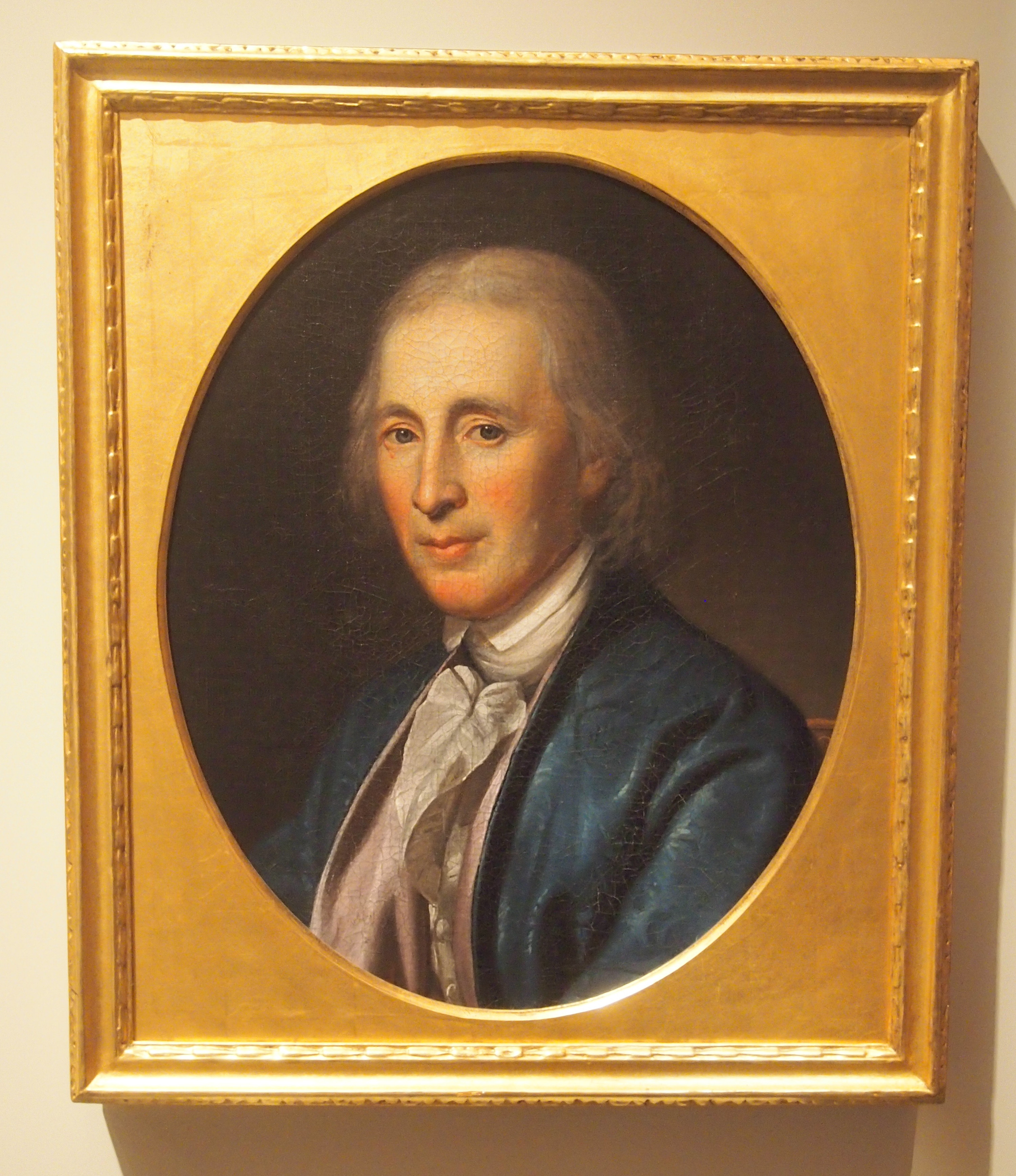
David Rittenhouse, Second Bank of the US

Talk about a lesser-known man of the Enlightenment. Of special interest to me is that he was a skilled astronomer — one of those worldwide who observed the Transit of Venus in 1769 — and first director of the U.S. Mint. Not only that, he built swell orreries and surveyed borders for mid-Atlantic states, including the half-circle border between Pennsylvania and Delaware.

“His scientific thinking and experimentation earned Rittenhouse considerable intellectual prestige in America and in Europe,” says the Penn University Archives & Records Center. “He built his own observatory at his father’s farm in Norriton, outside of Philadelphia. Rittenhouse maintained detailed records of his observations and published a number of important works on astronomy, including a paper putting forth his solution for locating the place of a planet in its orbit.

“He was a leader in the scientific community’s observance of the transit of Venus in 1769, which won him broad acclaim. He also sought to solve mathematical problems, publishing his first mathematical paper in 1792, an effort to determine the period of a pendulum. He also experimented with magnetism and electricity.”

Here’s John Dickinson, who didn’t support the Declaration. Later, though, he did his part for independence, and was a delegate in 1787.
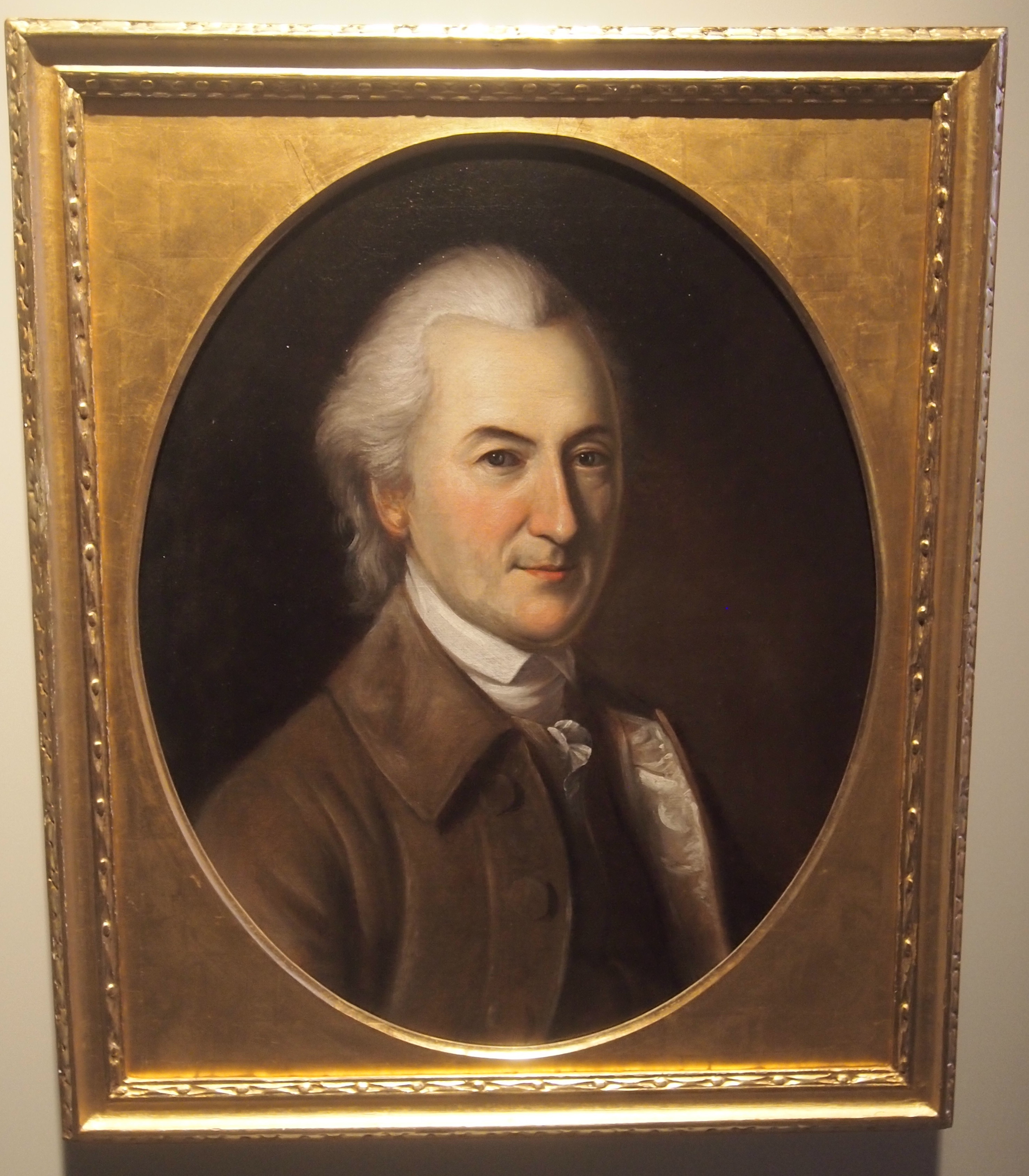
John Dickenson, Second Bank of the US

“On July 1, 1776, as his colleagues in the Continental Congress prepared to declare independence from Britain, Dickinson offered a resounding dissent,” says HistoryNet.

“Deathly pale and thin as a rail, the celebrated Pennsylvania Farmer chided his fellow delegates for daring to ‘brave the storm in a skiff made of paper.’ He argued that France and Spain might be tempted to attack rather than support an independent American nation.

“He also noted that many differences among the colonies had yet to be resolved and could lead to civil war. When Congress adopted a nearly unanimous resolution the next day to sever ties with Britain, Dickinson abstained from the vote, knowing full well that he had delivered ‘the finishing Blow to my once too great, and my Integrity considered, now too diminish’d Popularity.’ ”

Here’s a nice dramatization of that moment from John Adams, with Dickinson portrayed by Zeljko Ivanek.

This is Thayendanegea, also known as Joseph Brant, a Mohawk war chief who was decidedly not on the side of the colonists during the Revolution.
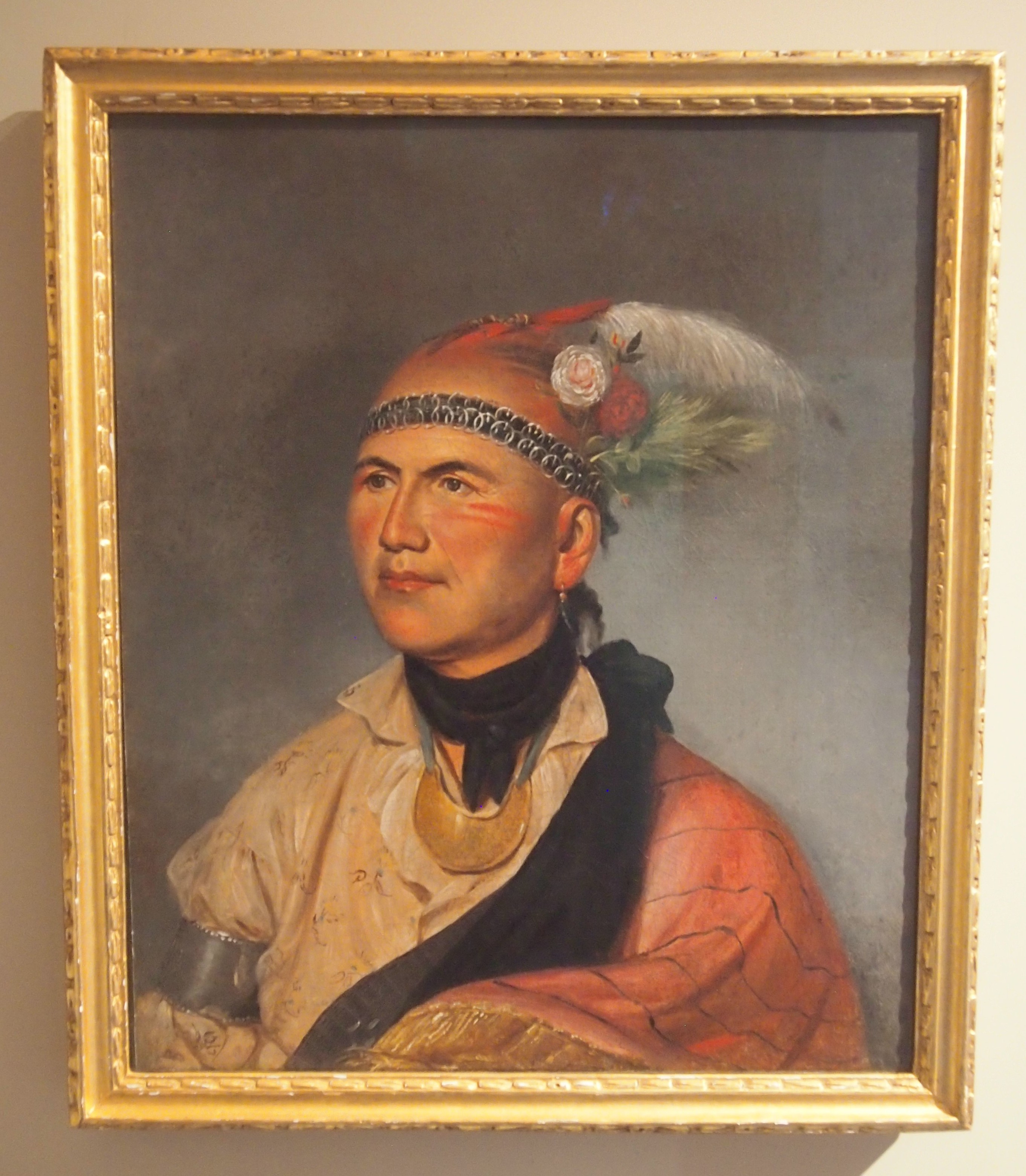
Thayendanegea, Second Bank of the United States

He was pro-British in the war, in that it served the interests of the Iroquois Confederation. Awfully even-handed of the gallery to include him, though it’s good to acknowledge his leadership skills, which apparently were many in war and diplomacy.

“The Mohawks chose to support the British because American colonists were already overrunning their lands,” says Upper Canada History. “The alliance was not unnatural as far as the Natives were concerned. For more than a hundred years, the Iroquois League had allied itself with the British in their long conflict with the Algonquins. Brant, Mohawk chief, had fought alongside the British in the Seven Years’ War and he remained loyal to the redcoats. This new alliance was really just a continuance of their long-standing cooperation…

“Brant fought with fierce determination against the Americans on the frontier and distinguished himself as one of their most courageous warriors and ablest strategists. His contribution to the cause did not go unrewarded. Of Brant’s loyalty and leadership, Lord Germain wrote, ‘The astounding activity of Joseph Brant’s enterprises and the important consequences with which they have attended give him a claim to every mark of our regard.’ In 1779 Brant received a commission signed by the king as ‘captain of the Northern Confederate Indians’ in appreciation of his ‘astonishing activity and success’ in the king’s service. Even though he esteemed his rank as captain, he preferred to fight as a war chief.”

After the Americans won the war, Thayendanegea led his people to Canada, with mixed results. He’s regarded highly enough in Canada to have been on a proof silver dollar in 2007, the bicentennial of his death.
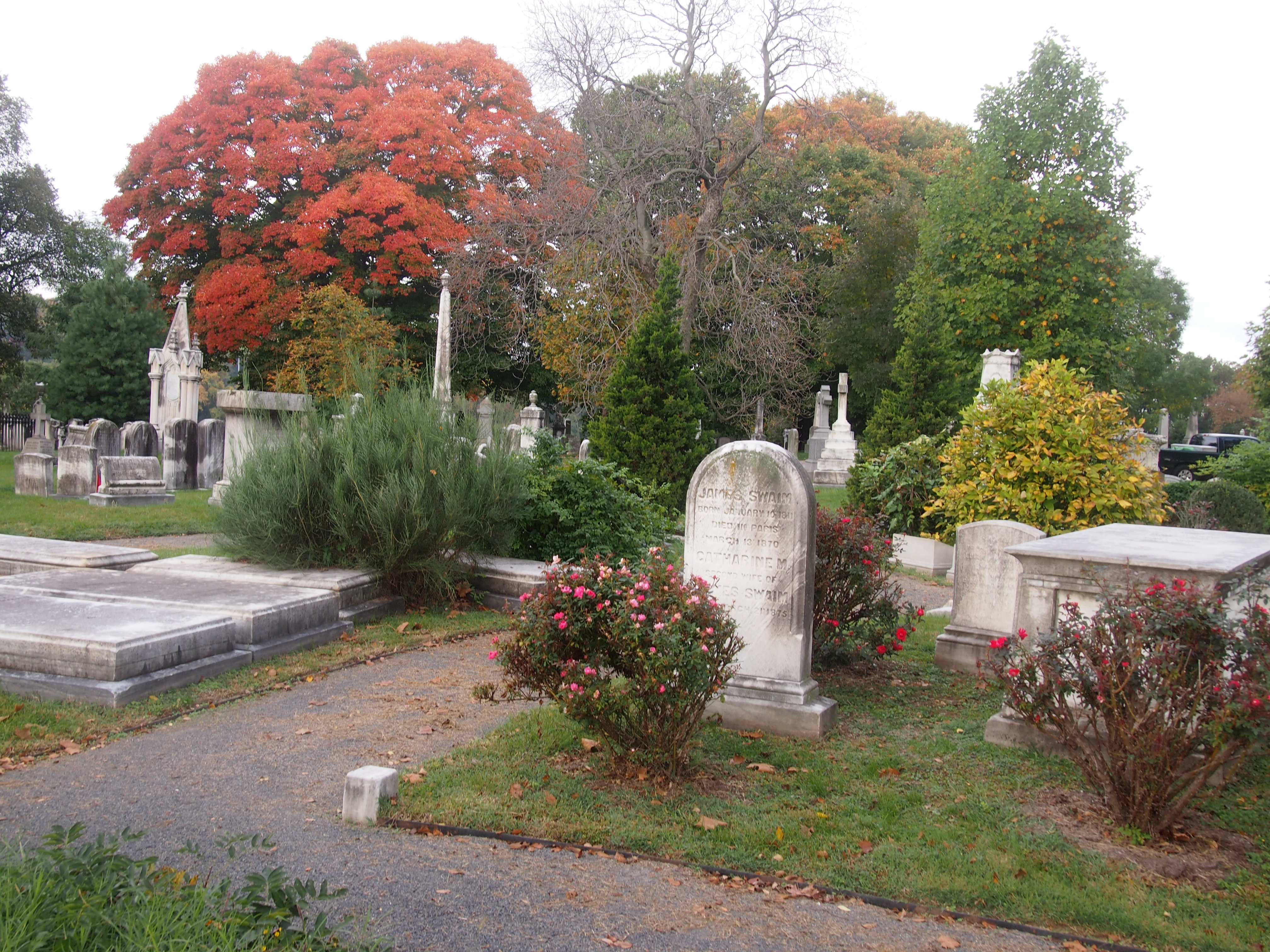
Laurel Hill Cemetery

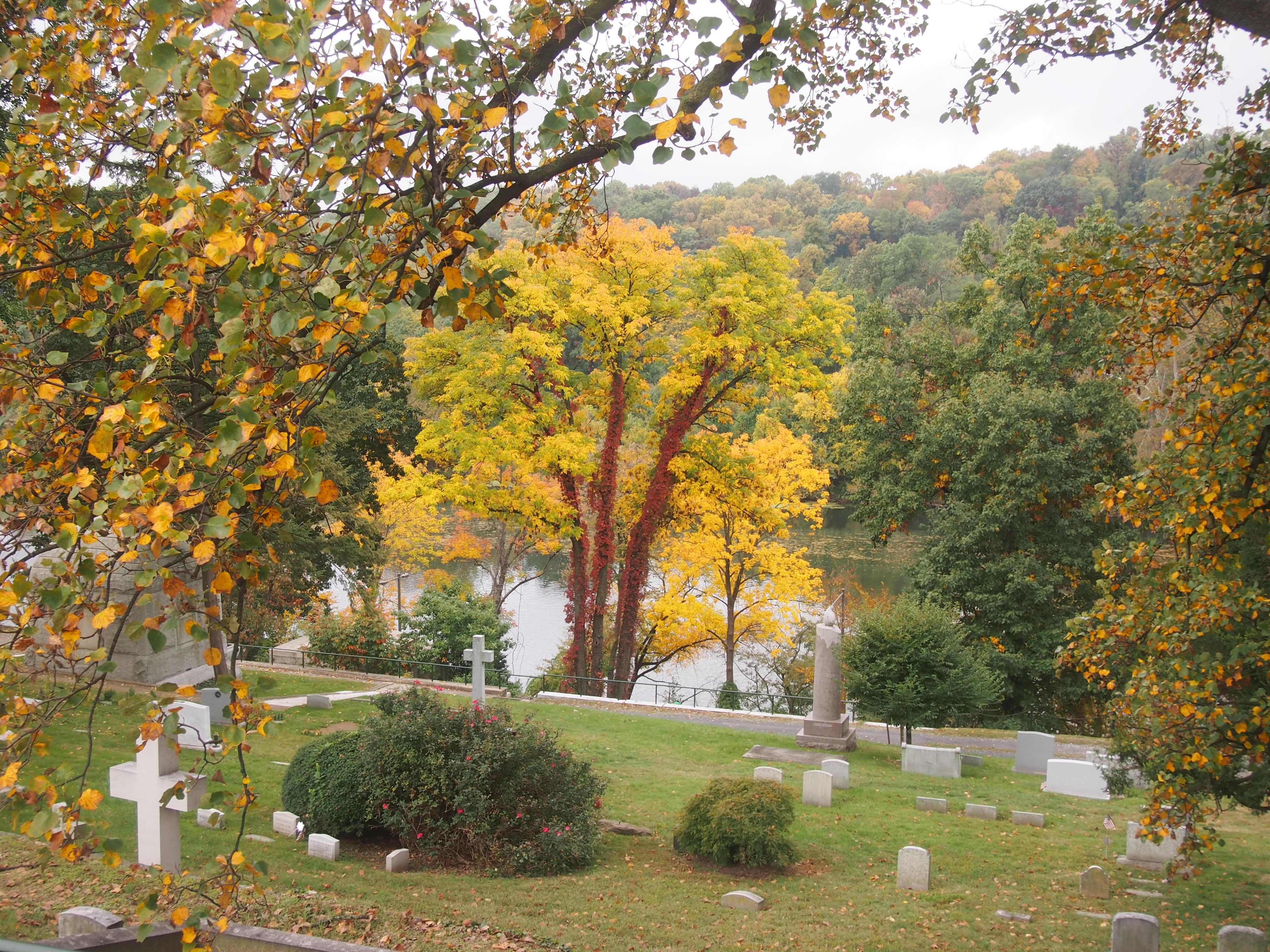
Laurel Hill Cemetery in Philadelphia is known as the second major rural cemetery in the country, dating from 1836. Its location isn’t remotely rural now, but in its early days the cemetery was outside the city on a sizable hill overlooking the Schuylkill River.

As the cemetery’s web site says, “Previously, churchyards were the only places available to bury the dead, and they were often as crowded and unsanitary as the streets that bordered them. Worse yet, rapid industrialization and population growth commonly led to the disinterment of burial grounds to make way for roads and buildings…. Laurel Hill was not only established as a permanent, non-sectarian burial place for the dead, but also as a scenic, riverside sanctuary for the living.”

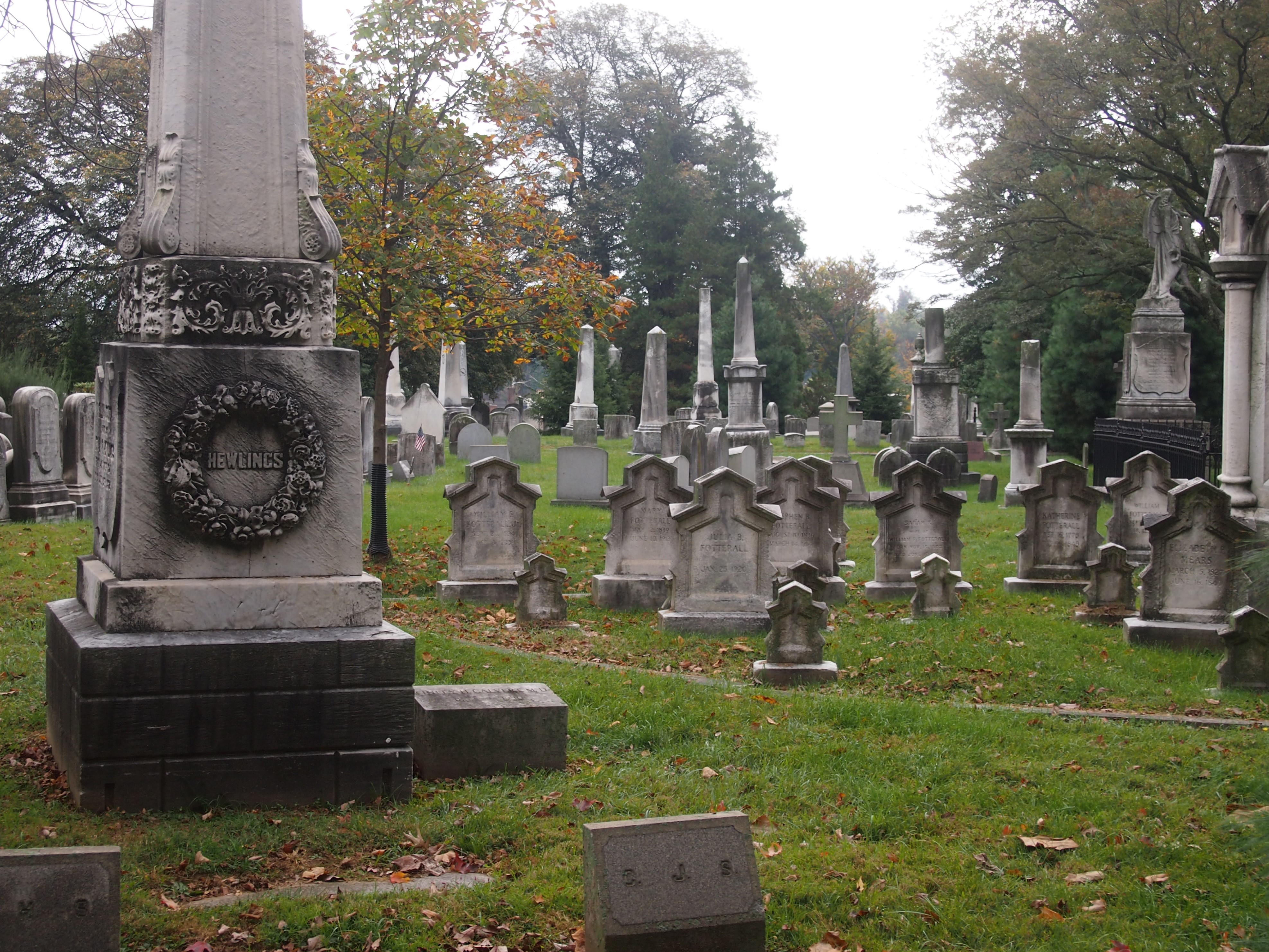
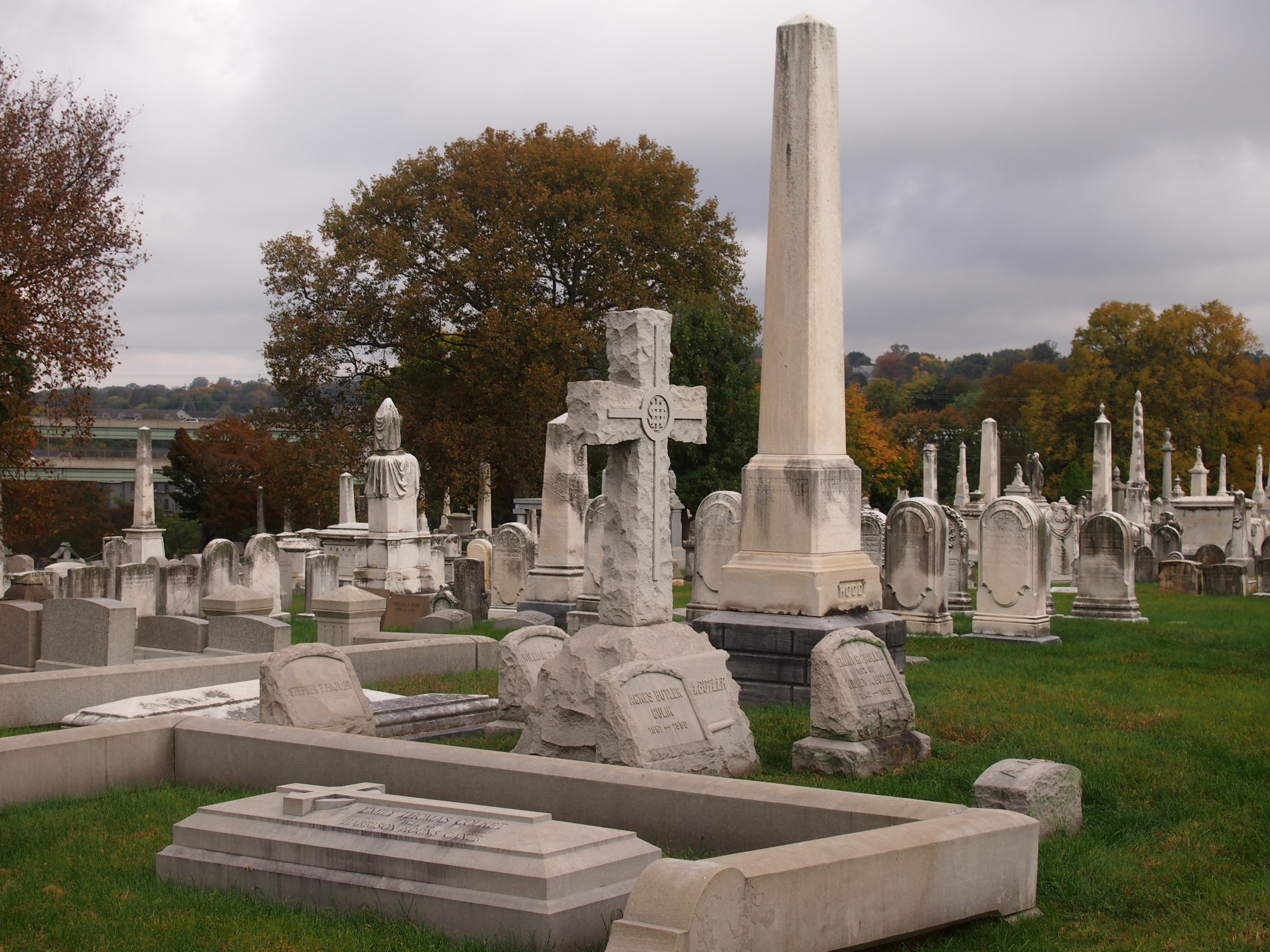
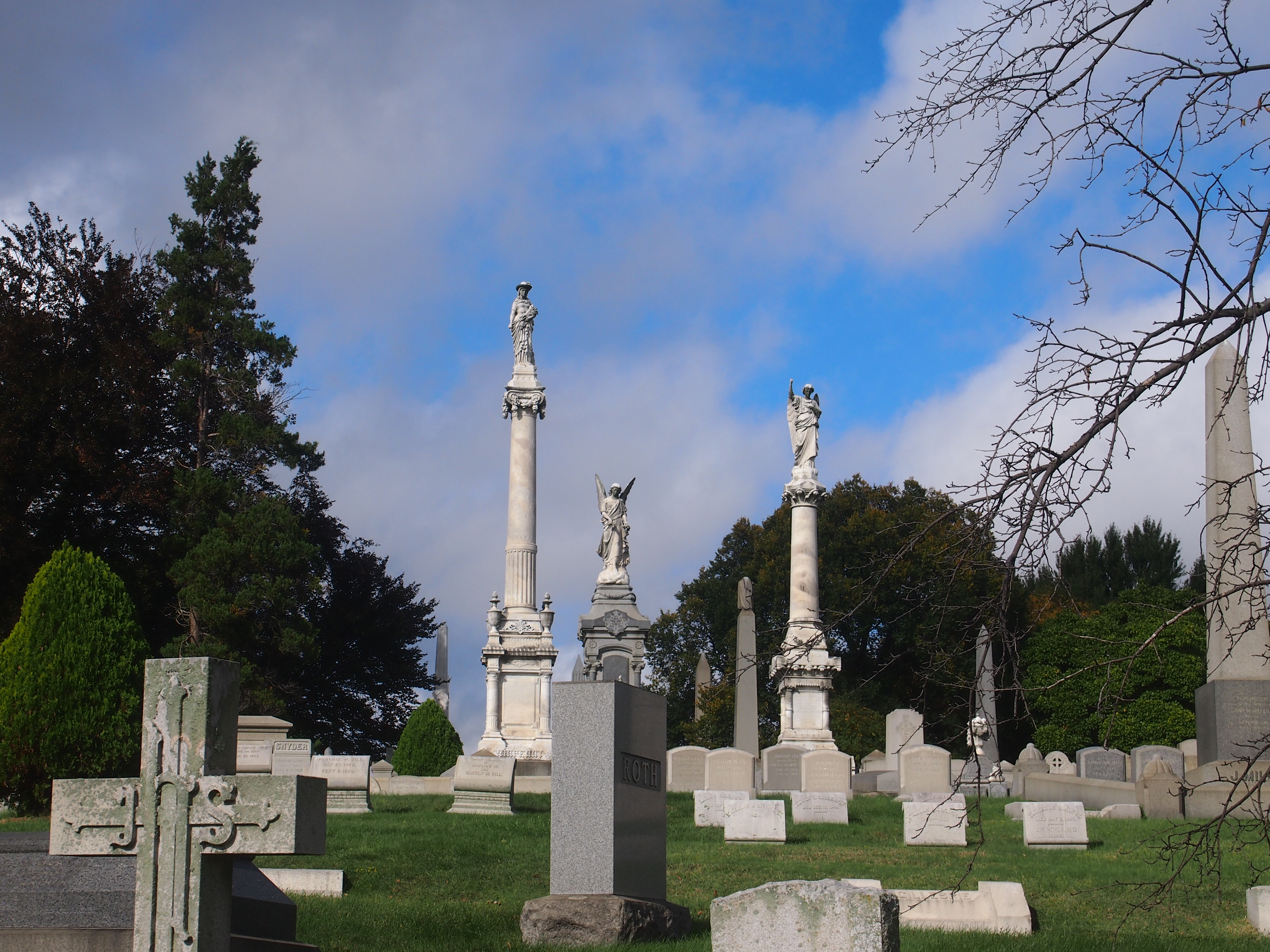
As the city grew around it, Laurel Hill itself become crowded, and it’s now a sizable necropolis with about 33,000 permanent residents in 74 acres. Many spots are lush with growth.Laurel Hill Cemetery 2016Trees grow on the slope down to the river.Laurel Hill Cemetery 2016Many parts are thick with stones.Laurel Hill Cemetery 2016Laurel Hill Cemetery 2016Some monuments reach toward the sky.
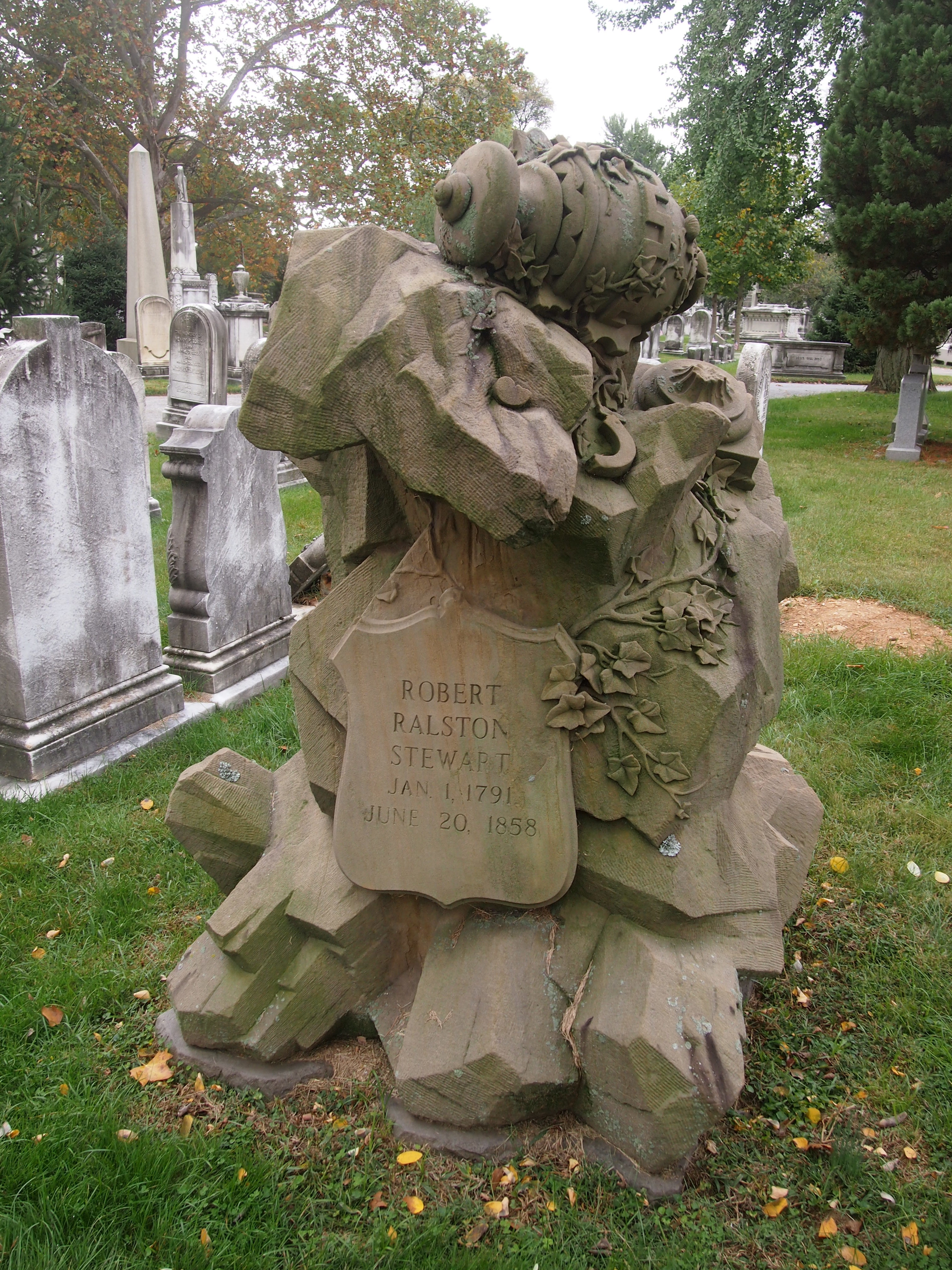
Laurel Hill Cemetery 2016There are less conventional stones. Find a Grave says that “the shattered urn symbolizes a violet death. Stewart was murdered by his manservant.”
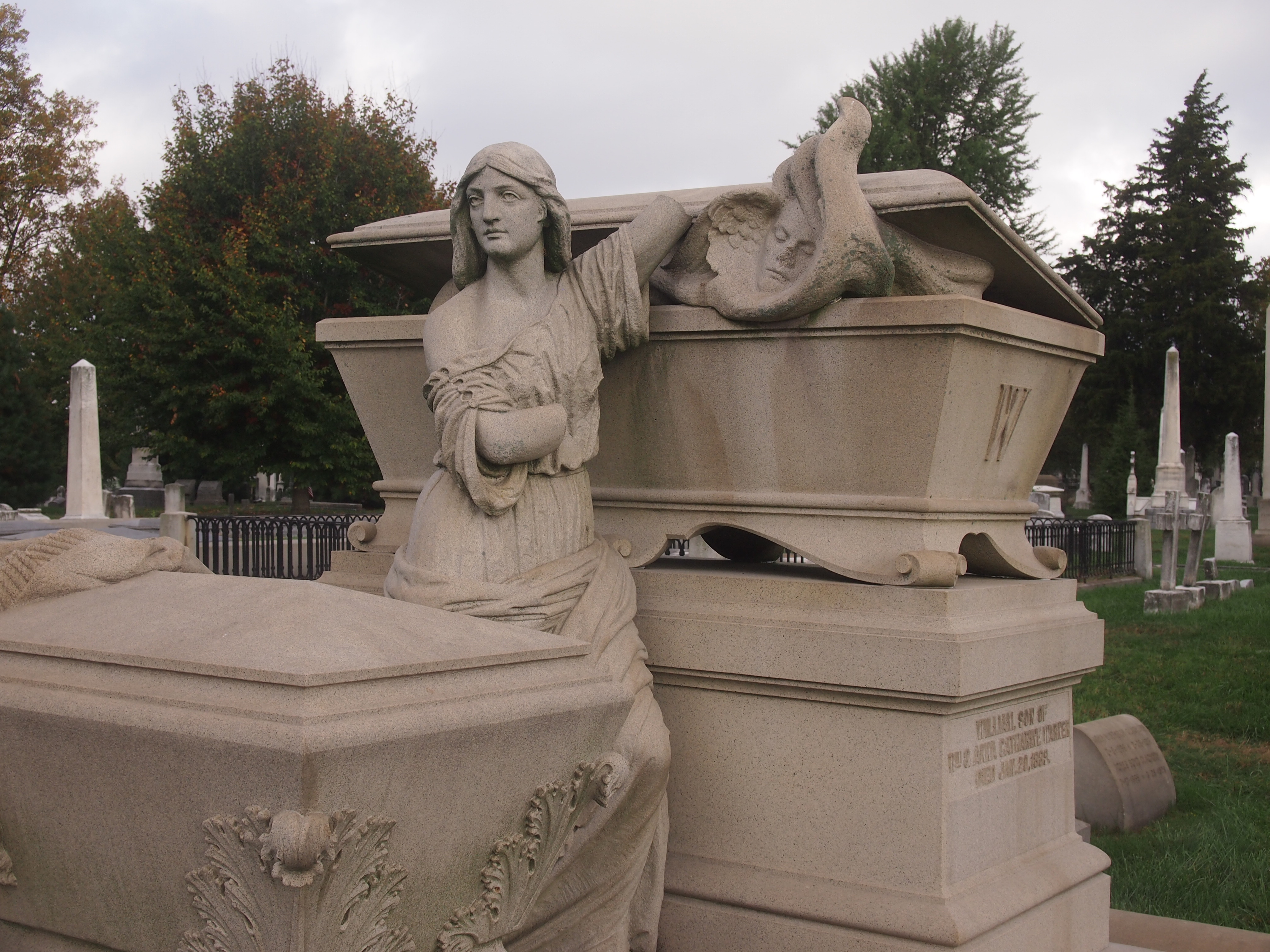
Laurel Hill Cemetery 2016The cemetery also has a large stock of striking funerary art, such as the Warner Memorial. Bellamorte.net says: “The Warner Memorial, sculpted by yet another Scottish craftsman, Alexander Milne Calder, shows a full-sized female figure opening a casket while the spirit of its male inhabitant slips free and takes wing. Sadly, the monument has been the target of vandalism over the years; both of the woman’s arms are missing as is the nose of the rising male spirit.”
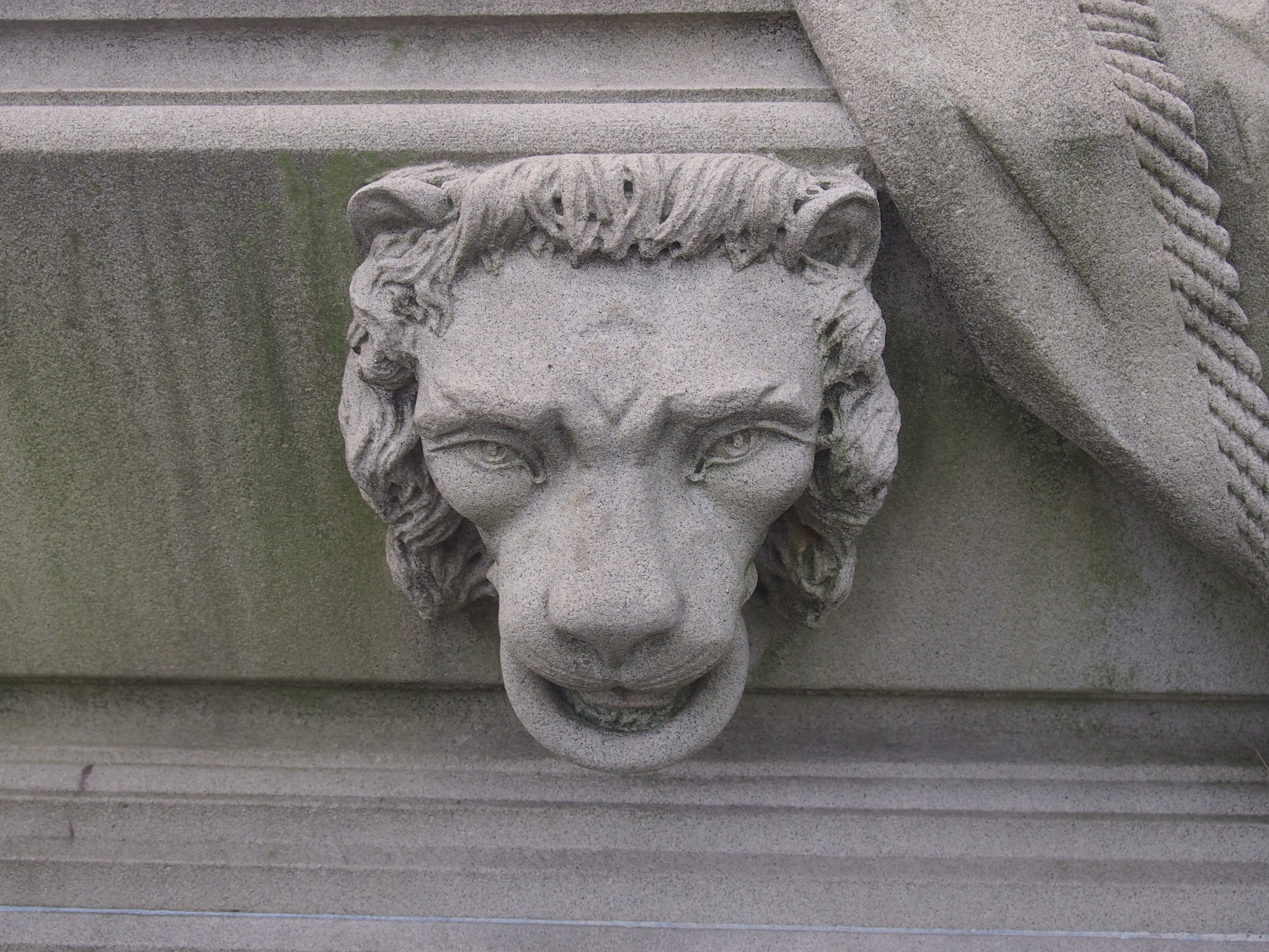
Laurel Hill Cemetery 2016Another detail from the Warner Memorial.
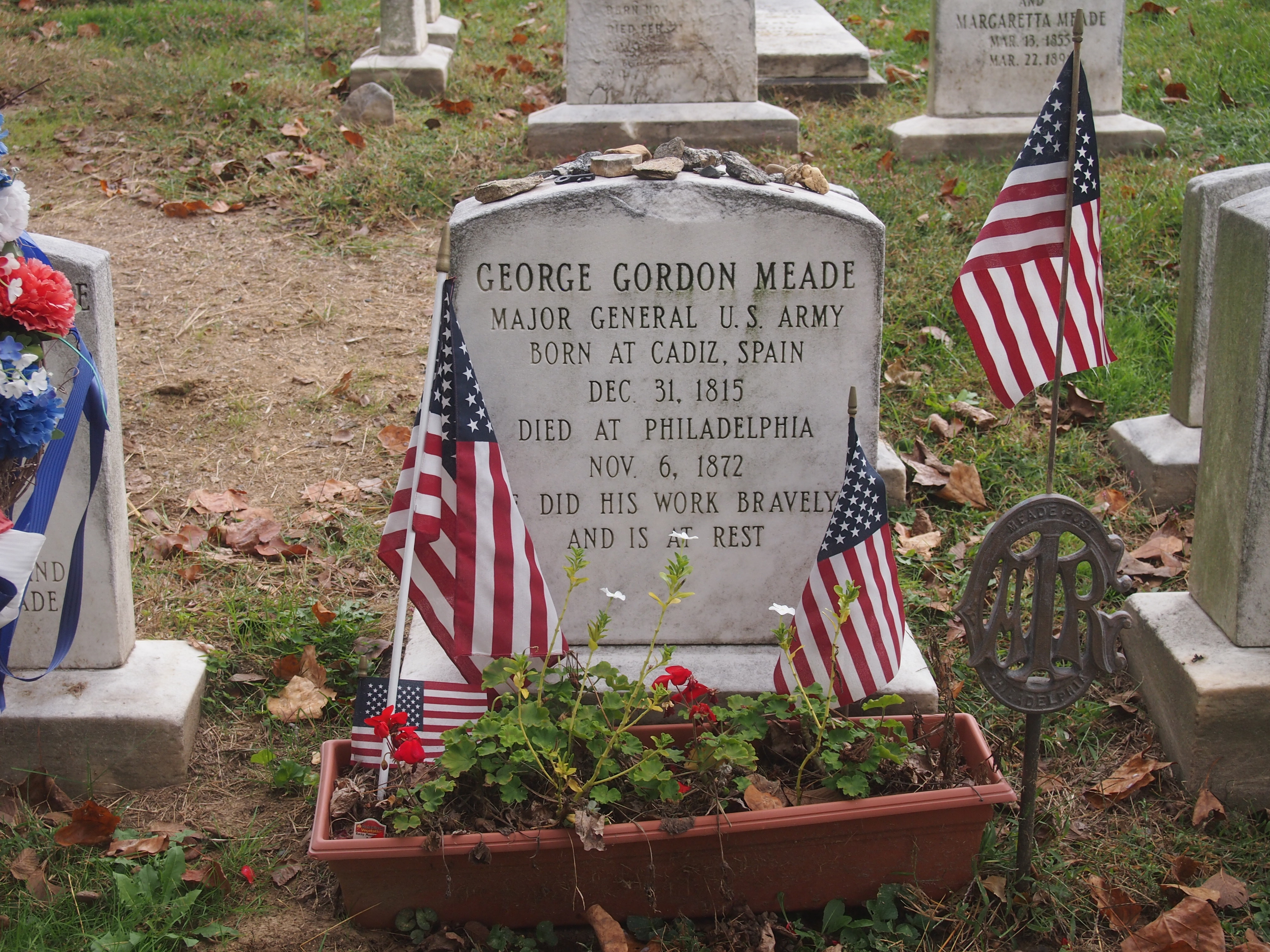
Laurel Hill Cemetery - Warner Memorial LionI didn’t seek out too many notable burial sites, except for Gen. George Meade, resident of the cemetery since 1872. He and some of his family have a spot with a nice view of the river, and I can report that people put stones on his grave.
Laurel Hill Cemetery - George Meade GraveOne of the oddest stones I saw belonged to Catharine Drinkhouse Smith and Levi Franklin Smith, a five-sided pillar (not four, as it says on Bellamorte.net). Mrs. Smith was a noted spiritualist of her time.

Her side of the stone said, with curious precision about some things: “Mrs. Catharine Drinkhouse Smith was born at Reading, Berks County, State of Pennsylvania, on Thursday, the Fifth day of August, 1824, at 15 minutes past 5 O’clock in the morning, and passed to spirit life 15 minutes before 12 O’clock the 27th day of March, 1893, from the residence of her husband, Professor Levi Franklin Smith, 2430 Thomson Street, Philadelphia, Pennsylvania. Mrs. Smith was a devoted Spiritualist, and one of the best mediums of her time, and accomplished great good, in spreading this beautiful truth, and in demonstrating a continuity of life.”

Another odd thing: the cemetery had a gift shop. Besides Arlington National Cemetery, I think that’s the only time I’ve run across that. The man behind the counter was an informative fellow, happy to talk about the place (and a bit about Professor and Mrs. Smith). I did my little part to support the cemetery by buying some postcards and a refrigerator magnet.

Ann Goes to New Places in Greater DC

I spoke more with Ann about her trip to DC, especially about some of the places that they visited that I never got around to for one reason or other, despite a number of trips to Reagan-era Washington, one visit in the mid-90s, and our week in the city in 2011. The kids had the advantage of someone else handling all the logistics, with buses to take them around, so they got around.

For instance, last Saturday morning they went as far afield as Annapolis, where the place to go is the U.S. Naval Academy. Ann says she was particularly impressed with the tomb of John Paul Jones. I asked her about the Stribling Walk and her eyes got a little wide, remembering that she’d seen that too.

I told her about Rear Admiral Cornelius Kinchiloe Stribling, who had a long career in the antebellum U.S. Navy, and when the war came, sided with the Union, despite being a native of South Carolina. His son John, however, joined the Confederate Navy and died in its service. At one point in his career, he was superintendent of the Naval Academy, and apparently was well regarded.

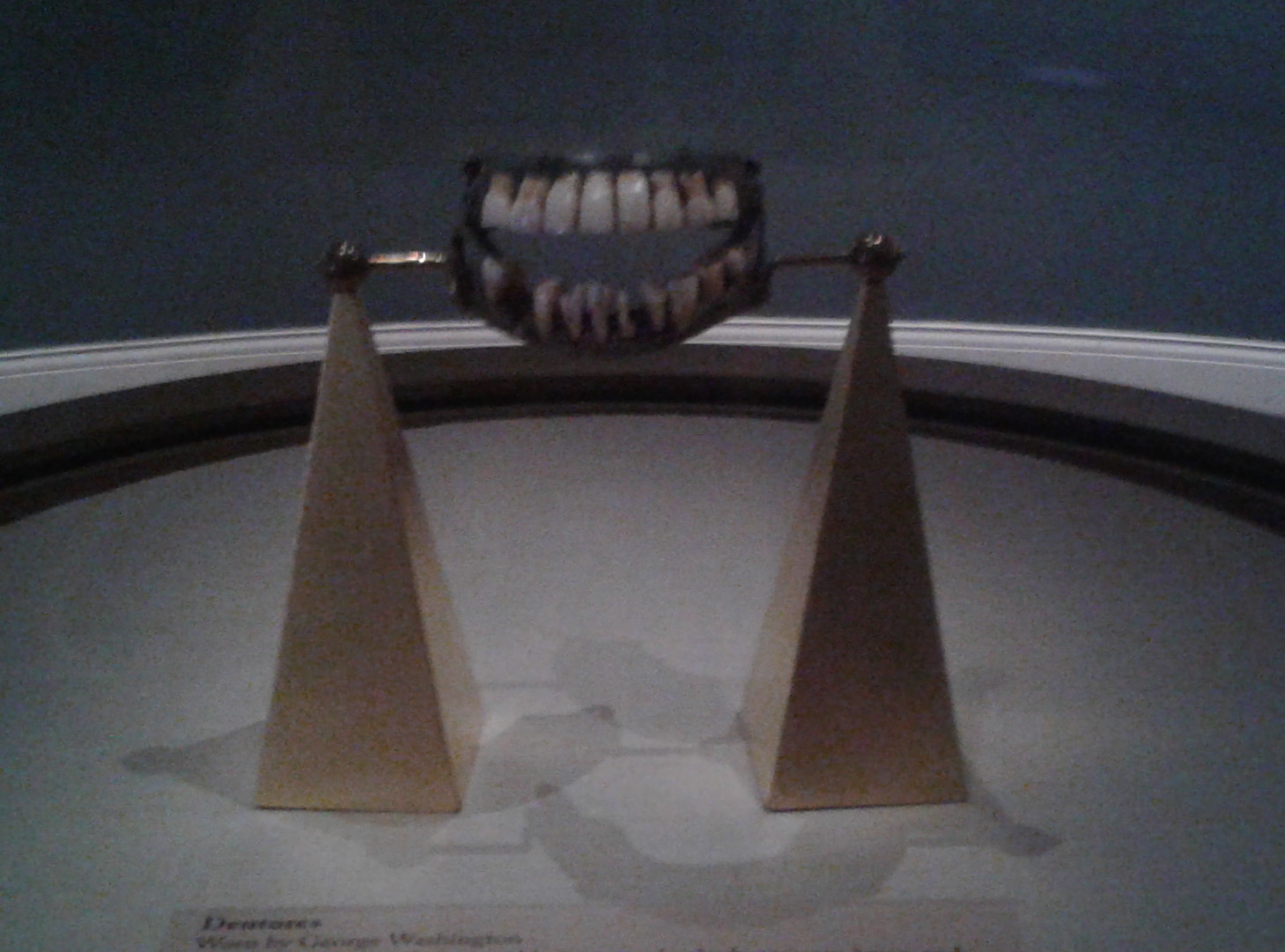
Also, the kids made it to Mount Vernon. So did I, once upon a time. When I got there, the place was closed — by the shutdown of the federal government in early 1995. Ann got to see George Washington’s teeth, among other things. Looks painful to wear.

Washington's teeth, Mount Vernon

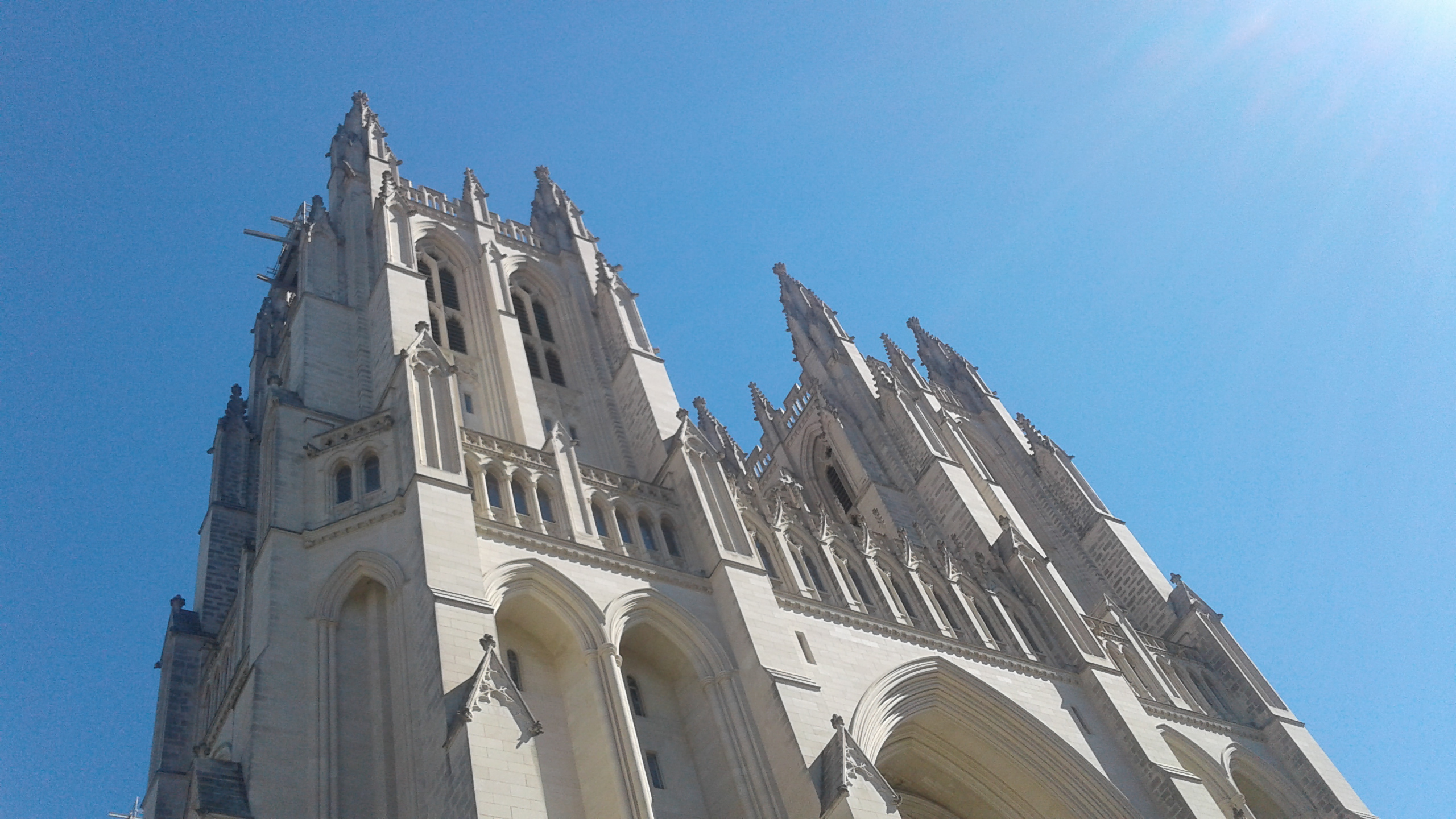
They also went to the Washington National Cathedral, formally the Cathedral Church of Saint Peter and Saint Paul in the City and Diocese of Washington. In 2011, we opted to go to the Basilica of the National Shrine of the Immaculate Conception instead, because the basilica is within walking distance of a Metro station, while the cathedral is not.

Ann said she admired the design, both interior, for its intricate carving, and vaulting exterior.

National Cathedral 2016

The tour group also hit all of the major war memorials on the National Mall: WWII, Korea and Vietnam. By the time we got around to that part of the Mall in 2011, it was dark, so we really didn’t see Korea or Vietnam, though I remember seeing the Vietnam memorial in the mid-80s, when it was new and remarkably striking; the Korean memorial wasn’t finished until the mid-90s.

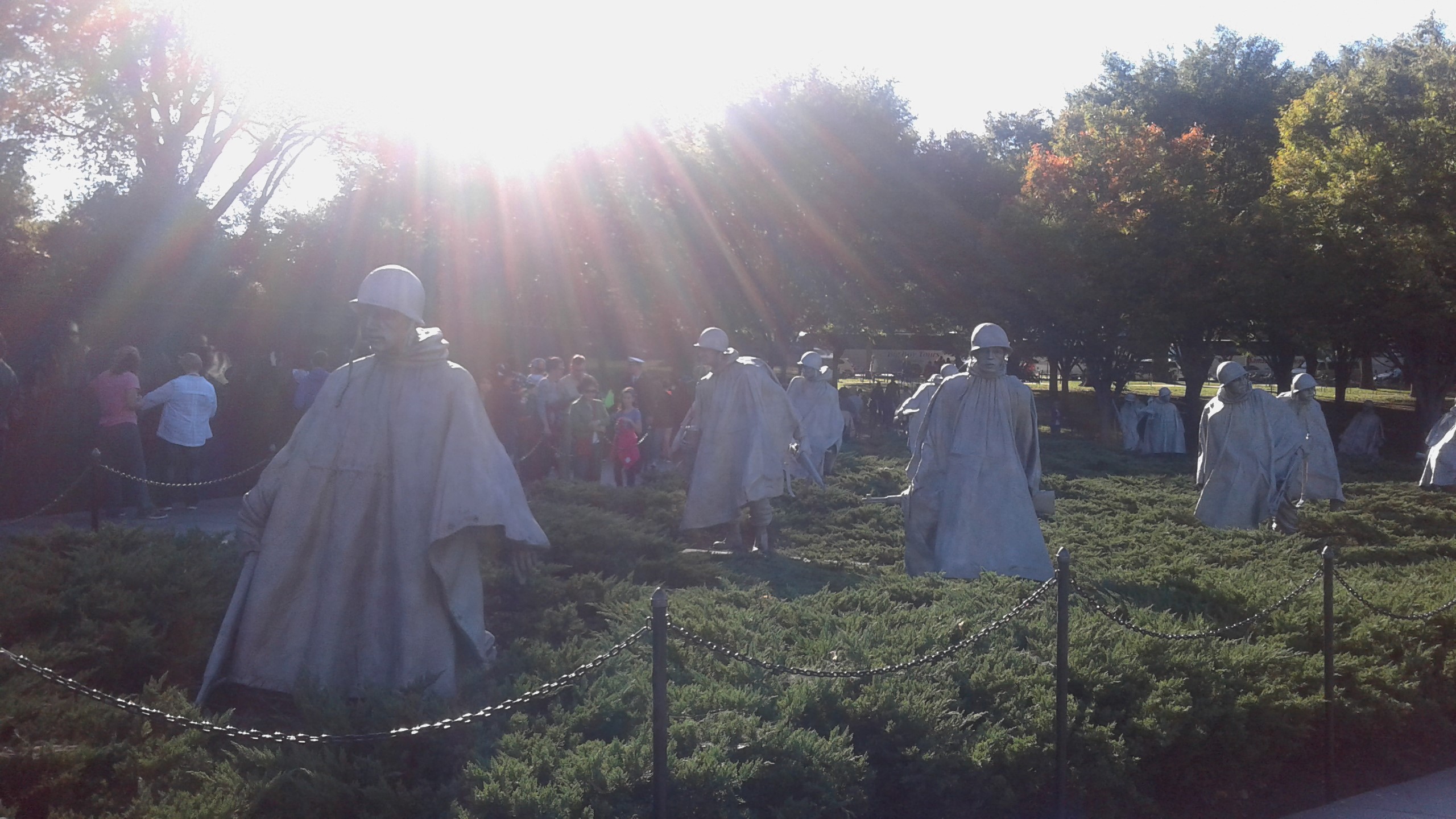
This is part of the Korean War Veterans Memorial, as Ann saw it in the morning.

Korean Veterans memorial Dc 2016

Each of the stainless steel soldiers, I’ve read, weighs about 1,000 lbs., and include members of each service, though are mostly Army. Sculptor Frank Gaylord did them.

Kankakee Walkabout

For no charge, the Kankakee County Convention & Visitors Bureau will send you a 24-page booklet (six forms of four pages each) called “Historic Churches of the Kankakee Area Self-Guided Walking and Driving Tour.” It’s a high-quality, full-color bit of work, with some text, a few maps and a lot of interior and exterior pictures of Kankakee-area churches, such as Asbury United Methodist, Wildwood Church of the Nazarene, First Presbyterian, St. Paul’s Episcopal, and others.

There’s also a few interesting historical tidbits about some of the buildings. This is my favorite, about St. Paul’s: “Divine intervention spared the stained glass windows during two great hail storms in 1932 and 1982.”

The churches weren’t the only reason we went to Kankakee on Saturday, braving intermittent rain, but as long as we were going to be in the area, I wanted a look. Ideally, a look inside a few of the churches, including divinely protected stained glass, but I suspected that would be impossible. We went to four of them, all in walking distance of the Kankakee County Courthouse, and none were open.

I understand the reasons. Things would go missing if they didn’t lock up most of the time. Still, it was irritating. We did get a look at the outsides, some of which are impressive enough, such as Ashbury United Methodist, which dates from 1868.

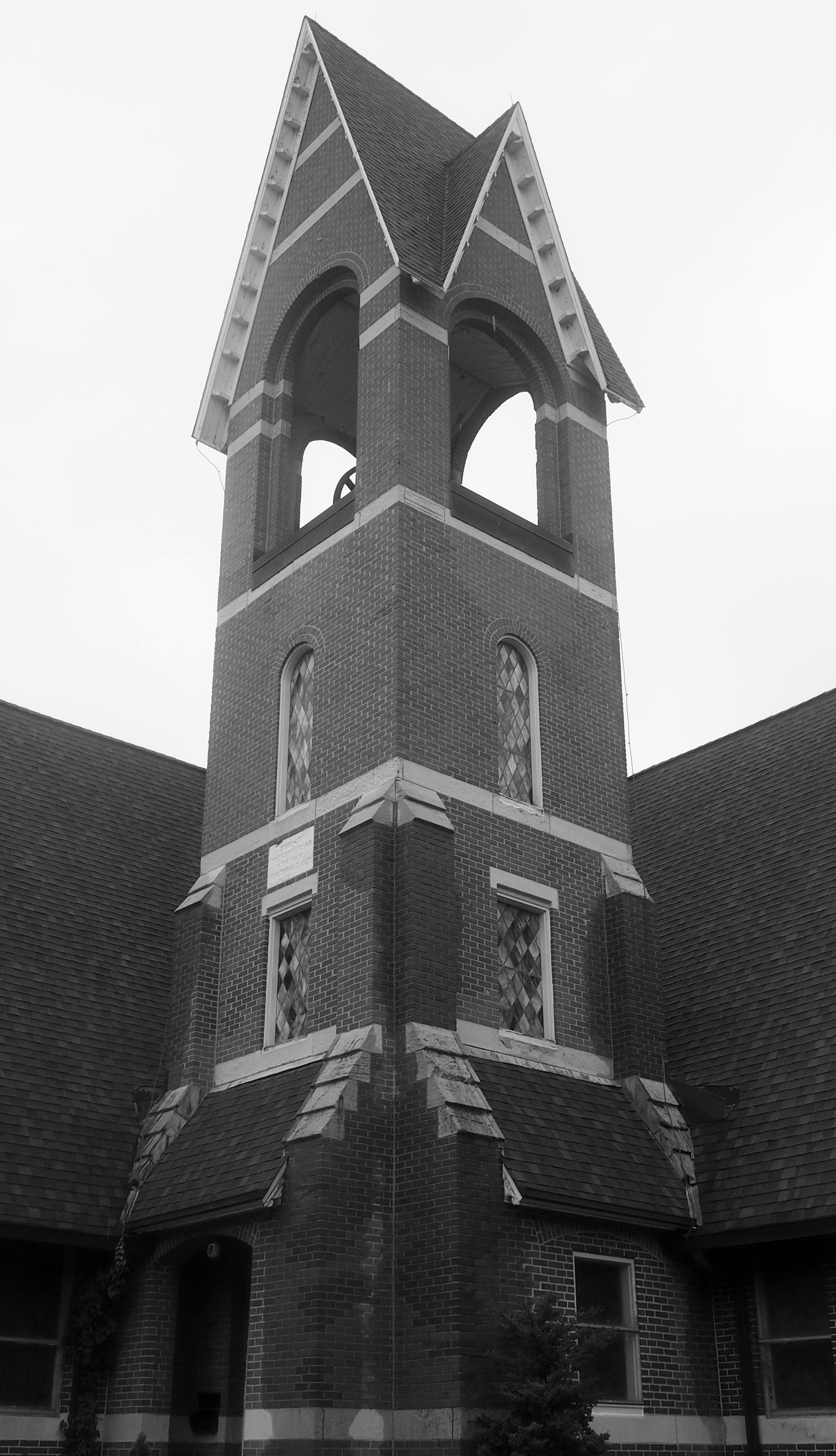
Ashbury United Methodist, Kankakee 2016I liked the bell tower of First Presbyterian, vintage 1855. According to the booklet, its 2000-lb. bell is rung by hand on Sundays.
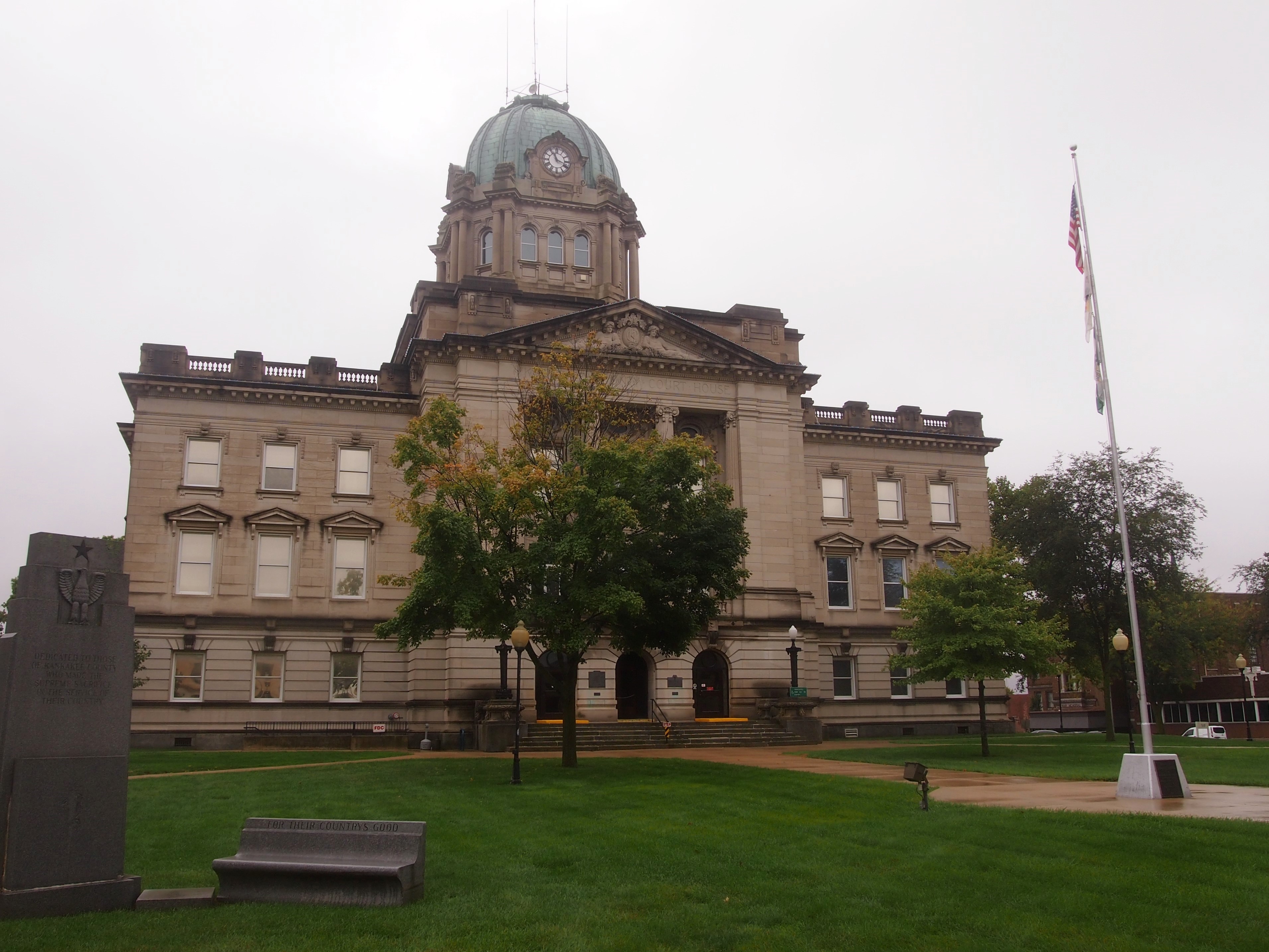
First Presbyterian Church of Kankakee 2016Churches weren’t the only buildings of note. This is the Kankakee County Courthouse, standing on this site since 1912.
Kankakee County Courthouse 2016The architect who designed it, Zachary Taylor Davis, ought to be better known in Chicago, considering that he also did the original Comiskey Park (gone) and the still-beloved and still-standing Wrigley Field. It should also be remembered that lunch-counter baron Charlie Weeghman commissioned that ball park for his team, the Chicago Whales of the Federal League.

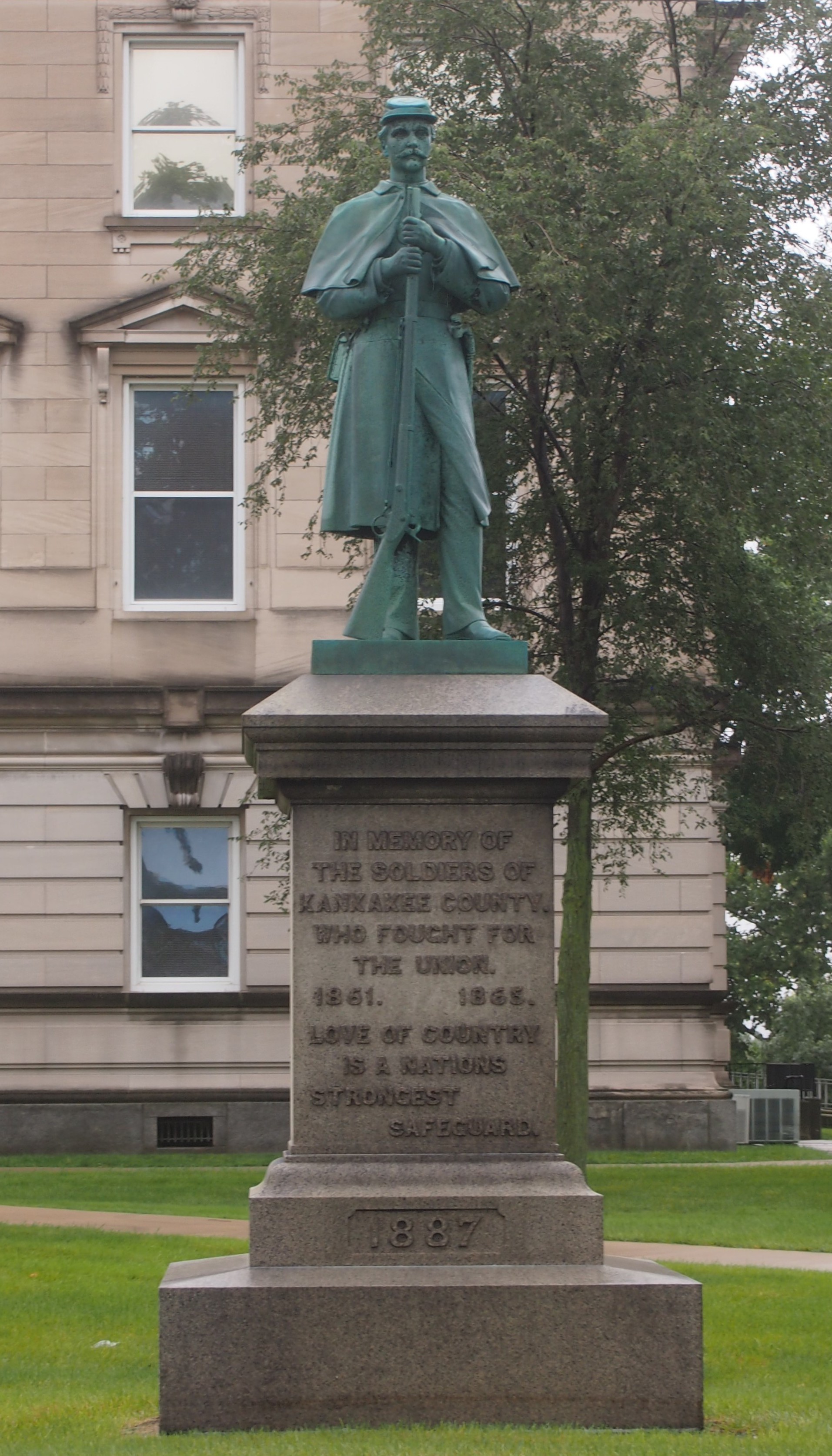
The courthouse statute, dated 1887. As you’d expect, “In memory of the soldiers of Kankakee County who fought for the Union.”
Kankakee County Courthouse statue 2016One more Kankakee County structure, just south of the courthouse: the brutalist county “detention center.”
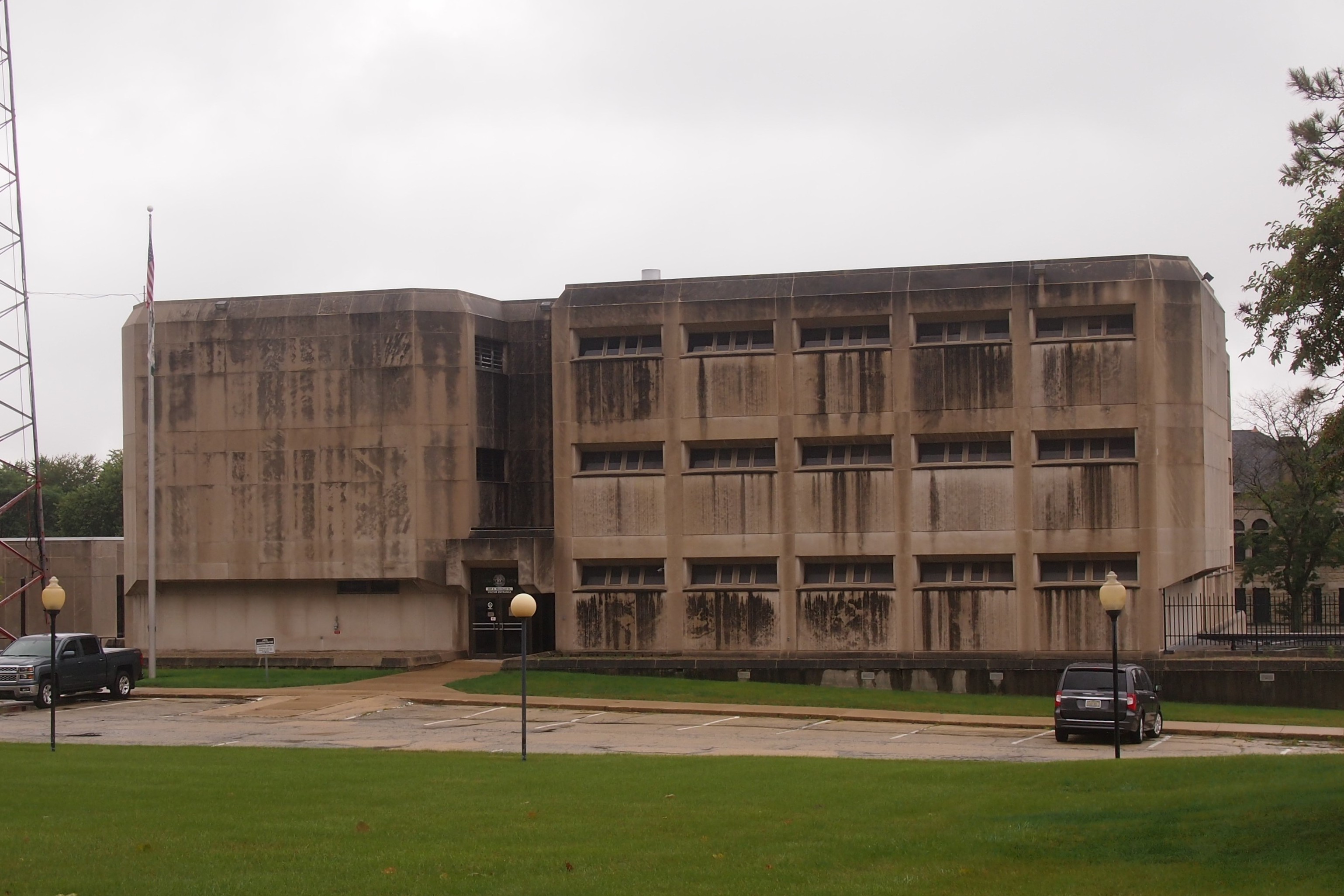
Kankakee County jailThe jail, that is. Detention is what you get in school. Otherwise it’s just official euphemism.

Museum of Contemporary Art, Chicago

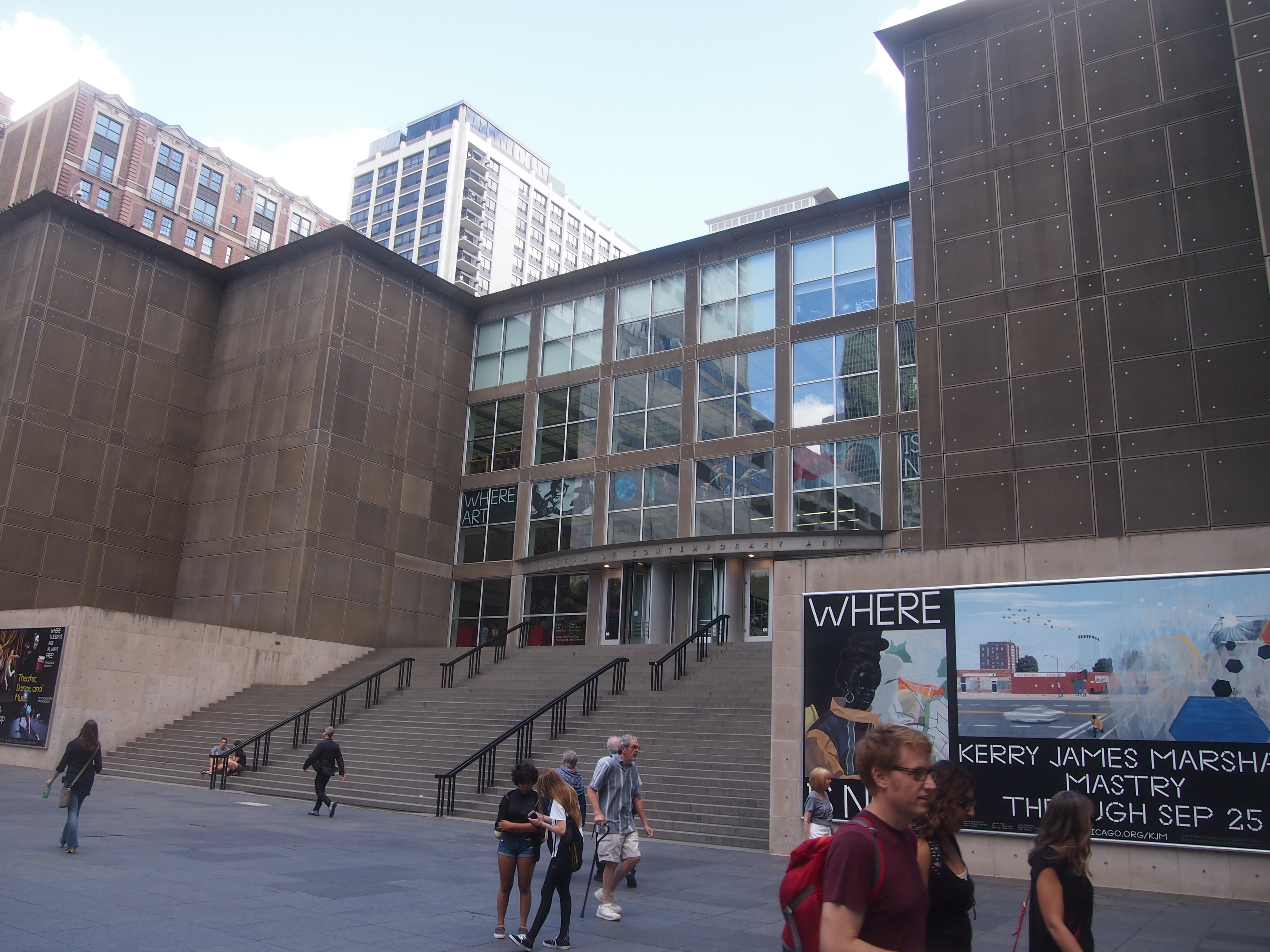
A docent at the Museum of Contemporary Art (MCA), Chicago, asked me how long it has been since I last visited the museum. I couldn’t remember. I’m pretty sure it was sometime after the current building opened 20 years ago, though I couldn’t say when, or what I saw. Reason enough to visit again on a pleasant September Saturday in 2016.

Encyclopedia Chicago says that “the new building clad in aluminum and Indiana limestone opened in June 1996 in a 24-hour summer solstice celebration. Referencing the modernism of Mies van der Rohe as well as the tradition of Chicago architecture, the $46 million structure is among the largest in the United States devoted to contemporary art. Its 45,000 square feet of galleries, with a permanent collection boasting more than 5,600 works and a 300-seat auditorium and outdoor sculpture garden, is suitable for large-scale artworks, new media, and ever larger audiences.”

Maybe so, but the structure, designed by German architect Josef Paul Kleihues, presents an unfriendly face to the public.

Museum of Contemporary Art. ChicagoI don’t dislike it, exactly, but it doesn’t say art museum to me. Change the signage just a little and you’ve got a police headquarters, a telecom company, or a top-drawer server farm. Then again, art museums don’t have to look like the Art Institute either. MCA is what it is on the outside, and an interesting museum on the inside.

The inside is more welcoming. One example: MCA has some of the more comfy chairs — small sofas enclosed by spacious cubical-like structures — of any museum I’ve been to. Toward the end of our visit, if we’d stayed too long in one of these after so much time on foot, we might have fallen asleep.

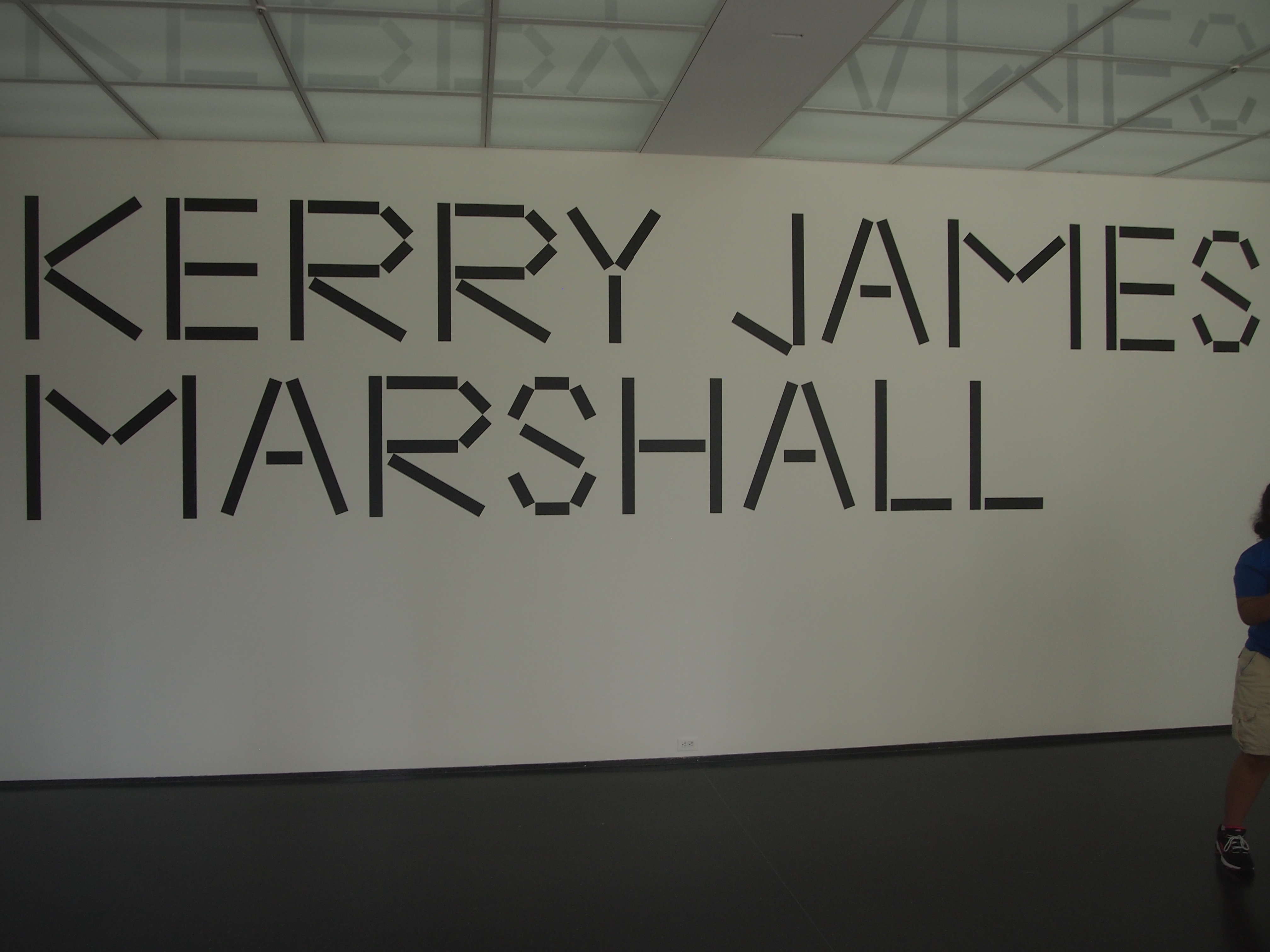
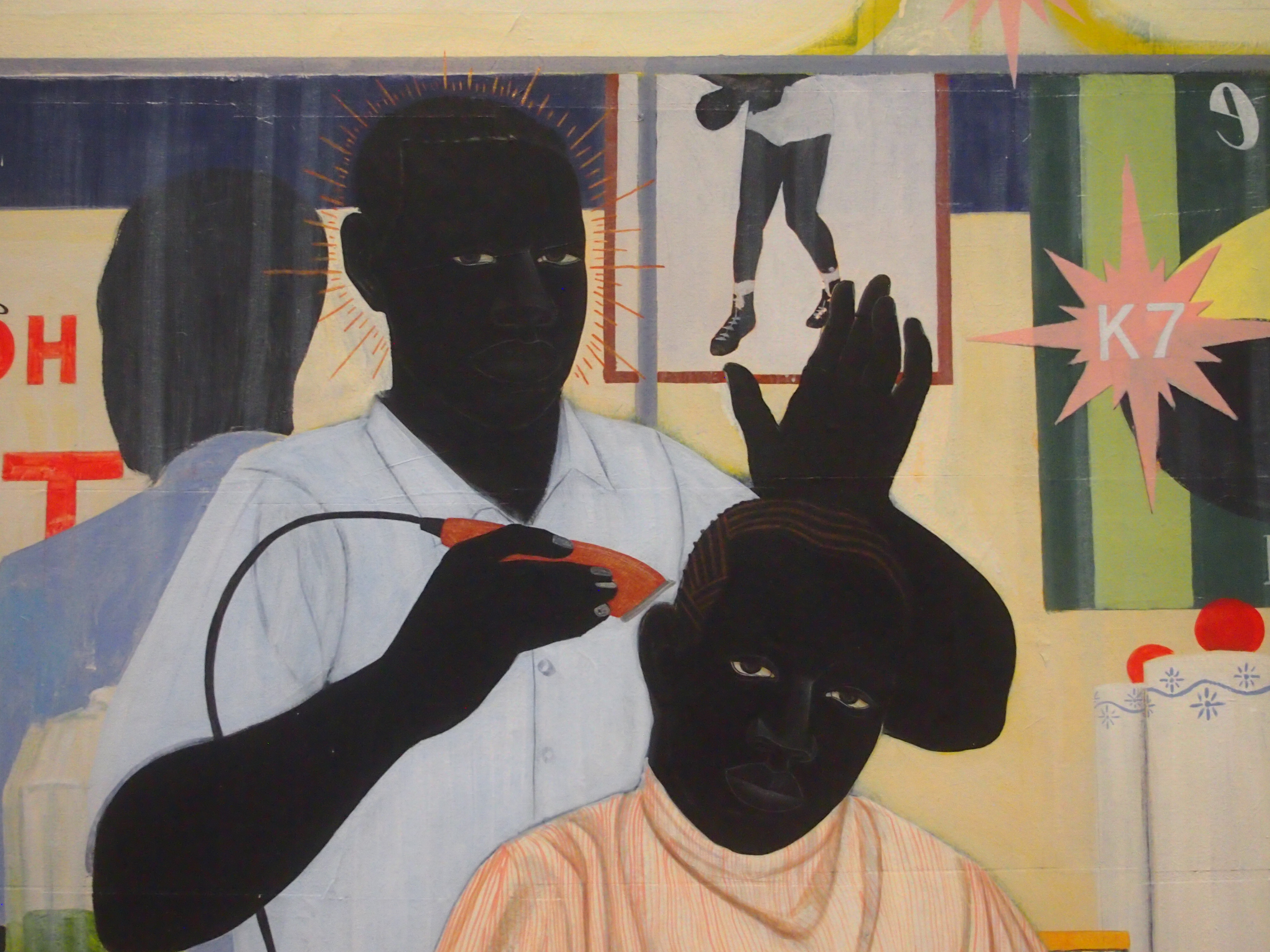
Museum of Contemporary Art ChicagoCurrently the big MCA exhibit is of Kerry James Marshall, an artist I was wholly unfamiliar with, in a show called “Mastry.” That just shows how little I pay attention to contemporary art. He’s a living artist, only a few years older than I am, and a resident of Chicago’s Bronzeville neighborhood. A remarkable body of his work is on display.

Of Marshall, Sam Worley wrote in the April edition of Chicago magazine this year, just before the MCA show opened, “At 25, he decided to return to the basics and paint a self-portrait—a classic portrait, almost. Its title alluded to a great literary work: ‘Portrait of the Artist as a Shadow of His Former Self.’ [1980]

“Marshall used egg tempera, a 13th-century favorite. He adopted compositional techniques associated with artists such as Michelangelo, Leonardo da Vinci, Raphael. But, of course, his subject was black. So black that the shade of his skin is deeper than the portrait’s black background, which he fades into, as if invisible. Compared with conventional European portraiture, it’s like a photo negative….

“And so Marshall settled on creating a body of work inspired by and in dialogue with the classics—his early barbershop portrait ‘De Style,’ for example, its name a sly play on the Dutch abstract art movement de Stijl—while remaining resolutely its own thing. He found success with a simple insistence on placing black people, and black history, at the center of his raucous, colorful paintings, and that has opened a space for younger artists.”

A detail from “De Style” (1993).
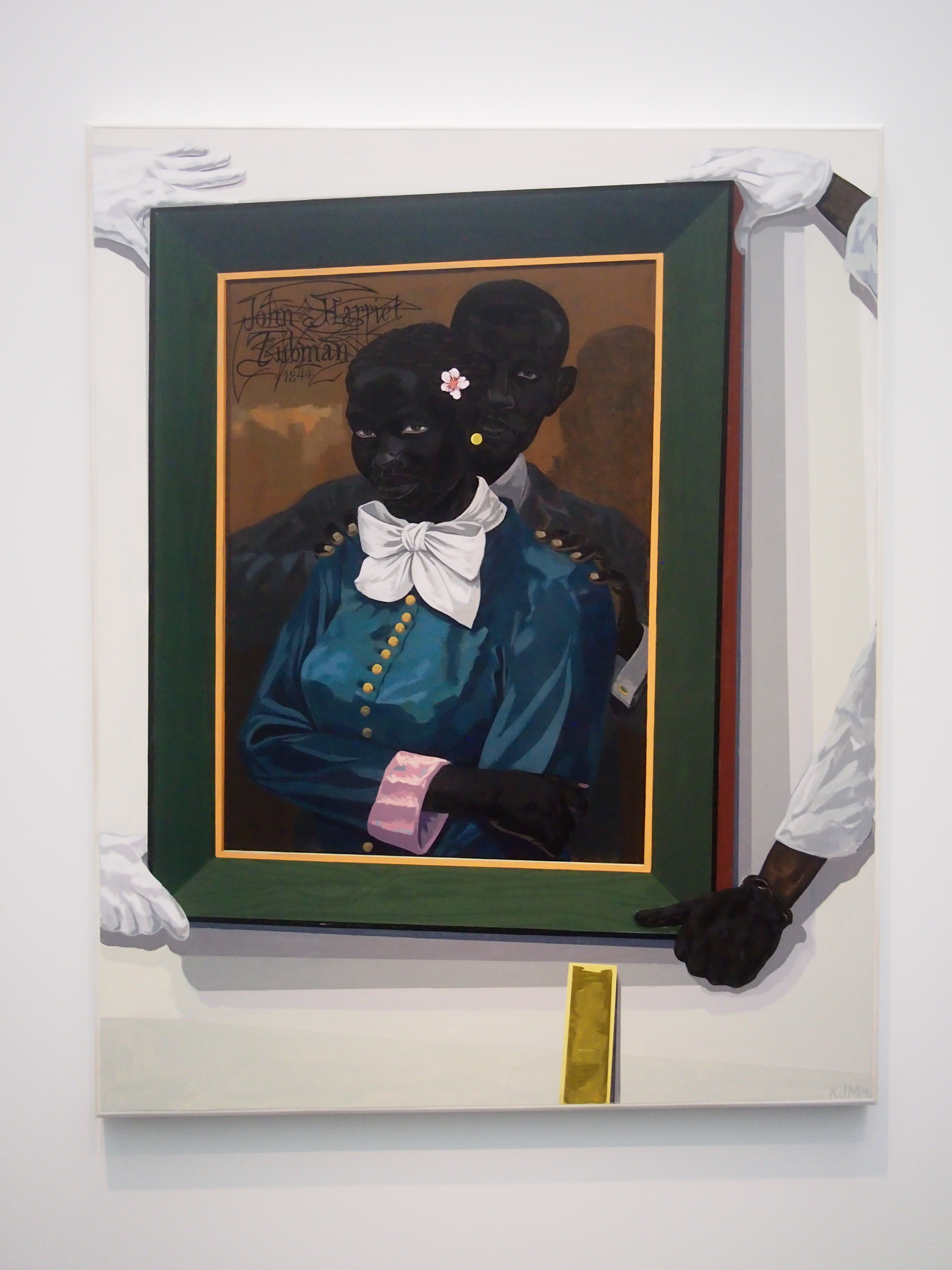
Here’s one I particularly liked, a more recent painting, “Still Life with Wedding Portrait” (2015).

“In this painting, Marshall imagined a wedding portrait of a young Harriet Tubman… and her first husband, John… presenting her as someone’s beloved wife and not simply the stalwart resistance hero portrayed in standard histories,” the MCA notes.

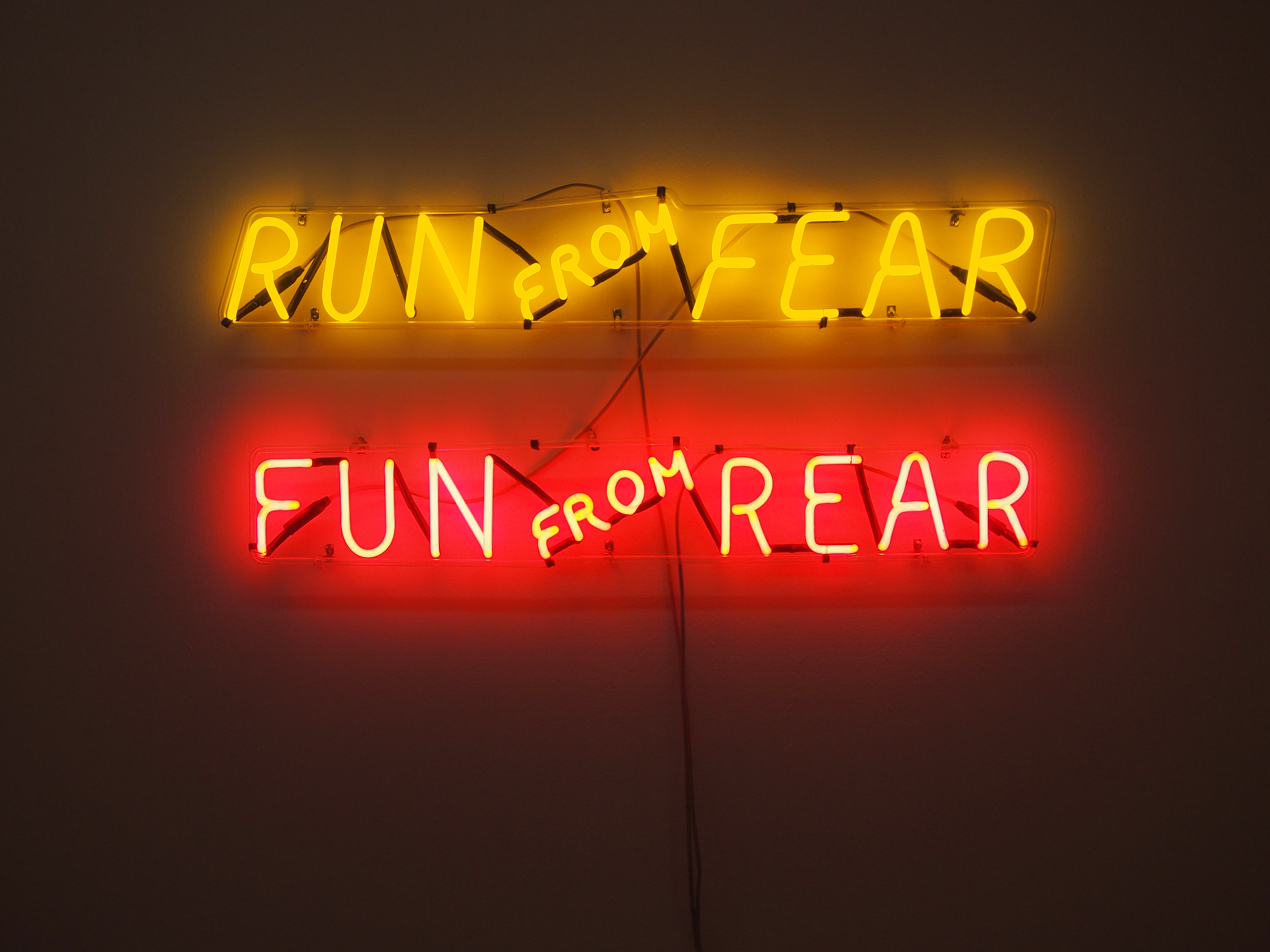
As interesting as the Marshall show was, we also made time for other galleries. I always enjoy a spot of neon.
“Run From Fear, Fun From Rear” (1972) by Bruce Nauman.

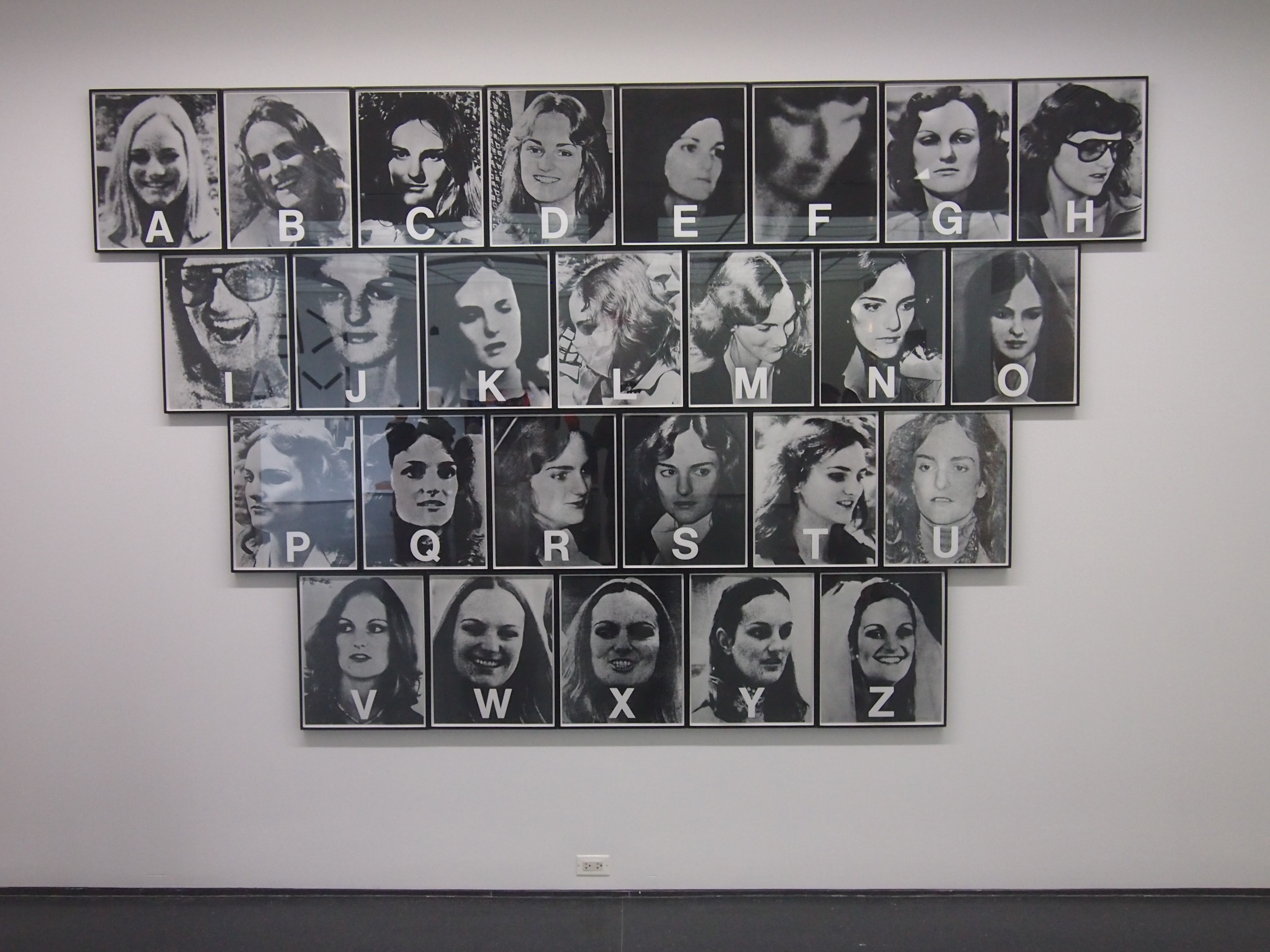
Here are all the portraits of Patty Hearst you could want in one place. Twenty-six, to be exact.
“Patricia Hearst, A thru Z” (1979) by Dennis Adams.

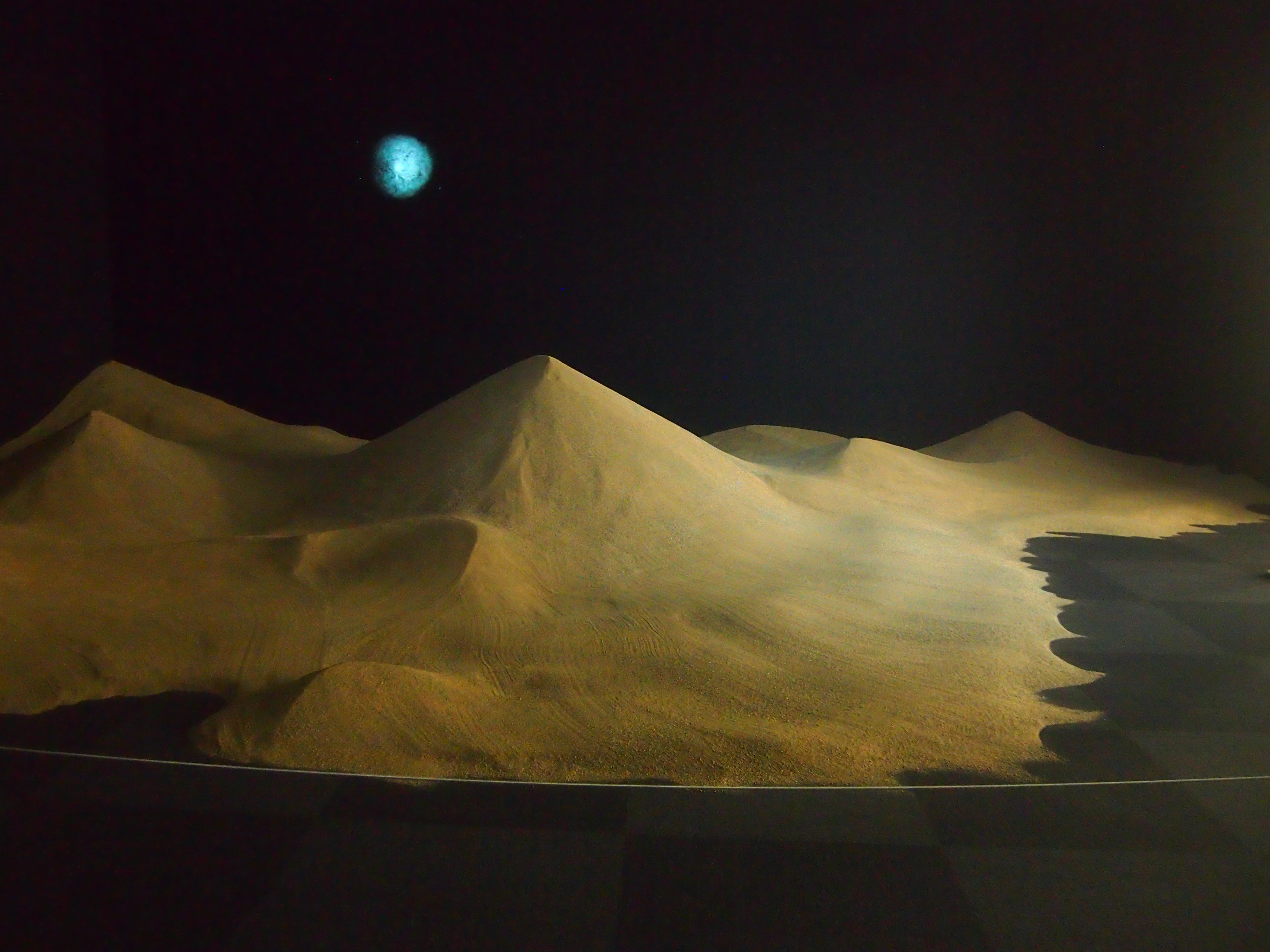
I liked this especially: seven tons of sand on the floor in a dark room, along with radios, LED light box, and some ambient sound.
“A beach (for Carl Sagan)” (2016) by Andrew Yang.

MCA says of this: ” ‘The total of stars in the universe is larger than all the grains of sand on all the beaches of planet earth.’ So claimed Carl Sagan. In fact, astronomers estimated in 2003 that for every grain of sand on Earth’s beaches and deserts there exist ten times as many stars above. Yang takes Sagan’s pronouncement to heart in a scale model of the Milky Way in which one grain of sand represents one star; the estimated 100 billion stars are approximated by more than seven tons of sand.”

A scale model in numbers, but not size. How far would you have to scatter the sand to get that? That probably wouldn’t be too hard to figure out, but I don’t feel like it just now. I imagine it would be from here to one of the outer planets in the Solar System.

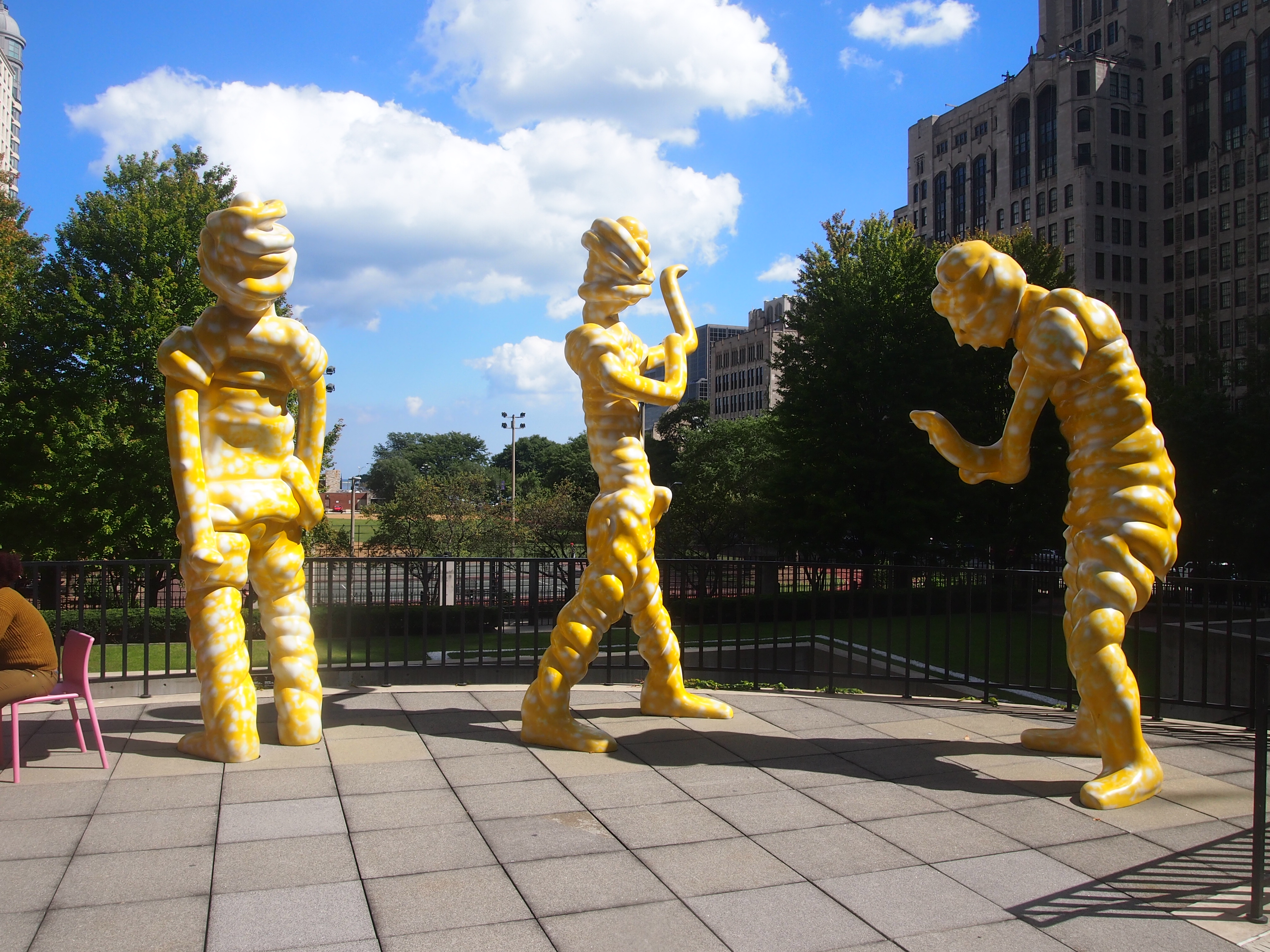
Behind the building, the museum has a sculpture garden. With only four — or was it five? — works. Quantity isn’t everything, but I think there should be more. Here’s “Graz Grosse Geister,” by German artist Thomas Schütte.
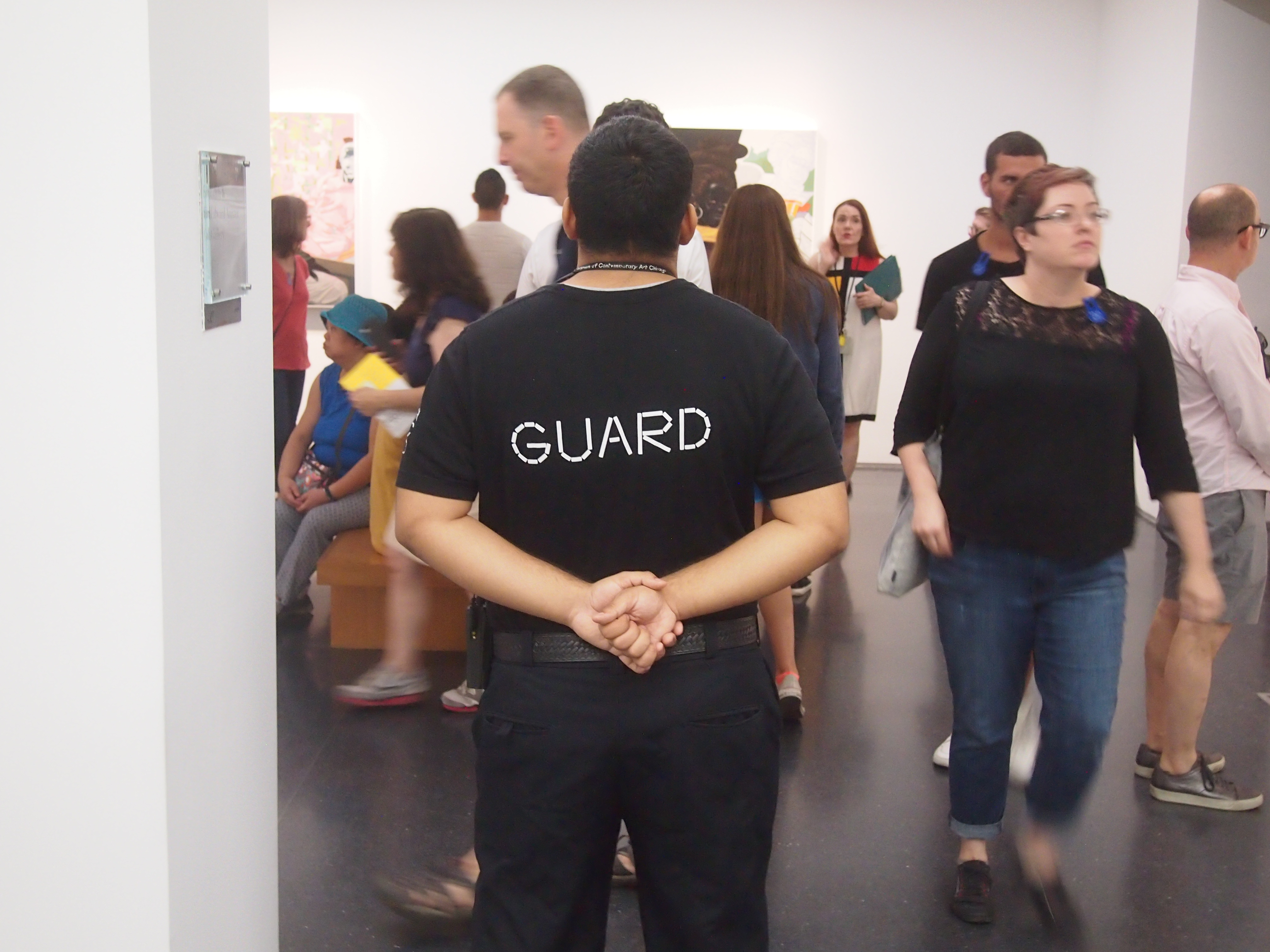
Museum of Contemporary Art, ChicagoAt some point during the visit I noticed that the museum guards weren’t just wearing black shirts with GUARD written on the back.
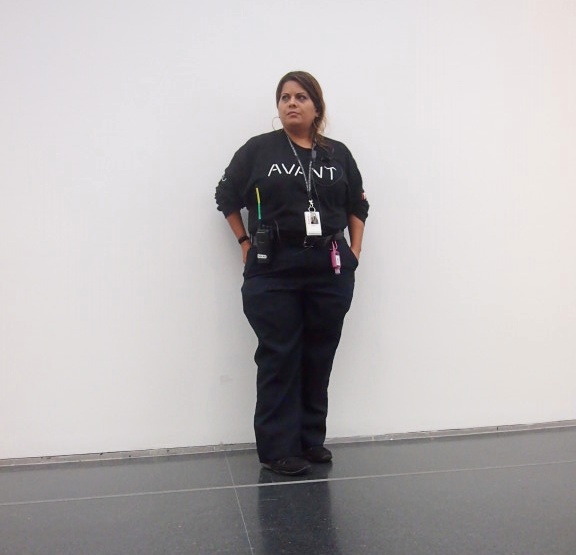
Museum of Contemporary Art, ChicagoAVANT was on the front.

Museum of Contemporary Art, Chicago

Just a little art joke, no extra charge.

The Fourth Presbyterian Church of Chicago

Saturday was the annual Churches by Bus tour organized by the Chicago Architectural Foundation, which we were on last year and the year before. Not this year. We’ve been to two of the five churches listed on the tour. The tour isn’t precisely cheap, so I wanted a little more novelty. Four out of five, maybe.

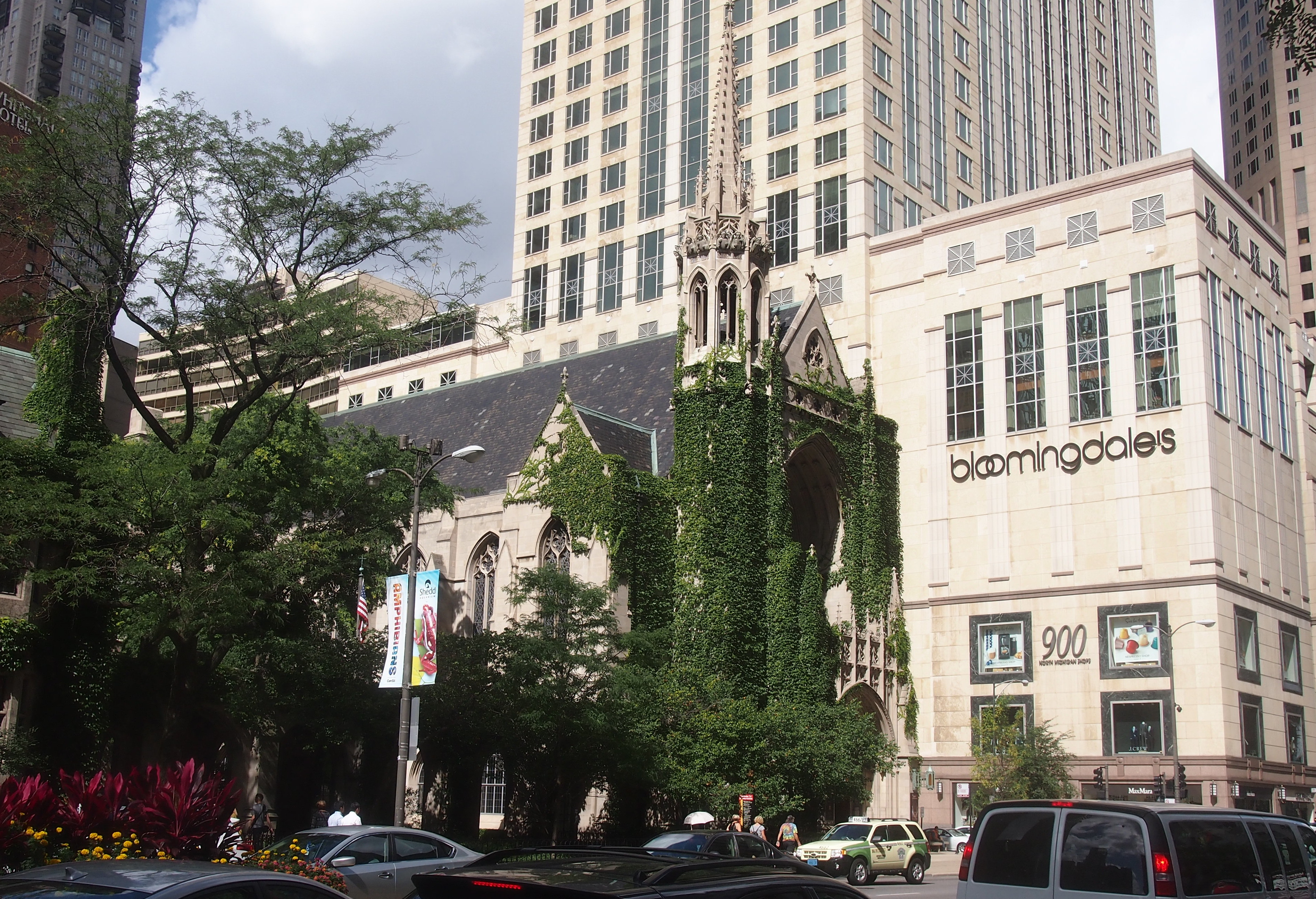
So we planned to look at four churches around Michigan Ave. while in the neighborhood. Nothing new — almost nothing new — but no charge either. As it turned out, only two of the four were open, and a third had a service in progress; not the time to wander around looking at it. The open one that wasn’t busy was Fourth Presbyterian Church of Chicago on Michigan Ave., a fine Gothic structure in the heart of the shopping district.
Fourth Presbyterian Church Chicago

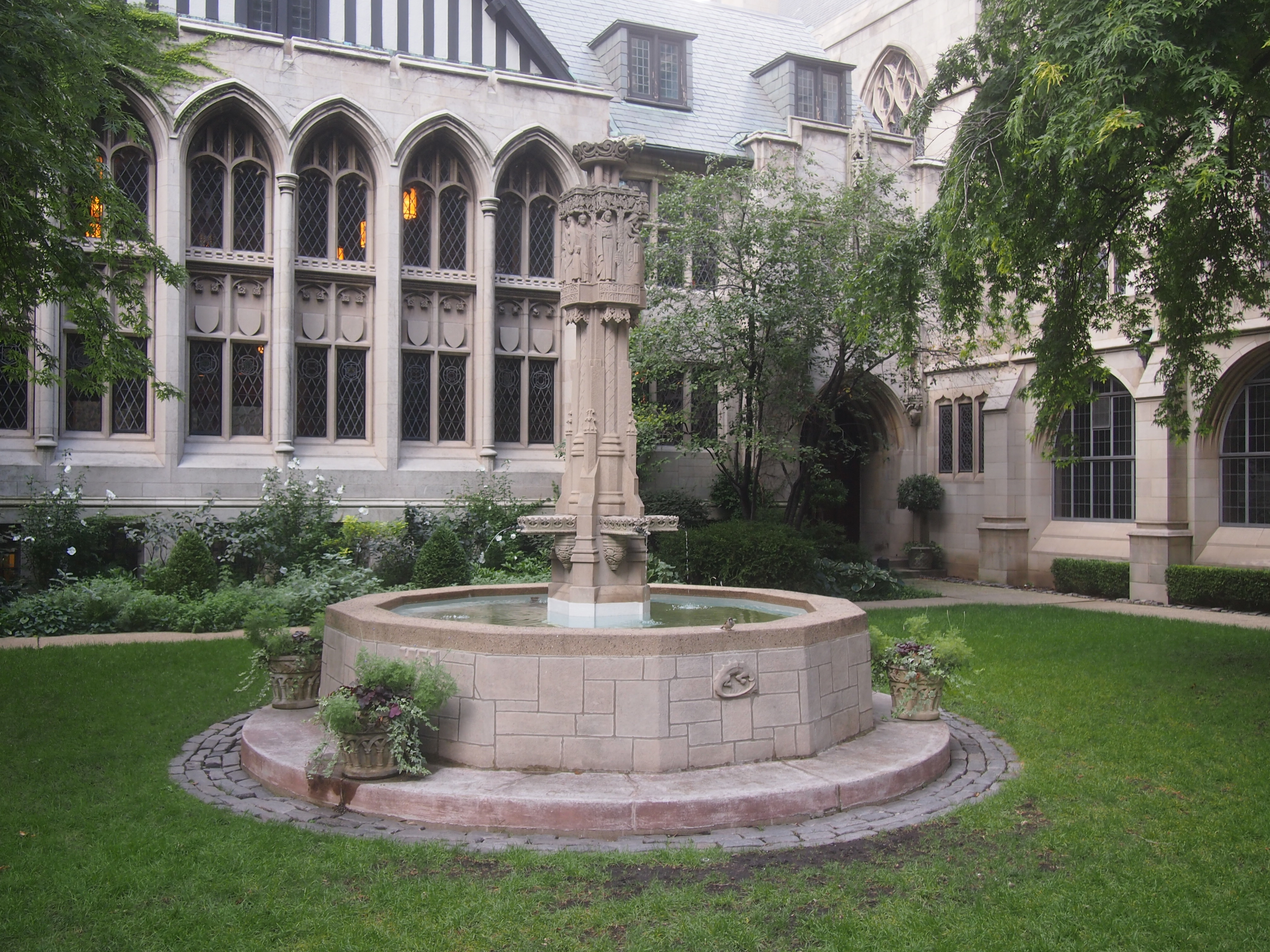
Nice courtyard to the south of the main building, too.

Fourth Presbyterian Church Chicago

When the church was finished in 1914, however, that part of Michigan Ave., still called Pine St., was no great shakes. Cheap land, in other words. All of the action on Michigan Ave. was still south of the Chicago River. That changed with the completion of the Michigan Avenue Bridge over the river in 1920, and Fourth Pres has watched temples of mammon grow up around it since then.

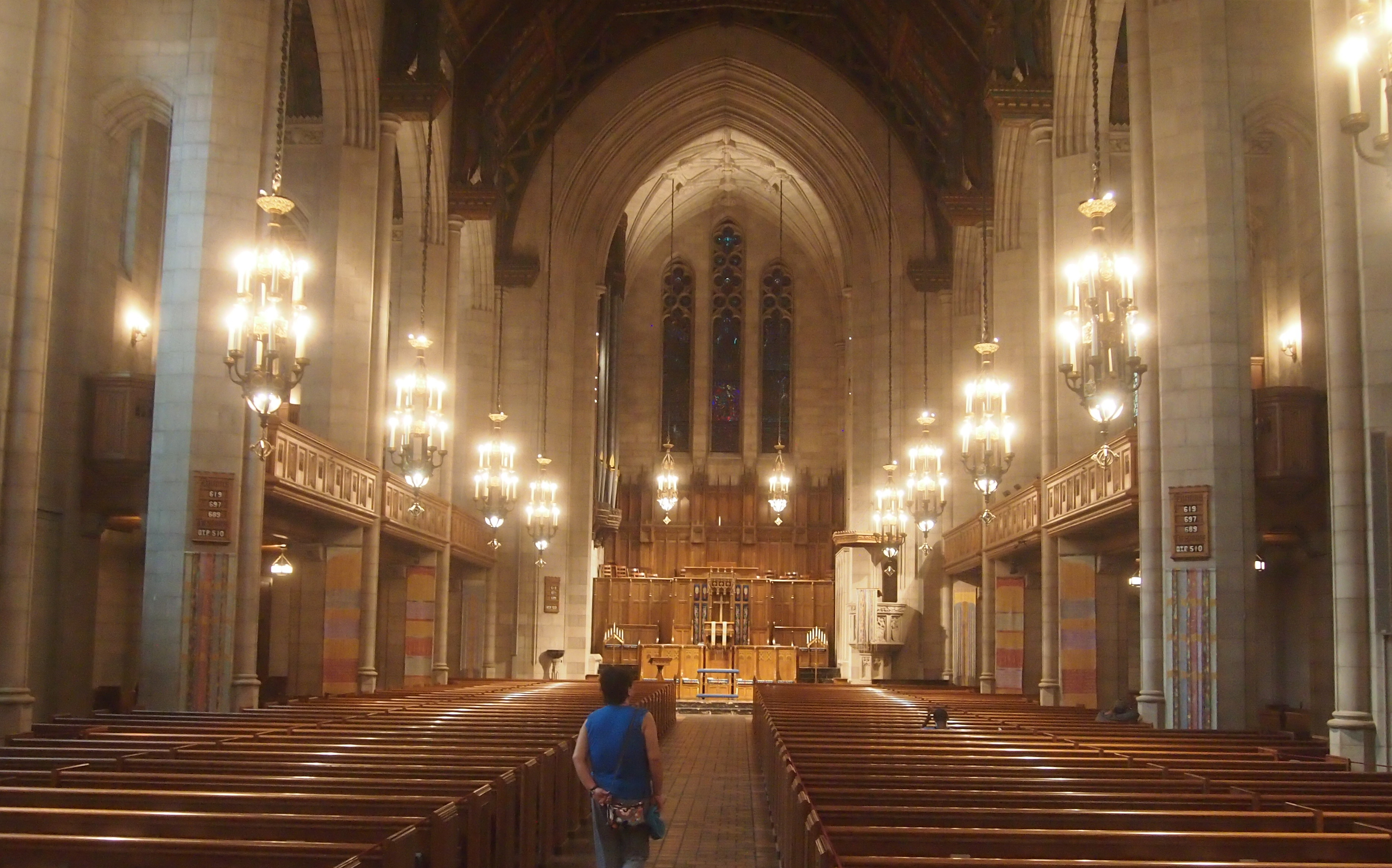
A fine interior. Been inside a number of times over the years. The ceiling’s a little dark, but lights up there would be expensive not only in electricity usage, but maintenance, I figure.

Ralph Adams Cram (1863-1942), an architect who did a lot of ecclesiastical work, designed the church. He’s also known for the Cathedral Church of St. John the Divine in Manhattan.

Adjacent to the church is a much newer structure, the Gratz Center, which was completed only in 2013 to house a preschool program, the Buchanan Chapel, a new dining room and kitchen, offices, and rooms. We took a look at the second-story Buchanan Chapel, which is mostly spare, but well lit with natural light, and with a labyrinth on its floor. The chapel’s architect was Brian Vitale, in Gensler’s Chicago office.

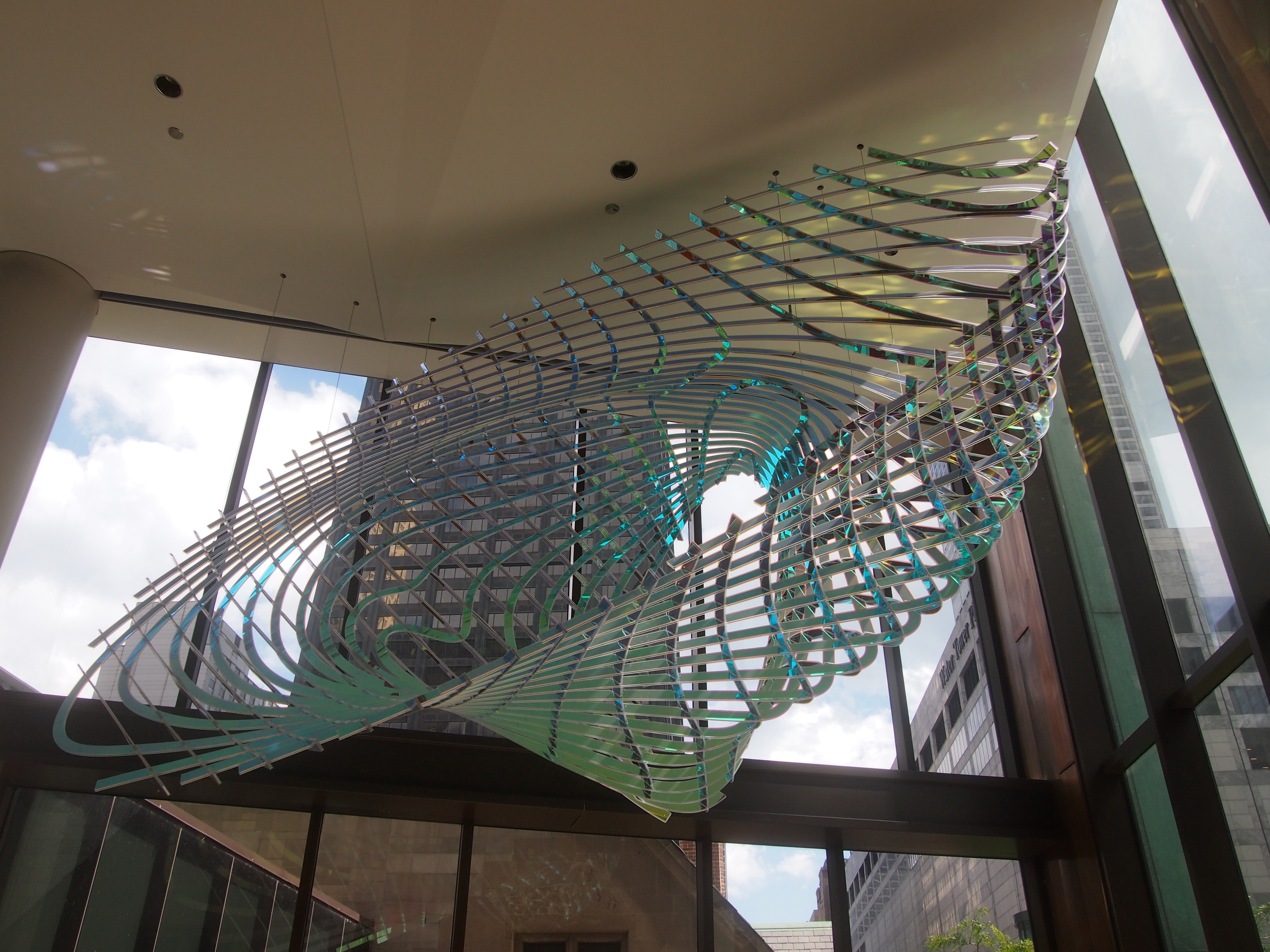
Up in the corner of the chapel hangs “Quaternion,” a 2014 piece by Alyson Shotz, a Brooklyn artist.

"Quaternion," a 2014 piece by Alyson Shotz, Interesting. Often, that’s all I ask from bits of the world.

Michigan Avenue on a September Saturday Afternoon

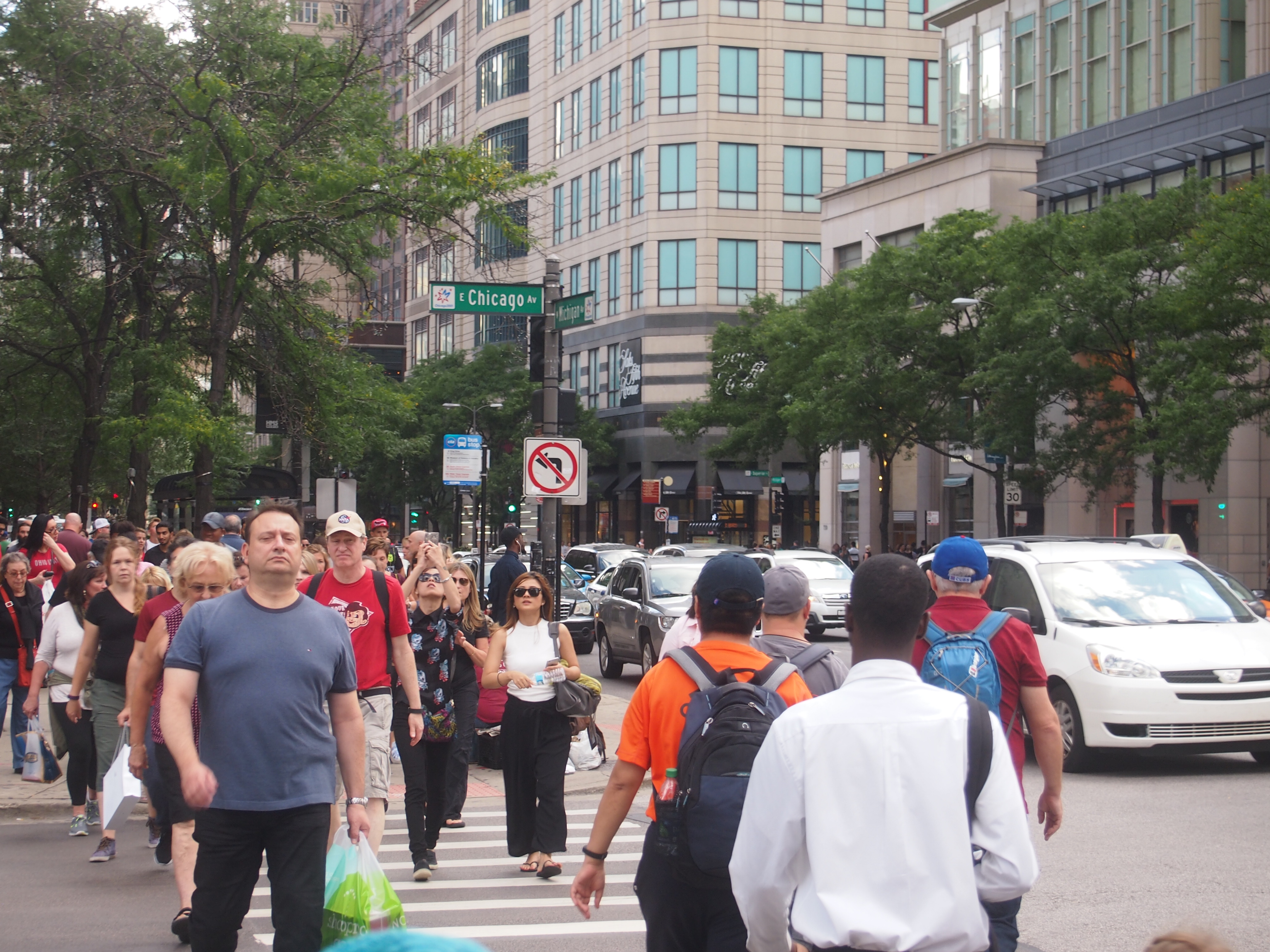
We went downtown again on Saturday, more specifically to Michigan Avenue and within a few blocks to the east and west of that famed street. A famed street, and crowded on a Saturday during the time of year when it’s still warm.
Michigan Avenue Sept 2016The sidewalk wasn’t always that crowded. But sometimes it was, suddenly.

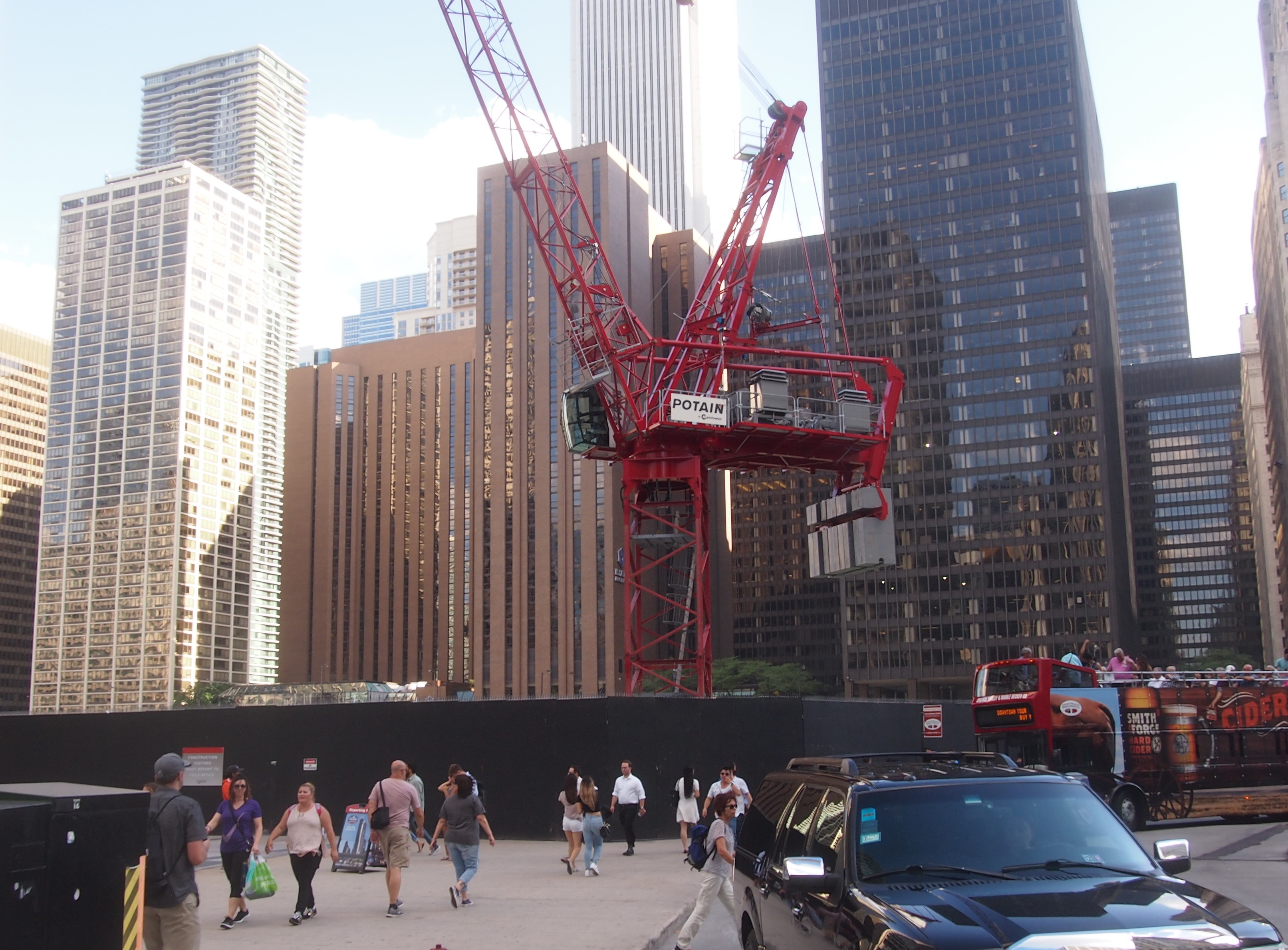
At the spot officially called Pioneer Court — I don’t know anyone who actually calls it that — in front of the Equitable Building and just south of the Tribune Tower, the new Michigan Avenue Apple Store is under construction, to take the place of the store further to the north on the avenue. They say it’ll be a humdinger when it’s done.
Pioneer Court, Chicago, Apple under construction 2016Wonder whether the bronze Jack Brickhouse will be in Pioneer Court near the Tribune Tower for much longer.
Jack Brickhouse statue, Pioneer Court, Chicago, 2016After all, the Tribune hasn’t owned the Cubs in a while, and the Tribune isn’t even going to own the Tribune Tower much longer (the company got $240 million for it). Then there’s the matter of Brickhouse being dead for nearly two decades. That’s a long time not to be on the radio. Time flies, people forget, your statue ends up in a less prominent location. Just speculation.

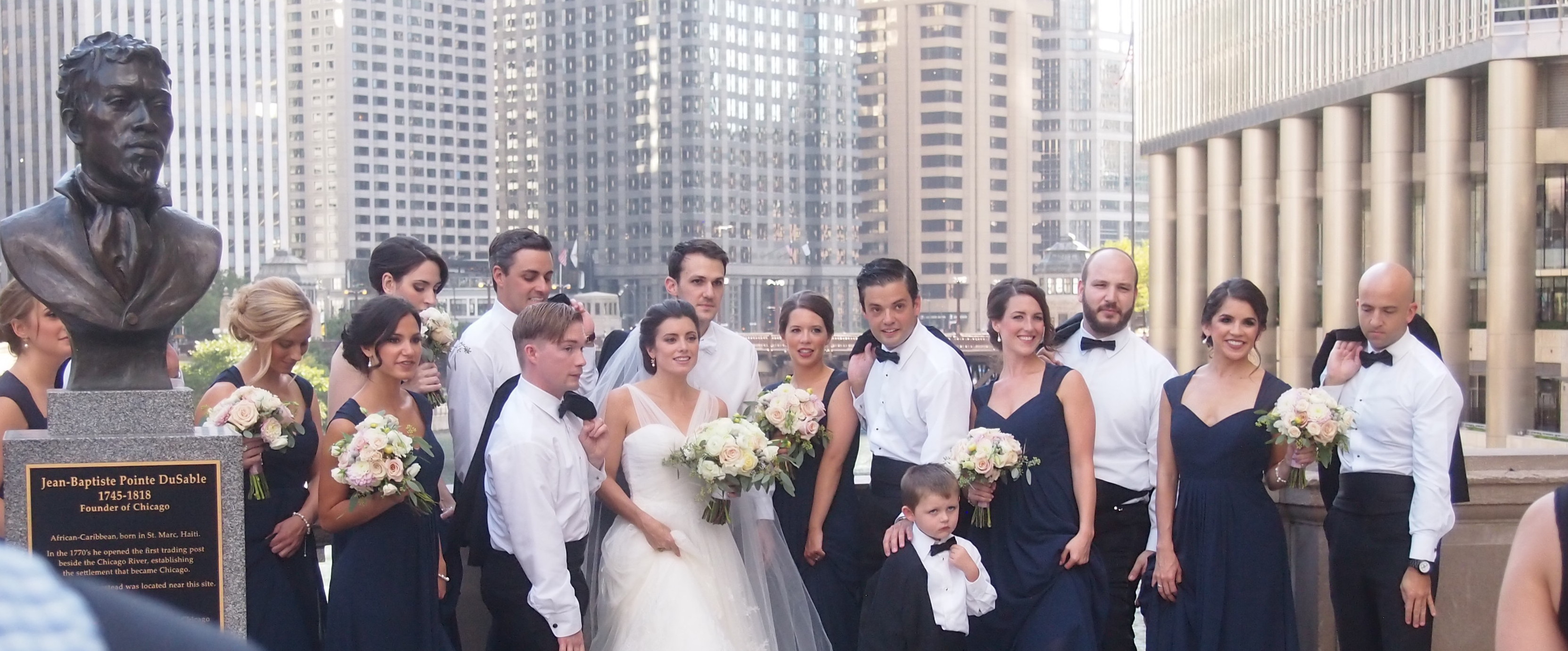
The plaza across the street from Pioneer Court, in the shadow of the Wrigley Building, was just the place on Saturday for some wedding photography. At least this party thought so, and they could do a lot worse.
The bust in the corner is of Jean-Baptiste Pointe DeSable, the fellow from Haiti — I suppose that would be from Saint-Domingue — who founded a trading post on the Chicago River near this site in the 1770s, making him the first non-Indian Chicagoan. I think that bust used to be where the Apple store is being built.

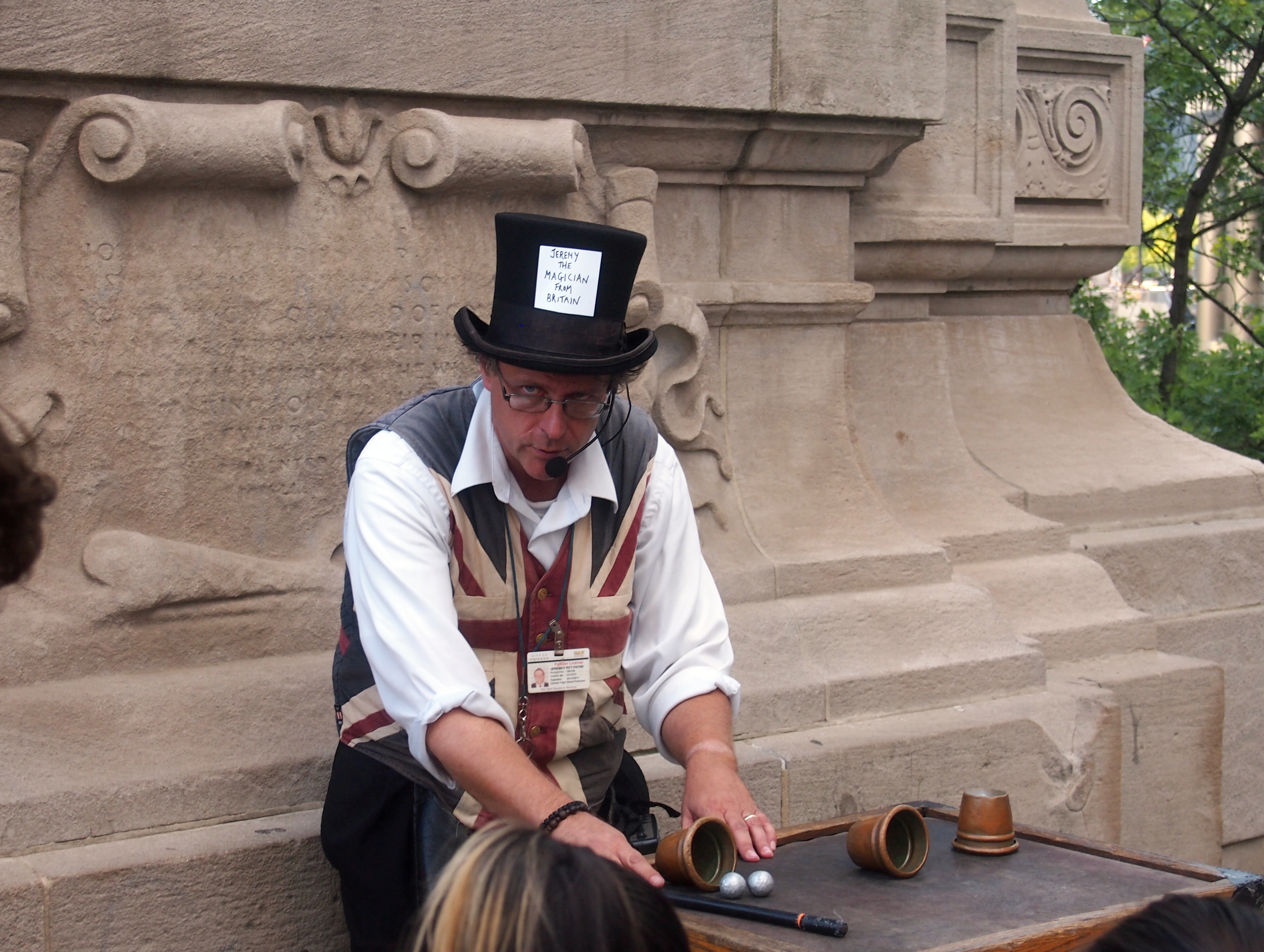
Not far away, just at that moment, was Jeremy the Magician from Britain. That’s what his hat said, anyway, and he had the accent for it, and a Union Jack vest, in case you didn’t get the point.
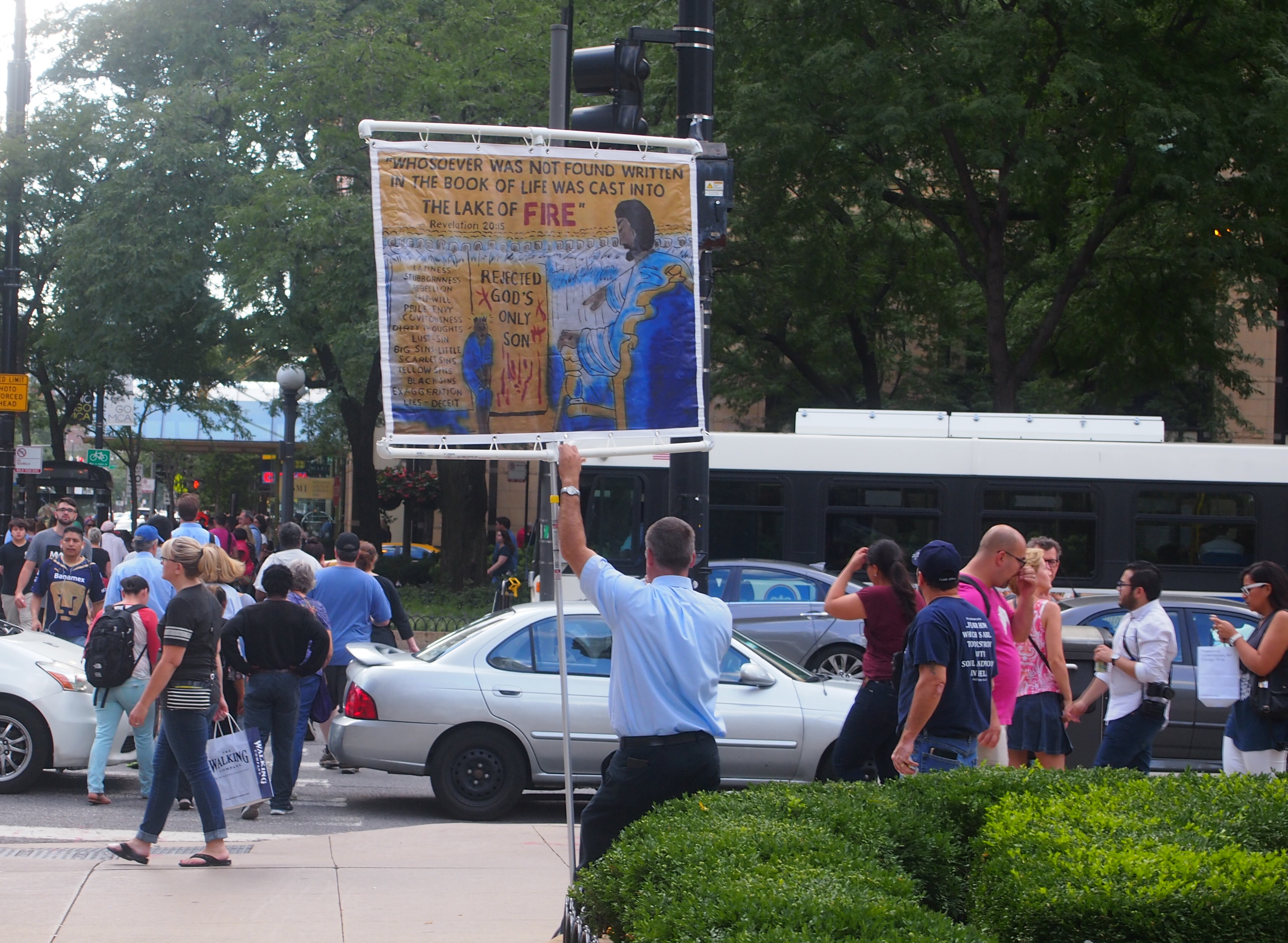
Michigan Avenue Magician Sept 2016Further north, in fact not far from the Chicago Water Tower (can I call it iconic? Too bad that word’s been beaten to death), this fellow had a different sort of message.Street preacher, Michigan Avenue, 2016

Namely, you’re going to Hell.

(Capitalize “Hell.” English Language & Usage Stack Exchange says: “No less an authority than Fulton Sheen had the galleys for his latest book come back from the typesetters with ‘Heaven’ and ‘Hell’ knocked down to lowercase. He carefully re-capitalized each occurrence. When his editor called to request an explanation, he gave what I think we can regard as the definitive answer to [the] question: Because they’re places. You know, like Scarsdale.)

The Wheeling Superdawg ’16

More than six years ago, I wrote, “What to do after touring a mansion exuding poshness, if you happen to be hungry? Go to a hot dog stand.

“Not just any hot dog stand, but the drive-in Superdawg. Not the original, which is on the Northwest side of Chicago, but the Wheeling, Ill., iteration that opened in January. It was on our way home.”

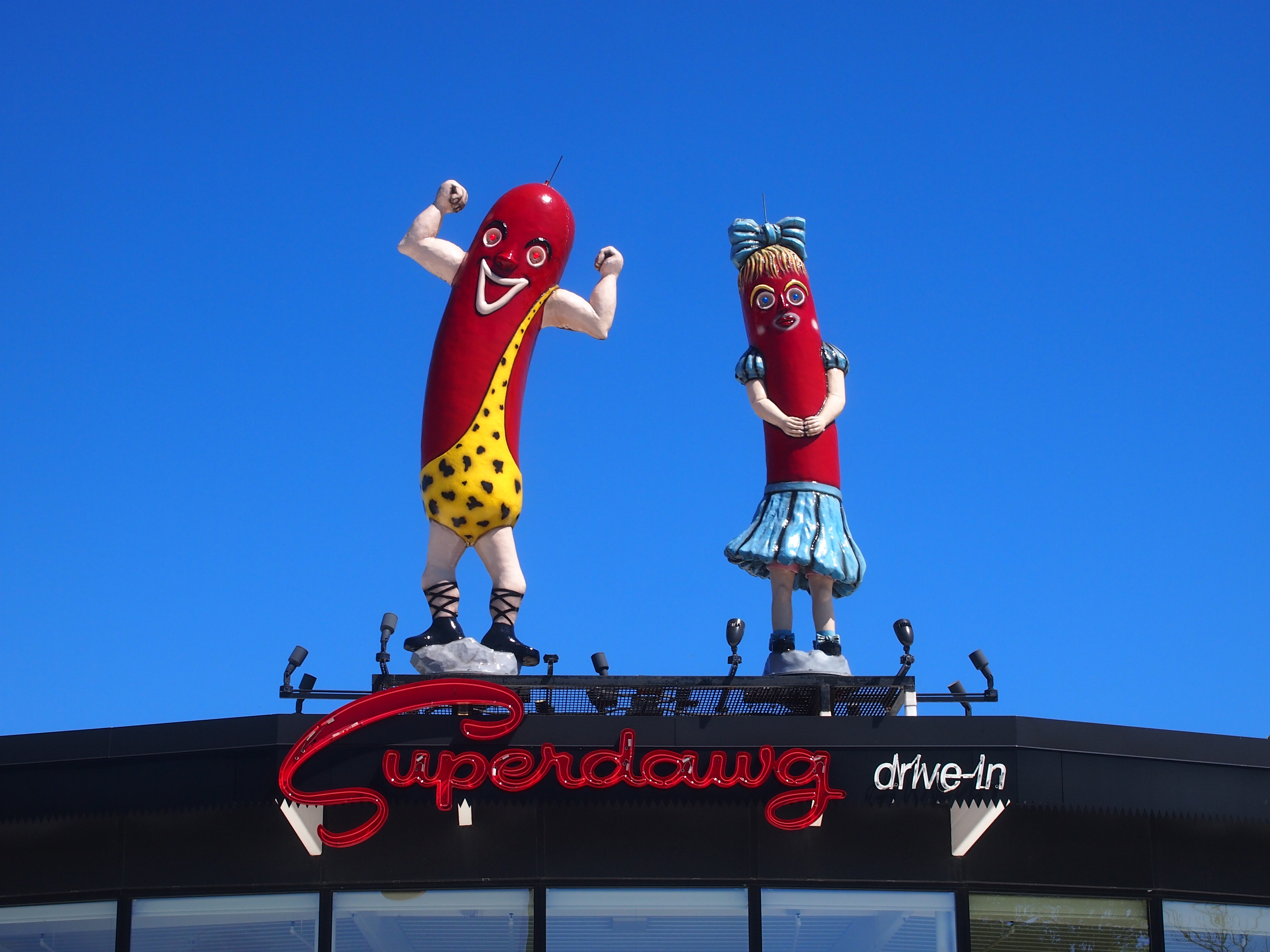
On Saturday, I noticed that the Wheeling Superdawg was on the way to the Chicago Botanic Garden, more or less. So we went again, the first time in more than six years. Before we got there, Yuriko said she didn’t remember any such place. But as soon as we arrived, she did. It’s hard to forget these characters.

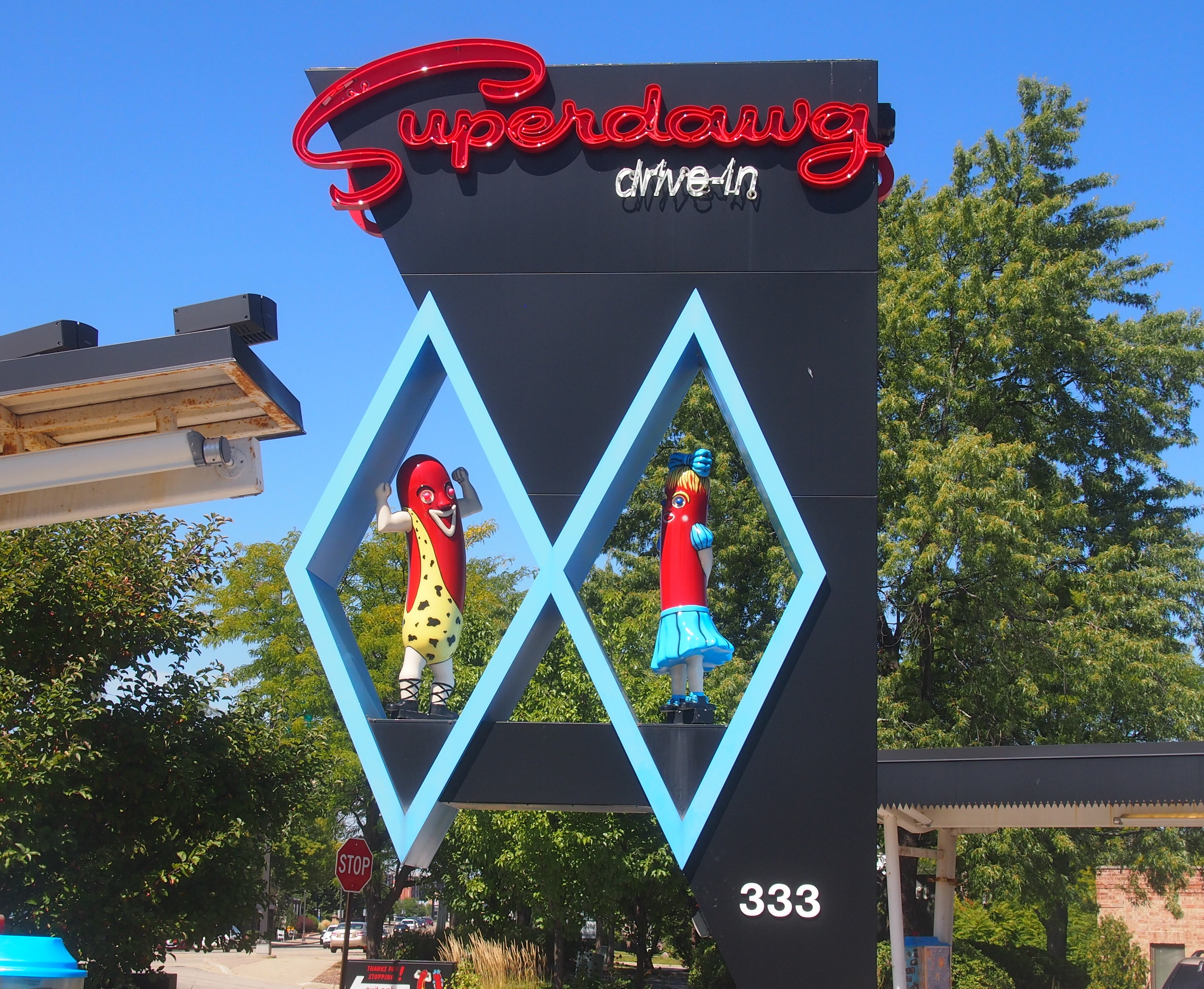
Wheeling Superdawg 2016Those are the rooftop boy and girl dogs — awfully heteronormative of them, some nags might say — but they’re also featured in a lot of other places, including on the packaging and the napkins. They’re also on the sign that faces the road (Milwaukee Ave. in Wheeling). These anthropomorphic hot dogs rotate slowly, unlike the static ones on the roof.
Wheeling Superdawg 2016This time I had the original Superdawg. I forgot to order it without mustard, but other than that I liked it. Yuriko enjoyed her hamburger.

Back in ’10 I noted: “Each order station also has a sign that says: ‘We’re super sorry, but we’re unable to accept credit cards because of our unique drive in/carhop service…’ We went inside anyway, and they don’t accept cards there either. Retro indeed.”

I can report that in 2016, inside the restaurant at least, all manner of credit and debit cards are now accepted. Guess they figured the all-cash model was losing them some customers.

One more thing today: I’d be remiss if I didn’t note the 50th anniversary of Star Trek, though I have only the vaguest memories of it as a prime-time show in the late ’60s. One of the stations in San Antonio started showing it in the after-school slot in 1973, when I was in junior high. That I remember. The first episode the station aired was “Devil in the Dark.”

The series, and all its successor iterations, have been hit or miss over the years. Its starting concept — the pitch Roddenberry supposedly made — was “Wagon Train to the Stars.” Does anybody remember Wagon Train any more?

My own fondest memory of the show I’ve written about before: “More than 30 years ago, I spent a few days camped out in a dorm room at MIT. I noticed a few things while there, such as that everyone on the hall went to the common room to watch an afternoon showing of Star Trek, and everyone knew the lines. (The original series; because this was 1982, the only series. Patrick Stewart was still just a Shakespearean actor who’d played Sejanus for the BBC.).”

Non-Plants in the Chicago Botanic Garden

I thought of “Manmade Things in the Chicago Botanic Garden” as a title, but in a real sense everything in a highly cultivated garden is manmade, even if the raw materials of the displays are descended from naturally occurring plants. Artificial selection invented the tea rose, after all.

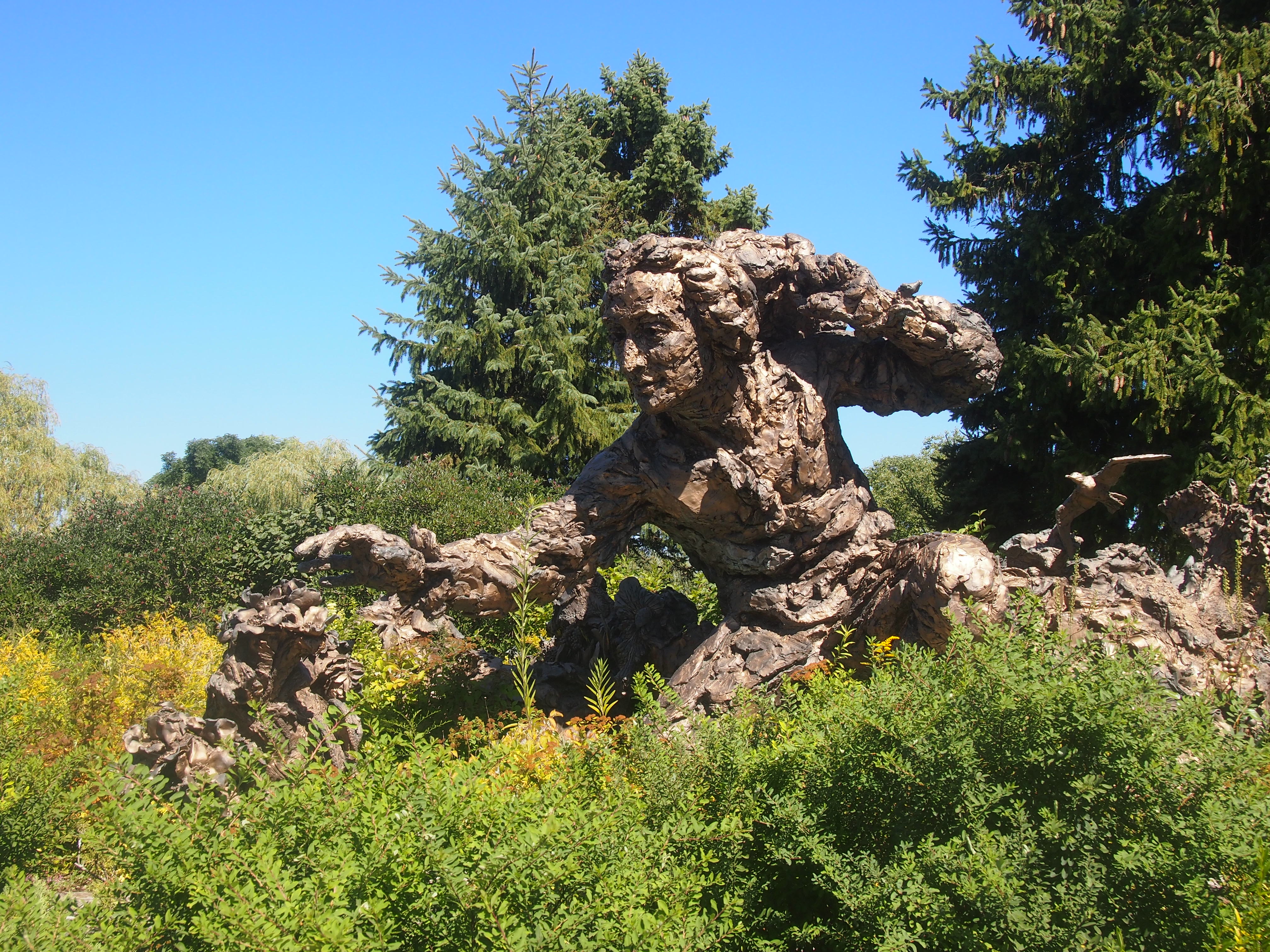
The Chicago Botanic Garden includes many things besides plants. Such as this sculpture in the Heritage Garden.

Chicago Botanic Garden - Carolus Linnæus - Robert BerksIt’s instantly recognizable as a Robert Berks bubble-gum statue, in this case dating from 1982. Based on a casual search, his statues seem to be esteemed these days, especially now that he’s dead, but I’m with the art critics who were upset about the Einstein statue in DC when it was new. They’re ugly. That’s my two-word critique.

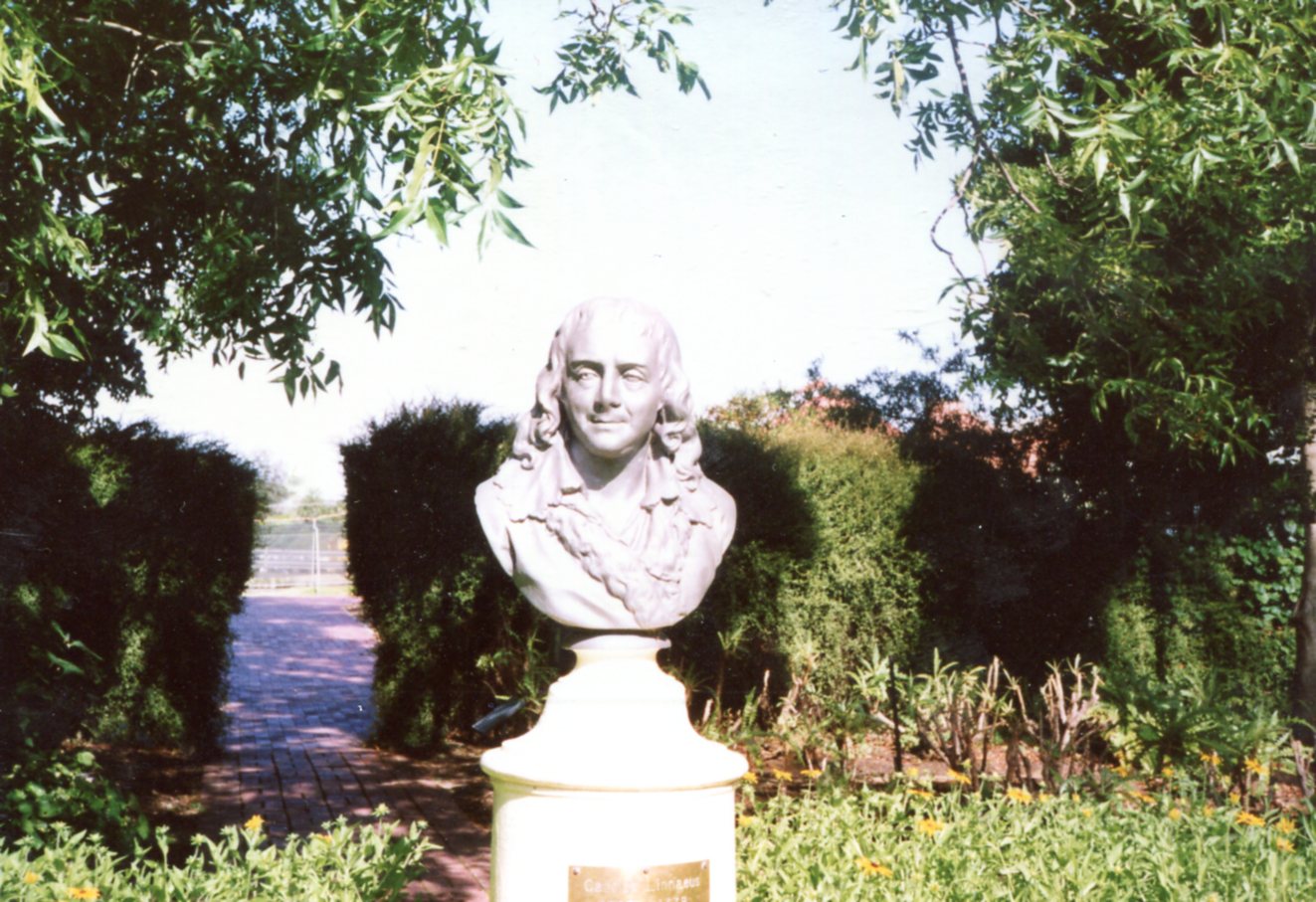
Anyway, the subject is fitting for a garden, since it’s Carolus Linnæus. In fact, I’ve seen his carved face before in such a place, but a long way from metro Chicago.
Carolus Linnæus - Adelaide Botanic Garden - South AustraliaThat’s Linnæus at the Adelaide Botanic Garden in 1991. A much more conventional bust, certainly, and maybe not that interesting. But at least it isn’t ugly. More about the Chicago-area Linnæus statue is at the always delightful Public Art in Chicago.

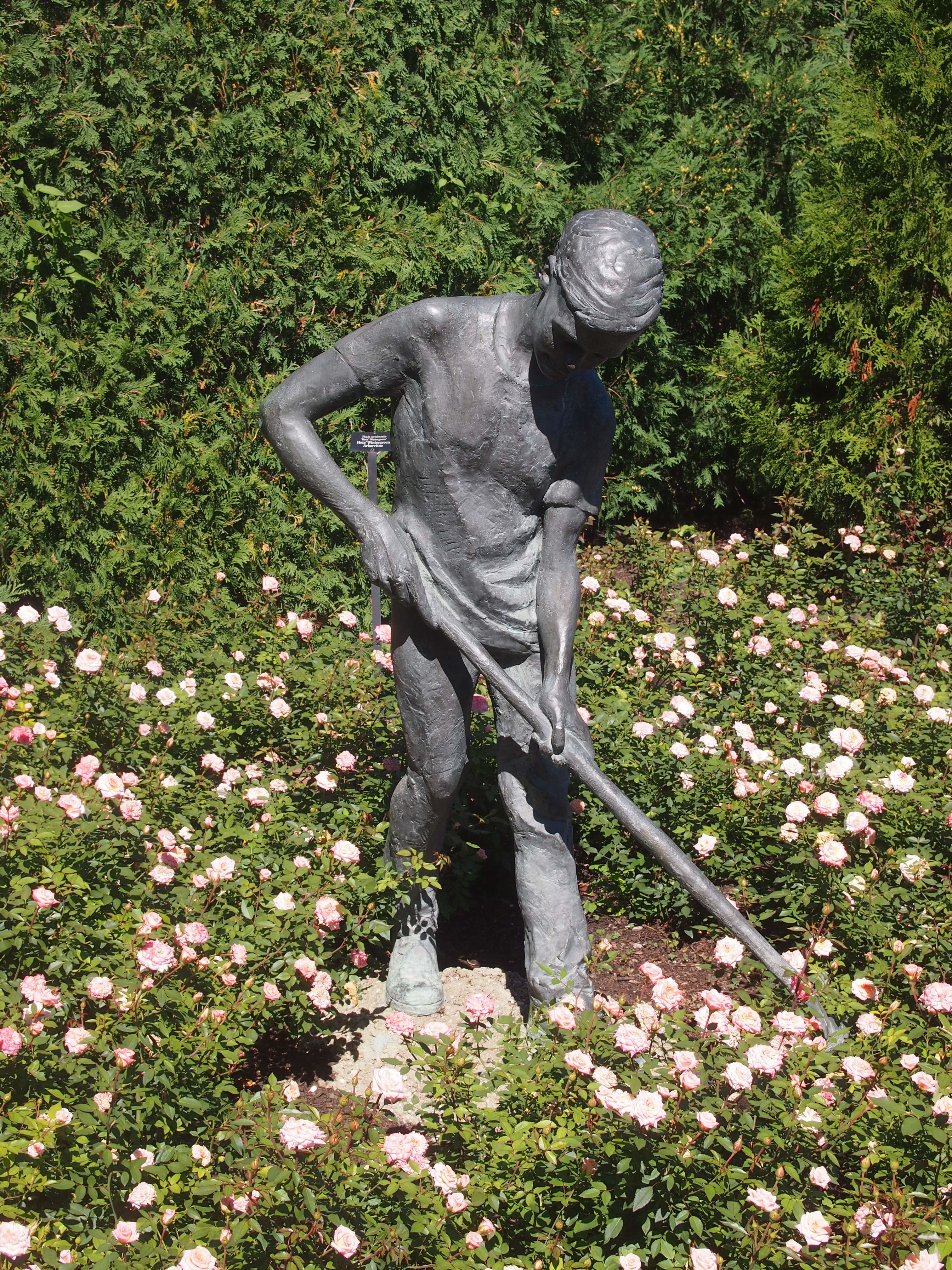
This is “Boy Gardener” in the Rose Garden.

Chicago Botanic Garden - Boy Gardener - Margot McmahonBy an Oak Park sculptor, Margot Mcmahon. Straightforward, unpretentious.

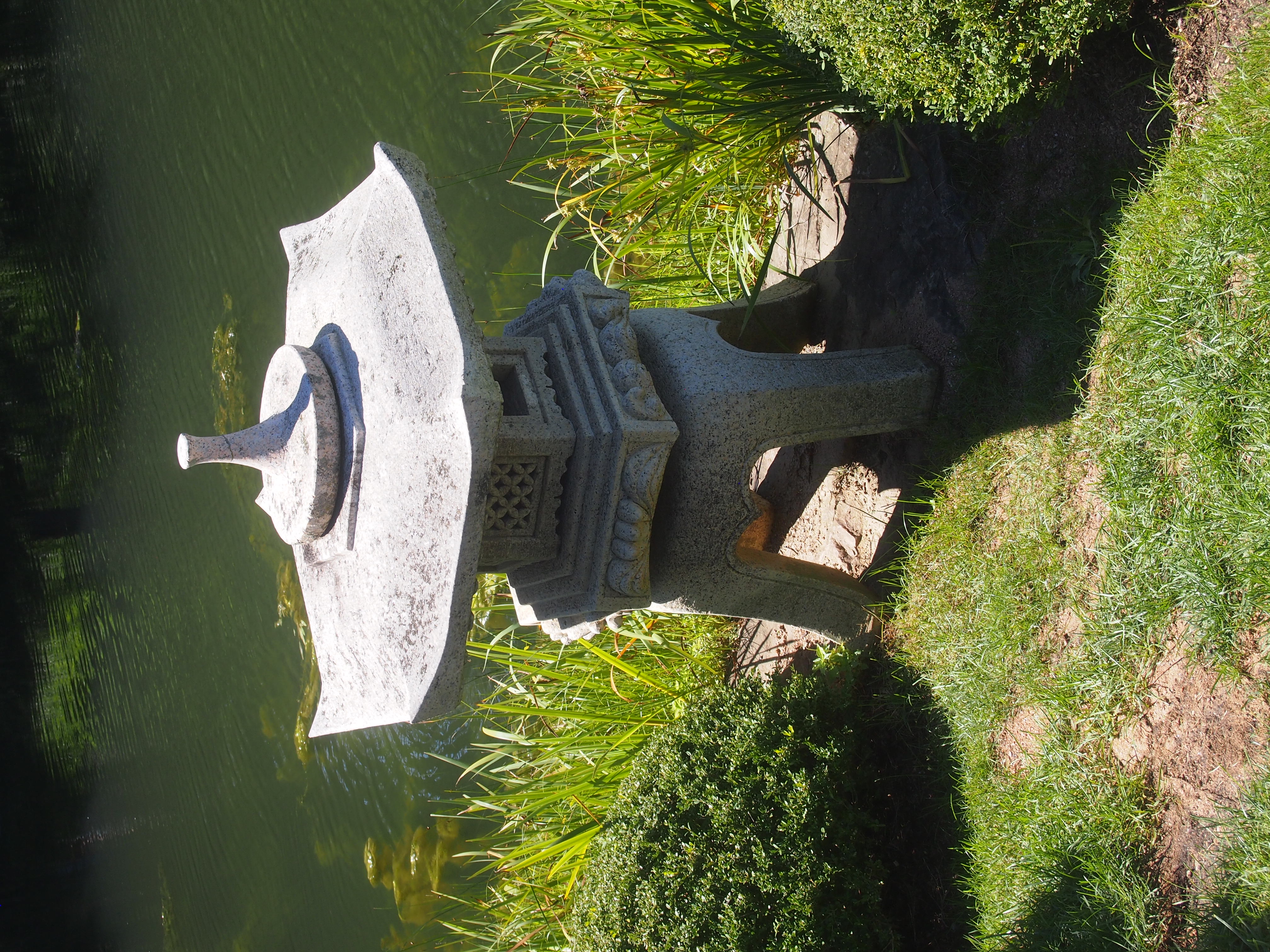
In the Japanese Garden, a yukimi lantern.

Chicago Botanic Garden - Japanese Garden - yurimi lanternSupposedly it looks elegant covered with snow, and I’ll bet it does. I don’t think I’ll visit the gardens in winter to confirm that, though.

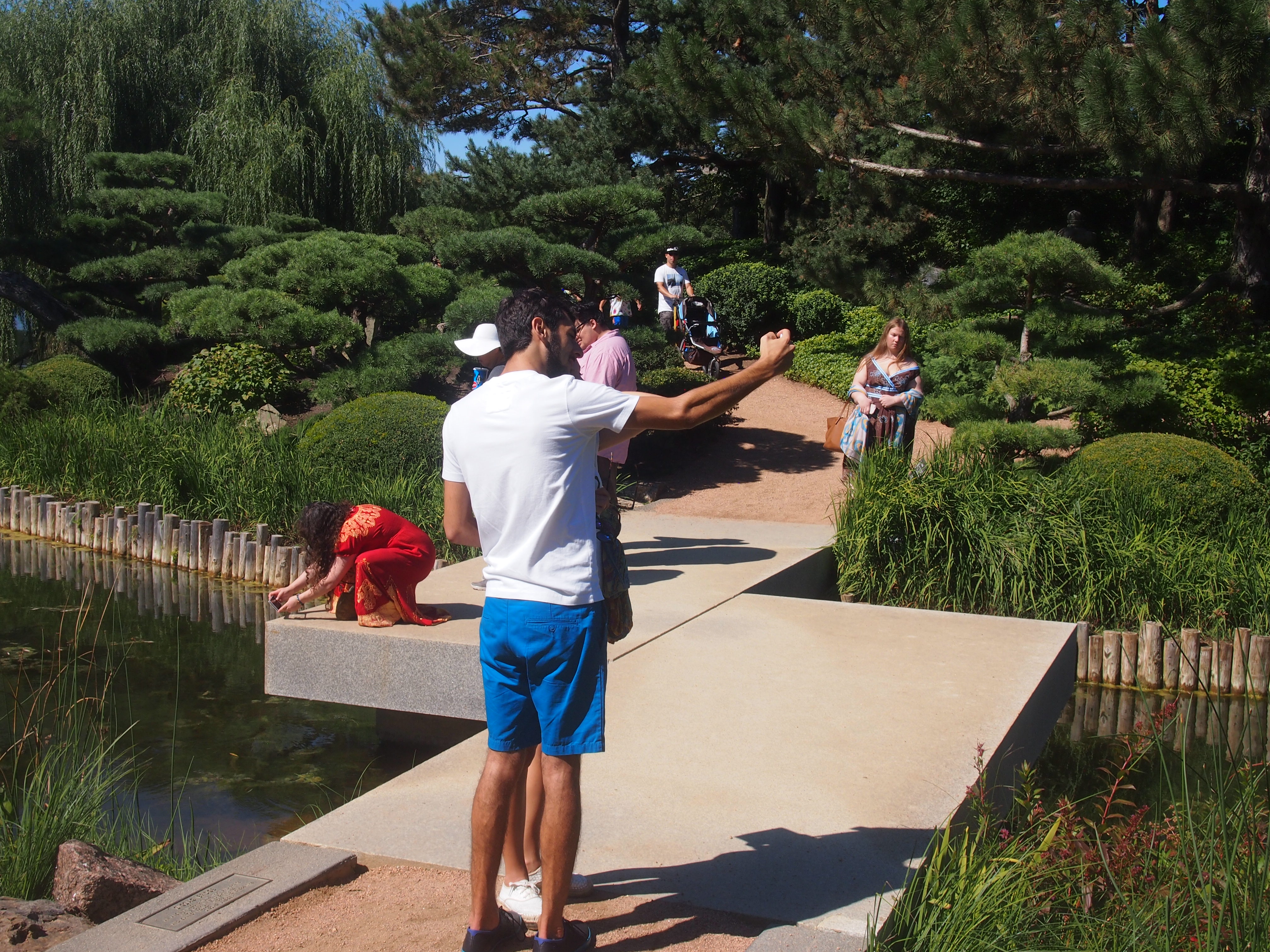
Also in the Japanese Garden, the Zigzag Bridge, with a selfie in progress, and a woman taking pictures of carp.

Chicago Botanic Garden - Japanese Garden -zigzig bridgeThe explanation for its shape is that evil spirits can only travel in straight lines, and thus can’t follow you onto the island. What is it about evil spirits? They’re scared of noise, can’t follow a slight zigzag, and seem to have a lot of other handicaps to keep them from their malevolent work.

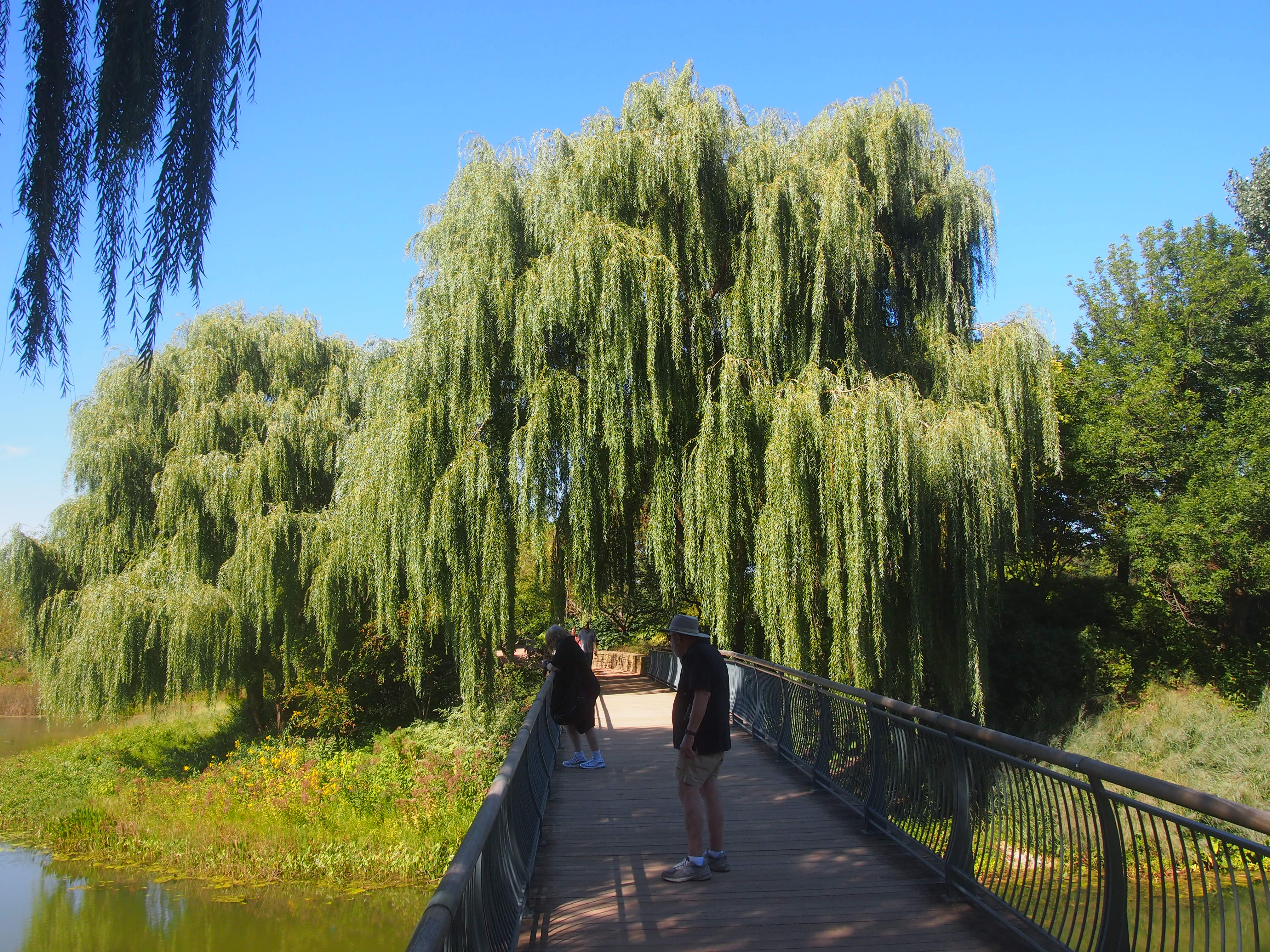
Here’s one of the bridges between the main part of the garden and Evening Island. Not so distinctive by itself, but it is shaded by enormous willows.
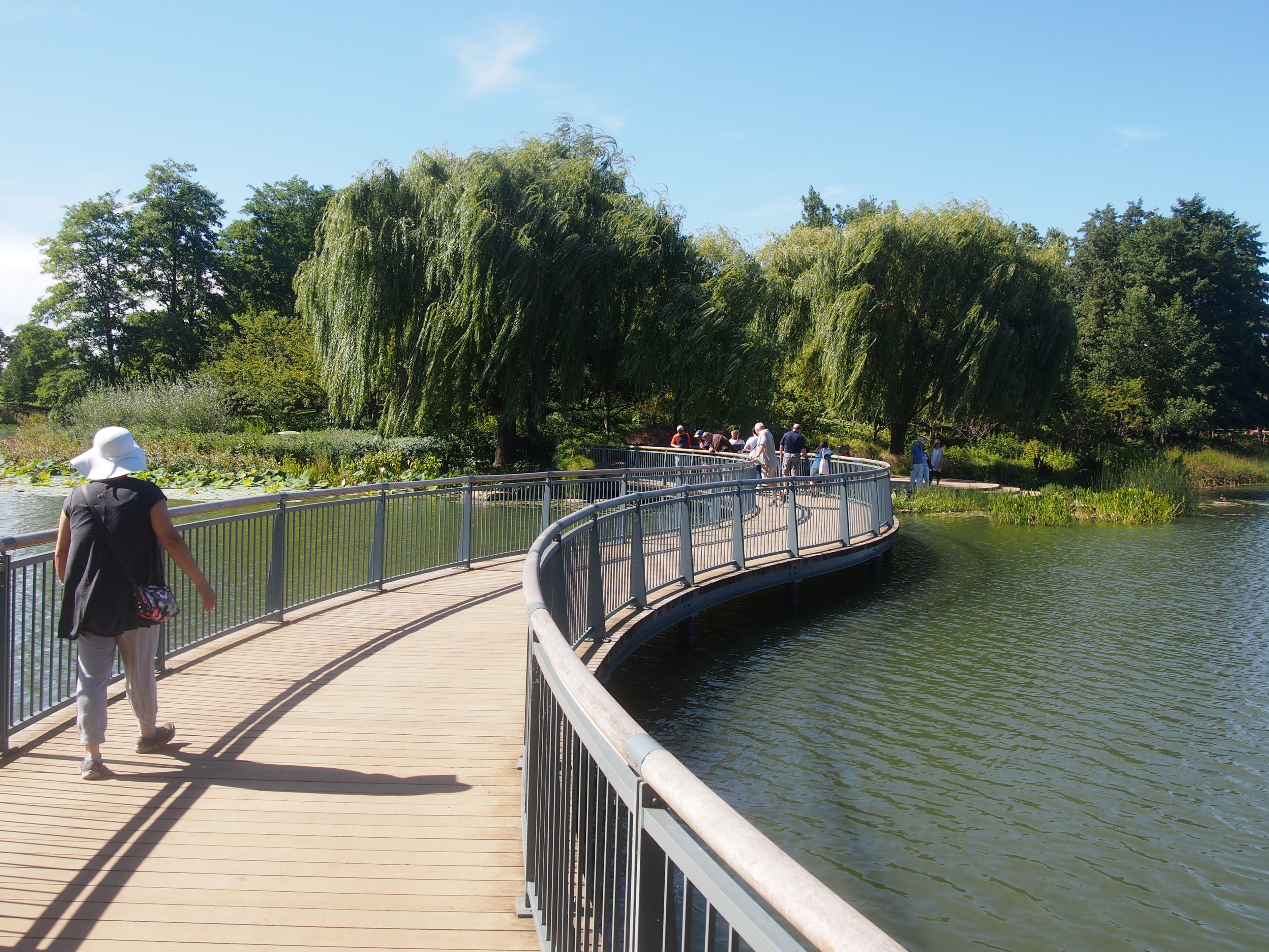
Chicago Botanic Garden - bridge to Evening IslandThe other bridge to Evening Island has a name, the Serpentine, for obvious reasons. With more willows.
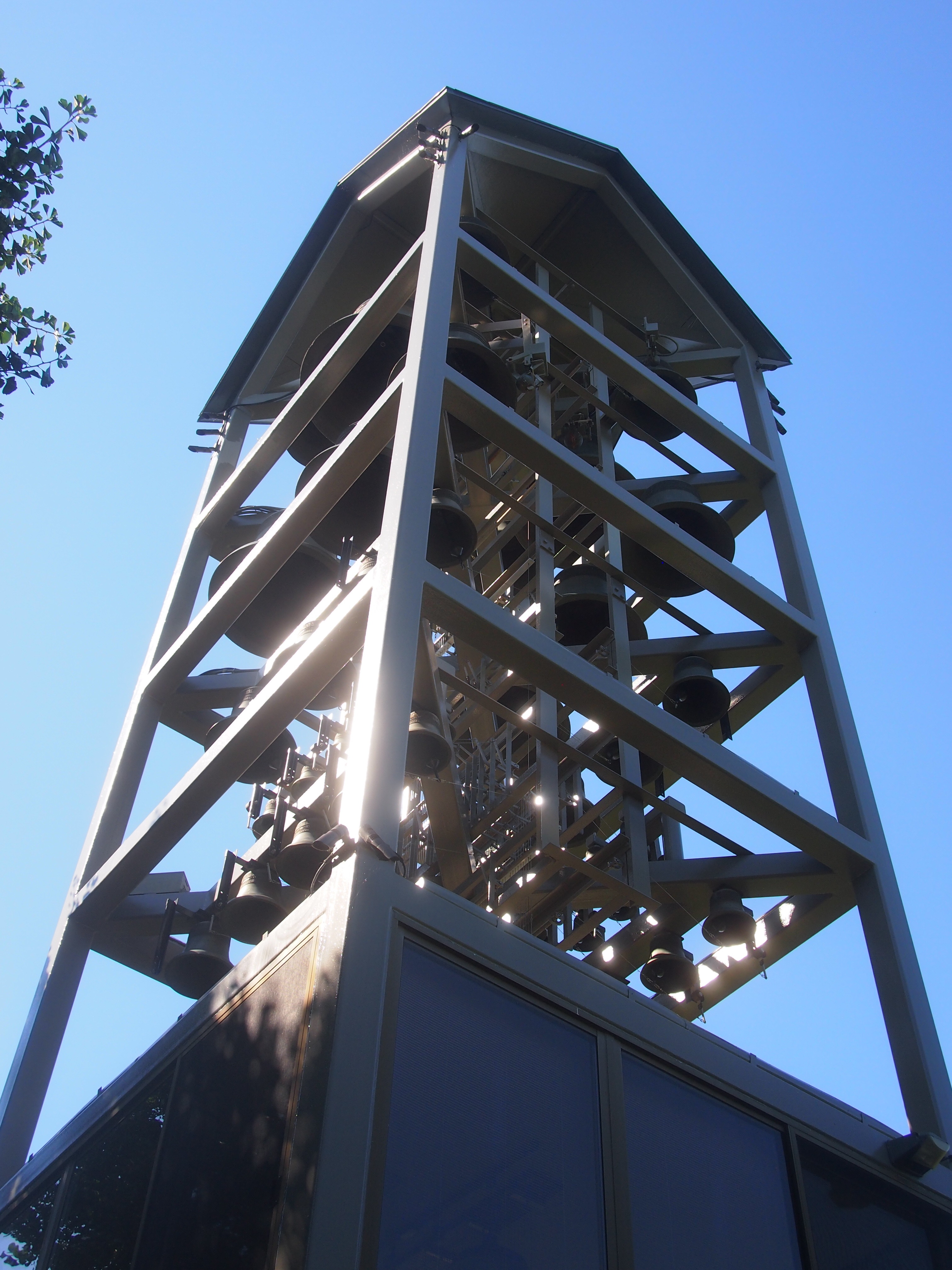
Chicago Botanic Garden - Serpentine BrdigeOn Evening Island itself, there’s this structure rising from the flora.

Chicago Botanic Garden - Theodore C. Butz Memorial CarillonThe Theodore C. Butz Memorial Carillon, to give its formal name, installed in 1986. A sign at the base of the structure says, “Crafted in Holland, the Garden’s carillon is one of a few hand-played carillons in the United States. The cast bronze bells have a range of four octaves, and are played using a large keyboard. The smallest of the 48 bells weighs 24 pounds, and the largest weighs two and a half tons.”

No carillonneur seemed to be on duty, but we did hear it ring the hour, so I guess it can be set for automatic as well as manual.

Olmec Head & Man-Sized Fish in Chicago

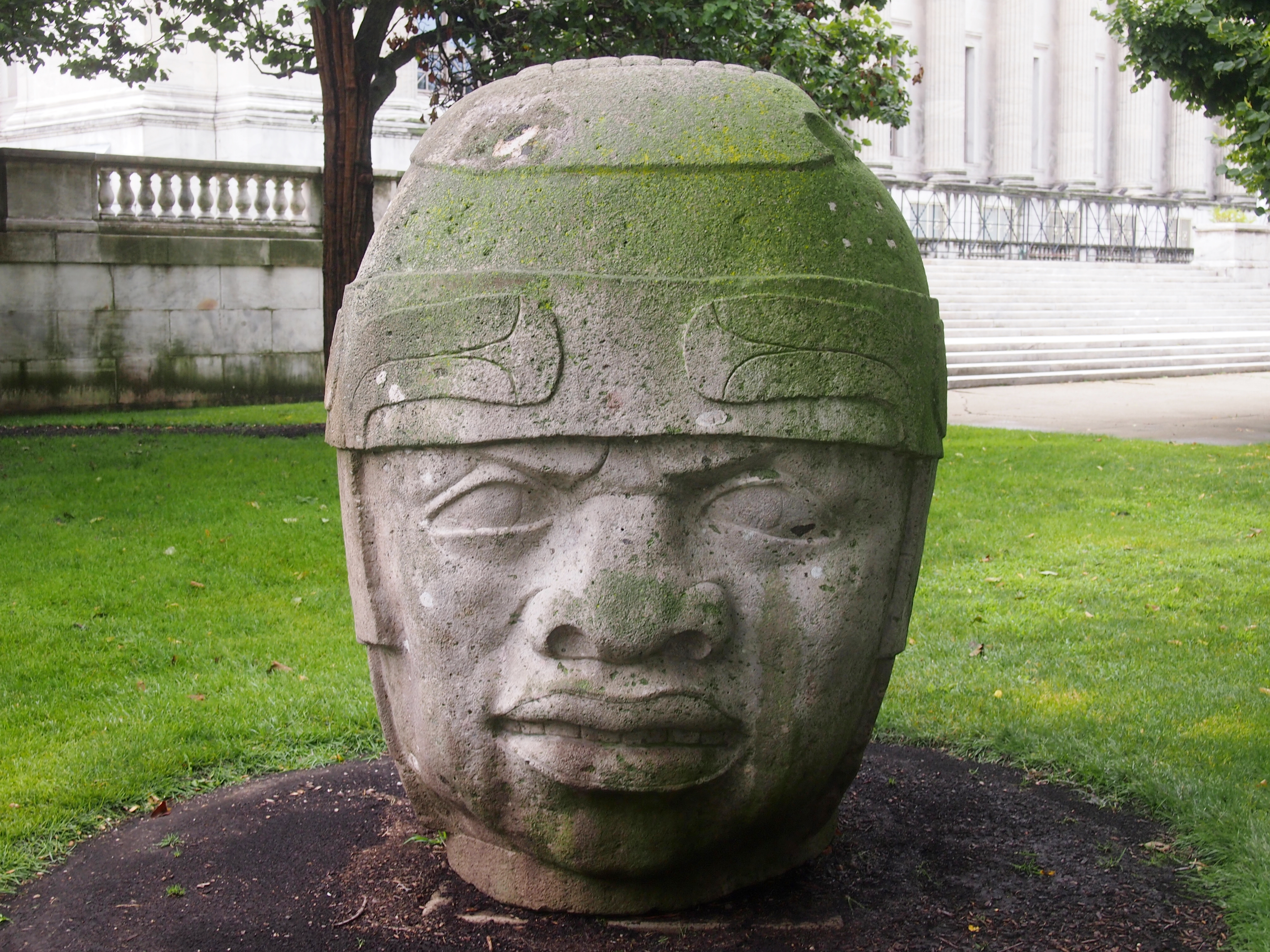
Where in the Chicago area is this fellow?

Olmec Head 8, Chicago 2016Between the Field Museum and the Shedd Aquarium in downtown Chicago, that’s where, with the Field Museum in the background of the picture. It’s a replica by Ignacio Perez Solano of Olmec Head 8, and a gift of the state of Veracruz to Chicago, dedicated in 2003. So while near the Field Museum, it’s actually part of the city’s collection of outdoor art. It might not be as imposing as the original, but it’s no small thing at seven feet high and a weight of seven tons.

Later it occurred to me that I didn’t know much about the original Olmec heads, beyond their great antiquity in pre-Columbian Mexico, so I read a bit. “Seventeen heads have been discovered to date, 10 of which are from San Lorenzo and 4 from La Venta, two of the most important Olmec centres,” the Ancient History Encyclopedia tells me. “The heads were each carved from a single basalt boulder which in some cases were transported 100 km or more to their final destination, presumably using huge balsa river rafts wherever possible and log rollers on land….

“The heads were sculpted using hard hand-held stones and it is likely that they were originally painted using bright colours. The fact that these giant sculptures depict only the head may be explained by the widely held belief in Mesoamerican culture that it was the head alone which contained the emotions, experience, and soul of an individual.”

Apparently the state of Veracruz, especially when Miguel Alemán Velasco was governor (1998-2004), decided that norteamericanos would benefit from replica Olmec heads, so there are now eight such heads in the U.S., according to Wiki: Austin, Chicago, Covina, Calif., McAllen, Tex., New York, San Francisco, Washington, DC, and West Valley City, Utah.

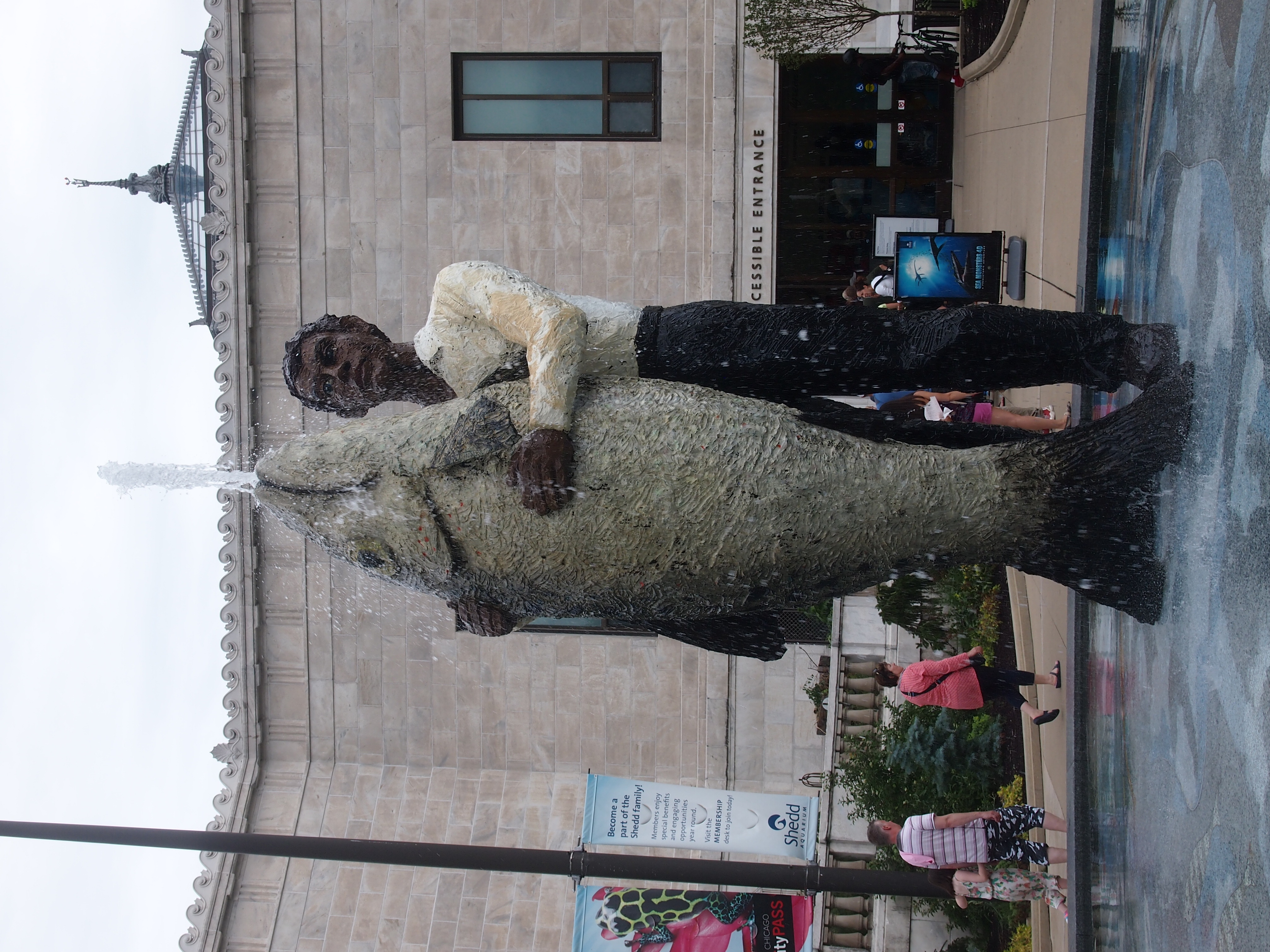
Closer to the Shedd is a very different sort of sculpture, the aptly named “Man With Fish.”

Man With FishAccording to the Chicago Park District, the work is “a gift to the Shedd Aquarium from William N. Sick in honor of his wife, Stephanie… The painted bronze sculpture portrays a man with his arms wrapped around an enormous fish. Water sprays from the fish’s mouth, dripping into a reflecting pool below.”

William Sick is a prominent local businessman, and also happens to be a trustee and former chairman of the Shedd Aquarium, and a director of Millennium Park. He must have decided at some point that a sculpture by Stephan Balkenhol was just the thing for the Shedd. It was the artist’s first work in the U.S., installed in 2001.

“Stephan Balkenhol (b. 1957), a German sculptor who studied at the Hamburg School of Fine Arts, created “Man with Fish,” the park district continues. “Several of Balkenhol’s works feature human figures relating to an animal or several animals in an unexpected way. ‘Man with Fish’ conveys this playful approach as does ‘Small Man with Giraffe’ which stands in front of the Hamburg Zoo.”

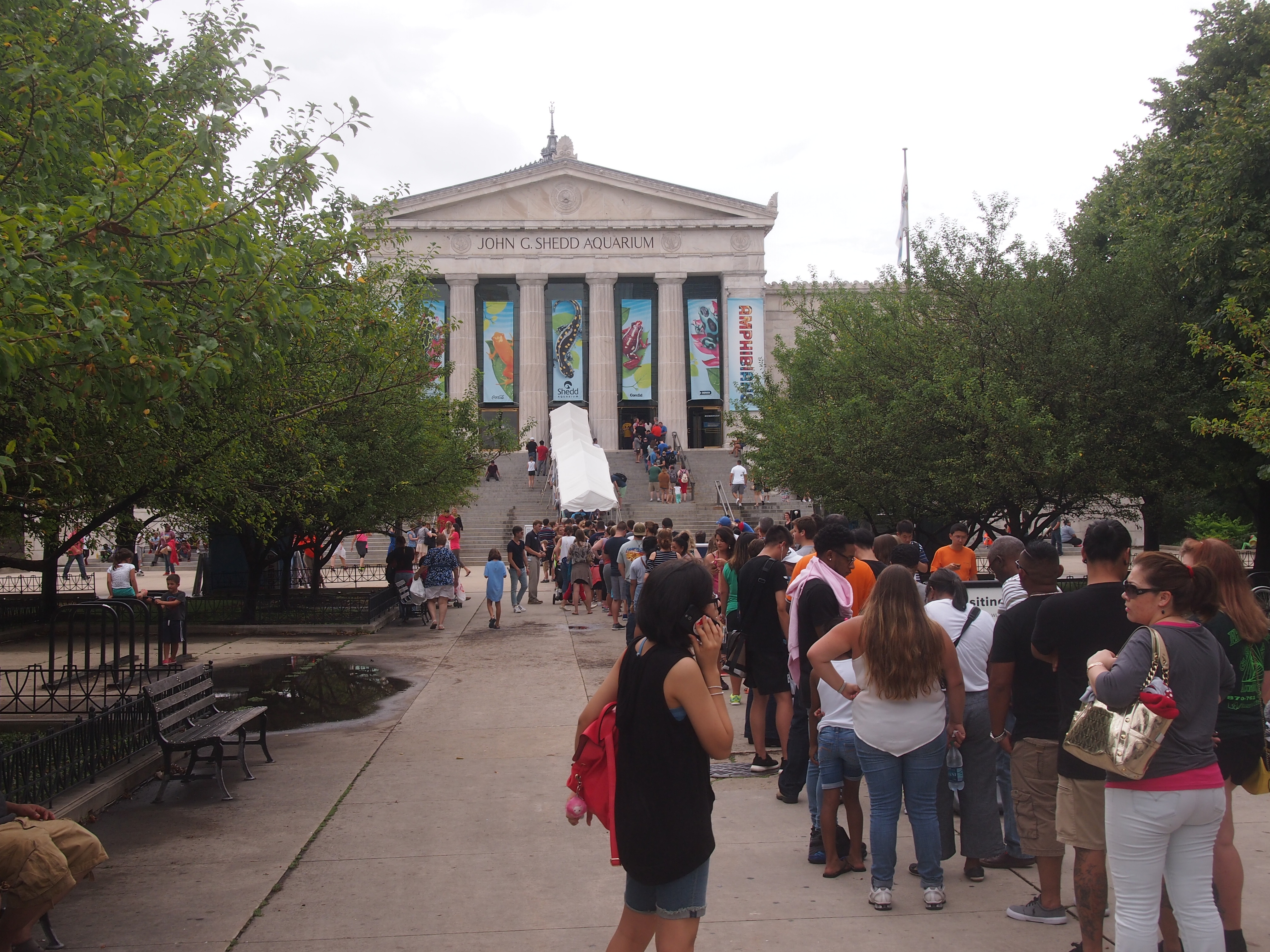
We didn’t go all the way downtown just to look at statues, as interesting as they were. Lilly goes to university this week, so we all wanted to do something together before that. Ultimately we picked the Shedd Aquarium. We figured it wouldn’t be quite so crowded on Friday as it would be on Saturday, so we went on Friday.
Shedd Aquarium August 12, 2016Wrong.