The Oblates in San Antonio

The Missionary Oblates of Mary Immaculate run the Oblate School of Theology on a sizable campus on the North Side of San Antonio, not far from where I grew up, and near some former regular haunts of mine. Even though the campus is on Oblate Dr., and I drove by that street often for years, I had no notion of its existence until this year.

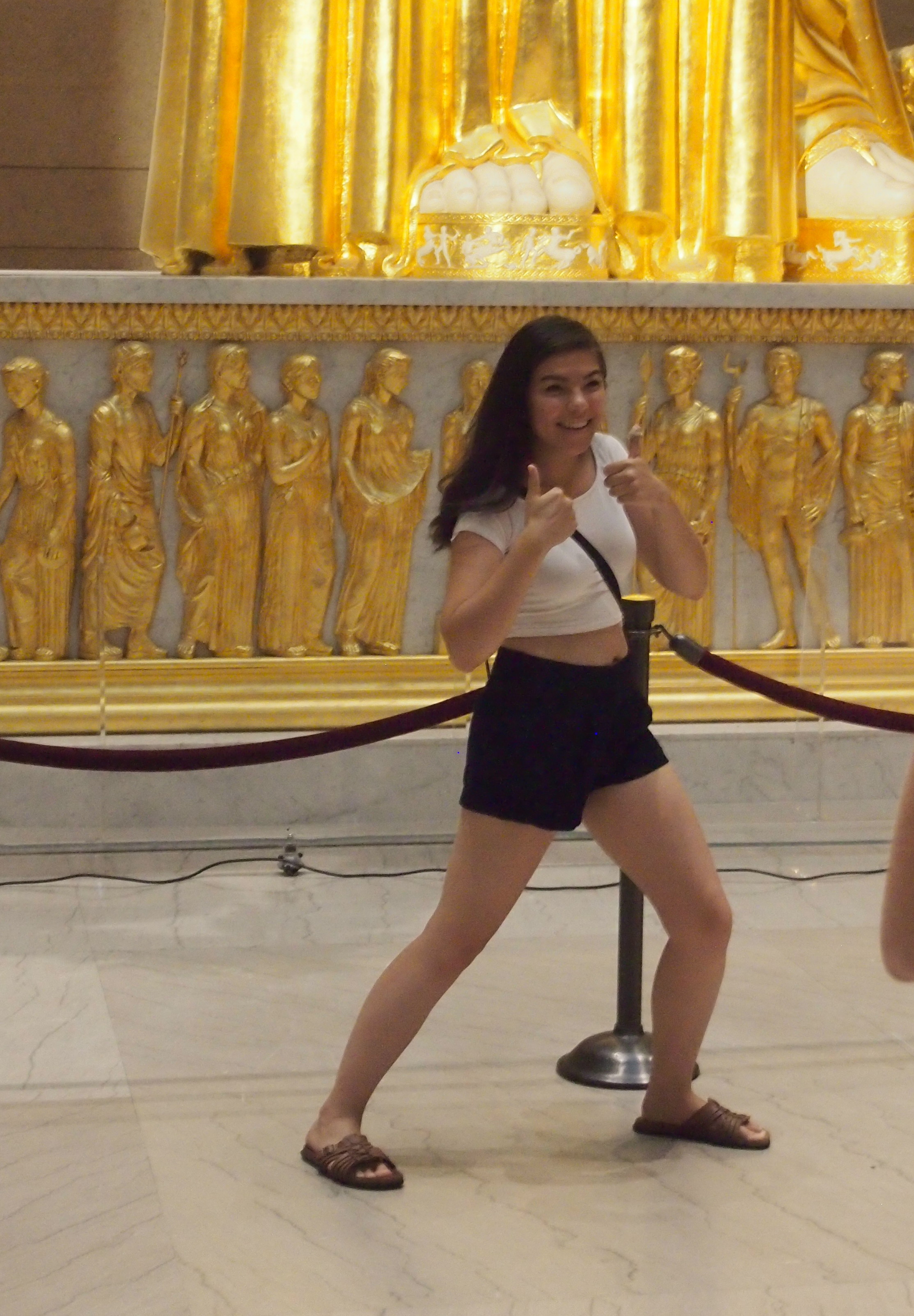
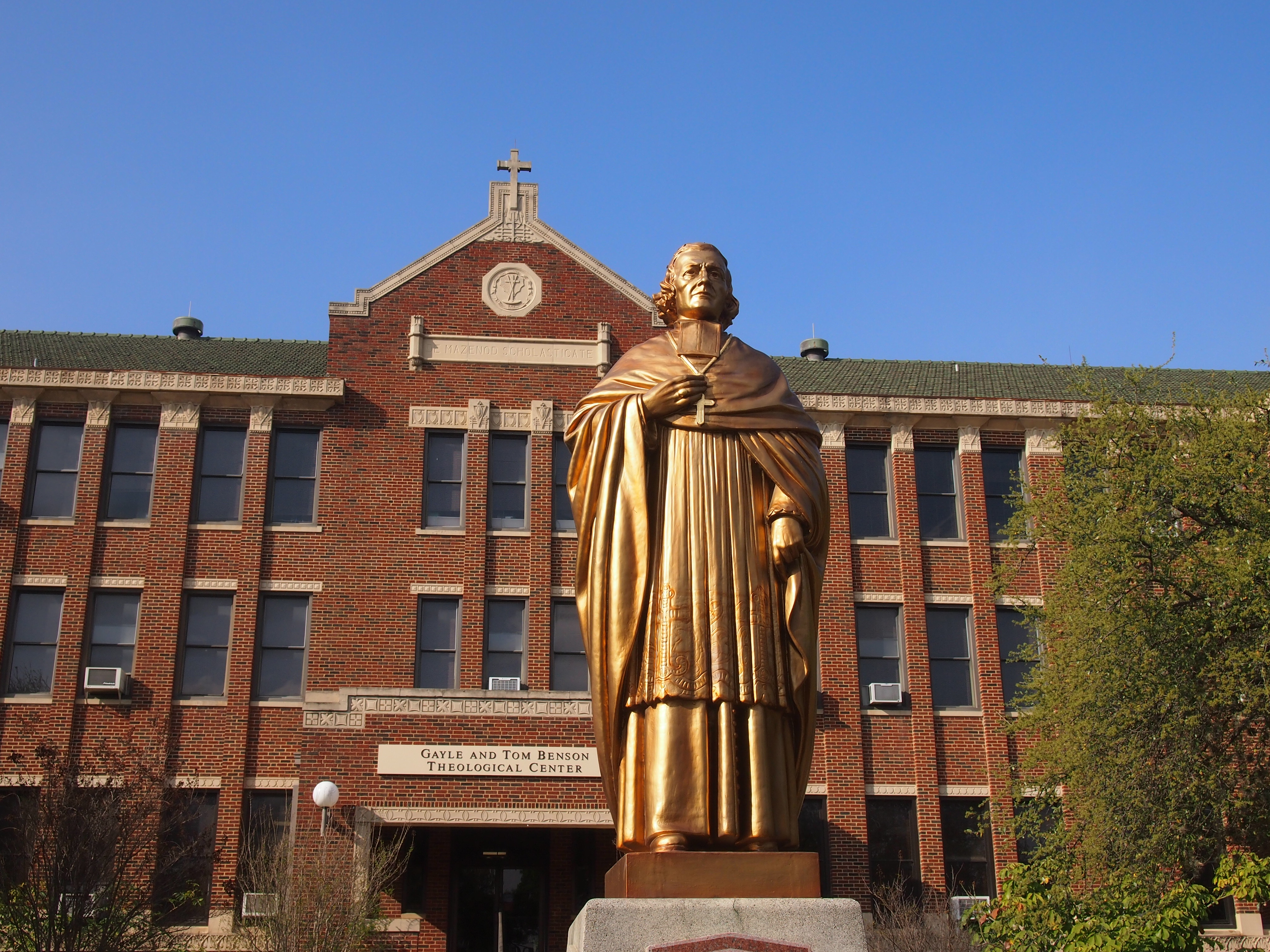
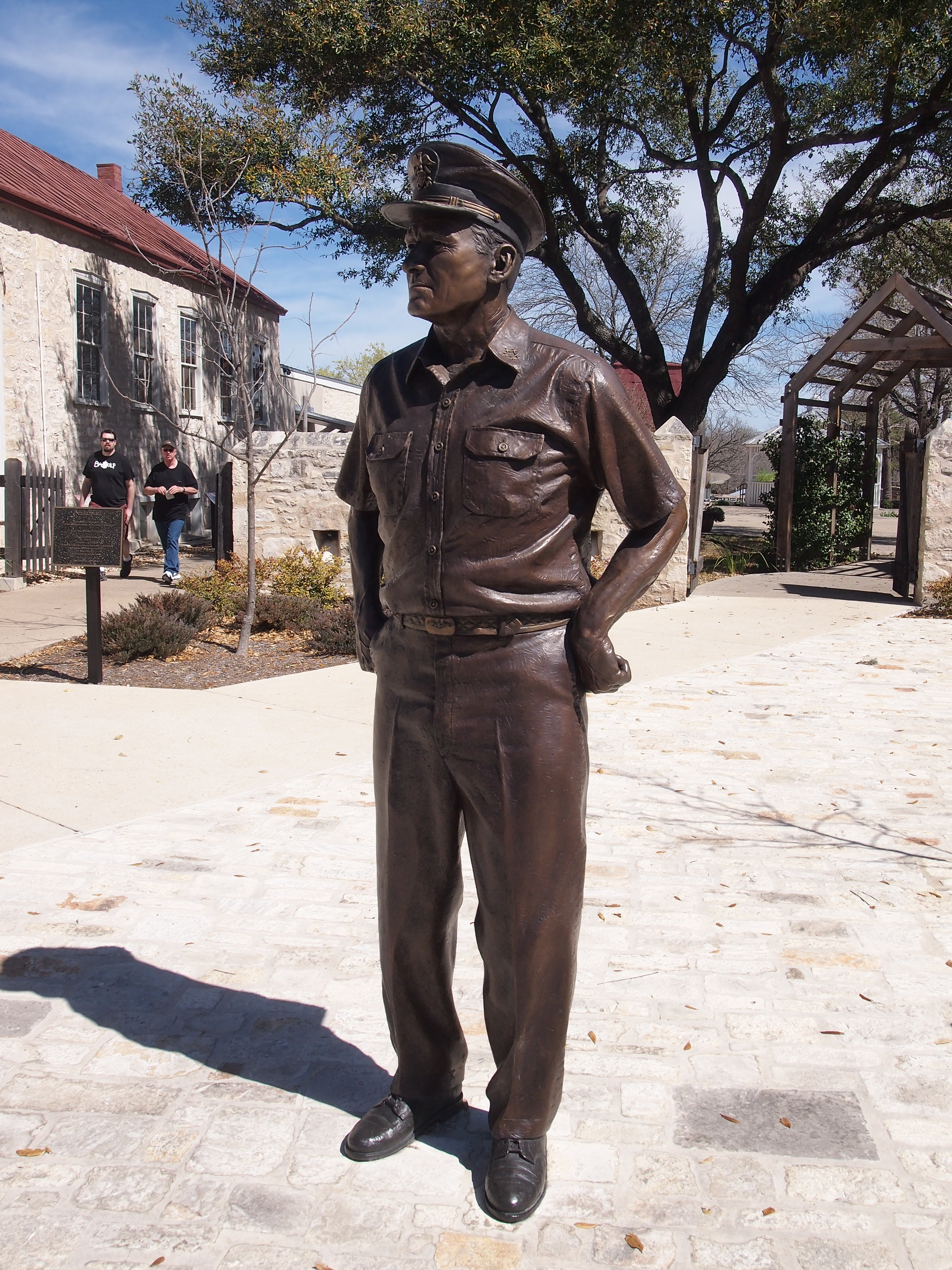
On March 12, another pleasantly warm day, I went with Jay, my nephew Dees and his girlfriend Eden to take a look around the campus. A gilded St. Eugene de Mazenod greets you at the entrance, in front of the handsome Gayle and Tom Benson Theological Center.
Oblate Theological SchoolEugene de Mazenod founded the Oblates in post-revolutionary France 200 years ago. Tom Benson is best known as the billionaire owner of the New Orleans Saints, but anyone living in San Antonio in the last 50 years or so knows him as the owner of Tom Benson Chevrolet. In any case, he gives a lot of money to Catholic causes.

According to the school’s web site, “the Missionary Oblates of Mary Immaculate came to Texas in 1849, at the urgent request of Texas’ first Roman Catholic Bishop, to preach Christ’s message and to serve the People of God, especially the poor and marginalized.

“The Oblate School of Theology was founded in San Antonio in 1903 as the San Antonio Philosophical and Theological Seminary. The School’s initial goal and mission was to educate young men to serve as Oblate missionaries in Texas, New Mexico, Louisiana, Mexico and the Philippines… Today, Oblate School of Theology prepares men for priesthood from many dioceses across the United States and a number of religious communities.”

I have to add that in the early 20th century, the part of San Antonio that’s now home to the Oblates wasn’t part of San Antonio. Assuming they founded their school where it is now — and I haven’t found any information to suggest otherwise — the land the Oblates bought lay in the countryside, with the city to the south. There were no housing developments or highways nearby; all that would come in the 1950s, when the campus and the land around it were annexed by the city, as shown on this interesting growth-of-San Antonio map (which also shows the curious fact that the pre-1940 shape of the city was square).

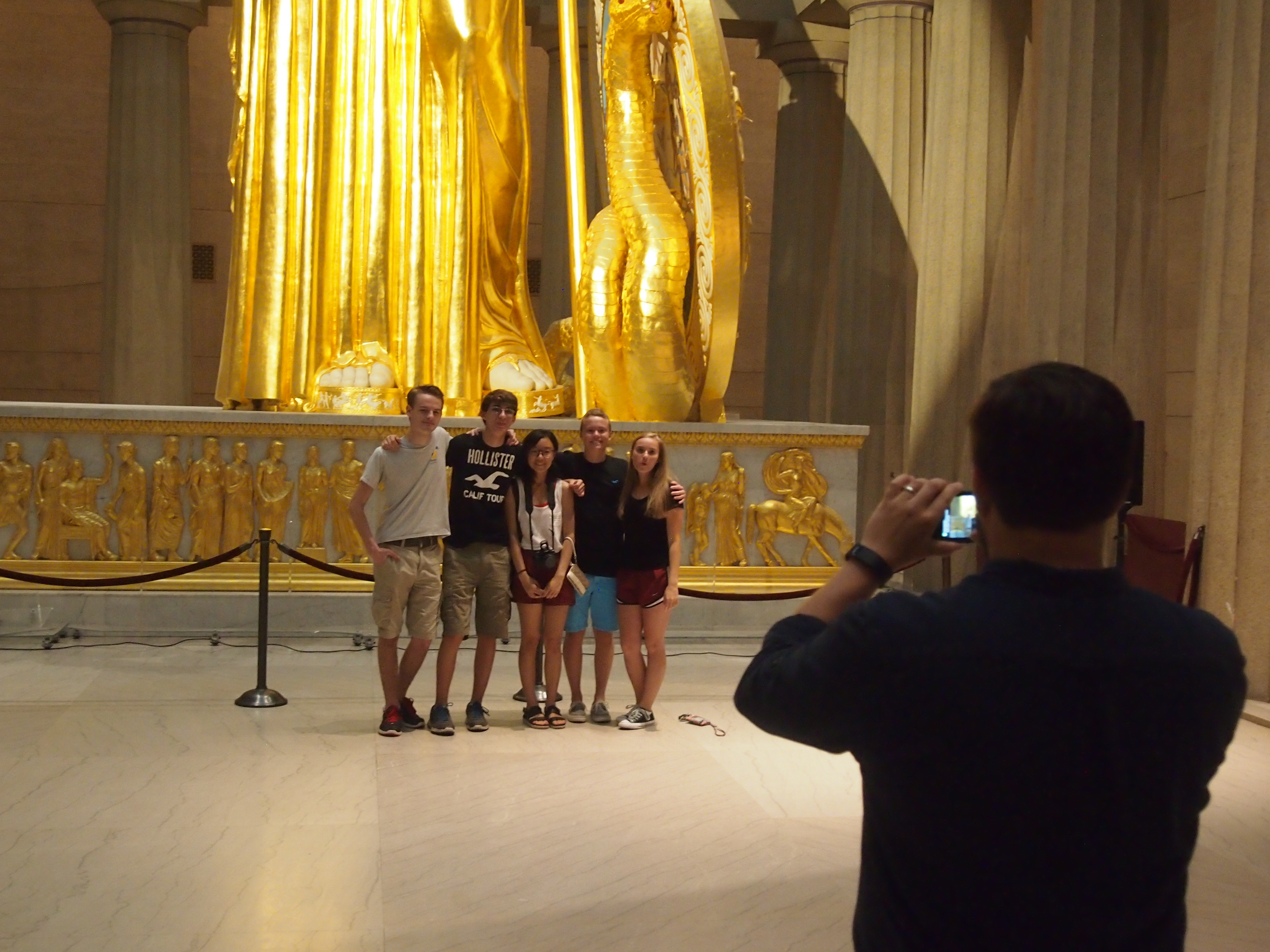
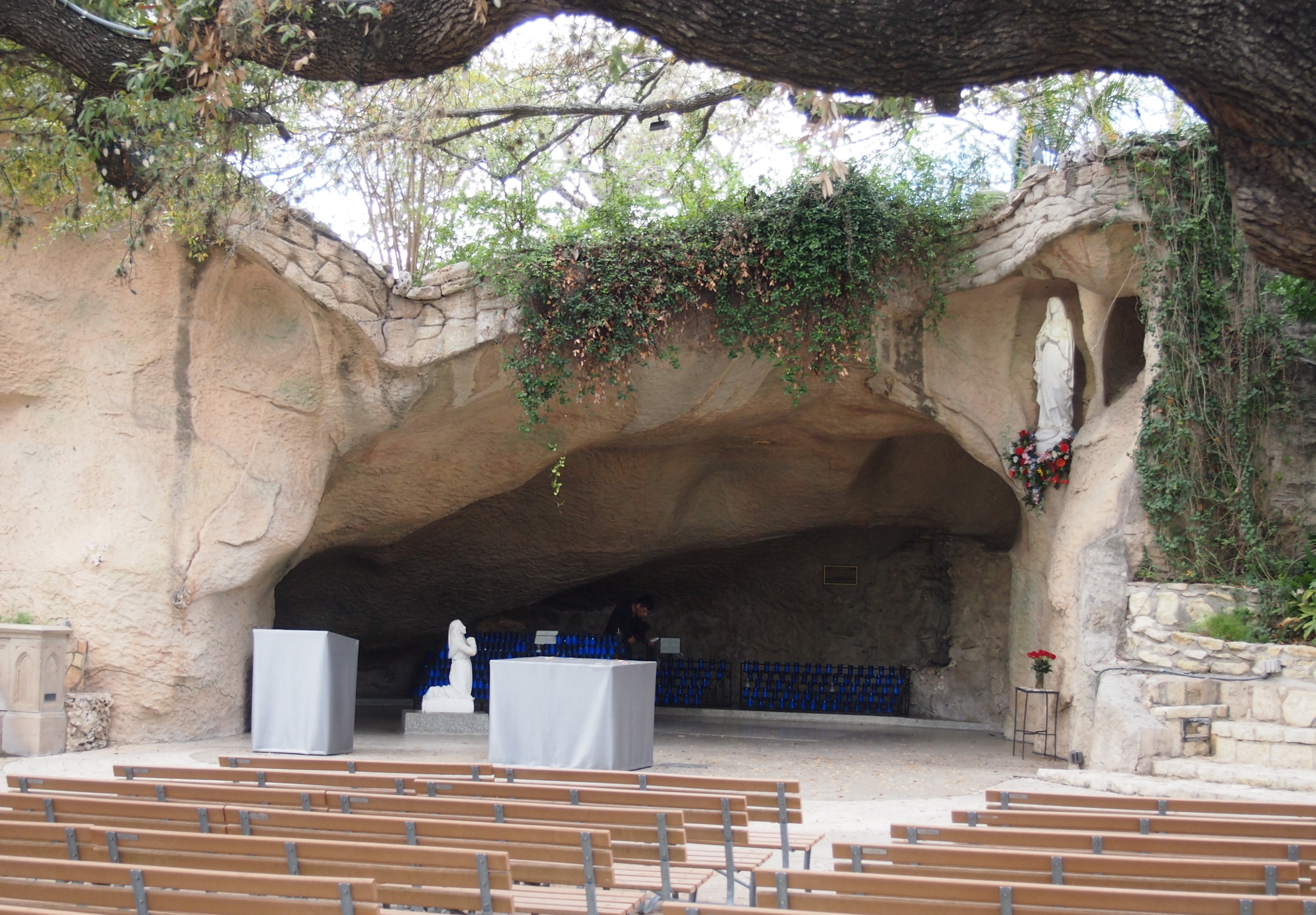
As nice as it is, we didn’t come just to see the Benson building. Rather, we were intrigued by a grotto on campus patterned after the famed grotto in Lourdes. A full-sized replica, I read, made of concrete.
Oblate School of Theology GrottoThe San Antonio grotto’s been on the site since the early 1940s. In fact, according to its plaque, the Oblates dedicated it on Sunday, December 7, 1941. I’m sure that the date had been picked in advance, and events in the wider world weren’t going to call it off. Then again, maybe the Oblates were up early that morning Central Time, before any ill-tidings came from Hawaii.

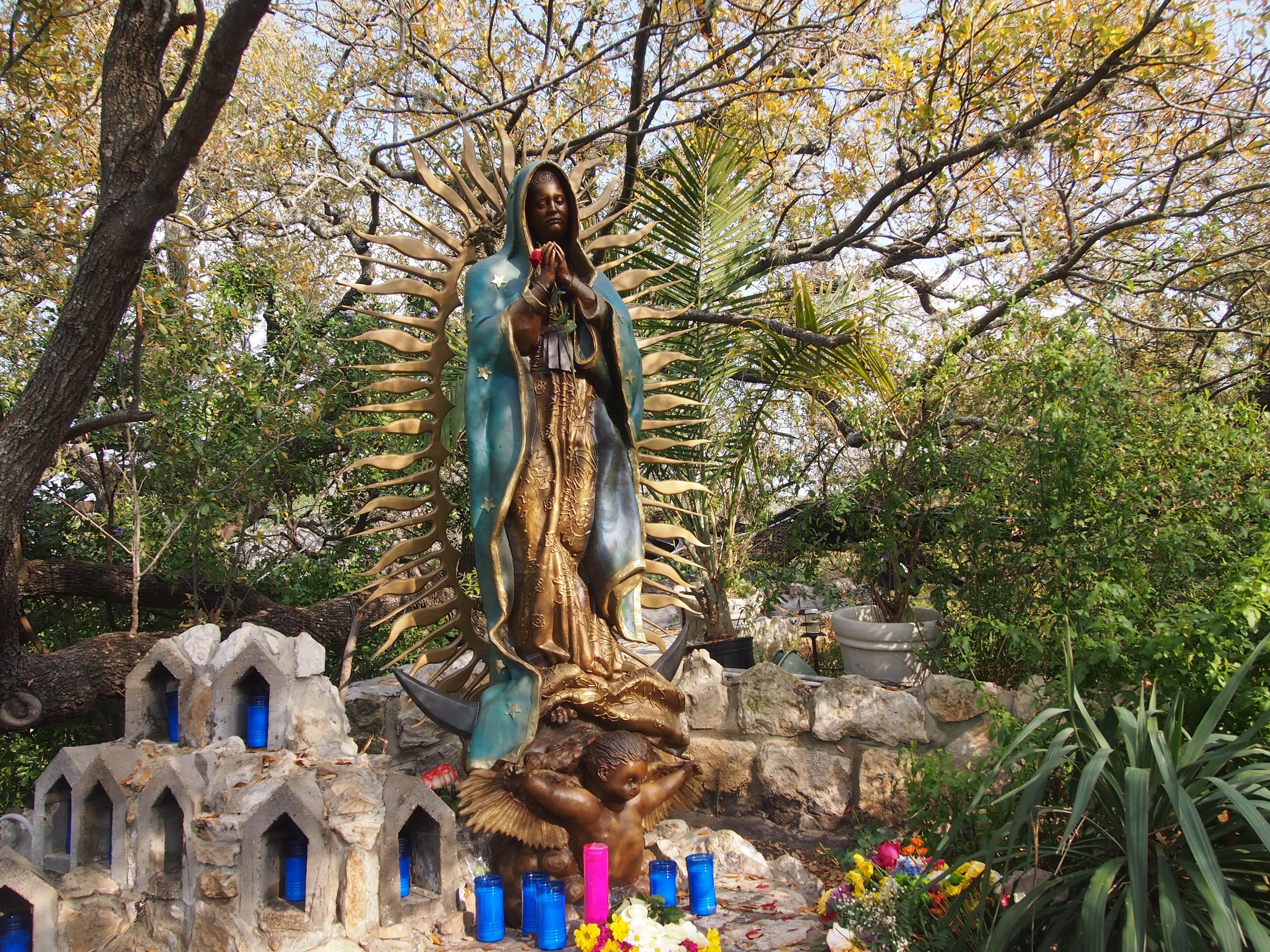
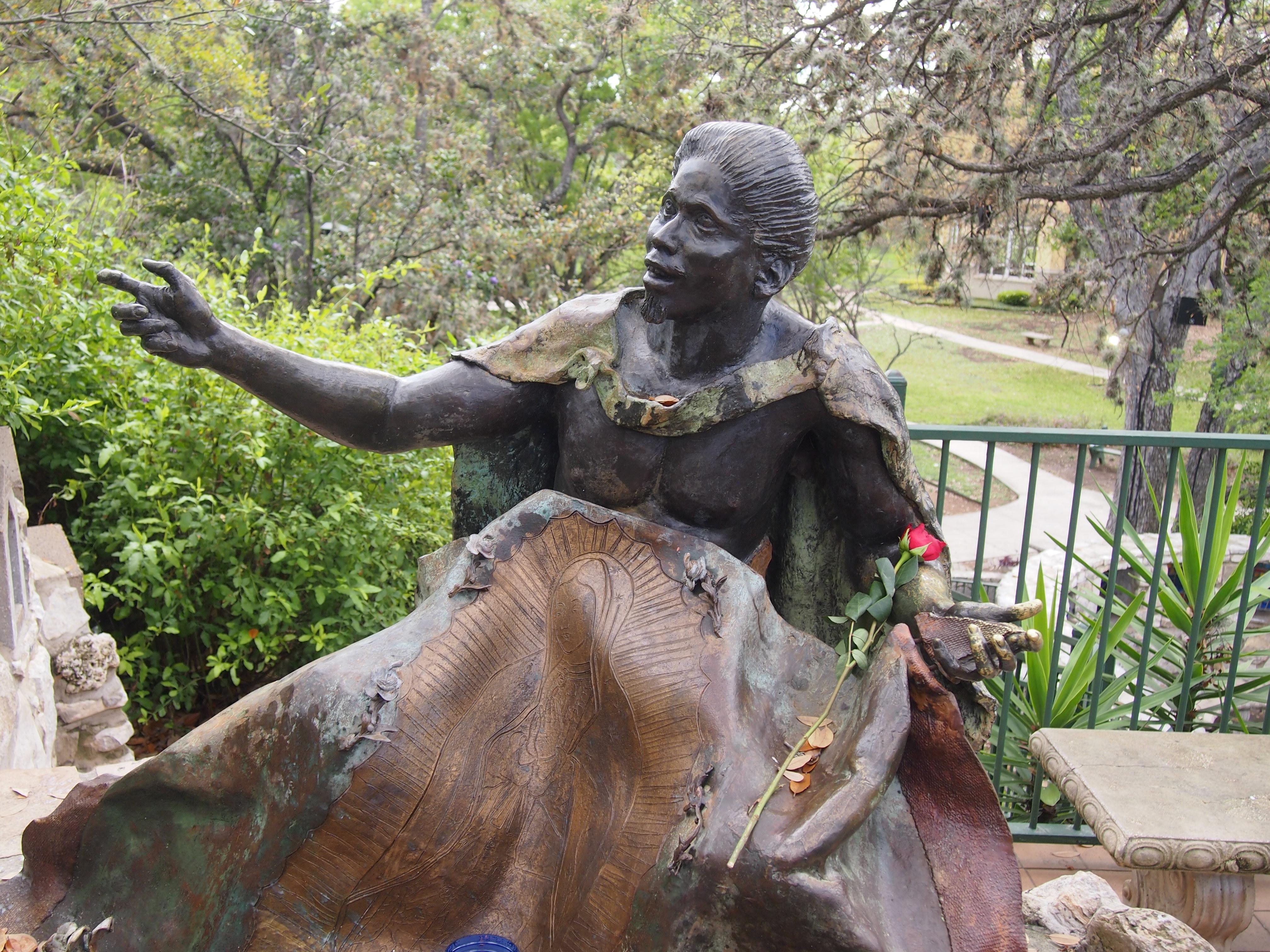
Built on top of the grotto, accessible by stairs, is the Tepeyac de San Antonio, dedicated on July 25, 1999, depicting the Virgin of Guadalupe appearing before St. Juan Diego in December 1531. This isn’t the first depiction of that scene that I’ve run across.

Here’s the Virgin.
The Virgin of GuadalupeAnd Juan Diego.
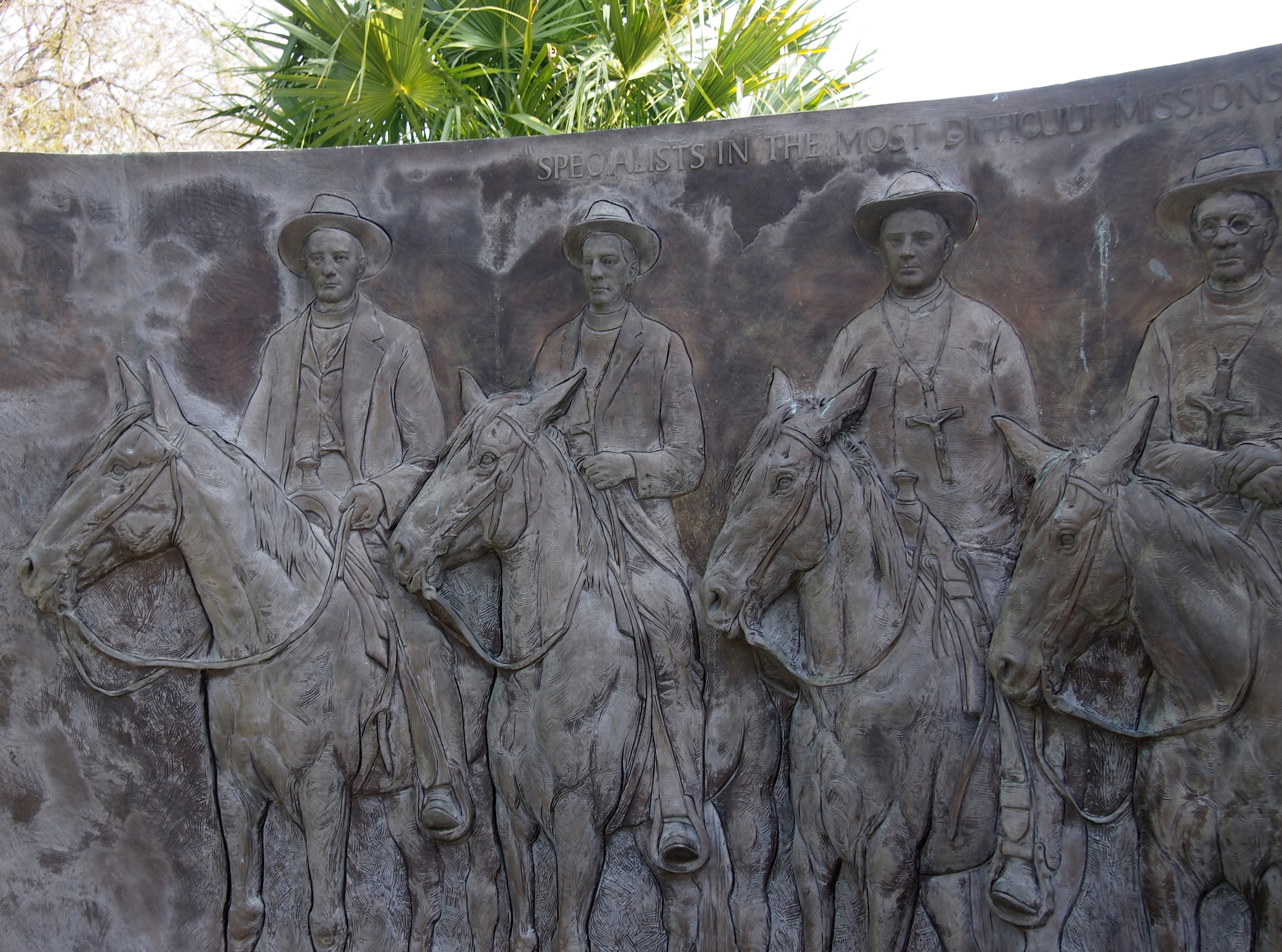
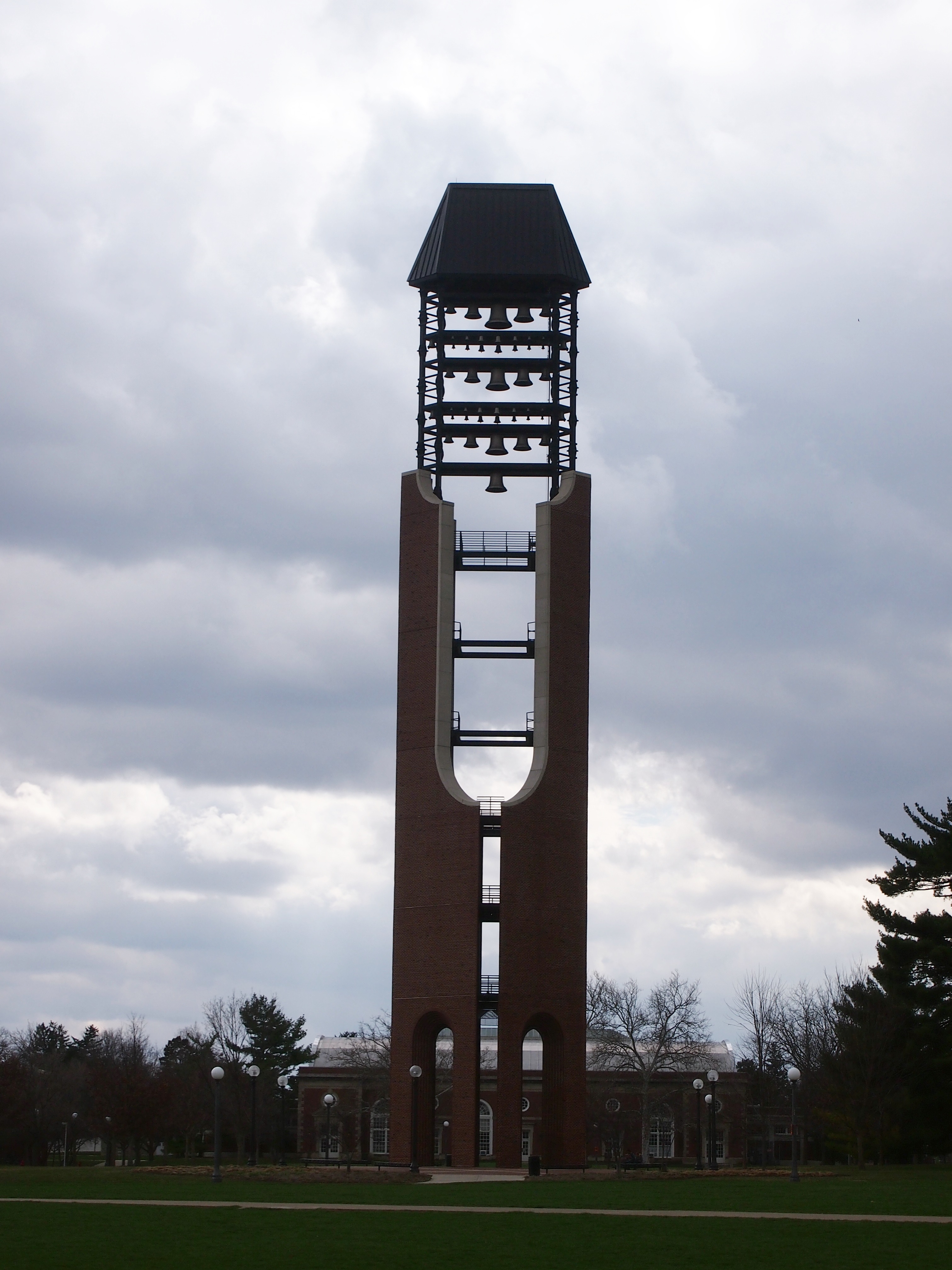
JuanThe Oblate campus also features a chapel, some business offices, places for visiting scholars, a gift shop (no post cards; I’d have bought some saint cards) and a fair amount of public art, such as a freestanding metal structure with a frieze of Oblates on horseback — “The Cavalry of Christ,” who were 19th-century missionaries in South Texas. ‘Ot and sweaty business, no doubt.
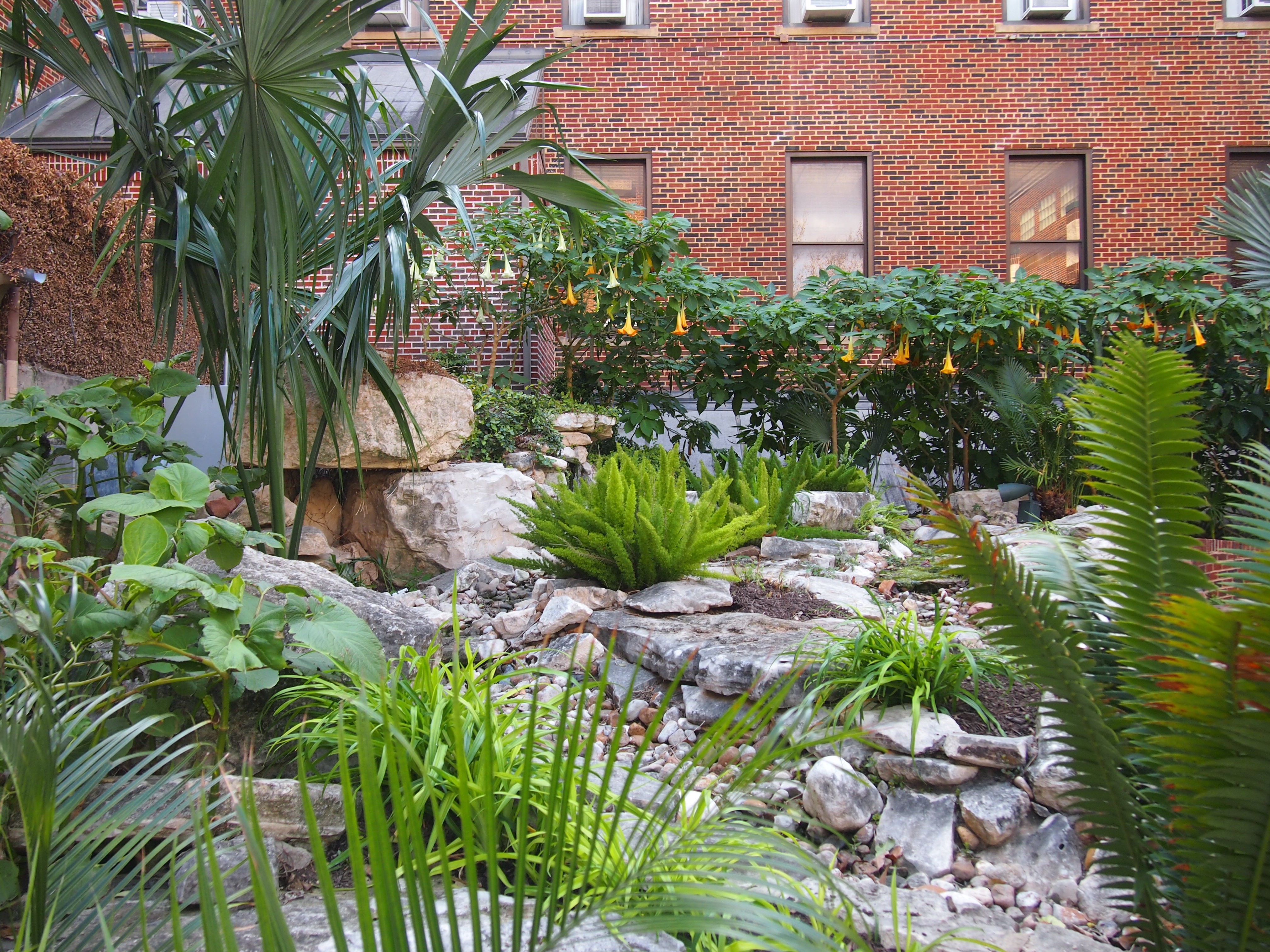
Horsemen for ChristA garden behind the Benson building.
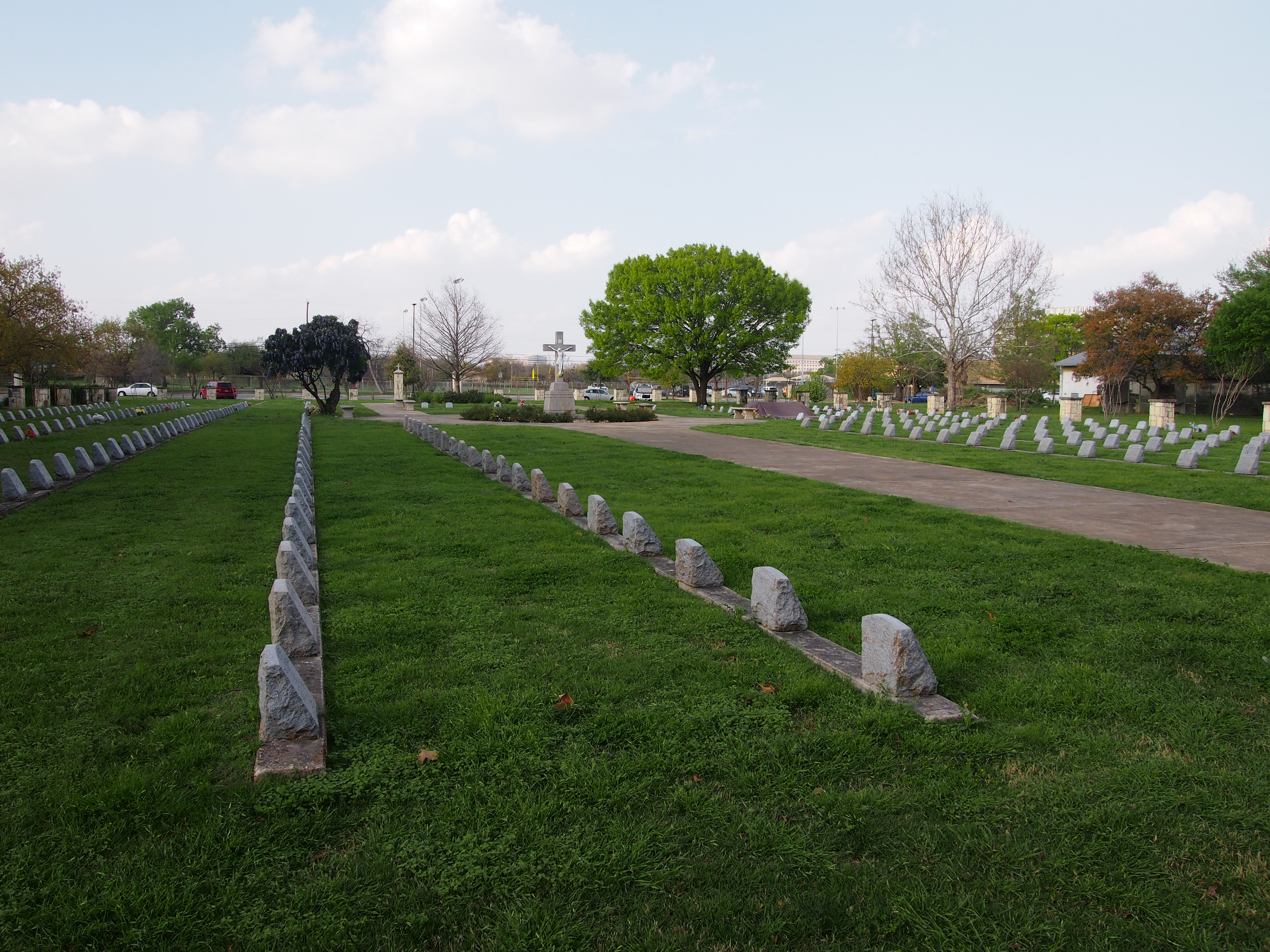
A place for Oblates who’ve passed on.
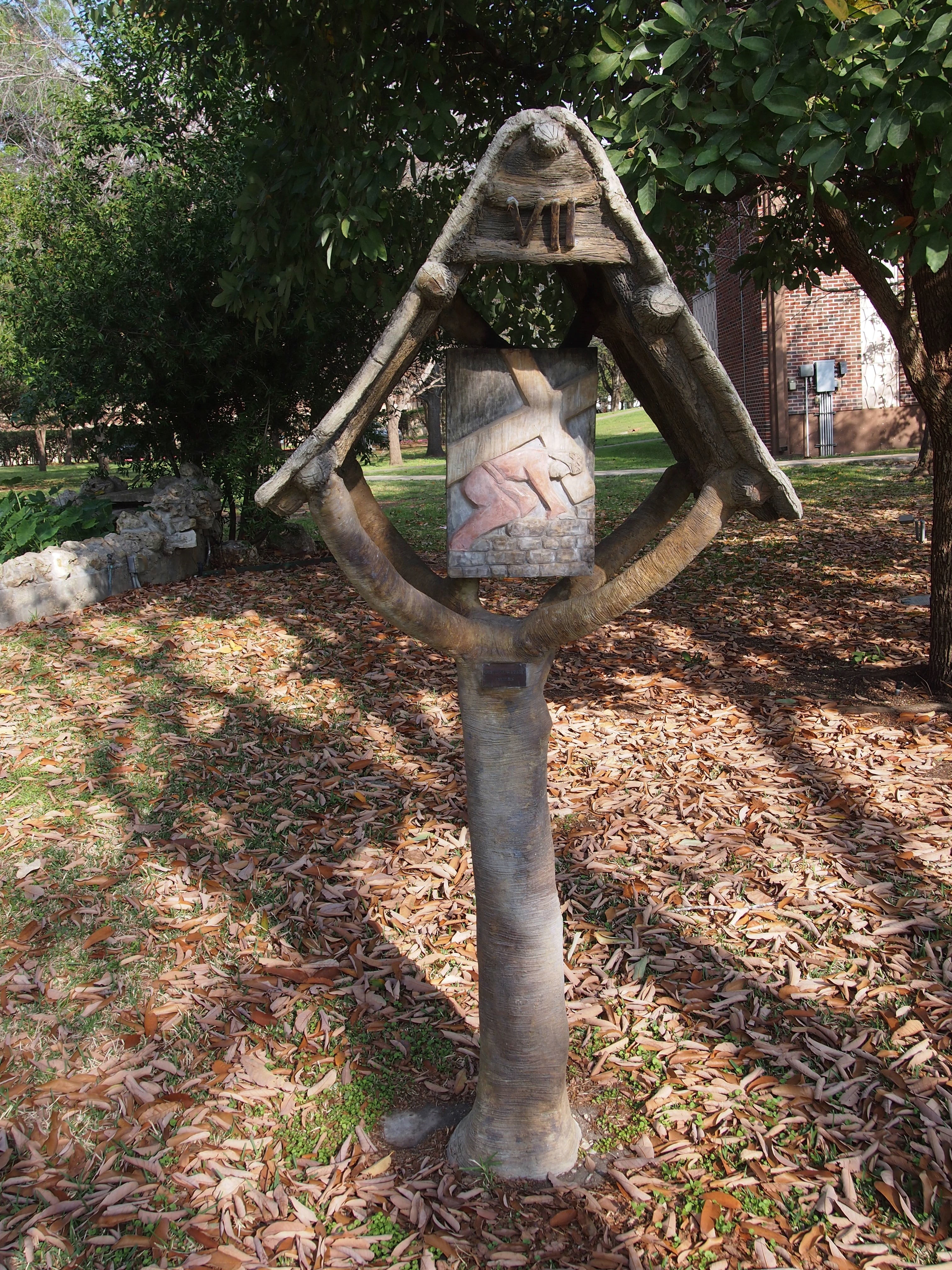
Stations of the Cross in a style I’ve never seen.
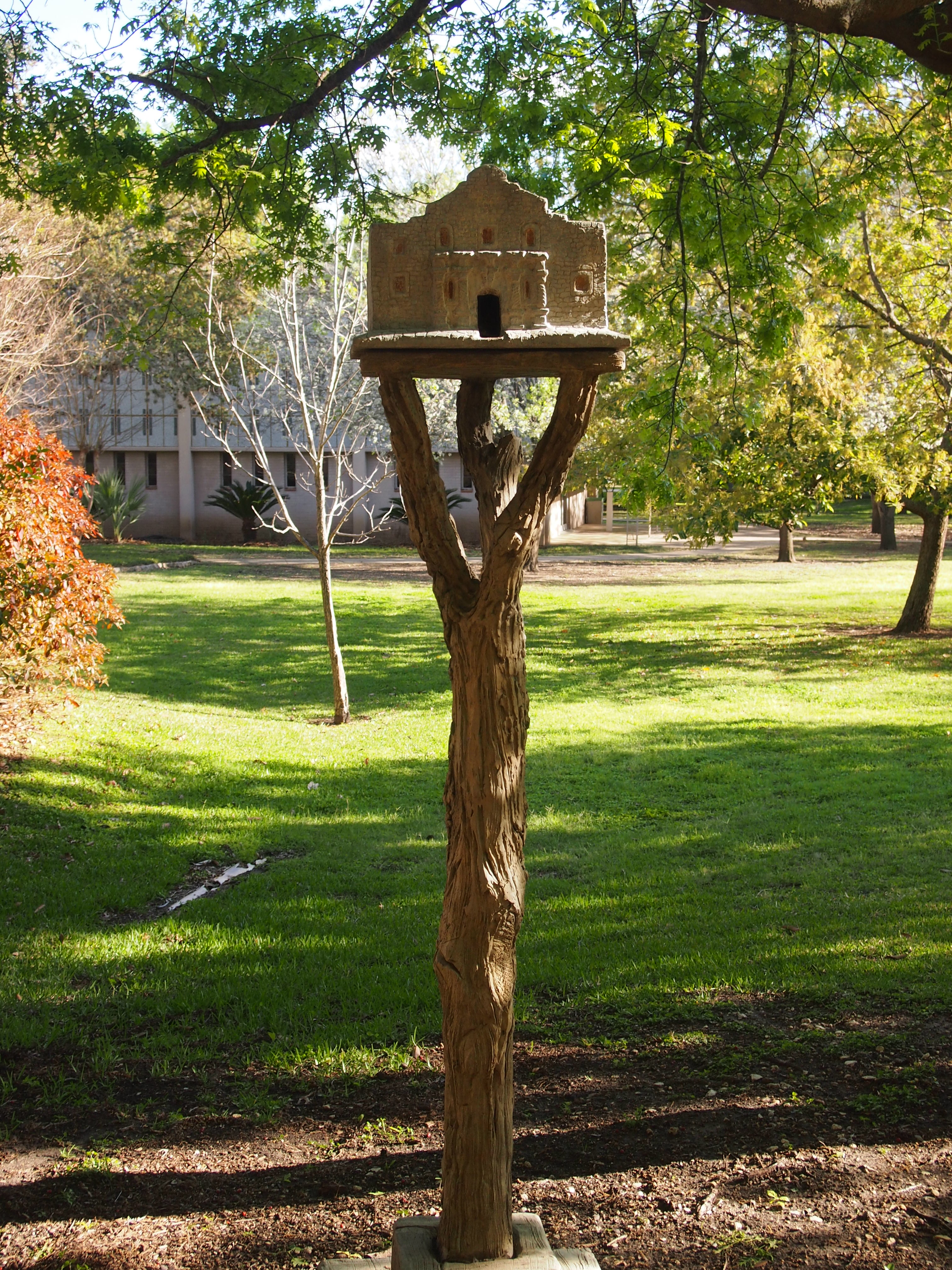
Stations of the CrossAnd “missions on a stick.”
There were five of them, depictions of the five Spanish missions in San Antonio. That includes the best known of them, the Alamo.

Denman Estate Park

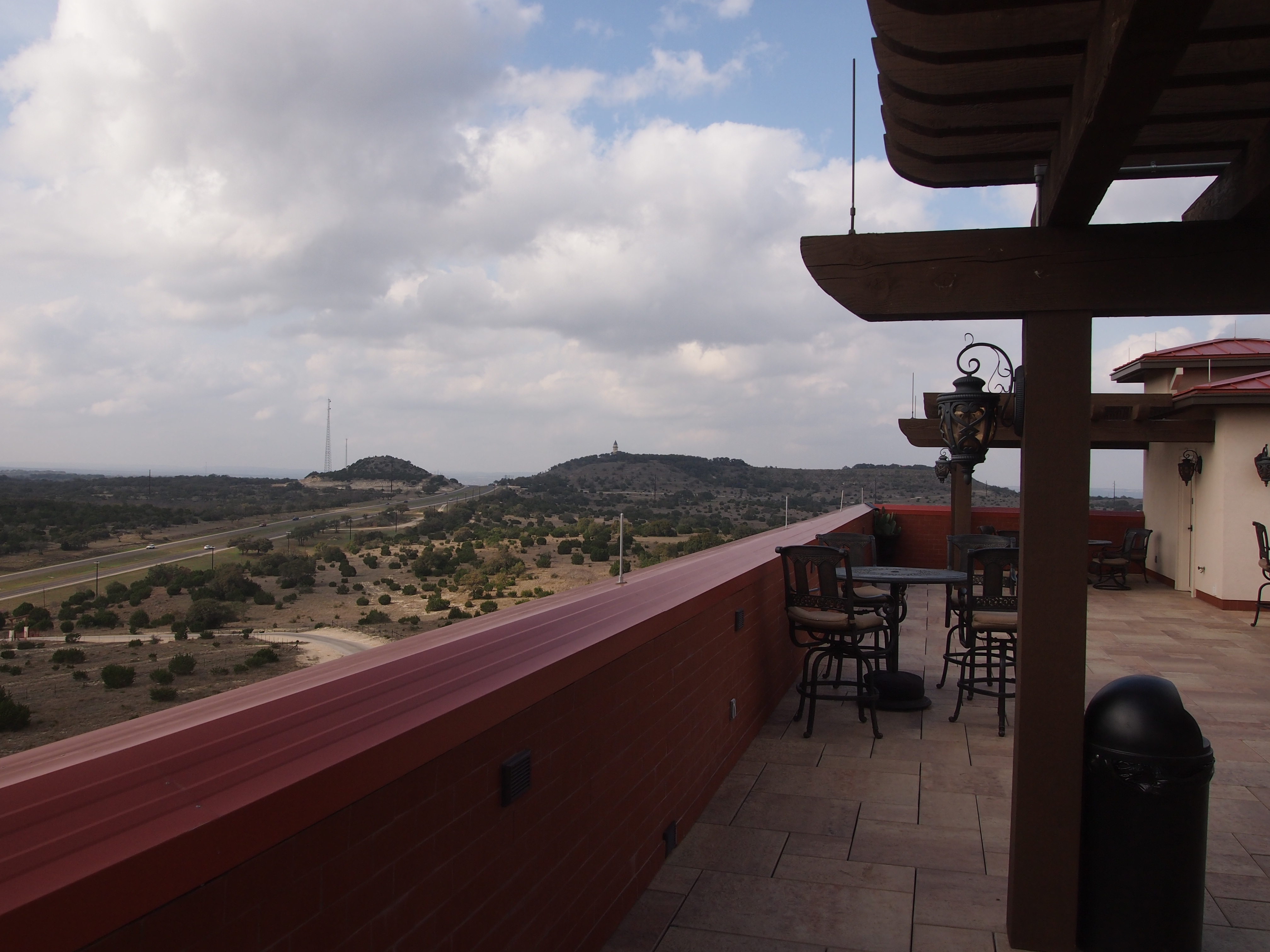
Last year I was looking at a Google Maps map of San Antonio and noticed an odd green blob tucked away in a neighborhood just northwest of the junction of I-10 and Loop 410, an area not too far from where I grew up, but not within my usual orbits. Higher resolution revealed that it was called Denman Estate Park. What?

“The City of San Antonio purchased 12.52 acres of land from the estate of philanthropist Gilbert Denman Jr. in 2007 at a cost of $2,561,081,” the city’s web site says, with a cost-precision sometimes found in public documents. “An adjacent 7.70 acres were purchased by the University of [the] Incarnate Word. In 2010, Gilbert Denman Jr. Estate Park, 7735 Mockingbird Lane, opened as a jointly used park and a retreat center for UIW.

“Park amenities include a 0.5-mile walking trail, labyrinth, picnic benches and tables, parking, fencing and lighting. It also features a monument hand-built in Gwangju, Korea, by Korean craftsmen and artists who traveled to San Antonio to assemble it. The City and UIW entered into a joint use agreement in which UIW maintains the property and uses the buildings as a retreat center.”
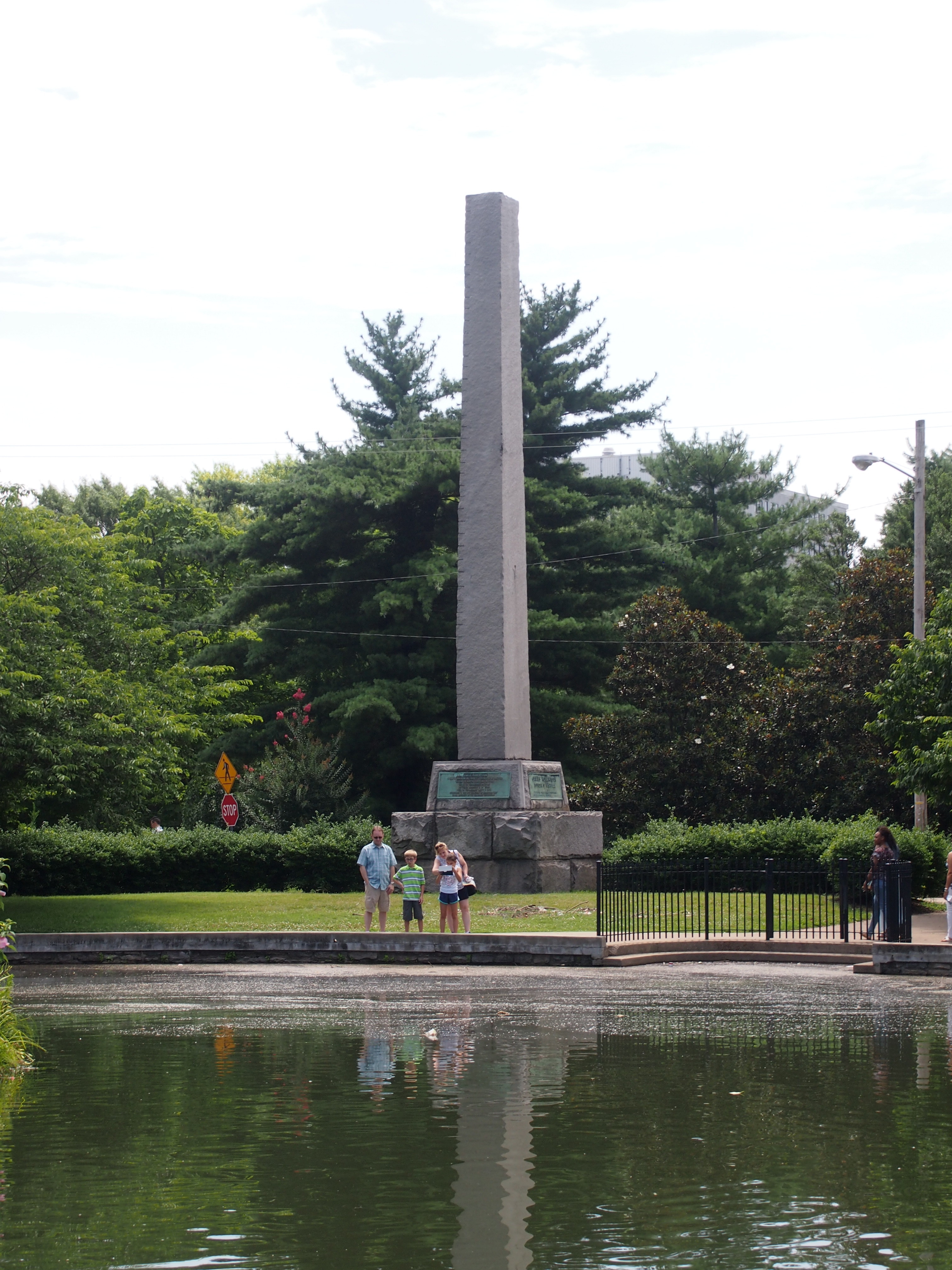
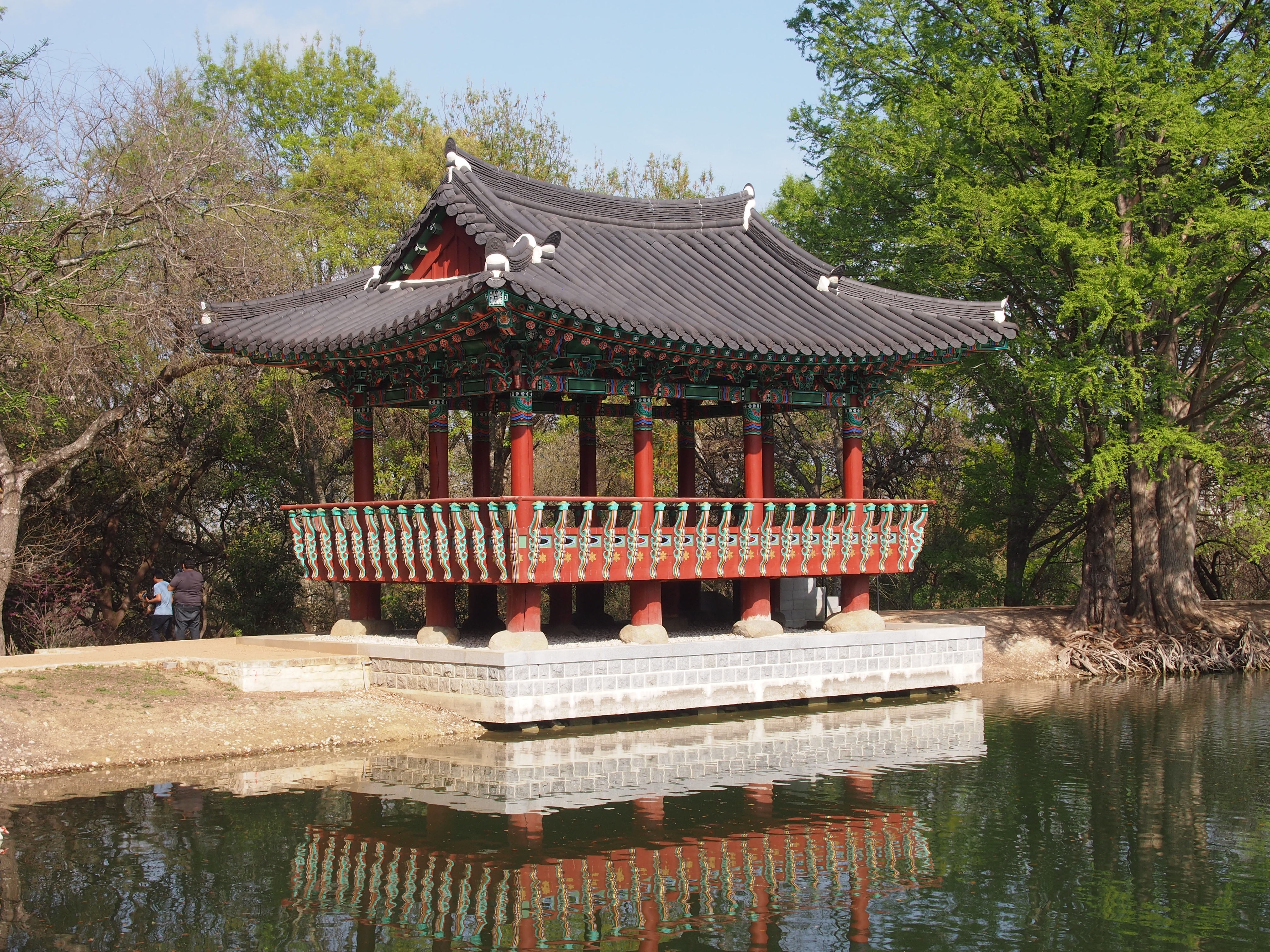
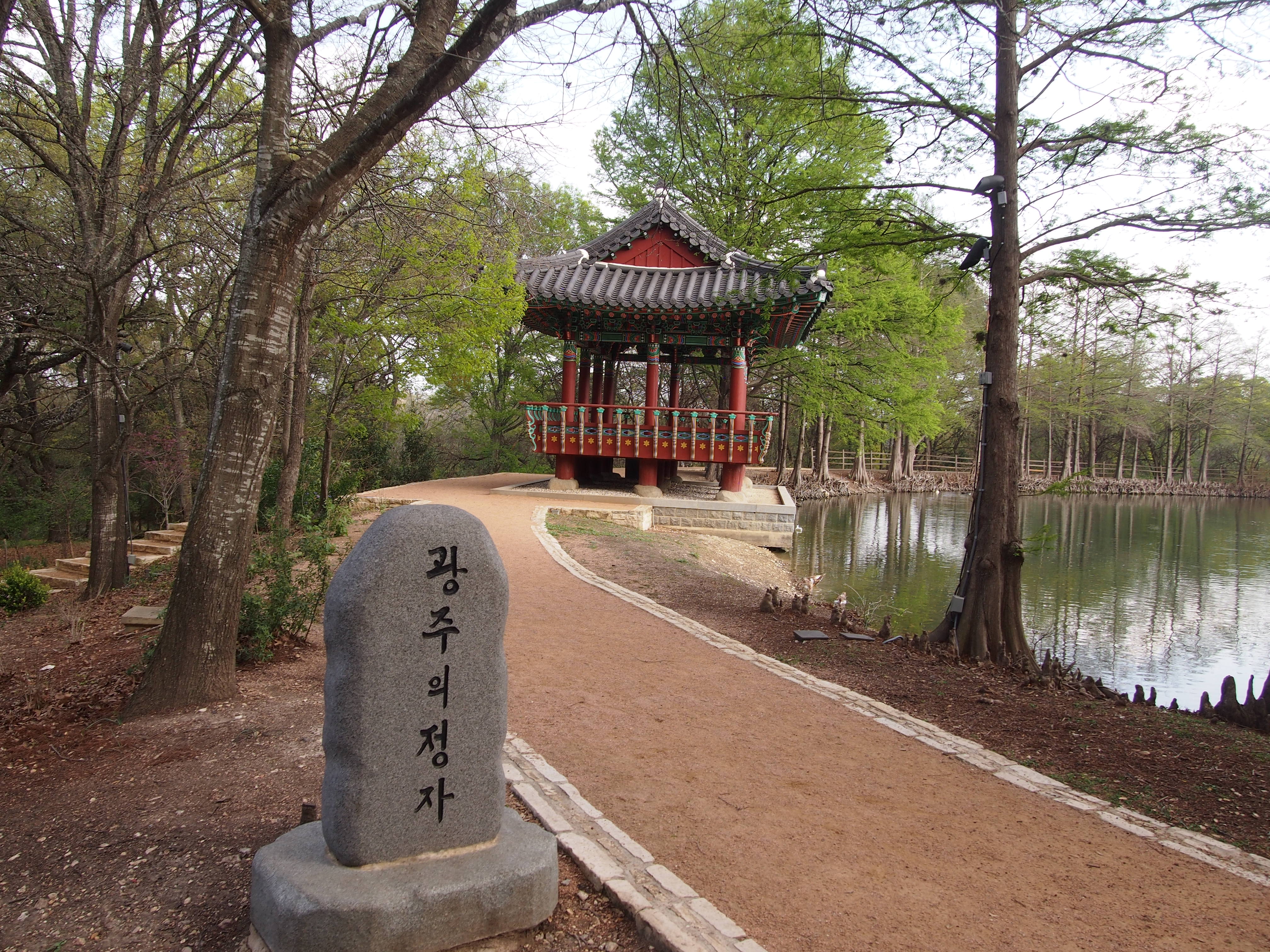
I knew had to take a look at that. I finally did so when I had a few free hours in San Antonio during my most recent visit. I arrived in the early afternoon, parked my car, and found the short path to the park’s small pond, which also has a path all the way around it. The hand-built “monument,” on the banks of the pond, is a striking little structure — especially for being in South Texas — in a nice setting.
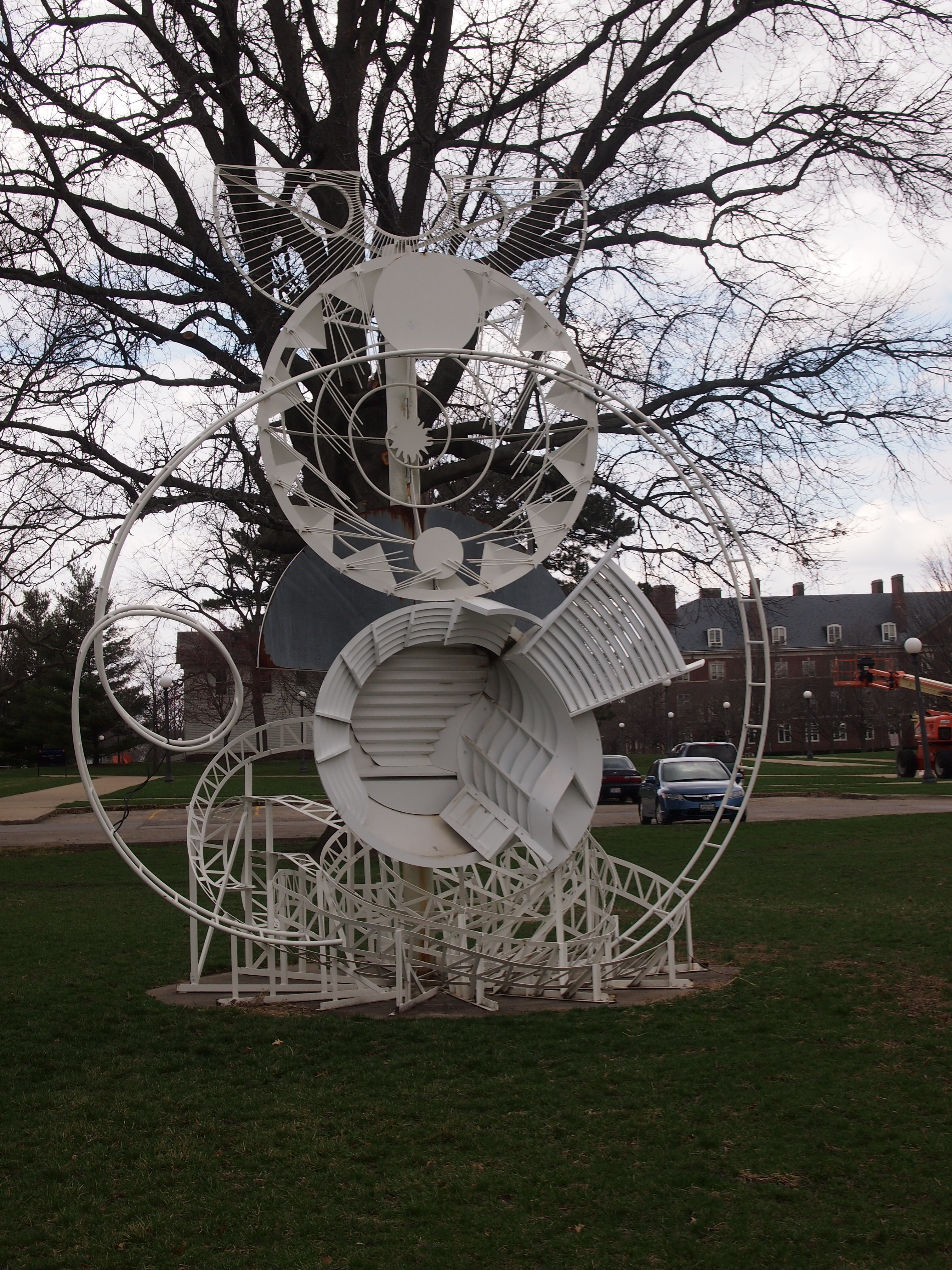
Denman Estate Park, San Antonio“Pavilion” is a better word for it in English, and in fact that’s the word a nearby plaque uses.

Denman Estate Park, San Antonio“This pavilion is a replica of the traditional Korean pavilion style of the southern provinces,” the plaque says. “The pavilion, traditionally used as a place of reflection and reception by scholars and gentlemen, embodies the beauty and harmony created by nature and structure.

“It is hoped that this ‘Pavilion of Gwangju’ will offer many opportunities to strengthen the friendly relationship between Gwangju and San Antonio, as well as inspire an in-depth understanding of Korean culture and traditions by the American public.”

A noble sentiment, but I have a feeling K-pop reaches more Americans than other kinds of Korean culture and traditions. The pavilion seems to have been a gift from Gwangju to San Antonio. It isn’t clear whether Gilbert Denman himself had anything to do with its placement, since the structure was dedicated in 2010, six years after his death.

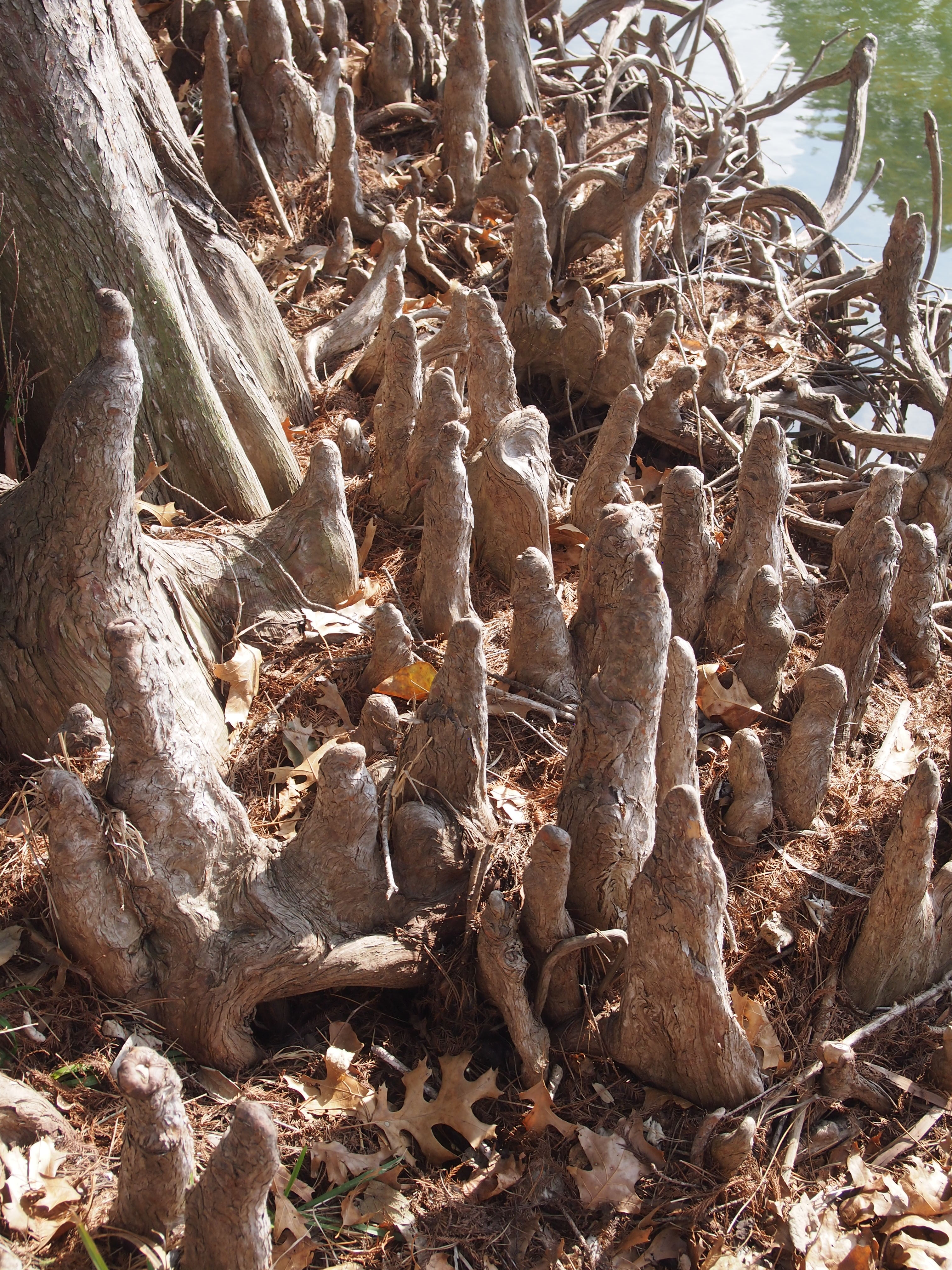
The pond was partly ringed with cypress trees with a vast number of cypress “knees” — the woody bumps that emerge near the base of the trees — a term I just learned.

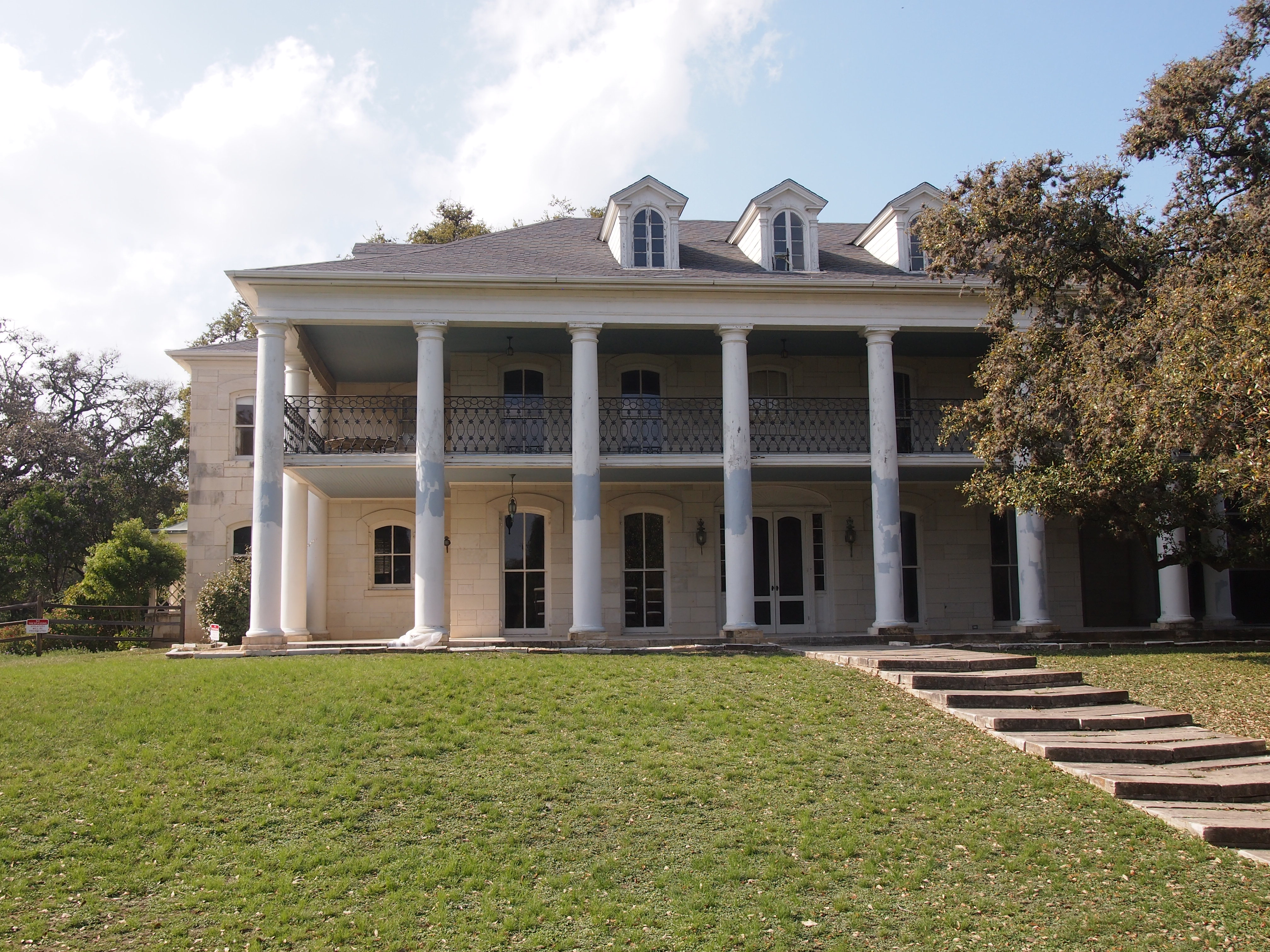
Denman Estate Park, San AntonioDenman Estate Park, San AntonioElsewhere on the property is the former Denman manse (I assume), which is closed to casual visitors. No doubt the university uses for events and rents it for weddings and the like.

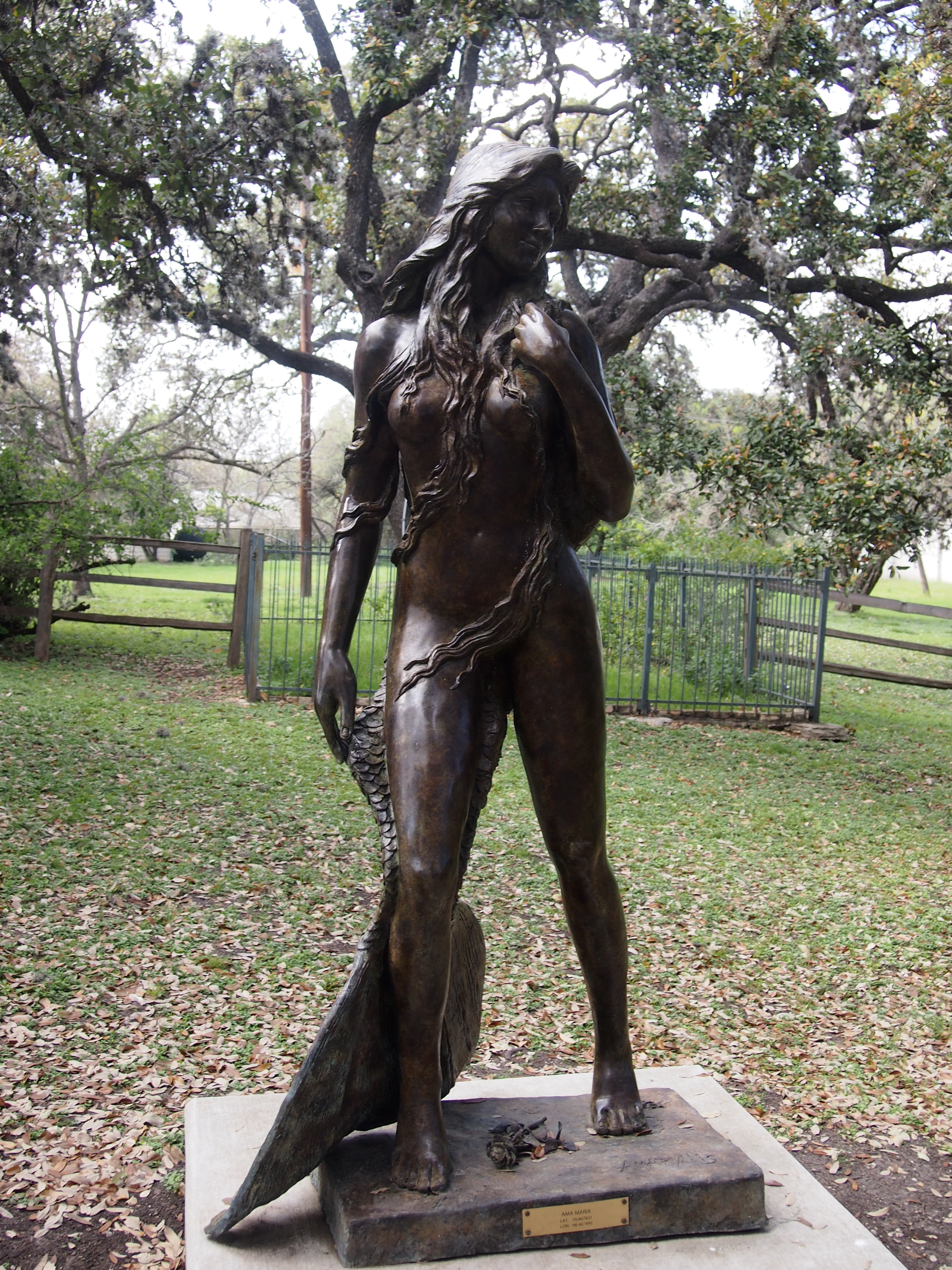
Denman Estate Park, San AntonioNot far from the house is “AMA Maria,” a mermaid sculpture with strategically placed flowing hair, a fish tail, and human legs.

Ama Maria, Denman Estate Park, San AntonioOddly enough, the plaque on the base of the statue also includes its latitude and longitude to six decimal places: LAT. 29.467831  LON. -98.467490. Turns out there are a fair number of these statues in various parts of the world, including three others in Texas. It was something I’d absolutely never heard of before.

A site called mermaidsofearth.com tells us that “the Amaryllis Art for Charity project is placing AMA mermaid statues all over the world, with each mermaid statue uniquely made and customized for its location… The statues are for sale, with about one third of the proceeds dedicated to a charity jointly chosen by the project organizers and the local sponsors.”

It isn’t clear from that whether the statues are for sale in situ or whether they’re bought and put in places like Denham Estate Park. Never mind, there’s one there now. More about it is here.

Finally, who was Gilbert Denman Jr. (1921-2004)? A handy obit published by the Porter-Loring Funeral Home in San Antonio offers a few details about his charmed life, which included being born to a wealthy family and presumably doing well himself as a prominent attorney in San Antonio. Like Robert L.B. Tobin, he was also a notable local philanthropist.

One of his many acts of philanthropy, according to the obit, involved donating “his extensive collection of Greek and Roman artifacts to the San Antonio Museum of Art. The collection, among the finest of its type in the nation, is housed in the Denman Gallery of the Ewing Halsell Wing at the museum.”

The good people of San Antonio are clearly better for his Antiquities collection. I will be better for it, once I get around to visiting the San Antonio Museum of Art again sometime. It’s been a long time since I’ve been there, since the late ’80s at the latest, before the creation of the Denman Gallery in 1990. The big deal exhibit the last time I remember being there was Nelson Rockefeller’s large collection of Latin American folk art, which arrived as a permanent part of the museum’s collection in the mid-80s.

“Ecce Hora”

Not far from “Awaking Muse” (see yesterday) on the grounds of the Prairie Center for the Arts and the Village of Schaumburg municipal center is a sculpture doubling as a sundial — or a sundial doubling as a sculpture — called “Ecce Hora.” After visiting the muse, I walked over to the structure.
"Ecce Hora"This vantage shows the south-facing side of the sculpture, which naturally catches more light than the north face, so it has a wide variety of hour lines. You’ll note that it shows the time as a little past 11 am, which was completely accurate. Toward the tip of the gnomon — it’s hard to see in this picture — it advises you to add an hour during most of the year to account for DST, but we’re still on standard time.

The sign near the work — actually there are two signs, duplicates of each other for some reason — says, “this adjustable sundial was designed and built by Chicago artist Christine Rojek. Ecce Hora (which means “Behold the Hour”) is constructed of painted aluminum and includes fanciful hand-painted figures which twist, dive and somersault. They perform as if to say, ‘If life is just a shadow, make a dance.’ ”

That’s what they’re saying? How about, “Time flies, so do we” ?

The north-face, which has the English name, is destined not to catch as much sunlight. It certainly was in the shadow this time of the year.

"Ecce Hora"But at other times of the year, it will be illuminated, so there are hour lines on that side as well, just not as many. All in all, it’s good to take a look at sundials every now and then.

“Awaking Muse”

Rumor has it that the ground will be covered with snow again tomorrow — which will devolve into slush a few days after that — so I spent a few minutes today out on the brown ground near the Prairie Center for the Arts and the Village of Schaumburg municipal center. The grounds are sizable, and include a large pond that’s usually home to a pair of swans.

“The village purchased Louis and Serena, called Mated Mute Swans, in 1994 in response to the growing Canada Goose population on the municipal center pond and grounds,” the Village of Schaumburg web site says. “Breeding age pairs of Mute Swan will not tolerate Canada Geese in their breeding (nesting) area, which can cover several acres of water.”

Not sure whether they migrate, but in any case, the swans weren’t around today. A sign near the pond warns would-be fishermen away when the swans are in residence. The other is probably the only public sign I’ve seen that uses the word cygnet.
Schaumburg Feb 23, 2016Near the pond is a sculpture — a set of sculptures arrayed together — called “Awaking Muse,” by Don Lawler and Meg White."Awaking Muse" Schaumburg"Awaking Muse" SchaumburgA nearby sign tells us that “this sculpture depicts a female figure stirring from her slumber beneath the earth. Carved from Indiana limestone, the sculpture excites imagination and brings inspiration to its viewers. The ‘Awaking Muse’ references the muses of Greek mythology. The Greek muses were goddess sisters who inspired mortals with great thoughts in the arts and sciences.”
"Awaking Muse" SchaumburgI don’t know that it excites my imagination, but I like it. It’s been there since 2006. Some years ago, we attended a few summertime outdoor concerts on the grounds near “Awaking Muse,” and the sculpture was alive with children playing on it. Including ours.

The only thing missing? A nearby Indiana limestone alarm clock. Even muses have a hard time waking up sometimes.

“Rock”

The Christkindlmarket in Daley Plaza was insanely crowded on Saturday. So we didn’t spend much time there.

Millennium Park was pretty crowded too, but it’s spacious and holds its crowds better. There’s a new public art installation near the Bean. DNAinfo tells me that it goes by the simple-enough name “Rock,” and it consists of eight limestone rocks — some are borderline boulders — weighing between 3,000 and 9,000 lbs.

“The stones, which were donated by the Chicago Park District out of a Hyde Park storage facility, will be included in an upcoming lakefront kiosk at Montrose Beach as part of this year’s Chicago Architecture Biennial,” writer David Matthews said in September.

“Soon guests will be able to paint and otherwise decorate the stones, which will help support the kiosk when it is built next year…”

The thing to do when encountering “Rock,” at least if you’re limber, is climb on them.
"Rpck" Chicago Dec 2015"Rpck" Chicago Dec 2015"Rock" Chicago Dec 2015That included Ann.
"Rock" Chicago Dec 2015But not me. I never was a limber-American.

Formerly Known as Marshall Field’s Christmas Windows

Chicago’s seen a lot of street protests lately, but on Saturday we didn’t see any protesters, even though we passed by City Hall and parts of Michigan Ave., which have been hubs of protest. Except for this guy.

Marshall Field's protester 2015He stood on State St. near its intersection with Washington St., just outside of the Store Formerly Known as Marshall Field’s, as you’d expect. Is the sign advocating that the British retailer Selfridge’s buy the famed old store in Chicago and return it to its original name? Maybe. I didn’t ask him. But after all, Harry Selfridge was an early part owner of Marshall Field’s, and essentially took its techniques to the UK to establish his store.

The streets might not have been thronging with protesters, but they were thronging all the same, probably boosted by the fact that it was a Saturday before Christmas, along with the warm temps. Extra helpings of people were in front of the former Marshall Field’s on State St. to see the seasonal windows.
State Street at Macy's Dec 2015Eventually we got a look at the seasonal windows. As usually, they were elaborately creative. Or creatively elaborate, with a Christmas theme. This year it was about a space-flight-enthusiast young boy hitching a ride with Santa to various fantastic versions of the planets (except Pluto), including a return to Earth that seemed to feature a bizarro hybrid of New York and Chicago. Guess that counted as a fantastic version of Earth.

The madding crowd made it hard to look at the windows for very long, or take many pictures, but I did get one of the window I especially liked.
Macy'sChicago Christmas Windows 2015It’s a snowball fight between giant ice creatures inhabiting Uranus and Neptune. Methane snowballs, probably.

Return to Humboldt Park

Another place we went on Saturday — which I suspect will be the last warm Saturday of the year — was Humboldt Park, one of Chicago’s major parks. The last time I was there, summer was ending, but it was still summer. In mid-November, the park’s a different place, one of autumnal gray and brown and smidgens of green.

Humboldt Park Nov 14, 2105There are still a lot of birds around. Ducks and geese mostly, still foraging in the unfrozen waters.

Humboldt Park Nov 14, 2105Near the park’s Boat House is a dead tree refashioned into artwork: “Burst” by Mia Capodilupo (2014). A ex-locust tree plus hose, rope, extension cord, and fabric.

Humboldt Park Nov 14, 2105According to WTTW, it’s one of a number of such transformations citywide: “The Chicago Park District has teamed with a local sculptor’s group to turn trees that were condemned into public art. The stay of execution for the mighty elms, ash and locust trees is also an opportunity for artists to make a very public impression.”

Not far from “Burst” is a more traditional kind of park art, a statue of explorer Friedrich Wilhelm Heinrich Alexander von Humboldt. I saw it last year but couldn’t make an image.

Felix Gorling did thisNote the globe behind him. There’s an iguana back there, too. WBEZ reports: “[Humboldt Park] was laid out in 1869. The statue arrived in 1892, the work of Felix Görling. It was paid for by German-born brewer Francis Dewes, who was also responsible for a flamboyant mansion on Wrightwood Avenue.
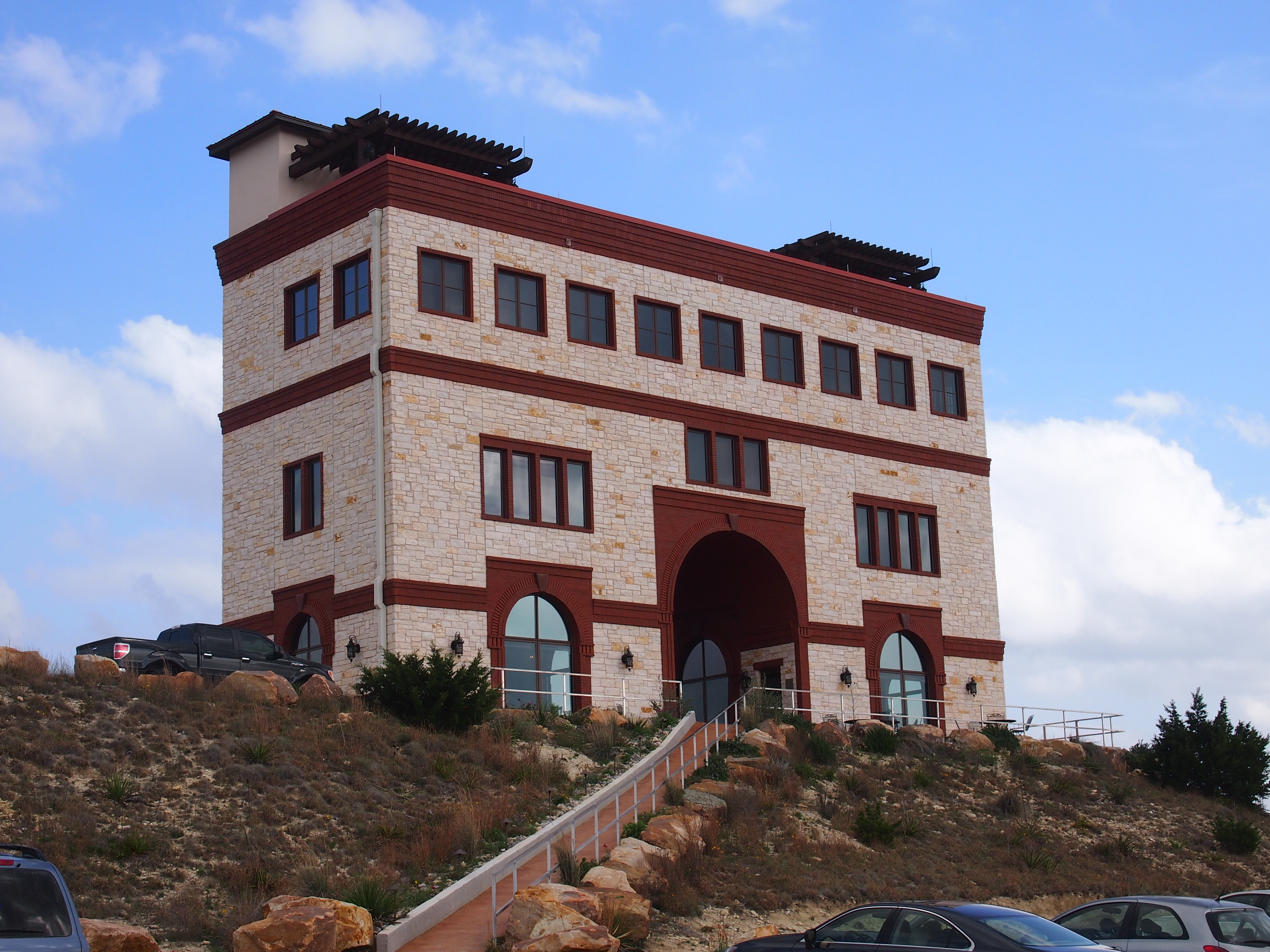
“When the statue was erected, the neighborhood around it was heavily German. The Poles later settled in, and for many years Humboldt Park was the site of the Polish Constitution Day Parade. Then the Poles moved on and were succeeded by the Puerto Ricans… One of the park’s roadways is now named for Luis Munoz Marin — the first elected governor of Puerto Rico.”

The 18th Street Station, Pink Line

En route to the National Museum of Mexican Art on Saturday, I passed through the 18th Street Station of the CTA’s Pink Line. A number of El stations feature public art, but 18th Street, which serves the Pilsen neighborhood, is lavishly decked out.

18th Street Station18th Street Station18th Street StationAccording to Chicago-l.org, which has detailed information about many aspects of Chicago’s elevated and subway system, the 18th Station “features two art installations contributed by members of the local Hispanic community, both installed under the auspices of the CTA’s Adopt-a-Station Program.”

The first is a mosaic mural on the exterior of the station on the east side of the entrance, installed soon after the station opened in the early 1990s (the current station replaced a earlier one dating from the 1890s). I didn’t see that mural this time, since I headed westward to visit the museum.

In 1998, local artist Francisco Mendoza and the Mexican Fine Arts Center Museum (now the National Museum of Mexican Art), along with the city-run youth art program Gallery 37, created a second art installation at the station, notes Chicago-l.org. “Art teacher Mendoza enlisted his students at Gallery 18, a satellite program of Gallery 37, along with anyone else in the neighborhood who could paint to create colorful murals throughout the station.”
That’s what I saw. Since CTA platforms now feature screens that estimate the arrival time of the next train — a very handy use of information tech, I believe — I had time to wander around the station and take pictures. Such as of the painted stairwells.
Stairs!More stairs!“Concentrated largely on the platforms and in the stairwells between the station house and platforms, the artwork covers any solid surfaces that could be utilized, including the lower panels on the side walls on the west platform and the full-height walls on the east platform under the platform canopy, and the walls, window and wall framing, and risers in the station stairwells.”

The station could look like an ordinary metal-and-concrete facility, but the painting makes it distinctive. It’s a good example of being someplace, rather than just anyplace.

Hall of State, Fair Park

At one end of the Fair Park Esplanade is the Hall of State, a stately hall indeed. “The Hall of State, a museum, archive, and reference library, was erected in 1936 at a cost of about $1.2 million by the state of Texas at Fair Park in Dallas to house the exhibits of the Texas Centennial Exposition and the Greater Texas and Pan-American Exposition of 1937,” explains the Texas State Historical Association.
Hall of State, Fair Park“The structure, designed by eleven Texas architects, is characterized as Art Deco… The front is 360 feet long, and the rear wing extends back 180 feet… The walls are surfaced with Texas limestone. A carved frieze memorializing names of historical importance encircles the building. Carvings on the frieze display Texas flora.”

I went inside for a look, and soon was face-to-face — or maybe face-to-plinth — with six statues of early Texas luminaries: Stephen F. Austin, Sam Houston, Mirabeau B. Lamar, James Fannin, Thomas J. Rusk, and William B. Travis. Here’s Lamar (1798-1859), second president of the Republic of Texas, among other things.
MB LamarPompeo Coppini did the sculptures. I’d run across his work before at the Texas State Cemetery in Austin. If it’s a monumental sculpture in Texas done in the early to mid-20th century, odds are he did it.

Then I entered Great Hall.
Hall of State, Great HallThe TSHA again: “The Great Hall, or the Hall of the Six Flags, in the central wing, has a forty-six-foot-high ceiling. Murals on the north and south walls depict the history of the state and its industrial, cultural, and agricultural progress. These were painted by Eugene Savage of New York.” I’d run across him before as well.

Great Hall, Hall of StateDuring my visit, the Great Hall happened to be sporting an exhibit about Texas musicians, and I will say that I learned that Meat Loaf was from Dallas, something I didn’t know. Actually I didn’t know much about many of the Texas musicians mentioned in the exhibit, such as various bluesmen and Western swing players and Tejano bands.

On the back wall of the Great Hall is a gold-leafed medallion with the Lone Star emblem of Texas surrounded by representations of the six nations whose flags have flown over the state.
Gold leaf!The United States and the Republic of Texas are at the top; the Confederacy and Mexico in the middle; and France and Spain on the bottom. The six together are a persistent theme in symbolic representations of modern Texas.

A Stroll Down the Fair Park Esplanade

My afternoon at the State Fair of Texas wasn’t the eat-it-now experience that the Wisconsin State Fair was. I ate two things: a fried chocolate pie like the kind to be found near the Texas-Oklahoma border, and a cheese and jalapeño corn dog, the best corn dog I’ve had in years, maybe ever. It’s the thing to eat at the fair, which is one of the claimants for introducing the food to the world.

Mostly I looked around. I spent some time in the animal barns, for example.

State Fair of TexasState Fair of TexasI missed the pig races, but I did see some riding acrobatics.

State Fair of TexasI also saw a temporary exhibit at the former Museum of Nature & Science, which left Fair Park a few years ago to become the Perot Museum of Nature and Science. The exhibit was called Canstruction, featuring structures made of cans. Such as “Big Reunion,” a model of Dallas’ Reunion Tower by JHP and RLG, two Dallas architecture firms, made out of 3,064 cans — carrots, spinach, mixed vegetables, tomatoes, and beans — plus wiring and LED lights (all that info is on the sign).
CanstructionI liked this one too.
Canstruction“St. Basil’s Cathedral, Moscow,” by Humphreys & Partners Architects, using 2,090 cans: corn, jalapeños, tomato sauce, chilis, and mandarin oranges, among others.

I also got a good look at Fair Park itself, one of the deco marvels of the world. I’d been to the park before, but barely took the opportunity to walk around and gawk at the likes of this.
Fair Park 2015That’s the South Entrado of the Centennial Building, featuring a statue of the Republic of Texas, complete with the lone star and cotton flower. It’s part of Fair Park’s grand Esplanade, with buildings and sculpture on either side of a long reflecting pool. There are six monumental statues along the Esplanade.
The Republic of TexasFairpark.org says of the Esplanade that “the principal axis of the Texas Centennial Exposition was developed along the existing layout of the State Fair grounds. [Head architect] George Dahl strengthened the formal axis by adapting existing, unrelated State Fair exhibition halls with new, monumental facades and projecting porticos on each side of a 700-foot-long reflecting pool.

“The porticos establish the visual framework of the Esplanade and accentuate the grand perspective leading up to the Hall of State. Monumental artwork deftly combines with additional site features to complete the visually complex – and dramatic – spectacle.”

Each of the six statues represents the six nations that have asserted sovereignty over Texas or parts of it — what the Six Flags Over Texas refers to — namely Spain, France, Mexico, the Republic of Texas, the Confederacy, and the United States. France, Mexico and the U.S. were by Raoul Josset, a French sculptor (remarkable how many Euro-sculptors were active in Texas), while Spain, the Republic, and the C.S.A. were by Lawrence Tenney Stevens.

The Esplanade also featured a lot of murals, such as this bas relief mural by Pierre Bourdelle. This was one entitled “Man and Angel.” One source tells me it symbolizes air transport. It’s one of many murals along the Esplanade, each about three stories high.

Fair Park 2015At the eastern end of the pool are two large figures, the striking David Newton replicas of Lawrence Tenney Stevens’s 1936 sculptures, “The Tenor” and “The Contralto.” The originals were lost, maybe melted down for their metal during WWII, but exact replicas were created in 2009.
Fair ParkFair Park 2015As I was taking pictures of “The Contralto,” a group of boys came up to the statue. “Hey, is that a chick?” “Yeah, that’s a chick.” Some laughter. Yep, it’s an aluminum deco chick, companion to the aluminum deco dude nearby.