Don’t Call It a Hooverville

Just off of I-80 in east-central Iowa is the town of West Branch, hometown of Herbert Clark Hoover. These days, you can visit the Herbert Hoover National Historic Site there, as we did on March 27.

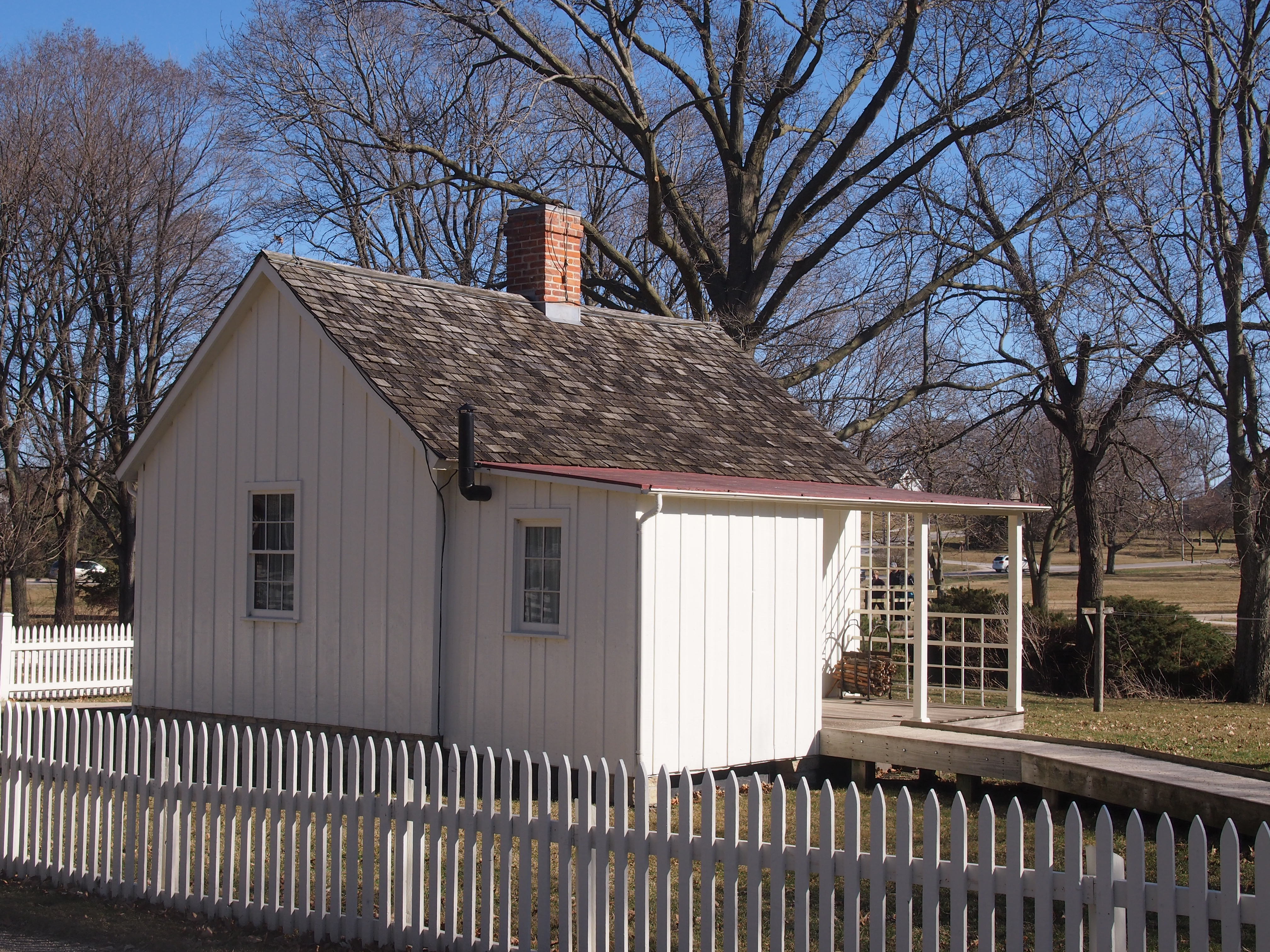
Besides the museum and library, and the graves of President and Mrs. Hoover, the site includes a collection of 19th-century buildings moved from other parts of town to form a sort of young Hoover-era village: a half-dozen houses, a schoolhouse, Jesse Hoover’s smithy, a Friends Meeting House, and a barn. All of these were put in the vicinity of Hoover’s birthplace cottage, a two-room structure in which HH came into the world on August 10, 1874. It’s the only thing in the area that hadn’t been moved.

It’s a small place. Really small: 280 square feet.

Herbert Hoover birthplace March 2015“Like any couple just starting out, 21-year old Hulda Minthorn and 23-year old Jesse Hoover were eager to have a place to call their own,” the NPS says about the cottage. “Shortly after their first wedding anniversary, and with the help of his father Eli, Jesse built this simple, but sturdy two-room cottage in the spring of 1871 on the corner of Downey and Penn streets.

“Looking around this house, you may think the Hoover family was poor. But their prudent spending, strong work ethic, and resourceful ways were actually a reflection of their Quaker beliefs.” More about the cottage is here.

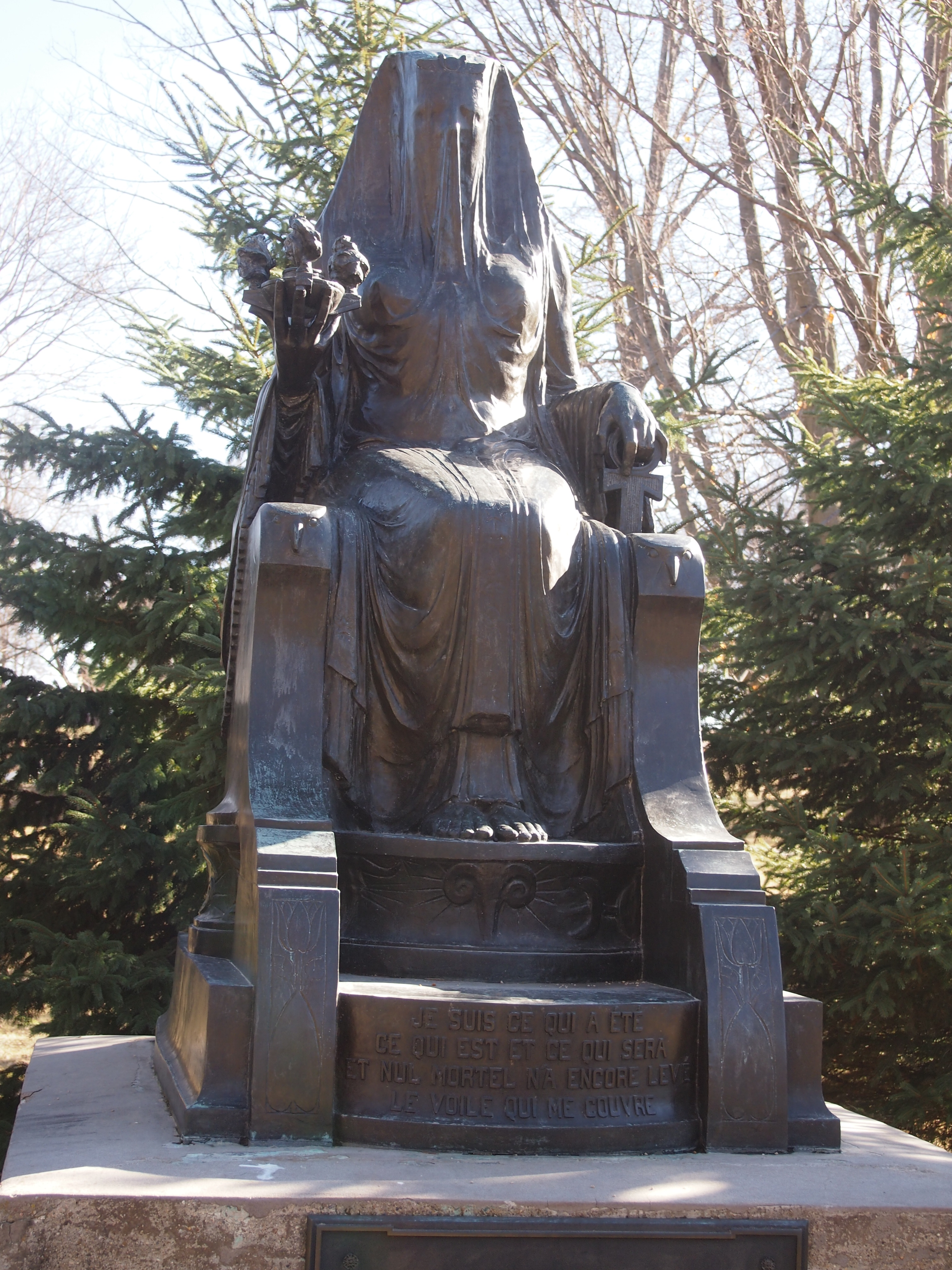
Across Hoover Creek from the cottage is a curious thing. A statue of Isis — the ancient Egyptian deity, that is. How many monumental statues of Isis are there in Iowa? Maybe just this one. How many anywhere? I couldn’t say, but I do know there’s one at the Herbert Hoover National Historic Site.
Isis in Iowa, 2015“Considering Herbert Hoover’s Quaker upbringing, you might be wondering why there is a statue of Isis, ‘the Egyptian goddess of Life,’ sitting on the grounds of his birthplace,” says the NPS. “This bronze, seven-and-a-half-foot tall statue is the work of Belgian sculptor Auguste Puttemans [apparently his last work] and was a gift from the children, refugees, and soldiers of Belgium in gratitude for Hoover’s famine relief efforts on their behalf during the First World War.”

Iowa City Yarn Bombing

A good way to kick off April: a day warm enough to eat lunch on our deck. Which I did, with the dog as ever waiting around for a handout, and then lolling around in the mild sun.

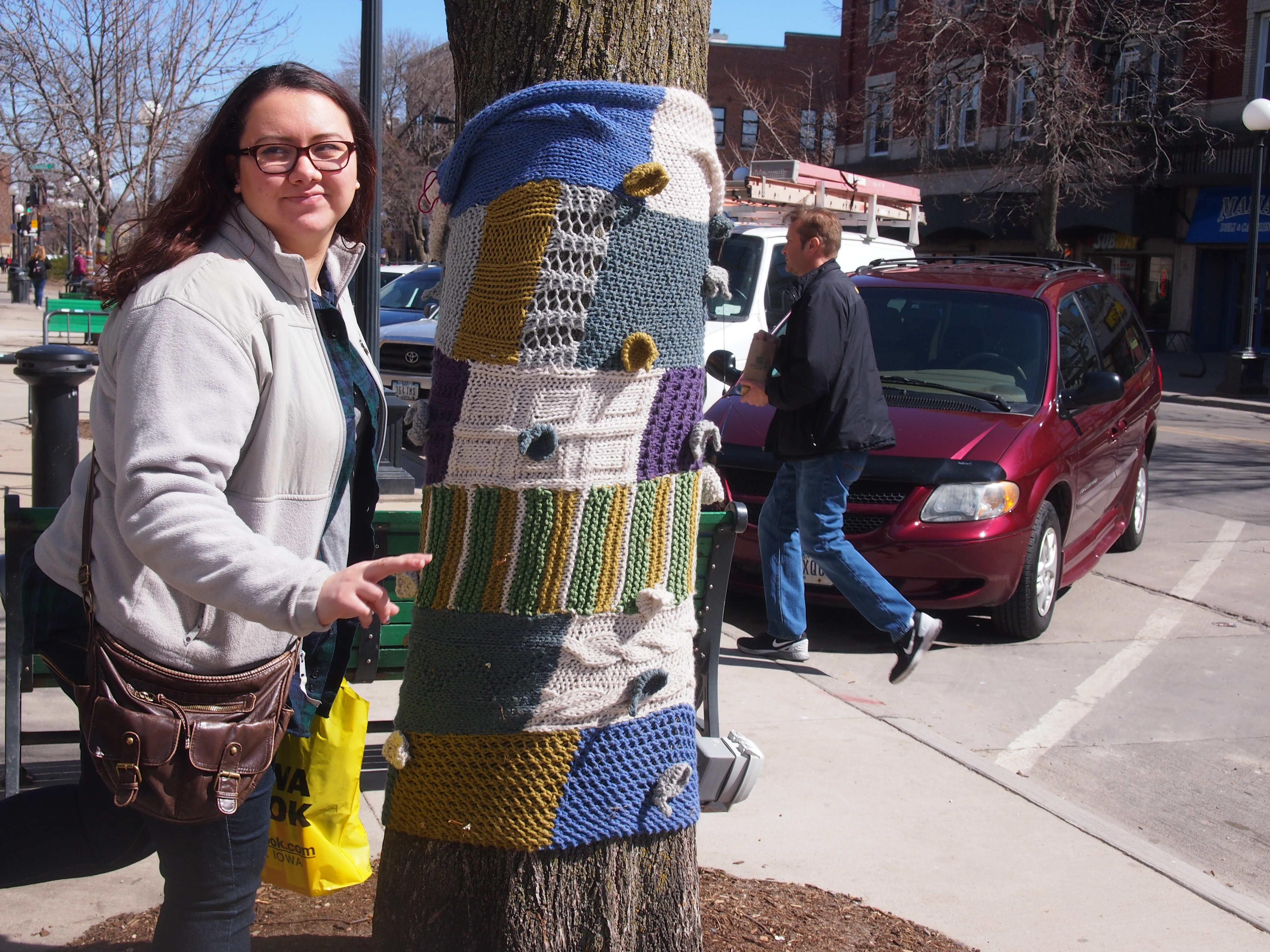
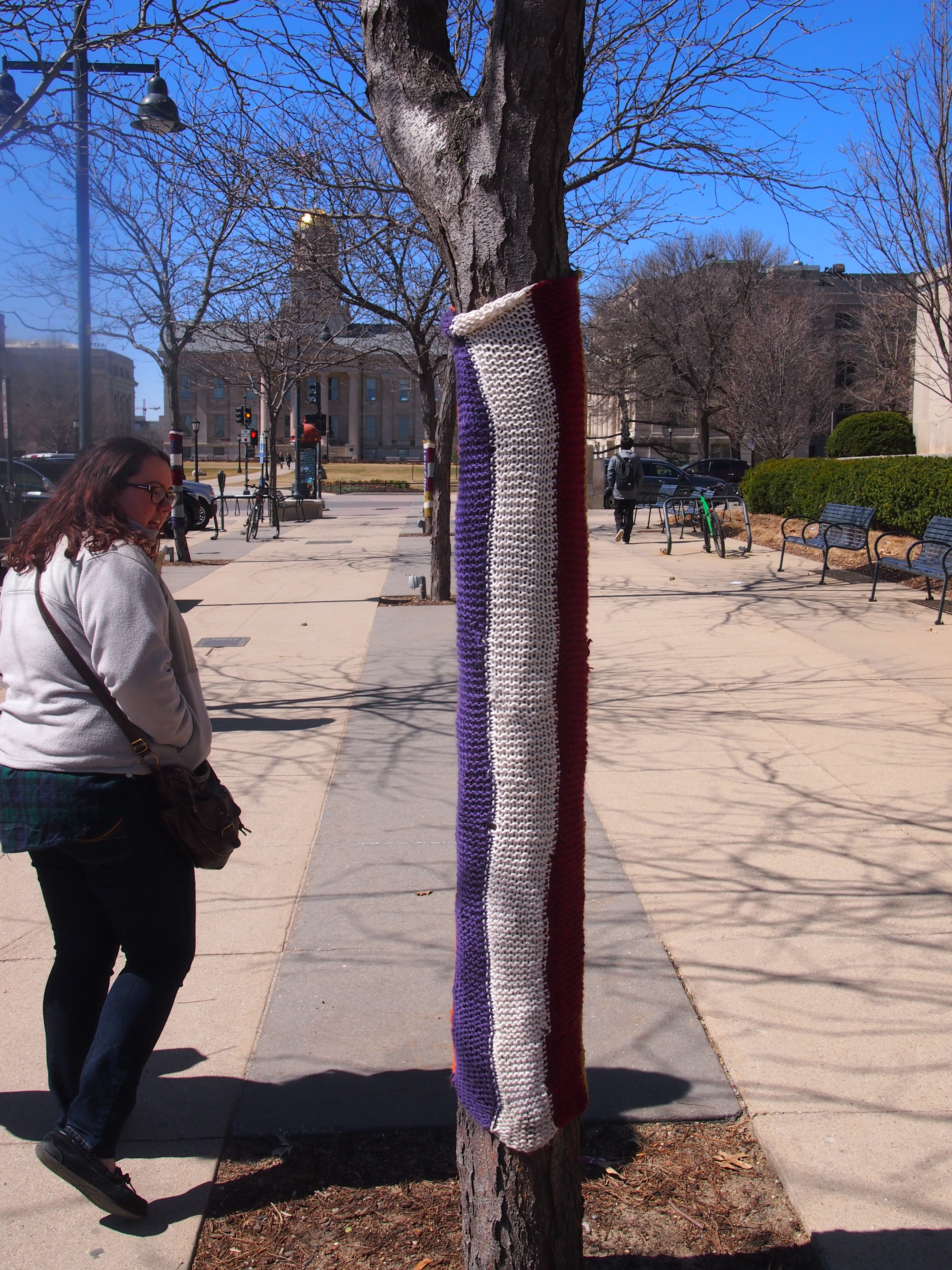
During our walkabout last Friday in Iowa City, besides plaques in the sidewalks, we began to notice trees wrapped in sweaters, or at least sweater-like creations of yarn.

Iowa City, March 27, 2015Nothing like something peculiar to get your attention. Mine, anyway. Later I found out that the wraps are a result of organized yarn bombing — which is something that actually happens — called the Tree Huggers project. Iowa City Downtown District says this about the 2014-15 project, which is apparently the third annual one: “2012 was the first year of the ICDD’s annual winter ‘Tree Huggers’ project produced by Home Ec Workshop and sponsored by Total Tree Care of Iowa City.

“The program has once again invited 120 local knitters transform the landscape of the District starting in November on over 130 trees throughout Downtown and the Northside Marketplace as part of the ICDD’s Community Gallery Program.”

Here’s another:

Iowa City, March 27, 2015And another two. Or three, depending on how you count.

Iowa City, March 27, 2015On the Sunday after we were there, the trees were “unhugged,” meaning that the sweaters were removed. “Following their removal, the Tree Huggers will be washed and put together for blankets that will be donated to local charity groups,” the district explains.

Iowa Avenue Bronzes

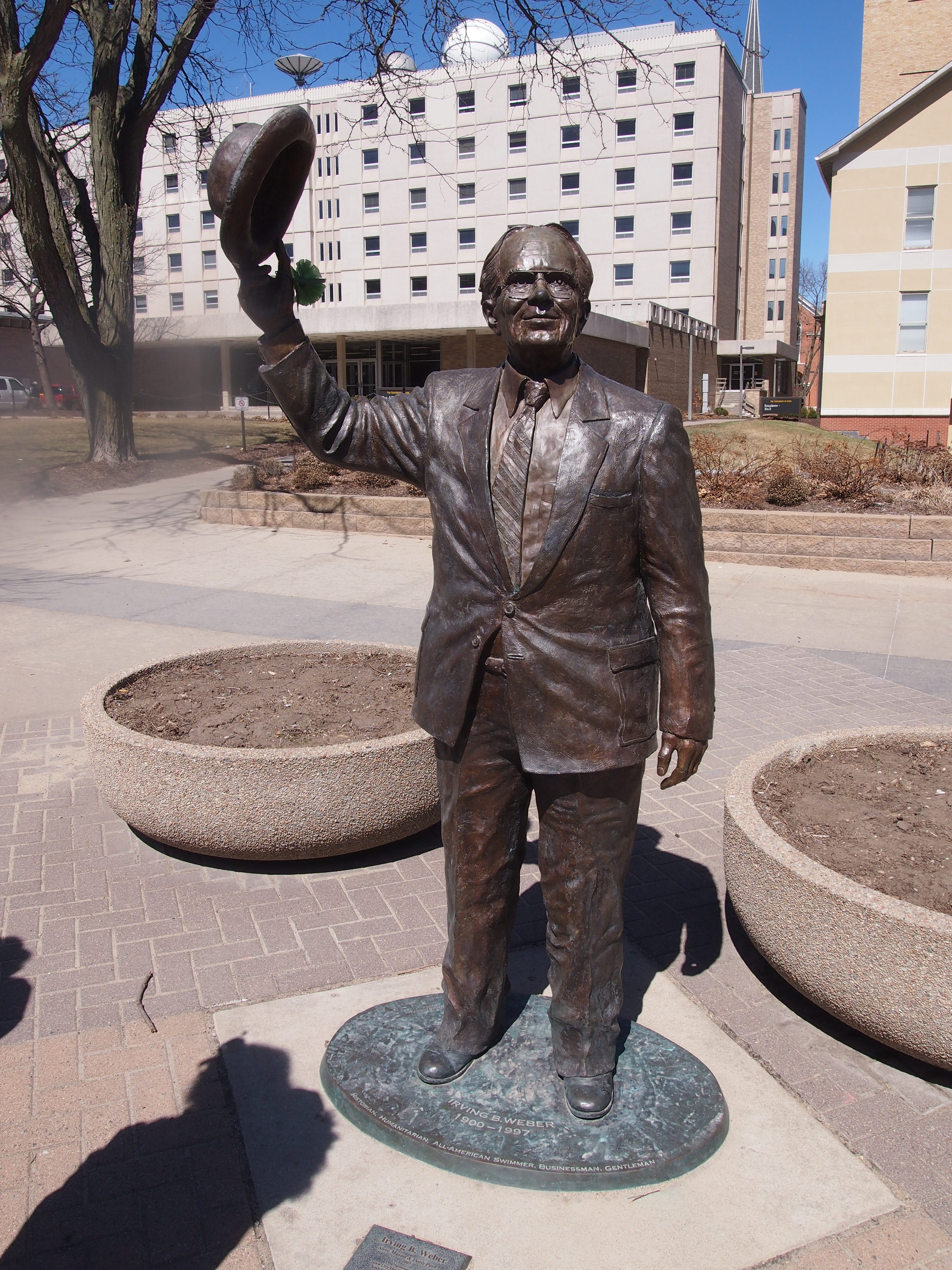
Near the intersection of Iowa Ave. and Linn St. in Iowa City, you’ll see this bronze fellow, forever waving his hat to passersby.

Irving B. Weber, Iowa CityIt’s Irving B. Weber (1900-97). You might ask, Who? I know I did. “Irving B. Weber is remembered for many things,” says the Iowa City Public Library. “He was the University of Iowa’s first All-American [sic] swimmer. He was a founder of Quality Chekd Dairies and served as its president until his retirement in 1966. Irving was an active member of the Iowa City Host Noon Lions Club and was the local school board president in 1952-53. In 1994 Irving B. Weber Elementary School was named in his honor.

“Irving B. Weber may be most remembered for the over 800 articles he wrote for the Iowa City Press-Citizen beginning in 1973. Irving’s view of history was not one of a dull retelling of facts and names. He told what it was like to grow up in Iowa City, the best places to buy penny candy, the joys of cooling off in Melrose Lake in the summer, and of sledding parties on closed-off streets.”

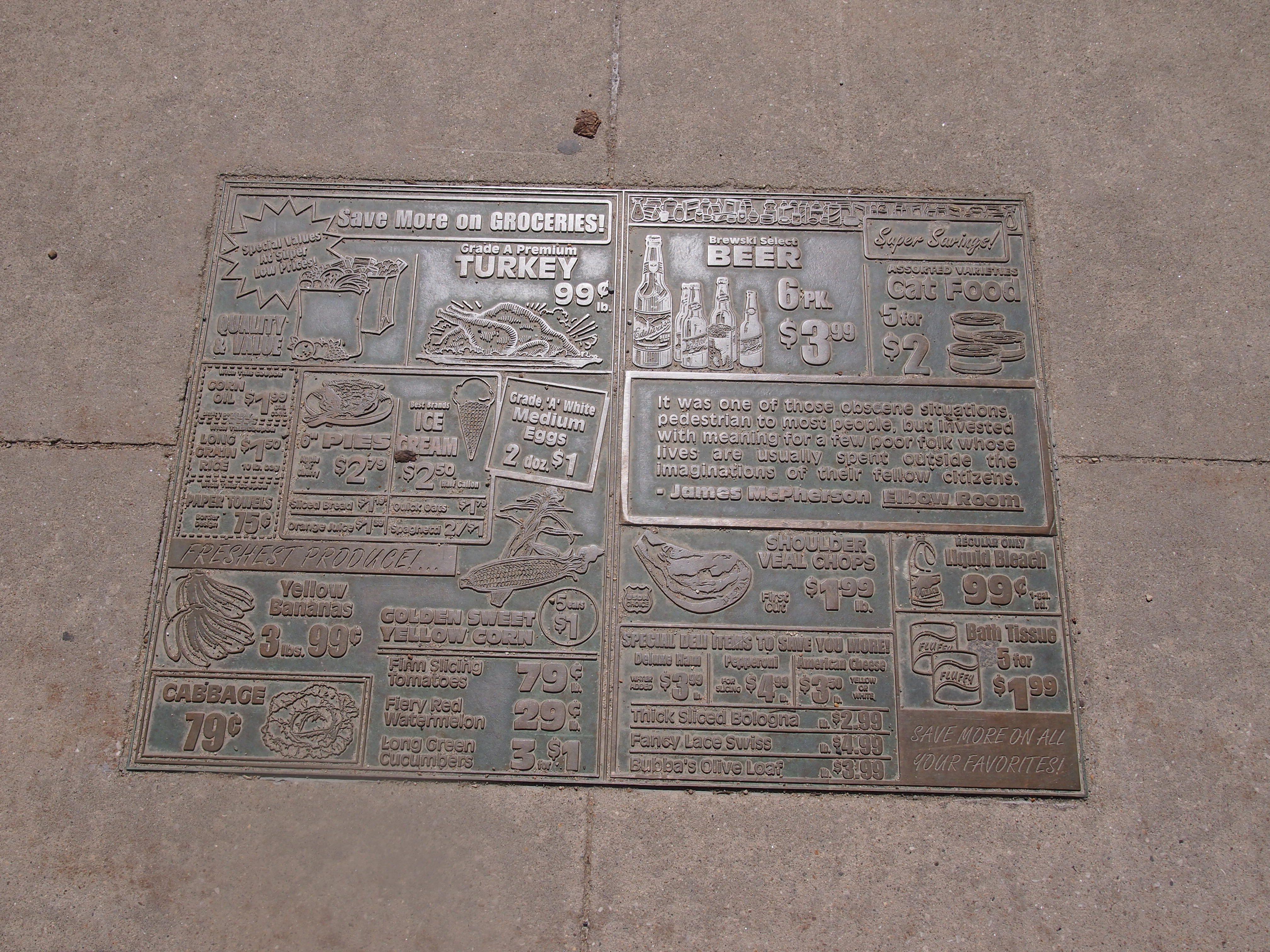
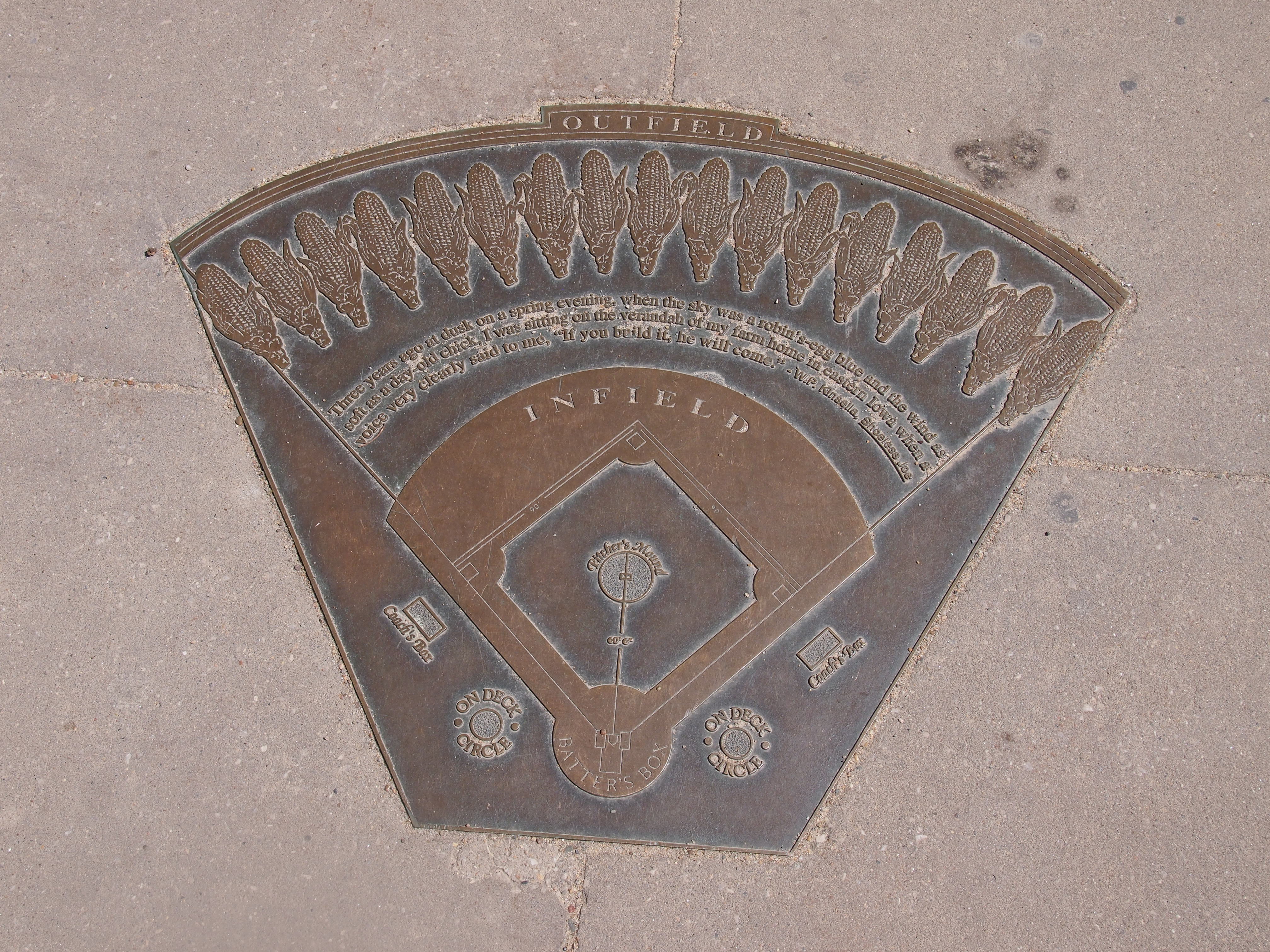
Mr. Iowa City, you might call him. Honored with a bronze by two Iowa artists, Stephen Maxon and Doris Park. Irving was easy to spot. Pretty soon, though, I started to notice bronze plaques mounted in the sidewalk along Iowa Ave. We’d chanced on the Iowa City Literary Walk. The variety was remarkable, and I saw only a dozen or so plaques.

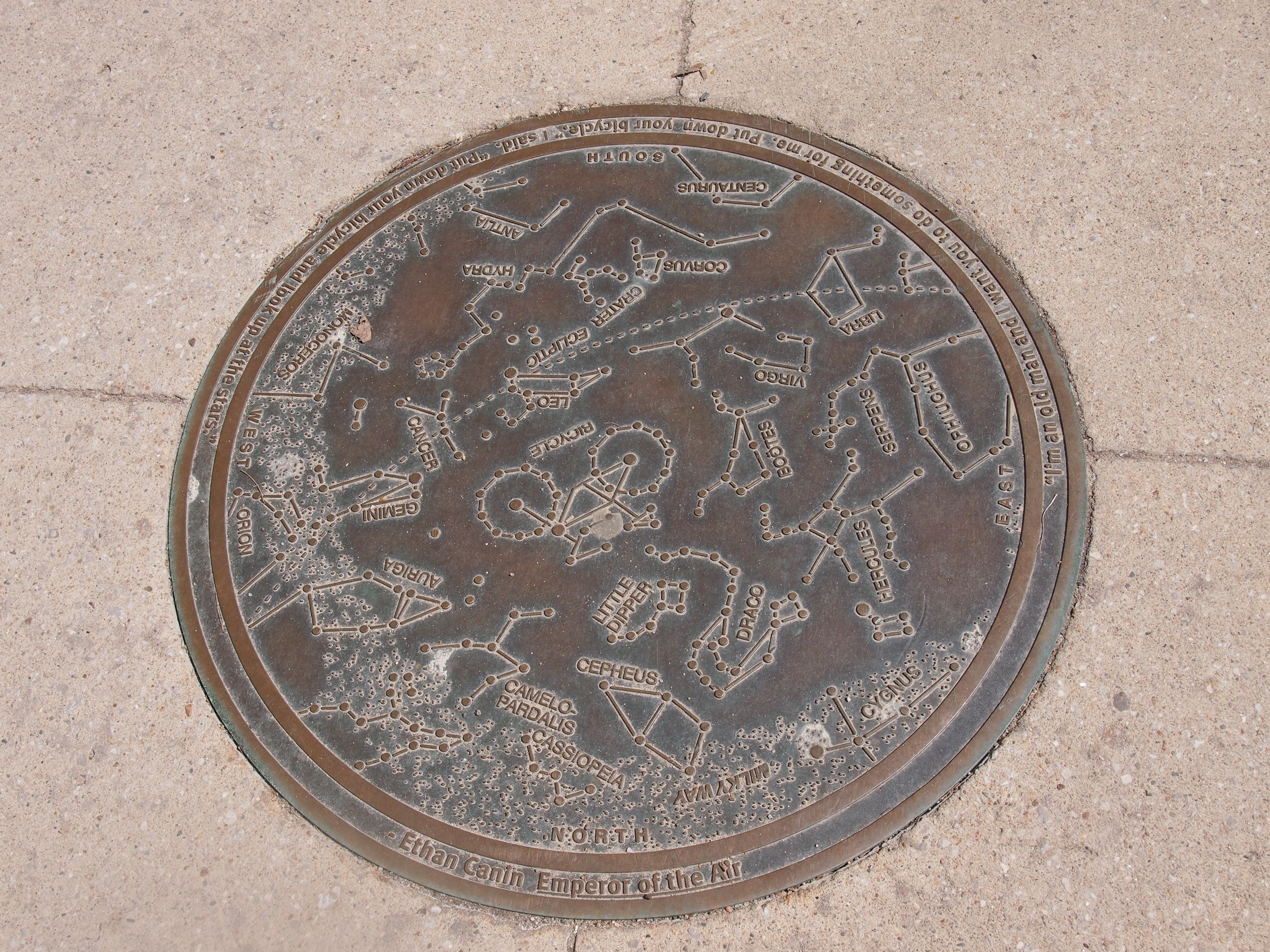
Such as these, which contain quotes from James [Alan] McPherson, W.P. Kinsella, and Ethan Canin, respectively.

Iowa City Literary WalkIowa City Literary WalkIowa City Literary WalkAccording to the City of Iowa City, “The Literary Walk, conceptualized by the Iowa City Public Art Advisory Committee in 1999, celebrates works by 49 writers who have ties to Iowa. [A good many specifically to the Iowa Writers’ Workshop, I suspect.] The Literary Walk is comprised of a series of bronze relief panels that feature authors’ words as well as attribution. The panels are visually connected by a series of general quotations about books and writing stamped into the concrete sidewalk. All artwork, by Gregg LeFevre, is set in the pavement along both sides of Iowa Avenue from Clinton Street to Gilbert Street.”

The Telephone Pole Faces of E. 57th

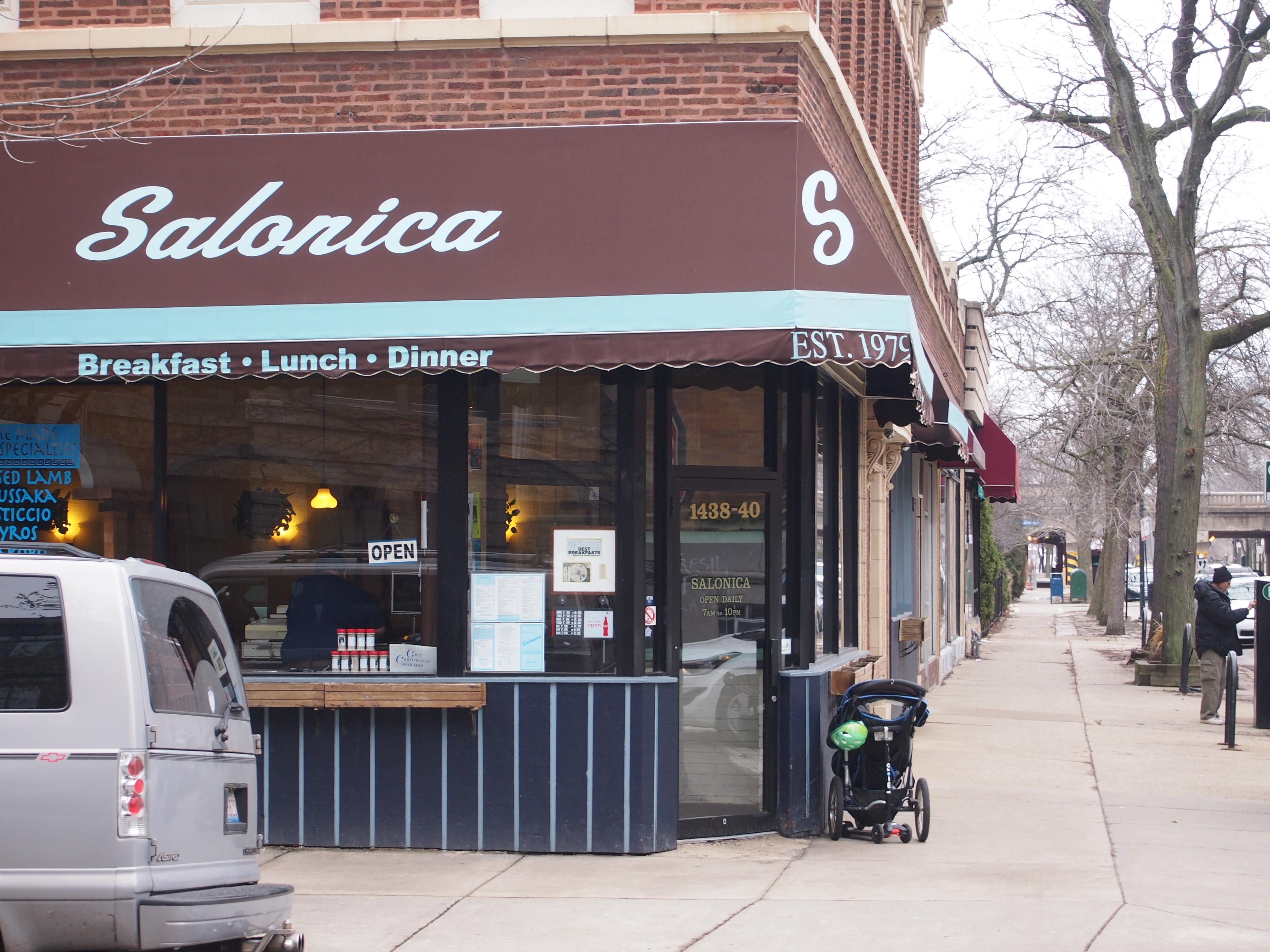
On Sunday, Lilly and I drove to Hyde Park, home to the University of Chicago and neighborhood eateries such as Salonica, a Greek diner on E. 57th St. at Blackstone Ave. Yuriko, Ann and I ate there last year during our visit to see the Robie House and other Hyde Park places.

This time, Lilly and I ate there. It was busy at about noon, but the line wasn’t out of the door. The patrons were a good mix of students and neighborhood residents. At least, I’m fairly sure that the grayhairs and young families were locals; and the young men and women — every jack one of the men with a beard — were students.

Salonica, Hyde ParkLilly had an omelet, I had pancakes. It’s the kind of place that serves tasty breakfasts all day, besides Greek items and sandwiches. In a place like this, breakfast is the thing for me. If I’ve already had breakfast that day, I have another. So it was this time.

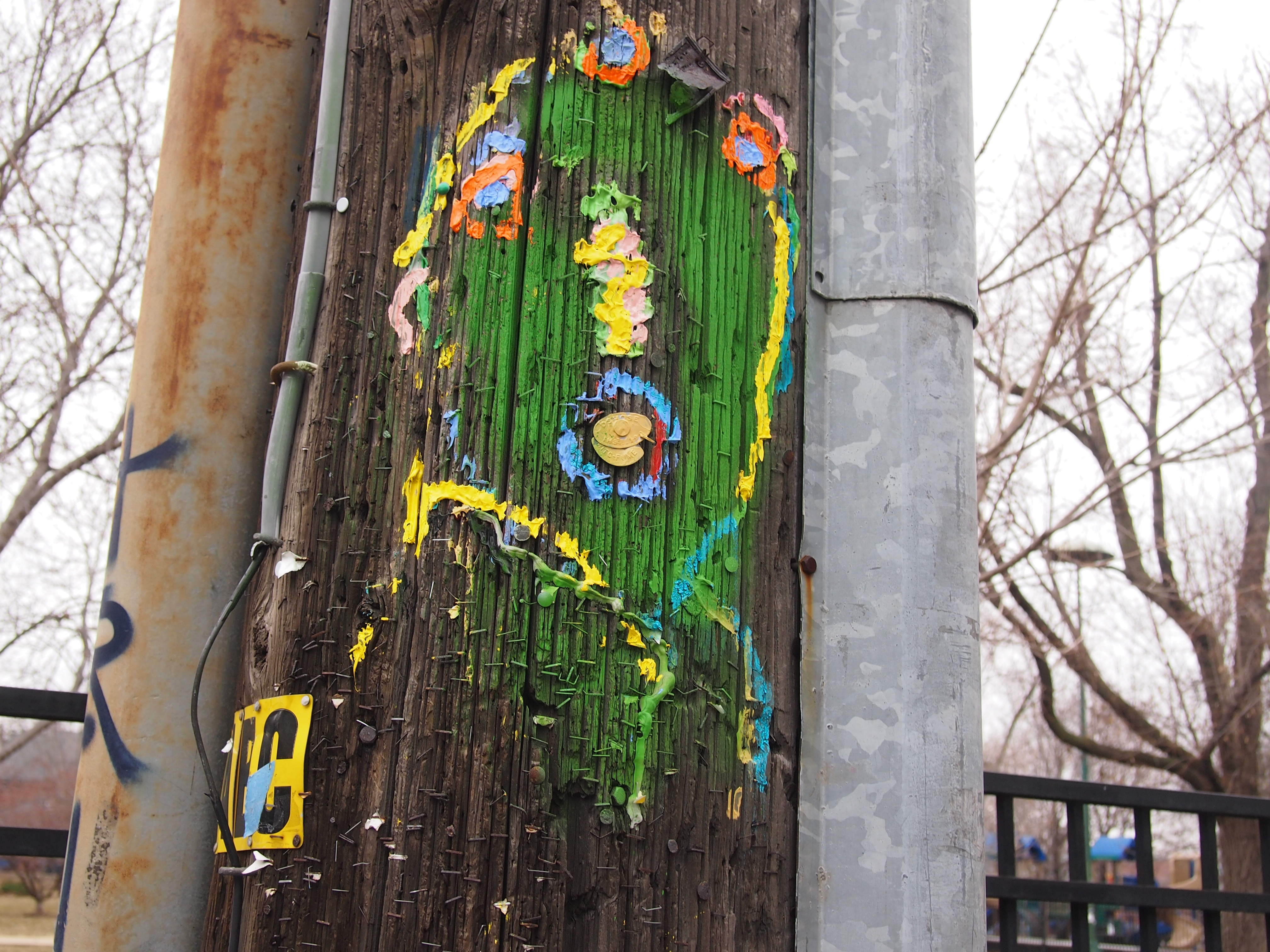
A block and half west of Salonica are two telephone poles flanking the spot where the alley between Dorchester Ave. and the small Bixler Park meets E. 57th St. Each of the poles is painted with a green image at about eye level. Facelike, green with a yellow outline and blue and orange details. Maybe it’s not supposed to be a face. Whatever it is, it’s a lively work.

E 57th St ChicagoI remembered seeing them last year, so they’ve been around at least that long. If you go to Google Streetview, you can see them as green splotches.

Nothing like a little local detail. Hyperlocal detail, it is. Not even the most experiential-oriented, don’t-ever-admit-you’re-a-tourist-even-though-you-are guidebooks or web sites can cover that kind of thing.

A Gazebo and More

What this country needs is more public gazebos. There, I’ve said it, and I don’t care who knows it. I’m pro-gazebo.

World-Wide Words tells us that the word gazebo “is surrounded by more mystery than an earnest etymologist would like. It appears in 1752 without any warning or antecedent in part four of a book by William and John Halfpenny with the title New Designs for Chinese Temples, an influential work that was aimed at the then new English fashion for the oriental in design and architecture.

“Little is known about William Halfpenny, who called himself an architect and carpenter, not even if this was his real name… The word gazebo is equally mysterious. A lot of people have assumed that — like the temples described in the book — it must be of oriental origin. If it is, nobody has found its source.

“Failing that, etymologists make an educated guess that he named the structure tongue-in-cheek, taking the ending -ebo from the Latin future tense and adding it to gaze, so making a hybrid word that might mean “I will look.” If true, the model was probably videbo, “I shall see,” or perhaps lavabo, literally “I will wash,” taken from the Latin mass of the Roman Catholic Church to refer to the towel or basin used in the ritual washing of the celebrant’s hands.”

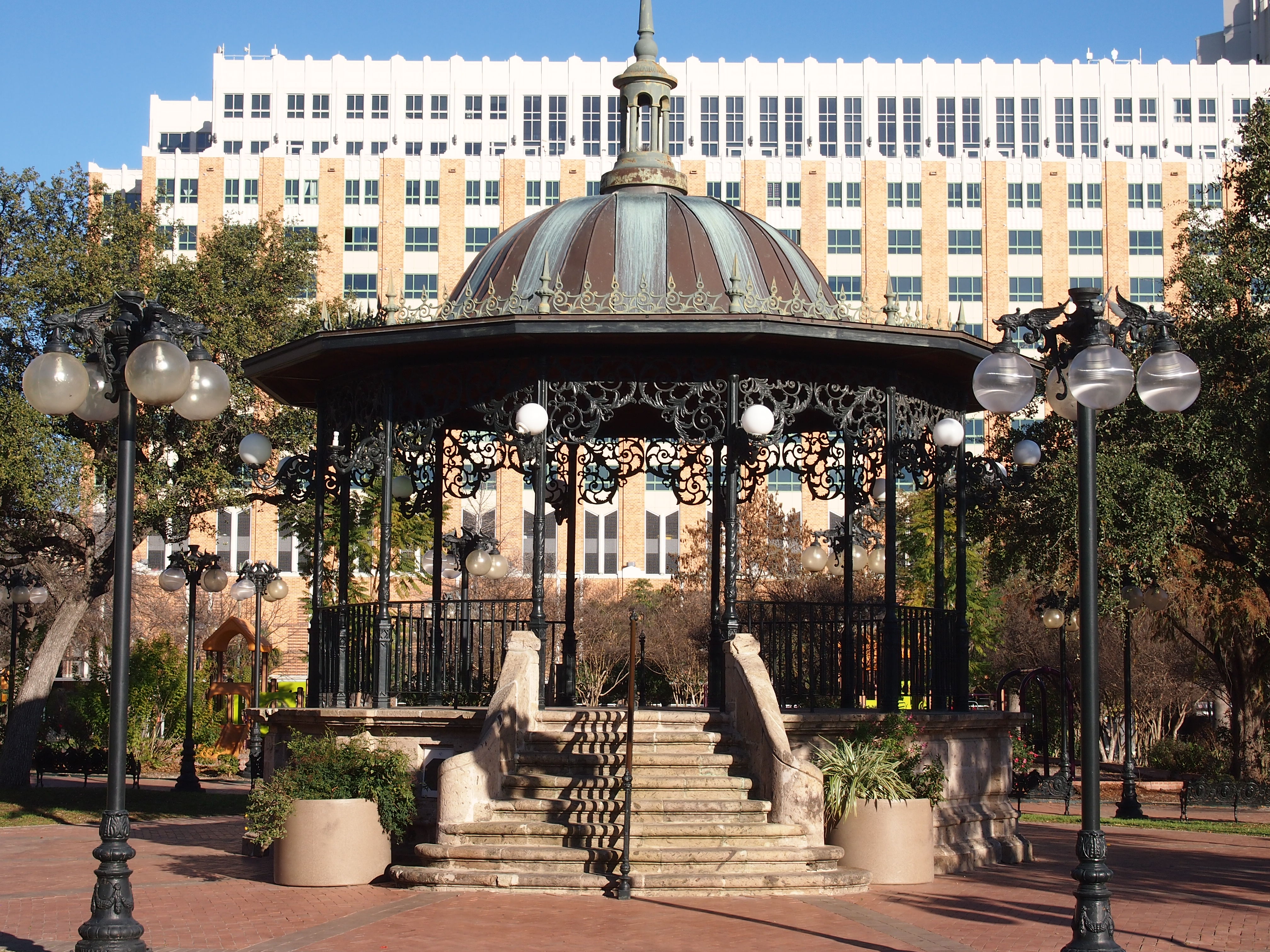
If you’re ever in Milam Park (see February 26) in San Antonio, you’re likely to find yourself looking at this fine gazebo.

Milam Park gazebo Feb 2015An attached plaque says, in English and Spanish, “The people and government of the state of Jalisco, Mexico, offer this kiosk to the noble city of San Antonio de Bexar, in tribue to the relationship, tradition, and cultural inheritance of our people. May 1993.” Why Jalisco and San Antonio have a special relationship, I don’t know, but it was good of them to send a gazebo, even if they call it a kiosk.

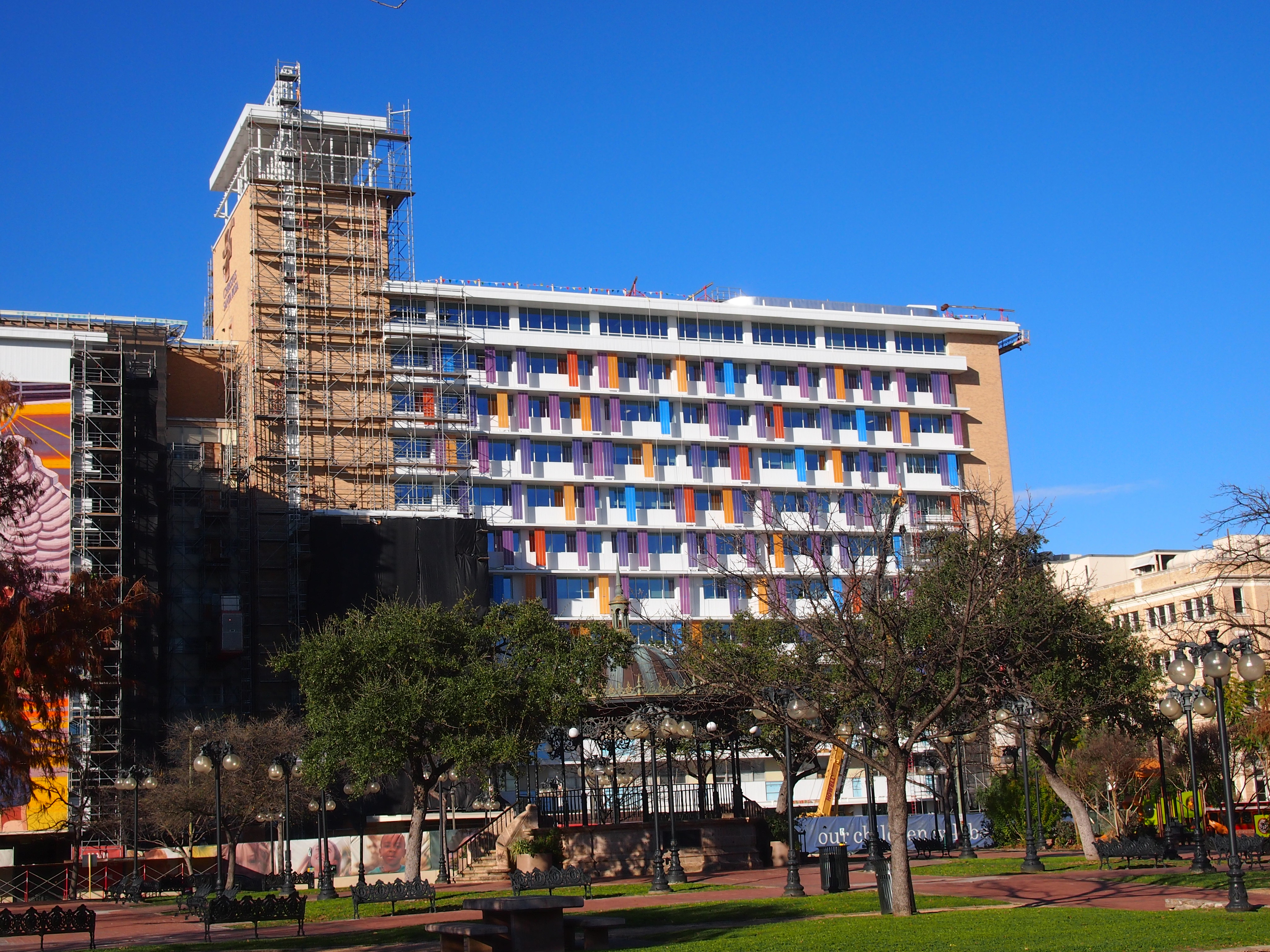
To the north of the park is Santa Rosa Children’s Hospital. Or at least that’s what I’ve always heard it called — the formal name these days is the Children’s Hospital of San Antonio, which is part of the Christus Santa Rosa Health System, which has five hospitals. Last month workmen were busy adding color to the side of the building, which had previously been a drab structure.

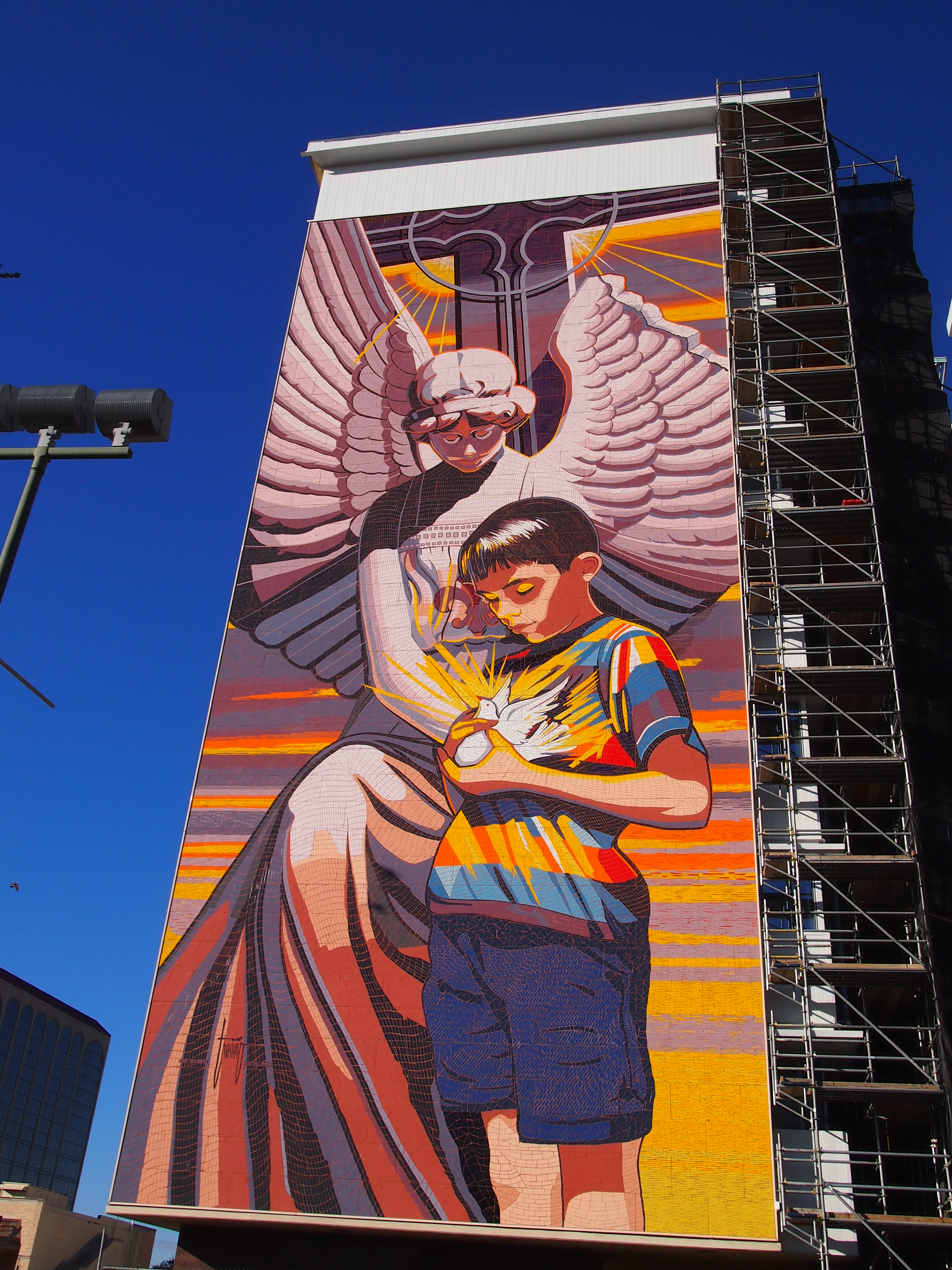
Children's Hospital of San AntonioOn one side of the hospital’s an enormous mural — eight, nine stories tall?

The Spirit of Healing muralOne thing I need to do in the future is look at some of San Antonio’s many building-side murals. This is a start. It’s called “Spirit of Healing.”

According to the San Antonio Express-News, the hospital’s exterior “[is] taking its color cues — purples, oranges and blues — from the adjacent… mural by Jesse Treviño, the façade of Santa Rosa Hospital cheerfully is being transformed… Colorful channel glass panels are being hoisted into place on the hospital’s south side facing Milam Park and El Mercado. Roughly 11 feet by 3 feet, there will be 300 of them when all is said and done.

“Backed with LED lighting, at night they will glow like Christmas lights. During the day, the visually dynamic custom cast panels — lightweight to span large distances yet strong, durable and wind-resistant — mark the building as a special place.”

A Few San Antonio Statues

I didn’t specifically seek out statues while visiting San Antonio, but sometimes I would be wandering along and there was another one. Such as this fellow, important enough to get a life-sized bronze downtown, on Houston St.

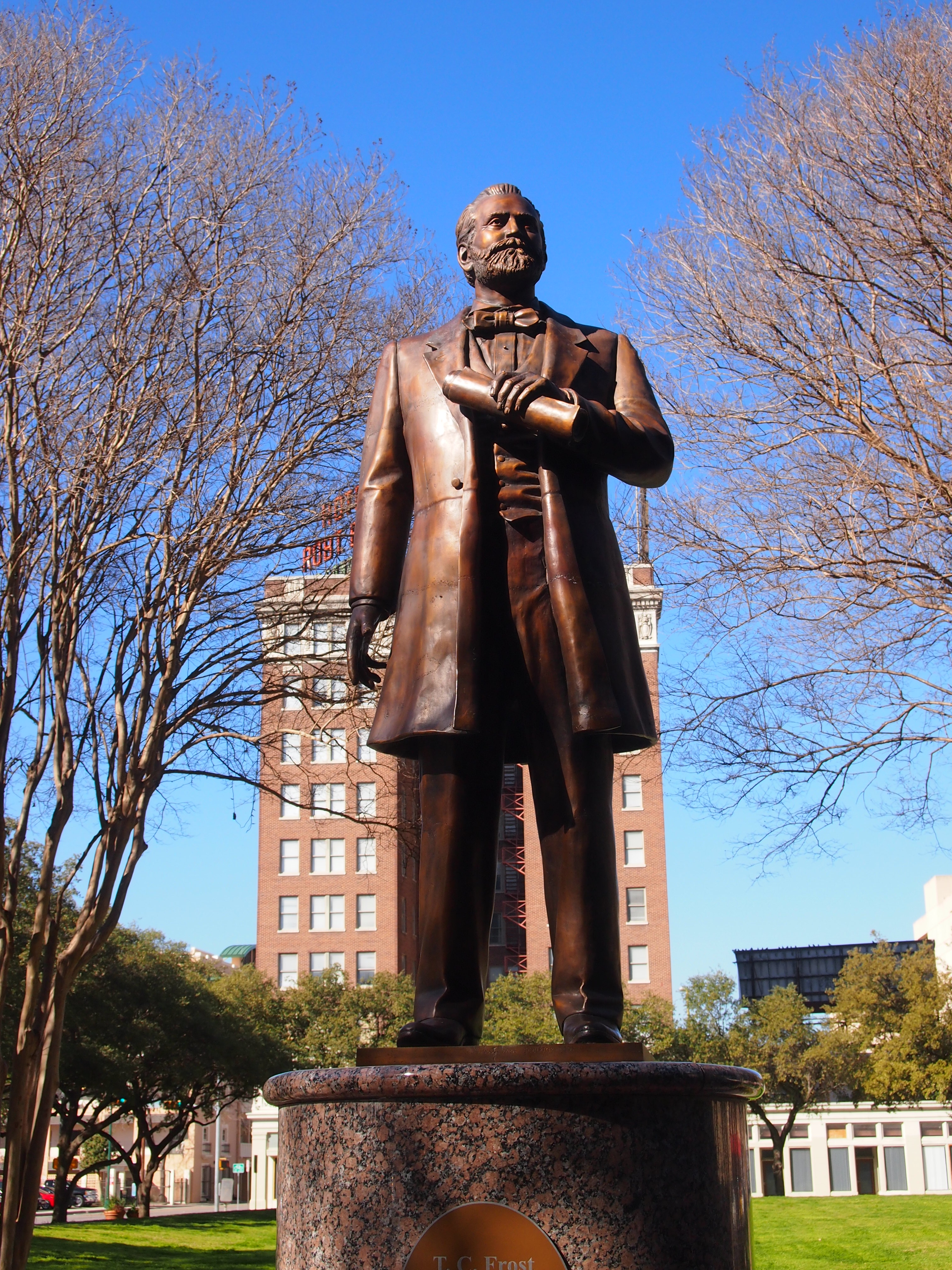
TC Frost San Antonio Feb 2015It’s Thomas Claiborne Frost (1833-1903): frontier lawyer, Confederate commander, wool merchant, and eventually banker. Frost Bank exists to this day as a major regional bank focusing only on Texas markets, and most recently it had the distinction of not being caught with exposure to the bum mortgages of the 2000s, and so turned down TARP money.

Sculptor Robert L. Dean Jr. did the Frost statue. He’s better known for a number of Eisenhower statues, including ones in Denison, Texas; West Point; Ike’s presidential library; and in London and Normandy. He also did Patton, Bradley, DeGaulle, and Eddie Rickenbacker, among others. I’d never seen the Frost bronze because it’s fairly new, put there only in 2001.

Here’s a person I didn’t know had a bust in San Antonio.

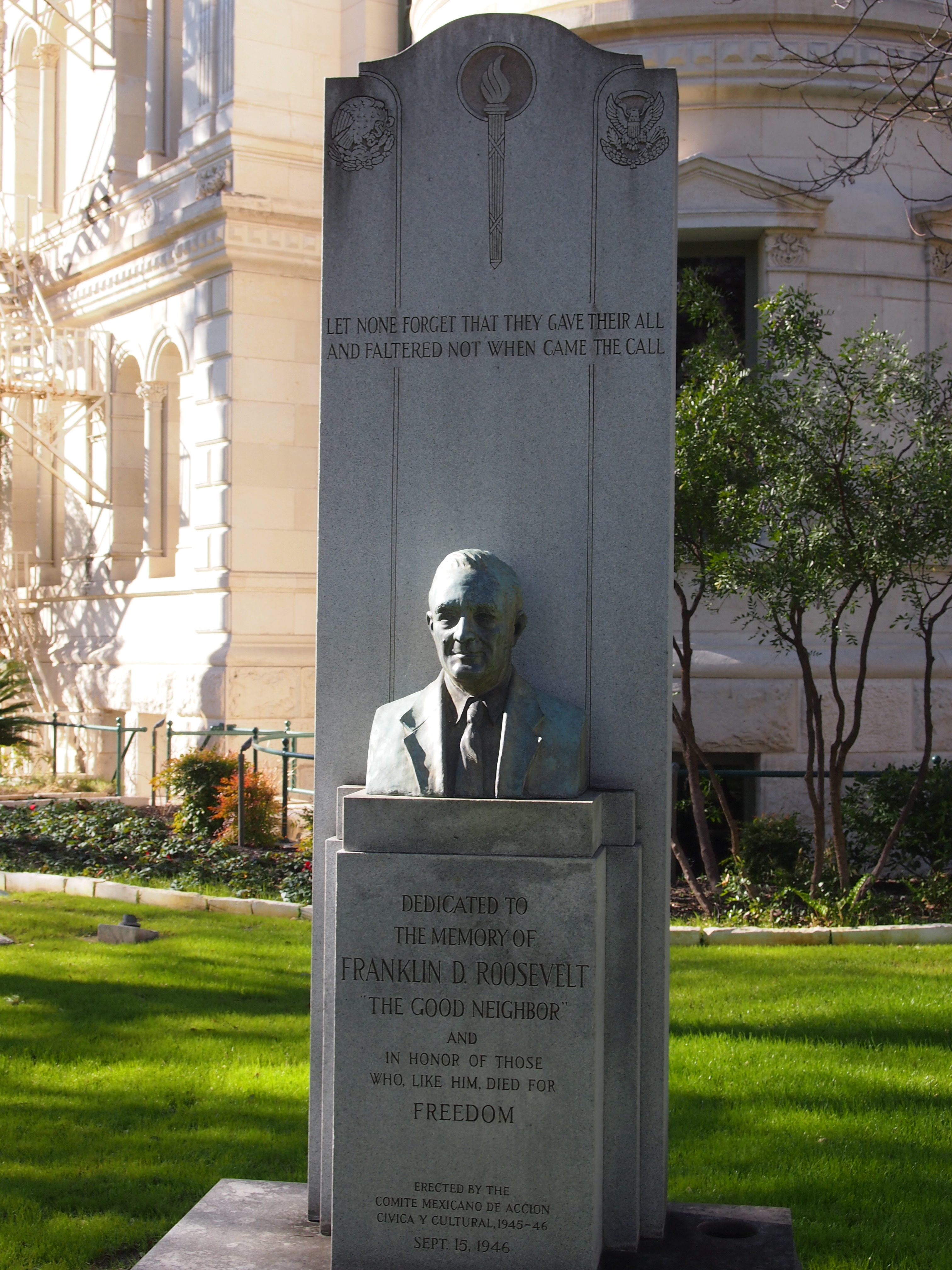
FDR San Antonio Feb 2015President Roosevelt, looking not quite like the FDR we know from photos and movies, but never mind. The memorial is on the grounds of San Antonio City Hall, a 1946 gift from Mexico — specifically, the Comite Mexicano de Accion Civica y Cultural. The sculptor was from San Antonio, however: Louis Rodriguez, a member of a family that still carves memorials and gravestones. Louis and his brother James best-known work is the Alamo Cenotaph.

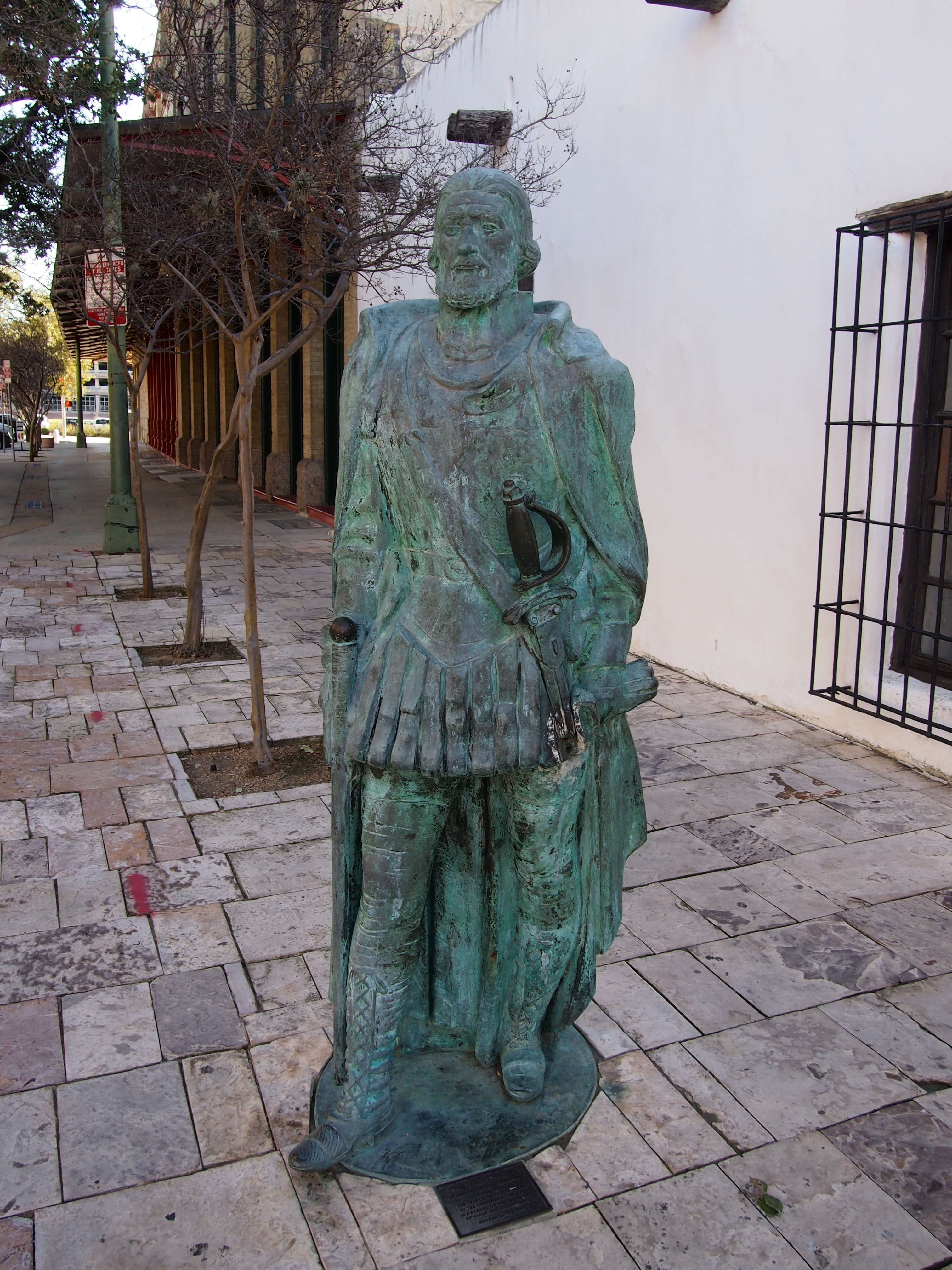
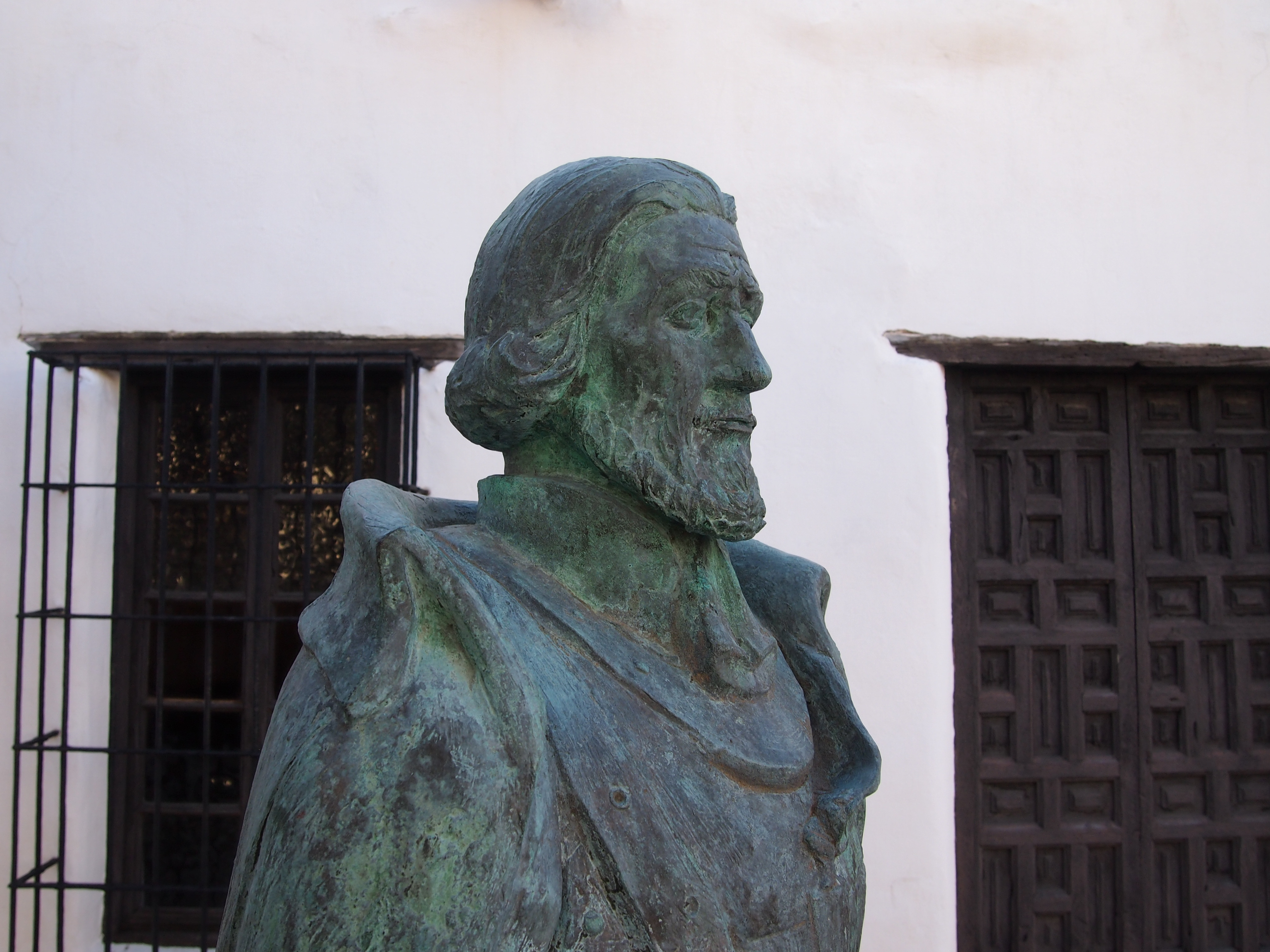
Not far away is “The Conquistador,” a bronze outside the Spanish Governor’s Palace.

Conquistador, San Antonio Feb 2015It too was a gift to the city — by the government of Spain in 1977, “as a symbol of the close ties of Spain and San Antonio,” according to the plaque at the foot of the work. The sculptor was Enrique Monjo, who also did work at the National Cathedral.

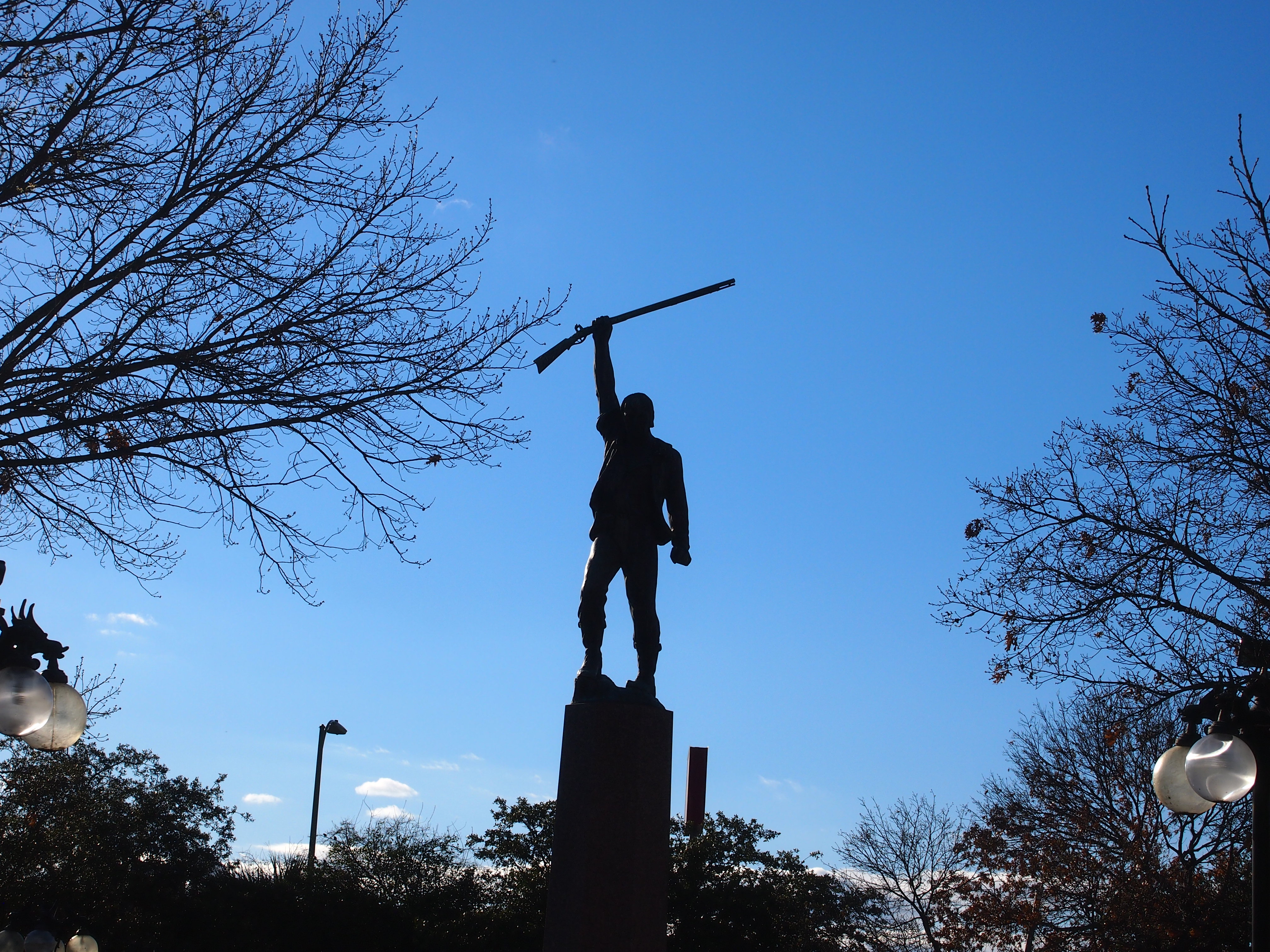
Conquistador San Antonio Feb 2015Here’s a fellow in a Texas pose.

Miram Park San Antonio Feb 2015Who holds his weapon so defiantly? Texian Ben Milam, in Milam Park downtown. He was one of the leaders of the Texian forces in the Siege of Bexar in late 1835, which resulted in the capture of San Antonio from Mexican forces under Gen. Martin Perfecto de Cos, an incident that precipitated the better-known Battle of the Alamo a few months later. Milam didn’t live to participate in that, or even the conclusion of the Siege of Bexar, since a Mexican bullet hit him in the head on December 7, 1835, two days ahead of Cos’ surrender. Besides Milam Park, a scattering of other places in the state are named for him, such as Milam County, northeast of Austin. But the Ben Milam Hotel in Houston is no more.

One Bonnie McLeary did the statue, which was commissioned for the Texas Centennial in 1936, along with a number of other statues around the state. She’s better known, according to A Comprehensive Guide to Outdoor Sculpture in Texas (1996), for her “garden sculptures and her portrayal of children.”

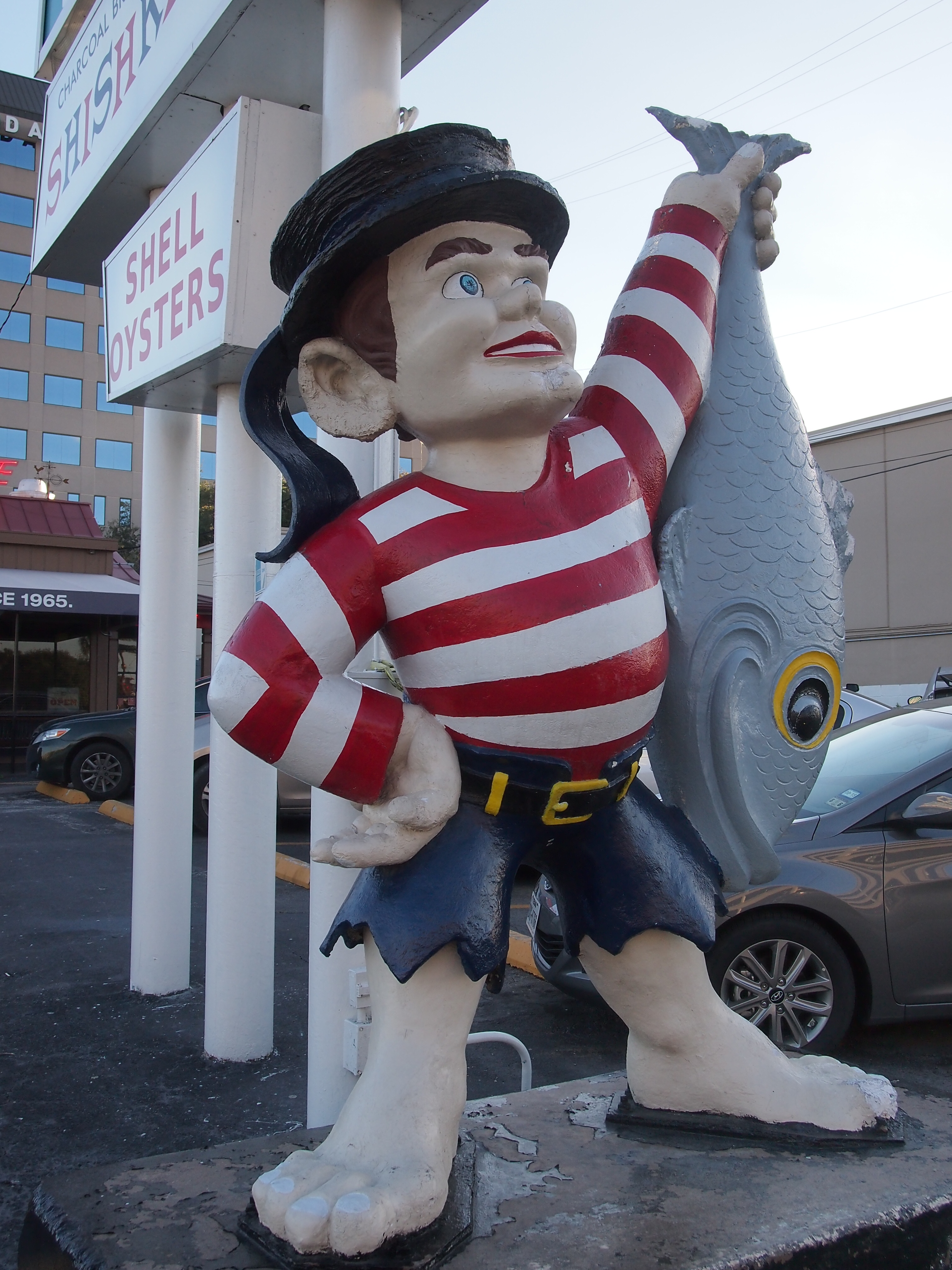
Then there’s Jolly Jack.

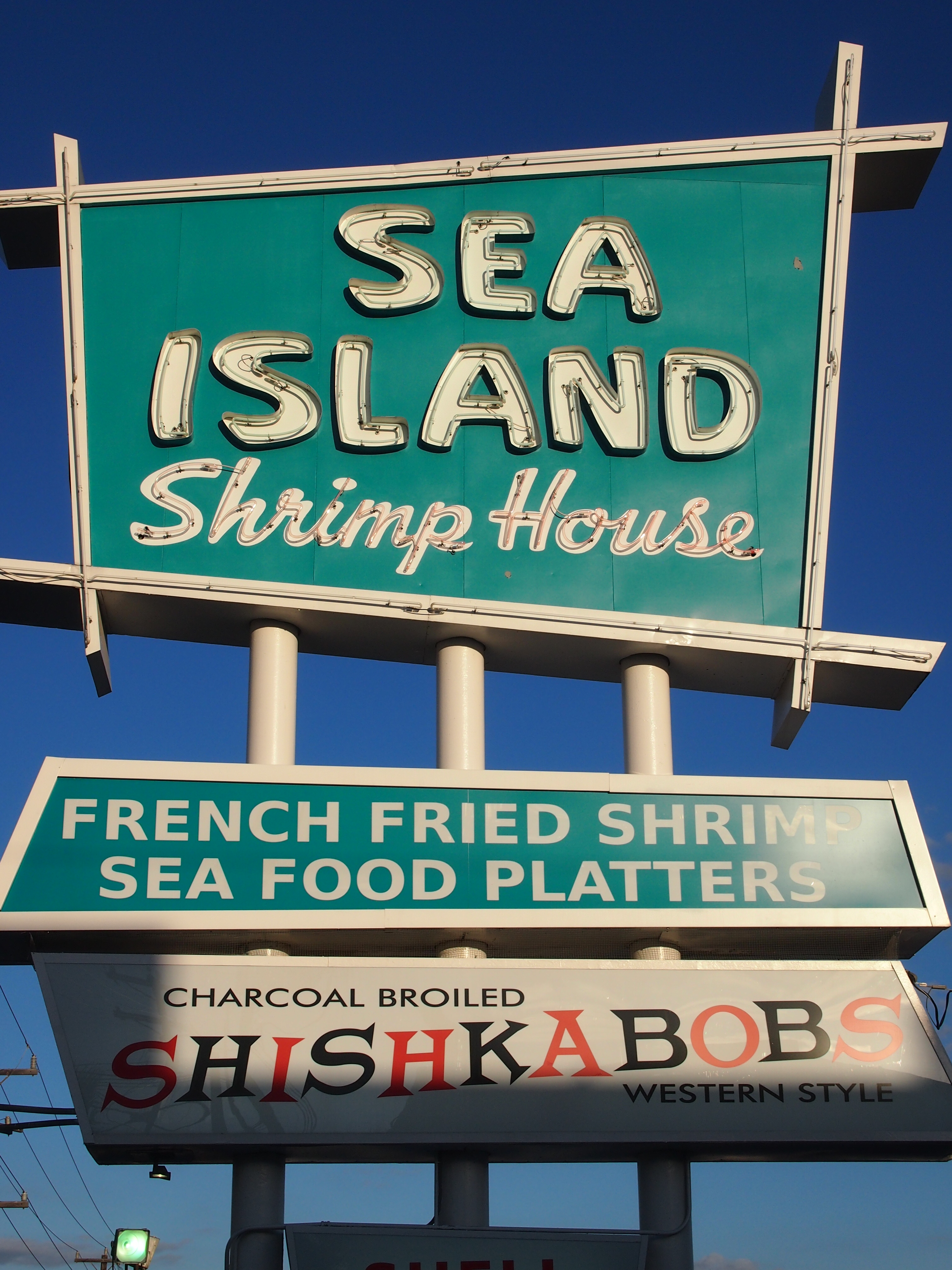
Jolly Jack San Antonio Feb 2015Sea Island San Antonio Feb 2015He stands outside of Sea Island, a restaurant on the North Side of San Antonio, near North Star Mall. Remarkably, I’ve been able to find mention of its creators, two Austin artists named Dana Younger and Kevin Collins, at least in this 1998 Austin Chronicle article: “In August, the area was dominated by Jolly Jack, a 10-foot-tall statue commissioned by Sea Island Shrimp House. Jack is the regional seafood chain’s answer to the classic Bob’s Big Boy, an oversized cartoon fat kid [looks like an old-time jack fisherman to me, not a fat kid] in cut-off blue jeans and bare feet, with a red-and-white striped shirt and a black top hat. He proudly holds a five-foot-long fish up in his left hand to entice potential diners. Collins and Younger were paid $9,000 to make the mold and will get $3,000 for each of three more Jolly Jacks.”

Friday in the Park With Geof

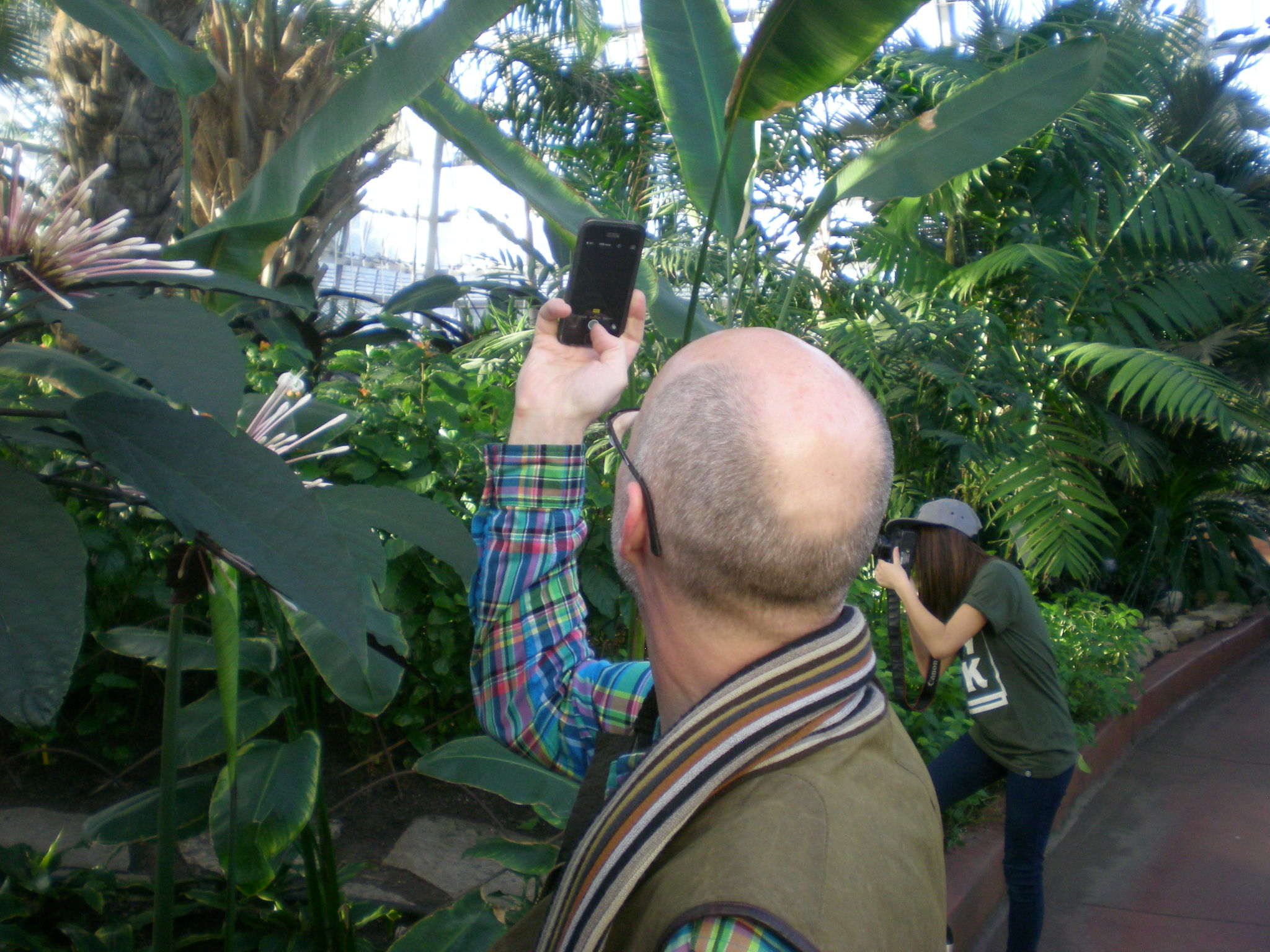
The last time I went to the Garfield Park Conservatory, about a year and a half ago, I took a good many pictures (such as these and these and these). This time around, which was on last Friday, not so many. On the other hand, my old friend Geof Huth, who was visiting from New York state, snapped up a storm. Many of his images ended up on Facebook.

Geof Huth Jan 30, 2015I didn’t remember seeing this before, though I probably have.

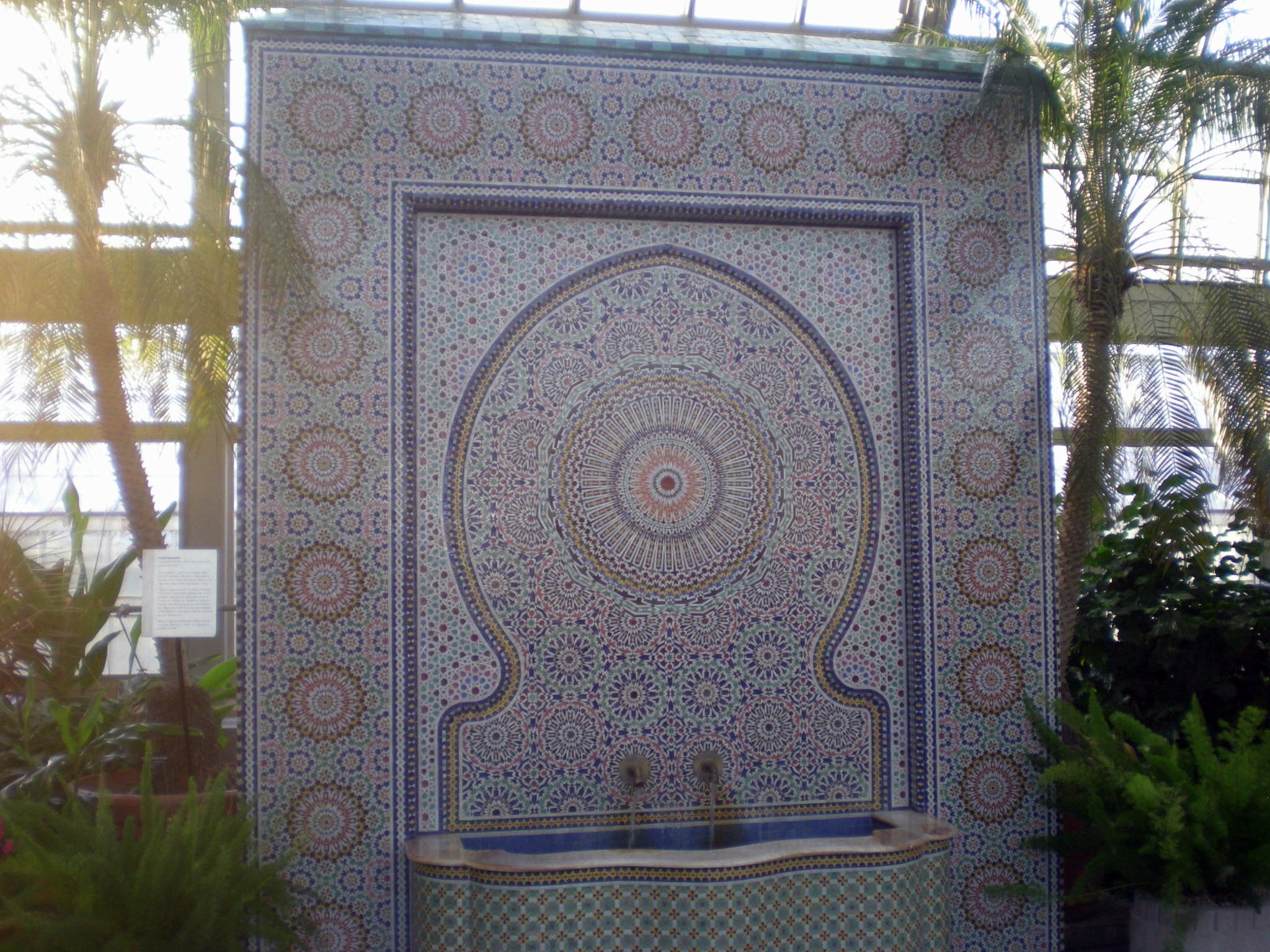
DSCN7708A nearby sign says: “This fountain is a gift from Chicago’s Sister City of Casablanca, Morocco to the people of Chicago. It is covered with special hand-cut terra-cotta tiles called “zellij” … the round patterns on the front of our fountain are intended to represent flowers. The zellji technique was developed in the 10th century in North Africa and Andalusia and has been faithfully practiced up to the present day.”

Hi, How Are You

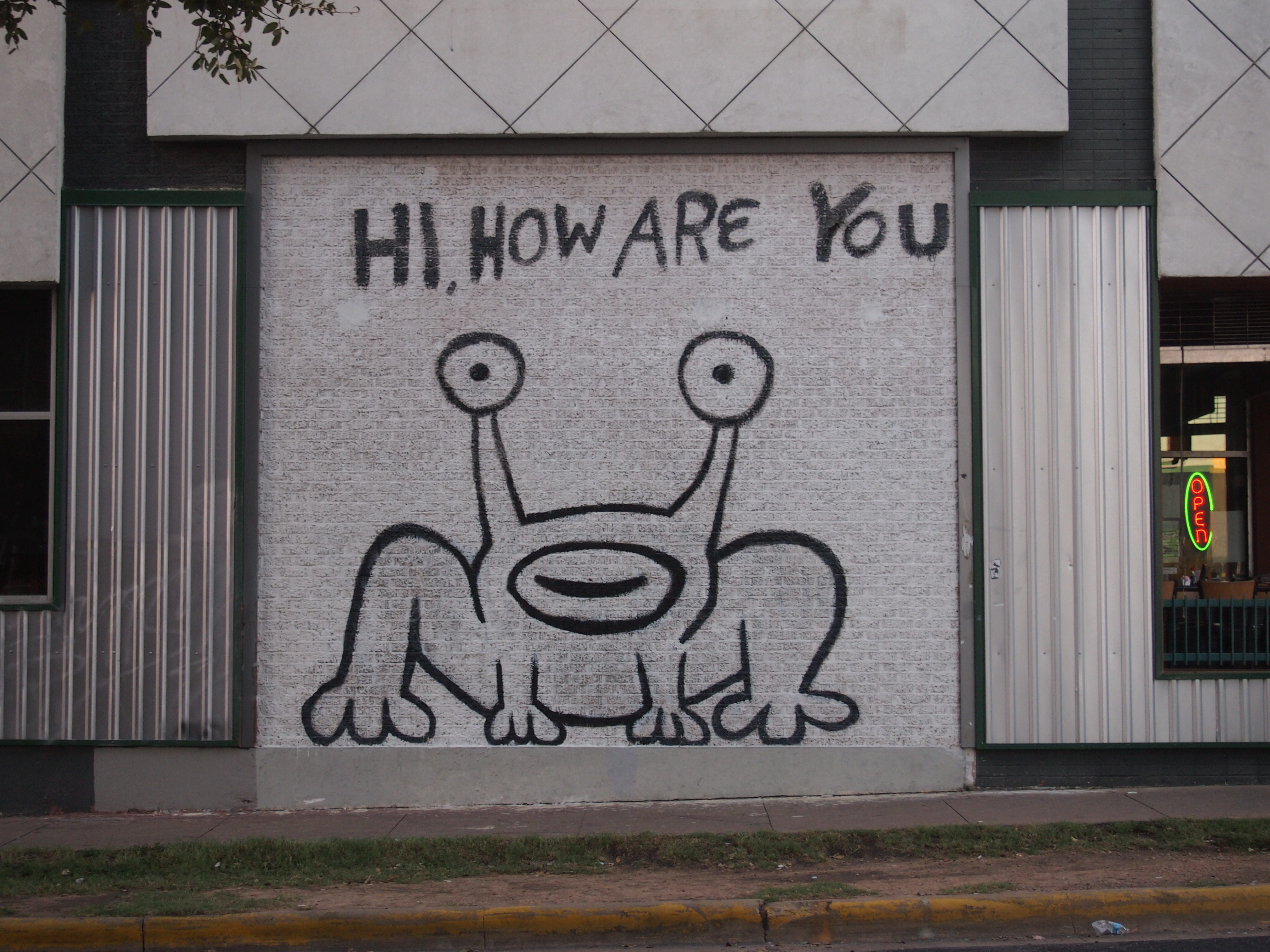
Just before dark on November 8, Tom took us to the corner of Guadalupe and 21st. That’s the location of the “Hi, How Are You” mural, also known as “Jeremiah the Innocent.”

Austin, Nov 8, 2014It was the first I’d heard of it, but I haven’t spent that much time in Austin in the last 20 years. A record store that used to be on the site hired musician and artist Daniel Johnston, who has some renown in Austin, to paint the mural in 1993. Popular demand kept it intact when the location became a Baja Fresh in 2004, and now the restaurant on the other side of the wall is called Thai, How Are You?

Thai sounded just like the thing for dinner, especially since we hadn’t taken the time to have much lunch, so we went. I’m glad to report that the Thai, How Are You? serves good food.

Texas Fall ’14

Just flew in from Texas and boy are my arms… Bob Hope seems to get the credit for that old gag, and it does sound like him. Someday when I have a few idle days, I might look around and try to find something Bob Hope said that was funny. Nah, too much trouble.

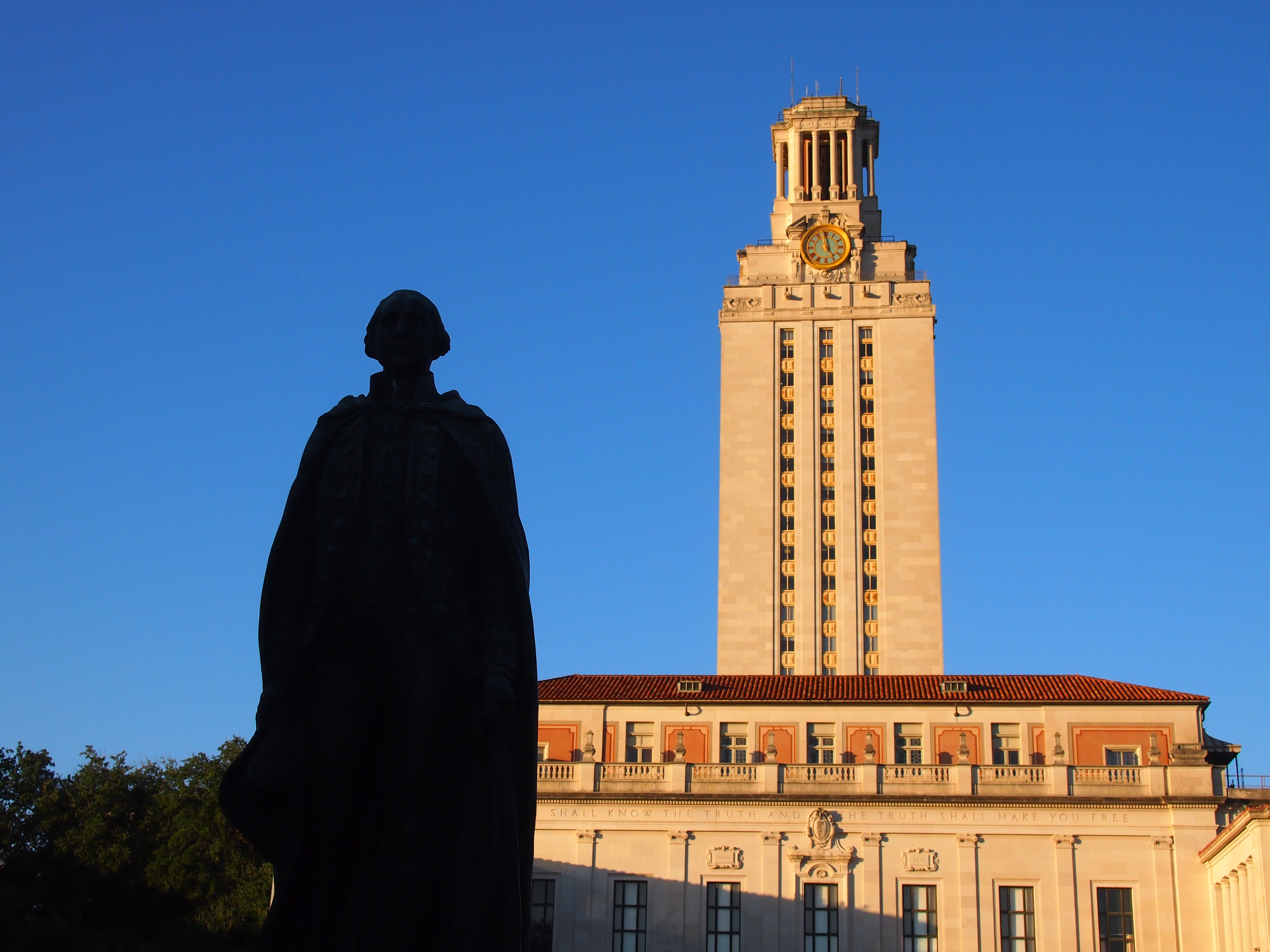
I went to Texas on the 7th and returned today, spending most of the time in San Antonio. But on the 8th, along with my brother Jay, nephew Dees, his girlfriend Eden, and my old friend – known him 40+ years now – Tom, visited the campus of the University of Texas at Austin. Our main objective was to go to the top of the UT Tower and take in the expansive view of Austin. This is the tower from the south, along with a statue of George Washington.

Austin, Nov 2014A silhouette of Washington, anyway, since the light wasn’t right. The Center for American History at UT says that “Pompeo Coppini’s dramatic rendering of George Washington has been a prominent fixture on the south mall since 1955. Erected by the Daughters of the Republic of Texas, it was the first statue of Washington in the state.” I’ve run across Coppini’s work before.

Assorted other bronzes adorn the UT on the campus, such as effigies of Jefferson Davis, Texas Gov. James Hogg, and Martin Luther King Jr. (told you they were assorted). We either missed them, or the late afternoon November light was poor for picture taking.

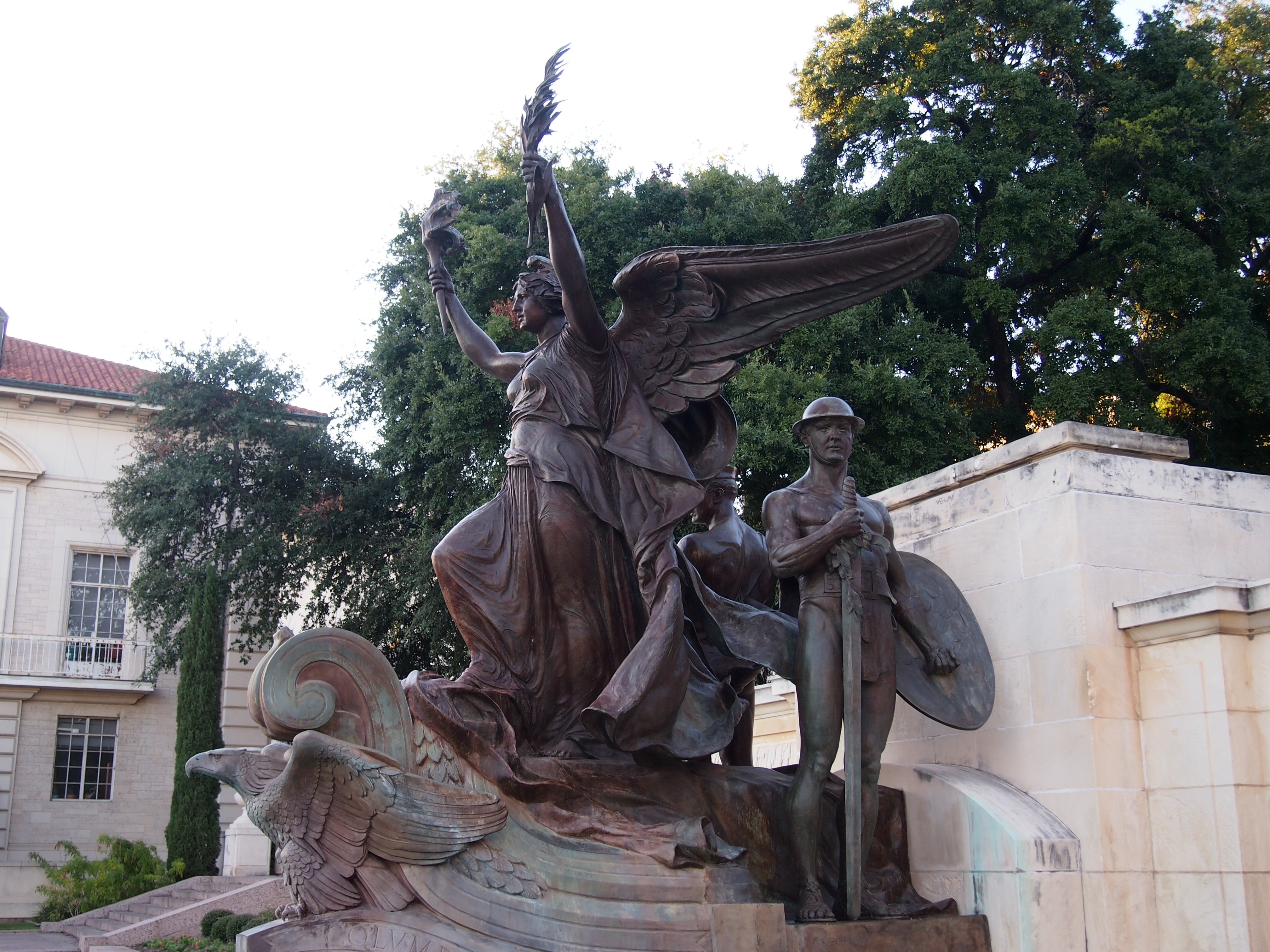
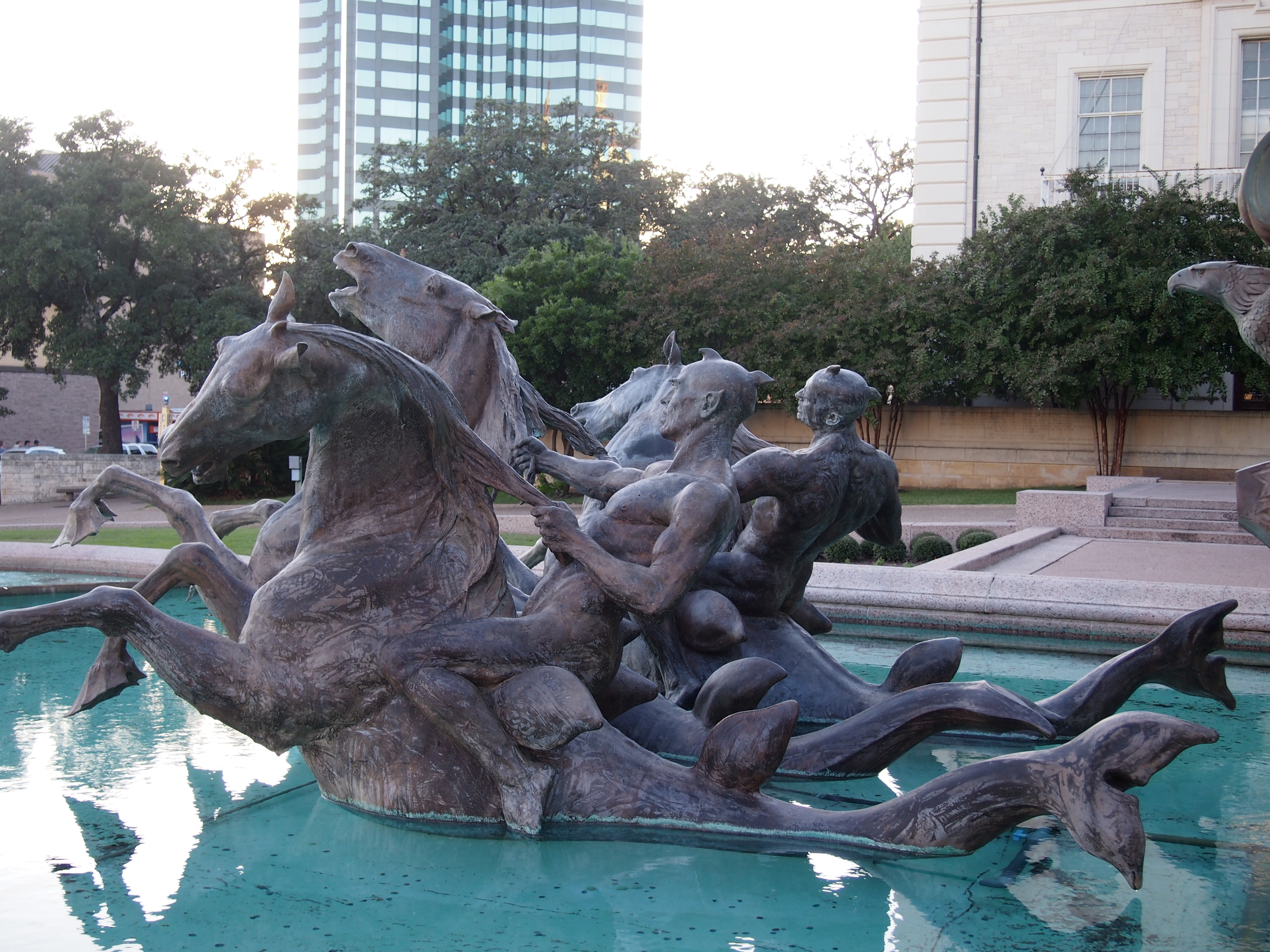
A more ambitious work on campus by Coppini is the Littlefield Fountain, paid for by George Littlefield, an early big donor to UT. Apparently he envisioned a Confederate Memorial, but by the time the thing was actually done in the early 1930s, and Littlefield himself was gone, it was a memorial to honor UT students and alumni who died during the Great War. A fitting thing to see in early November, and 100 years after the Great War’s early days.

Littlefield Fountain, Austin, Nov 2014On the other side is a sailor of the war, to go with the lightly clad solider bearing a very long sword.

Littlefield Fountain Nov 2014 In the fountain itself, interesting equine-piscine creatures.

Green-Wood Cemetery

One of the larger neighborhoods in Brooklyn is a necropolis, with about 560,000 permanent residents: Green-Wood Cemetery. Take the R line subway to either 25th St. or 34th St. station, and you’re there. Fairly early in the morning of October 14, I went to 34th St. station, got a map from the guard at the entrance, and walked right in.

“Founded in 1838 as one of America’s first rural cemeteries, the Green-Wood Cemetery soon developed an international reputation for its magnificent beauty and became the fashionable place to be buried,” the map tells me “By 1860, Green-Wood was attracting 500,000 visitors a year, rivaling Niagara Falls as the country’s greatest tourist attraction…”

Besides groundsmen and other obvious cemetery employees — including one driving a garbage truck — I noticed exactly three other people visiting Green-Wood that morning. It was a weekday, but even so cemetery tourism isn’t what it used to be.

I didn’t have all day – or even all morning – to explore the vastness of Green-Wood, so I cut a path from the 34th St. entrance to the 25th St. entrance, spending about an hour. The better way to see the place would be the trolley tours that the cemetery gives, but I couldn’t fit that into my schedule. Still, I managed to wander some of the paths.
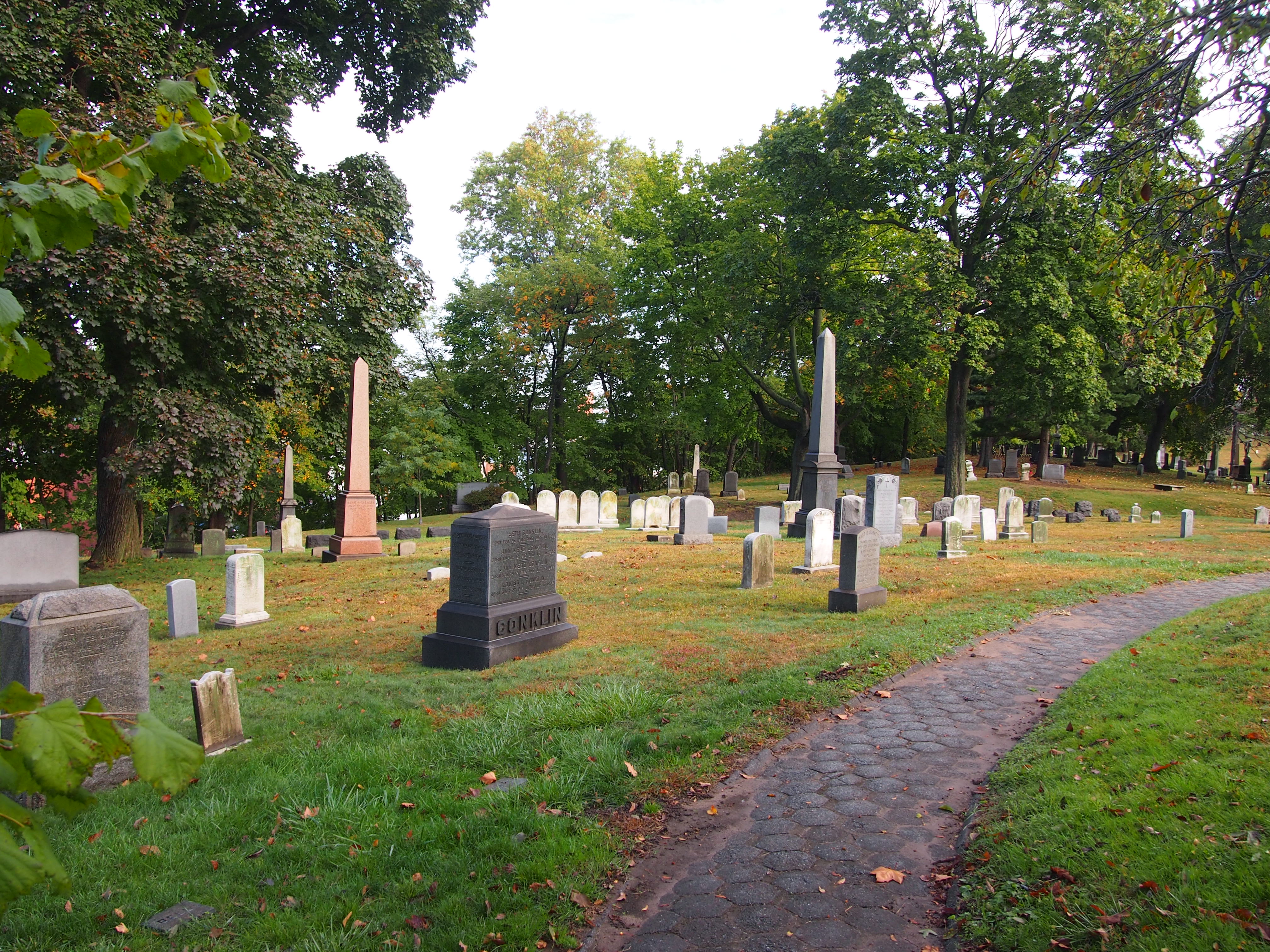
Green-Wood Cemetery, Oct 14, 2014 And marvel that the cemetery has hills. A lot of hills. Since when does Brooklyn have hills? Turns out Brooklyn has glacial moraine hills in spots, especially the cemetery, which in fact includes the highest point in the borough (about 200 feet above sea level).
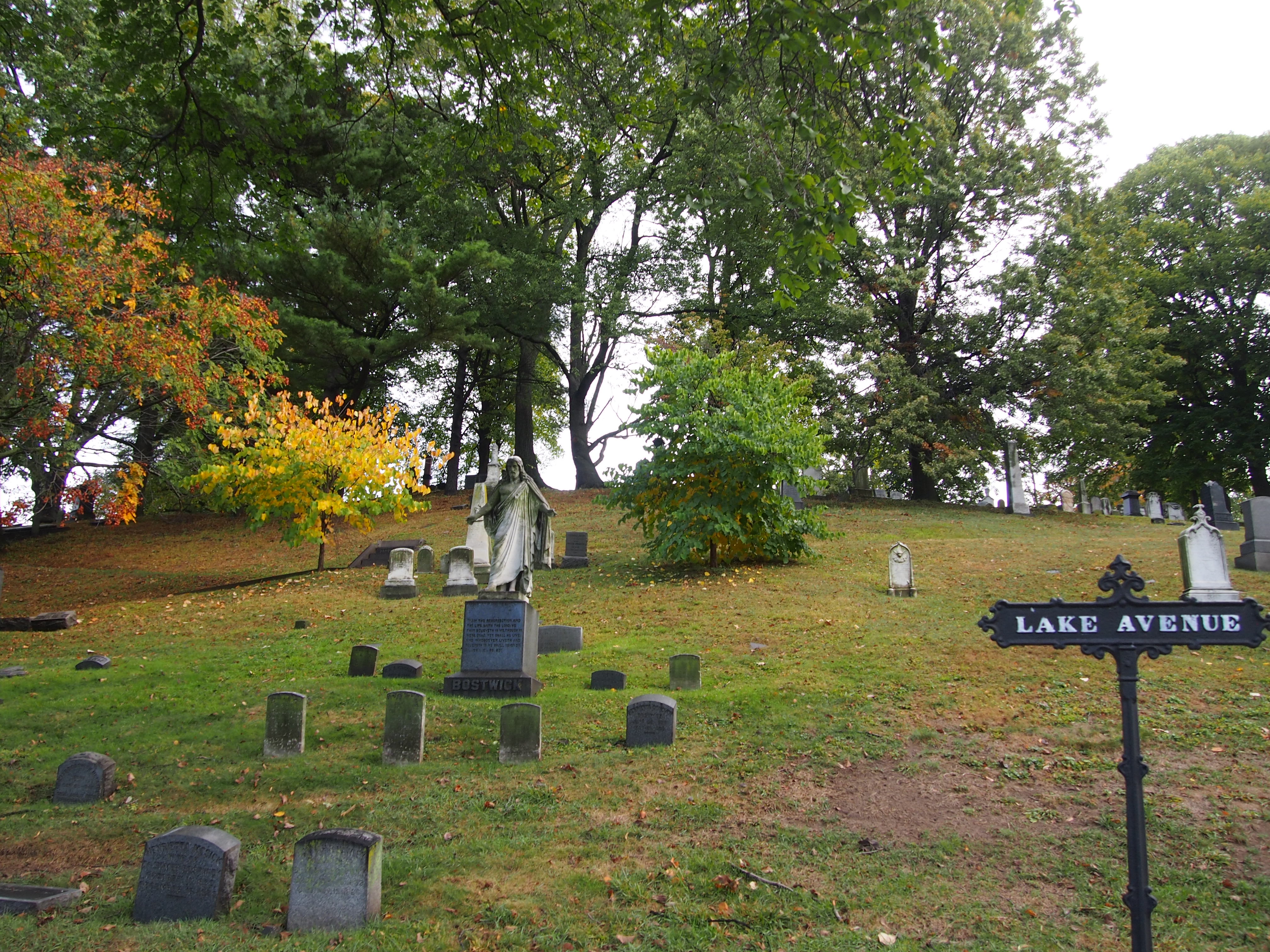
Green-Wood Cemetery, Oct 14, 2014Note the street sign. There are many streets and paths in Green-Wood and, unlike some other parts of the borough, they’re all well marked.
OLYMPUS Green-Wood Cemetery, Oct 14, 2014DIGITAL CAMERA“Today Green-Wood is 478 spectacular acres of hills, valleys, glacial ponds and winding paths, throughout which exists one of the largest outdoor collections of 19th- and 20th-century statuary and mausoleums,” the map continues. It also points out that there are also 7,000 trees, though I’ve read that some of them were knocked down by Hurricane Sandy. I didn’t see any lingering damage from the storm, but I didn’t really see that much of the place, either.

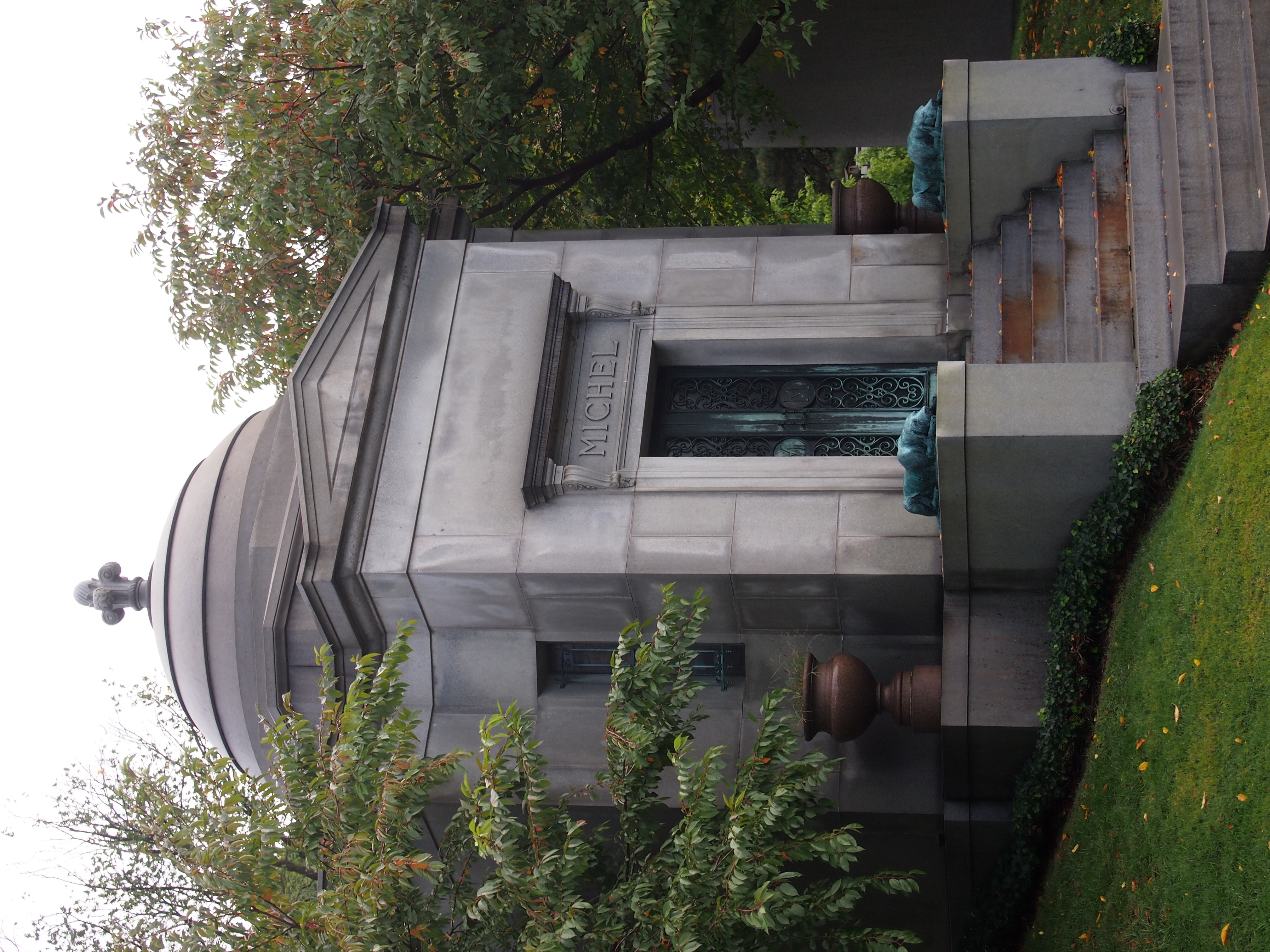
I did see some funerary art. At the Michel mausoleum, for instance, a pair of dogs waits patiently for their masters – the Michels would be my guess. It’s pretty clear they aren’t guarding the place.

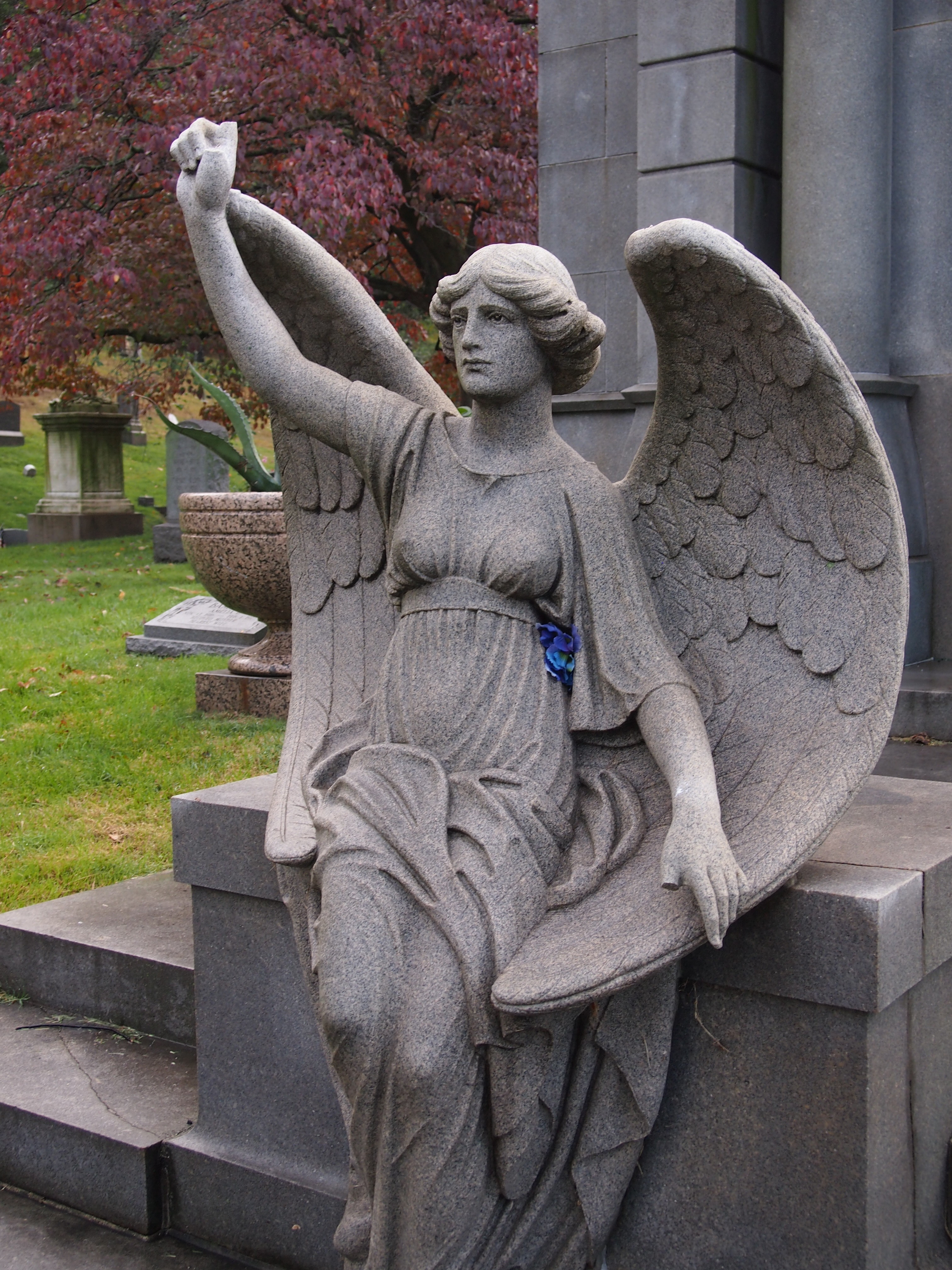
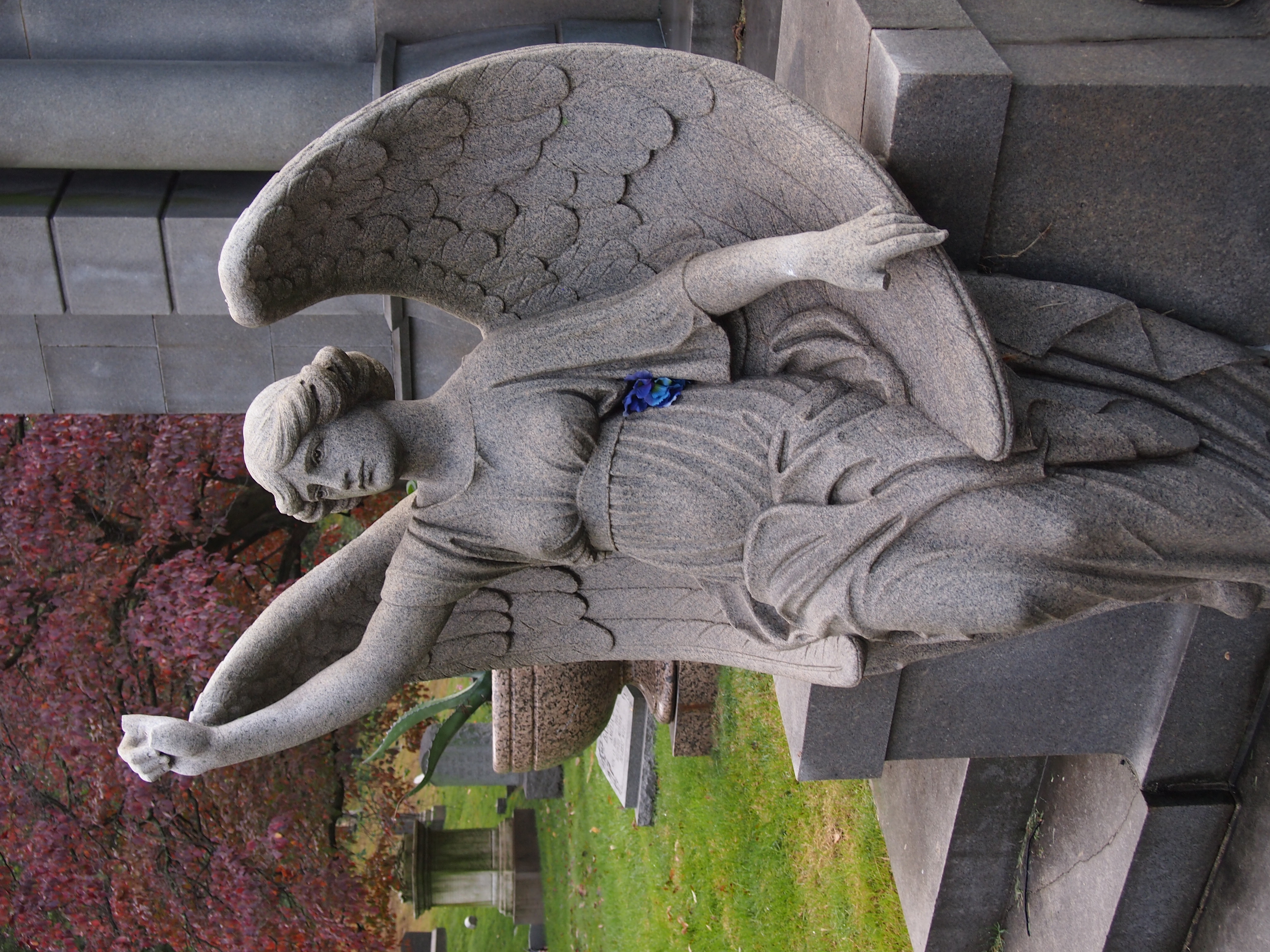
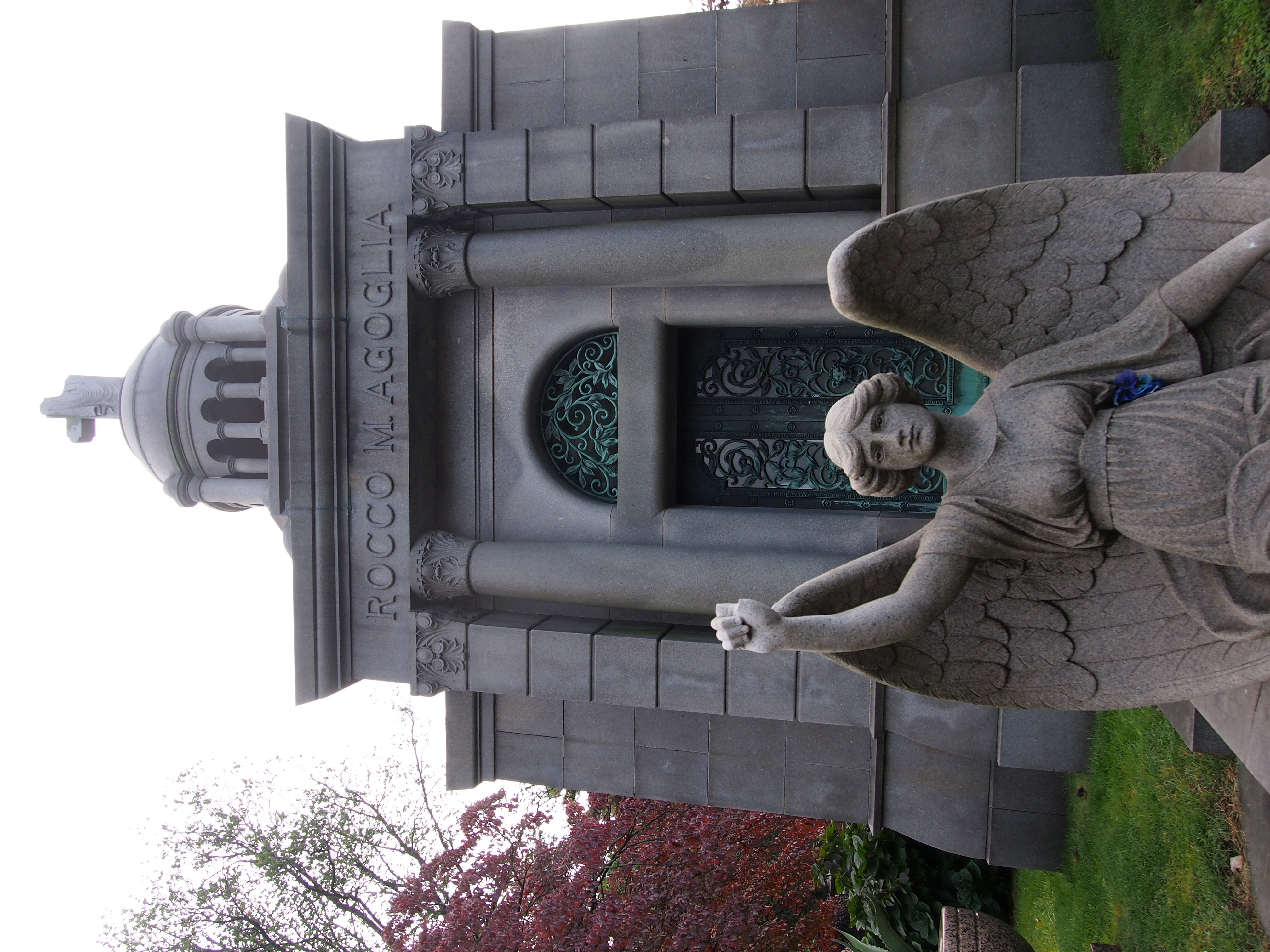
Green-Wood Cemetery, Oct 14, 2014Other mausoleums sported angels.

Green-Wood Cemetery, Oct 14, 2014An awfully female-looking being, considering that angels are thought to have no gender. This particular angel is associated with the mausoleum of Rocco M. Agoglia. You have to like a name like that.
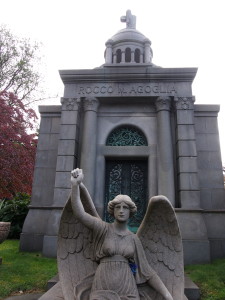
Green-Wood Cemetery, Oct 14, 2014Find A Grave, for what it’s worth, tells me that “Rocco M. Agoglia of 7717 Narrows Avenue, Brooklyn, New York, died suddenly at Amityville, Long Island, on July 1, 1931. He was 69 years old. He is survived by eight sons, John, Fury, Sylvester, Arthur, Joseph[,] Rocco Jr., Herman and George, and one daughter, Mrs. Ida Carey.”

Fury? At least his many children (presumably) still had the scratch during the Depression to commission a nice mausoleum for their father in Green-Wood, which causal passersby can still see here in the early 21st century. Or maybe they couldn’t pay for it until a lot later. Or maybe Rocco himself paid for it before he needed it. Anyway, there it is.

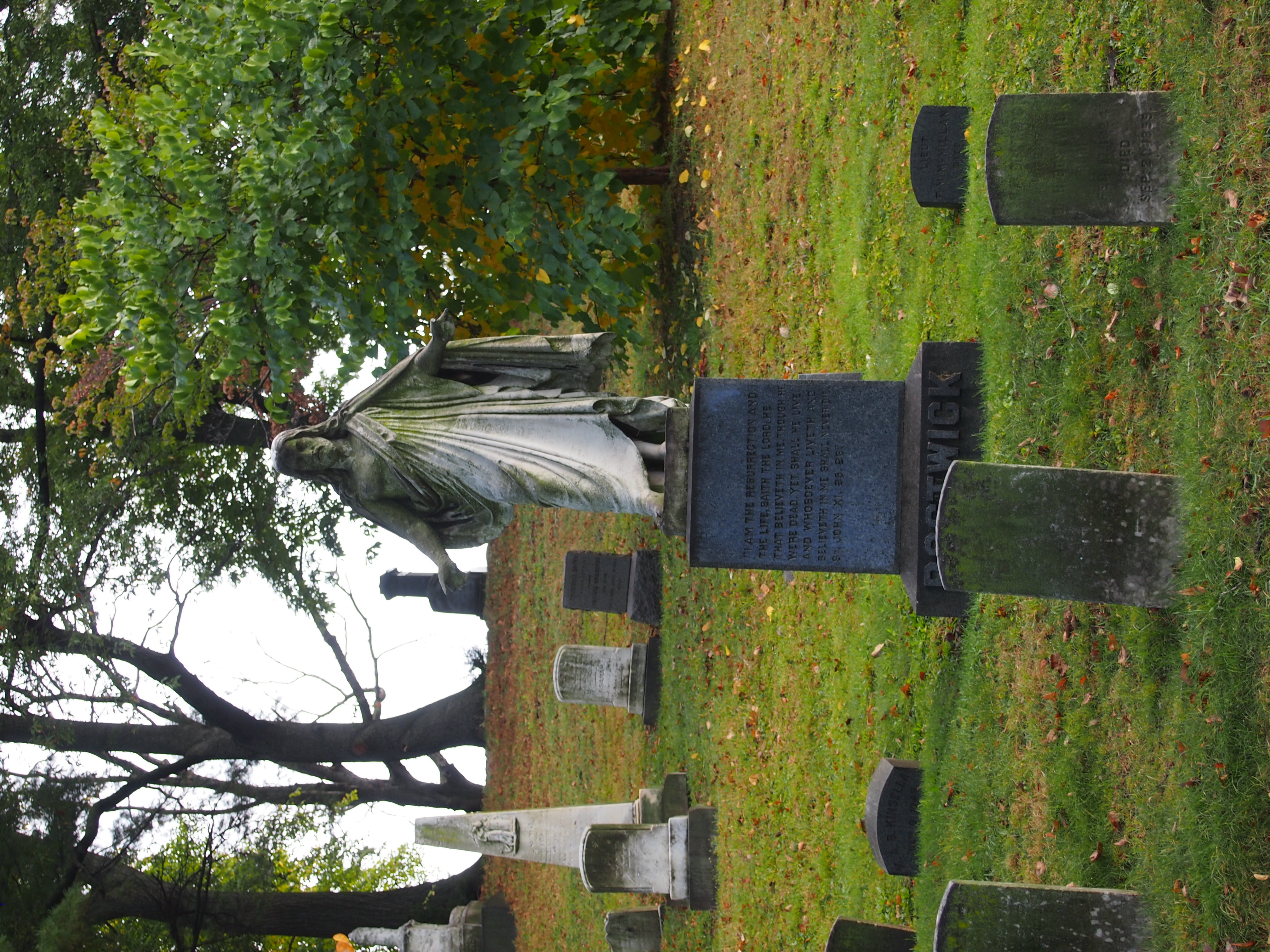
Jesus Himself makes an appearance above this stone.
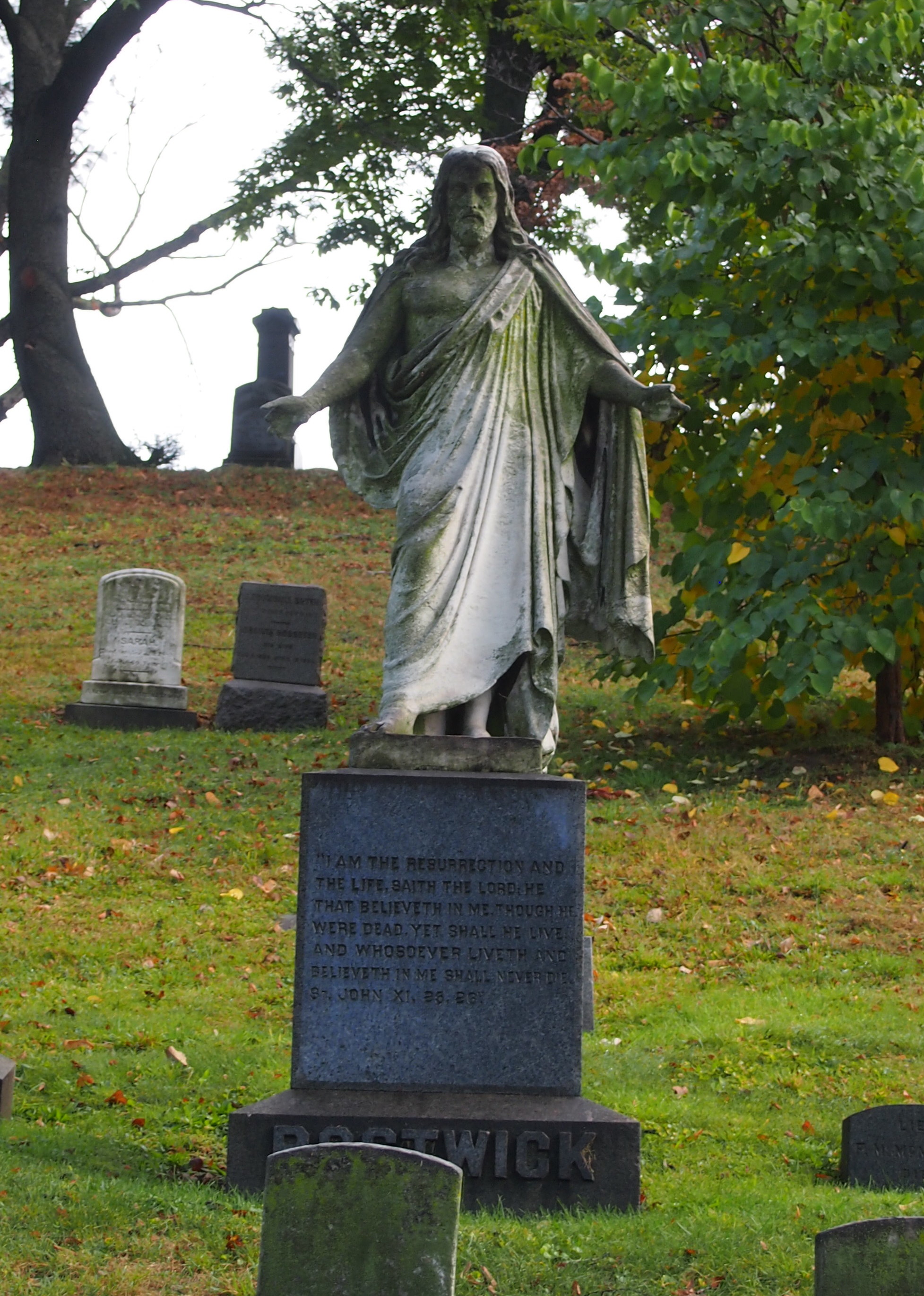
Green-Wood Cemetery, Oct 14, 2014Being such a fashionable cemetery at one time, Green-Wood sports a good many notable dead people, especially but not exclusively from the 19th century. The map notes some that are instantly recognizable, such as Henry Ward Beecher, Leonard Bernstein, DeWitt Clinton, Henry Halleck, Samuel Morse, Boss Tweed, Horace Greeley, and Louis Comfort Tiffany. Others noted include Cooper Union founder Peter Cooper, “Father of Baseball” Henry Chadwick, silent movie star William S. Hart, actress Laura Keene, artist Jean-Michel Basquiat, “dancer, adventuress” Lola Montez, Broadway lyricist Fred Ebb, and “Steeplechase founder” George Tilyou.

I really wanted to visit Boss Tweed, but he was pretty deep into the cemetery, so I had to settle for a handful of other notables. Such as D.M. Bennett.
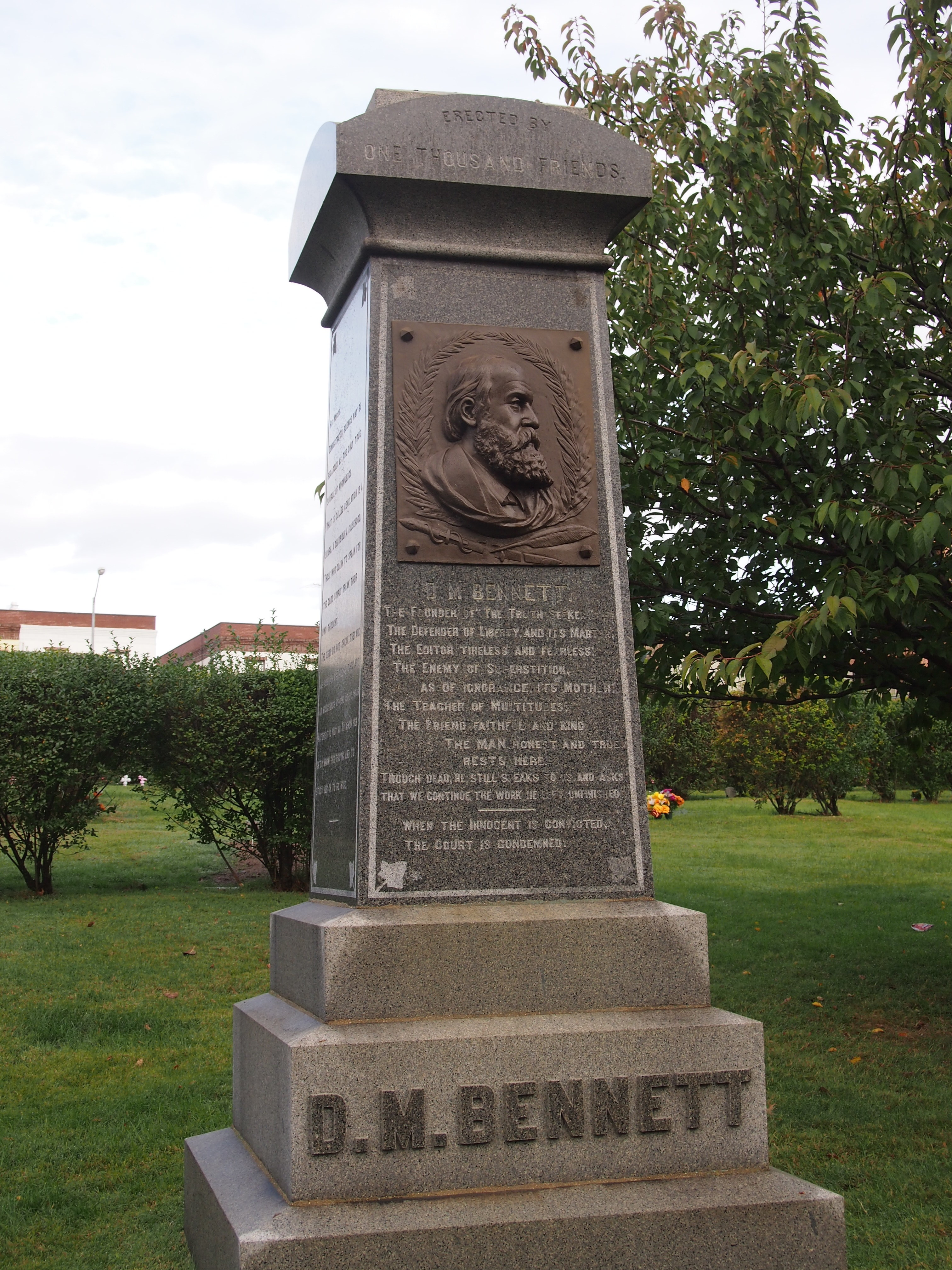
Green-Wood Cemetery, BrooklynD.M. Bennett? I’d never heard of him, either. But DeRobigne Mortimer Bennett (1818-1882), his stone says, was “the founder of The Truth Seeker, the defender of liberty and its martyr, the editor tireless and fearless, the enemy of superstition, as of ignorance, its mother, the teacher of multitudes… though dead, he still speaks to us and asks that we continue the work he left unfinished.” Though it’s arrant reductionism, I’m going to characterize him as a free-love advocate. At least, Comstock busted him for sending free-love pamphlets through the mail.

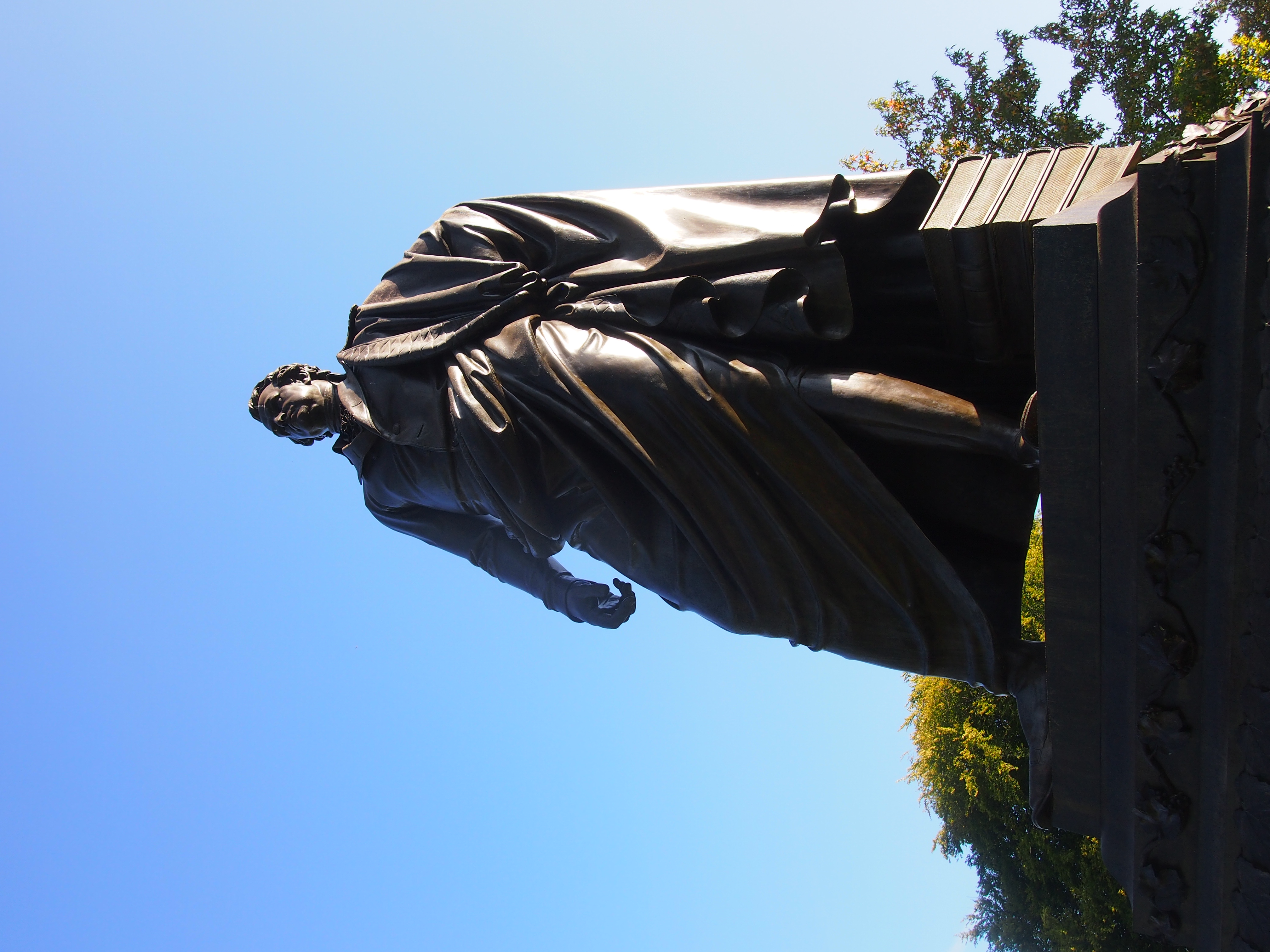
Later I found my way to the large memorial of DeWitt Clinton (1769-1828), sixth governor of New York and main impetus behind the Eire Canal (“DeWitt’s Ditch”) – which, if you think about it, makes him an indirect founder of Chicago. He has a statue atop his grave, with the plinth memorializing the building of the canal.
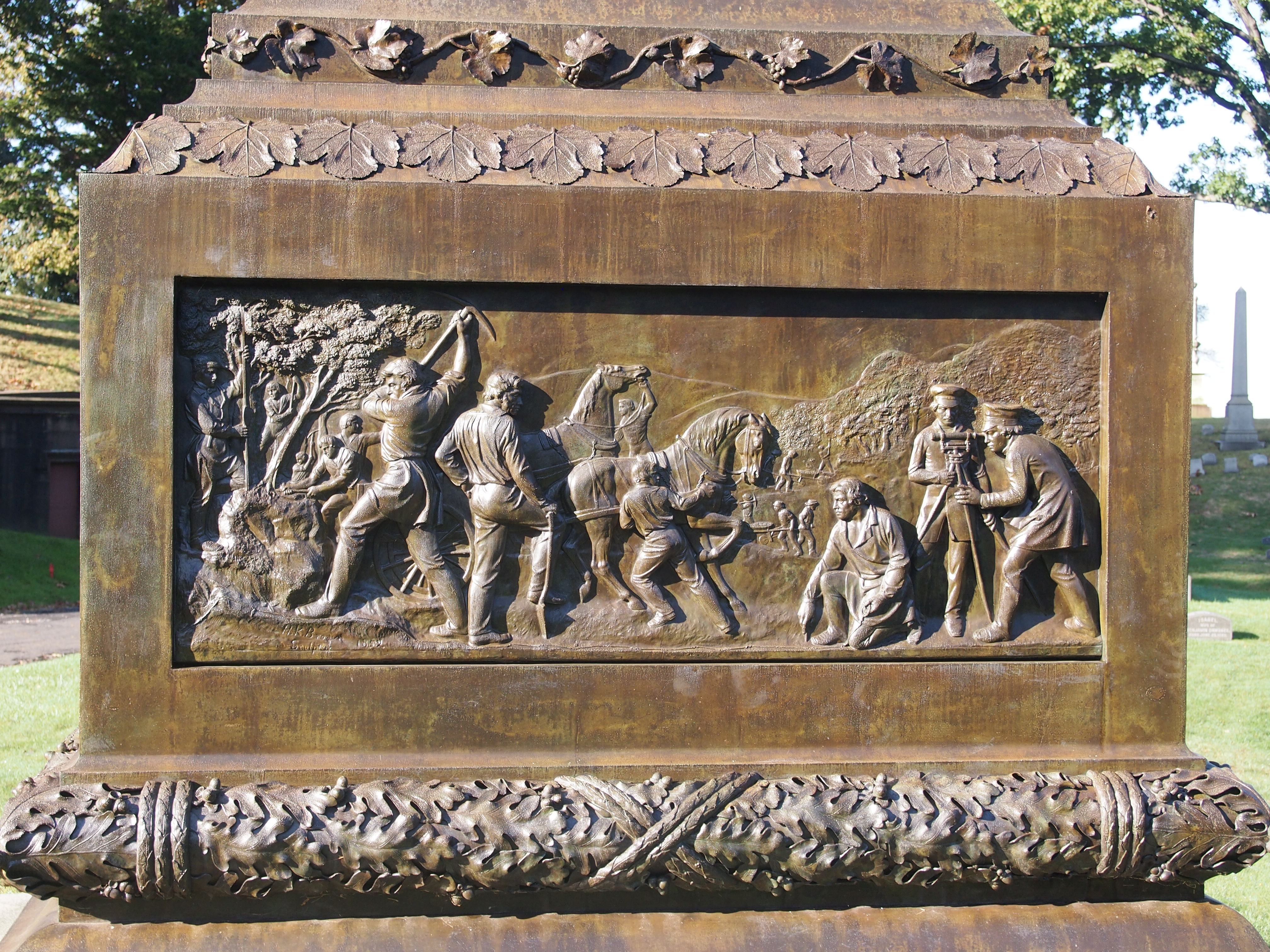
DeWitt Clinton StatueThe sun wasn’t in the best position for a good shot of Gov. Clinton, but I gave it a go.
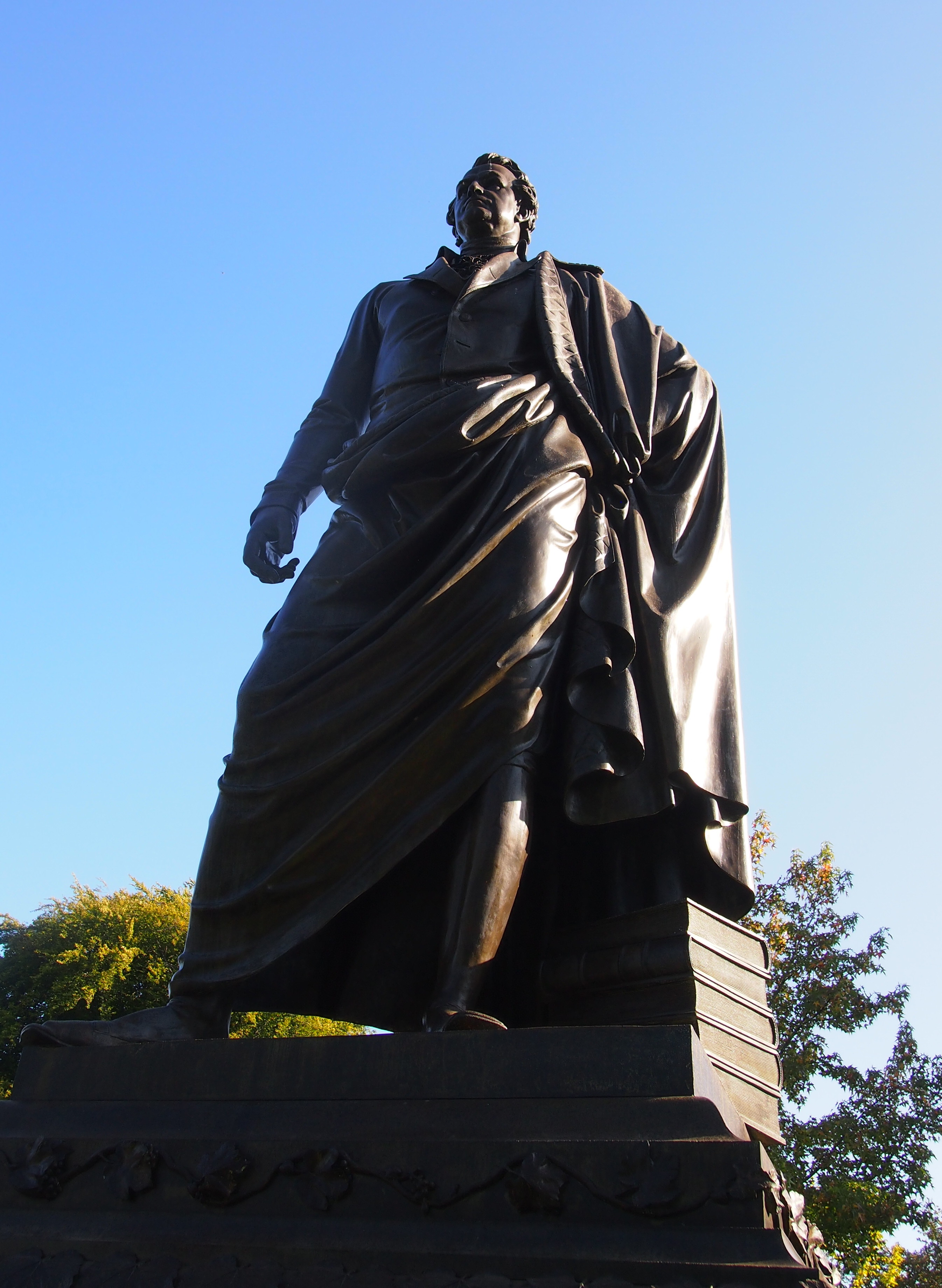
DeWitt Clinton statue Note that good republican that he was, the governor’s wearing a toga. He is not, however, bare-chested, unlike a certain noteworthy statue of George Washington. The Clinton statue is by Henry Kirke Brown, better known for equestrian statues in New York.