Mochidou

Not long ago, we noticed Mochidou, a pastry shop in Hoffman Estates, Illinois. How that happened involves a change of veterinarians from a few years ago.

Once upon a time, we took the dog to a nearby practice that included a husband-and-wife vet team who had good bedside (kennel-side?) manor. Then about three years ago, they moved on at about the same time as a soulless chain of veterinary practices acquired the location. This new owner – let’s call it Three Initial Animal Care – soon showed its true colors when the dog acquired a snout infection in the summer of 2020.

Things were looking bad, and during a consultation by phone (these were high pandemic days, remember), whomever had replaced the competent married couple prescribed medicine we couldn’t get the dog to eat. Then the infection spread to one of her eyes. Later, the new vet saw the dog in person, while I waited in the car, and she seemed just a little too eager to fob us off on a specialty hospital, which also happened to be part of the chain.

After some expensive tests at said hospital, no cause could be determined. Could have been a virus. Or bacteria. Or a fungus. Nevertheless, the specialist there said we could proceed with very expensive surgery to try to fix things. As fond as we are of our old dog, we determined at the point that she was either going to live or not, without further intervention.

She lived. And lives to this day, with more energy than you’d expect from a dog around 13 years old. The infection destroyed her right eye, and she sneezes more than she used to, which seems to be a permanent result of the snout damage. She might also have a diminished sense of smell, which I suppose would be worse for a dog than losing some eyesight. But she doesn’t complain, and more importantly, has a vigorous appetite, and still barks at passersby, lolls around on the floor, begs for food, and does all the other dog things dogs do.

In early 2021, we decided to find a new vet, and so we did, a fellow with a solo practice in Hoffman Estates. We like him, and I believe he gives good advice.

The last time we took her to see him, we noticed that Mochidou had opened in the same strip center. Seems to be the only one of that name (so far). It sells mochi doughnuts — that is, a fusion of Japanese mochi and American doughnuts.

Last week, I was in the vicinity on non-dog business, and bought a box. We gave them a try. Man, are they good.
They aren’t as hyper-chewy as mochi, or as soft as a regular American (non-cake) doughnut, but in between. They aren’t as plain as mochi, or as sweet as a typical doughnut, but in between. Add to that a dash of flavor, mango in our case, and you have a wonderful treat.

“Enter the mochi donut: a donut trend that is sweeping across America due to its uniquely bouncy texture and naturally gluten-free qualities,” Thrillist reported in 2020. “The mochi donut has existed before its stateside debut, but was mostly popularized in Japan under the name ‘pon de ring’ from the donut chain, Mister Donut.”

(Mister Donut’s a post for another time. I’ve got some fond memories of mornings at the Mister Donut across the street from Nagai Koen Park in Osaka, savoring the fine doughnuts, refreshing milk tea and the incongruous rockabilly soundtrack.)

Mochidou’s confections are probably made of tapioca flour, since glutinous rice flour would end up chewier, but I didn’t ask about the ingredients, and box didn’t say. Note that they are rings of eight attached dough balls. An elegant design that makes it easy to share.

Only one gripe: they are expensive. A half dozen sells for about $16. Hipsters in high-rent urban settings spurred along to the next gustatory experience by FOMO might not consider that pricey, but we suburbanites — who take what comes — do.

The Bronze Giraffe

Took Ann back to school on Sunday. Mostly a straightforward shot down to Normal and back, with one small detour. A stop to see Maybelline and Charley.Bronze Giraffe
Bronze Giraffe

At least, that’s what paper signs taped to their necks called them. They can be found at the Bronze Giraffe Antiques.Bronze Giraffe

The shop is in a grocery-anchored strip center just off I-55 in Normal, next to the grocery store in fact. Ann needed a few items for her room, so we stopped at the grocery. Then we took a peek at the antique store.

I liked the place. Not only stuff in profusion, some neatly arrayed on shelves and tables between partitions – as you often see at antique malls – but some spots as cluttered as an old-timer’s garage. Was there ever any mention of a garage on Fibber McGee & Molly? It surely would have shared some jumbled characteristics with the famed closet.Bronze Giraffe Bronze Giraffe

To be fair, most of the cubicles were less cluttered. But whatever the organization, there were oddities to see. For instance, a bath toy of some vintage.Bronze Giraffe

The bartender in Hell.Bronze Giraffe

“Horseshoe ornaments.”Bronze Giraffe

A Nativity set with a few additional characters.Bronze Giraffe

And Whiz Kids. It was a publication I’d never heard off.Bronze Giraffe

In a rack of third-string titles? I don’t know comics well enough to know for sure, but I have my suspicions.Bronze Giraffe

TV Tropes has a short description of Whiz Kids.

“The Tandy Computer Whiz Kids series was a series of promotional comics published by Radio Shack from 1980 to 1991, and produced initially by DC Comics, then later by Archie Comics. In them, the two titular Whiz Kids, Alec and Shanna, teach their class (and by extension, the audience) about Tandy computer products and occasionally other topics (substance abuse, child kidnappers, environmentalism, etc.).

“They [the Whiz Kids] love school and learning, spend their summer vacations doing charity work and/or something educational, and help the police catch criminals out of a sense of civic duty.

“Alec and Shanna seem more interested in the educational software for the computers they promote than any video games that the computers may have.”

Well, that sounds bad. Nothing I saw in my quick look at the issue made me think otherwise.

Just before we left, I asked the clerk about the bronze giraffes, which are prominently placed at the front of the store. A whim of the previous owner, she said. If you don’t have some whimsy at your antique store, you might as well hang it up.

Vestiges of Marshall Field’s

Back to posting on January 17, out of respect to the legacy of Dr. King, because a holiday’s a holiday, and also since it’s nice to have a little time off not long after a sizable stretch of holidays, which can be a bit tiring.

We’re just ahead the pit of winter, but for now anyway the weather isn’t that bad. “Pit” is an inexact term, of course, but I think of it as the last week of January and the first one of February, more or less. Since the Christmas freeze, temps have been more moderate, but I expect another gelid blast sometime soon.

The following is a reminder that, once upon a time, department stores were the disruptors.

“The development of the department store posed a serious threat to smaller retailers,” explains the Encyclopedia of Chicago. “Many small merchants tried to rally the public against the new behemoths, but they failed to gain much support. Rather than rally to the side of traditional merchants, Chicago shoppers embraced the new form of retail.

“The opening of the new Marshall Field’s State Street store in 1902, only a few years after anti–department store protests, signaled that this newer type of institution had won the admiration of consumers. The opening was a sensational event, and the store decided not to start selling items on its first day of business so that more of the eager public would be able to pass through.”

Ah, if only passing through the building were quite as awe-inspiring here in the fraught 21st century. Still, a visit has its moments of visual splendor. If you look up.

I need to spend more time looking this masterpiece. In person, I mean. Closer views are available on higher floors, but it’s a wow even from the ground floor. Worth the crick you might get putting your neck in just the right position to see it.

“The highlight of the Marshall Field store was the Tiffany Dome (1907), a glass mosaic covering six thousand square feet, six floors high,” EOC says.

Not just any glass, but a special kind of glass that Tiffany & Co. had just invented. State-of-the-Victorian-art amorphous solids in a glassy myriad of hues, in other words.

The Marshall Field Building’s other yawning space – a building that takes up a city block has ample room for yawning spaces – is worth the uplook too.

A building of this kind also has a practically limitless supply of engaging detail. Some of it is literally underfoot, and by literally, I mean literally.

Back on the seventh floor, not long after noon, we wandered through a not particularly busy clutch of quick-service restaurants. At some point, department store management erased the longstanding and high-quality casual food service in the basement, and reconfigured parts of the seventh floor for food service.

Near the restaurants is a corner with floor-to-ceiling windows. Hard to pass those up, so we didn’t. We took in the views from northwest corner of the building.

Looking north on State St.

Looking west on Washington St. 

A few years ago, the ornate venue originally known as the Oriental Theatre, which started as a 1920s movie palace, took a new name, Nederlander. After theater impresario James M. Nederlander (d. 2016). Doesn’t he count as a New Yorker? Guess his company would argue that it is national, as indeed it is.

Elsewhere on the seventh floor is a pocket-sized, plain hallway with a small exhibit of figures from Marshall Field Christmas windows on State Street, which were as much holiday tradition at the store as decorating the Walnut Room or hiring a Santa Claus, with thousands of Chicagoans and tourists seeing the windows every year and developing fond memories of the place.

As recently as 2015, the windows were inventive expressions of the window designers’ art.

The items on display in the hall aren’t particularly old: most are from this century. Such as from 2004.

2006.

A luminous creation from 2005.

I could write more – say, 1000 words – contrasting these artifacts with the 2022 State Street Christmas windows, but I don’t need to. Here’s one of the storied windows this Christmastime.

One could take the current owners of the building to task for this diminished creativity, but it isn’t the cause of anything, only a symptom.

I can’t end on that sour note.

While taking pictures at an elegantly decorated part of the seventh floor, I caught an image of a passing lass, elegant as her surroundings.

The Ghost of Marshall Field

On the second to last day of 2022, we spent a while at Macy’s downtown Chicago store. The chain does business in the magnificent building originally occupied by Marshall Field & Co., the celebrated retailer on State Street, which takes up an entire city block.

On the seventh floor, Marshall Field looks out upon the modern operation. It hasn’t had his name since the early 21st century.

Does the mustachioed shade of Mr. Field (d. 1906) wander the building at night, collar taut, making no noise and visible to no one, because he’s a happy ghost? After all, his building, not quite complete when he died, is still there, and still retail. Or is he having trouble keeping quiet, considering the direction of the department store business?

For some modern context – business context, that is – I fed “Macy’s” into Google News today. Some headlines that emerged:

Macy’s Analyst Remains Bearish Following Disappointing Q4 Preannouncement: ‘Longer Term Structural Challenges’

Macy’s Cautious View on Consumers Hits Shares

Macy’s quietly lays an egg — and more may be coming for retail: Morning Brief

All those are actually relatively good news in the world of department stores, which cling to life but which further disappear with each passing year. I’m not saying that Macy’s is doomed, just operating as one of the last players standing on much smaller playing field.

The downtown Chicago location was fairly busy that day and still decked out for the holidays. Especially on the seventh floor, home to the Walnut Room, which still has a reasonably impressive Christmas tree.

The Walnut Room is a grand space even in our time, serving meals of one kind or another since 1907, and the site of large Christmas trees since that same year. Originally named the South Grill Room, this is how it looked in 1909, not in the holiday season.

Generations of Chicagoans came here to eat or, like me as long ago as the late 1980s, to see the grand tree. Looks like they are still coming for both purposes, so at least Macy’s has that going for it.

“The bold selection of grilled foods was meant to distinguish the South Grill Room from the daintier tearooms,” the Digital Research Library of Illinois History notes. “The restaurants’ role was not to make money (they usually operated at a loss) but rather to lure hungry visitors into the store and give those already inside a reason to stay. Their upper-floor location required diners to navigate past enticing impulse goods while making their way upstairs.

“Because so many customers spoke of this restaurant by referring to its Circassian walnut paneling, it was later renamed the ‘Walnut Tearoom,’ next as the ‘Walnut Grill,’ and finally as the ‘Walnut Room’ in 1937.”

Also on the seventh floor: the Narcissus Room. It used to be a tea room. One of those daintier rooms mentioned above. There were still signs pointing to it, so I decided to go take a look. For all I know, tea rooms are the latest thing among hipsters and Gen-Whatever social media posters.

The room as it once was. My source puts the card at 1920.

The entrance to the Narcissus Room much more recently. As in, about two weeks ago. Note that it isn’t locked, and there were no signs advising against entry by non-employees.

Nice detail on at the threshold.

I opened the door.

I did not, in fact, enter. This view was freely available from outside the door, which is in public hallway in the store. According to Macy’s, you can rent the room for an event. As of that day, anyway, no events seemed to be in the works.

Plan B Travels at the End of ’22

Since Tucson was a no go, we decided to spend the same three days, December 29 to 31, visiting new sights close enough to home to be at home, come bedtime. A suite of day trips, that is. If you can’t go far, go near.

On the first day, we drove southward to near our old west suburban haunts, stopping first in Darien, Illinois, which is home to the National Shrine of St. Thérèse. I’d visited the shrine by myself at some point ca. 1999, but took no notes and made no photos, so I didn’t remember much. Besides, I’d read that a new shrine building was completed only in 2018, so it counted as a new place for me.

I’d also forgotten that Thérèse of Lisieux is also known as the Little Flower of Jesus. The entrance of the new shrine announces that, silently, as you enter.Little Flower of Jesus

Later that day, we made our way further south to the Midewin National Tallgrass Prairie. Strictly speaking, we’d been there before as well, all the way back in the summer of ’04. I told Yuriko we’d been there, but she didn’t remember. Maybe I remember because I spent a lot of time that day pushing Ann’s stroller along an uneven grass path under a hot sun. I seem to have left that part out of my posting about it, however.

On the other hand, Midewin is large, with about 13,000 acres and 30 miles of trails open to the public, so I’m sure we walked through an entirely different part this time – one with visible reminders of the area’s time as the site of an ammunition plant.

The sun wasn’t an issue this time.Midewin National Tallgrass Prairie

On December 30, we made our way to a different sort of human environment: downtown Chicago, by way of driving to near O’Hare, parking the car, and riding the El into town. Without planning to, we found something downtown we’d never seen before, an art exhibit in the underground Pedway.Chicago Pedway Dec 30, 2022

The Art of American Victorian Stained Glass, featuring well over a dozen windows from the late 19th century and early 20th. Wow. Well hidden and remarkable.

We also spent time in other parts of downtown, including a walkabout inside holiday- season Macy’s. I’ve been there any number of times, of course, but this time I appreciated the place with new eyes. One conclusion: it ain’t no Marshall Field.

Well, some things are the same. Macy’s still has the holiday horns hanging on State Street.State Street Dec 30, 2022

One of these days, I ought to give State Street the Wall Street or William Street treatment, but I’d have to be by myself to do so. State Street might not exactly be a great street, but it still has character.State Street Dec 30, 2022
State Street

By that, I mean skyscrapers from the early days of steel-reinforced buildings. Also, astonishingly intricate ironwork from a time when a department store (the vanished Carson Pirie Scott) could afford such things.Carson Pirie Scott Chicago ironwork
Carson Pirie Scott Chicago ironwork

Actually, the Louis Sullivan building at State and Madison — the (0 0) of the street numbering system in Chicago — was built in 1899 for the retail firm Schlesinger & Mayer; Carson Pirie Scott was a Johnny-come-lately when it bought Schlesinger in 1904. These days there’s a Target in the lower floor. Sic transit gloria tabernae, I guess.

On the last day of 2022, we headed away from metro Chicago again. We’d considered Starved Rock State Park as a destination, but I wanted something new, so we went to Buffalo Rock State Park, which is more-or-less across the Illinois River from Starved Rock. Nice little park.

Afterward, the weather was good enough, and the temps just warm enough, to allow us to eat Chinese takeout at a picnic table in Washington Park in Ottawa, Illinois, in our coats. The last time we were there, it was hot as blazes.

Didn’t look around too much this time, though someday I want a good look at the many churches along Lafayette St. in Ottawa. I did take a look at LaSalle County’s Civil War memorial.LaSalle County Illinois Civil War memorial

A closer look at the base –LaSalle County Illinois Civil War memorial

– reveals that even the names of the Honored Dead are no match for Time.

American Science & Surplus

Regards to all for Christmas and the New Year. Back to posting around January 3, when I will wonder, as usual, how we could possibly be so far into the 21st century. Which still seems like a new century to me.

On Sunday, I bought a rubber chicken from this plentiful stock, at a retailer I know. I got the regular one for $10.95, not the more expensive, fancy-pants glow-in-the-dark model. Bet a regular one cost $9.95 a year ago, but such is the retail economy in our time.American Science & Surplus

Why a chicken? (Why a no duck?) My old one must have worn out. Not because I used it for anything, just that rubber doesn’t last forever. Anyway, no household is complete without a rubber chicken. Words to live by.

Where? The truly wonderful American Science & Surplus, which has three stores, two in Illinois — Park Ridge and Geneva — and one in Milwaukee. None of them are particularly close to where we live, so we don’t go often. In fact, I think it’s been about 10 years. We ought to go more often.

This is the AS&S in far west suburban Geneva, which we patronized just around sunset.American Science & Surplus American Science & Surplus

As you can see, the store promises rubber chickens.American Science & Surplus

But that’s only the beginning. AS&S has a retail selection unlike any other in my experience. Toys and toy-like items, but also electronic parts, lab equipment, optical gear, craft items, camping equipment, tools and hardware, militaria, office goods, novelties and more. Much, much more.American Science & Surplus American Science & Surplus

The place was fairly busy, with people probably doing what we were doing. Looking for oddities for presents.American Science & Surplus American Science & Surplus American Science & Surplus American Science & Surplus

You can also buy Teslas there.American Science & Surplus

Affordable Teslas, that is, though at $20, I took a pass.

Kong Dog

When you see something like this, you may ask yourself, how did that get here? (Not how did I get here?)

How it got here: worldwide cultural diffusion. Considering the near-ubiquity of electronic communications and physical travel in out time, the world’s many, many kinds of human expression are essentially in the same pot now. Let it boil.

To be more specific, culinarily inventive people in South Korea encountered the corn dog at some point. Corn dogs are the kind of folk-food attributed to various inventors, but in any case they originated in the South, as in the southern United States.

The Koreans tinkered with the formula, adding flavors and modifying the texture, but not too much, and pretty soon Korean corn dogs were sold from stands and small chains in that country. Like the dried cuttlefish on a stick that I saw for sale in Japan, and sometimes bought, corn dogs are a natural for the take-away trade on streets dominated by pedestrians, as many are.

An idea like that, it turns out, is too good not to be exported. Korean corn dogs have arrived in the North America. Maybe not always as street food, but instead adapted to the American suburbs as take-out joints in strip centers.

I know all this because we visited a small storefront called Kong Dog on Saturday after our walk. It appeared at that site a little while ago, a month or two maybe, selling Korean corn dogs from a shop in a large strip center a few miles from our house.

We were intrigued. We already knew that Korean-style fried chicken is good eating, something I’m sure even my hillbilly ancestors would have appreciated, if they’d had it. So Korean-style corn dogs were worth a try.Kong Dog Schaumburg

I’m happy to report that they are delicious. As usual, I’m not an early adopter. Google Image turns up a lot. But I guess I’m not too far behind the curve on this one: “Korean corn dog is the latest K-food craze to hit London, and they’re making waves among the foodies of this city,” Honest Food Talks reported breathlessly only in September.

You could call them a kind of gourmet corn dog, a concept that exists here but doesn’t seem to have a lot of traction, since corn dogs are largely still considered children’s food. (And that creation pictured at the Honest Cooking page I’ve linked to are hush puppies, not corn dogs.)

It took me a moment to work out the name. Kong, as in large. Talk about the lasting influence of a movie that’s nearly 90 years old.

Flavor options: original, potato, sweet potato, churro, rainbow, ramen, hot Cheeto, sweet chili Doritos (Yuriko had that), and injeolmi, a “roast yellow bean powder.” The Kong Dog web site says there are 11 sites open, many in metro Chicago but also in some northeastern states (NY, PA), with 23 more locations in the works, in roughly the same parts of the country.

For extra atmosphere, K-pop fills the room. K-pop idols make their moves on video. At least, I assume all that is K-pop. It wasn’t J-pop. Maybe there should be a genre of music for each letter of the Roman alphabet; that’s two right there. A-pop to Z-pop, and the world could not agree on whether that last one is “zee pop or zed pop.”

I digress. They each come in their own little box.Kong Dog Kong Dog

That’s an original. When I try a new place, that’s usually what I get. With all sausage, since you can opt for all sausage inside, or mozzarella, or half-and-half. It was distinctly crisp, and tasted like a corn dog.

A really good corn dog, that is, anchored by high-quality sausage and clothed in a batter tastier than the frozen dreck that’s fobbed off on kids. Guess that’s a low bar. But anyway, it’s good eating, even if a little expensive for a single item ($6). Hillbillies would approve, once they’d scraped up the price.

Buckhead From on High

Two days after I returned from the West last month, I went to Atlanta for a work conference for most of week. Atlanta and I go back a ways; I first went there by bus in ’82, but also later. Still, my most recent visit was in 1999, so it’s been a while.

This time, there was work to do, of course, and events to attend, and I got to spend time with colleagues I hadn’t seen in a number of years, or ever, except for Zoom. That was good.
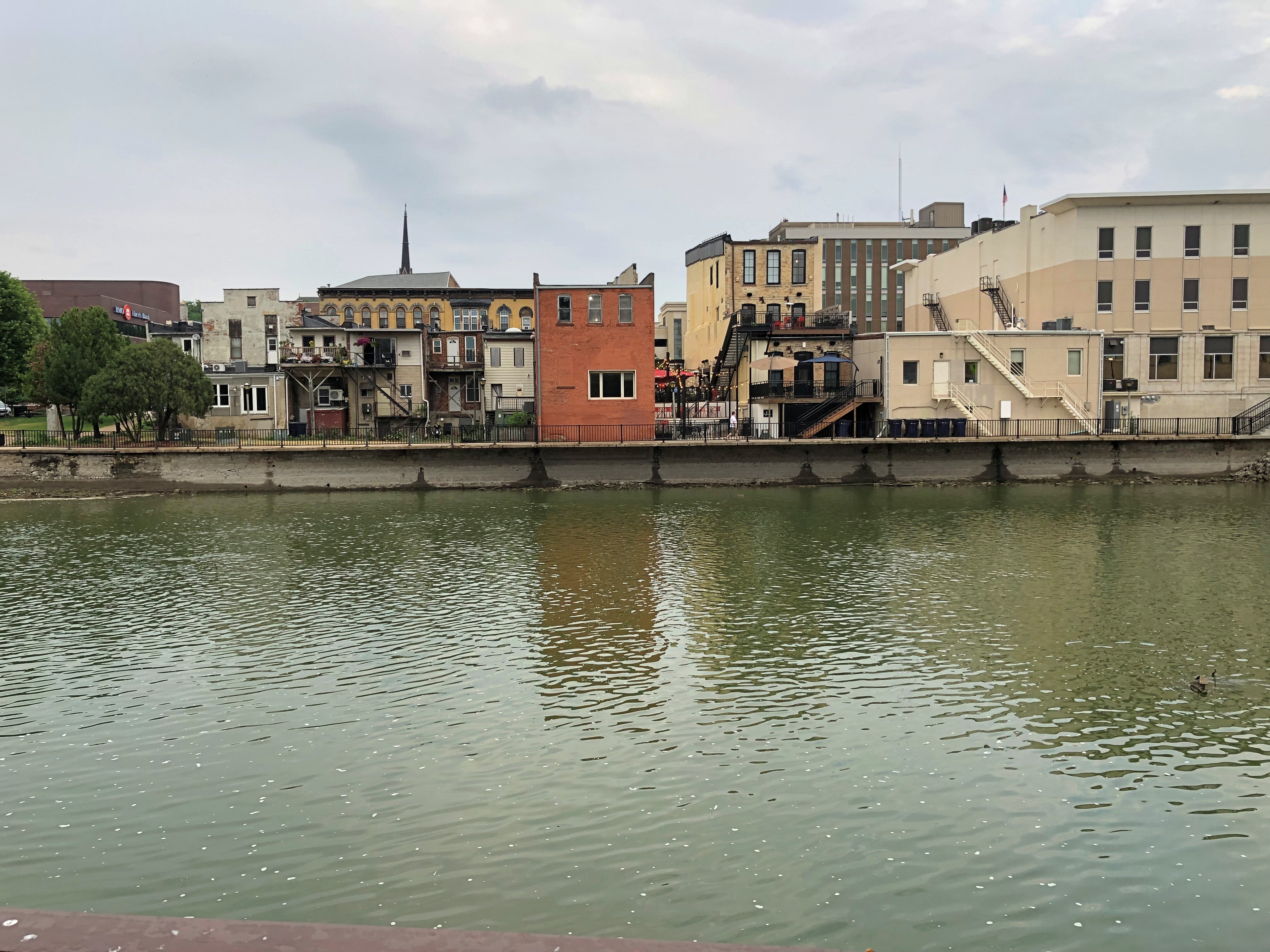
I also had a few excellent meals not at my expense, especially one at The Consulate, a restaurant in Midtown that rates its own Atlas Obscura page.

I stayed in an upper floor of the conference hotel in Buckhead, which is like a second downtown for Atlanta, something like the Galleria district in Houston. I enjoyed some good views from the room.Buckhead view 2022
Buckhead view 2022

Including much of the rooftop of a major regional mall. Not something you see every day.
Buckhead view 2022

Sure, the property’s mechanicals need to be up there. But isn’t there also the opportunity to use at least part of the roof for games that might attract hipsters and their always at-hand cameras — to promote the mall on social media — such as ax throwing, bocce and shuffleboard?

Virginia Street, Reno

Before I left Reno on October 4, there was one more thing I wanted to do: take a walk along Virginia Street, a major thoroughfare. In the end, I walked two sections of it, one downtown and featuring the well-known Reno sign, the other in Midtown.

Might as well begin with the sign. The structure across Virginia Street is actually called the Reno Arch. To split hairs even more, this is the third Reno Arch, installed in 1987 to replace the 1963 version, which itself replaced the 1926 original.

The daytime Arch.
Reno Arch

Plenty of bulbs on the underside. Quite a glow come nighttime.Reno Arch

What’s that on the side of the Whitney Peak Hotel, overlooking Virginia Street? A climbing wall.Downtown Reno - Virginia Street

A set of climbing walls, actually, some toward the upper reaches of the tall building. When I first walked by it, a man was climbing on the lowest wall, but by the time I returned to take a picture, he was gone.

Downtown Reno has a clutch of what you might call Las Vegas-class casino-hotels, though diehard Reno partisans — are there such? — might chafe at the comparison.

Such as the Eldorado Resort Casino.Downtown Reno - Virginia Street

More modest gaming ventures populate much of the downtown Virginia Street, such as Cal-Neva, Horseshoe and what must be the first fully robotic casino, Siri’s Casino. Or is that name just a (happy?) coincidence?Downtown Reno - virginia street Downtown Reno - Virginia street Downtown Reno - Virginia street

South from that point are some examples of municipal Reno. Like the Washoe County Courthouse.
Downtown Reno - Virginia street

The Pioneer Theater Auditorium. If you guessed 1967, you’re right.
Downtown Reno - Virginia street

Back at the Truckee River.Truckee River Truckee River

The stretch of Virginia Street through Midtown Reno is a different animal: smaller buildings, local nongaming businesses — though entertainment focused, some of them — and a number of murals. New-looking for the most part, because we’re in an unacknowledged age of mural painting nationwide, commercial and otherwise.Midtown Reno Murals Midtown Reno Murals Midtown Reno Murals

Some you might call vernacular murals, if you’re in an academical frame of mind.
Midtown Reno Murals

Every block, there were more pro murals.Midtown Reno Murals Midtown Reno Murals Midtown Reno Murals

Just a small sample, but they made for a good walk. That and the fact that few other people were around in the late weekday morning — Midtown’s prime time is clearly weekend nights — and even few cars, owing I suppose to the little in biggest little city.
Virginia City

Bonanza started each week with a map on screen, and that was probably the best thing about that TV show. Not just any map, but an idiosyncratic depiction of the Cartwrights’ vast ranch Ponderosa, which straddled Lake Tahoe at some inexact moment in the 19th century.

Set illustrator Robert Temple Ayres (d. 2012) designed the original, “Map to Illustrate the Ponderosa in Nevada,” in 1959. I wasn’t a regular watcher of Bonanza, either in prime time or afternoon repeats, but I did know that map.

That show might have been the first time I ever heard of Virginia City, Nevada, which is featured prominently on the map, toward to top, because it is more-or-less oriented with the east to the top. Maybe Ayres was trying to tell us all something about the importance of Jerusalem. More likely, he needed to fit the map on horizontal TV screens.

Also, if I remember right, the Cartwrights were always going to town — to Virginia City — for one reason or another. After leaving Carson City on October 3 to return to Reno, I decided to go by way of Virginia City myself, which is on Nevada 341. The drive climbs into the Virginia Range, and the city sits on what used to be the Comstock Lode.Virginia City, Nevada Virginia City, Nevada

At less than 800 residents, the city is a town, nothing like its silver boom heyday in the 1870s, when there was a population of more than 25,000. The town you see now mostly dates from after 1875, when the original V. City burned down.

Local boosters haven’t forgotten that a young Samuel Clemens lived here for a while.Virginia City, Nevada

The main street is C Street.Virginia City, Nevada Virginia City, Nevada Virginia City, Nevada

You can stroll down C Street and visit the likes of the Fourth Ward School Museum, Cafe Del Rio, Virginia City Jerky, Wild Horse Gallery, Comstock Firemen’s Museum, Tahoe House (a hotel), Washoe Club Museum & Saloon, Garters and Bloomers, Grant’s General Store, Virginia City Mercantile, Red’s Old Fashioned Candies, Comstock Bandido (clothes), Palace Restaurant & Saloon, Silver Queen (another hotel), Bucket of Blood Saloon, Priscilla Pennyworth’s Emporium, Red Dog Saloon, The Way It Was Museum, Buzzard Creek Collectibles and much more.

The name of this place was particularly apt.Virginia City, Nevada

I hadn’t come to Virginia City to shop. Rather, I sought out St. Mary’s in the Mountains Catholic Church on E Street. Considering that the town is built on the side of a slope, it was a walk downhill to get there.St Mary's of the Mountain - Virginia City, Nevada
St Mary's of the Mountain - Virginia City, Nevada

Completed in 1870 and rebuilt after the fire in ’75. I was glad to find it still open for the day.St Mary's in the Mountains - Virginia City, Nevada St Mary's in the Mountains - Virginia City, Nevada St Mary's in the Mountains - Virginia City, Nevada

Nearby is the more modest St. Paul’s Episcopal Church. It wasn’t open.St. Paul's Episcopal Church Virginia City, Nevada

Nice view from next to the church, though. Note the gazebo. What was it Mark Twain said about gazebos? They’re the mark of civilization, even in rough-and-tumble Nevada? Well, maybe he didn’t say that.
St. Paul's Episcopal Church Virginia City, Nevada

Soon I visited Silver Terrace Cemetery, which is on the edge of town. You don’t have to go far to get there, but it is a bit of a walk once you’re at the entrance.Silver Terrace Cemetery, Virginia City. Nevada

Worth the effort. Finally, a cemetery with a distinctive local name. I’m glad its organizers didn’t pick Greenwood or Woodland or something else completely at odds with Nevada geography.Silver Terrace Cemetery, Virginia City. Nevada Silver Terrace Cemetery, Virginia City. Nevada

Not a lot of large memorials, or many trees, but the place has character. And some contour.Silver Terrace Cemetery, Virginia City. Nevada Silver Terrace Cemetery, Virginia City. Nevada Silver Terrace Cemetery, Virginia City. Nevada

“Very few of the adults entombed here are native to Nevada, which offers a window into the cultural melting pot that was drawn to the glamour of the largest silver strike in U.S. history,” Travel Nevada notes. Glamour? More likely, they wanted to get rich.

“Most of who worked the Comstock were immigrants… nobody famous is buried here, just those who devoted their lives to developing Comstock Lode.”