Wright in Dwight, But Also Odd Fellows, Cobb, and a Relic of Quackery

Ambler’s Texaco Gas Station is on the edge of Dwight, Illinois, not far from the Interstate, and after our short visit on Sunday, Ann and I went further into town, seeking a late lunch. We found it at El Cancun, a Mexican restaurant in the former (current?) Independent Order of Odd Fellows building, dating from 1916. Looks like the orange of the restaurant has been pasted on the less-colorful IOOF structure.IOOF Dwight Illinois

I didn’t notice IOOF on the building until after lunch, so I didn’t think to ask the waiter about the building, though I did notice that the restaurant space, whose walls were large and colorfully painted, had a gray ceiling that evoked the late 19th/early 20th century. Maybe once upon a time it was a meeting room or bar for the Odd Fellows of greater Dwight.

Even if I’d asked the waiter, I’m not sure he would have known. Got the impression he didn’t grow up in these parts. He was eager to upsell me a margarita, however. I declined. Had the enchiladas verdes, which were quite good, and a classic teetotaler beverage, water.

The IOOF building is across the street from the back of Dwight’s historic railroad station, now a museum. This is the front.Historic Depot Dwight IL
Historic Depot Dwight IL

About the depot, more info is easily available. “As with other neighboring central Illinois towns, Dwight began as a locomotive watering stopover,” explains The Great American Stations (now that’s an interesting web site).
“The Chicago and Mississippi Railroad sent surveyors in the early 1850s to this prairie location, and while the stop was just two small buildings and a water tank, James Spencer, Richard Price Morgan, John Lathrop and the brothers Jesse and Kersey Fell of Bloomington participated in laying out a town that they would name for Henry Dwight, who had funded most of the building of this section of the railroad.

“Dwight began growing rapidly in the 1870s, with significant railroad traffic through to Chicago from St. Louis, and the town hired Henry Ives Cobb to design their larger, grander railroad depot.”

Jesse Fell, by golly. Him again. He was definitely a big fish in the little pond of central Illinois.

As for Cobb, he designed the wonderful Newberry Library in Chicago and the phallic but interesting Yerkes Observatory in southern Wisconsin, among many other things.

But for big-name architecture, Cobb’s work isn’t Dwight’s star attraction. That would be the modest Frank Lloyd Wright bank building facing the front of the station. FLW was trying to smash that pre-FDIC paradigm of grand bank buildings, it seems.Frank L. Smith Bank

Known as the Frank L. Smith Bank when built in 1905, it’s now the Dwight Banking Center of Peoples National Bank of Kewanee. I like the old name better: Frank’s Bank. How many of us get to have our own banks?

Next to the bank is the Fox Development Center, a state-owned facility for treating people with various unfortunate conditions.Former Keeley Institute Building, Dwight, IL

Pretty spiffy for a government structure, eh? Originally it was one of the buildings owned by the Keeley Institute, built in 1891 and rebuilt after a fire in 1902 in its current brick-and-stone Greek revival style.

I wasn’t familiar with the Keeley Institute. Here’s the long and short of it: there was a patent medicine for everything in the late 19th century, and the product of one Leslie Keeley, a small town doc, promised to cure alcoholism with injections and liquids to drink. His cure containing a substance whose exact formula was a secret, though Keeley asserted it contained the element gold in one form or another.

Not too many people believed that, but a lot of people believed the Gold Cure might just work, enough to make Keeley a fortune and open up locations around the world that lasted well into the 20th century. The institute’s international HQ was in Dwight.

Curing alcoholism with injections might seem odd to us, but actual medicine was only just beginning to separate itself from patent medicine in those days.

“I will take any liquor habitue there, soddened and saturated by twenty years of alcoholic debauch, sober him in two hours, cut short his worst spree in four hours, take him from inebriety to perfect sobriety without nervous shock or distress, and leave him antipathetic to alcoholic stimulants of every sort and kind inside of three days,” Keeley said of his treatment. He also developed “cures” for opium addition and nervous exhaustion. Ah, if only it were that easy.

Note the slogan on this ad for the Gold Cure.Gold Cure

We Belt The World. Though it’s a little hard to see, that same slogan is still above the entrance of the Fox Development Center, wrapped around a globe in the pediment.Former Keeley Institute Building, Dwight, IL

More about Keeley and the Gold Cure is here. Fascinating the things you find on the road.

Ambler’s Texaco Gas Station

Dwight, IllinoisThe National Park Service takes more of an interest in the former U.S. 66 than I would have thought. On this page, the NPS lists dozens of historic sites associated with that road, including 12 in Illinois plus a listing on “Illinois Road Segments.”

One of the sites is Ambler’s Texaco Gas Station in Dwight, Illinois, which is about half way between the northwest suburbs and Bloomington-Normal. On the way back to take Ann to ISU on Sunday, we stopped there.Dwight, Illinois Dwight, Illinois

Though called Amber’s by the park service, the name on site is the Ambler/Becker Station, and the NPS does mention the facility’s other designations over the decades it was a gas station (1933 to 1999): Vernon’s Texaco Station and Becker’s Marathon Gas Station.Dwight, Illinois

After the place ended its existence as a car-care facility, it became a tourist attraction. Sure enough, we’d been attracted for a look, though it was closed on Sunday afternoon.

“With the help of a $10,400 matching grant from the National Park Service’s Route 66 Corridor Preservation Program, the Village of Dwight painstakingly restored the station to its former glory, taking the main office and canopy area back to the 1930s and the service bay area back to its 1940s appearance,” the NPS says. “Today, the station serves as a visitor’s center for the Village of Dwight.”

La Salle Churches

After our walk at Matthiessen State Park on Friday, we went to the town of La Salle and found a mid-afternoon lunch at a sandwich shop called Obee’s. Good sandwiches and chili, too.

Rather than head home right away, we stopped to look at a few of La Salle’s sizable church buildings. None of them were open, but the afternoon light illuminated their exteriors nicely.

First stop: Queen of the Holy Rosary Memorial Shrine.Queen of the Holy Rosary Memorial Shrine
Queen of the Holy Rosary Memorial Shrine

Once a parish church, these days Queen of the Holy Rosary is a Diocesan Shrine dedicated to Mary in memory of all U.S. veterans. Designed by Arthur F. Moratz of Bloomington, it dates only from the 1950s. A late work for him. I’ve run across Moratz before; he did the Normal Theater.

Not far away (nothing is too far away in La Salle) is St. Patrick’s, a much older church, completed in 1848 to serve the Irishmen working on the I&M Canal. One Patrick Joseph Mullaney did the design.St Patrick's Church, La Salle, IL

According to a plaque on the front, St. Patrick’s is the “oldest living parish church in Illinois.” With a resplendent interior, from the looks of these pictures.

Elsewhere in La Salle is a church building that had the look of being closed. Permanently closed, that is.St Joseph's Church, La Salle IL

St. Joseph’s, according to a stone in the wall, dedicated in 1907.St Joseph's Church, La Salle Il

More remarkably, the cornerstone lists the architect: Henry Schlacks, whose work I’ve seen before. I don’t think I’ve ever seen an architect mentioned on the exterior of a church, but he was a pretty big bug among church designers more than 100 years ago.

In any case, St. Joseph’s isn’t listed as an active parish by the local Catholic church, and there isn’t any evidence that any other denomination occupies the place.

On the other hand, St. Hyacinth looks active. Just not open when I happened by.St. Hyacinth Church, La Salle IL St. Hyacinth Church, La Salle IL

St. Patrick was originally for Irish immigrants, while St. Hyacinth was for Polish immigrants, a later wave to this part of Illinois. It was completed in 1892 to replace an earlier church that burned down, and was also designed by another prolific church architect, George P. Stauduhar.

I could see other steeples off in the distance, since La Salle is still a low-rise town, and steeples are often the tallest structures around. But the light was fading and the afternoon getting chillier, so we called it a day after Hyacinth.

Illinois Wesleyan University

College campuses, at least when the weather is temperate, have a lot to recommend them as walking destinations. Green space with expansive trees, good-looking or at least interesting buildings, the possibility of public art, inexpensive museums sometimes, a youthful vibe but also historical tidbits, and overall no admission charge.

And the certain knowledge that you (I) don’t have to show up for class, finish assigned reading or write papers. That’s all done.

Illinois Wesleyan UniversityBefore we dropped Ann off at her dorm on Sunday and returned home, we all took a stroll through Illinois Wesleyan University, which is in Bloomington, though not to far south of ISU. I’m glad to report that its motto is still in Latin.

Even better, I knew what it meant without looking it up because of the long-ago Latin teaching efforts of Mrs. Quarles and Dr. Nabors. But I have to say that even a little knowledge of the etymologies of the English words “science” and “sapient” would be enough to guess “knowledge” and “wisdom.”

Illinois Wesleyan, which as far as I can tell is only tenuously connected to the Methodist church, is pleasantly green though not quite the arboretum that is ISU.Illinois Wesleyan University
Illinois Wesleyan University

A good many buildings were newer-looking than I expected for a college founded in 1850.Illinois Wesleyan University
Illinois Wesleyan University

But not all of them.
Illinois Wesleyan University

There was a scattering of artwork, such as “Aspiration” by Giles Rayner (2015), a British artist specializing in water sculpture.Illinois Wesleyan University

For whatever reason, no water flowed when I was there. It would have been cooler, literally and figuratively, had it been.

Elsewhere is “Family With Dog” by Boaz Vaadia (also 2015), a Brooklyn-based artist.Illinois Wesleyan University
Illinois Wesleyan University

That second picture is my own composition, “Daughter With Dog With Family With Dog” (2021).

The Normal Theater

One of the things Ann wanted to do when we were visiting was see a showing of Beetlejuice at the Normal Theater, a single-screen moviehouse of ’30s vintage only a few minutes’ walk from her dorm. Since Yuriko didn’t want to see the movie, she stayed in our room with the dog and I went to the show with Ann.

As it happened, I’d never seen that movie. Neither had Ann, but she didn’t have the opportunity to see it when it was new. Not sure why I didn’t. I saw a fair number of movies in my late ’80s Chicago bachelor days — first run, foreign and arthouse — both highly memorable (e.g., The Princess Bride) and much less so (e.g., the ’87 movie version of Dragnet).

It’s a fun romp. A good example of a movie that doesn’t take itself that seriously, entertainment by a talented cast working from a good script that also includes all sorts of interesting visual detail. Tim Burton certainly has a gift for the visual, which you’d think would be mandatory to be a director, but apparently not.

Lots of weirdness, bright and dark, all mixed in effective ways. For a few moments, I’d swear the look of the afterlife owed a lot to German Expressionism, but also Brazil and Kafka, with B horror movies and screwball comedies and Fellini and Saturday morning cartoons and who knows what else thrown in to the rest of the movie.

Now I believe I need to see some of the other Tim Burton movies I’ve missed, such as Edward Scissorhands, The Nightmare Before ChristmasBig Fish, Sweeney Todd and Big Eyes, and maybe re-watch Pee-wee’s Big Adventure and Batman, which I haven’t seen since the decade they were made.

Better yet, I saw Beetlejuice‘s rampant weirdness in a real movie theater. Not a multiplex, either. The Normal Theater is one of the scant few survivors of another age of moviehouses: a neighborhood theater from that time when a lot of neighborhoods had them.
Normal Theater

It isn’t a movie palace, but its Art Moderne style is charming to modern eyes, which are inured to bland interiors.

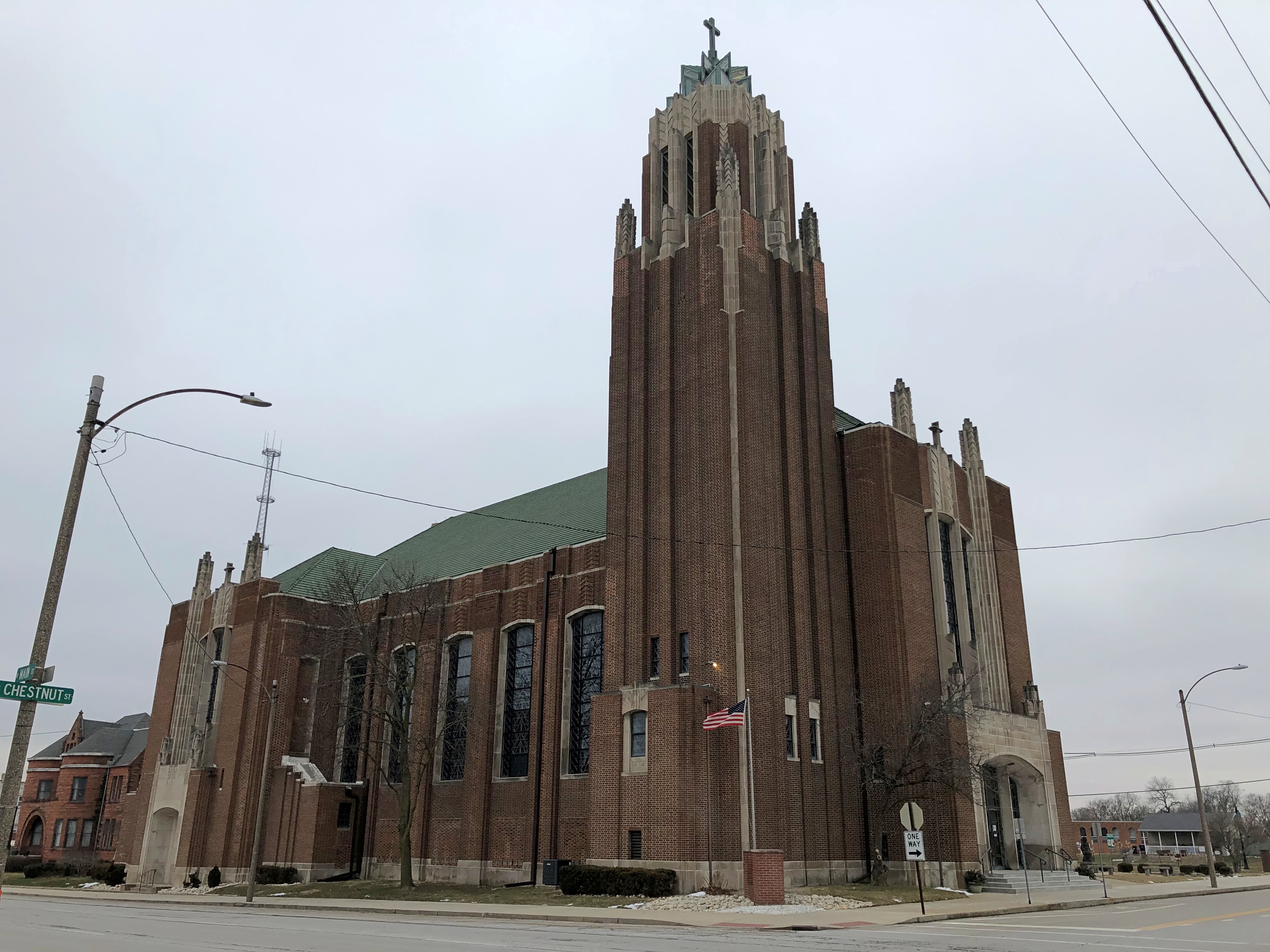
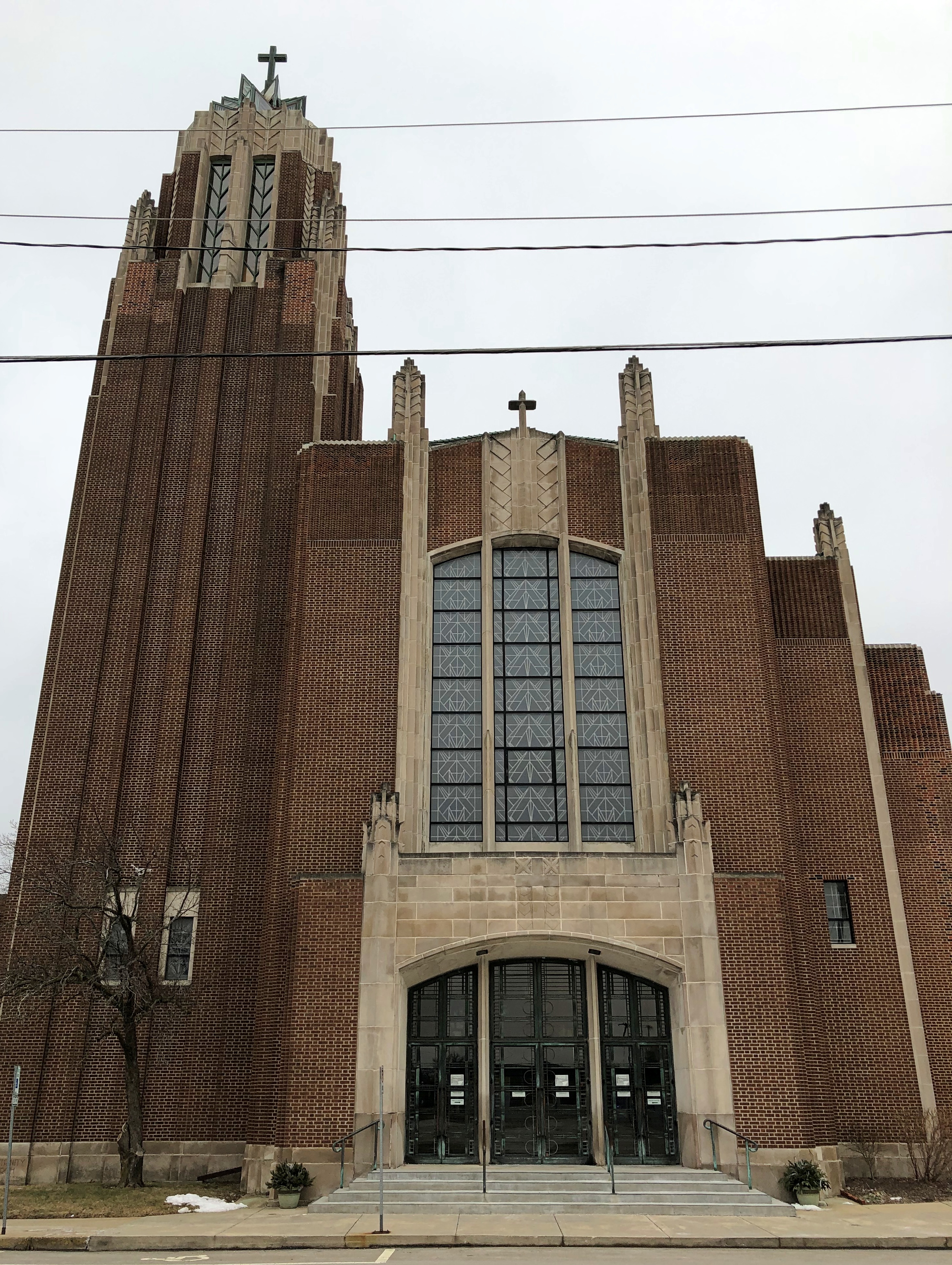
“The architect was Arthur F. Moratz, youngest sibling of Paul O. Moratz, another prominent local architect,” the theater web site says, which also includes some good pictures. “In Bloomington, Arthur Moratz buildings include the acclaimed Art Deco-style Holy Trinity Catholic Church at the north end of downtown, and his own residence, 317 East Chestnut Street.”

When it opened in 1937, the theater had 620 seats (these days, 385). First movie: Double or Nothing, with Bing Crosby and Martha Raye. Soon it found its niche in the world of Normal moviehouses.

“The Normal, generally speaking, did not screen the just-released prestige pictures and big budget epics,” the web site says. “Those were shown instead at the Irvin (and sometimes the Castle), which were both owned by Publix Great States Theatres. After all, why would the chain compete against itself? For its part, the Normal was known for genre and B pictures, especially westerns and musicals, as well as second-run fare.”

Of course, after its heyday, the theater followed the usual course for such places, with the 1960s and ’70 being unkind to it, though the Normal limped into the ’80s, surviving as a discount theater (dollar tickets and later $1.50).

I remember paying $1 at the Josephine Theatre in San Antonio ca. 1974 to see a Marx Bros. double feature, two of their lesser-shown works, Out West and At the Circus (I think, though one of them might have been The Big Store). Later in the ’70s, that theater showed X-rated pictures, which were advertised in small print in the newspapers, and no one I knew ever went there. I’m glad to say that the Josephine was later restored, and until the pandemic at least, was open.

As for the Normal, I don’t know whether it ever showed dirty movies (the web site is silent on the matter), but in any case, it closed in 1991. “The reason we closed it is that nobody went to it,” the owner said at the time. No doubt.

Amazing to relate, the town of Normal then bought the place, and a combination of federal grants, donations and local tax dollars was used to restore the theater, with a re-opening in 1994. It’s been showing old movies, foreign films and art pictures ever since — everything a nonstandard, nonchain theater should show. Admission: $6. A bargain these days.

This month is devoted to various horror and horror-adjacent movies, serious and not. Besides Beetlejuice, on the bill are Halloween (1978), PG: Psycho Goreman, The Witch, The Brood, Nightmare on Elm Street and its immediate sequel, Destroy All Monsters, Dead of Night (Ealing Studios), Mad Monster Party and The Rocky Horror Picture Show.

I encouraged Ann to take advantage of the theater, and I think she might. The movie theaters I had access to in college, especially Sarratt Cinema at Vanderbilt and the Texas Union Theater at UT, were an entertaining part of my education — something I didn’t appreciate until some years later.

ISU Quad Walkabout

Heavy rain for a while today and cooler temps, but not till afternoon, so there was time for one more lunch on my deck.

Ann invited us to visit her over the weekend, which we did, heading down to Normal on Saturday morning and returning Sunday afternoon, spending the night in a motel near I-55. Daytime temps were nearly as warm as when I dropped her off at ISU in August.

Toward the end of the day on Saturday, it had cooled enough for a short walk — including the dog, whom we brought — around the prettier parts of campus. Mostly that meant the ISU Quad. What’s a university without a quad or two?

As mentioned yesterday, most of the foliage is still green. An eastern approach to the Quad.ISU Quad

ISU Quad

“The Hand of Friendship,” which honors Robert G. Bone.ISU Quad

Bone (1906-1991) was the ninth president of Illinois State Normal University, which was renamed Illinois State University during his tenure. Though only president for 11 years (1956-67), he oversaw a lot of construction, including the tower where Ann lives. Later, the school’s student center was named after him.

The Quad also counts as the heart of the arboretum that spans the campus — the Fell Arboretum, to cite its formal name, honoring one Jesse Fell.

Fell (1808-87) was the sort of businessman that America spawned in the 19th-century — lawyer, real estate speculator, newspaper publisher and sawmill owner. Specific to Illinois, he was a friend of Lincoln’s. He founded towns in central Illinois and helped organize counties there as well, and is considered a founder of ISU.

As for the arboretum, apparently Fell not only profited from cutting down trees, but was a fanatic when it come to planting them, so ISU named it in his honor.

Elsewhere, we saw a plaque on a rock honoring the horticulturist who designed the original landscape for the campus, William Saunders (1822-1900), who also happened to be a founder of the National Grange of the Order of Patrons of Husbandry, an organization I had only scant knowledge of before. That is to say, little that I remember, though I’m sure heard about the Granger movement in a U.S. history class. Always good to learn or re-learn something.

In the middle of the Quad is a lush garden.ISU Quad

ISU Quad

ISU Quad

The centerpiece is the Old Main Bell, dating from 1880.
ISU Quad Old Main Bell

Old Main was the campus’ first building, which stood from 1857 to 1958. A memorial honors the building not far from its bell. Unusually, it depicts all four elevations of the building.
ISU Quad Old Main
ISU Quad Old Main

We wandered on. This is Cook Hall.

“One of Illinois State’s most interesting buildings and the oldest one still standing on the Quad, Cook Hall was originally built to be a gymnasium,” ISU tells me. “It was completed in 1897 and was named after John Williston Cook, the University’s 4th President (1890-1899). He earned his diploma in 1865 from Illinois State Normal University and in 1876 he became a Professor of Mathematics.

“The building has also been known as the ‘Old Castle’ or ‘The Gymnasium.’ The governor at the time, John Altgeld, had a great liking for medieval castles and insisted all new state construction during his term in office resemble castles. You’ll find a Cook Hall look-alike at many other state schools; they are called ‘Altgeld’s Folly.’ ”

Really? I had to look into that more, and found this Wiki item about Altgeld Castles. It does indeed seem that a raft of crenellated, or quasi-crenellated buildings at Illinois state schools dates from the 1890s. I remember seeing Altgeld Hall at UIUC, but didn’t know it was part of a pattern. An eccentric pattern. That’s two things I learned (or relearned) today; makes for a good Monday.

Egg Harbor, Wisconsin

Here’s a short and incomplete list of businesses you can find on the few streets of Egg Harbor, Wisconsin, in Door County: Be Beauty, Buttercups Coffee, Fat Louie’s Olive Oil Co., The Fireside (restaurant), Greens N Grains Natural Food Market & Cafe, Grumpy’s Ice Cream and Popcorn, Hatch Distilling Co., Plum Bottom Gallery, and Shipwrecked Brew Pub & Restaurant.

Businesses aiming to capture out-of-town dollars, in other words. We dropped a few ourselves. We arrived just after noon on September 5, enjoying clear skies and warm temps, and by mere luck found a parking space on the main street (Wisconsin 42). On a slight rise at that spot, a little set back from the road, is Macready Artisan Bread.Egg Harbor Wisconsin

Egg Harbor WisconsinWith cast iron tables and chairs, it looked like a good place for an al fresco lunch, which it turned out to be. Good sandwiches: a braunschweiger and an egg salad. As Wiki says, braunschweiger refers to pork liver sausage in North America. At least it did in Egg Harbor that day.

As you’d expect, main street in Egg Harbor sports some handsome buildings and landscaping.Egg Harbor Wisconsin

Egg Harbor Wisconsin

Egg Harbor WisconsinEgg Harbor WisconsinA park adjoining the street leads to the lakeshore.Egg Harbor Wisconsin

The shore is mostly given over to a marina.Egg Harbor Wisconsin Egg Harbor Wisconsin

Egg Harbor Wisconsin“The Seafarer” by Jeffrey Olson, 2012. He’s a local artist.

There’s also this, with a sort-of egg on top.Egg Harbor Wisconsin

Just what is this kind of multi-directional sign post called, anyway? Who built the first one? How many are there?

Google Image “multi-directional sign post” and you’ll get a lot of images, so maybe that’s it. Seems a little too bland, though. This fellow, who built one, calls it a travel signpost. Also bland, but maybe current in the UK.

There’s whimsy to many (most?) of them, including the one in Egg Harbor. One sign points upward — the (sort of) direction of the International Space Station. Then there’s one pointing to Santa’s House, presumably due north, and a non-directional, still unfulfilled wish that Covid-19 disappear.

That reminded me that I saw a different take on such signs in Fairbanks.Fairbanks Multidirectional Mile Post

Alaskan destinations up top, but also international ones, which are listed on the post itself on the side not visible in my picture. As if you need more evidence that Fairbanks, unlike Egg Harbor, is a long way from everywhere.

Door County Dash

This is a map of the Niagara Escarpment, borrowed from Wikimedia. I can’t vouch for the details, but the general outline seems to agree with other maps I’ve seen.

Over Memorial Day weekend, we visited the east end of the escarpment, where big water flows over a big cliff. Over Labor Day weekend, we visited the west end of the escarpment, where big cliffs overlook big water. That is, Door County, Wisconsin, surrounded by Green Bay and Lake Michigan proper. (The map also fills me with notions of visiting the Bruce Peninsula and Manitoulin Island, though those would be a mite harder to reach from metro Chicago.)

Not our first trip to Door, of course. And maybe not the best time to visit the Door peninsula, since crowds converge there on summer weekends. Still, the place holds its crowds fairly well, except for the narrow streets passing through such towns as Egg Harbor, Fish Creek, Sister Bay and Bailey’s Harbor.

We drove to the town of Green Bay on Saturday, leaving not particularly early, eating takeout Chinese for lunch at an obscure park in Germantown, a far north suburb of Milwaukee, where Yuriko thought there ought to be German food. There is a place called Von Rothenburg Bier Stube there, but we weren’t in the market for that.

West of Germantown is Hubertus, home of Holy Hill Basilica and National Shrine of Mary Help of Christians, which we visited. We arrived in the town of Green Bay late in the afternoon and settled in for takeout pizza from a joint with an Irish name.

Our visit to Door County on Sunday was essentially a day trip from Green Bay. It might be better someday to actually pay Door County prices and stay in Door County, to allow more time to explore the place. The county isn’t very large — only 482 square miles of land — but it packs in the tourist attractions, natural and manmade. Tourists have been coming for a long time, with resorts first developed just after the Civil War, and the industry really kicking into gear with better roads and cars of the 1920s.

My plans were vague, and we often went where whim took us, such as the lighthouse and pier at the south end of the Sturgeon Bay Ship Canal, a walk along a beach, lunch in the crowded but still pleasant Egg Harbor, and visits along the shore of Green Bay, with its sweeping vistas.

We made it to the tip of the peninsula — I’d long wanted to go there — where the ferry disembarks for Washington Island, but the day was running out, so we didn’t go there. That would be a fitting destination from a base camp closer than the town of Green Bay, I think.

On Monday, we spent part of the morning poking around the town of Green Bay, including a look at a few churches, cemeteries, and city hall. Afterward, the drive back was straightforward and not that interesting, though we had another nice lunch in suburban Milwaukee.

All in all, a good little trip. Saw a few things you can only see in Wisconsin, such as this Green Bay item (maybe made here).cheesehead dinosaurFor the record, that cheesehead hat was taped onto the dinosaur’s head.

Ann Goes to College

Ann is now a student at the Illinois State University in Normal, Illinois. From now on, August 14, 2021 will be the day she went to college. Such dates seem to be creeping further into August, but I only have a small sample. My own such day was August 25 and Lilly’s August 18.

ISU is a little closer than UIUC, only about two hours on the road to Springfield and St. Louis. As completely normal for August in Normal, it was hot. That didn’t keep anyone from moving in.

The oddest thing I saw this time wasn’t a TV or bottled water, but a fellow with a turntable and a vinyl record collection. State-of-the-dorm gear in — 1979, as I recall (I didn’t have one).

Her building, Watterson Towers, is enormous, and looks old enough for me to have lived there as a student. Yep, it opened in 1968.

The tallest building in Bloomington-Normal and, according to some sources, the tallest between Chicago and St. Louis.

A nugget I found about the building reported by WGLT, the school’s NPR station, last summer: “Illinois State University said Thursday it will rename floors in the Watterson Towers residence hall in the wake of nationwide upheaval and a renewed dialogue on race and history.

“… every five floors in both towers are called a ‘house.’ The university named those houses for the nation’s first 10 secretaries of state: Van Buren, Clay, Marshall, Madison, Adams, Pickering, Monroe, Randolph, Smith, and Jefferson. Eight out of the 10 were involved in slavery. Several would be elected president after serving as secretary of state…”

Guess which two didn’t own slaves. That would be Adams, as in John Quincy, and Van Buren.

“The entire Watterson Towers complex was named for a beloved professor on campus and that name will not change,” WGLT concluded.

As far as I can tell, the “houses” are now North, A through E, and South, A through E.

Ann found her room and we moved all her stuff in.

It’s a tiny room that she shares with a roommate. Again, the way a dorm should be.

New Buffalo

A Mediterranean pattern has set in, here on the brief plateau of high summer. I’m taking as many meals as possible out on my deck.

Not long ago, we went to Buffalo, so by my idiosyncratic lights, that meant we ought to visit New Buffalo too. So we did on Sunday. Good thing that town is only about two hours away, assuming good traffic, which in no safe assumption. Even so, it isn’t that far, with New Buffalo hugging the eastern shore of Lake Michigan just inside the state of Michigan, only about two miles north of the Indiana line.

New Buffalo has been a nearby vacation destination for metro Chicago for many years. I first visited in 1987, when I spent a short time at the vacation house of a Chicagoan I knew, and went back occasionally after that, though not in about 20 years.

A lot of people go for the public beach, but Waikiki crowded, it isn’t.New Buffalo, Michigan

We didn’t spend long this time, since it was nearly 90 F, and our idea of a good beach is an almost empty one in the 70s F. It was nice to see the lake, though. And the marina.

New Buffalo, Michigan

New Buffalo, Michigan
A boat belonging to the Berrien County sheriff’s office, docking.
New Buffalo, Michigan

Not far inland from the marina is the town’s commuter rail station.
New Buffalo, Michigan

Not much to look at, but the station and the line facilitated New Buffalo’s growth in the early 20th century, providing easy access from Chicago in the days before the Interstate or major suburbs. Come to think of it, if I were planning to be in New Buffalo and nowhere else for more than a few hours, that would be the way to come, so as to avoid pain-in-the-ass traffic jams south of Lake Michigan.

We parked on a leafy residential street and walked a couple of blocks to the main tourist street. One of New Buffalo’s two main streets is Whittaker, which connects the shore with I-94. About three blocks of Whittaker is lined with retailers, restaurants and new-looking residential properties, such as these.New Buffalo, Michigan

New Buffalo, Michigan

That told me that, except probably for recessionary downturns of a few years at most, the second home and residential rental business in New Buffalo has expanded over that last few decades, taking advantage of the fondness among well-to-do people for parking themselves close to water. Not an ambition I share, but water does have its allures.

The street wasn’t overly crowded on Sunday, a very warm summer weekend day, but busy enough. We wandered around and looked in some stores, and came away with a t-shirt, refrigerator magnet and some postcards, as one does.

New Buffalo, Michigan

Interesting mural.
New Buffalo, Michigan

I’ve been able to find out that it’s painted on the side of Michigan Mercantile Building, home to a recently opened Starbucks. At the end of a short alley under the mural is the New Buffalo Farmstand by Mick Klug Farm. As for the mural, it looks new as well, but that’s all I know. I didn’t check for a signature.

A detail.
New Buffalo, Michigan

One reason we spent the day in New Buffalo was to have lunch at Redamak’s.
New Buffalo, Michigan

Since 1946 is a telling detail, since the restaurant is on Buffalo Street, the town’s other major thoroughfare. It isn’t a pedestrian-friendly road and the train doesn’t go there, so for Redamak’s to prosper in its early years, it needed car traffic — which was booming about then.
New Buffalo, Michigan

Currently the place is owned only by the second family ever to own it, which makes for continuity. I had a good hamburger there more than 30 years ago, and we had good ones there on Sunday: one with bleu cheese for me, a barbecue burger for Yuriko.

The road out front is also U.S. 12. Ah, where does that go? I wondered as we waited on the porch for a table. My phone wasn’t connected to the Internet at that moment, so I had to wait to find out. Just like in the not-so-old days.

All the way from Detroit to Aberdeen, Washington, running almost 2,500 miles, it turns out. We had a table next to a window. There’s something satisfying about sitting in a storied burger joint that looks out on a 2,500-mile highway. Not a nostalgia-industry highway like the defunct U.S. 66, but a genuine active part of the U.S. highway system in the 21st century.