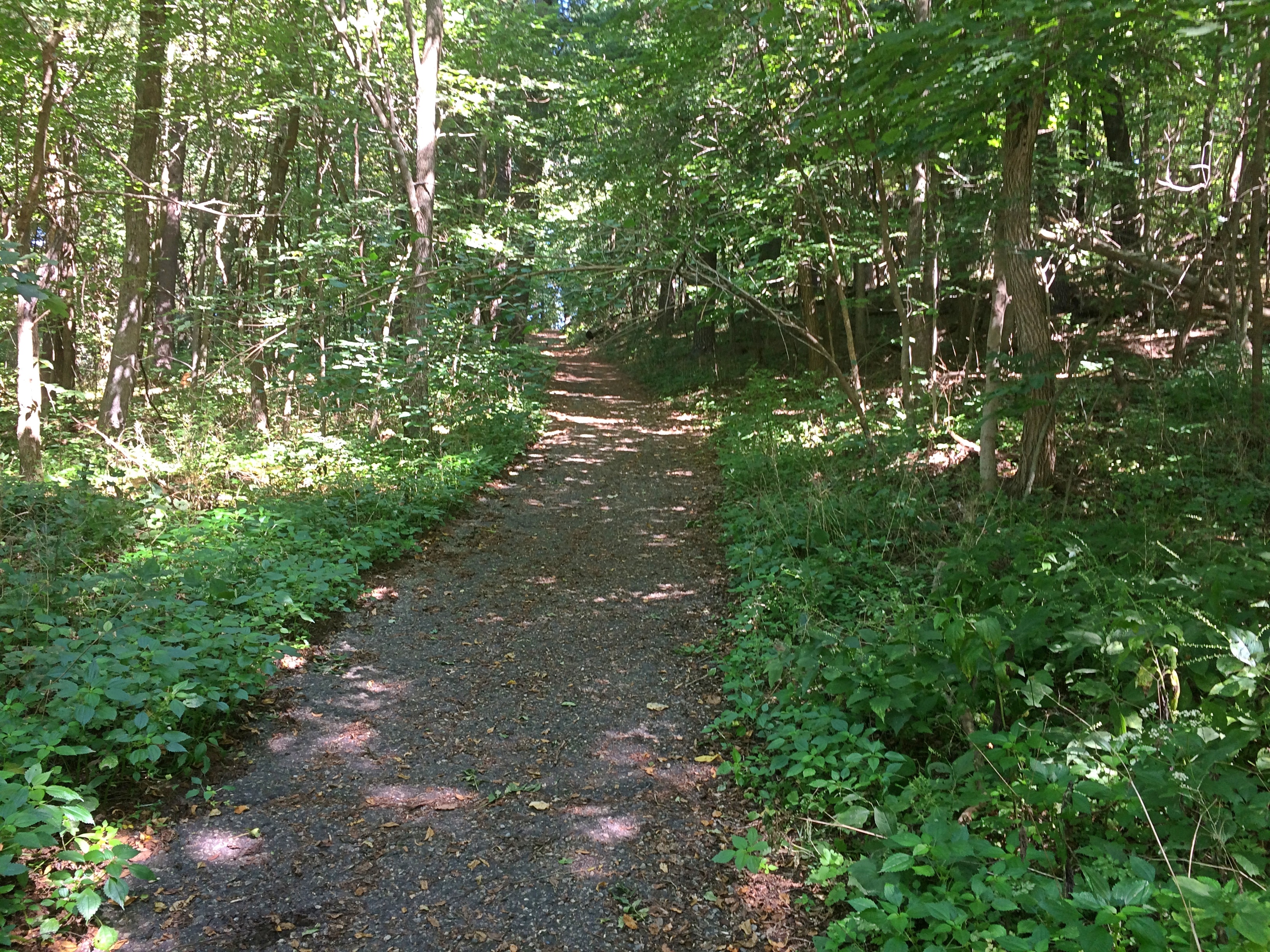
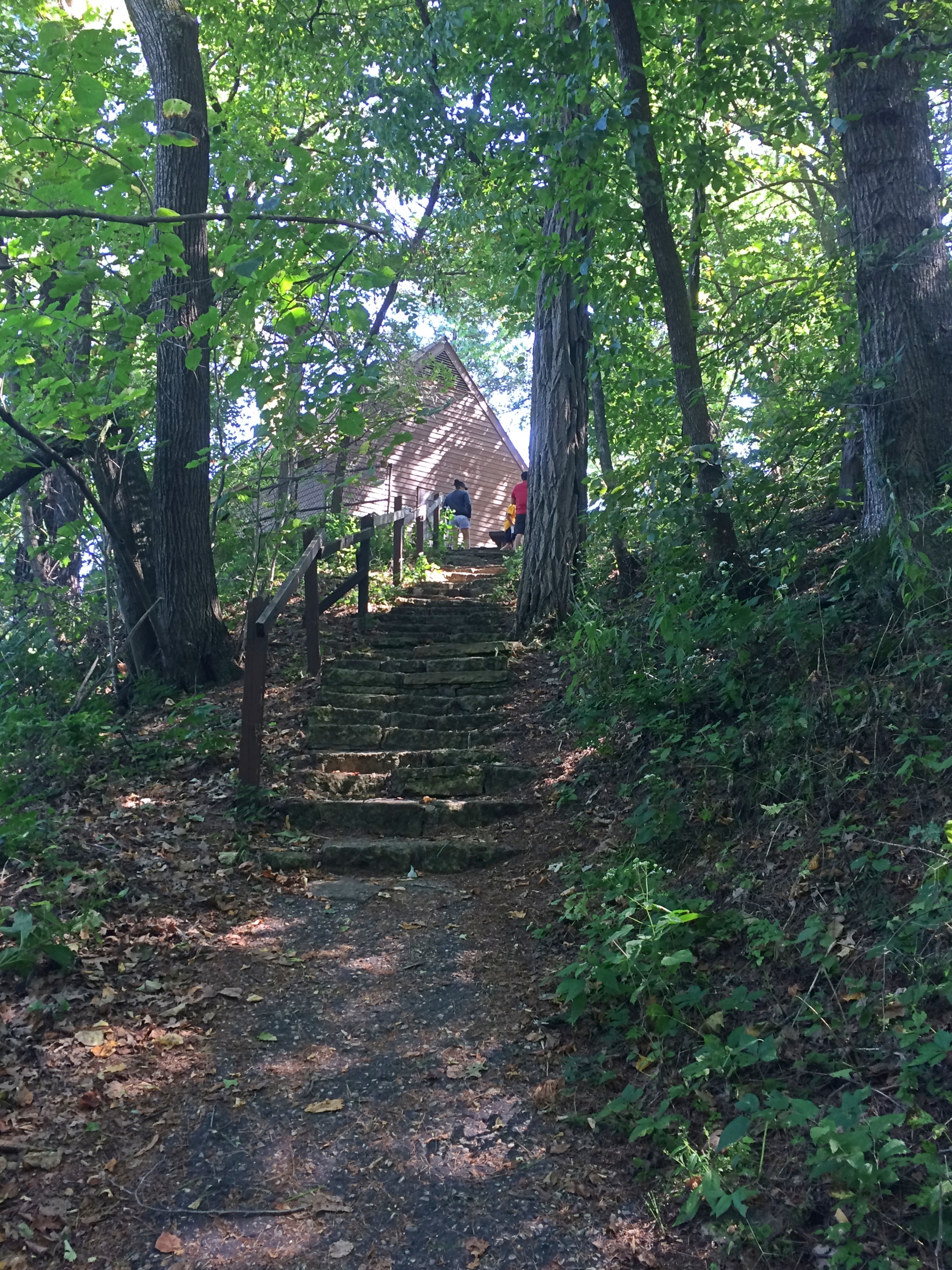
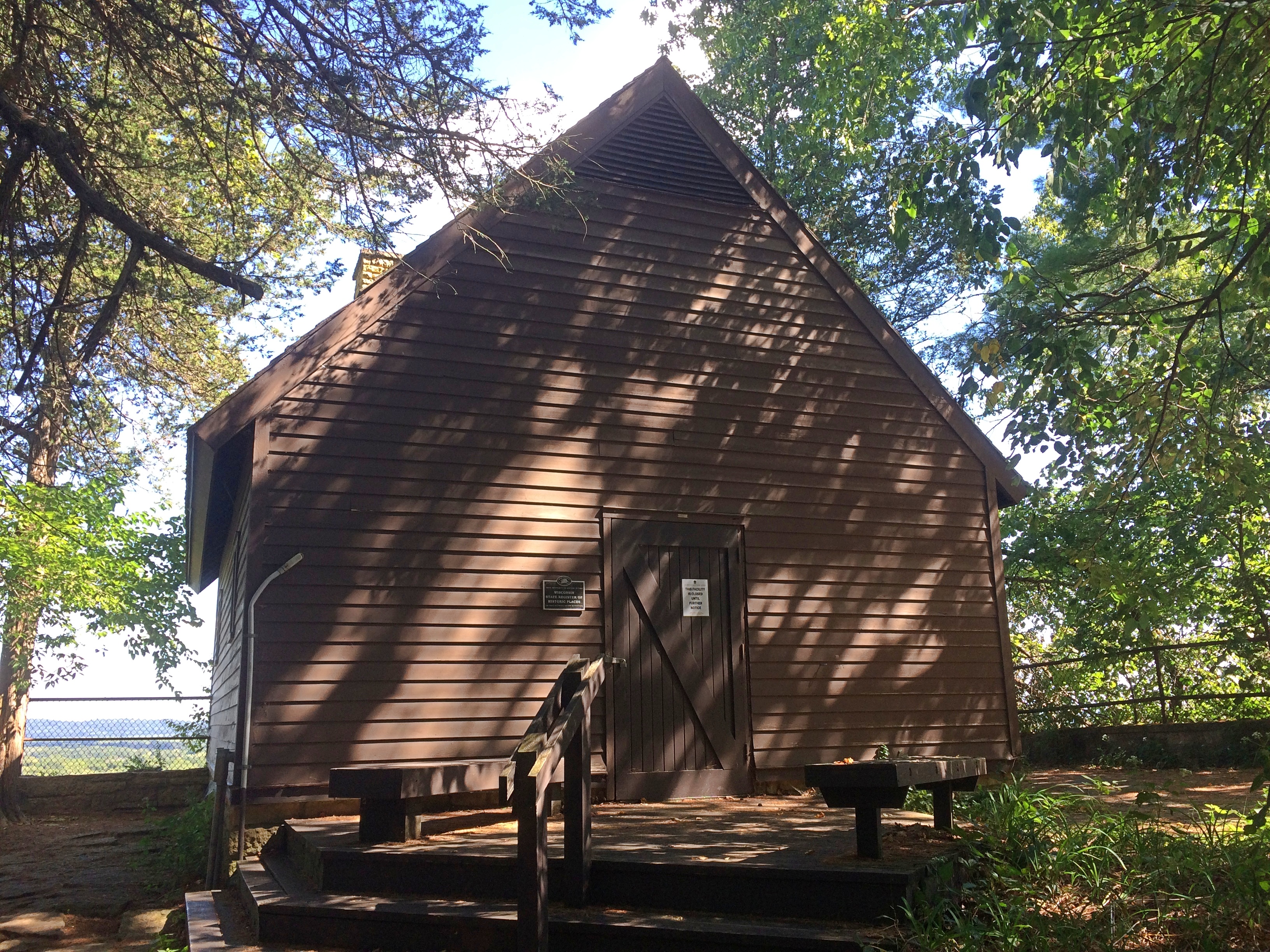
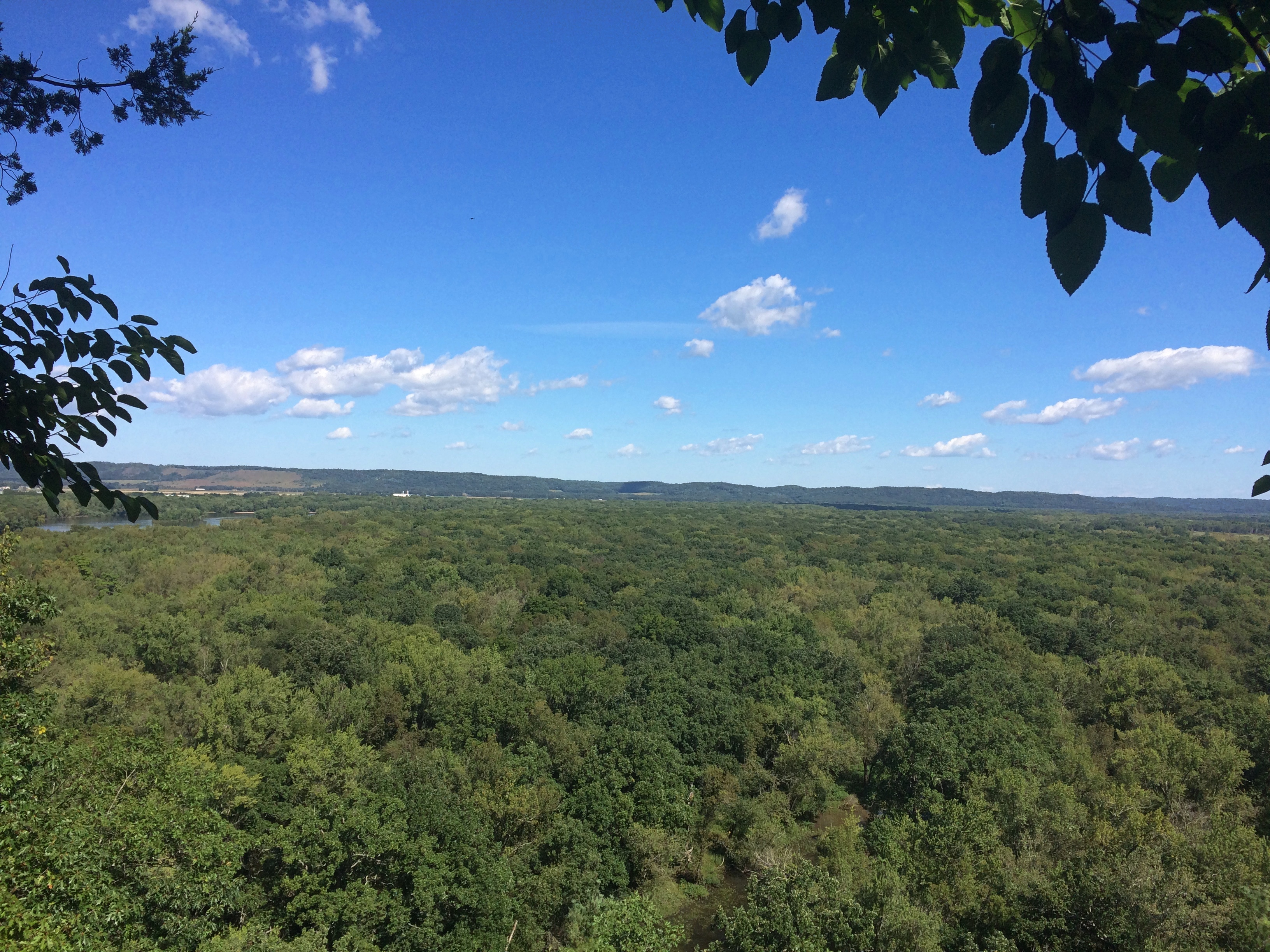
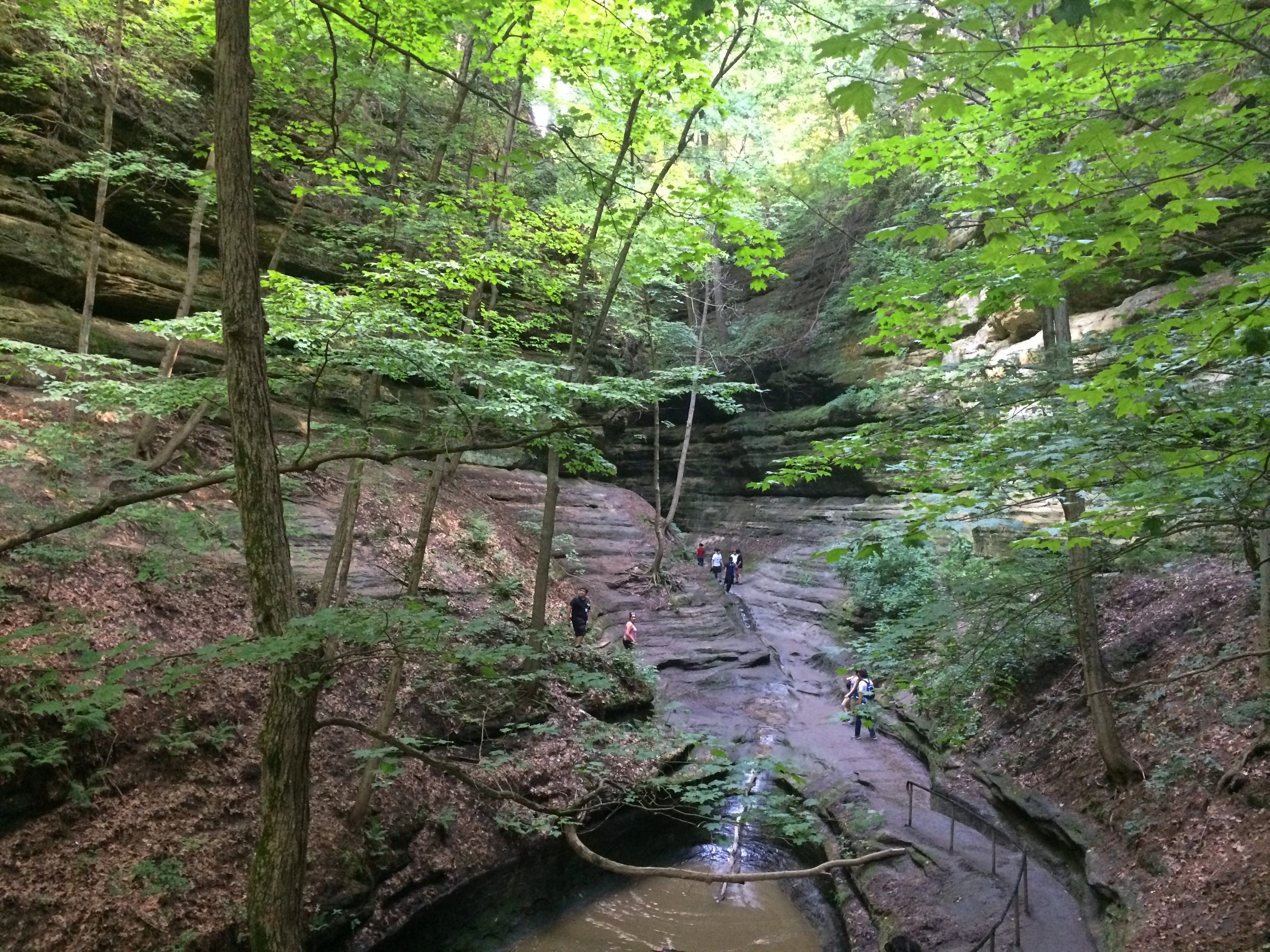
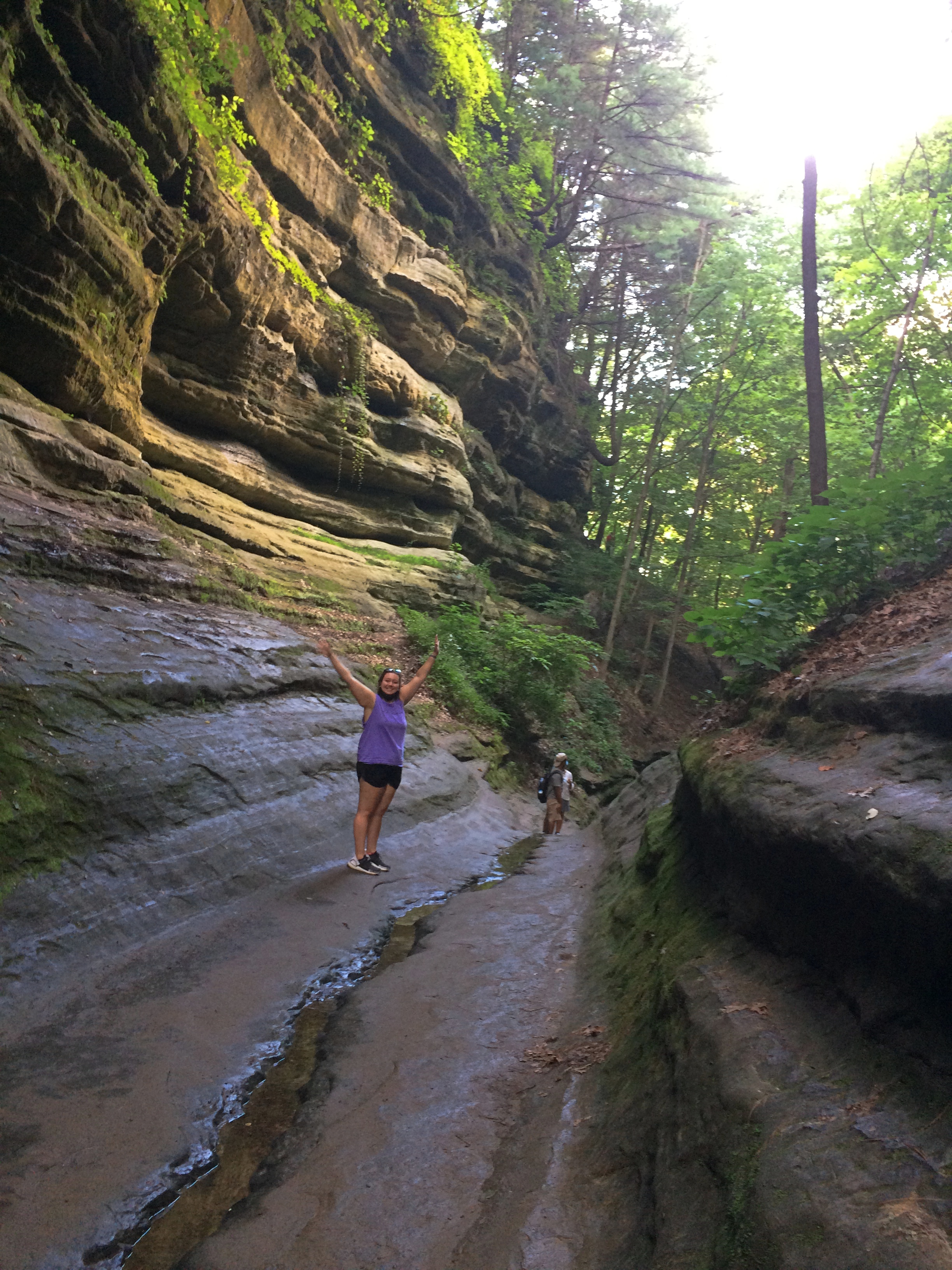
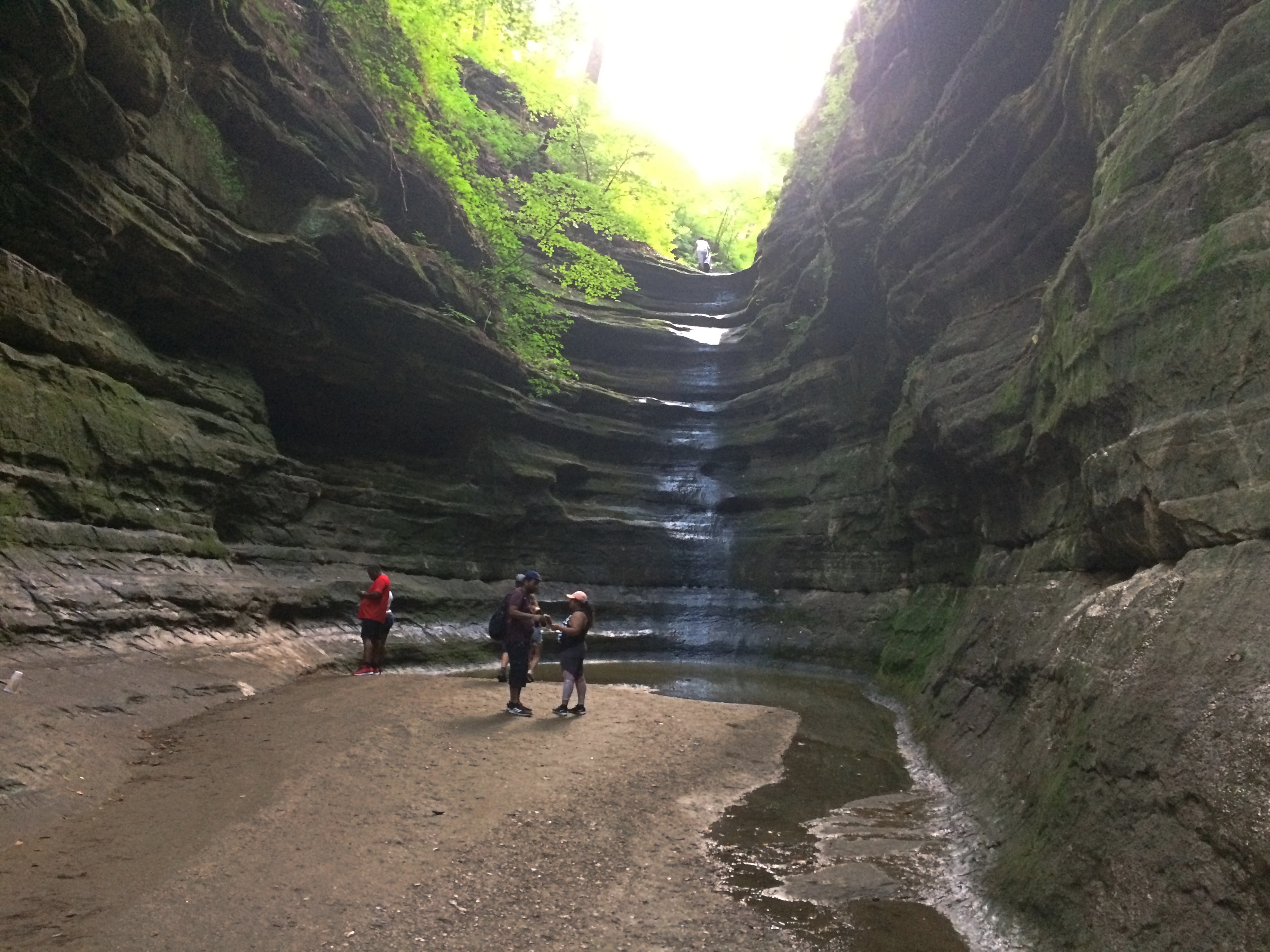
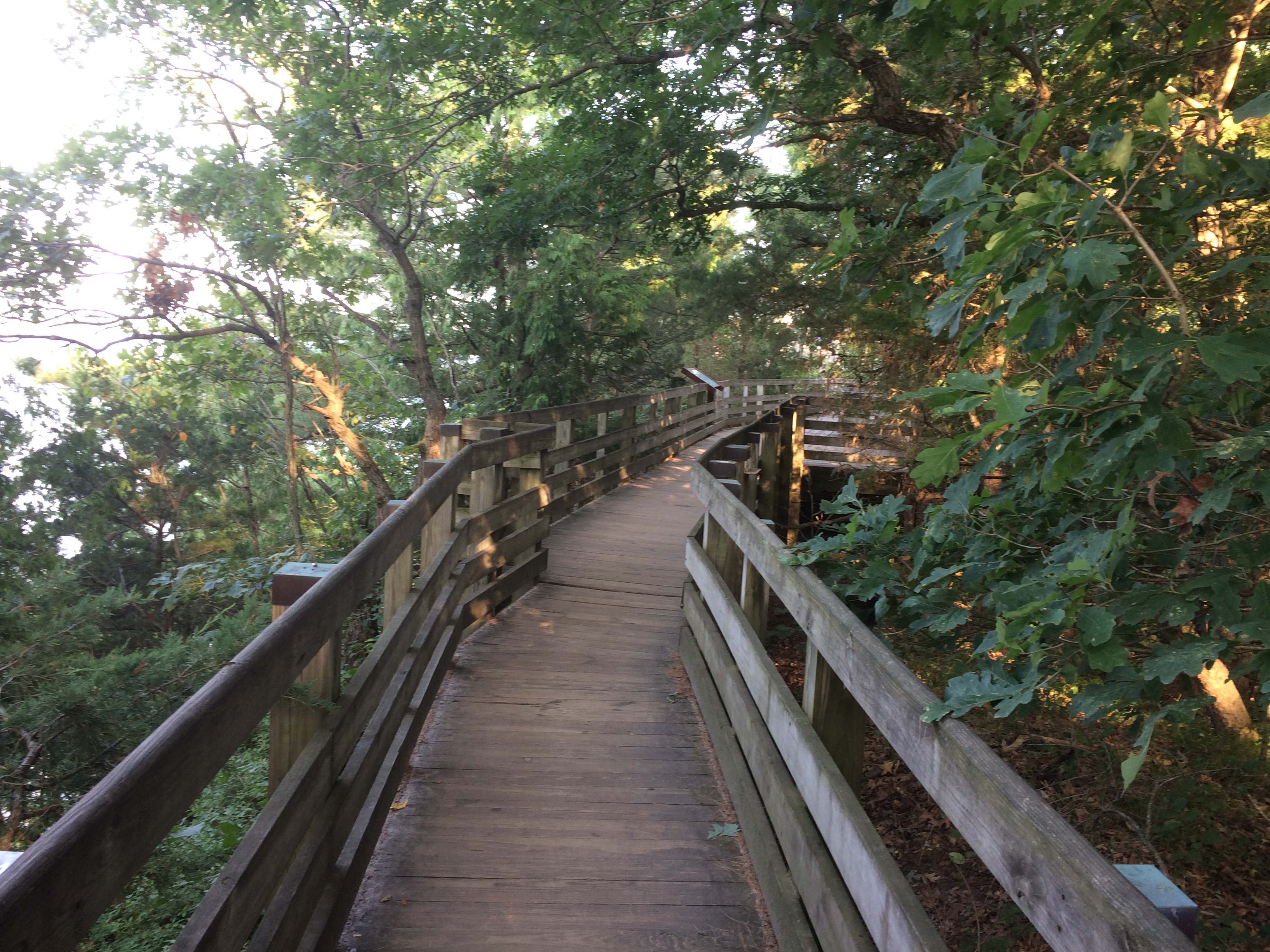
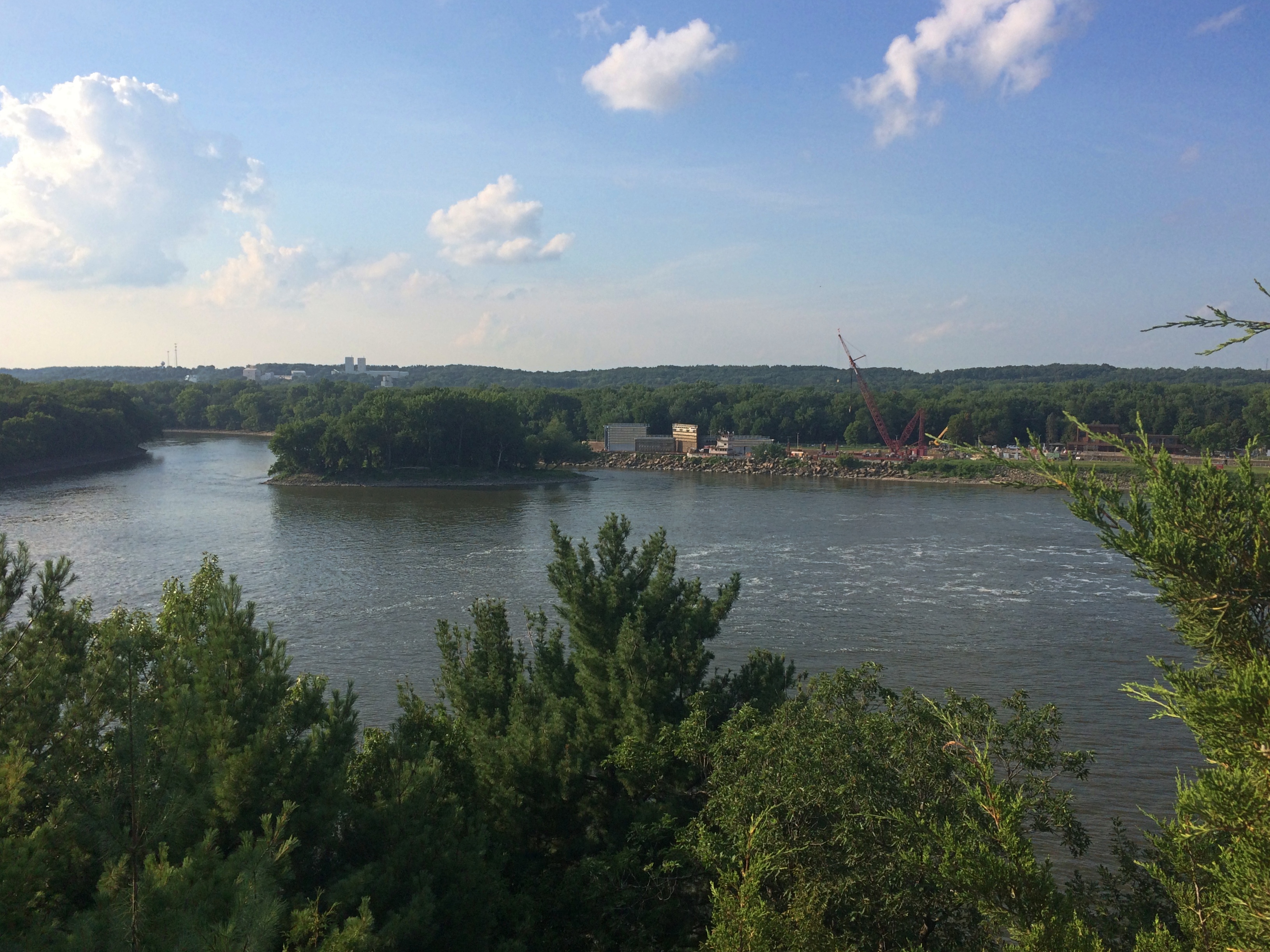
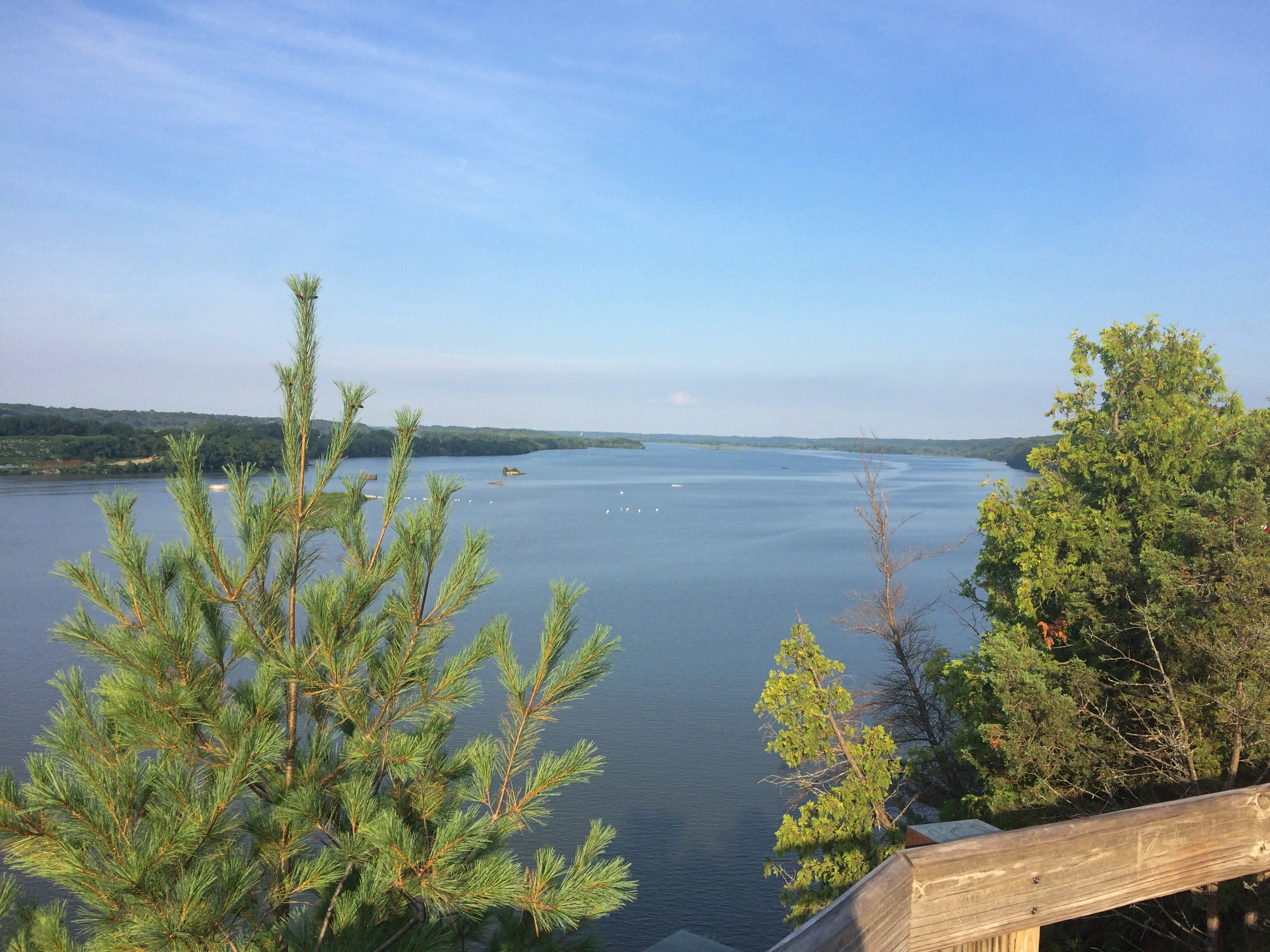
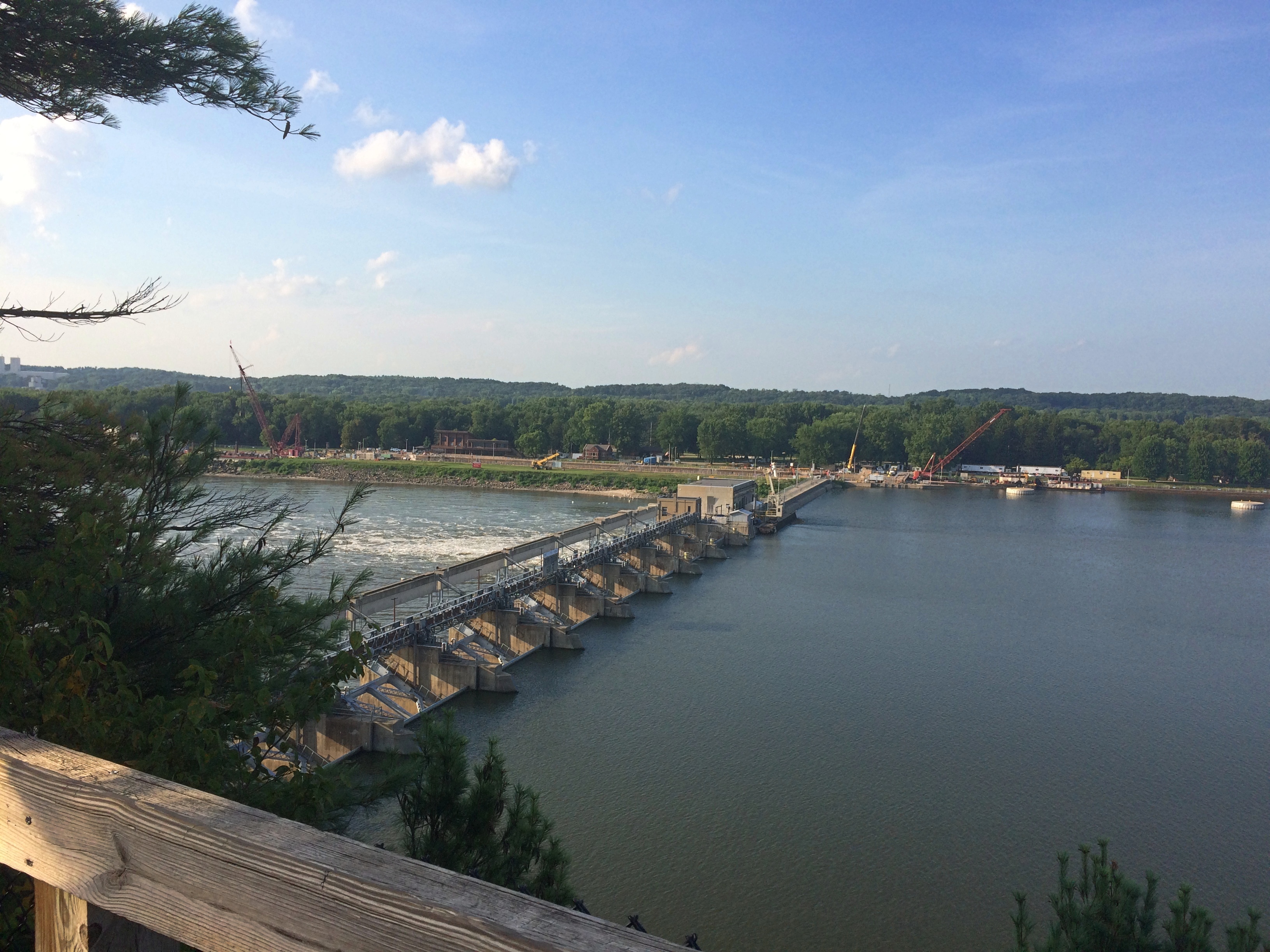
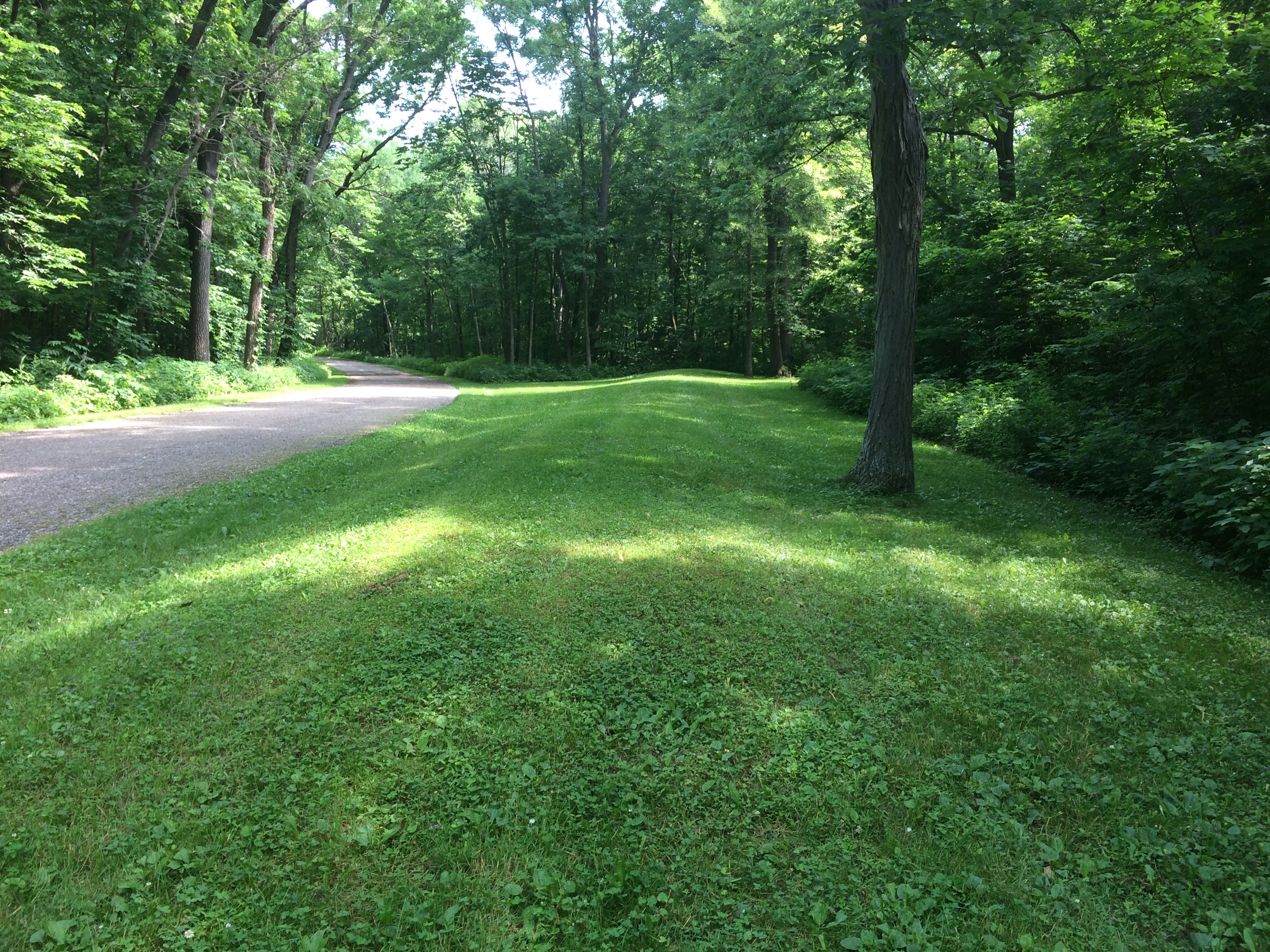
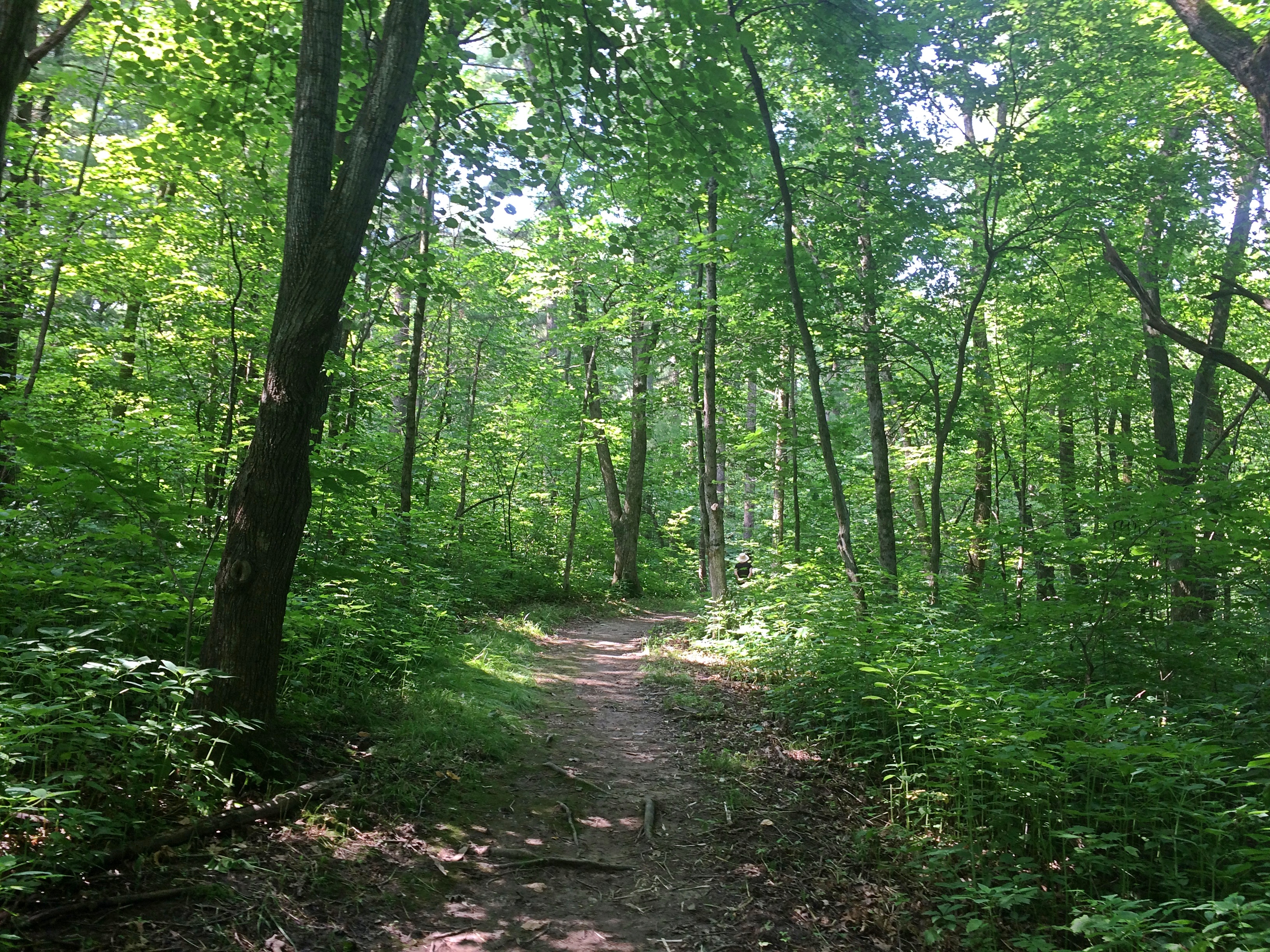
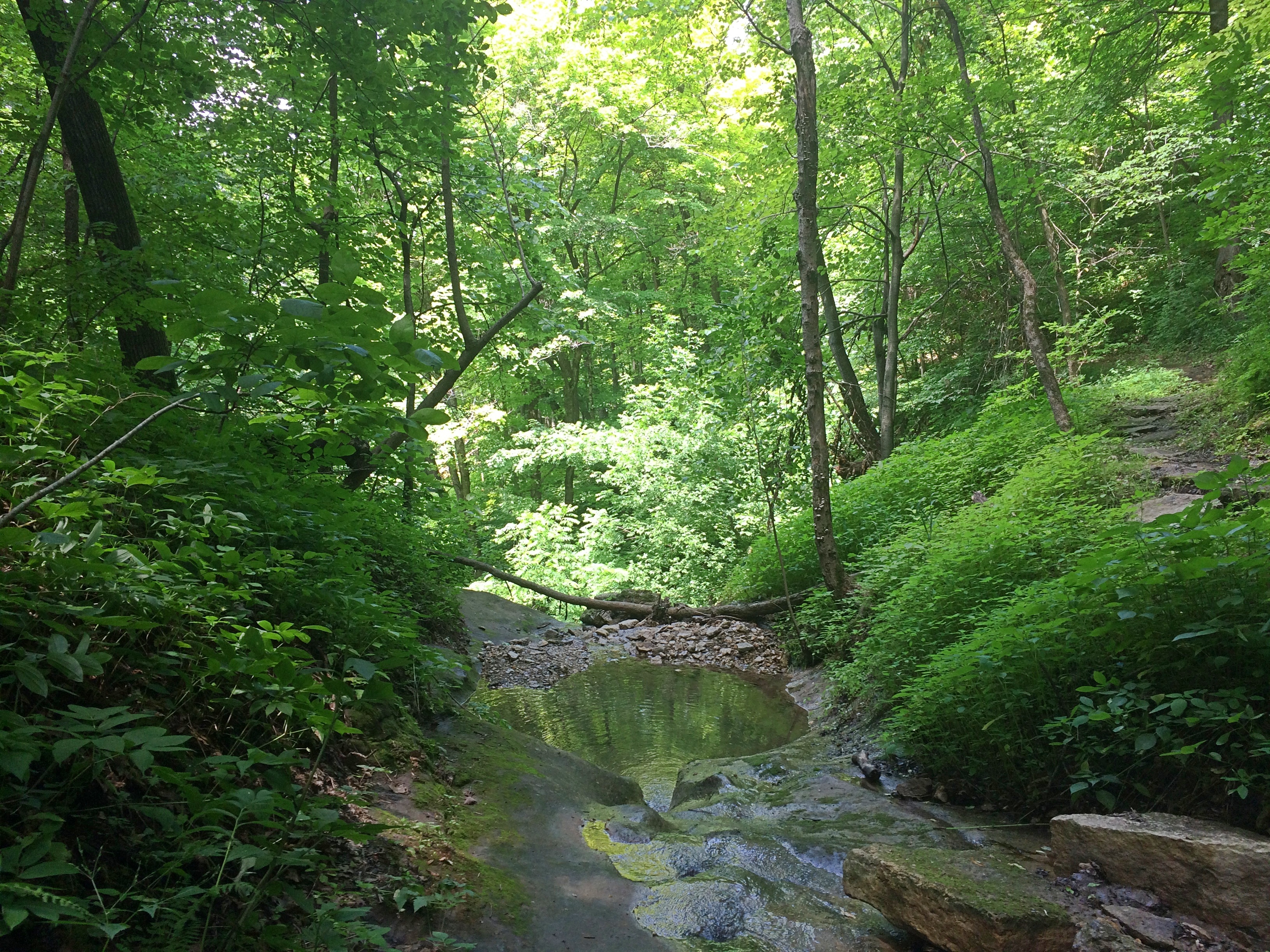
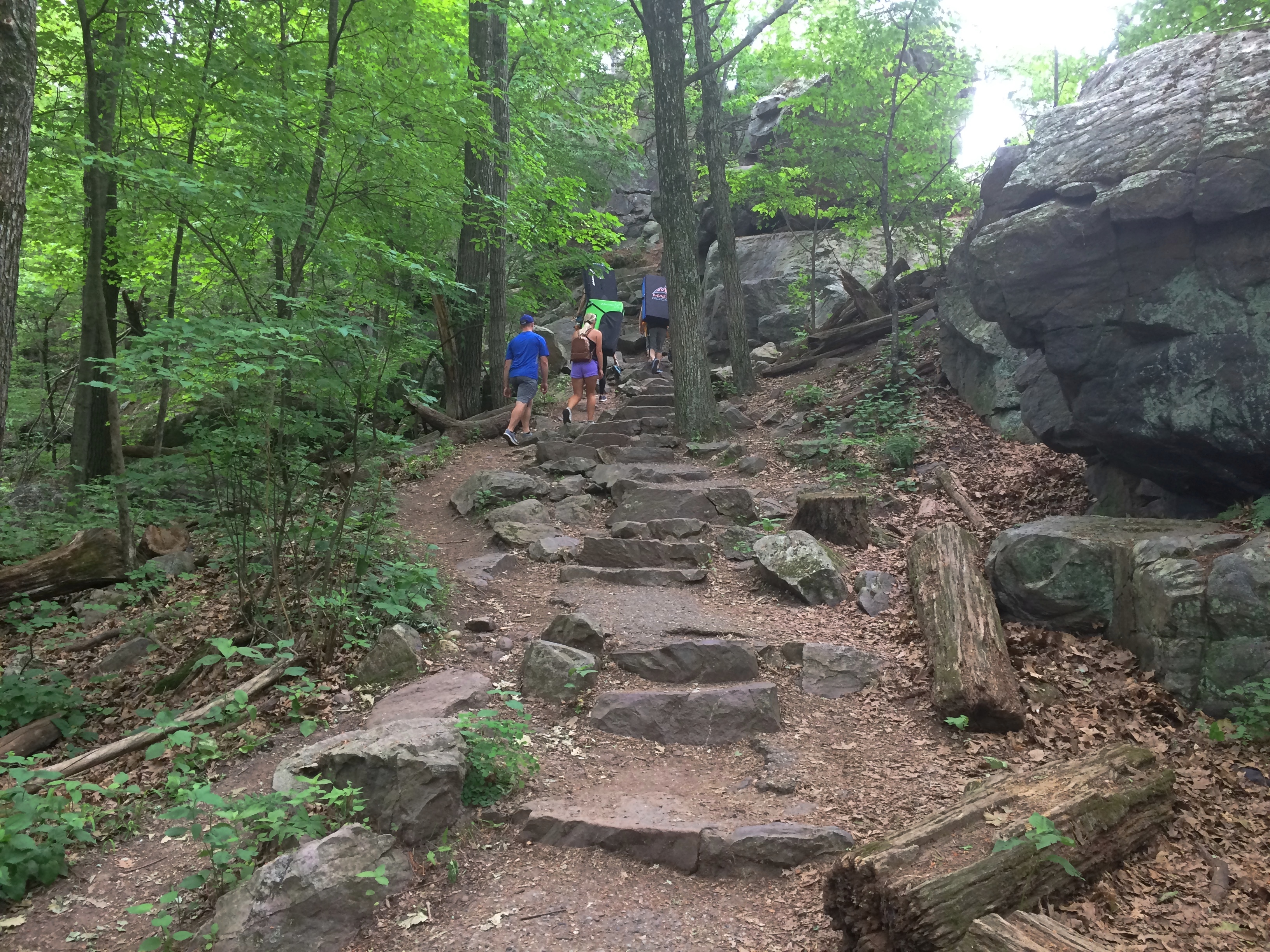
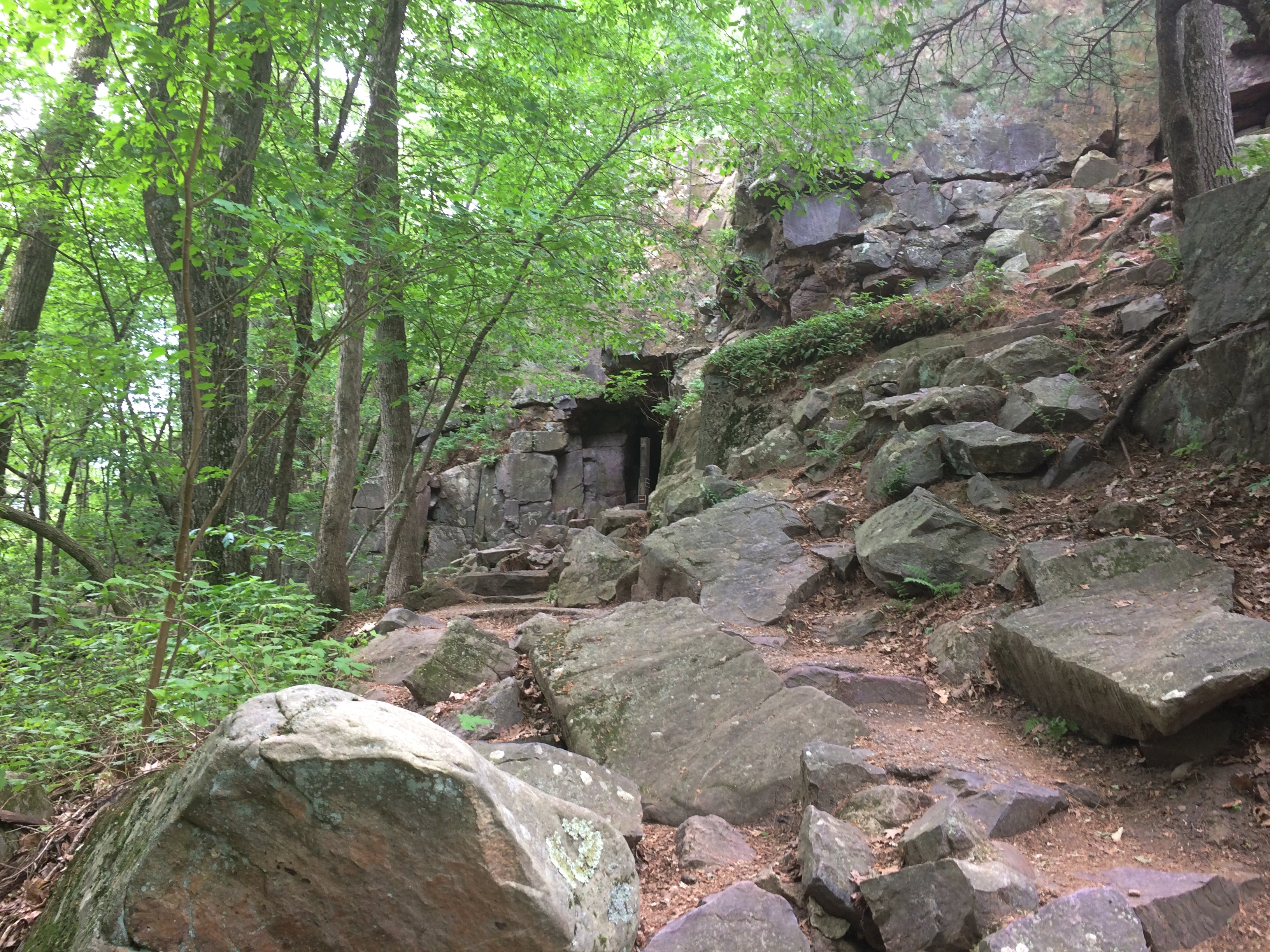
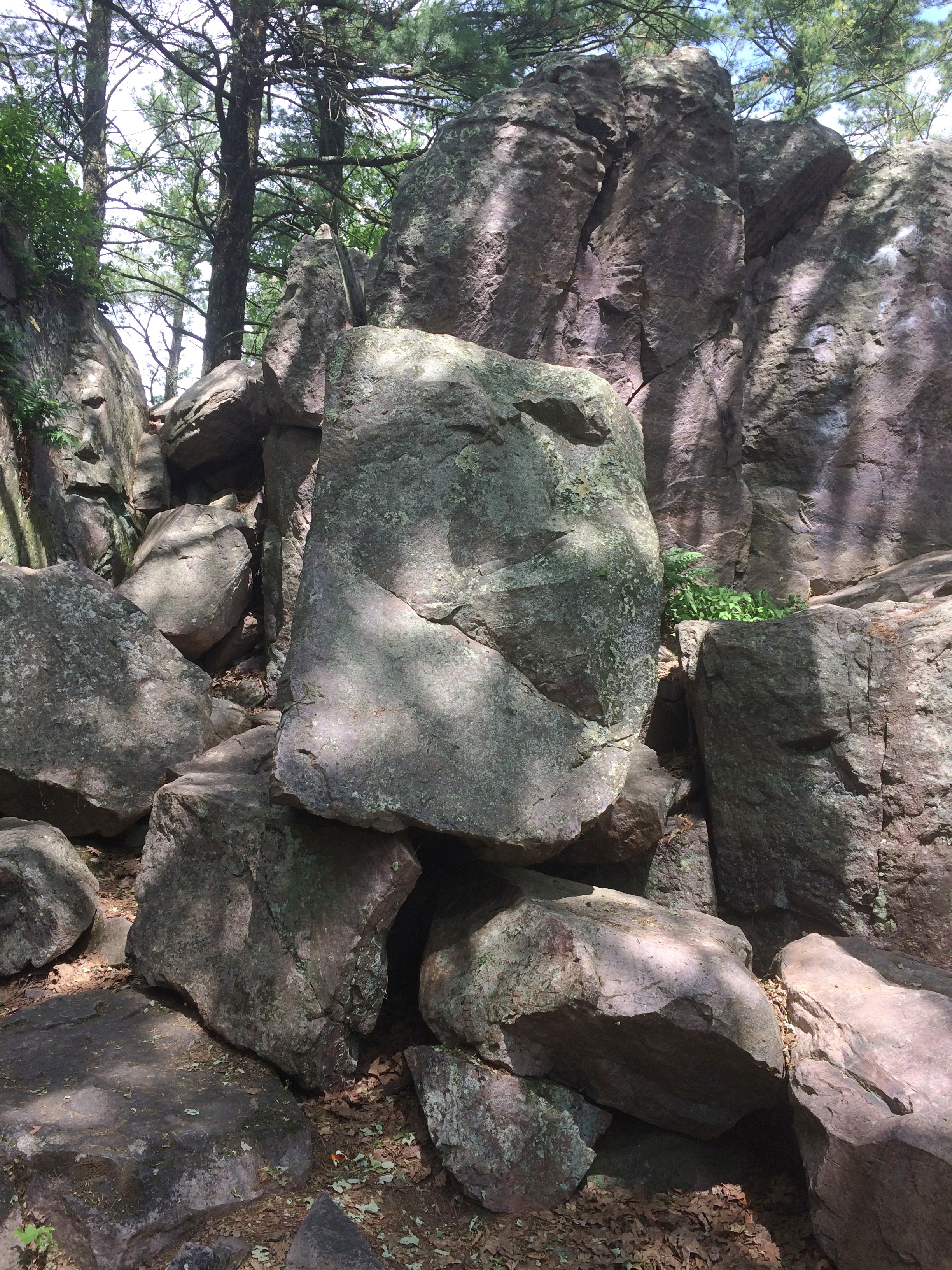
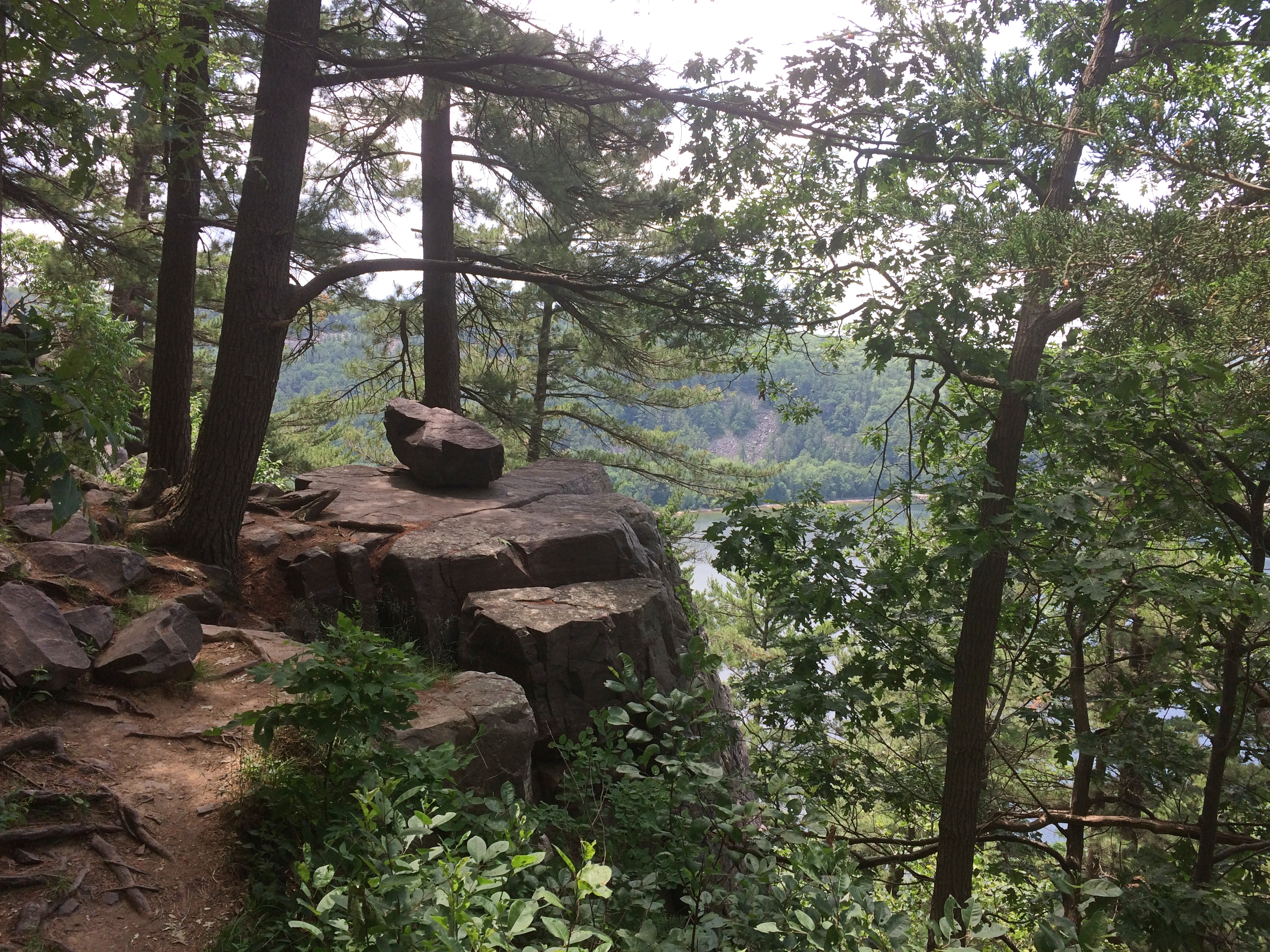
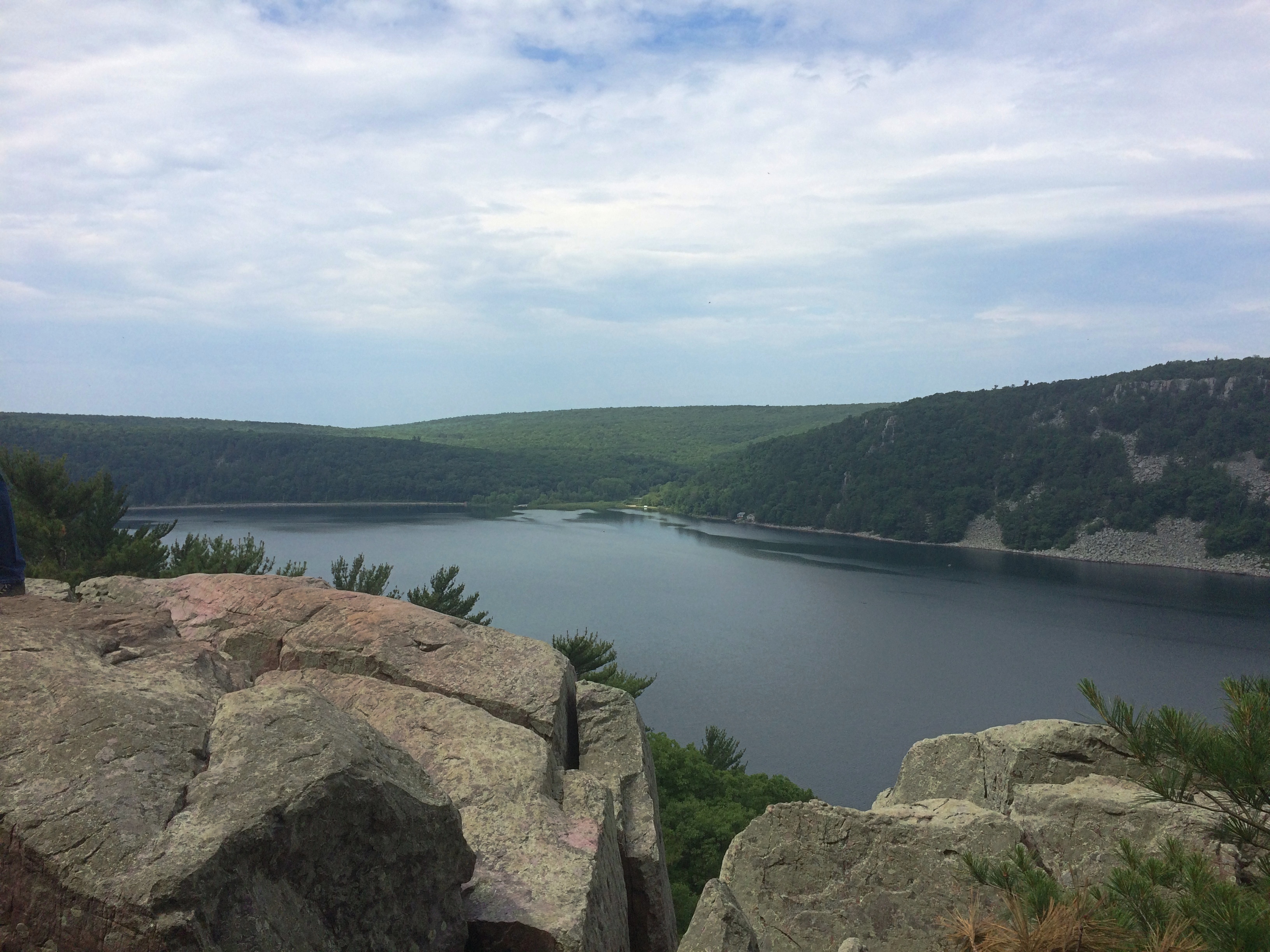
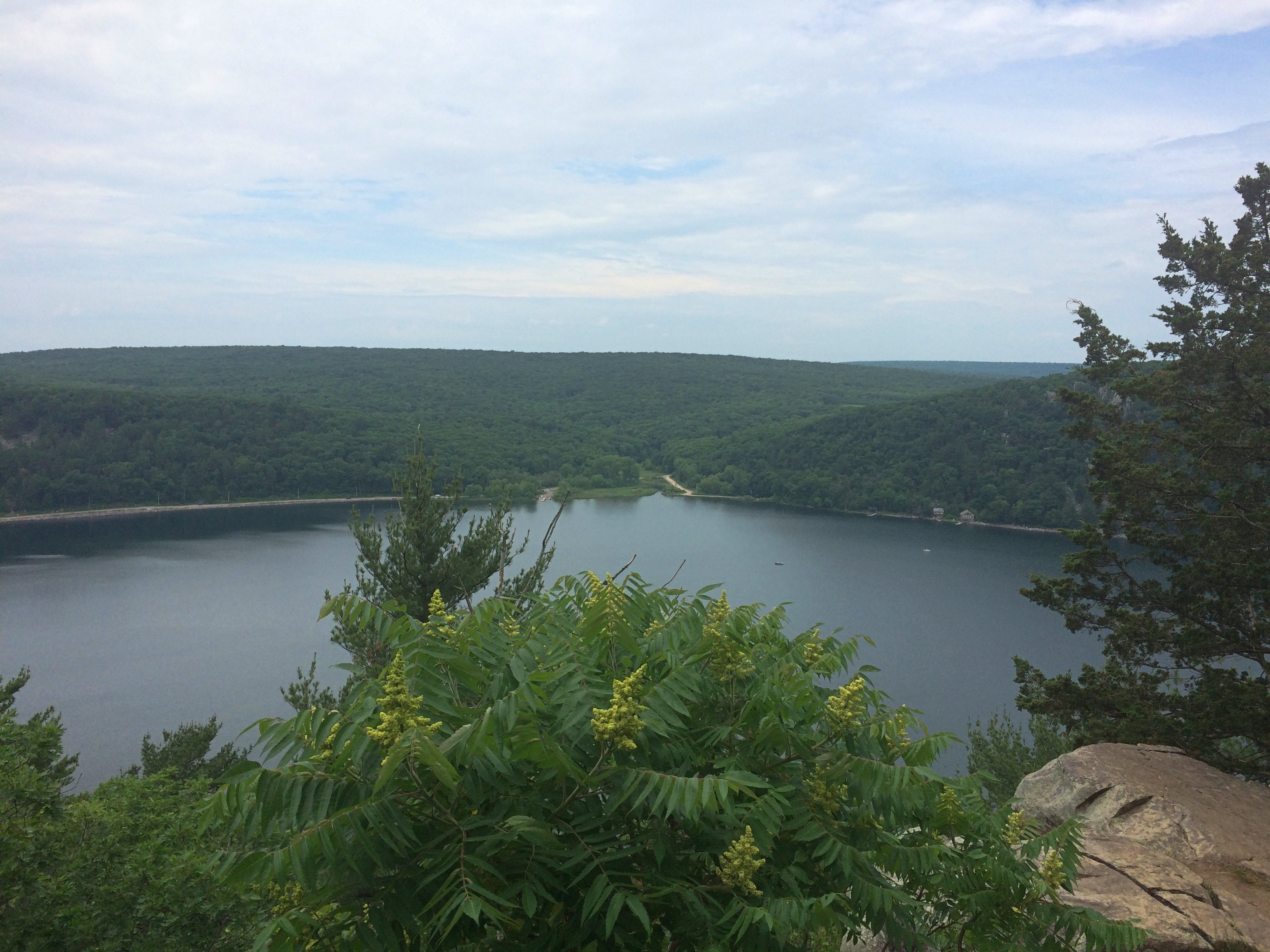
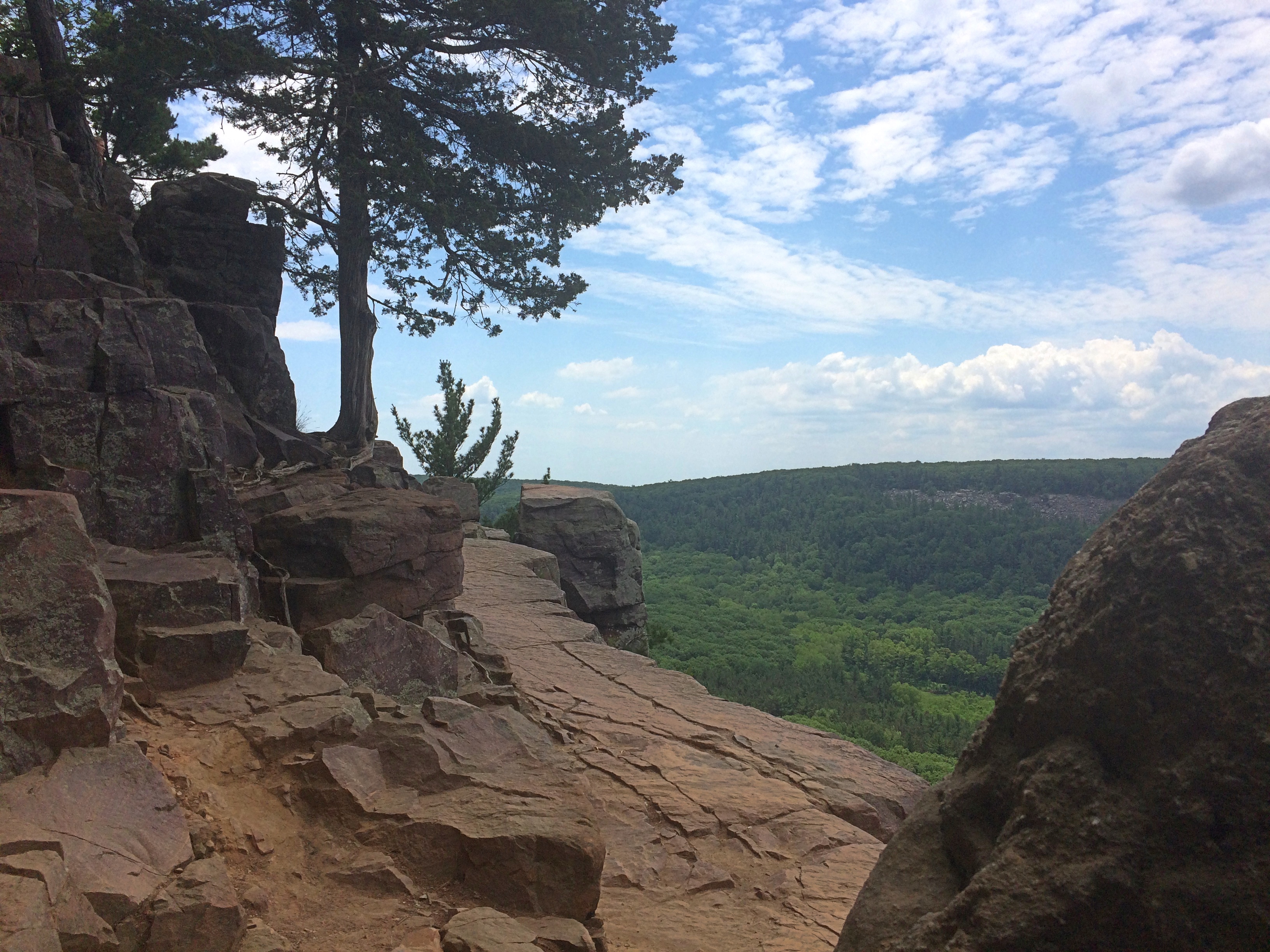
Cave-in-Rock State Park

Snow this morning. It didn’t stick, but it did remind us all of the cold months to come.

At the beginning of 2020, works published in 1924 finally entered public domain in the U.S. The Center for the Study of the Public Domain noted some of the better known works now available to all.

“These works include George Gershwin’s ‘Rhapsody in Blue,’ silent films by Buster Keaton and Harold Lloyd, and books such as Thomas Mann’s The Magic Mountain, E. M. Forster’s A Passage to India, and A. A. Milne’s When We Were Very Young.”

Plenty of obscure works are now available as well. One I have in mind is The Outlaws of Cave-in-Rock by Otto A. Rothert, published in 1924. Rothert (1871-1954) was secretary of the Filson Historical Society in Louisville, and apparently took a strong interest in regional history

The Outlaws of Cave-in-Rock can now be found in Google Books. I haven’t read it all, but I have sampled some of it. Such as the first few paragraphs.

“This book is intended to give the authentic story of the famous Cave-in-Rock of the lower Ohio River… and to present verified accounts of the most notorious of those highwaymen and river pirates who in the early days of the middle West and South filled the Mississippi basin with alarm and terror of their crimes and exploits.

“All the criminals herein treated made their headquarters at one time or another in this famous cavern. It became a natural, safe hiding-place for the pirates who preyed on the flatboat traffic before the days of steamboats….

“A century ago and more, its rock-ribbed walls echoed the drunken hilarity of villains and witnessed the death struggles of many a vanished man. Today this former haunt of criminals is as quiet as a tomb. Nothing is left in the Cave to indicate the outrages that were committed there in the olden days.”

The book also tells the tale, in four chapters, of the exceptionally murderous Harpe brothers (or cousins), a bloody story deftly summarized by the late Jim Ridley in the Nashville Scene some years ago. Enough to note here that the Harpes and their women roamed western Tennessee and Kentucky around the beginning of 19th century, murdering and robbing as they went, but especially murdering.

They spent some time among the blackguards at Cave-in-Rock, but were forced to leave after they threw a man bound to a horse to his (and the horse’s) death off the cliff’s edge above the cave for fun. Even river pirates have their standards.

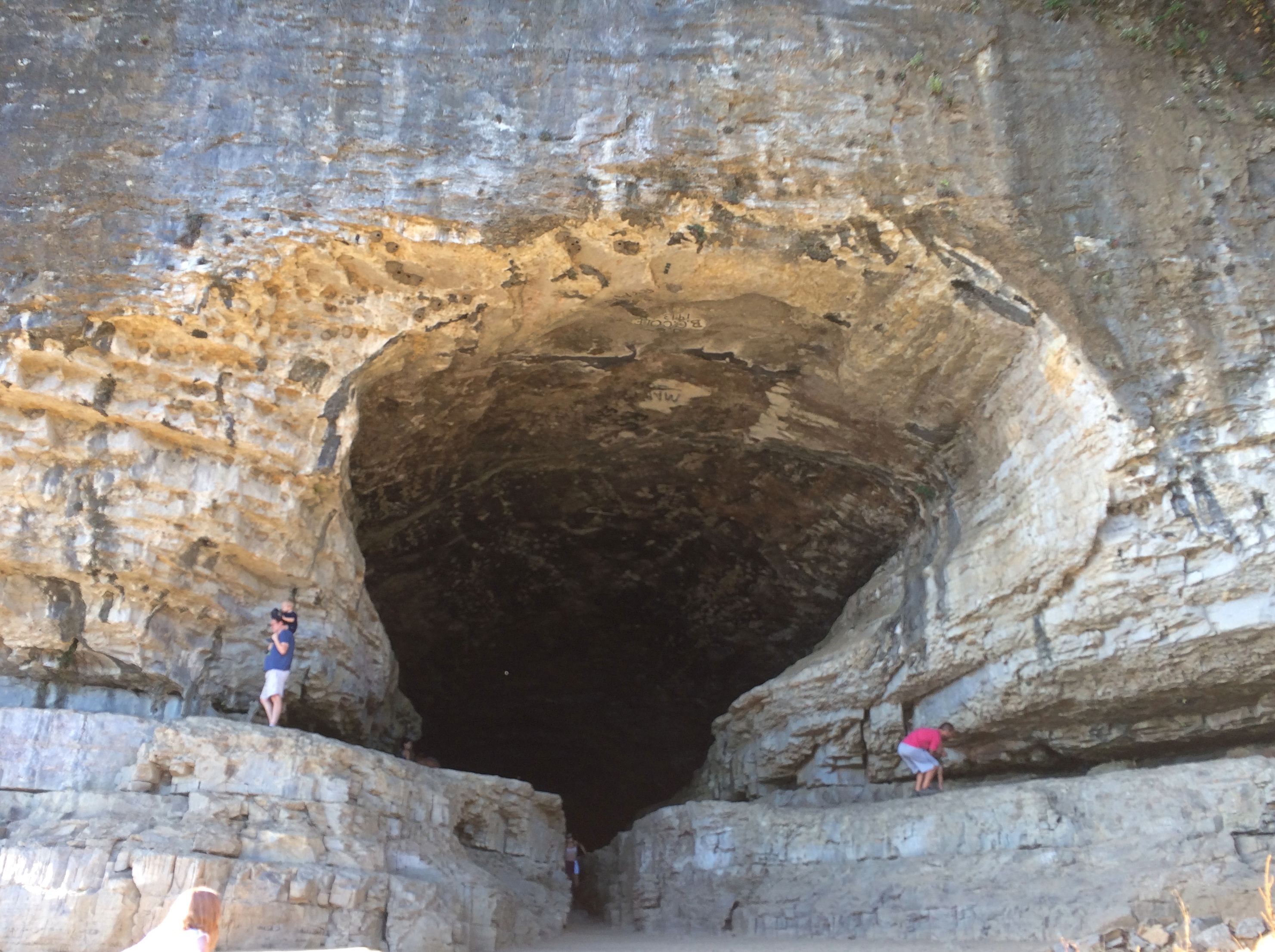
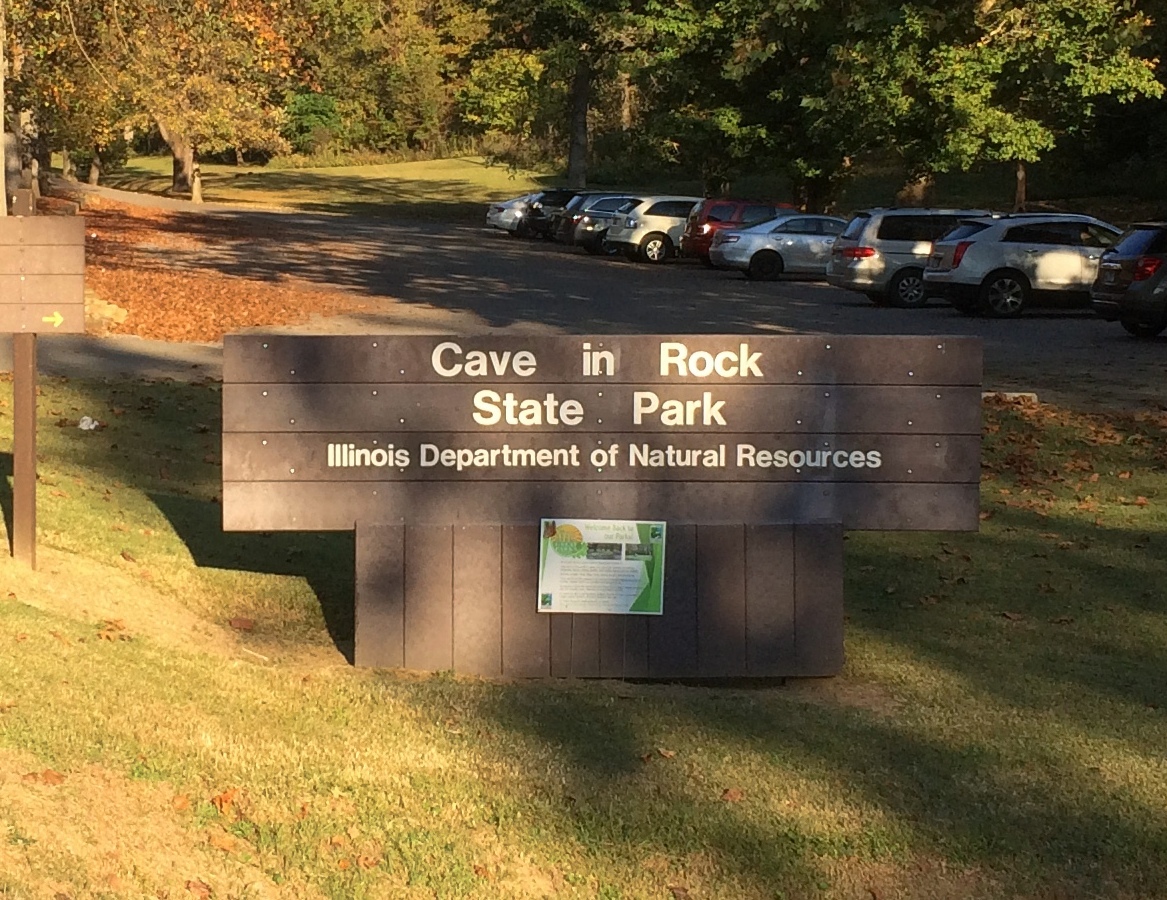
In our time, and in fact since 1929, the cave has been the central feature of Cave-in-Rock State Park. Not quiet as a tomb, quiet as a minor tourist attraction. It isn’t part of Shawnee National Forest, but some of the national forest lands are nearby. Note the sign isn’t a stickler for hyphens.Cave-in-Rock State Park

The park is near the small town of Cave-in-Rock, Illinois, which is walkable distance to the south from the park. We arrived at the park on the afternoon of October 11.

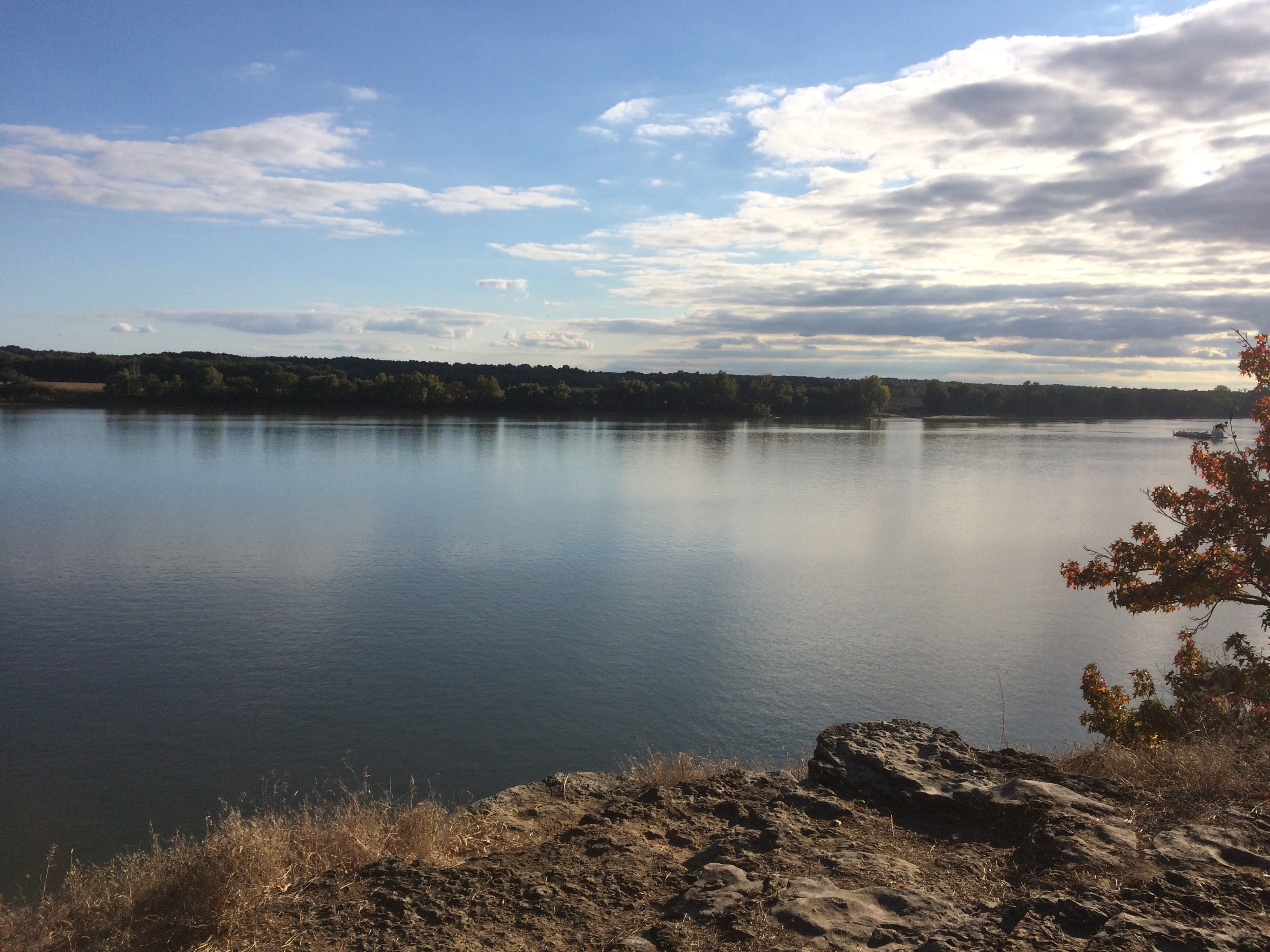
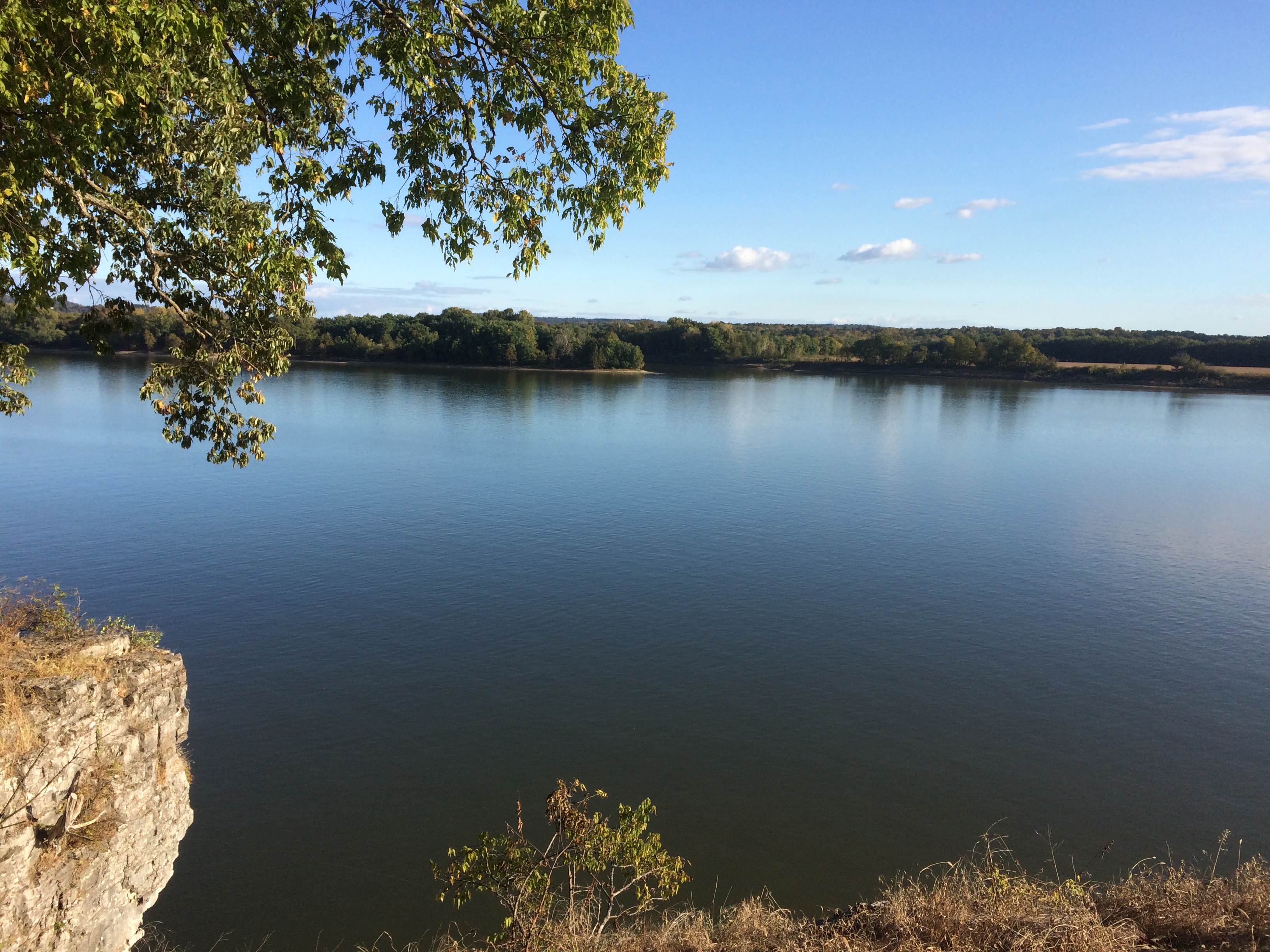
You park in a small lot and climb 50 or so steps uphill, to a crest overlooking the Ohio River, sporting picnic shelters and tall trees. Views from the crest, looking across to Kentucky.Cave-in-Rock State Park Cave-in-Rock State Park

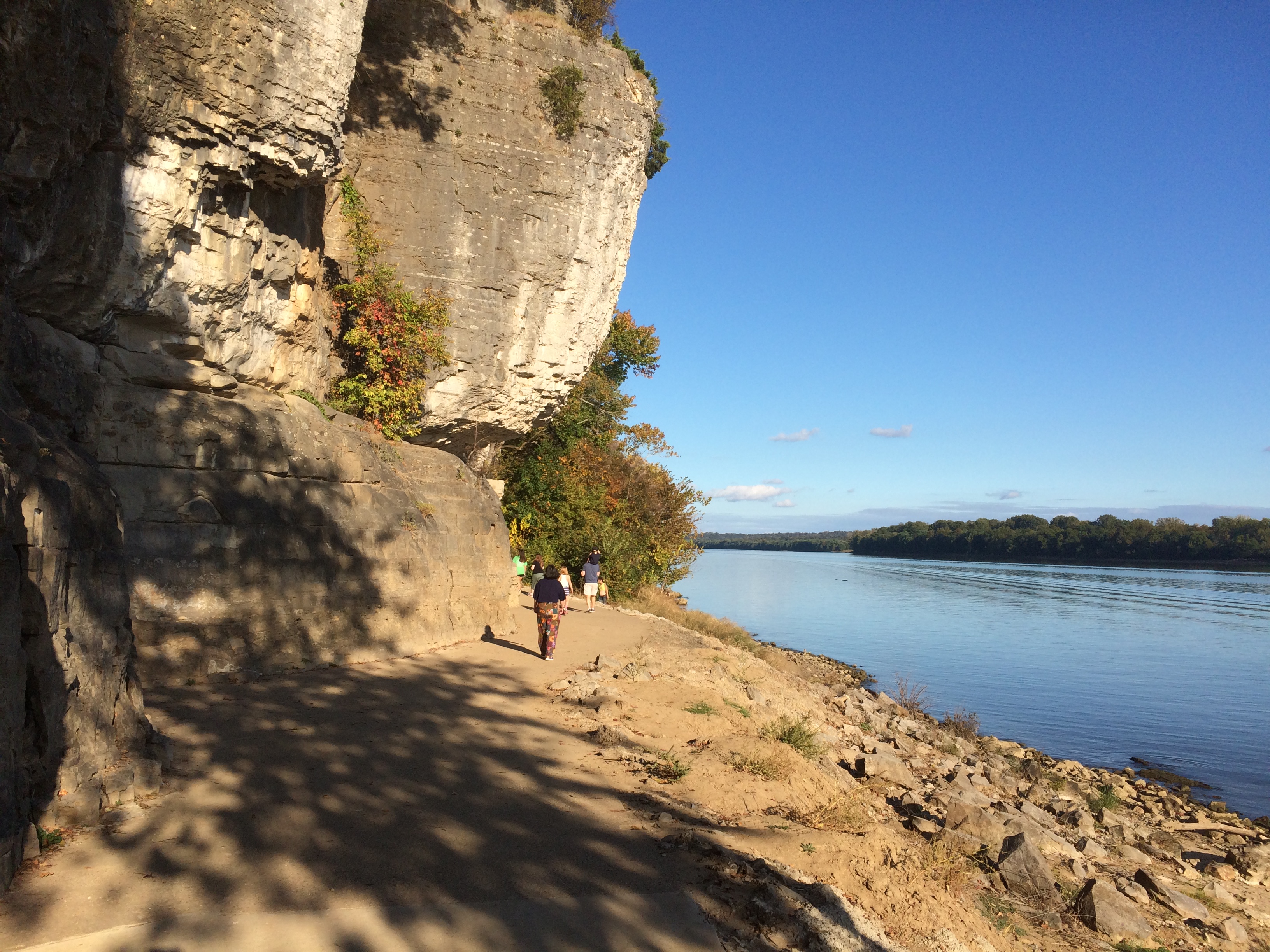
From the crest, you go down more stairs most of the way to the river’s edge. The cave entrance is under a high cliff and a few feet higher than a small beach on the river.
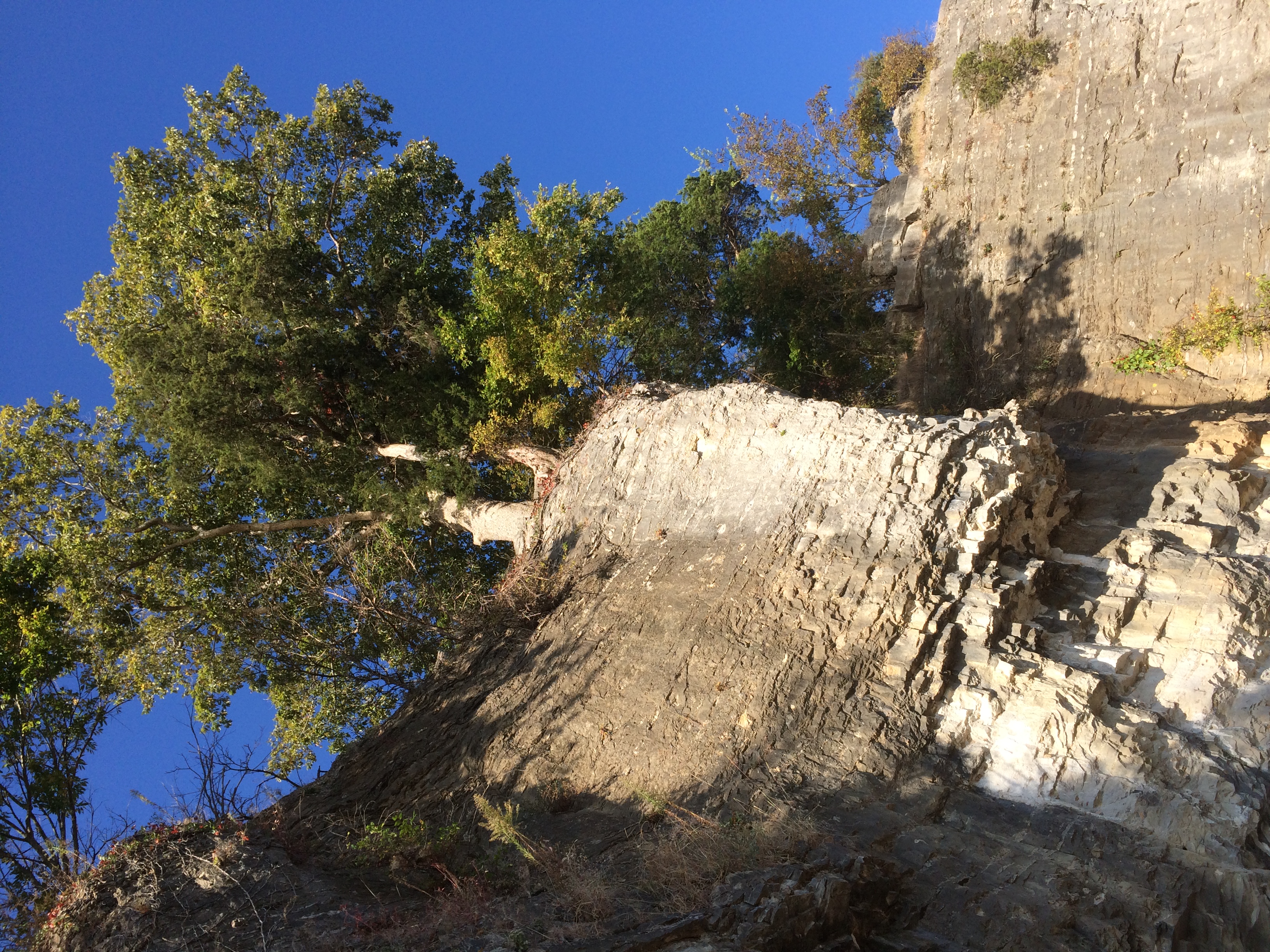
Cave-in-Rock State ParkLooking back up at some trees lording over the edge of the cliff.
Cave-in-Rock State Park

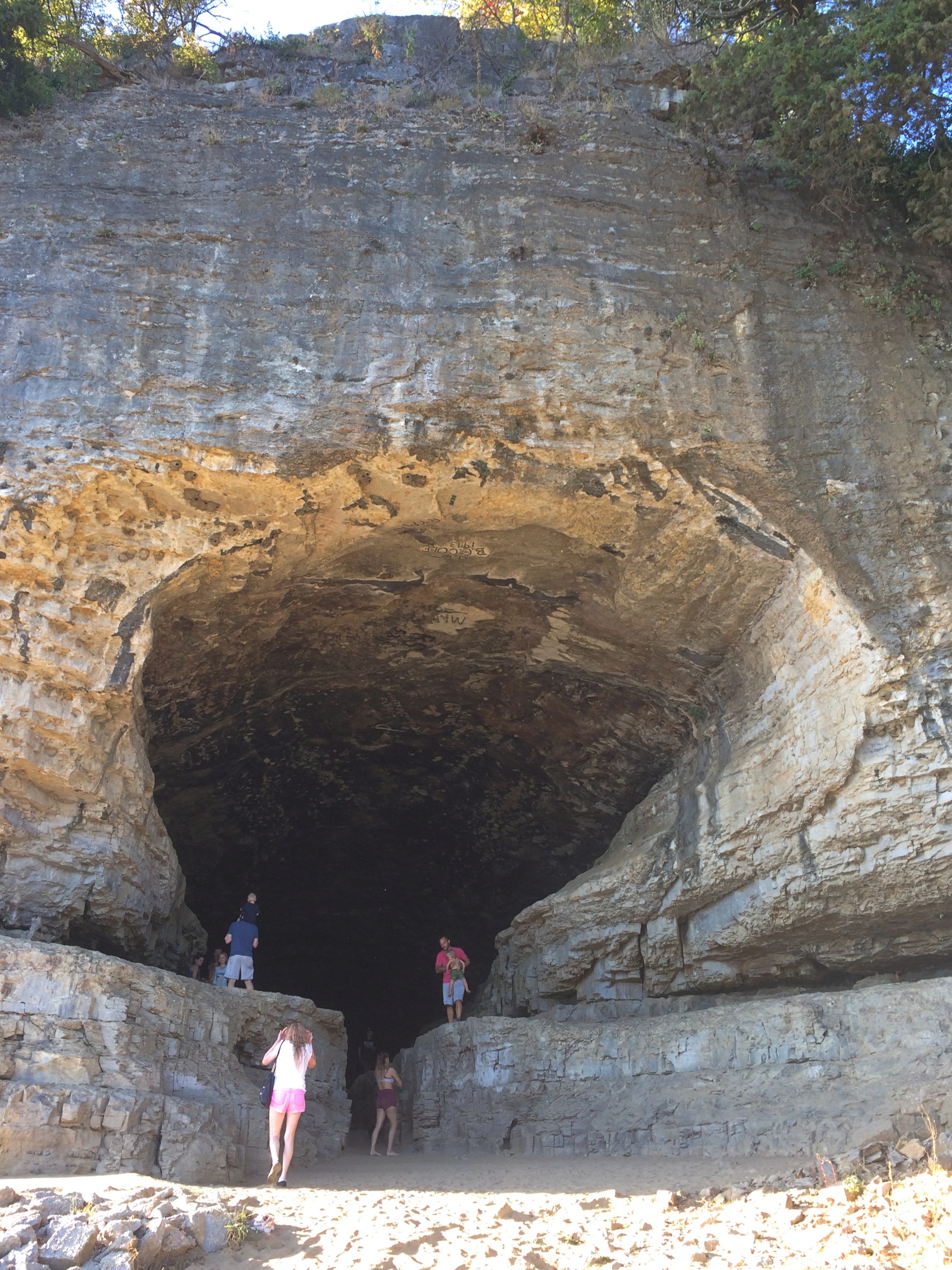
A few more steps and you’re in front of Cave-in-Rock. It’s an apt name.

Cave-in-Rock State Park Cave-in-Rock State Park

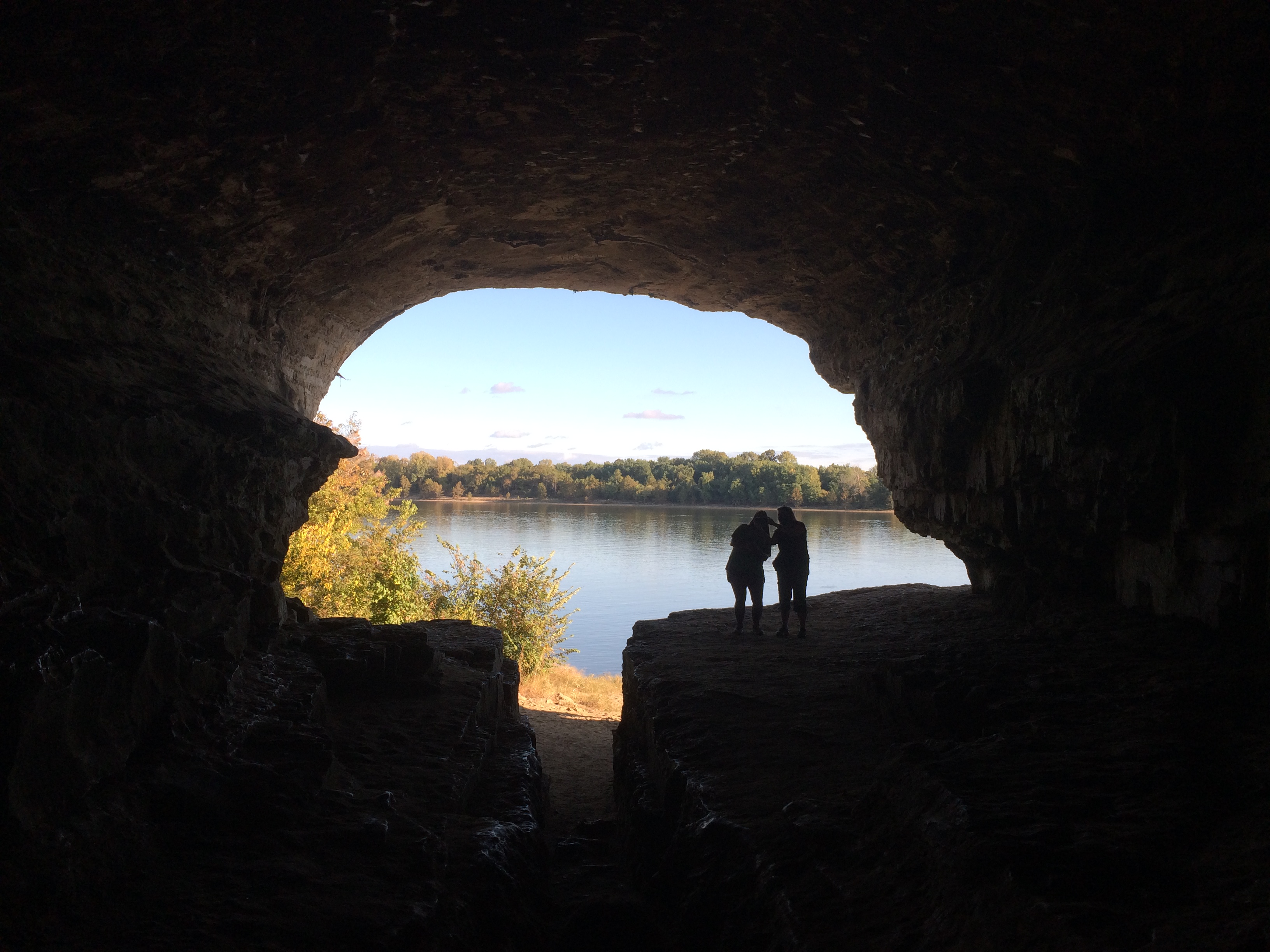
Soon you’re inside, looking out.
Cave-in-Rock State Park

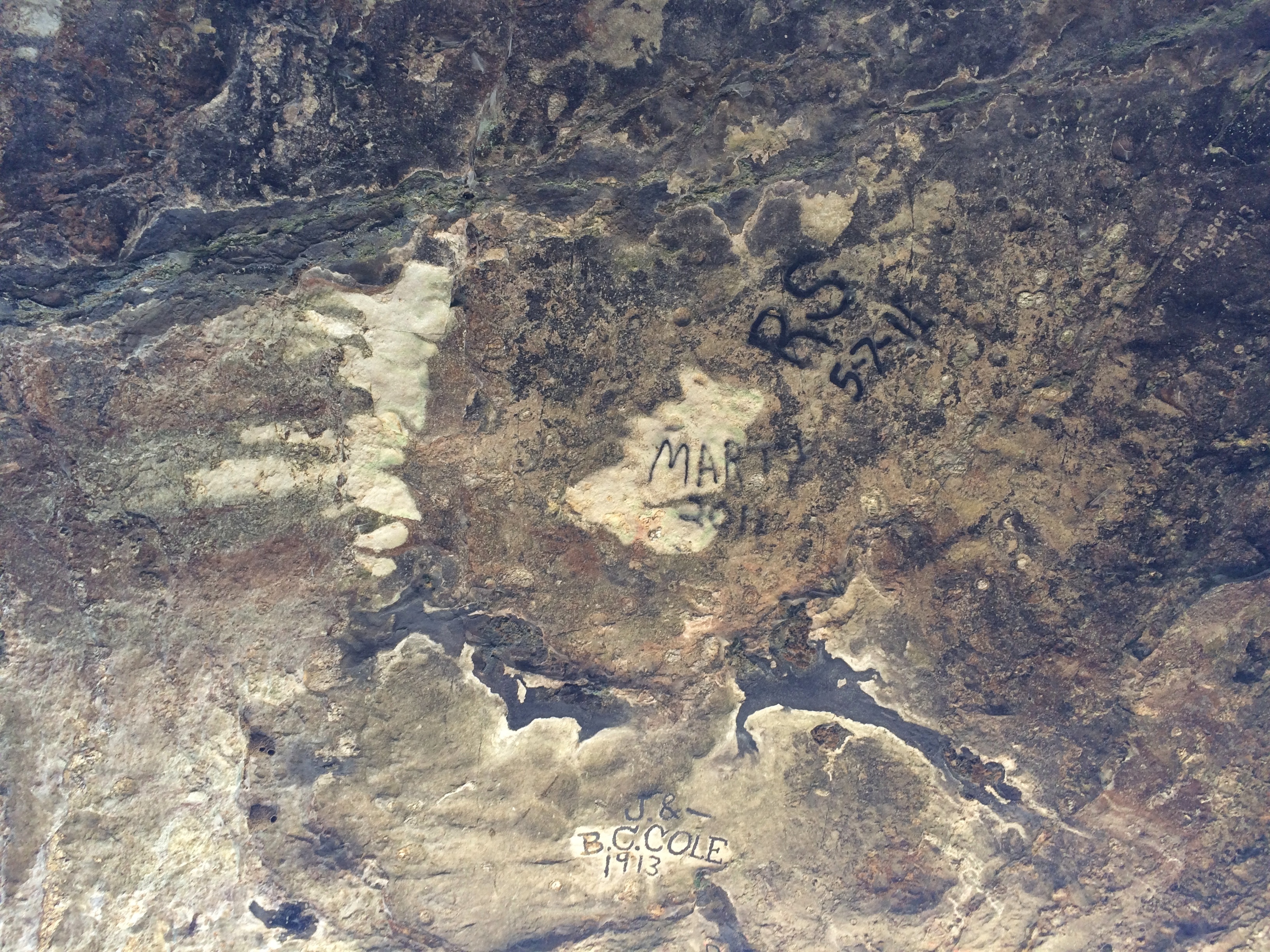
It doesn’t go too far back, at least not that I know of. Graffiti, mostly painted signatures, is prominent on the roof of the cave.
Cave-in-Rock State Park

J. & B.C. Cole were here in 1913, pre-park and probably dangling from a rope over the cliff edge. The more recent Marty and R.S. were here in 2011, and probably had rappelling gear.

Two Wisconsin Vistas: Granddad Bluff Park & Tower Hill SP

On Tuesday night late, a storm blew threw, bringing rain and fall-like temps, and leaving Wednesday wet and cool and gray. Today wasn’t quite so cool, but still not summer-like. It will be warm again, but this is our first taste of fall.

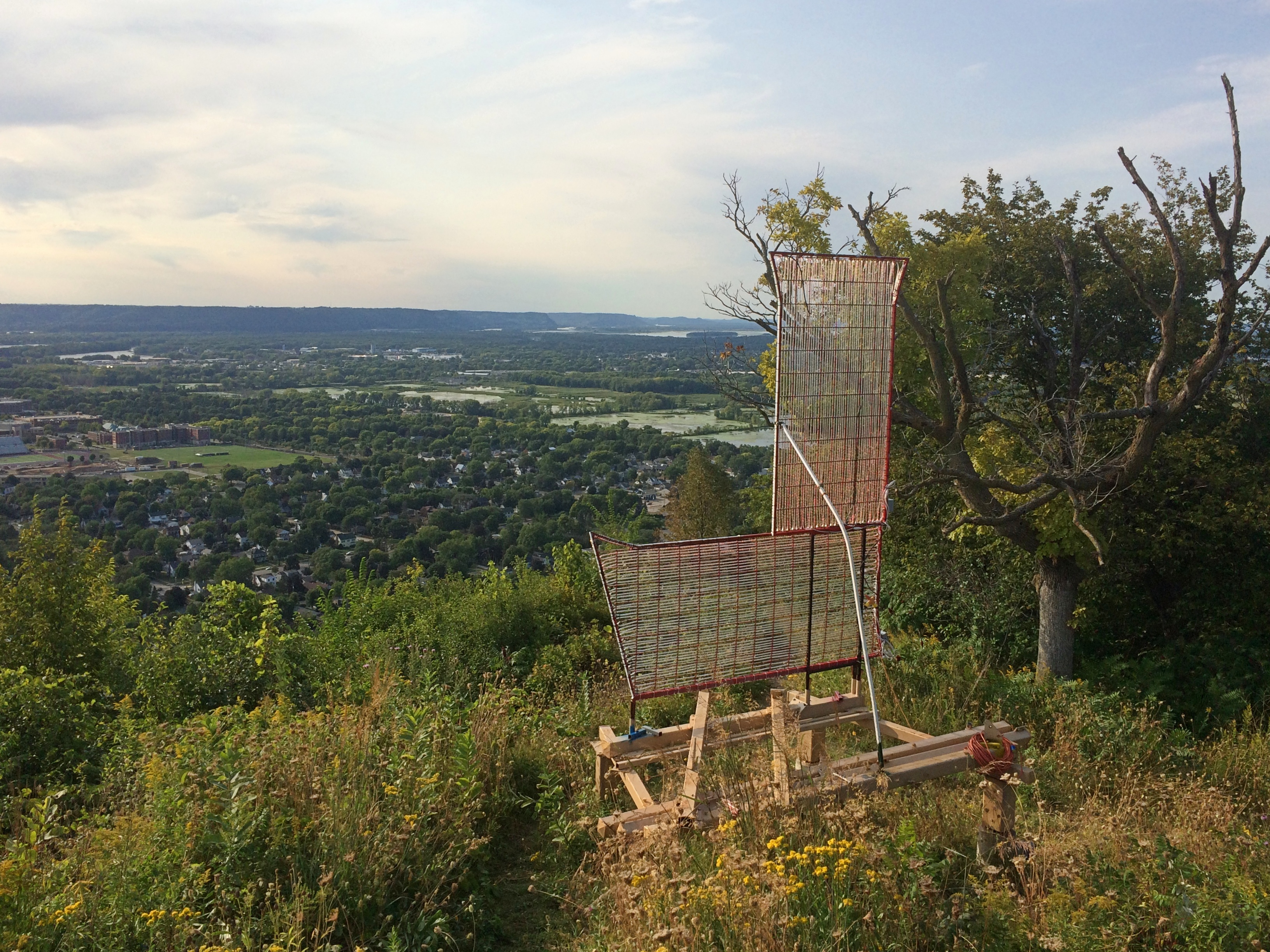
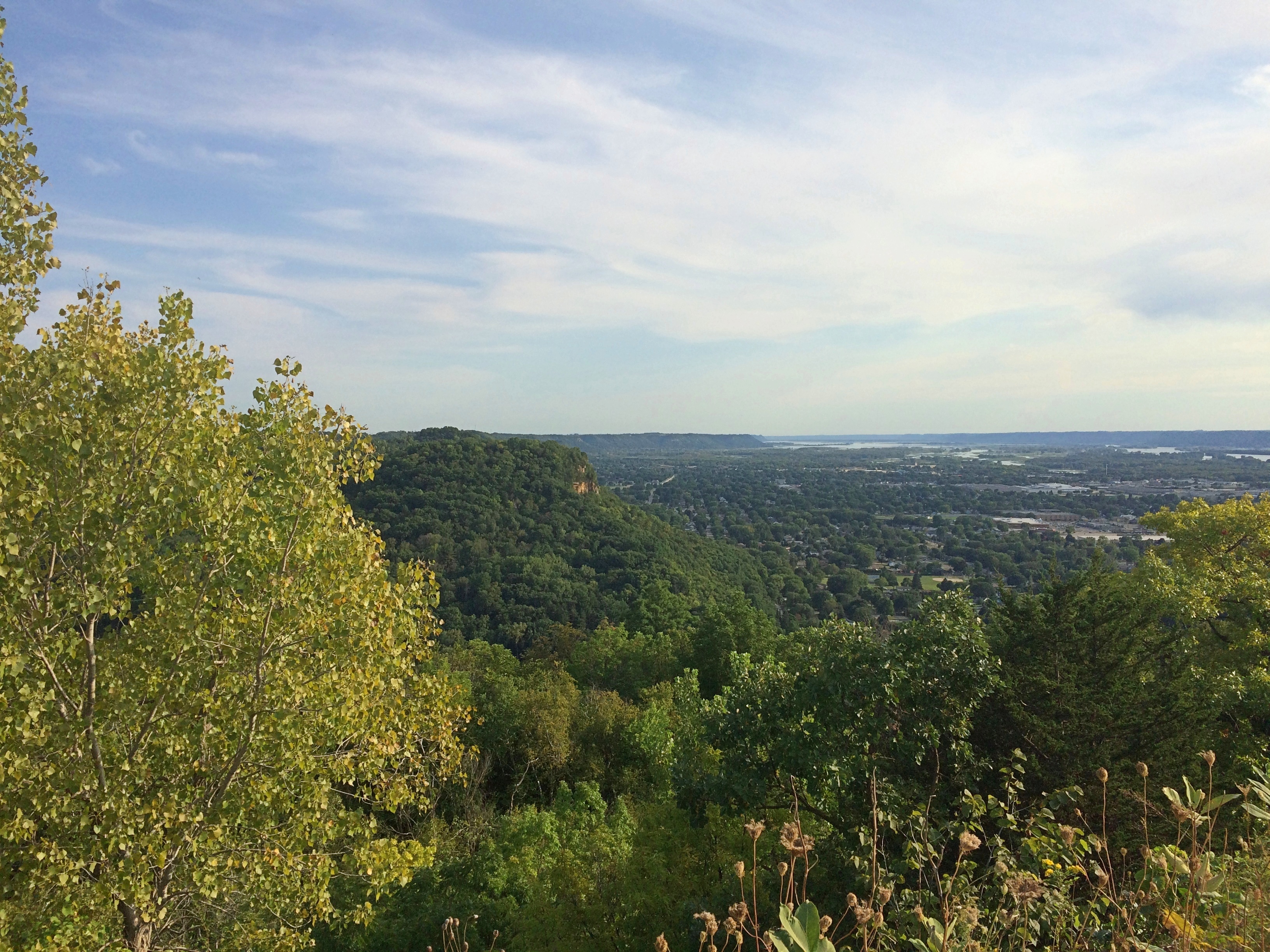
Late Saturday afternoon, we made our way to Granddad Bluff Park in La Crosse. Unlike some of the other vistas we’ve taken in recently, you can drive most of the way to the overlook at Granddad Bluff. From the parking lot, it’s a short walk to the edge of the bluff.

Granddad's Bluff

Granddad's Bluff

Not sure about that L. I suppose it stands for La Crosse. I didn’t see any other letters to spell out the name, Hollywood Sign-style.Granddad's BluffGranddad's BluffGranddad's BluffNice views. La Crosse spreads out to the west of the bluff. The city, pop. 51,000 or so, mostly hugs the Mississippi just south of where the Black River joins it.

I’d have guessed that roving Frenchmen founded the place, but apparently not. Lt. Zebulon Pike passed this way in 1805 and called the area Prairie La Crosse, but the town wasn’t founded until 1841 when a New Yorker named Nathan Myrick showed up.

“Myrick found a partner [and] in Nov. 1841, borrowed an army keelboat and a stock of trader’s goods, and poled up the Mississippi River to Prairie la Crosse (now La Crosse, Wis.),” explains the Clark County History Buffs. “There they built a cabin, the first in La Crosse, and became successful in the Indian trade…”

I have my own tenuous connection to La Crosse, even though last weekend was the first time I’d more than passed through the town. La Crosse is the first place I ever saw in Wisconsin, back in 1978 as our bus rolled through, probably on I-90 at the northern edge of town. I remember being impressed by the rolling hills after traveling through so much Midwestern flatland.

We buzzed through in 2005 on the way to Yellowstone, and I thought then it would be good to visit La Crosse someday. The day happened to be September 5, 2020, first with a look from Granddad Bluff.

The bluff was a source of quarried rock in the 19th century, but as a lookout and prominent local feature, La Crosse residents have reportedly always been fond of the place. So much so that more than 100 years ago, when they believed a new owner was doing to destroy it for stone, a wealthy local resident arranged for the city to acquire it for a park.

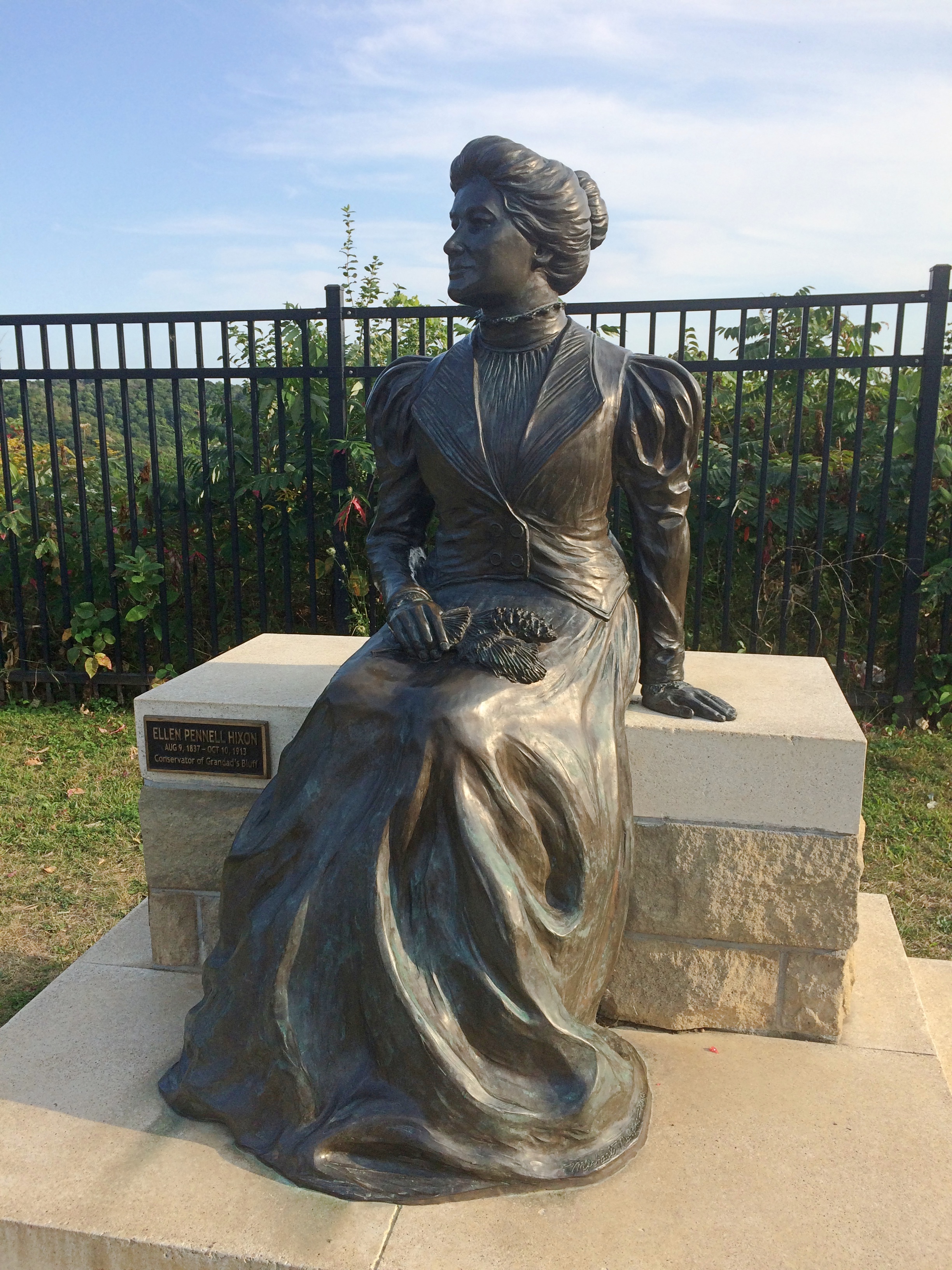
Here she is in the park: Ellen Hixon, depicted in a bronze by Wisconsin artist Mike Martino.Granddad's Bluff Ellen Hixon statue“A subscription was organized and Ellen P. Hixon, encouraged by two of her sons, Frank and Joseph, donated $12,000 to start the fund,” a sign near the bronze says. In current money, that’s more than $310,000. She was the widow of a local lumber baron, Gideon Hixon. Their house is now a museum, which is only open in a limited way now.

“About twenty other local benefactors and companies then contributed another $3,000 to purchase adjacent lands and to fund roads and other improvements. By 1912 the Hixon family was able to transfer title for the property to the city for use as a public park, and the bluff was saved.”

Good for her. As legacies go, Granddad Bluff’s a pretty good one.

Earlier in the day, we stopped briefly at Tower Hill State Park near Spring Green, Wisconsin, which is better known for Taliesin.Tower Hill State Park

It too offers a good vista, but you have to climb a hill to see it.
Tower Hill State ParkAt the top of the bluff is a reconstruction of the Helena Shot Tower. It’s closed for now.
Tower Hill State ParkTower Hill State ParkIn the early 1830s, a Green Bay businessman named Daniel Whitney had the shot tower built for the manufacture of lead shot. Molten lead dropped from a height forms into globes on the way down, which harden when hitting a pool of water below.

You’d think such an operation would do serious business during the Civil War, but it was closed by then. Later Jenkin Lloyd Jones, who was Frank Lloyd Wright’s uncle, developed a retreat on the site. His widow gave it to the state of Wisconsin, which created the park in the 20th century and had the shot tower rebuilt.

The view from near the shot tower is toward the Wisconsin River.
Tower Hill State ParkWorth the climb, which wasn’t nearly as exhausting as Devil’s Lake SP or Starved Rock SP or Wyalusing SP or Effigy Mounds NM. Been quite a summer for climbing hills, now that I think about it.

Thursday Bits & Bobs

Some unusually cool days this week. I’m not sure whether that had anything to do with what happened at about 7:45 pm on Wednesday out on our deck. I was sitting out there, decompressing from a day of work and other tasks, when I saw a dark blob hit one of our deck loungers. Twack!
Two cicadas. Noiseless, though the cicadas have been doing their twilight bleating for a few weeks now. Crickets are also singing after dark, though maybe not as strongly as they will closer to their seasonal demise. By Thursday morning, when I next checked, the cicadas were gone.

Happy to report there’s a thin mosquito population this year, at least around here. Flies have taken up the slack. Seems like one gets in the house every day through the back door, including some of the metallic-colored ones that used to fascinate me as a kid.

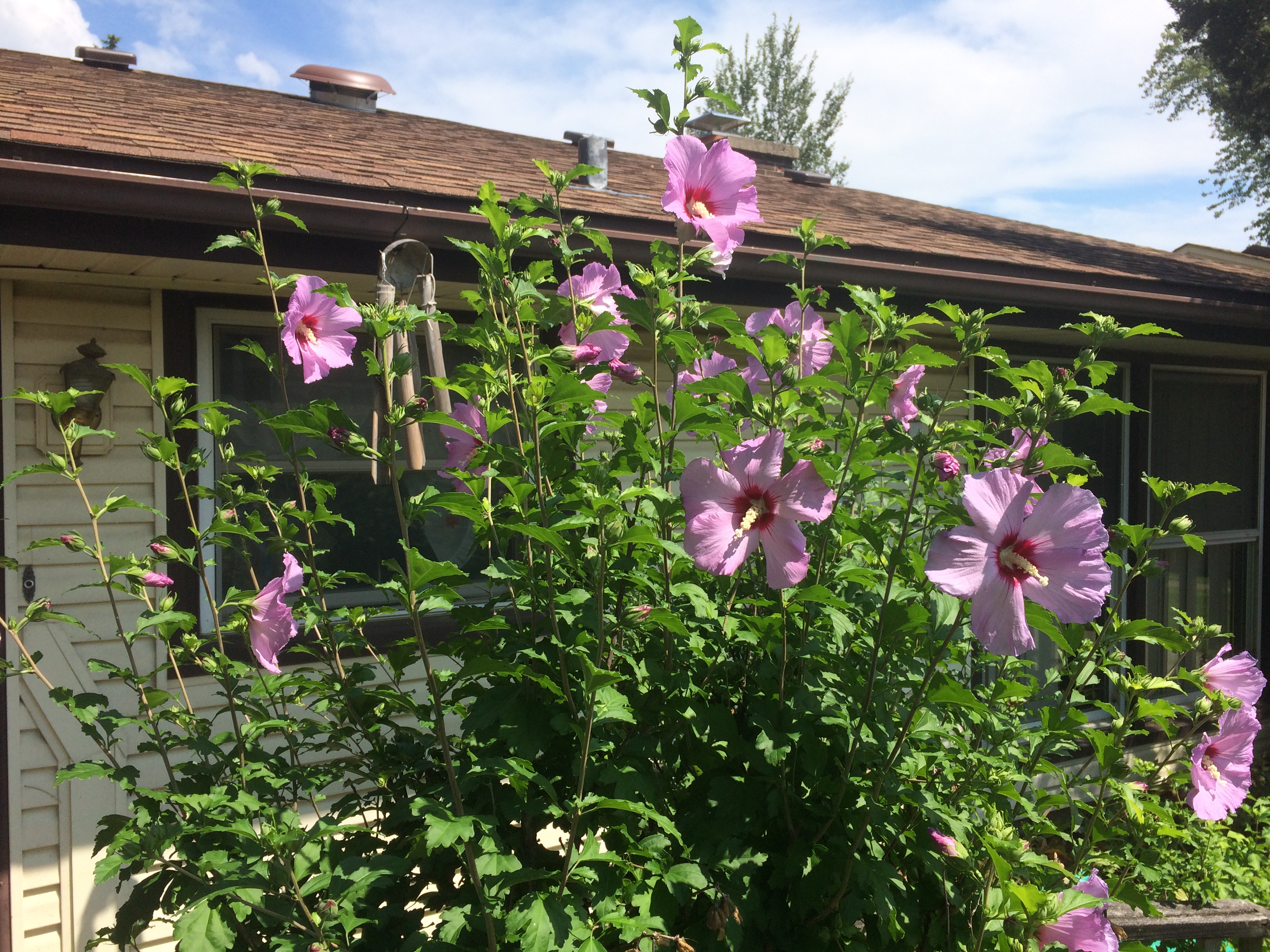
Also in the back yard: blooming hibiscus. Could be Hibiscus syriacus. I can also call it rose of Sharon, though I understand that’s applied to other flowers as well.
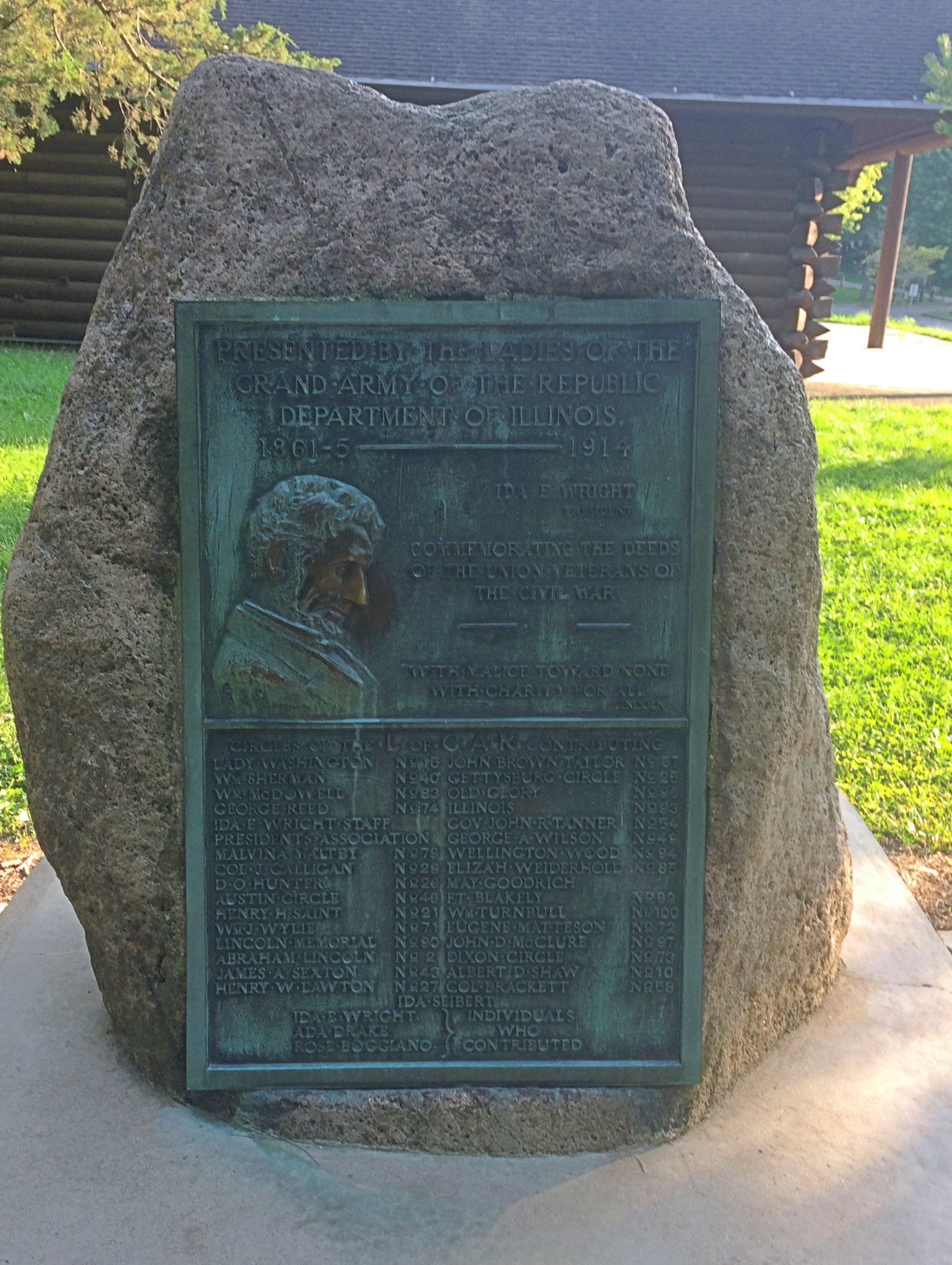
At Starved Rock State Park recently, I spotted his plaque near the lodge. Looking its century-plus age, including countless touches of Lincoln’s nose.
GAR Ladies plaque Starved Rock State Park“Commemorating the deeds of the Union veterans of the Civil War,” it says. The Ladies of the Grand Army of the Republic erected it in 1914. Looks like the Ladies, who are still around, were trying to keep up with the Daughters.

Chronicling a lot of violence, but also a thing of great beauty.

Our most recent episode of Star Trek: “A Piece of the Action.” I suggested it as one of three options — an action/adventure story, or one of the show’s tendentious eps, or comedy. Ann picked comedy. I’d forgotten how much of a hoot “Action” is, with the high jinks gearing up especially after Kirk and Spock got into pseudo-gangster duds and Shatner hammed it up.

Oh, my, listen to that. My my my.

Starved Rock State Park ’20

Hot-and-sweaty weekend until a steady warm wind came on Sunday afternoon, a baby sirocco you might call it, and blew away the humidity. That left the golden glow of dusk warm but dry.

All of us, dog included, took an in-state overnight (30-hour) trip over the weekend, with Starved Rock State Park as the prime destination. Been a while since we’d all been there together, but each of the girls had visited with friends in more recent years.

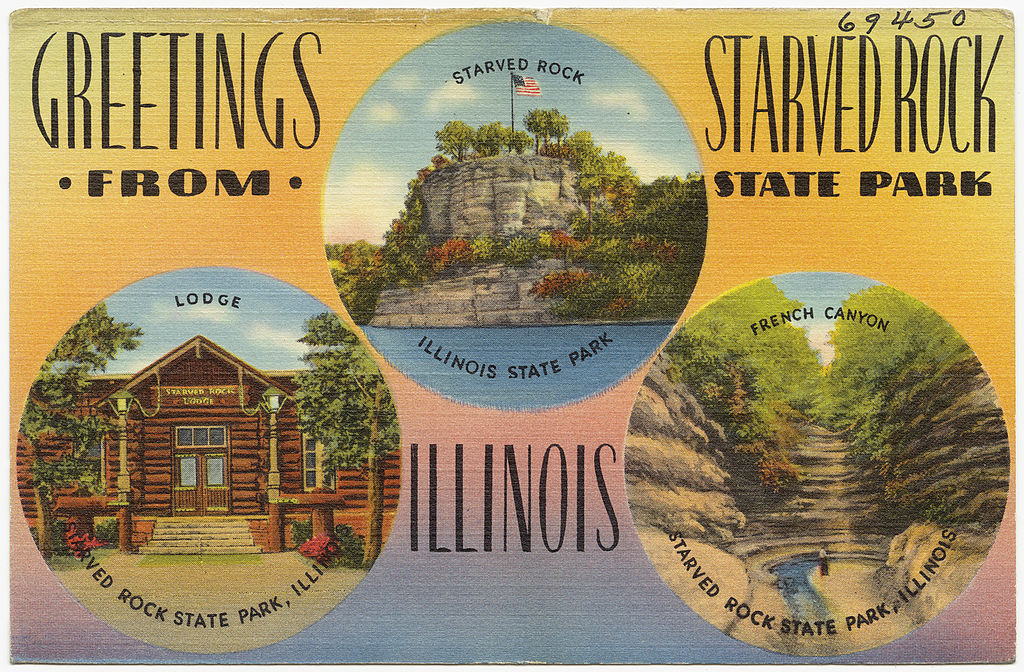
That isn’t a postcard of mine, though if the state sold it at the park, I’d buy one.

The 2,630-acre Starved Rock SP hews close to the south banks of the Illinois River in LaSalle County, its distinctive topography a creation of long-ago floods and glacial movement. The state acquired the land in 1911 and (of course) the CCC did park infrastructure work during that agency’s short existence. It’s a popular place, more so now than ever. Guess that’s because driving destinations are the thing at our moment in history.

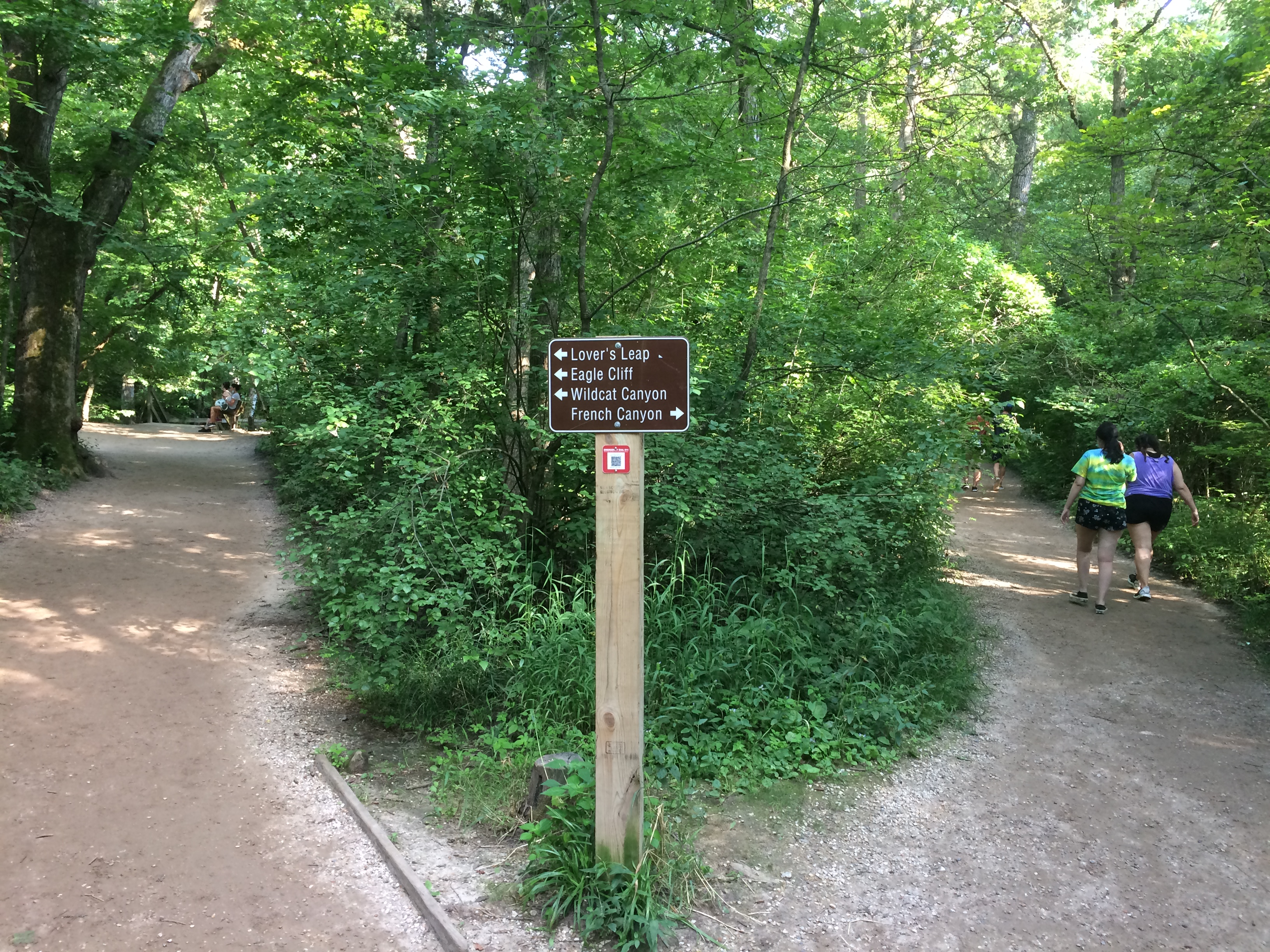
We waited until after the highest early afternoon heat had passed on Saturday to take our hikes. Late afternoon was still steamy, but tolerable, especially under trees. When we came to this fork, we took the path to French Canyon.
Starved Rock State ParkIt isn’t long before the French Canyon walls rise around you.
Starved Rock State ParkStarved Rock State ParkBefore long, you reach a waterfall. Just a trickle in late July.
Starved Rock State ParkDoubling back to the fork, we then followed a trail that’s mostly boardwalk, plus a lot of stairs that I didn’t document.
Starved Rock State ParkTo the view from Lover’s Leap.
Starved Rock State Park Lovers LeapThe nearby Eagles Cliff vista, looking upriver.
Starved Rock State Park Eagle CliffLook a little downriver and you see why the Illinois is so wide just below Eagle Cliff.
Starved Rock State Park Eagle CliffThe Starved Rock Lock and Dam, also known as Lock and Dam No. 6, completed in 1933 and operated by the Army Corps of Engineers.

We might have walked further into other canyons after that, or up to the Starved Rock feature, but the heat and stair climbing spent our energy. Mine, anyway. We ought to go back some cooler day in the fall. I’ve been visiting the place since the late ’80s and still haven’t seen some of the other canyons.

Wyalusing State Park

On the morning of July 4, we left Prairie du Chien and drove a short distance to Wyalusing State Park, a thickly wooded Wisconsin property at the confluence of the Wisconsin and Mississippi rivers.

The first order of business at the park: a drive to a place called Henneger Point at the end of the winding and not-too-wide Cathedral Tree Drive. A fitting name, with massive maples and other trees towering over the road.

Before getting to the point, you arrive at the Spook Hill Group of mounds, looking very much like the ones across the Mississippi at Effigy Mounds NM, and more distinct in person than via photograph.
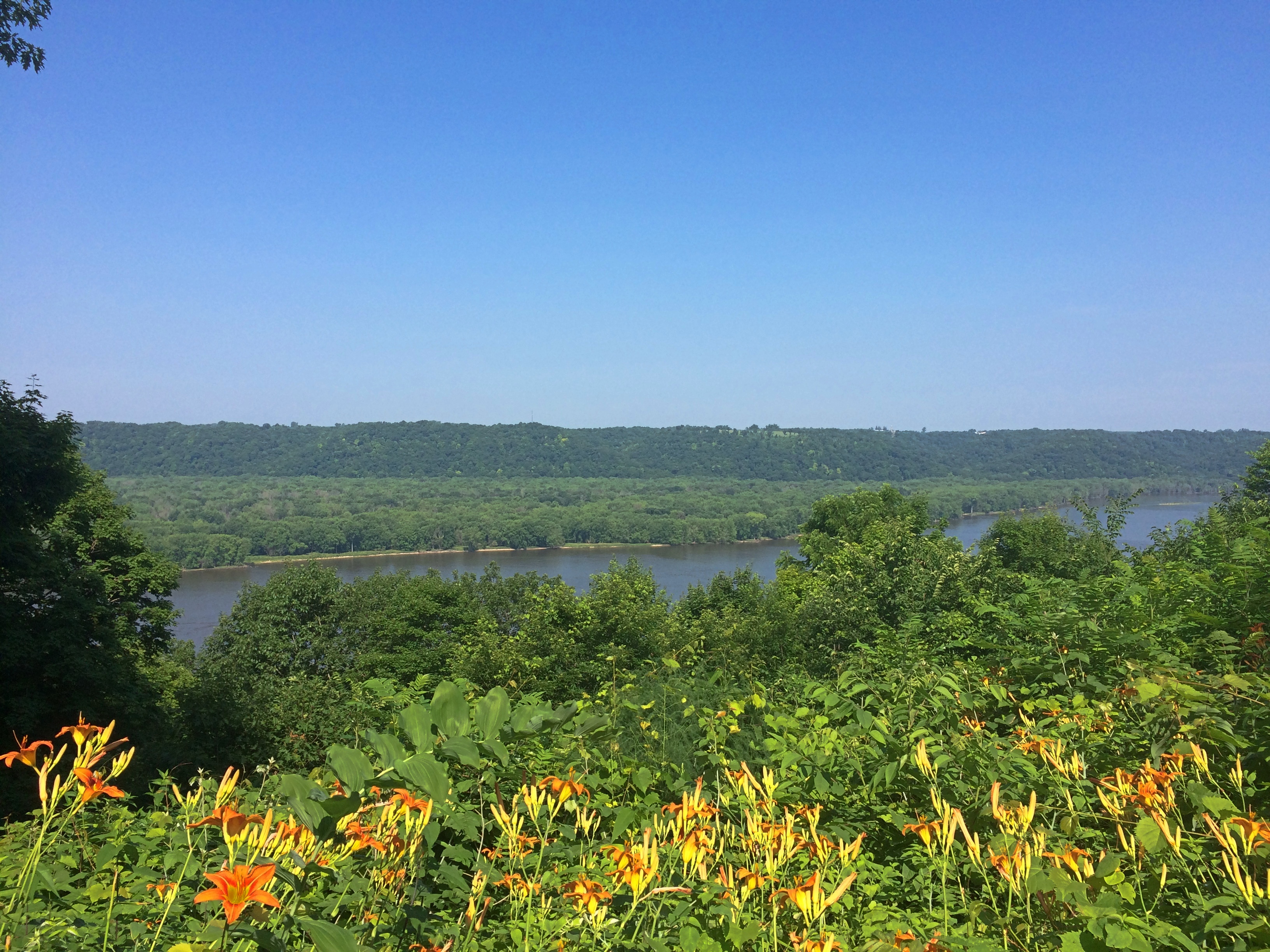
Wyalusing State Park spook moundsHenneger Point offered us a nice view of the river and Iowa across the way, behind a summer blaze of lilies.
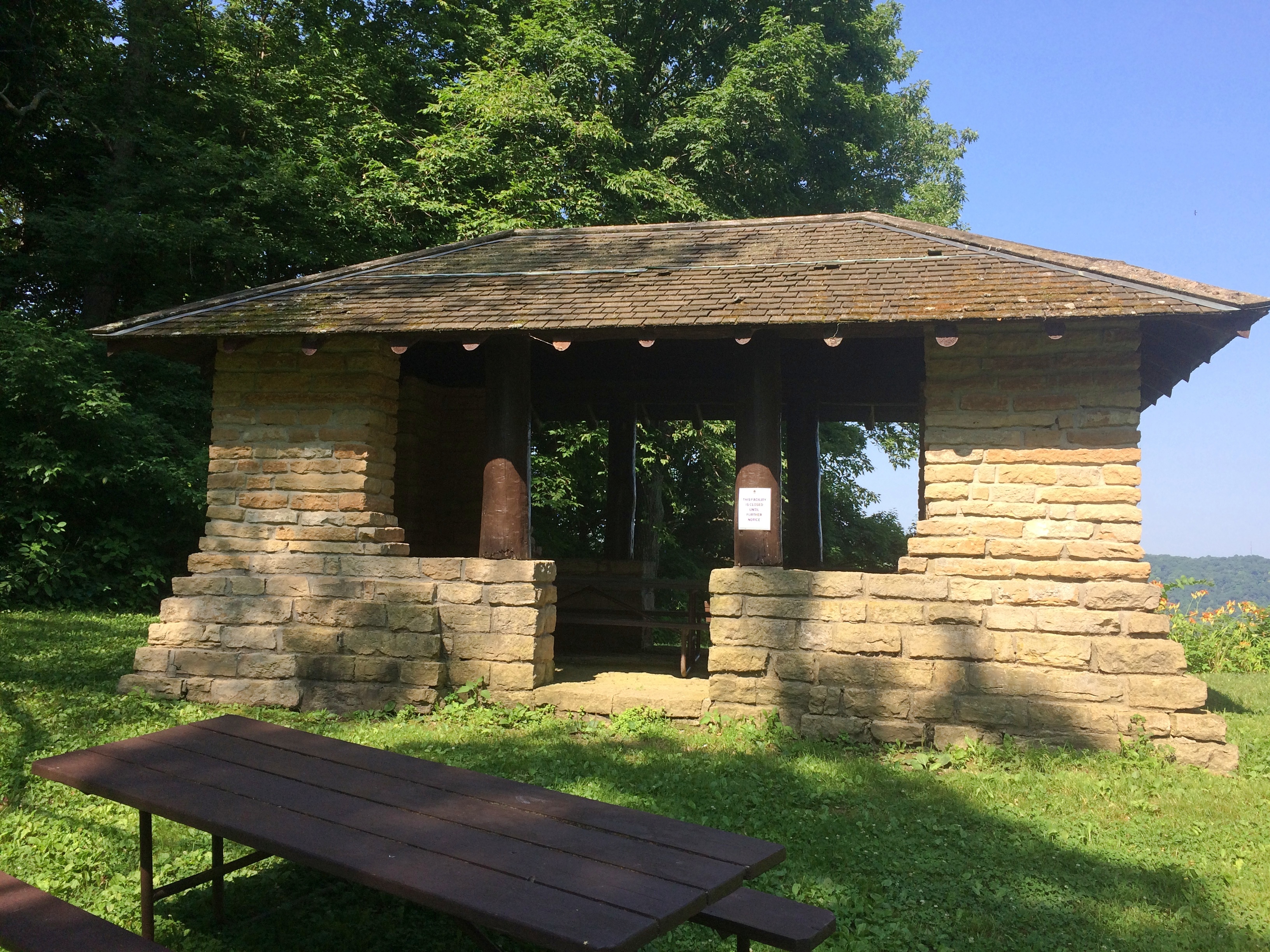
Wyalusing State Park Henneger Point A picnic shelter stands close by. The sign on the shelter said it was closed, though I imagine enforcement is a mite spotty.
Henneger Point CCC. Has to be, at least originally. Later, I found out that CCC Camp Nelson Dewey #2672 existed in the park from 1935 to ’37. Men living there built park facilities and improved its roads and trails, so they probably did the shelter, though later in the day I noticed a Wisconsin Conservation Corps sign on a small bridge on a trail. That’s an existing nonprofit that does similar work as the CCC of old.

We walked a half mile or so along the wide Mississippi Ridge Trail, one of whose trail heads is at Henneger Point.
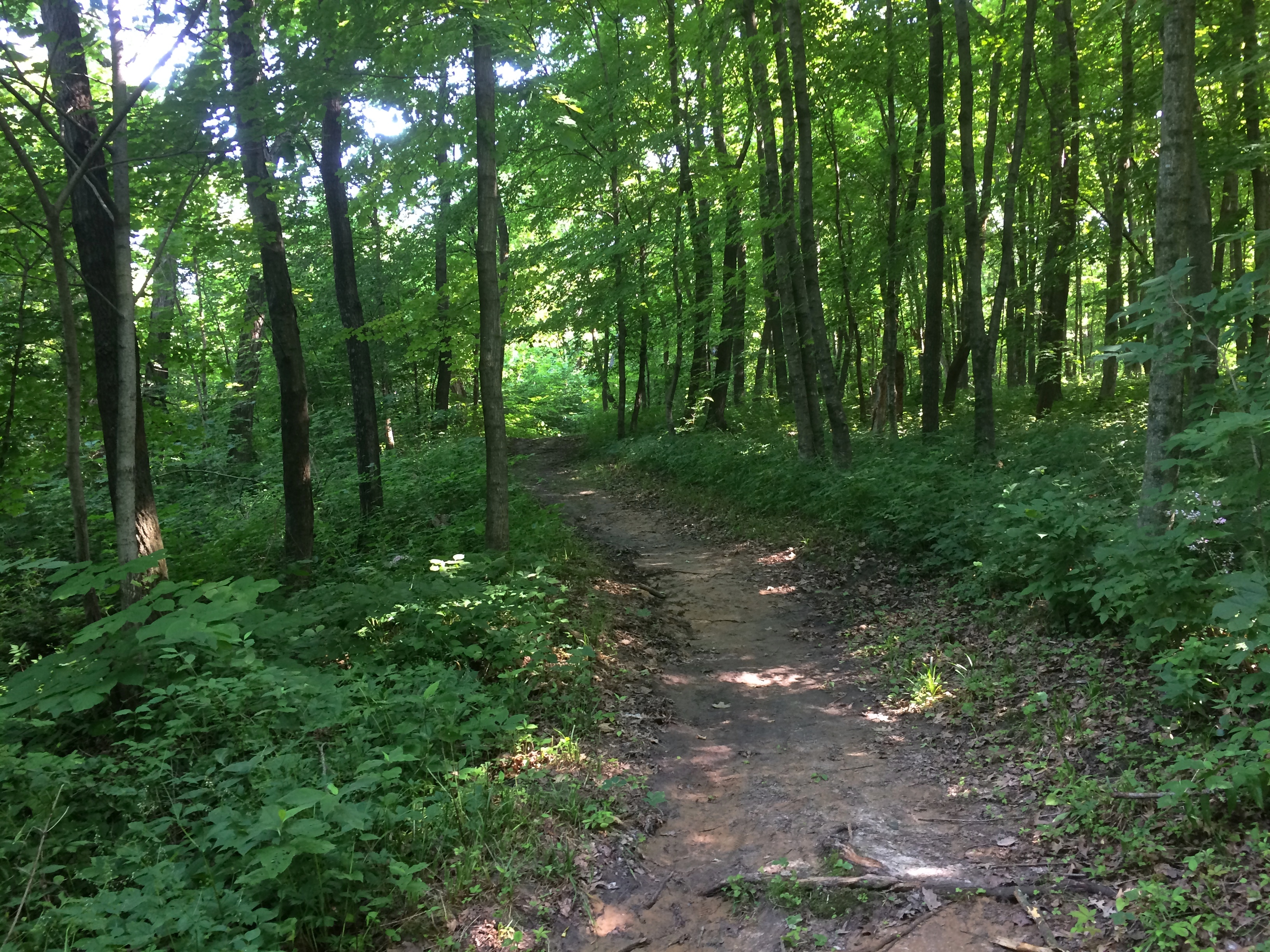
Mississippi Ridge TrailIn theory it’s suitable for bicycles, but we were absolutely the only ones on it. Talk about social distancing.
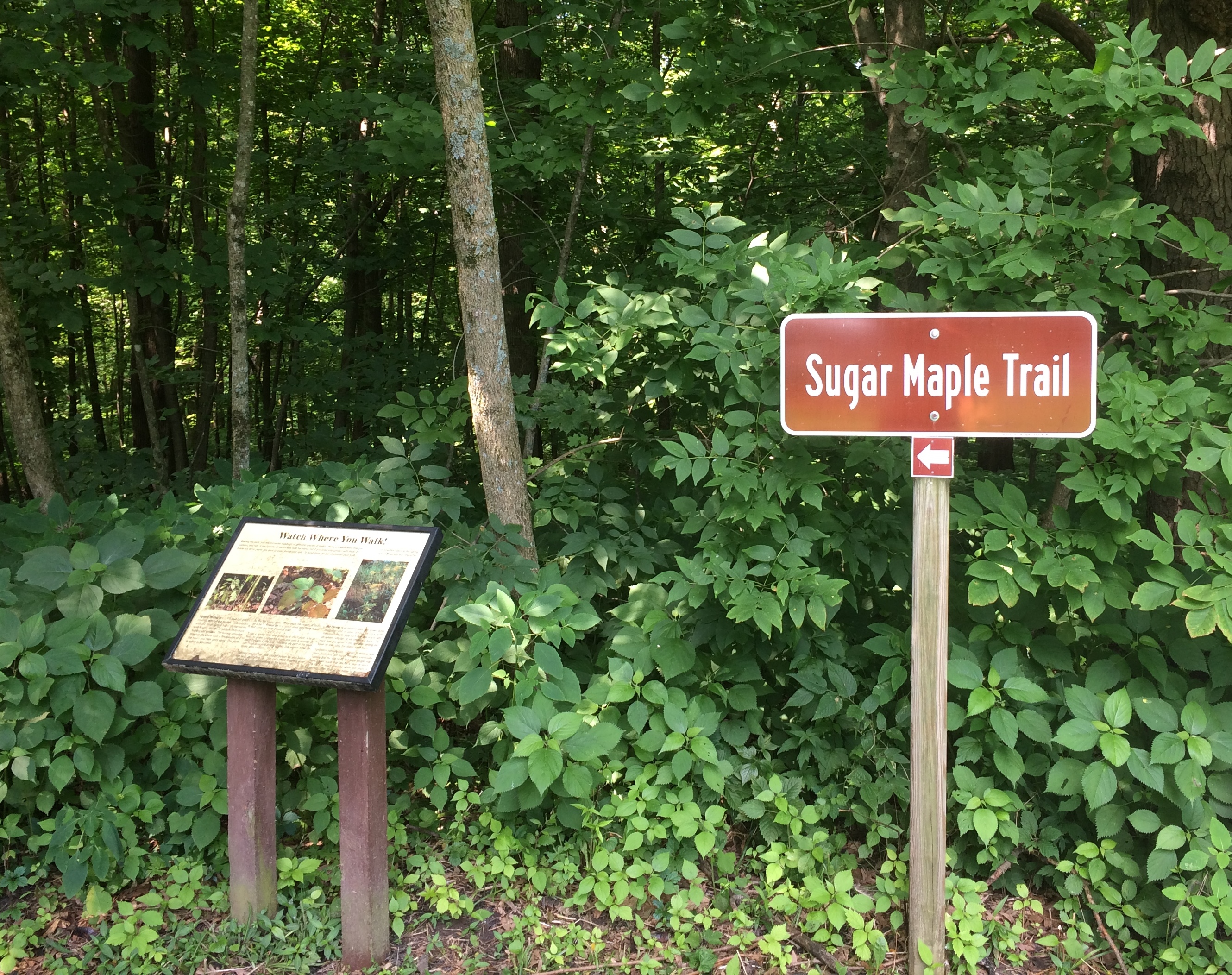
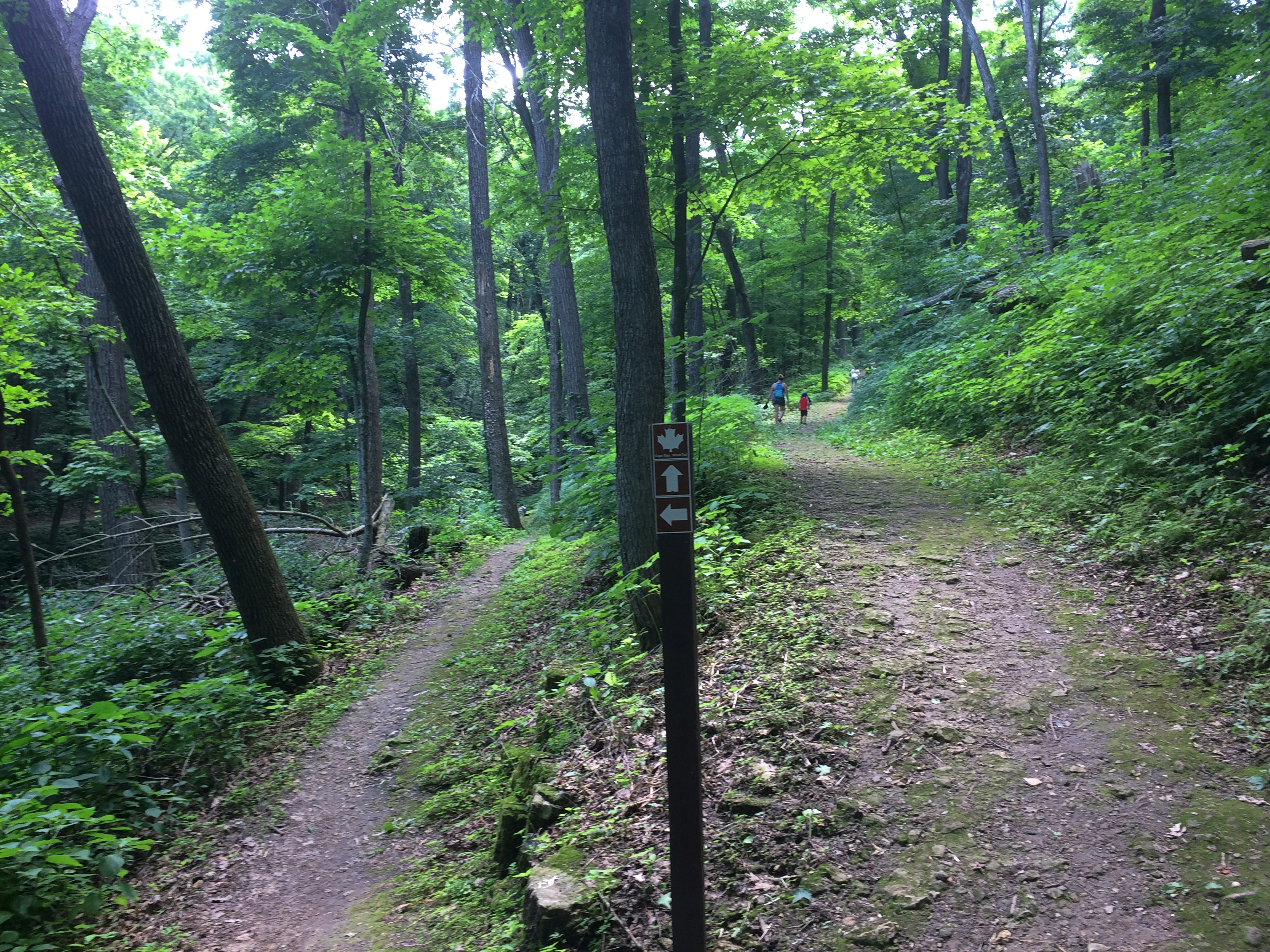
Mississippi Ridge TrailLater, we drove to the trail head of Sugar Maple Trail and did its 1.5-mile loop. The map didn’t warn us how steep it would be, though if I’d thought about it, I would have figured it out, since the trail loops down to near the river.
Sugar Maple Trail - Wyalusing SP
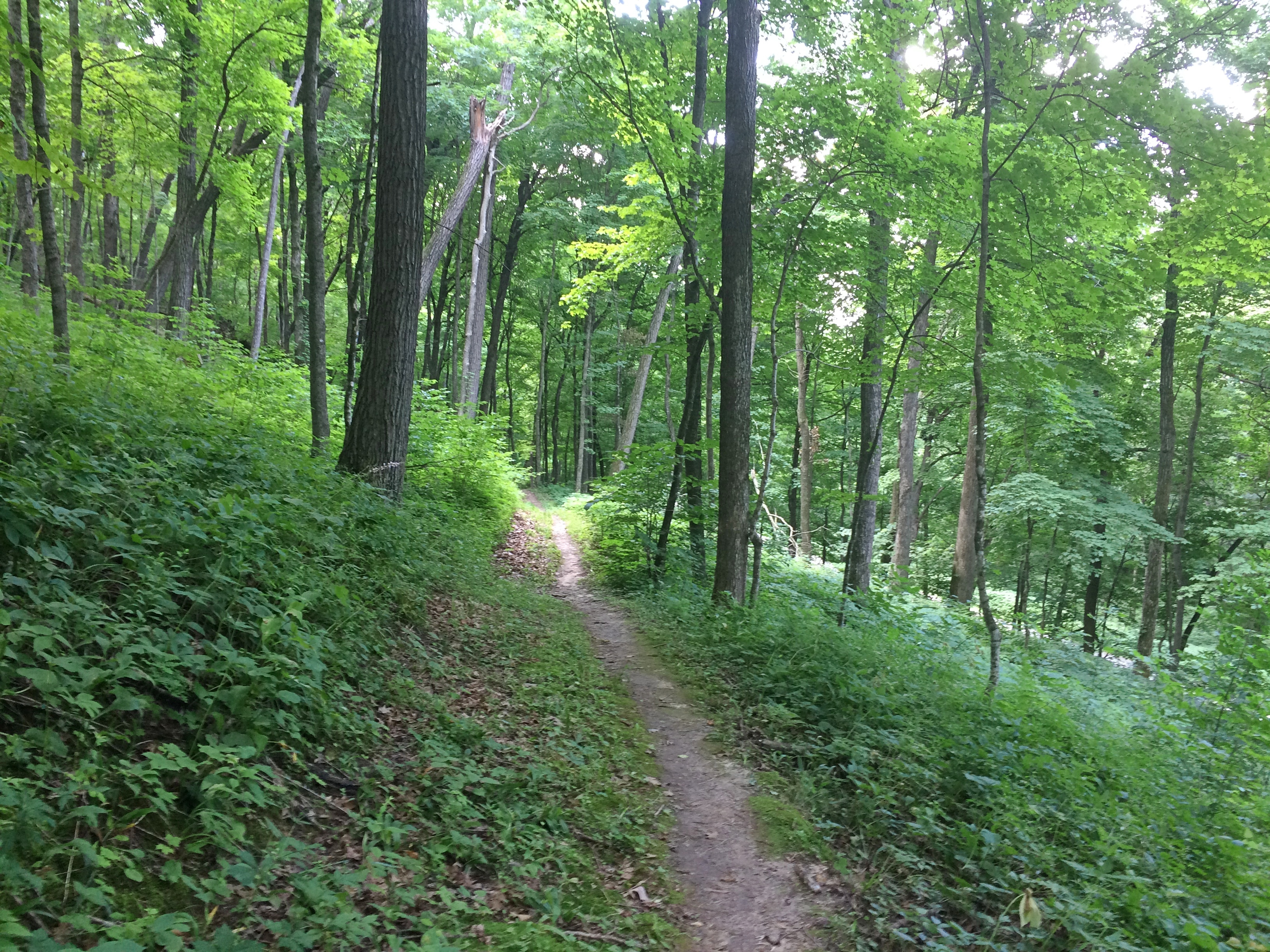
Only slightly down at first.
Sugar Maple Trail - Wyalusing SP
Then much further down, along the edge of a ravine cut by a creek-tributary of the Mississippi.
Sugar Maple Trail - Wyalusing SP
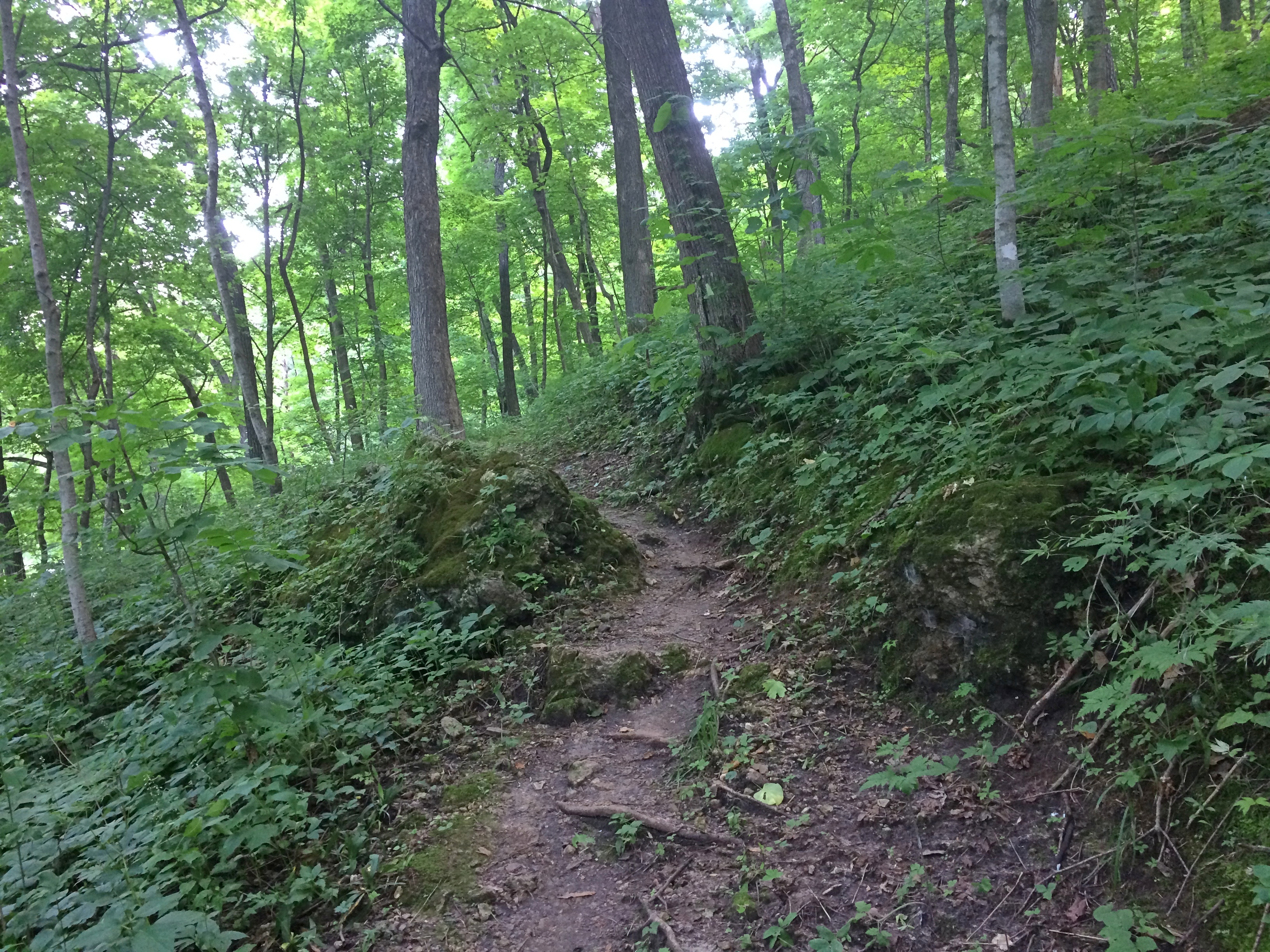
Going down wasn’t so bad, but I knew that meant we’d have to go back up. So we did.
Sugar Maple Trail - Wyalusing SP
Tiring, but not as tiring as the day before at Effigy Mounds, even though I believe the change in elevation and the ambient temperature were about the same. Steep and hot, respectively.

At one point along the cascading creek near the trail is a waterfall. Above the waterfall was a nice place to sit.
Sugar Maple Trail - Wyalusing SPElsewhere in the park is a memorial to the passenger pigeon, but I didn’t have the energy to seek it out after our long morning hike. Another time, perhaps. Until then, here’s Aldo Leopold on the passenger pigeon.

Devil’s Lake State Park

Over the weekend we visited Devil’s Lake State Park in Sauk County, Wisconsin. We drove up one evening, spent the night at a motel in Madison, and then the next morning continued on to the park, which is about 45 minutes to the northwest of the capital. After spending most of the day in the park, we drove home from there.

The closest town is Baraboo, which we last saw in 2007 — home of the delightful Circus World Museum. This time we drove by the museum. Even if we’d wanted to go again, which we didn’t, that wouldn’t have been possible. At least it’s still there. I hope Circus World manages to reopen sometime.

Devil’s Lake is a pleasant-looking, 360-acre lake with a couple of beaches and other lakeshore amenities, but those aren’t the main draw. What makes it the most popular Wisconsin state park are the Quartzite bluffs on two sides of the lake, east and west, relics of the most recent ice age. Rising to as high as 500 feet, they offer quite a view.

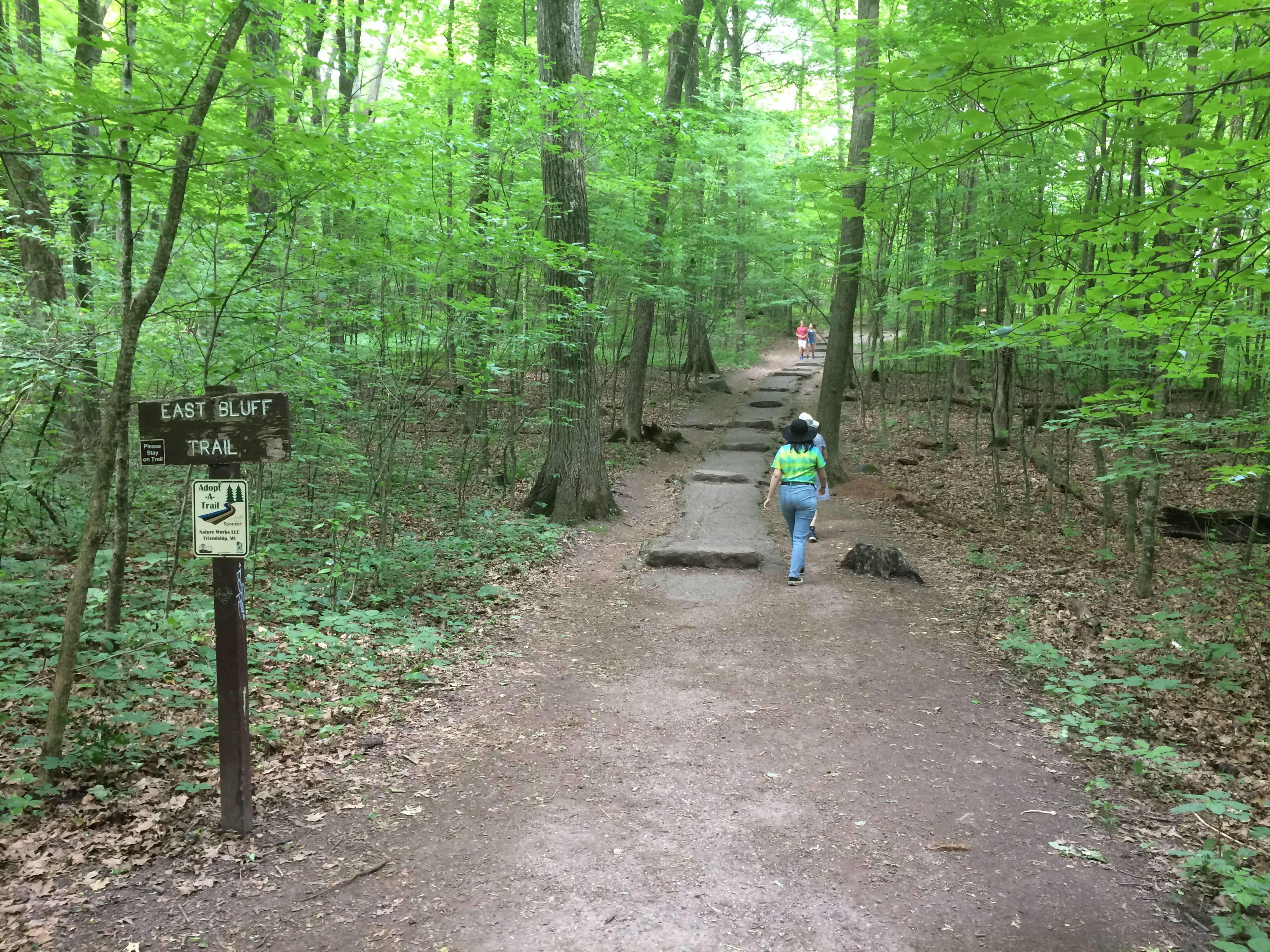
First, of course, you have to follow a trail that takes you up to those views. We picked the one on the east side of the lake, the fittingly named East Bluff Trail.
Devil's Lake State ParkUp it goes.
Devil's Lake State ParkI wondered what the people ahead of us were carrying on their backs — note the black and green rectangular packs. They turned out to be crash pads. For the sport, or activity, of bouldering. That is, climbing boulders. I knew people climb rock faces, but that was a variation I’d never heard of. Guess the people ahead of us were out for a day of bouldering. Takes all kinds.

I’ll bet Devil’s Lake SP is a good place for that. There are many, many boulders.Devil's Lake State ParkDevil's Lake State Park

Devil's Lake State Park

Like some other recent uphill hikes, it took me longer than the rest of the family. Rests were necessary. But I made it to various vistas.Devil's Lake State Park

Devil's Lake State Park

Devil's Lake State Park
There are a couple of named rock formations near the East Bluff Trail. One is the impressive Devil’s Doorway.
Devil's Lake State Park - Devil's Door
Looks solid, but surely the formation doesn’t have long to exist in geologic terms. Fleeting as a firefly on that scale. So is the whole bluff, come to think of it.

To provide a sense of scale.Devil's Lake State Park - Devil's Door

Near Devil’s Door, the East Bluff Trail meets the East Bluff Woods Trail, which has a much gentler slope. We returned via that trail.
Devil's Lake State Park
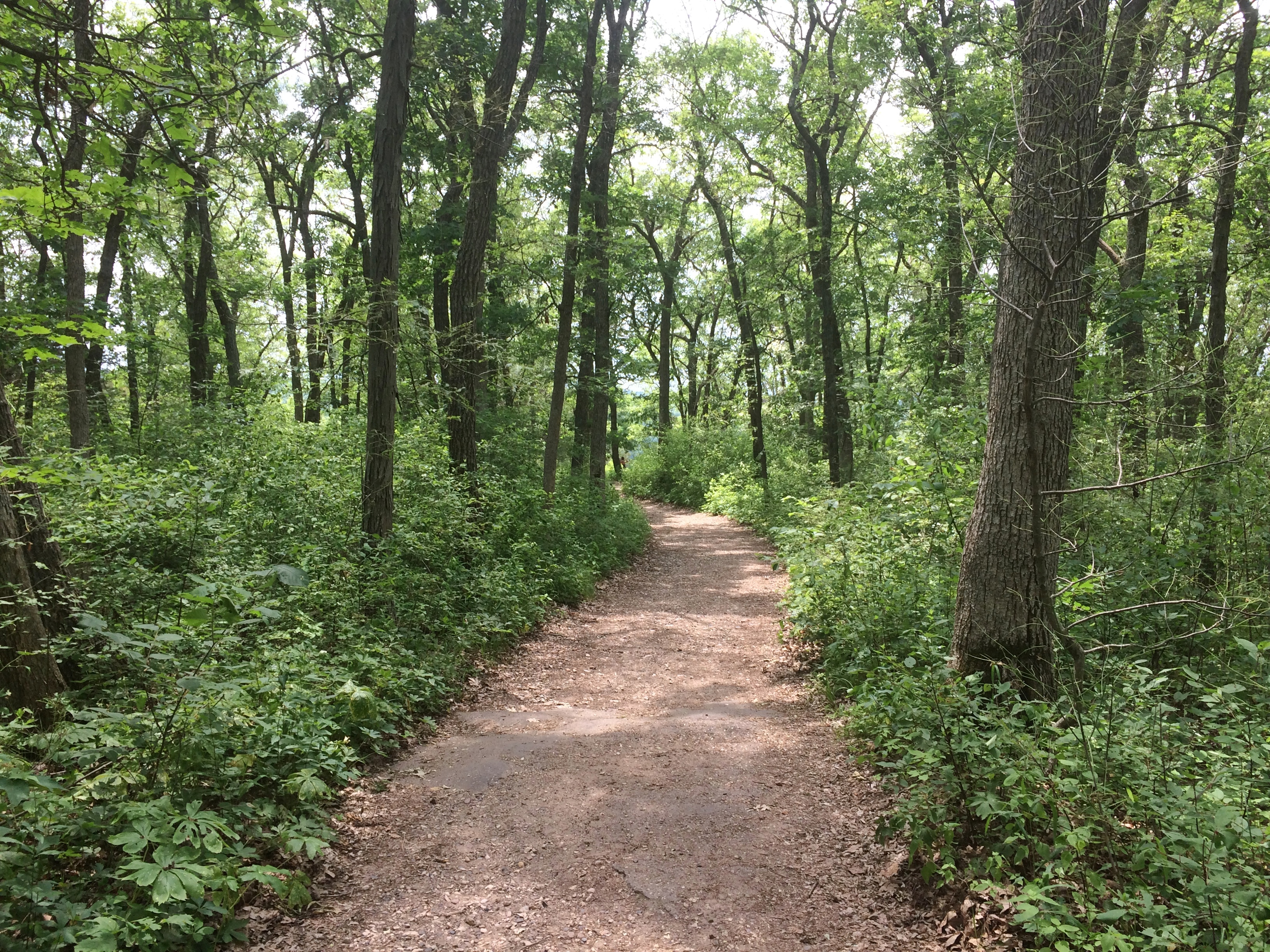
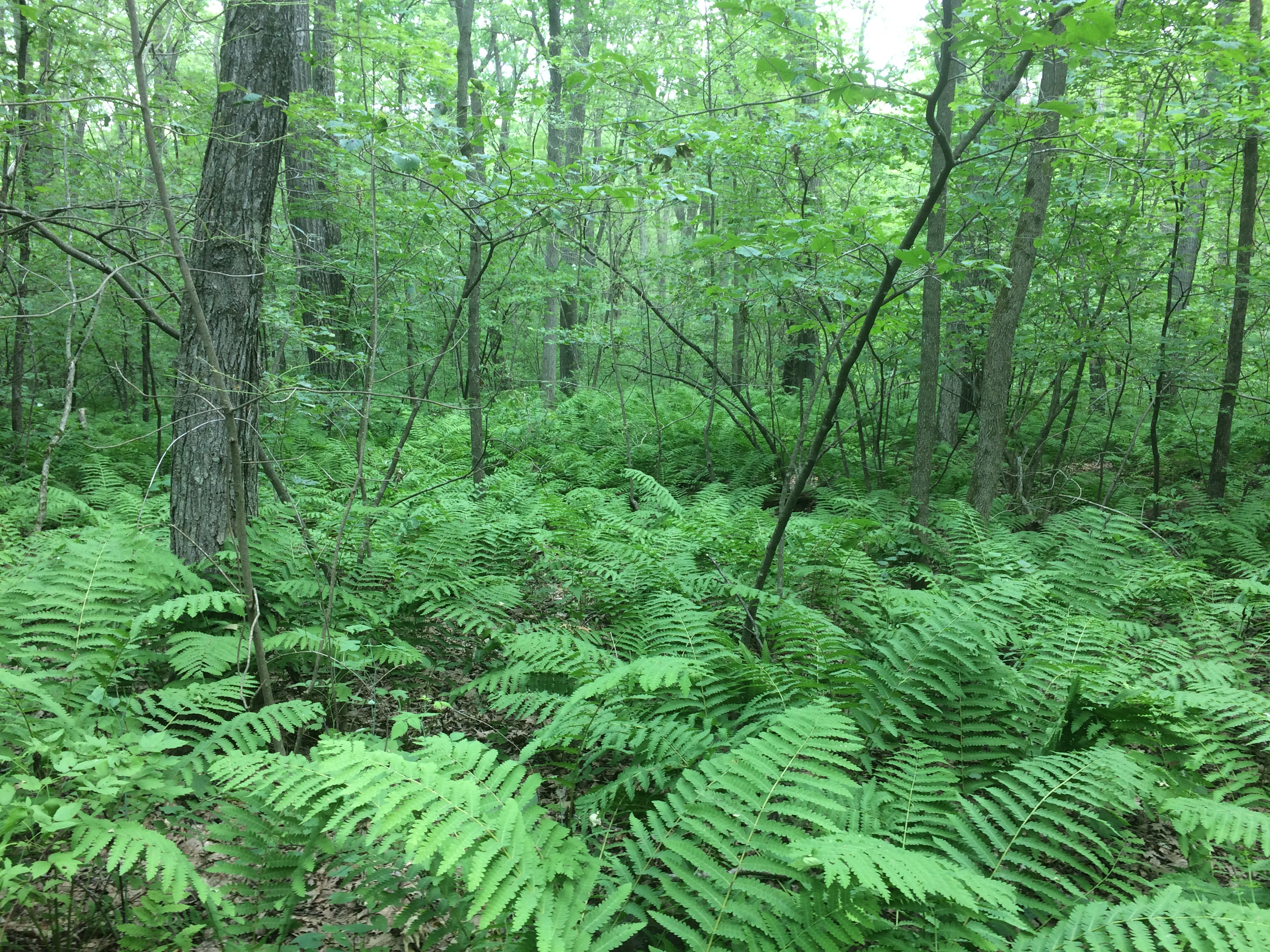
In June, the trail passes through a lush forest in the first flush of a septentrional summer. Past occasional fern fields.
Devil's Lake State Park
Do ferns consider flowering plants a pack of johnny-come-latelies? That’s the kind of deep-time thing I wonder about when wandering through a forest, dog-tired from climbing a Holocene-vintage bluff.

Divers Southern Indiana Courthouses &c

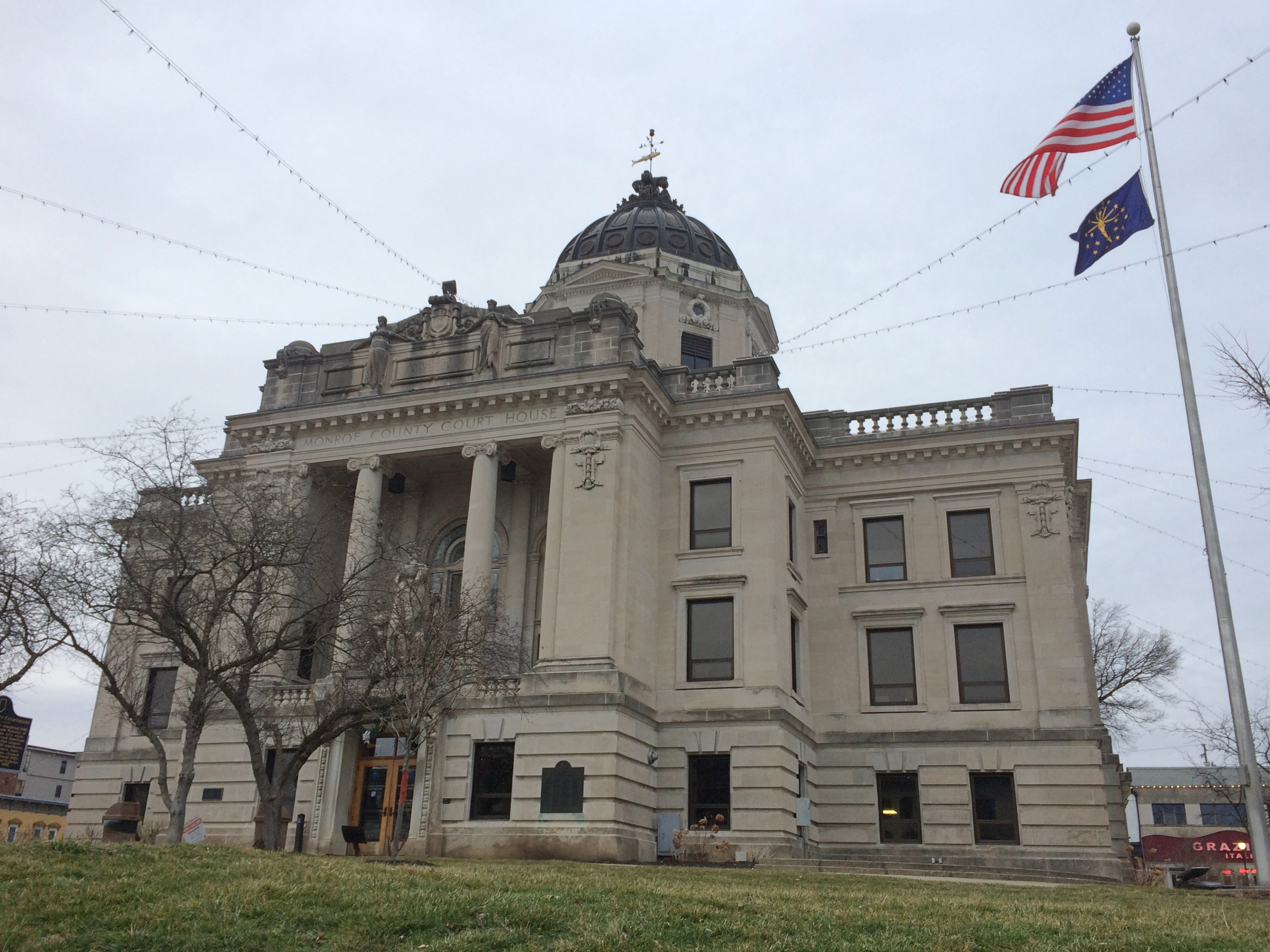
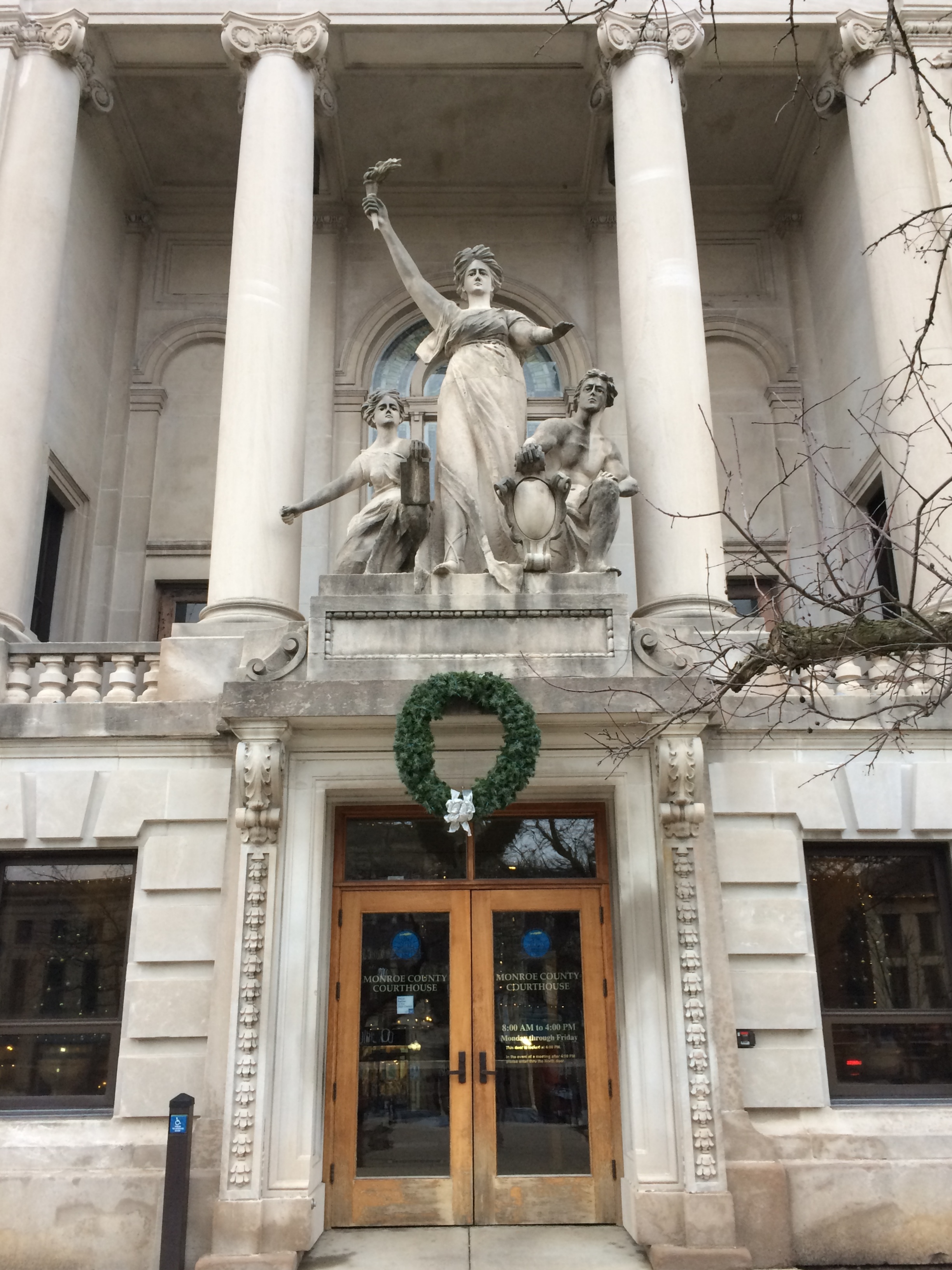
Bloomington is the county seat of Monroe County, Indiana, and sports an impressive downtown courthouse, a 1908 Beaux Arts design by Hoosier architects Wing & Mahurin.

Monroe County Indiana Courthouse

The building was closed for the weekend, but I took a look at the exterior just before dusk. While I stood there, strings of lights lit up.
Monroe County Indiana CourthouseWhat’s a county courthouse without some allegories?
Monroe County Indiana CourthouseOr a war memorial? At first glance, it looks like a Civil War memorial only, but it specifically honors veterans of the war with Mexico, the Civil War, the Spanish-American War and World War I.
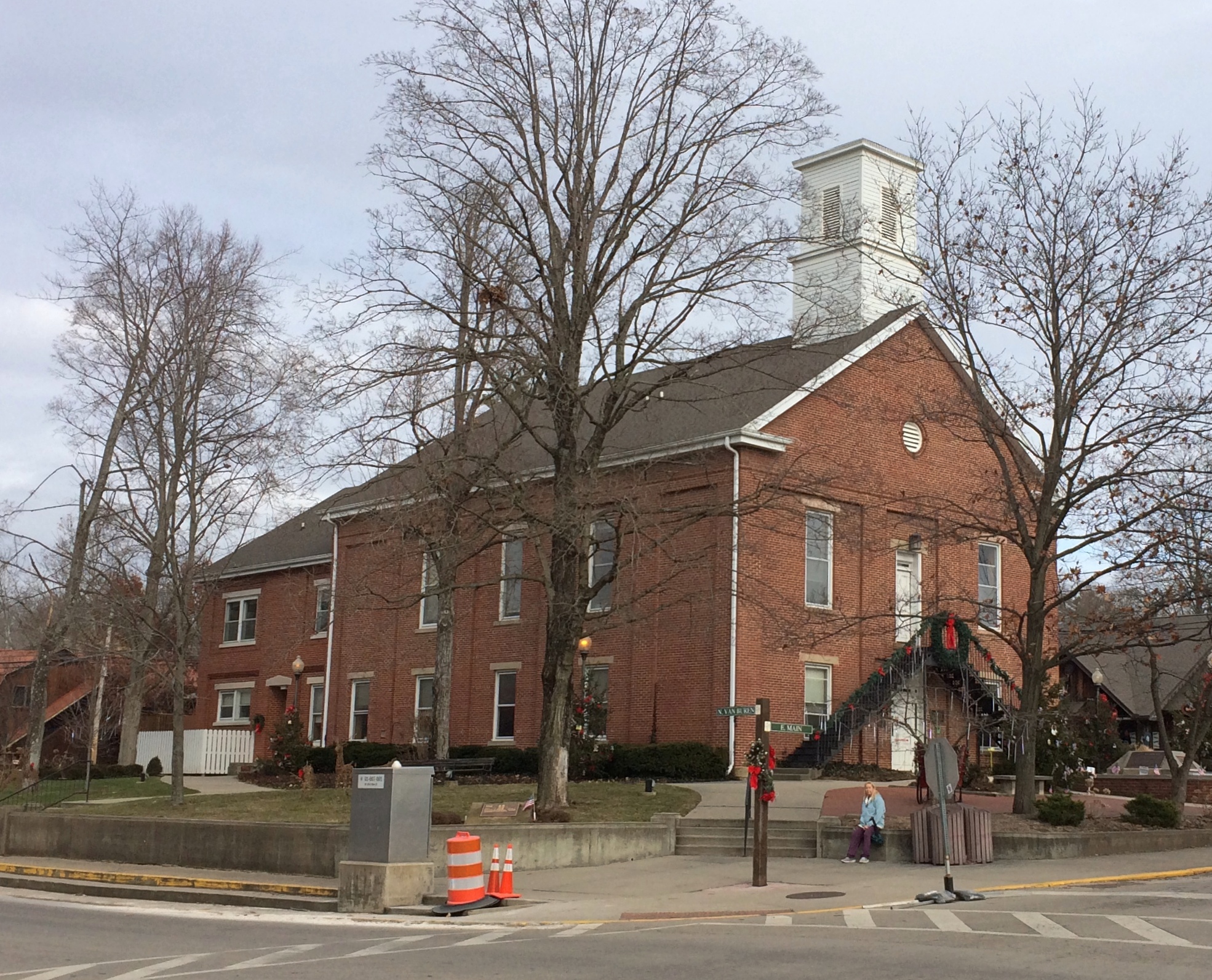
Monroe County Indiana CourthouseWhile in Nashville, Indiana, I took a quick look at the more modest, but also handsome Brown County Courthouse, a structure from the 1870s.
Brown County Indiana CourthouseNashville has some other interesting buildings as well, such as the Nashville United Methodist Church.

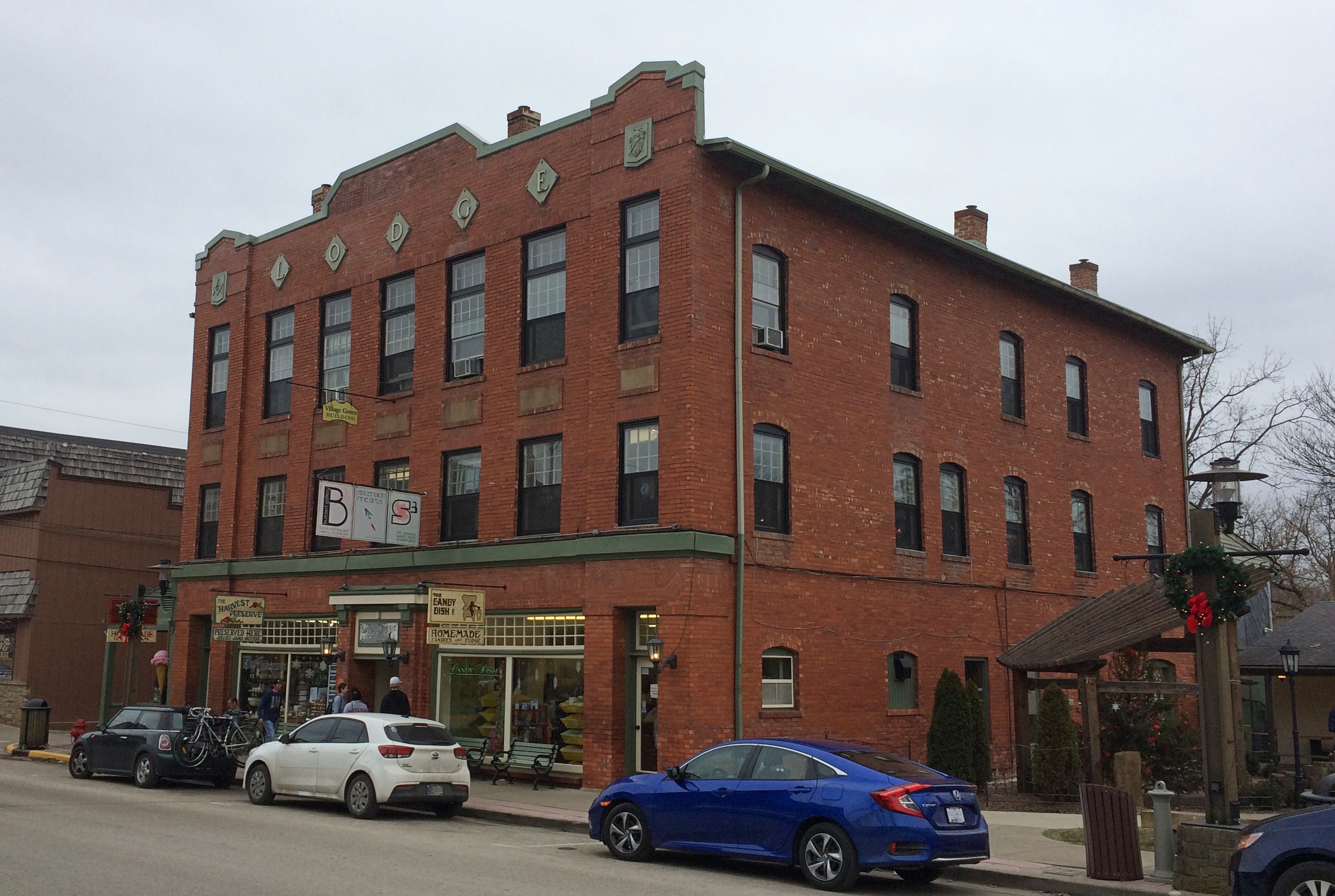
Nashville Indiana UMCThis looks to be a former Masonic building, though I’ve only looked into the matter enough to know that the Nashville, Indiana, Masonic Lodge #135 isn’t in that building, but a newer-looking one. But the older building does say LODGE on the front facade in large letters, along with Masonic symbols on either side.

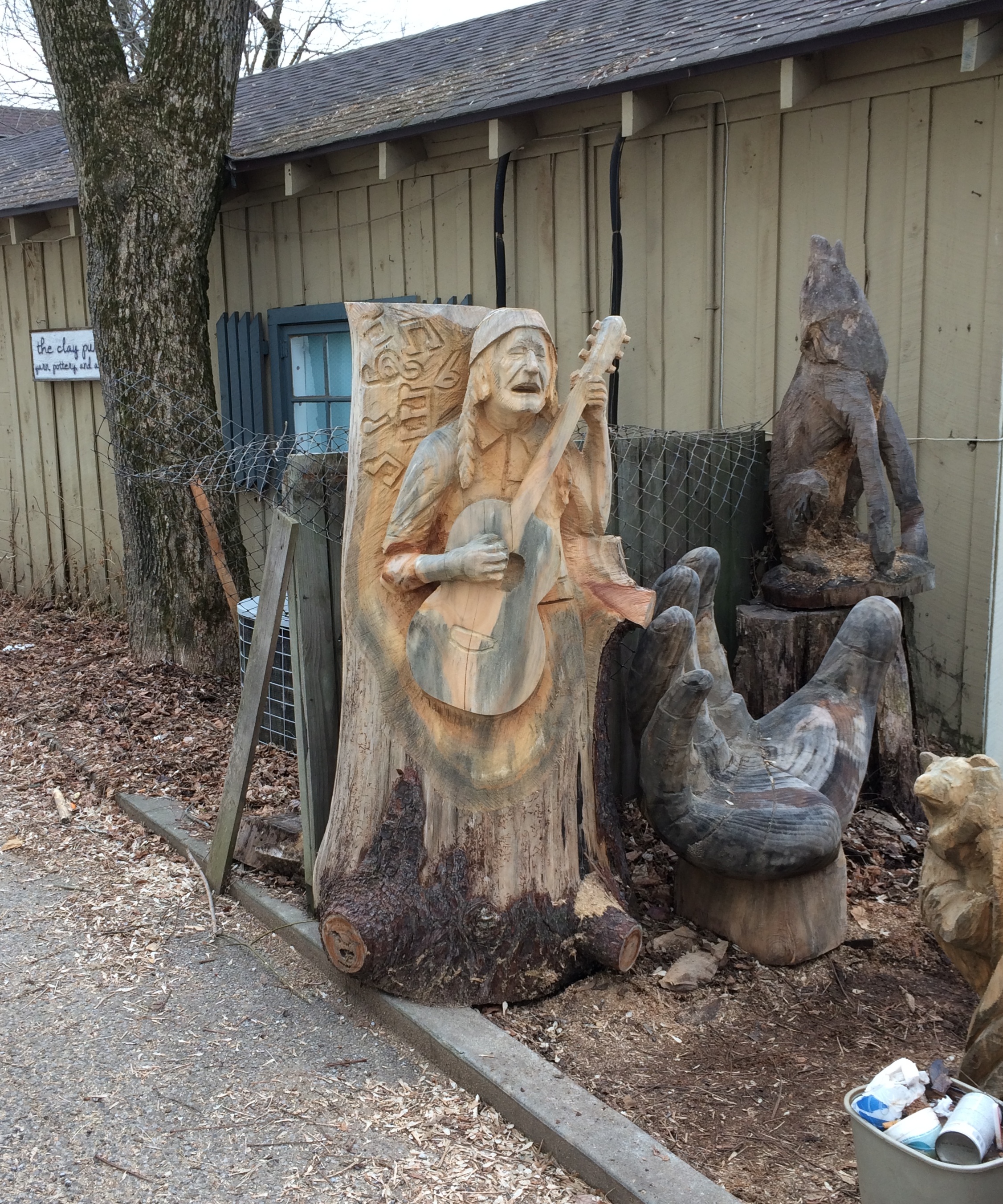
Nashville IndianaNashville isn’t a very large town, but there are streets away from the main tourist drag, Van Buren St. On just such a street we happened across a tree-carving studio.
Nasvhille Indiana tree carving studioBesides Elvis and a bear, you can also find Willie Nelson in wood there.
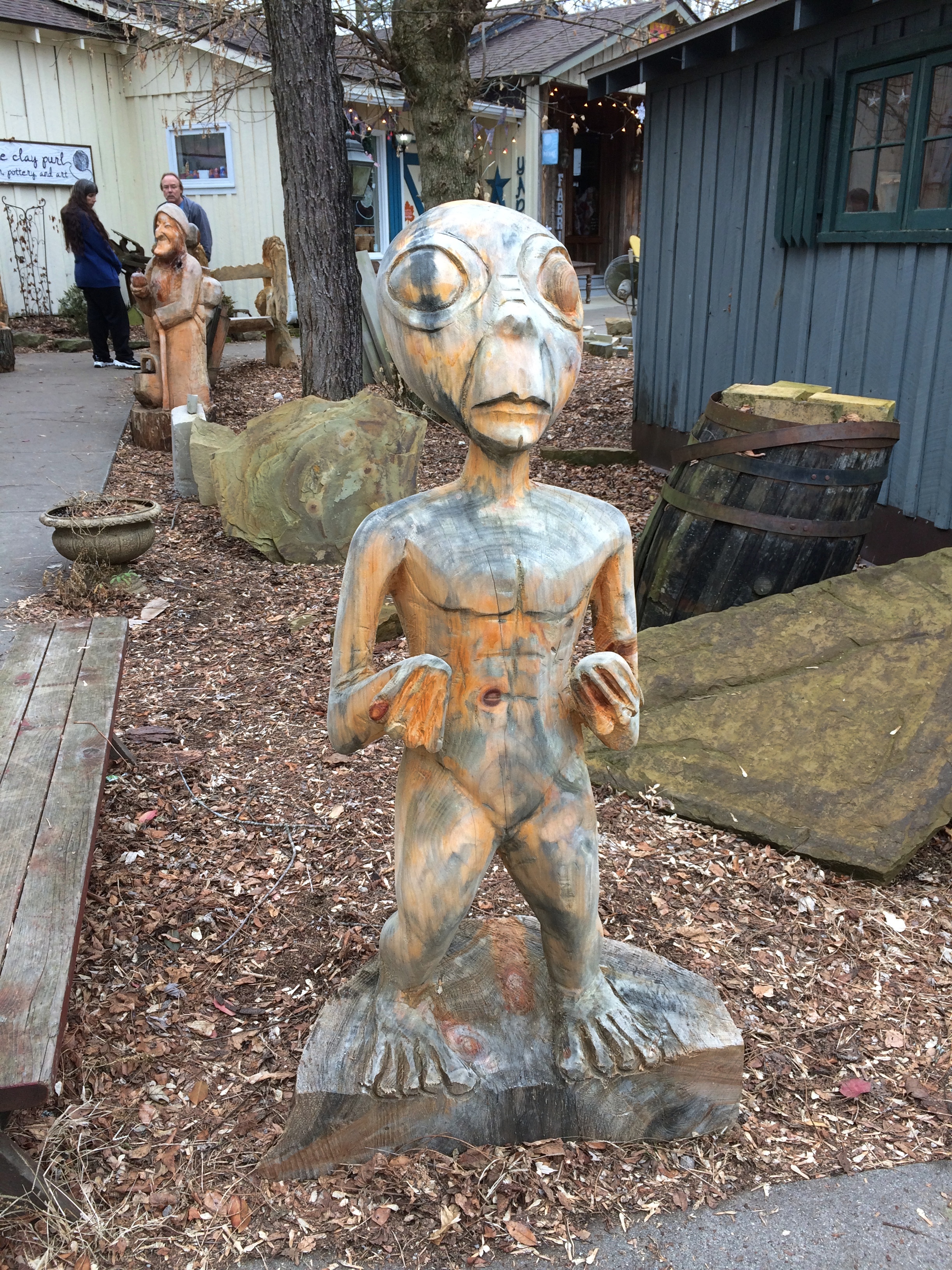
Nasvhille Indiana tree carving studioAnd one of the popular ideas of a space alien.
Nasvhille Indiana tree carving studioOne more courthouse: a good-looking structure in Paoli, Indiana, county seat of Orange County. We passed through town on the way to West Baden Springs, but didn’t stop in the intense rain. Even so, the courthouse caught our attention.

Bay City State Park

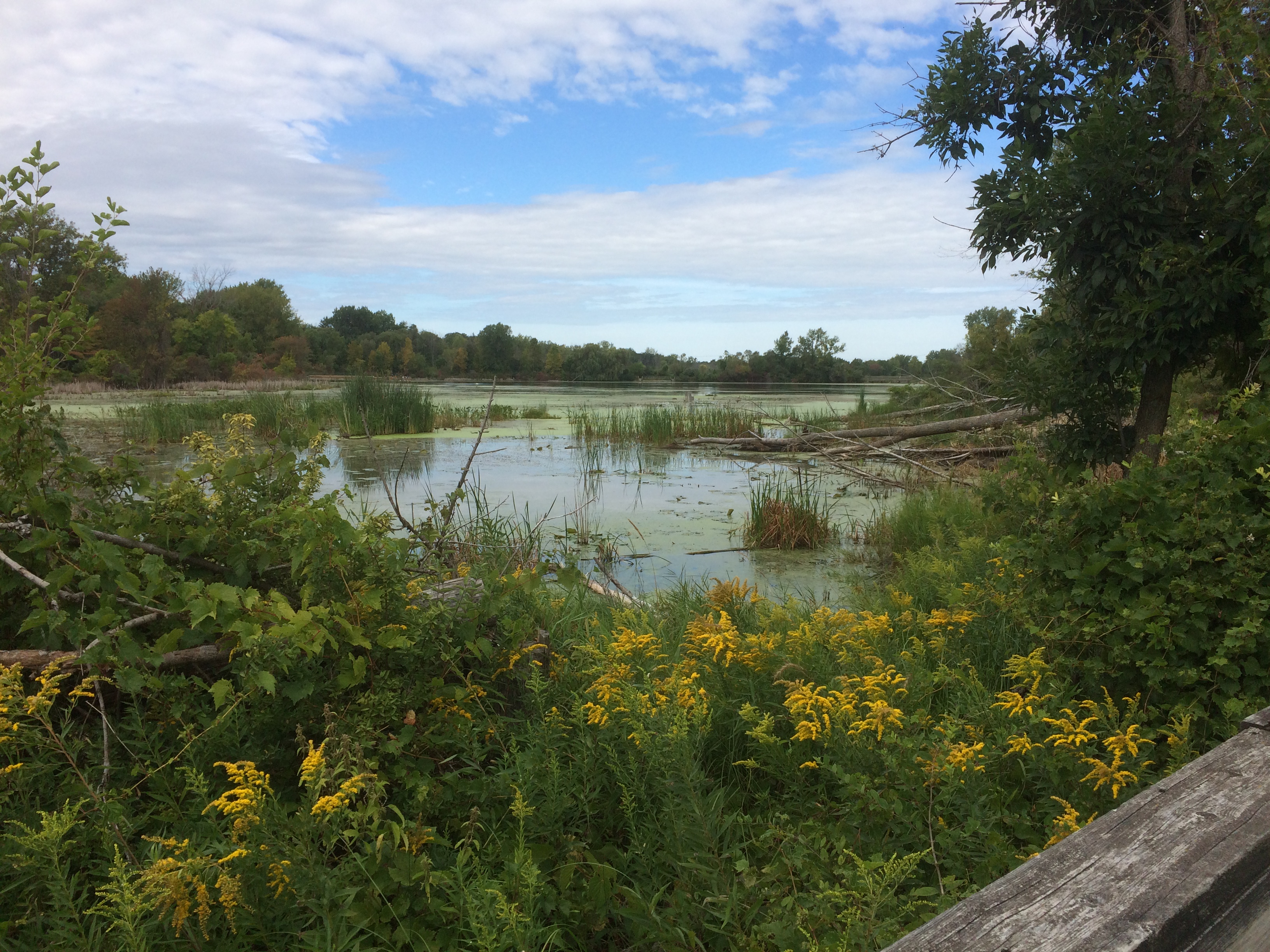
It’s near Bay City, Michigan, but even so Bay City State Park strikes me as a misnomer. It isn’t that near, for one thing — you have drive some miles to reach the edge of the city. Saginaw Bay State Park would be better, because that’s the salient feature of the park.

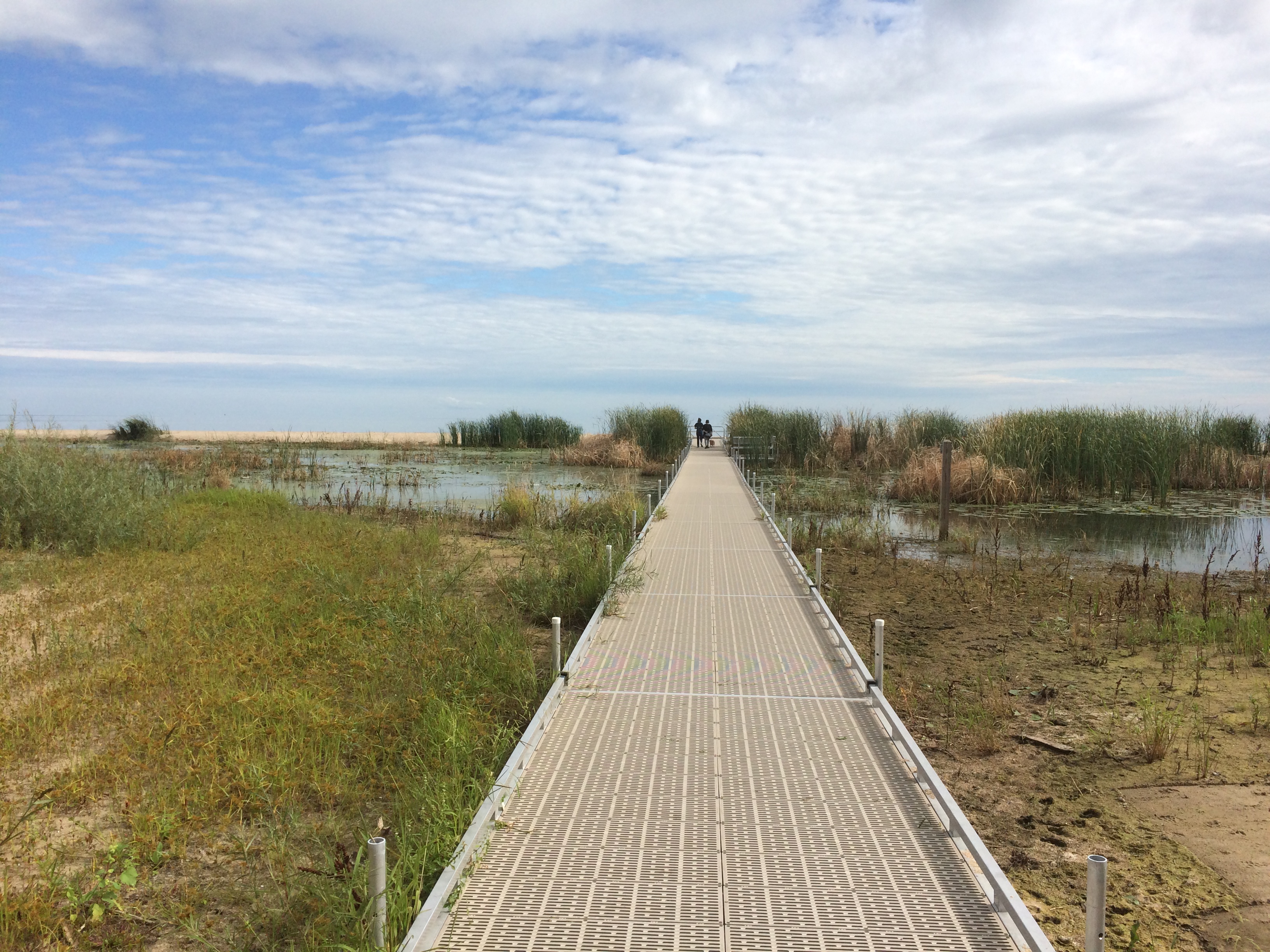
Though it’s a bit of a walk to take in the view. That’s what we did last Sunday morning.
Bay City State ParkWorth it.
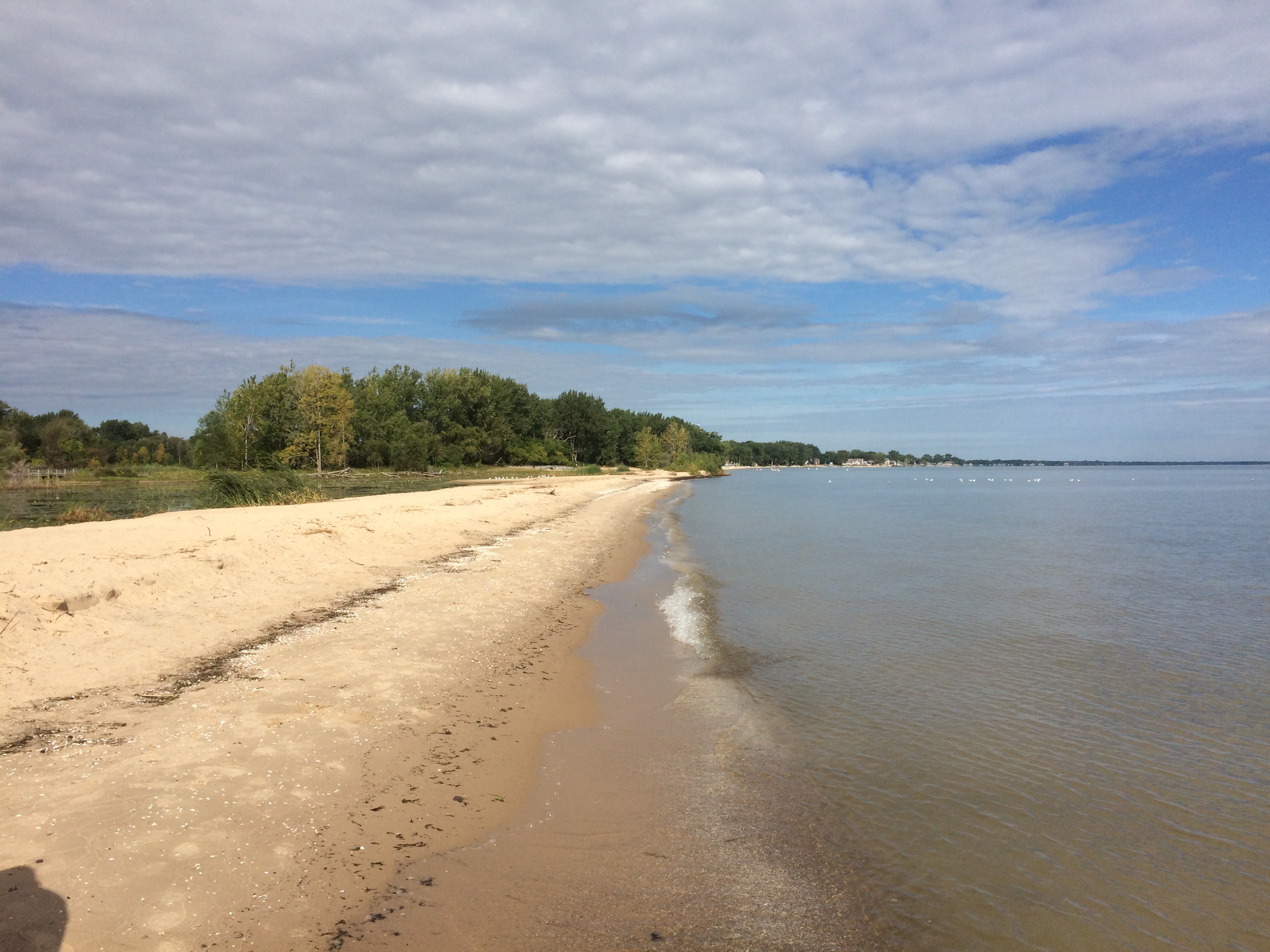
Bay City State Park“Bay City State Park, situated on the shores of the Saginaw Bay, is home to one of the largest remaining freshwater, coastal wetlands on the Great Lakes, the Tobico Marsh,” the Michigan DNR says. “More than a thousand feet of sandy beach and over 2,000 acres of wetland woods, wet meadows, cattail marshlands and oak savannah prairies make it an ideal staging area for migratory birds.”

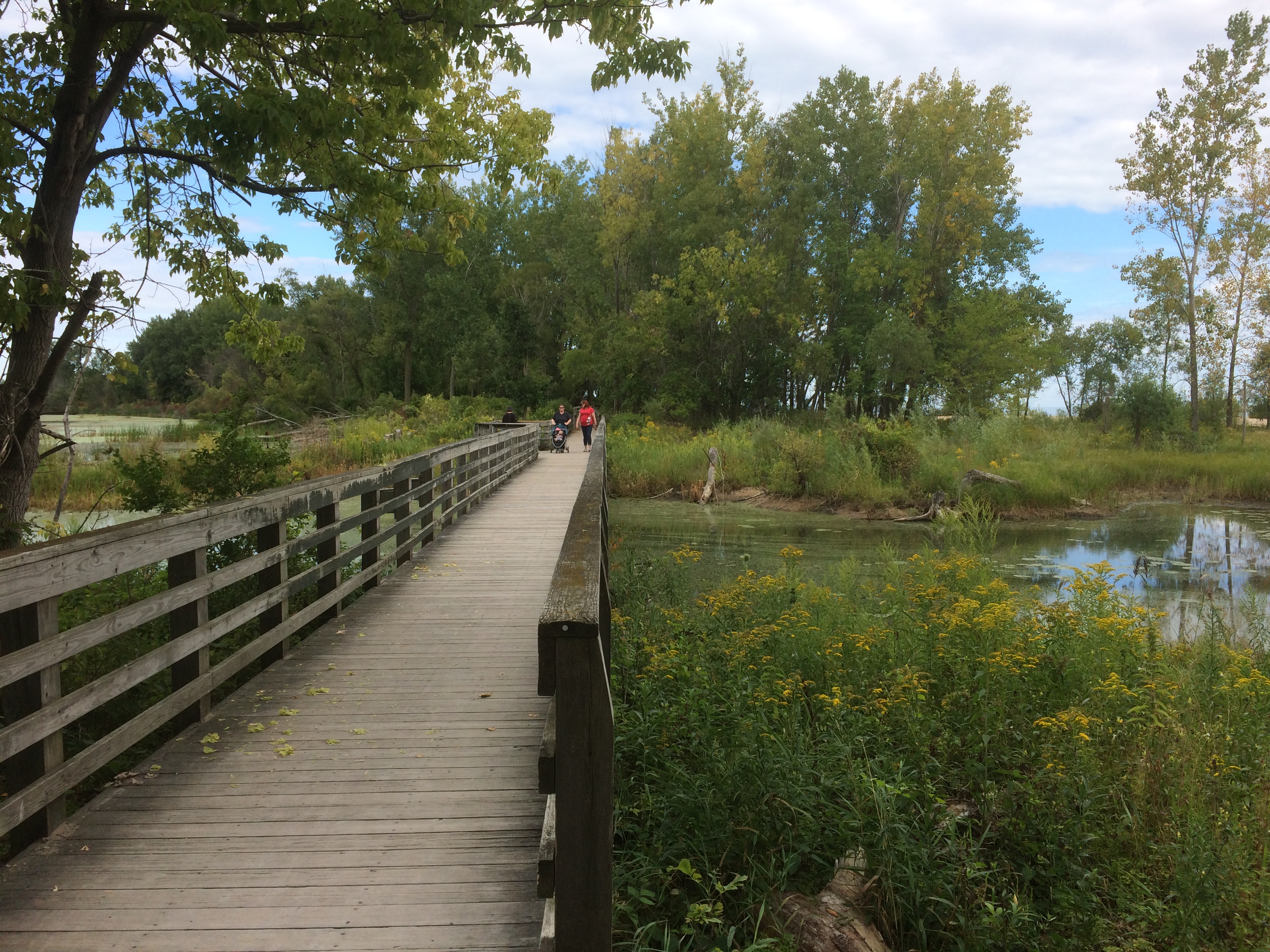
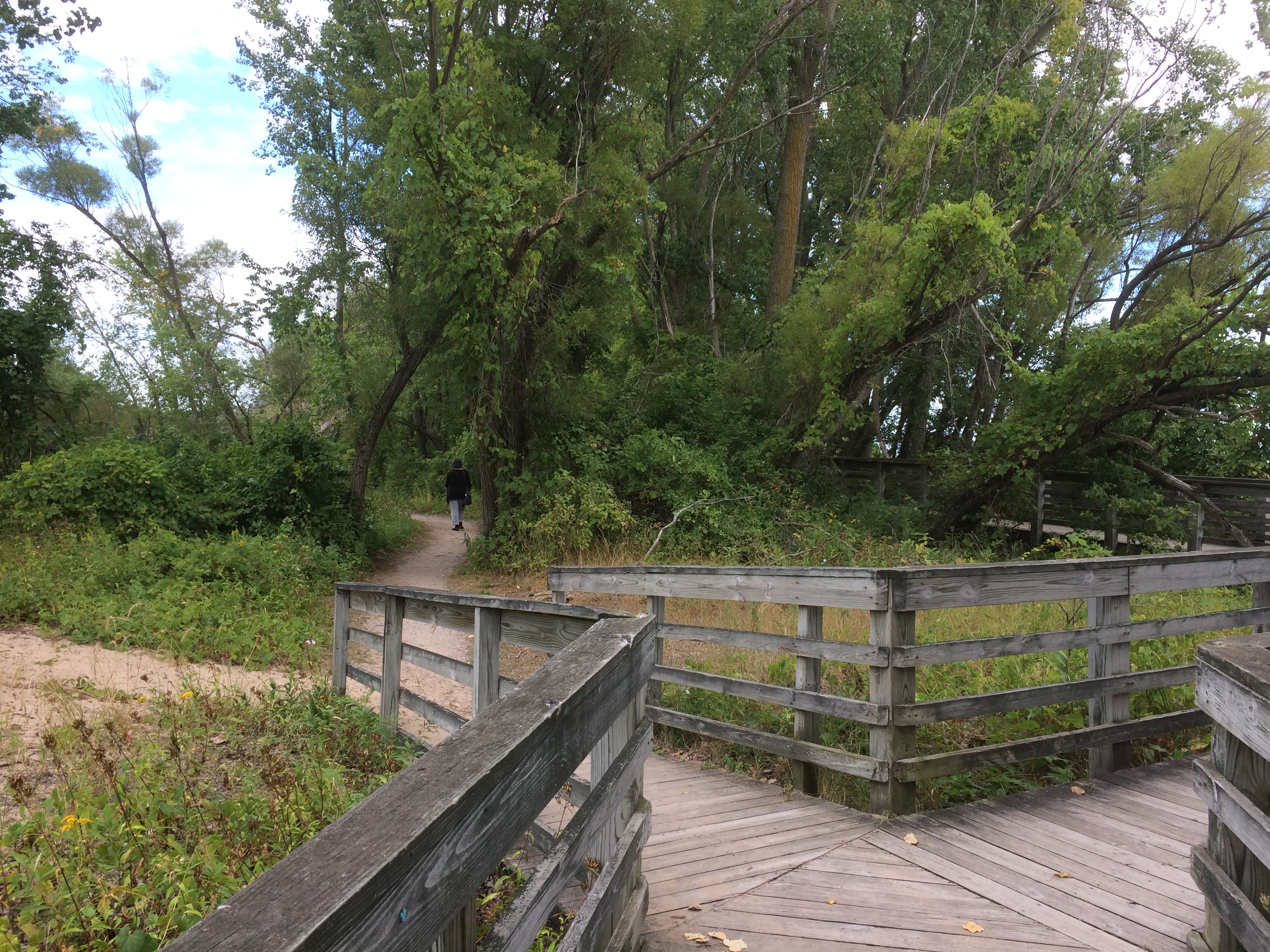
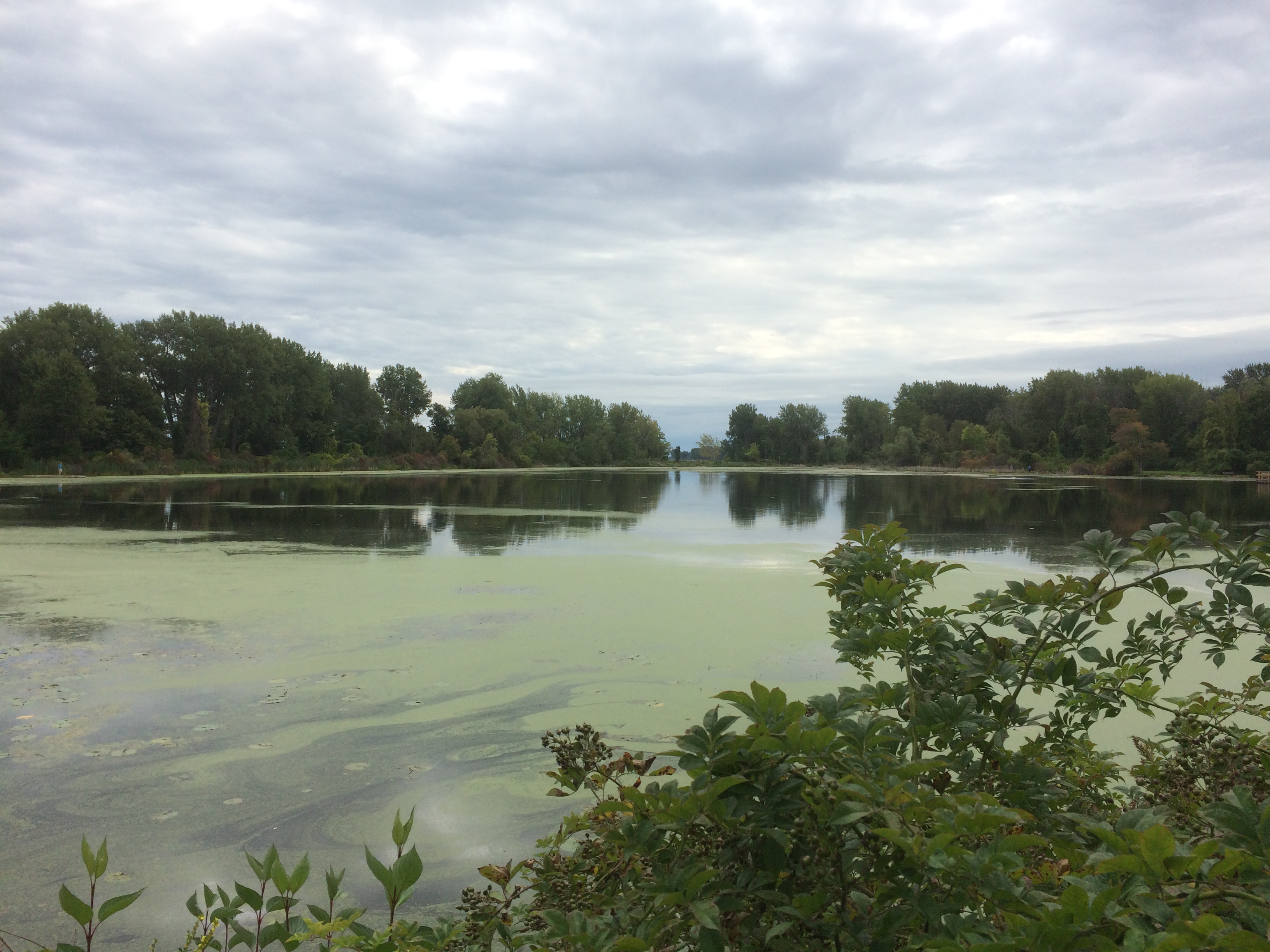
We spent time on the beach, but also walked around the nearby lagoon, which took the better part of an hour.
Bay City State ParkBay City State ParkBay City State ParkBay City State ParkThe air was neither hot nor cold, no mosquitoes bothered us — hard to believe, considering some of our mosquito experiences in Michigan — and the place wasn’t crowded at all, even though it was Labor Day weekend. The dog was happy to sniff along but didn’t pull too hard. Occasionally we’d hear a motor in the distance, but the hum of traffic you hear from every direction in the suburbs wasn’t there. Birds, bugs and wind are most of what you hear in a place like that, if you leave your noisemaking gizmos behind.

Even better than all that, we’d come some distance to be there. That seasoned the experience for the better. All in all, a near perfect walk.

Point State Park & Pittsburgh Walkabout

RIP, Patricia Deany, mother of our dear old friend Kevin Deany, and a kind and gracious lady. She passed last week at age 90.

At the confluence of the Allegheny and Monongahela rivers is Point State Park, a 36-acre triangular patch of land that may well be featured in every bit of tourist literature ever published about Pittsburgh since the park’s creation nearly 50 years ago.

But that’s no excuse not walk over to the park from downtown Pittsburgh and make a circuit around the fountain at the tip of the park, which is what we did after lunch at the Oyster House on July 5.
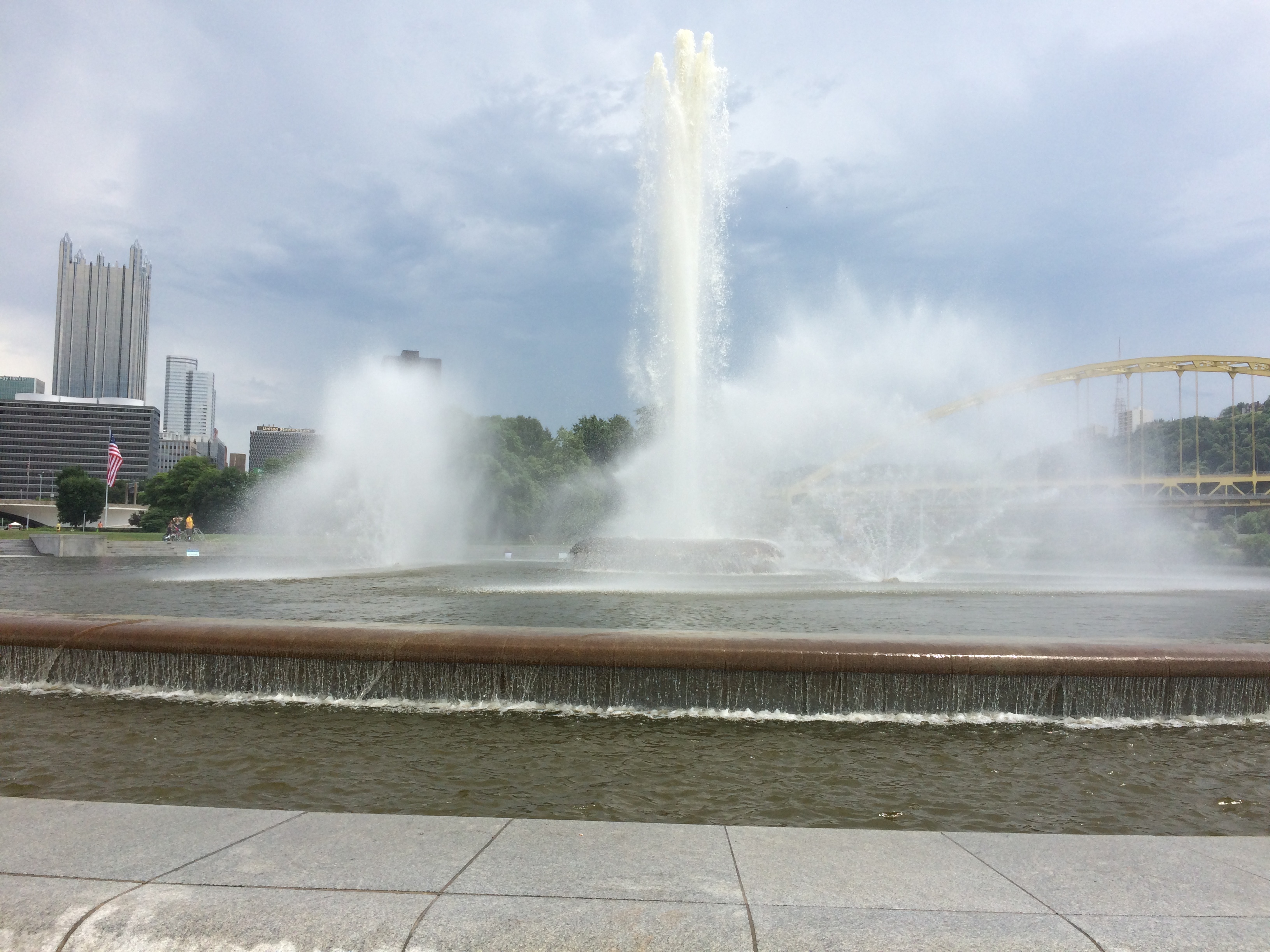
Point State Park, PittsburghThat image makes it look like no one else was there, which wasn’t true at all.
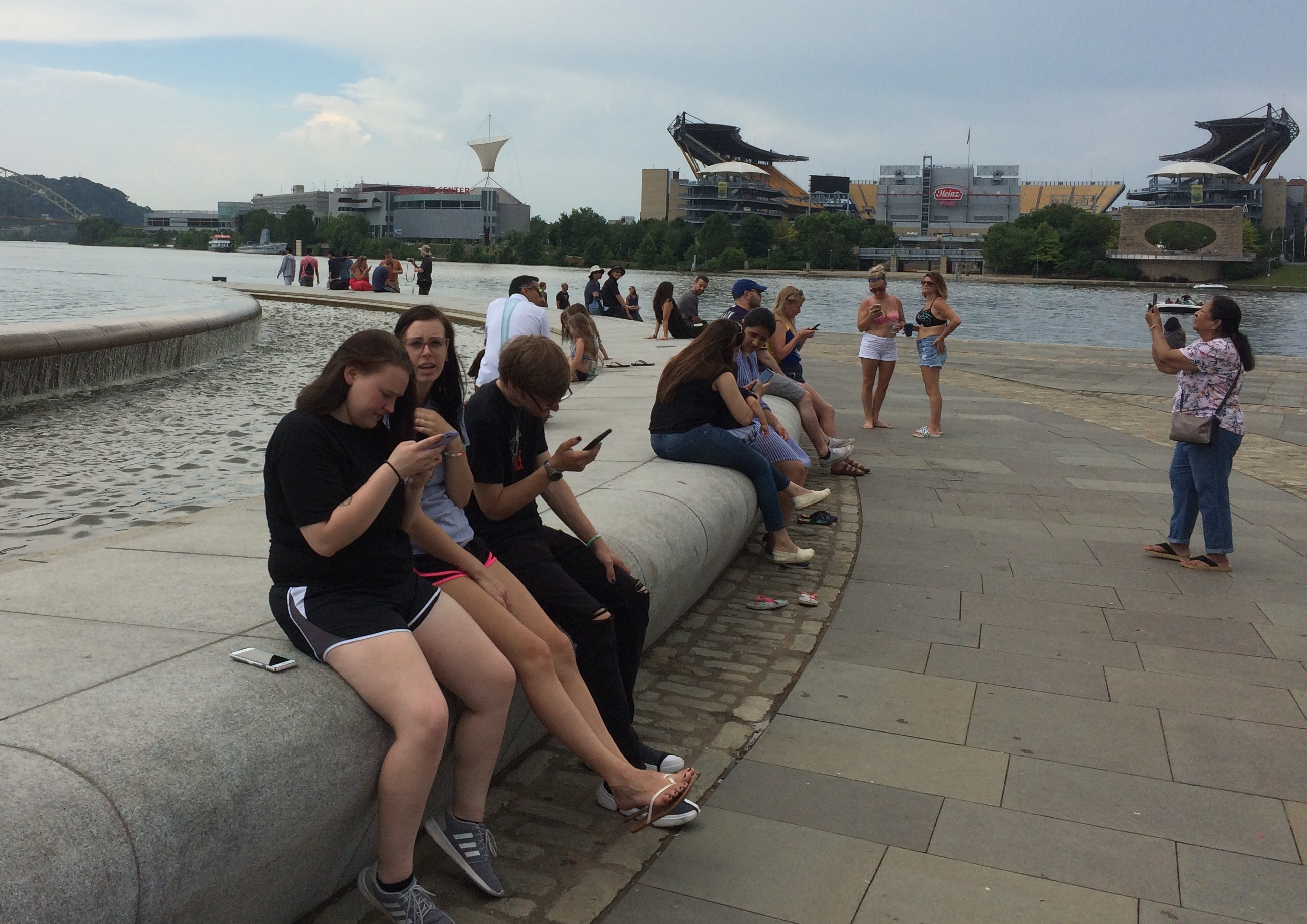
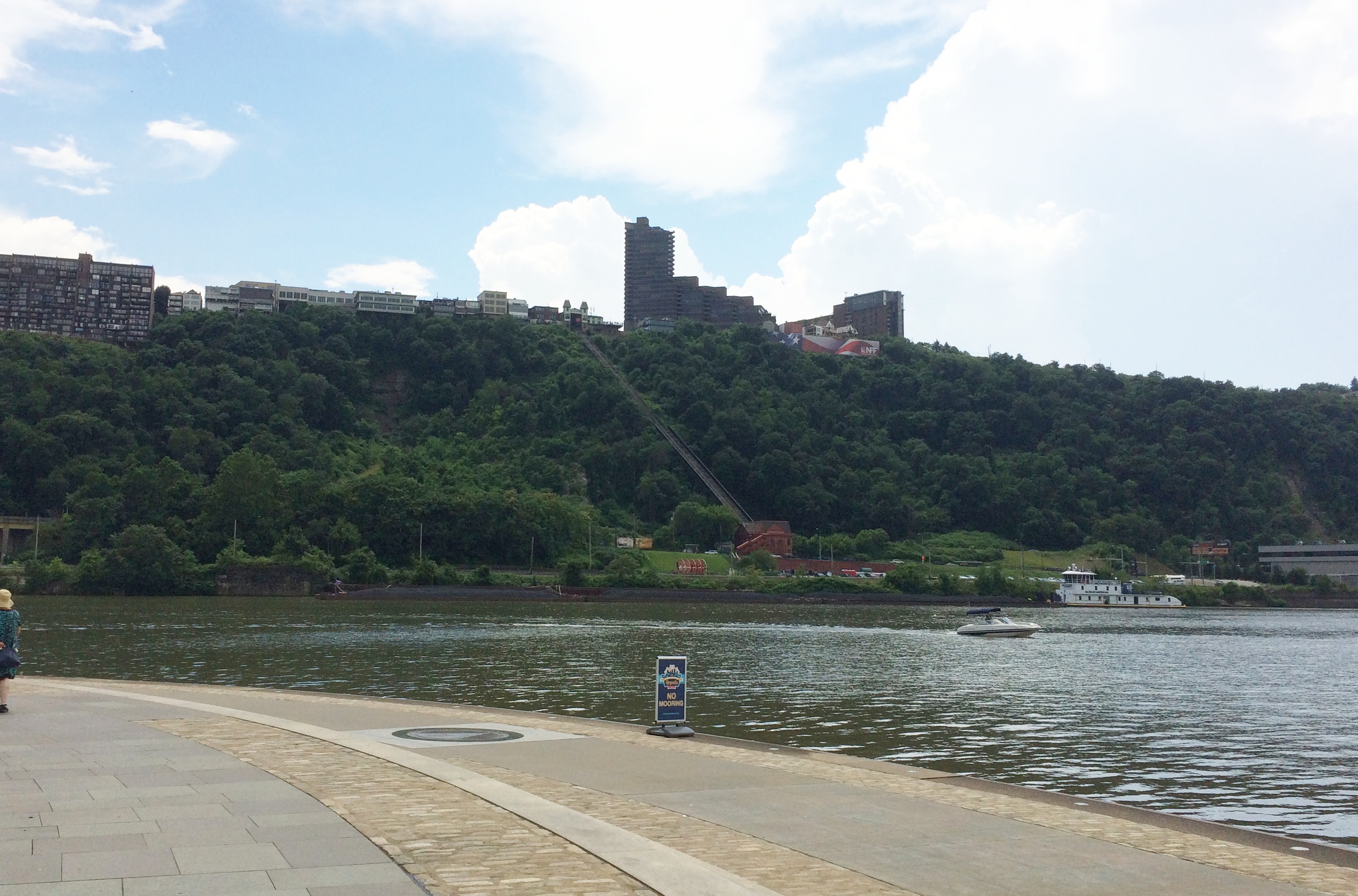
Point State Park, PittsburghThe park offers views of various other parts of Pittsburgh, such as Mt. Washington and the Duquesne Incline.
Point State Park, Pittsburgh

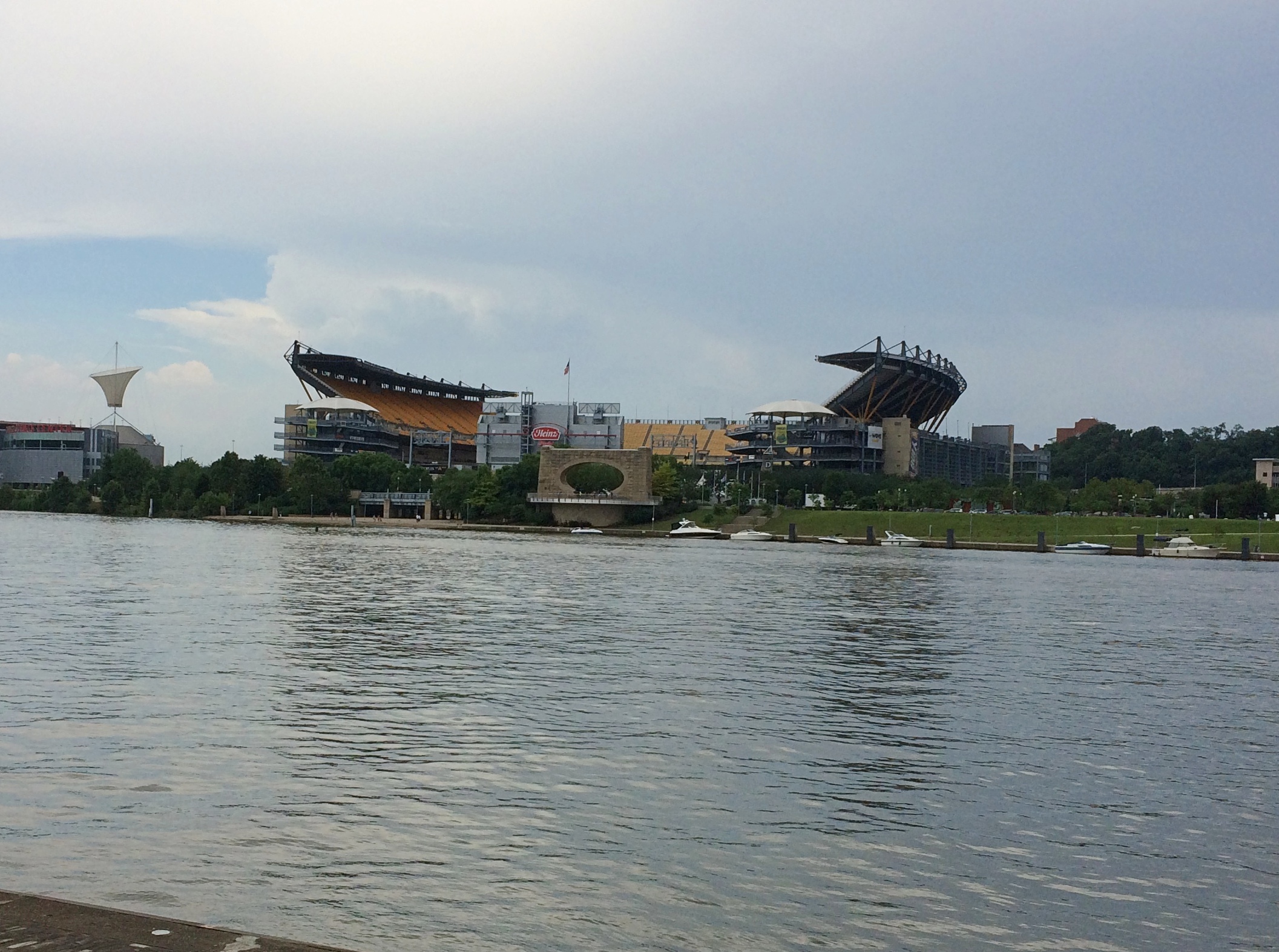
Or Heinz Field, home of the Steelers. There ought to be a giant ketchup bottle in there somewhere.
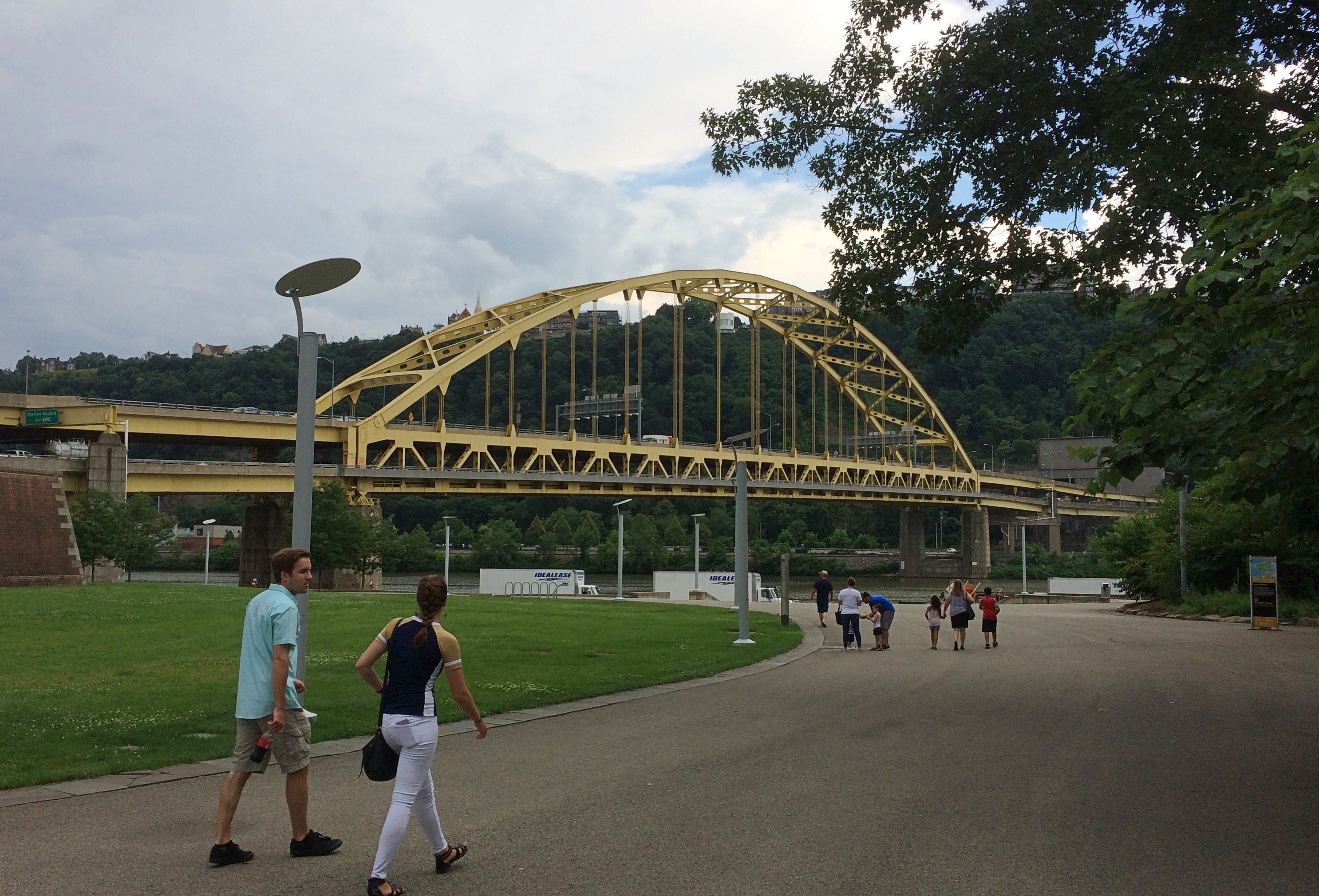
Away from the fountain, there’s a view of the Fort Pitt Bridge, which carries I-376 across the Monongahela. It replaced the Point Bridge, which was destroyed, along with the Manchester Bridge, to make way for the park.
Besides being a pleasant green space with views, the park makes various nods to the early history of Pittsburgh. An irregular path of sidewalk follows the outline of Fort Duquesne, the French outpost. Elsewhere other sidewalks mark the outline of the somewhat larger Fort Pitt, the succeeding British outpost, also in the classic star (Bastion) shape.
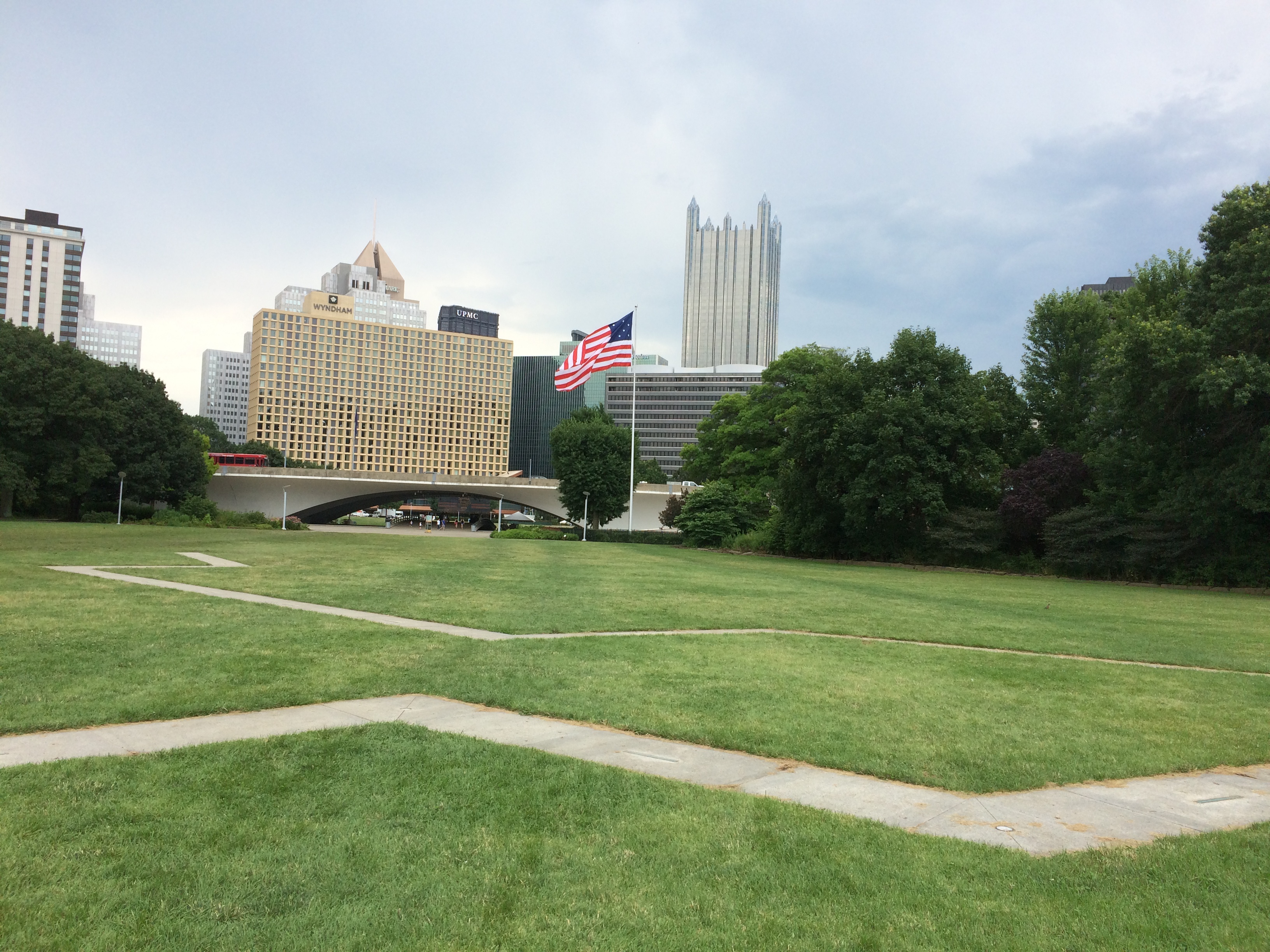
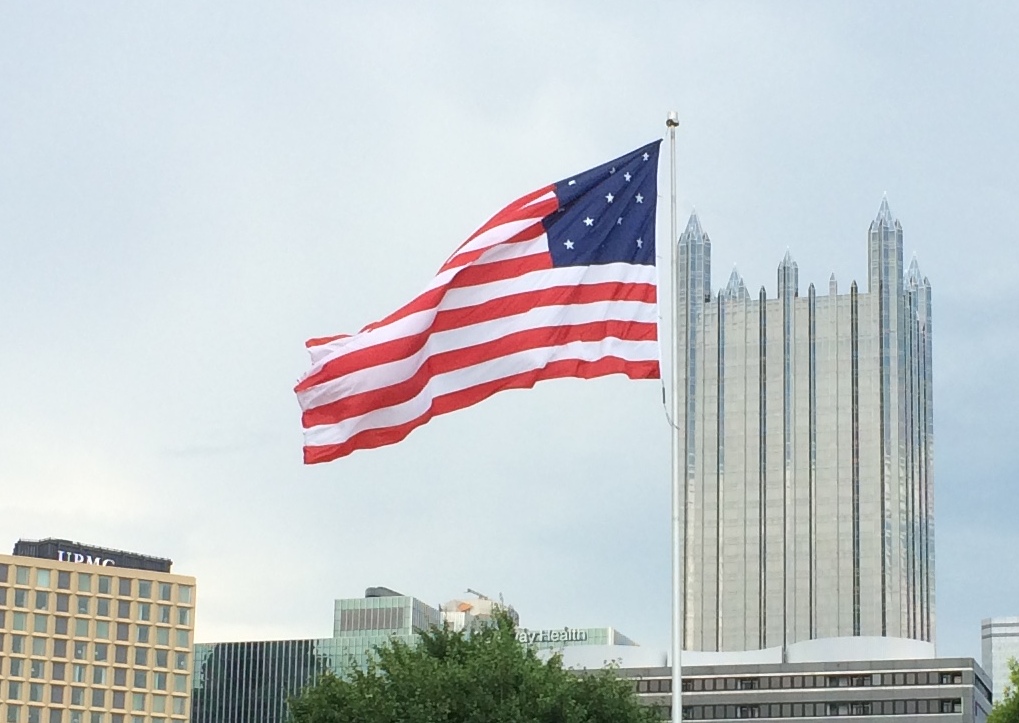
The U.S. flag is a little unusual. Not in having 13 stars, but in that they aren’t the circular arrangement you usually see. Then again, no one specified how the stars in the canton should be arrayed in those days (and maybe we should go back to that).
Point State Park, PittsburghOn one edge of the park is the Fort Pitt Block House, Point State Park’s only surviving structure from colonial times, built in 1764 as a redoubt of Fort Pitt. It has endured since then in its original spot, for many years as a residence, more recently as a relic.
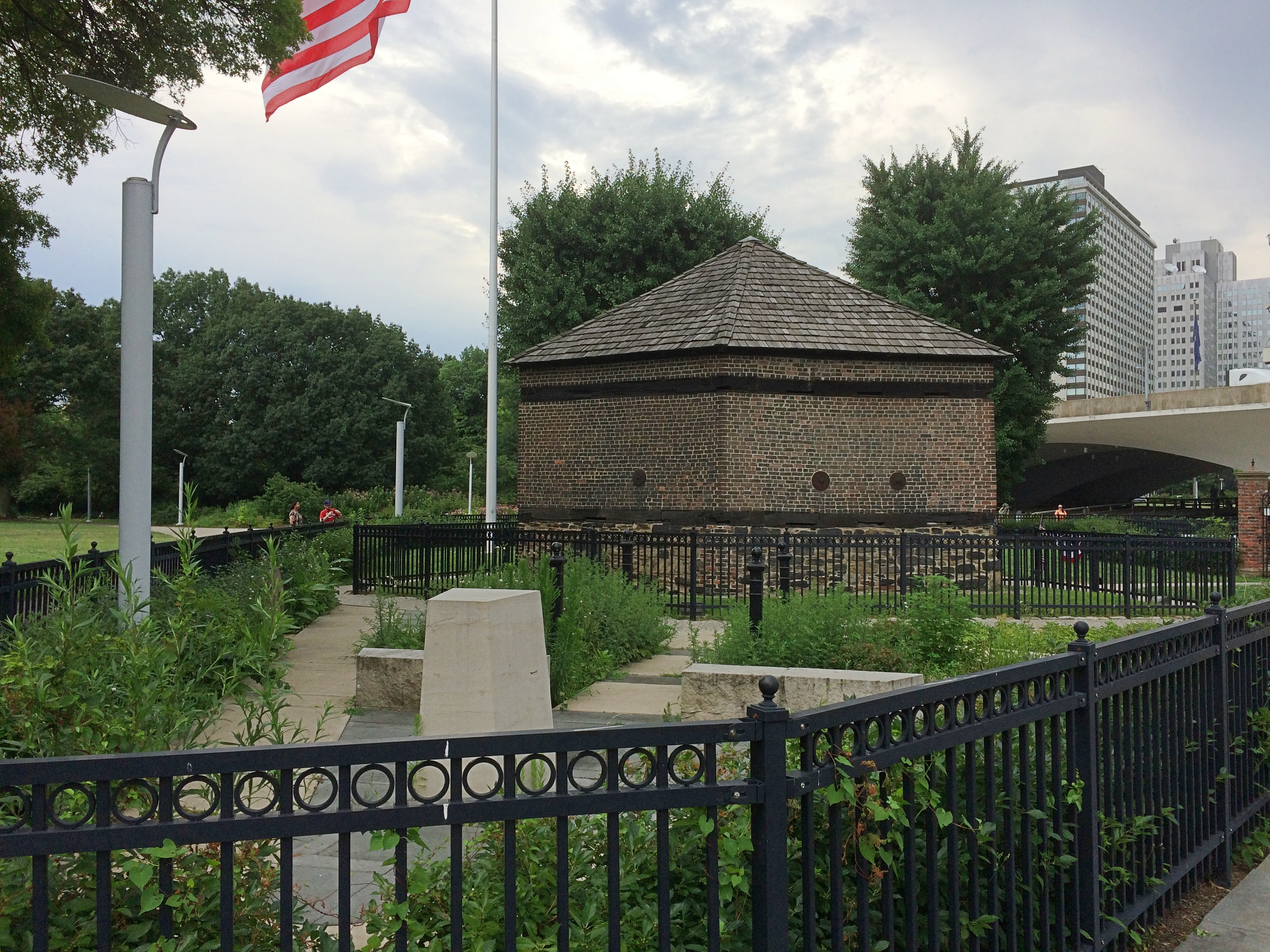
Our walking tour of downtown Pittsburgh started at the Block House, led by an energetic young woman, native to Pittsburgh and eager to talk about various places and buildings, though less about design and more about history.

Naturally, the names of Pittsburgh robberbarons Andrew Carnegie and Henry Clay Frick came up a lot, including the story about a dying Carnegie writing a letter to the estranged Frick asking for a meeting, presumably in the spirit of reconciliation.

Les Standiford tells the story, via NPR. A man named Bridge, who delivered the letter, was Carnegie’s assistant.

“Frick’s ire was, after all, legendary. He’d gone toe-to-toe with strikers, assassins, and even Carnegie himself, and had rarely met a grudge he could not hold. Long before Frick had constructed the mansion that would dwarf Carnegie’s ‘Highlands’ up the street, he had gone out of his way to purchase a tract of land in downtown Pittsburgh, then built a skyscraper tall enough to cast Carnegie’s own office building next door in perpetual shadow.

” ‘Yes, you can tell Carnegie I’ll meet him,’ Frick said finally, wadding the letter and tossing it back at Bridge. ‘Tell him I’ll see him in Hell, where we both are going.’ ”

Whatever else you can say about the steely-eyed bastard Frick, at least he had no illusions about his benevolence, as Carnegie seemed to have had. Our guide also mentioned the taller Frick building next to Carnegie’s, and in fact pointed them out. They are both now overshadowed by more recent Pittsburgh buildings, of course.

At one point, we passed by a building associated with both Carnegie and Frick, along with a lot of other Gilded Age and later tycoons: the Duquesne Club on Sixth Ave.
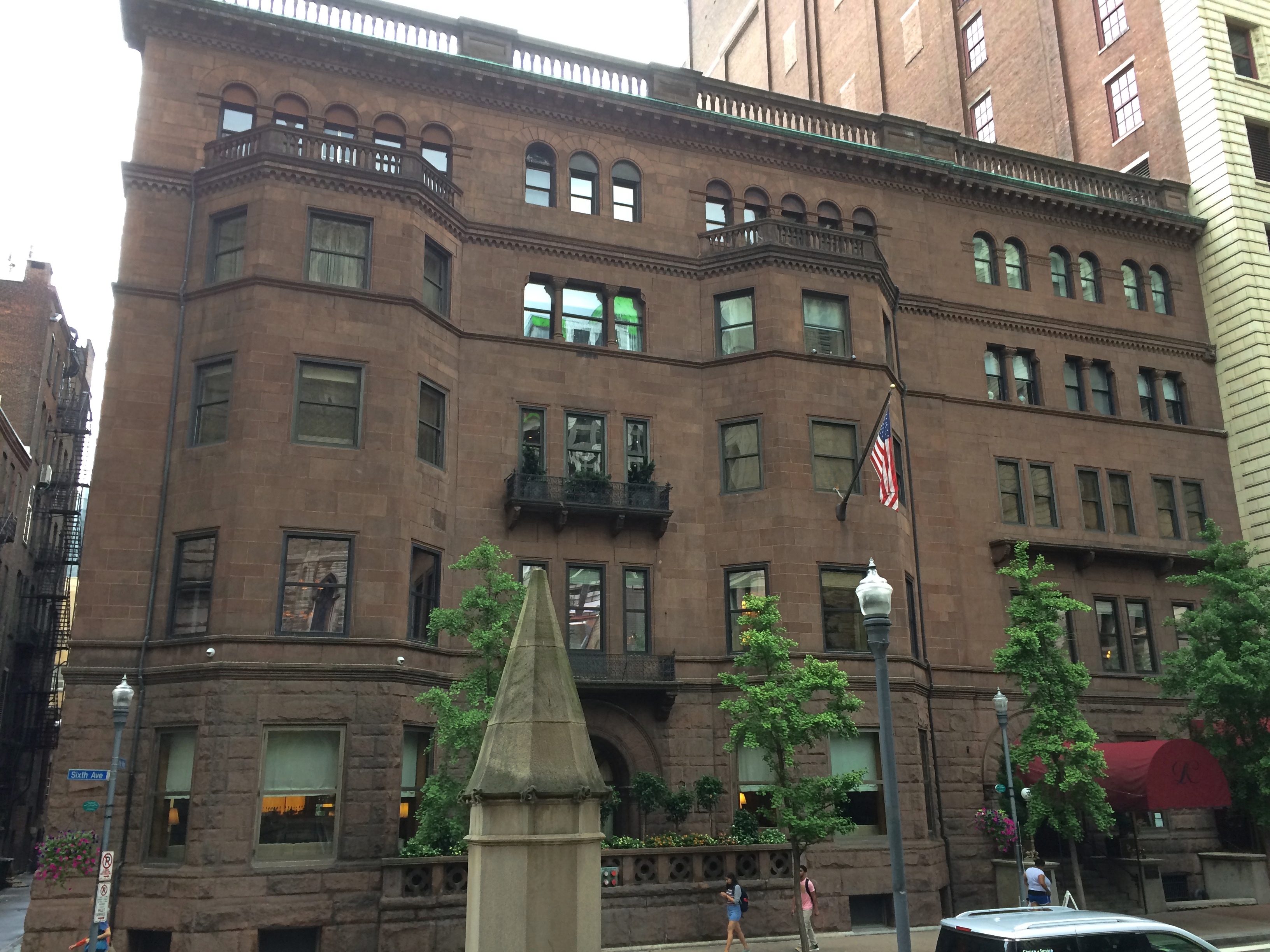
Duquesne Club Founded in 1873 and still a social club for the wealthy, its current home, a Romanesque structure designed by Longfellow, Alden & Harlow, opened in 1890. Just in time for Carnegie and Frick to discuss, possibly over brandy and cigars, the busting of the Amalgamated Association of Iron and Steel Workers.

Speaking of labor history, not far away from the club, I noticed this historic marker.
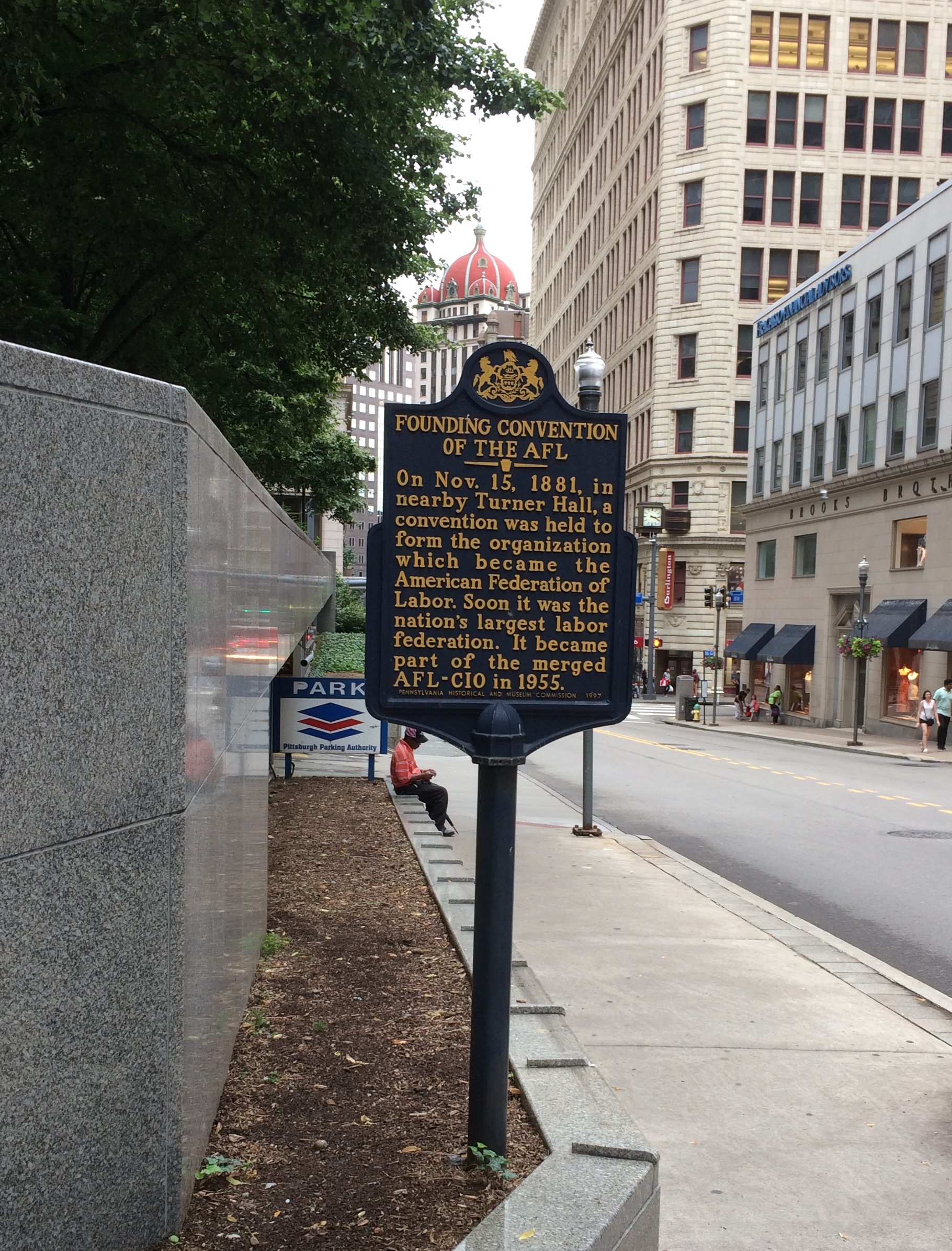
AFL Marker, Pittsburgh - Turner HallThe founding convention of the AFL was in a Turner Hall. Our guide didn’t mention that, and I asked her about the Turner Hall. She hadn’t heard it. To be fair, I’d never heard of Turner Halls until recently either. To be extra fair, I’m not guiding walking tours of a major American city, so I consider that a small lapse on her part.

The Turner Hall in Pittsburgh, unlike that in Milwaukee, is no more. The site is now called Mellon Square, a 1950s park-like creation paid for by the Mellons to go with the development of Alcoa’s new headquarters building at that time.

Alcoa isn’t there any more, and the building is now known as the Regional Enterprise Tower, but it still has its distinctive aluminum skin. The New York modernists Harrison & Abramovitz designed it.
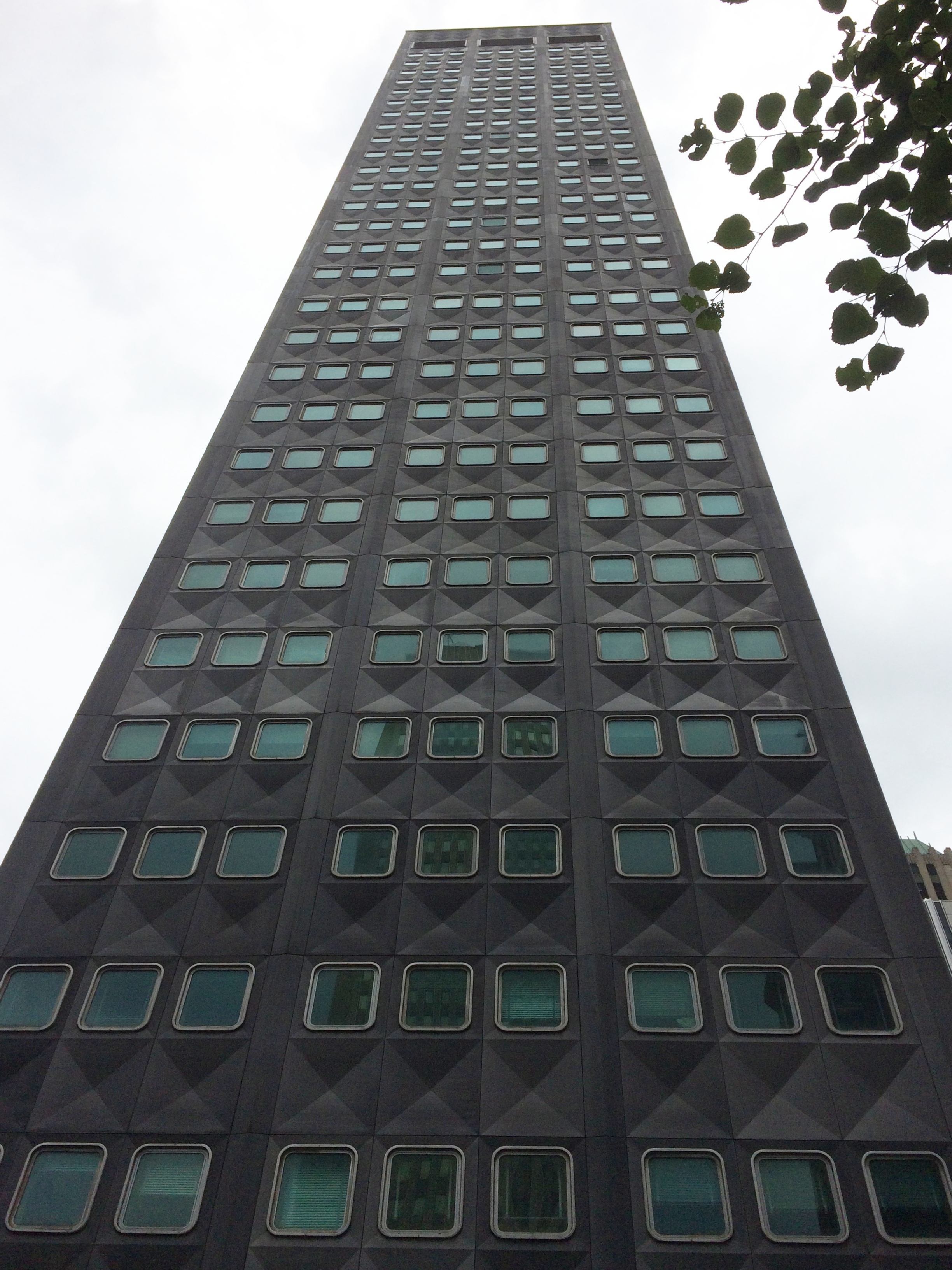
Alcoa Building Pittsburgh

I’ve read that a Beaux-Arts palace of a theater, the Nixon, was destroyed to make way for Alcoa, causing some consternation even in the tear-it-down midcentury.

Another historic marker that I noticed (that also wasn’t on the tour).
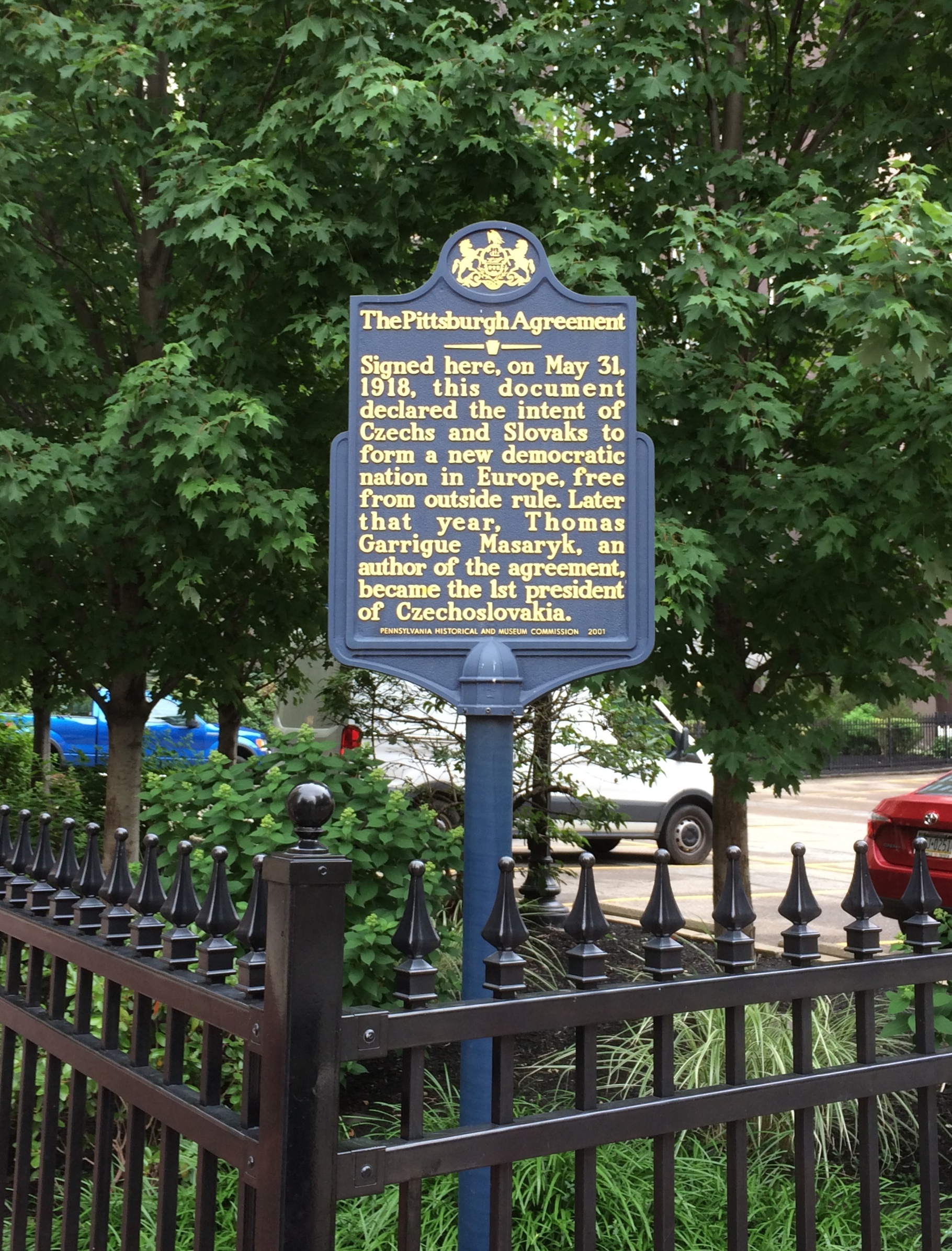
Pittsburgh Agreement MarketWhy Pittsburgh? I wondered. I looked it up later. NPR again: “Slovak culture is everywhere in the Steel City. It’s home to the Honorary Slovak Consulate, a handful of social clubs, cultural centers and annual holiday festivals dedicated to maintaining and celebrating Slovak traditions.

“ ‘Allegheny County has the highest percentage of all of the counties in the United States, not just Pennsylvania, of people who claim Slovak heritage,’ said Martin Votruba, head of Slavic studies at the University of Pittsburgh.

“Slovaks and Czechs formed a group called the Czecho-Slovak National Council of America. Because there were so many Slovak immigrants living in Pittsburgh, Votruba said it seemed like the perfect location to have a big meeting on Memorial Day in 1918.”

Along the way, we looked at a work of public art in Pittsburgh, a 25-foot bronze fountain centerpiece at Agnes R. Katz Plaza by Louise Bourgeois, completed in 1999. The eye-like smaller bronzes are actually benches, though it’s hard to tell from this angle.
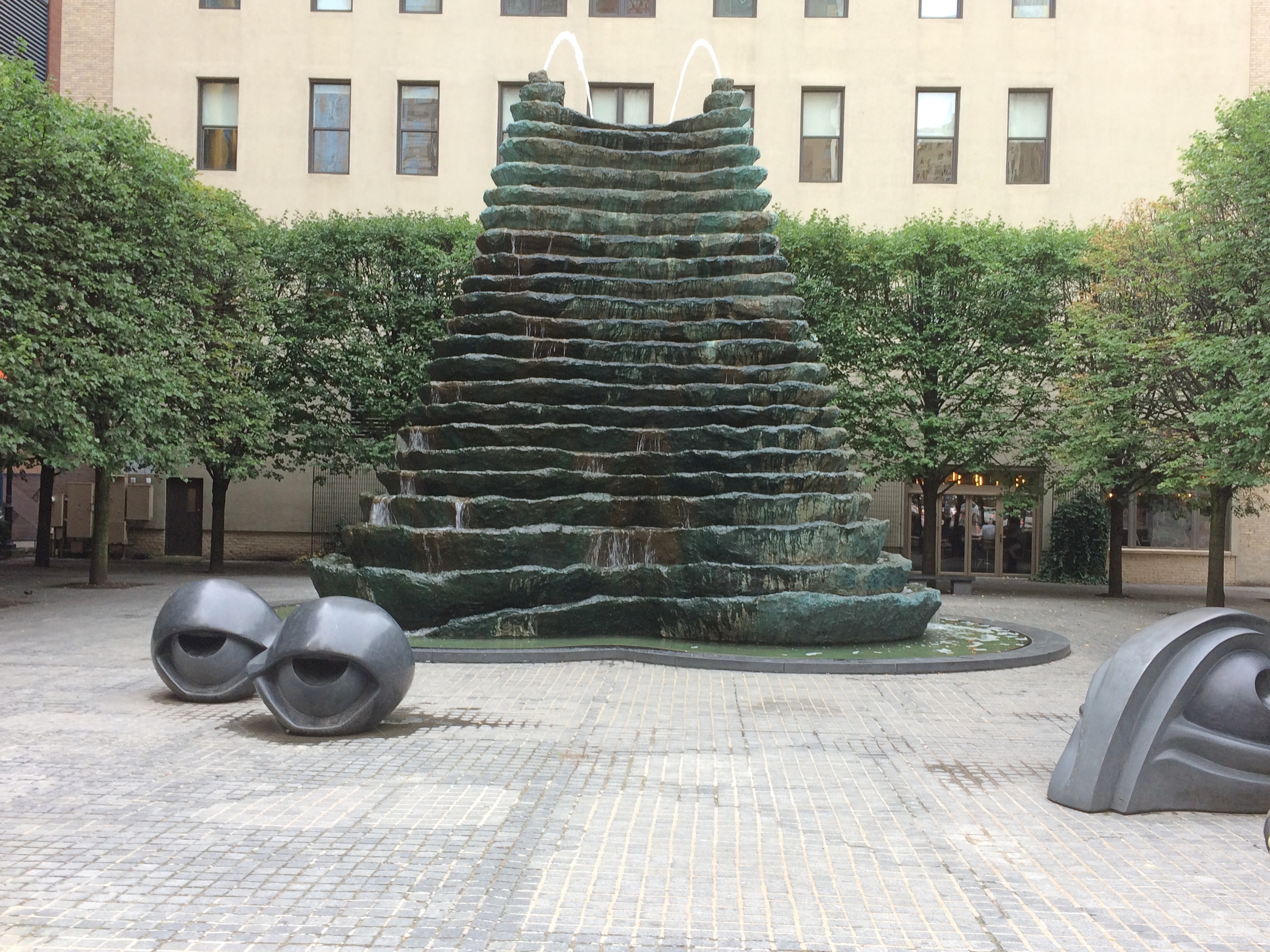
Agnes R. Katz Plaza by Louise Bourgeois,By the time we got to the U.S. Steel Tower, the tallest building in Pittsburgh, a light rain was falling. It would continue at varying strength through the rest of the walk.
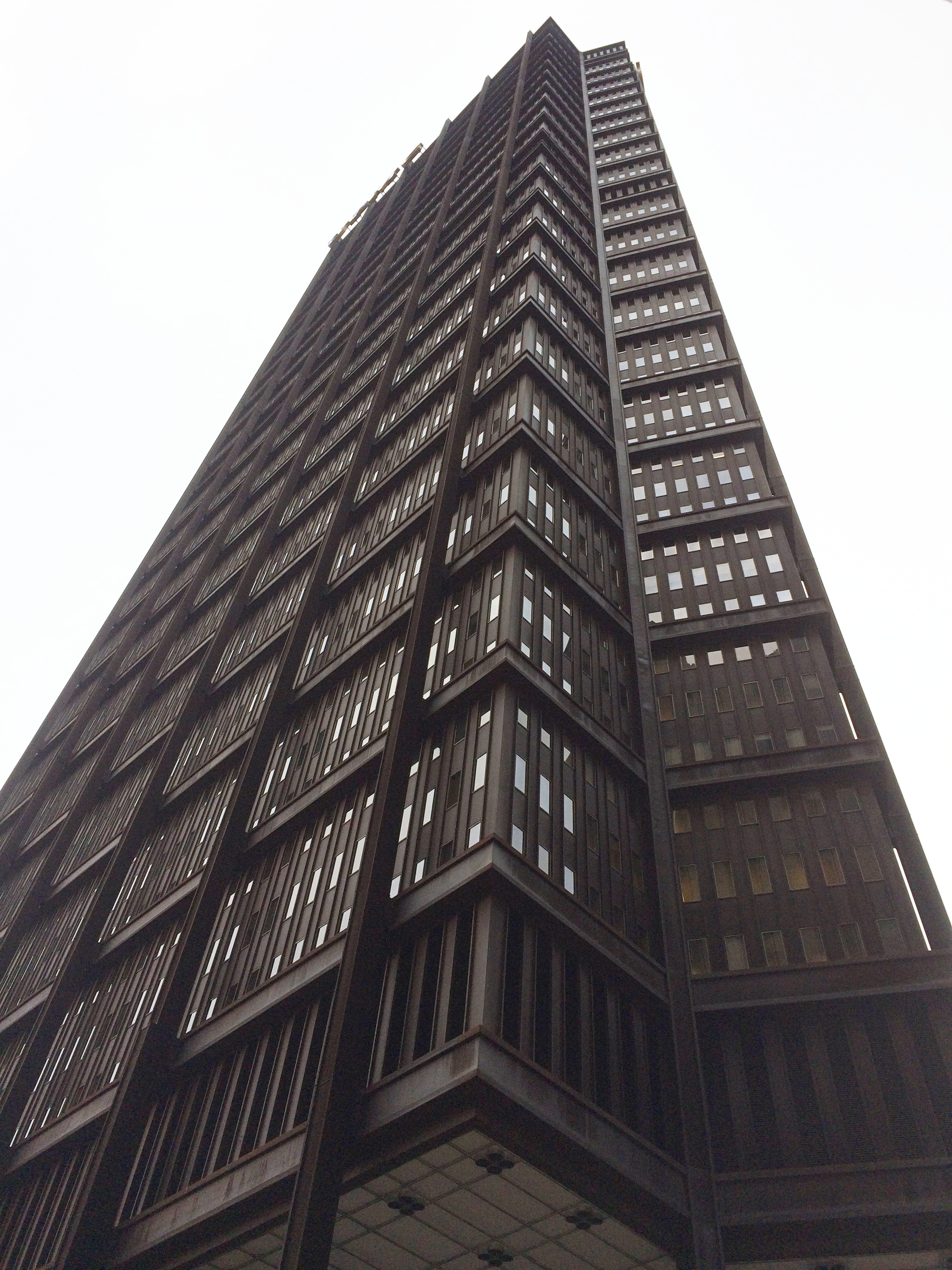
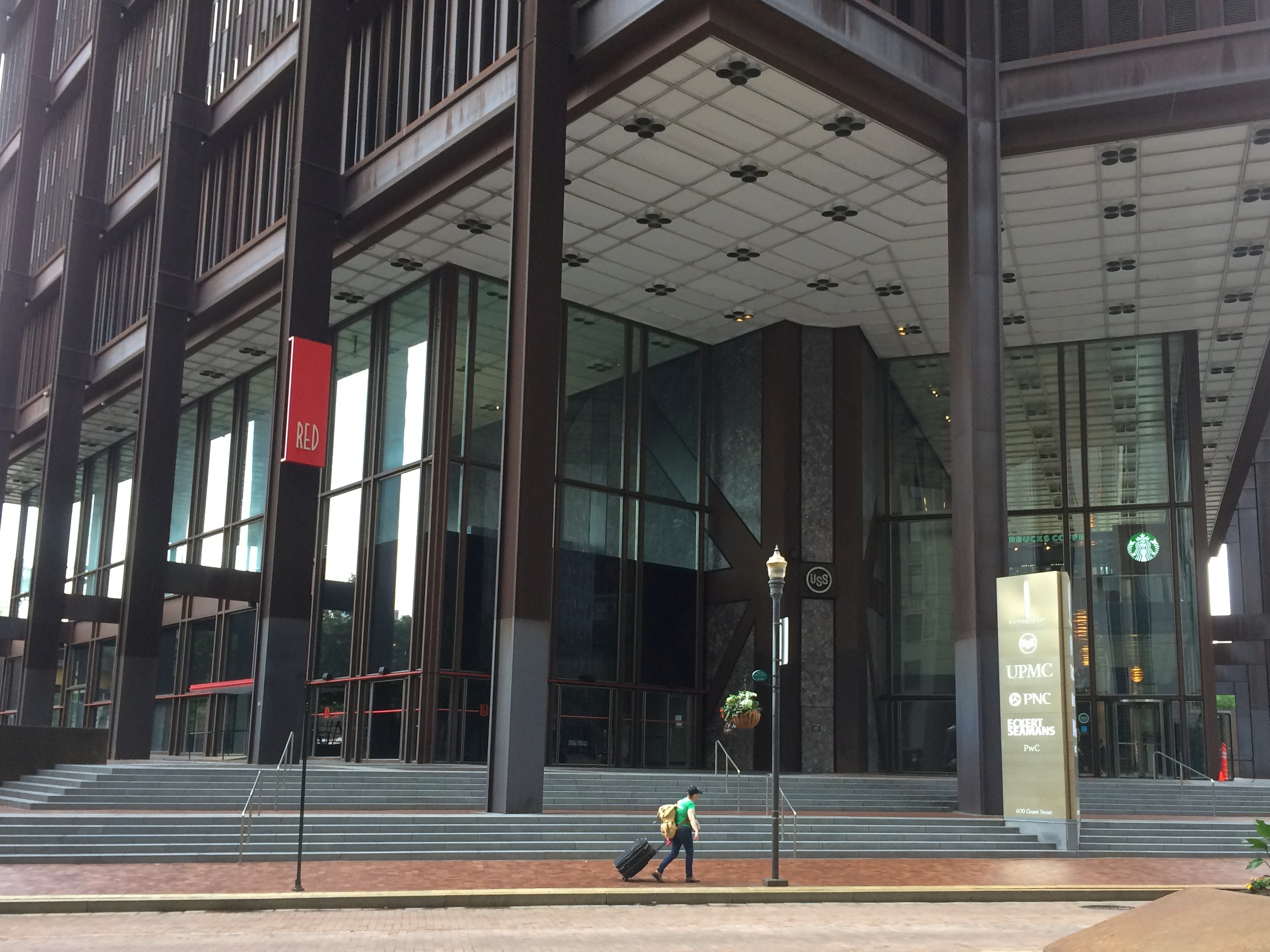
US Steel Tower, Pittsburgh

US Steel Tower, PittsburghNo aluminium for this behemoth, rather steel and lots of it. This too is a Harrison & Abramovitz design. The company made steel for its own building, a newish product at the time, corten or weathering steel, which ends up with a dark brown oxidation over the metal to protect the structure from the elements and obviate the need for paint. (The steel still has many surprising uses.) According to our guide, however, until recently the building skin had an unfortunate habit of spitting granules of this rust onto the sidewalks and people below.

Aluminium, steel and then glass. Fitting for the HQ of PPG, also a stop of the tour. Founded in 1883 as Pittsburgh Plate Glass, these days PPG is a supplier of paints, coatings, optical products and specialty materials.

The complex is actually six buildings, all opening in the early 1980s as part of the effort to revive downtown Pittsburgh. By that time, Johnson/Burgee were the go-to NY architects, so they designed the PPG. Rain prevented me from making a good image, but the tallest of the buildings towers over a plaza that features an ice rink in colder weather. It looks like this on a sunny day.

Toward the end of the tour, we made a stop at a place on Smithfield St. that has no marker of any kind and in fact isn’t distinctive in any way, except for one thing: it was the site of an early nickelodeon, thought to be the first theater anywhere devoted exclusively to movies, as opposed to a live theater with a few machines tucked away to separate patrons from their coins.

“The first exclusive moving pictures theater in Pittsburg and the world was opened in 1905 by Harry Davis and John P. Harris in the Howard Block, west side of Smithfield street, between Diamond and Fifth avenue,” one E. W. Lightner wrote in 1919.

Diamond St. is no longer called that. Oddly enough, the change to Forbes St. was made as late as 1958. I’d imagine that would have been hard to do.

Lightner continues: “Curious to say, the second exclusive picture theater of the world was opened in Warsaw, capital of Poland, by a Pittsburg Polander, who saw the Davis-Harris adventure and recognized the possibilities of presenting so wonderful and profitable a development in his native country.”

“The original and only ‘Nickelodeon’ was opened at 8 o’clock of the morning and the reels were kept continuously revolving until midnight. A human queue was continuously awaiting the ending of a performance and the emptying of chairs. Inside an attendant would announce, ‘show ended,’ and spectators would be hustled gently to the street and new spectators welcomed, seated as quickly as possible, and the picture would again respond to the magic reel.”

As you can see, it was pretty much a nothing site when Google Images came by.

Still looks that way in July 2019. There ought to be a marker there at least, or maybe even a hipster bar with a nickelodeon theme.
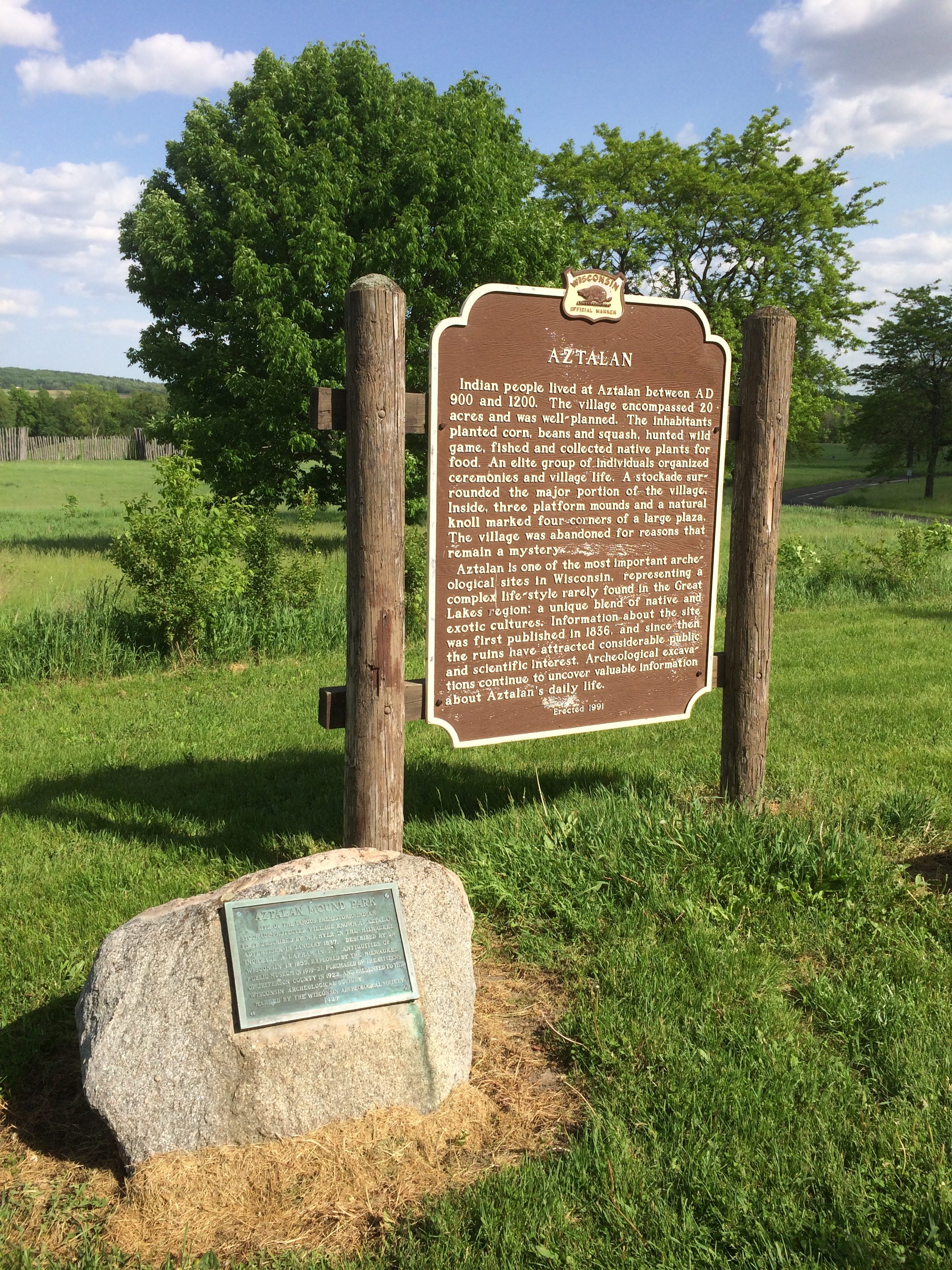
Aztalan State Park

After tooling around Lake Mills, Wisconsin, for a few hours, we got around to the original reason for driving up to southern Wisconsin for the day, a visit to Aztalan State Park. The park is a few miles east of the town, occupying 172 acres near the banks of the Crawfish River.
It’s a small version of Cahokia in Illinois, near modern-day St. Louis. The comparison isn’t idle, since both settlements were created and occupied by Middle Mississippian Indians more than 1,000 years ago.

Like Cahokia, Aztalan features manmade mounds and a rich archaeological legacy, despite 19th-century depredations. The Indians at Aztalan similarly and mysteriously abandoned it like those at Cahokia, centuries before the coming of Europeans.

The name is a misnomer in the sense that in the 19th century, one of the ideas about the prehistoric people who lived here saw them as ancestors of the Aztecs. The ancestors of the Aztecs were thought to be from a place north of Mexico called Aztalan. So the name was applied to the site, even though the Mississippians are no longer believed to be Aztec ancestors.

Then again, what the people who lived here actually called their settlement is unknown. I’d speculate that it was some variation of Our Place or This Here Place in their language, but who knows. Aztalan is as good a name as any in our time.

But why did they settle in the future Wisconsin? The Milwaukee Public Museum posits: “Things such as copper, lead (for white paint), deer, and certain types of stone materials such as Hixton Silicified Sandstone, were the basis of Mississippian trade interests in the northern frontier, and may have influenced the location of Aztalan as a Mississippian outpost in Wisconsin. Trade and other social and political processes expanded Cahokian influence out into much of the Midwest, as well as eastern and southeastern North America.”

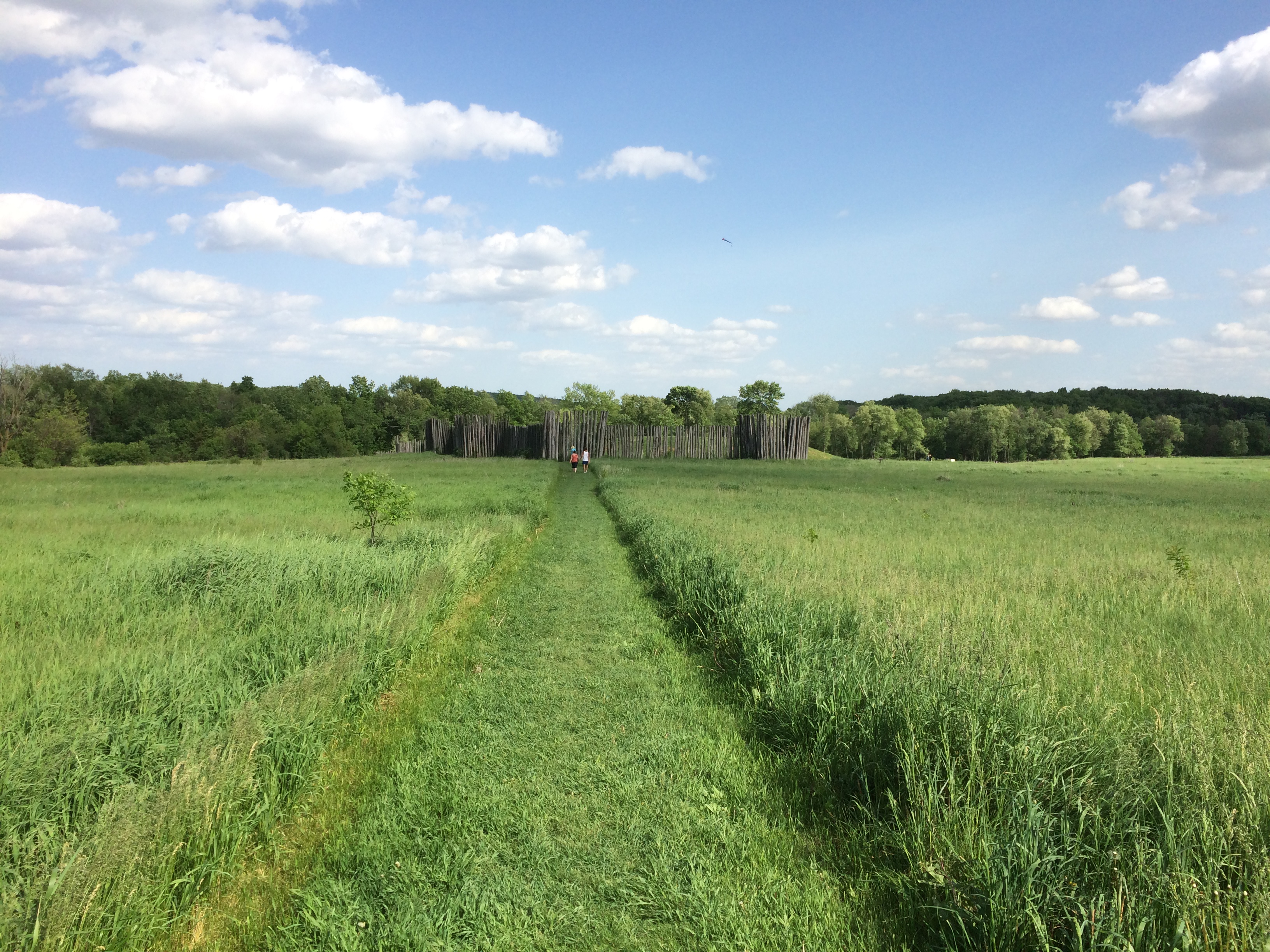
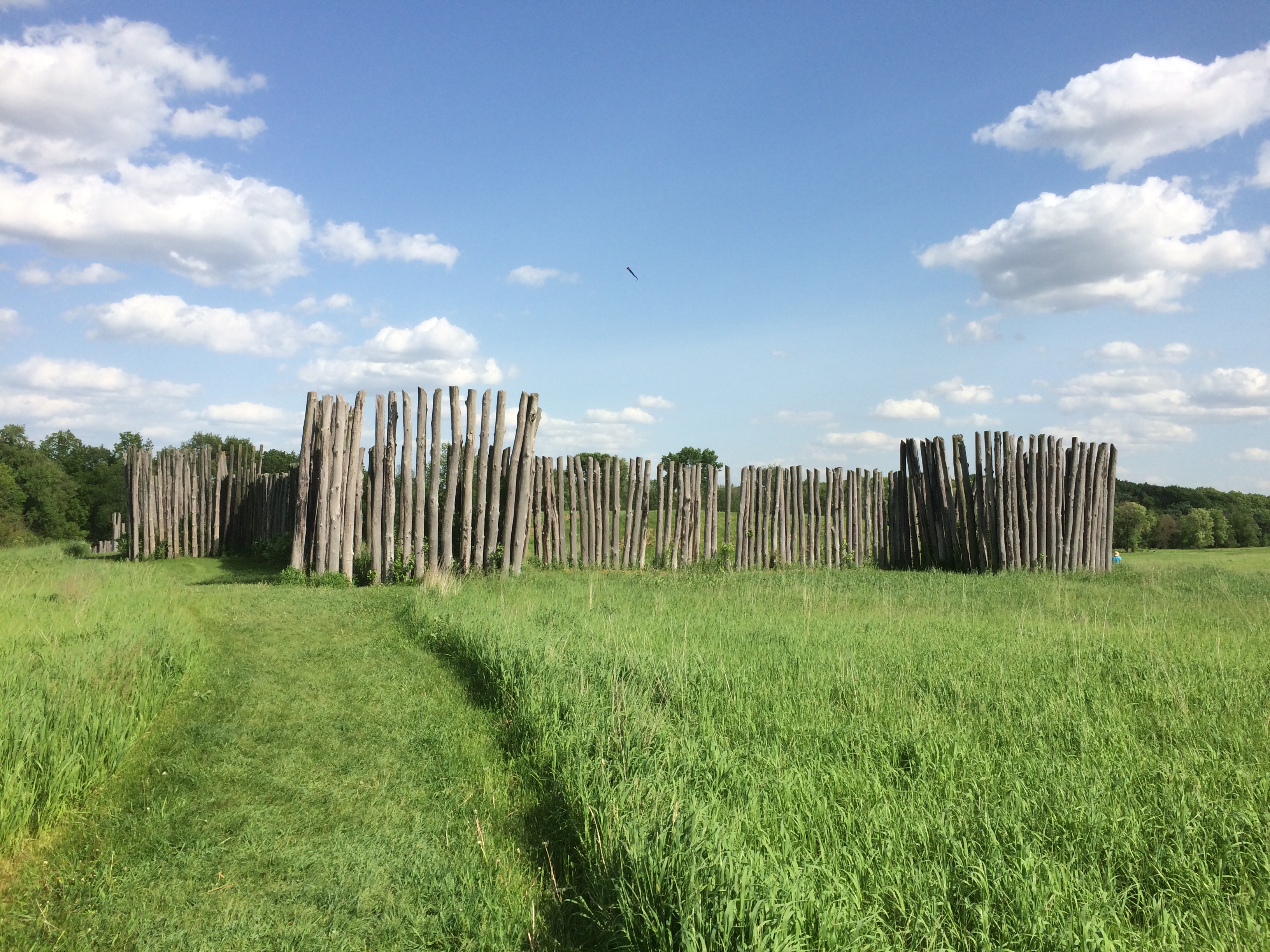
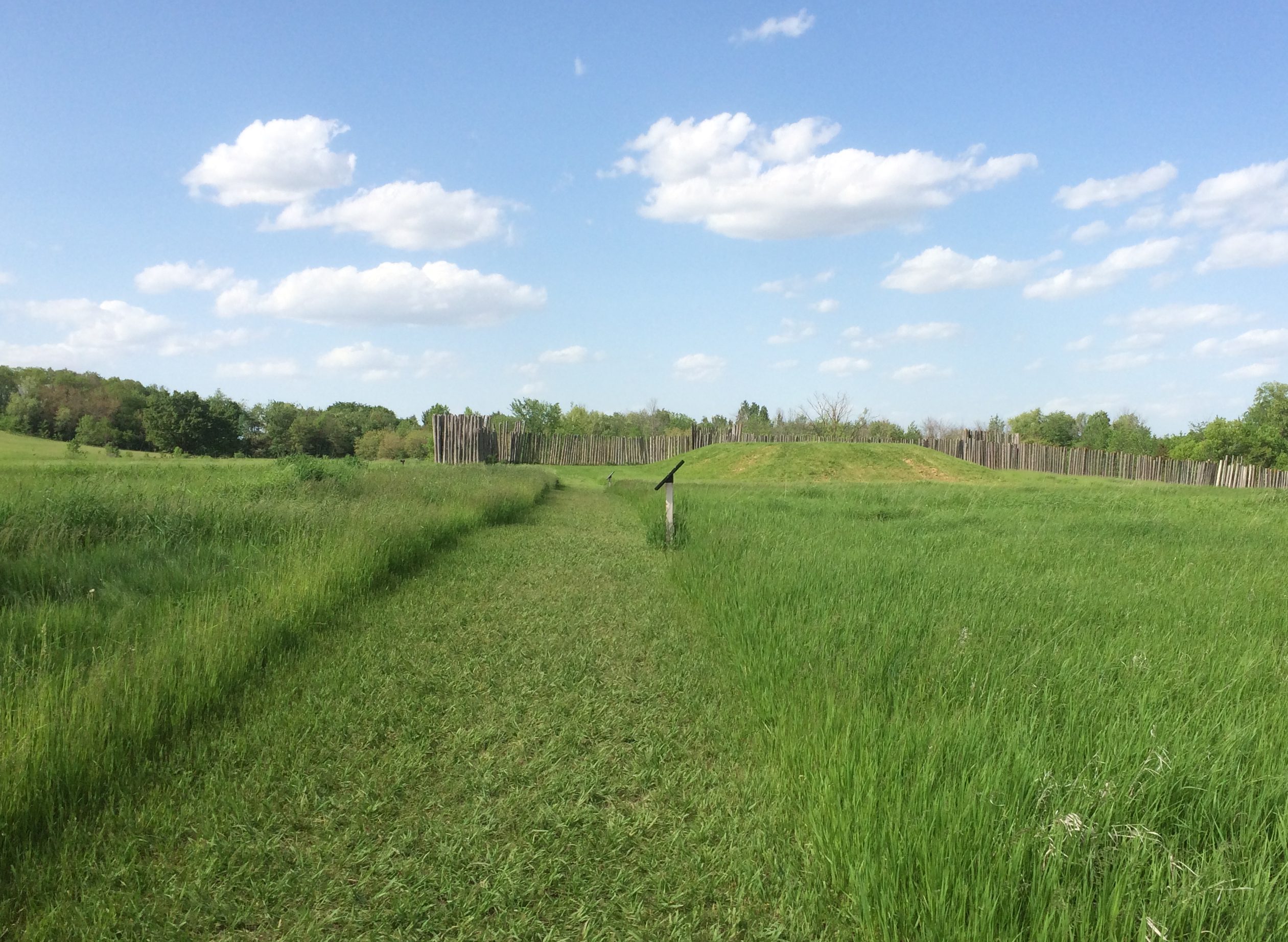
Aztalan State Park sports tall grass, mounds and stockade posts, with mowed paths connecting different areas.
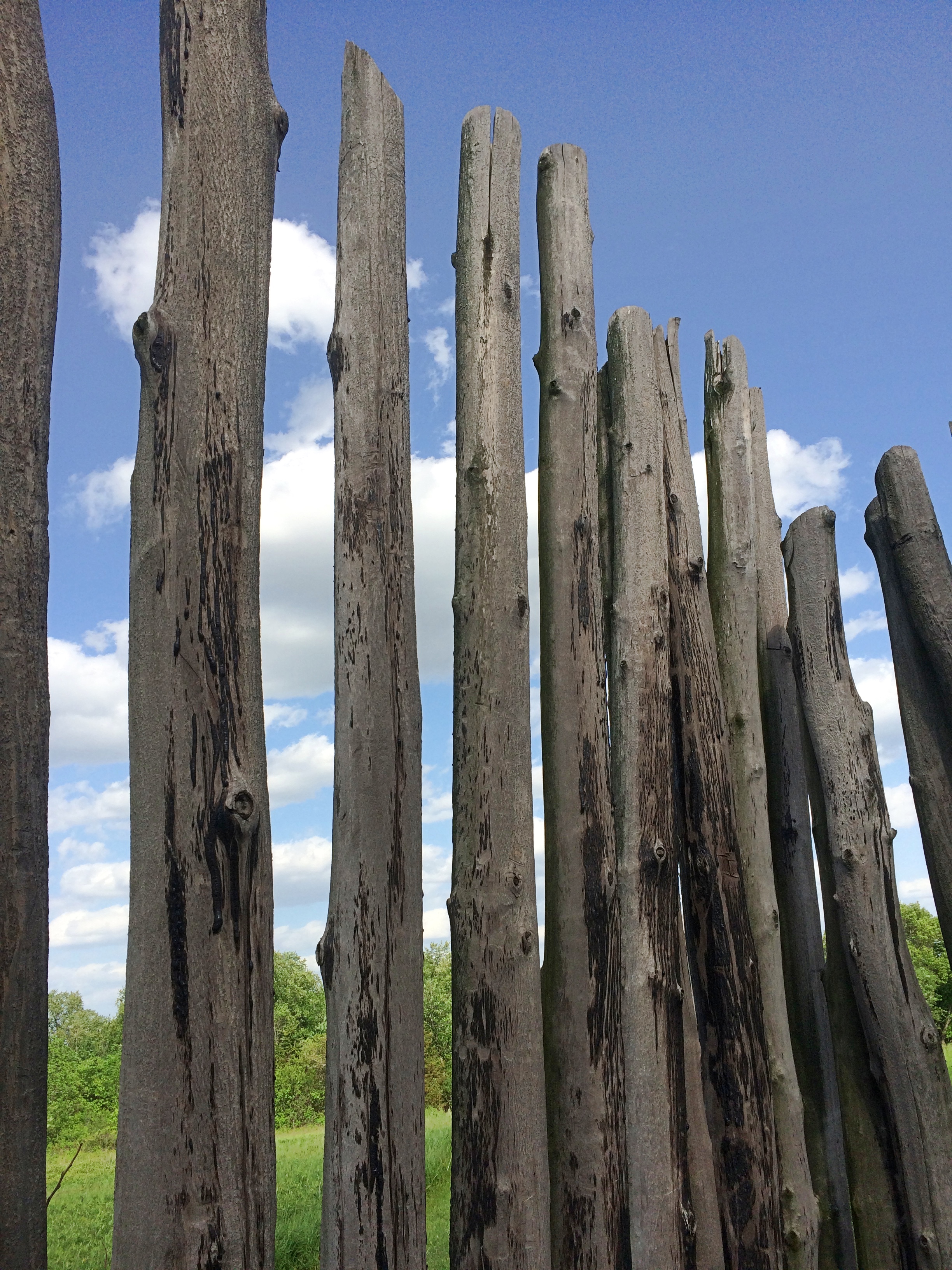
The stockade posts are 20th-century reconstructions, but I understand they were placed in the original holes.
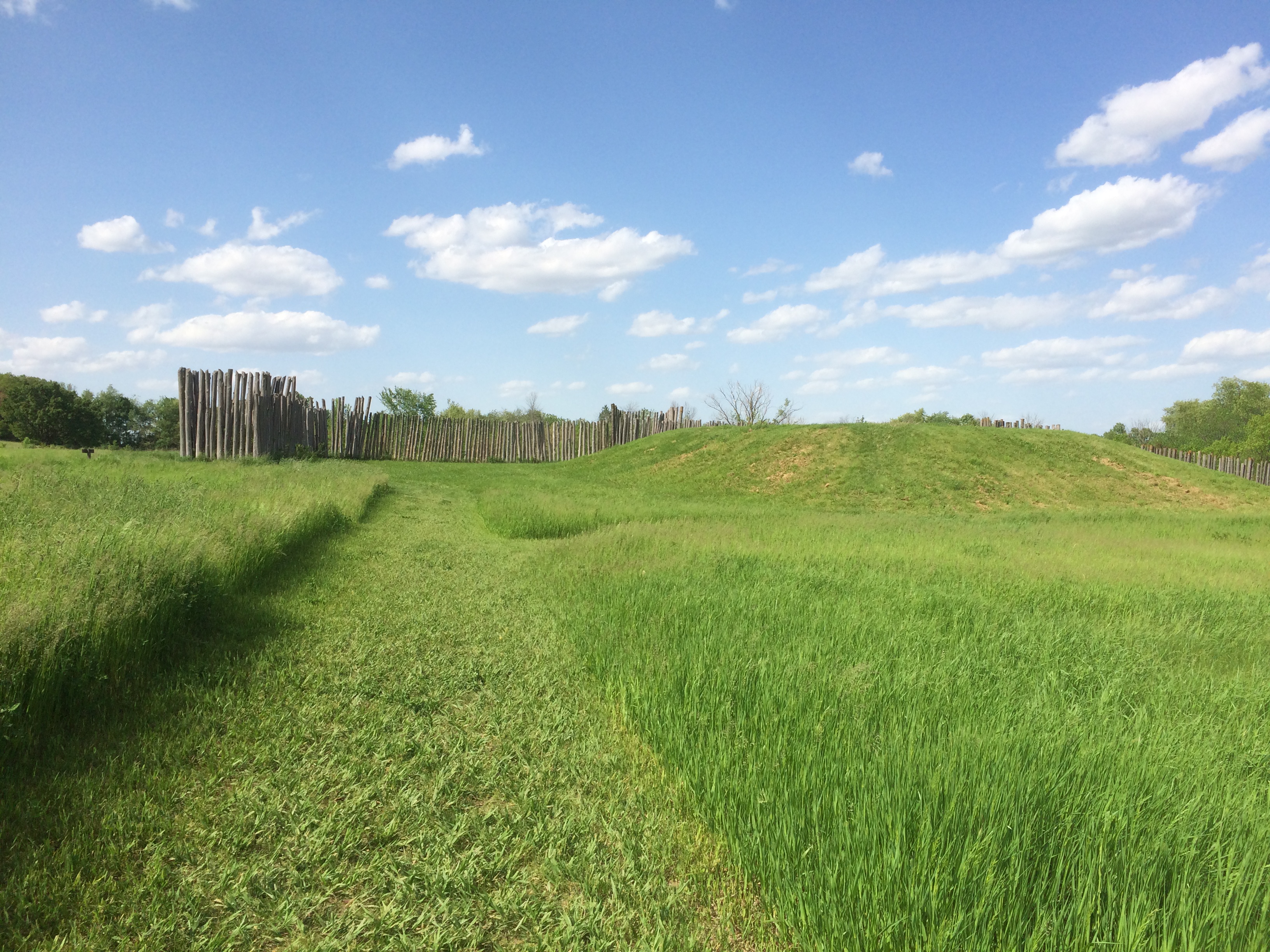
One of the mounds. The second largest one, I think.

The path to the largest of the mounds. Large and small are relative terms for the mounds at Aztalan. Compared with Cahokia, they’re all pretty small.

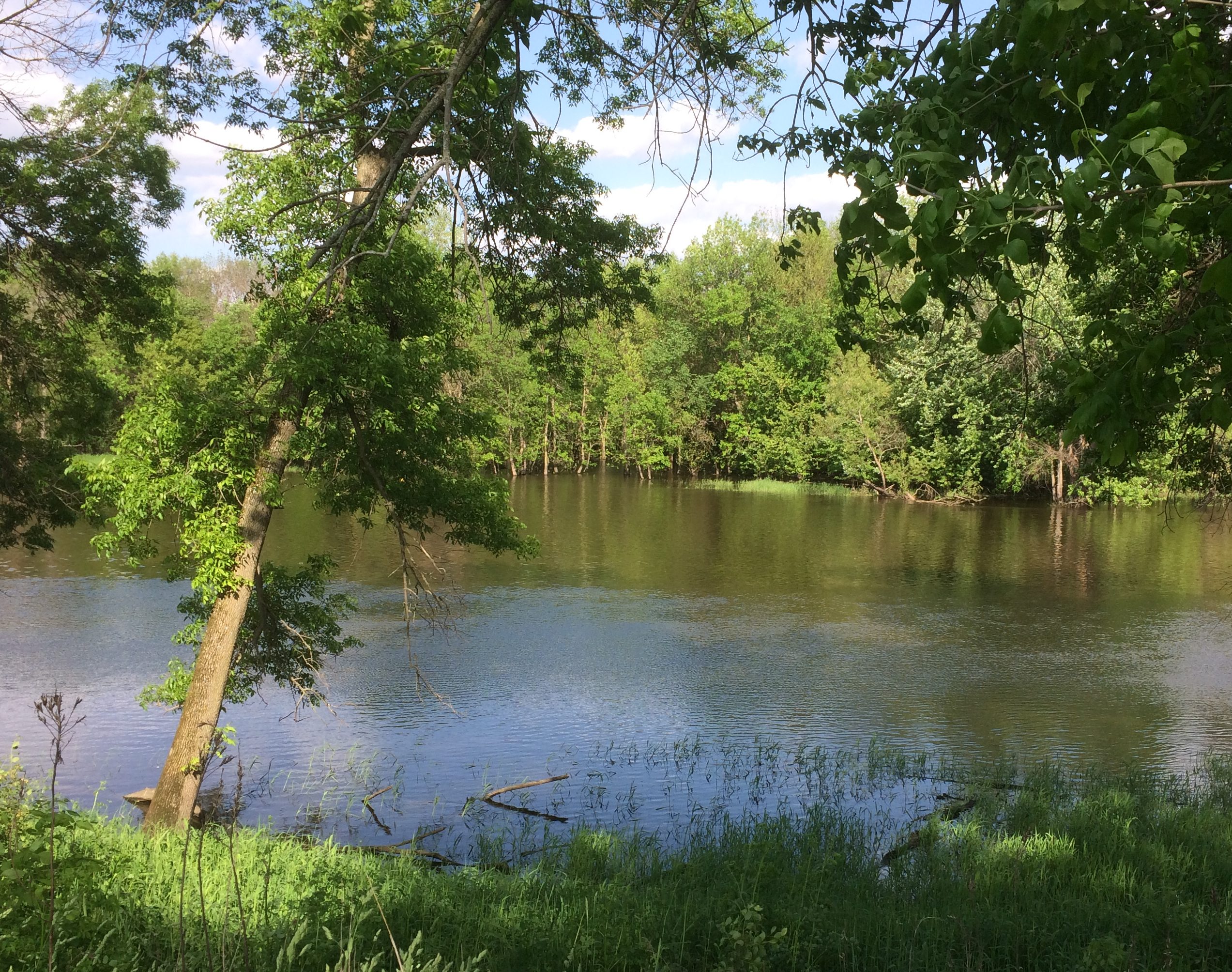
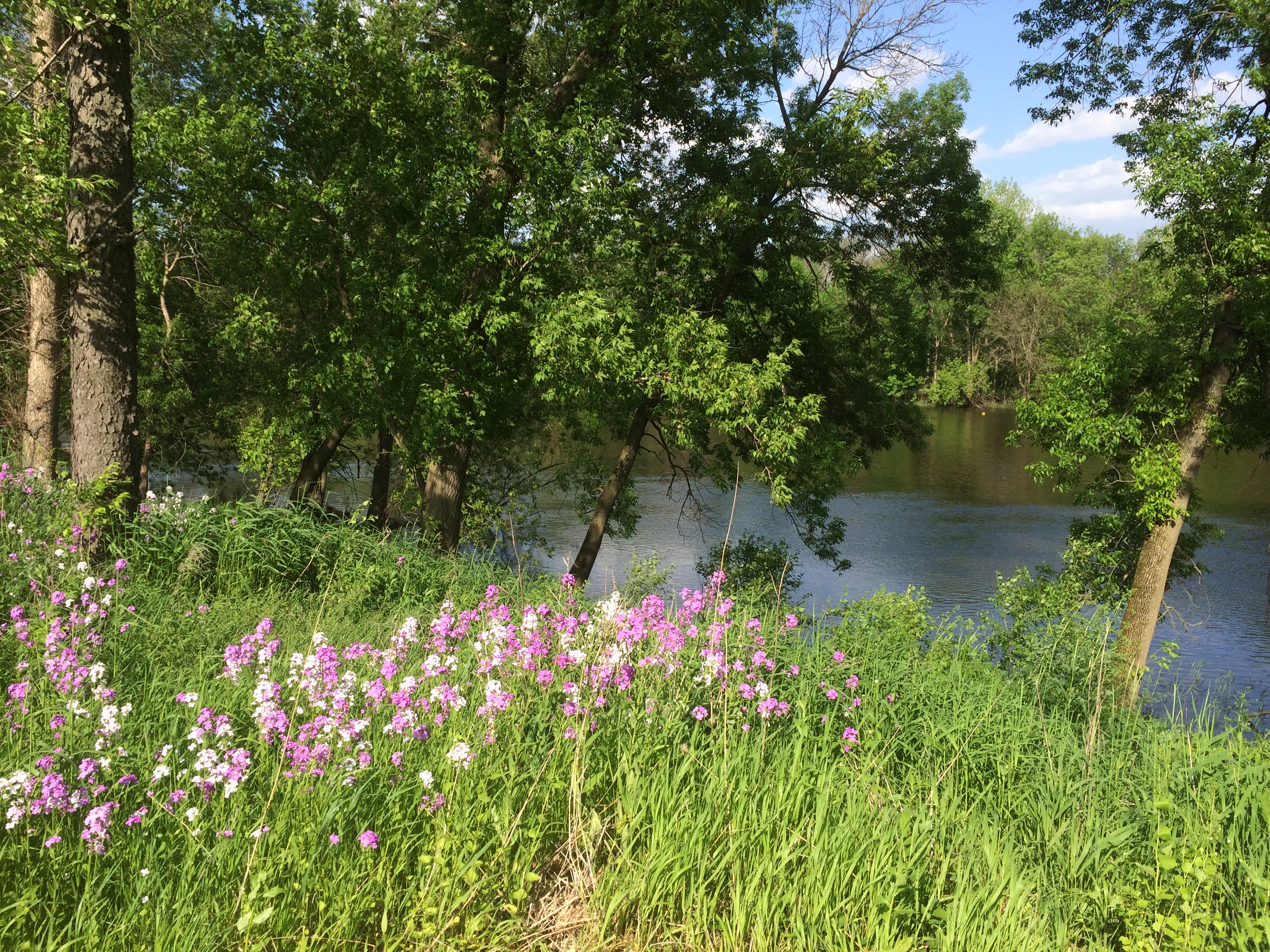
Another path leads down to the Crawfish River, which I assume supplied Aztalan with its water and some fish.
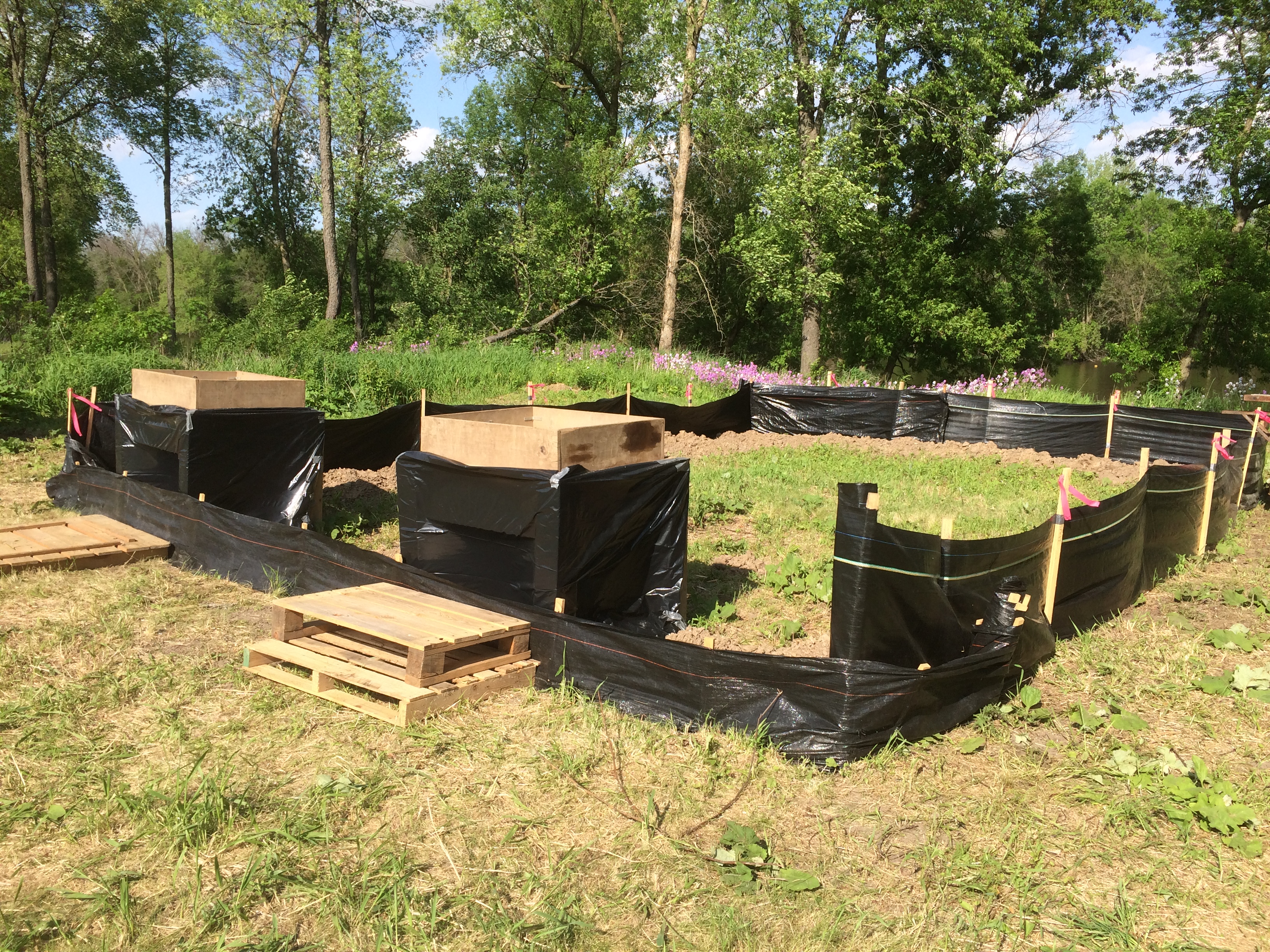
Near the river is what I take to be an active archaeological dig, complete with screens for sifting the soil.
I don’t think I’d have the patience for that kind of work. But I’m glad there are people who do.