St. Joseph, Joliet

The iron works in Joliet might be ruins these days, but St. Joseph Catholic Church, one of the city’s major church buildings, still stands on Chicago St. downtown. It’s the second church on the site, built in 1905 to serve Slovenian immigrants, many of whom worked in the local iron and steel mills.
St Joseph Catholic Church, Joliet

By the time we got there on Sunday, masses were over, and it might have been closed in the afternoon even under normal circumstances. Still, we got a good look at the exterior.

“The St. Joseph community includes Slovenian attire and music in its Masses, offers one Mass in Slovenian each month, refers to the Virgin Mary by her Slovenian name of Marija Pomagaj and holds a celebration for St. Nicholas Day, which is a tradition in Slovenia,” Shaw Media reported on the occasion of the parish’s 125th anniversary, including some interior shots.

Charles Wallace, an Irish-born Chicago architect (1871-1949), designed St. Joseph. He apparently did a fair number of churches in the Chicago area during the golden age of church building for large immigrant communities.

Across the street from the church is this building, headquarters of the Slovenian Union of America as well as the Slovenian Women’s Union of America Heritage Museum. The building dates from 1910.Slovenian Union of America / Slovenian Women's Union of America Heritage Museum

Closed, of course. My kind of little museum, though, so we might visit some other time. Might visit Slovenia some other time, too, with any luck. I hear it’s a pleasant place to visit.

Hadley Valley Preserve

On Sunday after leaving the Joliet Iron Works Historic Site, we planned to get takeout at a place in Joliet found via Google Maps, but after driving a few blocks, an old-fashioned technique for finding something to eat kicked in. That is, we saw it ourselves, and stopped on impulse.

Chicken-N-Spice. The place looked good, and it was: crispy fried chicken, warm mashed potatoes and gravy and tender biscuits. It was still a little cool to eat outside, so we found a spot to park and ate in the car.

After lunch we drove to the Kansas-shaped Hadley Valley Preserve, a unit of the Forest Preserve District of Will County.

Not really much of a valley, but the 685-acre preserve is a savanna, according to the FPD: a grassland with scattered tree growth and a mix of shrubs and wildflowers (in season).

Looks that way.Hadley Valley Preserve

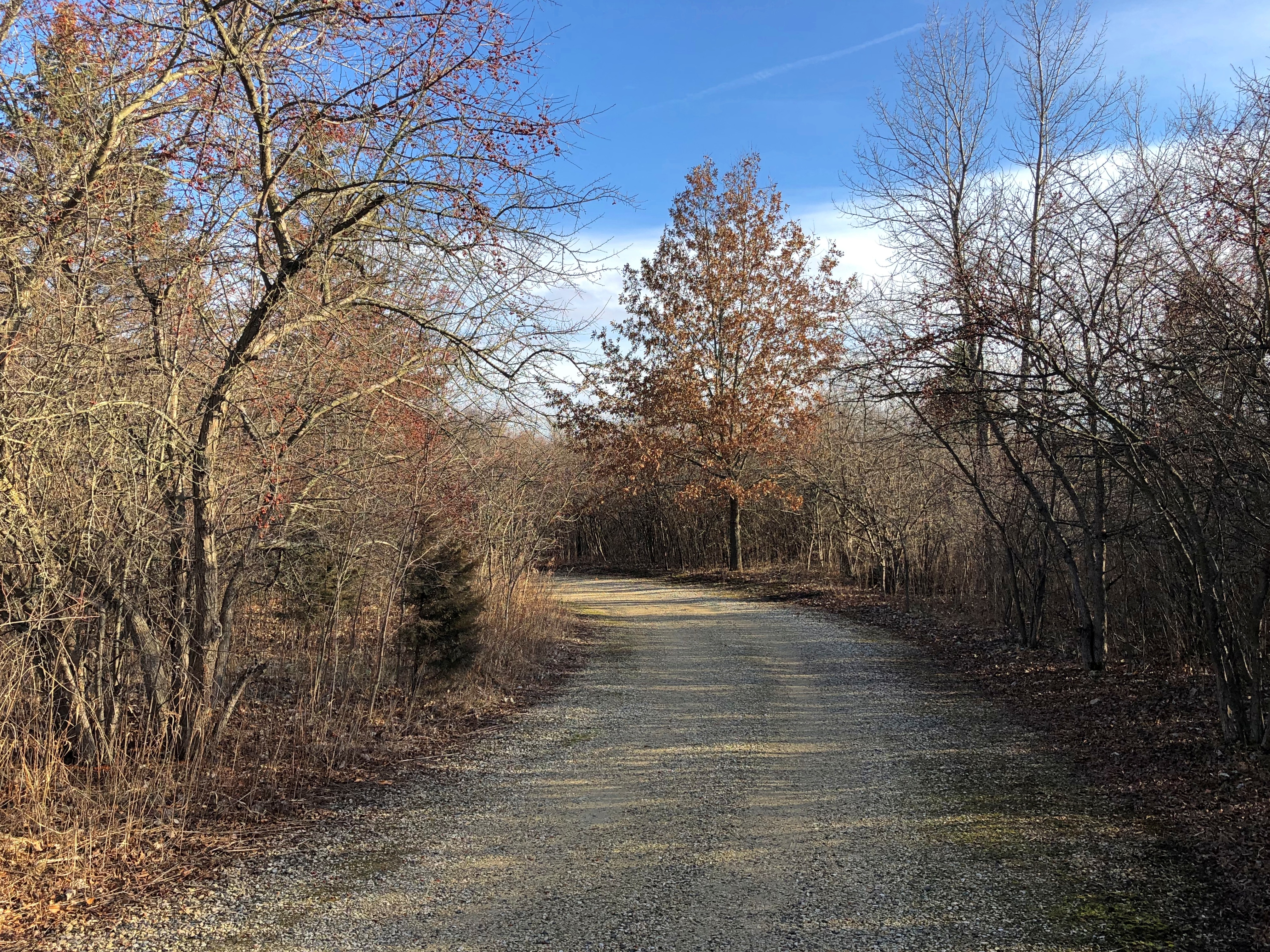
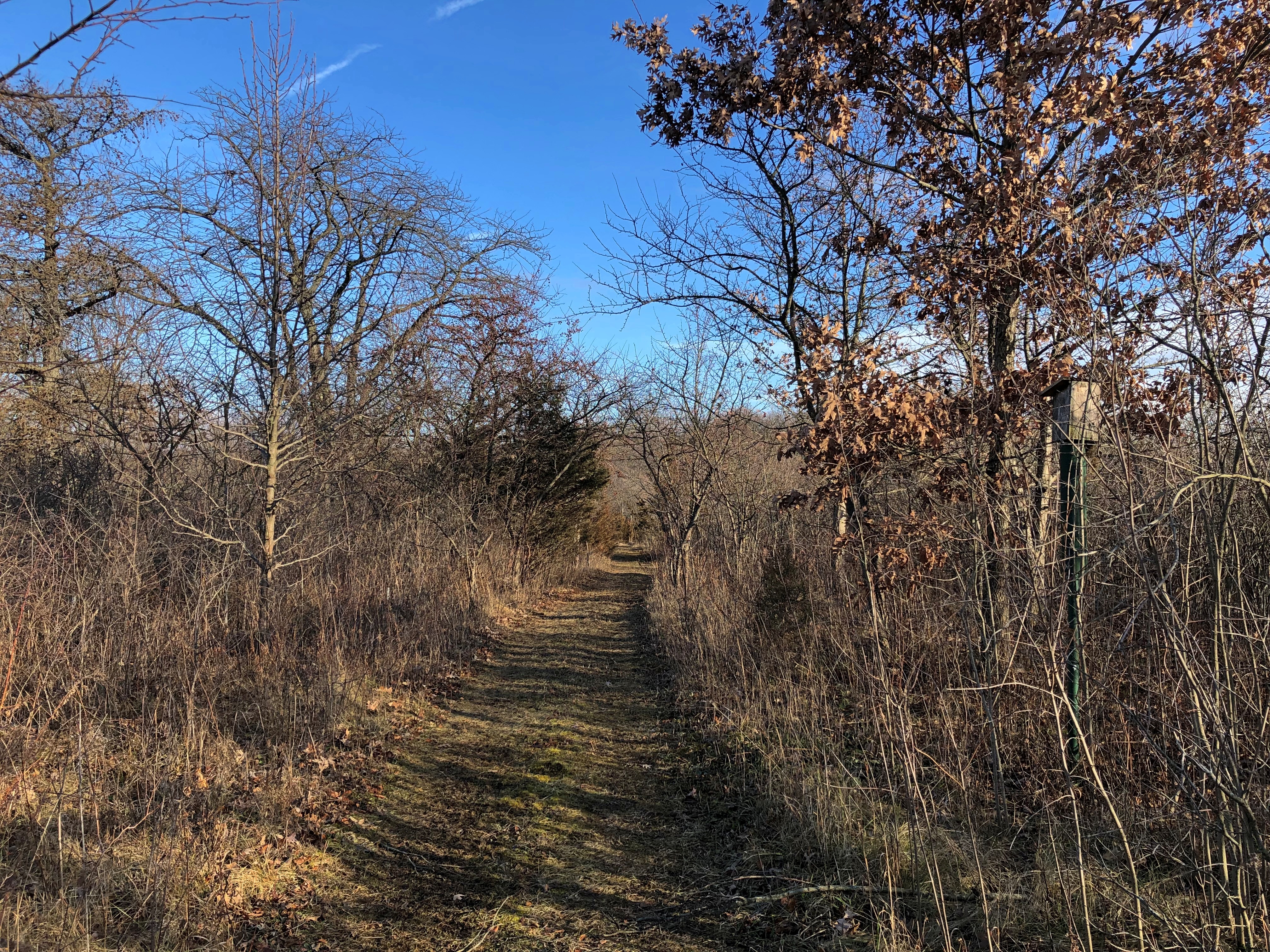
Hadley Valley PreserveThe trail makes an oval all the way around. We walked the whole thing counterclockwise, about 2.5 miles, with temps in the mid-50s and sunshine that wasn’t oppressive. Most of the mud had dried up by the time we walked it, unlike last week’s trail.
Hadley Valley Preserve
There were other walkers but also horses and their riders, about a dozen all together at one point or another on the trail.
Hadley Valley Preserve
Rolls of hay. Not as picturesque as possible, but the scattered rolls have some charm.Hadley Valley PreserveSpring Creek runs from east to west through the length of the preserve.
Hadley Valley Preserve
The creek eventually connects with Hickory Creek in Joliet, and from there flows to the Des Plaines River and, of course, the far-off Gulf of Mexico eventually.

Joliet Iron Works Historic Site

For early March, and especially considering the snows and bitter days of February, Sunday felt gloriously warm. Temps were in the mid-50s by the early afternoon, and we needed no further encouragement to go find a place to walk, though it took some driving to get there.

We went south. There are lots of places to see in southern metro Chicago, including the Joliet Iron Works Historic Site.
Joliet Iron Works Historic Site
Industrial ruins, that is. Unfortunately not the towering metal husks you might see in Pittsburgh or Birmingham, Alabama, but worth a look all the same.

A path runs through the ruins about a half mile, roughly parallel to RR tracks to the east, and the Illinois & Michigan Canal to the west, though those aren’t always visible.
Joliet Iron Works Historic Site
Toward the southern end of the site, it’s mostly rubble, and not always much at that.Joliet Iron Works Historic Site Joliet Iron Works Historic Site Joliet Iron Works Historic SiteFurther north, there are the stubs of the sizable structures that used to be there.Joliet Iron Works Historic Site Joliet Iron Works Historic Site Joliet Iron Works Historic Site

Including some dark holes.
Joliet Iron Works Historic Site
This pit is the foundation of a once mighty, and mighty dangerous, blast furnace.
Joliet Iron Works Historic Site
Once I was reminded of some of the images of Knossos that I’ve seen. Like this one.Joliet Iron Works Historic Site
“The factory opened in 1869 and was a massive facility for the time….” notes Atlas Obscura. “Employing four huge blast furnaces and a few thousand employees, the metal works produced around 2,000 tons of raw pig iron each day.”

Not sure where that figure came from. On site, one of the signs said that soon after the plant opened, the total was 50 tons of pig iron a day. By 1910, production was 400 tons a day.

“The plant kept putting out metals until 1936 when it closed for a short time before being reopened [for the war effort]. However, its new life was not to last that long either, as the works became unprofitable and were abandoned in the 1980s.”

Surprisingly little graffiti marks the ruins, though there are places where it’s clear it has been painted over. Such as here.
Joliet Iron Works Historic Site
But new graffiti is probably added regularly.
Joliet Iron Works Historic Site
The Forest Preserve District of Will County acquired the site in the 1990s, and stabilization efforts have been enough to allow it to be open to the public. Parts of the site, anyway.
Joliet Iron Works Historic Site
You can’t say you haven’t been warned.

Arlington Cemetery & Elm Lawn Memorial Park

Due south of Mount Emblem Cemetery are twin burial grounds, Arlington Cemetery and Elm Lawn Memorial Park, also in Elmhurst, Illinois. On Saturday I headed south from Mount Emblem along County Line Road, fully intending to find an entrance to I-290 and proceed home, but I noticed the two cemeteries before I got that far.

I’ve been driving by those cemeteries for years, seeing them from the highway, not realizing they were distinct and never getting around to seeing them any closer. Though the afternoon was getting chillier and patches of snow still covered the ground, I figured I’d take a look.

These images are of Arlington Cemetery, which is to the east.
Arlington Cemetery Elmhurst Illinois
These are of Elm Lawn, to the west.
Elm Lawn Cemetery Elmhurst Illinois
A better aesthetic than Mount Emblem, which is say more standing stones, and the cemeteries ought to be nice in the spring and summer. It’s hard to tell in the winter whether these concerns, of some years ago, have been addressed.

As a casual visitor, there was no difference between the two. No fence or other demarcation. I noticed that the Arlington office building was permanently closed, with a sign referring visitors to go to the Elm Lawn office a few hundred feet away. Indeed, according to the cemetery’s web site, the two have been combined under single ownership for more than 25 years.

The permanent residents probably don’t care about any of that. If they do, they’re keeping quiet.
Elm Lawn Cemetery Elmhurst Illinois
A small section of Elm Lawn (I think) that I drove by is designated the Valley of Peace Shia Cemetery, which must be fairly new. Considering the demographics of the northwest suburbs, that’s thinking ahead on the part of cemetery ownership.

Mount Emblem Cemetery

A cemetery with most of its memorials flush to the ground — a mid-century notion that hopefully has faded — looks like a snow-covered field in winter. That can be nice, but it doesn’t say cemetery, and the added beauty of stones in the snow, rather than under it, is missing.

There were stones in the snow at the Elk Grove Cemetery in January 2010.
Elk Grove Cemetery 2010
Mount Emblem Cemetery in Elmhurst, Illinois, has all the ingredients to be a striking cemetery except standing stones. So on Saturday, I saw mainly this kind of scene.
Mount Emblem Cemetery
With a few reminders that loved ones are memorized somewhere under there.
Mount Emblem Cemetery
There are a few structures that won’t be denied their place in the pale winter sun.
Mount Emblem Cemetery
Mount Emblem has, however, one thing unique in any cemetery I’ve been to, or know about: a Dutch-style windmill.
Mount Emblem Cemetery
It’s the Fischer Windmill, built in the mid-19th century, long before the cemetery was established.

“The windmill was built sometime between 1849 and 1865 by Henry Fischer, after he inherited part of the family farm from his father, Frederick L. Fischer, one of the original settlers in the county,” the Chicago Tribune reported in 1995. “It took two hired millwrights about three years to build it, including six months to fashion the main cogwheel.

“The main framework of the windmill is cypress, and it rests on a stone foundation. It features hand-hewn shafts and gearing of white oak and hickory… The mill ground wheat and corn for local farmers until the demand declined after the turn of the century.”

The cemetery association bought it in 1925 and, according to the Trib, installed chimes. I didn’t hear any chimes, but I did notice two loudspeakers mounted on the structure.

Cricket Creek Forest Preserve

Saturday wasn’t exactly warm, but it was above freezing, sunny and mostly windless, which had been true for some days before that. So we figured forest preserve paths might be clear of ice at least. We were mostly right, but not completely.
Cricket Creek Forest Preserve
That’s at the north entrance of Cricket Creek Forest Preserve in Addison, which generally follows Salt Creek as it meanders through DuPage County. The Salt Creek Trail runs through the 208-acre forest preserve.

The map depicts only the northern section of Cricket Creek. Further south are two more ponds, including one reserved for model boat sailing.

“The land was prairie until the late 1930s, when it started to transform into agricultural fields dotted with homes,” the DuPage County FPD says. “The Forest Preserve District acquired the first 40 acres in 1974 and made subsequent purchases through 2016, eventually transforming a flood-prone housing development into a beautiful forest preserve.”

The trails are crushed limestone.
Cricket Creek Forest Preserve
The photos don’t really show it, but underfoot on the path was a crushed limestone slush, making for occasionally sicky mud. Better than ice, I’d say.
Cricket Creek Forest Preserve
We made it most of the way around the pond, until we came to patches of unmelted snow and ice.
Cricket Creek Forest Preserve
So we turned around and went to the other side of the pond, essentially doing a U-shape partly around the pond. Not the most idyllic walk, but walking ought to be an all-season activity, including winter — mild winter days, that is.

(Very) Local Snow Scenes

After shoveling snow yesterday, I went around outside the house and took pictures. It looks like you’d expect.

Out the back, looking southwest and then south.A lot of damned snow


Nothing we haven’t seen before, but still impressive.

Our driveway.

The plume of snow over our neighbor’s fence is the result of him using his snow blower on his backyard patio. I partially dug out my car, in case I had to go somewhere during the day. I didn’t, so it remains mostly covered.

The view down the driveway to the street, looking north.

Like ours, almost all of the other driveways on the block are still covered a half-inch or so of snow. But yesterday afternoon I spotted one near neighbor using a leaf blower to try to clear that last coat of snow. Whatever, buddy.

Front yard, looking west. Life goes on. It isn’t fully visible in the picture, but the person in blue down the street was walking her dog.

The ridge of snow is next to the driveway. Considerable effort has gone into building it, including our shoveling and then snowfall. It comes up to about my mid-chest.

Now what we need is a string of sunny days just above freezing to slowly wear down the piles. A long string. Not a few really warm days in March marked by rain.

Torches Light the Western Sky

Gorgeous sunset today, this early February day in northern Illinois. Much more so for my eyes than a mere photograph indicates. More brilliant pink was mixed in than in this unadjusted shot, for instance.
But I can play with the photographic image, something I can’t do with my eyes. This strikes me as a bit closer to what I saw.
I didn’t see this, but monochrome does bring out some textures.
Luckily I didn’t see it this way, as if a nuclear device has gone off in the distance.
So eyes are the thing. That’s (one) reason to continue to send people into space. No matter how good the mechanical images are — and some are astonishing — that isn’t the same as human eyes beholding a sight.

Thursday Kibble & Bits

Sunny day, but not much meltage. Bitter cold night ahead, and another half-foot of snow forecast for the weekend. Before that, we’ll get Thai takeout at Ann’s request on Friday, and a birthday pie, to make staying at home more pleasant.

Earlier this month, when we were in Naperville, we came across a small park: Central Park. Among other things, there’s a weatherworn obelisk to memorialize local soldiers from the Black Hawk War, the Mexican War, the Civil War and the Spanish-American War. It looked like new wars had been chiseled in as time passed.

Not far from that was a Civil War cannon, looking pretty new, because it was refurbished in this century.
Central Park Naperville cannonIt’s a Confederate cannon.
Central Park Naperville cannonA prize of war, in other words, formerly shot off by the people of Naperville for “Independence Day, parades and other civic activities” in a less safety-conscious (-obsessed?) time. That’s what we could use a little more of in our time, though I suppose in some places edgy folks might mistake it for hostile gunfire, and maybe they’d be right to.

Willard Scott Jr. was this fellow, no relation to the weatherman, it seems. Among other things, this Willard Scott marched through Georgia, doing his bit to invent modern total war.

Shucks. No evidence of life in the clouds of Venus.

Google “Venus floating platform” and one of the first hits is about the Venus Atmospheric Maneuverable Platform (VAMP) at the Northrop Grumman web site. My estimation of that company just went up a notch. It’s at least thinking about flying a plane over Venus.

“The Venus Atmospheric Maneuverable Platform (VAMP) air vehicle is an aeroshell-less hypersonic entry vehicle that transitions to a semi-buoyant, maneuverable, solar-powered air vehicle for flight in Venus’ atmosphere,” NG says. “VAMP AV will be transported to Venus by a carrier/orbiter spacecraft… It is then released and enters the atmosphere, floating down toward the planet almost like a falling leaf.

“During the flight phase, the AV flies in the Venus upper- and mid-cloud layers and collects science data for transmission to Earth. VAMP AV will be capable of orbiting the planet for a long duration — up to a year.”

Of course, the company is no stranger to space, having built the Lunar Module and Pioneer 10, just to name two marquee projects. These days its marquee project is the James Webb Space Telescope, which can’t get into space fast enough, as far as I’m concerned.

Recently I’ve been getting press releases that say these sorts of things:

X will teach you how to:
Reframe your life experiences as growth opportunities
Rewire your mind-set and embrace spirituality as a lifestyle
Connect to your higher self and integrate healthy lifestyle practices
Tap into universal energy and transmute pain into power
Manifest your new reality and claim your authenticity
Change the world!

***
For your upcoming stories on female disruptors, please consider Y, Founder of Z, helping visionaries reconnect to SOUL, and Live FREE to become their most successful, influential and positively impactful versions. Y teaches women to embody the energy of money and become a vibrational match so it flows consistently and predictably.

Hm. My name seems to be drifting onto all sorts of lists, at some distance from commercial real estate. Though I do like that phrase, “energy of money,” and the idea of it flowing “consistently and predictably” certainly has appeal.

Bemis Woods

This is the funniest thing I saw over the weekend.
Bemis WoodsA recycling container belonging to the Forest Preserve District of Cook County. As soon as I saw it, I had the urge to peek inside. You’d expect three separate spaces, right? No. Everything goes into the same large space.

We were at Bemis Woods, a forest preserve in Westchester, Illinois, a western suburb just to the east of the DuPage County line and I-294.
Bemis WoodsWe walked from the parking lot to the green trail, then the red trail, then the purple trail, then on the road back to the parking lot. About a mile and a half in all. The trails were a little treacherous.
Bemis WoodsThe snow cover was thin, and where previous walkers had been, some of the snow had been scuffed enough to re-freeze as ice. Some parts of the trail were well covered with slippery zones, others less so.

Evidence of many other walkers, people and dogs, was easy to spot.
Bemis WoodsStill, it was a good walk through the woods at just below freezing.Bemis Woods

Bemis WoodsBemis WoodsWe crossed Salt Creek twice. Once at a footbridge. The view from there.
Bemis WoodsOnce along Wolf Road.
Bemis WoodsA good walk, but summer’s better on the whole. As it is for most things. The last time I was near Bemis — a little to the west, that time — was in August more than two years ago.