First Thursday in February Misc.

The only good thing about the beginning of February is that January is over.

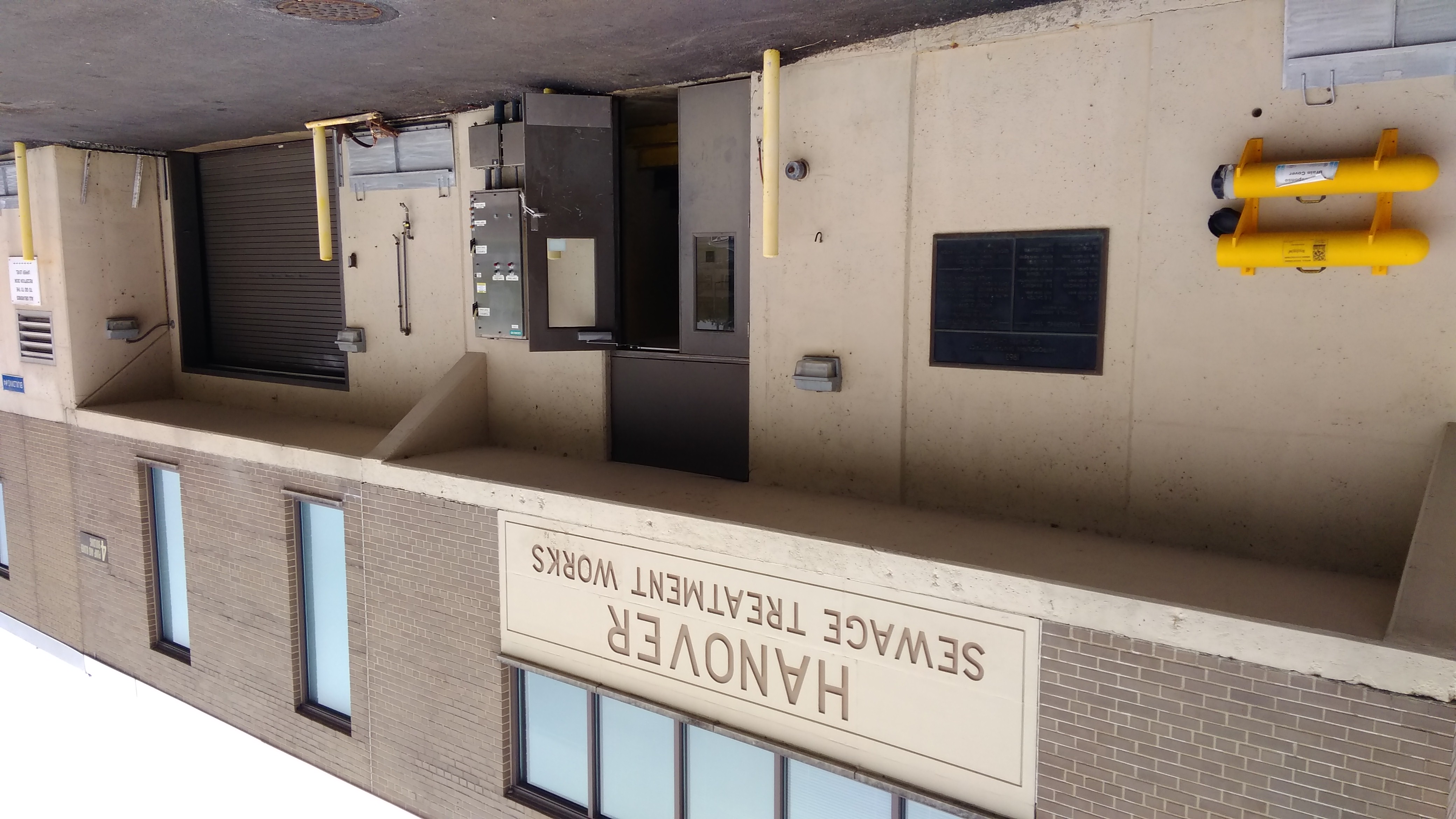
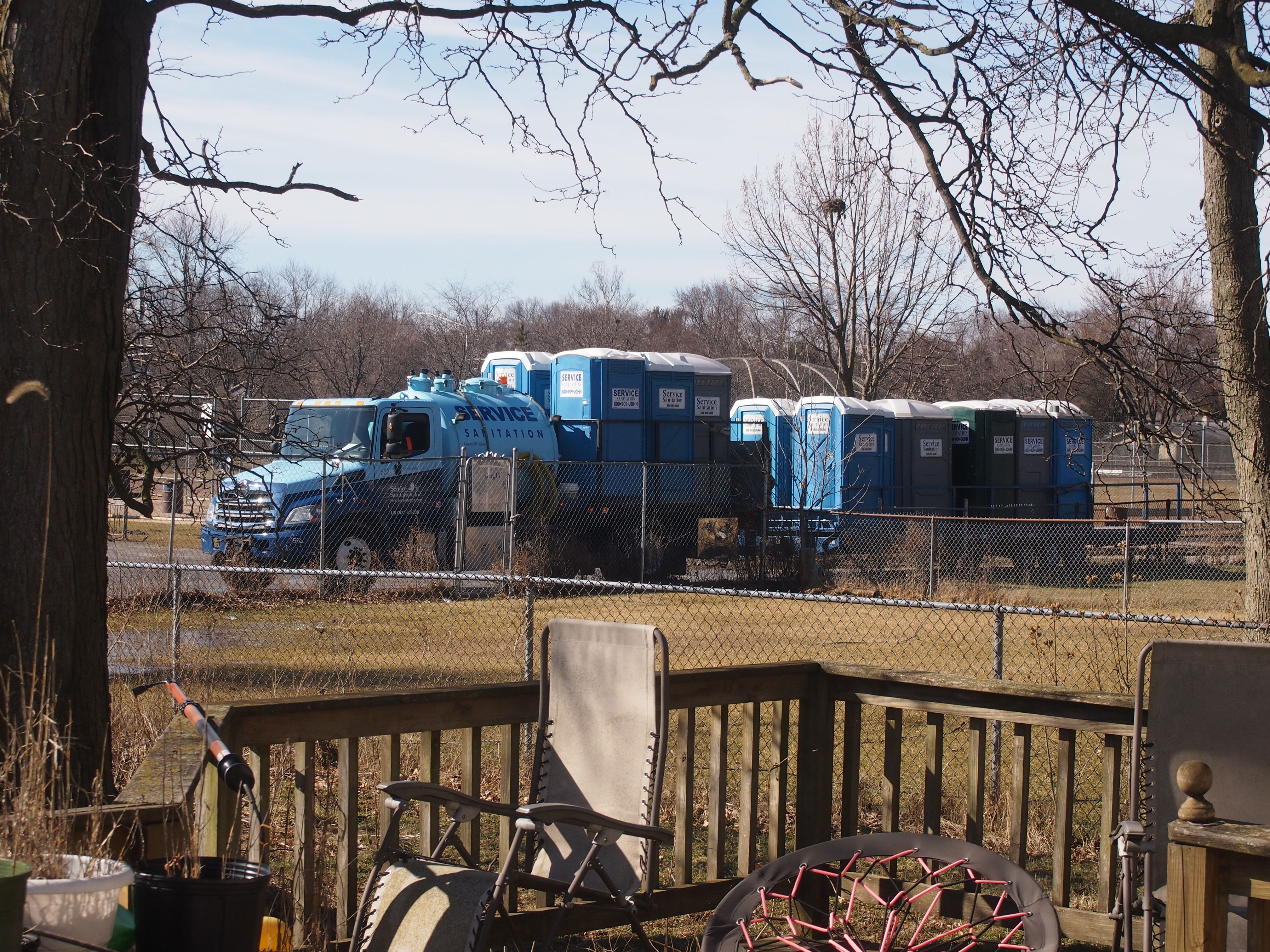
A picture from this moment in history.

Ann was with me, and I had take this shot with her phone. The car was in a northwest suburban parking lot.

Speaking of cars in parking lots, as I was walking the dog the other day, I passed through the parking lot in front of Lilly and Ann’s former elementary school, and saw a Tesla parked there. As if were any other car. Which I guess it is. Still, I can’t remember seeing one around here before. New, they’ll set you back at least $68,000. So you don’t see too many.

I had no idea the French used the suffix -gate as we do. Headline from today’s La Parisien about the hot water that François Fillon, candidate for the presidency, is in: Penelope Gate: toutes les fois où l’épouse de Fillon disait ne pas travailler pour lui. Are there Frenchmen who think the real scandal is that obvious anglicisme being used to describe it? A silly objection. English has borrowed plenty of French; time to give something back.

One more item out at St. Sava Serbian Orthodox Monastery, near the church: a memorial to Gen. Dragoljug Mihailovich, the Chetnik commander whom Tito ultimately had shot after the war.

Gen. Dragoljug Mihailovich memorial

Whatever else you can say about him — and apparently that’s quite a lot, for good and ill — President Truman did award him a Legion of Merit (Chief Commander) posthumously in 1948, the text of which is on the memorial in English and Serbian. It cites his efforts in rescuing U.S. airmen downed over Yugoslavia.

The Church of the Serbian Orthodox Monastery of St. Sava

Next to the the cemetery of the St. Sava Serbian Orthodox Monastery in Lake County, which I visited on Saturday, is a handsome church building belonging to the monastery. There’s something about onion domes that pleases the eye.

The Serbian Orthodox Monastery of St. Sava

Even without the domes, the structure has a pleasing aspect to it. The cornerstone dates the building to 1925. Back then there couldn’t have been much around it besides farmland. Even now, the area nearby is mostly undeveloped.

I fully expected the building to be locked. It wasn’t. I went inside and found myself alone with its striking interior, albeit a little dark.

A panoply of Jesus and saints and holy men — I assume that’s what I saw — graced pretty much every surface.

The Serbian Orthodox Monastery of St. SavaThe Serbian Orthodox Monastery of St. SavaAngles and demons, too.
The Serbian Orthodox Monastery of St. SavaLooking up.
The Serbian Orthodox Monastery of St. SavaKing Peter II of Yugoslavia used to be interred in the church. Here’s the spot where he was until a few years ago.
The Serbian Orthodox Monastery of St. Sava - King Peter II former gravePresumably the place is now a memorial to the king, marked with black stone instead of the white that used to be there.

I suspect that Peter’s story isn’t much known to Americans outside the Yugoslav diaspora. I only knew the outline, so I did some reading. Already on the throne, he was chased out of Yugoslavia at age 17 by the Nazis in 1941, and the post-war Tito government wasn’t interested in letting him return.

He spend much of his exile in the U.S., dying fairly young in 1970. For his own reasons, he wanted to be buried at St. Sava. Probably something to do with the schism going on within the Serbian Orthodox Church at the time, but I’m not going into the briar patch someone else’s schism by looking into the matter further. In any case, his son Alexander oversaw the repatriation of Peter’s remains to Serbia in 2013.

My reading led me to the web site of the Royal Family of Serbia, which is how Alexander, the claimant to the throne, styles it. It’s a well-designed and sophisticated site, offering a lot of information about Alexander — who styles himself HRH Crown Prince Alexander — and his family.

“Although King Peter II died in 1970, the Crown Prince, as the heir to the throne decided at the time not to use the title of King – which he felt would have had little meaning in exile,” the site explains. “He made it very clear at that time that he was not renouncing his title, or the dynastic right to the throne.”

Unlike a lot of pretenders, Alexander and his family actually get to live in the palace of their ancestors, which is near Belgrade and which his grandfather built. He’s had a residence there since moving to then-Yugoslavia after the overthrow of Slobodan Milošević.

The web site’s news page is incredibly detailed, with hundreds of releases about the family’s activities stretching back a number of years. Some recent examples:

More than 1,200 children at traditional White Palace Christmas receptions

Royal couple at the celebration of the Chartwell International School

Crown Princess Katherine as the patron of the first regional Veuve Clicquot Business Woman Award

Speech by Crown Prince Alexander at the monument of Vasa Carapic

Crown Prince Alexander at Military Museum exhibition opening

It occurs to me that Alexander is living precisely as he would, were he actually a constitutional monarch, and pretty much along the lines of the British approach (he grew up in the UK, after all, and was a captain in the 16th/5th The Queen’s Royal Lancers). No doubt he believes that if he acts like a monarch long enough and well enough, one day he or an heir will be King of Serbia.

The Cemetery of the Serbian Orthodox Monastery of St. Sava, Lake County

After leaving Marytown on Saturday, I headed north on Milwaukee Ave. A few miles from of Libertyville’s lively main streets, in an area not quite rural — call it exurban — is the St. Sava Serbian Orthodox Cemetery. At least, that’s a form of the name, since there’s wording in English and Serbian over a gate to the property that calls the entire place (in English), the Serbian Orthodox Monastery of St. Sava.

Near the cemetery is a church, presumably the monastery’s church (more about which later). I didn’t investigate any of the other buildings off in the distance, which are presumably the places for monks to live and otherwise follow their vocation. The map also tells me that St. Sava College is a little ways up the road.

Anyway, I came to see the cemetery. It’s been receiving Orthodox Serbs for about 90 years. The place is thick with weighty headstones.

St. Sava Serbian Orthodox Cemetery

With a mix of Cyrillic and Roman lettering.
St. Sava Serbian Orthodox CemeteryThere’s little funerary art, as seen in cemeteries steeped in Western European traditions, unless you count variations on the Cross. A few stones told in some detail of the person at rest, at least if you read Serbian.
St. Sava Serbian Orthodox CemeterySome sites included wooden crosses along with stone markers. A few had no headstone at all.

Some stones are of a distinctly modern cast, and in English.
St. Sava Serbian Orthodox CemeteryI’ve read that Rod Blagojevich’s parents are in the cemetery, but I didn’t see their stone that I know of. Blago was recently in the news briefly for not being on President Obama’s commutation list during his last days in office. Tough luck, Rod. Politics ain’t beanbag.

Marytown

Everyone else had something to do Saturday afternoon, so I took advantage of the fact that winter isn’t particularly bitter right now — and neither snow nor ice is covering the ground — to buzz up to Lake County, Ill., for a few hours. I wanted to visit a spot on the map there I’ve seen for years but never gotten around to: Marytown. Or, the National Shrine of St. Maximilian Kolbe.

A Polish Franciscan, St. Maximilian Kolbe was murdered by the Nazis. We’d come across a memorial to him before, at Our Lady of Mount Carmel Monastery in Munster, Ind. There he was a supporting player, so to speak. At Marytown, he’s the star of the show, after only Jesus and Mary.

The Marytown complex includes a Franciscan friary, a retreat and conference center, various outdoor shrines and a rosary garden, and a gift shop (where I bought postcards). It’s also home to the Marytown Press and is the American HQ for the movement that St. Maximilian Kolbe started, the Militia Immaculata.

For the purpose of my visit, however, Marytown is home to Adoration Chapel of Our Lady of the Most Blessed Sacrament. That’s what I’d heard was worth seeing, and it was. Here’s the exterior.

Adoration Chapel of Our Lady of the Most Blessed Sacrament - MarytownThe chapel, completed in 1930, was designed by architect Joseph W. McCarthy, who trained under Daniel Burnham and did a lot of Catholic churches in the Chicago area. I’ve read it was patterned after St. Paul’s Outside the Walls in Rome.

“The Benedictine Convent of Perpetual Adoration in Mundelein, known today as Marytown, was a special project of Cardinal George Mundelein, meant to keep alive the spirit of the 1926 Chicago Eucharistic Conference and provide for the spiritual needs of diocesan priests and seminarians at the newly built seminary next door,” writes Denis Robert McNamara in Heavenly City: The Architectural Tradition of Catholic Chicago.

This is the interior of the main chapel, as best as I could make an image. A fine combination of stained glass, mosaics and marble.
Adoration Chapel of Our Lady of t Most Blessed Sacrament, Marytown“The Benedictine Sisters maintained unbroken adoration of the Blessed Sacrament until they withdrew from the location in 1977, handing the complex over to the Conventual Franciscan Friars,” McNamara writes. “The Franciscans renamed the site Marytown and established the national shrine of St. Maxmilian Kolbe…”

One of the Adoration Chapel’s side chapels features is a mosaic stretching toward the ceiling of St. Maximilian Kolbe rising triumphant from Auschwitz. Right below it are some relics of his, which include beard hair — cut some years before he died in a place that would leave no earthly remains — a piece of a habit, a prayer book.

Outside the chapel, in the garden nearby, St. Francis makes an appearance in bronze, unsurprisingly, singing the Canticle of the Sun.

St Francis - Marytown

With a non-human audience.

St. Francis - Marytown

There are some other statues nearby and a rosary garden, which I’ve never encountered before. Or maybe never realized I’d encountered one before, since they seem to be fairly common.

MarytownMuch of the statuary was short on labels, so I’m not certain who this is supposed to be, though I’d guess an older St. Francis.

Uncle Bub’s

Good old Uncle Bub’s. It’s a barbecue joint in Westmont, Ill., and one of my favorites in this part of the country, along with Hecky’s in Evanston. We had dinner there on Saturday with my old friend Kevin — known him nearly 30 years now.

No reason to write much about Uncle Bud’s, when you have a picture that will offer up 1,000 words.
Uncle Bub'sThat’s pulled pork, mashed potatoes, baked beans and cornbread. A fine feast on a cold December night.

Uncle Bub’s is not to be confused with Uncle Bud’s, a catfish joint in exurban Nashville. One strange day in the spring of 1980, two friends and I wound up at Uncle Bud’s for a meal. The catfish was fine, but what I really remember seeing was Gregg Allman and his entourage — including a few very tan, very blonde young women — enter the restaurant and head for a back room.

It Flings a Crystal Veil

The other day, I thought to look at NOAA’s forecast for the winter. It seems to be a La Niña year.

“The current seasonal outlook for… 2016-17 favors above-average temperatures and below-median precipitation across much of the southern tier of the U.S., and below-average temperatures and above-median precipitation in portions of the northern tier of the U.S.”

Snowfall Schaumburg Dec 11 2016Uh-oh. Looks like that’s already under way. Snow fell Saturday and Sunday, pretty much straight down. No major storm, but ’tis enough, ’twill do.

Nearly six inches all together, according to my wooden ruler measuring snow on a flat surface. Ann went off on Sunday to go sledding with her friends, something I never did at 13, and reports having a fine time.

That’s not bad, but the days ahead are supposed to be pit-of-winter cold.

Which can make for nice clear-light twilight. Looking east.

Moon Over Schaumburg

And looking west (both pictures taken December 12, about 42 degrees North).

Schaumburg Dusk Dec 12, 2016No more snow pics this year unless there’s a real corker of a blizzard, something along the lines of 2011. I might post dogs or daughters in the snow, though.

A Wad of Paper Circulars

We still get a paper newspaper some days of the week, and last Wednesday’s newspaper was the heaviest I’d lifted off the driveway in years. It was a regularly sized mid-week paper supplemented by a weighty array of circulars, mostly from retailers fighting the battle against stagnant physical-store sales, though of course most have online sales as well.

They included (no special order): Macy’s, World Market, Sprint, Carson’s, The Dump, Best Buy, Abt, Duluth Trading, La-Z-Boy Furniture Gallery, AT&T, JC Penney, Kohl’s, Guitar Center, Mattress Firm, Bed Bath & Beyond, The Tile Store, Home Depot, Fannie May, Verizon, Sears, Art Van Furniture, Ulta Beauty, JoAnn, Staples, Office Depot/Office Max, Ashley Homestore, Value City Furniture, Walgreen’s, Sleep Number, Kmart, Walmart, HOBO (Home Owners Bargain Outlet), Bose, Toys R Us, Lowe’s, CVS and Target.

Some of these retailers aren’t just fighting to keep their physical stores busy, but against ending up in the dustbin of retail history. If you know even a little about retail, you can guess which ones those are.

The only one on the list I’d never heard of was The Dump. It calls itself “America’s Furniture Outlet.” As far as I can tell, there’s only one in the Chicago area, in west suburban Lombard. The brand is in nine other markets around the country and, strangely enough, notes its web site: “Regular stores open every day of the week and you pay for. [sic] We are only open Friday, Saturday, and Sunday, which keeps our cost of doing business down.”

The Illinois Heritage Grove

At Spring Valley Nature Sanctuary is the Illinois Heritage Grove. A sign there says that the grove “represents a sampling of native Illinois trees and shrubs specifically adapted to our climate and soils.” It’s a modest enclosure, with an oval footpath making its way around the grove.
Illinois Heritage GroveSpring or summer might have been the time to take pictures at the Illinois Heritage Grove, but there’s also something intriguing about bare trees. This is a cockspur hawthorn, Crataegus crusgalli.
Illinois Heritage GroveA surviving American elm tree, Ulmus americana.
Illinois Heritage Grove-elmThe USDA explained that “shipments of elm tree logs from France to Cleveland, Ohio, accidentally introduced the fungus into the United States in 1931. Within 4 to 5 years, scientists could trace the logs’ trip inland by looking at elm trees along the railroad route. The death trail ran all the way to furniture manufacturers in Cleveland and Columbus, where the imported elms were used for making veneer.

“By 1980, Ophiostoma ulmi — the fungus that causes Dutch elm disease — had virtually wiped out 77 million American elms. The loss of those prized shade trees denuded hundreds of tree-lined streets in towns and cities across the country.”

White ash, Fraxinus americana.
Illinois Heritage Grove - ash treeThe species in North America is under siege by the dread emerald ash borer. We’ve had personal experience with the loss of ash trees, ones we used to see every day near our front yard.

A black maple, Acer nigrum.
Illinois Heritage GroupNote the brass plaque hanging from the tree. It says:

IN LOVING MEMORY
CHRISTOPHER M. STANCZAK
6/6/76      5/19/95

I don’t know why his family, or friends, decided to memorialize him that way, but there it is. A modest search reveals that Christopher died in a car accident in Oklahoma, and is buried at Saint Michael The Archangel Catholic Cemetery in Palatine, across the road from the smaller St. John UCC Cemetery.

That’s entirely too melancholy a note on which to end. Here’s a little whimsy, then. I’d never heard of Bird & McDonald until today, but that’s what YouTube is for. Not sure when the clip was made, but with Redd Foxx in it, and from the looks of things, ca. 1980.

Spring Valley Fall

I find myself at the Spring Valley Nature Sanctuary in Schaumburg fairly often, because it’s close by and pleasant. I’ve heard a bird soap opera there, seen statues draped in winter clothes, and noted the aftermath of a controlled burn. I saw a frog looking like a bit of driftwood and encountered the glorious peonies during the warmer months, but also experienced the place in the bleak mid-winter.

Sunday was clear and not exactly warm, but it wasn’t cold either, so we thought Spring Valley would be just the place. Fall is well advanced, even though it hasn’t been so cold this month, not even quite freezing.

Spring Valley Nature Center Schaumburg

Spring Valley Nature Center SchaumburgBut not quite all the leaves have taken leave.
Spring Valley Nature Center SchaumburgAt the Volkening Heritage Farm, which is part of the preserve, the animals were enjoying the mild day.
Spring Valley Nature Center SchaumburgSpring Valley Nature Center SchaumburgThe pigs might not have been so placid if they’d realized that next weekend is the “From Hog House to Smokehouse” event at the farm. According to the Schuamburg Park District, “Visit the Heritage Farm to find out where bacon comes from and help preserve food and meat for winter as they did in the 1880s. Visitors will make sausage, smoke hams and learn other pork-related activities.”

I don’t think they’ll baconize all of the pigs. Just a number of them, as farmers would have in the 1880s. No preternaturally intelligent spider is going to come along to save any of them, either.

Four Houses of Worship

A number of churches — and other houses of worship — were part of Open House Chicago. That’s one of the attractions of the event, as far as I’m concerned.

In Evanston, we visited First Presbyterian. It’s not just a church. It’s a Daniel Burnham church.

First Presbyterian, Evanston

The church’s web site says, “In July 1876 a new church building was dedicated after the original church burned down. However, this church only stood for 18 years. In February 1894, the second church burned to the ground [and maybe sank into the swamp]. The congregation met in a former roller rink while our current building was being constructed, at a cost of $80,000. Daniel H. Burnham, the famed architect who was the inspiration for Chicago’s lakefront, designed the new church.

“The church is constructed of Lemont limestone, with an interior finish of red oak and Georgian pine. The sanctuary is ninety by seventy-five feet, and with the balcony, seats eleven hundred persons.” A lovely sanctuary it is.
First Presbyterian EvanstonWith a lot of stained glass. This wall includes the Old Testament collection.First Presbyterian, Evanston

In the Uptown neighborhood of Chicago is the Buddhist Temple of Chicago. I’m pretty sure we visited there ca. 1997 during a Japanese cultural festival (I remember the taiko drummers especially). Seems that there’s an new building on the site now, or newer anyway, built 10 years ago. The religious organization goes back much further, to when Japanese and Japanese-Americans forced off the West Coast resettled in Chicago.

A fine altar.Buddhist Temple of ChicagoAnd a nice collection of wood panels. This one illustrates Gautama under the Bodhi Tree.

Buddhist Temple of Chicago

In the Rogers Park neighborhood of Chicago, on the same street and the same block — Lunt Ave., near Ridge — are St. Jerome, a Catholic church, and the local HQ of the International Society for Krishna Consciousness (ISKCON Chicago).

Here’s St. Jerome, a century old this year, with its Italian Renaissance exterior. The architect was one Charles H. Prinderville.St. Jerome, Chicago

Inside, an ornate Baroque sanctuary. At some point, the building was lengthened, becoming one of the longer church buildings I’ve seen lately.

St Jerome, Chicago interior

Practically across the street, the devotees of Krishna do what they do. Until 1980, the structure was a Masonic temple. Now inside you can see depictions of Sri Kishora, or the youthful Krishna, and Sri Kishori, or the youthful Radharani.

ISKCon Chicago

Then there’s this fellow.

ISKCon Chicago

That’s an awfully lifelike statue of Abhay Charanaravinda Bhaktivedanta Swami Prabhupada (1896-1977), whom you might call a Vaishnavite Hindu missionary to the West. He seems to have done well with that.

I can’t resist one more thing: cutting and pasting his name here in Sanskrit (according to Wiki, anyway), just because I can: अभय चरणारविन्द भक्तिवेदान्त स्वामी प्रभुपाद