The DuPage Society of Model Engineers’ Labor of Love, in the Basement

In the basement of the DuPage County Historical Museum is something you don’t see in too many local museums. Or too many places, though the Museum of Science and Industry in Chicago has an enormous one: a model railroad display. The DuPage County model railroad isn’t as large as Science and Industry’s, but it’s plenty big enough: over 2,000 feet of HO track and train cars, and seemingly countless model buildings and vehicles and trees and people and animals, all visible at closer and further range behind a series of windows.

The DuPage Society of Model Engineers created the display 50 years ago as a clear labor of love, and it was ready for the public to see when the museum opened in 1967. I read that a model of this size and complexity isn’t ever really complete, so I imagine there have been a lot of changes over the years as enthusiasts come and go. Members of the society are on hand on the 3rd and 5th Saturdays of the month to oversee its operation, so we got to see three middle-aged gentlemen operating the display, including replacing one of the trains on the track when it derailed.

Supposedly the display highlights some of DuPage County’s railroads and landmarks, but it’s really a blend of actual places (such as the Adams Library) and more fanciful re-creations of the American landscape between about 1900 and 1950. Three HO scale trains were running, one freight train and two interurbans. One of the interurbans featured a sleek art deco engine and cars, something like the Pioneer Zephyr, though not quite the same (the actual Pioneer Zephyr, long since retired, is at Science and Industry).

“That an Amtrak train?” Yuriko asked.

“No, Amtrak doesn’t have that much style,” I answered.

We also saw, in no particular order, train yards, train sheds, a roundabout, water tanks, depots, stations, small factories, storage sheds, bridges, stores, houses, churches, cars, trucks, signs, horses, dogs, cats and tiny figures of people doing innumerable things: walking, riding bikes and motorcycles, working, playing, lying around, even hang gliding. There was a biker gang and a haunted house in the style of 1313 Mockingbird Ln. If I’d looked longer, I wouldn’t be surprised if there were hobos.

The detail was incredible. Beside many of the tracks were extra ties or random pieces of lumber. The coal yards seemed to sport little lumps of coal. Inside a sewing machine shop were two customers and a sewing machine with the minuscule letters SINGER on it. As I mentioned, most of the display evokes the first half of the 20th century, so horse and buggies were in one place, and chrome-heavy cars another. The billboard and window ads were mostly period as well. My own favorite: a sign for Carter’s Little Liver Pills.

The DuPage County Historical Museum

The DuPage County Historical Museum is housed in the former Adams Memorial Library at the corner of Main St. and Wesley St. in Wheaton, Ill. It’s a handsome structure, done in what’s known as the Richardsonian Romanesque style, and easy to admire on a clear day, though we didn’t have that luxury on Saturday.

The library was named in honor of Marilla Phipps Adams, the wife of John Quincy Adams, a New Englander who prospered in 19th-century DuPage County. Apparently he was a somewhat distant cousin of the president of the same name, but in any case he gave the money to build the library.

Charles Sumner Frost (1856-1931) designed the building, which was completed in 1891. Frost is better known for designing Navy Pier in Chicago, but also did a lot of railroad stations and terminals and depots, including the old Chicago and North Western Terminal (1911), which didn’t survive the 20th century. More about his work on the Adams Library is here.

The library went to a new building in the mid-1960s, and its old building became a museum in 1967. It isn’t a particularly large museum, but it has a nice collection, with rooms for a permanent display and a temporary display on the first floor, plus more in the basement and two items on the second floor.

The first-floor rooms covered DuPage County history (in the permanent gallery) and a history of wedding gowns and other traditions (temporary gallery). I enjoy local history displays of this kind, with their photos and documents and household items and ephemera of various sorts. I was particularly taken by some of the photos in the permanent exhibit, such as members of the Wheaton High School basketball team posed for a portrait taken in 1907.

Though it’s not a favorite movie of mine, the faces in the photo reminded me of lines from Dead Poets Society, as the teacher ruminates to his class on a similarly old portrait picture.

“They’re not that different from you, are they? Full of hormones, just like you. Invincible, just like you feel. The world is their oyster. They believe they’re destined for great things, just like many of you, their eyes are full of hope, just like you.

“Did they wait until it was too late to make from their lives even one iota of what they were capable? Because, you see gentlemen, these boys are now fertilizing daffodils. But if you listen real close, you can hear them whisper their legacy to you.”

The second floor of museum is a large, well-appointed room with a small stage. There are only two artifacts on that floor, but they’re good ones. Hanging high on the wall is the 36th Illinois Infantry Regiment National Colors, which was taken with the boys in blue to Pea Ridge, Perryville, Stone River, Chickamauga, Mission Ridge, Resaca, Kennesaw Mountain, Atlanta, Franklin and Nashville, among other places.

“Made of painted silk, this flag was brought back to Springfield after the war,” the museum’s web site says. “Recently professionally conserved with intensive cleaning and precise repair of the fabric, the restoration of the flag has ensured that it will be an educational tool for generations to come… The National Colors will remain at the DuPage County Historical Museum through July 2018, on loan from the Illinois State Military Museum.”

Also on loan from the Illinois State Military Museum is the 8th Illinois Cavalry Guidon. The museum notes that, “beginning in early 1862, the 8th Illinois was stationed in Washington D.C. and attached to the Army of the Potomac, fighting in their first battle at Williamsburg. The unit also fought in a number of engagements, including Mechanicsville (Seven Days Battle), Hanover Court House, Seven Pines, Brandy Station, Middleburg, Upperville, and Gettysburg.” More on the flags, along with pictures of them, is here.

A Short Visit to Wheaton

Rain again Sunday night, to add to the slosh on the ground left by Saturday’s downpours. No doubt about it, the weekend was wet. Here’s the view of the water from my car on Saturday, as I waited in a shopping center parking lot.

April 30, 2016Wheaton’s a prosperous suburb and the county seat of DuPage County, Ill., and easily accessible from where we live by surface streets. We used to go there with some frequency to visit the small but pleasant Cosley Zoo, which is operated by the Wheaton Park District, especially before recessionary pressures (apparently) inspired a new admission fee for non-Wheatonites, ca. 2010. These days there’s less demand among the younger residents of the house, who aren’t so young any more, for zoo visits.

We’d mulled going further afield on Saturday, but the persistent rain and cool temps nixed the idea of any outdoor destinations, so we headed to Wheaton. Not to the zoo, but to see the DuPage County Historical Museum, which we’ve passed by but never visited.

But first things first: lunch. I’m happy to report that the diminutive Mai Thai Cafe at Main St. and Wesley St. is still in business, and still services good Thai food at popular prices. Spicier than some other North American Thai joints, too, enough that there’s a sign posted at the restaurant warning customers to think twice about ordering the spiciest versions of its dishes.

Not far to the west on Wesley St., in Wheaton’s pleasant shopping district, we spotted a post-accident scene of the kind that makes you wonder, how did that happen, exactly? (Like this one.)

Wesley St. Wheaton April 30, 2016The car on the sidewalk’s clearly been smacked from behind, but it doesn’t look like it plowed through any of the planters on the sidewalk to get there. Maybe it jumped onto the sidewalk just so, narrowly missing the planters. Or did it back up onto the sidewalk somehow? If so, why, after being rear-ended? I didn’t inspect the scene closely, so I’m certainly missing an essential piece of the puzzle.

I took the shot from about a half block away, under an awning, because it was raining. Three or four other people were taking pictures from there as well. That’s the early 21st century for you: an era of easy photography that often doesn’t clarify anything.

Ravinia Circular ’16

The annual circular advertising this summer’s shows at Ravinia Festival arrived in the mail recently. Wonder how long printed circulars of this kind will be mailed at all, but for now they are.

It’s been a while since I’ve been to the venue, but I’ve enjoyed all of my visits, such as the long-ago August night in 1989 when a lunar eclipse was visible high over the concert. Or our attendance of a children’s concert in July 2002.

Ravinia 2002Ravinia, in Highland Park, Ill., on the North Shore, is the Midwest’s Wolf Trap. Or rather, since Ravinia’s a lot older than Wolf Trap, with outdoor music performances held there for more than 100 years — Wolf Trap is the Ravinia of the East Coast, open only since 1970.

In any case, Ravinia gets some A-list acts, and charges accordingly. Prices are for seats in the pavilion or for lawn seating, and they’re printed on the circular. Some of the concerts, especially lawn seating for some classical musicians, charge a reasonable $10, and I’d seriously consider paying $25 to hear the CSO play the entirety of The Planets while I relax on the lawn. (And ponder whether that should be “The Planets” or The Planets.)

On the other hand, I was curious to see who commands the highest pavilion seating ticket prices. Is it Bob Dylan? No. Paul Simon? No. Don Henley? Dolly Parton? Diana Ross? Nope. Those are all close, but Duran Duran tops the list at $160 a pavilion seat, and a steep $55 for a lawn ticket. Moreover, they’re playing two nights in a row, which is fairly rare at Ravinia.

Am I missing something? I remember Duran Duran as a tolerable early ’80s band that had a handful of hits. Must be their fan base is larger than I realize. Even so, here’s something I’m sure I’m missing: Duran Duran at Ravinia for $160 a pop.

The Impermanence of the Wisconsin Buddha

The Wisconsin Buddha cracked apart sometime this winter. (How many times in the history of English has that exact sentence been written?) A little background is in order. Some years ago — when we lived in the western suburbs of Chicago in the early 2000s — we visited southern Wisconsin one weekend, and chanced across a yard sale, though I forget exactly where. We acquired the Wisconsin Buddha there for a modest sum.

It’s an inexpensive ceramic yard ornament, jade green with flecks of blue. It’s also an Indian-style seated Buddha, in as much as I understand Buddhist iconography. Could be a bodhisattva for all I know. Very likely the operators of the Chinese factory that churned out thousands of them cared little about their representational meaning, though at some point, someone had to design the thing, and perhaps they had something specific in mind. Maybe it’s patterned after a sculpture I don’t know.

That reminds me of the estimable Charles Hambrick, the professor who taught my Eastern Religion class. Professor emeritus these days, but last I heard still with us. The concept of the bodhisattva came up in his class. A friend of mine was sitting next to me, and he said, “That’s what the song is talking about!” Yes, indeed.

Since we acquired it, the Wisconsin Buddha’s been for us, fittingly, a yard ornament. Does that count as doing its dharma? But it’s inanimate so — I don’t know, and will leave it at that. First the statue was in our back yard in the western suburbs, but for the last 13 years or so, it’s been perched here in the northwestern suburbs under some bushes near a fence that divides the back yard from a small bit of land that connects to the front yard. If you didn’t know it was there, it would be hard to spot.

On Sunday I was cleaning debris off our deck and noticed that the figure was face down on the ground. Looking more closely, I saw that it had cracked all the way across horizontally, a few inches from its base, and the top part had fallen over. A cycle of freezing and thawing? Wind? The dog, who sometimes goes near that fence? Something else?

I put the pieces back together again, and I may or may not glue them together. I’ll take this as a lesson in impermanence.

When It’s Springtime Around the 42th Parallel

So many signs of spring. So many, in fact, that they aren’t signs any more. They’re simply things that happen in early spring.

It’s warm enough to eat lunch on my deck, for instance. Which I did today for the first time since some day in the fall when I sat there and wondered when the next time would be — not till April, I probably thought. (Not counting a couple of al fresco meals in Austin last month.)

The birds are noisy and the robins in particular are doing their bob-bob-bobing, as famed in song. I spotted a large rabbit near the house this afternoon. Pregnant, probably; breeding like, well, a rabbit. The grass is green and post-crocus flowers are emerging, including dandelions. A few men on the block can’t wait to mow the still-short grass, and I’ve heard them mowing it. I can wait. Today kids were playing baseball in the park behind my house.

Then there’s the cherry-picker on my street.

Cherry picker, Schaumburg, IL April 2016A crew contracted by the village came by recently to trim the trees along the street. A new thing. Unless I’ve happened to miss them every spring for more than a decade, which is unlikely, considering my self-employment, which started 11 years ago today. Blimey.

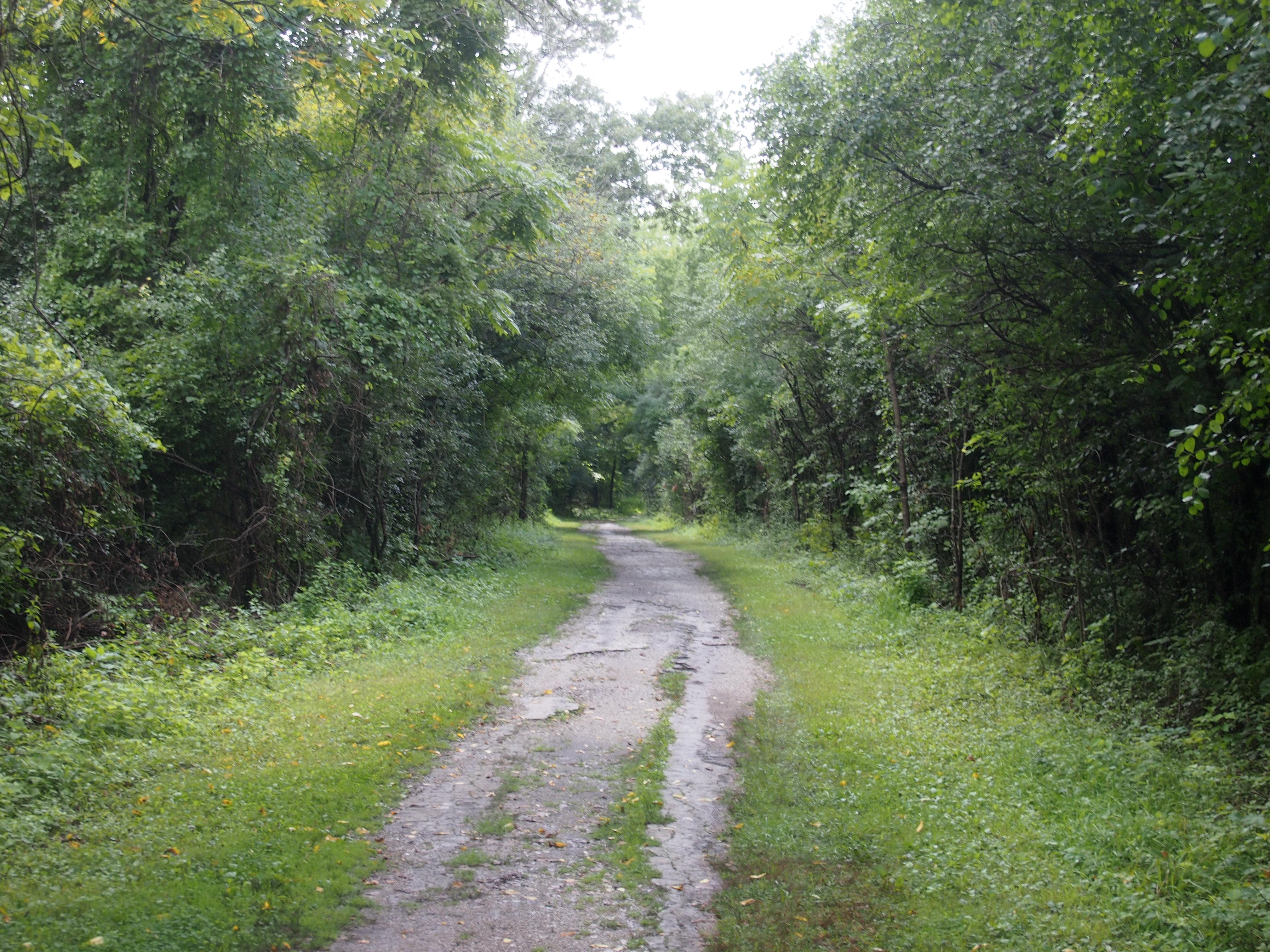
The Mallard Lake Trail, Near the West Branch of the Du Page River

I noticed a sign today at Mallard Lake Forest Preserve, which we haven’t visited in nearly a year.

Mallard Lake FP, Du Page CountyUh-oh. I don’t think that sign was there last year. But now there’s evidence that the dread zebra mussel has invaded these waters, as it’s hopscotched across the lakes of the world. Wiki tells me that the mussel has come from its native lakes of southern Russia to be a pest in North America, Great Britain, Ireland, Italy, Spain and Sweden.

It’s no trifling matter. The Virginia Department of Game and Inland Fisheries tells us that, “Many water treatment and power facilities must now treat their systems to keep them free of zebra mussels, beaches must be periodically cleaned of decaying masses of dead zebra mussels, and bottom-dwelling organisms and fisheries have been negatively impacted. In the United States, Congressional researchers estimated that zebra mussels cost the power industry alone $3.1 billion in the 1993-1999 period, with their impact on industries, businesses, and communities over $5 billion.”

Fortunately, zebra mussels don’t invade the land to attack casual walkers on forest preserve paths. That’s all we wanted to do today, because once again the weekend was unusually warm for February, nearly 60 degrees F.

Instead of simply circumambulating Mallard Lake, we also walked along a spur called the Mallard Lake Trail, which leads to a municipal park called Heritage Park, which is part of subdivision I know nothing about. For a quarter of a mile or so, Mallard Lake Trail seemed remote, though it was an illusion, helped by the day’s strong winds, which muffled the sound of traffic off in the distance.
Mallard Lake TrailWithin view of part of the trail is the West Branch of the Du Page River.
West Branch Du Page RiverIt might have been a natural-flowing stream at one time, but it has the look of a man-made channelization at this point. By the time we got here, the middle-of-the-woods illusion was punctured by houses in the background, and a school off in the other direction.
West Branch Du Page RiverThe West Branch of the Du Page River flows quite a ways south — including through downtown Naperville — to meet the Du Page River in Bollingbrook, Ill. The Du Page joins the Des Plaines at a place called Moose Island in Channahon, Ill., but very near there the Kankakee River joins the Des Plaines and they all form the mighty Illinois River, a direct tributary of the Mississippi just north of St. Louis.

So you might say we took a stroll in a very small part of the Illinois River watershed, which includes all of the little cricks and rivulets around here.

“Ecce Hora”

Not far from “Awaking Muse” (see yesterday) on the grounds of the Prairie Center for the Arts and the Village of Schaumburg municipal center is a sculpture doubling as a sundial — or a sundial doubling as a sculpture — called “Ecce Hora.” After visiting the muse, I walked over to the structure.
"Ecce Hora"This vantage shows the south-facing side of the sculpture, which naturally catches more light than the north face, so it has a wide variety of hour lines. You’ll note that it shows the time as a little past 11 am, which was completely accurate. Toward the tip of the gnomon — it’s hard to see in this picture — it advises you to add an hour during most of the year to account for DST, but we’re still on standard time.

The sign near the work — actually there are two signs, duplicates of each other for some reason — says, “this adjustable sundial was designed and built by Chicago artist Christine Rojek. Ecce Hora (which means “Behold the Hour”) is constructed of painted aluminum and includes fanciful hand-painted figures which twist, dive and somersault. They perform as if to say, ‘If life is just a shadow, make a dance.’ ”

That’s what they’re saying? How about, “Time flies, so do we” ?

The north-face, which has the English name, is destined not to catch as much sunlight. It certainly was in the shadow this time of the year.

"Ecce Hora"But at other times of the year, it will be illuminated, so there are hour lines on that side as well, just not as many. All in all, it’s good to take a look at sundials every now and then.

“Awaking Muse”

Rumor has it that the ground will be covered with snow again tomorrow — which will devolve into slush a few days after that — so I spent a few minutes today out on the brown ground near the Prairie Center for the Arts and the Village of Schaumburg municipal center. The grounds are sizable, and include a large pond that’s usually home to a pair of swans.

“The village purchased Louis and Serena, called Mated Mute Swans, in 1994 in response to the growing Canada Goose population on the municipal center pond and grounds,” the Village of Schaumburg web site says. “Breeding age pairs of Mute Swan will not tolerate Canada Geese in their breeding (nesting) area, which can cover several acres of water.”

Not sure whether they migrate, but in any case, the swans weren’t around today. A sign near the pond warns would-be fishermen away when the swans are in residence. The other is probably the only public sign I’ve seen that uses the word cygnet.
Schaumburg Feb 23, 2016Near the pond is a sculpture — a set of sculptures arrayed together — called “Awaking Muse,” by Don Lawler and Meg White."Awaking Muse" Schaumburg"Awaking Muse" SchaumburgA nearby sign tells us that “this sculpture depicts a female figure stirring from her slumber beneath the earth. Carved from Indiana limestone, the sculpture excites imagination and brings inspiration to its viewers. The ‘Awaking Muse’ references the muses of Greek mythology. The Greek muses were goddess sisters who inspired mortals with great thoughts in the arts and sciences.”
"Awaking Muse" SchaumburgI don’t know that it excites my imagination, but I like it. It’s been there since 2006. Some years ago, we attended a few summertime outdoor concerts on the grounds near “Awaking Muse,” and the sculpture was alive with children playing on it. Including ours.
The only thing missing? A nearby Indiana limestone alarm clock. Even muses have a hard time waking up sometimes.

Bulldogs Grill, Wauconda

If I were writing professionally about Bulldogs Grill, a hamburgery in Wauconda, Ill., I might characterize it as a “diner for Millennials,” even though I’ve heard just as much as I need to about that vague generational grouping (if you chug beer each time you hear “Millennial” during a commercial real estate conference, you’ll get soused fast). Still, the point would be that Bulldogs takes an old form, the diner — with its short-order items and eclectic wall decor and chrome-trimmed stools and that deep-fry smell — and infuses it with elaborations on the basic formula.

Fortunately, the joint also retains the diner tradition of food at fairly modest prices. If it were in Brooklyn or San Francisco or Seattle or Cambridge, Mass., instead of northwest suburban Wauconda, in the heart of Lake County, that might not be the case.
Bulldogs Grill Feb 2016So the place serves not just burgers, but varieties of burgers mostly unknown to diners before the 21st century. Not just fries, but creative variations on the basic model. Not just a blue plate special, but the likes of handheld wraps formed by tortillas, naan or sourdough, and “street food” that includes baja fish tacos, “Chinese chicken quesadillas,” and pulled pork nachos.

None of that would be important if the food were bad. But it isn’t. Bulldogs Grill cooks up some wonderful food, including the best burger and fries that I’ve had in months, probably since Krazy Jim’s Blimpy Burger in Ann Arbor. The burgers have whimsical names to go along with their various ingredients, such as the Double D, Hangover, Slap Yo’ Mama, Scarlet Johansson, Zombie Apocalypse, Gettin’ Piggy With It, Bob Marley, Bedlam, Bluenoon Rising, and Area 51, among others (a full list and descriptions are here). I had the Slap Yo’ Mama, which featured bacon, grilled onions, cheddar cheese and apple barbecue sauce. That sounded like a winning combo to me, and it was.

We also ordered regular fries and a portion of Pig Fries for all to enjoy. The Pig Fries included pulled pork, cole slaw, bacon, barbecue sauce and ranch dressing, all mixed up with fresh-cut French fried potatoes. Wow. The food nags say this kind of thing is bad for you. Maybe so. I’ll just have to take my chances from time to time.