First Folio Exhibit, Lake County Discovery Museum

ShakesBirthI’ve done a little Shakespeare tourism in my time, such as visiting his birthplace in Stratford. When I scanned the ticket from that visit, I noted that I paid £1 for admission in 1983. The Bank of England has a handy UK inflation calculator that tells me that’s the equivalent of just over £3 now.

I checked the Shakespeare Birthplace Trust web site today and found that a “Birthplace Pass” now costs £16.50 for an adult. For that, you get into “Hall’s Croft, Harvard House, Shakespeare’s Birthplace, Shakespeare’s Grave,” so that’s not as outrageous as £16.50 for just the birthplace, but it still doesn’t quite sit right. Can you just buy a single ticket for the birthplace, or is the pass the minimum? Also, there are other, more expensive options that include other houses and a garden.

Shakespeare’s grave is at the Church of the Holy Trinity, and I don’t recall being charged admission. These days, the church asks for a £2 or £3 donation if you want to take a look at the playwright’s grave, and spare those stones and not move his bones. A good idea, since moving those bones wouldn’t just get you cursed, it would probably be a fairly serious criminal offense in the UK.

FirstFolioAll this comes to mind because last week we — all of us going the same place, an increasingly rare thing — went to the Lake County Discovery Museum in Wauconda, Ill., to see a First Folio. It was my idea. On the occasion of the 400th anniversary of Shakespeare being laid to rest in that church near the Avon, the Folger Shakespeare Library has sent out some of its First Folios in traveling displays. Each state has one display in one location over the course of 2016, and Illinois’ is this small museum in the far northwest suburbs.

Of all the times I’ve been to DC, I’ve never managed to make it to the Folger. There’s a good chance I’ve seen a First Folio somewhere — maybe at the British Library or the New York Public Library — but I don’t remember. So I wanted to see this one.

I’d been the Discovery Center a few times before, mainly to see excellent exhibits drawn from the museum’s Curt Teich Postcard Archives. That includes over 400,000 postcards of more than 10,000 towns and cities nationwide and elsewhere, plus a lot of other subjects.

The First Folio exhibit was straightforward: a room with tall signs offering various facts about Shakespeare, his plays, the Quartos and the 1623 and later Folios, along with the King’s Men actors who saw fit to have them published: John Heminges and Henry Condell. A smaller, adjoining room includes the First Folio itself, behind glass and opened to the page that includes Hamlet’s soliloquy.

First FolioIt’s a handsome volume, not much worn or yellow. This was no pulp publishing. It’s also one of the 233 copies that are known to exist, and one of the 82 that the Folger owns as the largest collector of them. Remarkably, Meisei University in Tokyo has the second-largest collection, numbering 12. How did that happen?

A cop lurked in the shadows at the exhibit; a wise precaution, no doubt. At a Sotheby’s auction in 2006, a copy fetched £2.5 million, and thieves have been known to target the book, though the fellow in that article sounded like a bumbler.

I thought it was worth the 45-minute drive to Wauconda. My family might not have been persuaded, except we also had an enjoyable dinner in that town first. More about that tomorrow.

Spring Valley Winter

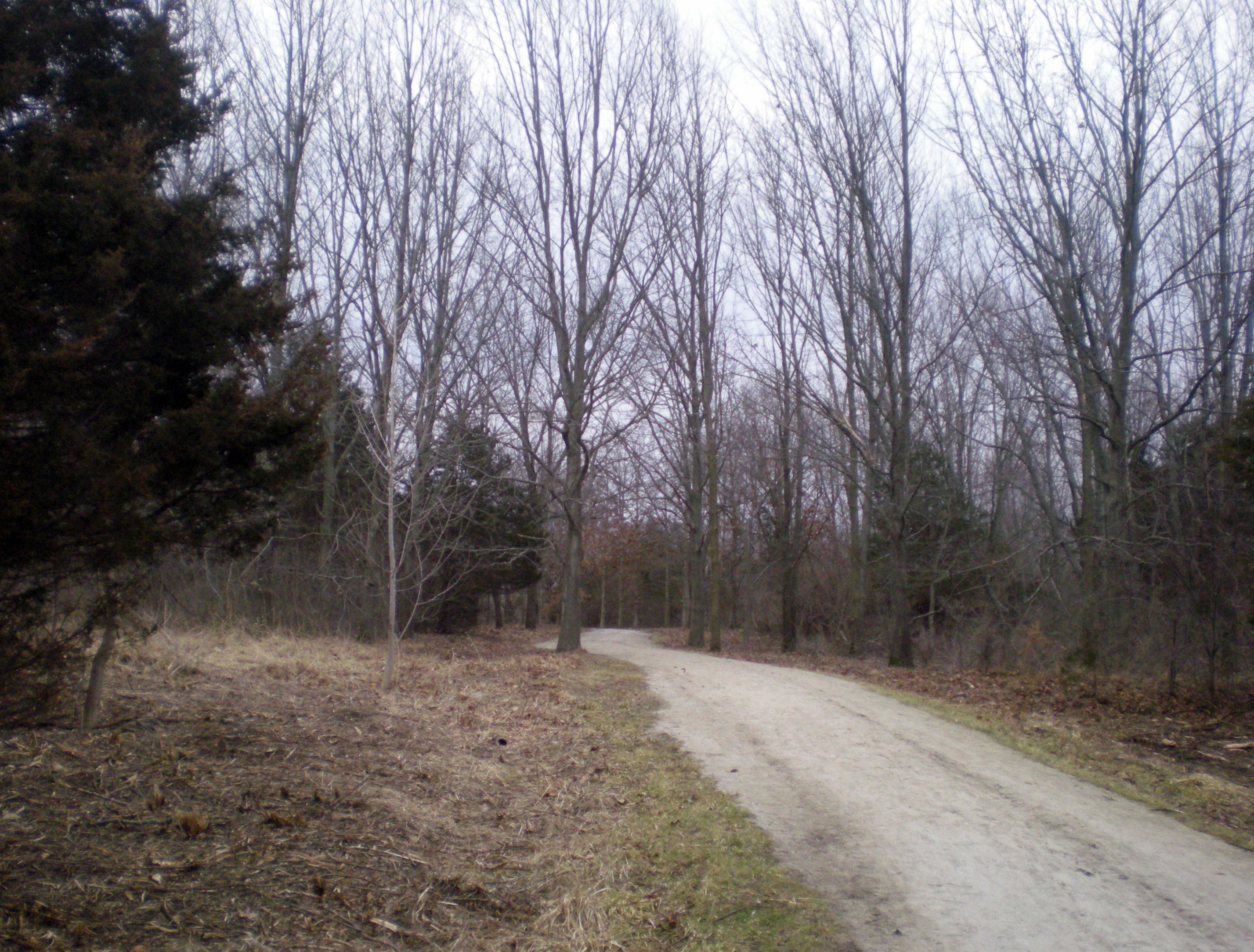
On Friday, I went for a walk in a place I don’t usually visit in the winter, because I happened to be driving by: Spring Valley Nature Sanctuary, though sometimes I go as northern Illinois is emerging from winter.

The recent snows have been modest, but enough to cover the trails and the ground.

Spring Valley Nature PreserveSpring Valley SchaumburgIn about four months, this same view of thick bushes along the trail will be a mass of green as dense as any in more torrid zones.
Spring Valley Nature SchaumburgIt was also time to document Doc Baker’s stone, also along the trail, put there in 2002. One of his life’s achievements was the founding of the Rotary Club of Schaumburg and Hoffman Estates. I have nothing bad to say about the Rotarians. The fellow who hired me for my first job in Chicago in ’87 was a Rotarian, and occasionally we had lunch at Rotary Club 1, which was on Michigan Ave. at the time.
Howard Doc Baker - Rotary Club Schaumburg Hoffman EstatesDoc Baker seems to have been well liked. Good for him.

Pit of Winter, and No Place to Toboggan

According to online sources, the temperature outside as I post is zero degrees Fahrenheit, with small negative numbers expected in the near future. Tomorrow will see highs in the positive single digits. So here we are, in the pit of winter.

Twenty-eight Januaries ago I was tramping around at one of the Du Page County Forest Preserves, maybe Blackwell Forest Preserve in Warrenville. I used drive out from the city periodically to visit a friend in Warrenville, usually on a Saturday. During the warm months, I’d help him tend his large garden, receiving a share of the produce.

In the winter, I forget what we did, besides watch videos and — on January 23, 1988 — visit a snow-covered forest preserve as the snow fell. I had my camera, and it was during a period when I was taking black-and-white pictures. We happened across a closed toboggan run.

Du Page County Jan 1988I can’t pin it down now, or rather don’t want to spend much time at it, but I’m fairly certain that the local forest preserves closed their handful of toboggan runs sometime not long before I took the picture. Probably it was the expense, or the liability, or both.

Mid-November Quietude

I was going to post pictures taken on the Champs-Élysées and at the Louvre about 21 years ago, but with word from France of the latest murderous barbarian outrage, recalling a pleasant November visit to Paris doesn’t seem right. Another time.

Here in northeastern Illinois this weekend, we enjoyed remarkably mild weather. The kind of afternoons during which you can sit in some comfort on your deck, should you be fortunate enough to have one, and eye the sun in the branches of the bare trees.

Nov 15, 2015Your dog, should you be fortunate enough to have one, joins you on the deck to watch for squirrels and rabbits and other intruders.

Payton, Nov 15, 2015Naturally it’s going to cool off dramatically soon. Winter wouldn’t be so tedious if there were occasional interludes like this in January and February, but that’s not how it works at this latitude.

Dust, Quicksand, & Late-Season Dragonflies

We enjoyed a warm weekend, following cooler days and almost cold nights. But no hard freeze just yet.

Today was windy, and it’s been dry a while, so dust kicked up from the baseball diamond was visible from my back yard.
Columbus Day Dust 2015By contrast, when it’s been raining a lot, patches of quicksand form, trapping unwary little leaguers. Well, maybe not. Apparently grade-schoolers aren’t even afraid of quicksand anymore, which means that people aren’t watching enough Tarzan movies.

Saturday we took walk at the Crabtree Preserve, which is a 1,000-acre unit of the Forest Preserves of Cook County that we’d somehow overlooked before, even though it’s only about 15 minutes away. It’s a pleasant place to walk on a warm October day, with trails that wind through woodland and restored, or mostly restored, prairie, and a small nature center with some exhibits.

I read that it’s been a boom year for dragonflies, but haven’t seen so many myself. Maybe that’s because I don’t live that close to lake-sized bodies of water. But as we followed the trail around Bulrush Pond and Bulrush Marsh, we spotted a few clouds — swarms — squadrons of dragonflies, especially ones with long red abdomens.

The Last of the Summer Weekends. Maybe.

On Friday afternoon, we took the dog for a walk at Poplar Creek Nature Preserve. A balmy afternoon. Most of the tree foliage is still green, but includes distinct tinges of yellow or brown. Goldenrod blooms profusely, and so do white daisy-like flowers, along with a larger version that’s lavender-colored, but not actually lavender. The tall grass is brown, the short grass green. The cicadas still buzz and the grasshoppers still hop.

The Woodfield Mall was busy in its own way on Saturday afternoon. I can’t remember the last time I was there, but it’s been a while. There’s a certain amount of renovation going on in the common areas, but nothing that affects the flow of people too much. A number of stores displayed Star Wars merchandise in highly visible ways. I haven’t been keeping track, but that must foreshadow a movie along those lines.

Sure enough, a line in the Sunday Tribune Arts and Entertainment section tells me that, “As a new Star Wars movie looms [interesting choice of verbs], many of the franchise’s original fans are as devoted as ever.” Guess the merch is partly for them and their offspring. As far as I’m concerned, the first three movies, while very entertaining in their time, need to go in a box labeled Things of the Past.

Most of Sunday was overcast, so I wondered whether I was going to see the lunar eclipse. A couple of hours before dark, however, the clouds cleared away, and at about 8:30 I went out to see the shadow of the Earth falling on the Moon. At about 9, Yuriko, Ann and I were out, and then again 15 minutes later for totality. The dog was out, too, but typical of dogs, she didn’t give a fig for the celestial phenomenon (no smell involved, I guess). The copper moon was a pretty sight, but it didn’t look any bigger than usual to me.

In time for the eclipse, the Atlantic posted these images, marvels of 20th-century manned space exploration. These images are more recent marvels of (mostly) unmanned space exploration.

Lilly was at a friend’s house on Sunday evening, so I did what you do these days, and sent her a text about the eclipse. Later she said she’d seen it. I’m also glad to report that at least two neighboring families on my block were out to see it, too. I noticed that while taking the garbage out under the dark copper moon.

St. Luke’s Lutheran Church, Park Ridge

You might call St. Luke’s Lutheran Church at 205 N. Prospect Ave. in Park Ridge an example of Suburban Gothic, but apparently that’s the name of a movie that came out last year. Anyway, it’s a handsome English Gothic-style church in the suburbs. We were back in Park Ridge Saturday afternoon for the last stop on the Churches by Bus tour.

St Luke'sThe building has the distinction of being designed in the late 1920s by Elisabeth Martini (1886-1984), the first woman to be the proprietor of an architectural firm in Chicago. Mostly she did houses, but it seems that she was a member of this church, and did the design work for a payment of $60 a month for the rest of her life, which turned out to be another 50-odd years, though it might not have been adjusted for inflation.

Adjoining the sanctuary (next to the bus in my picture) is a 2010 addition by Douglas E. Lasch of Jaeger, Nickola, Kuhlman & Associates, which replaced a smaller addition from the 1970s and blends in remarkably well with the original structure. He has his own shop now, Faith Environ Studio, which focuses “primarily on providing architectural services to faith-based and other non-profit clients.”

St. Luke’s sanctuary has an elegant interior.

St Luke'sThe stained glass windows tell of the Old and New Testaments. I’m sure the representation of Moses in one of the windows was meant seriously, but I can’t shake the idea that he’s grinning. Maybe it’s the eyes. “See what I have here! Commandments! Ten of them! Aren’t they terrific?”

MosesLuther, on the other hand, looks fairly serious, but not grim.

LutherI suppose those are the 95 theses on the door. A little hard to read at this scale. Wonder if they’re microprinted in the original Latin? I didn’t check. Never mind, the text is easily available on line in Latin and English (and other languages).

I haven’t looked at the theses since sometime in a college history class, so I was amused to find No. 86: “Again, ‘Why does not the pope, whose wealth is today greater than the wealth of the richest Crassus, build this one basilica of St. Peter with his own money rather than with the money of poor believers?’ ”

Ah, if only in our time and place we could mention Crassus without having to explain who he was. Then again, if those poor believers were able to understand that they were doing their little part to build the grandest church in Christendom, would they have been particularly upset?

One more thing about St. Luke’s in Park Ridge, which I read about later. It’s the home to the Bottle Band. Odd the things you find out. More about the band here.

Our Lady of Hope, Rosemont

The newest church on our bus tour last Saturday was Our Lady of Hope, a Catholic church at 9711 W. Devon Ave., just barely in the boundaries of the small suburb of Rosemont, which is better known for its proximity to O’Hare and various entertainment venues. In fact, while I might be wrong, it seems to be the only church with a location in Rosemont, based on a Google map search.

Built only in 1986 (which seems new to me), the church counts as a “Modern Prairie” style, according to the Chicago Architecture Foundation. “Modern Prairie designs are often devoid of frills and decoration, but build character through asymmetrical shape, and large open spaces,” the CAF says.

Frill-less indeed, especially on the outside.
Our Lady of HopeAlso true to its prairie-style forerunners, the entrance isn’t immediately apparent, but once you go in, you do find large open spaces. I liked the curve into the nave — maybe this space counts as the narthex, though probably that terminology went out with traditional church decor.
Out Lady of HopeA semicircle of seats faces the altar. The lighting was such that I didn’t get a decent shot of the altar. The seats, on the other hand, were quite visible.
Our Lady of HopeThere was some representational art, but not much. Such as this group standing among plants.
Our Lady of HopeA young architect named Leslie Ventsch, working at the time for developer Opus Corp., designed the structure. These days he’s a design director at Gensler, according to LinkedIn. He won a Burnham Award in the mid-80s, for a different structure.

First United Methodist Church, Park Ridge

Late yesterday morning, Yuriko and I were in Park Ridge, Ill., an inner northwest suburb of Chicago. On the whole, it’s a handsome suburb, well marked by prosperity. A lot of rain had fallen on Friday as thunderstorms rolled through, but by Saturday morning the day was well on its way to being pleasant and clear.

So it was a good day to be on the Chicago Architecture Foundation Churches by Bus tour, as we did last year. This year, the tour visited six churches on the Northwest Side of Chicago and two of its adjoining suburbs: Park Ridge as well as the diminutive Rosemont, which is better known for its convention center and theaters and restaurants near O’Hare.

We were on Bus # 4 again. Our first stop was First United Methodist Church at 418 W. Touhy Ave. in Park Ridge.
First United Methodist Church, Park RidgeAs suburban congregations go, it’s an old church, founded in 1856, with the original sanctuary built in 1857. The church building we saw dates from the 1920s, a Tudor Revival design by two men once in Daniel Burnham’s employ, Thomas Tallmadge and Vernon Watson. Inside, it isn’t particularly ornate.

First MethodistExcept for the six large stained-glass windows, completed in 1940. They were fashioned by Conrad Schmitt Studios in Wisconsin, which is apparently still around, and designed by a young German immigrant named Conrad Pickel, whose children run a stained-glass studio in Florida.

Stained Glass!The organ in back is much newer, installed only during this century. The organist (seen looking down at the sanctuary) played a bit for us. It has an excellent sound.
Big organ!The church has a couple of other distinctions besides its design. Hillary Clinton attended church here growing up in Park Ridge, and it’s also home to one of the first  Boy Scout Troops in the nation (the docent claimed it was the first), continuously active since 1912.

This, That and the Other Thursday

Here’s a sign you can see in my neighborhood.

Cave CanemLiterally true, and it might mean a legal quagmire for the property owner, though I’m no expert on the matter.

Driving along today, I spotted the first bumper sticker of next year’s election. Next year being the operative term. Everything at this point is just talk, and citizens are entitled to pay it no mind. The sticker said: Bernie 2016.

Mostly blue, but the letters and numbers were white, with a thin red swoosh underlining the letters. Reminded me of the Obama O design; no accident, I’m sure.

I mentioned it to Ann, who is as nonpolitical as a 12-year-old should be, and she told me the only presidential candidates she’s heard of are Hillary Clinton and Donald Trump.

On the Roosevelt Road bridge at the southern edge of downtown Chicago are some nifty bronzes. I only took a picture of one.

WorldBronzeRooseveltRoadThe sculptures are by Miklos P. Simon and include (among other things) likenesses of  dolphins, dinosaurs and celestial navigation instruments, supposedly homages to the Shedd Aquarium, the Field Museum, and the Adler Planetarium, none of which are far away. More about the bridge is here.