Main Street, St. Charles

St. Charles, Illinois, is on the Fox River southwest of where I live, about a 30 minute drive, partly on the two-lane roads near the river. Though quite a ways from Chicago, I suppose it counts as an outer mid-sized suburb, with about 33,000 inhabitants.

It’s got an interesting municipal building on Main Street, overlooking the Fox. Not too many Art Moderne municipal buildings around, at least in metro Chicago.

St Charles, Ill. Oct 5, 2014Vintage 1940, and it sure looks like it. Designed by R. Harold Zook, early 20th century architect noted for his work in the area, and for a fun name, at least by me. Get a little closer, and you’ll find Dellora standing in from of the edifice.

St Chas, Ill. Oct 5, 2014And her dog Toto? Her plaque doesn’t say. It does tell us that this is a representation of Dellora Angell Norris (1902-1979): “Her vision and generosity shaped our community for generations to come.” Not to quibble, but shouldn’t that be will shape? Ah, well. It’s in bronze, no editing now. Dedicated June 8, 2006. The sculptor is Ray Kobald.

Mr. Kobald is local to St. Charles. Think globally, sculpt locally.

On the west side of the Main Street bridge in St. Charles is the Hotel Baker.

Hotel Baker, St Charles, Ill. Oct 2014A closer view.

Hotel Baker, Oct 2014Local millionaire Edward J. Baker, one of the heirs to John “Bet-a-Million” Gates barbed wire and oil fortune, developed the property in 1927 (Dellora Norris was another heir). Over the years it was a hotel, then a retirement home, now a hotel again. Actually, he was Col. Baker — a Kentucky colonel, somehow or other. More about him here.

I ducked inside for a moment, fond as I am of spiffy hotel lobbies. Over the entrance, facing inward, is this nice piece of work.

Hotel Baker, Oct 2014The Baker Peacock, you could call it.

The Bluff Spring Fen

Back again on September 2. Labor Day weekend is no time to do work, if you can avoid it.

When in doubt, go to a dictionary. If one isn’t enough, go to two or more. First, the American Heritage Dictionary of the English Language, New College Edition, print version. Fen: “Low, flat, swampy land; a bog; marsh.” Next, Merriam-Webster, online version. Fen: “Low land that is covered wholly or partly with water unless artificially drained and that usually has peaty alkaline soil and characteristic flora (as of sedges and reeds).”

I found myself wondering about the exact definition of a fen when walking through a fen the other day. The Bluff Spring Fen. It was clearly a low wetland, and I’ll say this about a fen in August, especially in a rainy year — there’s a lot of characteristic flora.

Bluff Spring FenBluff Spring Fen, August 2014The only visible work of man is the footpath through the fen, which isn’t very visible, except in those few spots where wooden planks cross extra-low, extra-damp terrain.

Bluff Spring Fen plankThe fen is next to the Bluff City Cemetery, described yesterday. Toward the bottom of the bluff, in fact, and accessible through the cemetery grounds. The web site of Friends of the Bluff Spring Fen gives a more complicated definition of this particular fen: “Bluff Spring Fen is a 100-acre Illinois Nature Preserve in Elgin, Illinois, named for its rich, calcareous fens. These rare wetlands are fed by springs coming up through the ground bringing mineral-rich water. This alkaline water comes out of the ground at about 50 degrees, keeping the springs and streams flowing year round, and supporting animals and specialized plants that are adapted to these conditions.

“The Fen is not just the wetlands. It is a myriad of habitats including prairies, savannas, wetlands, and woodlands. Each one of these groups can be broken down further into subcategories… Rare and endangered species can be found here, such as the Small White Lady’s Slipper Orchids, the Baltimore Checkerspot Butterflies, and the Elfin Skimmer Dragonflies. To date, over 450 plant species, 57 butterfly species, more than 20 dragonfly species, and almost 100 bird species, including 33 nesting, have been recorded at the Fen.”

I don’t know if I saw any Elfin Skimmer Dragonflies, but I did see a lot of dragonflies. Squadrons of dragonflies. All beating their wings, causing typhoons in the South China Sea. Or was that butterflies? Saw a fair number of them, too. But not as many mosquitoes as I expected, fortunately. Always a good thing when you’re out in the middle of a fen.

The Bluff City Cemetery, Elgin

At Costco the other day, I was waiting in line at the keep-’em-in-the-store food service window, which is across from the row of check-out stands. The line was about eight people deep, and had started to snake toward the check-out stands, partially blocking the flow of people and shopping carts as they headed for the exit.

“Please move the line against the wall,” a Costco employee told everyone in line. It was a reasonable request, and we all moved away from the check-out row. A few seconds later, a man wheeled his cart past us in the line, and said, “Thanks. There’s no more Thermopylae.”

Did he actually say that? I wondered. I decided he had. I didn’t particularly feel like we were holding off a host of Persians, but I chuckled anyway. That’s someone who’s read his Herodotus. Or more likely, watched 300.

I spent some time one warm day recently at the Bluff City Cemetery in Elgin, Illinois, which has been a municipal burying ground since 1889. It’s a large place, 108 acres, and unusually uneven for Illinois terrain. My guess is that as a rolling bluff, the site wasn’t good for much else, so it became the cemetery.

Bluff City CemeteryBluff City Cemetery, August 2014A lot of mature trees, a lot of stones. Not a lot of funerary art, but I did see some examples, such as this figure, atop a monument to people named Hanson, and holding what looks like a chain attached to an anchor. I’ve read that anchors were early Christian symbols of hope, and are sometimes found on funerary art, though I can’t say I’ve ever seen one before.

Bluff City Cemetery, Elgin, Ill.The cemetery also sports a few burial vaults built into the hillside.

Bluff City Cemetery, August 2014There are some small mausoleums as well. I liked the Snow mausoleum, with its ivy.

Bluff City Cemetery, August 2014The Snows are under a large oak tree, and the entire time I was there it spat acorns at the ground near me.

A National Champion Red Ash

Not long ago I was tramping around a small section of Spring Valley that I’d never visited, and I found a plaque I’d never seen. That’s a minor thrill. Guess I’m peculiar that way about plaques. It says:

NATIONAL CHAMPION

RED ASH

Planted here April 29, 2001

The 450-year-old parent tree is in Dowiagiac [sic], MI

Schaumburg Park District

Alas, the park district misspelled “Dowagiac,” which is a town in southwest Michigan, in bronze. Further investigation reveals that this particular tree has descendants elsewhere, including on the grounds of the Pentagon. Sen. Carl Levin spoke at the planting of a red ash there on September 10, 2002, as a memorial. Excerpts from his speech:

“The tree we plant this morning, like the other eight planted over the weekend, are actual parts of the largest – and probably oldest – red ash tree in America. That champion tree is located in Dowagiac, Michigan.

Buds from that tree were taken and propagated by the Milarch Family Nursery in Copemish, Michigan, which seven years ago launched an inspired initiative called the Champion Tree Project. The purpose of the project is to take buds from America’s “champion” or historically significant trees and propagate them in “living libraries” throughout the country.

“ ‘Champion’ trees are the largest of their species. There are 826 species of trees in this country; Michigan has 49 champions.

“The champion red ash that these trees are part of is 95 feet tall. The trunk is over 21 feet around. It weighs somewhere between 160 and 200 tons. Most impressively, the tree is estimated to be about 450 years old.”

Here’s the Spring Valley red ash. It’s got a ways to go to be so tall and so heavy, but maybe it will as the centuries pass.

Red Ash, Schaumburg, August 2014Apparently, the Champion Tree effort is still going on, though known as the Archangel Ancient Tree Archive.

Meanwhile, far from all red ash trees, large and small, I was happy to read the following from NASA yesterday: “The Pluto-bound New Horizons spacecraft has traversed the orbit of Neptune. This is its last major crossing en route to becoming the first probe to make a close encounter with distant Pluto on July 14, 2015. The sophisticated piano-sized spacecraft, which launched in January 2006, reached Neptune’s orbit — nearly 2.75 billion miles from Earth — in a record eight years and eight months. New Horizons’ milestone matches precisely the 25th anniversary of the historic encounter of NASA’s Voyager 2 spacecraft with Neptune on Aug. 25, 1989.”

Jupiter and especially Saturn are show-offs, but Uranus and especially Neptune have a quiet majesty. I remember well seeing the pictures of Neptune’s blue orb in the pre-Internet newspapers and magazines of 1989. These days, of course, you can find images of Neptune easily.

RIP, Wayne Grothe

Dark clouds most of the day promising rain, but not delivering, at least not as of about 6 p.m. Cool air did blow through, however, ending a short series of humid days. It felt like the tropics out there for a while.

All too often, I see spontaneous memorials beside the road. Their frequency is sometimes haunting, such as the white crosses every few miles along some highway stretches in the Dakotas. A few days ago, I stopped to take a closer look at a memorial that’s at an intersection I often pass through. In fact, I would have passed through the day of the fatal accident – July 28 – but the road was closed.

Wayne Grothe memorial Aug 2014Next to the road, another sign.

Start Seeing MotorcyclesAll I know about the accident is what I’ve read: “A motorcyclist killed in a crash with another vehicle in Schaumburg Monday afternoon has been identified by Schaumburg police,” said the Daily Herald the next day.

“Wayne Grothe, 23, of Hoffman Estates was riding a motorcycle when it collided with a four-door Taurus driven by a 77-year-old Schaumburg woman just before 1 p.m. near the intersection of Roselle Road and Hartford Drive… The female driver was taken to Alexian Brothers Medical Center in Elk Grove with minor injuries.

“Roselle Road between Weathersfield Way and Wise Road was closed for several hours while police investigated.

“No charges have been filed in the crash and the investigation continues.”

James “Pate” Philip and His State Park

The Illinois Department of Natural Resources tells us that “first-time visitors to James ‘Pate’ Philip State Park (formerly Tri-County) may initially wonder what the area’s specific feature is. After all, the land is predominantly farmland that had been tilled and grazed for years. The north branch of Brewster Creek flows through the property, but most of the streambed had been channeled to move water away from former agricultural fields. Along the north boundary of James ‘Pate’ Phillip State Park, starting in the east, a row of houses rises up like a wall against a sea of grasses. Further west along the boundary is an active gravel pit and by the Bartlett Park District sport field. To the west of the park, across Route 25, is a landfill in the process of being closed.”

I wondered something along those lines on Saturday, when we went to take a walk at James “Pate” Philip State Park (Philip is a retired state politico; I’ve never read an explanation for the nickname, but he’s always referred to by it).

I’ve seen the park on maps as a green blotch for some time now. It was created about 10 years ago. I assume it had been farmland until then, though housing development probably came close in the 1990s. Now the idea is to return it to prairie, and dechannelize the creek.

Seems like a good idea to me. The Prairie State doesn’t have quite enough prairie. Since we had cloud cover and only warm temps, it was a good walk. The park is mostly flat and lush in early July, with grasses almost as tall as a grown man and a lot of wildflowers – including clusters of tiny gorgeous orange blossoms that I don’t think I’d ever seen before. My natural history knowledge is meager, so I might not ever know what they’re called.

I was also intrigued by the fact that the park is within three counties: mostly Du Page, but also Cook and Kane. The tri-county border is, in fact, within the park. I don’t know if there’s any kind of marker, and we didn’t feel like walking far enough to see it, but maybe I’ll go look someday.

We also visited Pratt’s Wayne Woods on Saturday, just south of Pate Philip’s State Park, and took a walk around one of its bodies of water. It was to have been part of a state park, but that didn’t happen, and it’s now a part of the Forest Preserve District of Du Page County – at 3,400-plus acres, the largest chunk under its authority, in fact. The district says, “Pratt’s Wayne Woods Forest Preserve in Wayne is located on the outwash plain of the West Chicago Moraine. Made up largely of wetlands, this landscape combines calcium-rich water with wet sandy soil to support plant life more commonly seen near Lake Michigan.

“Today, the forest preserve is home to over 1,000 species of native plants and animals. Below the savanna’s widely spaced oaks grow dogbane, pale-leaved sunflower and smooth yellow violet wildflowers. In the marshy areas, explorers can view great Angelica, marsh marigold, shooting star, nodding ladies’ tresses and spotted joe-pye weed as well as egrets, great blue herons and wood ducks.”

We saw a lot of plants and a few animals, probably including some of those listed above. But the district forgot to mention what a swell habitat the park is for mosquitoes and especially gnats. It’s been a good year for gnats.

Peonies Aplenty

Deep within Spring Valley, here in populous northeastern Illinois, there’s a log cabin built by one John Redeker, son of Friedrich and Wilhelmine Redeker, which sounds like the sort of German family that once farmed the 19th-century Schaumburg. It feels a little remote, but it’s only an illusion. These days, the cabin hosts events and exhibits.

Merkle Cabin, June 2014It’s on the grounds of a peony farm that John briefly ran, but his death in 1930 at 30, and the following Depression and other factors, made it a short-lived enterprise. Still, peonies solider on at the site. Note the bushes in front of the cabin.

Not far away, in a clearing near the cabin, is a field of peonies.

peony field, Schaumburg, June 2014Peony June 2014One more flower, and that's enoughA good place to spend a few solitary minutes.

Ex-Trees

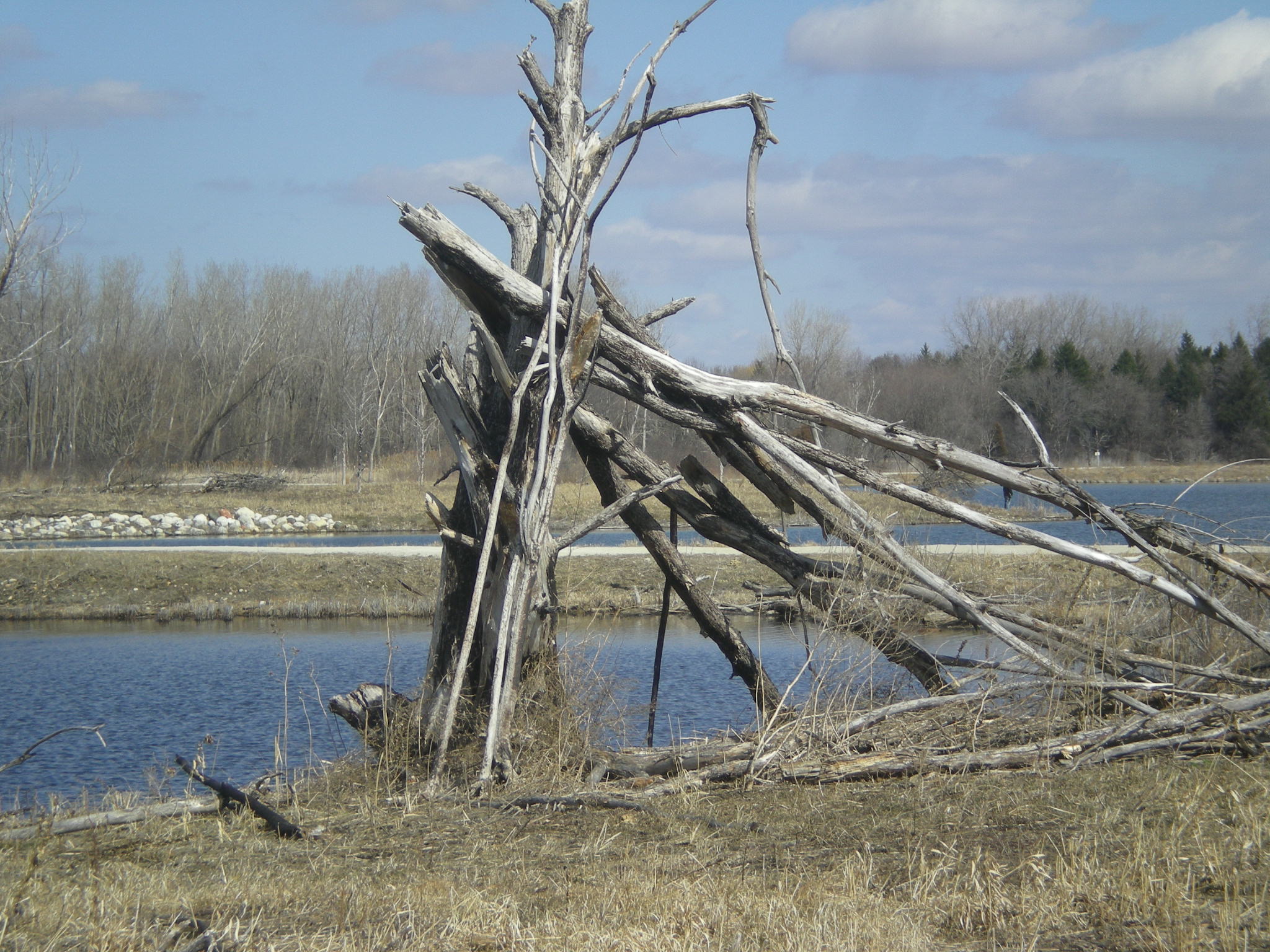
Spring Valley has a number of paved trails, and if you follow the one toward the cabin, you’ll find an enormous white tree not far from the property’s main pond. An enormous, mostly white, all dead tree. Spring Valley tree, June 2014

You might say that it’s passed on. This tree is no more. It has ceased to be. It’s expired and gone to meet its maker. This is a late tree. Bereft of life, it rests in peace. Its metabolic processes are now history. It’s kicked the bucket, shuffled off its mortal coil, run down the curtain and joined the bleedin’ choir invisible. This is an ex-tree.

A large dead tree can be a marvel. Nearly 30 years ago, I ran across a massive one in Mount Rainier Nat’l Park, a “fallen tree trunk bigger than a van. It’s on its side and looks ancient, with gray old roots reaching into the air to twice my height, clawing out in every direction.”

One of these days, unless the Schaumburg Park District removes the thing, the white tree might come crashing down into the pond. Like this smaller (but still fairly large) tree once did. Another tree, June 2014With any luck, it’ll fall some windy night when no one’s around, maybe making a loud crash, maybe not. (How would we know?)

Never Mind the Bollocks, Here Are June Flowers

Rain is falling tonight, and more is predicted for tomorrow. So far, we don’t have the makings of a long, dry summer, though of course that could change.

The following are early June flowers at Spring Valley, here in northeastern Illinois. Mostly I don’t know species names, with the exception of the iris, of course. That’s been one of my favorite blooms since I saw them next to the driveway at our house in Denton, Texas, when I was a kindergartener.

Iris, June 2014

Spring Valley, June 2014Spring Valley, June 2014With flowers come bees. For now, anyway.

Bee, Northeastern Illinois June 2014

Here’s hoping whatever ails the bees doesn’t kill all of them, but makes the survivors resistant to the affliction.

Spring Valley Summer

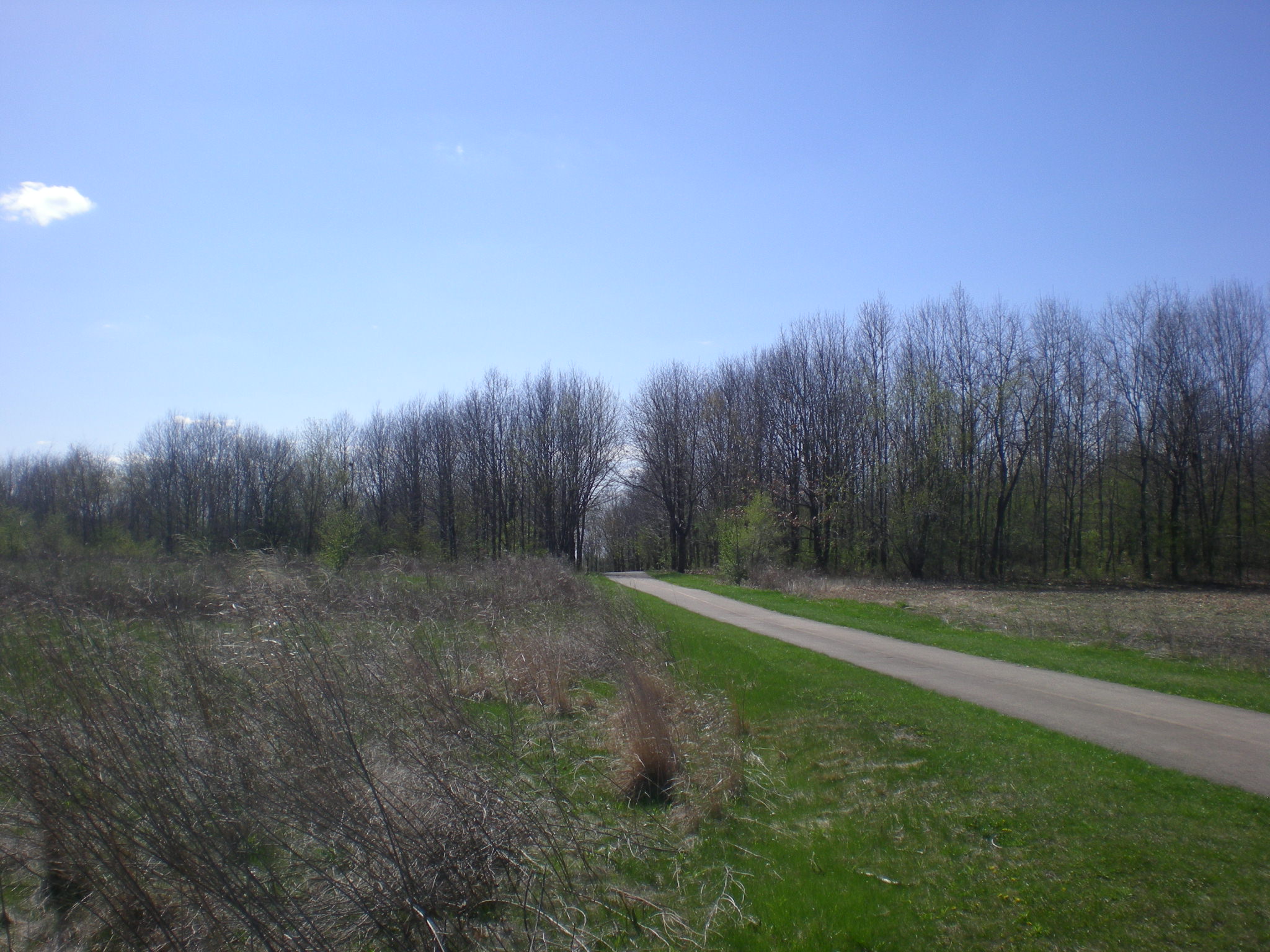
Northern Illinois is incredibly lush now. Heavy winter snow and consistent spring rain will do that. This is a recent snap at Spring Valley in Schaumburg, Ill. Spring Valley, according to the Schaumburg Park District, “a refuge of 135 acres of fields, forests, marshes and streams.” All you have to do to see it is walk in.

Spring Valley, Schaumburg, June 2014Contrast that with images made at Spring Valley early one April. Remarkable what two months + a certain number of inches of water will do.

These little blue wildflowers cover the prairie areas. Hope they aren’t invasive. Then again, if they are, they add a lot of color here in early June, so maybe they should be welcome colonists.

Spring Valley Flowers June 2014The pond’s also verdant as all get out, layered with lily pads and alive with little fish under them. Spring Valley lily pads, June 2014I’m all for going places, far-away places if possible, but there’s also a lot to be said for near-to-here places.