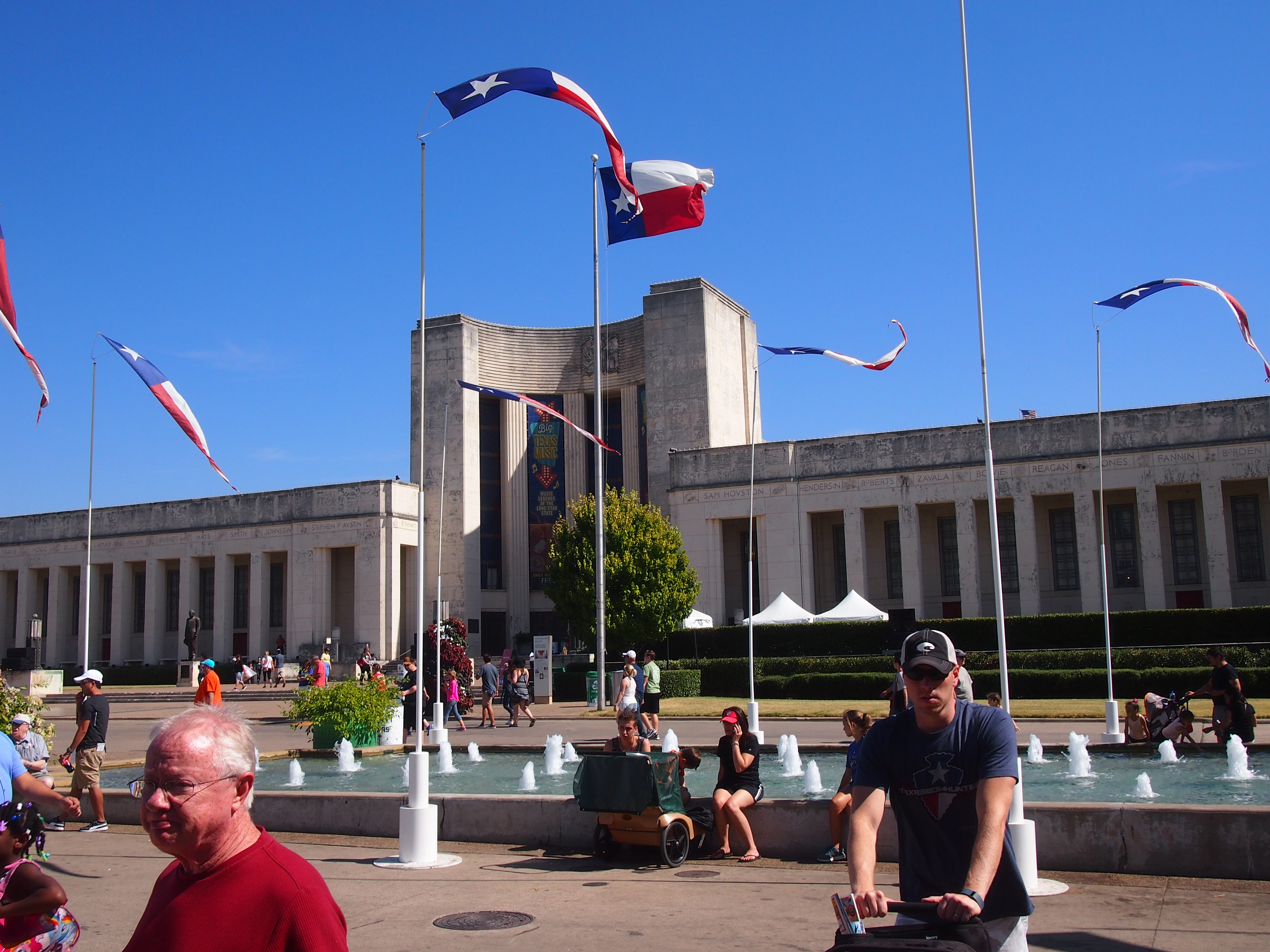
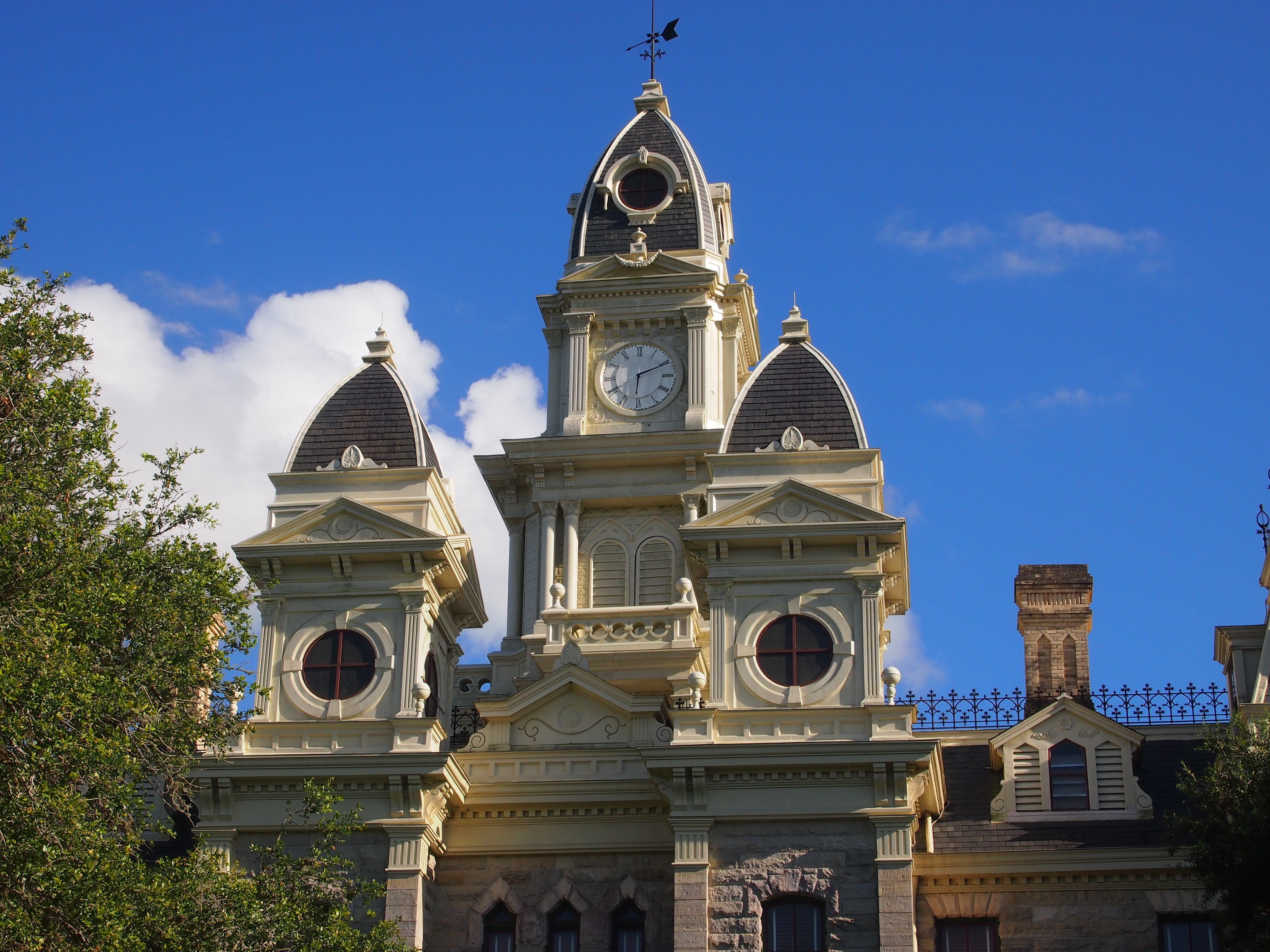
Hall of State, Fair Park

At one end of the Fair Park Esplanade is the Hall of State, a stately hall indeed. “The Hall of State, a museum, archive, and reference library, was erected in 1936 at a cost of about $1.2 million by the state of Texas at Fair Park in Dallas to house the exhibits of the Texas Centennial Exposition and the Greater Texas and Pan-American Exposition of 1937,” explains the Texas State Historical Association.
Hall of State, Fair Park“The structure, designed by eleven Texas architects, is characterized as Art Deco… The front is 360 feet long, and the rear wing extends back 180 feet… The walls are surfaced with Texas limestone. A carved frieze memorializing names of historical importance encircles the building. Carvings on the frieze display Texas flora.”
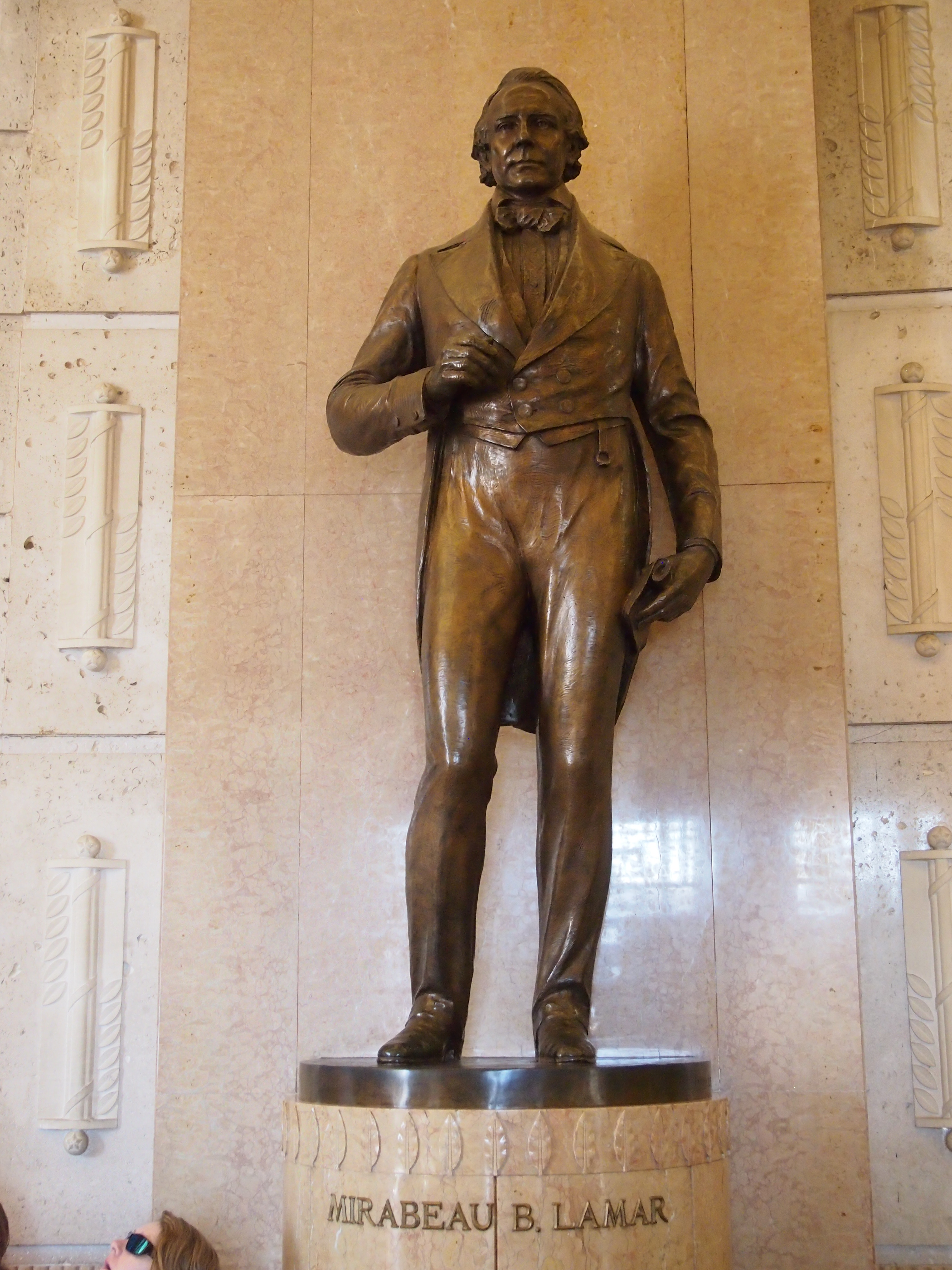
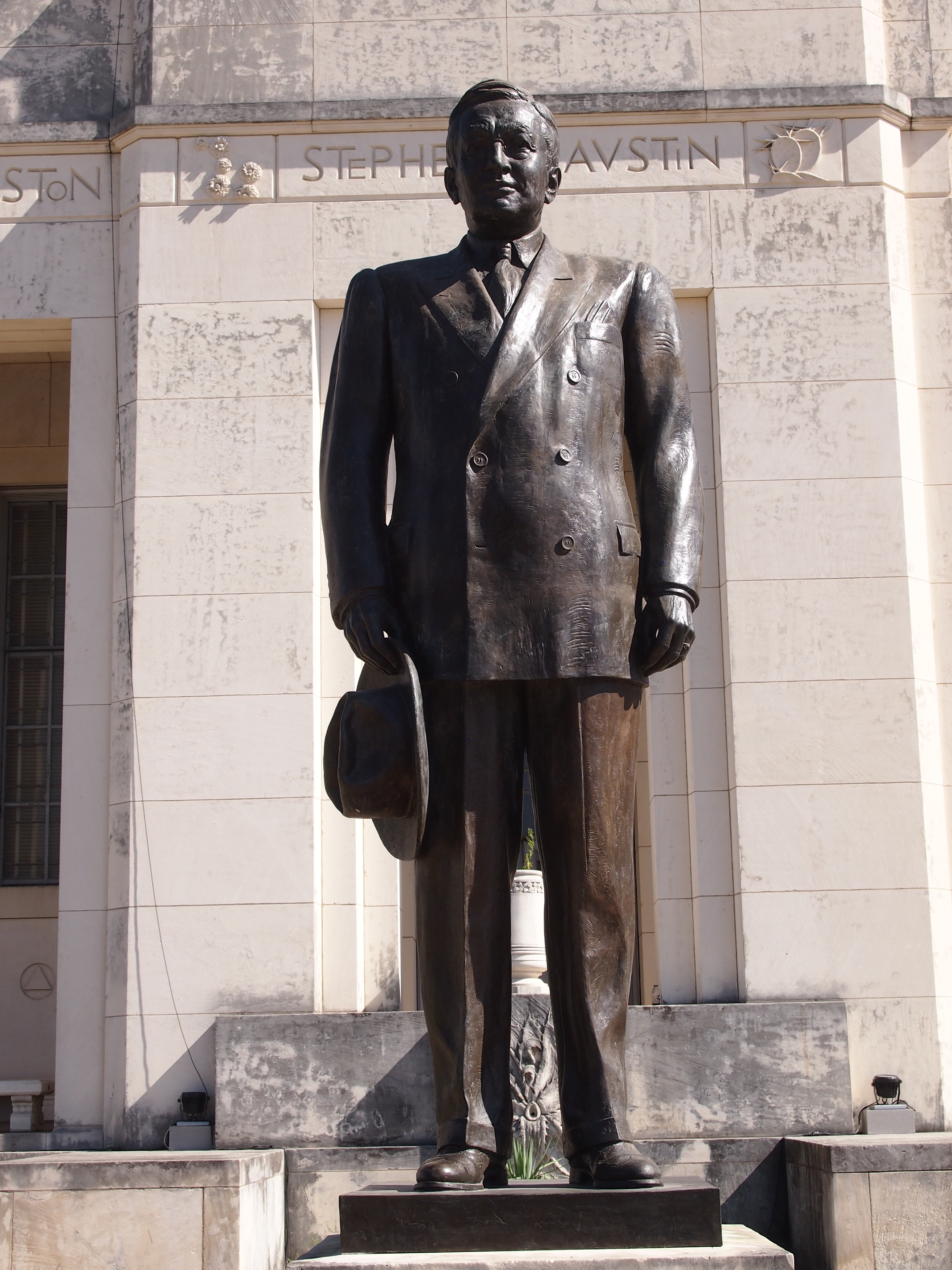
I went inside for a look, and soon was face-to-face — or maybe face-to-plinth — with six statues of early Texas luminaries: Stephen F. Austin, Sam Houston, Mirabeau B. Lamar, James Fannin, Thomas J. Rusk, and William B. Travis. Here’s Lamar (1798-1859), second president of the Republic of Texas, among other things.
MB LamarPompeo Coppini did the sculptures. I’d run across his work before at the Texas State Cemetery in Austin. If it’s a monumental sculpture in Texas done in the early to mid-20th century, odds are he did it.
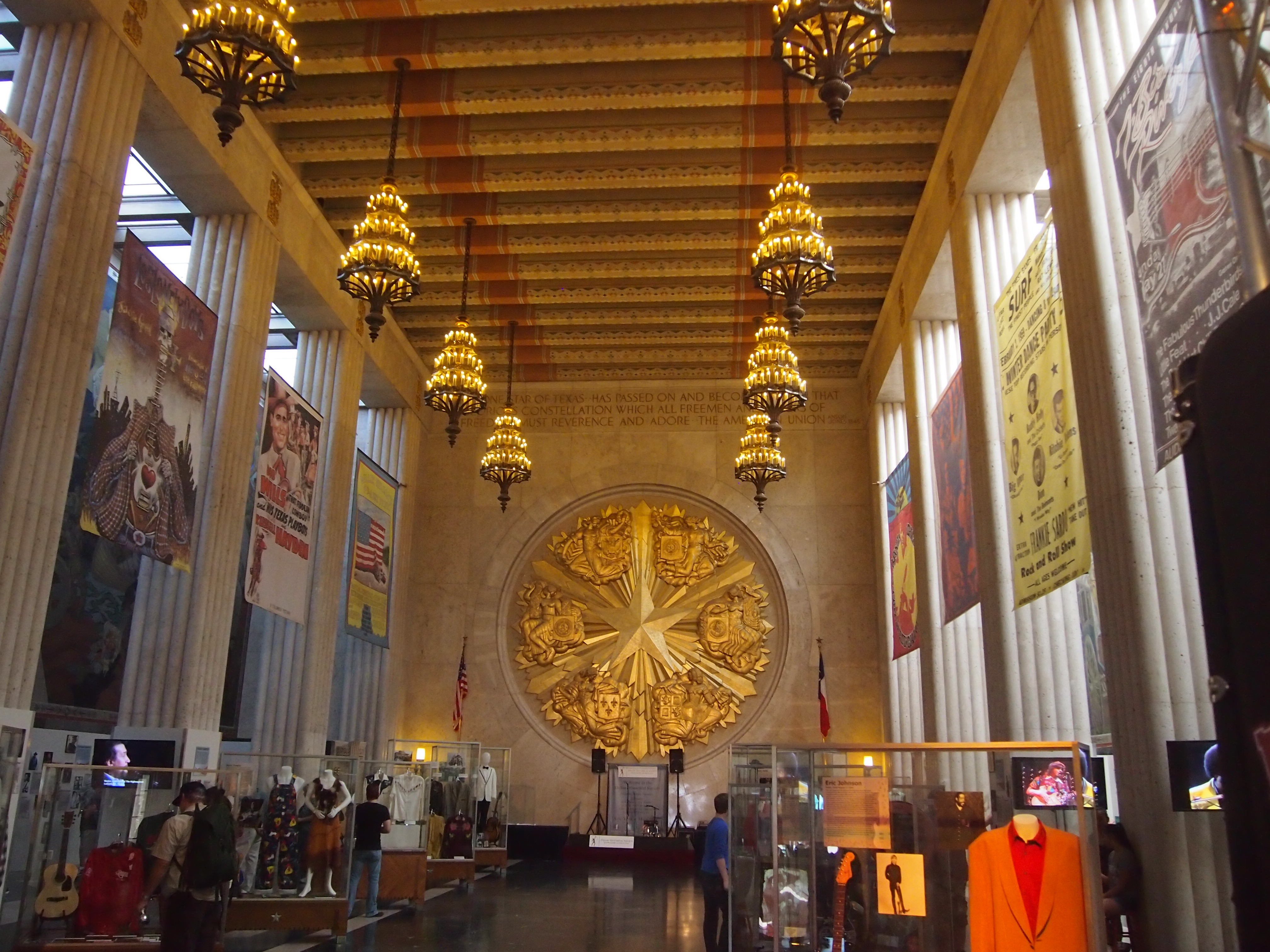
Then I entered Great Hall.
Hall of State, Great HallThe TSHA again: “The Great Hall, or the Hall of the Six Flags, in the central wing, has a forty-six-foot-high ceiling. Murals on the north and south walls depict the history of the state and its industrial, cultural, and agricultural progress. These were painted by Eugene Savage of New York.” I’d run across him before as well.

Great Hall, Hall of StateDuring my visit, the Great Hall happened to be sporting an exhibit about Texas musicians, and I will say that I learned that Meat Loaf was from Dallas, something I didn’t know. Actually I didn’t know much about many of the Texas musicians mentioned in the exhibit, such as various bluesmen and Western swing players and Tejano bands.
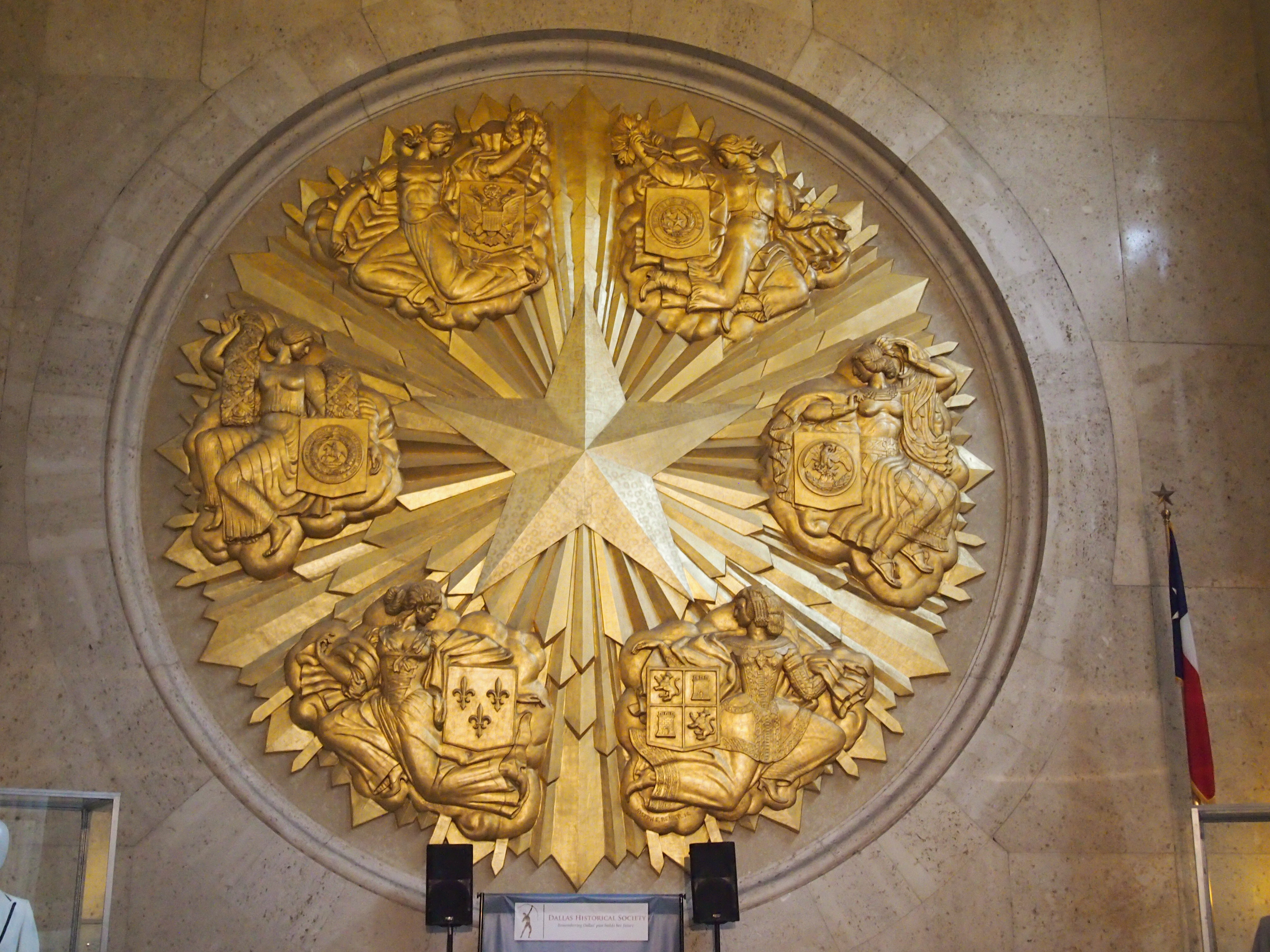
On the back wall of the Great Hall is a gold-leafed medallion with the Lone Star emblem of Texas surrounded by representations of the six nations whose flags have flown over the state.
Gold leaf!The United States and the Republic of Texas are at the top; the Confederacy and Mexico in the middle; and France and Spain on the bottom. The six together are a persistent theme in symbolic representations of modern Texas.
A Stroll Down the Fair Park Esplanade

My afternoon at the State Fair of Texas wasn’t the eat-it-now experience that the Wisconsin State Fair was. I ate two things: a fried chocolate pie like the kind to be found near the Texas-Oklahoma border, and a cheese and jalapeño corn dog, the best corn dog I’ve had in years, maybe ever. It’s the thing to eat at the fair, which is one of the claimants for introducing the food to the world.

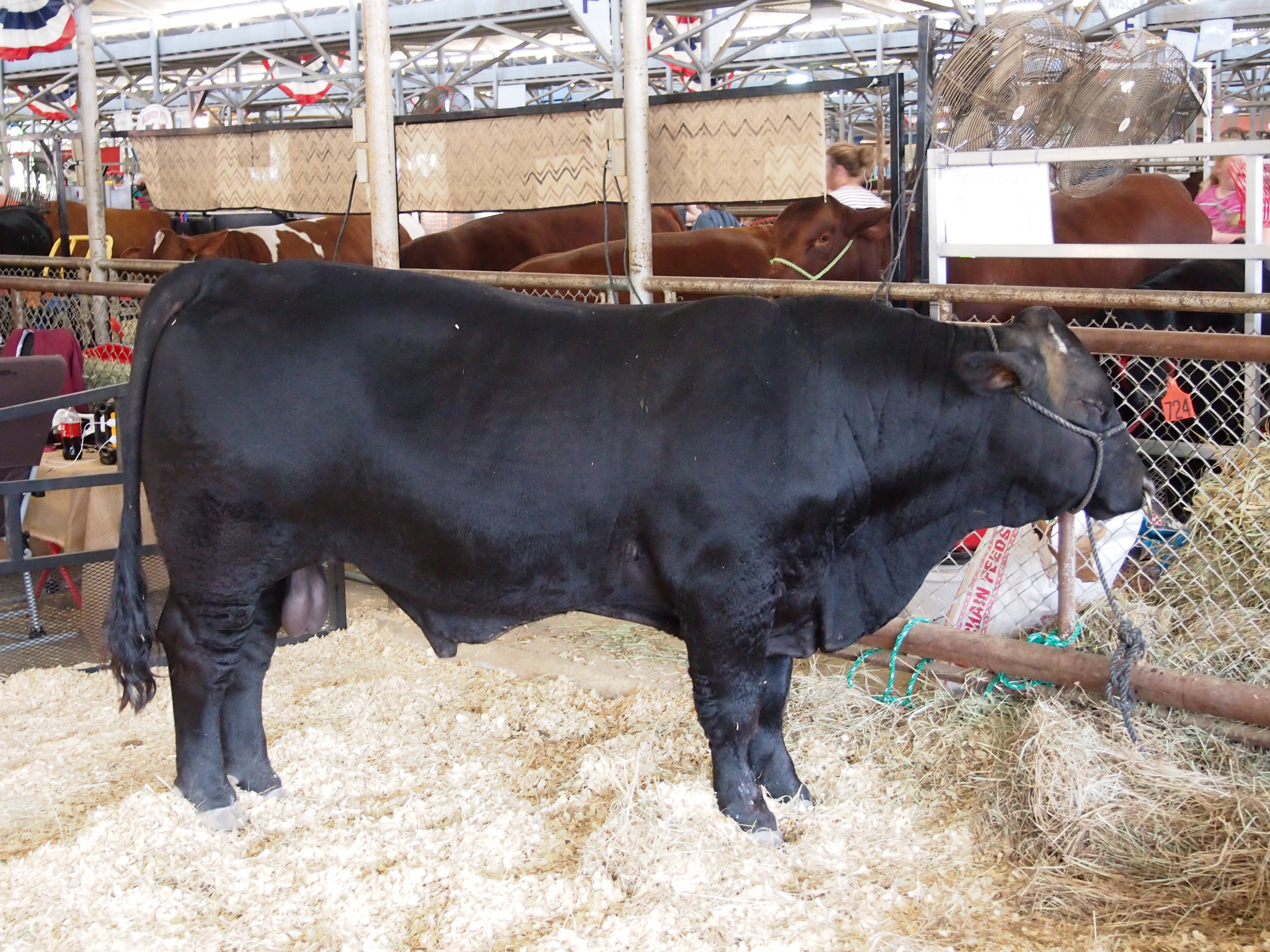
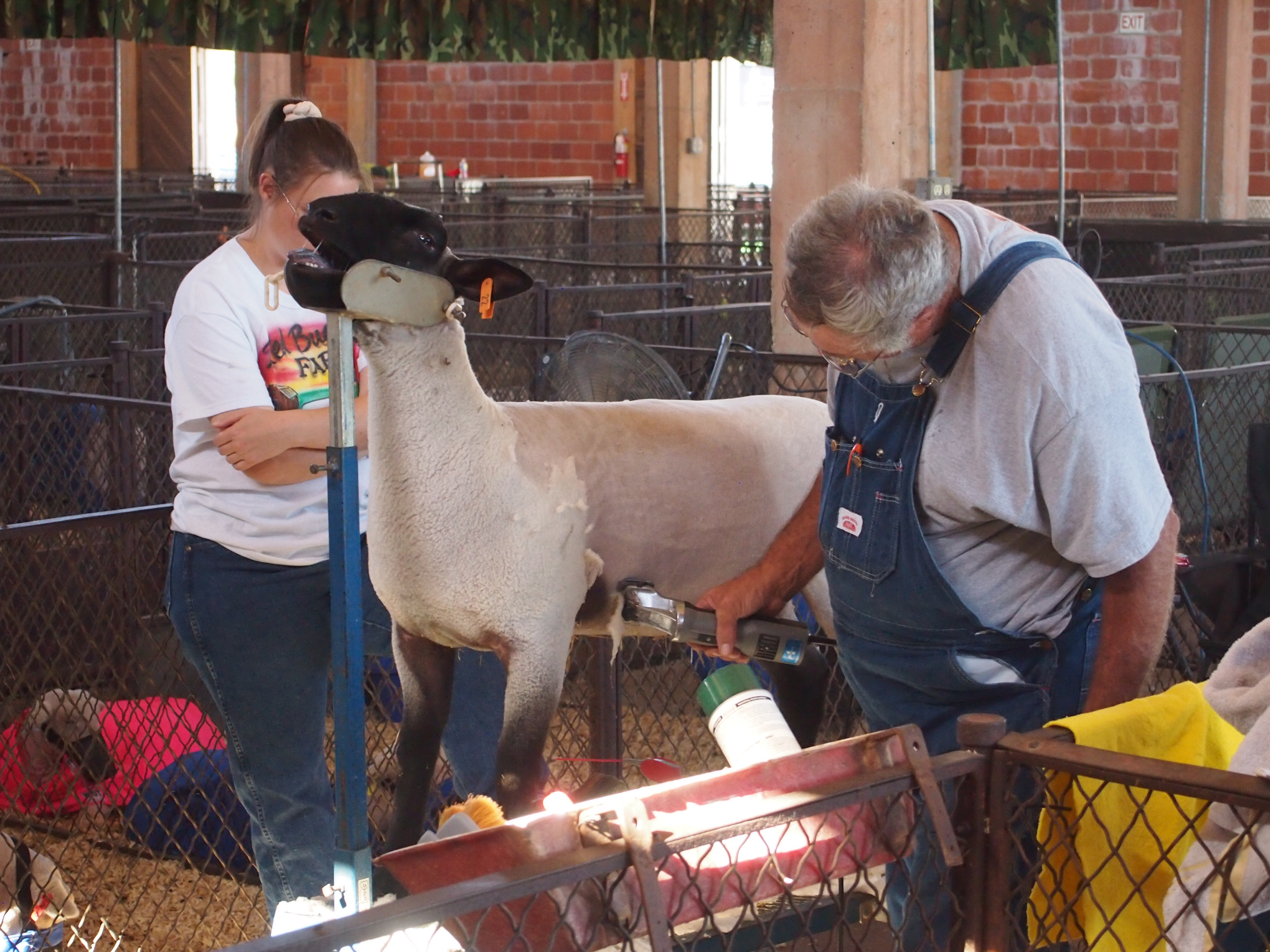
Mostly I looked around. I spent some time in the animal barns, for example.

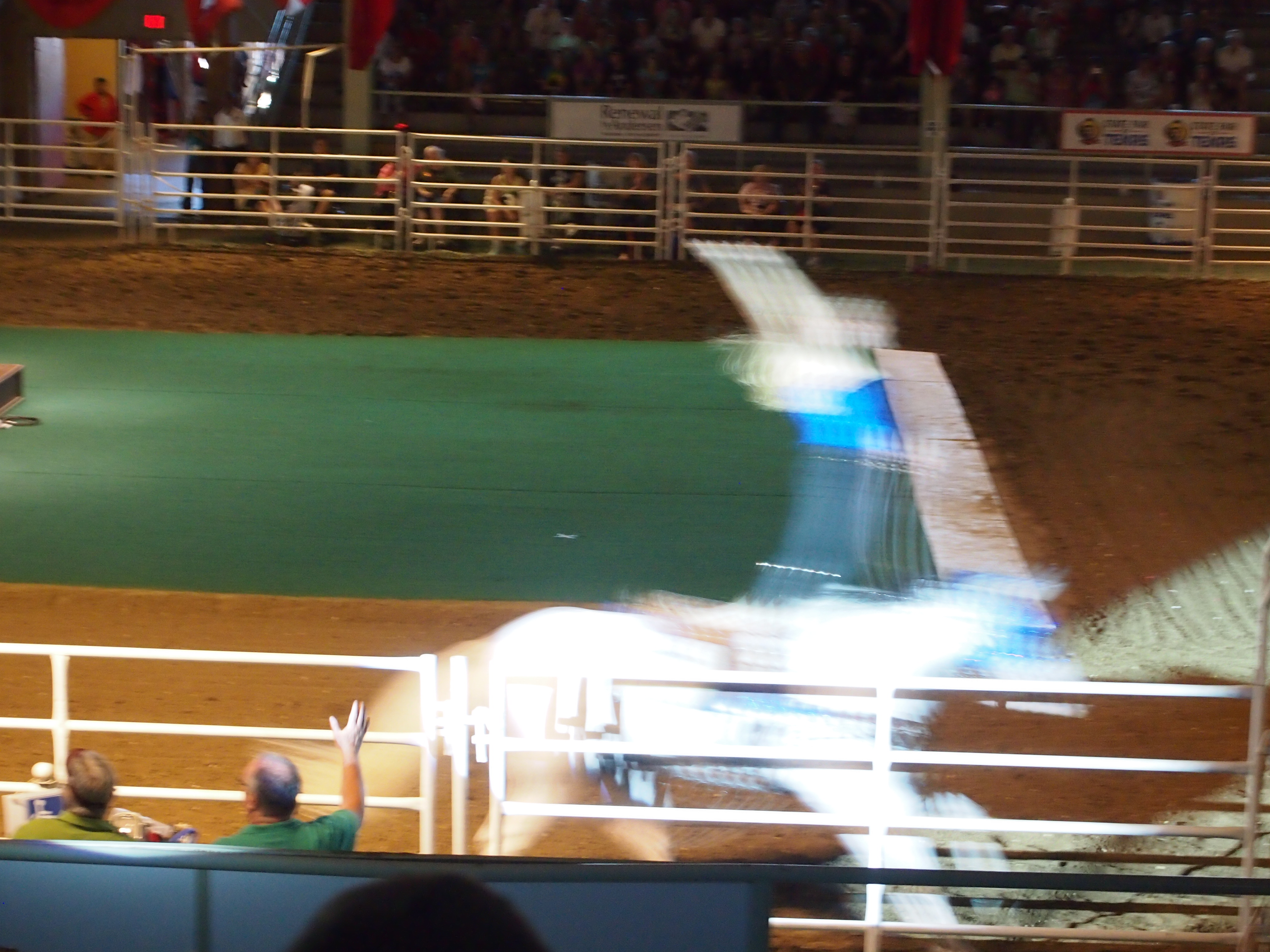
State Fair of TexasState Fair of TexasI missed the pig races, but I did see some riding acrobatics.

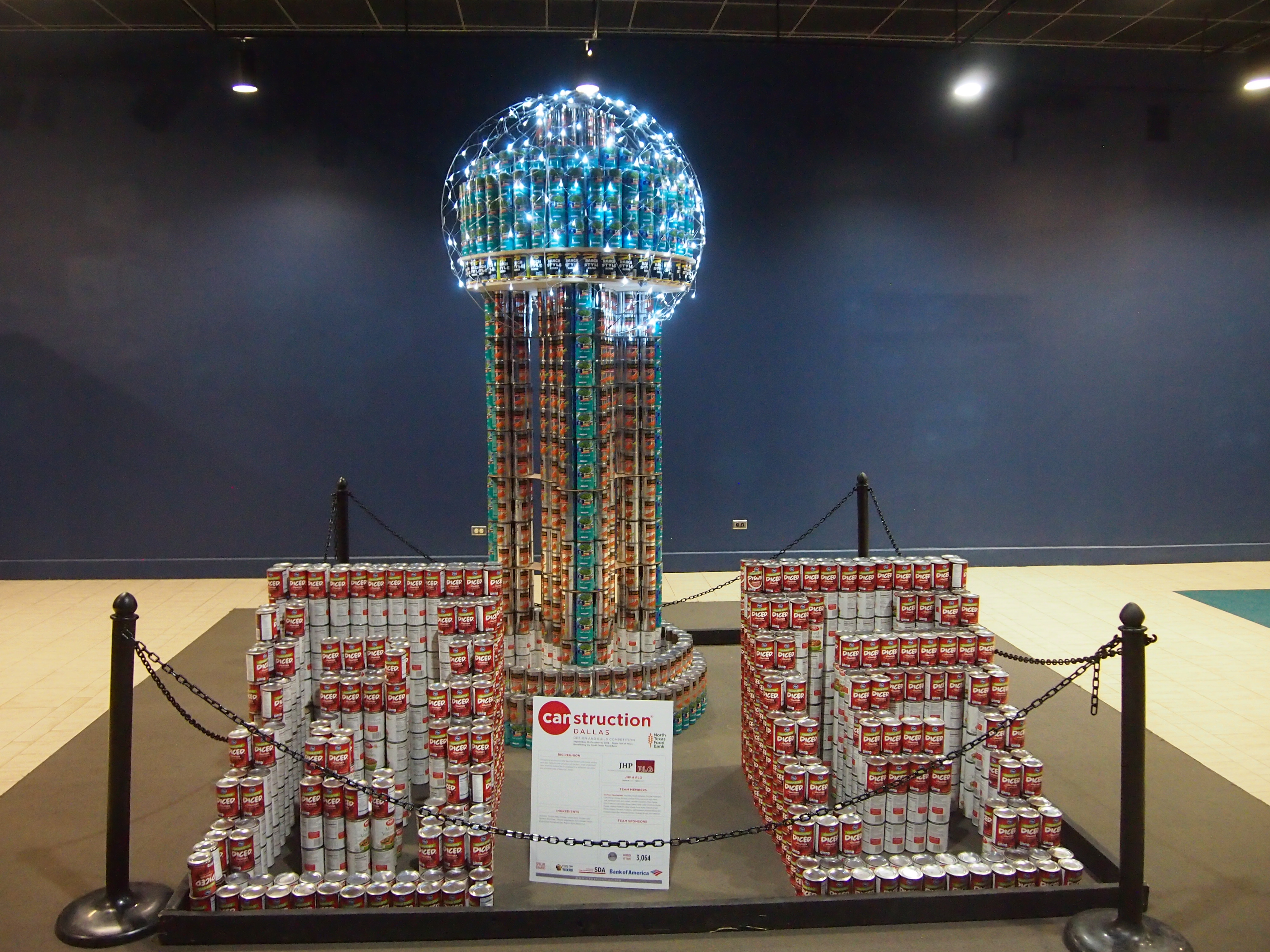
State Fair of TexasI also saw a temporary exhibit at the former Museum of Nature & Science, which left Fair Park a few years ago to become the Perot Museum of Nature and Science. The exhibit was called Canstruction, featuring structures made of cans. Such as “Big Reunion,” a model of Dallas’ Reunion Tower by JHP and RLG, two Dallas architecture firms, made out of 3,064 cans — carrots, spinach, mixed vegetables, tomatoes, and beans — plus wiring and LED lights (all that info is on the sign).
CanstructionI liked this one too.
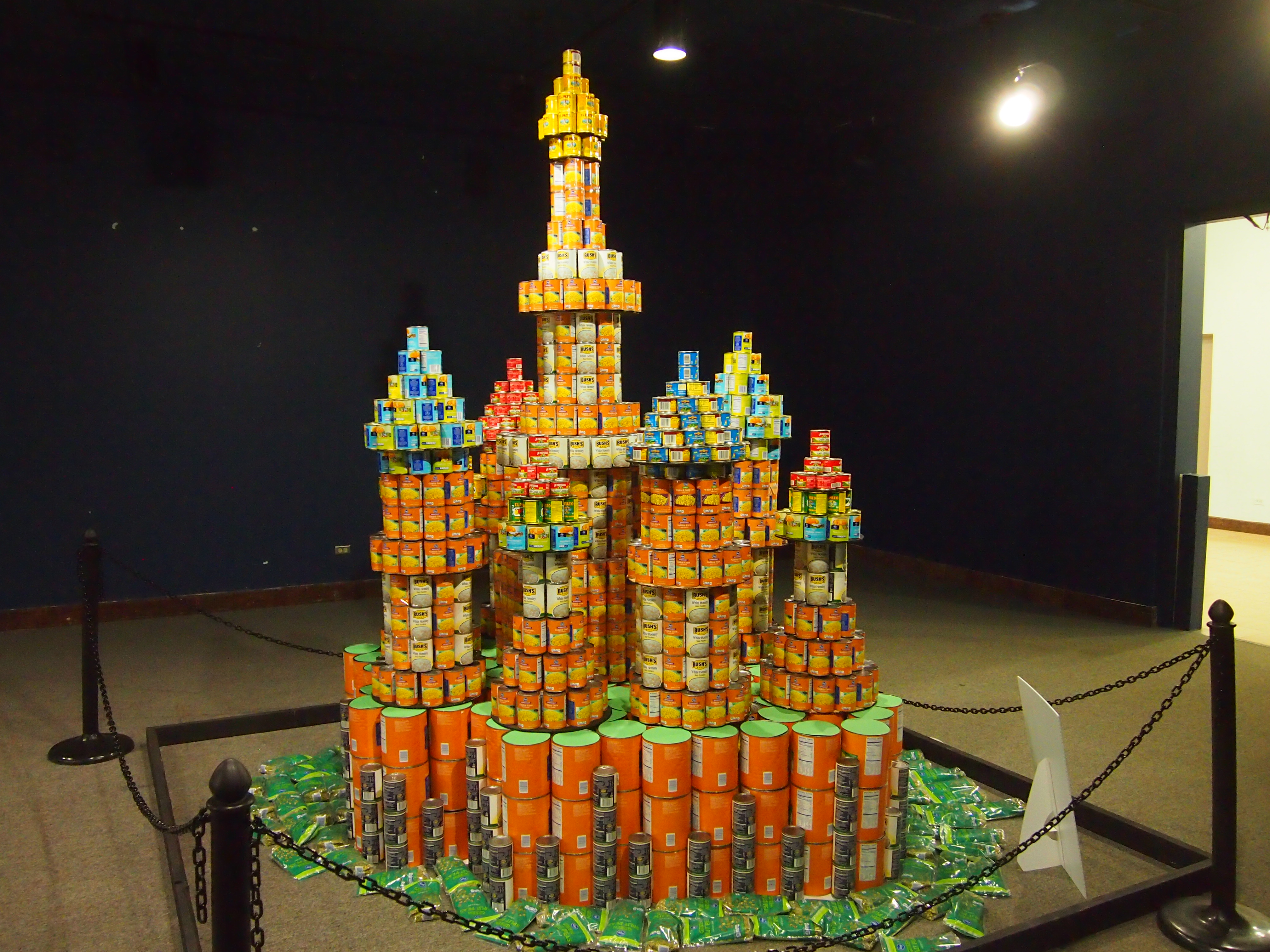
Canstruction“St. Basil’s Cathedral, Moscow,” by Humphreys & Partners Architects, using 2,090 cans: corn, jalapeños, tomato sauce, chilis, and mandarin oranges, among others.

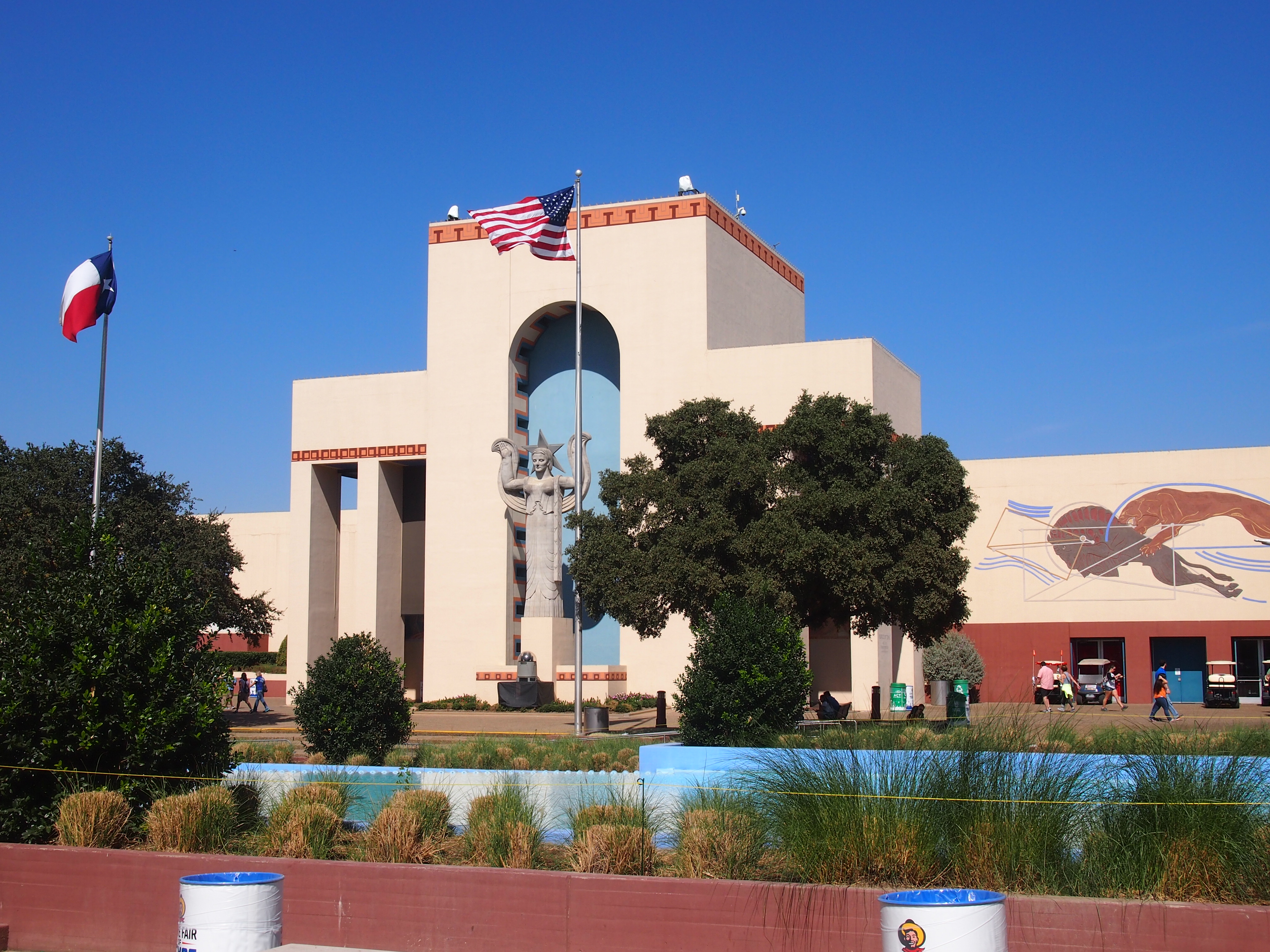
I also got a good look at Fair Park itself, one of the deco marvels of the world. I’d been to the park before, but barely took the opportunity to walk around and gawk at the likes of this.
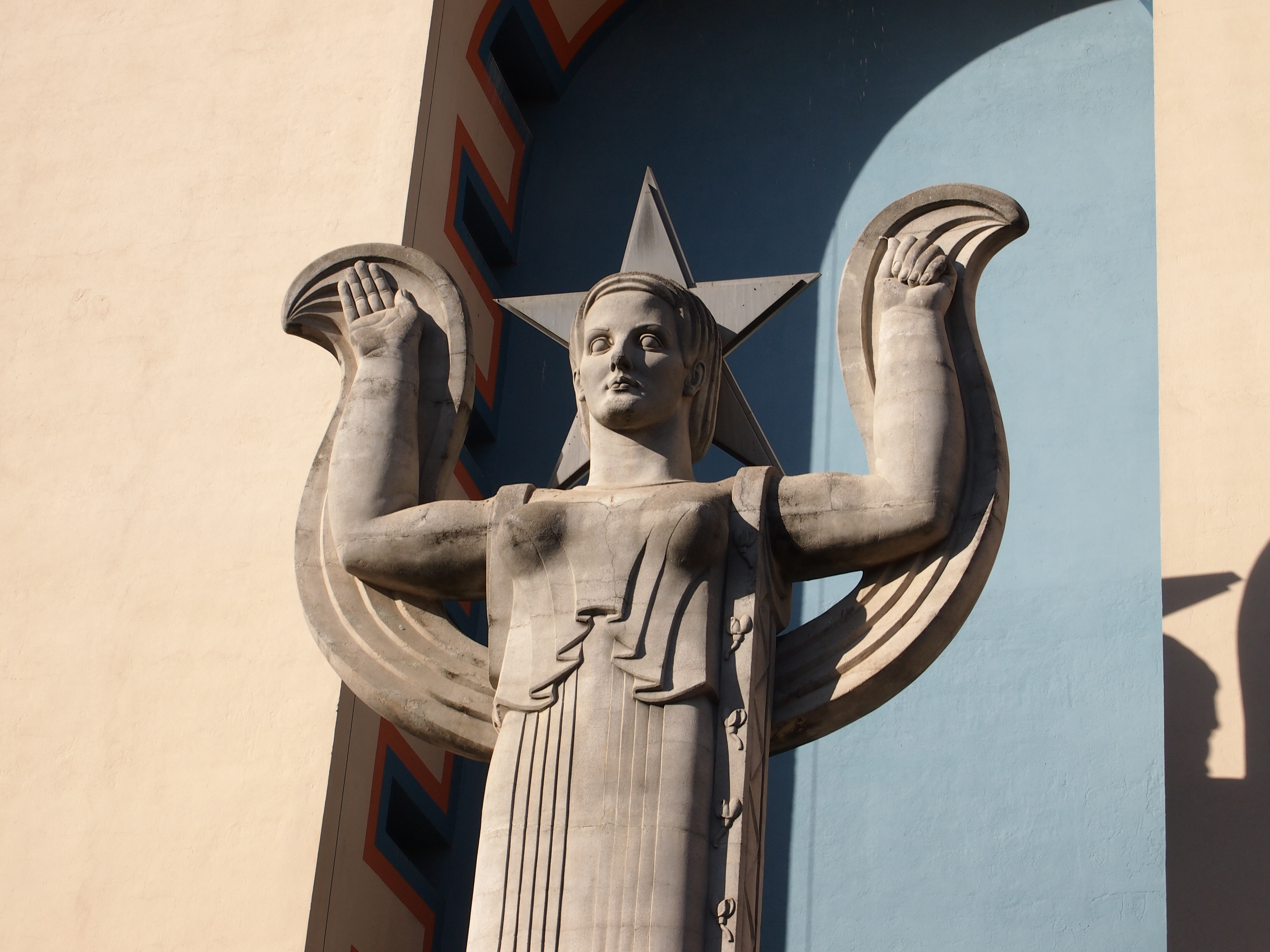
Fair Park 2015That’s the South Entrado of the Centennial Building, featuring a statue of the Republic of Texas, complete with the lone star and cotton flower. It’s part of Fair Park’s grand Esplanade, with buildings and sculpture on either side of a long reflecting pool. There are six monumental statues along the Esplanade.
The Republic of TexasFairpark.org says of the Esplanade that “the principal axis of the Texas Centennial Exposition was developed along the existing layout of the State Fair grounds. [Head architect] George Dahl strengthened the formal axis by adapting existing, unrelated State Fair exhibition halls with new, monumental facades and projecting porticos on each side of a 700-foot-long reflecting pool.

“The porticos establish the visual framework of the Esplanade and accentuate the grand perspective leading up to the Hall of State. Monumental artwork deftly combines with additional site features to complete the visually complex – and dramatic – spectacle.”

Each of the six statues represents the six nations that have asserted sovereignty over Texas or parts of it — what the Six Flags Over Texas refers to — namely Spain, France, Mexico, the Republic of Texas, the Confederacy, and the United States. France, Mexico and the U.S. were by Raoul Josset, a French sculptor (remarkable how many Euro-sculptors were active in Texas), while Spain, the Republic, and the C.S.A. were by Lawrence Tenney Stevens.

The Esplanade also featured a lot of murals, such as this bas relief mural by Pierre Bourdelle. This was one entitled “Man and Angel.” One source tells me it symbolizes air transport. It’s one of many murals along the Esplanade, each about three stories high.

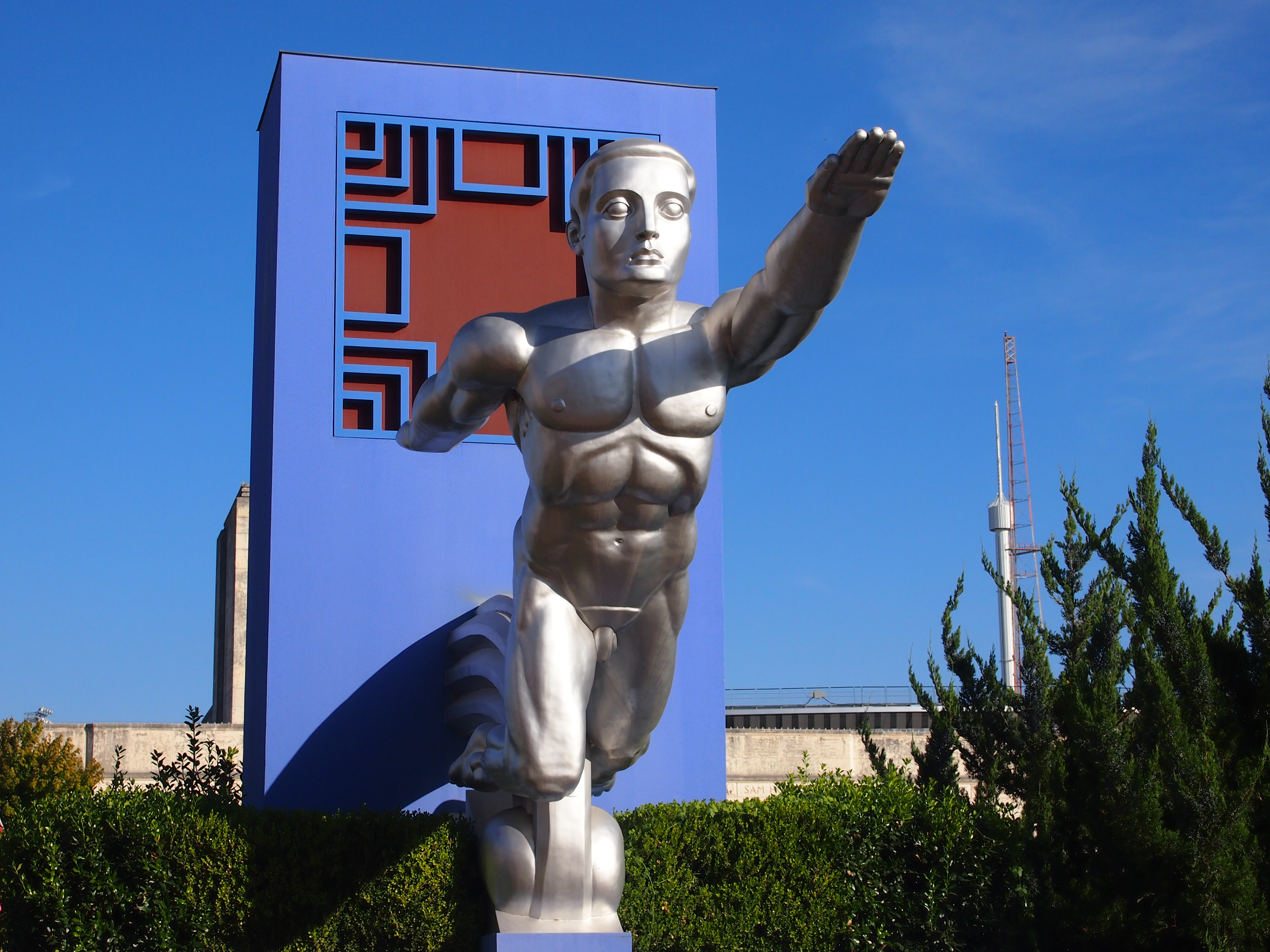
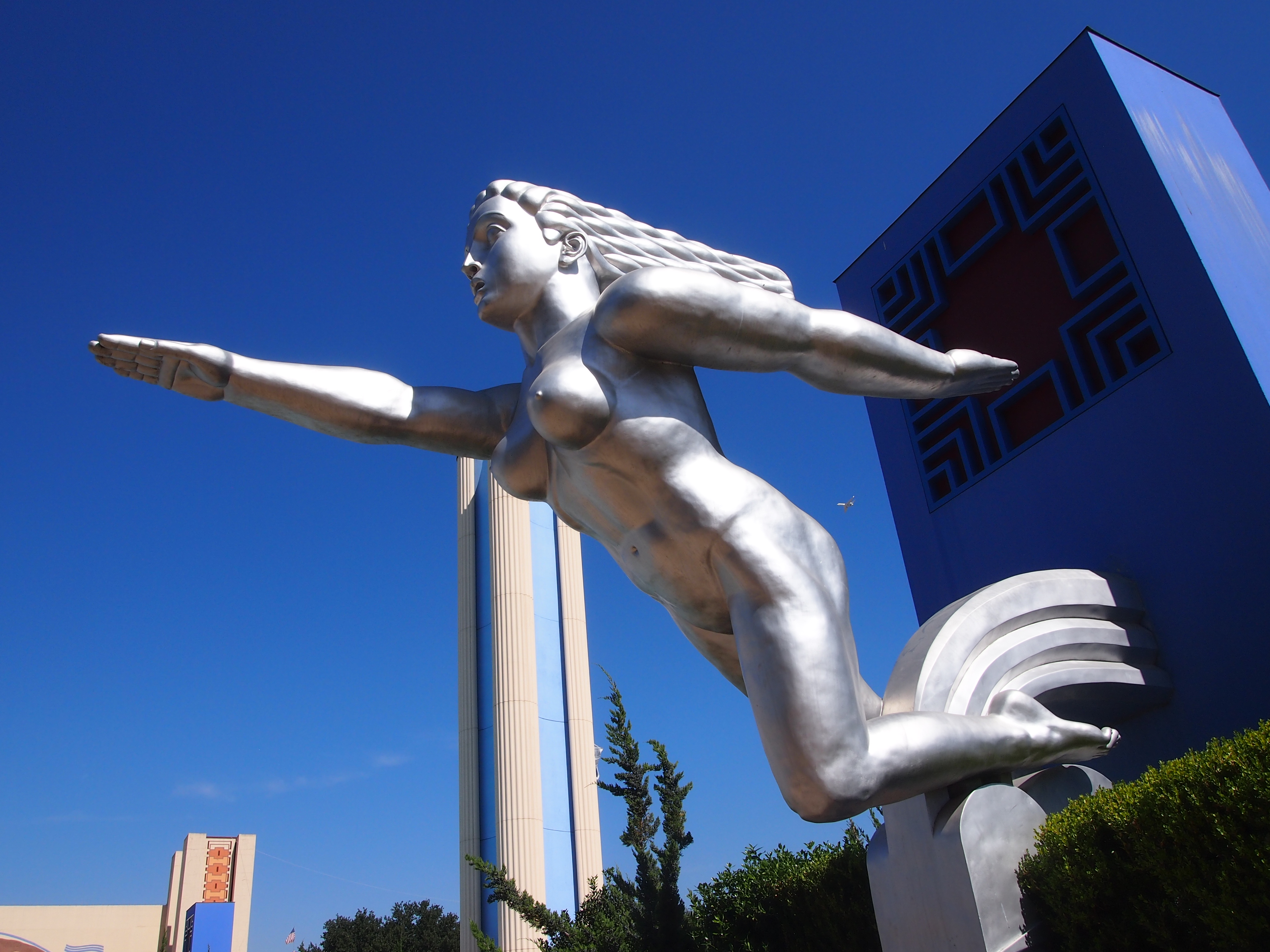
Fair Park 2015At the eastern end of the pool are two large figures, the striking David Newton replicas of Lawrence Tenney Stevens’s 1936 sculptures, “The Tenor” and “The Contralto.” The originals were lost, maybe melted down for their metal during WWII, but exact replicas were created in 2009.
Fair ParkFair Park 2015As I was taking pictures of “The Contralto,” a group of boys came up to the statue. “Hey, is that a chick?” “Yeah, that’s a chick.” Some laughter. Yep, it’s an aluminum deco chick, companion to the aluminum deco dude nearby.

The State Fair of Texas 2015

Since I happened to be in Dallas during the State Fair of Texas this year — which is held in October, because August would be insane considering the high heat — the thing to do was attend the State Fair of Texas. Especially since I’d made it to the Wisconsin State Fair not too long ago. I took the No. 60 bus to Fair Park and spent the afternoon of October 16 at the fair.
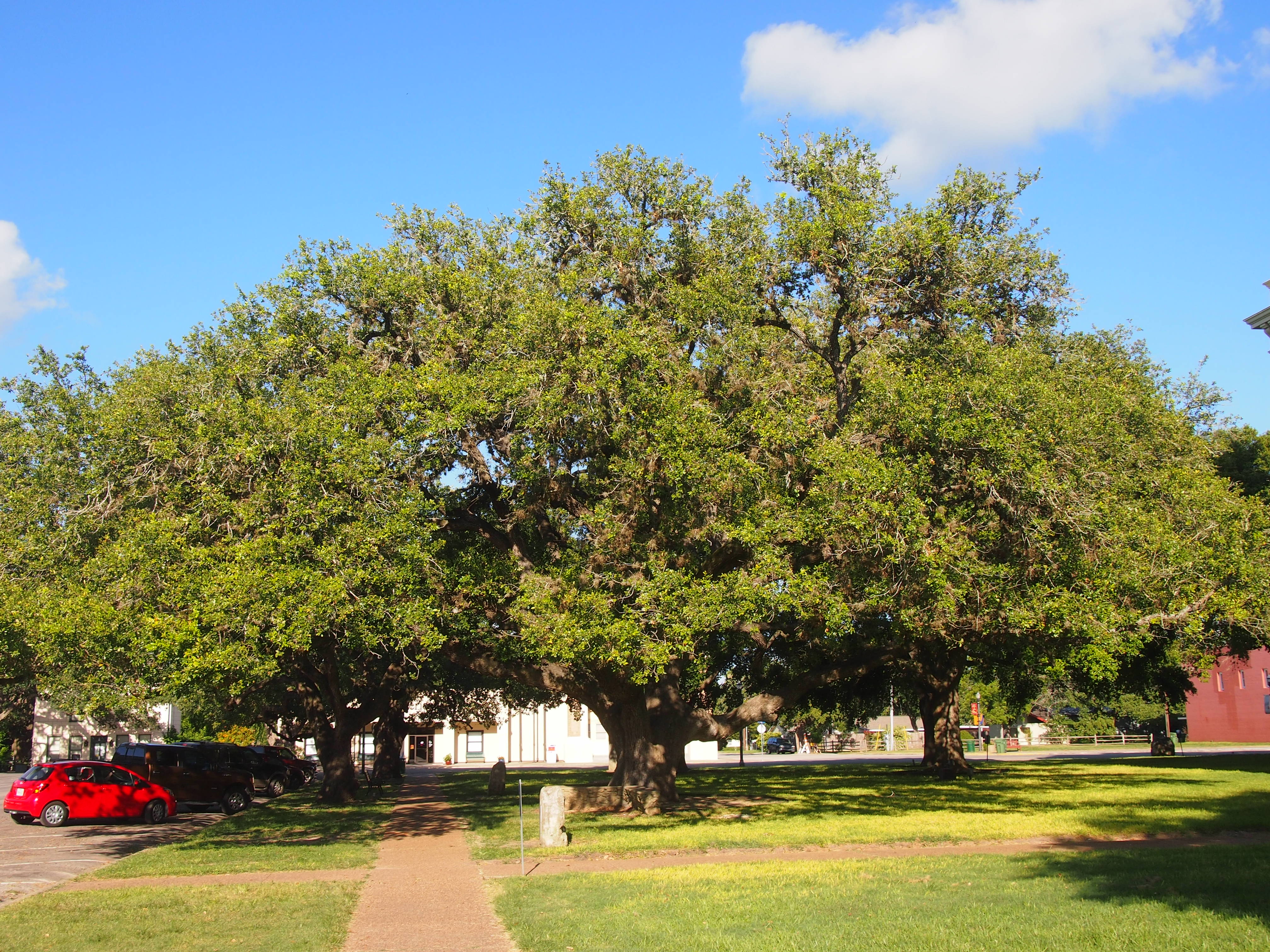
State Fair of TexasThe event has it origins in the late 19th century as a moneymaking venture, but according to the Handbook of Texas online, “the Texas legislature banned gambling on horse races in 1903, thereby eliminating the fair’s main source of income, the association faced a financial crisis. To protect this valuable community asset, the Texas State Fair sold its property to the city of Dallas in 1904 under an agreement that set aside a period each fall to hold the annual exposition.”

Sounds like one time to visit would have been not long after that: “President William Howard Taft visited the fair in 1909, and Woodrow Wilson delivered a speech in 1911. Automobile races and stunt flying exhibitions became the top attractions. Attendance passed the one million mark in 1916.”

More was to come. “In 1934, largely through the efforts of civic leader R. L. Thornton, Fair Park was selected as the central exposition site for the proposed Texas Centennial celebration. No state fair was scheduled in 1935, and construction began on a $25 million project that transformed the existing fairgrounds into a masterpiece of art and imagination. The 1936 Texas Centennial Exposition attracted more than six million people during its six-month run.”

My mother, who turned 11 that year, went to the Centennial Expo with her family, coming from South Texas. Separately, my father, who was 13, attended with members of his family (not sure which ones), coming from Mississippi. It was a big to-do.

Robert Lee Thornton (1880-1964), a banker who also did stints as the president of the State Fair and as mayor of Dallas, is now a bronze in Fair Park.

RE ThorntonHis plaque says: For more than forty years an inspired leader and a powerful force in the development of the city he loved from village to great metropolis.

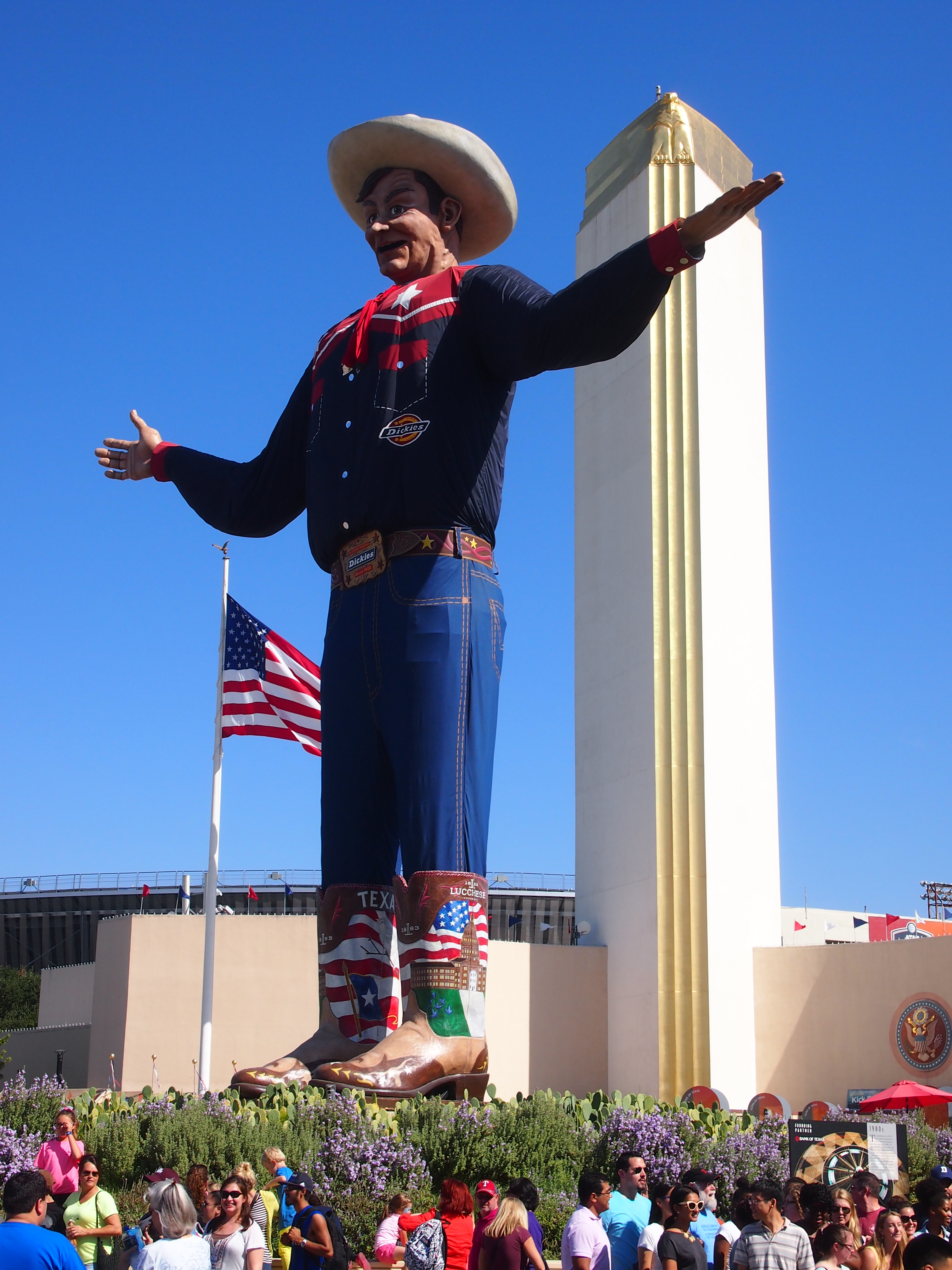
Mayor Thornton’s not the best known statue of the fair. That distinction belongs to Big Tex.
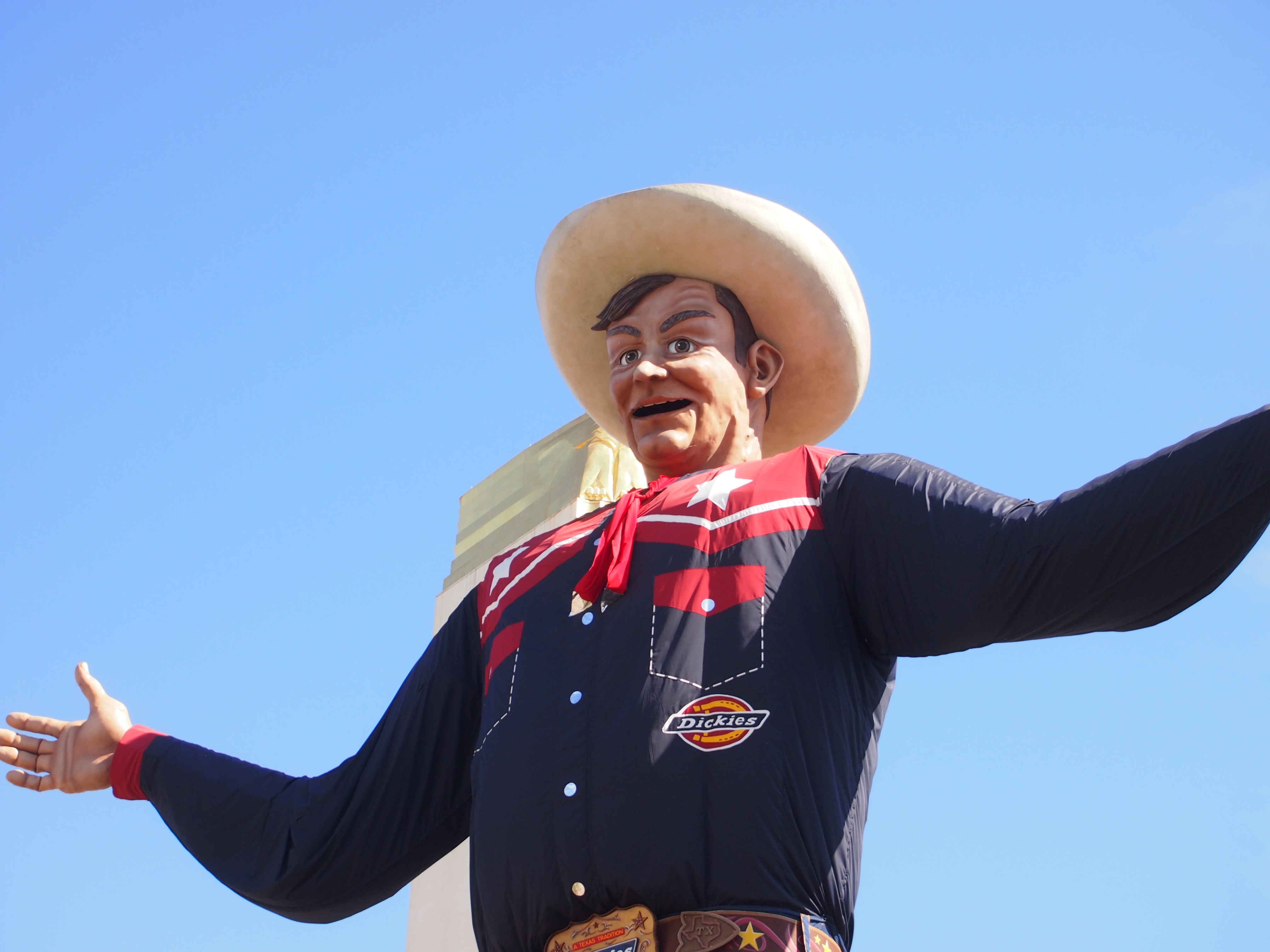
Big TexThe figure’s been at the fair since 1952, standing at more than 50 feet and weighing three tons, held up by a cage-like skeleton of 4,200 steel rods. Originally a giant Santa Claus in the town of Kerens, Texas, he was remodeled for the fair to wear cowboy duds, including a “75 gallon” hat, though the details of his clothes have changed over the years. A voice appears to come from his mouth, extolling the amusements of the fair.
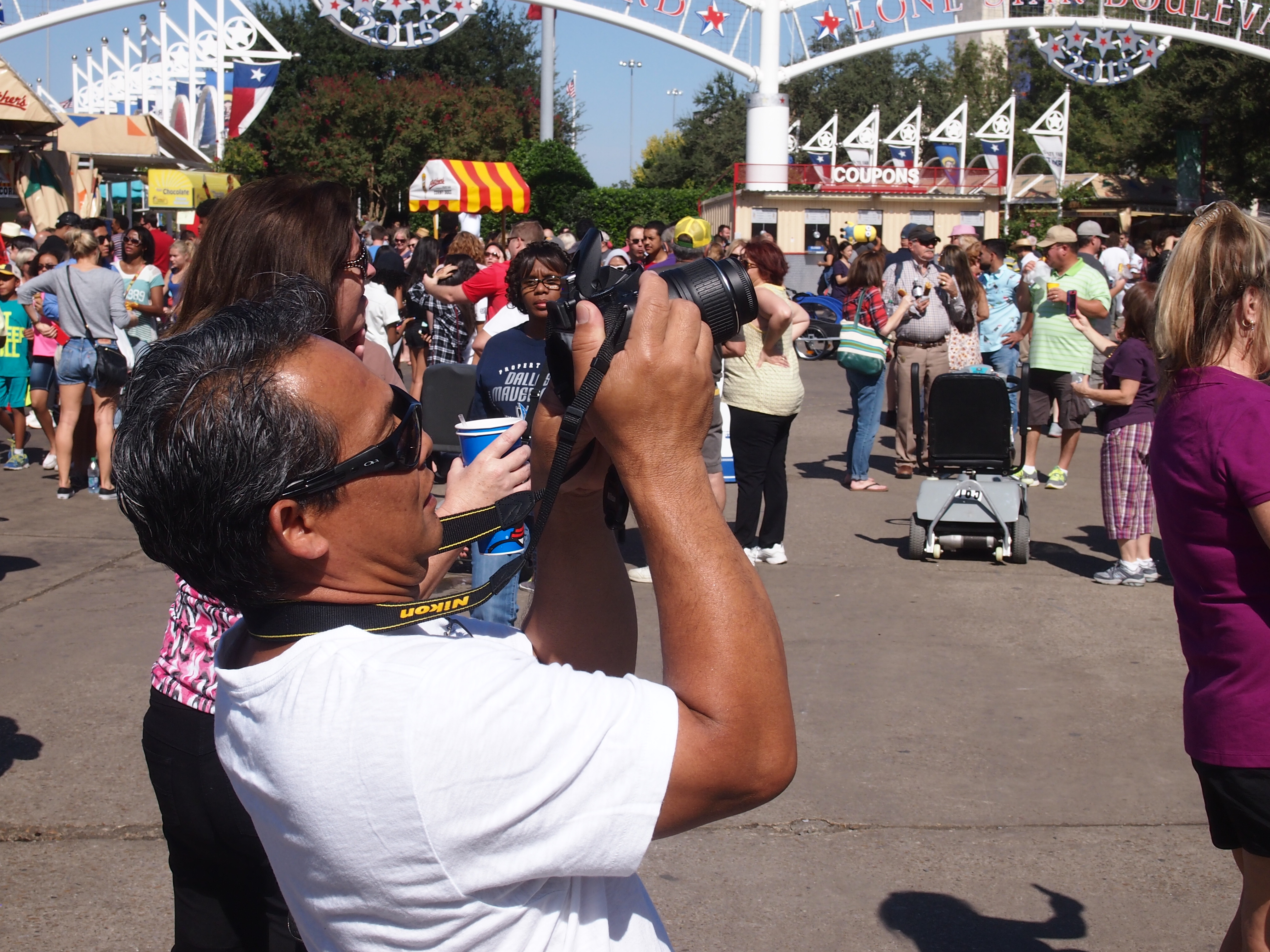
Big TexBig Tex is a popular fellow. A lot of people besides me were taking pictures of him.

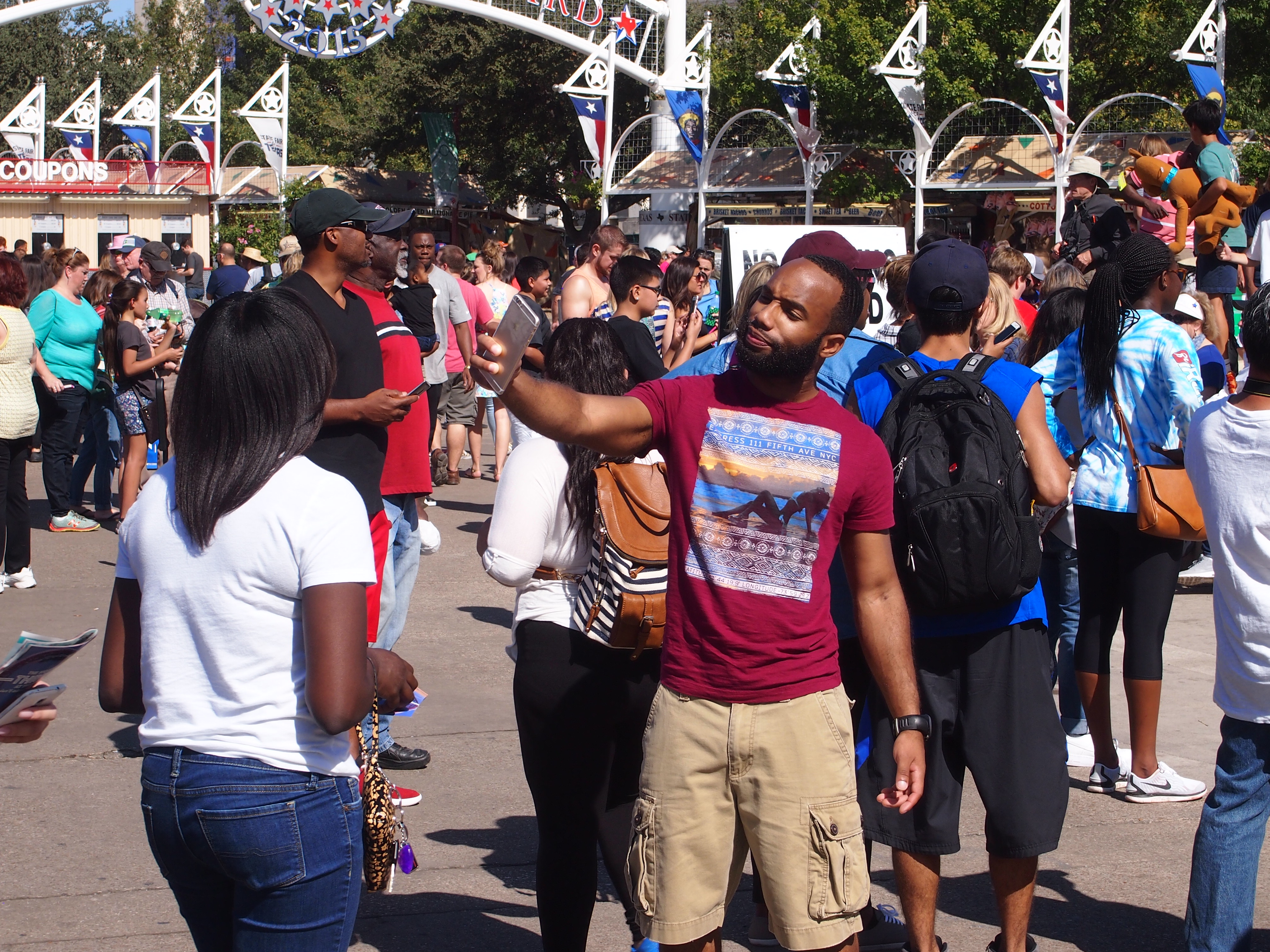
Big Tex 2015Along with selfies with Big Tex in the background.
Big Tex 2015 Two years ago, he caught fire and burned up while the fair was on.

I’m a little sorry I missed that. The one I saw this month is, of course, a phoenix of a Big Tex, rebuilt because the show must go on.

GTT Fall ’15: My Mother the Nonagenarian

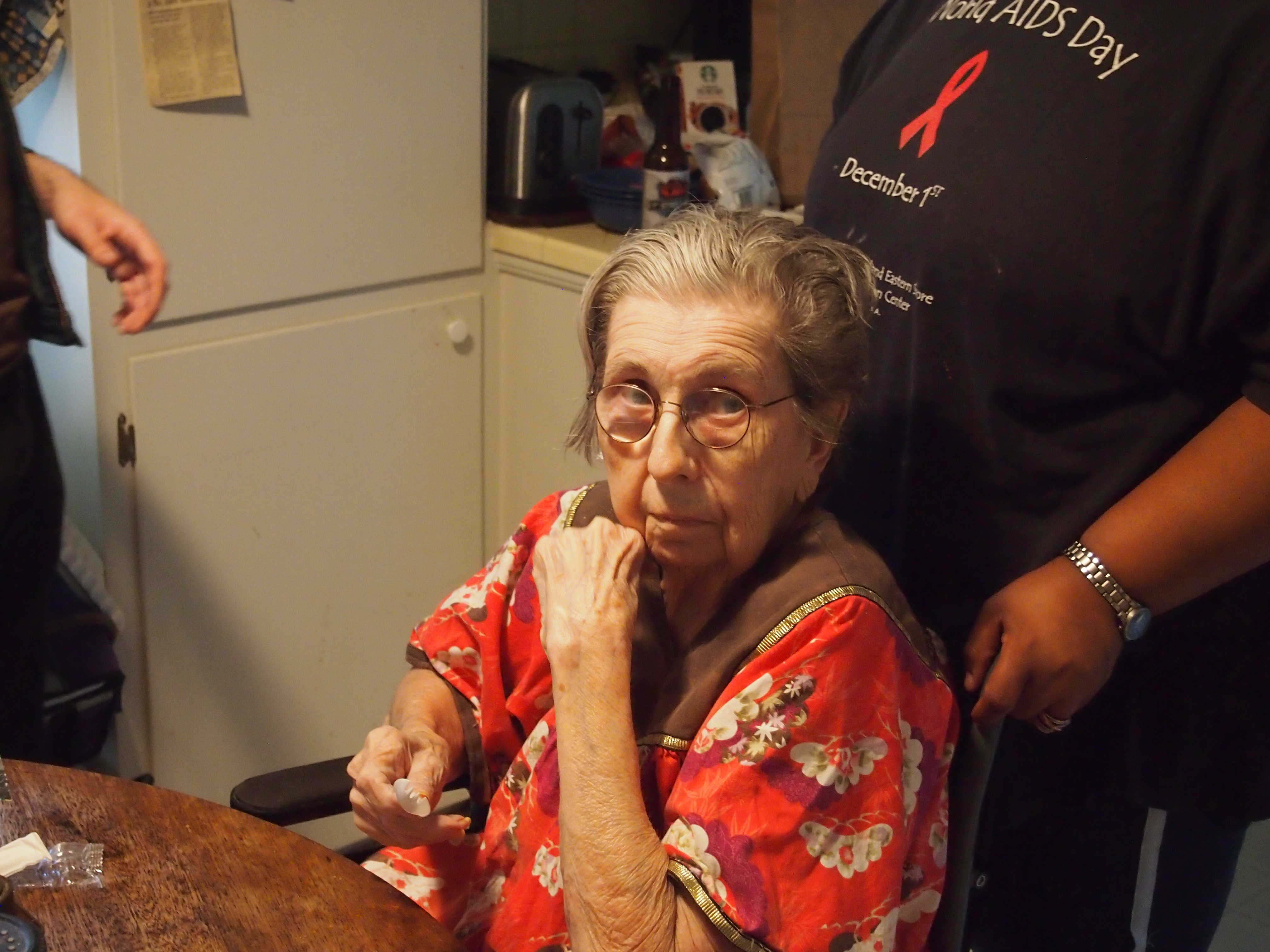
Jo Ann C. Stribling

Native of Texas; dietitian; longstanding member of St. Paul’s Episcopal Church, San Antonio; daughter of James and Edna Jo; sister of Sue; wife of Sam; mother of Jay, Jim and Dees; grandmother of Sam, Dees, Robert, Lilly and Ann.

As of this week, officially a nonagenarian. Not many of us get to be that.

Jo Ann Stribling, 90th birthdayI visited her on her 90th birthday, arriving in San Antonio two days before, after driving down from Dallas with my brother Jay, whom I’d visited for a while before that. Besides my mother and Jay, on this trip I saw my other brother Jim; all of my nephews and the wife of one and the girlfriend of another; and my aunt and first cousin.

Work continued during some of the visit, as it always does. And as I always do, I squeezed in a few other things, such as my second-ever attendance at a state fair, a ride on the Trinity Railway Express, a walkabout in Downtown Dallas, another walkabout along a lakeshore, a visit to one of the three spanking-new national monuments, created only this July, and a look-see at a cemetery, because of course I wanted to visit a cemetery.

The day I flew into Dallas, the city was experiencing its hottest October 15 on record, with a high of 95 F that afternoon. The days afterward were still warm, in the 80s mostly, which is a little higher than normal. By the time we planned to drive to San Antonio on the 22nd, heavy rain was predicted along most of the route, but the downpour was sluggish in arriving. All we saw were sprinkles here and there.

The massive rains came on the 23rd and 24th. The San Antonio area caught a regular storm coming from the northwest plus the remnants of Hurricane Patricia, which hit Mexico on the 23rd, and for a while had the strongest hurricane winds ever recorded. Wow.

Fruitcake Beef

I have nothing bad to say about the Collin Street Bakery’s fruitcakes, which come to mind because I got a catalog from the company recently. The fruitcakes themselves, that is. They are a sweet marvel, a dense delight, a bit of confectionery bliss.

Their price is another matter. I ordered my first fruitcake from Collin Street in 1985. A little looking around tells me that around that time, “the cake is sold in two-, three- and five-pound sizes, ranging from $9.15 to $21.45.” (NYT, Dec. 1, 1982; three years earlier, which is close enough).

And how much are they now? $28.45 to $65.50 plus $6.45 for shipping any sized order, according to the current catalog. I emphasize shipping because for years Collin Street didn’t change extra for shipping: it was a consideration that helped me be loyal. When did the company start charging? I don’t know. As recently as two years ago, there was no charge, because I ordered one that year, and probably wouldn’t have otherwise. Anyway, it’s damned annoying.

This year, a two-pound fruitcake would thus set me back $34.90 (almost — the size is actually 1 lb. 14 oz). The nominal 1982 cost of $9.15 would, adjusted for inflation, would now be $22.60, according to the BLS, plus zero for shipping. What’s the excuse for that? I’m skeptical that anything the bakery puts in their product has increased in cost by that much, and don’t tell me it’s shipping. Except for the USPS, the logistics of shipping is a lot more efficient than it was 30 years ago. As good as the cakes are, that’s a deal breaker.

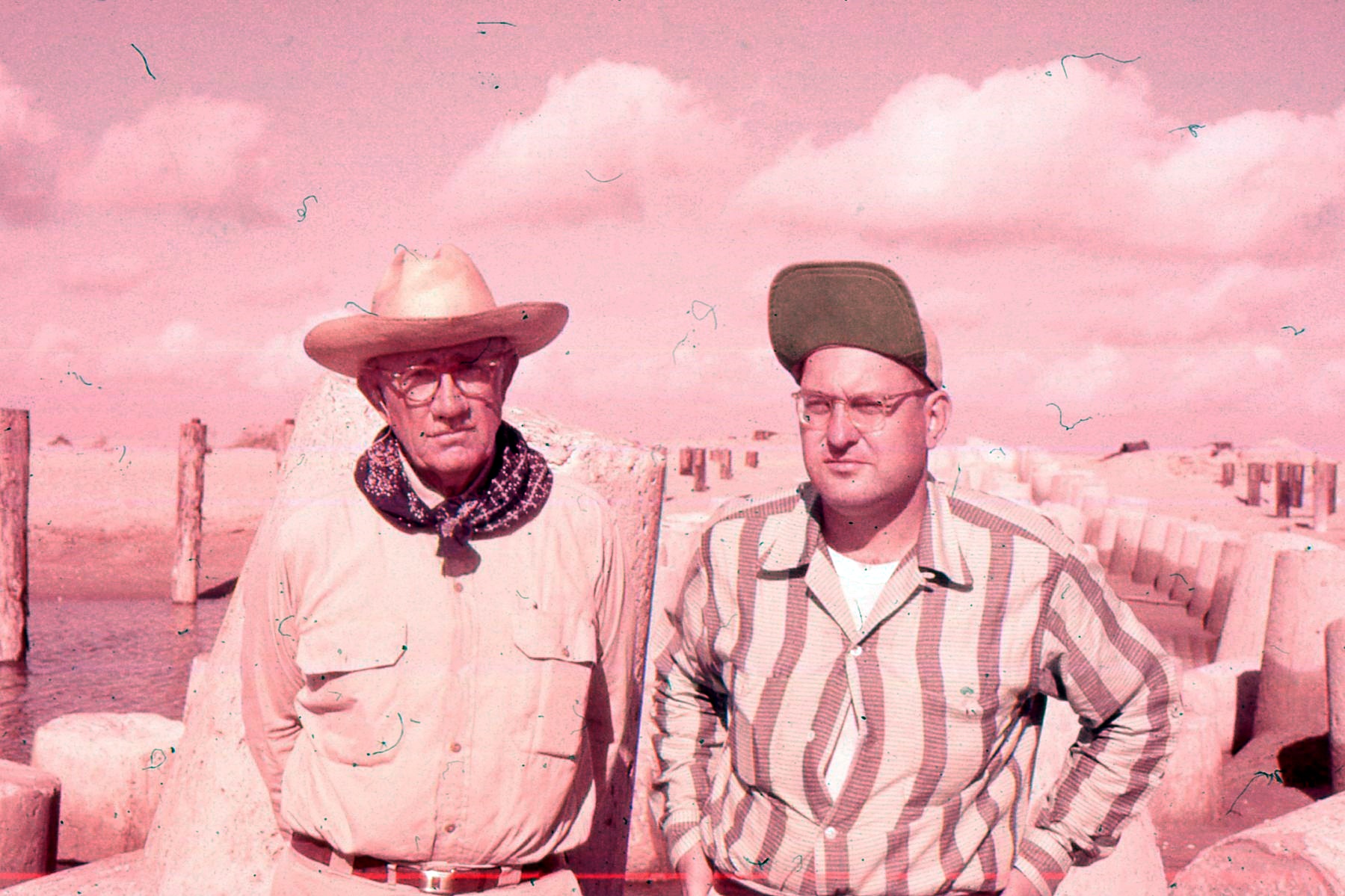
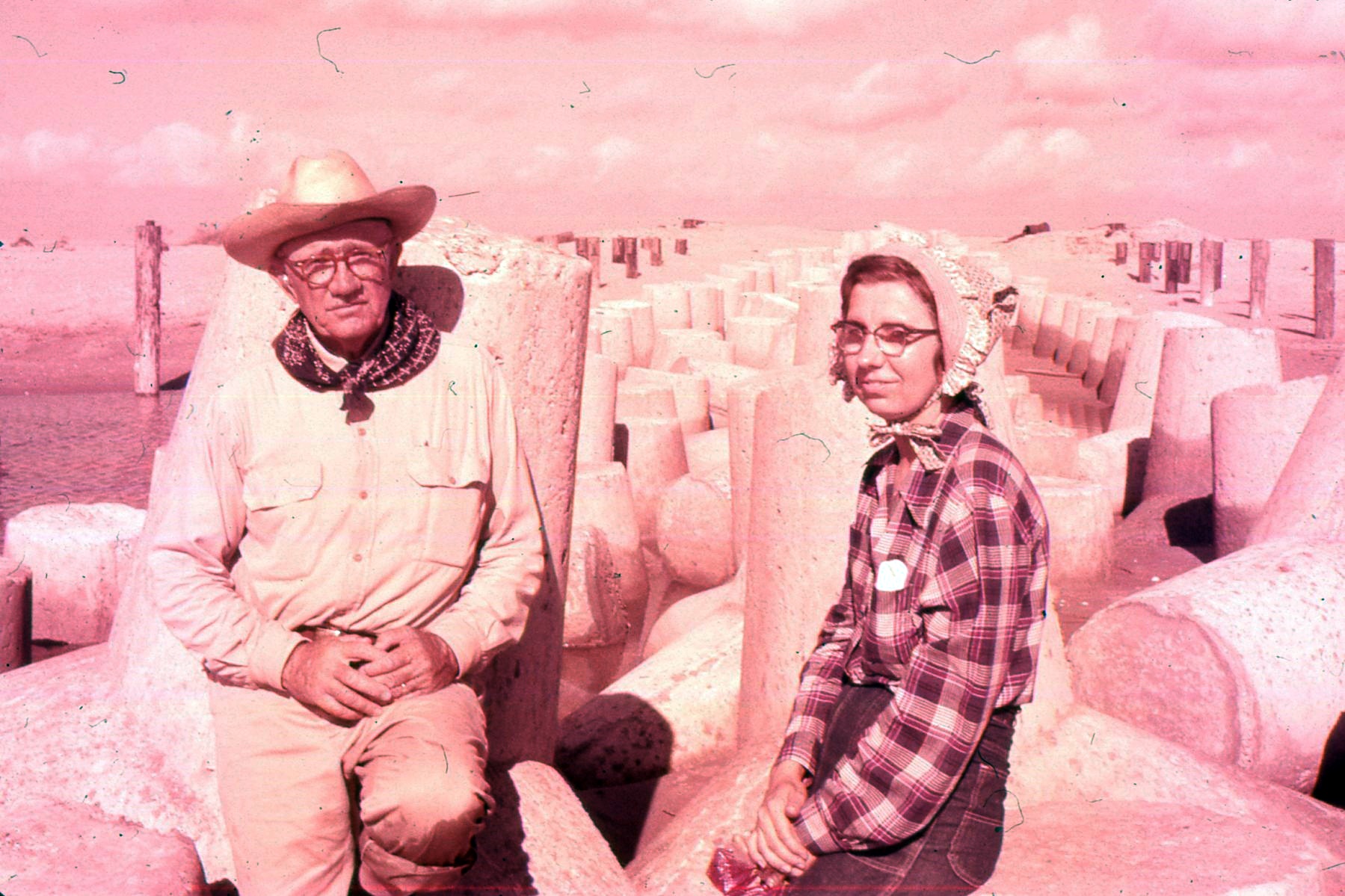
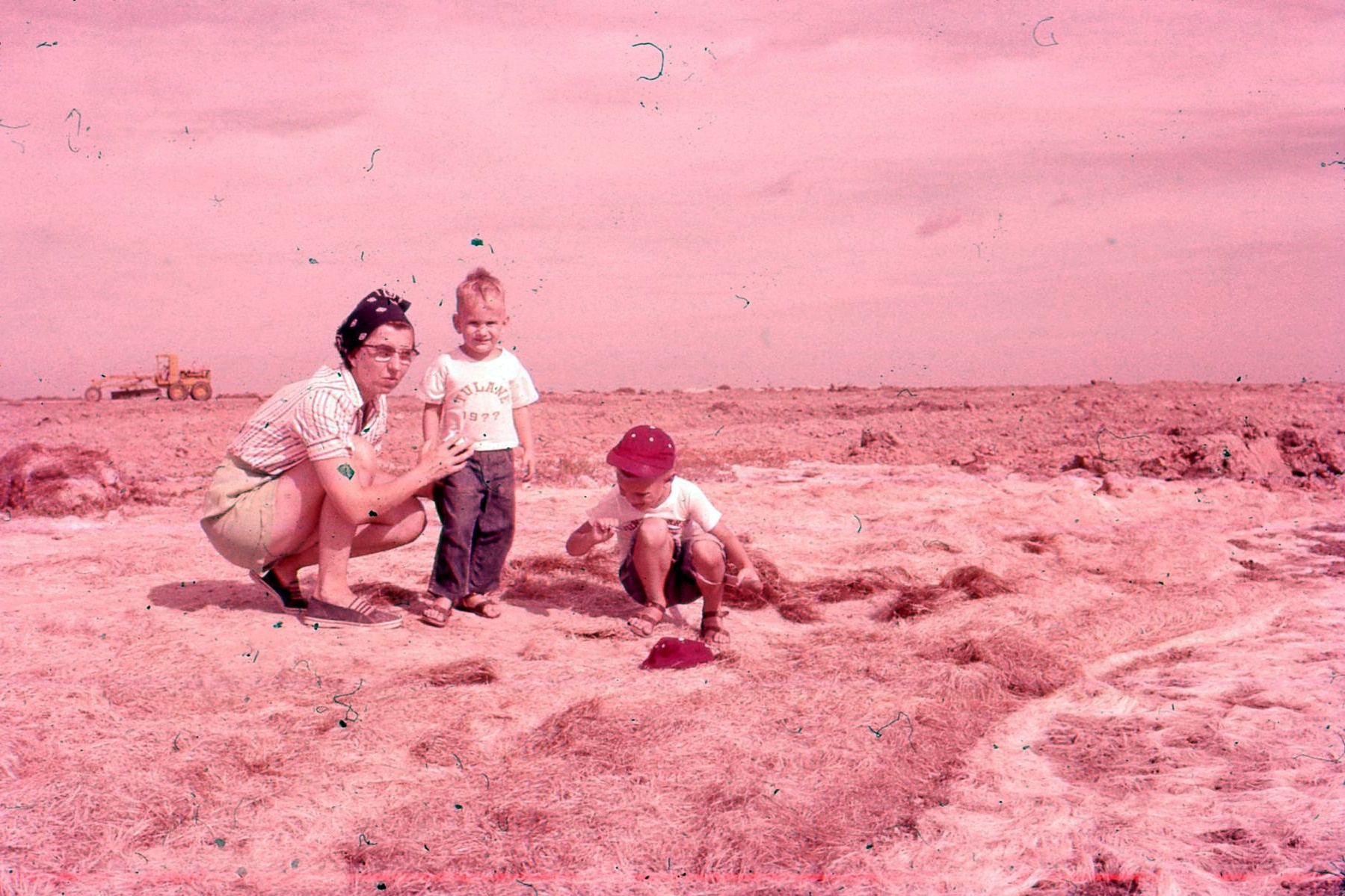
At the Mansfield Cut, ca. 1958

The last time I visited Texas, I dug into more of my father’s slides for scanning. Sometime during 1958, probably, my father, mother and brothers visited my grandparents on Padre Island. My grandfather (left), a civil engineer, was working in some capacity in the creation of the Mansfield Cut, though we’re not sure what. On the right is my father. Jay and I call this the wearing funny hats shot.GrandpaandDadMy grandfather (my mother’s father) and my mother. I suspect she borrowed the bonnet from my grandmother for the sunny day. Even in the late ’50s, it would have been considered old fashioned.GrandpaandMamaMy mother and brothers. It’s always a little odd looking at a picture of your family at a time when you don’t exist.MamaJimJayThe Mansfield Cut separates Padre Island from South Padre Island, and was made to provide access from the sea at that point to the Intercoastal Waterway. Jay says that mother marveled at the large numbers of shells on the beach there, since it was remote — it’s still remote — and not many people collected them. There’s a jar of shells at my mother’s home, and some of them might have been picked up during this visit.

Tobin Park & Salado Creek

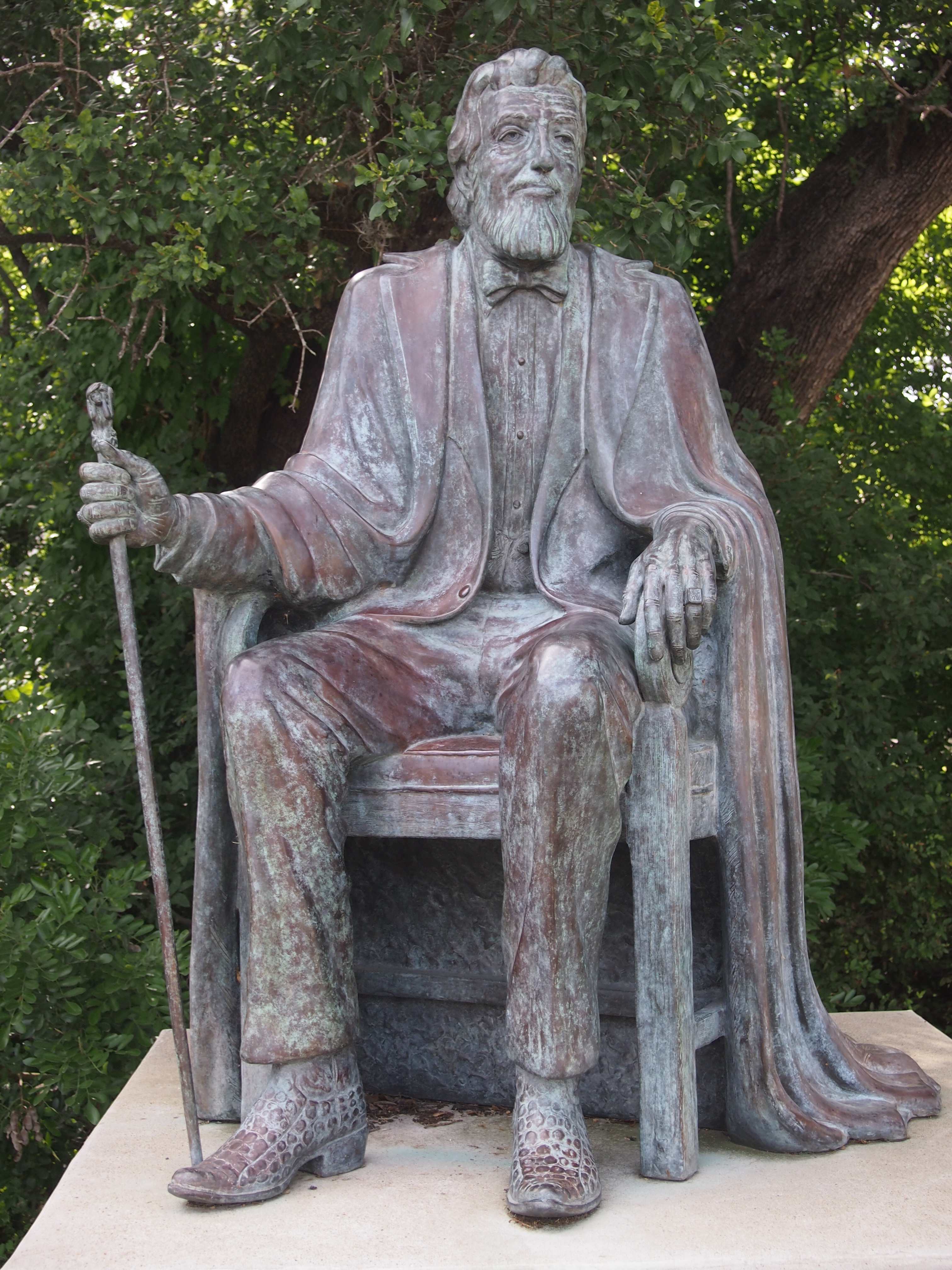
Just south of I-410 on the North Side of San Antonio, you’ll find Robert L.B. Tobin in bronze.
TobinTobin (1934-2000) inherited Tobin Suverys, the largest mapmaker to the oil industry, at only 19 when his father died in a plane crash. Apparently, the younger Tobin made a good run of it, enough to make him a major philanthropist in San Antonio and elsewhere. As the NYT said (and where is the Express-News obit?):

“Mr. Tobin served on the boards of the Metropolitan Opera in New York and the Santa Fe Opera. He was also on the boards of the Museum of Modern Art and of the Spoleto Festival in Italy. He endowed libraries and museums, underwrote operas, sponsored symphony premieres and championed artists and composers in many places.

“The major beneficiary of his philanthropy was the McNay Art Museum in San Antonio [an excellent museum]. Mr. Tobin’s mother, the late Margaret Batts Tobin, was president of the museum’s board of trustees for many years. She built a special wing for the museum on the 50th birthday of Mr. Tobin, her only son.”

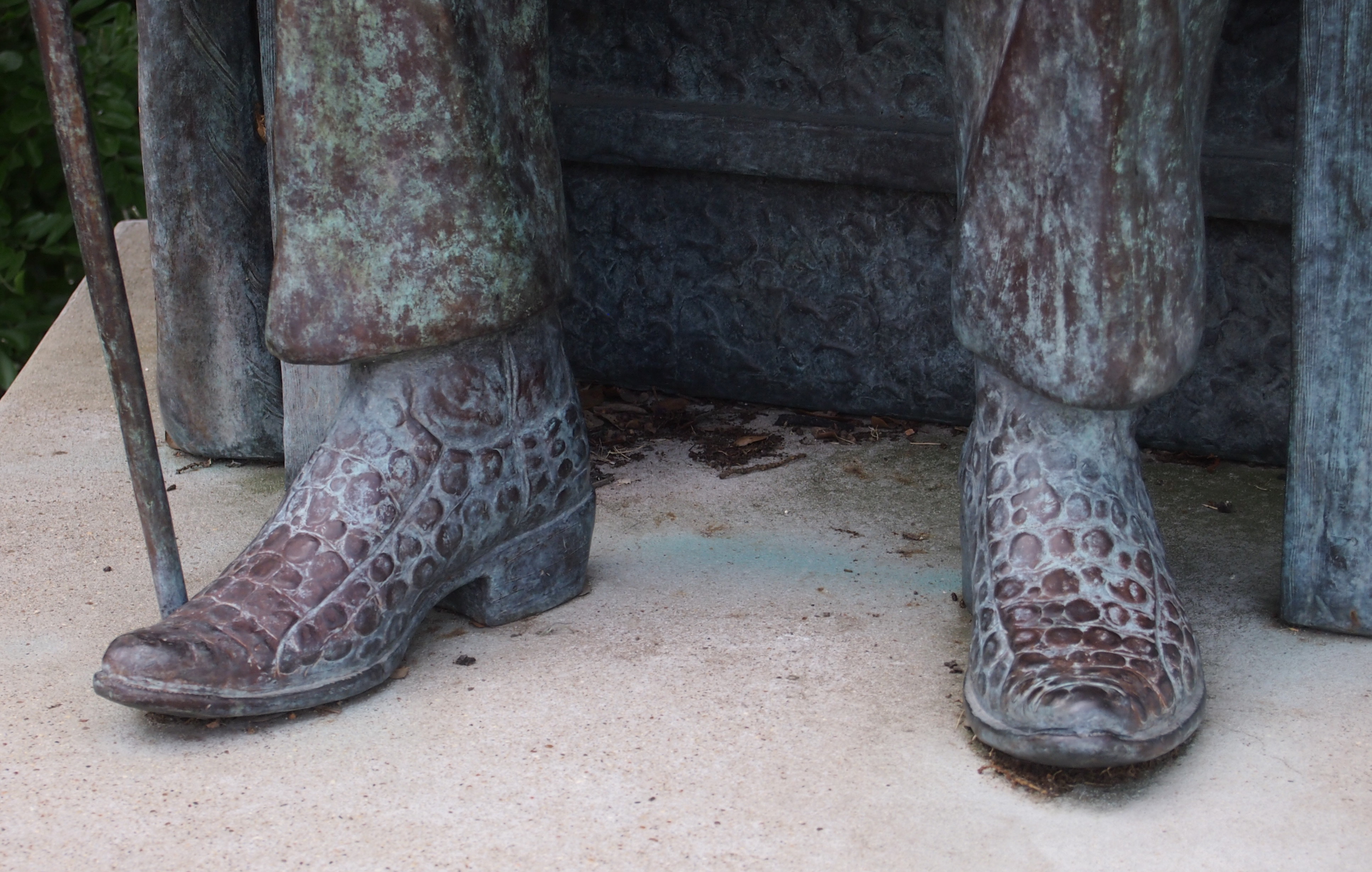
I’ve also seen mention of Tobin’s “Lucchese alligator boots,” which can be expensive indeed. This must be them in bronze.
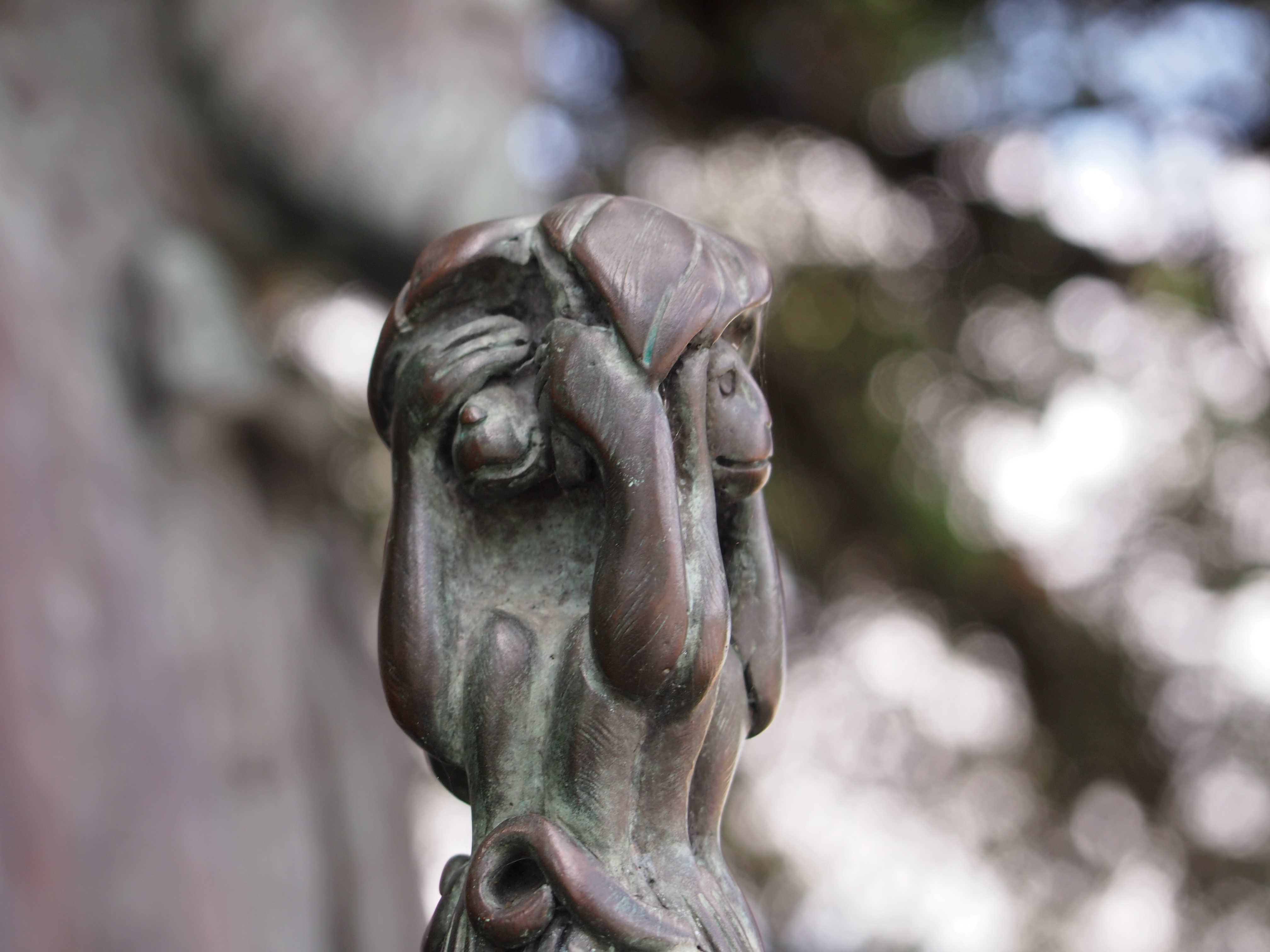
TobinAlso notable on the statue is Tobin’s cane, which has See No Evil, Hear No Evil, Speak No Evil monkeys on it. Not sure why the motto was close enough to his heart for him to want it on his cane, and then in bronze, but there you have it.
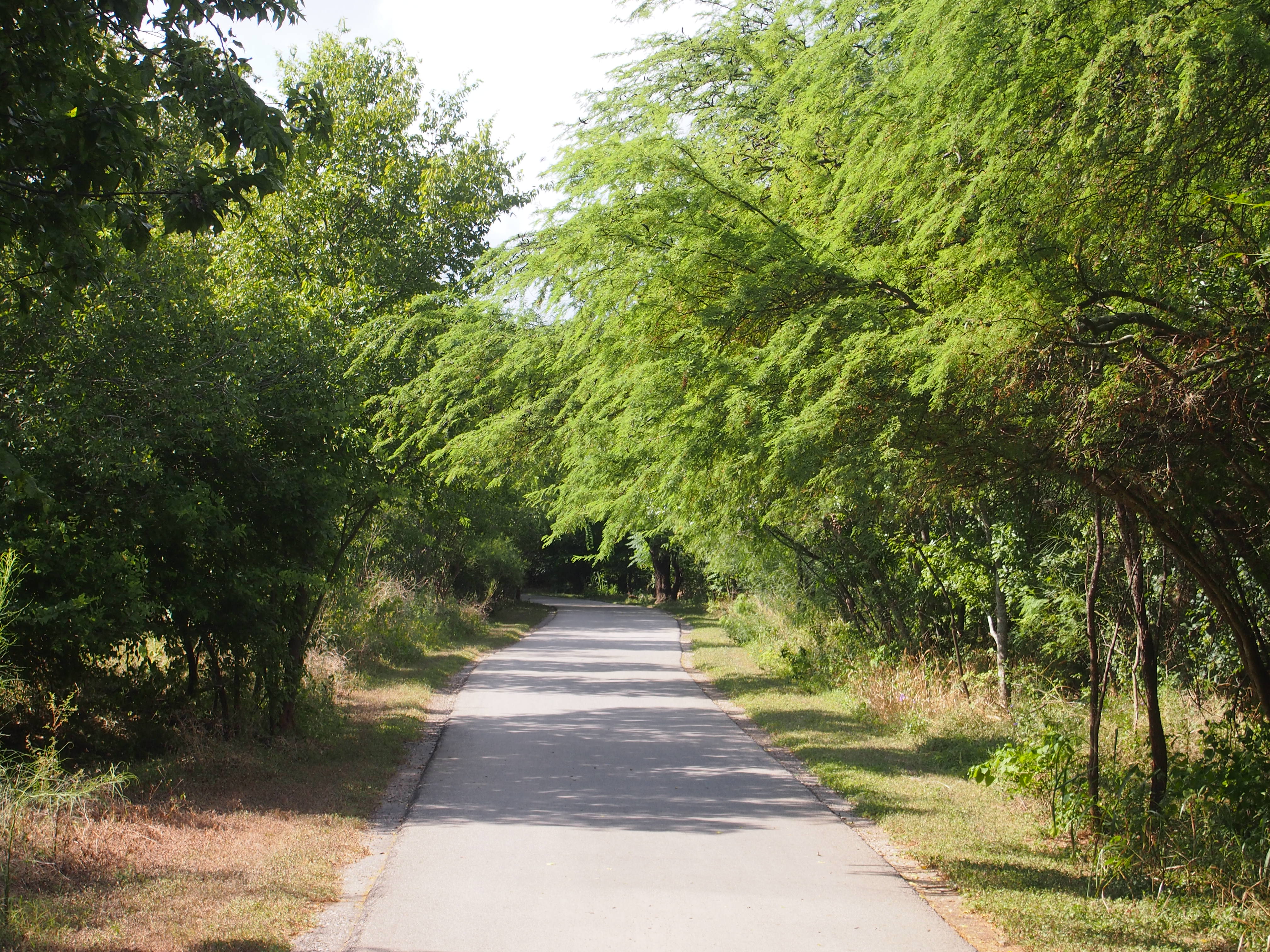
Monkeys!The statue is at the trailhead of Robert L.B. Tobin Park, a roughly two-mile segment of the Salado Creek Greenway between I-410 and Eisenhower Road. In a non-drought July, the greenway is green all right.
Tobin ParkTobin himself helped design the park shortly before he died, and his foundation ultimately donated 89 acres of land to the project. It opened in 2008. No wonder I’d never heard of it before Google Maps told me about it this year. All of the while I lived in San Antonio, and for years after, it was simply inaccessible land owned by Tobin (though if you’d asked me or anybody, no one would have known who he was).
Tobin ParkTobin Park is part of the bigger Linear Creekway Parks Development Program, the goal of which is to create linear parks along Salado Creek, Leon Creek, Medina River and the San Antonio River. Remarkably enough — Texas isn’t always the anti-tax place it seems to be — sales tax funding for the project was approved by voters in the 2000s. I wish the municipality well with this project. Greenways are fine things.

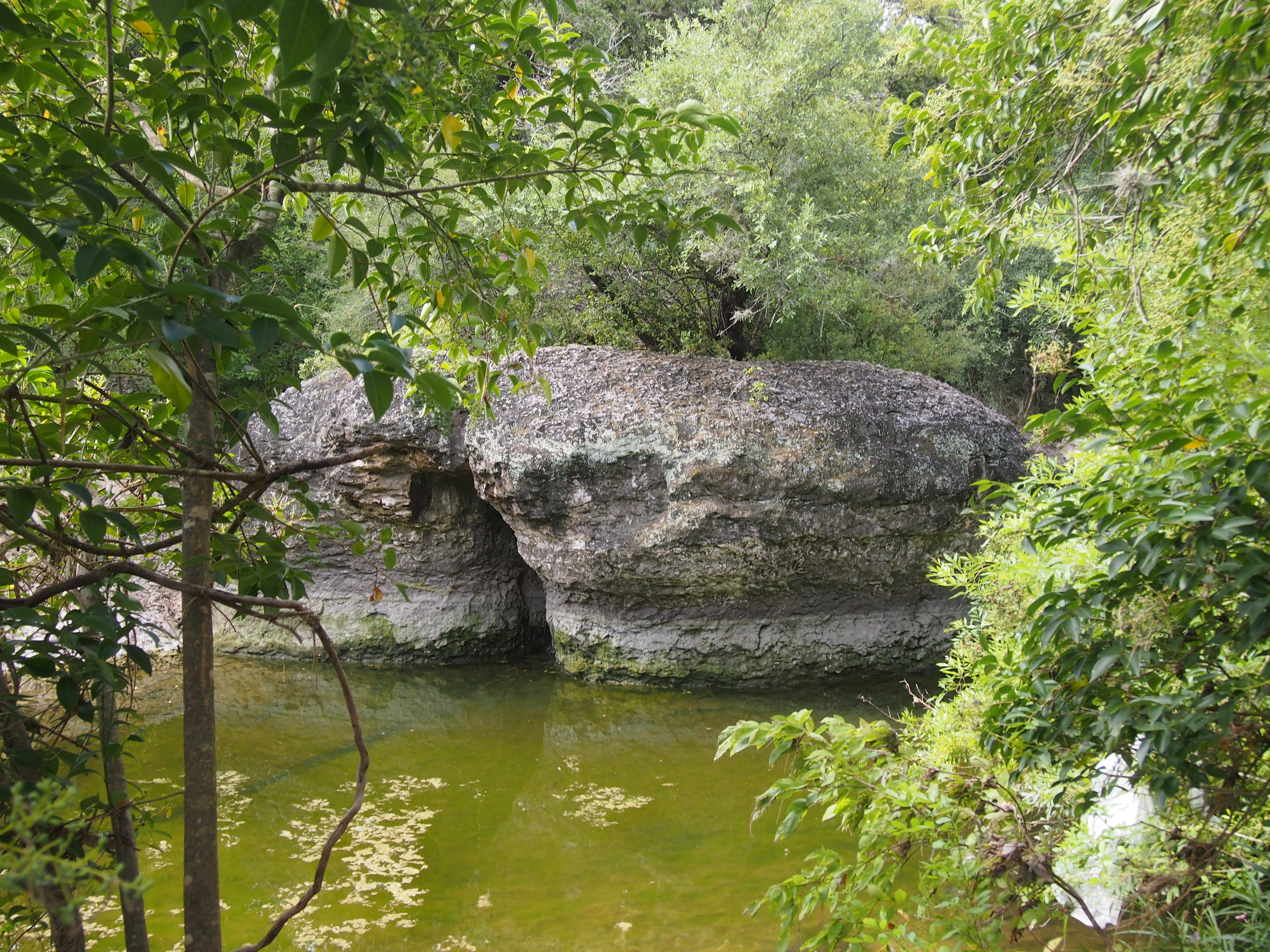
This is Salado Creek, with some visible sedimentary rock.
Salado Creek, July 2015It’s surprising there’s still water in it at all, but then again that’s a sign of how wet the weather has been this year. I imagine during some of the downpours in the spring — which is characteristic of San Antonio’s weather — Salado Creek was a torrent.

Nuestra Señora del Espíritu Santo de Zuñigais & Presidio Nuestra Señora de Loreto de la Bahía

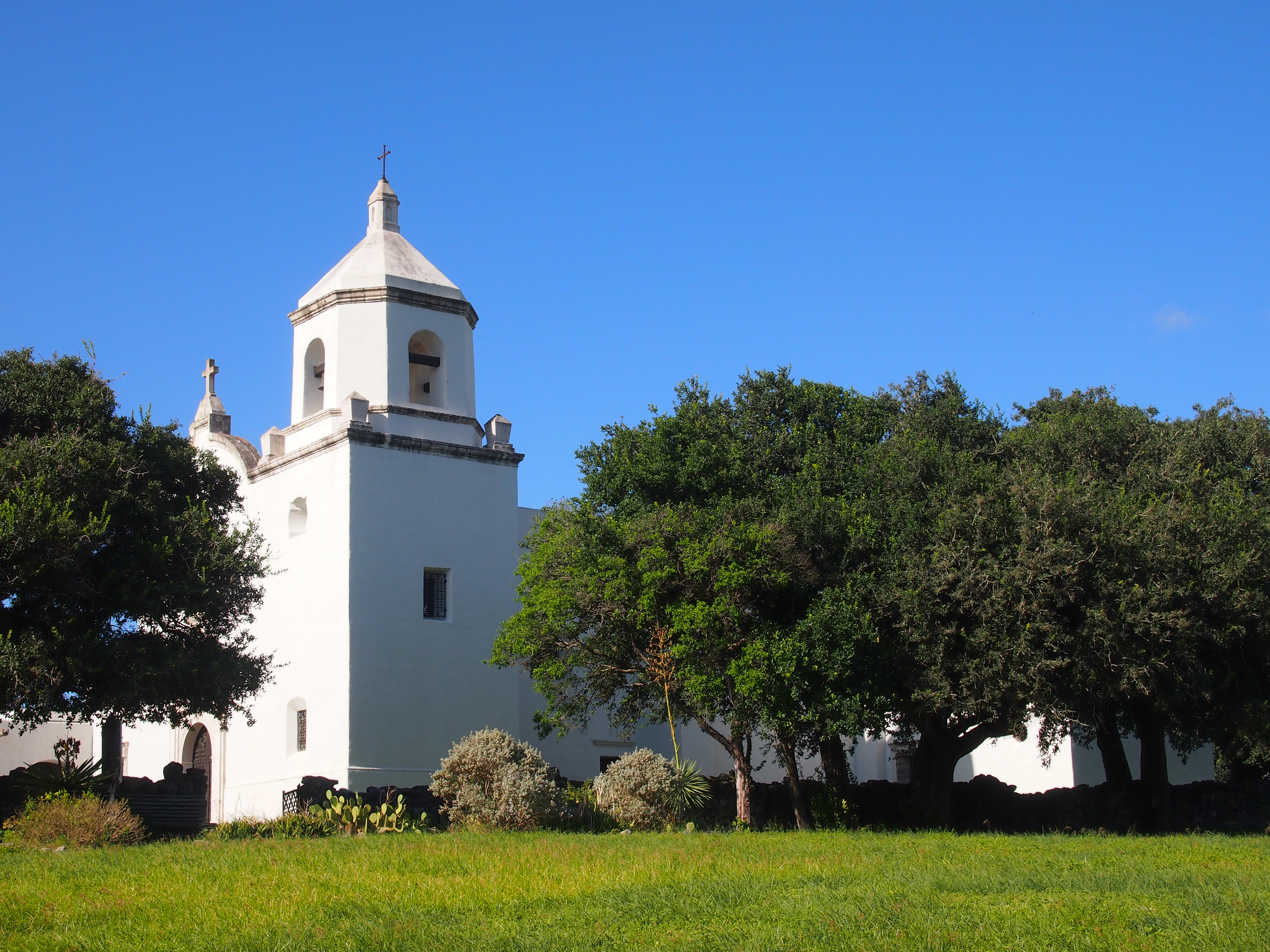
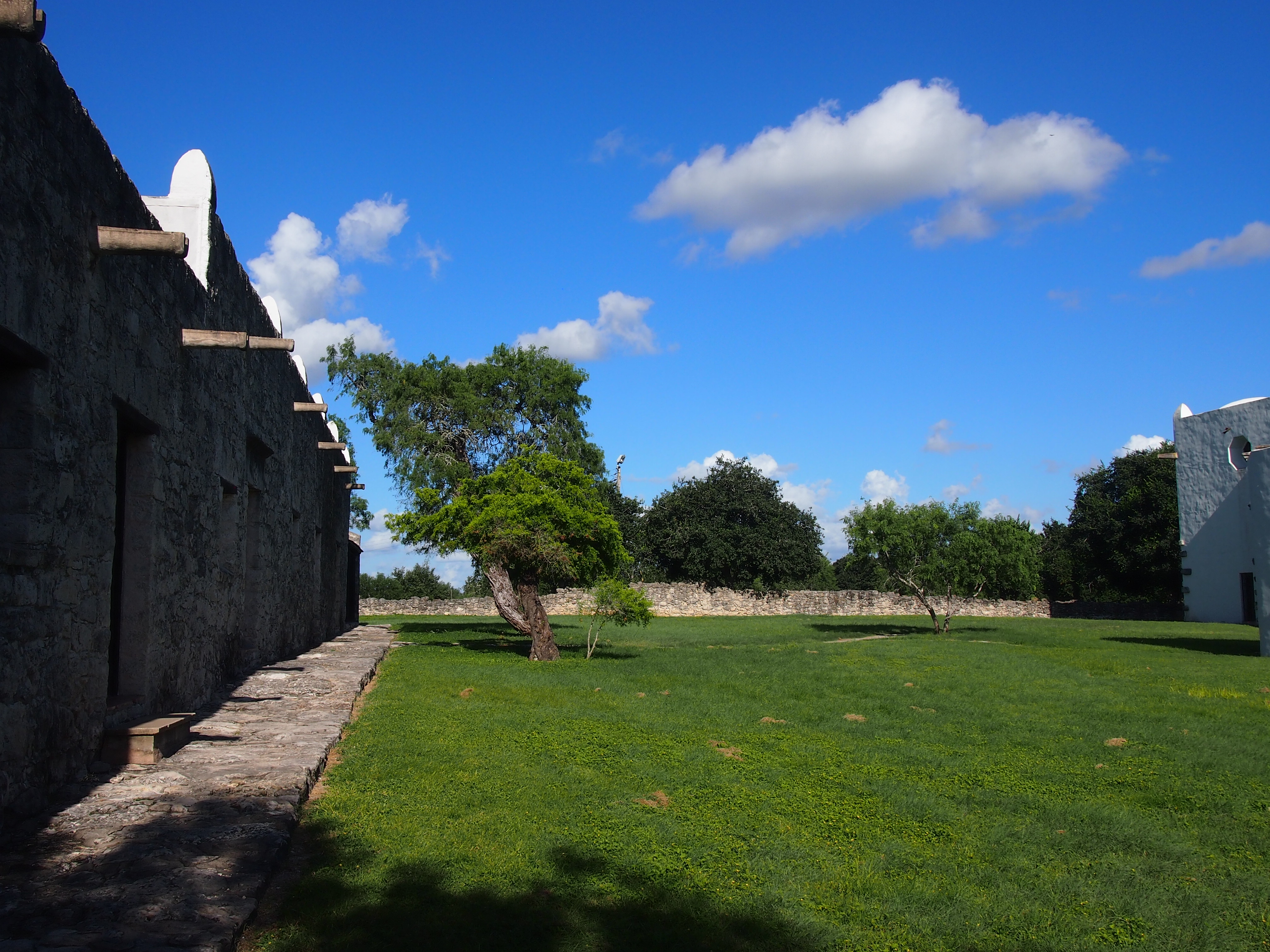
Nuestra Señora del Espíritu Santo de Zuñigais is on the San Antonio River, but it’s well downstream from the SA metro area, in the modern town of Goliad. It’s been there since 1749 in one form or another, at first doing what missions did in the early days, such as convert the natives, engage in ranching, and be a part (along with the nearby presidio) of Spain’s claim to the region against French and English inroads.

By the early 20th century, it was a ruin. But not forgotten completely, because the CCC rebuilt it in the 1930s. It isn’t as well known as the chain of missions in San Antonio, including the Alamo, which were tapped by UNESCO as a World Heritage Site earlier this month. That agitated a few simple-minded crackpots, since it’s always something. So the NPS felt obliged to include the following sentence in its press release about the honor: “Inclusion of a site in the World Heritage List does not affect U.S. sovereignty or management of the sites, which remain subject only to U.S., state and local laws.”

Ann and I made our way to Mission Espíritu Santo in the late afternoon of July 11. Only one other group was visiting at the time, and in fact the interior was already closed for the day. But we got a good look at the mission and its grounds.
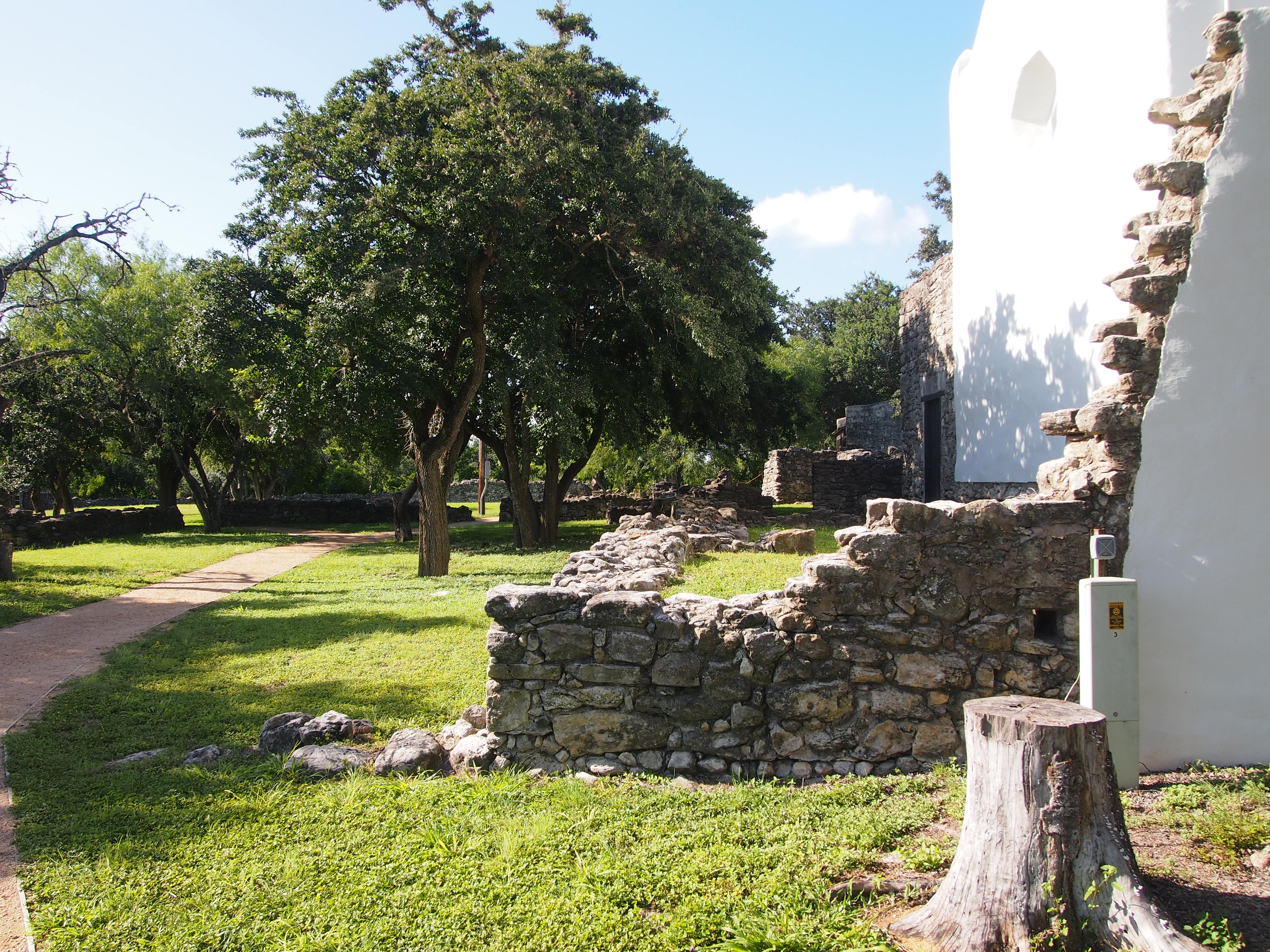
Goliad, july 2015Some parts are still ruins. It adds a certain something to the site.
Goliad, July 2015Other parts are open to the sky.
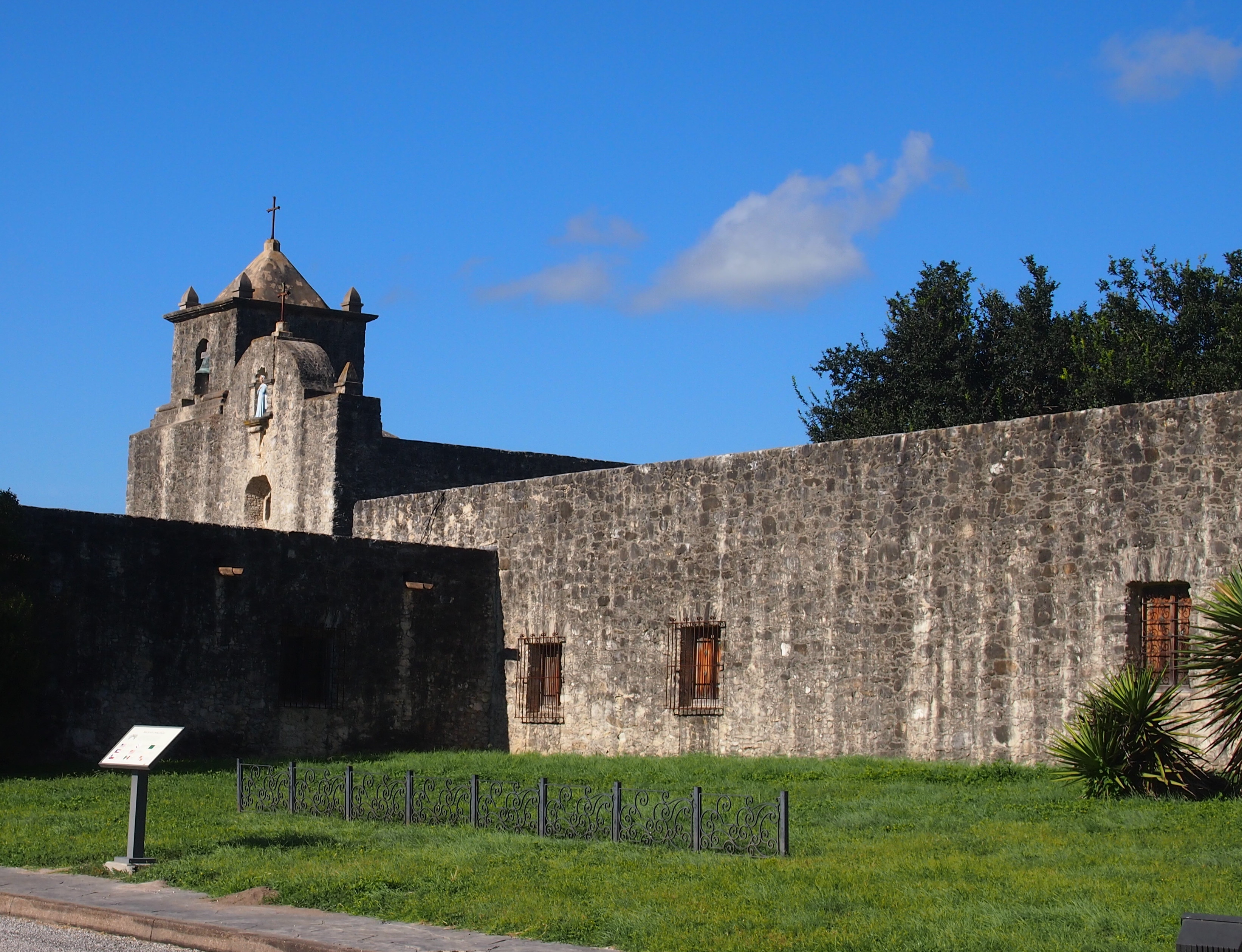
Goliad, July 2015A short drive away is Presidio La Bahía, the fort that protected the mission. In full, Presidio Nuestra Señora de Loreto de la Bahía, it was the place to go to when Apaches were coming. During the Texas Revolution, Fannin and his men were imprisoned there before they were killed not far away. In our time, that means people tell ghost stories about the place.
Presidio BahiaWe got there after closing time. The presidio, being a fortress, has a wall all the way around — also rebuilt, I assume — so no peeks inside. That just means I’ll have to come back someday for a longer look.

Fannin Battleground State Historic Site

The easy way to get from the greater Houston glop to San Antonio is via I-10. That route has its interests, such as Flatonia and Schulenburg and not far away, the Painted Churches, a few of which I’d like visit someday. But on the 11th, I had other things in mind, and followed US 59 southwest out of town.

Or rather, the future I-69. Every 20 or 30 miles, a sign told me that the current route of US 59 — which is already mostly a four-lane highway between the outskirts of Houston and Victoria — would someday be a bone fide part of the Interstate system running all the way to Laredo. For ordinary drivers like me, I’m not sure of the value, since on an Interstate you can’t use turnarounds in the medians, as you can — and as I did a few times — on a large US route. But looking at a map, I can also see the advantage of an I-69 through Texas for trucks barreling up from Mexico to points east: they can bypass San Antonio and its traffic.

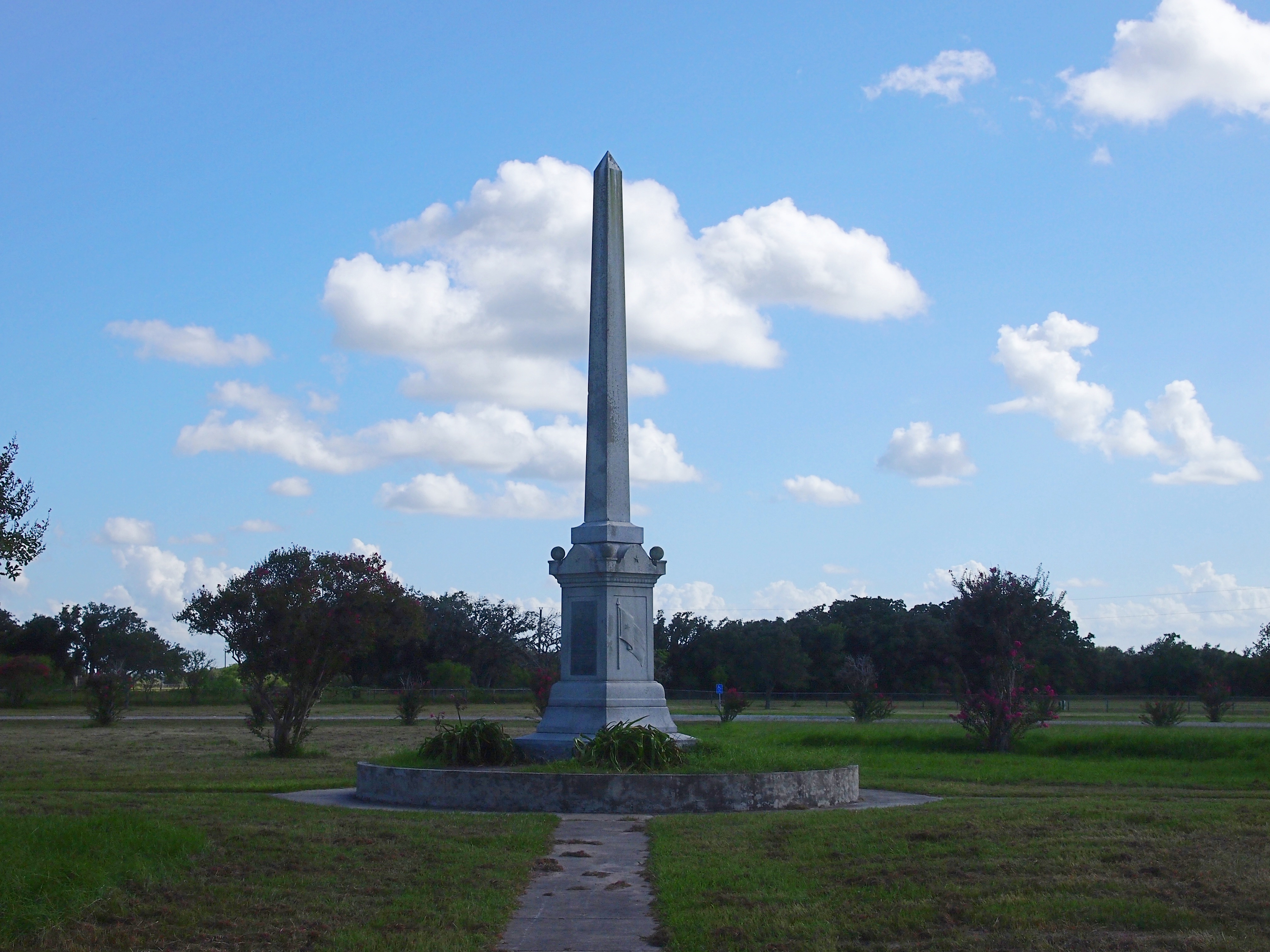
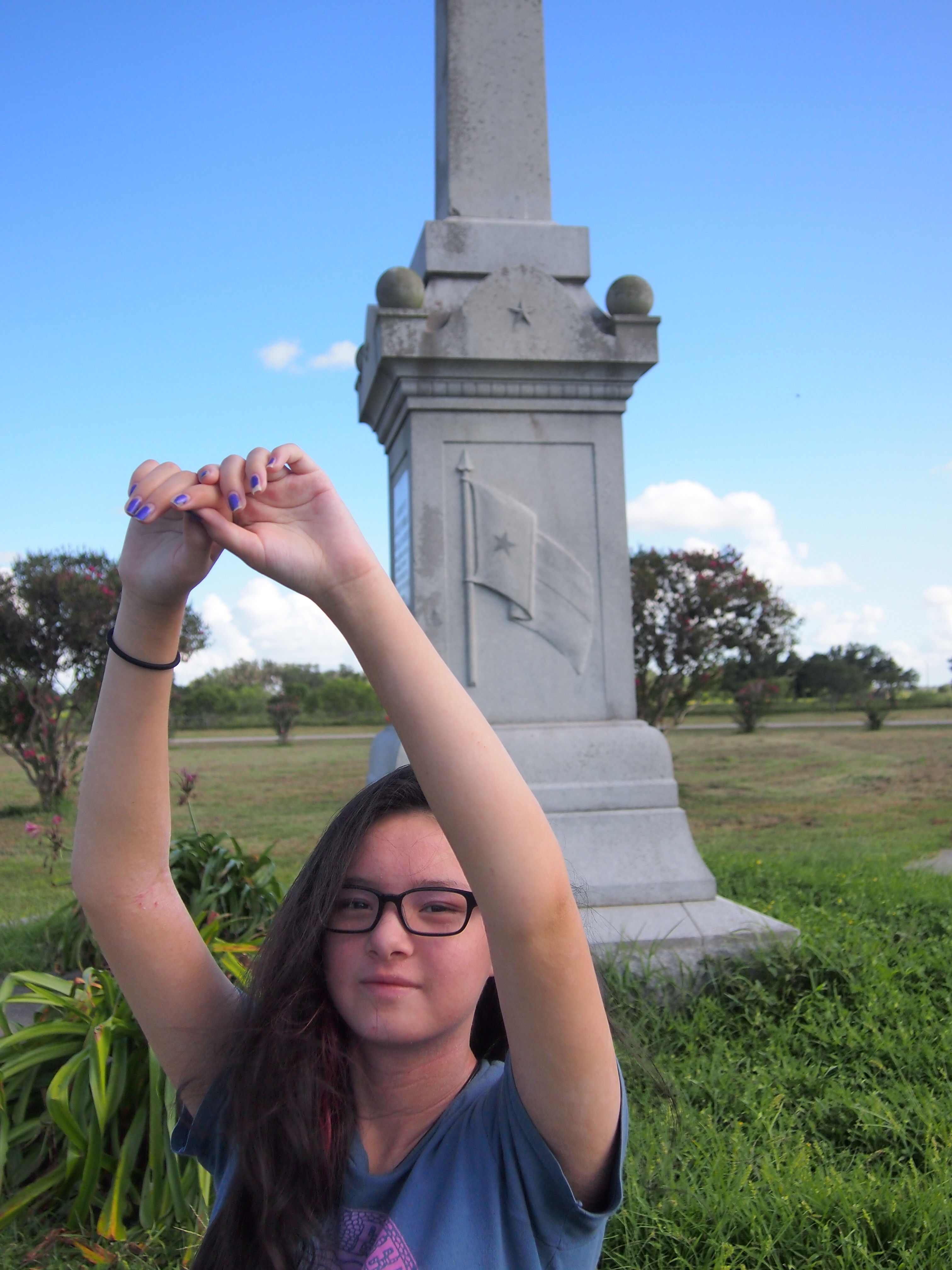
Just southwest of Victoria is the Fannin Battleground State Historic Site, where Col. Fannin surrendered to Gen. Urrea after the Battle of Coleto not long after the fall of the Alamo. An obelisk marks the site.

Soon after the surrender, of course, Fannin and most of his men were murdered on the orders of Santa Anna, in a move that wasn’t just a crime, but a blunder. The Texas State Historical Association posits: “The impact of the Goliad Massacre was crucial. Until this episode Santa Anna’s reputation had been that of a cunning and crafty man, rather than a cruel one. When the Goliad prisoners were taken, Texas had no other army in the field and the newly constituted ad interim government seemed incapable of forming one.

“The Texas cause was dependent on the material aid and sympathy of the United States. Had Fannin’s and Miller’s men been dumped on the wharves at New Orleans penniless, homesick, humiliated, and distressed, and each with his separate tale of Texas mismanagement and incompetence, Texas prestige in the United States would most likely have fallen, along with sources of help.

“But Portilla’s volleys at Goliad, together with the fall of the Alamo, branded both Santa Anna and the Mexican people with a reputation for cruelty and aroused the fury of the people of Texas, the United States, and even Great Britain and France, thus considerably promoting the success of the Texas Revolution.”

Ann, Fannin BattlegroundA little further to the southwest is the town of Goliad, seat of Goliad County. It has a handsome courthouse, as many counties in Texas do.
Goliad County CourthouseAlfred Giles, a British immigrant who did a lot of work in South Texas, San Antonio in particular, designed the Goliad County courthouse in 1894. A hurricane knocked down the clock tower in 1942, but it was finally replaced in 2003.

On the courthouse grounds is the Hanging Tree.
Hanging Tree, GoliadAccording to a State Historical Survey Committee plaque near the tree: “Site for court sessions at various times from 1846 to 1870. Capital sentences called for by the courts were carried out immediately, by means of a rope and a convenient limb.

“Hangings not called for by regular courts occurred here during the 1857 “Cart War” — a series of attacks made by Texas freighters against Mexican drivers along the Indianola-Goliad-San Antonio Road. About 70 men were killed, some of them on this tree, before the war was halted by Texas Rangers.”

More on this little-known incident here; it isn’t to the Texans’ credit. Even so, across the street from the Hanging Tree is the Hanging Tree restaurant. How very Texas.

The Menil Collection

On the morning of July 11, Ann and I drove into the heart of greater Houston, starting near Hobby Airport and stopping en route at a doughnut shop (Shipley, which has good doughnuts and is genuinely regional), post office, and Half Price Books, all located previously by using that marvel of the age, Google maps. But not, I want to say, using any GPS gizmo or other cheaters’ device in the car, since we had none. Later generations — people alive now, probably — might marvel at that, since they won’t know how to get from point A to B, C, or D without a machine telling them how.

As an adult visitor, I’ve more-or-less bypassed Houston over the years. It could have easily been a much more familiar city if, say, I’d gone to Rice. Or if family or old friends lived there instead of San Antonio, Austin and Dallas. So driving through was both new and oddly familiar. The neighborhoods and the houses and shops feel like Texas, but the greenery’s different, so I’d find myself walking along noticing bushes I couldn’t quite place or drooping leaves that didn’t look quite right or flowers new to my eye. Something like wandering around in Australia, but not quite as weird.

Around 11, as the sun was high and hot, we arrived at The Menil Collection. Perfect time to spend in an air conditioned building looking at art-stuff. I wanted to see one of Houston’s renowned museums, but not an overwhelmingly large one, since I had other plans for the afternoon. The museum also had a locational advantage, with easy access to the highway I wanted to take out of town. It also has a large collection of surrealists.

Nothing like some surrealists to brighten your day. I’m impressed by the raw weirdness of them. How did they think of that? John and Dominique de Menil, the oil millionaires who founded the museum, seem to have an early and abiding interest in the likes of Giorgio de Chirico, Max Ernst, René Magritte, Man Ray, and Yves Tanguy. Plus a few Dalis and Miros, among others. Oddly enough, but fitting, there’s also a room devoted to objects that various surrealists owned that reportedly inspired the artists. Exotic curiosities, that is. I didn’t make any notes, but I’m pretty sure I saw a shrunken head or two and a spiny suit of pseudo-armor.

According to the museum literature, the de Menils were also taken with Cubism and neoplastic abstraction, but we must have missed most of those. Or maybe most of them were off display, since I understand that the museum rotates its 17,000 objects with some vigor. We did happen on a nice collection of ancient Greek and Roman objects and afterward some African art, housing in a gallery looking out on an enclosed and inaccessible (to us) garden.

The museum itself is a spacious, light-filled space, except for some of the intentionally darkened galleries. Renzo Piano designed the structure. Seems like he gets all sorts of plum jobs. This one dates from the mid-1980s. The Texas State Historical Association describes it well: “The main museum building is on a tract of nine city blocks purchased by the Menils in the Montrose section of Houston. In accord with Mrs. Menil’s desire for a building that was ‘small on the outside and big on the inside…’ At forty feet by 142 feet and a maximum height of forty-five feet, the building dominates the neighborhood without overwhelming it, due in large part to its grey wood siding, white trim, and black canvas awnings.

“Renzo Piano, perhaps best known for his high-tech Pompidou Center project in Paris, produced an equally innovative if less visually startling technical miracle for the Menil Collection. Working with engineer Peter Rice he achieved an interior illuminated by natural light that passes through glass and is deflected by a series of 300 ferro-cement ‘leaves,’ thus protecting the works of art from direct sunlight. A series of glass-enclosed interior gardens enhances the natural ambiance of the galleries.” Some good images of the place are here.

Next, we walked over to the Rothko Chapel, which is part of the Menil Collection as well. It’s a short distance to the east, tucked in among the houses and trees of an otherwise well-established middle-class neighborhood. You expect certain things from a chapel, and the Rothko Chapel, with its enormous black Rothkos staring back at you from all around the interior walls, is a marvel at contradicting your expectations. Even so, its form is still clearly that of chapel, without overt religious symbols. But you can also imagine that these big black shapes are fragments of the Void, or something just as unnerving, staring right back at you. Quite a thing for the artist to pull off.

Ann, being 12, wasn’t quite so impressed. She appreciated the air conditioning. The Rothkos, not so much.

Here’s an example of art-speak. Whoever wrote the Wiki description of the Rothko Chapel said this: “The Chapel is the culmination of six years of Rothko’s life and represents his gradually growing concern for the transcendent. For some, to witness these paintings is to submit one’s self to a spiritual experience, which, through its transcendence of subject matter, approximates that of consciousness itself. It forces one to approach the limits of experience and awakens one to the awareness of one’s own existence. For others, the Chapel houses fourteen large paintings whose dark, nearly impenetrable surfaces represent hermeticism and contemplation.”

Submit one’s self to a spiritual experience, eh? Approximates that of consciousness itself? Abstract expressionism is notorious for evoking the kind of reaction Ann had: Why is this rectangle of color art? Why is it hanging here? Is this a joke? I don’t feel that way. The colors are interesting, especially when you start to eye the texture. You know, color is the subject. Look closely and it’s more than a Pantone monocolor; there’s more than one shade. I’m glad people paint this way. But I don’t see the need to discuss the genre with the artistic equivalent of technobabble.

Further away, but not too far, is the Byzantine Fresco Chapel, also part of the Menil (now, I’ve read, simply called the BFC). Sad to say, there’s no Byzantine fresco there. After some years in place, it’s been returned to its home in Cyprus. Now the building will house temporary installations. The one occupying the space now is “The Infinity Machine.” A pretentious title, maybe, but it was intriguing. That made up for missing the fresco.

The installation was a rotating mobile about two stories high, going all the way up to the high ceiling (the room is large: about 116,000 cubic feet). It consisted of dozens of antique mirrors hanging by cords of varying lengths. Some mirrors were hanging high, some low. Some were large, some hand-held mirrors. A mechanism turned the mobile so that the mirrors rotated around the room about twice a minute. The was room was mostly dim, but changing lights from the side illuminated the whirling mirrors in endlessly alternating patterns.

You sat on a bench along the wall and watched. You could, in theory, go over to the mirrors and maybe be hit by some as they passed by, since there was nothing to separate you from them except an admonition from the sole guard in the room not to do that.

There’s an audio component as well: sound files made by converting data gathered by various spacecraft as they’ve explored the outer planets and their moons. Don’t ask me how that’s done, it’s beyond my understanding. Something NASA calls Spooky Sounds, but that’s not quite right. Anyway, together with the motion of the mirrors and the dance of the light, the installation is quite a show. The artists are a married couple from British Columbia, Janet Cardiff and George Bures. More about it here, include a video that’s better than nothing, but hardly does it justice.