A Slightly Less Gelid Day

Zero degrees Fahrenheit isn’t warm at all, unless compared with 20 degrees below that. I spent a few minutes out early this afternoon — with temps actually at 5 below or so — and it was tolerable for what I needed to do, which was make sure the garage door closed.

Very low temps cloud the electronic eye, I think. At least, rubbing the lens clear seems to help.

“Surfing” never seemed like the right verb for wandering around the Internet. Maybe that’s why you don’t hear it much anymore, 20 years after it was common. Wander, meander, ramble — these seem better. More descriptive of the way I approach the Internet anyway.

The polar vortex loose on the Upper Midwest naturally led me to read a bit about Antarctic exploration, some about Shackleton but also, in a classic online tangent, the ship Southern Cross, which sailed on the lesser-known British Antarctic Expedition (1898-1900), a.k.a. the Southern Cross Expedition (and not Kingsford Smith’s aircraft, which I heard about years ago in Australia).

The Southern Cross was mostly a sealing vessel and eventually she went down with all hands in the North Atlantic — 174 men — in the 1914 Newfoundland Sealing Disaster, an incident about which I knew nothing.

Reading about that led me to information of the Newfoundland sealing industry, something I also knew nothing about. Here’s a short item about that industry, with footage of Newfies bounding around on dangerous ice floes in the days before the Canadian equivalent of OSHA.

That naturally lead to other information about Newfoundland. Apparently there’s a Newfoundland tricolor, but it’s not the official flag. There’s a song about it anyway.

I looked up the official Newfoundland and Labrador flag. Not bad, exactly, just a little odd. Though it had one designer, it looks like a compromise between two factions of the same committee.

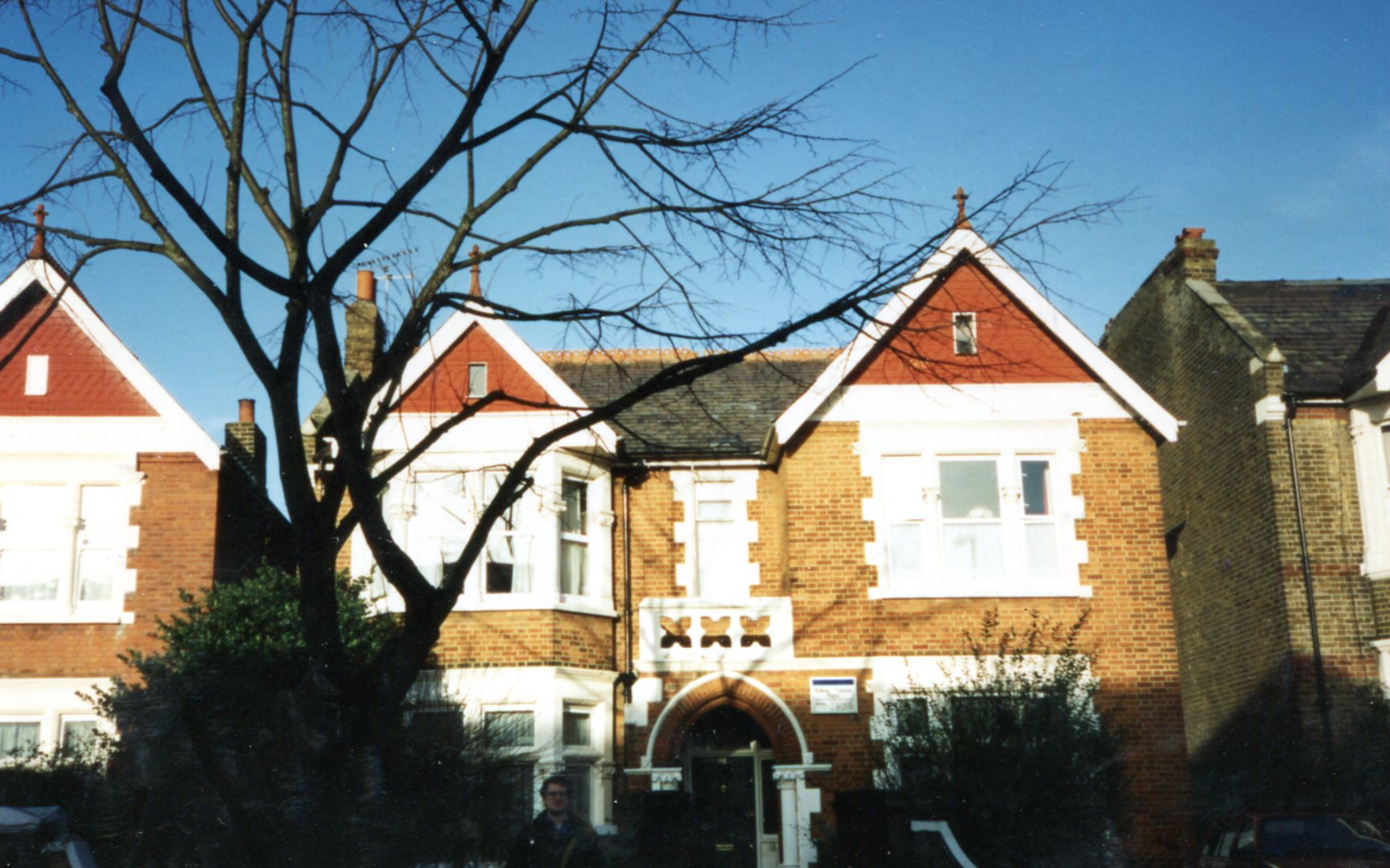
94 Gordon Road, Ealing, London

December 1994 was a good month. We were lucky to have it. After being on the move since April, it was time to take a rest but not quite time to go home. Or rather, go make a new home in the United States. So we spent most of the month in London.

I can’t remember how we found Ealing Tourist Flats. There was no Internet to consult, but there was a short-term rental industry, and we rented one of its units for four weeks. The property was a half-mile or so beyond the North Ealing Underground Station, which was on the Piccadilly Line, but it was much closer to a commuter rail station, Ealing Broadway, which is where we usually went if we wanted to go into the city center.

The neighborhood is part of the sprawl of greater London, with suburbization happening in the early 20th century. It still had a pleasant suburban character in the ’90s. Ealing Tourist Flats was at 94 Gordon Road.

I didn’t notice till I looked closely, but I’m in the picture, barely visible. I’m pretty sure the sign to the right of the main entrance, with the blue stripe, said Ealing Tourist Flats. Our flat was on the second floor, behind the windows on the left. It was a large studio with a foldout bed, table, television, and small food preparation area. Simple but all we needed for a few weeks.

In our time, I can look it up in detail. The tree’s gone and so is the sign on the front, but otherwise it looks about the same. I suspect it’s an ordinary apartment building these days.

Google Maps would have been a good thing to have, but of course in those days google would have just been a misspelling of 10100. If we’d had it, we might have noticed that Ealing Studios was actually nearby. We walked at least once to Walpole Park, which is next to the studios, though December wasn’t the best time for strolling in English parks, and I don’t think we realized it was close.

More Than I Need to Know About UK Advent Calendars

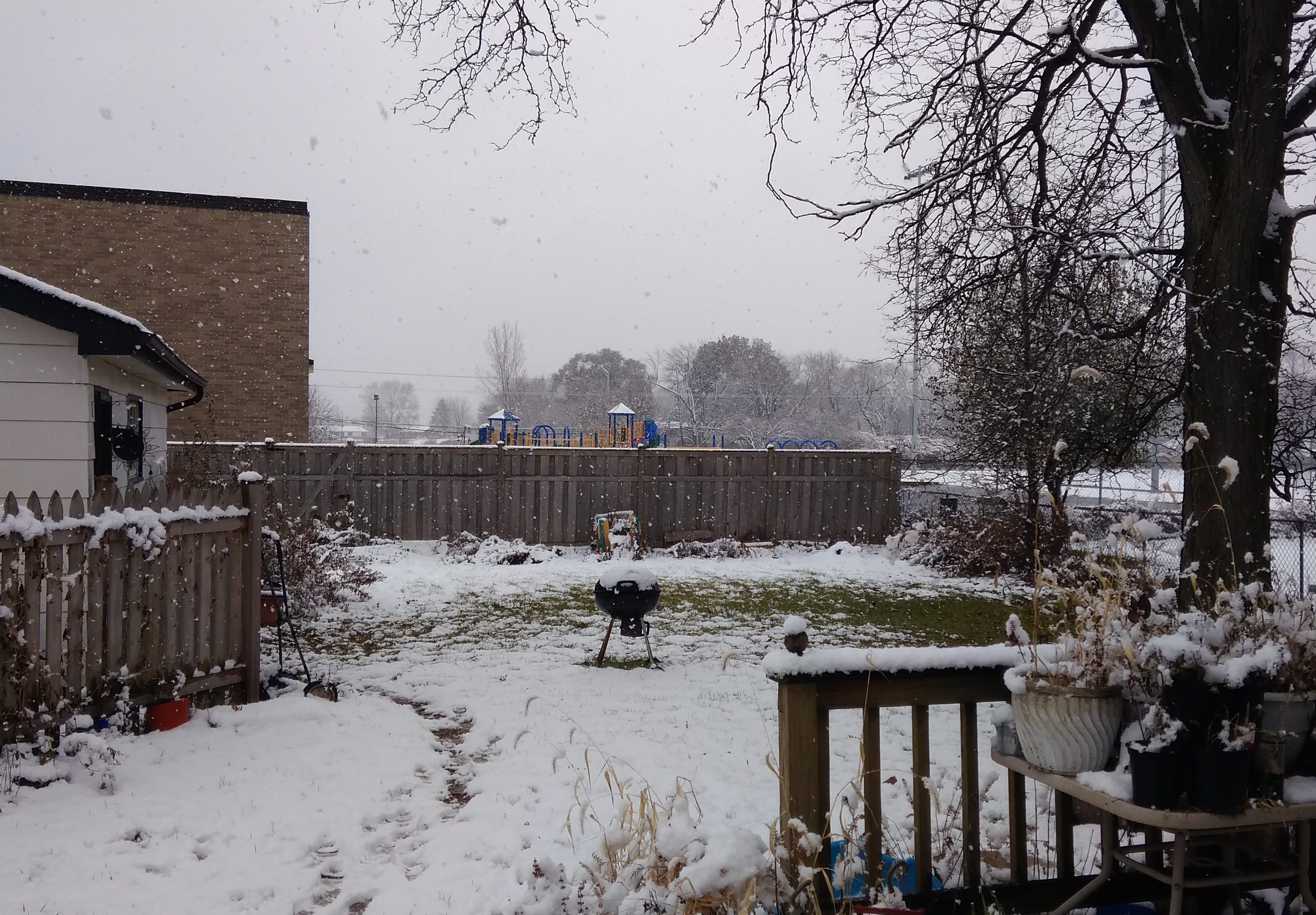
November has been much like December so far this year, and occasionally too much like January. On Saturday morning, the view of the back yard was like so.

That’s not even the first snow that stuck. That happened more than a week ago. It melted, but even so, no snow at all till December would be better.

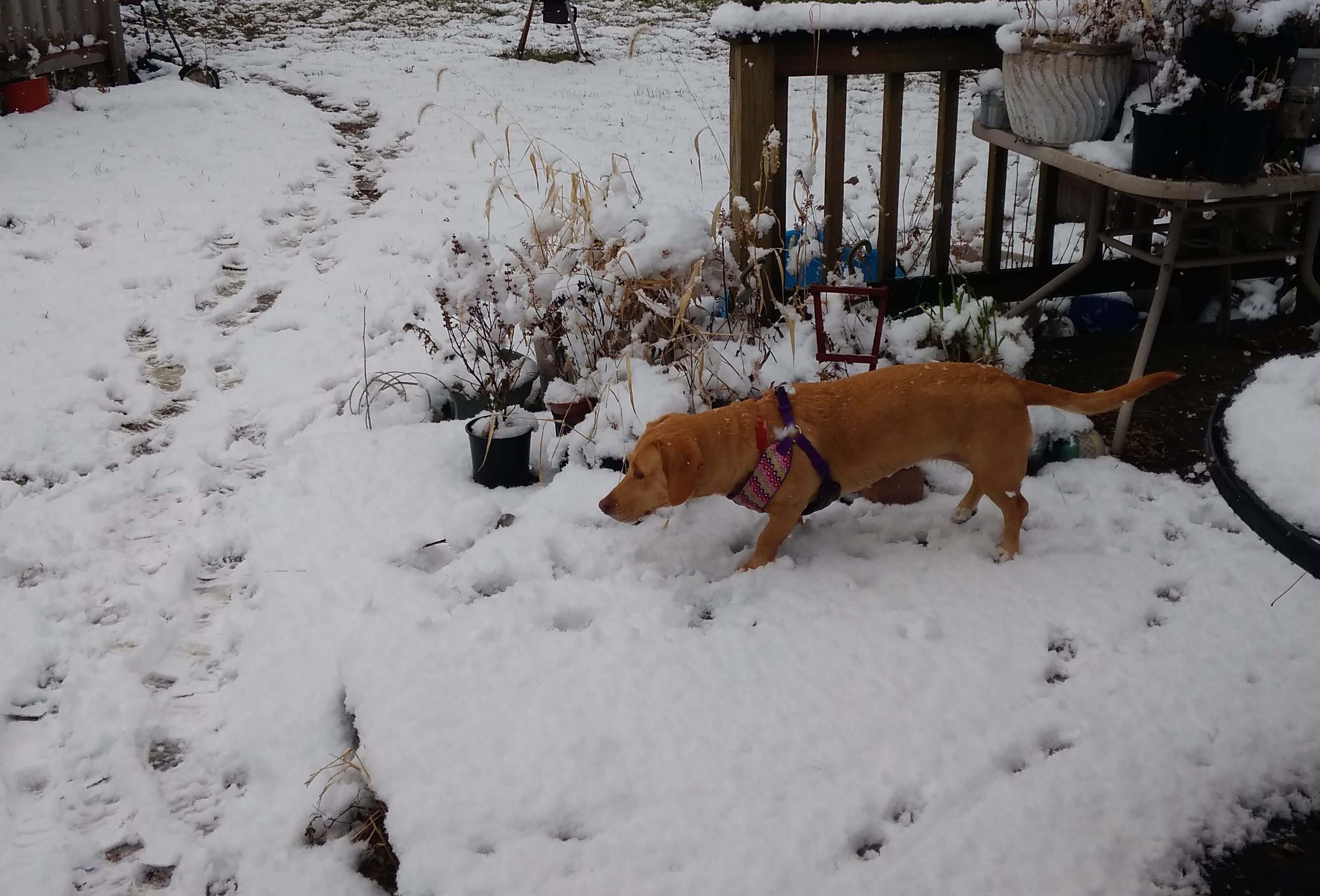
The dog doesn’t care.

Sometimes I get a press release so completely out of left field that I have to wonder about how I got on the list. Here’s a sample of one that arrived recently:

“55.6% of UK consumers surveyed stated that they intend to purchase at least one advent calendar this year, up from 53.4% last year, says GlobalData, a leading data and analytics company.

“While chocolate advent calendars remain the most popular type purchased, with 73.6% of advent calendar shoppers stating their intent to purchase this product, this is down on last year as consumers purchase more extravagant advent calendars as a way to treat themselves or others ahead of the Christmas festivities…

“For retailers considering launching an advent calendar, more focus should be placed on non-chocolate advent calendars, with both beauty and alcoholic advent calendars increasing in popularity this year particularly as more brands and celebrities introduce their own advent calendars. The average spend on advent calendars is also up year-on-year highlighting the boost in sales that advent calendars can provide.”

I assume that advent calendars are a more important holiday sales item for British retailers than U.S. retailers, though of course they’re a known quantity here.

Am I also to understand that British retailers are trying to up their game when it comes to advent calendars? Apparently so. A quick search for “celebrity advent calendars” turns up the likes of this. Naturally, the likes of The Guardian carped about luxe calendars.

Probably the advent calendar cartel — it has to be a cartel — wants more Americans to buy them, too. Aldi, which is owned by shadowy German billionaires, is rolling out wine advent calendars for the U.S. market for the first time this year. A thing that makes you go hmm.

Bayeux Tapestry Odds

Faux spring no mo’. Woke up this morning to a light coat of snow. Not even enough to warrant shoveling, but snow all the same.

I check the Paddy Power web site now and then, not because I’m interesting in betting, but because its predictive powers seem pretty good. Usually. The Irish bookies got the 2016 election wrong, but they get a pass for that, since everyone else did too.

Last week Amazon winnowed its second headquarters site selection to 20 cities, something I’m following as a professional matter. I was a little surprised to see that the odds favor Boston right now, at 2/1, with Atlanta, Austin and Washington DC next.

All very interesting, but what really caught my attention on the site was, “Bayeux Tapestry Location Display.” What? It’s going to be displayed somewhere outside Bayeux?

Apparently so. At some point in the next few years, at someplace in the UK. Exactly where is the betting matter.

Paddy Power puts the British Museum as the clear favorite, at 1/2, which seems reasonable, but also possible are Canterbury and Westminster Abbey at 5/1. Less serious possibilities are at Paddy Power Tower or “Any Carpet Right store.”

I assume the tower is the company headquarters in Dublin. As for Carpet Right, which is actually styled Carpetright, that’s a carpet retailer with 426 stores in the UK and 138 in the Low Countries and Ireland. Just a spot of fun from the Paddy Power bookies.

The Internet, being what it is, allows me to find out about other things related to the Bayeux Tapestry with ridiculous ease. For example, if I wanted to spend $230, I could have my own Bayeux Tapestry tablecloth, 95 percent cotton and also made in France. Nice, but no thanks.

Upon Saint Crispin’s Day

I’ve posted this before, but it was nine years ago, and besides, you can’t watch the St. Crispin’s Day speech often enough.

Laurence Olivier’s version is, of course, very accomplished, but somehow it doesn’t resonate with me like Kenneth Branagh’s.

As it happens, I’ve been reading about Agincourt in The Face of Battle by John Keegan (1976) these last few days. I’ve had the book a long time, though not 41 years, and only recently decided to get around to it. In Keegan’s capable hands, the historical Agincourt is every bit as interesting as Shakespeare’s.

The Pirates of Penzance

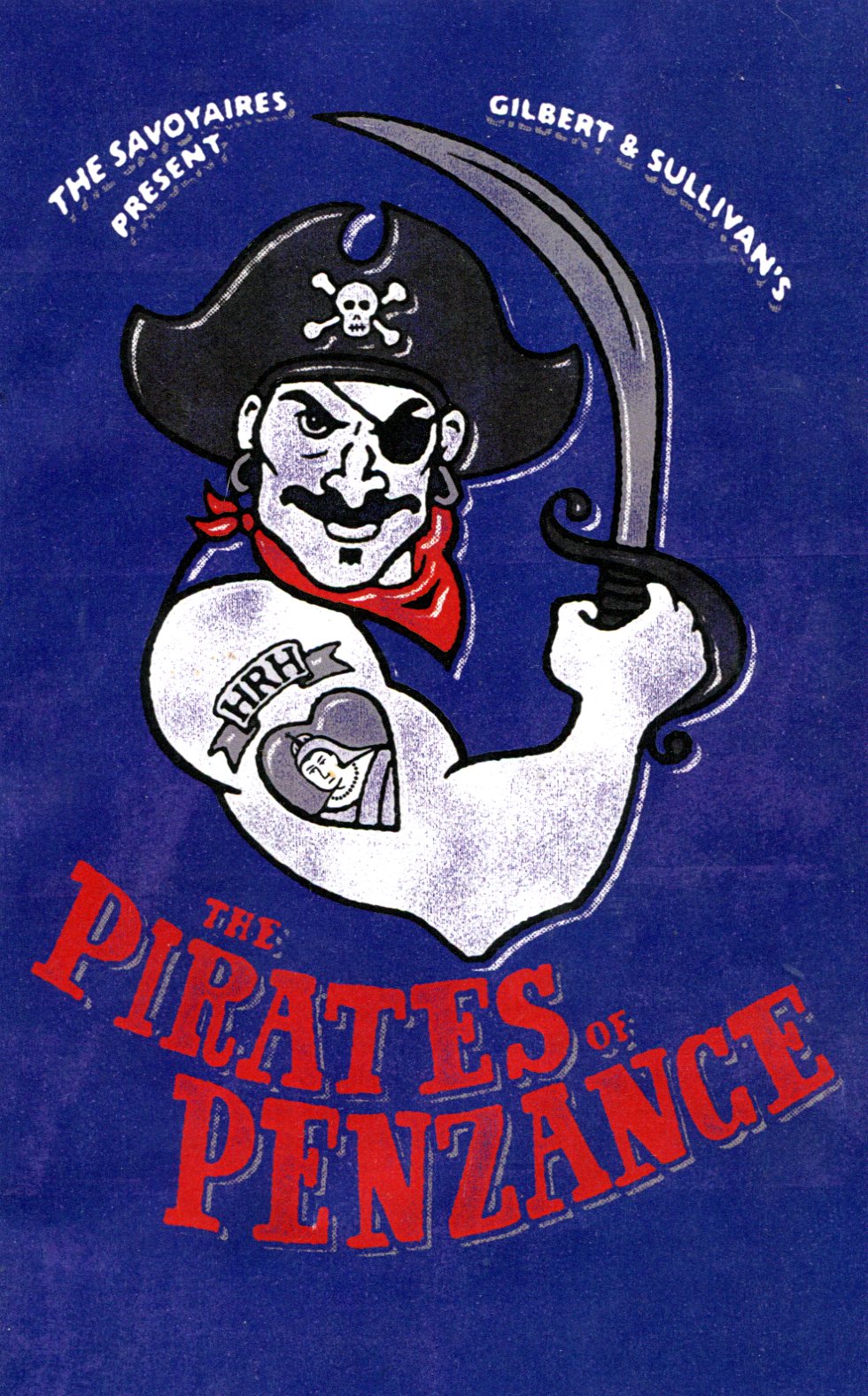
Not long ago Ann and I went to Evanston to see a production of The Pirates of Penzance by a troupe known as the Savoyaires, directed by Amy Uhl (choreography) and Timothy Semanik (music). I’d seen it advertised in the Iolanthe program last spring, and it occurred to me that I’d never seen it on stage. So I wanted to go.

img492I saw the Kevin Kline and Linda Ronstadt movie version sometime in the mid-80s at the Vanderbilt cinema. It was essentially a filming of the 1980 Broadway production. I’m not sure what it was, but I remember the movie being a little off. A little stiff.

Maybe it didn’t offer enough of that jolly good time that you should get from Gilbert & Sullivan. We got that from the Savoyaires, who didn’t need an elaborate venue to pull it off. The show was staged in a sizable but plain junior high school auditorium, complete with an orchestra.

Phillip Dothard played the Pirate King with gusto, and Sahara Glasener-Boles brought the right amount of sauciness to the part of Ruth. Of course what everyone was waiting for was the Major-General to show up and sing his signature song. An actor named Bill Chamberlain did that part.

“How did he learn to do that?” Ann asked later.

“Practice,” I said, though in fact, even if I had the voice, I doubt that I could ever do “I Am the Very Model of a Modern Major-General.”

And while Chamberlain was very good, he didn’t quite get all of the enunciation. Close enough, though. He was definitely part of the jolly good fun.

The program included “A Pirates of Penzance Glossary,” including the likes of Babylonic cuneiform, The Frogs of Aristophanes and Heliogabalus, whom it described as an “infamously depraved Roman emperor.”

“What was he depraved about?” Ann asked.

I couldn’t remember. It had been years since I’d read about him. A vague sense of perversion clings to him, but I wonder if there’s much to it. Ancient historians liked gossip and lurid invention as much as anyone else, and so did not-so-ancient historians.

“To confound the order of the season and climate, to sport with the passions and prejudices of his subjects, and to subvert every law of nature and decency, were in the number of his most delicious amusements,” Gibbon wrote of the boy-emperor.

He also wrote: “It may seem probable, the vices and follies of Elagabalus have been adorned by fancy, and blackened by prejudice.” In other words, dress as a woman a few times and people will make up all kinds of stories about you, especially if you’re emperor.

Ah, well. I will leave it to learned sages to argue over Heliogabalus. Next year’s production by the Savoyaires is Ruddigore, another G&S I’ve never seen staged. I’ll try to go.

Mighty Stonehenge

Notes from a day’s drive in southern England. My friend Rich and I were young and doing what people — tourists — do in that part of the world, seeing very old places.
Wish we’d known about Glastonbury Tor (about 50 miles to the west of Stonehenge; nothing is really very far away in England, not to a Texan). Even so, I’m not sure we could have seen Stonehenge and Bath and Glastonbury Tor in the same day, but we could have given it the old post-college try.

August 11, 1983

Mrs. Dow drove us to Gatwick Airport, and we paid our pounds [wish I’d recorded how much] and rented a blue Ford Fiesta. The plan is to drive various places until we need to return the car at the airport on the 14th, to catch our flight home.

Driving on the left side, with the steering wheel on the right, took some getting used to. Soon we were lost on the small roads south of Gatwick, very narrow ones with a surprising amount of traffic, and confusing roundabouts (traffic circles) appearing suddenly and often.

So we were edgy for a while. Fortunately, you get used to the roads. We even got unlost. Rich drove and I navigated, and we each took to those roles before long. We listened to BBC1 as miles of English countryside rolled by. Entertaining, no commercials.

At about 1, we arrived at Stonehenge. [Ah, mighty Stonehenge.] We saw it from some distance at first, driving along the A303. Looked almost luminous from a distance. The road runs remarkably close to the ruins. Maybe an ancient road did likewise.

We parked (no charge!) and visited the ruins. You can’t get too close to the stones. Close enough, though. Impressive, and puzzling, that ancient people dragged these some distance across England, long before it was ever called that, for the purpose of building a stone circle. I won’t speculate on their motives. The center uprights and lintels were especially impressive: big and white and somber. [Not quite this crowded that day, I’m glad to remember.]

Drove on to Bath. No problems until we got snarled in traffic in Bath, a town not built for cars. We eventually parked in a garage that featured the following emphatic signs: Thieves are active in this car park. Remove your valuables or they will be stolen.

We went to the tourist-i, booked a room, and drove there: a place called Toad Hall. Very nice, £7 each. We walked into the center of town from there, visited a number of bookstores there, then the Roman baths. [No detail about that, but I remember such scenes such as this.] Ate. Wandered back to Toad Hall. Just after sunset, a beautiful scene just outside our window: a church steeple with a nearby crescent moon.

I used to have a business card I picked up at Toad Hall, but I can’t find it. I remember it featured a gentleman Toad, whom I guess would be Toad of Toad Hall. Though a children’s book, I never got around to reading The Wind in the Willows as a child, so the name didn’t resonate with me when I stayed there. Only later I appreciated the whimsy of naming a B&B that.

I checked, and it’s still there. I also checked the rates: a double in August is (gasp) £95. (We paid the current equivalent of £42 between the two of us.)

Into the Silence

When I went to Half Price Books the other day, I knew I’d come away with something. Even more because I had a gift card, though I don’t remember where or when I got it. The code on the back was scratched off, so I couldn’t tell whether it had any value by checking online. I figured the clerk could tell me, and so she did: $15.

More than enough to buy Into the Silence by Wade Davis (2011), subtitled “The Great War, Mallory, and the Conquest of Everest.” That subtitle alone was almost enough to sell me on it. Not that I have a particular interesting in books about mountaineering, though I’ve read a few. But I do have an interest in the Great War and about journeys or expeditions to remote places, during which the participants die or not.

In this case, of course, Mallory and Irvine did not come back from Everest in 1924. Mallory managed to survive the war — which many of his friends did not — but Everest got him. I remember reading about the discovery of Mallory’s body in 1999. Irvine has yet to turn up, and no one knows whether they made the summit or not.

Also the fact that Wade Davis wrote the book was a recommendation, though I haven’t read any other books of his, even the one about Voodoo. Not yet. Anyway, he’s an insanely accomplished fellow, so I suspect I’m in for a good read.

The Clan-Na-Gael Guards Monument, Mount Carmel Cemetery

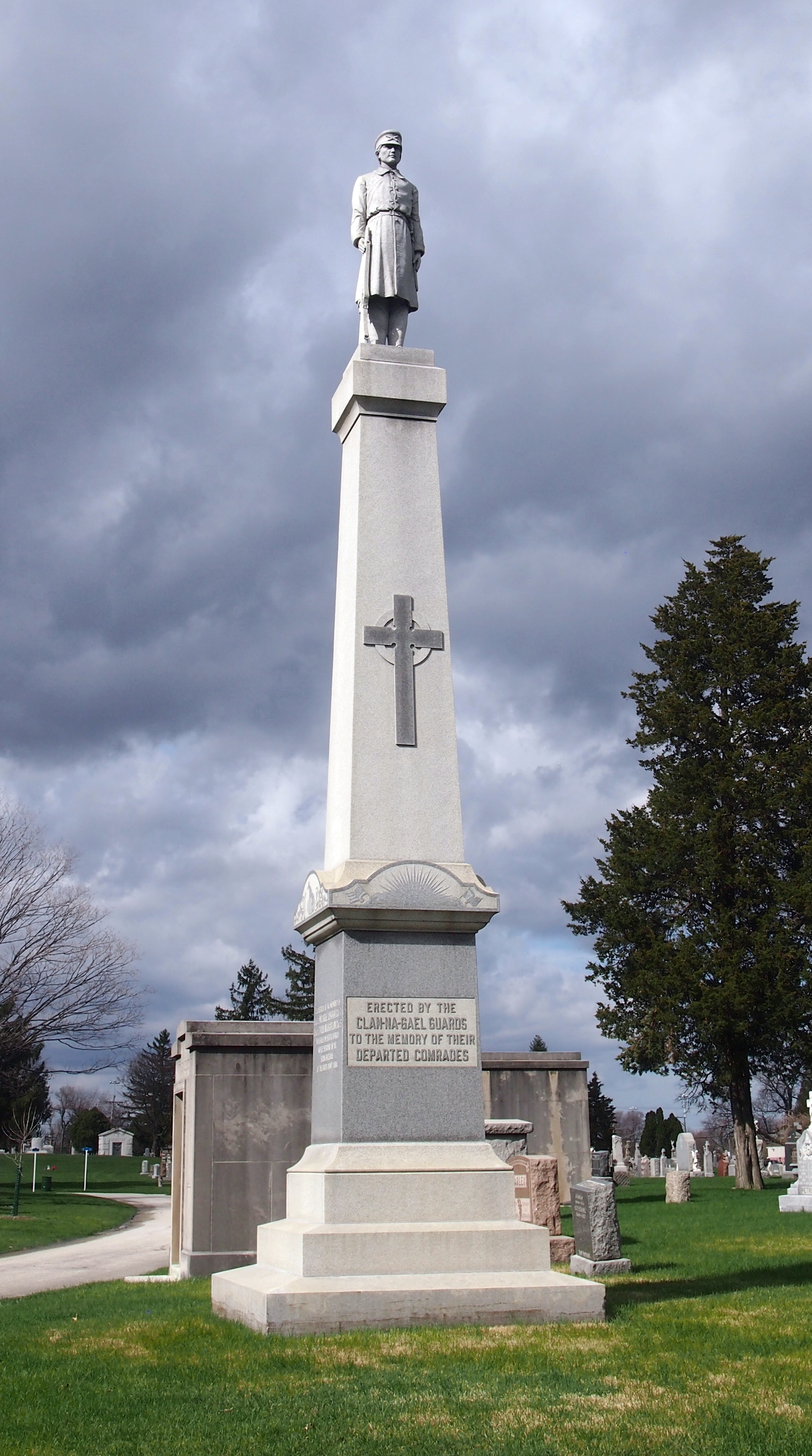
An obscure monument to obscure men fighting for a now-obscure cause. That’s what I found at Mount Carmel Cemetery last week when I spied the Clan-Na-Gael Guards Monument. What a find.
The Clan-Na-Gael Guards Monument, Mount Carmel CemeteryObscure isn’t meant as a pejorative. People besotted with fame might think it’s one, but obscurity is the common fate of almost everyone and everything. Life’s still worth living. In future millennia, we’ll all be as distinctive as grains of sand on a beach. It won’t even take that long. That’s probably as it should be.

Yet we memorialize. In stone sometimes, no doubt since mankind learned to carve. I’m no expert on the psychology of memorials, but I’d guess they’re mostly for those who already remember: family, friends, colleagues, comrades-at-arms, or a public who read the newspaper stories, saw the newsreels, recalled the special bulletin interrupting a radio or TV show. Memorializing for posterity might be given lip service, but that’s all it is.

The front of the Clan-Na-Gael Monument says (in all caps, but that screams):

Erected by the
Clan-Na-Gael Guards
To the memory of their
Departed comrades

The Clan-Na-Gael was, of course, dedicated to Irish independence. Any enemy of the British was a friend of theirs, such as Imperial Germany 100 years ago, though this memorial goes back a little further. I shouldn’t have been surprised to read the side of the memorial, yet I was:

Dedicated to the memory of
Lieut. Michael O’Hara Co. A
Lieut. Thos. Naughton Co. B
Who died in South Africa
While serving in the
Irish Brigade
Of the Boer Army 1900

Irishmen in the Boer War? Yes, indeed. Not just any Irishmen — though I’ve read there were a fair number in South Africa at the time, working in the mines — but Irishmen from Chicago who headed out to Africa for a chance to stick it to the British.

Soon, I came across a digitized version of an anti-British polemic, Boer Fight for Freedom, written in 1902 by Michael Davitt (an associate of Charles Stuart Parnell, and interesting in his own right). In the book, there’s a passage about the Chicago Irish who fought for the Boers:

The CHICAGO IRISH-AMERICAN VOLUNTEERS

This small contingent of volunteers was spoken of in Pretoria as the “finest-looking” body of men that had yet reached the Transvaal capital from abroad. They numbered about forty, excluding the medicos and non-combatants, and were all young men of splendid physique and of the best soldierly qualities.

They were under the command of Captain O’Connor, of the Clan-na-Gael Guards, and joined Blake’s Irish Brigade. President Kruger extended a special reception to the company, and addressed them in complimentary terms before they started for the front.
Lord Roberts was on the point of advancing from Bloemfontein when the Chicago men arrived, and they were hurried forward to Brandfort along with other reenforcements for De la Rey, who was in command until the arrival of Botha.

O’Connor and his men acquitted themselves most creditably in all the rear-guard actions fought from Brandfort to Pretoria; Viljoen’s Band Brigade, Blake’s and O’Connor’s men, with Hassell’s scouts, doing their share of fighting in all the engagements during events and occurrences which were well calculated to damp the enthusiasm of the allies of the Boer cause.

It is, however, under trying circumstances, offering little or no compensation for services or sacrifice, save what comes from the consciousness of a duty well performed, that men are best tested in mind and metal, and the work done during that most disheartening time was worth many a more successful campaign fought under brighter hopes for the cause of liberty.

The Clan-Na-Gael Guards Monument, Mount Carmel CemeteryBut what of the memorial itself? I found digitized information about that, too, in The Reporter, a Chicago-based national trade publication “devoted to the granite and marble monumental trade,” the masthead says (man, Google wants to digitize everything).

The October 1914 edition of the magazine tells us that, “Sunday, September 27th, there was unveiled with due ceremony, in Mt. Carmel cemetery at Hillside (a suburb), a Barre granite monument to the memory of Lieutenants Michael O’Hara and Thomas Naughton, who lost their lives while serving with the Boers against the British in South Africa. They were the only ones killed out about 40 Clan-na-Gael guards who went to the war from Chicago.

“The monument is a shaft with conventional bases, die, plinth and shaft, and was furnished by the Moore Monument Co., the price being about $1,800.”

That was fairly serious money, about $43,800 in 2017 dollars. I don’t doubt that the surviving members of the Clan-na-Gael Guards’ foray to Africa got their money’s worth.
Afternoon Music Selections

Ann and I were in the living room yesterday, and I called up YouTube on the TV. It’s one of the things you can do with a modern TV and wifi. She wasn’t really paying attention, since she had her smaller electronic gizmo handy, so I decided to play “Telstar.” The video shows mostly unrelated space images, but never mind. I thought it might get her attention.

I was right. “What is that?” she asked. Or maybe it was, “What is that?” But I don’t think she really wanted an answer.

After it was over, naturally I had to play the Tornados’ “Robot,” whose Scopitone doesn’t look very good on a bigger screen. But the YouTube poster’s (in 2006!) description is apt: “Tornados rock the twang in a back-woods sci-fi robotic dance party! And then kiss girls!”

She wasn’t impressed by that, either.

If it had occurred to me, I would have dialed up “Trans-Europe Express” (English or German). It’s been 40 years this month since the album of that name was released. Of course I didn’t hear about it at the time, but in the early ’80s, and even then I had no idea that it had been received so well by critics, for what that’s worth. All I know is I’ve always liked it.

When I looked it up recently, I was surprised to learn that the Trans-Europe Express, as in the train system TEE, doesn’t exist any more. Probably because I confused it with the TGV, which is very much still around.

Or maybe I could have played Kraftwerk’s “Tour de France,” another fun tune from some other zone, or “Beatbox” by Art of Noise. If your children don’t think you’re just a little strange, you aren’t trying very hard.