The Tripoli Shrine Temple

Last night at around 11, or just an hour before September ended, I sat on my deck outside in short sleeves, in comfort. Warm winds blew. The day had been summer-like, in the mid-80s at least, and October 1 has been roughly the same. Rain is coming tonight, though, and so are cooler temps.

I don’t have any interest in becoming a Shriner, but I have to like a fraternal organization whose members wear fezzes and meet in gilded, onion-domed buildings inspired by the 19th-century popular vogue for Orientalism. I’ve seen Shriners in their little cars buzzing along parade routes, and once upon a time I went to a Shrine Circus in a temple that the Shriners later sold, and which has been sold again.

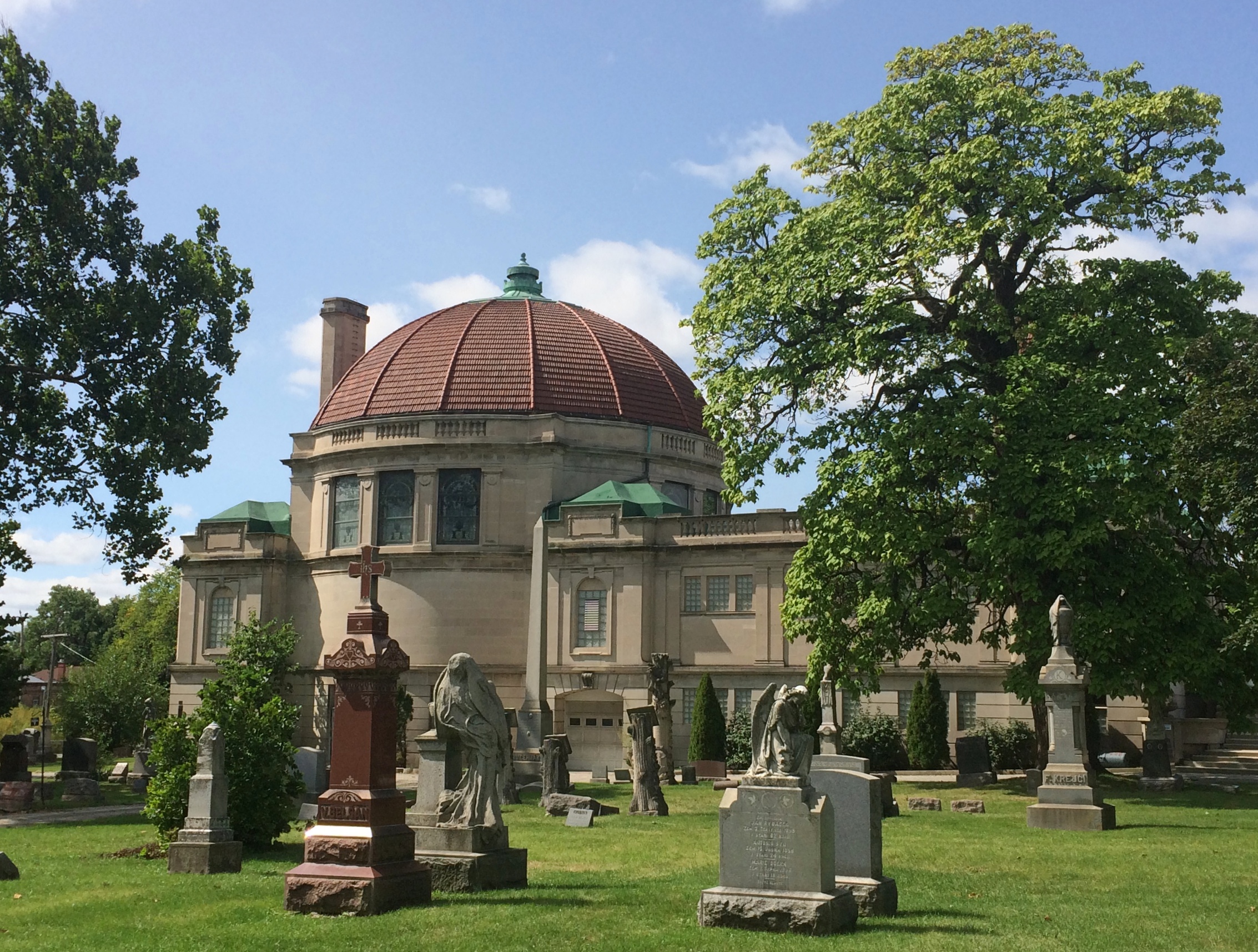
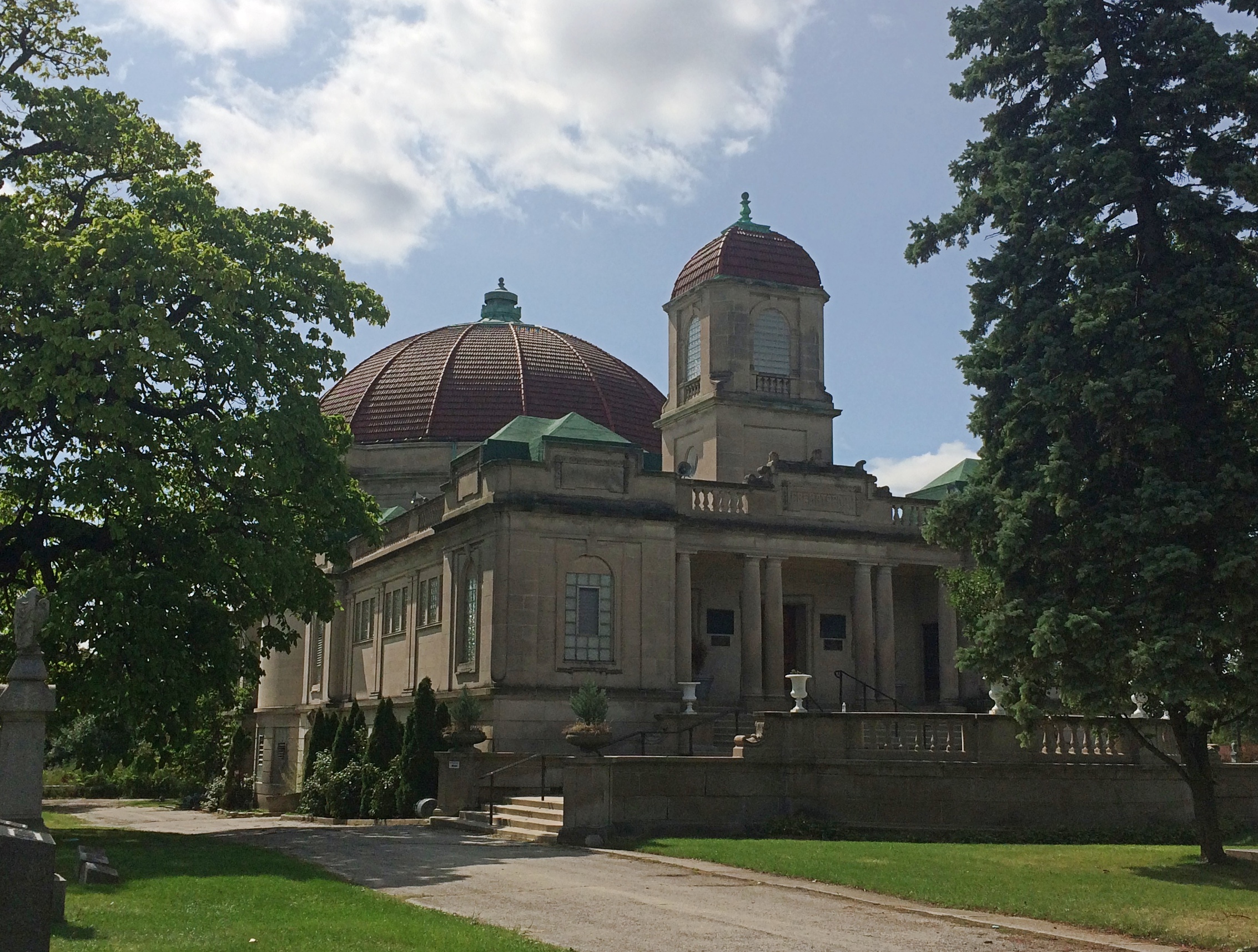
In Milwaukee, on Wisconsin Ave., the Shriners built themselves an exceptional edifice, the Tripoli Shrine Temple, taking inspiration from the Taj Mahal.
Tripoli Shrine TempleNo example of Moorish Revival is complete without stone camels, I think. Especially considering that the Shriners originally called themselves the Ancient Arabic Order of the Nobles of the Mystic Shrine. Two camels are perched beside the front entrance steps.

Tripoli Shrine TempleThe statue to the right of Shriner and child is a nod to the Shriners Hospitals for Children, of which there are 22 in North America (though none in Milwaukee).
Tripoli Shrine TempleThe temple, designed by Clas & Shepard of Milwaukee and completed in 1928, is every bit as ornate inside as out.
Tripoli Shrine TempleSecond floor.
Tripoli Shrine TempleLooking up.
Tripoli Shrine TempleThere was no shortage of Shriners around, helping show off the place.
Tripoli Shrine TempleThis one gave a short talk about the building. He had interesting things to say, especially about the countless thousands of tiles on the floors and wall. Literally countless, since no one kept count or has made a count. He said that during the interior construction of the temple in the late ’20s, a family of four skilled in tilework lived in the temple, staying until they were done a few years later.

Three Wisconsin Avenue Lutheran Churches & One Beer Palace

We kicked off our time on Wisconsin Ave. in Milwaukee on Saturday at St. Paul’s Lutheran Church, which has been on this site since 1917, though the congregation has been around since 1841, before there was a Milwaukee or even a state of Wisconsin.
St Paul's Lutheran MilwaukeeGeorge Bowman Ferry designed the structure. It must have been one of his last, since he died in 1918. In partnership with another Milwaukee architect, Alfred C. Clas, he’s better known for doing the Pabst Mansion, which isn’t far to the east of St. Paul’s.St Paul's Lutheran Milwaukee St Paul's Lutheran MilwaukeeJust a few blocks from St. Paul’s — 2812 W. Wisconsin vs. 3022 W. Wisconsin — is another Lutheran congregation, which meets at Our Savior’s Lutheran Church. I gazed at the structure for a while before I noticed the solar panels. It probably took so long because that’s still an unexpected feature in ecclesiastical architecture.Our Saviors Lutheran Church, MilwaukeeOur Saviors Lutheran Church, Milwaukee

Why so close to another Lutheran church? I don’t have a definite answer. They both seem to be part of the Evangelical Lutheran Church in America, but that’s a fairly recent combination, so perhaps they were different kinds of Lutherans in the early days. Also possible: Our Savior’s was founded by Norwegians, who maybe didn’t want to share a church with Germans or others in the 19th century.
The church is tall and the interior walls are spare.Our Savior Lutheran MilwaukeeOur Savior Lutheran MilwaukeeA reflection of its midcentury design, I believe, since the building was completed only in 1954 for a much older congregation. A detail I find interesting from the church web site, after mentioning the 1951 groundbreaking and 1952 cornerstone laying: “Work slowed in 1951-1953 due to the steel shortage caused by the Korean conflict.”

Also: “The original architect, H.C. Haeuser, passed away in 1951 before work on the church could begin. The firm of Grassold and Johnson was hired to replace him and that firm finalized the design.”

The walls may be mostly plain, but the stained glass isn’t.
Our Savior Lutheran Milwaukee“The stained glass windows were designed by Karl Friedlemeier, a native of Munich, Germany and manufactured by Gavin Glass and Mirror Company of Milwaukee from imported antique glass,” the church says. “Upper windows on the west wall depict Old Testament stories; New Testament stories are shown on the upper east walls.”

To east of these two Lutheran churches, again not far (1905 W. Wisconsin Ave.), is another church of that denomination, Reedemer Lutheran Church. It too is ELCA.
Redeemer Lutheran Church MilwaukeeA fine brick Gothic structure completed in 1915, designed by William Schuchardt, who worked at Ferry & Clas early in this career.
Redeemer Lutheran Church MilwaukeeRedeemer Lutheran Church MilwaukeeWhile on the way to Reedemer, we passed by the Pabst Mansion.
Pabst Mansion MilwaukeeLooks as palatial as it did in 2010. No reason it shouldn’t. It wasn’t part of Doors Open and so not open at no charge for the weekend. We walked by.

Across the street, an event called Beer Baron’s Bash was going on in the mansion’s parking lot, featuring food trucks and booths serving beer. Interesting, but not what we had come for either, so we walked by that too.

Milwaukee Doors Open ’19

Large amounts of rain fell on northern Illinois and southern Wisconsin on Friday, and more again on Sunday morning. In between, Saturday turned out to be a brilliant early fall day, clear and cool but not cold, and with touches of brown and gold on the still-green trees.

Milwaukee Doors OpenA good day to go to the latest Milwaukee Doors Open, driving up in mid-morning and returning just after dark.

This year — see 2017 and 2018 — we spent most of our time along or near Wisconsin Ave., a major east-west thoroughfare from the edge of Lake Michigan, just in front of the Milwaukee Art Museum, to near the Milwaukee County Zoo in the western reaches of the county.

At 2812 W. Wisconsin Ave. is St. Paul’s Lutheran Church, our first stop along the avenue, west of downtown and not too far from Marquette University. A few blocks to the west of that church is a vastly ornate Moorish Revival structure, the Tripoli Shrine Temple. “Is this a mosque?” Yuriko asked. No. “A church?” Well, no. It’s the Shriners.

Next to the temple — on an adjoining lot — is Our Savior’s Lutheran Church. From there, we headed a bit to the north, off Wisconsin Ave. but not far, to see the splendid Gilded Age Schuster Mansion, now a bed and breakfast.

Returning to Wisconsin Ave., we visited the Ambassador Hotel, whose handsome lobby is as Deco a design as any I’ve ever seen, and then went to the third and fourth (but not last) churches of the day: Redeemer Lutheran Church and, after lunch at a Malaysian Chinese storefront on the avenue, St. George Melkite Greek Catholic Church.

The end of the day found us closer to downtown Milwaukee, where we visited one more church on Wisconsin Ave., Calvary Presbyterian, with its surprising interior, and then we saw the inside of two massive edifices of the state: the Milwaukee County Courthouse and the Federal Building and U.S. Courthouse, the latter also on Wisconsin Ave.

The only Milwaukee building we visited this year not on or near Wisconsin Ave. was about five miles to the south, and the first place we saw in the morning, because it isn’t far from I-94, the highway into Milwaukee from the south.

Namely, Lake Tower.
Lake Water Tower, MilwaukeeAlso called the Lake Water Tower, or the Anderson Municipal Building. It goes back to the Federal Works Agency, completed with a worn plaque just inside the entrance, dated 1938-39.
Lake Water Tower, MilwaukeeDon’t see Federal Works Agency plaques too often, but I’ve run across them occasionally.

At the time, this part of Milwaukee was an independent municipality: the Town of Lake. In fact, Lake, Wisconsin lasted from 1838 to 1954, when Milwaukee was able to annex it. In the late 1930s, the Town of Lake had municipal offices on the lower floors, and a million-gallon tank of water up top.

There are still municipal offices in the building, albeit Milwaukee’s, but the water tank has been empty for nearly 40 years, its function made unnecessary by new facilities, including the water reclamation plant in the vicinity, whose distinct odor pervaded the area around the tower. Milwaukee Doors Open visitors can go to the fourth floor of the tower, through a heavy door and into the dry bottom of the tank, with a view of the metalwork and convex roof (or is it concave? never can remember) and other features above (see these pictures).

The place had a nice echo. I asked the person on duty at the site — a tedious assignment, up there in the tank — whether small acoustic concerts were ever held there. No, afraid not. Something about the ADA, but I think it’s really a lack of municipal imagination.

Hush, Here Comes A Whiz Bang

Been a while since I visited Archive.org, which I remember from the early days of the Internet. Or at least my early days on the Internet, back in 199-something. According to the site, the archive now holds 330 billion web pages, 20 million books and other texts, 4.5 million audio recordings, 4 million videos, 3 million images and 200,000 software programs.

Maybe not the Library of Babel, or even the Library of Alexandria — or the existing Library of Congress, with its 168 million items — but impressive all the same. A fine place to wander around. When I did so the other day, I came across digitized versions of Captain Billy’s Whiz Bang, the juvenile humor mag whose heyday was nearly 100 years ago.

I downloaded a cover. It’s public domain now. The explosion of pedigreed bunk belongs to all humanity.

Naturally I spent some time reading some of the jokes. They were anachronistically mentioned by Prof. Harold Hill, after all: “Is there a nicotine stain on his index finger? A dime novel hidden in the corncrib? Is he starting to memorize jokes from Captain Billy’s Whiz Bang?”

This is what I have to say about it: juvenile humor has a short shelf life. Also worth noting: 25 cents wasn’t exactly cheap in the 1920s for a kid. A quarter in 1922 had the purchasing power of about $3.80 now.

Speaking of juvenile humor, I ran across this article the other day. Interesting that the writer, or maybe the editor, expects readers to get the visual reference to Alfred E. Neuman. So, apparently, do the editors of Der Spiegel, at least their English-speaking audience.

GAR Memorial Hall, Aurora

There are a lot of statues memorializing Union veterans, but the Grand Army of the Republic, Post 20, which was in Aurora, Illinois, decided that a building would be a better way to honor the fallen, since it would also be useful for the living. Reportedly the post got the idea from a similar building in Foxborough, Mass.

Completed in 1878, the GAR Memorial Hall still stands on Stolp Island in Aurora.
The octagonal structure is of local limestone and designed by one Joseph Mulvey, who is fairly obscure. Not this fellow (probably), but someone who did other (razed) work in this part of the country. The GAR had meetings there and for a while it housed Aurora’s public library.

These days GAR Memorial Hall is a small museum with limited hours — namely Saturdays from noon to 4 p.m. I arrived at about 3, in time to look inside, and get out of the heat besides. Inside, you can see the tall stained-glass windows.

Plus a few artifacts of the war, such as these medicine bottles. The dark one was specifically for quinine.
GAR artifacts.
A number of exhibits were devoted to the 36th Illinois Volunteer Infantry and the 8th Illinois Cavalry, both largely composed of men from the Aurora area. The 36th fought at Pea Ridge, Murfreesboro, Missionary Ridge, Chickamauga and in the siege of Atlanta, among other places. The 8th was at Williamsburg, Seven Pines, Brandy Station, Gettysburg and Monocacy, among others.

An amusing aside, according to the museum: “The 8th Illinois Cavalry’s first fight was not against people but alcohol. At their first encampment in St. Charles, Illinois, some of the citizens of the town brought liquor to the young soldiers, and this threatened the discipline of the regiment [I’ll bet it did]. Without orders, a group of soldiers from the 8th marched into town and smashed the windows of the offending shops, pouring the liquor into the street.”

Three Decatur Museums

Near (or on) Eldorado St. — one of Decatur, Illinois’ main streets — are three small museums. Two are former mansions, one is attached to a factory. I figured we had time for two on Saturday afternoon, but in the end we visited all three.

This is the former mansion of three-time Illinois Governor, U.S. Senator and Civil War General Richard J. Oglesby (1824-99).

I’ve encountered Oglesby, in bronze anyway, in Chicago. He grew up in Decatur and had a successful run as an Illinois lawyer, Union Army officer, and politician. He panned for gold in California, traveled in Europe in the 1850s, married at least one wealthy woman (not sure about his first wife) and knew Lincoln well — was in fact at the Petersen House in Washington City when the Great Emancipator died.

Designed originally in the 1870s by William LeBaron Jenney, father of the skyscraper, in the 21st century the mansion is resplendent, the work of decades of restoration.

The museum’s web site says: “The Library is the most significant room in the house regarding authenticity. It remains as it was built. All the wood is of native black walnut, with the exception of the parquet floor. The original shutters have been reproduced, and glass doors were added to the shelves which were on the architect’s drawings. The books in the cases are Oglesby family books.

“The dining room is the other area that is known to be correct. During the restoration, the complete decoration of the room was found, even the color of the ceiling and all the faux finishes. This room has been reproduced as it was during the Oglesbys’ time in the house.

“The dining room wallpaper was reproduced by a company that was making authentic Victorian wallpapers. All the walls with the exception of the hall and the library are covered with Bradbury and Bradury Wallpaper copied from papers of the time period.

“Furnishings in the home have been chosen for the time period 1860-1885. Most came from old Decatur families. Many of the pieces and the artifacts have come from Oglesby descendants.”

My own favorite artifact is tucked away behind glass: a 19th-century prosthetic leg, that is, a primitive wooden item purported to belong to Antonio de Padua María Severino López de Santa Anna y Pérez de Lebrón, Napoleon of the West, and captured at the Battle of Cerro Gordo in 1847 after said Napoleon badly mismanaged things.

The authenticity of the leg hasn’t been confirmed, however. Unlike the other one in Illinois. Per Wiki: “Santa Anna, caught off guard by the Fourth Regiment of the Illinois Volunteer Infantry, was compelled to ride off without his artificial leg, which was captured by U.S. forces and is still on display at the Illinois State Military Museum in Springfield, Illinois.”

Not far from the Oglesby mansion is the Hieronymus Mueller Museum, a different sort of place.
Mueller, as in the Mueller Co. These days headquartered in Tennessee, but for a long time a Decatur company. Even now the company has a factory in Decatur, which is next to the museum. Mueller Co. made, and makes, metal parts and structures and machines. Half of the fire hydrants sold in the United States are Mueller made, for instance.
But that’s just a part of the output. Many examples of the company’s products are on display at the museum, along with various exhibits about the German immigrant Hieronymus (1832-1900) and his many children and grandchildren.
The company dabbled in horseless carriages, but didn’t go whole hog into that.
It did its part in WWII.
Here’s Hieronymus in bronze. He was a whiz during the golden age of American invention.
The museum says: “He started his business with a small gunsmithing shop but soon added locksmithing and sewing machine repairs. He had a knack for understanding mechanical devices. This led to his appointment as Decatur’s first ‘city plumber’ in 1871 to oversee the installation of a water distribution system.

“The following year he patented his first major invention, the Mueller Water Tapper who [sic] is, with minor modifications, still the standard for the industry.

“He and his sons went on to obtain 501 patents including water pressure regulators, faucet designs, the first sanitary drinking fountain, a roller skate design, and a bicycle kick-stand. In 1892 Hieronymus imported a Benz automobile from Germany and, together with his sons, began refining it with such features as a reverse gear, water-cooled radiator, newly designed spark plugs, and a make-and-break distributor – all leading to patents.”

Our third and final small Decatur museum for the day: the Staley Museum, one-time house of Decatur businessman A.E. Staley.
Staley was neither politician nor inventor, but had considerable talents as a salesman and ultimately boss man of A.E. Staley Mfg. Co., which started out as a starch specialist and expanded into many other products, mostly made from corn and soybeans. As a child, I ate Staley syrup.
Among other causes, Staley (1867-1940) was a soybean booster. In the spring of 1927, he organized a train to publicize and facilitate soybean cultivation in Illinois, the Soil and Soybean Special.
As the promotional material with the map says, “This is a farmers’ institute on wheels. If the farmer can’t go to college, this college will come to him.”

Staley is also known for founding the football team that evolved into the Chicago Bears: the Decatur Staleys, a leather-helmet company team. Here they are in 1920.
The origin of the team isn’t forgotten. Even now, the team mascot is Staley Da Bear.

Here’s the boss man himself.
Looking every bit the ’20s tycoon. He also developed an office building for his company a few miles from the home. The structure was one of the largest things in Decatur at the time, and a stylish ’20s design it is (see page 5).

Later in the day, we drove by for a look at the office building from the street. It’s still a commanding presence in its part of Decatur, though like the A.E. Staley Mfg. Co., it’s part of Tate & Lyle, a British supplier of food and beverage ingredients to industrial markets.

Our Second Decatur This Year

On Saturday, I wondered how many U.S. cities and towns are named for Stephen Decatur. Later I looked it up: Counting Decatur City, Iowa, and a ghost town in Missouri of that name, 17 — not counting counties, of which there are six among the several states.

Now mostly forgotten except by the Navy and naval history enthusiasts, he had his moment. He even took a lethal bullet in a duel, though Commodore Decatur isn’t known as well as Alexander Hamilton for that distinction. Lin-Manuel Miranda needs to get on the stick and write Decatur: A Musical of Kicking Barbary Pirate Asses.

Decatur’s moment also happened to be when towns and counties were being named in the United States. Decatur, Illinois, has the largest population of any of them, edging out Decatur, Alabama by some thousands of souls, even though the Prairie State Decatur has been shrinking in recent decades.

We spent most of Saturday afternoon in Decatur, Illinois, our second visit to a city of that name this year. Though the more northern Decatur isn’t quite the industrial town it used to be, a number of large manufacturers are still in evidence, such as Mueller Co., more about which later. Downtown Decatur seemed in fair shape as well. Good enough for a walkabout late in the afternoon, when the heat was ebbing away.

Decatur’s signature structure is the Transfer House.
Transfer House Decatur Illinois“The Transfer House was erected in 1895, replacing a smaller shelter dating from 1892,” writes H. George Friedman Jr., whose page features many pictures. “The City Electric Railway paid $500 toward the $2,700 building fund subscribed by local merchants and property owners, and agreed to furnish and maintain the building. As its name implies, it was used as a central transfer point for all the streetcar lines (and later the bus lines) in the city.”

Designed by W.W. Boyington, of all people. That only seems odd to me because we visited another one of his works just last week, the Old Joliet Prison. So there’s nothing really odd about it. The man got a lot of commissions.

Remarkably, the Transfer House was originally located at Main and Main streets — that always sought-after address, at least among commercial real estate investors. Decatur still has a north-south Main and an east-west Main, and their meeting looks like an ordinary intersection, though there is a statue of young A. Lincoln nearby.

In 1962, the city moved the Transfer House to its current location in Central Park, near a fountain.
The park also features a memorial to the Macon County’s Civil War soldiers.
On the back of the base, a plaque says:

Grand Army of the Republic
Organized in this city
April 6, 1866
Erected by Dorcas Society,
and Other
Patriotic Citizens

Not erected until 1904. Maybe funds were in short supply for years, but then the people of Decatur realized their veterans didn’t have much longer.

Near Central Park are a number of buildings, including this one sporting one of Decatur’s murals, featuring Mike Elroy, a recent mayor.
Driving into town we saw a more interesting mural featuring Bob Marley on the side of a record store building, but we didn’t stop for it.

A former Universalist church building, originally erected in 1854.
The handsome Merchant Street, formerly a hive of scum and villainy.

Further from the park was the equally handsome Library Block, home these days to a brewpub and other businesses.
The Decatur Masonic Temple, looking a lot like a WPA post office.
The First United Methodist Church of Decatur.
As with many city churches, it would have been nice to get inside for a look, but no go.

At first, I thought this might be the entrance to an eccentric dentist’s office, an oral equivalent of the eyes of Doctor T. J. Eckleburg.

But no: it’s the entrance to the Sol Bistro restaurant.

The Old Joliet Prison, Interrupted

Though it’s interesting, we didn’t go to Joliet on Sunday just to see the Joliet Area Historical Museum. The drive’s a bit far for that. About a year ago, I read that the museum had started offering tours of the former Joliet Correctional Center, which closed in 2002. I knew I wanted to do that, and so Ann and I went.

These days the site is called the Old Joliet Prison — a much better name. As you look at the massive stone walls and guard towers and the barb-wire residuum, no weasel word like “correctional” will do. It was a prison.

The tour groups meet in front of the former prison’s administrative building. Convict labor built the prison in the 1850s, with a design by W.W. Boyington, who also designed the Chicago Water Tower.
It’s also the site of the 1915 murder of Odette Allen, wife of the prison’s warden, a story that the guide told us almost at once. Blunt force to her head, body set on fire in her room, a young black inmate fingered for the crime but not executed because there was too much doubt about his guilt, though he spent the rest of his life in the prison. Later I read about the incident, as relayed here.

One curious detail to the story (I thought): “That afternoon, [Warden Edmund] Allen bought his wife a $3,000 diamond ring. He was going to present it to her that evening at dinner.”

That’s an insanely expensive ring, about $76,000 in current money. Allen was independently wealthy? Maybe running a large state prison had its graft opportunities in the early 20th century. This is Illinois we’re talking about, after all. But enough to buy that kind of rock for his wife?

Anyway, the former administrative building hasn’t been stabilized yet, so we had to enter the grounds through one of the prison’s sally ports.
Old Joliet Prison 2019Almost immediately after our entrance, heavy rain started to fall. The tour leader took us into some of the few structures open to visitors, in hopes that the rain would slack off.

So we got to see some solitary confinement cells, with the only light from windows and cell phones.
Along with the former prison hospital and its abandoned equipment.
The prison has been closed for 17 years. In the early years of its abandonment, the place was pretty much no man’s land, prone to looting, arson and vandalism. Graffiti relics of those days are still visible.
The rain kept coming.

Soon thunder and lightning started. Since much of the tour is outdoors — most of the buildings are still unsafe — that meant the tour had to be cancelled. In a few moments of lighter rain, we all left the way we had come. I got a few pictures of the wet grounds as we exited.

We can re-schedule at no extra charge at a later time. I figure that might be October, when it certainly won’t be hot, and the risk of thunderstorms is a little less.

The Joliet Area Historical Museum

RIP, Debbie DeWolf. One Monday morning in 1988, when I was working at the Law Bulletin Publishing Co. in Chicago, the company receptionist — whose name I forget — reportedly called the company long distance from Kansas or Nebraska or the like and said she wasn’t coming to work that day. Or ever again.

Shortly thereafter, a young woman named Debbie DeWolf took her place. She was one of the more effervescent people I’d ever met and she ultimately make a career at the LBPC well beyond answering phones. I hadn’t spoken with her for many years before her death, but it was sad news.

On Sunday, Ann and I spent some time in Joliet. We noticed that the Blues Brothers pop up in odd places around town, such as on the wall of an auto parts business and at the main entrance to the Joliet Area Historical Museum.

The Joliet Area Historical Museum

That’s pretty remarkable traction for not only fictional characters, but for characters created more than 40 years ago. Then again, Jake’s nickname was “Joliet,” and he was seen being released from the Joliet Correctional Center when The Blue Brothers opened (and come to think of it, he was back in the jug at the end of the movie), so I guess Joliet can claim him.

Better than the city being associated forever with the prison. The museum doesn’t particularly downplay the long history of the prison, but it isn’t exactly celebrated either. In any case, it will probably be a few more decades before “prison” stops being the first answer in a word association game with “Joliet.”

It’s a longstanding tie. In 1972, Chicago songwriter Steve Goodman recorded a song called “The Lincoln Park Pirates,” about an aggressive Chicago-based towing service that regularly ransomed cars. It included the following lines:

All my drivers are friendly and courteous
Their good manners you always will get
‘Cause they all are recent graduates
Of the charm school in Joliet

The Joliet Area Historical Museum is a well-organized example of a mid-sized local history museum, with thematically grouped artifacts and reading material. In its main exhibition hall, the centerpiece re-creates a section of the Illinois and Michigan Canal, which passed through Joliet. The view from the first floor.
The Joliet Area Historical MuseumThe view from the second floor, with stained glass from a demolished local church in the background.
The Joliet Area Historical MuseumAnother transportation-related artifact: a Lincoln Highway signpost.
The Joliet Area Historical MuseumAs it happens, the Lincoln Highway still runs through Joliet, half a block south of the museum, as U.S. 30. There’s also a sign in downtown Joliet marking the intersection of the Lincoln Highway and a branch of the former U.S. 66.

The museum does acknowledge the prison. In fact, there’s an entire gallery devoted to artwork made from material and debris and found objects from the former pen, or paintings inspired by it.

Even here, there’s no getting away from Jake Blues.
The Joliet Area Historical Museum“Fight Girl,” “Caught” and “Jake” by Dante DiBartolo. Interestingly, the images are painted on metal shelving scavenged from the prison.

Part of the former prison burned in 2013 — arson — and some of the burned items were later used for art as well. Such as a scorched TV set for “Ren-ais-sance Man” by Terry M. Eastham.
Joliet Area Historical MuseumI didn’t see a title for this one.
Joliet Area Historical MuseumRemarkably, the work is by a 7th grader named Sophia Benedick. The words on the work are, “It’s Never Too Late to Mend.”

There is also a room in the museum devoted to John Houbolt. He was the NASA aerospace engineer who pushed successfully for lunar orbit rendezvous for Apollo, a concept that made the landing possible by 1969. I’d read about him before (and seen him depicted in the superb miniseries From the Earth to the Moon), but missed the detail that he went to high school in Joliet.

Besides the museum, we spent a short time in downtown Joliet. One of these days, I want to attend a show at the Rialto Square Theatre. Supposed to be pretty nice on the inside. The outside’s not too bad either.
Rialto Square Theater JolietOn the grounds of the Joliet Public Library downtown is Louis Joliet himself.
Louis Joliet statue Joliet Public LibraryUnlike Jebediah Springfield, he didn’t purportedly found the town or anything. Joliet just passed this way.

Rivers of Steel: Carrie Blast Furnaces National Historic Landmark

It seems to be a misnomer, “Rivers of Steel,” at least as it applies to the Carrie Blast Furnaces National Historic Landmark, yet that’s part of the official name. The Carrie Blast Furnaces produced pig iron, not steel. The facility, which is just outside Pittsburgh, then sent the iron across the Monongahela River to the vast steel works in Homestead, Pa., site of the 1892 battle between strikers and company goons (professional goons: Pinkertons).

So I’d call it Rivers of Iron. Or maybe Rivers of Molten Iron, which sounds more badass. But never mind, that’s just me picking the sort of nits that allow me to be a half-way decent editor.

We arrived at the Carrie Blast Furnaces in time for the 11 a.m. tour on July 6. The day was blazing hot. Fitting for visiting a place whose heat must have been hellish year-round when it was in operation.

The furnaces were originally built in 1881 and acquired by Andrew Carnegie in 1898, becoming part of U.S. Steel a few years later. They closed in 1978. These days, Allegheny County owns the site and a nonprofit manages it, including tours.

The abandoned pig iron foundry — actually two surviving furnaces along the river, #6 and #7, with the rest razed — is a hulking empire of rust and dust and bricks and voids. Enormous pipes rise into the sky. Twisted metal goes this way and that. Our guide’s constant reminder on pebble paths peppered with debris: watch your step. We watched our step, but when standing still, peered as much as possible into Pittsburgh’s, and America’s, industrial past.

Some soaring elements.

Closer to the ground.

Rusty fixtures.

The king of the complex: one of the blast furnaces.

I listened to the explanations of what certain things were, and how the process moved along, but I don’t have a knack for metallurgy, so most of it didn’t stick. I did get the message about how dangerous and hard the work was, especially in the early days.

The site is also a nexus for graffiti and outsider art. The largest piece of outsider art was created some decades after the foundry was abandoned.

“In 1997, when the furnaces were in the hands of the privately owned Park Corp., a group of local artists entered the site, illegally, with the intention of constructing something from the materials that stayed when industry left: steel tubing, copper ties and wire from electrical conduit,” the Pittsburgh Post-Gazette says.

“Every Sunday for a year, the crew crawled through a hole in the fence, carrying their lunches and a few tools… The artists, whose seven head shots are posted on the exterior of the pump house, fastened the deer’s head on the ground and then lifted it atop the neck using a boat winch.”

Graffitists also roamed the site in its abandoned days. Inside a large shed (where the tour began), the walls are covered with it.

Elsewhere in the complex is a wall on which graffiti is now officially allowed.

“On this wall, it’s art,” the guide said. “Everywhere else, it’s vandalism.”