Ida

Grabbed from NASA. Hurricane Ida yesterday, from space.

A forecast map snipped from NOAA.

Looks like some folks I know in Middle Tennessee, and later New York, are going to get major wind and rain soon. Meanwhile, we’ll see some heat and some humidity, as we have these last couple of weeks.

Turns out Atlantic hurricanes beginning with the letter “i” have been particularly vicious over the years. Eleven have been retired so far, a mark of their severity: Ione, Inez, Iris, Isidore, Isabel, Ivan, Ike, Igor, Irene, Ingrid, Irma. No other letter has so many retired names.

Fuzzy Jungle Pictures

We spent late August and early September 1994 at Taman Negara, the sizable national park on the middle of the Malay Peninsula. It’s a place of jungle walks.Taman Negara 1994

We stayed where many people do, at Kuala Tahan on the Tembeling River. I’ve read that a road runs to that settlement now, but that wasn’t the case 25+ years ago — you took a boat much of the way.Taman Negara 1994

Had a basic snapshot camera in those days, so I got basic snapshots of the Tembeling. Fuzzy pics to go with fuzzy memories.

Taman Negara 1994

Taman Negara 1994Taman Negara 1994

Remarkably, whoever took the Wiki picture of the Tembeling River did so from the exact same vantage as I did a few years earlier, including what looks like the same tree in the foreground. Must be a rise on a path near the river, but I don’t remember specifically.

Globes on the Move

My globes migrated upstairs the other day. Five in all, acquired over the years.

Even the newest of them isn’t so new anymore, ca. 2000, missing features such as South Sudan and East Timor. The oldest globe dates from the late 1950s, including as it does a divided Germany, independent Ghana, but also French West Africa.

Another is ca. 1970, featuring most of the newly independent states of Africa, but also the Afars and the Issas and, elsewhere, East Pakistan. Yet another is from that brief window after the reunification of Germany but before the dissolution of the Soviet Union.

The Moon globe is special, acquired for me during the Apollo era. Many of the craters and other features are unnamed, but some craters have names informally given to them by Apollo astronauts, such as two honoring Charles Bassett and Elliot See. The International Astronomical Union Working Group for Planetary System Nomenclature did not, alas, retain those two, at least according to the Gazetteer of Planetary Nomenclature.

Summer Storm

Yesterday, a quick storm just before dark. Today, the same.

The gathering August 25 storm here in the northwest suburbs, not long before sunset.

The storm breaks.

After about 20 minutes, rain is still falling and the western sky lights up a pastel yellow that my photo hardly conveys.

Ten more minutes, it slacks off, with thunder rumbles continuing and occasional bursts of rain. The bright yellow to the west devolves into gray and then black.

RIP, Charlie Watts

I heard about Charlie Watts’ passing on the radio today, appropriately, as I was driving my car, in between men telling me more and more useless information that’s supposed to fire my imagination.

Actually, I would have been hard-pressed to name the drummer of the Rolling Stones, in their heyday or their more recent geriatric selves. Which turned out to be Watts the whole time. Not that I dislike the band, just that those kinds of details never captivated me.

“The news comes weeks after it was announced that Watts would miss the band’s U.S. tour dates to recover from an unspecified medical procedure,” the BBC reports. “Watts was previously treated for throat cancer in 2004.”

U.S. tour dates? This far along in the 21st century? Another thing I didn’t know about the Stones. They’ve got staying power, that’s for certain. I expect no one would have predicted such a thing in 1965.

RIP, Mr. Watts.

August Twilight & Pink Flamingo

That sounds like a lesser-known Faulkner story or the code name for a NATO Cold War exercise just on our side of the Fulda Gap — August Twilight.

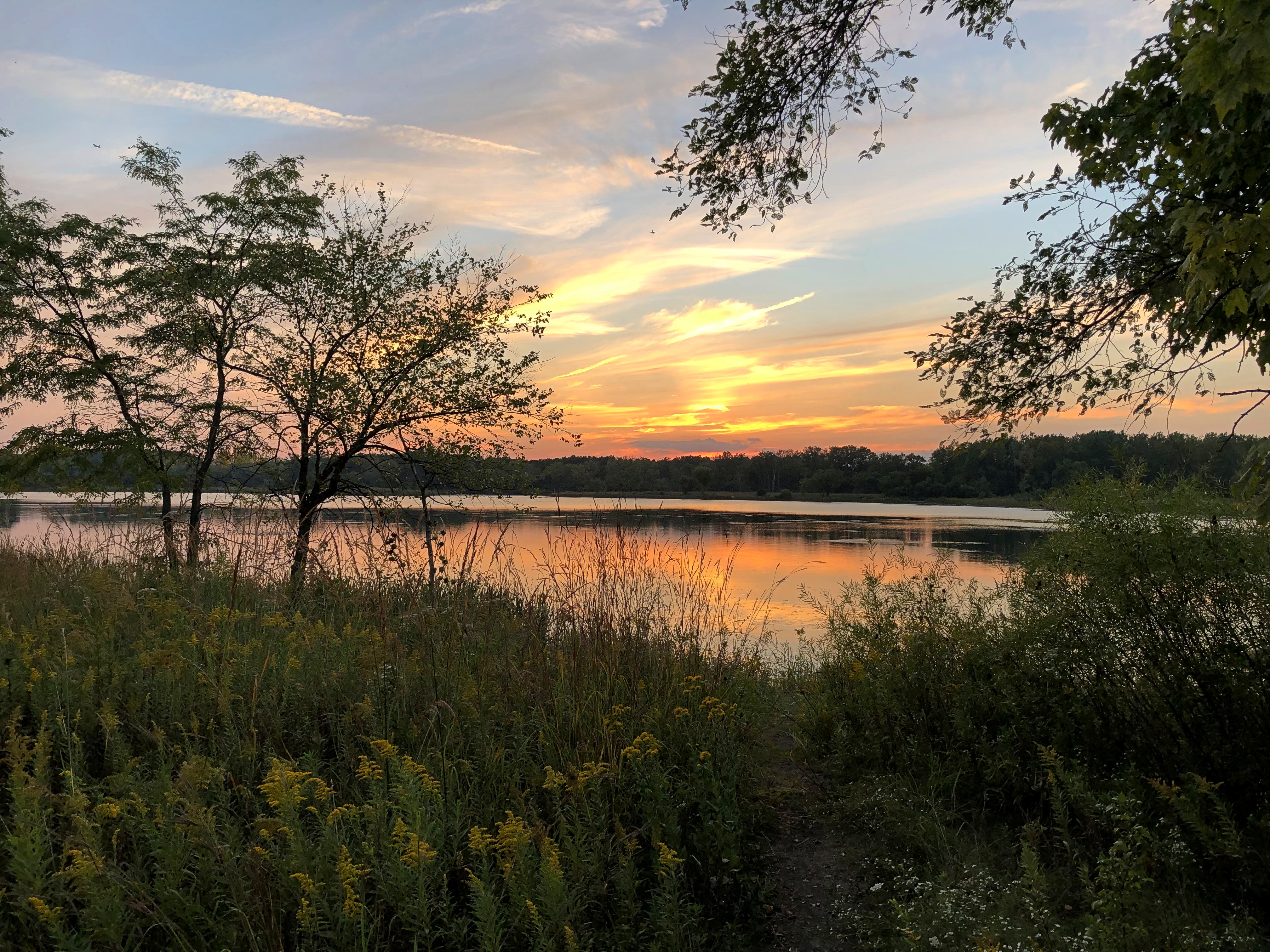
But it’s what I see most evenings out in the back yard.

Sometimes I turn on the fence lights, installed this summer for my June event.

Install might be too involved a verb; I draped them over the fence. The only hard part was making sure the extension cord didn’t become an underfoot hazard in the garage, a setup I facilitated with duct tape.

One more addition this year.

My dollar-store pink flamingo. It occurred to me recently that no suburban back yard is complete without one.

Arlington National Cemetery, 2011

Ten years ago this month we went to Washington, DC, which was the entire focus of the week-long trip. That had some advantages, especially since DC has a decent network of subway lines. We went everywhere by subway, including Arlington National Cemetery. Once there, shuttle buses run a loop around the grounds. Good thing, since the cemetery covers 639 acres.

President Kennedy drew a crowd.Arlington National Cemetery

Robert Kennedy isn’t far away, marked with a small stone and a cross.
Arlington National Cemetery - RFK

President Taft, the other U.S. chief executive buried in the cemetery, did not draw a crowd.Arlington National Cemetery - Taft

The memorial to the crew of the Space Shuttle Columbia. An elegant design.
Arlington National Cemetery - Columbia
The memorial to the crew of the Space Shuttle Challenger. Not an elegant design.Arlington National Cemetery - Challenger

Mainly because of the faces. The more you look at them, the worse they become.
Arlington National Cemetery - Challenger

Remember the Maine.Arlington National Cemetery - Maine

Arlington National Cemetery - Maine

Audie Murphy. I hadn’t remembered that he died that young; airplane crash.Arlington National Cemetery - Audie Murphy

Other noteworthy stones we happened across. Ones I did, anyway. Not sure anyone else noticed as I took pictures.Arlington National Cemetery

Arlington National Cemetery - Oscar York
Army brass. Among others, Gen. Alexander “I’m in control” Haig in the foreground, and Gen. Omar Bradley, with his five stars, not far away.

The Tomb of the Unknown Solider.
Arlington National Cemetery - Unknown Soldier
Here are the girls, goofing around at the nearby amphitheater.
Arlington National Cemetery

Hope the trip made some kind of impression.

Ann Goes to College

Ann is now a student at the Illinois State University in Normal, Illinois. From now on, August 14, 2021 will be the day she went to college. Such dates seem to be creeping further into August, but I only have a small sample. My own such day was August 25 and Lilly’s August 18.

ISU is a little closer than UIUC, only about two hours on the road to Springfield and St. Louis. As completely normal for August in Normal, it was hot. That didn’t keep anyone from moving in.

The oddest thing I saw this time wasn’t a TV or bottled water, but a fellow with a turntable and a vinyl record collection. State-of-the-dorm gear in — 1979, as I recall (I didn’t have one).

Her building, Watterson Towers, is enormous, and looks old enough for me to have lived there as a student. Yep, it opened in 1968.

The tallest building in Bloomington-Normal and, according to some sources, the tallest between Chicago and St. Louis.

A nugget I found about the building reported by WGLT, the school’s NPR station, last summer: “Illinois State University said Thursday it will rename floors in the Watterson Towers residence hall in the wake of nationwide upheaval and a renewed dialogue on race and history.

“… every five floors in both towers are called a ‘house.’ The university named those houses for the nation’s first 10 secretaries of state: Van Buren, Clay, Marshall, Madison, Adams, Pickering, Monroe, Randolph, Smith, and Jefferson. Eight out of the 10 were involved in slavery. Several would be elected president after serving as secretary of state…”

Guess which two didn’t own slaves. That would be Adams, as in John Quincy, and Van Buren.

“The entire Watterson Towers complex was named for a beloved professor on campus and that name will not change,” WGLT concluded.

As far as I can tell, the “houses” are now North, A through E, and South, A through E.

Ann found her room and we moved all her stuff in.

It’s a tiny room that she shares with a roommate. Again, the way a dorm should be.

Far North Leftovers

I got a couple of concerned text messages after the 8.2 magnitude earthquake off the Alaska Peninsula late on the evening of July 28. Did I feel it? Was I all right? Didn’t feel a thing, I answered. Alaska is big.

During the quake — which is thought to be largest affecting Alaska since the Good Friday disaster of 1964, but nothing like it in terms of damage — I was in Fairbanks, not too far from the words United States on the USGS map I clipped.

Curious, I got out my physical atlas and a ruler, and measured the distance between Perryville, the town on the Alaska Peninsula closest to the epicenter, and Fairbanks. As the crow flies. A tough old crow, used to the freezing temps.

Total, about 1,200 miles, very roughly. But the point is, I no more felt the earthquake than someone in Texas is going to feel a California earthquake, unless it’s really big.

Near the main building of the Museum of the North is a blockhouse that used to be part of the Kolmakovsky Redoubt.Kolmakovsky Redoubt

The museum explains: “In 1841, the Russian-American Company (RAC), seeking to obtain the rich beaver and land otter furs of the Interior of Alaska, set about the construction of Kolmakovsky Redoubt on the middle Kuskokwim River in Western Alaska. As the only redoubt (fort) deep in the Interior, it became the major trading center along the river for the next 25 years…

“Relations between the RAC and the local Yup’ik Eskimos and Athabascan Indians was amicable and instead of acting as a means of defense, the building served other purposes, including at one time a fish cache and during the gold rush, a jail. The blockhouse stood at the site for over 80 years before being dismantled and shipped to the University of Alaska in Fairbanks in 1929.”

More recently, the museum restored the blockhouse, including the replacement of rotten timber and putting tundra sod on the roof, “complete with blueberries, Labrador tea, and all manner of tundra flora.”

A building of a difference sort, but also Alaskan, near the auto museum: Joy Elementary School.
Joy Elementary School, Fairbanks

One look and I thought, 1960.

Sure enough: “Construction of our original circular school began July 21, 1960. It was completed and dedicated as Louis F. Joy Elementary on November 9, 1961. Louis F. Joy was Fairbanks City School Board President and a member for over 25 years. Lee S. Linck, the school’s engineer and architect, received an award for the school’s unique and beautiful design at the 1962 Seattle World Fair.”

A quick peek at the first place I ate in Fairbanks.Bahn Thai, Fairbanks

Bahn Thai. Had a good massaman curry.

Another lunch place in Fairbanks.
Soba restaurant Fairbanks

Soba. A Moldovan restaurant. That was the main reason I went. Glad I did, since the dumplings I had were wonderful, though massively filling. I asked the waitress, whose English I took to be Moldovan flavored, how she came to be in Fairbanks. She said she came with her husband and members of his family, which no doubt was true, but didn’t quite answer the question.

Speaking of immigrants to the Far North, this is the last place I had lunch in town, The Crepery.

The Crepery, Fairbanks

Had a delicious salmon crepe there. I sat way in the back, and instantly noticed a wall covered with photos of Sophia, Bulgaria. I asked the girl who brought me the order about that. The owner’s from Bulgaria, she said. People get around.

The Nenana River.
Nenana River

At this point, it forms one of the borders of Denali NP. I was on the non-park side, looking into the park.
As I was driving southward on the highway Alaska 3 after my stop in the town of Nenana, I passed by a military installation without noticing it. No signs point the way, and while the place isn’t precisely hidden, it is off the main road. It’s the Clear Space Force Station.

Not only that, the facility only recently became part of the Space Force.

“Clear Air Force Station, a remote military installation outside of Fairbanks, Alaska, was officially renamed from Clear Air Force Station to Clear Space Force Station during a ceremony on June 15, 2021,” the Air Force reports.

“Clear will continue to serve as home to Arctic Airmen and Guardians assigned to the 13th and 213th Space Warning Squadrons, providing 24/7 missile warning, missile defense, and space domain awareness…

“The history and mission of the base began in 1958 when the U. S. Air Force acquired the site to set up a Ballistic Missile Early Warning Systems and became fully operational in November of 1961 as the second detachment of the 71st Missile Warning Wing. The detachment became the 13th Missile Warning Squadron in January 1967. The unit was re-designated as the 13th Space Warning Squadron and reassigned under the 21st Space Wing at Peterson Air Force Base, Colorado.”

With any luck, the nation will endure, its current political dyspepsia forgotten, and in 100 years the only thing people will remember about the Trump administration is that it founded the Space Force. That might be more important than we can know.

On my last day in Fairbanks, I took a walk along some of the trails at Creamer’s Field Migratory Waterfowl Refuge, on the outskirts of town. Formerly a diary farm with a lot of surplus land, the place is now devoted to keeping birds happy and providing a place for people like me to walk.

There are buildings.
Creamer's Field Migratory Waterfowl Refuge

But mostly it’s undeveloped, except for the trails themselves.
Creamer's Field Migratory Waterfowl Refuge

Revealing scenes like this.
Creamer's Field Migratory Waterfowl Refuge

Looks remote, no? I parked my car only about 20 minutes’ walk away, so the place is close to the infrastructure of Fairbanks. Then again, Fairbanks is a manmade place surrounded by wilderness, so what I drove and then walked to was merely the leading edge of something vast.

One more thing.

Alaska makes 50.