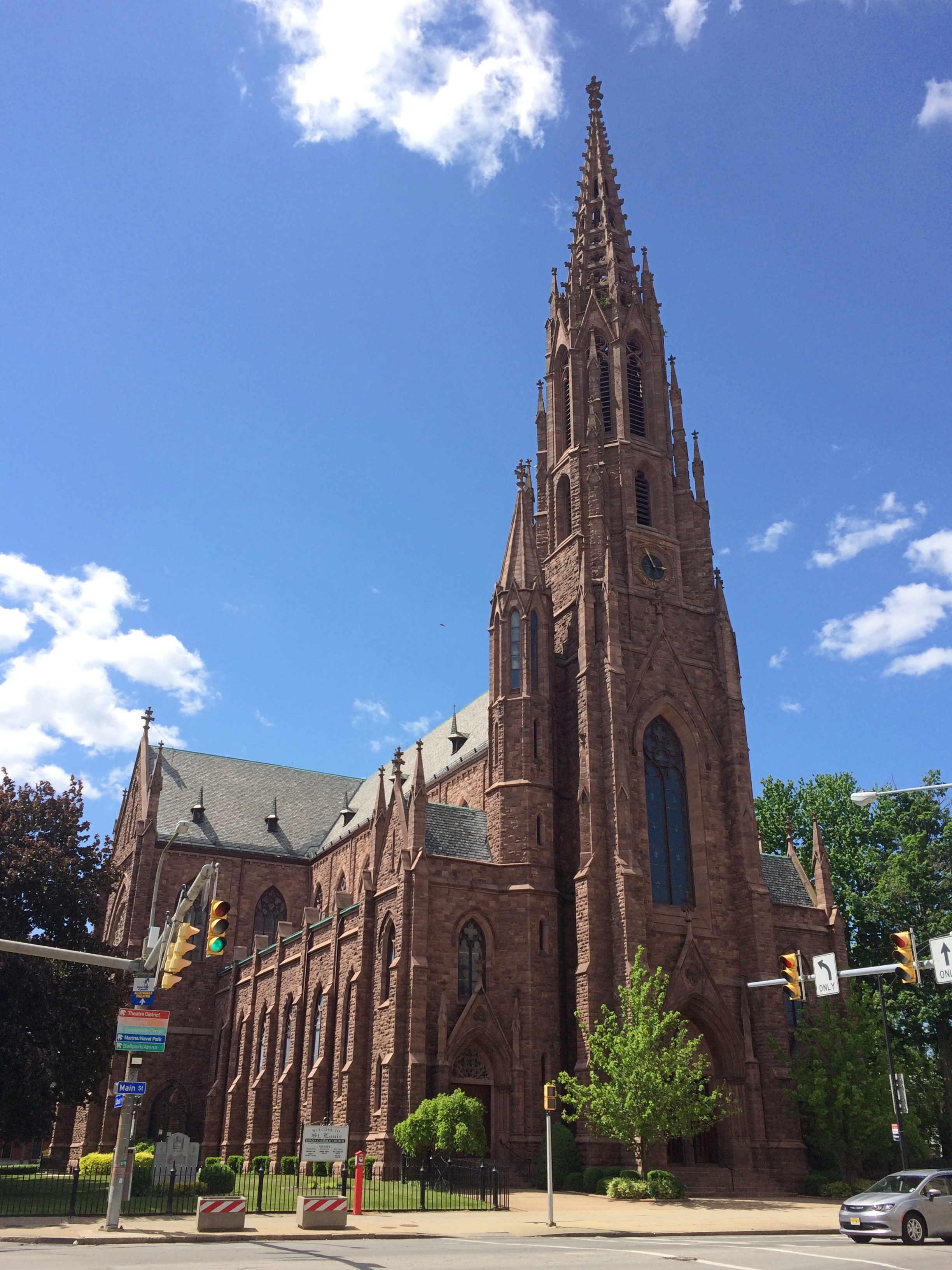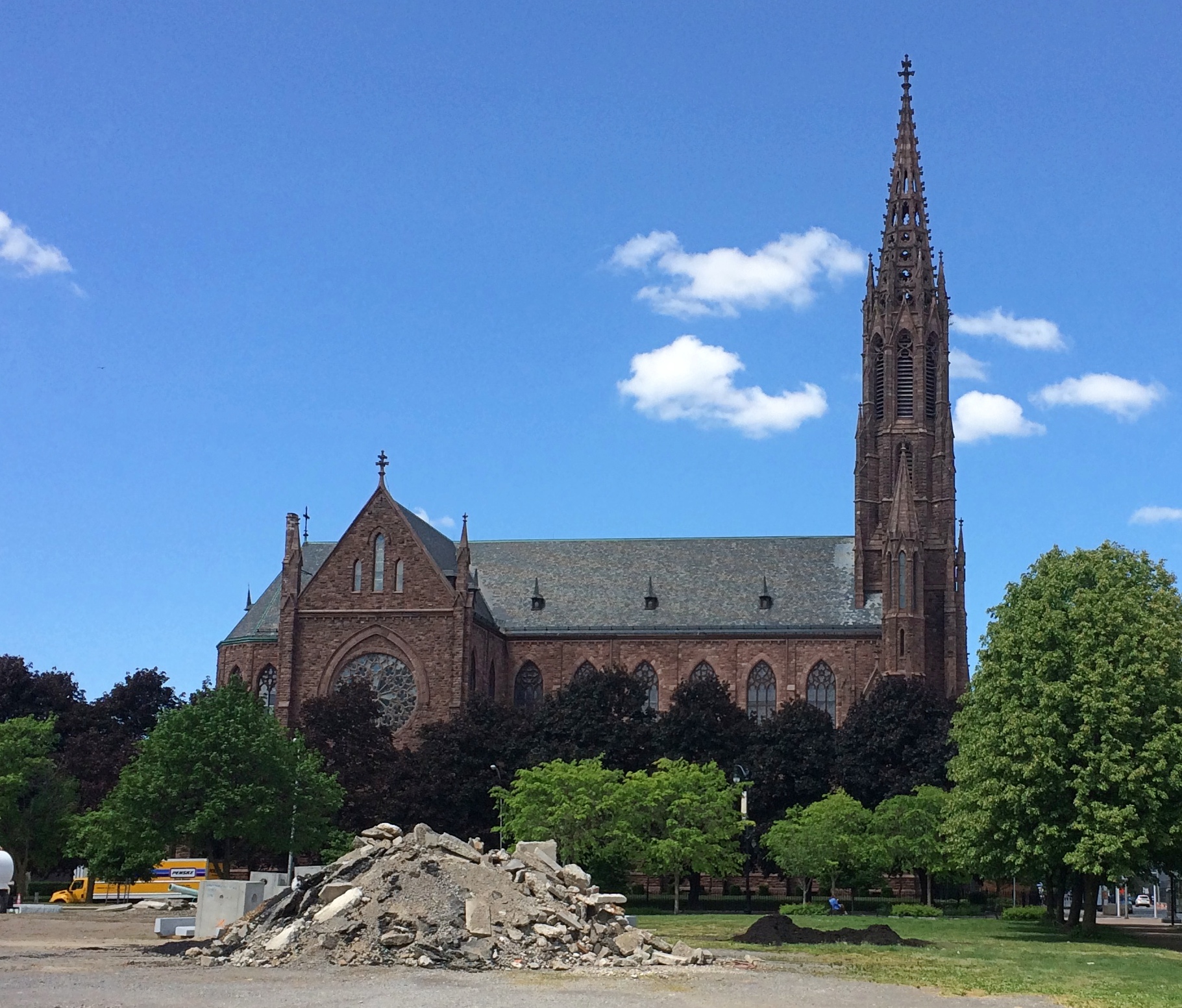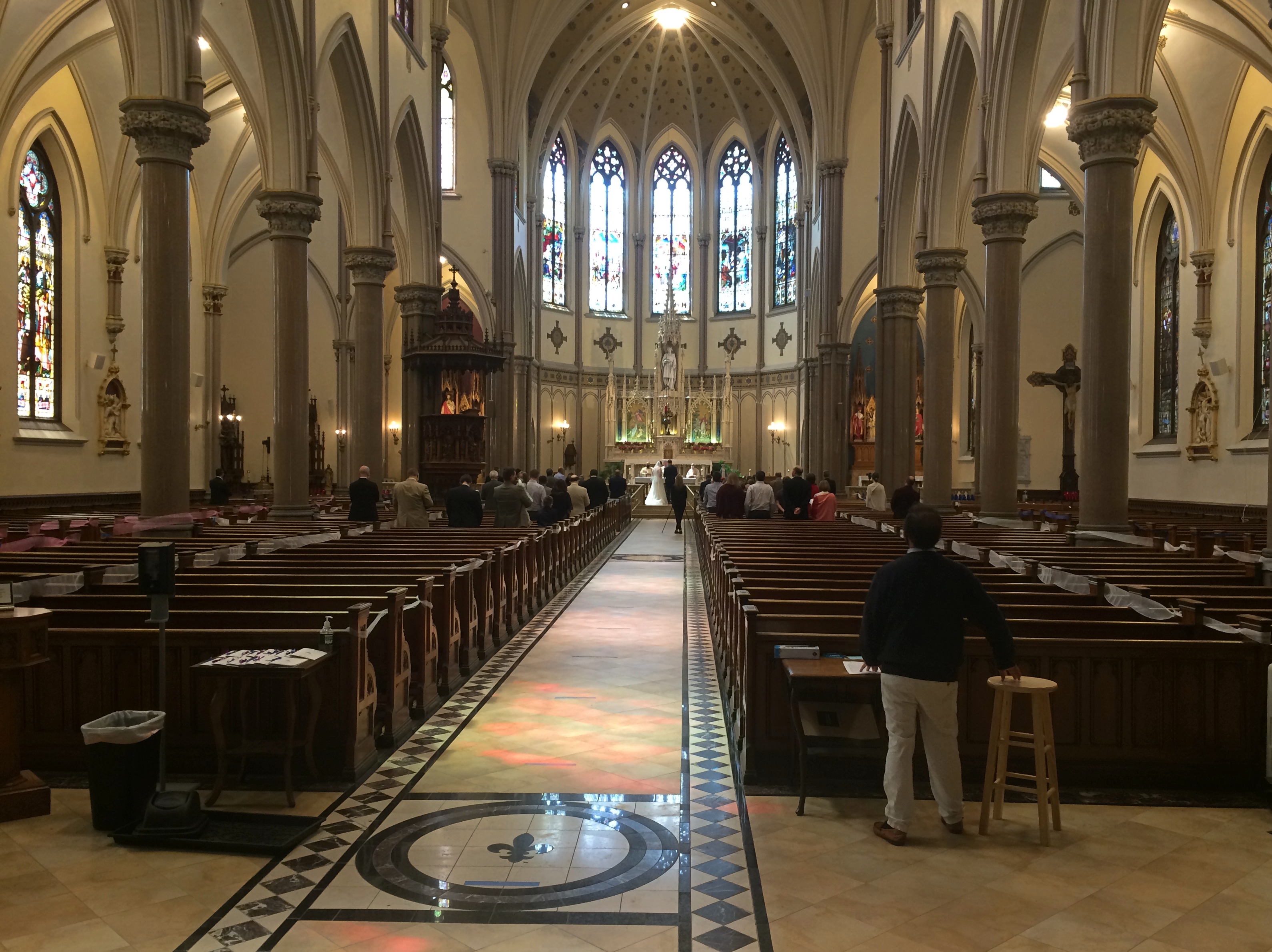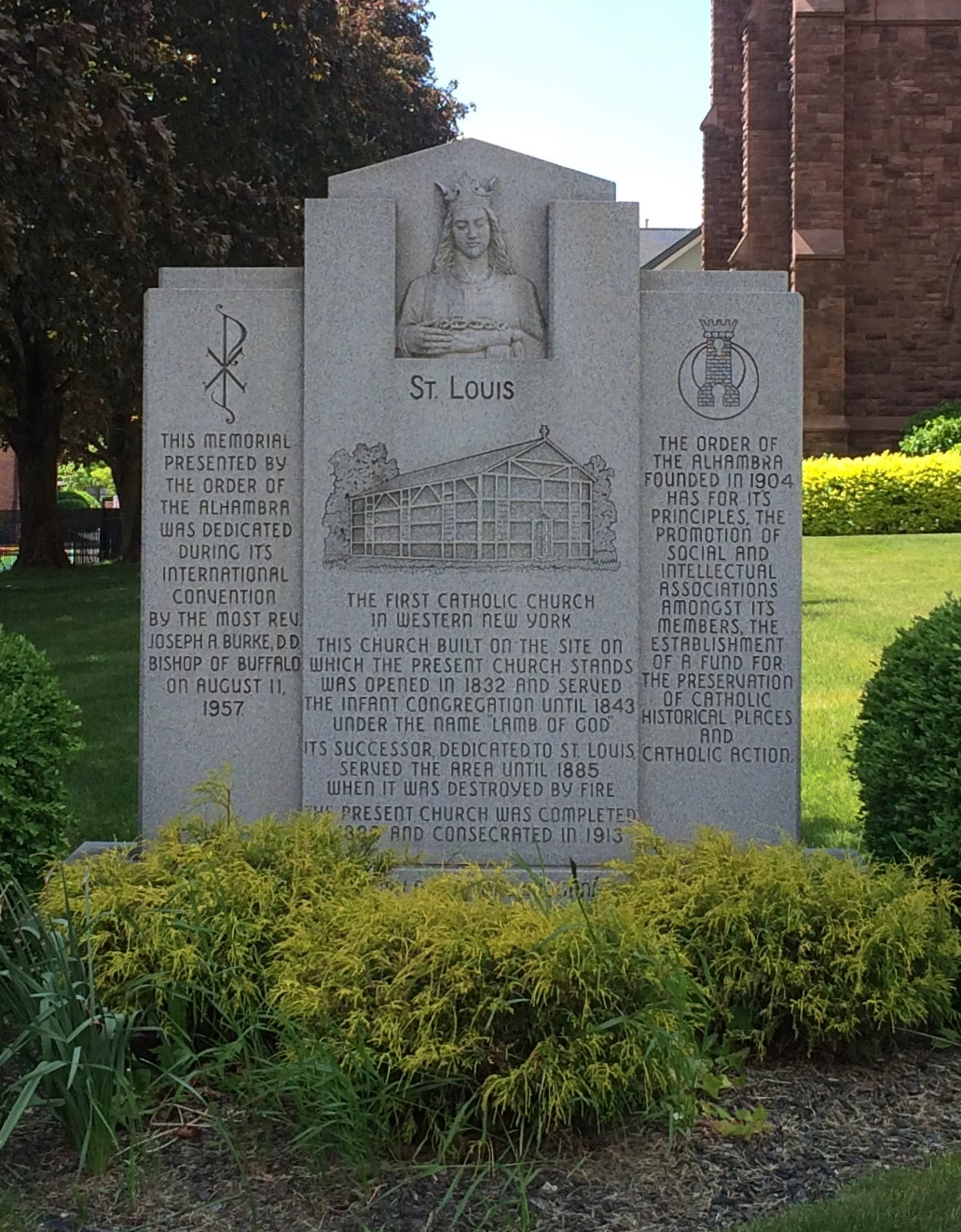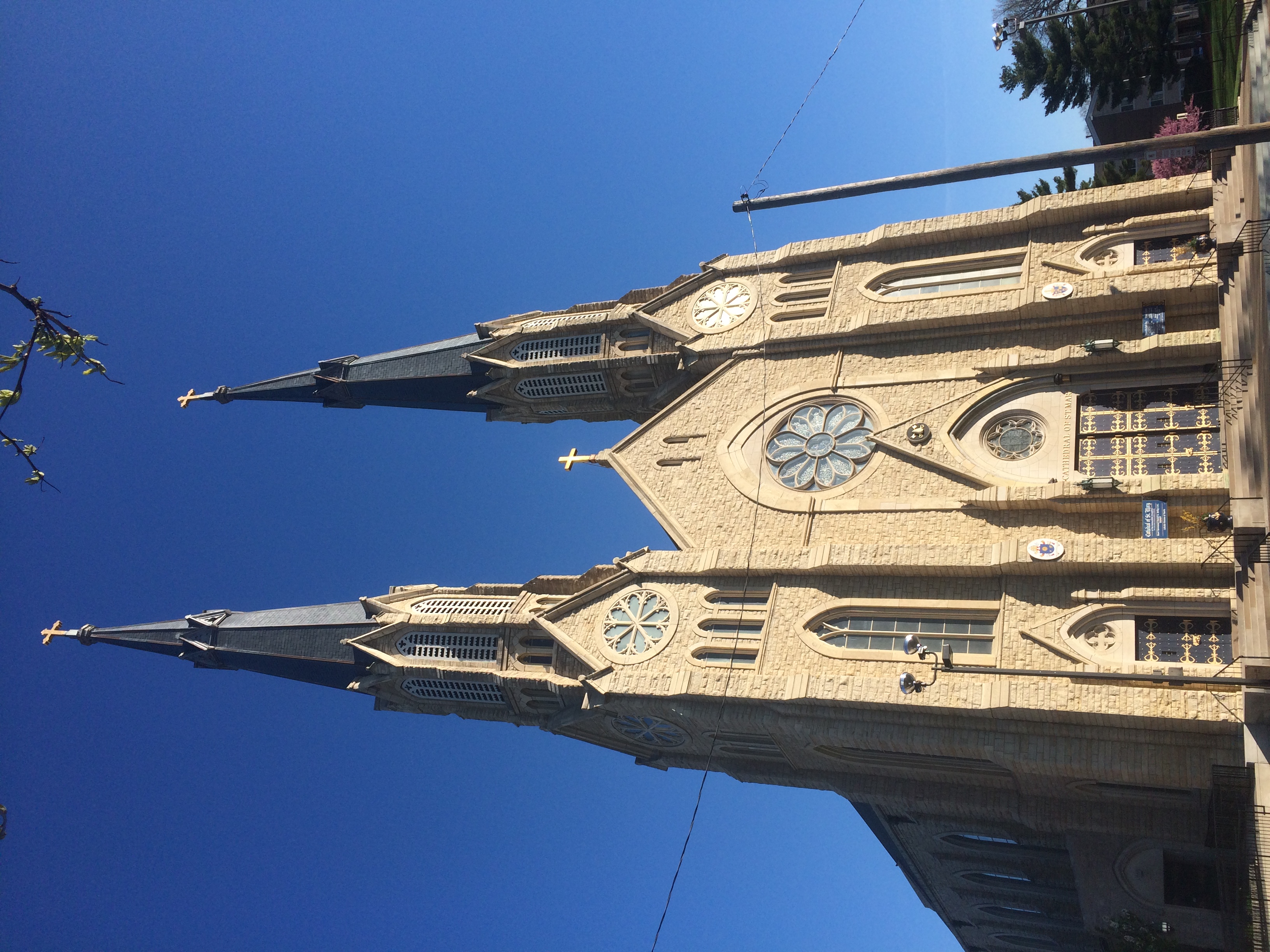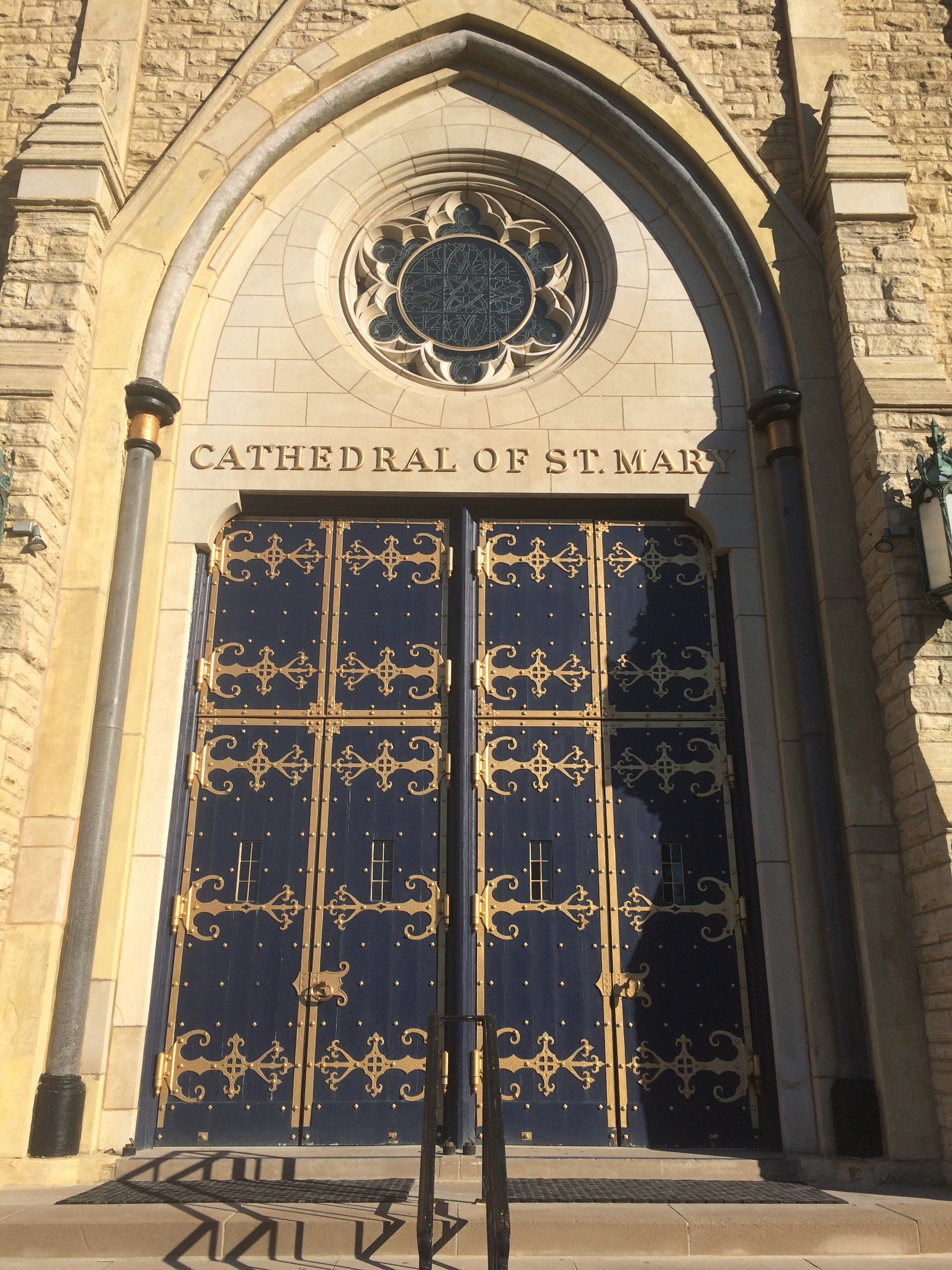
The iron works in Joliet might be ruins these days, but St. Joseph Catholic Church, one of the city’s major church buildings, still stands on Chicago St. downtown. It’s the second church on the site, built in 1905 to serve Slovenian immigrants, many of whom worked in the local iron and steel mills.
By the time we got there on Sunday, masses were over, and it might have been closed in the afternoon even under normal circumstances. Still, we got a good look at the exterior.
“The St. Joseph community includes Slovenian attire and music in its Masses, offers one Mass in Slovenian each month, refers to the Virgin Mary by her Slovenian name of Marija Pomagaj and holds a celebration for St. Nicholas Day, which is a tradition in Slovenia,” Shaw Media reported on the occasion of the parish’s 125th anniversary, including some interior shots.
Charles Wallace, an Irish-born Chicago architect (1871-1949), designed St. Joseph. He apparently did a fair number of churches in the Chicago area during the golden age of church building for large immigrant communities.
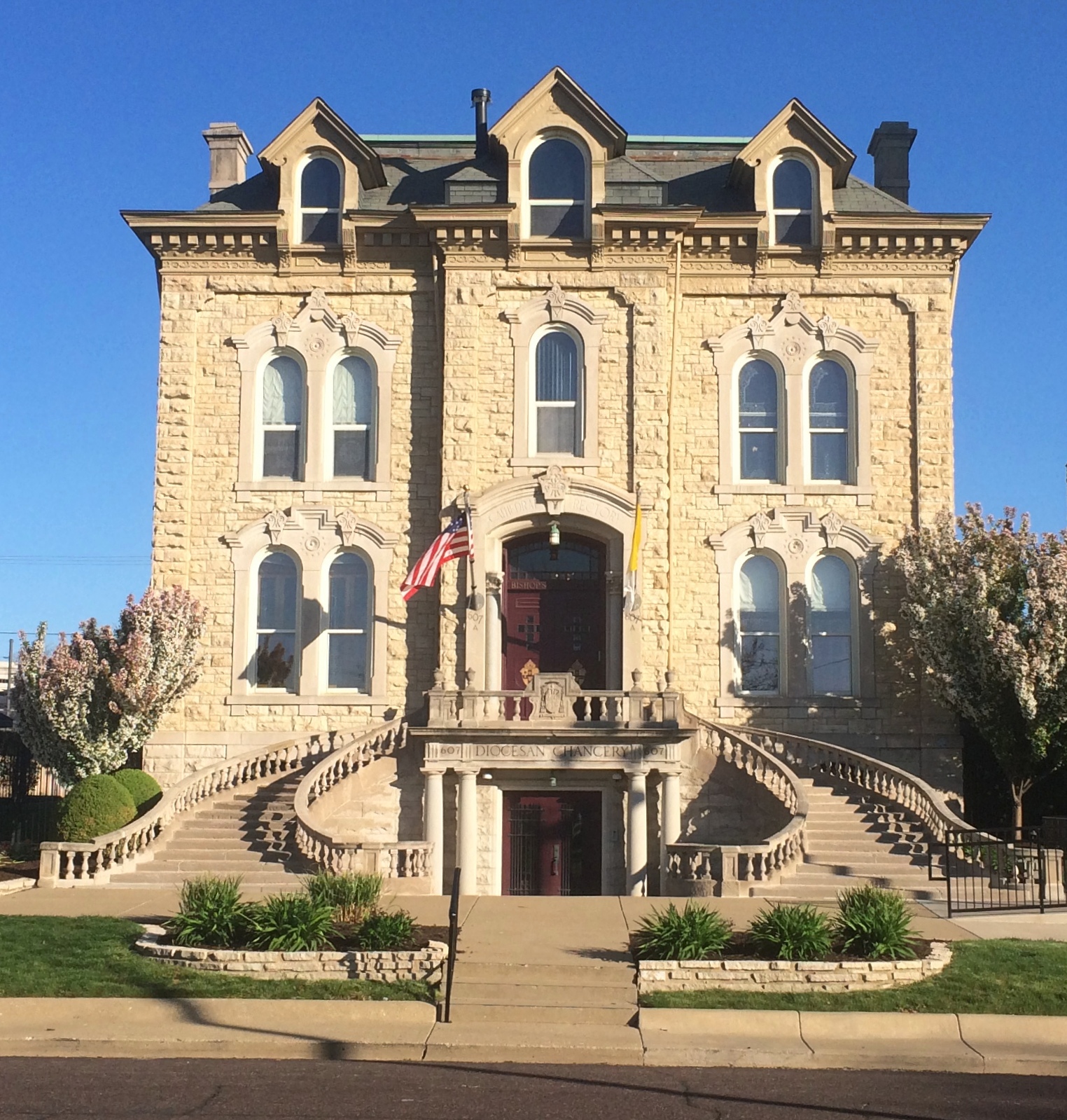
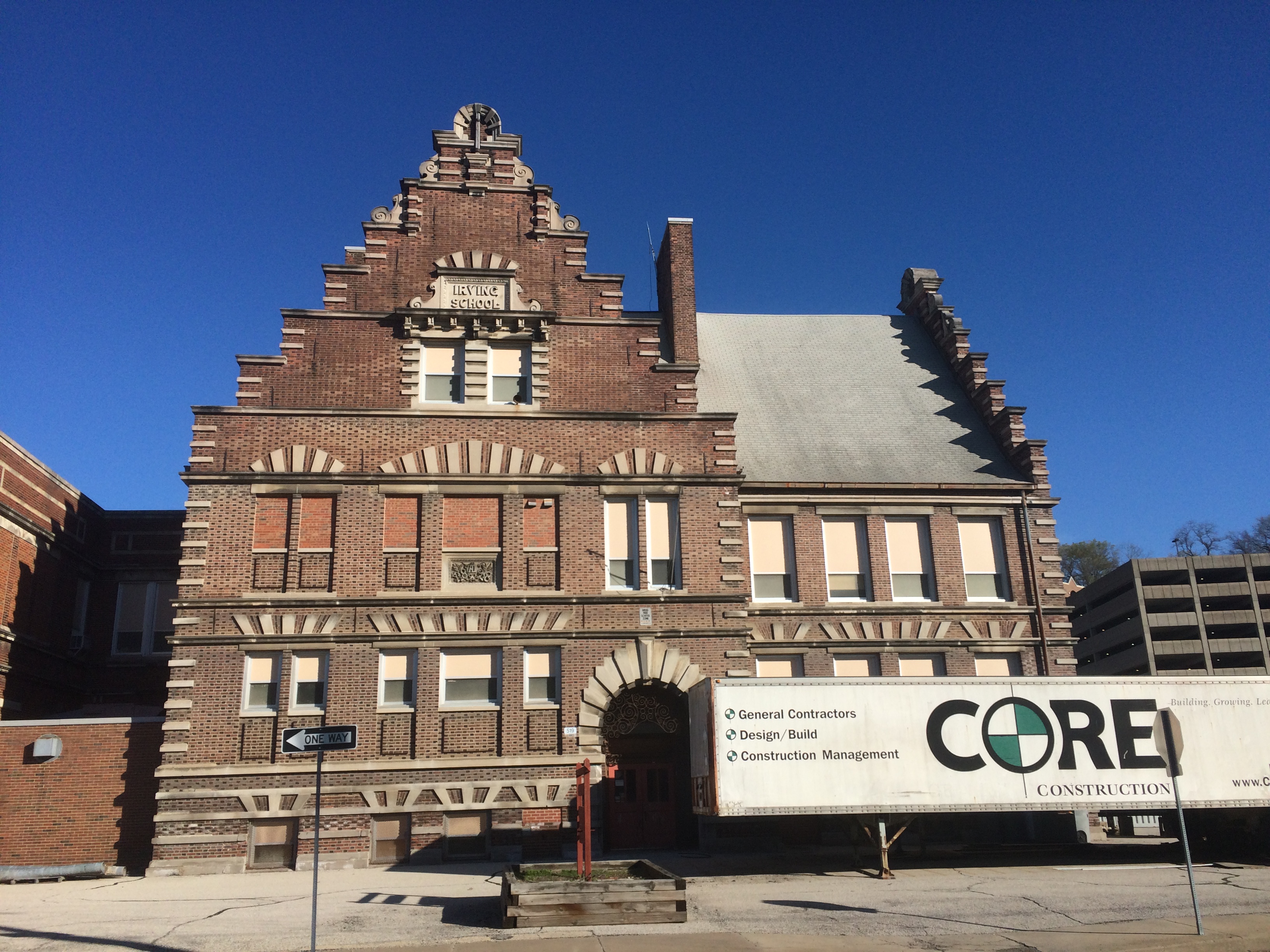
Across the street from the church is this building, headquarters of the Slovenian Union of America as well as the Slovenian Women’s Union of America Heritage Museum. The building dates from 1910.
Closed, of course. My kind of little museum, though, so we might visit some other time. Might visit Slovenia some other time, too, with any luck. I hear it’s a pleasant place to visit.
For early March, and especially considering the snows and bitter days of February, Sunday felt gloriously warm. Temps were in the mid-50s by the early afternoon, and we needed no further encouragement to go find a place to walk, though it took some driving to get there.

We went south. There are lots of places to see in southern metro Chicago, including the Joliet Iron Works Historic Site.

Industrial ruins, that is. Unfortunately not the towering metal husks you might see in Pittsburgh or Birmingham, Alabama, but worth a look all the same.
A path runs through the ruins about a half mile, roughly parallel to RR tracks to the east, and the Illinois & Michigan Canal to the west, though those aren’t always visible.
Toward the southern end of the site, it’s mostly rubble, and not always much at that.Further north, there are the stubs of the sizable structures that used to be there.
Including some dark holes.
This pit is the foundation of a once mighty, and mighty dangerous, blast furnace.
Once I was reminded of some of the images of Knossos that I’ve seen. Like this one.
“The factory opened in 1869 and was a massive facility for the time….” notes Atlas Obscura. “Employing four huge blast furnaces and a few thousand employees, the metal works produced around 2,000 tons of raw pig iron each day.”
Not sure where that figure came from. On site, one of the signs said that soon after the plant opened, the total was 50 tons of pig iron a day. By 1910, production was 400 tons a day.
“The plant kept putting out metals until 1936 when it closed for a short time before being reopened [for the war effort]. However, its new life was not to last that long either, as the works became unprofitable and were abandoned in the 1980s.”
Surprisingly little graffiti marks the ruins, though there are places where it’s clear it has been painted over. Such as here.
But new graffiti is probably added regularly.
The Forest Preserve District of Will County acquired the site in the 1990s, and stabilization efforts have been enough to allow it to be open to the public. Parts of the site, anyway.
You can’t say you haven’t been warned.
A cemetery with most of its memorials flush to the ground — a mid-century notion that hopefully has faded — looks like a snow-covered field in winter. That can be nice, but it doesn’t say cemetery, and the added beauty of stones in the snow, rather than under it, is missing.
There were stones in the snow at the Elk Grove Cemetery in January 2010. Mount Emblem Cemetery in Elmhurst, Illinois, has all the ingredients to be a striking cemetery except standing stones. So on Saturday, I saw mainly this kind of scene.
With a few reminders that loved ones are memorized somewhere under there.
There are a few structures that won’t be denied their place in the pale winter sun.
Mount Emblem has, however, one thing unique in any cemetery I’ve been to, or know about: a Dutch-style windmill.
It’s the Fischer Windmill, built in the mid-19th century, long before the cemetery was established.
“The windmill was built sometime between 1849 and 1865 by Henry Fischer, after he inherited part of the family farm from his father, Frederick L. Fischer, one of the original settlers in the county,” the Chicago Tribunereported in 1995. “It took two hired millwrights about three years to build it, including six months to fashion the main cogwheel.
“The main framework of the windmill is cypress, and it rests on a stone foundation. It features hand-hewn shafts and gearing of white oak and hickory… The mill ground wheat and corn for local farmers until the demand declined after the turn of the century.”
The cemetery association bought it in 1925 and, according to the Trib, installed chimes. I didn’t hear any chimes, but I did notice two loudspeakers mounted on the structure.
Back again on February 16. I do not, in fact, have Presidents’ Day-Washington’s Birthday off, but never mind. I will still be honoring the immortal deeds of William Henry Harrison, Millard Fillmore, Rutherford B. Hayes, et al.
I have an example of U.S. Army scrip, picked up by my parents in Germany in the mid-50s but obviously never spent. At some point, I annexed it to my collection of cheapo banknotes.
Scrip, maybe, but officially Military Payment Certificates, or to (of course) use their initialism, MPCs. Also roughly the size of Monopoly money. MPCs lasted from from 1946 until 1973. Postwar occupation to the near-end in Vietnam, in other words. Paying dollars to soldiers stationed in the likes of postwar Germany or Korea or Vietnam did wonky things to those local economies, the thinking went. Maybe so. I suspect locals found a way to trade in MPCs as well, though it must have been harder.
Thirteen series were released, with a total of 94 different notes. I’ve got a Series 521 5-cent note, including the standard admonition: For use only in United States military establishments — by United States authorized personnel in accordance with applicable rules and regulations.
I guess that meant my mother could use them at the PX.
“Series 521 MPCs were used in 19 different countries between May 25th, 1954 and May 27th, 1958,” says Antique Money. “Almost 317 million dollars worth of currency was issued across all seven denominations during that time period. For that reason, most 521 notes are very common.”
Figures. It wouldn’t be like me to end up with the Inverted Jenny of MPCs, if such a thing exists. About 27.2 million 5-cent notes of this series were manufactured. Value in perfect condition, according to Antique Money, which my note is not, $15.
This note is worth a little as a collectable. At least, I’ve seen one like it for sale online for about 5 euros. It’s a 1962 series 20 cruzeiros banknote from Brazil. I don’t remember where I got it, but I doubt I paid anything close to that much. The note is demonetized, long since replaced by the Brazilian real. A large selection of Brazilian currency can be seen here.
Apparently the name literally means “large cross” in Portuguese. Referring to my old friend, the Southern Cross.
Crux appears on the Brazilian flag, of course — it’s no monopoly of Australia or New Zealand (or Papua New Guinea or Samoa) — but it occurred to me I didn’t know much about the other stars on the flag. Turns out the number of stars is the same as the number of Brazilian states, same idea as with the Stars and Stripes. Stars are likewise added when states are created, and that’s happened as recently as 1992.
But unlike the U.S. flag, the Brazilian stars are arrayed in constellations you’d see in the southern skies. Also, Wiki makes this claim: “According to Brazil’s national act number 5,700 of 1 September 1971, the flag portrays the stars as they would be seen by an imaginary observer an infinite distance above Rio de Janeiro standing outside the firmament in which the stars are meant to be placed (i.e., as found on a celestial globe).”
Depicted on the note is Manoel Deodoro da Fonseca, the impressively whiskered leader, or maybe the figurehead, of the coup that deposed Emperor Dom Pedro II and ended the Empire of Brazil, becoming the first president of the Republic of the United States of Brazil.
Too bad about that, I always thought. It was a constitutional monarchy, after all, and could still be. The Americas could use at least one besides those technically British still. That might also have prevented some of the 20th-century political mischief in Brazil, who knows.
Be that as it may, this is the reverse, with a personification of Brazil proclaiming the republic, based on the painting “Proclamação da República” by painting by fluminense artist Cadmo Fausto de Souza (1901-83).
The note is another of the prodigious and expert output of Thomas De La Rue & Co. Ltd., London. The company’s still around, known as DeLaRue plc., and still designs banknotes, and a lot else besides.
I picked up this 1000 won note in South Korea in 1990. (₩ 1,000) I haven’t done well by holding on it, at least not financially. It seems inflation has been fairly consistent in that country for the last 30 years, and a handy inflation calculator for won — I’m still amazed what’s on line — tells me that you’d need ₩ 2,773 these days to have the same purchasing power.
Then again, ₩ 1000 = about 90 U.S. cents, so I haven’t lost a fortune by letting the value of my note erode over the years. It’s been worth it to me as a collector of small-potatoes banknotes, besides being a souvenir of my week on the Korean peninsula. Also, I like the aesthetics of the note.
Won is a cognate of the Chinese yuan and Japanese yen, essentially meaning “round.” The modern won is technically divided into 100 jeon, just as the Japanese yen is divided into 100 sen, but those are units about as useful as the U.S. mill.
My note is part of an older series, 1983-2002, but I can’t find any indication that it has been demonetized. The gentleman on the obverse is Yi Hwang (1501-1570), a prominent Korean Confucian scholar of his day.
That name is a McCune-Reischauer romanization, and Wiki at least says that he had no fewer than four different names: a Korean name, a pen name, a courtesy name and a posthumous name. In order, these are the names in hangul, just because I can: 이황, 퇴계, 경호, and 문순.
The reverse features, fittingly enough, the Dosan Seowon (Dosan Confucian Academy), established in 1574 in memory of Yi Hwang.
More snow today. Makes me wonder about the personification Old Man Winter. He’s pretty spry this February, that old man.
Tucked away in my stash of near-worthless banknotes are a few from Belarus, a former Soviet republic that retains more than a few vestiges of the red old days, I’ve read, such as autocracy and a heaping-helping of central planning.
Its base currency is the ruble, too. In theory a Belarusian ruble is worth about 38 US cents these days, but not these notes: there was a redenomination later.
This is the obverse of the 25-ruble note, from a series that began in 1992 and lasted until 2000. The notes’ size is pretty close to that of Monopoly money. Were those dimensions an inside joke on someone’s part? Moose money. Belarus also used to have squirrel money. Not 50 rubles, as I thought as first, but 50 kopecks. I suppose moose ought to be a lot larger than squirrel. Not that Belarus’ currency was ever really that large. According to Wiki, the ’92 series was “introduced in denominations of 50 copecks, 1, 3, 5, 10, 25, 50, 100, 200, 500, 1,000 and 5,000 rubles.”
3?Yes. Sorry I didn’t get one of those when I bought my wad of 50 or so international banknotes for pennies apiece.
Anyway, inflation soon kicked in: “These [denominations] were followed by 20,000 rubles in 1994, 50,000 rubles in 1995, 100,000 rubles in 1996, 500,000 rubles in 1998 and 1,000,000 and 5,000,000 rubles in 1999.”
The reverse of the old ruble notes are all roughly the same. At least, mine are — different only in color. The horse and rider is referred to as Pahonia, I understand, and is of considerable age, but I don’t want to go too deep into its history at the moment. As a symbol of Belarus, it seems to have been revived after the end of the Soviet Union, but not for long. Long enough to be on my moose and squirrel money, however.
Sunny day, but not much meltage. Bitter cold night ahead, and another half-foot of snow forecast for the weekend. Before that, we’ll get Thai takeout at Ann’s request on Friday, and a birthday pie, to make staying at home more pleasant.
Earlier this month, when we were in Naperville, we came across a small park: Central Park. Among other things, there’s a weatherworn obelisk to memorialize local soldiers from the Black Hawk War, the Mexican War, the Civil War and the Spanish-American War. It looked like new wars had been chiseled in as time passed.
Not far from that was a Civil War cannon, looking pretty new, because it was refurbished in this century. It’s a Confederate cannon. A prize of war, in other words, formerly shot off by the people of Naperville for “Independence Day, parades and other civic activities” in a less safety-conscious (-obsessed?) time. That’s what we could use a little more of in our time, though I suppose in some places edgy folks might mistake it for hostile gunfire, and maybe they’d be right to.
Willard Scott Jr. was this fellow, no relation to the weatherman, it seems. Among other things, this Willard Scott marched through Georgia, doing his bit to invent modern total war.
Google “Venus floating platform” and one of the first hits is about the Venus Atmospheric Maneuverable Platform (VAMP) at the Northrop Grumman web site. My estimation of that company just went up a notch. It’s at least thinking about flying a plane over Venus.
“The Venus Atmospheric Maneuverable Platform (VAMP) air vehicle is an aeroshell-less hypersonic entry vehicle that transitions to a semi-buoyant, maneuverable, solar-powered air vehicle for flight in Venus’ atmosphere,” NG says. “VAMP AV will be transported to Venus by a carrier/orbiter spacecraft… It is then released and enters the atmosphere, floating down toward the planet almost like a falling leaf.
“During the flight phase, the AV flies in the Venus upper- and mid-cloud layers and collects science data for transmission to Earth. VAMP AV will be capable of orbiting the planet for a long duration — up to a year.”
Of course, the company is no stranger to space, having built the Lunar Module and Pioneer 10, just to name two marquee projects. These days its marquee project is the James Webb Space Telescope, which can’t get into space fast enough, as far as I’m concerned.
Recently I’ve been getting press releases that say these sorts of things:
X will teach you how to: Reframe your life experiences as growth opportunities Rewire your mind-set and embrace spirituality as a lifestyle Connect to your higher self and integrate healthy lifestyle practices Tap into universal energy and transmute pain into power Manifest your new reality and claim your authenticity Change the world!
*** For your upcoming stories on female disruptors, please consider Y, Founder of Z, helping visionaries reconnect to SOUL, and Live FREE to become their most successful, influential and positively impactful versions. Y teaches women to embody the energy of money and become a vibrational match so it flows consistently and predictably.
Hm. My name seems to be drifting onto all sorts of lists, at some distance from commercial real estate. Though I do like that phrase, “energy of money,” and the idea of it flowing “consistently and predictably” certainly has appeal.
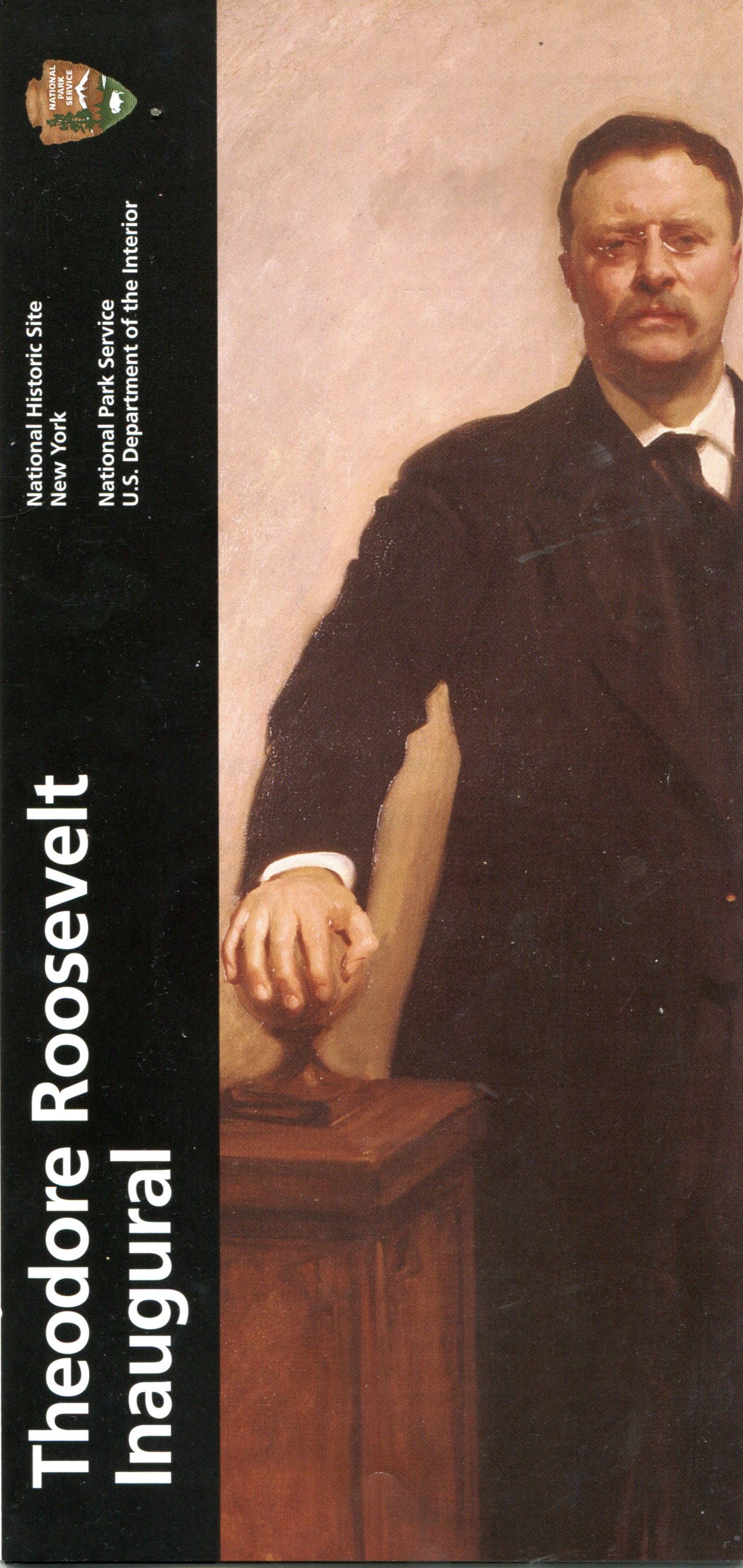
Time to dip into the well of presidential significa — don’t call it trivia — for obvious reasons. Much has been made of Joe Biden’s age, for example, and he is indeed the oldest person ever to be sworn into the office, besting his immediate predecessor in that regard as well.
Also, Biden was born before four of his predecessors, as was Ronald Reagan. I recall that once upon a time, Reagan was considered an old man for the job, taking the oath as he did at 69. Time flies, the gerontocracy becomes more robust. Kennedy was born after four of his successors, to look at the other extreme.
Then again, presidents are living longer than ever, along with the general population (well, until very recently). Jimmy Carter has made it to 96, topping that long-time champion of presidential longevity, John Adams, a good while ago now. Biden was just a young pup Senator when Carter was in office.
As of today, Carter has been out of office precisely 40 years, the longest post-presidential span. Herbert Hoover is still number two at 31 years. Bill Clinton and Barack Obama might make it to 40 years: to Jan. 20, 2041 for the former and Jan. 20, 2057 for the latter, but they would be very old men by those dates, 94 for Clinton and 95 for Obama.
Biden’s the first president from Delaware. That state had to wait a long time, considering that it was first state to ratify the Constitution. So far 19 states have been home to various presidents at the time of their election. Twenty-one states have been birthplaces of presidents. Florida Man has never been elected president.
Thus far, 14 presidents were born in the 18th century (ending Dec. 31, 1800, so Millard Fillmore counts), with James Buchanan as the last one; 20 were born in the 19th century, with Dwight Eisenhower the last of those; and 12 so far were born in the 20th century. According to the Constitution, that string has to continue at least until the 2036 election. Still, assuming the office continues as it has, and I certainly hope it does, the first president born in the 21st century may be out there somewhere even now.
And what was it about 1946? Bill Clinton, George W. Bush and Donald Trump were all born that year. There have been a number of other years in which two presidents were born, but that’s the only triple year so far.
I didn’t think it very likely, and sure enough it didn’t happen, but it would have been interesting had Donald Trump resigned in the aftermath of the Capitol Hill insurrection. Just so Mike Pence could beat William Henry Harrison’s record for short time in the office. Also, so that Trump’s term wouldn’t be exactly four years. Eight years, four years, eight years, etc. That’s just not very interesting.
There have never been four presidents in a row who were in office for eight years each. Three in a row, yes. Most recently Clinton-Bush-Obama. Before that, Jefferson-Madison-Monroe. Trump’s loss means four in a row might not happen for quite a while, if ever.
I could go on and on about this. But I’ll end by adding that we’re back up to five living former presidents again, the fifth time that has happened. Because of improved longevity, four of those periods have been recent.
A fair amount of work today, but I did take some time to watch — in the modern way, on a small screen on my laptop — part of the impeachment vote. Historic moment and all that.
If you asked me, there’s been entirely too much history made this month.