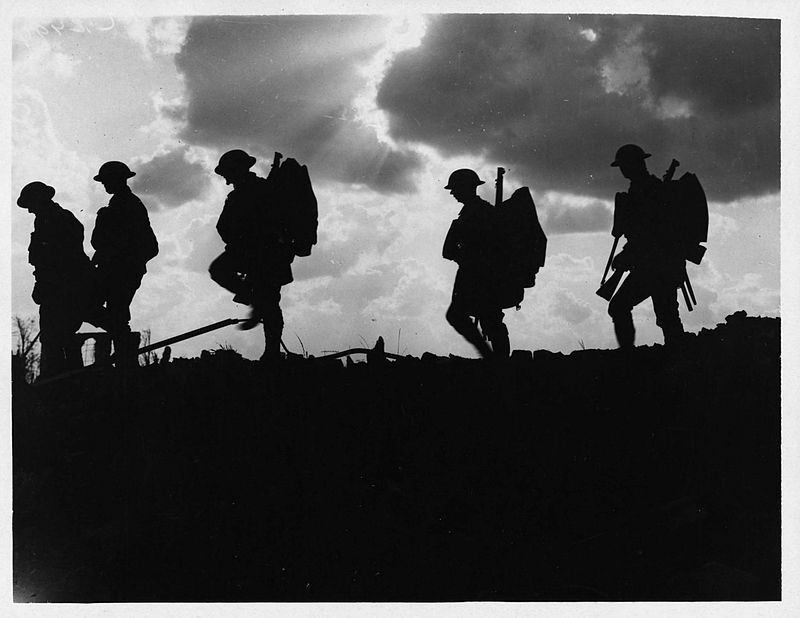
 Image taken by Ernest Brooks during the Battle of Broodseinde, showing a group of soldiers of the 8th East Yorkshire Regiment moving up to the front, silhouetted against the skyline.
Category Archives: History
Thursday Dross
After a cold second half of October, temps have trended warmer in early November. So much so that I had lunch on our deck today, and expect to tomorrow as well. It can’t last. But it’s nice to sit out there and forget about the national hubbub — which I can’t do during my working hours, as paying attention to it as part of my job.
Here’s an article about the House of Tomorrow at Indiana Dunes NP, which we saw last month. A good short read, except for one thing: no date on it, which is a pet peeve of mine. It’s obviously not that old, since it refers to the recent designation of the national park, but you shouldn’t have to rely on internal evidence to date an article.
When I posted about Pounds Hollow Recreation Area a while ago, I forgot to include the short falling leaves video. Here it is.
We’re past peak here in northern Illinois, but some of the trees are still ablaze, and some still wilted yellow-green. Sitting out on the deck was pleasant enough today, except when a leaf-blower kicked to life noisily not far away. Will future generations ponder that leaf blowers were ever a thing? Hope so. As far as leaves go, let ’em stay where they fall on your lawn. They’re nutrition for next year’s grass.
In Shawneetown, Illinois, the new town that is, you can see a memorial erected about 10 years ago. The wave of such memorials, I believe, will continue into the 21st century.
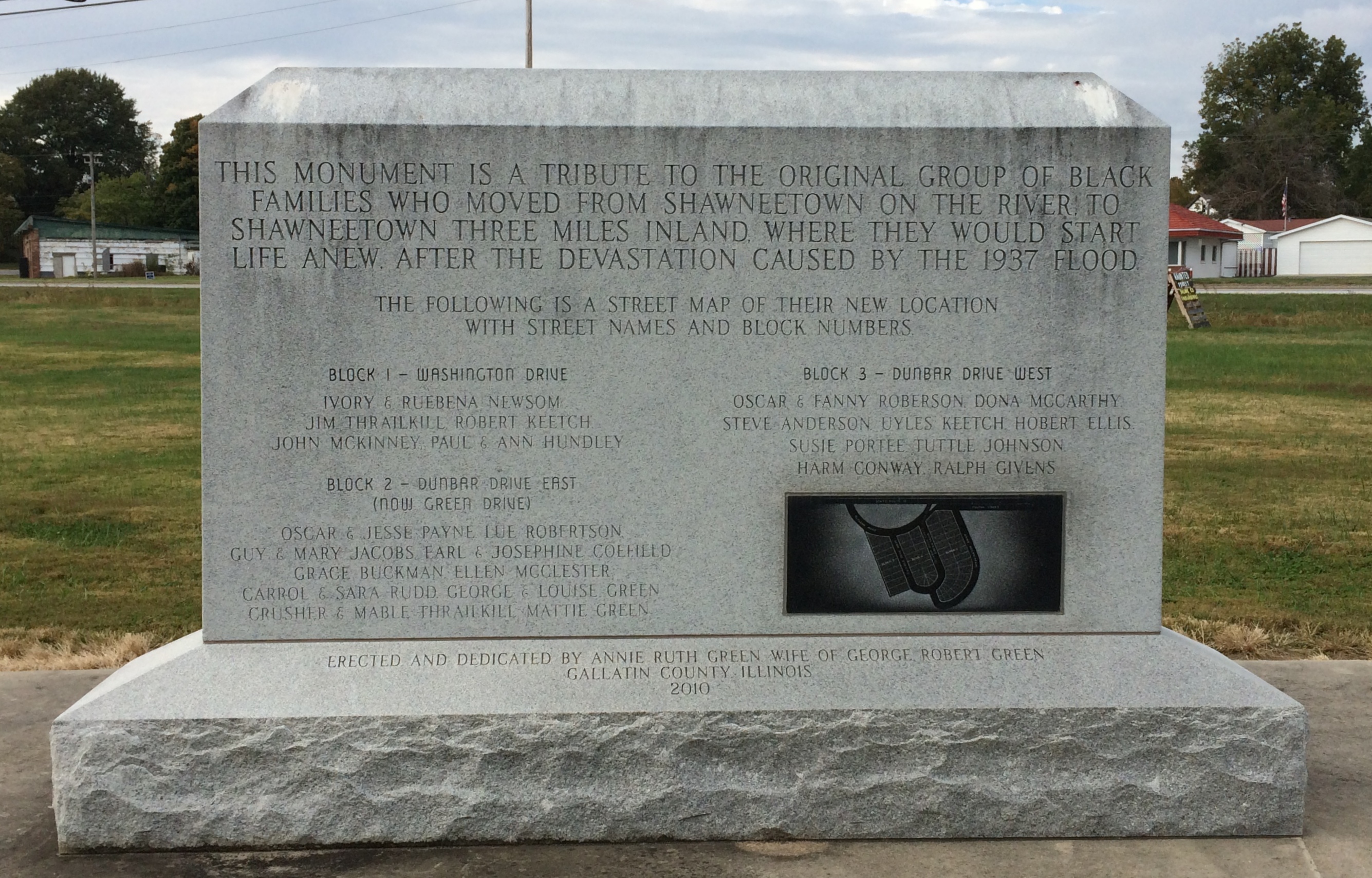 It’s a tribute to the original group of black families who moved from Shawneetown on the river to Shawneetown three miles inland, where they would start life anew, after the devastation caused by the 1937 flood.
It includes a map of the nearby neighborhood and all the names of the black residents who lived there. The other side has a more general black history of Shawneetown, noting that a segregation-era school stood on the site of the memorial, presumably for the black neighborhood’s children, but it doesn’t say that. The school closed in the 1950s.
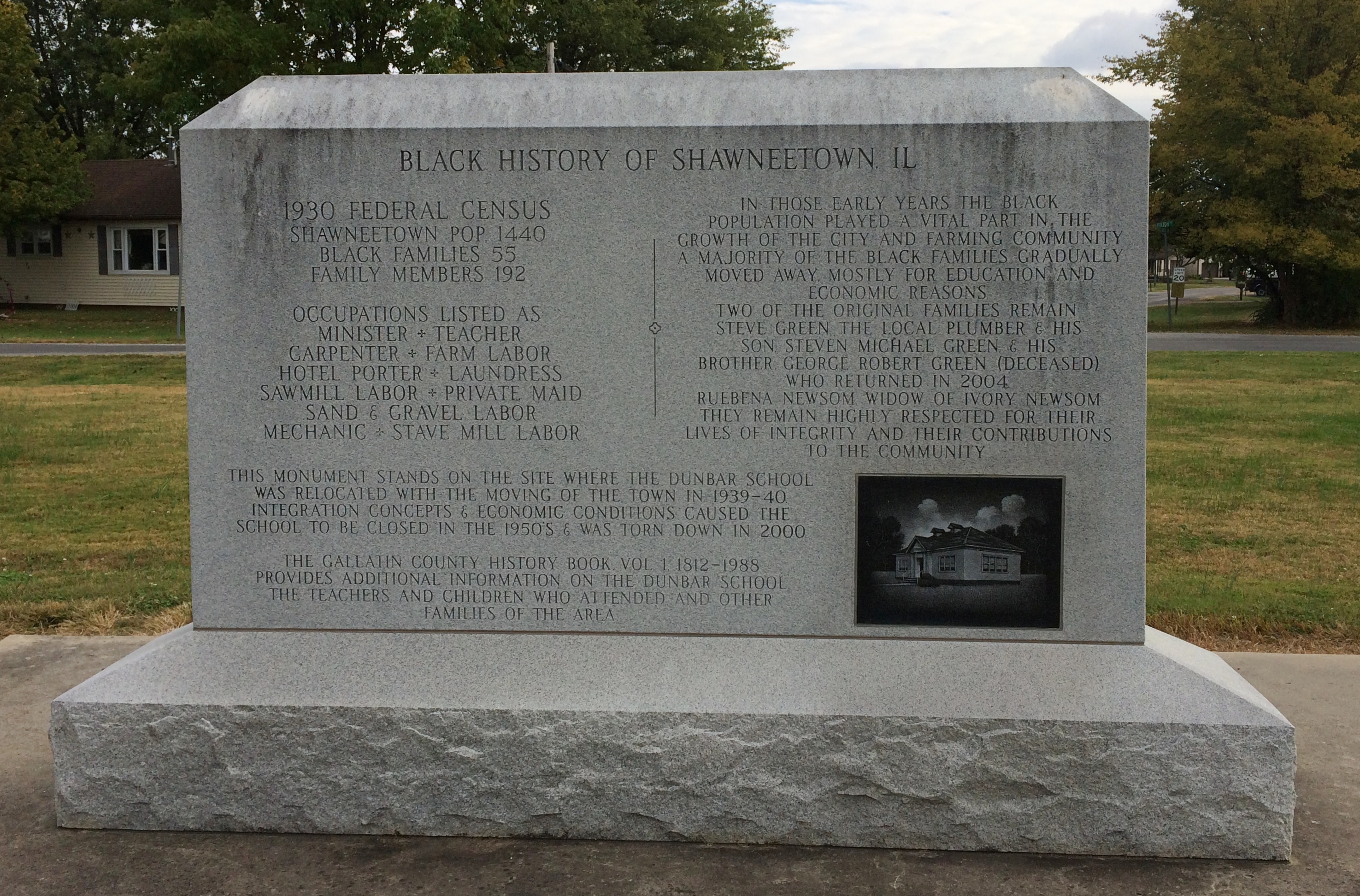 All a little wordy, but not as prolix as the Norwegian Settlers State Memorial.
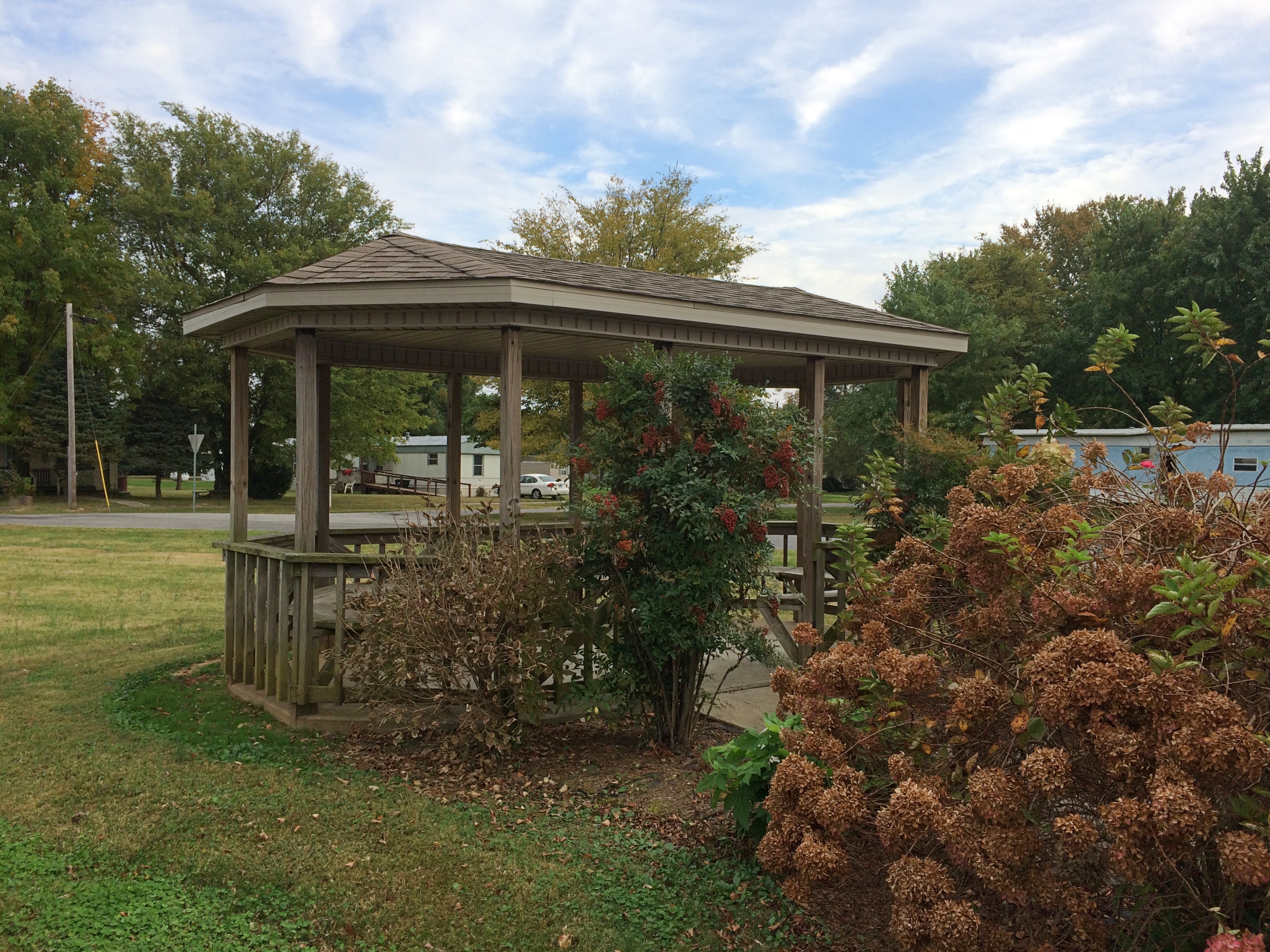
Near the memorial is a rectangular gazebo. Without corners. Or is it really a gazebo?
 When Ann and I saw the abandoned Texaco station in Old Shawneetown, I asked her if she’d ever heard the Texaco jingle. I hadn’t thought about it in years, but the point of jungles is to bury themselves deep, so it’s coded in my synapses somewhere.
Most Americans my age would know what I meant, but considering that Men Who Wear Texaco Stars are long gone, I didn’t expect her to know. She didn’t.
Later, I showed it to her on YouTube, where it’s a standalone video (and also the grist for truly stupid local TV news).
That made me a little curious myself. When did that jingle first air? As it turns out, 1962, as a snappier tune compared with, for example, what the singing Men With Texaco Stars did for Milton Berle 10 years earlier. The jingle was also incorporated into later Texaco songs, such as this one sung by Ethel Merman.
As jingles go, “You Can Trust Your Car” is memorable indeed. The story of the copywriter (and composer) who came up with it, one Roy Eaton, is even more remarkable. Aside from being a talented concert pianist, he was the first black creative at a major ad agency, joining Young & Rubicam in 1955 and later working for many years at Benton & Bowles, before founding his own company. He’s still alive at 90.
So memorable that it was the basis for an anachronism in a 1977 episode of M*A*S*H (see the trivia section at the bottom of the page).
The Ricki Lee Jones song “Last Chance Texaco” (1979) includes an example of a reference — to the jingle — that was perfectly understandable when the work was new, and perfectly mystifying to later generations.
Your last chance
To trust the man with the star
You’ve found the last chance Texaco
One more Texaco fact: John W. “Bet A Million” Gates was an early investor in the ancestor company of Texaco.
Dickson Mounds Museum
Got up early to vote this morning, since I believe that visiting the polls for a few minutes isn’t any riskier than going to a grocery store. Also, I am just mossbacked enough to want to vote on election day, just as my parents and grandparents et al. did, though I don’t begrudge anyone else the vote at some other convenient time or place.
It only took a few minutes. Few other people were there at the time. I’ve seen more in mid-day, especially during the 2008 election. Only one thing on the ballot made me smile this year: Willie Wilson, candidate for U.S. Senate from the Willie Wilson Party. That’s the best name for a party since the Rent is Too Damn High.

A few miles outside of Lewistown, Illinois, is the Dickson Mounds Museum. As the sign says, it’s a branch of the Illinois State Museum.
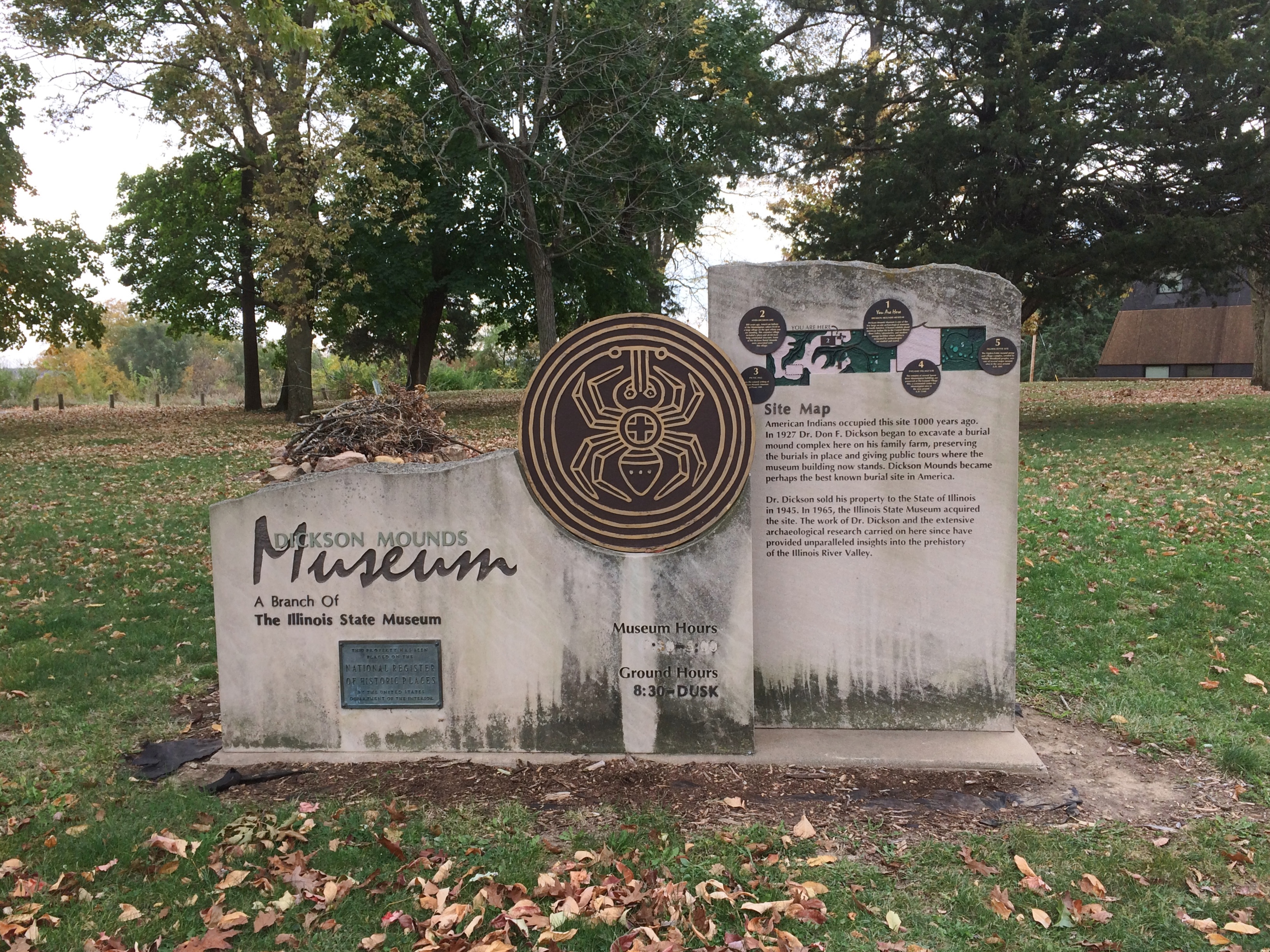
We arrived just after it opened at 10 on October 17. I hadn’t visited any museums of any kind since the Getty Villa back in February, for obvious reasons. But I figured the risk of infection at a place like Dickson Mounds was very low. For one thing — the main thing, actually — almost no one else was there, even on a Saturday.
And I mean no one. Entrance is free, so we didn’t have to interact with the woman behind the entrance counter. There might have been a few other employees of the museum around, but we didn’t see them. As we were leaving less than a hour later, we saw a couple with a small child entering. That was it.
The main museum building.
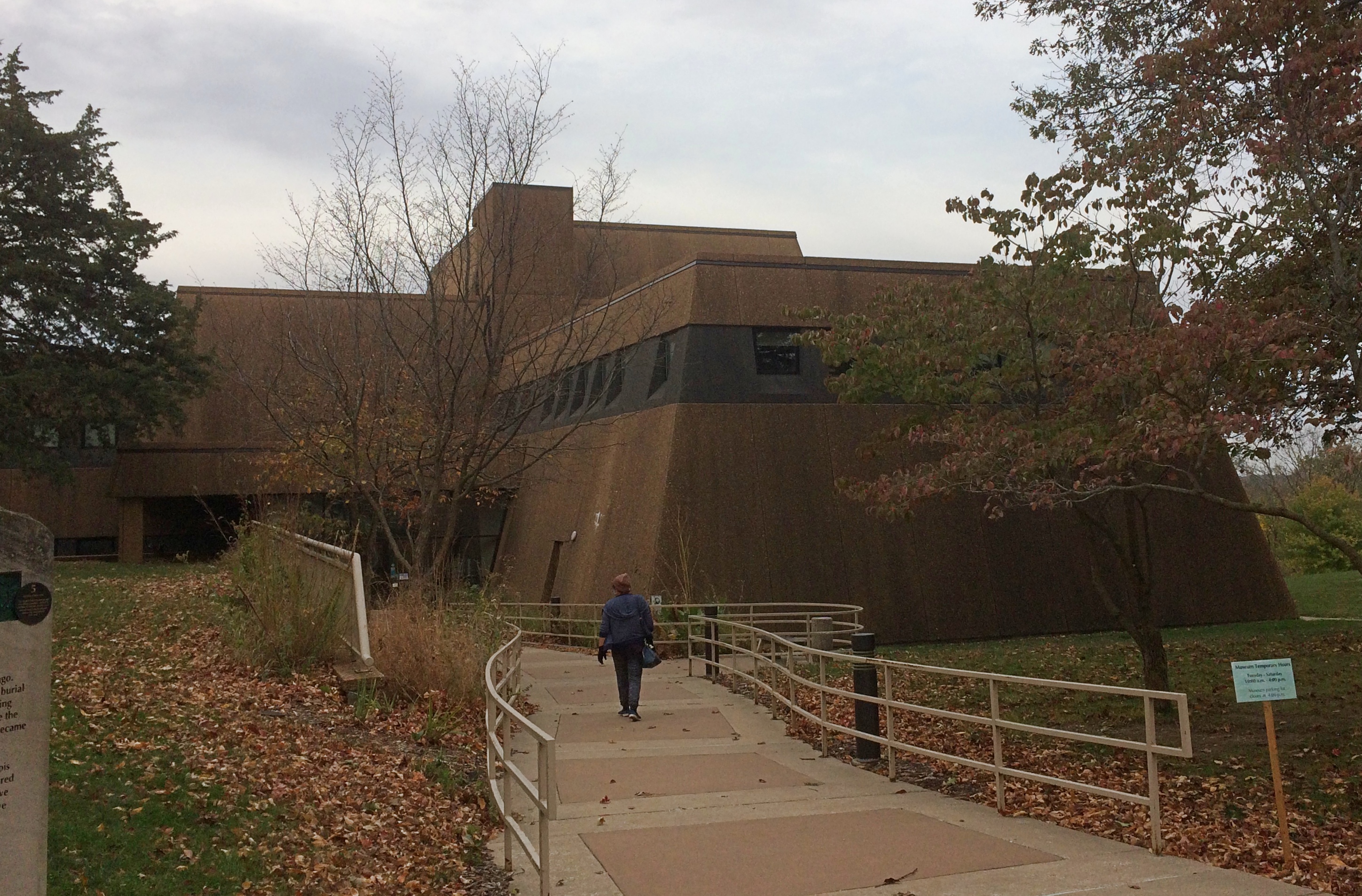
Completed in 1972, it looks something like a set from Logan’s Run, only browner.
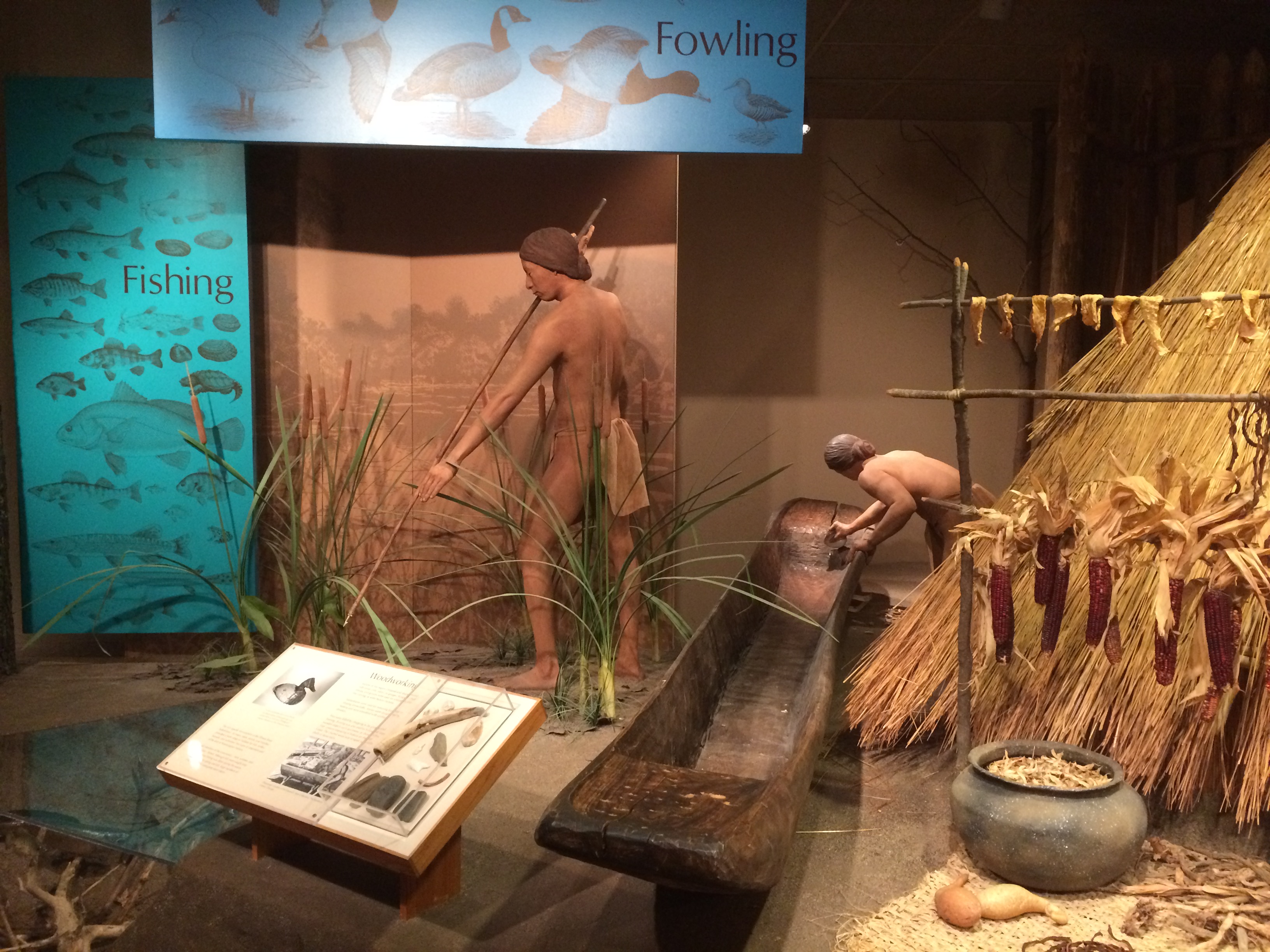
The museum is reasonably interesting, including a temporary exhibit of gorgeous prints by Audubon. Mostly the place focuses on the Mississippian peoples who lived in the area 1,000 years ago and more, and who, like a number of other peoples, left mysteriously before Europeans ever came to the Americas.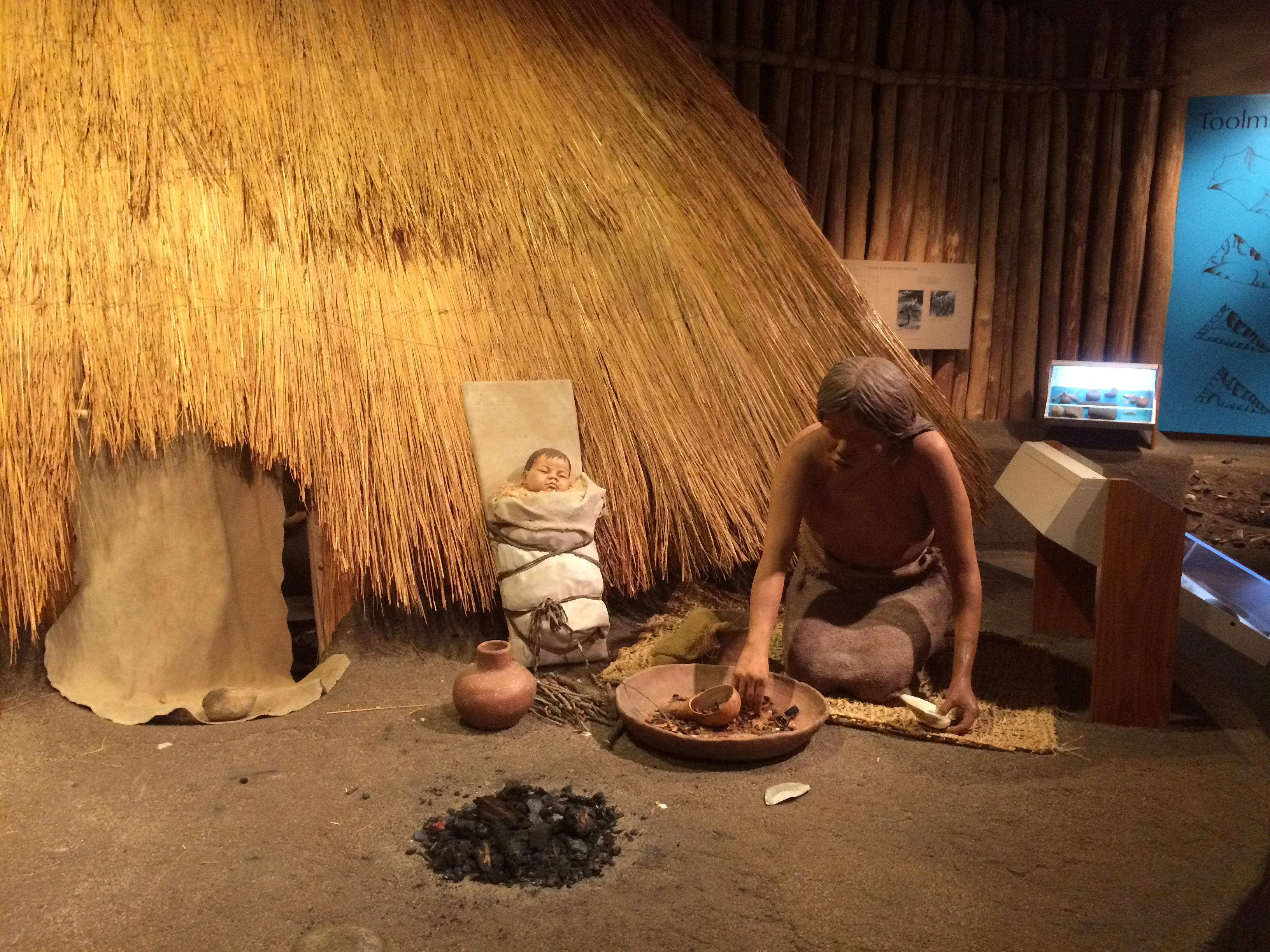
But the story of the museum itself is just as interesting if not more so, I think. For example, we were nearly 30 years too late to see any skeletons.
In the 1920s, a resident of these parts, one Don Dickson, started digging into Indian mounds on his family’s farm. He discovered skeletons. Lots of them. Maybe in the 19th century, such a find would have been unearthed and put into a traveling show, a seriously undignified outcome for human remains.
Dickson had a different idea, however, one more suited to his time, when Americans were more mobile than ever. He built a private museum around the skeletons in situ and people came to see them.
Not that dignified an outcome either, but at least the archaeological value of the site wasn’t completely destroyed. According to the museum, University of Chicago archaeologists investigated the area for years.
In 1945, Dickson sold the site to the state of Illinois, which later built the current building and still displayed the skeletons for decades. By the 1980s, the indignity of that arrangement was more widely understood, so in 1992 the state sealed off the remains beneath the building. Visitors today would not know about them unless they do further reading.
(Do people say the museum is haunted? That’s all it takes for a place to be considered haunted, after all.)
The museum also includes a lot of undeveloped land. A number of well-marked trails cross the land, so we took a walk.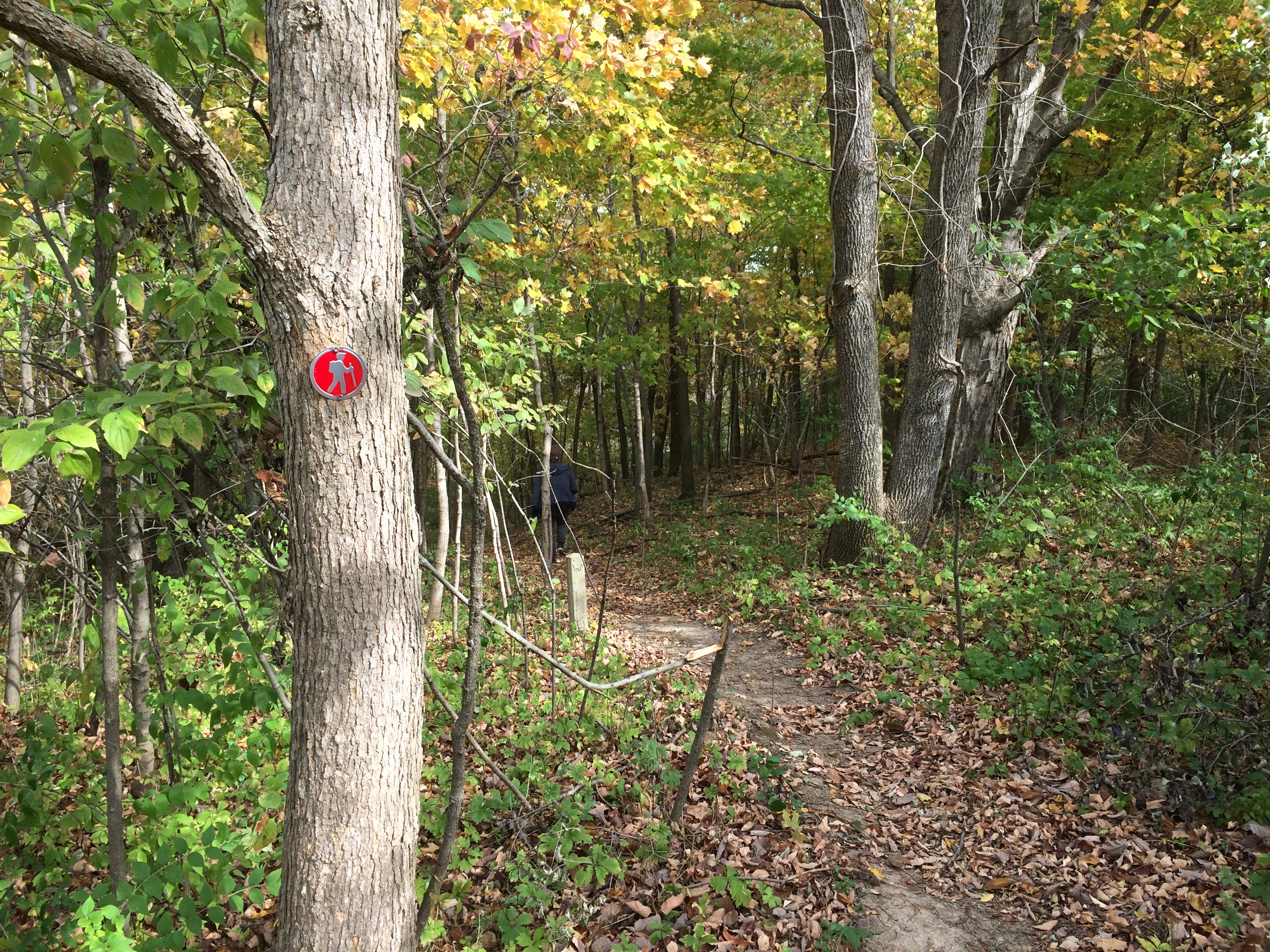
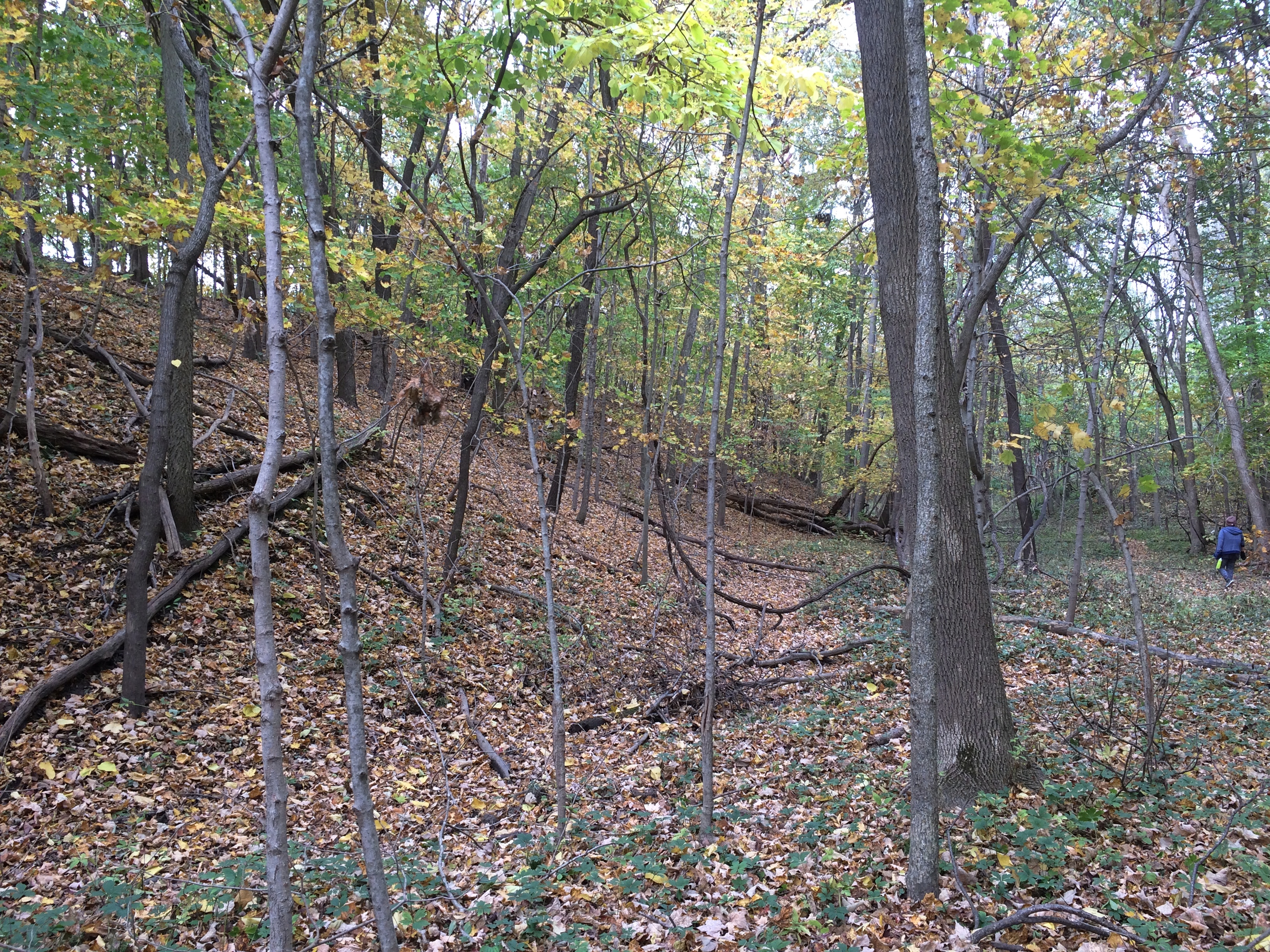
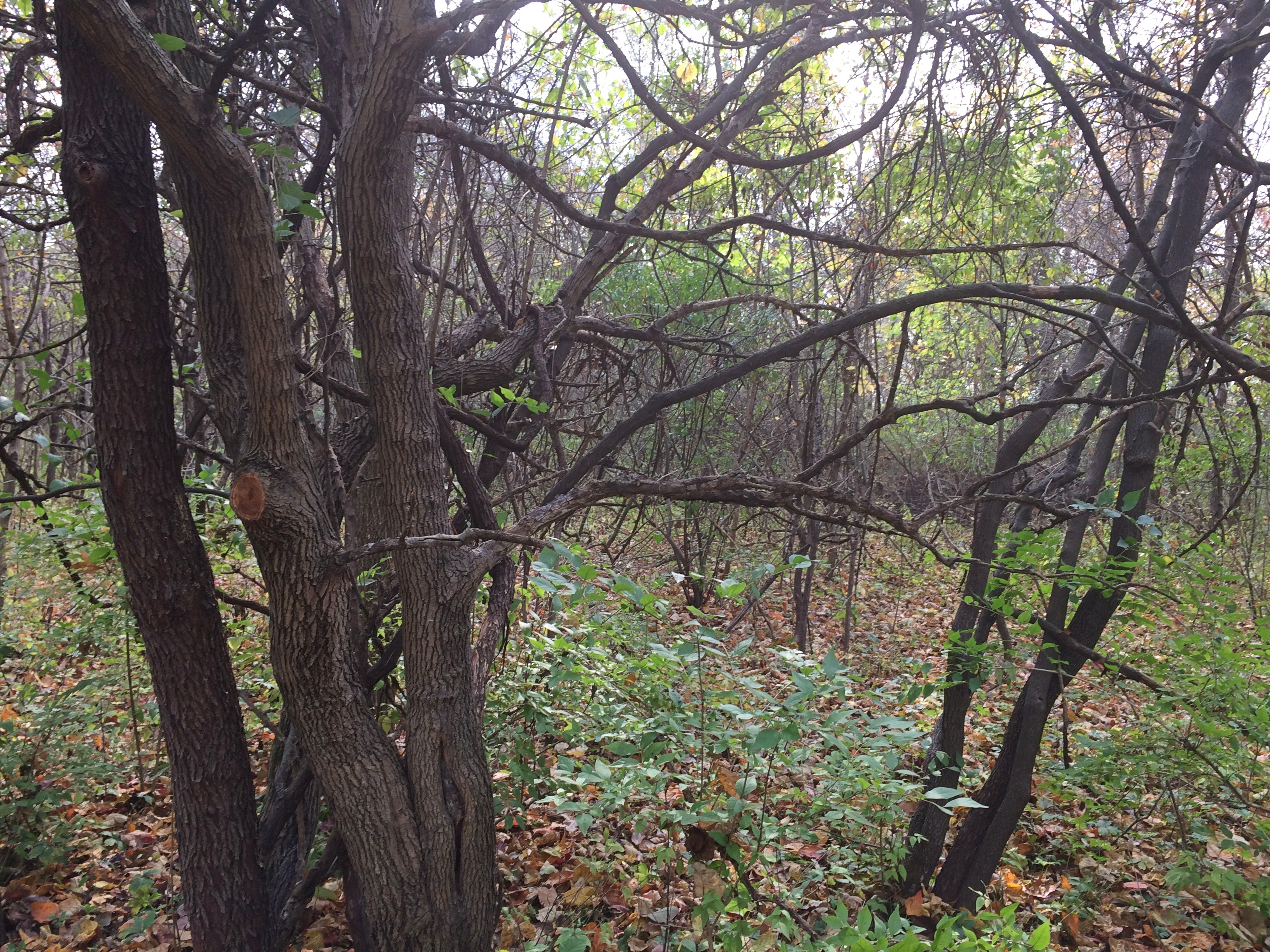
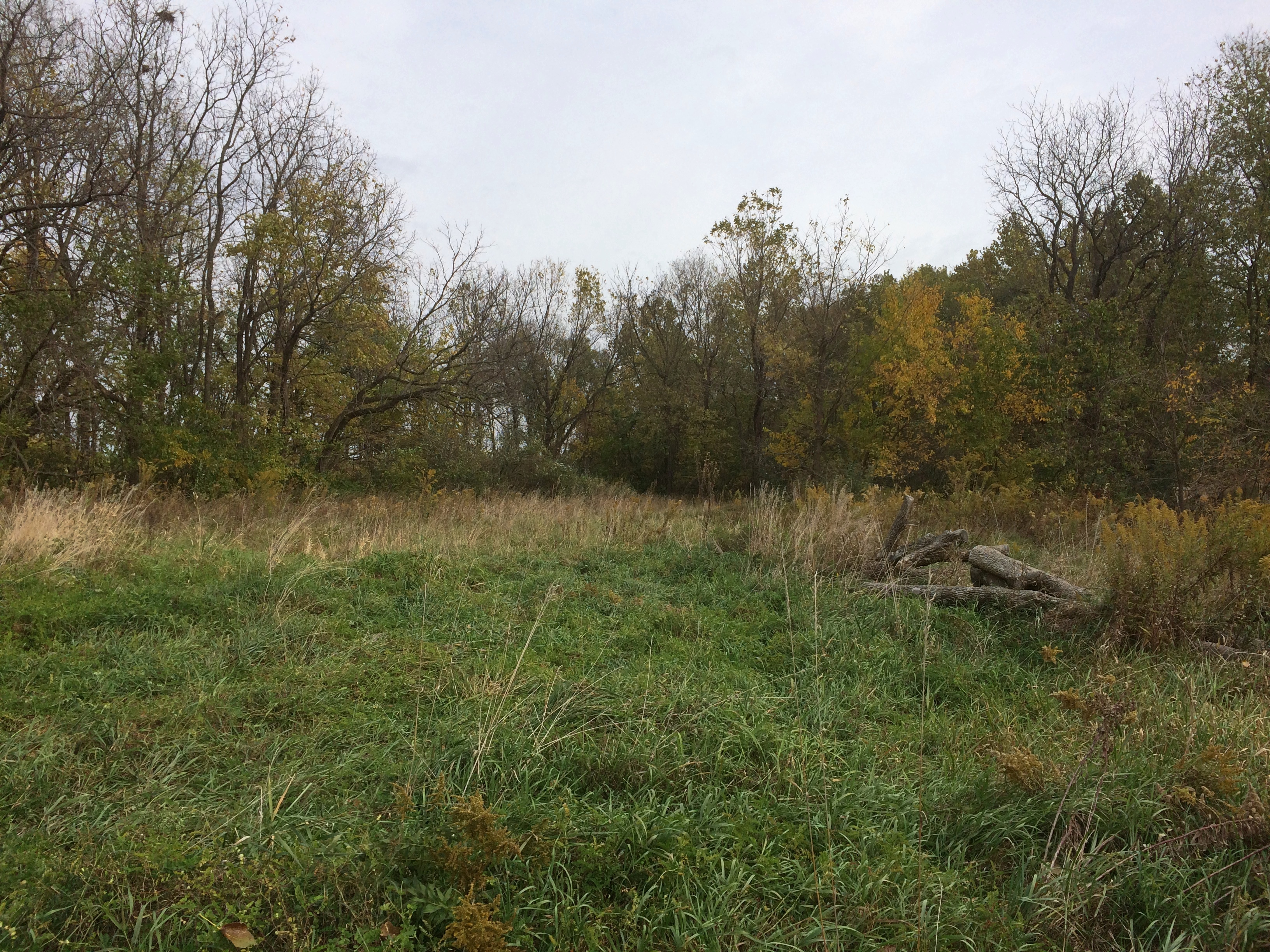 Second-growth forest, I suspect, if this used to be farmland. A large section of land was fenced off with a tall mesh fence. Archaeological sites that wankers might try to plunder? Could be, though nothing about the fence explained its presence.
Oak Hill Cemetery, Lewistown
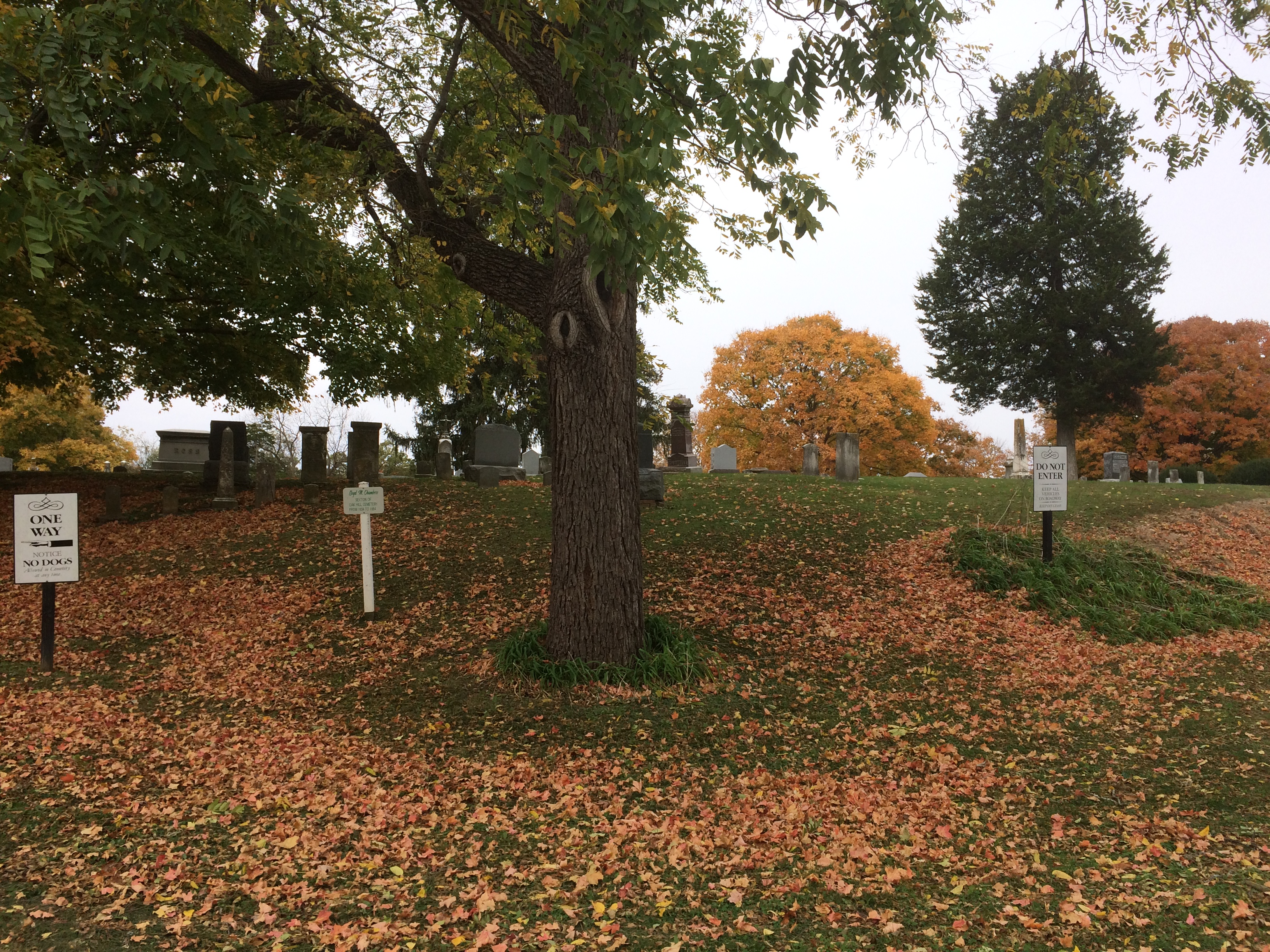
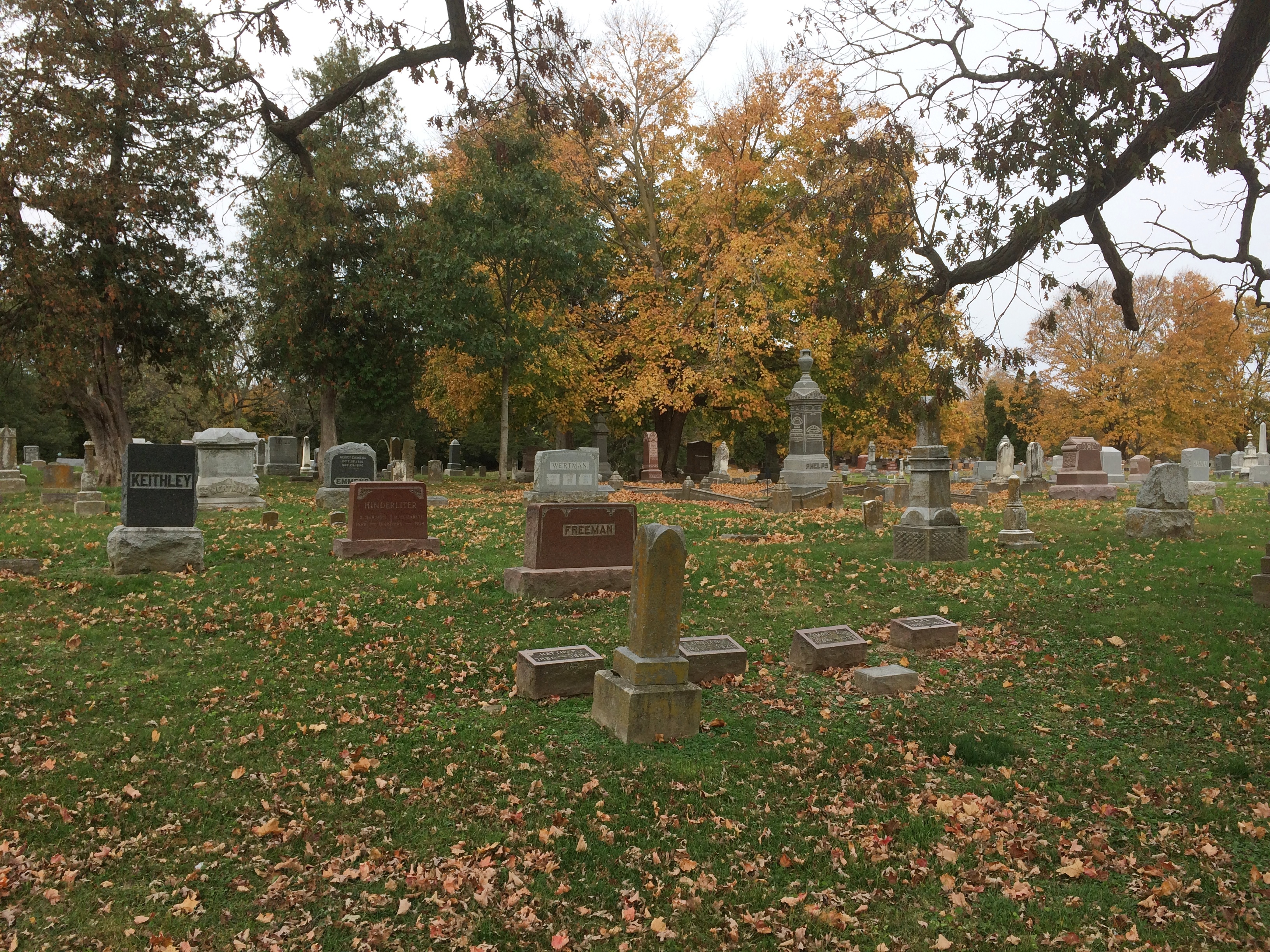
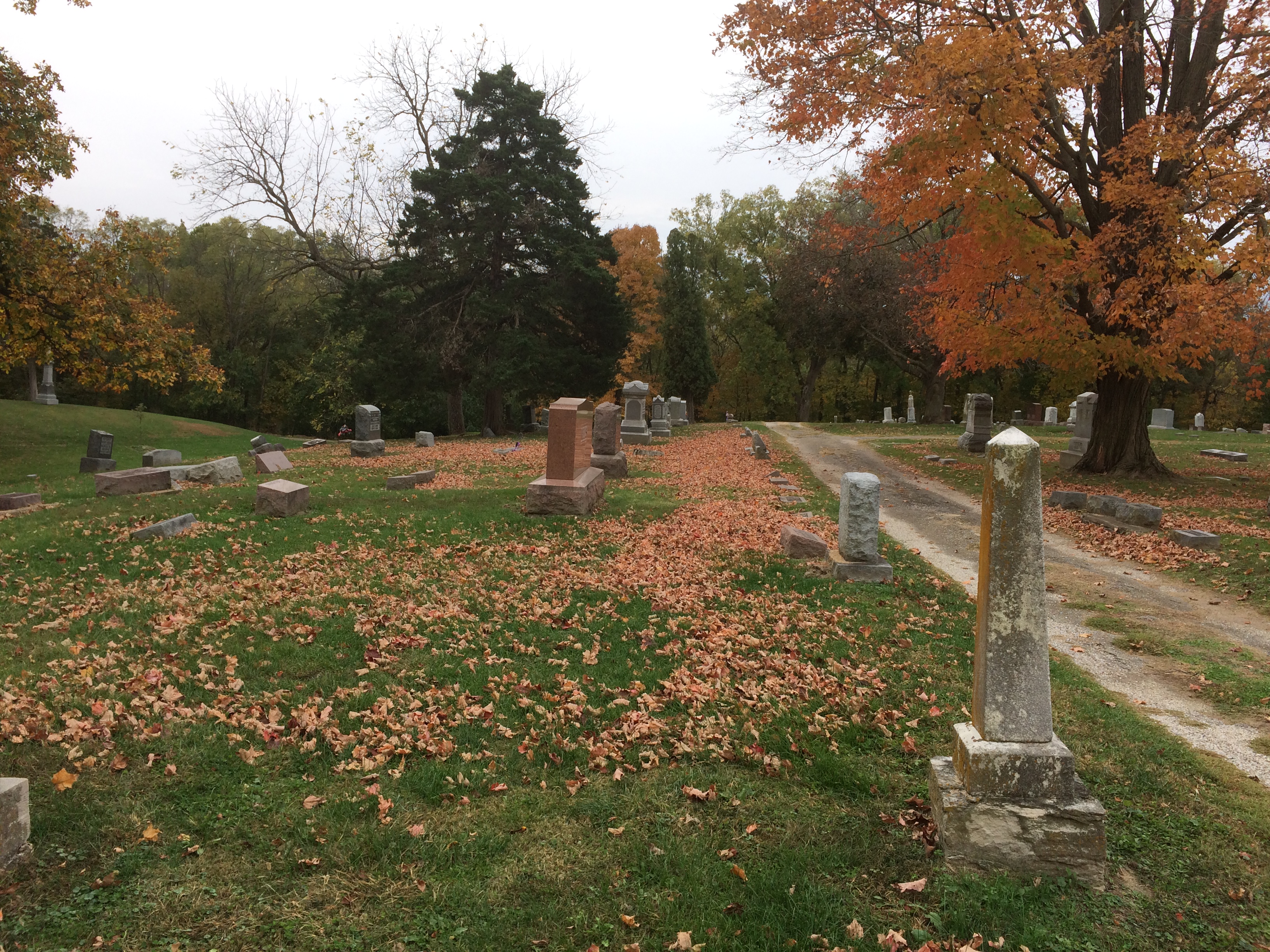
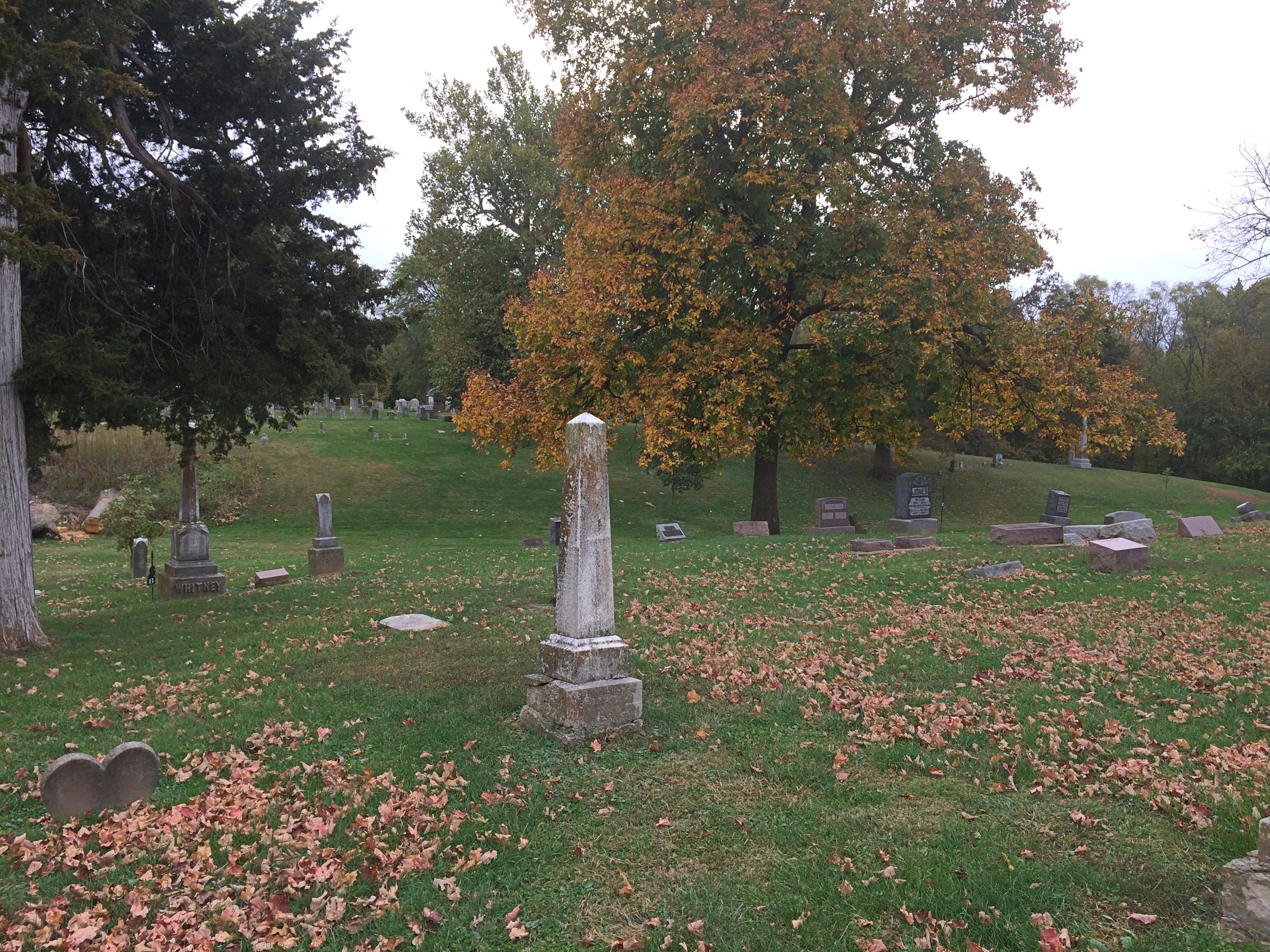
Lewistown, Illinois, isn’t very large. Only 2,100 or so people live there, as opposed to Oak Hill Cemetery in Lewistown, which has a population of more than 5,000. I arrived for a look on the morning of October 17.
I hadn’t expected such a good-looking cemetery. The fall colors helped, but only added to the overall aesthetic of woody terrain, sometimes hilly, peppered with upright stones and funerary art.
As you’d expect, there’s a Civil War memorial.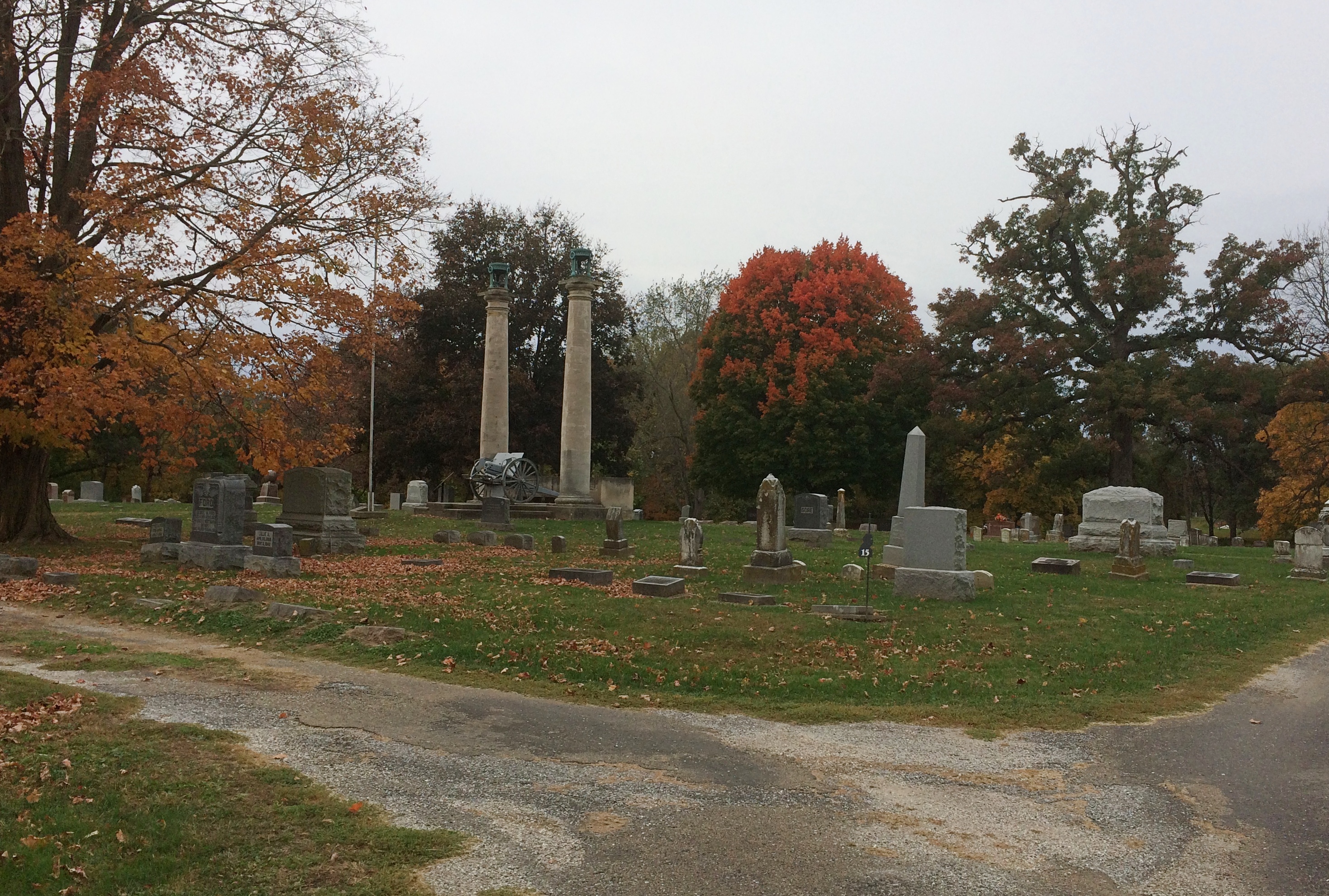
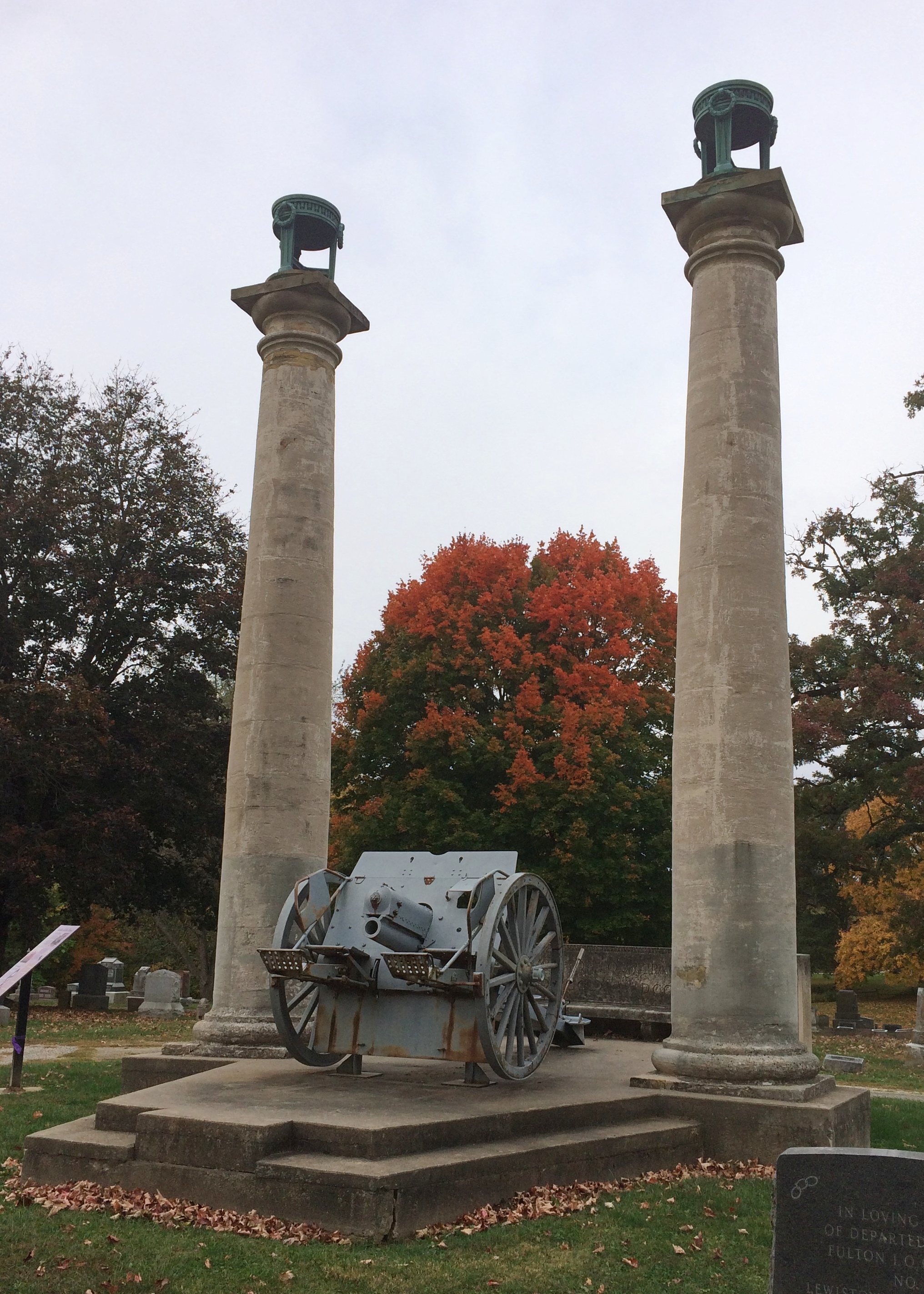
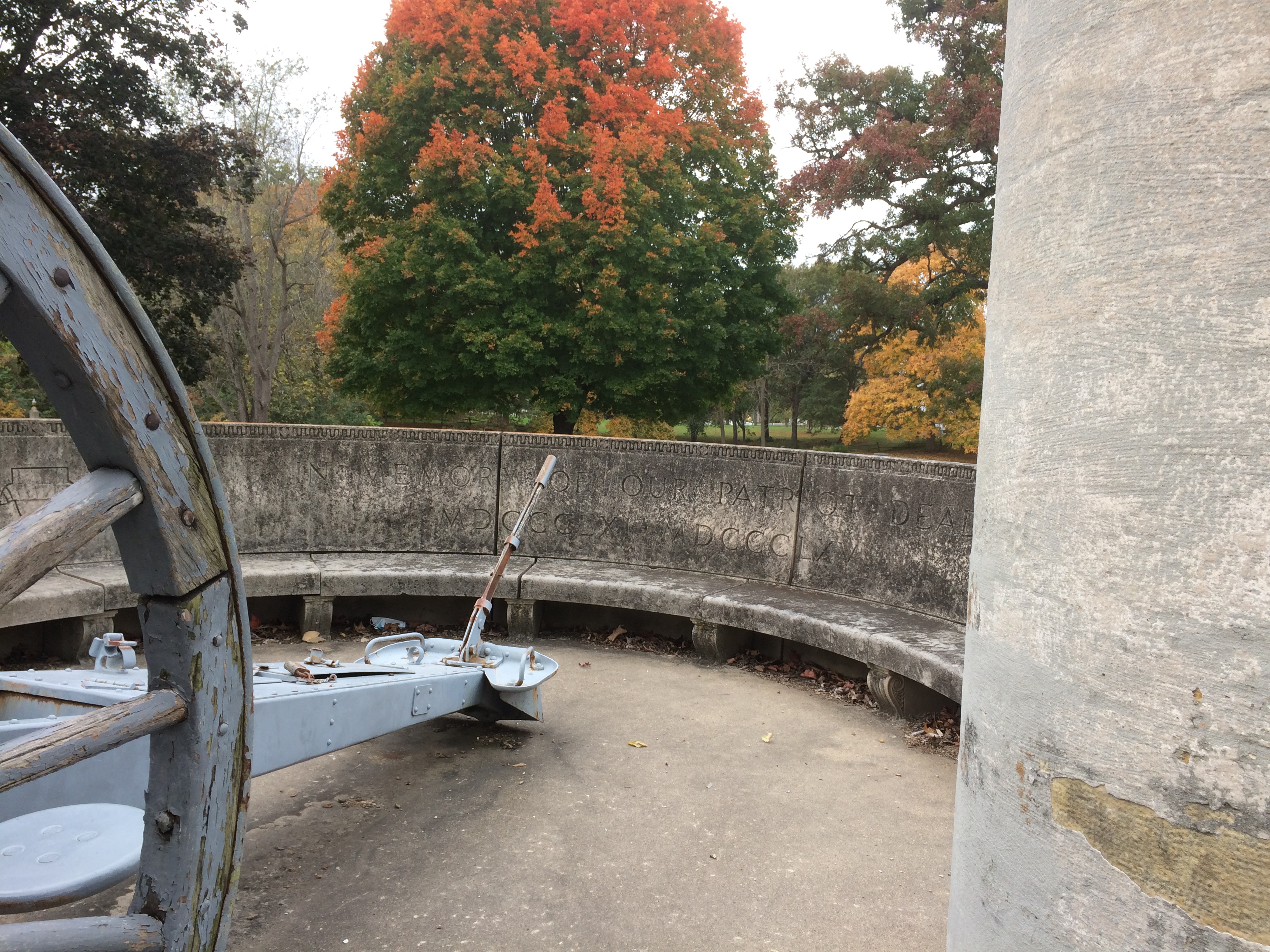
It’s hard to see in this pic, but this is the entirety of the inscription, written on the stone bench:
IN MEMORY OF OUR PATRIOT DEAD
MDCCCLXI–MDCCCLXV
I didn’t know it until later, but the columns at the memorial were salvaged from the previous Fulton County courthouse, which burned down in the 1890s. When Lincoln came to town in the ’50s to speak, he stood on the courthouse steps between the columns, and so the town wanted to work them into its Civil War memorial.
In as much as Oak Hill Cemetery is known to the world, it isn’t for its beauty or a war memorial. Rather, Edgar Lee Masters took inspiration from it for Spoon River Anthology. Sometimes, I’ve read, very specific inspiration, since he knew many of the townspeople — such as the weak of will, the strong of arm, the clown, the boozer and the fighter, to borrow language from the opening of the book.
“In the groundbreaking work, Masters, a onetime law partner of Clarence Darrow, gives voice to more than two hundred deceased citizens of Spoon River who are laid to rest in Oak Hill Cemetery, known to the locals as The Hill,” wrote Laura Wolff Scanlan in Humanities magazine in 2015.
“Freed by the shackles of life, the un-living who ‘sleep beneath these weeds’ confess their deepest secrets, disappointments, frustrations, joys, and warnings to the living in the form of brutally honest free verse poems.
“In some cases, Masters barely changed their names. Henry Phipps was really banker Henry Phelps. Harry Wilmans was Henry Wilmans…
“Even though most names were fictitious, everyone in town knew exactly who he was talking about. Because of this, the book was immediately banned from schools and libraries in the area, including the Lewistown library.”
When Masters died in 1950, he wasn’t buried in Oak Hill, but rather in Petersburg, Illinois, which is close to Springfield.
The Lewistown library started stocking the book in 1974. After the death of everyone mentioned in it, and most of their immediate families, in other words. In our time, Lewistown claims the work as its own, since what else is the town known for, or could be known for? For the centennial of the book in 2015, the town held Oak Hill Cemetery tours, exhibitions and theatrical performances, according to Humanities.
For avid Spoon River enthusiasts, and there must still be a few, the graves of the real people associated with fictional counterparts are marked with numbers.
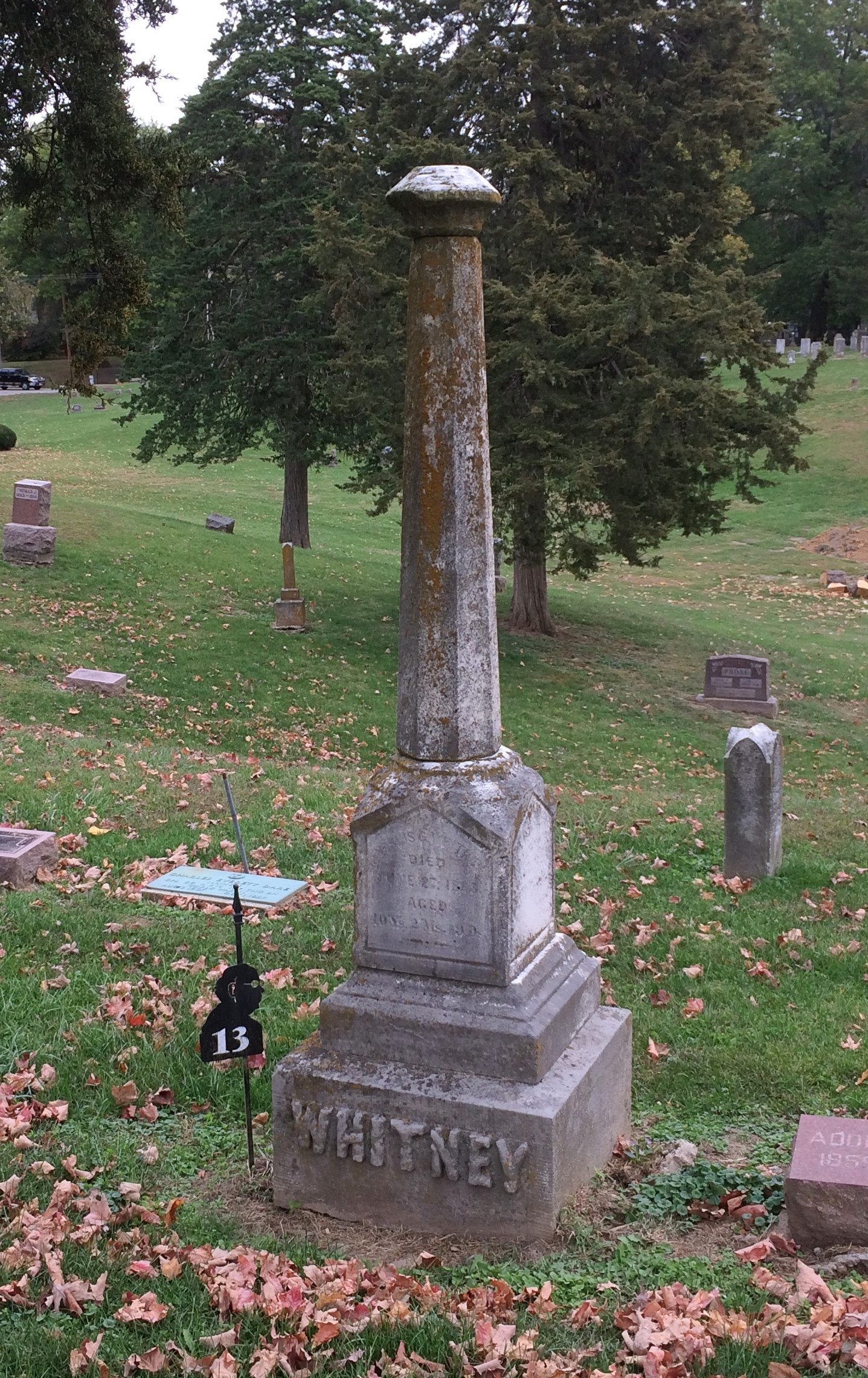
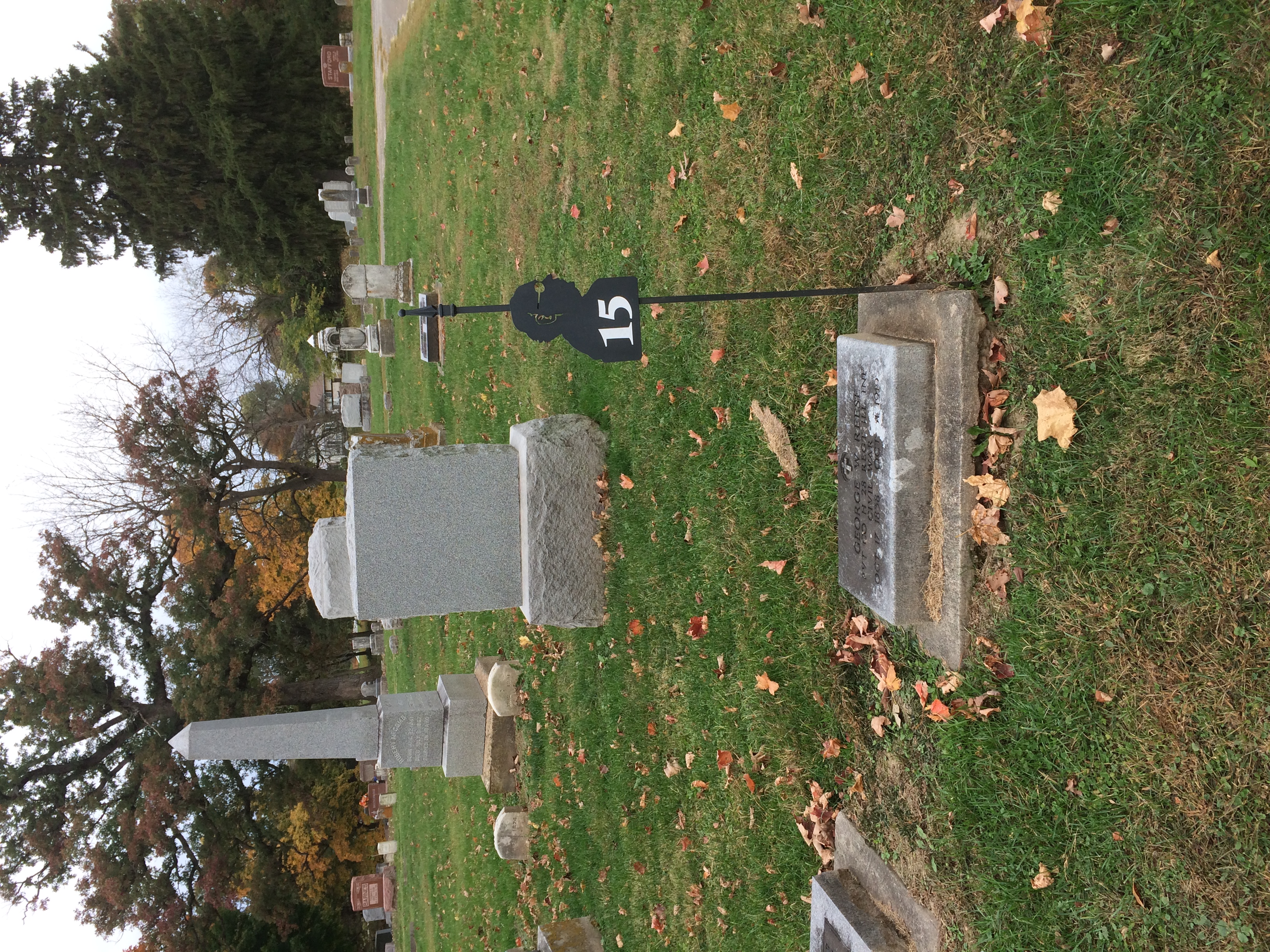
There’s a guide available that will tell you who’s who in the cemetery, according to their Edgar Lee Masters number. I am not enough of an enthusiast to look any of them up.
Still, I respect it as a successful work of literature about the residents of a cemetery. Interesting conceit. Sometimes I imagine that if the dead at the cemeteries could talk freely, I might hear some salacious bits. On the other hand, many of them might not have very much interesting to confess.
We had a copy of Spoon River in our library when I was growing up, and I read some of the poems then and a few later. The other day I happened across a radio version from 1957, which is worth a listen. William Conrad is always worth a listen anyway.
Spoon River Valley ’20
The weekend after Ann and I went to southern Illinois, Yuriko and I went to Fulton County, also in Illinois, but closer to home. It’s southwest of Peoria, along the Illinois River. The Spoon River also runs through the county, until it meets the Illinois.
Why Fulton County? Marketing. At least that’s part of the reason. Every year, on the first two weekends in October, an organization called the Spoon River Valley Scenic Drive Association puts on an event called the Spoon River Valley Scenic Drive Fall Festival. I heard about it some years ago.
Visitors are encouraged to drive around the county, look at the fall colors, and drop a few bucks. The association produces useful online and (probably) paper maps of the county toward those ends. So over the years, tucked back in that big mental file of mine, Minor Destinations, I had the vague idea that Fulton County had especially fine foliage. No doubt the Spoon River Valley Scenic Drive Association would appreciate the fact that that idea had been planted in my awareness of the place.
This year, the association cancelled the event. We would have missed it anyway, since we went on the third weekend of October.
We got a late start on Friday, not arriving at Lewistown, Illinois, until after dark, which is where we stayed that night, returning home Saturday night after spending the day in the area looking around. As my wont, I was up early Saturday morning (October 17) to have a look around Lewistown, seat of Fulton County.
It isn’t long before you’re at the Fulton County Courthouse.
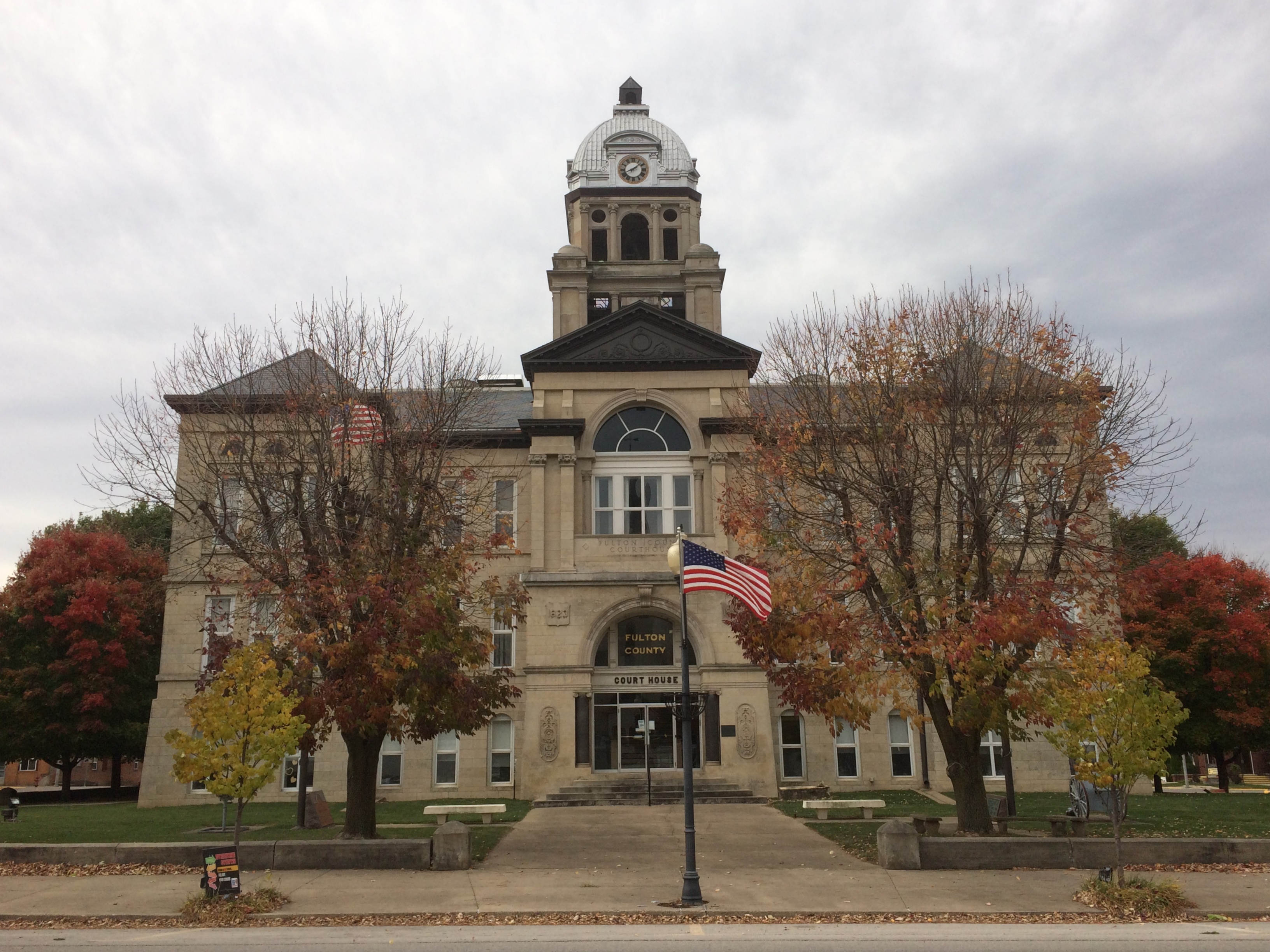
I have to say, this is a well-written plaque there in front of the courthouse.
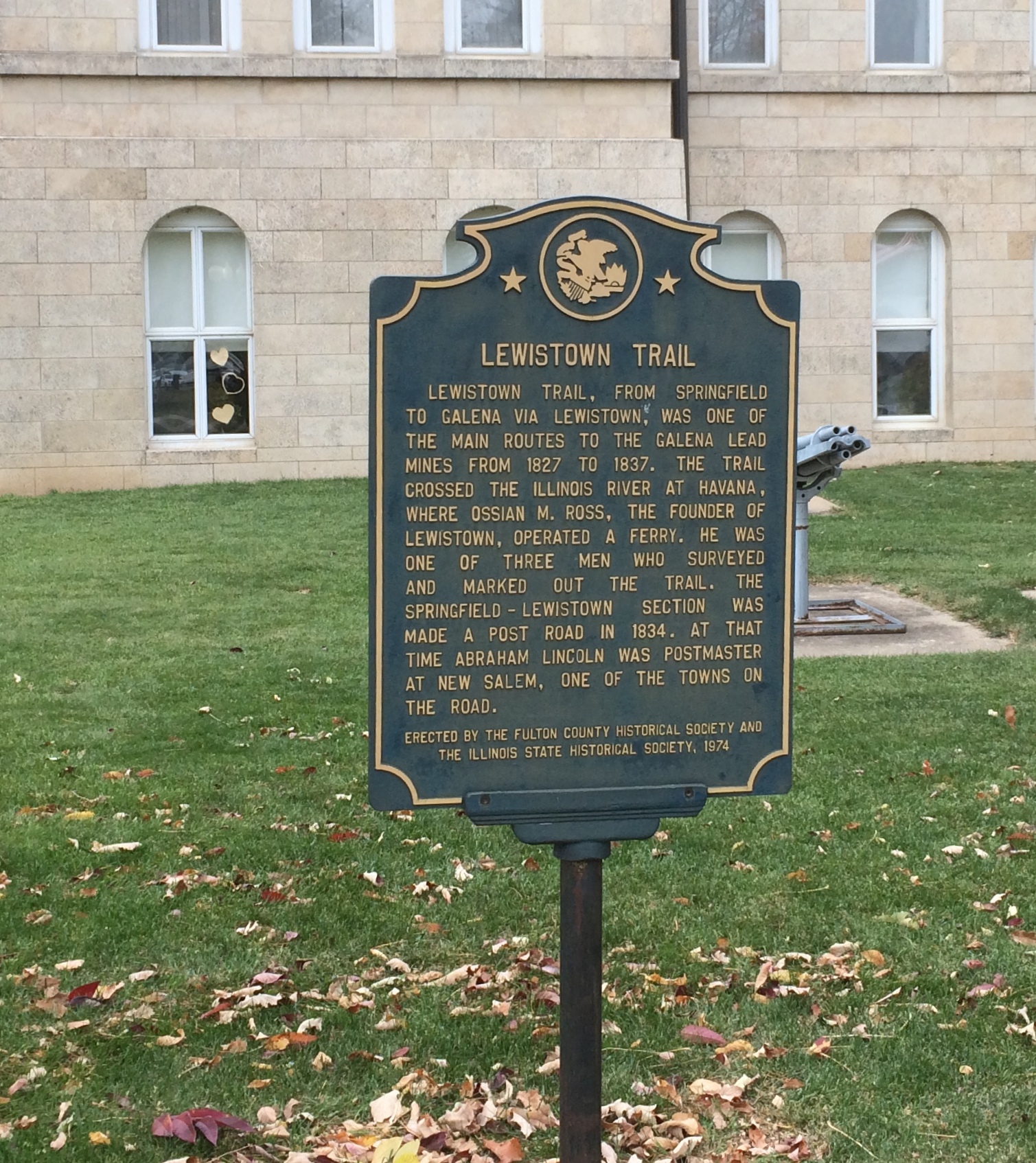
A brief on a now-obscure part of Illinois history, told concisely and clearly. Mentioned in passing is the 19th-century Gelena (Illinois) lead rush, and the text makes a connection to Lincoln, as historic markers in Illinois like to do.
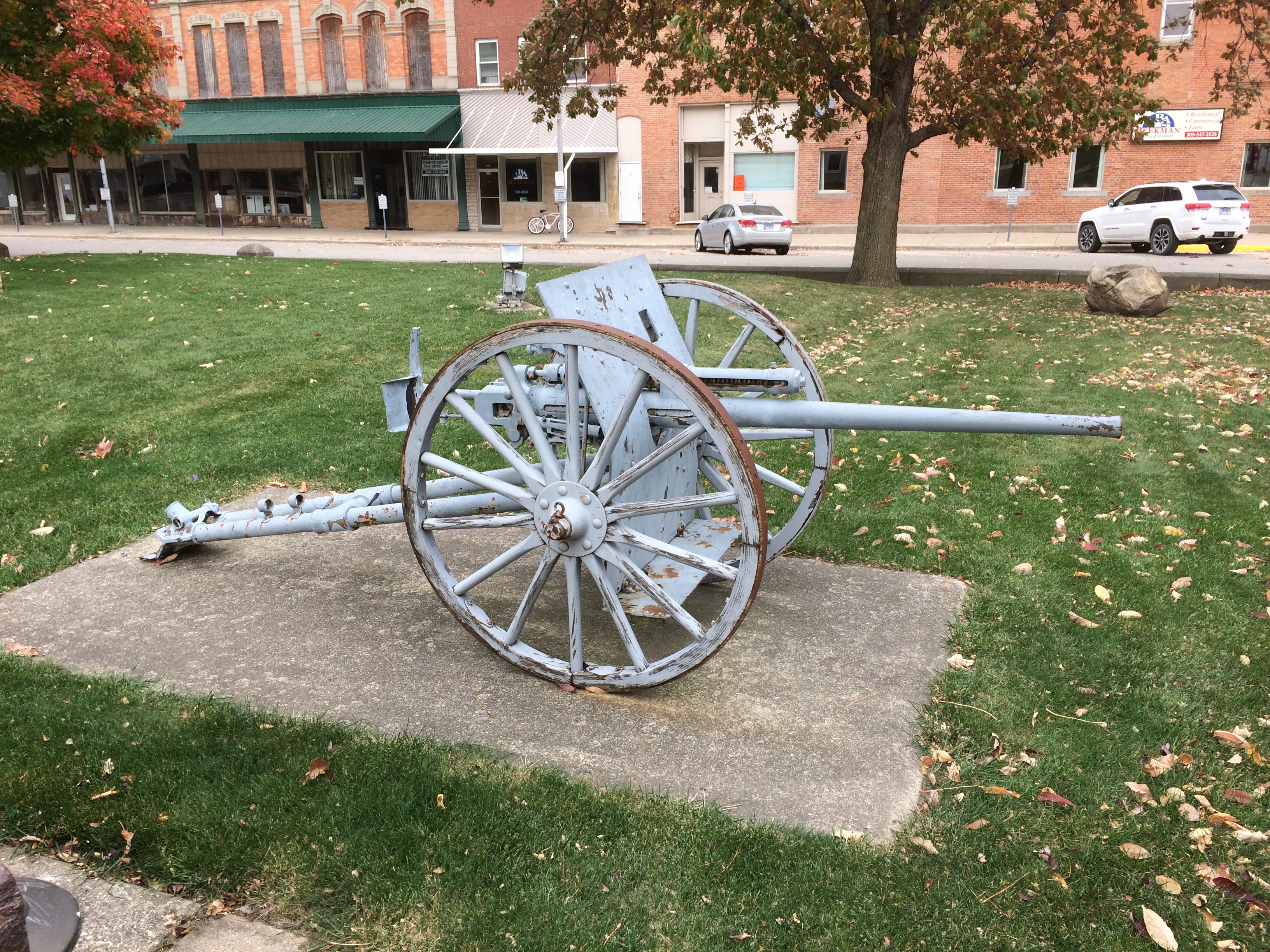
Bits of war surplus. Now memorial bits.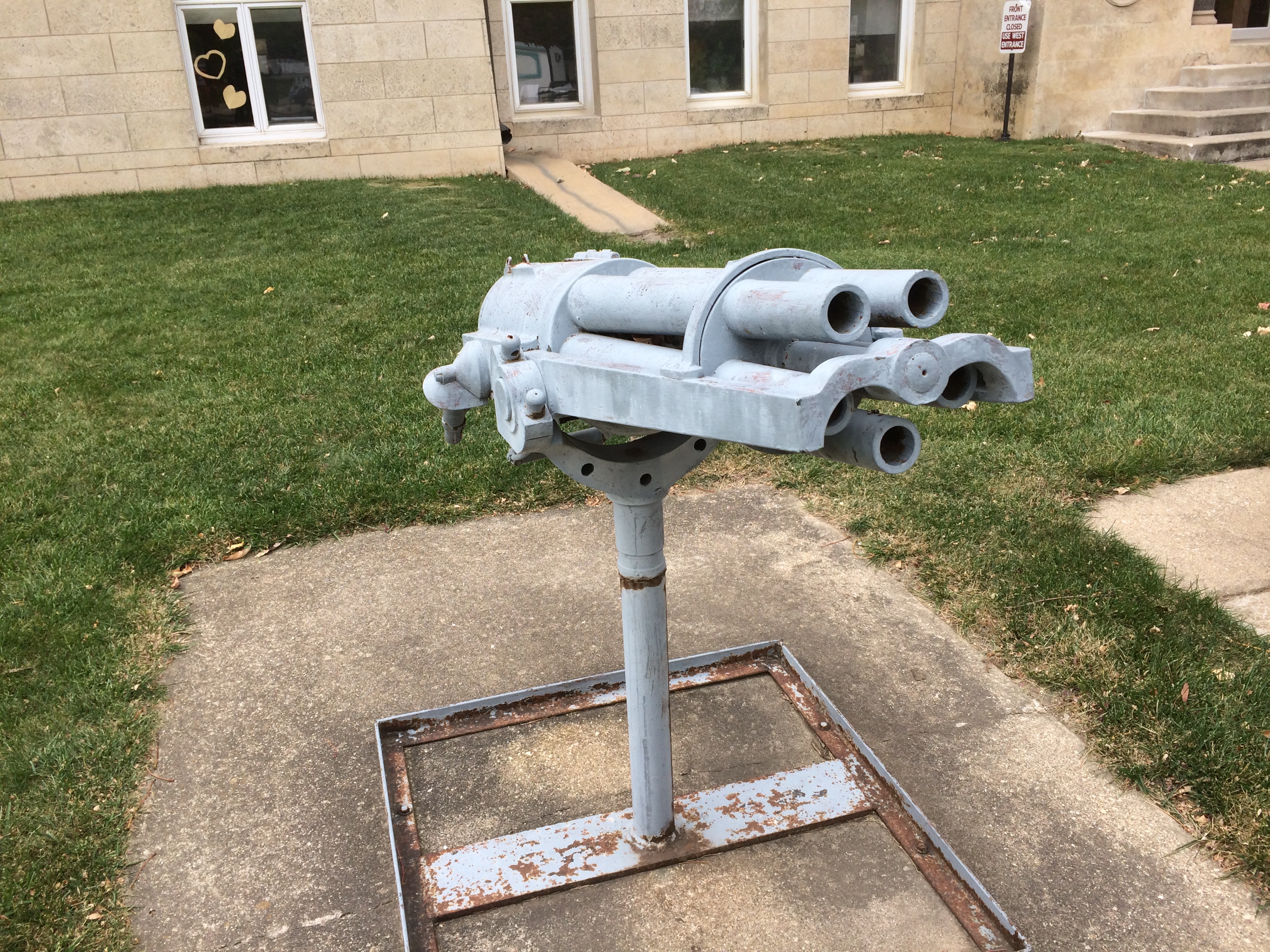
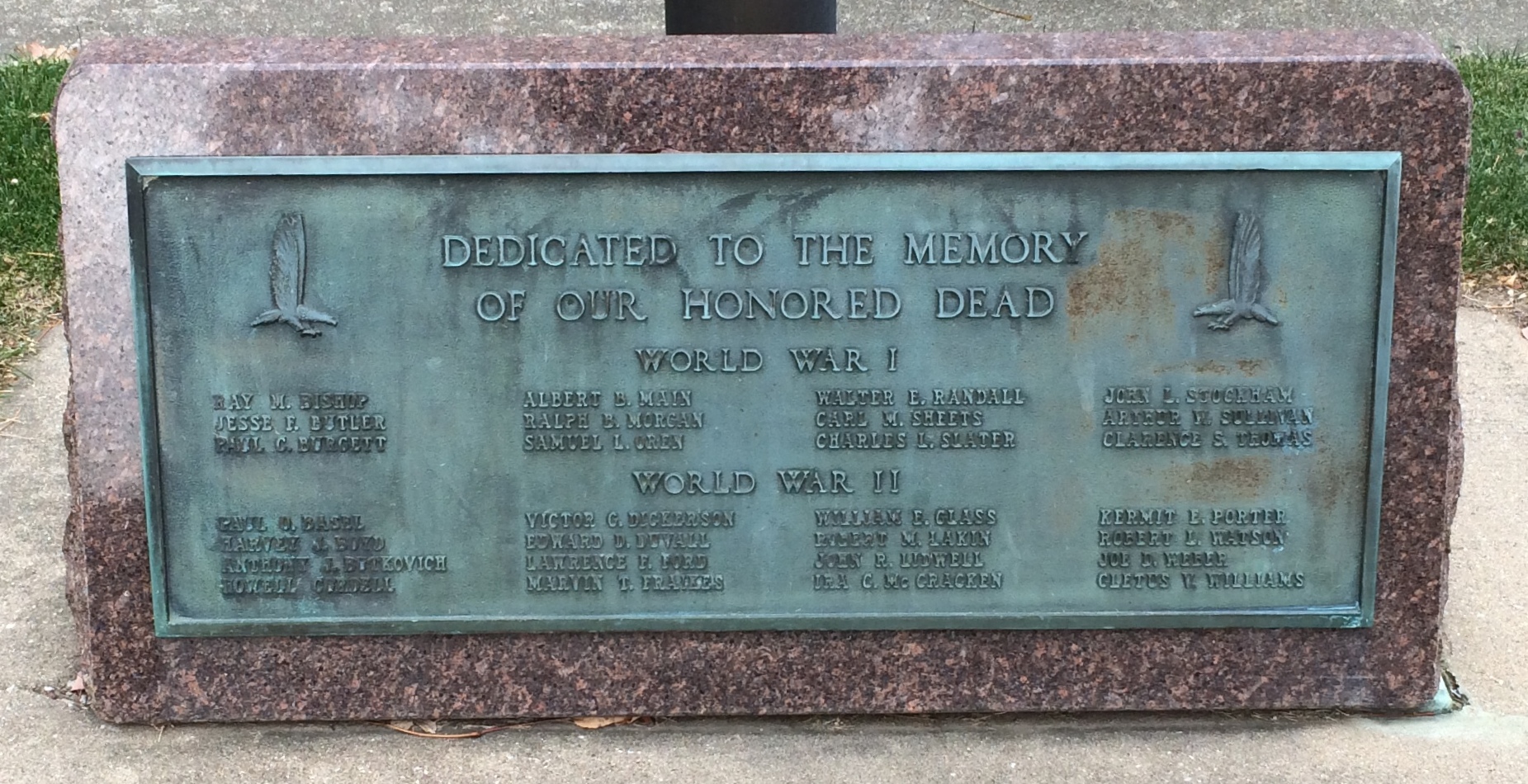
Always good to look at these kinds of plaques — this one was near the cannon — even if only a half a minute or so.
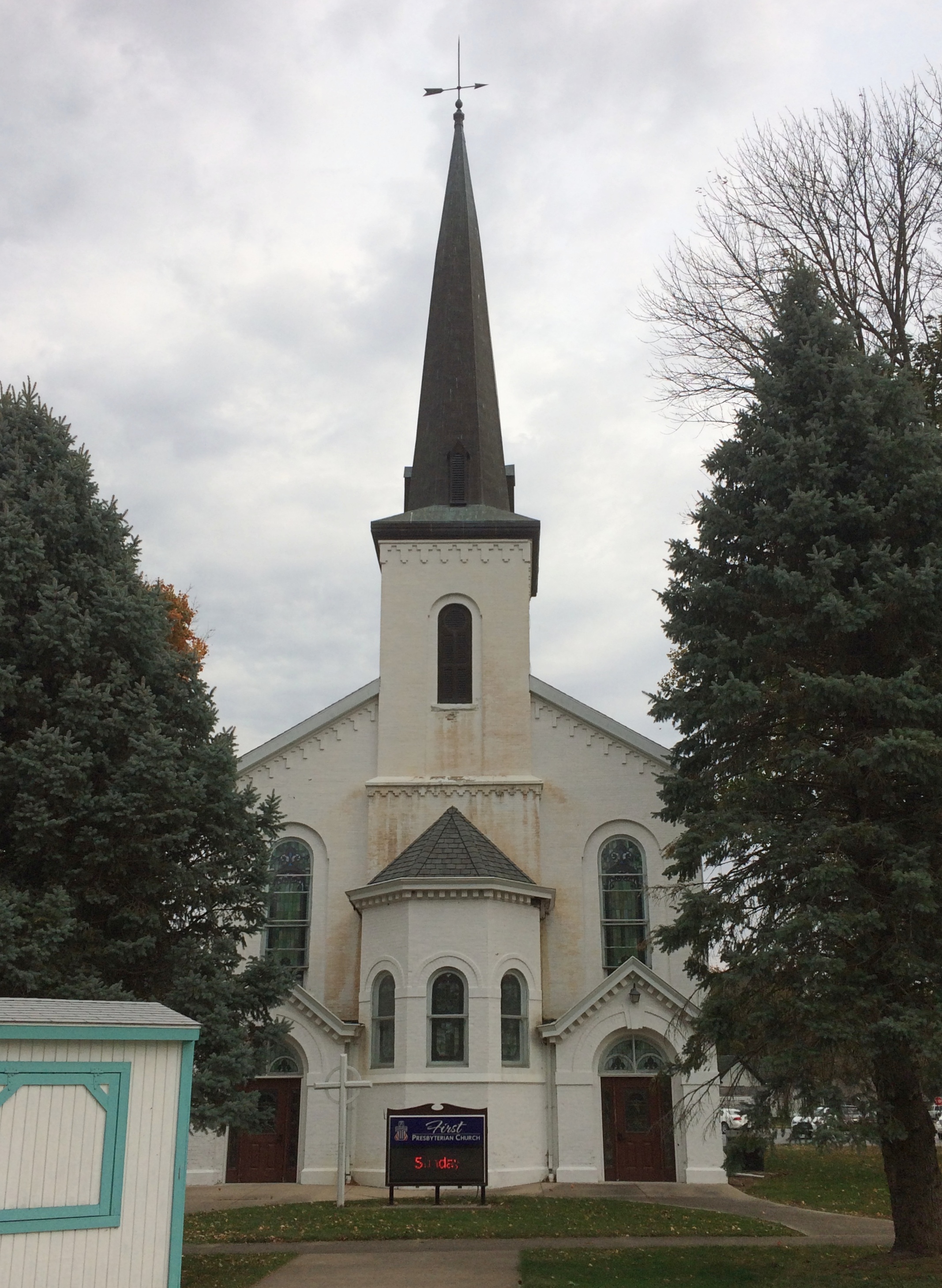
Across the street from the courthouse is First Presbyterian Church.
The town gazebo.
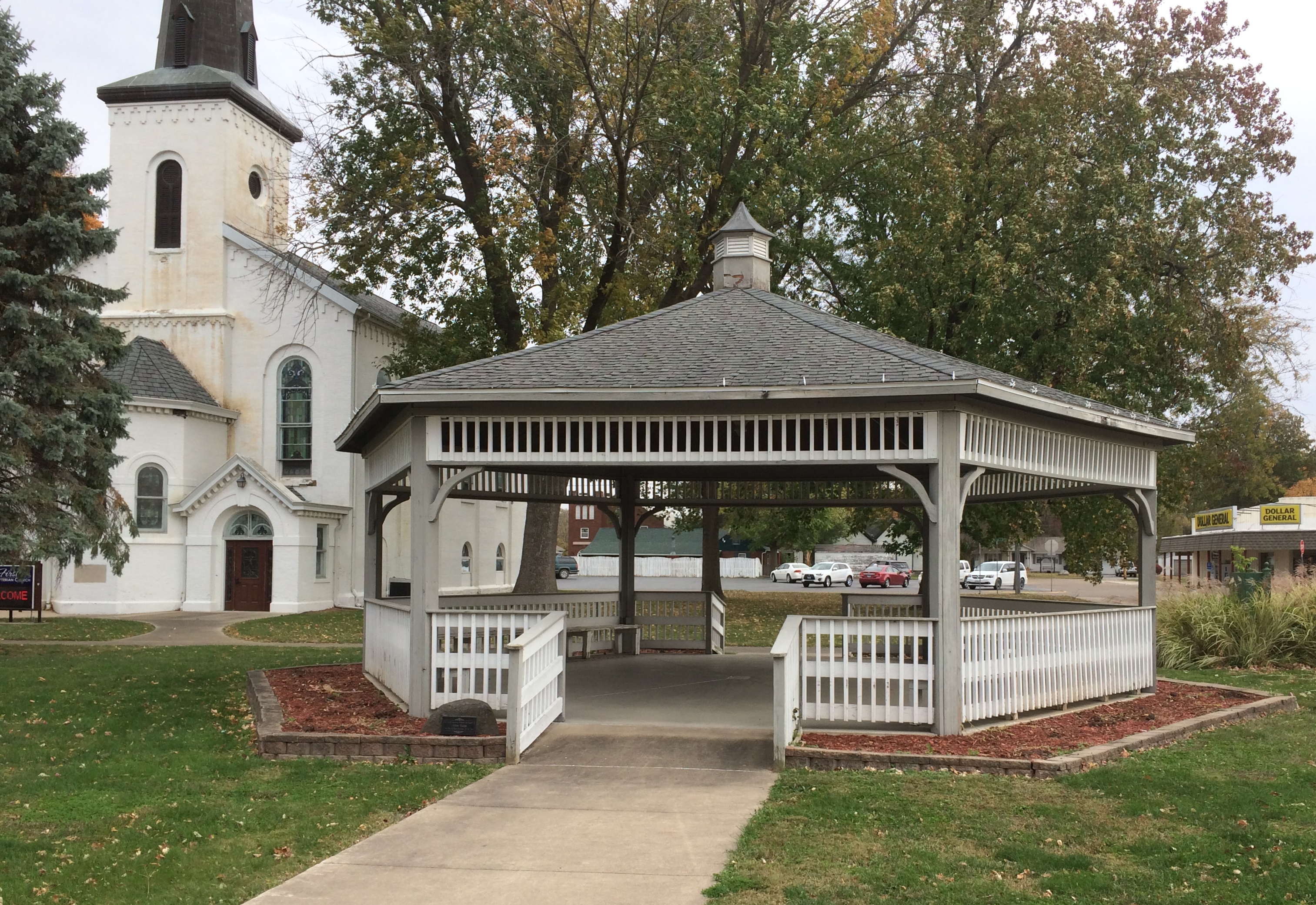
Or maybe it’s on church property. That would technically put it that very special class of gazebos, the ecclesiastical gazebo, early ruins of which can be found in Vatican Necropolis in the Vatican City, and in Constantinople…. There I go again, writing bogus gazebo history.
Nearby is the Prairie State Bank & Trust, looking like a going concern (it is), in a basic brick bank building. Make that a basic brown brick bank building.

It’s good when alliterations work.
New Harmony, Indiana, Part 2
After wandering around New Harmony, Indiana, for a while and seeing many interesting things, it occurred to me that we hadn’t visited one of the places that I was curious to see, because I didn’t know exactly where to find it.
Google Maps in this instance didn’t know either. Or rather, I didn’t know exactly what the spot was called, to tell Google. The search engine isn’t a mind reader, not yet (but surely that’s Alphabet Inc.’s dream).
We spent time looking around an antique and knickknack store on the main street, since New Harmony, pop. 750, has some of the elements of a day-trippers town (like Fredericksburg, Texas). I found a candle holder I wanted to give as a gift, and after paying for it, I asked the woman behind the counter two questions.
One, where I might find postcards, since her store had none. She offered a suggestion, and another customer who had overheard us offered another suggestion, which turned out to be closer by and correct.
My other question: “Can you tell me where I can find Paul Tillich’s grave?” I’d read it was in town. Not in a cemetery, but a standalone location.
I can’t claim to be an expert on Paul Tillich, or even remember that much about him or his theological ideas. Whatever I might have learned during my collegiate religious studies had long been forgotten. Still, I figured I should drop by and pay my respects, and later do a little reading to refresh my memory.
She told me where to find him. We’d wandered by previously without realizing it, since he’s tucked in a grove of conifers forming Paul Tillich Park.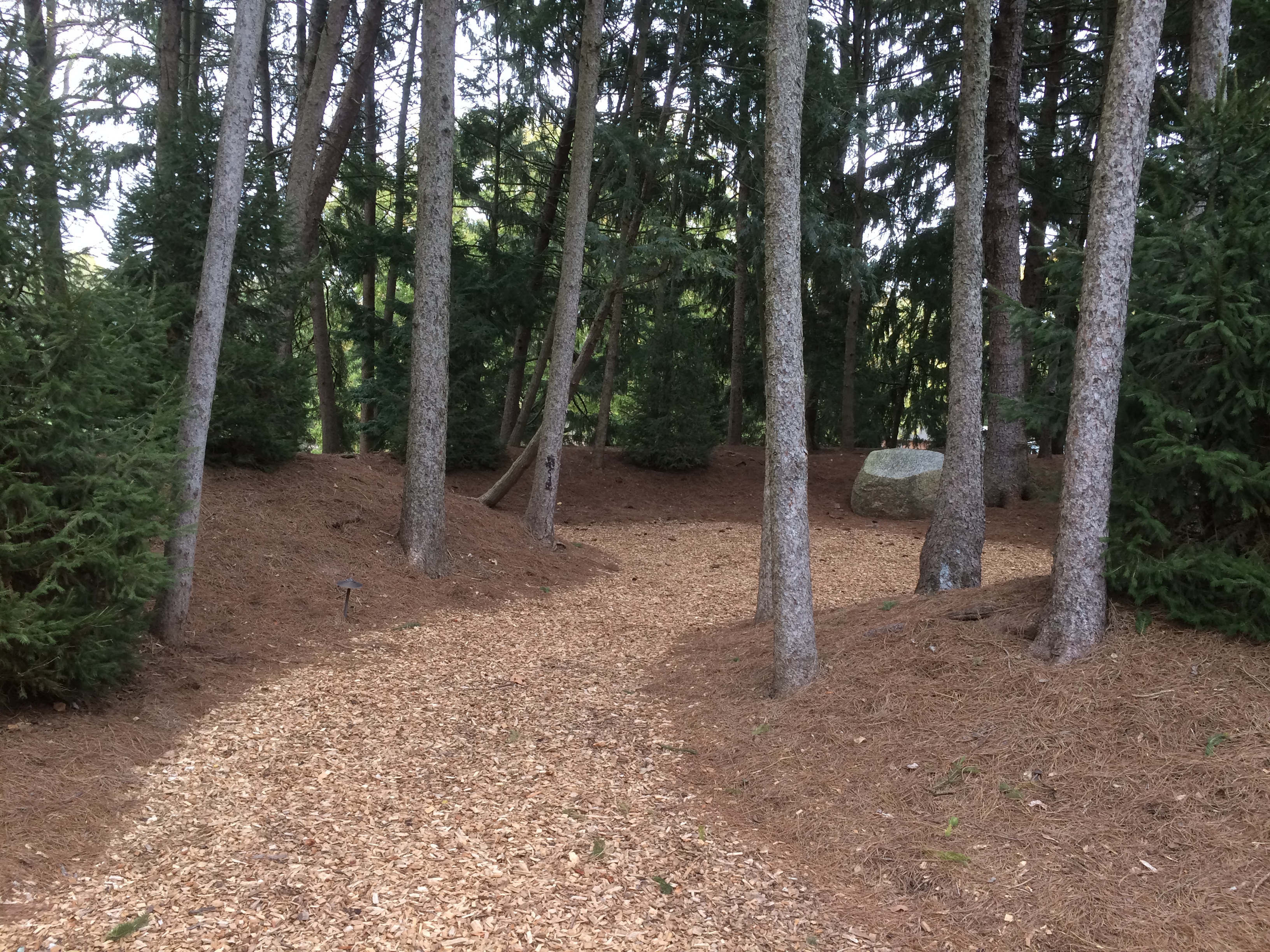
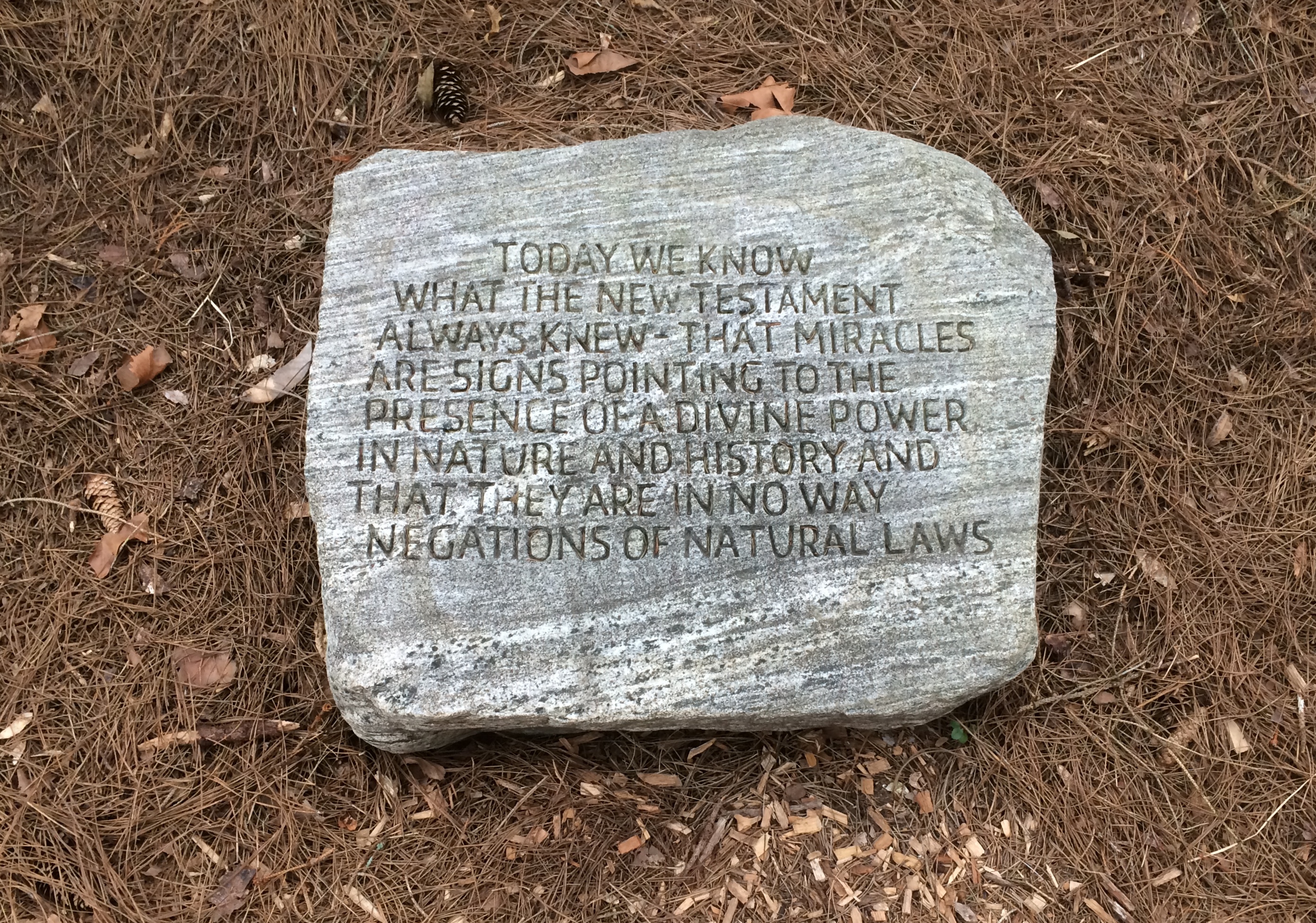
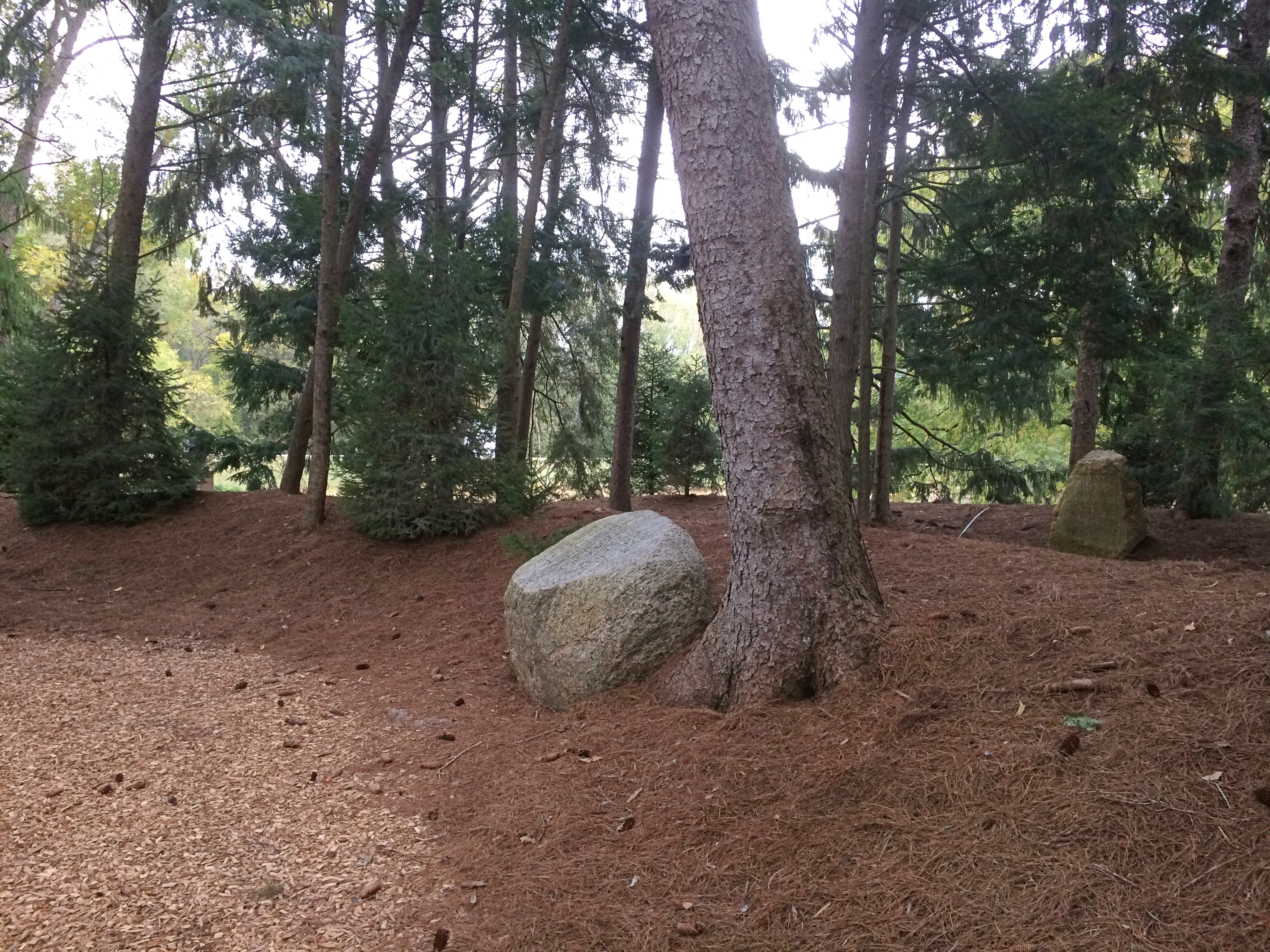 None of the stones in the pictures are his gravestone. Rather, they’re some stones in the park with Tillich’s words carved on them.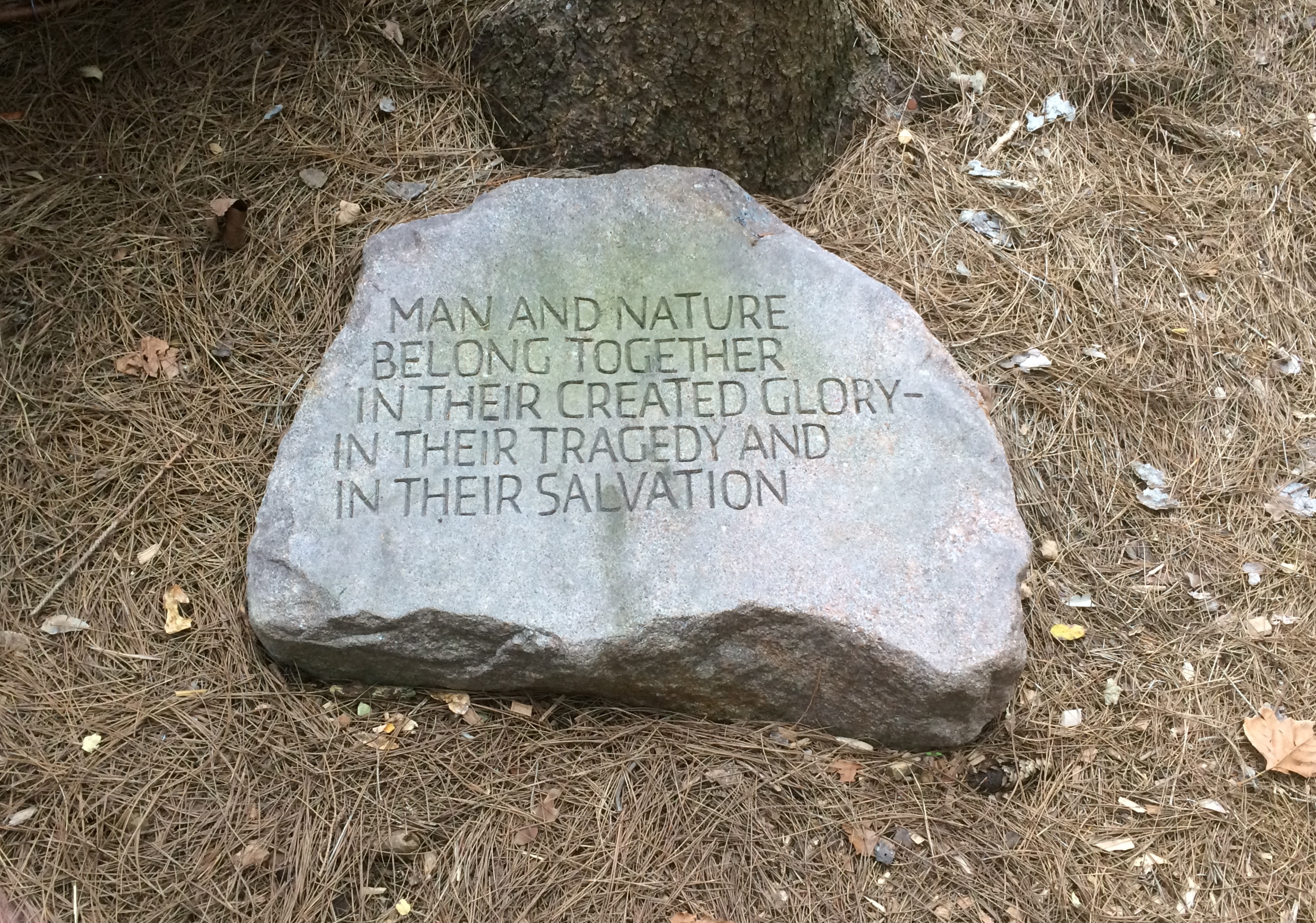
This is his stone.
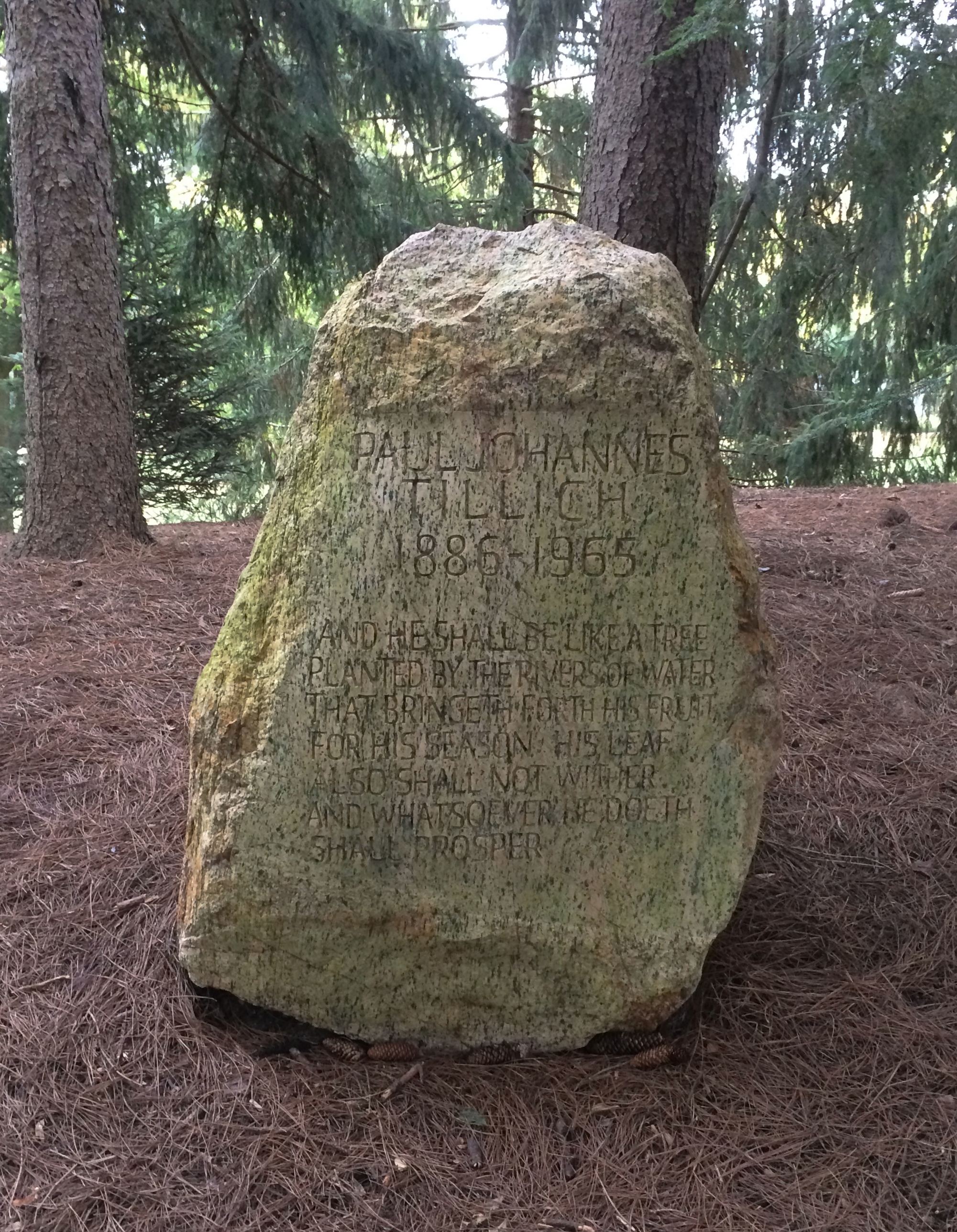
A little hard to read, even when you’re standing in front of it. Turns out to be Psalm 1:3.
PAUL JOHANNES TILLICH
1886-1965
And he shall be like a tree planted by the rivers of water, that bringeth forth his fruit for his season; his leaf also shall not wither; and whatsoever he doeth shall prosper.
What’s Tillich doing in Indiana? Broadly speaking, he was another inadvertent gift to the United States from the Nazis, like Einstein or Thomas Mann or Billy Wilder or Walter Gropius. Tillich came to America in 1933 and held a number of academic posts in this country. Apparently he was taken with the history and setting of New Harmony.
“Before his death in 1965, the philosopher Paul Tillich hoped to make New Harmony a center for his own teachings, and thus in a way fulfill the early ambitions of Rapp and Owen in making the town an example of spiritual and material concerns successfully united,” notes a 1978 New York Times article, which is worth reading all the way through. “The trust created Paul Tillich Park…”
Jane Blaffer Owen’s trust, that is, mentioned yesterday.
“Jane Owen’s charisma emanated from her spiritual liberality [also, maybe, her largesse]. She was profoundly affected by the teaching of the twentieth-century German-American theologian Paul Tillich, becoming by turns his admirer, student, and friend….” writes Stephen Fox in a magazine published by Rice University — also worth reading all the way through.
“In 1963, she persuaded Tillich to come to New Harmony to dedicate a site across Main Street from the Roofless Church for a park to be named in his honor.”
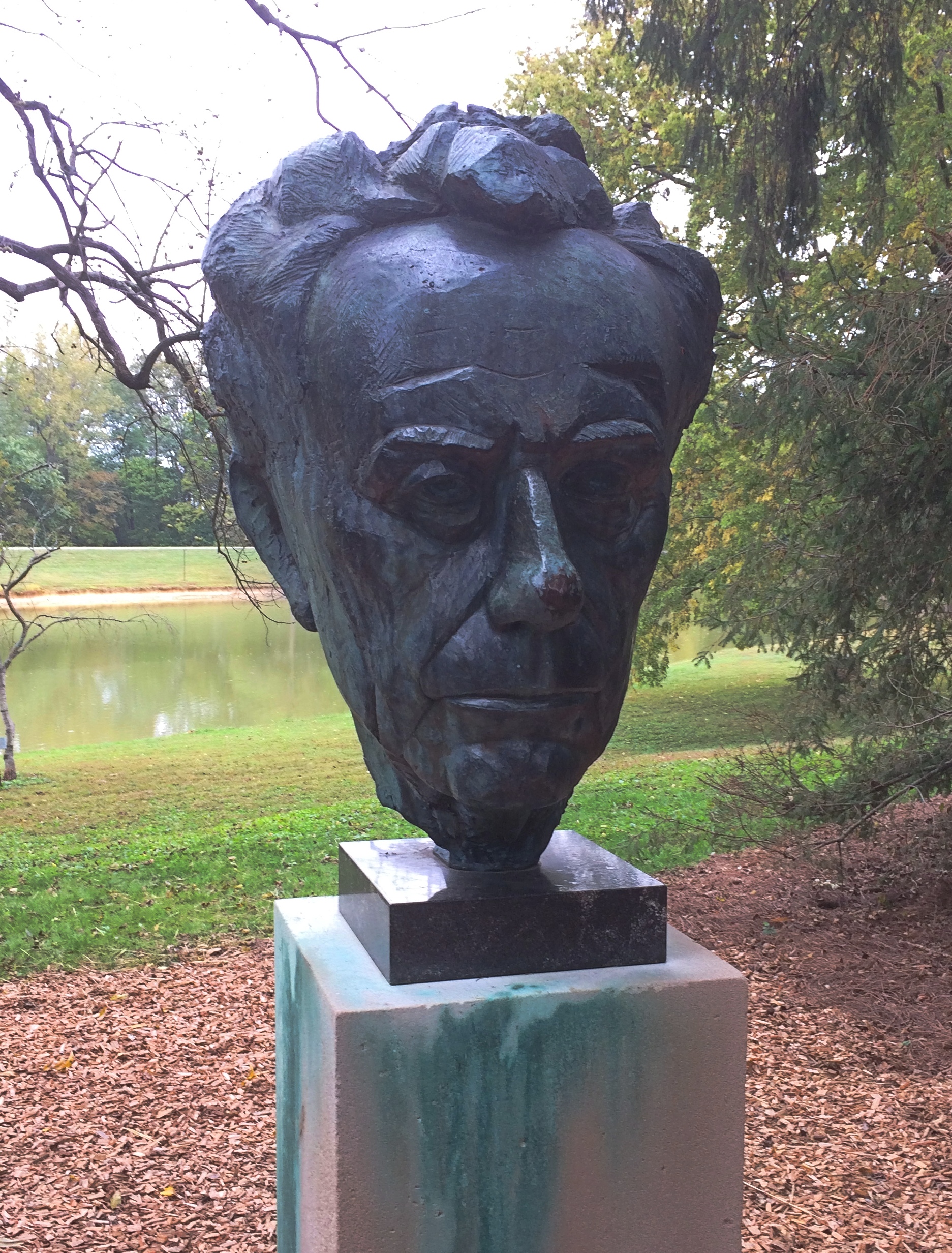
“On [Philip] Johnson’s recommendation, she had the New York landscape architects Zion & Breen design a natural setting of grassless berms planted thickly with spruce and hemlock trees, around which granite boulders inscribed with passages from Tillich’s writings and a bronze bust by James Rosati were installed. This is where Tillich’s ashes were interred in 1966.”
This is the Rosati bust.
We weren’t quite finished with New Harmony after visiting Tillich. We spent some time at the town’s labyrinth, formally the Cathedral Labyrinth and Sacred Garden and patterned after one in Chartres Cathedral. Another work of the Robert Lee Blaffer Foundation.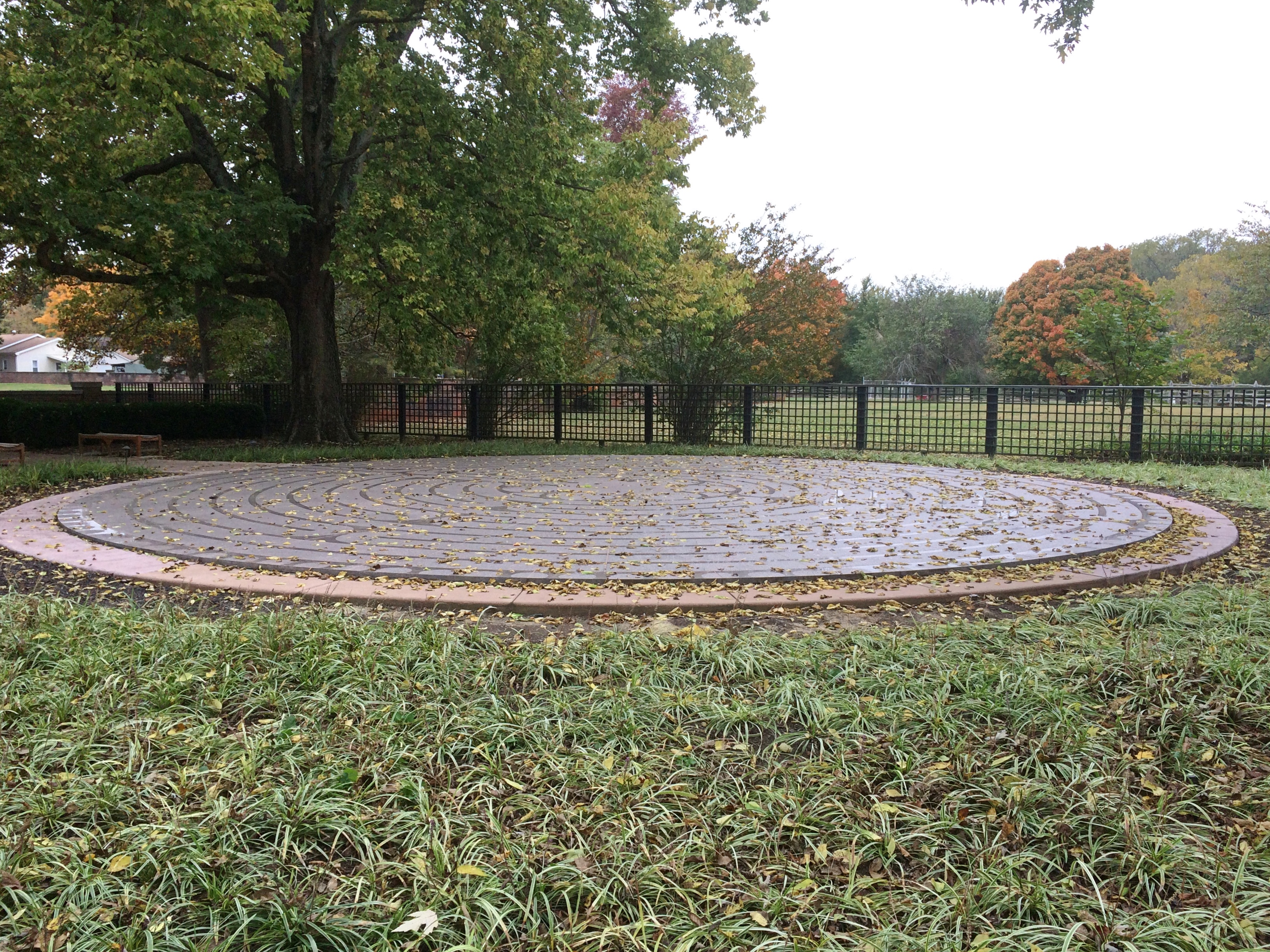
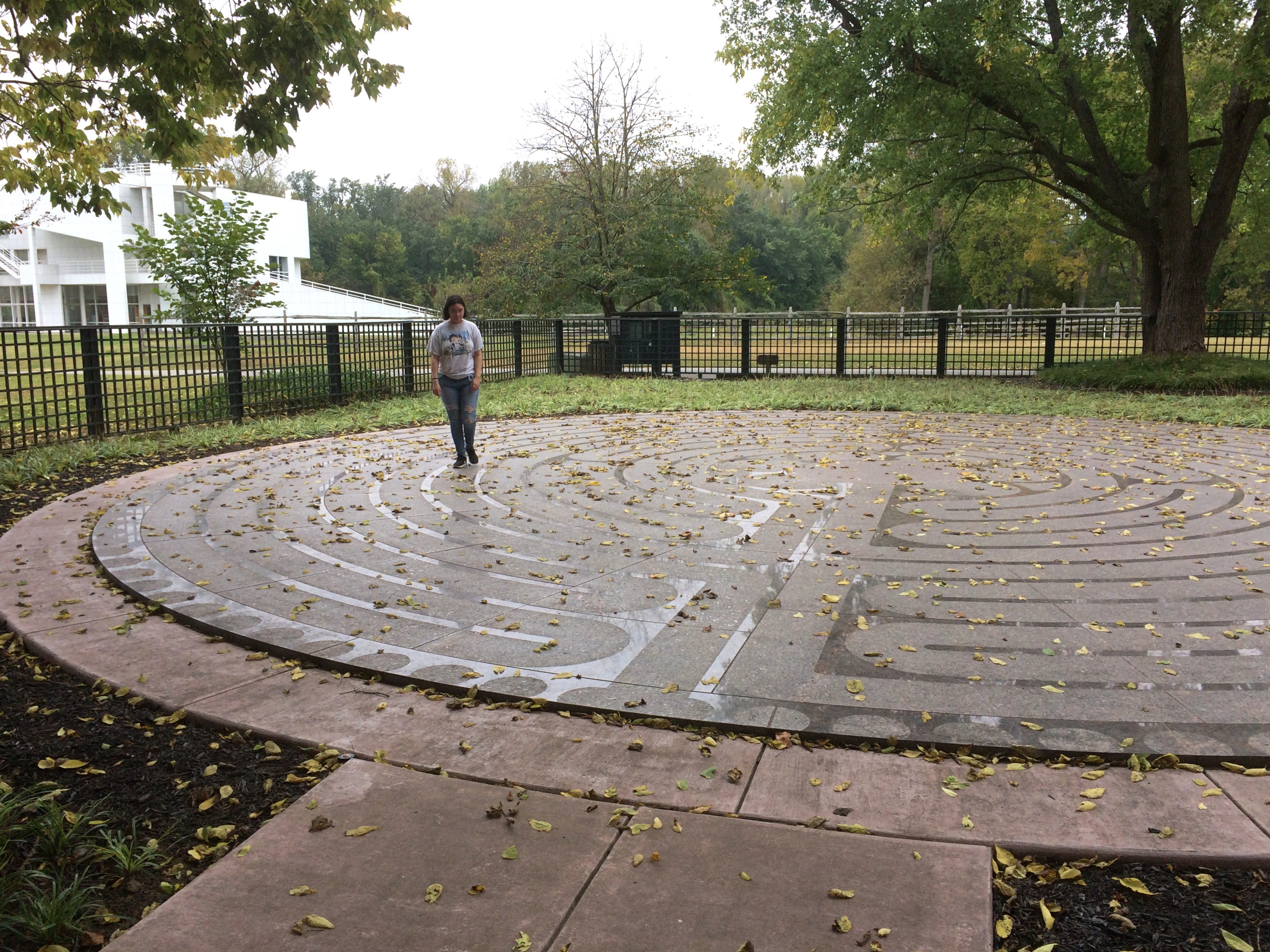
We spent some time walking it. Ann had more patience with it than I did.
Finally, we approached the Harmonist Cemetery, or the Rappite Cemetery, a burying ground surrounded by a low wall. Outside the wall are an assortment of well-worn stones, dating from the 19th century but after the utopian experiments in New Harmony.
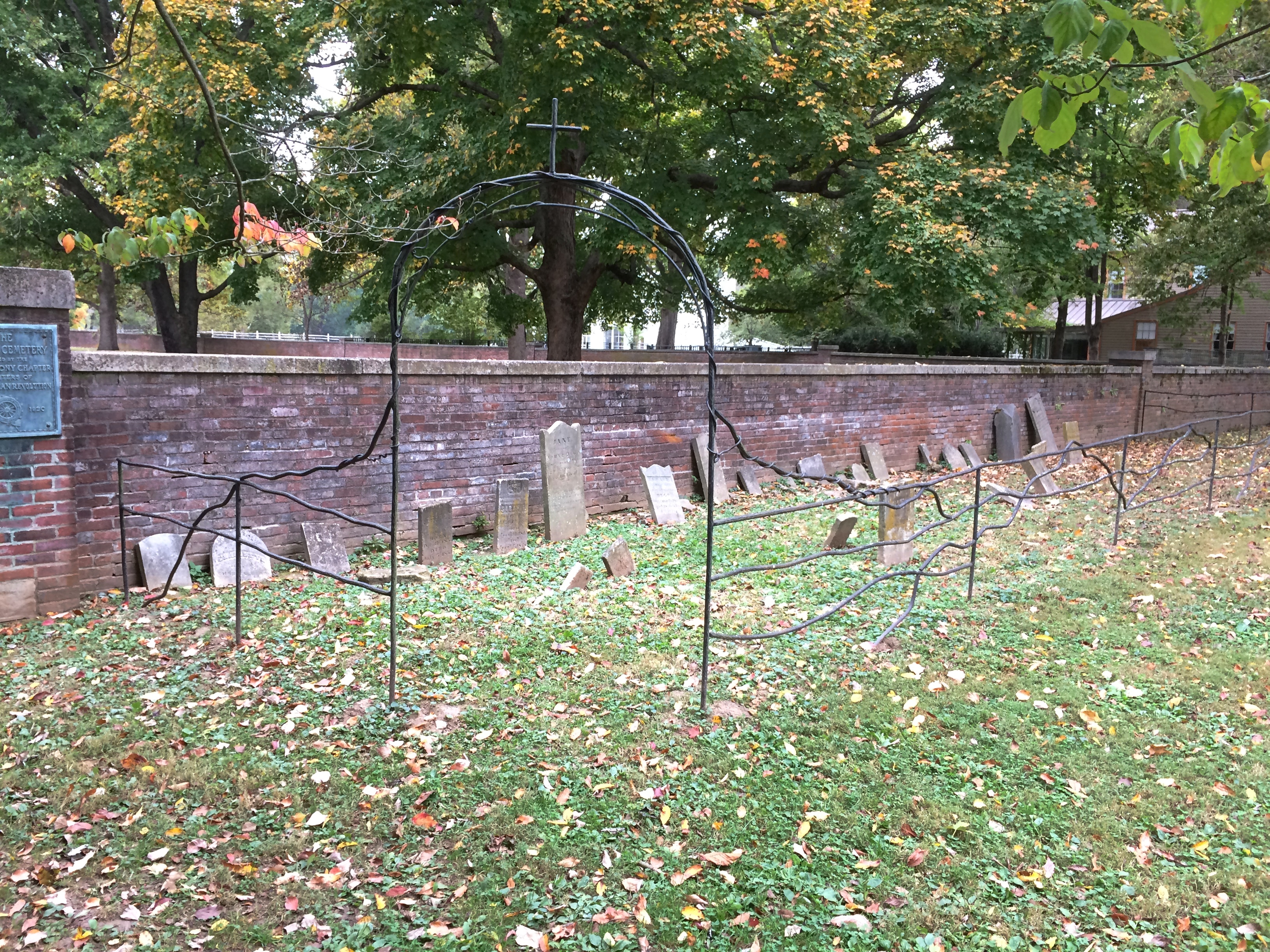
Many are illegible, but I could read the names and much of the info on this one.
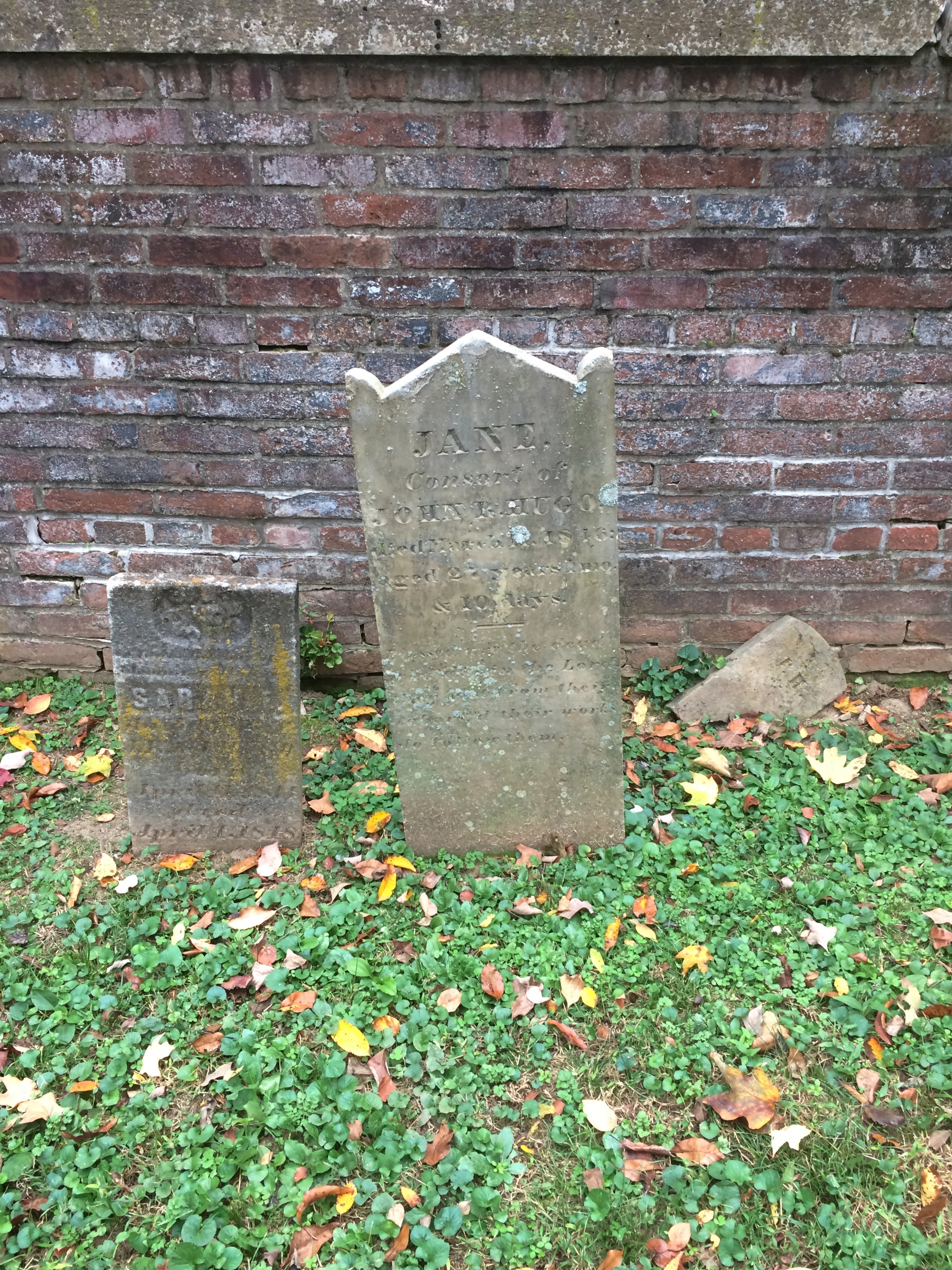
JANE
Consort of
JOHN T. HUGO
Died March 11, 1846
Aged 27 years, __ months and 10 days.
“Consort” isn’t a word I’ve seen too much in cemeteries, but maybe I don’t go to the right ones.
Behind the wall are no stones, just a wide expanse of grassy ground.
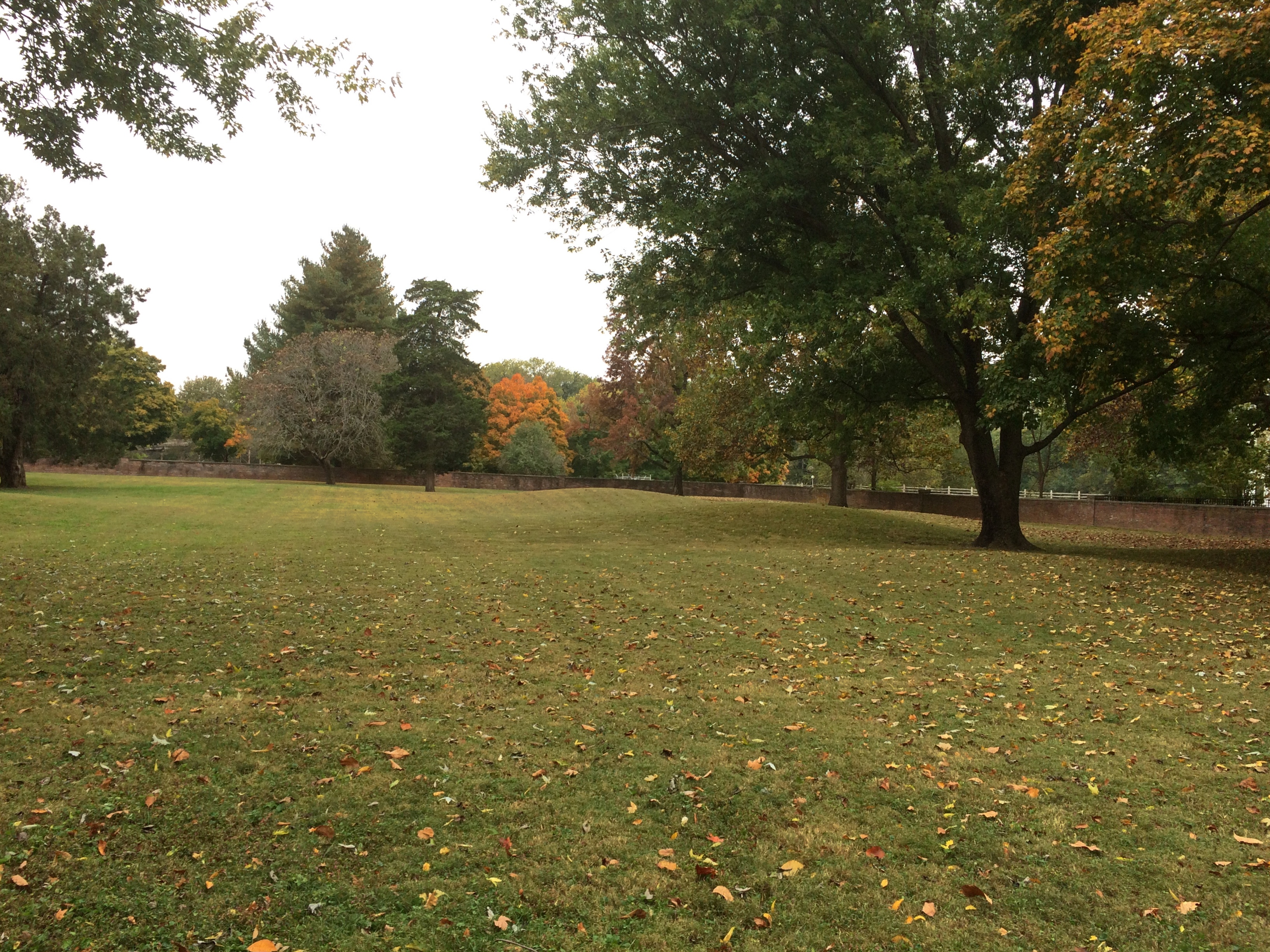
There was nothing on site to explain that, but after a moment’s thought we speculated that the Harmonists didn’t believe in individual gravesites or markers, so we were looking at a mass grave. Later I checked, and that’s correct. Ann said that made the site unsettling, and I suppose mass graves can be, say if mass violence was involved. I don’t think that was the case for the Harmonists; just the result of the everyday dangers of living in the 19th-century frontier.
Note also the mounds. Apparently the area was home to Indian mounds before the Harmonists came, and so they must have considered it a natural for a burial ground. About 230 of the colonists lie there.
New Harmony, Indiana, Part 1
Almost all of our Columbus Day weekend trip — Italian Food Day, as Ann calls it — was spent in Illinois, but on October 12 as we drove north toward home, we crossed into Indiana for a visit to the town of New Harmony on the Wabash River, just across from Illinois.
The Harmony Society, originally from Württemberg, moved to the Indiana Territory in 1814 from Pennsylvania and founded the town. You could call the group utopian, but my impression (from only a dollop of reading) is that they were Lutheran separatists and chiliasts. Or you could call them Indiana Territory communists, since they held all of their property in common, before that meant being reds.
Even so, they made a go of it, prospering before selling the site and moving back to Pennsylvania in 1825 at the direction of their leader, George Rapp. “They produced quality products including textiles, rope, barrels, tin ware, leather goods, candles, bricks and much more using the latest machinery and technology available,” the Visit New Harmony web site says.
“Because beverages were in demand [I’ll bet] in neighboring and river towns, wine, whiskey and beer were produced in large quantities. The daily production of whiskey was about 32 gallons and 500 gallons of beer were brewed every other day.”
Welch industrialist Robert Owen bought the place in the 1820s, all 2,000 acres of it, with his own utopian experience in mind. His was a more straightforward failure.

“Owen’s ‘Community of Equality,’ as the experiment was known, dissolved by 1827, ravaged by personal conflicts and the inadequacies of the community in the areas of labor and agriculture,” the University of Southern Indiana explains.
Yet the history of the town didn’t stop when the second experiment did. Scientific and other intellectual activity continued in New Harmony through much of the 19th century, and structures unusual in a Hoosier town rose throughout much of the 20th century. In our time, the restored 19th-century structures and the modernist touches of the 20th century make for an interesting amalgam.
We parked in the lot near the New Harmony Atheneum and started our walk around town.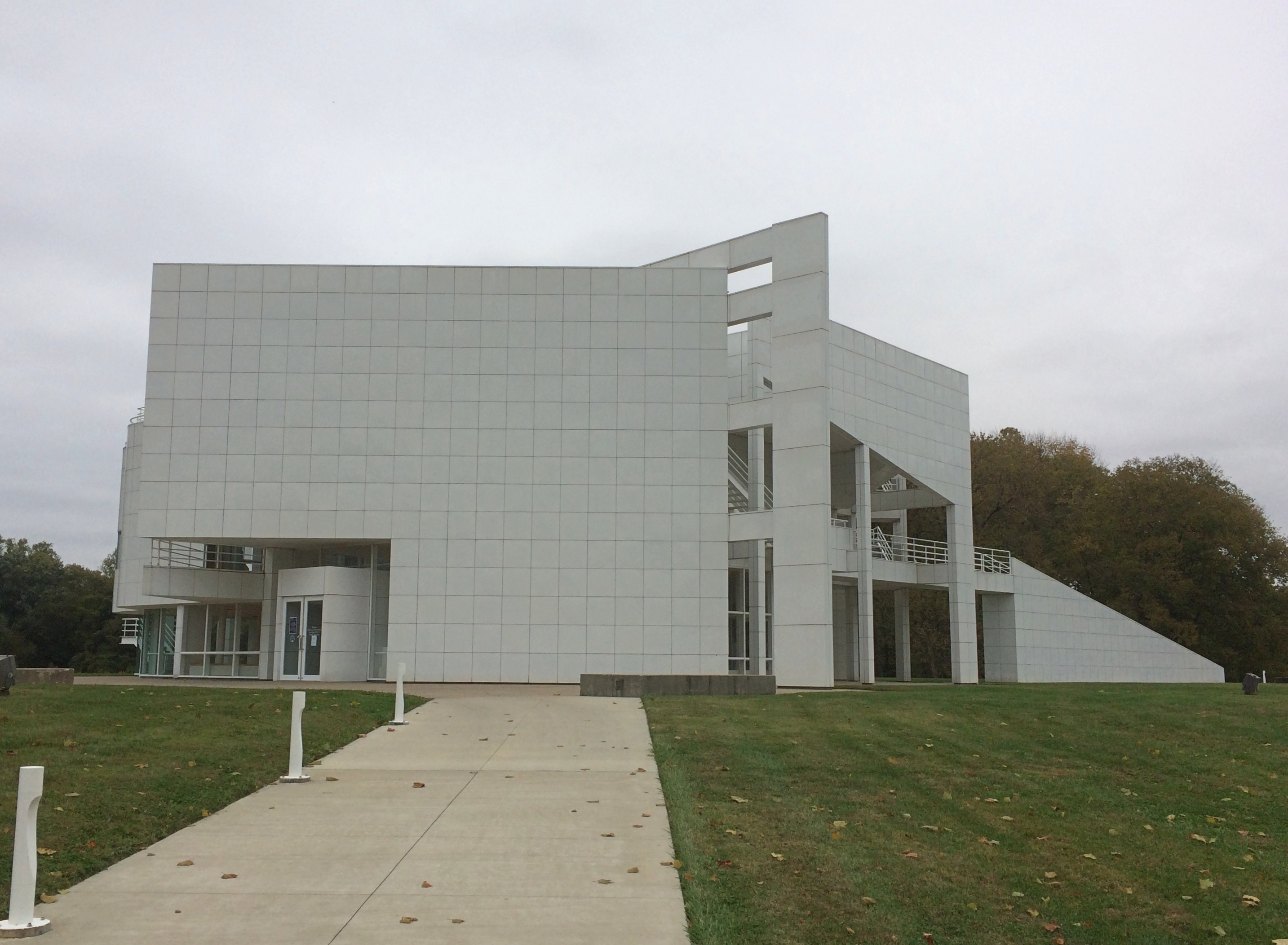
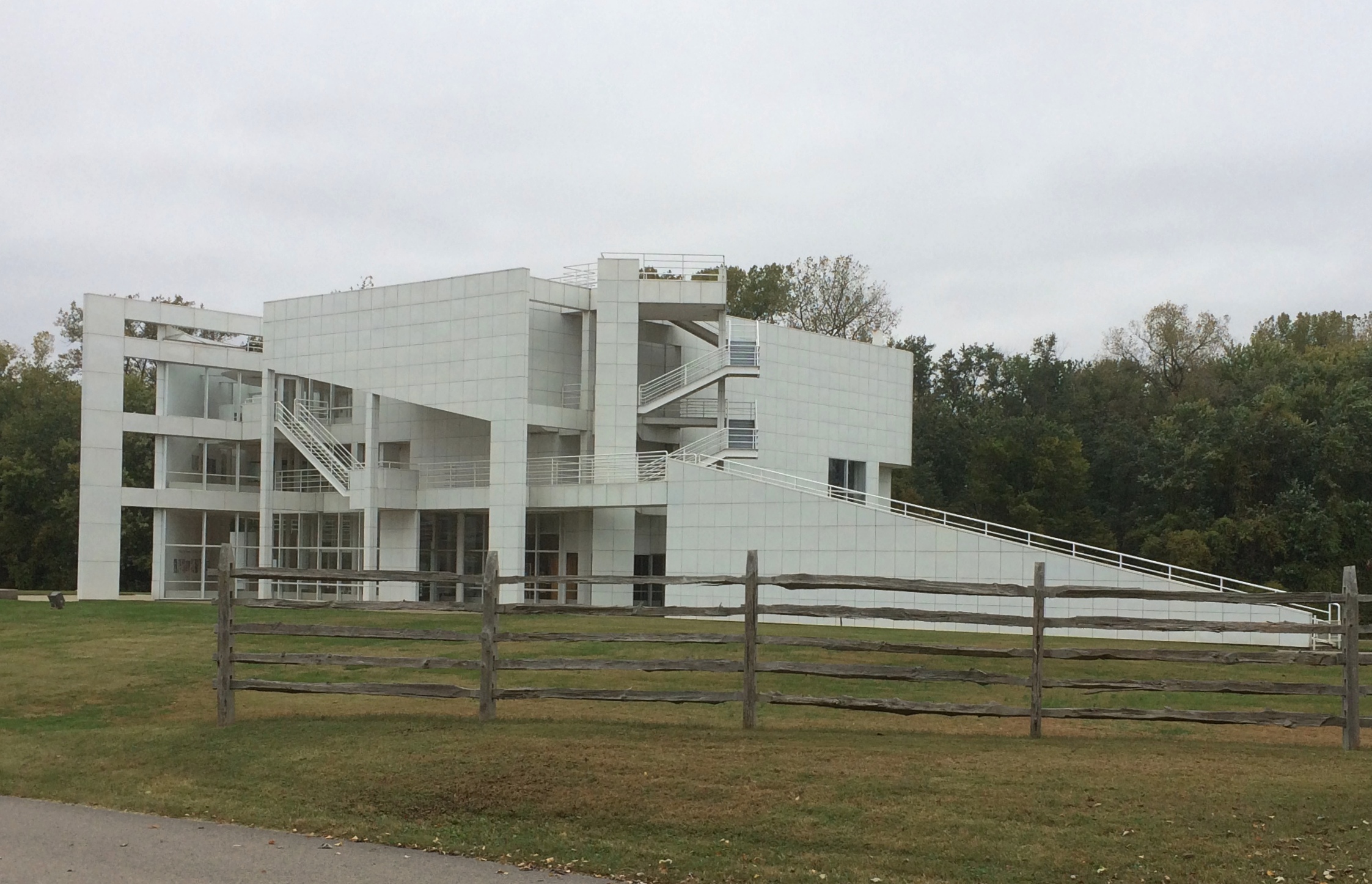
“Clad in white porcelain panels and glass attached to a steel frame, the structure was the first major commission for the now internationally acclaimed architect Richard Meier,” Indiana Landmarks says.
“Built as a visitors’ center for the town [in 1979], the structure is designed to guide visitors along a specific route through the building, with overlaying grids offering frequent views of the surrounding buildings and countryside. From a spacious deck on the roof, visitors can look out over the town and take in views of the Wabash River.”
We would have done all that, but the Atheneum was closed — for Monday, not the pandemic. So on we went, a few leafy blocks to the Roofless Church.
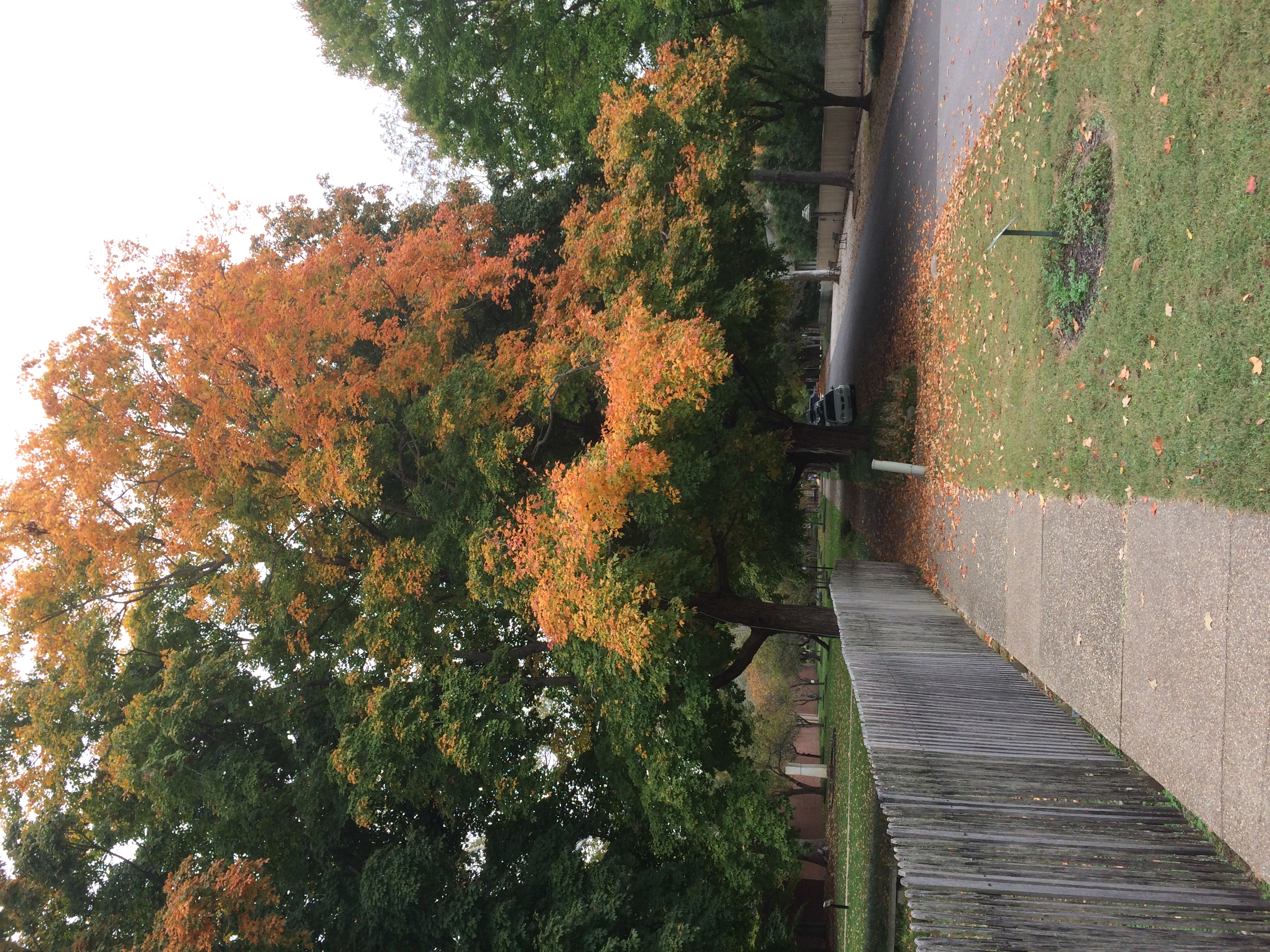
The Roofless Church is behind this wall, one of four brick walls forming a rectangle.
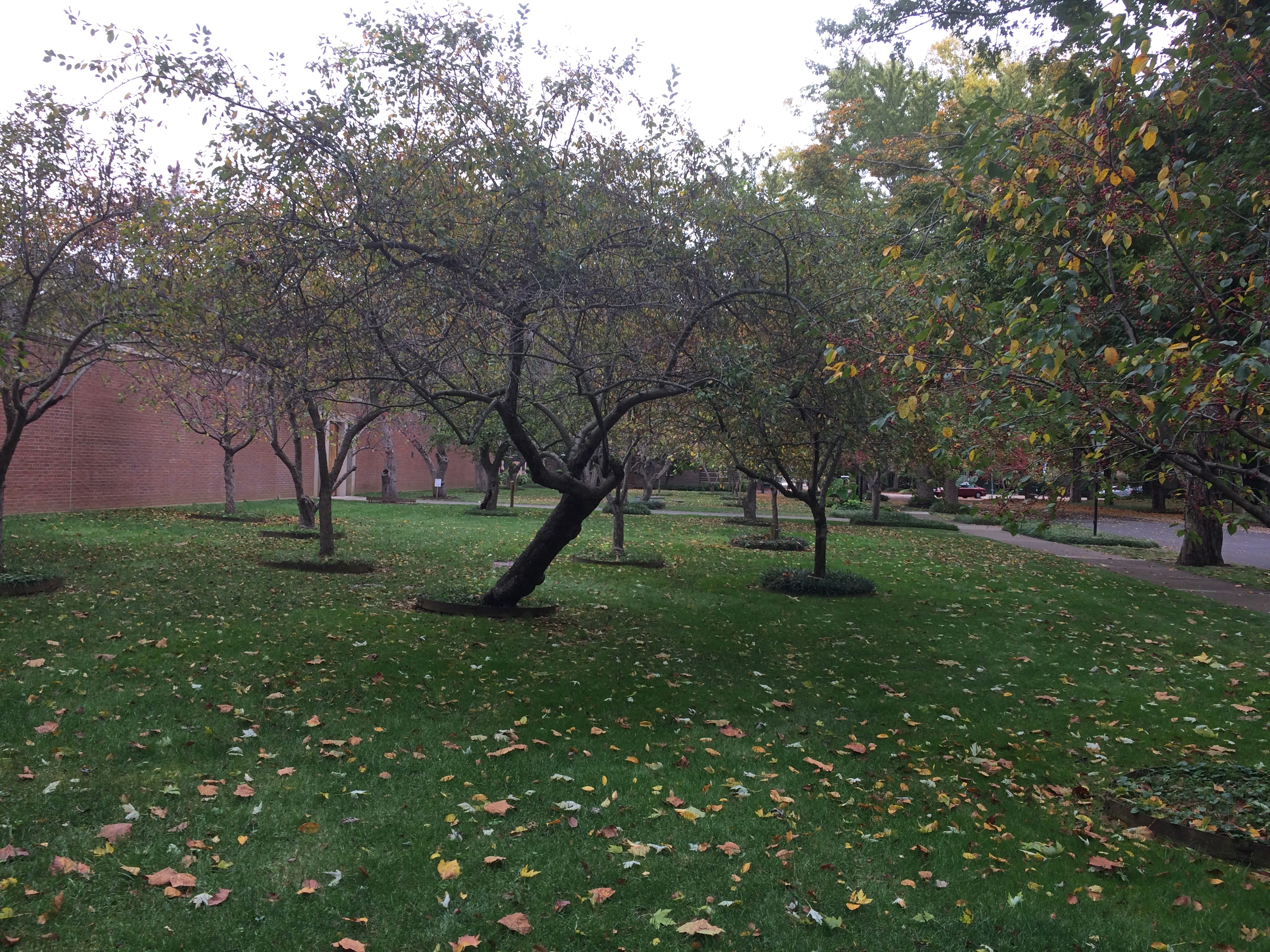
Inside the walls.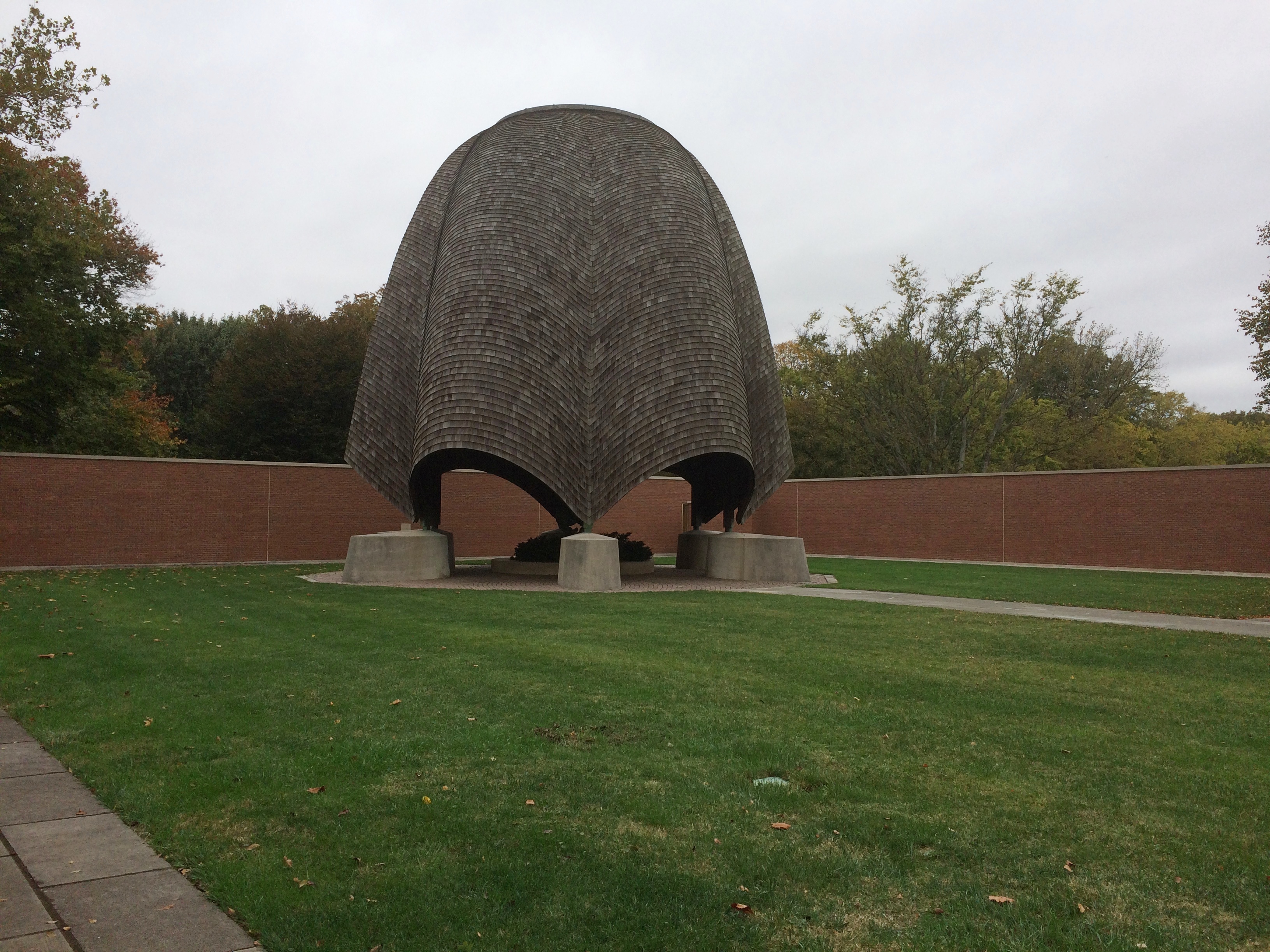
The structure was erected by the Robert Lee Blaffer Trust, according to a plaque. Jane Blaffer Owen, Humble Oil heiress, founded the organization in honor of her oilman father, and she and her husband, Kenneth Owen, a descendant of Robert Owen, proved instrumental in reinventing New Harmony in the 20th century (she died in 2010, he in 2002).
“Further down North Street and through a gap in a brick wall there is hidden a modernist masterpiece by the architect Philip Johnson, completed in 1960,” says Atlas Obscura.
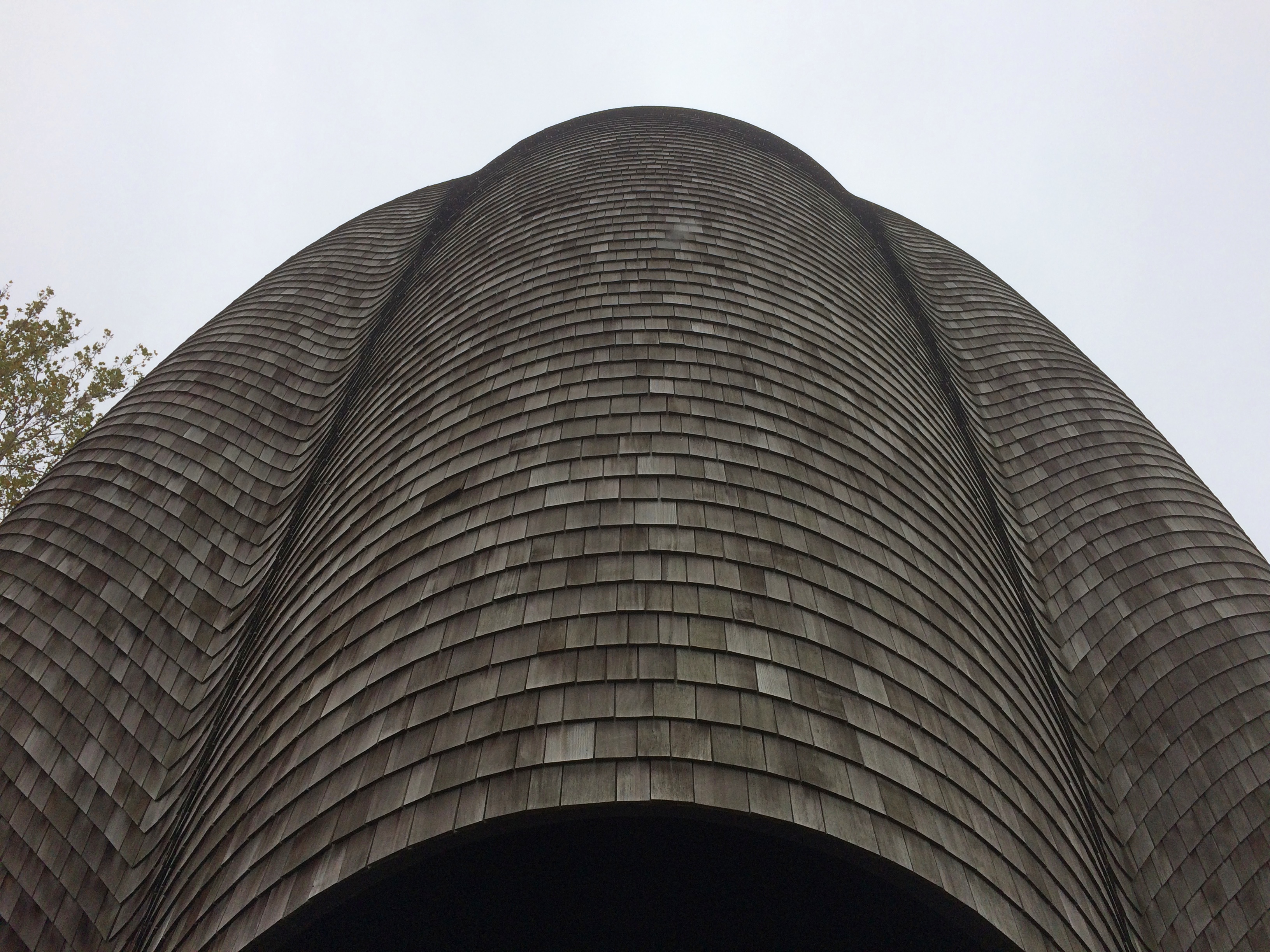
“It is called the Roofless Church and it says something about how much we expect our building to have roofs, that when people see the shingled structure in the images, they often say, ‘that’s silly, that’s a roof right there.’
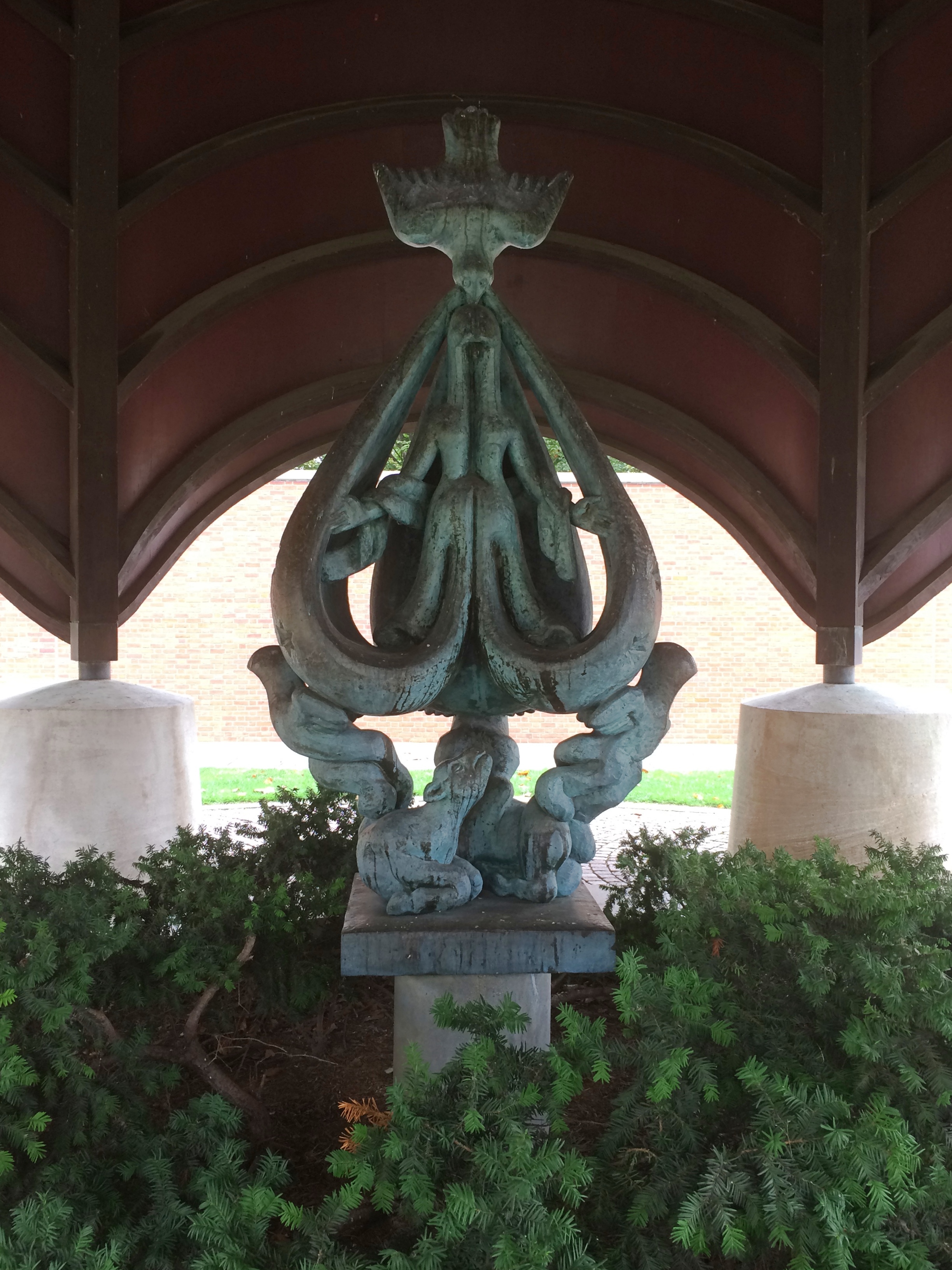
“But the church is not simply that space, it is a city block sized footprint of which only a part is enclosed. The curved parabola dome is actually a protective cover for a beautiful sculpture by Jacques Lipchitz.”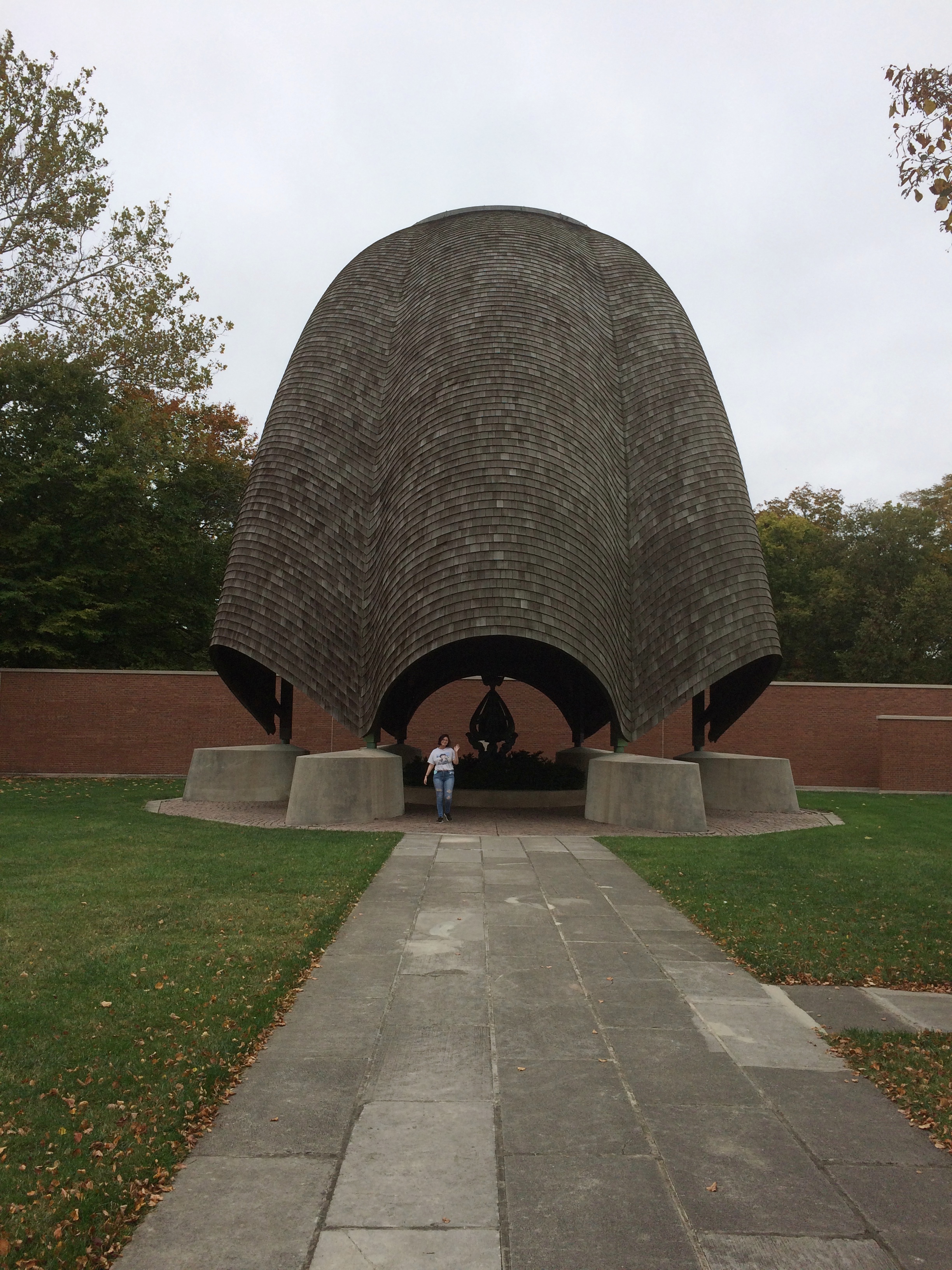
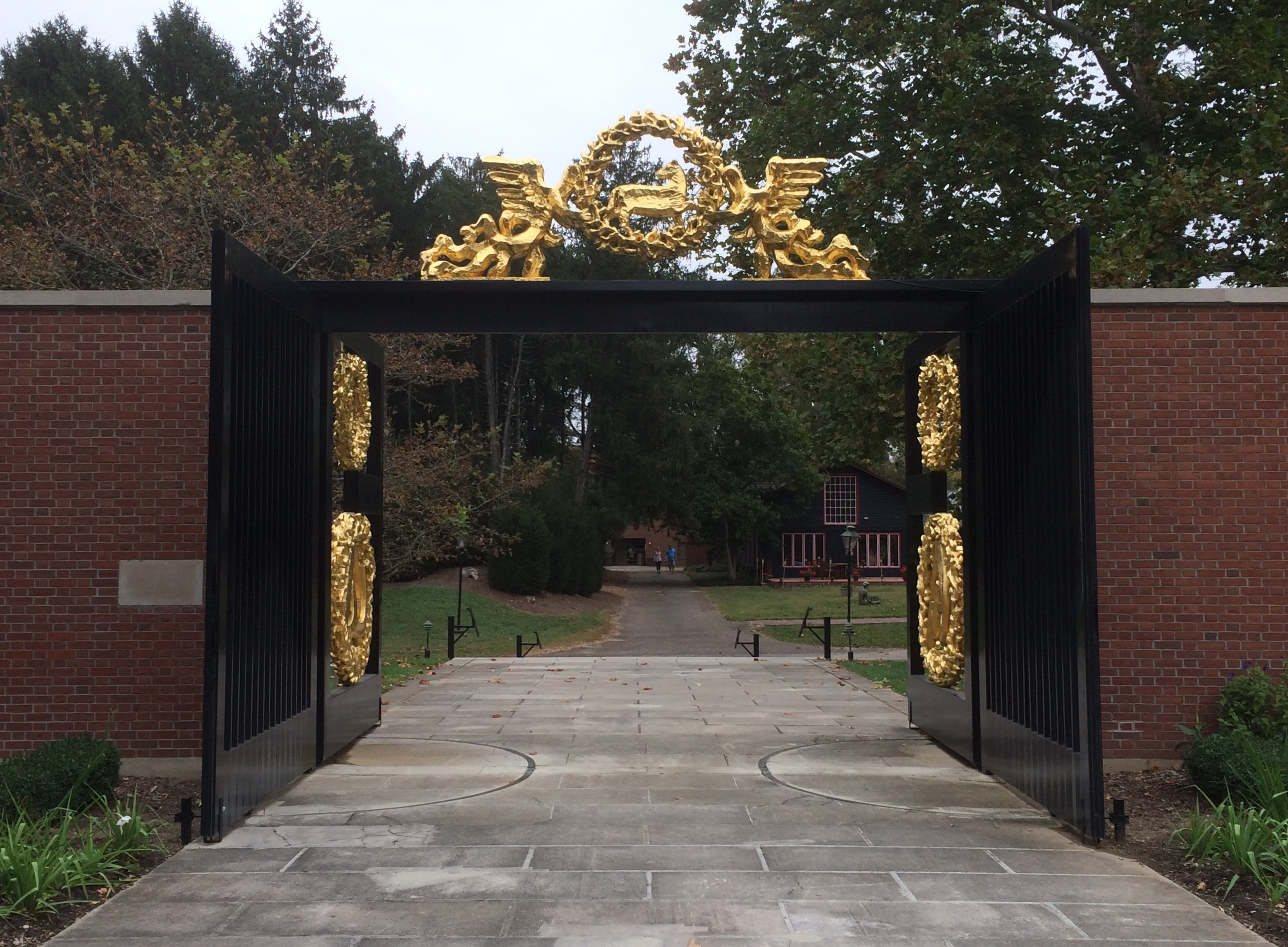
Elsewhere within the perimeter of the Roofless Church are trees and benches and small gardens. The east wall has a gate.
We walked around a pond not far from the Roofless Church.
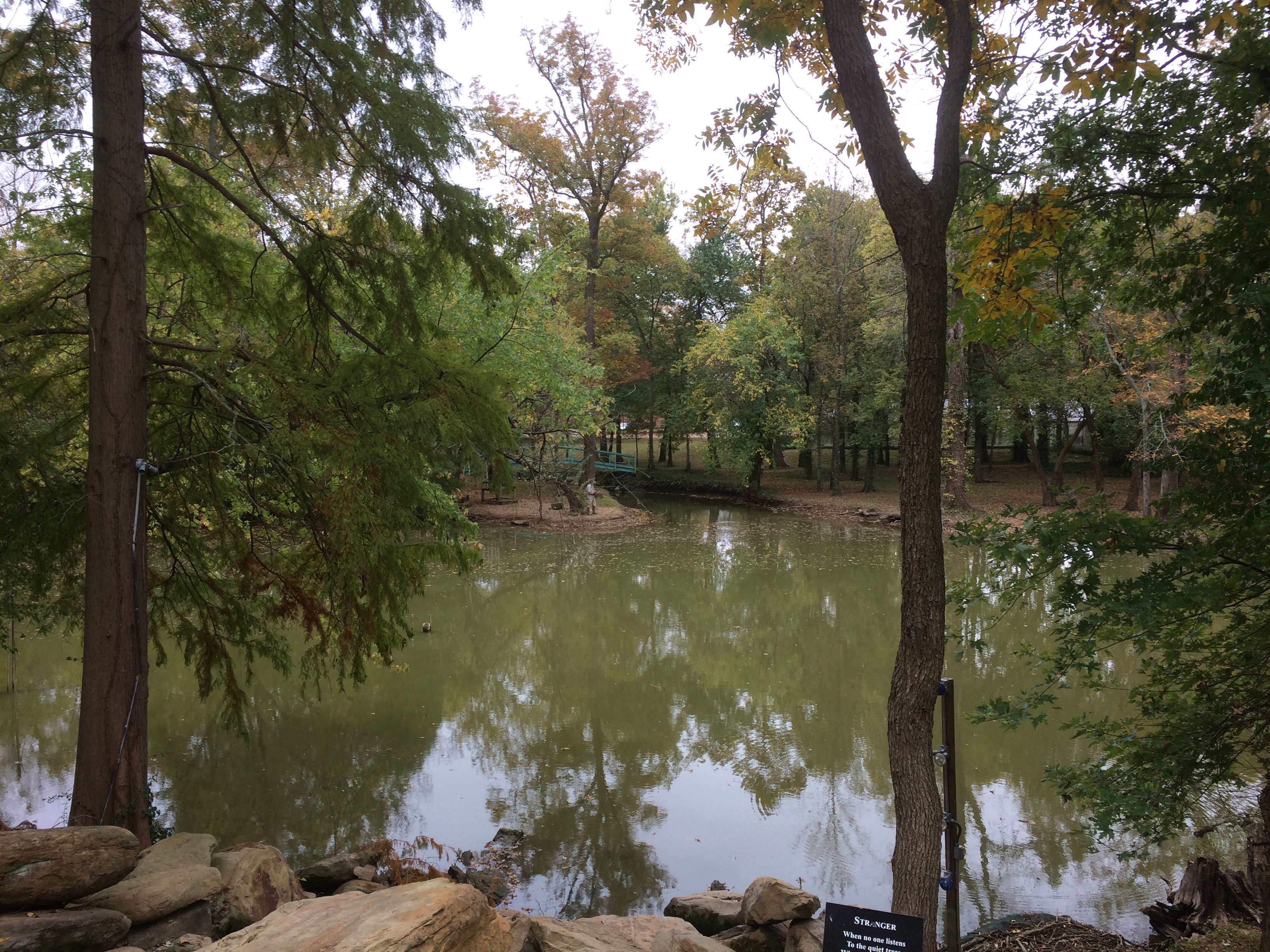
Near its edge is the Chapel of the Little Portion, built by the New Harmony Inn and Franciscan Brothers, and dedicated to St. Francis.

There’s a statue of St. Francis by the pond as well. I keep running into him. Actually, Francis and the Angel of the Sixth Seal by David Kocka.
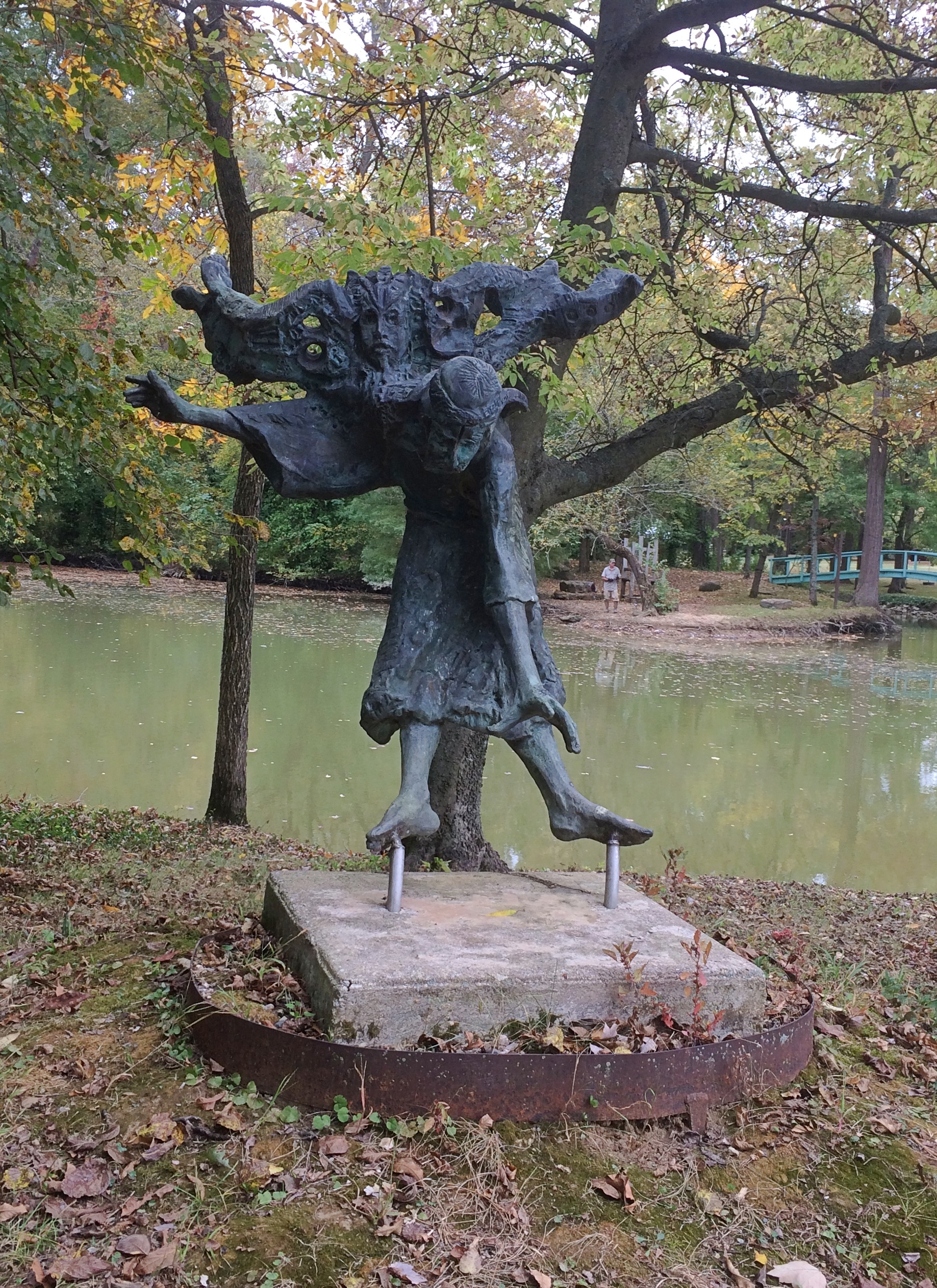
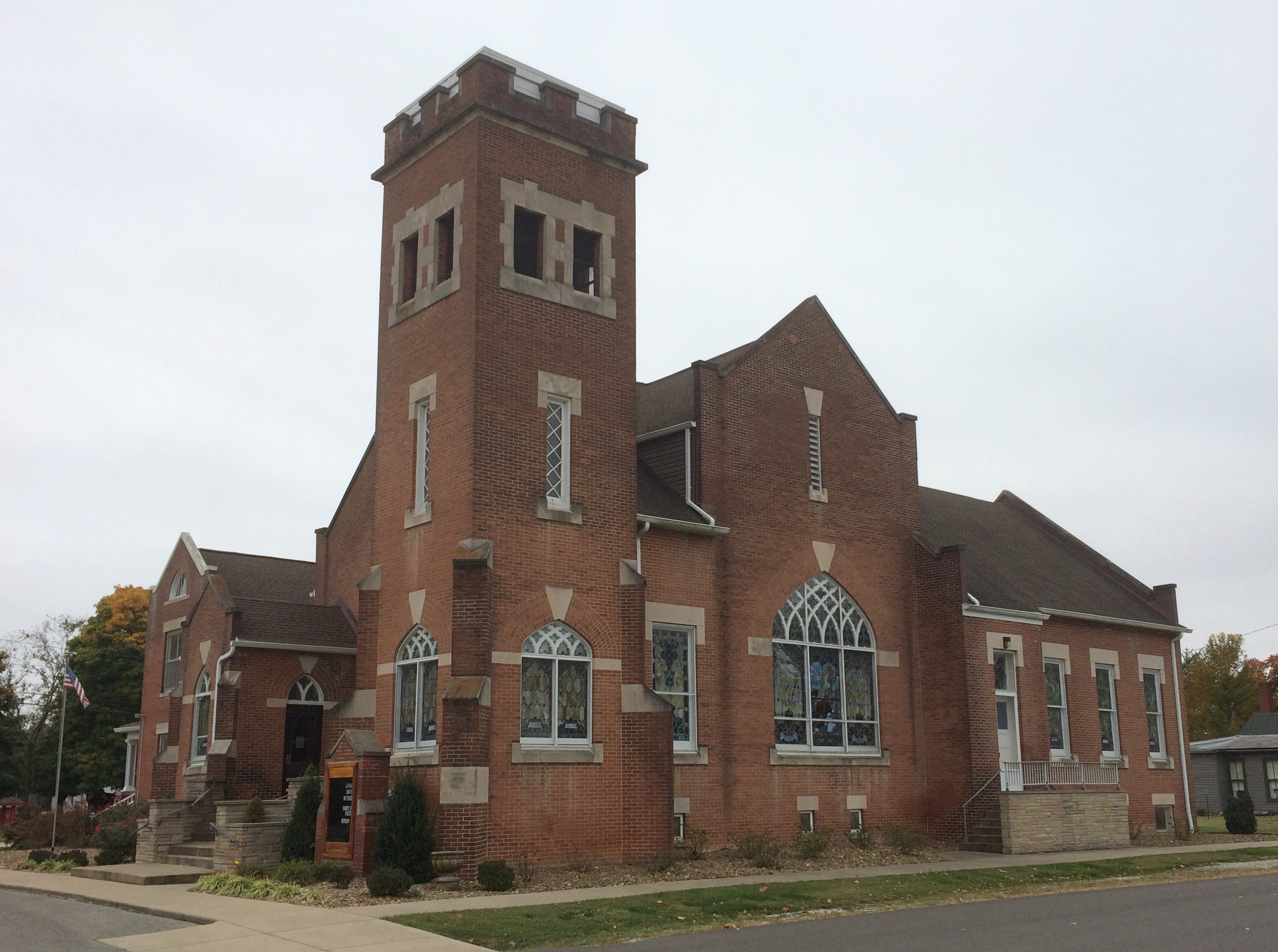
New Harmony isn’t very large, so we wandered from the pond — past the MacLeod Barn Abbey — into the main commercial part of the town in a few minutes. There you can find some handsome restored buildings, such as the Johnson United Methodist Church.
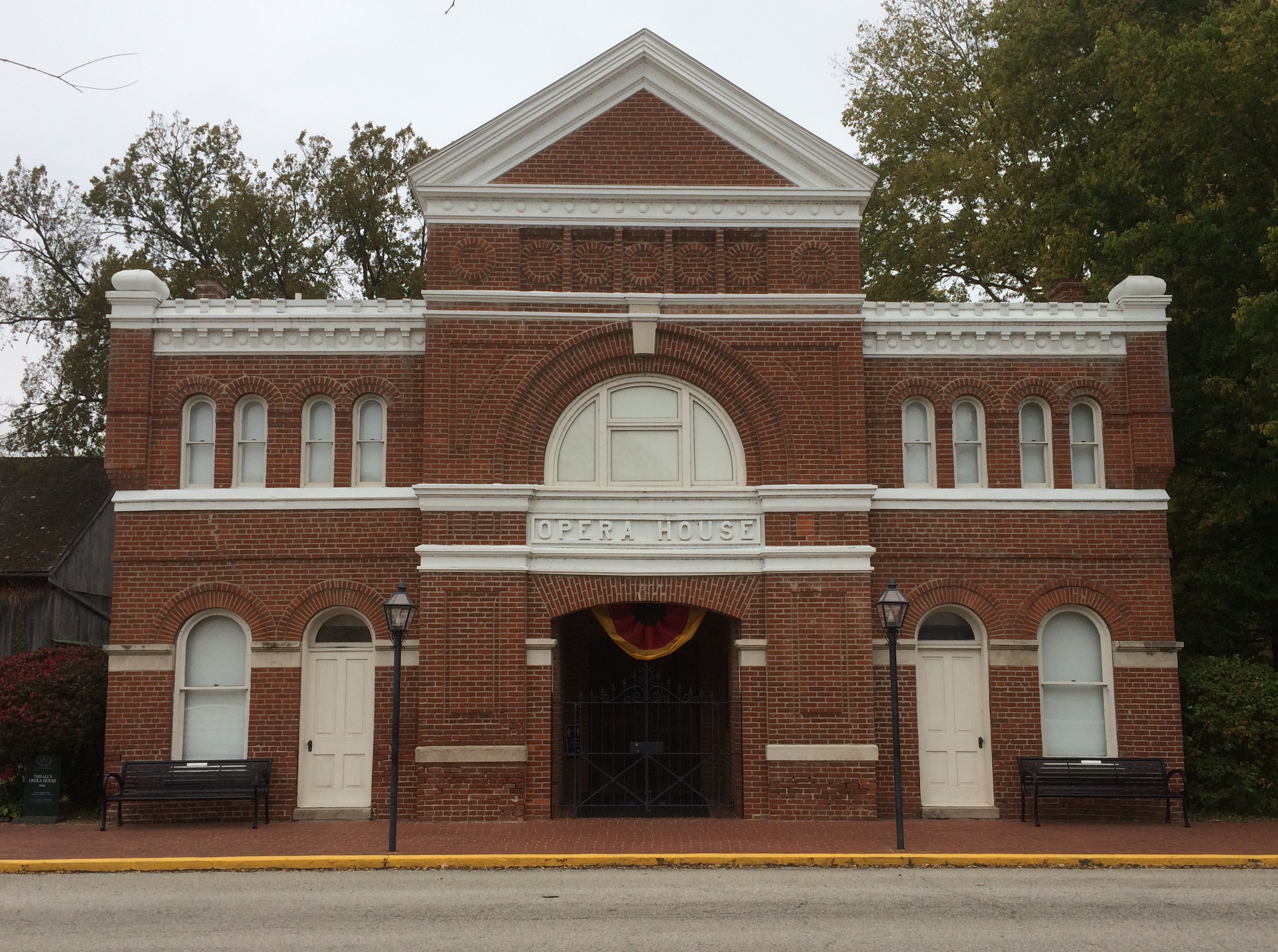
The Opera House.
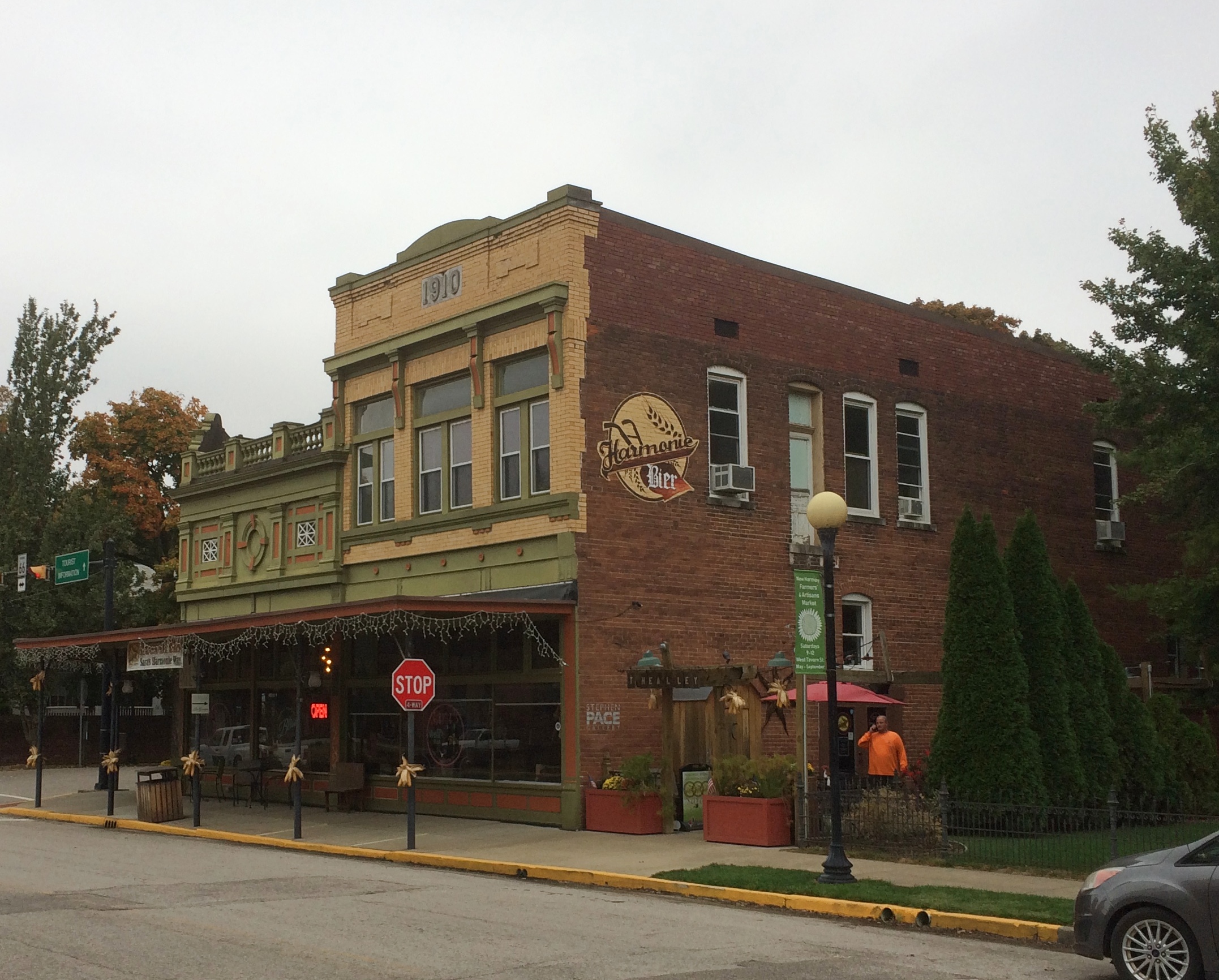
A commercial building, at least part of which dates from 1910.
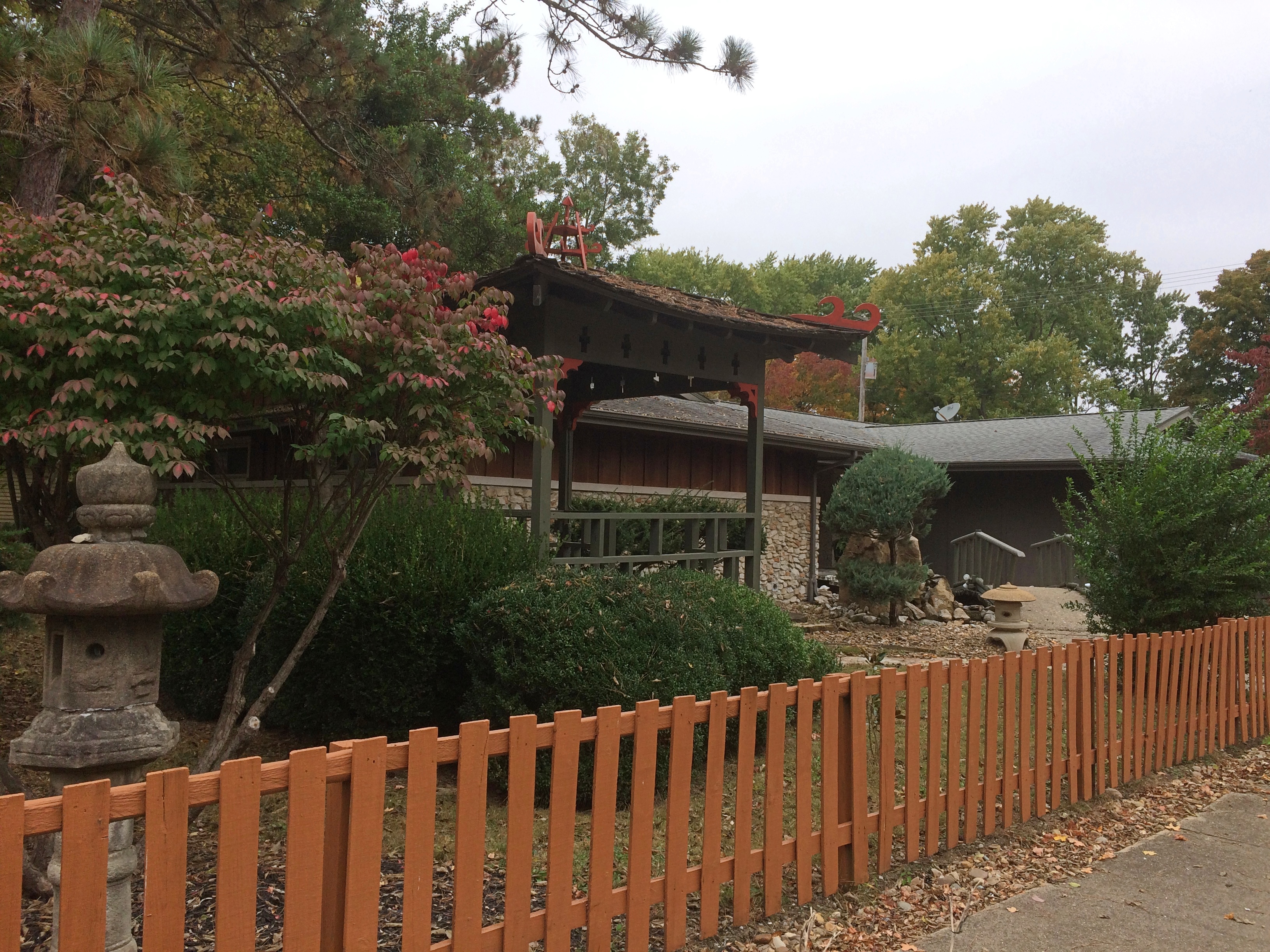
A private house (I assume) with Asian design elements.
Rappite Community House No. 2, erected 1816-22.
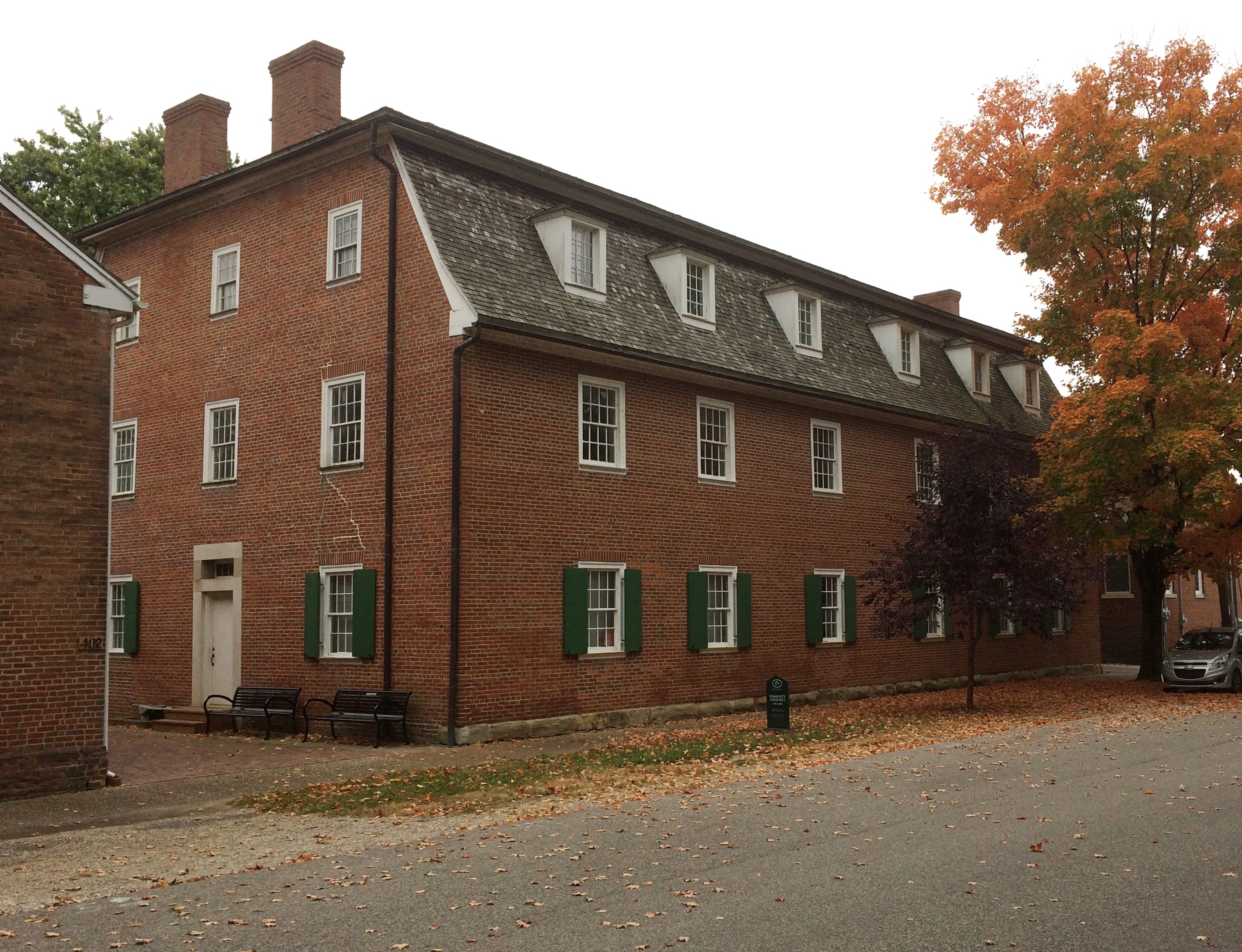
If you own everything in common, you’re going to live in communal housing.
Two Southern Illinois Towns: Cave-in-Rock, Equality
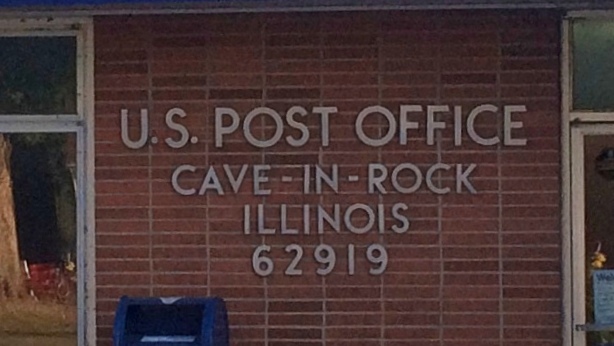 The USPS uses the hyphens in Cave-in-Rock, Illinois. I saw the post office in the town and I documented the usage. Other signs around town were about evenly split on using hyphens.
After we visited the state park of the same name, I took a walk around town, mostly along a short stretch of Main Street, while Ann lounged around in the car.
The town’s actual main street seems to be Canal Street, but Main — which parallels the Ohio River — features the post office and Cave in Rock United Methodist Church, which doesn’t bother with the hyphens. Actually, according to the sign out front, the church doesn’t bother with “Cave in Rock” at all.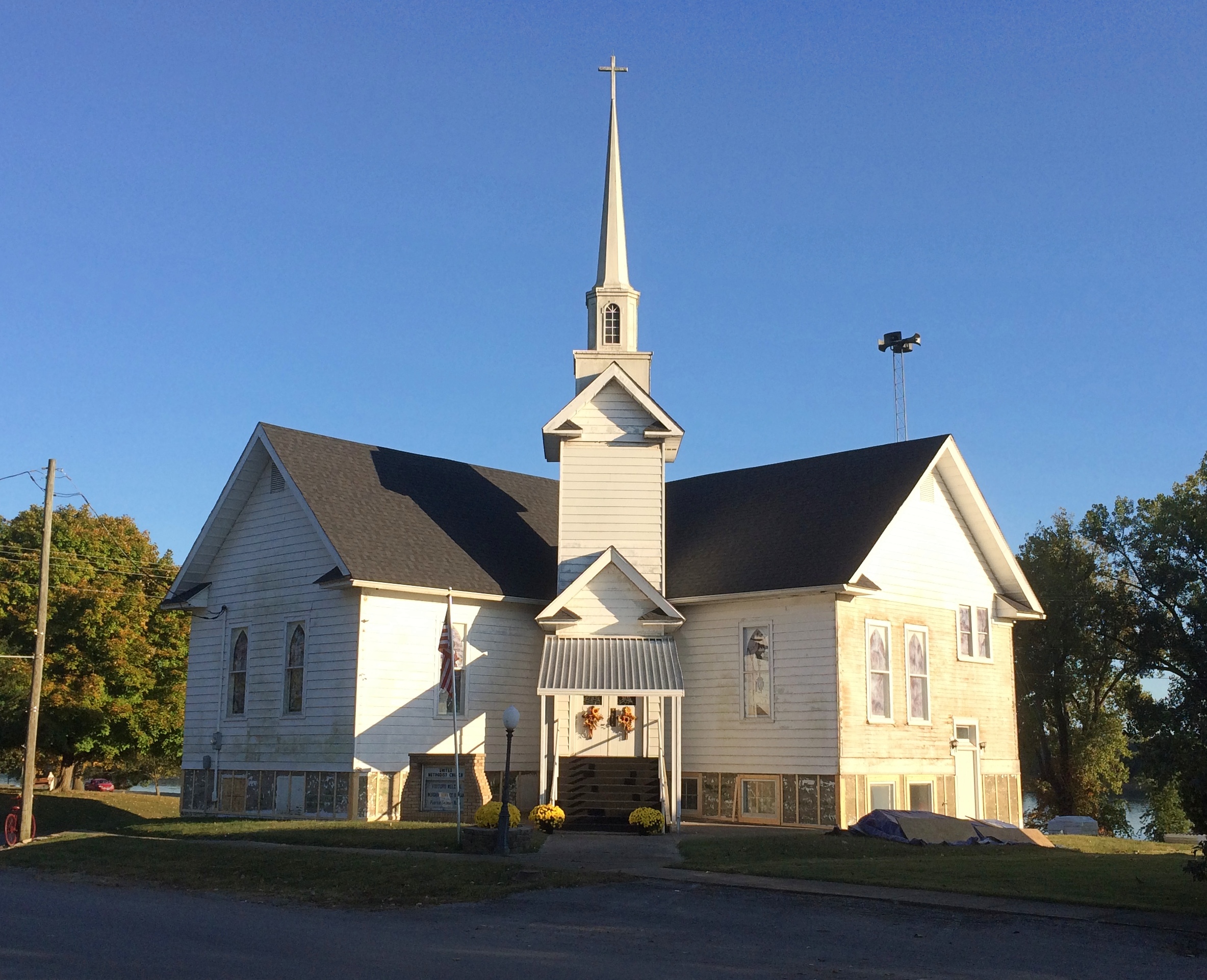
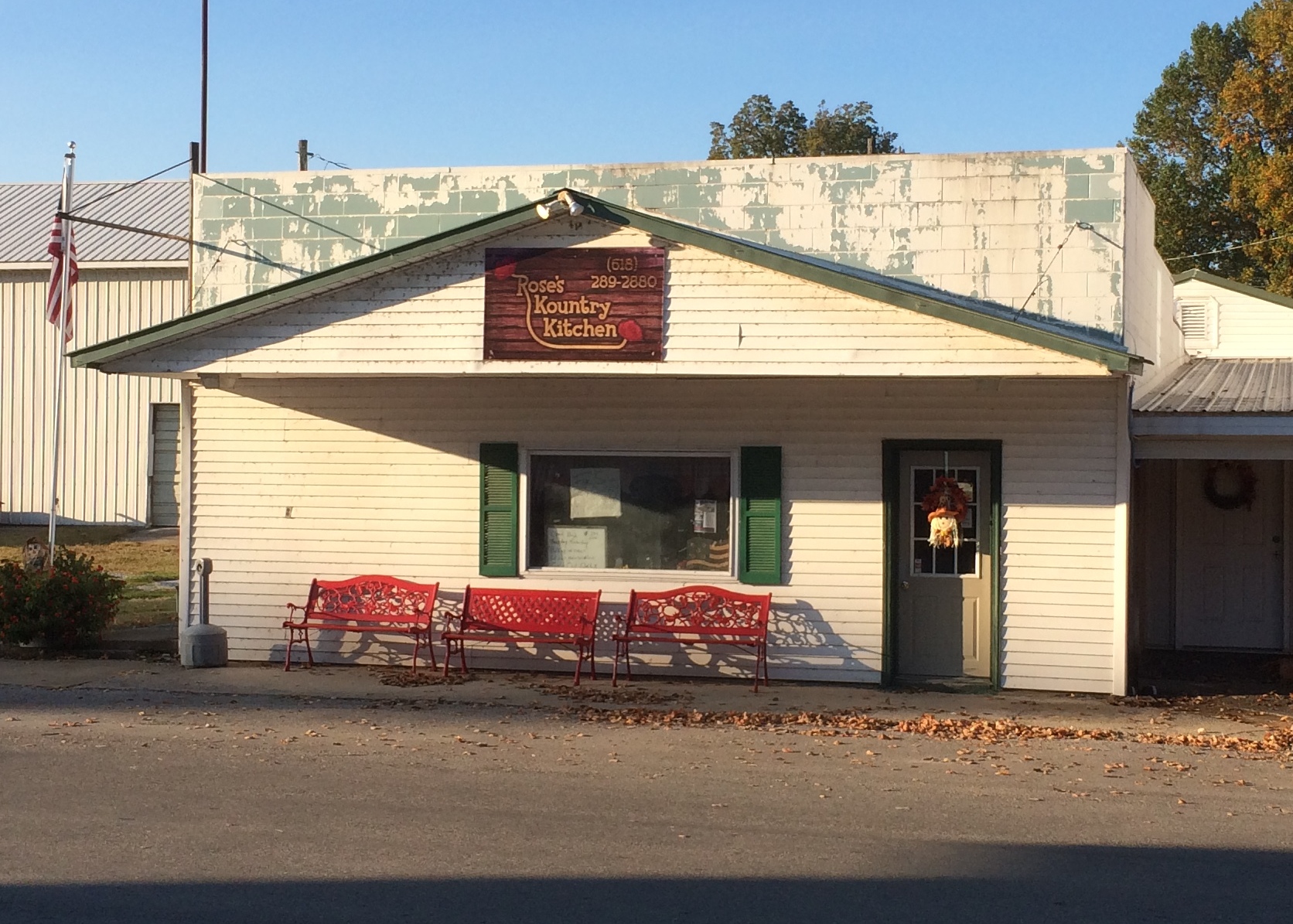
Rose’s Kountry Kitchen. Not too busy, but it was Sunday afternoon.
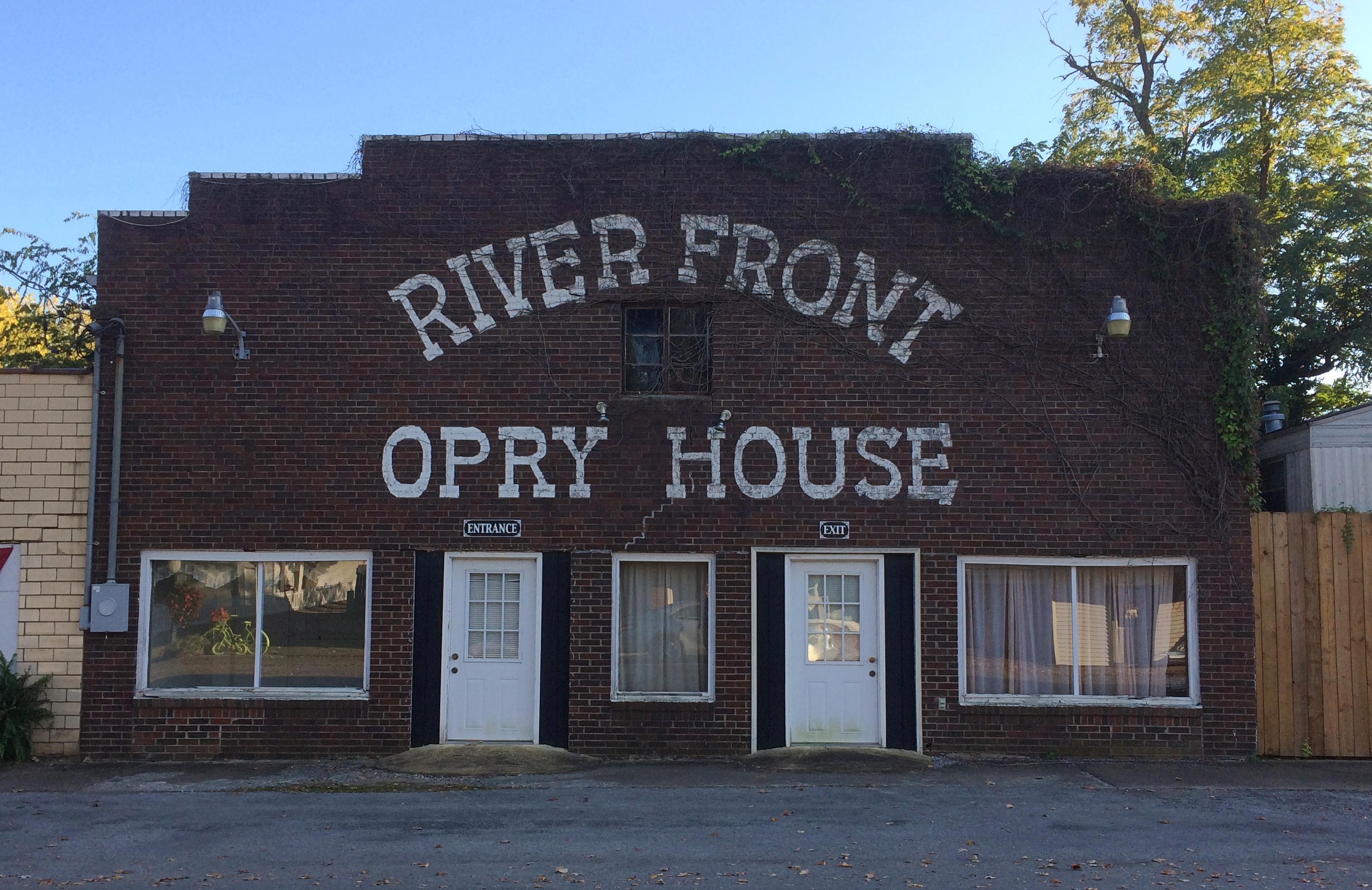
The River Front Opry House. Not sure if anything goes on there anymore.
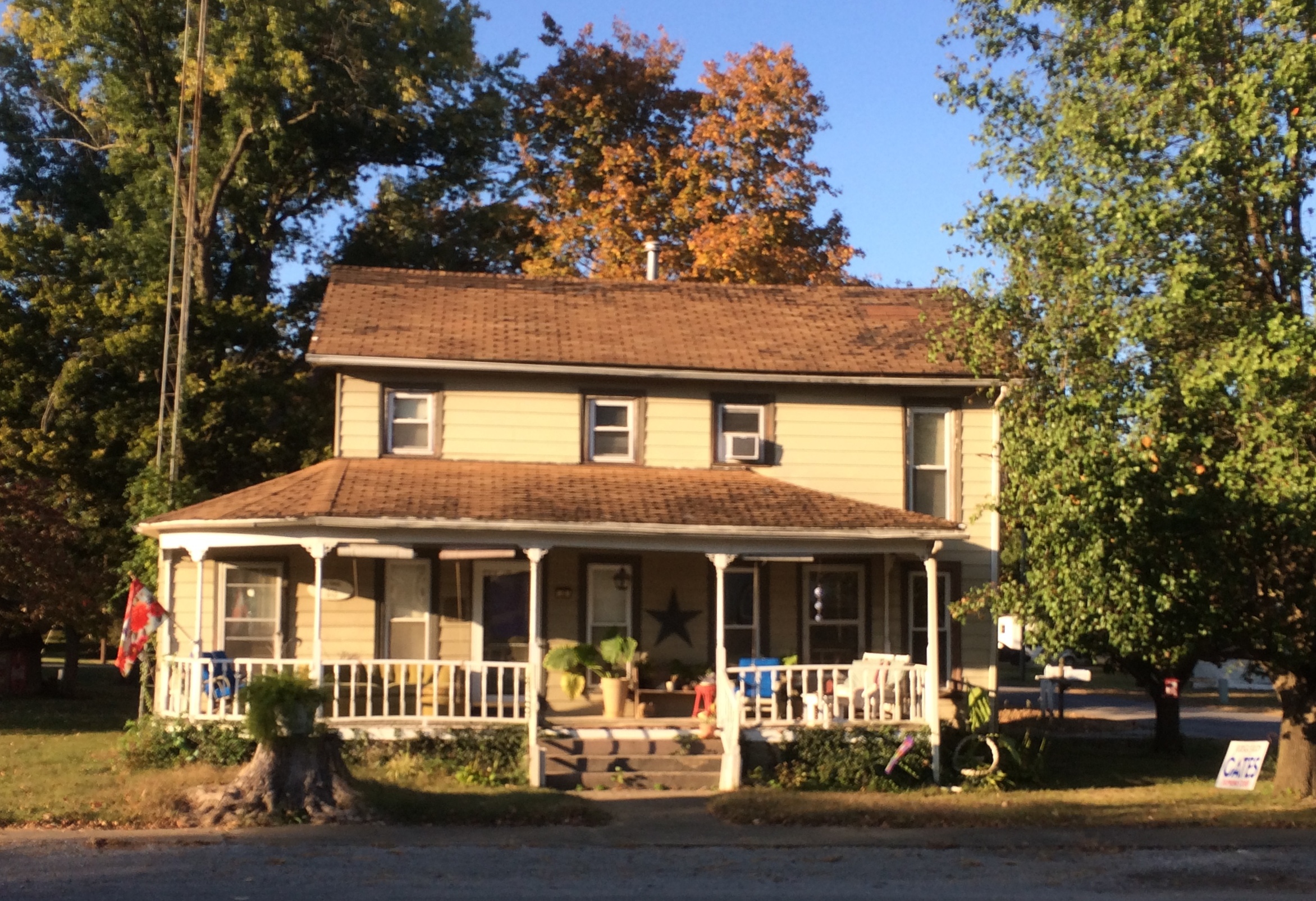
Some pleasant-looking houses.
Also, art bicycles at various points near the street.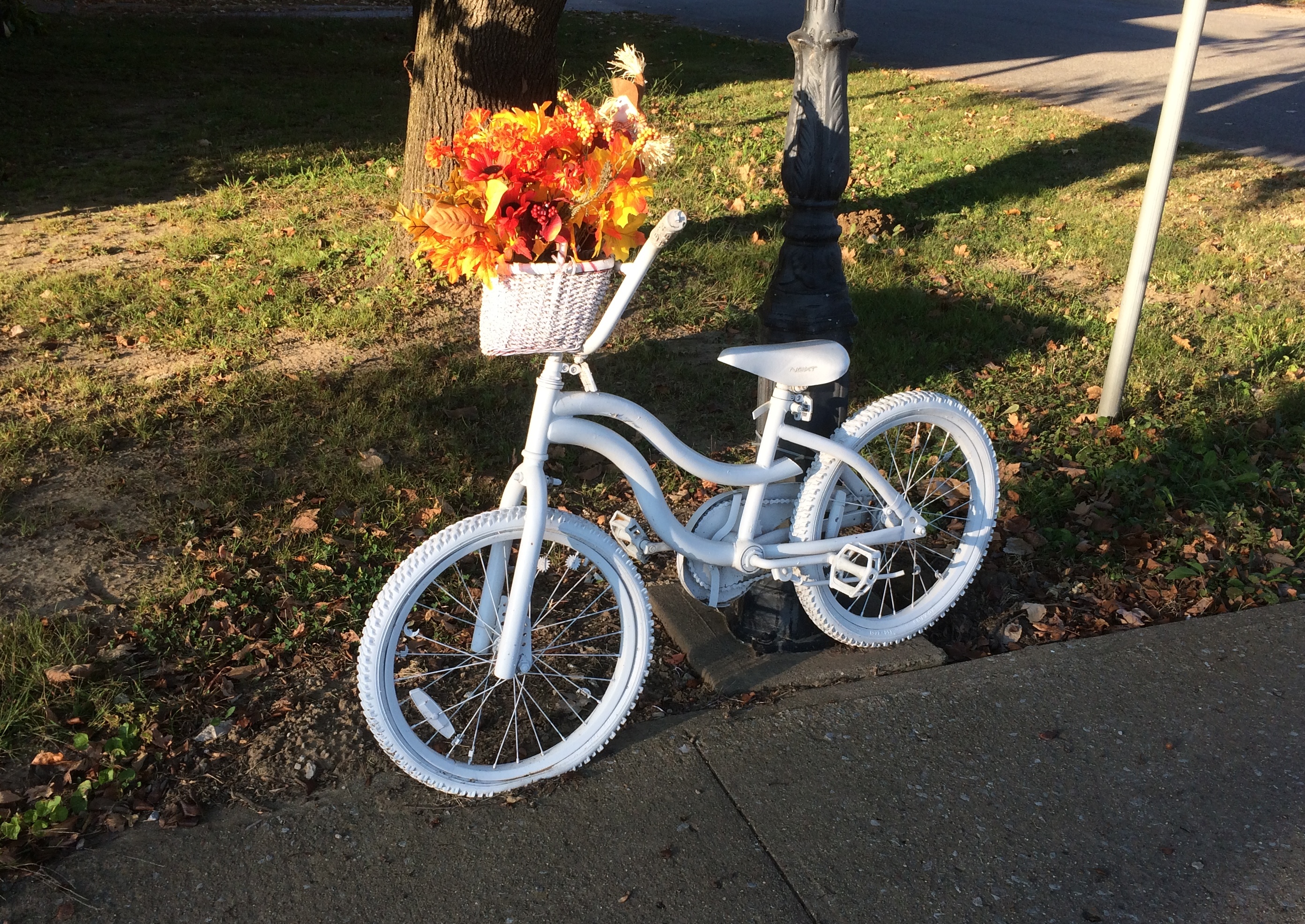
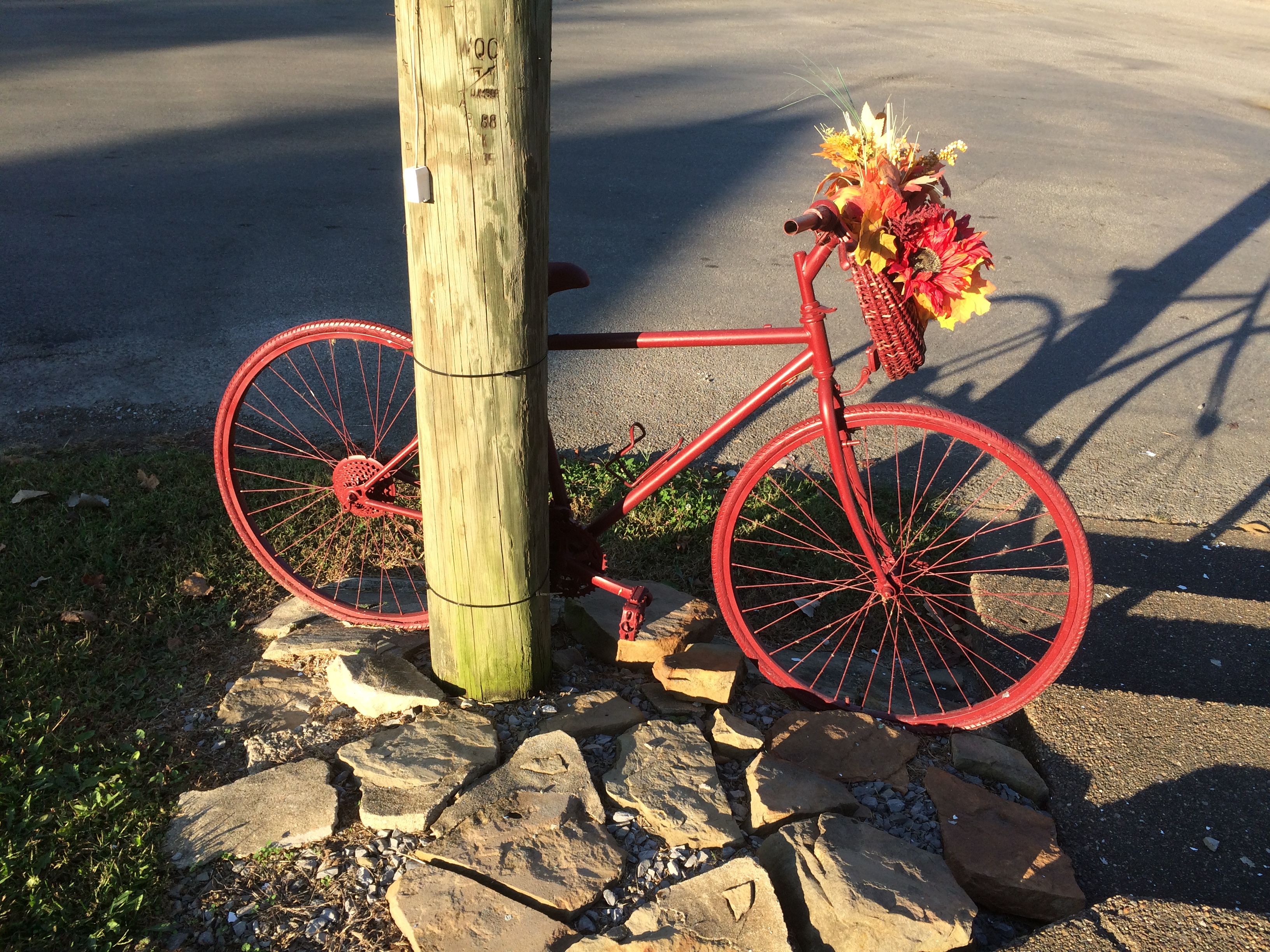
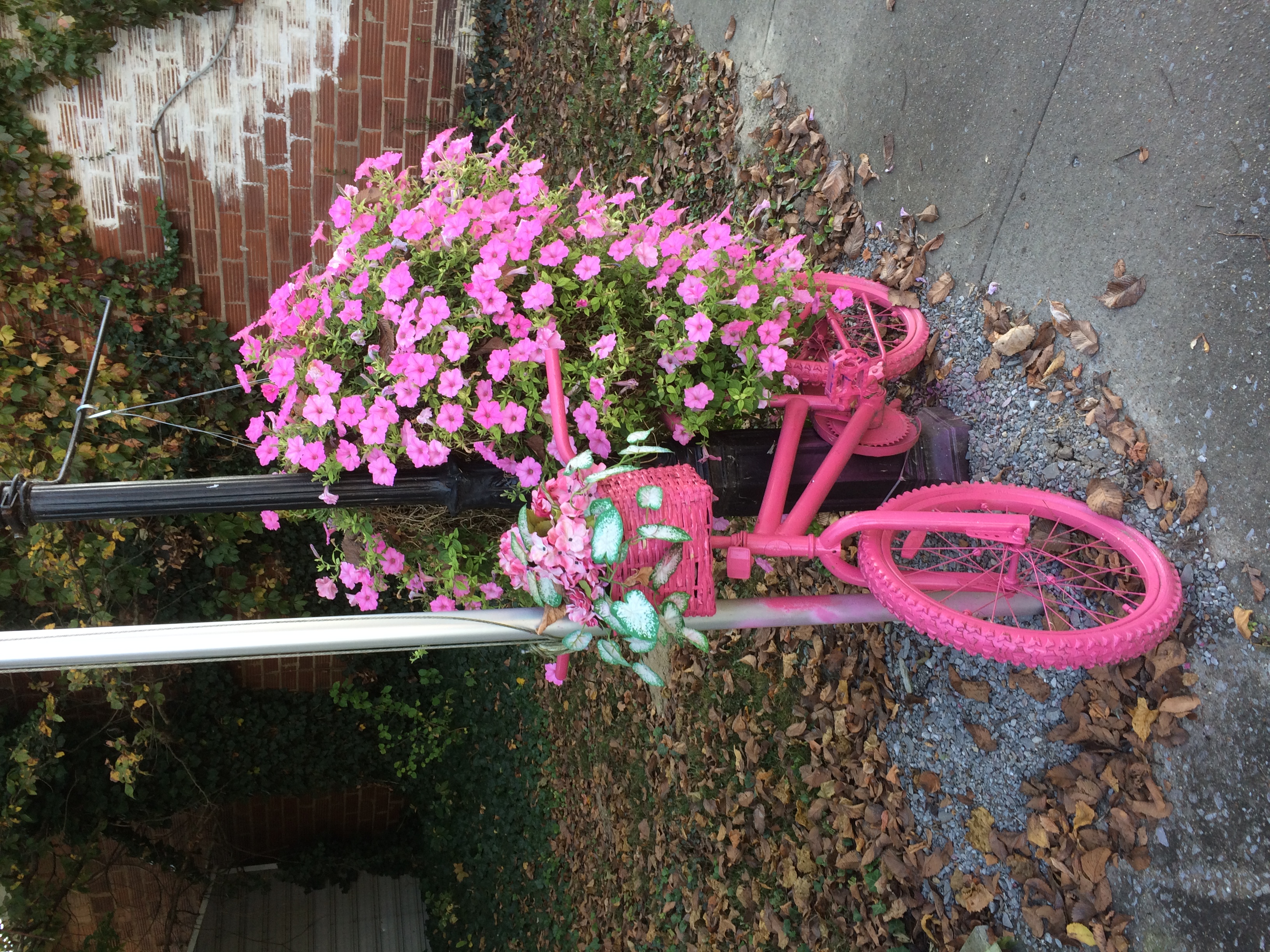
A small group of residents, acting informally, installed the bikes, reports KFVS-12. Civic-minded folks, from the look of it.
Something else about Cave-in-Rock: From 2007 to 2013, the annual Gathering of the Juggalos happened at nearby Hogrock Campgrounds. See SNL for a parody of an infomercial advertising the Gatherings of that period. Also, see a report by the FBI on the Juggalos. I have no idea whether it’s accurate, or whether the G-men had a burr up their butts for no solid reason.
Picture that, a town of 300 people inundated by 10,000 Juggalos. Guess they figured that Juggalo money spends too, despite the risk of damage to the town. Not the only hint of Insane Clown Posse I’ve run across this year.
Between Harrisburg and Shawneetown is the village of Equality, Illinois, pop. about 500. We drove down its main street, W. Lane St., then turned onto N. Calhoun St. Near the intersection of those streets, a restaurant called the Red Onion looked almost pre-pandemic busy.
Not far along Calhoun, I saw a place I wanted to stop.

The Equality water tower rises over the former site of the Gallatin County courthouse. The town was county seat for a while in the 19th century, but eventually lost that distinction. The building, later used as a school, burned down in 1894.
Under the tower is a sizable but timeworn memorial.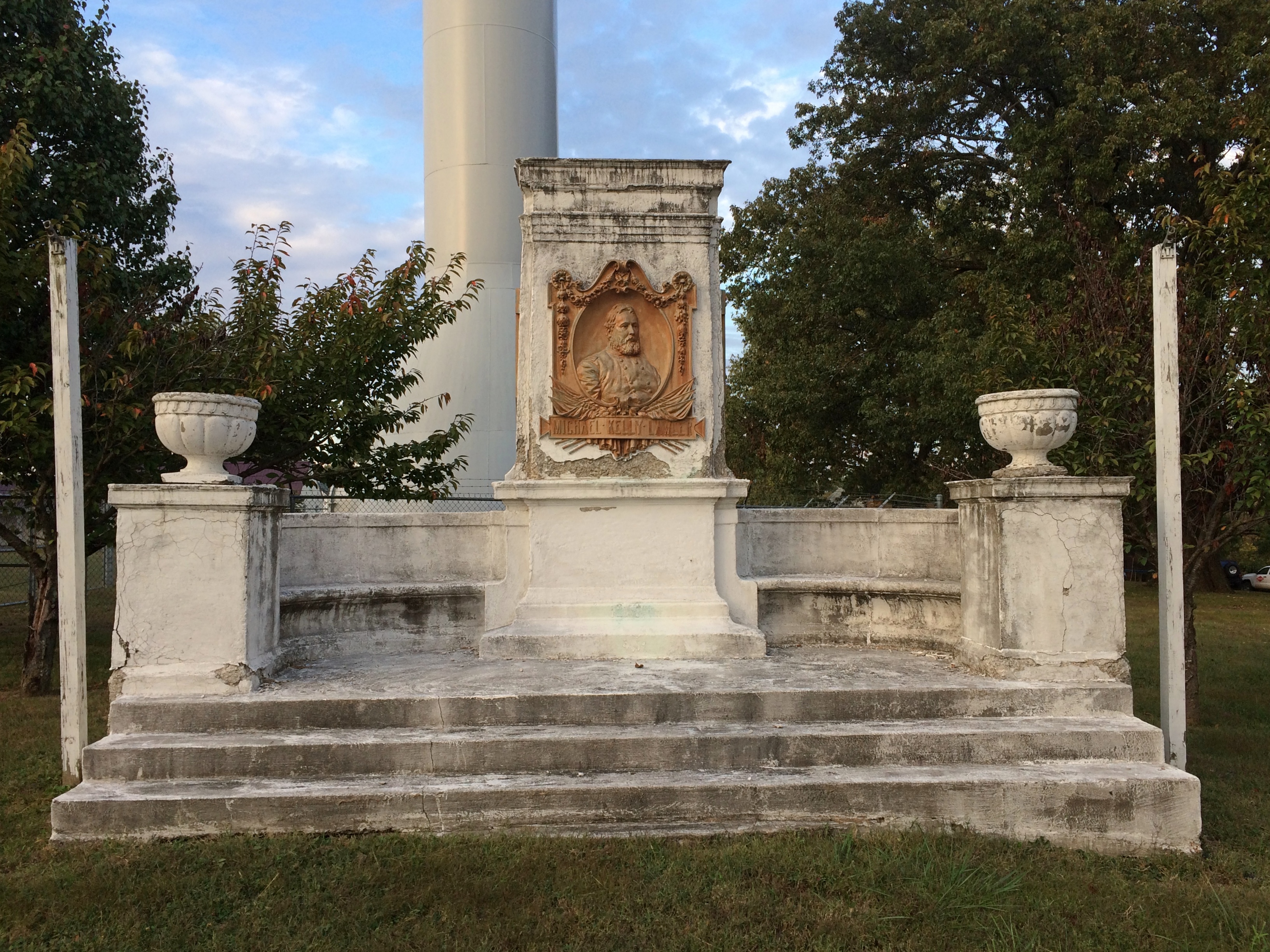
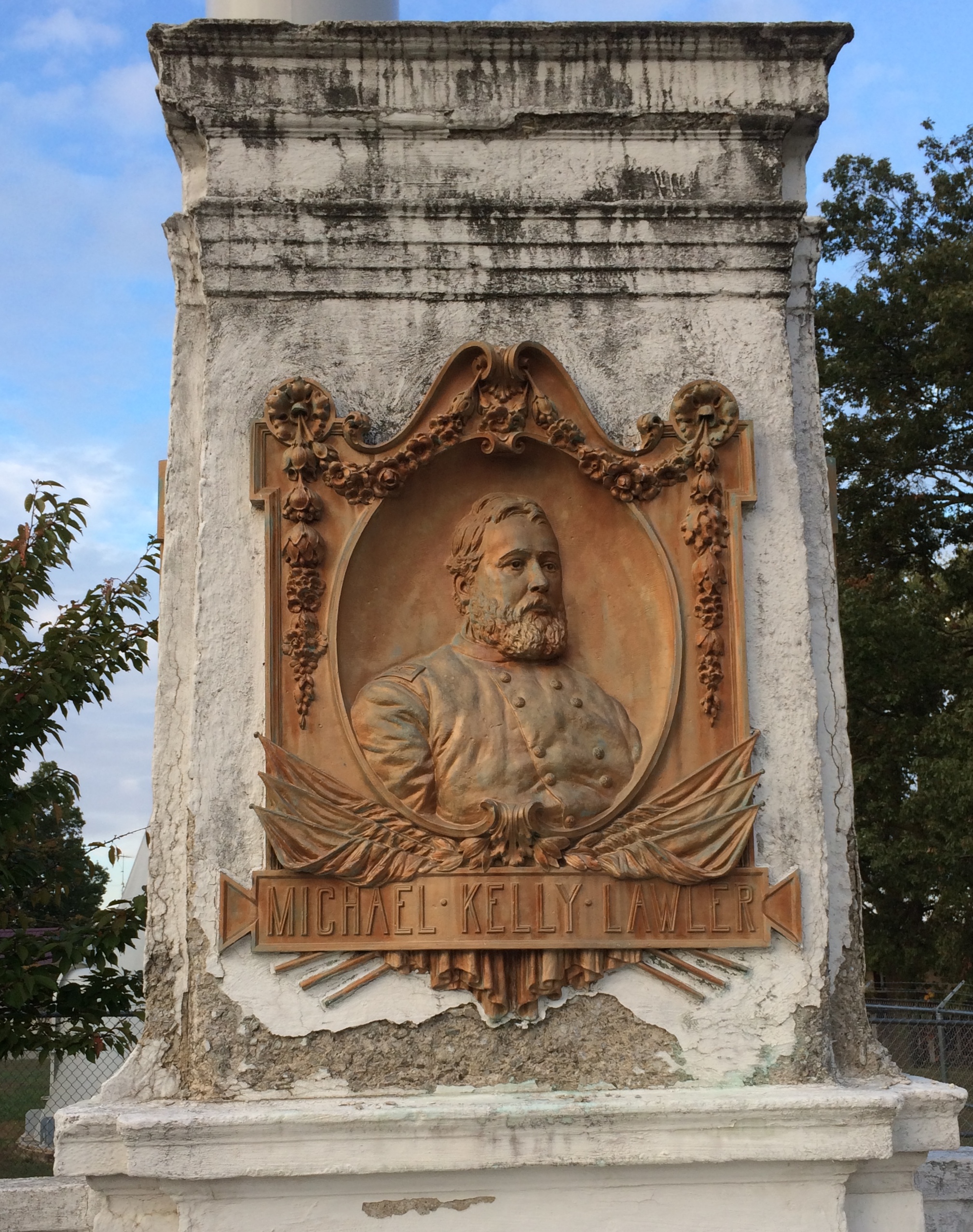
It honors Michael Kelly Lawler, born in County Kildare, Ireland, but who came to Gallatin County, Illinois, as a boy. A veteran of the war with Mexico, Lawler spent the Civil War in the western theater, most notably as a brigadier general leading Union troops during the Vicksburg campaign.
The state of Illinois erected the memorial in 1913, a good many years after the Gallatin County hometown general in blue had died. A plaque on the memorial lists E.M. Knoblaugh as the sculpture.
A simple Google search uncovers little about him, except the fact from the 1915 edition of Report of the Auditor of Public Accounts that the state of Illinois paid him $688.02 for service as a sculptor, and $4,210 to erect the monument, or $4,898.02 all together. In current dollars, more than $128,000, so he presumably did well in the deal.
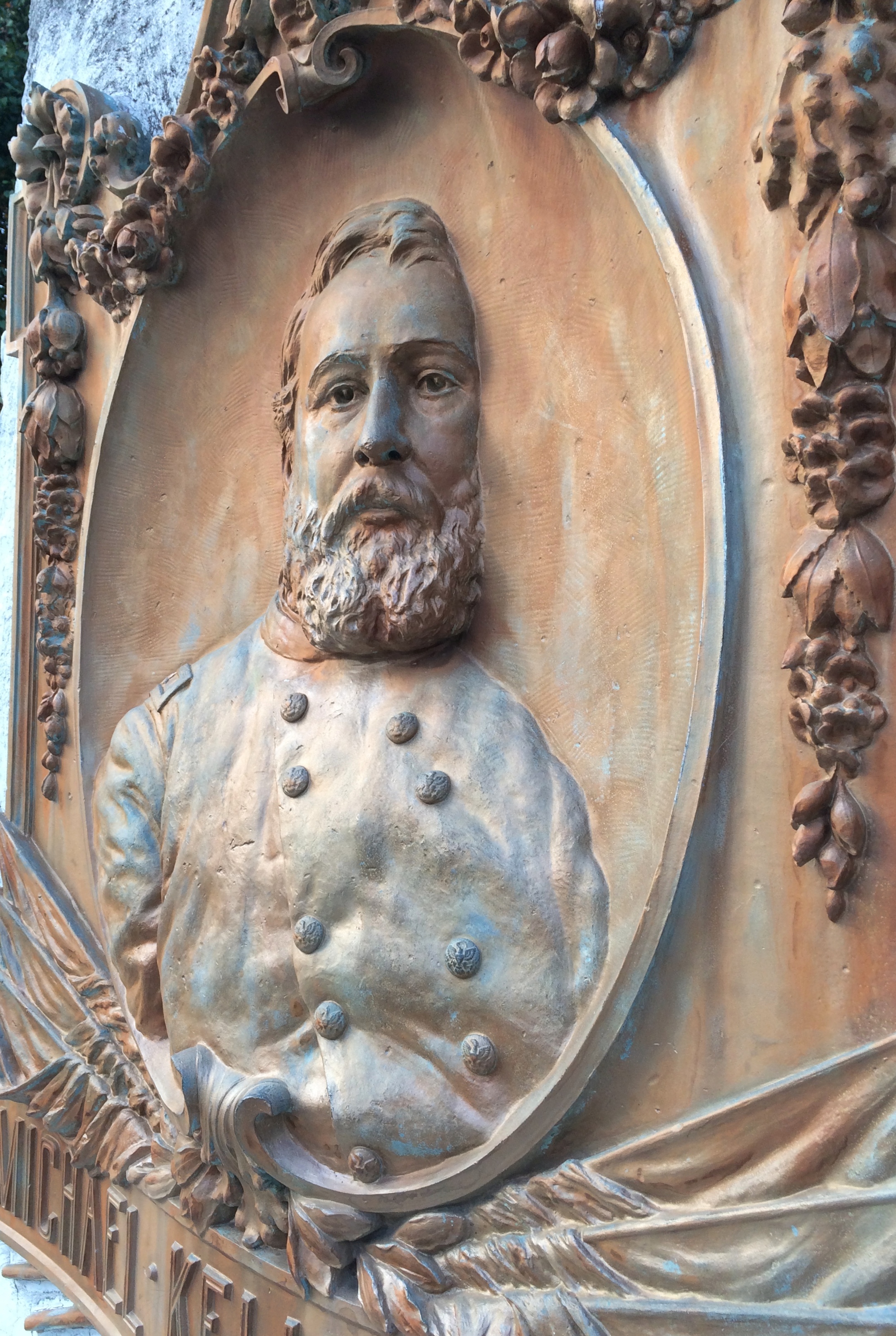
Besides that, whoever he was, he did a fine job, especially on the relief, a lifelike visage that looks like it might have been restored sometime recently.
Old Shawneetown
If you drive east from Carbondale along Illinois 13, you’ll pass through a number of towns connected by that four-lane highway: Cartersville, Marion and finally Harrisburg, after which the road narrows to two lanes. That was our route on the afternoon of October 10.
There’s a branch of 17th Street Barbecue in Marion, with the original in Murphysboro, Illinois. It’s a barbecue joint of some local renown. I can’t remember when I first heard about it. Some Internet list, probably, but anyway I knew about it and decided to get lunch there in Marion.
Meals on the road in 2020 have involved takeout in all cases, either to eat in the car, or our room, or when possible at an outdoor public picnic table. We found a table in a small park in Marion to eat our 17th Street ‘cue.
We both got barbecue pork sandwiches. The meat was fine, but whoever made the sandwiches shorted us on the sauce, so the meal was a little dry. I’d be willing to try the place again if ever I’m down that way, but I’m going to insist on sauce.
The eastern terminus of Illinois 13 is Old Shawneetown on the banks of the Ohio River. Too close to the river, and thus prone to flooding. The Great Ohio River Flood of 1937 finally drove most of the residents away to found a new Shawneetown a few miles to the west. But Old Shawneetown isn’t a ghost town in our time, since 160 or so people live there, just the residuum of a larger place.
The town’s main intersection.
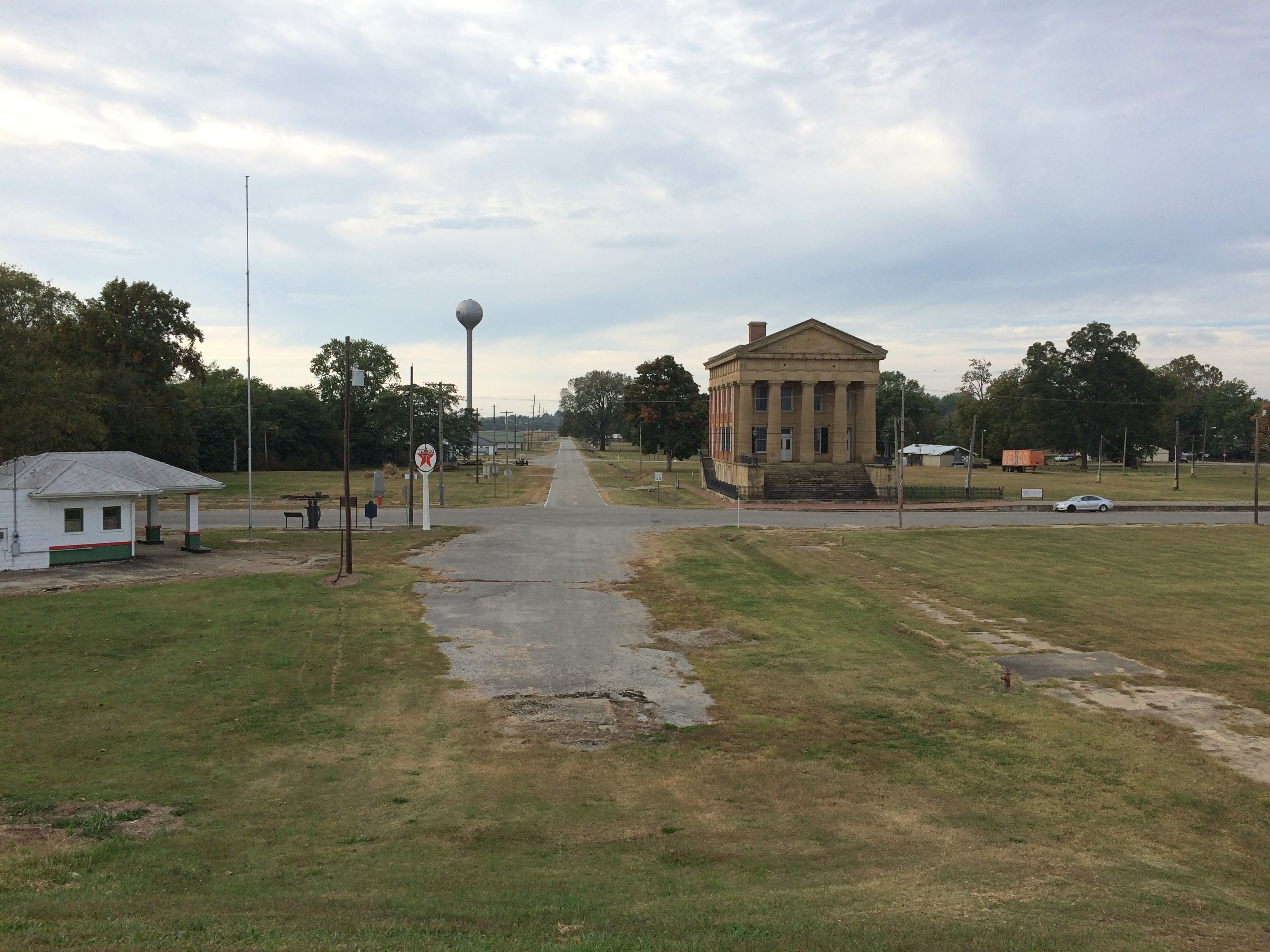 The original Shawneetown had its moment, a little more than 200 years ago, when it was home to a federal government land office for the Illinois Territory, and as a transshipment point for salt extracted nearby. During the famed 1825 tour of the U.S. by Gen. Lafayette, Shawneetown was on his itinerary, surely marking the town’s peak of fame if not population.
Peaked too soon, looks like. No railroad passed through Shawneetown in the following decades, at least by the time this map was published in 1855. That tells me that Shawneetown never really prospered after the land office and salt mine closed.
I’ve known about the place for a long time. I knew girl in college from around Shawneetown, a coaxing elf of full Irish ancestry who grew up on a nearby popcorn farm. Gallatin County even now is a nexus of popcorn agriculture. Last I heard, she lived in Ankara with her French husband. People get around.
The main surviving building from the town’s storied past is the Shawneetown Bank State Historic Site, dating from 1840. Home to banks for about 100 years — they seem to have come and gone with various financial panics — it stands neglected these days.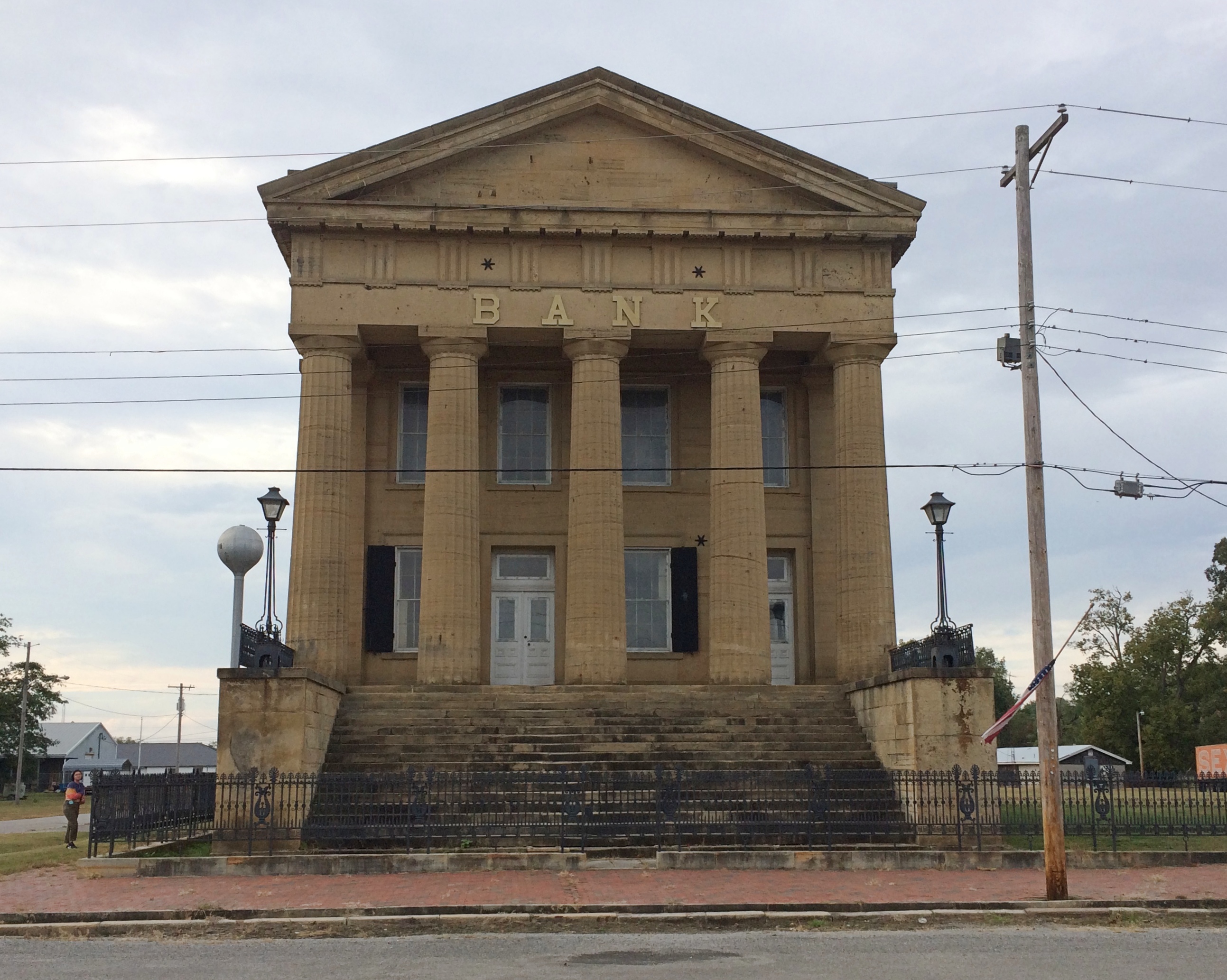
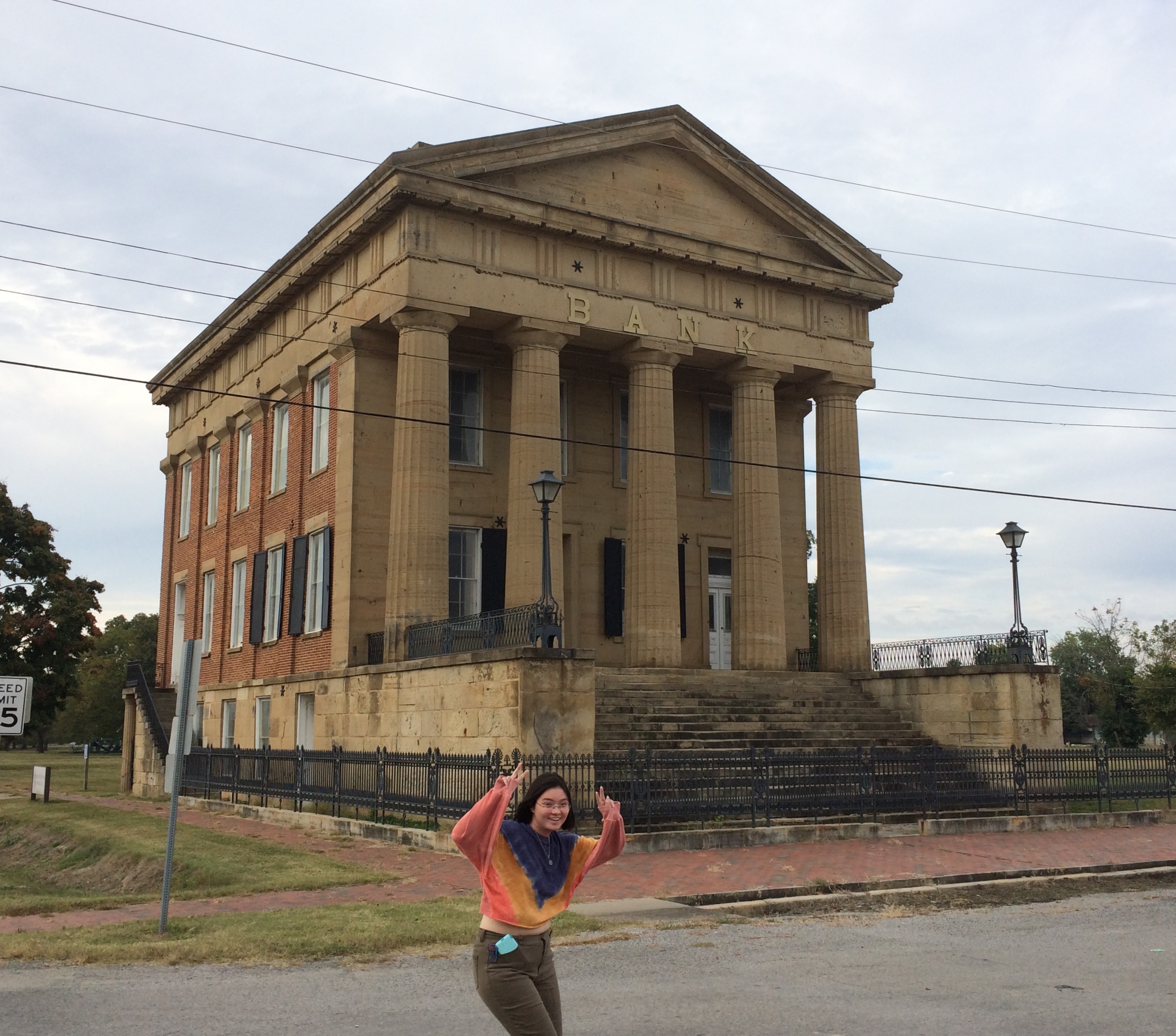
It’s not the only abandoned structure in the neighborhood. A white Texaco station is catercorner across from the bank. If it were on U.S. 66, it might be a little museum. Maybe someone has that in mind. Though abandoned, the structure looks in fairly good shape, especially the sign.
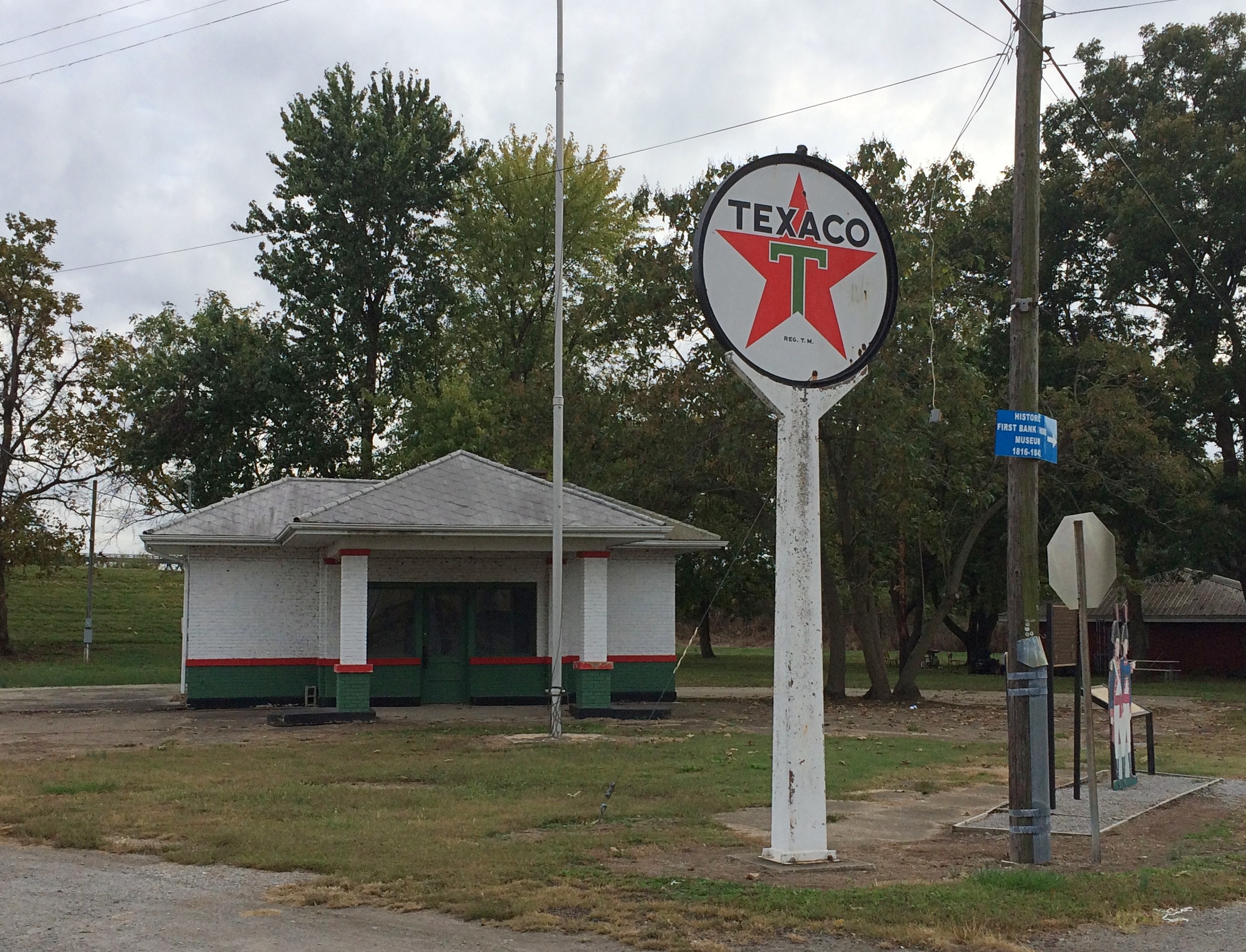
There are a few plaques and other acknowledgments of the town’s history. Such as cutouts of Lewis & Clark, who passed this way just before there was a town.

I like to think that the Corps of Discovery made a stop here at the only gas station along their route.
As Lewis wrote in his journal, Nov. 6, 1803: Arrived at Swanee Txco Station. Pay’d owner 2 dollards for provisions, — Cheetos, other divers chips, Coke & Pepsi, choco bars etc. Men also bought provis. for own use Mr Wm. Jones store mger, reports recent visit by Indian band from furth. north. — buying his entr. stock of funyuns.
Down the street from the abandoned bank and the abandoned gas station is Hogdaddy’s Saloon, an abandoned entertainment venue, though not so long ago, from the looks of it.
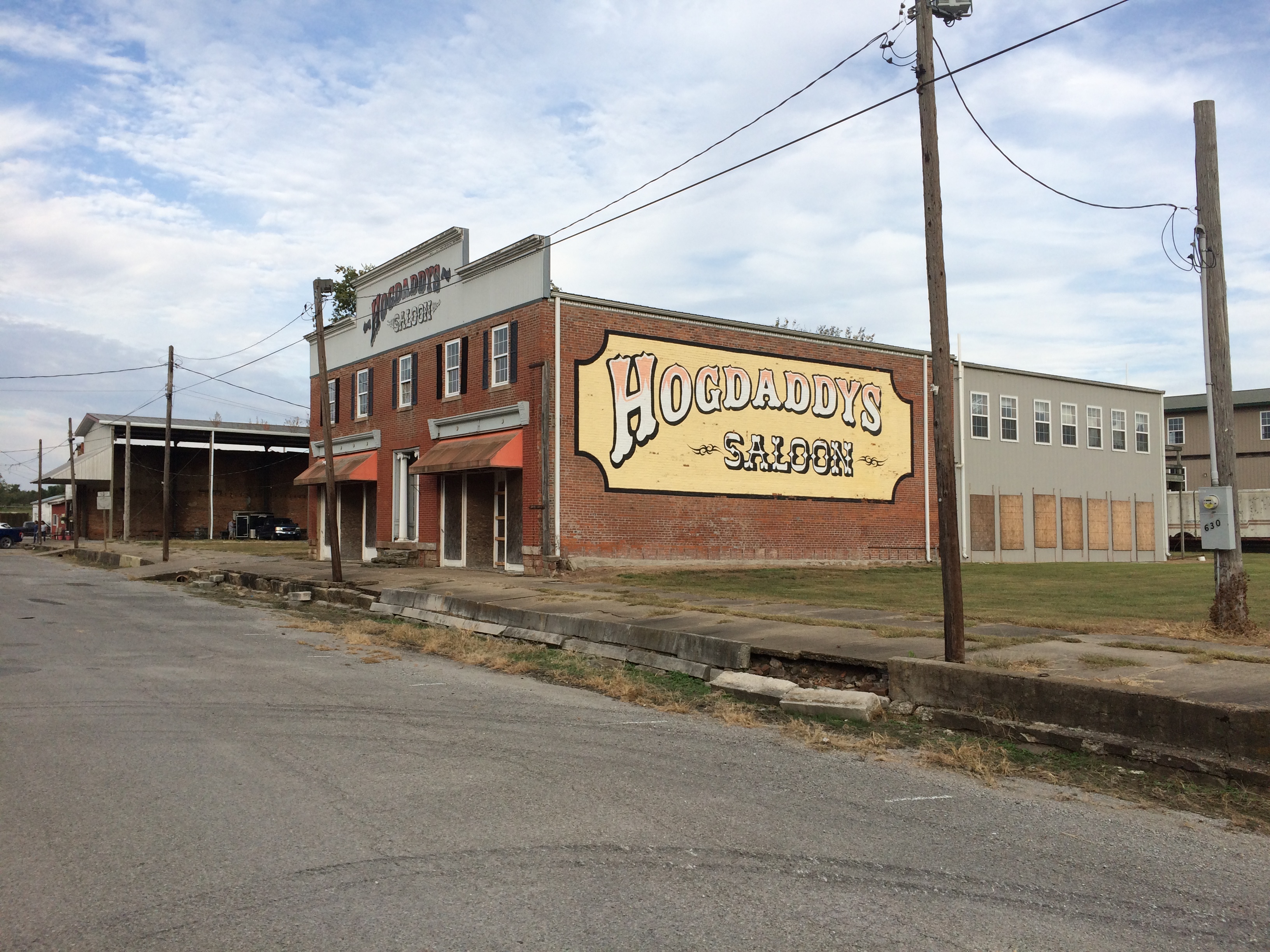 What Old Shawneetown needs (in more normal times) is a music festival right there on the main street. If Bonnaroo can, so can Shawneetown. Something for the hipsters to discover, to put the town on the hipster map and attract hipster dollars. As long as they believe the place is authentic somehow, they will come. That way a place like Hogdaddy’s could make a go of it.
An embankment separates the town from the river, part of a levee system built long ago to keep out flood waters — in vain. The always interesting WPA Guide to Illinois (1939) tells the story better than any online source I’ve found (p. 436). For that book, the ’37 flood was a recent event.
“The town bore the yearly invasions of the Ohio unprotected until the unusually severe flood of 1884, after which it constructed a comprehensive levee system,” the Guide notes. “But in 1898, and again in 1913, Shawneetown was under water. In 1932, the levee was raised five feet above the 1913 high-water mark….
“But Shawneetown had not envisioned anything like the 1937 flood. By January 24 of that year, menacing yellow waters were slipping silently past the town, only inches from the levee top… Small groups of people huddled on street corners, terrified, waiting; the telephone service ceased; hemmed in by the ever-swelling Ohio, Shawneewtown flashed a desperate cry for help over an amateur’s short-wave radio.
“Responding to the call, a river packet and several motorboats evacuated the townspeople just as the waters began to trickle over the levee. A roaring crashing avalanche soon inundated the cuplike townsite…
“The 1937 flood marked the end of Shawneetown’s ‘pertinacious adhesion’ to the riverbank. Gone were the packets and keelboats which induced her to hazard annual submersion. Gone was the steady traffic of settlers, goods and singing rivermen. With the aid of the State, the RFC, and the WPA, a project is under way for transplanting the town to the hills 4 miles back from the river… The State plans to establish a State park at the present site of Shawneetown.”
Guess the state never quite got around to that, maybe because not everyone wanted to leave.
A stairway leads to the embankment’s top, which offers a view of the Ohio. Looking upriver.
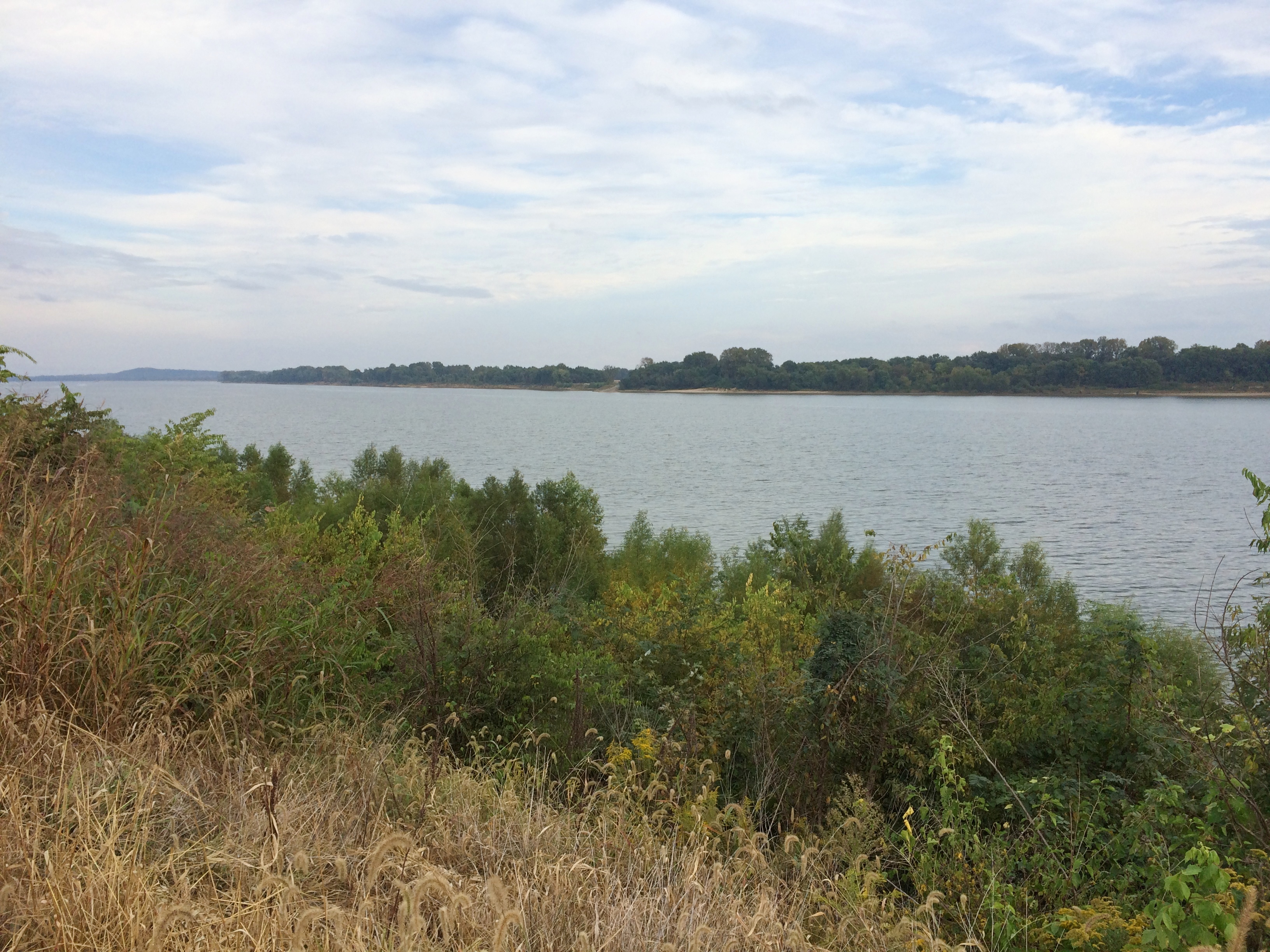
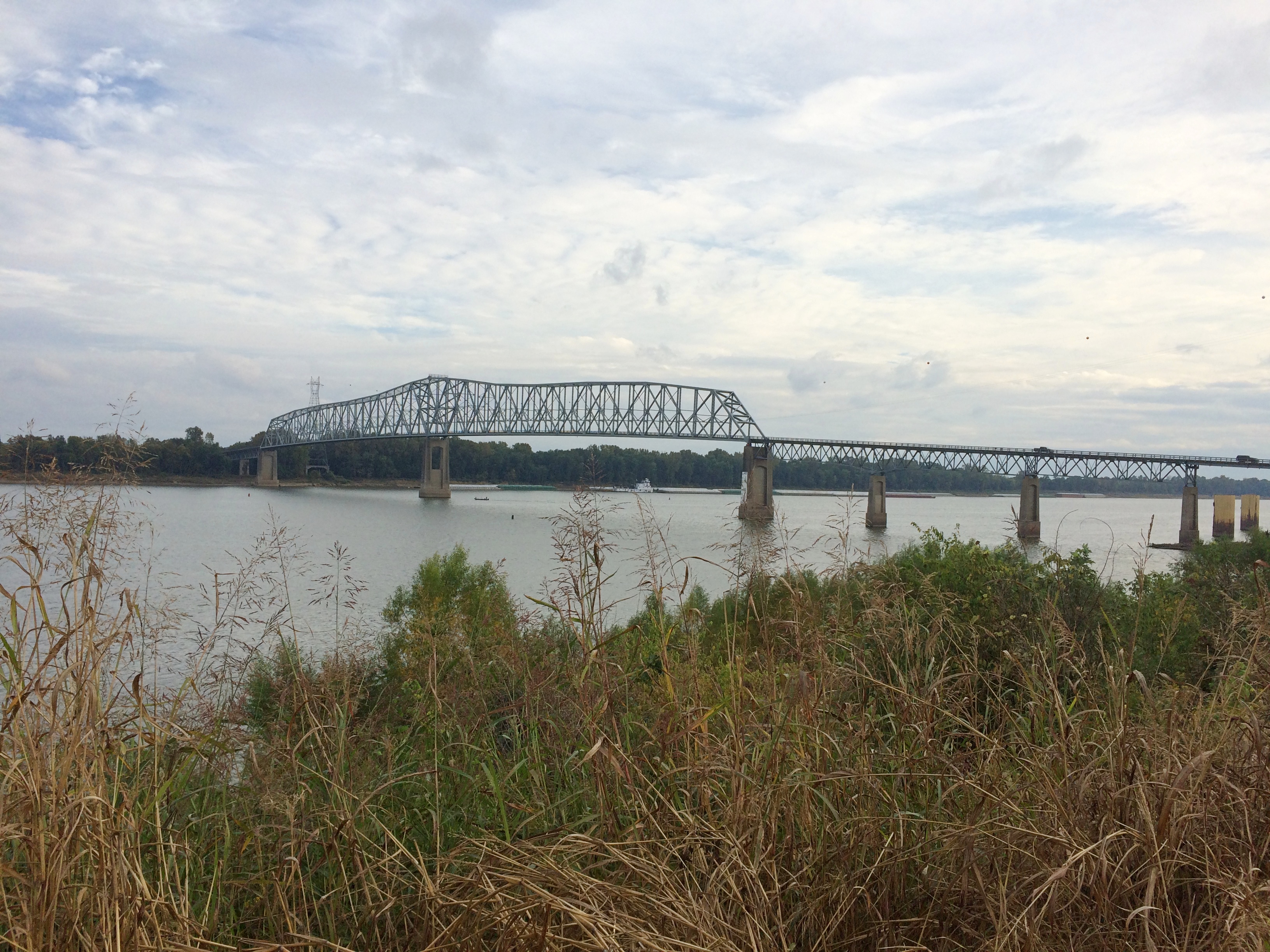
And downriver, looking at the bridge that crosses over to Kentucky.
On the side of the embankment is a graffito. Any graffiti would be a little odd in such a town, but this would be odd anywhere.
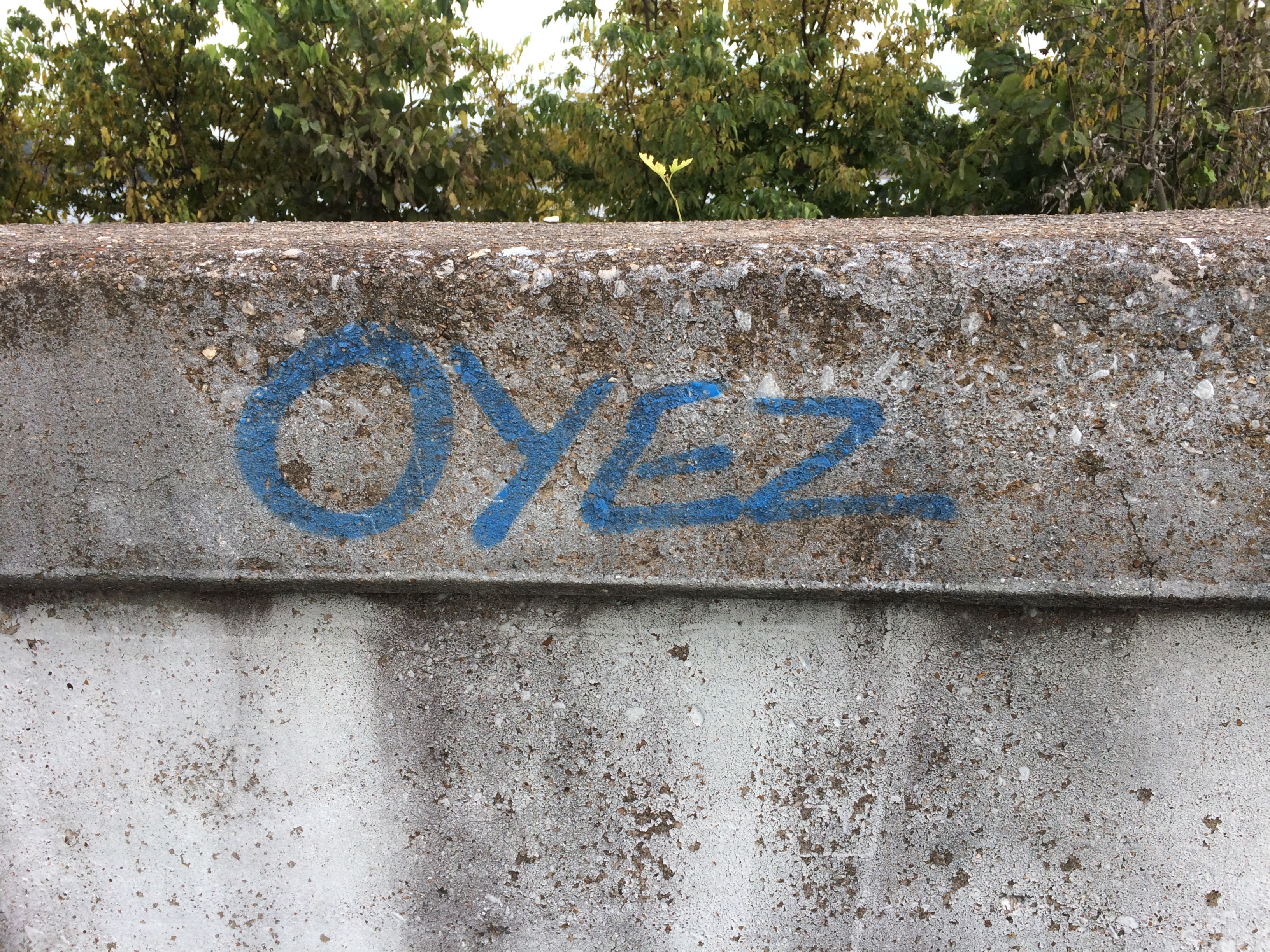
Left by a passing bailiff with a can of spray paint?
SIU and Buckminster Fuller Too
On October 10, Ann and I tooled around the Southern Illinois University campus a bit, agreeing that it isn’t the aesthetic experience that some college campuses are. Visitor parking proved hard to find, so we didn’t take a walk on campus.
We did spot the Wham Building on Wham Drive. Ann suggested that the donors were the British pop duo, now about 35 years passed their heyday. Though as a matter of style, it ought to be the Wham! Building. Their connection to SIU? None that we knew, but never mind. Maybe they decided they had enough money to fund a building on a college campus, and they threw a dart at a map to determine where it would be.
Not long after that conversation, we heard a local station playing “Wake Me Up Before You Go Go.” Coincidence or synchronicity? Coincidence, I’d say.
Not far from campus is a residential neighborhood with a fair amount of student housing, marked by some genteel seediness. Parking was easy around there, so we stopped for a short walk down a residential street.
Some of the residences stood out more than others. Some for their décor. It might be hard to see in the picture, but there’s a neon sign in the window of this Halloween-ready house: PALM READER.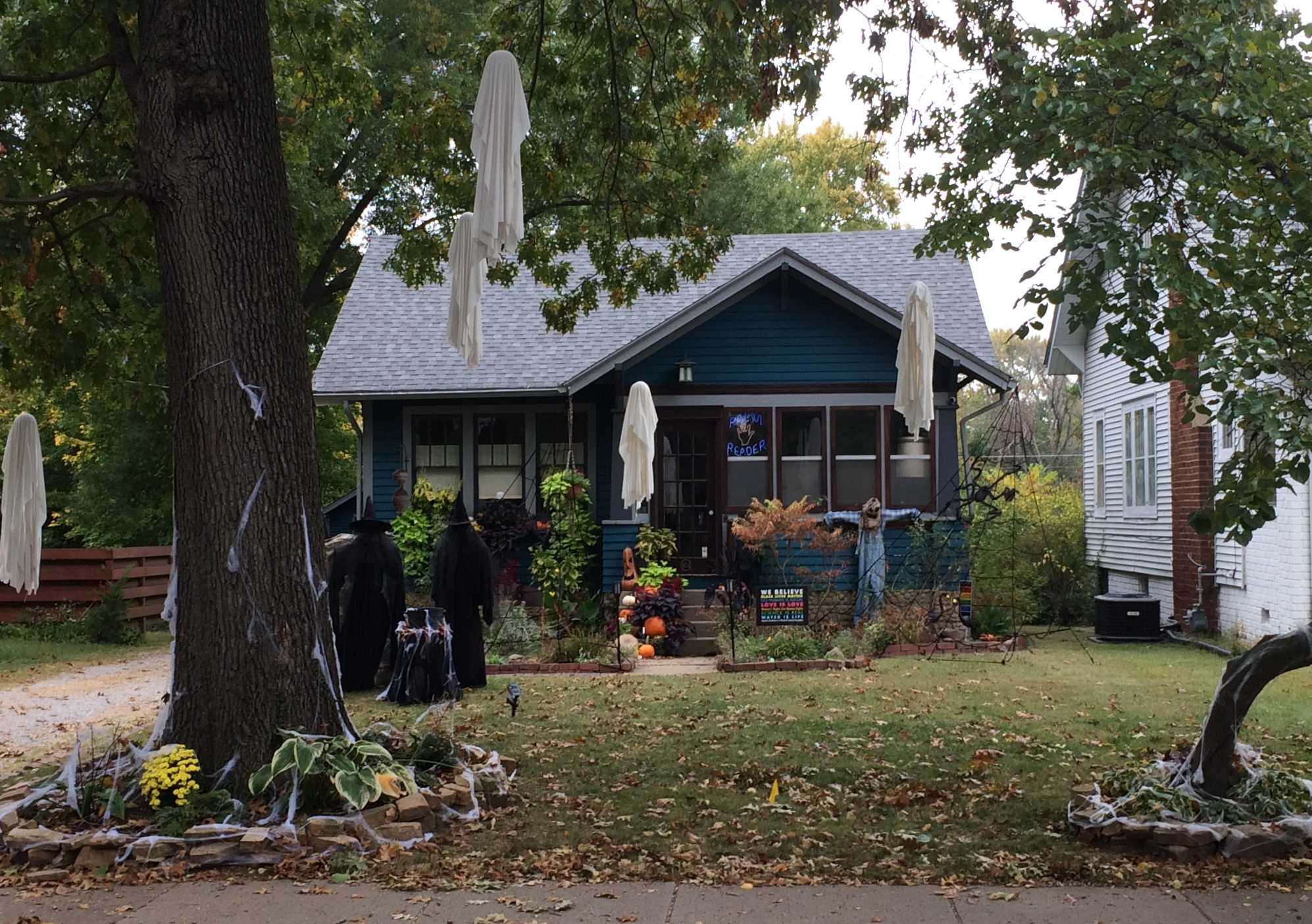 Other properties stand out for more fundamental reasons. The R. Buckminster Fuller and Anne Hewlett Dome Home is at the intersection of two small streets in an otherwise unremarkable location in the neighborhood.

The dome is fenced off and closed. But someone used to live there. Bucky himself, as it happens. A sign on the fence says: “Buckminster Fuller is considered one of the leading visionaries of the 20th century. He patented the geodesic dome in 1954 and it is his most enduring legacy. In April 1960 he assembled this dome home (The Fuller Dome) and lived in it with his wife Anne until 1971.”
How long had it been since I’d thought about Buckminster Fuller? Before finding out about the dome, that is, which was a few days before our visit to Carbondale. A long time, that’s how long. I suspect much of the world can say the same. Whatever Fuller’s contributions to civilization, and I’ll be the first to say geodesic domes are pretty cool, he’s headed for obscurity as surely as Ernie Pyle.
Reading about Fuller made me think of Lucy Kulik, a sixth-grade teacher of mine. She taught us math and I believe also led our participation in Man: A Course of Study almost 50 years ago. I hadn’t thought about her in a long time, either, and checked to see whether she was still among the living. Possible, but not likely, though it turned out she died only last year at 97, and now has a stone at Fort Sam Houston National Cemetery next to her husband, an Air Force lieutenant colonel — something I didn’t know about her.
RIP, Mrs. Kulik. The details have faded after a half century, but I remember you were a good teacher.
In class one day Mrs. Kulik mentioned Buckminster Fuller as the fellow who invented a dome made of triangles and who wanted the world to give up the words “sunrise” and “sunset.” I’d never heard of him at the time, or if I had, I’d forgotten.
Fuller suggested the words sunsight and sunclipse to replace sunrise and sunset, arguing that the common words reflect an incorrect understanding of the way the Earth and the Sun move. You could argue that they do, of course, and the words he suggests are perfectly fine, but to object to sunrise and sunset on those grounds itself reflects an excess of literalism in understanding language. That might be a reason his suggestions didn’t catch on.
His domes might be cool — you can’t stand in front of the Expo ’76 Fuller dome in Montreal and not feel a little awe — but I also have to add that a few of them go a long way. In the case of Carbondale, one is probably enough.