A Small Sample of Aggieland

Texas A&M University is a big place. I looked it up: the main campus currently occupies 5,500 or so acres, and accommodates 56,000+ students. Systemwide – because there are other campuses – the school boasts an endowment of $7.6 billion. It also seems like a lot of construction is going on, so those figures will probably be outdated in a few years. A&M’s pretty much the main industry in the twin towns of Byran and College Station, Texas, which also have the distinction of not being on an Interstate, though I-45 runs fairly close.

Jay and I took a stroll around campus for an hour or so, which is time enough to see a small fraction of the buildings, as well as a lot of Aggies. They look pretty much like college students anywhere in North America, except for Corps of Cadets members mixed in, who are easily distinguished by their uniforms, which have a remarkable resemblance to WWII vintage U.S. uniforms, in as much as I’m familiar with them. Membership hasn’t been mandatory in 50 years, but the Corps is still a defining tradition at the school. But of course there are many Aggie traditions, some of which are common knowledge among Texans.

If we’d done much planning, we might have been able to see a building or two dating from the time our grandfather attended A&M (again, he was Class of 1916). Mostly, though, we came across buildings dating from the 1920s and ’30s – there seems to have been a large building boom then – as well as some remarkably brutalist structures from more recent decades. Of the structures we saw, I most liked the Civil Engineering Building, built in 1932.

The plaque on the building describes it this way: “A classical revival two-storied stone structure is faced in brick, with cast stone and ceramic tile ornamentation.”

Texas A&M April 2014Note the ornamentation here: two Hermes figures, a cow, a couple of horses, and a couple of dogs. Elsewhere, pigs.

Texas A&M April 2014The reason for all of those animals on the Civil Engineering building? The plaque again: “Originally used as a veterinary hospital with two additional buildings in the rear, used as [a] stable and anatomy laboratory.”

Not far away we happened on the Cushing Memorial Library, where there’s an exhibit for the centennial of the opening of WWI: “The Great War: Memories of Service and Sacrifice, A World War I Exhibit Featuring the Aggie Experience.” Just the thing to see – free, not too large, and connected to our family’s experience. Class of 1916 meant that it wasn’t long before Grandpa was in the Great War. We told a woman behind the desk at the entrance about him, and she seemed pleased to hear it.

The displays featured some material from Aggies who’d been in the war, but the exhibit had more than that, including wartime posters, photos, letters, everyday items, and more, and not just from American soldiers, but also British, French, German and Italian. (What, nothing from little Montenegro?). The material is from the Ragan Military History Collection at the library.

“A enlarged image of the tattered Gold Star service flag that most prominently captures the World War I Aggie experience will also be exhibited,” notes the A&M release about the exhibit. “Part of a national tradition that began with World War I, the service flag contains approximately 2,000 maroon stars honoring those Aggies who served, and 50 gold stars memorializing those Aggies who gave their lives in the war.”

Fortunately for him and his 13 descendants (so far), Grandpa came back from France, though as an engineer, unexploded ordnance — and the Spanish Flu — were likely the main dangers he faced.

Corsicana, Texas

Everything about this picture says Texas: the Collin Street Bakery sign, marking a famed Texas bakery; the Texas flags; the HEB grocery store; the pickup truck driving by; the onion domes off in the distance. Onion domes?

Texas4.25.14 001First a little background. On April 24, 2014, Jay and I drove south on I-45, the main road from Dallas to Houston. About 50 miles south of Dallas is Corsicana, seat of Navarro County, and home of the Collin Street Bakery. I’ve been eating its fruitcakes on and off for years, mostly by mail order, but in 1996 (I think) I passed through town and visited the bakery store.

As the web site notes: “The DeLuxe Texas Fruitcake or Pecan Cake you order today is still baked true to the old-world recipe brought to Corsicana, Texas from Wiesbaden, Germany in 1896 by master baker Gus Weidmann. He and his partner, Tom McElwee, built a lively business in turn-of-the-century Corsicana which included an elegant hotel on the top floor of the bakery.”

The hotel is gone, but you can still buy baked goods at the bakery store, including the signature fruitcake. We bought one to take to our mother, plus some smaller items for more immediate snacking. From the parking lot, we noticed those nearby onion domes, and being curious about onion domes in small-town Texas, we went over for a look. After all, how often do you see Moorish Revival buildings in small-town Texas? Probably more often than I’d think, but anywhere there one was.

It’s the Temple Beth-El, a former synagogue on 15th St. in Corsicana.  A shot from across the street is here; it’s a handsome building.

Like the Collin Street Bakery, Temple Beth-El too dates from the late 19th century. The Jewish community of Corsicana isn’t what it used to be – they probably went to Dallas, like everyone else – so in more recent years, the building’s been a community center overseen by the Navarro County Historical Society.

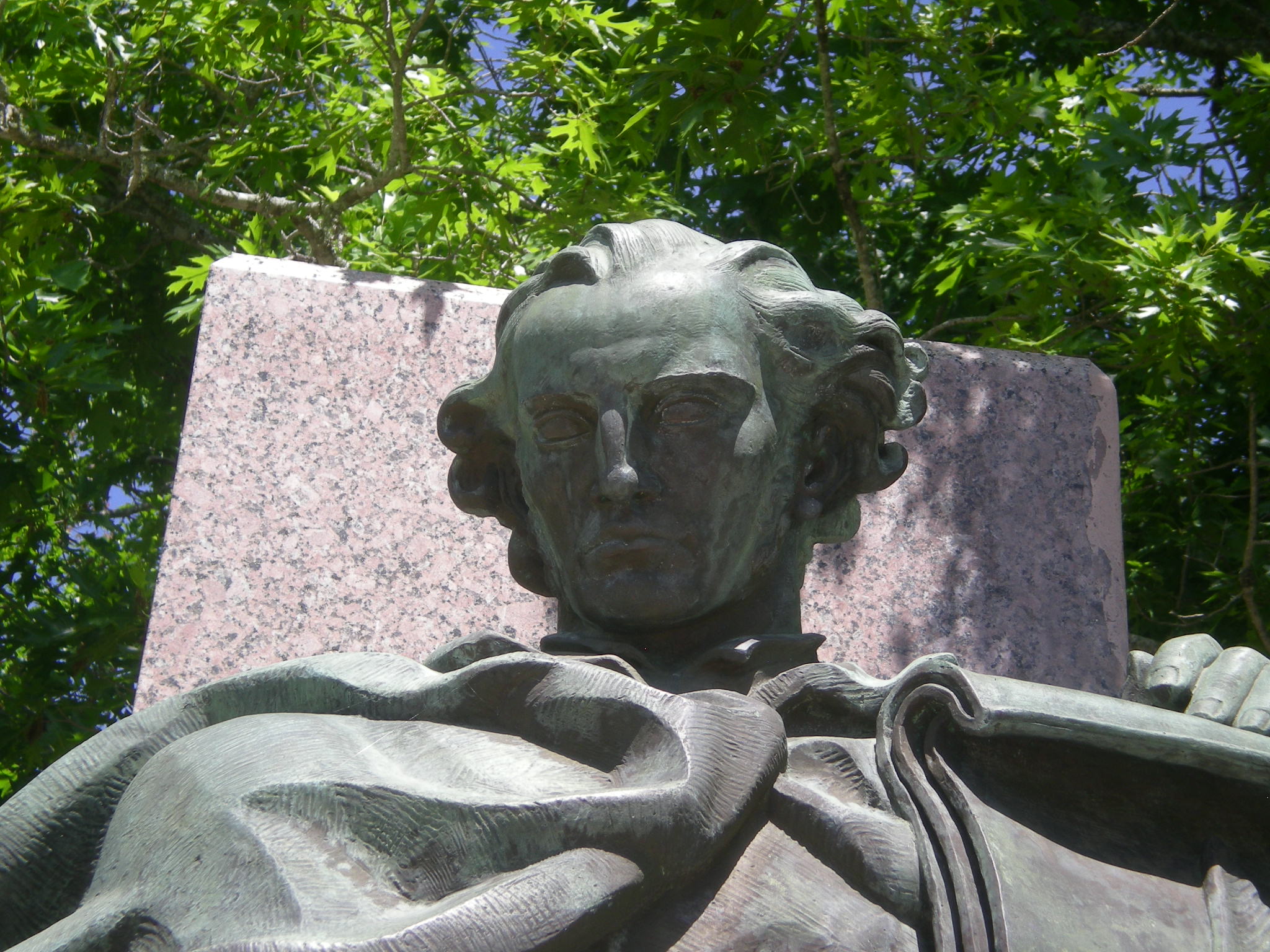
Now fully in a look-see mood, Jay and I went over to the Navarro County Courthouse grounds. Navarro himself was there. A statue of Jose Antonio Navarro, that is.

The Smithsonian tells us that “the sculpture was commissioned by the Texas Centennial Commission to honor Jose Antonio Navarro (1795-1871), a native Texan lawyer, merchant, and rancher who founded Navarro County and co-created the Republic of Texas. Navarro named the County seat Corsicana after his father’s birthplace, Corsica. While on an expedition to Sante Fe, Navarro was captured by Mexican soldiers and given a life sentence for treason. He escaped in 1845 and upon his return to Texas was elected as a delegate to the Convention which approved the annexation of Texas and drafted the Constitution.”

Nearby Navarro stands “The Call to Arms,” a Confederate memorial. It’s a little unusual, not being a soldier standing at attention or the like.

The statue’s plaque says that it was erected in 1907 by the Navarro Chapter of the United Daughters of the Confederacy “to commemorate the valor and heroism of our Confederate soldiers. It is not in the power of mortals to command success. The Confederate soldier did more – he deserved it.”

History’s written by the victors, indeed.

Indiana’s Central Canal (A Fragment)

Canals were all the rage in North America the 1830s, inspired by phenomenal success of the Erie Canal. Something like dotcoms were the rage in the 1990s, I believe, and that didn’t turn out so well either. Yet fragments of both investment-speculation manias survived the inevitable collapse, such as Peapod in the case of dotcoms, and a stretch of Indiana’s Central Canal from the earlier mania.

We spent some time on Easter Saturday afternoon walking next to Indiana’s Central Canal, which had been planned to connect the Wabash River in the northern part of the state with the White River in the southern part and then on to the Ohio River. Work began in 1836.

Then came the Panic of 1837. Only a few miles of the canal were ever built, running through Indianapolis. It’s had various uses over the years, but ultimately the canal-builders of the 19th century bequeathed recreational infrastructure to us in the early 21st century. It’s a pleasant place to stroll, or paddleboat or kayak, on a warm spring day.

Indianapolis, April 2014Indianapolis April 2014The last time I visited the canal was on a cold day in early 2005. It wasn’t quite so pleasant then, but I did notice the memorial to the ill-fated USS Indianapolis near the canal. This time we saw a memorial that wasn’t there in 2005, Project 9/11 Indianapolis, on a rise just above the waterway.

Project 9/11 Indianapolis, April 2014The memorial was dedicated on the 10th anniversary of the attacks, and includes two 11,000-pound beams from the Twin Towers, standing upright. One of them has a bronze American eagle perched on top. It made me wonder: how many fragments of those buildings have made their way around the country?

Maxine’s Chicken & Waffles

Until recently, I was only dimly aware of chicken & waffles. As a combined meal, that is, apparently known to the Pennsylvania Dutch and as a soul-food specialty in the 20th century. (More about it here.) Not long ago, Lilly started mentioning the combo. Not sure why. Maybe she picked it up from a let’s-go-there-and-eat-something show (e.g., Diners, Drive-Ins, and Dives.)

Anyway, the notion had lodged in my mind just in time for me to see a listing for Maxine’s Chicken & Waffles, which is at 132 N. East St., right at the eastern edge of downtown Indy. The area’s still mostly small commercial uses and parking lots, though I spotted a couple of apartment complexes being developed nearby.

Once I saw the listing in one of those publications left in hotel rooms, and did a little reading about the place – this is the age of Yelp, after all – I suggested it for Saturday lunch, after we’d finished with the Eiteljorg Museum. I didn’t want to end up at some restaurant that could be anywhere, just because we couldn’t think of anywhere else to go, and everyone wanted to eat right now.

Maxine’s is about a 20-minute walk eastward from the museum, across the heart of downtown Indianapolis. Along the way we spotted the statue of Vice President Hendricks, but also another memorial that goes to show the veneration we still have for President Lincoln.

Indy, April 2014It marks the spot where Lincoln stopped to speak, on February 11, 1861, on his way to Washington City to become president. (We should still call it Washington City. Maybe that usage will return if DC wins statehood.)

We arrived at Maxine’s for a late lunch. Good thing, too, because I’ll bet the place gets really crowded on Saturday morning and into the early afternoon. As it was, it was mostly full. According to a sign on the wall, and its web site as well, the place only dates from 2007, founded by the children and grandchildren of Ollie and Maxine Bunnell, whose large family had a knack for cooking (Maxine’s regular job was cooking at St. Francis Hospital).

I’m glad that the restaurant survived the recession. Not every venture started in 2007 would be so lucky. But I don’t think luck was the main factor. We all had a variation of chicken & waffles – plain, blueberry and strawberry waffles – and they were terrific. So seemingly simple, so artfully made.

OLYMPUS DIGITAL CAMERAAs you can see, it’s your basic waffle, adorned by three fried chicken wings, with a bit of honey-butter on the side, along with syrup. The combo works. They complement each other. After you’ve eaten some of the sweet waffles, you switch to the mildly spicy chicken, and then back. From beginning to end, not a bad bite in sight. Not even a mediocre one. Whatever soul-food recipes the heirs of Ollie and Maxine have come up with, they’re winners.

Centuries Come, Centuries Go

Last week I took note of some of the monumental items at the Oriental Institute Museum, but of course the museum is home to a lot more artifacts, and most of them were more modest in size. But no less interesting for it. Such as some dice from Roman Egypt.

OLYMPUS DIGITAL CAMERACool. Especially since anyone alive now, two millennia after they were made, could look at them and know exactly what they’re for, even if the games of chance aren’t quite the same. Even cooler is that dice were ancient even then, so much so that their origin is obscure.

Also on display were some knucklebones, an alternative to dice that are probably just as old, if not older (and the ancestor of modern playing jacks?). According the museum, “knucklebones of sheep or oxen were used to determine the number of moves on game boards. The four sides of each bone are distinctive, and each was assigned a specific number. They were normally thrown in pairs, allowing for ten possible combinations.”

The museum also sported plenty of figurines.

Eygptian figurines 1Still charming after all these centuries. Thought to come from a tomb of a courtier named Nykauinpu at Giza, made of limestone and dating from the Old Kingdom, Dynasty 5 of the 25th century BC. So by the time of Julius Caesar, this statue was already older than anything from the time of Julius Caesar is now. Even on a human scale (not to mention geological or cosmological), time’s mind-boggling.

On a sign describing another man-and-woman set of Egyptian figurines, I noted these lines, referring to the way the woman was dressed (emphasis added): “This style of dress was popular for the entire 3,000 years of pharaonic history.” I’ll say one thing about the ancient Egyptians — they found something they liked and stuck with it.

Born in Babylonia, Moved to Chicago

The Oriental Institute Museum in Hyde Park, Chicago, houses an embarrassment of riches, a surfeit of treasures, and an abundance of artifacts from times lost to time. Not bad for an organization that isn’t even a century old. The institute’s web site puts it succinctly: “The Oriental Institute is a research organization and museum devoted to the study of the ancient Near East. Founded in 1919 by James Henry Breasted, the Institute, a part of the University of Chicago, is an internationally recognized pioneer in the archaeology, philology, and history of early Near Eastern civilizations.”

Besides the obviously high quality of the collection, which I’m only partly able to appreciate – it’s hard for me to sort out of who was who and when was when in the ancient Near East, except for places that were eventually part of the Roman Empire — I like the museum for two other reasons. First, it’s never been crowded in all the times I’ve been there since the 1980s. Second, it doesn’t pander to visitors with a lot of whiz-bang, touch-it-wow gimmicks. It’s got stuff, and signs describing that stuff. An old-fashioned, static approach to museum organization, for sure. If you go to the Oriental Institute Museum, you’ve got to be prepared to look at things and read about them.

But who’s so jaded that he wouldn’t be impressed by this?

Oriental Institute-2Or this?

OLYMPUS DIGITAL CAMERAOr this?

How'd You Get So Funky?The first item is a colossal bull head from the Hundred-Column Hall of Persepolis, dating from the reigns of Xerxes and Artaxerxes I in the fifth century BC (note: the signs in the museum use BC, not BCE). The horns are lost, which makes me suspect they were made of something really valuable, looted long ago.

Next is a human-headed winged bull — a lamassu — which once was at the entrance to the throne room of Assyrian King Sargon II . Weighs 40 tons. I wouldn’t want to get on his bad side.

Finally, a 17-foot-plus statue of Tutankhamun. Well, sort of. The institute says: “The statue is inscribed for Horemheb whose name was recut over that of King Aye. The statue is assigned to the reign of Tutankhamun on stylistic grounds, for it resembles other representations of that king.” Sure, but it’ll always be King Tut to me.

The Rockefeller Memorial Chapel

Nearly 11 years ago, I wrote, regarding the Rockefeller Memorial Chapel at the University of Chicago and clearly impressed by its size, “John Rockefeller thought big. The structure is huge. A big Gothic thing. I knew that, of course, having passed by it a number of times over the years, but it hit home when I wandered inside. I was the only one there. The glass is mostly clear, so the angled summer sun lighted the place. Several doors were open, so there was a breeze — unusual in such a large church. For large it was, as large as many cathedrals I’ve seen.”

None of that has changed in 11 years, except there was no summer sun or warm breeze last Friday.

Some vital stats, to save a Google search: The chapel is 265 feet long and 102 feet wide at its widest point. The tower, towards the northeast corner, is 207 feet high and can be ascended via a spiral stone staircase of 271 steps. The chapel weighs 32,000 tons, and 56 concrete piers carry the foundations down to bedrock 80 feet below the floor. Its design includes no structural steel.

This is the chapel from the front.

Rockefeller Chapel 1 March 2014From the back, which shows the 72-bell carillon.

OLYMPUS DIGITAL CAMERAAnd inside.

Rockefeller Chapel-2 March 2014The organ is sizable, too. According to the chapel’s web site, it’s an E.M. Skinner creation, vintage 1928, that originally “included four manuals, and had 6,610 organ pipes in 108 ranks; since its 2008 restoration, it now has 8,565 pipes in 132 ranks.” It was quiet when we saw it, but it can make a mighty sound.

Rockefeller Chapel OrganStill fairly light inside for a cloudy day in late March. We spent time looking around and resting on the pews. I took note of the handful of plaques along the walls. Two of them told me that a fair number of U of C men died for their country in both WWI and WWII.

I also noticed a plaque dedicated to U of C academic Ernest DeWitt Burton (1856-1925), a professor of New Testament, director of the University Libraries, and ultimately president of the university. The plaque lauds him highly: His scholarship enlightened religion; his energy completed this chapel; his vision led the university forward.

Naturally I had to look him up. No doubt the professor would have disdained an open-source encyclopedia, but never mind. I can’t help feeling that the groves of academe don’t produce scholars like that anymore.

The Frederick C. Robie House

It was a little hard to get a full picture of the Frederick C. Robie House, which sits horizontally on a 60’ x 180’ lot on the South Side of Chicago. At least it’s hard if you don’t feel like backing up into the street, and I didn’t. The wind was brisk and everyone wanted to get inside.

OLYMPUS DIGITAL CAMERAAs usual with a Frank Lloyd Wright work, it’s just as useful to think of it as a complex work of sculpture as much as a dwelling place, maybe more so. Something you might create with large, very expensive set of Legos, and which needs to be sustained with an IV money drip. The place was expensive from the get-go: the 1910 cost was about $60,000, or roughly $1.4 million in our dollars. For that price Robie got not only the lot and the house, with its long, lean lines, but also the furnishings, which were provided by the architect. And at least FLW didn’t run off with his wife.

OLYMPUS DIGITAL CAMERAYou pick up your tickets at the gift shop (the entrance is pictured above), a space that was originally a garage, since Robie had a fascination for early auto-mobiles, as some wealthy men of the time did. The shop is stocked with architectural-themed books, videos, clothes, games and knickknacks, many associated with FLW, but not all. It included a Lego set – see, you can build architecturally significant Chicago-area houses from Legos – that looked awfully familiar.

OLYMPUS DIGITAL CAMERAThe tour started in the lower level, adjacent to the gift shop-garage, which our guide called the Children’s Playroom, which is habitable but not yet restored. We saw a short video there about the house, including its bumpy history – Robie only lived there a bit more than a year before financial troubles obliged him to sell, to a guy who died shortly after moving in; later, when the Chicago Theological Seminary owned the house, it was nearly razed twice, including a 1950s threat that inspired a 90-year-old FLW to show up to protest.

But of course the building survived, and has even influenced its immediate surroundings . After the video we went outside and took a look at things from the entrance plaza of the Harper Center of the U of C’s Booth School of Business, which is across E. 58th St. The 215,000-square-foot Harper Center, completed only in 2004, references the Robie House with its horizontals and cantilevered elements (a Thornton Tomasetti design: more here).

The house’s entrance is tucked away under one of the large horizontal elements, making it hard to see from the street. The entryway is also only a few inches higher than my height, which makes me speculate that FLW wanted to make it even shorter – why should anything be taller than what he, a short man, needs? If so — and you certainly get that feeling at Taliesin sometimes — WTF, FLW?

But he wasn’t The Genius of later lore quite yet, so he didn’t win on that point. Or maybe it’s that he didn’t really see the design all the way through completion, since he skedaddled to Europe around then.

The second floor, barely visible from the outside through the seeming simple but elegant windows, is an impressive space. The great open room sports interesting glass and wood and lighting features, and I thought it would been a swell place for a swank party – during any decade from the 1920s to the 1950s, since swank was pretty much dead after that. Not sure it would be all that comfortable for daily living, not without more comfortable furniture and more clutter (comfortable for me, at least. What’s life without clutter? Drab.)

Most of the bedrooms aren’t visible on the ordinary tour because they’re on the third floor, which has only one way in or out. For a tour of a dozen or 15 people, apparently, the Chicago Fire Marshall insists on two ways out. So the third floor is accessible via small-group tours that cost more. I didn’t need to see the additional space that badly. We saw one second-floor bedroom, intended to be a guest bedroom, though at the moment it’s devoid of furnishing. I noticed in that room that the electric lights – even though brought up to code by the renovation – are operated by a two-button system, which I don’t see often.

In the not-yet-refurbished kitchen stands a conventional refrigerator, and it doesn’t go with the design at all. But mainly that’s because it stands in front of a dwarf-sized door that leads to a servants’ staircase. That door, the guide pointed out, was for the delivery of ice, and the spot where the refrigerator stands was for an icebox. I hope a little bit of our admission price goes to the purchase of a 1910-vintage ice box, because that spot cries out for one.

Subtropical March ’13

Slowly warming over the weekend, but not enough to call spring. It’s this time of year especially when I miss the springs of South Texas and Middle Tennessee, or even the Kansai, which are already under way. This time last year, San Antonio was greening up nicely.

Such as at the Sunken Gardens, officially the Japanese Tea Gardens, when we visited last year. I expect it looks this way again about now, complete with greenery along with edge of expansive koi ponds.

OLYMPUS DIGITAL CAMERAWe discovered that the garden also sports some plant graffiti. Floroffiti, maybe?

OLYMPUS DIGITAL CAMERAOLYMPUS DIGITAL CAMERAOther places were greening, too. But not that green. At Mission San Juan, the grass was still its usual winter brown.

OLYMPUS DIGITAL CAMERAGrass also gets brown under the heat of summer, which can last a long time. So it’s better to say that the predominant color of South Texas grass is brown, with interludes of green at certain times of the year.

This was the San Jose Burial Park, which isn’t far from Mission San Juan.

San Jose Burial ParkWe didn’t spend much time there, but it looked like a peaceful burial ground, not much known expect by people who live nearby.

Pics for the Day

Today I happened across something fitting for the centennial year of the beginning of the Great War: a collection of images from that war. But not just any old group of pictures. As the Telegraph puts it, “a former dustman has amassed one of the Britain’s best collections of First World War photographs after spending decades rescuing them from rubbish tips and bins.”

Saved by a garbageman, in more American words. Some of the collection is posted at the Telegraph web site. What I want to know is who – who – who would throw away pictures like these?

Here’s another collection of images, not quite as arresting, but interesting despite the annoying SEO headline, “These 22 Far Away Perspectives Of Famous Places Will Change The Way You See Them Forever.” No, they won’t.

The Stonehenge image well illustrates one of the stranger things about that site. Not that an ancient stone circle survives in Wiltshire, though it’s been reconstructed more than most people probably realize. What boggled my mind when visiting in 1983 was that a road goes right next to it. We drove there, and I expected to park beside the road and walk some distance. Nope – it’s right there. Convenient, but it doesn’t quite sit right.

The second picture of the Pantheon isn’t from far away, but never mind. I also visited that site in 1983, before the first McDonald’s opened in Italy, so this perspective didn’t exist for me to experience. I had to check: the first McDonald’s in that country opened near the Spanish Steps in 1986. More followed. The question that comes to mind, even now, is why do McDonald’s survive in Italy?

Then there’s the Mona Lisa. That’s not a new perspective for anyone who’s been to the Louvre. Even in November, the famed painting packed ’em in.

As for the Alamo, I’ve met people who expected it to be in the middle of nowhere. Or who felt that it should be “bigger.” Maybe because it looked that way when John Wayne died there.