Jana Seta Tallinn

This looks like a promising way to ease into proto-spring. Or, as you notice the crunch of snow under your feet give way to squishing sounds, the Mud Season.
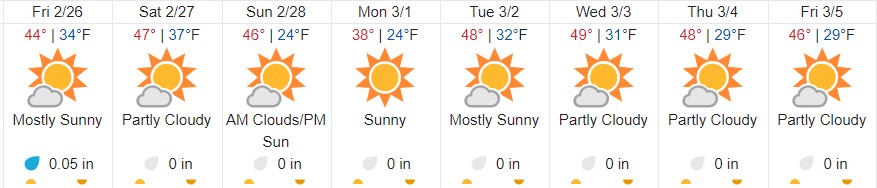
That’s just the near-term weather forecast for where I live, and thus a very narrow focus. I am glad — for any number of reasons, including Siberian weather — I don’t live in Irkutsk. The days ahead for that place:
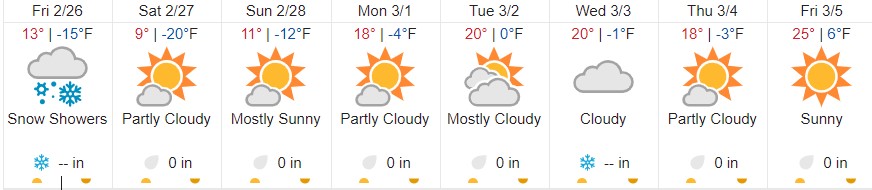
Which pretty much looks like here during February until a few days ago, except we had more snow. Another difference is that I expect the rest of the spring is going be much colder in Irkutsk than here.

Then again, for year-round pleasant weather, I hear the place you want to be is Medellín:
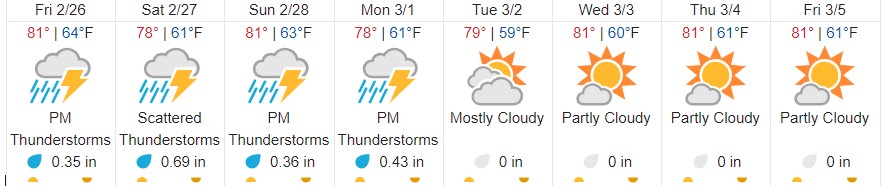
That does look pleasant, just keep a sweater around for the evening. Reminds me of Mexico City in December, except there wasn’t a bit of rain.
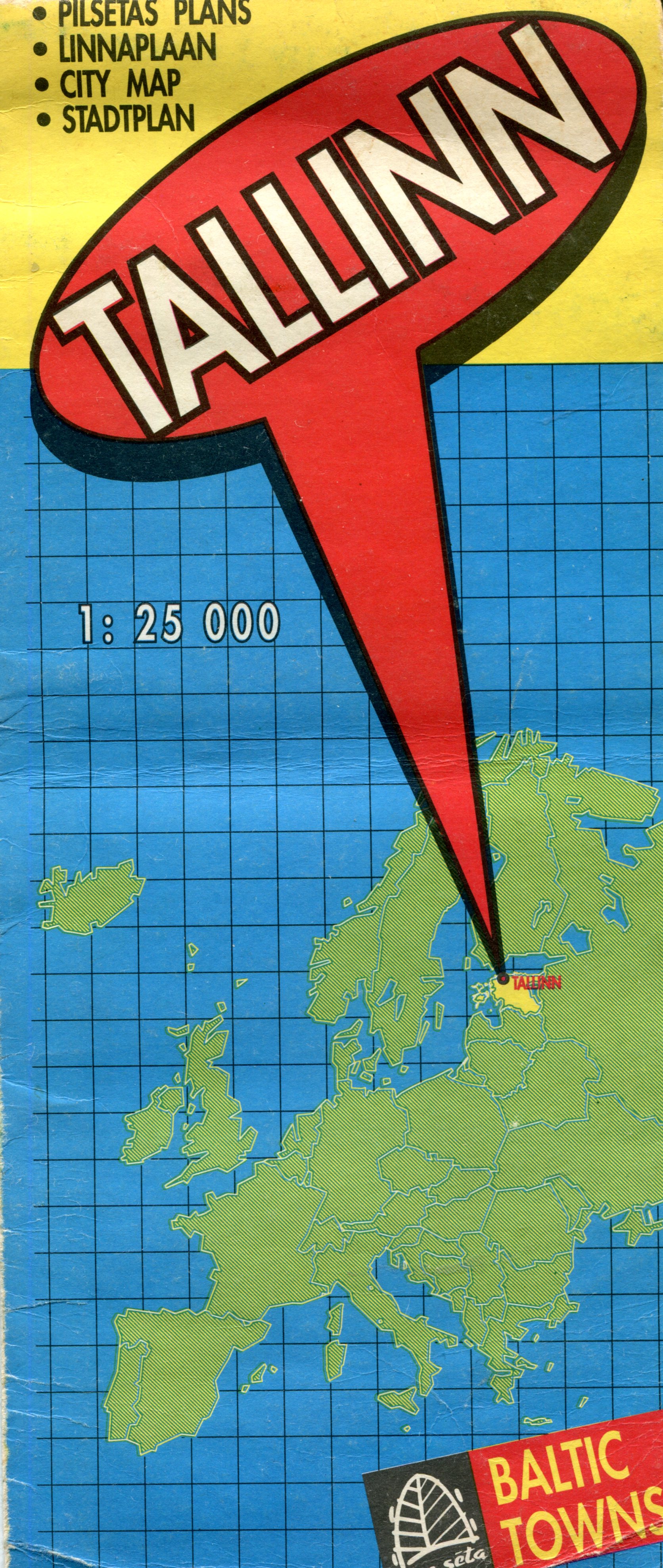
One more map (for now): Tallinn. Nice town, Tallinn, at least in 1994, and I expect it’s done well for itself in the generation since casting off the Soviet yoke.

The map front is simple enough, and reminds everyone where Estonia is in the greater scheme of Europe. Guess some people need to be reminded of that kind of thing.

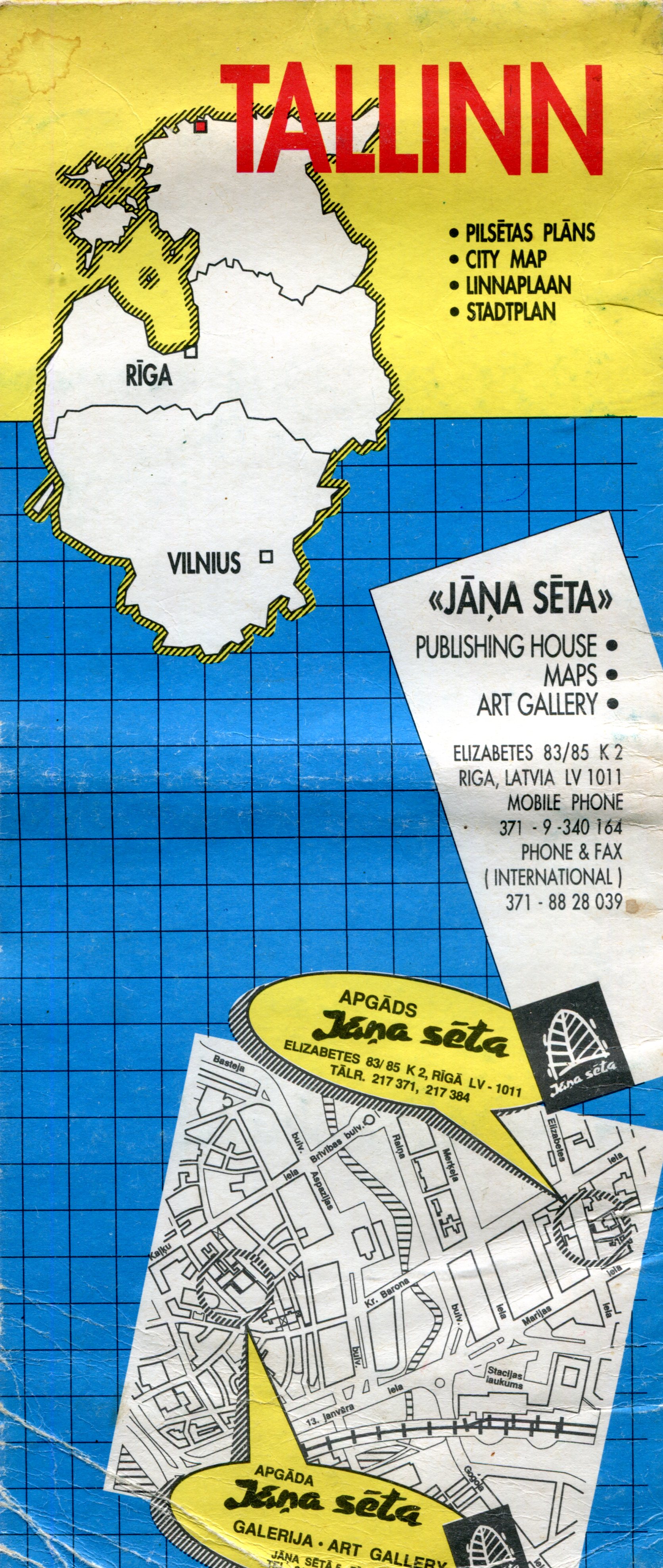
The map is the product of Jana Seta, “publishing house, maps and art gallery” in Riga. I’m happy to report that it’s still around, and has a web site that tells me that the company had just started business the same year we visited Riga, which was just after we were in Tallinn. Unfortunately, we didn’t visit the map store.

“We started on the 19th of April 1994 when the specialized map and travel literature outlet — Jana Seta Map shop — opened its doors to the first customers in the newly renovated Berg’s Bazaar building in Riga,” the site says. “At that time it was the first and only specialized map shop in the Baltics.
“Together with the constant in-going and out-going tourism development in Latvia, our shop has grown to become one of the leading map shops in the whole of Eastern Europe. Many trips around Latvia and abroad have started at the shelves of our map and tourism literature.

“The former USSR army general staff topographic map and city plans (published 1949-1991) have a special place in our assortment.” Hm.

One side of the map is a wider view of the city, while the other has a detailed map of the historic center, plus an index and advertisements for the kinds of things that tourists and business travelers might want, mostly in English. Looks like Jana Seta was quick to pick up the ways of private enterprise. The map key and other information are in English, Russian and (I assume) Latvian.

This is the inset for the historic center of Tallinn.
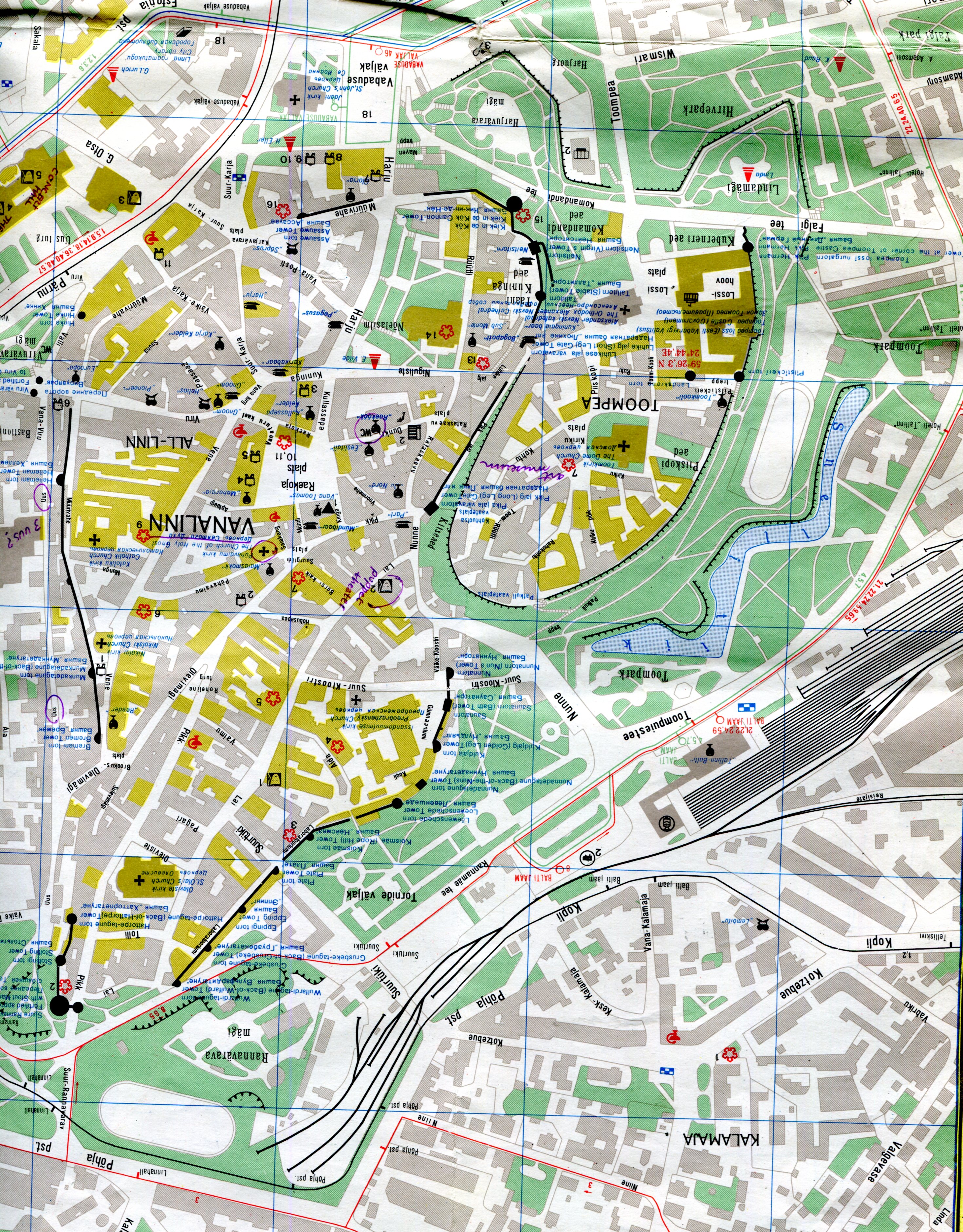
A fine old place to visit, though we stayed in cheaper accommodations out from the center, in a Soviet-era block of flats, and rode the convenient trolley into the old town. I see that I marked a few places of interest in purple ink, including one I labeled “puppet theater.” As much as I’d like to say that we went to a puppet theater in Tallinn, I’m afraid we didn’t.

“The Historic Centre (Old Town) of Tallinn is an exceptionally complete and well-preserved medieval northern European trading city on the coast of the Baltic Sea,” says UNESCO, which put it on the World Heritage list in 1997. “The city developed as a significant centre of the Hanseatic League during the major period of activity of this great trading organization in the 13th-16th centuries.

“The upper town (Toompea) with the castle and the cathedral has always been the administrative centre of the country, whereas the lower town preserves to a remarkable extent the medieval urban fabric of narrow winding streets, many of which retain their medieval names, and fine public and burgher buildings, including town wall, Town Hall, pharmacy, churches, monasteries, merchants’ and craftsmen’ guilds, and the domestic architecture of the merchants’ houses, which have survived to a remarkable degree. The distribution of building plots survives virtually intact from the 13th-14th centuries.”

One more thing I learned just now from Jana Seta’s site: “Mars has three craters named for places in Latvia: Auce, Rauna and Talsi. Now you know.”
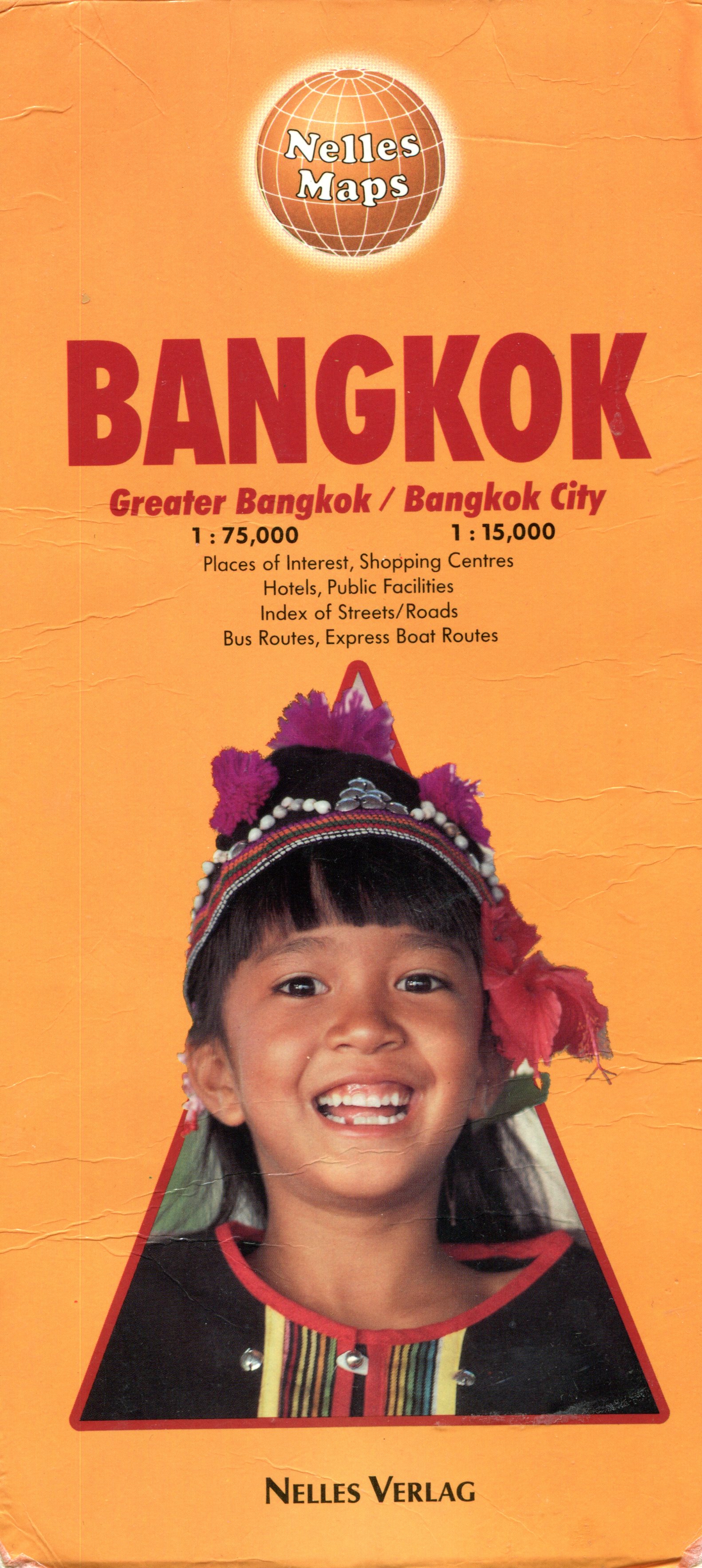
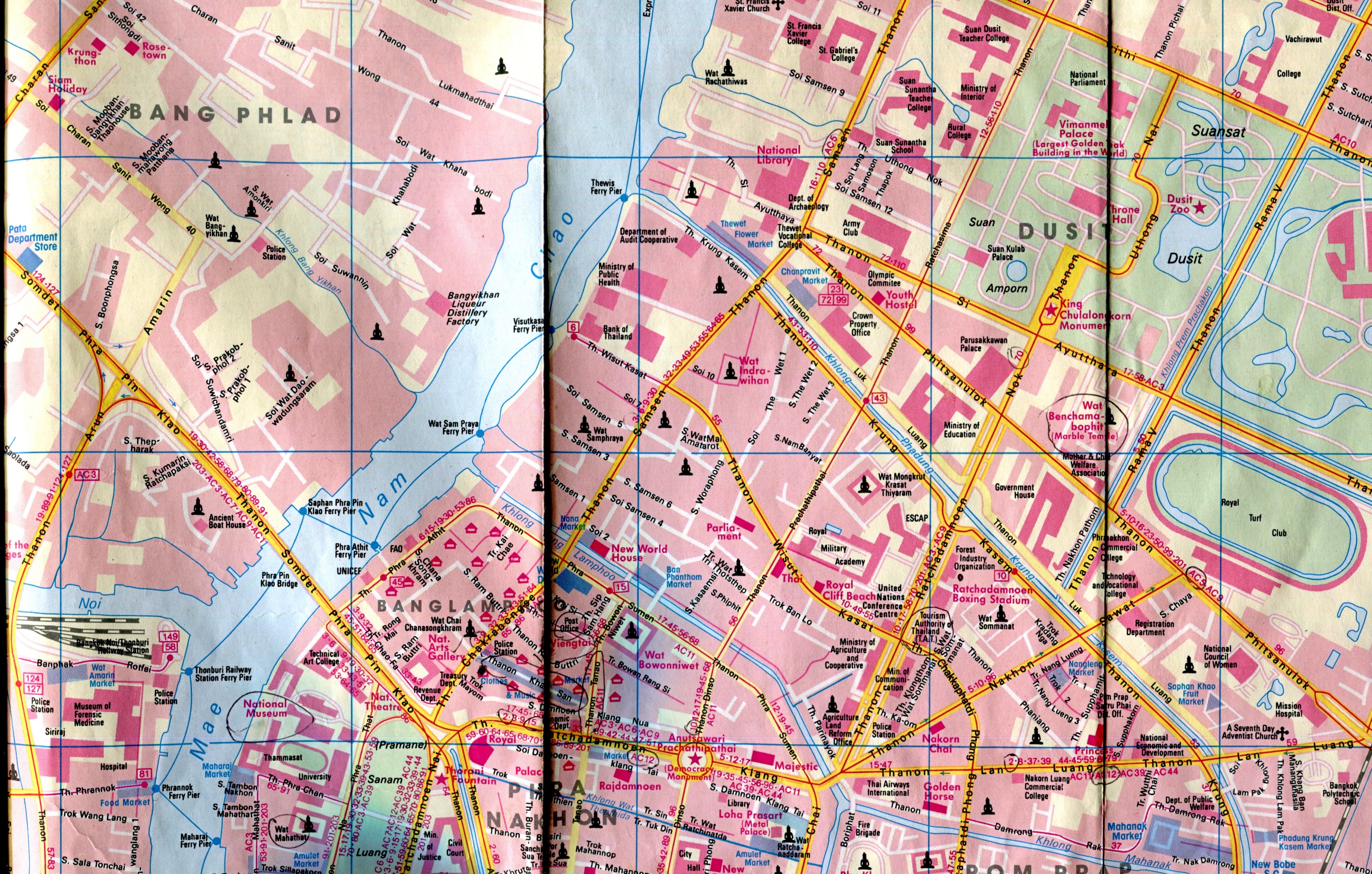
Nelles Bangkok

Bangkok is one of those cities hard to navigate even with a map. But I guess the challenge and the thrill of finding your way around in a place where most of the signs aren’t in a roman script is a thing of the past. Even if I ever went back there, I’d take my box, with its connection to nifty electronic maps and transliterations.

We had a good map: Nelles. It wasn’t the only place where we used that brand.

Craenen, a European map distributor, says of Nelles: “Nelles Verlag is a German publisher of maps and guidebooks. The Nelles maps are well known and appreciated for their reference precision and quality…


“Places of interest, including historical sites, beaches, national parks or protected area, etc. are highlighted both on the main map and on the accompanying street plans or enlargements…. The extensive range consists of a large number of destinations for which it is difficult to find other good maps. Asian destinations in particular are very well represented, and in recent years, more coverage has been given to both South America and Africa.”

Tourist Map of Japan

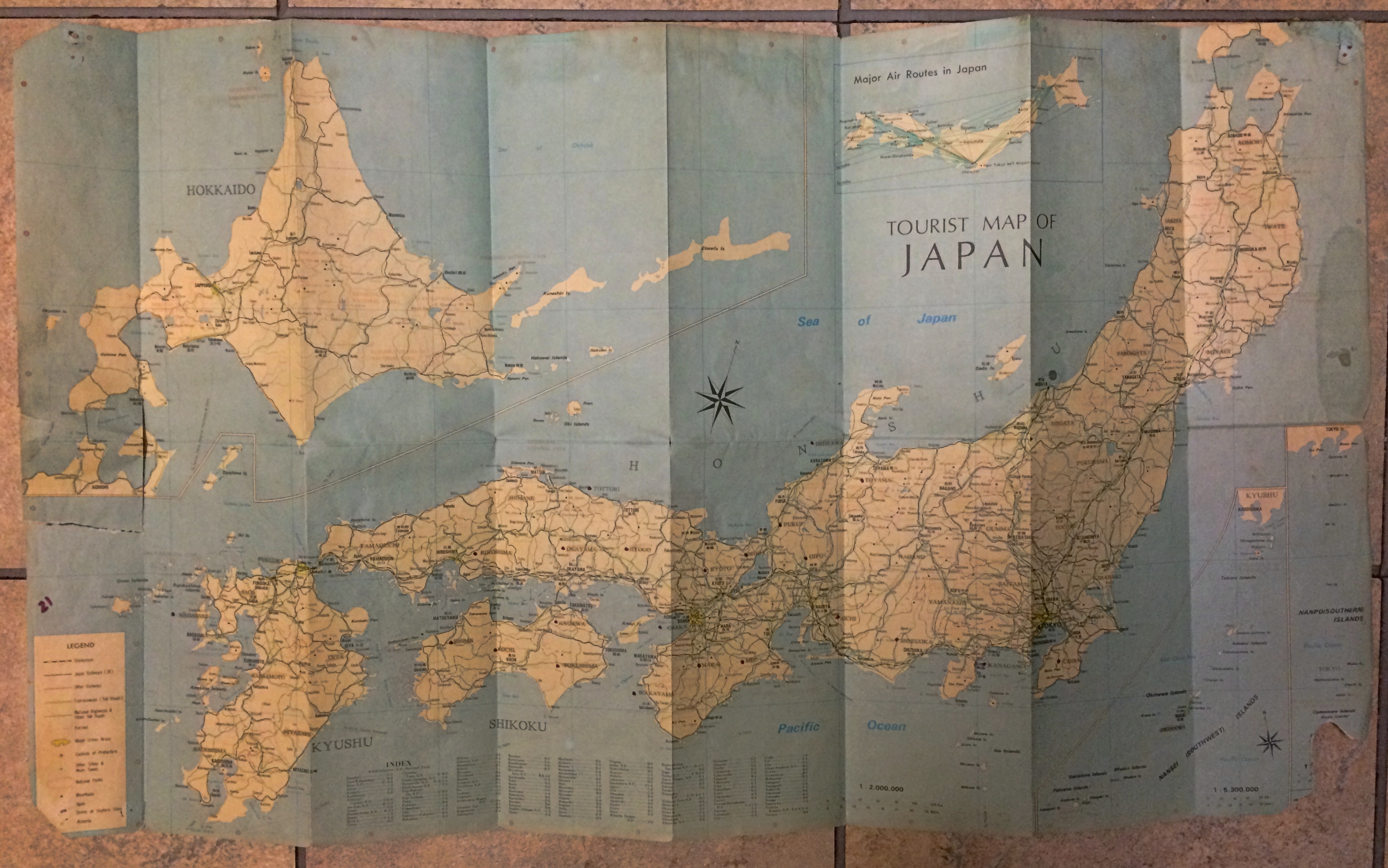
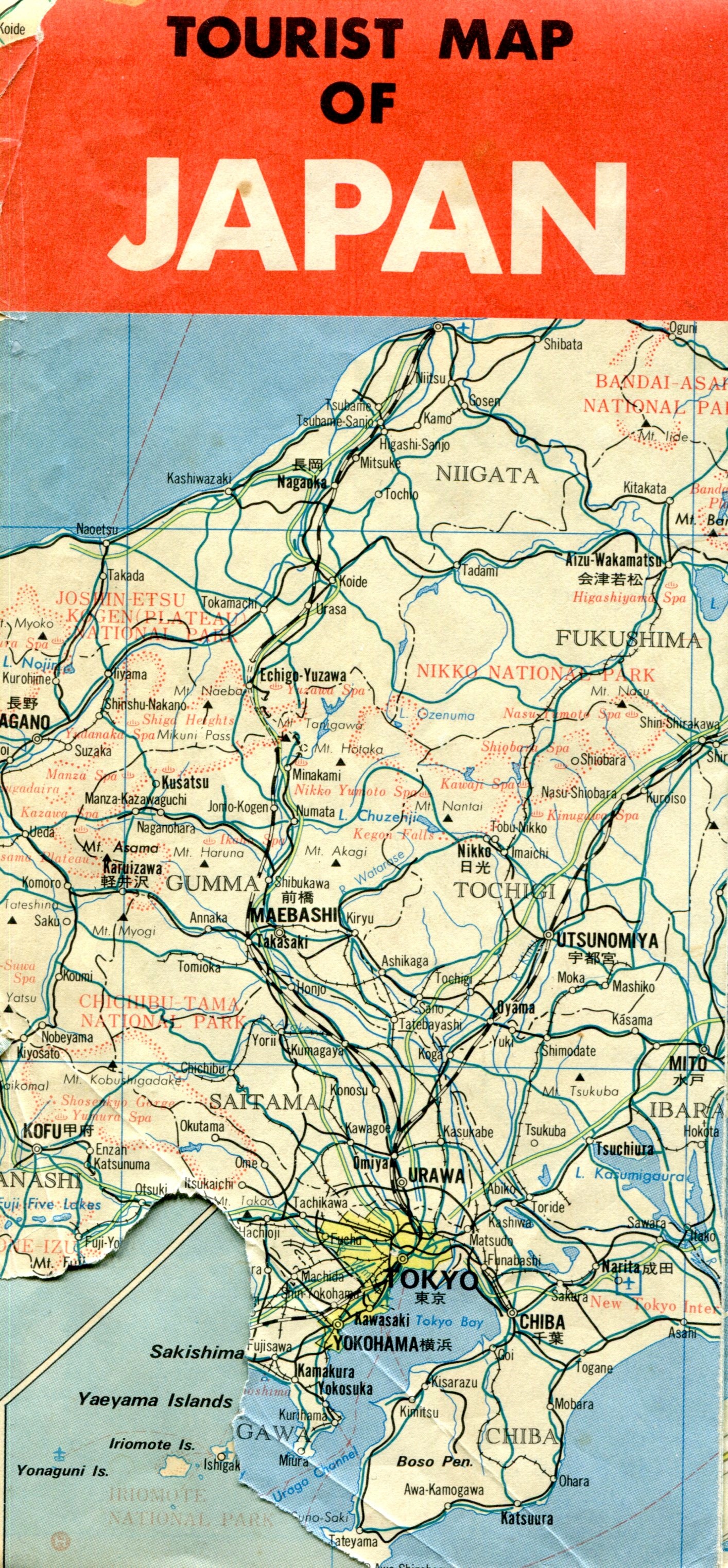
Another yellowing old map in my collection — accumulation — random stash — is one of Japan published by the Japan National Tourist Organization in 1988. I picked it up in 1990 during my early days in the country, and for a while it was thumbtacked to a wall in my flat.Tourist Map of JapanLook closely and you’ll see the thumbtack holes. Along with tears and other damage. Part of the front panel, not far from Tokyo-Yokohama, is missing for some reason.
Tourist Map of Japan
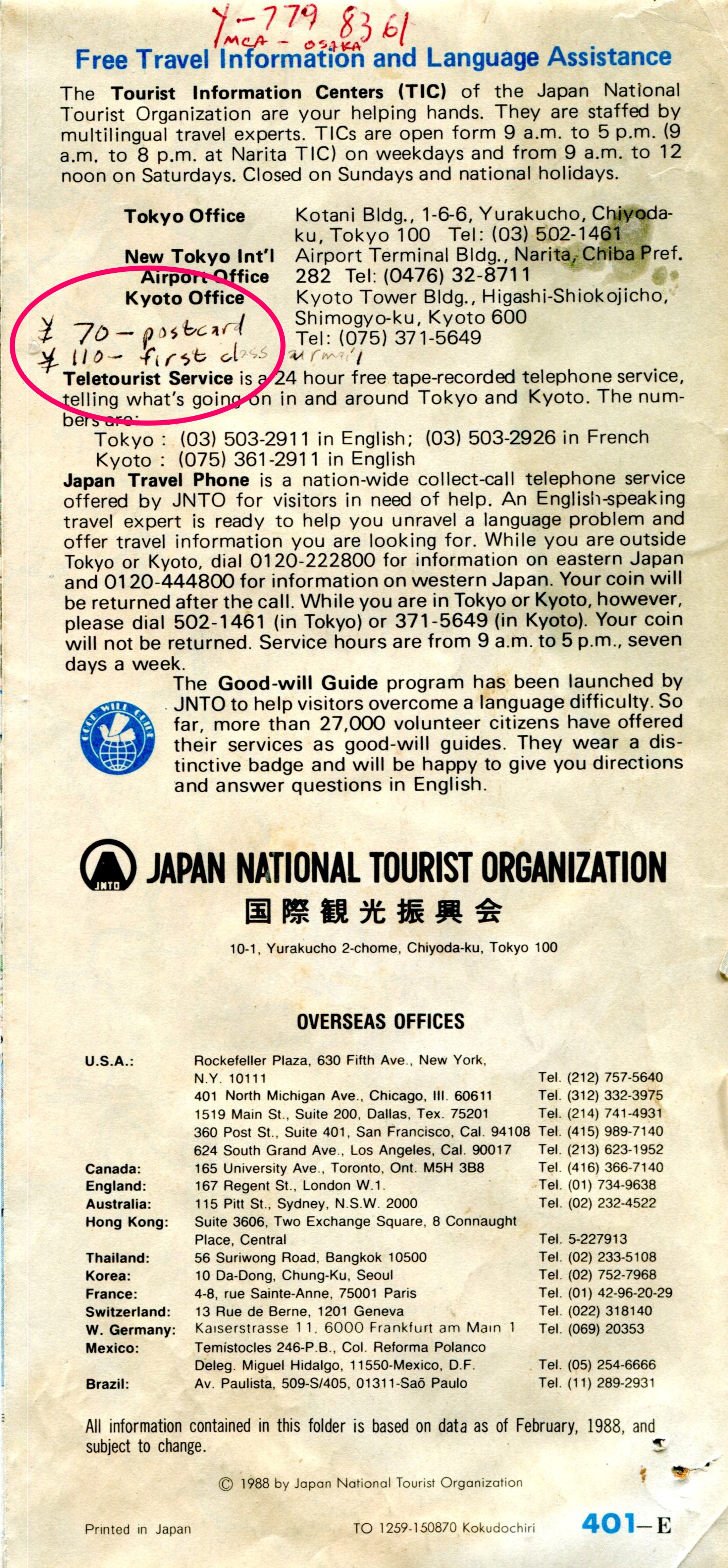
I also seem to have used it for note-taking, at least briefly. Something I learned very early on: the price of a postcard and a first-class letter to the U.S. (¥70 and ¥100, respectively). Not bad, $1 fetched about ¥130 during my first year there. I’m not sure what “Y-779 8361 MCA – Osaka” refers to.
Tourist Map of Japan
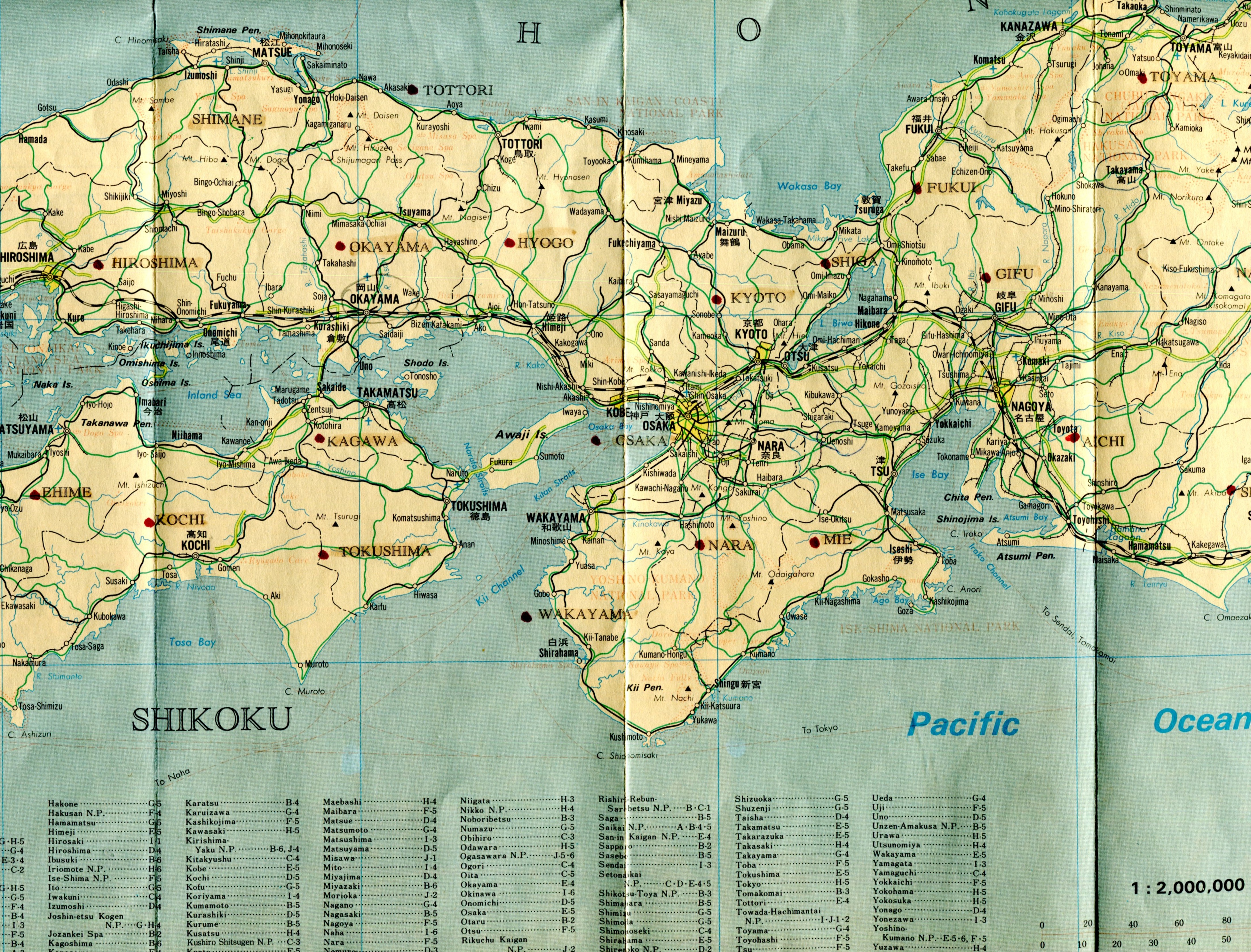
Featuring cities, towns, rail lines and roads, spas (very important in Japan; onsen (温泉), perhaps hot spring is a better translation), rivers, lakes, major mountains, national parks and prefecture names. The kanji for larger cities and towns is also included.
Tourist Map of Japan
It wasn’t a map I carried around much, since the scale was too large (1:2,000,000 as it happens) to be useful as a guide. Still, it had a good run on my wall, helping inspire me to get out and about.

Jugendherbergen in Europa und im Mittelmeergebiet

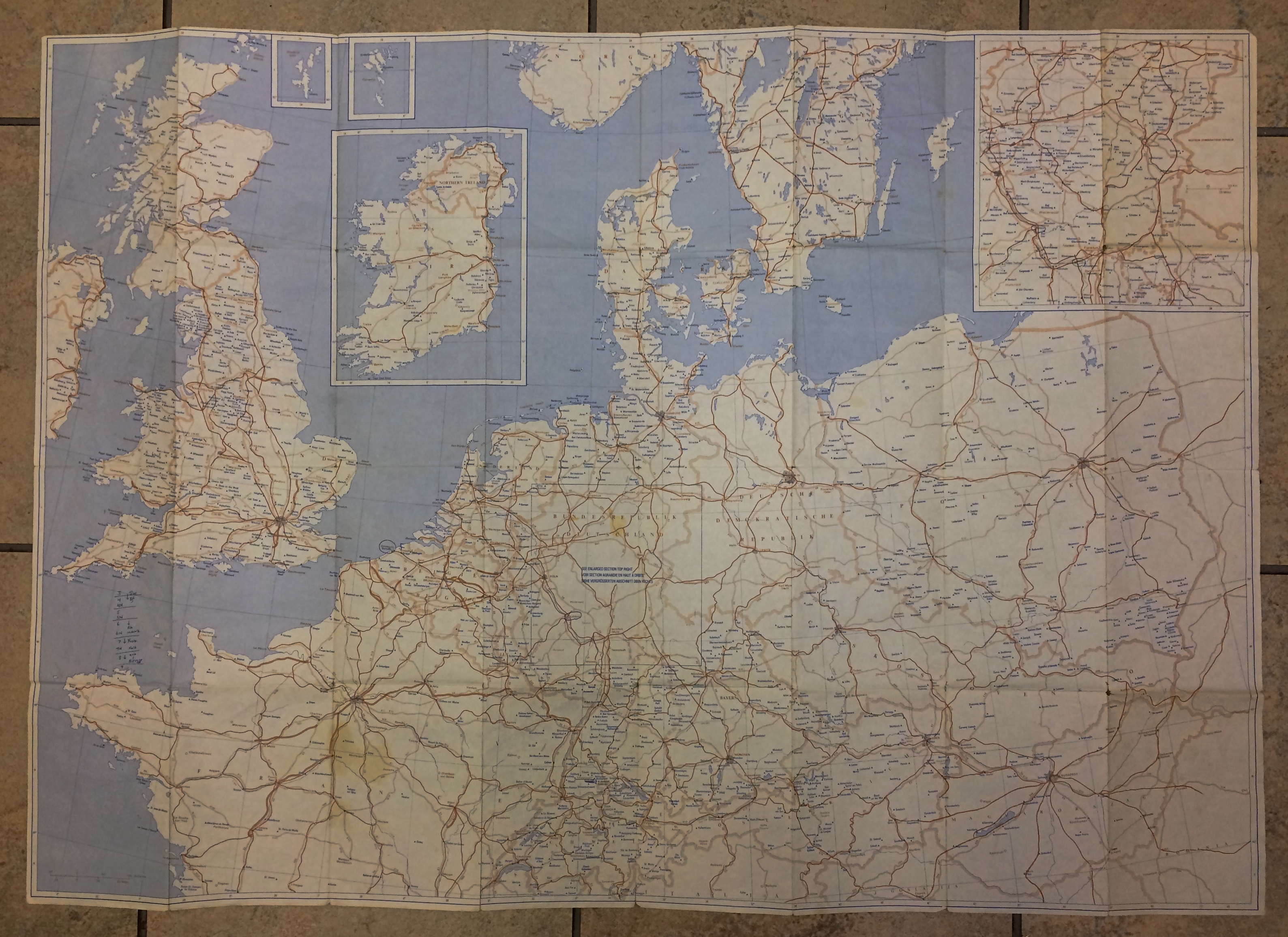
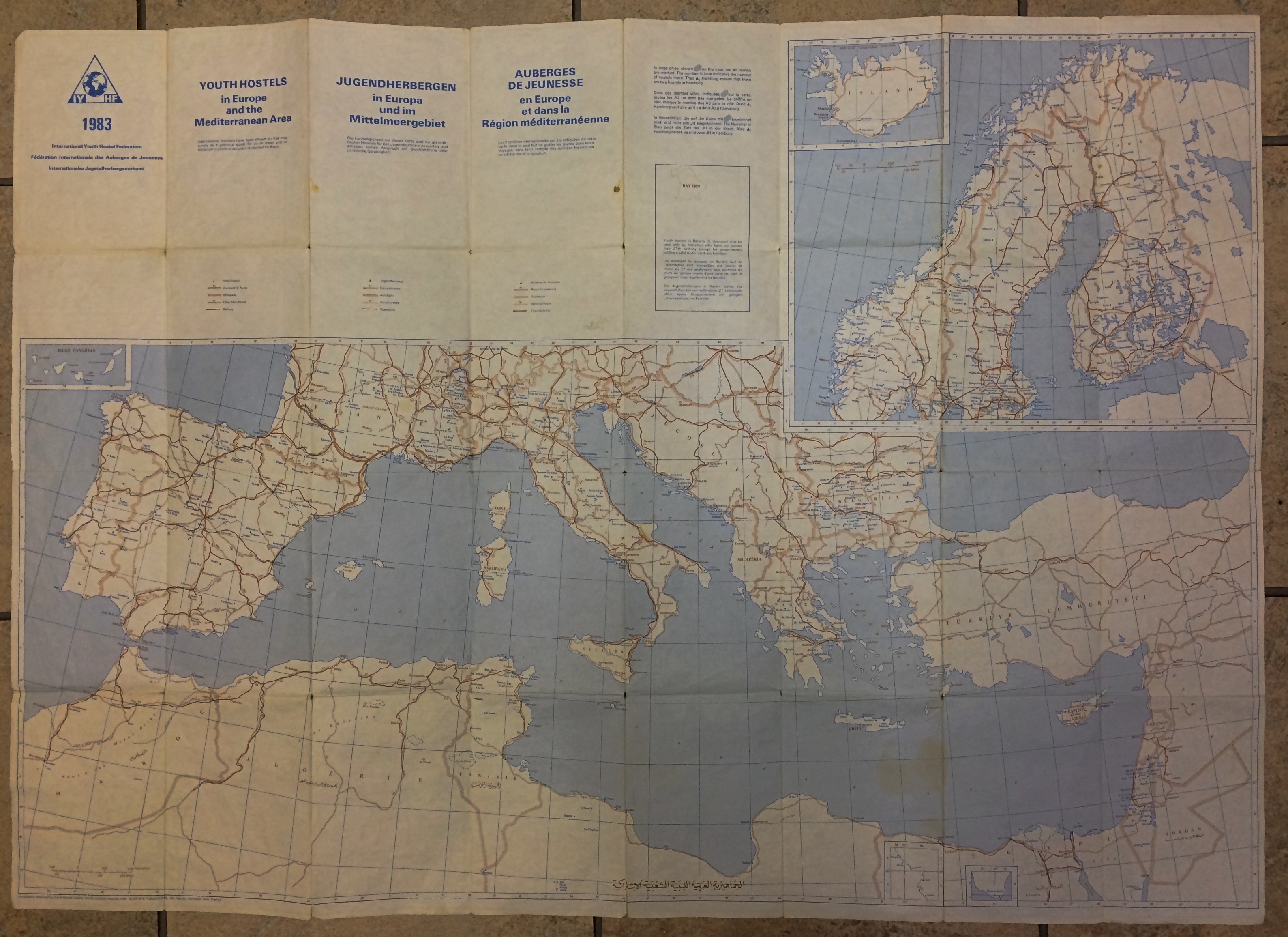
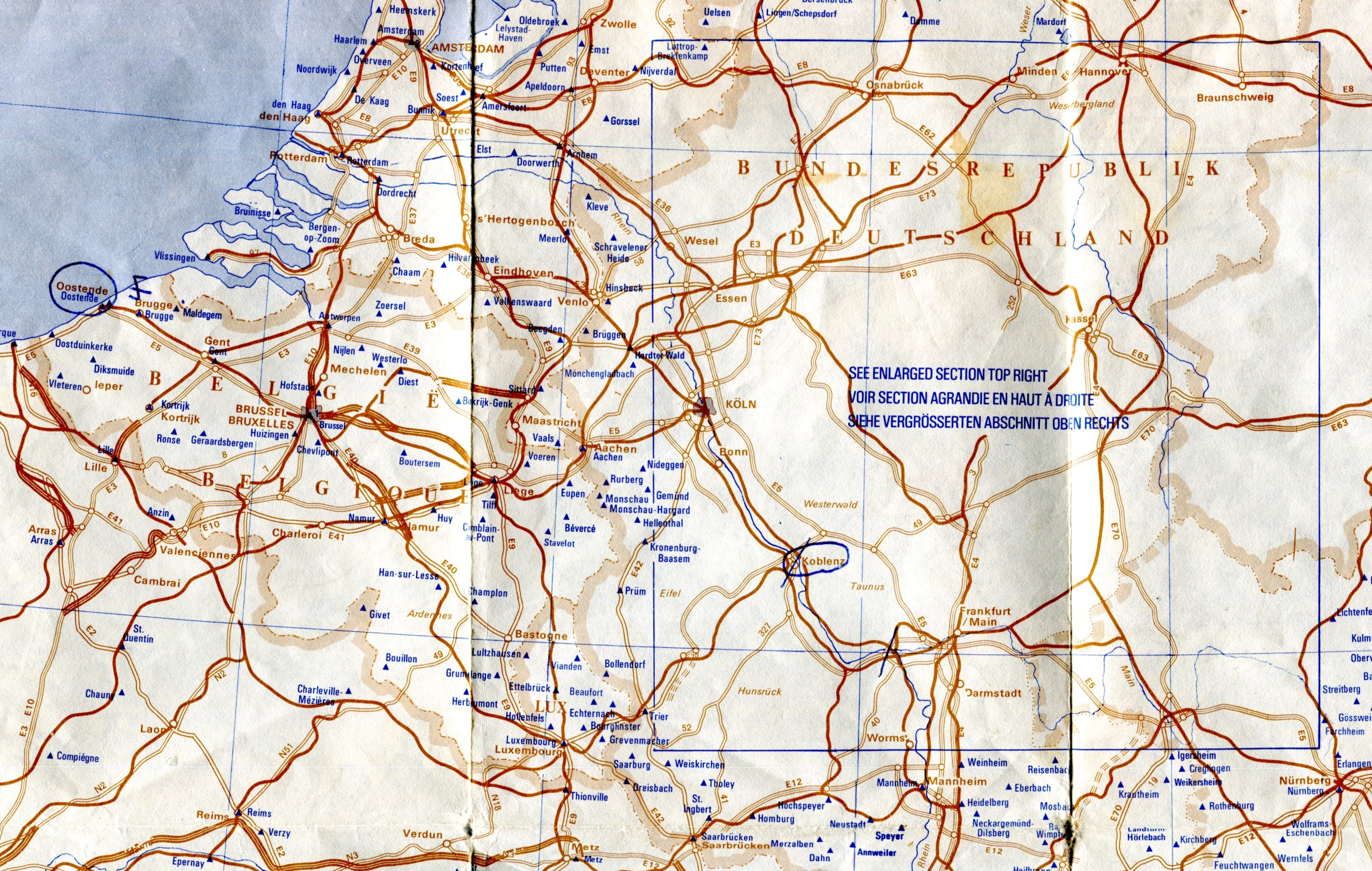
Folded away in my collection of maps is a well-folded and slightly yellow youth hostel guide map of Europe, vintage 1983. Even if I hadn’t carried that map around Europe in the summer of ’83, I would know the date.youth hostel map 1983 youth hostel map 1983

It’s fairly large, 24 x 34 inches, and a little cumbersome to use except in your room, as you planned a future stay. We had guidebooks that might (or might not) mention a particular youth hostel, but there were no websites to tell you what you were getting into, though I never did stay in a bad one, just some mediocre ones. You also never knew whether it had a vacancy, unless you figured out how to call ahead, which could be an involved process. Even in the high season of summer, however, I remember that being an issue maybe only twice, and in those cases the hostel staff recommended somewhere else to stay.

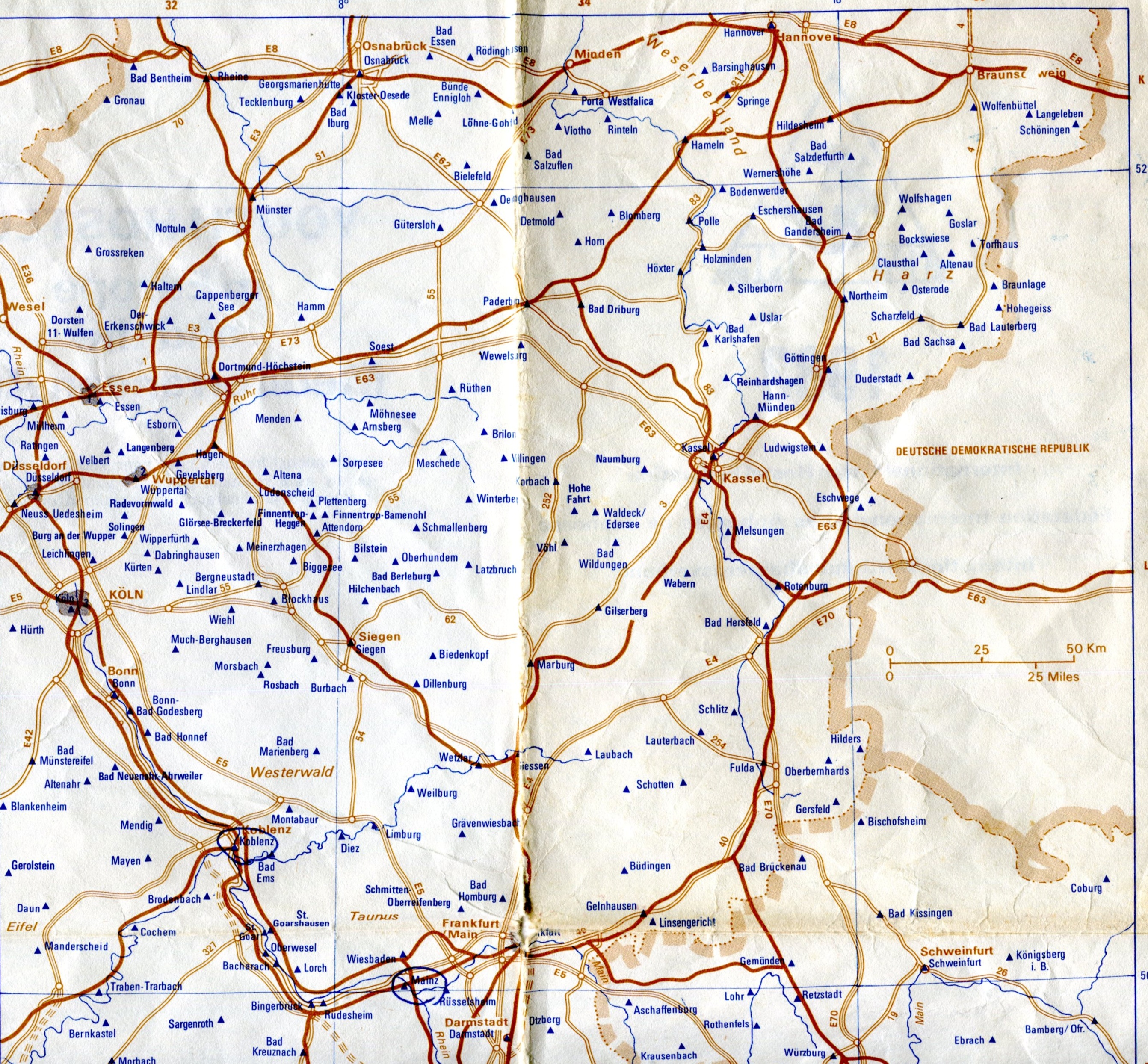
One side includes most of northern Europe, including insets for Ireland and West Germany, where youth hostels were thick on the ground. But not in East Germany in those days. Guess the DDR didn’t take kindly to youth traveling around.youth hostel map 1983Interestingly, most of the other communist countries, at least those that weren’t the Soviet Union, had a system of youth hostels. Bulgaria seemed to have been especially fond of them. Maybe they still are.

The other side features southern Europe and northern Africa, including a fair number in Tunisia and a scattering in Morocco, Egypt and Libya, of all places.
youth hostel map 1983
The map is relatively simple, noting national borders, some of the larger cities and roads and rivers, and each IYHF-affiliated property as a blue triangle to stand out against the browns of the rest of the map.youth hostel map 1983

The German inset.youth hostel map 1983

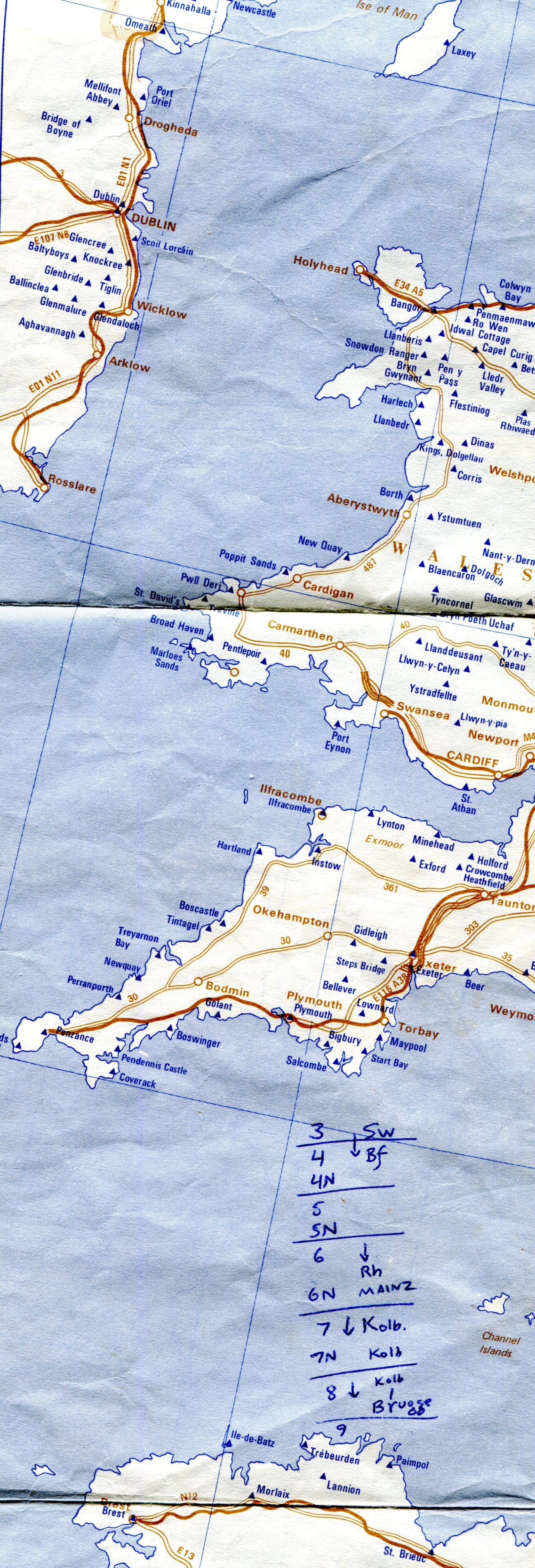
I took a few notes on the map, such as these between Devon and Brittany.youth hostel map 1983

Looks like I was working out my travel schedule from August 3 to 9, as we headed north from Switzerland to the coast at Oostende. I wrote “Brugge” at the end, but for reasons I don’t remember, and can’t fathom now, we didn’t stop there.

We stayed at hostels in the UK, West Germany, Austria, Switzerland and Denmark. All the more expensive countries, in other words. In Italy, which had any number of cheap guesthouses, we didn’t bother, and sometimes the hostels we stayed at in northern Europe weren’t affiliated with the IYHF.

Across the Border

If you like maps, you’re going to have a certain fascination with borders, as imaginary and fluid as they may be. If you travel at all, you’re going to cross borders. If you have a fascination with maps and you travel at all, you’re going to be fascinated when you come face-to-face with a border.

Such as standing on state borders. Or national ones, which are harder to stand on, but not impossible.

On Saturday morning, when it was cool but before the cold rains that evening, I took a walk along a path, headed toward a border.
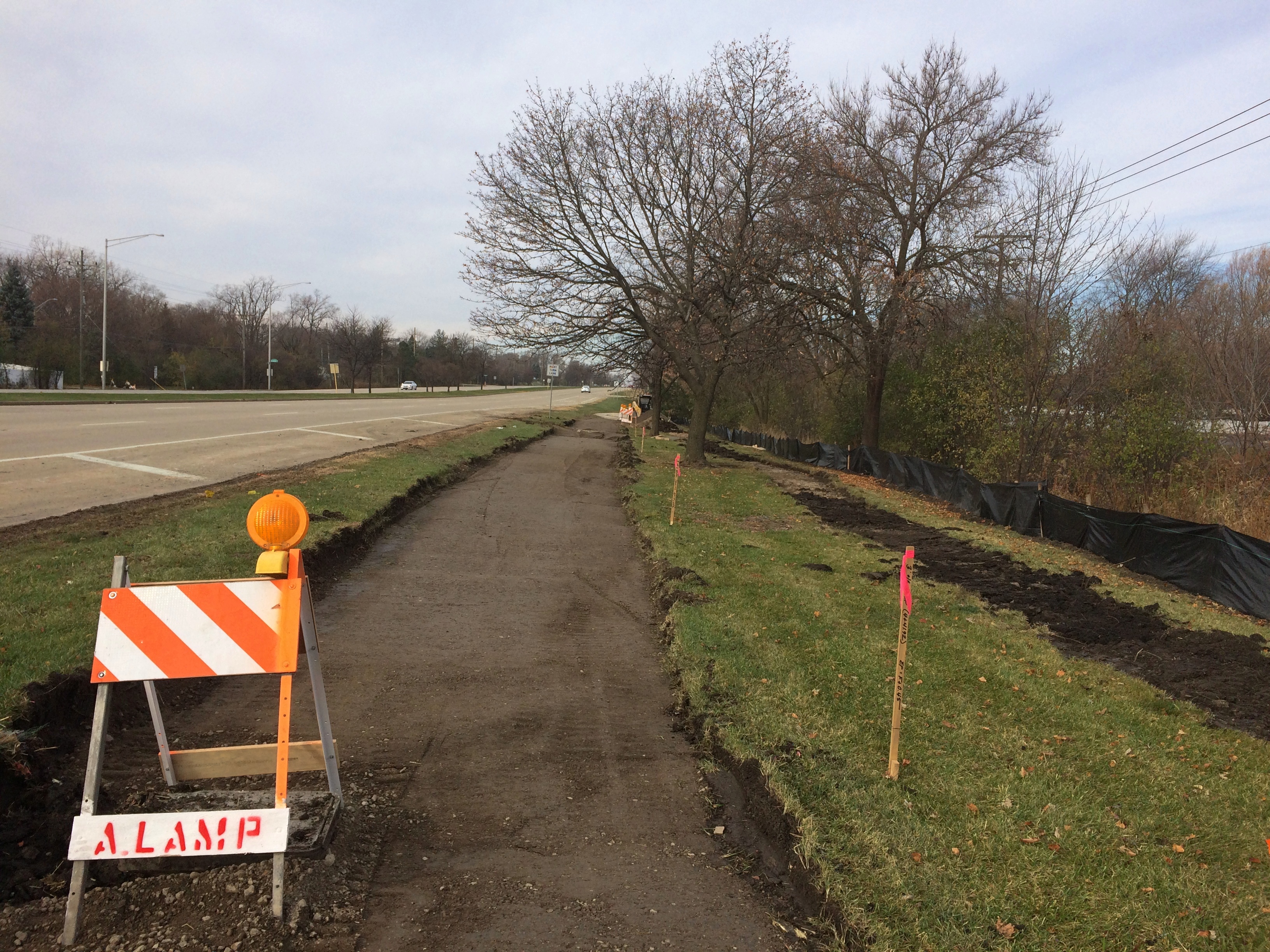
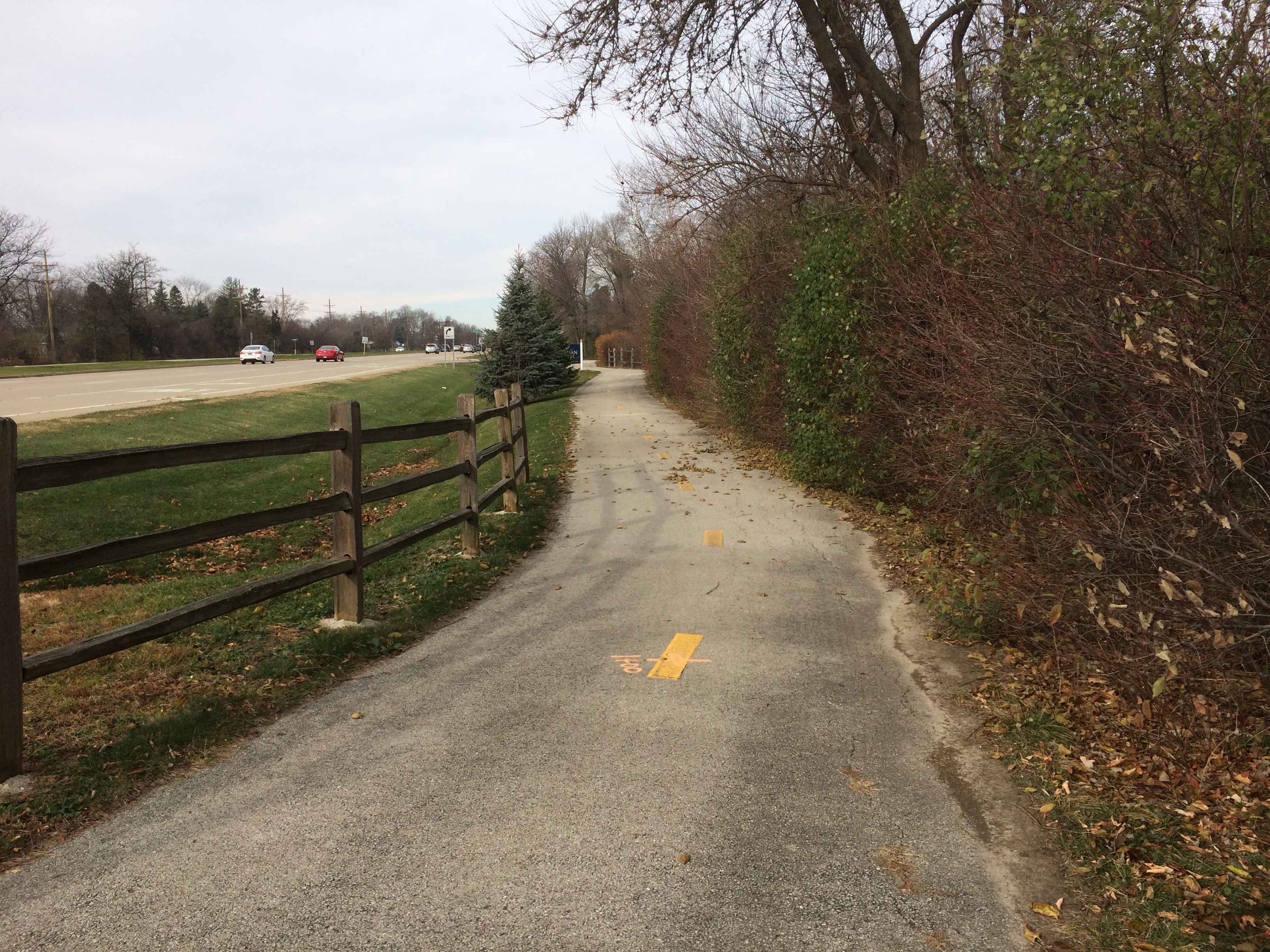
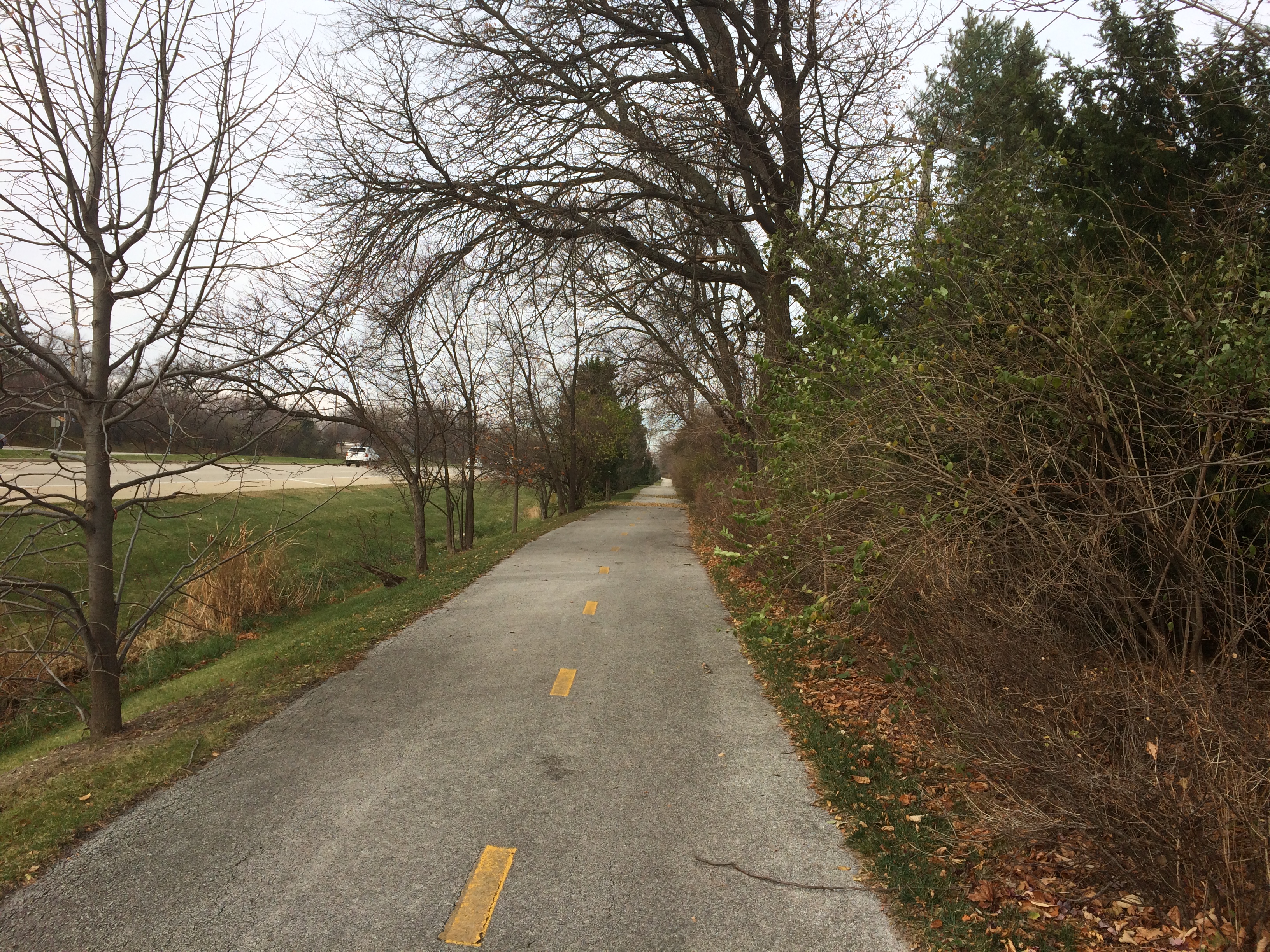
Higgins Road footpathActually, as you can see, the footpath was under construction, so I for 100 feet or so I followed the cut ground where pavement would soon be. Replacement pavement, since I’ve seen a path there for years. I can’t imagine it’s being replaced with anything else.

Not all of it is being rebuilt.
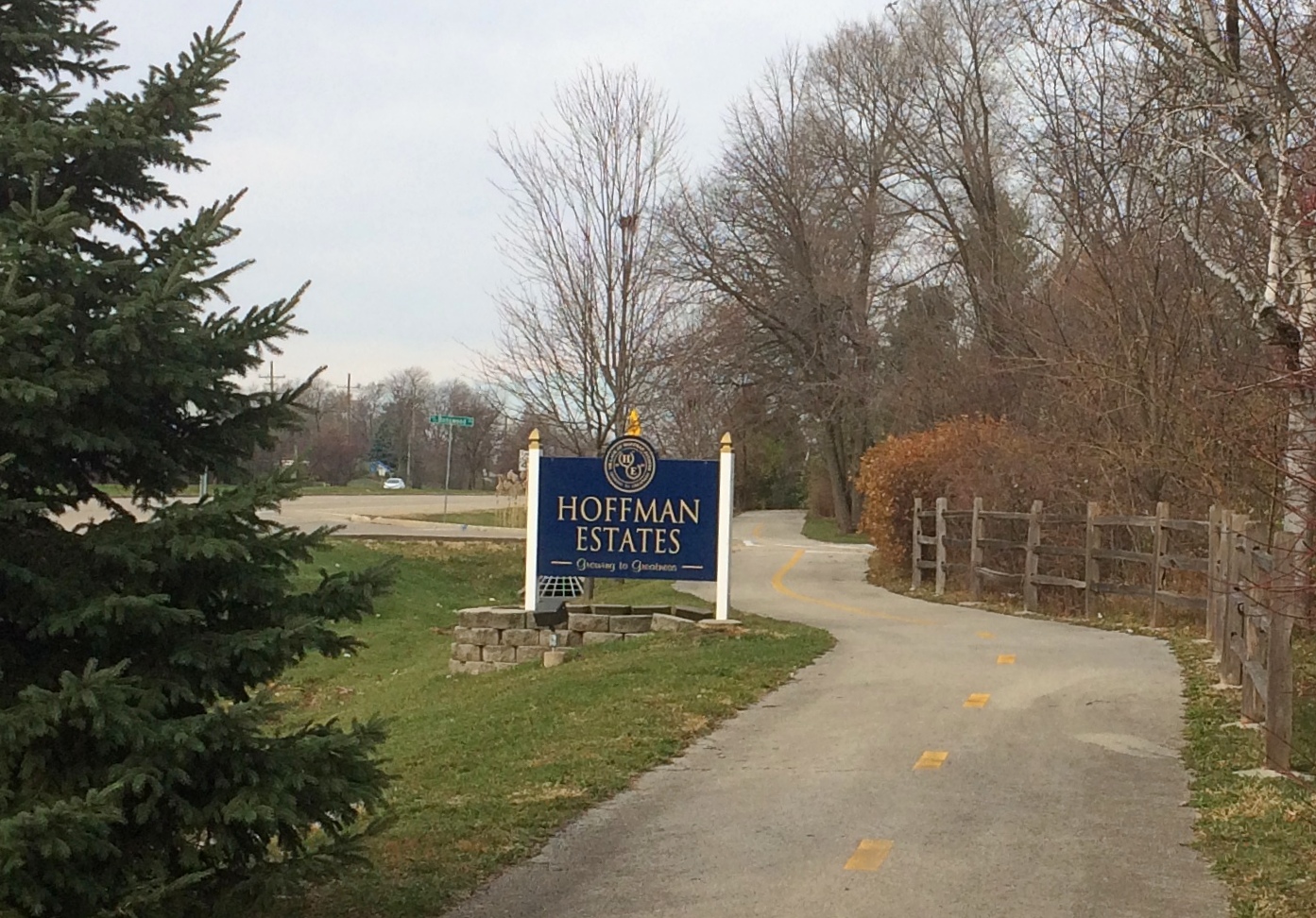
Higgins Road footpathSoon I came to the border. Or at least a sign, if not the precise line.
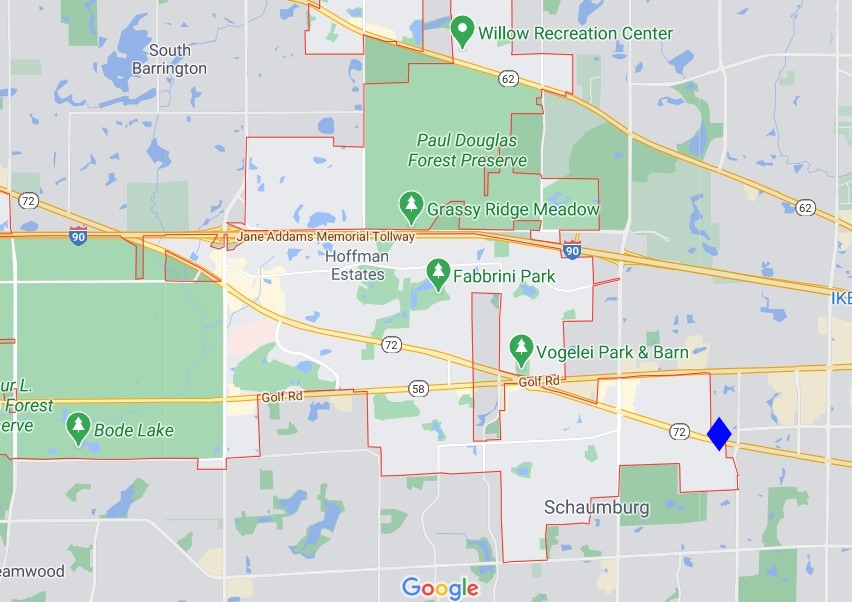
Higgins Road footpathThe Schaumburg-Hoffman Estates Border. A simple map shows how convoluted it is, an echo of a competing annexation rush in the late ’50s and early ’60s.

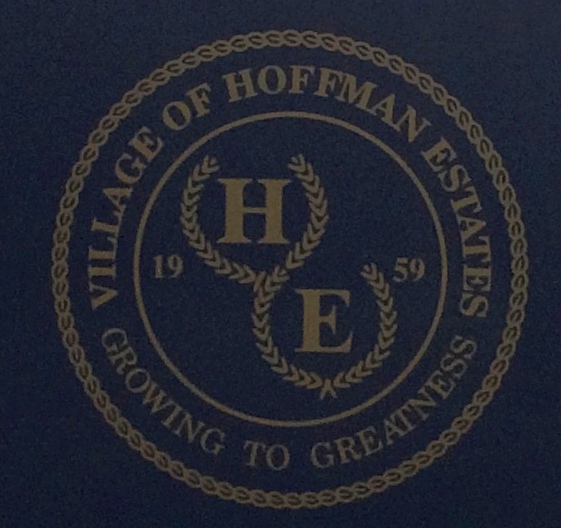
On the back of the sign is the Hoffman Estates seal, or emblem or logo. I didn’t remember seeing it before. Edited from the original: “Growing to Greatness, and Those Schaumburg Bastards Aren’t Going To Stop Us.”
The blue diamond marks where I was, heading west into Hoffman Estates, and then back east into Schaumburg. The road is Illinois 72, but we never call it that. It’s Higgins Road. Just to the east of the blue diamond is a small office complex that includes our dentist as a tenant. I took Ann there Saturday morning for an appointment, but there’s no waiting in the waiting room, so I hit the footpath.

“Early records date the road back to 1851,” writes Pat Barch, Hoffman Estates historian. “It was identified as the Dundee Road on 1904 maps. Early settlers called it the Chicago-Dundee Rd. Today’s Higgins Road (Route 72) wasn’t opened as a state road until 1924. It runs for 110.71 miles from IL Rt 43 in Chicago to Lanark, IL.”

Also, the road might have been named for nearby landowner “F. Higgins.” Lots of early landowners gave their names to later suburban roads. As suburban roads go, I like Higgins, at least at this juncture. It’s usually less crowded than the similar-sized and nearby Golf Road, which runs past the Woodfield Mall, car dealerships and other traffic generators.

All the years I’ve been driving on Higgins, I’d never walked on the path. Or seen many other people doing so, or riding bikes. So I guess the current crisis is good for something — getting me out to see the territory.

This is the view across the border. Not much of a change in scenery.
Higgins Road footpathHiggins to the left has some traffic, but only enough to be distracting when you’re on foot, until you start to ignore the sound. To the right are bushes and fences that separate the road and footpath from suburban back yards.

I got as far as the intersection of Higgins and Ash Road. Years ago, I used to turn on Ash to drive to the home of a babysitter we used occasionally, who had a daughter about Lilly’s age. Live in a place long enough and everywhere reminds you of something.

Handy Map of London

I have in my possession a Handy Map of London. This is supposedly a German version of similar vintage; mine is in English, but it looks just the same. Mine is dated 1986, so I’m certain I picked it up in 1988.

It isn’t my favorite map of London — that would be that marvel of aesthetic mapmaking, the Bensons MapGuide.

Still, the multi-page, folding Handy Map, published by John Bartholomew & Son Ltd. of Edinburgh, was indeed handy. That company, long since a unit of Harper Collins, is one of the storied Scottish mapmakers, as detailed here.

Interesting material in the Wiki description, though without citation: “John Bartholomew Junior was credited with having pioneered the use of hypsometric tints or layer colouring on maps in which low ground is shown in shades of green and higher ground in shades of brown, then eventually purple and finally white.

“It is his son John George who is attributed with being the first to bring the name ‘Antarctica’ into popular use as the name for the Southern Continent, and for the adoption of red or pink as the colour for the British Empire.”

By gar, someone invented those conventions. But they’re such strong conventions that you hardly think of a time when maps didn’t feature them.

The Handy Map folds out to reveal ten separate maps, nine of which are parts of Greater London, and all of which are color- and number-coded. Want to look for a particular place? The map makes that pretty easy. Even more so than Benson, I have to say.

The tenth map is a view of all of Greater London. As you’d imagine, it can’t be overly detailed, but it is good for orientation. I was looking at it the other day (for now the Handy Map is in the downstairs bathroom) and noticed an oddity on the Greater London map.

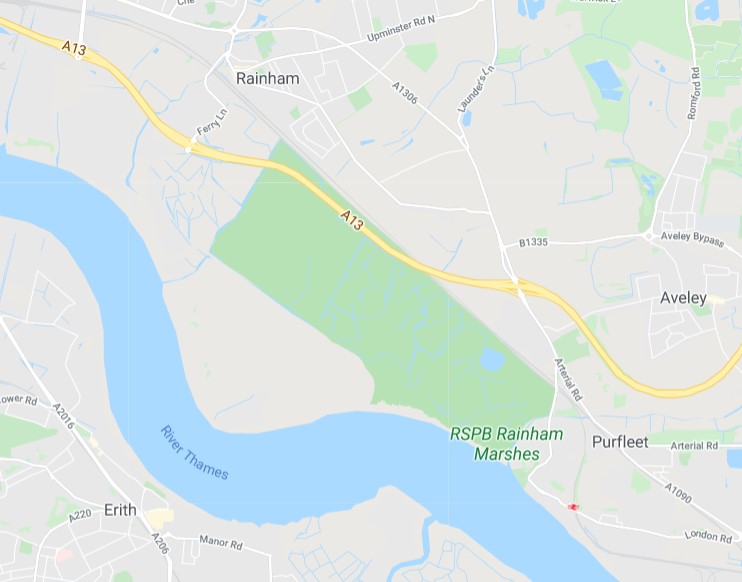
Toward the eastern edge of the map, just north of the Thames near a place called Purfleet, is a pink, long oval shape (like a race track) simply marked DANGER AREA.

What? It took me a few days to remember to check it out on Google Maps. In 1986, a danger area. In 2020, it’s the RSPB Rainham Marshes, also known as the Rainham Marshes Nature Reserve.
That would be, according to Google: “Bird-rich former marshland firing range with accessible boardwalks and a modern visitor centre.”

RSPB? The Royal Society for the Protection of Birds. The organization bought the land from the UK Ministry of Defence in 2000, opening it to the public in 2006. So danger area no more, unless you’re attacked by cetti’s warblers, little egrets or peregrine falcons. More about the marshes is here.

More about the organization is here.

“The RSPB was formed to counter the barbarous trade in plumes for women’s hats, a fashion responsible for the destruction of many thousands of egrets, birds of paradise and other species whose plumes had become fashionable in the late Victorian era,” its web site says.

“The organisation started life as the Society for the Protection of Birds (SPB), founded by Emily Williamson at her home in Manchester in 1889. The group quickly gained popularity and in 1891 it merged with the Fur, Fin and Feather Folk, to form a larger and stronger SPB, based in London.

“In its earliest days, the society consisted entirely of women and membership cost twopence. The rules of the society were:

“That members shall discourage the wanton destruction of birds and interest themselves generally in their protection

“That lady-members shall refrain from wearing the feathers of any bird not killed for purposes of food, the ostrich only excepted.”

Interesting that ostrich feathers were OK. If I felt like it, I could investigate why that was, but I have a hunch that ostrich farming was entirely too valuable before WWI to discourage, especially in South Africa. These days, leather is the main thing, with feathers just a sideline.

The Location of Wales

I have two desks in my office, both of which have drawers that are full of the debris of a home office. That includes a drawer with a lot of business cards in it. Sometimes I throw some of them out, since they date back to the early 2000s, an eon ago in the business world.

Jobs change, titles change, phone numbers change, email addresses change: all the ingredients of bum information in data bases. In some theoretical sense, my drawer of cards is an ancient analog database, but really it’s just a pile of cards. Including one with this back:

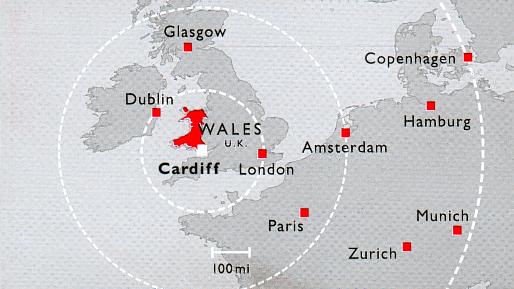
Unusual to find a map on a business card. It came with some material from the Chicago office of an organization promoting business development in Wales. It’s graphically interesting and it conveys some possibly useful information, namely that Wales isn’t that far from London or Dublin or various well-known European cities. Then again, it’s Western Europe. Nothing is that far apart in modern terms anyway.

Maybe the main reason the organization included a map is that they were tired of people saying, “Wales, huh? Don’t you guys have a Prince? Now, let’s see — I’m not sure where that is.”

Winterlude ’20

Though it hasn’t been a harsh winter, it has been winter, so time for a short hiatus. Back posting around March 1.

It turned out to be a good idea to know as little as possible about Parasite before seeing that movie, which we did last weekend, weeks after we’d originally considered going. All that time, I did my best not to read about it. Not knowing the arc of the story helped maintain the suspense, which was as riveting as anything Hitchcock did, especially after the midway twist.

I did know that the movie came highly recommended, and by sources I respect more than the Academy of Motion Picture Arts and Sciences. Could it, I wondered, be better than 1917? It was. That’s a remarkable achievement all by itself. One of those rare movies that is as good as people say.

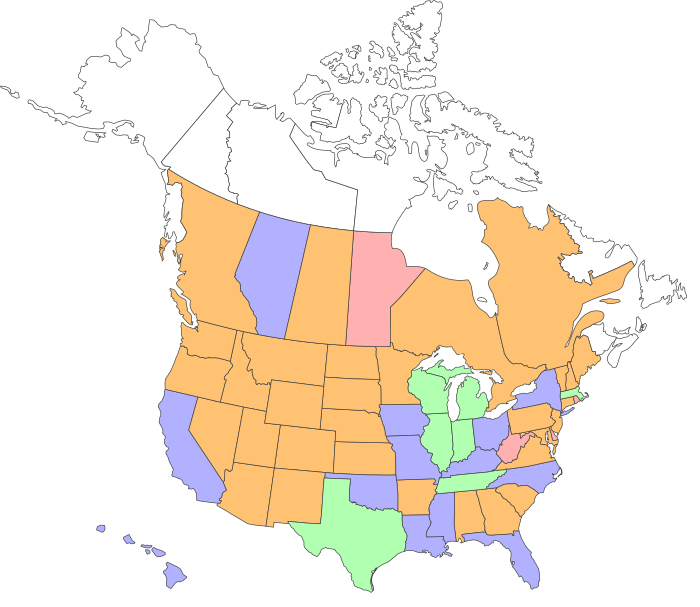
I’ve updated my vanity North American map again.
The key to the colors is here. The color scheme is wholly idiosyncratic, so I do have certain ideas about certain places. For instance, if I spent some time in following places, I’d color the respective states blue: the Northwoods of Minnesota; Norfolk and vicinity in Virginia; Mobile, Alabama; and Tuscon, Arizona. If I spent a night in West Virginia or Delaware or Rhode Island or Manitoba, they’d be orange. Just means I need to get out more.

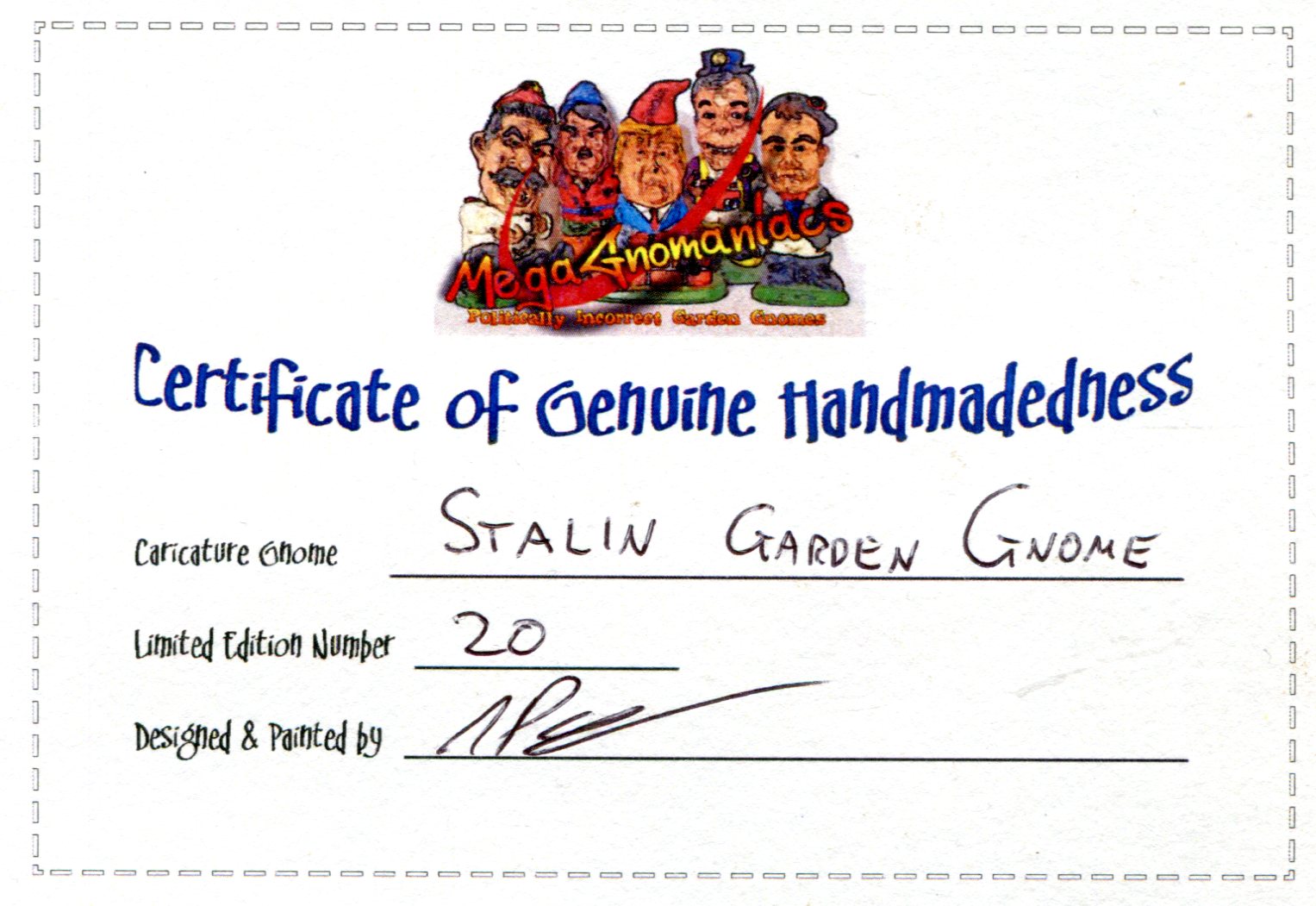
Though cold today, the sun was out. Time to take my new garden gnome outside.

Gnomish Stalin was a Christmas president from my brother Jay, shipped to me from the UK. Cornwall, specifically. For all I know, Cornwall might be the world hub of eccentric garden gnomes.
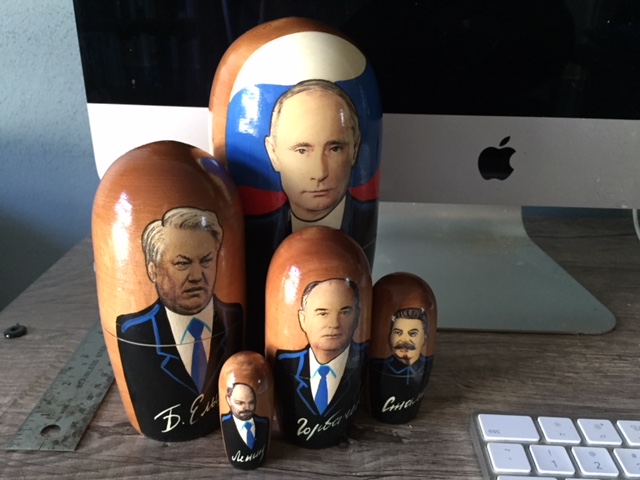
This year, I got Jay a Russian nesting doll — a political matryoshka doll, made in Russia. He sent me a picture. Nice set, though you’d think there would be room for Khrushchev at least, whom I’d pick for inclusion over Yeltsin.
Coincidence that we both sent Russian gifts — political Russian-themed gifts, no less? Or synchronicity? Who knows, I’m just glad to have a new conversation piece for my summertime visitors.

Australia Day, Bush Fire Edition

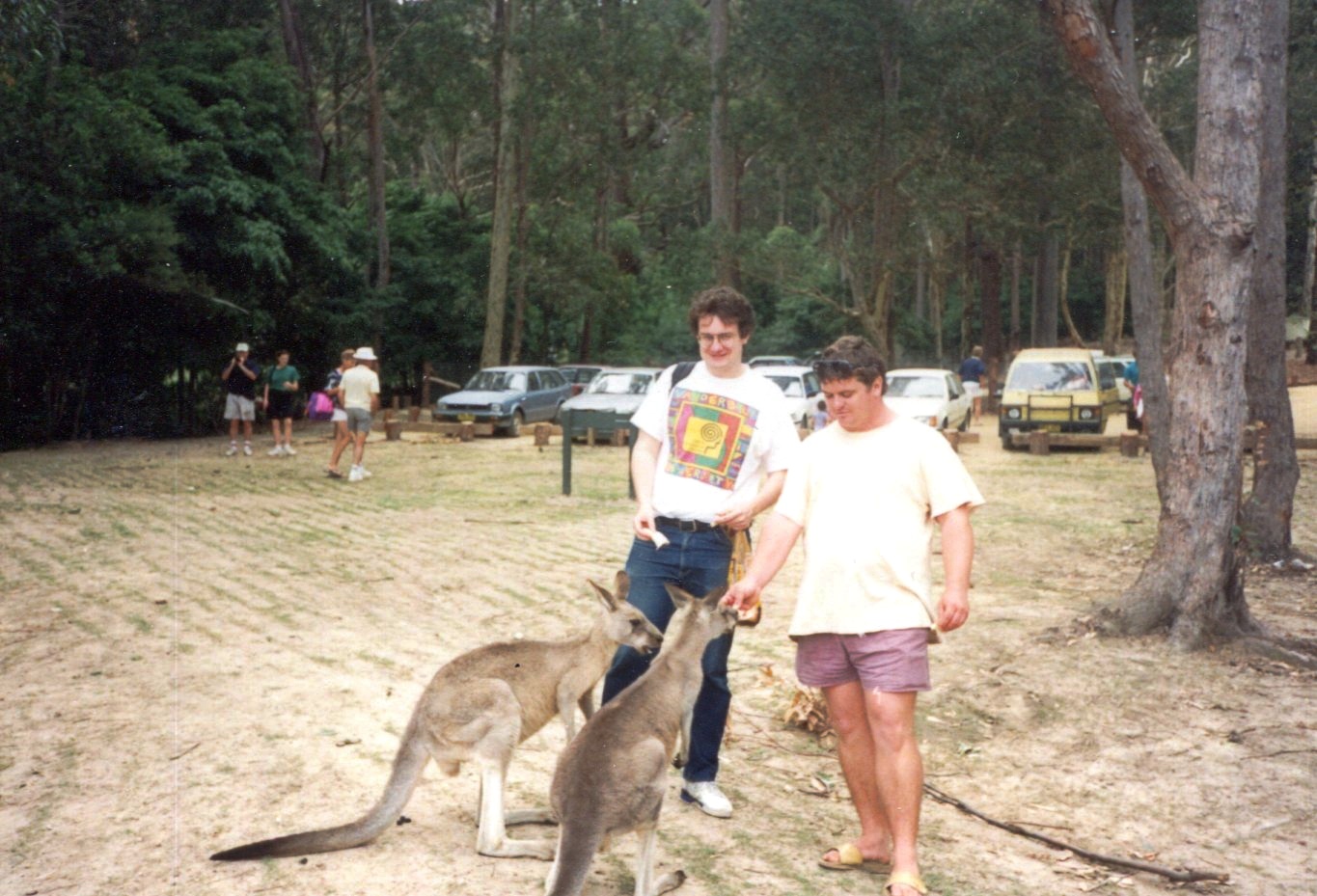
Australia Day has come around again, but it doesn’t seem fitting to post pictures of me standing near wallabies in New South Wales or recalling how they call Rice Krispies Rice Bubbles in Oz or my Christmas Day walk around in Canberra in a T-shirt.

Seems like one damn thing after another for the Lucky Country this year. Some choice recent headlines:

“Australia’s Wild Weather: First Fires, Now Baseball-Size Hail” — New York Times, Jan. 20

“Australia Rains Bring Relief From Fires — and a Surge in Deadly Spiders” — Smithsonian, Jan. 24

“Coronavirus: first Australian case confirmed in Victoria as five people tested in NSW” — The Guardian, Jan. 24

“Record 81 days of bad air quality in Sydney” — Sydney Morning Herald, Jan. 24.

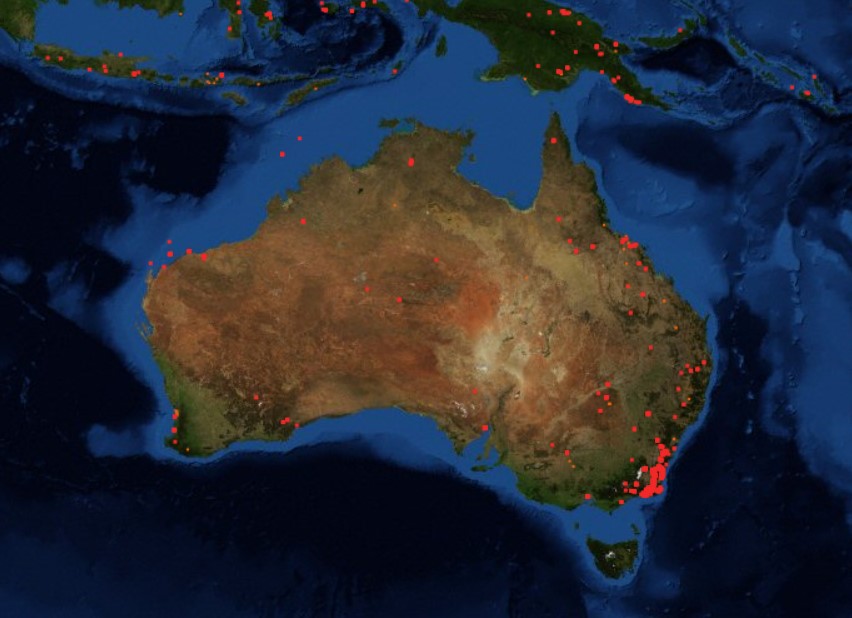
Curious, I took a look at the web site of NASA’s Fire Information for Resource Management System, which (as it says) “distributes Near Real-Time (NRT) active fire data within 3 hours of satellite observation from both the Moderate Resolution Imaging Spectroradiometer (MODIS) and the Visible Infrared Imaging Radiometer Suite (VIIRS).”

Took a screenshot of the Fire Map of Australia on the site as it appeared on Friday. Fires in the previous 24 hours, it says.

I can see why the air is bad in Sydney and why parts of Canberra — which is a small city practically plopped down in the bush — have been evacuated.

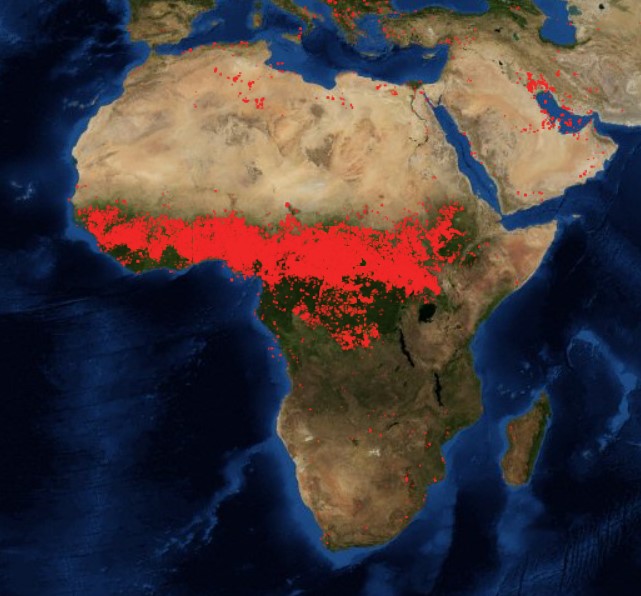
Still, I’m not sure the map helps me grasp the magnitude of the bush fires. Maybe that’s not really possible. I wondered about that even more when I looked at Africa at the same time.
Looks like central Africa is burning to a crisp. But do the many points of fire denote blazes regardless of size? That way a lot of small fires — which could be entirely normal for central Africa right now — wouldn’t be a catastrophe on the order of a smaller number of much larger fires in Australia.

Another NASA page hints at an answer. First, it says, “The colors are based on a count of the number (not size) of fires observed within a 1,000-square-kilometer area.” Also: “Across Africa, a band of widespread agricultural burning sweeps north to south over the continent as the dry season progresses each year.”

I’ve changed my mind. I think I will post a picture of wallabies. In hopes that better times are ahead for Australia.

Pebbly Beach NSW Dec 1991

December 1991: We’re feeding wallabies at Pebbly Beach on the NSW coast, which was damaged by fire recently, according to local reports. The other fellow is Peter, a friend I stayed with for a while in Canberra. Lost touch with him long ago; hope he’s well.

Time Flies, Things Change

Something I found today in the usual way, by not looking for it. Best to look at it full screen. After a moment the details sharpen up and wow.

In only one viewing I didn’t notice any obvious mistakes, though the thing is quick and a creation of this detail must have some. And certainly you can quibble about the difference between an “advanced culture” and an “embryonic civilization” and an “advanced civilization.” What’s history for if not to quibble over?

None of that matters. It’s fascinating to watch. It’s as if the wonderful Historical Atlas of the World came to life and with much more detail (and a soundtrack).

Just from one go-around, a few takeaways. As far as the ancient civilizations of the Near East are concerned, for example, the Romans are just a bunch of Johnny-come-latelies. As anyone from Europe would be.

Then there’s the Mongols. I know about their meteoric rise, but to see the Mongol presence on the map expand like a balloon attached to a helium tank makes it all the more impressive. No wonder it’s Chinggis Khaan International Airport.

Also, note the world population count — an educated guess in all pre-modern times — in the 14th century. Down it goes with the arrival of the Black Death.

This map must represent a lot of work. Whoever Ollie Bye is, I applaud his efforts.