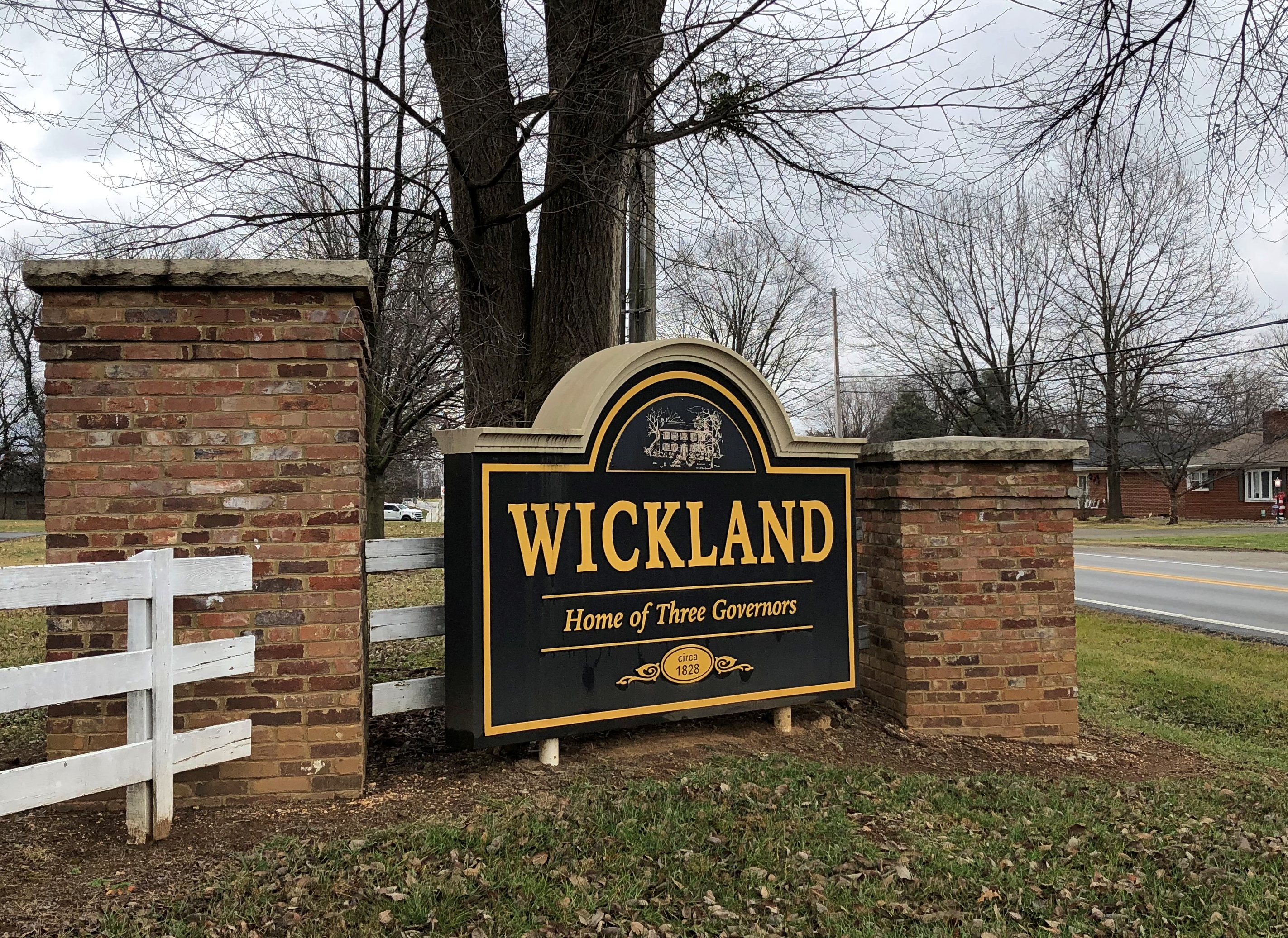
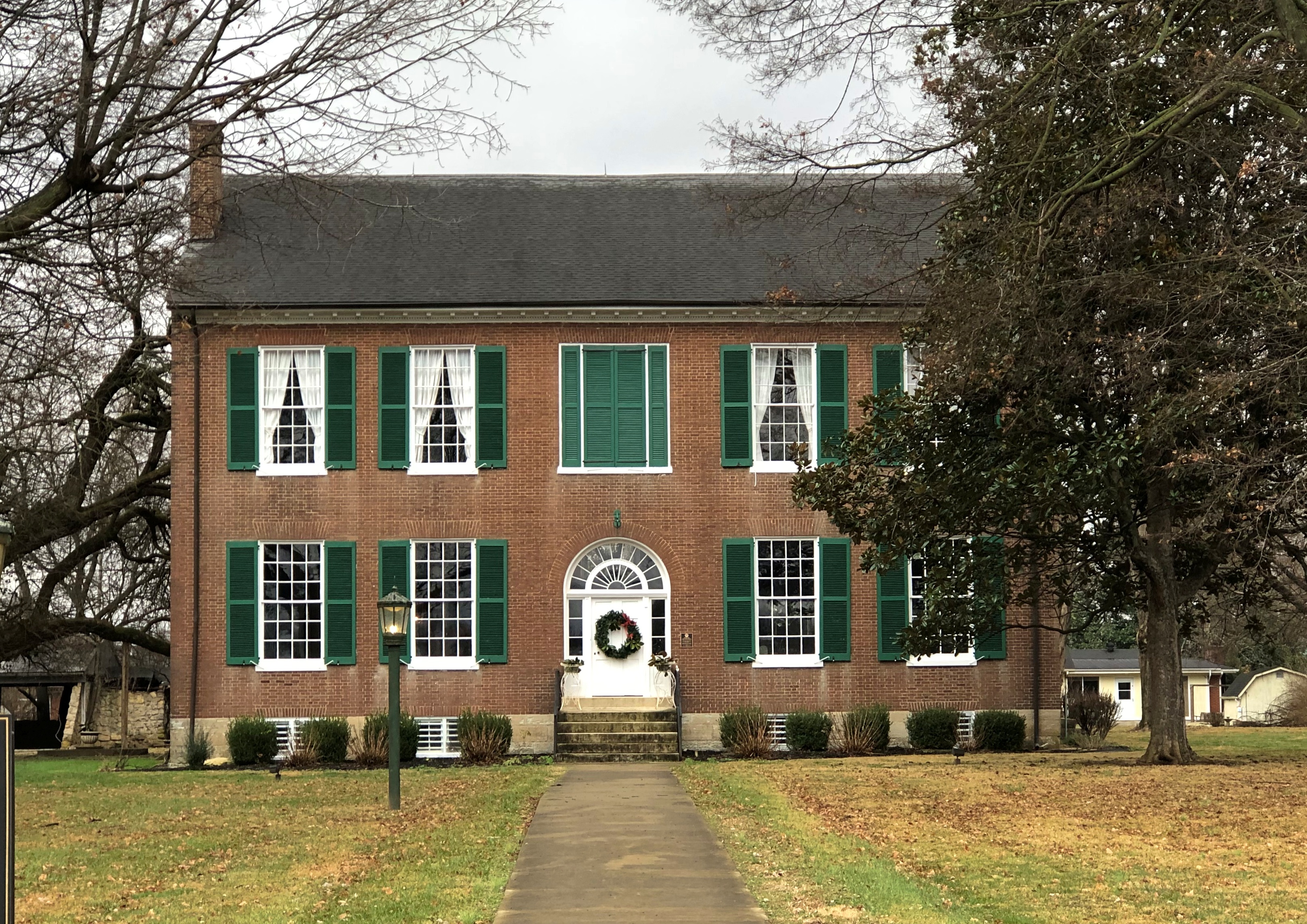
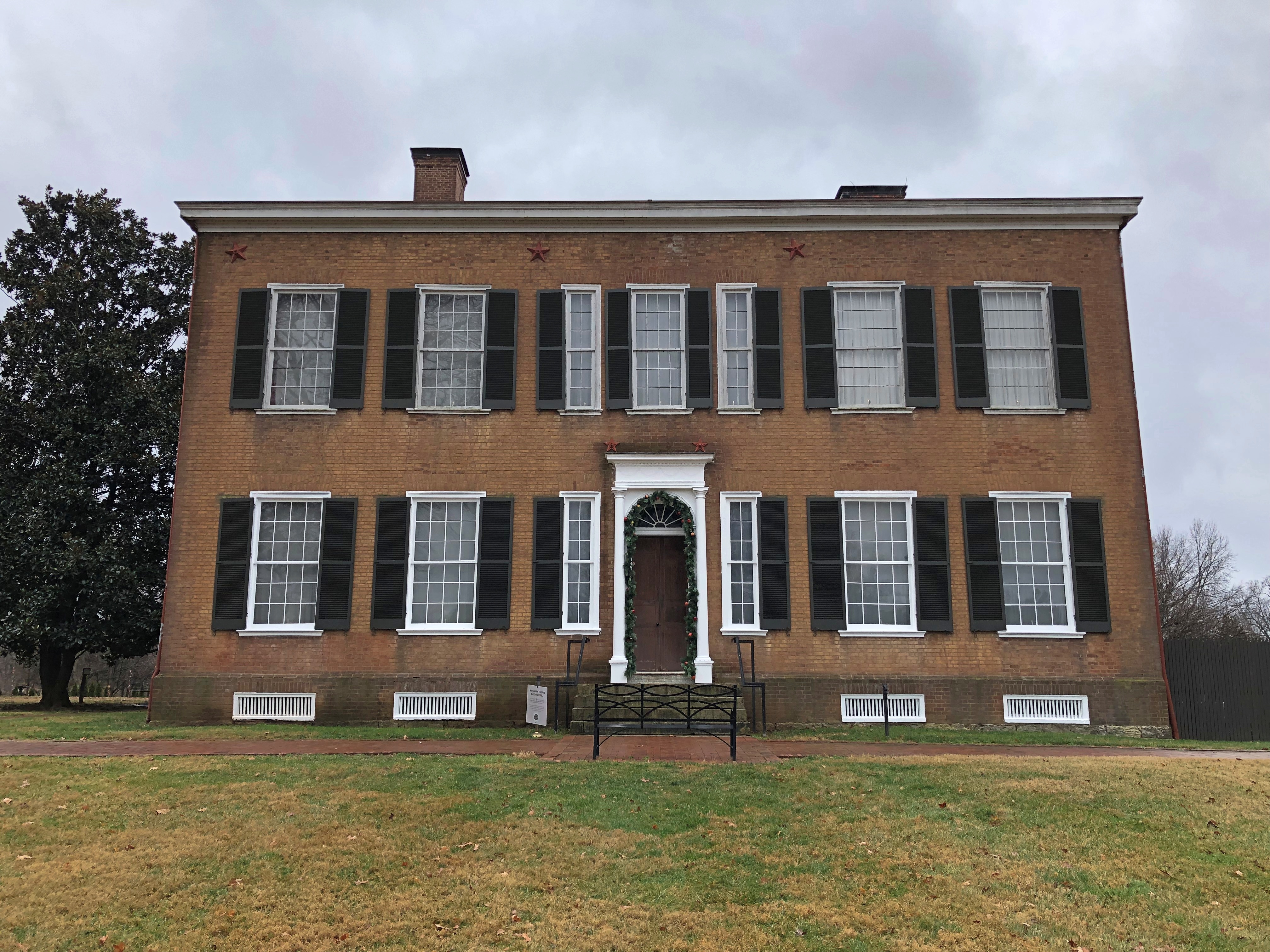
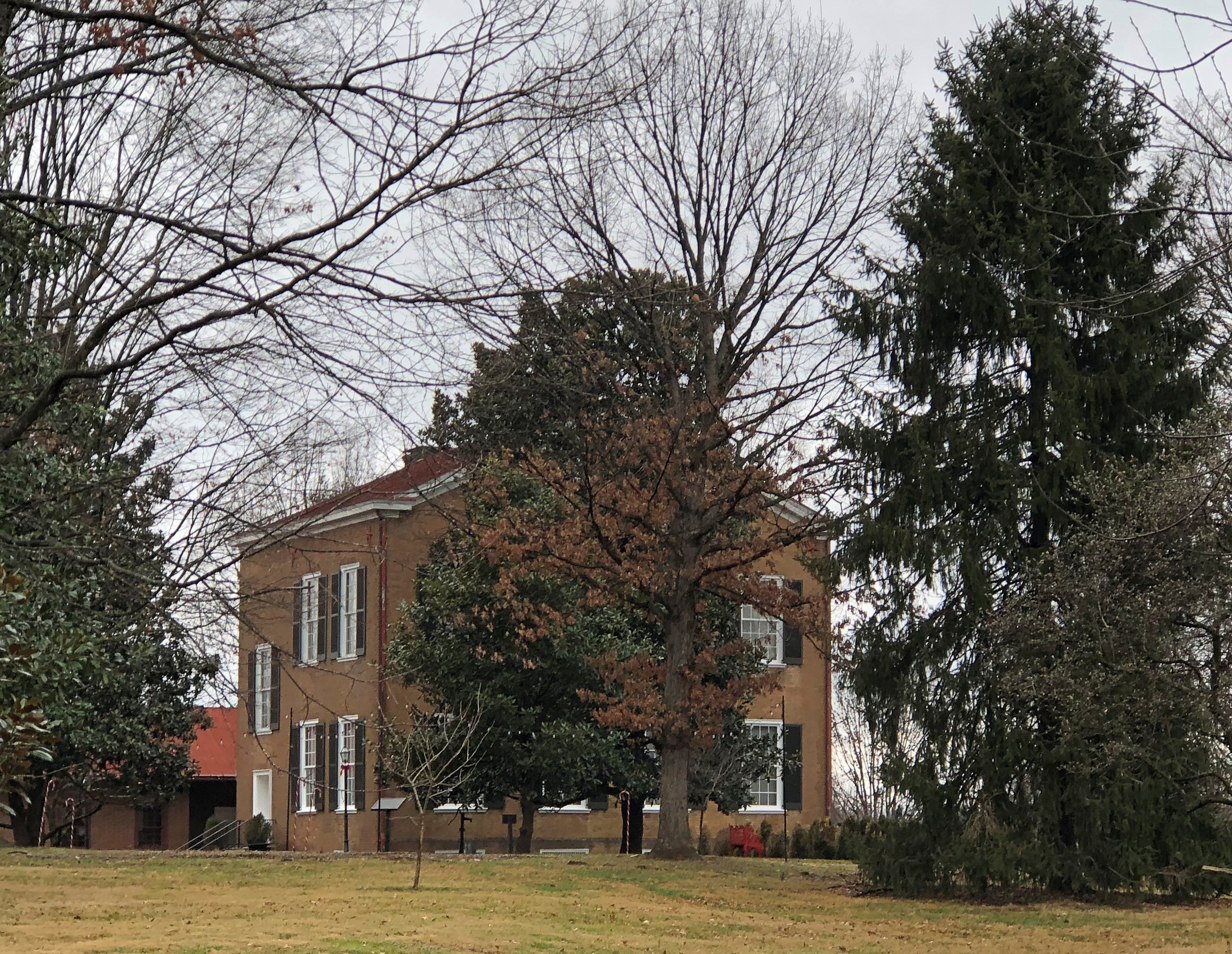
From My Old Kentucky Home State Park, it’s a hop and skip, not even a jump, to another old Kentucky home, Wickland. Or as it is called on Google maps, Wickland, Home of Three Governors.
For good reason, it turns out. That wording is on the sign at the entrance.
Whatever else you can say about Google as a rapacious entity, you have to admire its maps. My affection for paper maps hasn’t dwindled, and I still use them, but sometimes things pop up on Google Maps that I instantly know I should visit, such as Wickland.
Though with a Bardstown address, it is a bit out of town.
Done in Georgian style, rather than Federal, Wickland is roughly a contemporary of Federal Hill (My Old Kentucky Home). We weren’t entirely sure it was open, but in we went, to be greeted by a woman perhaps 10 years younger than me whose name I forget, but who said she managed the place.
That meant taking taking down some of the Christmas decorations at that moment, but she paused that activity to tell us about the mansion for a few minutes, intimating that it was just as interesting as Federal Hill, but received much less attention. I’ll go along with that. She was the only other person there, and said that we were the only visitors so far that day.
Its original owner, one Charles A. Wickliffe, built the house in the 1810s from a design by a Baltimore architect named John Rogers, and later Wickliffe became governor of Kentucky. His son Robert C. Wickliffe grew up at Wickland but moved to Louisiana, where he was governor of that state just before the war. John Crepps Wickliffe Beckham, Charles’ grandson and John’s nephew, was also born at Wickland and he too was a governor of Kentucky, taking office in 1900 after the death of four-day Gov. William Goebel, who was assassinated. That’s an entirely different story, and one I won’t get into, but more about it is here.
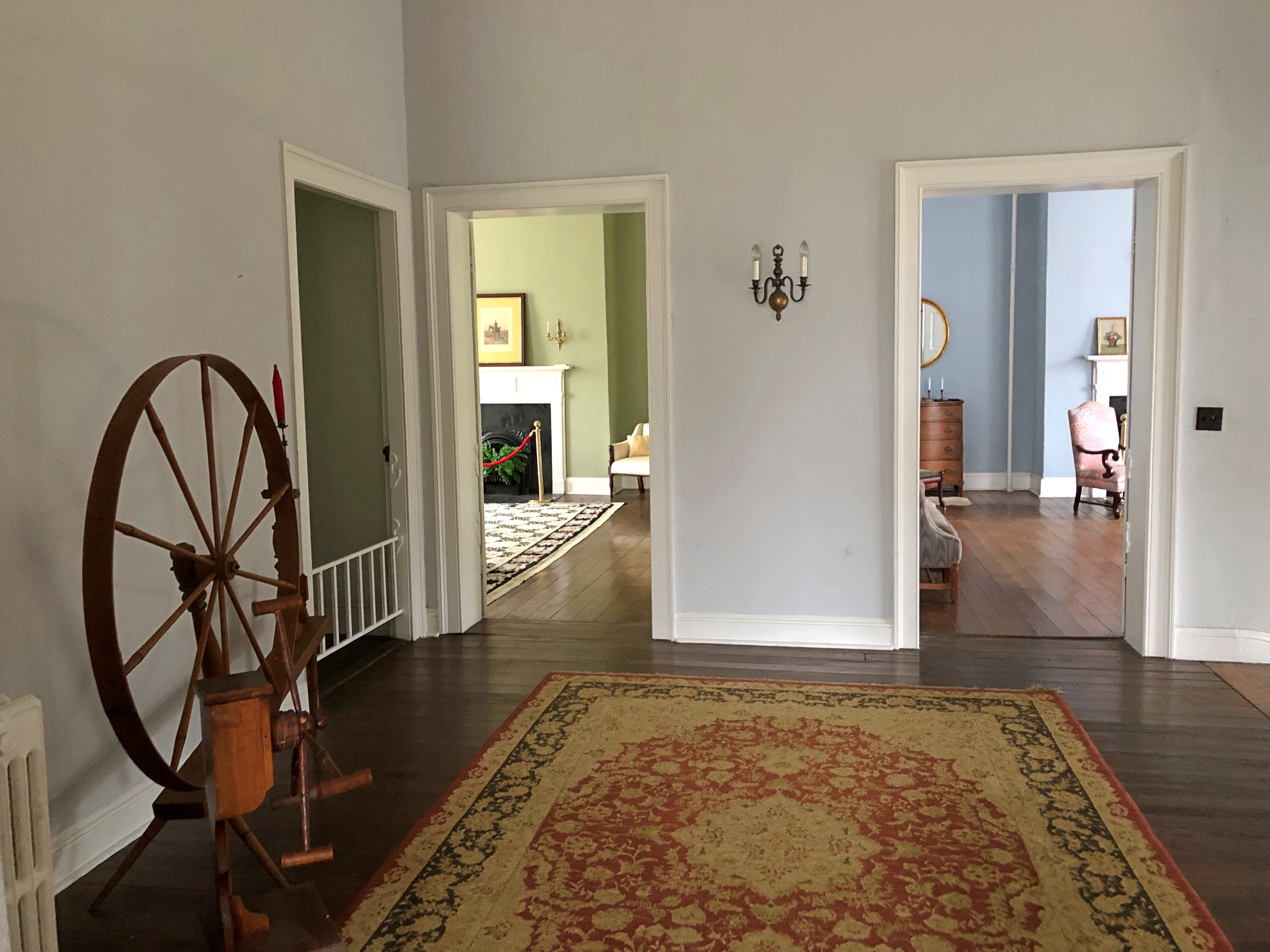
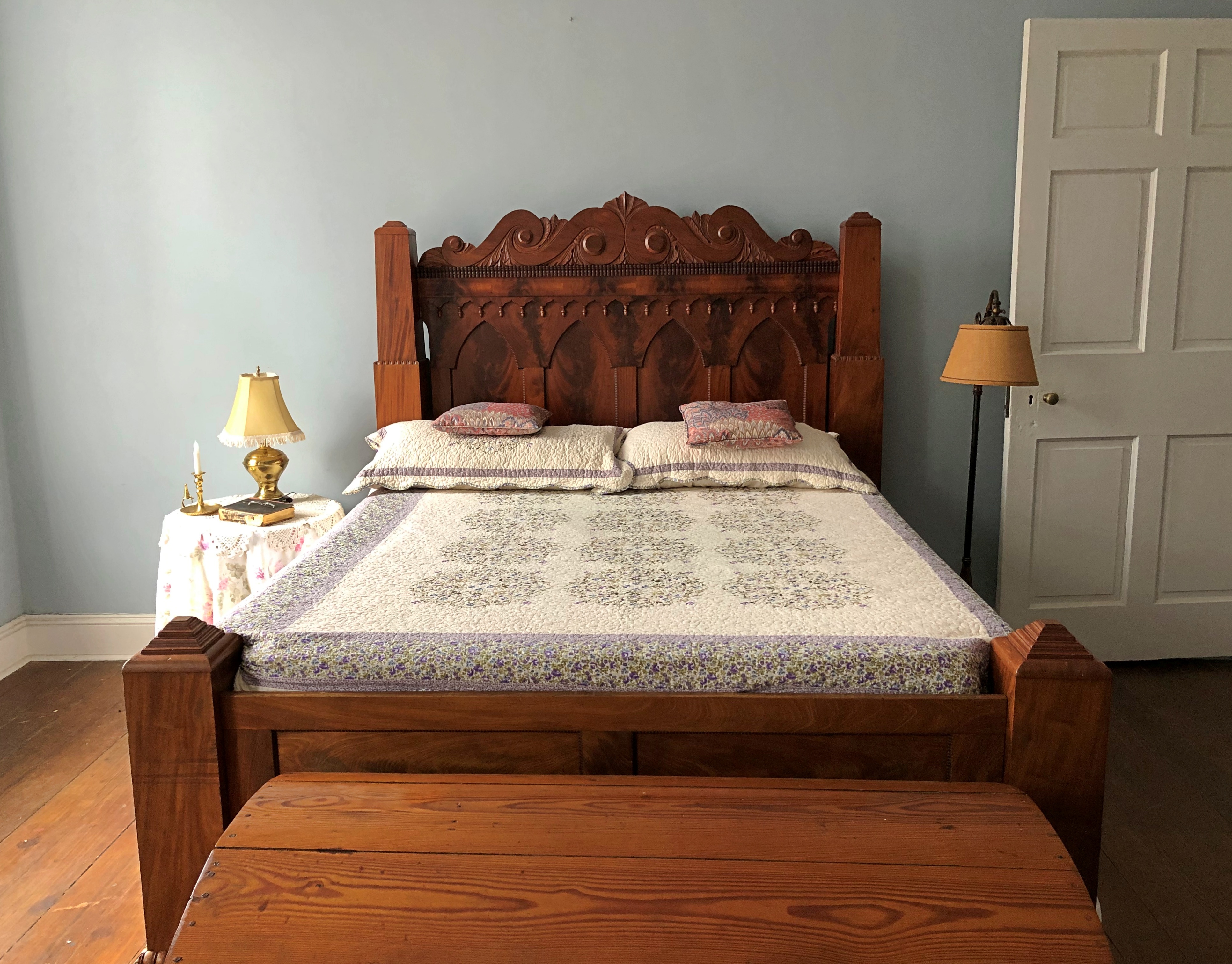
After our brief chat, the manager of Wickland turned us loose for a self-guided tour. That is, we wandered around the mansion’s three floors, completely unsupervised. Also, unlike at Federal Hill, we could take pictures, so I did.
Nice. Not all of the Christmas decorations were down yet.
Wickland doesn’t charge anything to visit, but we made a donation equal to what we paid to see the more ballyhooed My Old Kentucky Home. Seemed only right.
When John Rowan began work on a house for his family in north-central Kentucky in the 1790s, he called it Federal Hill. Finally completed in 1818 largely by slave labor, it stands today as the centerpiece of My Old Kentucky Home State Park in the outskirts of Bardstown, a handsome structure in a pleasant setting.
Besides surviving an 1801 duel in which he killed the other fellow, and beating the rap, Rowan went on to be an important politico in early Kentucky, including a term in the U.S. Senate as an antagonist to Henry Clay and the Whigs, being a Jackson man. He died in 1843, missing the later unpleasantness, and even the war the Mexico.
We visited around noon on December 29. We were the only ones on the tour, in contrast (later that same day) to the distilleries we visited. I hadn’t read much about the place before the visit, and vaguely assumed that there was some good reason that the property’s current name evokes the famed Stephen Foster song. It inspired him in the composition in some way, perhaps.
The house museum doesn’t exactly discourage this line of thinking. At the visitors center is this portrait of Foster.
There he is, in a 1939 painting by Howard Chandler Christy, receiving the gift of composition from a muse – Euterpe, I suppose, muse of music and lyric poetry and, perhaps, the modern popular song. To the left of the muse’s wings (did muses have wings?) is the entrance of Federal Hill, and there are visual references to some of Foster’s other songs as well.
The Kentucky Colonels’ organization commissioned the painting for the world’s fair in New York that year, and “My Old Kentucky Home” had become the official state (commonwealth) song not too many years earlier. So I assume the Colonels wanted to emphasize a Kentucky connection with the famed song, aside from the fact that the name is in the title and opening lines.
An aside: I know that a Kentucky Colonelcy is an honor bestowed by the commonwealth, but I’m still a little surprised by some of the names on this list, such as Princess Anne, Bob Barker, Foster Brooks (well, he was from Louisville), Phyllis Diller, George Harrison (actually, all the Beatles, even Ringo), David Schwimmer, Red Skelton, and both Smothers brothers (RIP, Tom).
The museum (at least in our time) doesn’t explicitly claim that Federal Hill was an inspiration for the song, since the evidence for that seems to be gossamer thin. I’ve read conflicting reports about whether Stephen Foster, described as a “cousin” of the Rowan family – which could mean various levels of consanguinity in the loose definitions of 19th-century America – even visited Federal Hill from his home in Pittsburgh.
It is clear, however, that “My Kentucky Home” was inspired by Uncle Tom’s Cabin, and as such, sympathized with slaves separated from family members without pity or recourse. The song’s association with a particular mansion in Kentucky, namely this particular one, apparently came later – well after the Civil War. The idea seems to have been promoted by, among others, the last member of the Rowan family to own the mansion, an elderly granddaughter who managed to sell the property to the commonwealth in the early 1920s.
Can’t really blame her if she took a little creative liberty with the history of Federal Hill, since she probably wanted to live somewhere with less expensive upkeep. Also, such a thing would be firmly within the American (and entirely human) tradition of historical storytelling known as “making things up.”
Be that as it may, Federal Hill is well appointed inside with period items, and our guide, a young woman dressed antebellum style, knew her non-made-up stuff. She also sang the first verse of “My Old Kentucky Home” for us, in a pleasant and practiced voice, which I understand is part of all the tours. Of course, the first lines weren’t quite the Steven Foster original, being:
The sun shines bright in the old Kentucky home/ ‘Tis summer, the people are gay.
The Kentucky legislature mandated the change, at least for official renditions, after an embarrassing incident in 1986 when a visiting group of Japanese students sang the song, original lyrics and all, to the legislature.
Our guide mentioned, almost in passing, an horrific incident from the time of John Rowan. In 1833, the family, or many of them, ate or drank something contaminated with Vibrio cholerae, and three of Rowan’s children (he had nine), a son- and daughter-in law, a granddaughter, and his sister and brother-in-law all died of cholera in short order, as did a similar number of slaves.
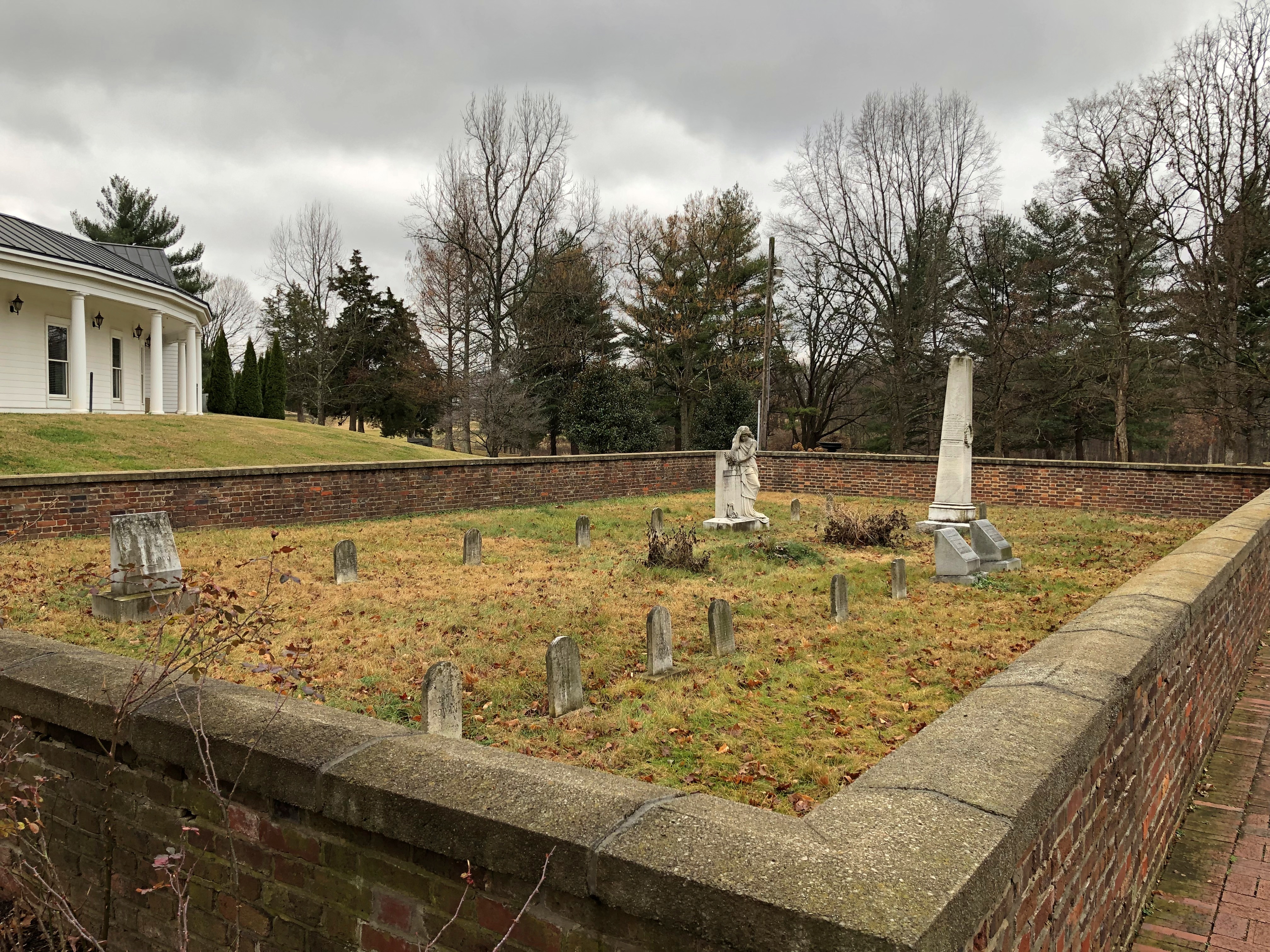
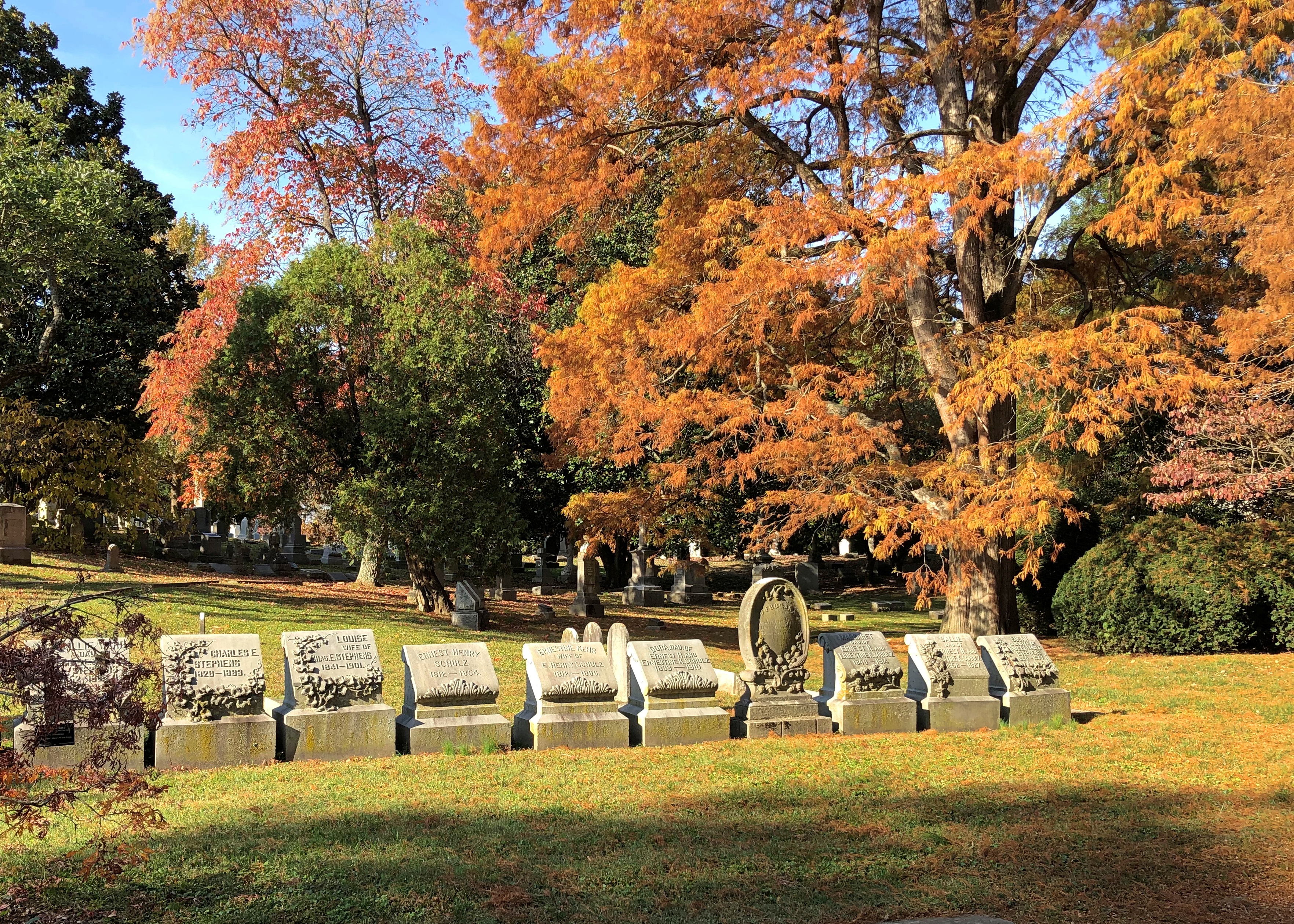
Many of these Rowans are buried within sight of the mansion, and the visitor center, for that matter.
Sen. Rowan himself joined them later, marked by the obelisk. The memorial behind his, with the grieving figure and lyre, is that of Madge Rowan Frost (d. 1925), the granddaughter who sold the property to the state.
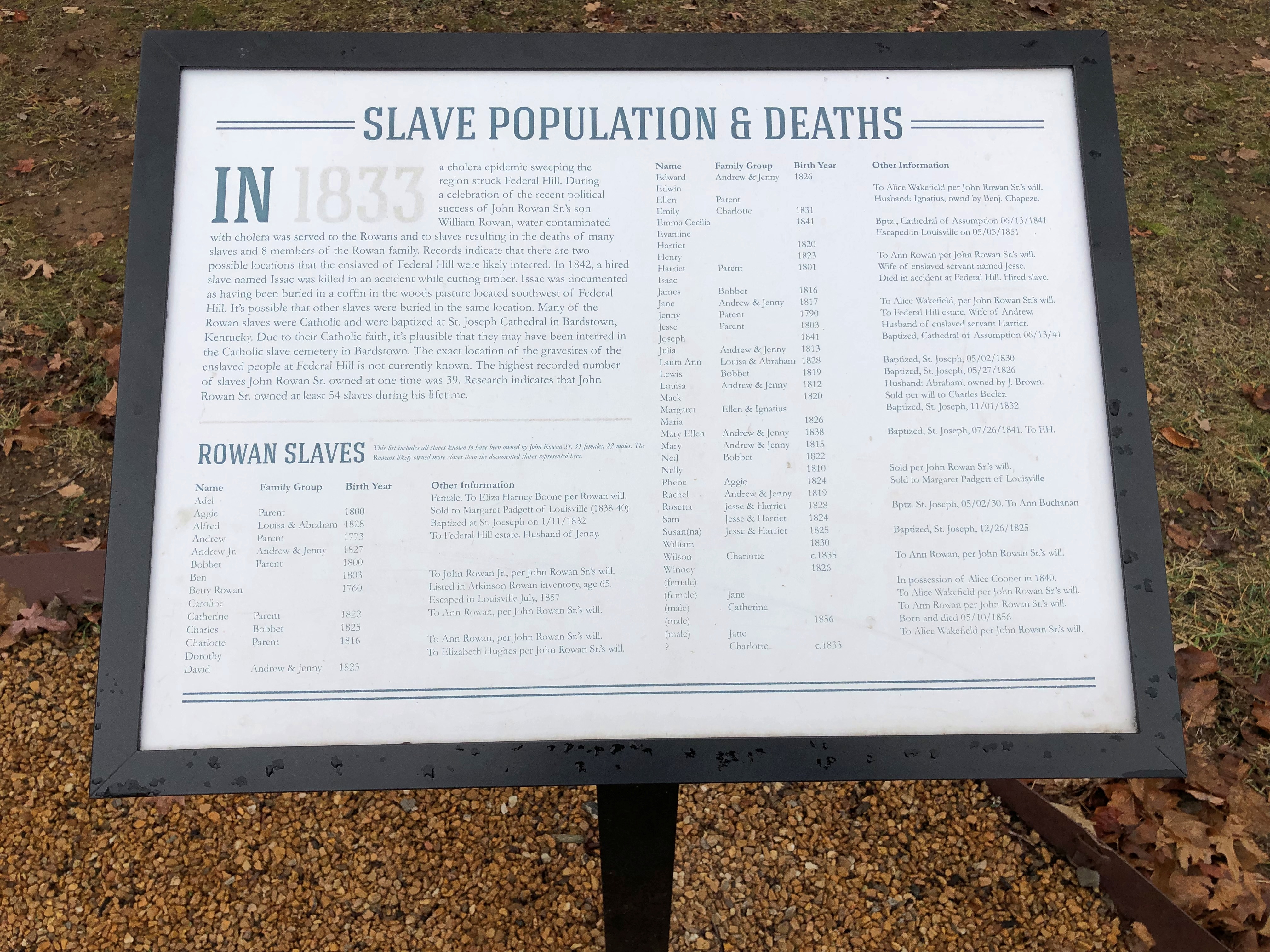
The park, in the form of its guided tour, and written material on signs, doesn’t ignore the enslaved population, as no historic property of this kind would do any more, possibly following the lead of Monticello. Sen. Rowan owned as many as 39 people at one time. A sign near the Rowan cemetery details what is known about them.
But not their burial sites; that remains unknown. Likewise, their cabins, along with most of the other outbuildings, are long gone. Mostly what you’ll see at the state park is a picturesque mansion retroactively tied to an enduring song.
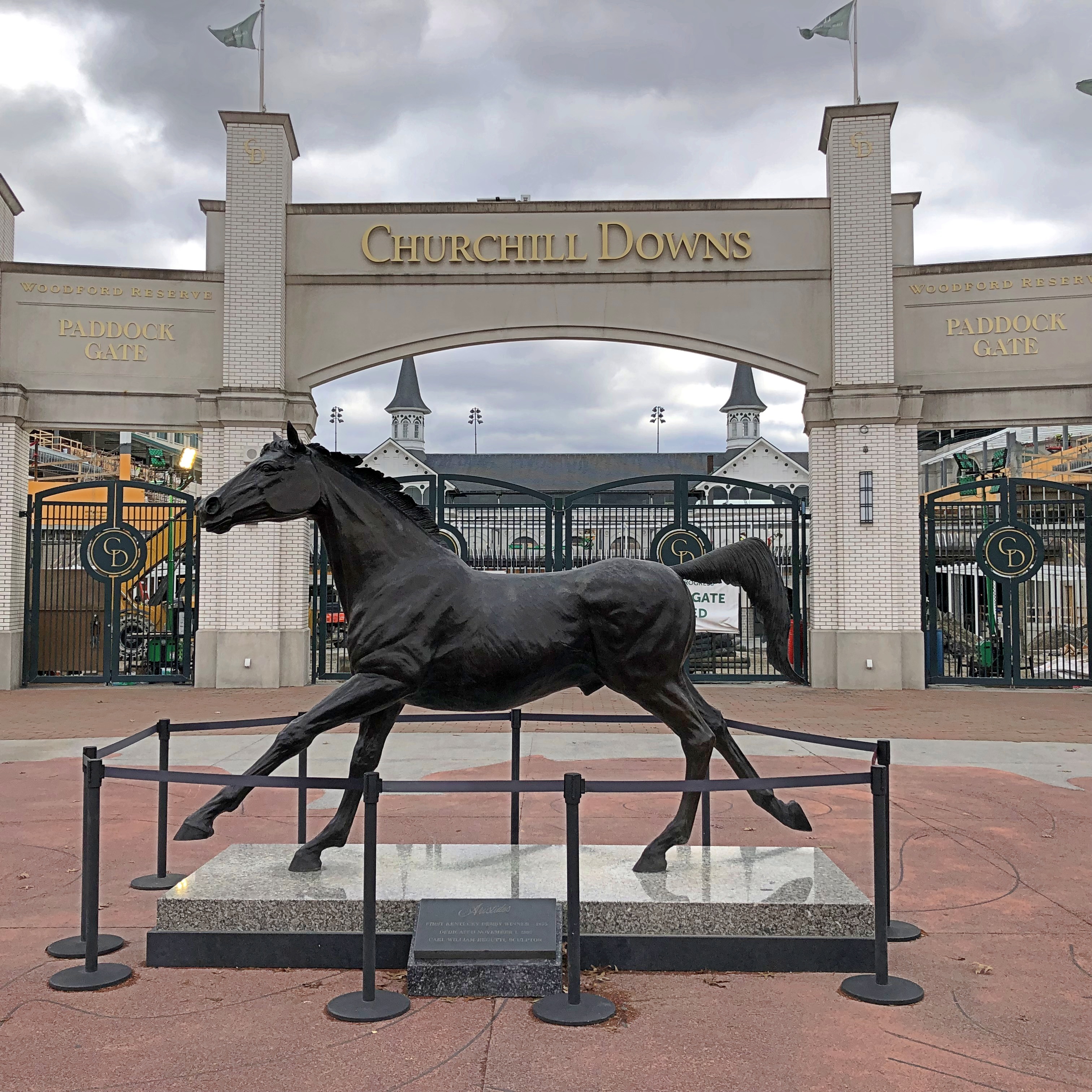
Even before you enter the grounds of Churchill Downs, you encounter bronze horses. Both are winners of the Kentucky Derby. One is Aristides, at the Paddock gate, who came in first in the first Derby in 1875 – long before it was a Run for the Roses,® or the first race of the Triple Crown,® or the Most Exciting Two Minutes in Sports,® or the object of 21st-century renovations.
The Derby was about drinking and gambling from day one, I believe, and not in moderation, yet genteel enough (at least in the stands) for the monied elite — traditions that grand event upholds to the present, all the other trappings notwithstanding. What better for a spring day in Kentucky?
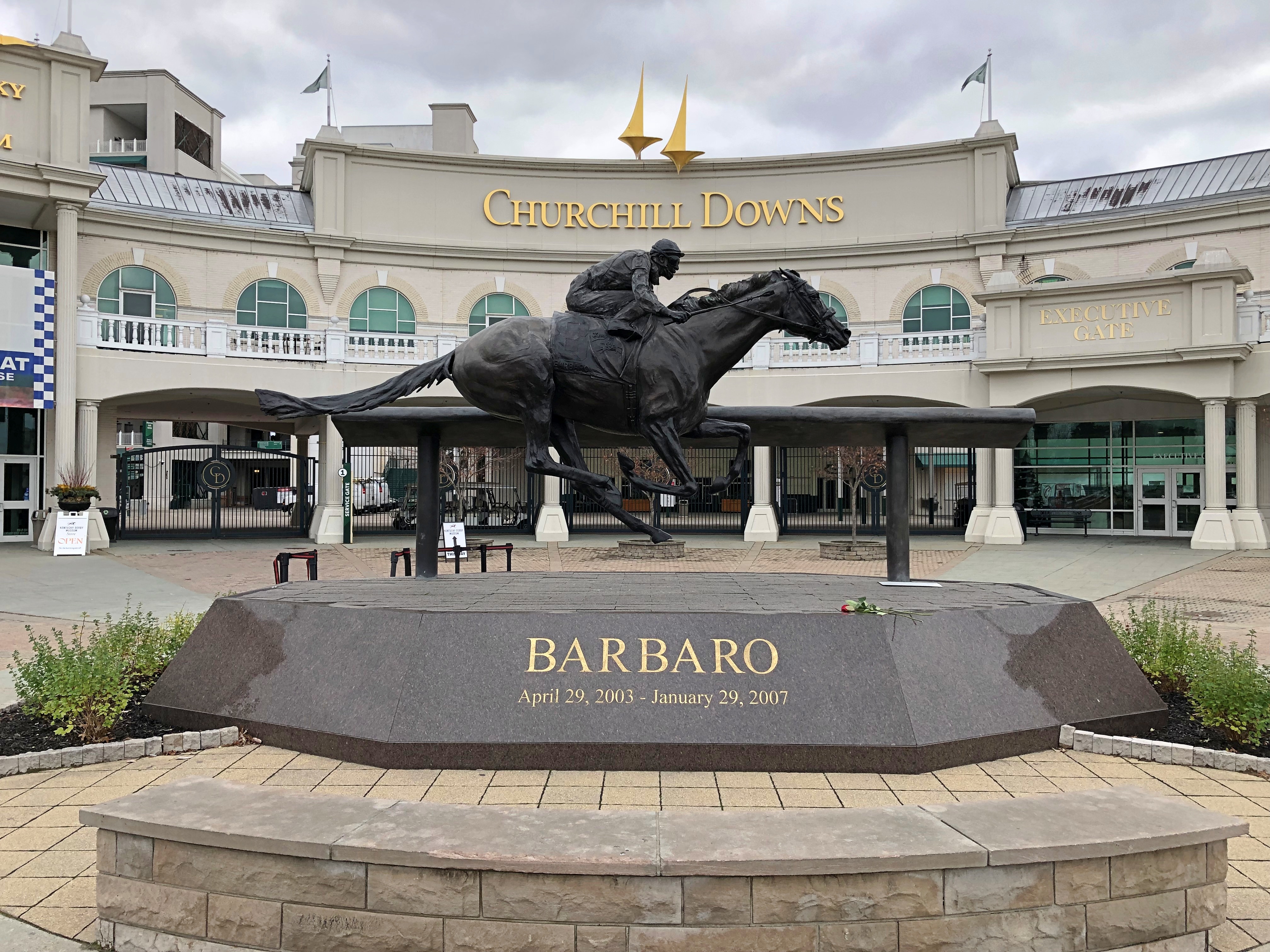
The other horse, and statue, is more recent: Barbaro.
I suspected right away that some physical remains of Barbaro were there as well, and yes, his ashes are, I read later. I’ve pretty much ignored thoroughbred horseracing most of my life, and even my limited interest in the ’80s was because I enjoyed going to the Derby in person. So I wondered about Barbaro. I must have heard the news story in the 2000s, but it had evaporated, gone amid the backdrop of a household with little kids.
Still, I figured, as a Derby winner his birth and death years (2003 to 2007) pretty much got to the heart of Barbaro’s career – a shooting star among race horses, brilliance to ashes. Later I looked up the details, including in a succinct, eulogizing video, and that’s about the size of it.
A thoughtful comment from the video’s comment section: Not making an anti-racing statement but, if you feel bad for Barbaro, take a moment to think about all of the other horses that broke down and died, on/off the track, too. Barbaro got kind letters, flowers, signs and even gift baskets with horse feed sent to his veterinarian centre, because he was a champion. Just seems sad that we only do that for the gifted athletes of the sport, even though every one of those incredible animals gave it their all for our entertainment.
@catarena8031
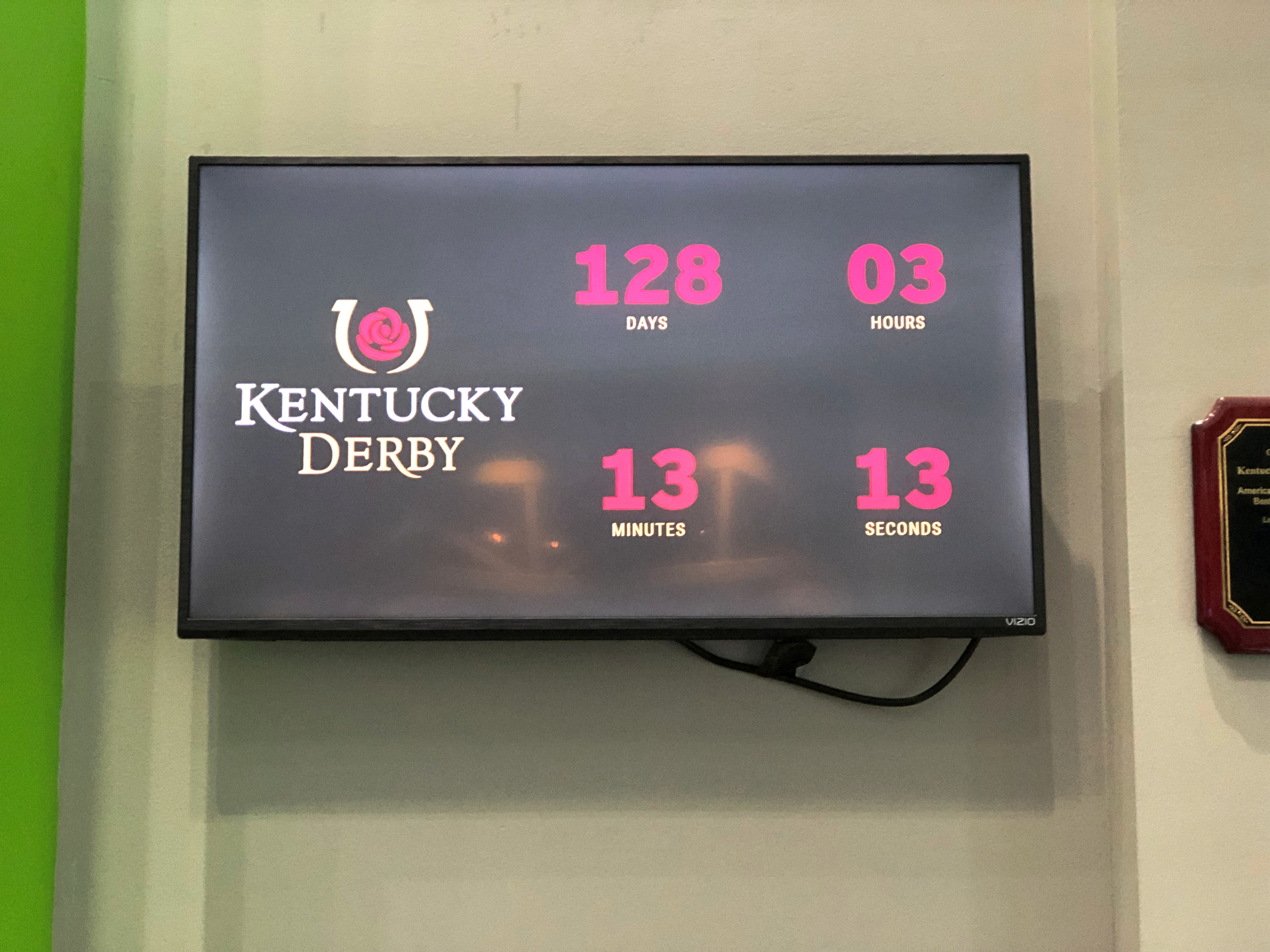
Near Barbaro is the entrance to the Kentucky Derby Museum, and near the admission desk is a countdown clock.
(As it appeared on December 28.)
While we were still in the parking lot, headed for the entrance, we passed by a young couple leaving. Out of the blue the man said to us, “Take the Barn and Backside Tour. It costs more, but it’s worth it.”
“Really?” I said, in a friendly tone. They both nodded their agreement.
“You get to see a lot more,” he said, gesturing with his hands a bit, sort of making parentheses around his sizable beard. “Some of the stables and other places behind the track.”
We agreed that that sounded good and parted ways. I asked about it at the desk. Sorry, sold out. So we got the basic tour and museum admission, a spot over $20 per person. The museum, well organized and informative but not overtaxed with dense reading, was worth a look, for a small glimpse into a whole other world.
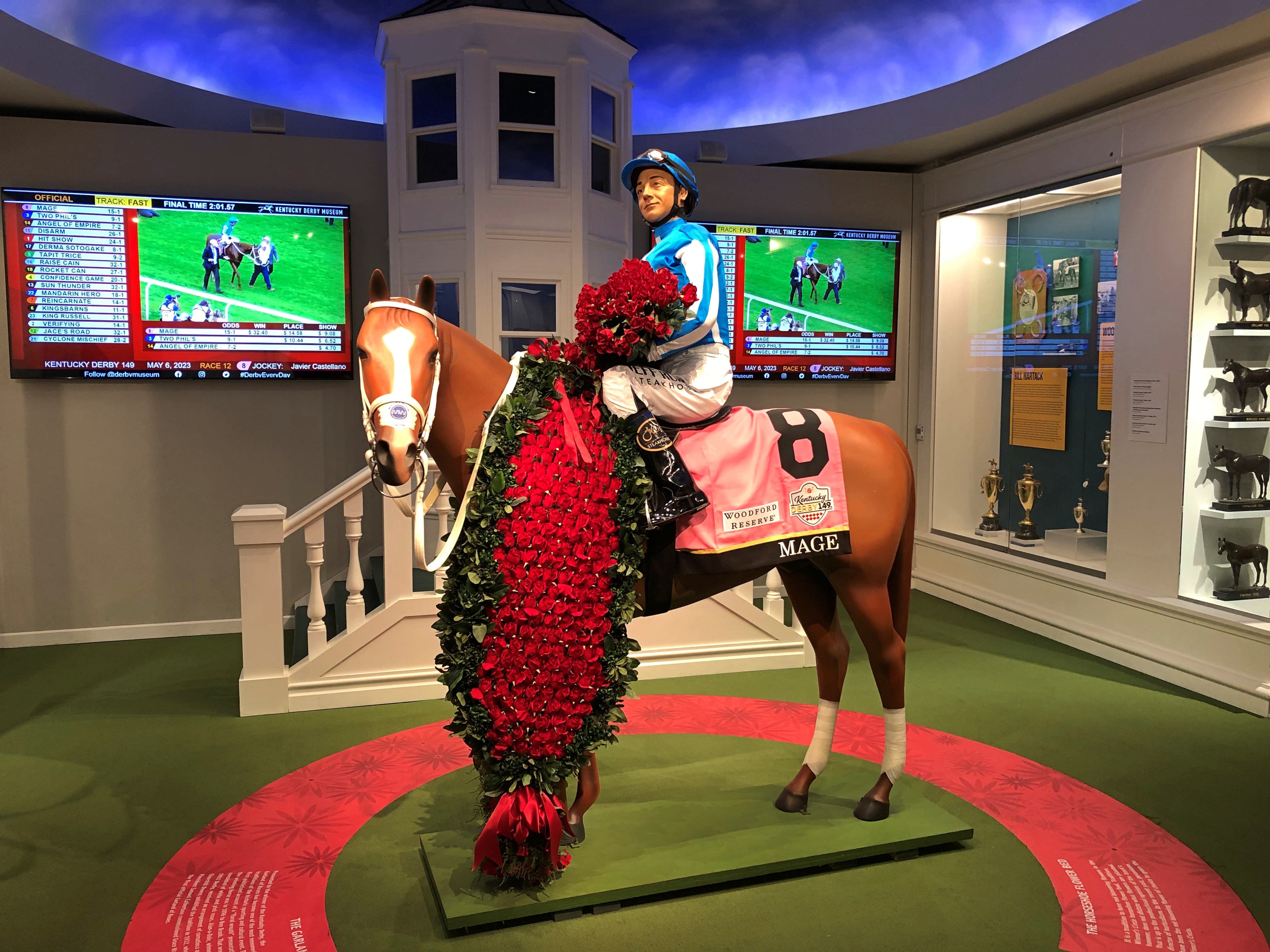
Also, you get to see a facsimile of Mage, last year’s winner.
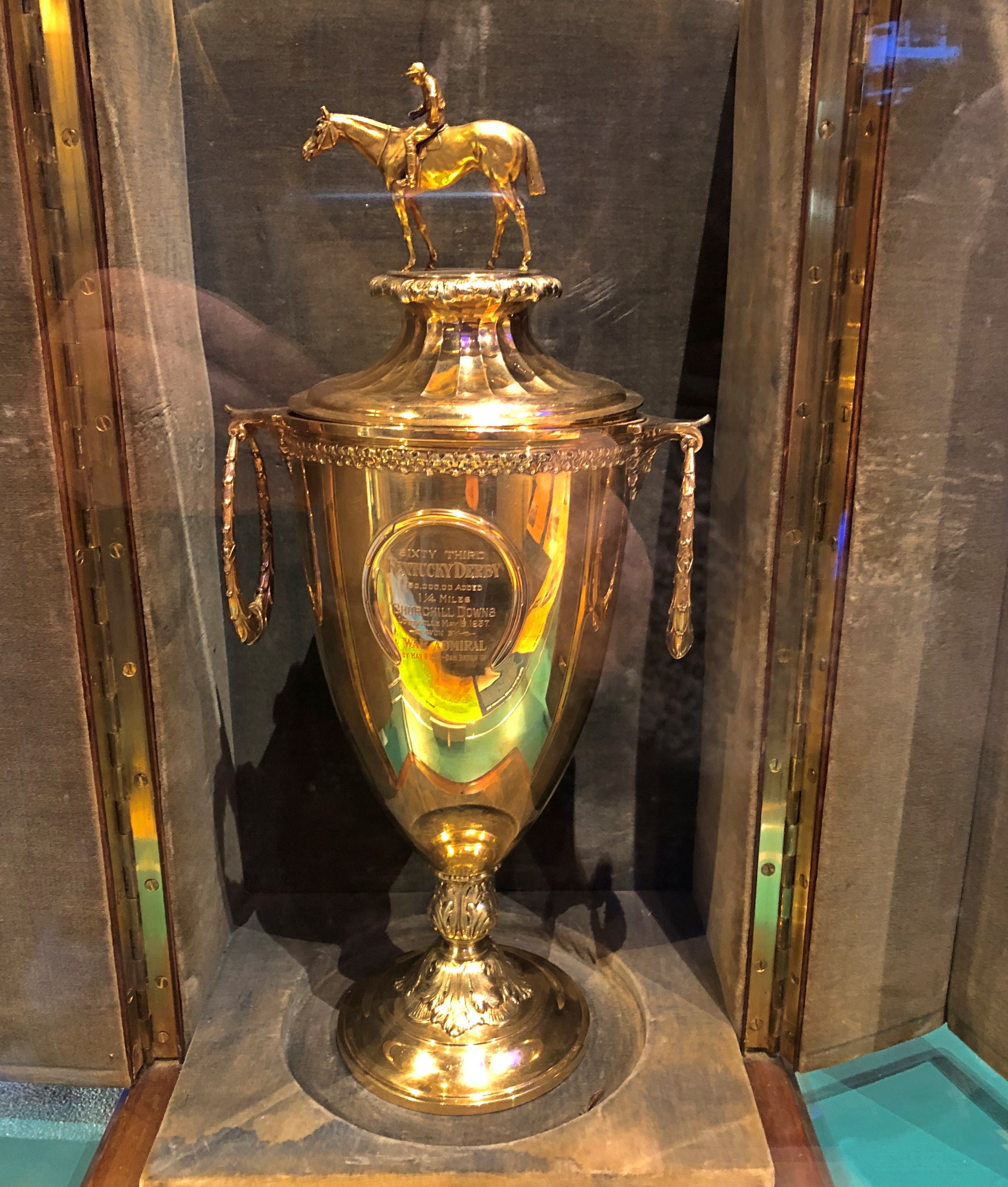
And the trophy War Admiral received in 1937 for winning the Derby.
Along with a good many other items. Other displays included Triple Crown winners – each one had a kiosk – how thoroughbreds are raised, the building of the track and the early races, video screens to call up and watch previous televised races (I watched ’86; I only heard it when there), images of the flamboyant hats and dresses worn by female racegoers, and the part African-Americans have played in the event, especially as jockeys: a good many in the early years, including Oliver Lewis; nil as Jim Crow solidified; some since the legal end of segregation.
The tour started with a short presentation on a 360-degree screen well above eye level: part movie, part still images with a sound track, and about what the horses and the jockeys and all the many other support staff do to put on the Derby. Quick-moving, it idealized the event somewhat, but who would expect otherwise?
The cinematography was exceptional sometimes, giving me the sense that whatever else the racehorses are, they’re massive, powerful beasts of tremendous energy. And what manor of men would perch themselves atop these beasts at their top speeds? Besides relatively small men and a few women, that is. I have a new-found respect for jockeys.
Also, it got me to thinking, a little along the lines of the comment above. Sure, it’s fine to know about the winners down the years, and I’ll go along with the notion that, say, Secretariat was a very great racer indeed. But what about the also-rans? Not just also-rans, but last rans?
Back when Aristides took the prize to the crowd’s acclaim, a horse named Gold Mine proved not to be one, coming in 15th and last. When Sir Barton won on his way to the first Triple Crown in 1919, Vindex was 12th and last.
Vindex? After the Roman who rebelled, unsuccessfully, against Nero? Could be. I can imagine the owner reading about the bold Vindex in the works of I forget which Roman historian. It would have been a thing for a horse-owning Kentucky gentleman to do in his youth in late 19th century, possibly even in the original Latin.
One more. When Secretariat won the day in 1973, before a national audience (including a 12-year-old me), Warbucks was 13th and last.
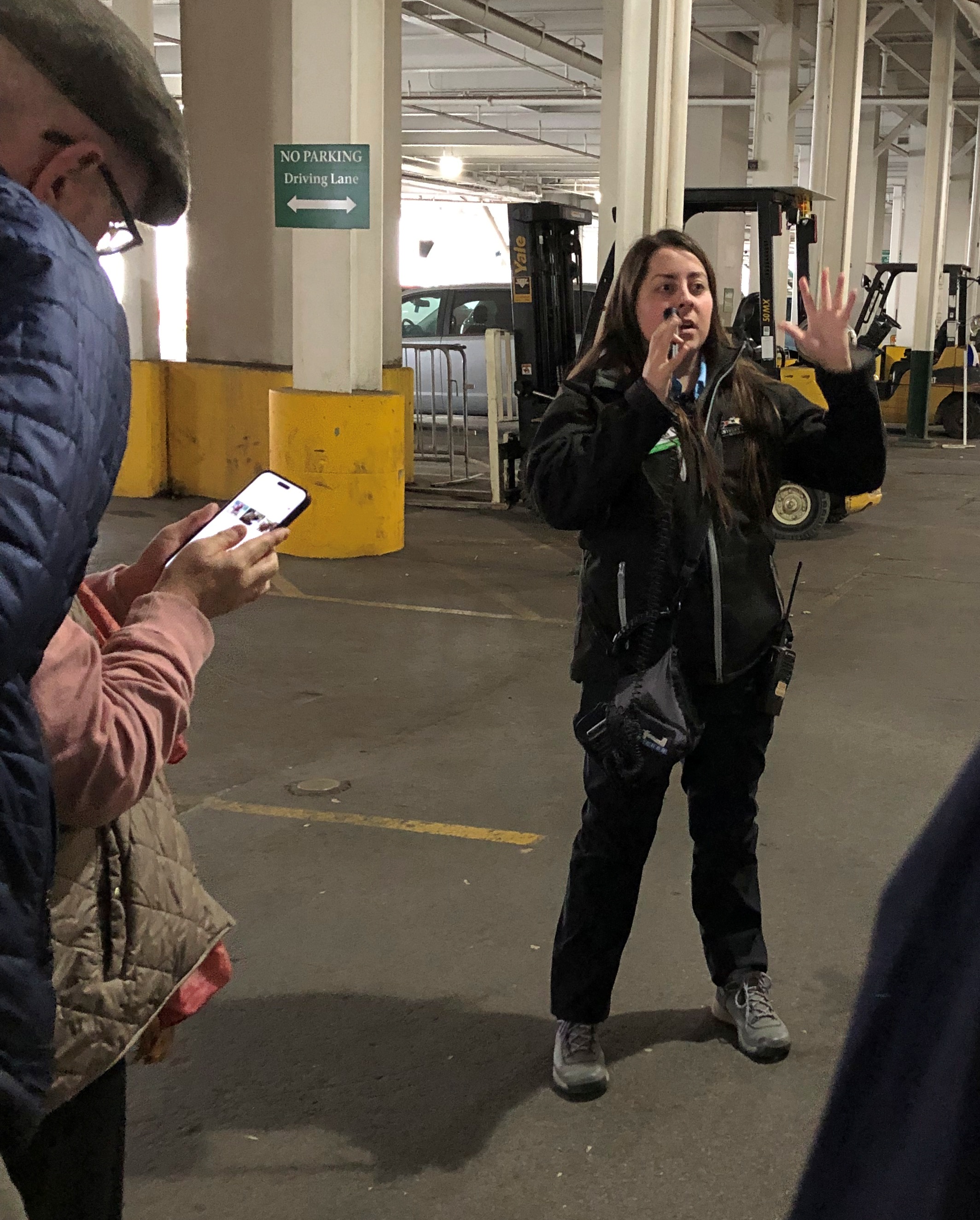
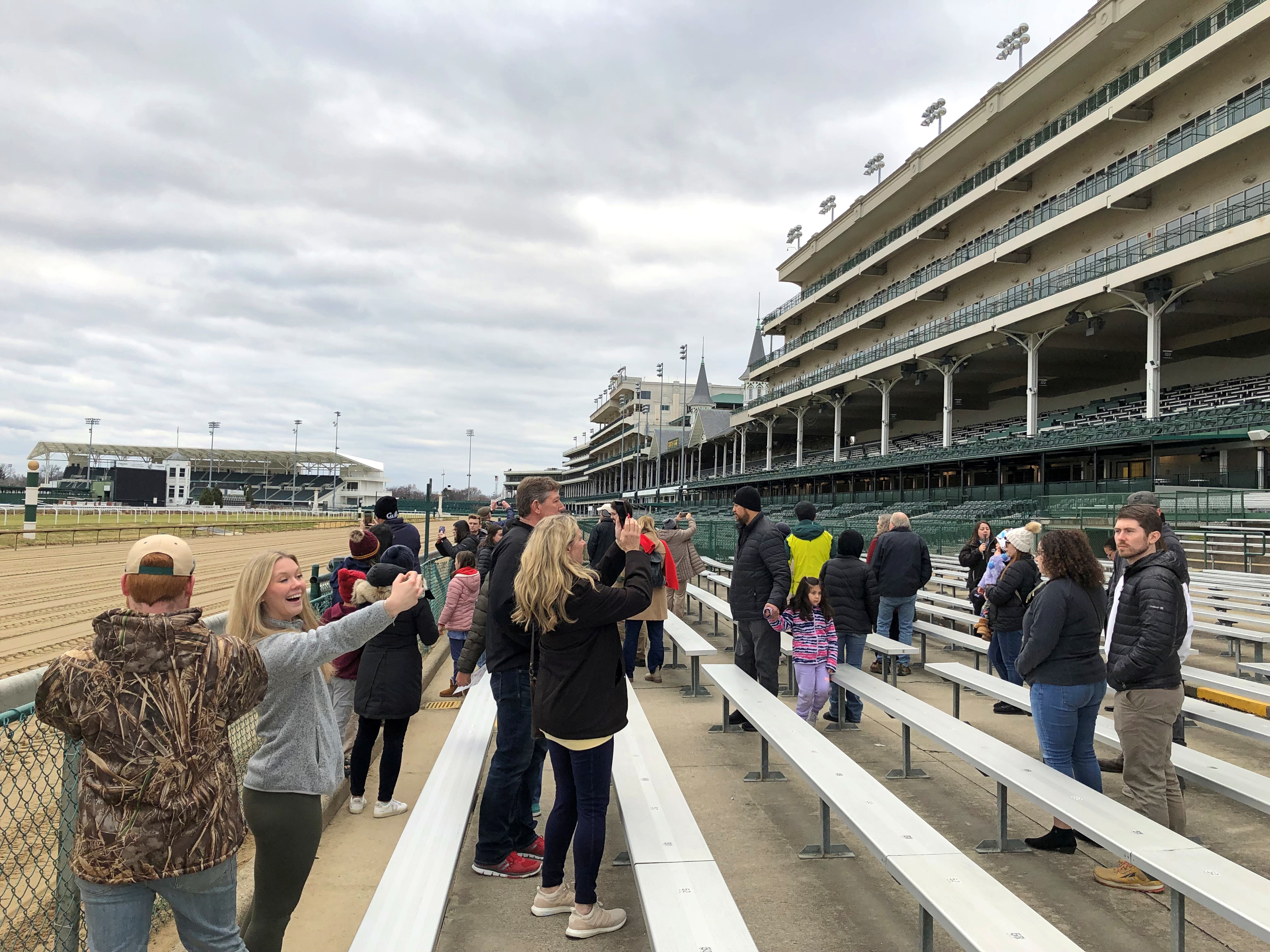
From the museum, the tour group moved to under the grandstands, guided by a competent employee of the track. She told us a capsule history of the race and the Downs.
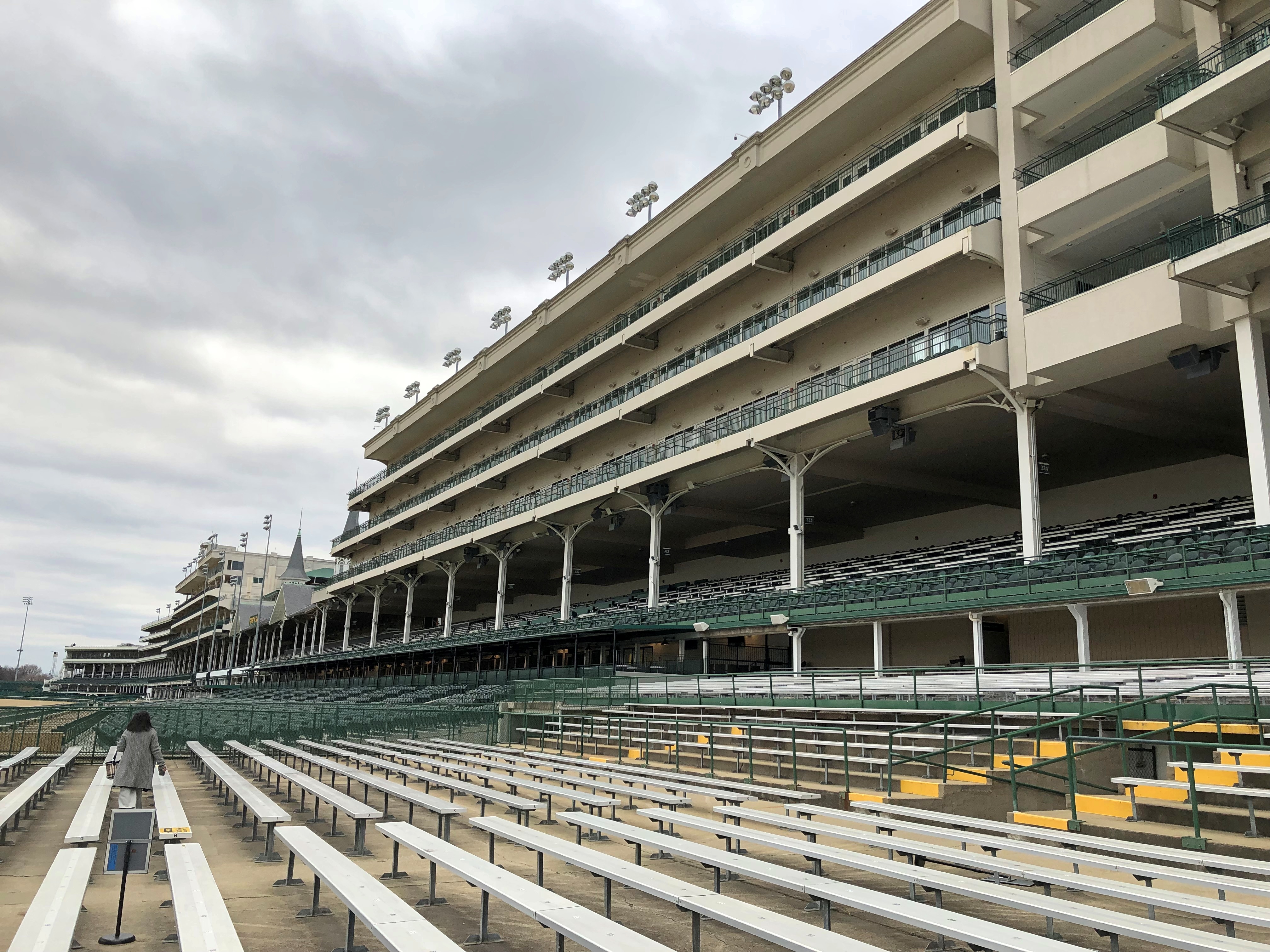
Out to the lowest level of the grandstand. It’s a good view, I have to say.
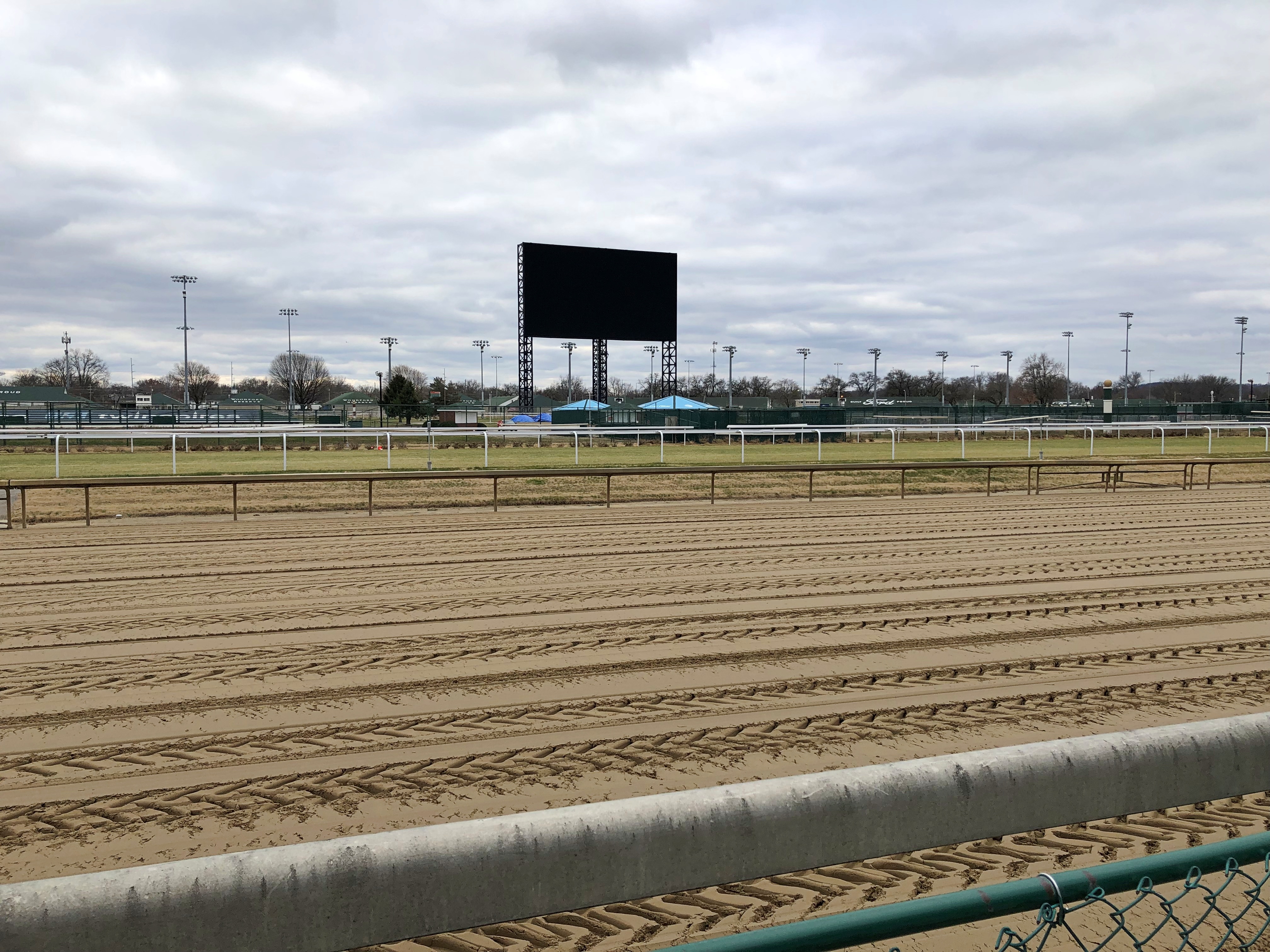
The guide provided more history and some physical information about the track itself, and about the enormous stable complex on the other side of the track, way off in the distance, which sounded big enough to have its own zip code. (It doesn’t seem to.)
Then we headed back to the museum for a few more minutes, and that was that. Chintzy, Churchill Downs. That was more like a $12 museum + tour package. Not even a few minutes up in the grandstands? Did some whiz in the organization, or maybe a computer program, determine that eliminating the small but measurable cost in elevator maintenance and maybe slightly higher insurance premiums was worth shorting the patrons in their experience? Just speculation.
All I know is that the view from the grandstands should have been part of it. One visit to the Derby, I had access to the grandstands, and wandered around quite a while. You really get caught up in the thing looking down on the lively, colorful crowds and the active racetrack. Even on an empty winter day, I think you’d feel an echo of those festive times.
A friend on Facebook – and actual friend, known him 35 years — signed off with HNY today. Dense fellow that I am, that didn’t register, so I Googled it and found Happy New Year and Hot Nude Yoga. I’ll assume he meant the first one.
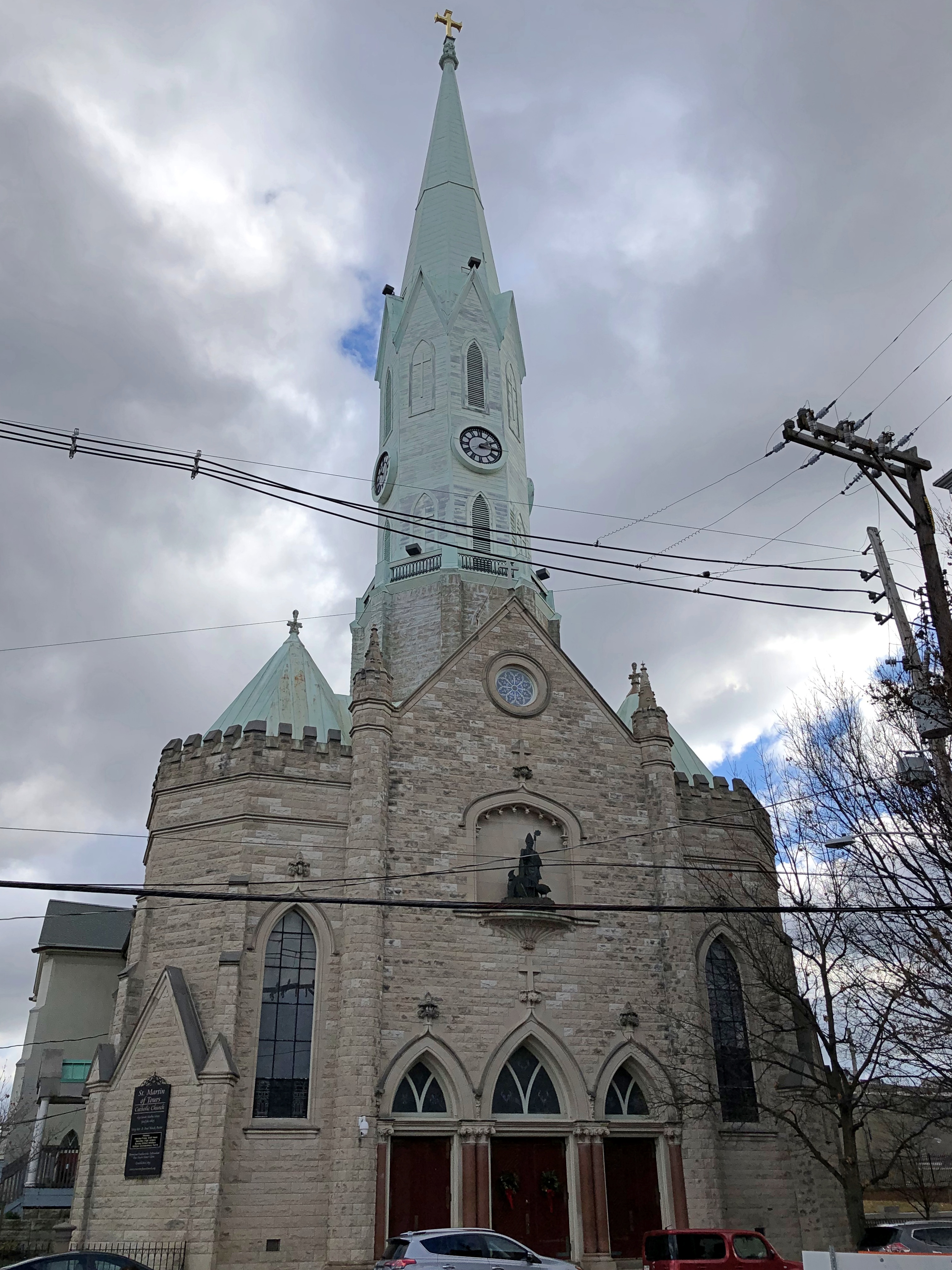
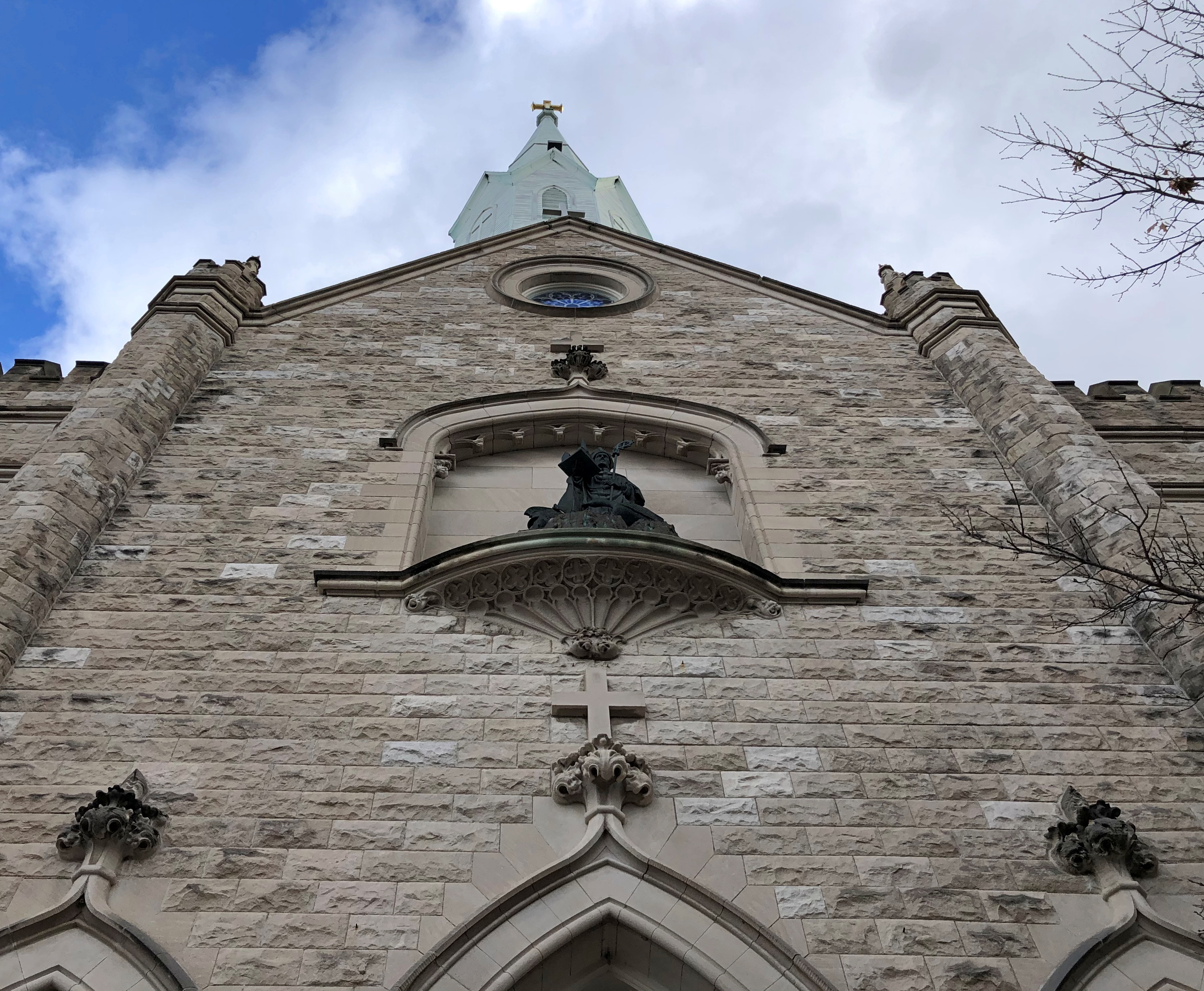
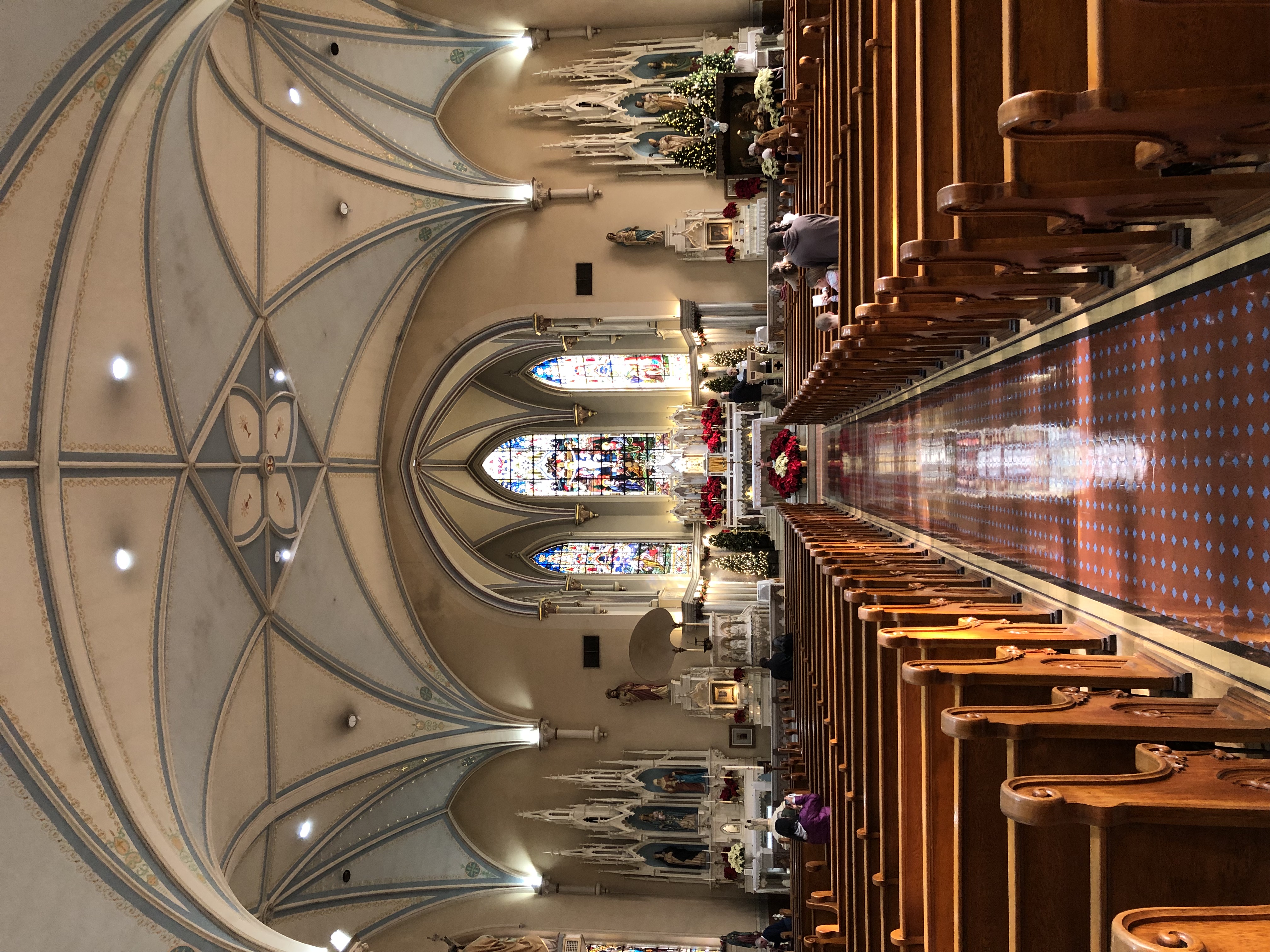
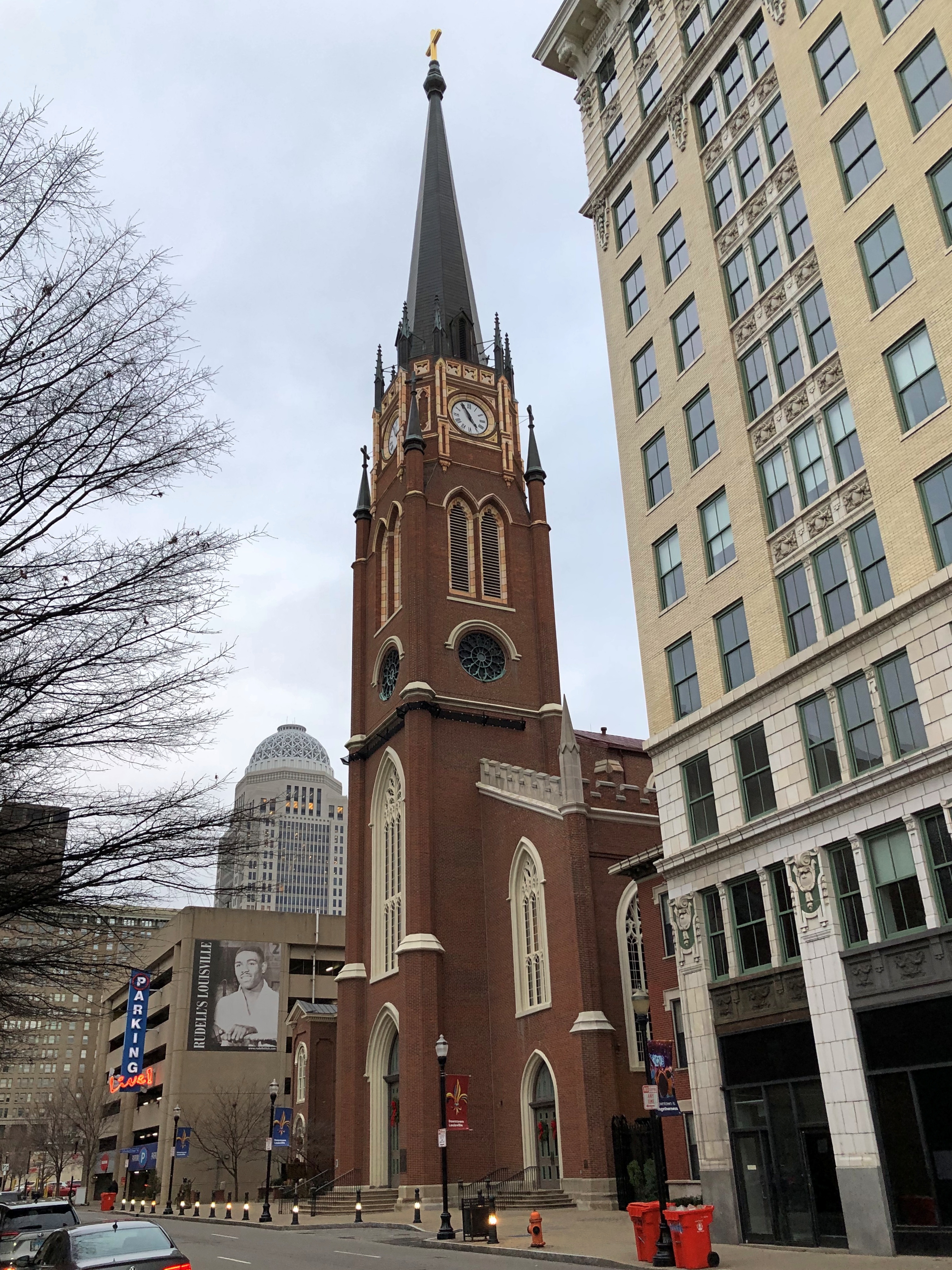
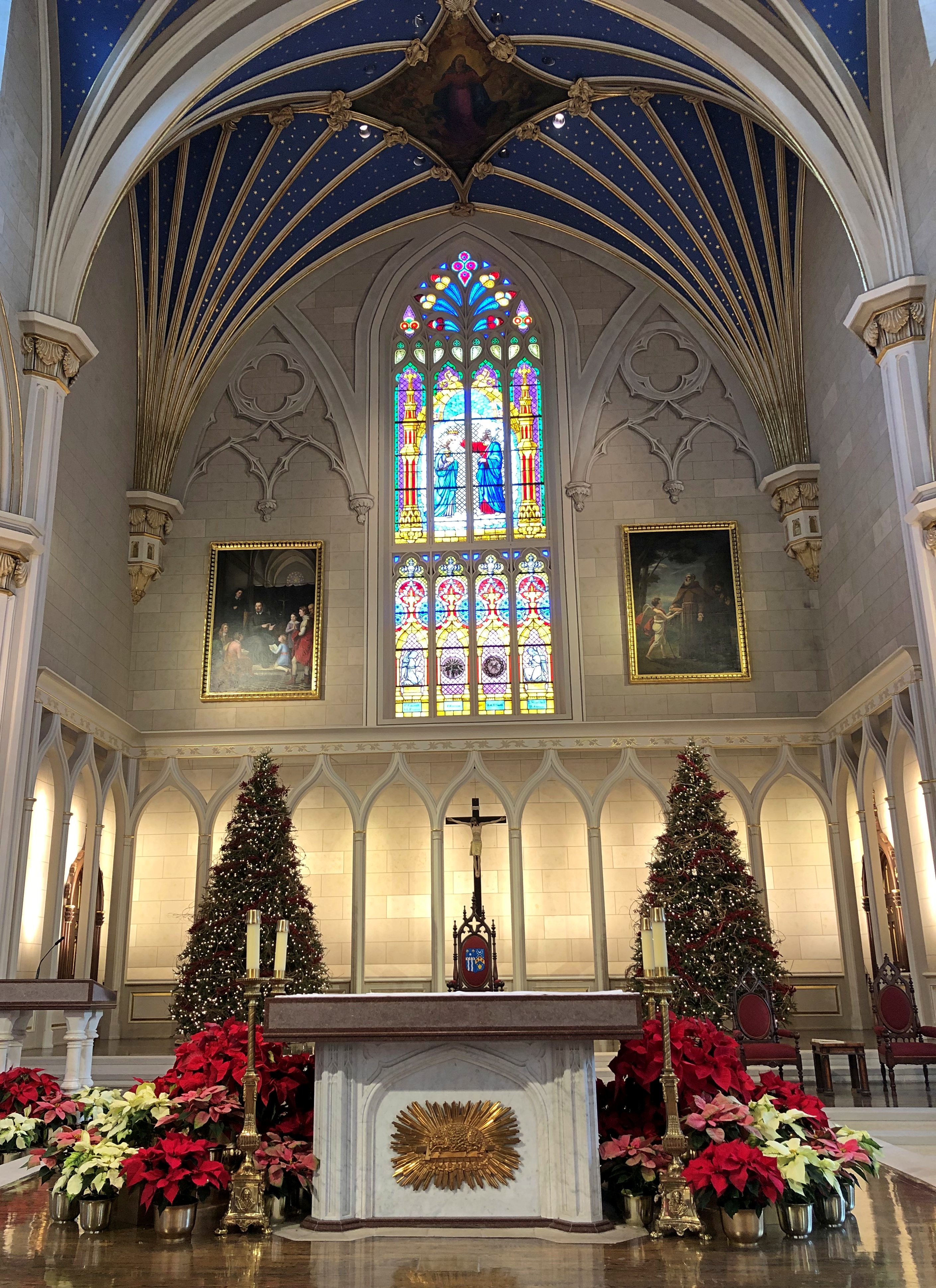
Fairly early on our first day in Louisville, we found our way to St. Martin of Tours, a Catholic church that rises in the Phoenix Hill neighborhood, among clusters of shotgun houses, more than I’d seen anywhere else.
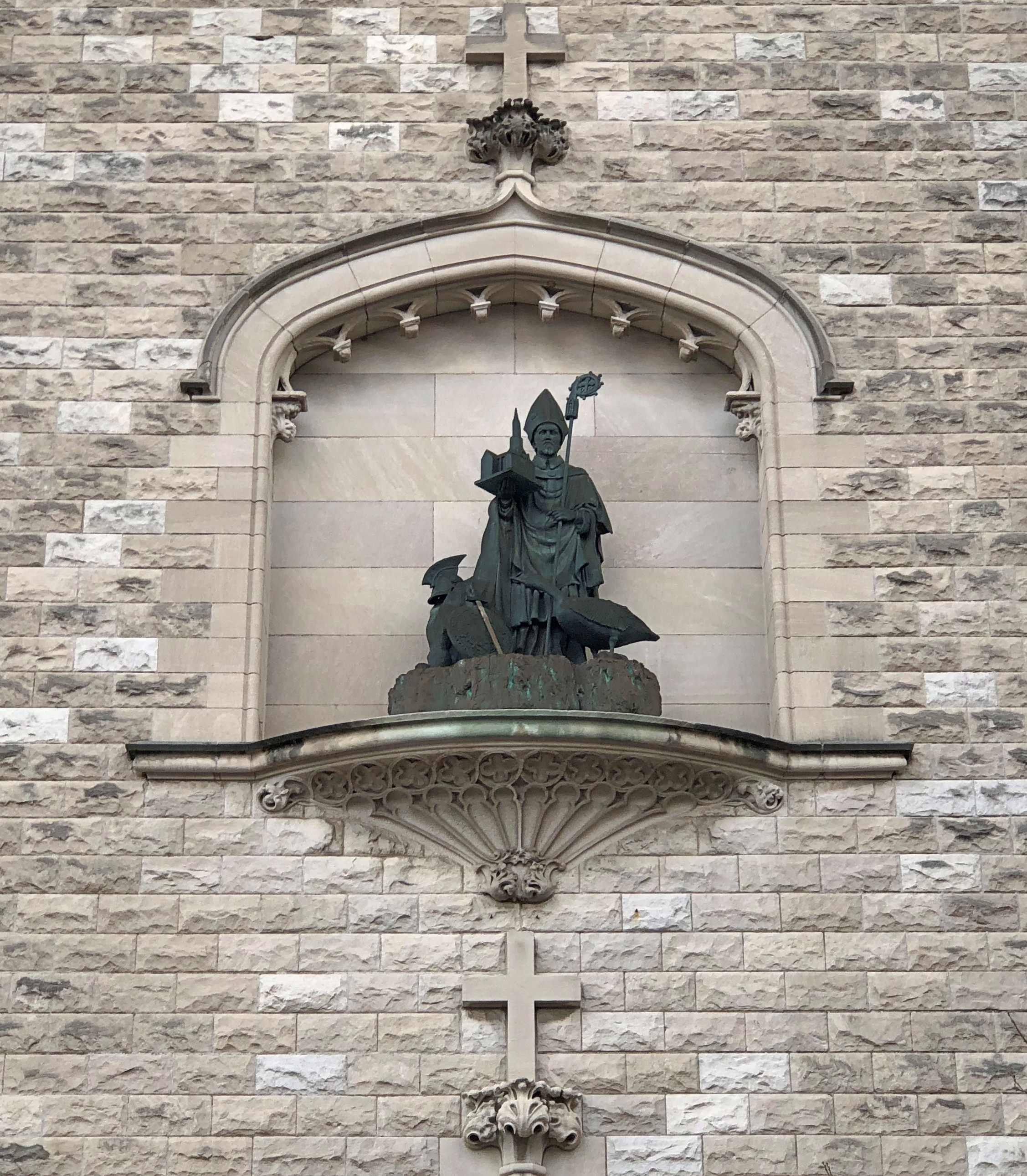
Must be St. Martin himself. He holds his basilica in Tours (I assume) as if on a serving plate.
I heard about him in a VU history class, but after so many decades, it was all a little fuzzy, so I looked him up. I remember now: Martin and his mentor Hilary of Poitiers kicked butt when it came to fighting the Arian heresy in the fourth century.
Patron of France, Martin is, but so much more: beggars, cavalry and equestrians, hotel and inn keepers, reformed alcoholics but also vintners and wine growers, quartermasters, and the Swiss Guards at the Vatican, among many others.
I suppose the saint was popular among the antebellum German immigrant population. They were on the receiving end of a Nativist mob attack not long before the war, a serious enough atrocity that it might have encouraged the waves of German Catholics to go to Chicago, St. Louis and other cities instead of Louisville.
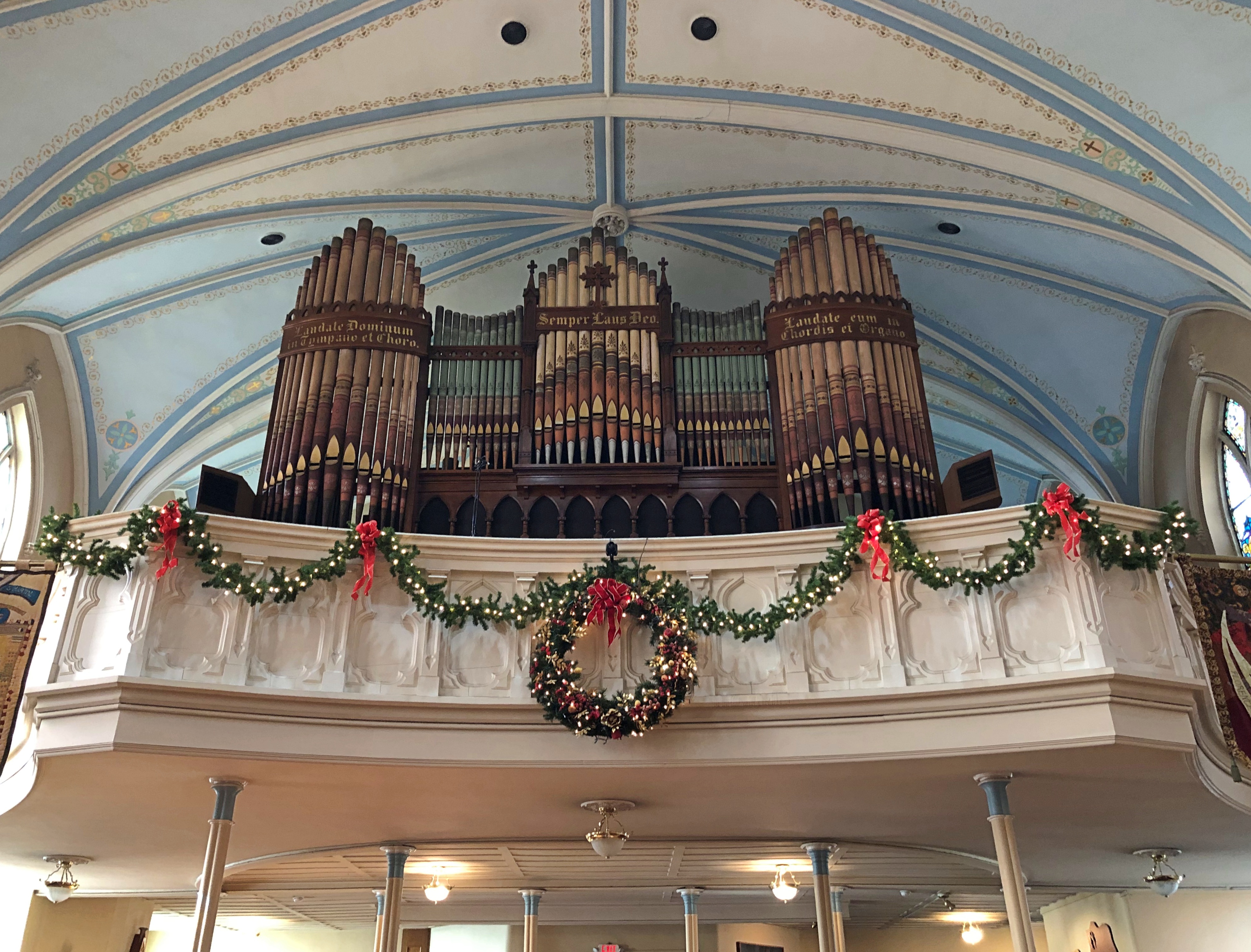
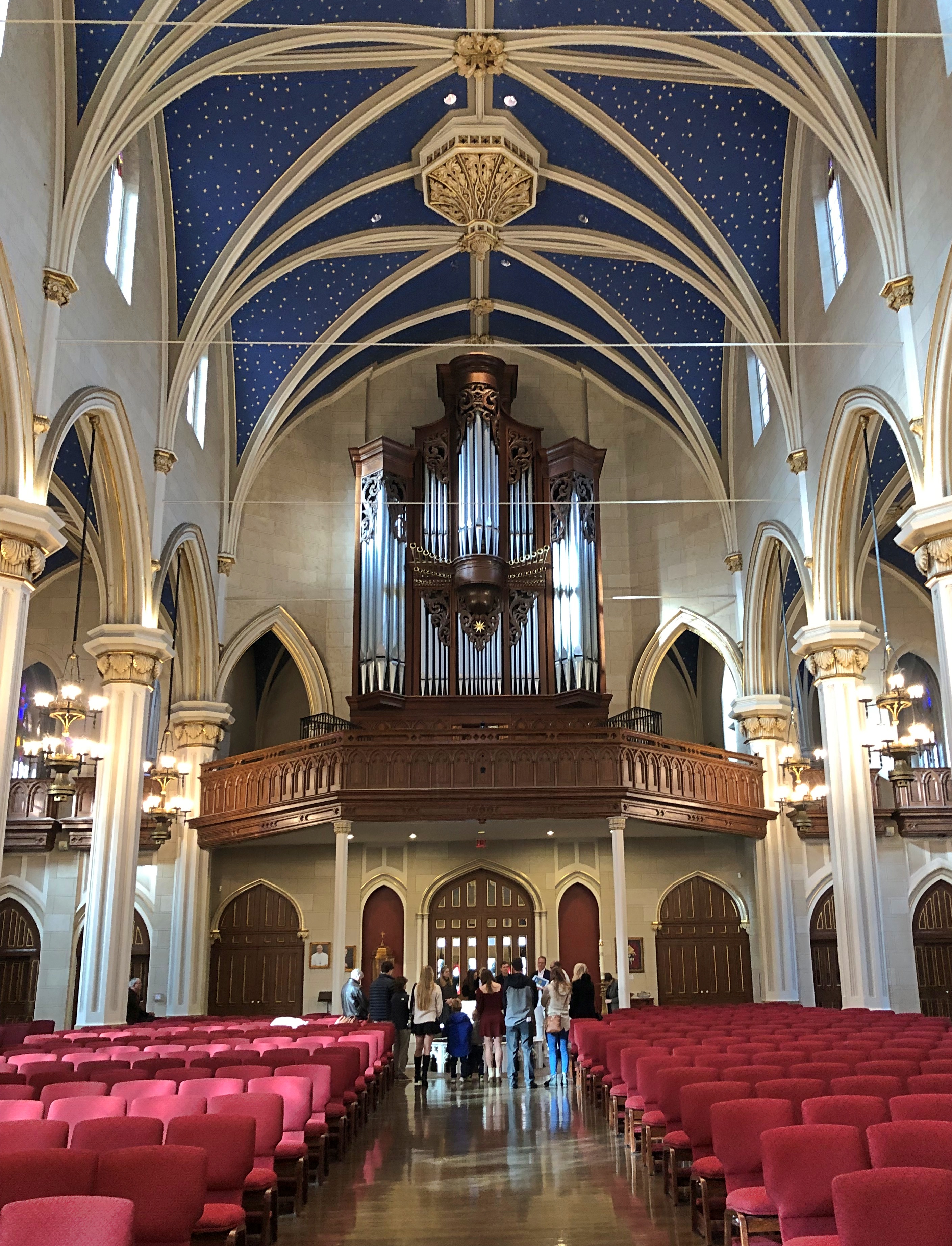
The mighty-looking organ was silent during our visit.
A side chapel is a site of perpetual adoration, but I didn’t want to bother the man in there, who looked pretty intent. Closer to the altar are the bones of Saints Magnus and Bonosa, fourth-century figures and the subjects of the sort of vague saintly stories common in that period.
It too was new in the 1850s when the Know-Nothings nearly burned it down. In our time, it’s closed on Thursday afternoons. So I took a short stroll in that part of downtown. Yuriko had sense enough to wait in the warm car.
We returned to the cathedral on Sunday for another look. Near the entrance, a baptism in progress.
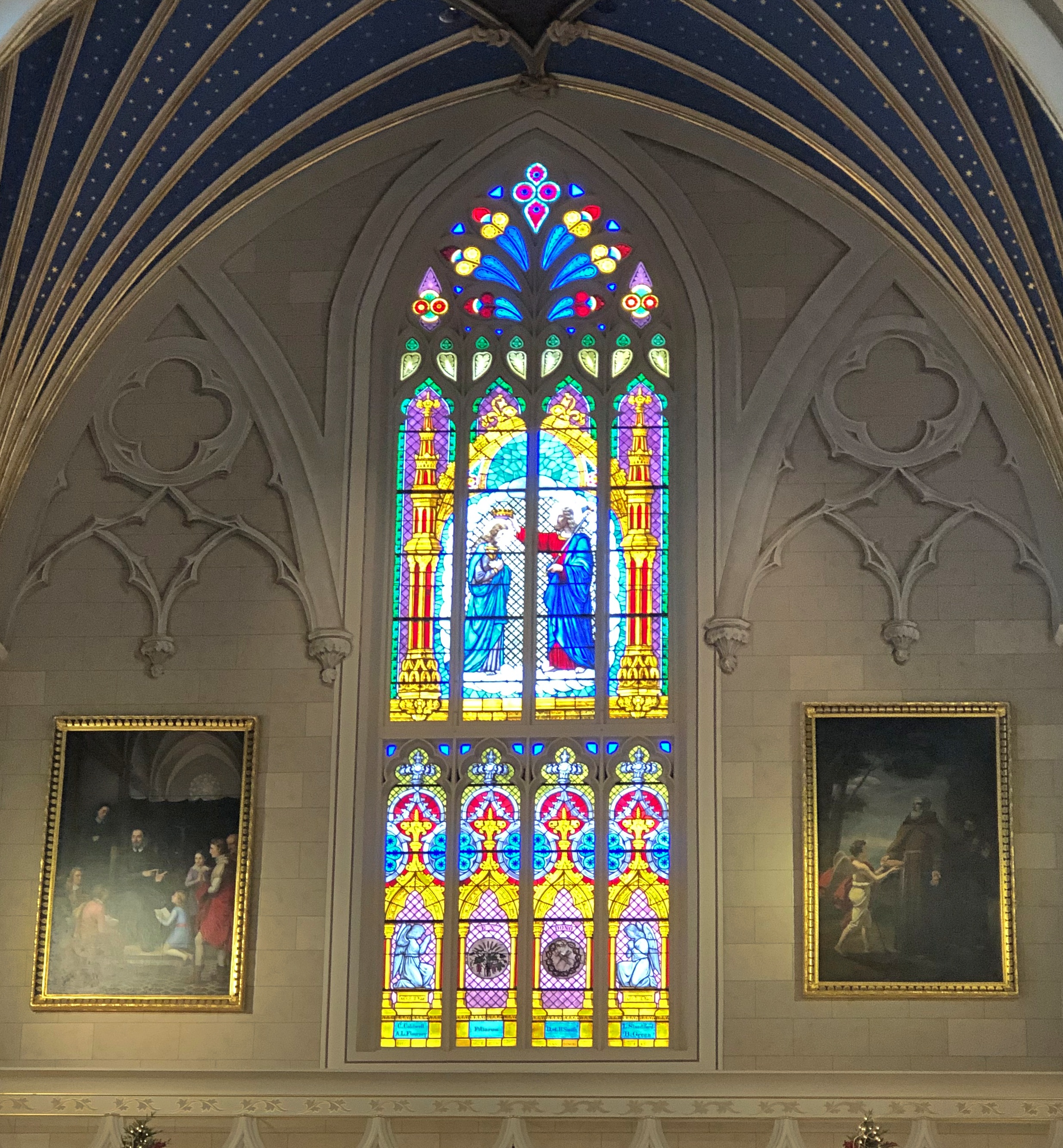
The Coronation Window.
How many windows have proper names?
“Original to the Cathedral, the Coronation window depicts the crowning of the Virgin Mary as the Queen of Heaven,” the church web site says. “Designed by the Blum Art Co. in 1883, it is one of the oldest and largest hand-painted glass windows in the United States. The window was removed in 1912 and stored in the Bell Tower until 1994, when it was restored to its original position.”
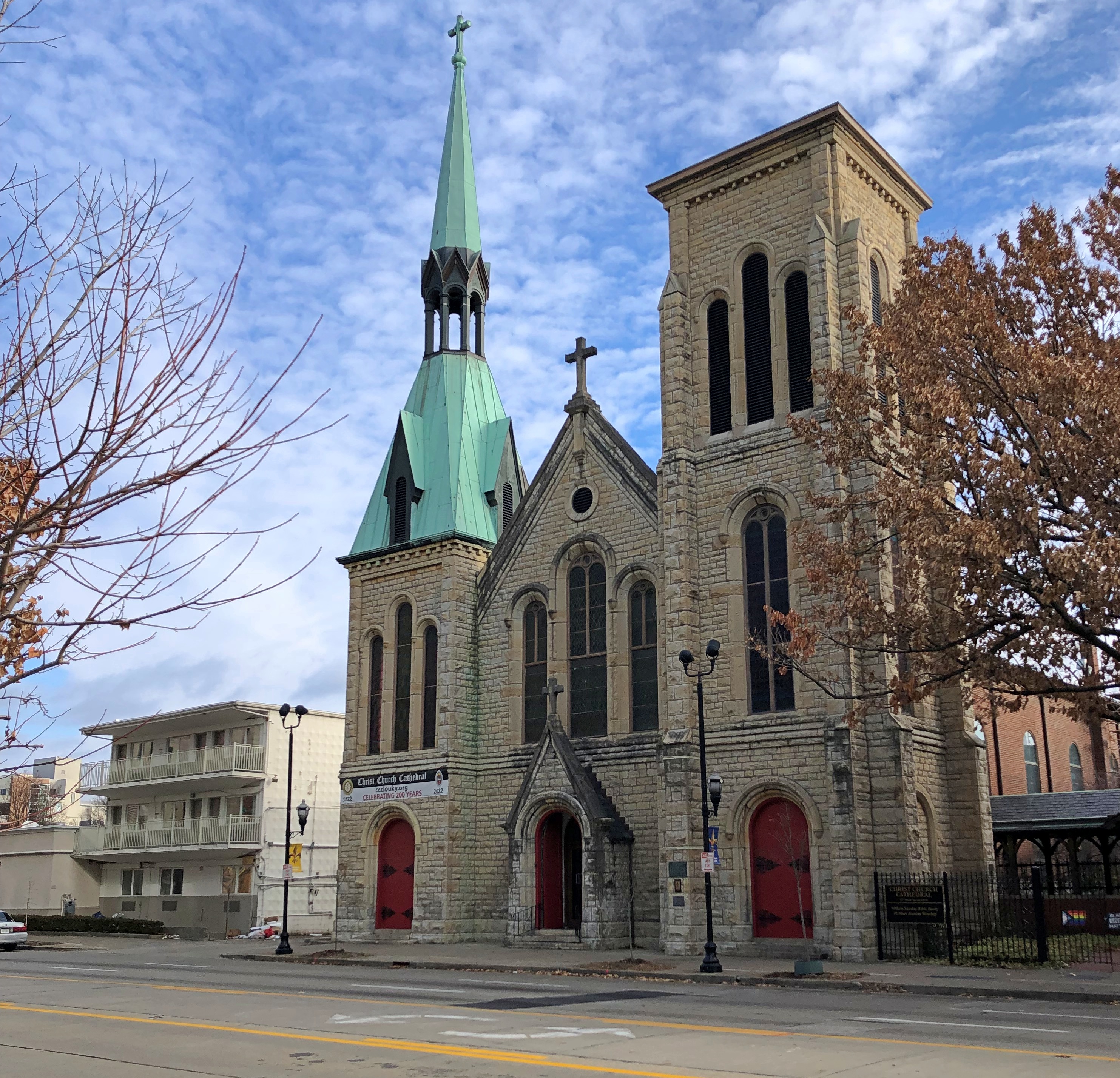
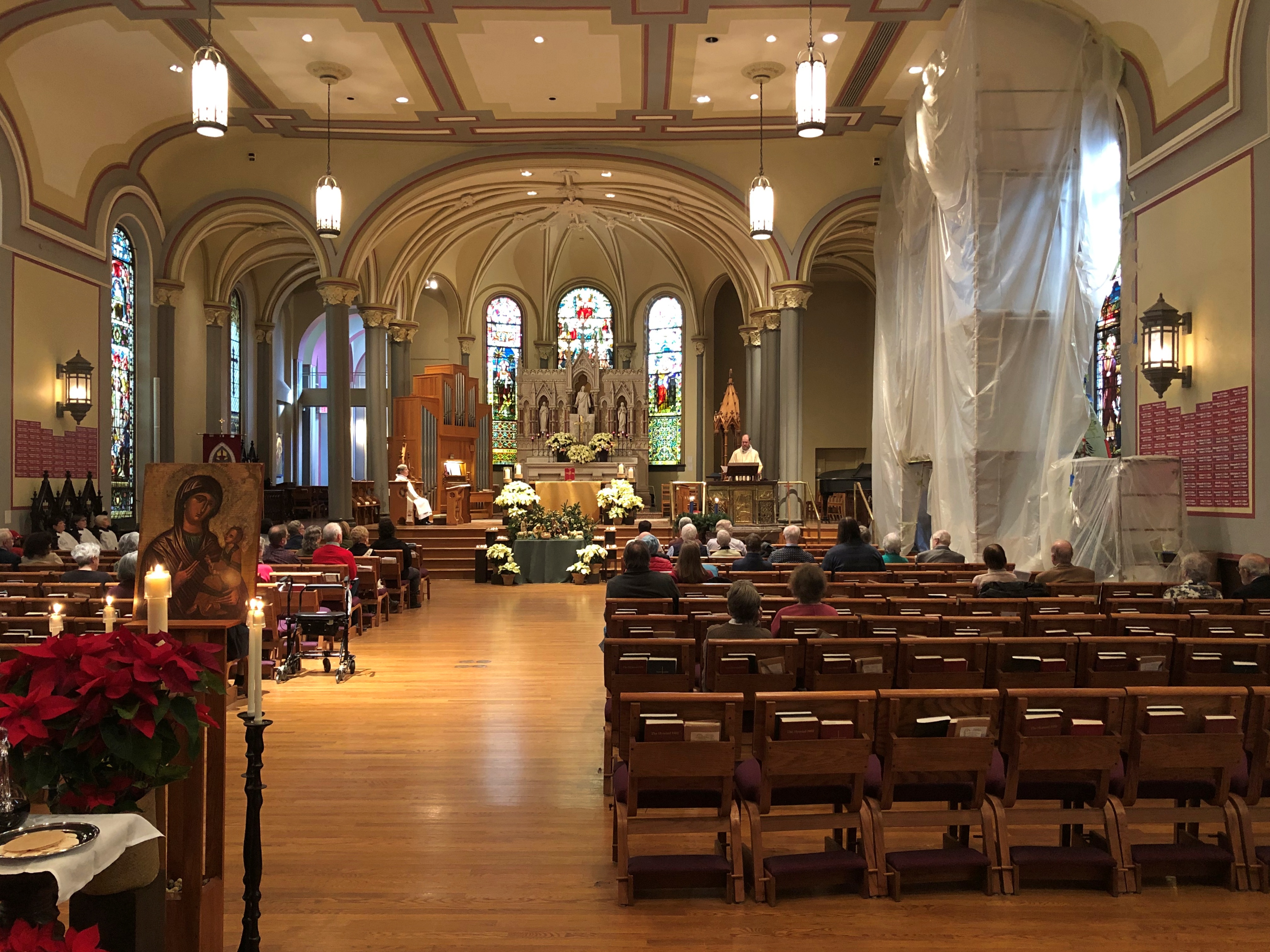
A few blocks away is the Christ Church Cathedral, seat of the Episcopal Diocese of Kentucky, and at just over 200 years, one of the oldest buildings in Louisville.
Homily in progress. We didn’t stay for it. The priest was probably not denouncing Arianism, but who knows.
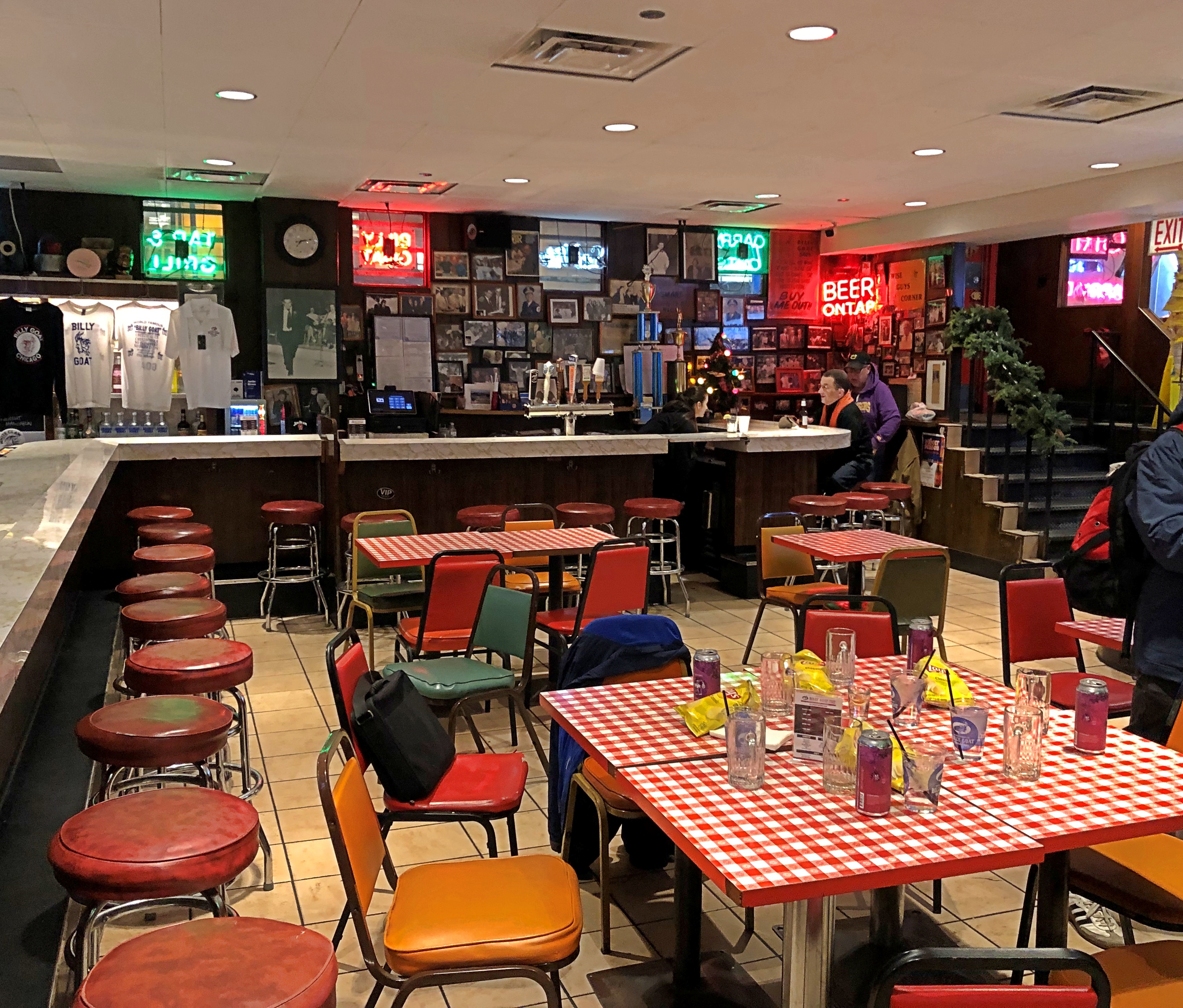
I can’t say whether Billy Goat Tavern & Grill looks exactly the same as it did in the ’80s, but it sure felt the same on Monday night. The walls of photos, neon, beer taps, rows of bottles, knickknacks and basic restaurant tables and chairs, and plenty of worn red bar stools. The vibe is Chicago tavern clutter, comfortable as an old shirt.
Now that I think about it, I had the most Greek experience I’ve ever had at the Billy Goat, having never yet made it to Greece. Shortly before the 1988 presidential election, the Dukakis campaign staged a campaign parade on Michigan Avenue, and after work I went to watch, on a spontaneous quasi-date with a fetching Greek-American woman I knew. Was it a torchlight parade? In my memory, there were torches, but probably no: that seems like a 19th-century thing.
We were within feet of the candidate as he walked by, his expression a little stiff and discouraged. Later we repaired to the Billy Goat, which was wall-to-wall packed, including many Greek Americans – wearing the colors of the Greek flag, some of them — with everybody feasting on cheeseburgers and beer, the place alive with talk, and the clank of spatulas on the grill, and the hissing burgers and onion air, and the clouds of cigarette smoke still common in bars and restaurants.
I’m pretty sure the workers called out Cheezborger! Cheezborger! in those days, which might be an example of life imitating art, or more likely, life and art reinforcing either other.
Rumor was that Dukakis himself would make an appearance, and well he should have, but he never did. He should have shown up in his tank helmet, shaking hands and mugging for cameras. Rather than be embarrassed by it, he should have leaned into it, but no.
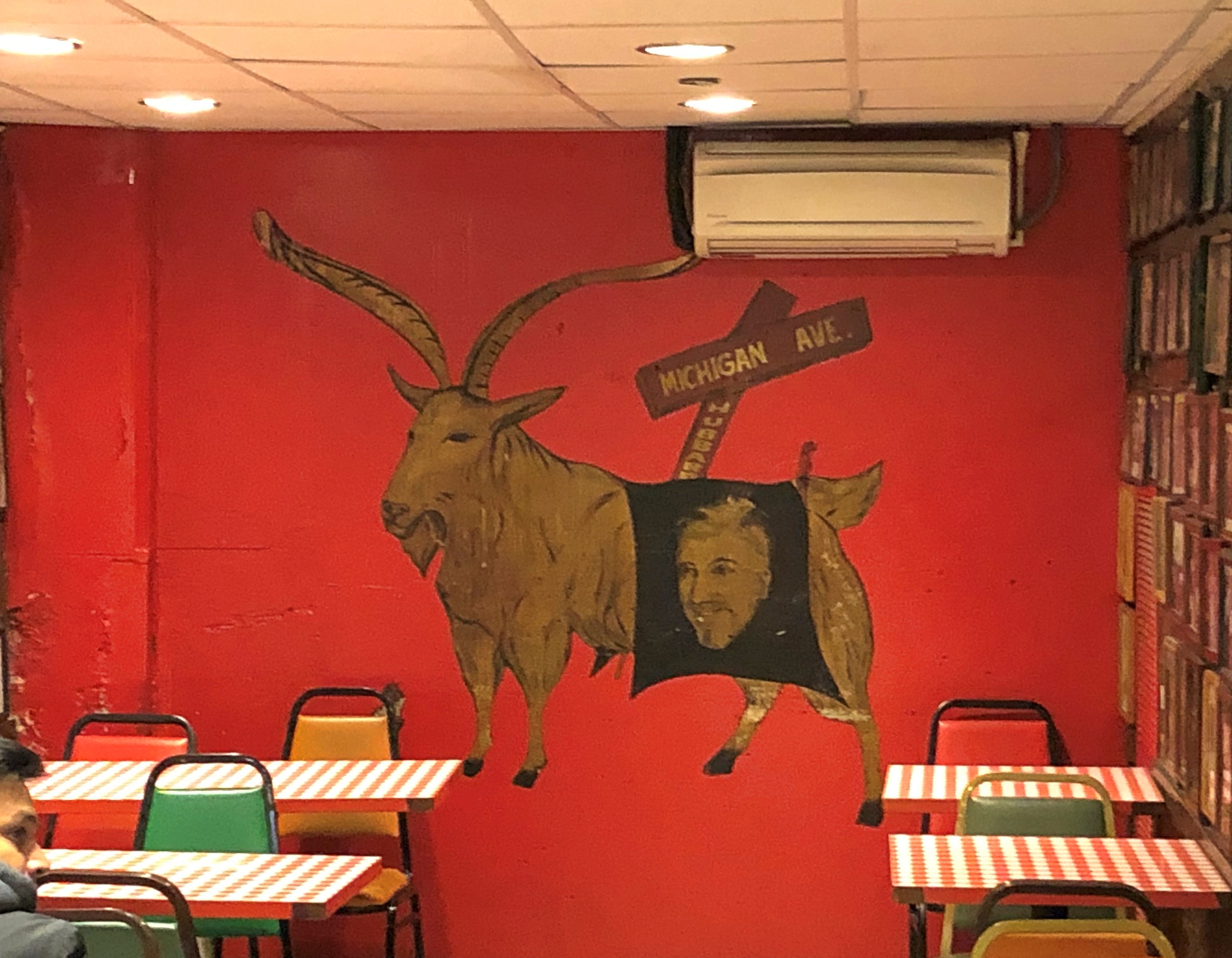
Back here in the 21st century, there are reminders of goats at Billy Goat. How could it be otherwise?
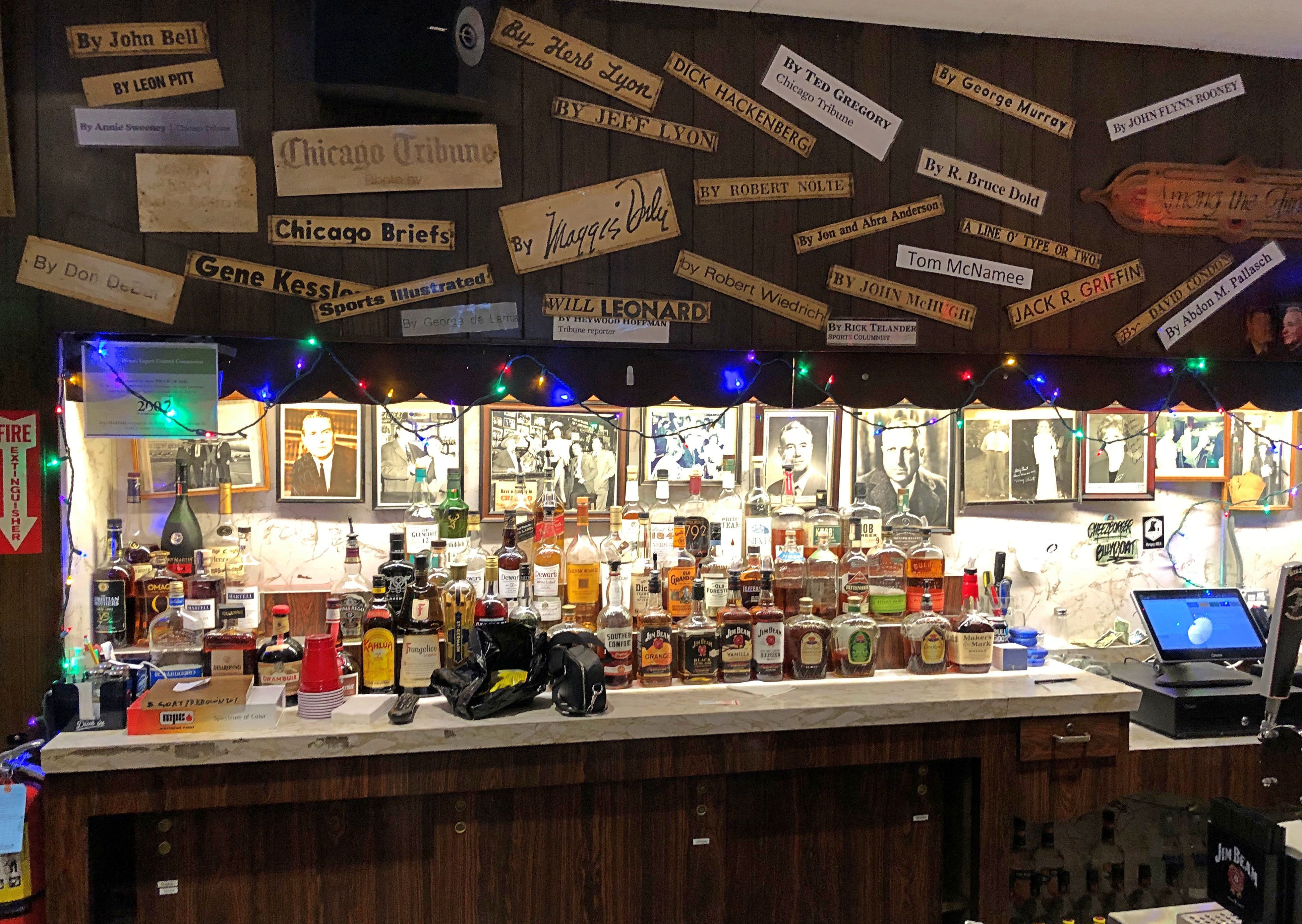
You can see a wall of bylines at Billy Goat. Once upon a time, both major Chicago newspaper buildings were within easy walking distance, even in winter, so newspapermen hung out there.
Best known was Royko, who worked the place into his column from time to time. From there, the place went on to wider notice, sort of.
I expect the number of journalists is fairly low these days, outnumbered by other kinds of downtown residents and workers, plus tourists. On Monday night at least, no one called out when you ordered your cheeseburgers; they just went to work at it.
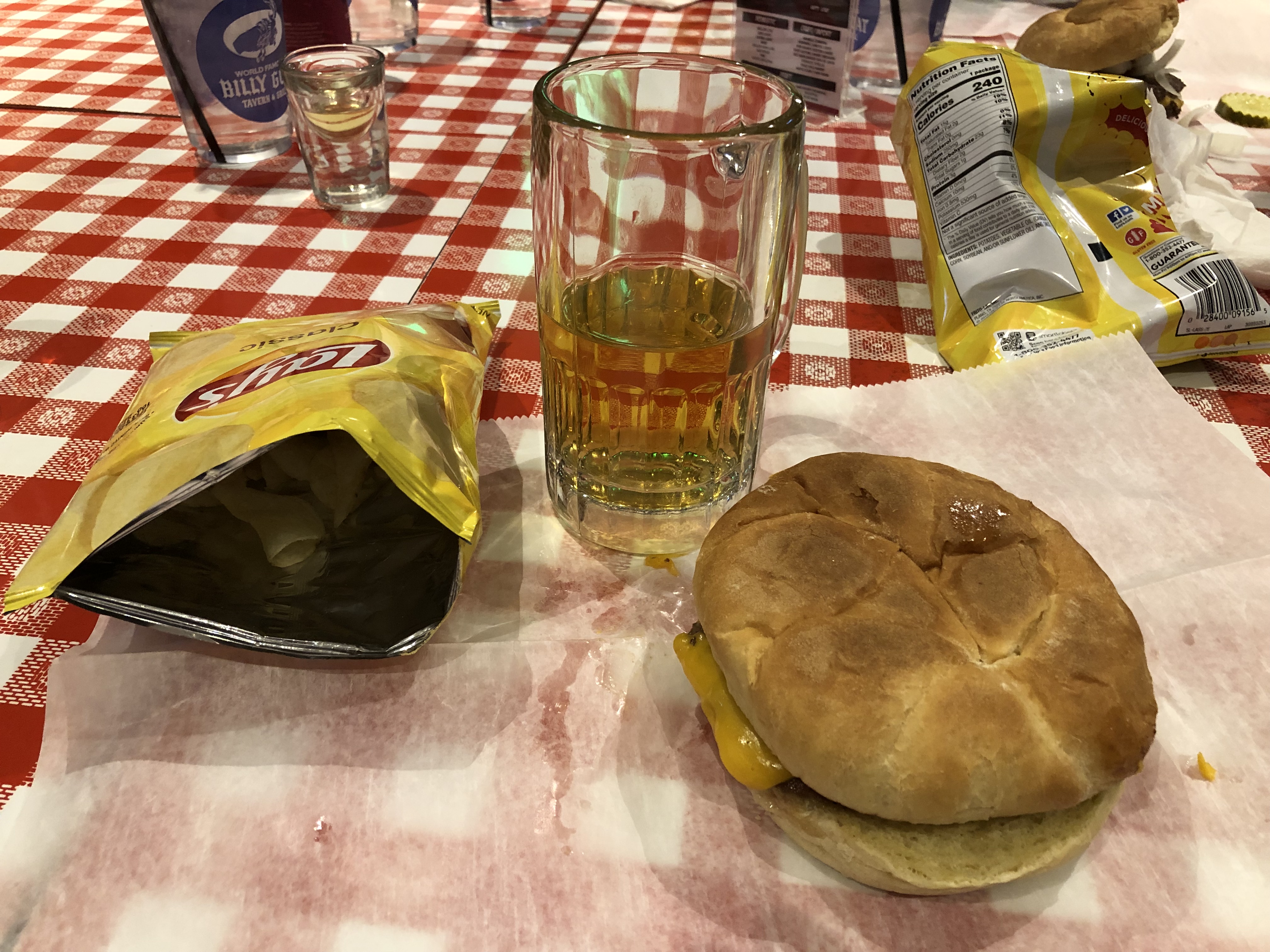
Except for the vegan in our group – she was a good sport about it — we had cheeseburgers and chips and beer. What else? In theory, a few other things are on the menu, but we didn’t test it. No fries, either.
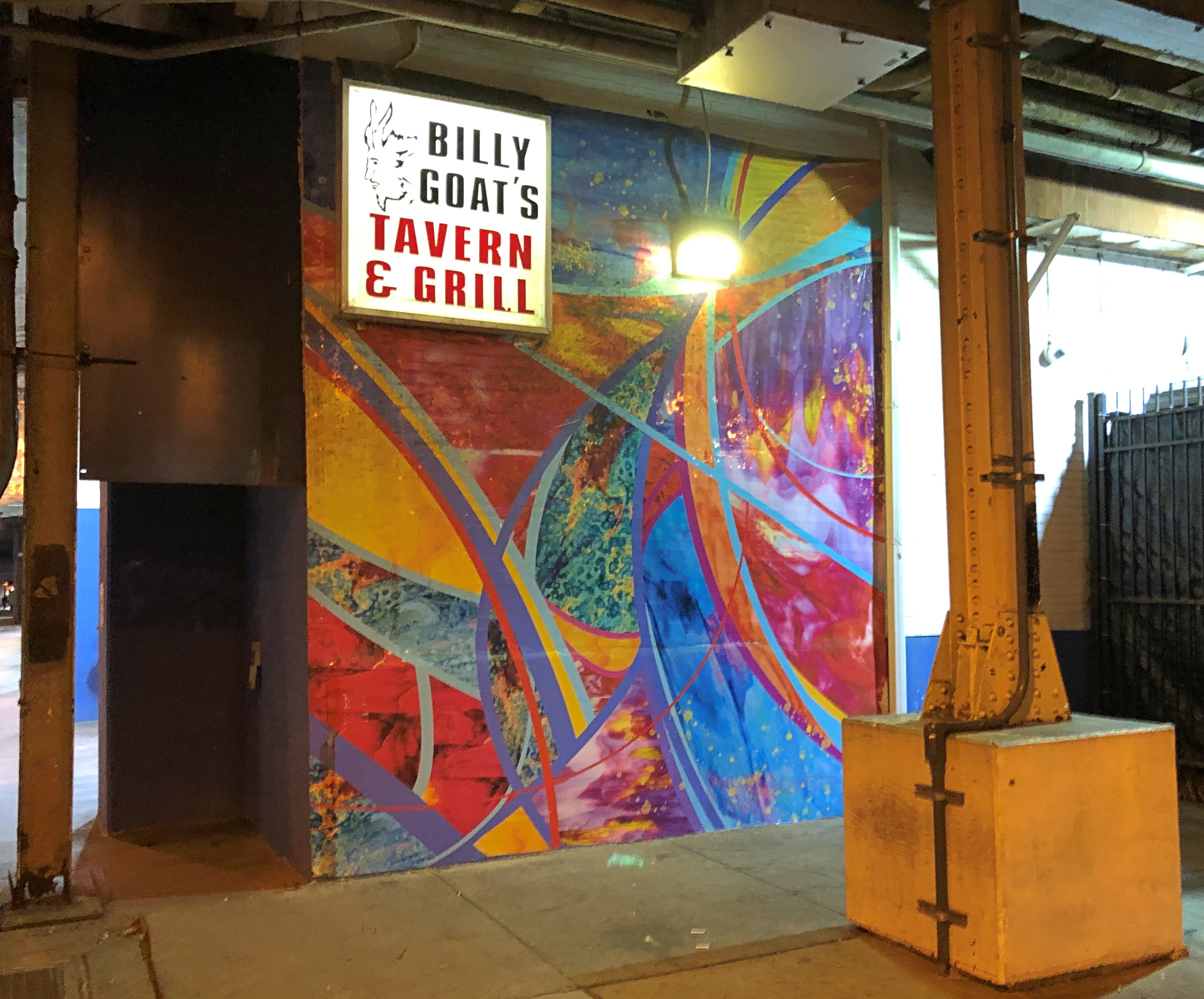
Around the corner from the entrance of the Billy Goat, directly facing Lower Michigan Ave. and just north of the Chicago River., is a mural and a tavern sign.
The mural is a work by Andy Bellomo, “a self-taught artist who began her creative interest as a young teen studying the color, light, shapes, and lines of traditional stained glass in churches,” according to the the Magnificent Mile Association, as part of a number of murals known as Undercurrent (at least to the Mag Mile Assn.).
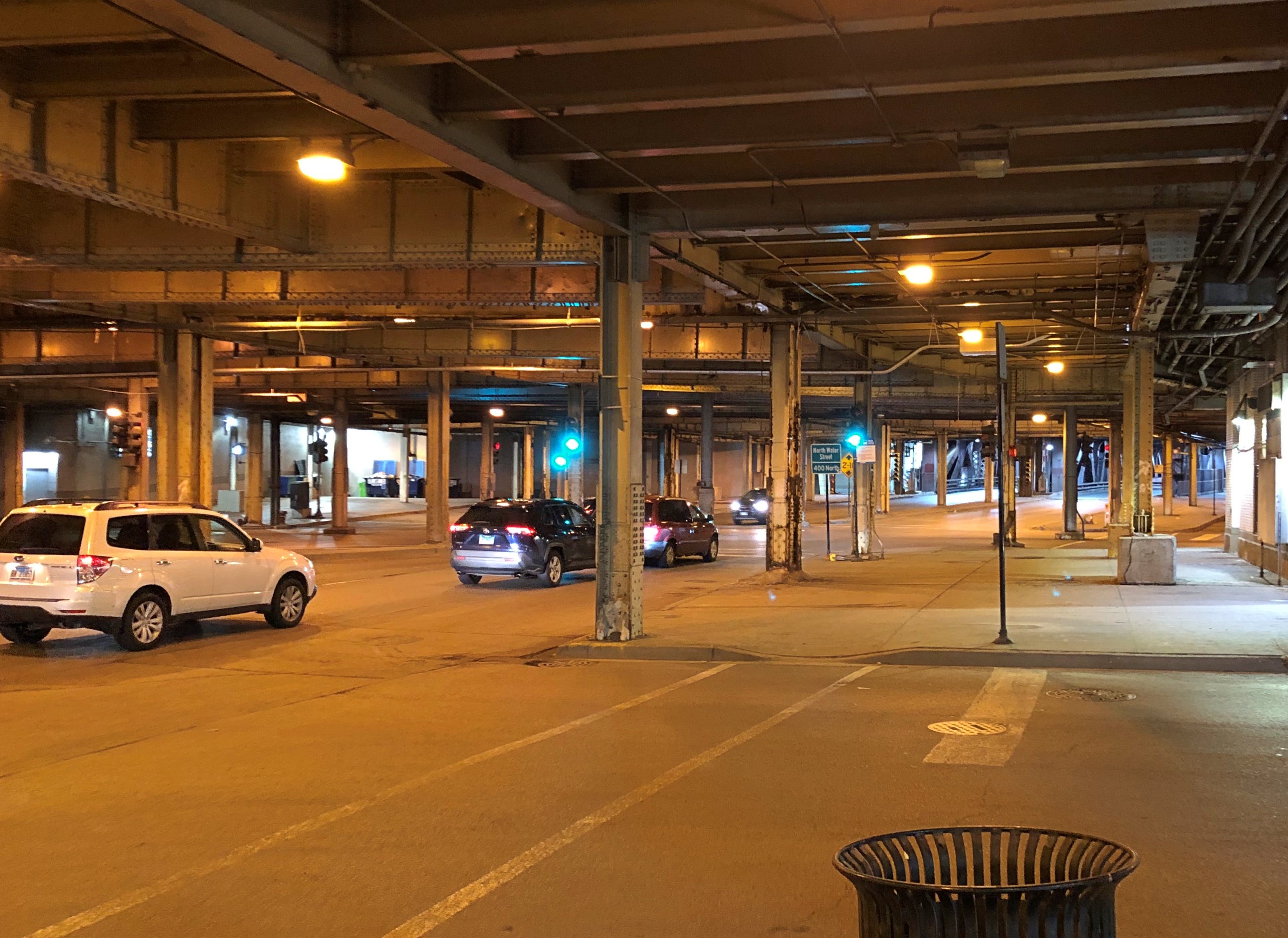
It’s been there about a year, which would account for me never noticing it before. Haven’t been down to Lower Michigan Ave. in a some years, but I can assure the world that it’s still the hard urban space it’s always been.
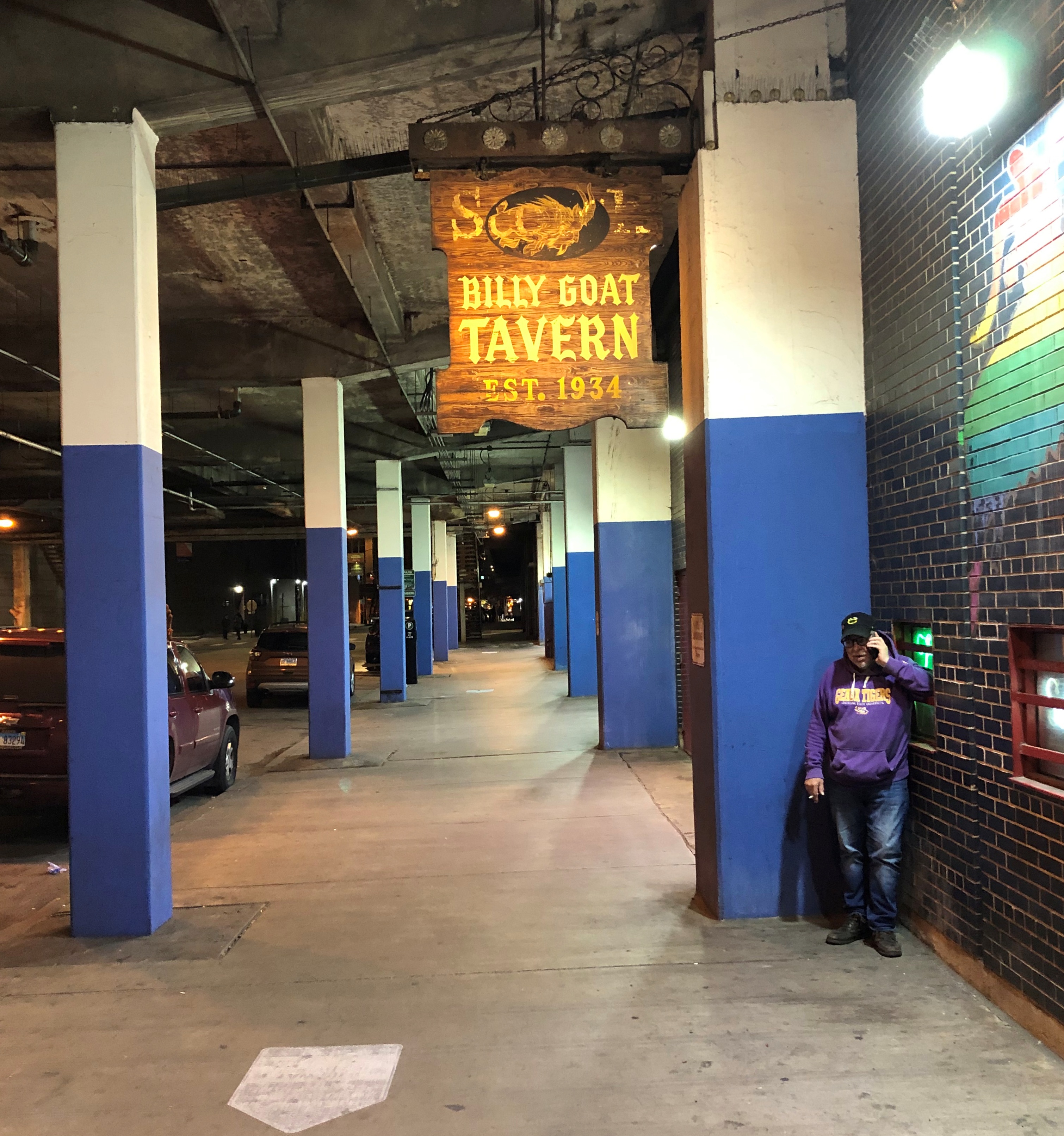
There’s more of the Undercurrent mural on the other side of the tavern’s entrance, not captured in the below image.
But I did capture, without realizing it, part of a different mural, one that’s been there for decades, by an artist mostly lost to time in Chicago, even though his heyday was only about 50 years ago. It’s on the extreme right edge of the image: a rainbow goat.
“Many people ask about the rainbow goats painted on the walls outside of The Goat,” notes the tavern web site. “They were painted in 1970 by Sachio Yamashita, known as Sachi… Billy [Sianis, original owner of the tavern] made a deal with Sachi. Every day after Sachi and his helpers finish their work, beer and borgers are free! Unfortunately Billy Goat Sianis passed away on October 22, 1970 just days before the paintings were complete.”
I might have noticed the goats before, but didn’t give them much thought. I didn’t notice them this time, or I’d have taken a full image, since how many rainbow goats could there be in the world? On walls, that is.
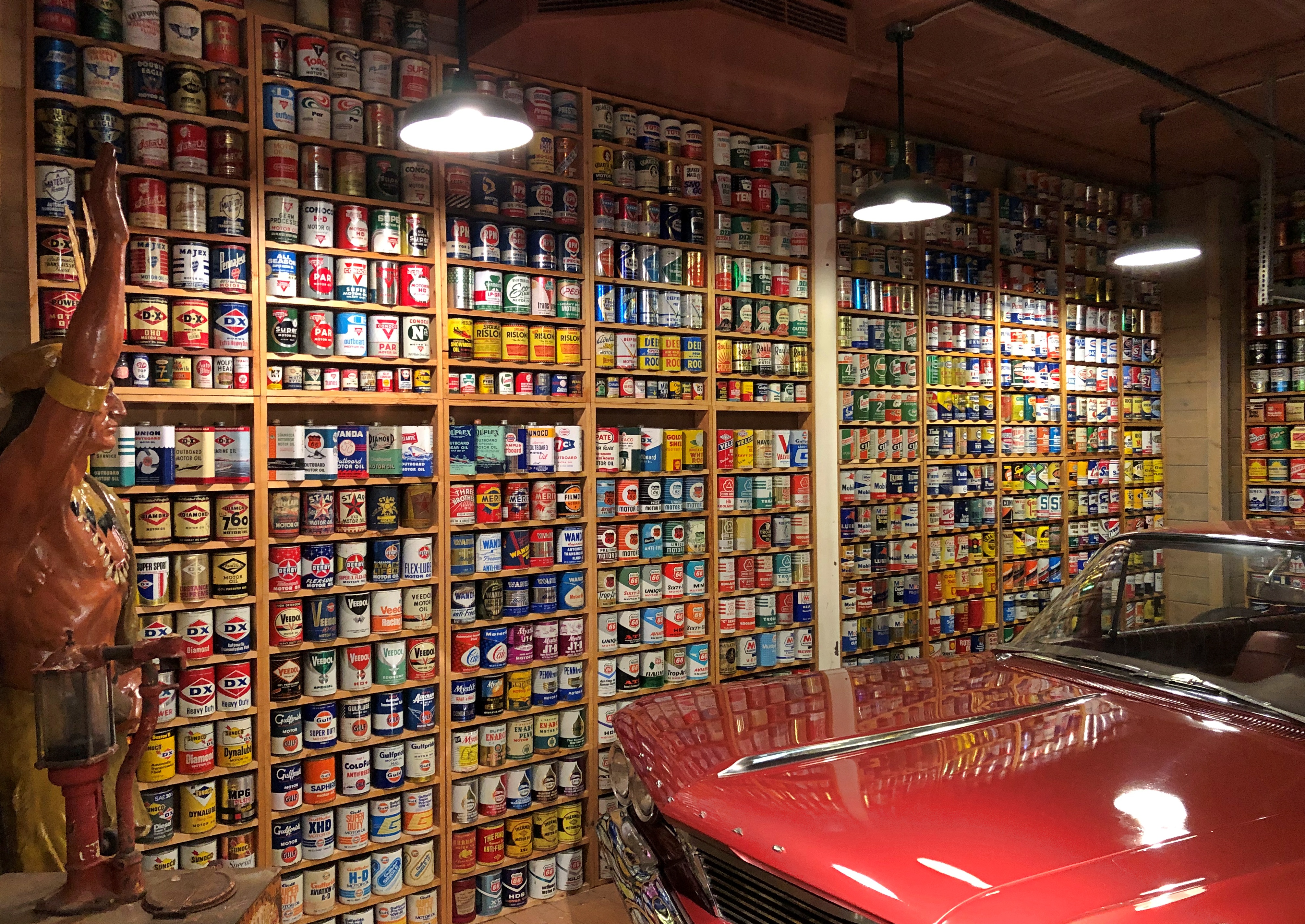
Not something you see very often: a wall of motor oil.
I’d never seen such a thing until I came across it just a few doors down from the Museum of the Gilding Arts, in the Pontiac-Oakland Museum and Resource Center, which also faces the elegant Livingston County courthouse in Pontiac, Illinois. In the case of the museum, Pontiac refers to the car brand of that name, and Oakland does as well, as the predecessor of Pontiacs. Both brands are defunct now, but not in the hearts of enthusiasts.
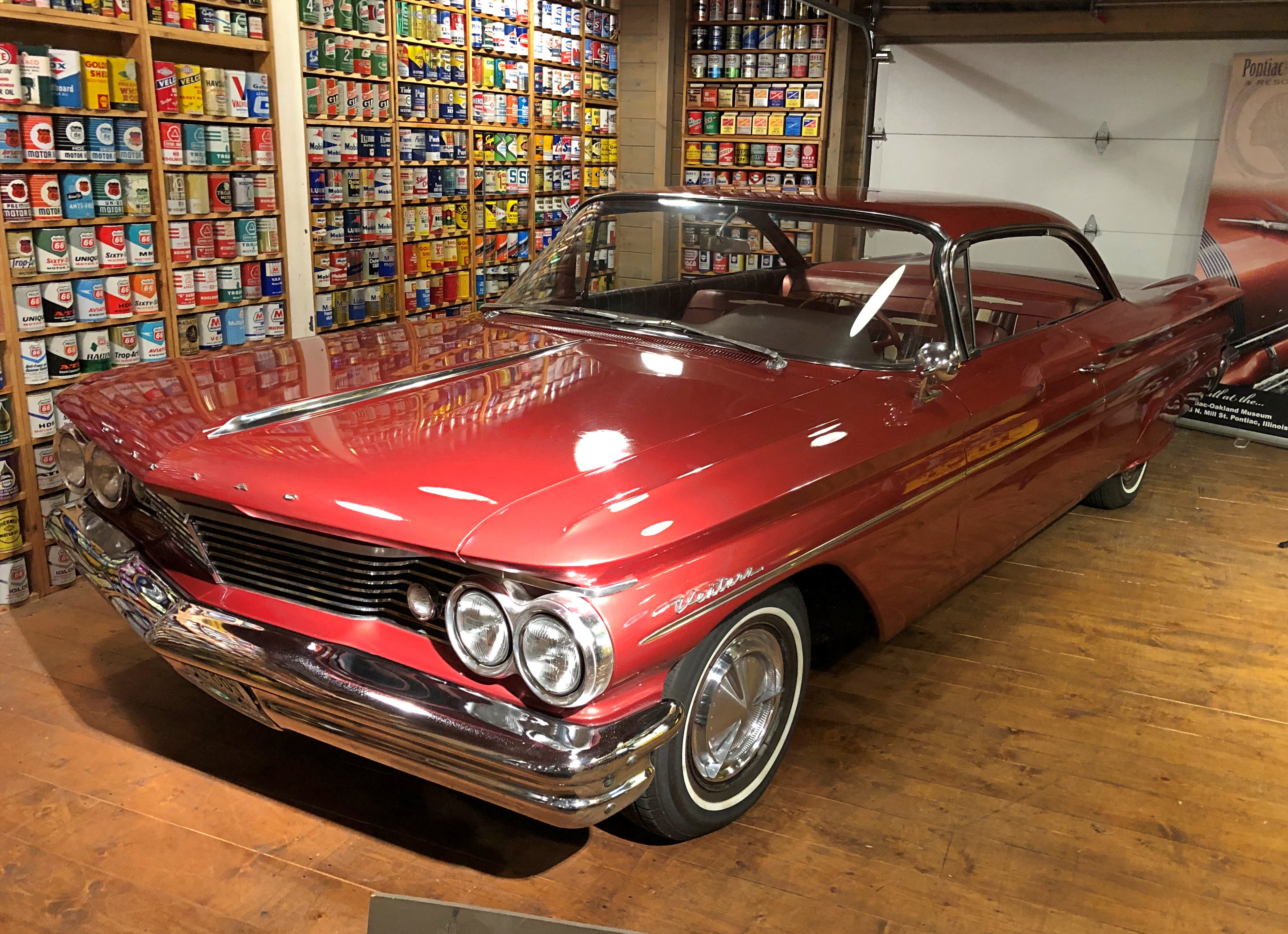
The many cans of motor oil happen to be a backdrop for one of the cars on display: a 1960 Pontiac Venture.
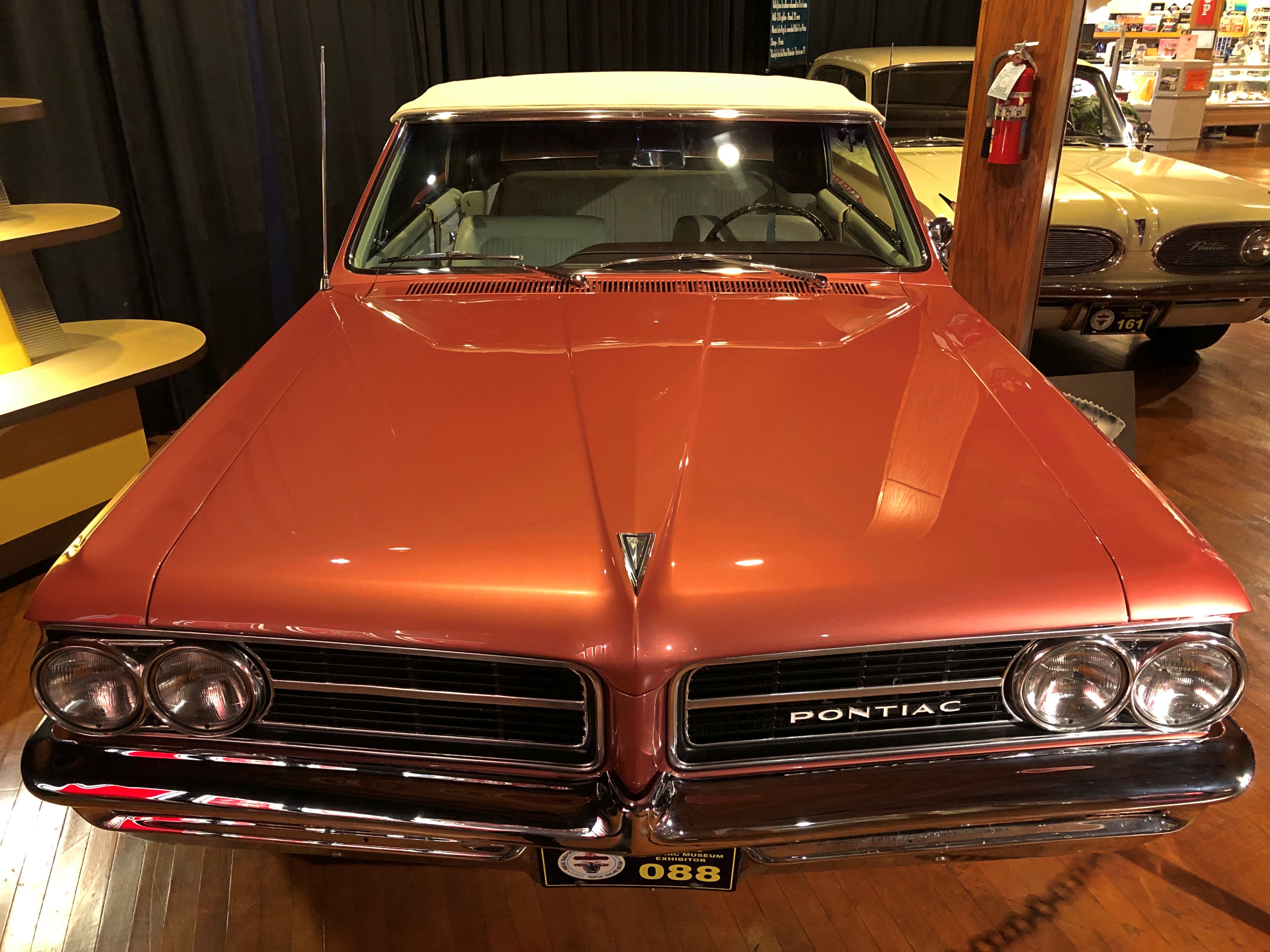
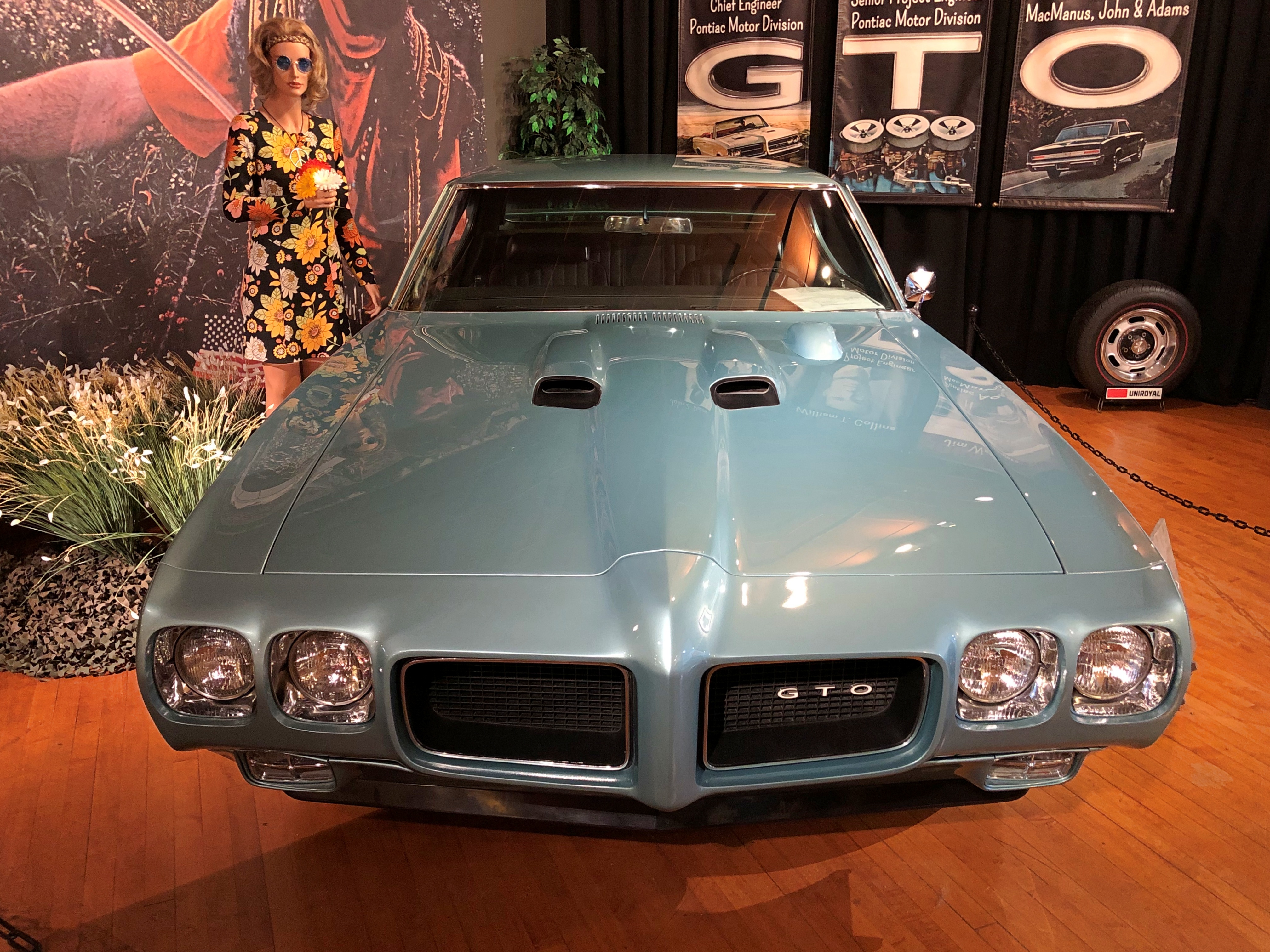
Nearby are other cars of roughly the same era.
A 1964 LeMans Convertible and a 1970 Pontiac GTO Judge, respectively. Not sure if that counts as a Little GTO.
The collection on display isn’t that large – not compared to Fairbanks or Reno, say – but it was well worth a look. Before its absorption into GM, and in fact before horseless carriages, Pontiac got its start as a carriage maker.
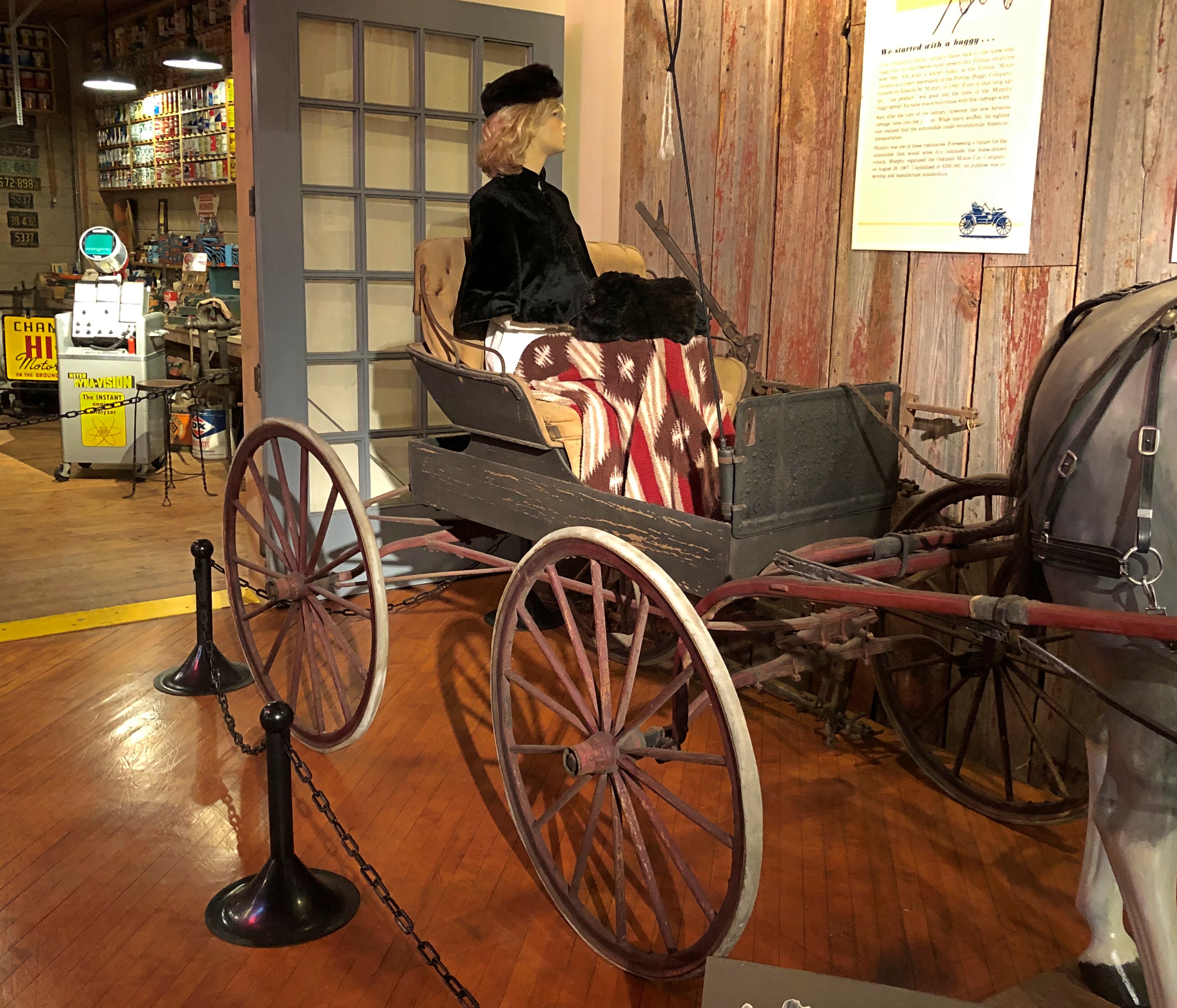
An 1890s product of the Pontiac Buggy Co. “One of a handful known to exist,” its sign said.
Soon enough, Pontiac Buggy founder Edward Murphy began building 2-cylinder runabouts called Oaklands, and later built more successful 4-cylindar models, as products of the Oakland Motor Car Co. GM bought Murphy out in 1909, and focused on Oaklands for some decades. The GM Pontiac model didn’t exist until 1926, and then the Depression killed off the higher-priced Oaklands.
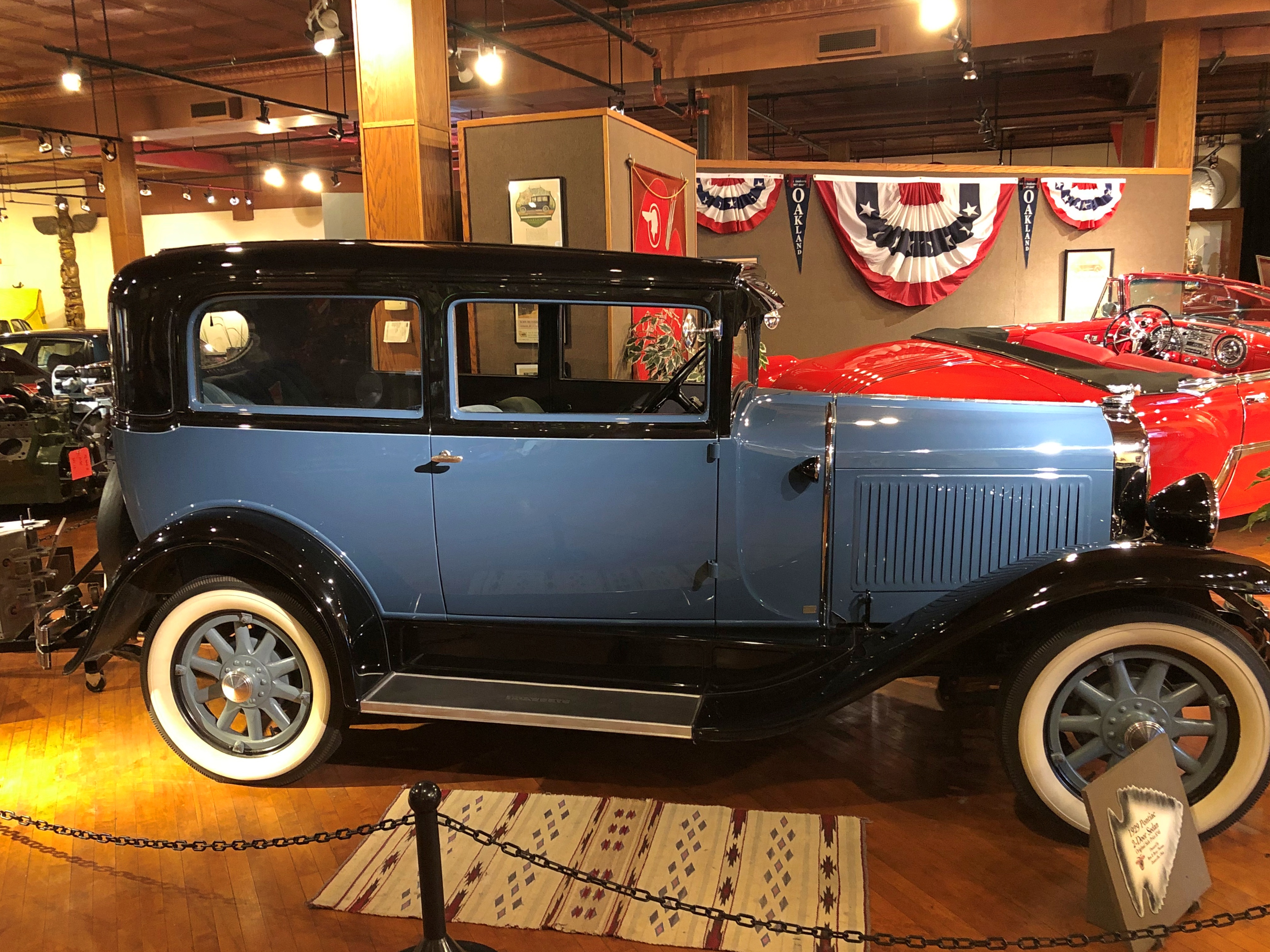
A 1929 Oakland.
A Pontiac sedan of the same model year.
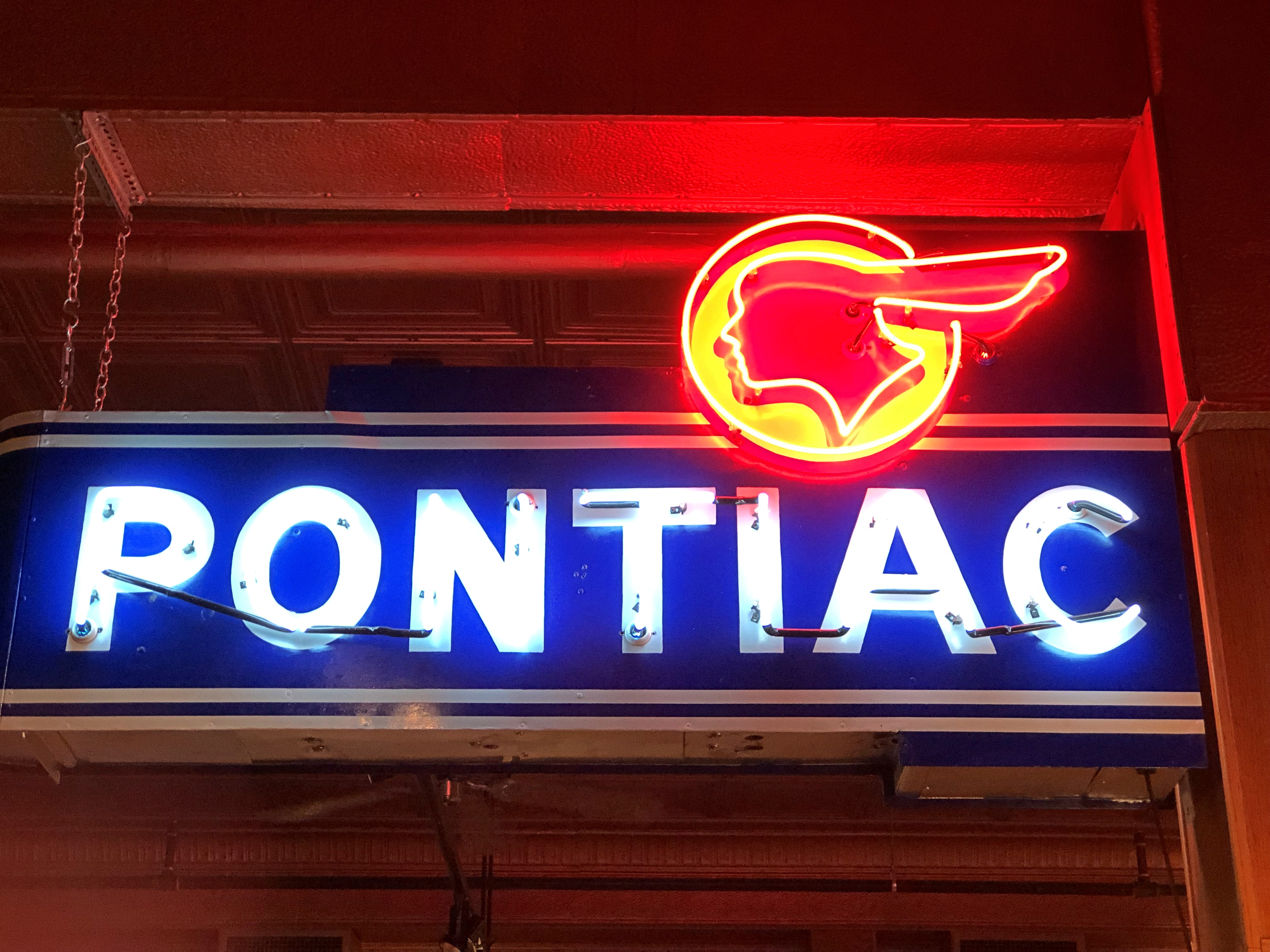
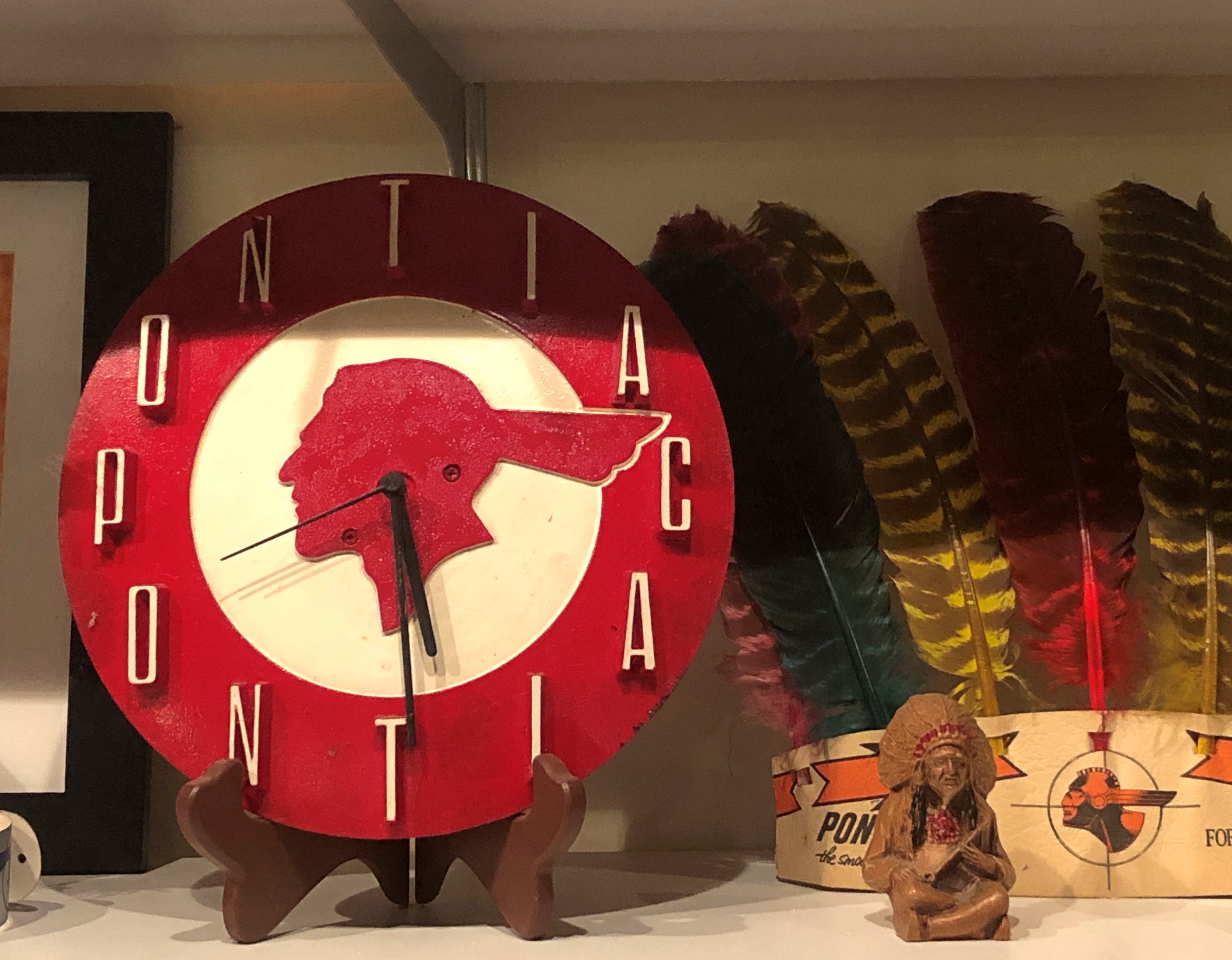
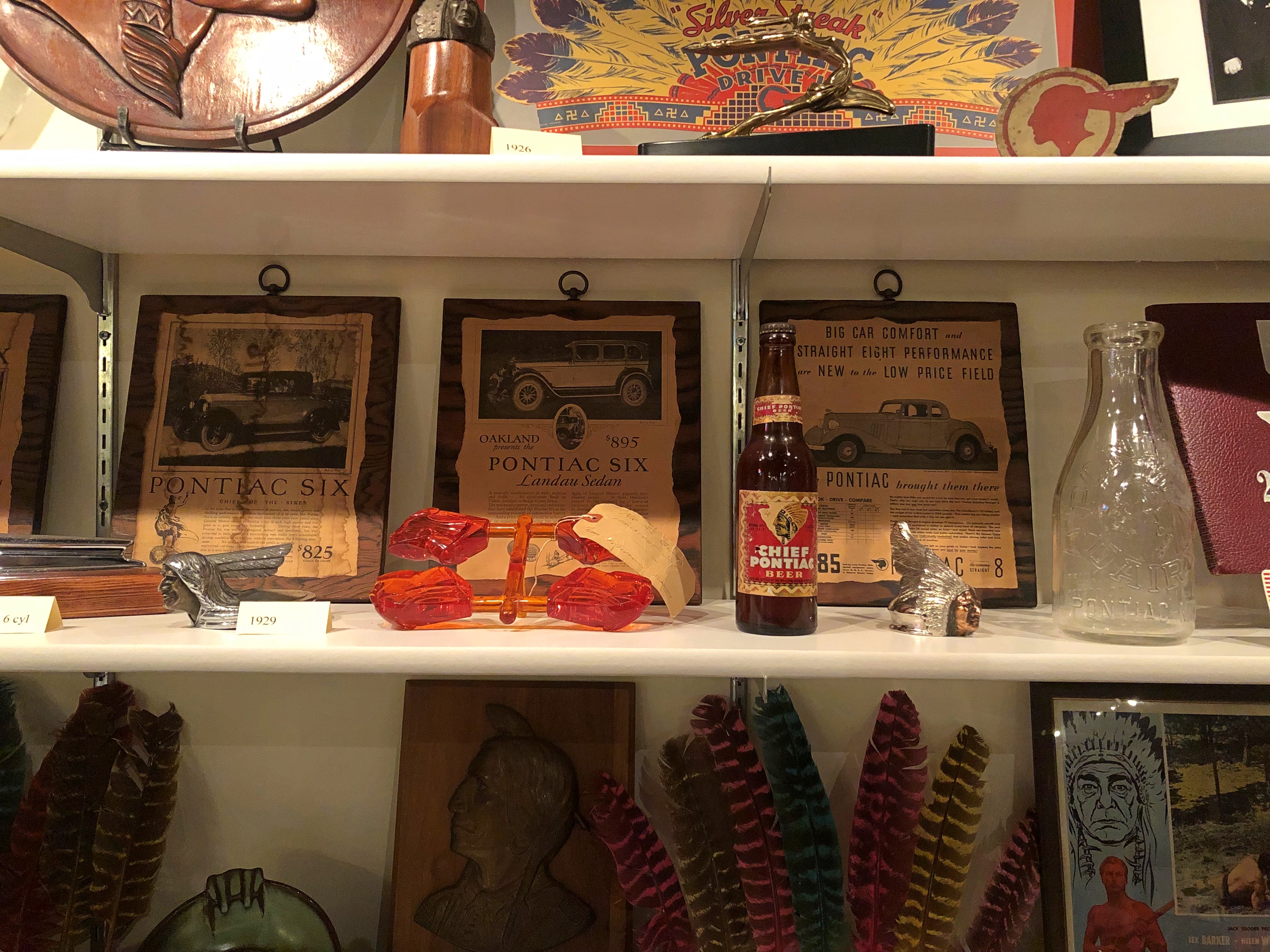
Also on display: marketing odds and ends that emphasize the Native roots of the name.
Some might object these days, but I can’t help suspect that Pontiac – Obwandiyag – able 18th-century leader of the Odawa – might have liked being associated, however tenuously, with such a solid object of commerce.
Wiki, citing a 2002 academic work, notes: “Their neighbors applied the ‘Trader’ name to the Odawa because in early traditional times, and also during the early European contact period, they were noted as intertribal traders and barterers.”
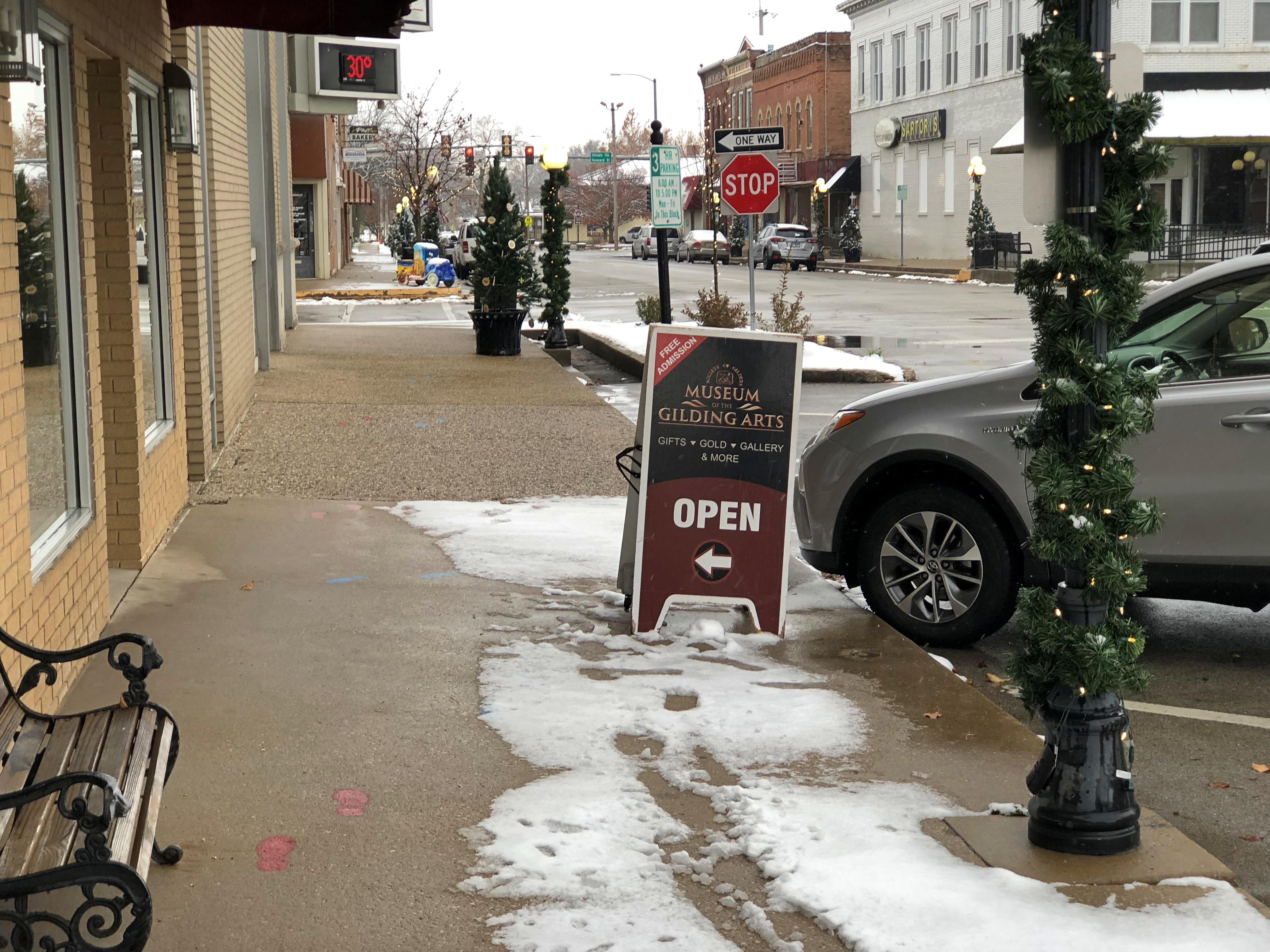
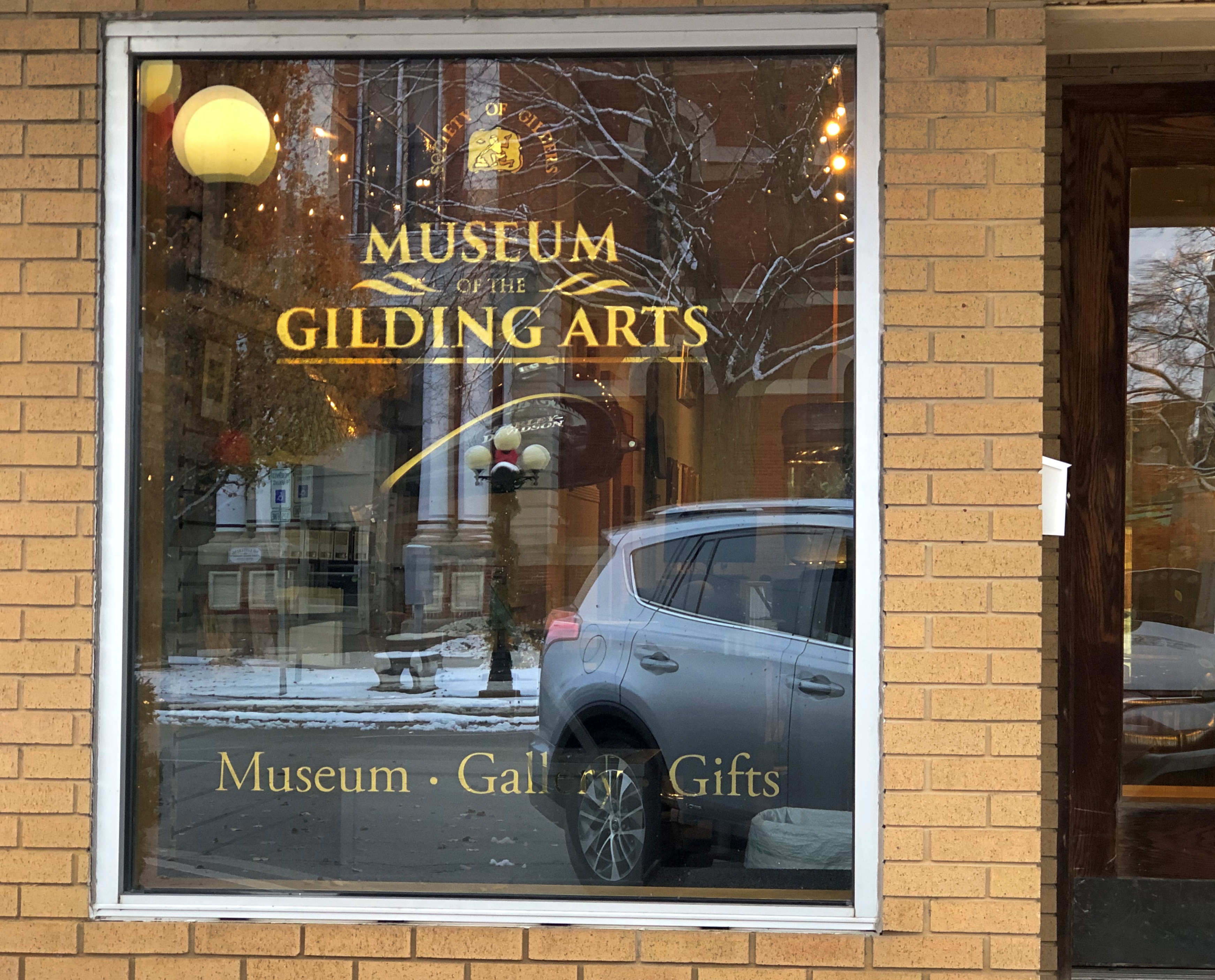
The docent at the Museum of the Gilding Arts, a neatly dressed woman about 10 years my senior, wasn’t sure why the museum is in Pontiac – Pontiac, Illinois, that is, where I stopped on Sunday specifically to visit the diminutive two-room museum.
“I’m going to ask about that, because I’ve wondered as well,” she said. “I’ve only been here three weeks.”
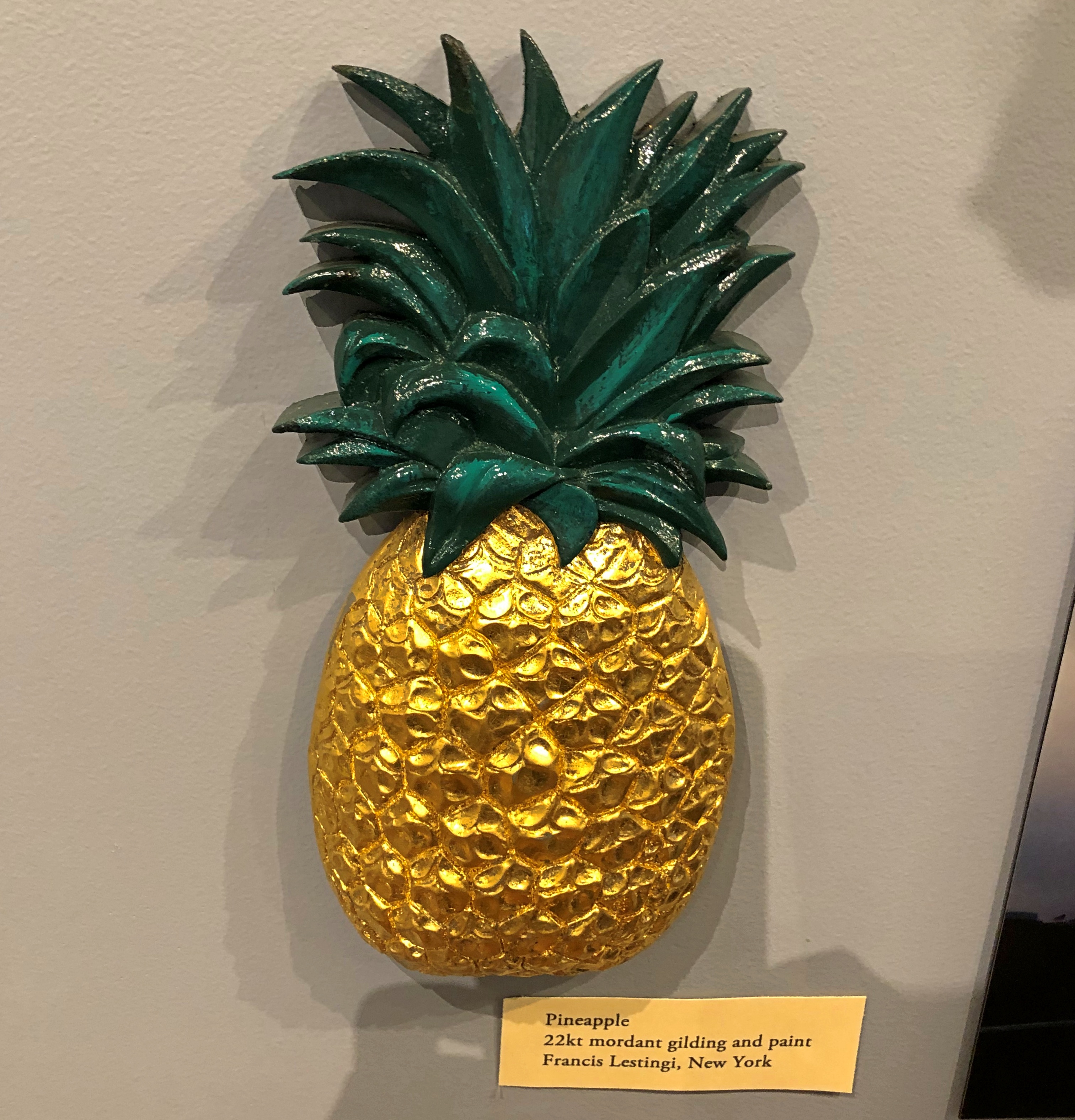
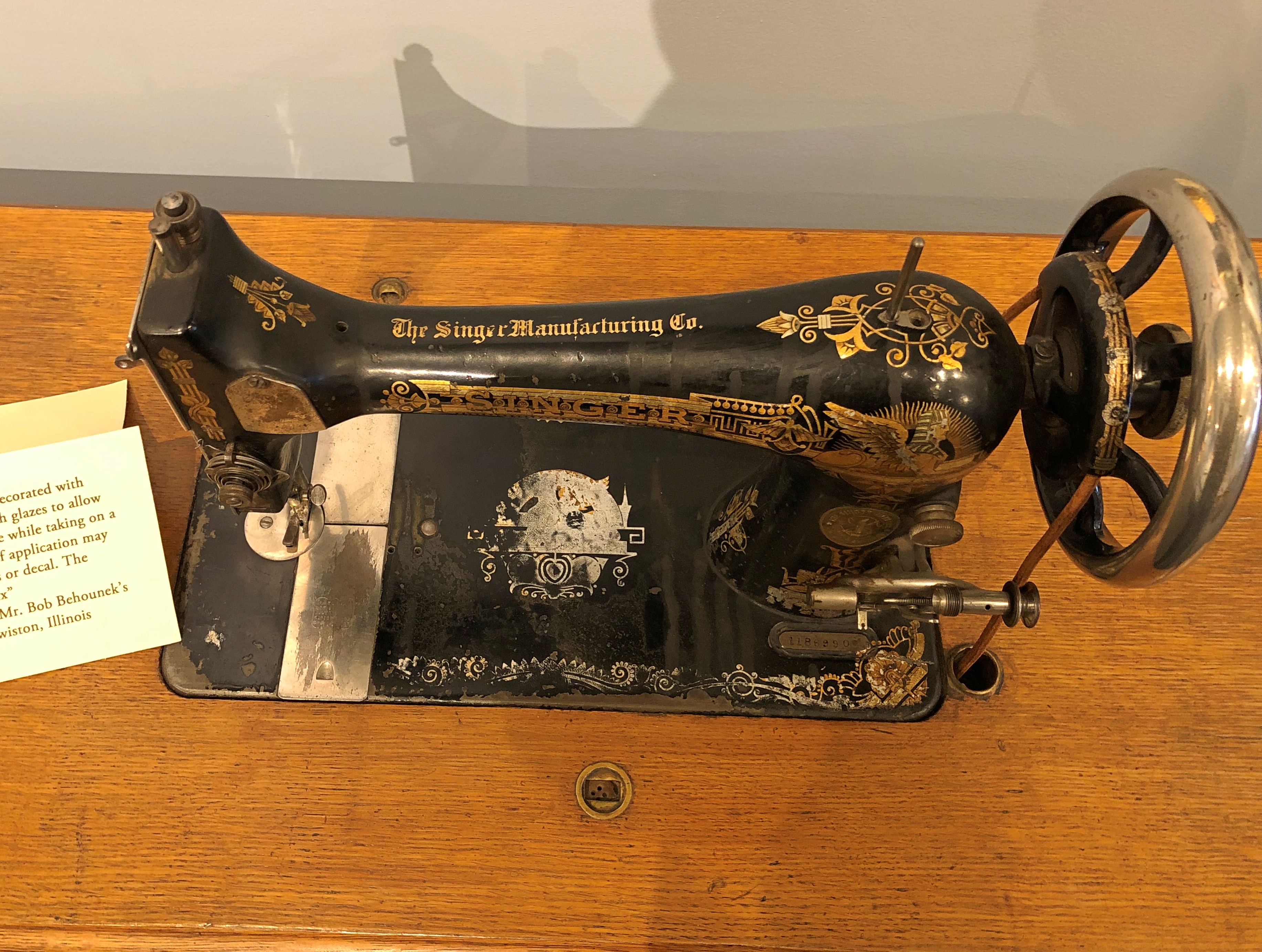
Before that, she said, she hadn’t known much about gilding, but had been reading about it and spending time with the exhibits. For a while, I had a personal tour of the place, as she suggested things to look at, such as the various items that had been gilded, including decorative pieces but also machines.
Visit Pontiac is succinct about the place: “The focus of the Museum of the Gilding Arts is the history, craft, and use of gold and silver leaf in architecture and in decoration throughout a history that dates back to the days of ancient Egypt.
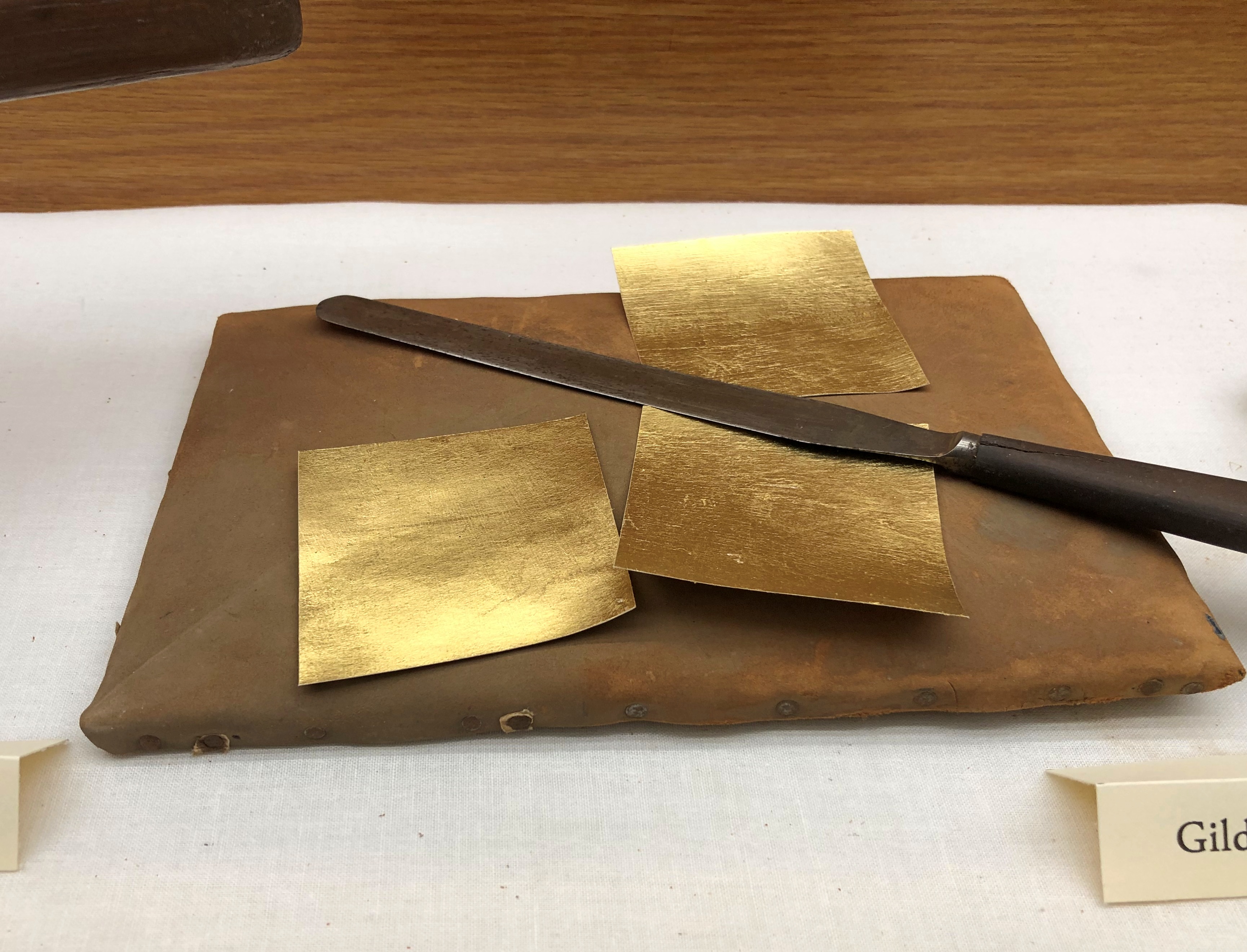
“There are examples of gold and silver leaf, artifacts used in the application of the precious metal leaf, and displays showing how leaf was manufactured.
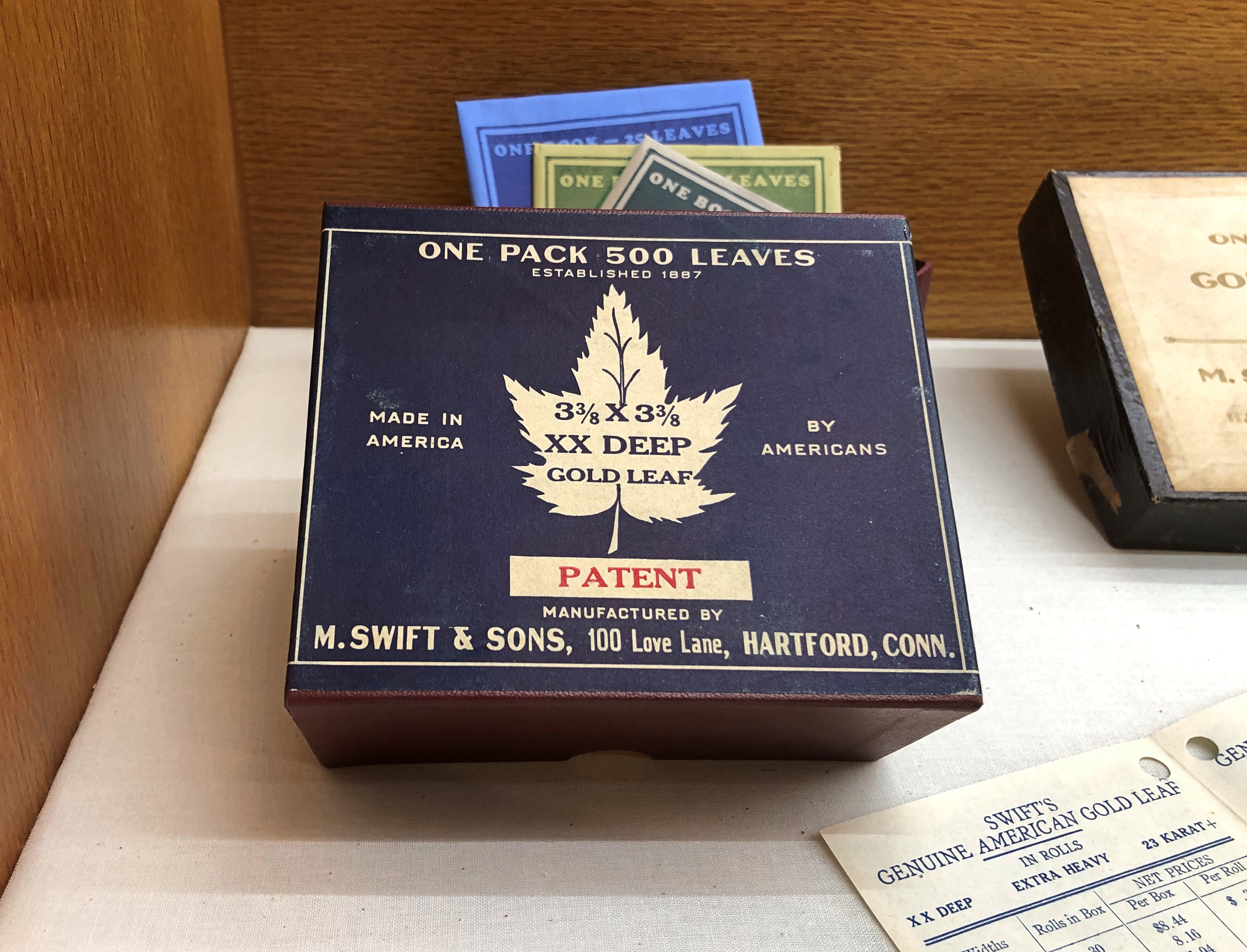
“The exhibit features items from the Society of Gilders’ Swift Collection. The M. Swift and Sons company manufactured gold leaf in Hartford, Connecticut, and began its operations in 1887.”
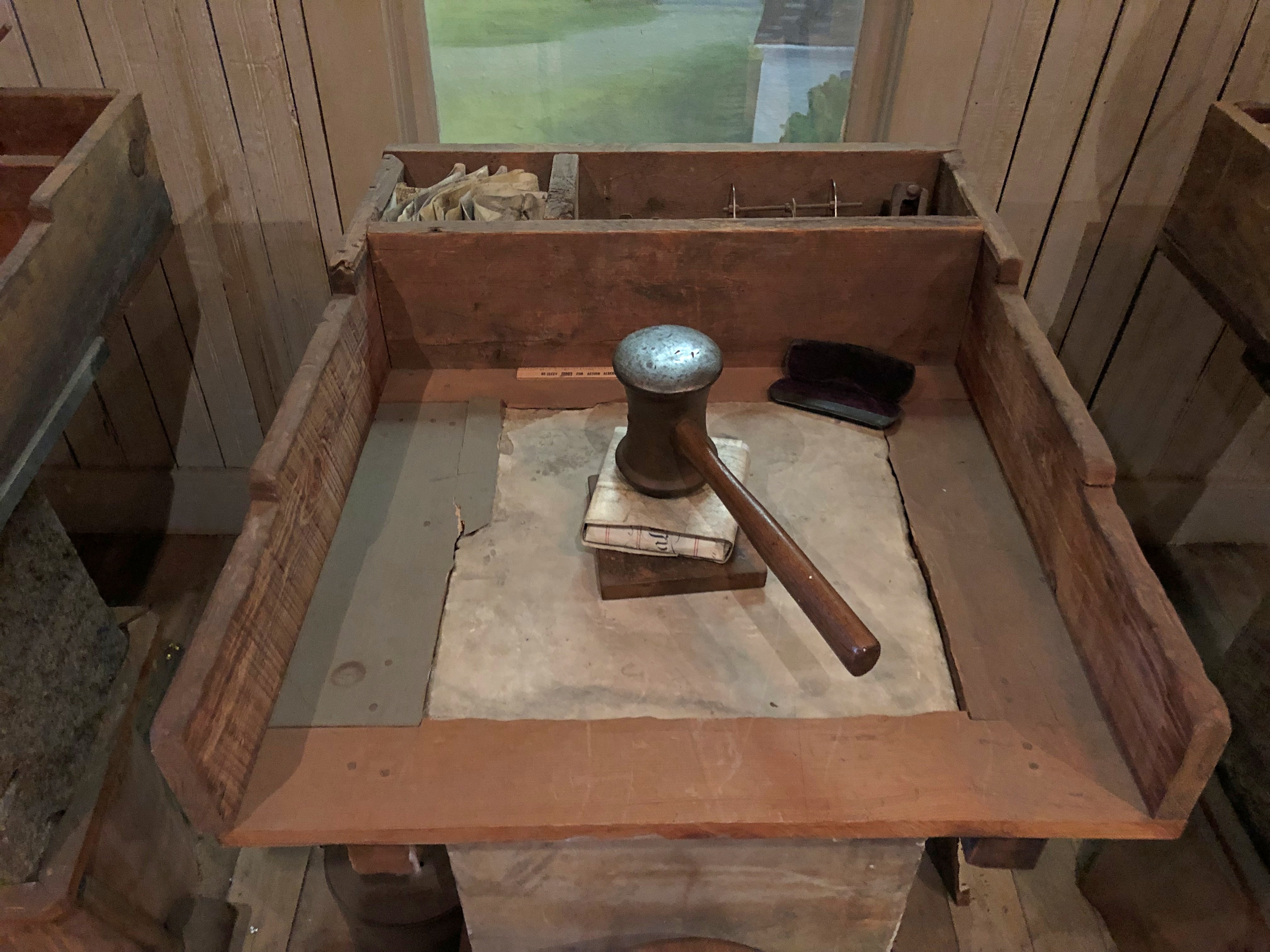
The docent seemed most impressed by the story of M. Allen Swift, the last owner of M. Swift & Sons, who died at a very advanced age in 2005. The business died with him, having been founded by his grandfather, Matthew Swift, who emigrated as a youth from the UK in 1864. Before he died, Allen Swift had the foresight to preserve old-time elements of his family’s gold leaf factory, including an array of wooden work benches – which are now on display in the back room of the two-room museum.
Each bench sports one of the heavy hammers that late 19th-century workmen used to beat gold.
The 19th century was full of jobs that required great upper-body strength, and gold beater was surely one of them.
“The process of making gold leaf began with quarter-inch-thick gold bars, 12 inches long by 1.5 inches wide,” notes an article in Connecticut Explored about the redevelopment of the Smith factory in our time. “The bars were rolled to a thickness of 1/1000 of an inch and cut into squares. The squares were then dusted with calcium carbonate applied with a brush — often a hare’s foot — and placed between a thin membrane made of the outer layer of an ox intestine.
“These were then stacked, in as many as 300 layers, and repeatedly struck with a 16-pound hammer. The squares were cut again into smaller squares and the process repeated with a 10-pound hammer; the squares were then placed in a mold and struck with a 6-pound hammer. When finished, a layer of 280,000 leaves stood just an inch high.”
What happened to the residue of the ox intestine? Maybe I don’t want to know. Not only a tough job, then, but probably a dirty one as well, and ill-paying unless you were a Swift. Machines took over most of the heavy beating in the 20th century, but I expect it still was a tedious job. More about the museum, which opened in 2015, is at the Society of Gilders web site.
Before I left, the docent told me that I had been the only visitor that day. I was glad to hear it. I hadn’t gone too far out of my way, stopping after I’d dropped Ann off in Normal, and it was worth the small effort to get a glimpse of an entire industry I knew nothing about.
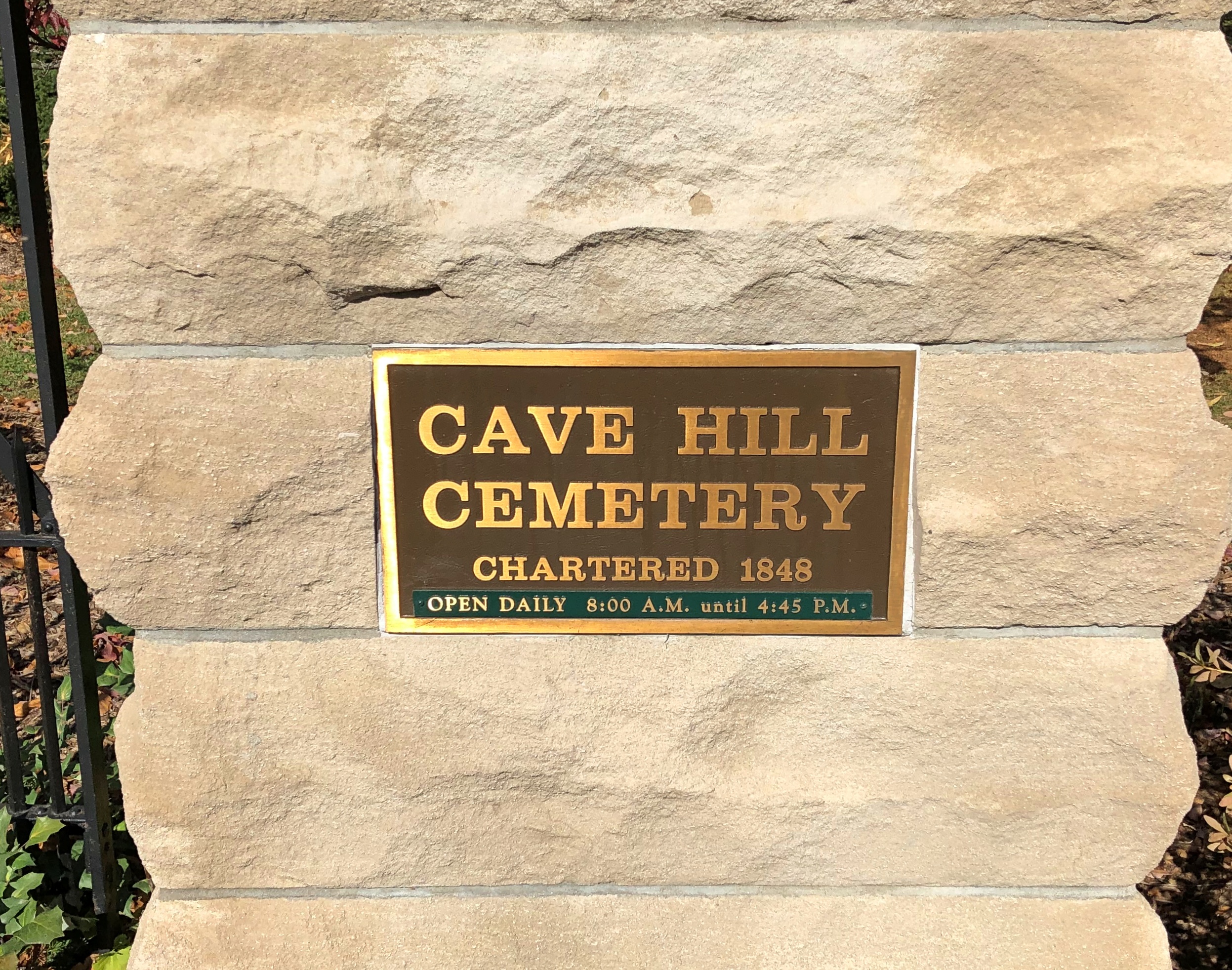
Wrapping up a fun long weekend is always a bit of a downer, but so it goes. Rather than grind all the way north from Nashville on Monday, I decided to pause on the return in Louisville. I couldn’t remember the last time I’d spent any time there – 1990? – though I’ve passed through many times since then. This time, I got off I-65 and made my way to Cave Hill Cemetery.
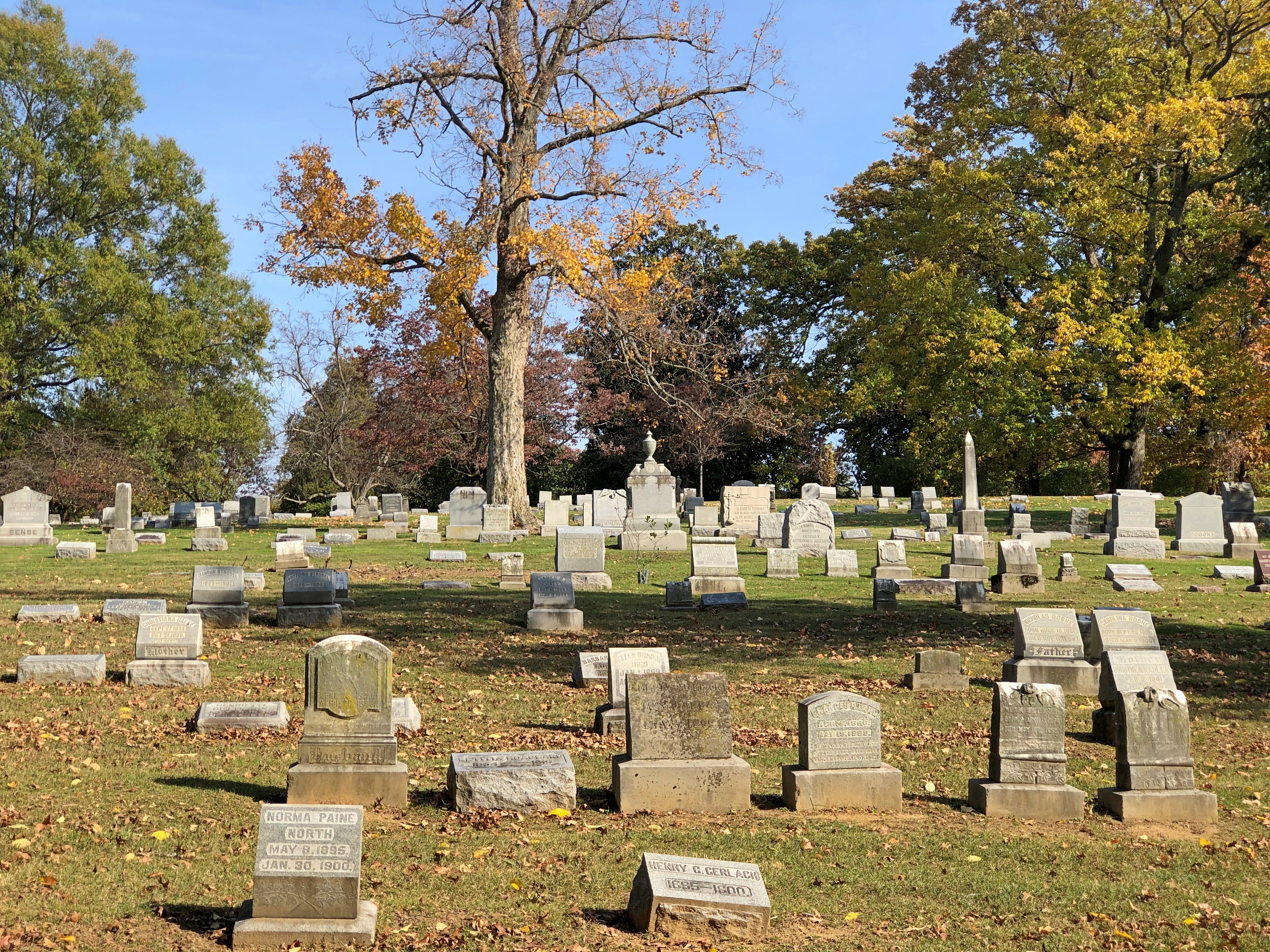
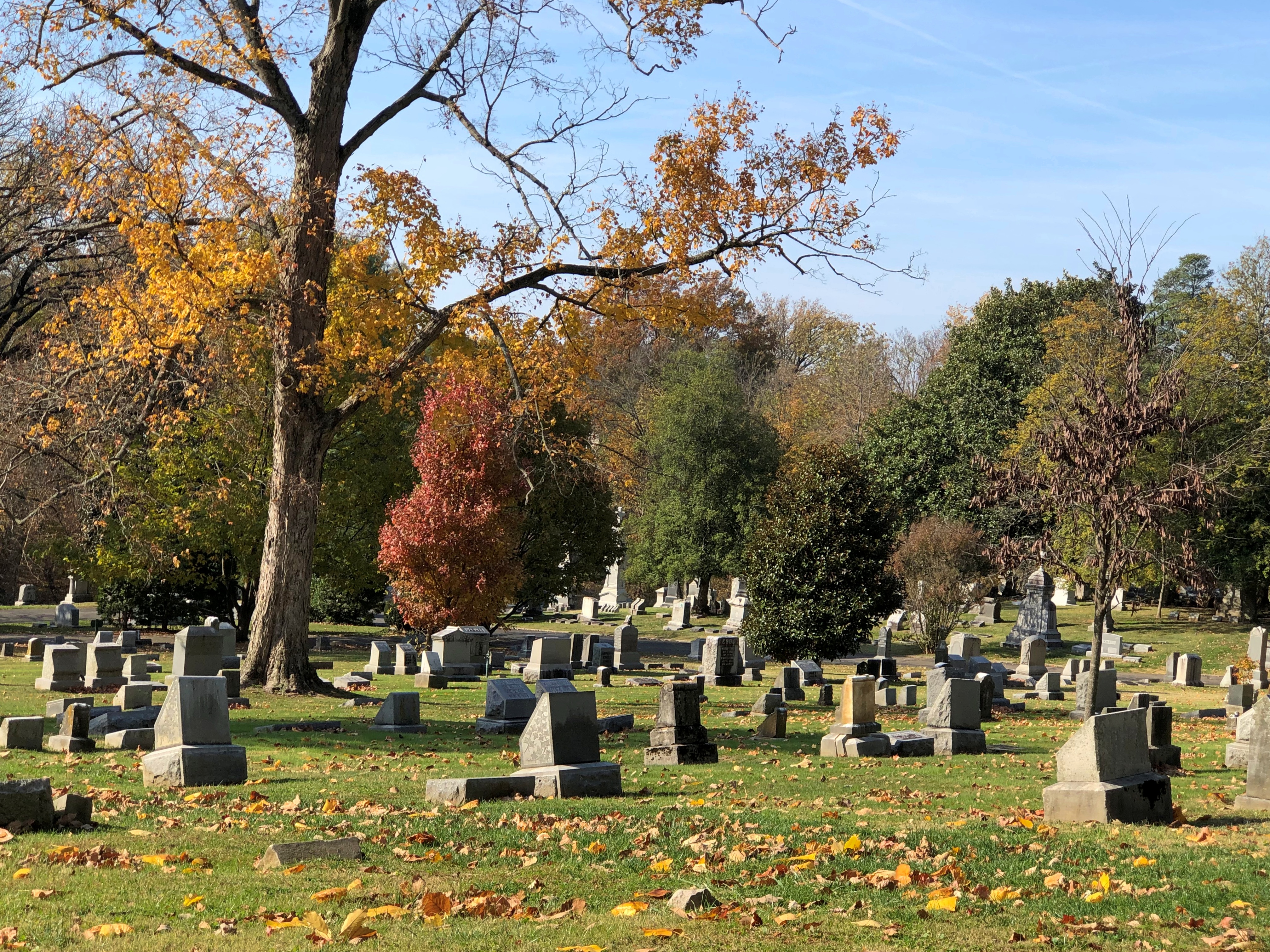
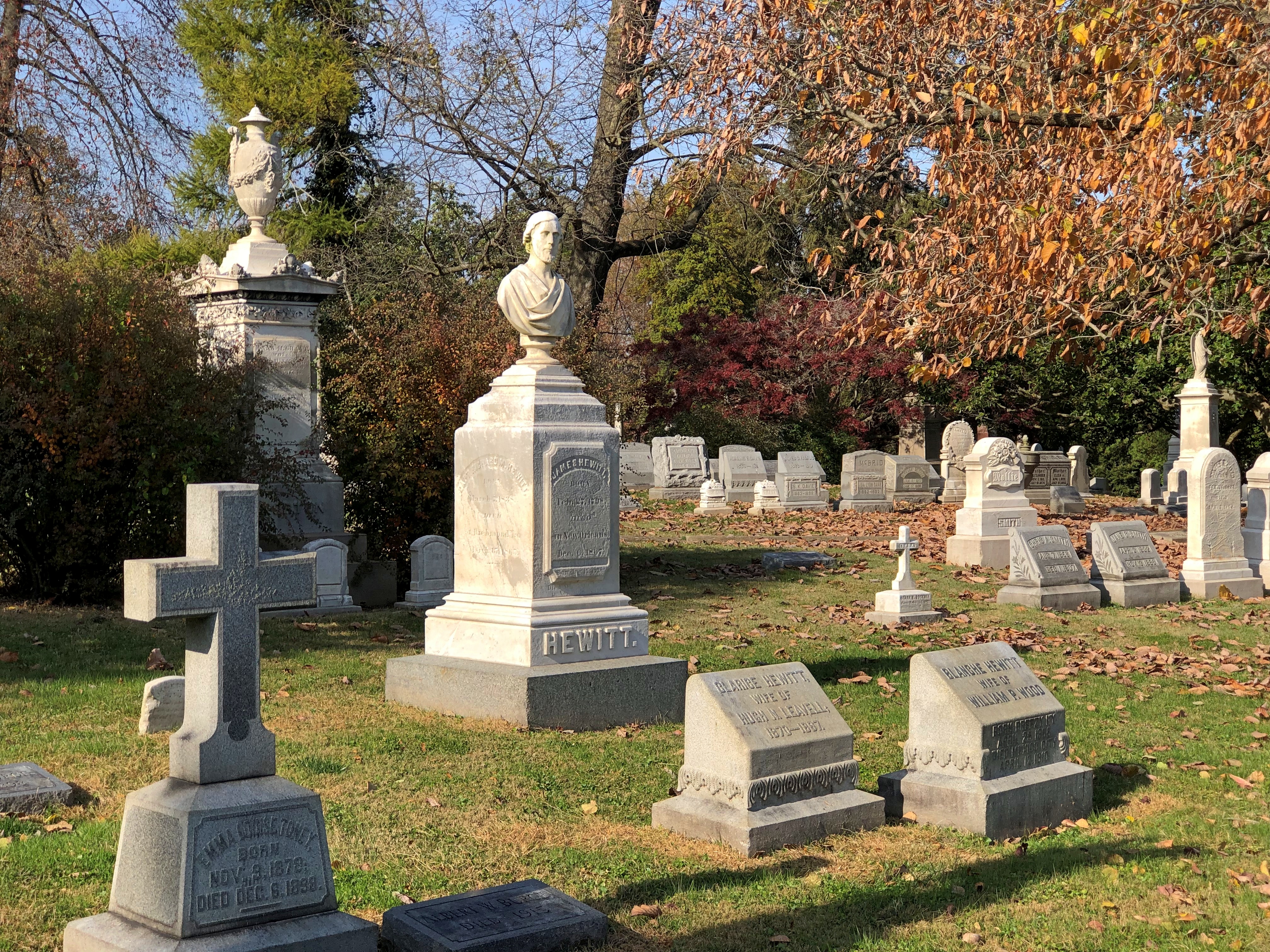
Cave Hill is a Class A cemetery. Or Class A+ or maybe A++. I ought to create an aesthetic rating system for cemeteries, but I think that would be a lot of work. Enough to say that Cave Hill has everything a top cemetery should have: a vast variety of standing stones, plain to elaborate, including a lot of funerary art and mausoleums and a scattering of odd memorials; historic burials of those notable locally and a few famed worldwide; a Victorian rural cemetery movement pedigree; hilly contour (in places where that is possible) and enough mature trees, bushes and flowers to count as an arboretum; water features; and a chapel or two.
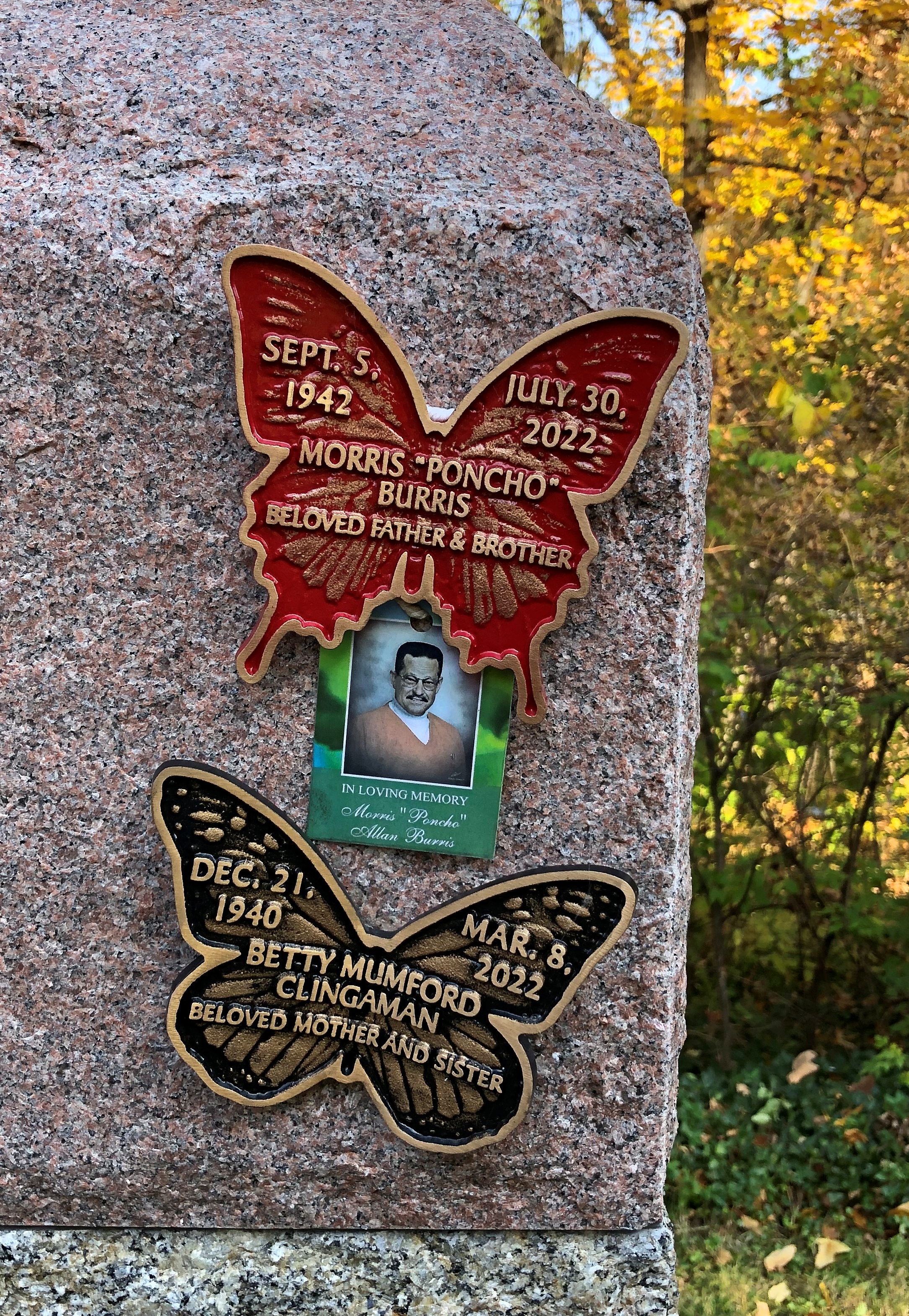
Their ashes were probably scatted nearby. This stone is near a part of the cemetery called the Scattering Garden.
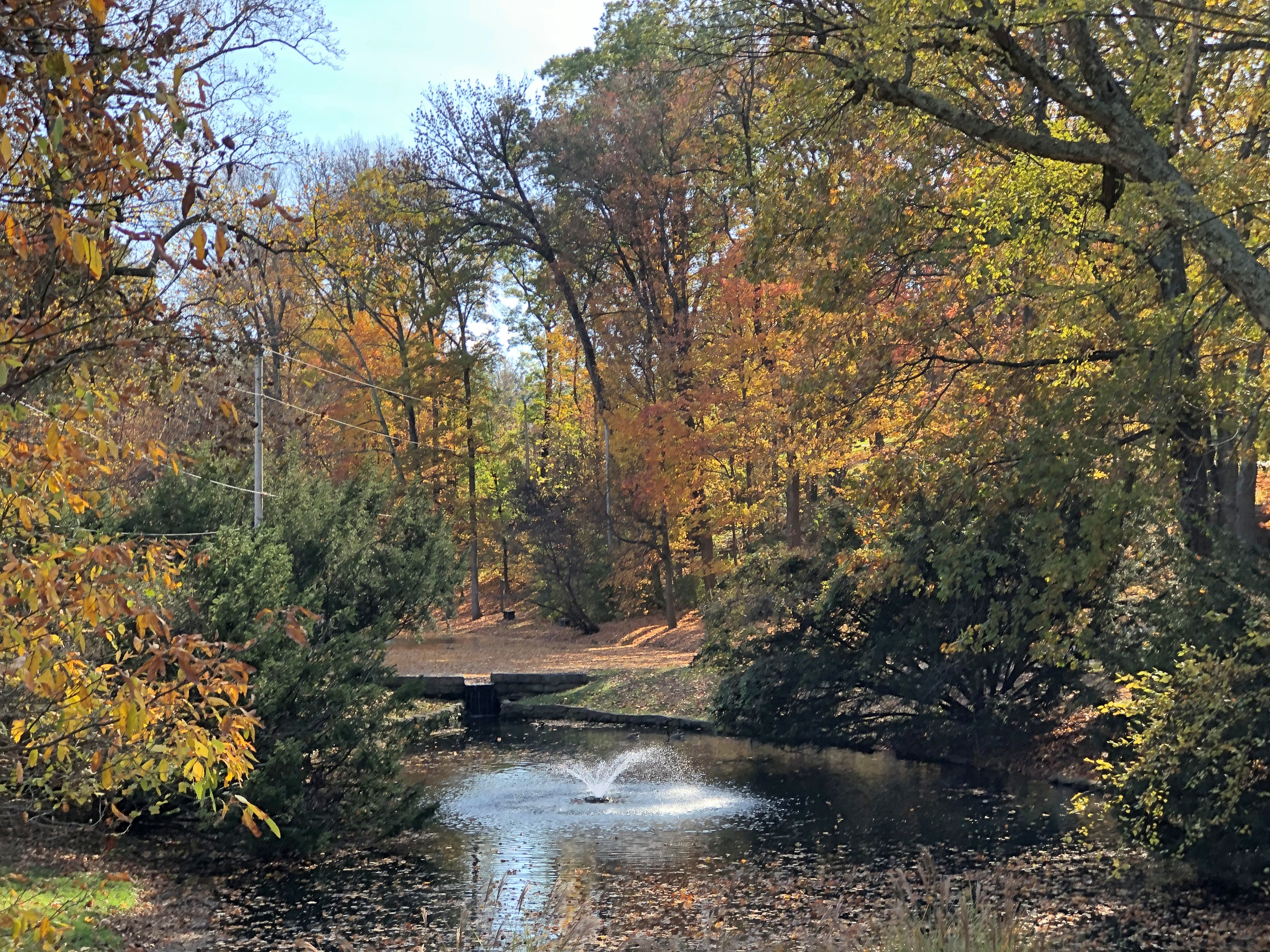
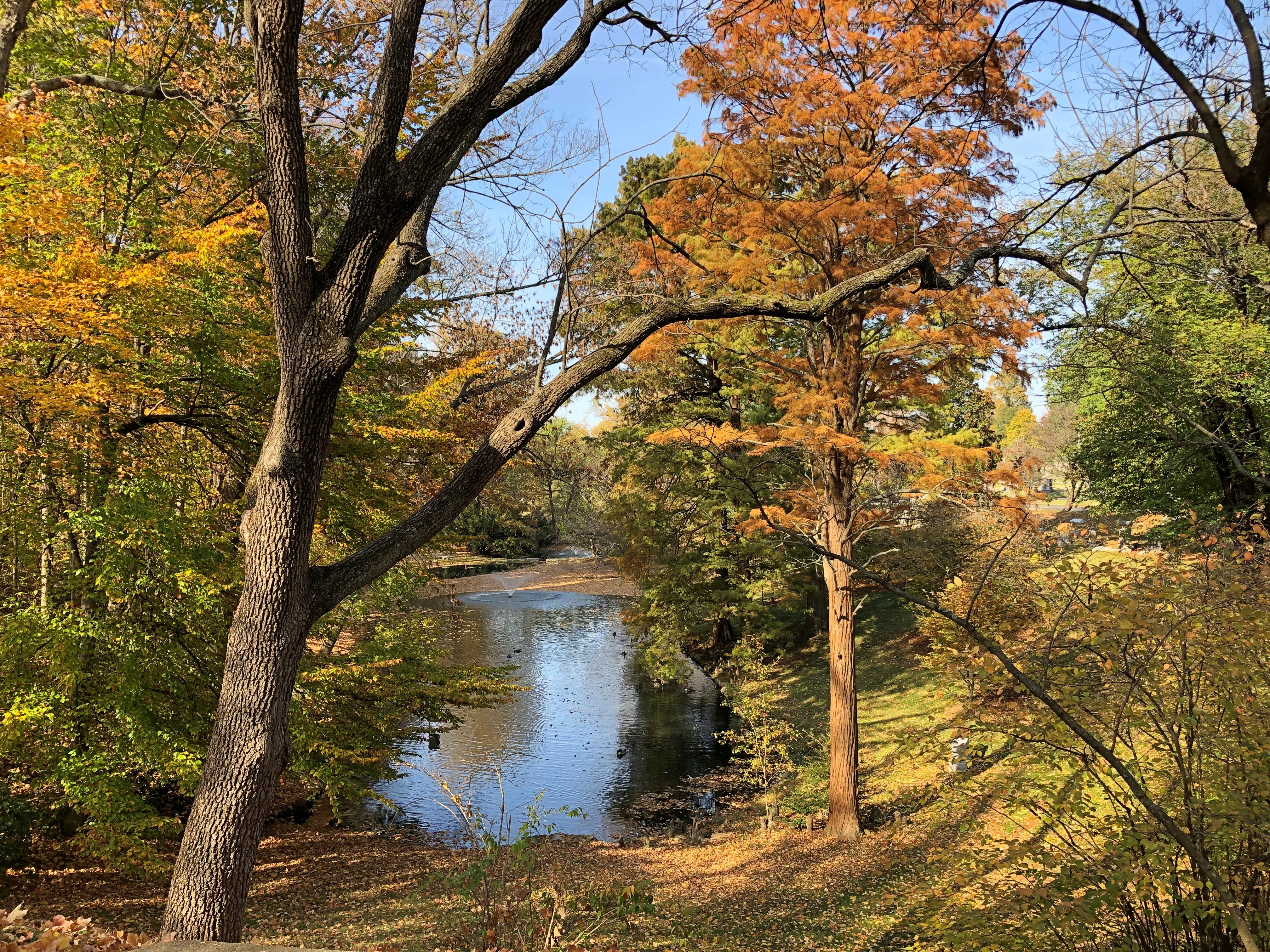
Among scenes of fall, at least for now.
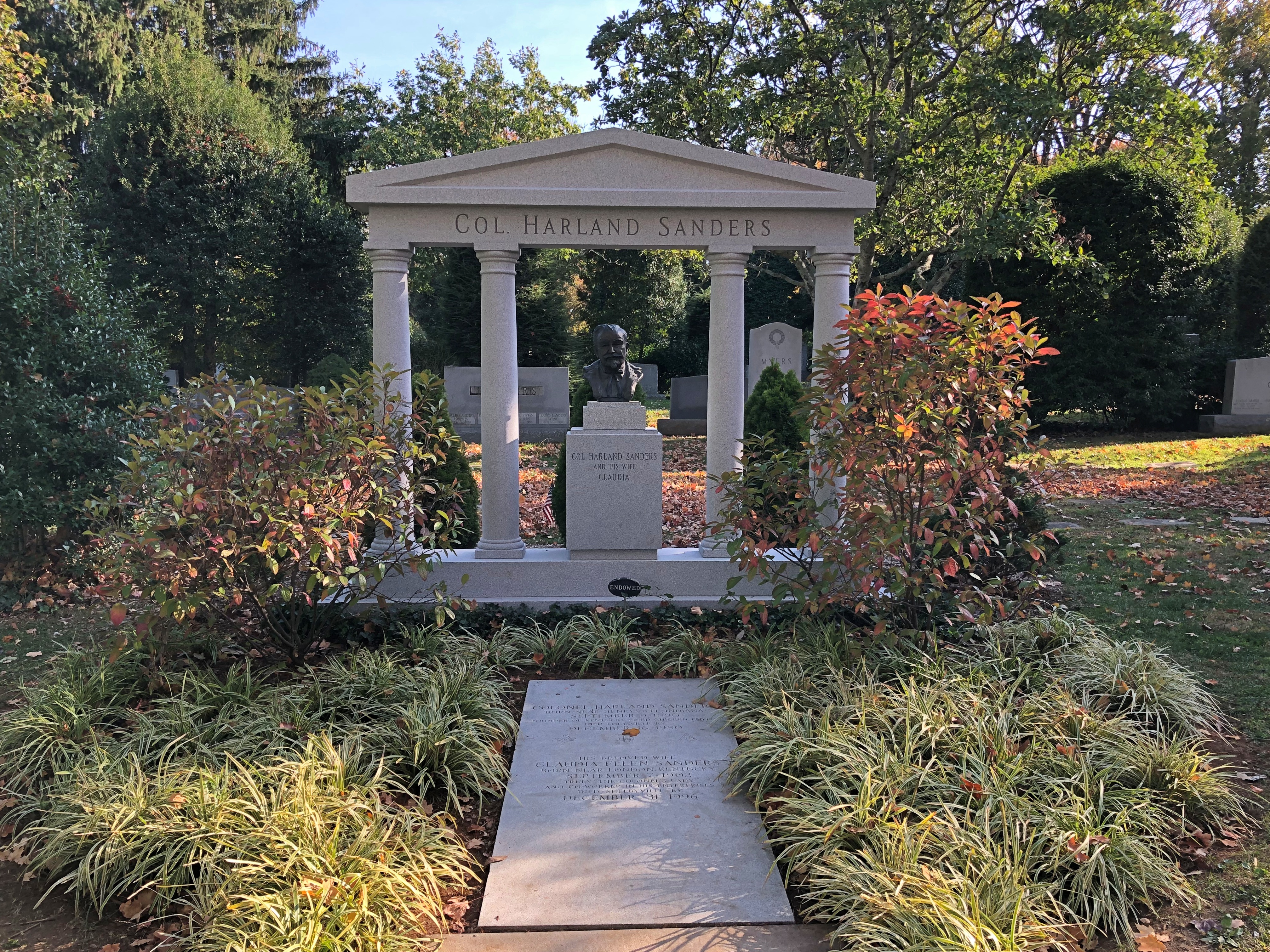
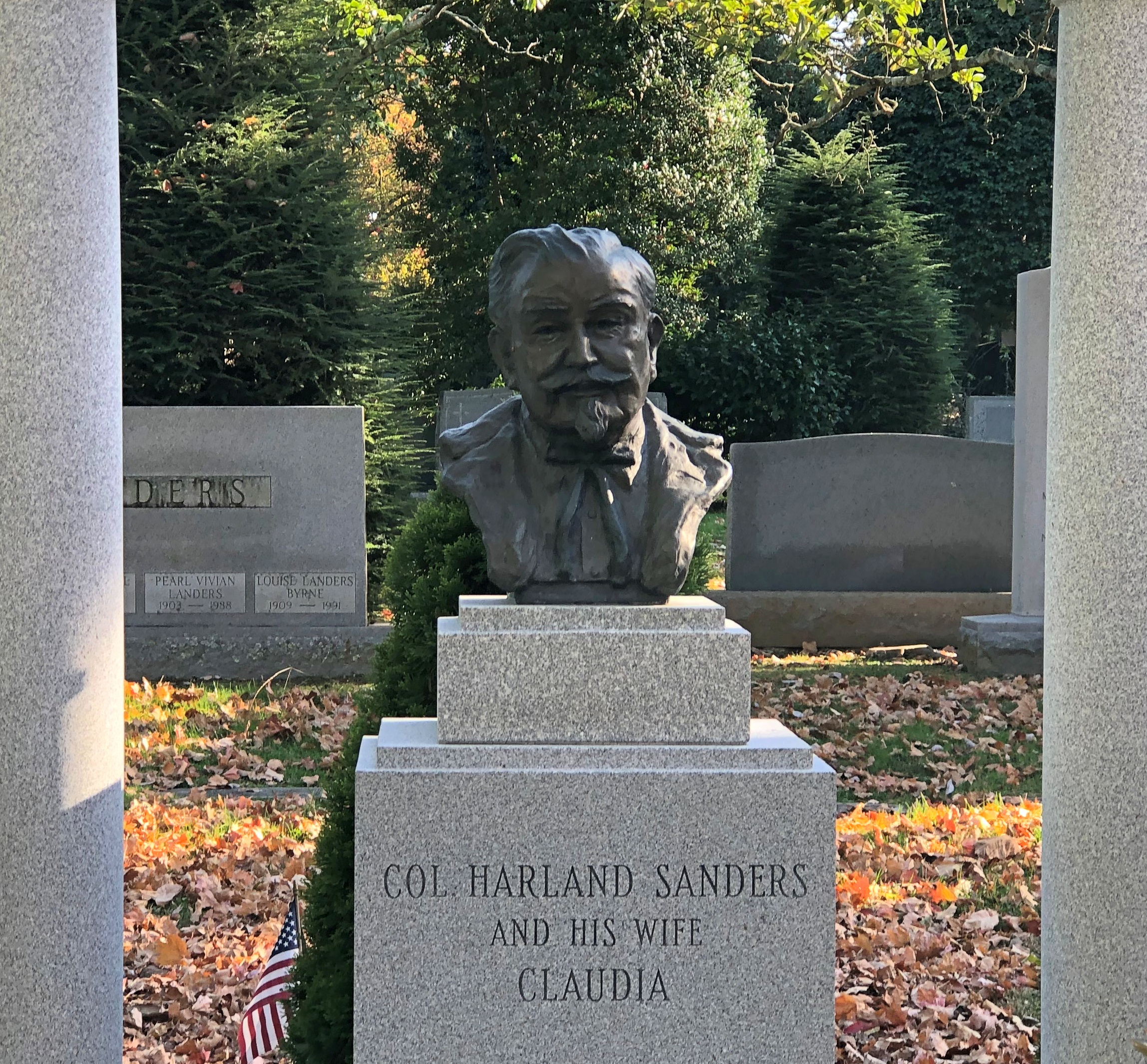
Cave Hill sports a number of notable permanent residents, but two far outshine the rest in terms of posthumous fame. At least for someone my age; I can’t vouch for later generations, who may not realize that Col. Sanders was an actual person, not just a cartoon mascot for KFC.
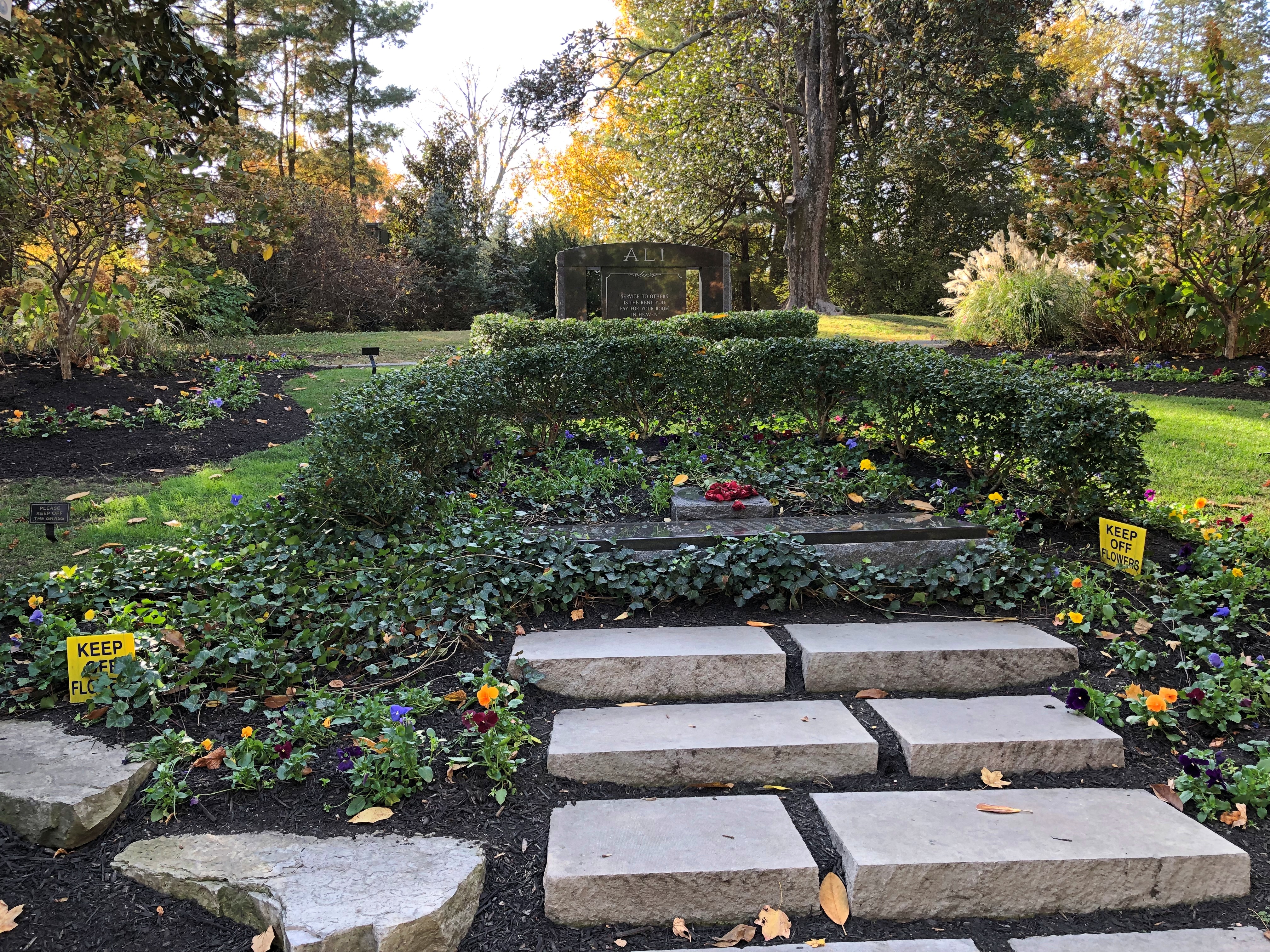
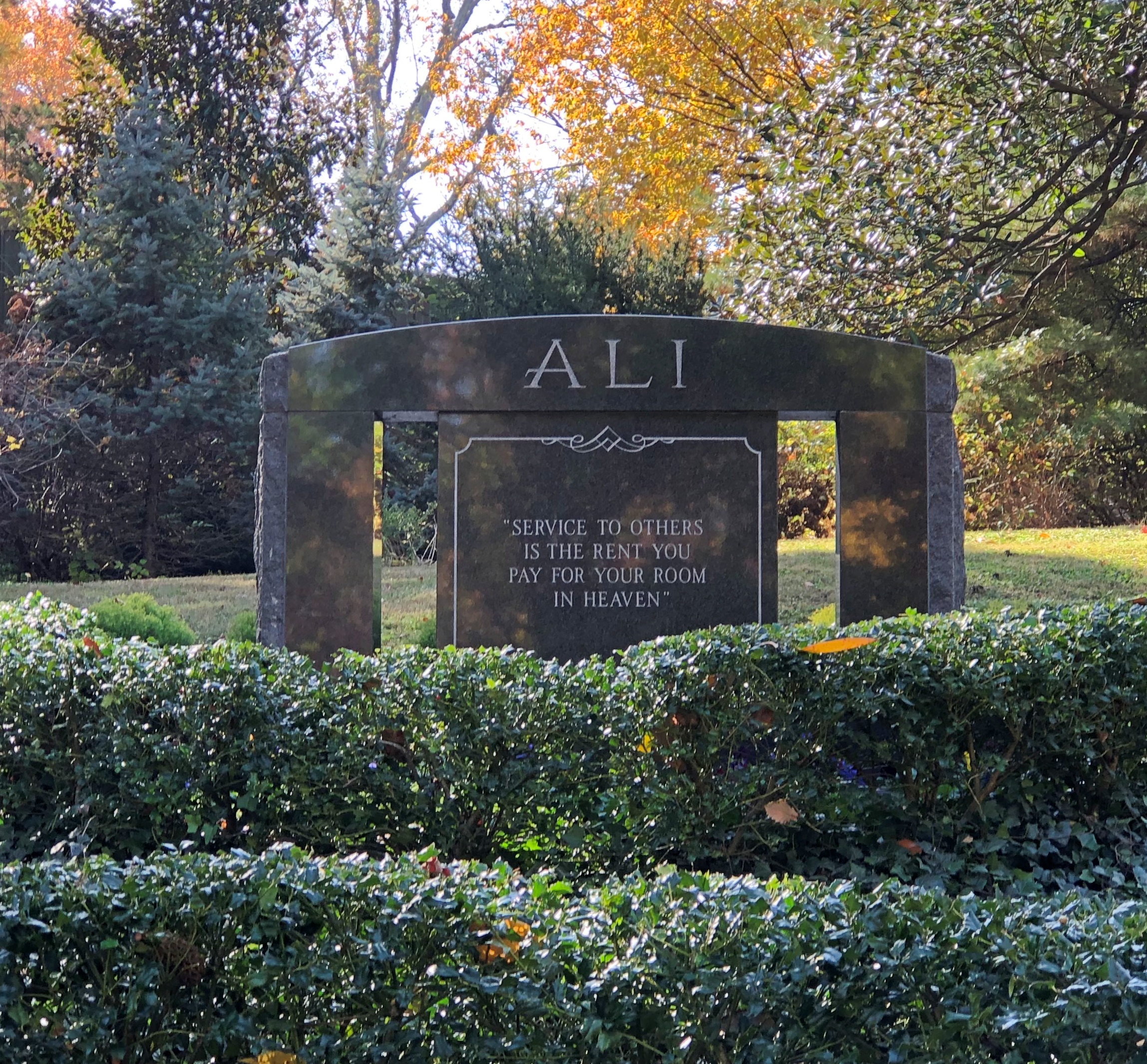
Even more famous worldwide, at least during the last half of the 20th century, was Muhammad Ali. At some point, he was thought to be the best-known person on Earth, or so I read. If not, he was in the running.
Even boxing-indifferent people like me knew him, since he was no mere prizefighter. Float like a butterfly, sting like a bee.
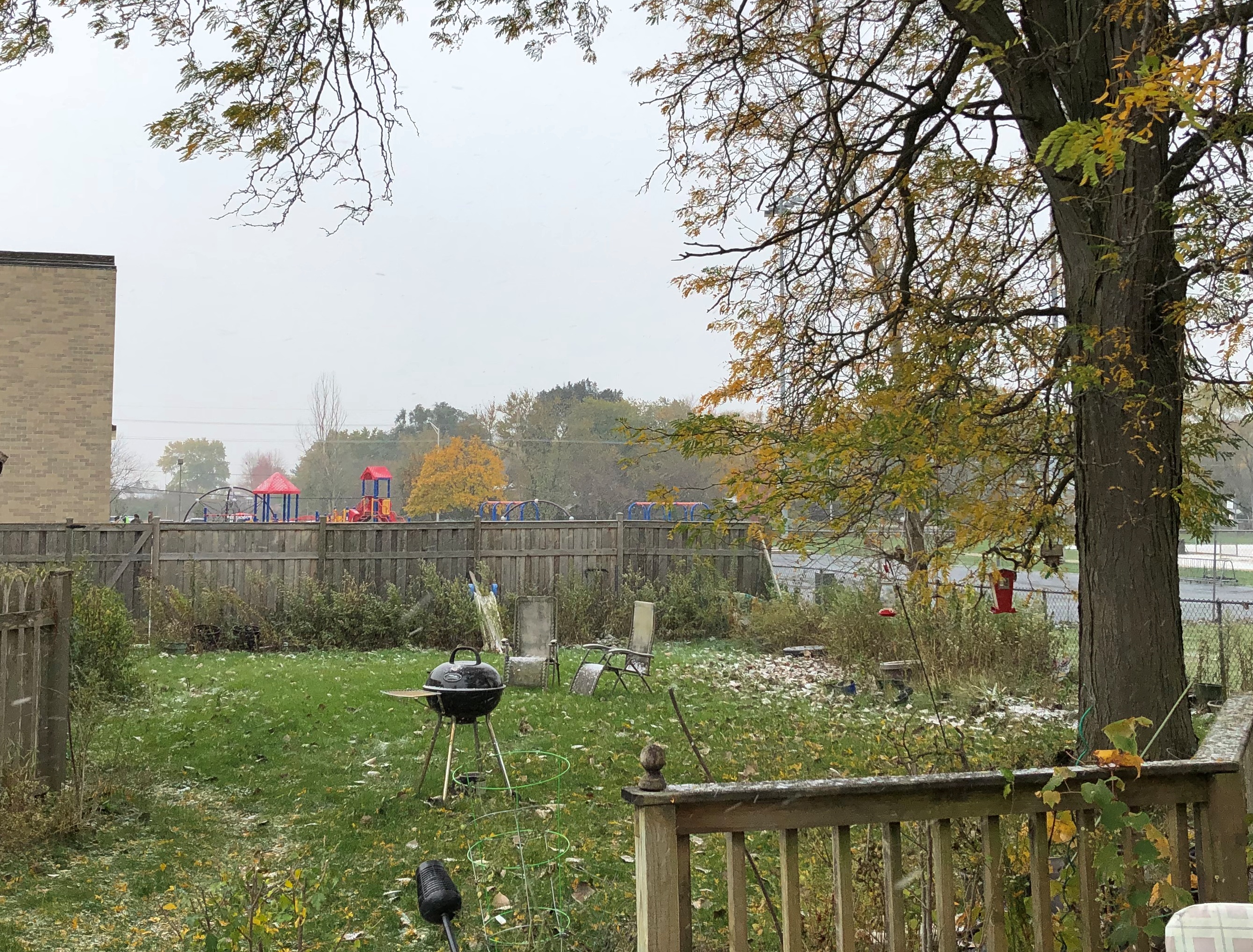
Halloween snow today. Flurries on and off through much of the day, presaging a cold outing for those trolling for candy.
I doubt that the kids mind. Their adult companions trailing behind, on the other hand, might be a mite annoyed. Glad that part of being a parent is well behind me.
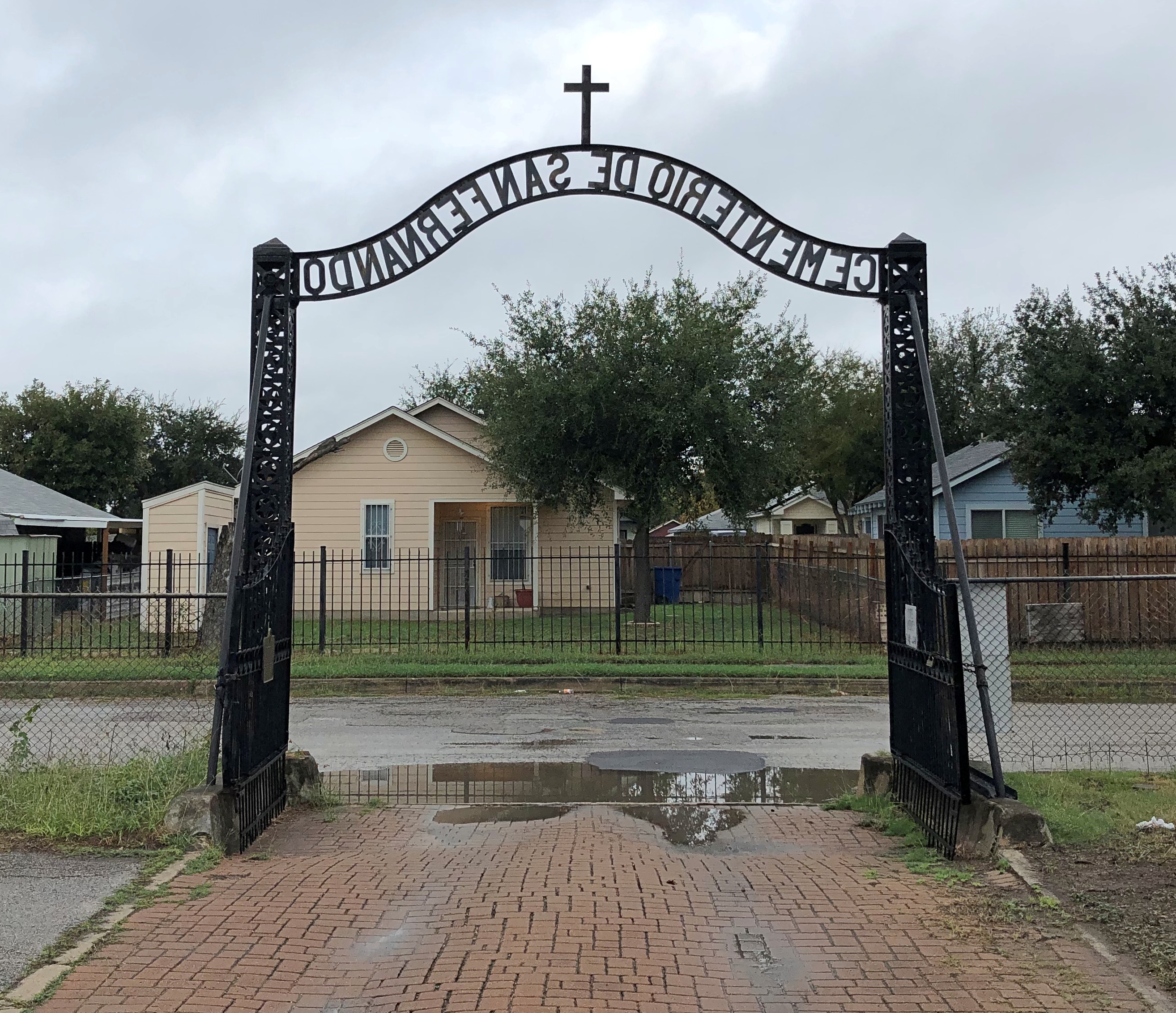
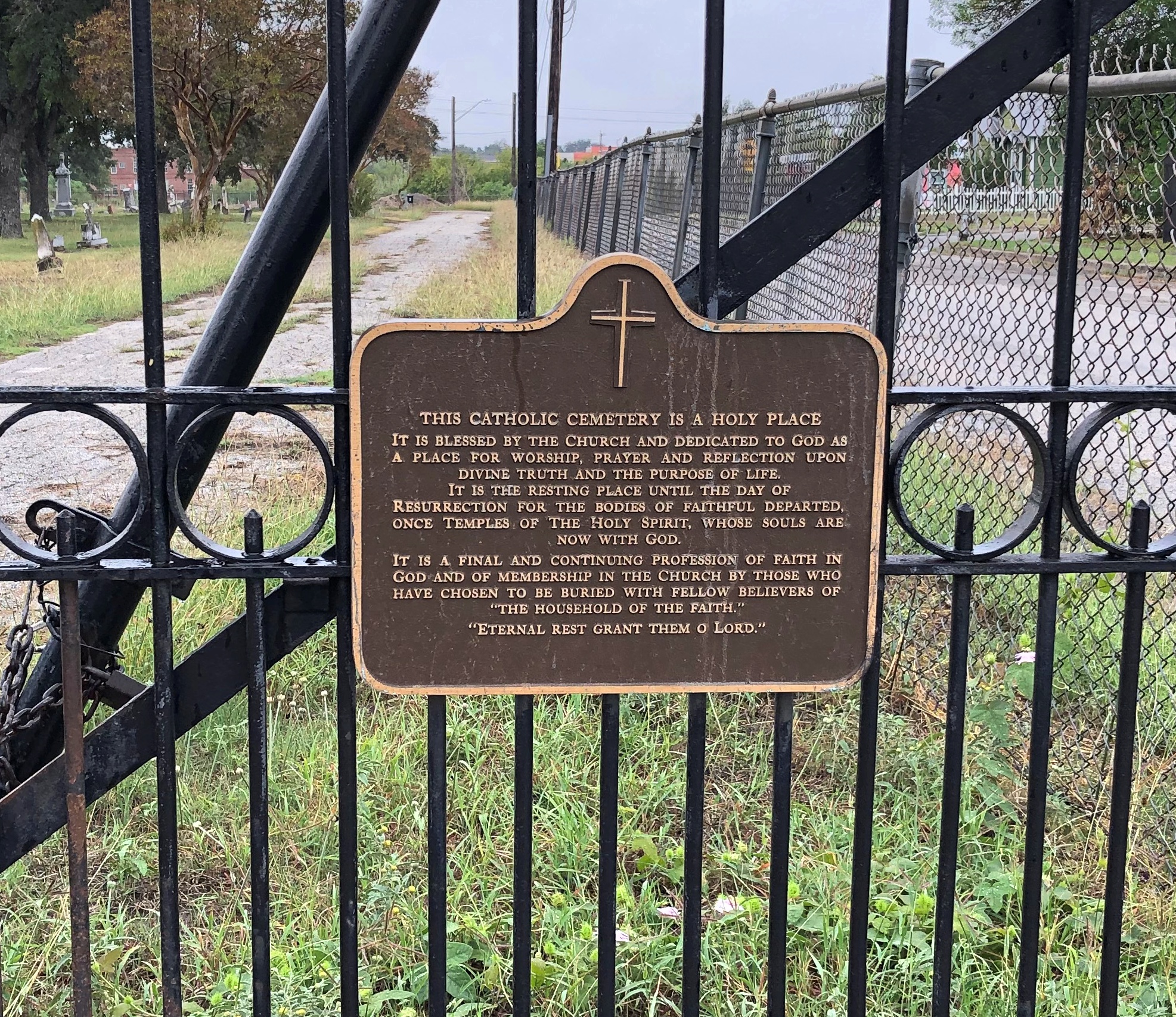
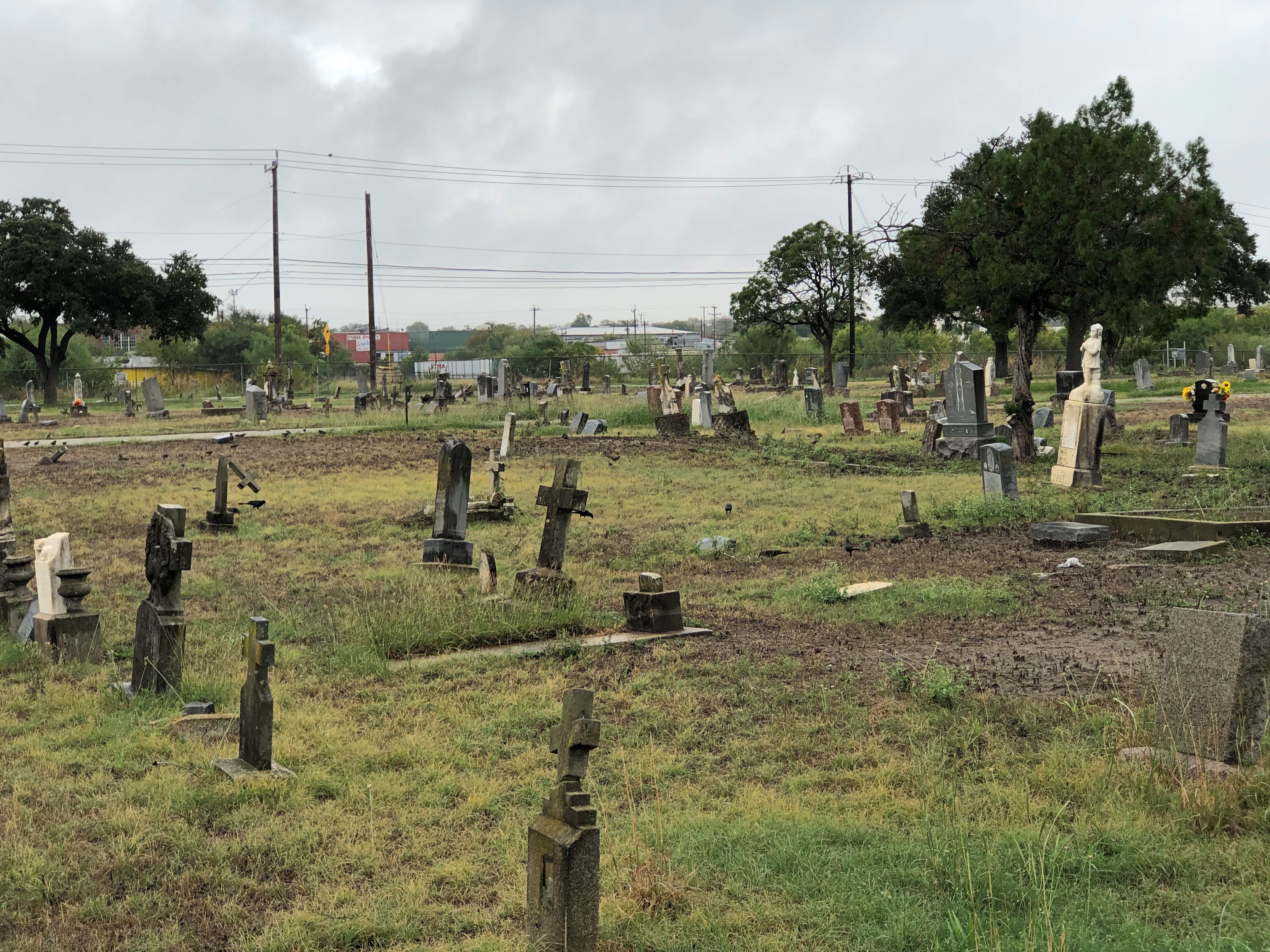
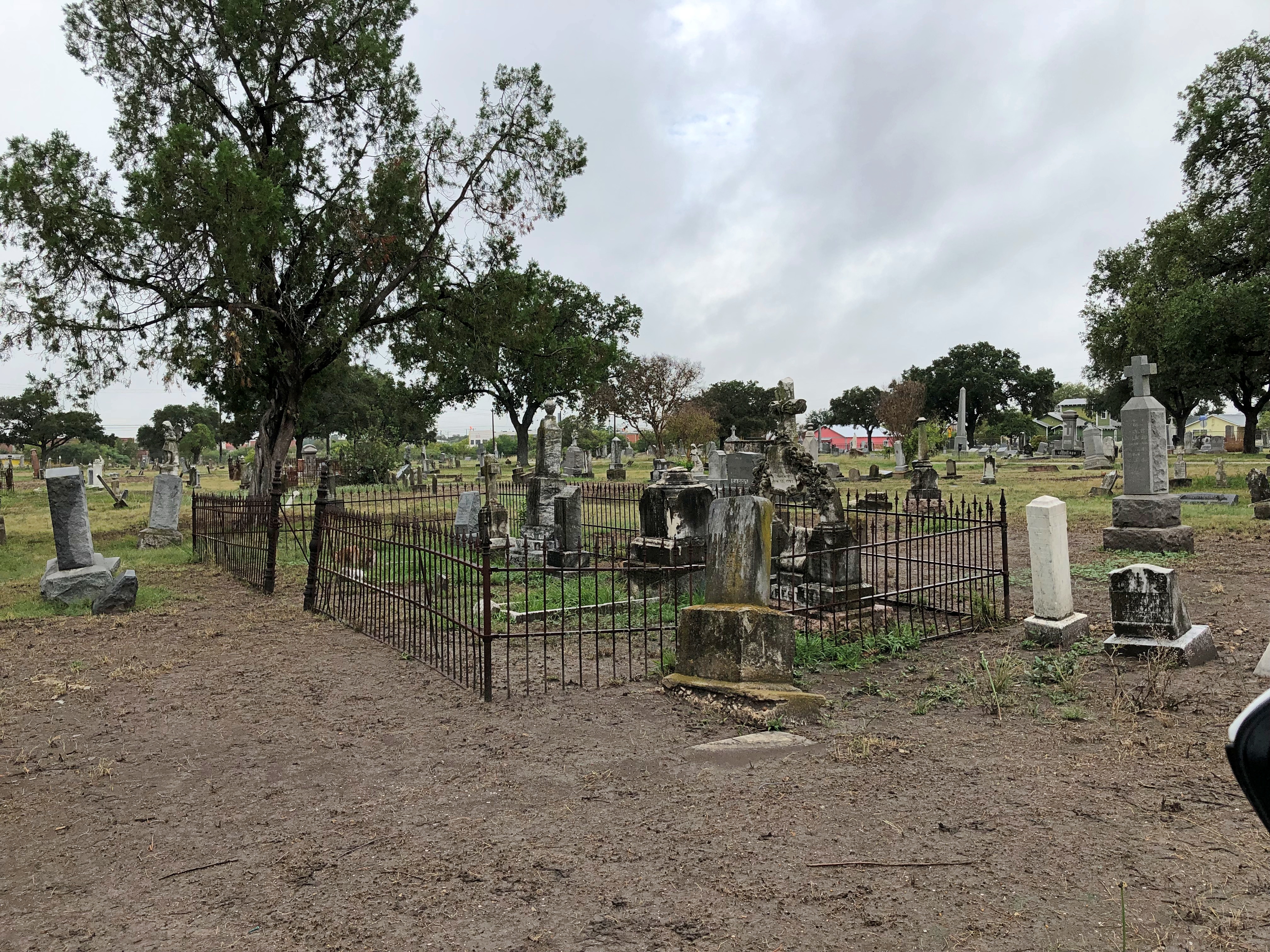
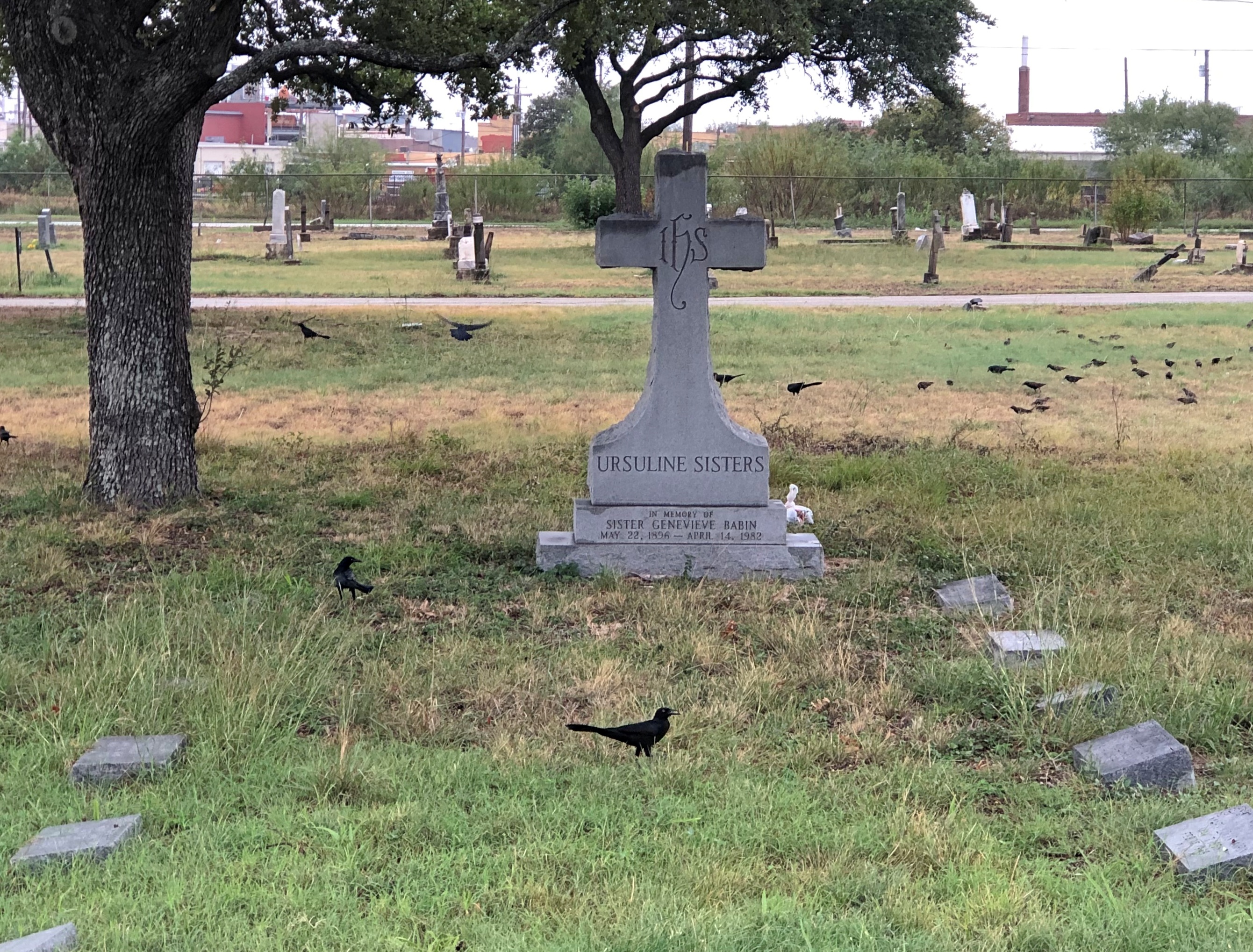
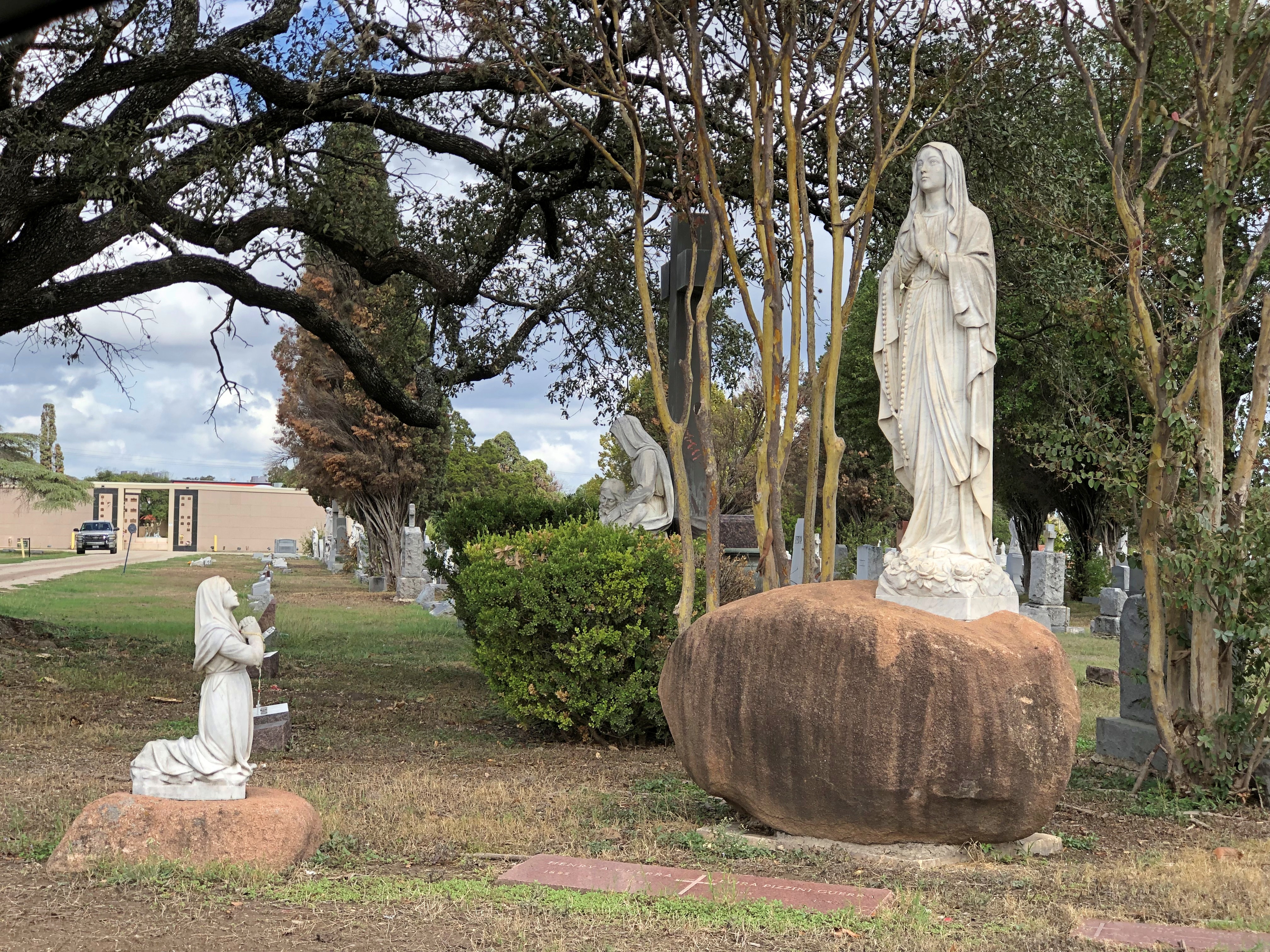
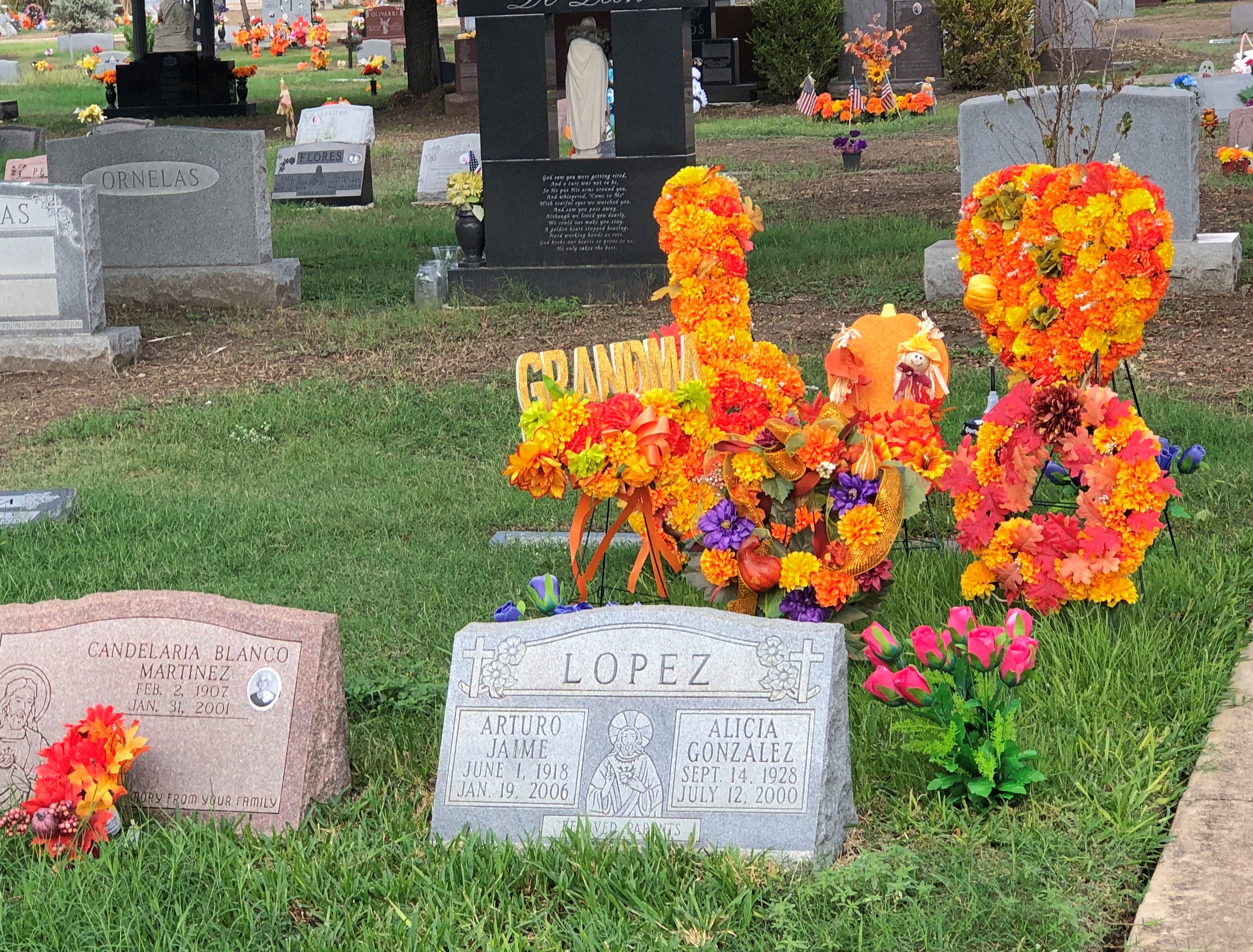
Early on Saturday morning I made my way to what I believe is the oldest Catholic cemetery in San Antonio, San Fernando No. 1, which is in a modest neighborhood just west of the King William district. Cementerio de San Fernando, to go by the entrance.
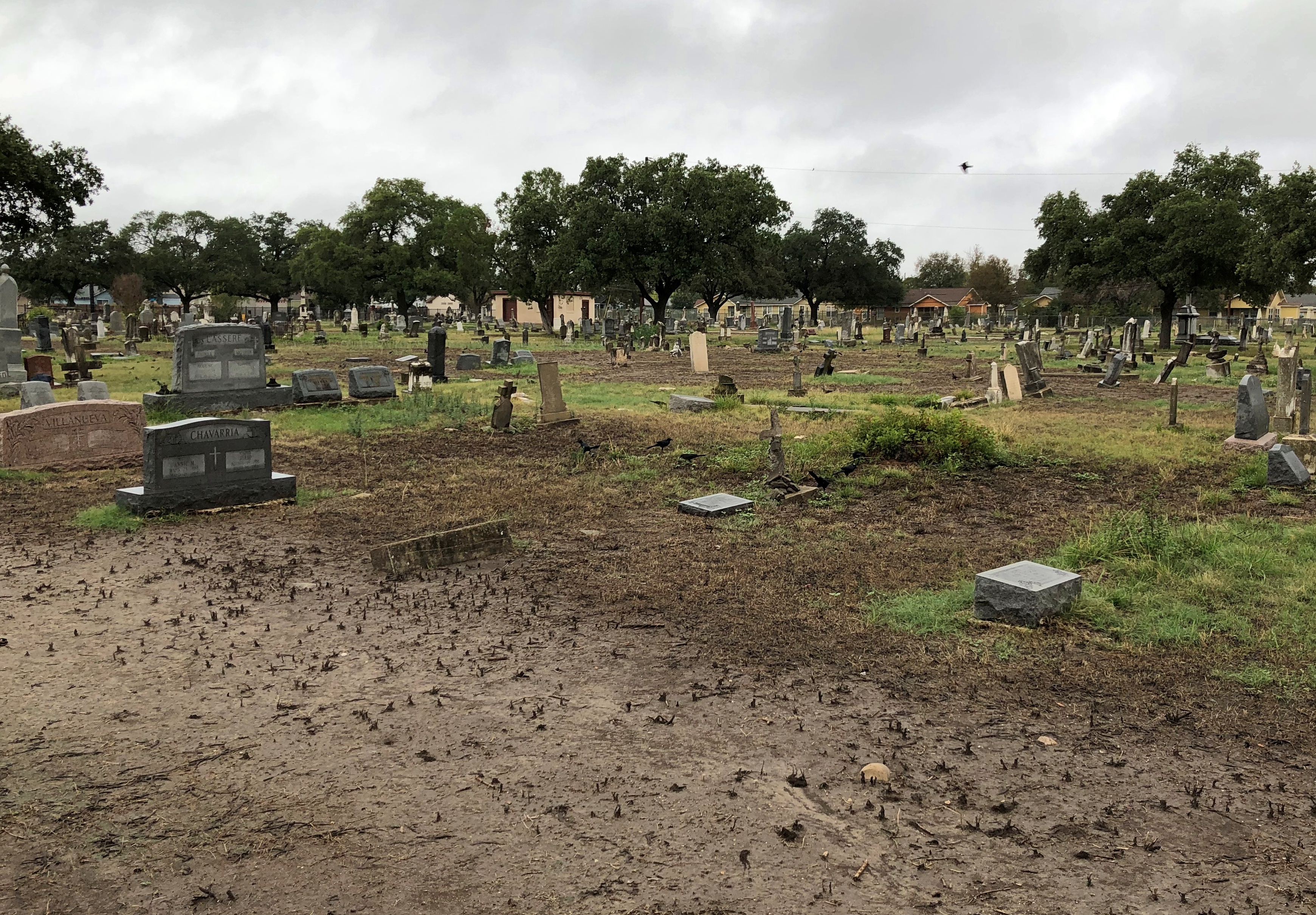
Overnight rain had left puddles and mud. I was the only living person among the old stones in soggy ground that morning.
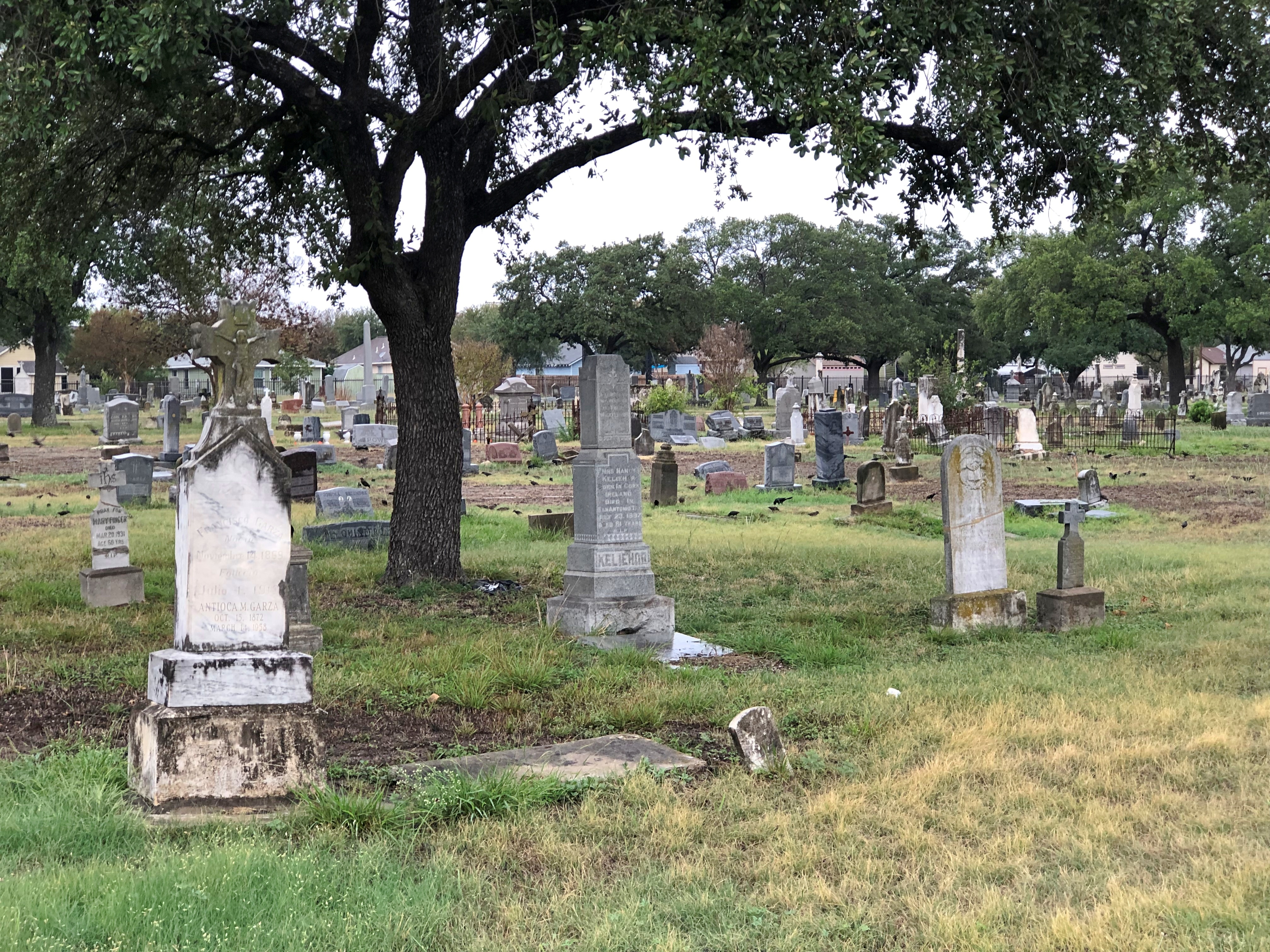
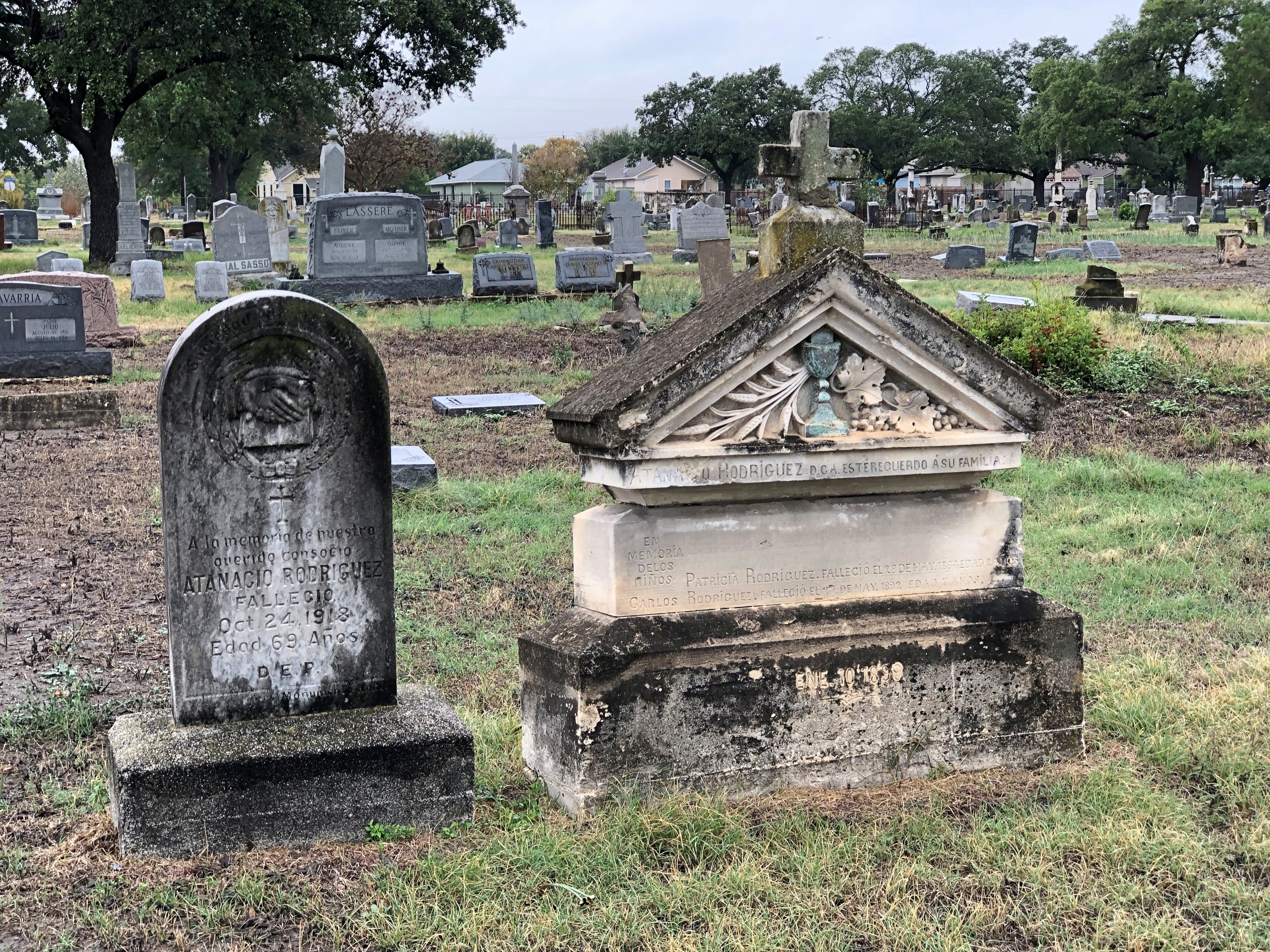
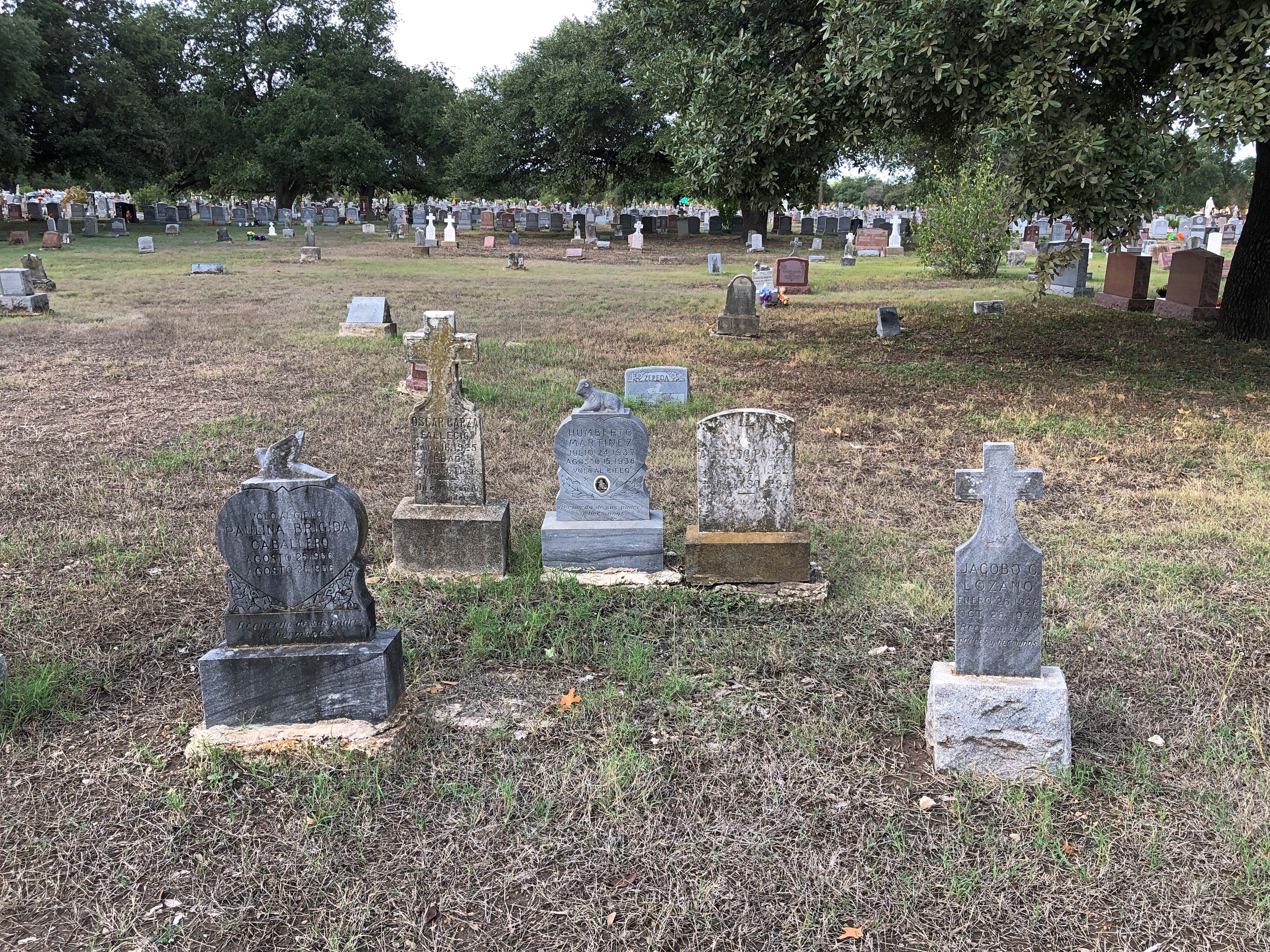
The elements continue to wear away even the larger memorials.
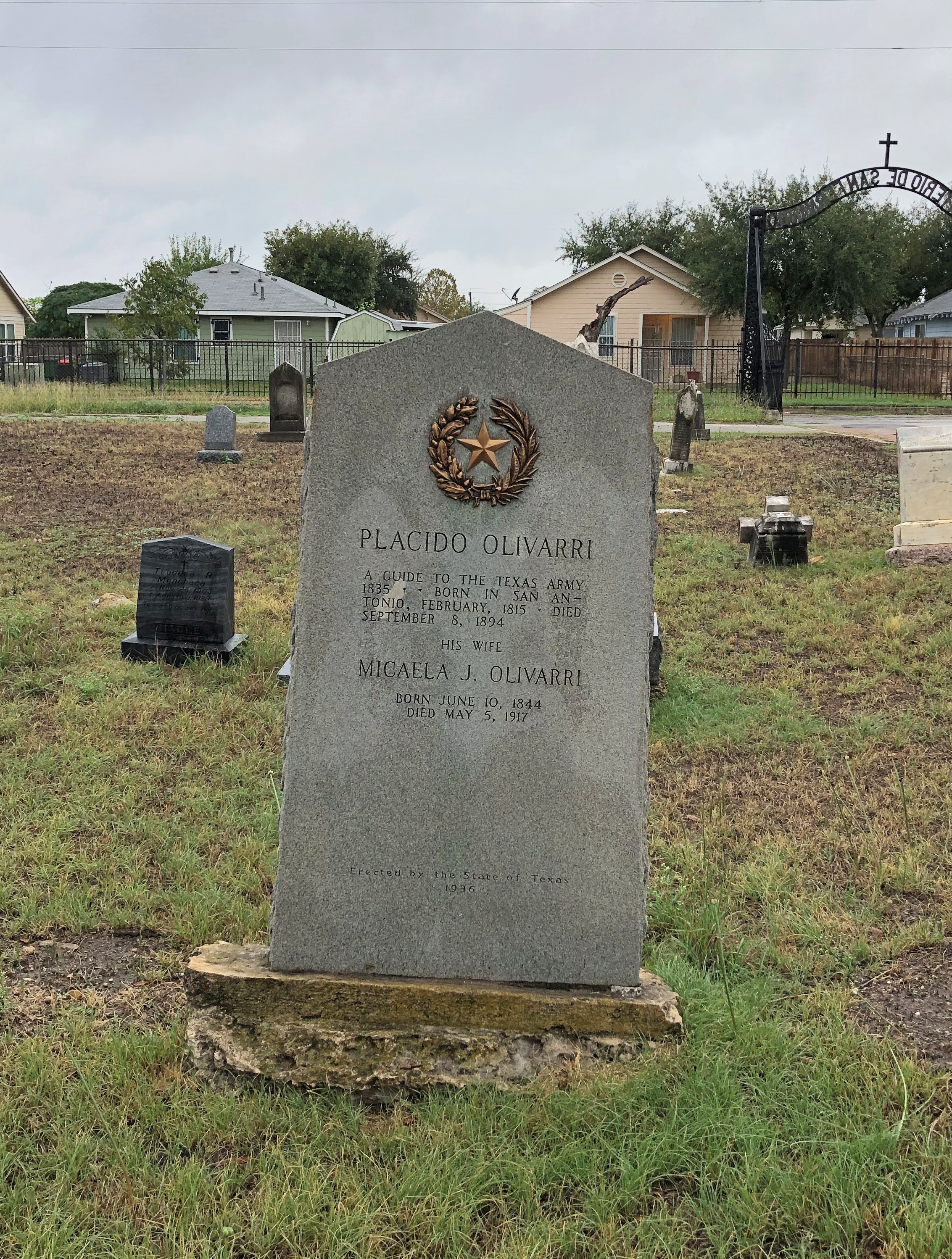
Some signers of the Texas Declaration of Independence and a SA mayor or two are reportedly buried in the cemetery as well, but this was the only memorial of note that I saw.
“Placido Olivarri is most famous for his service as a scout and guide for the Texas Revolutionary Army under Sam Houston,” the Texas State Historical Association reports. “His proficiency as a scout was so great that Gen. Martín Perfecto de Cos of the Mexican Army offered a substantial bounty for Olivarri’s capture, dead or alive… Following the Texas Revolution, Olivarri became a landowner and wagon train manager in San Antonio.”
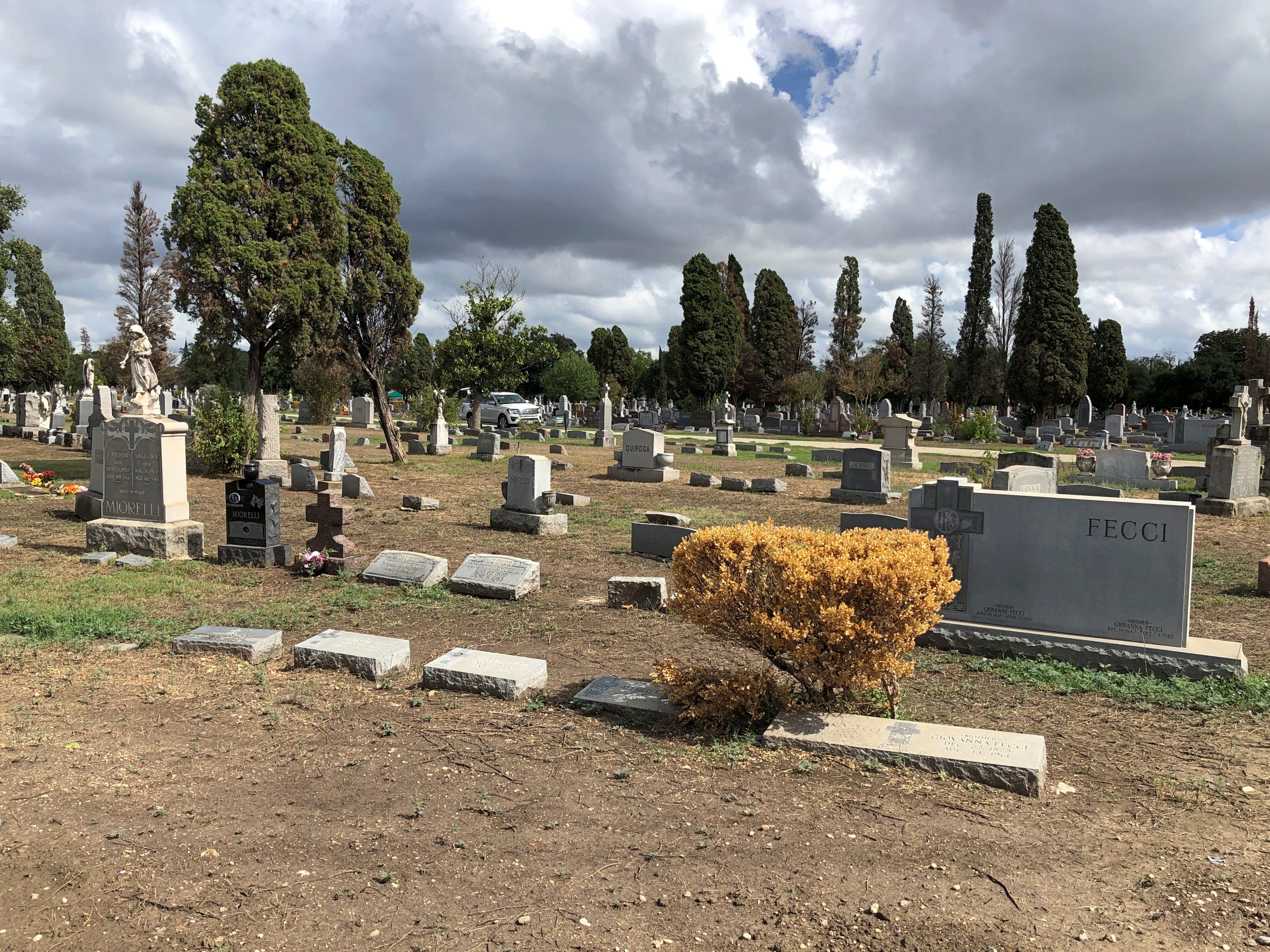
San Fernando No. 1 reportedly started taking burials in 1840 – during the brief period of the Republic, that is. The newer San Fernando No. 2 (opened in 1921) is considerably west of the first one, but not hard to find, and still an active cemetery. There is a No. 3, but I didn’t make it out that way this time.
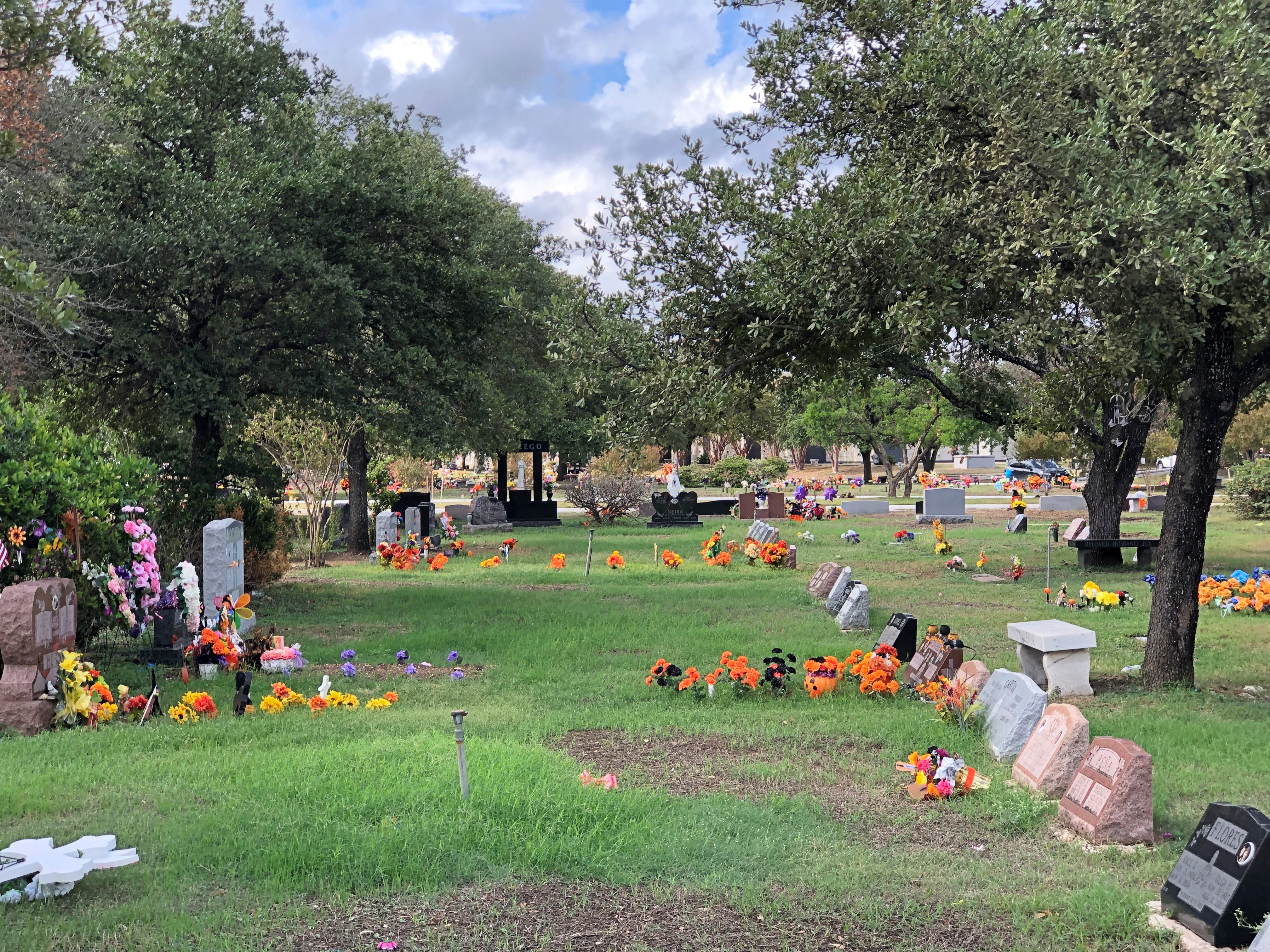
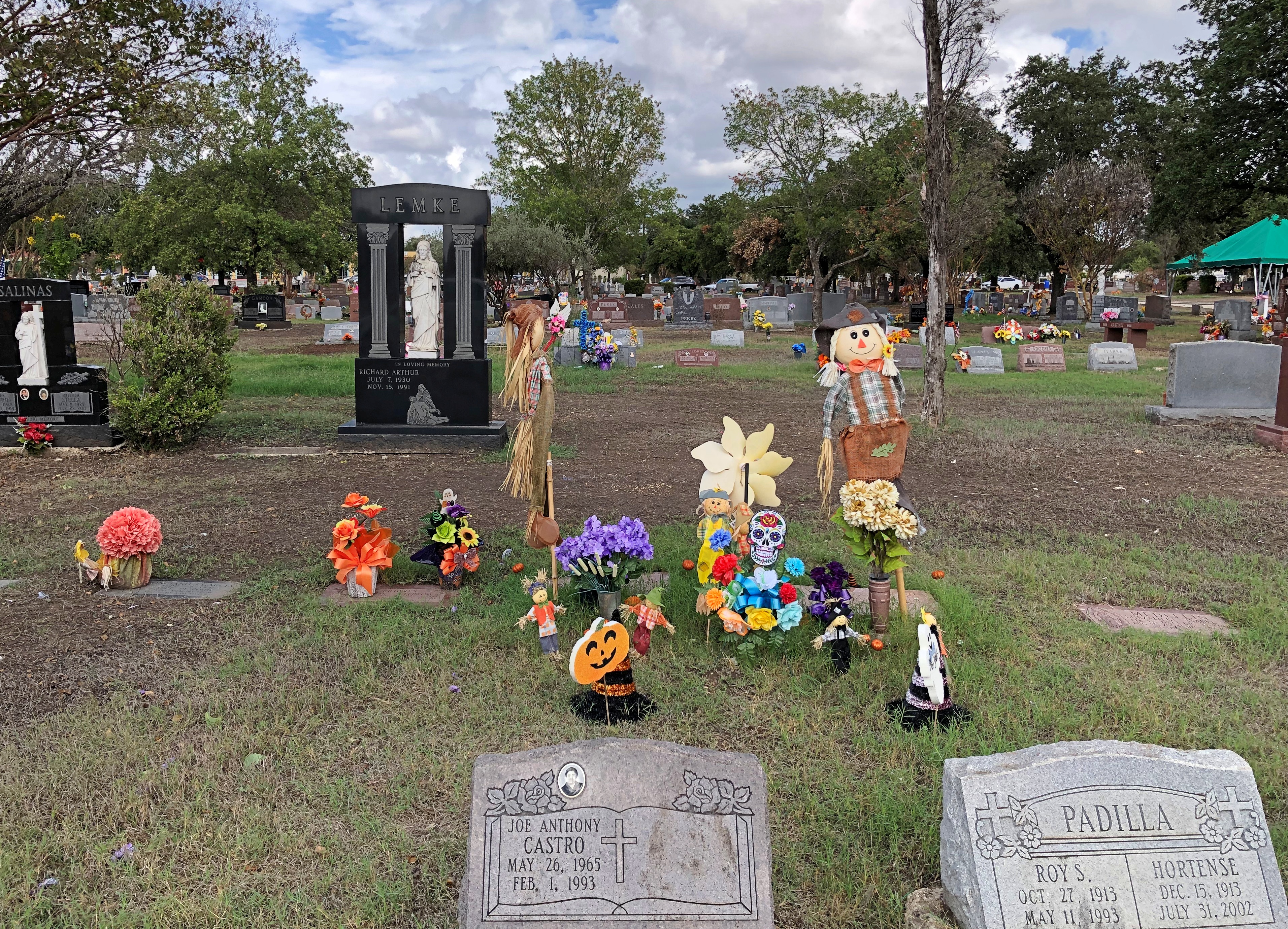
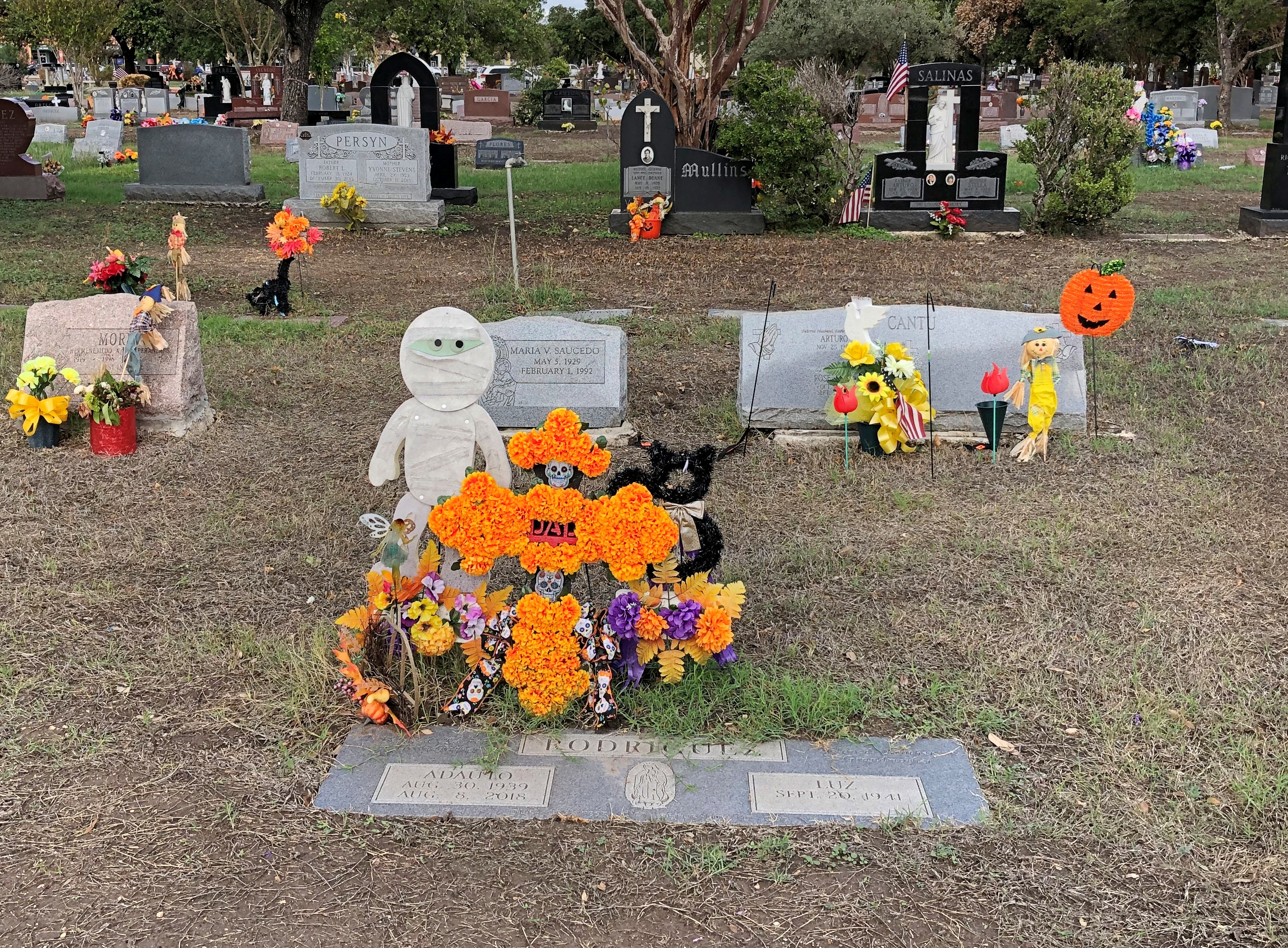
I arrived at No. 2 in the afternoon, once the skies had cleared. It too was muddy.
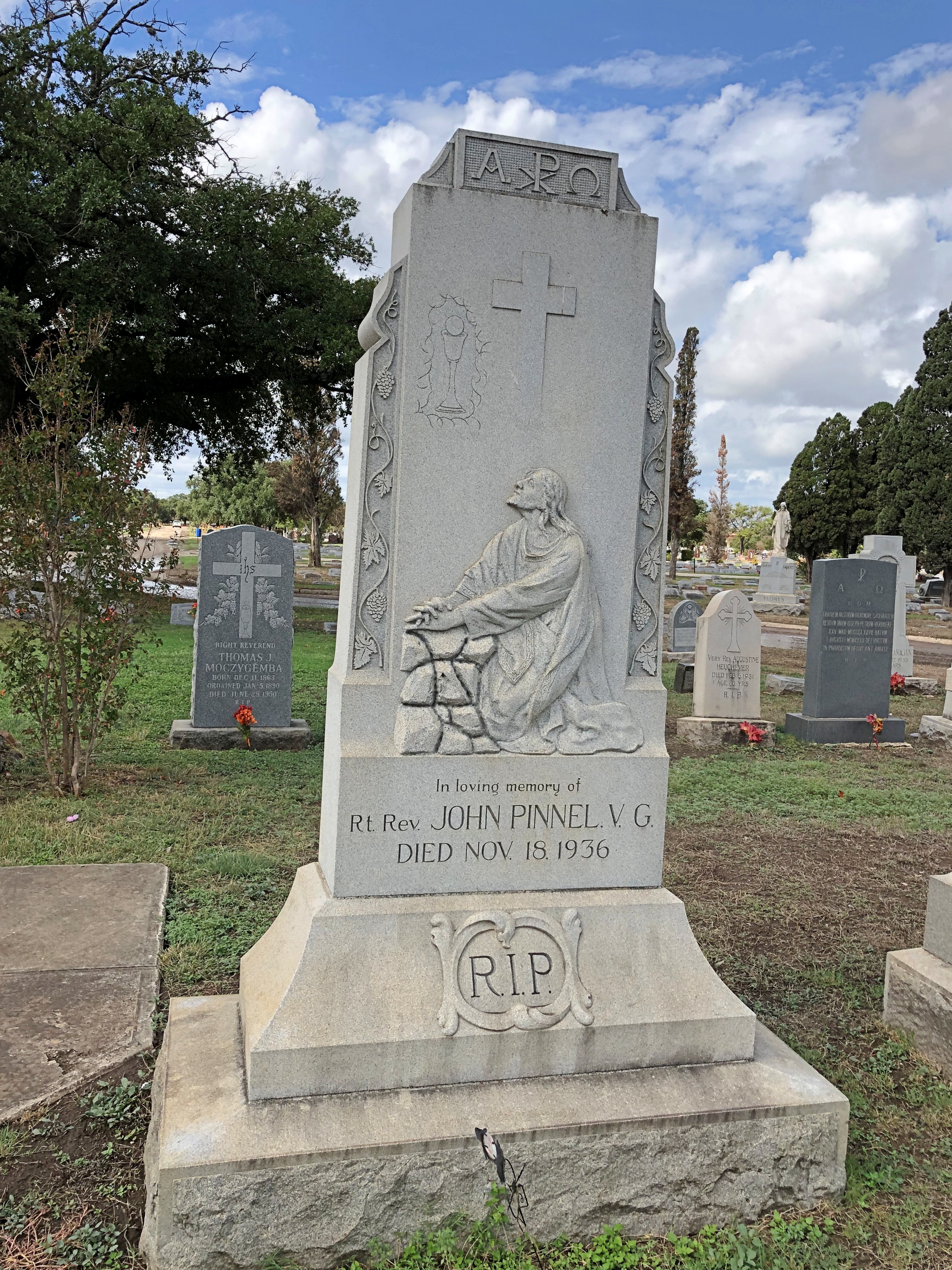
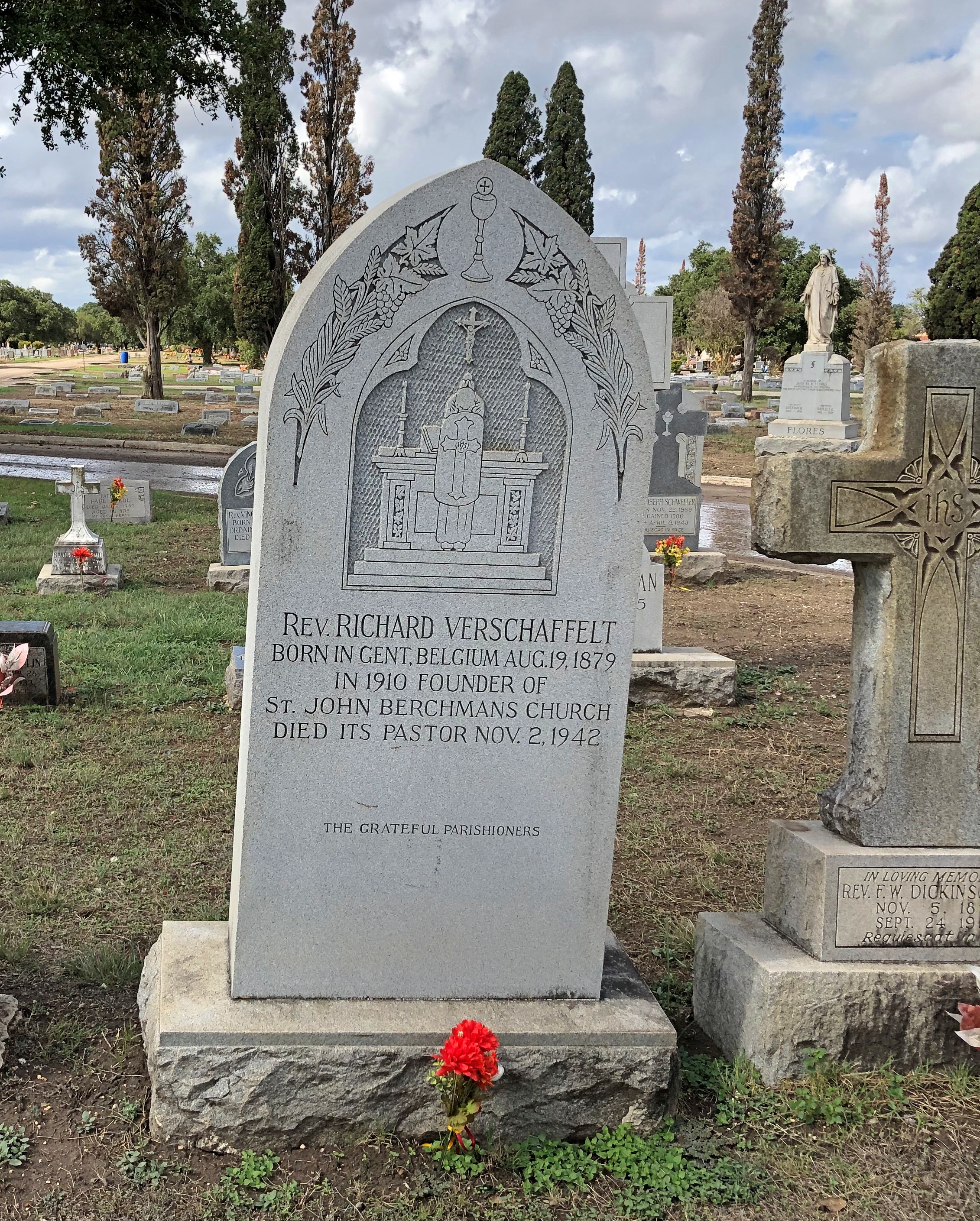
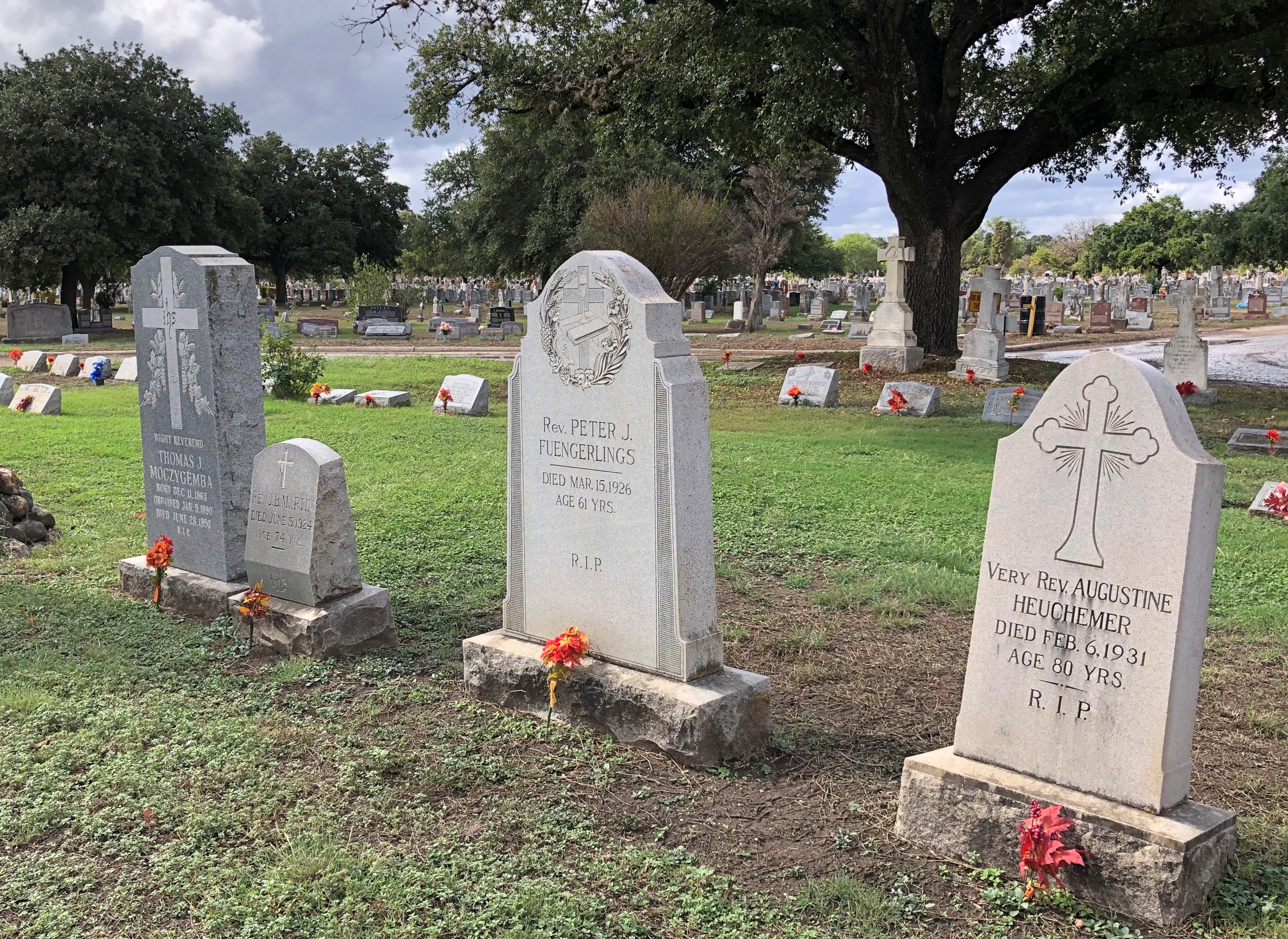
Deep in the cemetery is a section for clergy.
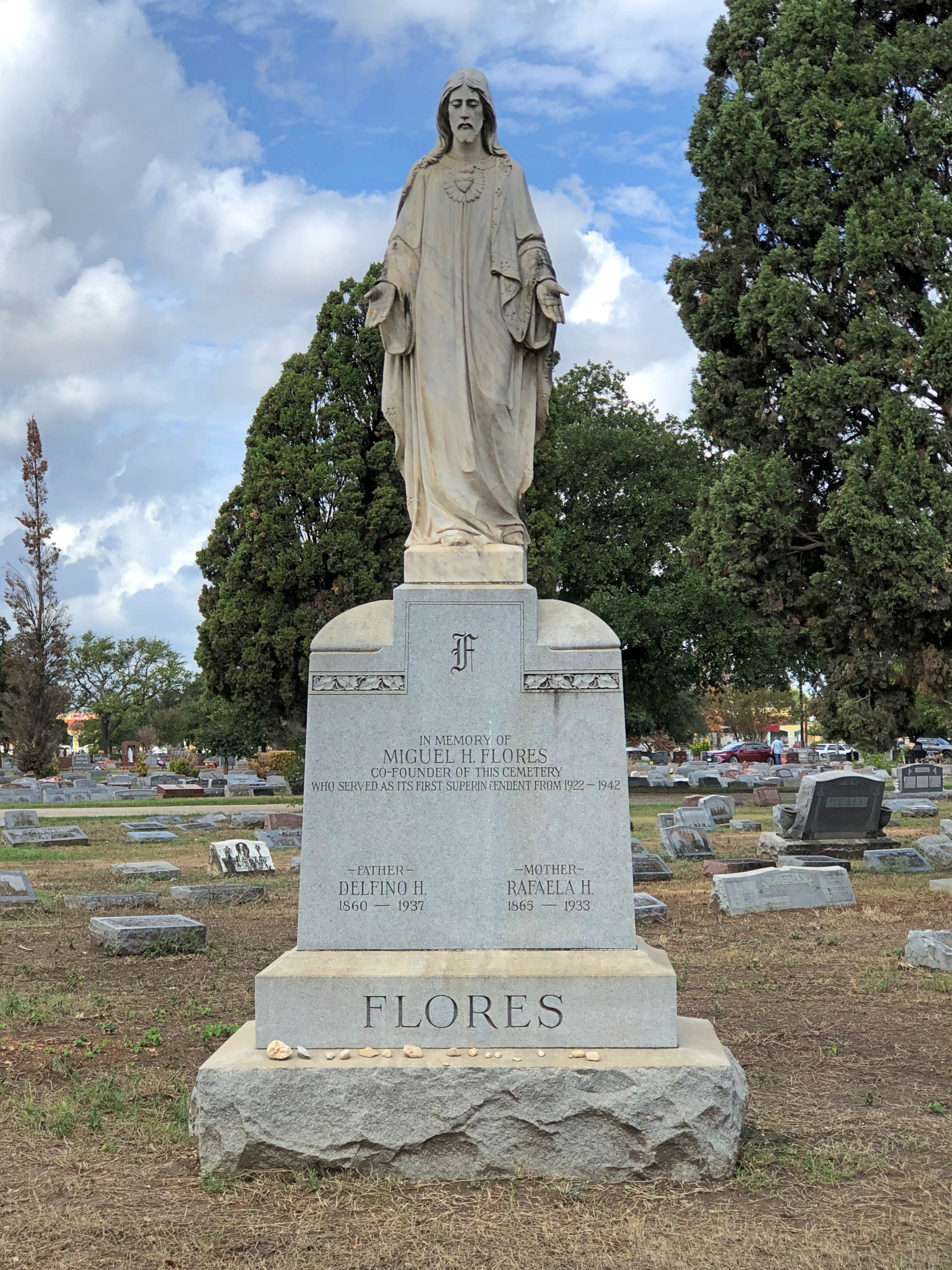
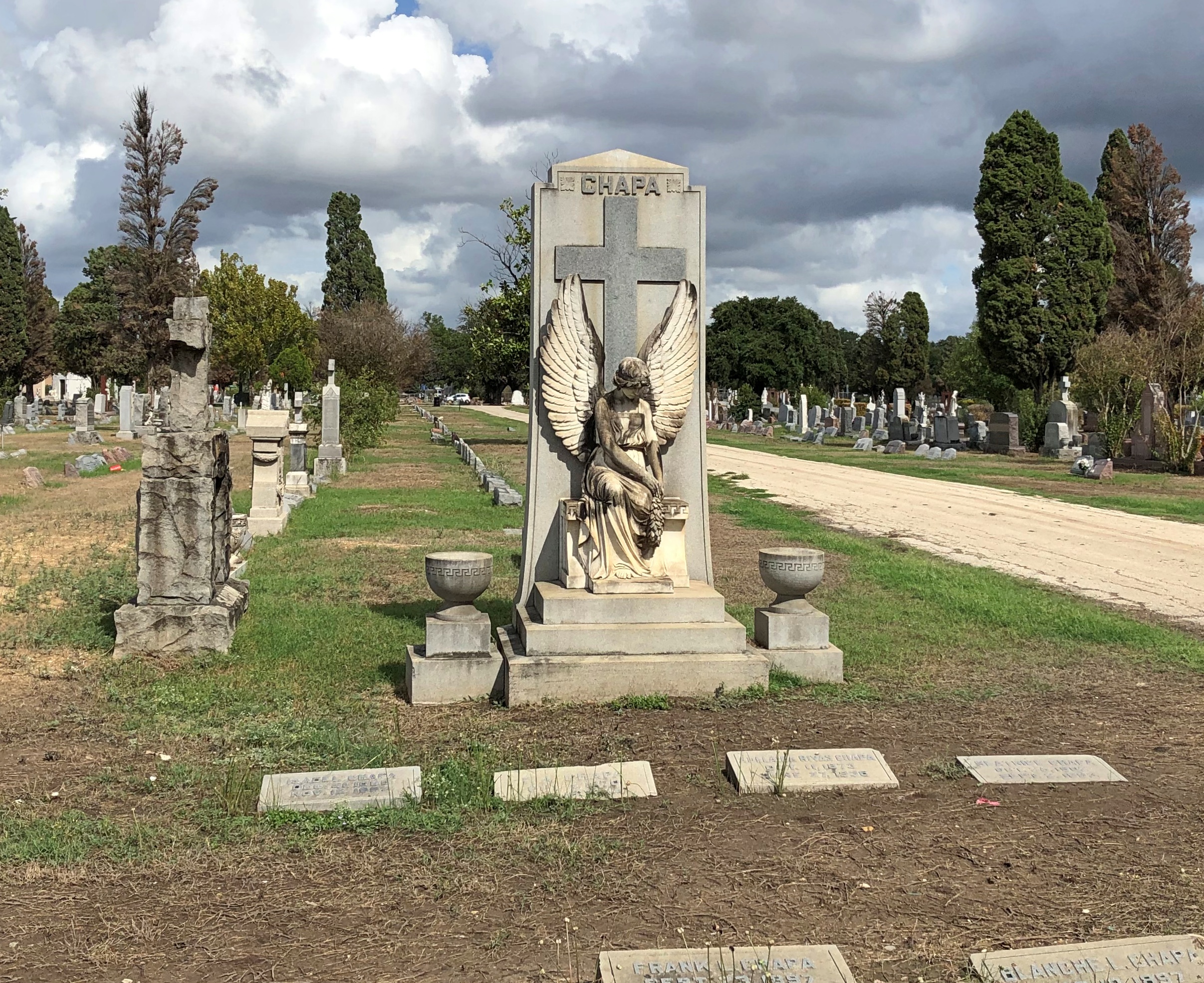
Some stones suggest 20th-century prosperity in San Antonio. Or at least, money for more impressive memorials.
“Shop epic deals influencers love,” says an ad I saw today, one associated with an online retail behemoth oddly named for a major tropical river. Instantly I found a use for that Reagan-era phrase: just say no.
Influencers would be about as useful for finding worthwhile goods as the blind men in describing the elephant.
I didn’t know until today that the inestimable Natalie Merchant set the poem “The Blind Men and the Elephant” to music. That comes of rummaging around the Internet about blind men and elephants. She might have sung it at Ravinia in 2012, since the recording would have been fairly new then, but I don’t remember.
The poem by John Godfrey Saxe is much older, of Victorian vintage. I didn’t know much about the poet, so I looked into some of his other work. His rhymes tend not to be dense with complex images, as far as I can tell. One begins:
Come, listen all unto my song; It is no silly fable; ‘Tis all about the mighty cord They call the Atlantic Cable.
That’s from “How Cyrus Laid the Cable.” I have to like a poem about early communications infrastructure, though I don’t think Natalie has set it to music.
The parable of the blind men and the elephant is much older than the 19th century, of course, a dash of ancient wisdom from the Subcontinent. I might have first heard about it in one of my Eastern religion classes. Or perhaps when I bought the record Waist Deep in the Big Muddy and Other Love Songs in the mid-80s, the disk that kicked my admiration for Pete Seeger into high gear. On that record, he performs a comic spoken version of the parable — the second spoken interlude during a song called “Seek and You Shall Find.”
I like all of the stories. Especially the first one, which is about boiling all the world’s wisdom down into one book, then one sentence, then one word. A re-telling for our time wouldn’t involve a king and wise men, but perhaps a tech mogul and his AI specialists. Eventually, sophisticated AI boils all the world’s wisdom down into a single word, and the result is the same. Maybe.