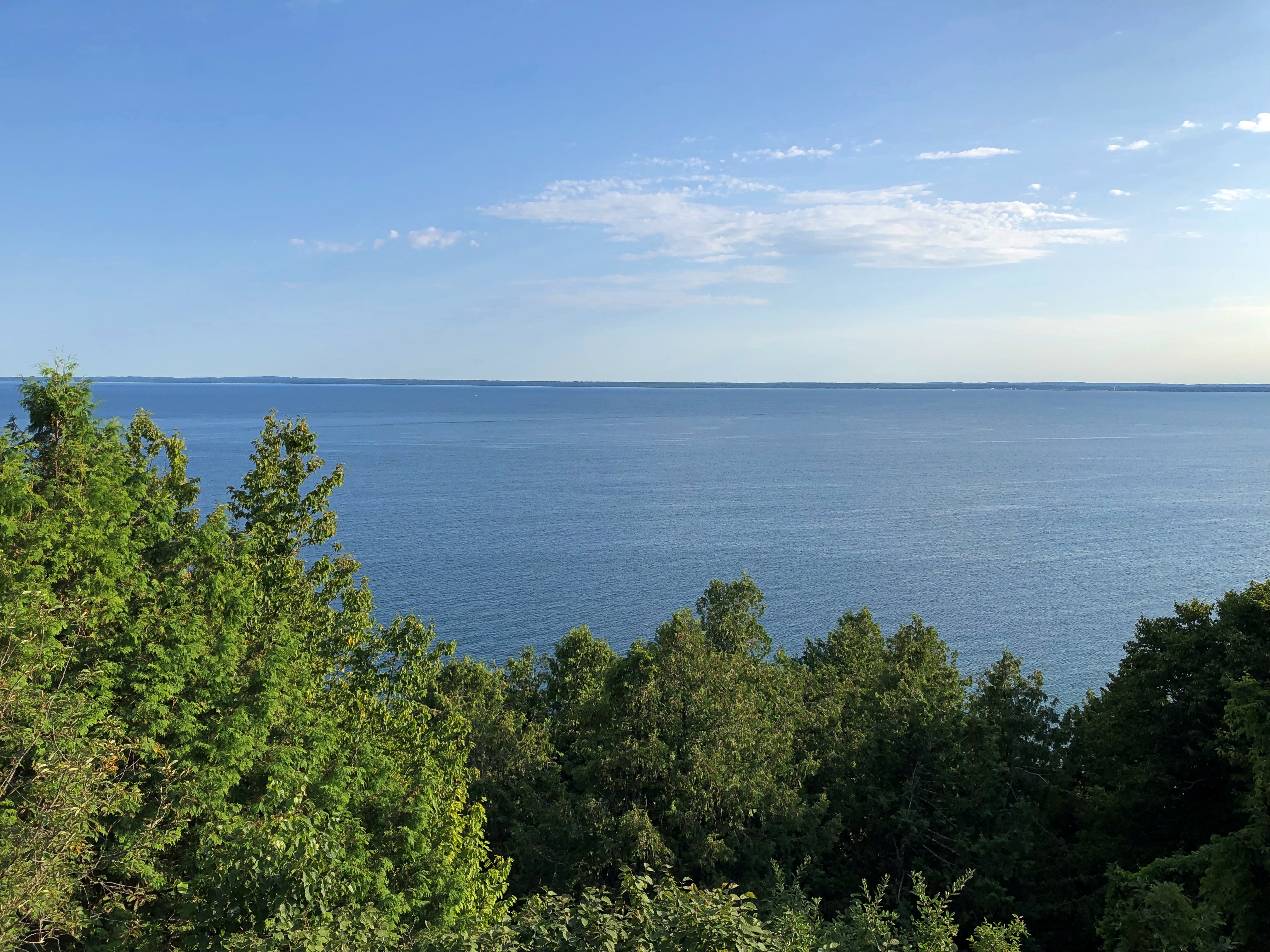
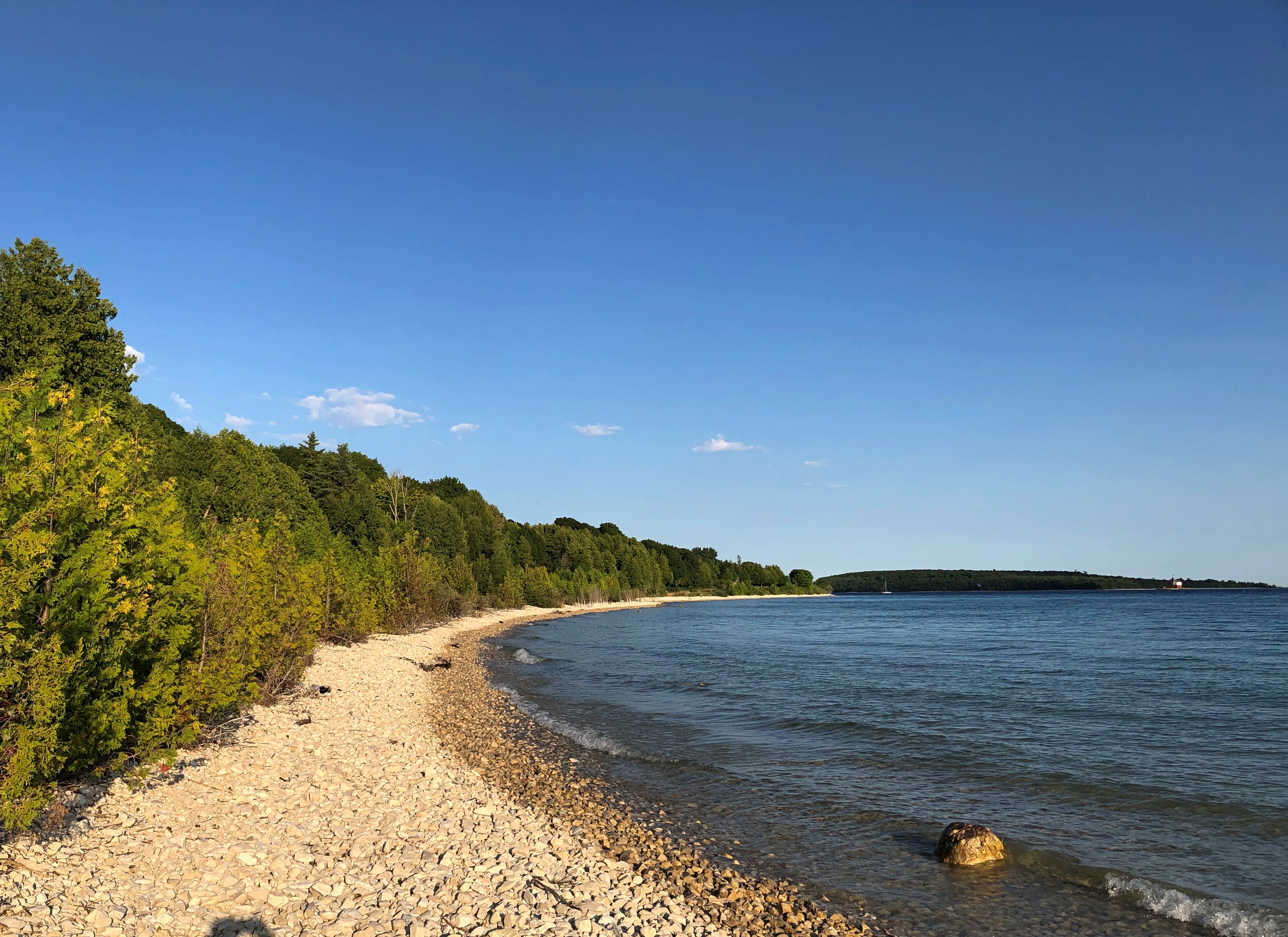
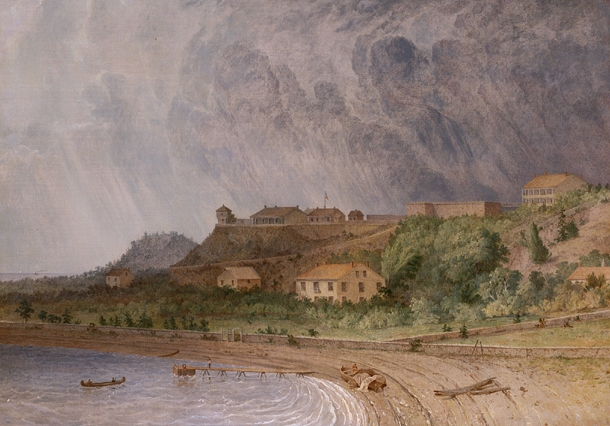
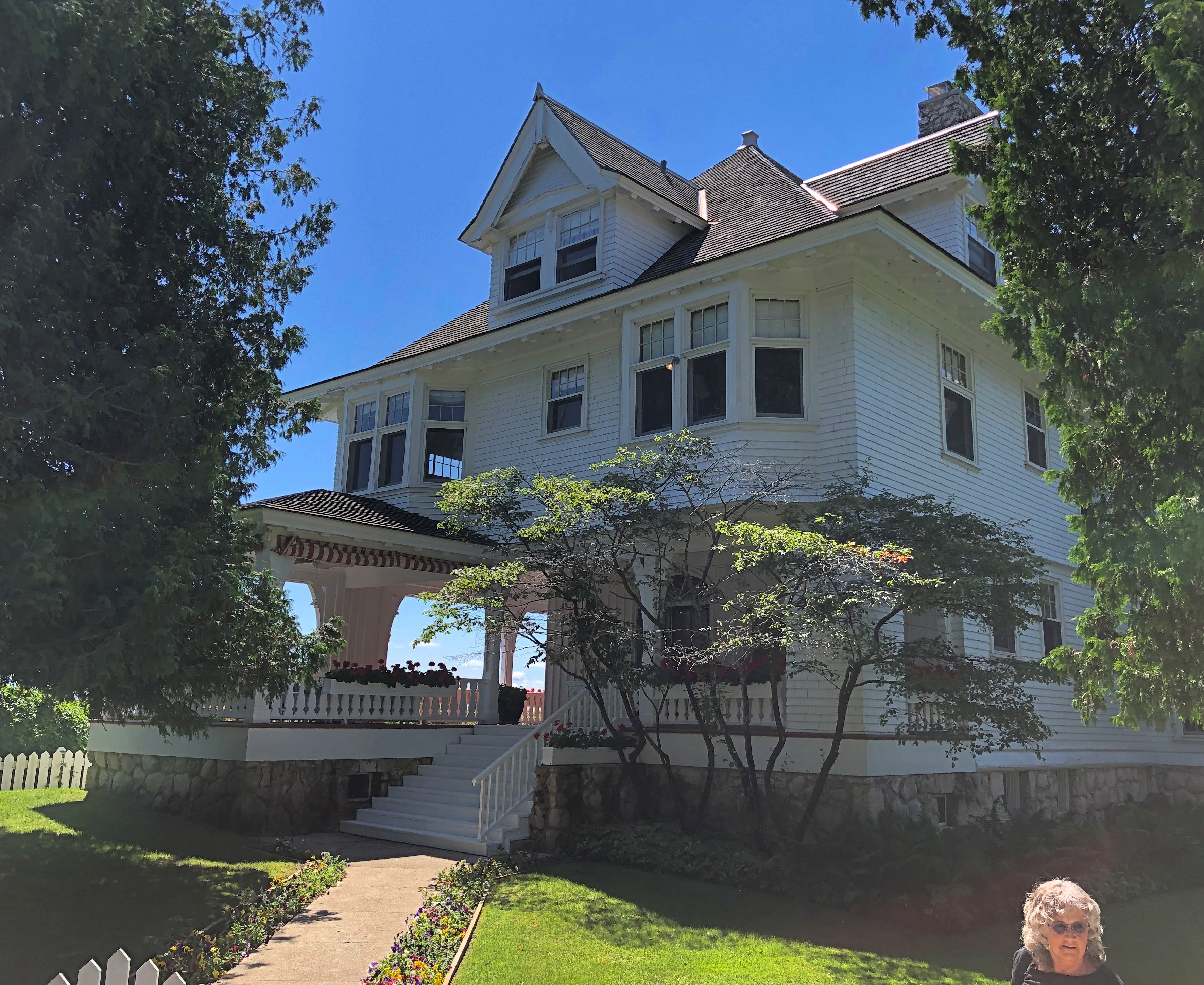
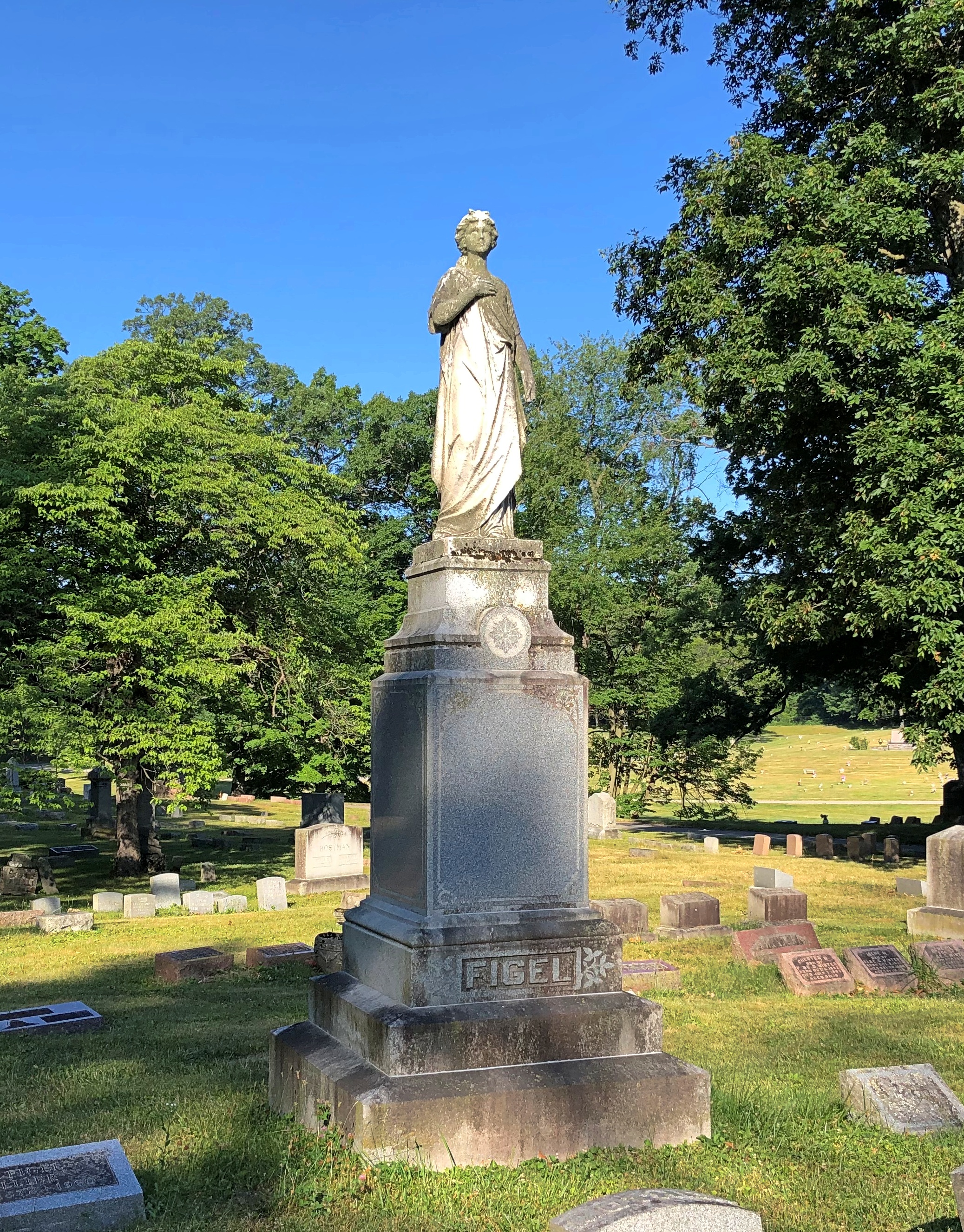
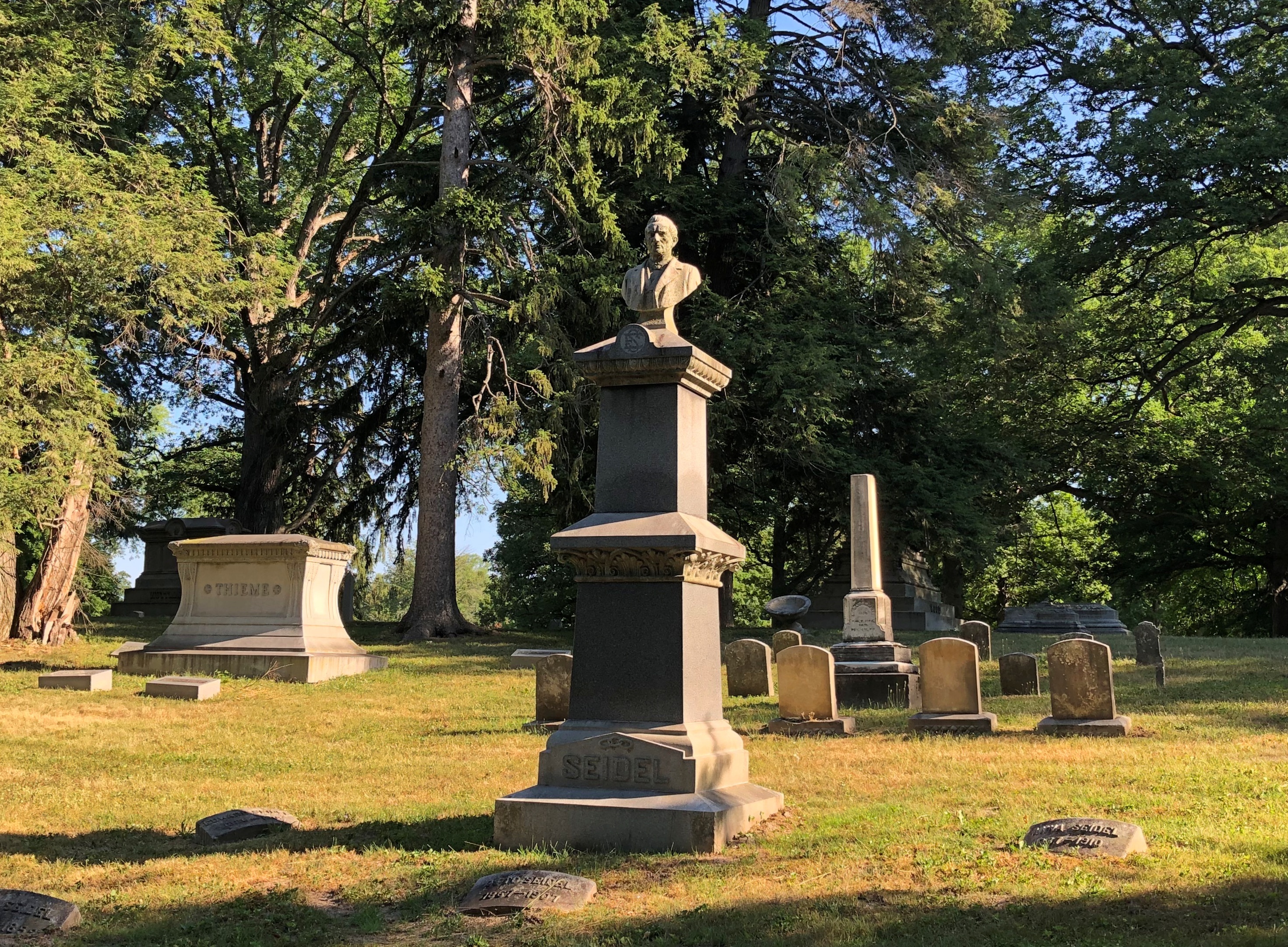
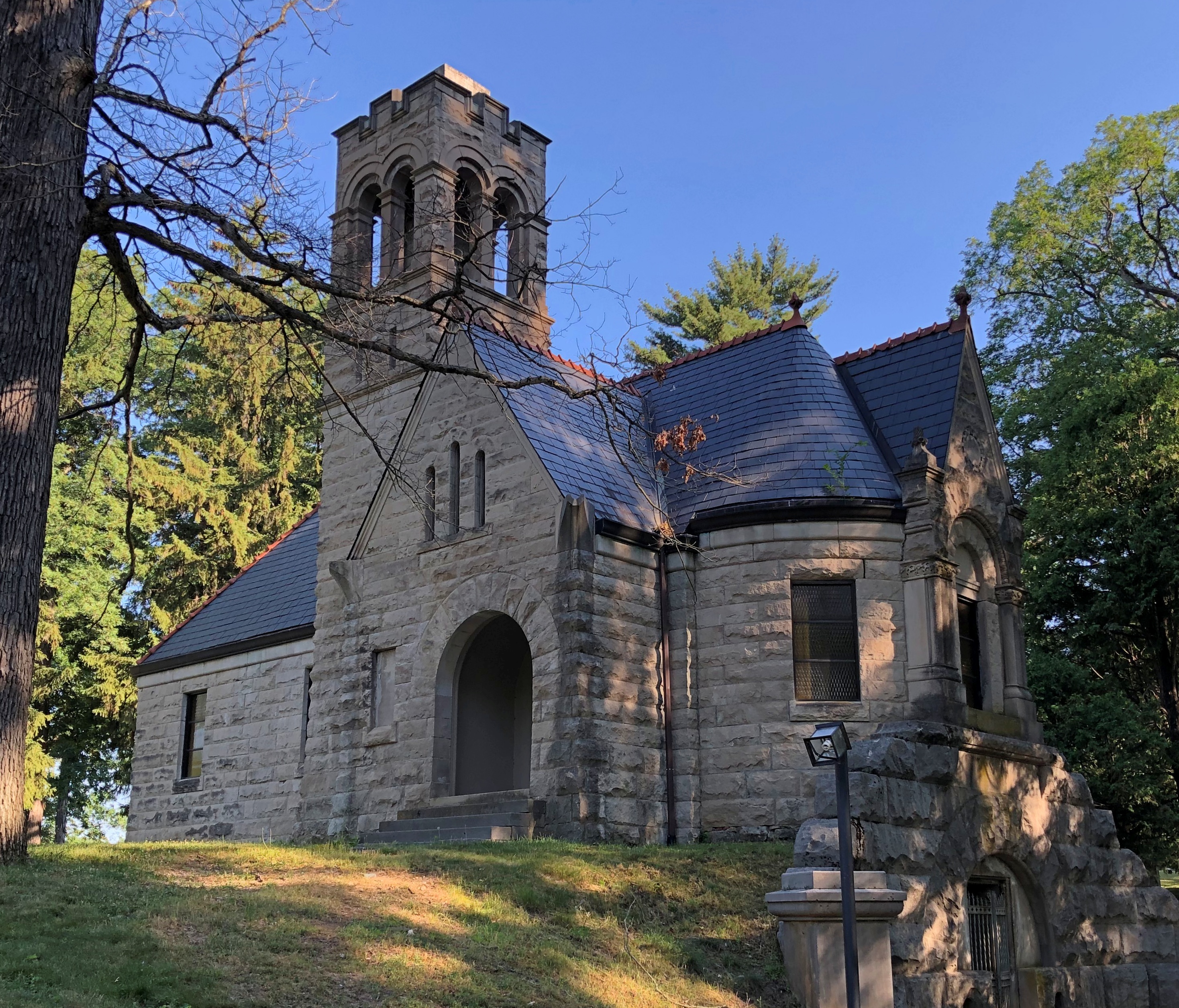
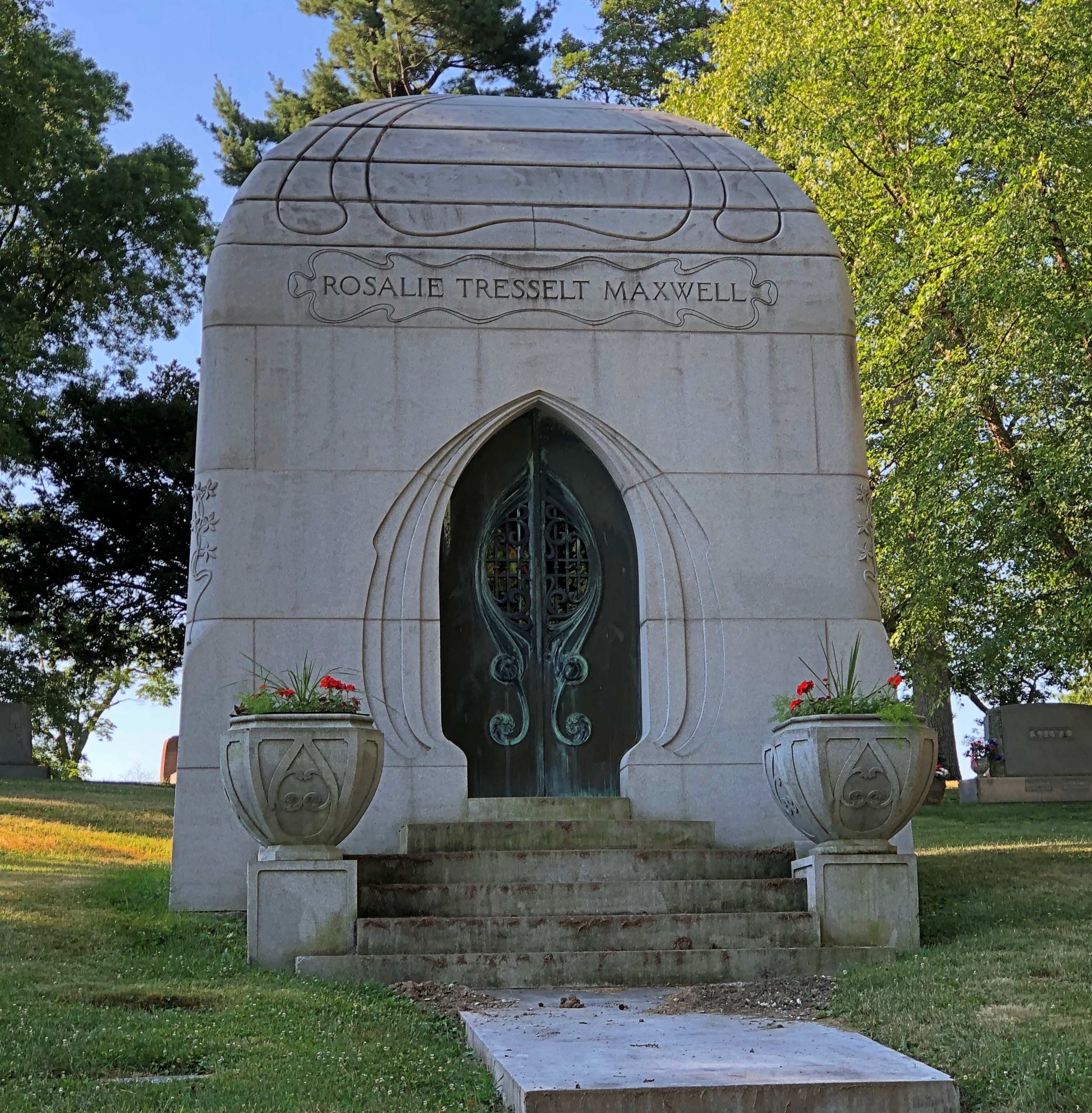
Allouez Catholic Cemetery

The village of Allouez, Wisconsin, which counts as a suburb of Green Bay, was named after missionary Claude-Jean Allouez, S.J.

The Catholic Encyclopedia (1913): “Allouez, Claude, one of the most famous of the early Jesuit missionaries and explorers of what is now the western part of the United States, b. in France in 1620; d. in 1689, near the St. John’s River, in the present State of Indiana. Shea calls Allouez, ‘the founder of Catholicity in the West’… Allouez laboured among the Indians for thirty-two years. He was sixty-nine years old when he died, worn out by his heroic labours. He preached the Gospel to twenty different tribes, and is said to have baptized 10,000 neophytes with his own hand.”

Besides the village, the Allouez Catholic Cemetery and Chapel Mausoleum has his name. The missionary isn’t buried there, however, but in Michigan. Allouez Catholic Cemetery

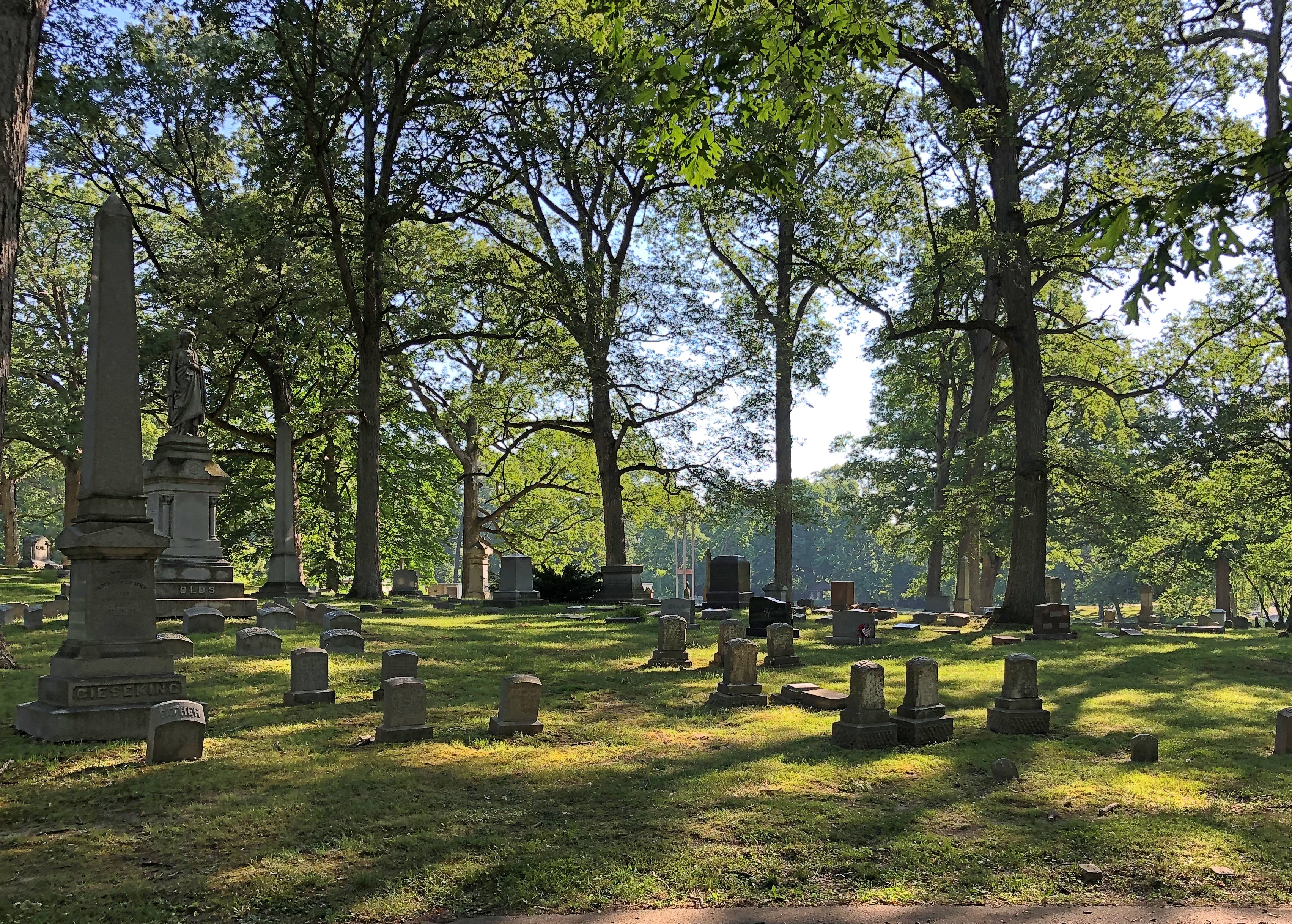
I visited on the morning of Labor Day. The cemetery is on a long slope between two major streets in the area, Riverside Dr. and Webster Ave. Nearly two centuries old, it still has a lot of room to grow.Allouez Catholic Cemetery

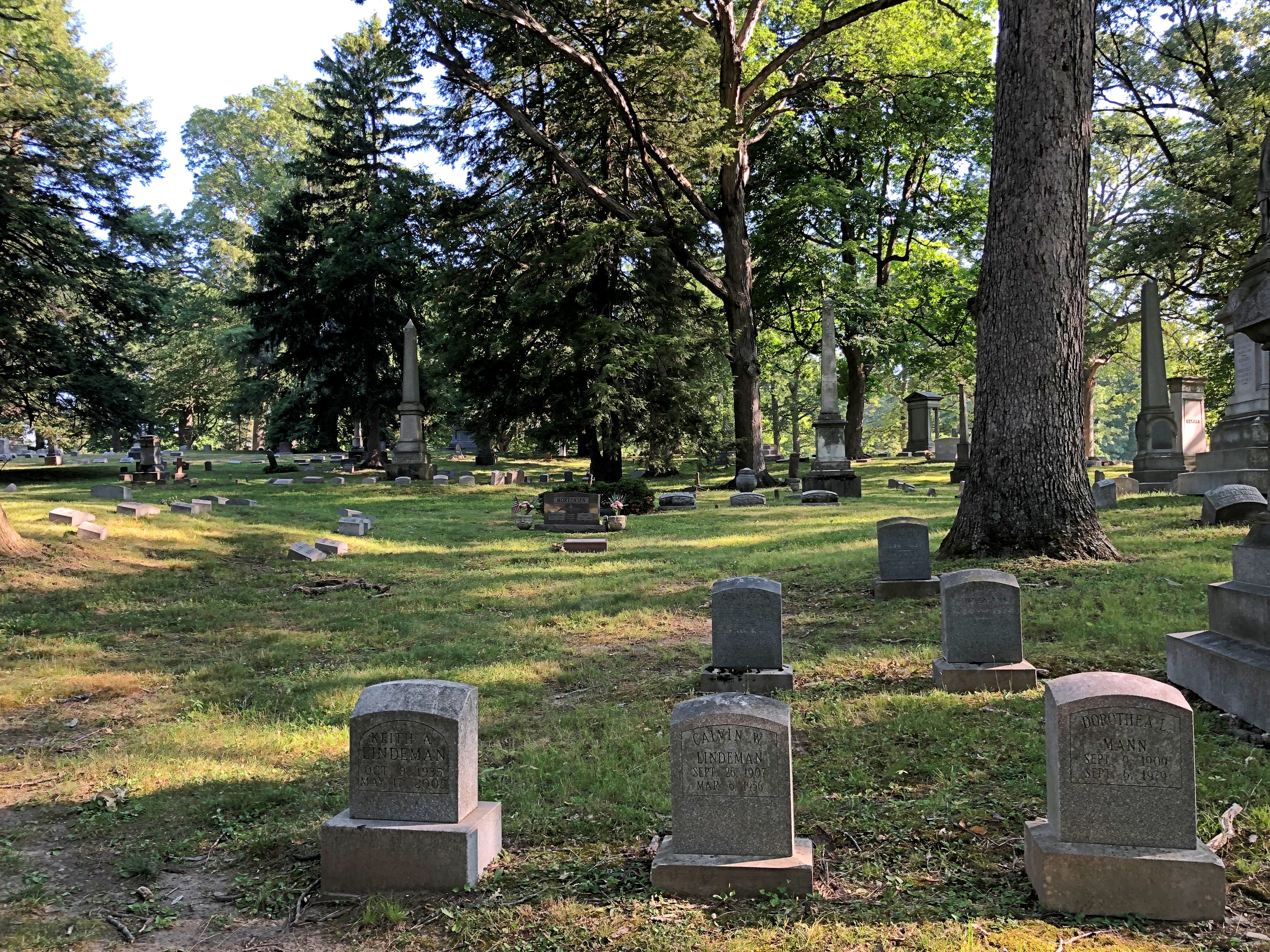
In the developed area, so to speak, the stones are fairly dense.Allouez Catholic Cemetery

Allouez Catholic Cemetery
According to the cemetery web site, there are a number of Green Bay bishops in on the grounds, but I wasn’t looking for anyone in particular.Allouez Catholic Cemetery

Allouez Catholic Cemetery

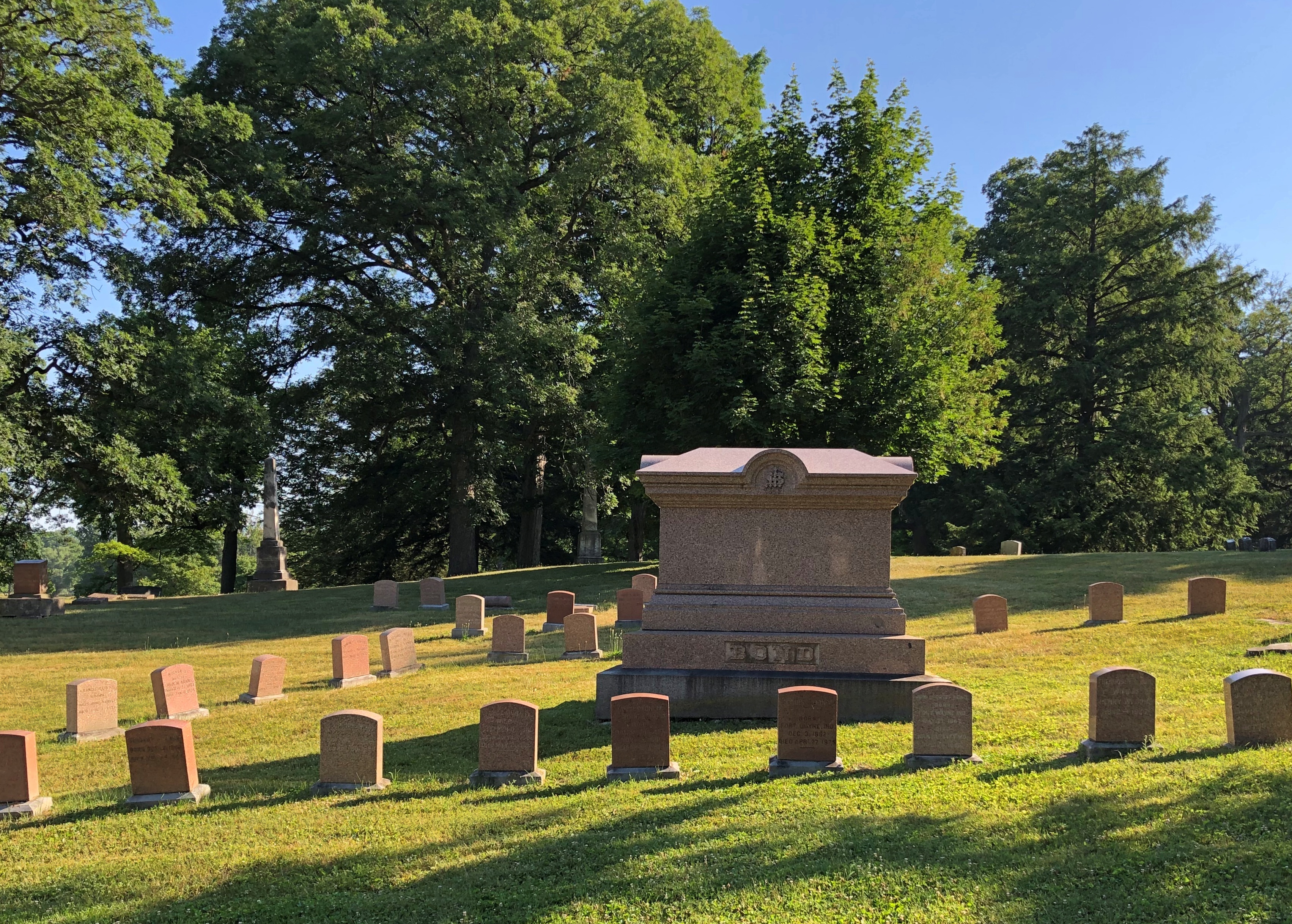
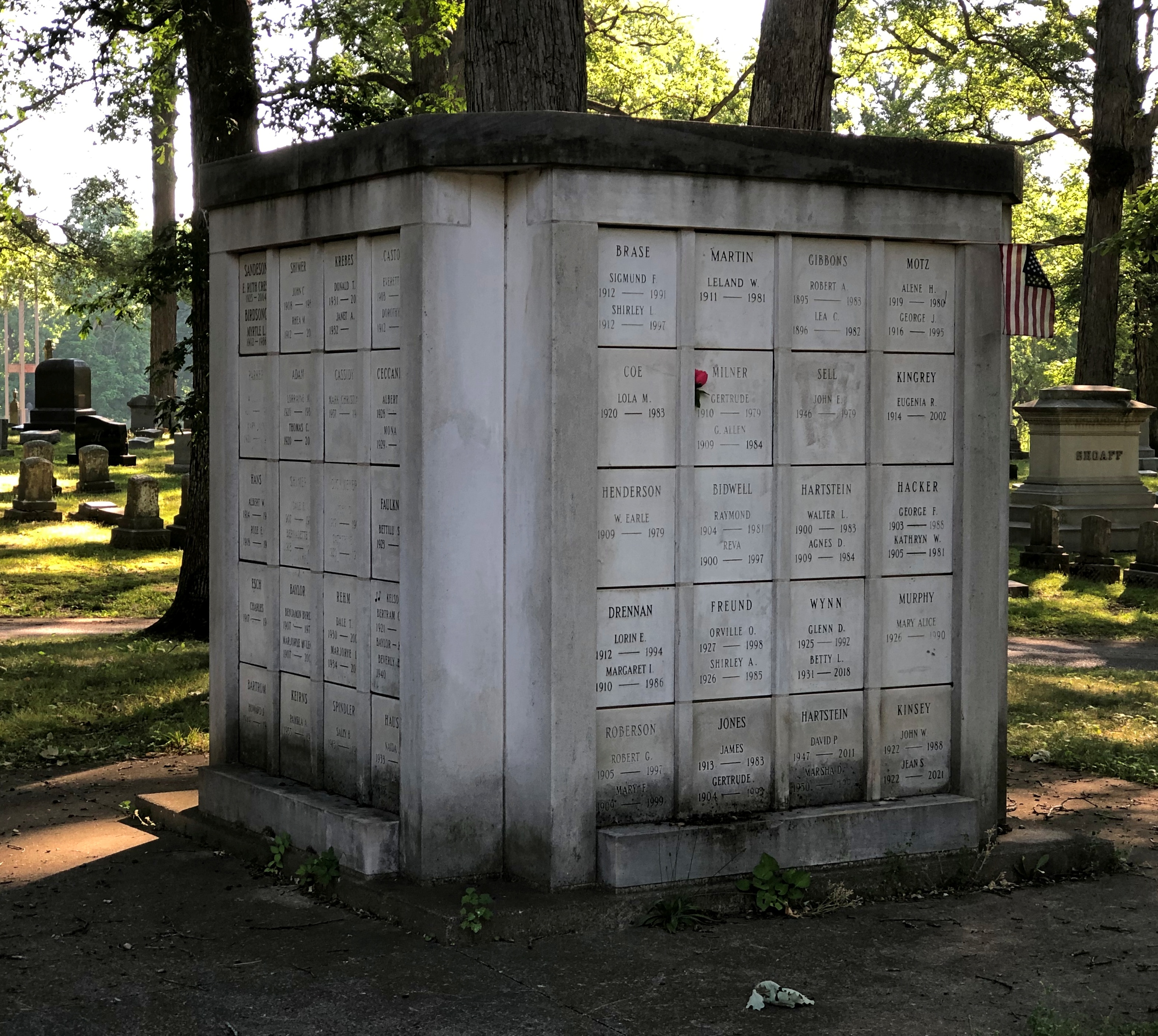
The cemetery is home to only a handful of individual mausoleums, such as this one.
Allouez Catholic Cemetery

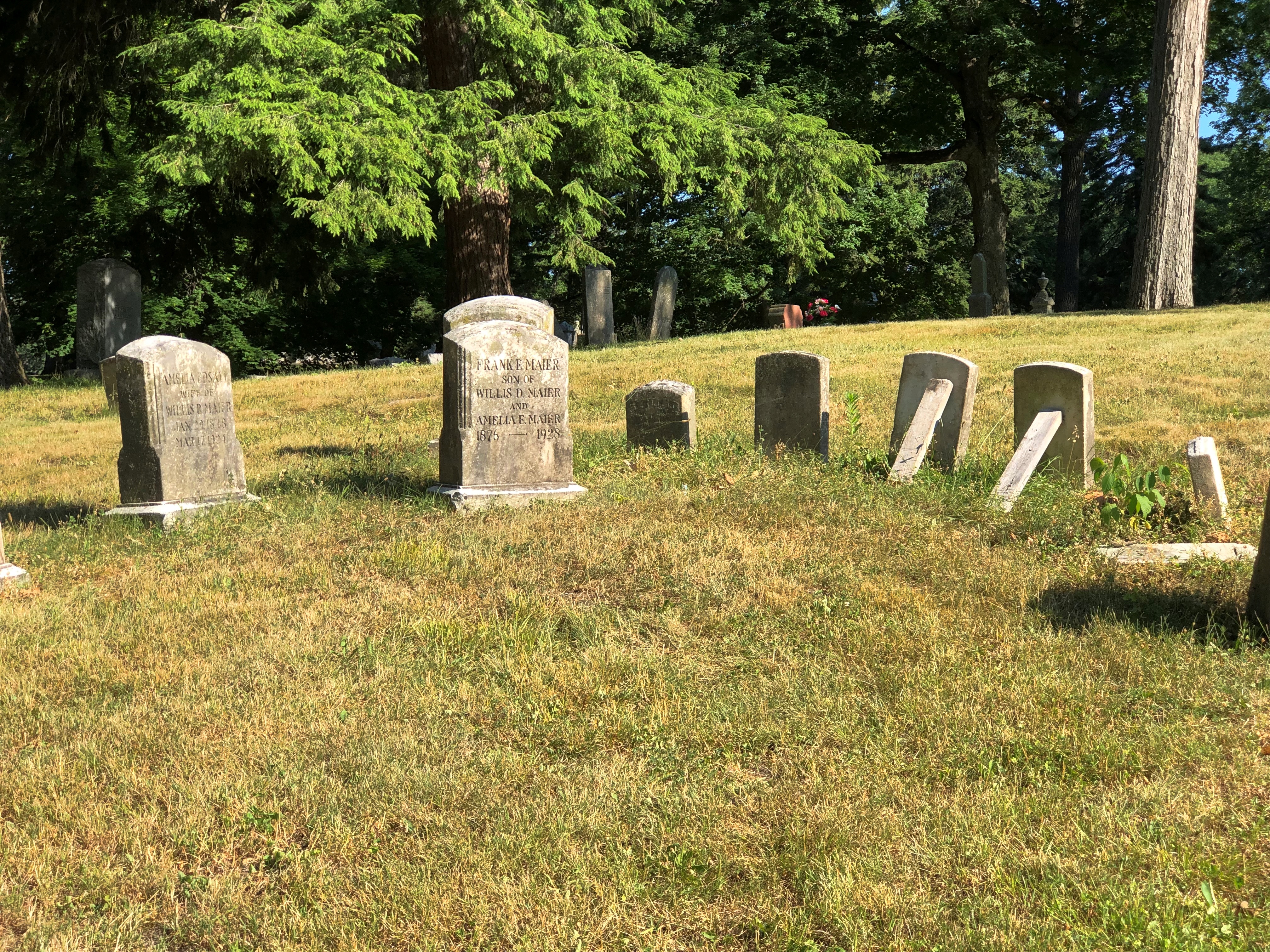
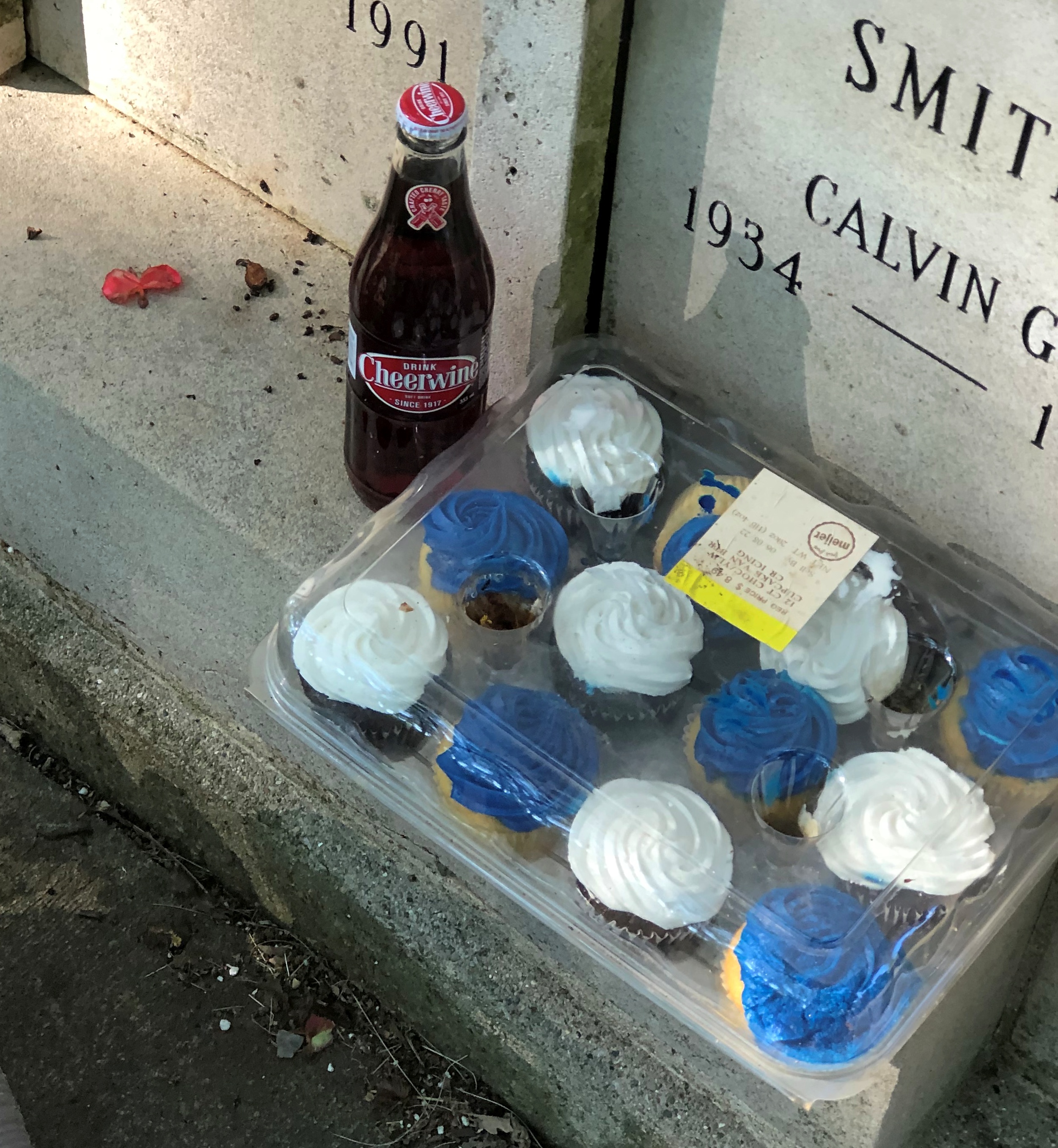
An intriguing stone. People get around, until they aren’t able to any more.Allouez Catholic Cemetery

As always, some stones reflect unalterable sadness. This stone silently speaks of a terrible recent incident: a boy run over by a man in a truck.Allouez Catholic Cemetery

He says accident, the DA says homicide by negligent operation of a vehicle.

Remembrance

Ten years ago, Schaumburg had a September 11 remembrance at a spot called Veterans Gateway Park. This year, the ceremony was elsewhere on Schaumburg Road, on a patch of land in front of the village’s memorial for police and firefighters, not far from the headquarters of those village organizations. It started at 8:30 a.m. and lasted less than half an hour.
Sept 11 Schaumburg

There was an color guard, singing of the national anthem, a moment of silence, and short speeches — though a little hard to hear, over the din of traffic on Schaumburg Road — by the mayor, police and fire chiefs, the Congressman who represents the area and, a little surprisingly, Cook County Board President Toni Preckwinkle. Perhaps she had a string of events to attend, though I’d think most of them would be in the morning, around the exact anniversary of the attacks.

Door County Shores

In the outskirts of Sturgeon Bay, Wisconsin, county seat and largest town on the Door Peninsula, is a simple sign on state highway 42/57 that says LIGHTHOUSES, with an arrow pointing to a side road. After that, you’re on your own if you want to see those structures, which are on the Sturgeon Bay Canal where it meets the Lake Michigan.

Getting to them involved a couple of wrong turns and passing by the intriguing side road to Leif Everson Observatory, marked by what looks like a model of the planet Neptune, with its Great Dark Spot and some Poseidean moons.

Eventually we found ourselves near the shore — and the lighthouses, but also a pier jutting out into the lake.Sturgeon Bay Pier and Lighthouses

Besides the road and a small parking lot, most of the area is divided between private property and a Coast Guard station. Many signs warn you not to trespass on either, which hints at a history of miscreants showing up and making messes.
The Coast Guard station has a light: the Sturgeon Bay Canal Light, vintage 1899.Sturgeon Bay Pier and Lighthouses
A little ungainly, but I suppose it gets the job done.

The concrete pier is a bit crumbled in places and its iron-and-plank superstructure is a bit rusty in places. The pier is open to the public. To get there, one treads the “public” half of a narrow footpath. More signs warn you not to step off it.Sturgeon Bay Pier and Lighthouses

So if you are a mind to, you can go down the pier. We did.
Sturgeon Bay Pier and Lighthouses

The pier offers some nice views, including the Coast Guard facility and the private shoreline.Sturgeon Bay Pier and Lighthouses
Sturgeon Bay Pier and Lighthouses

Even better is a view of the other light, Sturgeon Bay Ship Canal Pierhead Lighthouse, which is the older of the two, dating from 1881.
Sturgeon Bay Pier and Lighthouses

The light is on a rock island of its own, connected to the pier by the iron superstructure. In other pictures, the light is bright red, and maybe it still is, in the right light. On Sunday morning, it looked dull red, but even so considerably more handsome than the Coast Guard’s tower.

One more thing: a survey marker way out near the tip of the pier.Sturgeon Bay Pier and Lighthouses

Those two lights satisfied the tourist requirement that you visit at least one lighthouse in Door County. So on we went from there, pausing briefly in Sturgeon Bay for gas, and then up the other coastline — the two aren’t very far apart — to the 14-acre Frank E. Murphy County Park on Horseshoe Bay, a small patch of Green Bay.

It’s a pleasant little park, grassland and a beach.Frank E. Murphy County Park

Frank E. Murphy County Park
A homely concrete pier juts out into Horseshoe Bay, and we went there too, taking in the wind and the waves.
Frank E. Murphy County Park

Frank E. Murphy was a Door County lumberman, cattle breeder and fruit grower in the decades on either side of 1900, according to a sign at the entrance. His family donated the land for the park in 1934.

Another fact on the sign: the man credited with naming Horseshoe Bay in 1842 was Increase Claflin Jr. (1795-1868, pictured). His Find a Grave bio is just a touch hagiographic: “Increase Claflin was a splendid type of a pioneer, a most auspicious forerunner of Door County’s men. He was sturdy, reliable, fearless, intelligent, loyal and self-sacrificing. In the rare quality of his ancestors as well as in his own noble manhood, Door County could ask for no truer type of American virtue.”

The text sounds suspiciously like it was lifted from a 19th-century bio of the man, maybe a newspaper obit, as a reasonable use of the public domain.

Anyway, Increase needs to be brought back as a first name. Perhaps Gen Z parents will take it up.

Arlington National Cemetery, 2011

Ten years ago this month we went to Washington, DC, which was the entire focus of the week-long trip. That had some advantages, especially since DC has a decent network of subway lines. We went everywhere by subway, including Arlington National Cemetery. Once there, shuttle buses run a loop around the grounds. Good thing, since the cemetery covers 639 acres.

President Kennedy drew a crowd.Arlington National Cemetery

Robert Kennedy isn’t far away, marked with a small stone and a cross.
Arlington National Cemetery - RFK

President Taft, the other U.S. chief executive buried in the cemetery, did not draw a crowd.Arlington National Cemetery - Taft

The memorial to the crew of the Space Shuttle Columbia. An elegant design.
Arlington National Cemetery - Columbia
The memorial to the crew of the Space Shuttle Challenger. Not an elegant design.Arlington National Cemetery - Challenger

Mainly because of the faces. The more you look at them, the worse they become.
Arlington National Cemetery - Challenger

Remember the Maine.Arlington National Cemetery - Maine

Arlington National Cemetery - Maine

Audie Murphy. I hadn’t remembered that he died that young; airplane crash.Arlington National Cemetery - Audie Murphy

Other noteworthy stones we happened across. Ones I did, anyway. Not sure anyone else noticed as I took pictures.Arlington National Cemetery

Arlington National Cemetery - Oscar York
Army brass. Among others, Gen. Alexander “I’m in control” Haig in the foreground, and Gen. Omar Bradley, with his five stars, not far away.

The Tomb of the Unknown Solider.
Arlington National Cemetery - Unknown Soldier
Here are the girls, goofing around at the nearby amphitheater.
Arlington National Cemetery

Hope the trip made some kind of impression.

Ann Goes to College

Ann is now a student at the Illinois State University in Normal, Illinois. From now on, August 14, 2021 will be the day she went to college. Such dates seem to be creeping further into August, but I only have a small sample. My own such day was August 25 and Lilly’s August 18.

ISU is a little closer than UIUC, only about two hours on the road to Springfield and St. Louis. As completely normal for August in Normal, it was hot. That didn’t keep anyone from moving in.

The oddest thing I saw this time wasn’t a TV or bottled water, but a fellow with a turntable and a vinyl record collection. State-of-the-dorm gear in — 1979, as I recall (I didn’t have one).
Her building, Watterson Towers, is enormous, and looks old enough for me to have lived there as a student. Yep, it opened in 1968.

The tallest building in Bloomington-Normal and, according to some sources, the tallest between Chicago and St. Louis.

A nugget I found about the building reported by WGLT, the school’s NPR station, last summer: “Illinois State University said Thursday it will rename floors in the Watterson Towers residence hall in the wake of nationwide upheaval and a renewed dialogue on race and history.

“… every five floors in both towers are called a ‘house.’ The university named those houses for the nation’s first 10 secretaries of state: Van Buren, Clay, Marshall, Madison, Adams, Pickering, Monroe, Randolph, Smith, and Jefferson. Eight out of the 10 were involved in slavery. Several would be elected president after serving as secretary of state…”

Guess which two didn’t own slaves. That would be Adams, as in John Quincy, and Van Buren.

“The entire Watterson Towers complex was named for a beloved professor on campus and that name will not change,” WGLT concluded.

As far as I can tell, the “houses” are now North, A through E, and South, A through E.

Ann found her room and we moved all her stuff in.

It’s a tiny room that she shares with a roommate. Again, the way a dorm should be.

The Museum of the North

The flight from Seattle to Fairbanks actually isn’t that long, only three hours or so. I expect getting to Anchorage is even shorter, something to keep in mind for the future.
I could see parts of Vancouver Island not long after takeoff, including the city of Victoria from on high. Only a few days earlier, I’d seen it from a vista in Olympic National Park, far away but distinct on the shore of the Salish Sea.

Soon, however, British Columbia and whatever I might have seen of southeast Alaska were obscured by clouds. Closer to Fairbanks, the clouds thinned, and in places I got to see just how undeveloped the interior of Alaska is. A structure here, one there, a place that looked like cultivated land (maybe giant cabbages), but not much else manmade.

I arrived in Fairbanks on July 26 to find partly cloudy skies and comfortable temps, in the low 70s. It was mid-afternoon, with a lot of light ahead, so I made my way to the Museum of the North, which is on the campus of the University of Alaska Fairbanks and thoughtfully open until 7 pm during the summer. Seemed like a good choice for the first place I went in Alaska. Not much else looks like it in Fairbanks.The Museum of the North, Fairbanks
Joan Soranno and the GDM/HGA architectural team designed the building to convey a sense of Alaska,” says the museum web site. Hm.

A sign inside the building expands on that idea: “The design is a composition of four abstract forms. Angled, curved, tipped and cantilevered, these forms reflect the lines and shapes found in Alaska’s coastlines, mountains and glaciers.”

The exhibits cover a lot of ground. “The museum’s research collections — 2.5 million artifacts and specimens — represent millions of years of biological diversity and thousands of years of cultural traditions in the North,” the museum says.

The university began exhibiting artifacts as long ago as 1929, with various places for its displays, but the current building wasn’t completed until 2006.

“The collections are organized into 10 disciplines: archaeology, birds, documentary film, earth sciences, ethnology/history, fine arts, fishes/marine invertebrates, insects, mammals, and plants,” the museum says.

Let’s start with one of those mammals. He greets you at the entrance to the first-floor gallery.

The Museum of the North, Fairbanks

Followed by plenty of other sizeable creatures of a stuffed nature.The Museum of the North, Fairbanks

Along with prehistoric relics.
The Museum of the North, Fairbanks

The first-floor Gallery of Alaska is organized geographically, with sections for the Southeast, South-Central, Interior, Western Arctic Coast and Southeast. The exhibits include much more than large stuffed animals.

The Native presence is well covered.The Museum of the North, Fairbanks

The Museum of the North, Fairbanks
Nods to the Russian period.
The Museum of the North, Fairbanks

And the early U.S. years.
The Museum of the North, Fairbanks

If genuine, there’s a 19-oz. gold nugget in there among others nearly that large. I assume the display is wired against theft.

On the second floor is the Rose Berry Alaska Art Gallery, which includes an eclectic mix. The only thing all the works have in common is that they were created by Alaskan artists.

“Arctic Winter” by Theodore R. Lambert, 1936.
The Museum of the North, Fairbanks

“Iron Eskimo” by T. Mike Croskrey, 2002.
The Museum of the North, Fairbanks

“Great Alaska Outhouse Experience” by Craig N. Buchanan, 2005
The Museum of the North, Fairbanks

That one has an interactive element. You can enter the structure and sit down. You’ll then be up close to the walls and something of a ceiling.The Museum of the North, Fairbanks
The Museum of the North, Fairbanks

All in all, the museum turned out to be a pretty good way to start my visit to Alaska.

Immaculate Conception, St. Matthew’s & Other Fairbanks Churches

On the Chena River across from Fairbank’s Golden Heart Plaza is Immaculate Conception Church, built by Father Francis Monroe, S.J. early in the city’s history (1904) south of the river, but moved to its present position (north of the river) across the frozen Chena in the winter of 1911-12. Modern moving techniques weren’t available, so townspeople were taking bets as to whether the building would actually make it across.

Immaculate Conception Church, Fairbanks

Immaculate Conception Church, Fairbanks

The view of downtown from the church.

Downtown Fairbanks

Nice flowerbeds, too.Immaculate Conception, Fairbanks

Immaculate Conception is the oldest Catholic church in the interior of Alaska, and at one time counted as a cathedral. That title and the seat of the Diocese of Fairbanks is elsewhere these days, at Sacred Heart Cathedral, which I drove by but didn’t stop at.

I was glad to find the church open.
Immaculate Conception Church, Fairbanks

That was the only Fairbanks church I ventured inside of, but I did stop for a look at a few other exteriors, such as First United Methodist, just outside downtown.
First Methodist Church, Fairbanks

The more modernist First Presbyterian, not far from city hall.
First Presbyterian Church, Fairbanks

And the Episcopalian St. Matthew’s, founded in 1904.St. Matthew's Episcopal, Fairbanks

“St. Matthews is one of the three oldest churches in Fairbanks, located on First Avenue, across the street from the Chena River,” the church web site says. (South of the river.) The view of the Chena at that point:Chena River, Fairbanks

“The original church building burned in 1947, but the great wooden altar and other carvings were saved, and were replaced with the present St. Matthew’s Church building. First services in the new church were held Christmas Eve, 1948. Its congregation numbers about 1,200, over half of which are Alaskan Native. The Lord’s Prayer is prayed nearly every Sunday (if a speaker is present) in the Gwitch’in, the Athabaskan language, as well as in English.”

The church also has a deep and unexpected (to me, anyway) connection with the first ascent of Mt. Denali. The Episcopal Archdeacon of Alaska and the Yukon, Hudson Stuck, held the first service at St. Matthew’s on October 16, 1904.

Less than nine years later, in the spring of 1913, Stuck led the first expedition to summit Denali, or McKinley, as it was known at the time. Three other men were with him: “Walter Harper, the youngest at age twenty, half Alaskan Native, fit and confident; Harry Karstens, thirty-four, calmly competent from his years in the Alaskan backcountry; and Robert Tatum, twenty-one, the greenest member of the team,” the Daily Beast notes.

The final push came on June 7. “They had launched this expedition eight weeks earlier, enduring bitter cold, severe altitude, and the loss of key supplies to a campfire…

“How did an Episcopal Archdeacon, well into middle age by the standards of the time, come to find himself in the freezing final summit push on the highest, coldest peak on the continent? The answer lay in two equally potent forces, woven into his being. Just as strong as Hudson Stuck’s belief in doing good — “I am sorry for a life in which there is no usefulness to others,” he once wrote — was his love of wild places.

“For Stuck, Alaska was a place where his physical and spiritual aspirations, his goals for himself and for his mission, could be united into a single purpose. ‘I would rather climb Mount McKinley than own the richest gold mine in Alaska,’ he claimed. He was not alone in his desire.”

A fascinating tale about someone I’d never heard of. Stuck was not, however, the first to the summit that day. He tapped Walter Harper for that honor.

“Harper was born in late 1892 and was the son of a Koyukon-Athabascan mother, Seentaána, and a legendary gold prospector father, Arthur Harper,” the NPS says.
“Walter was raised by his mother and was fluent in Koyukon-Athabascan. Tanana was his home village and he eventually attended the Saint Mark’s Mission school in Nenana before becoming a guide for Missionary Hudson Stuck. Stuck’s faith in Harper as a skilled guide and outdoorsman eventually led to his participation in the Denali summit expedition.”

Harper might well have become an important figure in the Alaska Territory, but he had the great misfortune to be aboard the Princess Sophia in October 1918, which sank en route from Skagway to Vancouver after striking Vanderbilt Reef, with the loss of all 350-plus souls — another story I’d never heard.

Two Fairbanks Cemeteries

Bound to miss the Perseids again tonight. A thunderstorm is supposed to roll through tonight — third night in a row here — and besides, metro Chicago is no place to see celestial phenomena very well, except maybe a bright moon or planet.

I visited two major Fairbanks cemeteries during my late July visit, in reverse chronological order. First I went to Birch Hill Cemetery, founded in 1938 as an alternative to Clay Street Cemetery closer to downtown, which was founded simultaneously with the settlement itself in 1903.

As the name implies, Birch Hill is on a hill. In our time, the hill overlooks the Steese Highway, where it meets the Johansen Expressway. At that particular junction are such major retailers as Home Depot, Costco, Fred Meyer, REI and Walgreen’s, so the traffic is relatively heavy and the cemetery relatively noisy. You get used to that.

Though they aren’t on this interesting list, I imagine that those Home Depot and Costco locations are the northernmost of the respective chains.

I tromped around Birch Hill for a good half hour.Birch Hill Cemetery, Fairbanks

Birch Hill Cemetery, Fairbanks

Birch Hill Cemetery, Fairbanks

Birch Hill Cemetery, Fairbanks

The cemetery included a number of special sections, such as Pioneers Plot 1.
Birch Hill Cemetery, Fairbanks

In that section, there (unsurprisingly) are old stones.
Birch Hill Cemetery, Fairbanks

And newer markers for people who came to Fairbanks in its pioneer years, such as one Joseph Landers, who died “About 80” in 1936. He might have come when he was about 50 already; couldn’t have been too much earlier. Must have been a tough old bird.
Birch Hill Cemetery, Fairbanks

The memorial, which is obviously newer than 1936, says it was put there by Igloo No. 4. Eh? I looked it up. That’s the Fairbanks lodge of the the Pioneers of Alaska.

The Pioneers’ web site says: “[The organization was] first organized in Nome on February 14, 1907, with the mission:

To preserve the names of Alaska’s pioneers on its rolls;
To collect and preserve the literature and incidents of Alaska’s history;
And to promote the best interests of Alaska.”

That seems to include fixing plaques to Alaska pioneer graves, presumably unmarked or whose markers had been ravaged by the northern climate. There were others besides Mr. Landers in Pioneer Plot 1.

Loyal Order of Moose are on the hill, too.
Birch Hill Cemetery, Fairbanks

Along with unusual gravesites whose honorees may or may not have belonged to a fraternal organization, such as A.A. Zimmerman, whom the plaque says donated the land for the cemetery.Birch Hill Cemetery, Fairbanks

Birch Hill Cemetery, Fairbanks
A few days later, I made my way to the Clay Street Cemetery, which is tucked away in a residential neighborhood near downtown Fairbanks.
Clay Street Cemetery, Fairbanks

Clay Street Cemetery, Fairbanks

It’s a flat parcel, but not without its charms.Clay Street Cemetery, Fairbanks

Clay Street Cemetery, Fairbanks
Igloo No. 4 put in a few memorials here, too.
Clay Street Cemetery, Fairbanks

Other individual graves. Pioneer women, in these cases.
Clay Street Cemetery, Fairbanks

This plaque, dedicated in 2002, lists 89 men, mostly buried in the cemetery, who died in gold mining accidents near Fairbanks from 1905 to 1918.
Clay Street Cemetery, Fairbanks

“Underground mining was dangerous during this pioneer era,” the plaque says. “Most died from cave-ins, falling down shafts, being struck by material while in a shaft, and gas asphyxiation. The miners were often young, single, foreign-born ‘pick and shovel’ laborers. They were far from home.”
Alaska 3, Nenana & Warren Gamaliel Harding

One way to get from Fairbanks to the entrance of Denali NP is to ride the Alaska Railroad. In fact, that was the original route for tourism into the interior of Alaska, though I suspect from the 1920s to the early ’70s, most people came up from the port of Seward to access the grandeur of McKinley NP, as it was then known.

I considered taking the train down from Fairbanks myself — the wonderfully named Denali Star. That would have been a cool ride. But the pandemic bollixed up its schedule. Last year, the passenger trains didn’t run. This year, at least as I planned things back in April, service was more limited than it had been before 2020, such that I couldn’t make the train work for me logistically.

That’s how, on July 28, I came to be in a rental car heading west and then south from Fairbanks on the route Alaska 3. I picked the car up at the airport in Fairbanks at noon that day. Along with the other documents, the rental company gave me a list of proscribed roads.

Mostly gravel roads. During my ride on the Dalton Highway the day before, the driver told us that if you look closely, you’ll notice that a lot of cars and trucks in Alaska have cracked windshields. Insurance typically doesn’t cover that kind of damage, since gravel roads tend to dish it out too regularly.

The list is interesting for another reason, in that it gives names instead of route numbers. Most Alaska highways, it seems, are known by their names rather than numbers. I asked the bus driver on the Dalton whether that road had a number, and he had to think before he told me. It’s Alaska 11, but no one calls it that, and I didn’t see any signs along the way using the number.
In Fairbanks and a little ways south, I also drove on Alaska 2, but the signs called it the Steese Highway (not to worry, I was well south of Mile Post 81).

Later I learned that Alaska 2, the Steese, is the Alaskan portion of the Alaska Highway. I smile at the thought that I’ve driven on the Alaska Highway, even if only about 12 miles of it between Fairbanks and the town of North Pole.

As for the road between Fairbanks and Denali NP, its name is the George Parks Highway, named for a mining engineer and governor of the Alaska Territory in the 1920s and ’30s. Remarkably, he lived to see his name attached to the road, since he died at age 100 in 1984.

I didn’t see too many signs calling it the Parks Highway, though. Mostly I saw the Alaska 3 signs, featuring the state name, the number, and the Big Dipper and Polaris, arrayed as they are in the northern sky and the Alaska flag. An excellent design, one that made me think, damn — I’m in Alaska. For miles at a time, those were the only signs I saw. The road the was remarkably free of most the signage you might see elsewhere: directional signs, mileage signs, billboards and so on.
Alaska 3 was mostly a two-lane shot through the boreal forest. The terrain between Fairbanks and Denali NP, which runs about 125 miles, follows the Tanana River, and then passes by the Minto Flats and the Tanana Flats, so it isn’t a mountainous crossing. I suppose that facilitated the road’s construction, completed only 50 years ago.

That isn’t a long drive, certainly not for someone who learned to drive in Texas. But it was mesmerizing in a way that few roads are. Traffic was light, so my eyes were able to wander sometimes from the road ahead to the forested expanse on either side.

The were a few directional signs. My favorite.

Alaska 3

That was at an intersection with Alaska 3 in the town of Nenana, the only settlement of any size (pop. 341) between suburban Fairbanks and the tourist town of Healy, just north of the entrance to Denali NP.

The road crosses the Tanana River at the town of Nenana, very near where the Nenana River — which I would see later, near the national park — joins the Tanana, on its way to the Yukon River.Nenana, Alaska
The other bridge in the town of Nenana (across the Tanana River) is the Mears Memorial Bridge, which takes the railroad across the river. More about that shortly.

Nenana seemed like a good place to look around. Near the highway is a cluster of tourist and memorial structures, including a boat out of water, the Taku Chief.Nenana, Alaska Taku Chief
The nearby sign says: “The last commercial wooden tug to ply the Yukon and Tanana River Basins, the Taku began her career in 1938 in Southeast Alaska. After 7 years in service she was requisitioned by the CAA for use on the rivers of the Interior. In 1956, she joined the fleet of Yutana Barge Lines, and after a colorful history, the sandbars and sweepers finally took their toll. On July 18, 1978, she was condemned. She rests in her last port, Nenana, a tribute to the heartbeat of Alaska transportation.”

Near the ship is another casting of the James Grant work memorializing the Alaska Territorial Guard, 1942-47.Nenana, Alaska - Alaska Territorial Guard, 1942-47

The town’s main street (besides the highway) is A Street, with a scattering of houses, buildings, abandoned buildings and empty lots. The pandemic might have done in this business; or maybe it closed before then.
Tenana, Alaska

St. Mark’s Mission church.
Tenana, Alaska - St. Mark's

“The Episcopal Church, continuing work done by Episcopal and Anglican missionaries along the Yukon River, envisioned a series of missions throughout the Tanana basin to serve its Native population,” Sketches of Alaska says. “Eventually four missions were established: St. Barnabas at Chena Native Village, Luke’s at Salcha, St. Timothy’s at Tanacross (near Tok), and St. Mark’s at Nenana…

“The picturesque church is similar in design to other Episcopal mission churches throughout Interior Alaska — a log structure with gable front and bell tower. The 22-foot by 28-foot building is constructed of logs squared on three sides, with the bottom courses of logs flaring outwards. Gothic arched windows contain stained glass, and the building is topped by a shake roof.”

At A Street and Front Street near the Tanana River is a curious tower.Nenana, Alaska - tripod

I didn’t look that up till I got home. I’d assumed it was some kind of winter sporting event, but no. Wiki: “The Nenana Ice Classic is an annual ice pool contest held in Nenana, Alaska. It is an event in which individuals attempt to guess the exact time the Tanana River ice will break up at Nenana.

“The ‘tripod,’ which actually has four supports, is planted on the river ice between the highway and railroad bridges in Nenana, 300 ft from the shore… A line is attached to the top of the tripod and once that end is anchored the other end is taken to the Ice Classic tower nearby on the banks of the river. Attached there to the clock inside the tower, when the ice goes out and moves the tripod 100 feet the line breaks and stops the clock.”

The pool is no small potatoes. According to the pool web site, the prize money in 2021 totaled $233,591. The clock stopped on April 30 at 12:50 pm and the prize was split among 12 winners. The rest of the funds generated by the pool go to local charities.

The Wiki photo of the tripod looked awfully familiar. Then I remember that I’d seen the tripod, standing next to the tower (and there was another one near the Taku Chief). There was nothing to explain what they were. Tourist photographer that I am, I took a picture of one of them anyway.

Nenana, Alaska - tripod
Finding out what it was produced a bit of mild amazement, here during the post-trip writeup. What a fun thing to learn about, like the Sopchoppy Worm Gruntin’ Festival. How often do we look at things on the road, or near home for that matter, without the slightest idea what they are?

At the meeting of A Street and Front is the handsome Nenana depot, which still seems to be a stop on the Alaska Railroad, but it’s also the State of Alaska Railroad Museum. It was closed when I got there.Nenana, Alaska - depot
Nenana, Alaska - depot

Next to the depot is a plaque and, I assume, the same golden (colored) spike that Warren G. Harding pounded on July 15, 1923, to mark the completion of the railroad. The last part completed was the Mears Memorial Bridge.Nenana, Alaska - Warren Harding golden spike

The Anchorage Daily News published an article a few years ago about presidential visits to Alaska. “The most ambitious trip to Alaska, by far, was Harding’s,” the article says. “He departed from Seattle on July 5, 1923, and returned to Vancouver, British Columbia, on July 16, 1923. During his tour he spoke in Metlakatla, Ketchikan, Juneau, Skagway, Valdez, Seward, Anchorage, Nenana and Fairbanks, among other stops.”

President_Harding_in_Alaska_on_Presidential_Train
At that moment, he was running out of days, though neither he nor the nation knew it. President Harding died in San Francisco on August 2, 1923, not long after his visit to Alaska.

Fairbanks Walkabout

When planning my trip to Alaska, I set up two tentpoles: the visits to the Arctic Circle and Denali NP. The marquee attractions, you might say. But I also wanted to see Fairbanks. More than Anchorage, considering Fairbanks’ position as the northernmost city of the nation and its intriguing origin as a gold rush camp.

The city clings to the Chena River, a tributary of the Tanana, which eventually empties into the Yukon River. Downtown Fairbanks is the spot on the Chena where the buildings are slightly larger and slightly closer together than elsewhere in the city, but by no stretch of the imagination is Fairbanks a dense place with tall buildings, even downtown.

A plaque marks the city’s spot of origin, put up for the centennial of the Alaska purchase. It’s the site of where Fairbanks founder E.T. Barnette set up a riverside trading post in 1901, which prospered as gold seekers swarmed to the area. (These days, Barnette is a downtown street.)Fairbanks origin plaque

Views of the Chena at Fairbanks.Chena River Chena River Chena River

The high water mark for the flood of August 15, 1967. It was a whopper. Flood control infrastructure has been built since.Chena River flood 1967

Smack on the south banks of the Chena is Golden Heart Plaza.

“Completed in 1986, Golden Heart Plaza is located where the center of gold-rush activity occurred,” notes the American Planning Association on its page on Great Places in America. Don’t know about great, but the plaza seemed pretty good.

“The decorative-concrete plaza features a ramp that leads directly down to the river, the literal and figurative heart of Fairbanks. The plaza boasts more than 70 bronze plaques that act as a permanent register of names of Interior Alaska families, organizations, and institutions, along with historical vignettes.

“The plaza’s central feature is a fountain statue, ‘Unknown First Family’ by Malcolm Alexander. Standing 18 feet high with water cascading over it into the surrounding pool, the statue has been dedicated to all the Alaska families of the past, present, and future.”

Cascading in the summer, anyway.

Golden Heart Plaza

Golden Heart Plaza
I read some of the many plaques. Some were straightforward history, others honored various organizations or groups of people, and yet others were corporate propaganda.
Golden Heart Plaza oil plaque

As I wandered around downtown, I took note of other public art. This is the “Interior Alaska Antler Arch,” made of more than 100 moose and caribou antlers, and a few skulls. A local artist and outdoorsman, Sandy Jamieson, put the arch together.Interior Alaska Antler Arch

A memorial to the Alaska-Siberia Lend Lease Airway, designed and created by Alaskan sculptor R.T. Wallen and erected only in 2006.

Alaska-Siberia Lend Lease Airway memorial

Alaska-Siberia Lend Lease Airway memorial

One hears about the Murmansk Run, but that was only one of the four Lend-Lease routes to provide war materiel to the Soviet Union. Aircraft flew from North America via Alaska to Siberia and then on from there.
“Polaris.”"Polaris."

"Polaris."
“An arresting collection of crossing steel spires, ‘Polaris’ combines the ideas of ice, quartz, and the Aurora Borealis, the world-famous nightly electrical atmospheric phenomenon that Fairbanks, Alaska, is ideally positioned for,” says Atlas Obscura.

“Its longest spire points directly at the North Star. The artwork was designed and constructed by artists Michael Vandermeer and Cheryl Hamilton in Vancouver, Canada, and then transported to Fairbanks.”

A memorial statue to the Alaska Territorial Guard, 1942-47, by Athabascan artist James Grant.A memorial statue to the Alaska Territorial Guard

A memorial statue to the Alaska Territorial Guard
I also got a look at some downtown buildings (or near downtown), though not in any systematic way. Just whatever I thought interesting. For instance, no Denali for this bank.

Mt McKinley Bank

The mural on side of the Crepery, where I had lunch one day.
Crepery mural

An Irish bar, far from Ireland.
The I Fairbanks

More.

Downtown Fairbanks

Downtown Fairbanks

Downtown Fairbanks

I didn’t go.
Downtown Fairbanks

I thought it strange that a building this large was boarded up.
Downtown Fairbanks closed hotel

I didn’t look it up until I got home. It’s an abandoned hotel and the tallest building in Fairbanks. Looks to be 11 stories. Quite a story.

A couple more buildings, somewhat further from downtown, though still within walking distance of everything else I saw. First, a major riverside facility of Aurora Energy, an electric utility.Aurora Energy Fairbanks

Fairbanks has a handsome deco city hall, designed by Tourtellotte & Hummel, who has offices in Boise and Portland, Oregon. Developed in the 1930s, it was a school for decades. Fairbank’s only school until 1951.
Fairbanks City Hall

I went in. No guard or metal detectors. No one paid the slightest bit of attention to me. That was refreshing.
City Hall is one of Fairbank’s more aesthetic buildings, but that wasn’t the only reason I went in. A pamphlet I picked up on public art in Fairbanks tipped me off to artwork inside that I had to see. A bust by Franklin Simmons.Fairbanks City Hall
Fairbanks City Hall - Charles Fairbanks

It’s Vice President Charles Fairbanks.