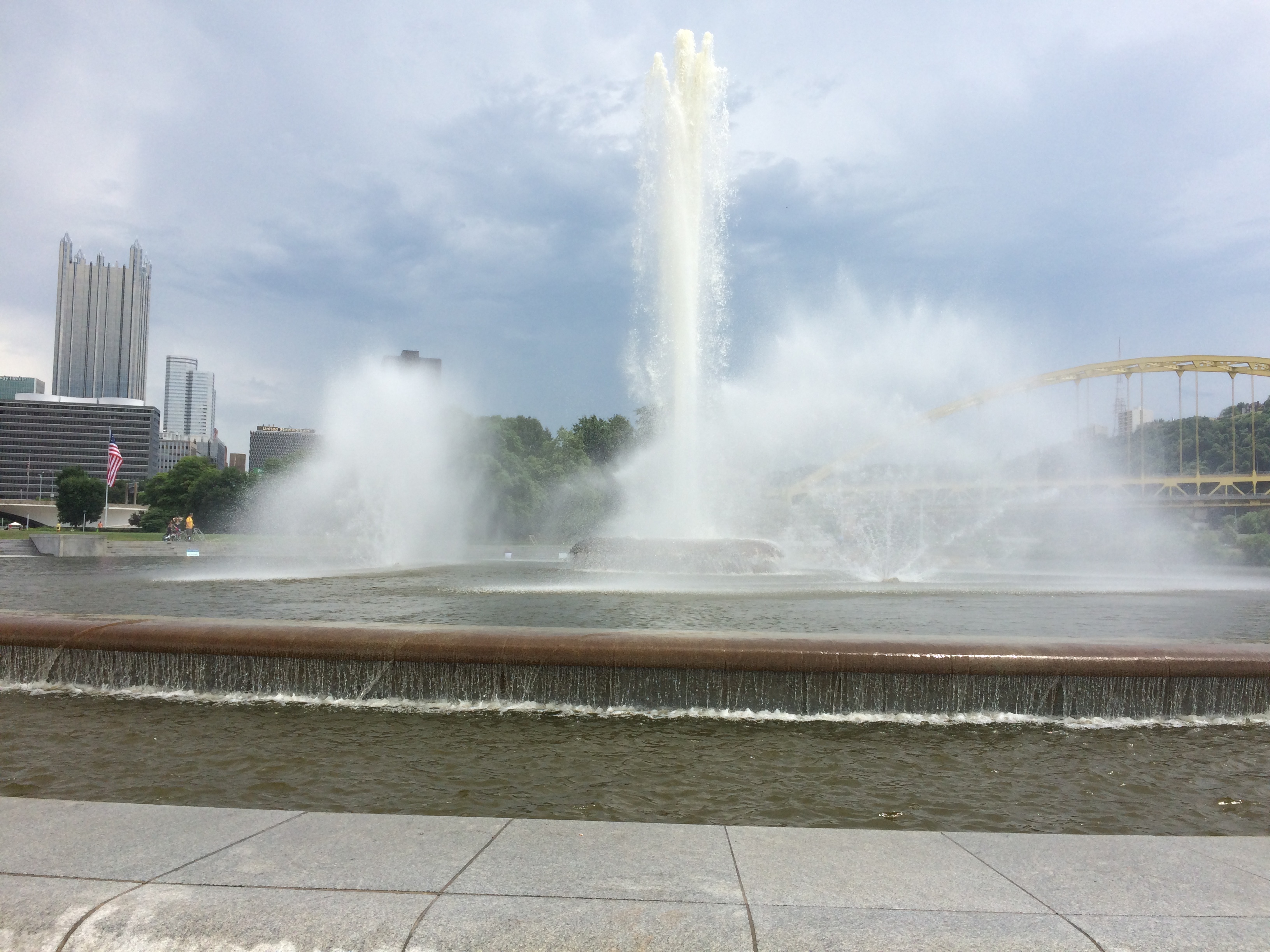
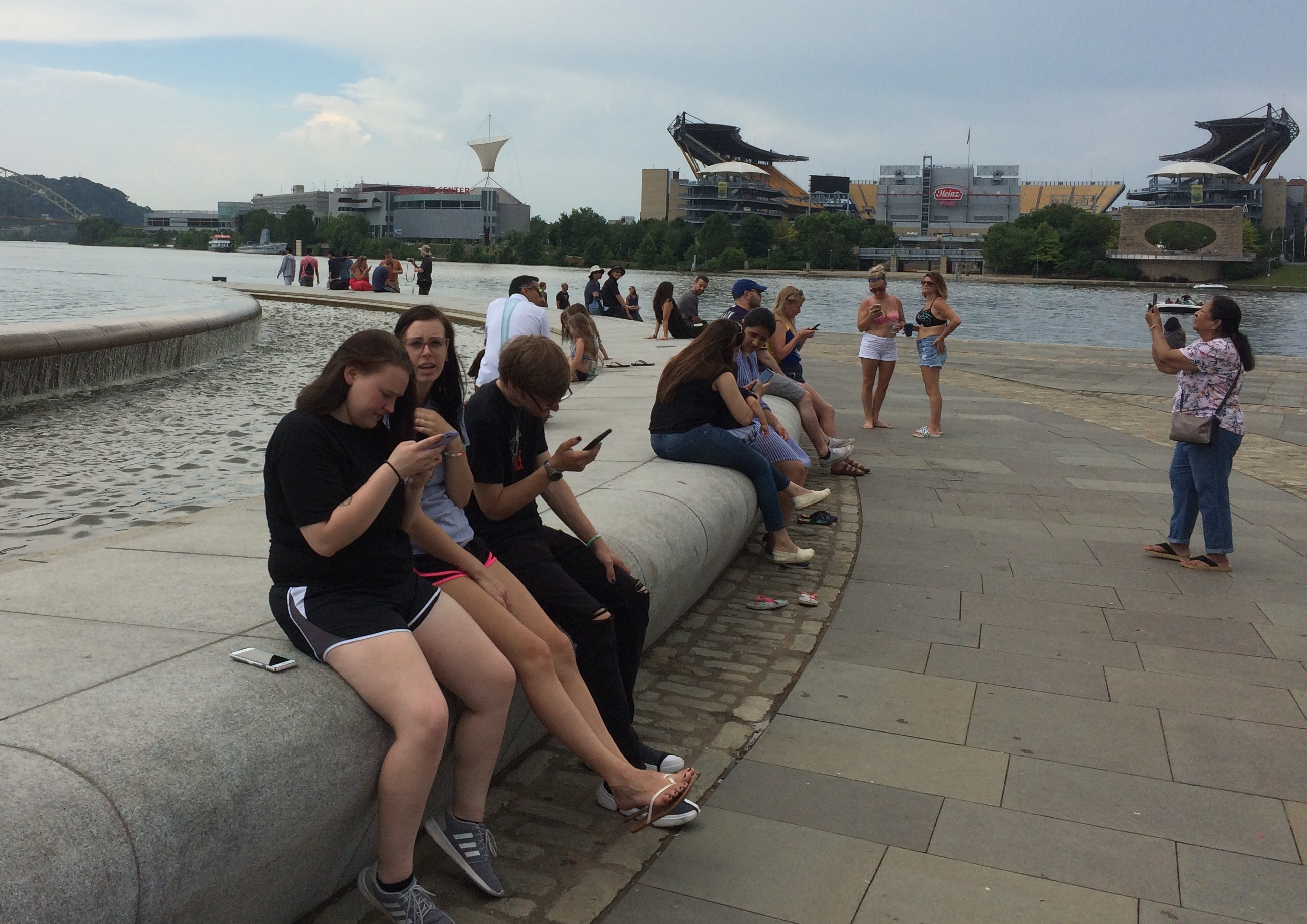
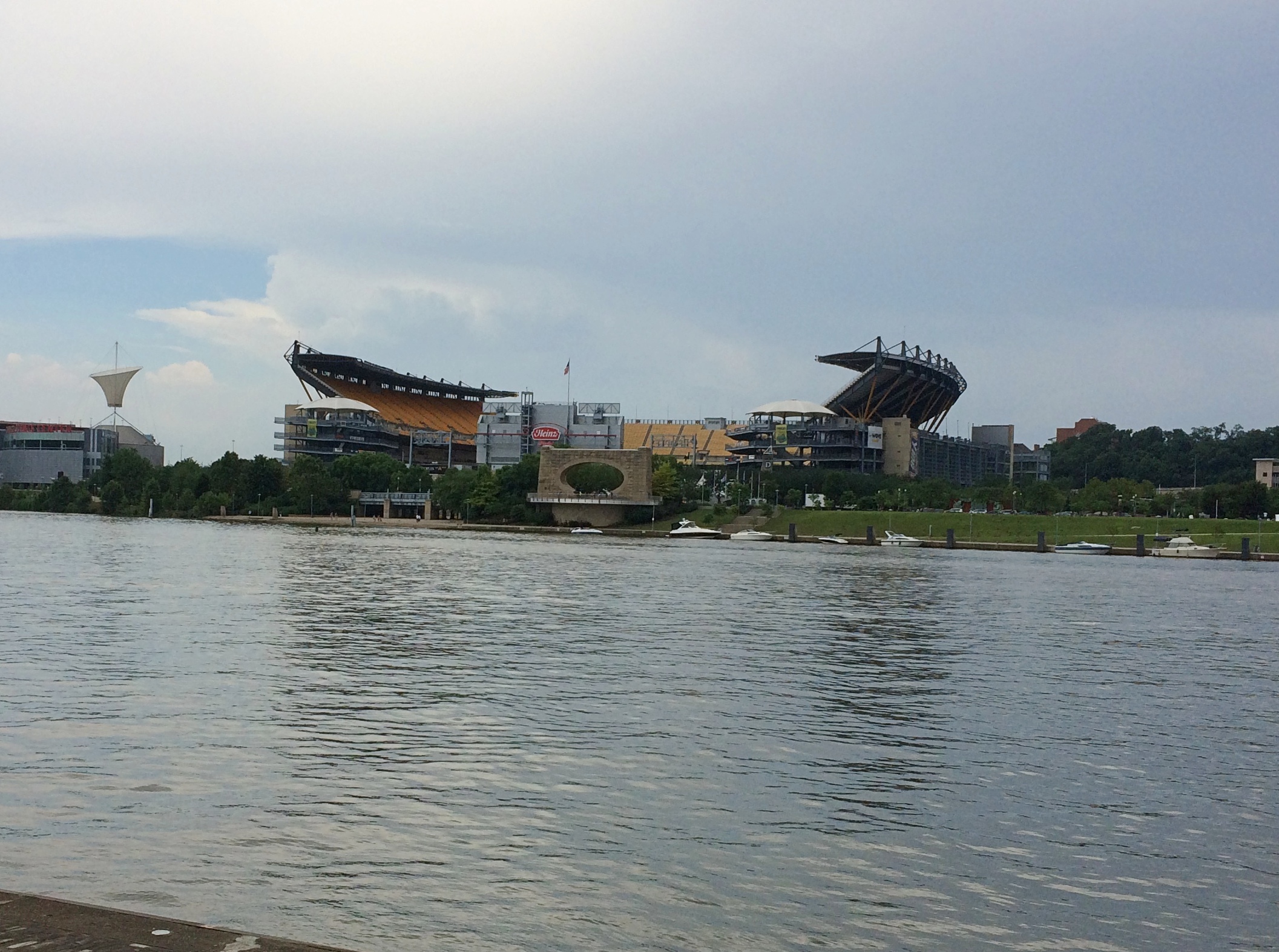
The Duquesne Incline

A hundred years ago, hilly Pittsburgh had a lot of operational funiculars: the Castle Shannon Incline, Castle Shannon South Incline, Duquesne Incline, Knoxville Incline, Monongahela Incline, Monongahela Freight Incline, Mount Oliver Incline, Norwood Incline, Penn Incline, and the St. Clair Incline.

Yet others had already come and gone by then: the Bellevue Incline, Clifton Incline, Fort Pitt Incline, H.B. Hays and Brothers Coal Railroad, Nunnery Hill Incline, Pittsburgh and Castle Shannon Plane, Ridgewood Incline and the Troy Hill Incline.

That’s enough for a whole chapter of a coffee table book: Great Funiculars of the World, a sequel to Great Elevators of Europe. The designer of most of them was one man, Samuel Diescher, a Hungarian who came to America in 1866 and did an exceptional number of engineering projects during his career.

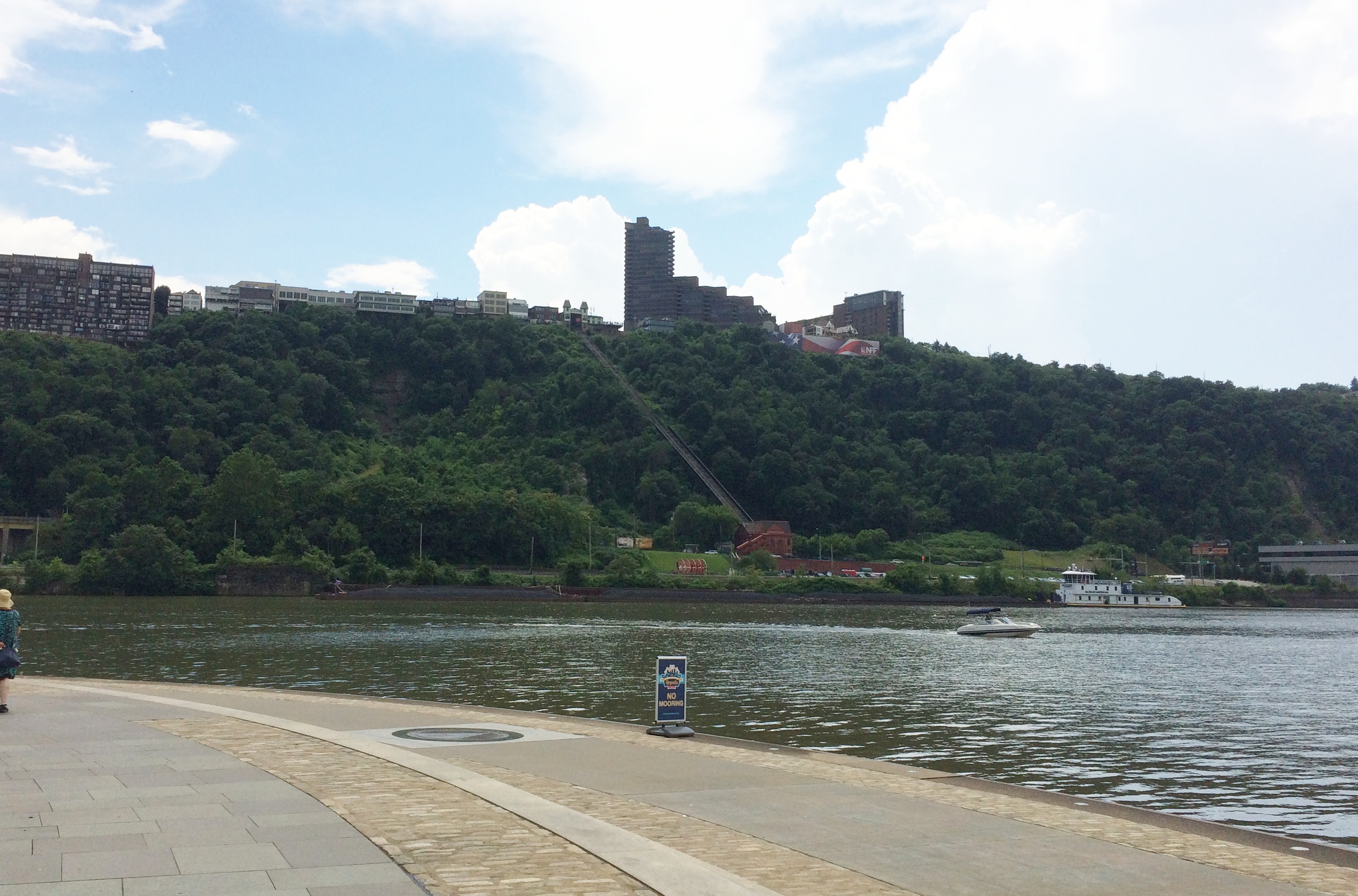
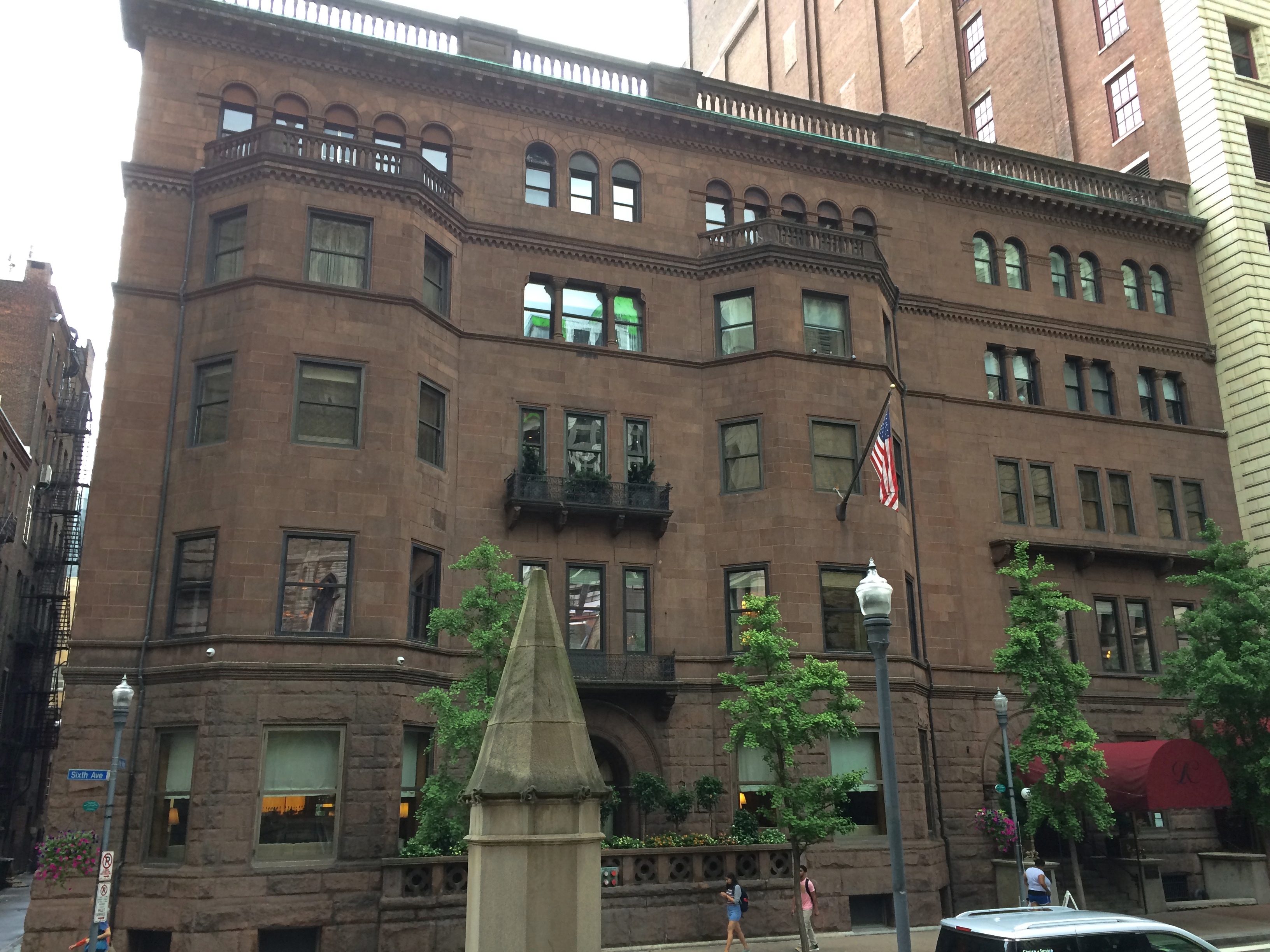
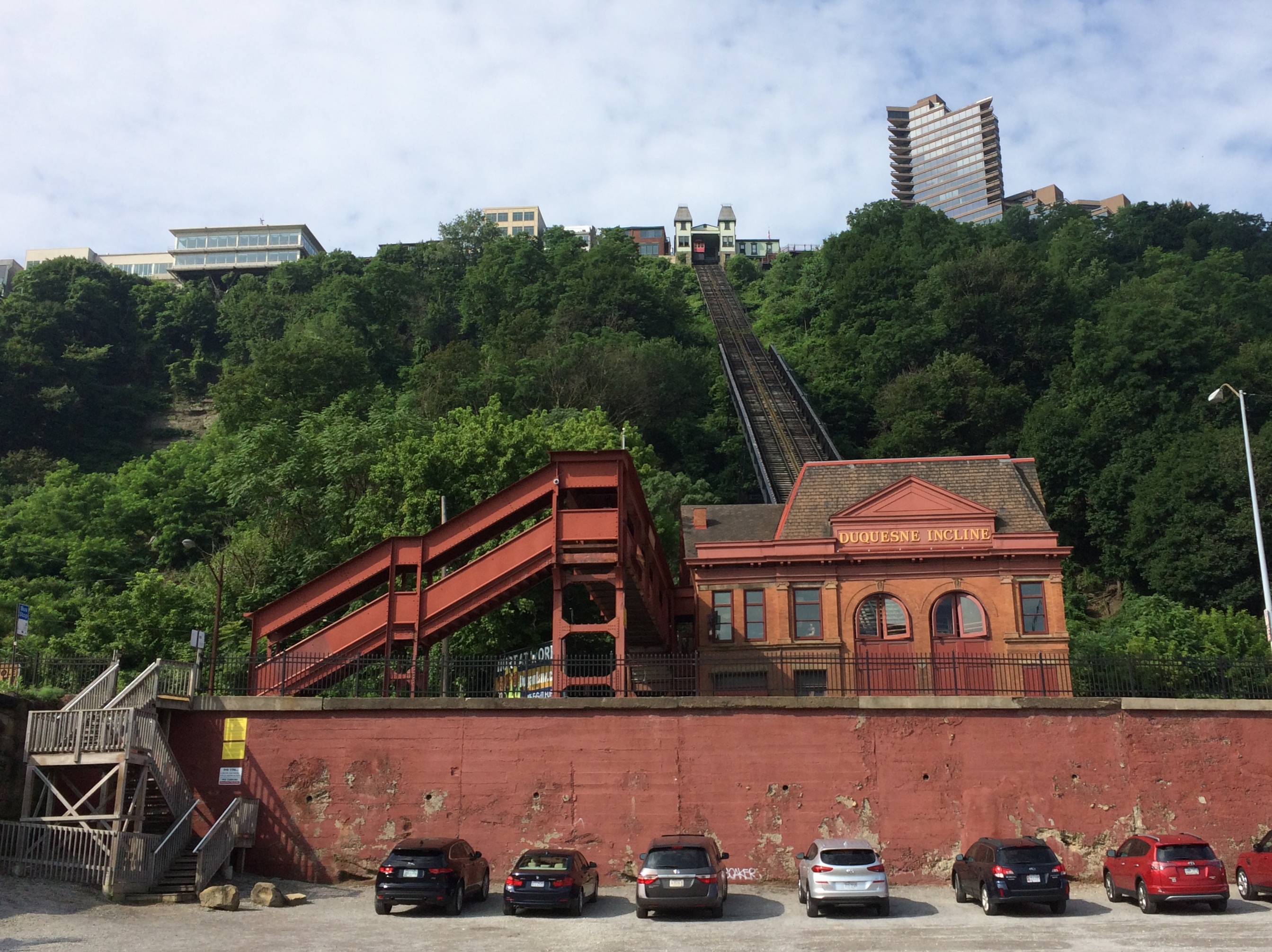
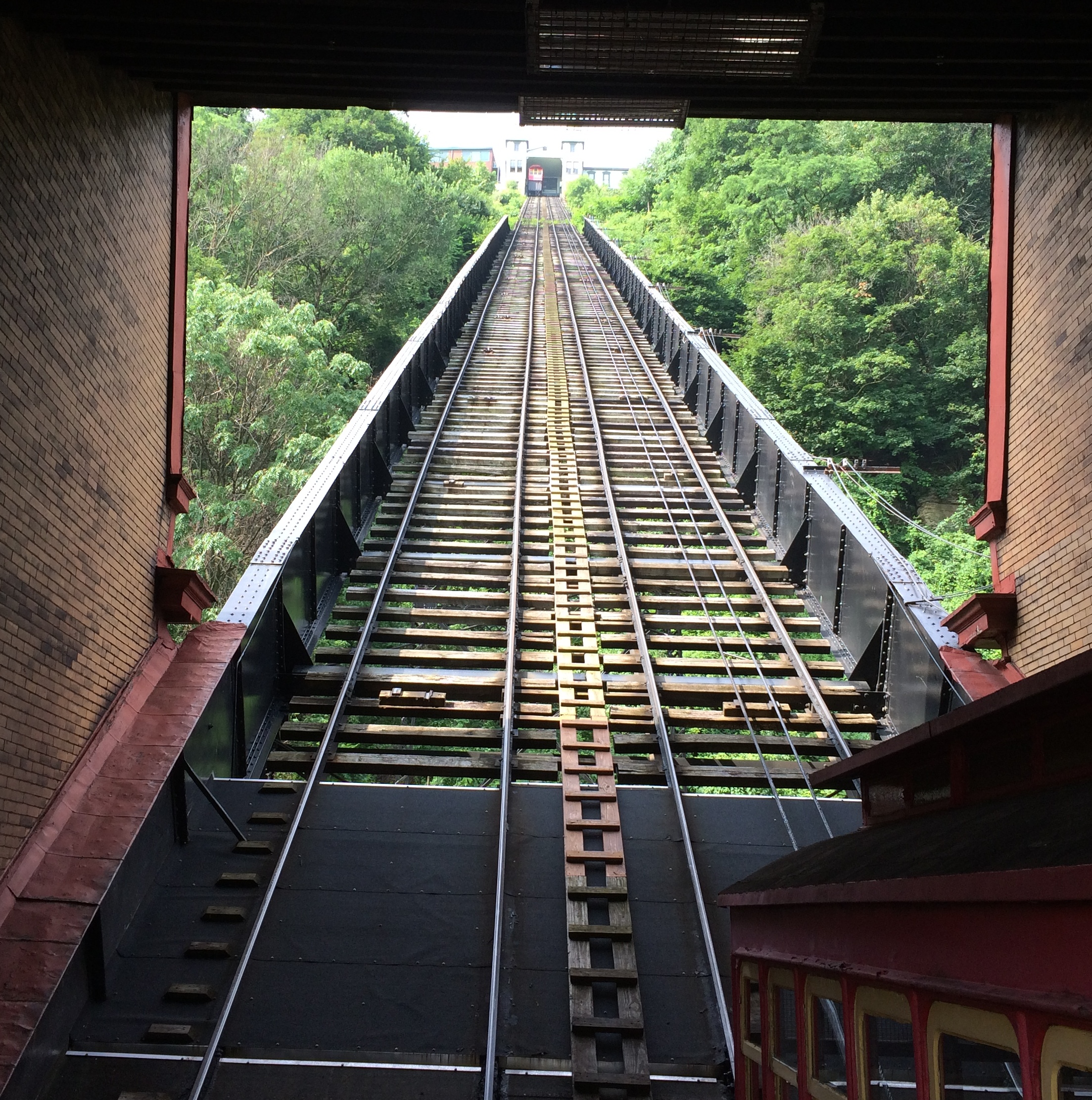
Only two funiculars survive in 21st-century Pittsburgh, the Duquesne Incline and the Monongahela Incline, about a mile apart on the slopes of Mt. Washington, to the south of downtown. We couldn’t come to Pittsburgh and not ride at least one of them, and so on mid-morning of July 5, we drove to the Duquesne’s lower-level parking lot and climbed the stairs on the left for access to the funicular.

The Duquesne, in operation since 1877 and restored in 1963, rises about 400 feet.
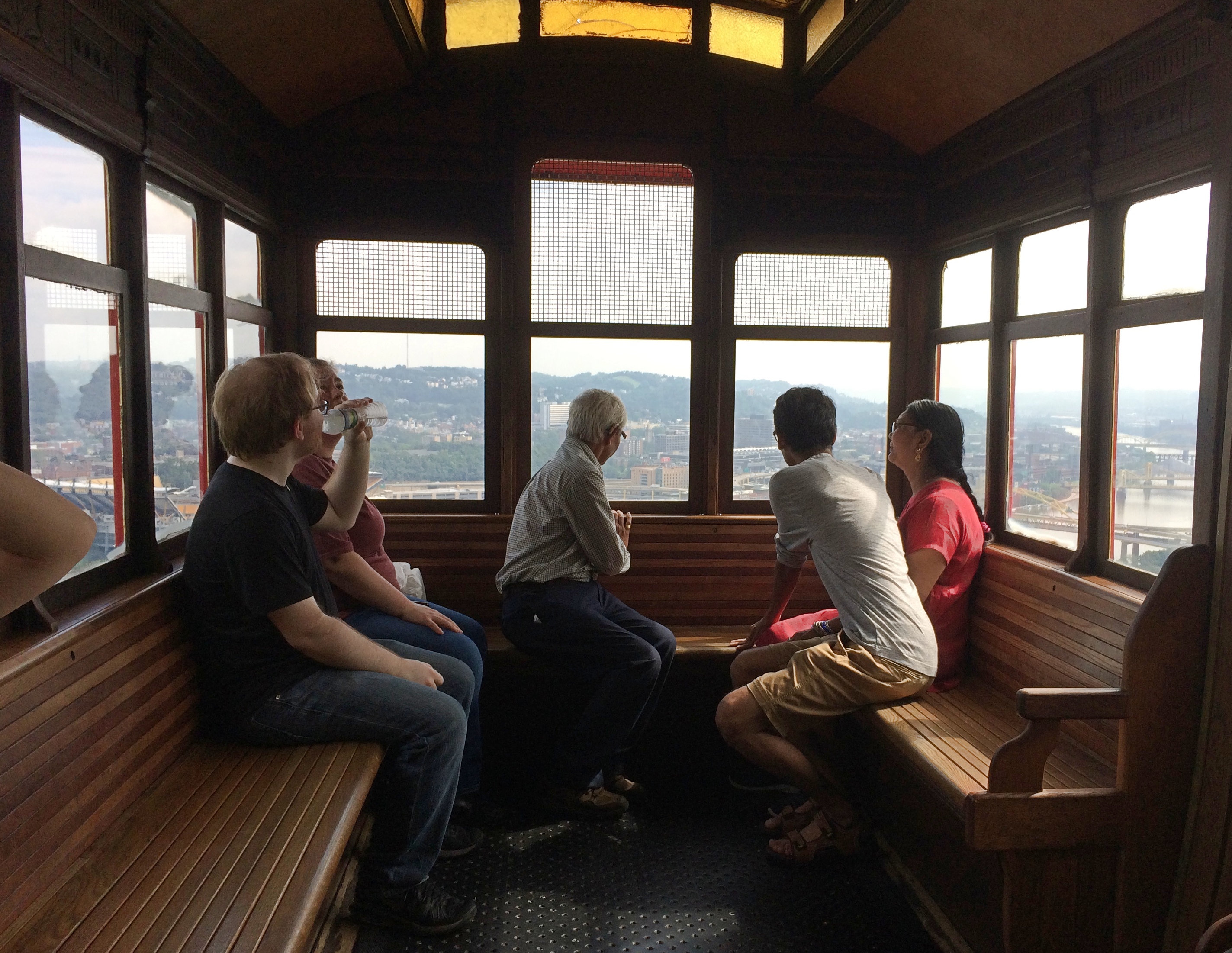
Round-trip for ages 12 to 64 is $5, and completely worth it. Though part of Pittsburgh’s transit system, on a quasi-holiday in summer, tourists seemed to be the main customers.
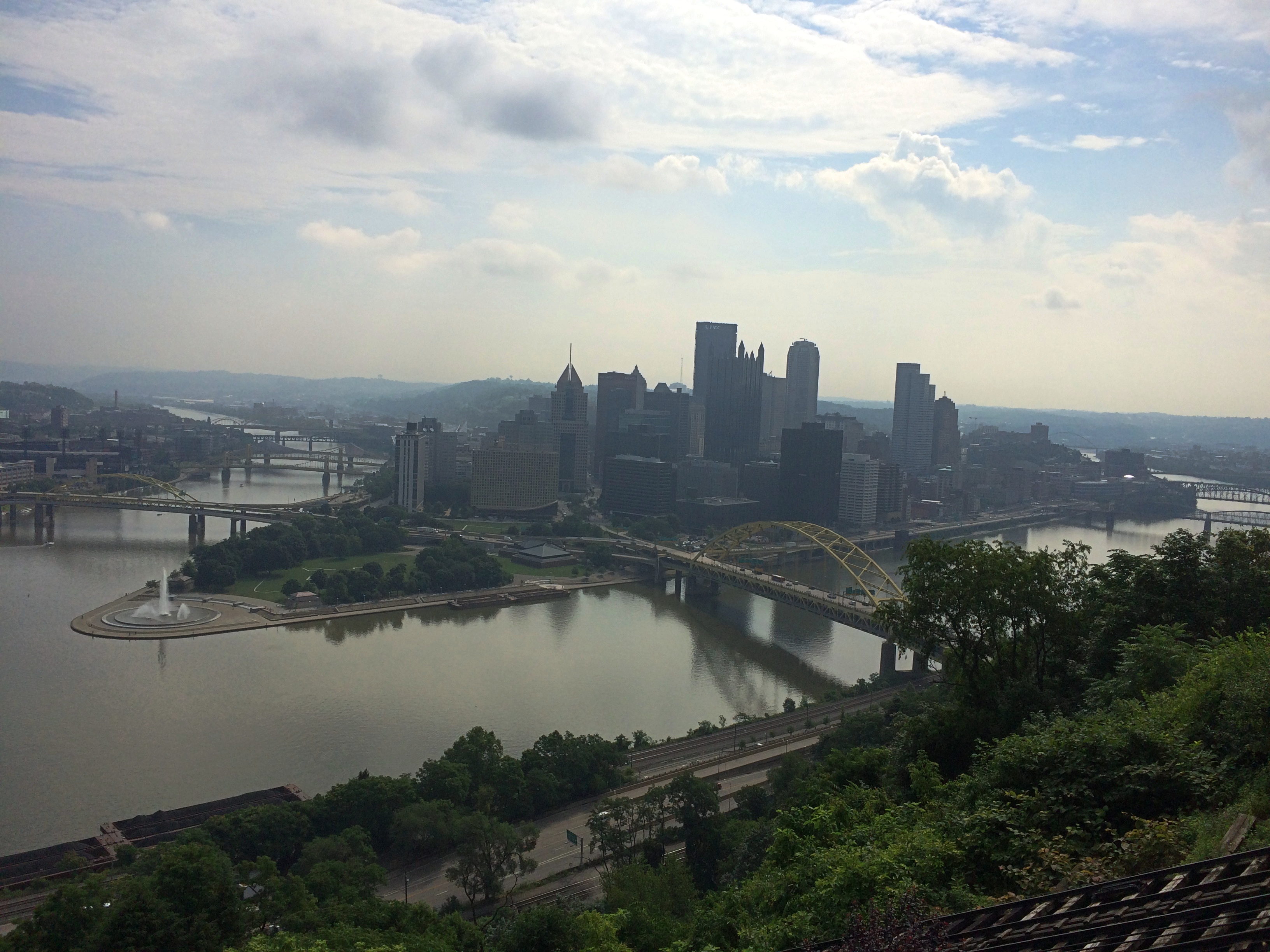
At the top is a splendid view of downtown Pittsburgh and the three rivers and their bridges, though things were a little hazy that morning. No matter.
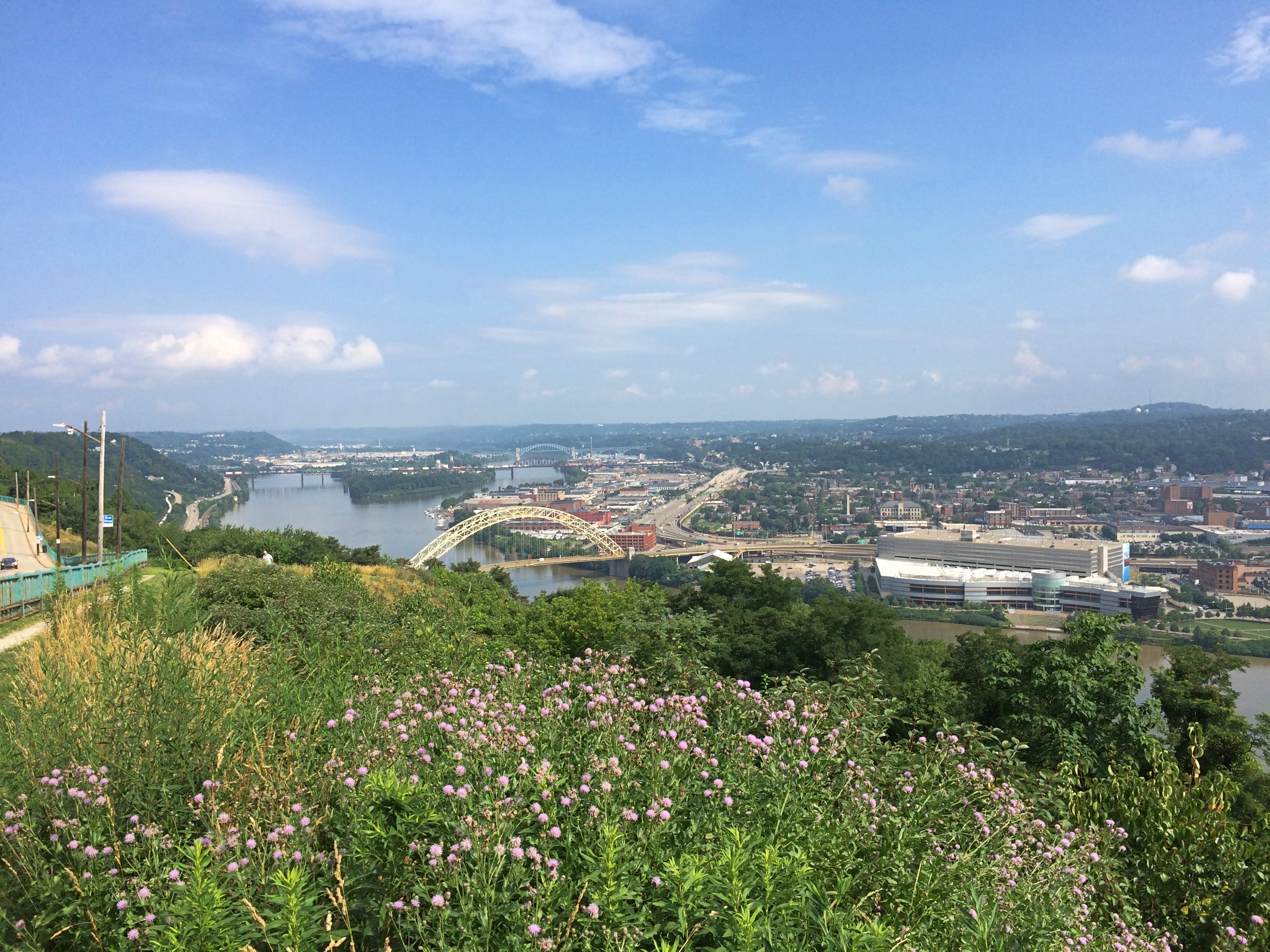
A few minutes’ walk to the west of the top of the Duquesne is the small Point of View Park. Besides offering roughly the same view of downtown, the view from the park down the Ohio is nice.
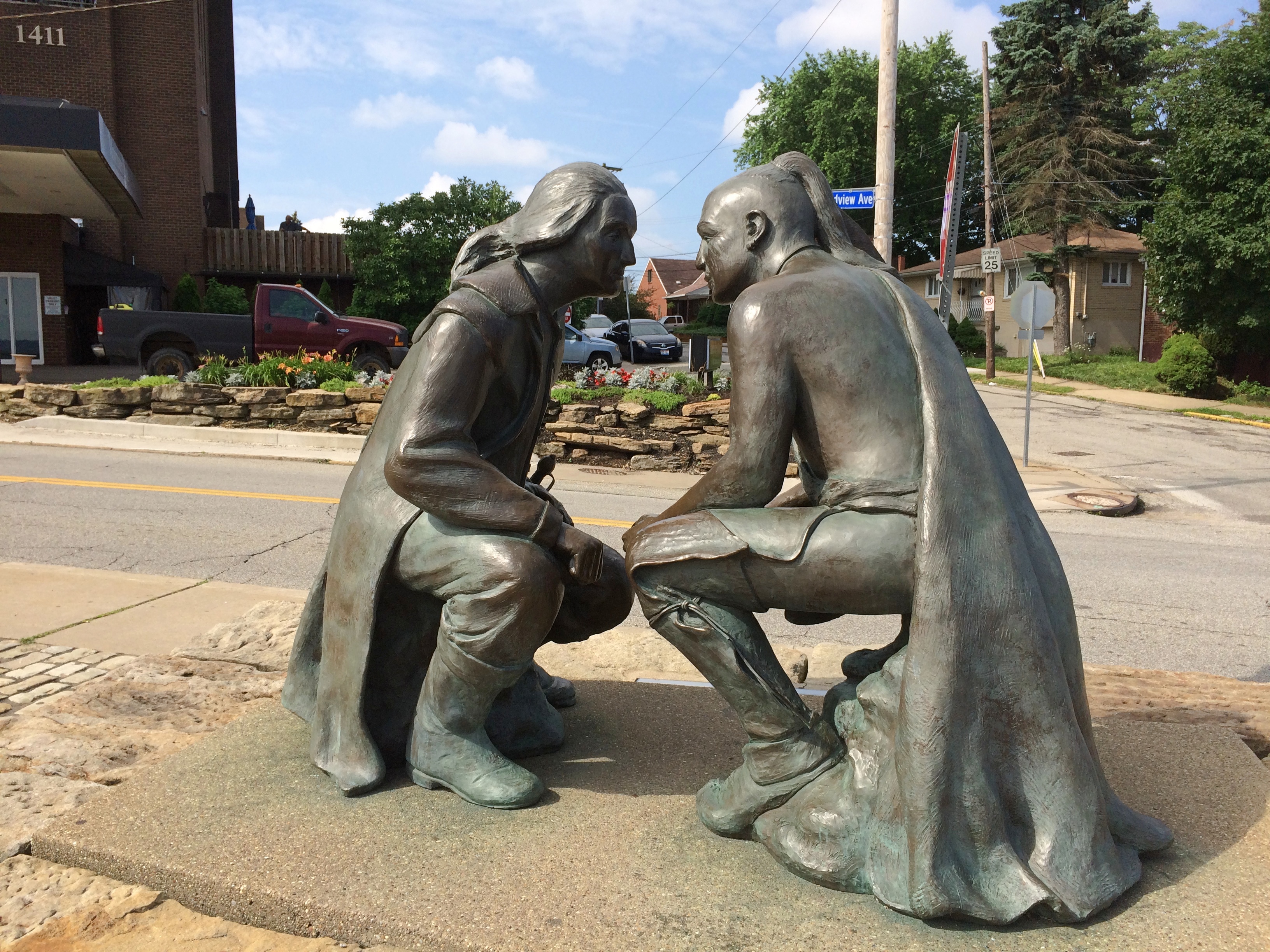
The park also features two bronzes in a curiously intimate pose: George Washington and Seneca leader Guyasuta by local artist James A. West (2006).
A nearby plaque says that “this bronze depicts a meeting in October 1770 between [Washington and Guyasuta]… this work captures a moment in time between two formidable men whose actions had a huge impact on Pittsburgh…”
Looking closely at the Wiki entry on Guyasuta, I see this detail about his name: “The many spelling variations include Guyashuta, Guyasoota, Guy-a-soot-er, Guyasootha, Guyasotha, Guyasutha, Kayashota, Kayasota, Kayasutha, Keyashuta, Kiasota, Kiashuta, Kiasutha, Kiosola, Kiyashuta, and Kyasoota.”

Louisiana Capitol Views 2009

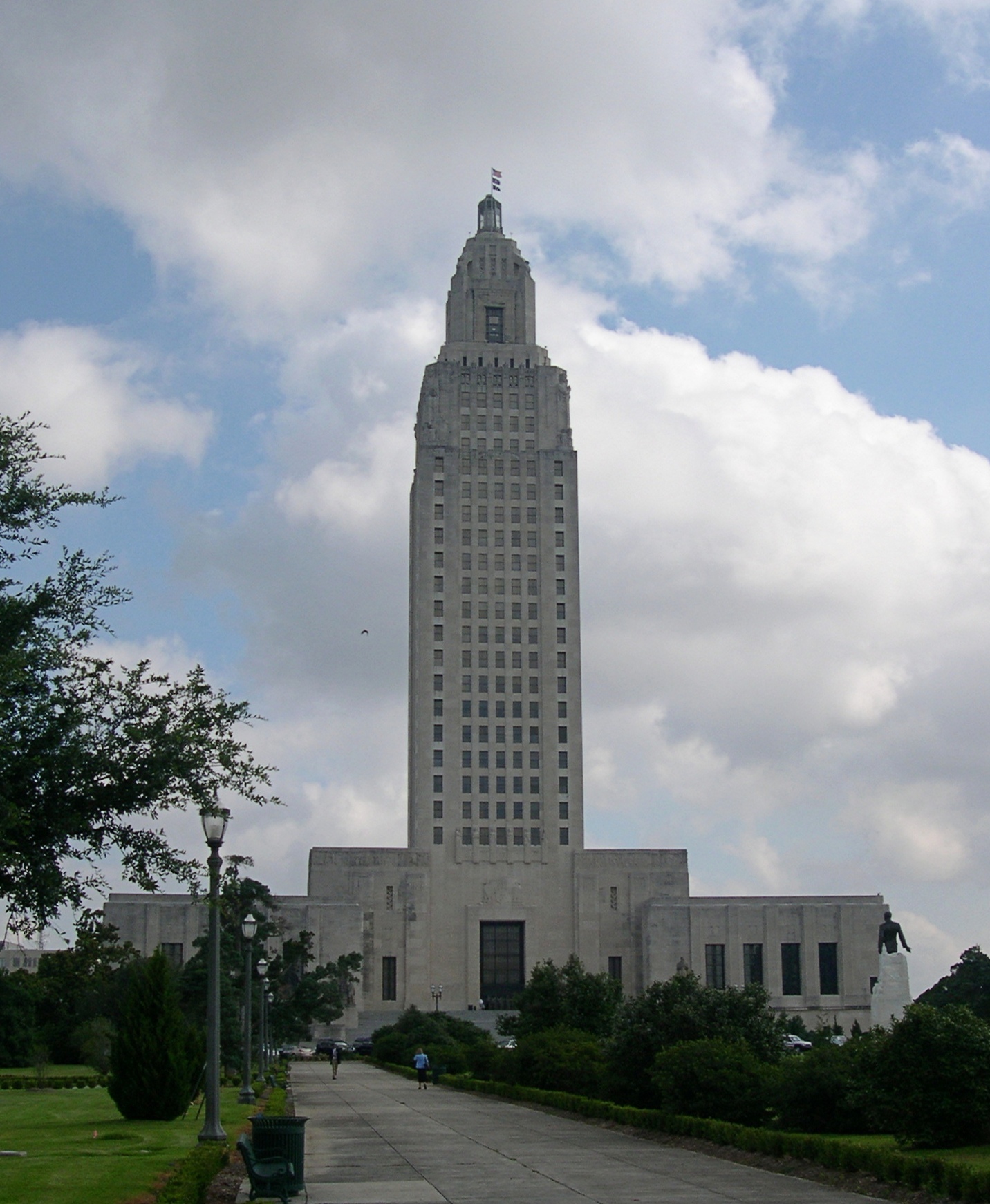
This year’s loop around the South was something like the loop I drove 10 years ago, but with key differences. For instance, I was by myself that time, and bypassed such places as New Orleans and Nashville. Instead I spent time in smaller places, such as Lafayette and Baton Rouge. In the capital, I visited the house — the state house — that Huey Long built, Louisiana’s art deco state capitol.

It’s a handsome building. Long hired a Louisiana architect, Leon C. Weiss, to design the building. No relation to his assassin Weiss, apparently.

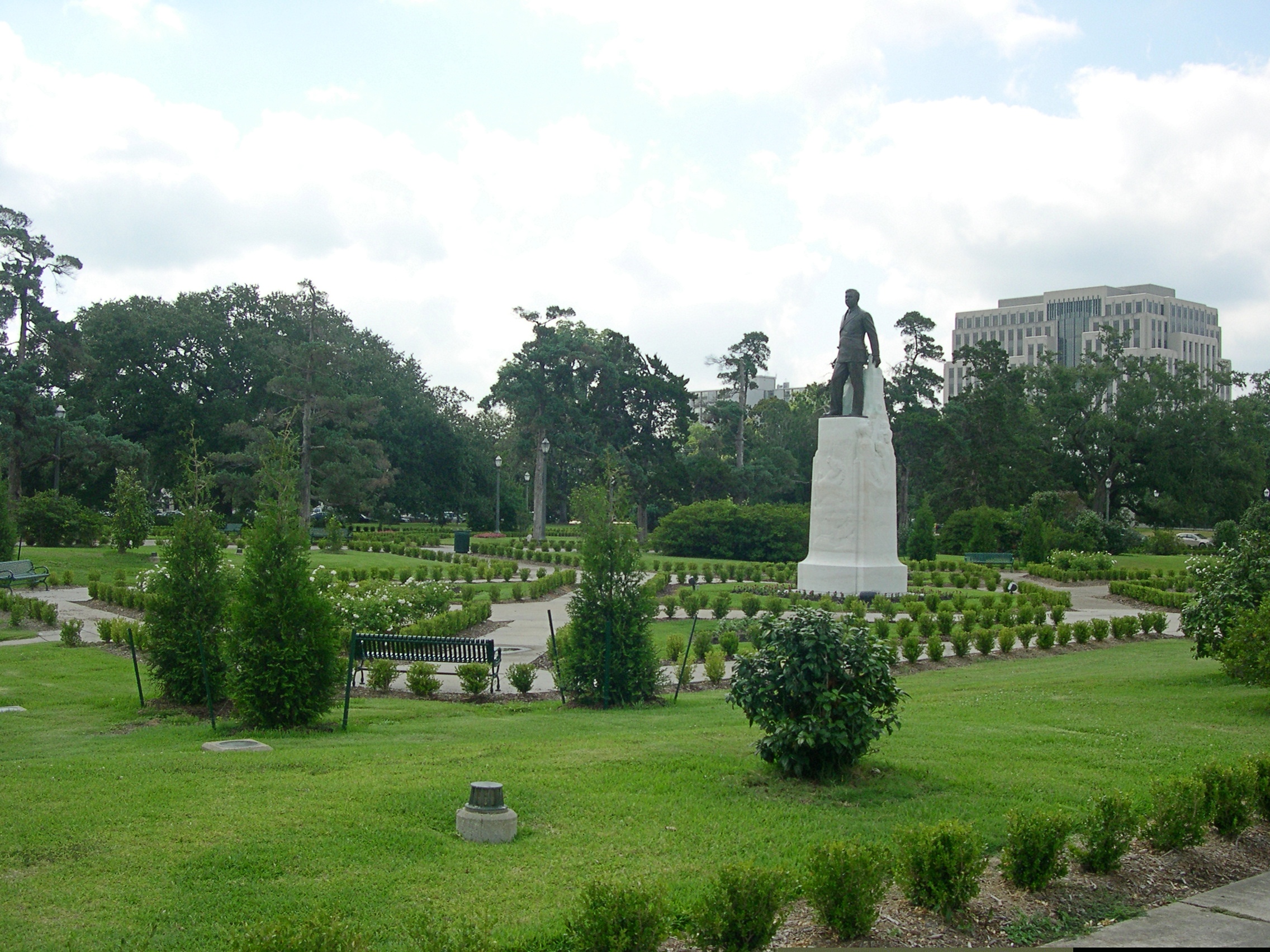
The garden front of the capitol, whose centerpiece is a memorial to the Kingfish, is also a cemetery with one occupant, Huey Long himself.

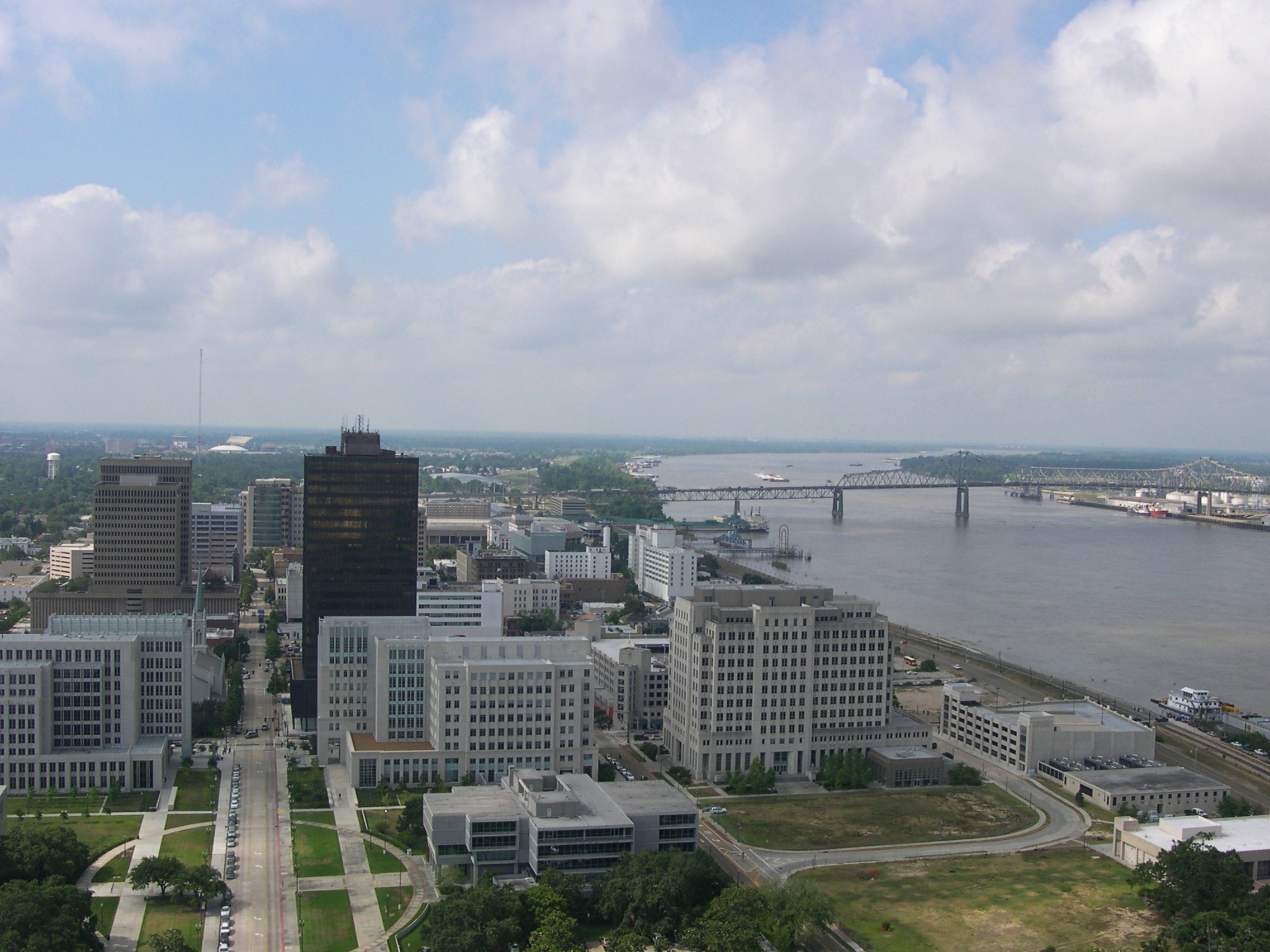
Louisiana Capitol - Long GraveThe observation deck on the capitol’s 27th floor, which charged no admission when I was there, has some splendid views of the Mississippi and the city.

Looking south toward downtown Baton Rouge.
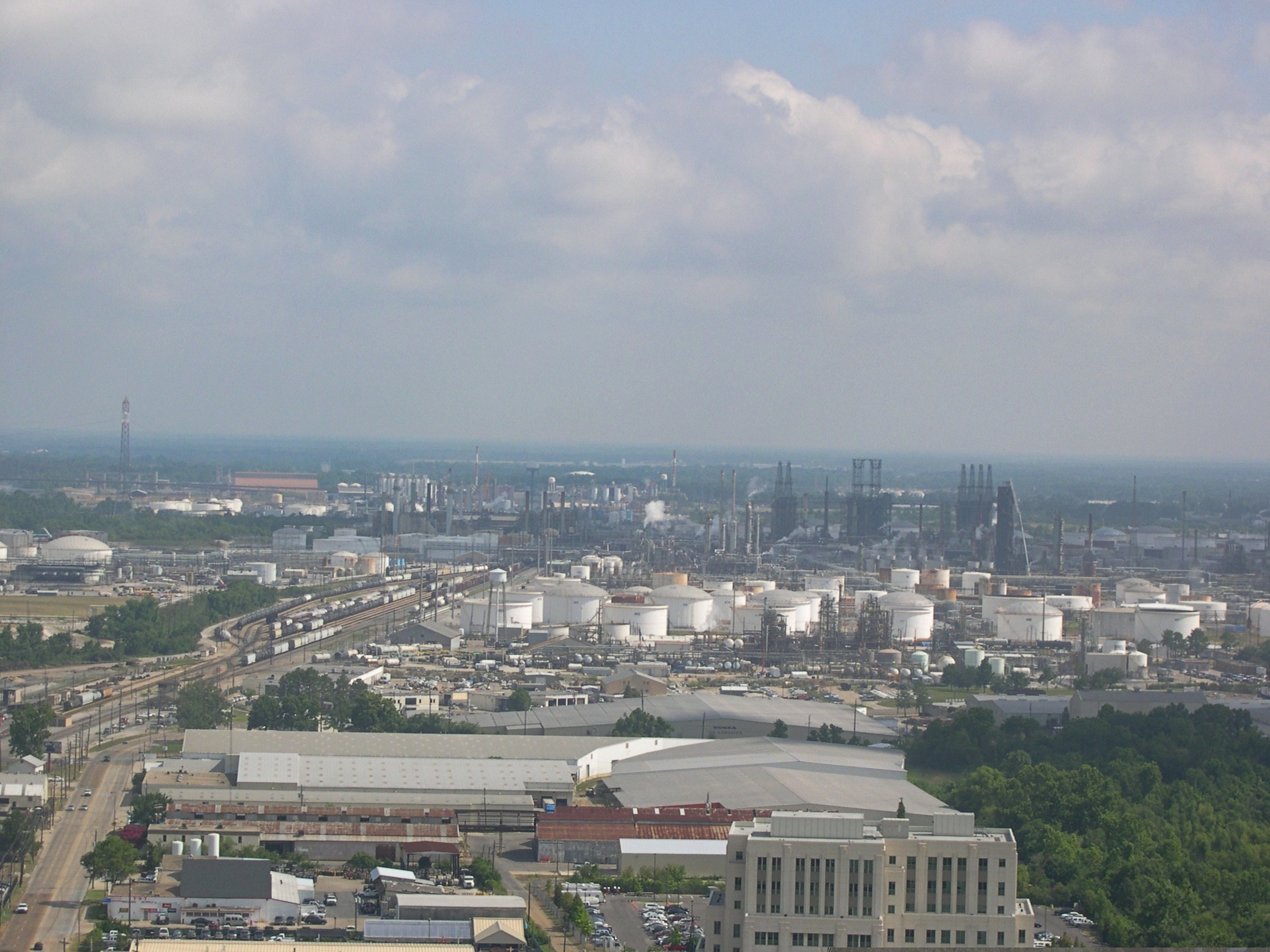
Louisiana Capitol - downtownNorth toward industrial Baton Rouge.
Petrochemicals. In fact, much of the view is taken up by ExxonMobil’s Baton Rouge Refinery, one of the nation’s largest such facilities.

Natchez &c.

When we left New Orleans to drive to Natchez, Mississippi, on May 15, the uninspired route would be have been I-10 to Baton Rouge and then north on US 61. Instead I wanted to drive across Lake Pontchartrain, because I’ve seen that crossing on maps for years. Better yet, it’s no extra charge, since the Lake Pontchartrain Causeway collects no toll northbound.

The morning was bright and traffic light on the causeway. It’s actually two bridges, one each way, so you don’t face miles and miles of unavoidable oncoming traffic mere feet away. An enjoyable stretch of road under those conditions. Uneventful enough driving to ponder the engineering marvel that’s the causeway while still on it.

Before going, I wondered if there would be a few minutes on the causeway when we would be out of sight of land. I’d read claims to that effect. But the answer is no, not that I saw. I spotted the north shore of the lake in the distance before the south shore had completely vanished from my rear-view mirror. Once you get to the other side of the lake, you’re in Mandeville, Louisiana. I-12 from there connects with US 61 in Baton Rouge.

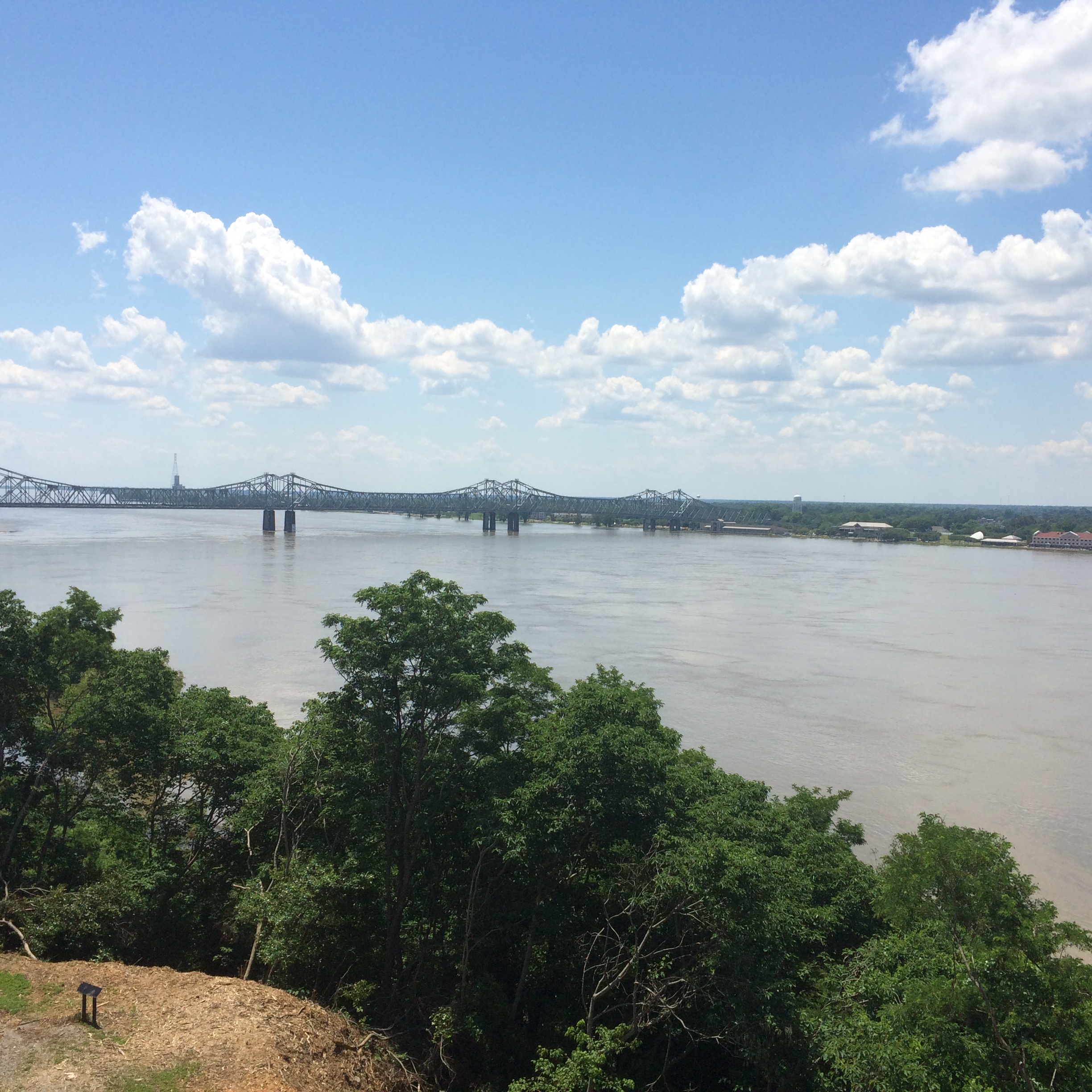
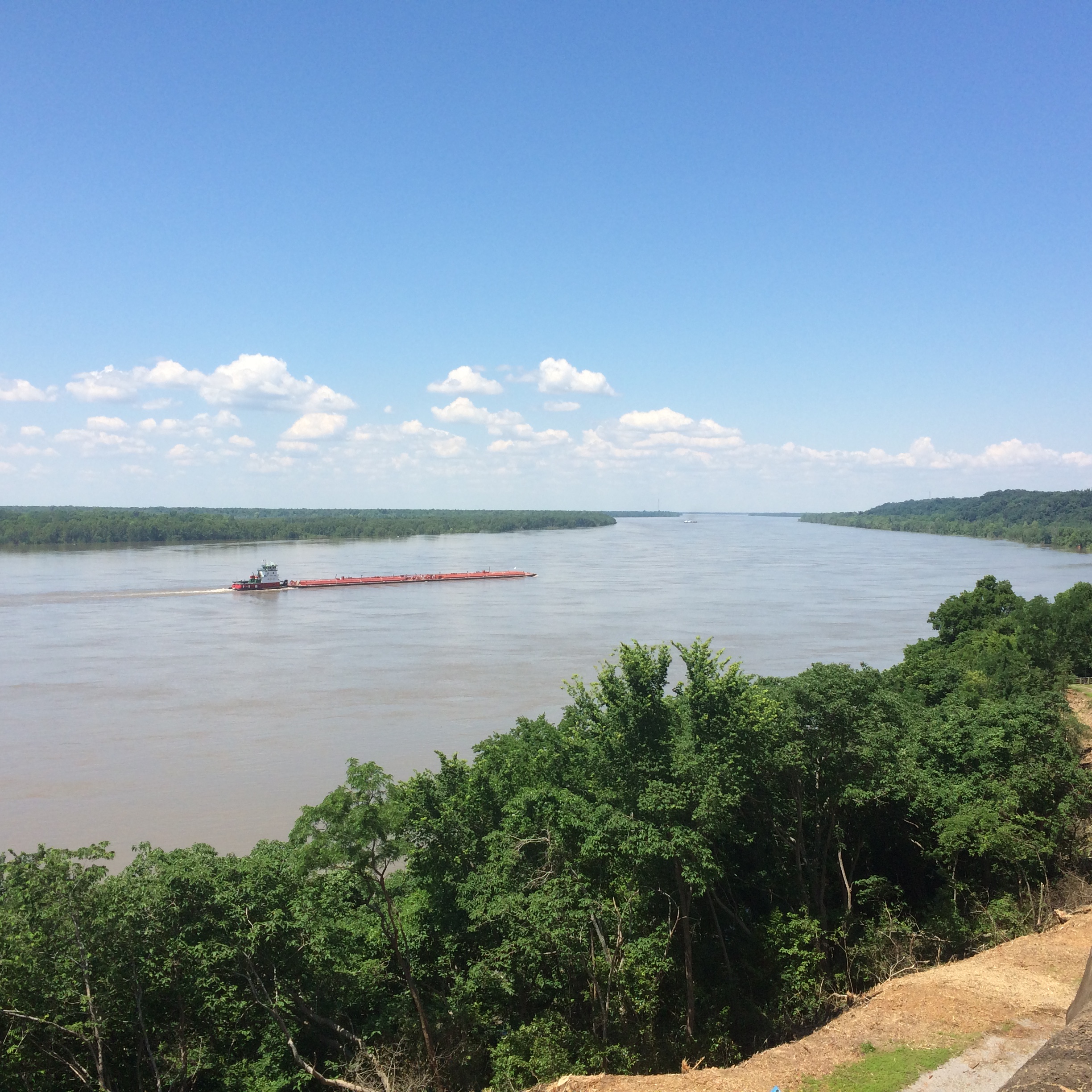
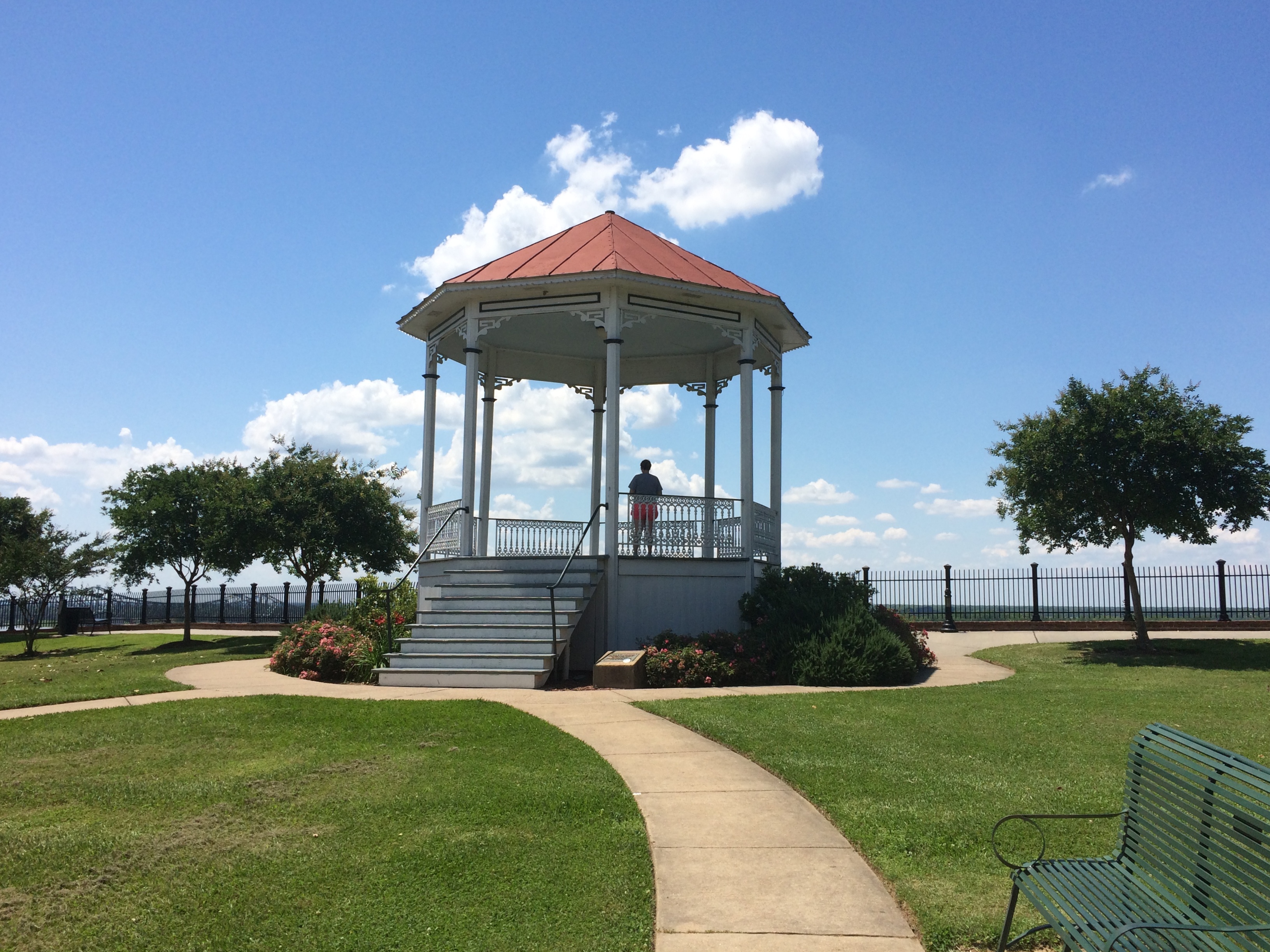
By early afternoon, we were in Natchez, Mississippi. The town has some good views of the Mississippi River from a park on the bluff.
The local gazebo.
It was too hot to wander around in the noonday sun for long. We decided not to tour one of the local antebellum homes, but rather spend the afternoon heading further north on the Natchez Trace Parkway to seek out antebellum ruins instead.

Lilly drove part of the way on the Trace and I played with my camera.

Others might find the driving dull, but I like driving the Trace for its lush greenery, and also its sparse traffic. No trucks at all.

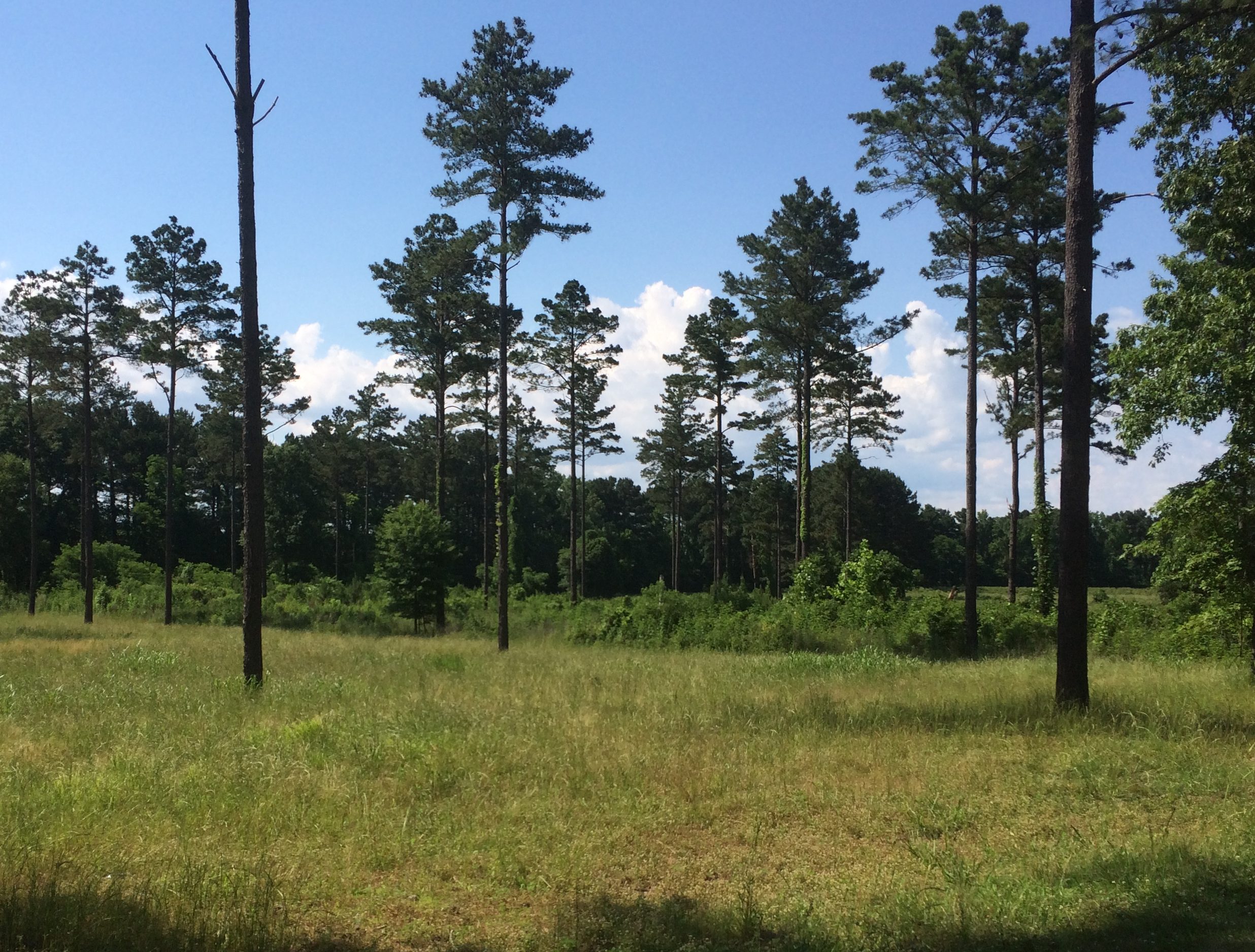
We took a diversion off the Trace before going to Port Gibson and on to Jackson, along a winding country lane called Rodney Road. Go far enough on that road, and you’ll come to the Windsor Ruins.
I can’t remember where I read about the ruins, but the place has been filed under my Possible Minor Destinations for a good while. That’s such a sprawling, unorganized mental catalog of places that it’s a wonder that I ever remember to take the right detours at the right time.

We were the only ones there once another car left a minute or two after we arrived. Considering that the ruins used to be the heart of an enormous plantation, it’s remarkable how lonely the spot now feels. History has passed it by.

The view from the ruins.
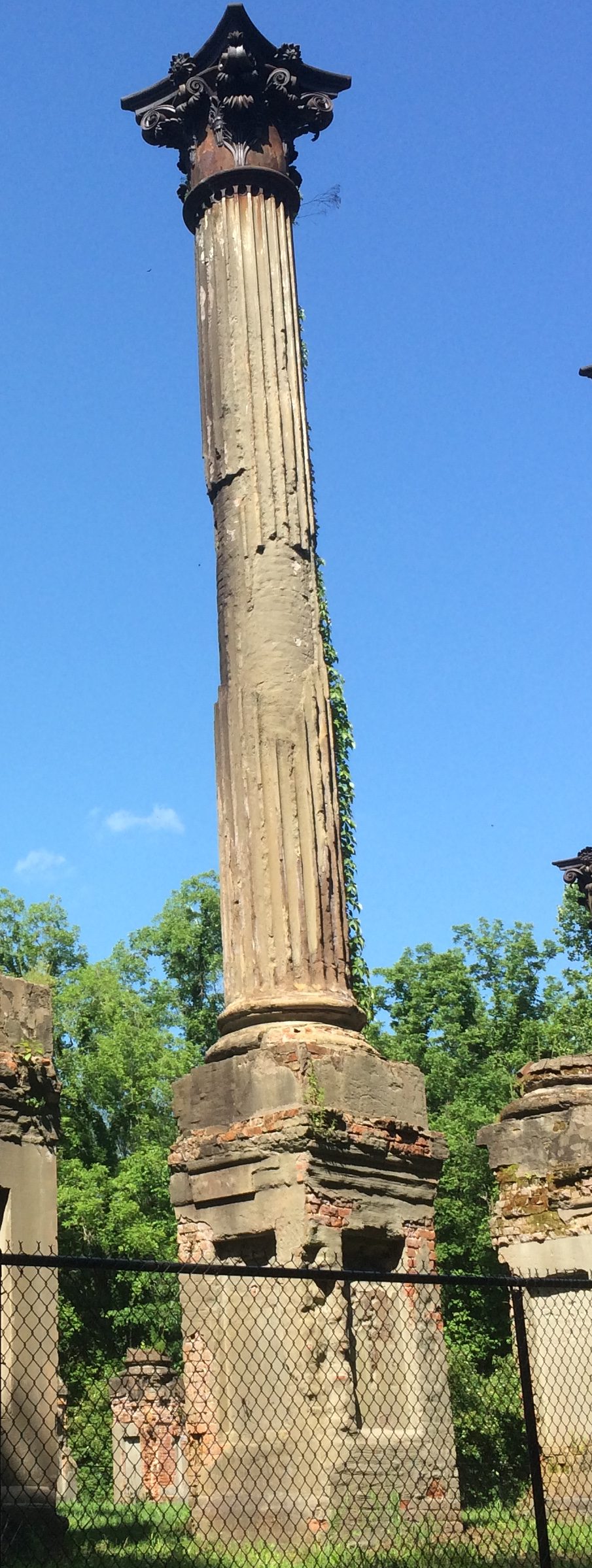
“Windsor, built between 1859 and 1861, was the home of Smith Coffee Daniell II, a wealthy planter who had extensive properties in the Delta and in Arkansas,” the NPS says. “Completed in 1861, the home was the largest house built at that time [in Mississippi], the plantation once covering over 2,600 acres.

Curiously, Daniell died on April 12, 1861. The mansion survived the war, probably because the Union army used it as soon as the area had been captured, but it burned down by accident in 1890.

The fence is fairly new, added by the state, which now owns the site. Guess the state of Mississippi doesn’t want any of the 23 massive Corinthian columns coming down on any hapless visitors. They’re looking a little dodgy.

The Chicago Riverwalk ’19

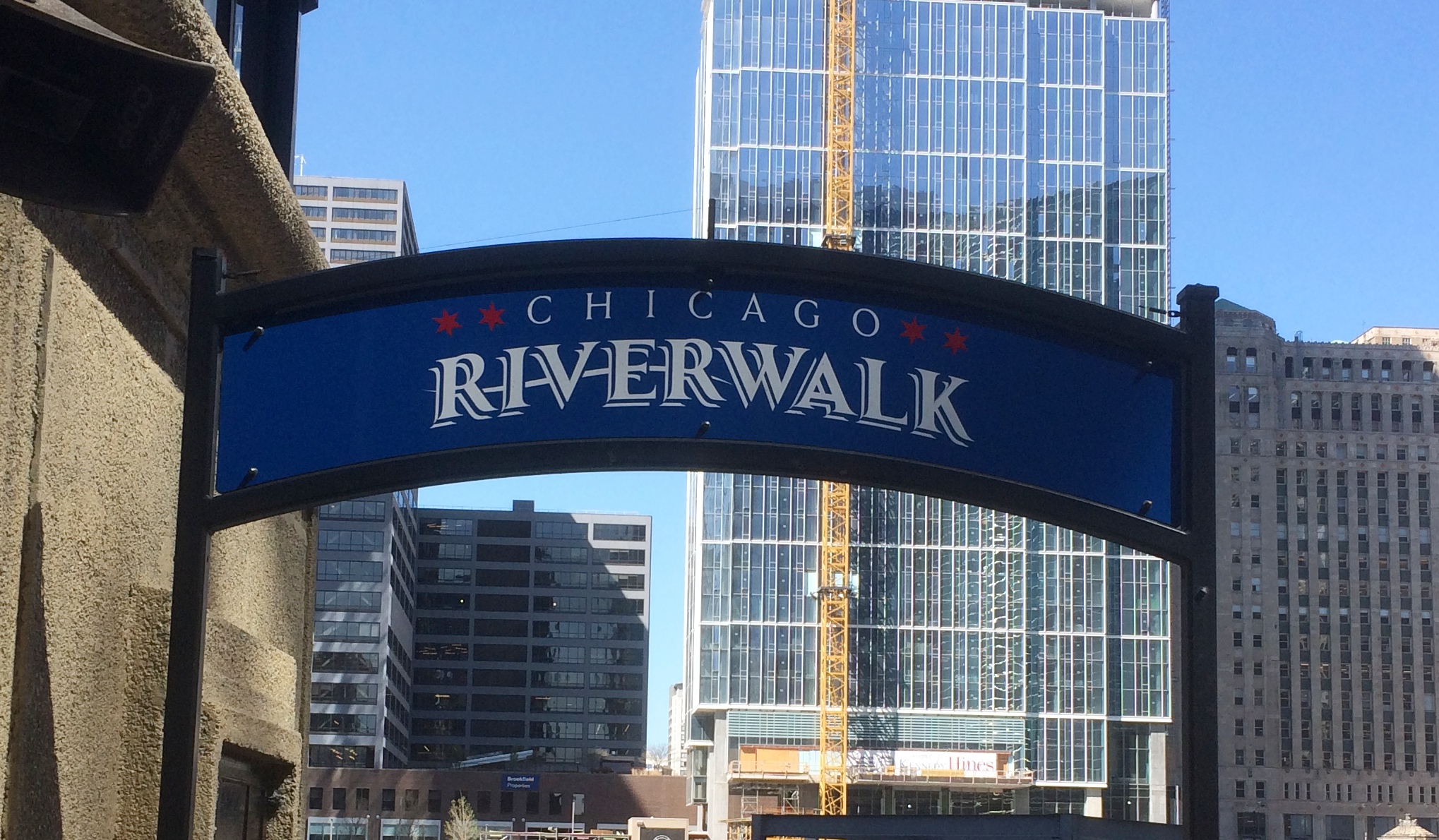
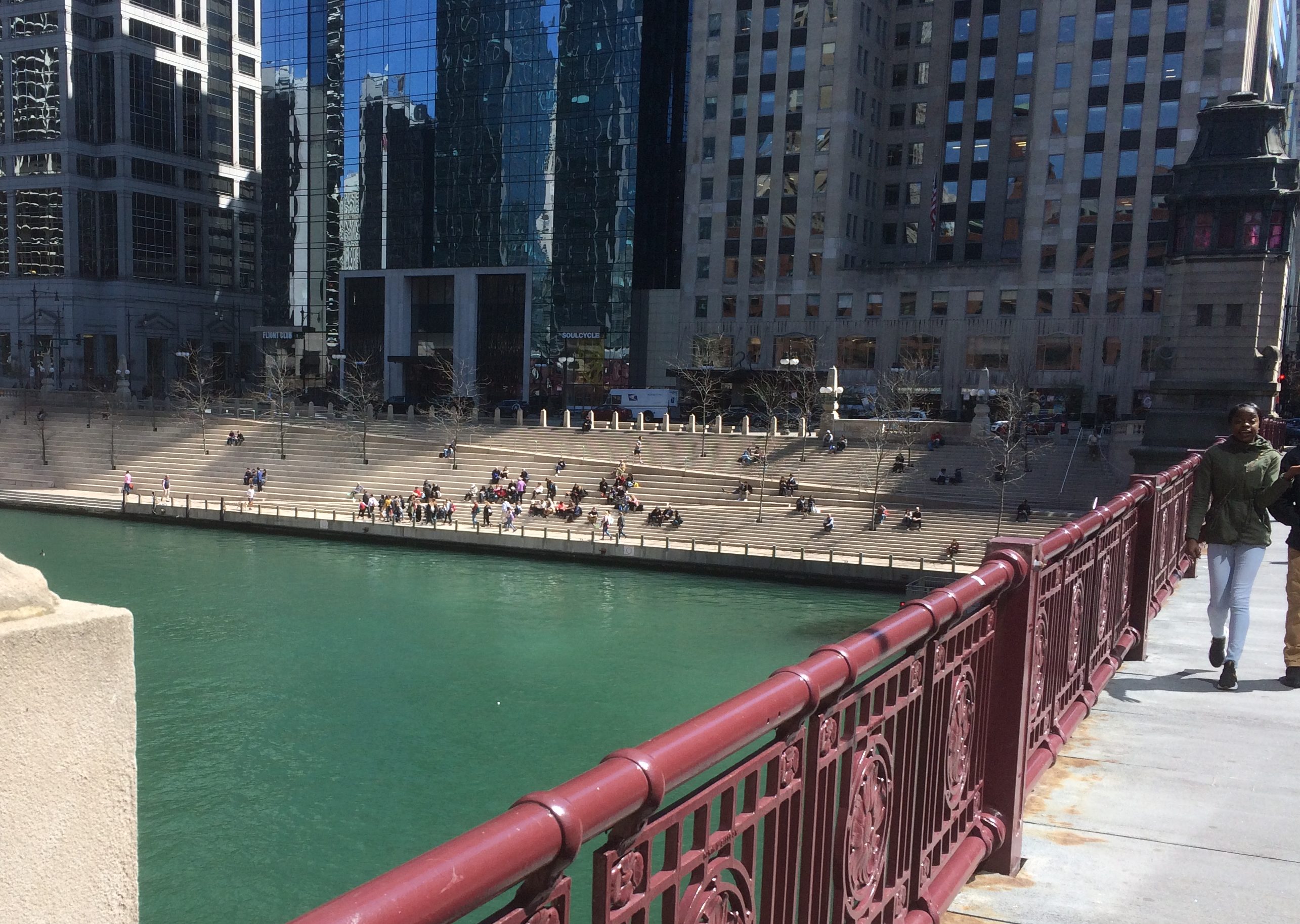
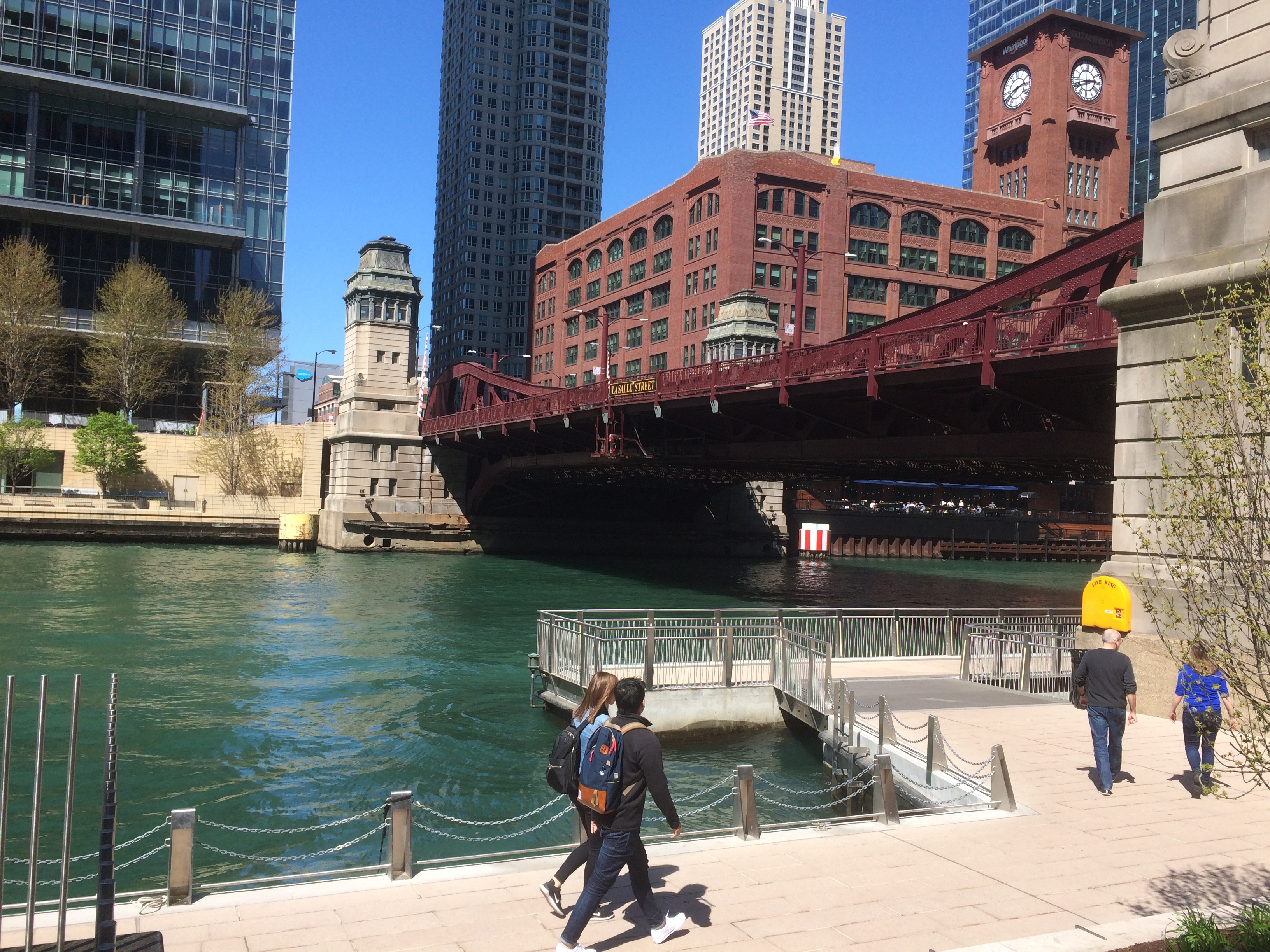
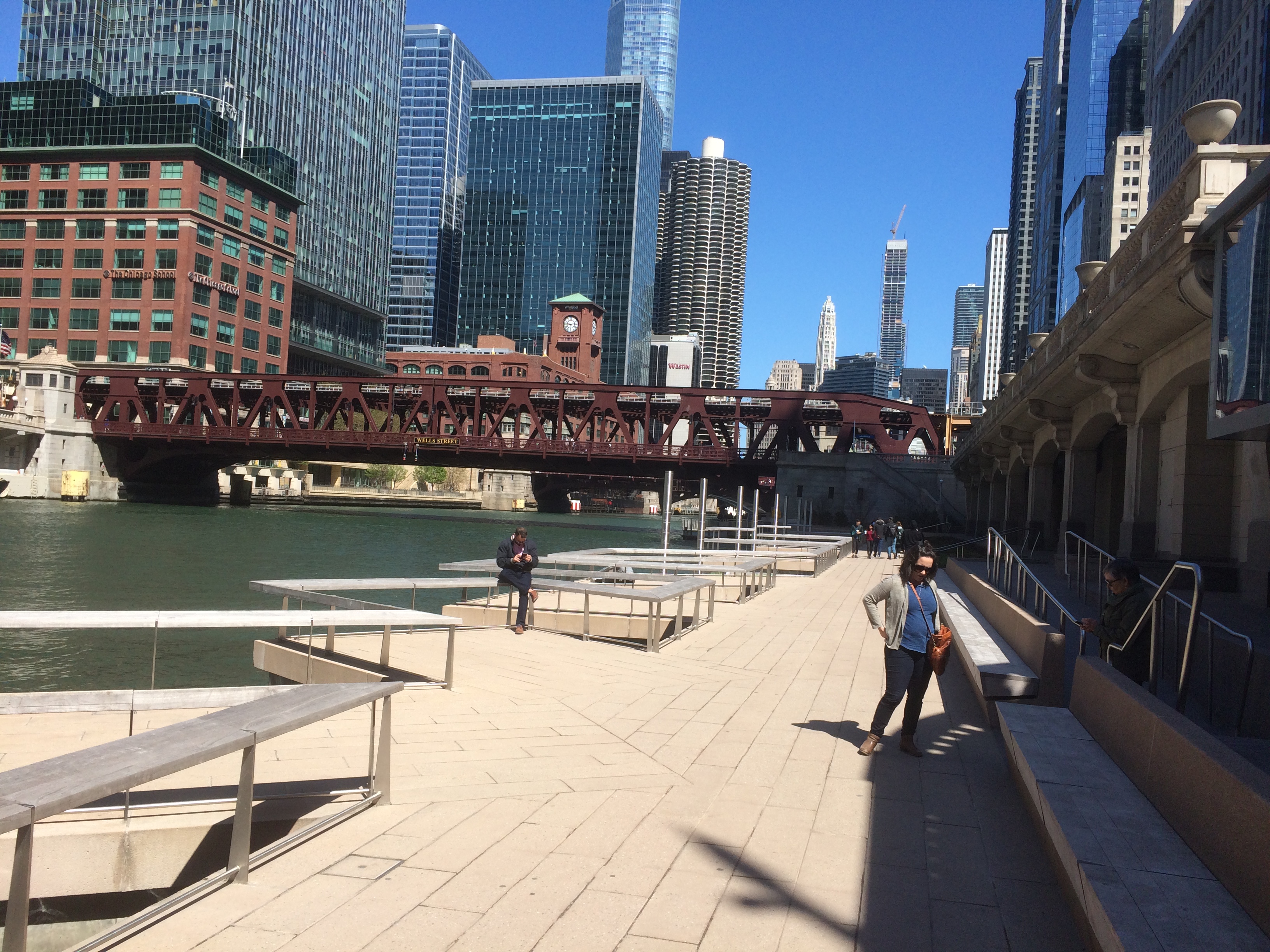
Returning from my appointment on Friday, I took a walk along the Chicago Riverwalk — a section that wasn’t completed the last time I was paying attention — from N. LaSalle St. around to W. Lake St.

Parts of the waterfront walkway to the east were started back in 2005; the western section was only completed in 2017. The San Antonio Riverwalk, it isn’t, but Chicago has done well with what it has.

From the north end of the LaSalle St. bridge, you can see the “River Theater.”
To the west of that feature is a walkway that crosses under the LaSalle St. bridge.
I noticed that besides building the riverwalk, the city cleaned up the underside of all the bridges you can see from the riverwalk. Once upon a time, they wore their peeling paint and rust like badges of honor.

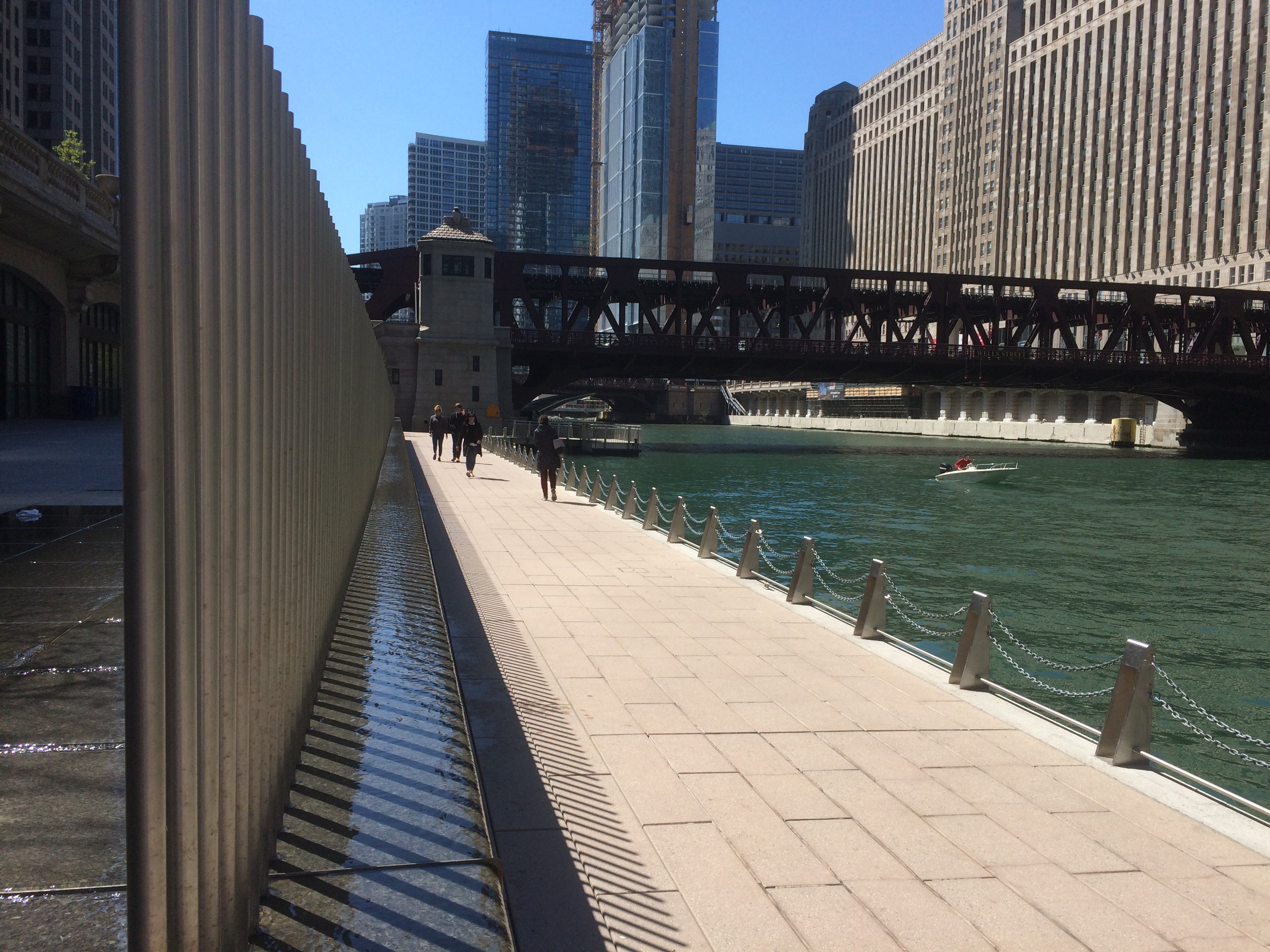
From the LaSalle St. bridge to the Wells St. bridge is a straightaway with a tubular fountain sort of feature.
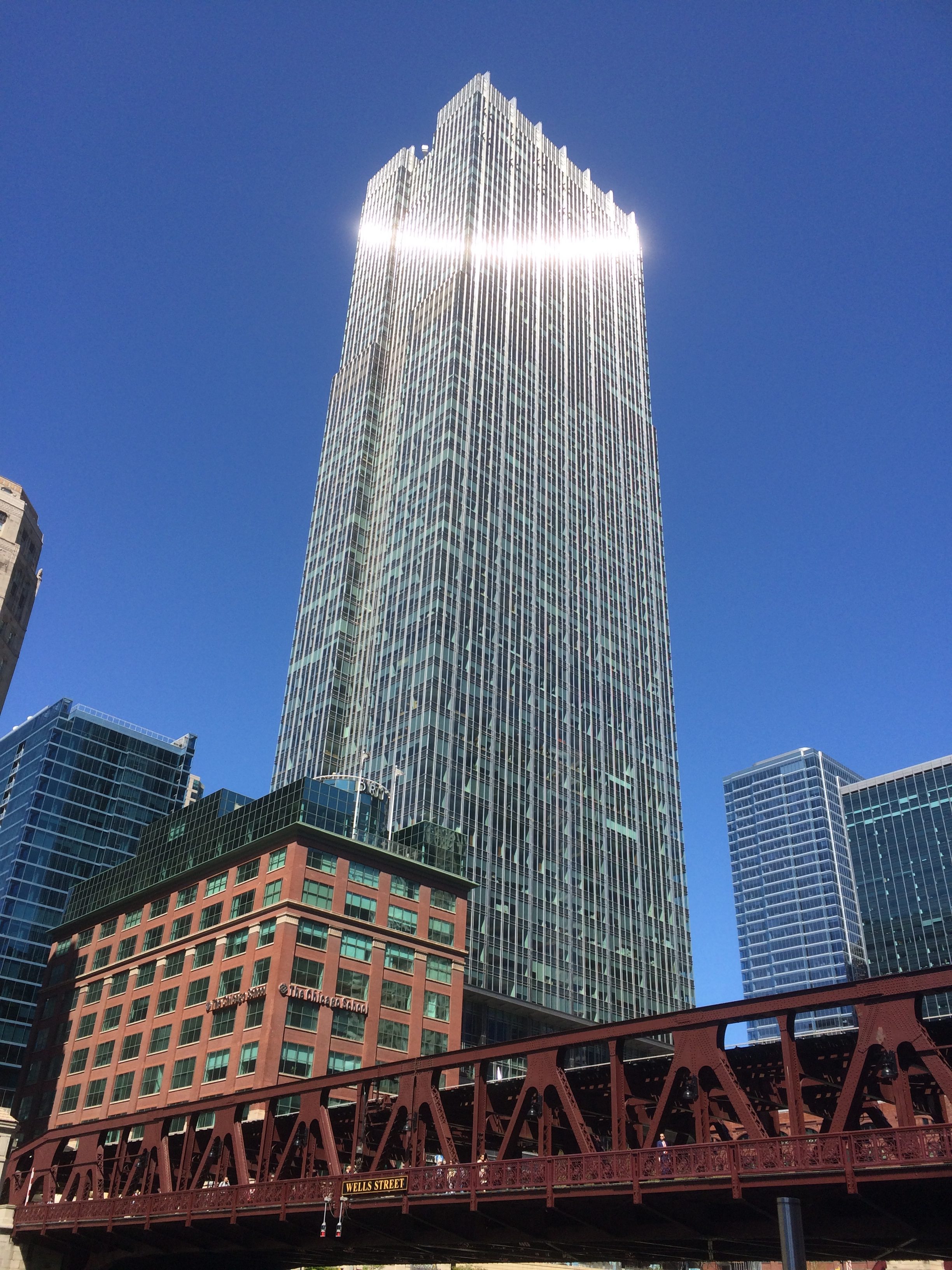
On the west side of the Wells St. bridge is a fine view of that structure.
The afternoon sun in late April left a curious trace on the 300 N. LaSalle building, which rises above the Wells St. bridge.
Further to the west of Wells St.
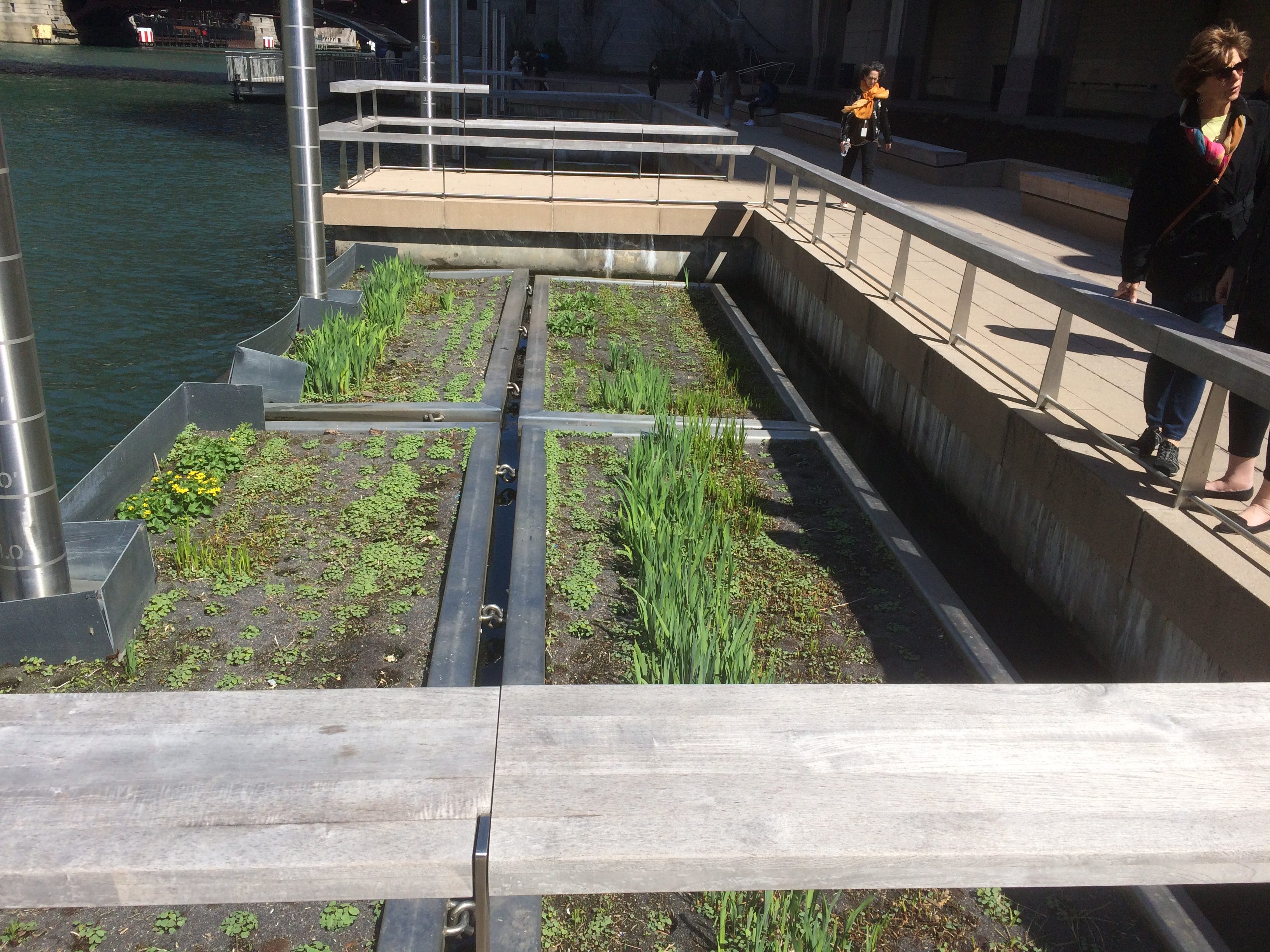
This section, west of Wells, sports floating wetland gardens. Or maybe you can call them the Floating Gardens of Chicago. But what the city really needs are hanging gardens. Maybe they can go next to the Obama Library.
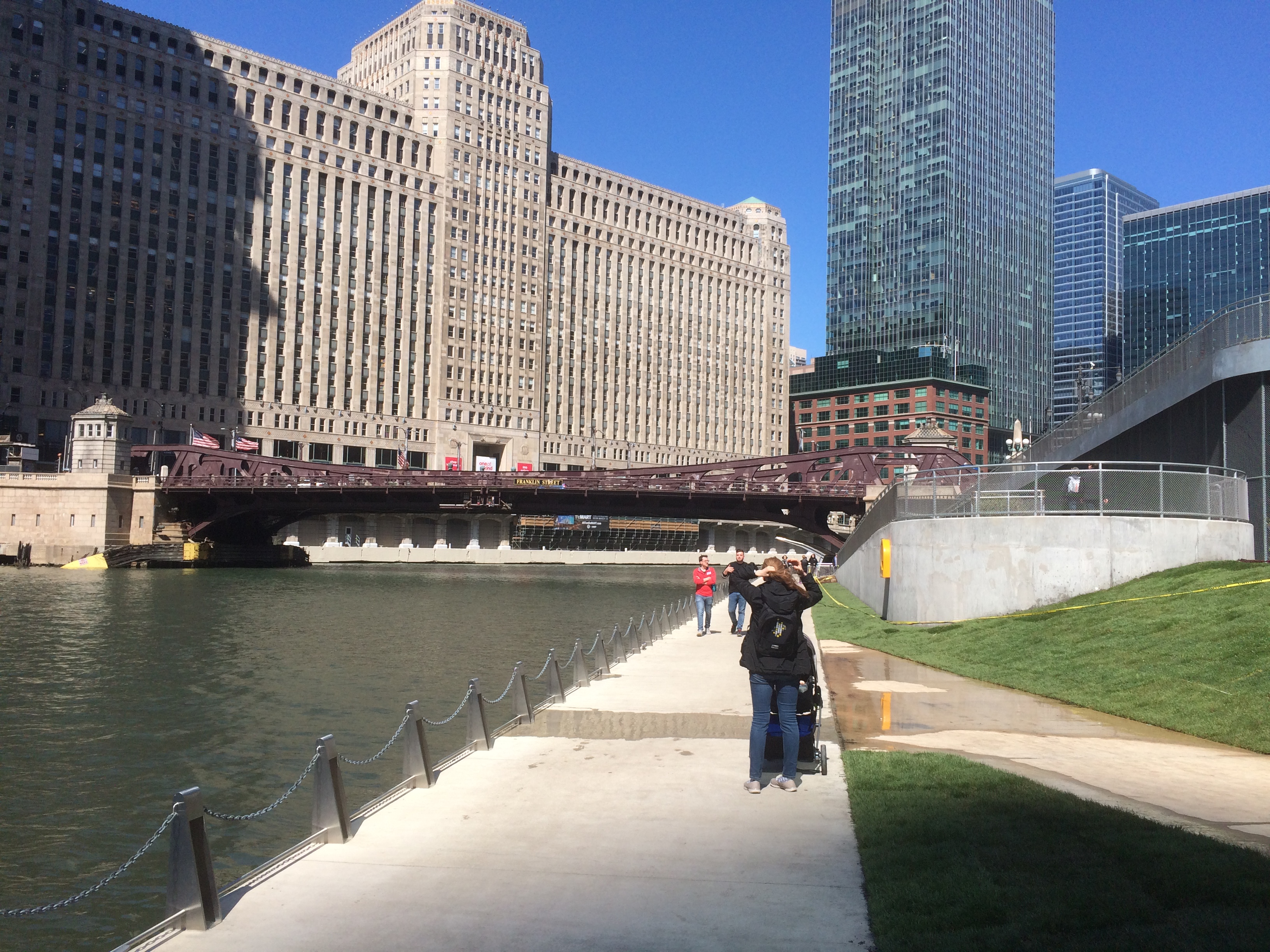
From there, the path crosses under the Franklin St. bridge, and goes to its end at Lake St., with the Merchandise Mart dominating the view. Workmen were busy installing turf on the small slope to the right (in this pic) of the sidewalk.
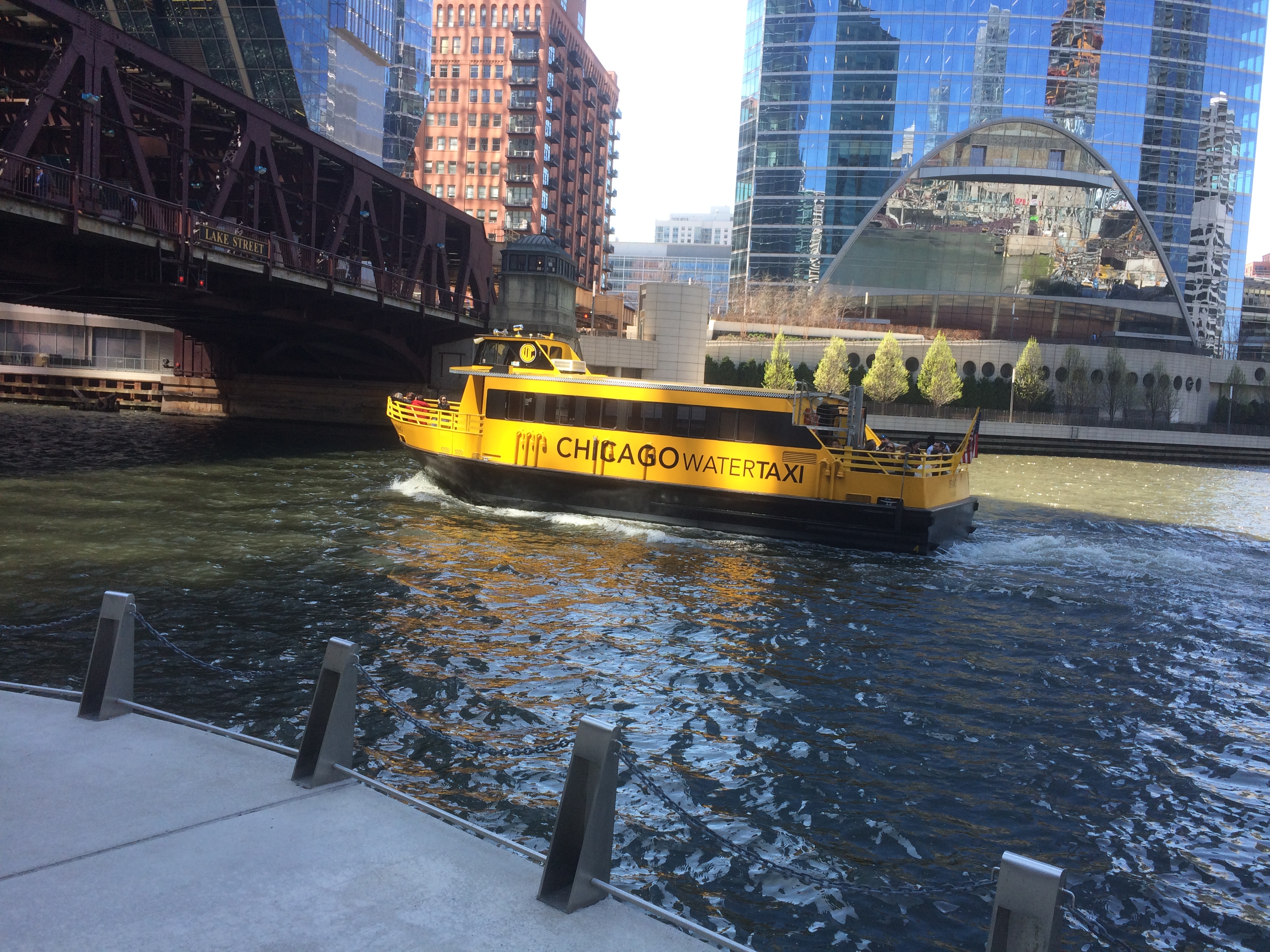
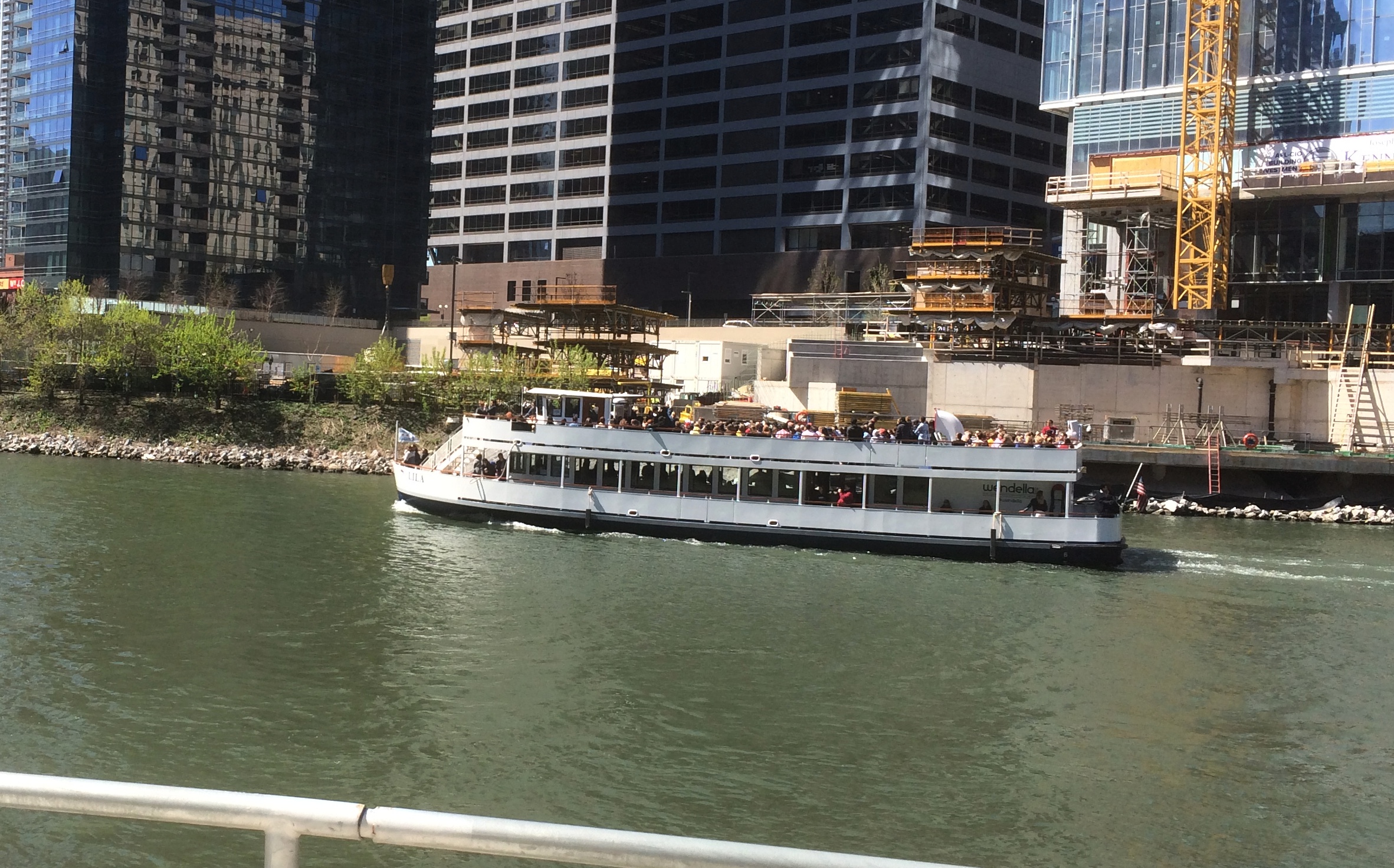
All the while, you can see boats plying the river.
Interesting that yellow means taxi, even on the water. I recognized the vessel in the second pic. The good tourist ship Lila passing Wolf Point.

Views From 151 N. Franklin St.

Last week I attended an event on the top floor of 151 N. Franklin St., a new office building in downtown Chicago. I had a few moments to admire the excellent views.

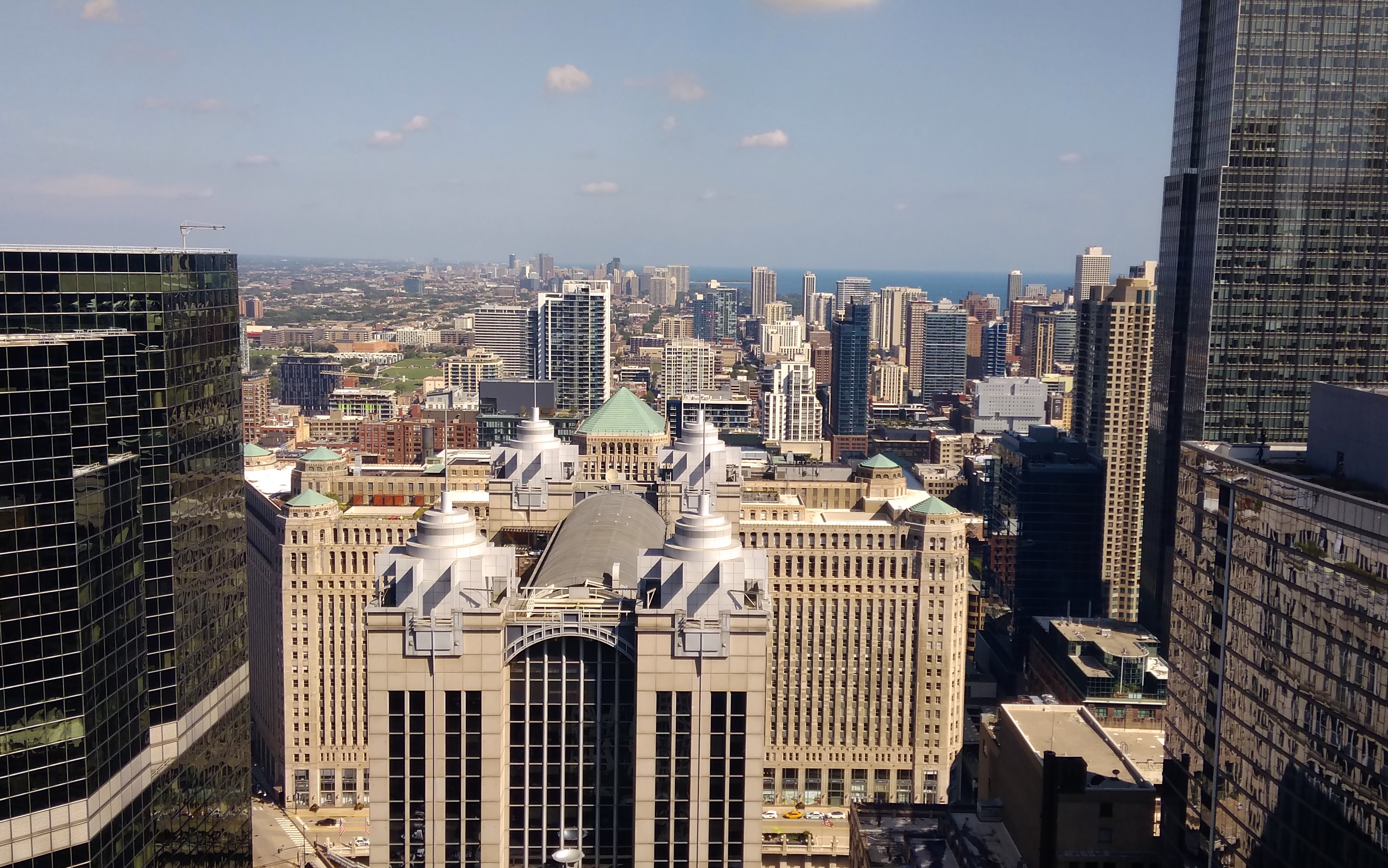
Looking slightly to east-northeast, roughly. In a gap far to the right is a slice of Lake Michigan.

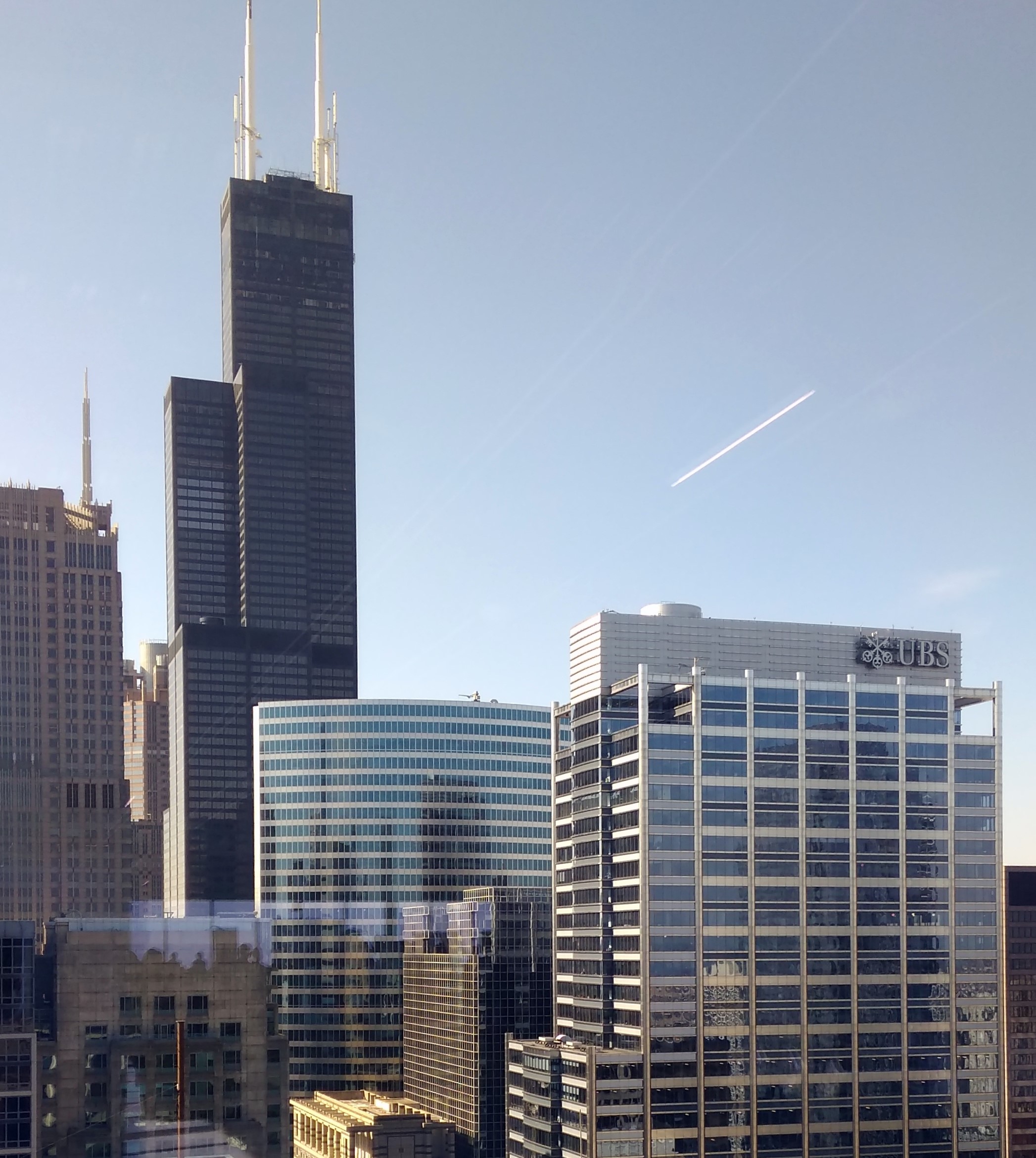
To the south-southwest, roughly. The tower formerly known as Sears rises above all, including annoying reflections.

Straight north.

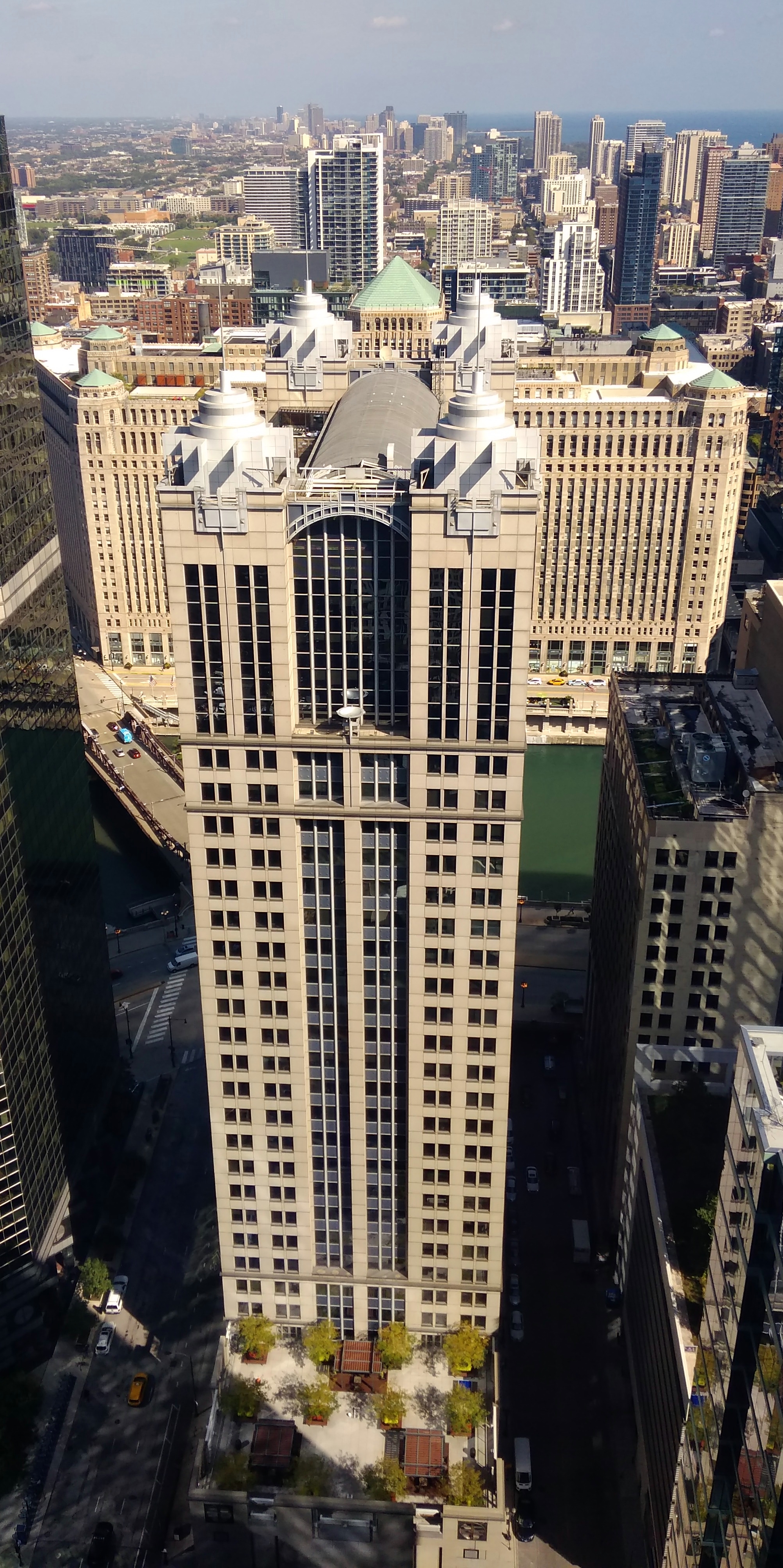
The building with the four roof features — maybe those count as cupolas — is 225 W. Wacker Dr., a 30-story late ’80s development designed by Kohn Pedersen Fox. A vertical shot of that building.
Behind it, or rather to the north, across the Chicago River, is the much more horizontal Merchandise Mart.

More about the 35-story 151 N. Franklin is here, including a mention of the views from the top. Here’s the thing that struck me: the building was just completed. That means these are spanking-new views of Chicago.

The Henry C. Palmisano Nature Park (Mount Bridgeport)

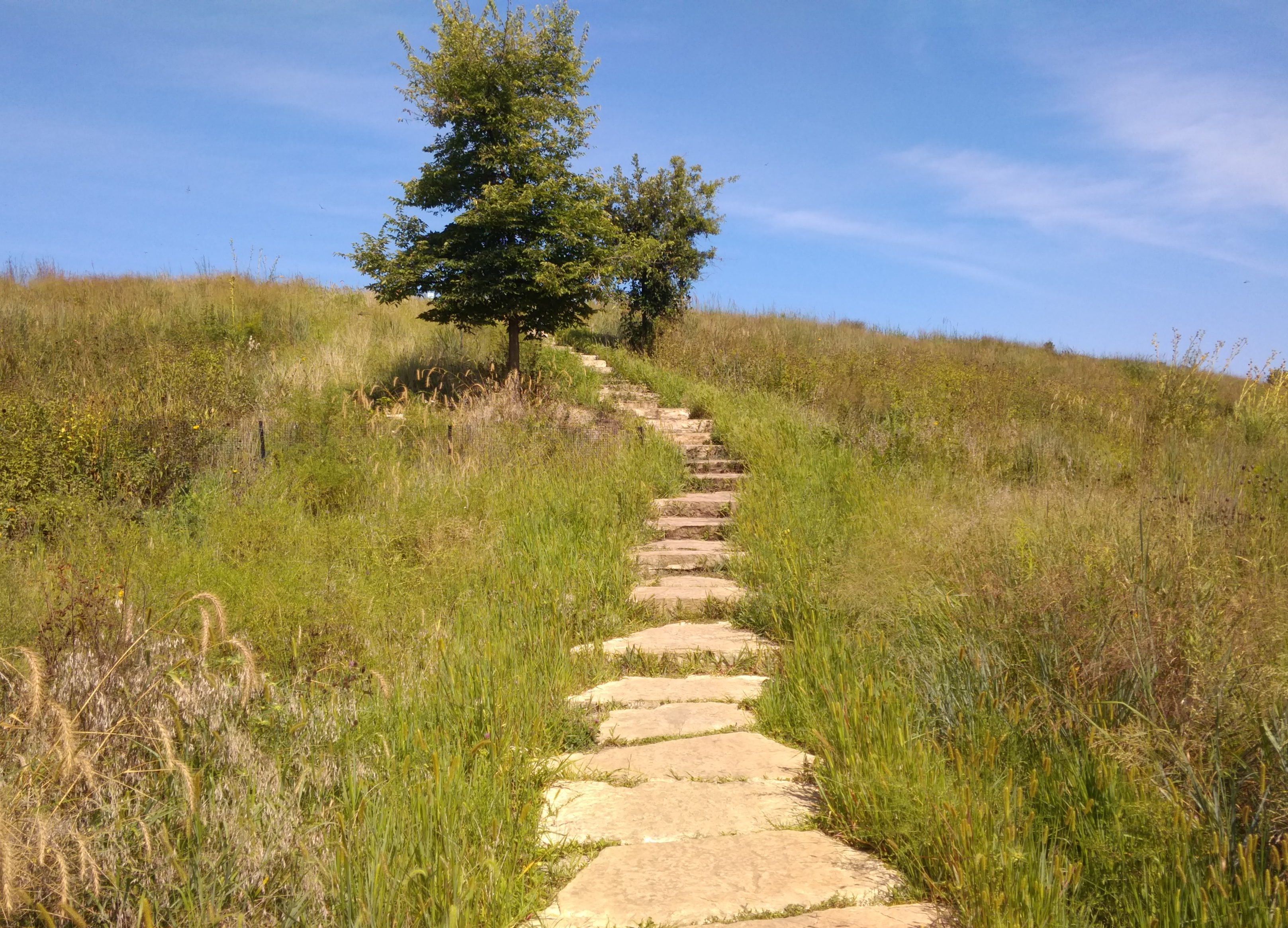
Not long ago, I found myself looking up this hill.

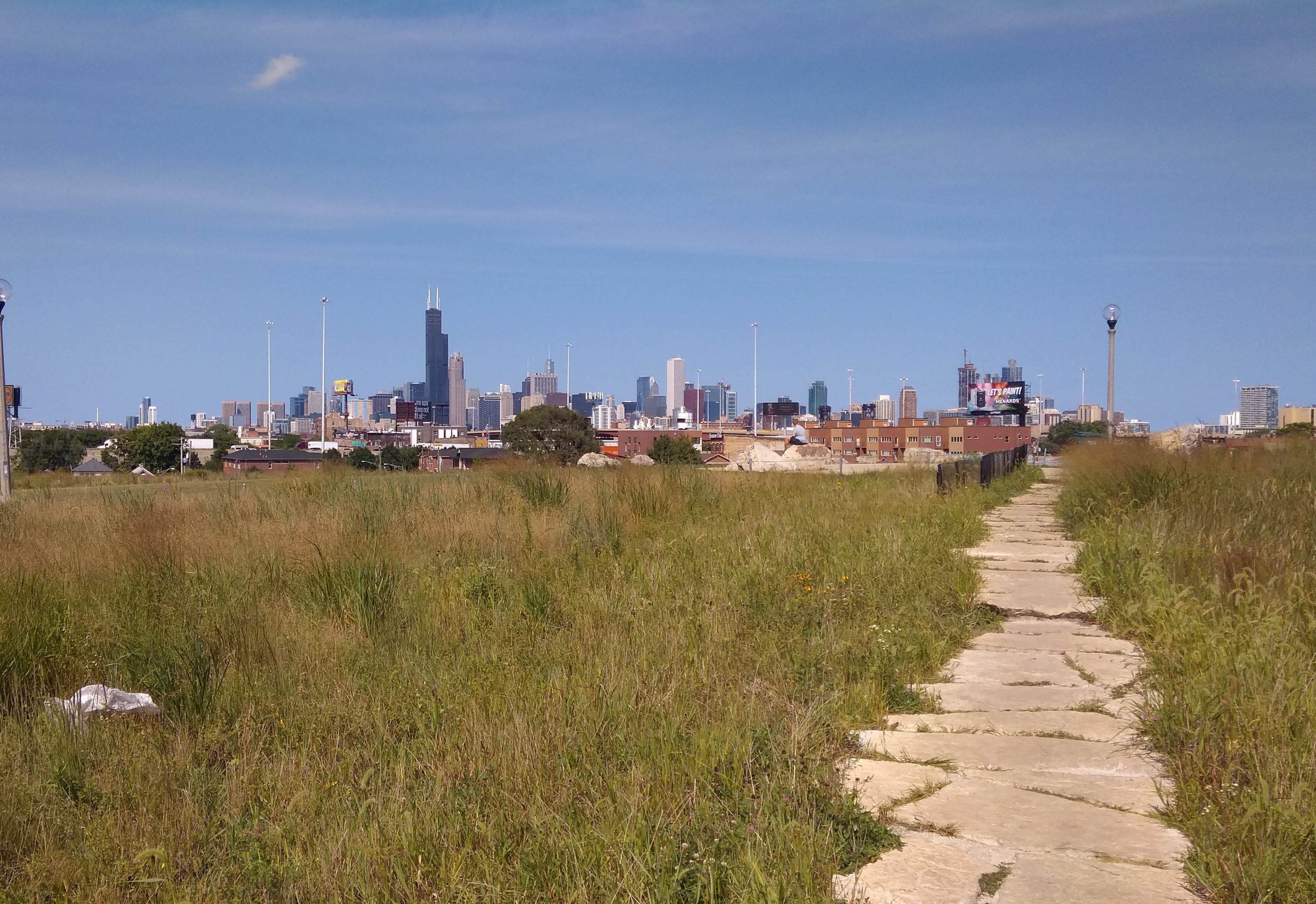
I climbed the steps, since I still have the energy for that kind of thing sometimes, and at the top of the hill is this vista.
That only goes to show how easy it is for an image to mislead. How would someone merely looking at the first image know that the hilltop has a fine view of downtown Chicago from the southwest?

Anyway, I was at the Henry C. Palmisano Nature Park, though I have a good source that tells me its informal name is Mount Bridgeport, after the surrounding neighborhood, and it rises 33 feet above street level.

“In the late 1830s, the land was purchased by the Illinois Stone and Lime Company which began quarry operations,” says the Chicago Park District. “Within a short time, one of its partners, Marcus Cicero Stearns, took over and renamed the quarry. Stearns was an early Chicago settler who got his start by opening a supply store for workmen who blasted out rock to build the Illinois and Michigan Canal.

“Even after Stearns died in 1890, the quarry continued operating under his name until 1970. For the next few decades, the site was used as a landfill for clean construction debris. After the dumping ended, the idea of transforming the site into a new park emerged.”

The transformation took some time, but a park finally opened on the site in 2009, named for a man who died in 2006. It’s more than a grassy hill with a view, though that’s a standout feature in flatland like Illinois.

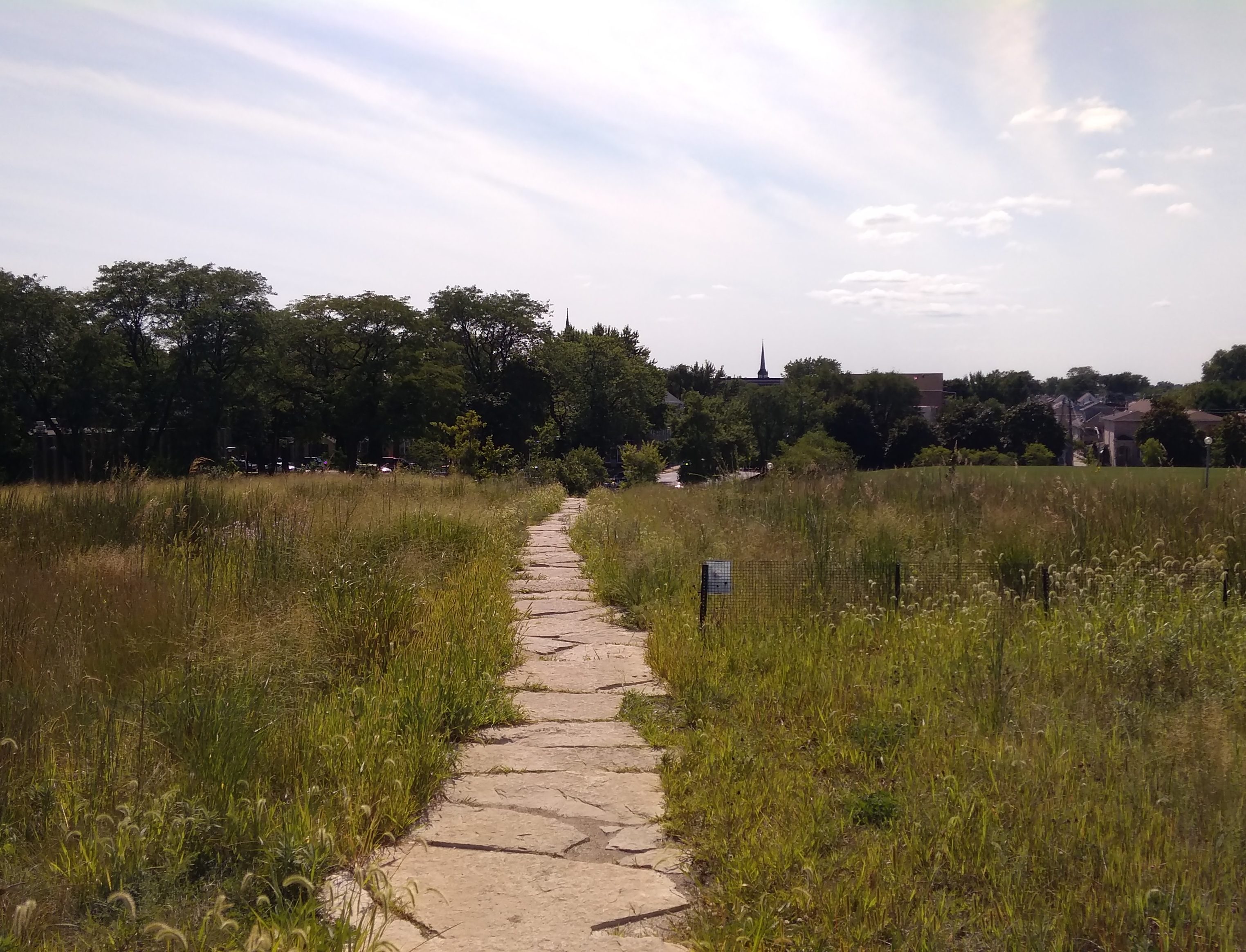
The path goes off in other directions.
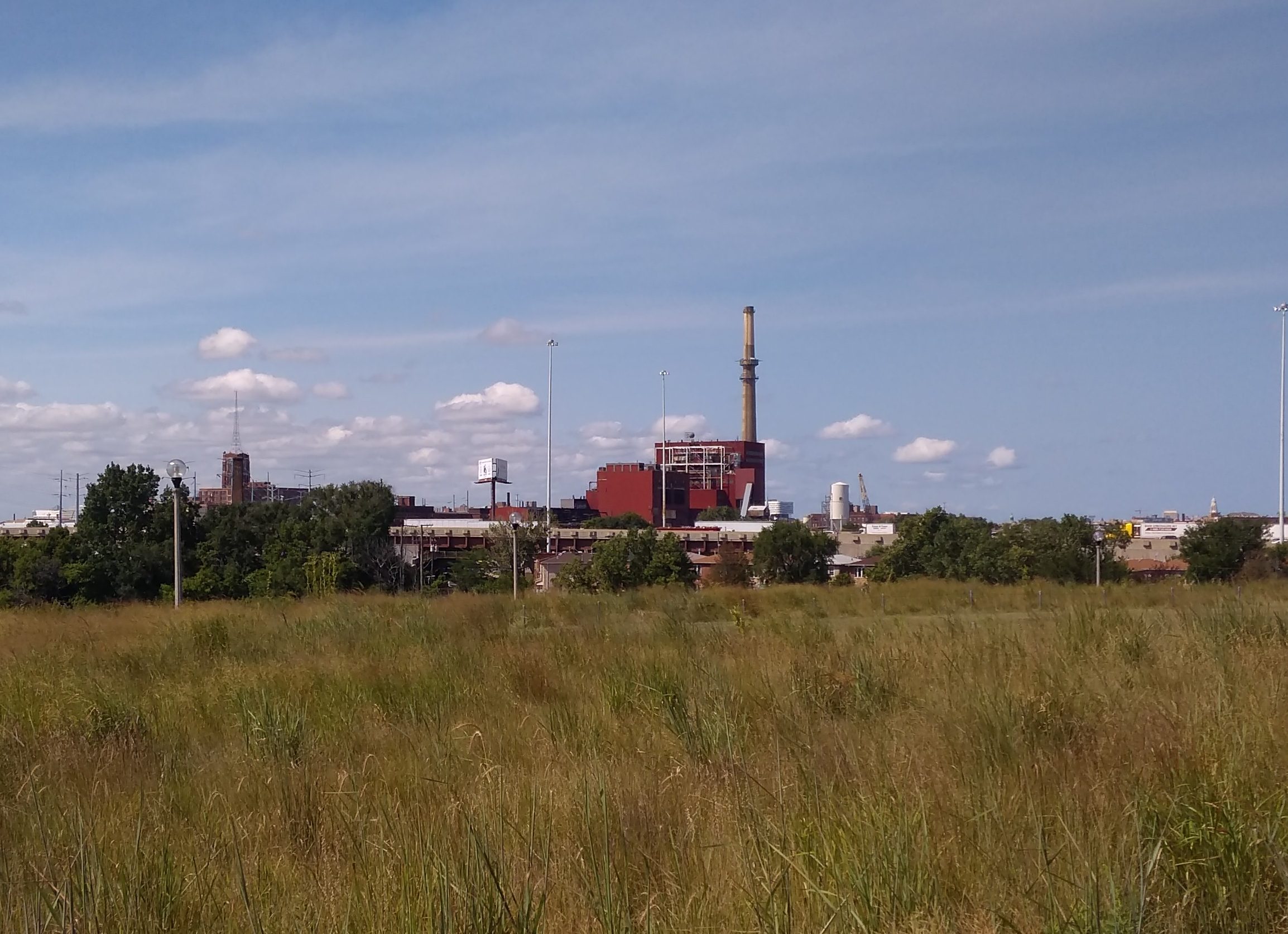
Other parts of the city are visible from the hill.
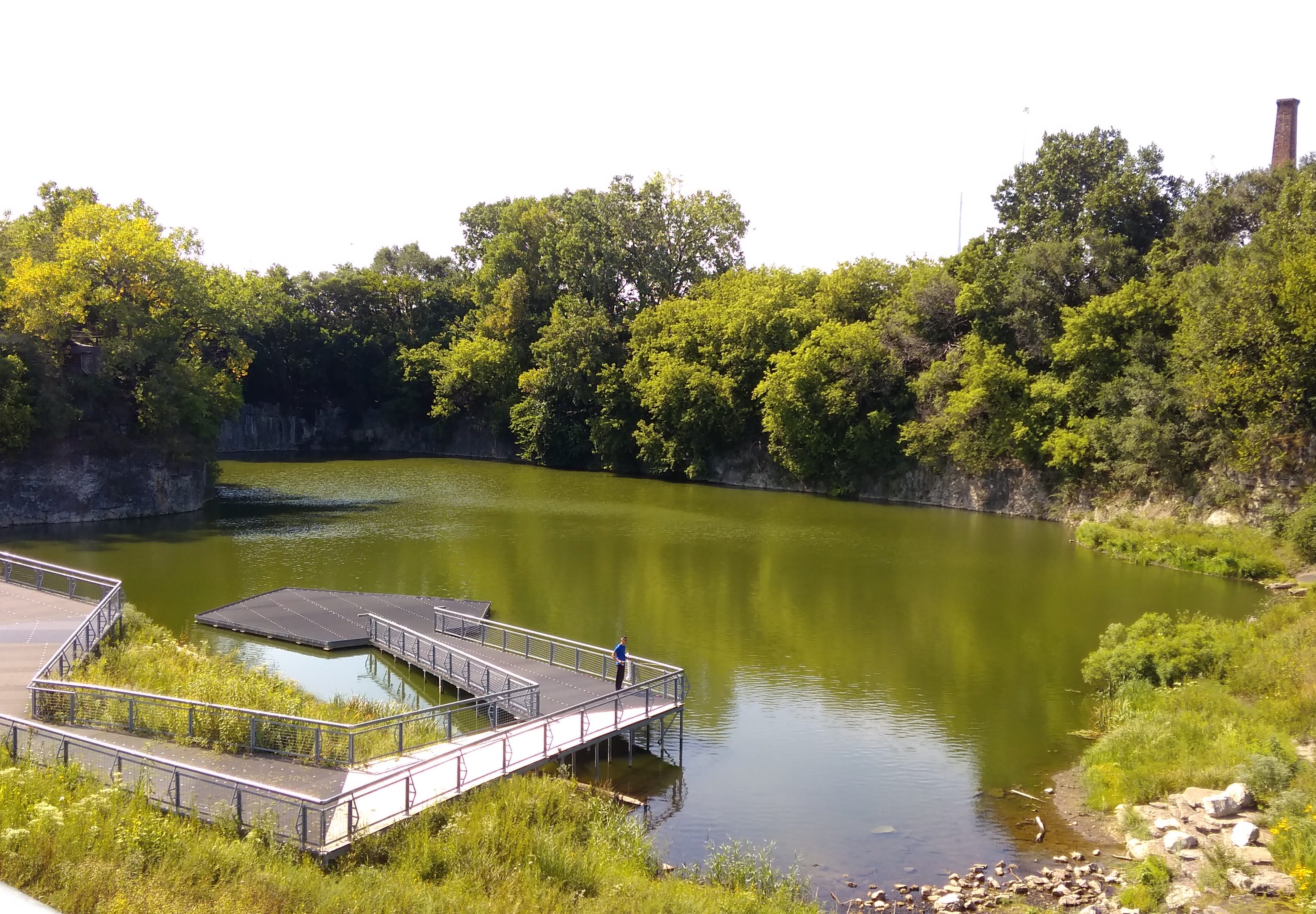
Part of the old quarry hole is now a pond, available for catch-and-release fishing, according to a nearby sign.
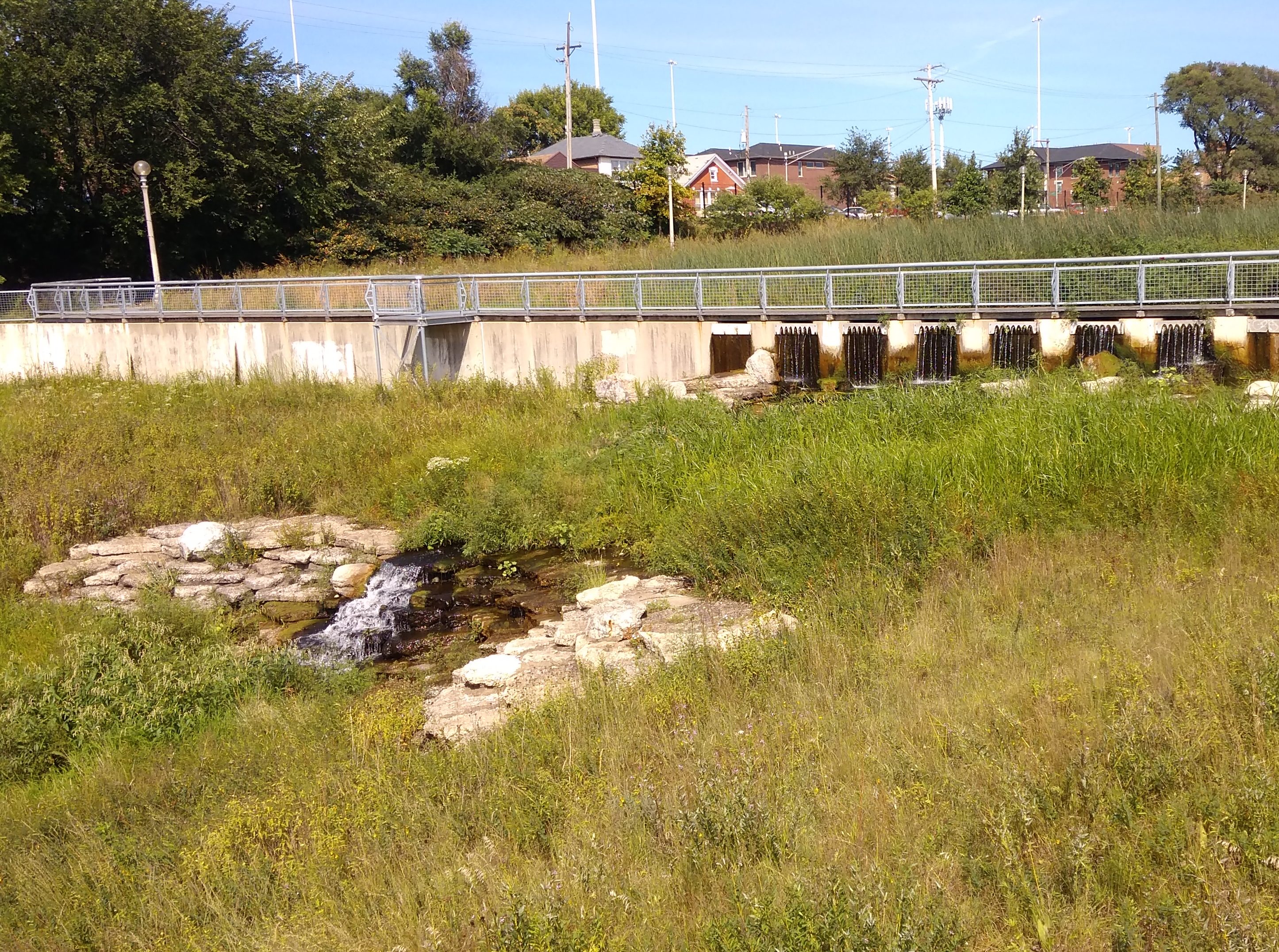
This may be the closest waterfall to downtown Chicago. Modest, but nice to look at. The stream goes to the quarry-pond.
“This is a dynamic park, with a fishing pond, interpretive wetlands, preserved quarry walls, trails, an athletic field, a running track, and a hill that offers dramatic views,” the Park District notes. “Over 1.7 miles of paths, including recycled timber boardwalks, concrete walks, a crushed stone running path, and metal grating walkways traverse the park.”

The Stevenson Expressway is visible, and very much audible, from the park. How many of the many drivers on that highway have any notion of such an excellent park nearby?

I never did for some years. “What’s that park?” I wondered some time ago while looking at a map of Chicago, making a mental note to visit when I would be nearby, which happened to be just before Labor Day. Being a map enthusiast has its rewards.

Enger Tower

Whenever possible, I recommend finding a high perch to see the territory around you. Ideally, a spot reached without much danger of bodily harm. Even better, a structure created just for that purpose. Best of all, a structure open to the public at no charge, like the handsome Enger Tower in Duluth, which we climbed on July 29.

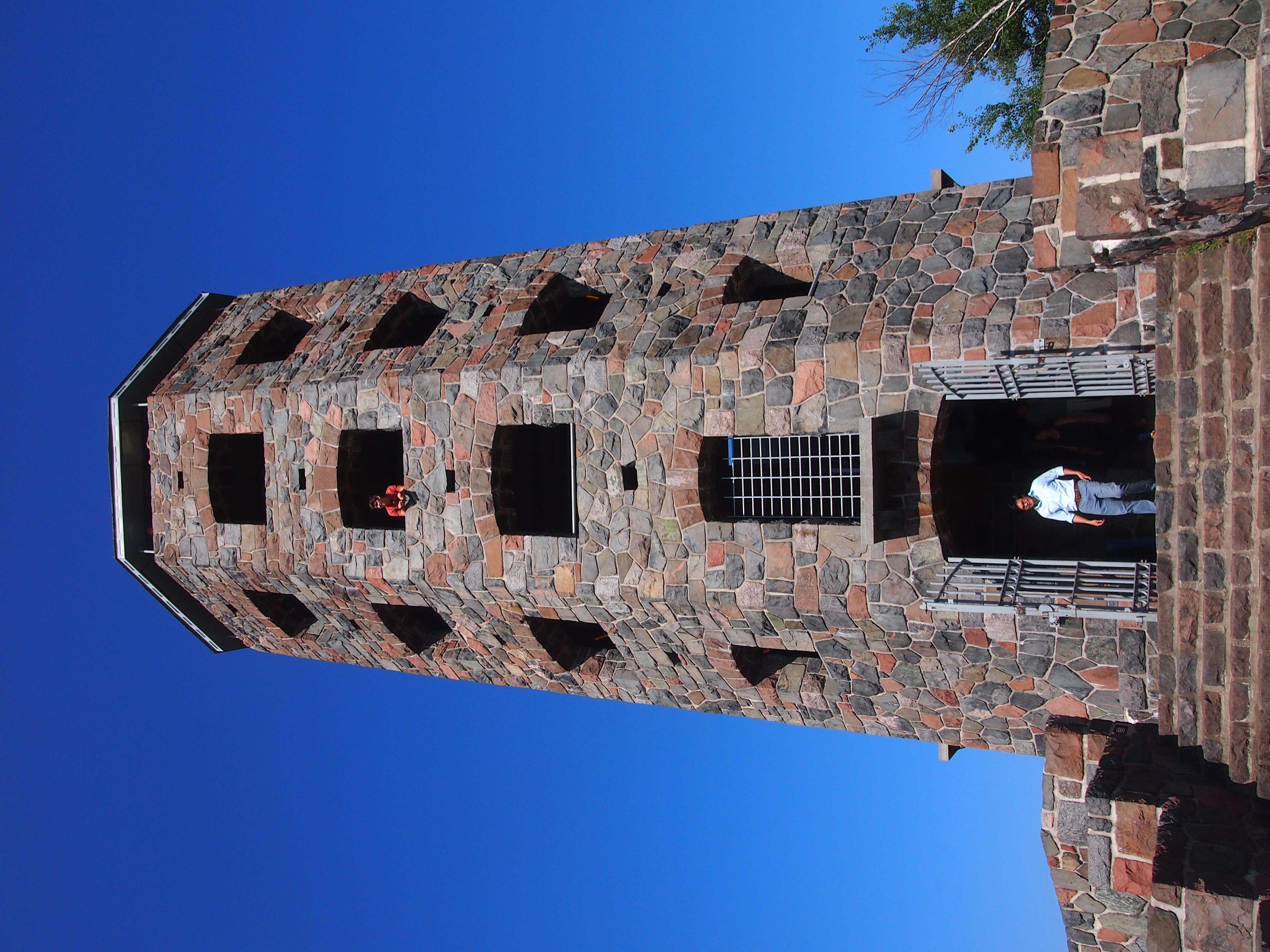
In full, the Enger Observation Tower. At least that’s what it says on a plaque just inside the entrance. That plaque also says that it’s named after Bert J. Enger (1864-1931), “Native of Norway, Citizen of Duluth.”

Enger was an immigrant who made good in the U.S., and left money for building the tower. Crown Prince Olav of Norway came all the way to Duluth to dedicate the structure in June 1939 (Olav wasn’t king until the 1950s, many eventful years later). A separate plaque notes that King Harald, the current Norwegian monarch, re-dedicated the tower in 2011 after renovations.

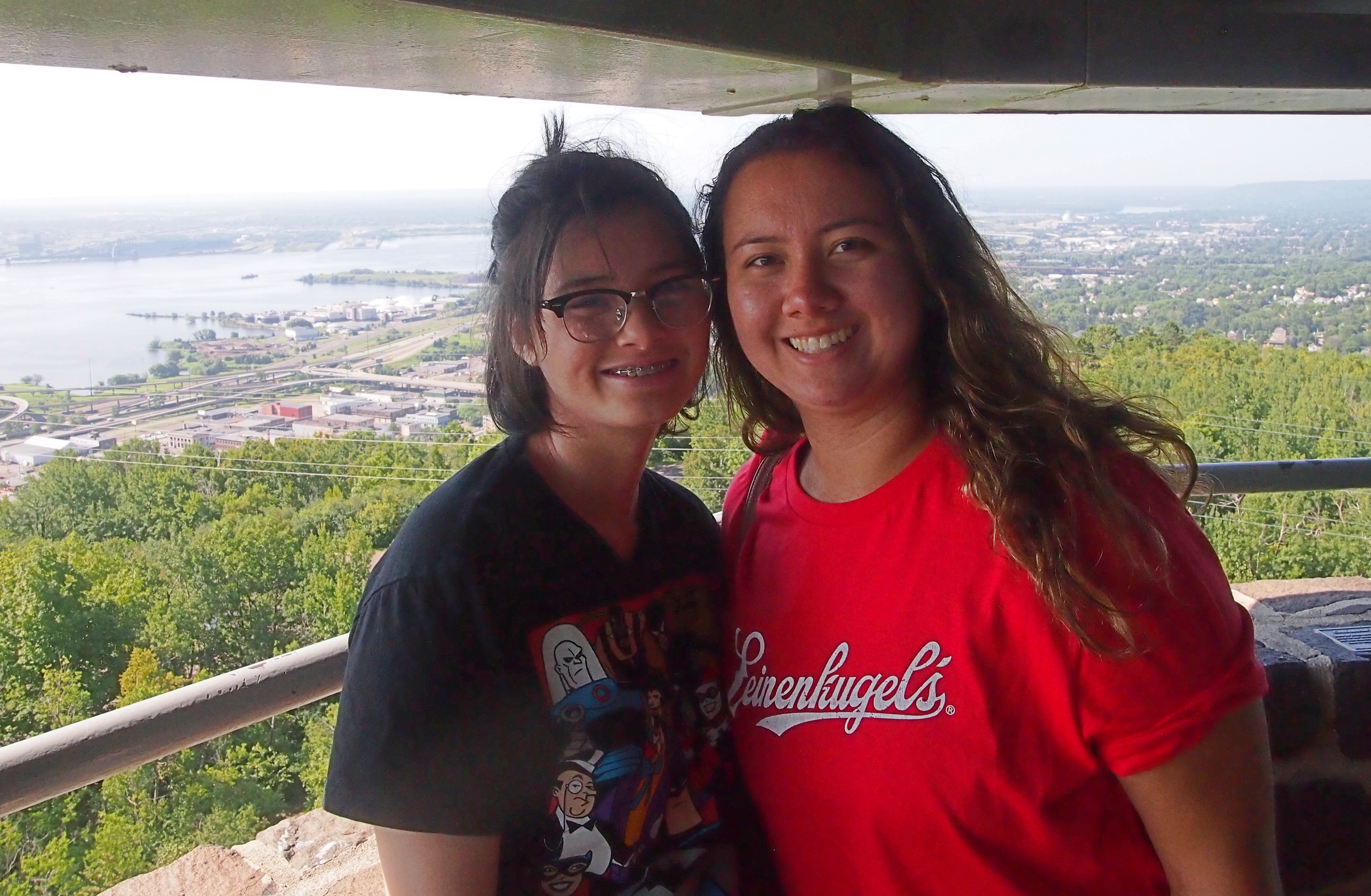
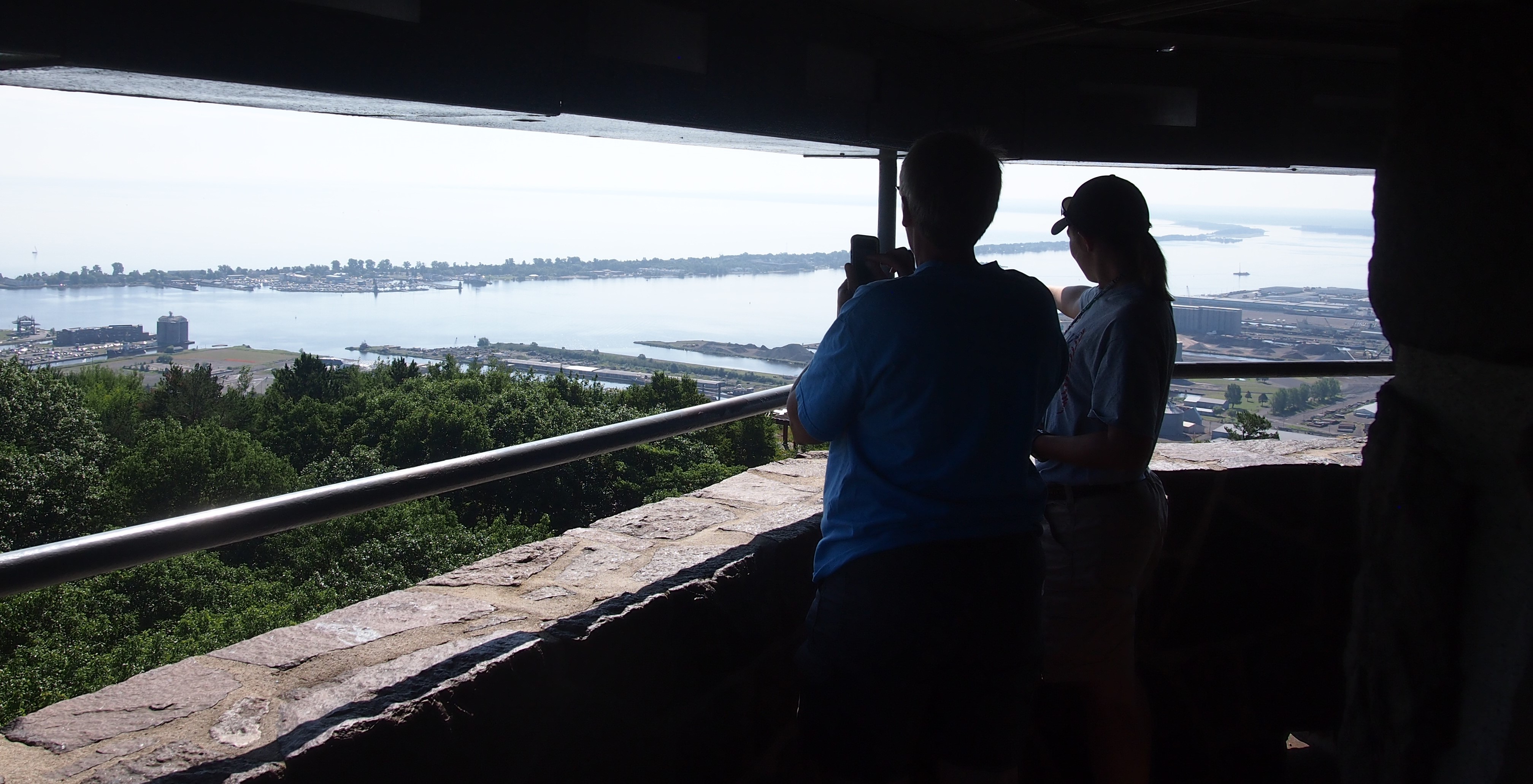
The blue stone tower rises 80 feet on top of an already high hill, so the view is terrific: Downtown Duluth, St. Louis River and St. Louis Bay, Superior, Wis., and the rolling greenery north of town.

Enger Tower

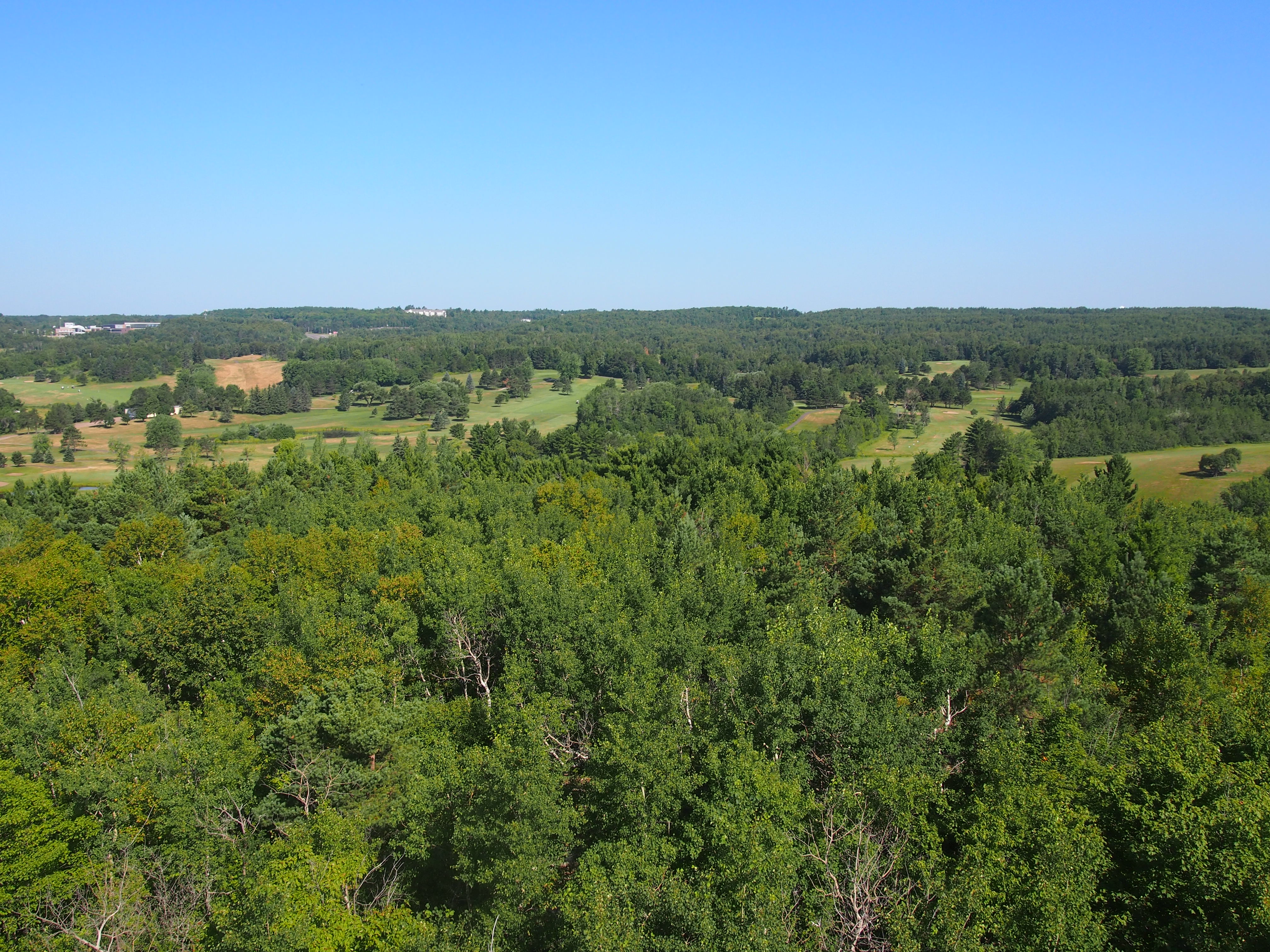
During our visit, the light was best for capturing images to the north of the tower, including woods and the park’s golf course.

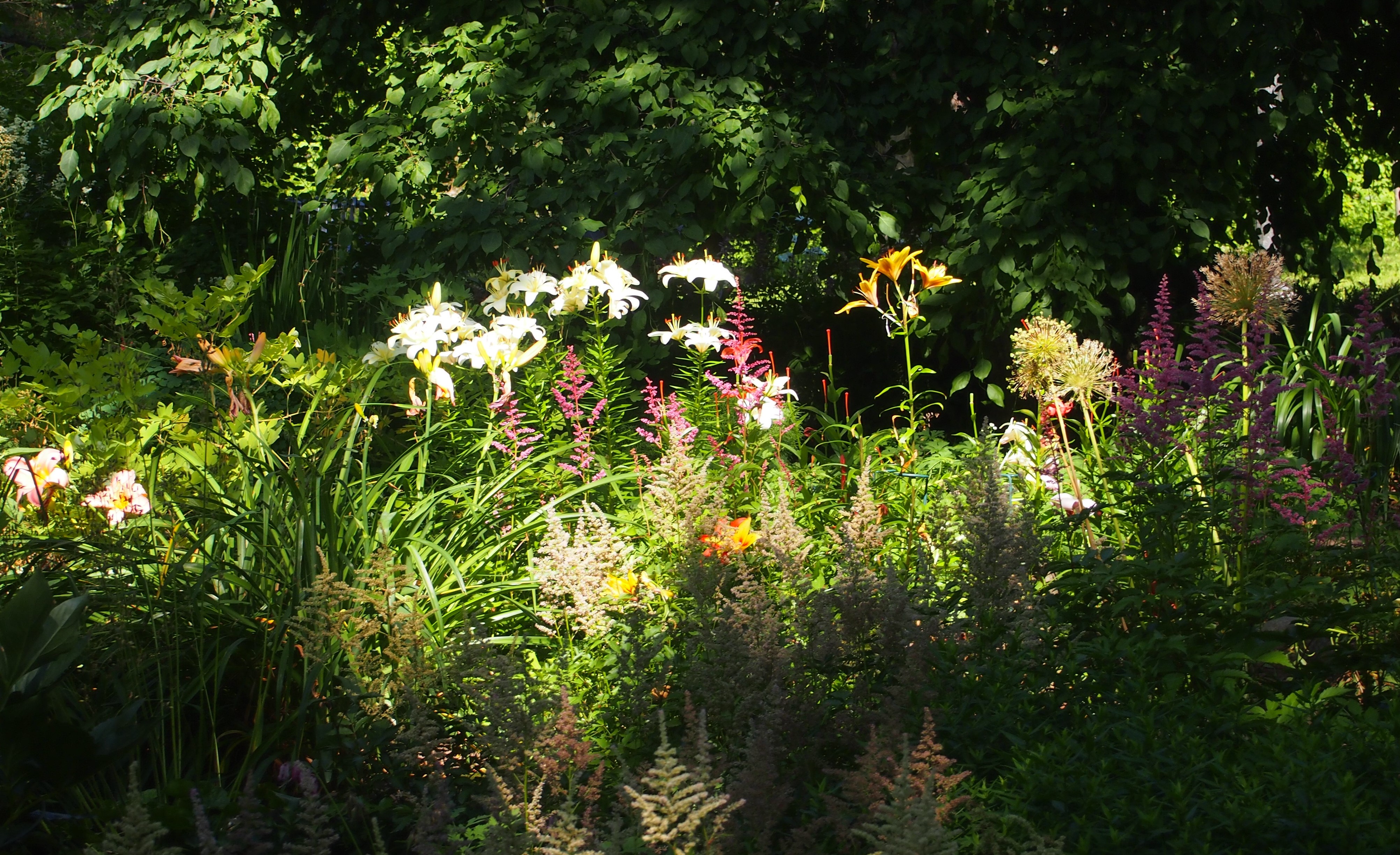
The tower wasn’t the only attraction at Enger Park. There were gardens too.

Full of flowers enjoying the short boreal summer.

Palo Duro Canyon State Park

Last Friday, I drove from Amarillo to Palo Duro Canyon State Park. It took only about 30 minutes: south on I-27 and then east on Texas 217, which ends when you get to the park entrance. Until very close to the entrance, it’s easy to look around and think, “Canyon? There’s a canyon around here? How is that possible?”

People — ignorant people, that is — are known to think “Texas is flat.” Some of it is, though, such as the Panhandle near Amarillo. A steppe’s a steppe. I’d read that Palo Duro was quite the canyon, but until I got there, it was a little hard to picture, driving down a mostly empty two-lane highway through terrain devoid of rises.

That’s just an example of my ignorance. If I’d done any kind of research beforehand, I would have found out that Palo Duro Canyon is enormous. Park literature calls the canyon the “second largest” in the United States, and a look at Google Maps, using the satellite image function, supports that idea, at least in terms of square miles of canyon floor.

The Grand Canyon is certainly deeper, and actually more grand — that’s in the name — but as the runner up among major U.S. canyons, Palo Duro is quite impressive. Here’s the kicker: the state park, even at 20,000 acres, is only a fraction of the entire canyon, which is about 120 miles long and averages six miles wide. The rest is private ranchland and maybe not much different than in previous centuries

You pay your entrance fee, a reasonable $5, and pretty soon you’re overlooking the sweep of the canyon, a long irregular groove carved in the flatness of the Texas Panhandle.

Made not by a mighty river like the Colorado, but one with a less formidable name, the Prairie Dog Town Fork of the Red River. Unlike the bigger canyon in Arizona, visitors to Palo Duro SP have the option of driving to the canyon floor, 800 or so feet down. That’s because the CCC built a road into Palo Duro once upon a time, along with other structures.

So I drove in. I also got out and walked. Not on the longest of trails available, but a few miles on shorter ones.

I liked the Rojo Grande Trail. Rojo all right, in places. At least the kind of red you get in rocks.

Along with views of the canyon walls.

Plus plenty of semiarid-region flora and even a little fauna (a rabbit, in my case). Also, the occasional mark of man, besides the works of the CCC and the Texas Parks & Wildlife Department.

All along the park road, drivers are warned about flash flooding. There seemed little risk when I was there, but the potential is real.

Almost 40 years ago, heavy rains flooded the canyon, killing four people. According to the sign, water crested at 21 feet above the nearby low water crossing. Hard to imagine that much water gathering in a place that seems so dry, but nature’s capricious. Best to stay out of her way if possible.

Big Bend National Park

When I was young, I was a fan of the Texas highway maps produced by the Texas Highway Department (these days TexDOT), which were published annually and usually available at highway rest stops, though I think one year in the early ’70s I wrote to the department, and it mailed me one.

I admired those maps, unconsciously at that age, for good reasons. They were precise, easy to understand, useful and aesthetic, everything you need in a map. I found the color scheme for the cities and towns particularly fascinating. The largest cities were yellow. Mid-sized cities were green and large towns were brown. Or maybe those last two were the other way around; I don’t have an old map in front of me. To my thinking, that’s a brilliant way to depict population centers by relative size.

My 7th-grade Texas History teacher, the prickly Mrs. Carico, taught us map-reading skills one day using Texas highway maps. Imagine any teacher doing that now. I think I already knew most of what she said, though I did learn from her the difference between red mileage numbers (marked with red arrows) and black numbers that didn’t use arrows.

She didn’t care for the yellow-green-brown system, though I don’t remember why. Maybe because the national forests in East Texas and Big Bend National Park in West Texas were a slightly different shade of green. But I never found that confusing.

It’s probably from those maps that I got my first notion of Big Bend. There it was, hugging the Rio Grande, far from most everything else, thrusting into a remote part of Mexico, marked by the brown smears that denoted mountains on the map. A few roads went there. A few towns were nearby — but not that near. Somehow that place was a national park.

But I didn’t feel an aching need to go there. In 1972, when we took a family vacation to Carlsbad Cavern National Park, we could have just as easily have gone to Big Bend, but we didn’t, and the thought never occurred to me. In 1980, when I drove to El Paso from San Antonio, a little creativity on my could have resulted in a day in Big Bend, but it didn’t occur to me. In the 1990s, reports of his visits to the park by my brother Jay were interesting, but it seemed even further away than ever from my vantage in the Midwest.

Last year, I planned to go with Jay and Lilly, but circumstances prevented it. This year, I decided it was time, though by myself. So on April 24, 2018, in mid-morning, I found myself at the park entrance.

The road from the town of Marathon to the park entrance, U.S. 385, was a lonely one. I was almost by myself on the way down that morning. According to the National Park Service, Big Bend isn’t a top 10 national park by visitors. It isn’t even in the top 25.

In 2017, it was 41st out of 60 national parks, and 130th out of all of the 377 units of the NPS (Gates of the Arctic NP is last among national parks, unsurprisingly). A lot people probably have the same feeling about Big Bend that I had for many years: I’m sure it’s scenic, but it’s far away.

Glad I made the effort. It’s well worth the drive.

Those views were even before I got to the main places I visited in the park, such as the Chisos Mountains.

The Ross Maxwell Scenic Drive winds south to the Rio Grande, through the Chihuahuan Desert landscape.

Ross Maxwell was easily the most scenic drive I’ve taken since the Icefields Parkway in the Canadian Rockies. What is it about mountains, wet or dry?

Though it was very warm — upper 80s F., I’d say — I had a hat, sunscreen and water, so I took some walks. One was down into a shallow valley to the former Homer Wilson ranch, to see the abandoned buildings.

No one else was on the trail, going there or back. It was on this short hike that I appreciated the quiet of the park. In a city, or the suburbs, the din of traffic is always coming from all directions, strongly or faintly, except maybe right after a large snowstorm.

In the remote Chihuahua Desert, if you hear a car, it’s a single car, and it goes away. Mostly you hear the wind, birds, and your footsteps, until you stand still. Listening for traffic and not hearing it was as much a pleasure as drawing in air without any hint of pollution.

I also spent time on foot in the Chisos Basin, but the best walk by far was into Santa Elena Canyon on the Rio Grande. At that point, the limestone cliffs of the canyon are 1,500 feet high and as majestic as anything I’ve seen in nature. Photos do the massive shapes little justice, but I took some anyway.

The trail led a short way into the canyon, and up some hundreds of feet. I was exhausted by the time I got up into it, but the view of the Rio Grande from that vantage was some compensation. Sure, let’s build a wall here.

When I got back to the river, I took off my shoes and put my feet in. Cool but not cold, and it felt good.

Teotihuacan

During our six days in Mexico City, we ventured out of the city only once, traveling 25 miles or so northeast on December 30, into the State of Mexico, to see Teotihuacan. To see las pirámides there: the Pyramid of the Feathered Serpent; the Pyramid of the Moon; and the Pyramid of the Sun, hard to beat for sheer rise-to-the-sky bulk.

The rest of the time in Mexico, we walked or took the subway to our destinations. For Teotihuacan, we hired a car and a driver, who doubled as a guide: a bilingual gentleman name Leonardo, a lifelong resident of Mexico City in his 60s (probably) and exceptionally knowledegable about las pirámides de Teotihuacan, and a good many other things. He had, I believe, escorted many a gringo to see Teotihuacan over the years.

The ride out of Mexico City had its own interests: the miles and miles of city visible from the highway, seemingly endless painted cinder block and colored stucco filling every spot until the terrain is too steep; the graffiti on the highway walls or, as it seemed sometimes, the painted words that represented a cheap way to announce or advertise something; the many Pemex stations; the brown brush and tired-looking trees; and distant mountain peaks always in the background.

Leonardo’s lived long enough to see the Valley of Mexico fill with greater Ciudad de Mexico. Fewer than 3 million people lived there in 1950; now more than 20 million do. As in many parts of the world, the inhabitants of the furthest reaches of the country came looking for work, waves and waves of them, and built their own improvised neighborhoods. Leonardo also said that he remembered the ’68 Olympics as an exciting time to be a young man in Mexico City.

It occurred to me only afterward — only after I’d returned from Mexico, really — that I’d never seen a pyramid with my own eyes before, unless you count the likes of the Luxor Hotel & Casino in Las Vegas. Actual ancient structures, no. An odd thing to realize.

Or maybe not. We’ve all seen so many images of them, whether in Egypt or Mexico or elsewhere, in movies and TV and magazines and books and artwork and travel literature and posters and so on. Second-hand experience, that simulation of the real thing, is not always a bad thing, but is infectious and can blur first-hand experience.

Now I do my little bit to spread second-hand experience. No matter.

The first place we visited at the site was the smallest of the major structures, the Pyramid of the Feathered Serpent, a Mesoamerican name if there ever was one. It was a short climb up uneven stone steps, a preparation for that much larger pyramids to scale later.

In archaeological terms, the Feathered Serpent is where a lot of the recent action has been. “In 2003, a tunnel was discovered beneath the Feathered Serpent pyramid in the ruins of Teotihuacan, the ancient city in Mexico,” reported to the Guardian. “Undisturbed for 1,800 years, the sealed-off passage was found to contain thousands of extraordinary treasures lying exactly where they had first been placed as ritual offerings to the gods.

“Items unearthed included greenstone crocodile teeth, crystals shaped into eyes, and sculptures of jaguars ready to pounce. Even more remarkable was a miniature mountainous landscape, 17 metres underground, with tiny pools of liquid mercury representing lakes. The walls of the tunnel were found to have been carefully impregnated with powdered pyrite, or fool’s gold, to give the effect in firelight of standing under a galaxy of stars.”

We didn’t see any of that, of course. But even if it was standalone ruin, Feathered Serpent would be a fairly impressive pile of stones. Many of the artifacts discussed above, incidentally, are now on display at the de Young Museum in San Francisco.

Soon we took a look at some of the excavations near the larger Pyramid of the Moon.
Then on to the Pyramid of the Moon itself. Here it is, seen from near its base.

I stood and stared a while. If I hadn’t, I’d have had no business being there. Pretty soon, though, you feel like climbing the thing. You’re only allowed to climb about three-quarters of the way up, however. The upper level beyond that looks a little dicey.

The structure is unexpectedly complex. Science Daily reported in 1999 that “the inhabitants of Teotihuacan built successively larger pyramids on top of the previous monuments, often partially deconstructing the previous pyramid in the process.

“From past research, there were thought to have been five phases to the Pyramid of the Moon, with phase one (dated in the 1st Century A.D.) being Teotihuacan’s oldest major monument. Excavations show a major jump in size and complexity occurring with the construction of pyramid four and a change in orientation that puts it in line with the unique and precise city grid structure that we see today in the city’s eight square miles of ruins.”

From the perch on the Pyramid of the Moon, you look down on the broad path known as the Avenue of the Dead.
Beyond that, the mountains nearby are clear — or rather, they’re in the haze. But more striking is the mammoth Pyramid of the Sun, to the left of the Avenue of the Dead as seen from the Pyramid of the Moon. Remarkably, the outline of the Pyramid of the Sun looks a lot like the even more massive mountain Cerro Gordo behind it. No coincidence, I figure.
Afterward we walked back down to the Avenue of the Dead, because who wouldn’t want to miss a chance to walk on such a thoroughfare?
Pretty lively with living tourists. It’s pleasing to imagine that the shades of the unknowable people who built these impressive structures sometimes take strolls on the avenue, too.

The Pyramid of the Sun looms over the landscape like no other part of Teotihuacan. To save a trip to Wikipedia, the structure is 216 feet high and is considered the third largest ancient pyramid in the world (the likes of the Vegas Luxor are thus out). The Great Pyramid of Cholula, only down in Puebla, is considered the largest, though it looks like a hill in our time; and the Pyrimid of Giza is second.

The Pyramid of the Sun also seems to attract climbers more than anywhere else. Note the orange line part way up. That’s crowd control, in the form of orange netting that marks a queue to get to the next level of the pyramid.

Tom and Lilly went on the to top. Considering my weight and age, and the fairly hot sun, I decided to wait for them at the level of the orange netting, so that’s as high as I got. Just another thing I should have done 20 — or 30 — years ago.

Even so, the view back at the Pyramid of the Moon from that level was one of my favorites at Teotihuacan and, in fact, of the entire trip.
A postscript to our visit: A few days after we returned home, I happened across an episode of Ancient Aliens on the History Channel. Or rather, the “History” Channel. It isn’t a channel I watch much. But I was passing by and I noticed a familiar image. An aerial layout that looked like — Teotihuacan.

I stayed with it to confirm that the fellow was blathering about Teotihuacan. He was. The IMDb entry about the show (which is in its 12th season) pretty much sums it up: “The many structures that still stand in Teotihuacan appear to be encoded with advanced mathematical and cosmic principles, and the layout precisely mirrors the positions of the planets in our solar system.”

Does it, now? Clearly, I’ve been wrong about certain things for many years. Especially that interest in ancient aliens somehow faded away with the 1970s. Maybe that was merely the golden age of such notions, and they aren’t gone at all.

No one knows which people built Teotihuacan in the early centuries of the first millennium or what their motives were or why they left. Why is that hard to accept? The idea that ancient aliens had a hand in its construction is an insult to whomever the real builders were. Or to any ancient human beings who built extraordinary structures.