Castillo de Chapultepec

Grim cold January days here in the North and, I’ve heard, it’s fairly cold in the South too. Why this is a big news story is another matter. It’s winter. You know, the season when it gets cold. Sometimes very cold.

Also, weather ≠ climate, as far as I understand these things. A cold winter no more disproves climate change than a hot summer proves it.

Way down in Mexico City, the weather was completely consistent during the days we were there. Cool in the early mornings, warm by noon, very warm in the afternoons, cool again in the evenings. Not a bit of rain, since the rainy season isn’t now. We were reluctant to leave that pattern and come back to the cold.

Were Mexico City tropical, the walk up to the Castillo de Chapultepec would have been a lot less pleasant. In modern times, the castle is on a high hill in Mexico’s vast Bosque de Chapultepec (Chapultepec Park, measuring 1,695 acres, or 686 hectares) and is open to the public. Chapultepec, I’ve read, means grasshopper hill in Nahuatl.

In earlier centuries, the hill might not have been so public. I’ve seen it described as sacred to the Aztecs, but it wasn’t until late in the colonial period that the viceroy of New Spain — Bernardo Vicente de Gálvez y Madrid, the very same fellow that lent his name to Galveston — ordered construction of a stately manor on the site. He died without realizing its completion, and the site wasn’t really used until the independent government of Mexico decided to put its military college there in 1833.

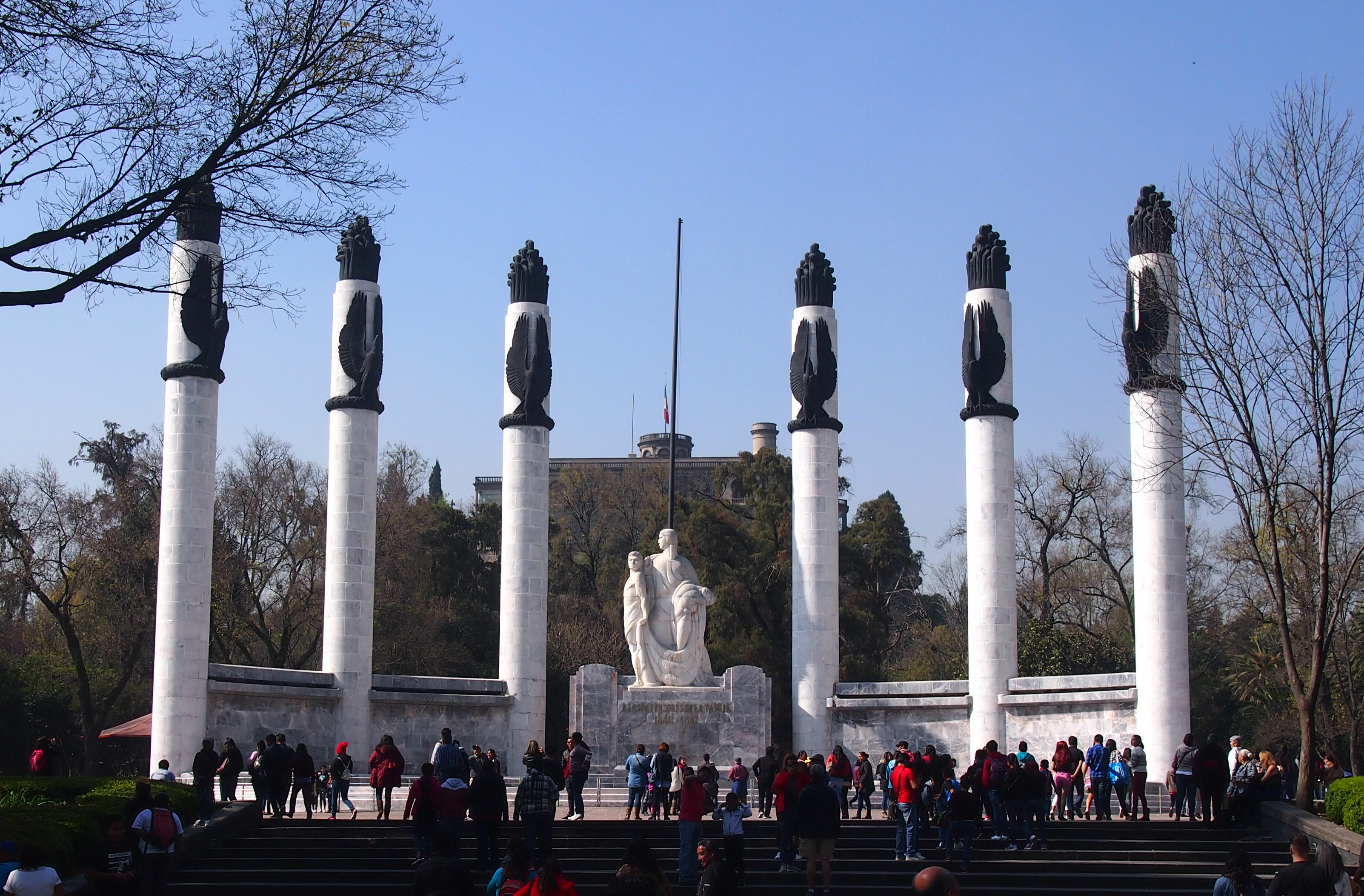
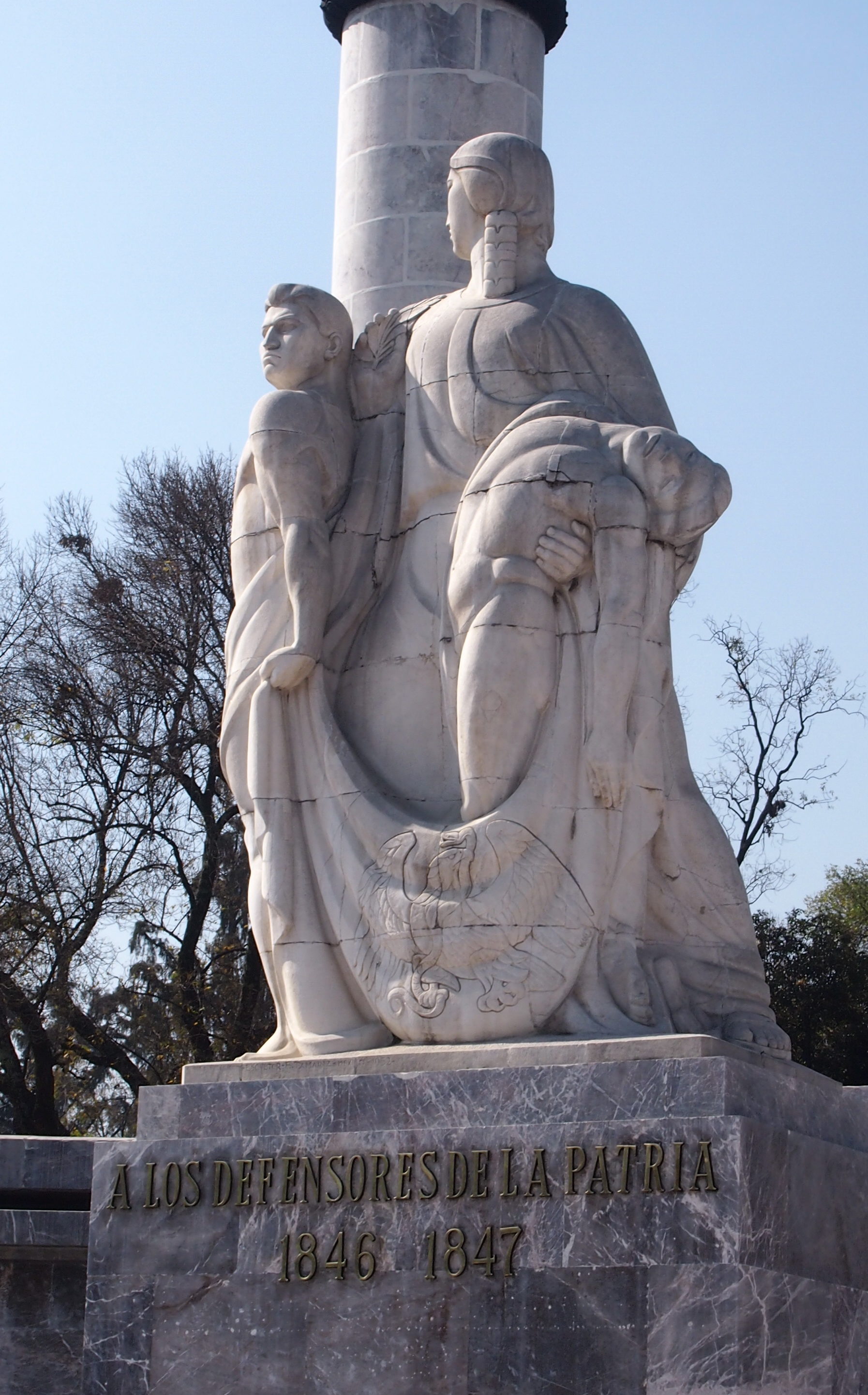
That’s what the Niños Héroes were defending to the death against U.S. forces under Gen. Winfield Scott on September 13, 1847. At the eastern entrance to the park, below Castillo de Chapultepec, is the famed memorial to the six cadets.

The memorial dates from 1952 and was designed by architect Enrique Aragón and sculpted by Ernesto Tamariz.

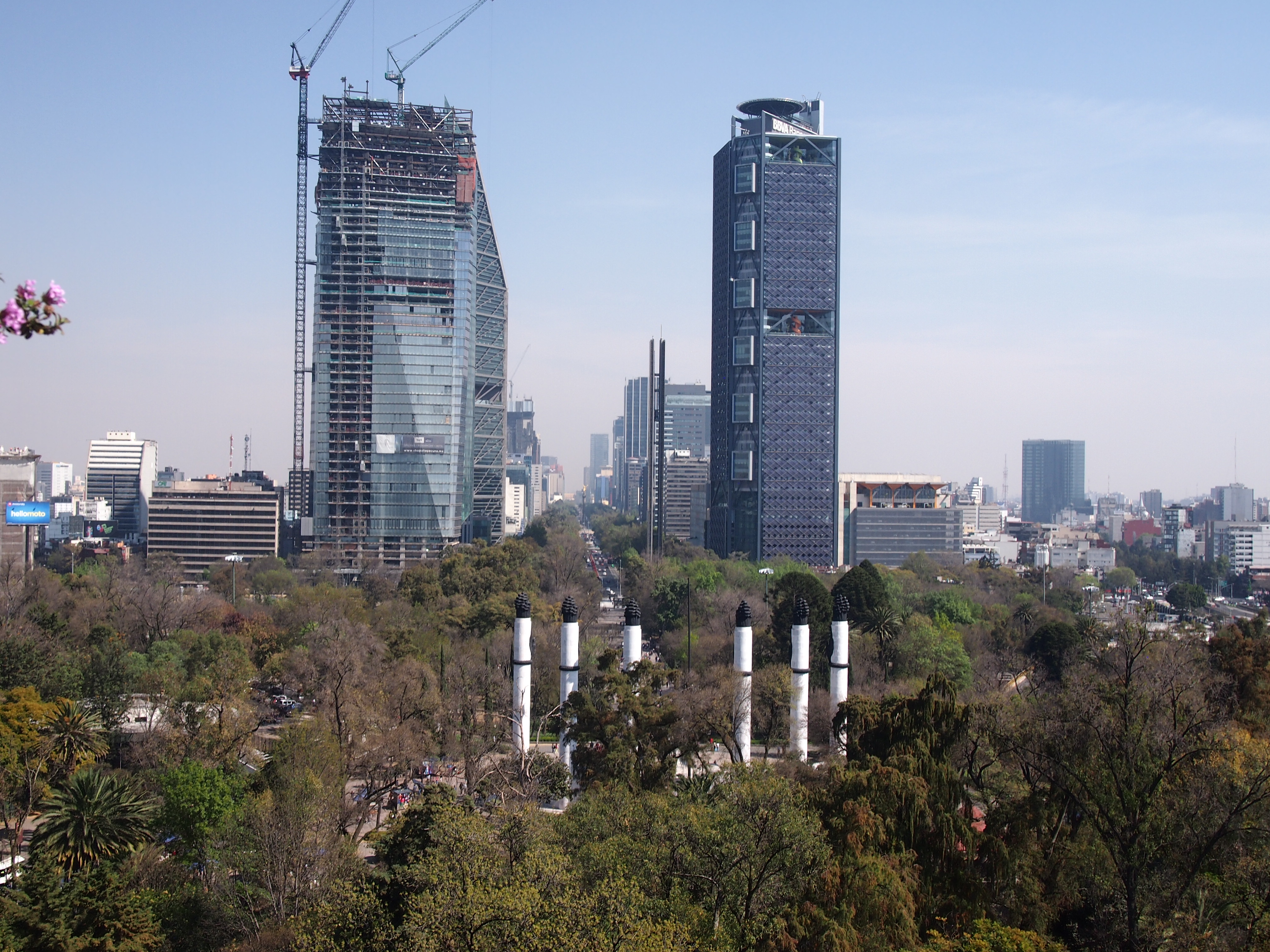
Once you get atop the hill and in the castle, you can look back toward the memorial.
Beyond that, looking eastward — Castillo de Chapultepec would have been west of the city in the 19th century, later witnessing it grow toward the hill — is the modern Paseo de la Reforma, flanked by large buildings.

The castle started taking its current shape under the ill-starred Emperor Maximilian, who used it as a residence. Some of his portraits still hang in the museum, including one that was suitably regal, and another one from which I got the impression that the artist had given the emperor a hint of a “what have I gotten myself into” look on his face (I think it was this one).

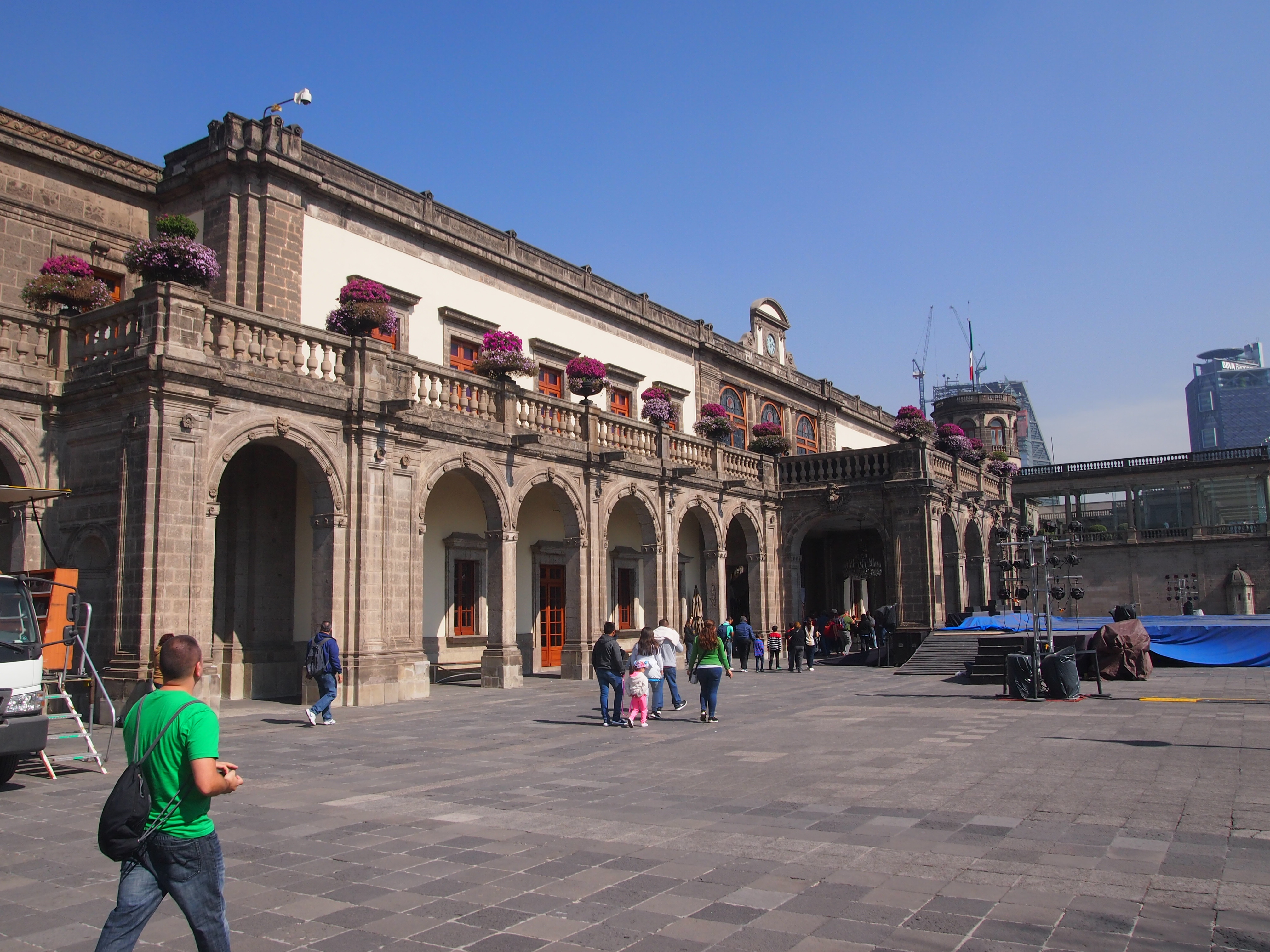
The museum’s entrance leads visitors to a handsome plaza.
Note the stage under the tarp. That’s where the Ballet Folklórico de México gave the lively performance we attended two nights later, with a palatial backdrop bathed in alternating colored lights.

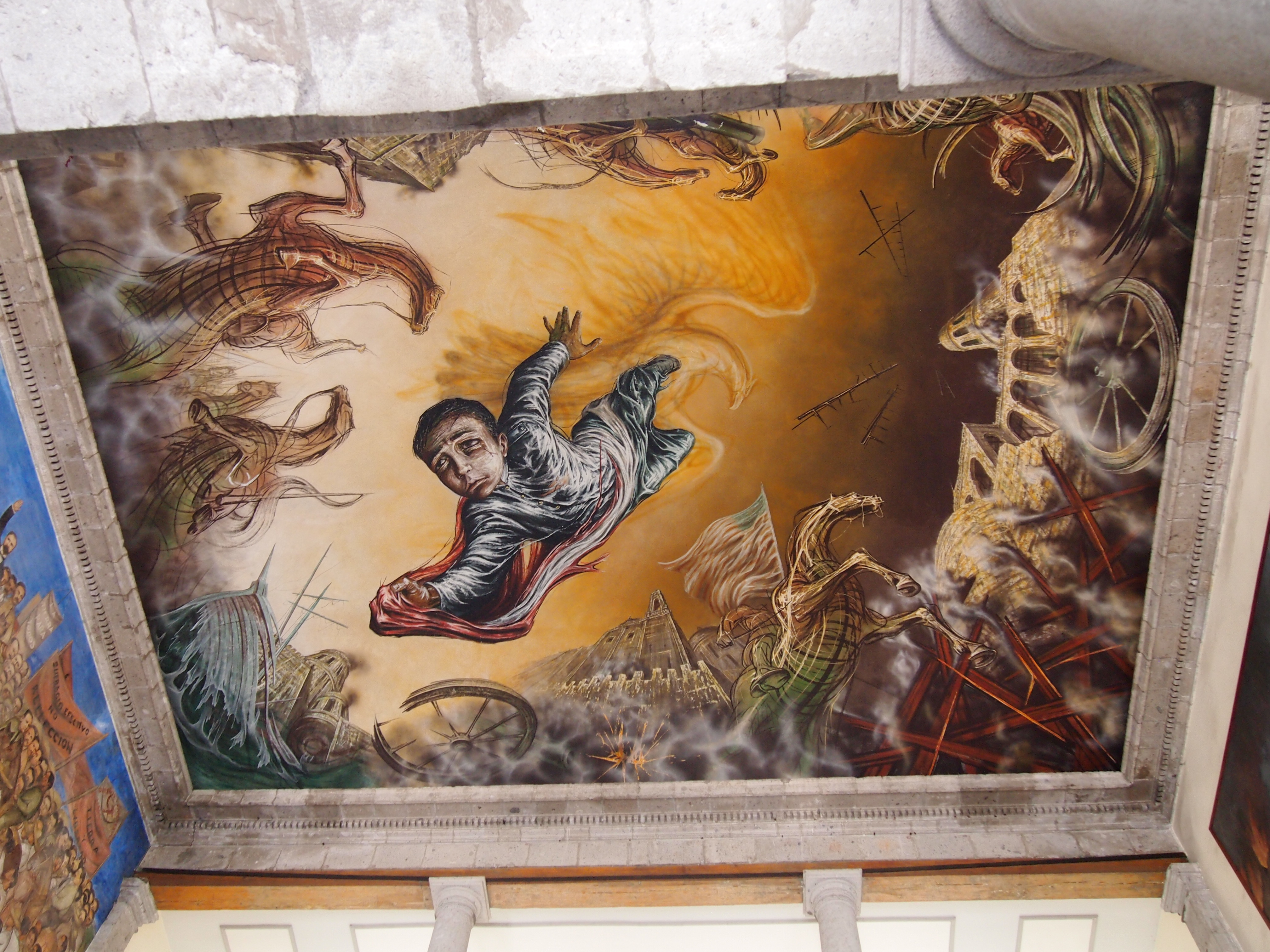
Enter the castle itself behind the temporary stage, look up, and you’ll see this 1967 mural by Gabriel Flores on the ceiling.

Later I learned that it depicts Juan Escutia, one of the Niños Héroes, leaping to his death from the castle walls, wrapped in the Mexican flag.

After Maximilian wound up on the business end of a firing squad, the castle was neglected for a while again until Porfirio Díaz decided he wanted to live there and so spiffed up the place. Post-Díaz Mexican presidents lived there as well, until 1944, when the building became a museum.

As a museum, Castillo de Chapultepec’s collection is extensive, including paintings and sculpture, clothing, coins, musical instruments, silver items, period furniture, ceramics, flags, a room of 19th-century carriages, books, documents and more. I was especially taken by the murals. You want to see some fine murals, go to Mexico.

Here’s a detail of Francisco I. Madero leading the 1911 revolution, part of a larger mural in the museum’s Independence Room. Juan O’Gorman, who did a mural on the front of the Lila Cockrell Theatre in San Antonio for the world’s fair in 1968, did this mural.
Off to the left in the Madero mural, not pictured above, is the top-hatted U.S. Ambassador to Mexico, Henry Lane Wilson, handing the presidential sash to Victoriano Huerta, who murdered Madero in 1913 to take the presidency for himself.

On the other side of room are Porfirio Díaz and his ugly minions, such as this fellow and his whip.

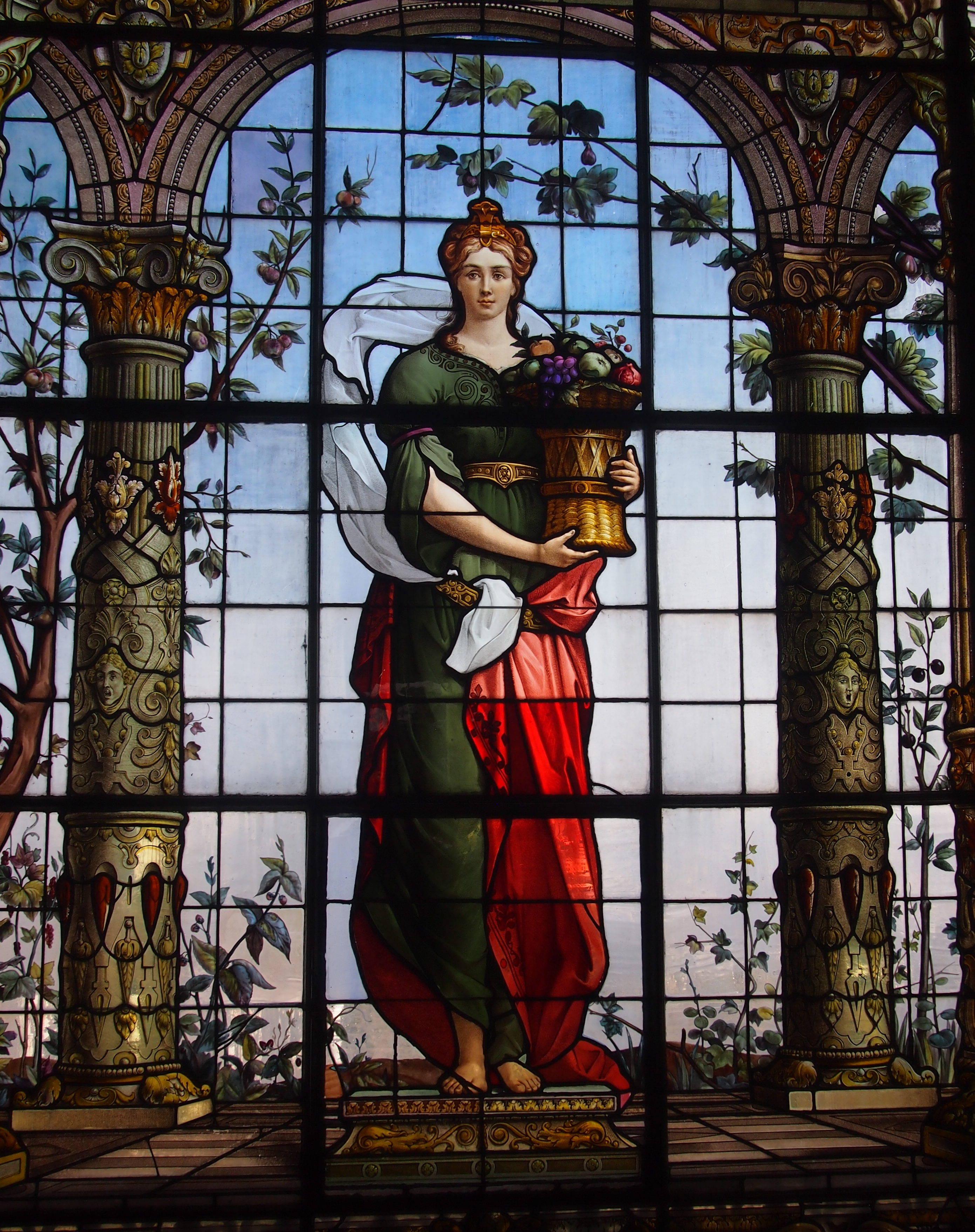
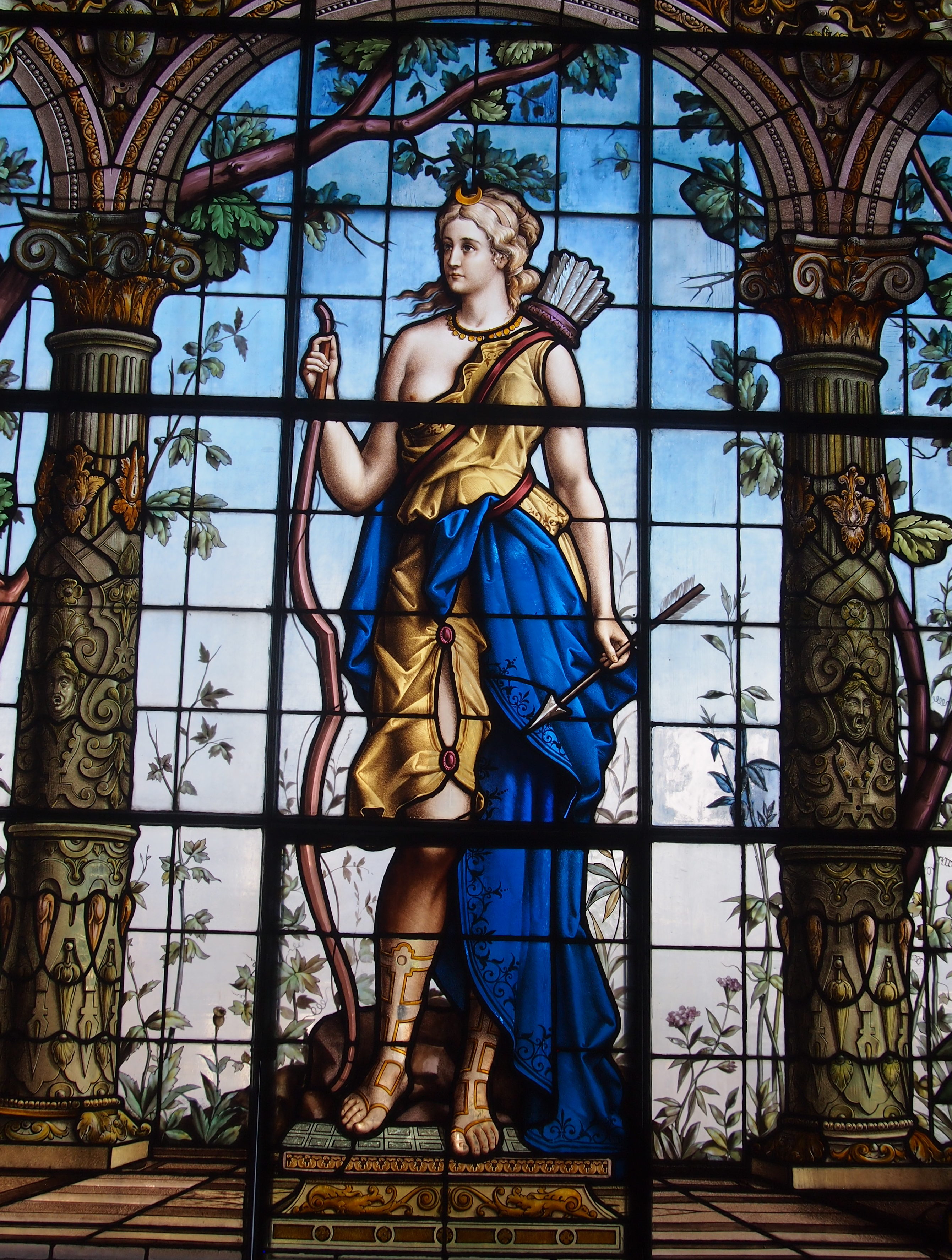
Murals aren’t everything, however. Elsewhere in the museum is a hall with a row of fine stained glass depicting various goddesses of Classical Antiquity, such as Ceres.

And Diana.
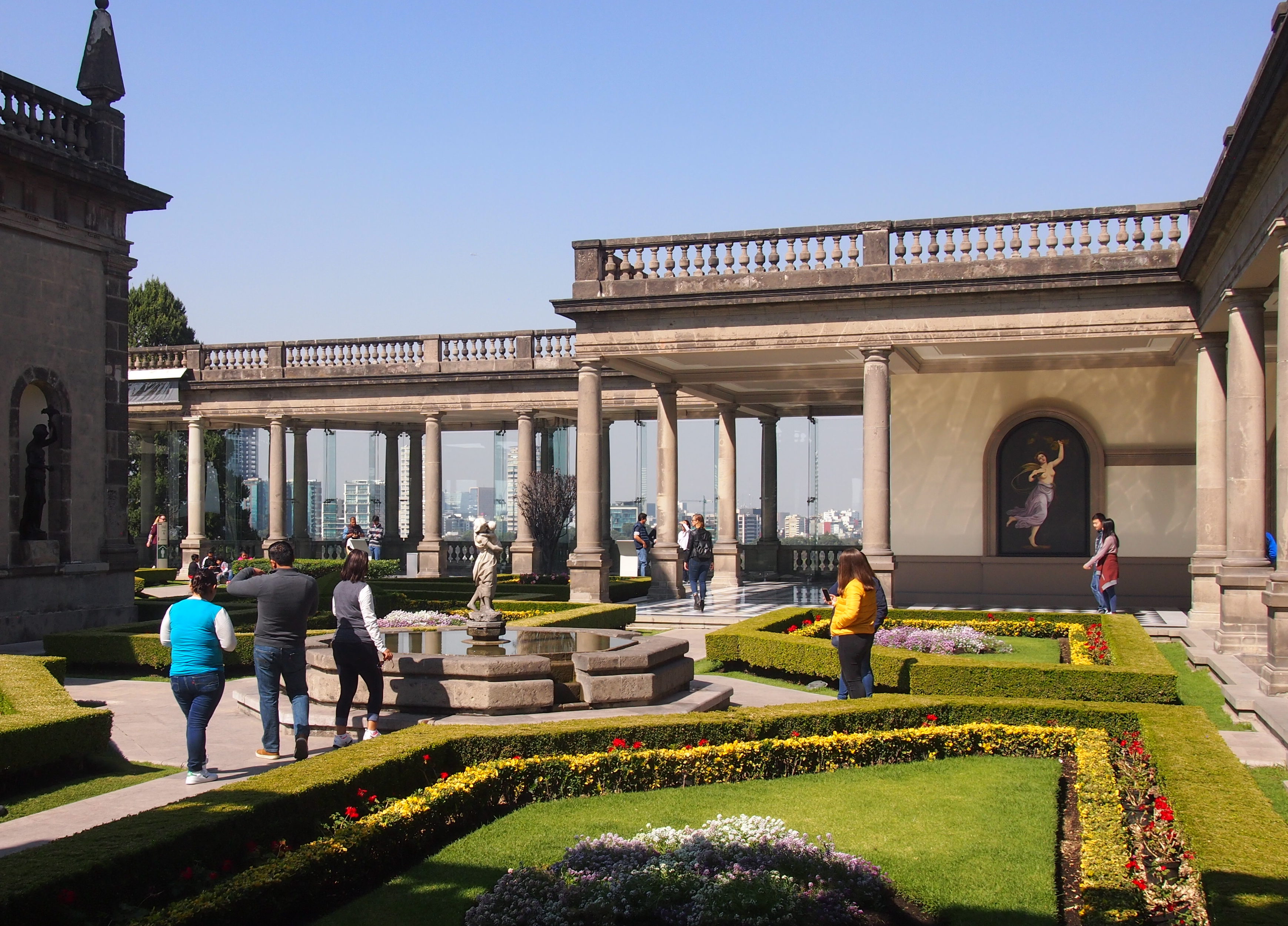
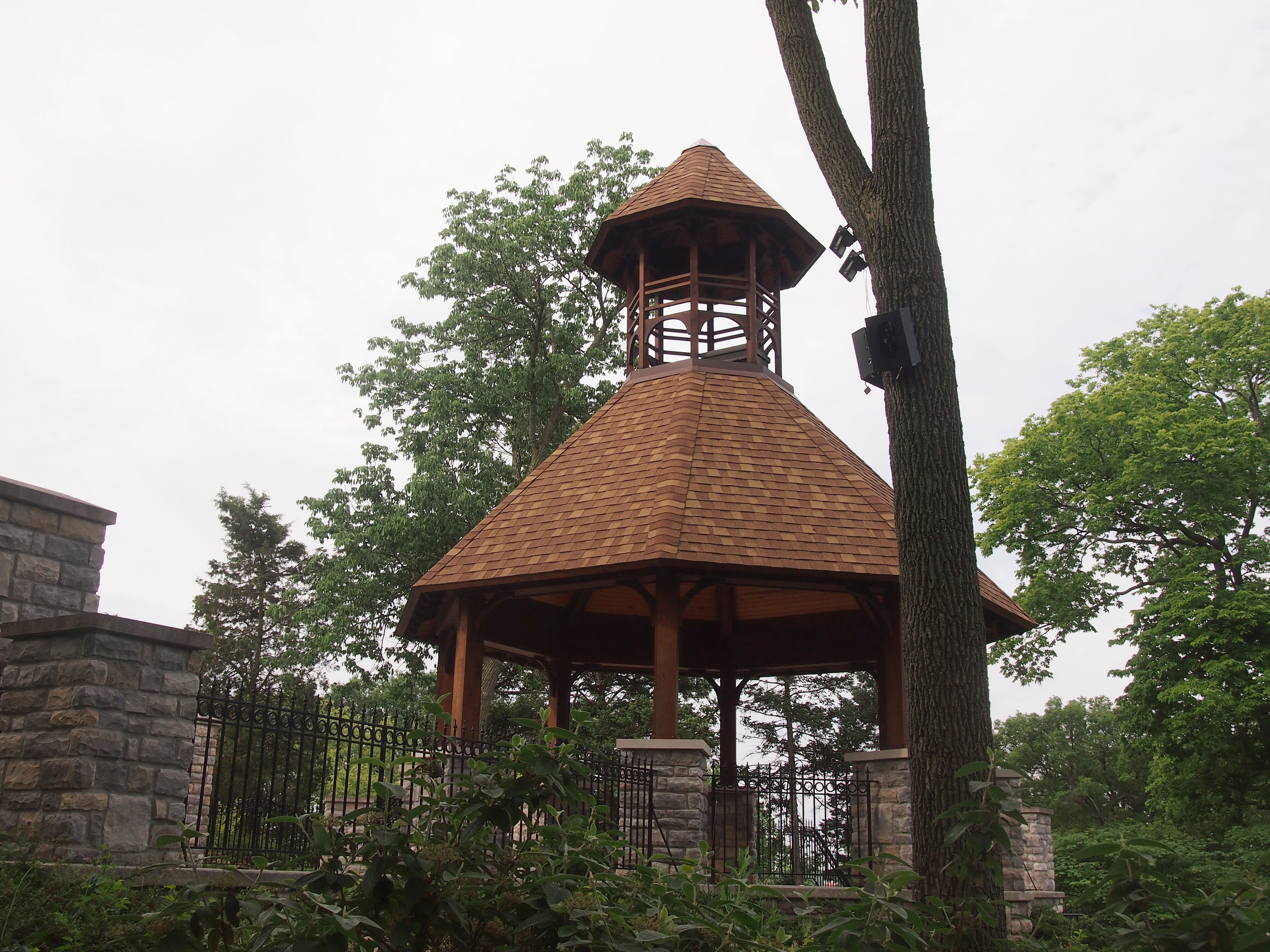
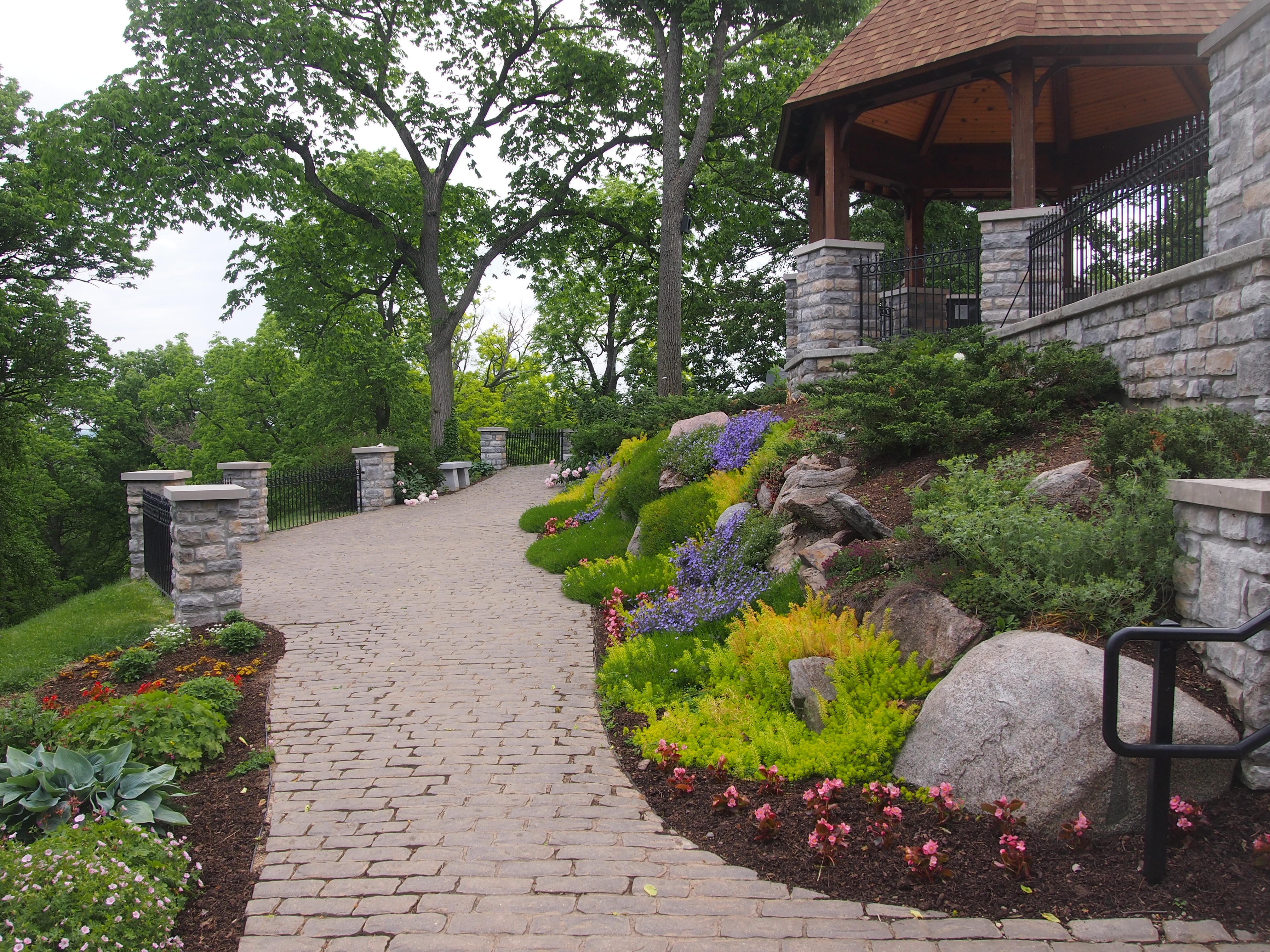
The castle’s roof gardens are exceptionally pleasant, especially under a warm afternoon sun.
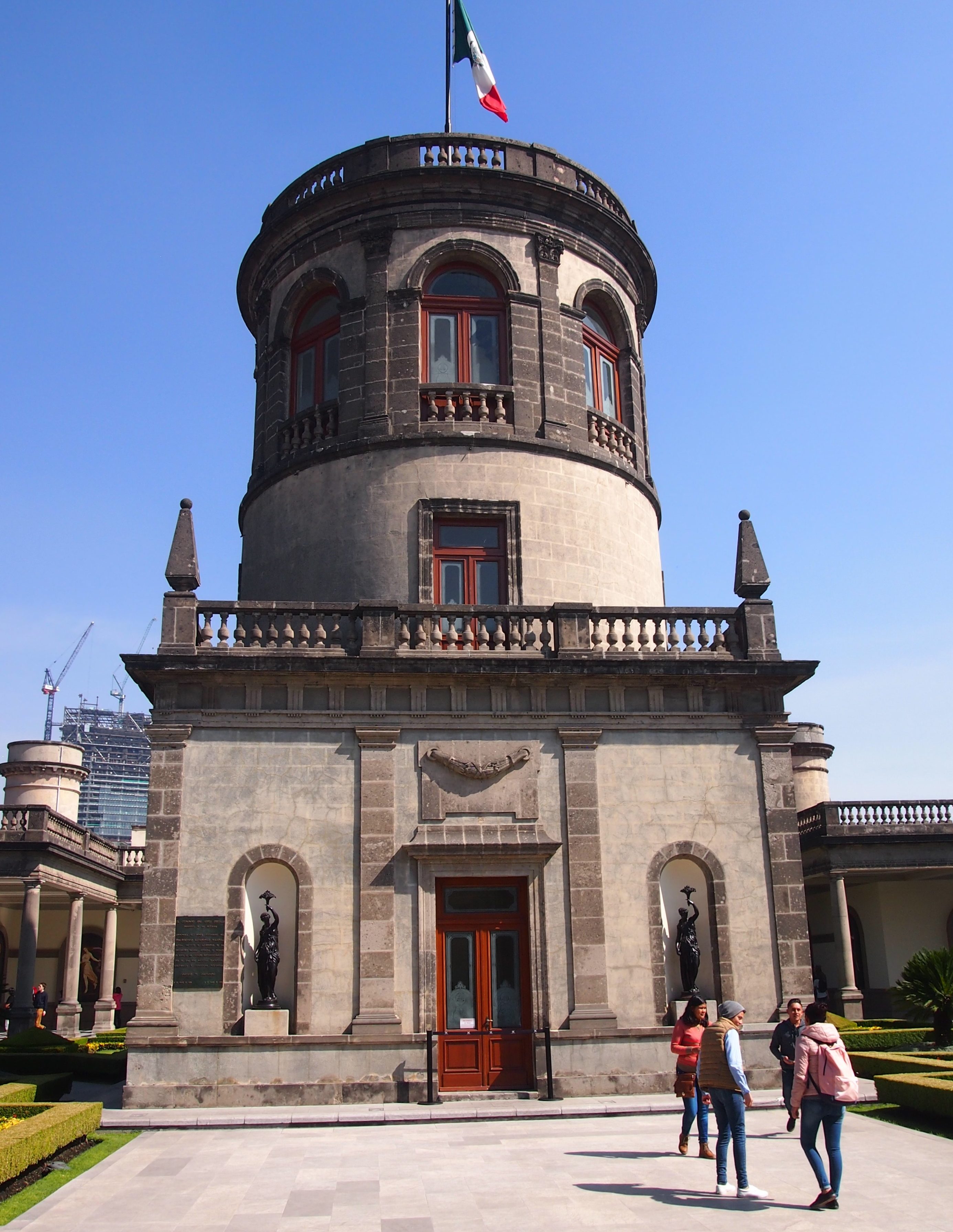
A tower that caps the castle rises over the rooftop garden.
Castillo de Chapultepec was a fine way to kick off four straight days of tourism.

Vulcan

While I was in Birmingham earlier this month, I noticed a lot of yard and roadside signs for the upcoming Senatorial election. Every single one was for Doug Jones or, more likely, against Roy Moore. Birmingham tends to be Democratic, and Jones is from Birmingham, but I think there was more to it than that. What I didn’t think was that Jones would win.

The simplest of the signs said: No Moore.

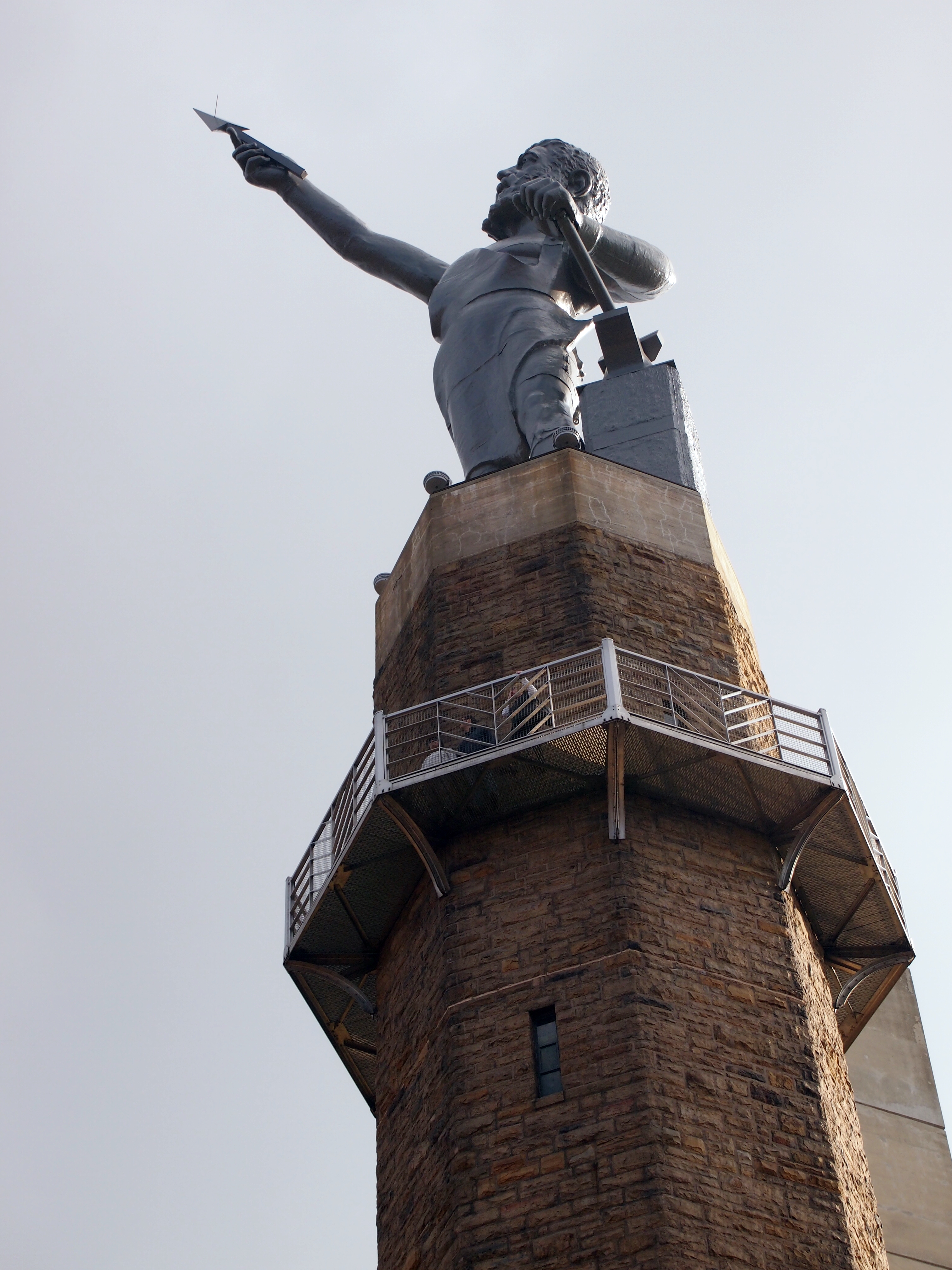
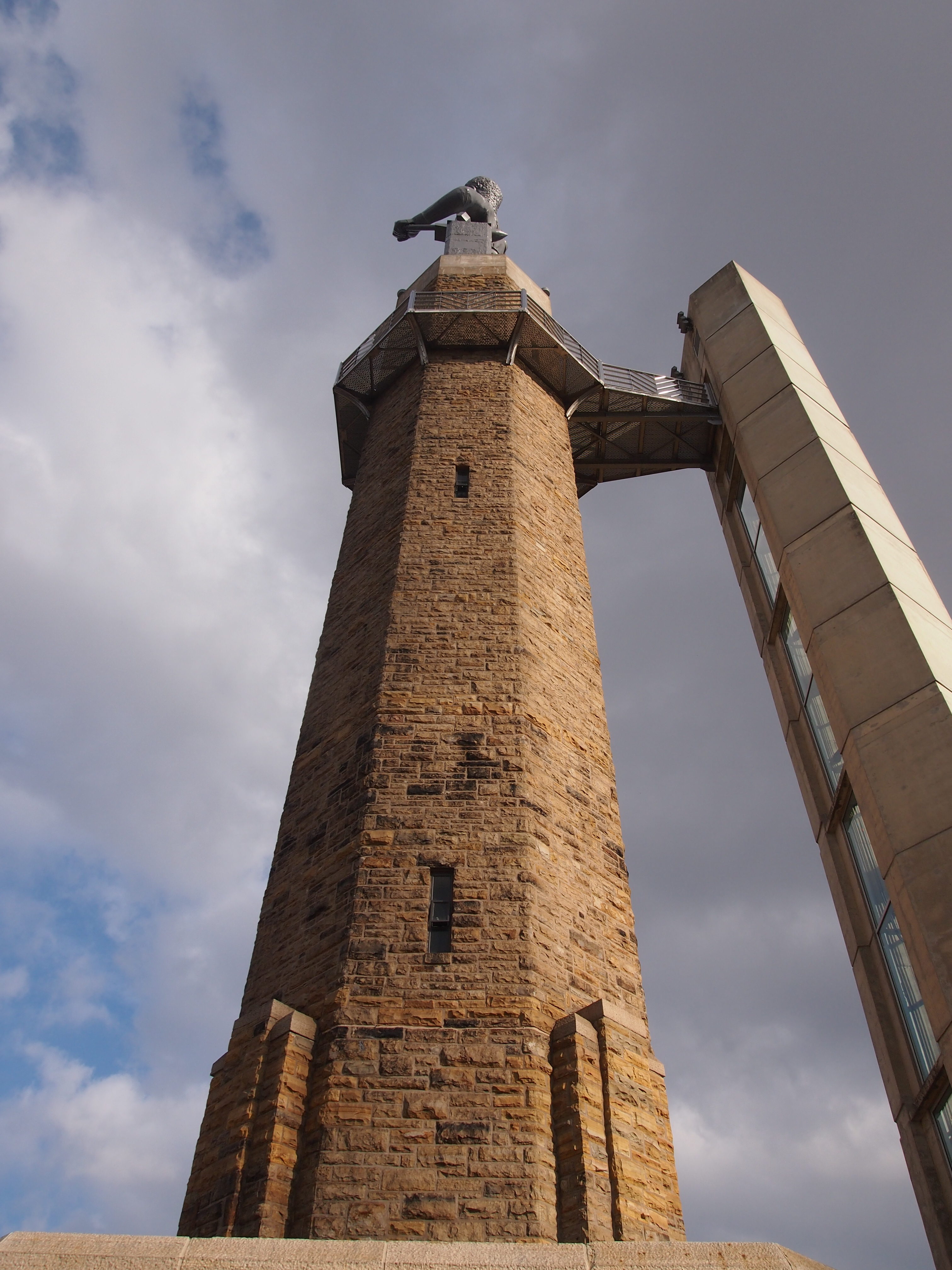
I’m only half-joking when I say that the modern world was invented either by Victorians, or for the 1893 World’s Fair, or for the 1904 World’s Fair, or by ad men in the 1920s. In the case of the massive cast-iron Vulcan overlooking Birmingham, Alabama, the statue was created for the World’s Fair in St. Louis, to tell the world about the city’s core competence in metal.That’s Vulcan atop the stone tower that the WPA built for him in the 1930s. Next, a view from a little further back.

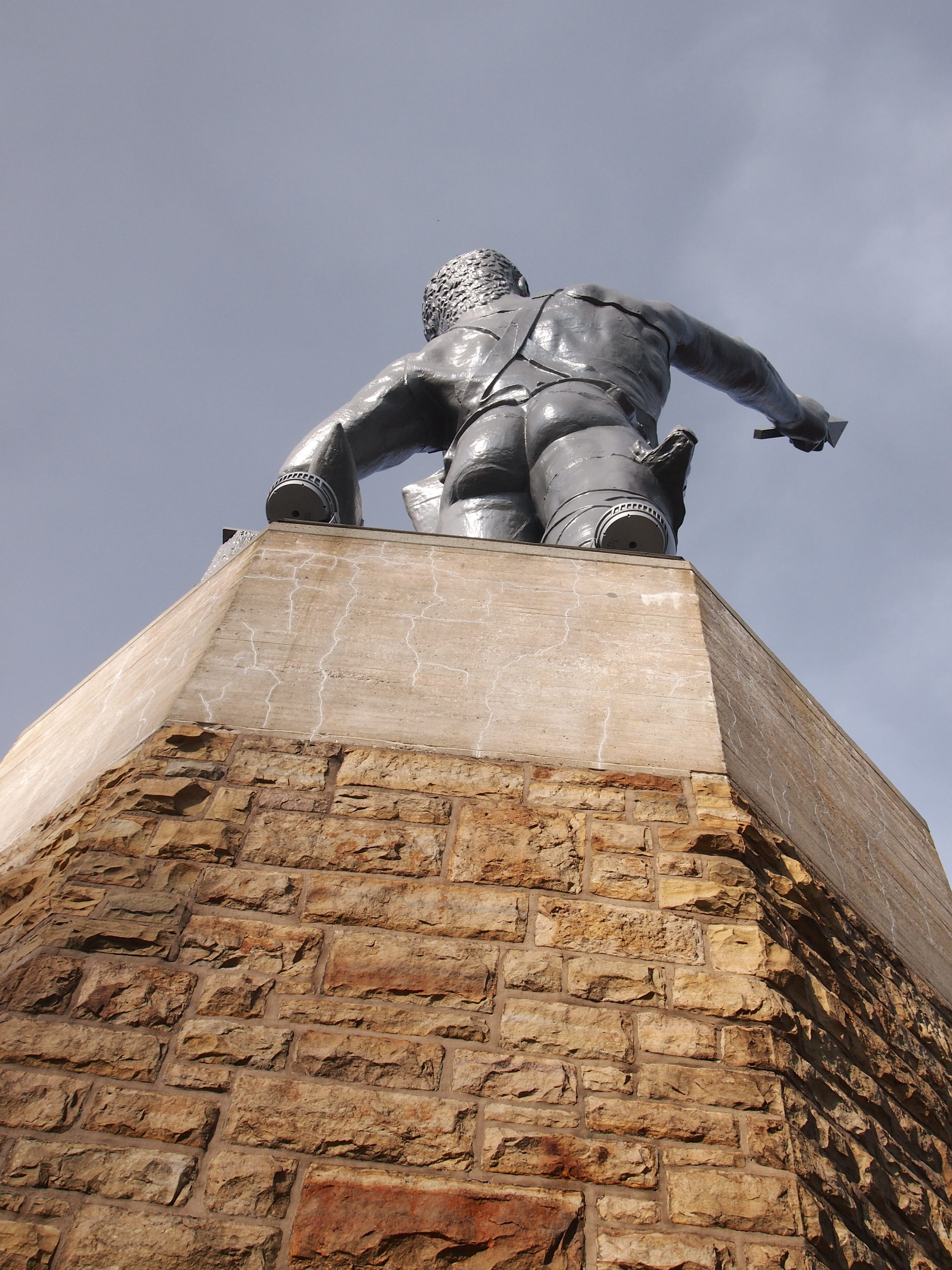
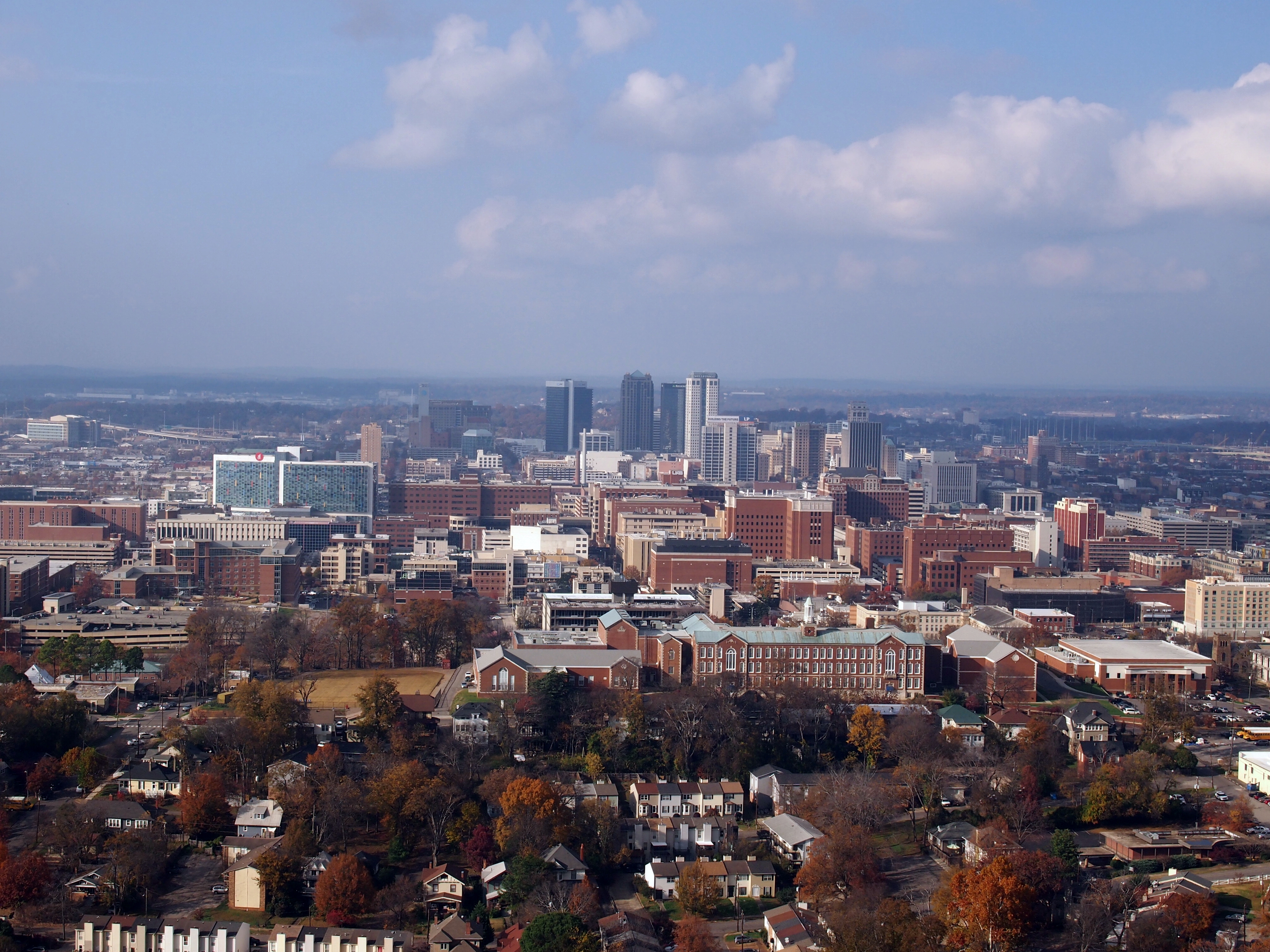
Note the observation deck. You can reach that via stairs inside the tower, or by an elevator in the other tower. We took the elevator. From the deck, which goes all the way around the tower, Vulcan’s backside is close by.Besides Vulcan’s buttocks, we could see Birmingham stretching out in the distance.

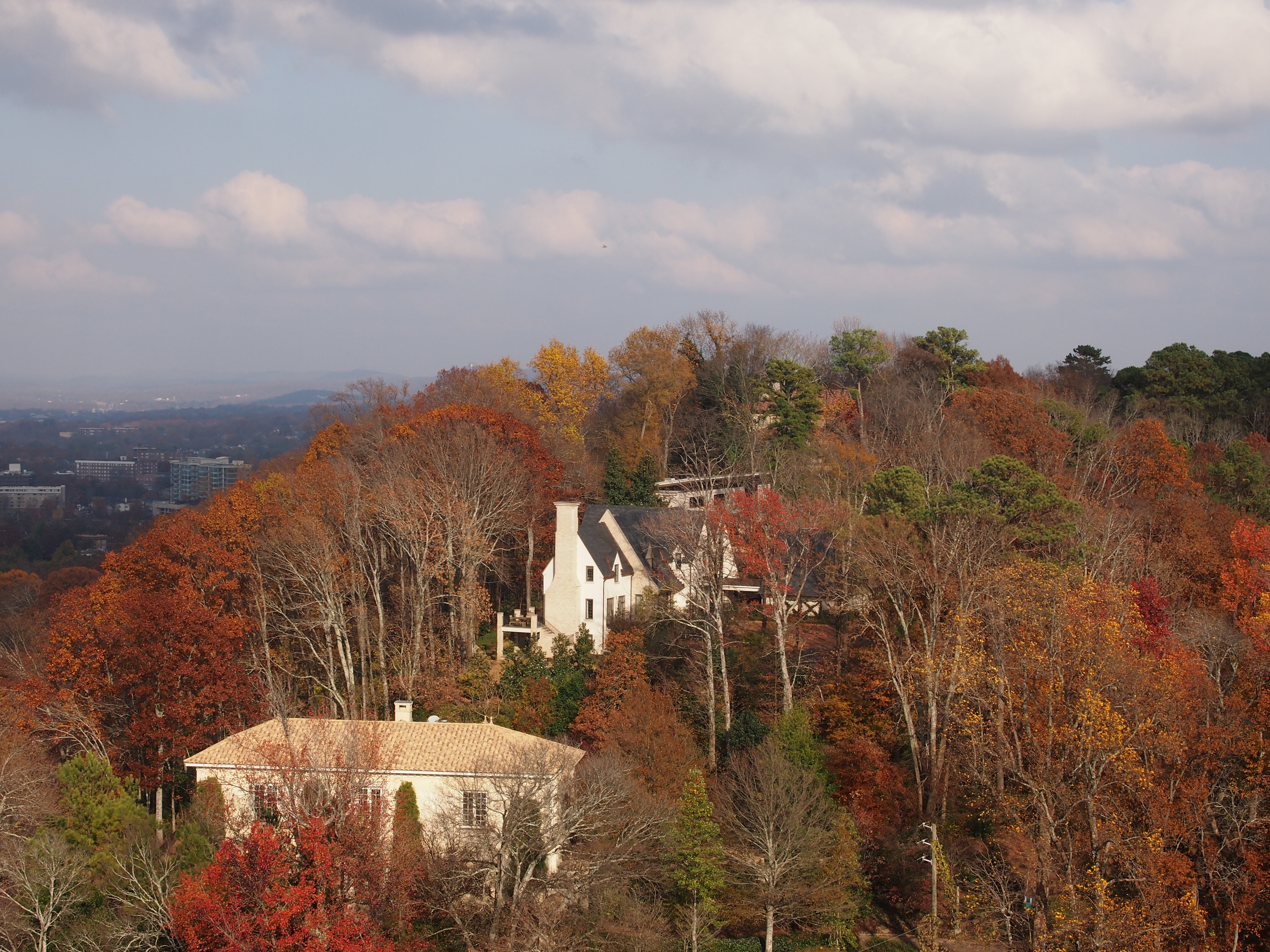
There were also views of the surrounding hilly terrain.

For Vulcan, created by immigrant Giuseppe Moretti, the road from the 1904 World’s Fair to the top of Red Mountain in Birmingham wasn’t direct. After the fair, he was painted and displayed at the Alabama State Fairgrounds until the 1930s, when he was moved to Red Mountain and put on the 124-foot pedestal fashioned by the WPA.

Instead of a spear point, which was lost en route home from the fair, he had a lantern in his outstretched hand. It glowed red after a traffic fatality in Birmingham; green when there had been none for a while.

In the early ’70s, the tower was “modernized,” that is, made ugly. By the end of the 1990s, however, the statue was threatening to fall apart — no small matter for something that’s 56 feet high and weighs 100,000 pounds (the head alone weighs 11,000 pounds).

It took a while to raise the funds needed for repairs, but civic pride eventually came through. The statue was revamped by 2004, including restoring the structure and Vulcan’s original coloration, giving the tower back its WPA appearance, and putting a spear point back in the god’s hand.

A Few Views From the Wells Fargo Center, Denver

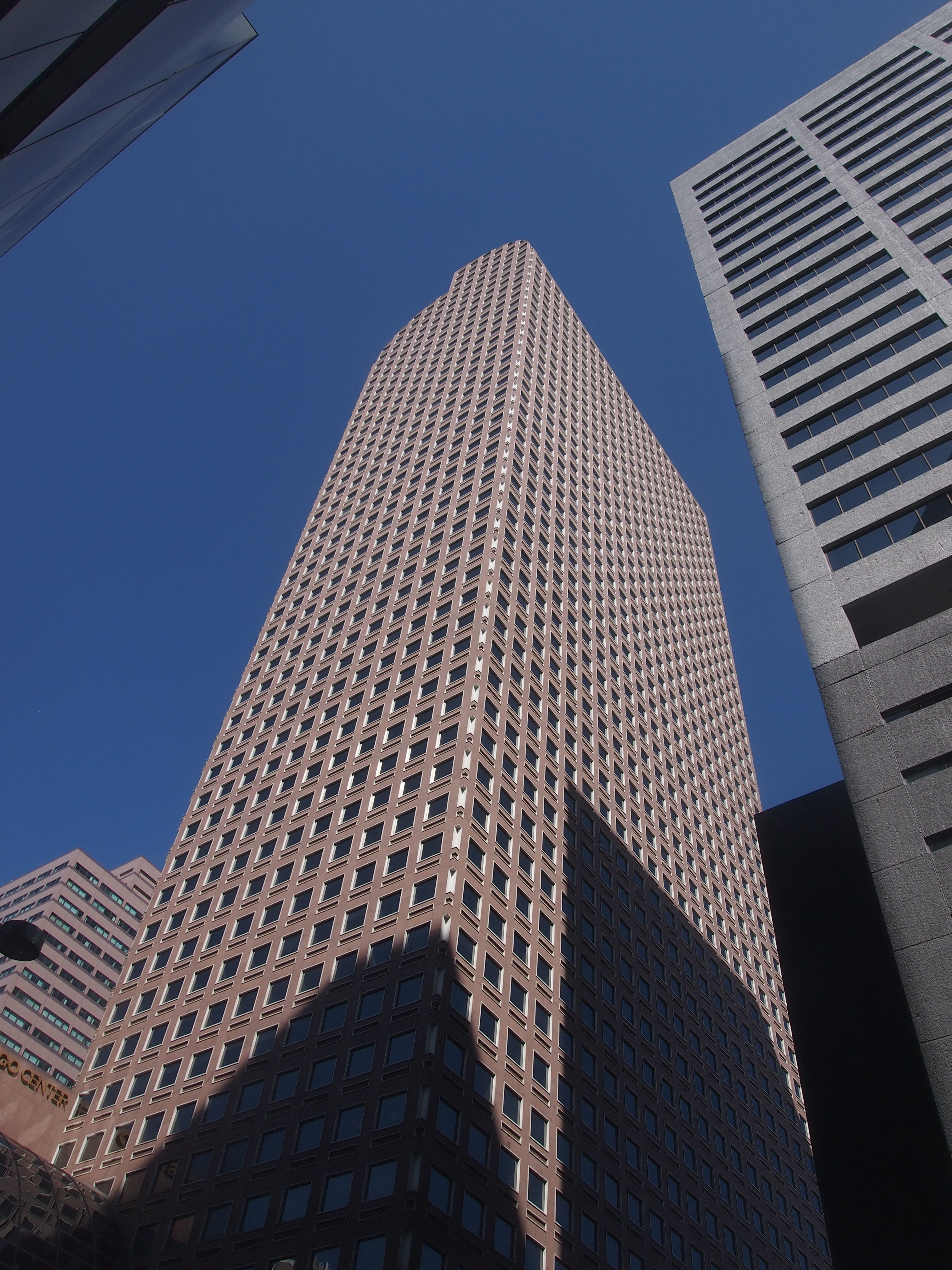
During my stay in Denver, I had an event to attend in the Wells Fargo Center, the third tallest building in Denver, big enough (about 1.2 million square feet) for its own zip code: 80274.
Wells Fargo Center, DenverThe 1983-vintage building’s distinctive curving roof, a Philip Johnson touch, was barely visible from where I stood, near 17th Ave. and Sherman St. The neighboring streets there are Lincoln, Sherman, Grant and Logan. I sense a postbellum naming scheme.

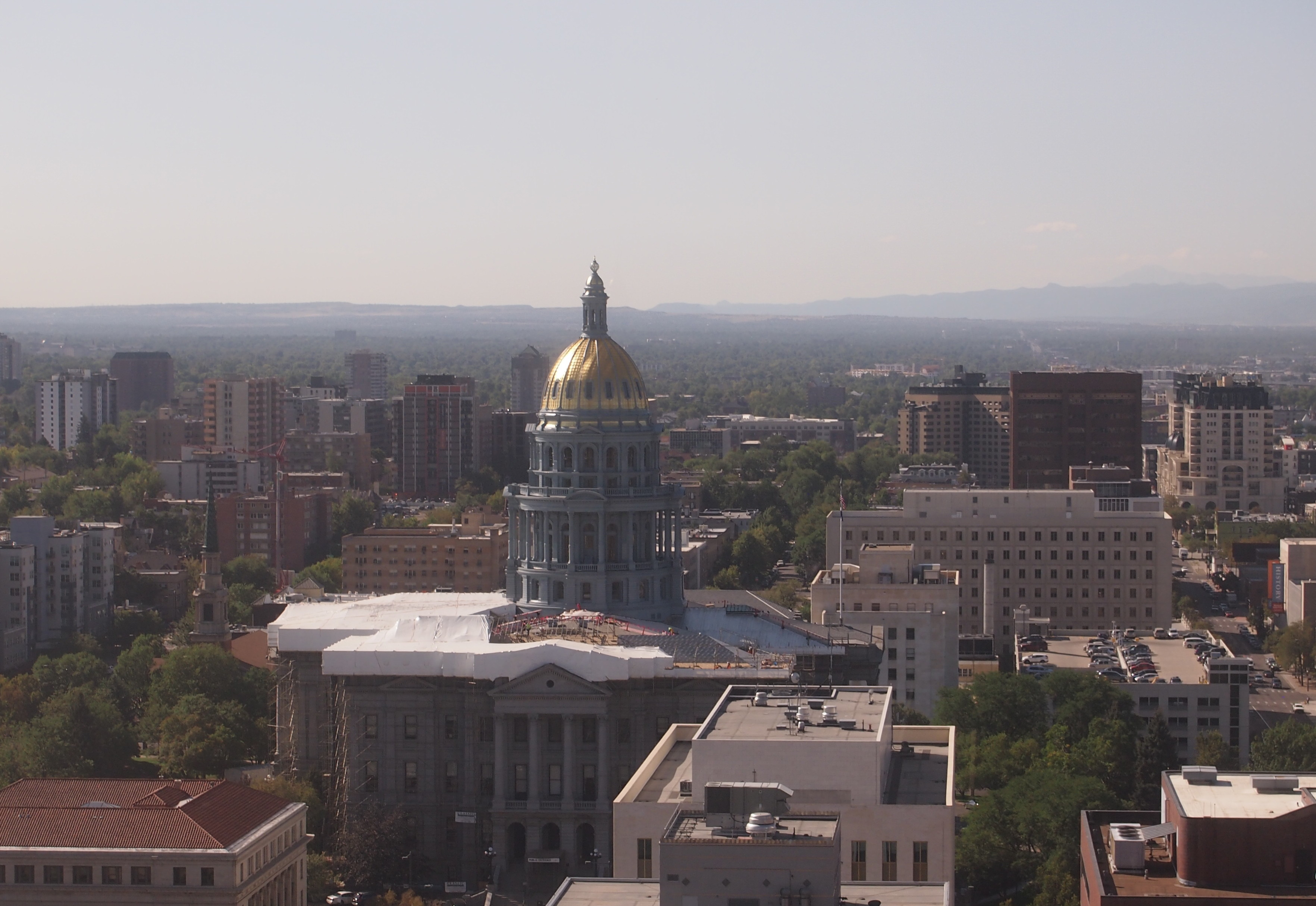
The event was about mid-way up the tall tower, high enough for views of the city and surrounding territory, though glare from the window glass and haze in the sky obscured things a bit. Still, here’s another view of the capitol.
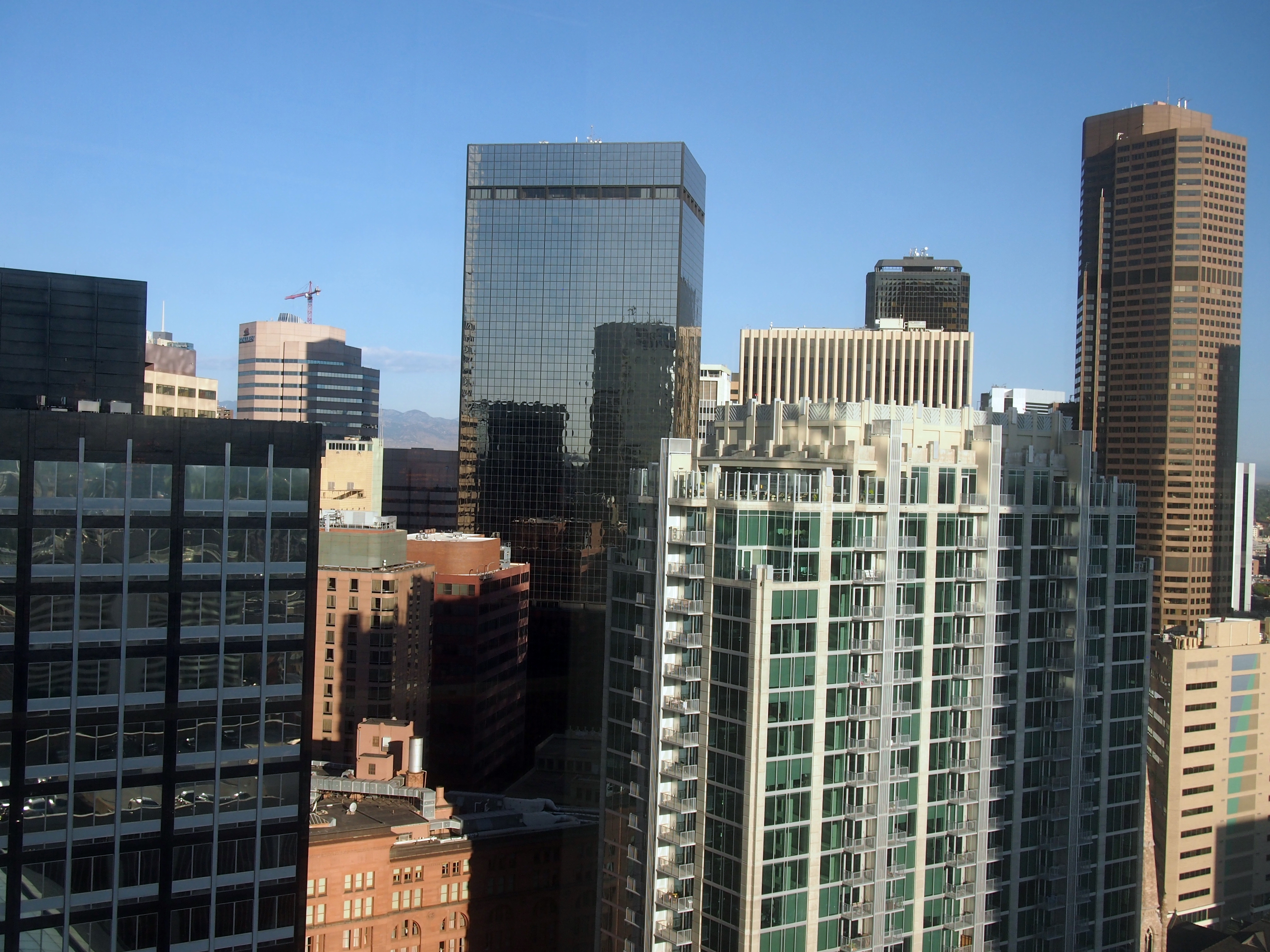
Colorado capitolSome neighboring tall buildings.
Downtown DenverThis caught my eye.
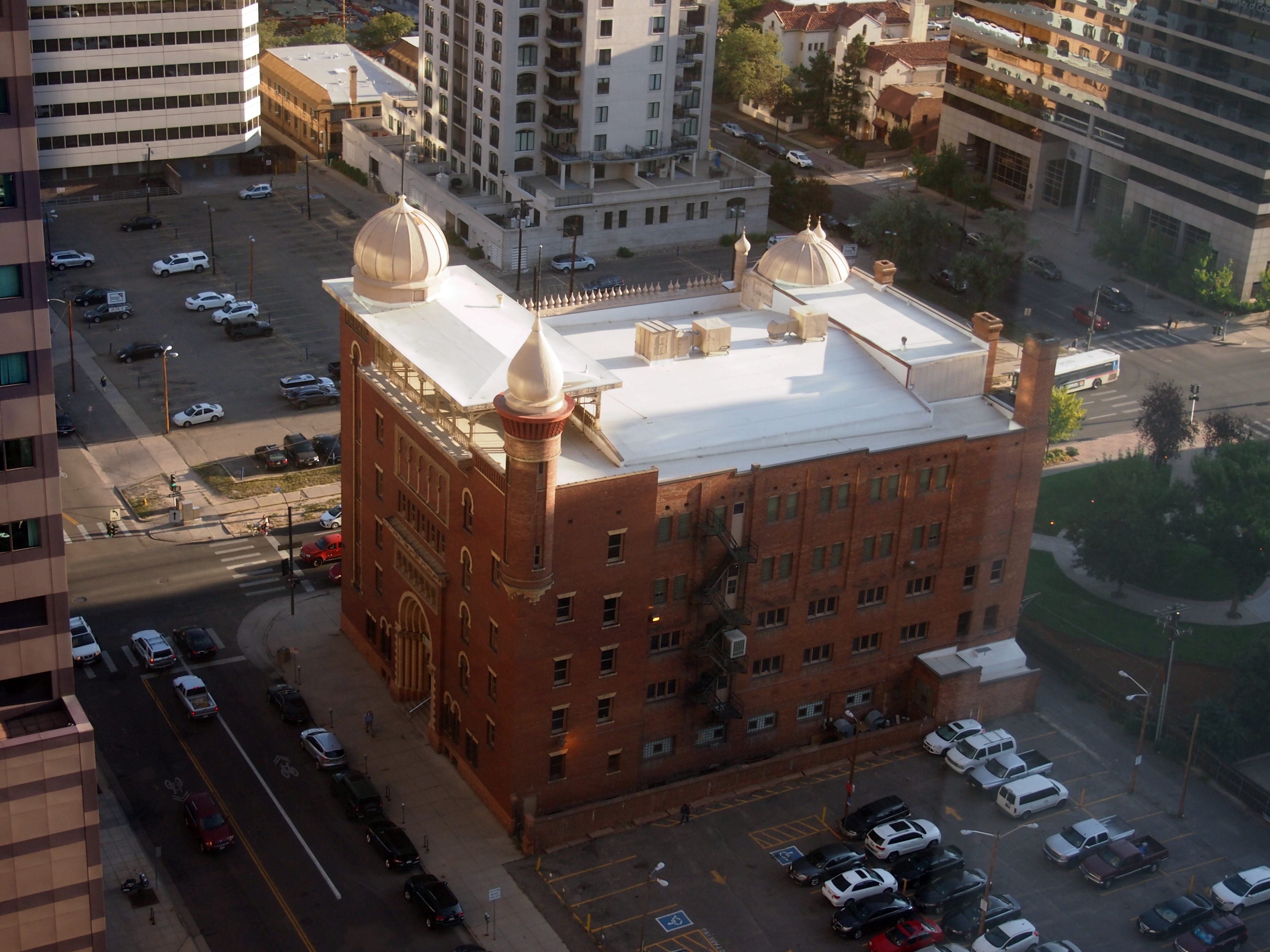
Sherman Street Event Center, DenverIt’s the prosaically named Sherman Street Event Center, 1770 Sherman St., catching the late summer morning sun. It used to have better names: in order, the Mosque of the El Jebel Shrine, the Rocky Mountain Consistory, and the Scottish Rite Temple. The Shriners had it built in 1907, onion domes and all.

Porcupine Mountains Wilderness State Park (The Vistas)

What is it about vistas that people like? Assuming we can agree that vista refers to an aesthetically pleasing view from a high position. People drive distances, climb stairs, take elevators, pay money and sometimes even take risks for a good vista. I do those things, though the risks are never that great. I like a good vista, but I can’t quite say why.

That question triggers others. Did Petrarch really climb Ventoux for the view? Or is vista-awe actually a more recent invention, maybe a sprig of the Romantic movement or a Victorian fixation? These questions aren’t so burning that I’m going to do much research, but I do wonder. I suspect the feeling is fairly modern, and probably not universally shared even now, any more than a taste for coffee or soccer or rock and roll.

And it doesn’t just apply to views from mountains. Now that manmade towers are so plentiful, so are those vistas. At Porcupine Mountains Wilderness State Park in the UP on July 1, we enjoyed one vista of each kind: a tower top, though that was atop a high hill reached mostly by walking, and a view from a the bluff of a high hill, though we reached that mostly by driving.

The park has a lot of hiking trails through a lot of wilderness, about 59,000 acres with a Lake Superior coastline. The mountains of the name aren’t really much in the way of mountains, but it is rugged terrain: dense old-growth forests, never logged because of its inaccessible ruggedness. I read some years ago that the area was to have been a national park, but the federal government was too distracted in the early 1940s to get around to it, so the state of Michigan went ahead and created a state park in 1945.

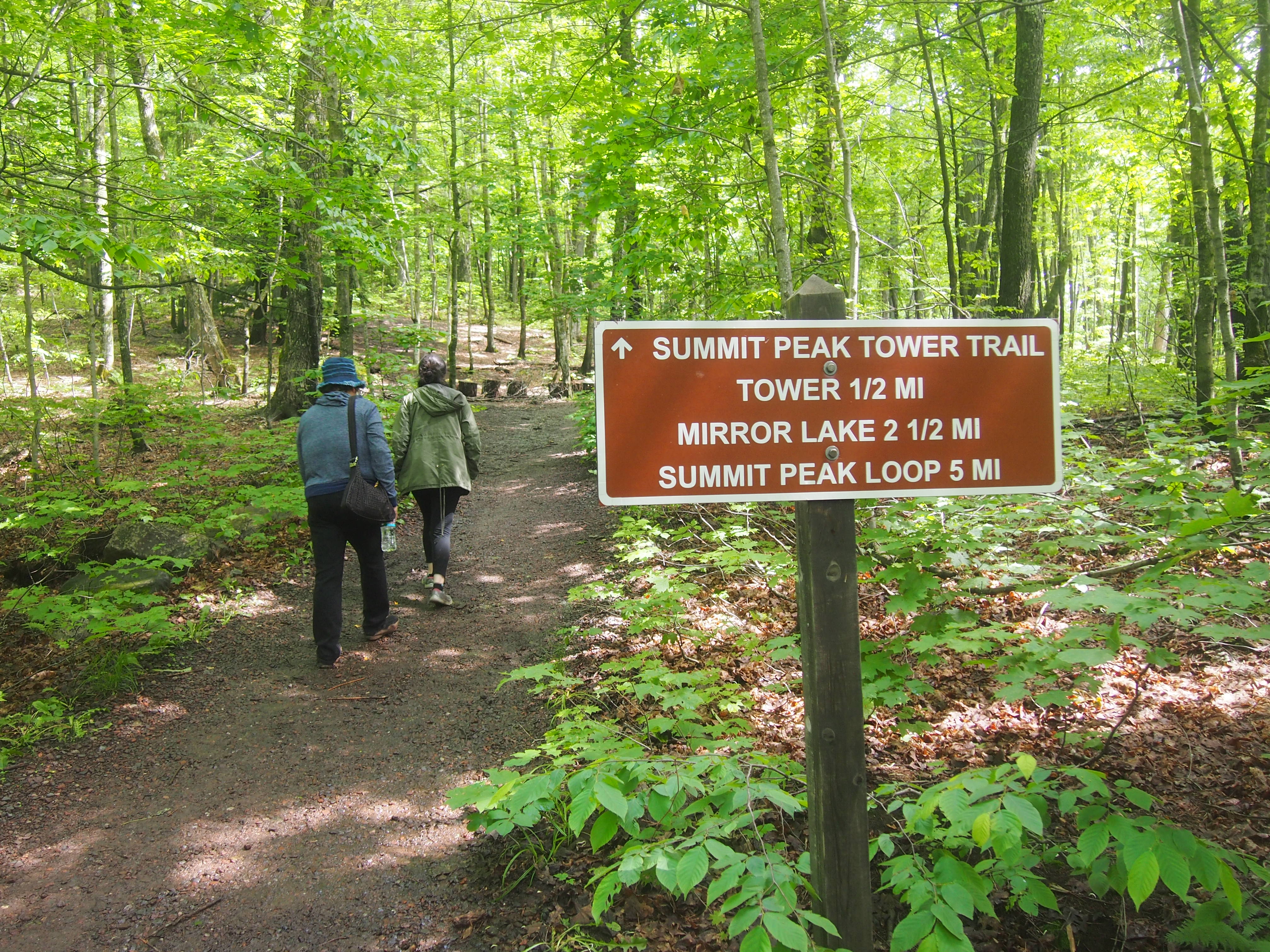
I can’t pretend we did any serious hiking in the Porkies. The time and energy weren’t there. But we did some excellent short hikes. Off the South Boundary Road, a side road plunges into the park and ends at a parking lot for the Summit Peak Tower Trail. It’s only half a mile to a lookout tower atop a high hill.

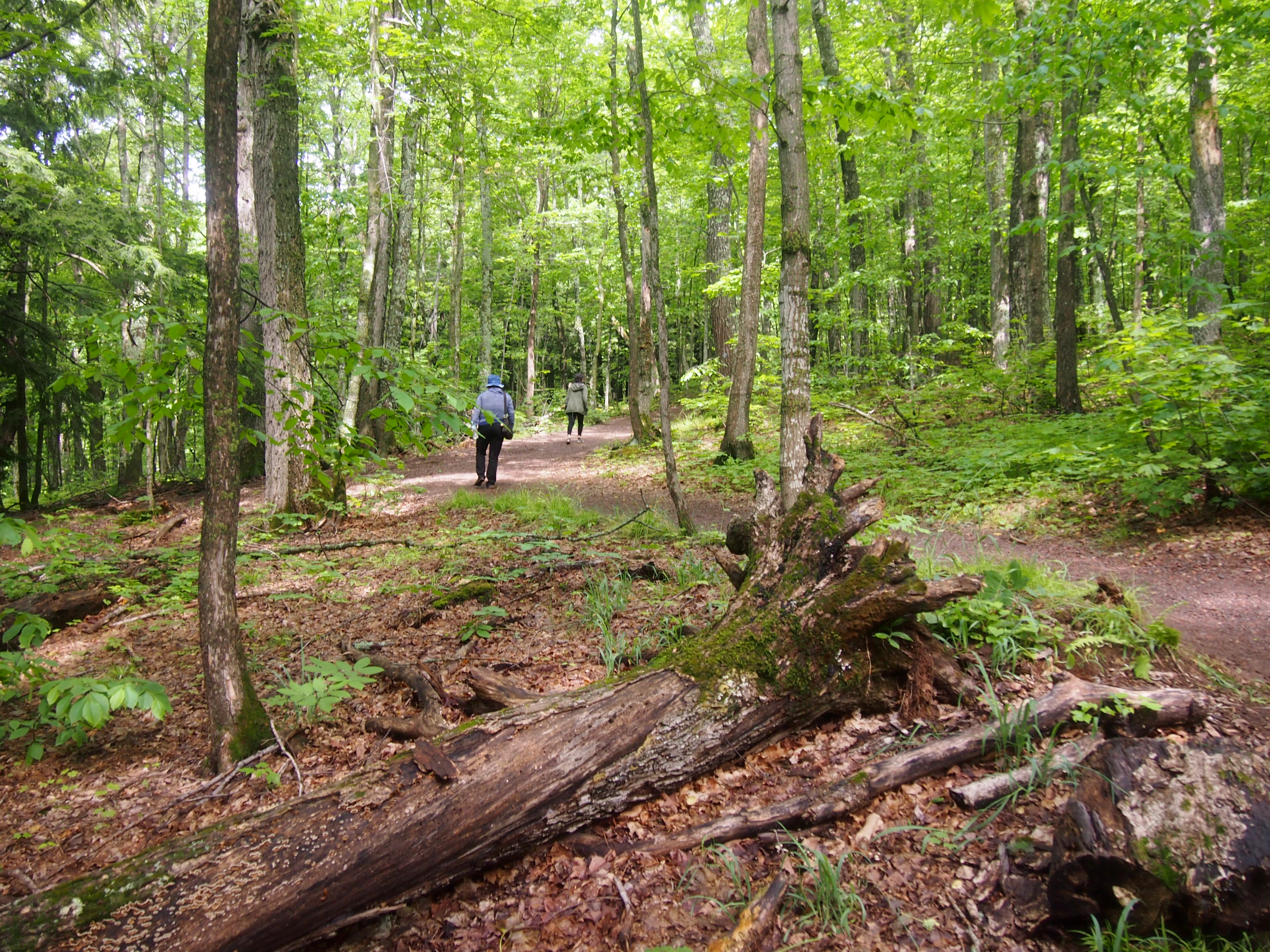
Summit Peak Tower TrailThe trail rose gradually for a time. Except for muddy spots, no difficulties.
Summit Peak Tower TrailEventually, the grade increased and sometimes there were boardwalks and steps.
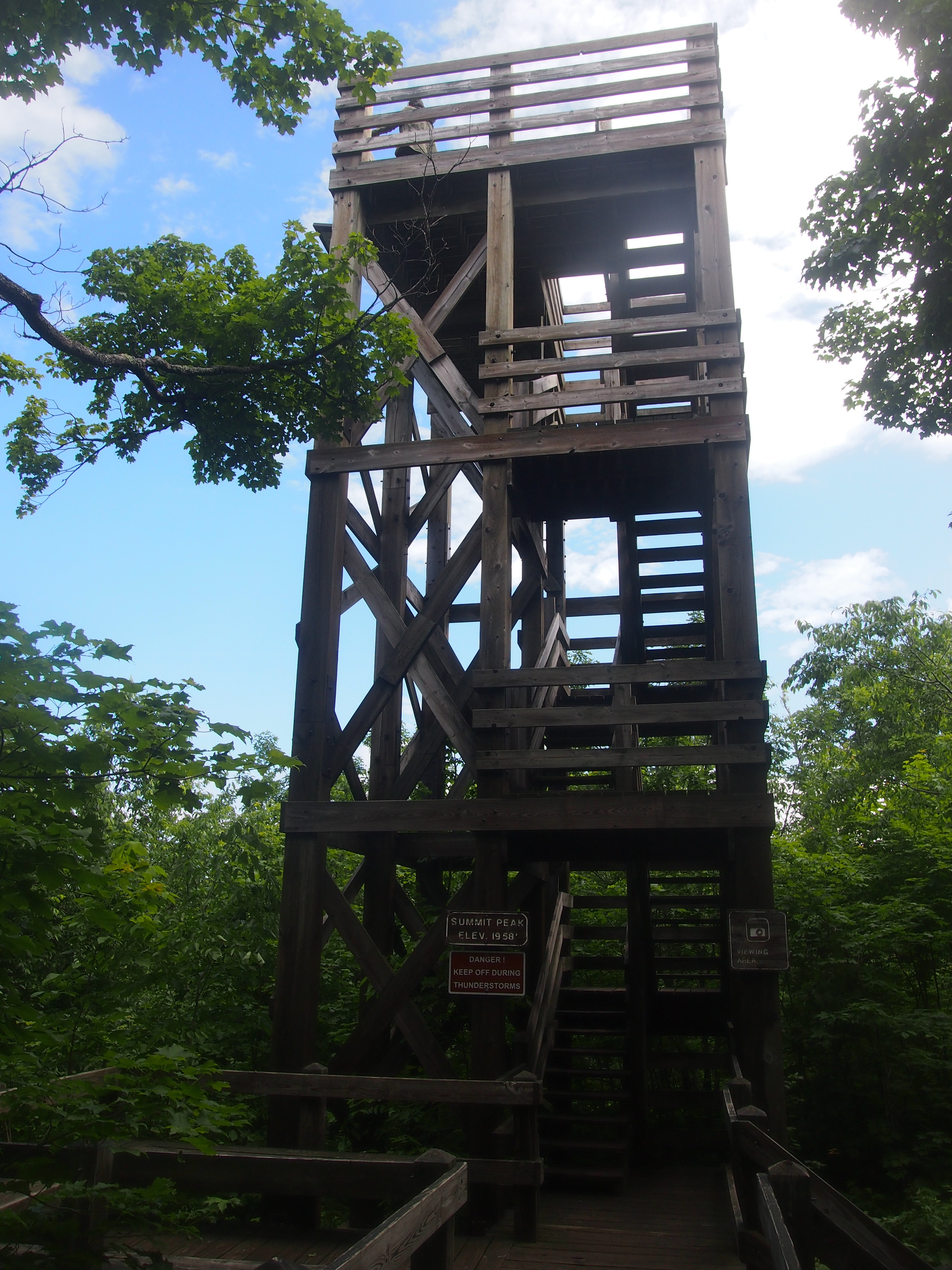
Summit Peak Tower TrailI had to rest for a minute or two a number of times — and my family kept getting further ahead of me — but before long even I’d made it to the tower. A sign at the base warns: Keep Off During Thunderstorms. Well, yes.
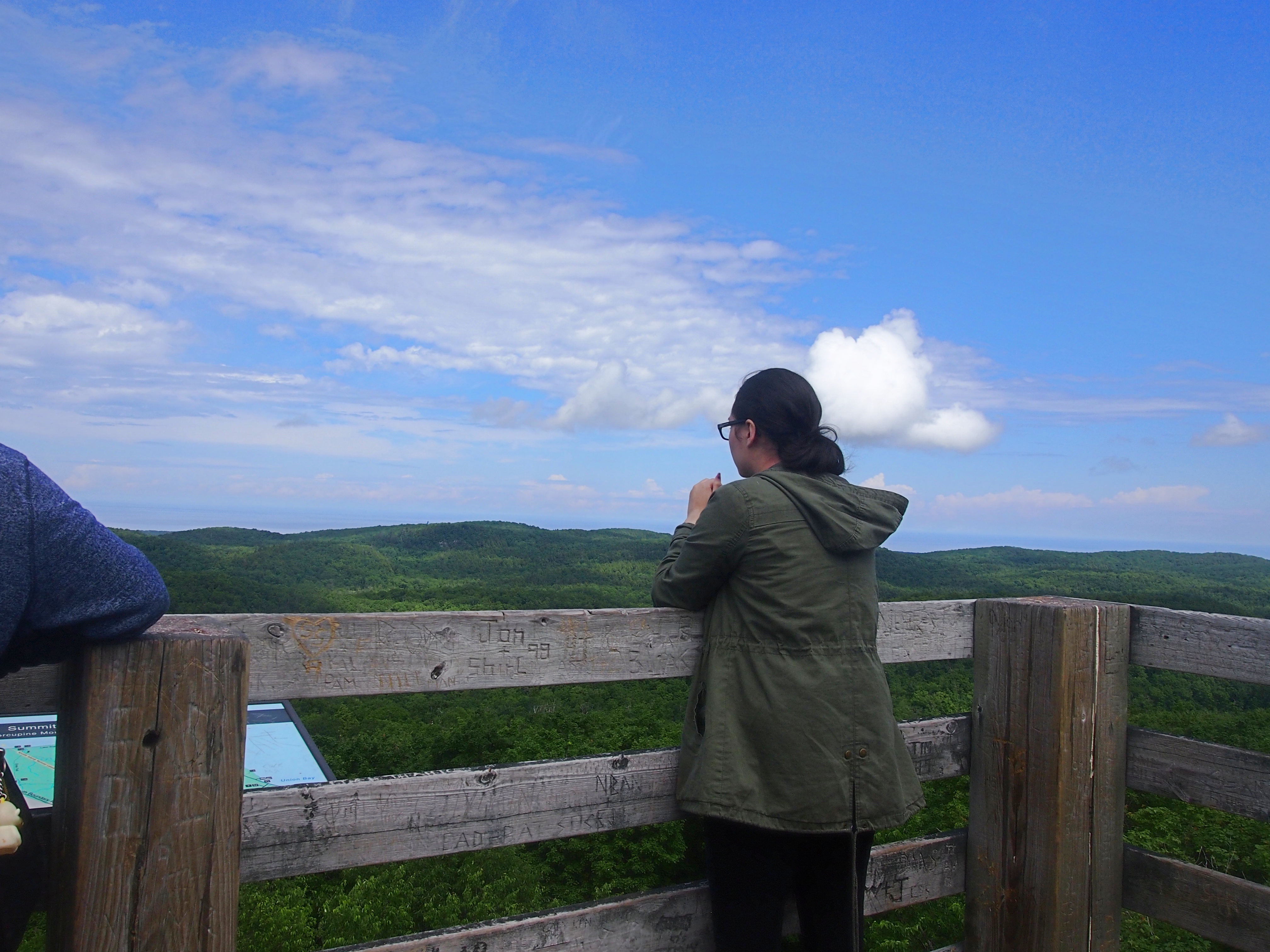
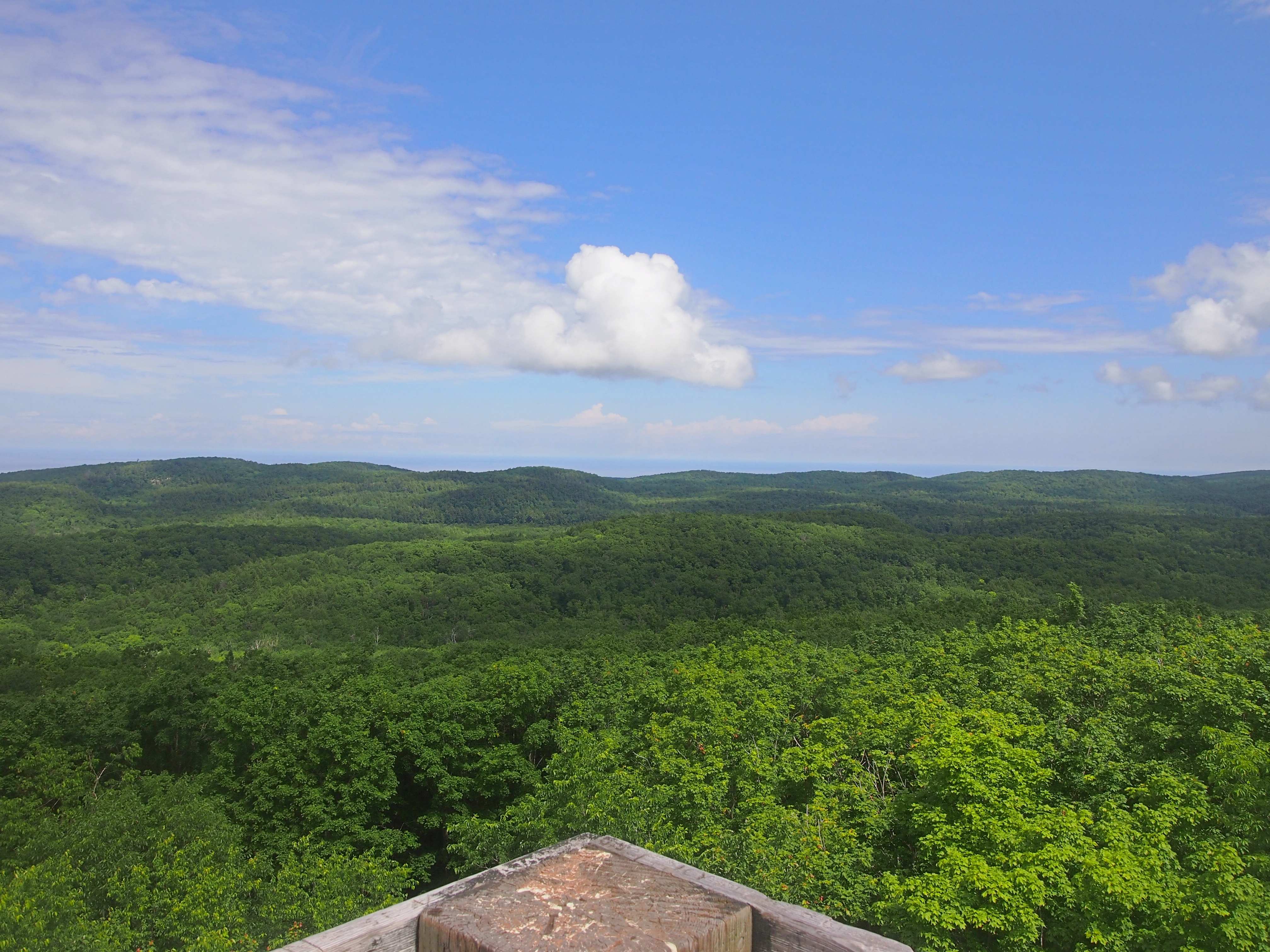
Summit Peak Tower TrailMore steps to the vista we’d come to see. It was worth the effort, even if it’s romantic moonshine invented by the Romantic poets. I’m all in.

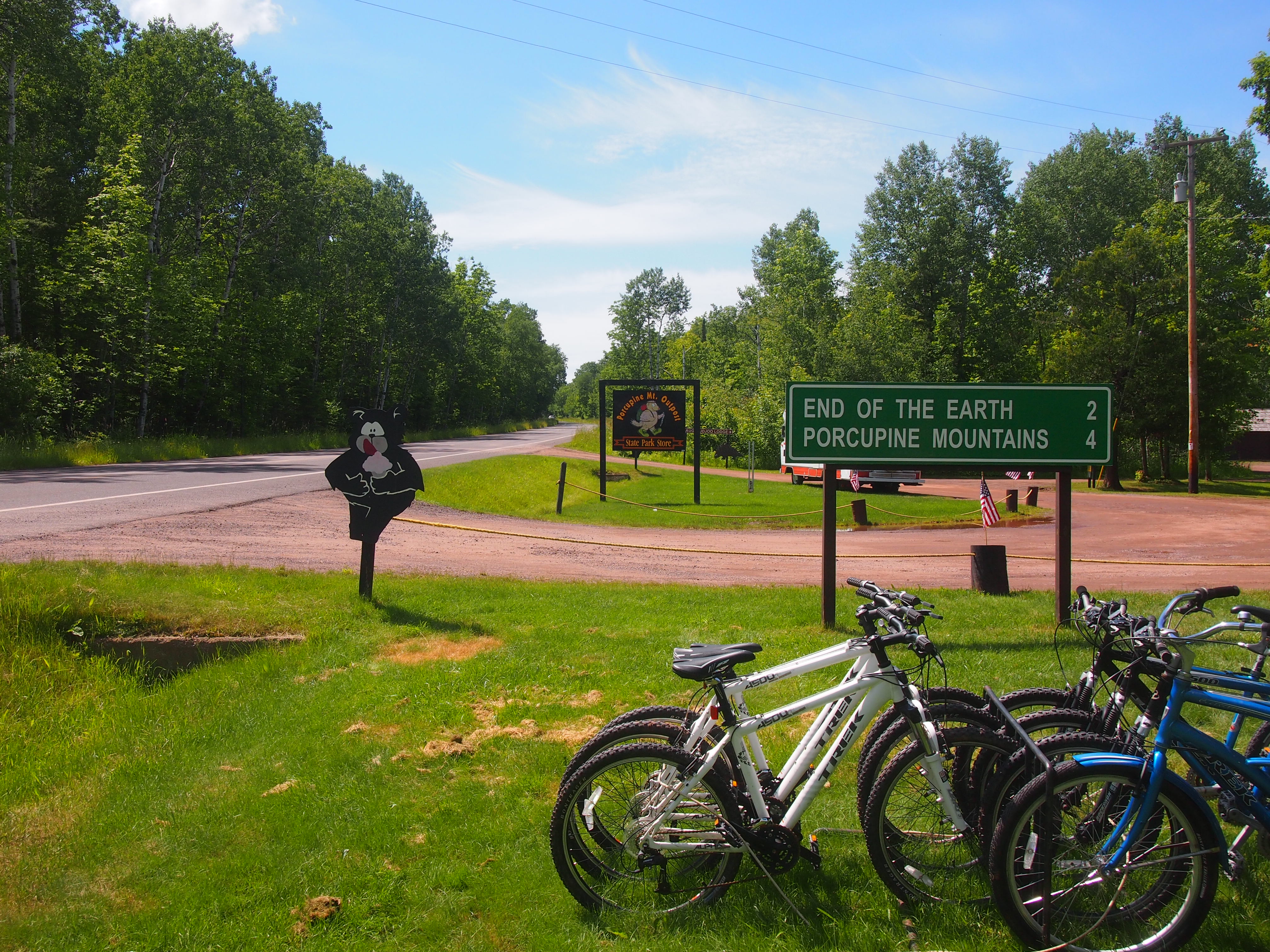
Porcupine Mountains State ParkPorcupine Mountains State ParkThe other vista we decided to see is in the north end of the park, easily accessible by road: the Lake of the Clouds. A sign outside the park along M-107 pointed the way.
M-107 SignAs for the End of the Earth, it didn’t look like anything special. Talk about anticlimactic.

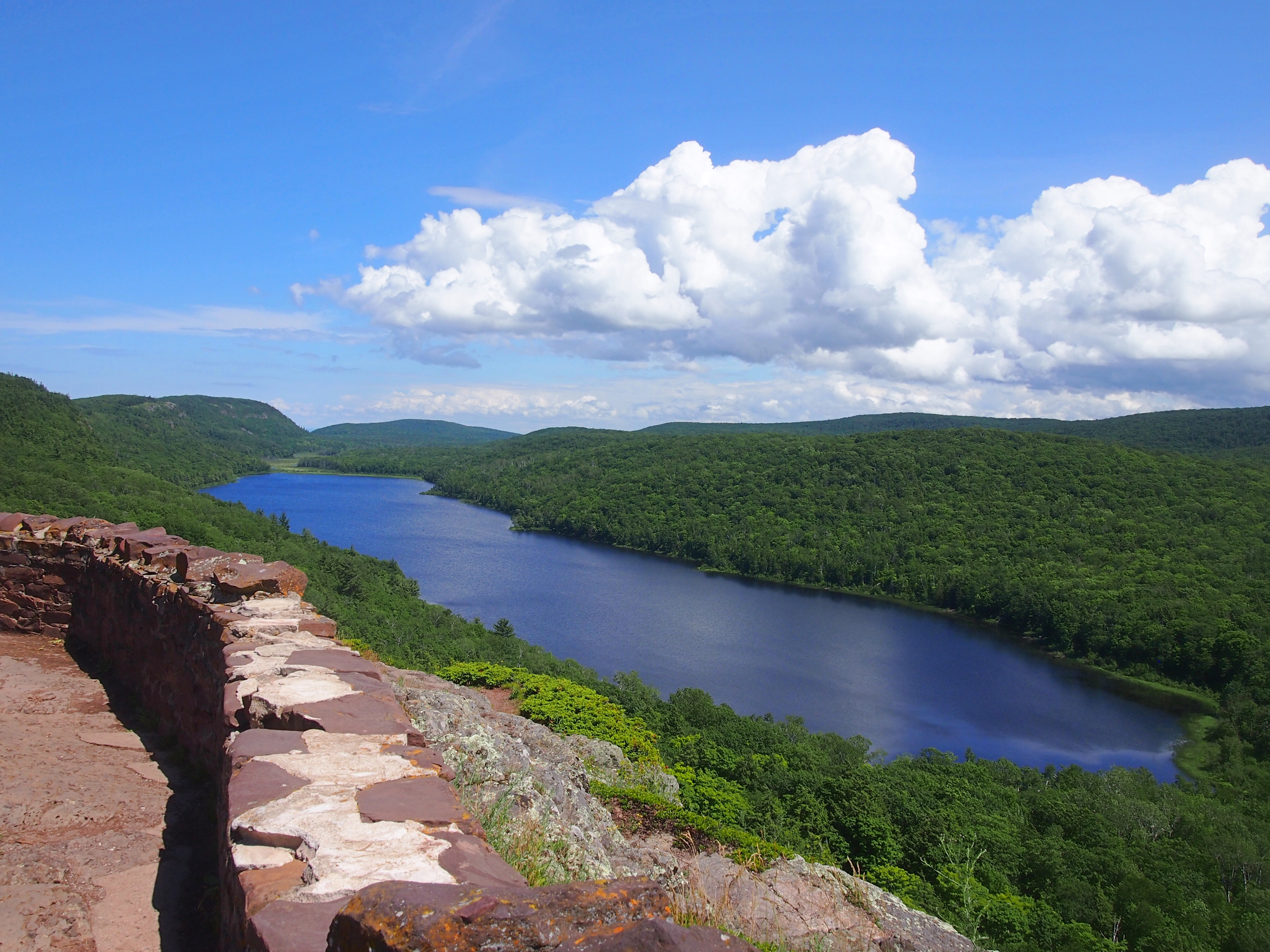
From the the Lake of the Clouds parking lot, a trail only a fifth of a mile leads to the first of two grand vistas.
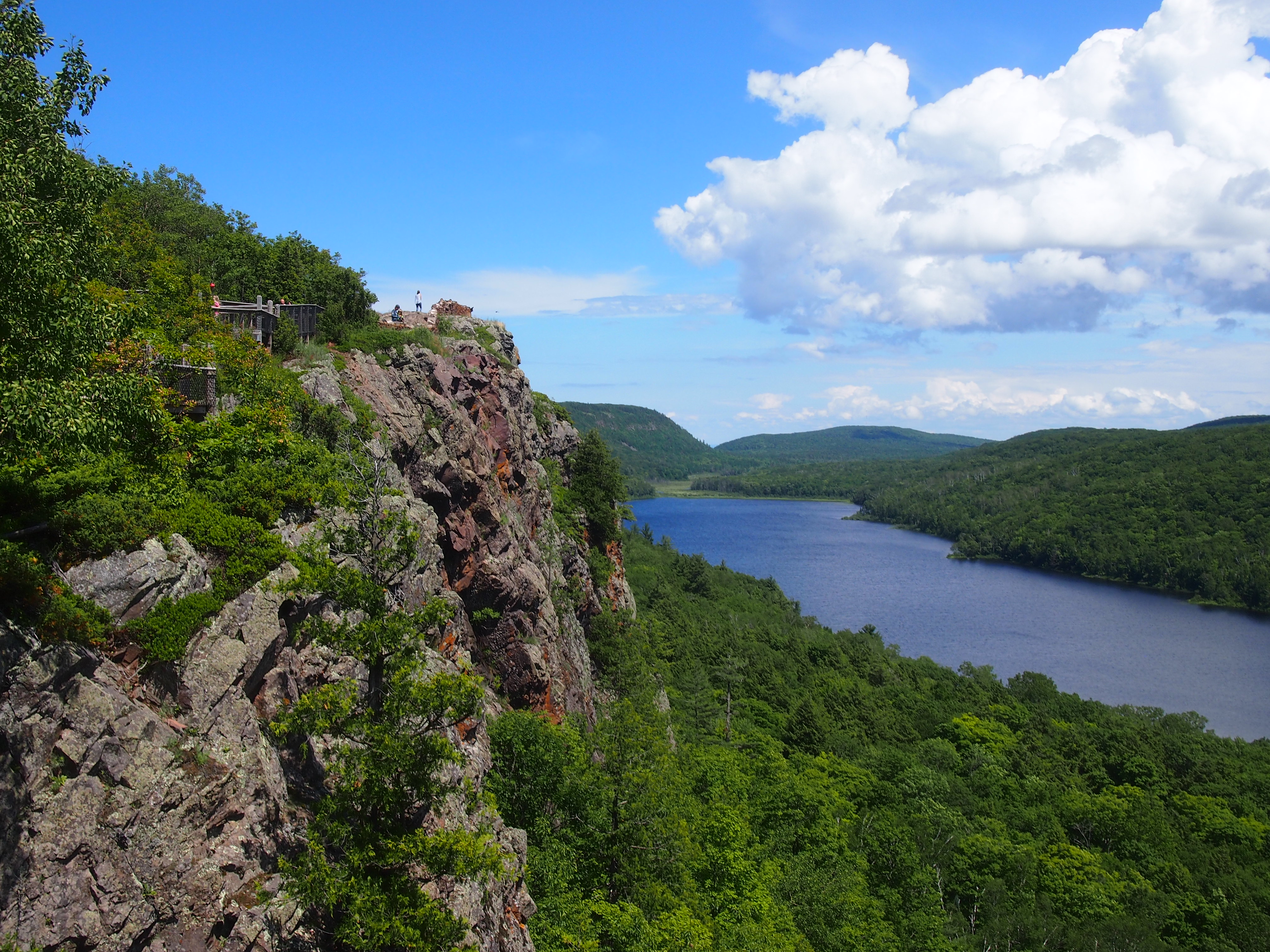
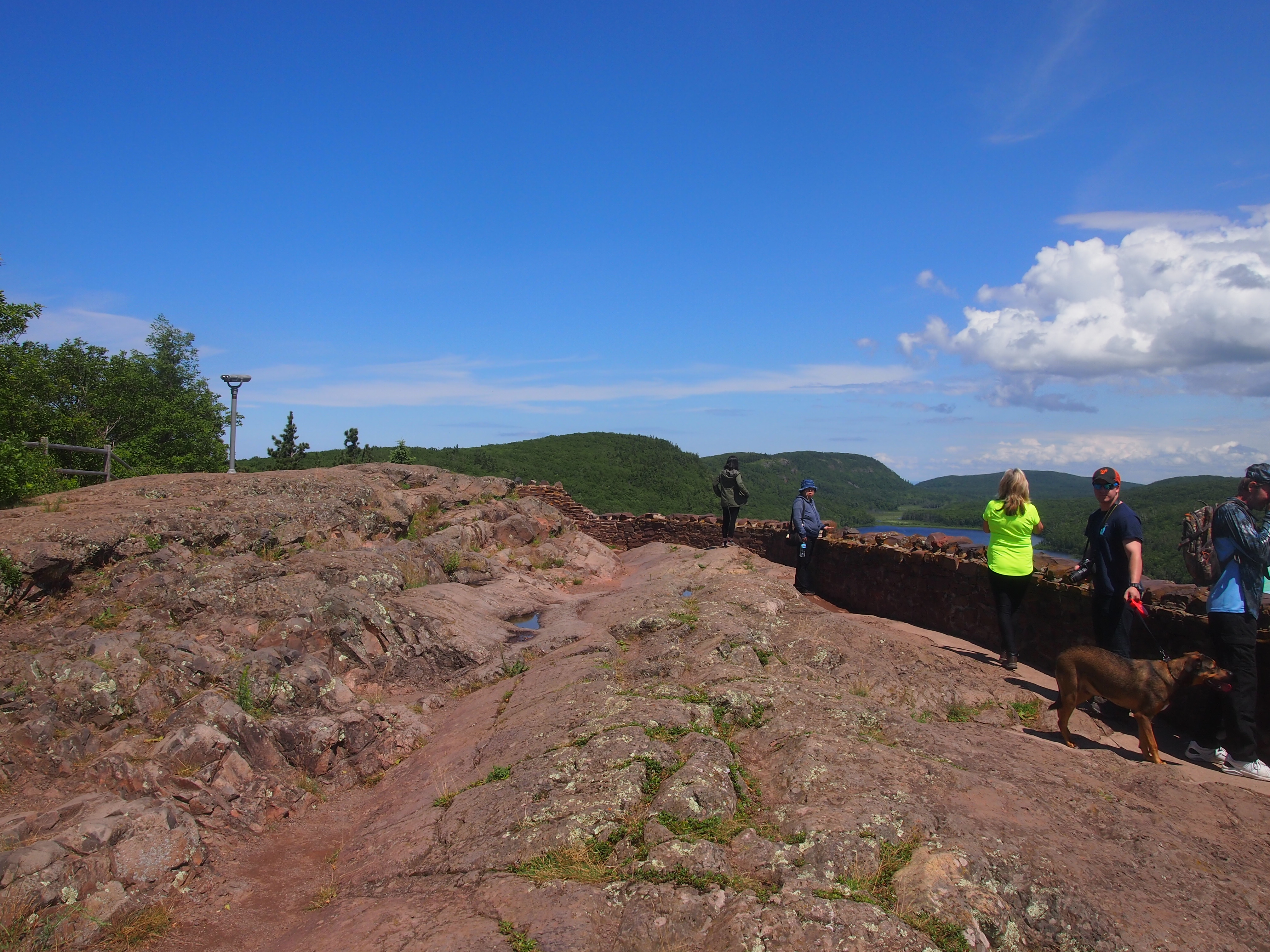
Lake of the Clouds, MichiganNote the people somewhat higher. The trail continues to that level, which is a rocky surface behind a short wall, overlooking for one of the fine vistas of the UP.
Lake of the Clouds, MichiganPorcupine Mountains State Park Lake of the CloudsIt’s a wow. The Lake of the Clouds view reminded me of some of the exceptional Canadian vistas we saw in ’06, though those were among mighty mountains, rather than picturesque hills.
Lake of the Clouds, MichiganAnn pointed out that in the fall, the view would be entirely different, and I think entirely worth the risk of running into early-season UP snow to see its multicolors.

The London House Hotel & The Tower on Top

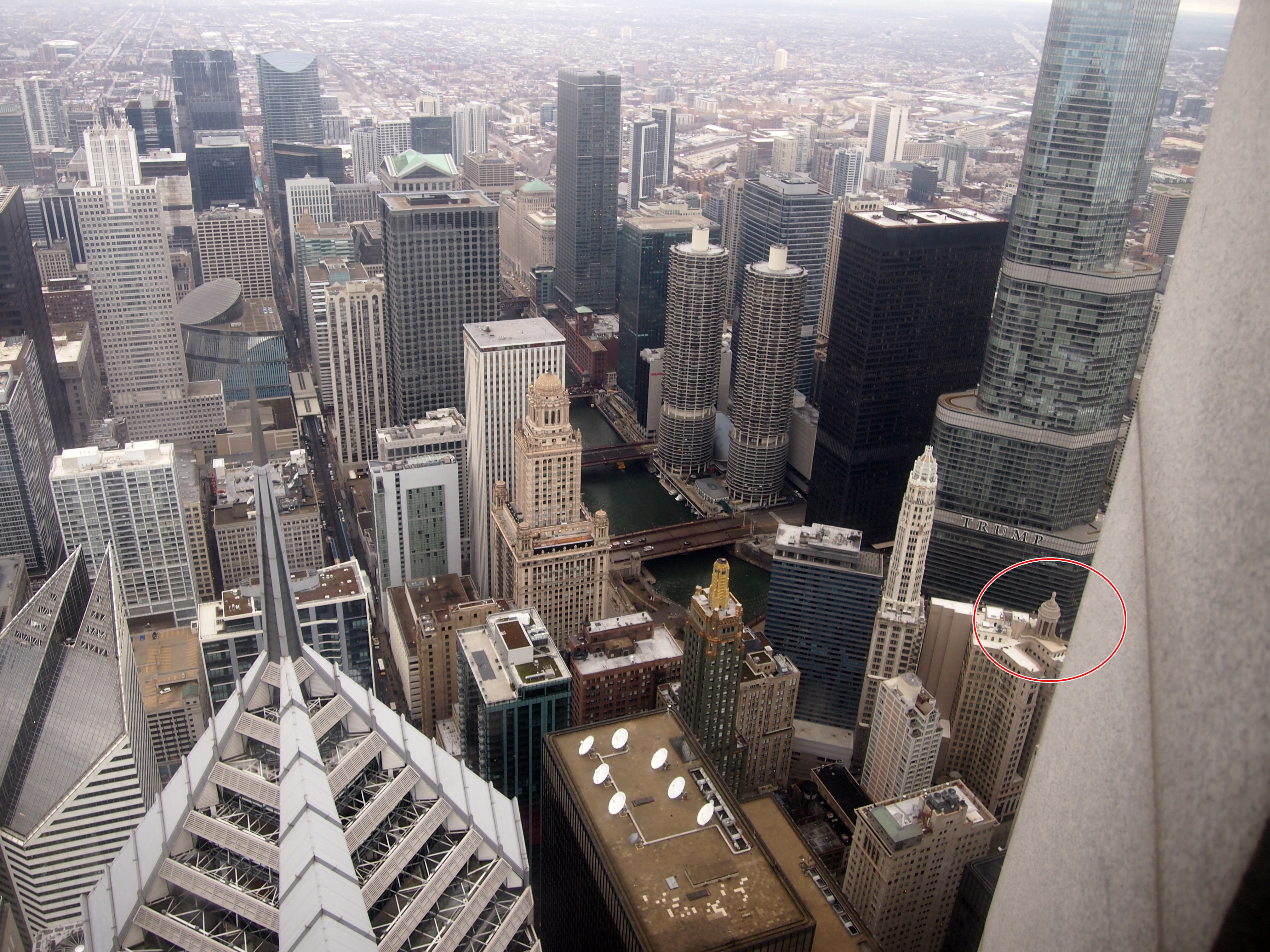
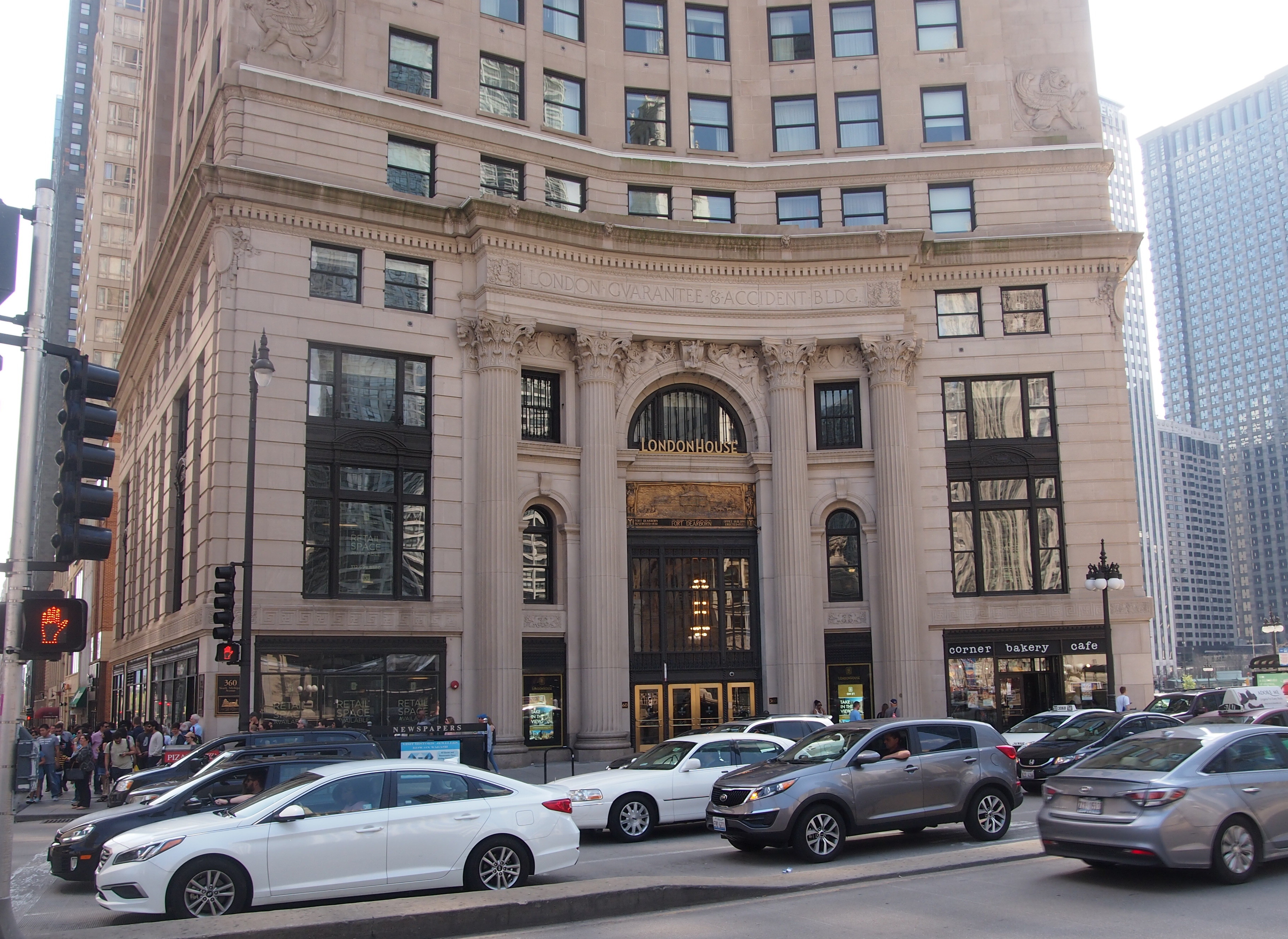
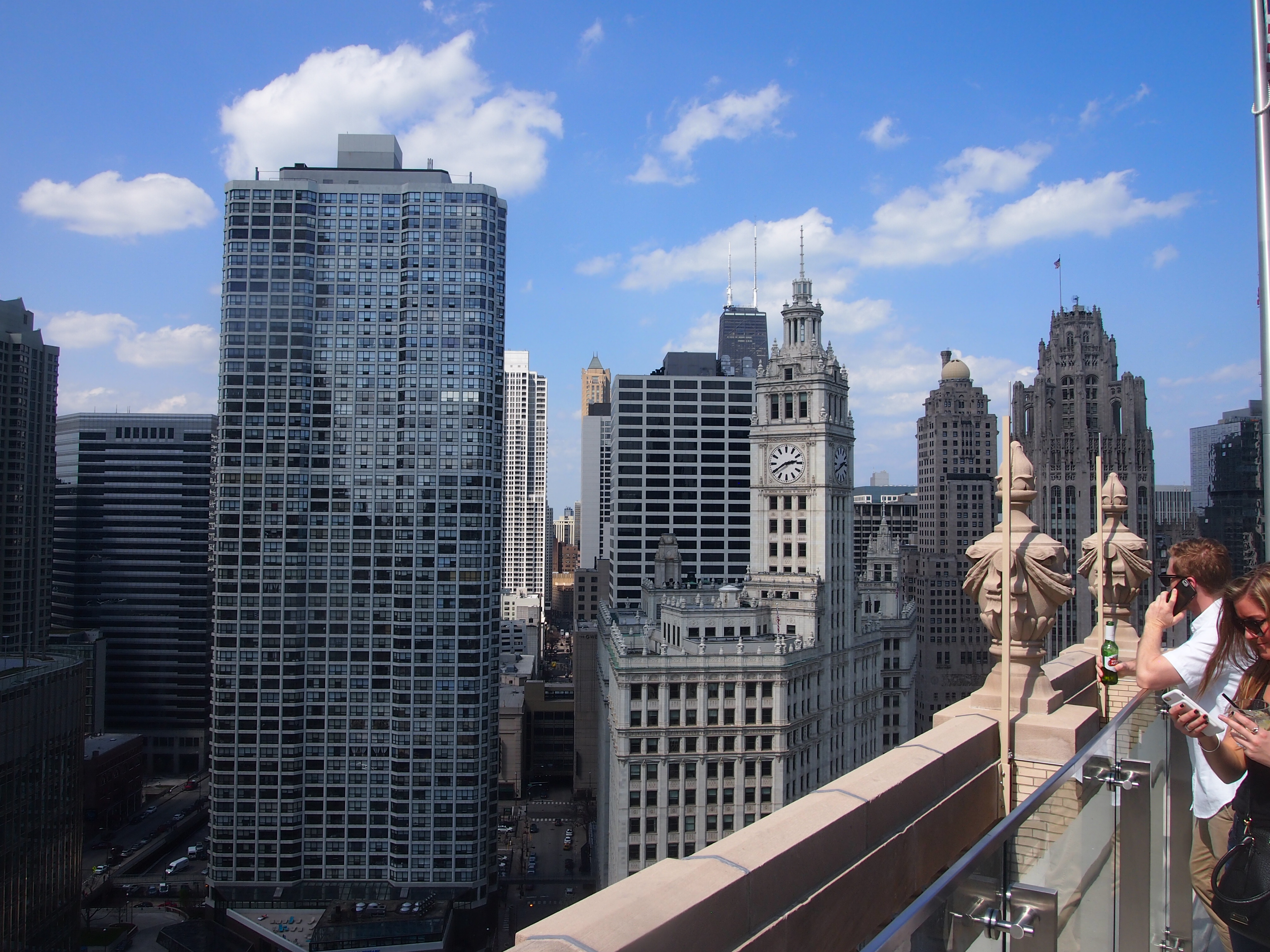
When I took pictures from high up in the Aon Center, I didn’t know that a few weeks later, I’d be on top of another nearby building. Not as tall, but with also with a terrific view of Chicago. And one (formerly) associated with an insurance company: The London Guarantee & Accident Building, 360 N. Michigan Ave., vintage 1923.

Chicago architect Alfred S. Alschuler designed the Beaux Arts tower for the U.S. branch of a British insuror, and since last year it has been occupied by the London House Hotel. I didn’t know that, probably because I don’t keep track of the Chicago real estate market in detail right now. I still think of it as an office building that was home to Crain’s Chicago Business for a time, and which also used to count the Turkish Consulate as a tenant. Once upon a time, Armenian sympathizers would periodically protest on the sidewalk outside.

There’s a tower on the top of London House, marked with a circle.

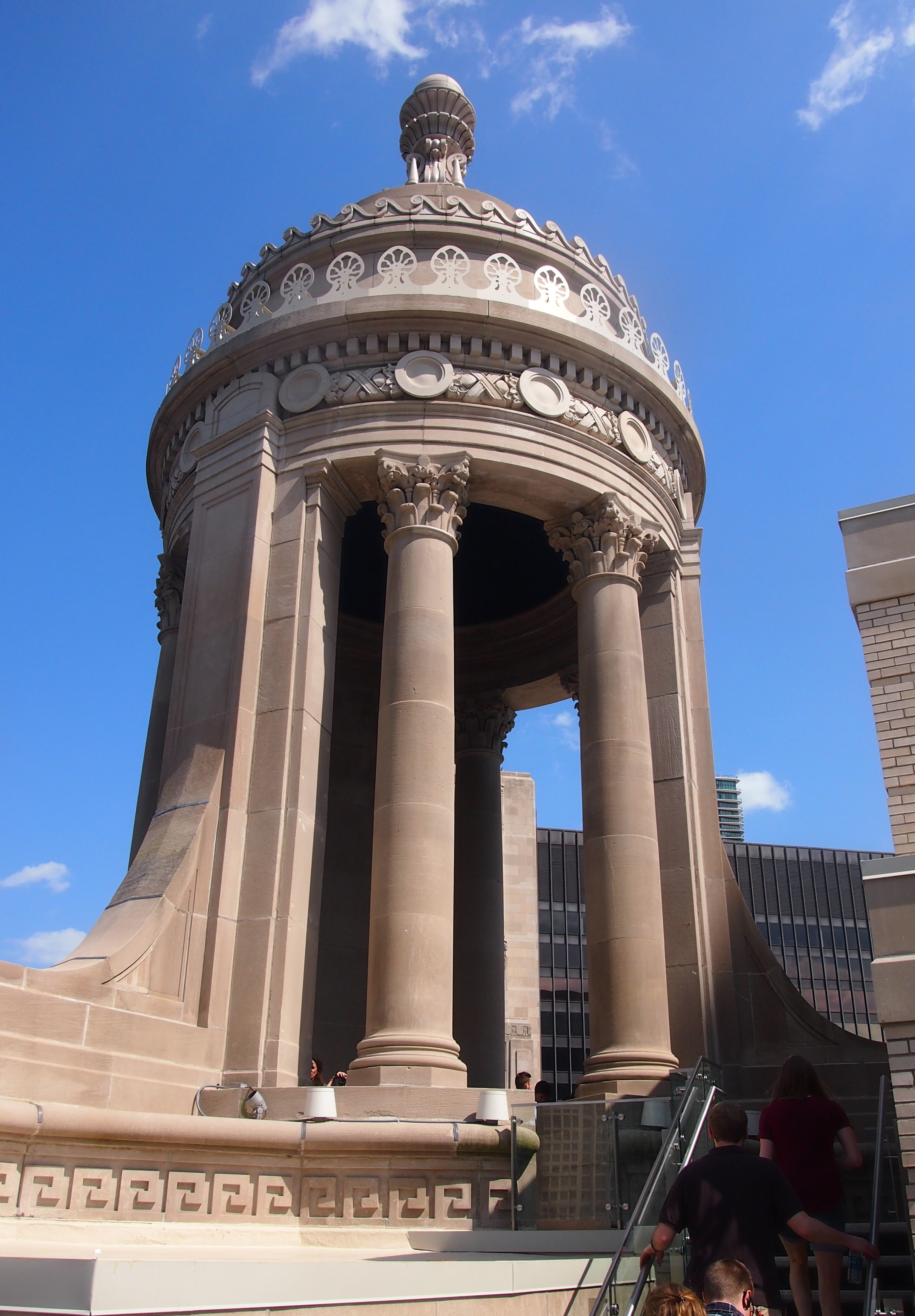
Chicago from Aon Center 2017Up close, it looks like this.
London House Chicago cupola 2017The tower is supposedly modeled after the Choragic Monument in Athens. I’m not expert enough to know, but there are visual similarities at least.

The London Guarantee & Accident Building was on the Chicago Architecture Foundation’s Hotel Boom tour, and it was the only property we explored beyond the exterior and the lobby, though those parts are interesting too.
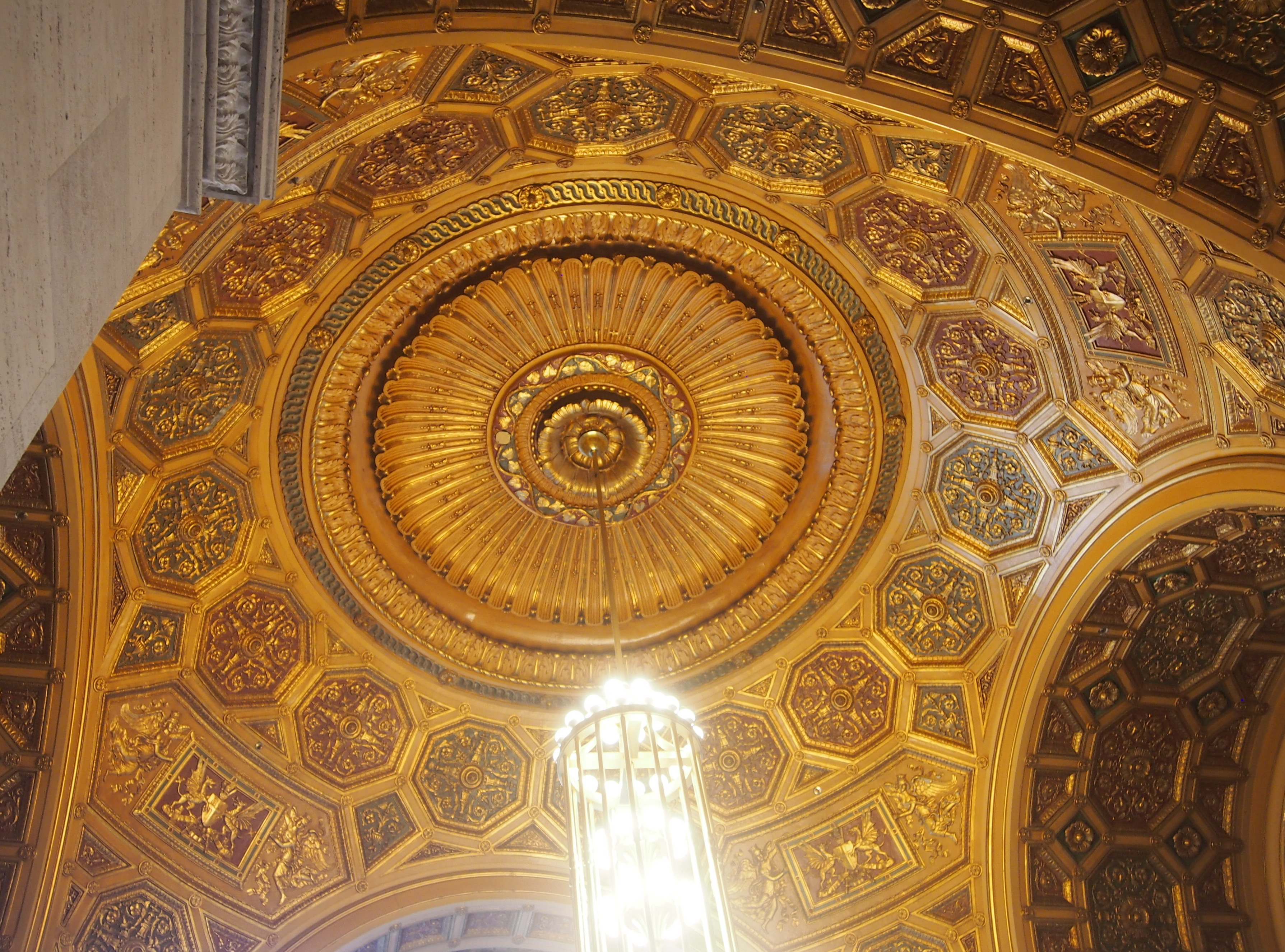
London House Hotel Chicago 2017This is the ceiling inside the Michigan Ave. entrance.
London House Hotel Chicago 2017The docent said that it was original to the building, but had been uncoveraged fairly recently. At some point probably in the 1950s or ’60s, it had been Eisenhowered by a lower ceiling.

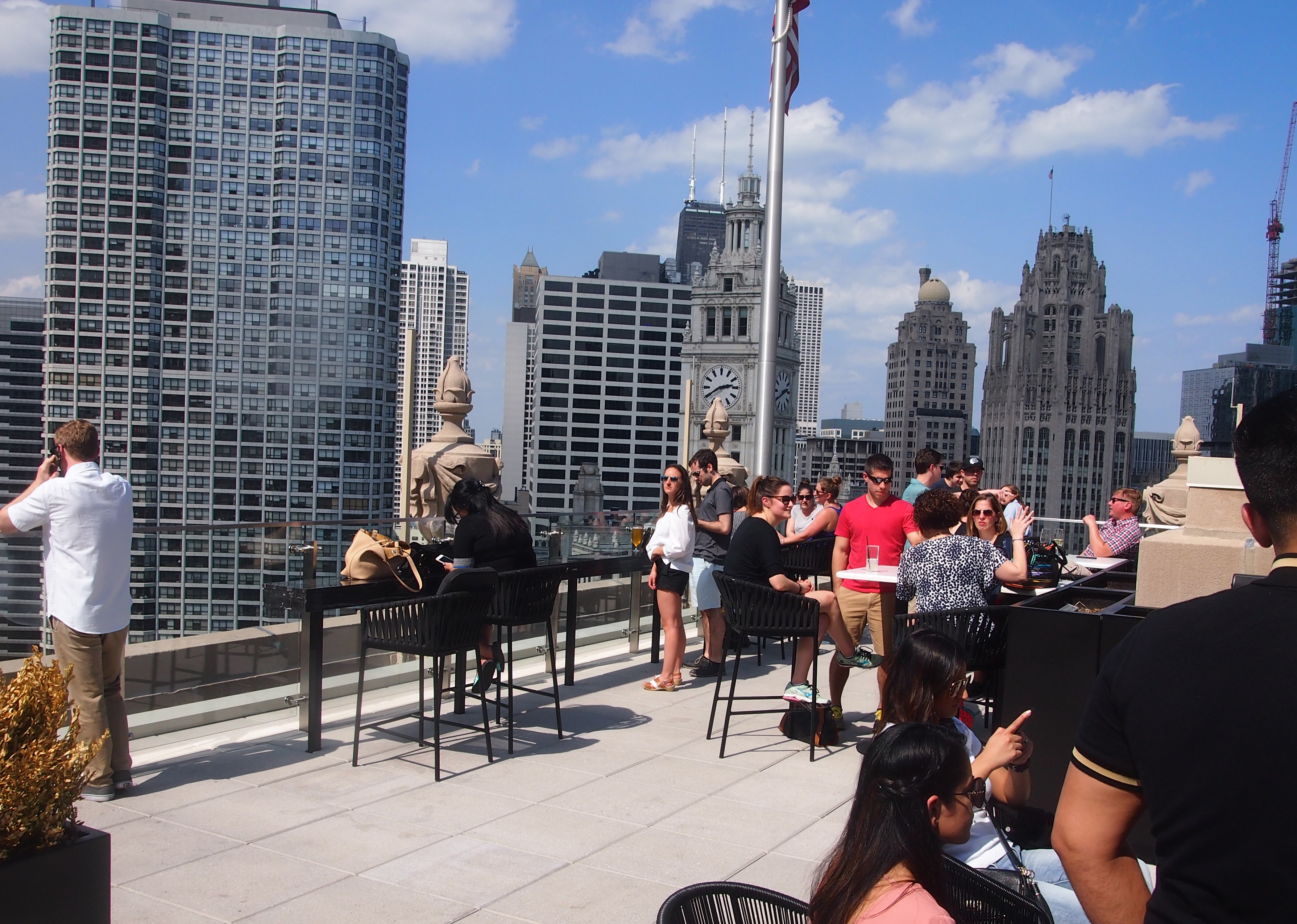
From there we looked around the lobby, and then took an elevator to the 21st floor, which is occupied by a bar. On a spring Saturday afternoon, the place was packed. Then, another elevator takes you up to two levels of outdoor terraces. One of which has tables and chains and (on a warm day) people with their drinks.

London House Hotel Chicago rooftop 2017

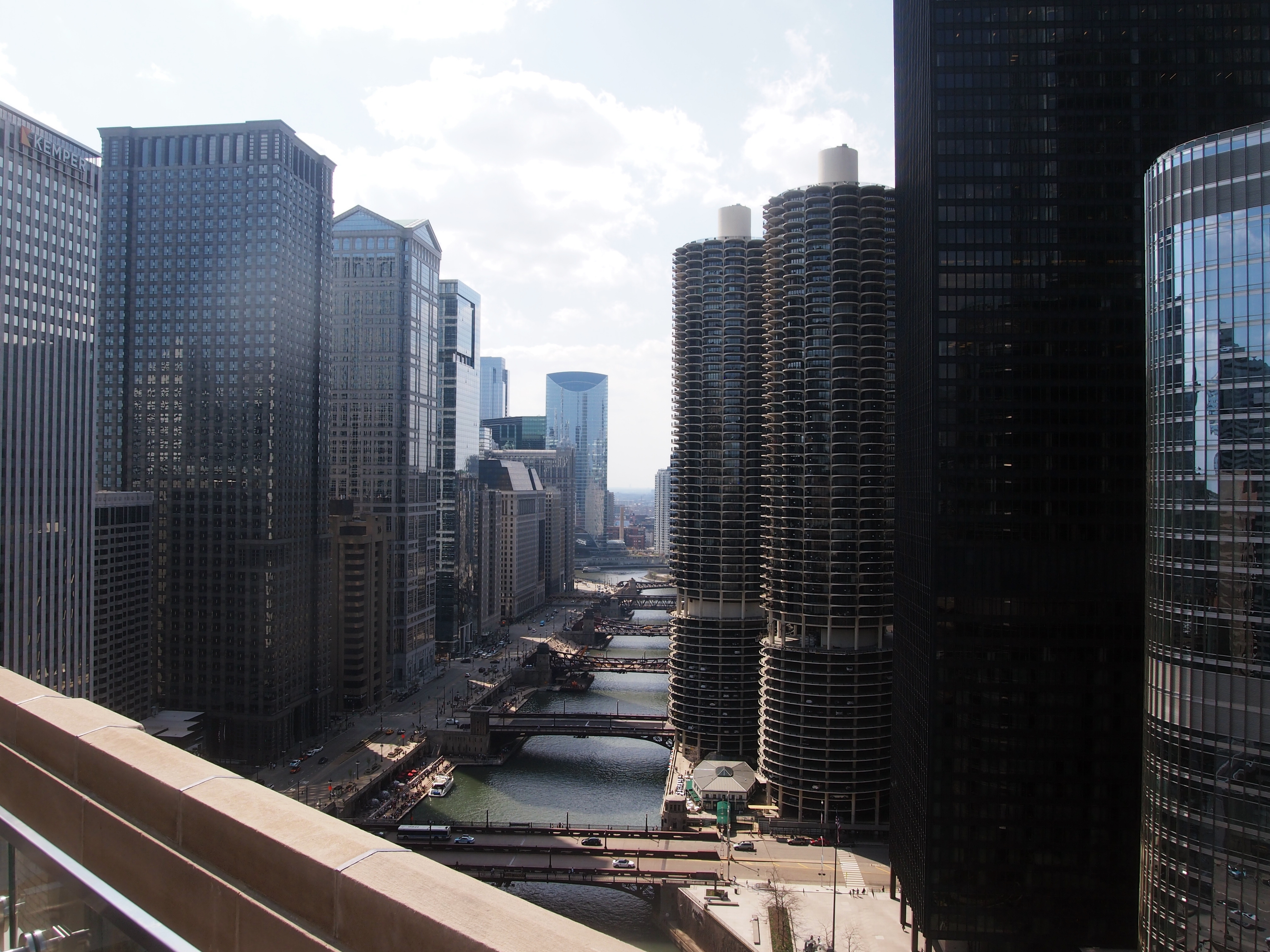
The views are exceptional. Looking west down the Chicago River.
London House Hotel Chicago rooftop 2017North up Rush St. The building with the clock tower is, of course, the Wrigley Building.
London House Hotel Chicago rooftop 2017Stairs from this level lead up to the Choragic Monument-ish tower, which offers some views of its own. Looking to the east, you get a good view of the upper reaches of 333 N. Michigan Ave., another building of the 1920s.
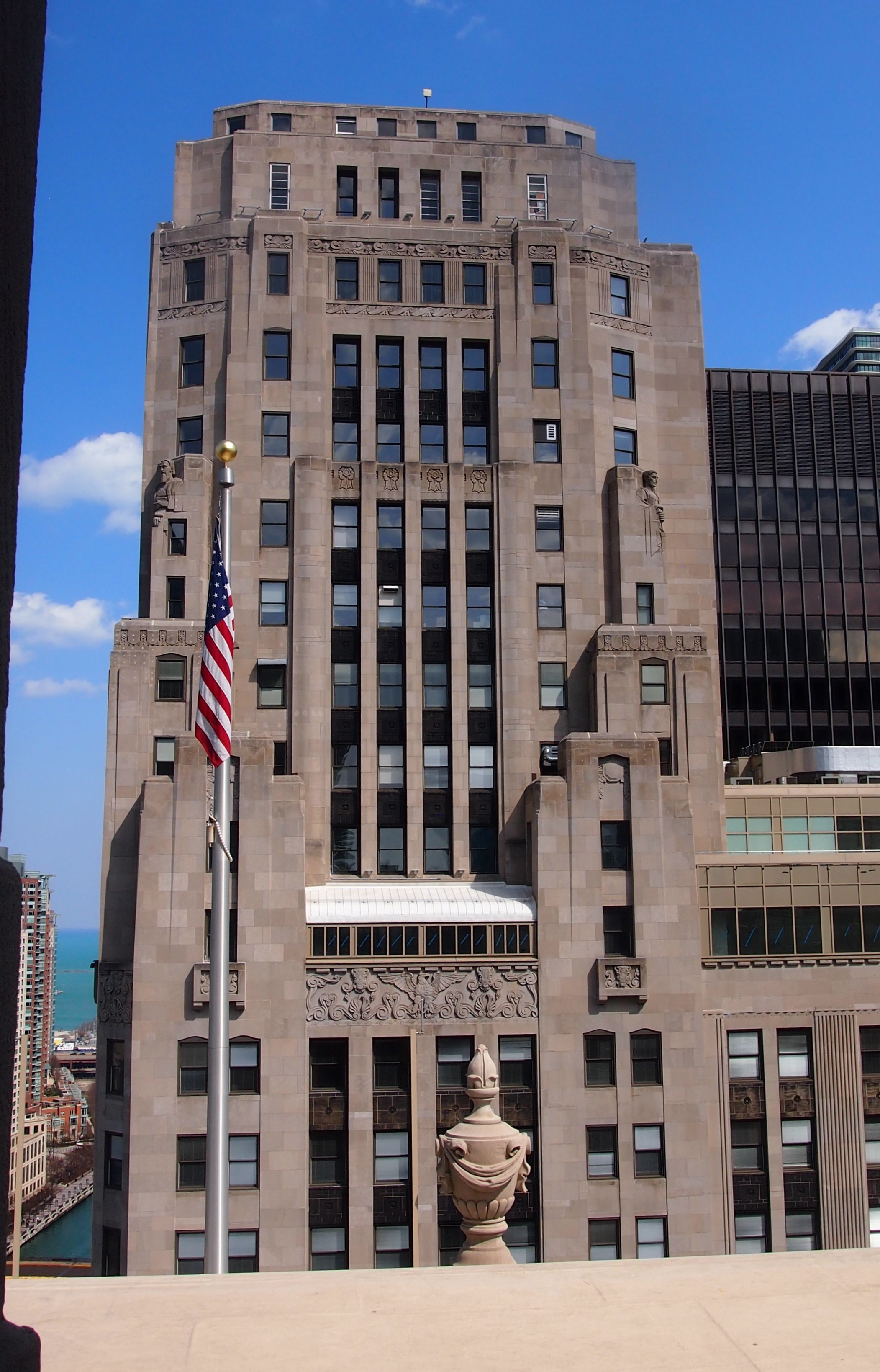
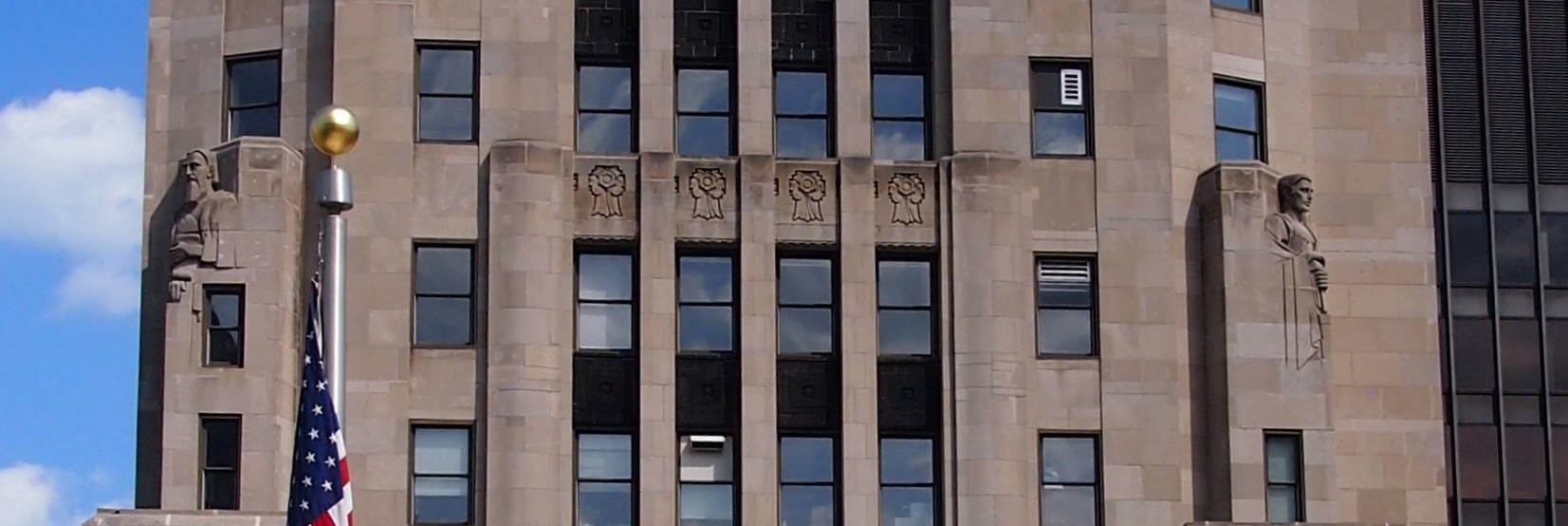
333 N. Michigan Ave ChicagoI was intrigued by the busts way up.

333 N. Michigan Ave ChicagoWho is supposed to see them? Angels? Even from inside the building, it looks like they would be hard to see. A modern example of painting the back of the statues in a cathedral niche.

About 333 N. Michgan and environs, Blair Kaimen wrote: “Its designers, Chicago architects Holabird & Root, drew heavily from Finnish architect Eliel Saarinen’s influential second-prize entry in the 1922 Tribune Tower design competition. Continuous vertical lines and gentle setbacks mount to a top without a cornice or cupola. The building superbly takes advantage of a bend in North Michigan Avenue to dominate the view as you look southward.

“Together, 333 and 360 join with the neo-Gothic Tribune Tower and the eclectic Wrigley Building to form an extraordinary quartet of 1920s skyscrapers that frame a great urban space around the Michigan Avenue Bridge.”

Views from Aon

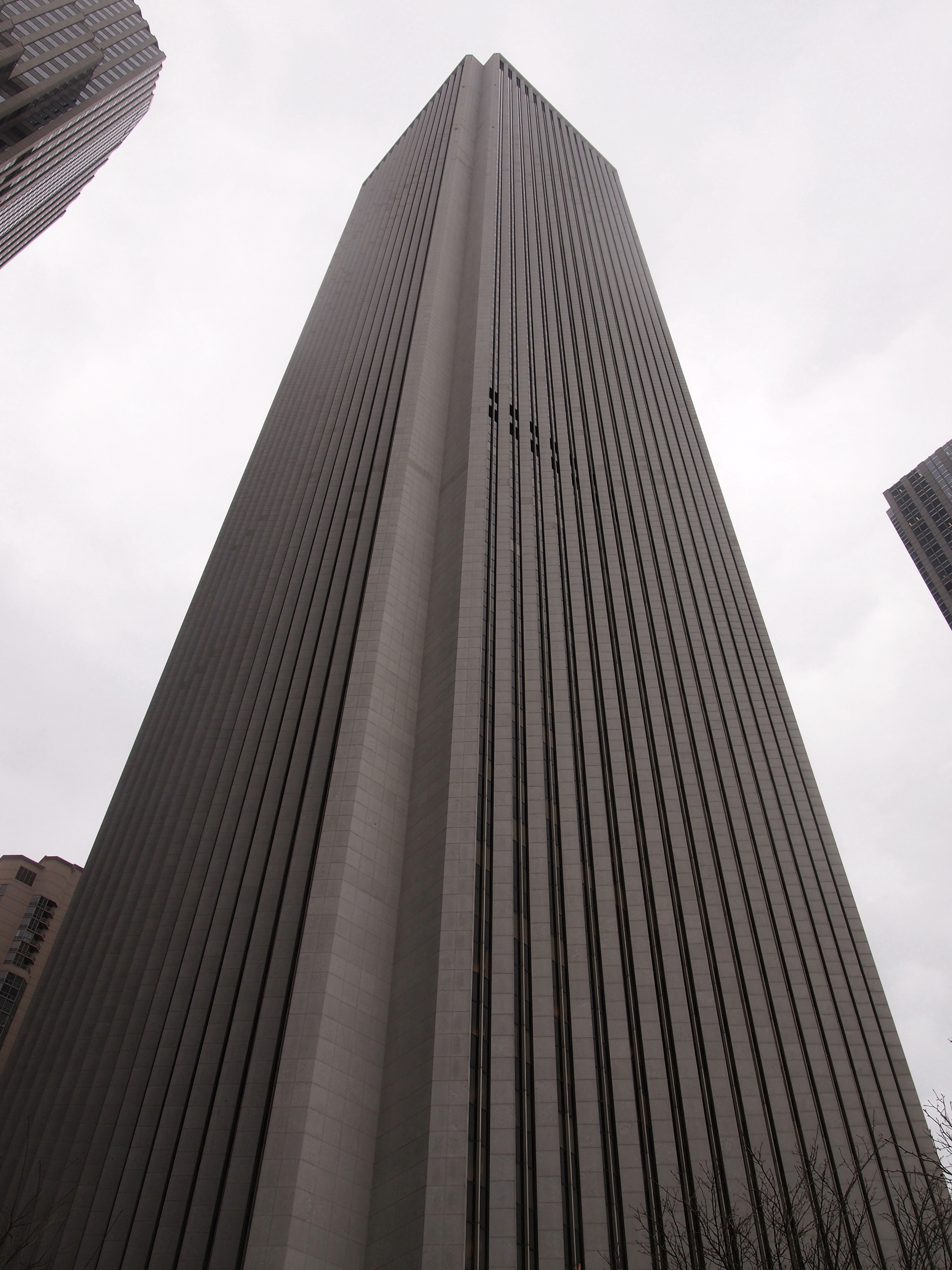
Recently I attended an event at the Mid-America Club, which happens to be on the 80th floor of the Aon Center, formerly known as the Amoco Building, and if you go back far enough, the Standard Oil Building (for some time after ’73, when it was completed). At 83 floors and 1,136 ft., it’s the third tallest building in Chicago, but that makes it only the 52nd tallest in the world in our time, when China and the UAE have decided that really tall buildings are just fab.

Aon Center 2017

Getting to the 80th floor, I encountered an elevator system I’d never experienced before. There are touchpads at each elevator bank, and you press the number of the floor you want to go to. Then the machine tells you which of the elevator cabs to board to go express to that floor. There are standard elevator buttons inside the cab, but they’ve been covered over by a hard plastic case and are inaccessible. Guess this makes inter-floor transit more efficient. For all I know, this kind of system could be common and not exactly new; I don’t go into that many very tall buildings any more.
I’d been up to the Mid-America Club before, though I couldn’t remember exactly when. Probably as long ago as the early 2000s. It offers a mighty 360-degree view, though this time around it was obscured some by overcast skies.

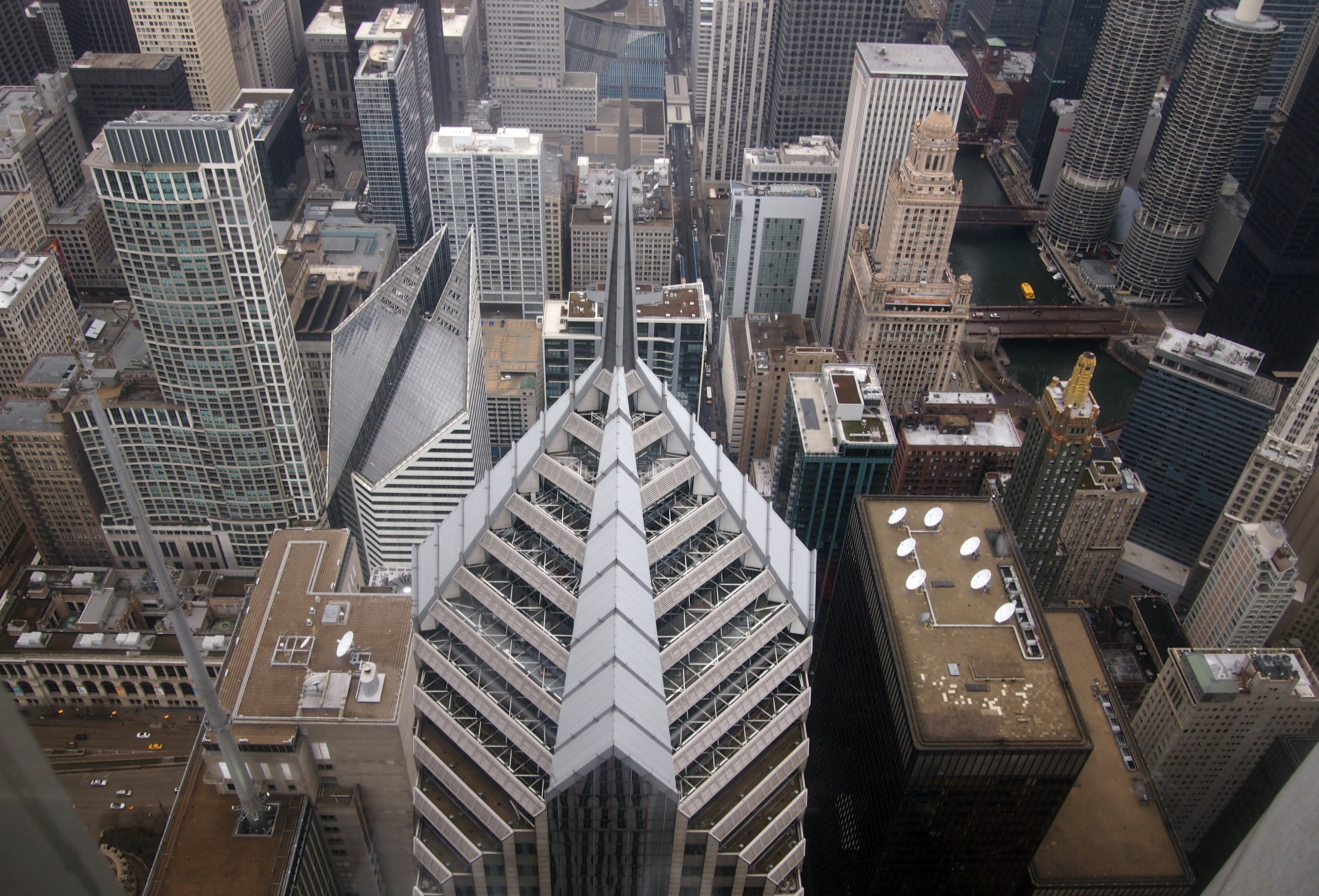
This is looking west, down at the top of the Prudential Center. Pru II, vintage 1990, has the pointy spire, maybe for zeppelin mooring. Pru I, vintage 1955, is the shorter structure immediately to Pru II’s left, though it was the tallest building in Chicago when new.
Prudential Center II Chicago spireUp and to the right, and on the river, with the cupola on top, is 35 E. Wacker, a handsome ’20s building in which I had an office for a few years.

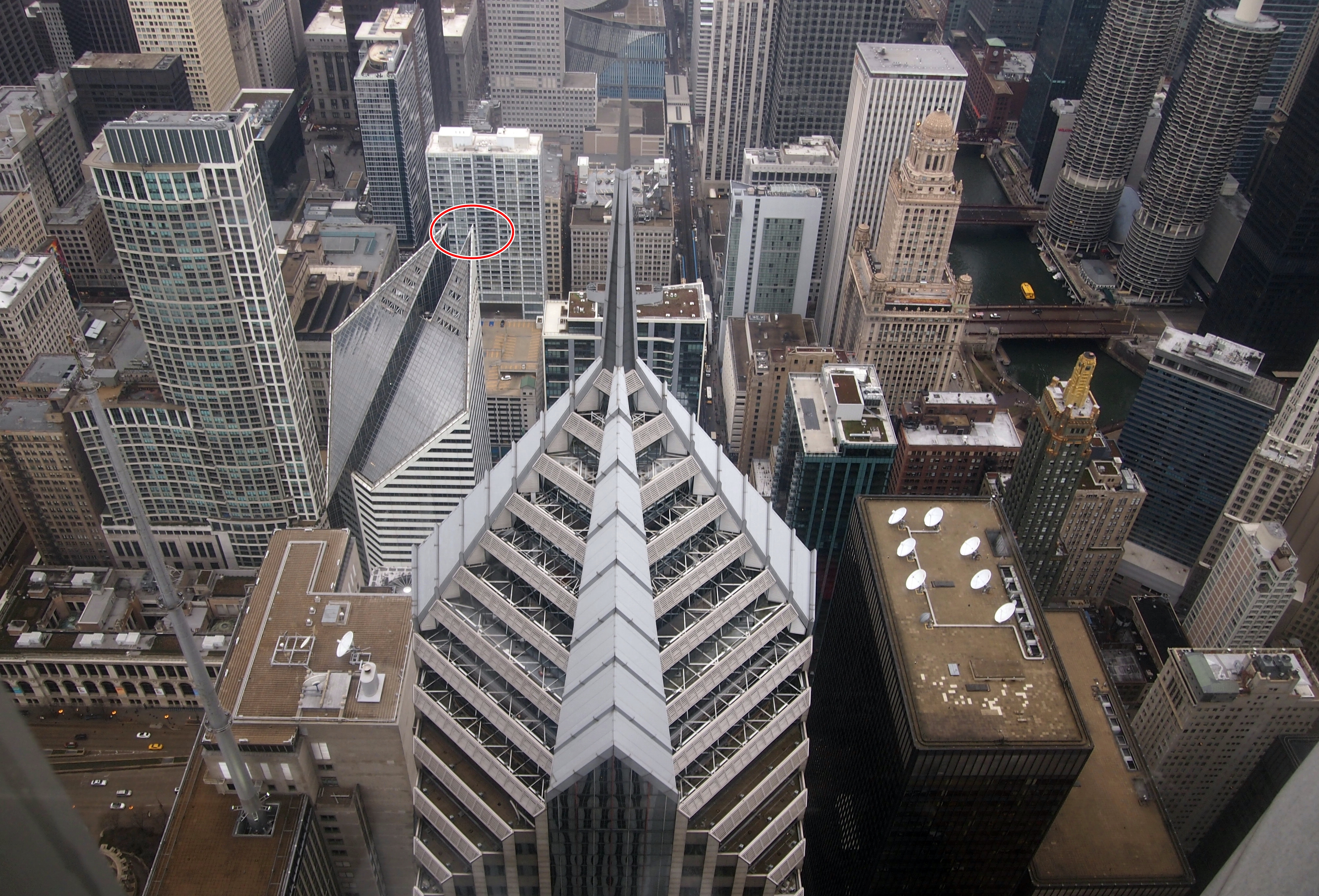
Also seen from this vantage is 150 N. Michigan. Years ago, I ventured onto the exterior of that building, at a place marked by the red oval. It’s a lot safer than it looks like here.

150 N. Michigan Ave.

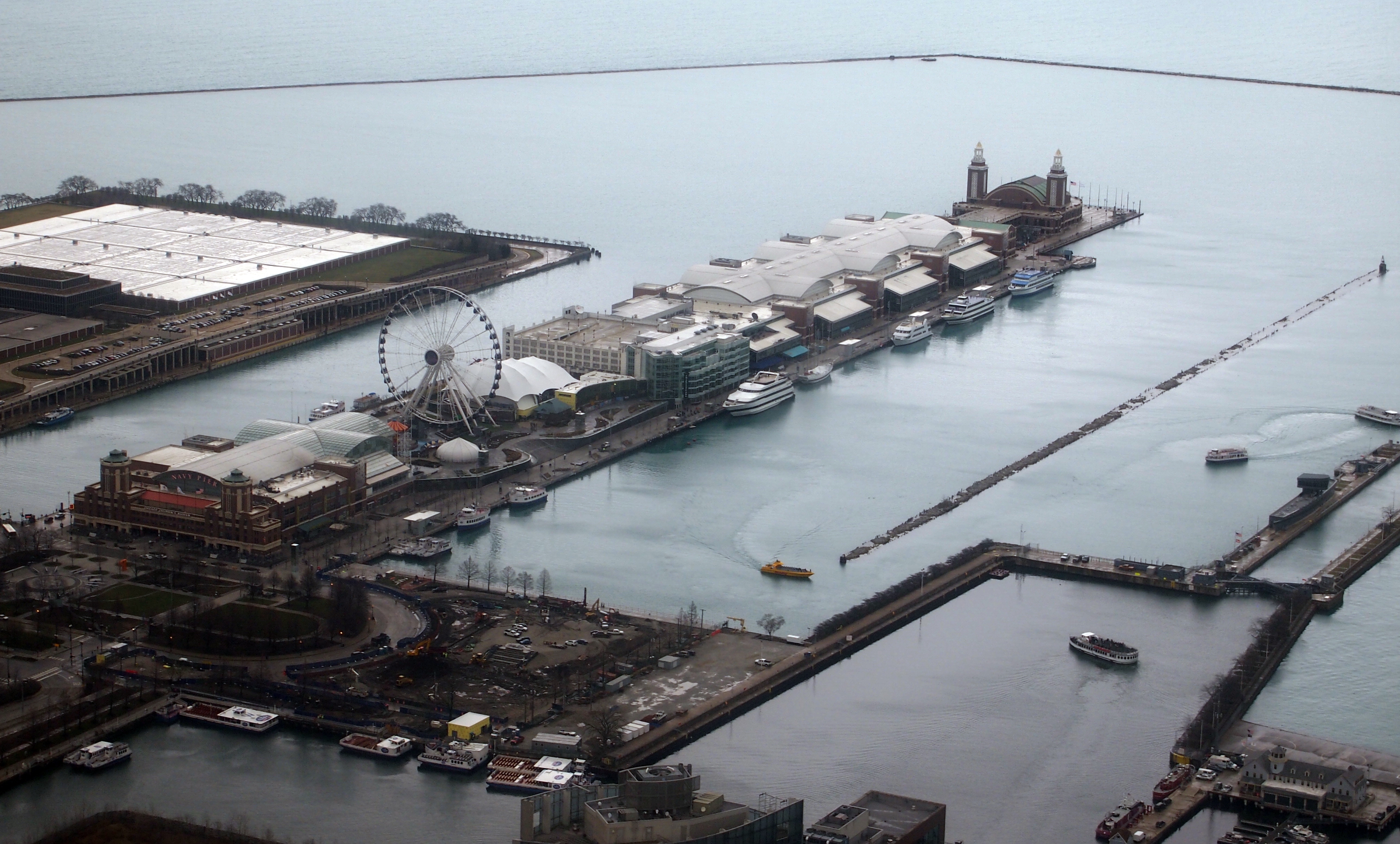
To the northeast, the entirety of Navy Pier, with part of Chicago’s massive Jardine Water Purification Plant behind it. Largest in the world by volume, I’ve read: nearly one billion gallons of water goes through per day.
Navy Pier from aboveOne of the pictures posted here is shot from Navy Pier, looking back in the direction of the Aon Center (and a lot of other buildings).

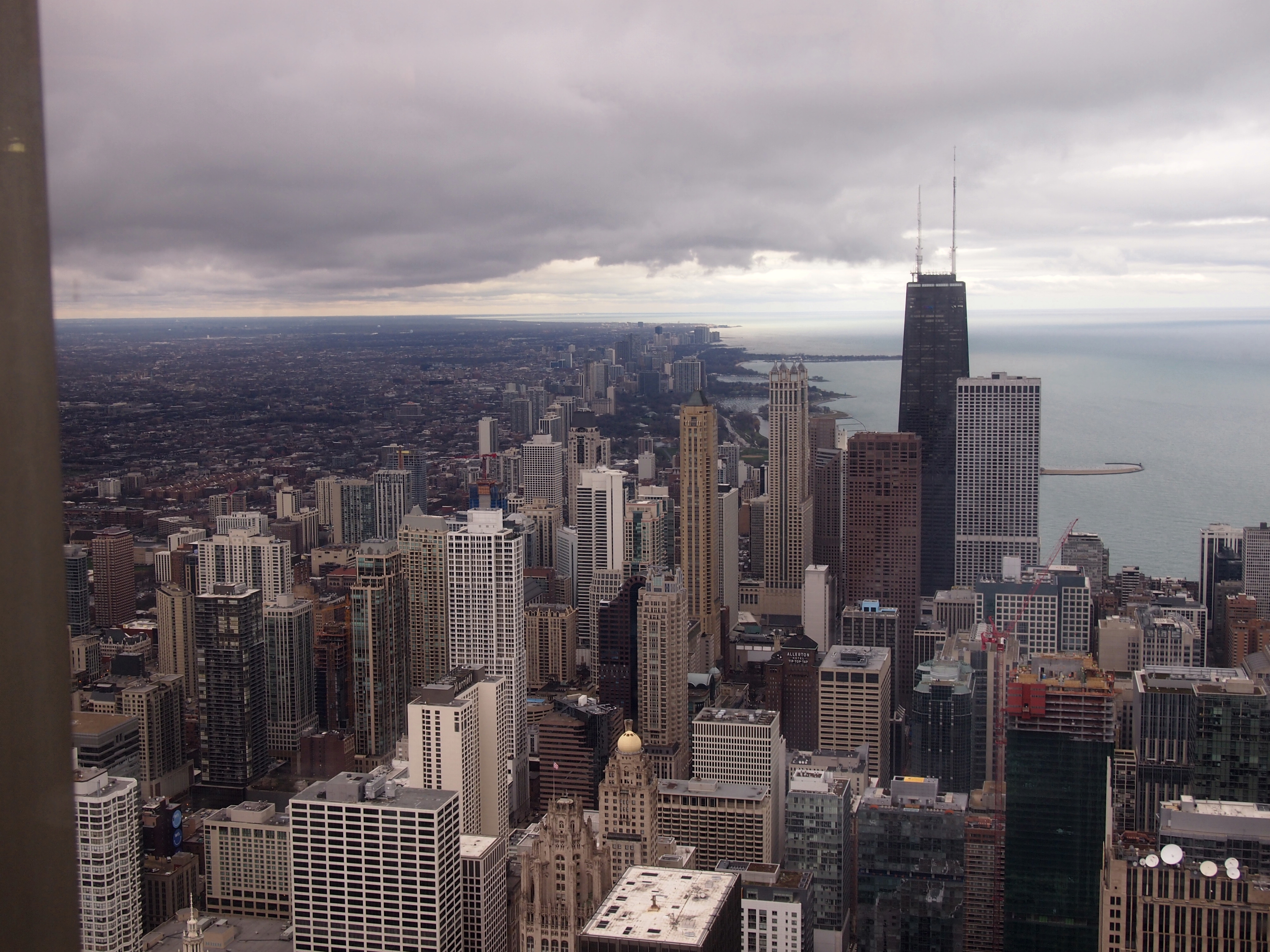
To the north, a large chunk of downtown off in the distance: North Michigan Ave. and Streeterville.
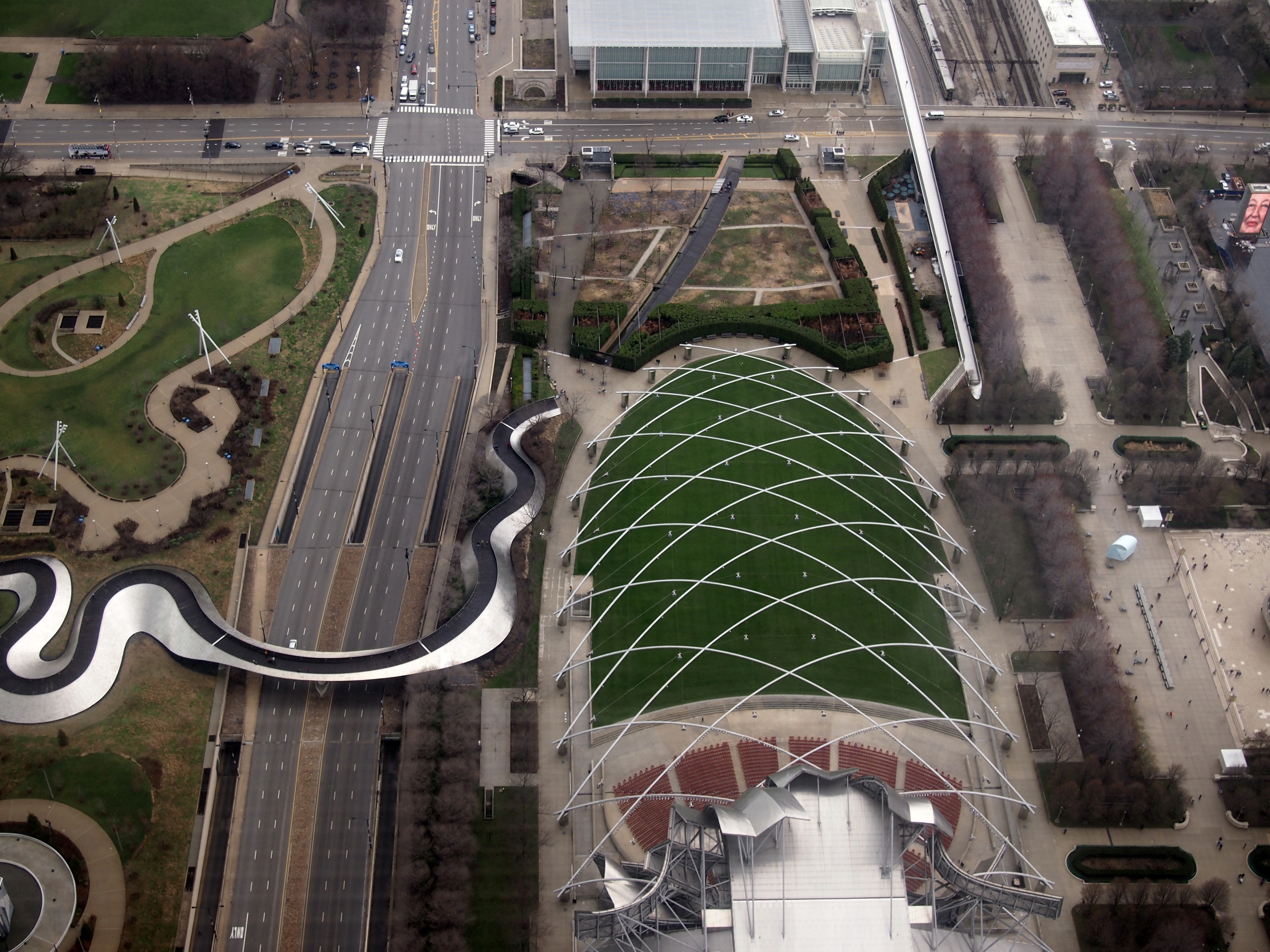
North Michigan Ave and StreetervilleTo the south, and looking nearly straight down, is Pritzker Pavilion. As seen from ground level in this posting.
Pritzker PavillionThe ribbon snaking off to the left is a pedestrian bridge. Officially, the BP Bridge, one of the projects funded by the oil company before its really big sponsorship of a hole in the Gulf of Mexico. Frank Gehry, who did the Gehry-like bandshell, did the bridge too.
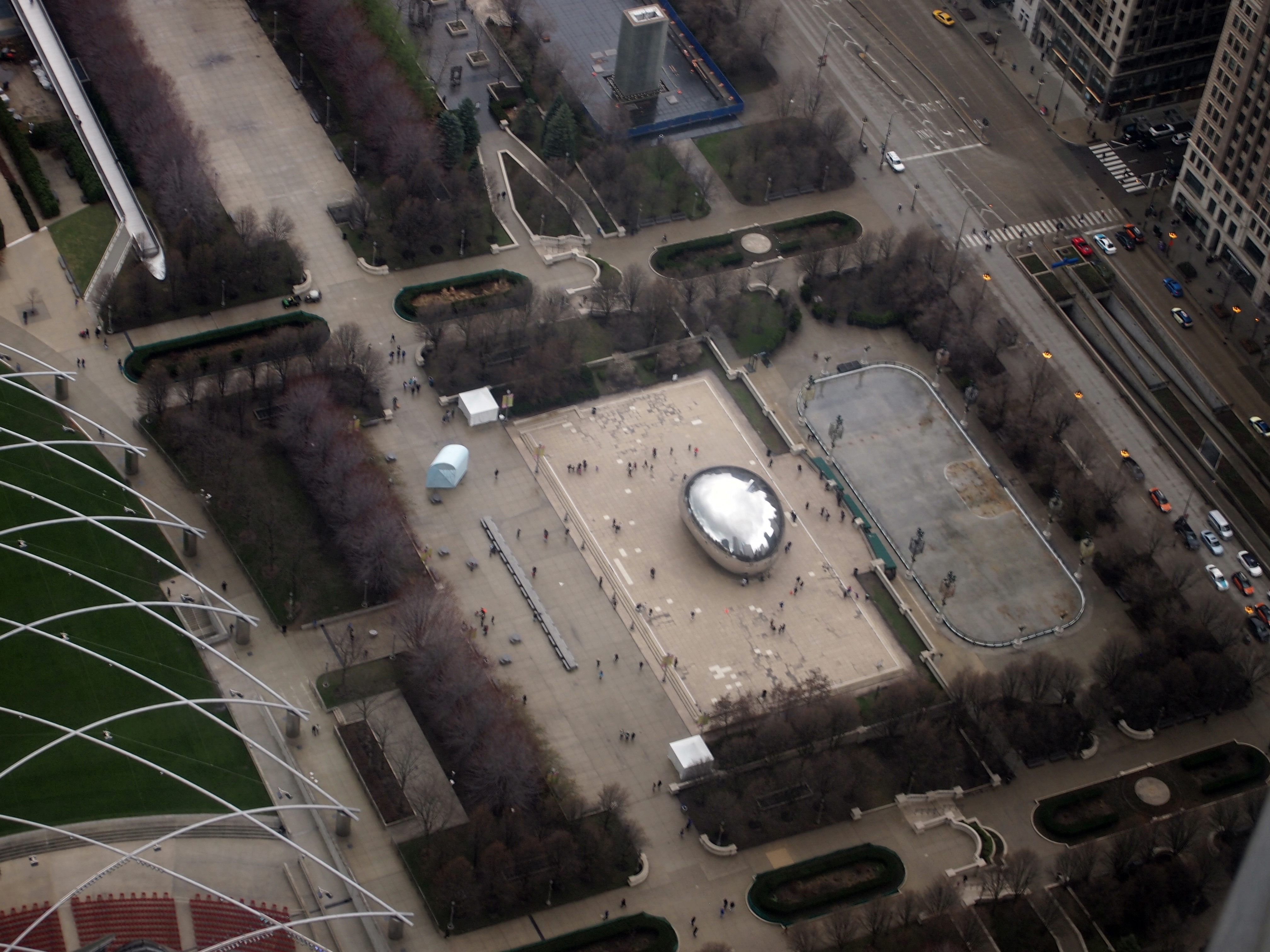
Finally, the Bean, or “Cloud Gate.”
The Bean from the airFrom this vantage, looking like a bead of quicksilver surrounded by ants.

Western Ohio &c

We arrived in downtown Dayton late on a Friday afternoon, May 27, and from the look of things, Dayton isn’t an 18-hour city just yet. Municipal planners probably aspire to that: there’s been some nice infrastructure work at Riverscape Metro Park and Five Rivers Metro Park downtown, including walkways, an elegant garden, a pavilion and other public spaces that look fairly new. As for the private sector, I also spotted a few new apartment projects downtown.

But as a tertiary market, Dayton’s downtown still seems to close up at 5 pm. That’s almost old fashioned now, as the way things were in most smaller downtowns in the last third of the 20th century. Only a handful of people were out and about in the late afternoon/early evening of a warm late spring/early summer day in downtown Dayton, some at the riverfront, others outside the Schuster Center, an event venue.

The main river along downtown is the Great Miami River, which eventually flows into the Ohio. A tributary that meets the Great Miami near downtown Dayton is the Mad River. I like that name. Later, I drove by Mad River Junior High. Now that’s a name for your school.

Less amusing to learn about was the Great Dayton Flood of 1913 (part of the Great Flood of 1913), which is memorialized along the Great Miami. The Dayton flood spurred the creation of the Miami Conservancy District, established in Ohio by the Vonderheide Conservancy Act of 1914, which authorized levees and dams and such to prevent another monster flood. It was a great age of civil engineering, after all. So far, it seems to have worked.

Of course, no matter how obvious the public good, someone’s going to be against it.

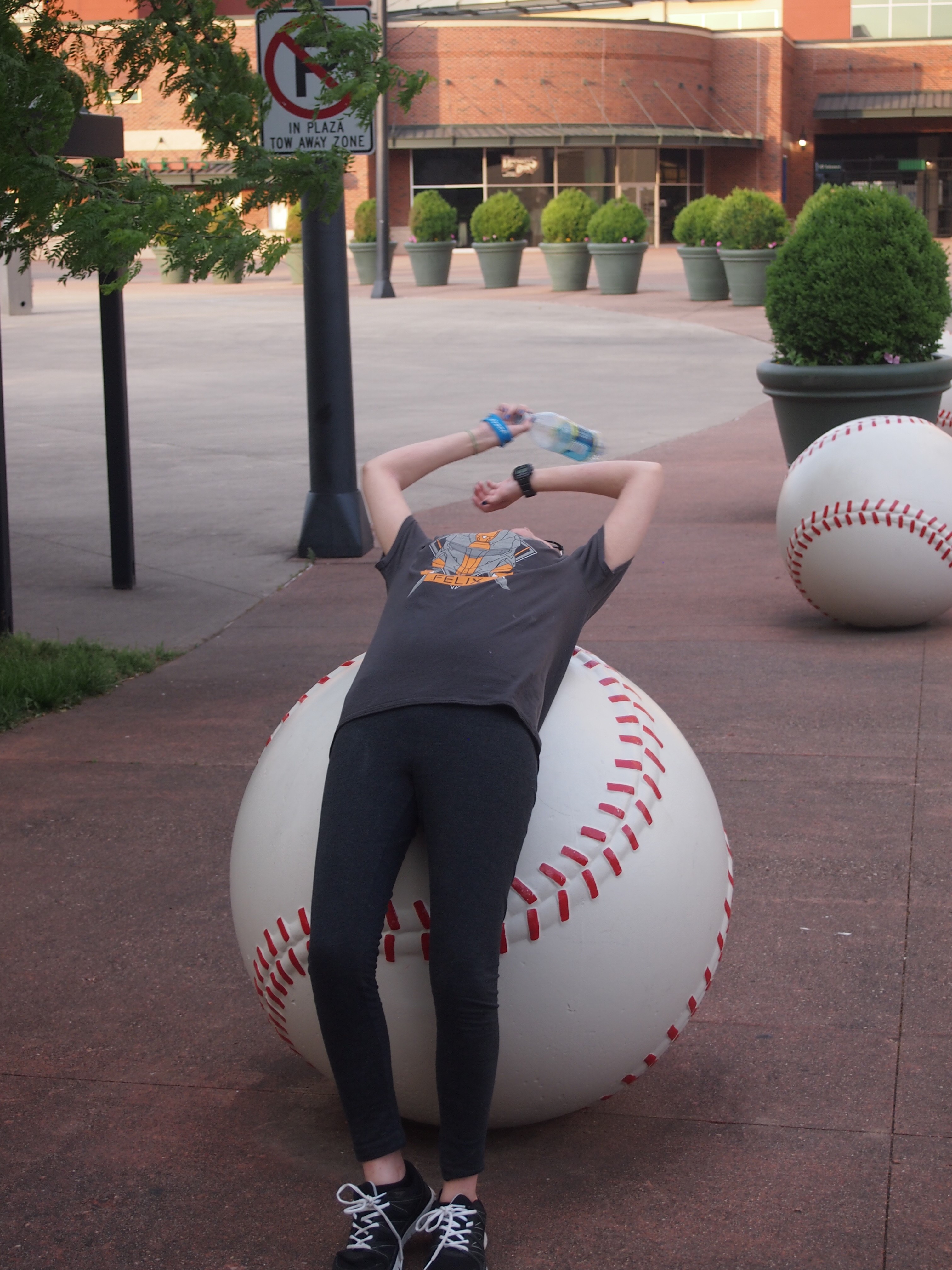
Also downtown: Fifth Third Field, where the Dayton Dragons minor league team plays. In the plaza near field are large concrete baseballs. On these Ann proved herself to be more limber than the rest of us.

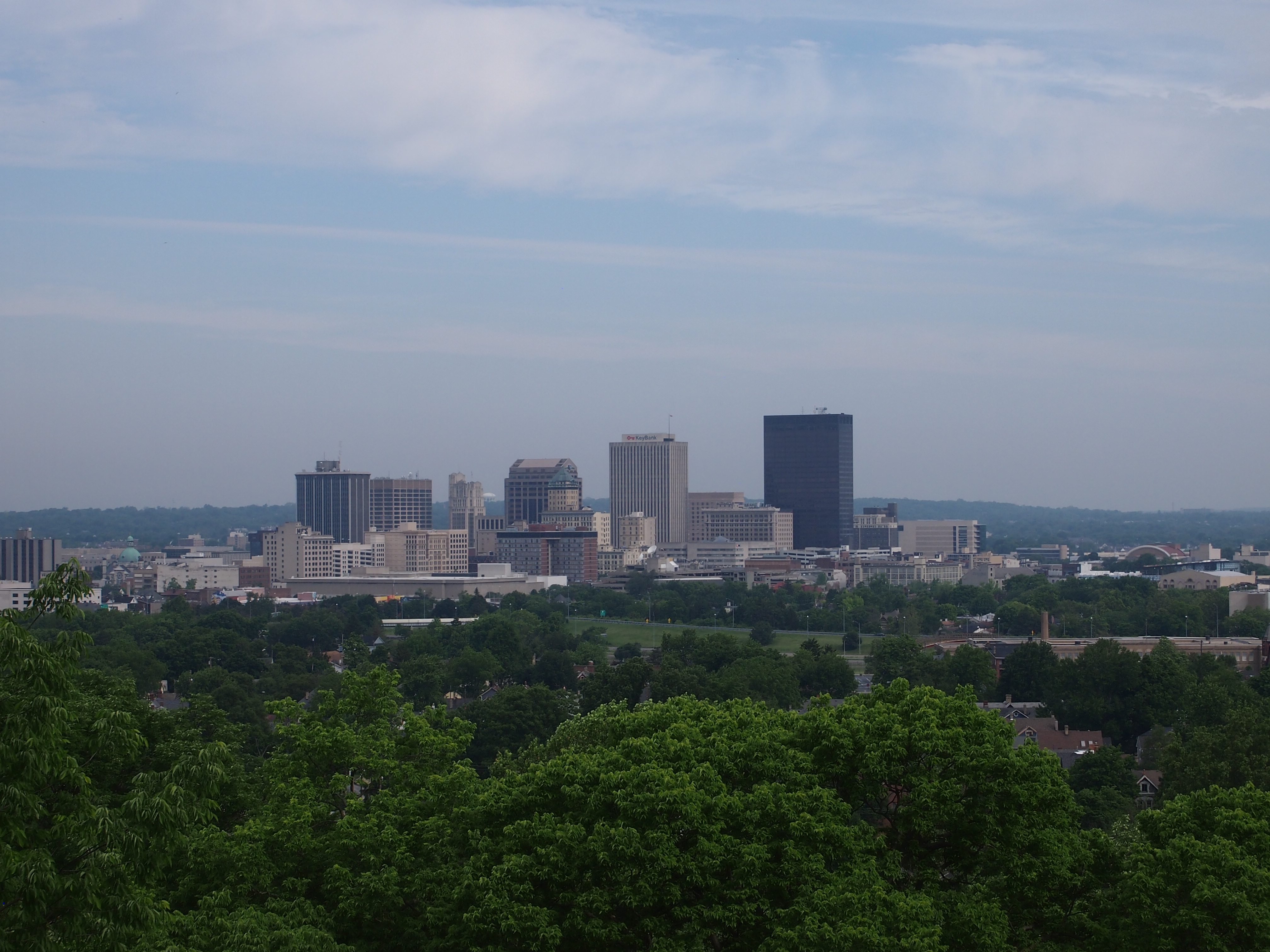
Fifth Third Park, Dayton 2016At the Woodland Cemetery and Arboretum, I happened across Lookout Point, the highest elevation in Dayton. This is the view from there.
Dayton - View from Woodland Cemetery and Arboretum In 2010, the cemetery completed a tower and columbarium on the hill, along with landscaping all around. It’s a lovely spot.

Woodland Cemetery and ArboretumLookout Point, Woodland Cemetery, DaytonThe cemetery also put in a time capsule at Lookout Point, to be opened in 2141, the year of the cemetery’s tricentennial. Guess 2041 wasn’t far enough in the future.

One famed burial I didn’t see at Woodland: copperhead Clement Vallandigham. In reading a bit about him, I found out about his death in 1871, when he was working as a defense attorney after unsuccessful attempts to return to office.

“Vallandigham’s political career ended with his untimely death on June 17, 1871,” notes Ohio History Central. “While preparing the defense of an accused murderer, Vallandigham enacted his view of what occurred at the crime scene. Thinking that a pistol that he was using as a prop was unloaded, Vallandigham pointed it at himself and pulled the trigger. The gun discharged, and Vallandigham was mortally wounded.”

At least his client was acquitted. That’s further even than Perry Mason would go to get a not guilty verdict.

On the way home, we stopped in Wapakoneta, Ohio, a town south of Lima and hometown of moonwalker Neil Armstrong. Just off I-75 is the Armstrong Air and Space Museum. I’ve read the design is supposed to evoke a future Moon base. Maybe the sort of Moon base Chesley Bonestell would put in the background of a lunar landscape.

Armstrong Air and Space MuseumThe museum’s probably interesting enough, with Armstrong artifacts and other items related to space exploration. The Gemini VIII capsule is there, in which Armstrong and Scott almost bought the farm. But Ann wasn’t particularly enthusiastic about the place, and we wanted to press on to Ft. Wayne for lunch, so ultimately the admission fee we didn’t spend went toward that lunch. I did buy some postcards at the museum.

The Armstrong Air and Space Museum’s web site stresses: “The museum is owned by the State of Ohio, is part of the Ohio History Connection’s statewide system of historic sites and museums, and is operated by the local Armstrong Air and Space Museum Association. Neil Armstrong was never involved in the management of the museum nor benefited from it in any way.”

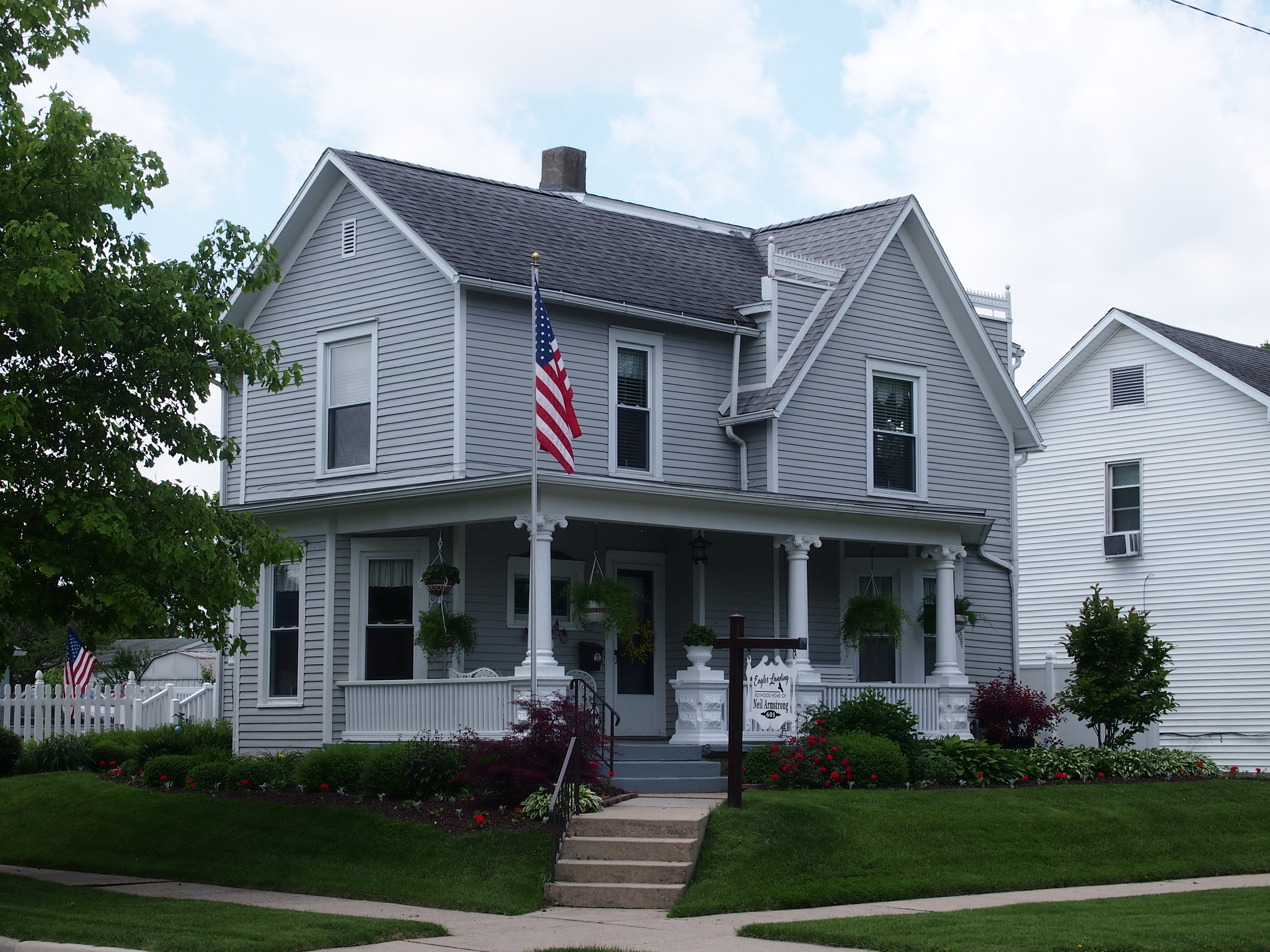
Before leaving Wapakoneta, I wanted to find Armstrong’s boyhood home. It wasn’t hard; the town is small. The house is privately owned by non-Armstrongs, so the thing not to do is venture too close. No doubt occasional oafs do just that, though probably fewer as time passes and fewer oafs remember his achievements.

Another good-looking small town in western Ohio is Troy. We stopped there to obtain doughnuts at the local Tim Hortons. That part of Ohio is within the Tim Hortons realm; our part of Illinois is not. Troy has a handsome main street and a fine courthouse.

Finally, with this trip, I’m glad to report that I’ve been to Neptune. Neptune, Ohio, that is, an insubstantial burg in Mercer County along US 33. Far from the ocean, and far from the planet of that name, though no further (roughly) than anywhere else on Earth.

Curiosity made me waste spend a little time at the USGC Geographic Names Information System, and I discovered that there are five populated U.S. places called “Neptune,” not counting variants like Neptune Beach, Fla. Besides Ohio, they are in Iowa, Tennessee, West Virginia and Wisconsin. Someday maybe I’ll look up the other planets.

Honolulu 1979

Something I spotted at one of the large strip centers near us: a new barber shop, Mad Men Barbershop. I’m not quite sure what they’re suggesting. Come here to look like Don Draper? He was the only male character whose hairstyle didn’t change much during the internal chronology of the show from 1960 to 1970. If short and oily for men is coming back, I want no part of oily. I’m glad that died off in the 1960s and has stayed dead. Grease is not the word.

Slides are an inconvenient medium in our time. I wonder how many billions of slide images are languishing in boxes, never to be seen. Ah, well. I’m doing my little part to bring a few of those to a wider audience here (four or five readers, at least).

Thirty-six years ago this month I visited five of the Hawaiian islands. I had a 35mm camera with me, one that belonged to my brother Jay. I took good care of it and came home with four boxes of images. Many are of lovely, picturesque Hawaii. Green hills, waterfalls, flowers, ocean vistas, volcanoes, lava tubes, black sand beaches, that kind of thing.

But not the following pics. They are urban Hawaii. Views of Honolulu in 1979, that is.
The first one is arguably picturesque. It’s Diamond Head, after all. But hotels and other development seem to be creeping up on it. Not that I object to development of that kind per se. I took this shot from a hotel room balcony. One of the higher floors of the Sheraton Waikiki.
HonoluluDiamondHeadFun fact about that hotel, developed in the early ’70s, I think: it had no 13th floor. Or none with that number. If they’d known how inundated the islands would soon be with Japanese tourists — and there must have been a fair number even 40 years ago — they probably would have not used the number 4 in their floors.

Speaking of hotels, this one only looks a little like the Ilikai, famed in one of the best TV intros ever. I’m not sure what property it is, and while there’s probably an app to find out, never mind. The image comes complete with ugly breakwater in the foreground.
Honolulu79.2Another balcony view, this time of Waikiki Beach. Two young lovers strolling the sands of Waikiki couldn’t be lost in each other’s charms for long without stepping on another beachgoer.
Honolulu79Finally, Honolulu at night.
HonoluluatnightA little fuzzy, but representative of the way the lights — which is to say, development — attached itself to the foothills near Honolulu, looking for every square foot. Even then, Honolulu was the most expensive real estate market in the country.

Lilly in Ecuador

I don’t have any comments to offer here on the jurisprudence of Justice Scalia, but I do crack a smile at his florid prose, as pointed out again recently by endless commentators (and wags who have fun with him). Such writing comes from having no editor to answer to, and a taste for it. I’ve run across most of his terms before — everyone ought to know “argle-bargle” and “applesauce” (in the way he meant it) for instance — but “jiggery-pokery” was a new one on me.

Or rather, an old-sounding new one. It’s a term of abuse that sounds like it might have come up in a London coffee shop argument about the Bangorian Controversy. I was glad to learn it.

Earlier this month, Lilly went to Ecuador and Panama on a Spanish Club trip. It was a big wheel, little wheel trip — one major destination (Ecuador for a week), one lesser one (Panama for three days).

That’s further than I ever got to go on any school trips, though taking a bus to Stevens Point, Wis., from San Antonio for the Mu Alpha Theta National Convention was its own kind of epic, and Amarillo seemed almost as far (Latin Club trip). It was the luck of the draw for her; some years the club goes to Spain, others Costa Rica. All those sound good to me, but Ecuador especially. South America. I’ve never even been close.

Most of her pictures weren’t selfies. She’s outgrowing a need for excessive self-images, I think. Here’s a view overlooking Quito.

The next pics illustrate her taking after her father, unconsciously I bet, in taking pictures of statues and public art. This particular figure is Francisco de Orellana, explorer of the Amazon. As Wiki puts it, “in one of the most improbably successful voyages in known history, Orellana managed to sail the length of the Amazon, arriving at the river’s mouth on 24 August 1542.”
Quito June 2015Some roadside art.
Quito June 2015Plaza de la Independencia.

She was also impressed by the fact that she could see a volcano from Quito, which I believe is Pichincha. Alexander von Humboldt was the first European to climb it. I hear tell it’s still active.
Quito 2015Of course there were many more places. She visited the tourist Equator — how could you not? — Plaza Santa Domingo, a couple of art museums, open markets, grocery stores, churches, a school (technically they took a few Spanish lessons), the neighborhood in which she stayed with an Ecuadorean family, even the outside of the Ecuadorean presidential palace. All in all, it sounded like a fine trip. I’d need no persuasion to go myself.

The House on the Rock, Section 1: Alex Jordan’s Odd Man Cave

The Alex Jordan Center is the first building of The House on the Rock you encounter after the ticketing building. Reached by a walkway through an “Asian garden” (an odd mix of Chinese and Japanese elements), the center is essentially a museum devoted to The House creator, Alex Jordan Jr. (1914-1989), with information about him and his lifelong obsession with building the complex, and filling it with stuff.

Ann, May 30, 2015There’s more information on the walls of the Alex Jordan Center than is easily available elsewhere, especially online (as Wiki puts it, “published information on Jordan’s life is scarce”). Much of what’s written about the place follows the Roadside America school of reportage: Wow, what a wacky place! Look how wacky it is! Can you believe how wacky this place is?

The House on the Rock is wacky. Ah, but so much more. My impression is that Alex Jordan was something of a ne’er-do-well whose parents supported him until he lucked into a way to support his obsessions: charging people admission to see his stuff (that, and maybe farm subsidies). Once it got up and going, the place grow’d like Topsy. Except not quite: Jordan spurred the growth. Whatever the character of his obsessions, he also clearly wasn’t stupid. I was astonished to learn that he oversaw the design and construction of some of the automatic music machines, which look as fantastically complex as any of the Disney animatronics.

Here’s a smaller example of a kind of animatronics I’d never heard of before, one of which, with information, is in the Alex Jordan Center: “In the early 1980s, Alex traded with California collector John Daniel for a collection of Baranger motions…

The House on the Rock May 2015Baranger motions are mechanical animations manufactured by the Baranger Company of South Pasadena, California between 1925 and 1959. The animations were rented to jewelry stores as window displays; they were shipped to the stores periodically on a rotating basis so that there was always something of interest in the store window… The House on the Rock has the world’s largest collection of Barangers on display and in storage.” (The Pollack Advertising Museum in Mesa, Ariz., reportedly has more.) The pictured eggman, a Humpty Dumpty Baranger, is only one of 14 in existence, according to one source.

Jordan must have also had a dash of P.T. Barnum in him. Why else would you have a three-story sea monster built for the world to see? On the other hand, I was happy to learn that The House on the Rock doesn’t particularly gouge its visitors. Admission for three adults and one child, bought at a discount on line, was less than $90, and certainly worth it. The gift shop was tourist-priced, but not excessive. One small example: postcards were a quarter each. I seem to remember that cards of Taliesin were more, maybe a dollar. The place doesn’t charge Buc-ee’s prices, in other words.

The House on the Rock is formally divided into three parts. The first part begins after leaving the Alex Jordan Center, and includes the original structure: a dimly lit collection of rooms snaking around the side of the hill. At least, that’s what it felt like. Without a map, or an aerial view of the complex, it’s hard for a casual visitor to tell how it’s all put together. Not that that matters. Once you’re into the groove of the place, passing through twisting corridors and crossing pedestrian bridges and climbing staircases and wandering along footpaths through mildly claustrophobic tunnels, and even taking in an occasional view of the outside, it’s just one thing after another. Quite literally.

The first section was also the only part of the complex that remotely resembles living quarters, featuring (among other things) a simple kitchen looking about 40 years old. Other rooms included pieces of furniture, such as couches and tables, and one has a large fireplace: elements of an elaborate man cave, to use a term more recent than The House. With some stress on cave. Rock formed the basis of most of the walls, the ceilings were low, and much of the color scheme involved brown.

The House on the Rock, May 2015Most of the rooms weren’t so ordinary. Jordan’s fascination with collecting dolls, especially Japanese dolls, and Tiffany lamps, or Tiffany-like lamps, is apparent in many places.

The House on the Rock, May 2015The House on the Rock, May 2015The first section also included a handful of the automatic music machines that would show up in such quantity later in the complex. This looks like a painting of such a device — in fact, an homage to a famous painting I can’t quite place — but actually the device is behind a hole in the wall made to look like a frame. Insert a token and it makes music.

The House on the Rock, May 2015At one point the tour trail takes you outside to enjoy the view. Even though last Saturday was overcast and rainy, I saw the appeal of the vista, off into the rolling green hills of southern Wisconsin.

The House on the Rock May 2015The signature room of the first section is the Infinity Room. In its terse way, The House on the Rock web site says, “The 14th room of the House, completed in 1985, this engineering marvel extends 218 feet out over the scenic valley and 156 feet above the forests [sic] floor. The Infinity Room has 3,264 windows for walls that treat guests to a truly spectacular view.”

I wasn’t able to take a picture of the Infinity Room exterior that wasn’t obscured by trees, but there are some images on line.

Looking toward to end of the room, you see this.

The Infinity RoomAs far as you can go into the room, you see this.

The Infinity RoomDead ahead from there is a window in the floor that allows you to look down toward the tops of the trees. I can only hope that Jordan hired competent engineers to cantilever the thing safely, and that inspectors from Iowa County periodically take a look at it. The room’s been up for 30 years, so presumably it’s fairly sound. Still, Yuriko was unnerved by entering the room, and didn’t stay long, and she wasn’t the only one. Another woman visitor voiced her disquiet and turned around mid-way to the end point. Her young daughter went on (as did mine). The lure of infinity wasn’t to be missed.