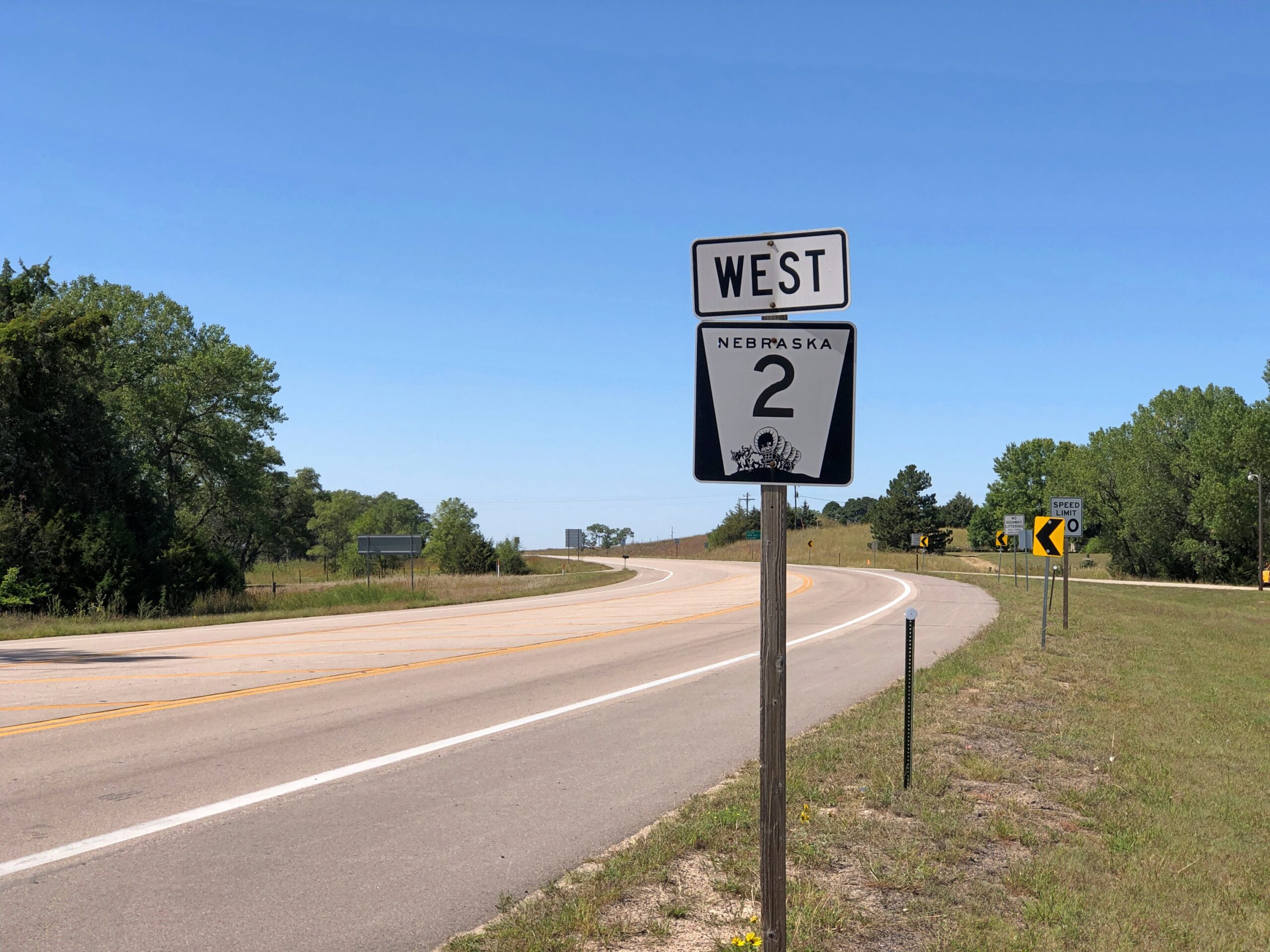
Nebraska 2

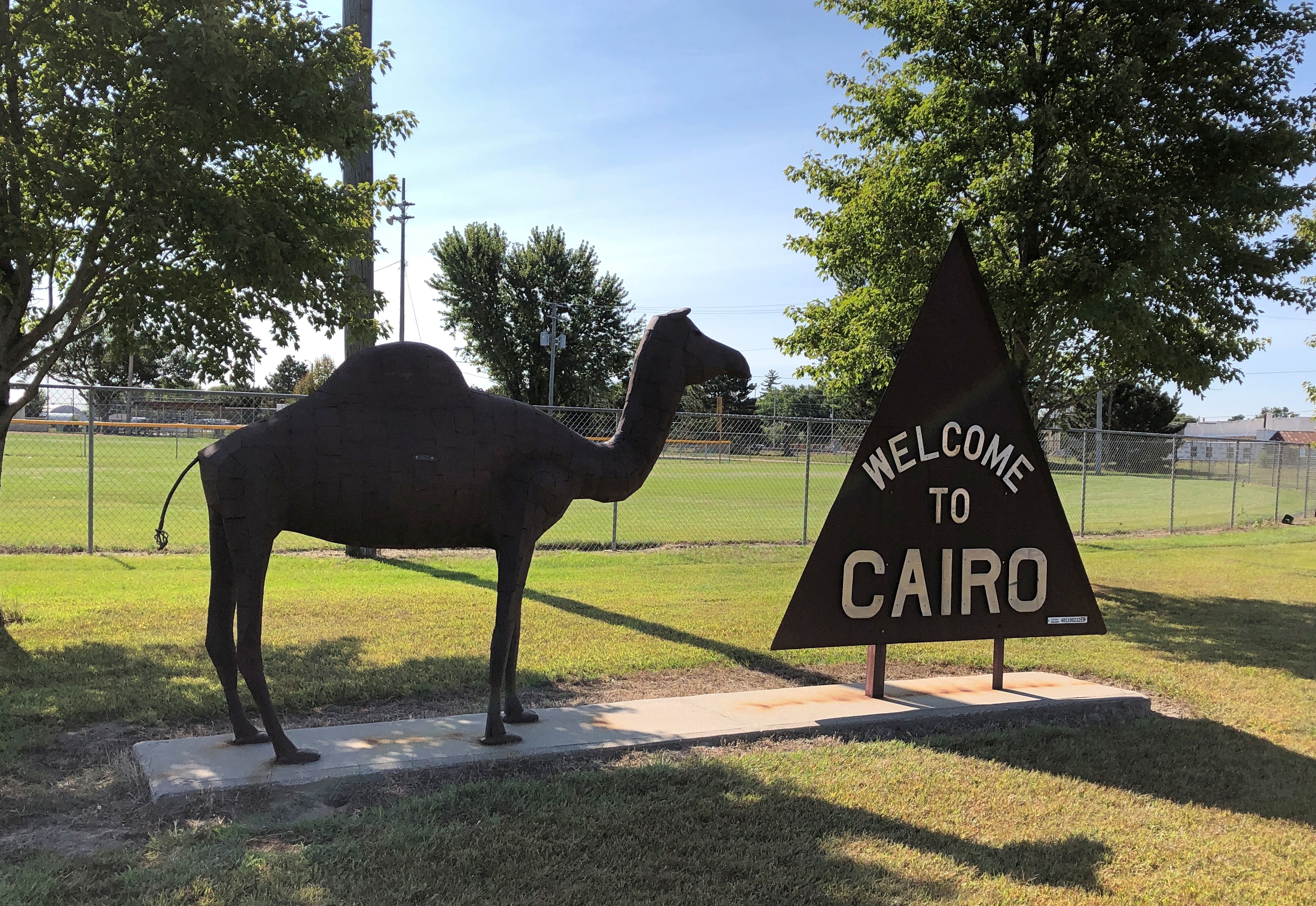
Which of these two destinations aren’t like the others?

Cairo, Neb

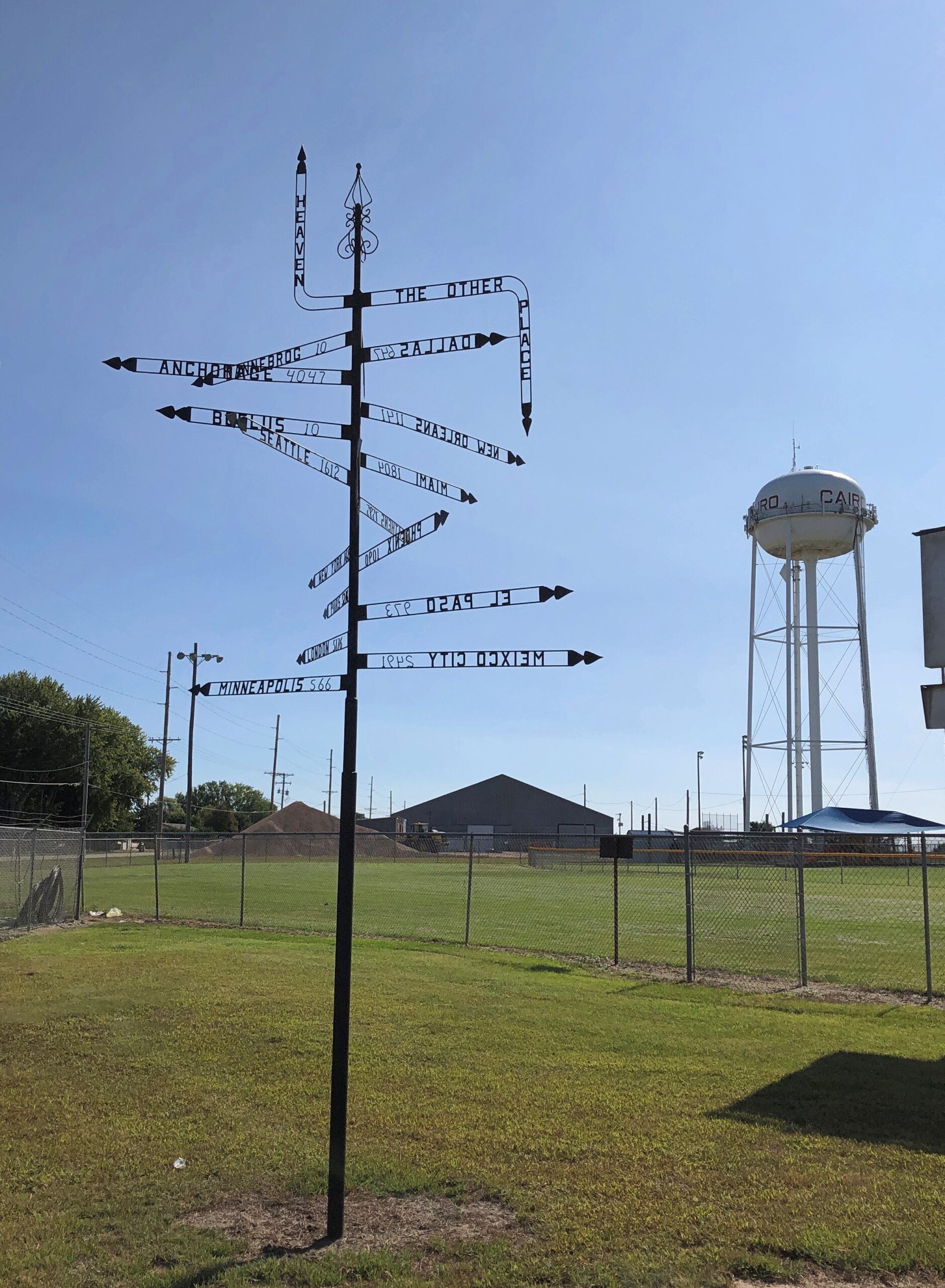
That’s a beginner’s-level question. Better question: where can you find this pole, with mileages and – what units measure the distance to Heaven or Hell? – other signs?

Answer: Cairo, Nebraska.

Cairo, Neb

Maybe a palm tree was in the works, but the city decided not to spend any more money. Cairo (pop. 822) is one of the small chain of small towns on the eastern section of the highway Nebraska 2, which runs westward and north of Grand Island. Cairo is the first place I stopped on my way west on that highway in early September.

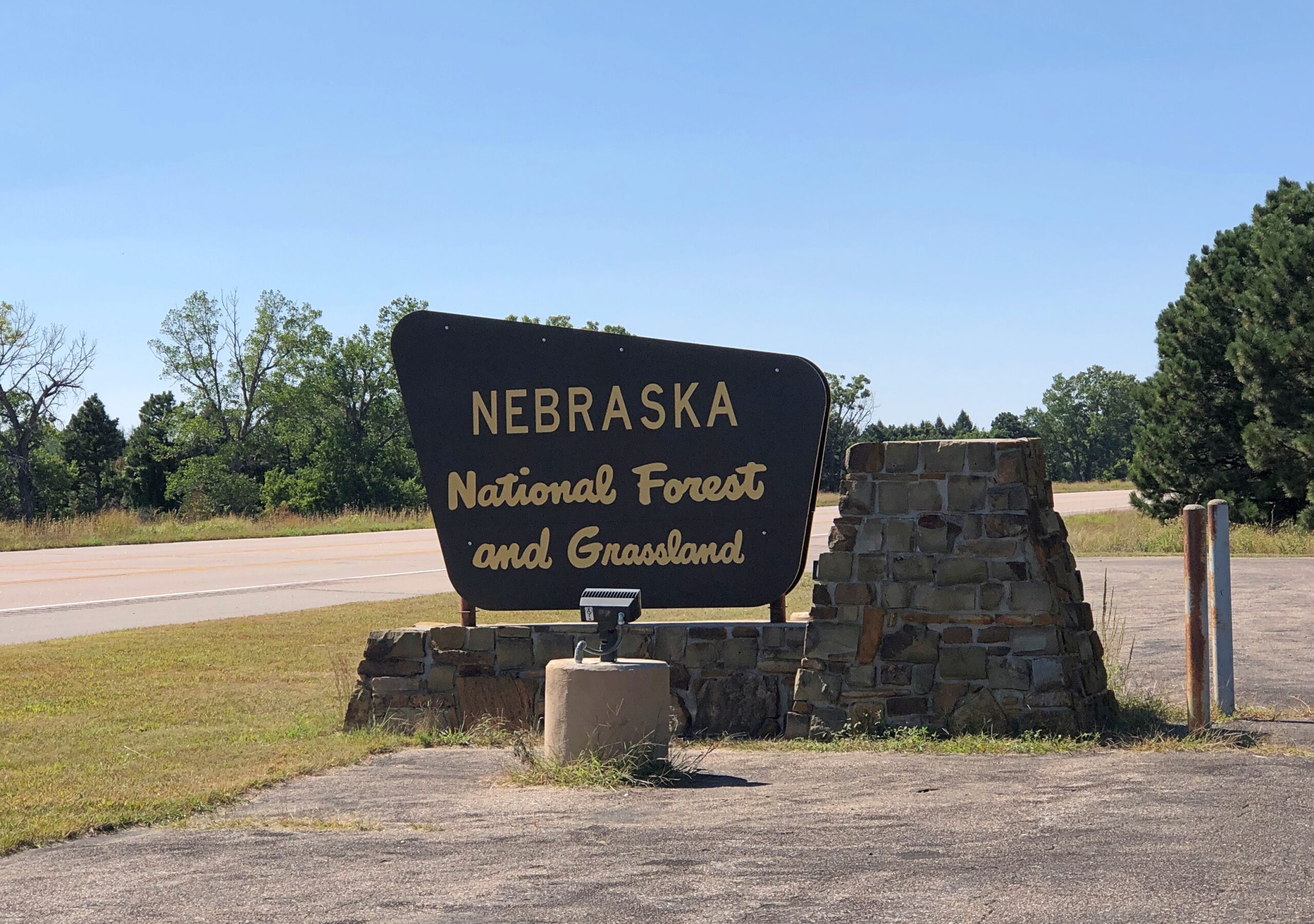
Eventually the highway reaches the Nebraska National Forest and Grassland, a patch of (partly) wooded land that inspires the question, there’s a national forest in Nebraska?

West from the forest, Nebraska 2 crosses the Sandhills, an unusual place here in North America, with the land morphing from cropland to ranch land on sandy steppes. The towns on the way are mere hamlets, and sometimes not even that. On the western edge of the Sandhills, one comes to the sizable town of Alliance, Nebraska, home of Carhenge and railroad staging area for coal trains headed east.

Before I did the drive, I was looking forward to it as much as any of the roads in Colorado. It lived up to expectations. Nice when that happens.

Nebraska 2

The Fence Post cites Charles Kuralt’s fondness for Nebraska 2: “Highway 2 is not just another highway that goes somewhere. Highway 2 is somewhere,” he’s known to have said. I’d say whatever else his failings, Kuralt had good taste in roads.

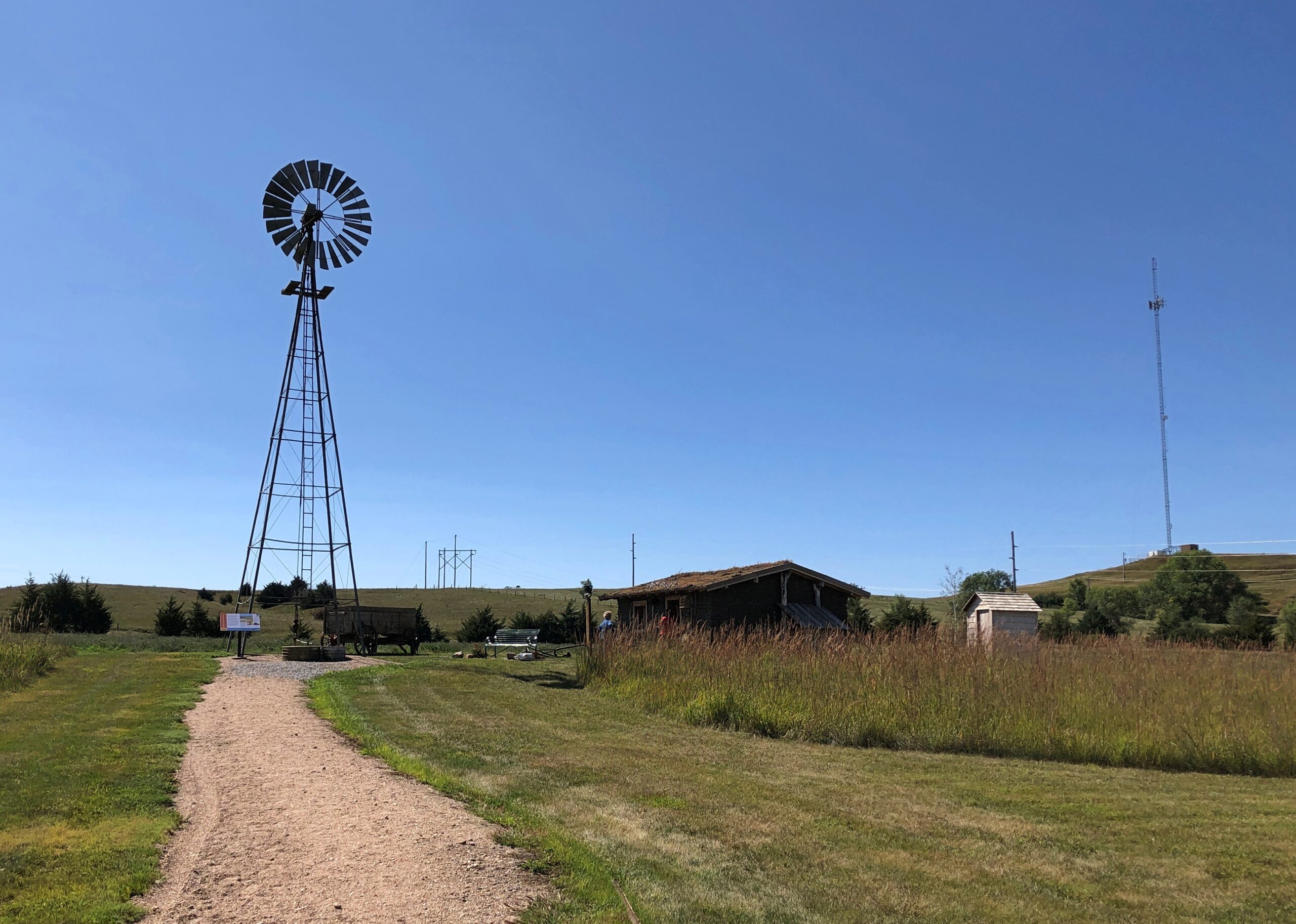
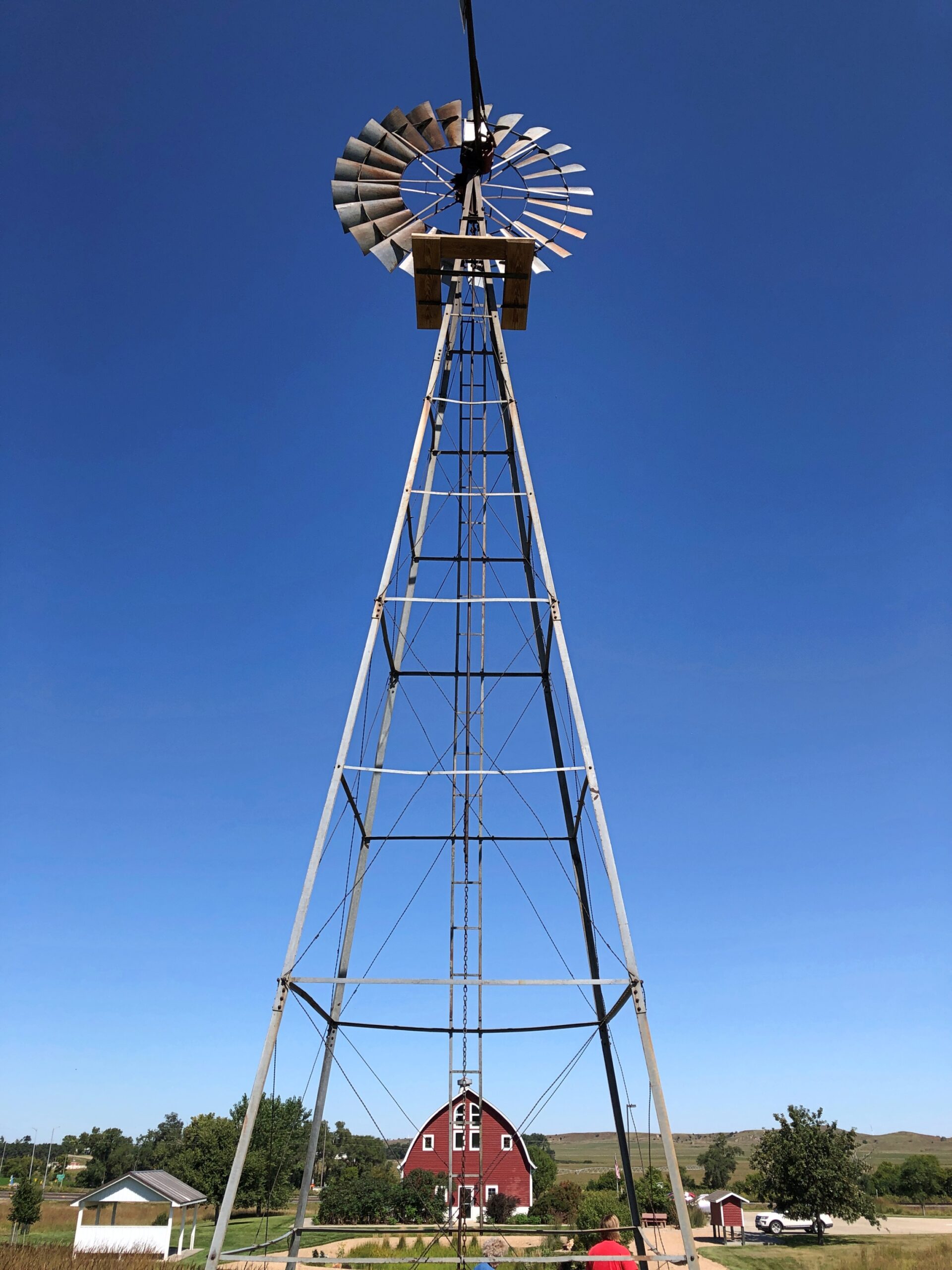
Just outside Broken Bow (pop. 3,491), seat of Custer County and pretty much the only town of any size in that county, the Sandhills Journey Scenic Byway Visitor Center offers a building with bathrooms and pamphlets and displays and, for my visit at least, a grandmotherly and talkative volunteer. Old enough, she said, to remember when the highway was just a road through the countryside that attracted no attention from the outside world. Not a scenic byway, and sand hill cranes were just flocking birds. Now a trickle of tourists and bikers and RVers come this way. She had some solid recommendations, especially a good diner for lunch.

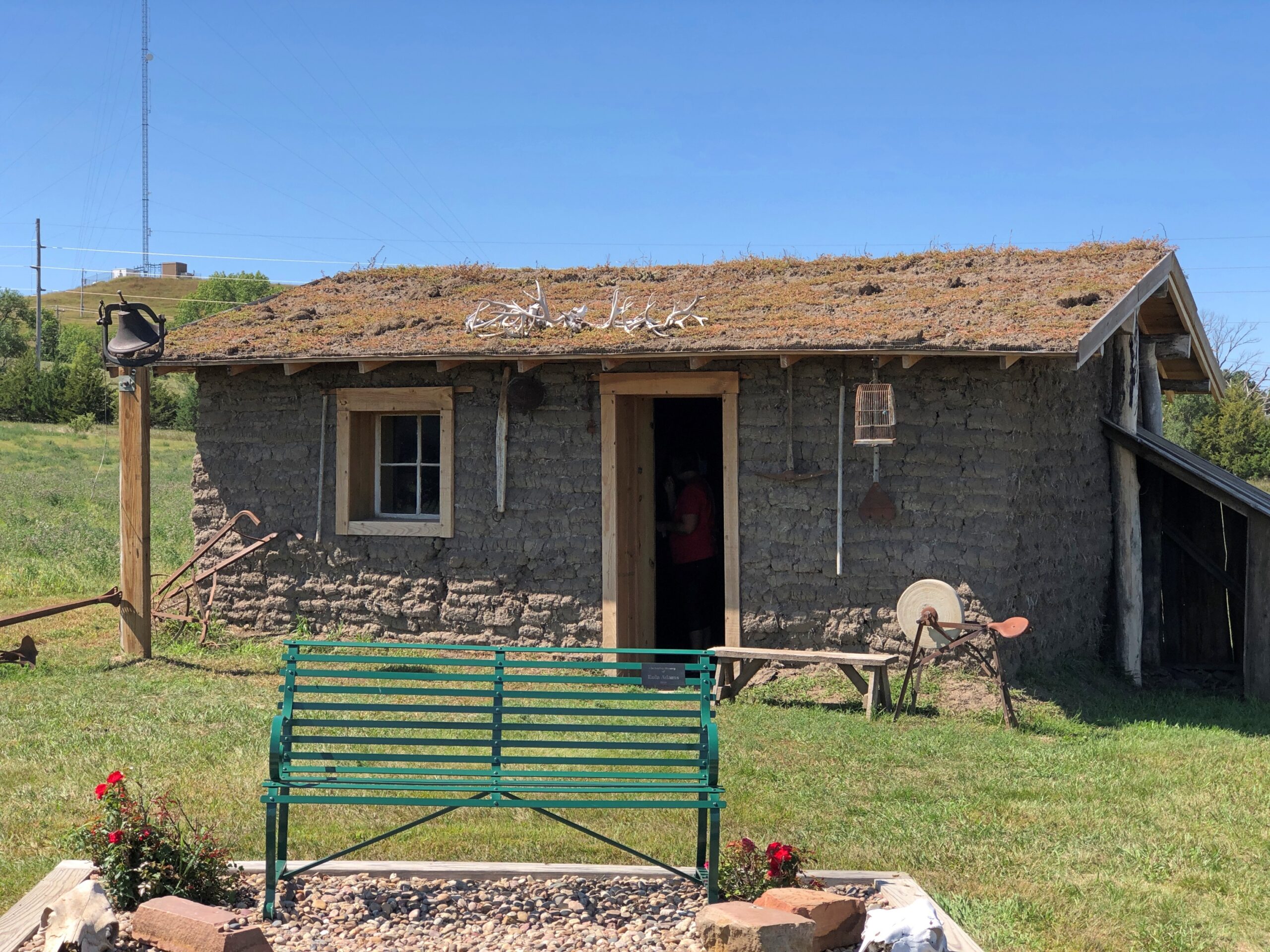
The visitor center grounds include a relocated (or was that reconstructed?) Sandhills cabin. The residences of the farmers trying to scratch out a living in the Sandhills, and finding out that no amount of scratching would make decent crops grow consistently from the land.

Broken Bow, Neb
Broken Bow, Neb
Broken Bow, Neb
Broken Bow, Neb

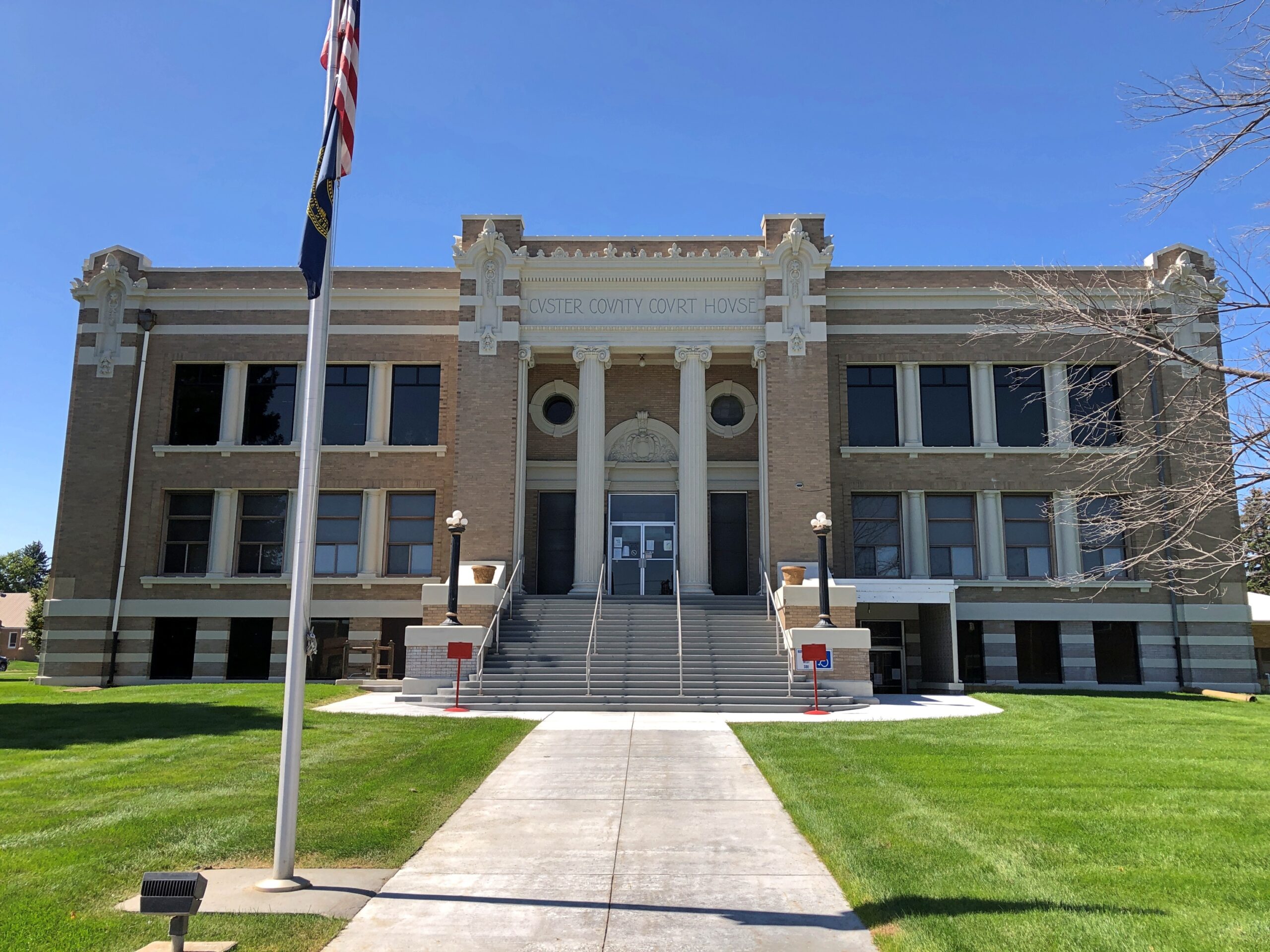
The Custer County Courthouse. Saturday, closed.

Broken Bow, Neb

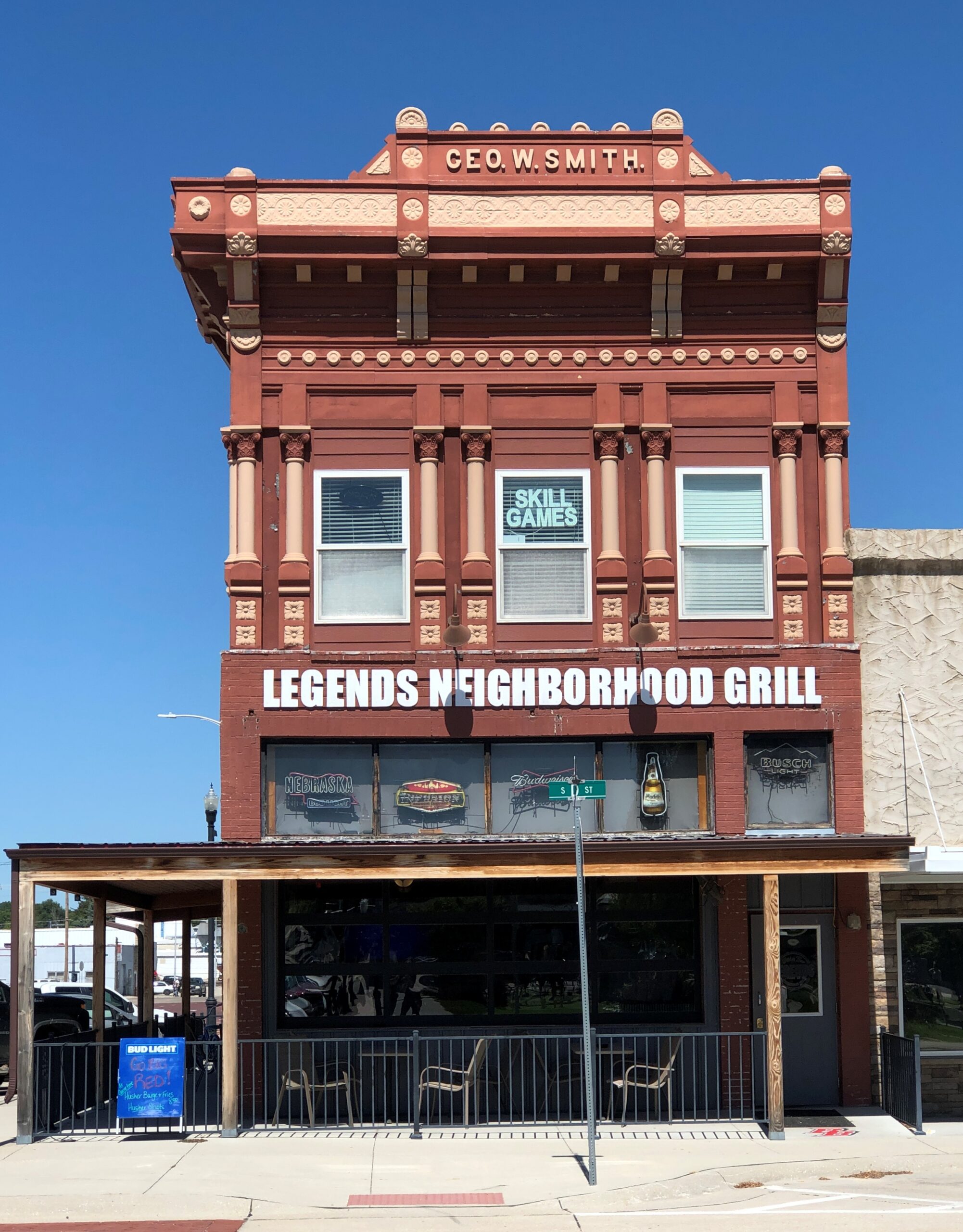
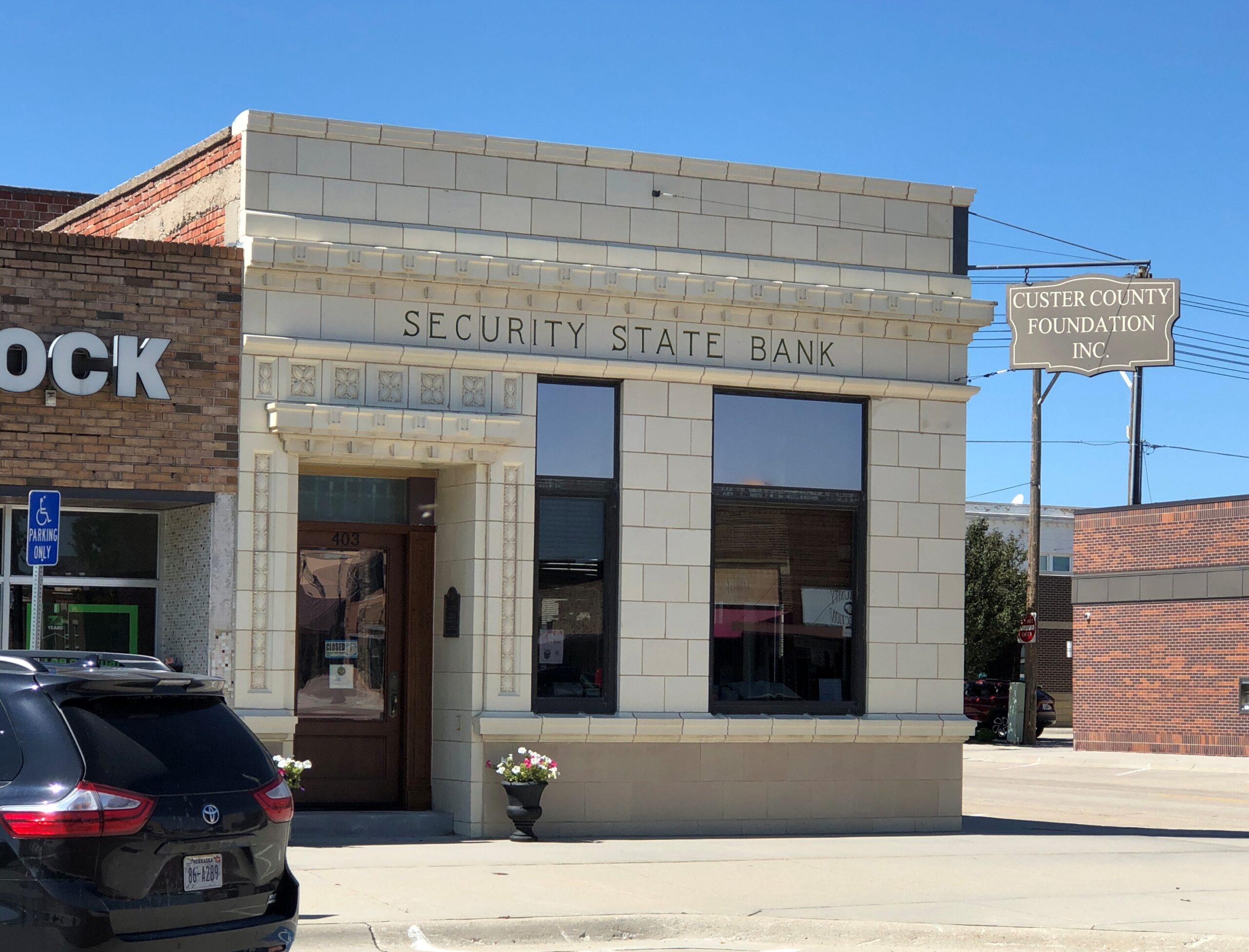
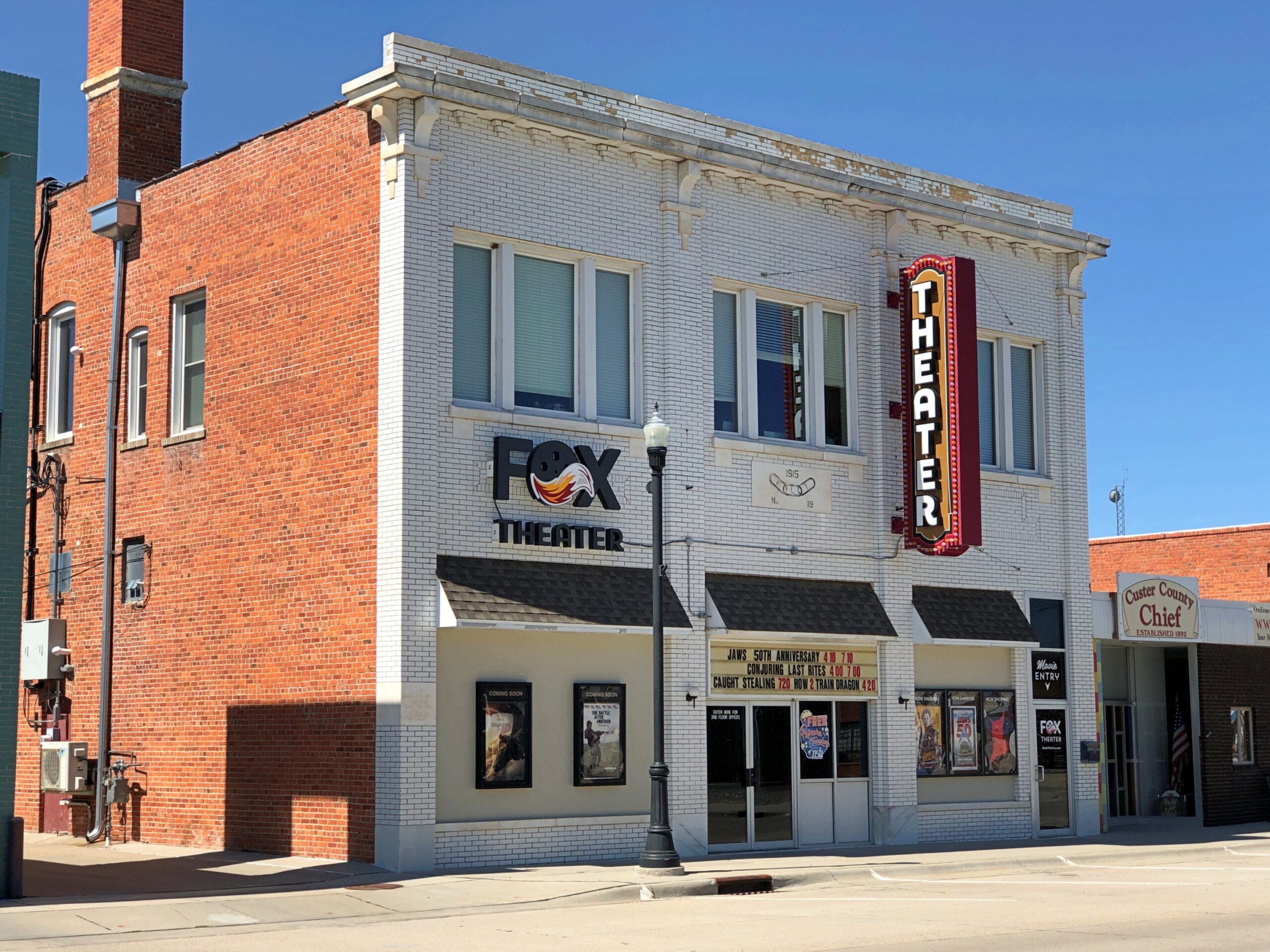
A block from the courthouse, some buildings around City Square Park.

Broken Bow, Neb
Broken Bow, Neb
Broken Bow, Neb

City Square Park is a generic sort of name. Wonder whether there’s anyone from the town who can be honored by renaming the park? Looking at list of notables from Broken Bow, one instantly stands out.

This guy: Solomon Butcher.

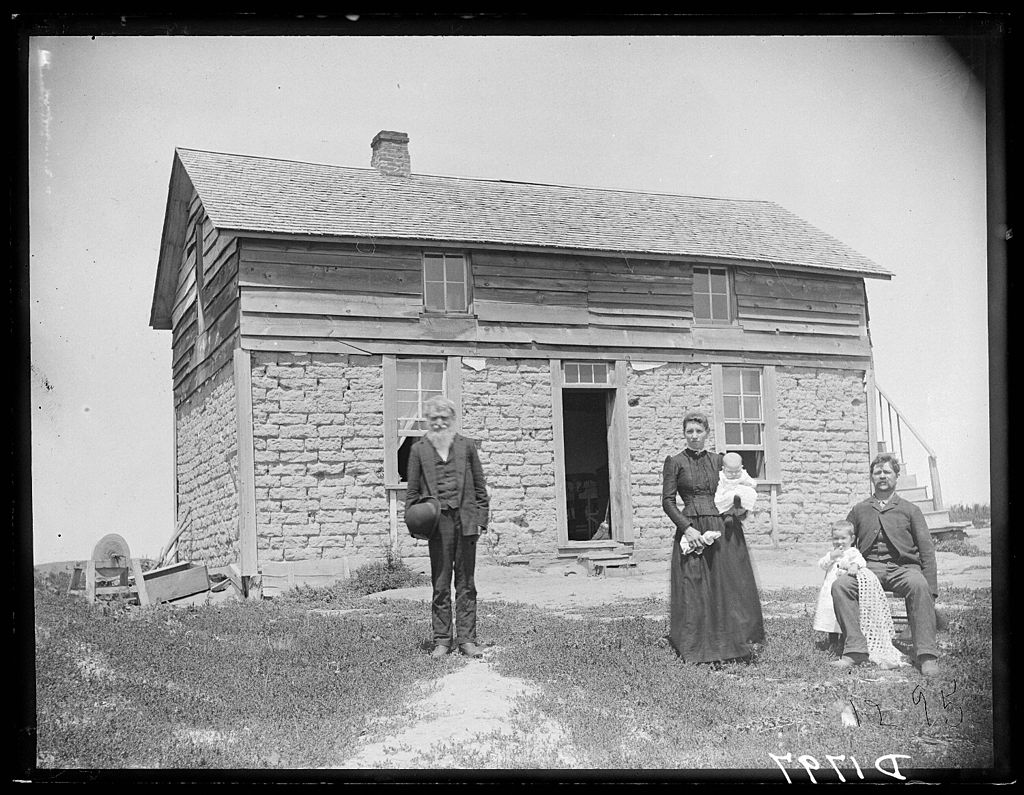
Wiki: “Solomon D. Butcher (January 24, 1856 – March 18, 1927) was an itinerant photographer who spent most of his life in central Nebraska, in the Great Plains region of the United States… he began in 1886 to produce a photographic record of the history of European settlement in the region. Over 3,000 of his negatives survive; more than 1,000 of these depict sod houses.”

Frederic Schreyer and family, Custer County, 1880s, by Solomon Butcher.

Definitely name the park after Butcher, Broken Bow.

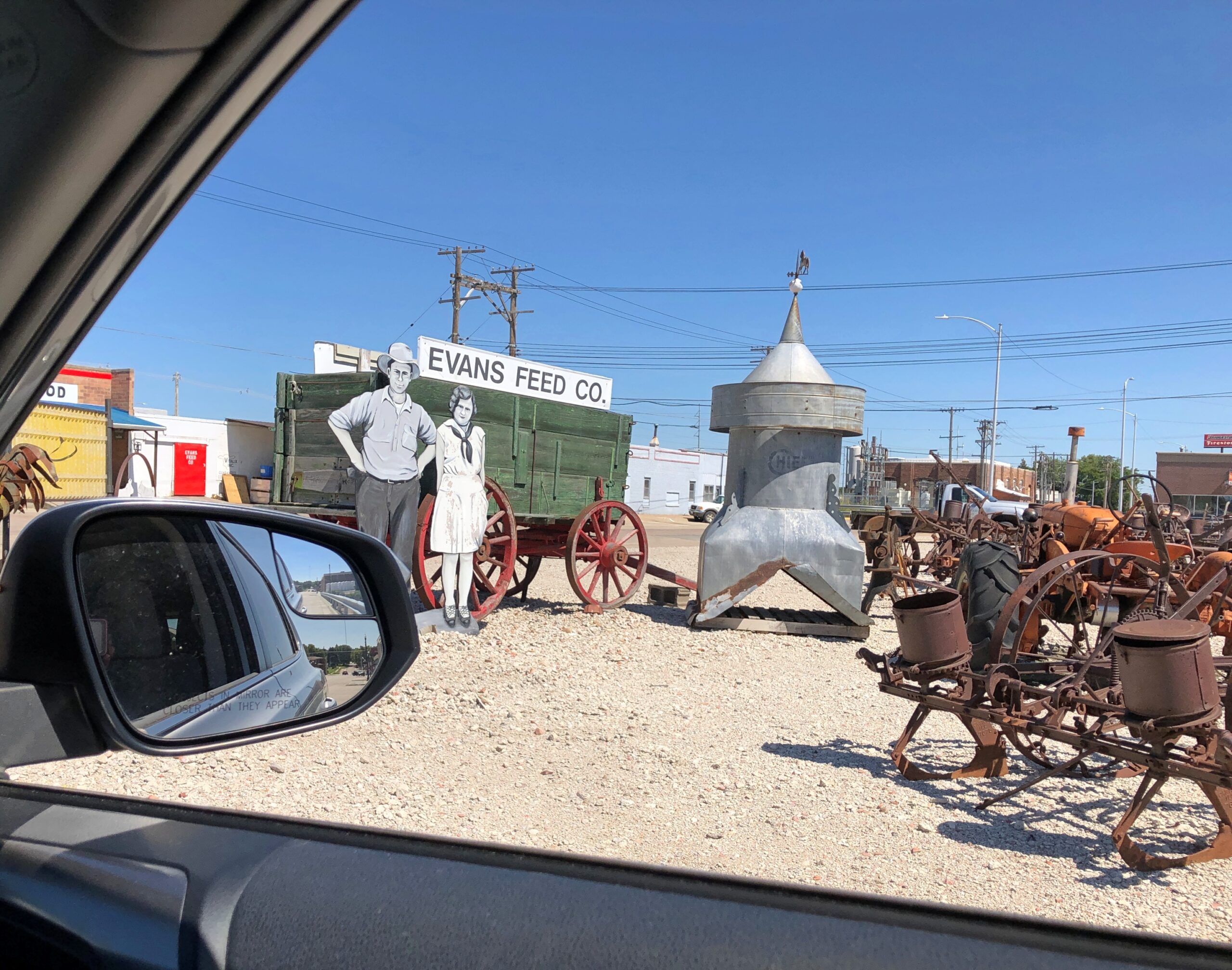
One more in that town. I couldn’t be bothered to get out of the car.

Broken Bow, Neb

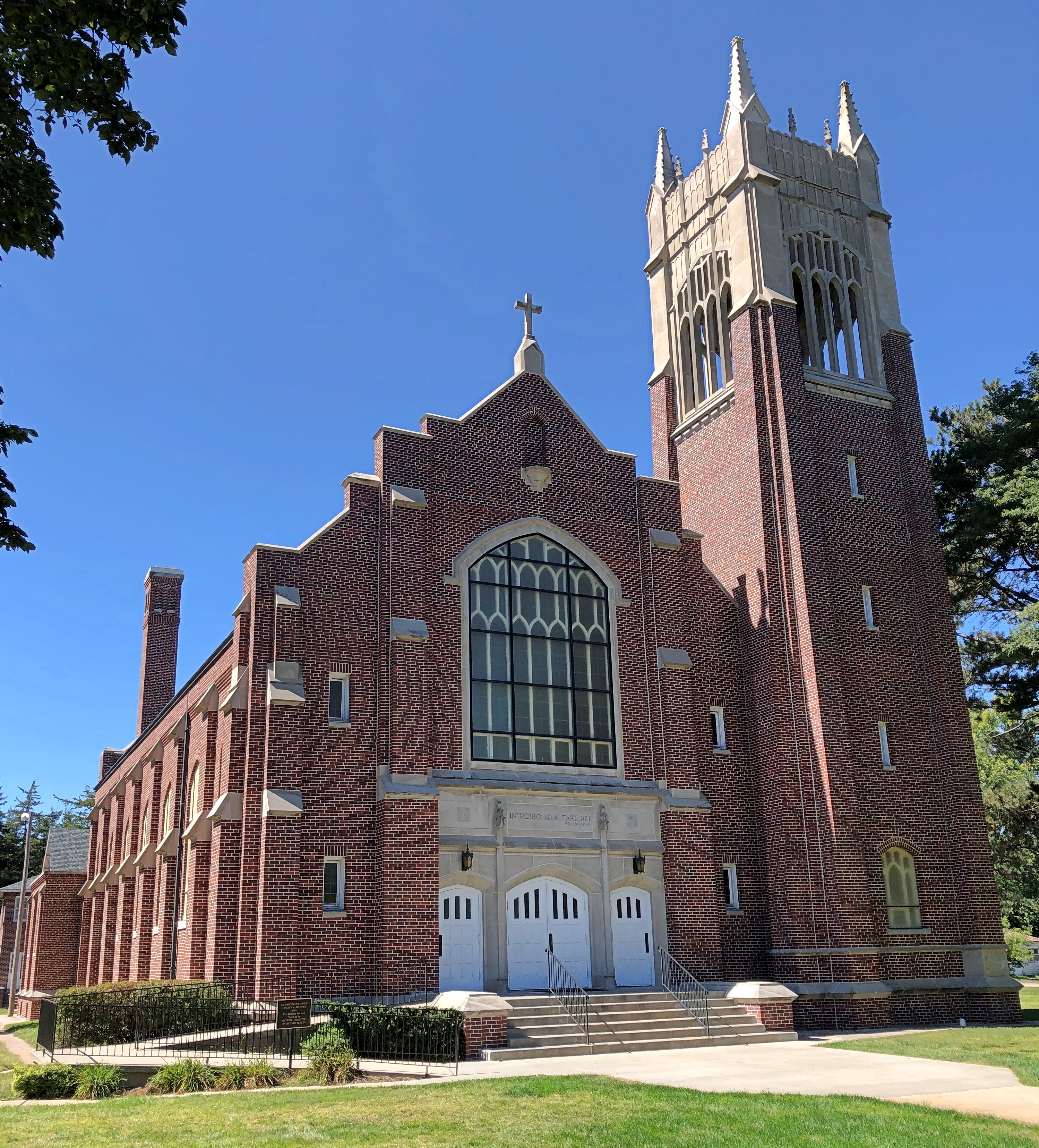
West of Broken Bow is Anselmo (pop. 145), home of this church, St. Anselms Catholic Church, nicknamed Cathedral of the Sandhills. Saturday, closed.

Anselmo, Neb

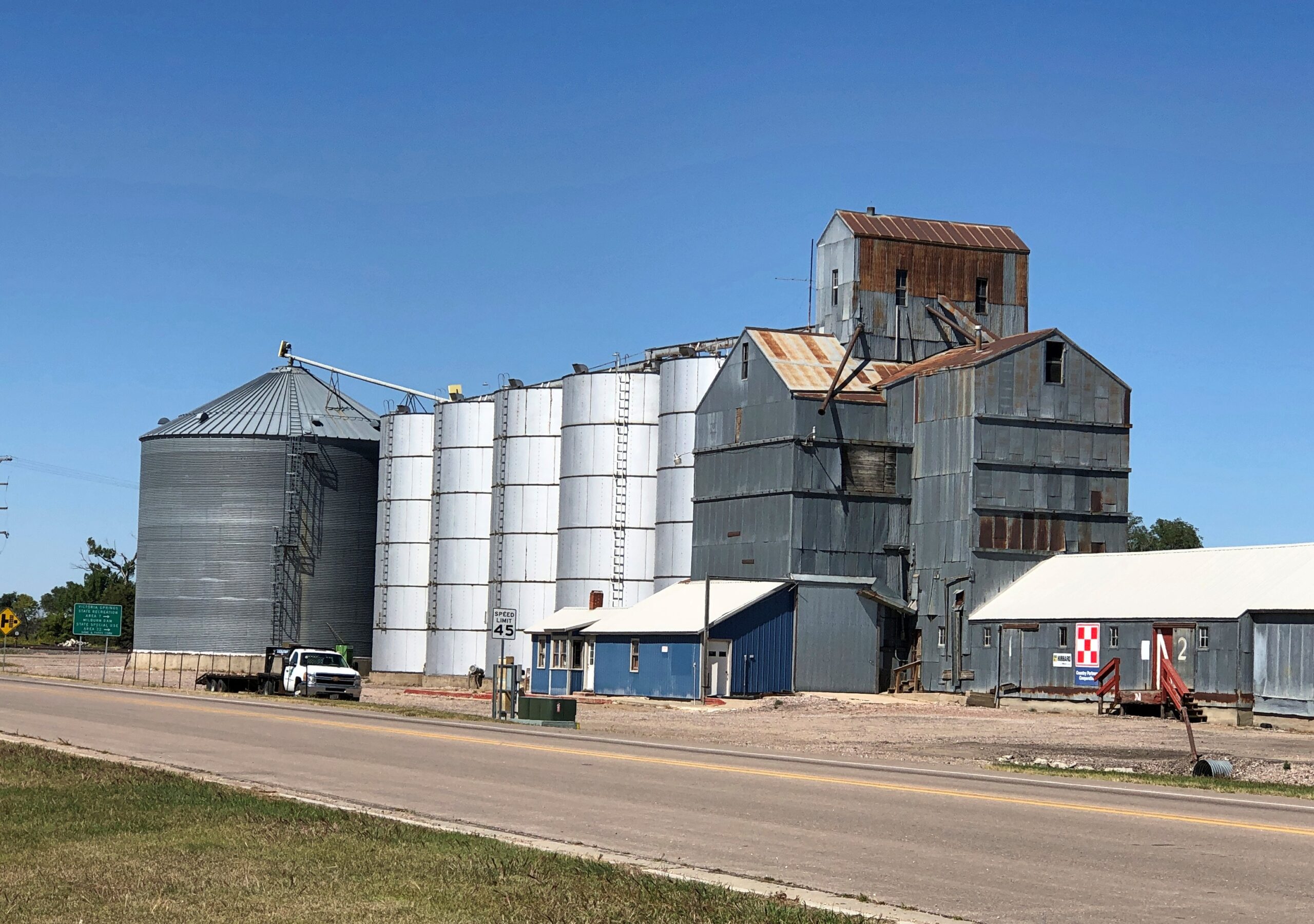
A more common sort of building, not far from the church.

Anselmo, Neb

Not the most imposing that I saw, but representative of the many structures like it. The grist of a photo collection. Of course it has been done. I’m pretty sure I saw a room of Bernd Becher’s photos of water towers at the Modern Art Museum of Fort Worth.

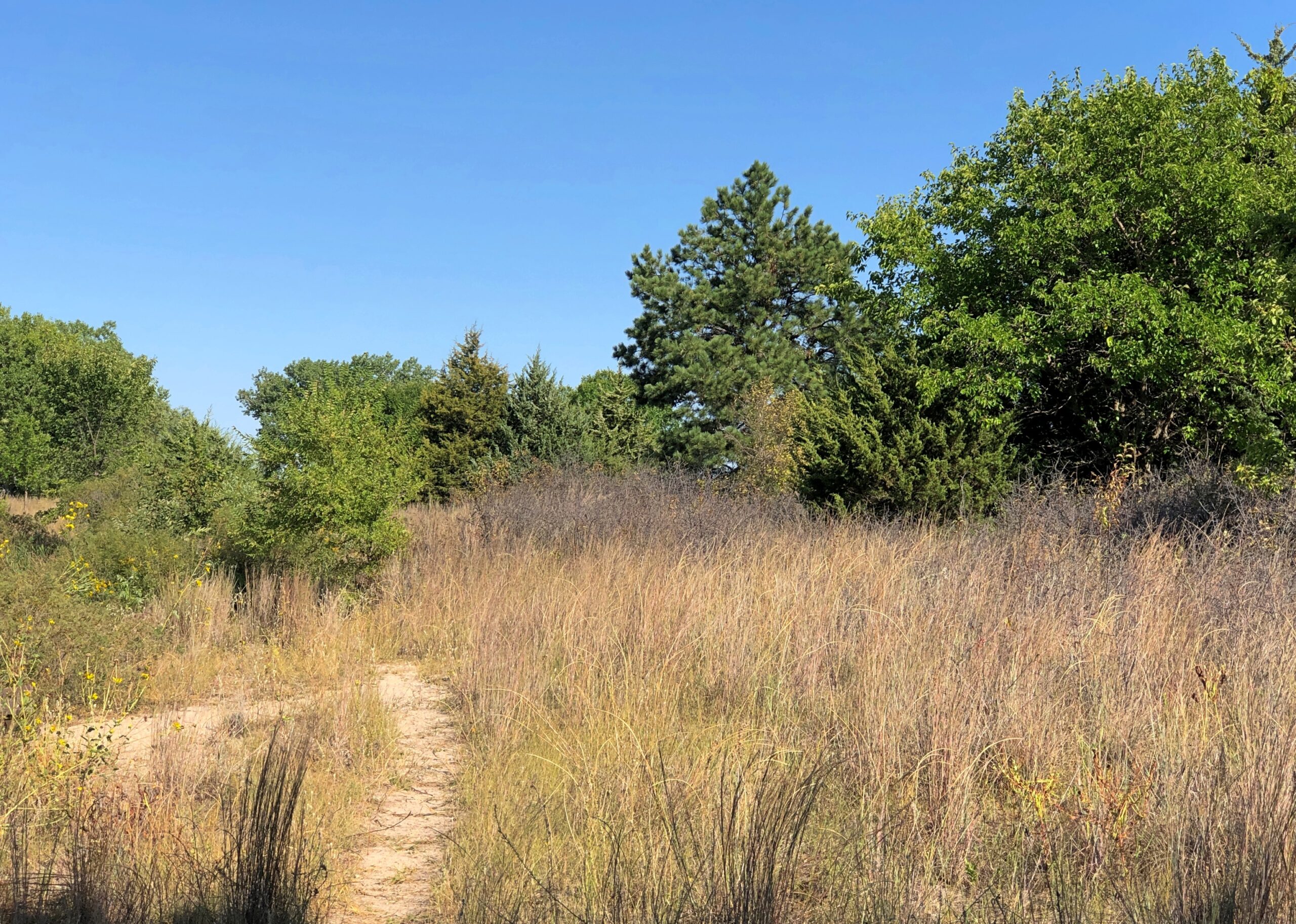
Nebraska National Forest and Grassland is in an unexpected place, slap in the middle of Nebraska, not due to a freak of nature, but the efforts of human beings. Specifically, mass plantings of trees by the federal government for more than 100 years, beginning (not a surprise) during the administration of Teddy Roosevelt.

Nebraska National Forest

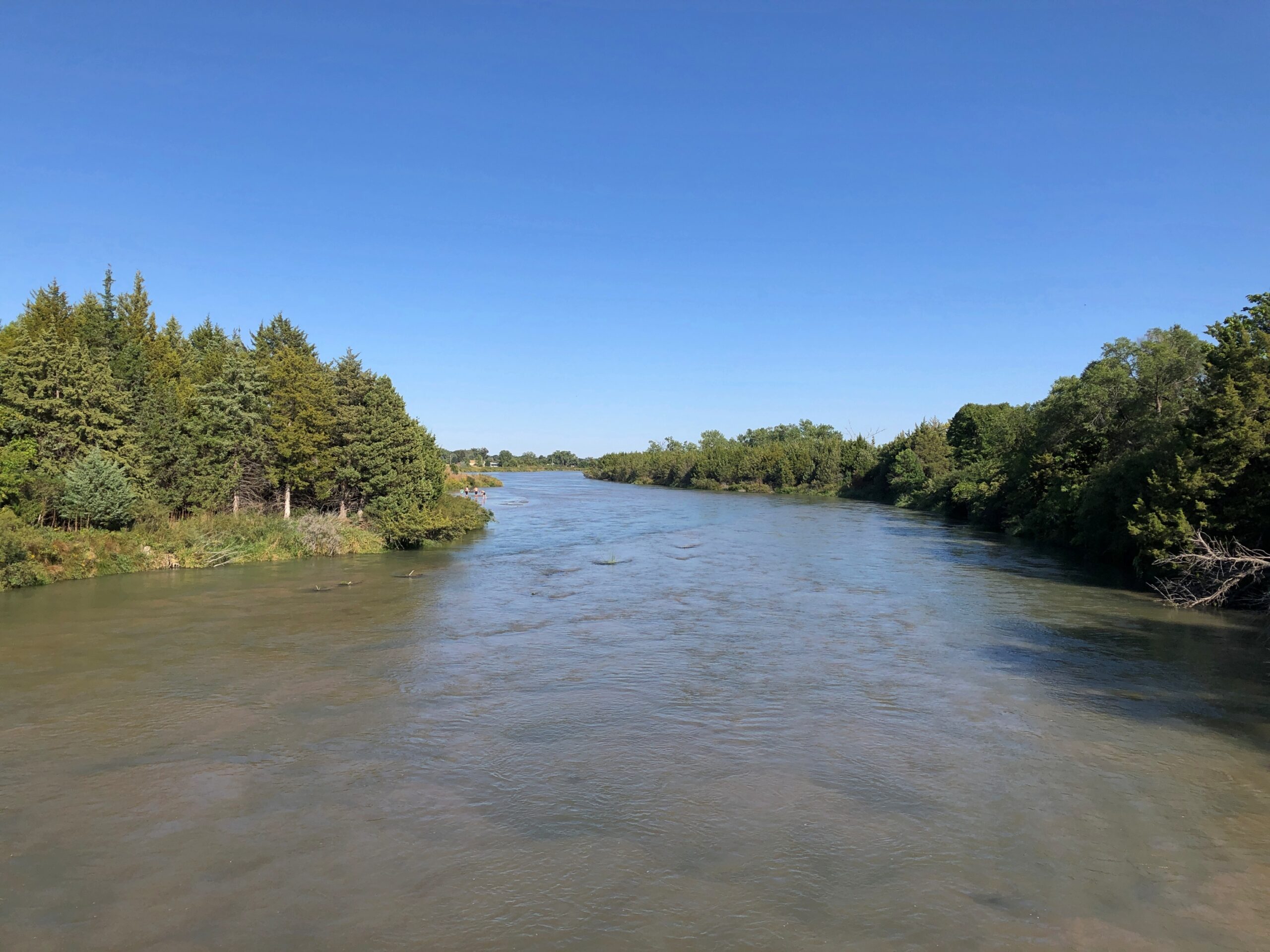
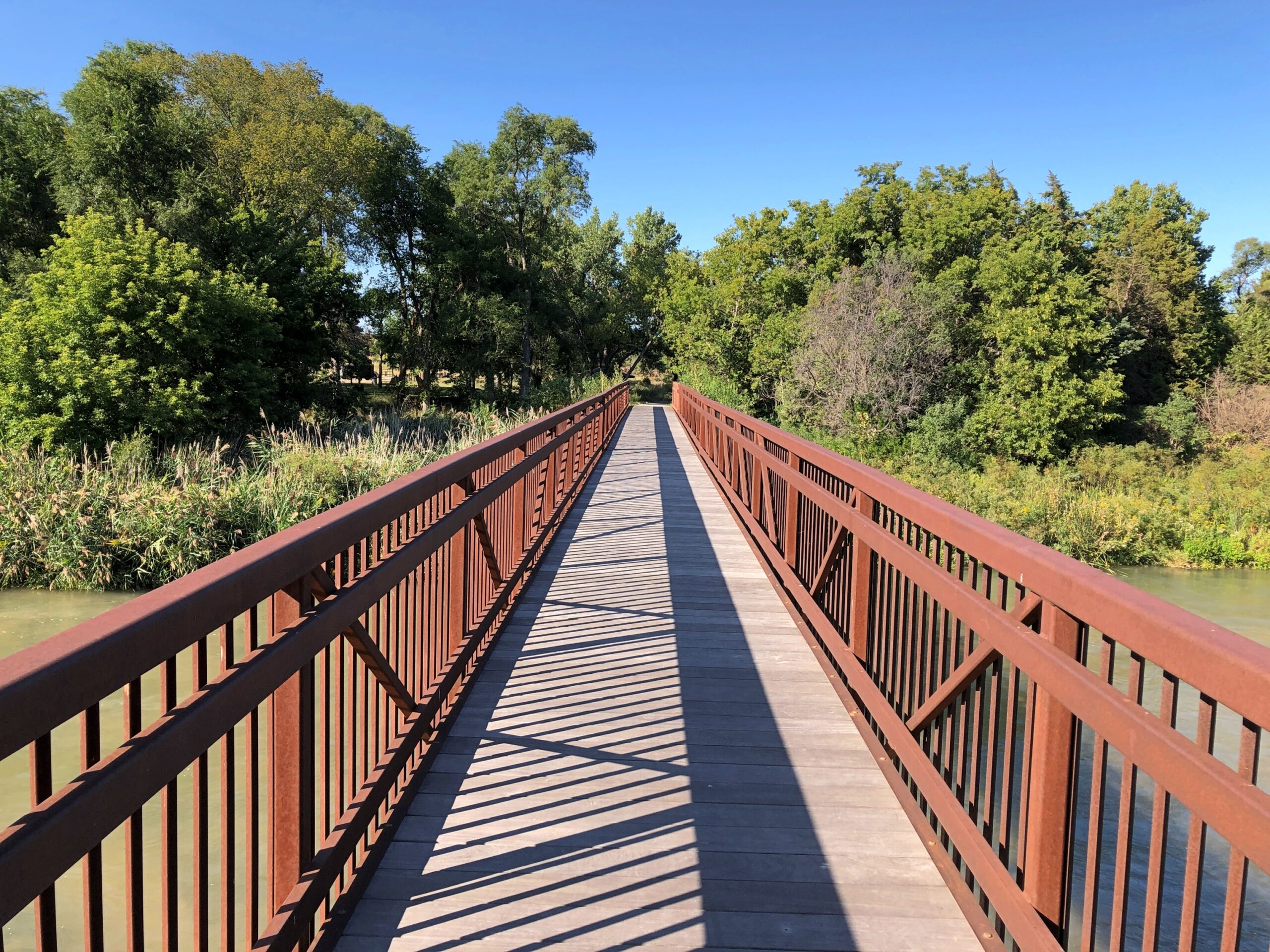
Near the national forest entrance is the Middle Loup River, broad but shallow, and crossable on a foot bridge.

Nebraska National Forest

I camped in the national forest. The campgrounds weren’t completely full, but there were more people than I expected for a remote spot in Nebraska. Then again, it was a Saturday night, and soon enough I figured out what brought most of them: the ATV trails. Not long after dawn on Sunday, the campers across from me – a man and a small knot of teenage boys – roared away in a small caravan of ATVs crusted with dust from the day before.

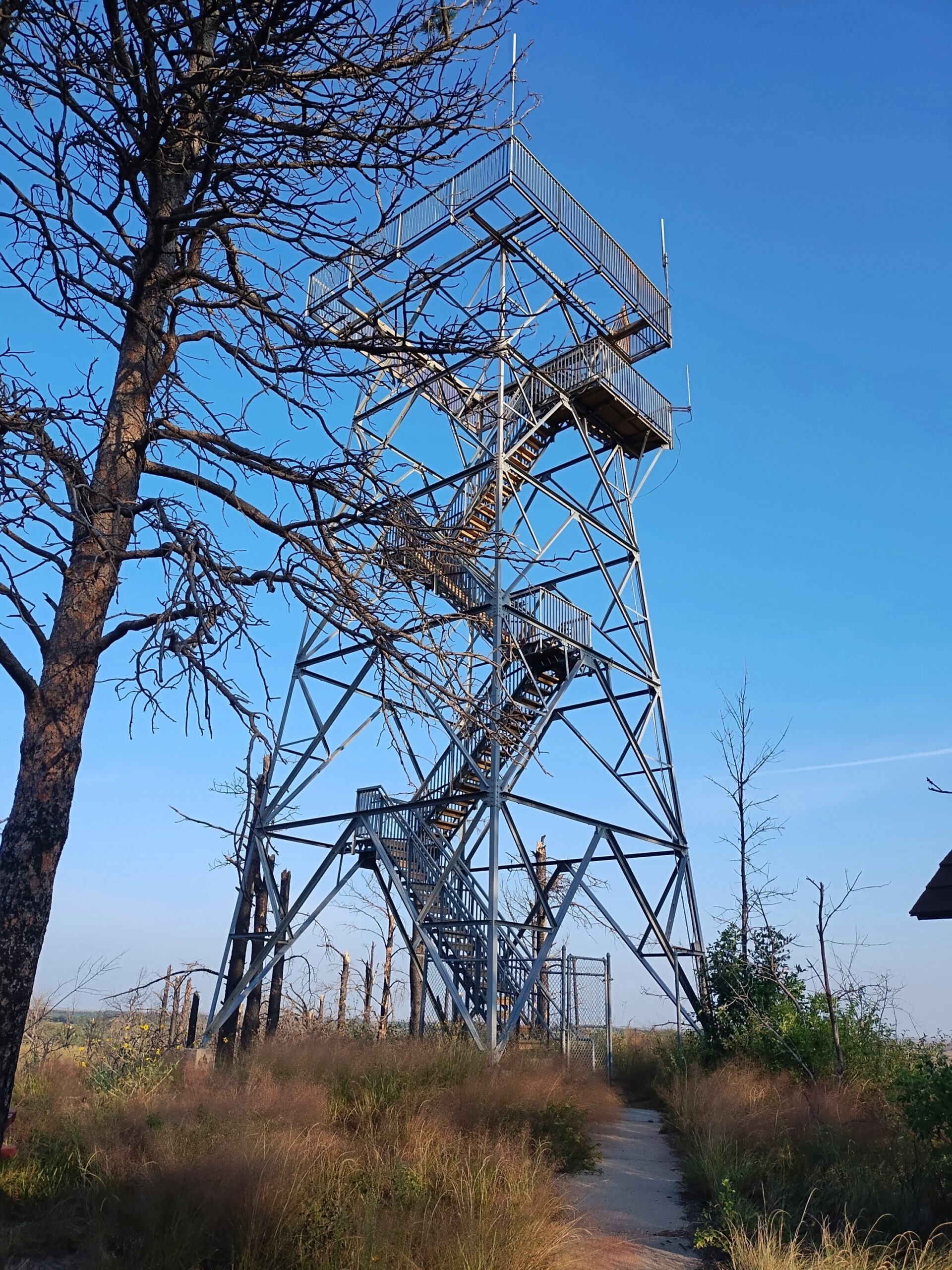
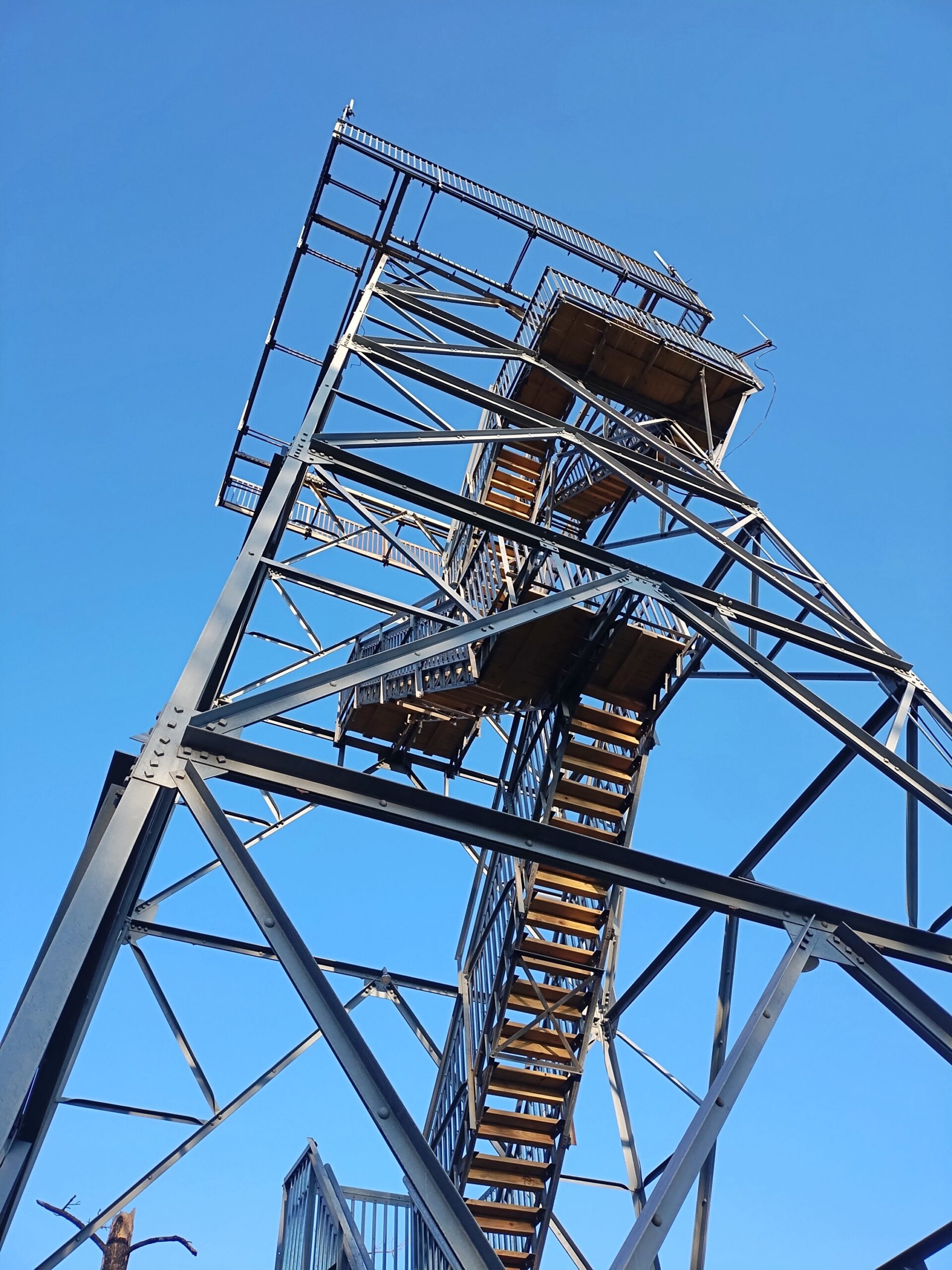
I packed up and sought out a quieter place. A national forest hill with a fire tower and some views. The tower was closed.

Nebraska National Forest

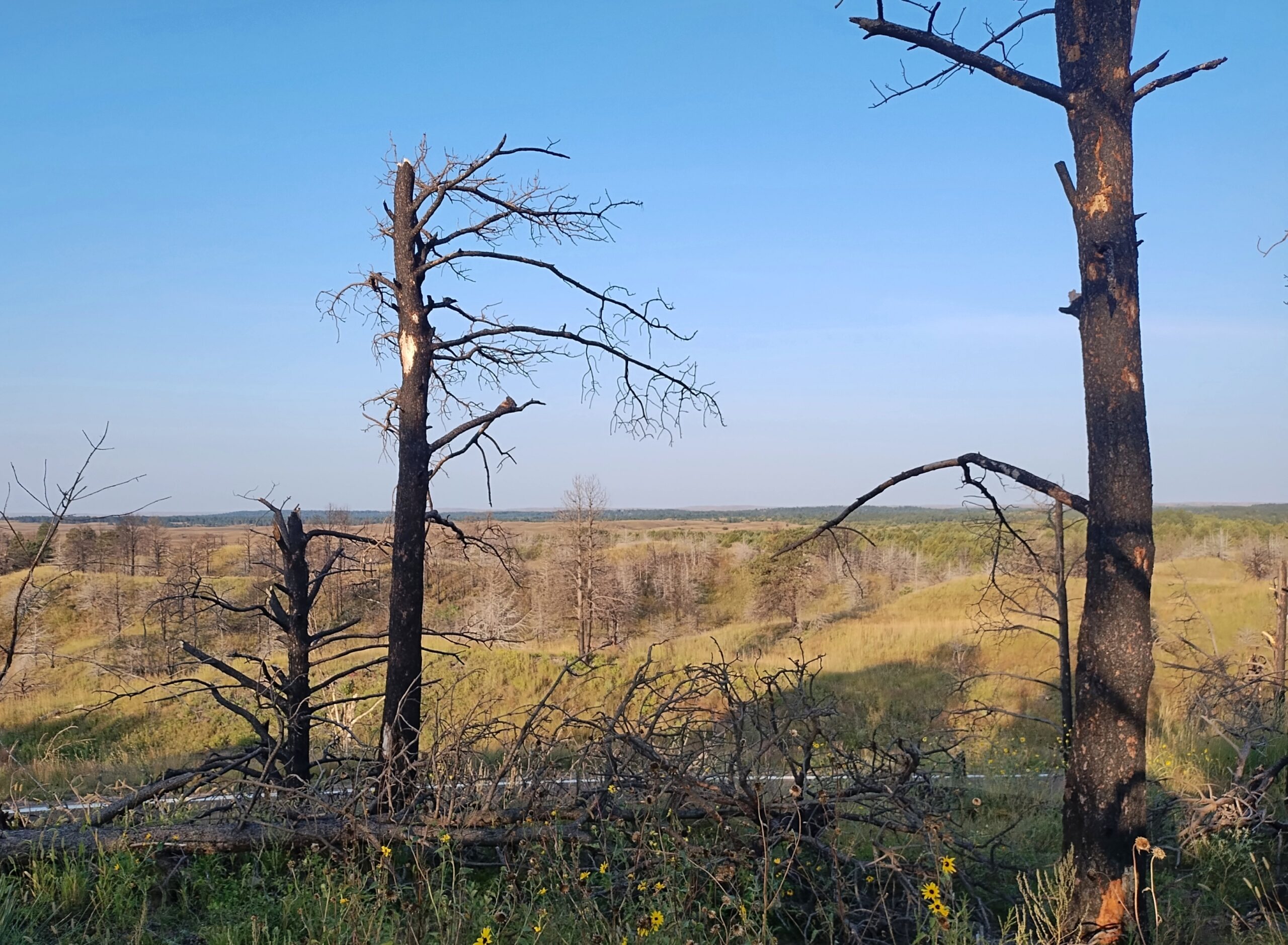
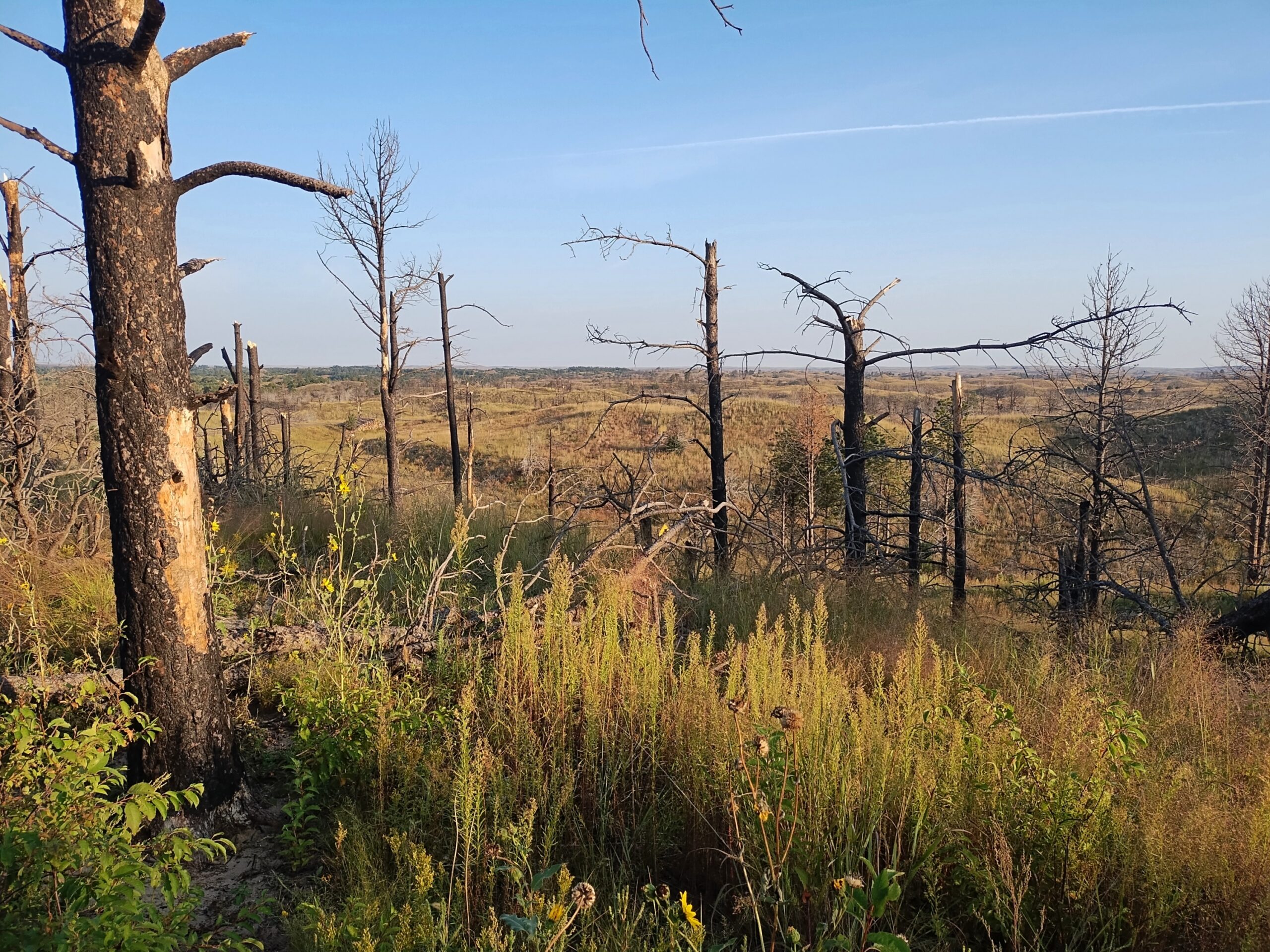
But the views were still pretty good.

Nebraska National Forest

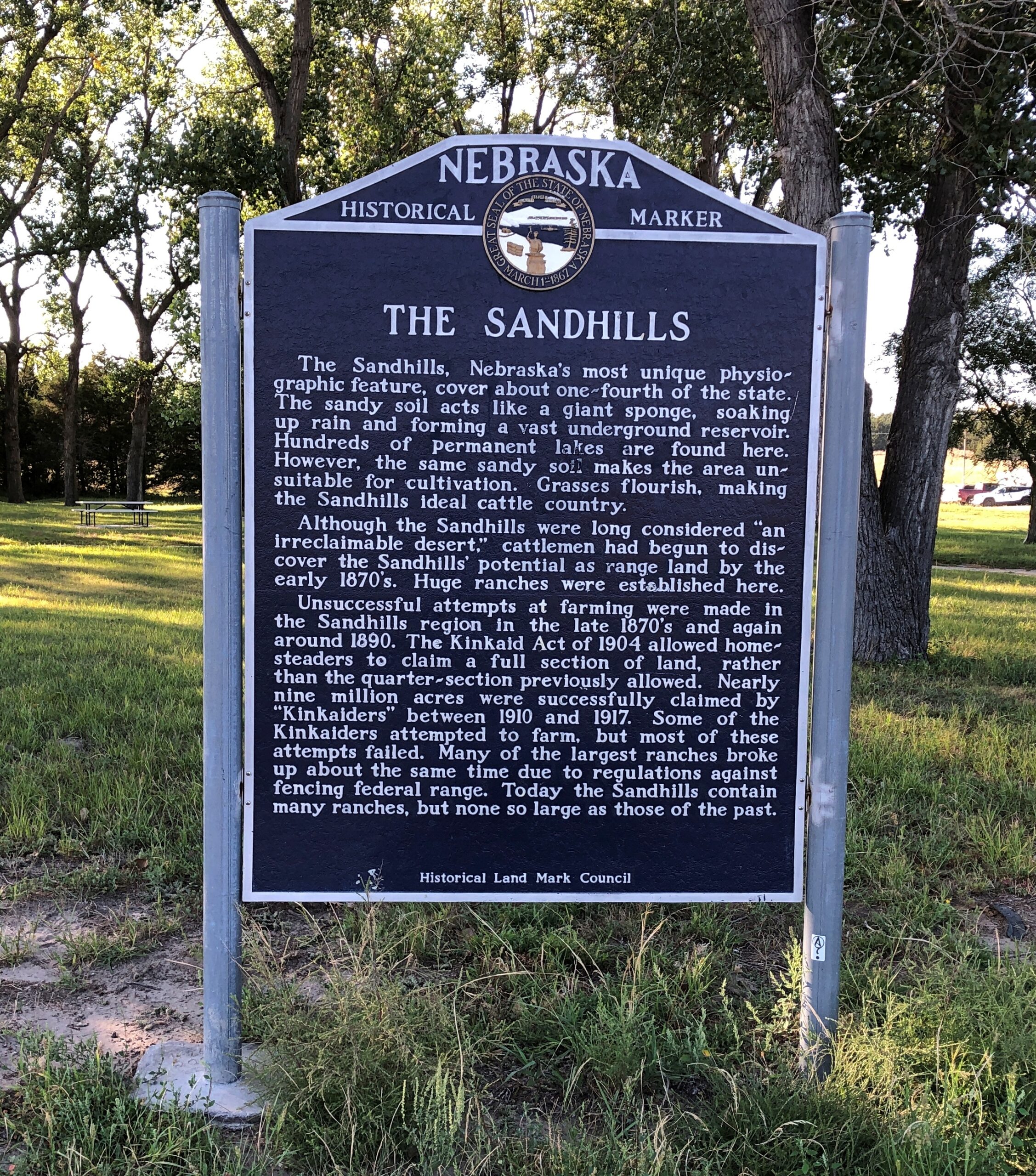
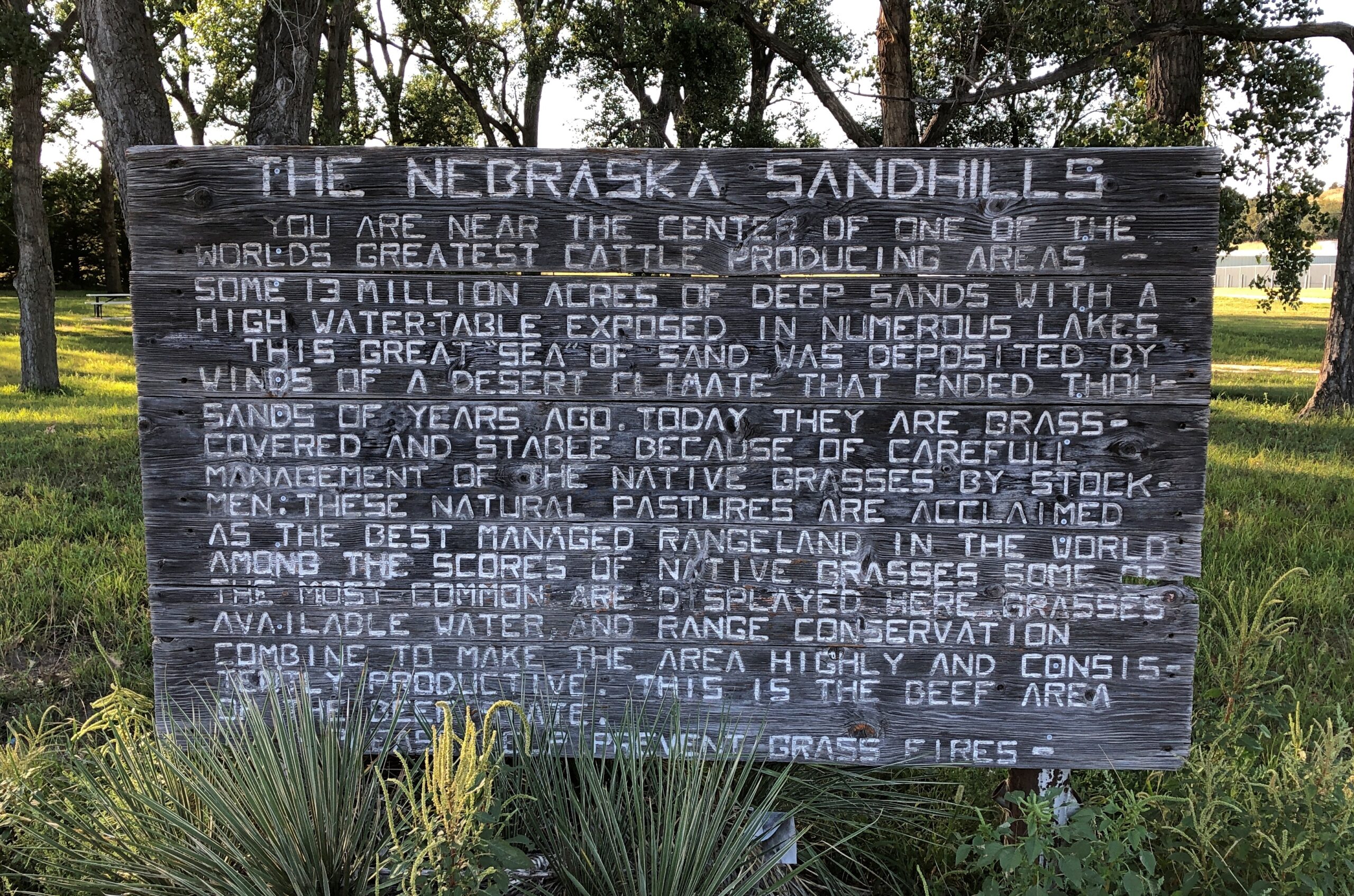
West from the national forest, Nebraska 2 heads into the rolling grassland of the Sandhills proper. In the village of Thedford (pop. 208), varied public interpretations of the Sandhills are available for reading.

Sandhills of Nebraska

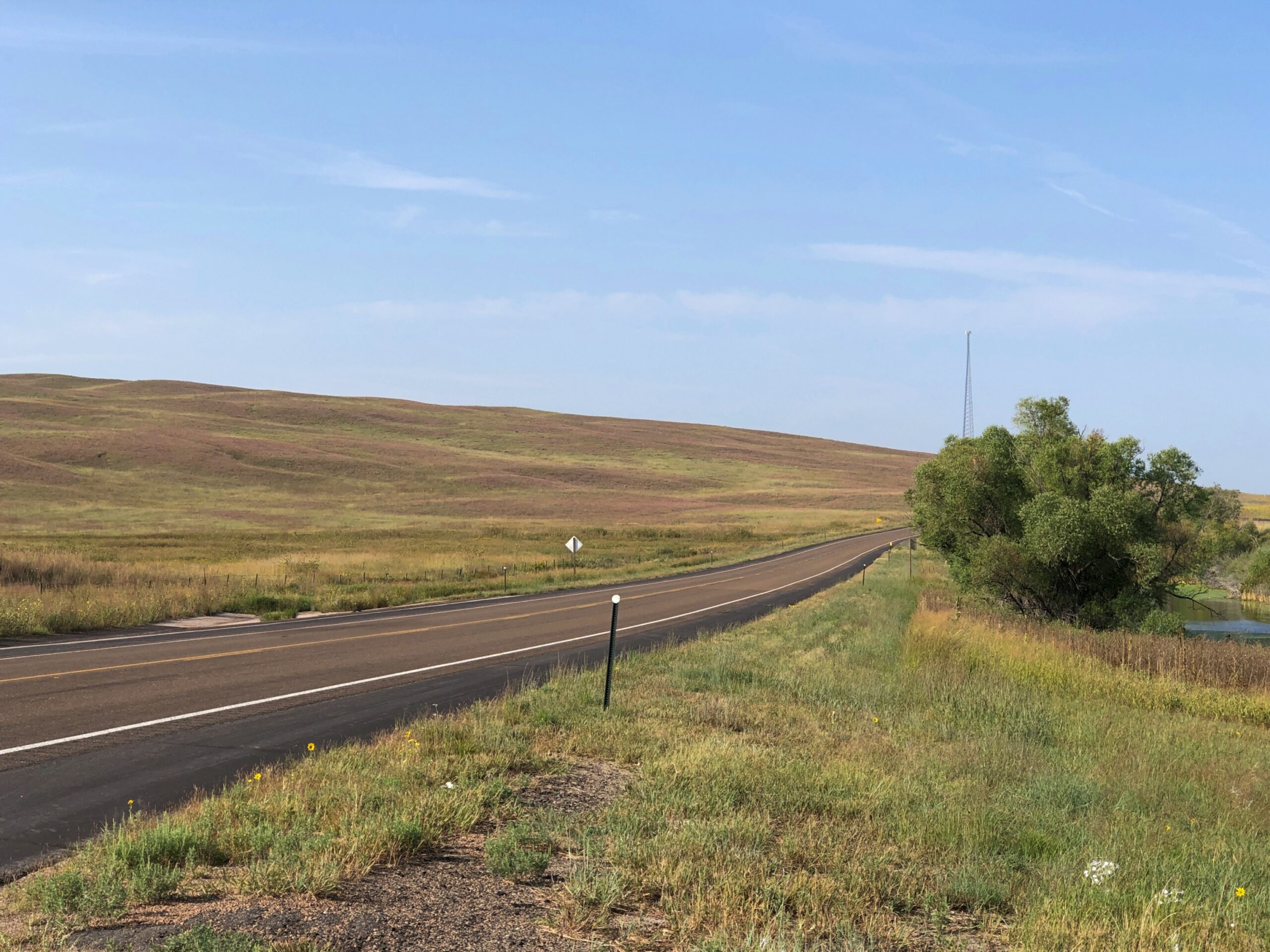
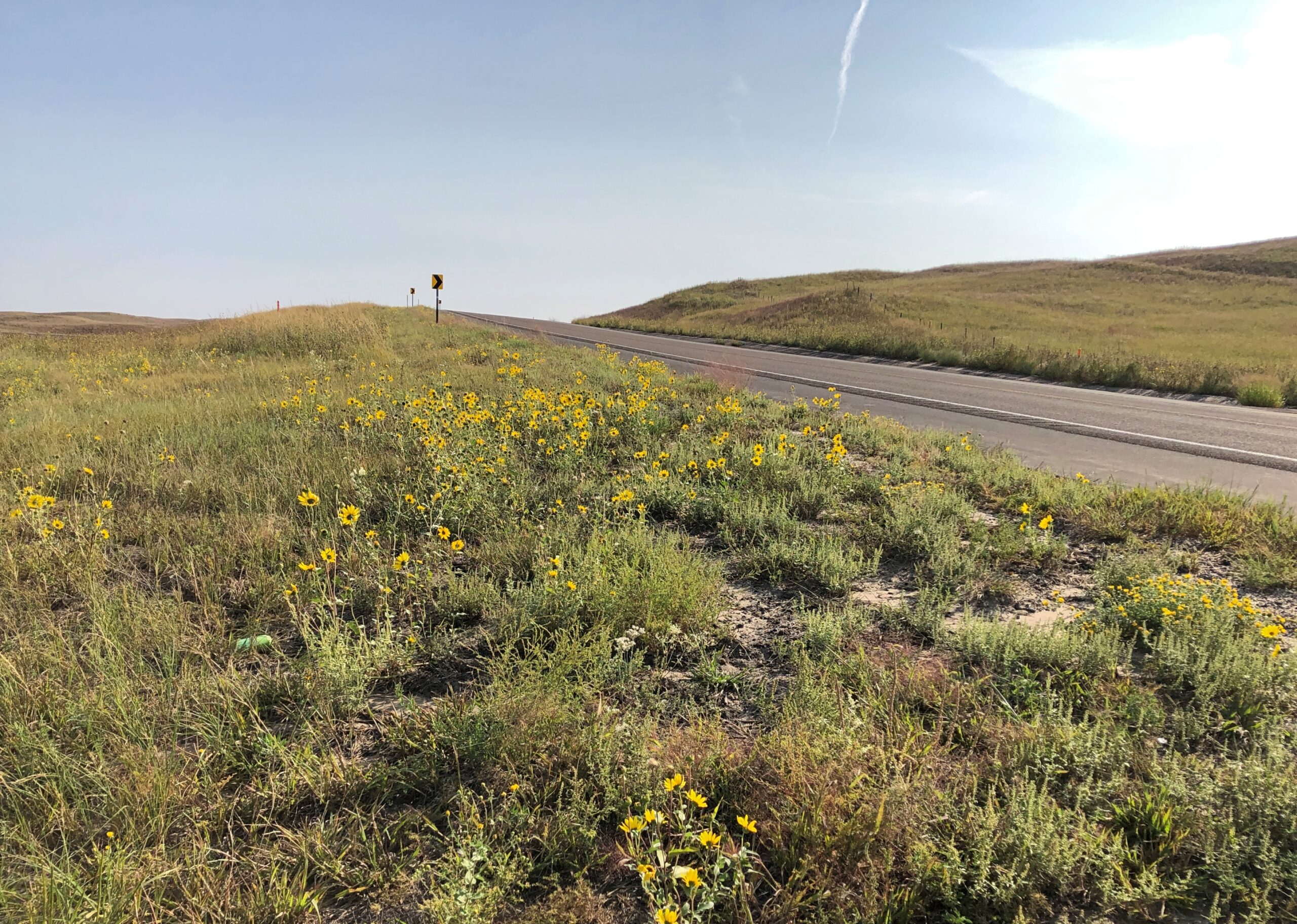
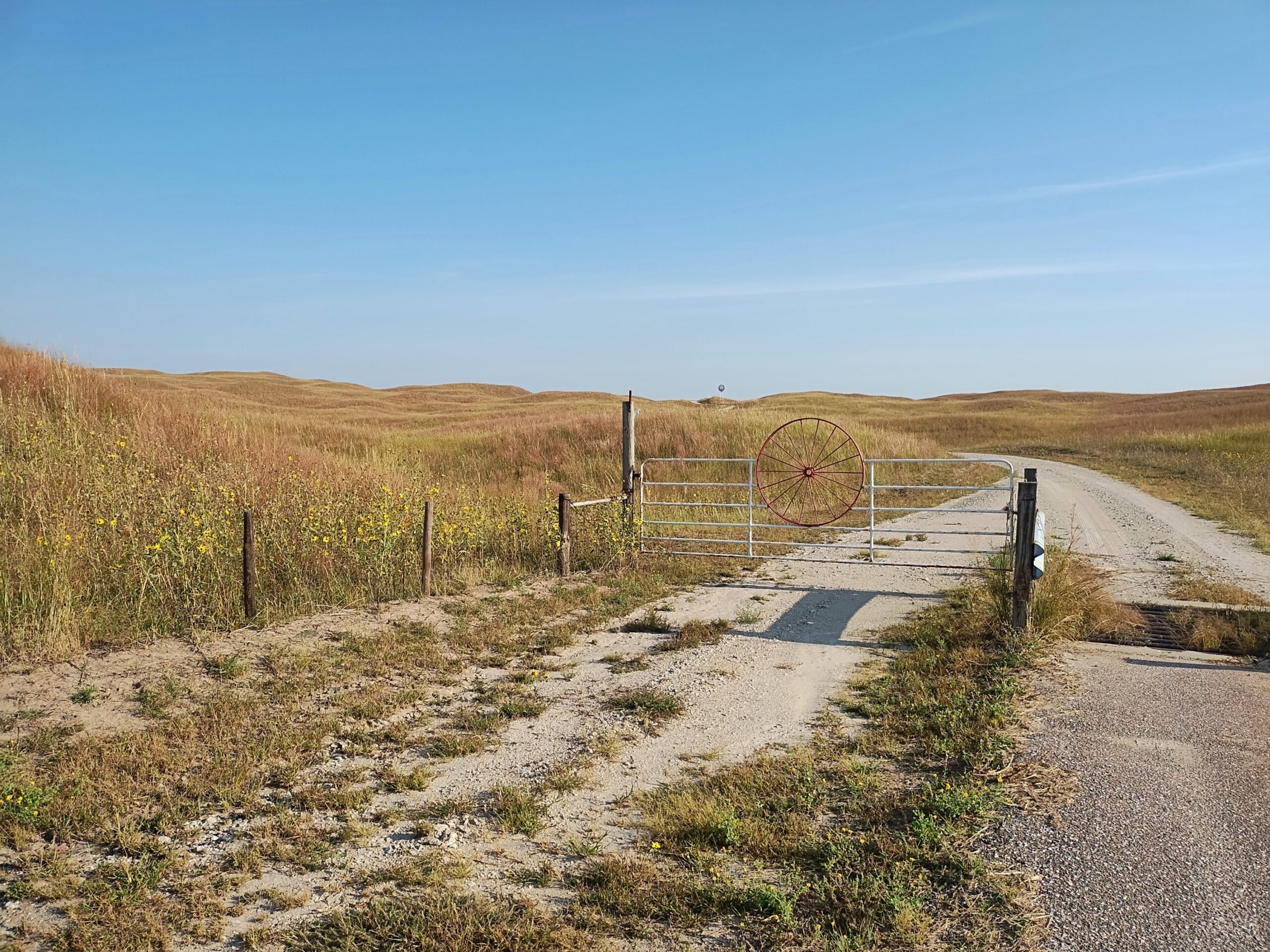
The terrain along the highway Nebraska 2 might seem monotonous to some. Too bad for them. You’re driving across a kind of ocean, terrain all wavy, except that it’s solid ground, marked by occasional trees or manmade structures, and side roads — trails — wandering deeper into the hills.

Sandhills of Nebraska

The handful of towns are really just wide places in the road. Sometimes, not even that.

Sandhills of Nebraska

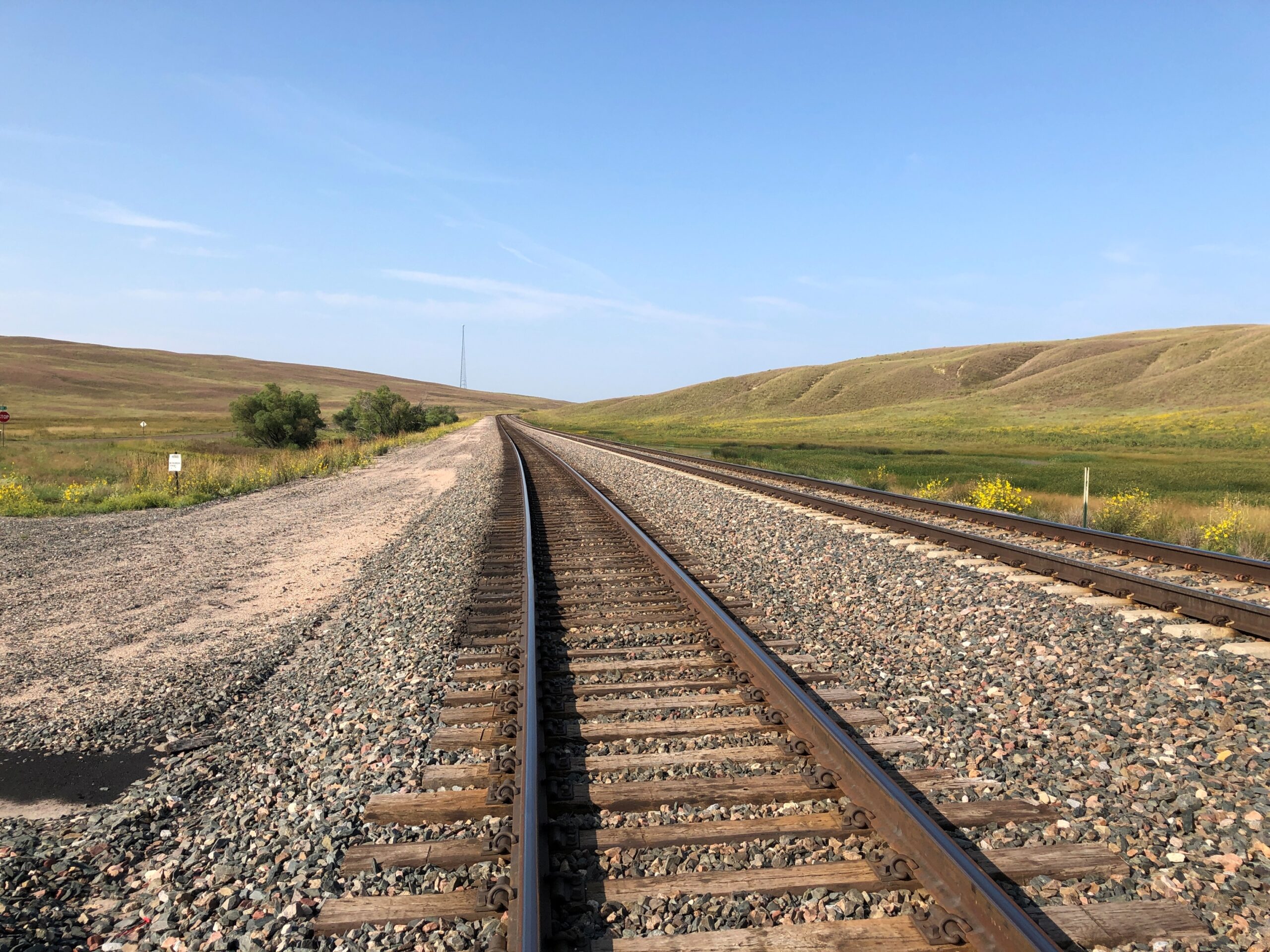
Nebraska 2 parallels the BNSF line, which came first.

Sandhills of Nebraska

Note: I was standing on a public side road to take that picture, as I do with all my RR shots.

Eventually, I took the road to Alliance. But that was merely incidental. Out this far, the road, as Kuralt said, is the destination.

Five-State National Road Dash

Our first winterish weather blew through early this week, but we’re back to cool days. For now. Some leaves seem to be clinging a little longer than usual, but most are accumulating on the ground, as expected for November. A scattering of Christmas decorations are already up, and I don’t mean in stores, where they’ve been for weeks. Let November be November, I say.

Much of my return from the East Coast generally followed the westward course set by the National Road, though I didn’t use much of US 40, which has that nickname. If you want to make decent time, you take I-68 through Maryland and then I-70 across Ohio and into Indiana, which pretty much parallels the National Road.

The Interstate is designed for just that kind of efficient travel. On the whole, it delivers. The four-lane highways also deliver boring drives, to hear some tell it. That’s an erroneous assumption, to hear me tell it. The Interstate has its fine stretches, such as I-68 in October, a gloriously colorful drive. Winding and hilly, too, through Maryland’s peculiar panhandle.

A rest stop near Hancock, Maryland, offers views to the north, so most of what you see is Pennsylvania.

Maryland I-68
Maryland I-68

The rest stop is at Sideling Hill, an enormous rise gouged by an enormous cut for I-68 to go through. An impressive feat of engineering, completed only in the 1980s. Then again, blowing up mountains is a thing that happens in this part of the country.

The narrowest part of the Maryland isn’t far away. At its narrowest, there is less than two miles are between the Potomac and the Mason-Dixon Line. So if you picked up Maryland by the panhandle, it would surely break at that narrowest point.

I filled my gas tank off the highway in the last town in Maryland, Friendsville (pop. 438), at a station whose enclosed retail space (between a few pumps) seemed little bigger than a walk-in closet, and yet there was a clerk manning the place on Saturday just before dark. Rotund and massively bearded, he was playing a video game when I opened the door to pre-pay. He might have been a little surprised to encounter a customer, at least one who didn’t pay at the pump.

From there, I continued into West Virginia, then took I-79 north into Pennsylvania, then headed west on I-70, which crosses West Virginia’s odd panhandle – more like a periscope – before reaching Ohio. After overnighting in Cambridge, Ohio, I bypassed Columbus but stopped in Springfield, near Dayton but with a distinct geographic identity. Alcor to Dayton’s Mizar, you might say.
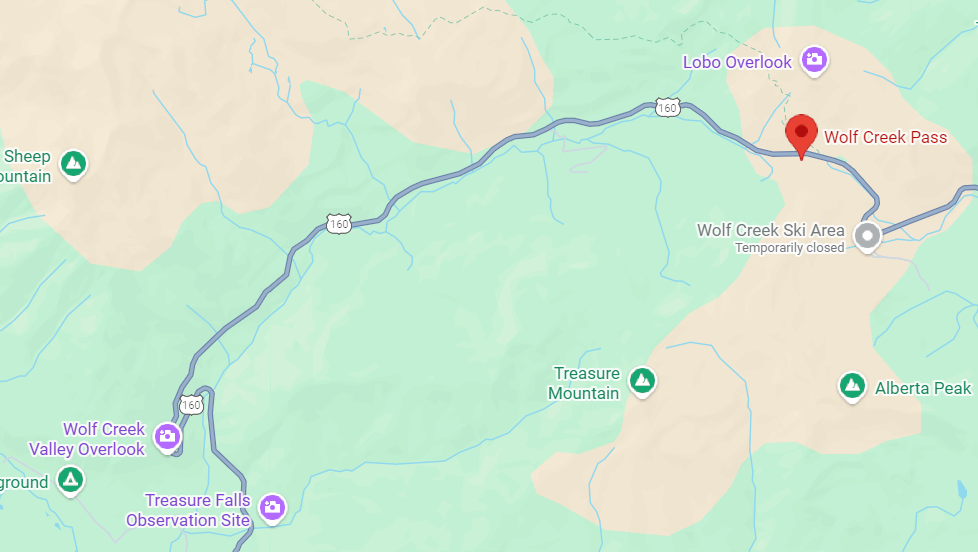
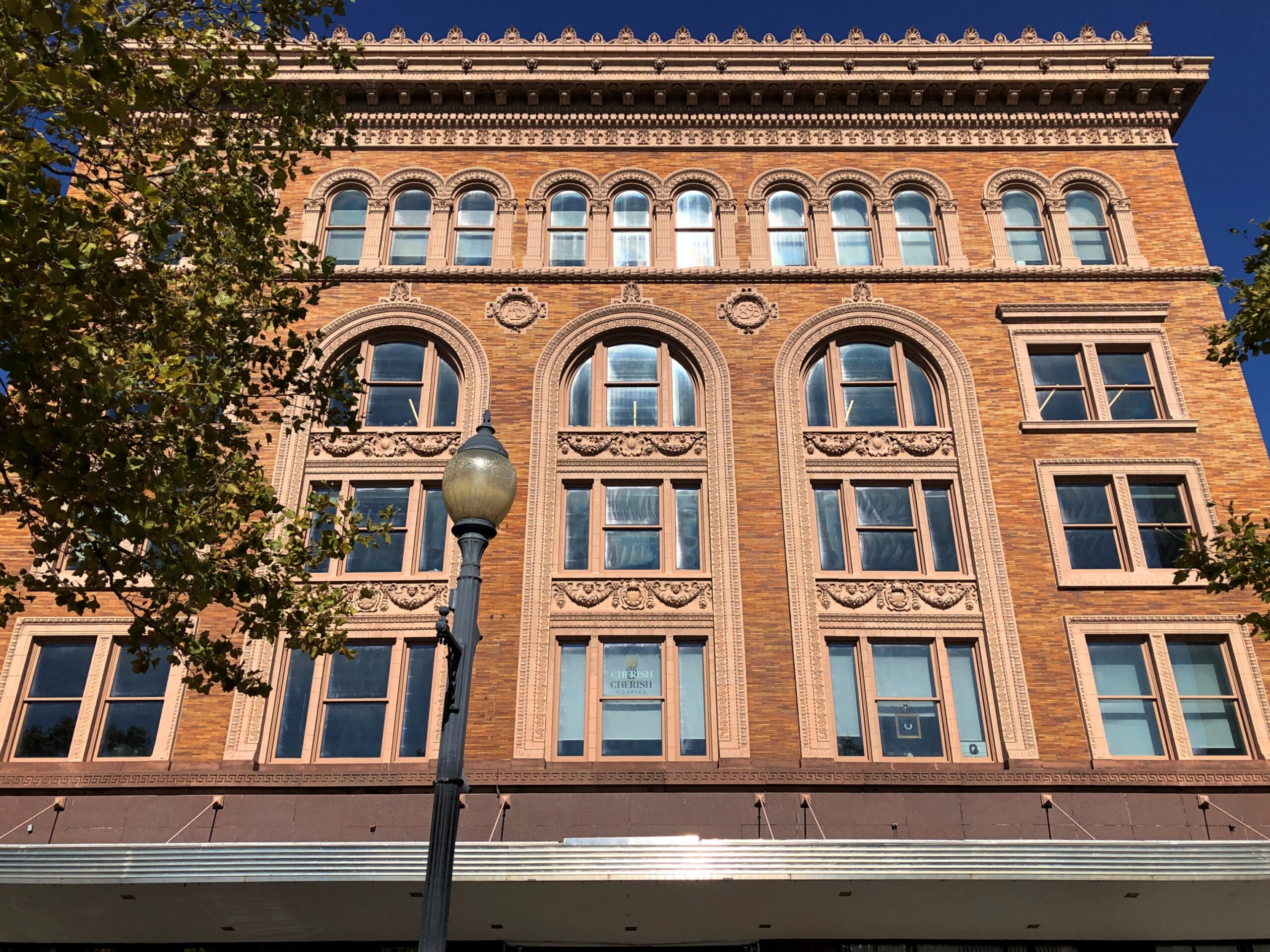
Downtown Springfield was practically devoid of pedestrians that Sunday, and not that many cars drove through either. A few buildings rise high enough to suggest a more prosperous past, but look too closely and some of them seem to be as empty as the streets, or at least underutilized.

Springfield, Ohio
Springfield, Ohio
Springfield, Ohio

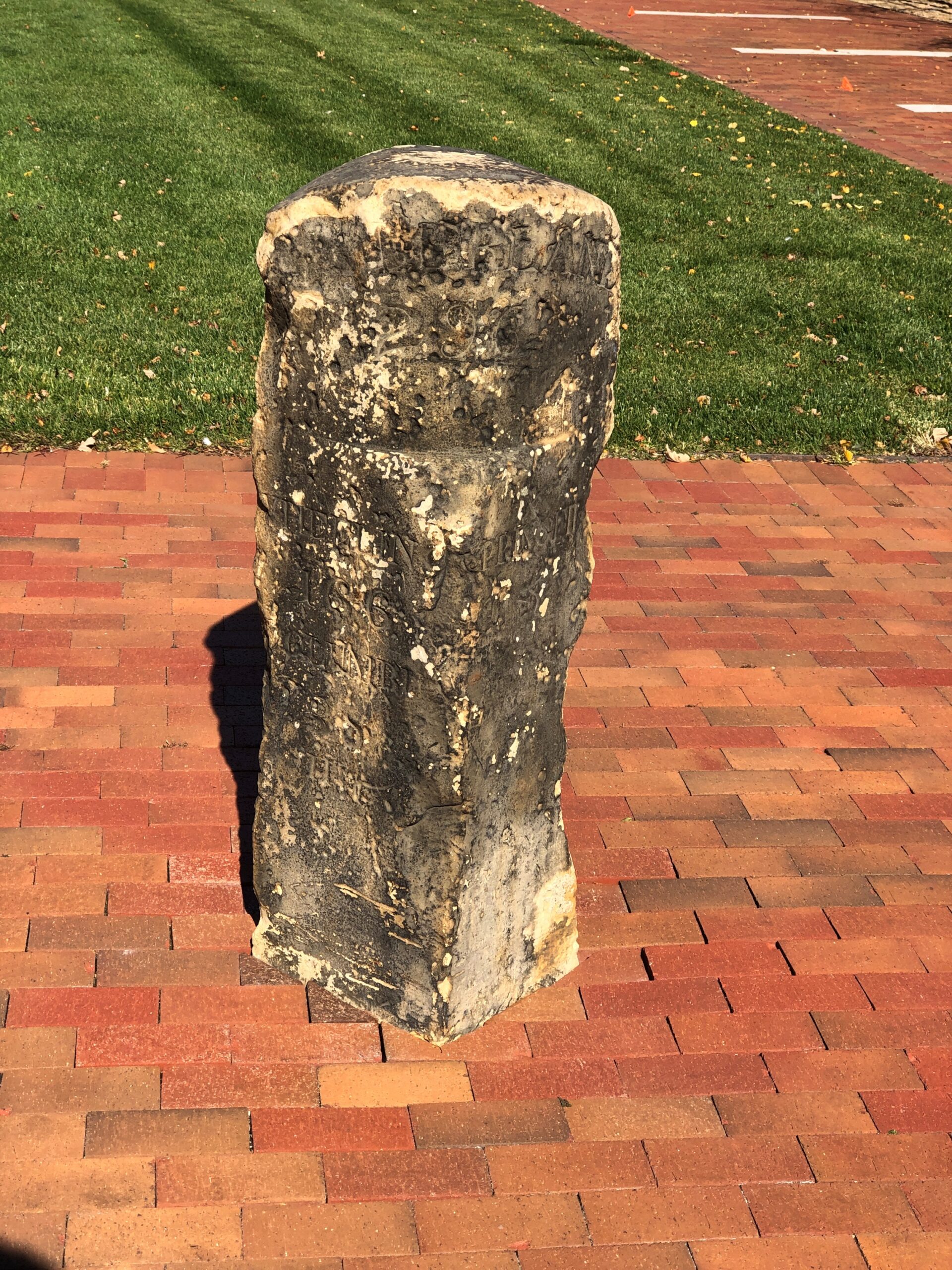
The National Road went, and still goes through Springfield, in the form of US 40. A milestone in Springfield marks the point at which the federal government quit paying for further westward expansion of the road. Anything else would be on the states, namely Ohio, Indiana and Illinois.

National Road Milestone, Springfield Ohio

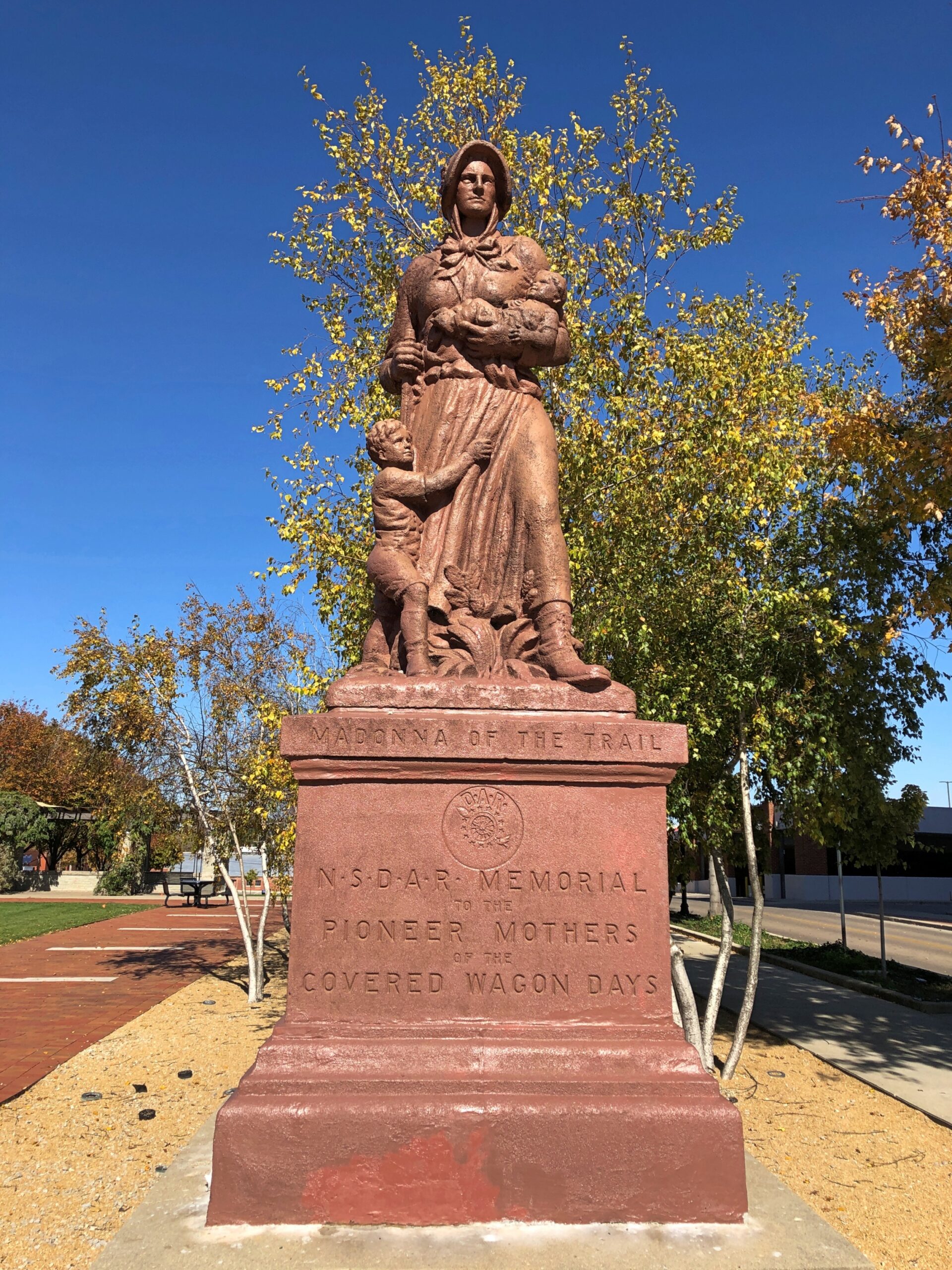
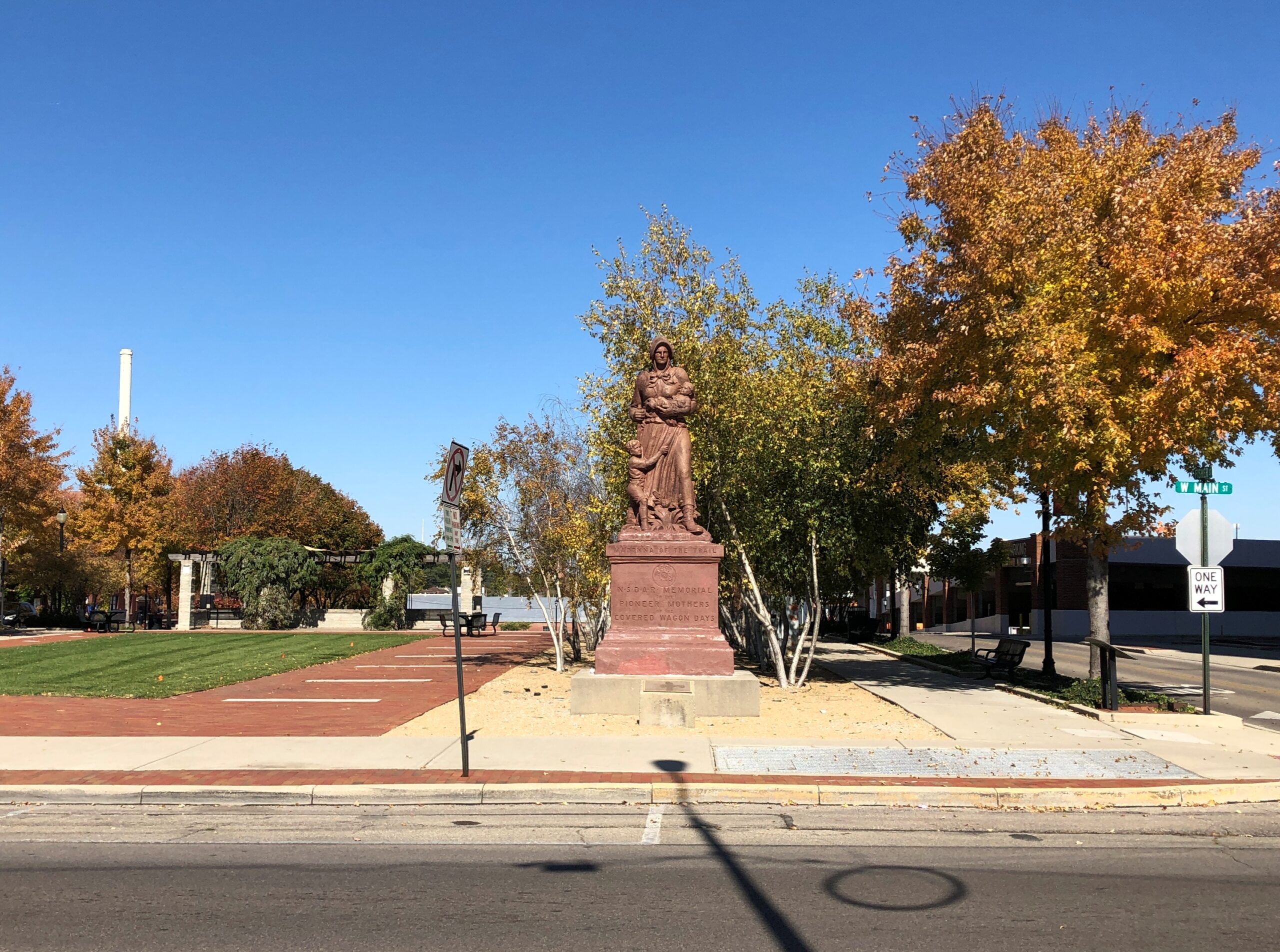
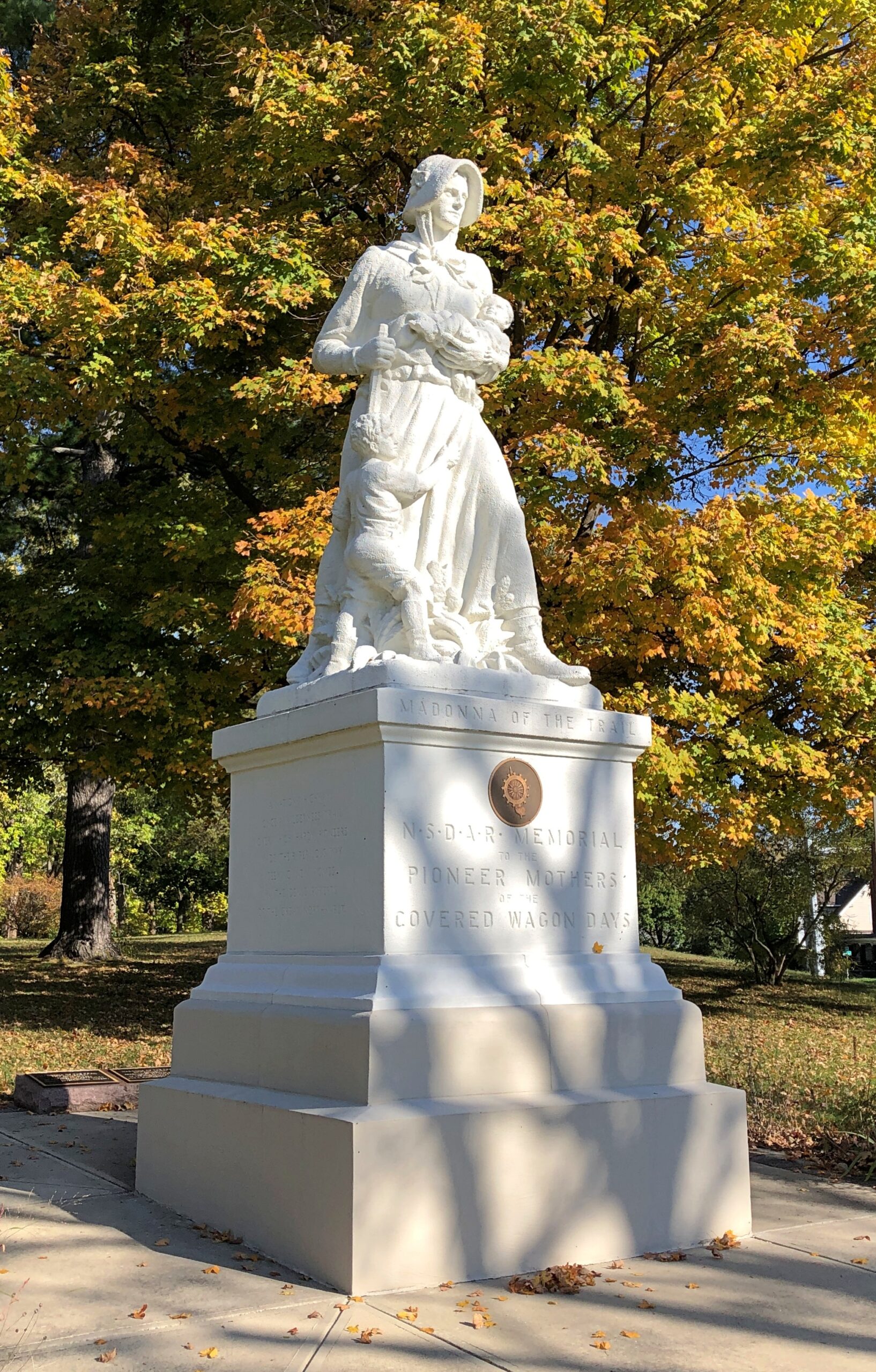
Later, after the National Road had become History, the Daughters of the American Revolution erected a series of statues along the route, and others to the west: “Madonna of the Trail.”

National Road Madonna of the Trail, Springfield Ohio

There are 12, with the easternmost of them along the National Road. Erected in the late 1920s, the Springfield one was renovated about 20 years ago.

Nearby, passersby are urged to Dream Big.

Springfield Ohio

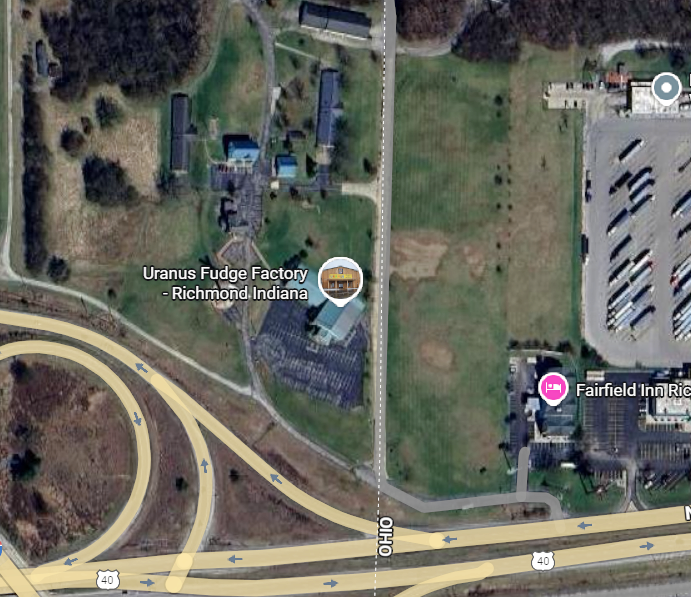
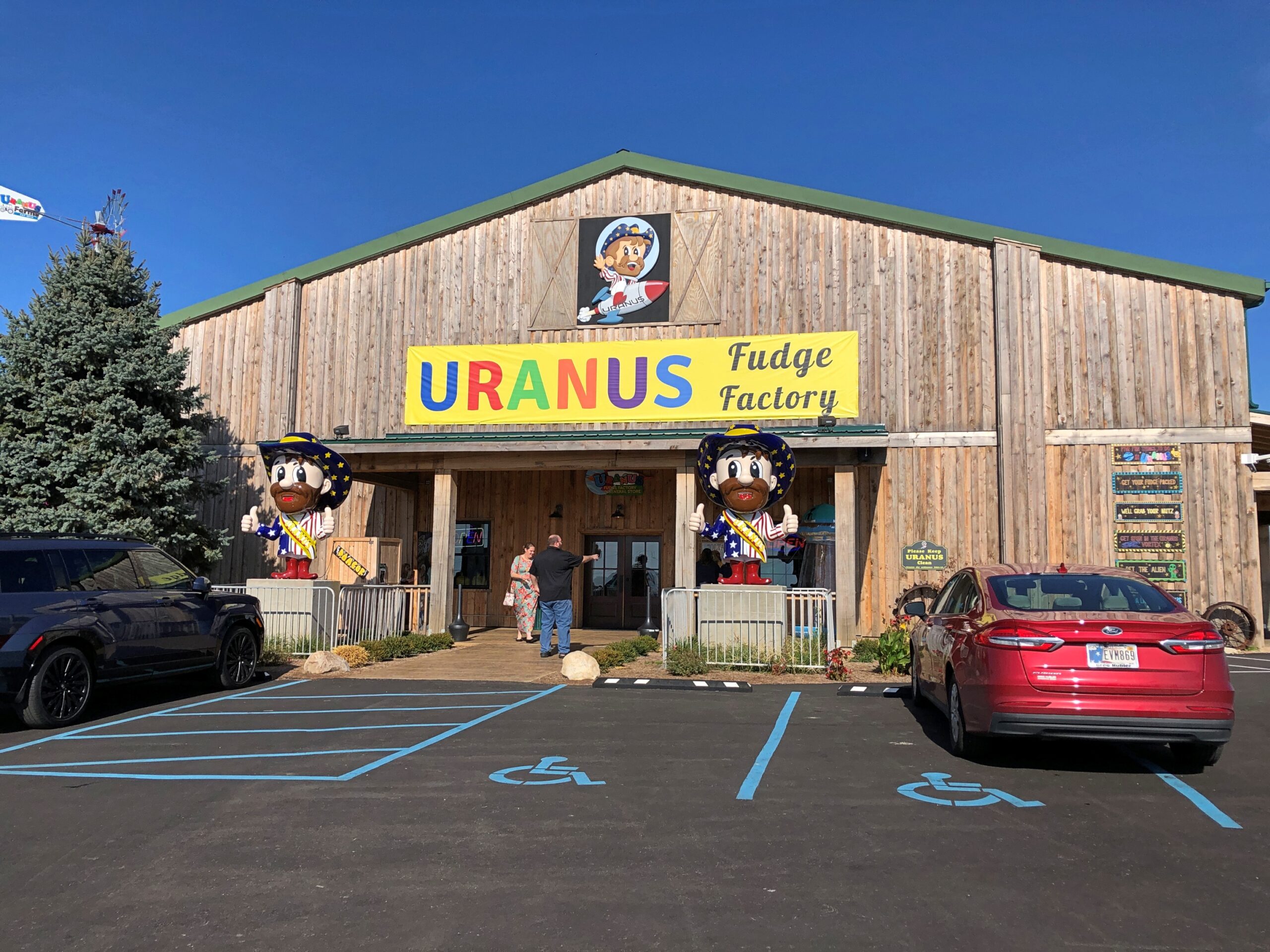
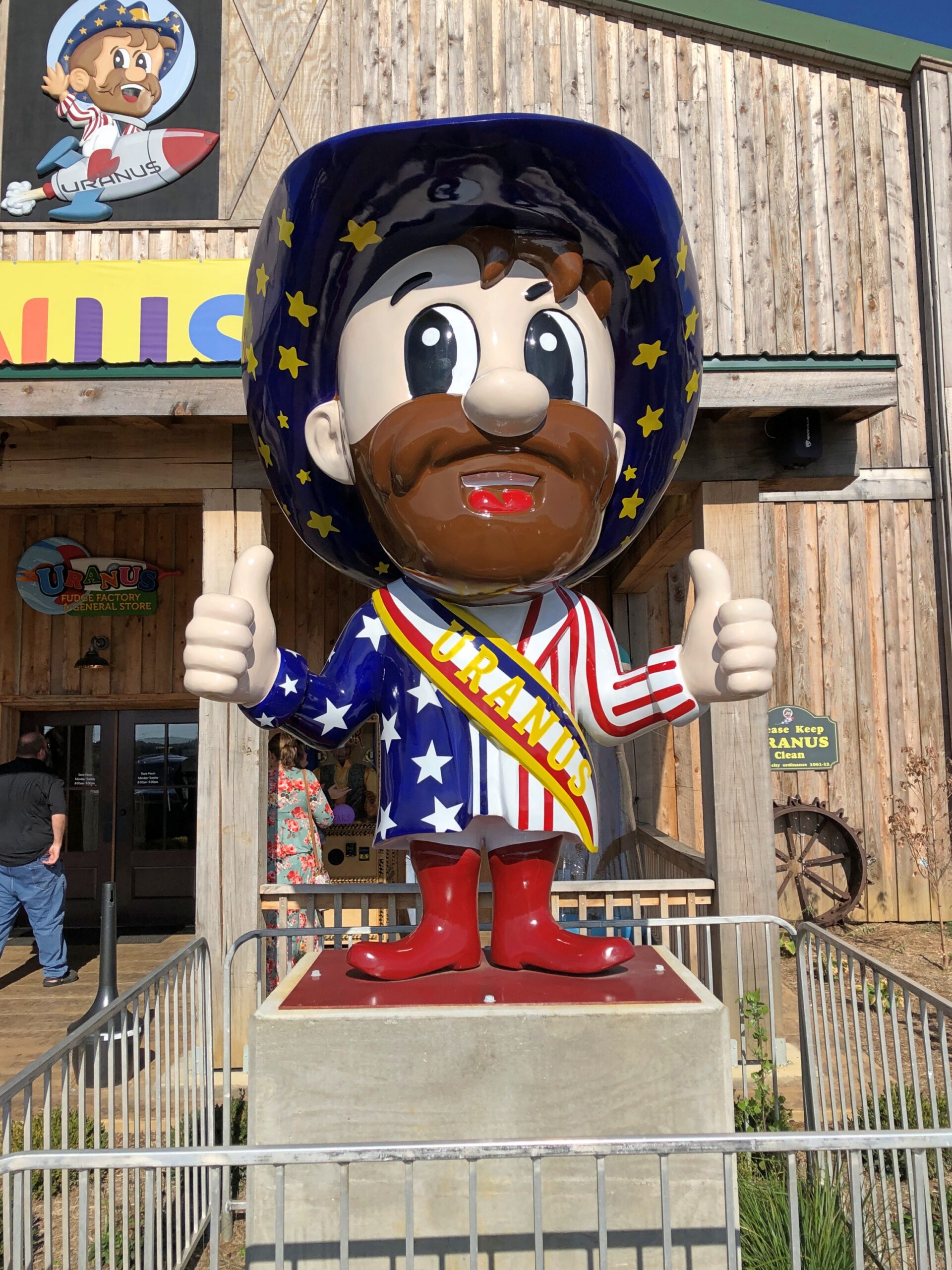
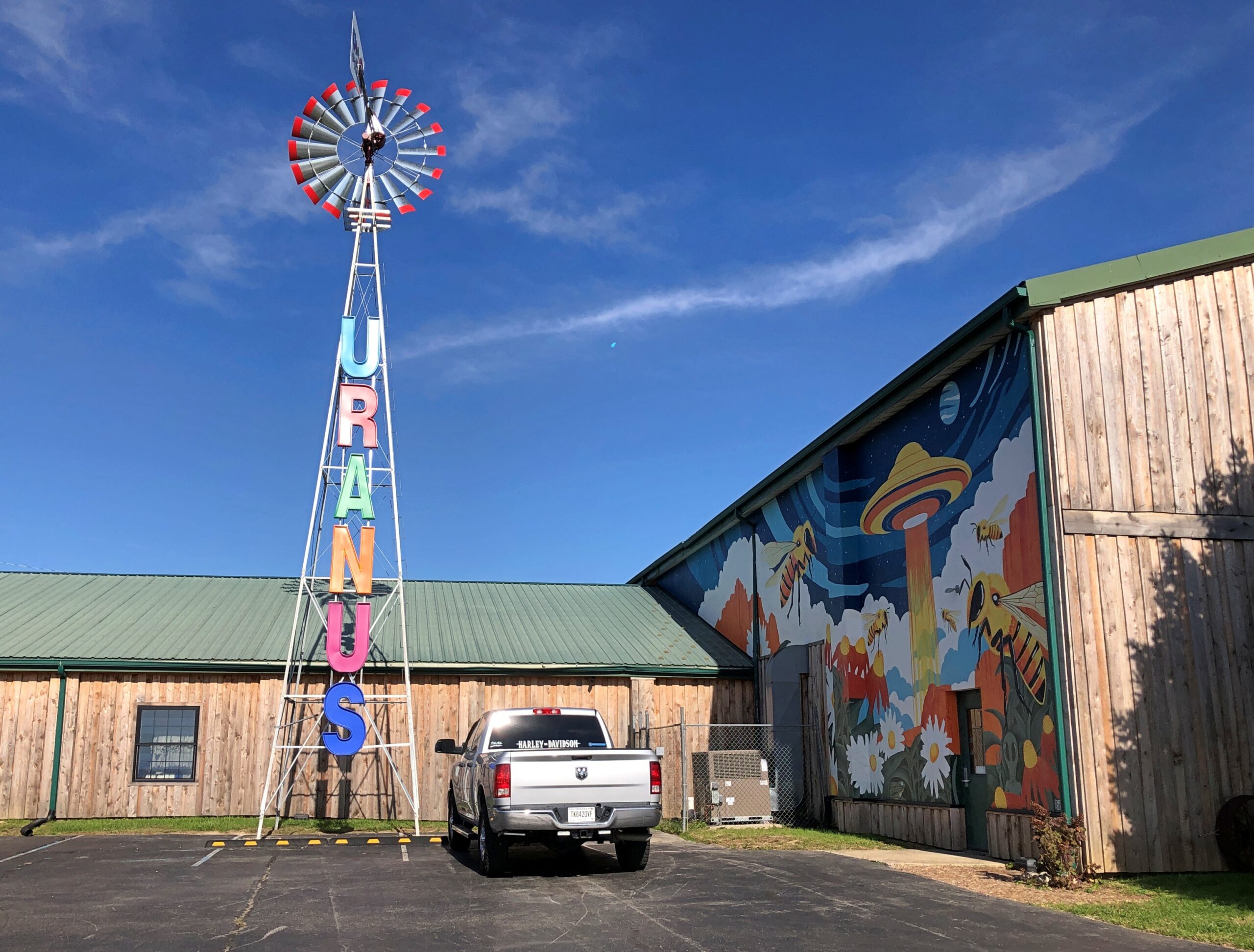
About an hour west of Springfield, at the border of Ohio and Indiana on I-70 – just barely inside Indiana – is the Uranus Fudge Factory. I had to stop for that.

Uranus Fudge
Uranus Fudge
Uranus Fudge

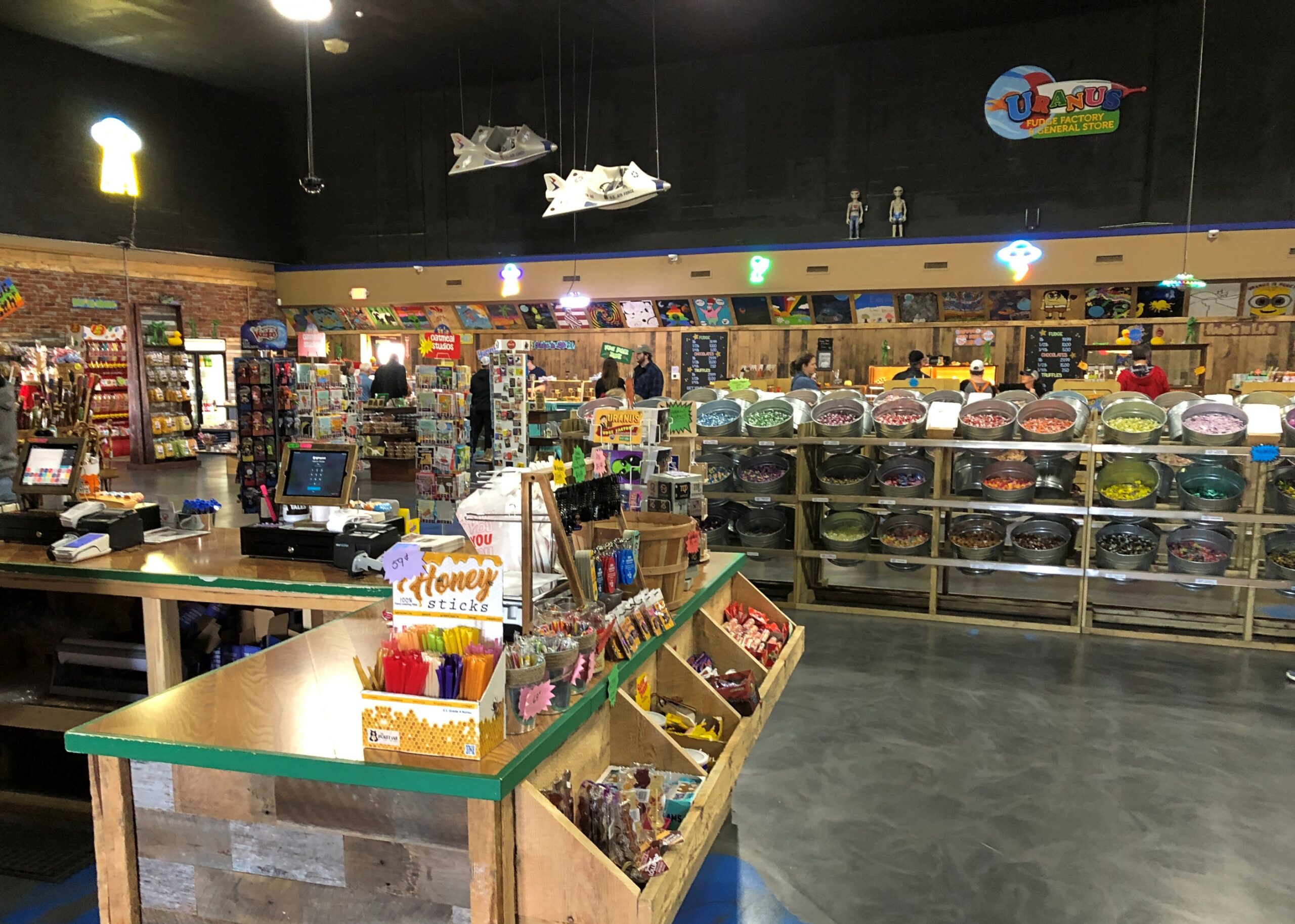
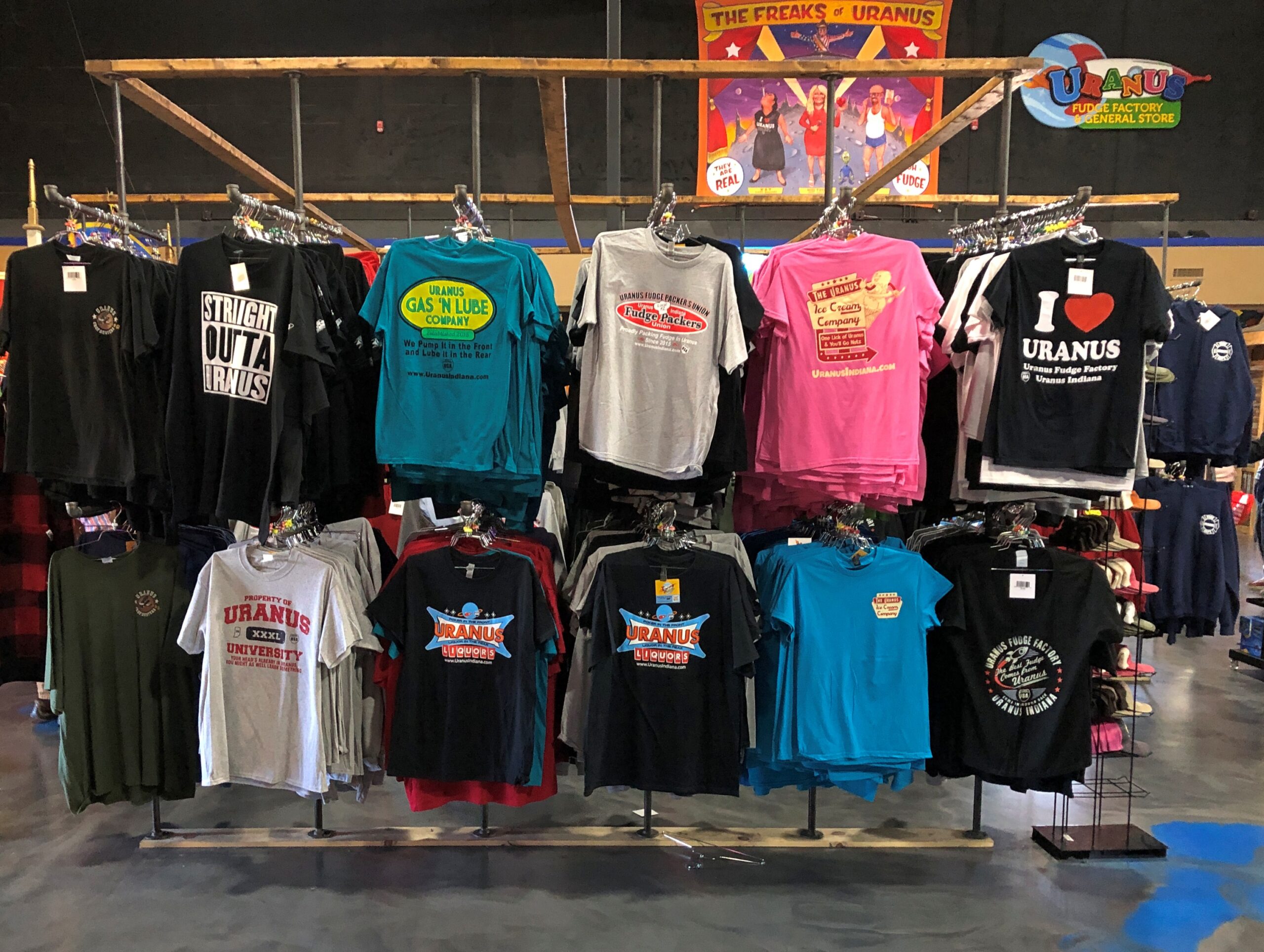
Sure, there’s fudge in there somewhere, but also a lot of gags involving the word Uranus (Your-anus). Examples can be found in the newspaper — an honest-to-God paper newspaper — that the store produces, The Uranus Examiner, and gives away. I have a copy. My kind of souvenir.

Sample front-page headlines from the Summer 2025 edition:

Breaking News: You Can Explore Uranus In Three Locations

Eating Their Way Through Uranus

Get A Lick Of Uranus

Sink Your Balls In Our Putt Holes

The second of those stories was about the 2nd Annual Eating Uranus Fudge Galactic Championship held at the Anderson, Indiana location in March. Apparently it was a Major League Eating-sanctioned event, and apparently MLE is a real thing. One Patrick Bertoletti won the 2nd championship at Uranus, putting away a bit more than nine pounds of fudge in about as many minutes.

Fudge is one thing, but mostly Uranus sells stuff. A lot of stuff.

Uranus
Uranus Fudge

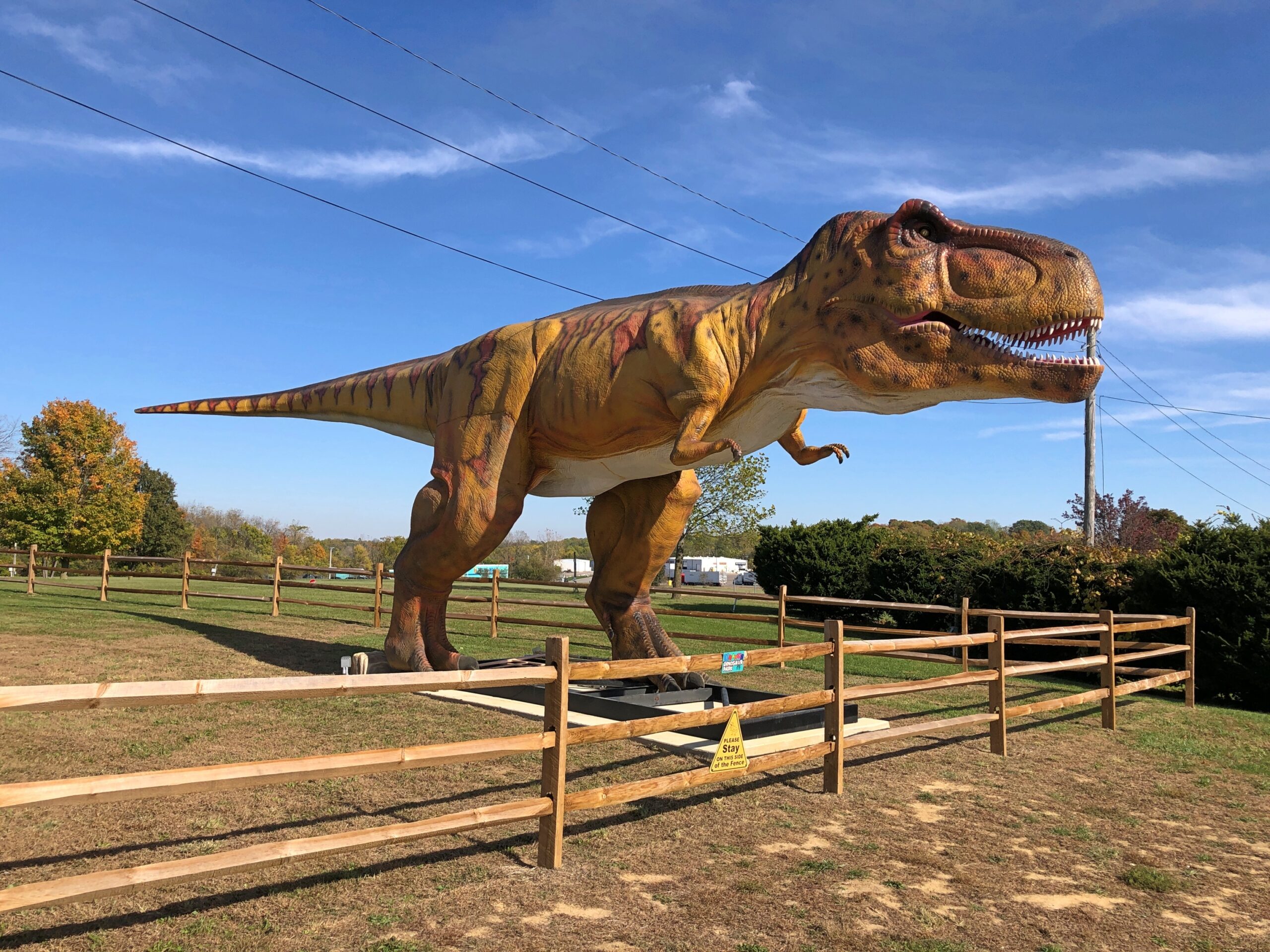
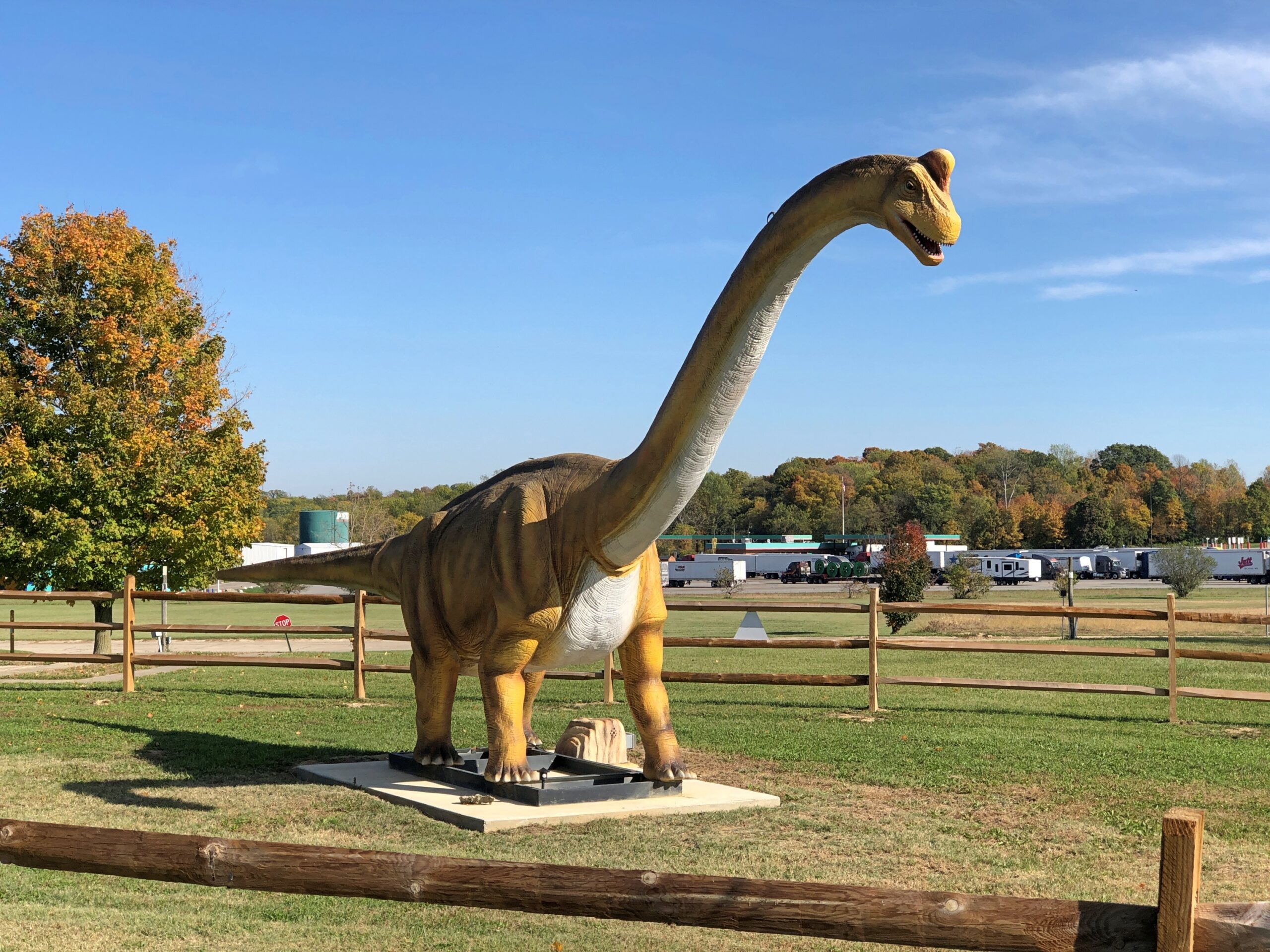
The Richmond, Indiana location is the third of three for Uranus, and I think the only one with dinosaurs —

Uranus Fudge
Uranus Fudge

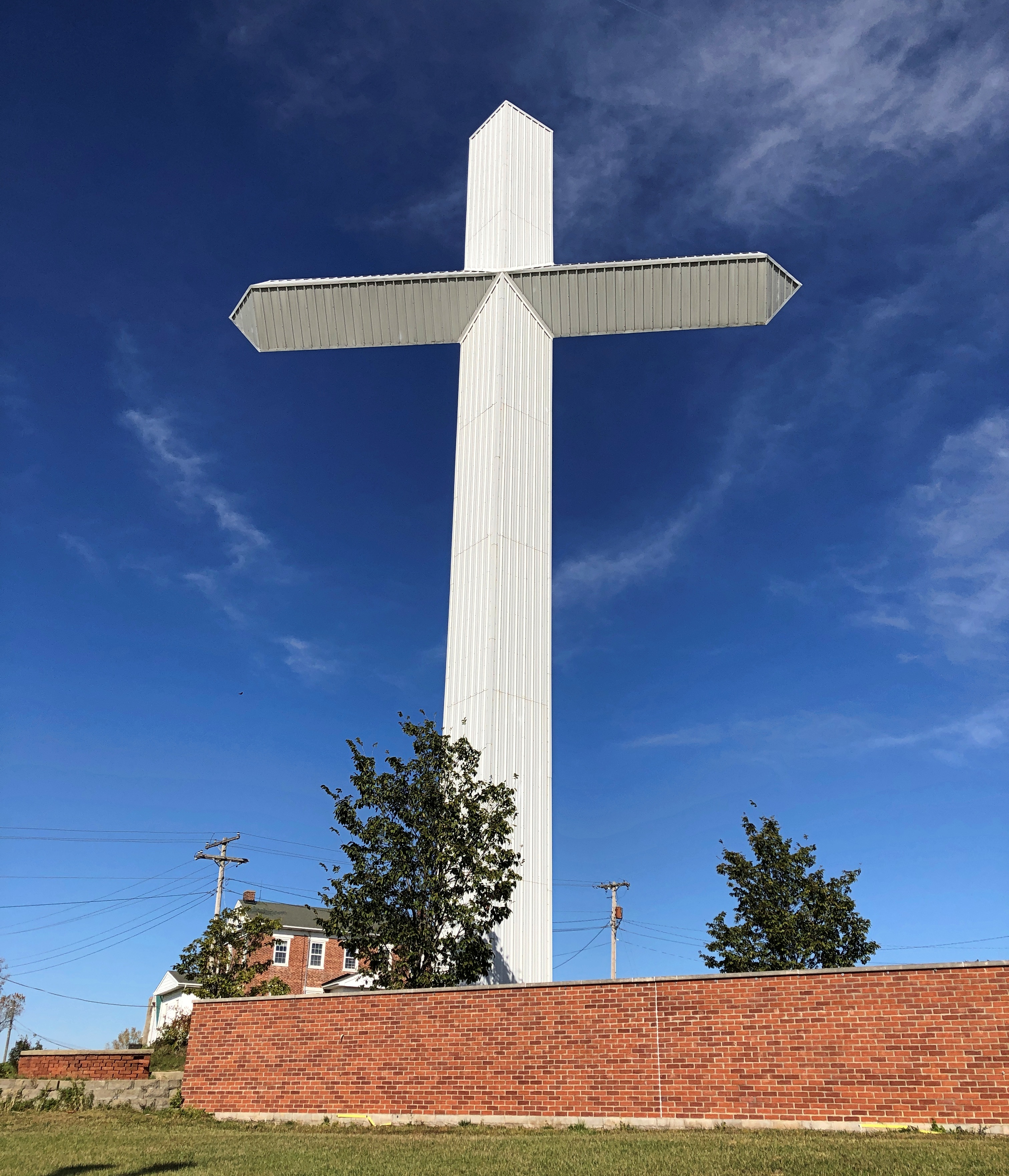
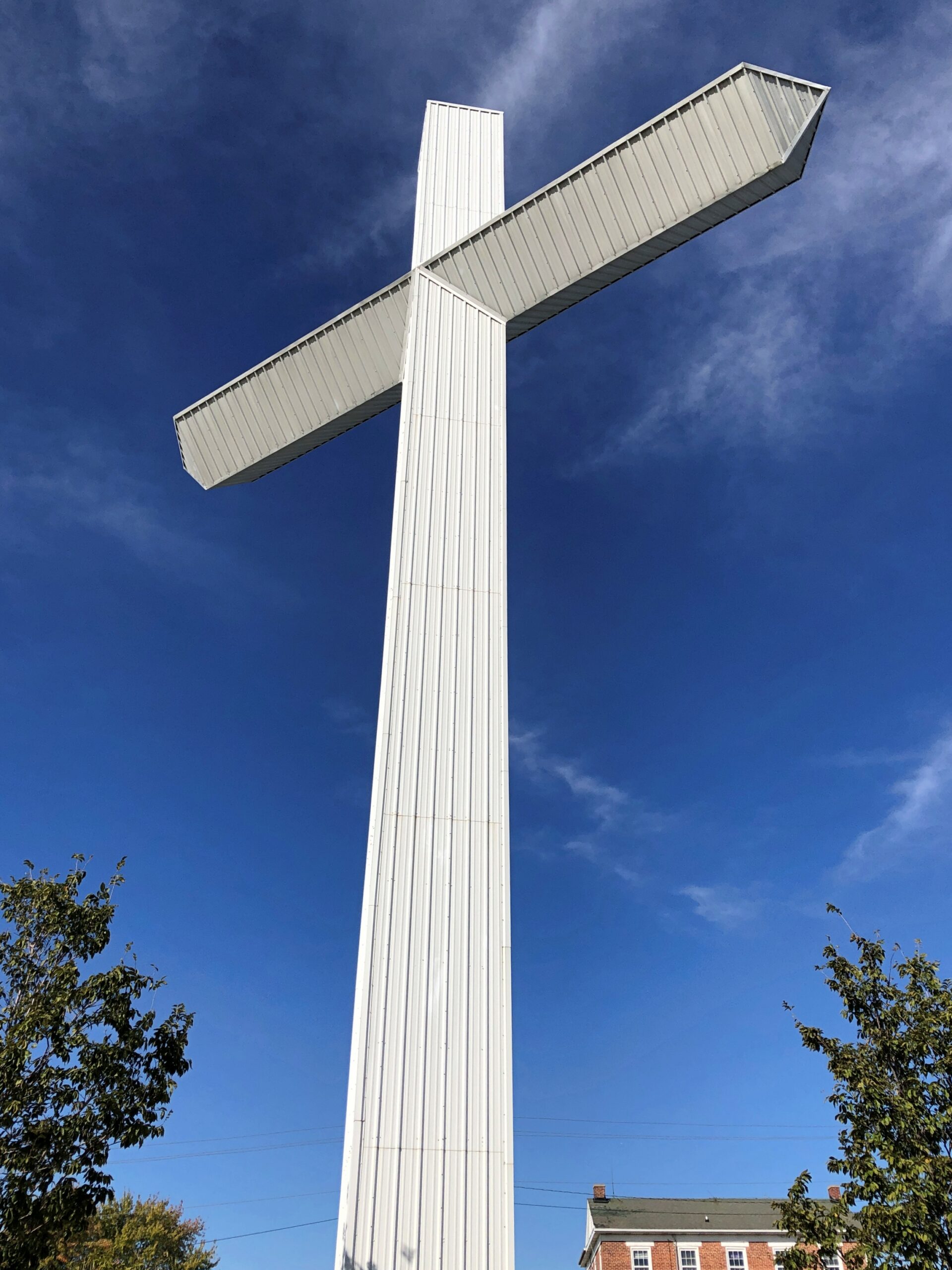
— and a 100-foot cross of corrugated steel over a metal frame.

Uranus Fudge
Uranus Fudge

Until about 10 years ago, the property belonged to New Creations Chapel, which also included a church building, boarding school for troubled teens and a Bible college. The ministry, for reasons its web site explains in some detail, sold the property to Uranus, including the cross.

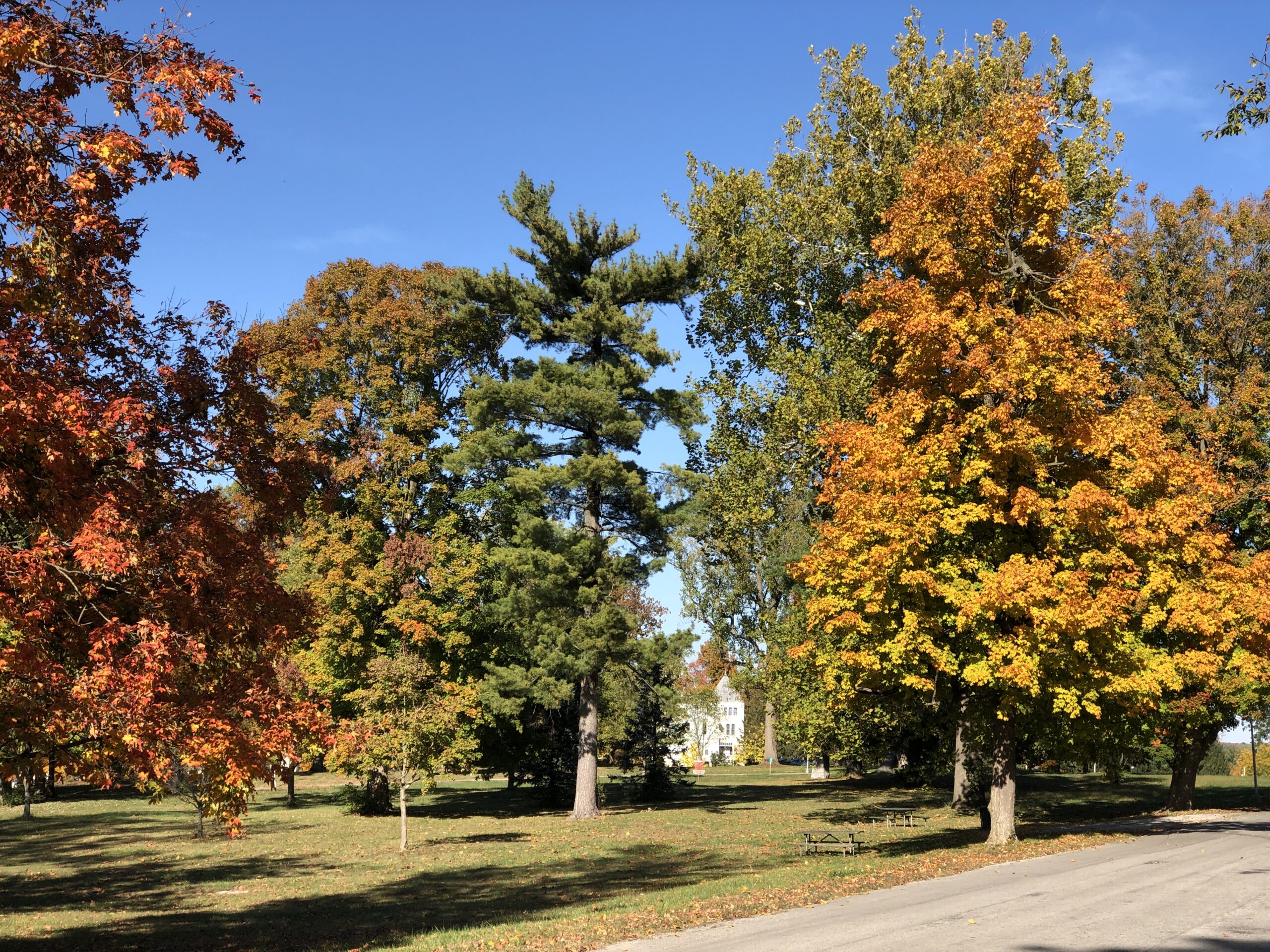
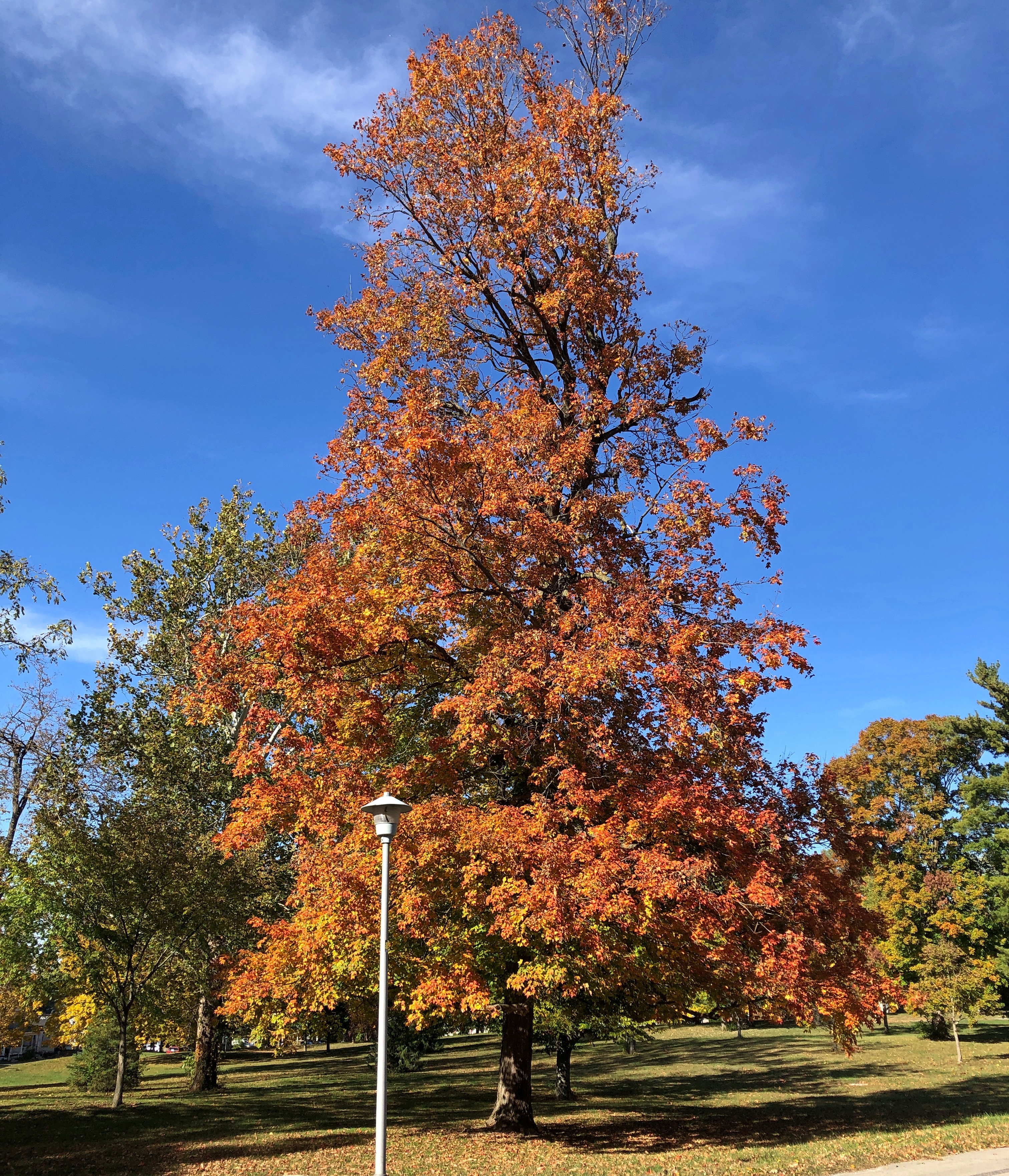
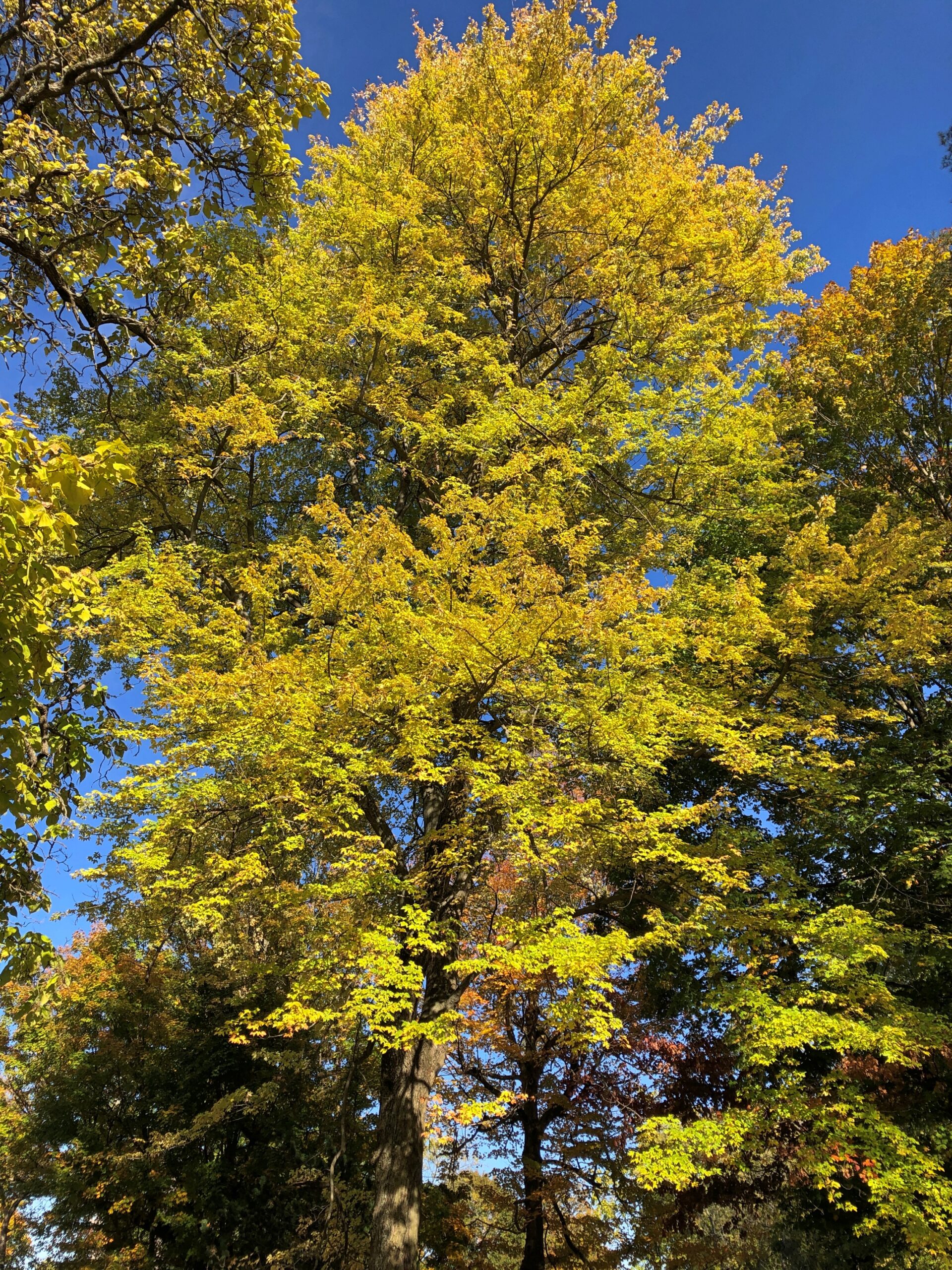
Heading through Richmond, Indiana, I stopped at an entrance to a large park to check my map. Glen Miller Park. A colorful spot in October.

Glen Miller Park, Richmond, Indiana

Not named after the bandleader, which would be Glenn Miller Park. “Glen Miller Park was established in 1885 and was named for Colonel John Ford Miller, who was a railroad executive during the late 1860s,” the city of Richmond says. “Colonel Miller bought the land from Nathaniel Hawkins in 1880, with the intention of transforming the land into a park.”

So Glen Miller as in glen, a term that evokes pleasant Scottish valleys. I was just about to be on my way when I noticed a statue.

Glen Miller Park, Richmond, Indiana

It was another of the 12 Madonna of the Trail statues, located at the edge of the park, where it meets US 40. Unlike the earlier one in Springfield, I hadn’t sought it out. It was just there. One’s travels, like life, can be strange sometimes.

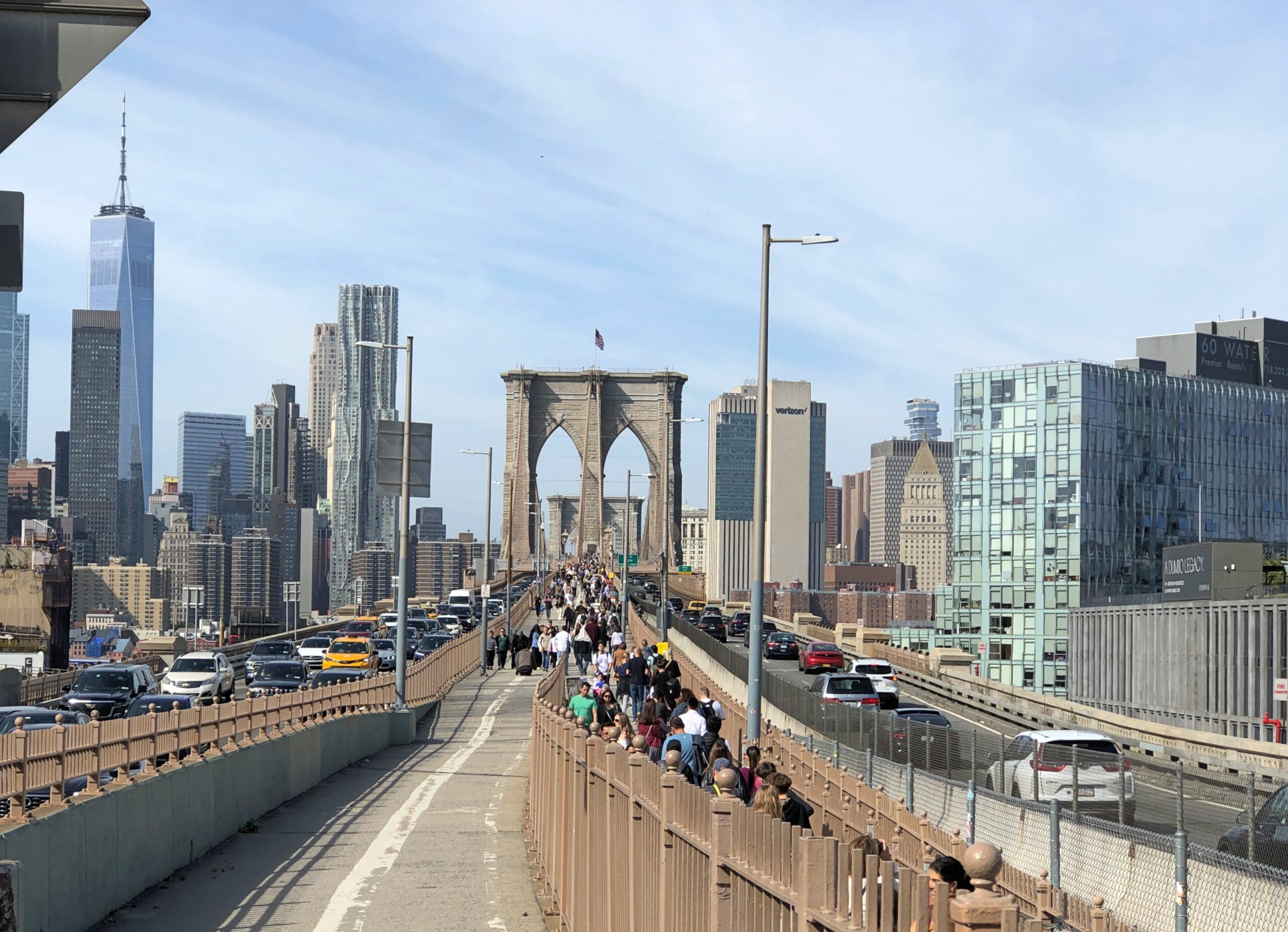
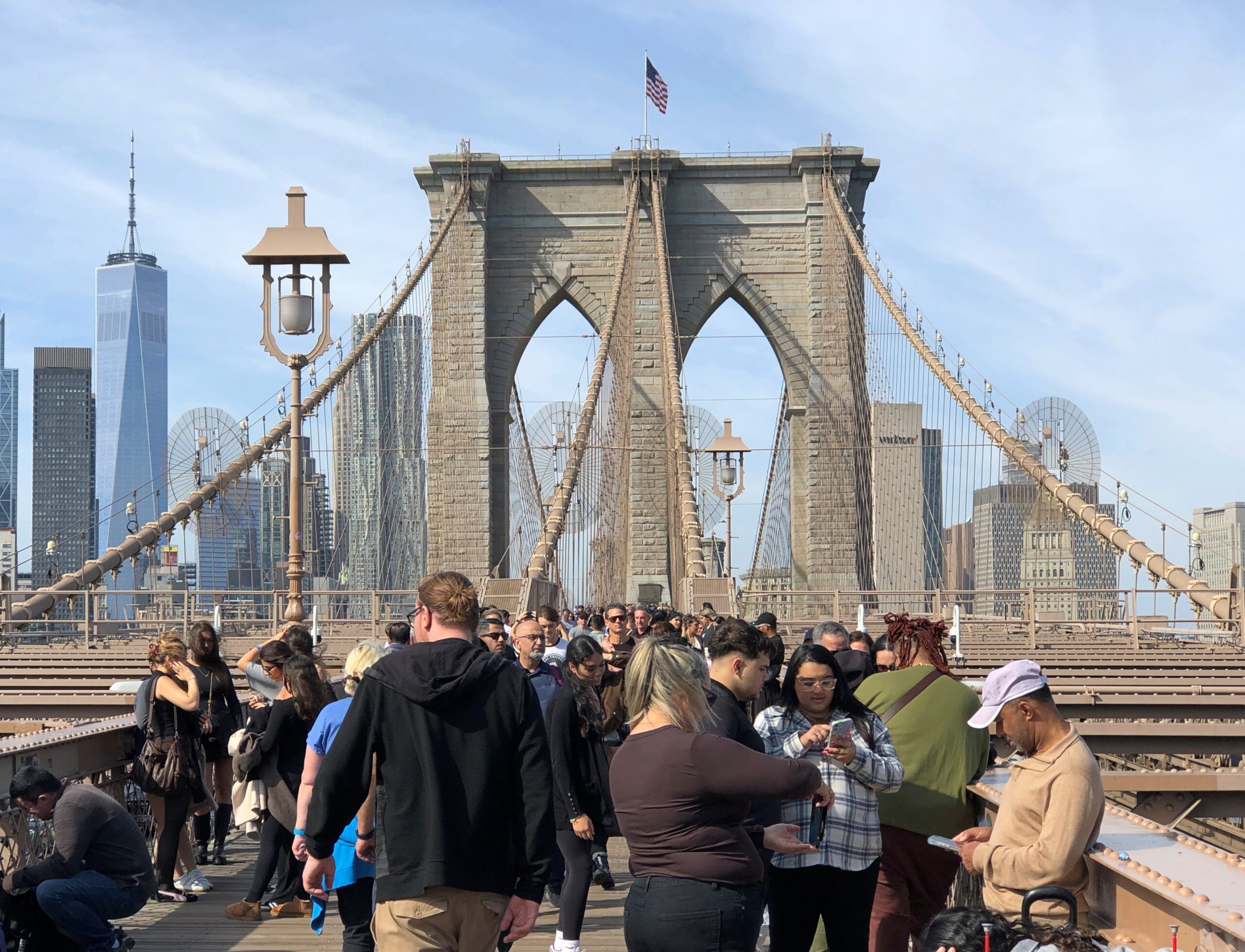
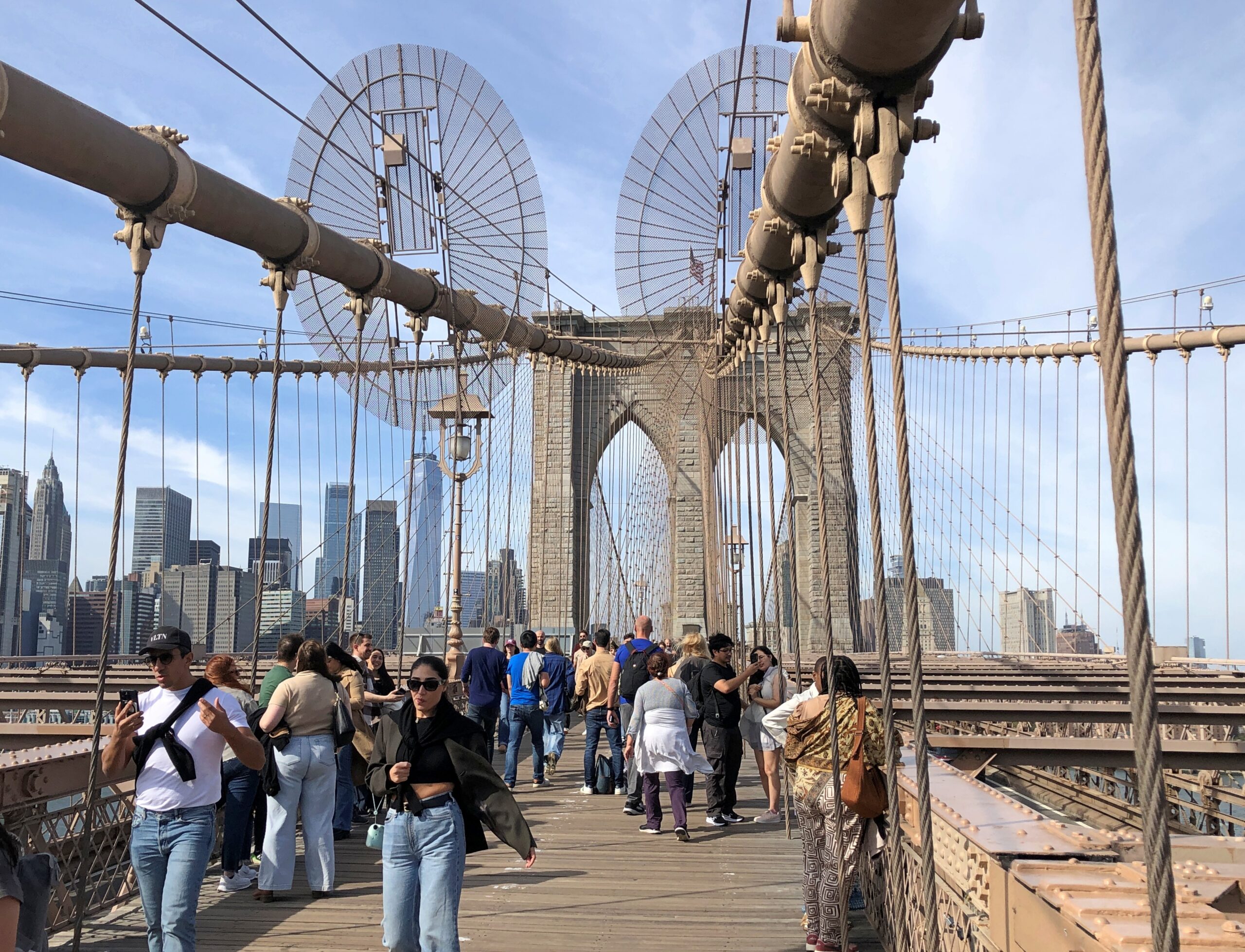
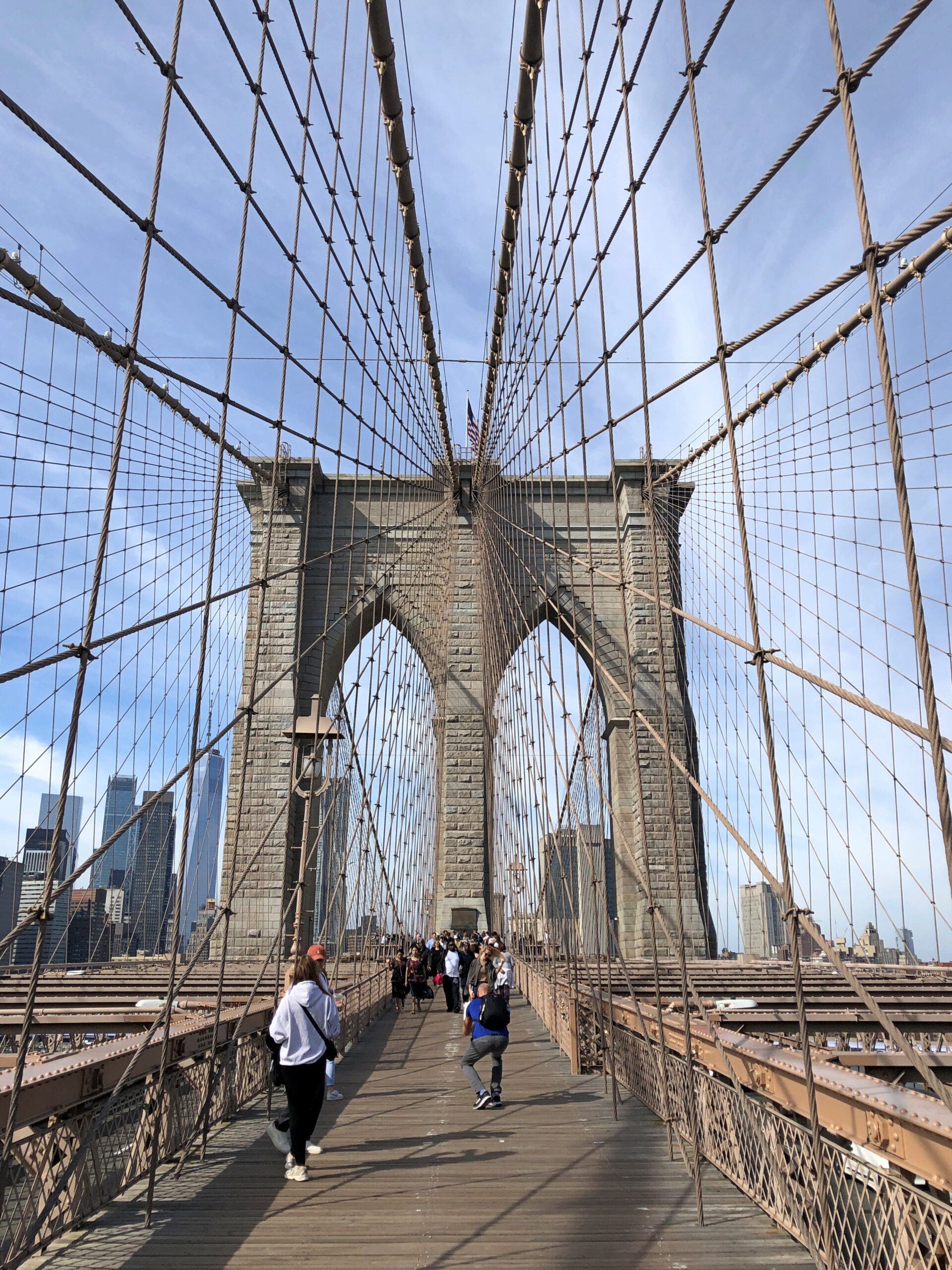
Across the Brooklyn Bridge ’25

On May 24, 1983, I flew from San Antonio to New York City, since in those days the way to get to Europe was via NY. I remember only one thing about that flight, which I assume took me to LaGuardia. As we made our final approach, the plane banked over the East River and I happened to be on the correct side, in a window seat, for a terrific view of the Brooklyn Bridge.

The captain might have even mentioned the bridge, because it so happened that the Brooklyn Bridge was celebrating its centennial that very day. A hundred years earlier, on May 24, 1883, the bridge had opened with great festivities, including attendance by President Chester Arthur and NY Gov. Grover Cleveland.

I’d never seen the bridge with my own eyes before then, either, since my brief layover in the city a year earlier mostly involved time at the Port Authority Bus Terminal. Yet I recognized the bridge at once, from TV and movies. Such as the time, in one movie, when Tarzan (Johnny Weissmuller, accept no substitutes) went to the Brooklyn Bridge, did a Brodie off of it, and of course survived, unlike some real divers.

One day in August ’83, having returned to New York and with more time on my hands, I decided to cross the Brooklyn Bridge on foot toward Brooklyn, to facilitate my first-ever visit to that borough. Except for that fact that it was blazing hot, it was a good idea. The bridge itself is a work of industrial beauty and the views are great.

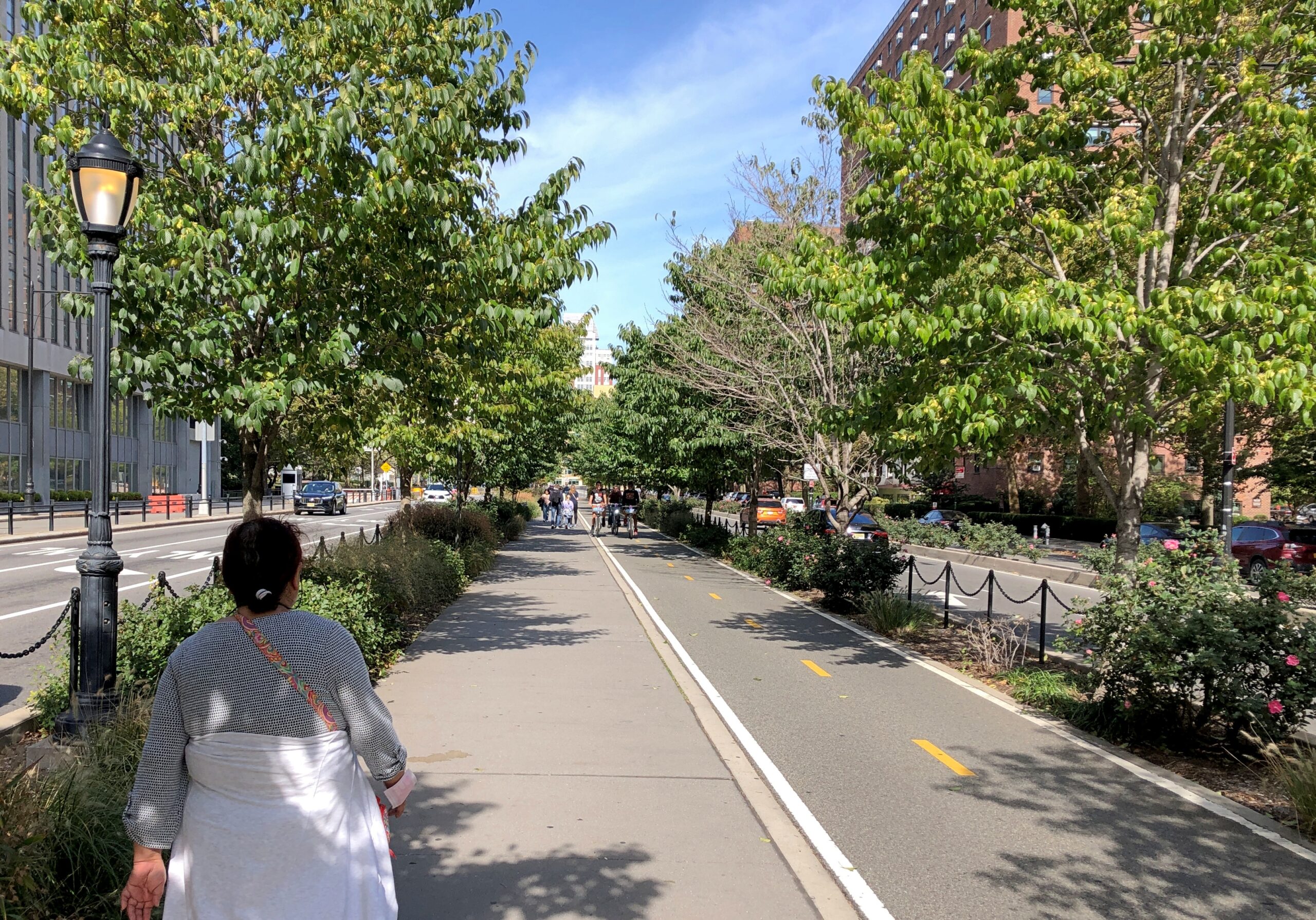
After leaving Fort Greene Park, Yuriko expressed the idea that she wanted to see the Brooklyn Bridge — which she hadn’t up close — and I couldn’t begrudge her a visit, especially since we weren’t far away. We walked from Myrtle Ave. to Flatbush Ave. (actually the “Flatbush Avenue Extension”) to Tillary St., where you can find the entrance to the Brooklyn Bridge Promenade. At that point, it’s both pedestrians and bicyclists.

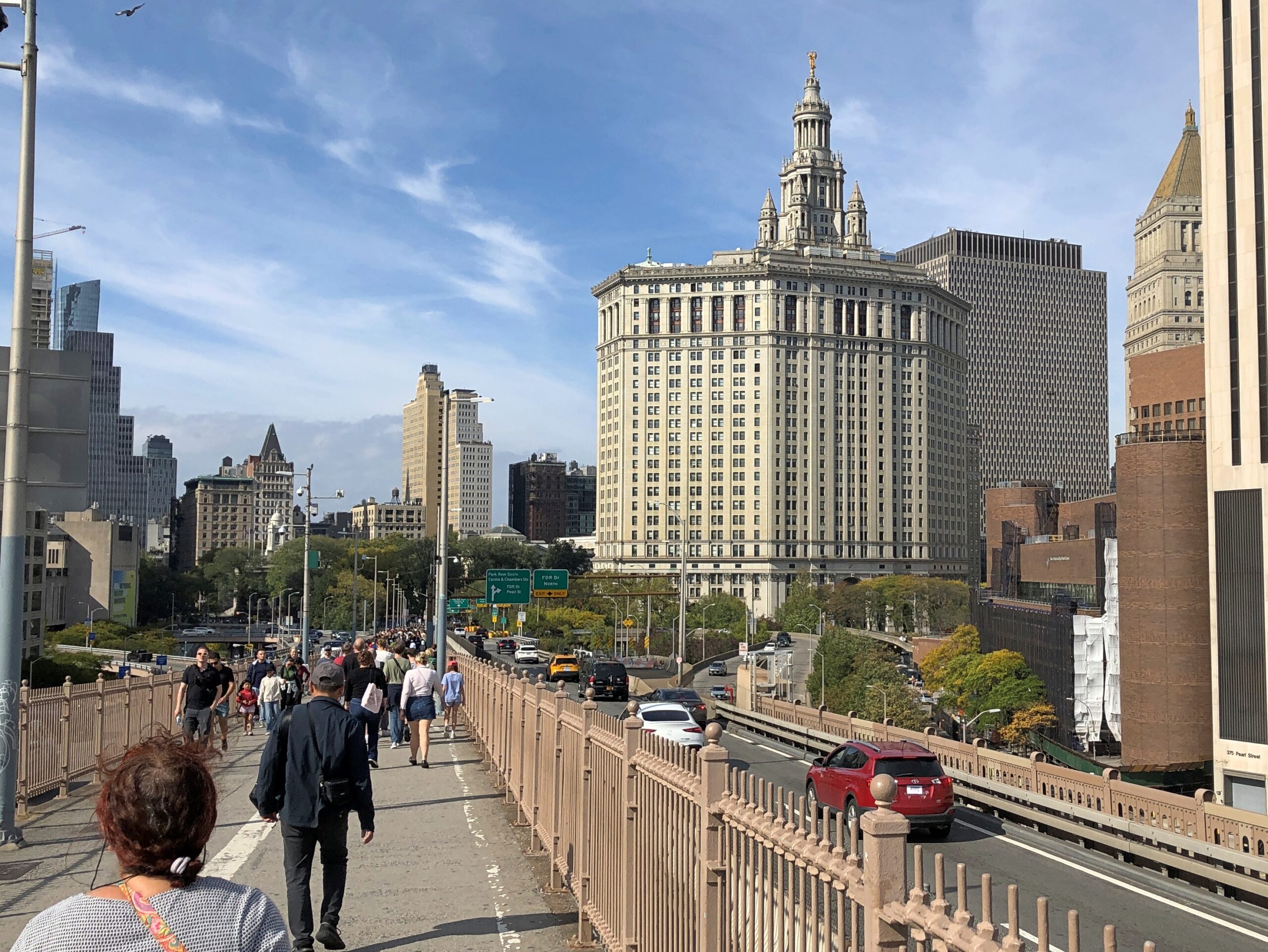
Brooklyn Bridge 2025

I didn’t realize at first that the promenade leads directly to crossing the bridge, though it takes about 20 minutes to get there. I imagined, at first, that it would lead to Dumbo and a view below the bridge. An excellent spot, which I most recently visited in 2014.

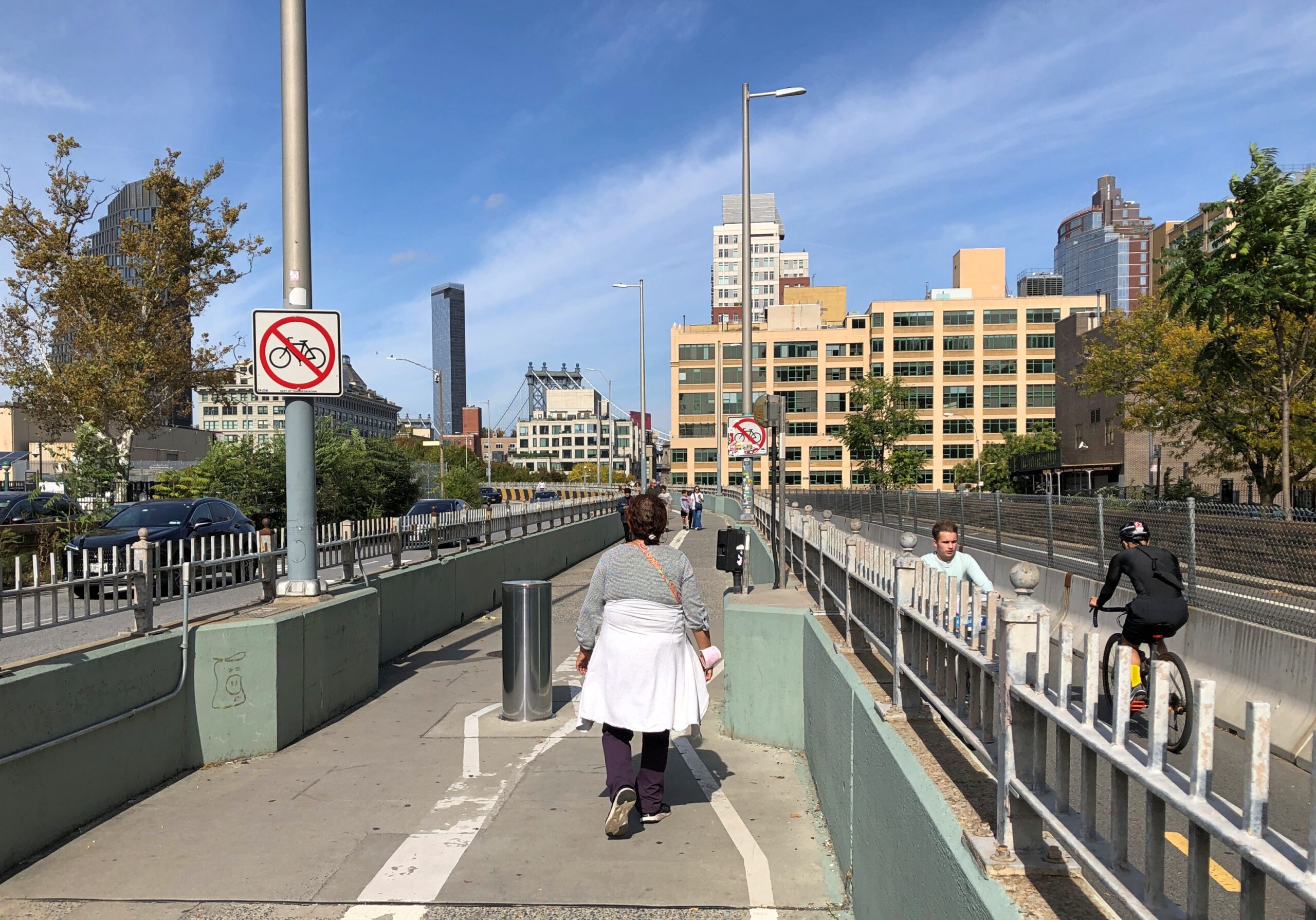
Soon I realized that we were headed for the bridge itself. Not only that, I saw that pedestrians were soon separated from bicyclists, beginning fairly far away from the bridge.

Brooklyn Bridge 2025

What an amazingly good idea, only done in 2021. Considering the crowds that the Brooklyn Bridge attracts, it probably should have been done years ago.

We walked from Tillary St., but the more popular Brooklyn-side pedestrian entrance is stairs at Washington Street and Prospect Street, seen below.

Brooklyn Bridge 2025

I didn’t remember the bridge being that crowded my first time, though at a remove of 40+ years, the details are a little hard to remember. It was hot, and probably a weekday, so that might have thinned out the pedestrian traffic.

That wasn’t the case on a pleasant October Sunday. New Yorkers and tourists were out in force.

Brooklyn Bridge 2025

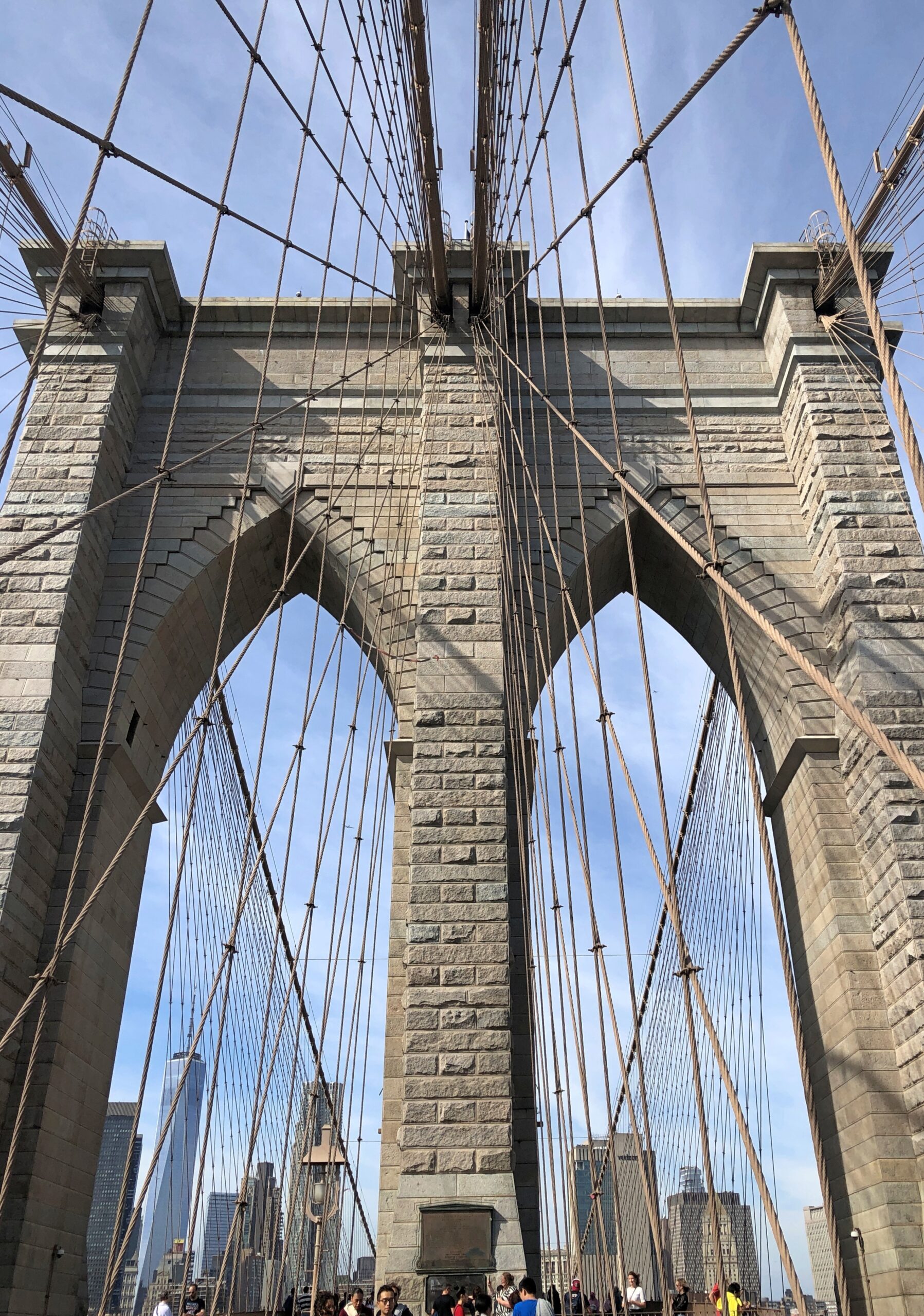
Mostly the bridge holds its crowds well. From the many wooden planks, you still get a closeup of the web-like intricacies and gray hulking towers created by the Roeblings and thousands of workmen.

Brooklyn Bridge 2025

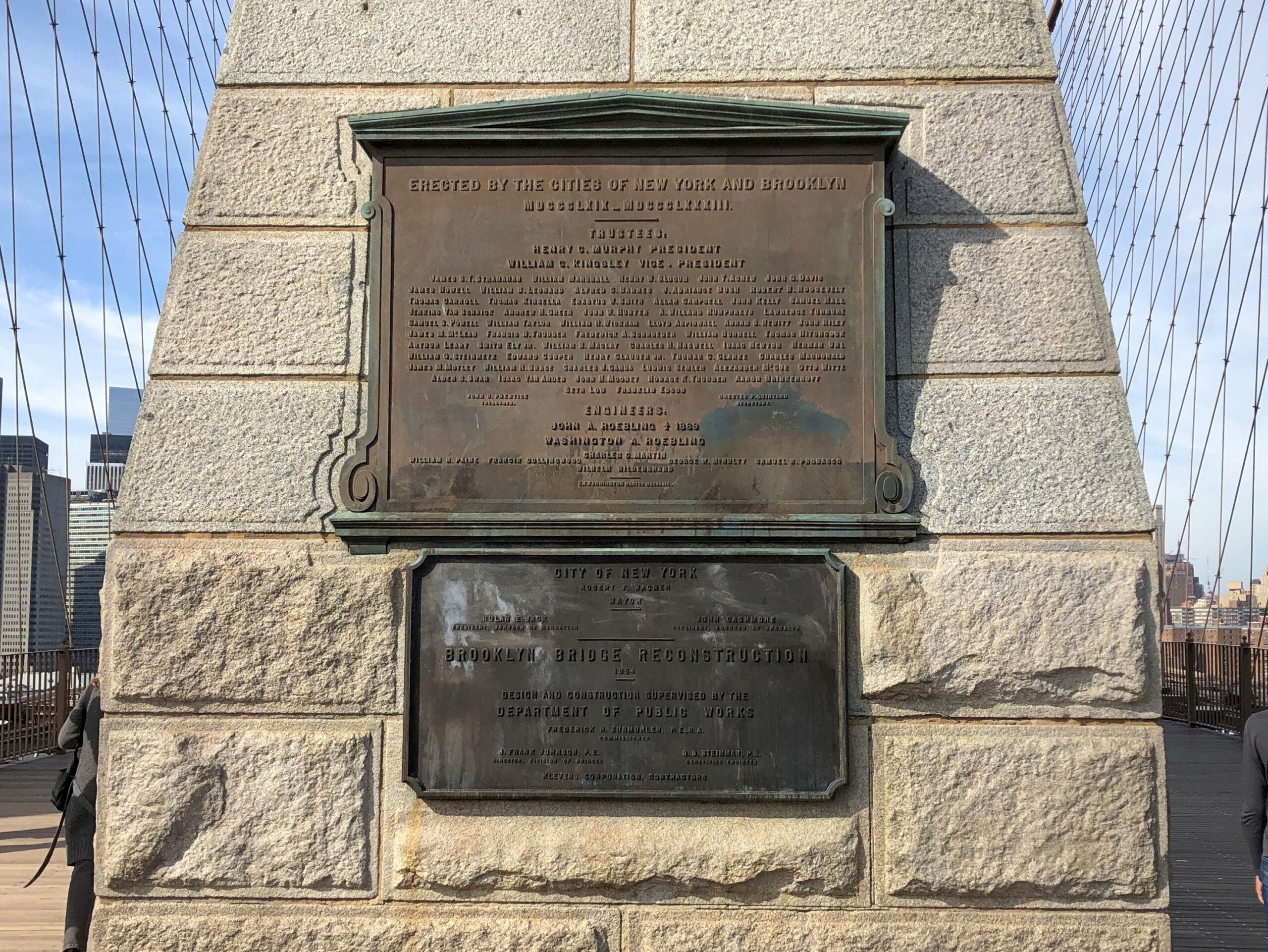
Credits.

Brooklyn Bridge 2025

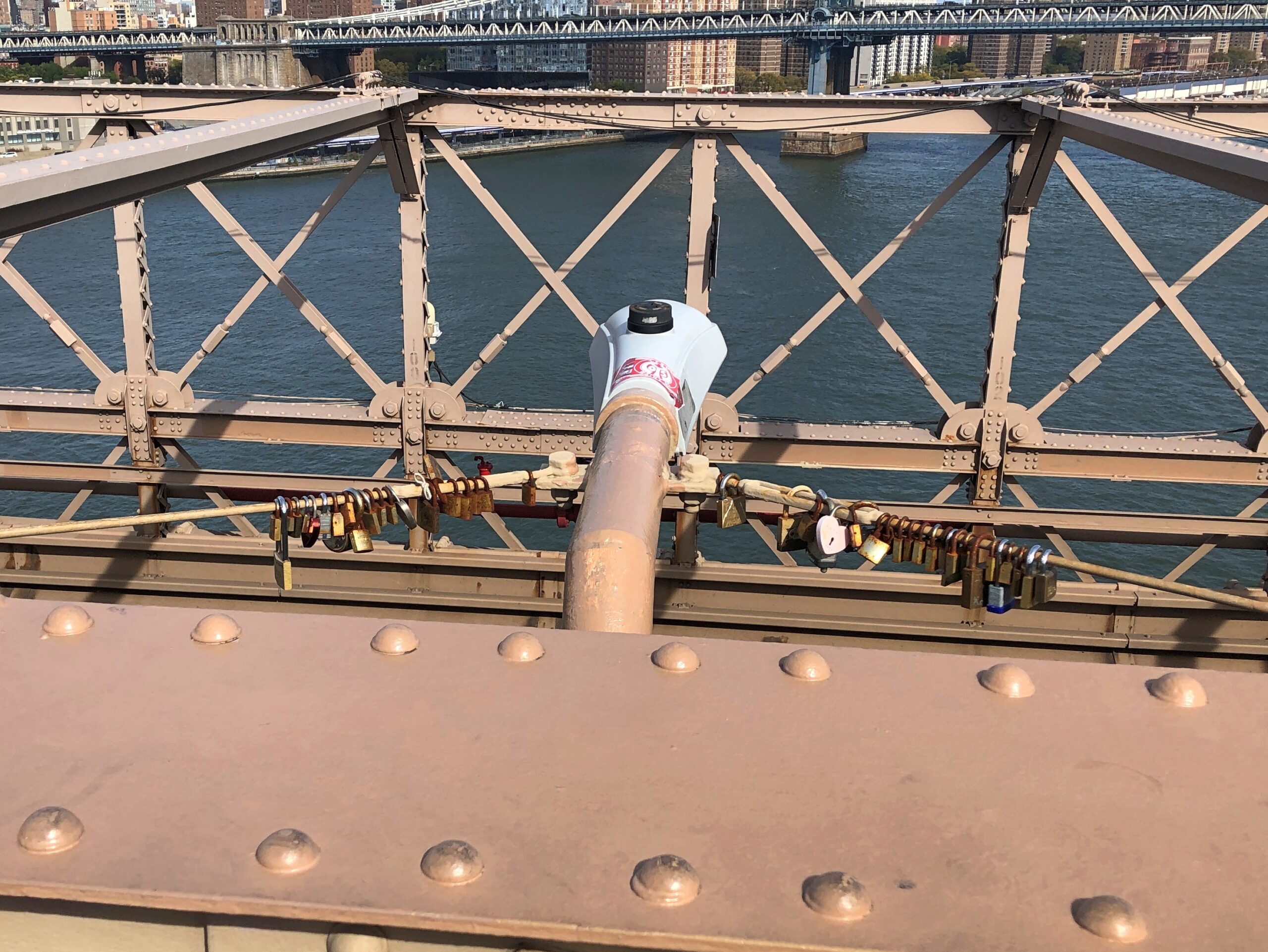
Love locks. I understand the city frowns on their attachment to critical infrastructure. That doesn’t change a thing.

Brooklyn Bridge 2025

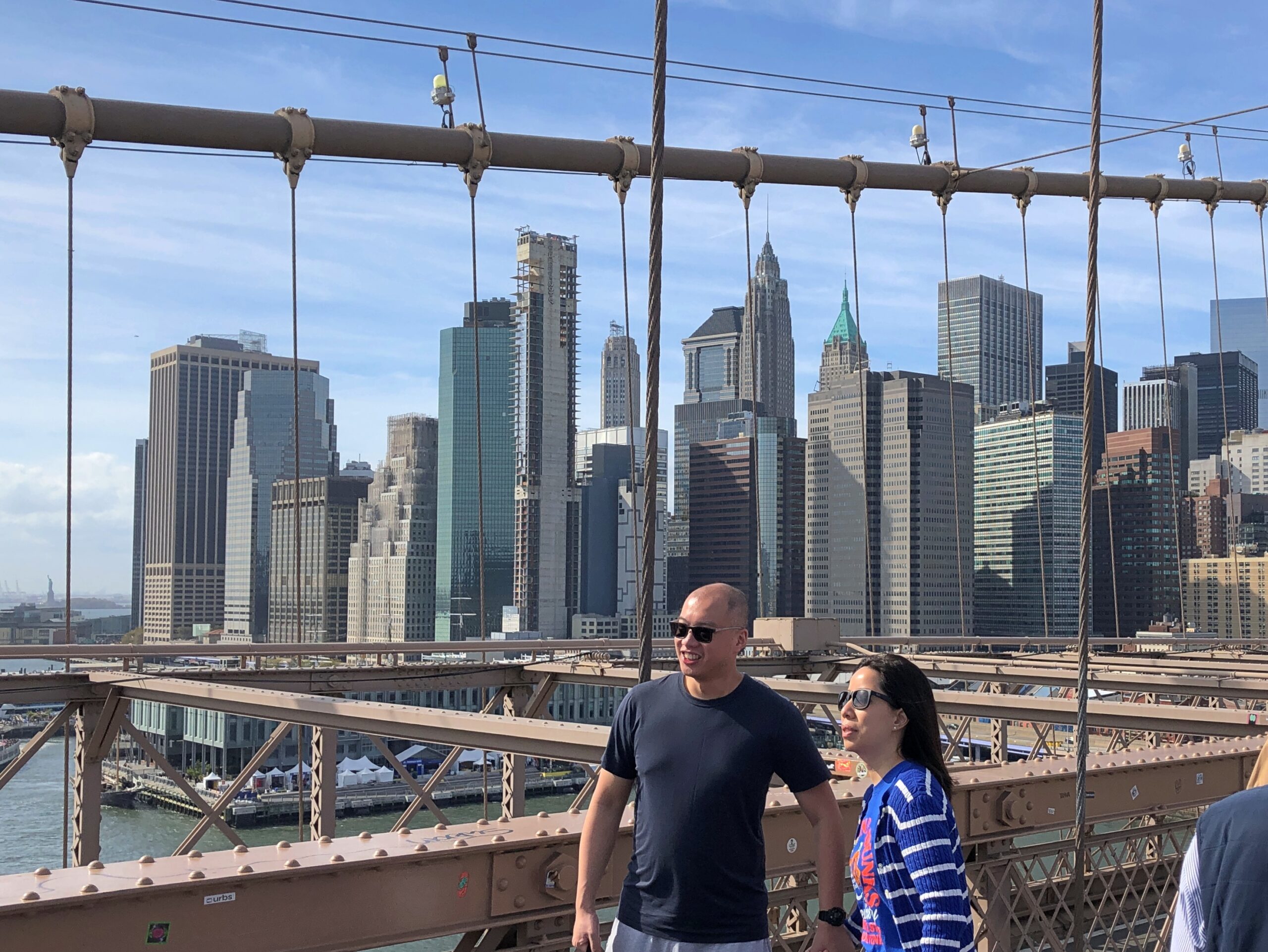
Provided you pay attention that there isn’t someone walking right behind you, it’s easy enough to stop to take in the famed views of Manhattan.

Brooklyn Bridge 2025

Soon enough you’re approaching Manhattan.

Brooklyn Bridge 2025

Yuriko had fulfilled her wish to walk the bridge, and it occurred to me that not only have I walked across the Brooklyn Bridge twice, I’ve done it once each way. Guess I need to visit San Francisco again and walk across to (near) Sausalito, then take a bus back, which would be the reverse of 1990. Or for that matter, visit the Ohio Bridge in Cincinnati again (another Roebling work), though I don’t remember which way I crossed it. Or visit the Roebling Museum. Ah, so many bridges to cross.

Southern Tier Fall Crossing

Drive out from Erie, Pa., headed northeast, and soon you have a decision to make: I-90, which becomes the New York State Thruway, or I-86, which does not. Besides costing more money, the NYST went places I didn’t want to go (this time): greater Buffalo, Rochester, Syracuse, Utica and into Albany, a route I drove as long ago as 1991 on my way to Boston.

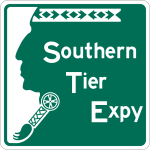
By contrast, I-86 passes through much smaller places, winding through the hilly Allegheny Plateau, a way I had not been before. High time to do so, I thought. The road is also New York 17, with signs along the way identifying it as the Southern Tier Expressway. “Southern Tier” is the southernmost counties in upstate New York, which apparently is a longstanding regional term.

That’s a good-looking sign, and serves as a nod to the Seneca, who hold land in this part of the state. A Seneca artist named Carson Waterman did the design. For some miles before and after the town of Salamanca, which is part of the Seneca holdings, standard green highway signs include both English and Seneca.

One of the larger places on the Southern Tier Expressway is Jamestown, which I know from the song. It’s a game I occasionally play with my friends: Did You Know There’s A Song About…? and then I name something like rural electrification in Australia or the Versailles conference. In this case, the song is “Maddox Table” and it’s about labor organizing in Jamestown, hometown of the band 10,000 Maniacs. The town isn’t specifically mentioned in the lyrics, but Bemis Point is. Even before the Internet, I could look that up, and note that it’s a local recreation destination on Chautauqua Lake.

Chautauqua Lake is in Chautauqua County, the westernmost bump on the map of New York state. Ah, storied Chautauqua, which brings to mind the outdoor exhortations of men in full suits and women in long dresses, regardless of how hot it was. There’s another streaming service series for you: Chautauqua, set in the raucous 1890s. Could be a comedy or a Gritty Drama.

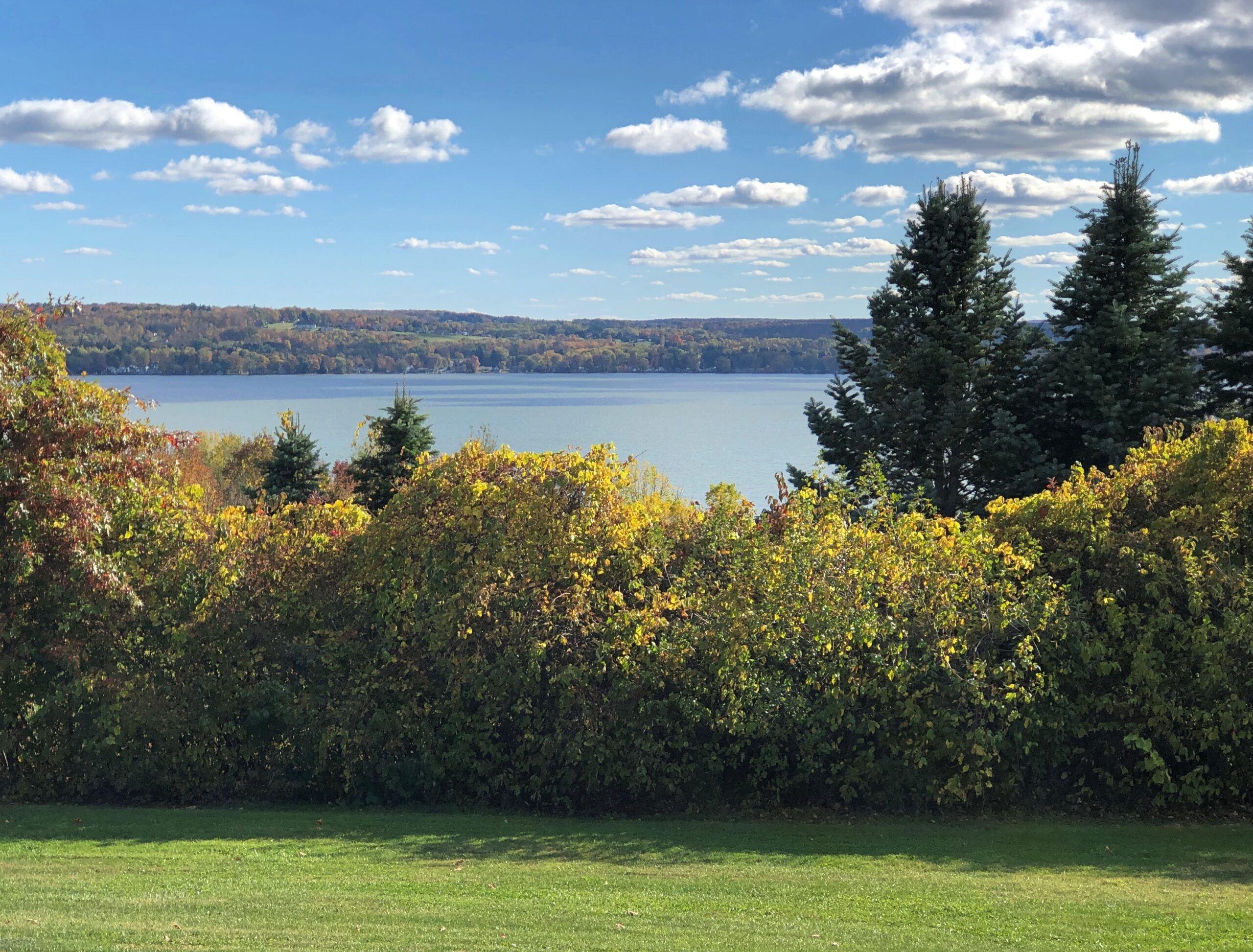
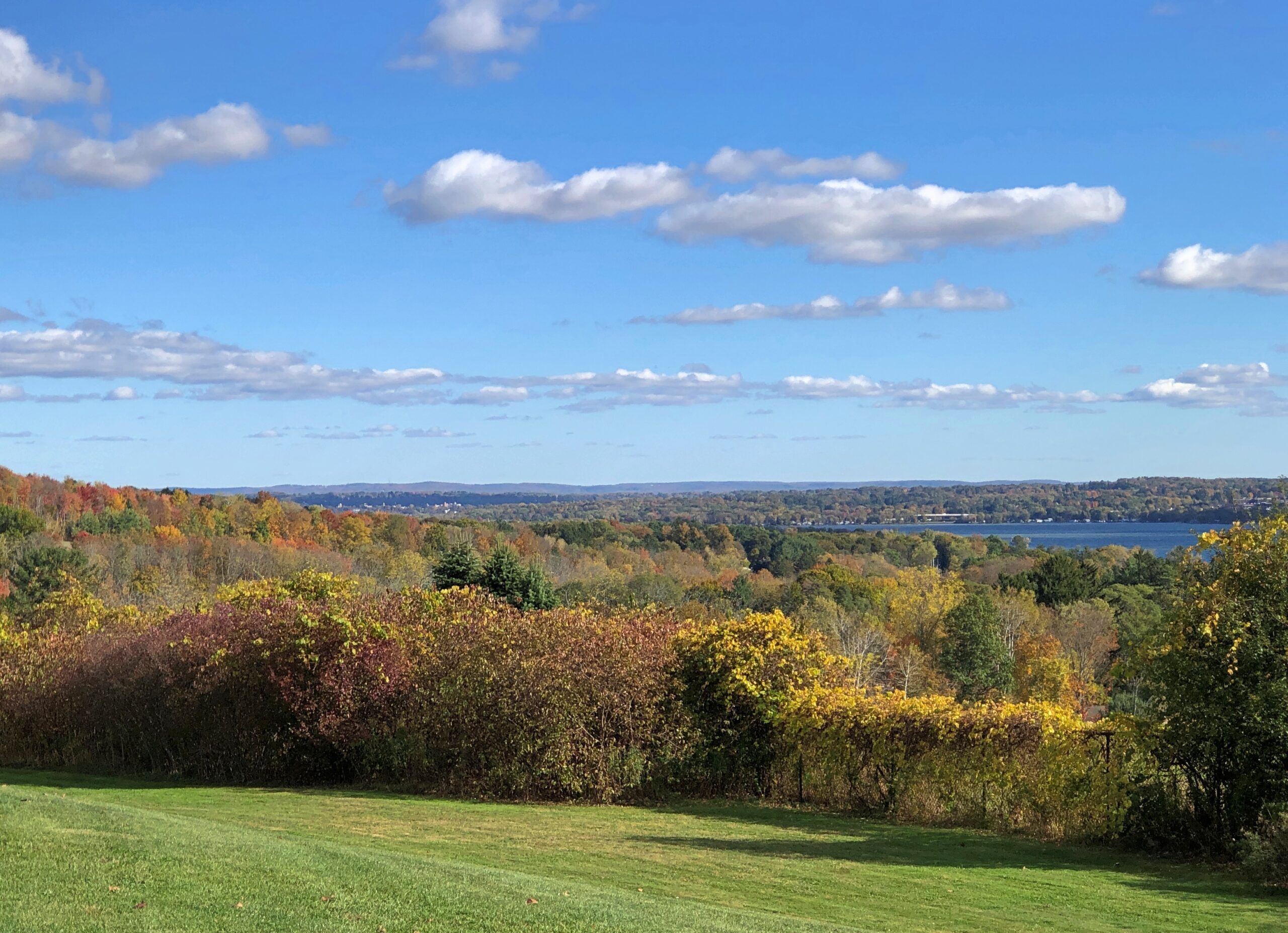
I wanted to reach my destination, Binghamton, NY, before too late, so I didn’t linger near the lake. But I did stop at the rest area on Chautauqua Lake, which is large, and contains multitudes of structures along its shores, and probably many more people in the summer. One of the more scenic rest areas of the trip, it turned out.

Southern Tier NY
Southern Tier NY

So was the next rest area, not far from Corning. A few hours to devote to the glass museum in that town would be well spent, I think.

Southern Tier NY
Southern Tier NY

After an uneventful night in Binghamton – the kind I prefer on the road – I set out for greater NYC, by way of the highway New York 17, the “future I-86” according to my maps, and then the highways New York 30 and 28.

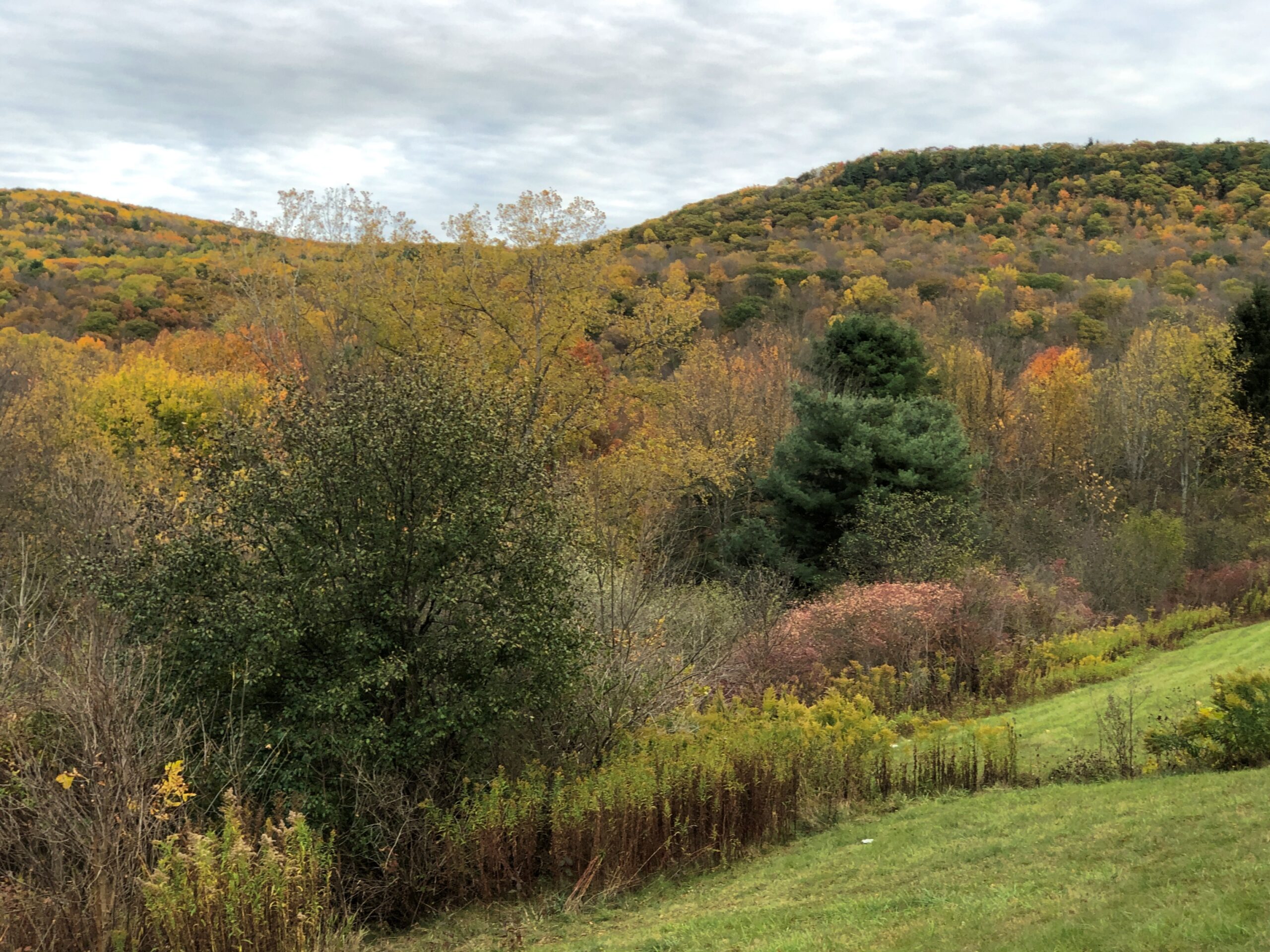
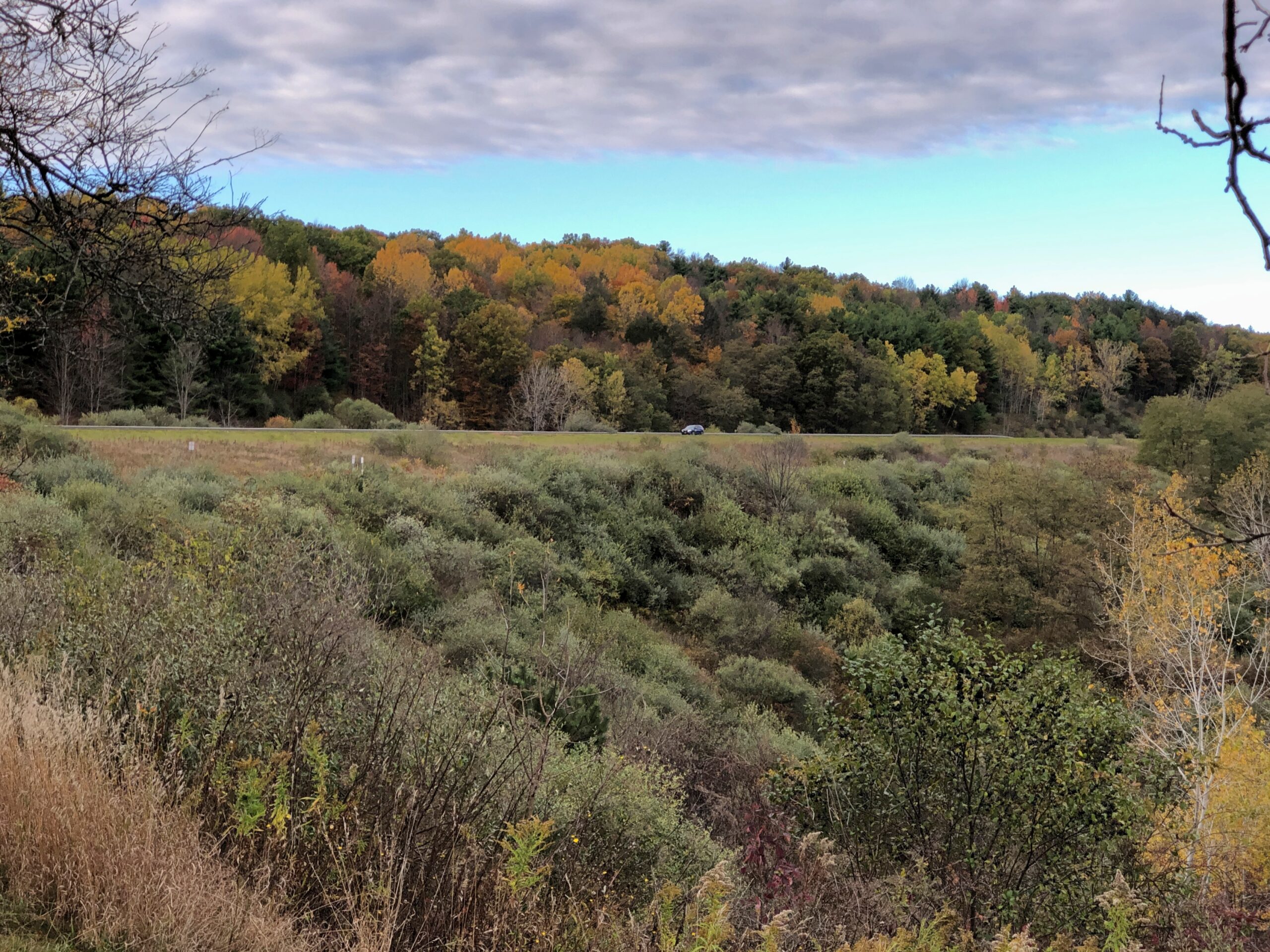
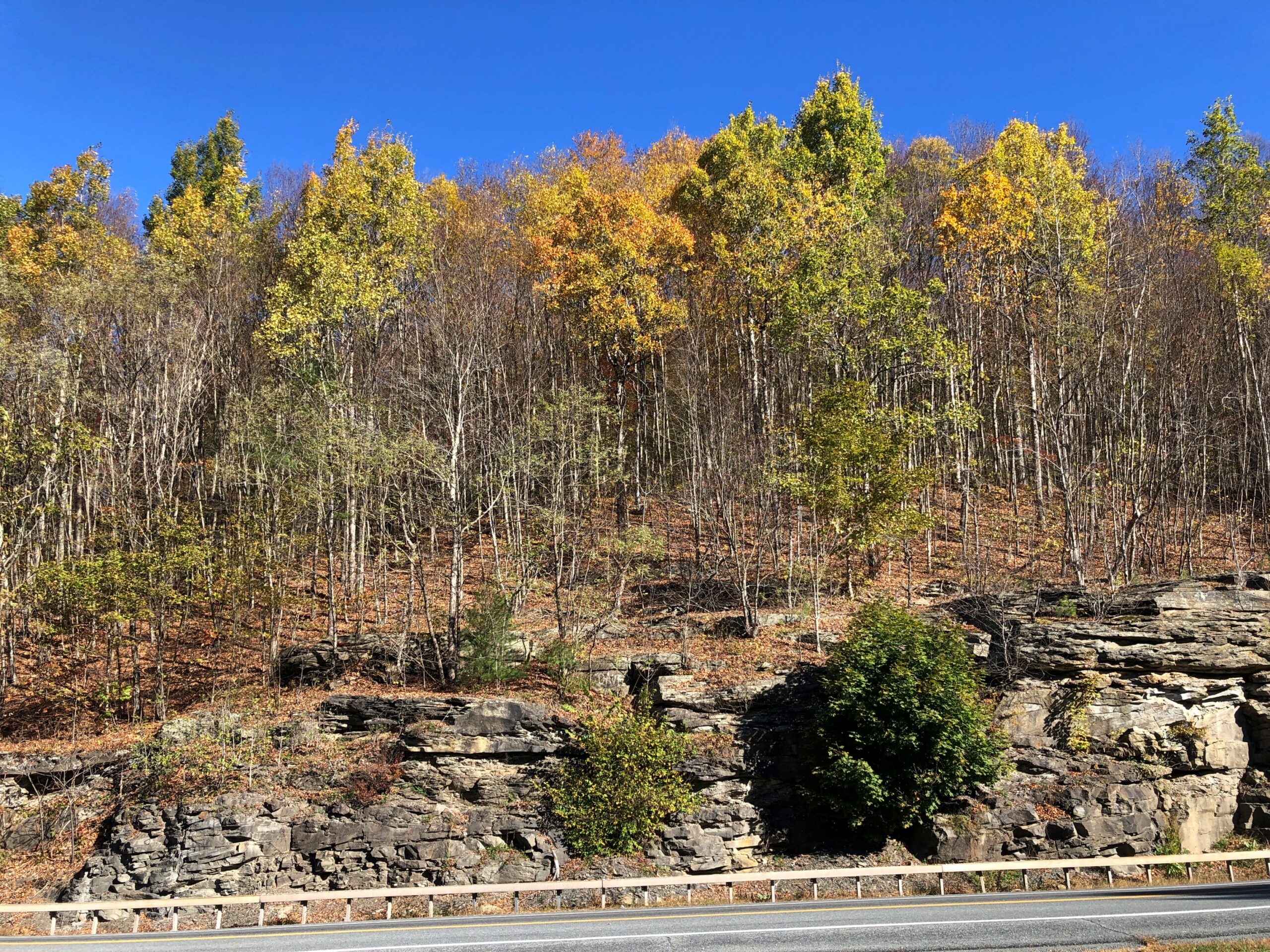
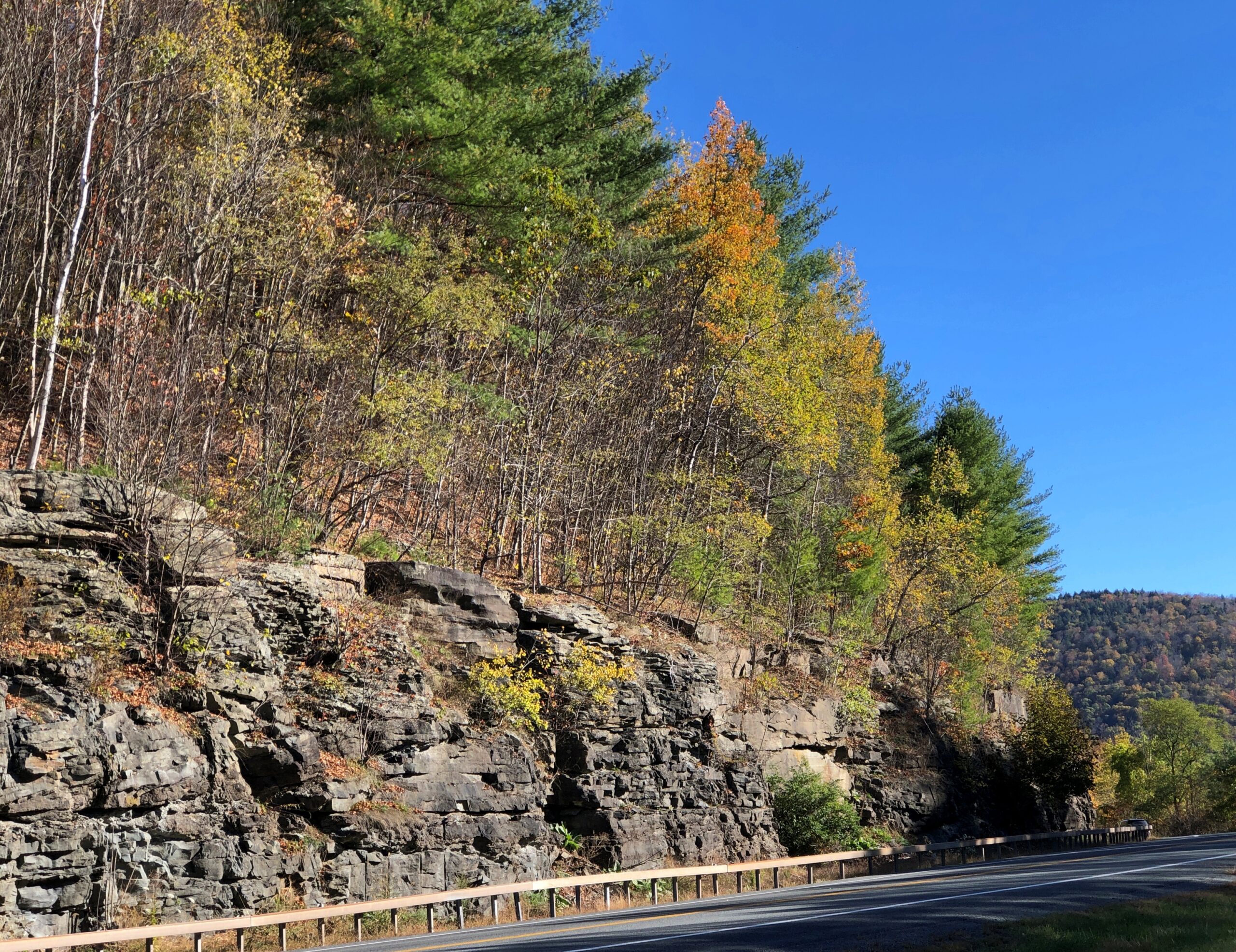
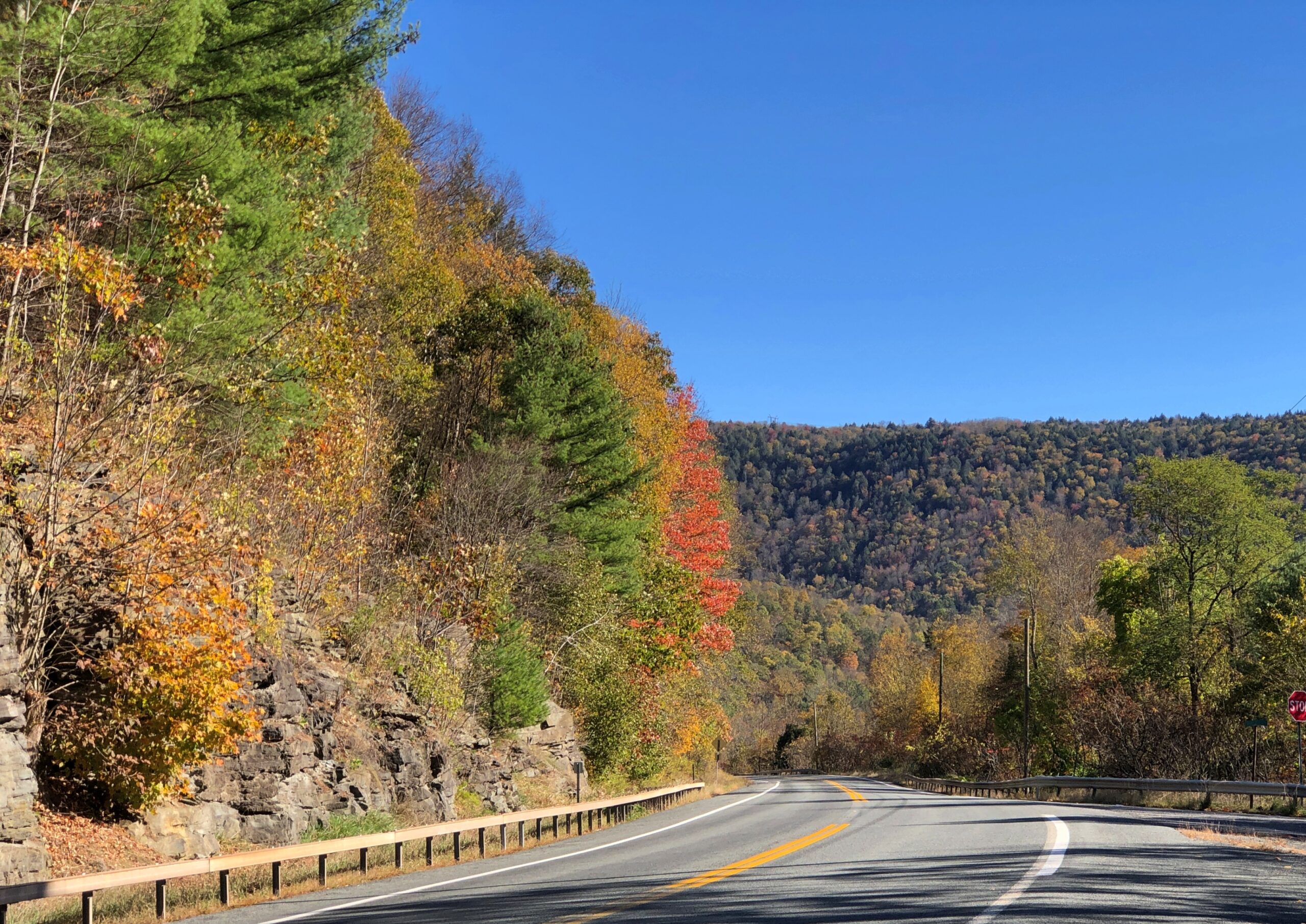
NY 30 skirts the edge of Catskill Park. Last time I was in the Catskills was during the Clinton administration, back when the Concord Hotel and Resort was still clinging to existence, so it’s been a while, and I’d never been in the colorful and nearly empty western edge of the park in October. That emptiness made all the difference in the car commercial driving I enjoyed.

Southern Tier NY
Southern Tier NY
Southern Tier NY

During all the driving over the next week or so after NY 30, empty roads would not be part of my reality.
Nebraska Rocks

Pity the people whose job it is to promote tourism in Nebraska. Set ideas are notoriously resistant to change, at least over periods less than a generation, so I expect the idea “nothing to see there” is a constant battle for those who know otherwise.

I didn’t need to be persuaded. A drive across the state – a reward in itself, more about which later – takes you Carhenge (see yesterday) but also to terrain not generally associated with Nebraska.

At the western edge of the state, rocks. Big, impressive rocks that poke out of the still-flat ground, stubborn geological leftovers that refuse to erode as fast as the surrounding terrain. Natives, mountain men, trappers, and wagon trains across the prairie all knew about these rocks, knew that they marked a certain point in their journeys. I’m sure they were hard to miss.

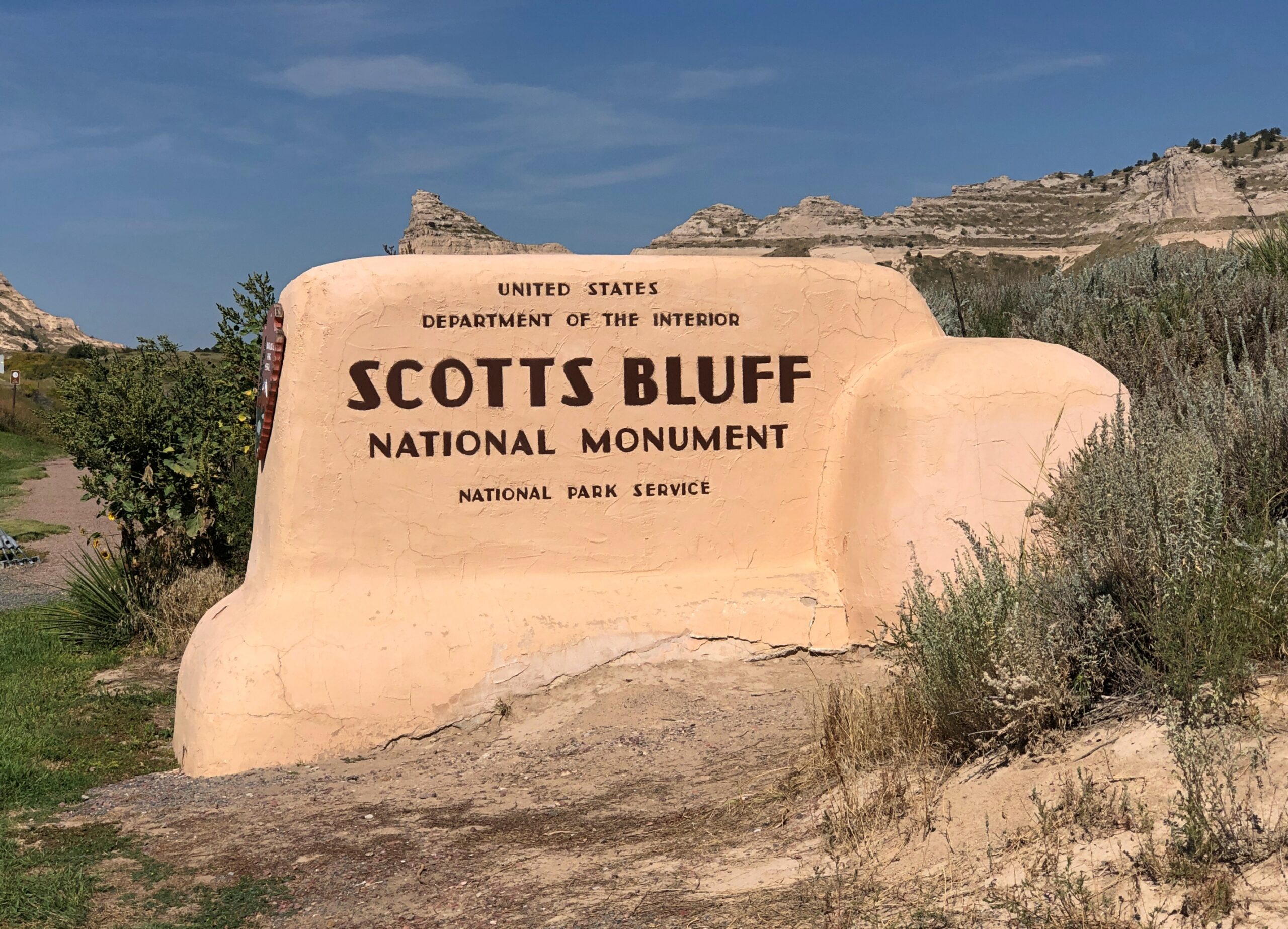
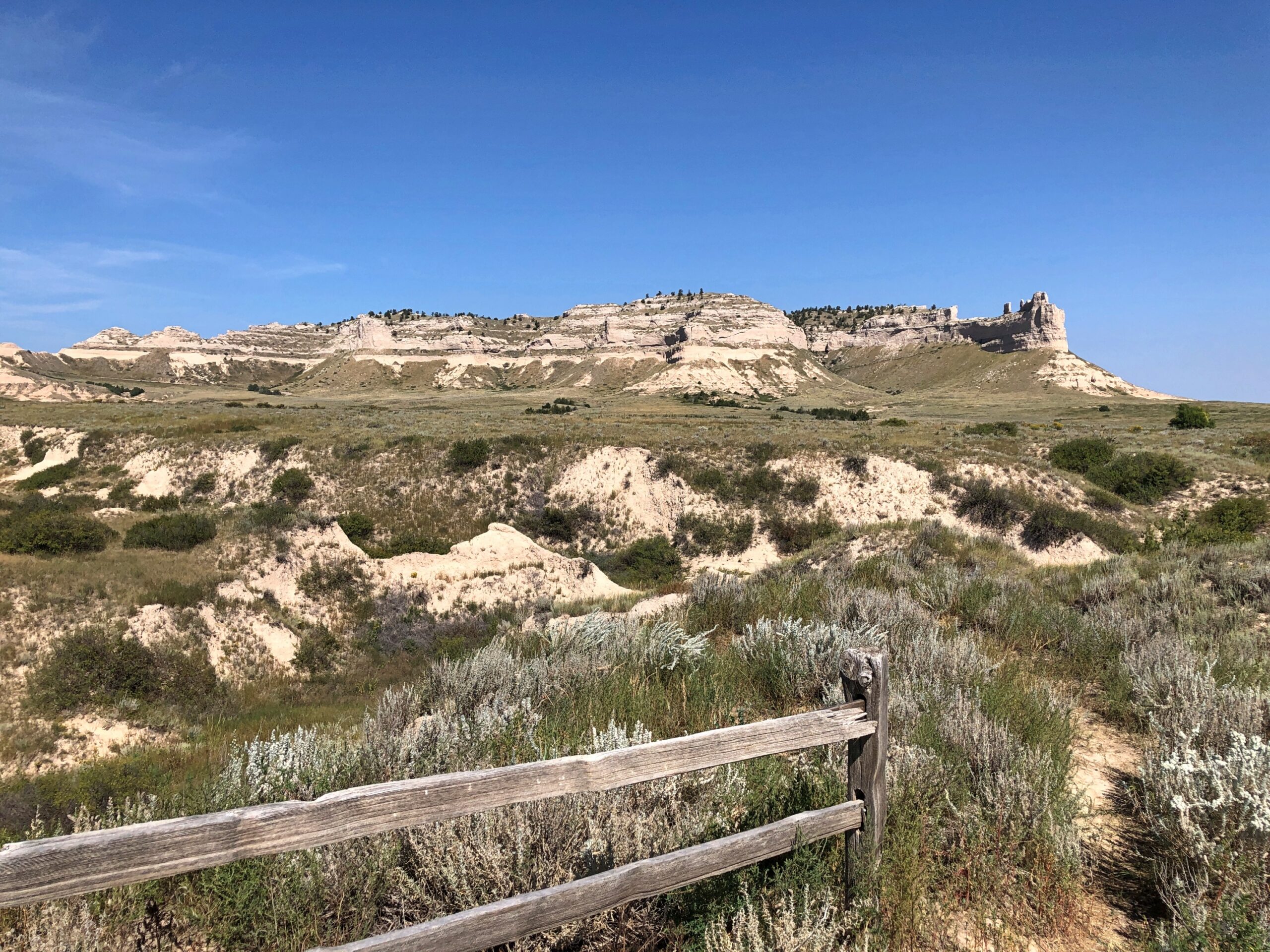
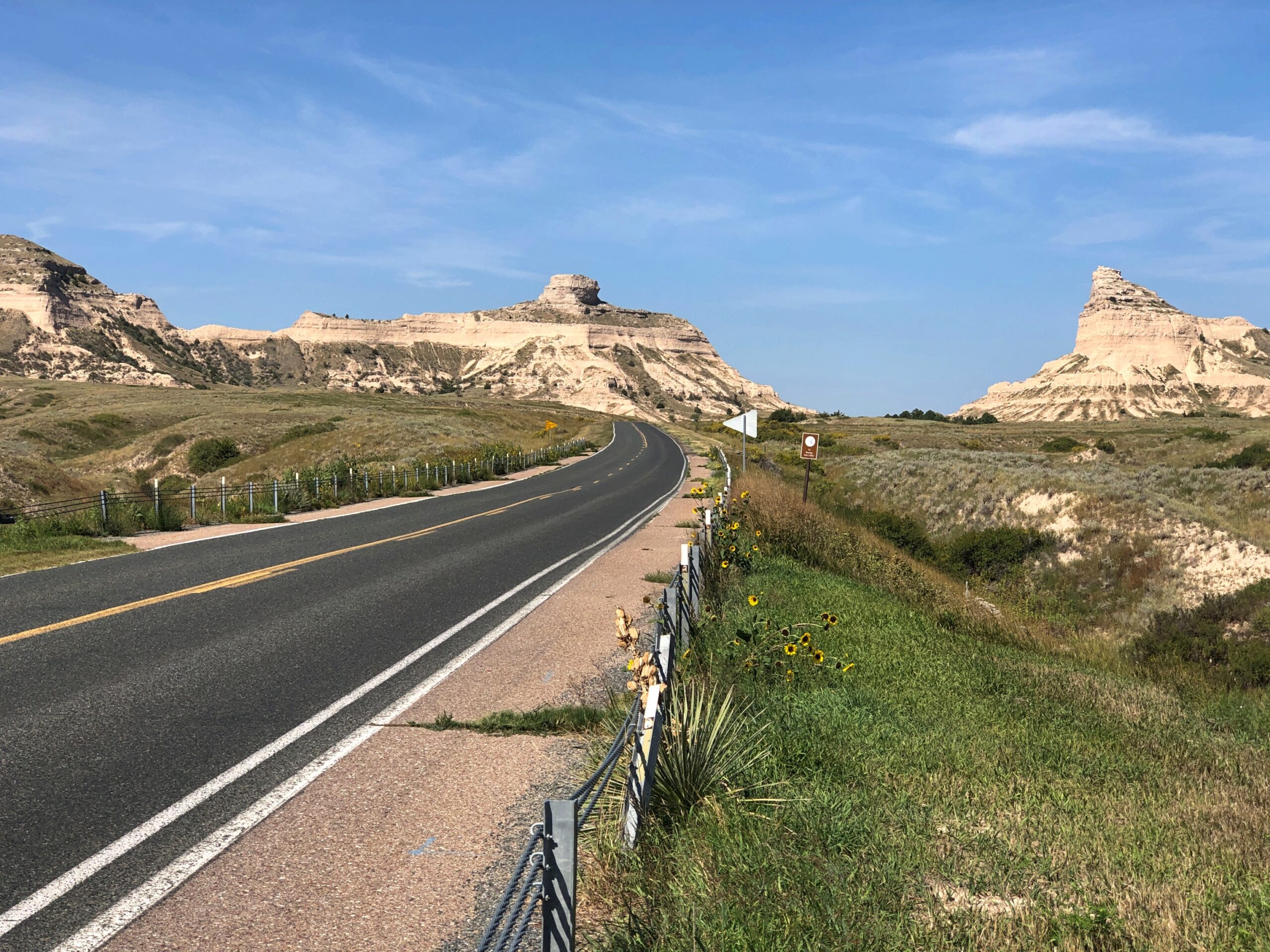
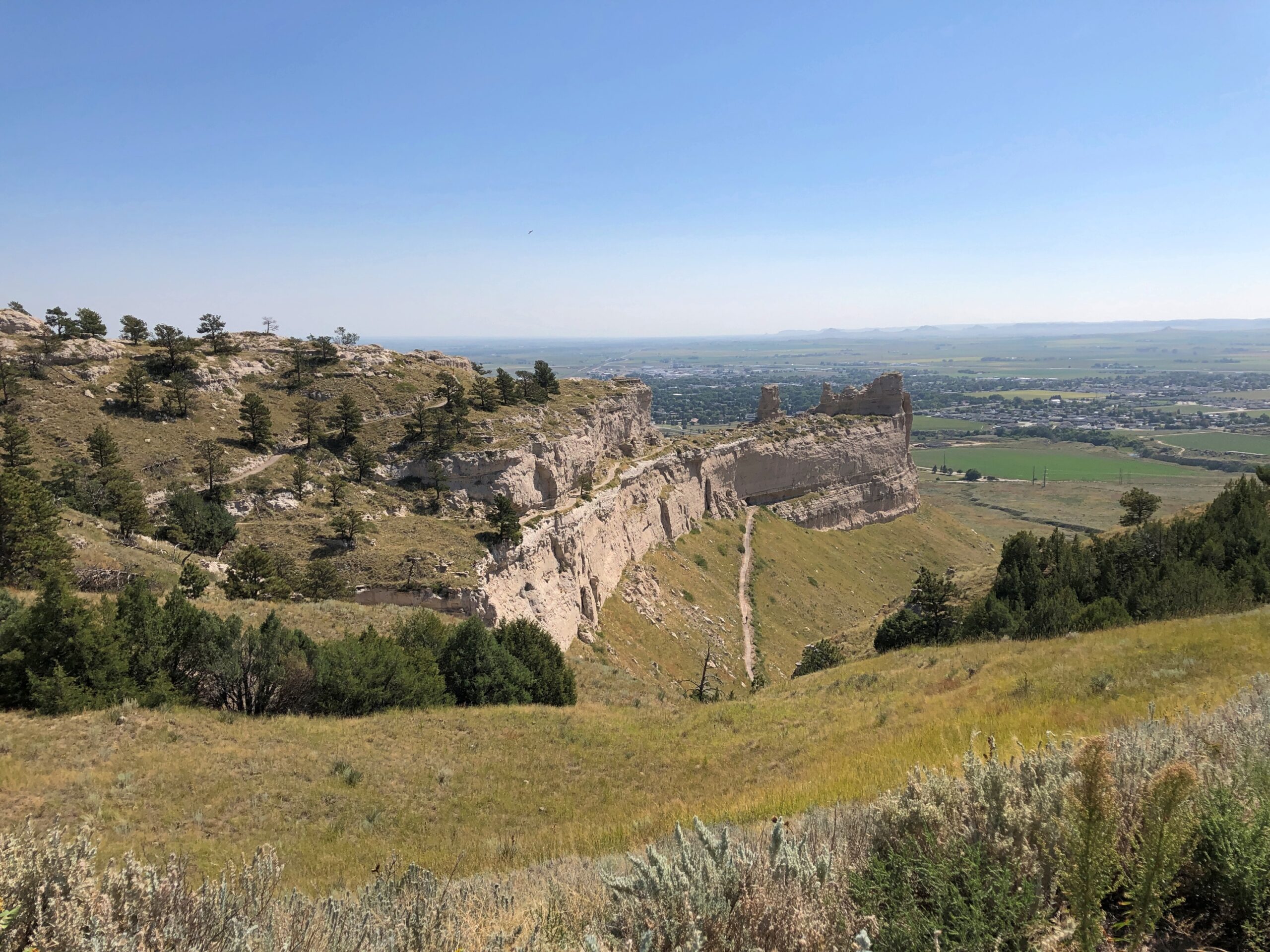
Since 1919, the rocks a few miles from Gering, Nebraska have been known as Scotts Bluff National Monument. I arrived on the morning of September 8.

Scotts Bluff National Monument

On this particular trip, the monument was an appetizer, ahead of the main course in Colorado. The Sandhills of Nebraska, which I’d just driven through, aren’t pancake flat, but waves of grassy hills with scattered outcropings of rock. After a drive like that, the Scotts Bluff seemed to appear suddenly, rising in your field of vision to take over half the sky.
I exaggerate, but only because that’s how I seem to remember it. An outcropping like that in the Rockies would be lost in the crowd, but here in western Nebraska it’s the star of the show.
Scotts Bluff National Monument

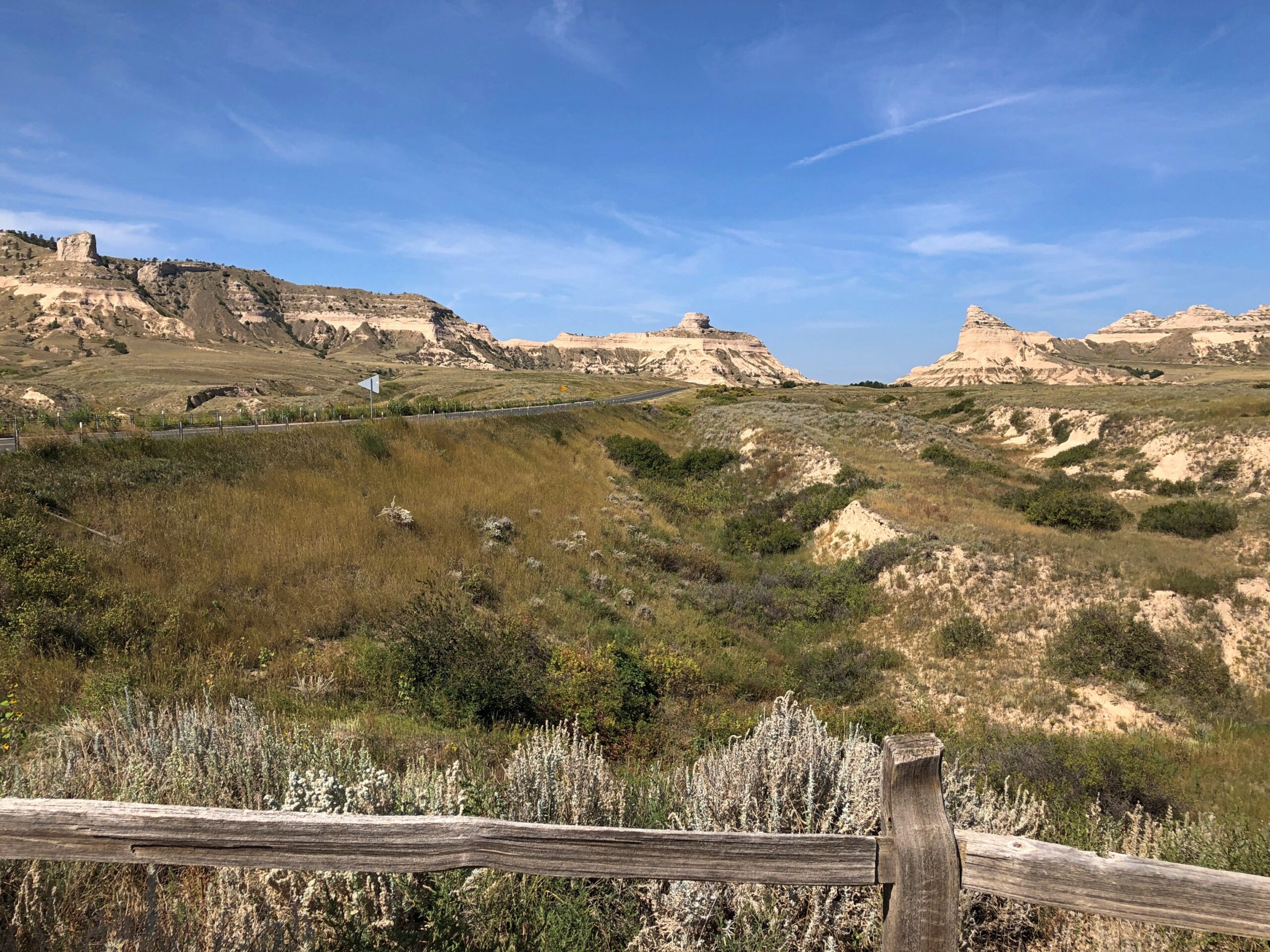
The road leading to the monument, the highway Nebraska 92, follows the Oregon Trail at his point.

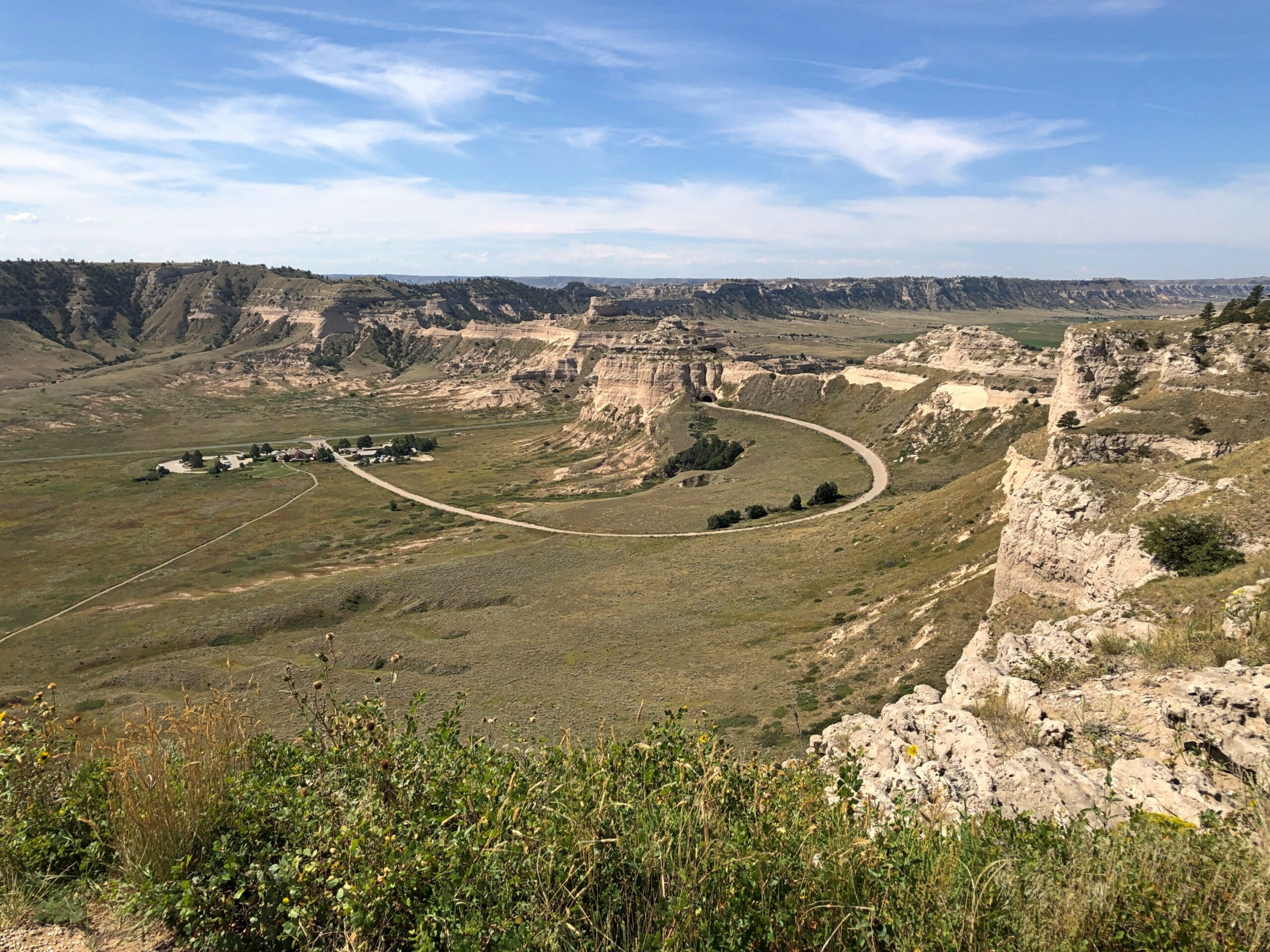
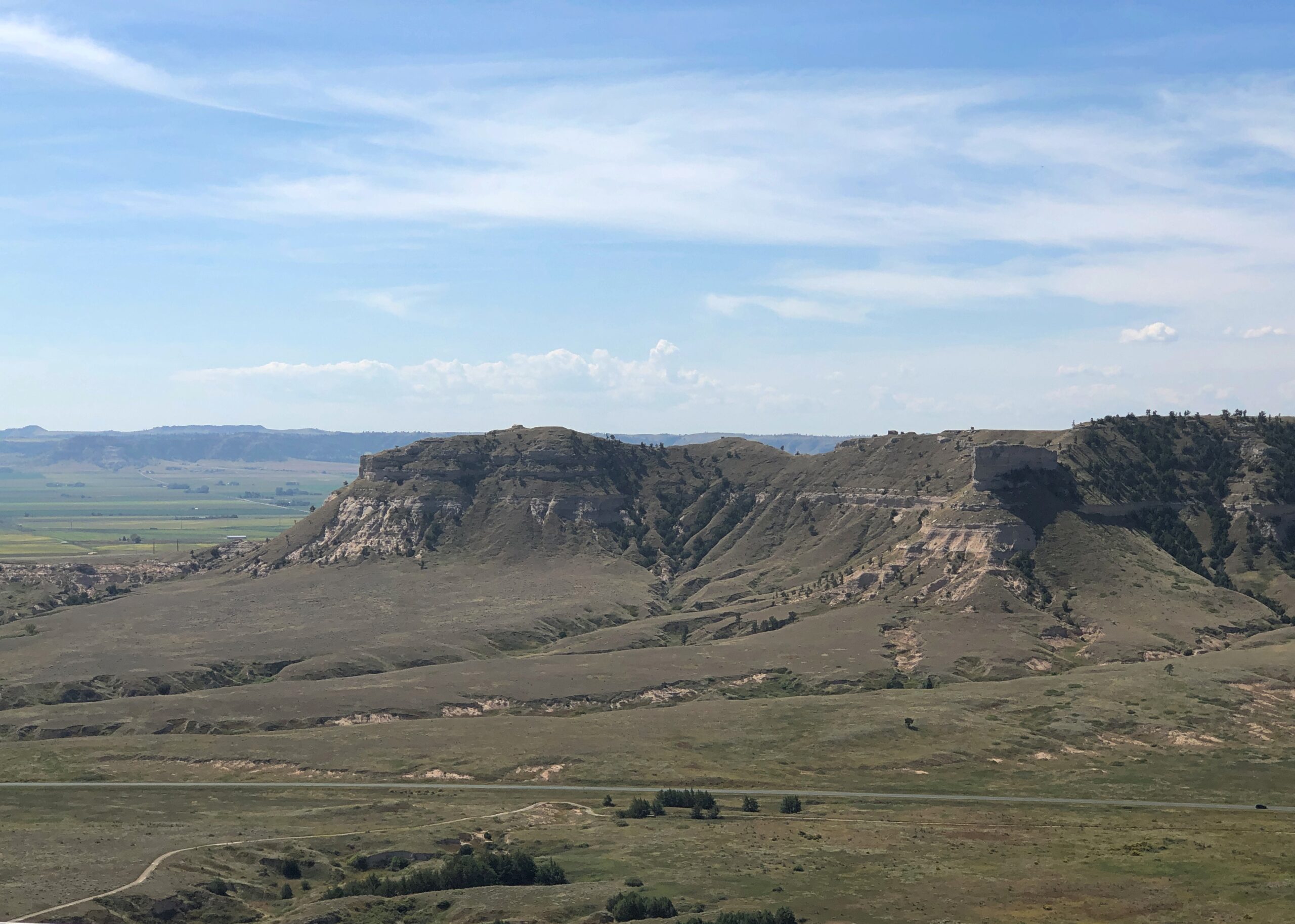
Scotts Bluff isn’t just a single bluff. A set of them, you might say. A road (yes, CCC built) provides access to the top. From there, any number of fine vistas ring the area. A fair number of people took the drive the same day as I did, but in no way did they amount to a crowd.

Scotts Bluff is no solitary outpost. Turning to the 1911 Enclopdaedia Britannica’s entry on Nebraska: “In the fork of the North and South Platte are the Wild Cat Mountains, with contours rising to 5300 ft., in which Wild Cat Mountain, long reported as the highest point in the state, attains 5038 ft., Hogback Mountain 5082 ft., and various other hills — Gabe Rock (5006), Big Horn Mountain (4718), Coliseum Rock (5050), Scotts Bluff (4662) &c. — rise to heights of 4500 to 5000 ft.

“In the extreme N.W. the White river and Hat Creek have carved canyons in deep lacustrine deposits, creating fantastic cliffs and buttes, bare of vegetation, gashed with drainage channels, and baked by the sun.”

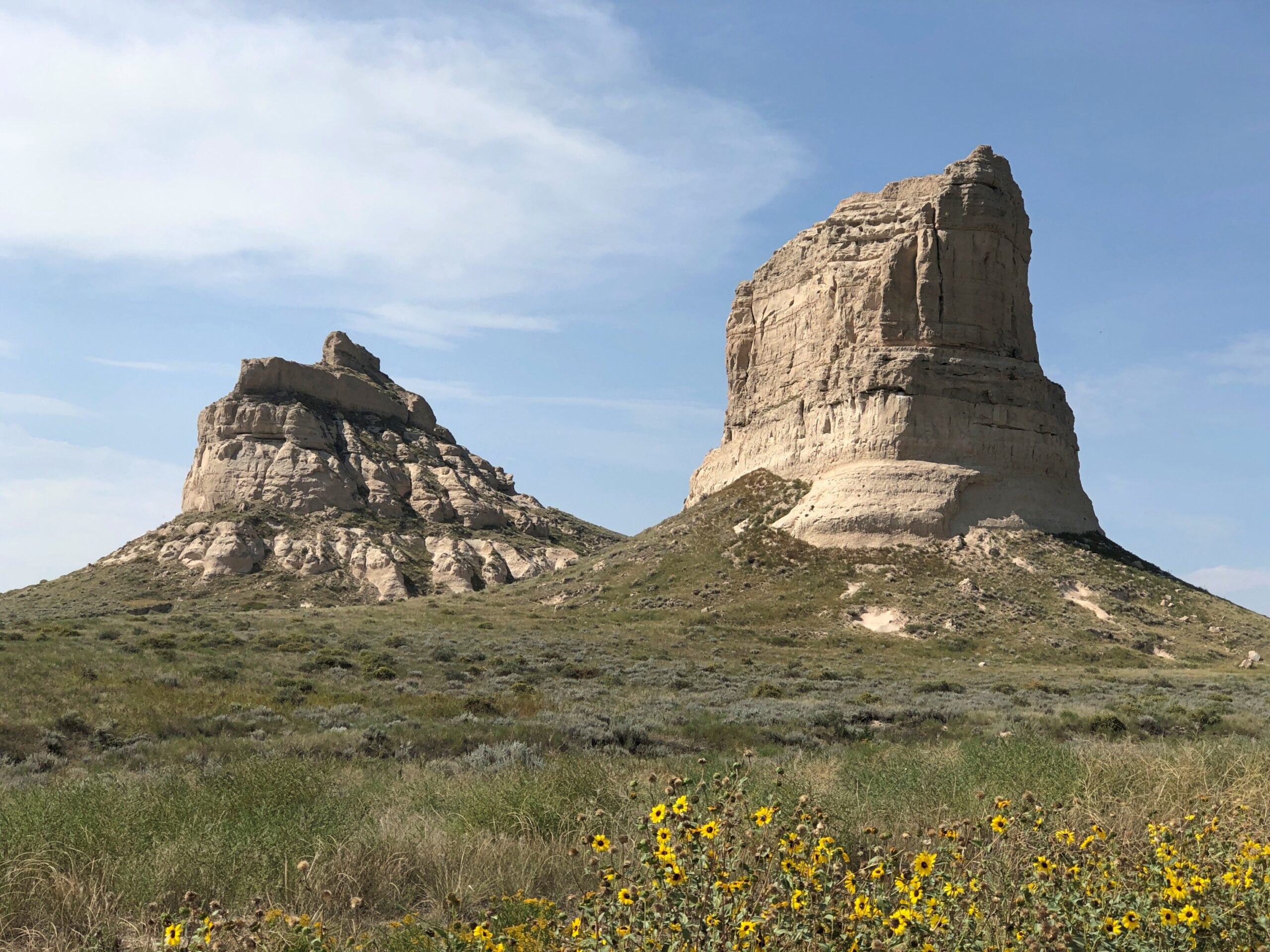
East of Scotts Bluff not far from highway US 26 is a set of rocks known as Courthouse and Jail. There’s something to that name.

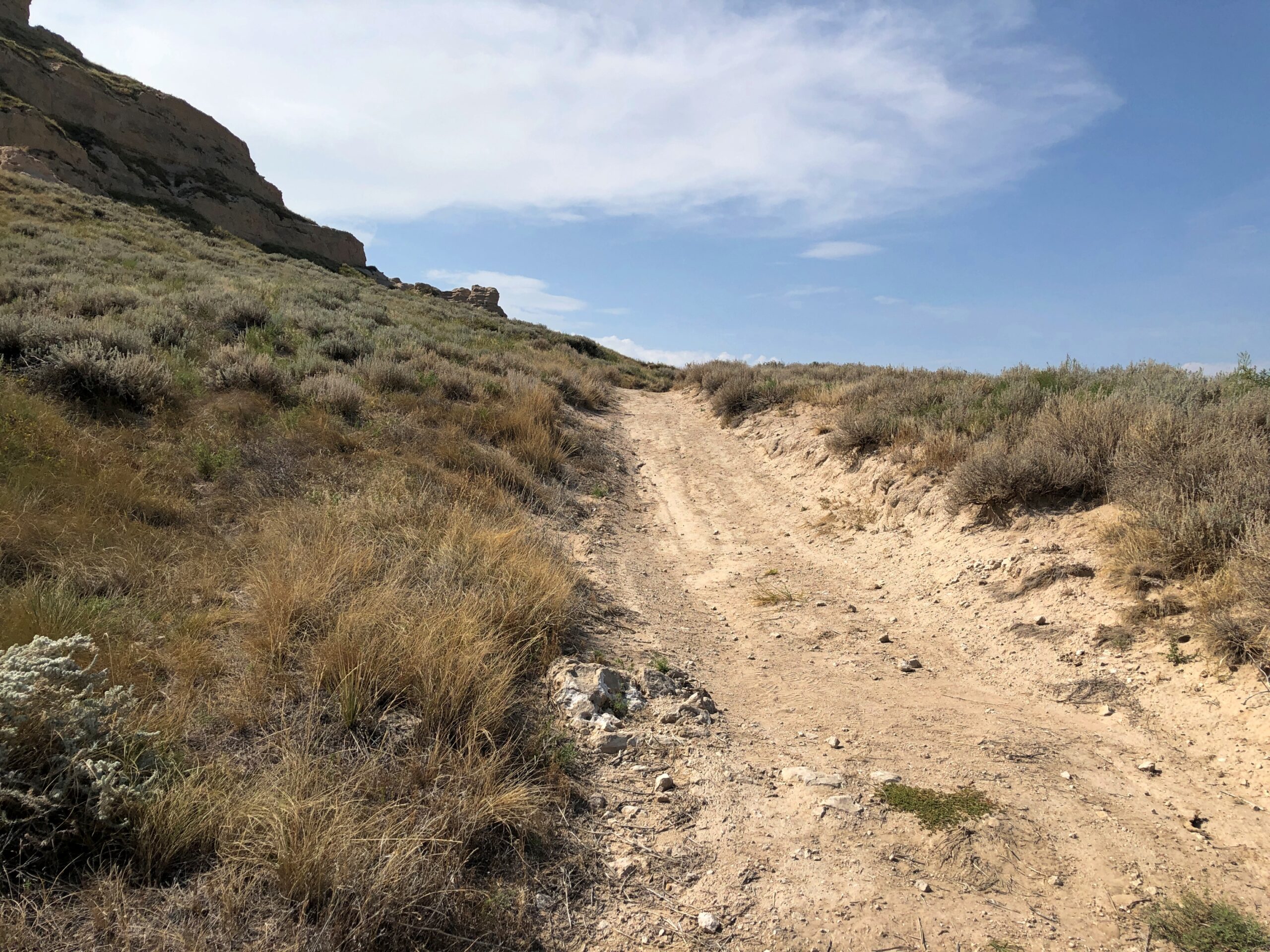
If Scotts Bluff was lightly visited, these two were almost completely empty. I stopped by on the afternoon of the 7th, and the only other people in the parking lot were sitting next to their RV, under a tarp, probably shooting the breeze over beer. So I had the trail to myself, though I didn’t go that far under the hot and copper sky.
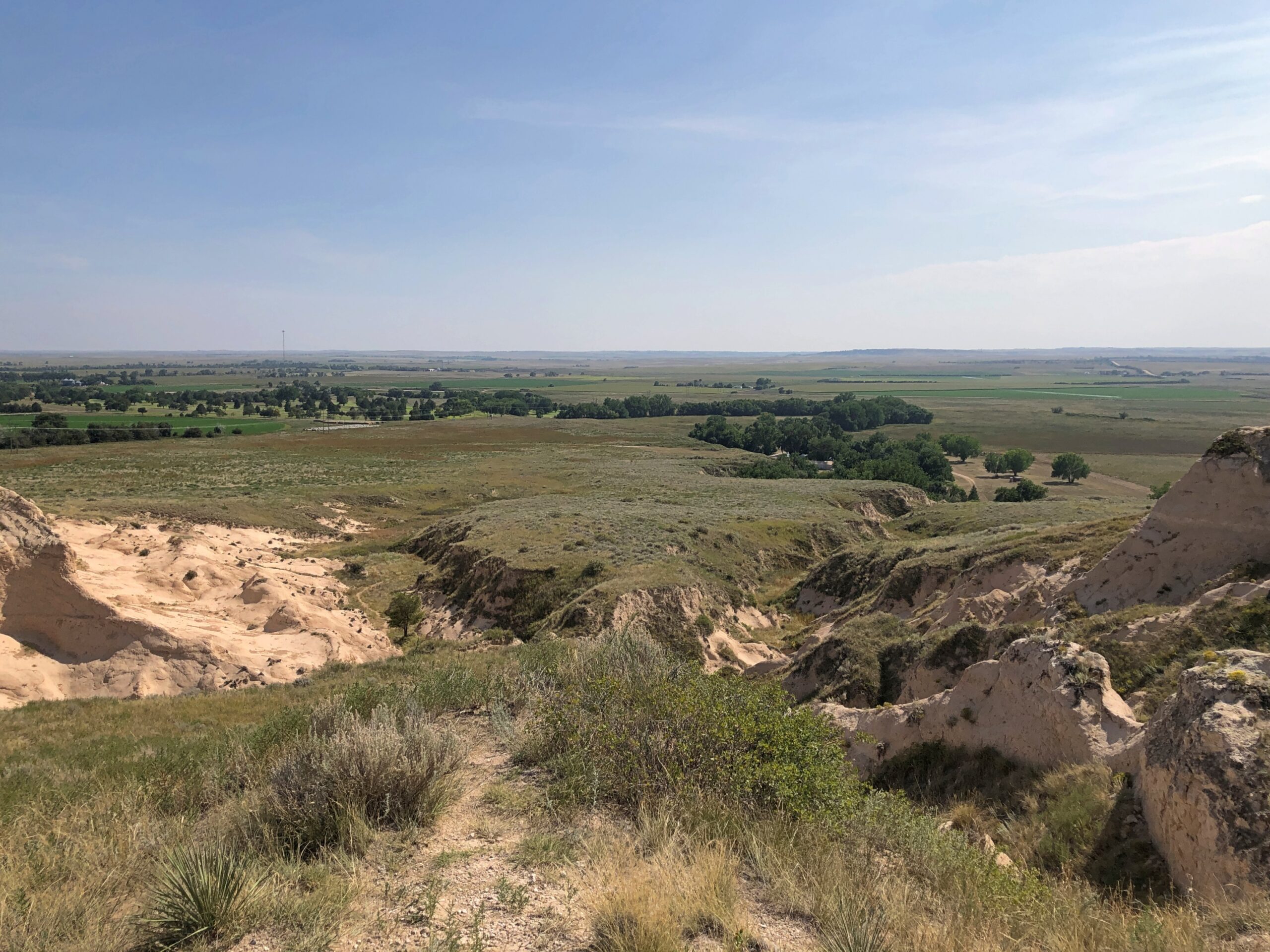
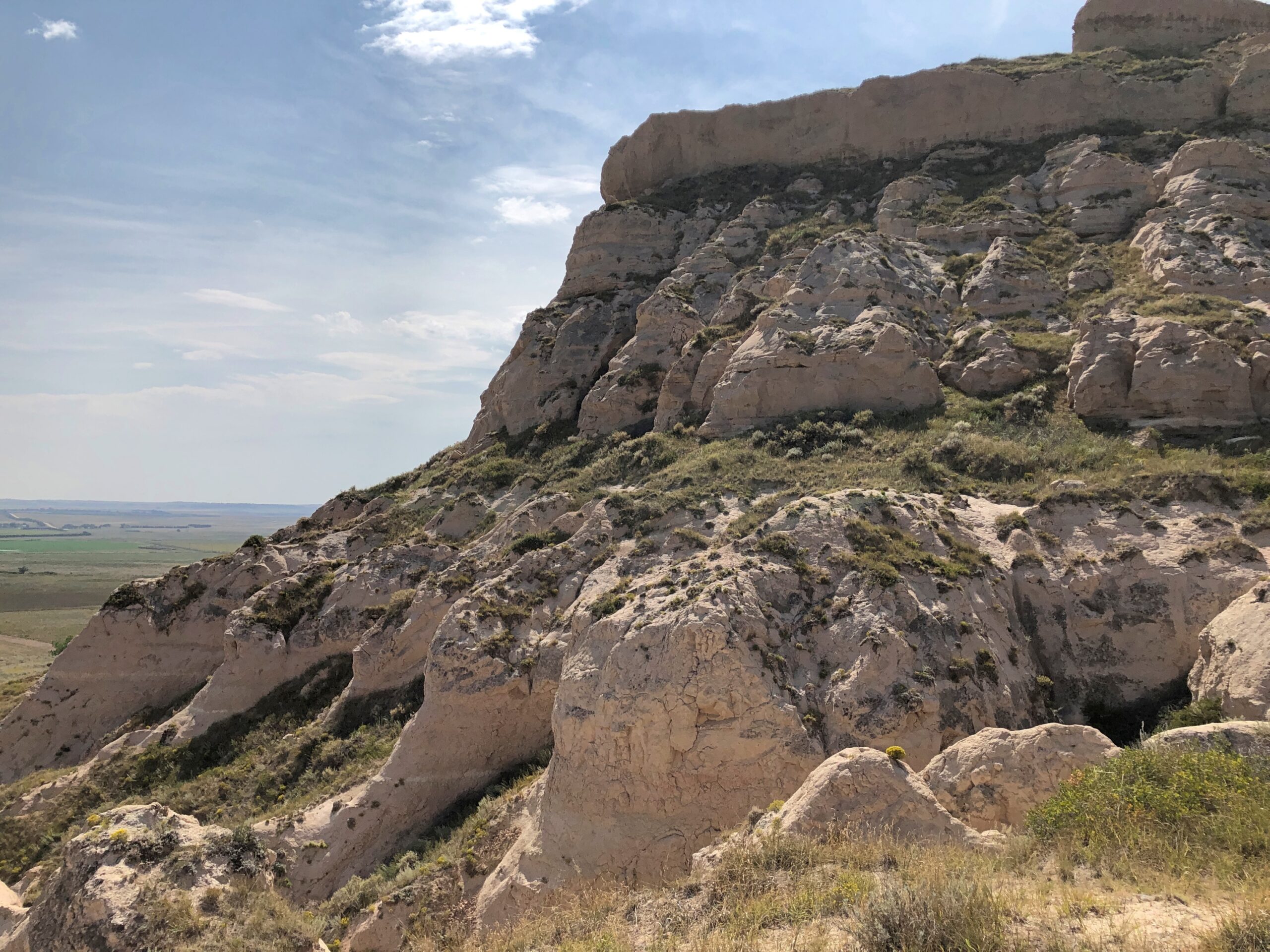
Offering some views of its own.
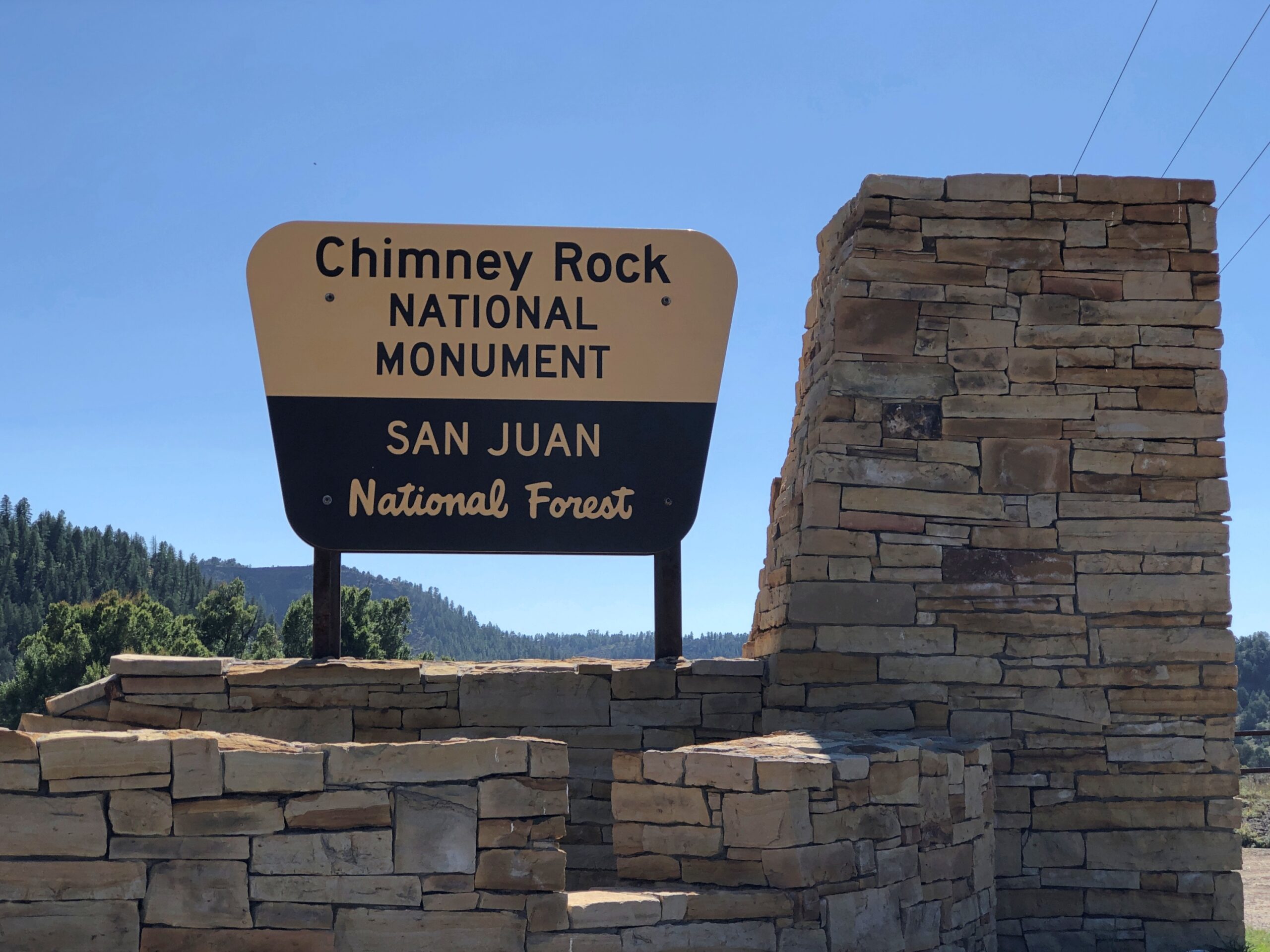
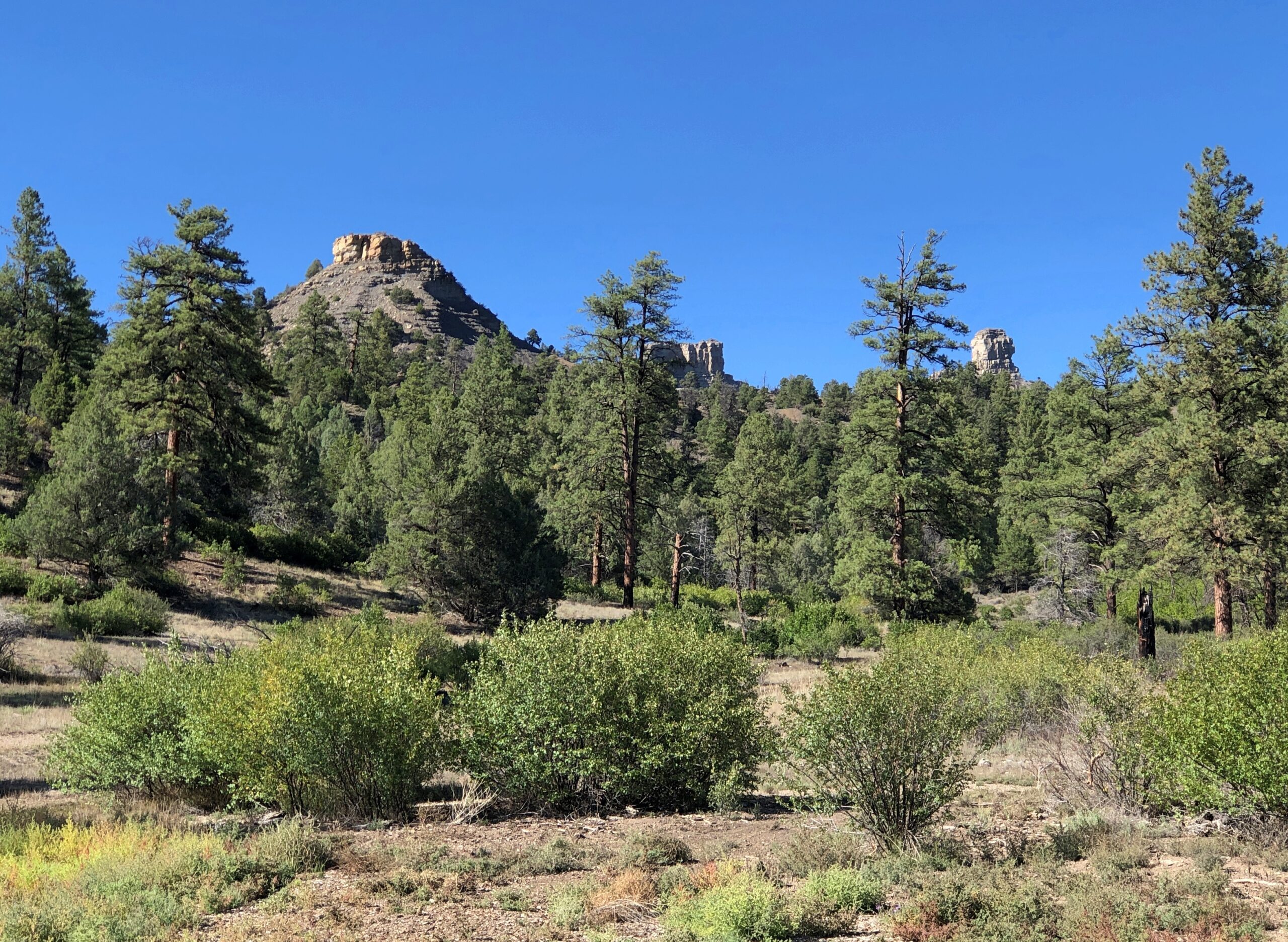
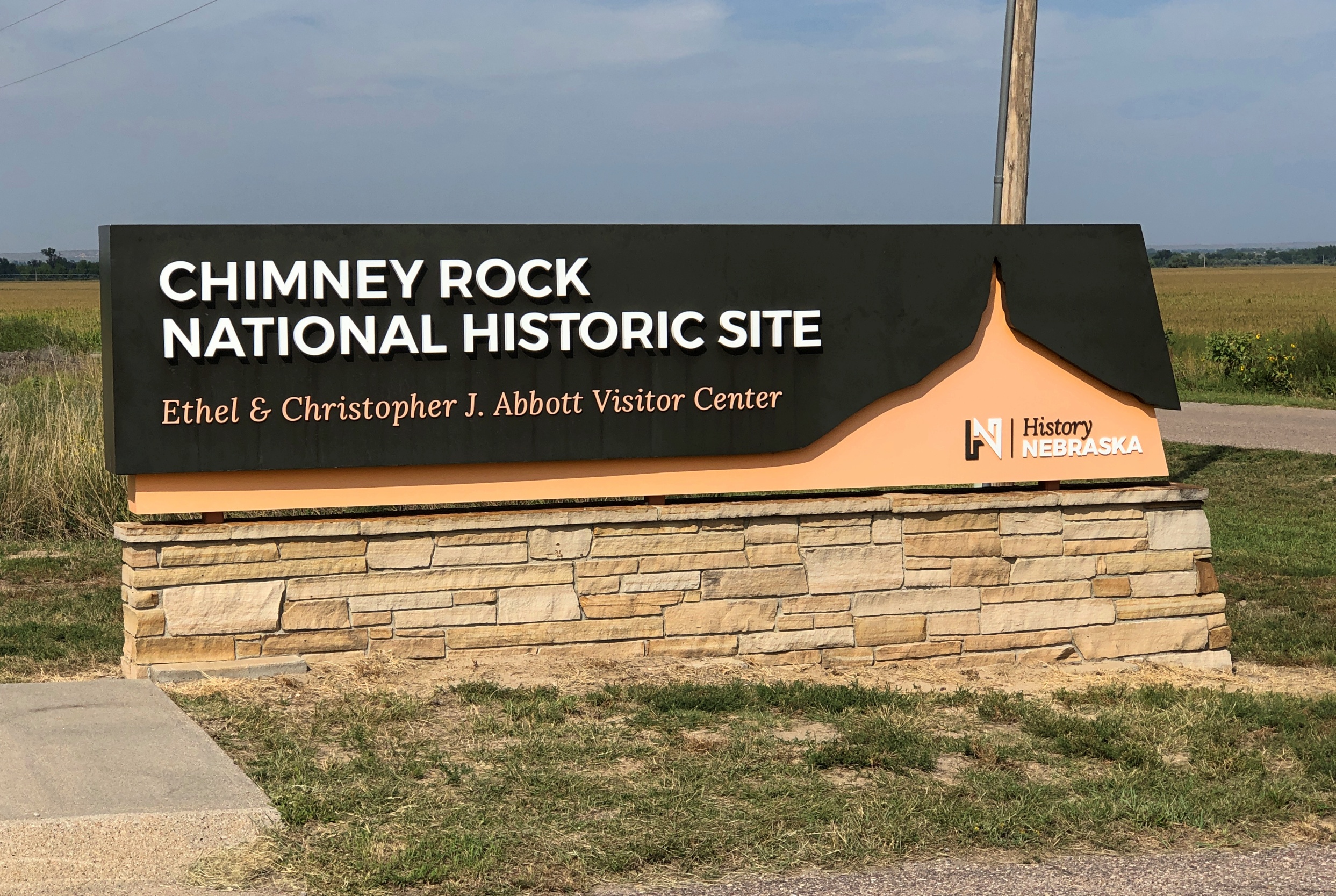
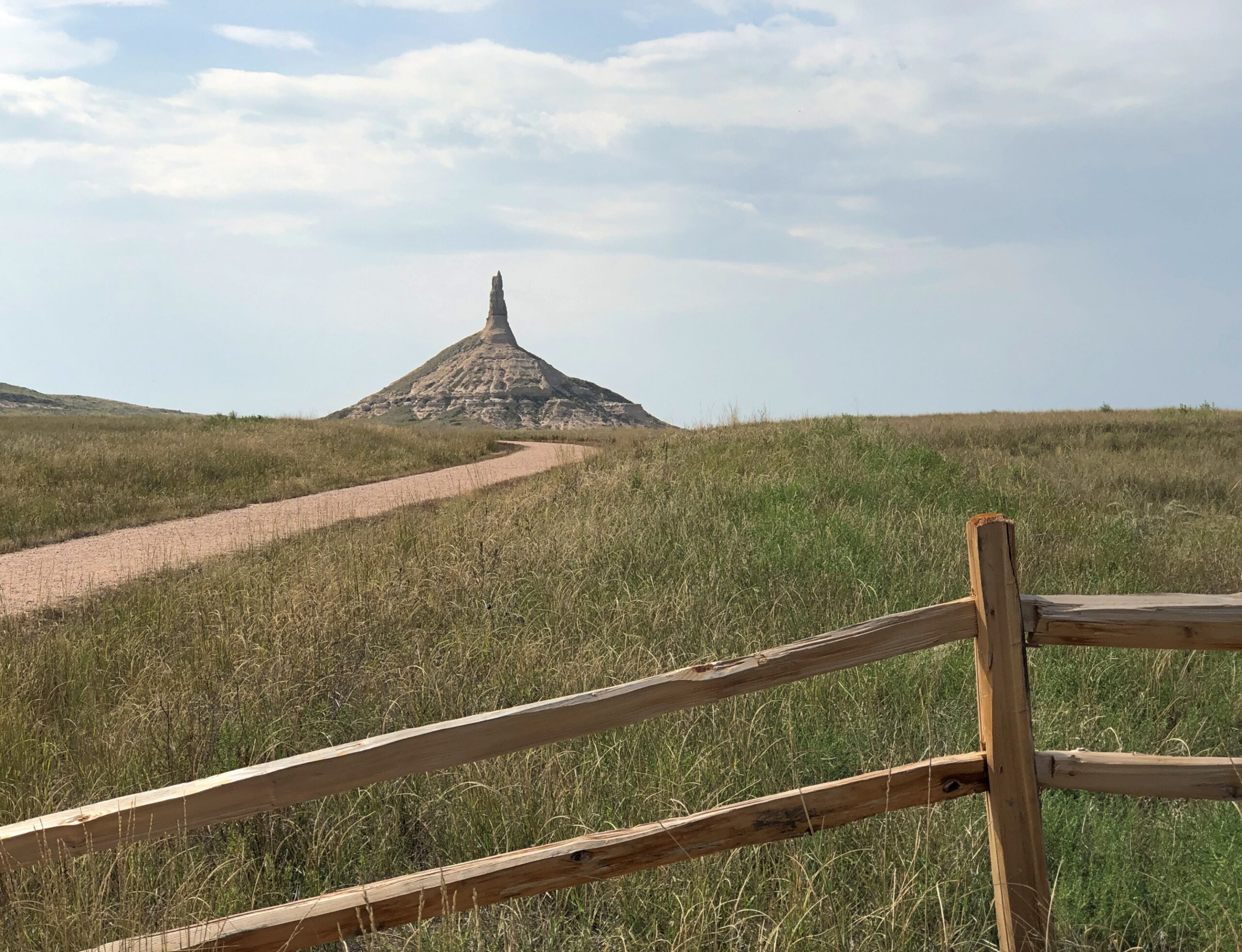
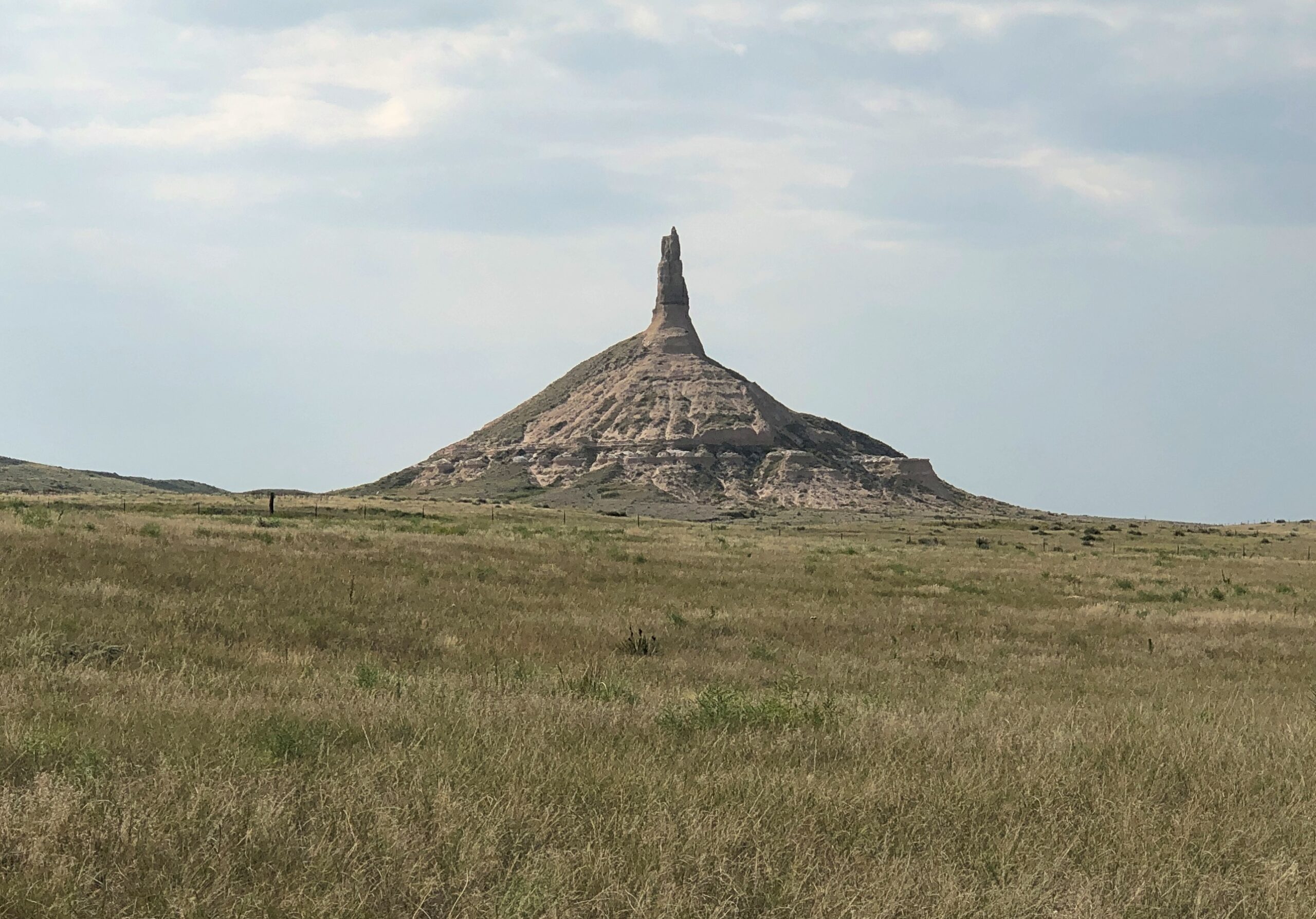
Not far away in this part of Nebraska (at least by horseless carriage) is the better known Chimney Rock National Historic Site.

It was later on same day as Courthouse and Jail, and the heat was still on. Again, I didn’t want a personal heat event to interrupt my trip, so I didn’t go as close as the trails would have allowed.

Chimney Rock, Neb

I sent an image of Chimney Rock and a text message to old friend Tom J.:

The aliens decided that Devil’s Tower was a better site.

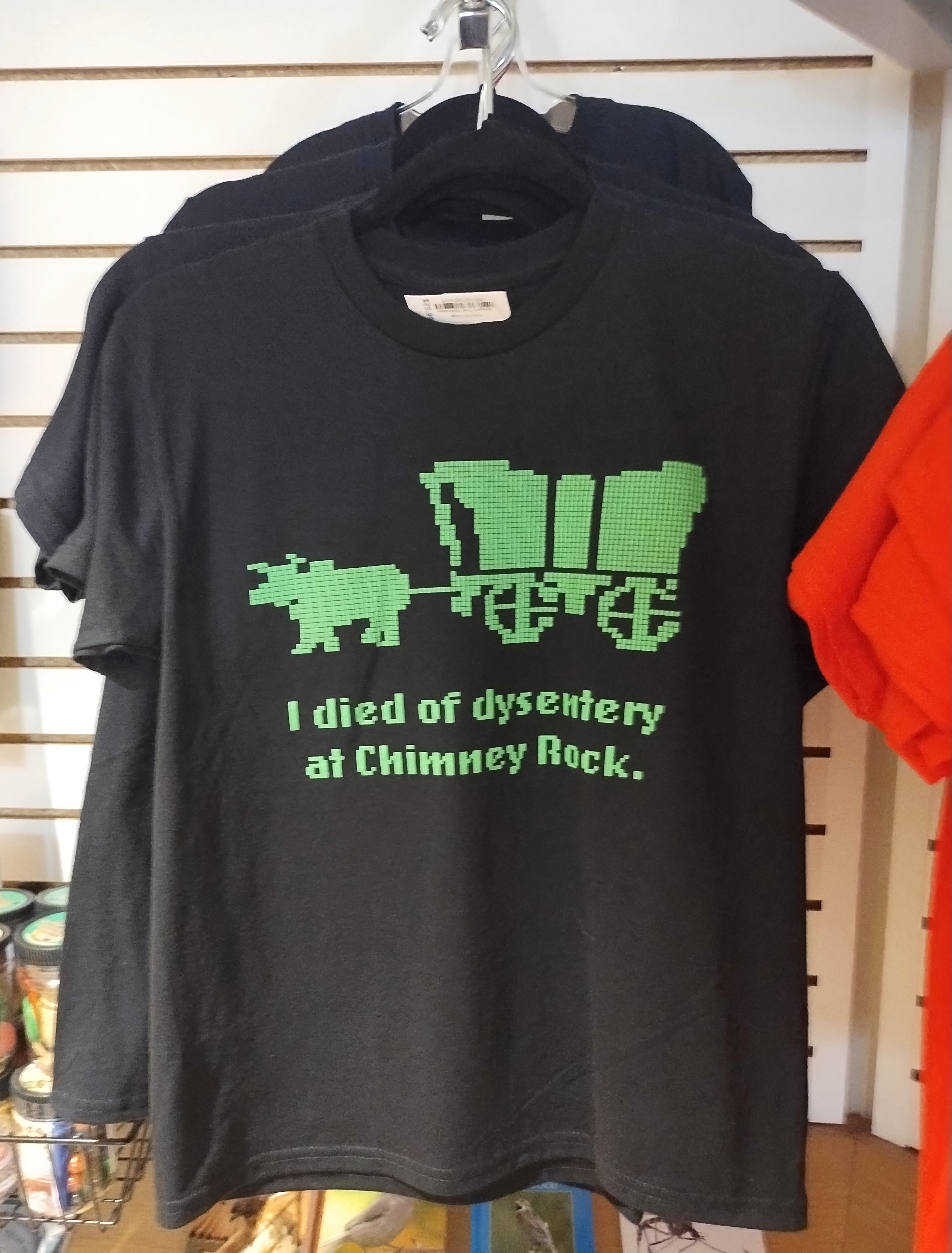
Then I sent this image from the Chimney Rock gift shop.

Chimney Rock, Neb

Tom answered:

lol. We never even played Oregon Trail and that’s still funny.

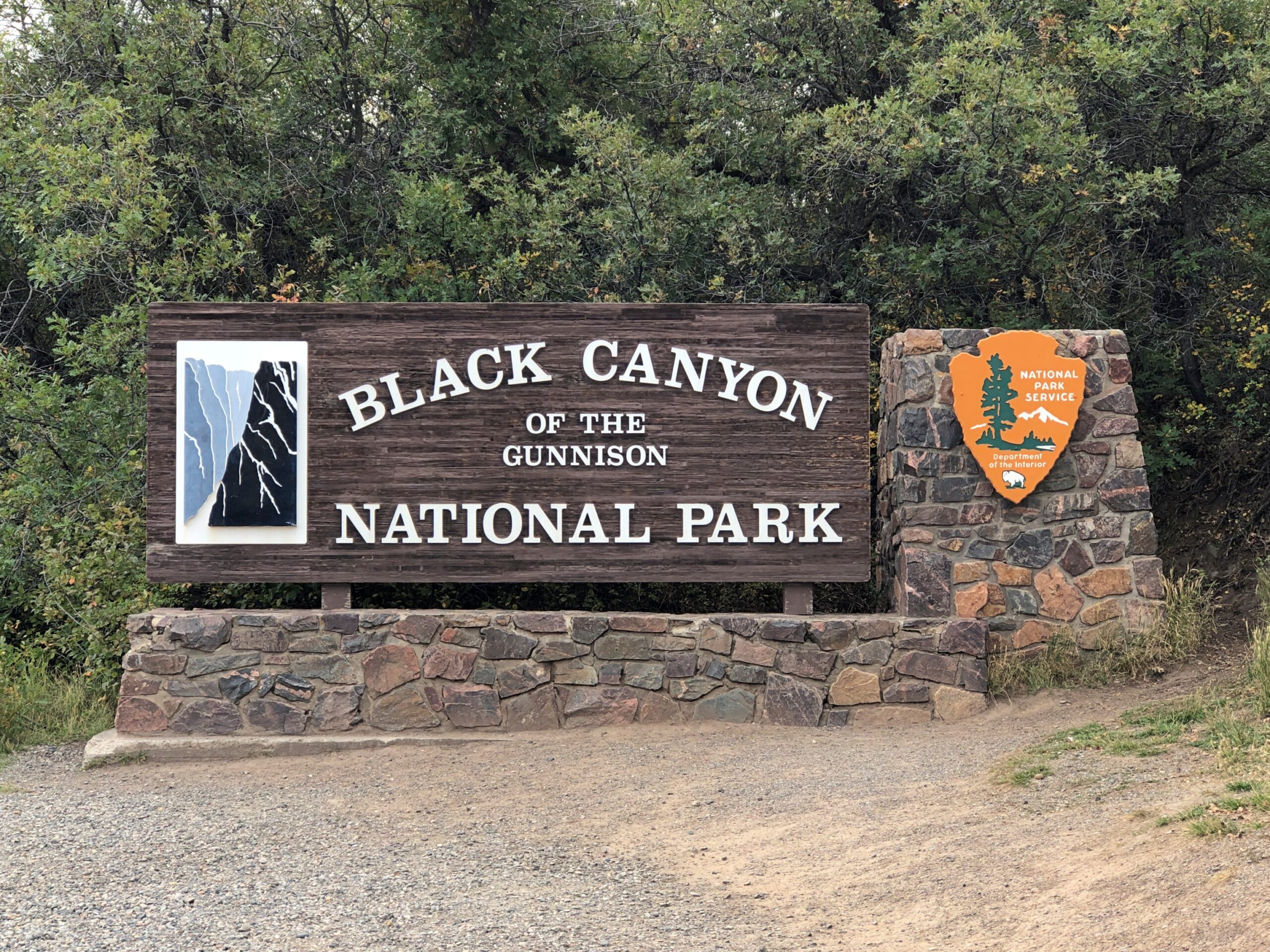
Black Canyon of the Gunnison National Park

A vast stretch of mountains majesty well over the tree line, a complex mass of sand piled at the edge of rugged mountains, and the well-hewn cliffside relics of a people remote in time but whose presence endures – the first three national parks we visited in Colorado in September all rated as exceptional destinations. But I’m glad, simply because it was last on the clockwise loop I’d planned through the state, that Black Canyon of the Gunnison National Park came last. It would have been a hard act to follow.

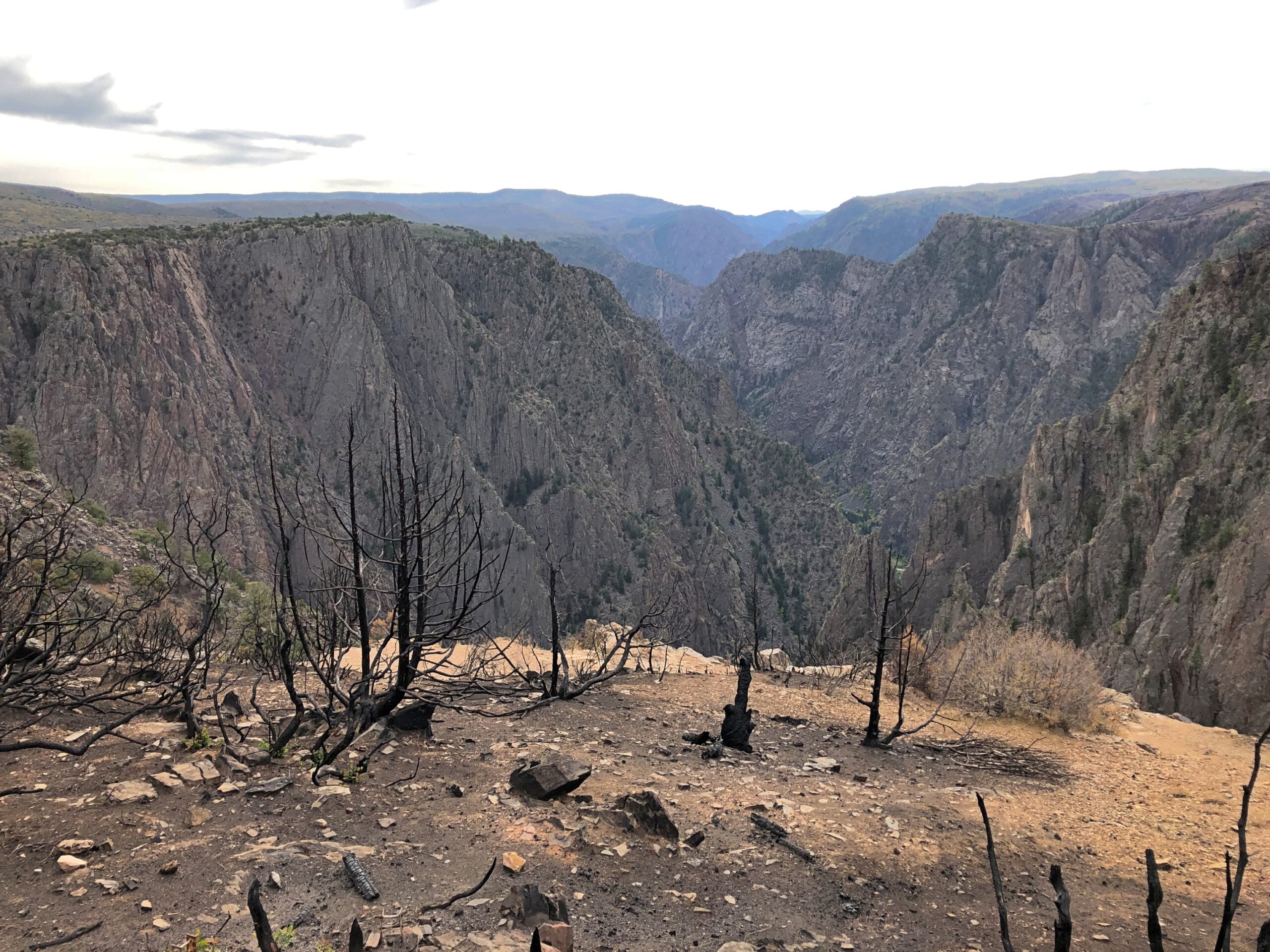
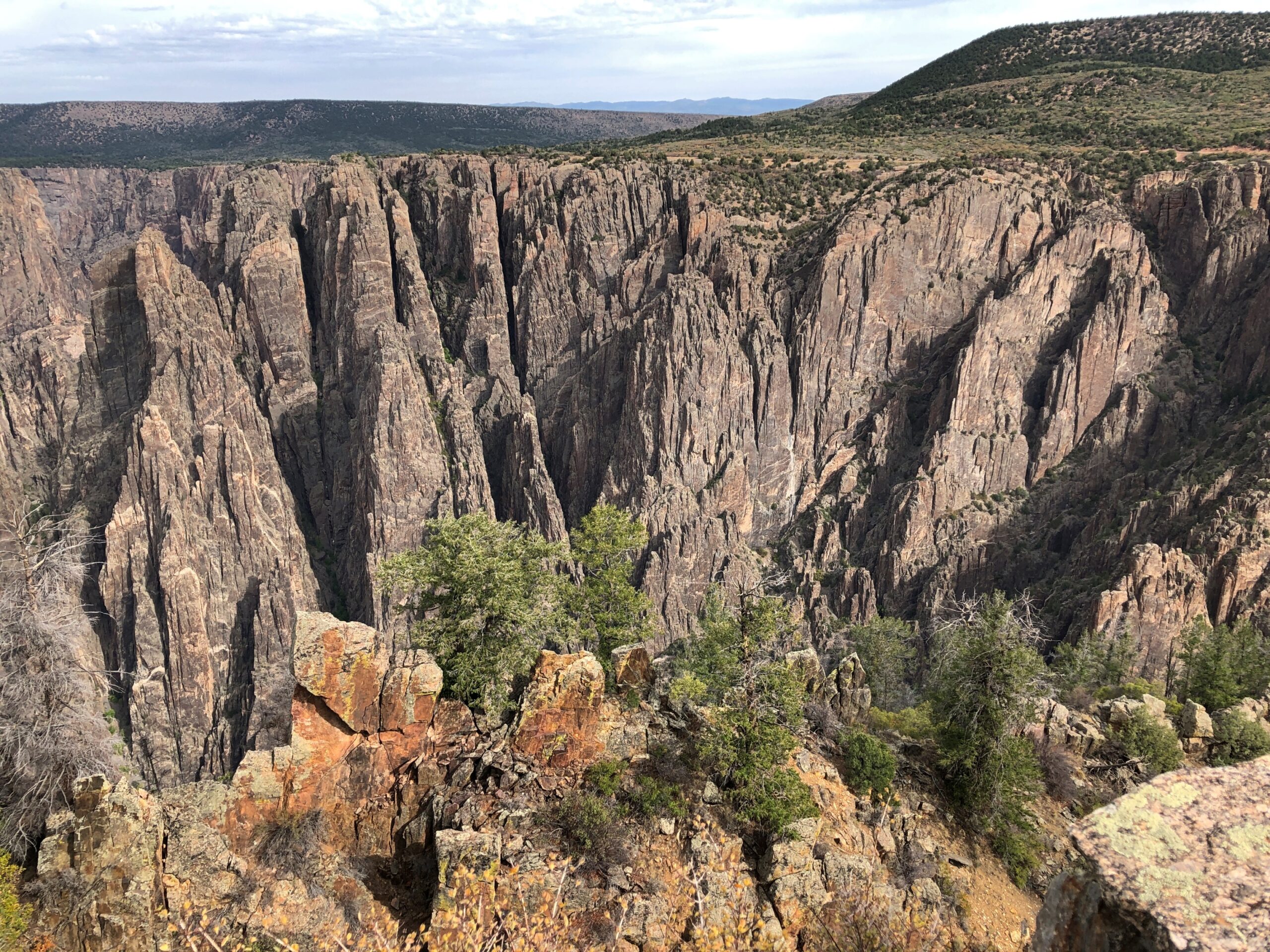
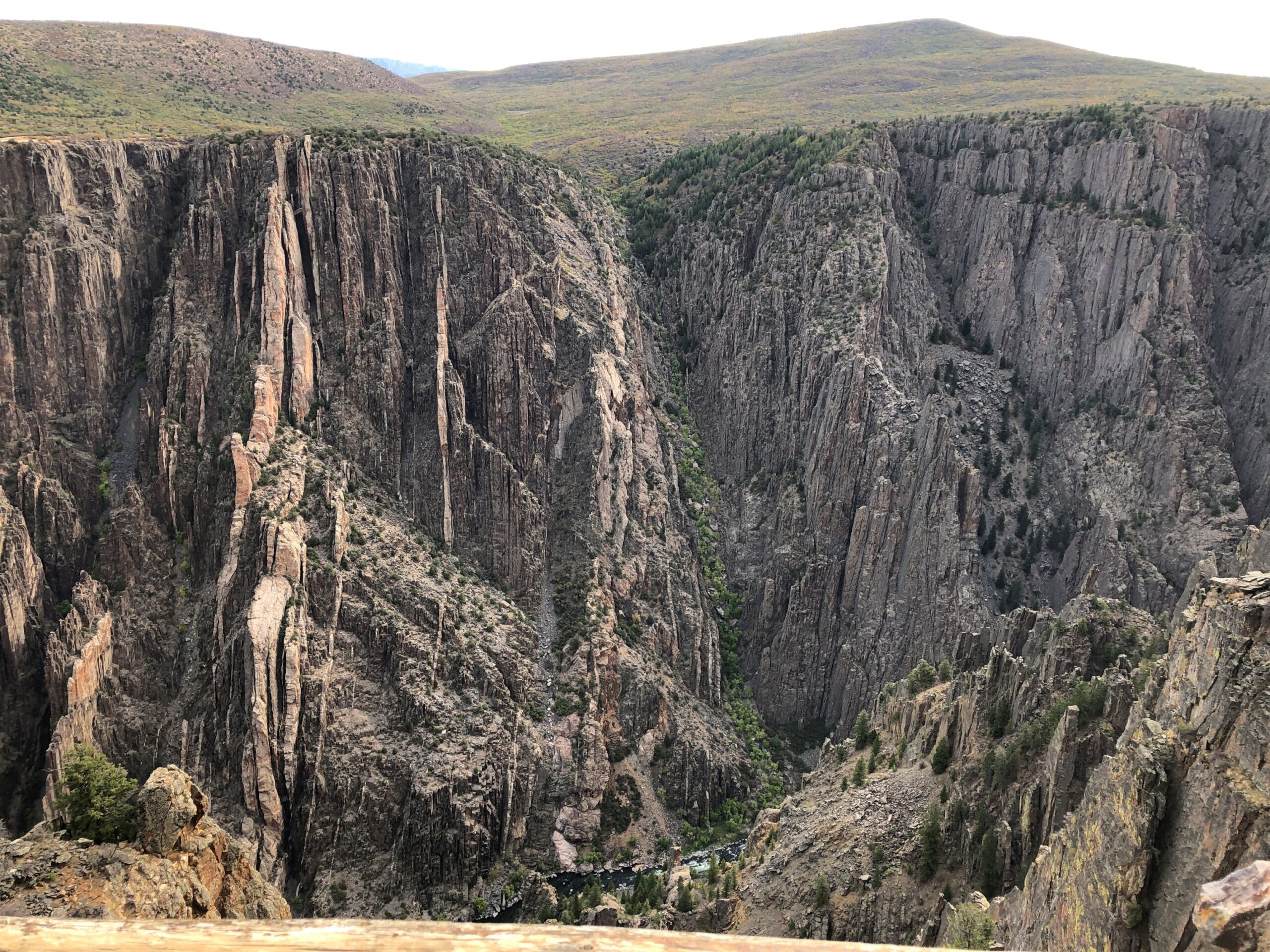
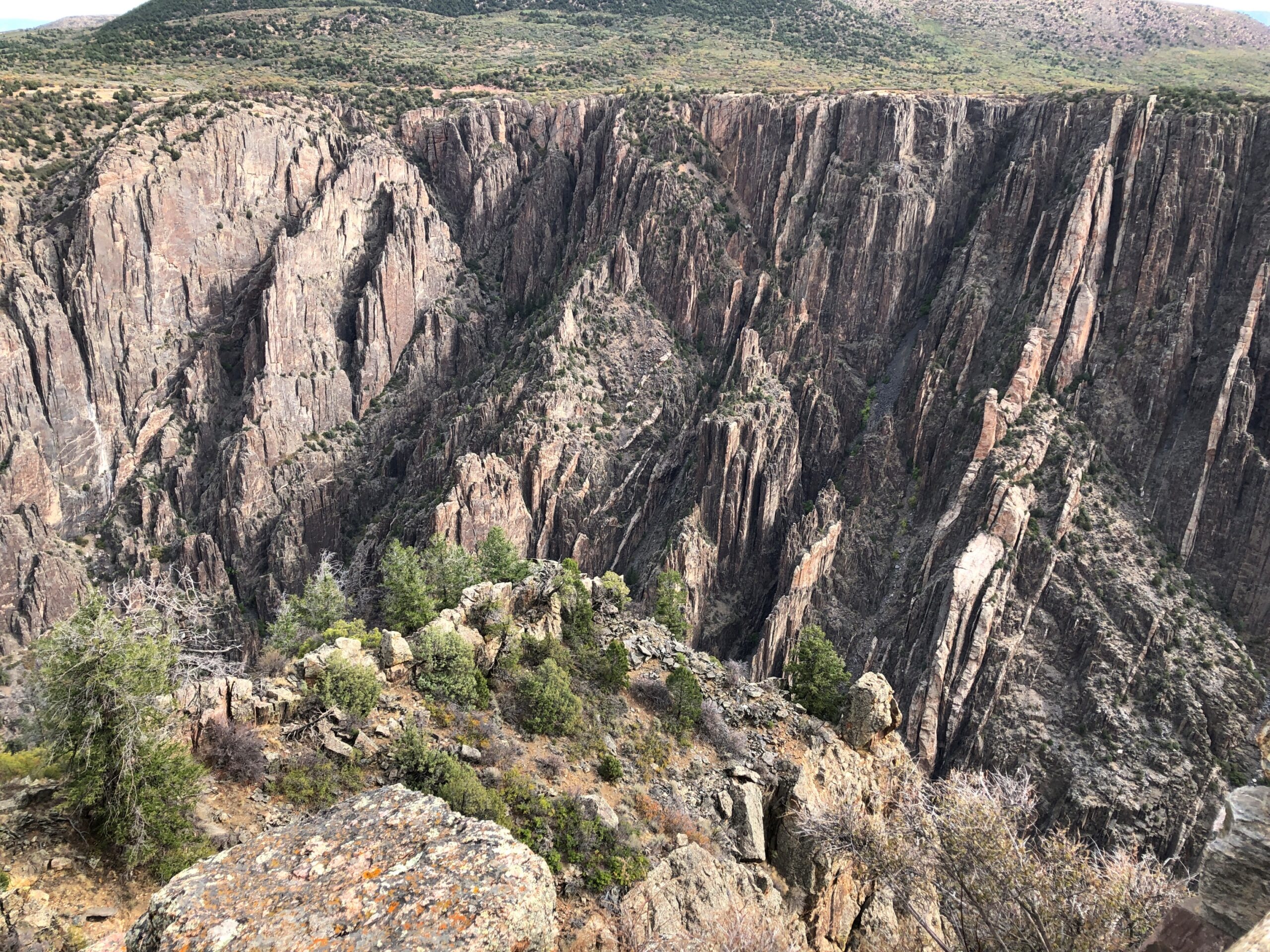
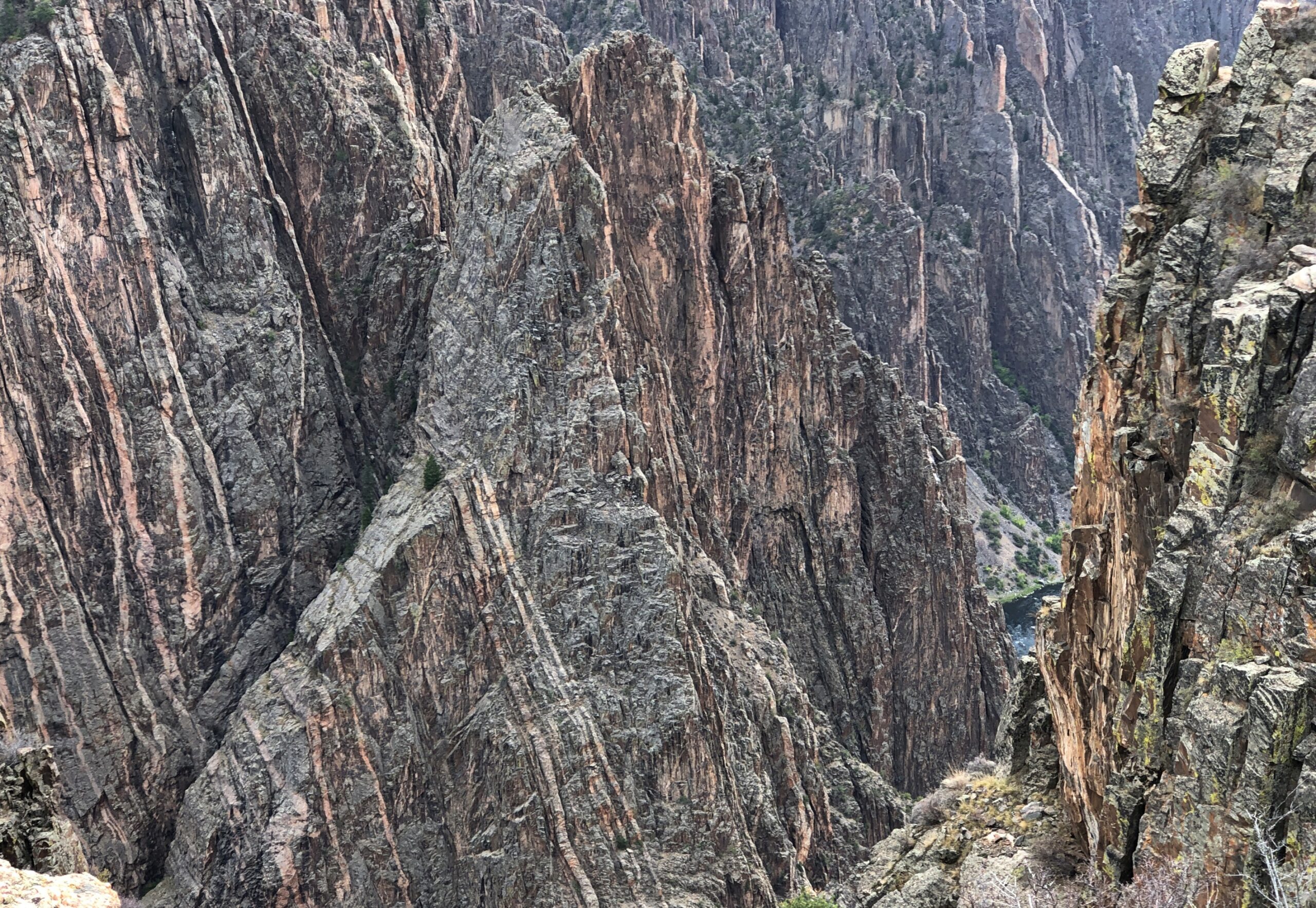
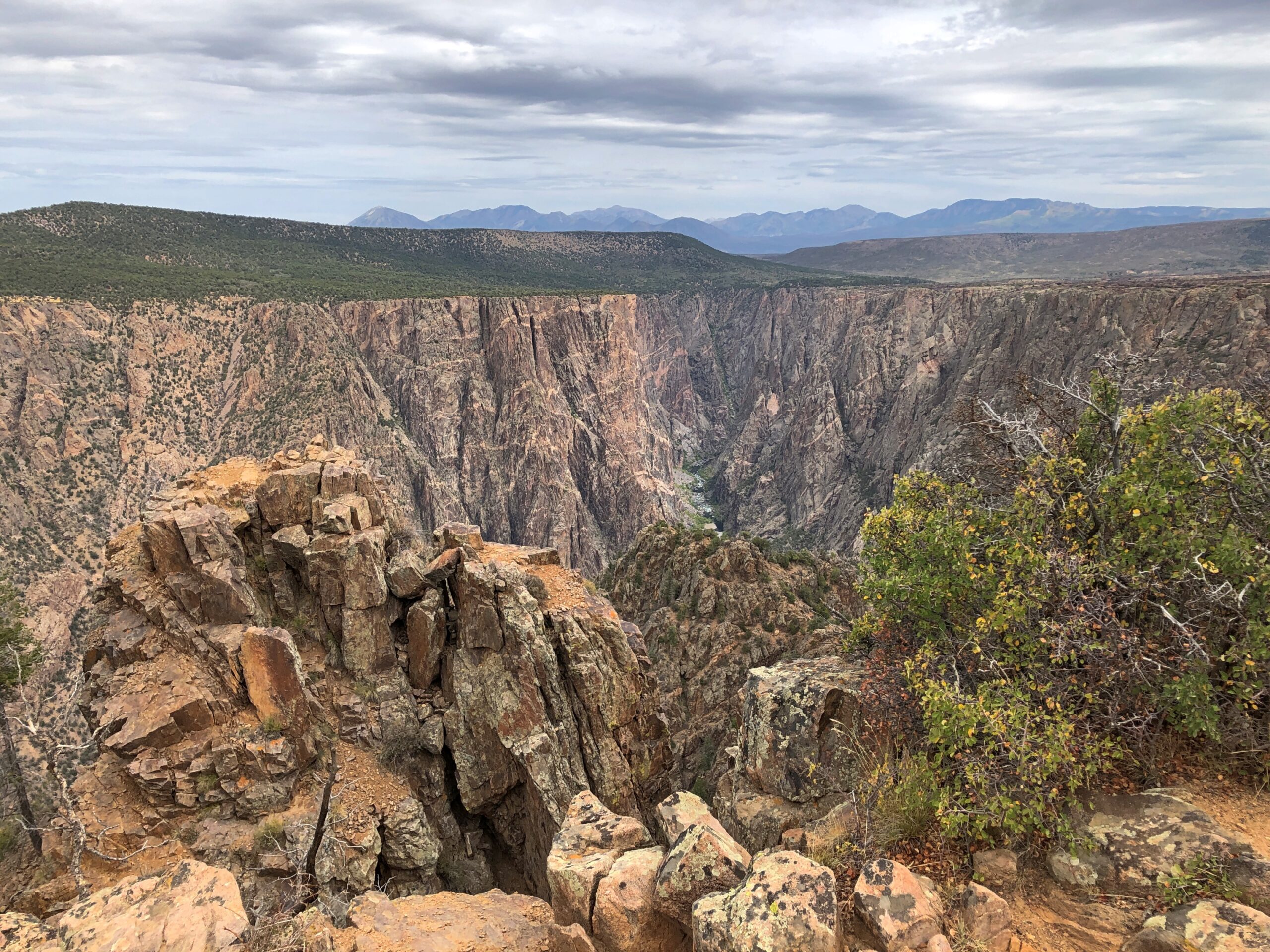
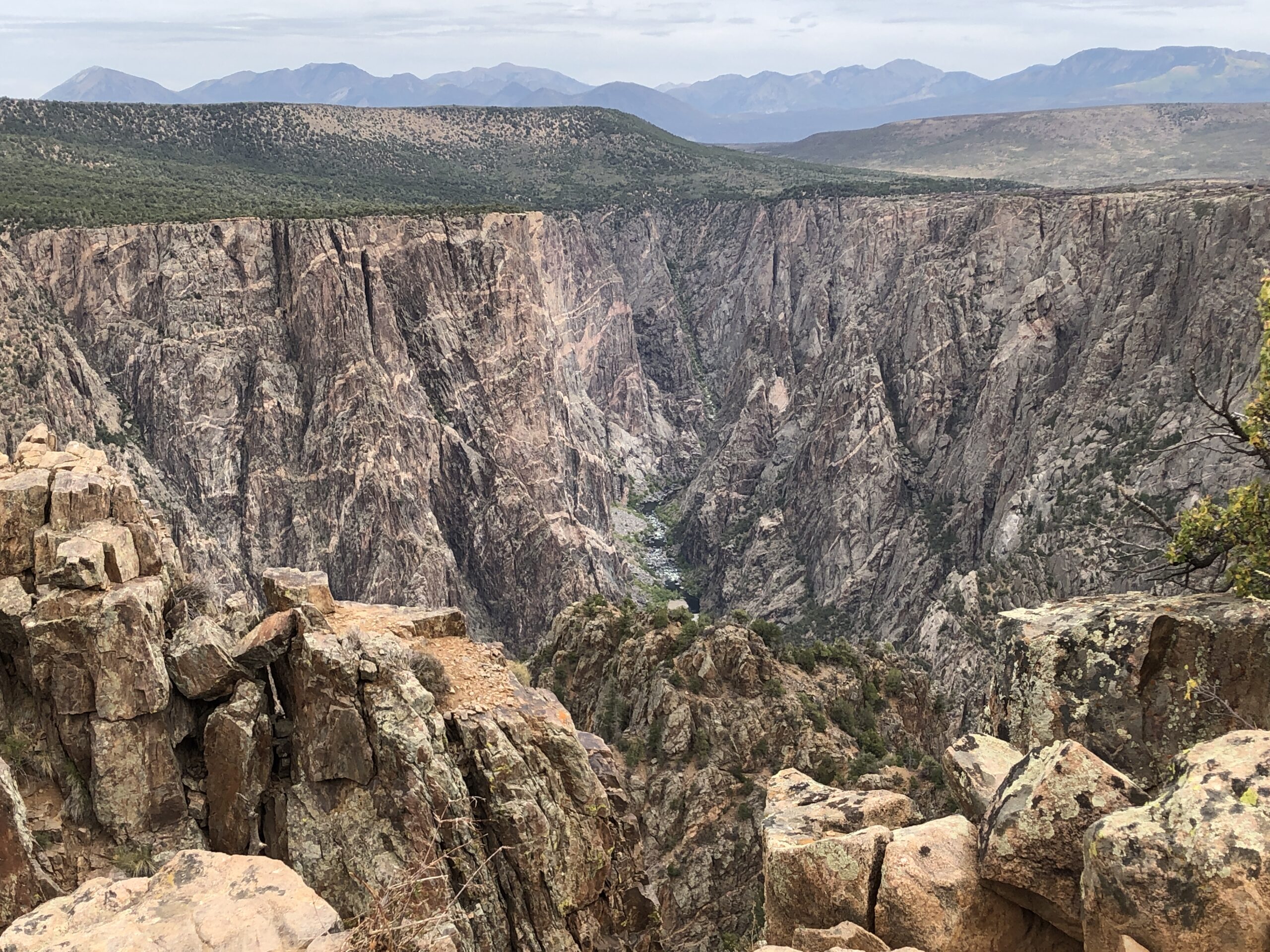
As a steep – and really deep – crack in the earth, the Black Canyon lives up its name, with most of the canyon cast in shadow most of the time, striking in its seeming darkness. But not pitch black all the way down its 2,000-foot cliffs. Far away, a whitish irregular ribbon runs through the gray bottom of the canyon, quickly recognizable as a river in quicksilver motion. The Gunnison, that is.

If there were no other people around, which happened sometimes at this park, you could hear the roar of the river. Faint, but distinct in its power. Mass snow melts and rushing tributary creeks enable the Gunnison to act (on a geological time scale) like a high-powered saw cutting through rocks that are unimaginably ancient. Before long, that is 2 million years, the river gouged the crack you see, exposing rocks 1,000 times older than the time it took to cut the canyon.

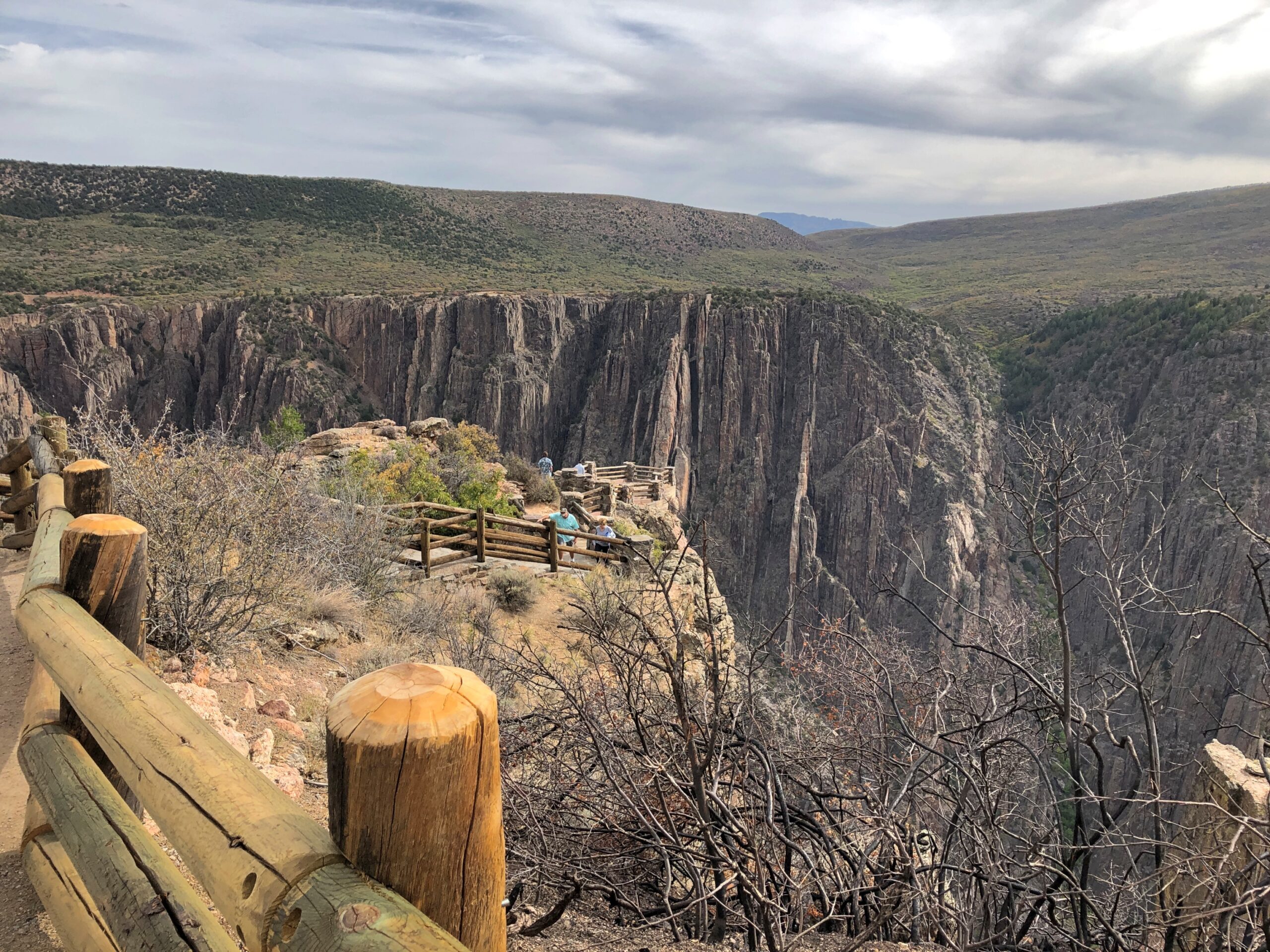
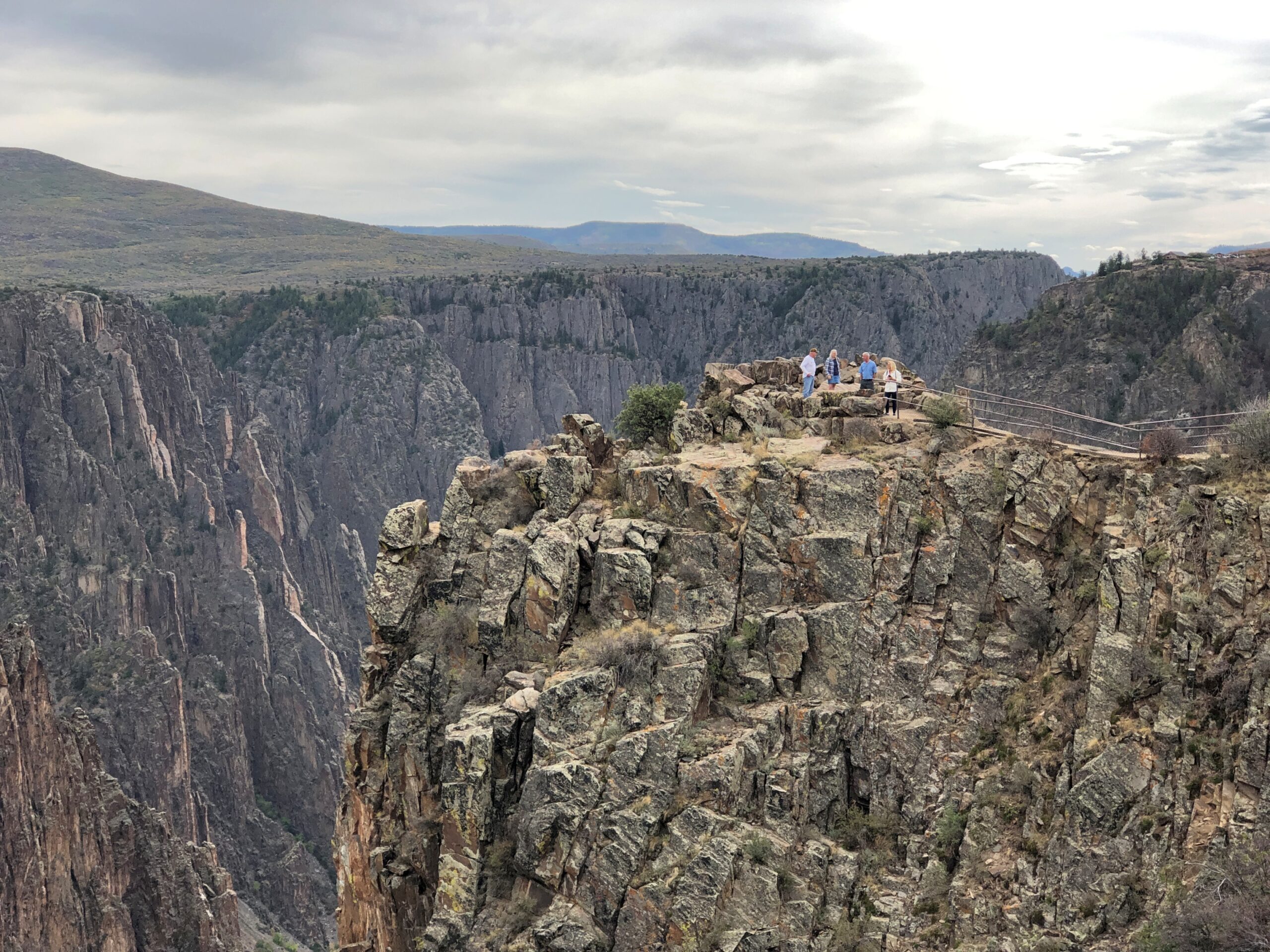
A single two-lane road snakes about seven miles along the south rim of the canyon (should I even have to say it? By the CCC), offering a string of overlooks. Not far from the park entrance, an overlook gives a taste of vistas to come. I might have named the place Gray Canyon, but that isn’t quite as poetic, is it?

Black Canyon of the Gunnison

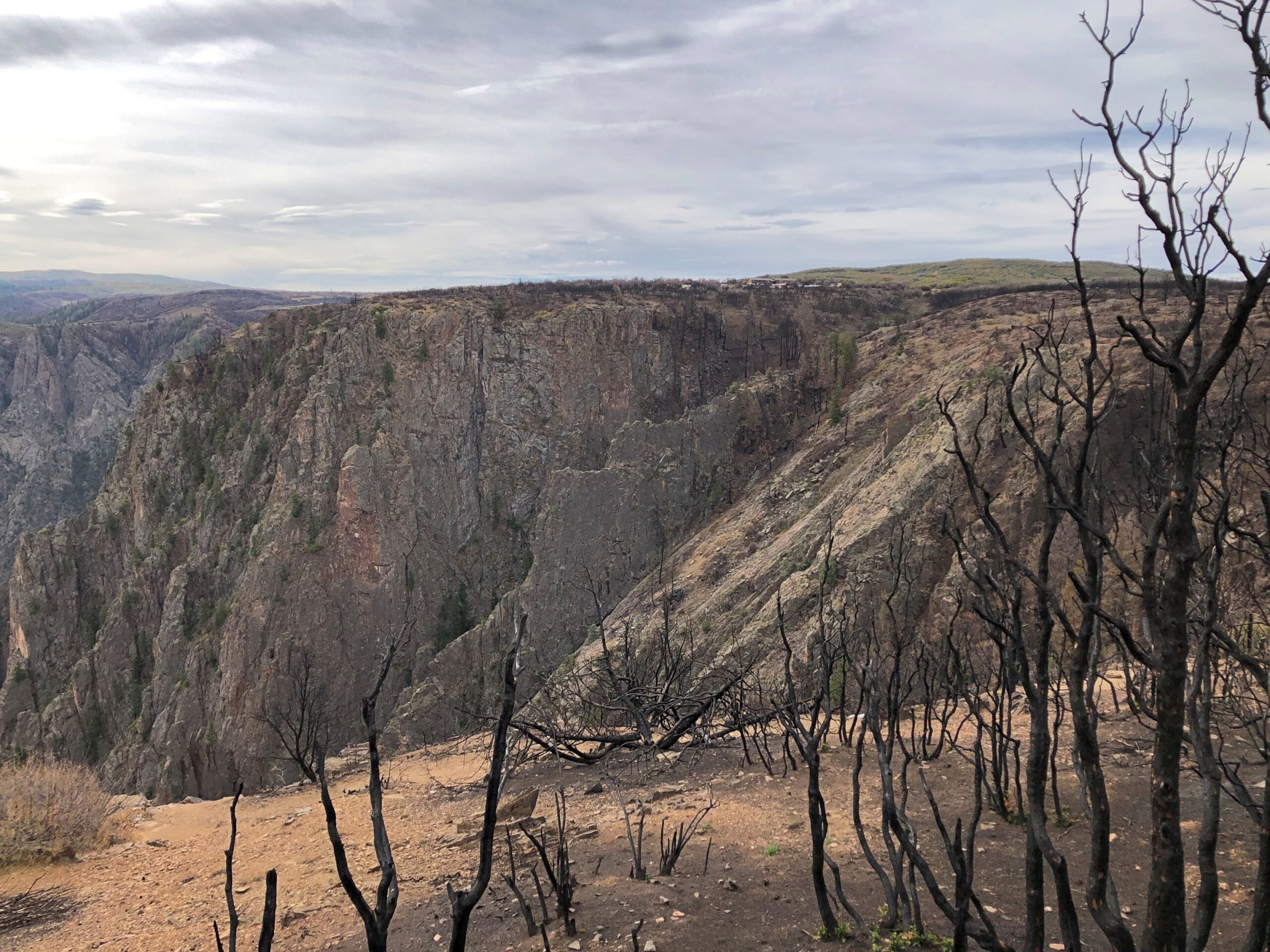
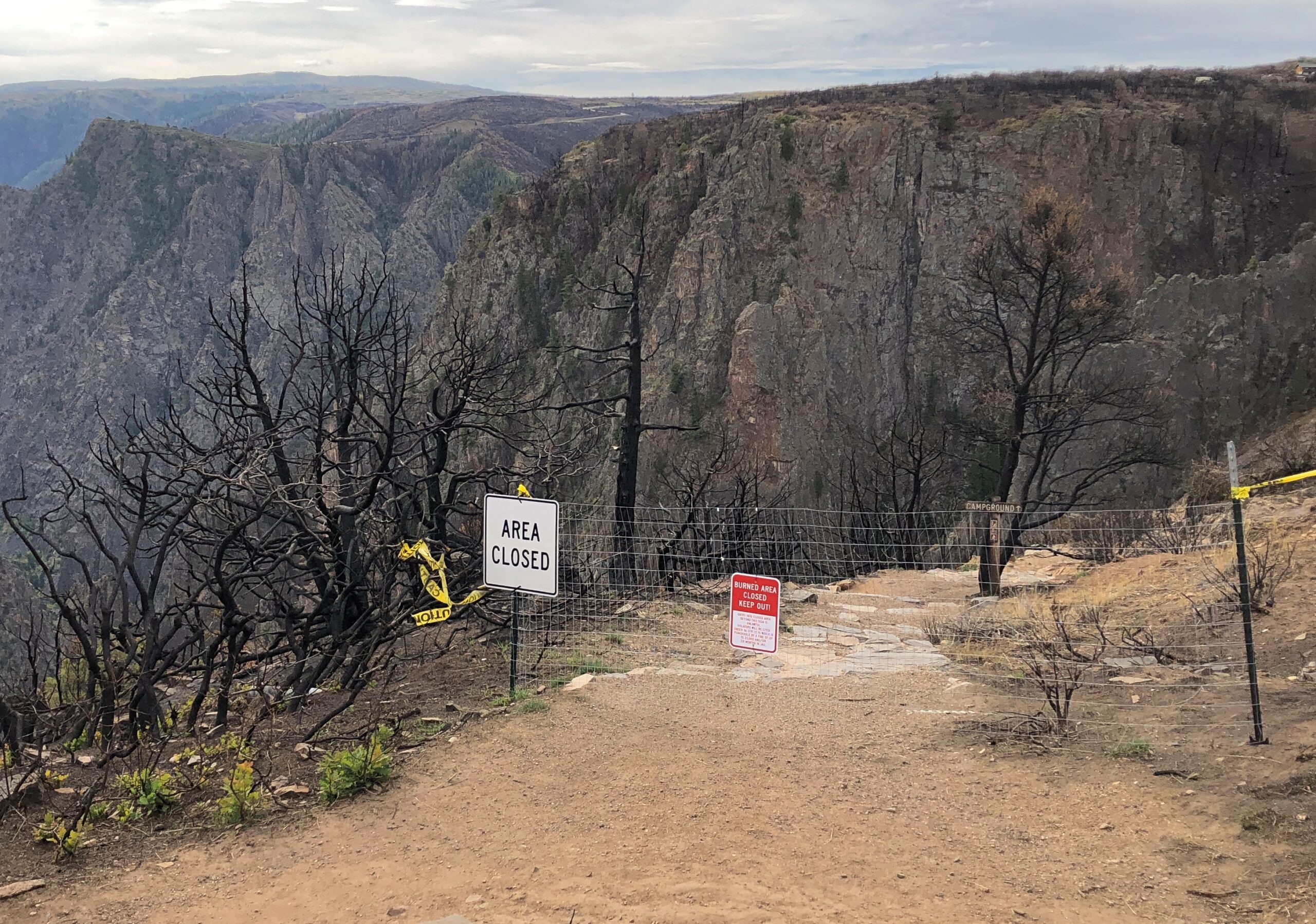
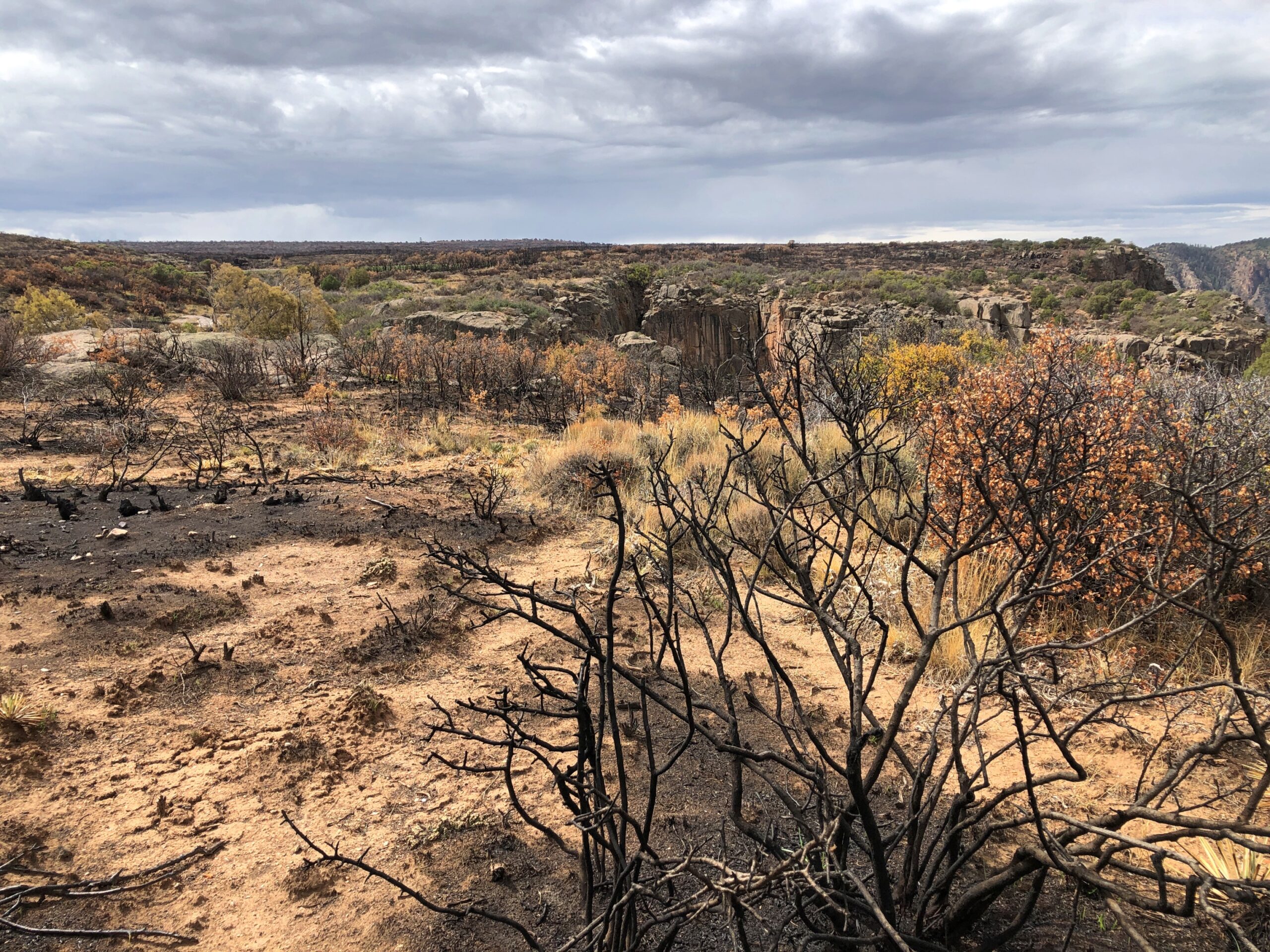
Also, evidence of the fire that swept through the park in July, burning about a total of about 4,000 acres on both the south and north rims, along with some Park Service infrastructure. A number of trails leading away from the south rim overlooks were still closed when we visited the park on September 19, with signs disallowing access to charred grounds and slopes.

Black Canyon of the Gunnison

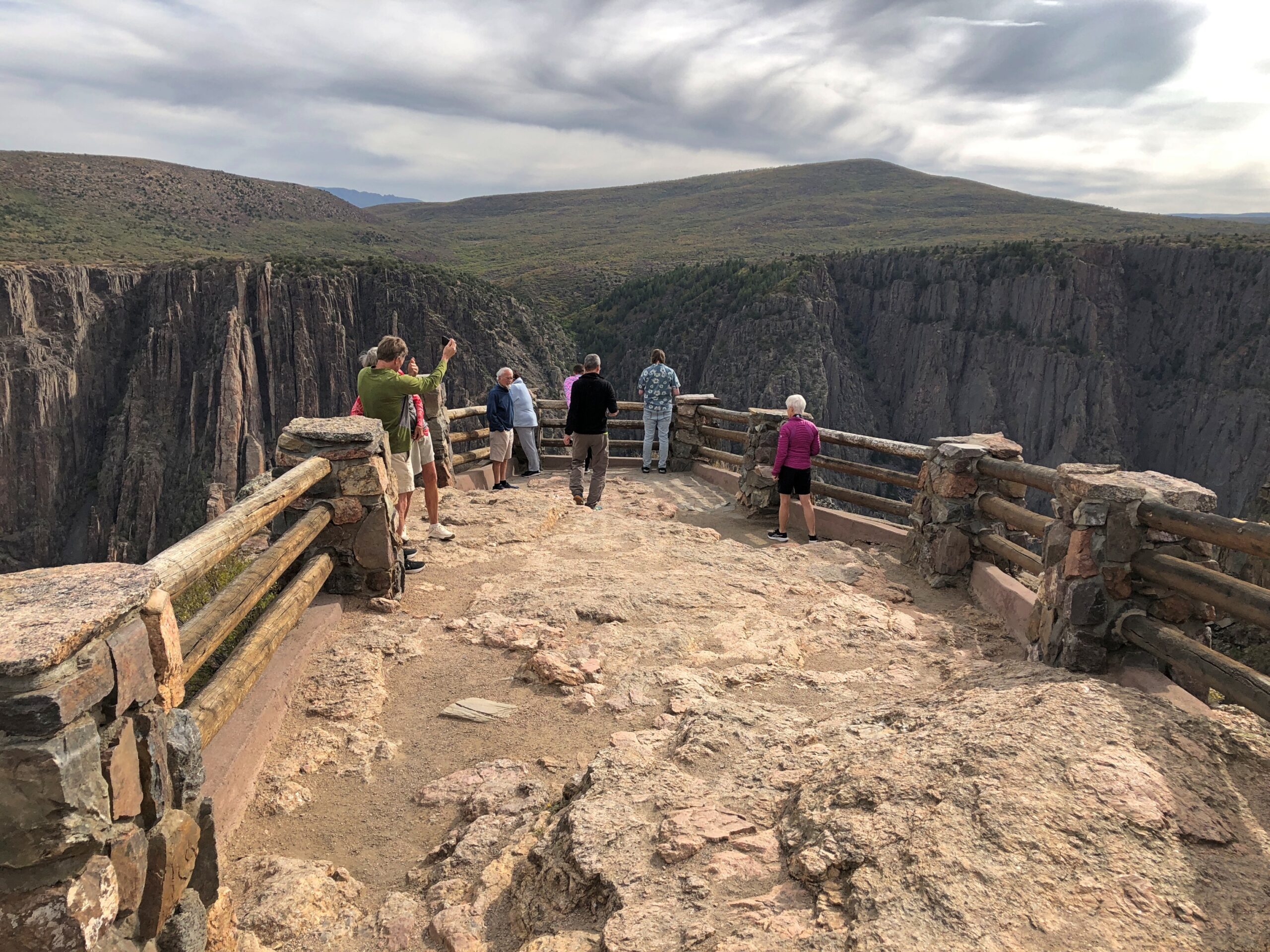
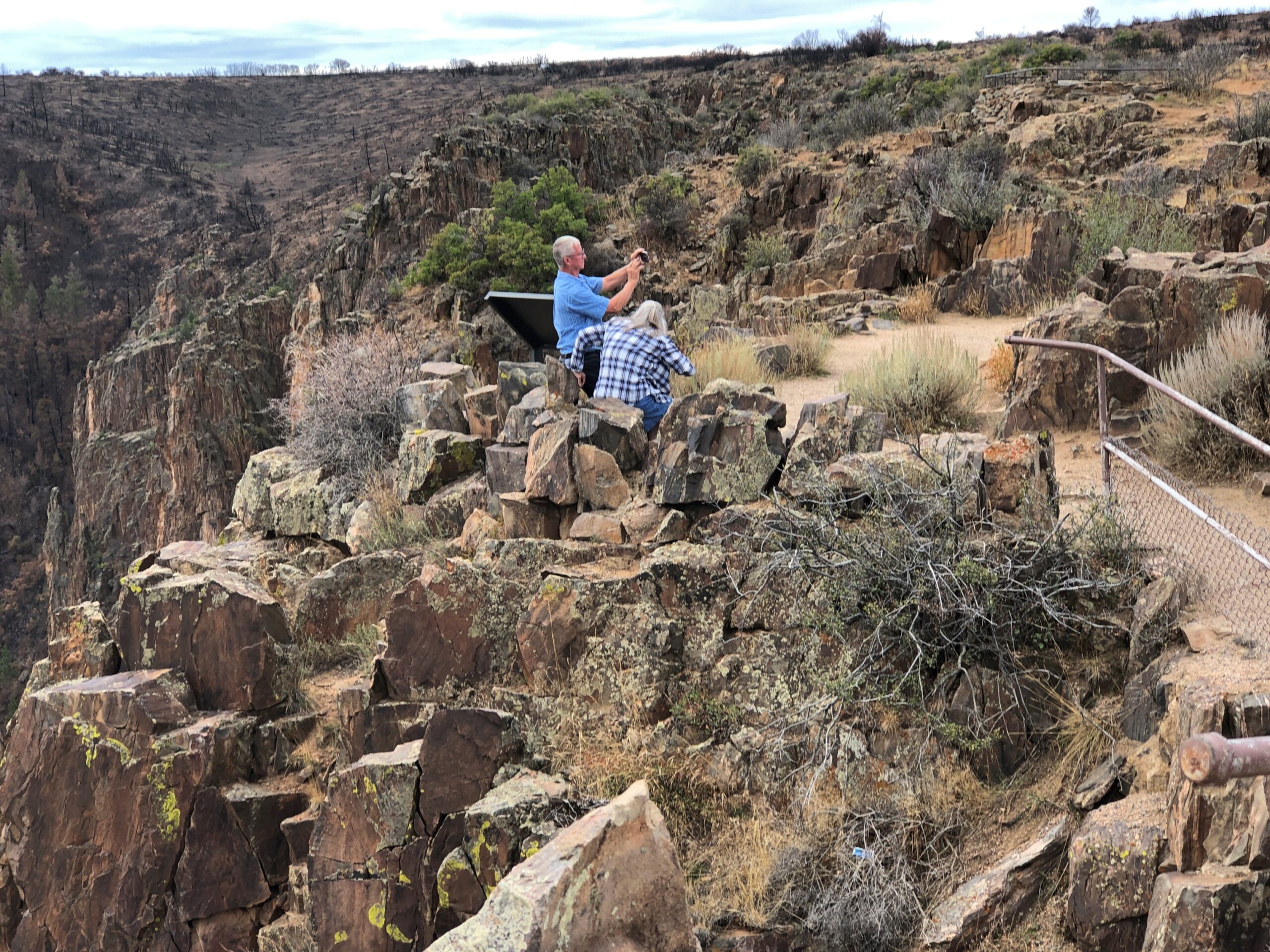
Fortunately for us, we were able to drive the South Rim Road and see what we could see at some of the overlooks. Unless you’re keen on some kind of lunatic climb into the canyon, that seems like a perfectly reasonable ambition. At the main visitor center on the road – which a ranger told us had barely escaped intact, through the efforts of hotshot crews – a path leads to scenic perch, built to accommodate casual visitors. It survived the fire as well.

Black Canyon of the Gunnison

Any photo’s going to be a pale image of this vista, but they will have to do. Believe me, it was a place to drop everything and gawk. And, even while safe behind rails, to experience a touch of vertigo. Nothing incapacitating, just an unsettling mental comparison between little you and the huge yawning drop.

Black Canyon of the Gunnison

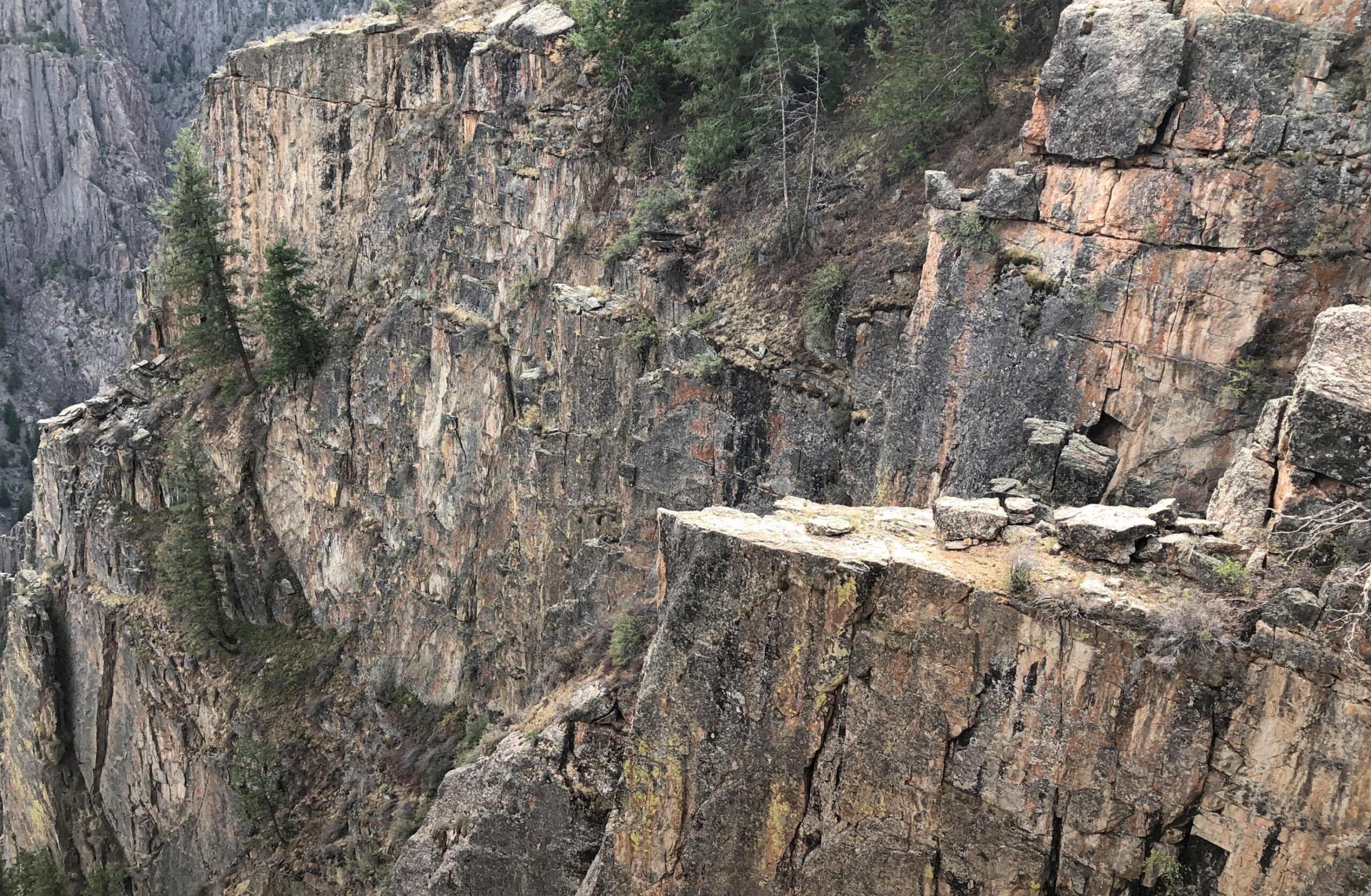
A pointy ledge below. An opportunity for an Instagram death. It was hardly the only one.

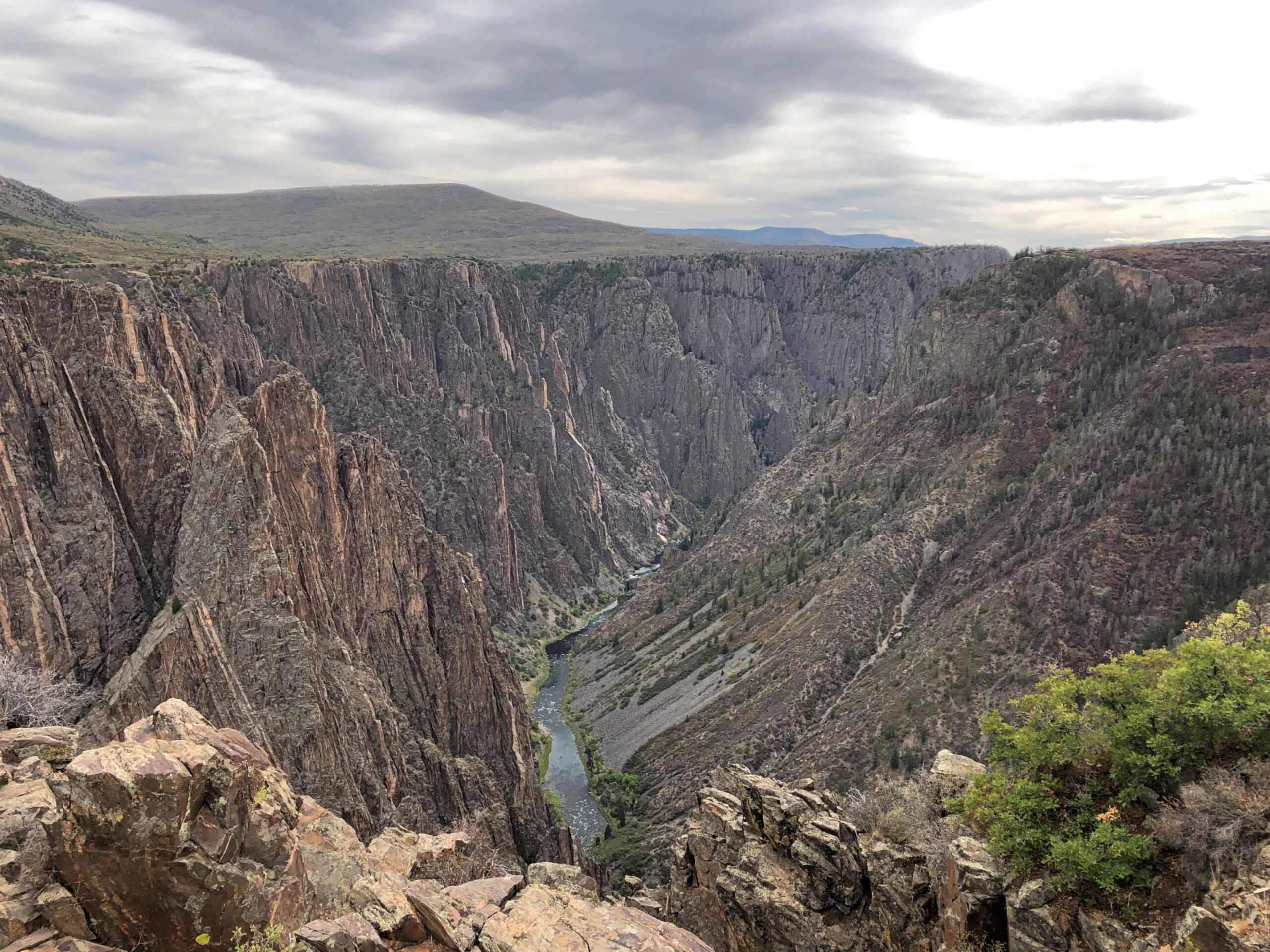
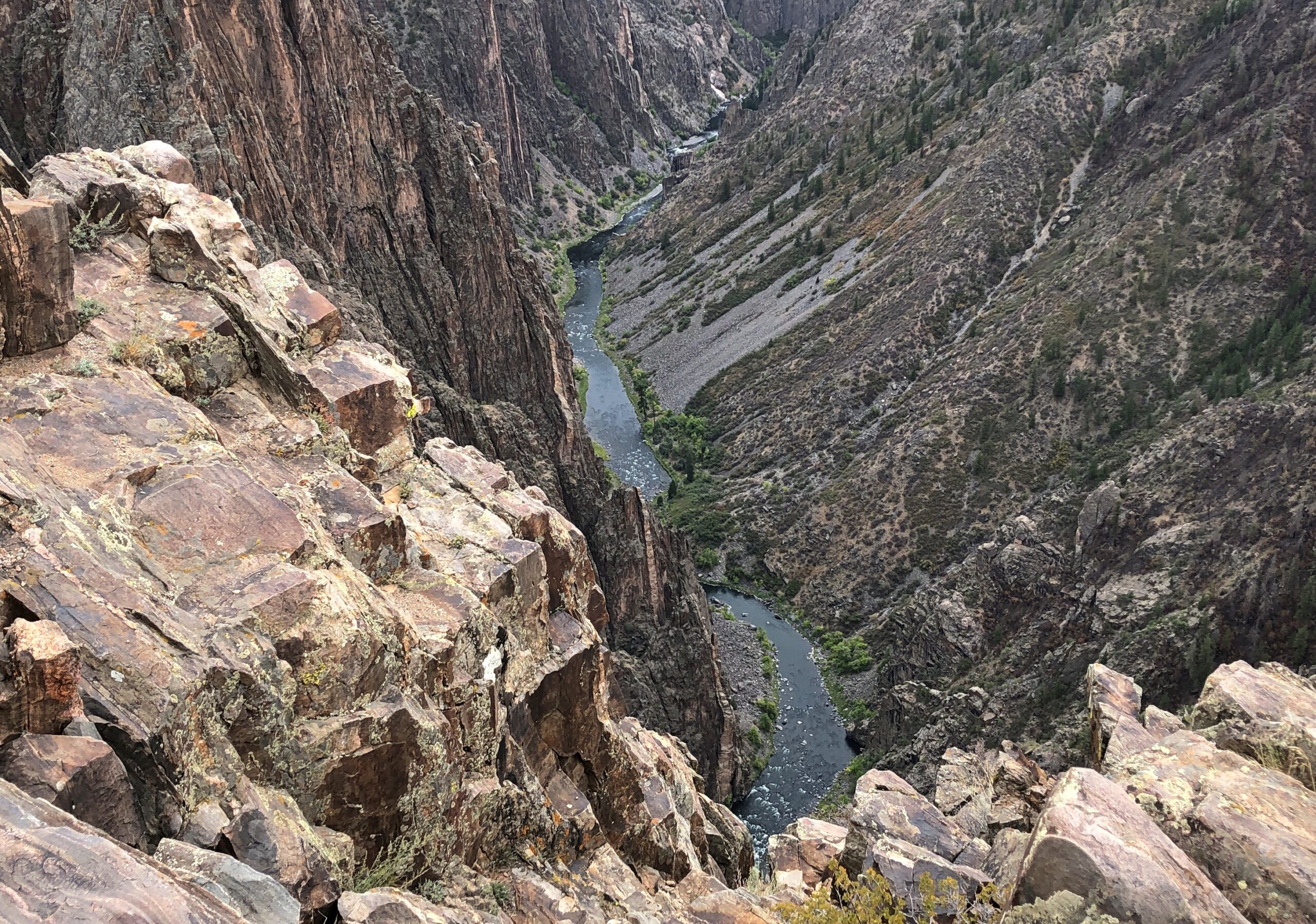
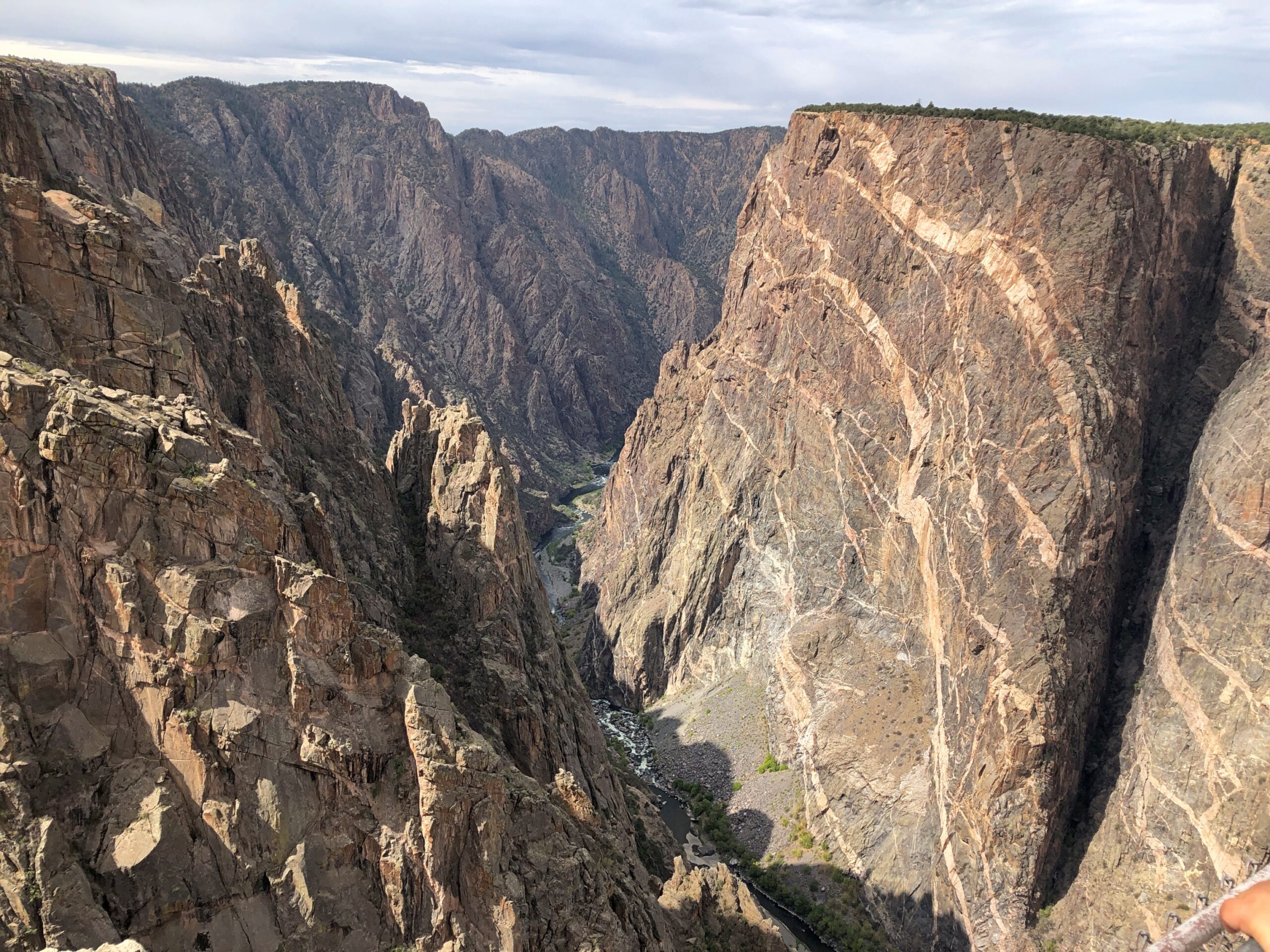
Further down the road, a good view of the Gunnison. It’s hard to tell just by the images, but that’s around 2,000 feet down. Eventually, the water goes into the Colorado River.

Black Canyon of the Gunnison

Capt. John Gunnison is the U.S. Army officer and explorer who came to the canyon in 1853 as part of the effort to find a route for the transcontinental railroad. To sum up his conclusion, in terms he would have never used: Not through the Black Canyon, Secretary Davis. Are you kidding me? Later that year, Gunnison and most of his men got the worst of an encounter with some Ute warriors and, among other places, the river acquired his name as a posthumous honor.

I also have to say that Gunnison’s career also included surveying in the Upper Midwest, such as the Green Bay area, and that he surveyed the border between Wisconsin and Michigan. An underappreciated kind of achievement, I’d say.

None of the viewpoints were crowded. The Grand Canyon, this isn’t. The more accessible south rim of the Black Canyon isn’t crowded, even on a warm Friday afternoon, unlike the more accessible south rim of the Grand Canyon.

Black Canyon of the Gunnison

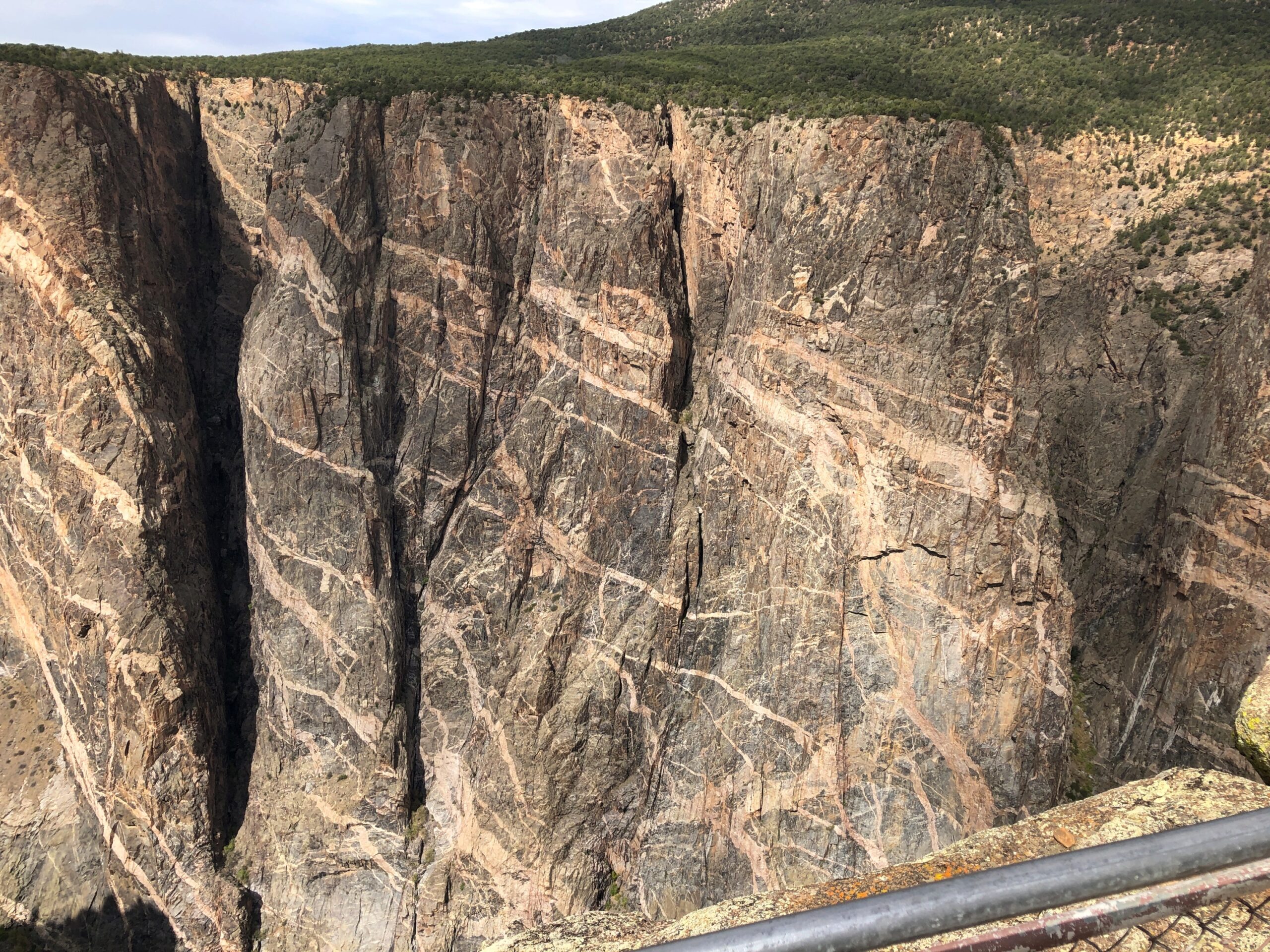
Near the end of the road is a view of the Painted Wall.

The stripes are not paint, of course, but pegmatite, an igneous rock that solidified after the surrounding rock did, for reasons that a geologist, which would not be me, might be able to explain. A sign at the viewpoint helpfully compares the height of the cliff (2,250 feet) to various manmade structures. The only one that would rise higher than the wall is Burj Khalifa, and that not by much. Note also that the top of the cliff, across on the remote north rim of the canyon, has absolutely nothing in the way of safety infrastructure. The cliff is a cliff, with gravity ready 24/7 to whisk the careless or suicidal to their doom.

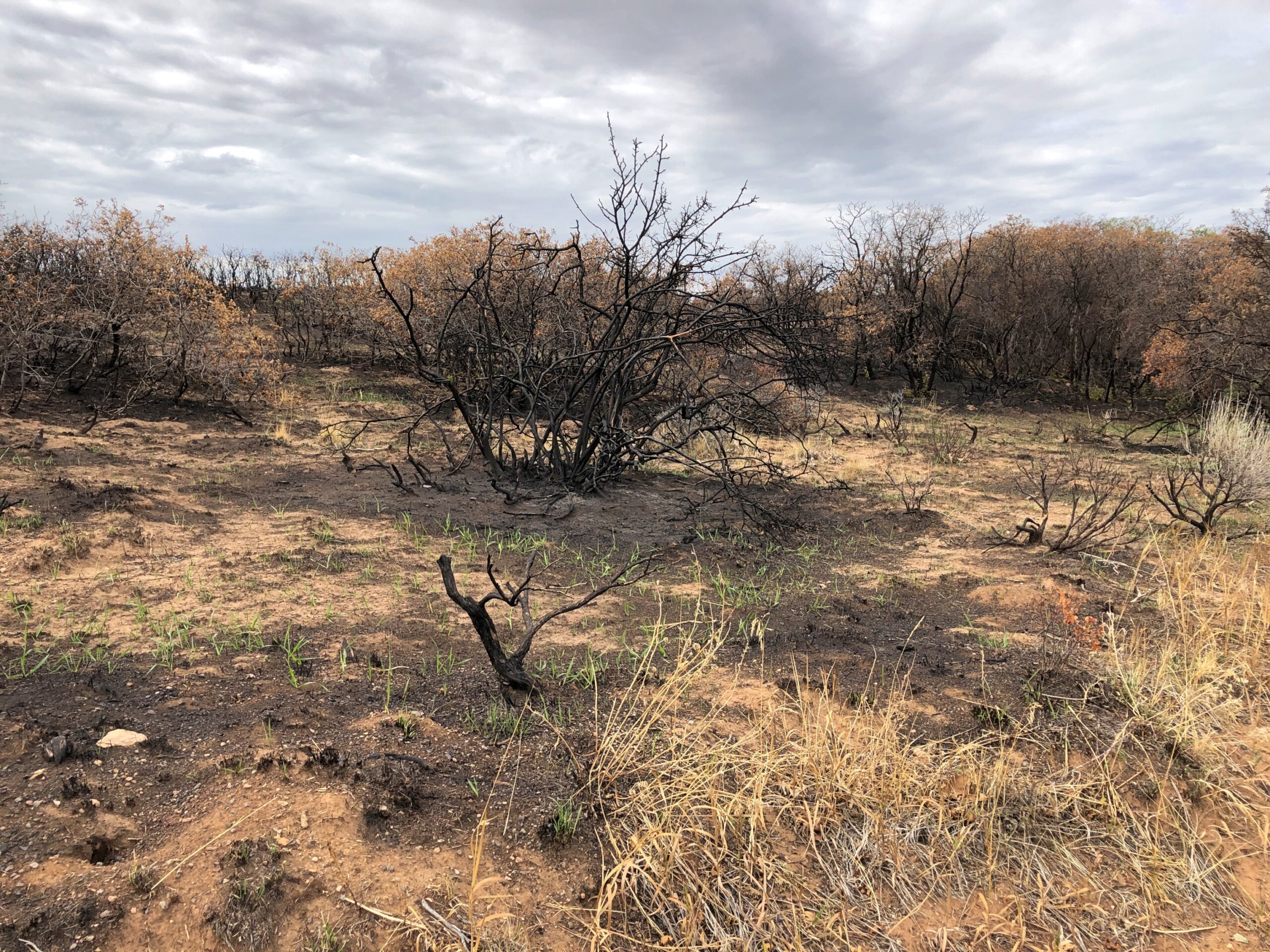
I’d be remiss if I didn’t include a few more post-char landscapes: the sort that spread out from South Rim Road for long stretches. It would be a thrill of a road anyway — a little more thrill than I need, actually — with its sporadic few spots where the separation between the road’s edge and an enormous cliff was a single white line.

At the end of the road is the trailhead of Warner Point Trail. From the parking lot, according to a sign, the walk is 1,373 yards to the overlook at Warner Point. Near the sign, I heard a couple of young German men obviously working out the distance in meters (you don’t need much German to understand that). No matter how few people are at a U.S. national park, some are going to be Germans.

I preferred to work out the distances in miles. That would be nearly eight-tenths of a mile, so roughly a 1.6 miles there and back. Or 2.5 km for Euro-types. Better shoes on, poles in hands, hats on heads and water in a small backpacks, we set off on the trail. Yuriko and a few other people (including the Germans) got to Warner Point before I did , but get there I did.

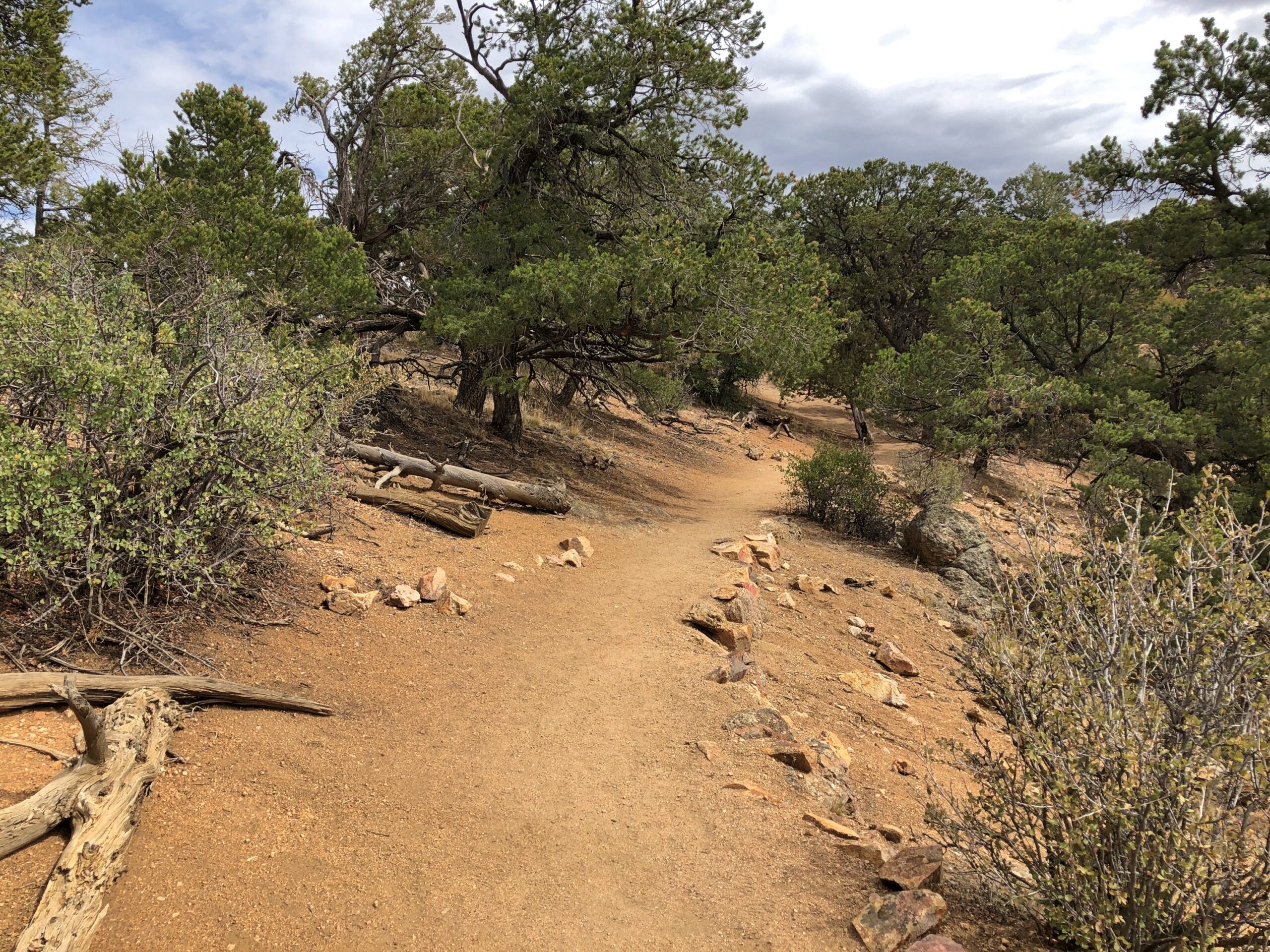
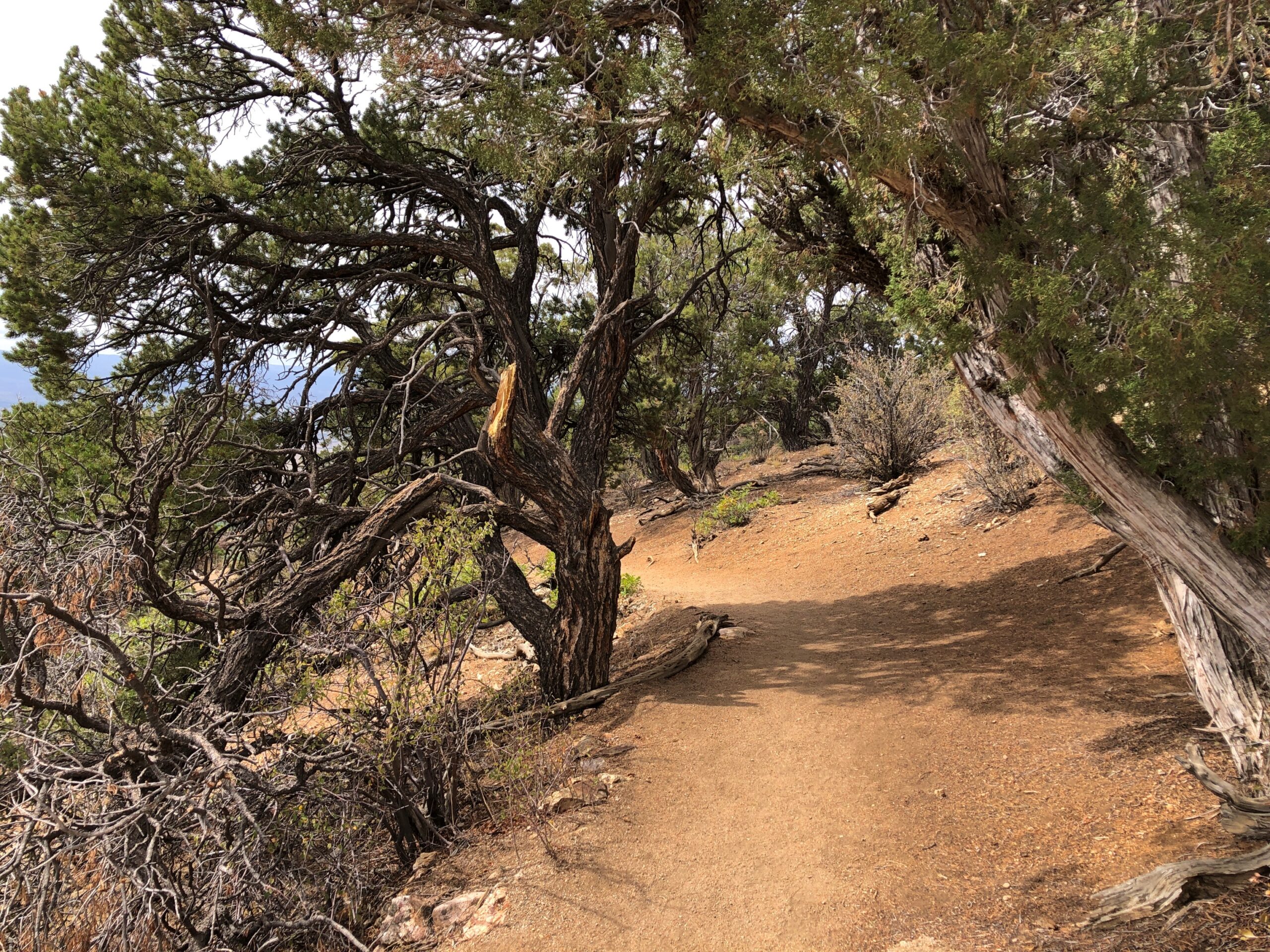
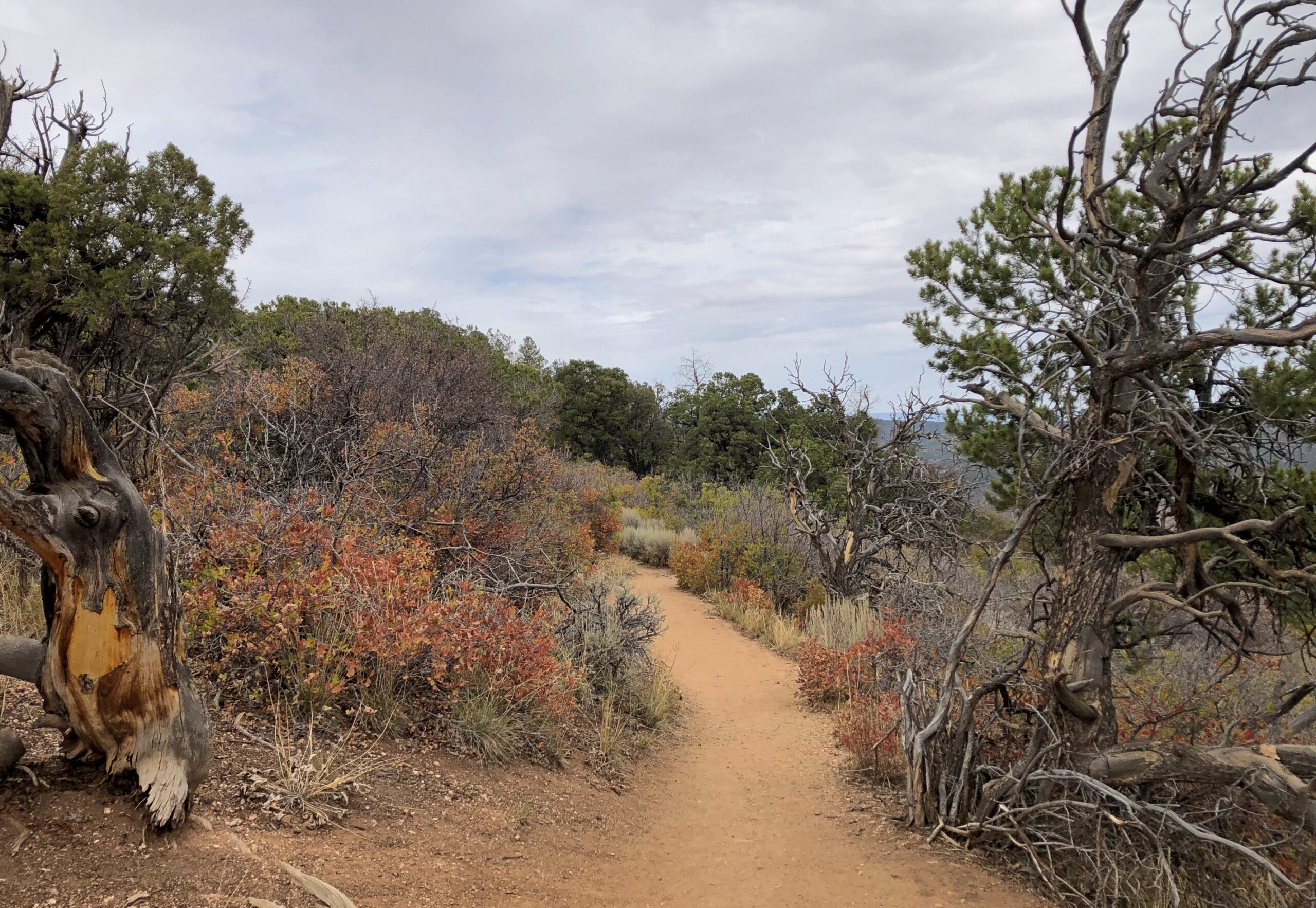
The walk was partly on this kind of trail.

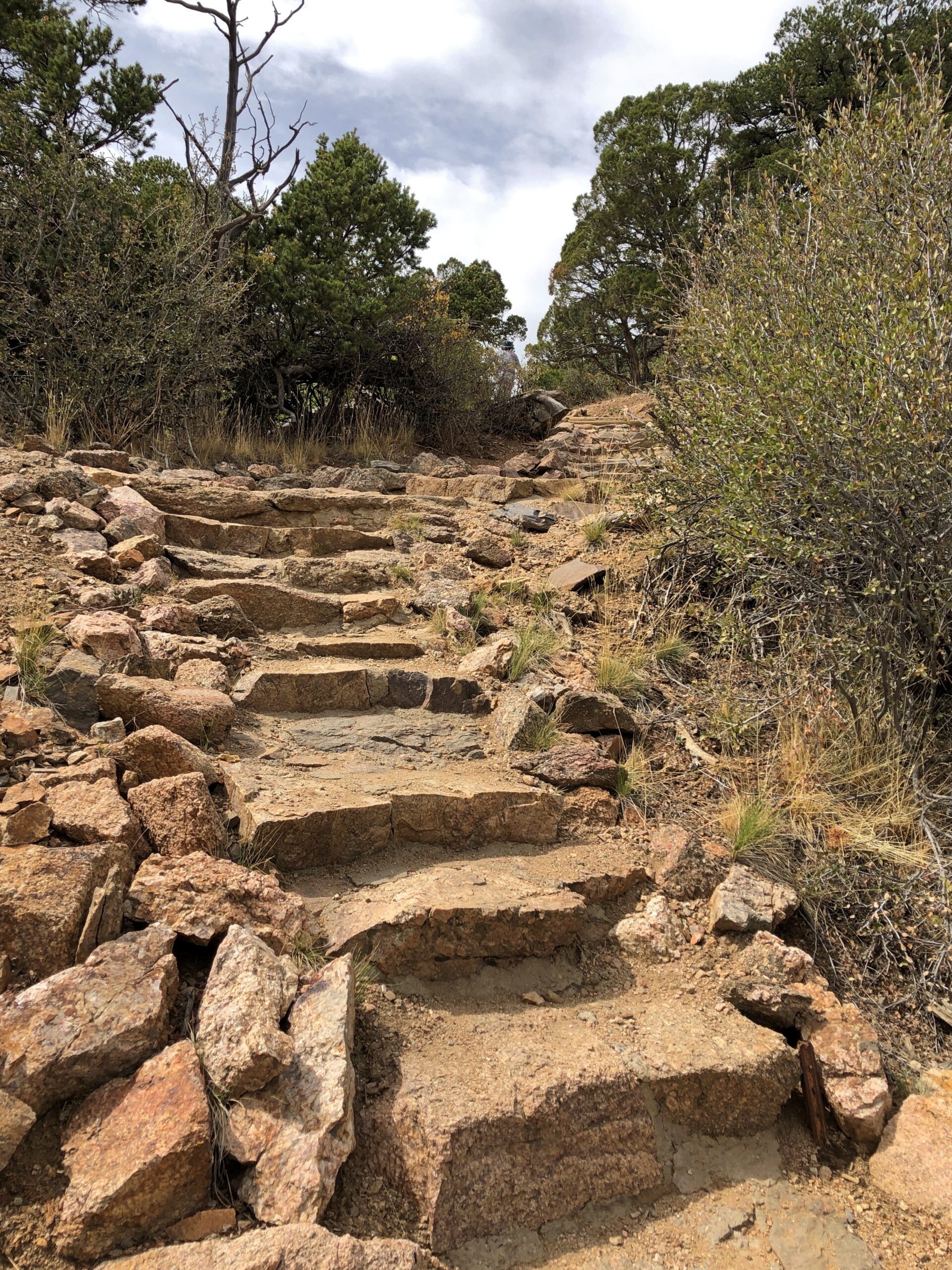
With a fair amount of this kind of thing.

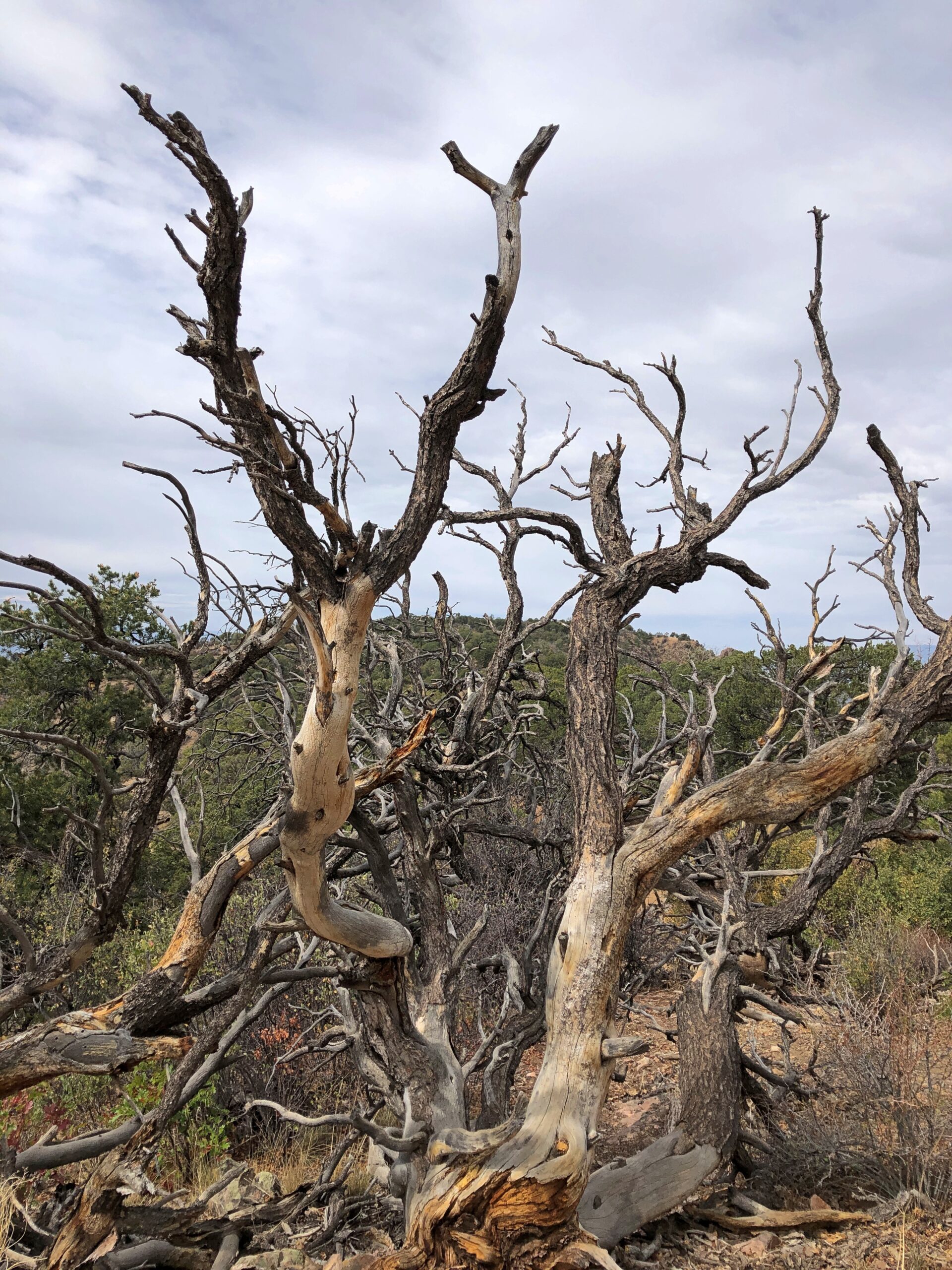
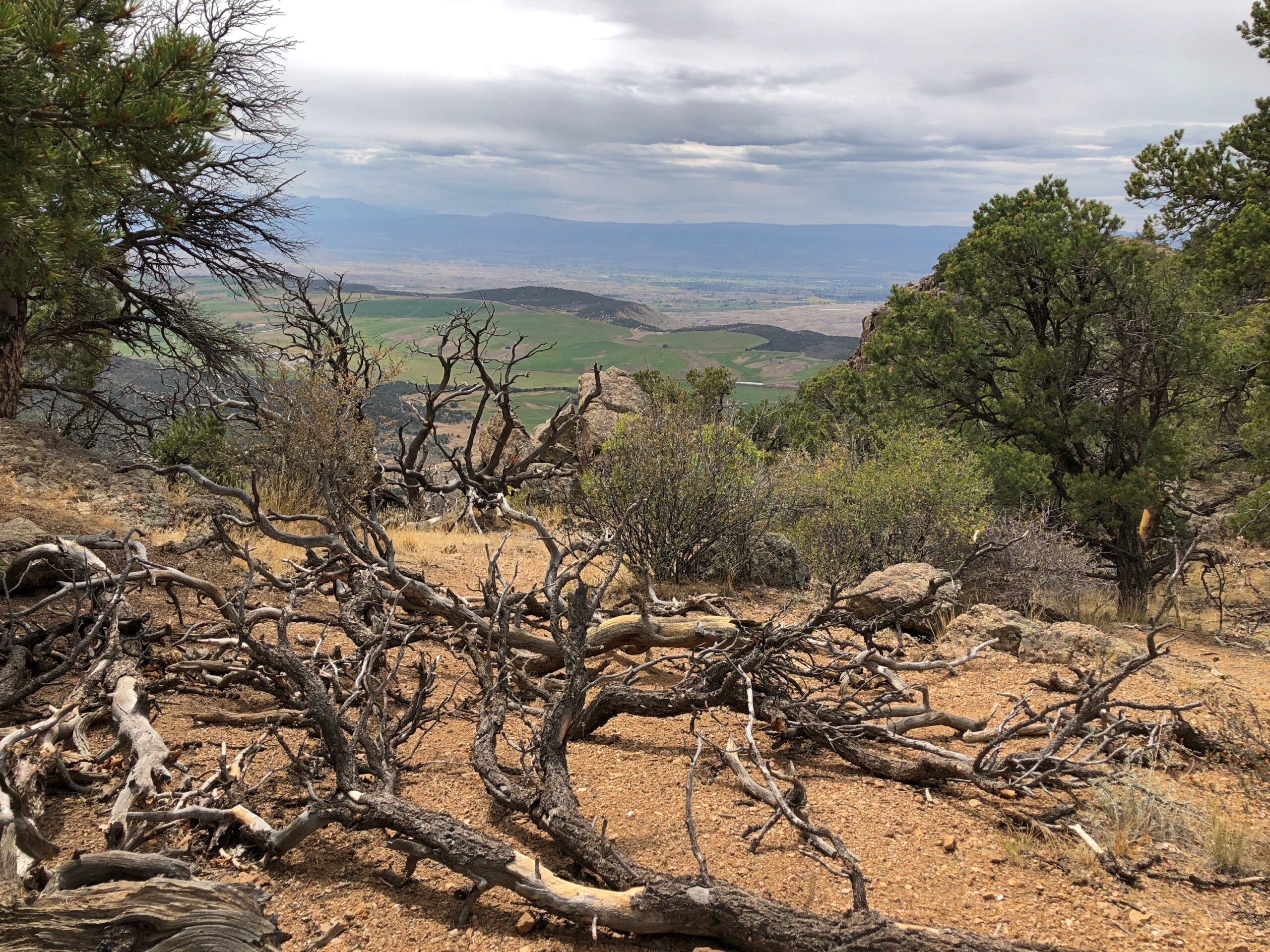
Along the way, an impressive collection of deadwood that the recent fires missed.

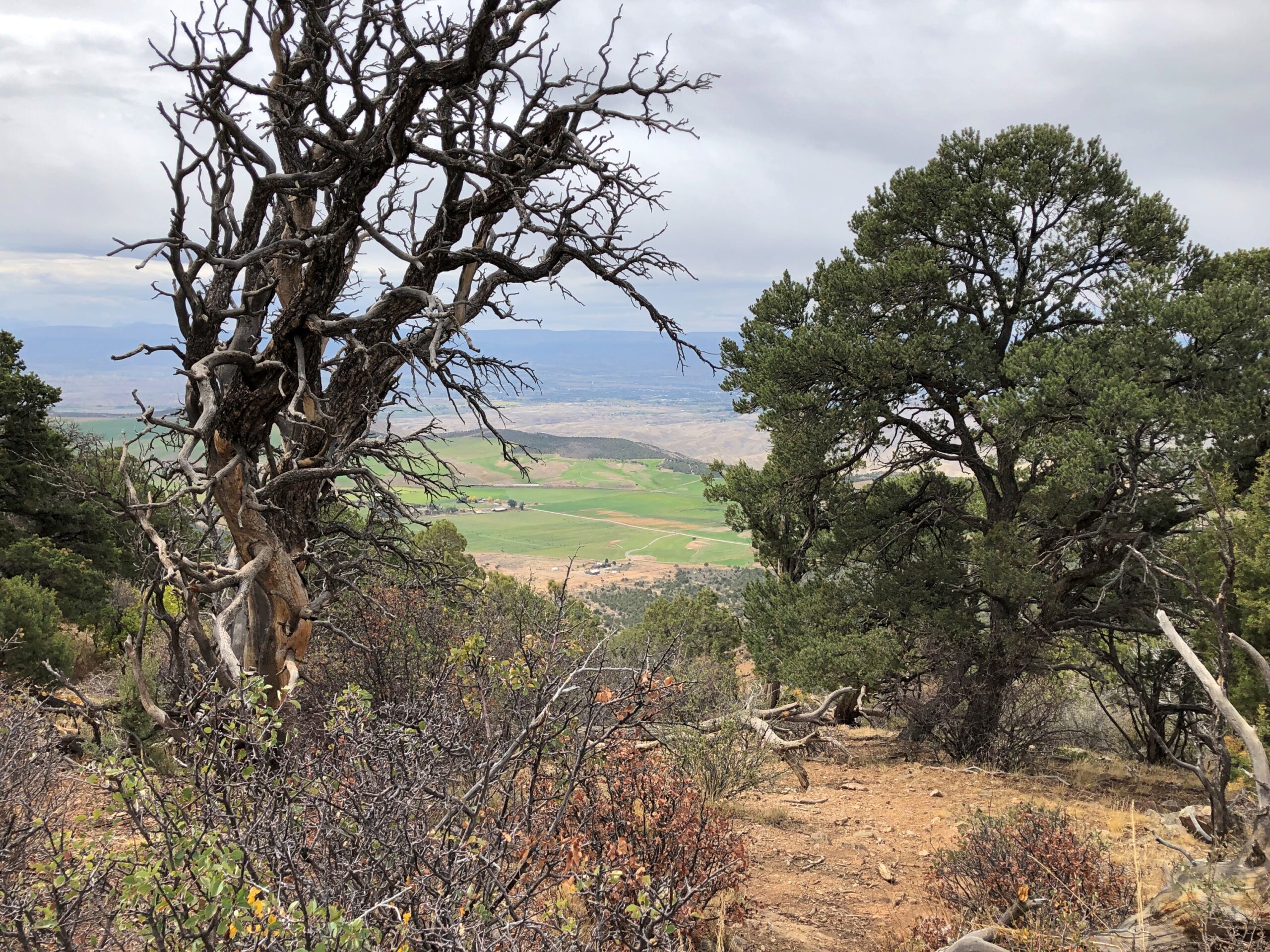
With views of the agricultural valley outside the park..

Finally, the end of the trail at Warner Point.

When I got there, Yuriko was waiting. Two other people were there (not the Germans; as athletic sorts, they’d come and gone). Soon they left. So we had the vista to ourselves for about 10 minutes, until another couple came along and we left. When we were quiet, the only sound was the Gunnison far below.

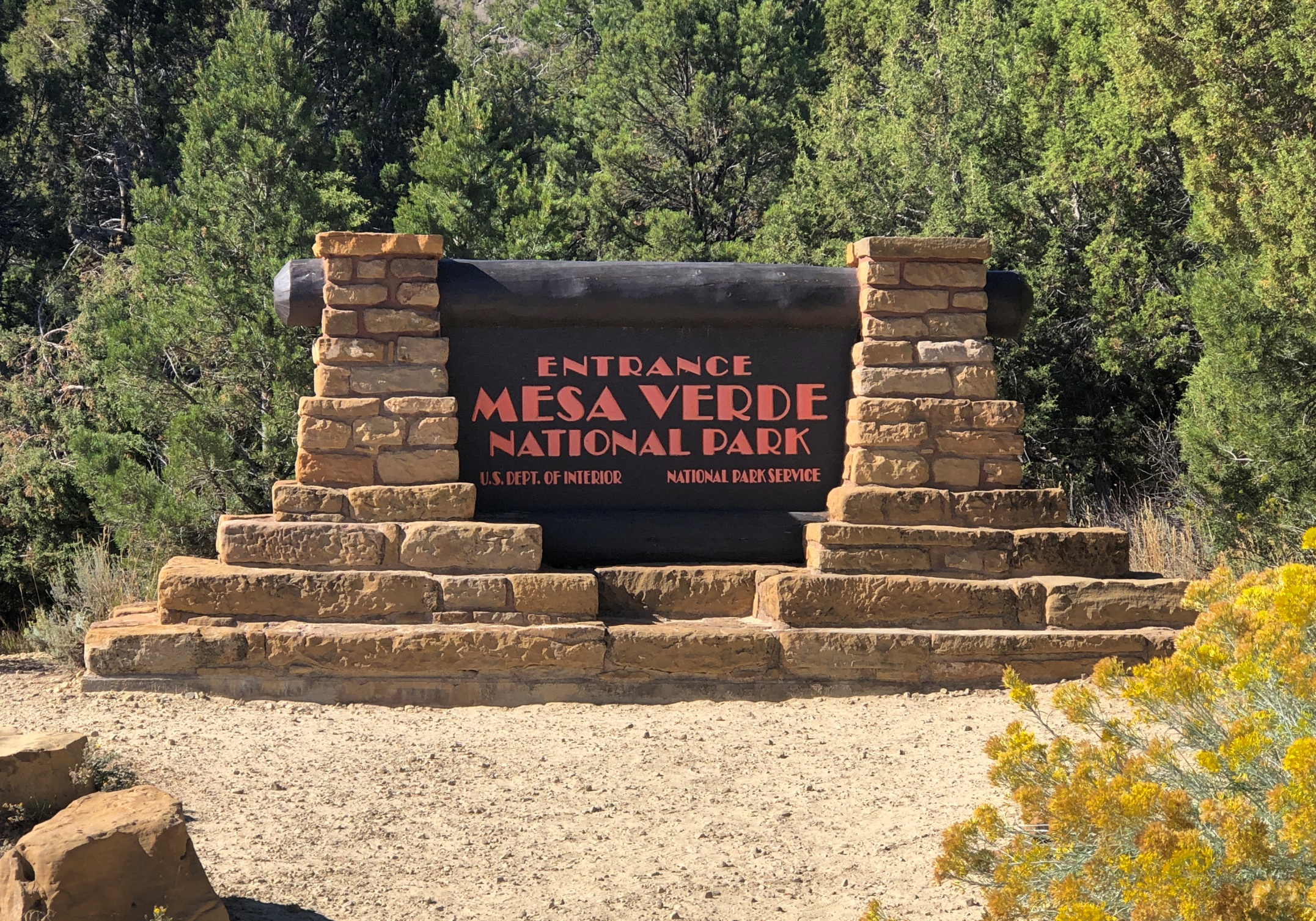
Mesa Verde National Park

In 800 years or so, will people come from significant distances to look at the ruins of my mid-century neighborhood? That doesn’t seem likely for any number of reasons. I’d be surprised if my own house survives until the next century, considering how good people are now at razing and rebuilding. But considering such a long span of time, there’s no way to know.

That’s the kind of thing I wonder about when facing structures of that age, especially those whose inhabitants are known mainly by the structures and other items they long ago cast off.

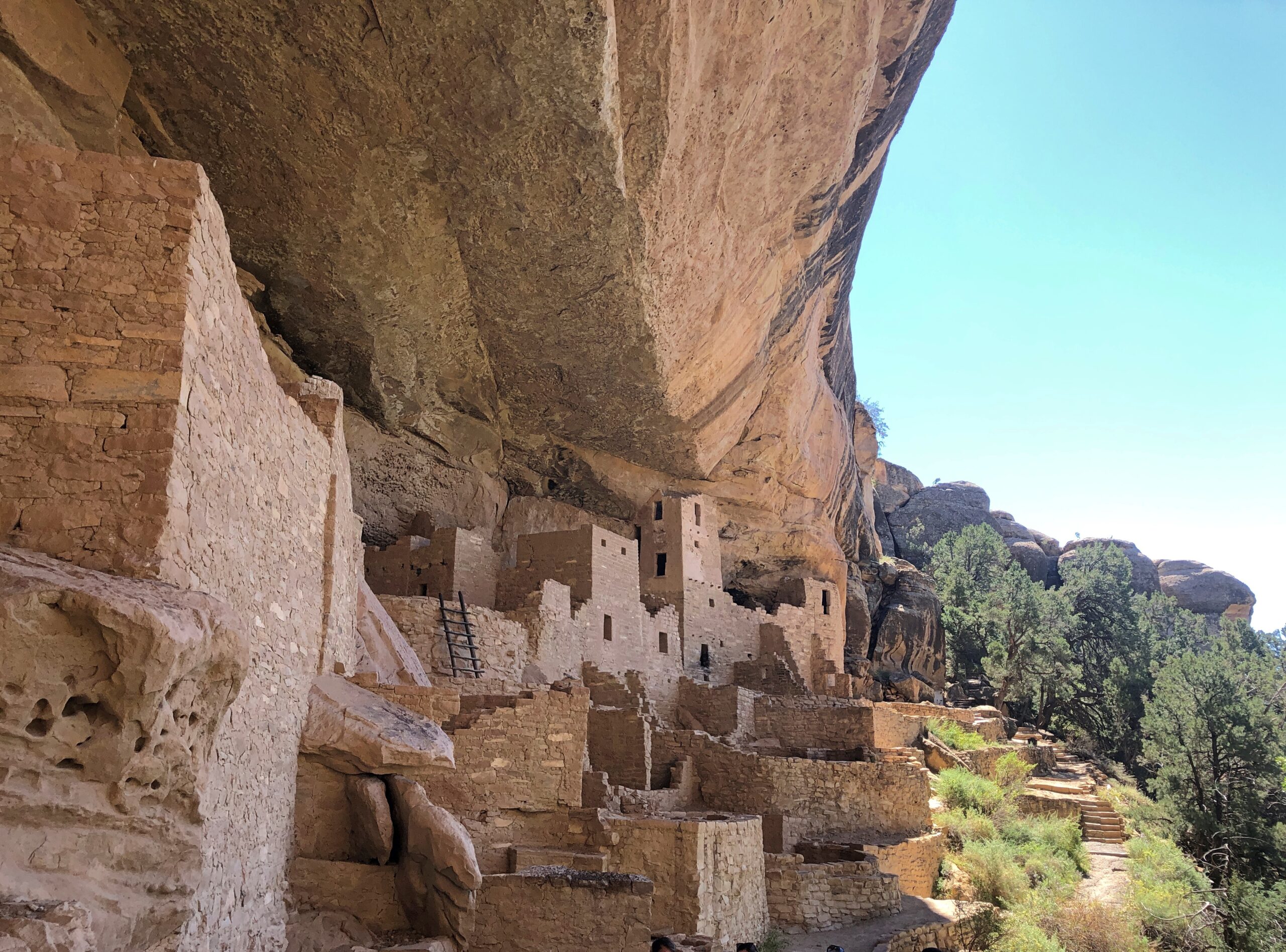
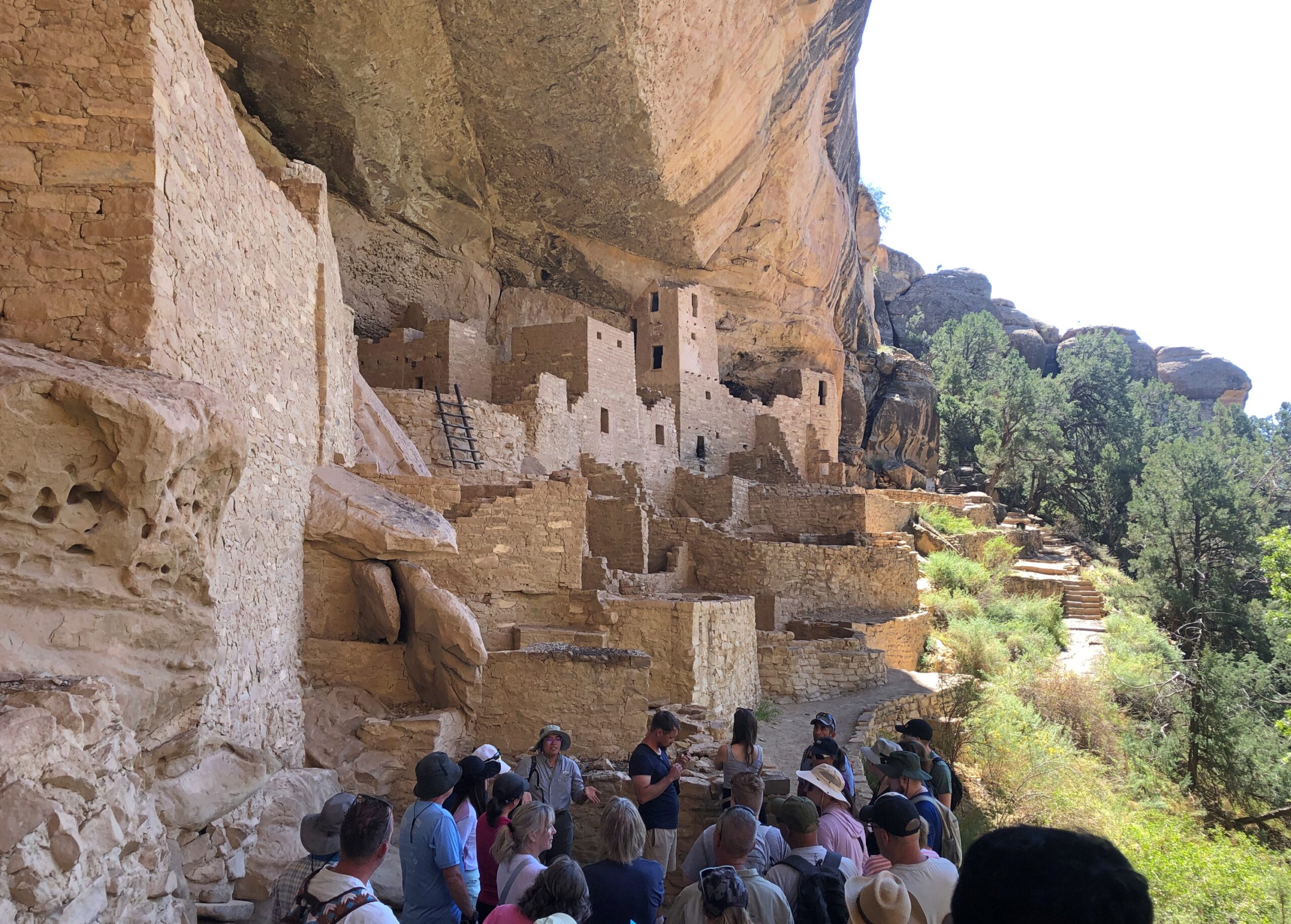
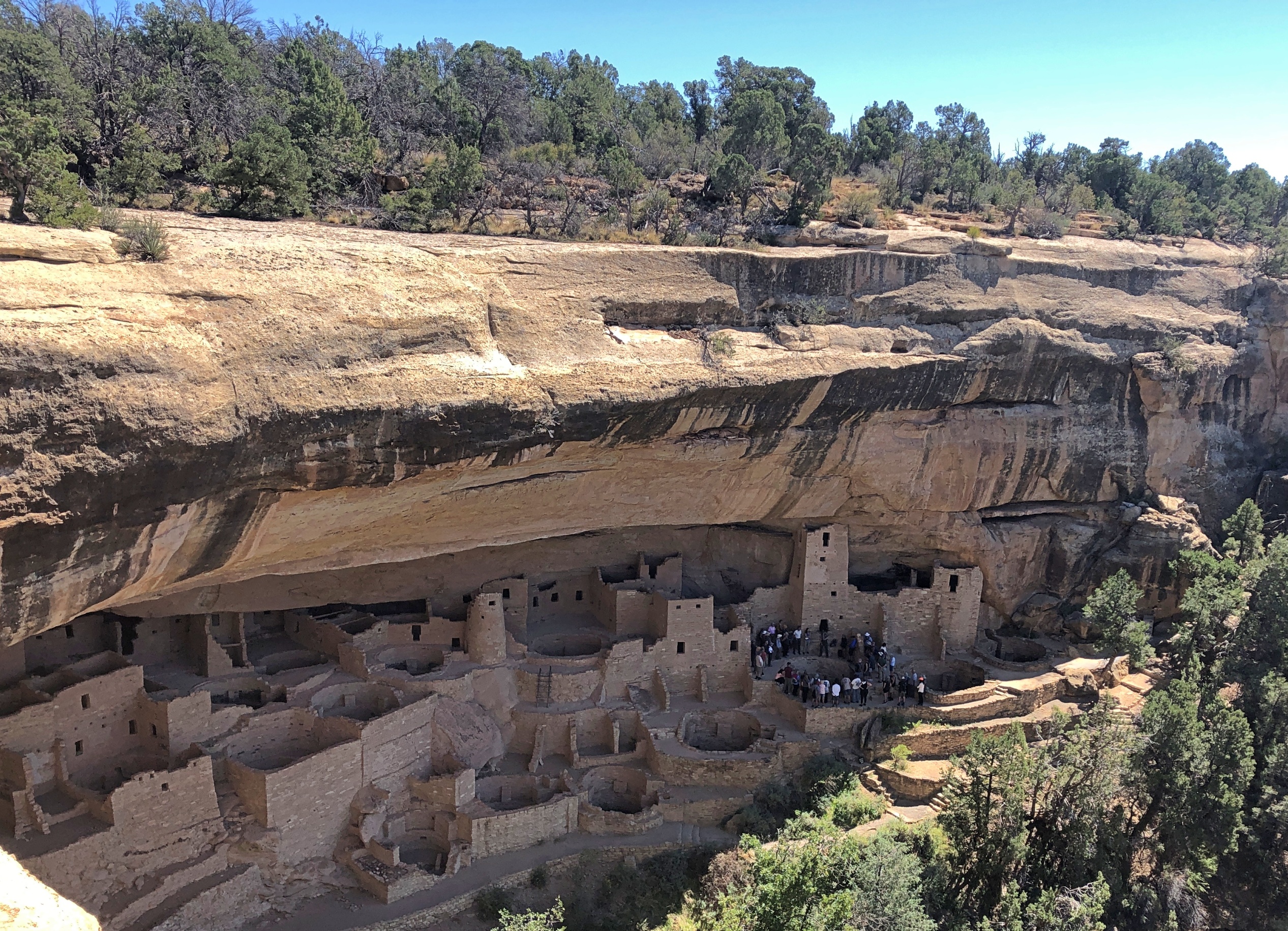
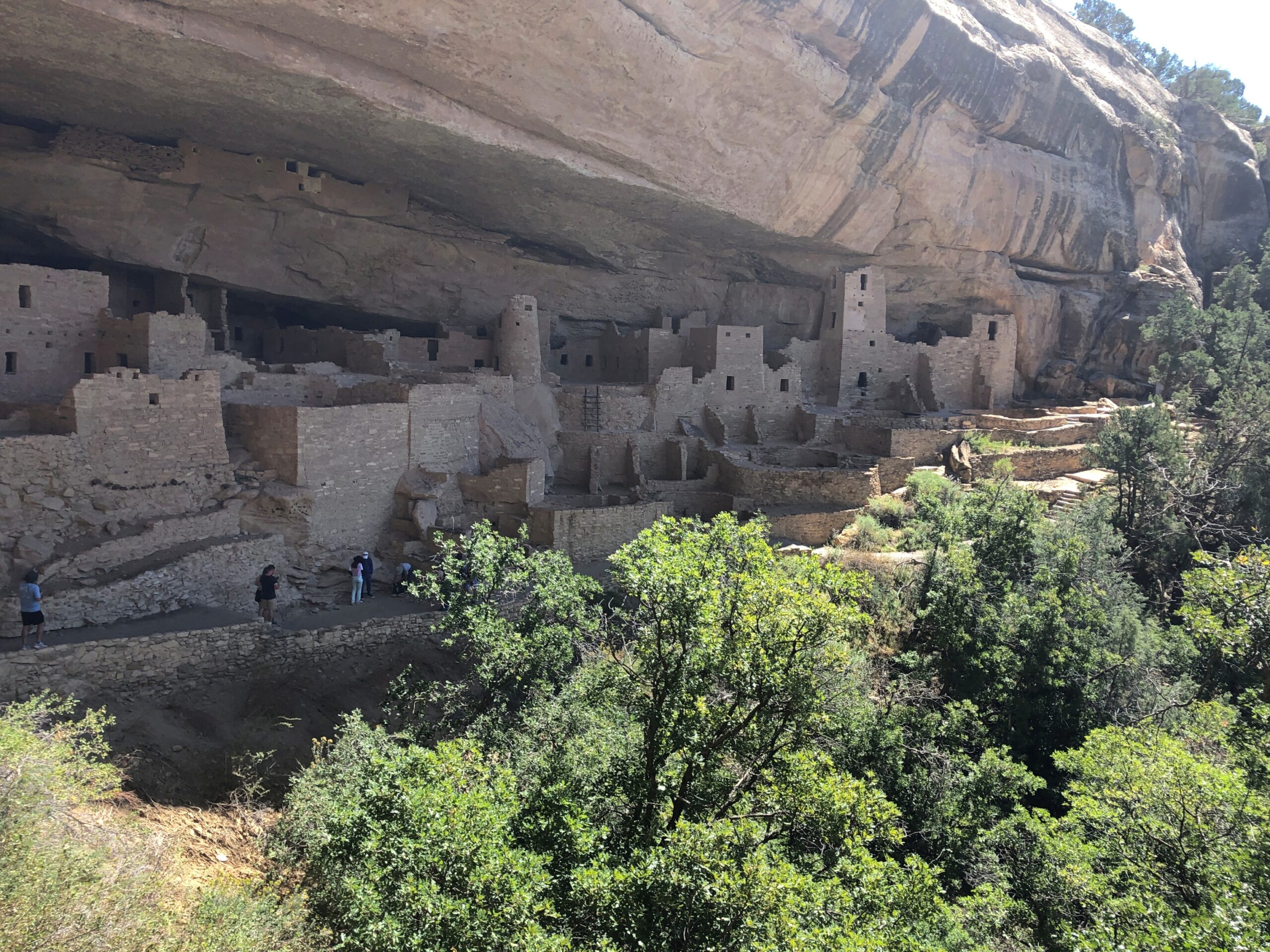
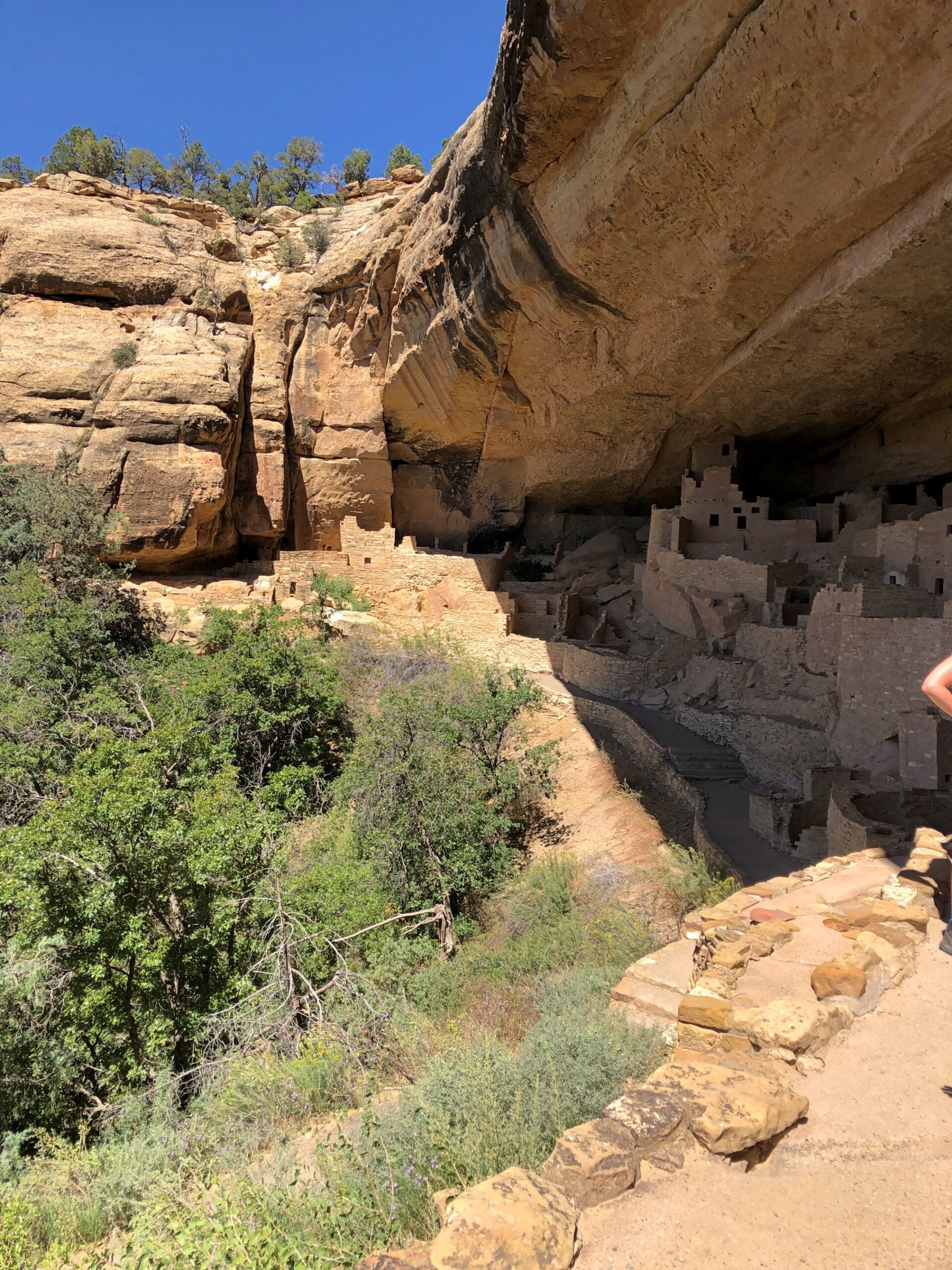
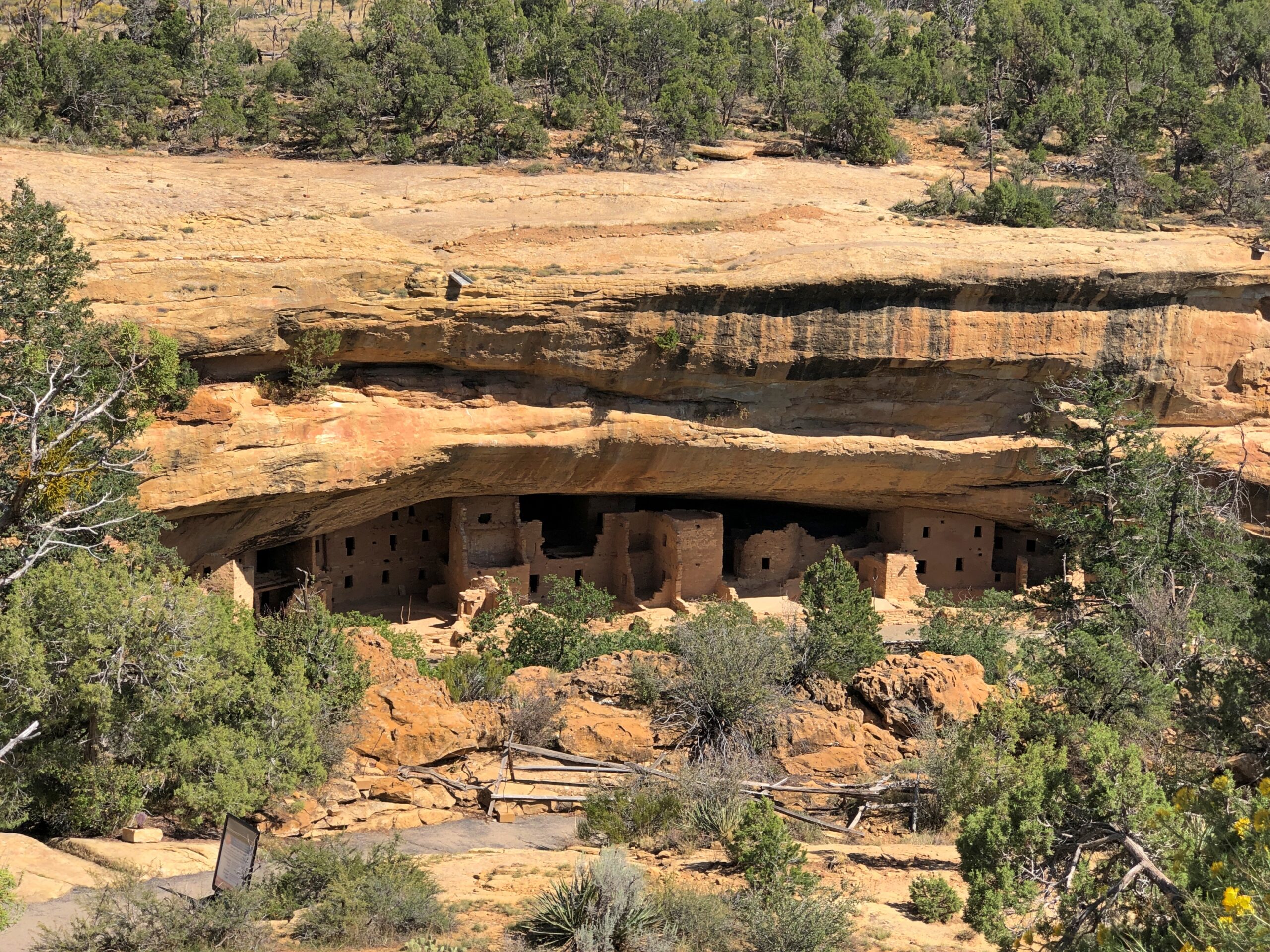
On September 17, we’d come to the Cliff Palace at Mesa Verde National Park. To get close, you sign up and pay for a ranger-guided tour, which goes down stone stairs, along the edge of the cliff near the dwellings, and then back up some stone stairs (built by the CCC; does that even need to be said?). The elevation is 7,500 feet or so, but that didn’t cool things down that day. It was hot and sweaty.

A shot like that took some effort. We were hardly alone at Cliff Palace.

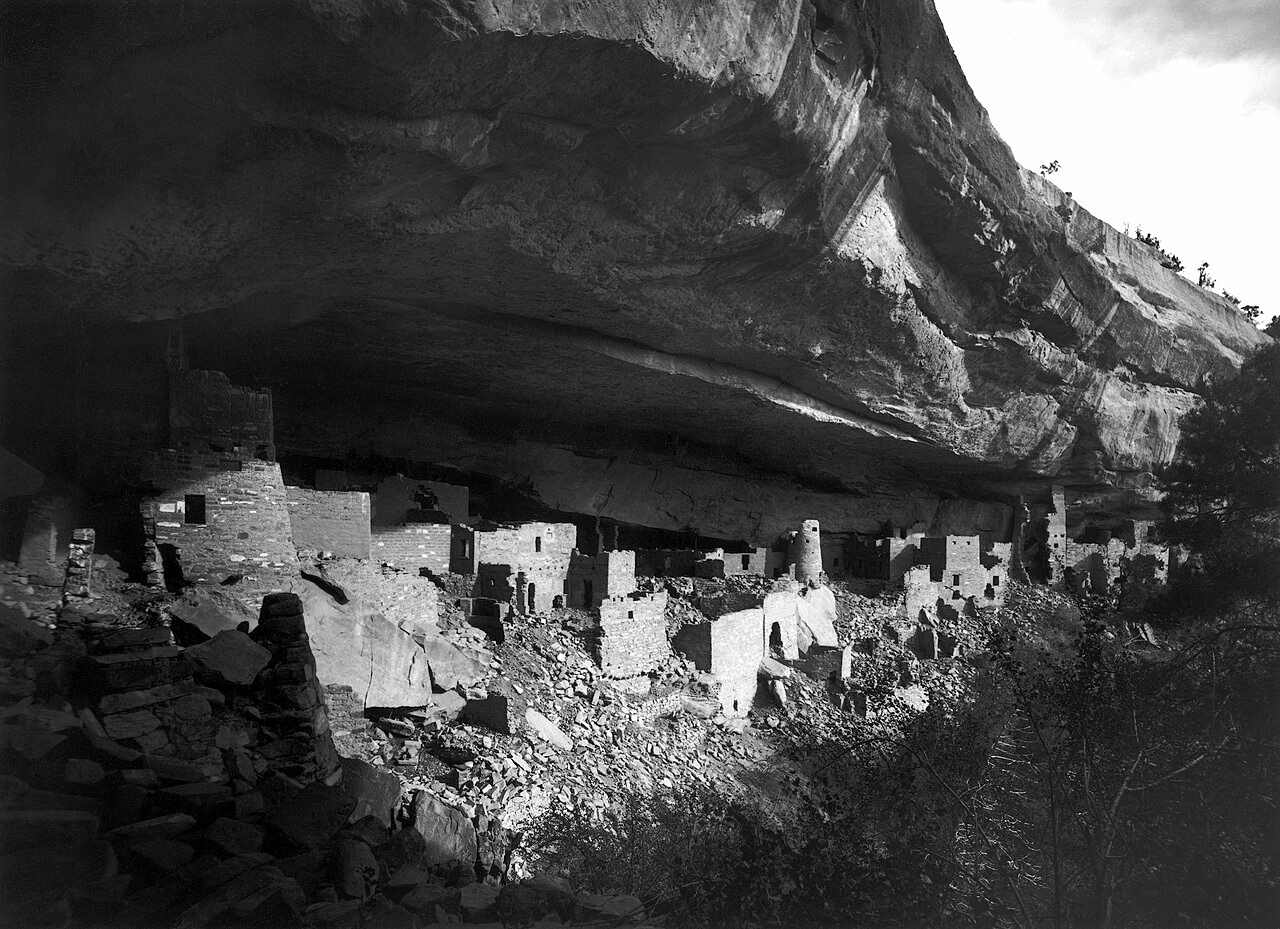
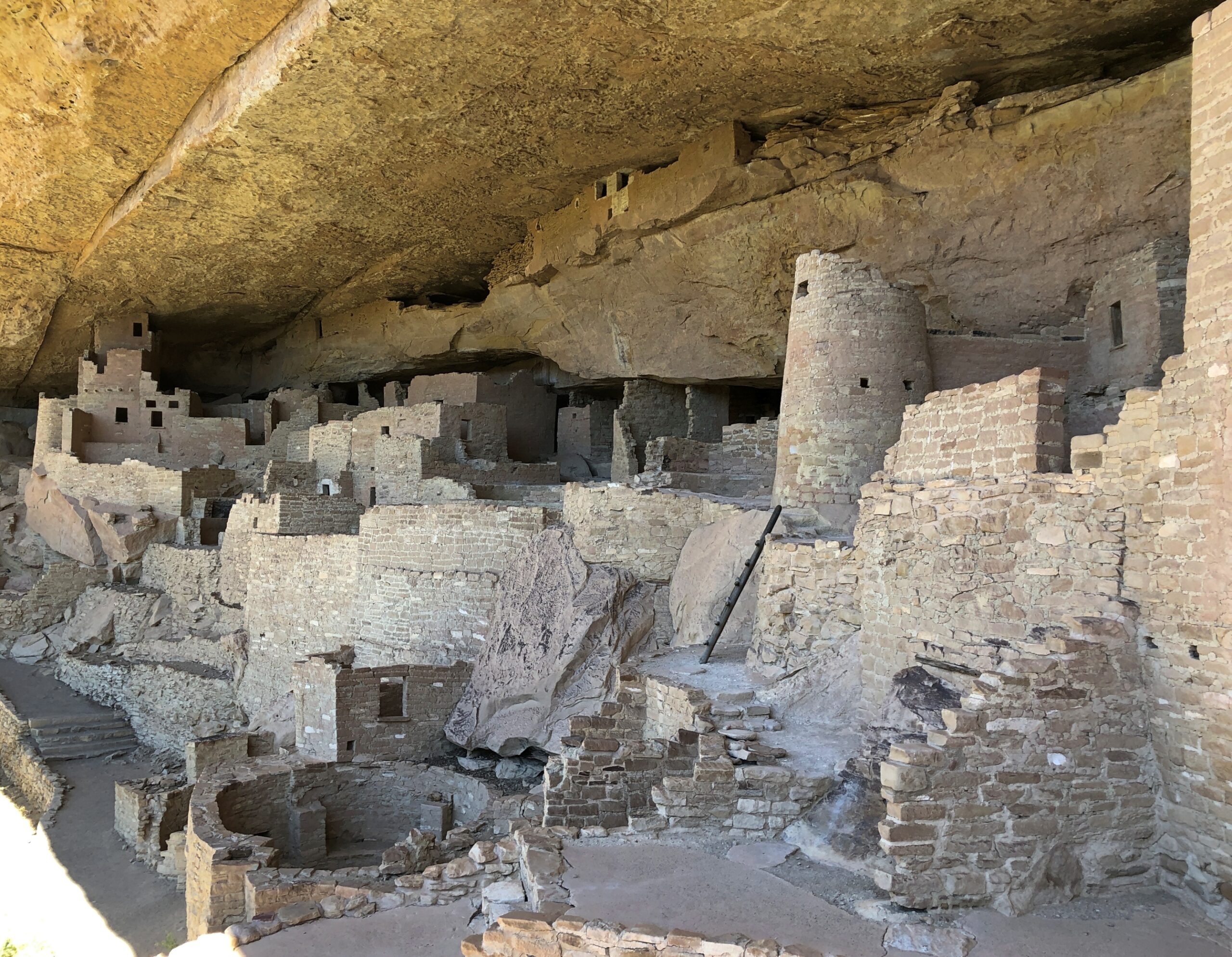
The ruins, which are most certainly near a cliff, are probably not a palace in the grand sense of a royal residence. More of a neighborhood, one of many in the vicinity, though the largest. Also, not quite as much of a ruin as it used to be. This is an image of the Cliff Palace from 1891, taken by Gustaf Nordenskiöld.

Not as long ago as all that, considering the age of the structures, but before TR inked the bill creating the national park, and back when you could help yourself to whatever was lying around, as the explorer (and photographer) Nordenskiöld apparently did, taking many items back home to Sweden. Eventually, the items made their way to Finland. A few were returned recently.

The ruins aren’t quite as ruined these days. The 20th century was a period of stabilization. Not as many artifacts got nicked either.

Mesa Verde National Park

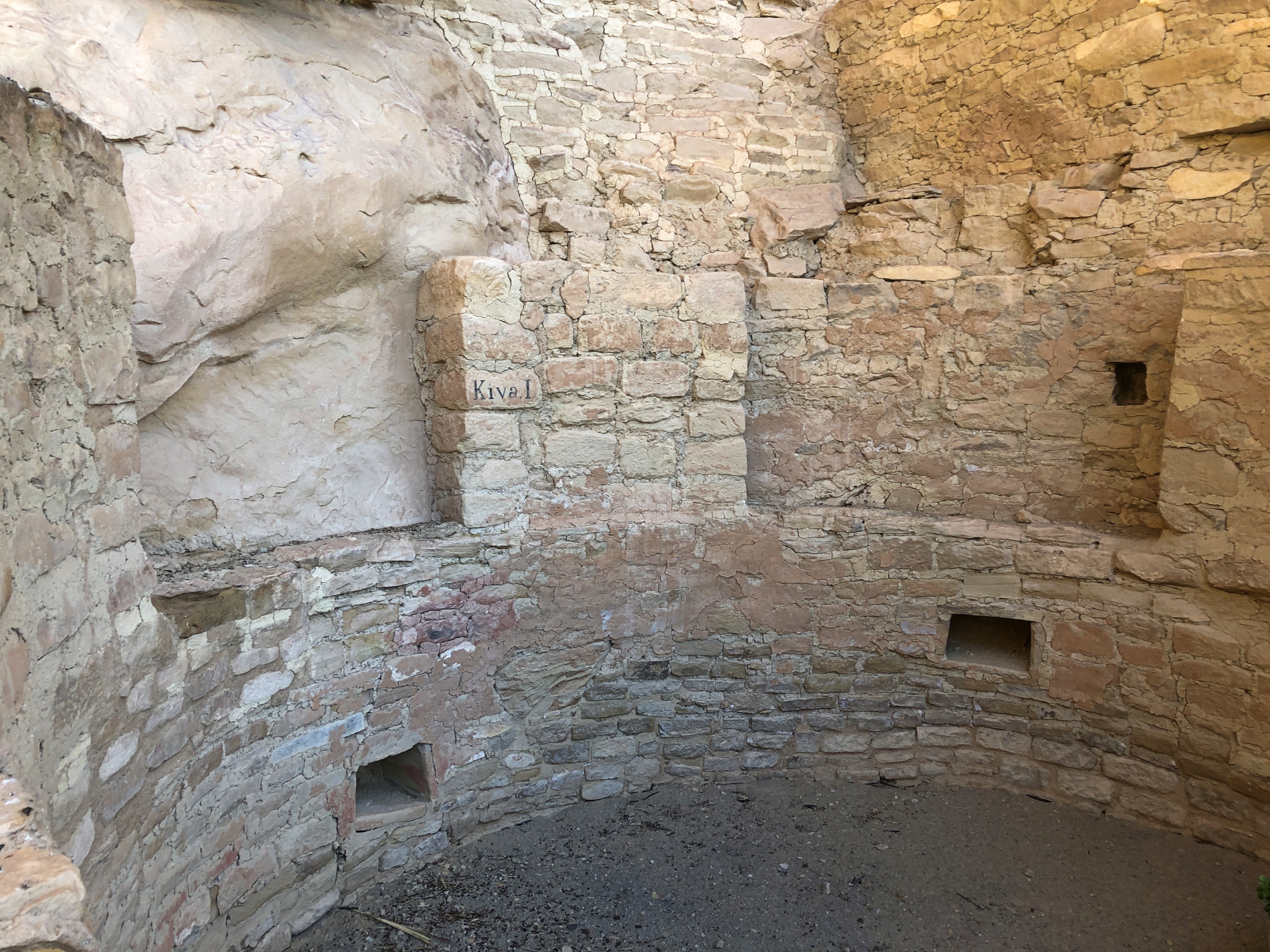
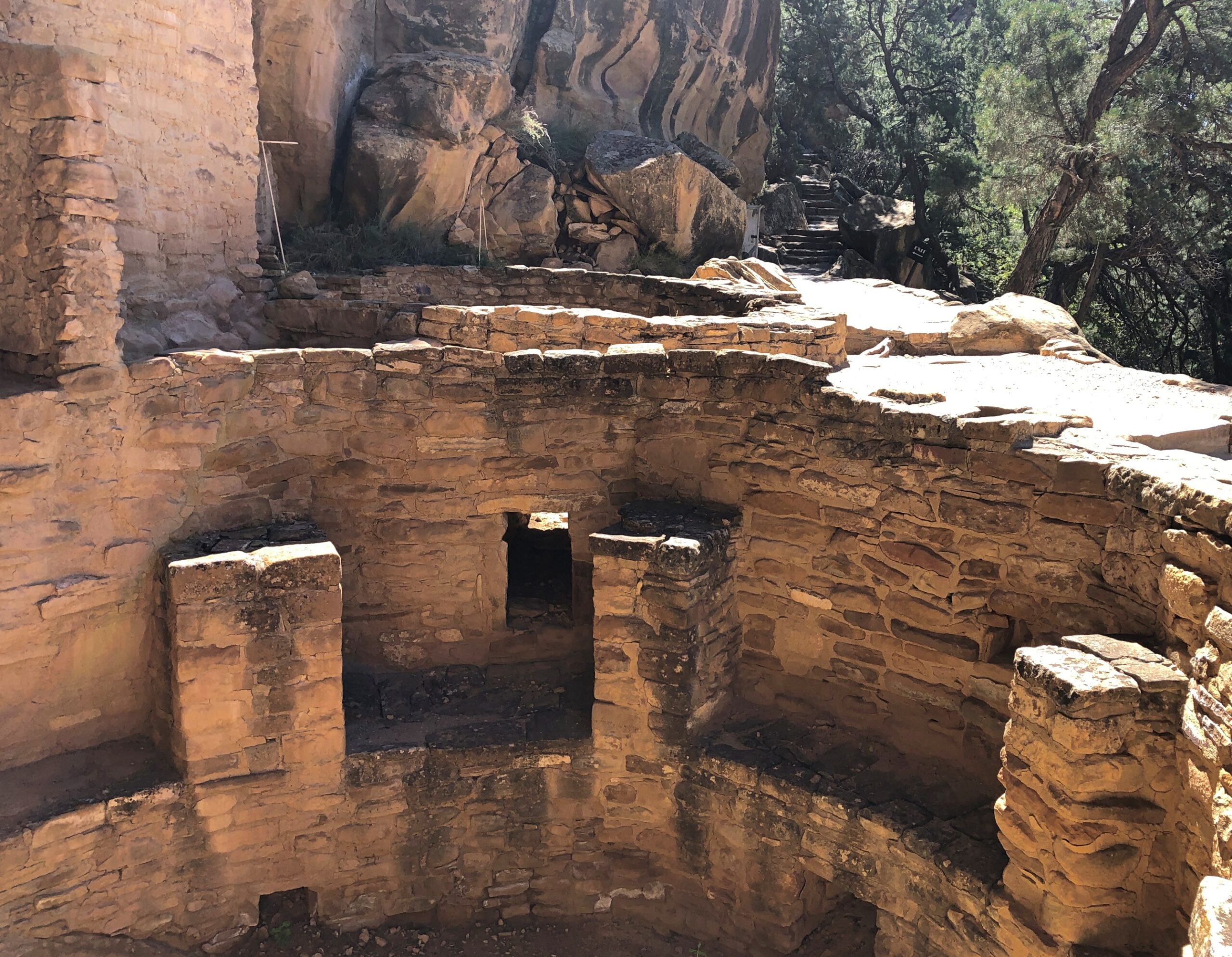
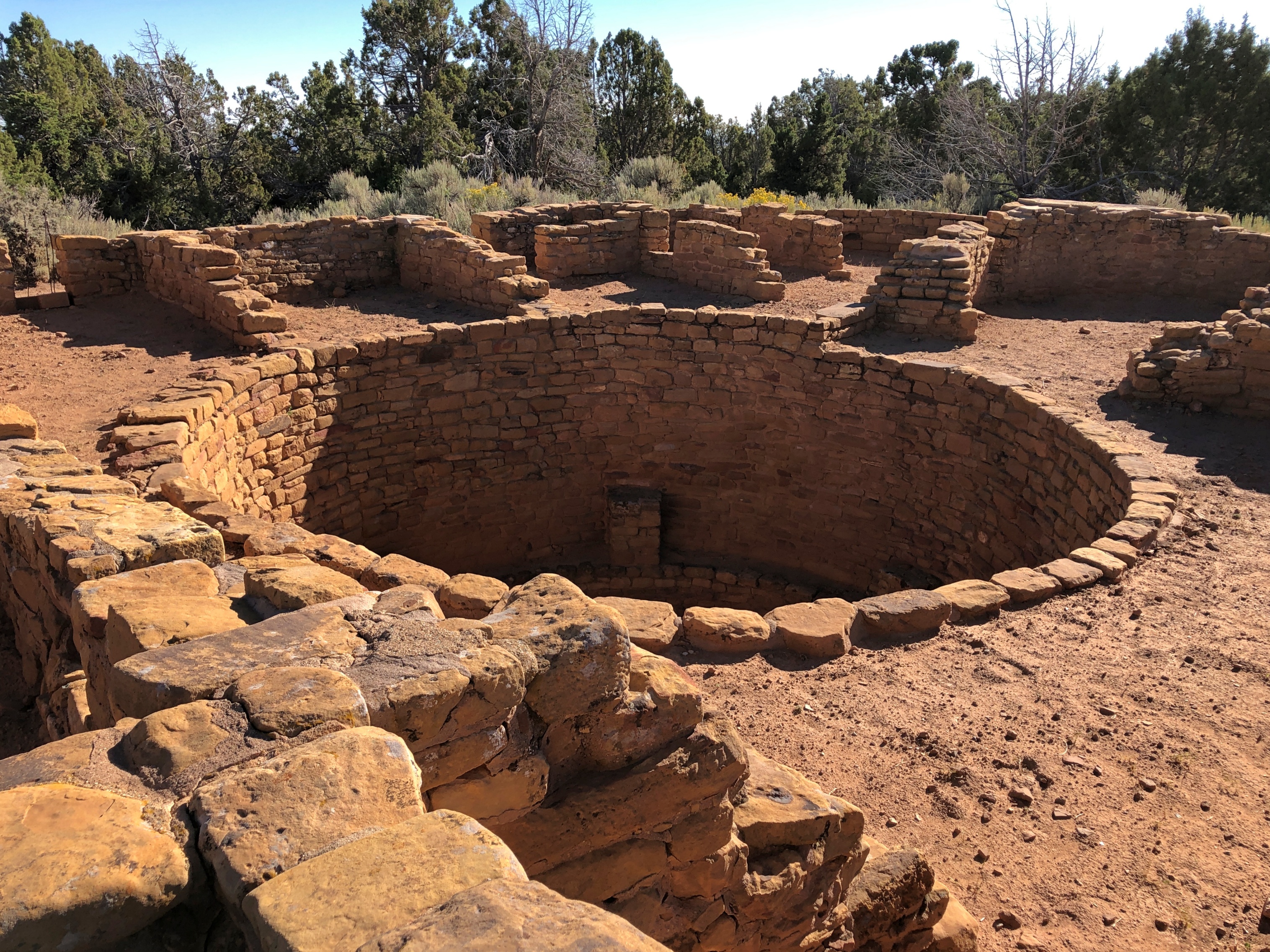
A kiva. The largest one at the Cliff Palace, I think. A religious site similar to others in the Southwest, such as at Bandelier National Monument (and now I know that was a kiva).

Mesa Verde National Park

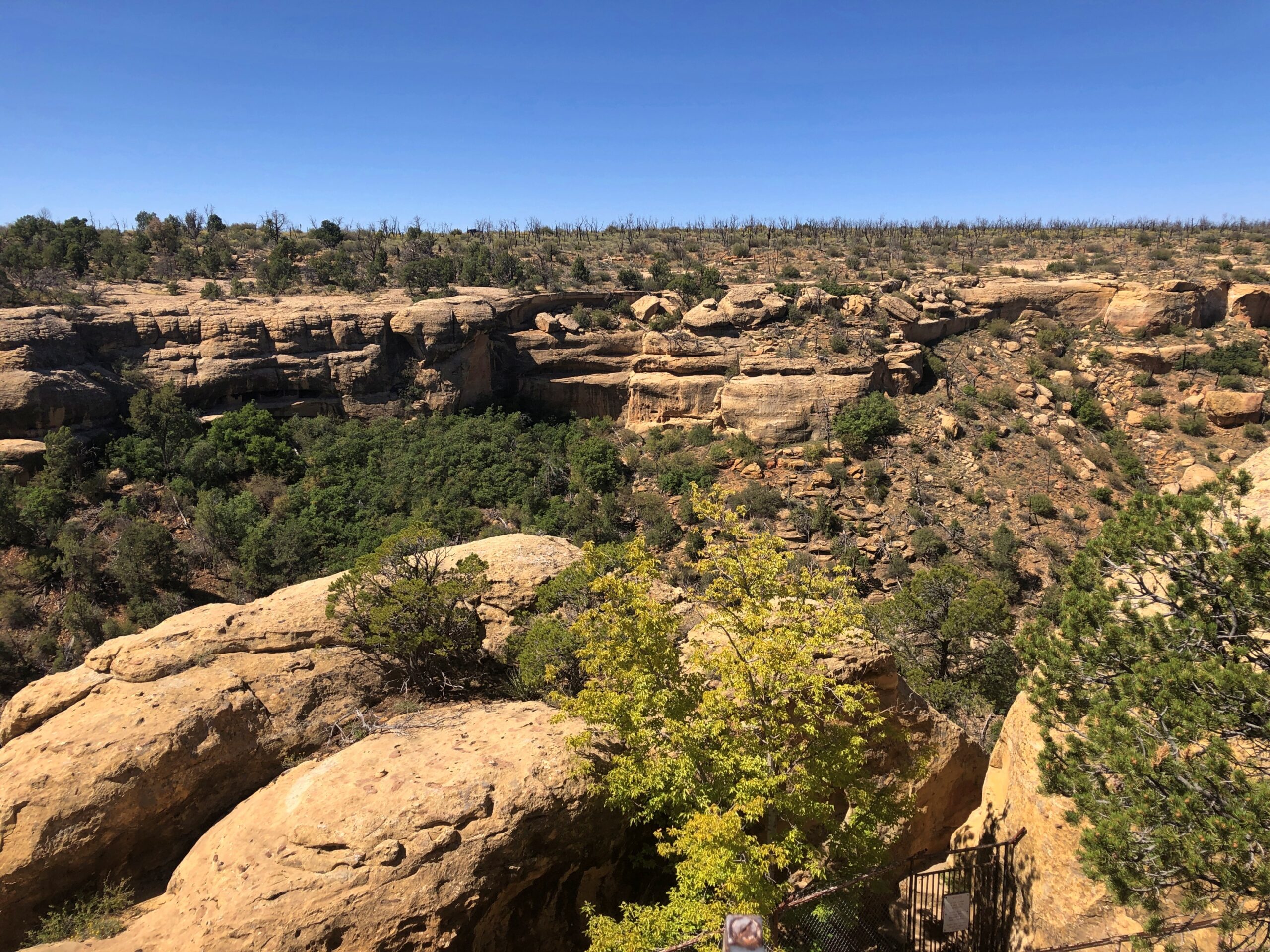
The canyon below the Cliff Palace. Imagine having to scramble up and down the walls regularly, to tend to fields or fetch water or escape from marauders.

Mesa Verde National Park

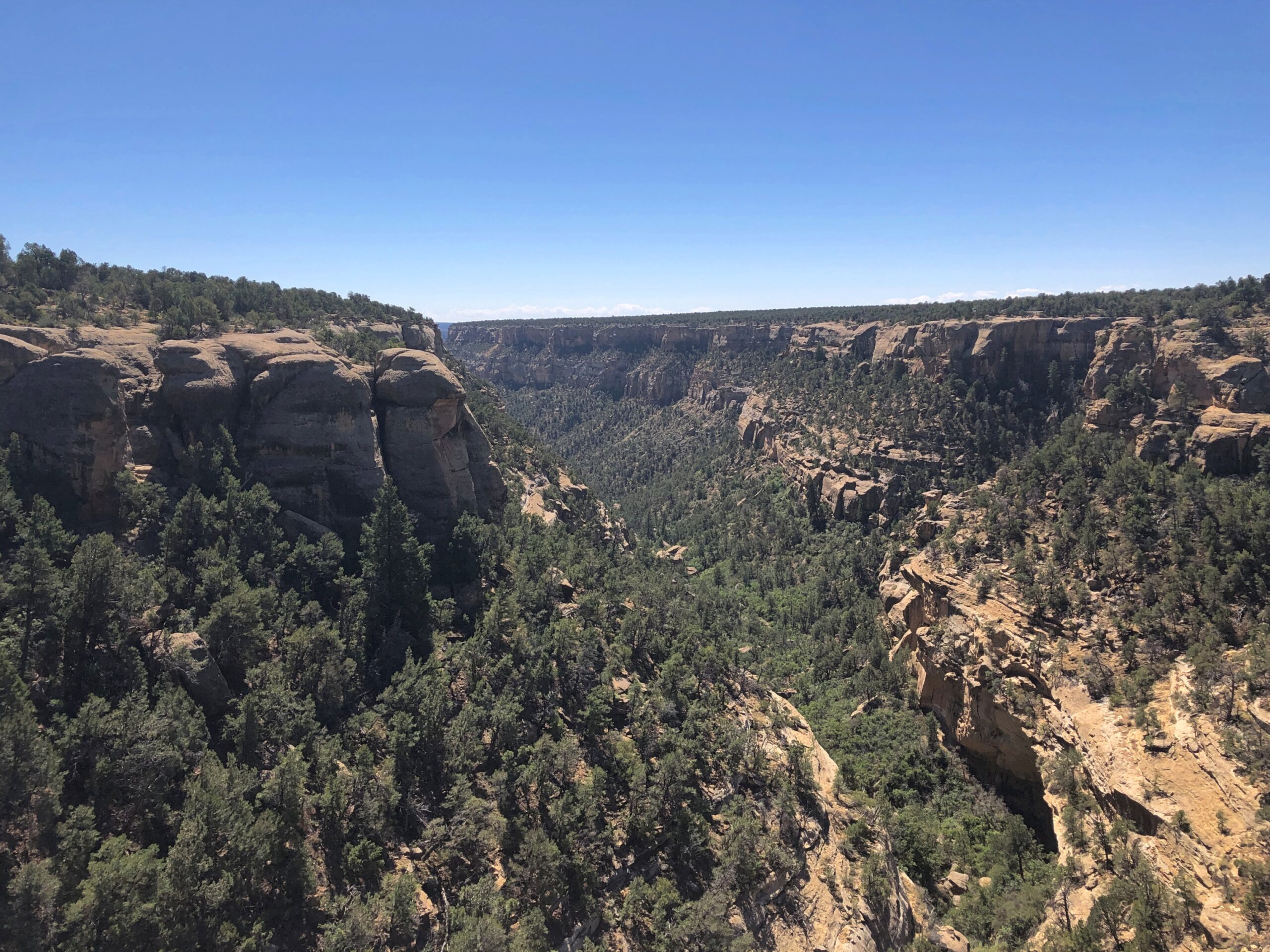
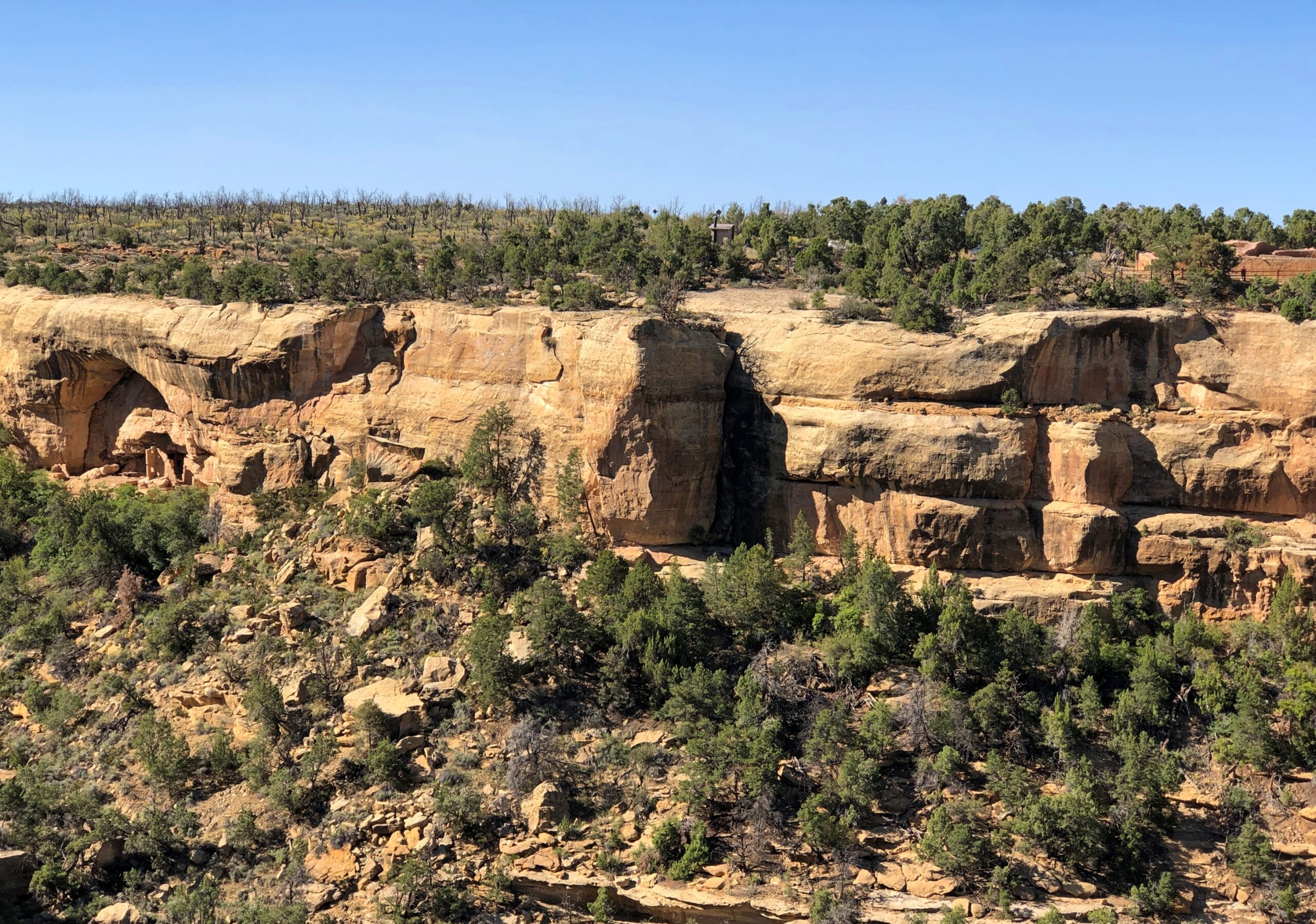
Mesa Verde is of course much more than the Cliff Palace, since the park protects an estimated 5,000 archaeological sites, including 600 cliff dwellings. The main road through the park (built by the CCC, naturally) takes visitors to other overlooks. The dwellings of Spruce Tree House are sizable and also off limits these days, until the overhead rocks are stabilized.

More cliff dwellings. They are a little hard to see, but they are there.

Mesa Verde National Park

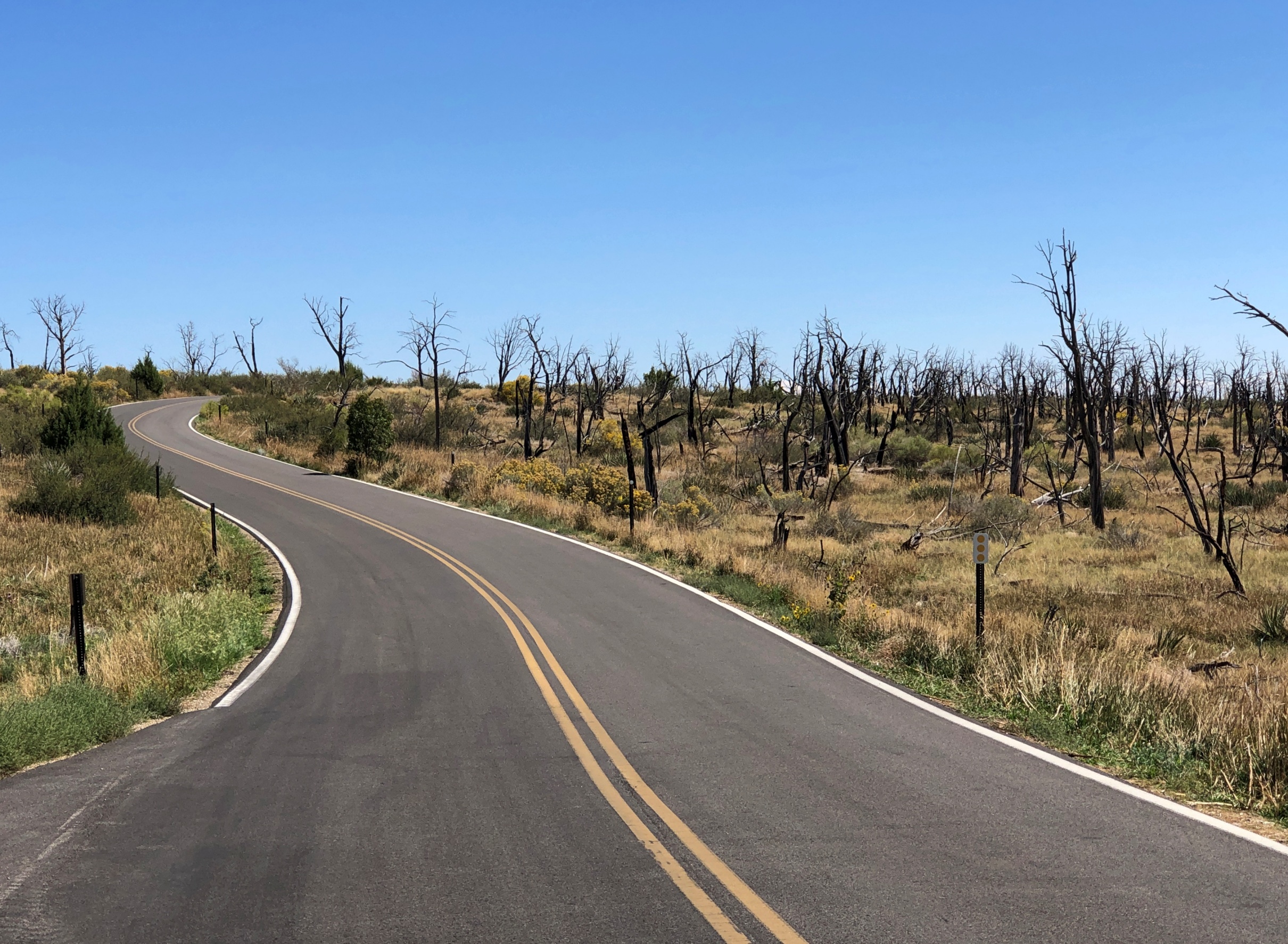
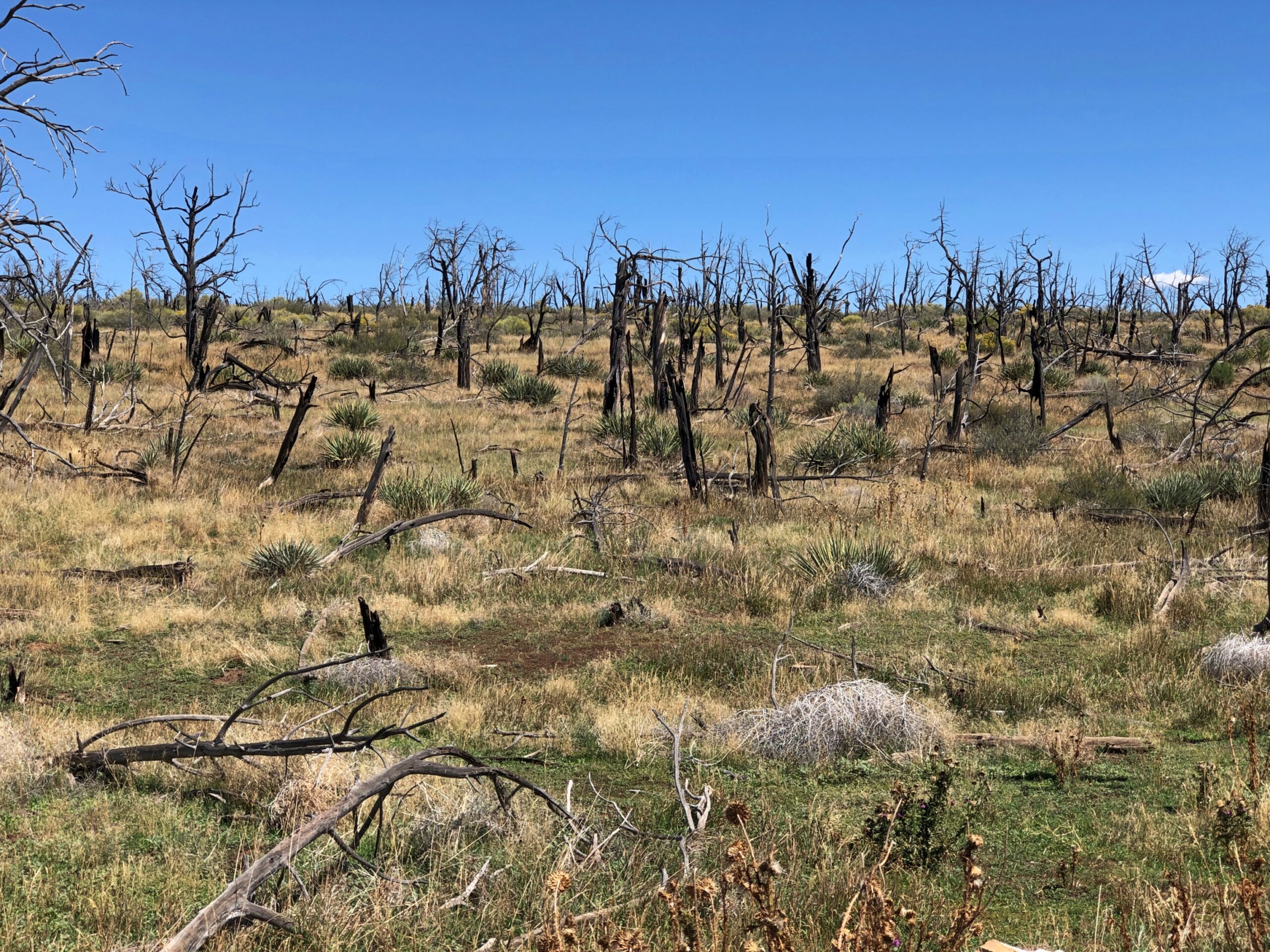
On top of the main mesa, the road also goes through areas burned by wildfire at one time or another.

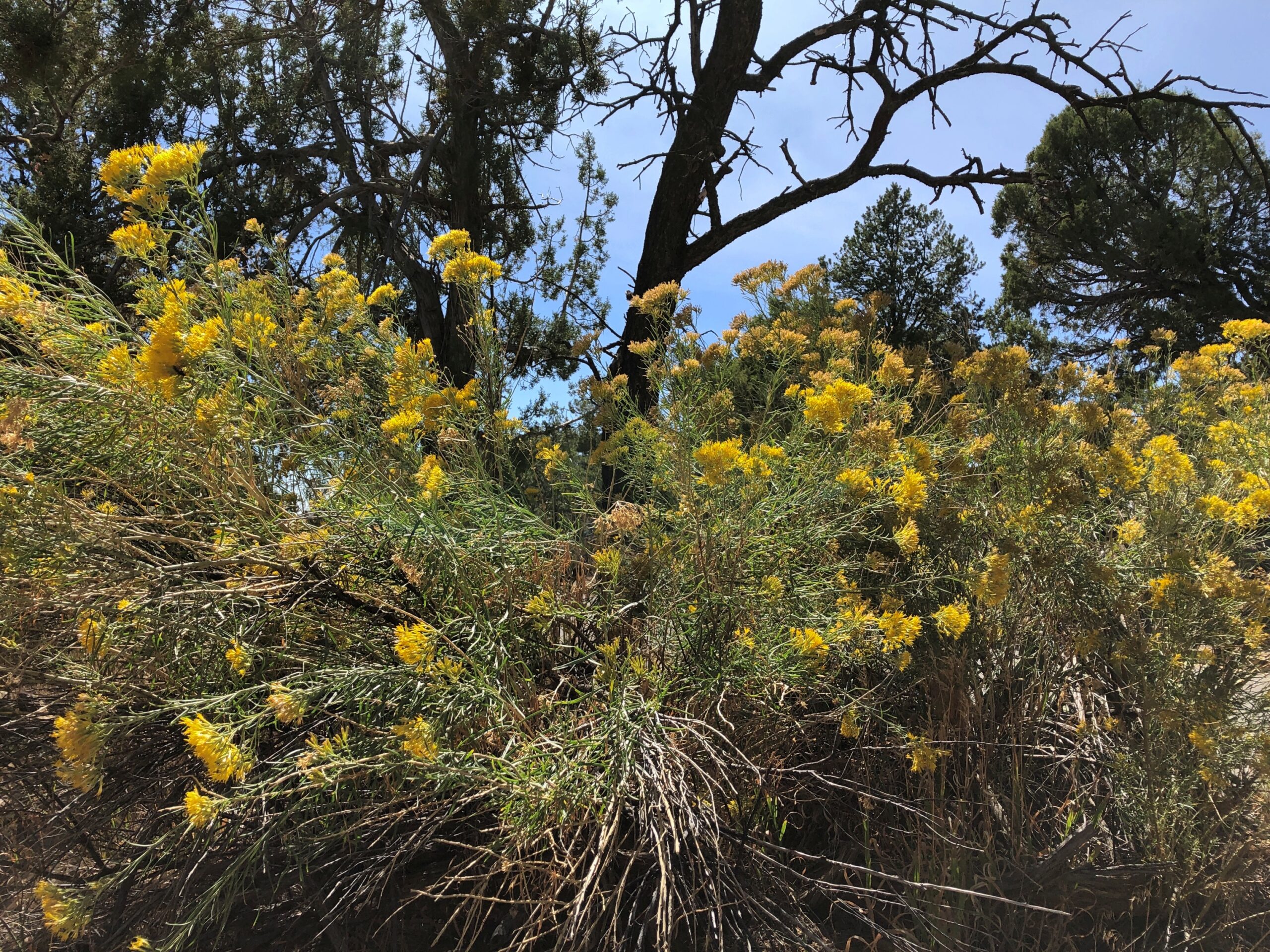
Flora always bounces back.

I had the vague idea that the inhabitants of the cliff dwellings disappeared mysteriously after about 1300, but visiting the park schooled me on more current thinking. They left, but there was nothing mysterious about it. Drought hit them, and hit them hard, so they migrated to find water and other sustenance. Persistent violence was probably a factor, too, as tends to happen in periods of strained resources. So it’s pretty clear that Ancestral Puebloans’ descendants even now live among the tribes along the Rio Grande, not too far away.

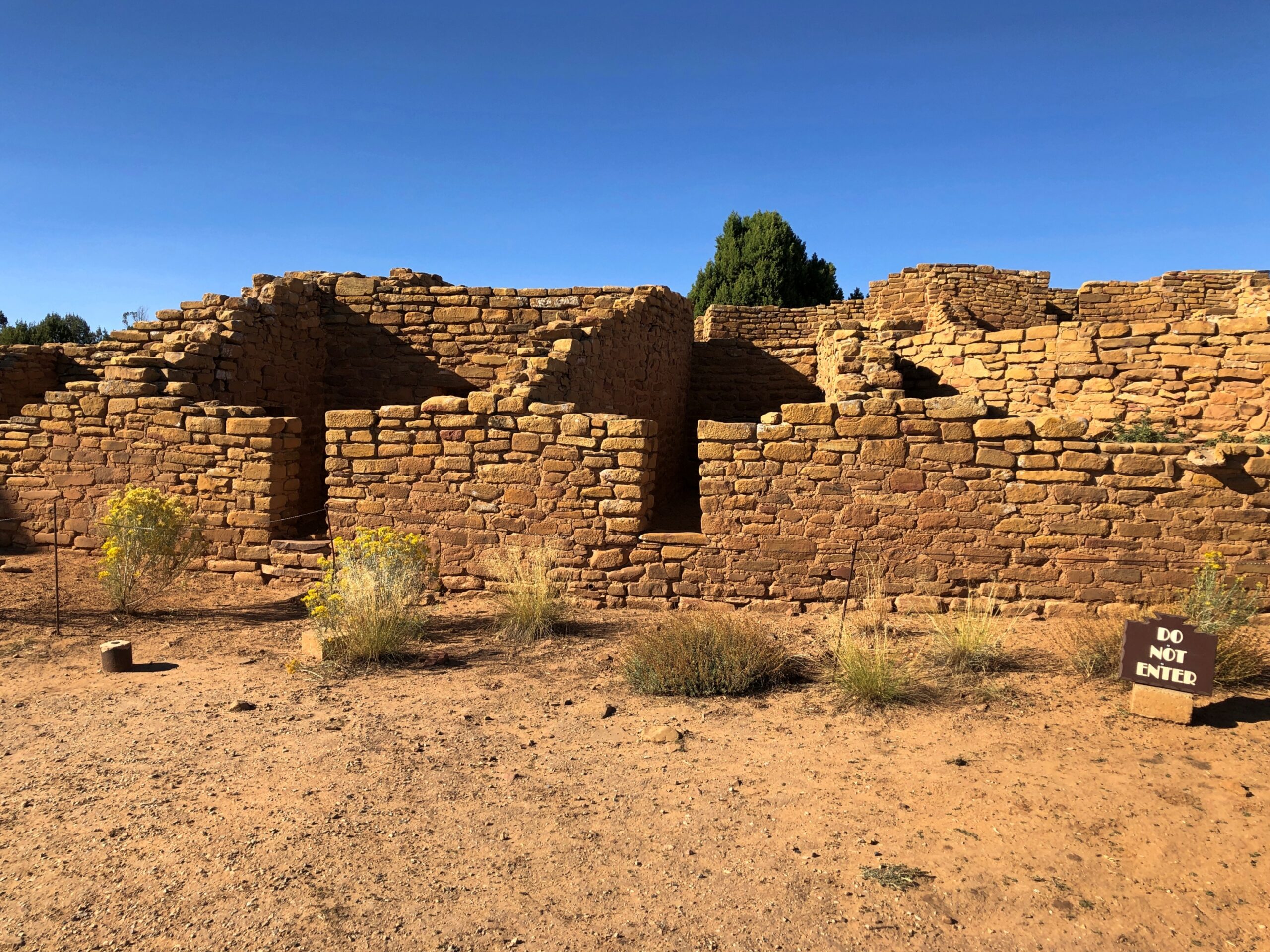
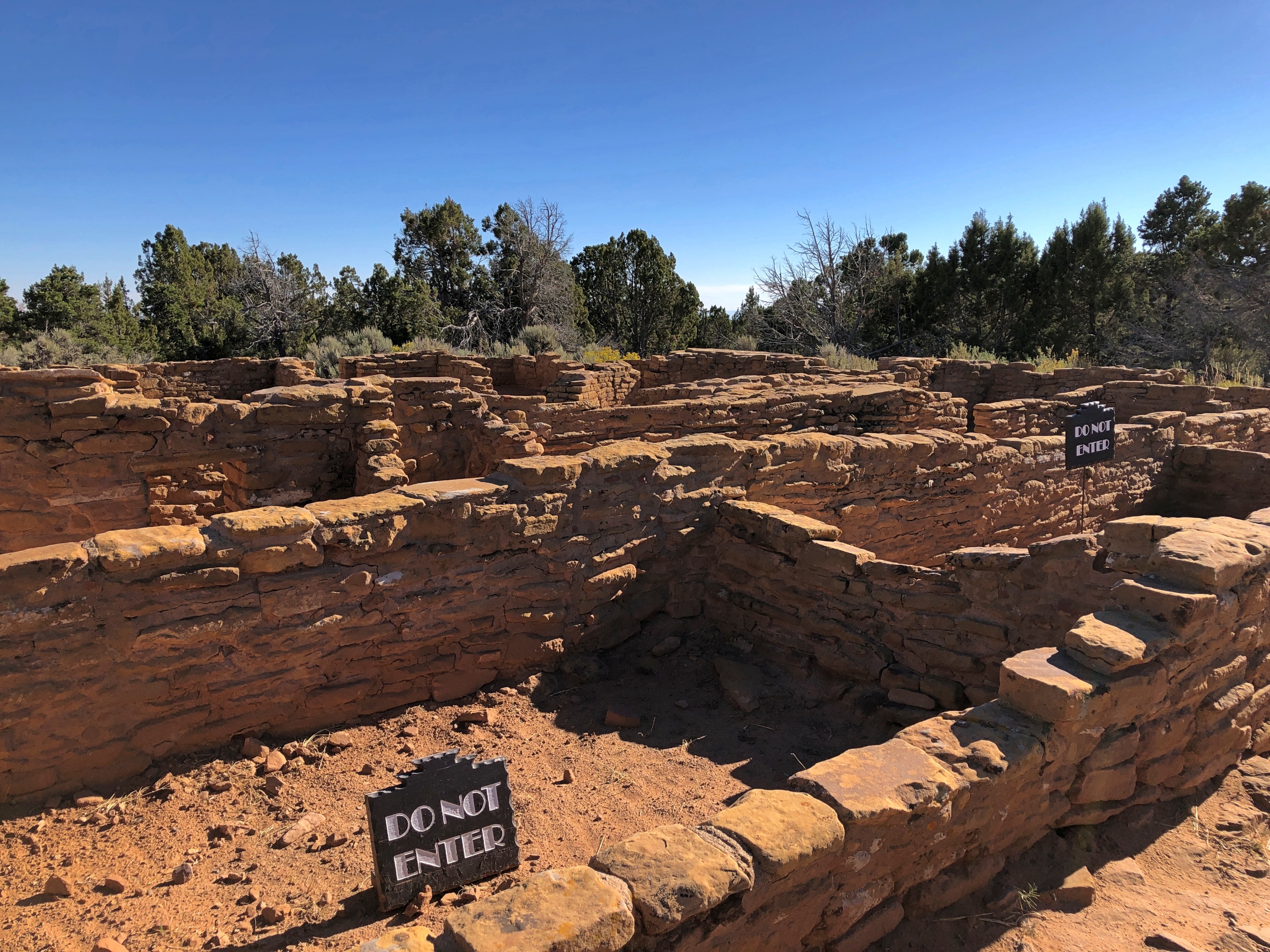
I also didn’t realize that the well-known cliff dwellings were only occupied for a relatively short time, in the grand scheme of native inhabitation: only about a century. Before that, most of the inhabitants lived atop the mesas. One such ruin is called Far View, which isn’t far from the road.

Mesa Verde National Park

I heeded this signs and didn’t enter. But you can walk around the perimeter and imagine the passing centuries.

Great Sand Dunes National Park and Preserve

It’s a safe bet that when most Americans think of scenic Colorado, they think of the sort of mountains you see at Rocky Mountain National Park, or many of the other ranges in the state. Less likely to come to mind is 1.5 cubic miles of sand. That much sand is hard to imagine at all.

That’s the amount of sand thought to be piled at Great Sand Dunes National Park in southern Colorado. Naturally, it isn’t a 1.5-mile cube, though the idea is amusing. The NPS notes that the sand is more spread out: “The 30 square mile (78 sq. km) active dunefield is where the tallest dunes reside. It is stabilized by opposing wind directions (southwestly [sic] and northeasterly), creeks that recycle sand back into it, and a 7% moisture content below the dry surface.”

Great Sand Dunes National Park

We approached the park on September 14, heading eastward on Lane 6 North, an Alamosa County road through the flatlands of San Luis Valley, an enormous stretch of land between the San Juan Mountains and the Sangre de Cristo Mountains. At 8,000 square miles, San Luis is the world’s largest alpine valley, the Denver Gazette asserts, with an average elevation at more than 7,600 feet.

Great Sand Dunes was a national monument for longer than it has been a park, though park status represents an enlargement of the monument that President Hoover created. It is Colorado’s newest national park, raised to that status only a little more than 20 years ago.

At a distance of some miles from the park, you notice a pale rim at the foot of the Sangre de Cristo range. As the mountains come better into view, so does the rim, soon looking like a vast pile of sand – which it is – pushed up against the mountains by some enormous broom – which it was not (see above).

Great Sand Dunes National Park

Also on offer: a nice view of the Sangre de Cristo, including flora that thrives in the sandy soil of its foothills.

Great Sand Dunes National Park

The tourist side of GSDNP features a visitor center and a parking lot and, a short ways away, camp sites. Vegetation girds the parking lot. From there – dunes at the other end of a long sand flat.

Great Sand Dunes National Park

No further signs, no trails. Visitors head toward the dunes and wander around wherever they want.

Great Sand Dunes National Park

A major activity is sandboarding. Like snowboarding, I suppose, only without the freezing white stuff. Atop this dune, sandboarders are ready to slide.

Great Sand Dunes National Park

It’s a young person’s and young families’ game. We happened to meet a pair of young men on one of the dune crests, boards in hand. One of them was wearing a Texas A&M cap, and I asked if he’d gone to school there. He had, finishing a few years ago. I wasn’t entirely certain that he believed me when I told him my grandfather was Class of ’16. That is, 1916.

Horseback riding is also allowed on the dunes, under certain conditions.

Great Sand Dunes National Park

We merely took a walk, climbing a few of the smaller dunes. I’d learned my lesson back in 2007, when we clawed our way up a large sand dune in Michigan, at Sleeping Bear Dunes National Lakeshore: “It was a slog. One foot up, then it slides down a bit. After all, it’s warm sand. Make that pretty hot sand. Step, slide back, step, slide back, step, slide back. Rest. Heat. Sweat. Sand in shoes. Remove sand pointlessly, because it comes back. Step, slide back, step, slide back…”

The day at GSDNP wasn’t quite as hot as in Michigan, but the sand was just as sandy. So we admired North America’s largest pile of sand, but not from the top of any particularly large pile.

Rocky Mountain National Park

On September 15, KKTV in Colorado reported that Trail Ridge Road through Rocky Mountain National Park was “briefly closed Sunday [the 14th] due to the wintry weather. This was first time snow and ice shut down the road since it reopened in May.”

We drove that road two days before, on the 12th. As the article notes, the “48-mile highway through the park is North America’s highest continuous paved road and connects the east and west sides of the park… [it] reaches 12,180 feet at its highest point. Alpine Visitor Center, where snowfall was caught on webcam, is located at about 11,796 feet.”

We’d spent the night before in Granby, Colorado, from the looks of it a growing town – complete with large rows of spanking-new townhouses – and from there entered the park from the western, or less crowded side. The eastern entrance near Estes Park, Colorado, has a more direct connection to the mobs coming from greater Denver.

RMNP is a place of majestic vistas. We came for that, and were not disappointed. But I was just as impressed by something we saw near the western entrance at a place called Holzwarth Historic Site, in the Kawuneeche Valley. A picturesque place.

It was the first place we stopped in the park, walking on a path through part of the valley. A small bridge crossed what looked like a creek.

Rocky Mountain National Parl

A sign on the bridge informed us, however, that this was the Colorado River. A flabbergasting moment. I’d known that the Colorado rises in one of the remote parts of the park, but I didn’t know we were going to encounter the river – whose downstream will carve epic canyons and be dammed to the hilt for the water and power needs of millions of people – by crossing it on foot in a few seconds.

The Holzwarths ran a dude ranch on the site for much of the 20th century, before selling it to the Nature Conservancy, which eventually resulted in the area being added to the national park. A number of the dude ranch buildings still exist not far from the baby Colorado River.

From the valley Trail Ridge Road, which is also US 34, heads upward. A look back at the valley.

Soon you reach Milner Pass on the Continental Divide, crossing back to the Atlantic side; we’d crossed to the Pacific side at Berthoud Pass the day before outside the park, on the way to Granby.

From there, the road takes you above the tree line. By that elevation, the warmth down in the valley is just a memory, as brisk chilly winds blow. The air was still above freezing that day, but not by much.

From one of the several pullouts on the road, a path through fields of alpine tundra.

Been a long time since I’d seen any. Back in the Canadian Rockies? No, Alaska. Still, a while ago. We’d reached autumn above the tree line, with the tundra turning.

Rocky Mountain National Park

The road goes on.

Who first built the road? There was none when Rocky Mountain NP became a national park, with President Wilson’s signature on the bill. Improvements came later, and of course they were by the CCC.

At the Alpine Visitor Center, parking was hard but not impossible to find. The views are good from there, but if you want the better vistas, you climb some outdoor stairs. Roughly 200 feet of them.

The air was cold and there wasn’t enough of it. Or so it seemed. I took my hiking pole, put on a sweater and cap and started up. I could have bought a small can of oxygen at the gift shop, had I known about it. I saw a woman, clearly older than me, coming up the stairs as I was headed down, pausing to inhale vigorously from such a can.

Yuriko and Emi made it to the top before I did, but by taking a number of breaks, I managed to get to there myself. Just another thing I should have done 30 (40) years ago. But even then, I’d have been tired at the top.

Rocky Mountain National Park

It’s that extra five feet that leaves you gasping, I think. No matter, the view was worth the gasps. Entirely. The images, as usual for this kind of vista, barely convey the scene in its glory. This is going to be a persistent reality over the next few days’ posts.

Rocky Mountain National Park

Enough to make you burst out with a rendition of “Rocky Mountain High.” If you had the oxygen. I have to say I was glad to repair soon to a lower altitude, one below the tree line. From the Alpine Visitor Center, the road heads toward the eastern entrance to the park, a good many miles away and several thousand feet closer to sea level.

Before we left the parking lot, we saw a fox — guess that would be an alpine fox, pointy snout, pointy ears, billowing with orange and white fur — trot onto the parking lot, as if it had a car parked there. A young ranger, presumably used to the elevation, took chase. Not to catch the fox, which would have been impossible, but probably to prevent the animal from getting run over. Roadkill is one thing, but parking lot kill would have put a small dint in the scenic wonder all around. Anyway, the fox headed for the slopes.

Not only was the air better below tree line, fall foliage was well under way, something we haven’t gotten much of even now here in northern Illinois, though it won’t be long.

Rocky Mountain National Park

One down, three to go. One of the marvels of Colorado’s four national parks is how different each of them are from the others, as we would soon see for ourselves.

Myrtle Beach: Grand Strand & Pier 14

The Grand Strand, it’s called. That would be the wide beach that stretches along the Carolina coast for 60 miles or so, including greater Myrtle Beach. Grand indeed.

Myrtle Beach, SC June 2025

Sounds like a name a newspaperman might invent. A news moniker. That is, a newspaperman back when they pounded print on their typewriters, and so it was, in the late 1940s.

The beach as a leisure destination, or at least the seaside, goes back a little further. No doubt the Romans had some equivalent, but modern beachgoing is just another thing bequeathed to us by the Victorians and their railroads.

Myrtle Beach the beach is more of a creature of the early 20th century, I understand – the dream of a turpentine baron of the late 19th century, one Franklin G. Burroughs (d. 1897), whose original fortune came from the sap-rich pines of the area. His real estate vision wasn’t as grand as that of Florida railroad tycoon Henry Flagler, but the idea was similar: build railroads to the coasts and persuade people to take leisure trips using those lines and, at the end of the lines, using tourist infrastructure that you’ve conveniently provided. Burroughs’ sons were up to the task, opening a rail-serviced hotel by the shore in 1901. Ultimately the rest of Myrtle Beach rose out of that placement on the Grand Strand, a stretch that had long been considered wasteland. Reportedly Burroughs’ widow named the town for its common flora.

I got a kick out of learning that the corporate descendant of Burroughs’ company, now known as Burroughs & Chapin, is a real estate developer active even now in the Carolinas and Georgia, largely building retail space.

It was a fairly hot walk from the boardwalk to the beach itself.

Myrtle Beach, SC June 2025

A row of fixed blue beach umbrellas waits for users.

Myrtle Beach, SC June 2025

And waits. Somebody must use them sometime, but close inspection revealed no one was. Even closer inspection revealed the charge for renting the umbrella and (I believe) two beach chairs with it is $50 a day. Way to price something out of the market, beach umbrella dudes (the city?).

The beach wasn’t particularly busy anyway. It had a lot of sun, which people seem to like, but just a little much in the way of blazing heat. Still, a few people ventured into the smooth waves.

We did too, briefly. Ahh.

Jutting out into the ocean, as piers do, is Pier 14.

Myrtle Beach, SC June 2025 Pier 14

It’s been a fishing pier a long time, despite some serious damage during Hurricane Hugo in 1989, and on the landward end it is home to a decent-looking seafood restaurant. The pier might be a Myrtle Beach institution, but ownership doesn’t seem inclined to gouge leisure fisherfolk, charging only $7 to fish from the pier, and $2 for a second pole (limit two poles). A look around the pier is $1, which you get back in the form of a discount on a purchase from the gift shop, which of course also sells fishing gear. A lesser businessman would gouge on the entrance fee (and no discount) for fisherfolk and tourists, and make them less amenable to spending money at the pier’s store.

“Why 14?” I asked the fellow behind the counter, a big-bearded, capped and Myrtle Beach t-shirted man thick in the middle and thick in middle age, who might have been the owner. For a second it looked like he’d never heard such an odd question, but I had noticed only two other piers, one off fairly far off to the north and the other off to the south. Had there been other piers, lost to storms or urban renewal? Not how I’d have phrased the question, but what I was thinking. I’d seen the like, stubs of ruined piers, in New York.

“No, it’s after 14th Street,” he said, maybe thinking about that obvious thing for the first time in years, and then he pointed out that the pier is actually closer to 13th Street, but who would want Pier 13? We’ve all seen buildings conspicuously missing their 13th floor. Or missing that name, since even if you called it the 14th floor, it would be the 13th. Wasn’t that a Twilight Zone plot element? An unlucky 14th floor, that is. Maybe not. Could have been.

We paid our dollars and out on the hot pier we went.

Myrtle Beach, SC June 2025 Pier 14

Wheel of Fortune?

New wood, new graffiti.

Nice views from both the pier and the beach. Including occasional aircraft.

That would be Axelrod & Associates. Good thing we didn’t need him or his ilk during our SC visit.