Return of the Zhu-Zhus

“A line of severe storms slammed through downtown Chicago and surrounding areas Monday, downing trees and power lines, which sparked fires in the city, officials said,” CNN reported last night. That, and there was some riotous looting too.

“More than a million homes and businesses in the Midwest are without power, including a third of all of customers in Iowa,” CNN continued. “The wind was so strong when the storm passed through Perry, Iowa, it blew pieces of boards from other buildings into the walls of a house.”

So we lucked out. As I mentioned, the winds were fairly tame in my tiny corner of the world. After such wind and rain as we had had passed yesterday, I went out in the yard to pick up items that moved around a little, such as one of the deck chairs. The sun had returned and I noticed the rain-speckled hibiscus picking up the light.hibiscusToday we opened up a box that has been sitting in our laundry room for a good many years, tucked under a few other boxes. I call it a laundry room, but being home to the washer and dryer is only one of its functions. Crap we don’t want to put partly out in the elements — in the garage, that is — goes there.

On Saturday, since this is a Summer of Nowhere, I spent a fair number of hours in the garage, till the trash bin was mostly full and garage crap had been rearranged somewhat.

Back to the box. Among many other things, it contained five Zhu-Zhu Pets. Mechanical hamsters, since I’m not sure they rise to the level of robot hamsters.

Ann marveled at them. Her 17-year-old self reflected on how important they were to her seven-year-old self. She got her first one for that birthday. Like most toys, they were important until they weren’t.
What amazed me was that the batteries have held out on all of them. They all still move around and make various preprogramed noises.

That’s about 20 seconds of randomly selected Zhu-Zhu Pet sounds, squeaks and whirs coming directly from 2010 to you in 2020.

A Stormy Monday Afternoon, But Not Too Stormy

Not something you particularly want to hear.

That’s the local siren that goes off during severe weather, with wind and cicadas in the background, sounding at about 3:45 this afternoon. I don’t actually know its official meaning, but my interpretation is, watch out for tornadoes, bub. So I did, at least through the north-facing windows of my home office, with occasional peeks southward.

We got a fair amount of rain and some lightning for the rest of the afternoon, though I’ve seen worse. As of early evening, we’ve been visited by no tornadoes or even damaging winds. In fact, by 6 the sun was out again. Just another passing summer storm, though we haven’t seen many this year.

Years ago I knew an Englishman, a Mancunian if I remember right, who was living temporarily in Nashville. One of the things that impressed him about America — frightened him, sometimes — was the violent thunderstorms, he said.

That gave me pause. It was hard to imagine not having much experience with that kind of weather. Guess the UK doesn’t get quite as many thunderstorms as North America, especially in the north part of the country, though of course sometimes the British Isles do get thumped by winds (such as in 1987, the reason we couldn’t visit Kew Gardens the next year). Massive thunderstorms were definitely a part of growing up in South Texas, especially come spring, and living in both Tennessee and Illinois.

Lilly and James Burke — Twice

During our long drive to the Canadian Rockies and back in the summer of 2006, we made a stop on the return in Bismarck, North Dakota (and Zap, too). Mainly to see the state capitol — my kind of sight.

Outside the building is a statue of John Burke, 10th governor of North Dakota and Treasurer of the United States for all of the Wilson administration, among other offices he held in the Progressive Era. My kind of sight as well — and my kind of whimsy to have Lilly, age 8, pose with it.
John Burke statue North Dakota CapitolIt’s a duplicate of a bronze by Utah sculptor Avard Fairbanks, put in its current place in 1963. Looks pretty good for being out in the Dakota winters for so many years. The summers as well, since I remember that day in Bismarck was pretty hot.

Note the hat covering one of Burke’s feet. I just noticed it the other day, looking at the picture. It’s my Route of Seeing cap, given to me by Ed. I told him I would take pictures of in various places, to send to him. I wonder whether I remembered to do so in this case (I was wearing it in the Zap picture as well).

Forward to 2011. We went to Washington, DC, that summer. Part of the visit involved a tour of the U.S. Capitol. Where is the original Fairbanks statue of Honest John Burke? There.

Naturally I had Lilly, now 13, stand next to it. Bet not many non-North Dakotans can say they’ve posed with both, and probably a fair number of North Dakotans haven’t either.John Burke statue US Capitol

The image didn’t come out so well, but so what. By then I wasn’t carrying around Route of Seeing, though it’s still tucked away with our other caps somewhere. Maybe I’ll take it somewhere again. (More likely, I’ll forget.)

Thursday Bits & Bobs

Some unusually cool days this week. I’m not sure whether that had anything to do with what happened at about 7:45 pm on Wednesday out on our deck. I was sitting out there, decompressing from a day of work and other tasks, when I saw a dark blob hit one of our deck loungers. Twack!
Two cicadas. Noiseless, though the cicadas have been doing their twilight bleating for a few weeks now. Crickets are also singing after dark, though maybe not as strongly as they will closer to their seasonal demise. By Thursday morning, when I next checked, the cicadas were gone.

Happy to report there’s a thin mosquito population this year, at least around here. Flies have taken up the slack. Seems like one gets in the house every day through the back door, including some of the metallic-colored ones that used to fascinate me as a kid.

Also in the back yard: blooming hibiscus. Could be Hibiscus syriacus. I can also call it rose of Sharon, though I understand that’s applied to other flowers as well.
At Starved Rock State Park recently, I spotted his plaque near the lodge. Looking its century-plus age, including countless touches of Lincoln’s nose.
GAR Ladies plaque Starved Rock State Park“Commemorating the deeds of the Union veterans of the Civil War,” it says. The Ladies of the Grand Army of the Republic erected it in 1914. Looks like the Ladies, who are still around, were trying to keep up with the Daughters.

Chronicling a lot of violence, but also a thing of great beauty.

Our most recent episode of Star Trek: “A Piece of the Action.” I suggested it as one of three options — an action/adventure story, or one of the show’s tendentious eps, or comedy. Ann picked comedy. I’d forgotten how much of a hoot “Action” is, with the high jinks gearing up especially after Kirk and Spock got into pseudo-gangster duds and Shatner hammed it up.

Oh, my, listen to that. My my my.

Trinity Lutheran Cemetery, aka Freinenigreit Cemetery

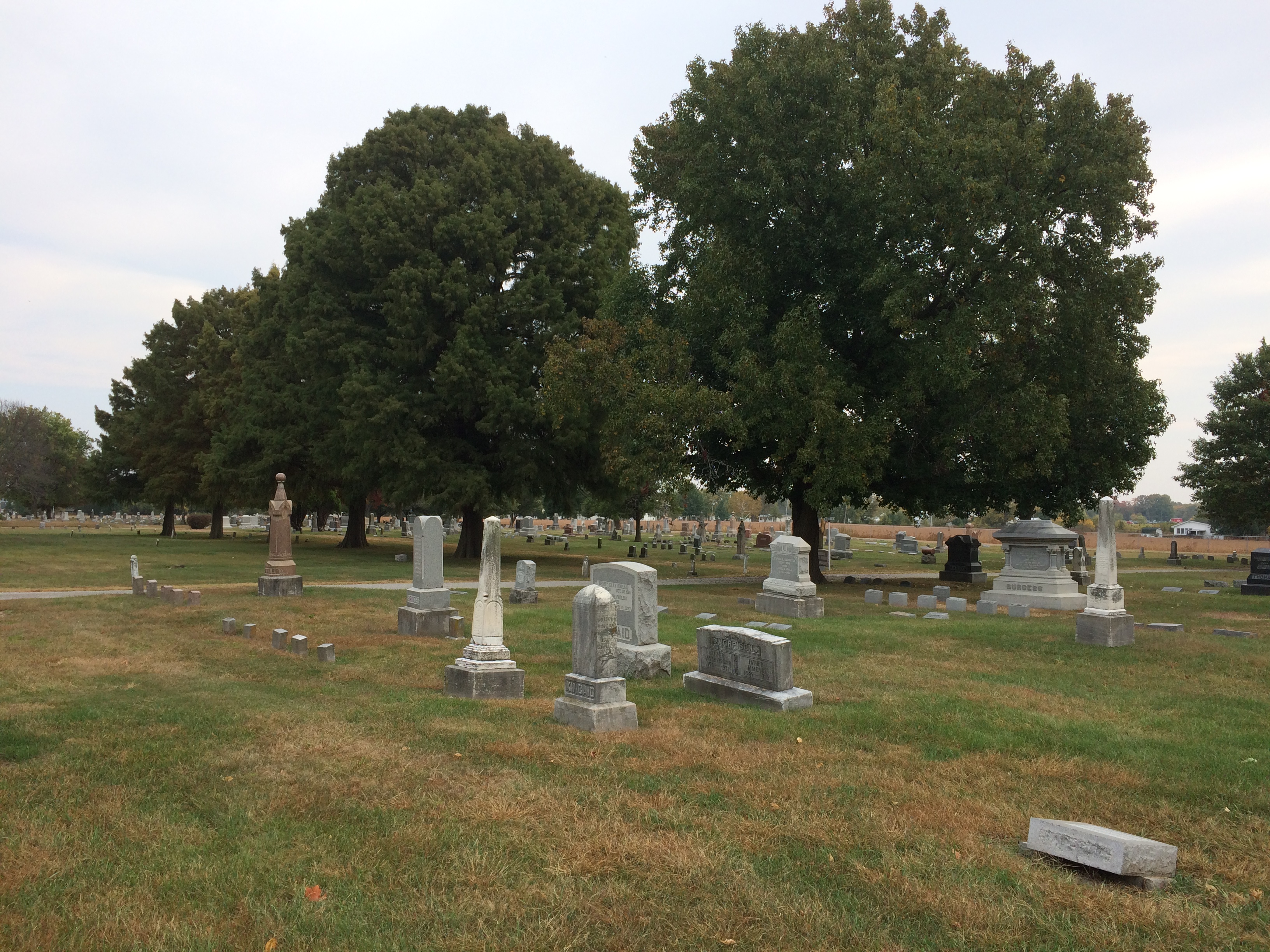
Tucked between an equipment rental shop and a truck accessories store on Irving Park Road in northwest suburban Roselle is Trinity Lutheran Cemetery. It’s also known as Freinenigreit Cemetery, according to a number of sources, including Find-A-Grave, but not any signs at the cemetery itself (that I noticed).Trinity Lutheran Cemetery

The alternate name speaks to the German heritage of this part of the Chicago suburbs, and the names of some of the earlier permanent residents reflect that as well: Botterman, Engel, Freitag, Geistfeld, Habermeier, Hattendorf, Reuter and Schmidt.
Trinity Lutheran Cemetery RoselleTrinity Lutheran Cemetery RoselleIt’s a small slice of a cemetery, about 300 burials, many of which are recent. Those names tend to be more varied: Abraham, Burkinshaw, Dunbar, Ek, Hernandez, Pastori, Smakal and Tumminaro.

A nice design for a simple stone.
Trinity Lutheran Cemetery RoselleFor an infant, born and died in 2004.Trinity Lutheran Cemetery Roselle

This one caught my attention.
Trinity Lutheran Cemetery RoselleI looked up Jake. A bright lad, just a little younger than my oldest child, who died suddenly of an undetected heart condition.

Illinois Heritage Grove in the Summer

During our Saturday walk at Spring Valley Nature Sanctuary, we wandered into the Illinois Heritage Grove, which is section of the sanctuary devoted to native woody plants. A mini-arboretum.
Illinois Heritage GroveThe last time I spent any time there was in the fall, when things looked a bit different: Illinois Heritage GroveSummer. Roughly the same view of part of the oval path through the grove.
Illinois Heritage GroveFor now, the grove’s bushes and trees are garbed in greenery. Such as the American plum (Prunus americana).
Illinois Heritage GroveThe hackberry (Celtis occidentalis).
Illinois Heritage GroveThe elderberry (Sambucus canadensis).
Illinois Heritage GroveRemember, your mother was a hamster and your father smelt of elderberries.

Spring Valley Flowers, August ’20

On August 1 we visited Spring Valley again, about two months after our most recent visit. The place is flush with a different selection of flowers and other flora than in June.
Glad to see that cornflowers are still blooming there. I think of it as a July flower.
I take this to be a kind of lily, but not sure the details.
A Google reverse image search suggests peony for this, but I doubt it. Still, a nice little cluster.
A larger cluster. Valerian?
Looks similar, but a different color.
Hard to believe it won’t be long before Spring Valley will look like this.

Two Illinois Points of Interest

For years, I’ve seen the following two points of interest routinely included on road maps of Illinois. At least, on Rand McNally and Michelin: the Norwegian Settlers State Memorial and the Wild Bill Hickok State Memorial.

When it comes to points of interest on commonly available road maps, there must be just a touch of the arbitrary in their selection. Just a touch, because certainly mapmakers have their editorial standards. Still, I see those (typically) red dots and wonder not only what it is, but also why is that on the map and not something else?
Guess being a state memorial or monument helps land a place on maps. (That link is part of a larger list.)

One goal of our recent trip was to avoid large highways, which we mostly did until we headed for home, when we wanted a more speedy return. When heading out, we kept to smaller roads. One of these was Illinois 71, which passes through the unincorporated community of Norway.

Not far from Norway is the the Norwegian Settlers State Memorial. It’s an example of the plaques-on-rocks school of memorial design, along with a wooden structure, and U.S. and Norwegian flags.
Norwegian Settlers State Memorial “This Memorial commemorates the 1834 settlement at Norway, Illinois — the first permanent Norwegian settlement in the Midwest,” says the State Historic Preservation Office. “A departure point for many Norwegians who settled other parts of the Midwest, Norway became known as the ‘mother settlement.’ The monument, dedicated in 1934, honors the community and its founder, Cleng Peerson (1783-1865).”

Peerson got around. Though he led immigrants to the New World, he didn’t seem to be interested in settling for more than a few years at a time himself. According to Wiki, he even spent time in Bishop Hill among its Swedish settlers. I guess he had no hard feelings against those oppressors of the Norwegian people. He ended up in Texas in the mid-19th century, as a lot of people did.

Why three stones? One from 1934 memorializes the 100th anniversary of the settlement of Norway, Illinois. Another from 1975 memorializes the 150th anniversary of Norwegians first coming to America en masse. The King of Norway came for that occasion. And yet another (also 1975) notes that part of Illinois 71 is the Cleng Peerson Memorial Highway.

That’s not all. The wooden structure — which I assume is an homage to Norwegian design — has text front and back. Three separate plaques on the front, dated 1980, tell the “Norsk Story,” that is, Norwegians coming to America.

Two more plaques on back (from 1982, bicentennial of Peerson’s birth) offer more detail about the memorial, including lines about Lester Severskie (1918-82) who was “dedicated to the preservation of the Norwegian heritage of Norway, Ill.”, a list of the Norwegian heritage organizations in the U.S. as of 1982 (I had no idea there were so many), and a few lines to thank Olav V, members of the Norwegian government, and so on and so forth.

This has to be the wordiest memorial I’ve ever encountered. It’s the memorial equivalent of a logorrheic movie star upon winning an Oscar. I usually enjoy reading obscure plaques, but these tried my patience, especially in the high heat of July. (The rest of my family was sitting in air-conditioned comfort in the car.)

Even so, I’m glad I stopped. Especially because I noticed that behind the memorial is a small cemetery. The Cleng Peerson Memorial Cemetery, according to one source (who spells cemetery wrong), though I didn’t see any signs or plaques at all about it, just the headstones. According to another source, it’s the Nelson Cemetery.

Norwegian Settlers State Memorial cemetery

Norwegian Settlers State Memorial cemeteryWhatever the name, it must be an active local cemetery. At least one burial was fairly recent.
Norwegian Settlers State Memorial cemeteryPeerson himself isn’t there. He’s buried near Clifton, Texas.
In a different context, you might call Peerson an empresario, along the lines of Stephen F. Austin in Texas, except that he was merely a leader of immigrants, not someone who was granted land by an existing government. Except that in the end, he was granted land by Texas, but for services rendered in populating the state with hardy Norwegians, not as an incentive to bring them.

Returning from the Illinois River Valley on Sunday, I made a point of stopping at the Wild Bill Hickok State Memorial in Troy Grove, Illinois. Wild Bill isn’t buried there either. He died in Deadwood, after all, and he rests there in Boot Hill.

Rather, the memorial marks the birthplace of James Butler Hickok, scout, spy, lawman, soldier, marksman, gambler, showman, folk hero, and dime novel and movie and TV character. It’s at the center of an open patch of land where the Hickok family home once stood, and includes one plaque and one bust.
Wild Bill Hickok State MemorialThe state of Illinois erected the plaque in 1929, and it wasn’t shy about lionizing Wild Bill. It needed a proofreader, too.
Wild Bill Hickok State Memorial“He contributed largely in making the West a safe place for woman [sic] and children,” the plaque says in part. “His sterling courage was aways [sic] at the service of right and justice.”

The bust is more recent. I had to look it up, because I couldn’t find anything on site — not a word — to say who created it or when.
Wild Bill Hickok State MemorialThe state of Illinois says a “log-carved bust” of Hickok was added in 1999, but that’s no wooden bust. It took a little looking, but I found out that “in 2009, an attractive bronze bust of Hickok by artist William Piller was placed in the park. It replaced a carved wooden bust that had been in place 10 years but had severe weather damage,” according to the Danville, Illinois, Commercial-News.

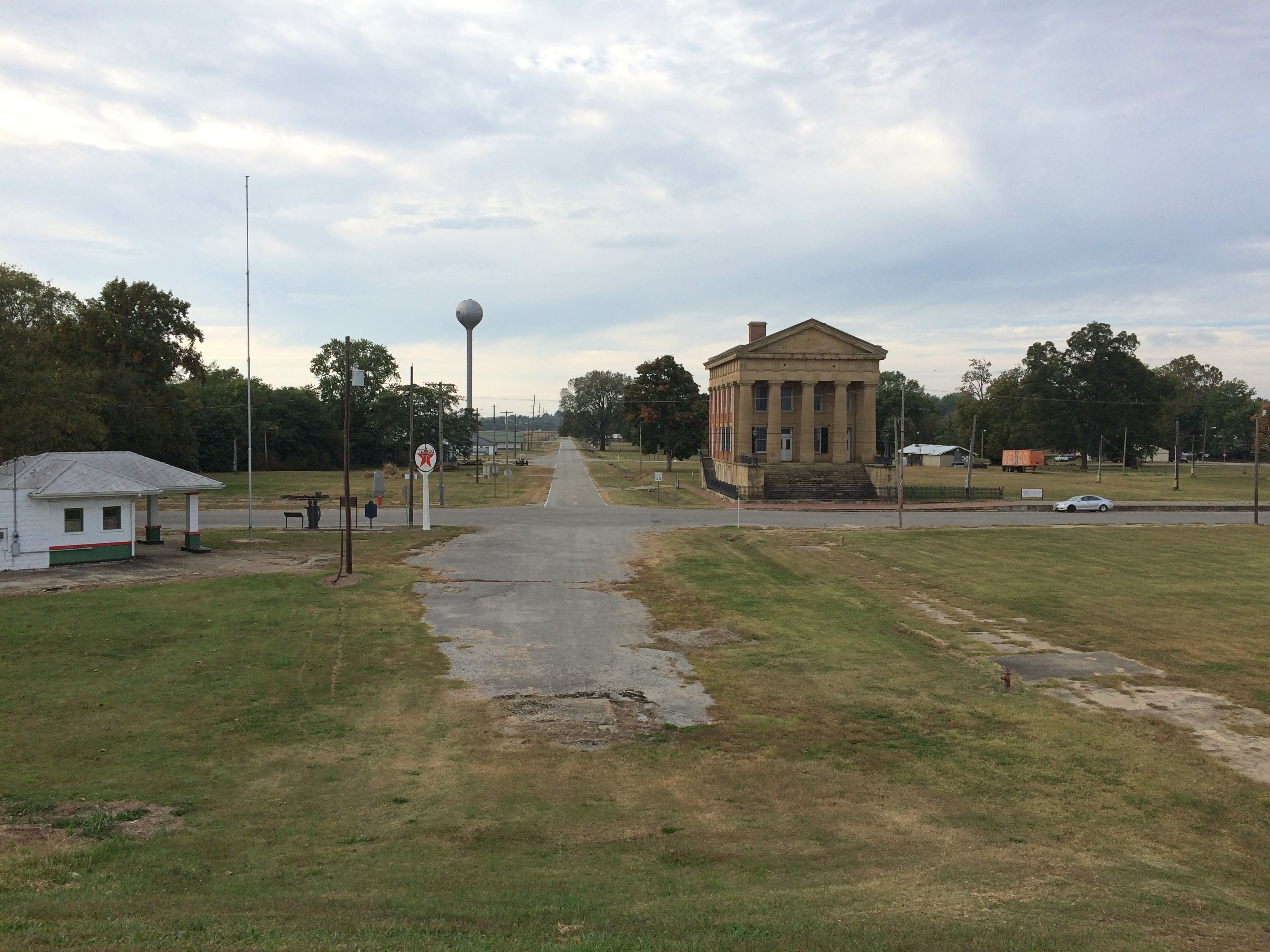
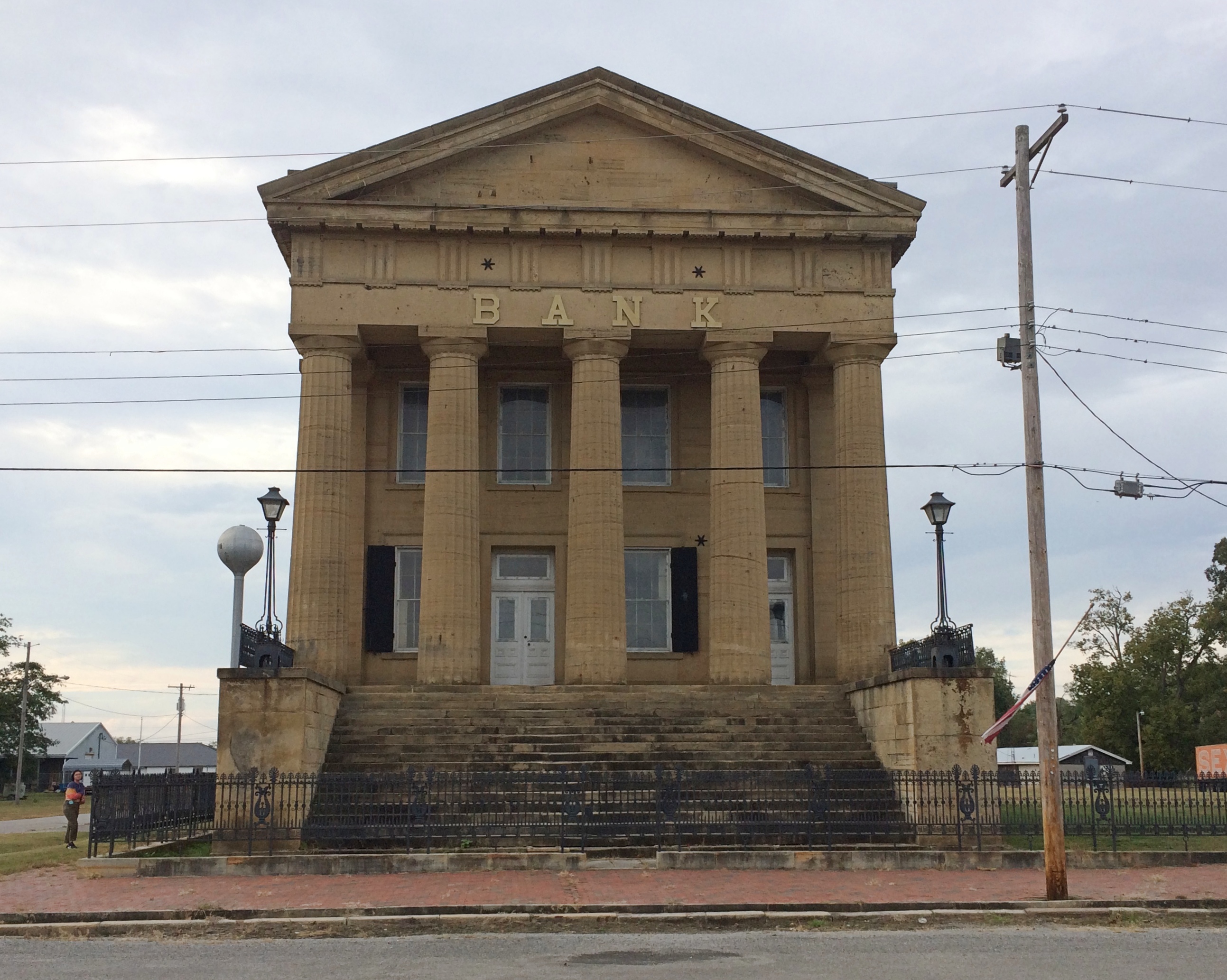
Though it was a hot day, I wasn’t quite done with Troy Grove, pop. 230. A building near the memorial caught my eye. (The rest of my family was sitting in air-conditioned comfort in the car.)
Former Bank, Troy Grove IllinoisBank, eh? Well, not any more. Still, it’s a handsome little building. A detail toward the top further got my attention.
Bankers Electrical Protection Co. of Minneapolis

A logo marker apparently left by the Bankers Electrical Protection Co. of Minneapolis: a guard dog close to a money bag. The company seems to have specialized in bank vaults and other security features for banks of yore. You know, the sort of banks at risk from unauthorized withdrawals by the likes of the Cream Can Gang.
Besides a few images, I haven’t found out much else about BEPCo. (as it surely would be called now), mostly since I don’t feel like it. Enough to assume that it went out of business or was acquired by another security company long ago. Yet traces remain, in stone no less.

Oglesby Sights

Sizable towns cluster around the Illinois River in north-central Illinois like so many stones on a necklace: Morris, Ottawa, LaSalle, Peru, Spring Valley, Princeton. Then there’s Oglesby, which isn’t so sizable, at about 3,500 people. The place is named after the long-ago Illinois governor, whom I’ve encountered before in Decatur and Chicago.

We became acquainted with Oglesby last weekend because we stayed overnight in a motel in the town, to take advantage of its proximity to Starved Rock SP and Matthiessen SP, though we decided not to visit the latter.

To become acquainted with the town, you can drive down the east-west Walnut St. for about two miles. On Sunday morning, I went out for gas early, which also meant looking around. Lilly joined me.

The town post office on Walnut looked about as WPA as can be. Being Sunday, we couldn’t go in and look at the 1942 mural, “The Illini and Pottawatomies Struggle at Starved Rock” by Fay E. Davis, which is said to be quite something.

Soon we arrived at this structure, which would loom over Walnut St., except that it’s set back a few hundred feet and behind a fence. The fence is pretty new.
Lehigh Portland Cement Co Oglesby IllinoisAn old enough ruin to sport fully grown trees in its midst. An interesting enough ruin to be fenced, though I figure local teens have no problem getting in when the mood strikes.

The blackened sign is just barely legible.

LEHIGH PORTLAND CEMENT COMPANY OGLESBY

That’s all I needed to find out more about this industrial ruin. For decades, Oglesby lived by the extraction and processing of minerals, especially the manufacture of cement and concrete.

The Chicago Cement Co. started operations on the site in 1898. Lehigh, a Pennsylvania company, acquired Chicago in 1916 and ran the plant until 1963. Apparently Lehigh decided at that time that modernization of the plant wouldn’t be worth the expense, and so closed it.

I have to report that cement and concrete production in the area isn’t dead yet. Illinois Cement Co., which is across the river in LaSalle, still seems to be in that business, and related hard-stone entities dot the map: the Mertel Gravel Co., Ladzinski Concrete Finishing Co., Lafarge Aggregates, Wenzel Concrete Works and Ruppert Concrete, to name a few (and those last two are in Oglesby).

The above image is only a part of the ruin.
Lehigh Portland Cement Co Oglesby IllinoisEven that doesn’t depict the whole of it. Note how far it goes back when you look on Google Maps. We were looking at the property from about where I’ve put a blue dot.
Lehigh Portland Cement Co Oglesby Illinois“This looks like the most interesting thing in Oglesby,” I told Lilly. Too expensive to tear down, I figure, so there it stands, letting the decades take their toll.

Down Walnut to the east was something almost as interesting, and cement related, too.Safety Follows Wisdom Oglesby IllinoisAn intriguing bit of work in a small public park — Lehigh Park — donated by the company to the town in 1945 (the side plaque says that). Turns out the work is one of a genre of memorials, awarded by the Portland Cement Association, with examples wherever cement is or was made. They’re made of cement, of course.

“Cement ‘Safety Follows Wisdom’ monuments, first presented in 1924, for perfect safety records at cement plants,” says the Historical Marker Database. “The winning design came from an Art Institute of Chicago team directed by sculptor Albin Polasek.” (I’ve happened across his work before.)

Safety Follows Wisdom Oglesby illinoisDo a casual search and you’ll find Safety Follows Wisdom stones all over the country. It’s something I had no inkling of until I drove down a main street in a small town and — more importantly — got out of the car and looked around. The devil might be in the details, but I find that the joy of traveling is in the details.