Fallen Trees

Before any snow fell on Sunday, we enjoyed a fairly nice Saturday, sunny and not too cold. Warm enough to talk a pleasant wall at Spring Valley, our go-to place for short walks in the mixed woods and prairie when we don’t want to drive too far to do so.

I noticed that the park district had finally gotten around to removing the big white ex-tree near the edge of the Spring Valley’s largest pond.
This is what it looked like nearly five years ago, standing tall and dead.

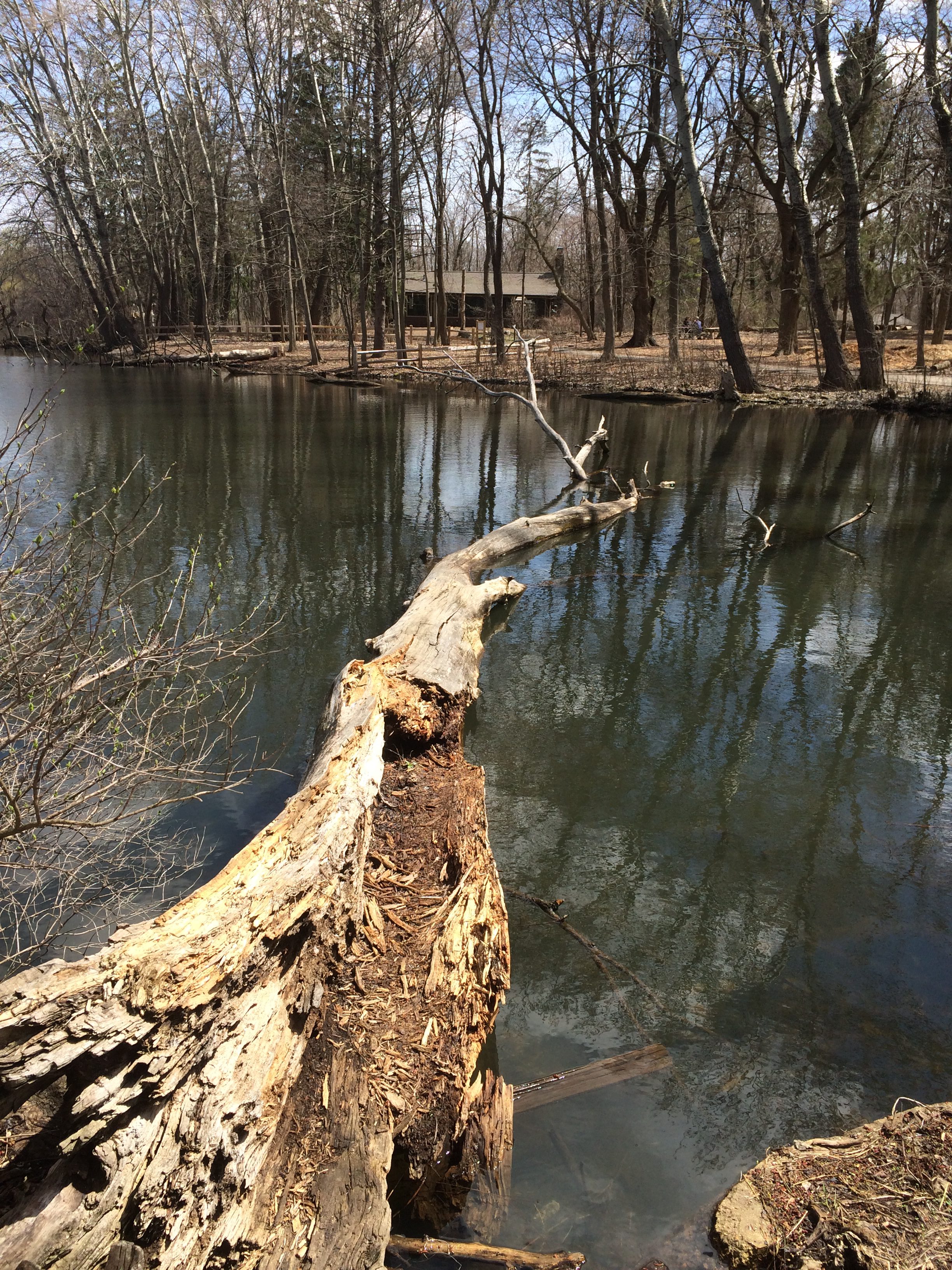
A nearby fallen tree, which landed in the pond, is still there, but the years are taking their toll.
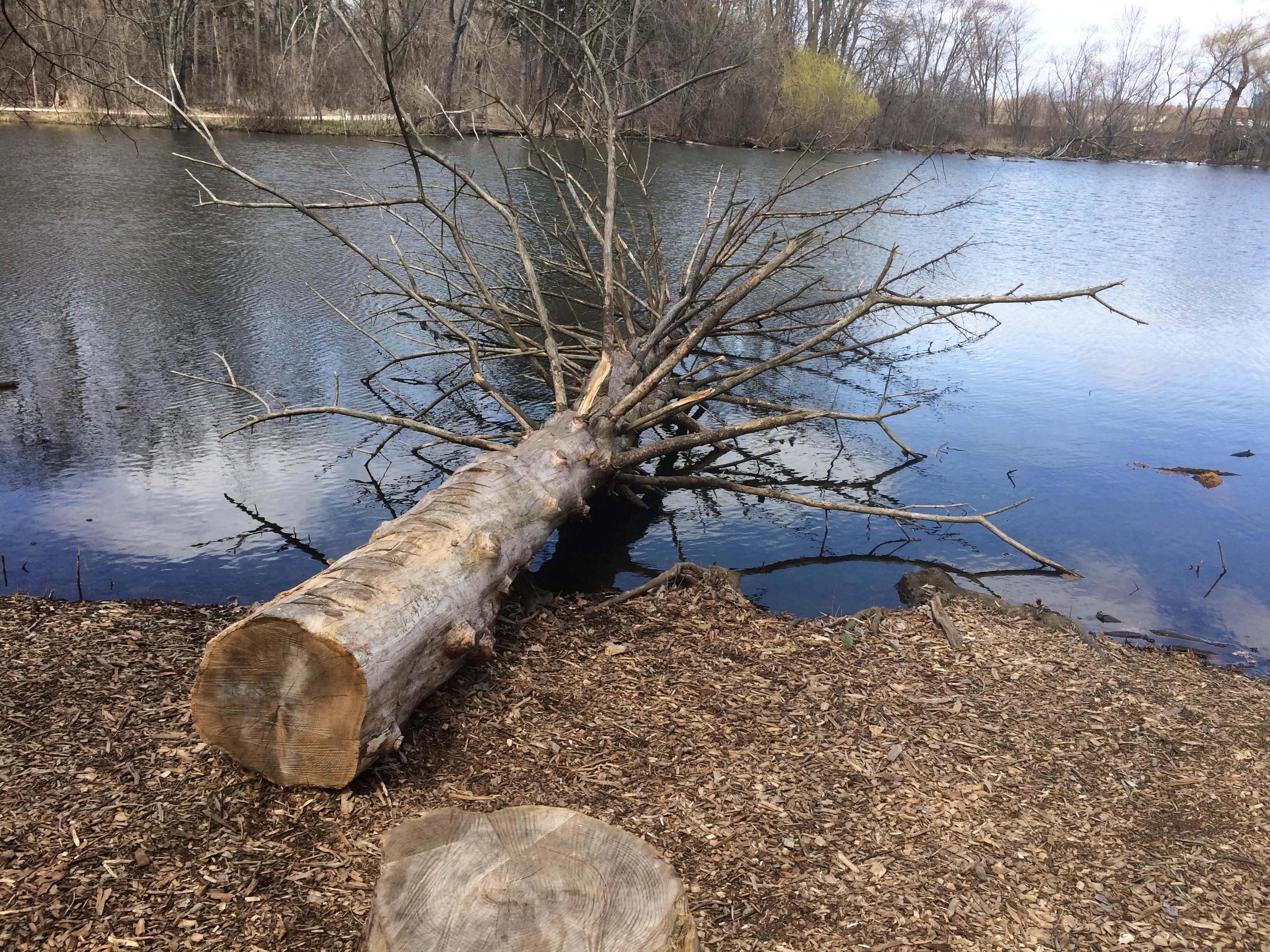
That inspired me to look around for some other fallen trees at Spring Valley. There are a fair number, including cut ones.

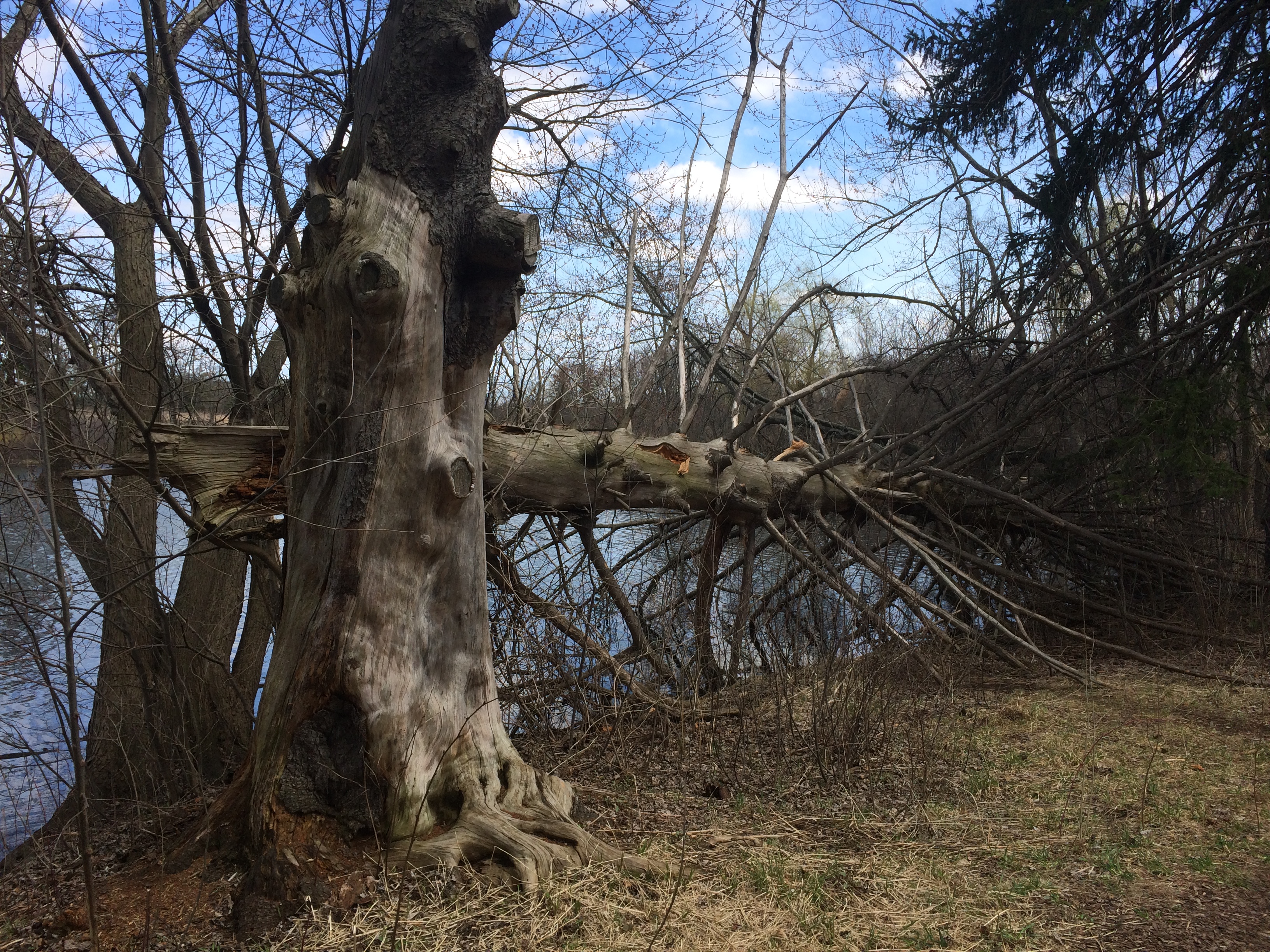
And those that look like the wind finally got them.
All very nice, but nothing as epic as I saw in Washington state, or as damaging as in the UP. Or as varied as you can find among these images.

Notre-Dame

First heard about the Notre-Dame fire on the car radio late yesterday afternoon. Wish I could report some kind of transcendent experience at the cathedral during our visit years ago, but no. Other people’s accounts along those lines are being posted with great speed.

We were duly impressed by the stained glass, the flying buttresses and the overall sweeping majesty of the exterior. But sad to say, what I remember most was that the cathedral interior was dark.

I understand the reason. Lighting is expensive. So the cathedral wasn’t much illuminated on an ordinary day in November 1994 for the ordinary tourists who were visiting. The thing to do would have been to attend a service, but we thoughtlessly did not.

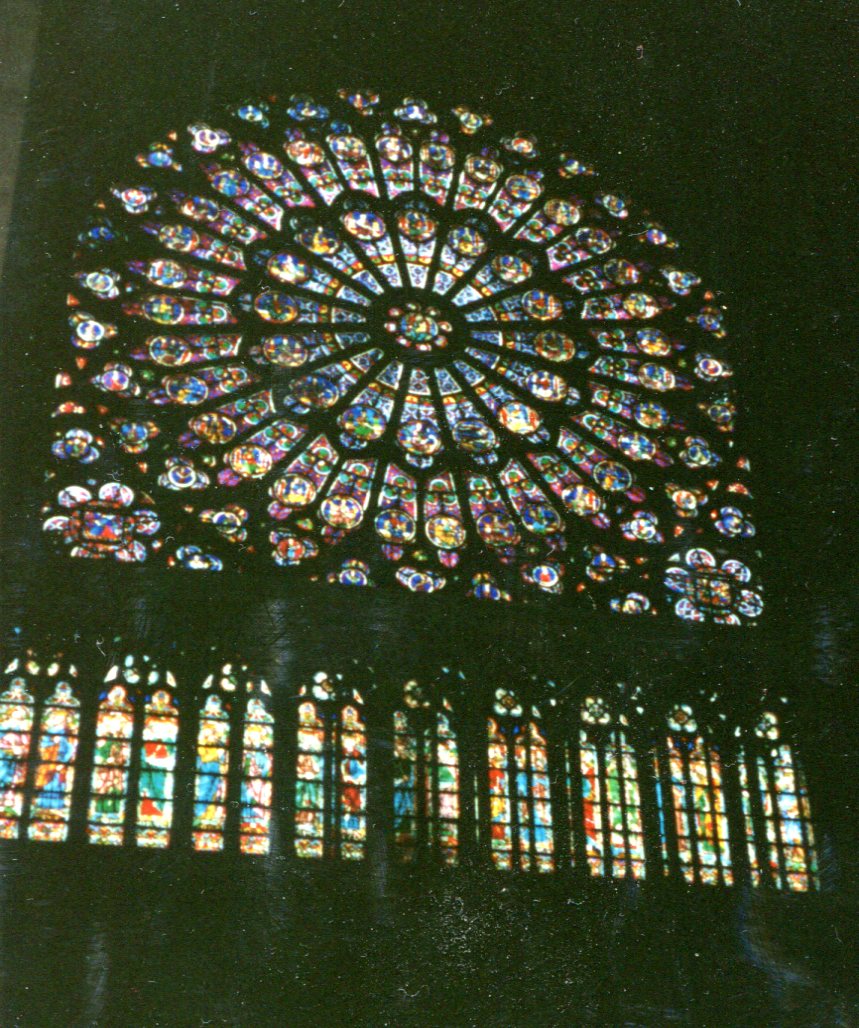
Among all the pictures I took in 1994, I have exactly one of Notre-Dame. Of course it was one of the Rose Windows. I didn’t want to use film anywhere too dark. Not that I had the equipment to take a very good image anyway.

Maybe we were lucky to be able to see it at all. Whether you credit Dietrich von Choltitz with not burning down Paris in 1944, or think that’s nonsense, the Germans could have certainly done a lot of damage before liberation, including dynamiting something so quintessentially French as Notre-Dame du Paris. Such an act would have been in character, after all.

I’ve read today that, at least, the flying buttresses did indeed buttress the walls, though the roof was lost, including wood lattices made from trees cut down between 1160 and 1170. The Rose Windows seem to be intact.

Naturally, the building will be restored. I wonder whether there will be arguments about rebuilding the completely lost spire. Considering the long history of the cathedral, it counts as a late addition.

Thursday Nokorimono

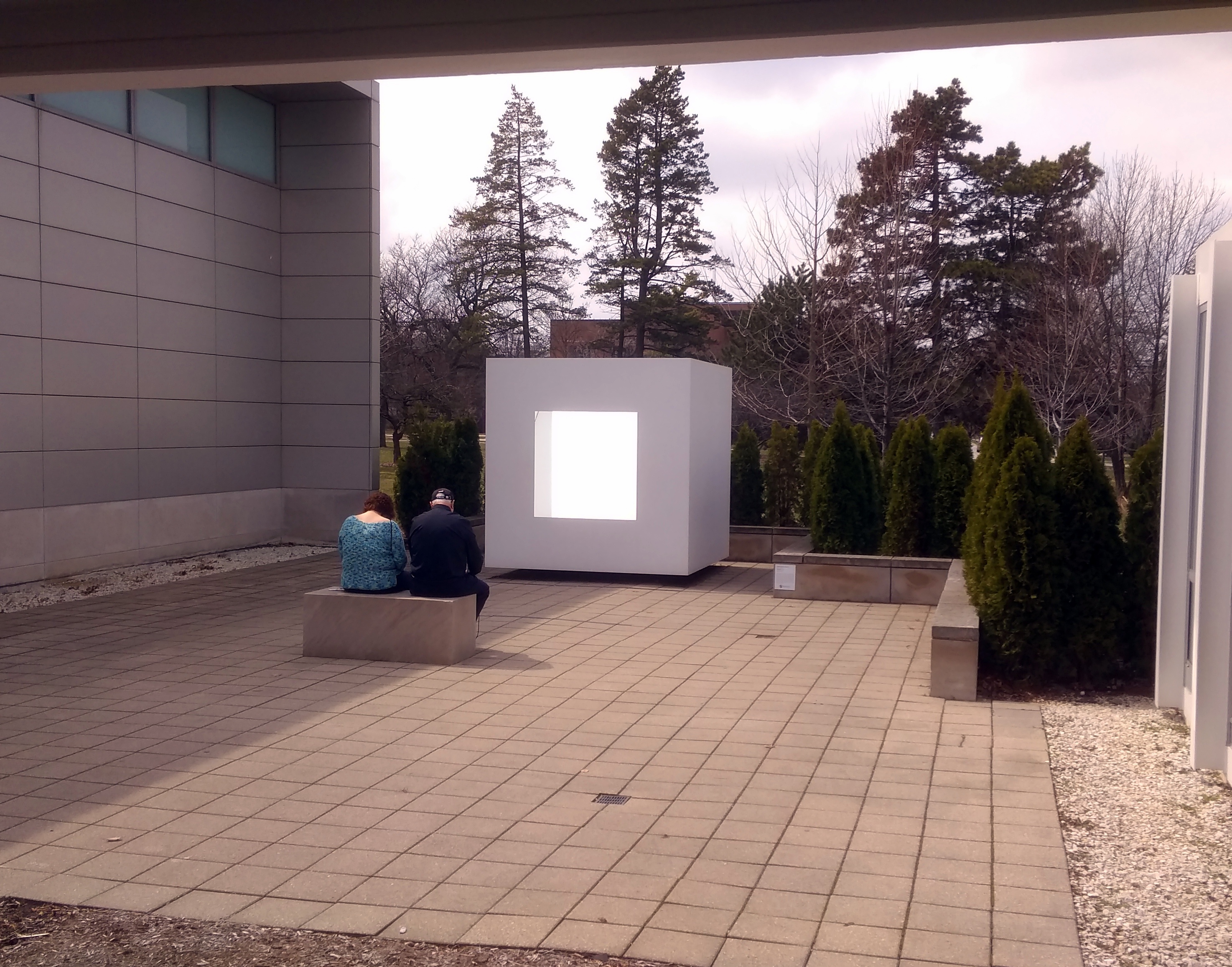
One major installation we saw at the Elmhurst Art Museum on Saturday didn’t have anything to do with the Bauhaus (which got a Google doodle today), or Mies van der Rohe, or anything but the sky.

“Skycube” by David Wallace Haskins, which was installed in 2015. It may look light, but it’s made from 6,000 lbs. of steel.
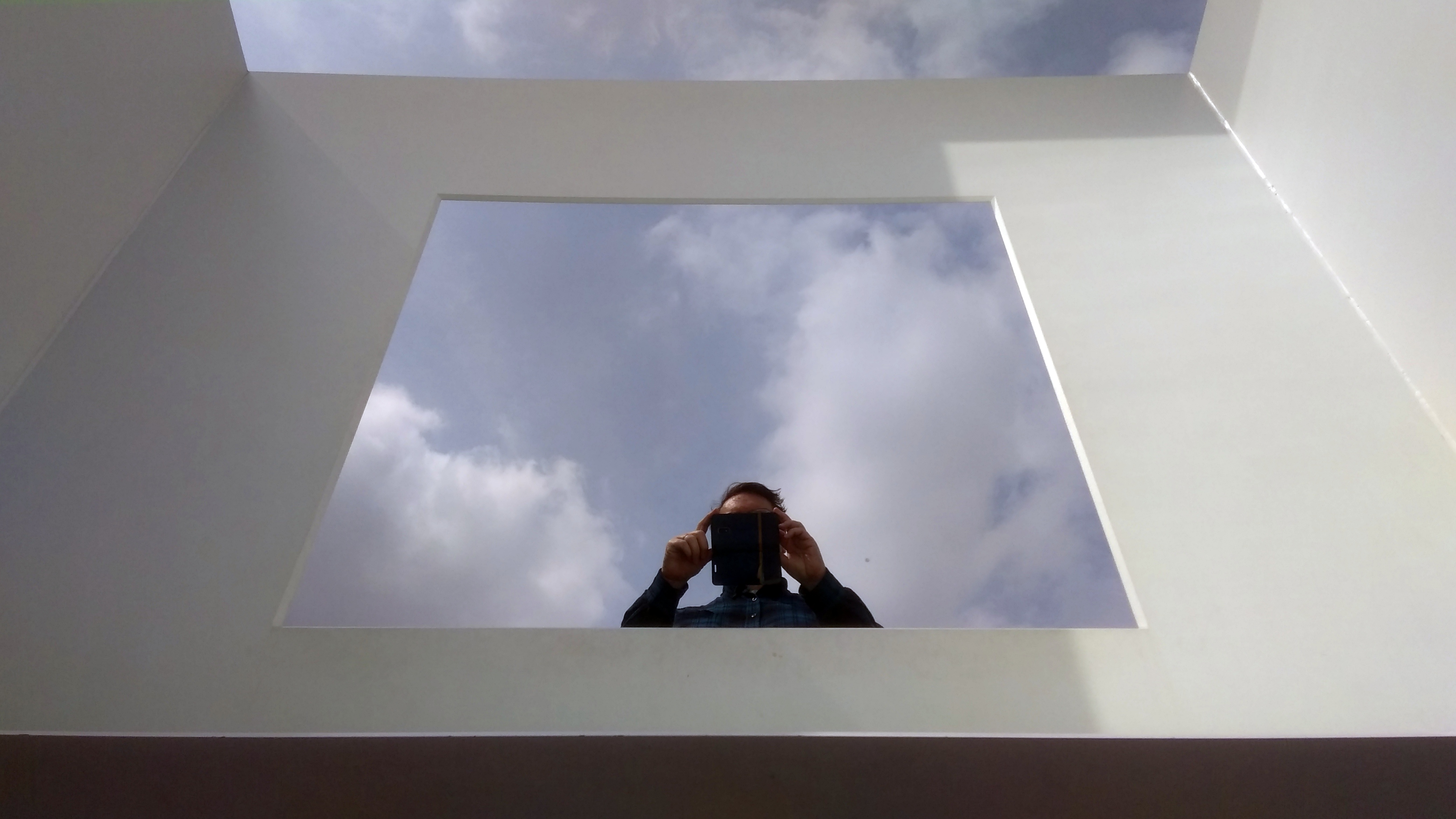
The mirrors inside the cube deliver an image of the sky to — in — at — the square window — hole — aperture — on the side. It’s a little unnerving to sit there and look at it, but also hard to turn away.
Stand next to the “window” and you can get a self-portrait in the sky. Got a surreal tinge to it.
The view might be even more interesting on one of those days when rafts of clouds are speeding along at high altitudes.

The YouTube autoplay algorithm is pretty much of the same dense mindset as Top 40 radio is, or at least used to be. Play one song, well known or even not so well known, and it will line up nothing unusual or surprising.

Odd, then — and I’ve tested this on a few separate days — when I queue up something by the B-52s, a good many lesser-known songs of theirs appear on the autoplay. Mostly published by the group itself, but not always (and who doesn’t like a song that mentions ancient Mesopotamia?).

Might just be a fluke, though. Your results may vary. I doubt that algorithms will ever be good enough to weed out all the flukes. Hope not.

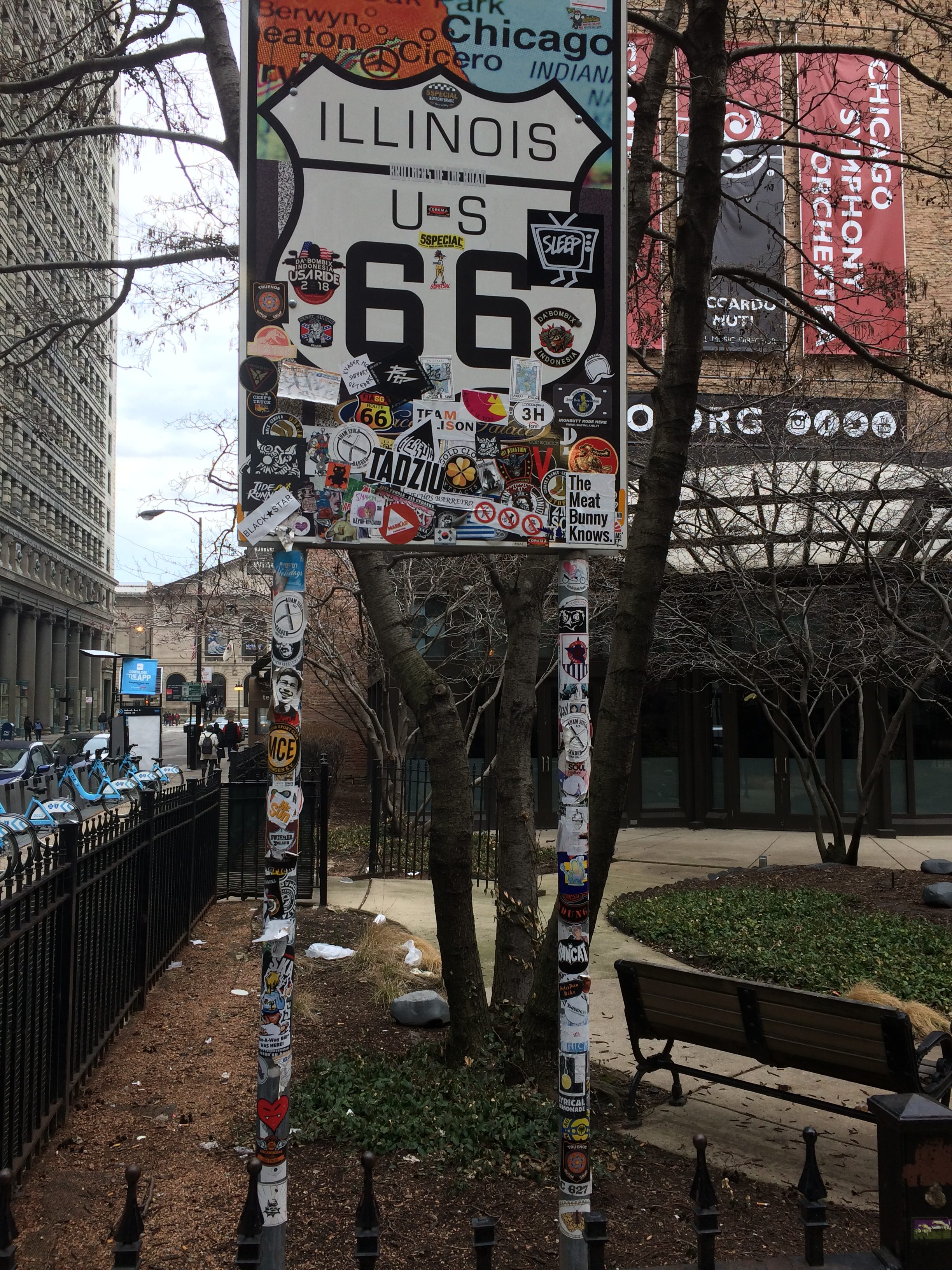
The last time I was in downtown Chicago, earlier this month, I paused for a moment to take a picture of a sign on E. Adams St. marking the eastern terminus of the former U.S. 66.
That’s the western-facing side of the side, covered by stickers from all over, with many European in origin. Shortly before I took my picture, a group of Germans were doing the same. Must be in their Reiseführer von Amerika. And what does the Meat Bunny know?

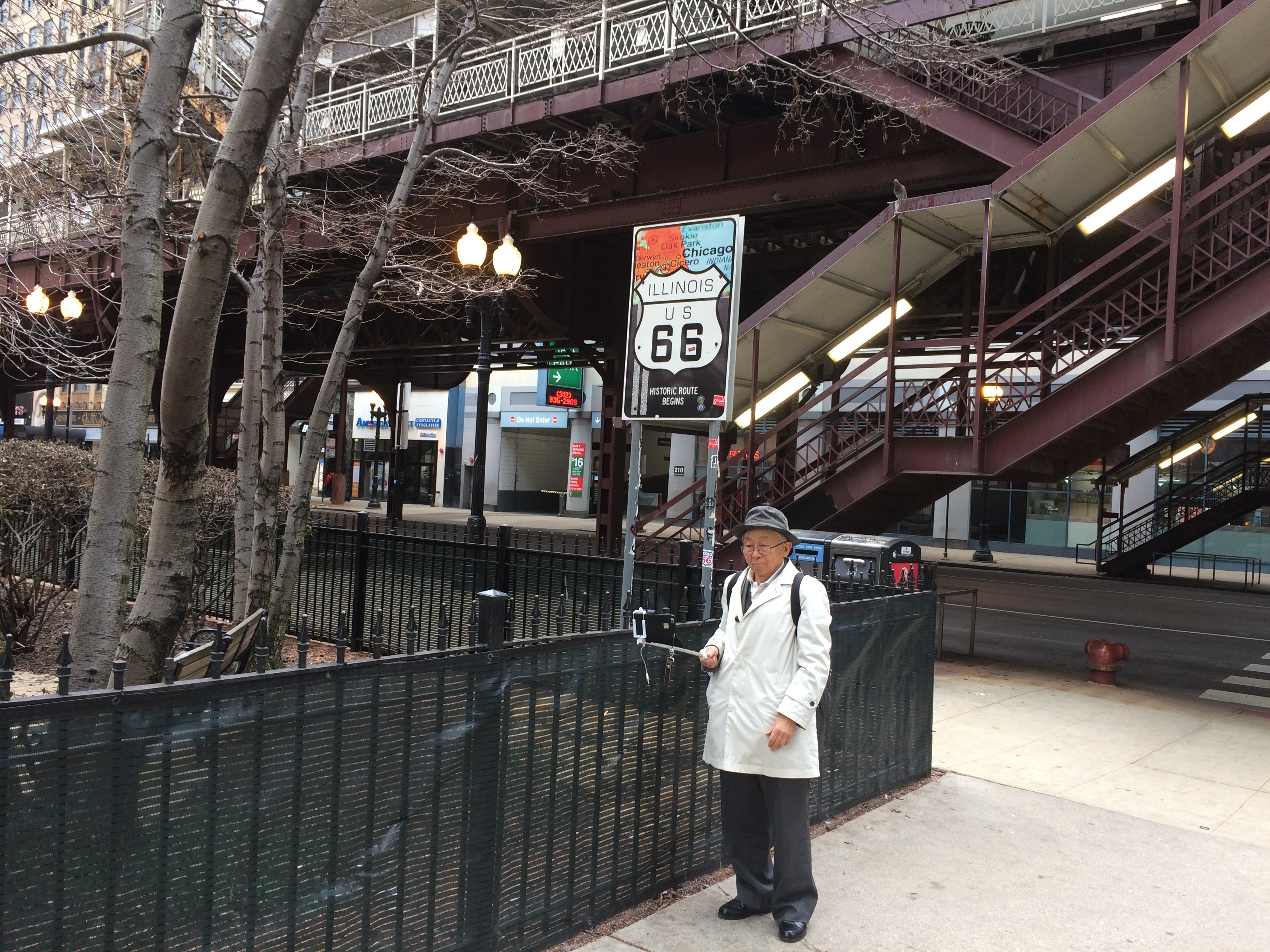
By the time I took a picture of the eastern-facing side, the Germans were gone.
Leaving only this fellow and his selfie stick.

The Whole World A Bauhaus

After a pleasant weekend and a warm Monday and Tuesday — lunch on the deck is my benchmark for warm days — the hammer dropped on Wednesday. Mostly we got cold rain, but I also saw flecks of ice on the deck and in the greenish grass today.

I’m pretty sure that the first time I ever heard of the Bauhaus, or Walter Gropius for that matter, was ca. 1977 listening to Tom Lehrer’s That Was The Year That Was album. One of the songs, “Alma,” was about Alma Mahler, who had died during The Year That Was, that is, 1964.

Walter Gropius was Alma’s second husband. In amusing Lehrer fashion, he made a rhyme of “Bauhaus” and “chow house” in the verse about Walter and Alma.

But he would work late at the Bauhaus
And only come home now and then
She said, “Vhat am I running, a chow house?
It’s time to change partners again!’

This is an interesting video about Alma. Nearly 55 years after her death, she still inspires strong opinions, pro and con; see the comments section. I think my opinion about Alma will be, I don’t care.

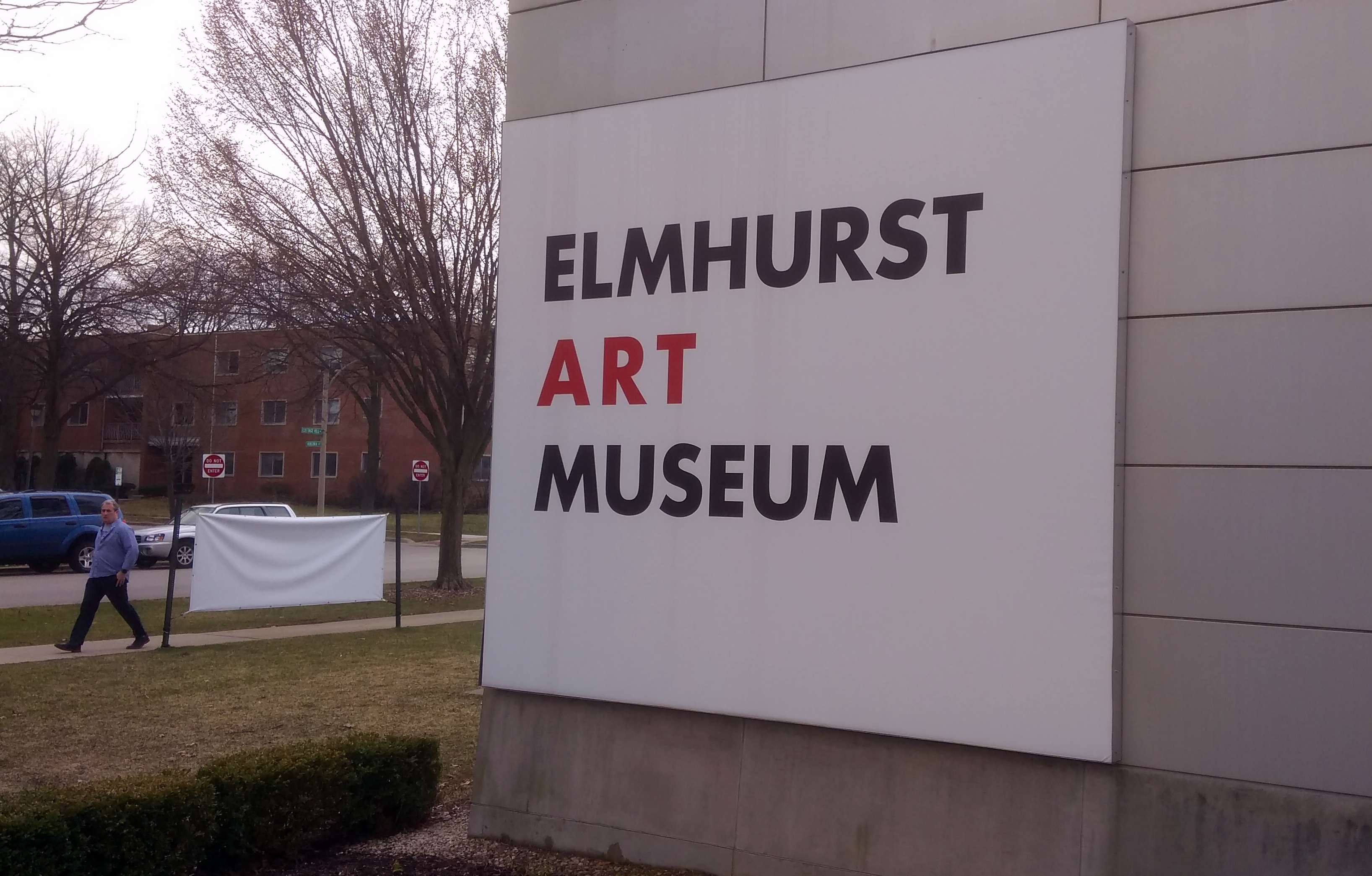
We went to the Elmhurst Art Museum on Saturday to see The Whole World A Bauhaus, a traveling exhibition mounted for the 100th anniversary of the founding of the Bauhaus. Elmhurst, it seems, is its only stop in the United States.
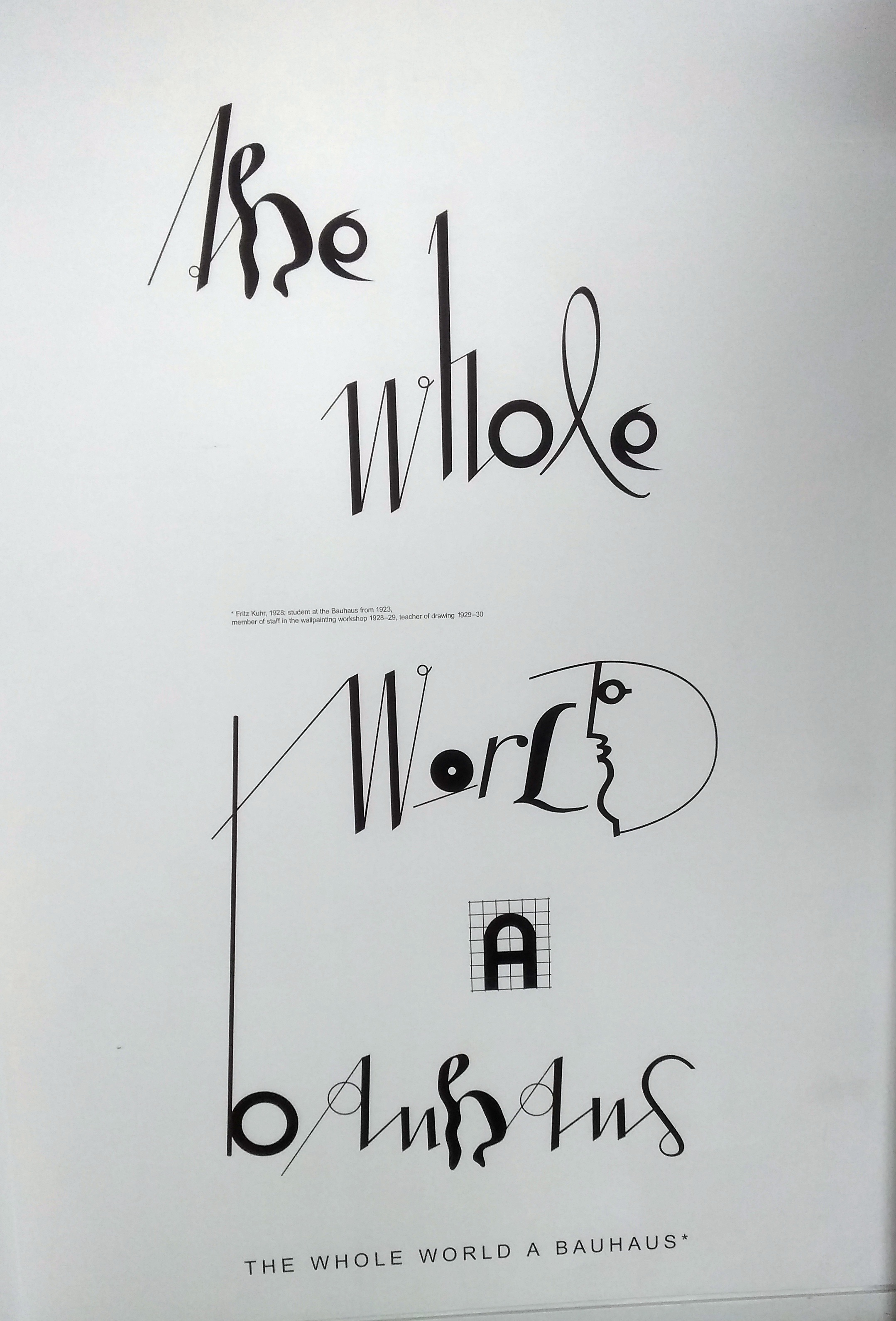
Blair Kamin did a good write-up of the exhibition in the Chicago Tribune: “Amid the show’s 400-plus objects,which include photographs, works on paper, architectural models, documents, films and audio recordings, are classic chairs by Mies and Marcel Breuer; geometric wall tapestries and carpets by such Bauhaus masters as the textile artist Anni Albers, wife of painter Josef Albers; and curiosities like a yellow, blue and red cradle and flyers for Bauhaus designs.”

Curious indeed, that cradle.
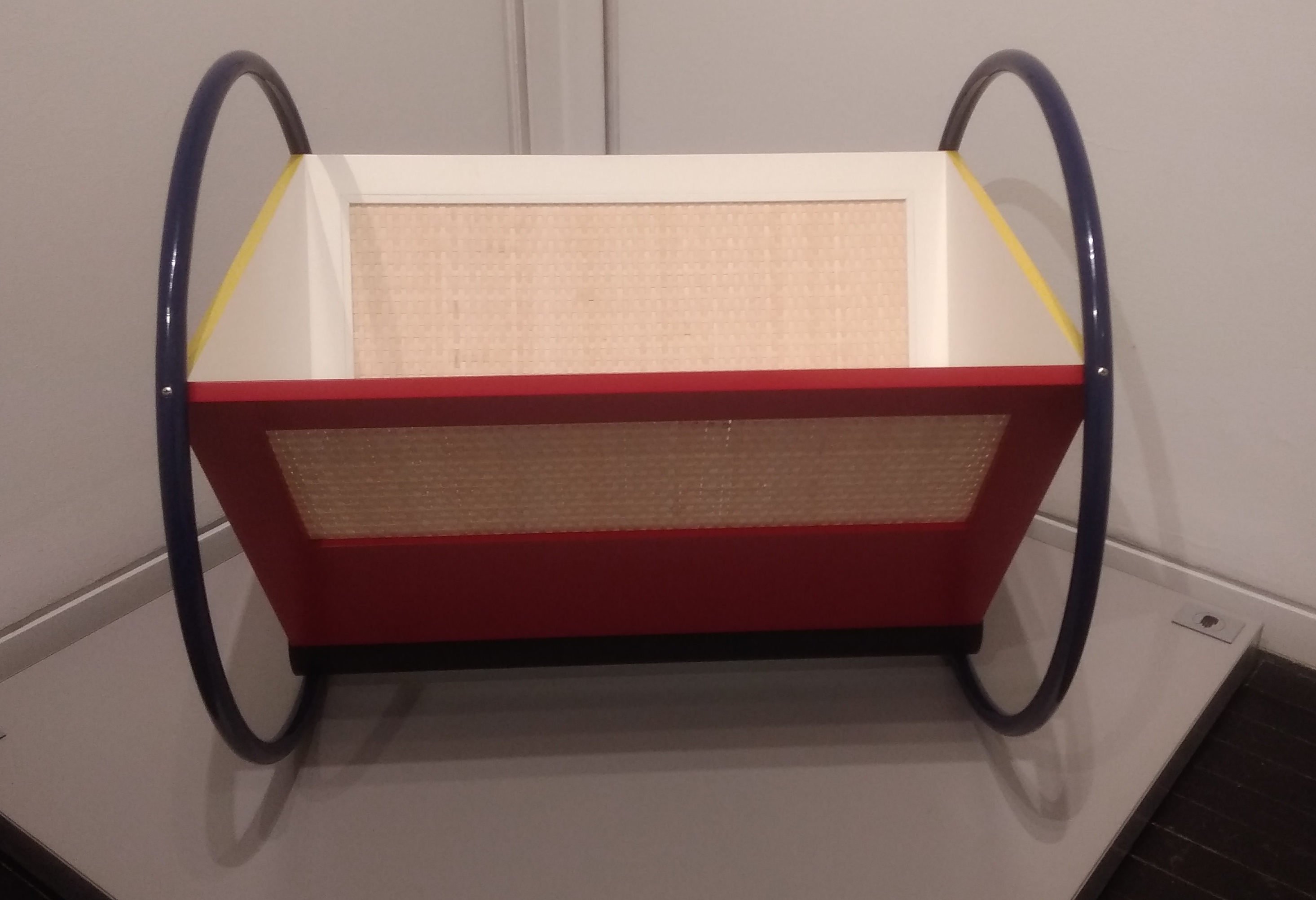
It looks like with a vigorous push, you could roll it completely over, throwing an unfortunate infant onto the floor.

But never mind that. At least it’s a Bauhaus object. Kamin calls the exhibit “overstuffed,” and I’ll go along with him. It’s overstuffed with photos and documents and other Bauhaus ephemera.
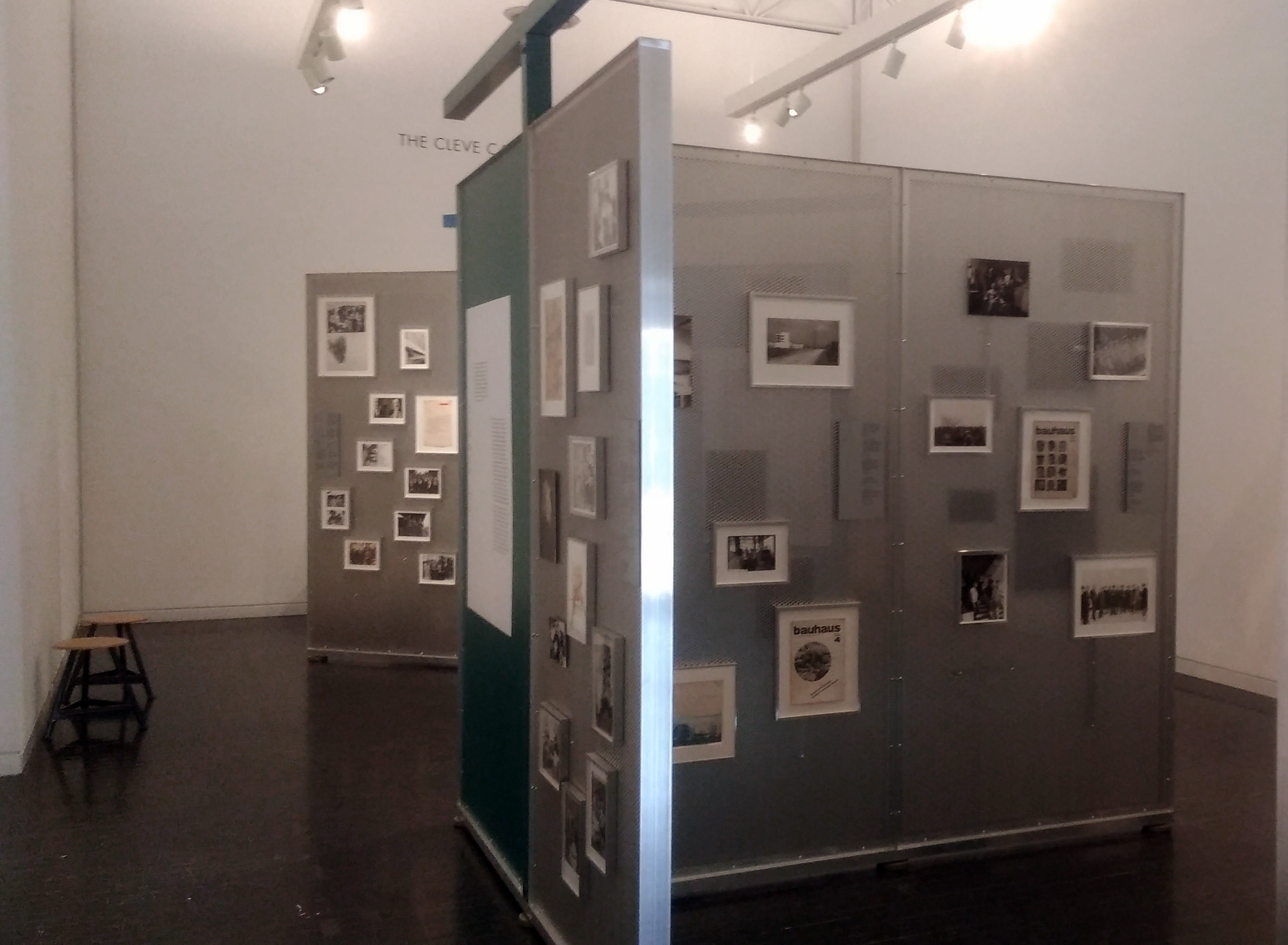
For true Bauhaus nerds, this might be exciting, but the minutiae was a little much for me. For a school that produced a wealth of artful objects, or perhaps elegant industrial objects, The Whole World A Bauhaus had relatively few of them on display. Fewer pictures of Bauhaus types at work and play and more Bauhaus output to examine in person would have improved the show.

Even so, I learned a fair number of things — such as how the Bauhaus formed factions almost immediately, as you might except from a group of people with talent, strong opinions and high ideals.

One example, as Kamin tells it: “One was the charismatic Swiss artist Johannes Itten, who shaved his head and wore rimless round glasses and gurulike garb. Itten made his students do breathing exercises to improve their powers of concentration. When the school’s founding director, the urbane German architect Walter Gropius, shifted the focus of the Bauhaus’ workshops from distinctive crafted objects to design for mass production, the idealistic Itten left the school in 1923.”

I also enjoyed much of what I saw. Such as the model of the Dessau Bauhaus building.
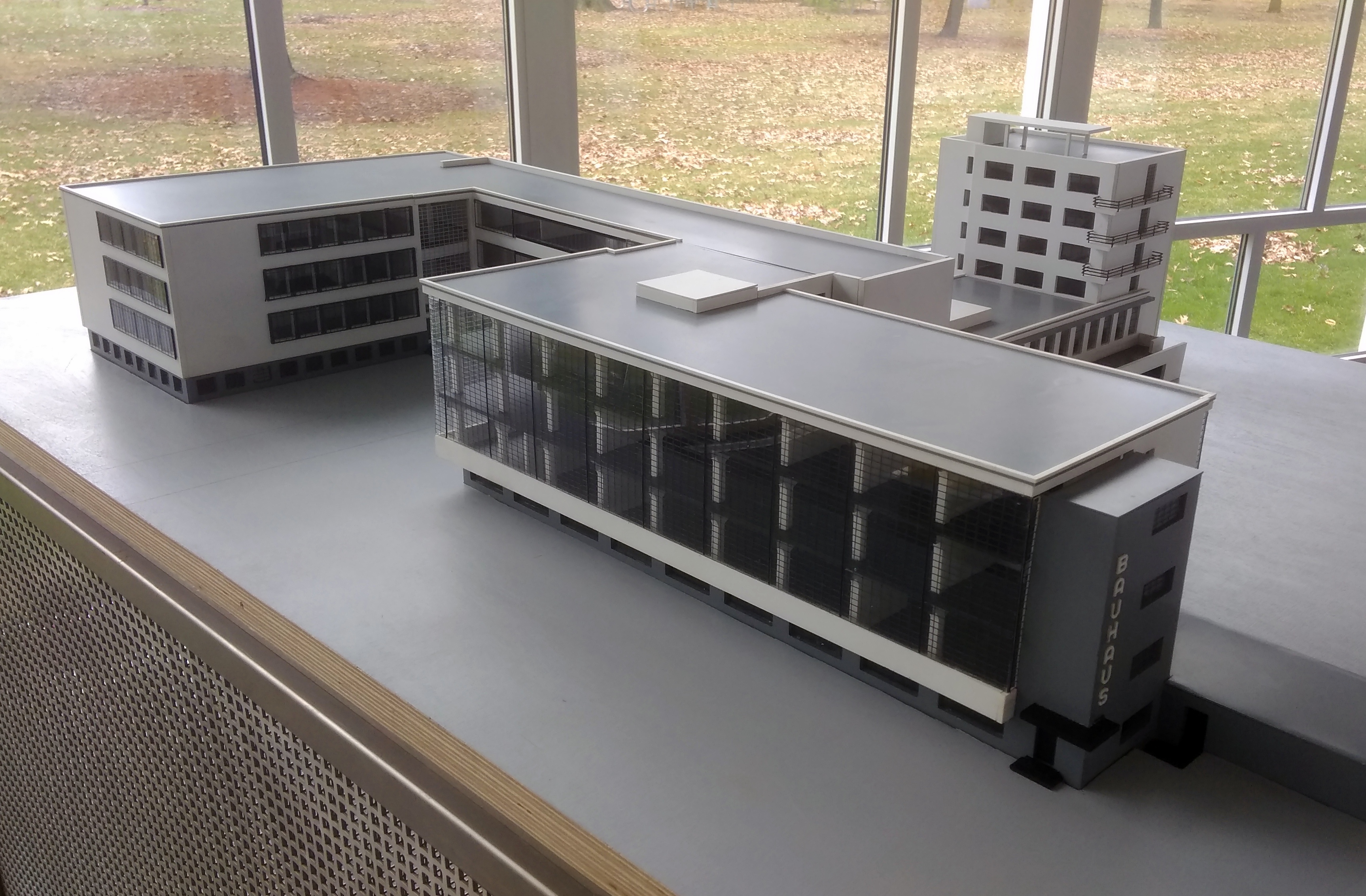
I wondered whether it, unlike the school itself, survived National Socialism, or the war or the DDR for that matter. Yes, it turns out. In reunified Germany, the Dessau Bauhaus is a big-deal tourist attraction.
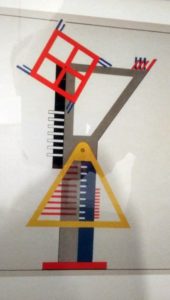
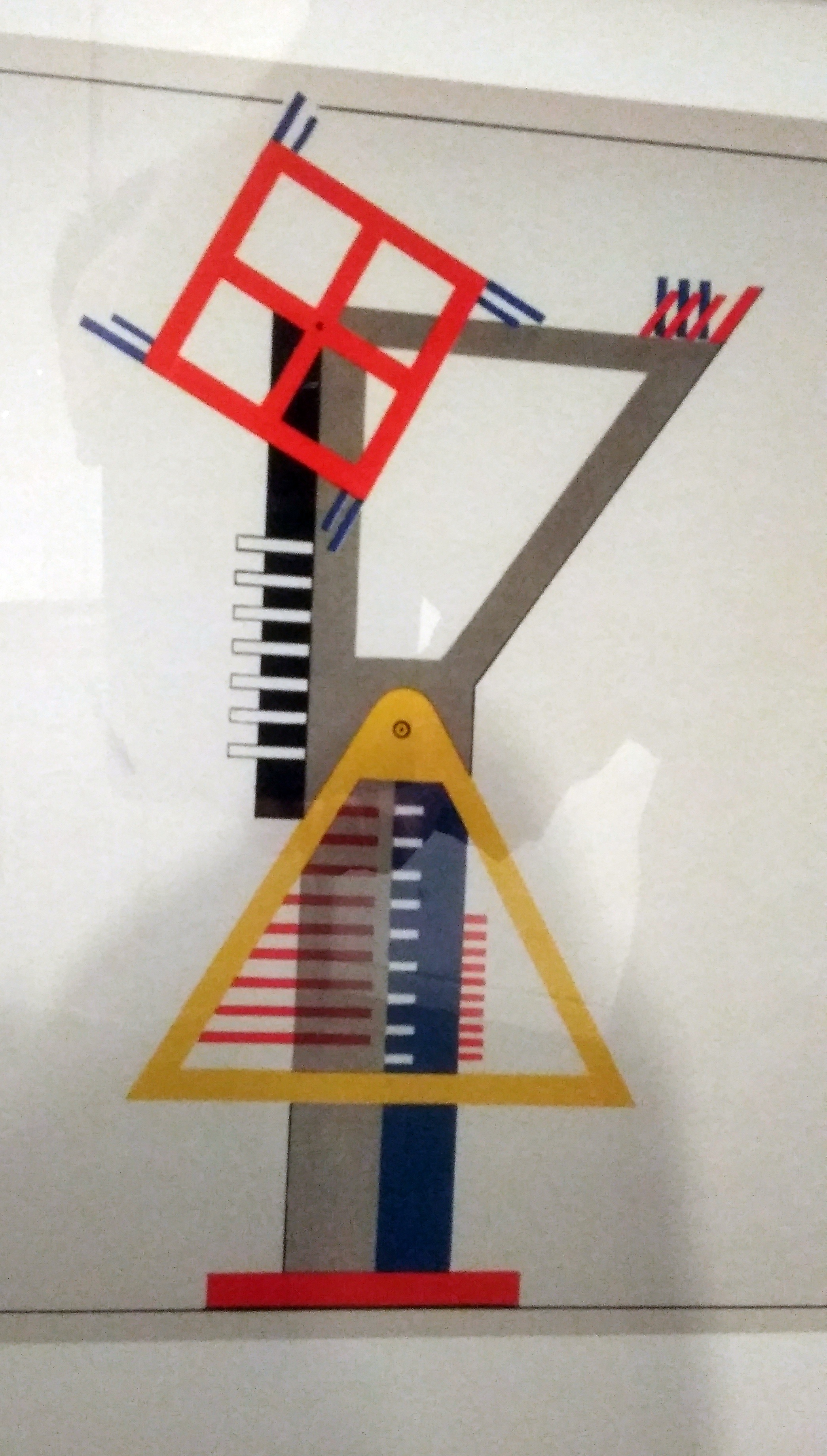
I consciously looked for works on paper that would make good postcards. I found a few. Such as “Construction for Fireworks” by Kurt Schmidt.

I’m not the only person who thinks a line of Bauhaus postcards would be just the thing. Gropius himself apparently thought that.

“In 1923, the Bauhaus was preparing for its first exhibition, where Walter Gropius, the school’s founder, would extol the benefits of industrial mass production,” notes Wired.

“To publicize the events, the Bauhaus mailed out beautiful postcards.”

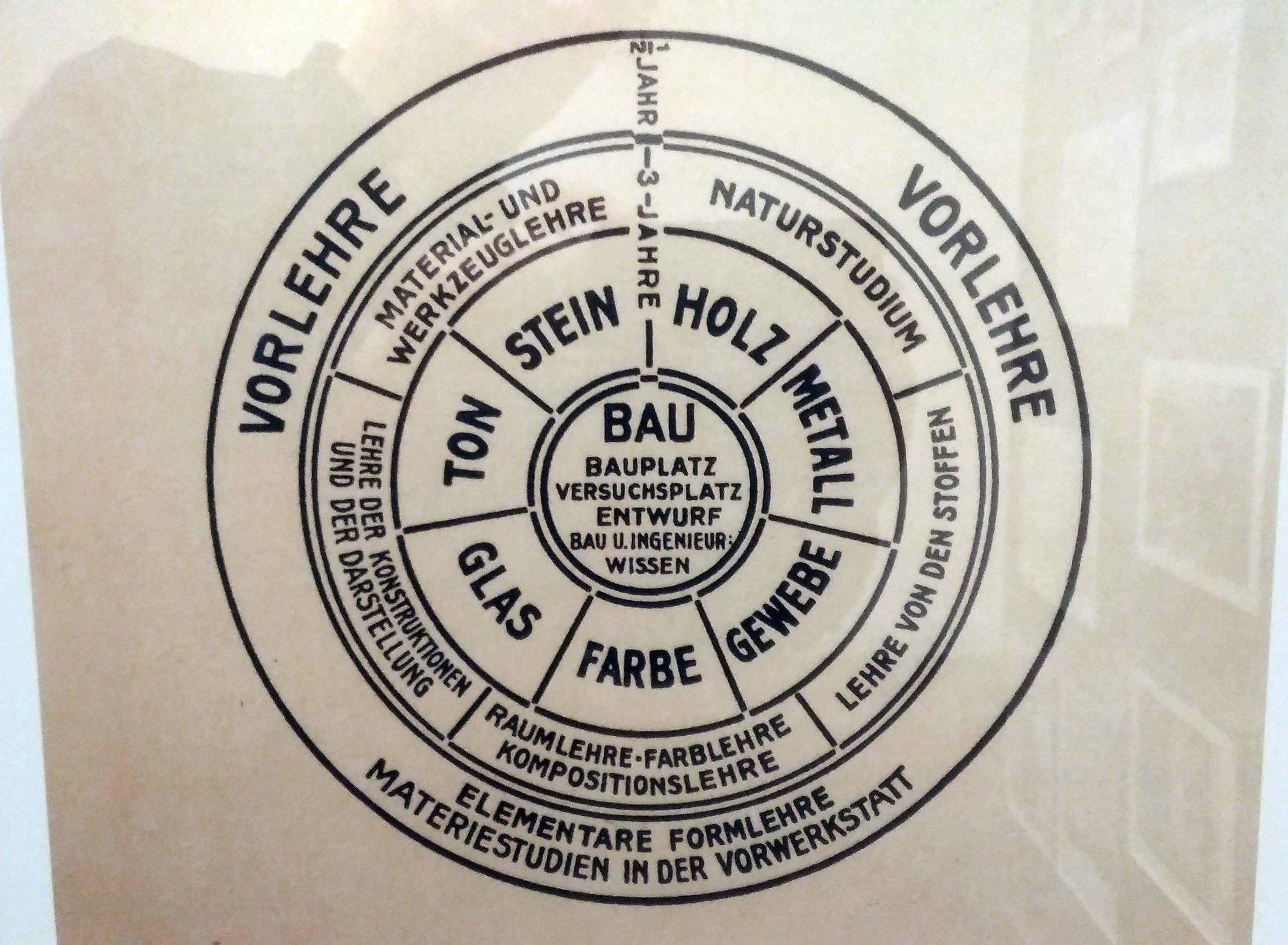
Here’s one more. Who needs a course catalog when you have this?
I wondered for a moment how the Elmhurst Art Museum bagged the only U.S. visit by this exhibition, and figured there were a few reasons. The Chicago area has strong ties to modernism, for one thing, but a few rooms of Bauhaus might get lost in a larger venue like the Art Institute.

Besides, the Elmhurst has its own ties to modernism. Namely, the main display space is adjacent to the McCormick House, a single-family home designed in 1952 by Mies van der Rohe, last director of the Bauhaus 20 years earlier, and moved to its current location from elsewhere in the village of Elmhurst.

The house was restored to a more original appearance recently.
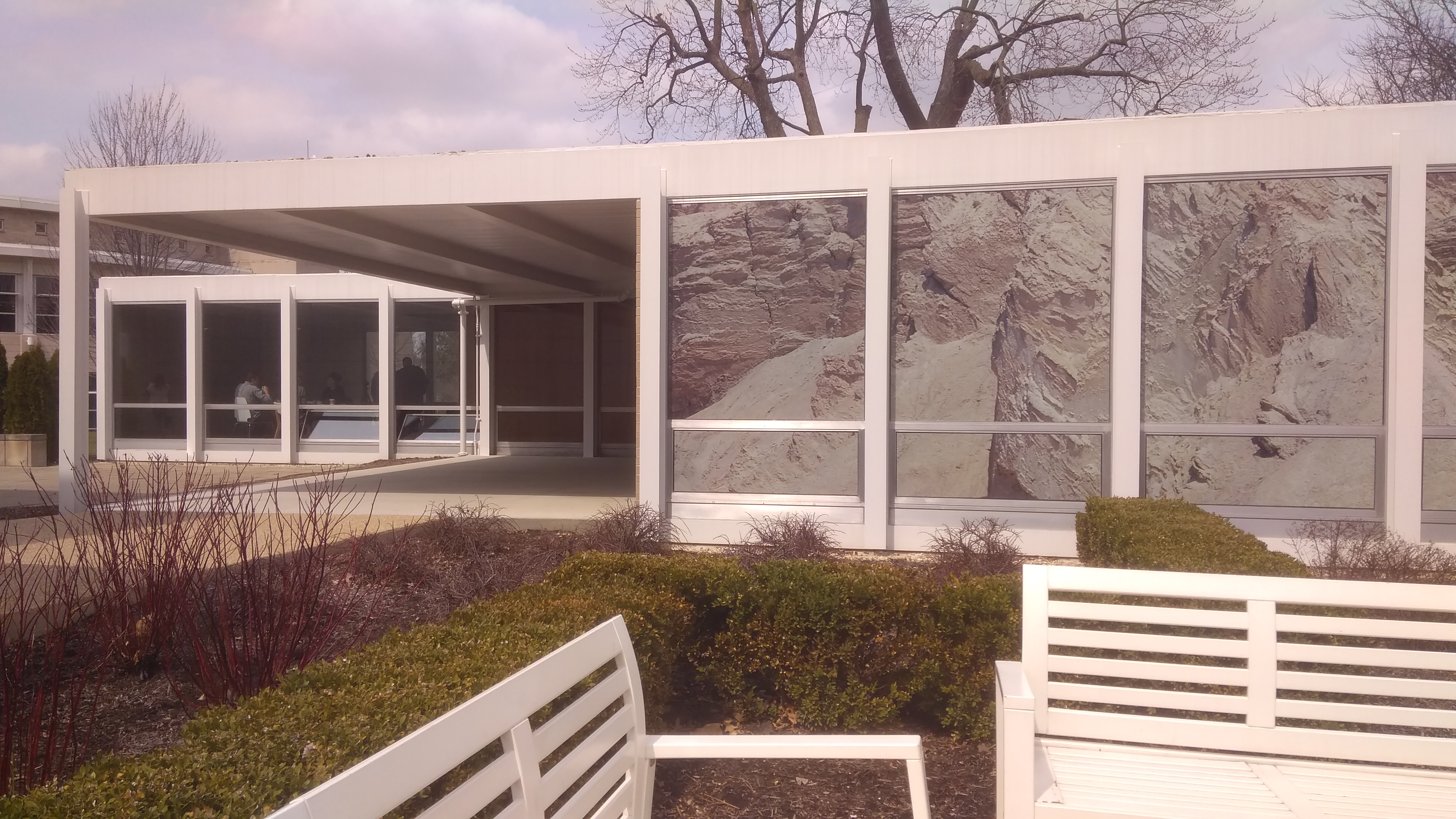
The house is open, so we wandered in for a look. Not quite as striking as the Farnsworth House, but definitely Miesian.

Glos Memorial Park, Elmhurst

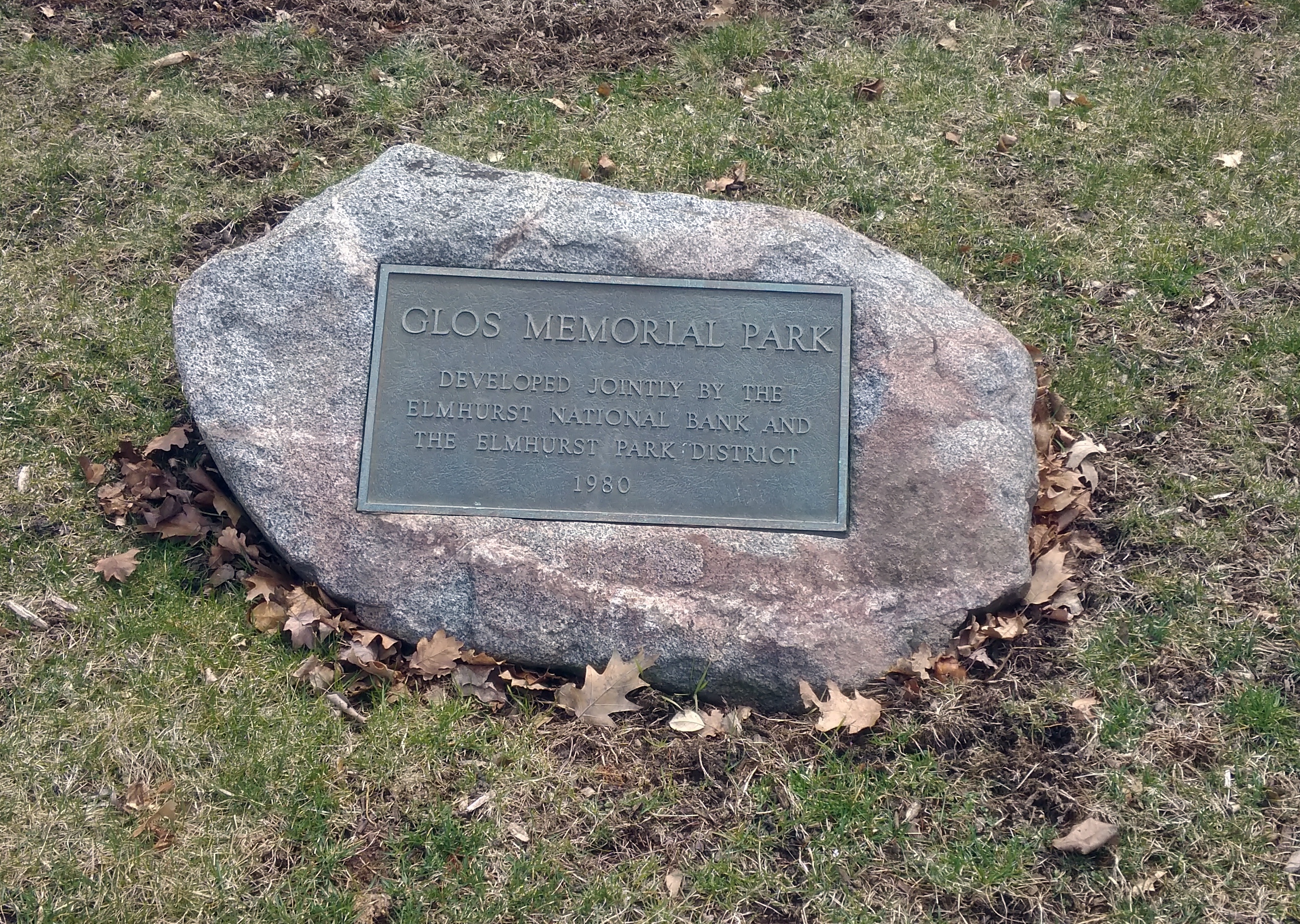
I’d like to say that I discovered Glos Memorial Park in Elmhurst on Saturday via serendipity, but I learned about the place from that exceptional travel tool, Google Maps.
The park is a strip of land, a little less than an acre, near Elmurst’s main shopping district and just east of Robert T. Palmer Dr. Mostly it’s a pleasant strolling sort of place, with sidewalks and benches and a rose garden, but there’s also a single structure.
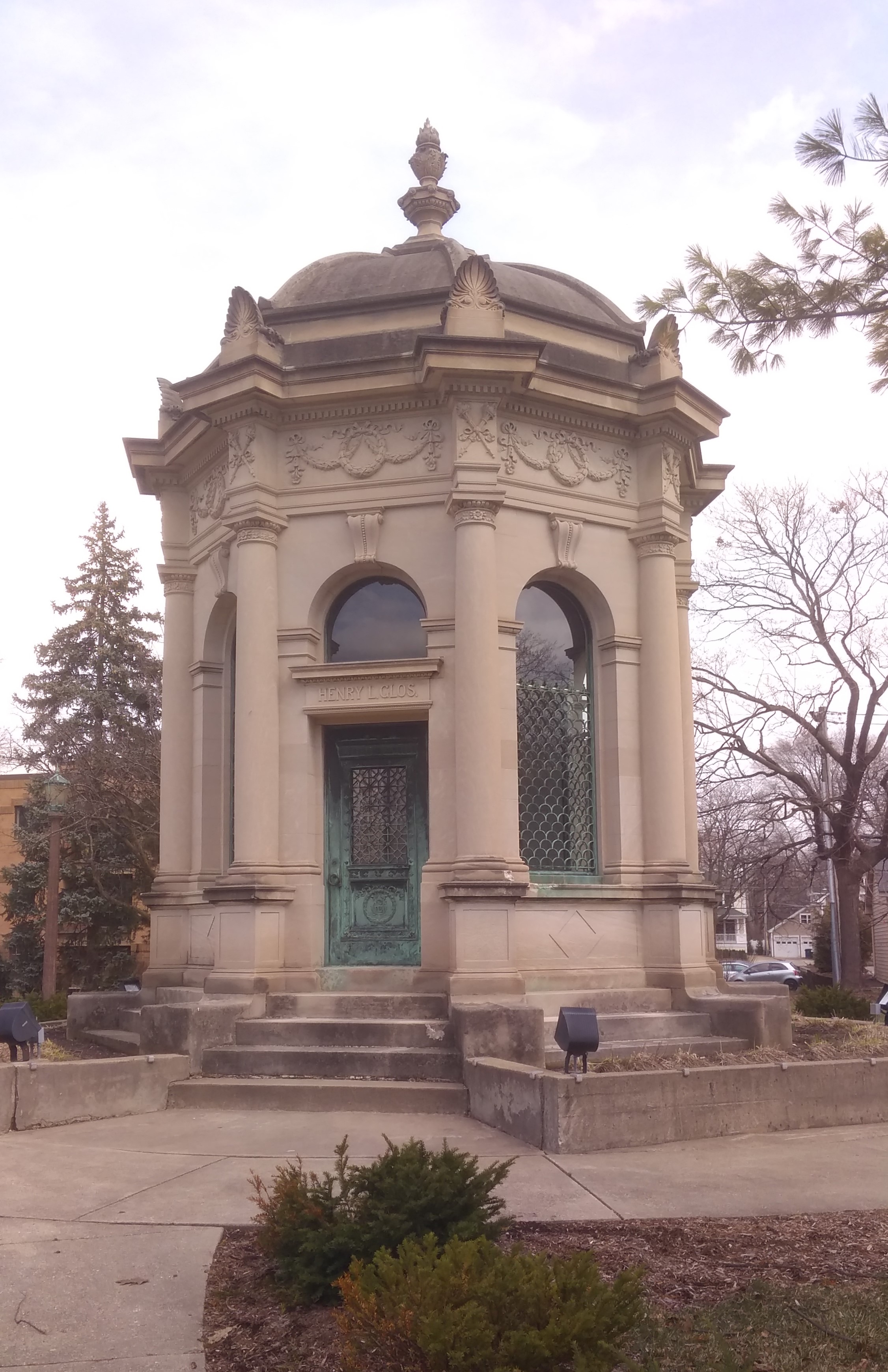
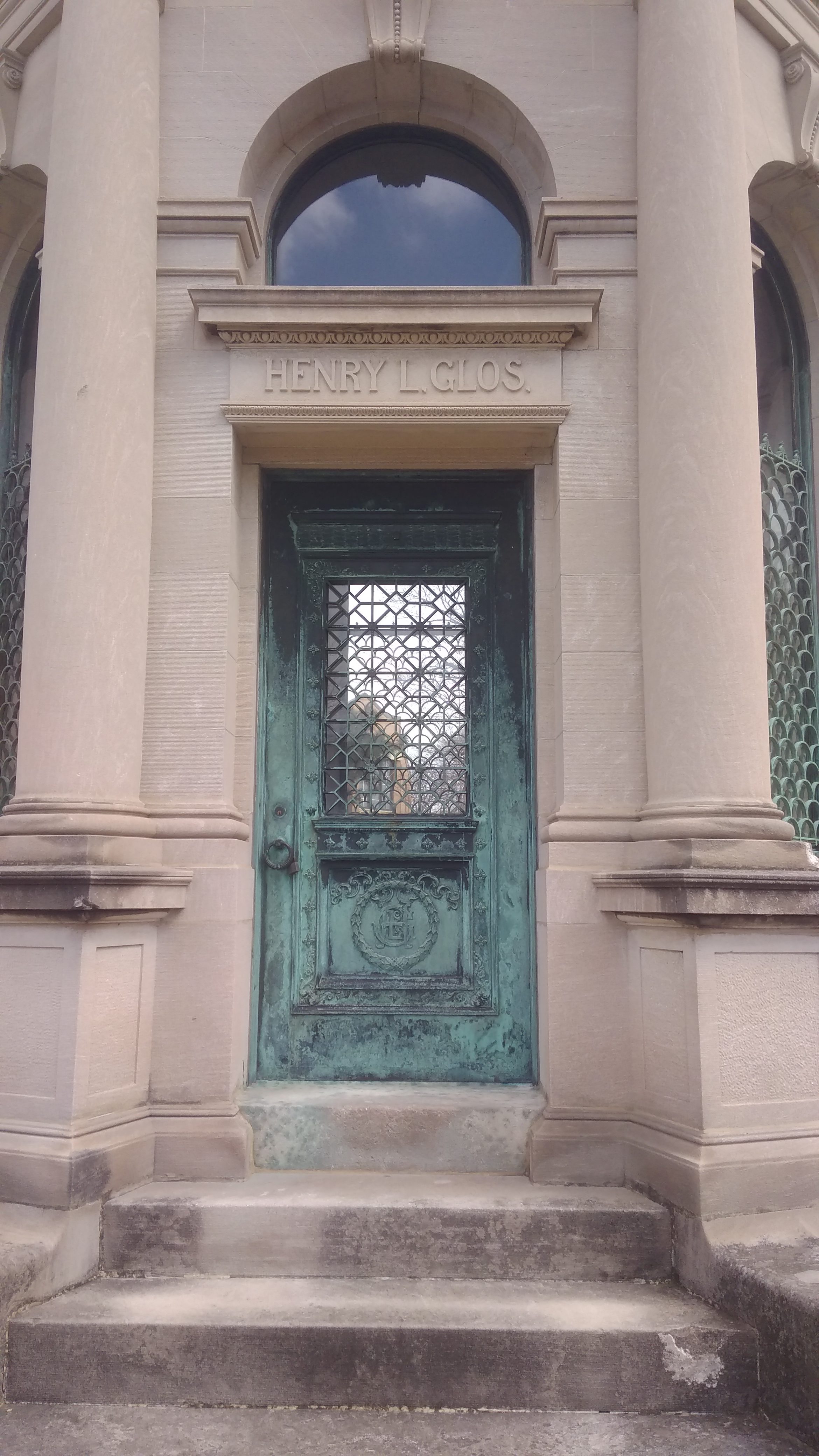
It’s the Glos Mausoleum.
Glos Memorial Park, Elmhurst“Lucy Glos, wife of Henry L. Glos, banker and first Village President, donated the land to the City of Elmhurst,” explains the Elmhurst Park District.

“The land was donated to the City of Elmhurst in the 1940s, but was not developed into a park until 1979, with dedication in 1981. The City began leasing the property to the Park District in 1978.”

Explore Elmhurst fills in a few other details: “The Village of Elmhurst passed an ordinance in 1892 giving Village President Henry Glos permission to build a mausoleum on his property. The mausoleum was built in 1899. Henry Glos (1851-1905) and Lucy Glos (1852-1941) are buried there.”

The Wilder Park Conservatory

Near Elmhurst College in west suburban Elmhurst is Wilder Park, a mid-sized suburban park that includes the Elmhurst Public Library, Elmhurst Art Museum, Lizzadro Museum, Wilder Mansion and the Wilder Park Conservatory and Formal Gardens.

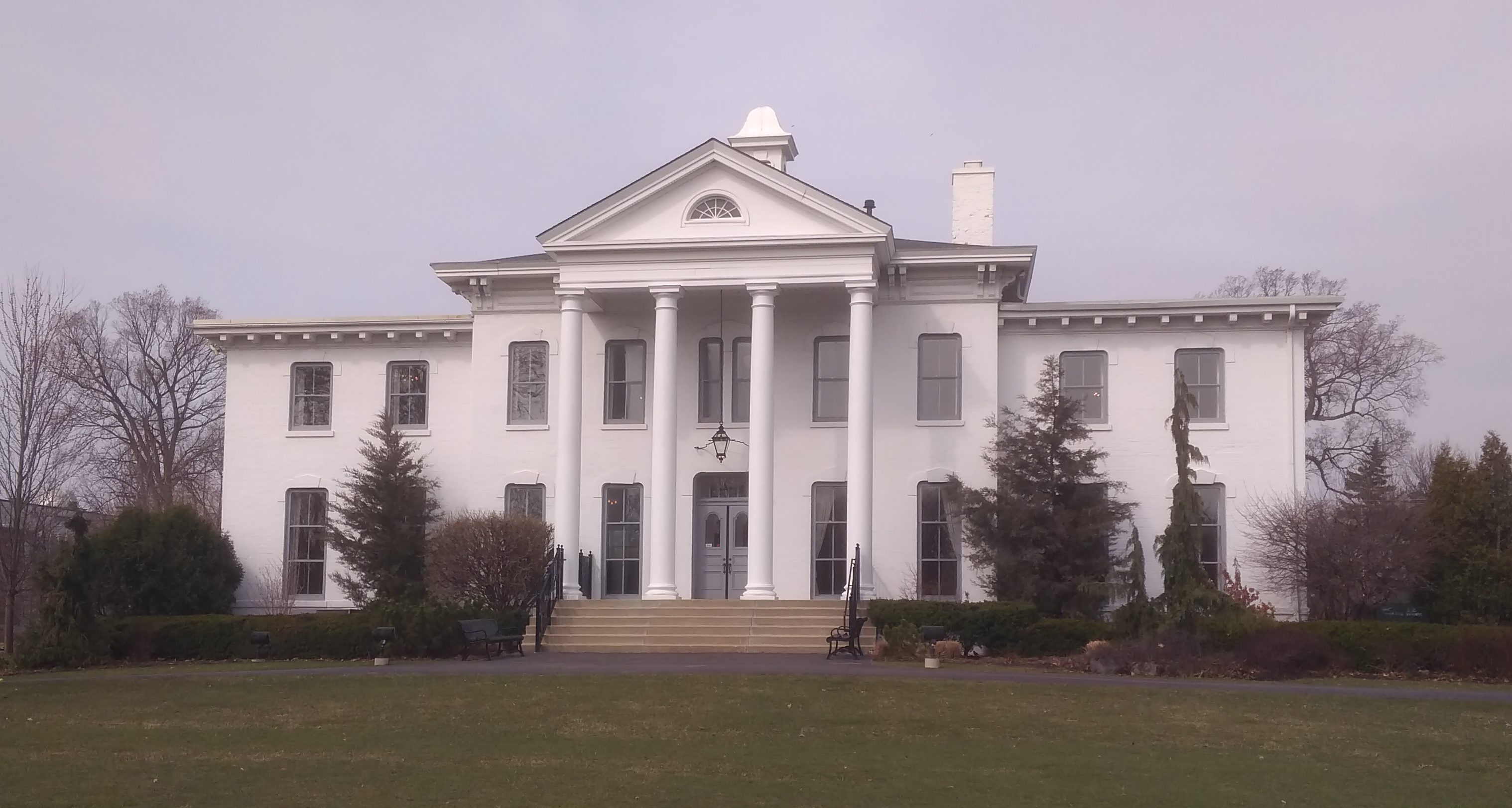
This is the Wilder Mansion, named after the last family that owned the place, before the Elmhurst Park District acquired it and the surrounding land in the early 1920s.
I understand that for most of the 20th century, the building housed the Elmhurst Library, but these days it’s a wedding and event venue. Even though it was late Saturday morning, the place was closed. I was a little surprised. I expected someone to be there, setting up for a wedding.

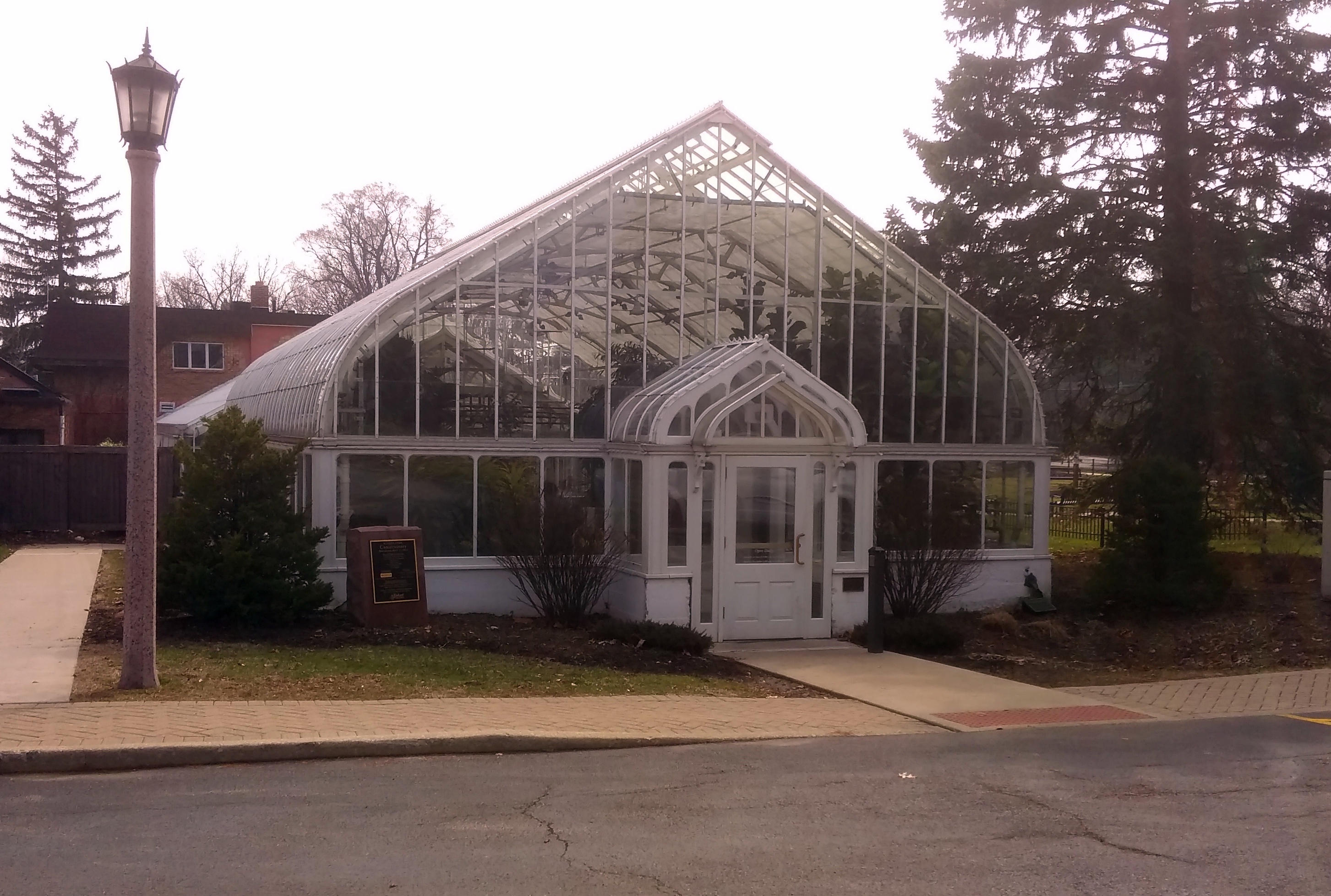
Not far away is the modest Wilder Park Conservatory and Formal Gardens. The gardens were around back and not growing much yet.
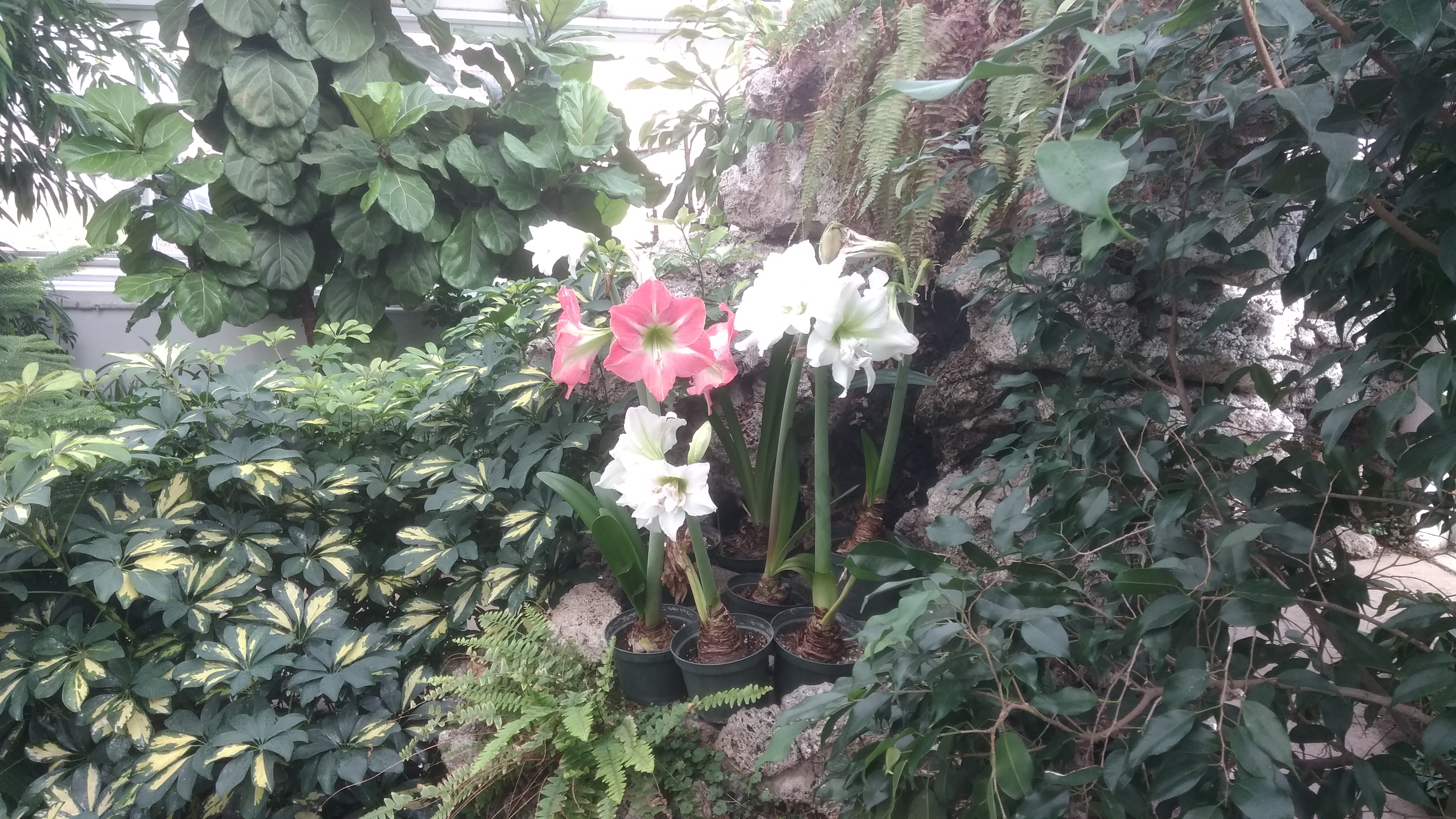
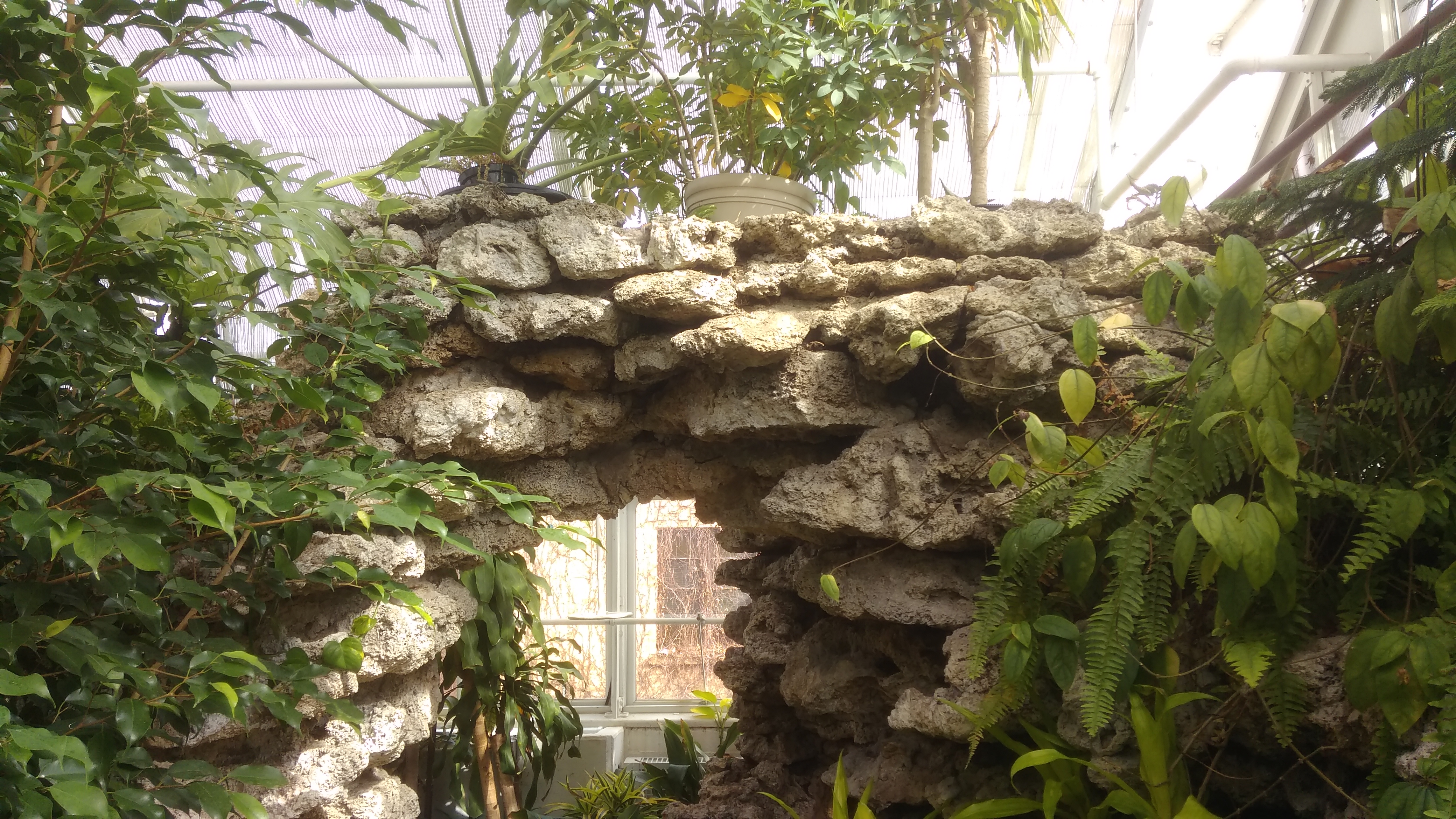
At one room and a non-public greenhouse, I believe the Wilder is the smallest public conservatory in metro Chicago, smaller even than the one in Mount Prospect, but it has a nice array of plants. Especially when outside is still mostly brown.

Along with a few rock formations.

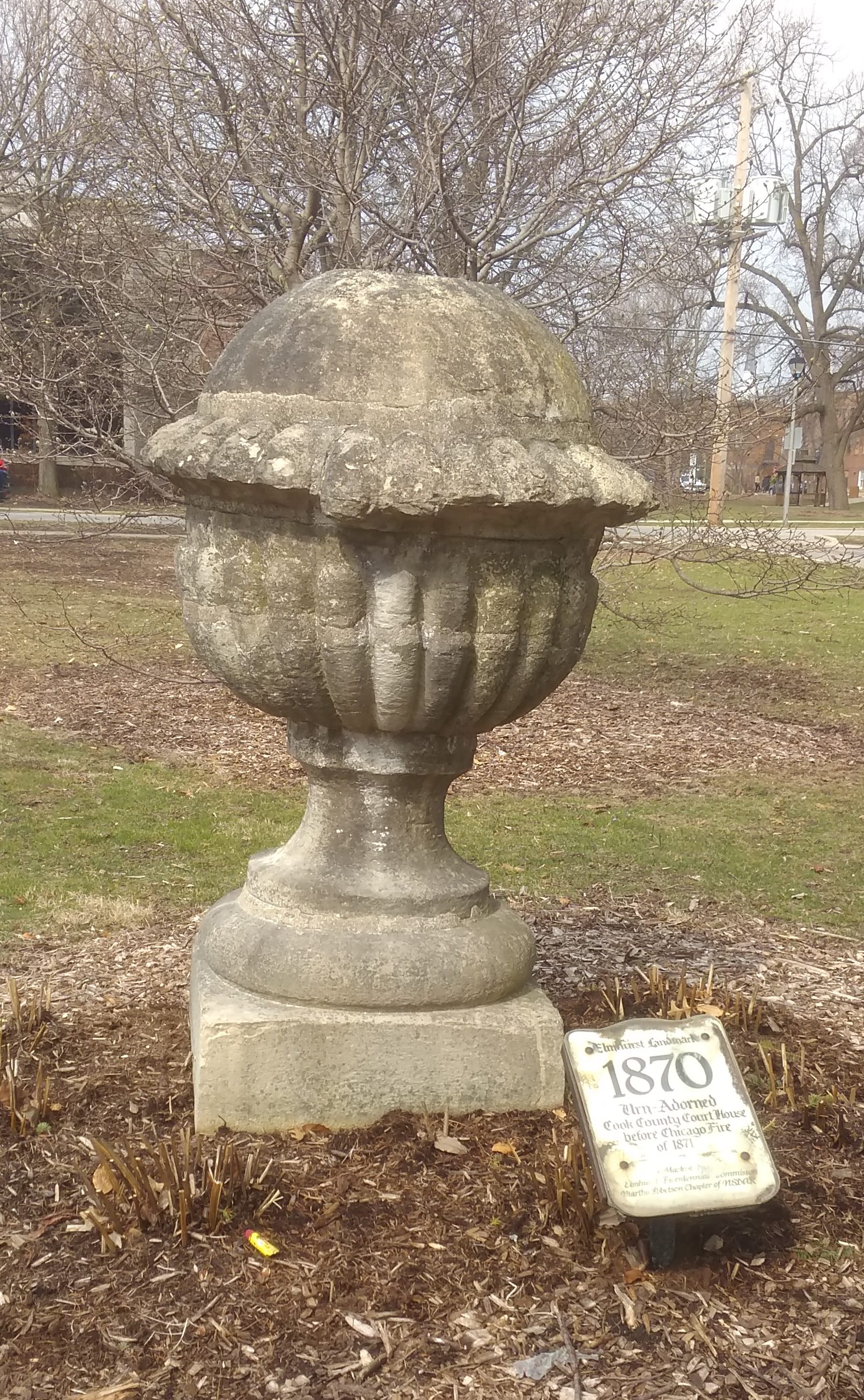
Outside the conservatory is a public oddity.
The sign says:

Elmhurst Landmark
1870
Urn-Adorned
Cook County Court House before Chicago Fire
of 1871

According to the ElmhurstHistory.Org: “Following the Great Chicago Fire of 1871, many people from the Chicago area collected ruins from the fire as a souvenir [sic]. Seth Wadhams, who lived in what is now known as the Wilder Mansion, brought two roof finials (decorative pieces) from the Cook County Courthouse, which had burned in the fire. One of the finials deteriorated over time. The second one remains in Wilder Park.”

It looks like you can see many of the courthouse finials in this pre-Fire photo. Strange thought that one of them might be, probably is, the obscure stone relic now miles from its original perch.

Theologian Rendered in Bubble Gum

Saturday felt like the actual first day of spring around here. Warm, partly cloudy, birds atwitter, no coat or even jackets necessary for human comfort.

We spent much of the day in the mid-sized western Chicago suburb of Elmhurst, a pleasant place we briefly considered while shopping for a house more than 20 years ago. We’ve spent some time there since, but not recently, and Saturday was a fine day for walking through some of Elmhurst’s soon-to-be-leafy, soon-to-be-green spaces.

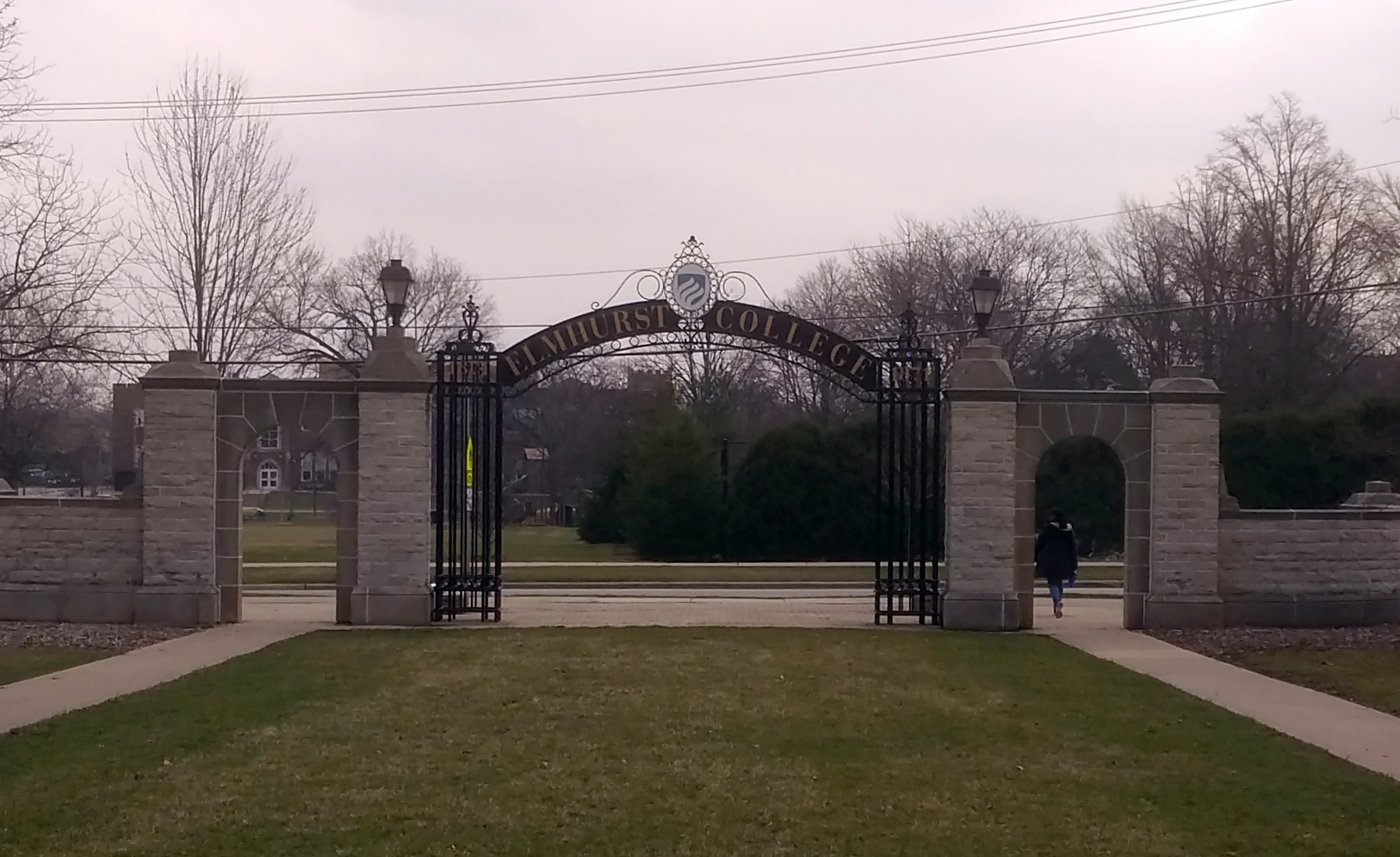
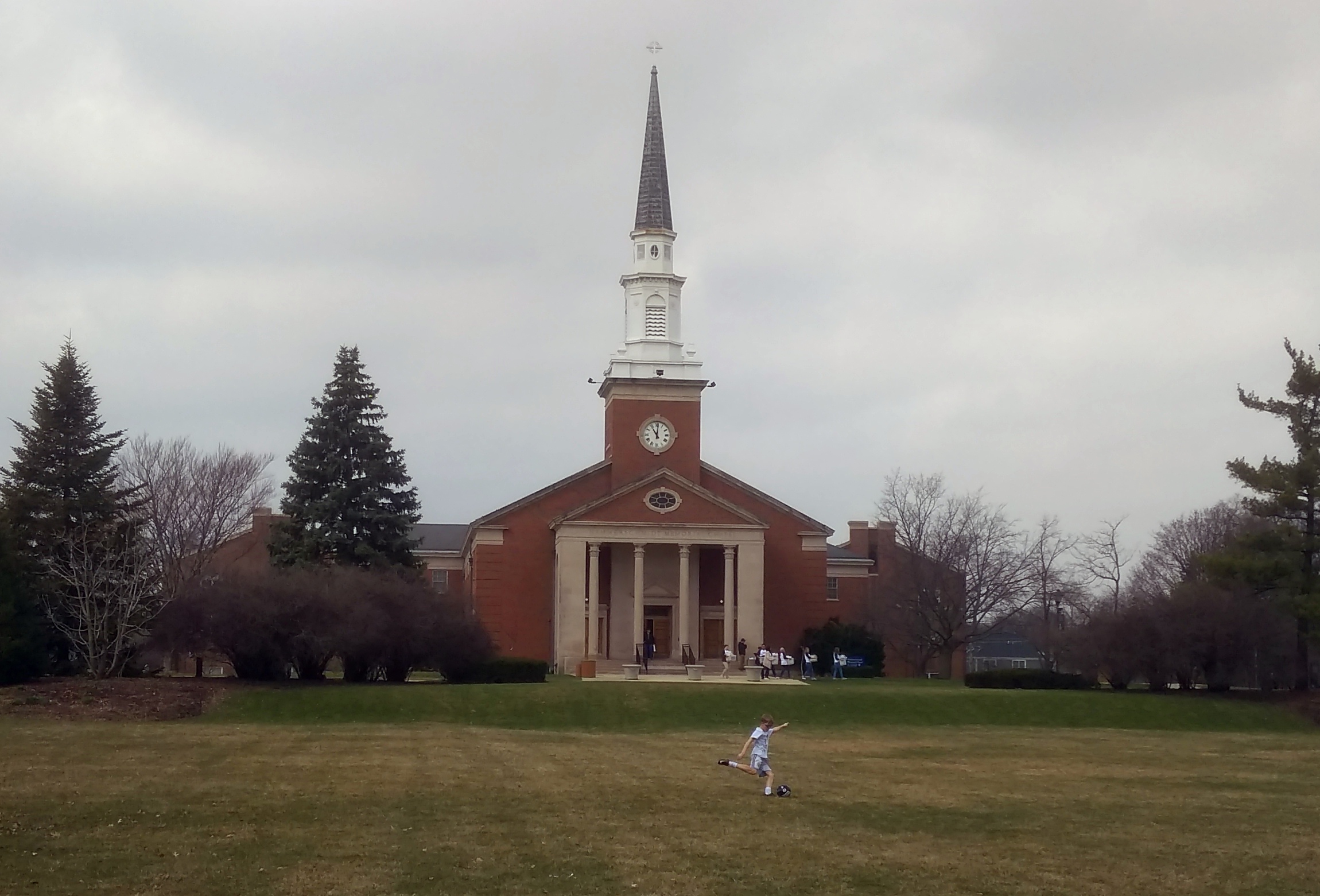
Elmhurst is also home to Elmhurst College, a private liberal arts school that looks every bit like you’d think, with handsome buildings, mature trees, lawns crossed by paved footpaths and students here and there on a warm Saturday.
Some years ago, I took Lilly to a few sessions of the Elmhurst College Jazz Festival, whose high school and college performers play at the college’s at Hammerschmidt Chapel.
Elmhurst College dates from the 1870s, founded roughly at the same time as Vanderbilt, though it doesn’t seem to have evolved into the same sort of academic leviathan. I’m glad some institutions still eschew the upgrade to university and call themselves colleges. I suspect that Elmhurst charges about the same stratospheric tuition as Vanderbilt, however, and there’s no excuse for either of them in that regard.
These days, the college is affiliated with the United Church of Christ. It was founded by the German Evangelical Synod of North America, or the Deutsche Evangelische Synode von Nord-Amerika, one of the 19th-century predecessor denominations of the UCC.

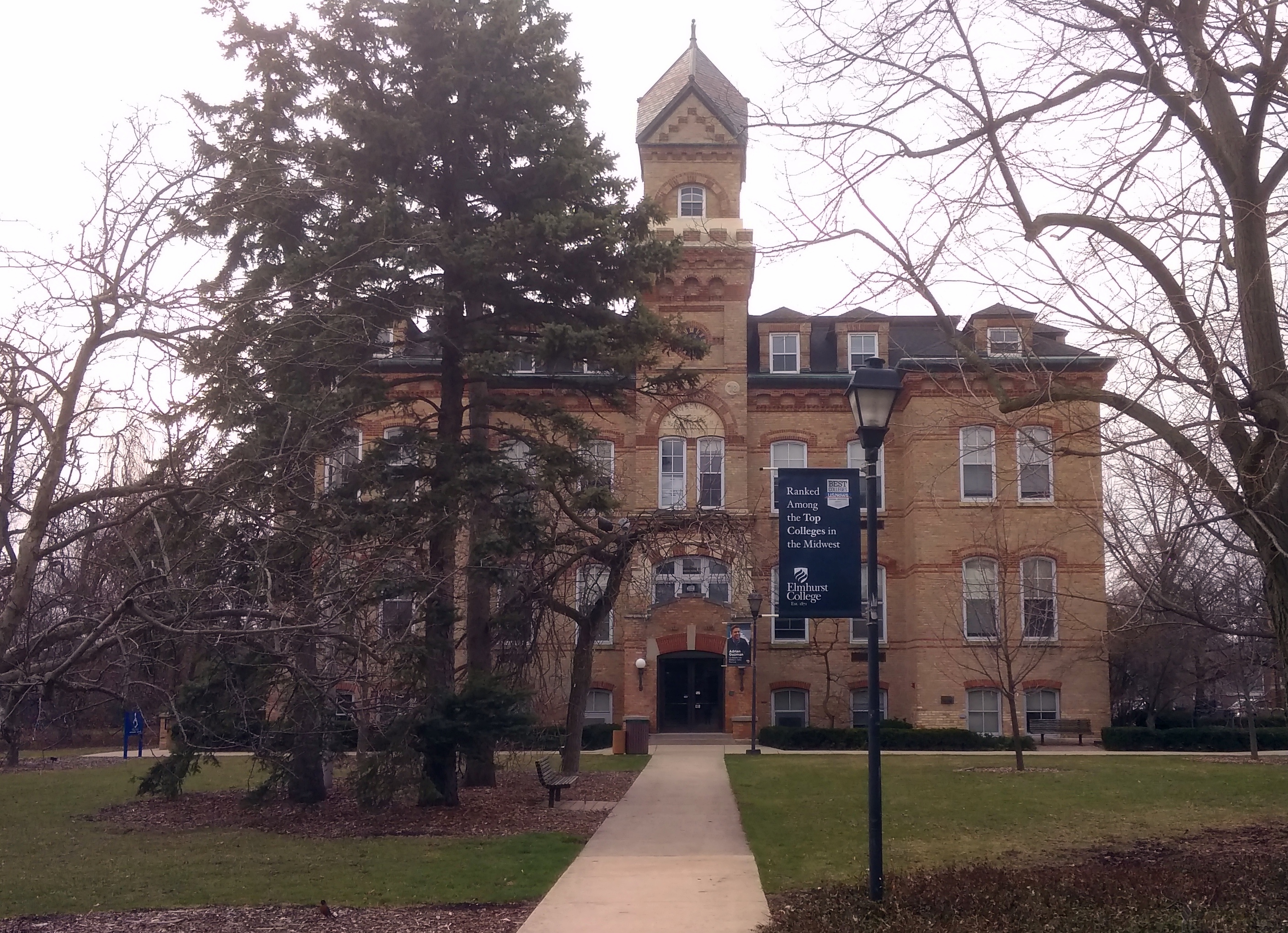
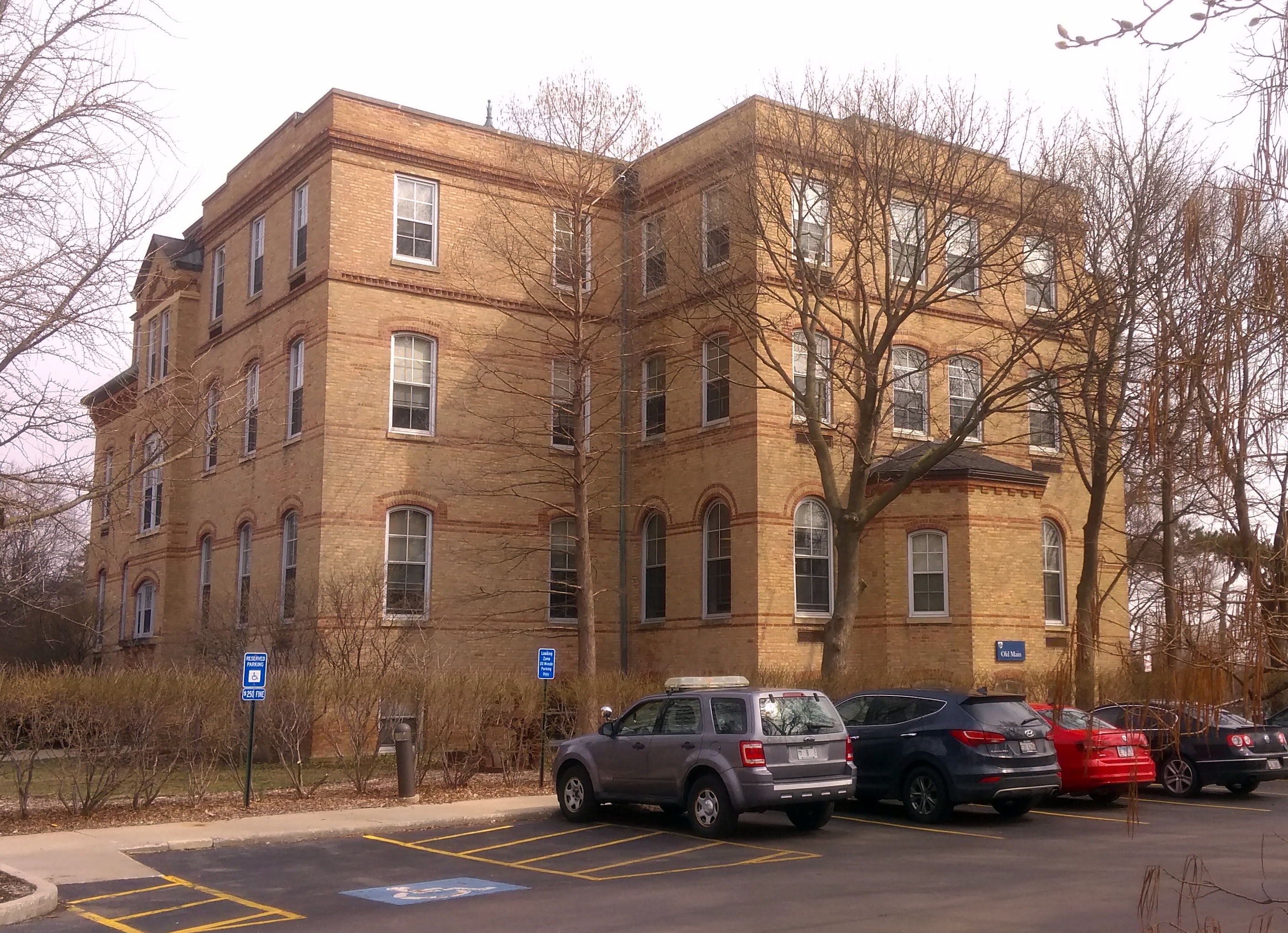
Here’s Old Main. Or the Hauptgebaude, which remarkably has its own Wiki page. One of the more handsome structures on campus, I’d say. The front.
And the back.
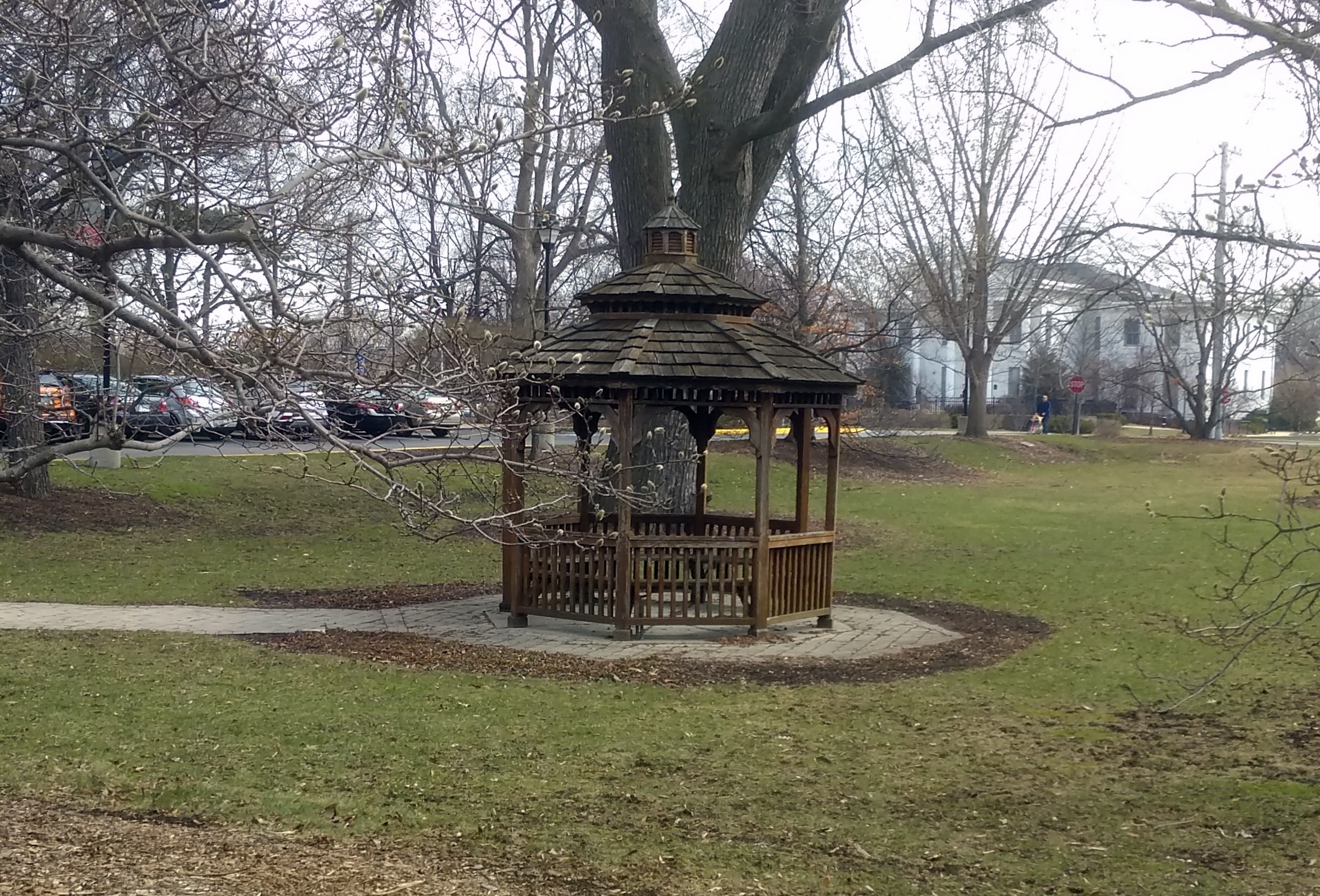
The college has a gazebo. Minor, but still a gazebo. All colleges should.

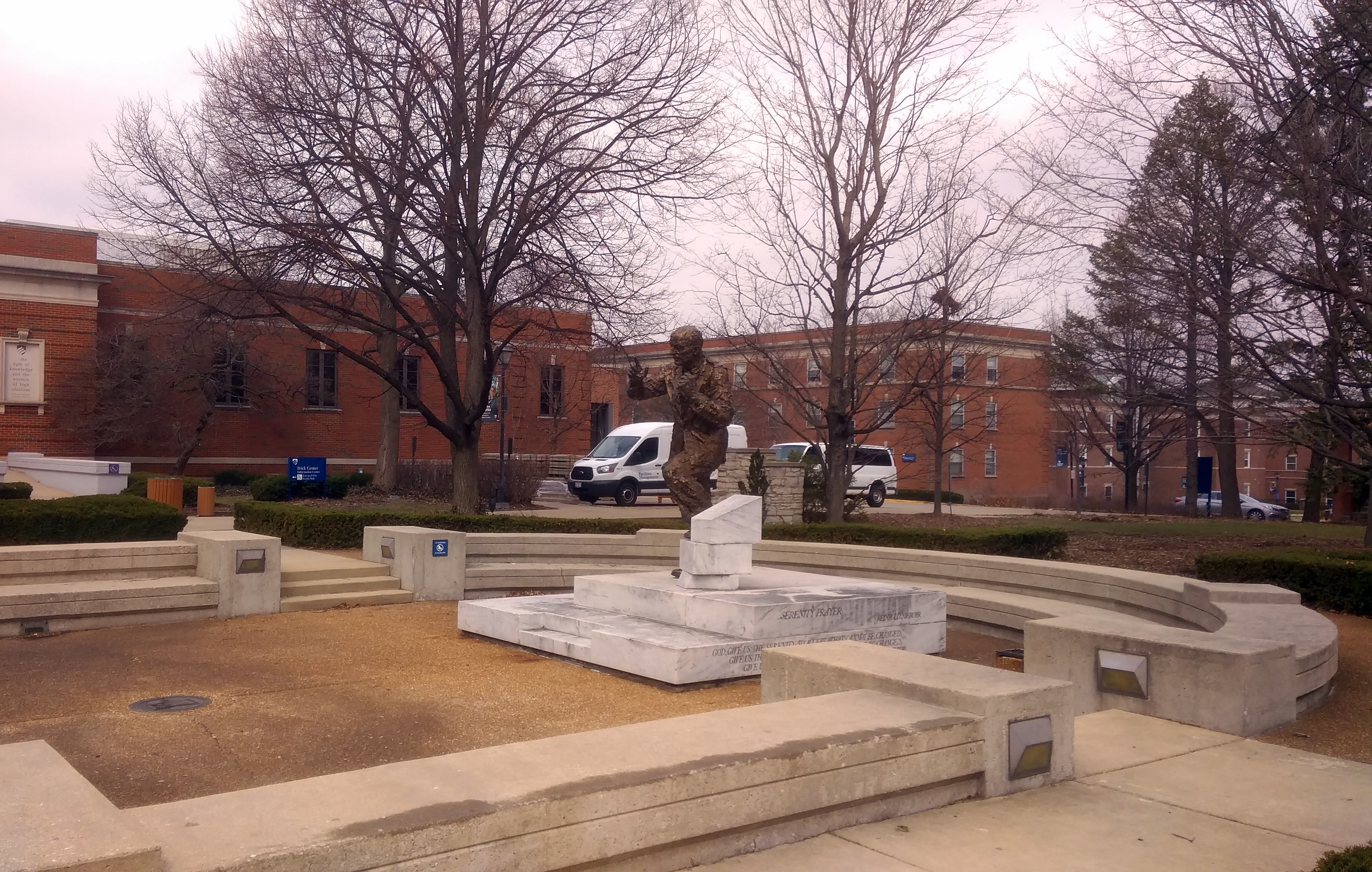
What’s this? I noticed a statue not far from Old Main, standing in its own plaza-like spot.
A founding bishop with “Knowledge is Good” carved on the base in German? I’m not sure the denomination had bishops; probably not, but never mind.

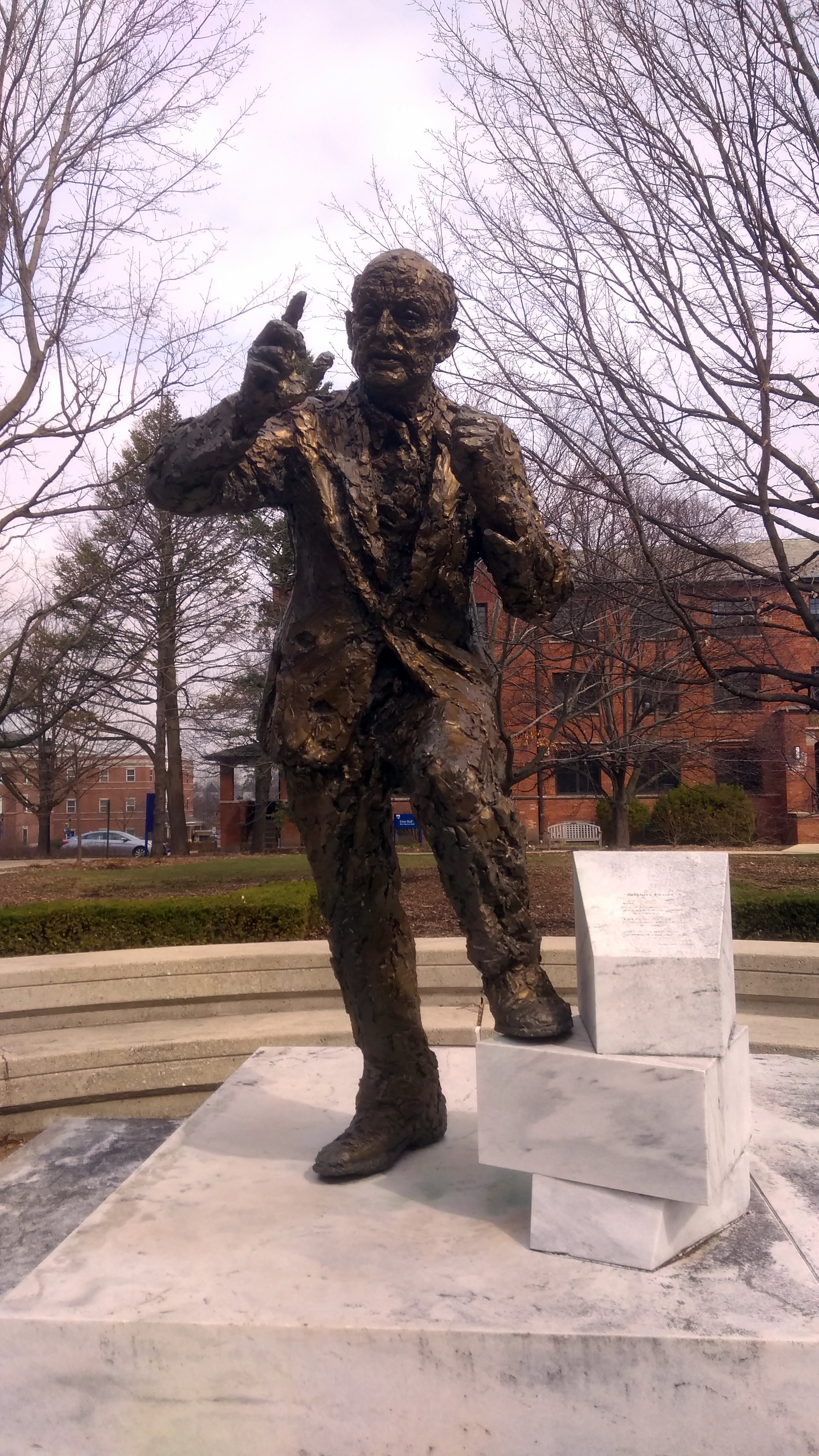
No. It’s a statue of Reinhold Niebuhr in an animated pose.
I didn’t expect that. My own ignorance was at work. Niebuhr did his undergraduate work at Elmhurst College, class of 1910. His brother H. Richard, also a theologian, likewise went to Elmhurst.

In 1997, Niebuhr was honored with this regrettable chewing-gum statue, the work of the late Robert Berks, who is better known for his bubble-gum Einstein in Washington, DC, though I’ve also encountered his Carolus Linnæus statue at the Chicago Botanical Gardens. Carved on one of the white blocks is the Serenity Prayer, which is widely attributed to Niebuhr.

Sad to say, most of what I learned about Niebuhr at Vanderbilt — and I’m pretty sure I learned something — has evaporated after nearly 40 years. He was a U.S. public intellectual in any case, informed by his theology. Is there such a thing any more?

Boh Cameronian

Not long ago I was informed that I could add a relatively inexpensive item to the Amazon basket to bring an order (that other people in the house wanted) up to the no-shipping-charge level. Funny how that works, but what to get?

I believe this is derisively known as a First World problem, but even in a context of affluence, that doesn’t count as a problem. It isn’t even an annoyance. Also, isn’t it time to retire that hoary old division of the world? (Not bad, but not my favorite song of theirs; that would be “Invisible Sun.”)

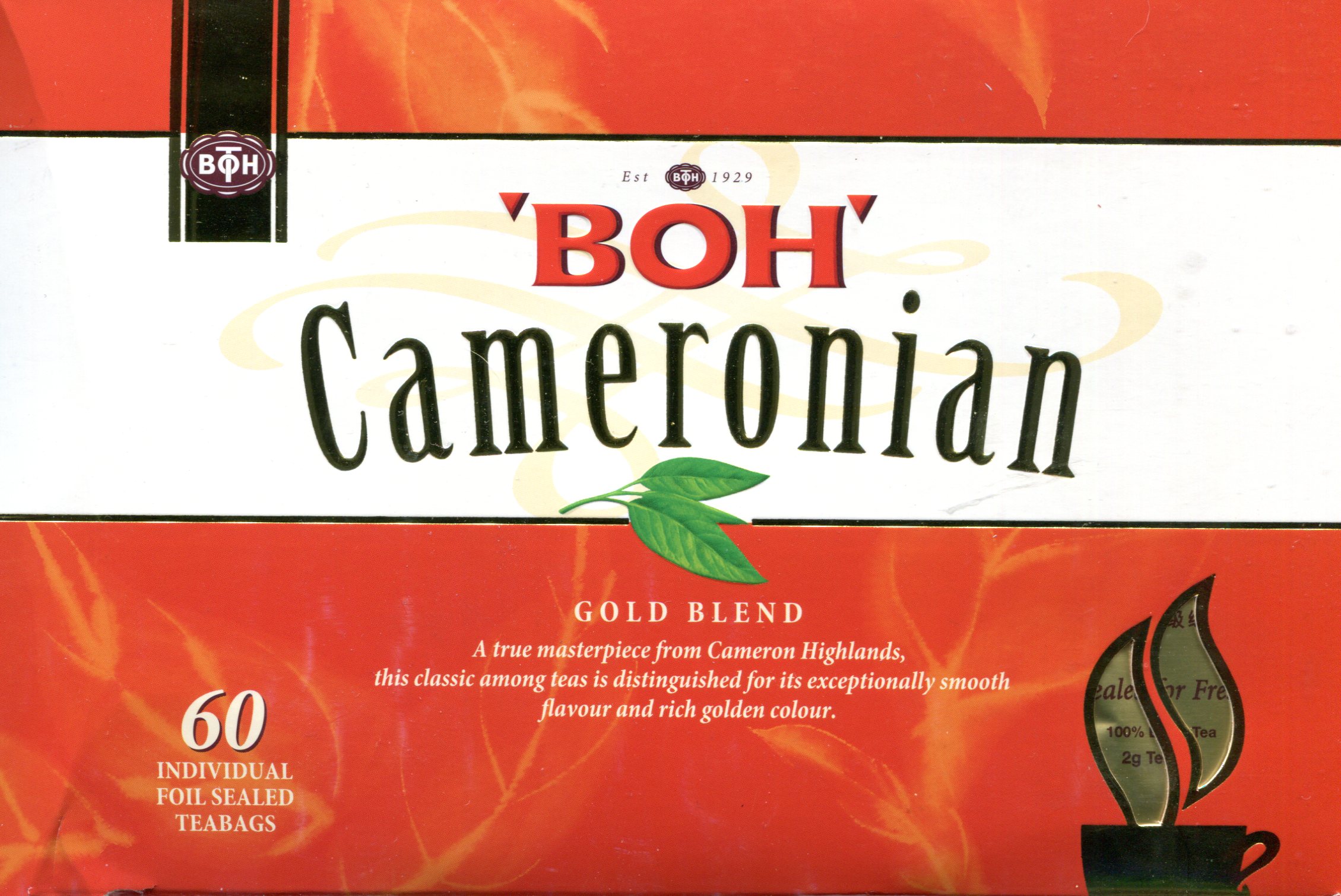
I decided I didn’t want to add to my household clutter, even things you (I) can’t have too many of — books, postcards, cheap coins, maps — so I got a box of Boh Cameronian.
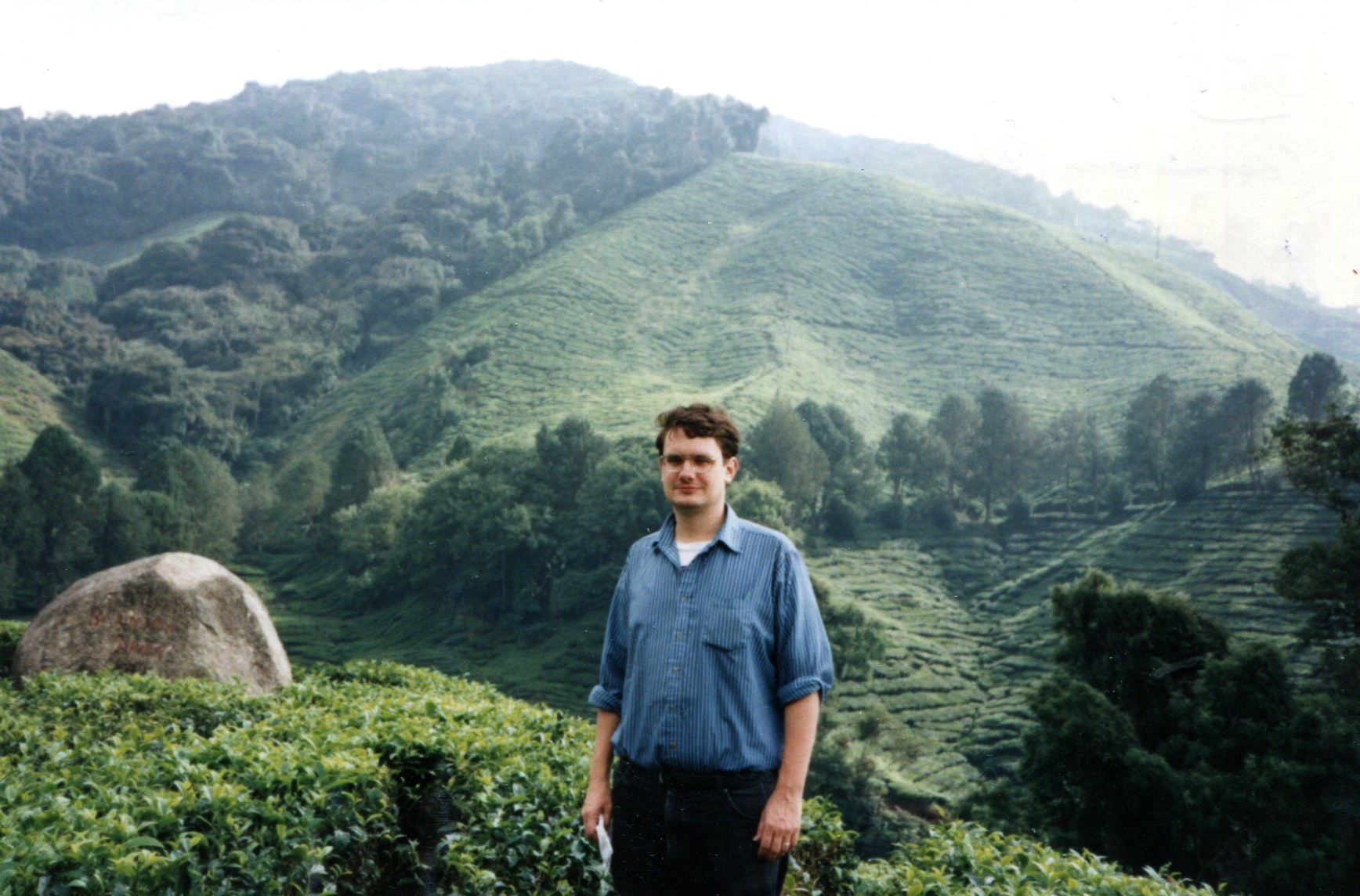
Boh Cameronian! It’s been nearly 25 years since I had a fine cup of Boh, which is tea from the Cameron Highlands of Malaysia. I became acquainted with it on my first visit to that nation in 1992. Two years later, we visited the Boh tea plantation up in the highlands.
Cameron Highlands Boh tea plantationNote the long-sleeve shirt. The Cameron Highlands were a hill station for a reason.

I’ve never seen Boh tea on the shelf in the United States, unlike Typhoo tea, even in stores that carry unusual or rarefied imports. In more recent years, I checked on line for the tea. I found it, but at astronomical prices.
I hadn’t checked in a good while, and never on Amazon. When facing my First World problem, I was inspired to look for Boh. A box of 60 bags was available there for about $12, plus no shipping. Twenty cents a bag. More than, say, Lipton, but you don’t buy Lipton for nostalgia value, or much of anything but price.

Even if I took the recommendation on the box and limited one bag to making one cup of tea — which I suspect is merely to encourage more consumption — that would be 20¢ a cup. More likely I will make a pot with each bag, or about three cups: around 7¢ a cup. Entirely worth it.

The marketing blarney on the box is in English and Chinese. The English:

Boh Cameronian takes its name from the Cameron Highlands, one of those special regions in the world blessed with a superb environment for growing teas of unique character and quality. Here, at 5000 feet above sea level at the scenic Boh Gardens, time-honored methods and innovation are combined to yield fine teas. Founded in 1929 by J.A. Russell, the pioneer of Malaysia’s tea industry, Boh teas are today renowned for their freshness and distinctive flavour.
The company offers a short history of Russell and the Boh plantation here.

I haven’t opened the box yet. It came just yesterday. A pleasant moment over the weekend might be the time to make a pot of Boh. I doubt that I can wait for that first cup till it’s nice enough to sit out on the deck, but I bet I’ll enjoy the some Boh al fresco in the near future.

Evergreen Memorial Cemetery, Bloomington

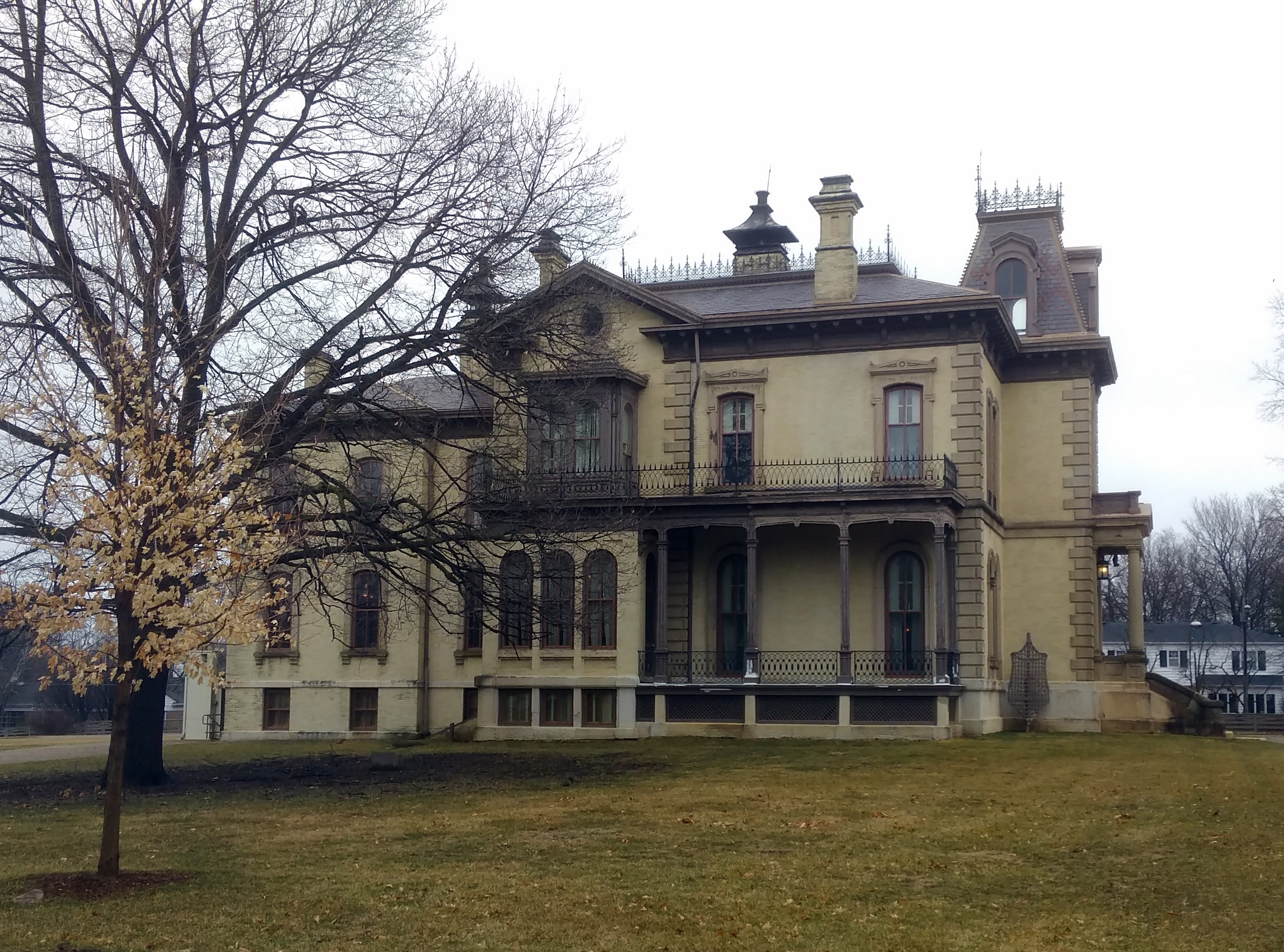
Sometime in the late 1990s, I visited the David Davis House in Bloomington, Illinois. As Lincoln’s campaign manager in 1860 — and important in getting him nominated in the first place — Davis was a behind-the-scenes man at a critical turning point in U.S. history. Lincoln put him on the Supreme Court in ’62.

On Sunday, I took a quick look at the house. As handsome as I remember.
David Davis House BloomingtonBut that isn’t why I swung through Bloomington. I wanted to see the Evergreen Memorial Cemetery. An impressive array of stones among the still-bare trees and brown grass.

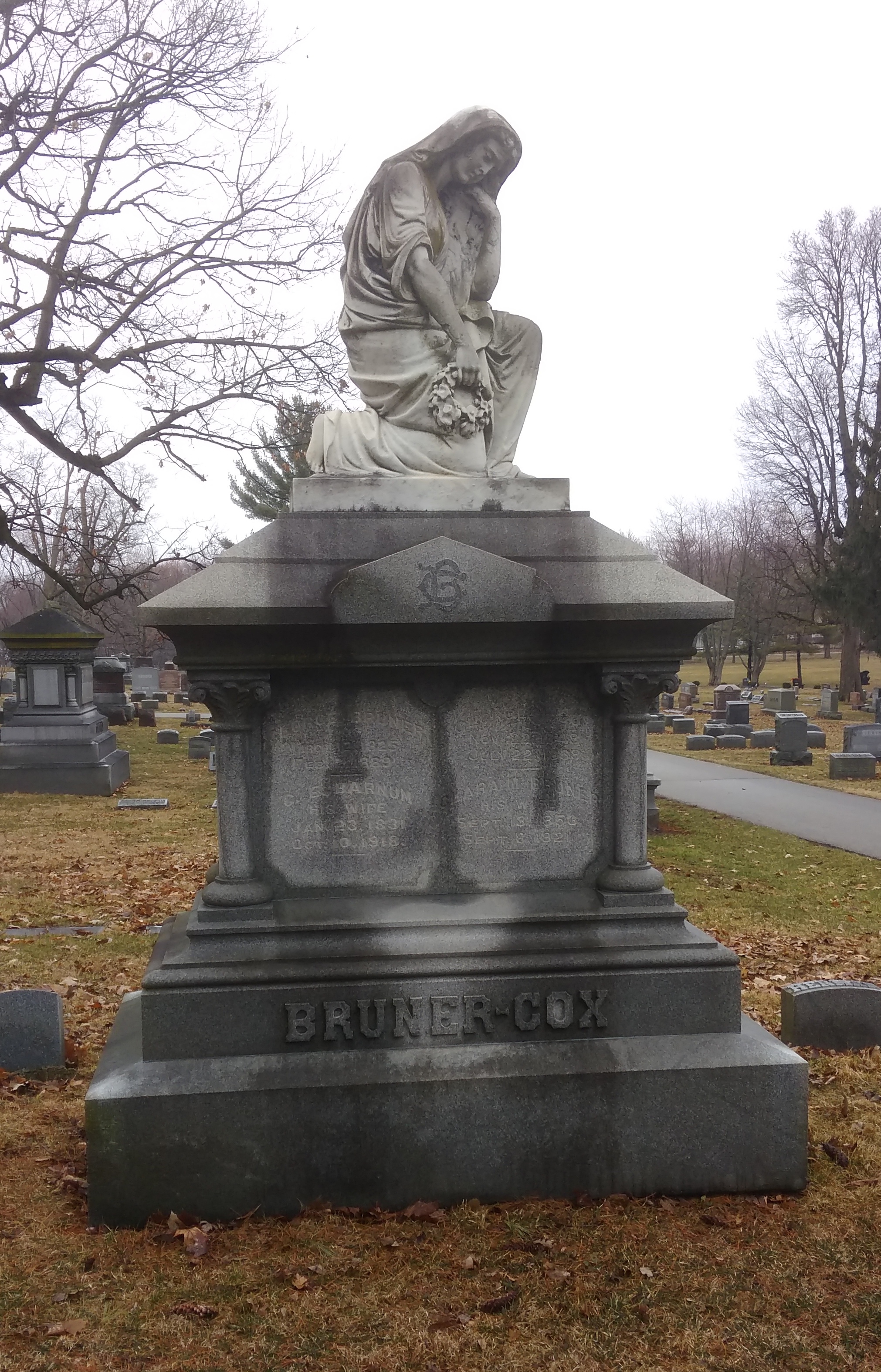
Evergreen Memorial Cemetery, BloomingtonEvergreen Memorial Cemetery, BloomingtonEvergreen Memorial Cemetery, BloomingtonSome sizable memorials, too, befitting the prosperous place Bloomington was in the 19th century.

Evergreen Memorial Cemetery, BloomingtonEvergreen Memorial Cemetery, BloomingtonNot a huge amount of funerary art, but some.
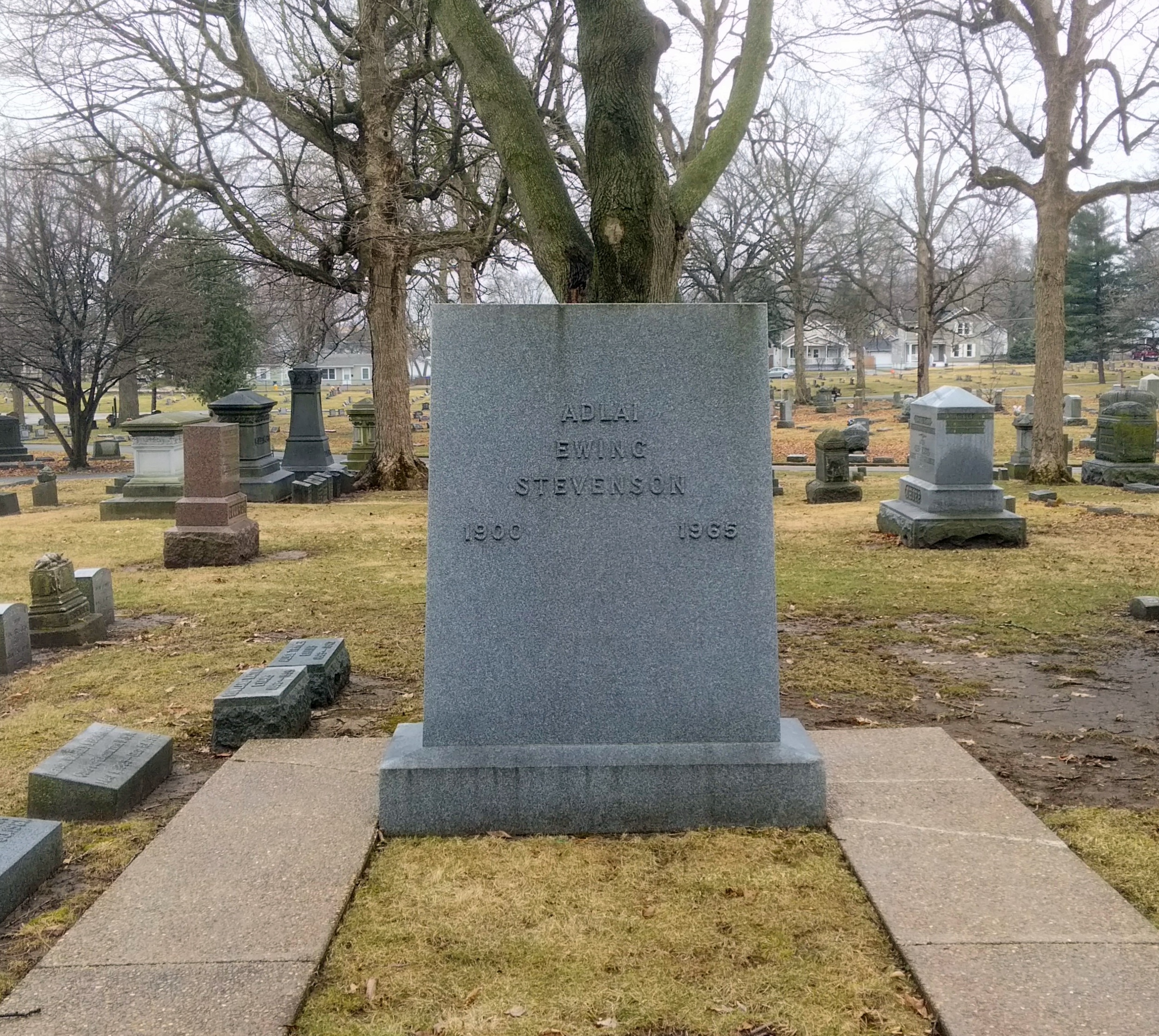
Evergreen Memorial Cemetery, BloomingtonI’d come to visit the Stevensons. Here’s the Adlai Stevenson famed for being shellacked by Eisenhower but also for his denunciation of Soviet behavior on the world stage.

Evergreen Memorial Cemetery, Bloomington

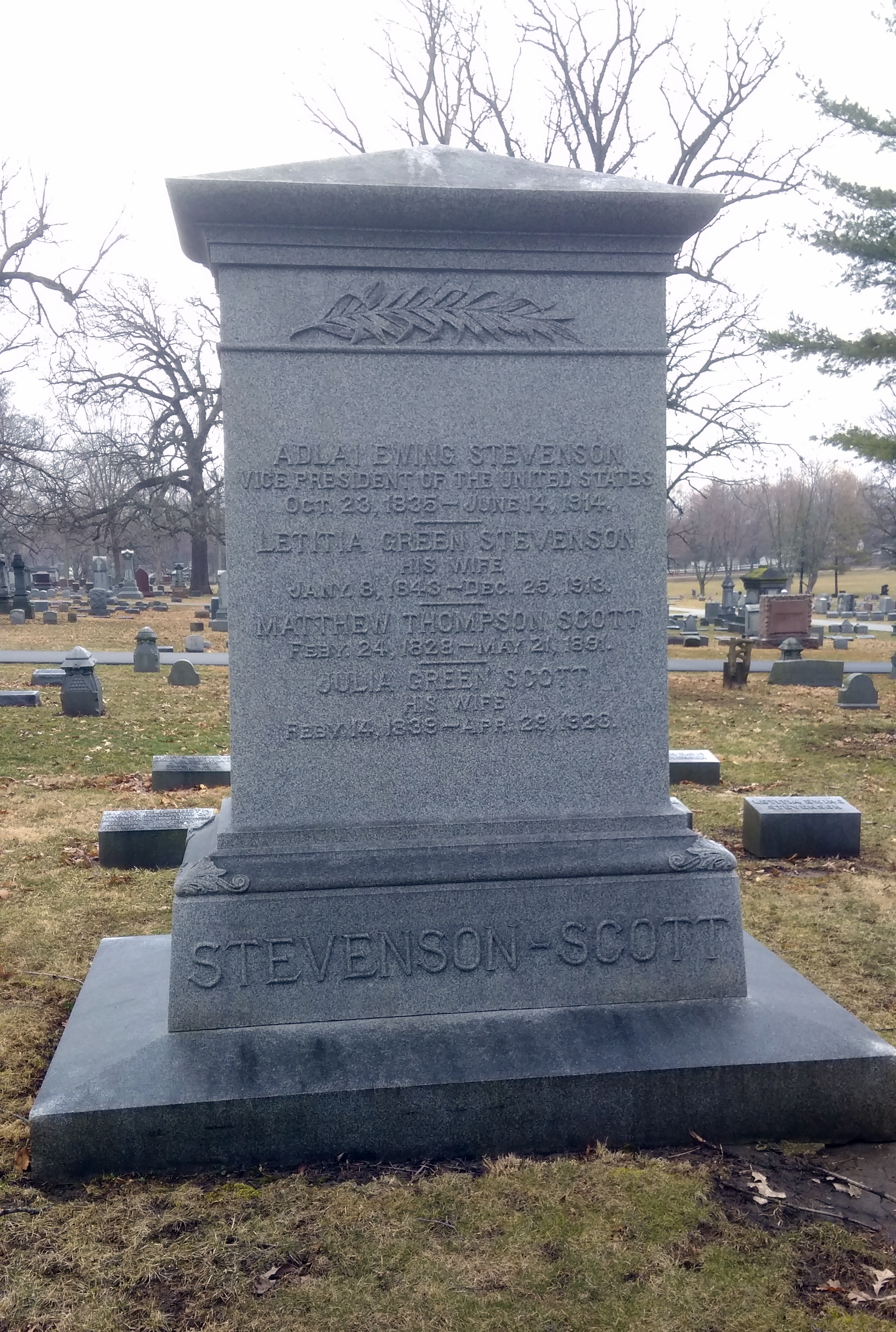
This Adlai Stevenson was 23rd Vice President of the United States, from 1893 to 1897, during Cleveland’s second term.
Evergreen Memorial Cemetery, BloomingtonHad President Cleveland’s cancer in ’93 been more aggressive, or medical science not up to its extraction — a few years earlier, probably not — this is also the Stevenson who would have been president.

I didn’t know the Scotts also memorialized on the stone: Matthew and Julia Scott. Turns out Stevenson was married to Letitia, Julia’s sister. Also, Matthew T. Scott was a business partner of Adlai Stephenson, with a distinctly 19th-century CV: land speculation, newspaper publishing, a coal mine.

Just before I left, I took a look at something a little more unusual.
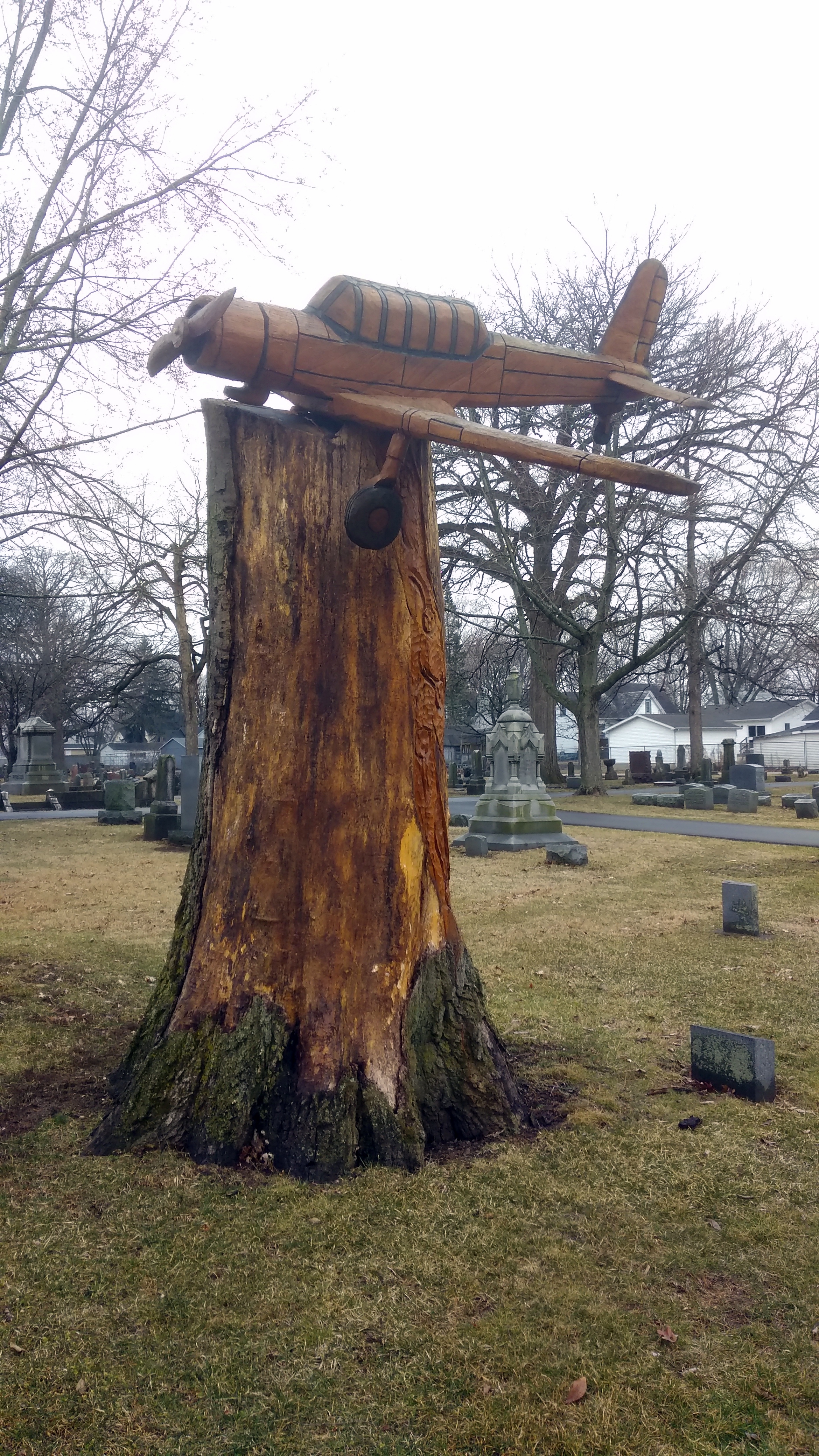
Evergreen Memorial Cemetery, BloomingtonAccording to a nearby plaque, the carving memorializes an airplane that crashed into the tree that used to stand there.

“On May 31, 1948, a group of citizens gathered at Evergreen Memorial Cemetery’s Civil War Veteran’s enclosure…” the plaque begins.

That must be here, very near the tree.

Evergreen Memorial Cemetery, Bloomington“… During the ceremony, a WWII trainer plane flown by James A. Tuley and passenger Chester H. Frahm was flying over Evergreen… to drop poppies over the grounds. The plane crashed into this tree, killing Frahm and severely injuring Tuley,” the plaque continues.

“In 2015 this tree had to come down and cemetery employees felt something more needed to be done with the wood from the tree… chainsaw artist Tim Gill was contacted and he accepted the challenge.”

The Pantagraph published a fuller version of the story.

Oak Grove Cemetery, LeRoy

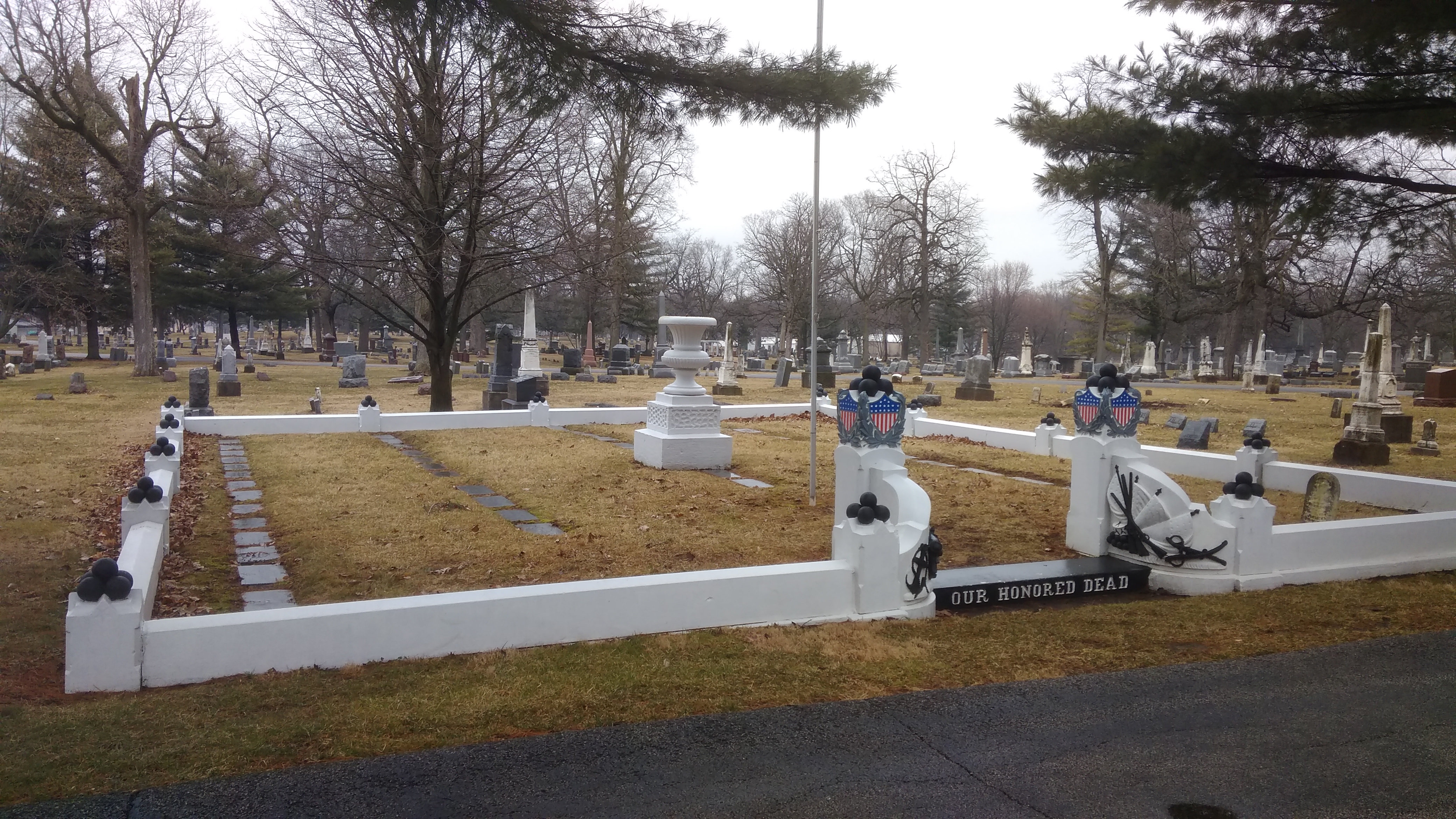
One place I wanted to visit during Sunday’s micro-excursion was the Evergreen Memorial Cemetery in Bloomington, Illinois, but just before I arrived at the town of LeRoy (see yesterday), which is about 20 miles from Bloomington, I spotted the Oak Grove Cemetery off U.S. 150.

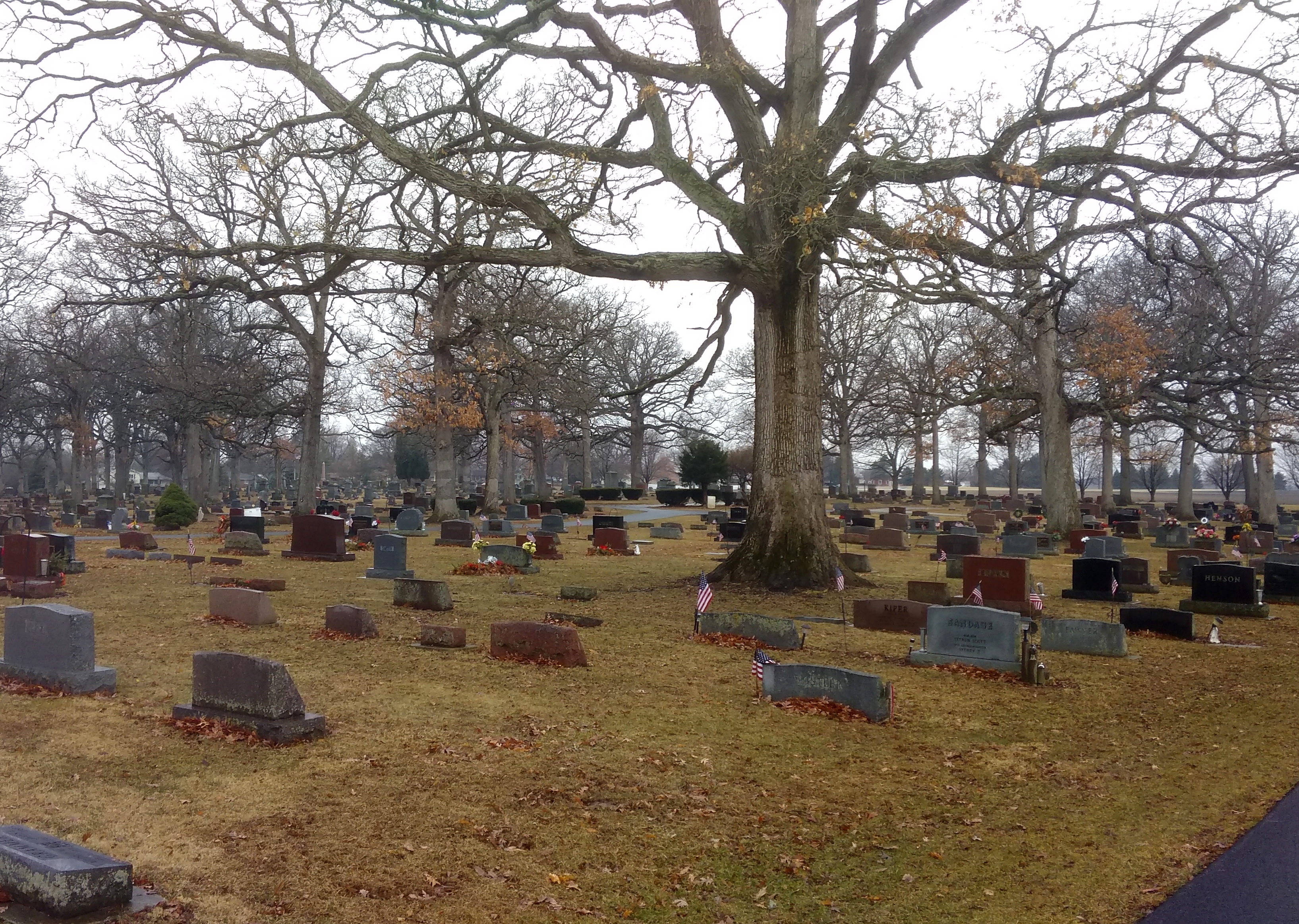
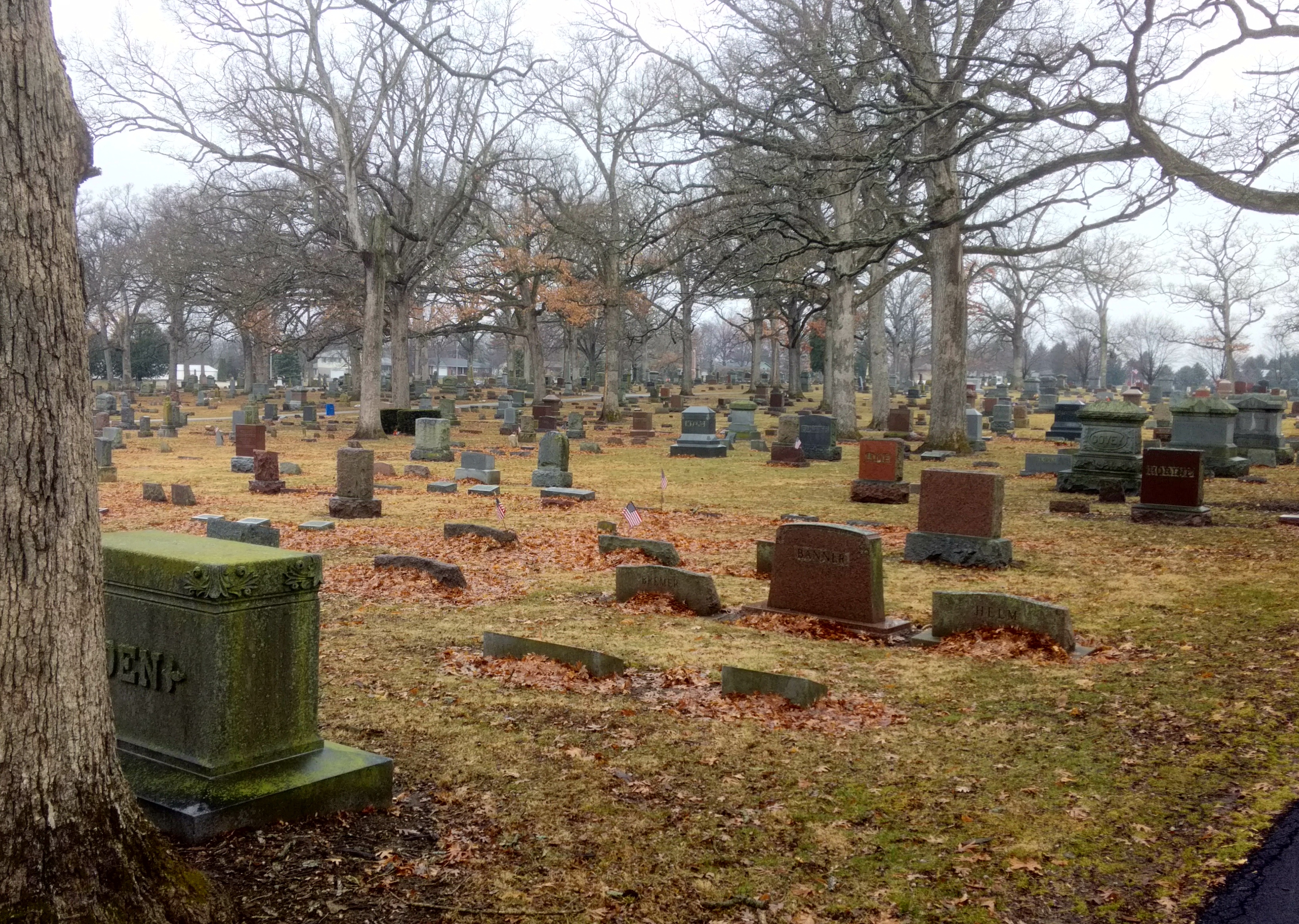
I pulled in. Why not? I expected a small cemetery, but it stretched back for acres, with plenty of well-established trees that will probably fill out nicely beginning next month.

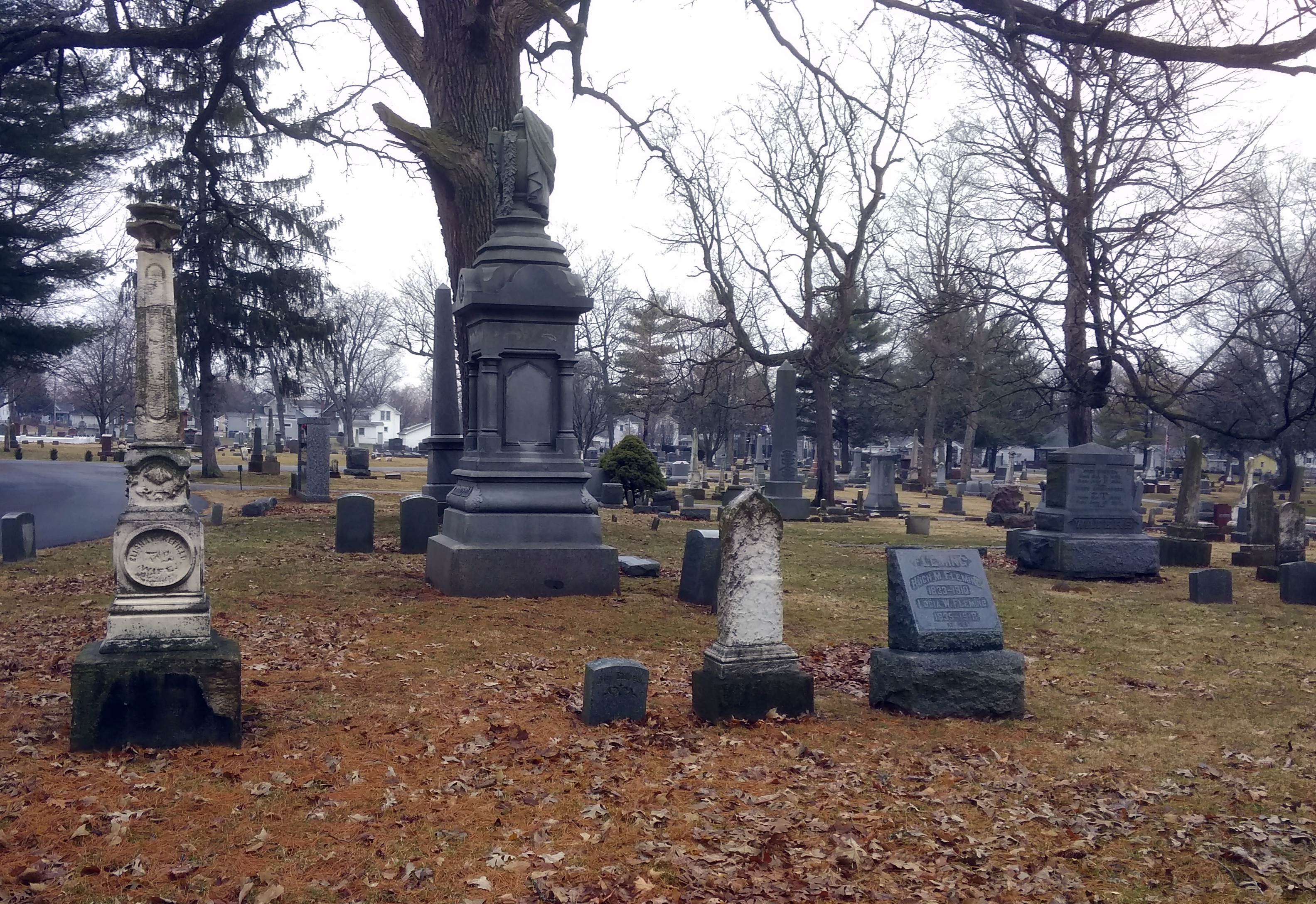
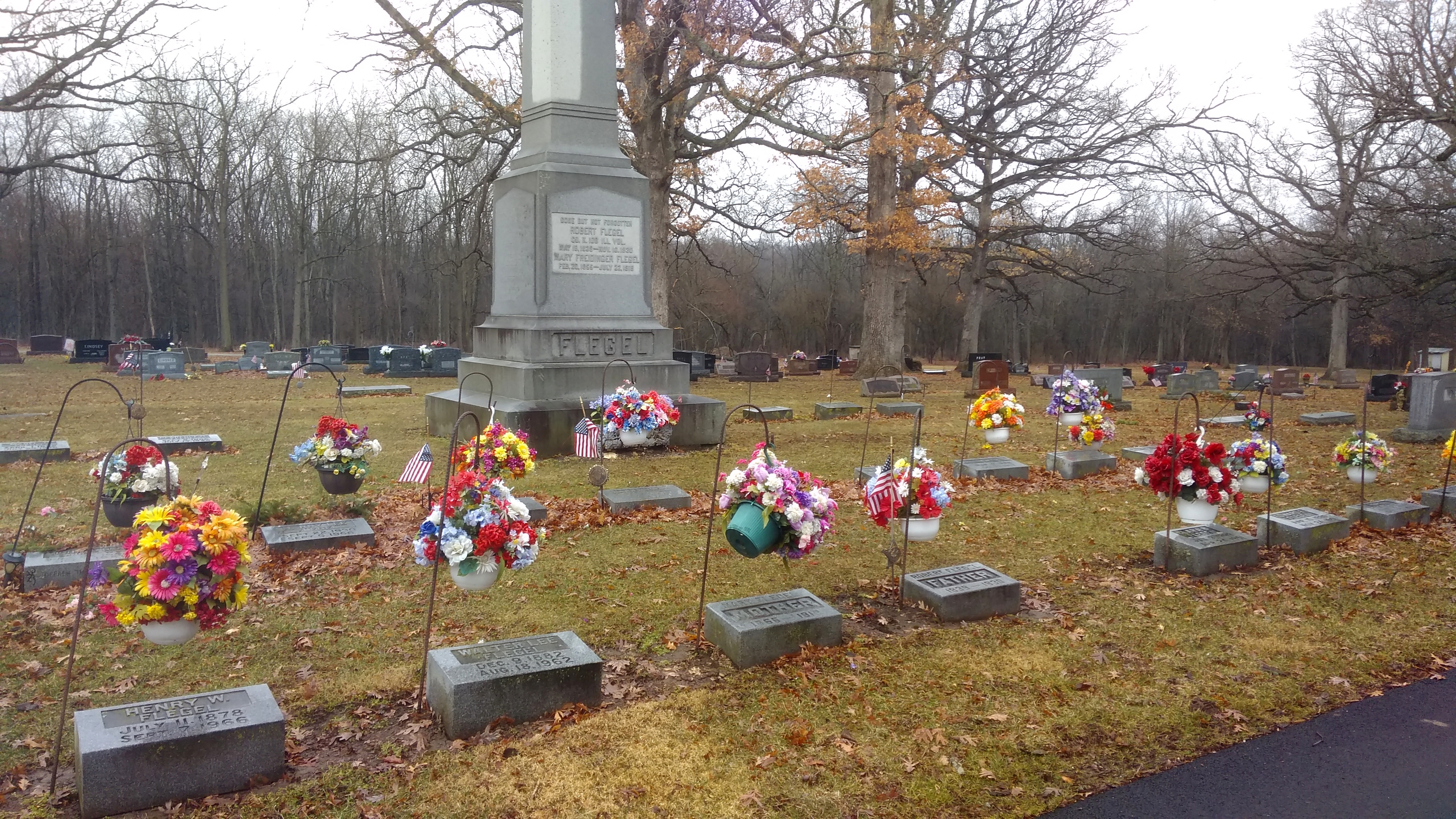
Oak Grove Cemetery, LaRoy IllinoisOak Grove Cemetery, LaRoy IllinoisOak Grove Cemetery, LeRoy IllinoisThere weren’t a lot a large memorials, but whoever Robert Flegel was, he and his wife Mary got an obelisk after their passing in the early 20th century.
Oak Grove Cemetery LaRoy IllinoisWhatever else he did, Flegel fought to save the Union, according to the inscription: Co. K, 108th Illinois Volunteer Infantry. Looks like his descendants or other family members are keen to decorate the many Flegel stones.

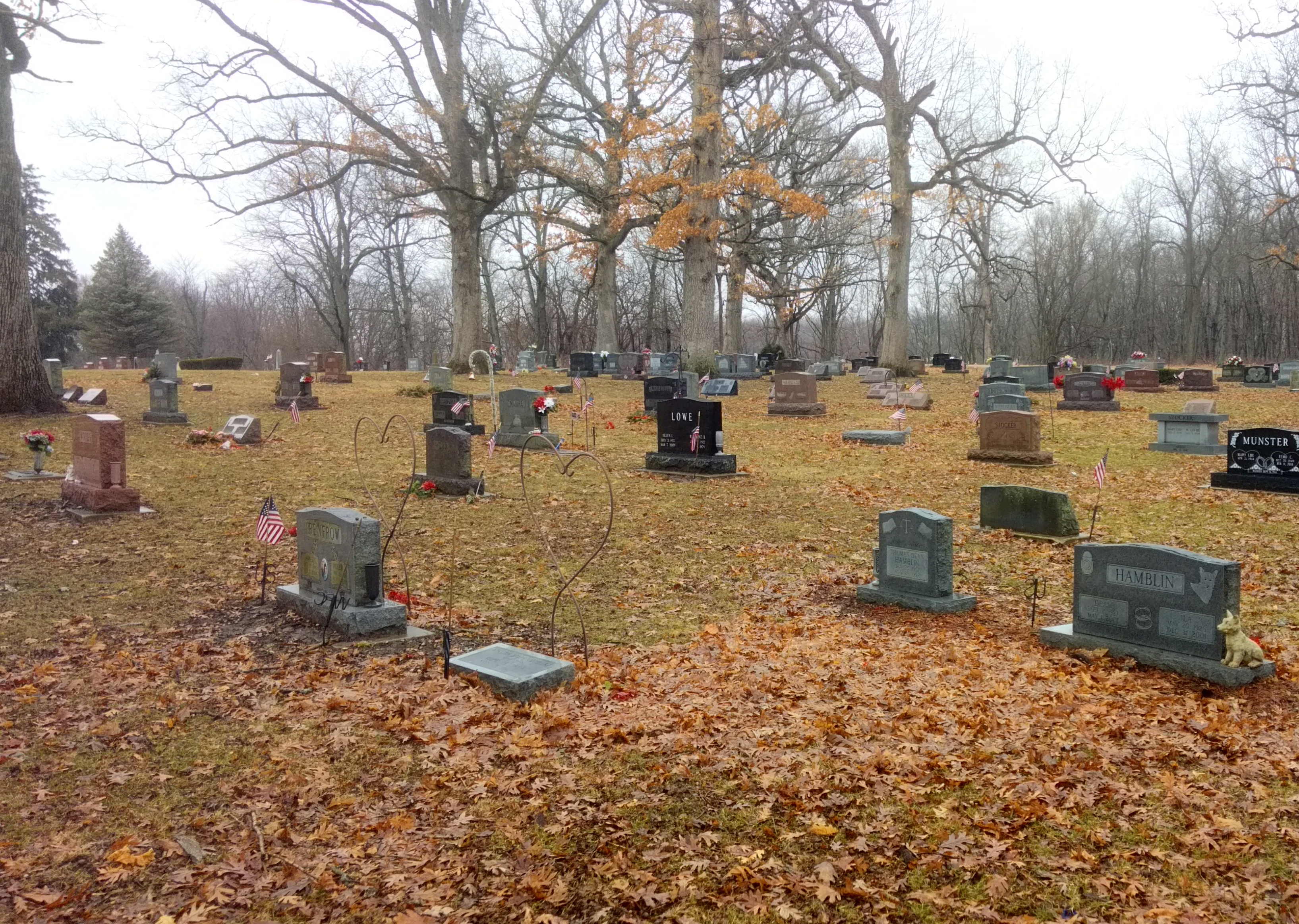
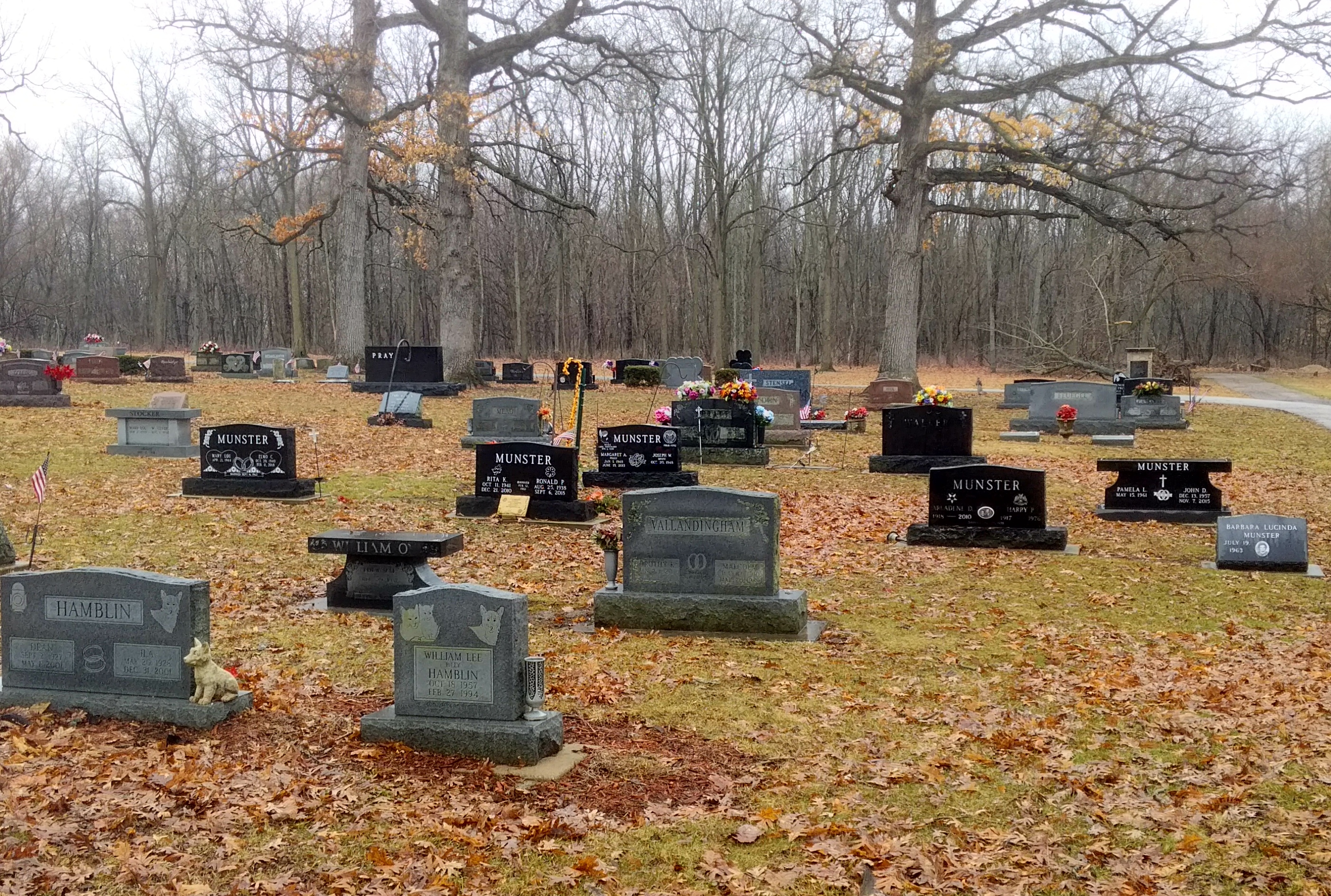
Oak Grove Cemetery LaRoy IllinoisThere are a lot of Munsters at Oak Grove as well.
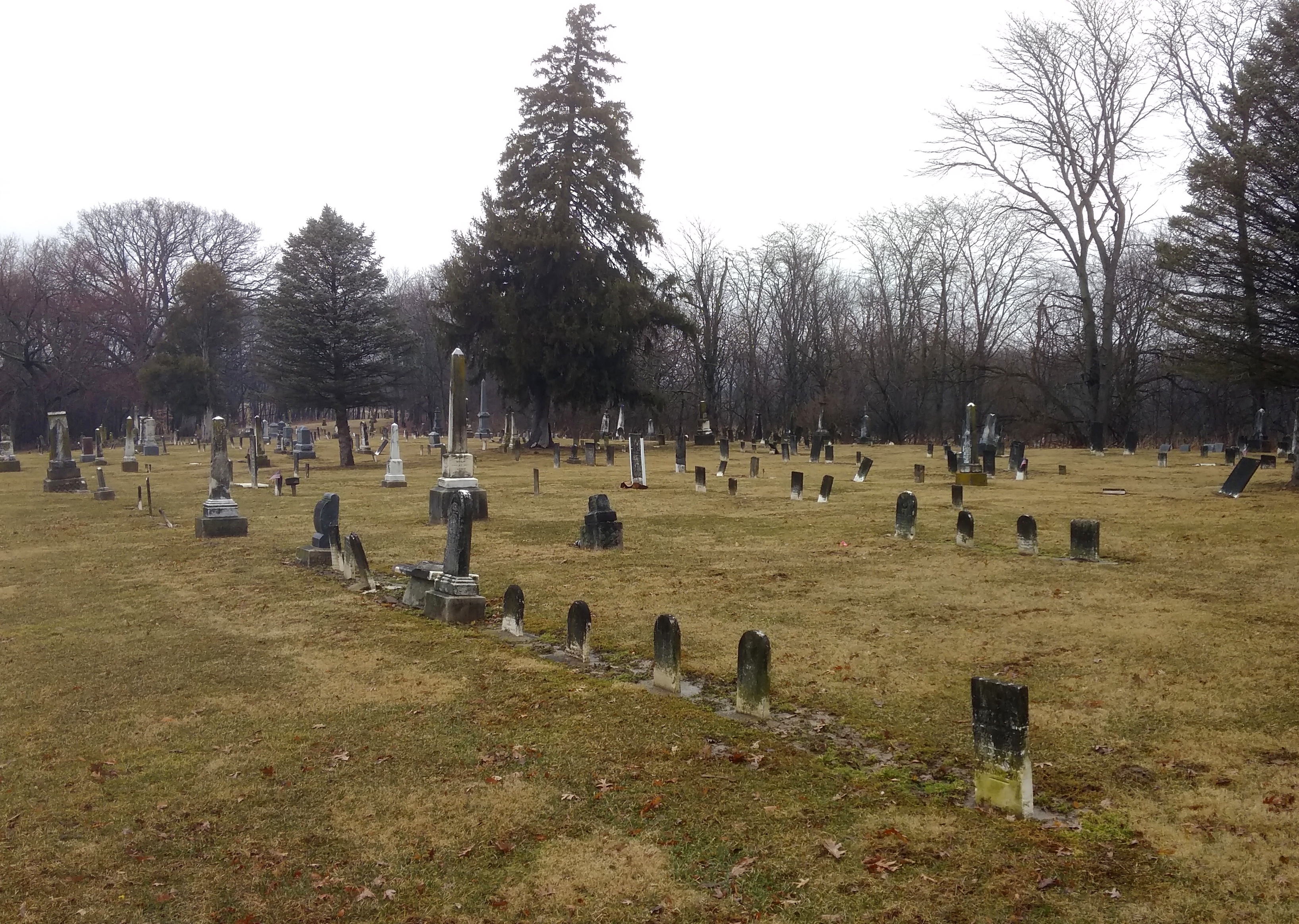
Oak Grove Cemetery LaRoy IllinoisFurther back away from the road are older stones. Mostly 19th century, including some pioneers of McLean County, probably.
Oak Grove Cemetery LaRoy IllinoisAccording to Find-A-Grave, spiritualist Simeon H. West was buried in the cemetery after he “departed this life Apr. 2, 1920.” I hadn’t made his acquaintance yet — that happened later in the day — and I don’t remember seeing his fairly large stone.