Ottawa Sights (Not the One in Canada)

We arrived in Ottawa, Illinois, on Saturday in time for lunch. We decided on carry-out from Thai Cafe on Columbus St., which seems to be the only Thai joint in town. At a population of 18,000 or so, maybe that’s all Ottawa can support.

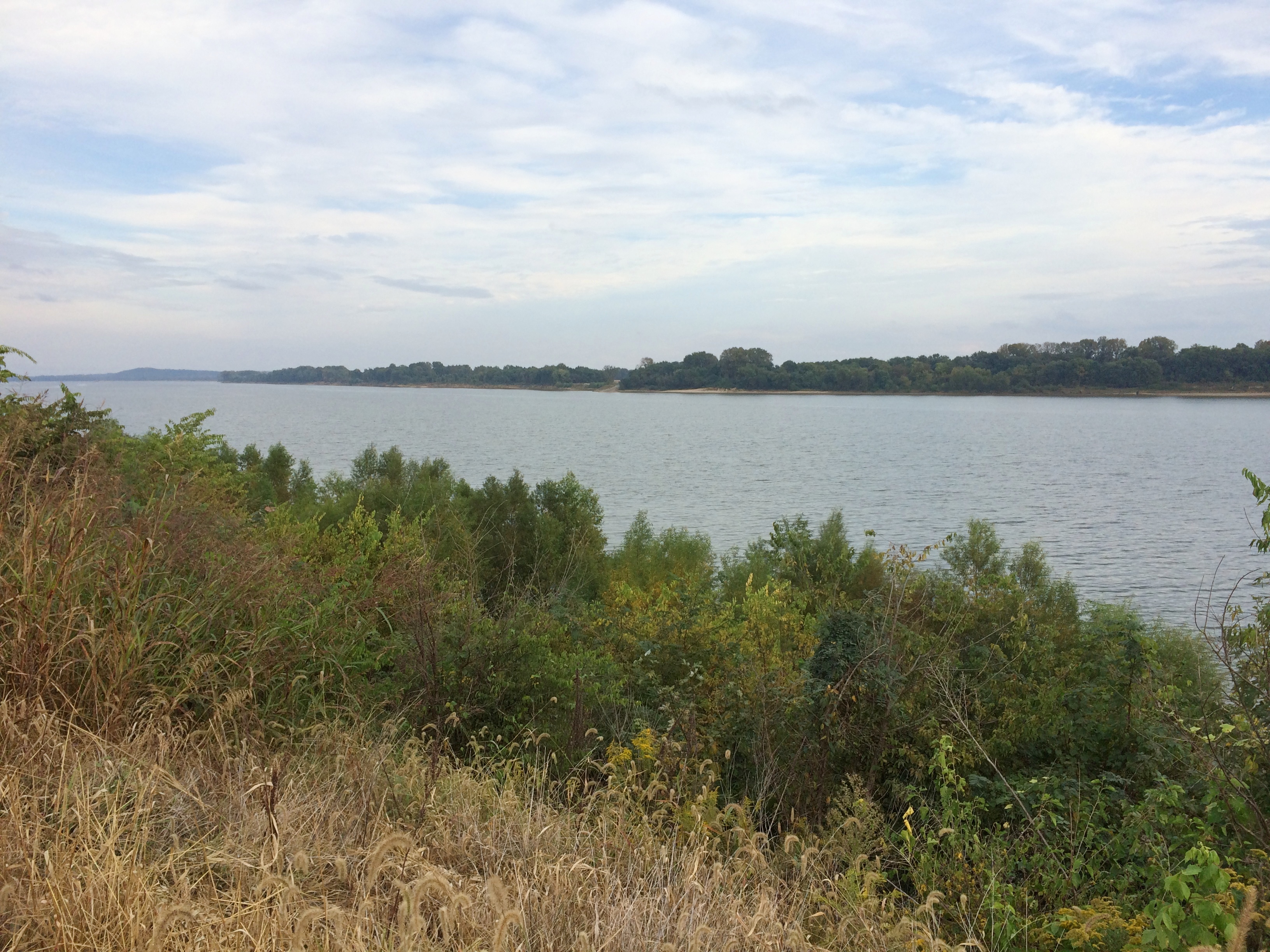
We took our food to Allen Park, a municipal park on the south bank of the Illinois, and found a picnic shelter. The river’s large and on a weekend in July, home to a lot of pleasure craft.
Ottawa Illinois 2020Sometimes, the river must be angry, such as on April 19, 2013. Got a lot of rain in northern Illinois about then, so I believe it.

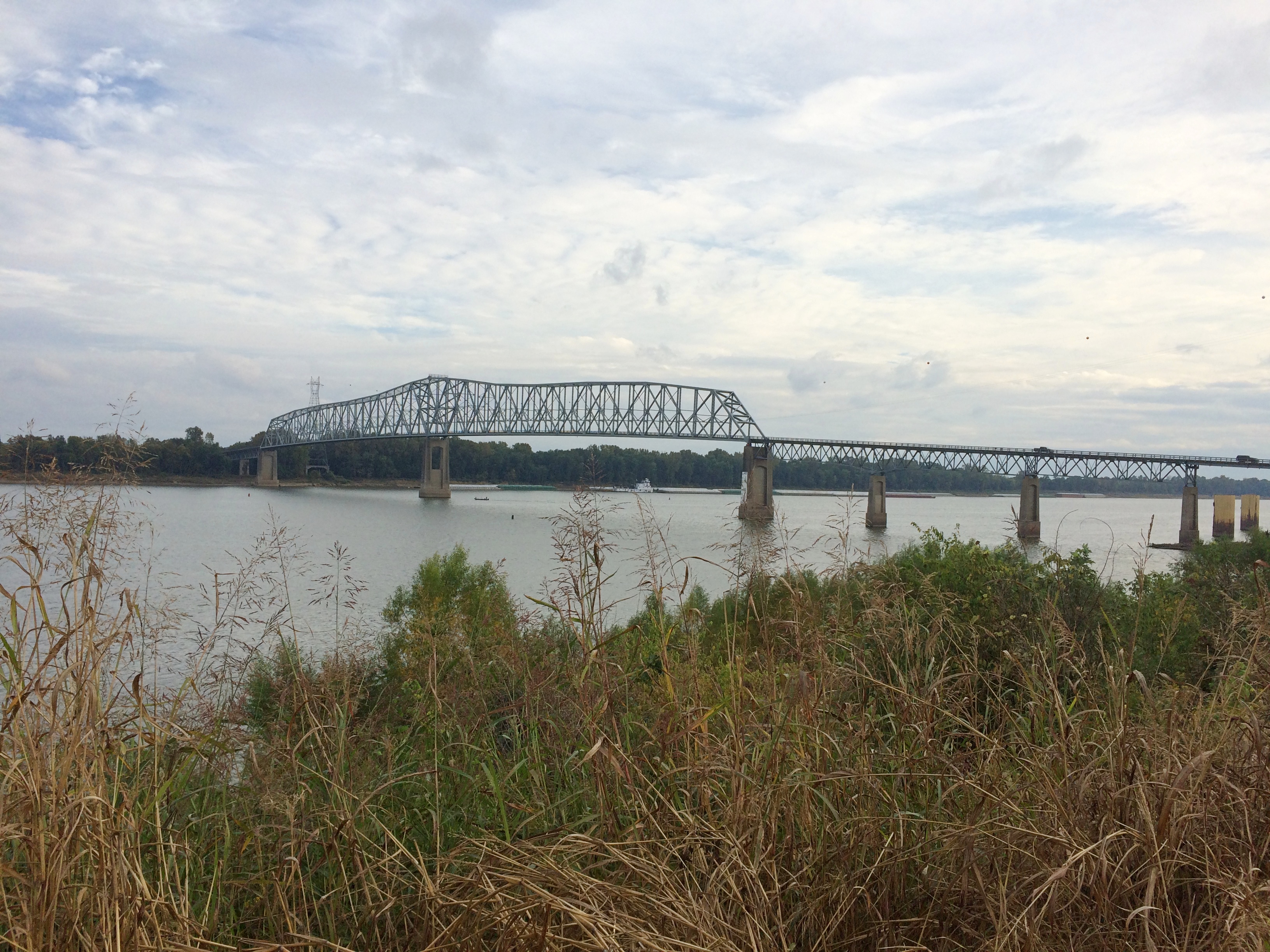
Ottawa Illinois High Water MarkDownstream a bit is the Ottawa Rail Bridge, which rates a page in Wikipedia. The current bridge dates from 1898, though it was modified in 1932.

Ottawa Illinois Rail Bridge

Two large metal sculptures rise in the park, both by Mary Meinz Fanning. The red one is “Bending.”
Ottawa Illinois BendingThe yellow one is “Reclining.”
Ottawa Illinois Reclining“Fanning was the driving force behind the creation of the red and yellow steel sculptures at Allen Park by the Illinois River in Ottawa,” says a 2010 article in The Times, which seems to be a local paper.

“The 40-foot-tall sculptures, which weigh 17 tons each, were erected in 1982 and 1983 from parts of the 1933-built steel girder Hilliard Bridge that was demolished in 1982 to make way for the present-day Veterans Memorial Bridge. Fanning died of illness Nov. 4, 1995, in Ottawa at age 48.”

Just as you enter the park, you also see a wooden sculpture: one of artist Peter Toth’s “Whispering Giants,” which I’d forgotten I’d heard of till I looked him up again. The one in Allen Park is Ho-Ma-Sjah-Nah-Zhee-Ga or, more ordinarily, No. 61.

Looked familiar. I realized I’ve seen one before —
Nee-Gaw-Nee-Gaw-Bow That one is Nee-Gaw-Nee-Gaw-Bow or No. 59, and we saw it by chance in Wakefield, Mich. about three years ago. Apparently the artist has put up at least one in each state.

Ottawa has a place in U.S. history mainly for two things. One that the town is happy to celebrate: the first Lincoln-Douglas debate in 1858. The other is the awful story of the Radium Girls, poisoned by luminous paint at a clock factory in Ottawa in the early 20th century. For a long time, there was no public acknowledgment of that incident. Now there is. But I didn’t know the Radium Girls have a statue in town (since 2011), so we missed that.

We didn’t miss the site of the Lincoln-Douglas debate, which is in the shady, square-block Washington Park.
Ottawa Illinois Washington ParkLincoln and Douglas are there as part of a fountain to memorialize the event. They were cast in bronze in 2002 by Rebecca Childers Caleel.
Ottawa Illinois Washington ParkOttawa Illinois Washington ParkIt would have been more pleasant if the fountain were on, but maybe it was dry for public health reasons in our time. The noontime heat was oppressive, so we didn’t have a leisurely look-around the area as much as we might have otherwise. There are other memorials in the park, and plenty of historic structures nearby, forming the Washington Park Historic District.

Those buildings include the Third District Appellate Court Building (1850s), the Reddick Mansion (1850s), the Ottawa First Congregational Church (1870), Christ Episcopal Church (1871), and a Masonic Temple (1910). A few blocks away, the LaSalle County Courthouse looked interesting, too, but we only drove by.

I managed to take a close look only at the former Congregational Church building.
Ottawa Illinois Washington Park Open Table Church

Ottawa Illinois Open Table Church of Christ

Gothic Revival in brick. These days, the church is part of the Open Table United Church of Christ.

Starved Rock State Park ’20

Hot-and-sweaty weekend until a steady warm wind came on Sunday afternoon, a baby sirocco you might call it, and blew away the humidity. That left the golden glow of dusk warm but dry.

All of us, dog included, took an in-state overnight (30-hour) trip over the weekend, with Starved Rock State Park as the prime destination. Been a while since we’d all been there together, but each of the girls had visited with friends in more recent years.

That isn’t a postcard of mine, though if the state sold it at the park, I’d buy one.

The 2,630-acre Starved Rock SP hews close to the south banks of the Illinois River in LaSalle County, its distinctive topography a creation of long-ago floods and glacial movement. The state acquired the land in 1911 and (of course) the CCC did park infrastructure work during that agency’s short existence. It’s a popular place, more so now than ever. Guess that’s because driving destinations are the thing at our moment in history.

We waited until after the highest early afternoon heat had passed on Saturday to take our hikes. Late afternoon was still steamy, but tolerable, especially under trees. When we came to this fork, we took the path to French Canyon.
Starved Rock State ParkIt isn’t long before the French Canyon walls rise around you.
Starved Rock State ParkStarved Rock State ParkBefore long, you reach a waterfall. Just a trickle in late July.
Starved Rock State ParkDoubling back to the fork, we then followed a trail that’s mostly boardwalk, plus a lot of stairs that I didn’t document.
Starved Rock State ParkTo the view from Lover’s Leap.
Starved Rock State Park Lovers LeapThe nearby Eagles Cliff vista, looking upriver.
Starved Rock State Park Eagle CliffLook a little downriver and you see why the Illinois is so wide just below Eagle Cliff.
Starved Rock State Park Eagle CliffThe Starved Rock Lock and Dam, also known as Lock and Dam No. 6, completed in 1933 and operated by the Army Corps of Engineers.

We might have walked further into other canyons after that, or up to the Starved Rock feature, but the heat and stair climbing spent our energy. Mine, anyway. We ought to go back some cooler day in the fall. I’ve been visiting the place since the late ’80s and still haven’t seen some of the other canyons.

Dundee Township East Cemetery

At the intersection of Dundee Ave. and Higgins Road (Illinois 25 and 72) is the 48-acre Dundee Township East Cemetery, owned by the township of that name, but also entirely within the village of West Dundee in Kane County. There’s no fencing or anything else to separate it from those fairly busy roads.
Dundee Township East Cemetery

We — that is, Ann and I — visited briefly on Saturday when we were out that way, which is northwest from where we live.

The cemetery dates from the 1890s, no doubt long before those adjacent roads were paved, though it’s possible that part of the future Illinois 72 had planks, since I understand much of its route follows the old Galena-Chicago Stagecoach Trail. These enthusiasts drove the trail’s modern-equivalent roads on a motorcycle. Not for me, but I’d consider using a car.

It’s a pleasant cemetery in the summer.Dundee Township East Cemetery
Dundee Township East Cemetery
Dundee Township East CemeteryIn an older section, there were a fair number of German names, and some German-language script on the stones. Here’s a fine German name: Schneidewendt, whose stone memorializes burials in the early 20th century.
Dundee Township East Cemetery
Not many mausoleums that I noticed, but there were a few. I expect a lot of the population in Dundee Township a century and some years ago were prosperous farmers, but not that prosperous.
Dundee Township East CemeteryWhoever The Family of Theodore Kunke were — that’s the text over the door — they had the scratch for a simple edifice.

Thursday Bits

I’ve heard of other large models of the Solar System, but not about the one in Sweden. There’s one much closer at hand, whose Sun and inner planets are in Peoria, but I’ve never gotten around to seeing it.

A recommended YouTube series: Lessons from the Screenplay. Ann introduced me to it by suggesting one comparing the character arcs of Parasite and Sunset Boulevard, something I would never have thought of. The narrator, who introduces himself as Michael, makes a novel and compelling case for the comparison.

I watched a couple more over the last few days, one about The Shinning — which I haven’t seen in about 30 years, and probably should again, same as Sunset Boulevard — and another about No Country for Old Men. Both videos were thoughtful and interesting, and not too long, which all I ask from YouTube movie criticism.

Looks like SOB lowlifes have co-opted a perfectly good nonsense word that’s been around for years and years. That’s the vagaries of language for you.

It’s time. I’m a little surprised it’s going to happen so soon, but not sorry to see it go. With any luck, the striking Belle Époque pedestal will be repurposed, rather than torn down.

Illinois Primary 2020

Restaurants and bars and a lot else in Illinois might be closed today, but the primary election went on as scheduled. I walked to my polling place and voted fairly early in the morning.
There were three election judges on hand, and two other voters. Two of the judges, youngish women, wore rubber gloves. One of the judges, a male retiree from the looks of him, did not.

Twelve Pictures ’19

I always take many more pictures than I post in any given year. Here are some from this year to close out the decade. Back to posting around January 5, 2020. That year sounds so far in the future, at least for those of us who vaguely remember Sealab 2020 — and yet here it is.

Near North Side Chicago, January 2019

San Antonio, February 2019

Downtown Chicago, March 2019

Elmhurst, Illinois, April 2019

New Orleans, May 2019

Arcola, Illinois, June 2019

Pittsburgh, July 2019

Oak Park, Illinois, August 2019

Midland, Michigan, September 2019

Charlottesville, Virginia, October 2019

Schaumburg, Illinois, November 2019

Millennium Park, Chicago, December 2019Good Christmas and New Year to all.

Idea Garden, Champaign

Besides Decatur, we spent some time over the weekend in Champaign, including a short visit to the Idea Garden of the University of Illinois Arboretum.Idea Garden, Champaign

Back in the spring, the Idea Garden was mostly just that, notional, but since then volunteers have brought the place to full flower. Literally.
A small structure mid-garden was being used for an informal gardening class when we passed by. Something about garden pests. Sunflowers reaching to the sky. Taller than a grown human being. One of the volunteers told me it was a special kind that grows tall. Not a lot of gardeners like them, he said, but he did.

Elephant ears!
I have fond memories of large elephant ears when I was a child.
The picture is ca. 1970, of my brother Jim and I and the front-yard elephant ears. I might have been small, but that’s not why I remember our elephant ears as large — they were objectively large. That’s the way they grew for a few early years at our house in San Antonio. In later years, they came up smaller and eventually disappeared.

Scovill Sculpture Park

First, we drove across Lake Decatur on US 36. Later, we walked near the shore of the lake, though at that point a fence was between us and the lake.
Lake Decatur from Scoville ParkWe didn’t mind, because we were taking a late afternoon stroll on Saturday at Scovill Sculpture Park. As these things go, the lake is old — almost 100 years, a project of civic improvement that also happened to be very useful for corn wet-milling. A.E. Staley, of corn products fame (see yesterday), had a major hand in the creation of the lake by damming the Sangamon River upstream in the early ’20s.

On the other hand, the sculpture park, on Decatur Park District land between the Scoville Zoo and the Decatur Children’s Museum, isn’t that old — only about three years. Interestingly, the sculptures aren’t permanent fixtures, but leased from the artists. After a few years, a new crop is brought in. According to my sources, the second set of 10 is in place now.

“My Favorite Things,” by Travis Emmen.
Scovill Sculpture Park“Calibration,” by Luke Achterberg.
Scovill Sculpture Park“Absence,” by Joseph Ovalle.
Scovill Sculpture Park“Urban Forest,” by Richard Herzog.
Scovill Sculpture Park“Rybee House 2,” by Stephen Klema.

Scovill Sculpture ParkThe park also includes the Scovill Oriental Garden, which has elements of Chinese and Japanese gardens.

Scovill Oriental Garden

Scovill Oriental GardenScovill Oriental Garden

Of course the park has a gazebo.
Scovill Park Gazebo. Gazebos are cool.As well it should. Here’s a book or database for someone to create someday: The Great Gazebo Gazetteer.

Three Decatur Museums

Near (or on) Eldorado St. — one of Decatur, Illinois’ main streets — are three small museums. Two are former mansions, one is attached to a factory. I figured we had time for two on Saturday afternoon, but in the end we visited all three.

This is the former mansion of three-time Illinois Governor, U.S. Senator and Civil War General Richard J. Oglesby (1824-99).

I’ve encountered Oglesby, in bronze anyway, in Chicago. He grew up in Decatur and had a successful run as an Illinois lawyer, Union Army officer, and politician. He panned for gold in California, traveled in Europe in the 1850s, married at least one wealthy woman (not sure about his first wife) and knew Lincoln well — was in fact at the Petersen House in Washington City when the Great Emancipator died.

Designed originally in the 1870s by William LeBaron Jenney, father of the skyscraper, in the 21st century the mansion is resplendent, the work of decades of restoration.

The museum’s web site says: “The Library is the most significant room in the house regarding authenticity. It remains as it was built. All the wood is of native black walnut, with the exception of the parquet floor. The original shutters have been reproduced, and glass doors were added to the shelves which were on the architect’s drawings. The books in the cases are Oglesby family books.

“The dining room is the other area that is known to be correct. During the restoration, the complete decoration of the room was found, even the color of the ceiling and all the faux finishes. This room has been reproduced as it was during the Oglesbys’ time in the house.

“The dining room wallpaper was reproduced by a company that was making authentic Victorian wallpapers. All the walls with the exception of the hall and the library are covered with Bradbury and Bradury Wallpaper copied from papers of the time period.

“Furnishings in the home have been chosen for the time period 1860-1885. Most came from old Decatur families. Many of the pieces and the artifacts have come from Oglesby descendants.”

My own favorite artifact is tucked away behind glass: a 19th-century prosthetic leg, that is, a primitive wooden item purported to belong to Antonio de Padua María Severino López de Santa Anna y Pérez de Lebrón, Napoleon of the West, and captured at the Battle of Cerro Gordo in 1847 after said Napoleon badly mismanaged things.

The authenticity of the leg hasn’t been confirmed, however. Unlike the other one in Illinois. Per Wiki: “Santa Anna, caught off guard by the Fourth Regiment of the Illinois Volunteer Infantry, was compelled to ride off without his artificial leg, which was captured by U.S. forces and is still on display at the Illinois State Military Museum in Springfield, Illinois.”

Not far from the Oglesby mansion is the Hieronymus Mueller Museum, a different sort of place.
Mueller, as in the Mueller Co. These days headquartered in Tennessee, but for a long time a Decatur company. Even now the company has a factory in Decatur, which is next to the museum. Mueller Co. made, and makes, metal parts and structures and machines. Half of the fire hydrants sold in the United States are Mueller made, for instance.
But that’s just a part of the output. Many examples of the company’s products are on display at the museum, along with various exhibits about the German immigrant Hieronymus (1832-1900) and his many children and grandchildren.
The company dabbled in horseless carriages, but didn’t go whole hog into that.
It did its part in WWII.
Here’s Hieronymus in bronze. He was a whiz during the golden age of American invention.
The museum says: “He started his business with a small gunsmithing shop but soon added locksmithing and sewing machine repairs. He had a knack for understanding mechanical devices. This led to his appointment as Decatur’s first ‘city plumber’ in 1871 to oversee the installation of a water distribution system.

“The following year he patented his first major invention, the Mueller Water Tapper who [sic] is, with minor modifications, still the standard for the industry.

“He and his sons went on to obtain 501 patents including water pressure regulators, faucet designs, the first sanitary drinking fountain, a roller skate design, and a bicycle kick-stand. In 1892 Hieronymus imported a Benz automobile from Germany and, together with his sons, began refining it with such features as a reverse gear, water-cooled radiator, newly designed spark plugs, and a make-and-break distributor – all leading to patents.”

Our third and final small Decatur museum for the day: the Staley Museum, one-time house of Decatur businessman A.E. Staley.
Staley was neither politician nor inventor, but had considerable talents as a salesman and ultimately boss man of A.E. Staley Mfg. Co., which started out as a starch specialist and expanded into many other products, mostly made from corn and soybeans. As a child, I ate Staley syrup.
Among other causes, Staley (1867-1940) was a soybean booster. In the spring of 1927, he organized a train to publicize and facilitate soybean cultivation in Illinois, the Soil and Soybean Special.
As the promotional material with the map says, “This is a farmers’ institute on wheels. If the farmer can’t go to college, this college will come to him.”

Staley is also known for founding the football team that evolved into the Chicago Bears: the Decatur Staleys, a leather-helmet company team. Here they are in 1920.
The origin of the team isn’t forgotten. Even now, the team mascot is Staley Da Bear.

Here’s the boss man himself.
Looking every bit the ’20s tycoon. He also developed an office building for his company a few miles from the home. The structure was one of the largest things in Decatur at the time, and a stylish ’20s design it is (see page 5).

Later in the day, we drove by for a look at the office building from the street. It’s still a commanding presence in its part of Decatur, though like the A.E. Staley Mfg. Co., it’s part of Tate & Lyle, a British supplier of food and beverage ingredients to industrial markets.

Our Second Decatur This Year

On Saturday, I wondered how many U.S. cities and towns are named for Stephen Decatur. Later I looked it up: Counting Decatur City, Iowa, and a ghost town in Missouri of that name, 17 — not counting counties, of which there are six among the several states.

Now mostly forgotten except by the Navy and naval history enthusiasts, he had his moment. He even took a lethal bullet in a duel, though Commodore Decatur isn’t known as well as Alexander Hamilton for that distinction. Lin-Manuel Miranda needs to get on the stick and write Decatur: A Musical of Kicking Barbary Pirate Asses.

Decatur’s moment also happened to be when towns and counties were being named in the United States. Decatur, Illinois, has the largest population of any of them, edging out Decatur, Alabama by some thousands of souls, even though the Prairie State Decatur has been shrinking in recent decades.

We spent most of Saturday afternoon in Decatur, Illinois, our second visit to a city of that name this year. Though the more northern Decatur isn’t quite the industrial town it used to be, a number of large manufacturers are still in evidence, such as Mueller Co., more about which later. Downtown Decatur seemed in fair shape as well. Good enough for a walkabout late in the afternoon, when the heat was ebbing away.
Decatur’s signature structure is the Transfer House.
Transfer House Decatur Illinois“The Transfer House was erected in 1895, replacing a smaller shelter dating from 1892,” writes H. George Friedman Jr., whose page features many pictures. “The City Electric Railway paid $500 toward the $2,700 building fund subscribed by local merchants and property owners, and agreed to furnish and maintain the building. As its name implies, it was used as a central transfer point for all the streetcar lines (and later the bus lines) in the city.”

Designed by W.W. Boyington, of all people. That only seems odd to me because we visited another one of his works just last week, the Old Joliet Prison. So there’s nothing really odd about it. The man got a lot of commissions.

Remarkably, the Transfer House was originally located at Main and Main streets — that always sought-after address, at least among commercial real estate investors. Decatur still has a north-south Main and an east-west Main, and their meeting looks like an ordinary intersection, though there is a statue of young A. Lincoln nearby.

In 1962, the city moved the Transfer House to its current location in Central Park, near a fountain.
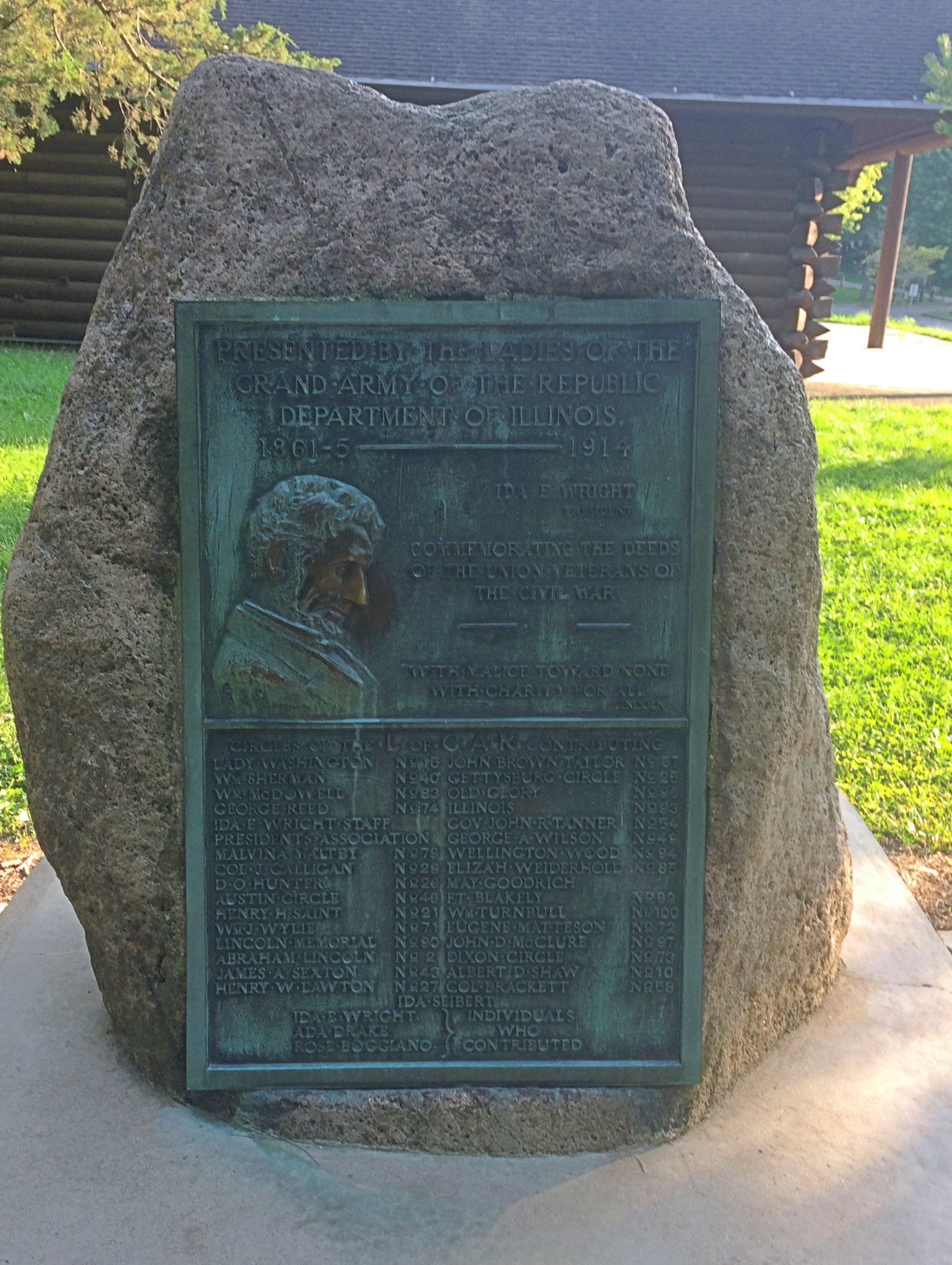
The park also features a memorial to the Macon County’s Civil War soldiers.
On the back of the base, a plaque says:

Grand Army of the Republic
Organized in this city
April 6, 1866
Erected by Dorcas Society,
and Other
Patriotic Citizens

Not erected until 1904. Maybe funds were in short supply for years, but then the people of Decatur realized their veterans didn’t have much longer.

Near Central Park are a number of buildings, including this one sporting one of Decatur’s murals, featuring Mike Elroy, a recent mayor.
Driving into town we saw a more interesting mural featuring Bob Marley on the side of a record store building, but we didn’t stop for it.

A former Universalist church building, originally erected in 1854.
The handsome Merchant Street, formerly a hive of scum and villainy.

Further from the park was the equally handsome Library Block, home these days to a brewpub and other businesses.
The Decatur Masonic Temple, looking a lot like a WPA post office.
The First United Methodist Church of Decatur.
As with many city churches, it would have been nice to get inside for a look, but no go.

At first, I thought this might be the entrance to an eccentric dentist’s office, an oral equivalent of the eyes of Doctor T. J. Eckleburg.

But no: it’s the entrance to the Sol Bistro restaurant.