Pacific Northwest ’85 Ephemera

Thirty years ago this month, I took a trip to Seattle and other parts of the Pacific Northwest. I hadn’t been there before and I haven’t been back, though I want to go. That was where I saw an enormous fallen tree in Mount Rainier NP and the excellent-in-every-way Butchart Gardens in Victoria, BC.
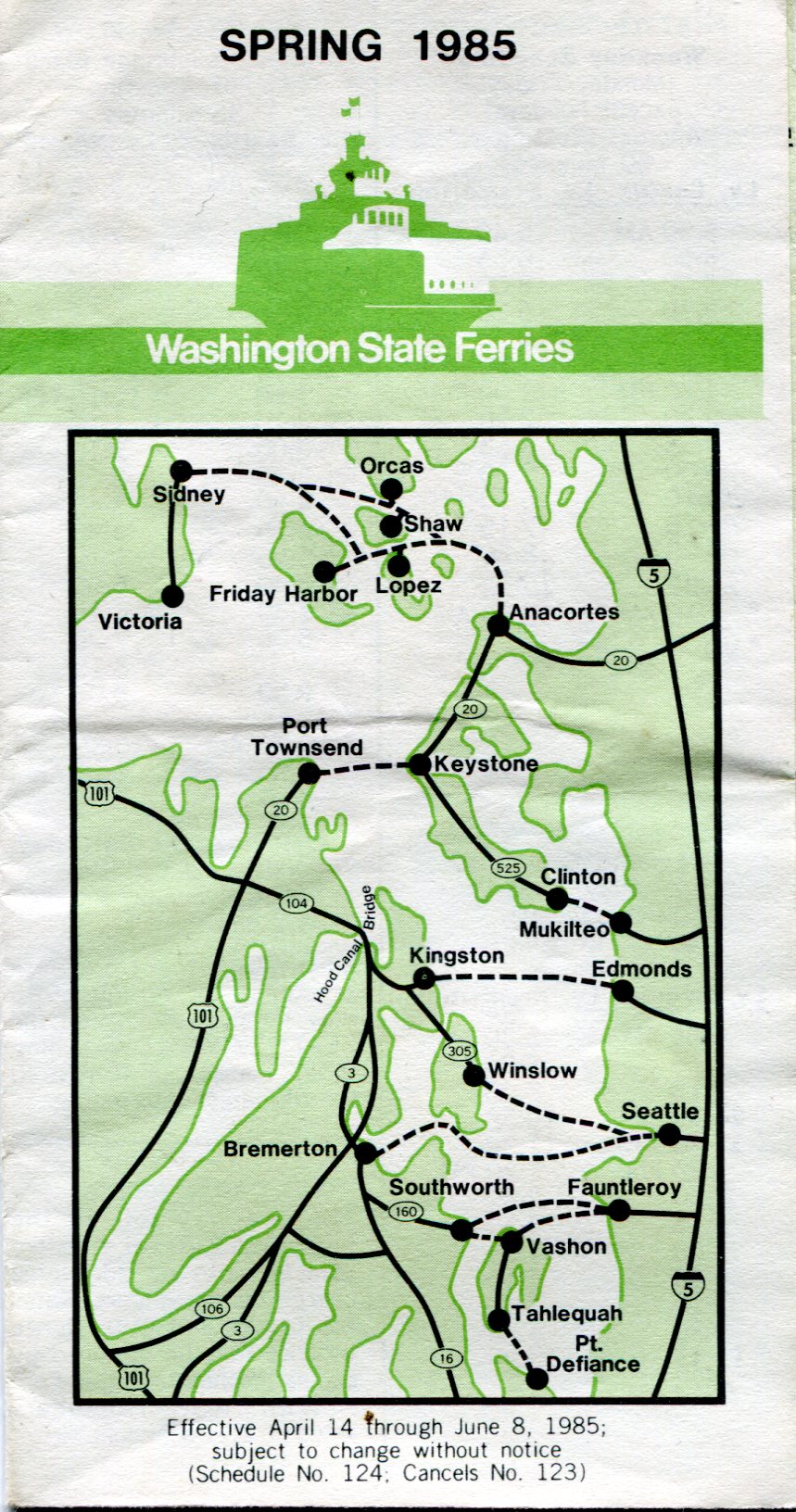
WAferries85I took no camera. It was that kind of trip. I did return with a lot of ephemera, though. Such as a Washington State Ferries schedule. I was staying with a college friend of mine the first weekend I was there, and took the ferry with him and friends of his. From Seattle to Winslow, I think, but in any case across Puget Sound.

We were the last car in, shoehorned into the back of the ferry, and during the crossing mostly sat in the car listening to a tape of United States Live by Laurie Anderson, which was fairly new at the time. I distinctly remember her relating a story about an obscure Chinese dialect in which the word for “Heaven” and “Moon” are the same, and how it was reported in this part of China that American astronauts had traveled to Heaven. If I were feeling that kind of ambition, I’d listen to the five disks of United States Live to find out where this bit occurs. I don’t feel like it — I’d rather retain this odd amalgam of a memory, made up of her strange story and the trip across Puget Sound, unimpaired by hearing the story again.

That weekend we also spent some time under gray skies on one of the beaches on the sound, playing volleyball and hunting geoduck. Or at least one or two members of the party were looking for geoduck, which I’d never heard of before. From a hole in the sand, they managed to pull up the neck of one of those clams, which was long and gross, but not the body. “That’s one hurting geoduck,” said one of the fellows who pulled it up.

It’s pronounced “gooey duck,” incidentally, and later at the Seattle Aquarium, I saw an entire geoduck. They might be good eating (I didn’t eat one), but they’re also remarkably ugly.

It was also on that beach that I found a shell partly covered in barnacles. It’s a little hard to get an image of it, but here it is anyway, top and bottom.
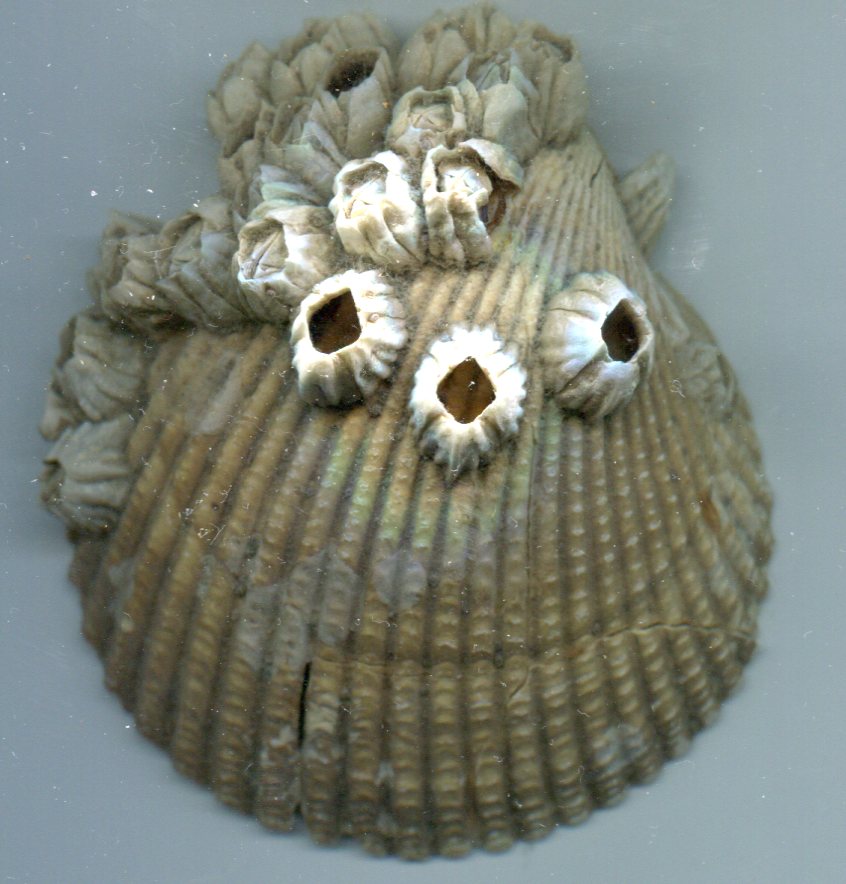
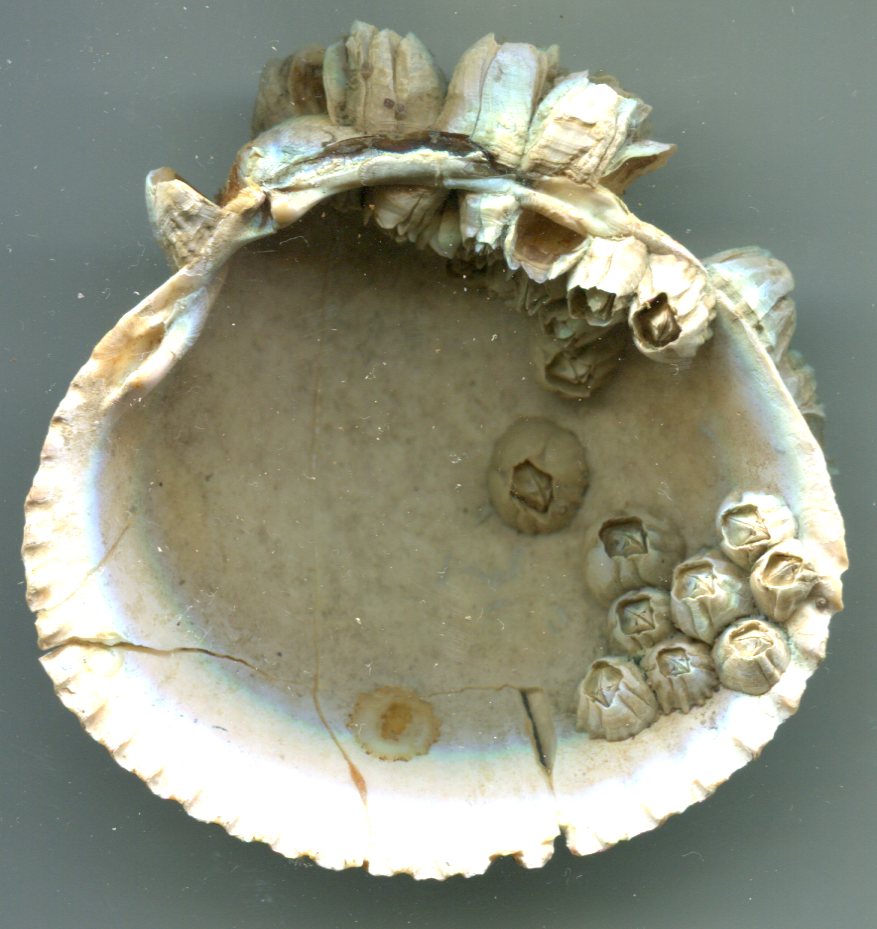
shell1shell2I’ve had the shell ever since, though some years ago a child managed to break it. I glued it back together. There’s something about it.
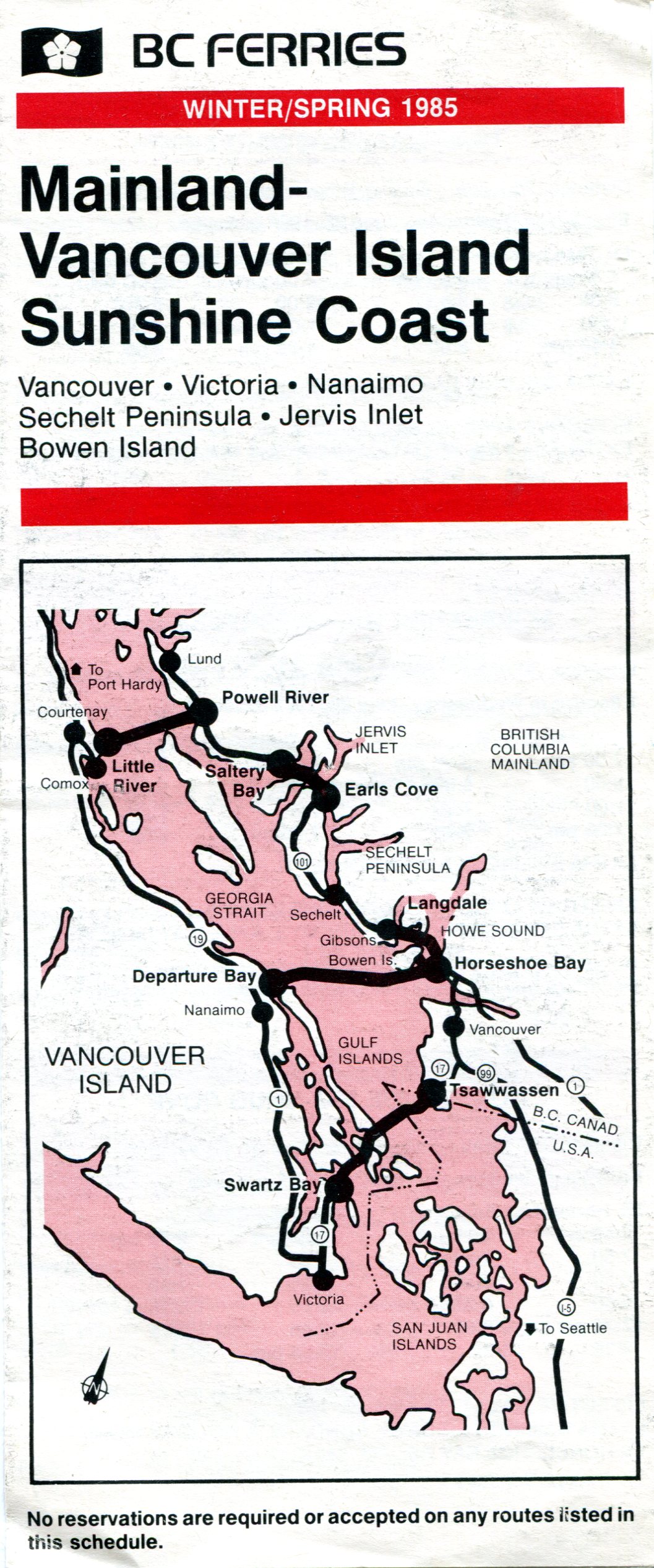
BCferries85There was nothing much as memorable about crossing from Tsawwassen to Swartz Bay in British Columbia. That time I was in my own rental car, and drove to Victoria, a fine little city.

On this trip I covered a lot of ground in my car, admiring the forests, except where they’d been clear-cut, and fond of the fields of blooming Scotch broom, which I later learned is an invasive species in the Pacific Northwest. Maybe not quite in a league with kudzu, but bad enough.

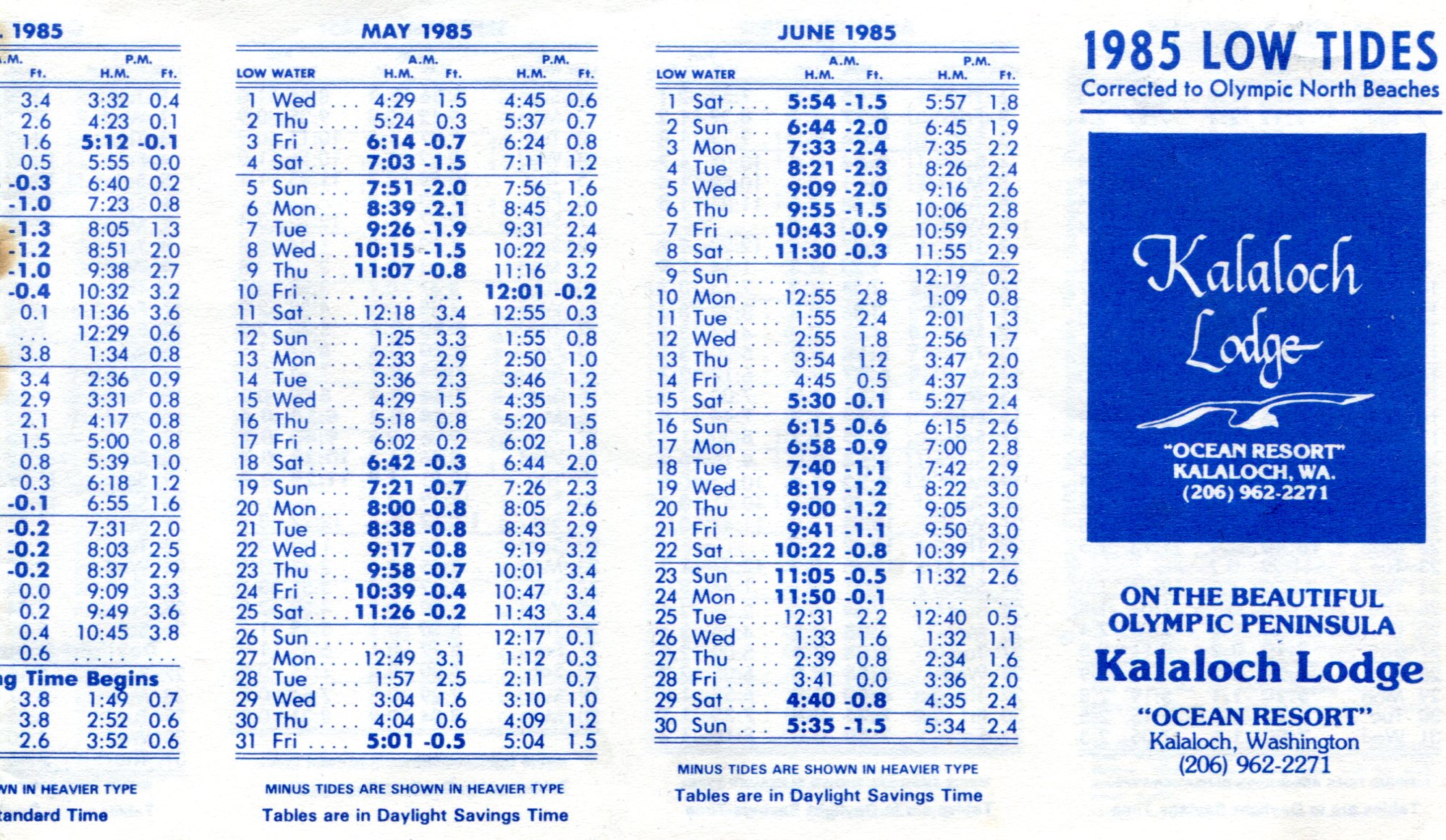
One more item, which I kept because you don’t see this kind of thing inland so much: a tide table. It was a lagniappe from the handsome Kalaloch Lodge, which is on the Pacific coast, and actually within the boundaries of Olympic National Park. Kalaloch85I spent the night there. Lovely place, though most of the scenery was obscured by drizzly clouds. Still glad I went. If only to go to a place that gives out tide tables to its guests.
The House on the Rock

Here’s a list of some of the things we saw at The House on the Rock on Saturday. It’s only a partial list, and most of the categories represent a large number of individual items: books, Tiffany-style lamps, dolls, Japanese dolls, Japanese lanterns, musical instruments, self-playing musical instruments, stained-glass windows, stained-glass panels, paperweights, stuffed birds, antique guns, dueling pistol sets, rifles, coin banks, model trains, suits of armor, swords, faux crowns, Fabergé-like eggs, 19th-century doctor, barber, and pharmacy equipment, scrimshaw, model ships, nautical equipment and ephemera, cash registers, model airplanes, bottles, mounted newspapers, brewery equipment, cheese vats, bells, doll houses, cannons, and circus miniatures.

The House on the Rock is also home to an enormous calliope; what’s asserted to be the largest carousel in the world (and it could well be); and a 200-foot-long model of a sea monster, about three stories high, poised in mid-fight with an enormous squid.

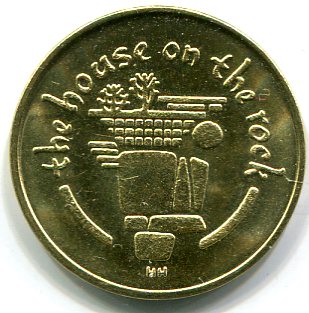
HouseontheRockObvThe self-playing musical instruments were many, some small and maybe from the golden age of such devices, the late 19th century (it’s always a maybe at The House when it comes to authenticity), and others were room-sized and created for The House. Most were operated by nicely designed gold-colored tokens that were available for four for a dollar. I kept one as a souvenir, and used a handful of others to play the automatic tunes.

All of these items are housed in a complex of buildings built on hill in rural Wisconsin. It’s a successful tourist trap, quasi-museum, psuedo-antique gallery with some possibly valuable items mixed in, a remarkable piece of outsider architecture, a monument to a highly energized eccentric collector named Alex Jordan Jr. who might have his own cable show were he living in our time, and most of all a mass agglomeration of stuff acquired according to the idiosyncratic lights of Mr. Jordan, dead now more than 25 years, but maintained as all of these things (and a viable business) by a successor he picked. I’ve never been any place like it before.

Actually, I have. Once or twice a year, I have a phantasmagoria dream, usually involving my passage through a street or a cityscape or a tunnel among a constantly shifting complex succession of images and things. Usually these are good dreams, but sometimes there’s an edge of anxiety, such as the time I passed through the phantasmagoria trying to remember where I’d parked my car (I woke relieved to realize my car was in my driveway). The House was no dream, but as you walk through, it’s for sure a complex succession of images and things.

Back on August 4, 2007, when we visited Taliesin, which is a few miles away, we talked about a return trip to The House on the Rock someday. That day turned out to be May 30, 2015. Yuriko, Yuika, Ann and I set out by car for Madison on the afternoon of the day before. We spent the night in a motel there, and the next morning drove the 50 or so miles to Spring Green, Wis., and then the few more miles to The House.

On the 29th, we arrived in Madison in time for dinner. I picked La Taguara on Washington Ave., a Venezuelan restaurant I discovered via online search. I’ve been to many kinds of restaurants, but this was a first for me, and everyone else. I can report that it satisfied our need for a good dinner, as well as my periodic urge for food novelty. I had the Pabellon a caballo, which the menu called the Venezuelan “national dish”: black beans, white cheese, shredded beef, rice, deep-fried sweet plantain pieces, and an arepa — flatbread made of ground maize dough — along with a fried egg. We had fried yucca for an appetizer, and I had passion fruit juice to drink.

Since it was still light after dinner, we made our way to downtown Madison by car, and eventually on foot to Monona Terrace, a meeting and convention facility that happens to have a rooftop terrace with a fine view of Lake Monona. The last time I was there, ice covered part of the lake. A late May view is a lot more pleasant. The opposite direction from the lake included an equally fine view of the capitol catching the day’s dying light.

After leaving The House on the Rock in mid-afternoon on the 30th, I drove a slightly out-of-the-way route back home, by way of Mount Horeb, New Glarus, Monroe, and Beloit (everyone else was napping). I did a driveby look at New Glarus, a town founded by Swiss settlers, and which includes the Swiss Historical Village, an open-air museum and something else in Wisconsin to see someday.

But on this trip, everything besides The House on the Rock was just a bonus. That was the focus of the 27-hour, 400-mile trip. It didn’t disappoint.

Quad Cities-Iowa City ’15

Or, back to visit Herbert Hoover. Not that President Hoover’s a particular favorite, but we were out that way. It started late Thursday afternoon, when all of us got in the car and headed westward, eventually putting up for the night in Moline, Illinois, one of the Quad Cities, our first of two nights there.

On Friday morning, we made our way to Iowa City — not following the most direct route, exactly, but getting there in the early afternoon for a look-see around the University of Iowa. It’s among the places Lilly is considering for her continued education. Late March being unpredictable, the air wasn’t very warm, but the sun was out and it wasn’t cold enough to discourage a walkabout on campus, or the nearby college-town business district, or a visit to the former state capitol. A re-visit for most of us, though it’s been quite a few years.

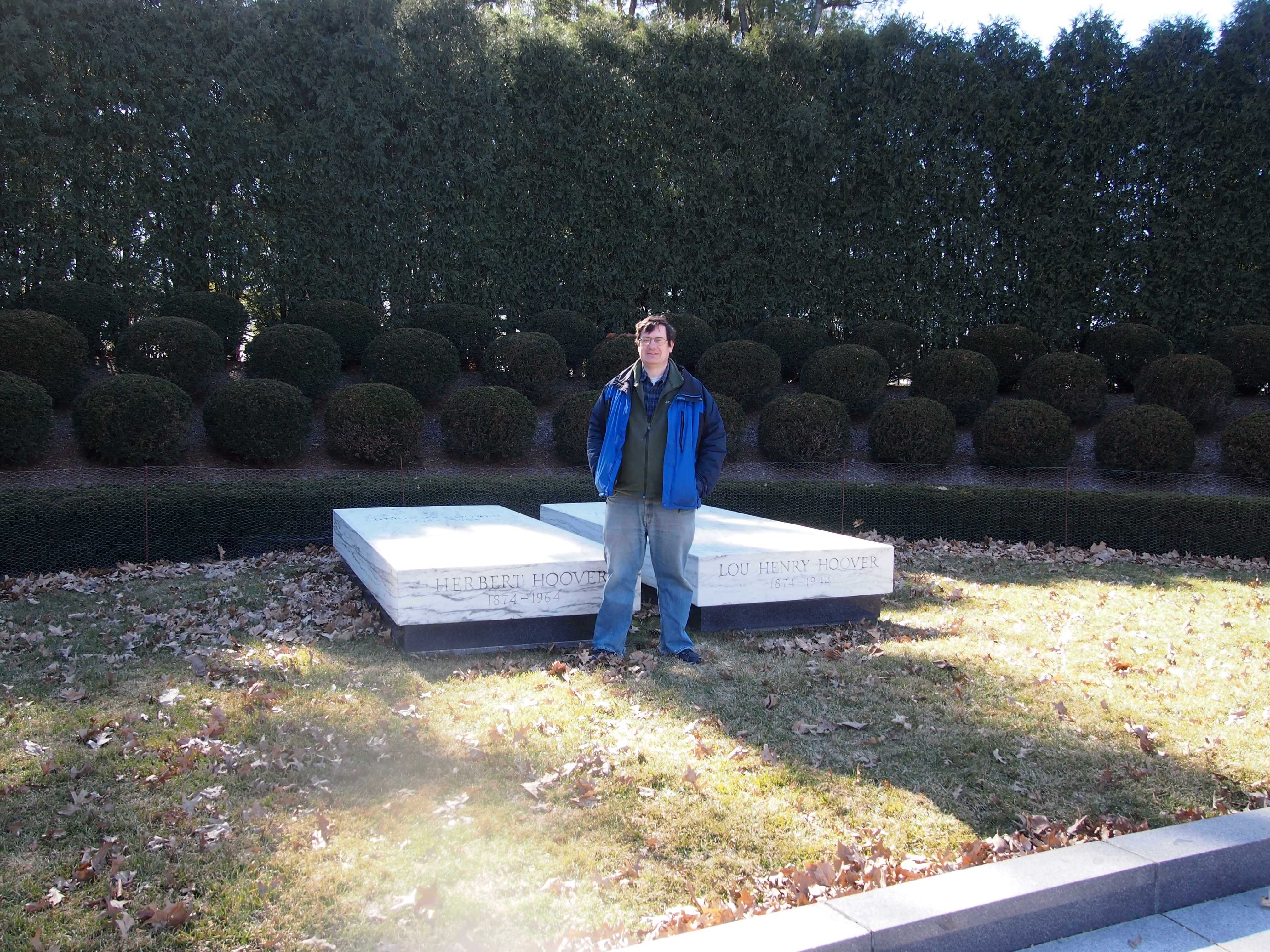
On our way back to Moline that afternoon, we stopped in West Branch, Iowa, birthplace and burial site of the 31st President of the United States. This time I insisted that everyone get out of the car and take a look. Lilly took my picture, so now I have a Manus Hand-style photo with a dead president. It’s the only one of that kind that I have.

Hoover gravesite March 27, 2015On Saturday morning, I was up earlier than the rest of my family, taking the opportunity to visit the Rock Island National Cemetery, along with the nearby Confederate Cemetery, burial ground for CSA POWs on Rock Island. On the way back, I toyed with the idea of wandering through the John Deere Pavilion, but left it for another time.

In the late morning, we visited the Figge Art Museum in Davenport, Iowa, the successor entity to the Davenport Museum of Art that’s been open about 10 years. Interesting collection, not overwhelmingly large, and including something I’d never seen before: a section devoted to Haitian art.

That was it for this 48-hour quickie. Except for a few minutes’ drive through Le Claire, Iowa, where we stopped for gas. Notable as the birthplace of Buffalo Bill Cody, and home to a museum devoted to the showman. We left that for another time as well.

Yumura Onsen 1992

Hard winter insisted on hanging around until Friday — the first week of March was a lot like the last week of January this year — but finally, as of Saturday, air temps were above freezing and patches of ground started emerging from their white covering. In the back yard at least. A few more days of this and I’ll be able to see the front yard again.

Yumura Onsen, the Hyogo Tourism Guide tells us [all sic], “was opened by Jikaku Daishi about 1,150 years ago. In the central part of the hot spring street there is a freshly heated water fountain and since the opening, 470 liters of hot water (98ºC) come gushing out per minute. Taking a rest in the 21m long foot bath along the river in the hot spring town is recommended.”

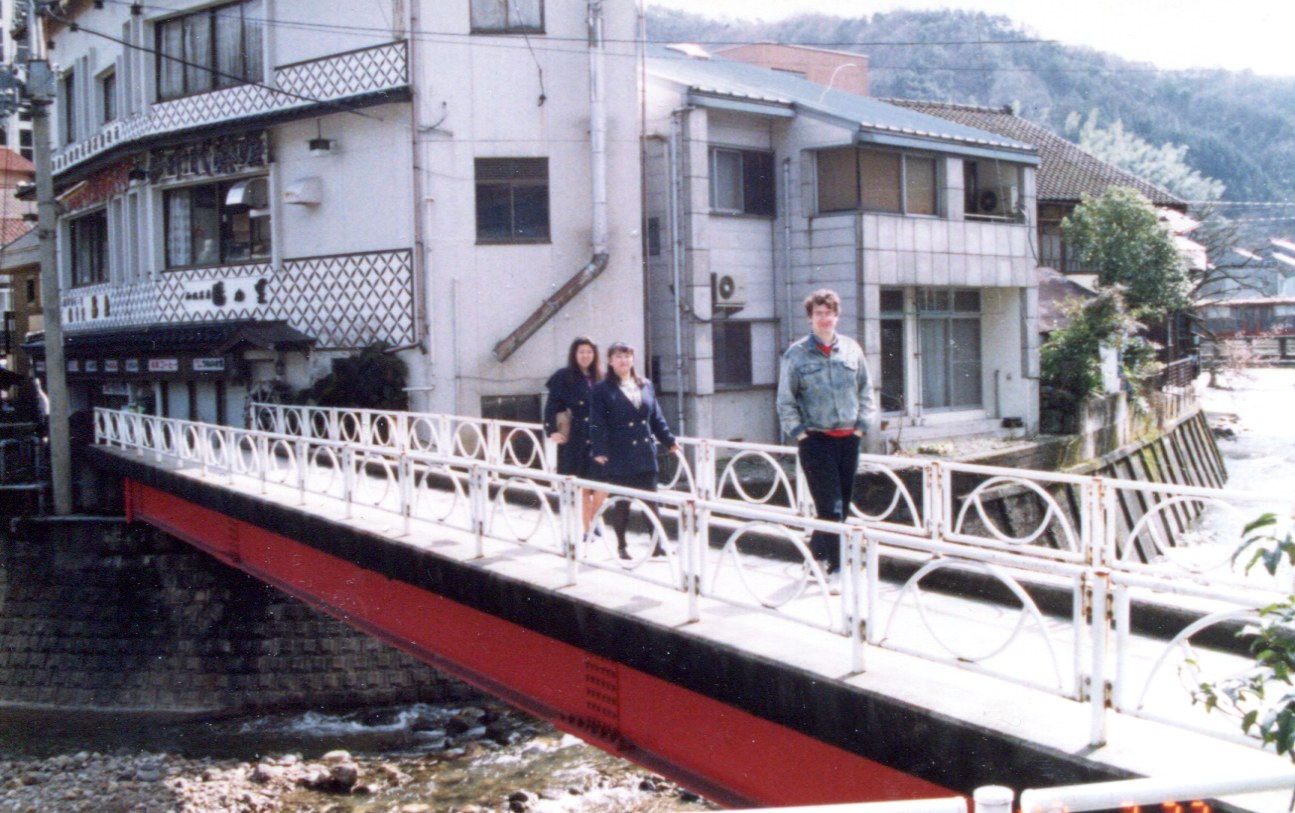
I’ll go along with that. Hyogo Prefecture includes Kobe, but Yumura’s toward the other side of the mountains, near the coast of the Sea of Japan. I visited Yumura in March 1992, and posted about it before — especially on the local practice of boiling eggs in the hot spring water. None of the pictures I have of the visit include the eggs or the hot springs, but I do have some of us gadding around the small town.

Yumura1992.1I remember the minshuku we stayed at fondly (the basics of minshuku are here). Sleeping on the floor is seldom an issue with me, especially when it involves sleeping on a tatami.
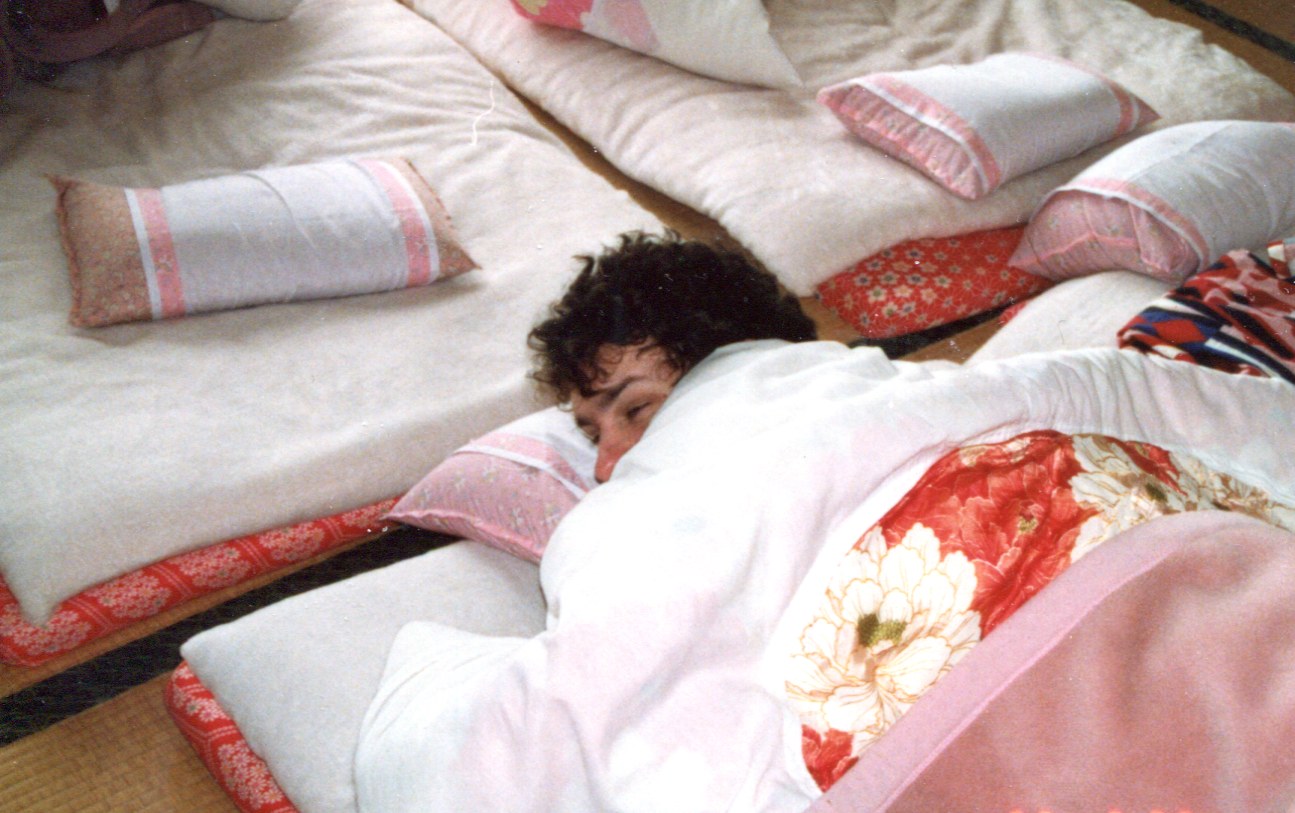
Yumura1992.2The floor at the Yumura minshuku was so comfortable that it was hard to get up in the morning. Harder than usual, that is.

Huis Tem Bosch ’93

We now have a 2015 calendar produced by Nishi-Nippon Railroad Co. Ltd., which I believe Yuriko got for free, and it’s a high-quality bit of work. It’s has a travel theme, and as with a lot of calendars – or magazines or other pictorial works — the photography’s of extreme high quality. Looking at the pictures, you can easily imagine that you’ll never see anything so grand in person, but then again, everything I see with my eyes is higher quality than any photography; it’s just that we’re so used to seeing with our eyes that we don’t appreciate it.

Anyway, the subject is Kyushu – the coast off Nichinan City, plum groves in Kitakyushu, barley fields in Saga Prefecture, Ogi City cherry blossoms and more. It reminds me of how little I saw of Kyushu: mainly Nagasaki and the curious Japanese theme park known as Huis Tem Bosch.

The theme? The Netherlands. Wiki puts it this way, and I can confirm the description, at least as of December 1993 when we went: “The park features many Dutch-style buildings such as hotels, villas, theatres, museums, shops and restaurants, along with canals, windmills, amusement rides, and a park planted in seasonal flowers.”

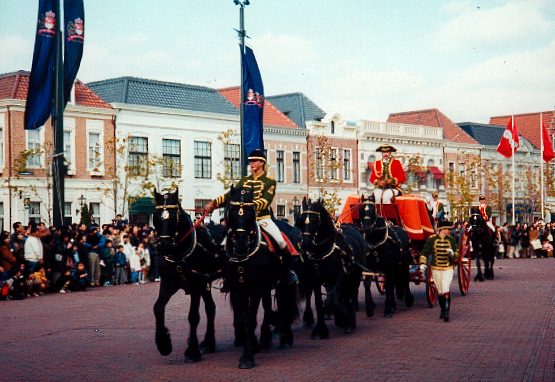
Parades, too.

HuisTemBosch 1993Since we were there in December, a fellow dressed as Father Christmas posed for pictures with visitors. I guess that would be Sinterklaas. I think he really was a Dutchman, but in any case he was blotto.

Texas Fall ’14

Just flew in from Texas and boy are my arms… Bob Hope seems to get the credit for that old gag, and it does sound like him. Someday when I have a few idle days, I might look around and try to find something Bob Hope said that was funny. Nah, too much trouble.

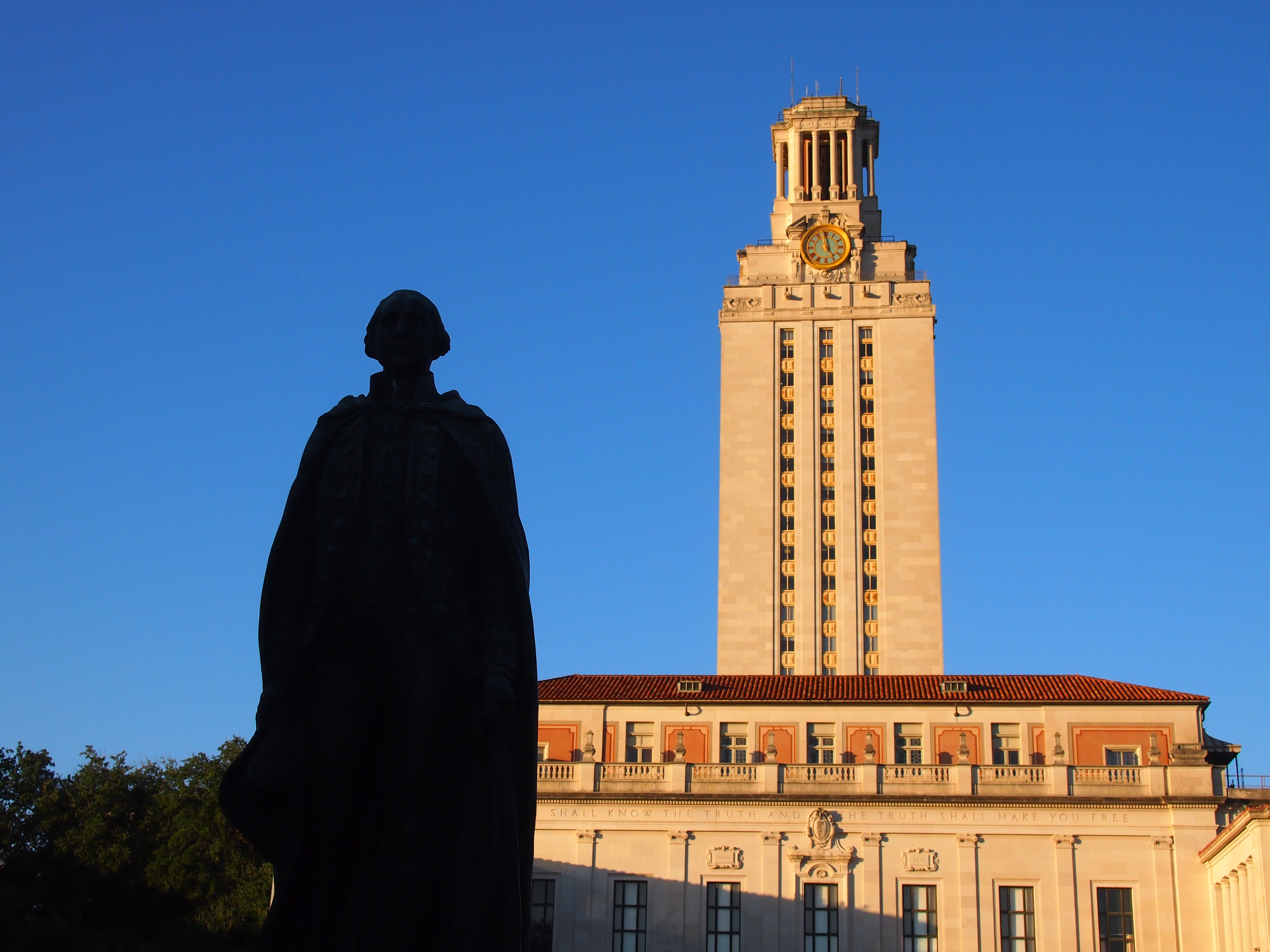
I went to Texas on the 7th and returned today, spending most of the time in San Antonio. But on the 8th, along with my brother Jay, nephew Dees, his girlfriend Eden, and my old friend – known him 40+ years now – Tom, visited the campus of the University of Texas at Austin. Our main objective was to go to the top of the UT Tower and take in the expansive view of Austin. This is the tower from the south, along with a statue of George Washington.

Austin, Nov 2014A silhouette of Washington, anyway, since the light wasn’t right. The Center for American History at UT says that “Pompeo Coppini’s dramatic rendering of George Washington has been a prominent fixture on the south mall since 1955. Erected by the Daughters of the Republic of Texas, it was the first statue of Washington in the state.” I’ve run across Coppini’s work before.

Assorted other bronzes adorn the UT on the campus, such as effigies of Jefferson Davis, Texas Gov. James Hogg, and Martin Luther King Jr. (told you they were assorted). We either missed them, or the late afternoon November light was poor for picture taking.

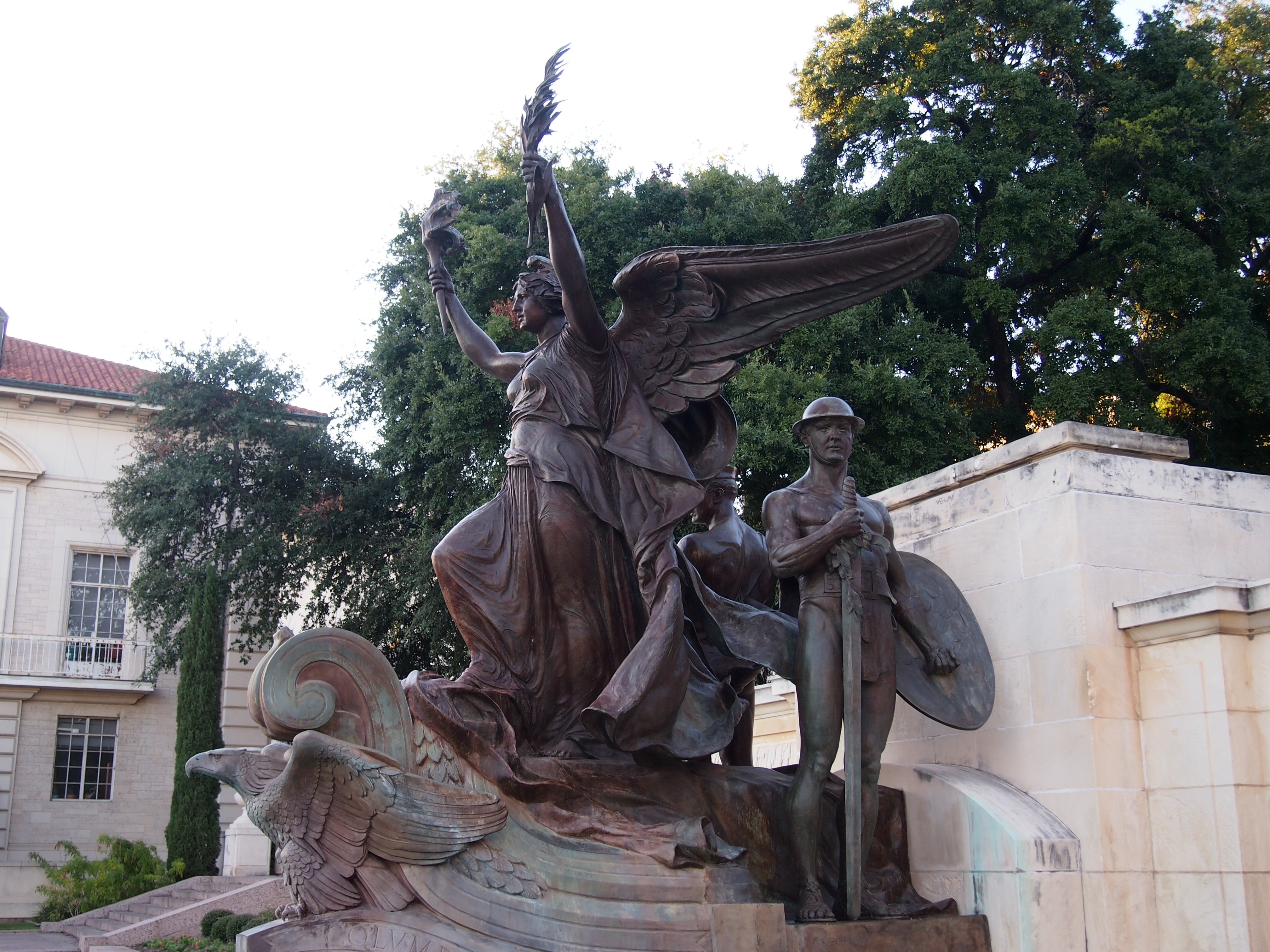
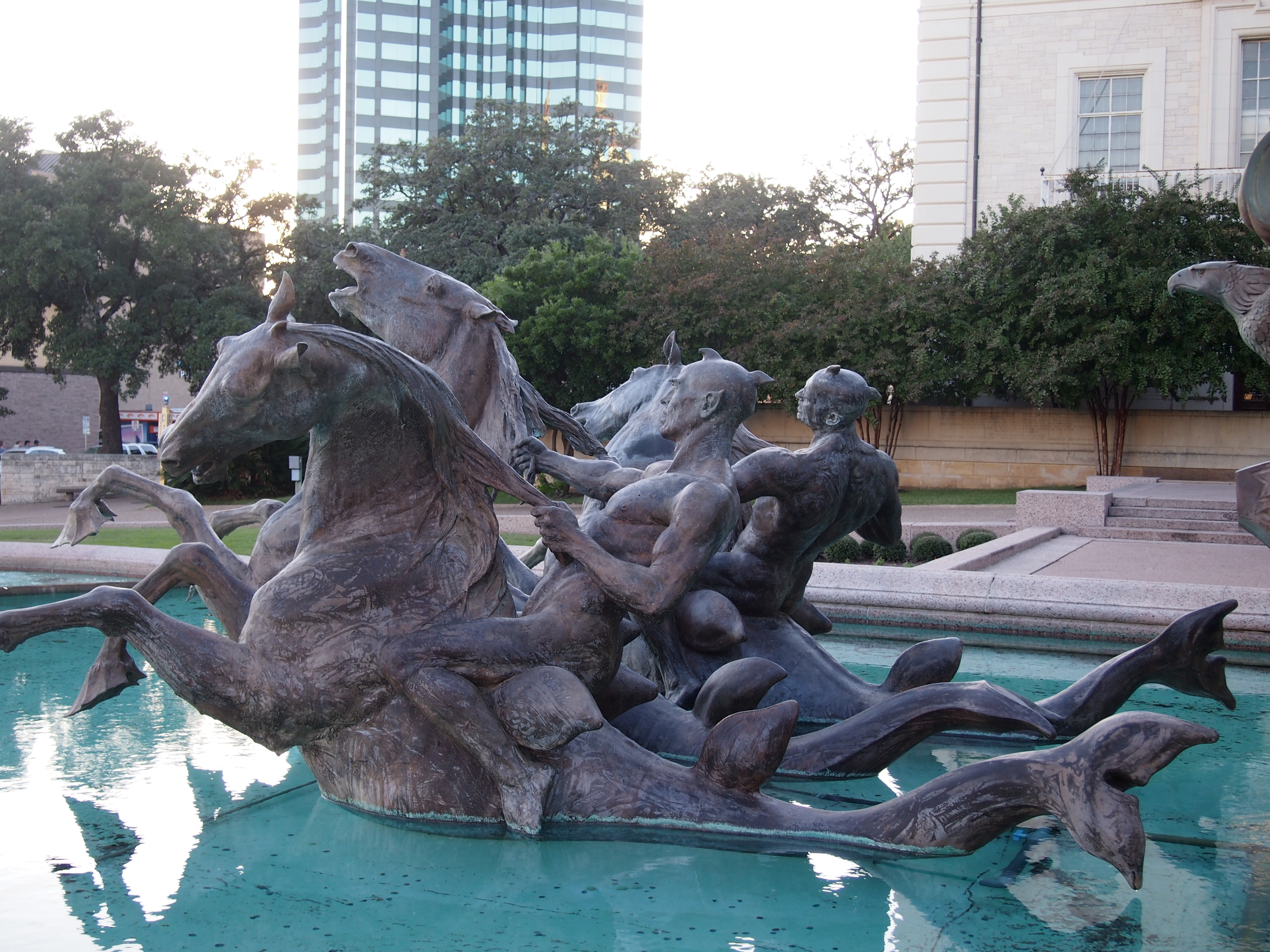
A more ambitious work on campus by Coppini is the Littlefield Fountain, paid for by George Littlefield, an early big donor to UT. Apparently he envisioned a Confederate Memorial, but by the time the thing was actually done in the early 1930s, and Littlefield himself was gone, it was a memorial to honor UT students and alumni who died during the Great War. A fitting thing to see in early November, and 100 years after the Great War’s early days.

Littlefield Fountain, Austin, Nov 2014On the other side is a sailor of the war, to go with the lightly clad solider bearing a very long sword.

Littlefield Fountain Nov 2014 In the fountain itself, interesting equine-piscine creatures.

Brooklyn ’14

So that explains it. New York ComicCon was at the Javits Center in Manhattan from October 9-12. Normally this would concern me not at all, but when riding the subway in Manhattan last week, sometimes I noticed youth in costumes, some elaborate, that seemed to evoke comic book characters, though none I recognized. Being too early for Halloween, despite marketers’ best efforts to pull that event forward, I figured it was something else.

But the oddest thing I saw in the subway was a normally dressed young woman waiting for a train going Uptown. She looked a little bored. Then I noticed the unloaded crossbow that she was holding, pointing down. Where does one practice crossbow on this teeming, crowded island? There must be an indoor range somewhere. Still, it was something you don’t see every day, not even in New York.

I left for New York on October 9 and returned on the 17th. I had business to attend to, but also made an effort to see things I hadn’t before. No matter how many times you visit – and I’ve lost count now – there’s always more, since New York is just that kind of place. I spent time in Manhattan, of course, but the focus this time around was Brooklyn. Over the years, my visits to the borough have been only sporadic, and now they say it’s the place to be in New York. My nephew and his flatmates in Bed-Stuy, who are passing their young manhood there, were good enough to put me up.

So I walked the streets and rode the trains, and a few buses. I ate barbecue, supposedly Texas style, Southern-style chicken (though not quite spiced in any Southern style I know), a Turkish gyro, a Cuban sandwich, slices of pizza standing up, some pretzels, food at diners – surprisingly common in the city – and visited a few tiny grocery stores, the kind large boxes have killed in most places, because Ye Shall Know Them by Their Grocery Stores. Almost everything is overpriced, but what isn’t in that part of the country? I marvel that the non-wealthy can live there at all.

In Manhattan, I made it to the High Line, a truly remarkable new public space, and the September 11 Memorial and Museum, besides a few moments at familiar old places, such as Grand Central and the streets of Midtown. In Brooklyn, I wandered around parts of Bed-Stuy, Downtown, Brooklyn Heights, and Dumbo. Every now and then, I would see a development, usually an apartment building, that I’d written about at one time or other.

Brooklyn Bridge Park, besides being up close under that highly aesthetic feat of bridge engineering, is also a truly remarkable new public space. One morning I got up early and made my way to the bucolic and vast Green-Wood Cemetery, south of Prospect Park. One afternoon I spent a few footsore hours in the Brooklyn Museum, an institution overshadowed by the big-box museums on Manhattan, but a palace of art in its own right.

Years ago, I took a Circle Line tour, which involves taking a boat all the way around Manhattan while a guide makes bad jokes on the intercom. Or at least it did then. This time, I opted for the much cheaper East River Ferry, for a view of the city by night, and no narration. Also, I took a walk on Roosevelt Island, taking the aerial tram to get there, in the company of other tourists, but also a fair contingent of Hasidim on an afternoon excursion.

On the whole, the place made me tired. It’s crowded, noisy, dirty and expensive. Who would have it any other way? I’m glad I was able to make it this year.

Fifteen Days, Seven States, Nearly 3,000 Miles, and the Blue Hole

Our drive to San Antonio and back started on the morning of July 12 and ended a few hours ago. I actually remembered to set to trip meter as we were leaving, so I know that between backing out of the driveway and returning to it, the car had been driven 2,952 miles and change. Except for when my brother Jay used the car in San Antonio, I drove all those miles. Ann was in the back seat almost all of the time.

Our route southward wasn’t as direct as it could have been, passing from metro Chicago to Des Moines to St. Joseph, Mo., the first day; to Hutchinson, Kan., by way of Topeka the second; and Dallas by way of Wichita and Oklahoma City on the third. After some days in Dallas, travel resumed: to San Antonio via the most direct route, which turned out to be a mistake (more about which later).

Our return northward was more straightforward: San Antonio to Dallas to Lebanon, Mo., and then home, three days’ driving spread out over four days, with a jag into extreme northwestern Arkansas. More about that later as well.

We were caught in two storms so intense that we waited them out beside the road. I saw two suitcases broken open, and their contents spread on the road, on two different Interstates. I’m pretty sure I saw a guy pulled over on the shoulder of yet another Interstate, changing his pants outside his car. We listened to a lot of radio. As hard as corporate interests try, terrestrial radio isn’t quite homogenized.

When I wasn’t driving, I was working (that’s the self-employed life). Or visiting with family members and friends: my mother, two brothers, two nephews and one’s wife, my aunt, first cousin and his family, two friends from high school. Or eating. Some chains, of course, but I did my best to support independent eateries in places like Wichita, Dallas, Austin, San Antonio, and Mt. Olive, Ill.

Besides all that, we squeezed in visits to three museums, the outside of two capitols (closed, unfortunately), a mall, an enormous bookstore, a couple of wooden bridges, and a cemetery with an historic figure buried in it. I also watched a number of early episodes of Treme, an addictively good show.

And I saw the Blue Hole.

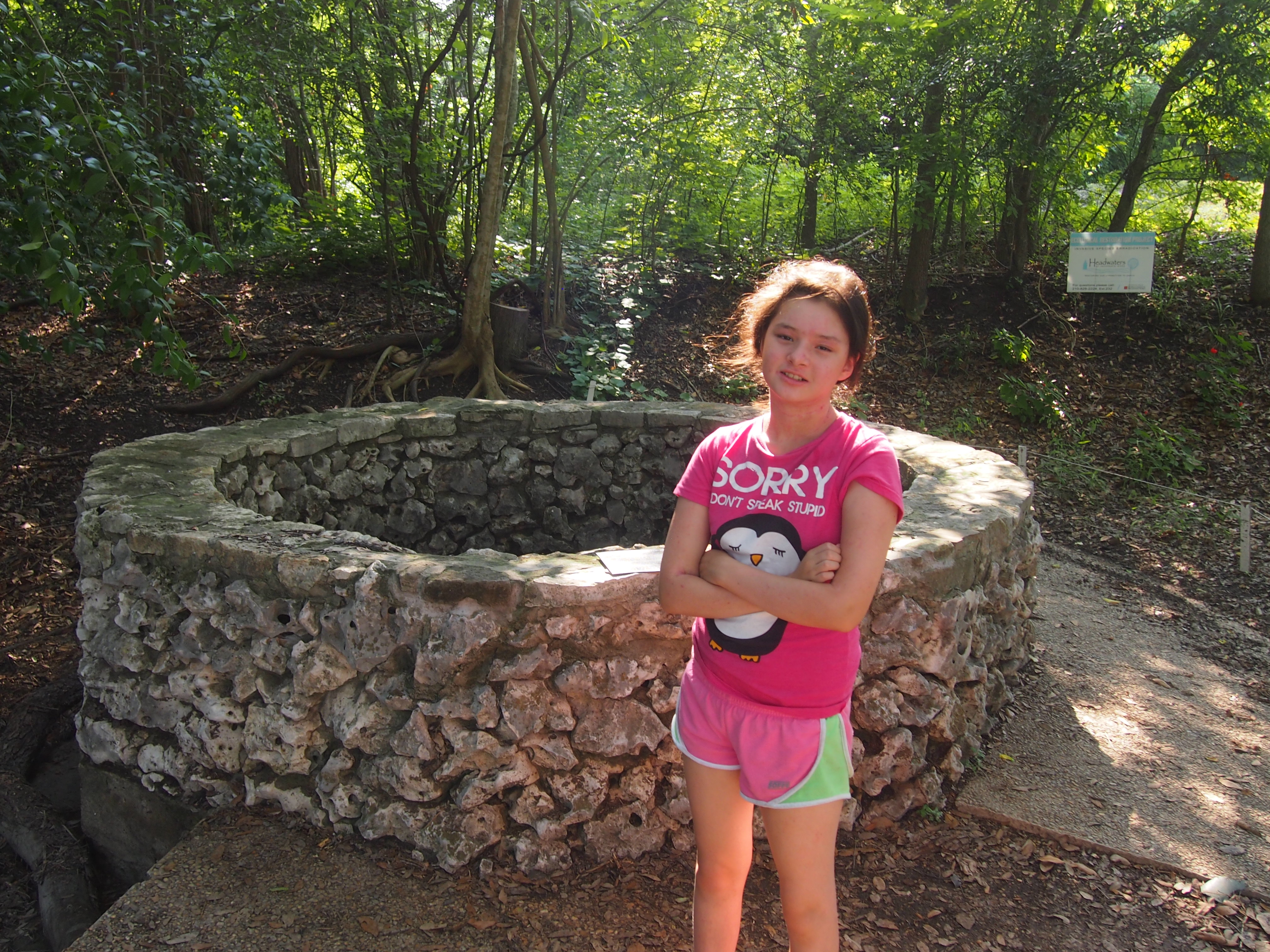
Blue Hole, SA, July 2014

I lived within 10 minutes’ drive of the Blue Hole for more than a decade, and every time I visited San Antonio after that for 35 years, I was equally close. Yet I never saw it before this visit. All I can say is, it was about time.

Tri-State Summer Solstice Weekend ’14

Late on Friday morning we drove west for a few hours – and enjoyed a remarkably long in-car conversation among ourselves, no radio or other electronics playing – and by mid-afternoon arrived at Mississippi Palisades State Park, which overlooks the Mississippi River just north of Savanna, Ill. The plan included bits of three states in three days. My plan, really, since my family humors me in such matters, and lets me think up the details of little trips like these.

Friday was Illinois. We camped at Mississippi Palisades, which is an Illinois State park and incredibly lush this year, and we spent time in Savanna, a little river town on the Great River Road, mostly to find a late lunch. Toward the end of the day, we made our way to Mount Carroll, Ill., which is the county seat of Carroll County and home to a good many handsome historic structures.

On Saturday, we ventured into Iowa – it really isn’t far – and first saw Crystal Lake Cave, just south of Dubuque. In Dubuque, lunch was our next priority, followed by a visit to the Fenelon Place Elevator. Which is a funicular. When you have a chance to ride a funicular, do it. The last time we were in Dubuque, I remember the Fenelon Place Elevator being closed for the season (uncharacteristically, I don’t remember when that was — the late ’90s?). Anyway, this time I was determined to ride it.

Afterward, we headed west a short distance to the town of Dyersville, Iowa, home to the Basilica of St. Francis Xavier, but better known for The Field of Dreams movie set, which still draws visitors. We saw both.

Today was mostly about getting home at a reasonable hour, but I had to add a slice of Wisconsin by navigating a number of small roads until we came to Dickeyville. It would be just another rural Wisconsin burg but for one thing: the Dickeyville Grotto, which actually includes a main grotto, smaller grottos, shrines, a church and a cemetery (and a gift shop, for that matter). Like funiculars, grottos demand our attention, especially such as striking bit of folk architecture as the Dickeyville Grotto.

Central Texas ’14

Not long after Easter, I flew to Texas to visit members of my family. First to Dallas, then a drive to San Antonio, then back to Dallas. I also wanted to squeeze in a couple of days in Central Texas, visiting a few places I’d never been. My brother Jay came with me on the excursion, focusing on College Station, Texas, home of the enormous Texas A&M University, which also happens to be my maternal grandfather’s alma mater: Class of 1916.

In all the time I’ve spent in Texas, I’d never made it there. That’s probably because College Station isn’t on the way anywhere, especially if you spend most of your time on the San Antonio-Austin-Dallas axis. But A&M looms large in Texas lore, so I’d have been interested in visiting even if my grandfather hadn’t started his career as a civil engineer there.

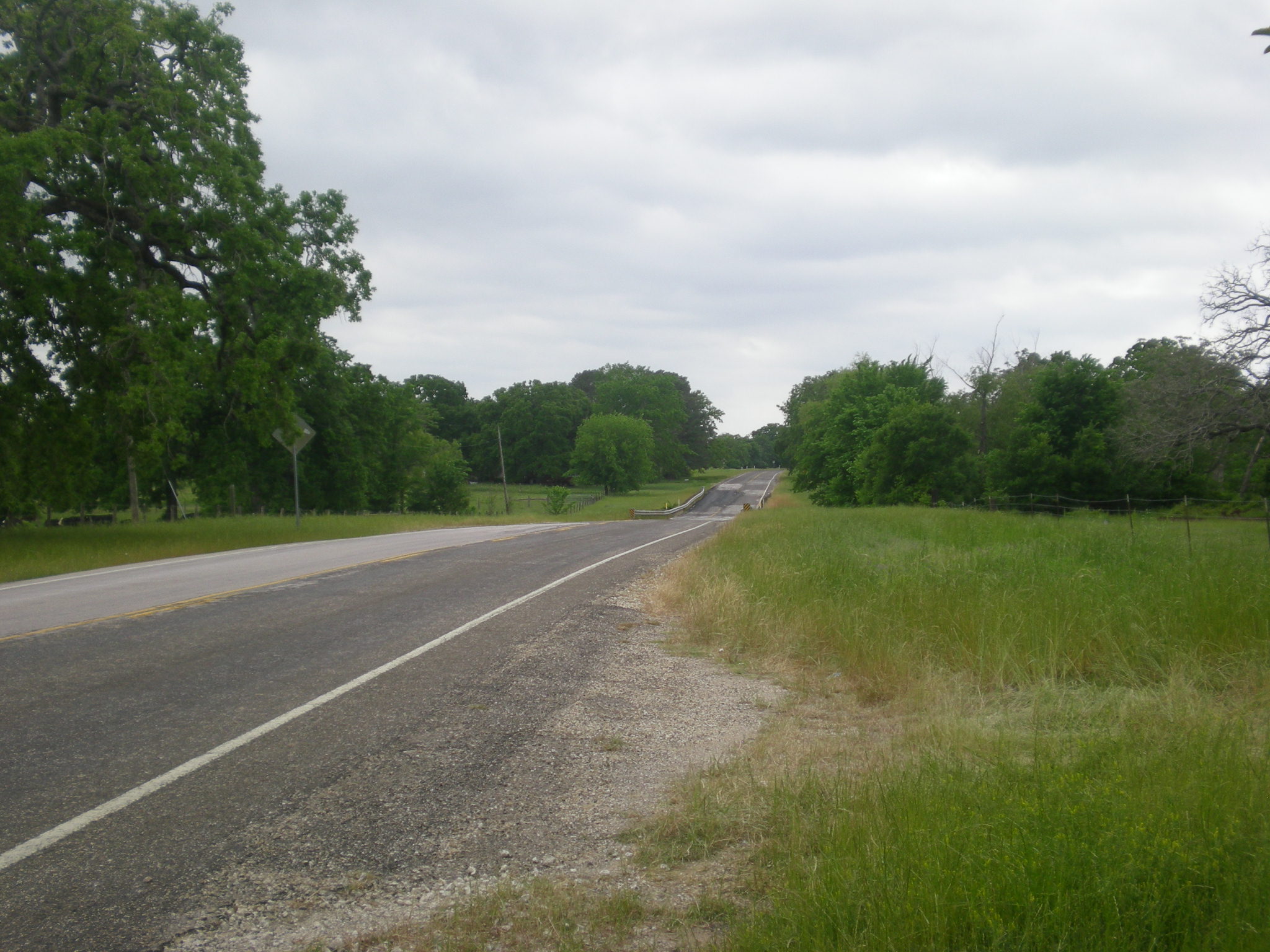
We drove on large roads and small. We made a point of driving on a highway called Texas OSR between I-45 and Texas 6. It was a short stretch of road through springtime green, and green is no sure thing even this time of the year; it means there’s been rain recently.

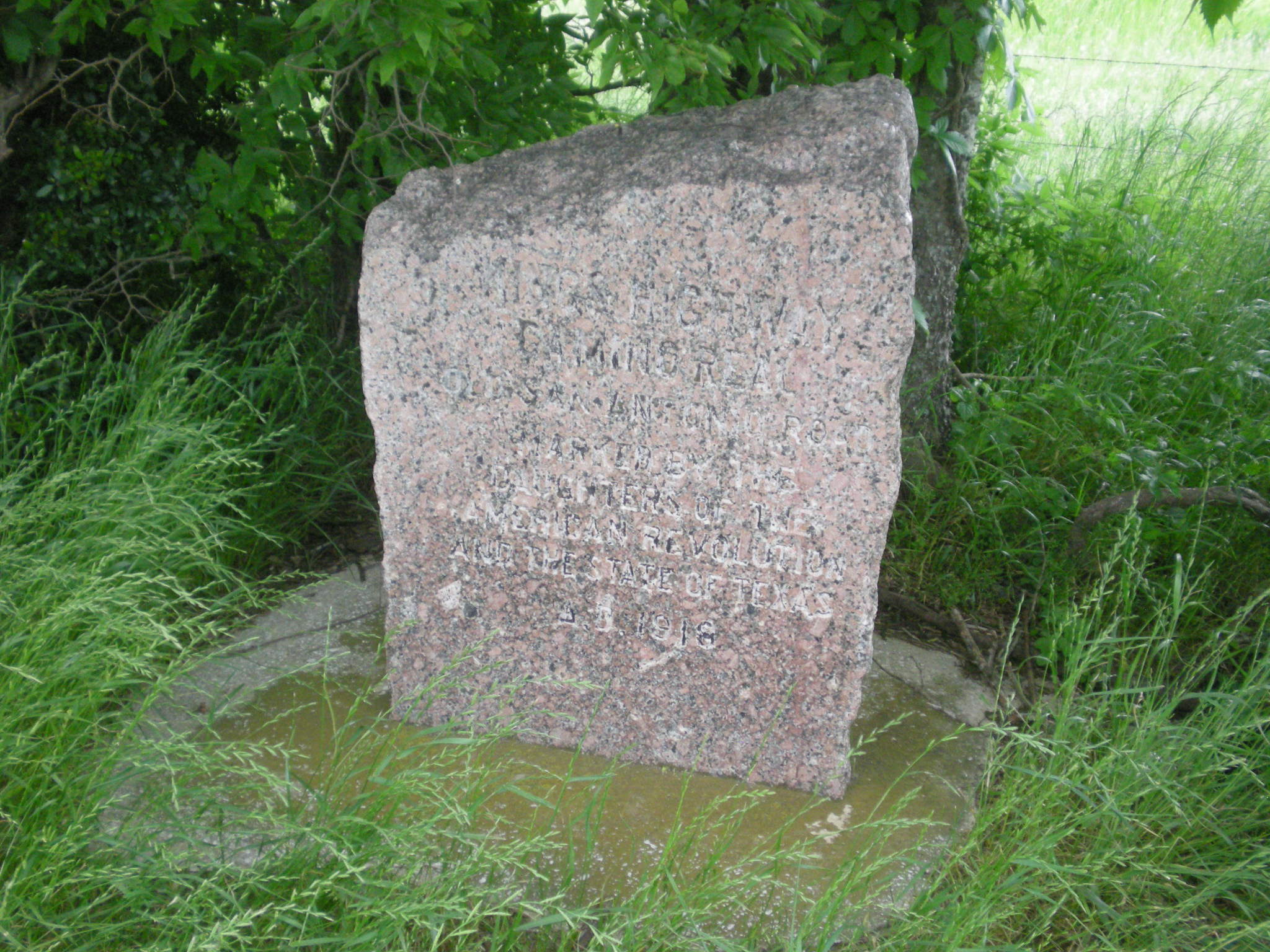
Texas OSR April 2014What’s so special about Texas OSR, besides the fact that it’s the only state highway in the enormous highway system of an enormous state to not include any numbers in its name? It’s a stretch of the Old San Antonio Road, also known as the Camino Real, the King’s Highway. The modern OSR is a fragment of the bygone route from Louisiana to Coahuila, by way of San Antonio. Still trod, maybe, by the shades of Spaniards and their horses.

Texas OSR marker 4.14A number of weather-worn markers on the side of the road explain the road’s historic significance. Though hard to read – even if this image were full size, it would be next to impossible to make out — the markers themselves are historic, put there by the Daughters of the American Revolution and the state of Texas in 1918.

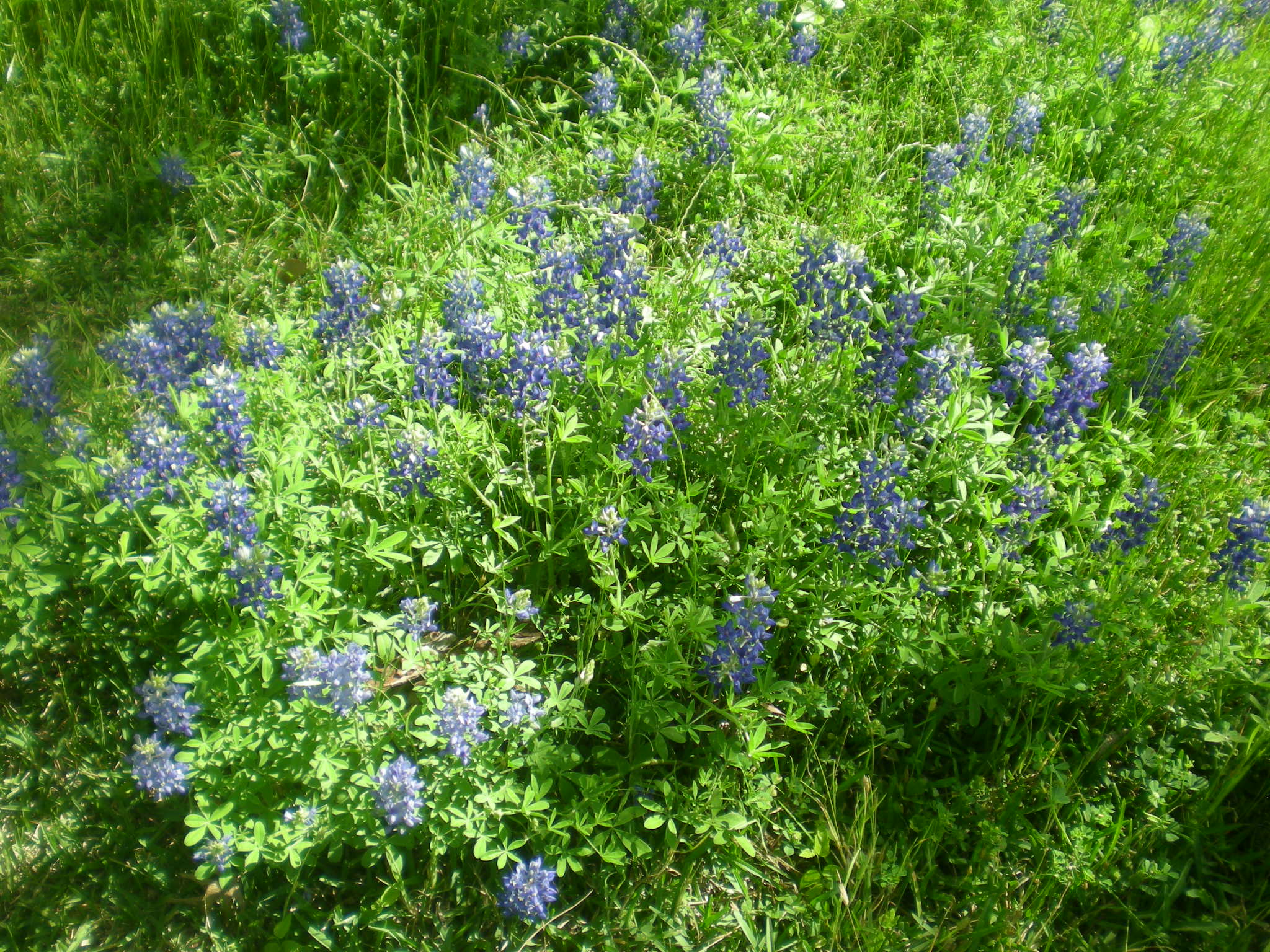
Central Texas in the spring also luxuriates in wildflowers, along the side of the roads, stretching off into vast fields, in random colorful spots. You can see the famed bluebonnets and other blue blossoms…

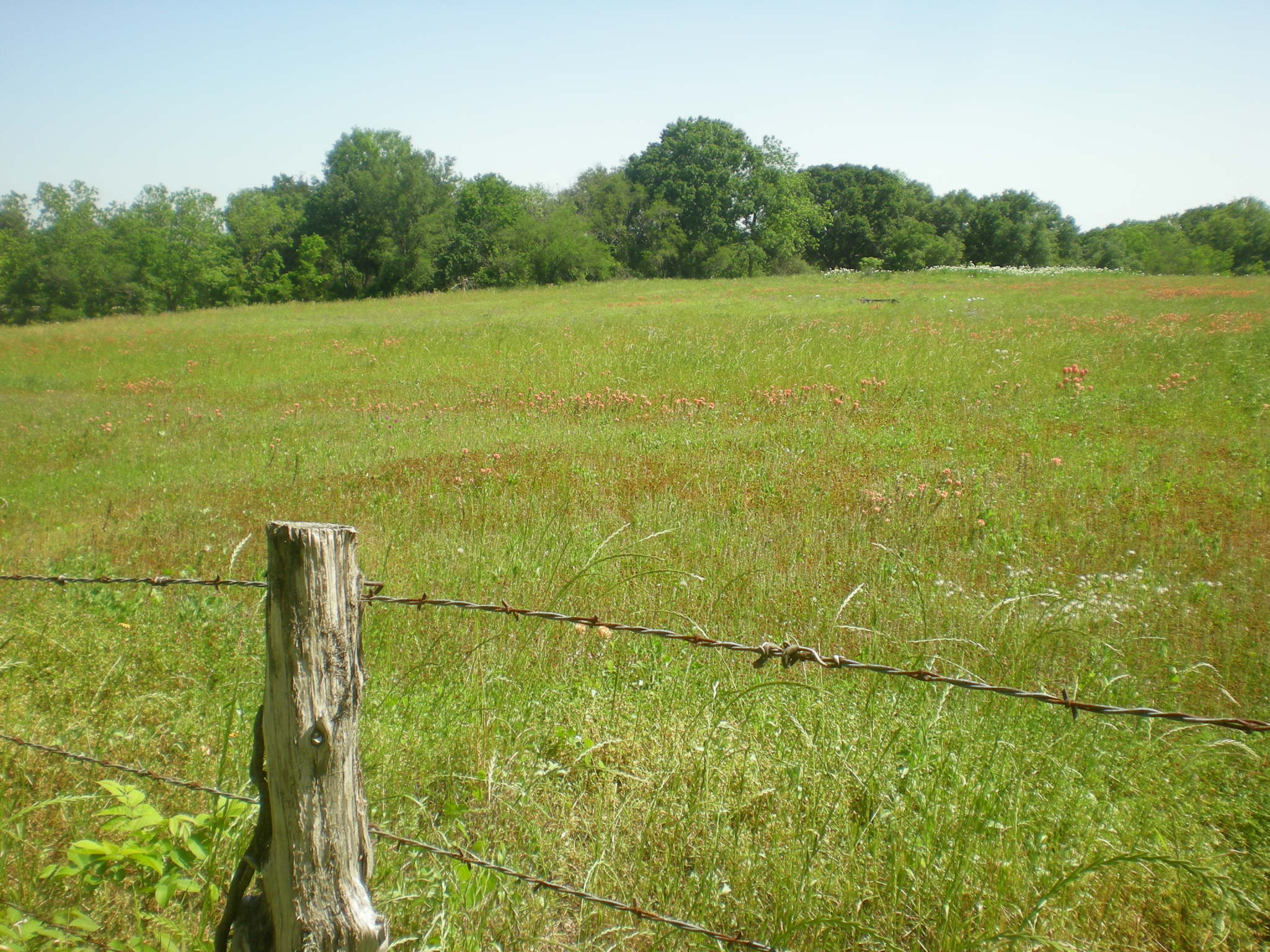
Texas4.25.14 055… but also a sea of others: red, white, orange, yellow, pink. Add a windmill to this scene and you have something landscape painters have been focusing on for more than a century.

Wildflowers, Central Texas, April 2014For true wildflower enthusiasts, there’s this index. It’s an astonishing variety.