Garden District Walkabout, Including Lafayette Cemetery No. 1

Someone once warned me about the condition of the sidewalks in the French Quarter, but on the whole, they weren’t that bad. For crumbling, occasionally hazardous sidewalks, the Quarter or even Treme couldn’t compare with the Garden District. Some stretches reminded me of Mexico City in that regard.

The houses in the Garden District clearly represent a concentration of wealth, so you’d think the sidewalks would be repaired. Maybe it’s that New Orleans is a trifle lax when it comes to infrastructure, but I don’t actually know that — the idea merely fits with the city’s reputation.

Or it could be a weird municipal dynamic: the city can’t appear to put too much money into the roads and sidewalks of an affluent area like the Garden District. Bad optics. So the area’s infrastructure is a little rough. Maybe the residents don’t care much. The only people on foot in the district seemed to be tourists, singly or in tour groups.

Never mind, it’s a good place for a walk, if you pay attention, and even when the Southern sun begins to beat down, as it did late on the morning of May 14. Sometimes shade is there for the taking.
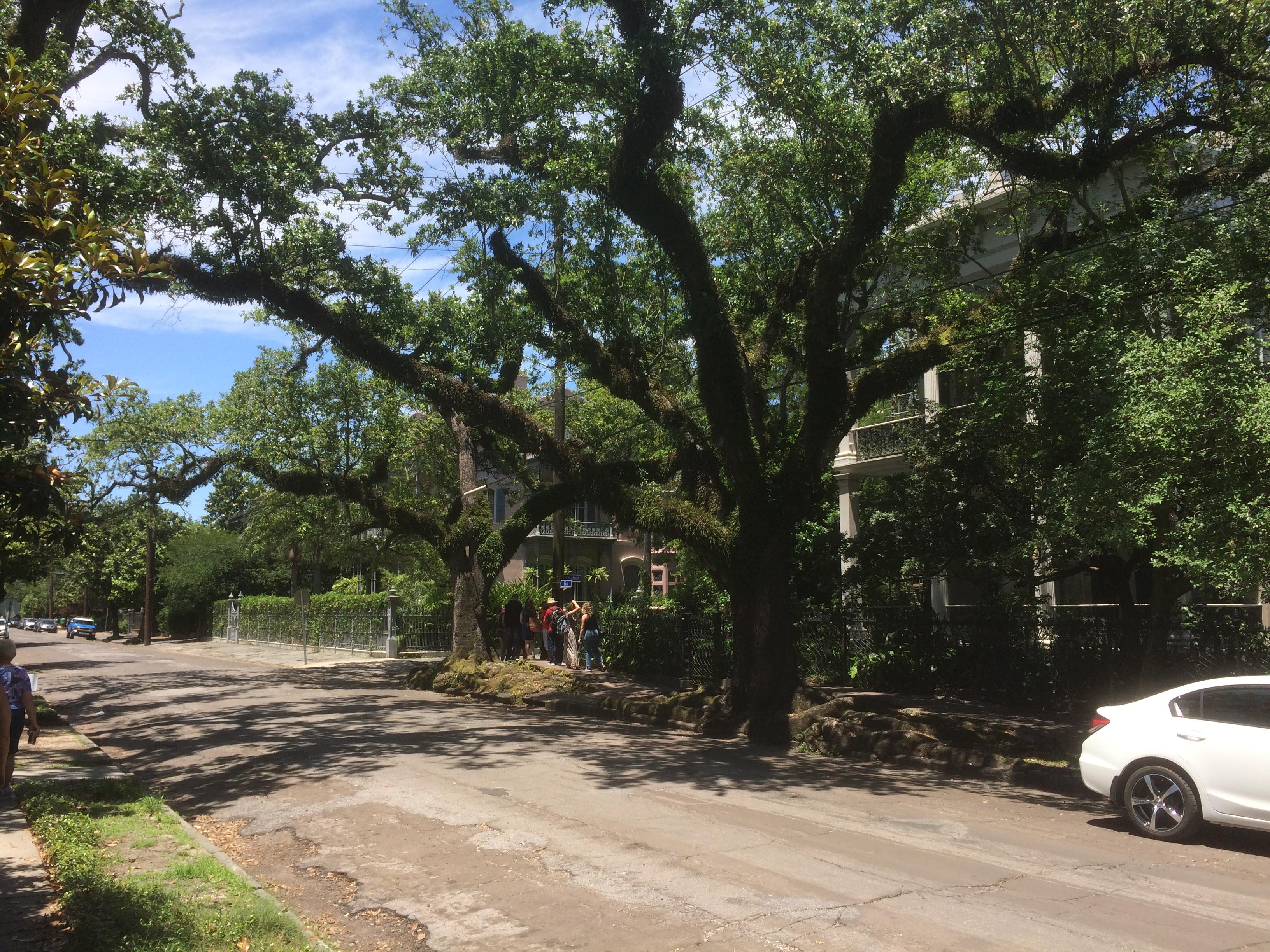
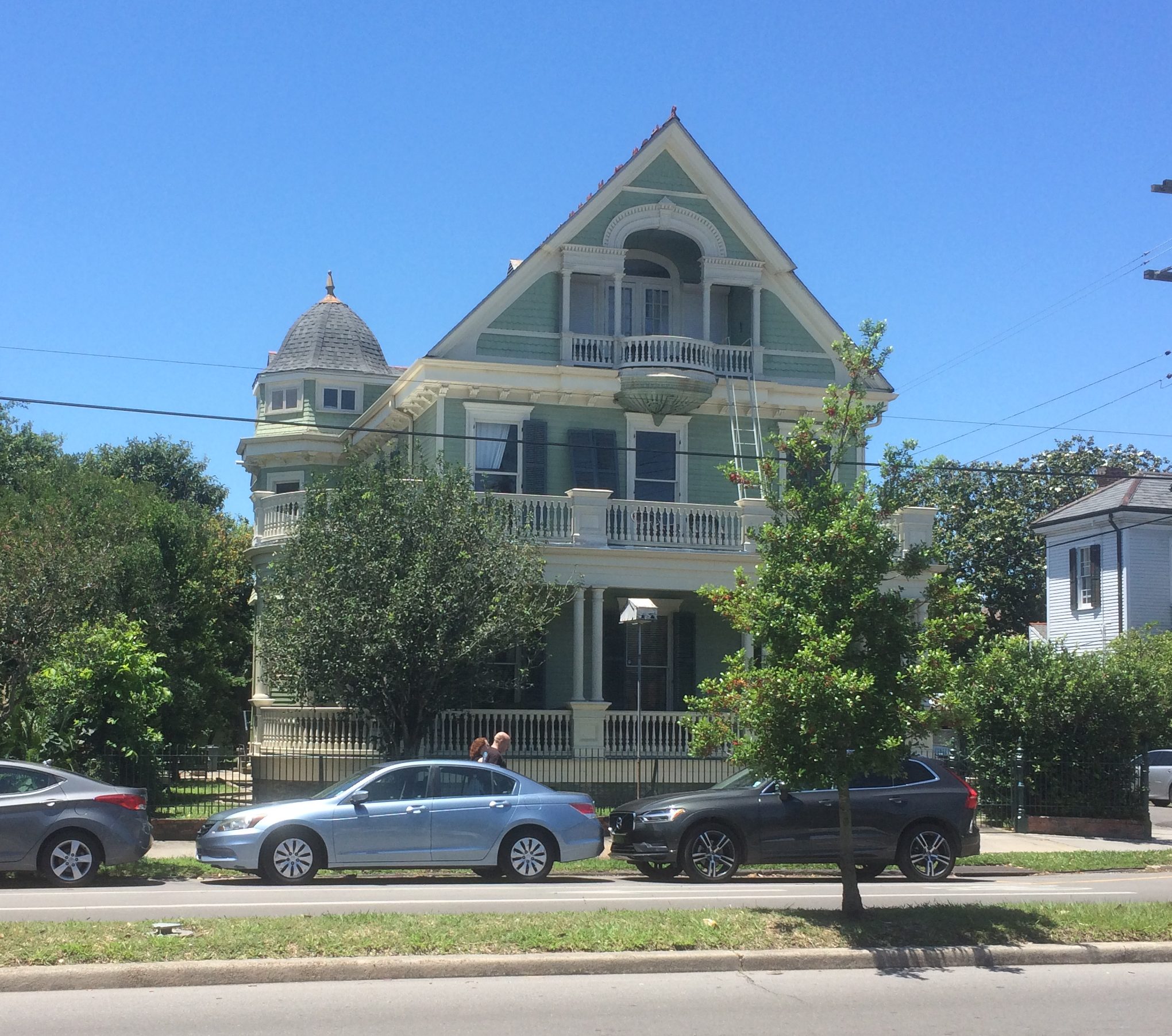
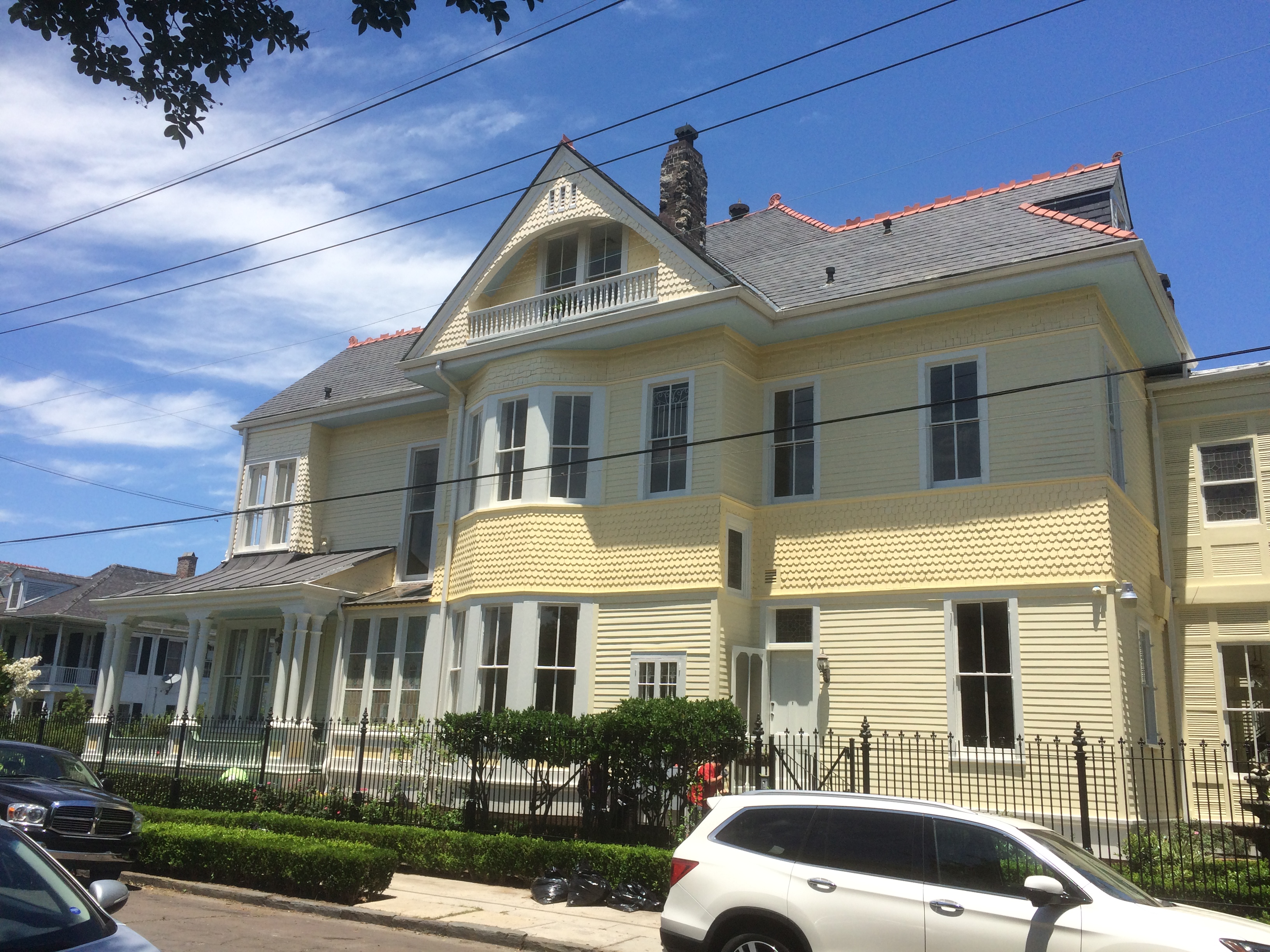
The trees part to reveal some fine houses.
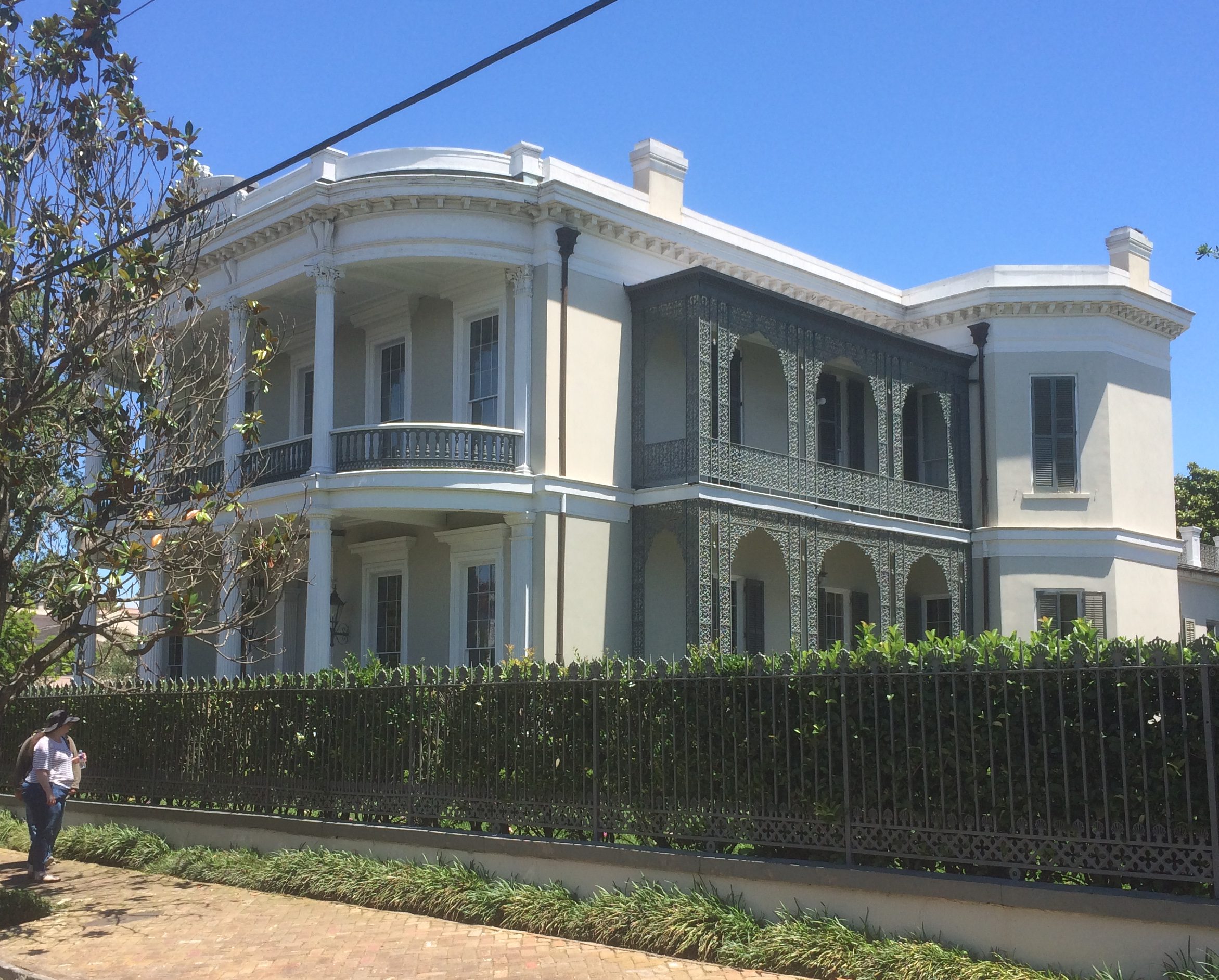
My favorite among those I saw, though of course that was a small fraction of the area’s visual richness.
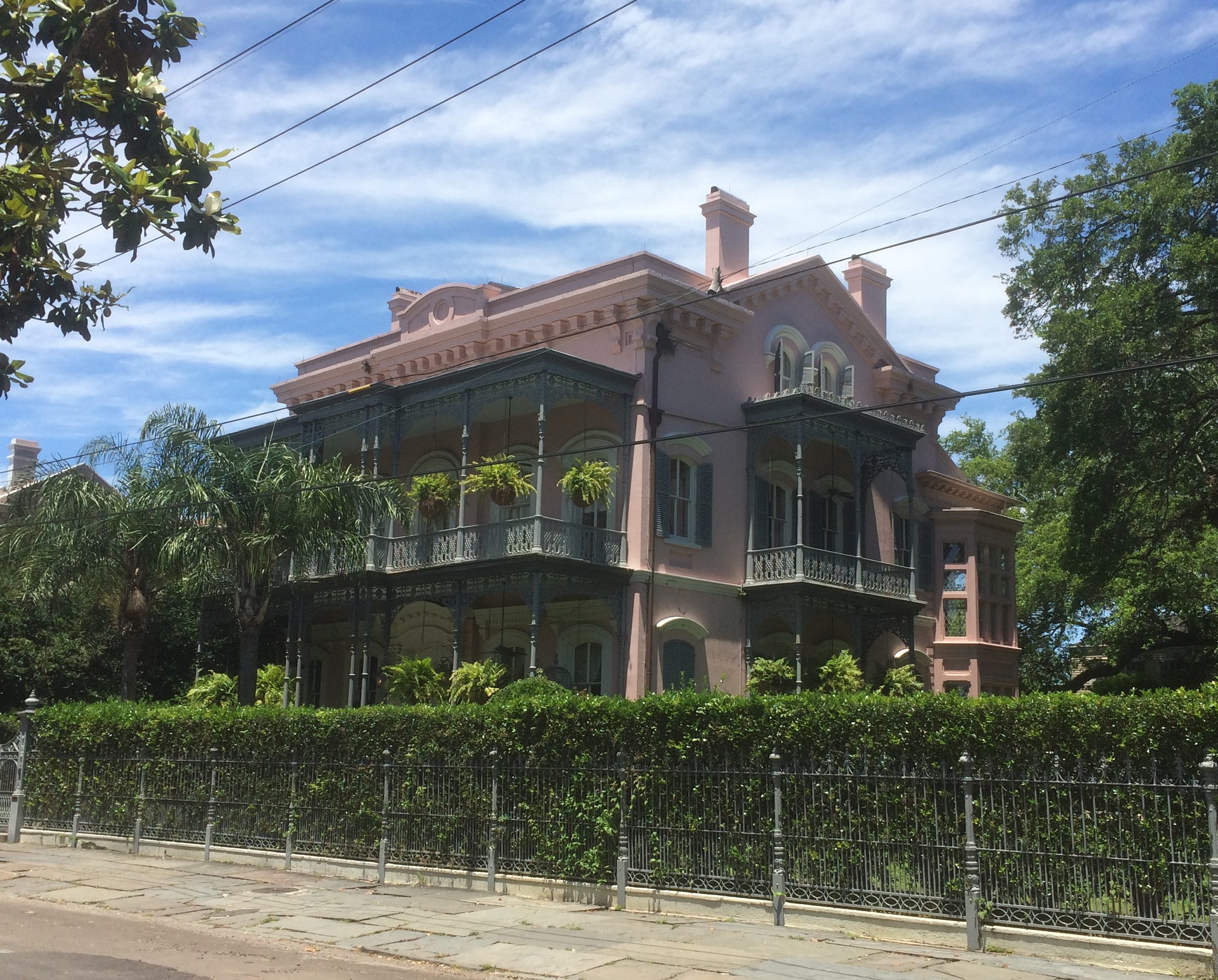
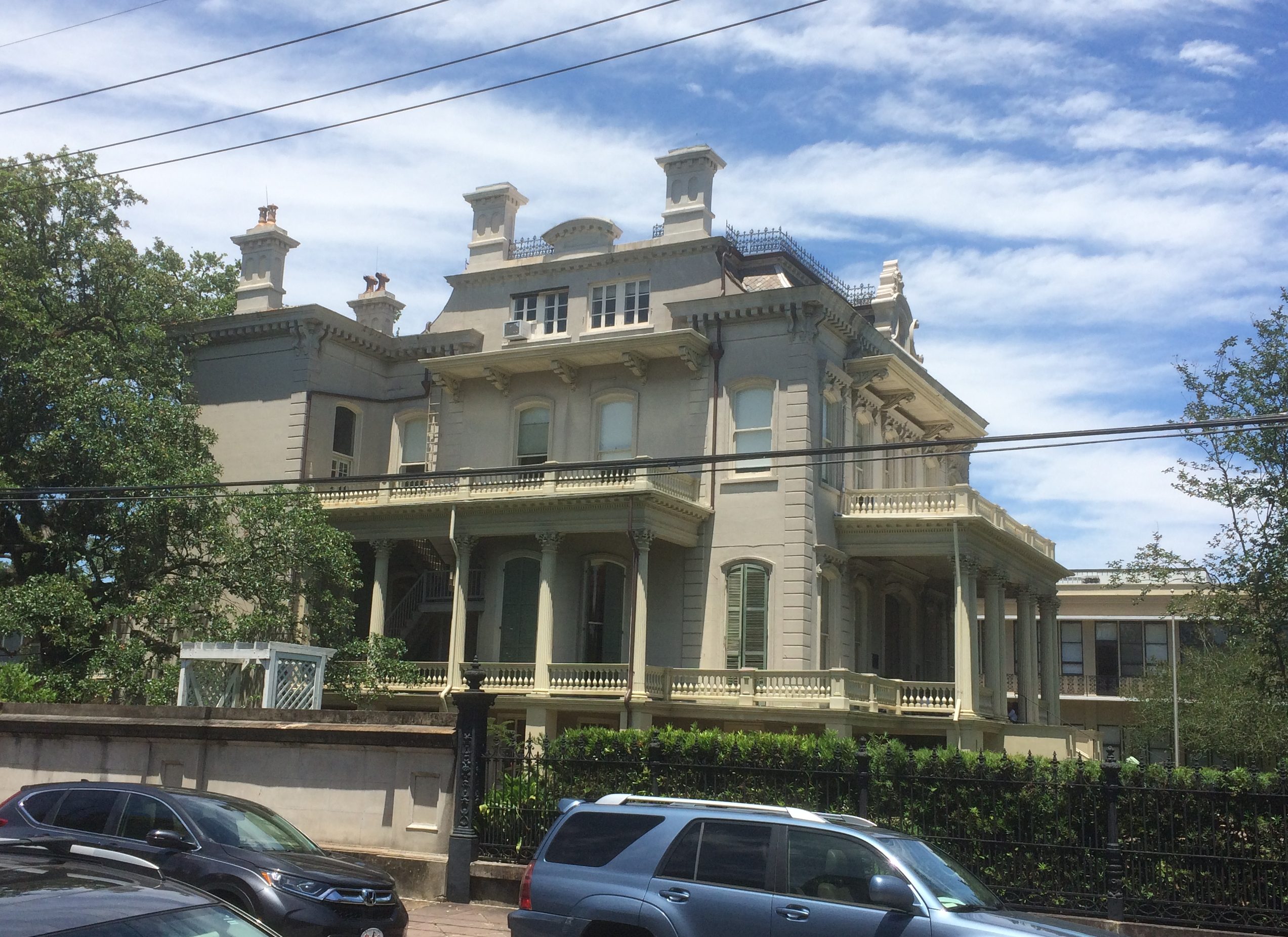
Our walk took us past some houses marked as historic, such as the Goldsmith-Godchaux House.
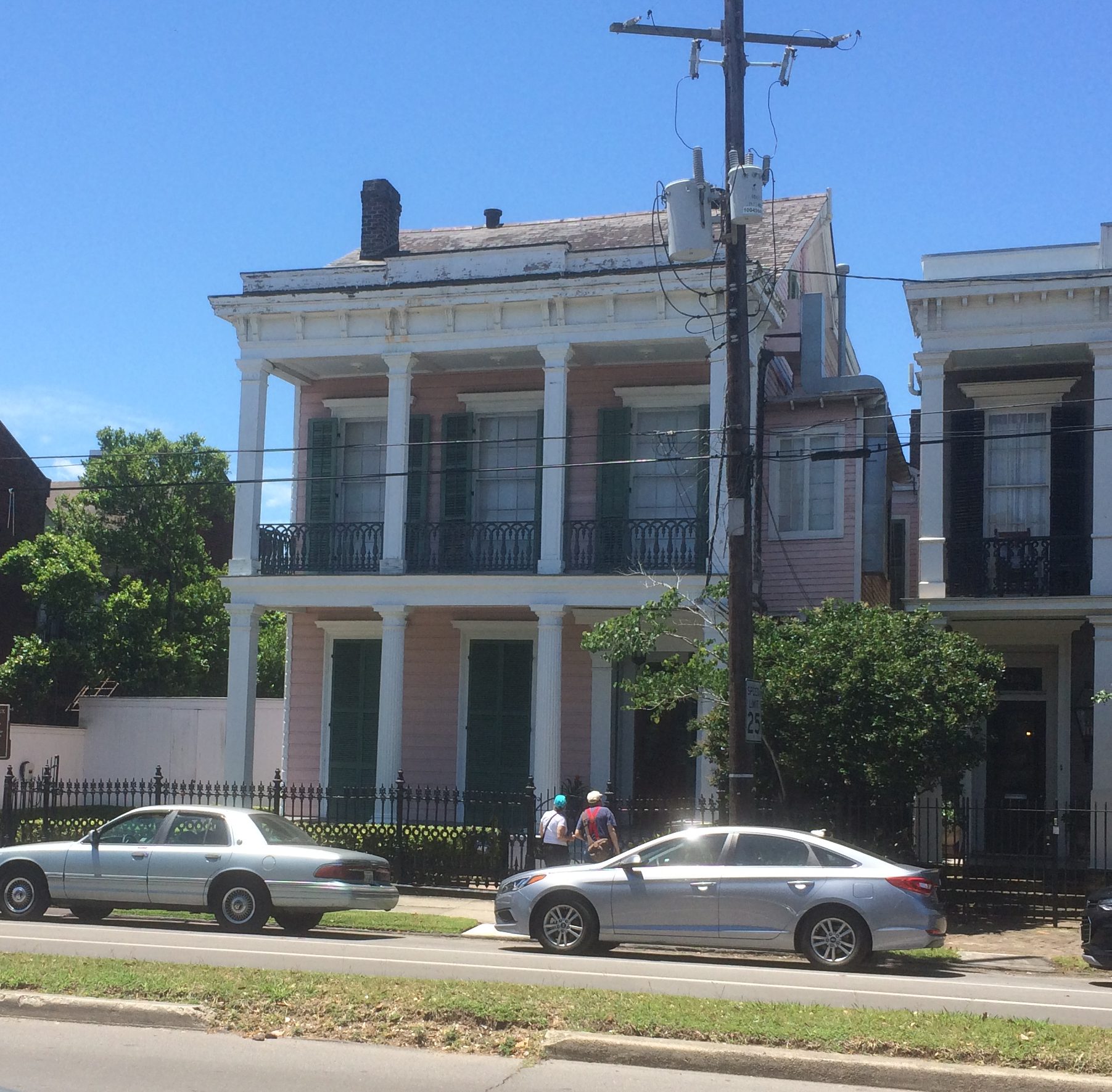
Alas, it seems to be noted more for its invisible (to us) interior than the exterior, though that’s nice enough. The plaque outside says: “Designed by noted nineteenth century architect Henry Howard in 1859. Significant for its painted interiors. Has more fresco wall decoration and stenciling than probably any other mid-nineteenth century residence in the South.”

It occurred to me, walking along and sweating, that the Garden District represents 19th-century urban sprawl. New development is often spoken of as if it’s kudzu, which grows willy-nilly and takes over the place. This is nonsense, since residential development follows demand, though infrastructure spending helps facilitate it (in the 20th century, that means you, Robert Moses).

In any case, the demand was there after New Orleans became part of the United States, since the new English-speaking population didn’t particularly want to live with the Creoles in the Vieux Carré. They probably considered the old city an old dump.

Who started subdividing the plantations that used to be the Garden District? I had to find out. A singularly interesting character named Barthélémy Lafon, a Frenchman who seems to have skipped out on the Revolution, coming to New Orleans in 1789.

According to 64 Parishes, “Barthélémy Lafon enjoyed a long and diverse career in Louisiana as an architect, builder, engineer, surveyor, cartographer, town planner, land speculator, publisher, and pirate.”

My italics. Though it seems like he was more of a rich-man sponsor of pirates than someone who went to sea in search of booty. Even pirates need seed capital.

Down on Magazine St., we walked by some interesting commercial structures, such this one at the corner of Magazine and Jackson.
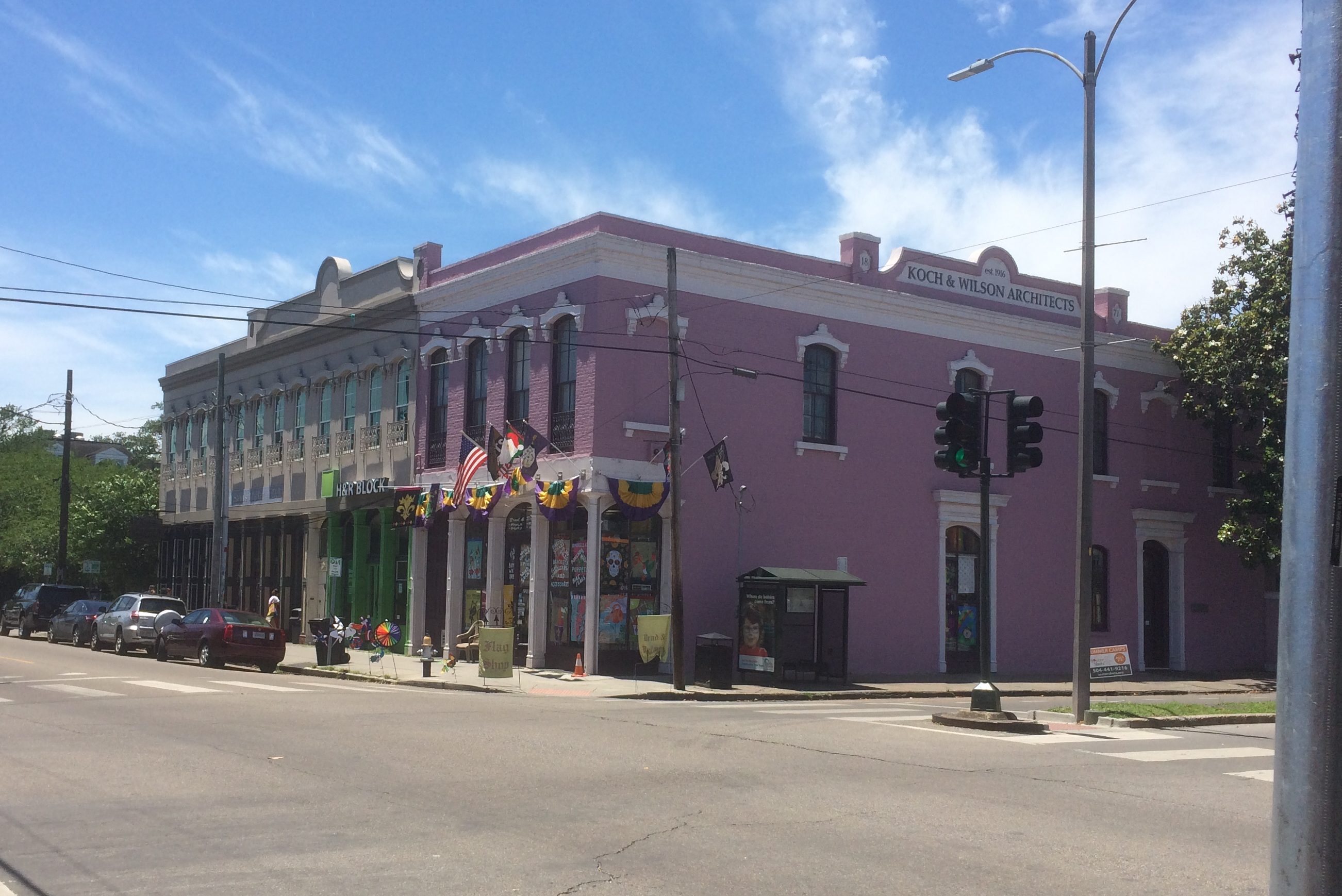
As it says, the building is home to Koch & Wilson Architects, who (I found out) are restoration specialists. Good for them. A fine thing to be in New Orleans. Among other things, the firm restored the nearby St. Mary’s Assumption. Sadly, we couldn’t get in to see that.

On the first floor of the Koch and Wilson Architects building is a flag shop, a deli and a doughnut shop (and H&R Block, but never mind). How cool a tenant roster is that?
We stopped by for doughnuts, and coldbrew coffee for Lilly. The shop served large and pricey hipster doughnuts, something not especially distinctive to New Orleans, but who cares. They were good.

Walking down Magazine, you come across this curiosity.
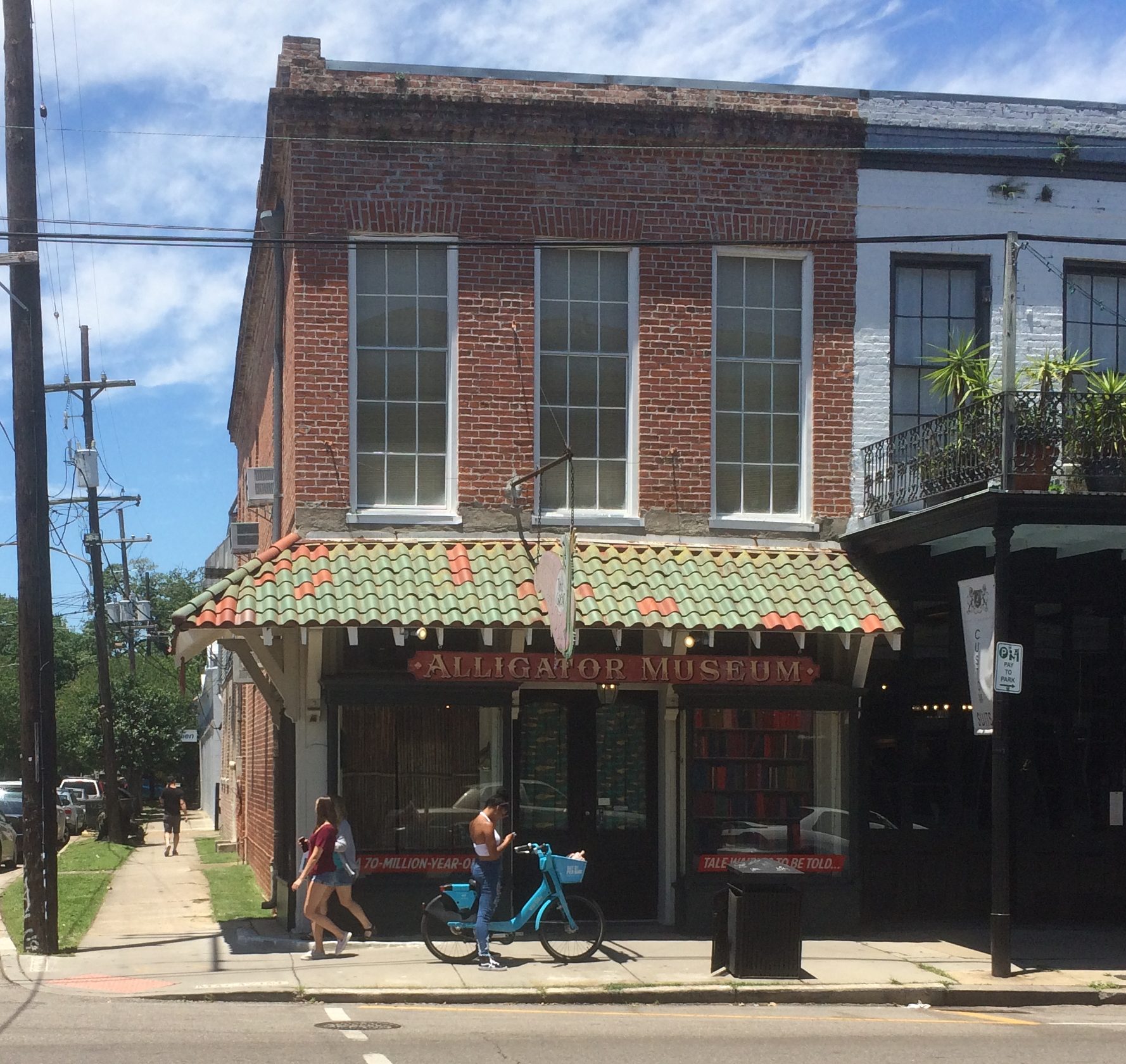
I’d look that up, but I’d rather not know exactly what you’d see there. We all need a little mystery, even in the age of Google.

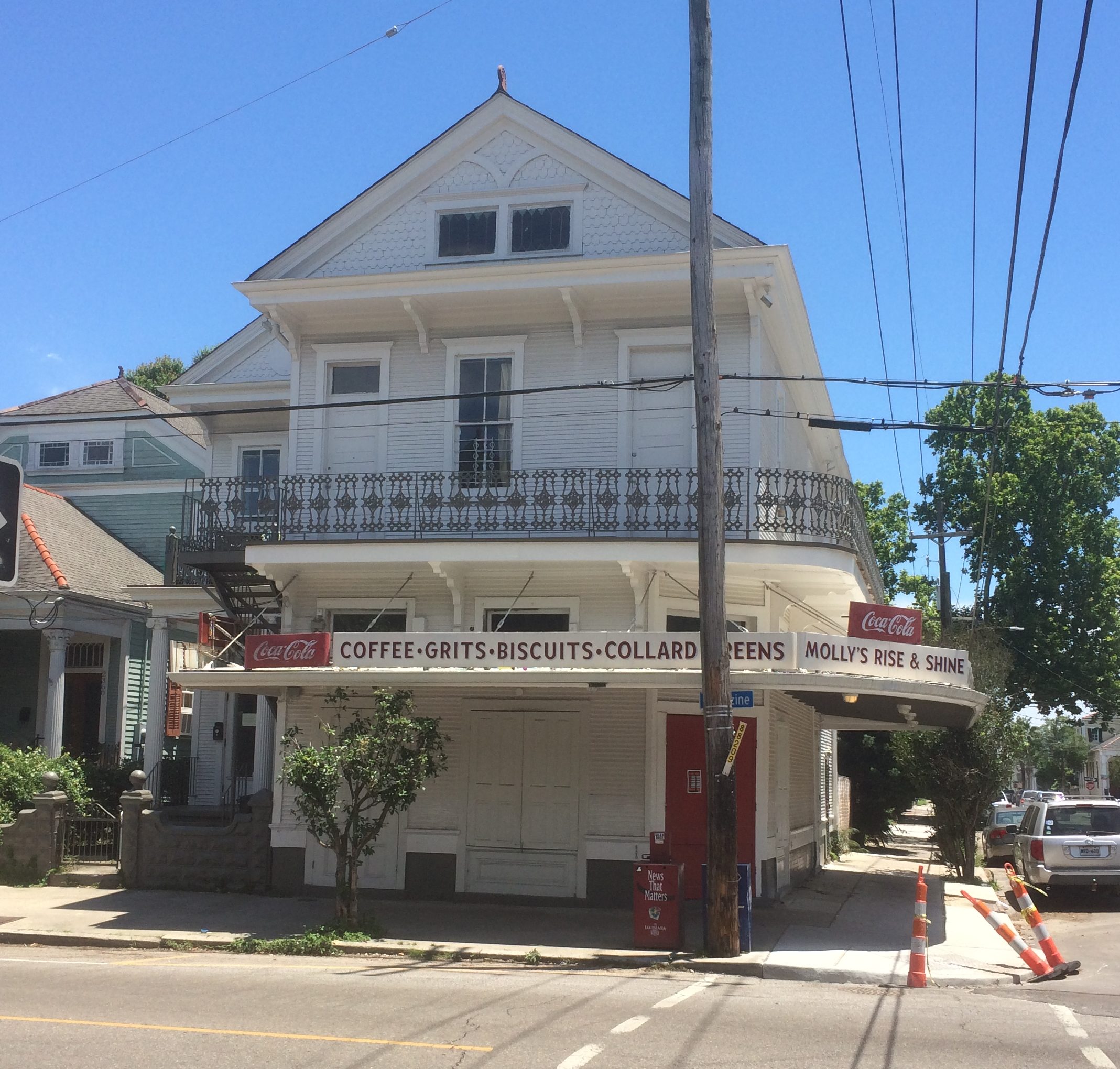
Down the other direction on Magazine is a joint after my own heart, but we didn’t stop in.
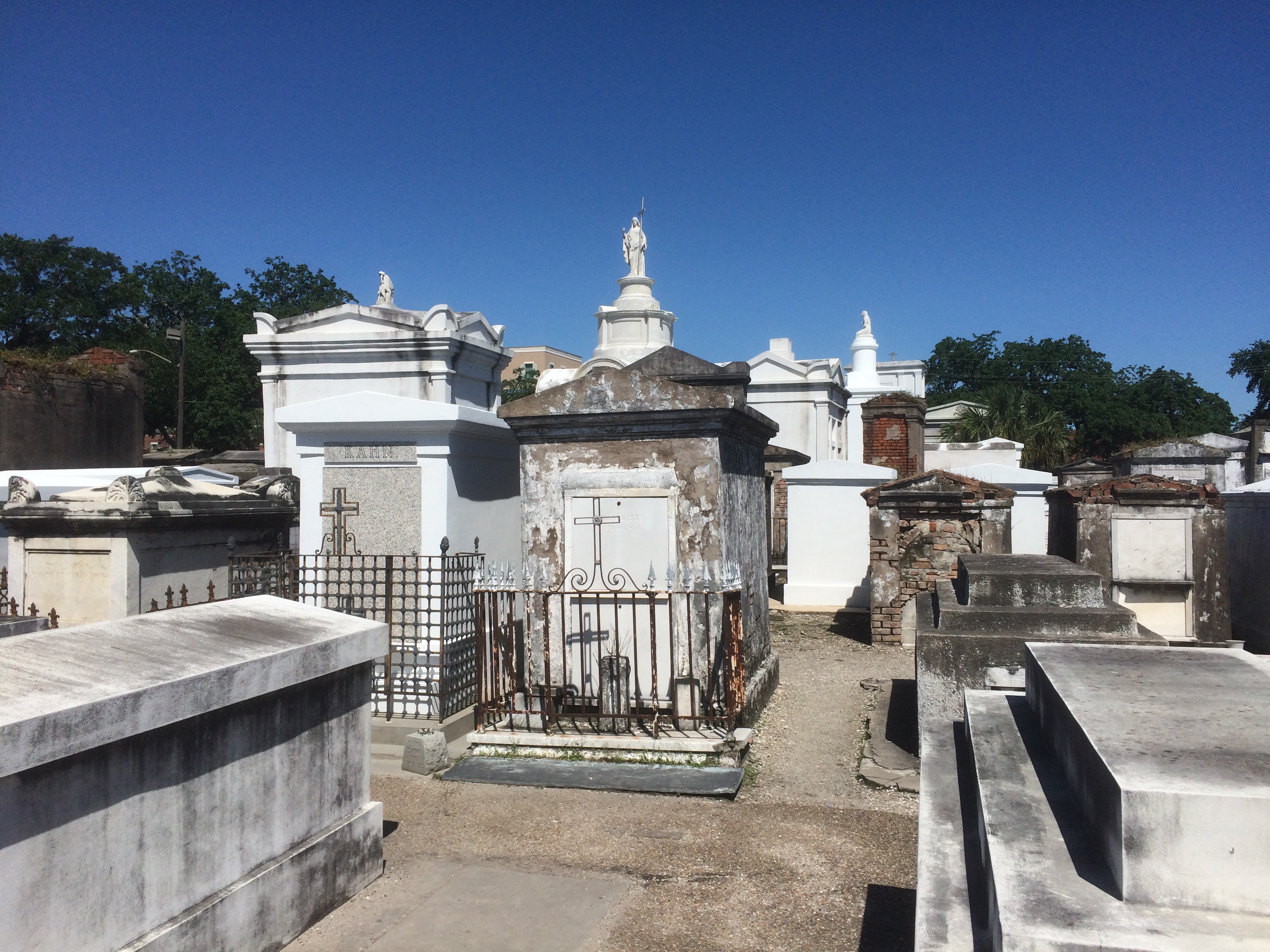
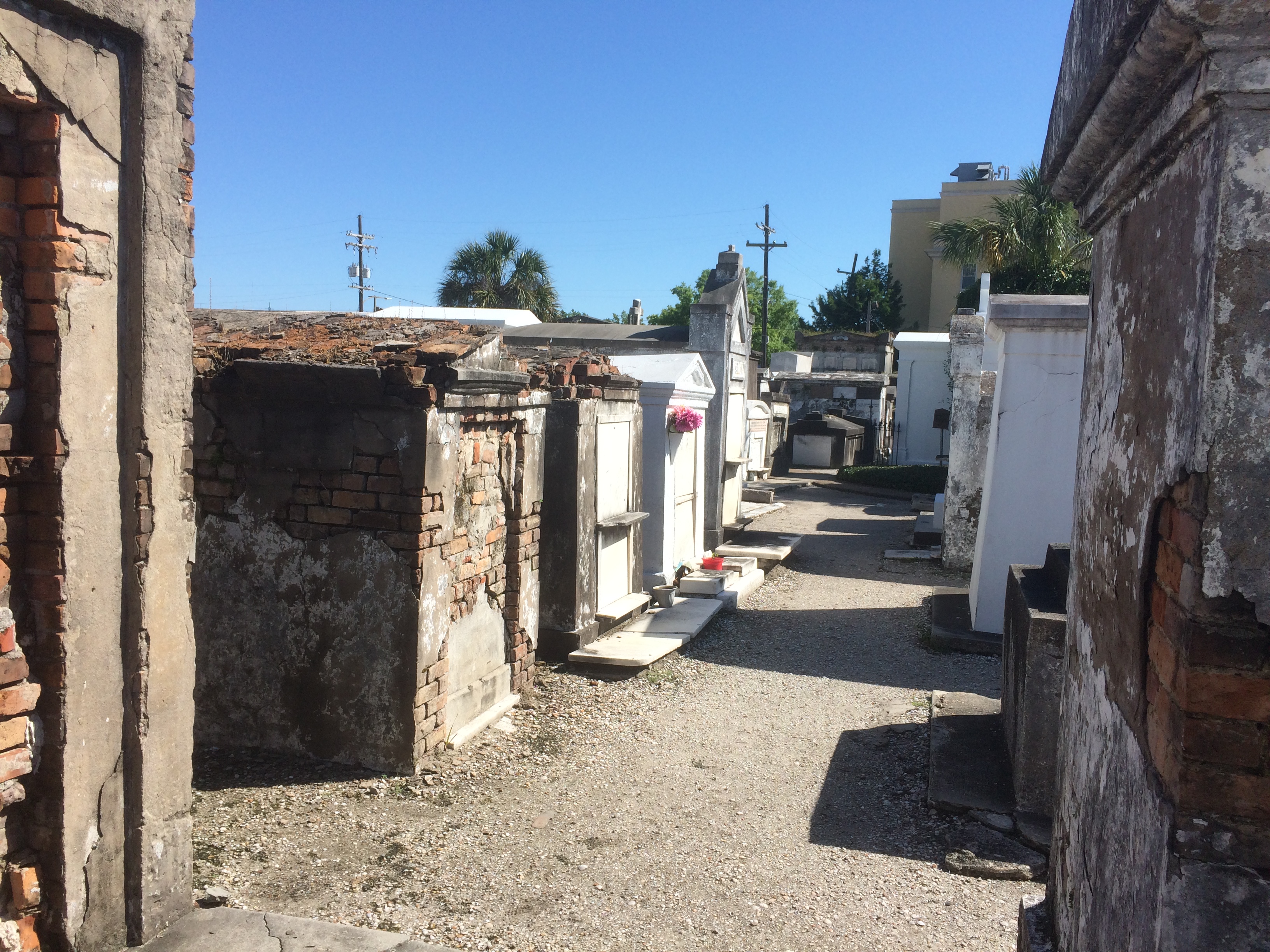
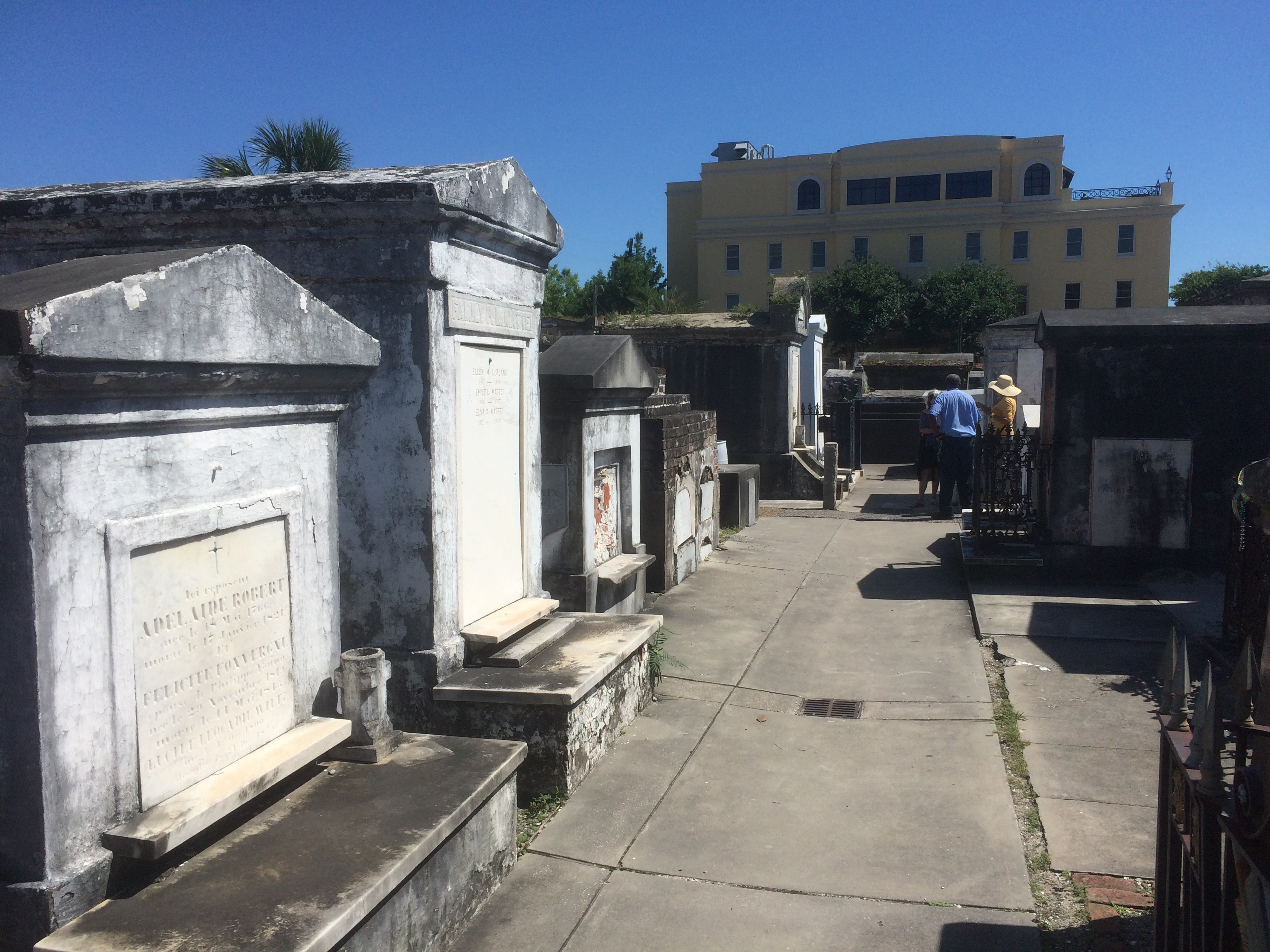
I couldn’t visit the Garden District without dropping in on Lafayette Cemetery No. 1. It was a more popular place than most cemeteries I’ve been to.
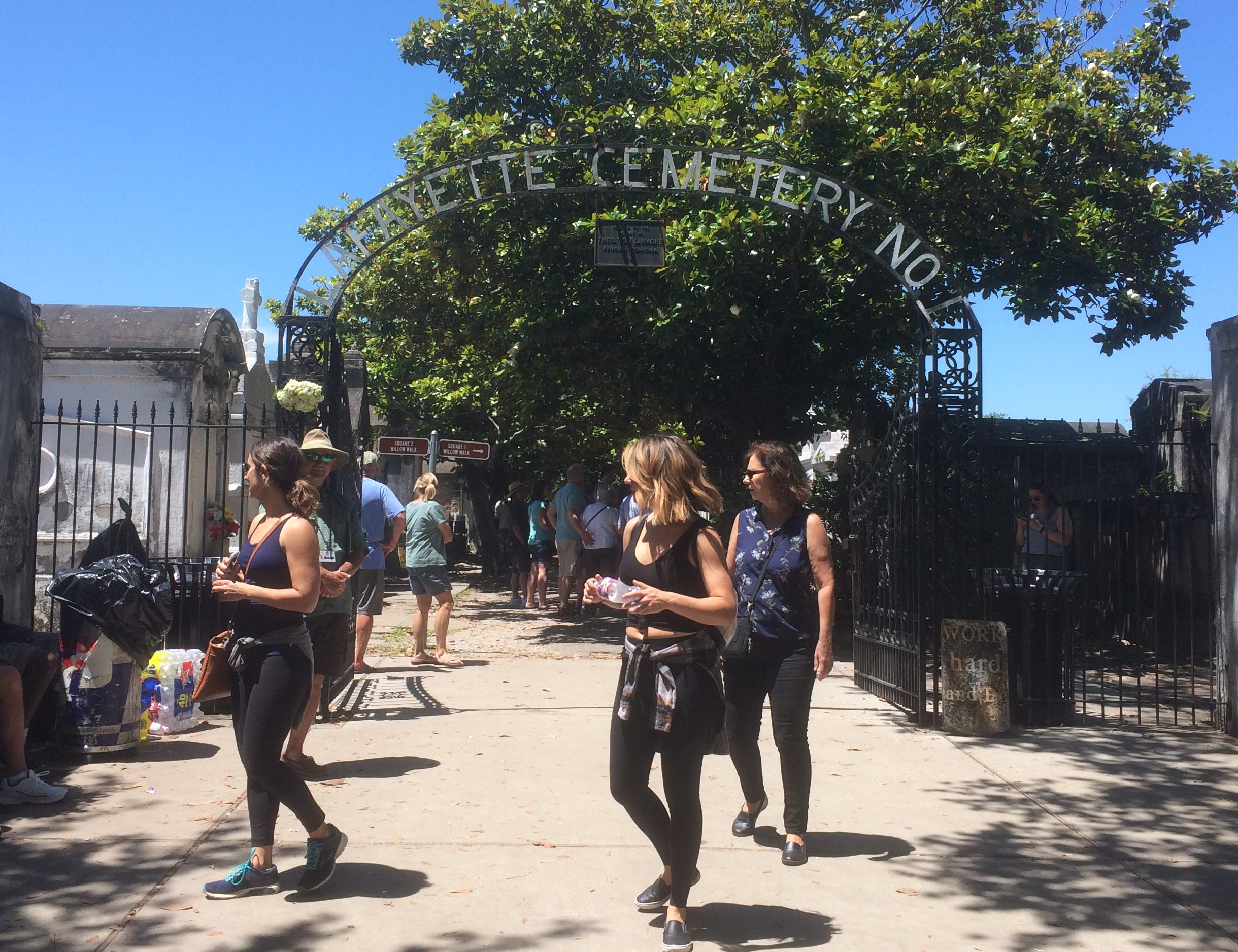
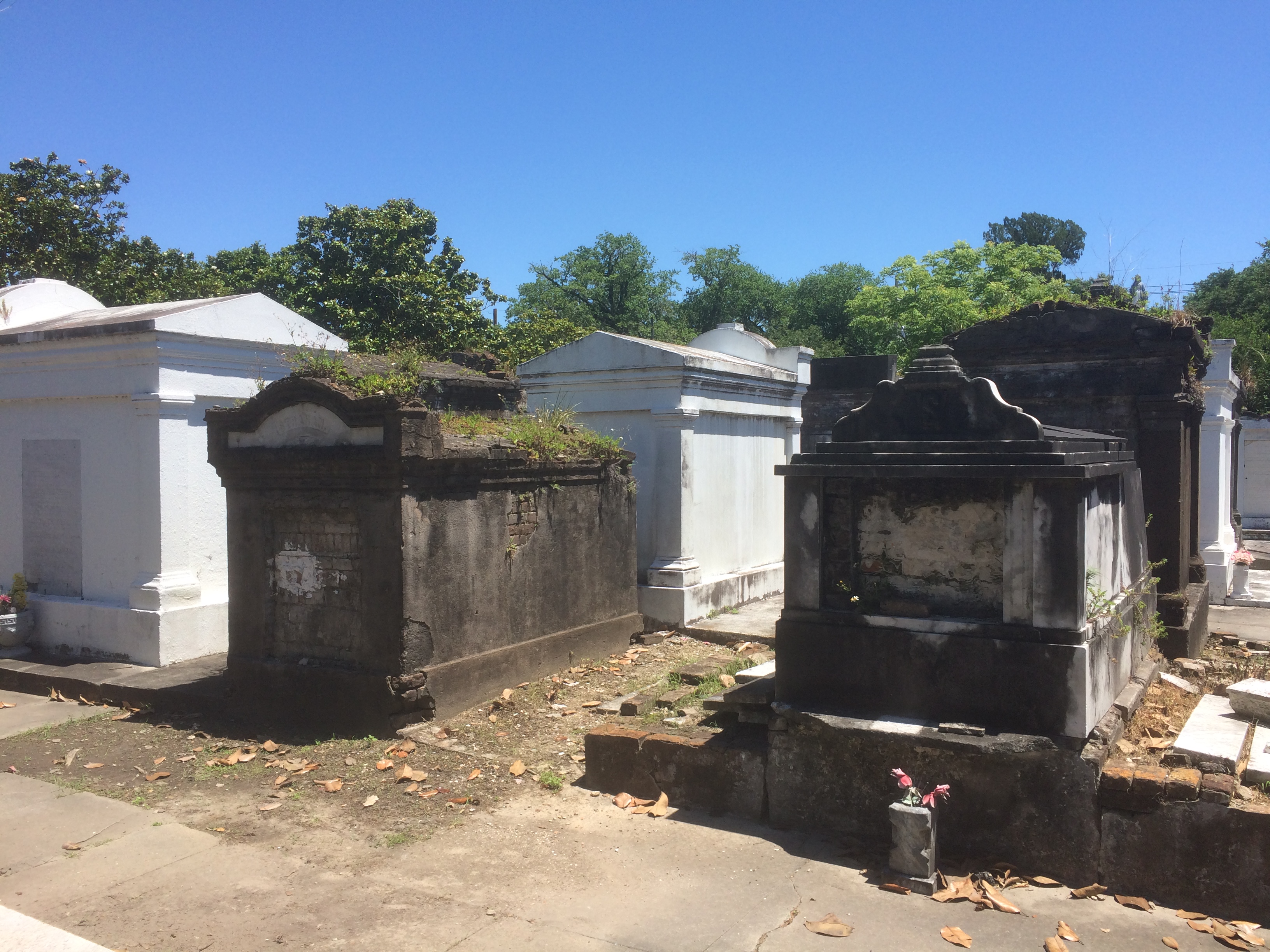
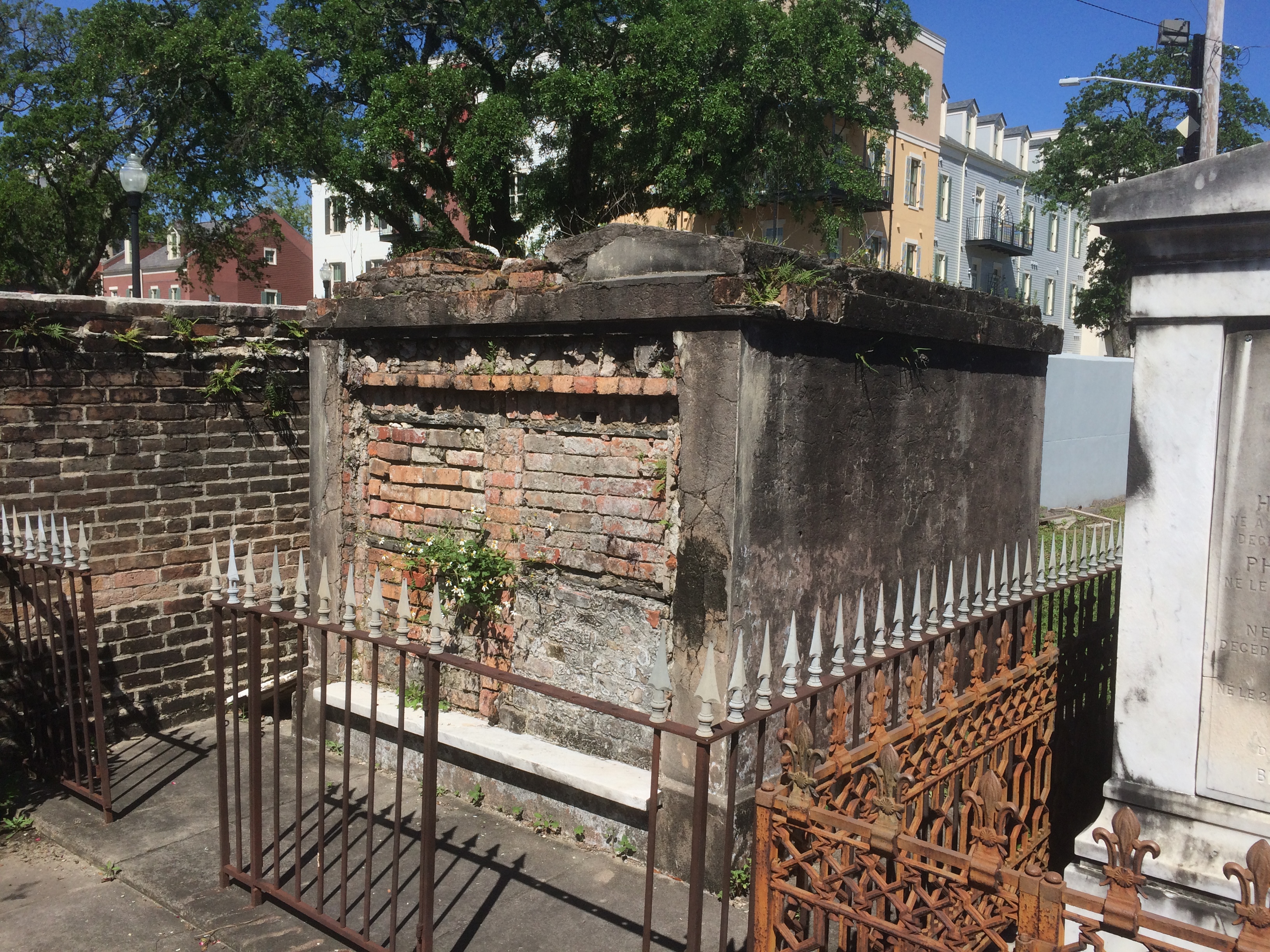
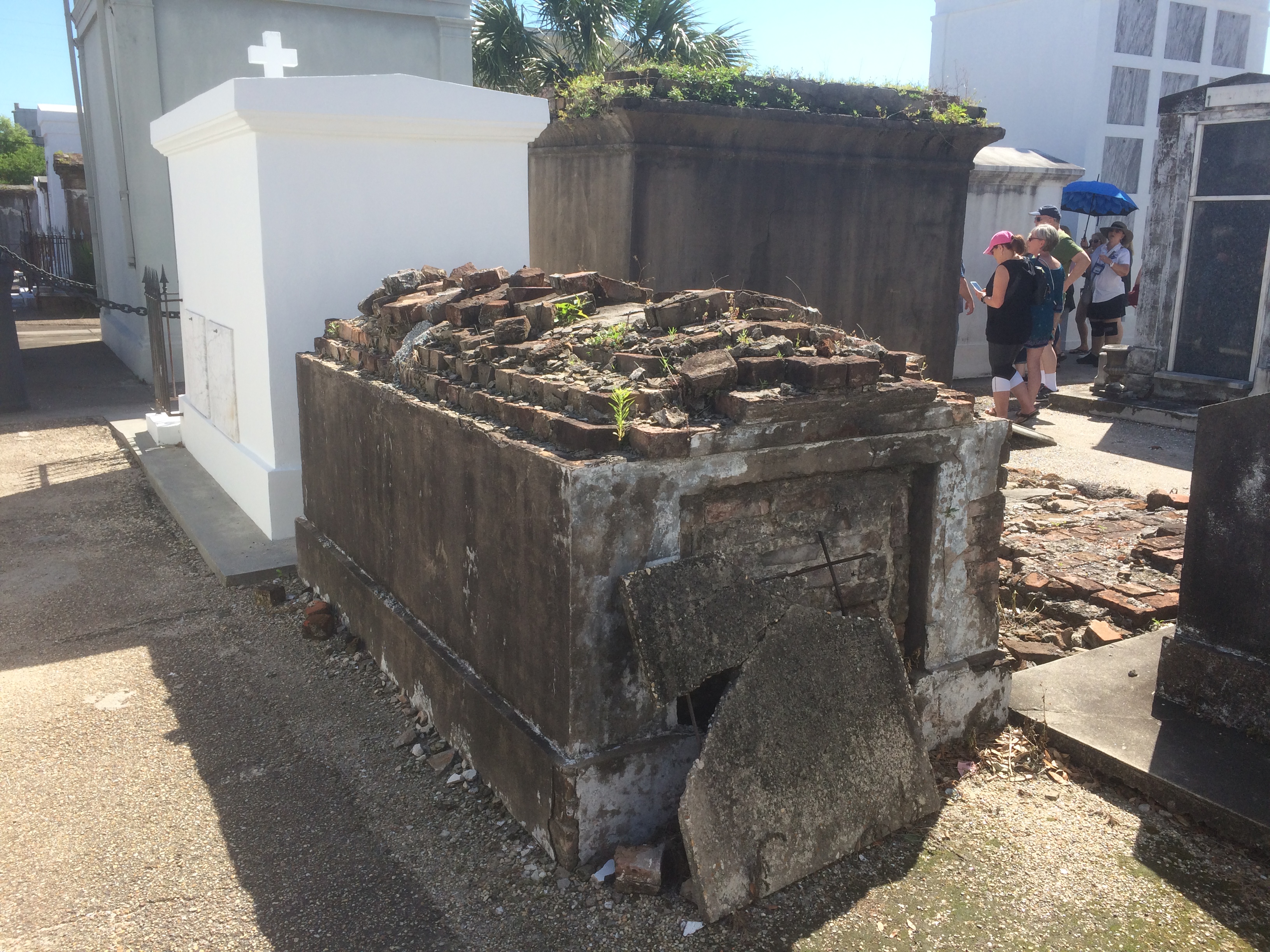
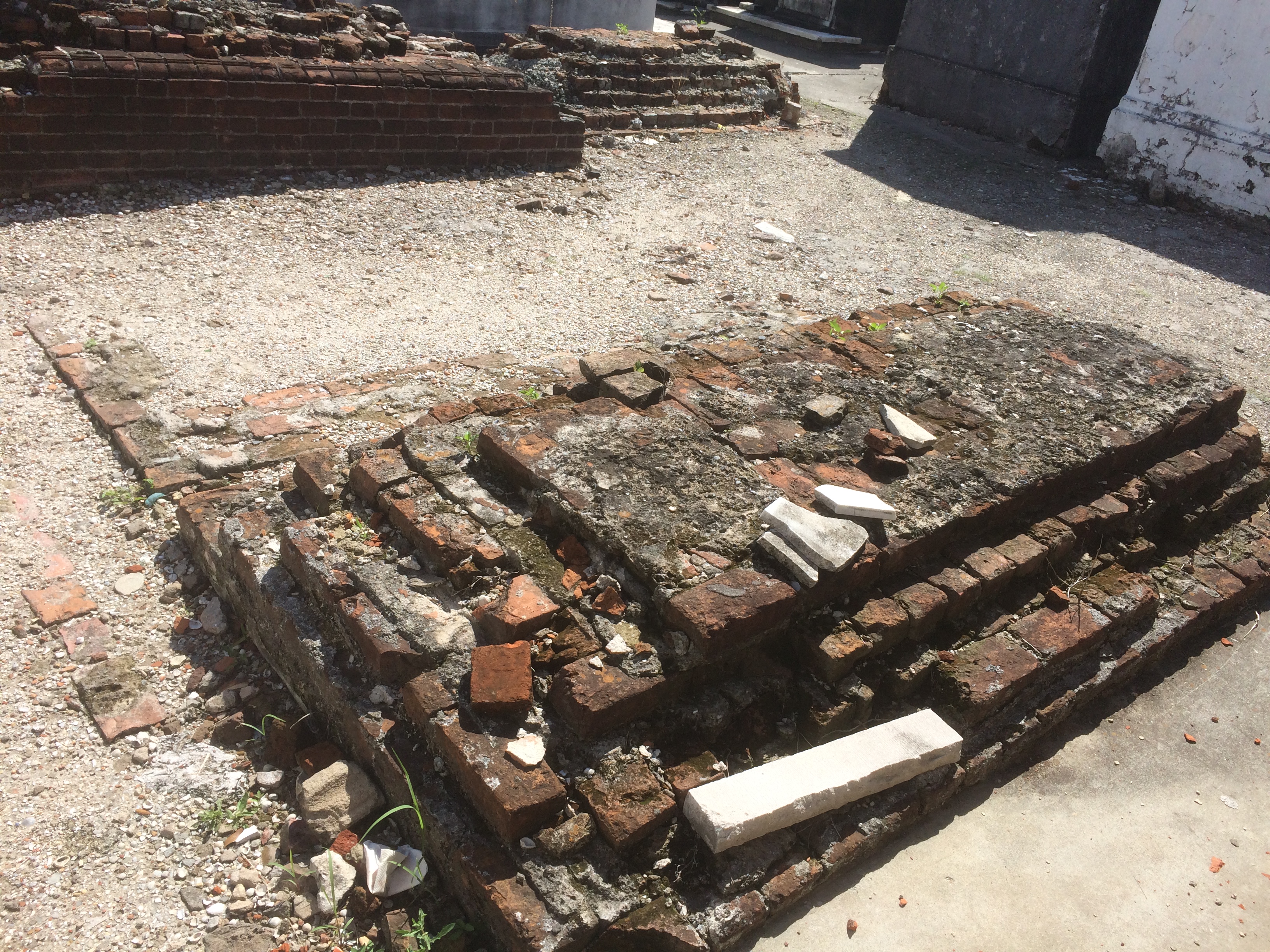
The collection of tombs is similar to that of Saint Louis Cemetery No. 1, a mix of maintained and crumbling examples.
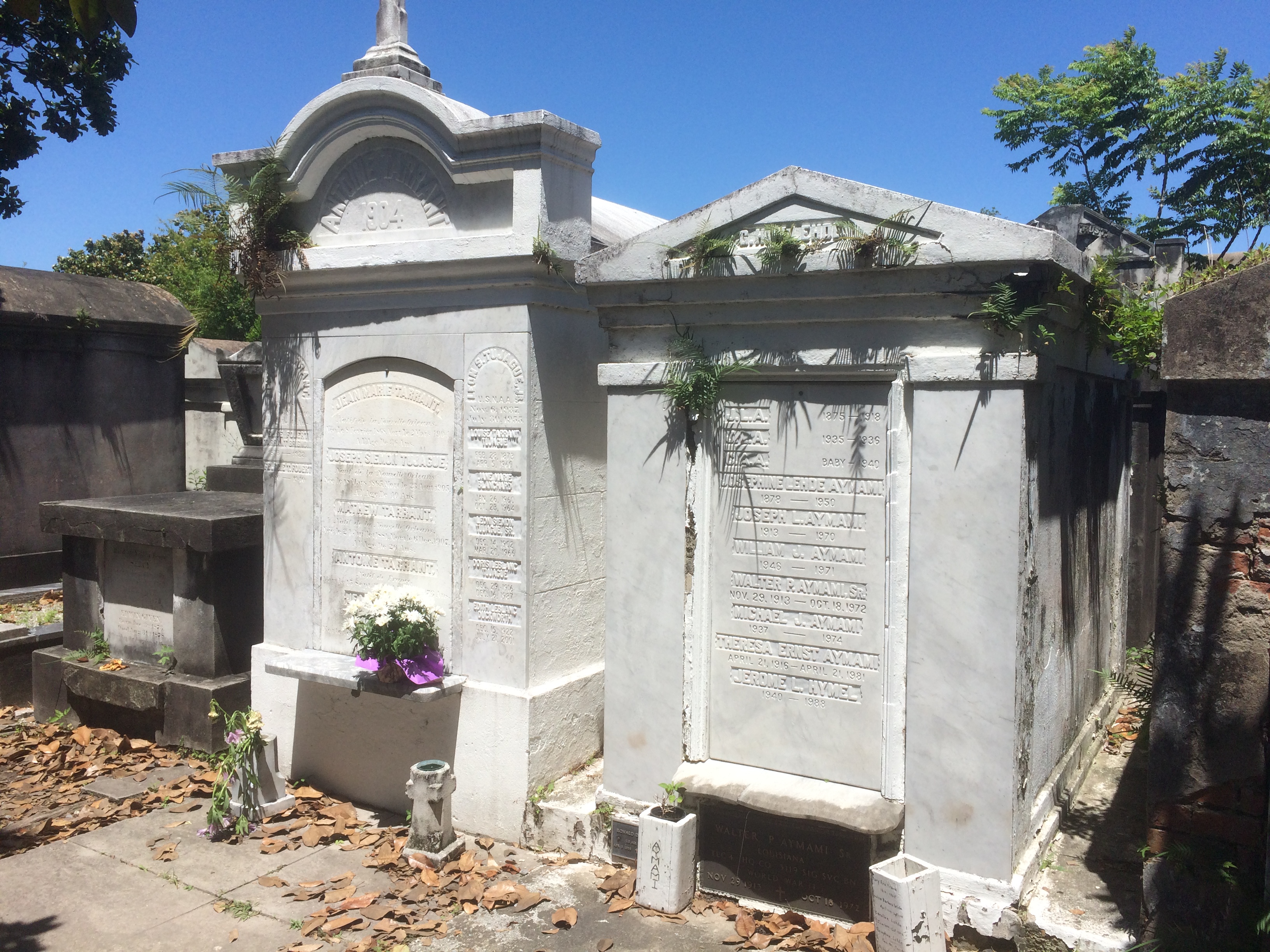
The cemetery had better shade than Saint Louis, mostly in the form of sheltering magnolias, and wider avenues of the dead in some places.
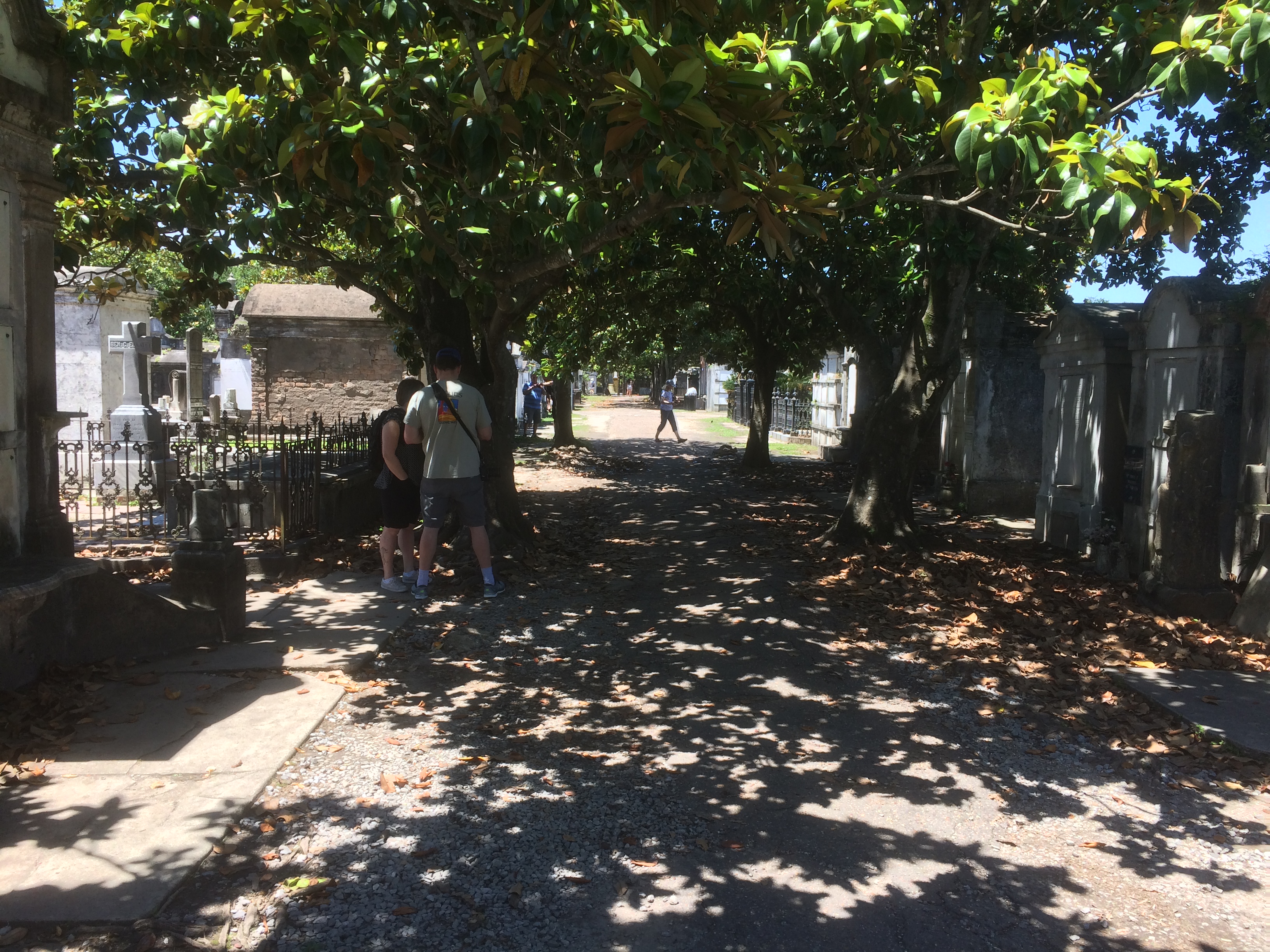
Lafayette Cemetery No. 1 also has some collective tombs. This one says Jefferson Fire Company, 1852.
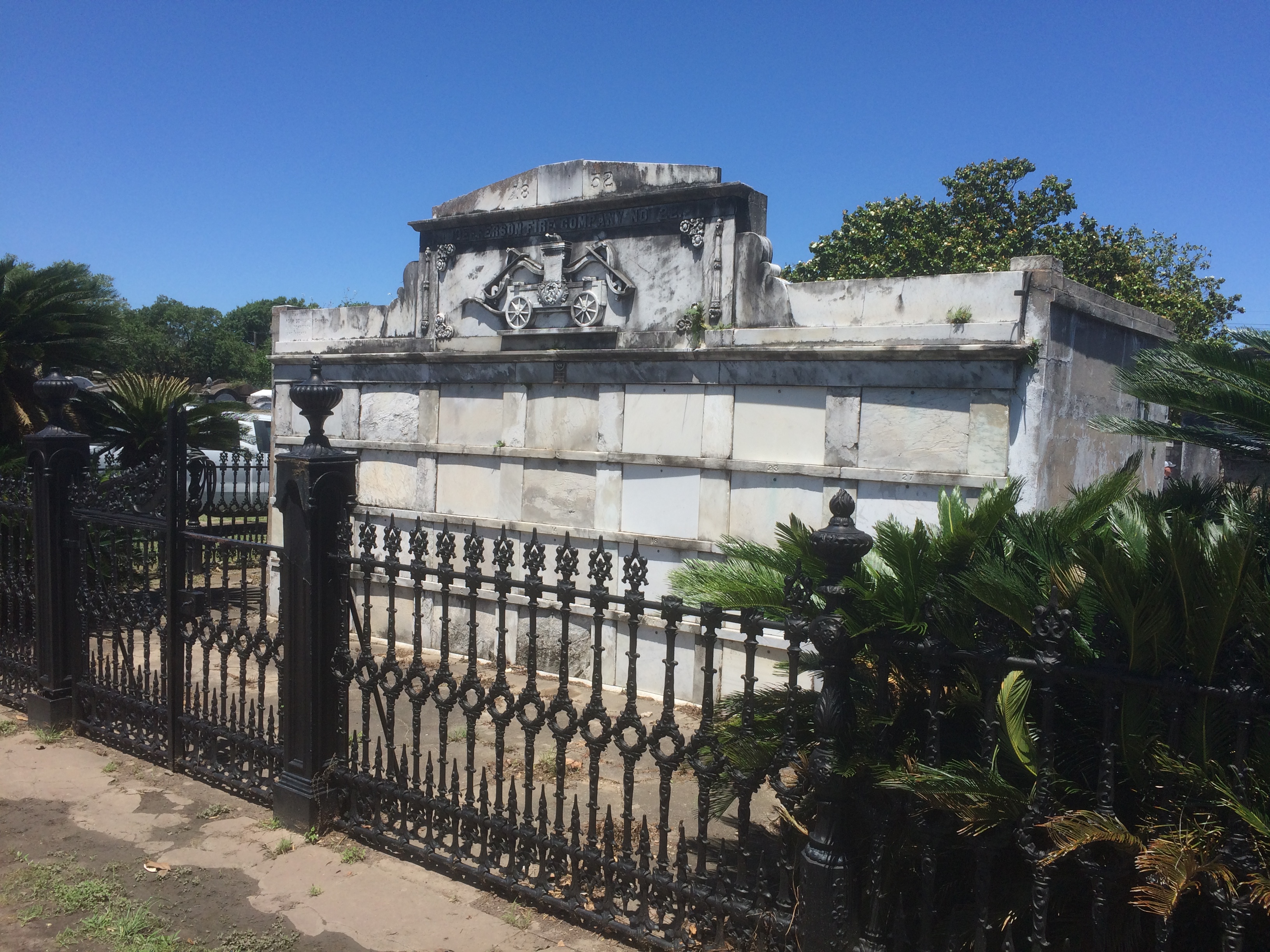
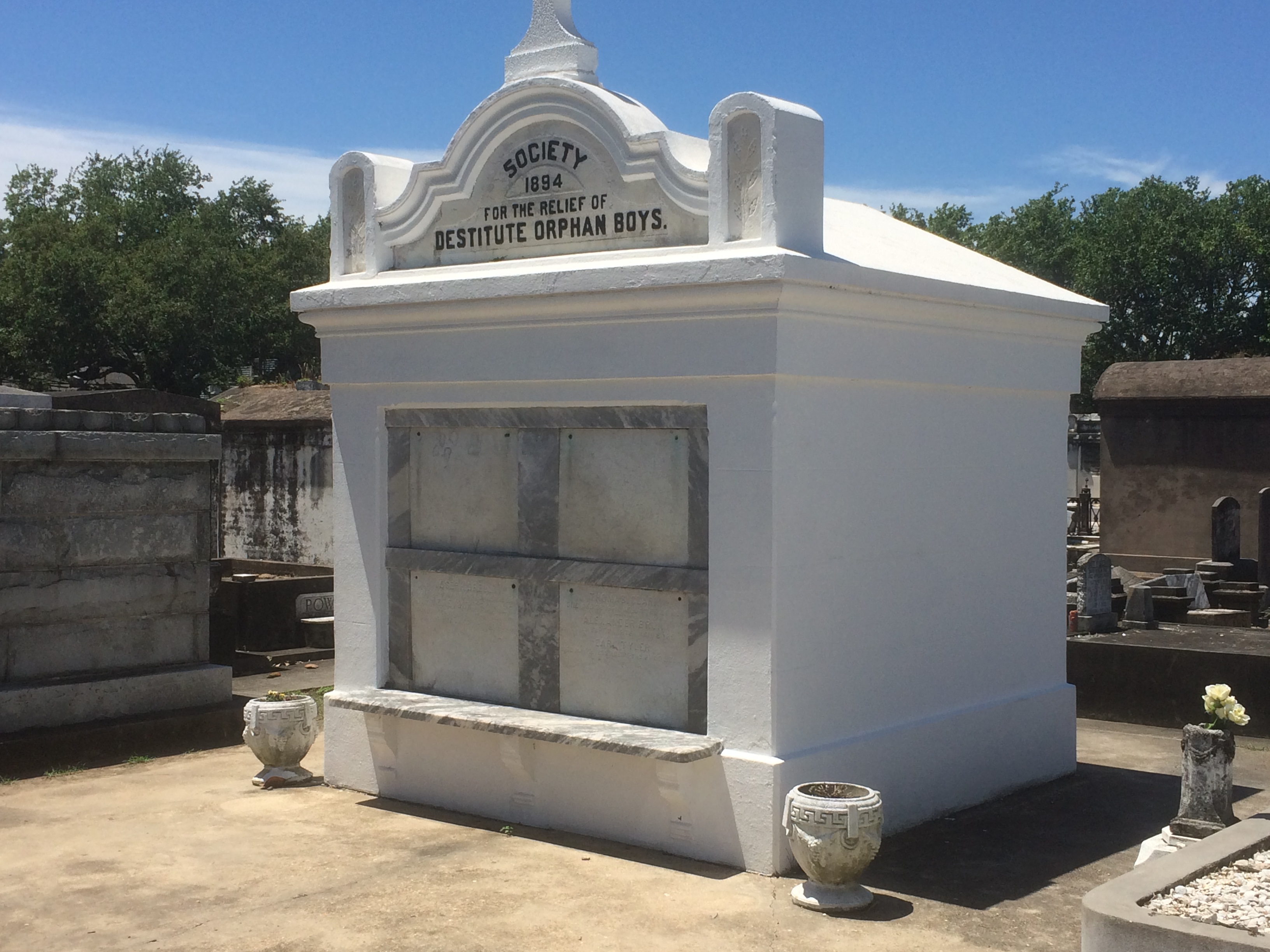
Here’s one for orphans.
Society for the Relief of Destitute Orphan Boys, 1894. If that isn’t Victorian nomenclature, I don’t know what is.
A Few New Orleans Statues, With Some Opinions

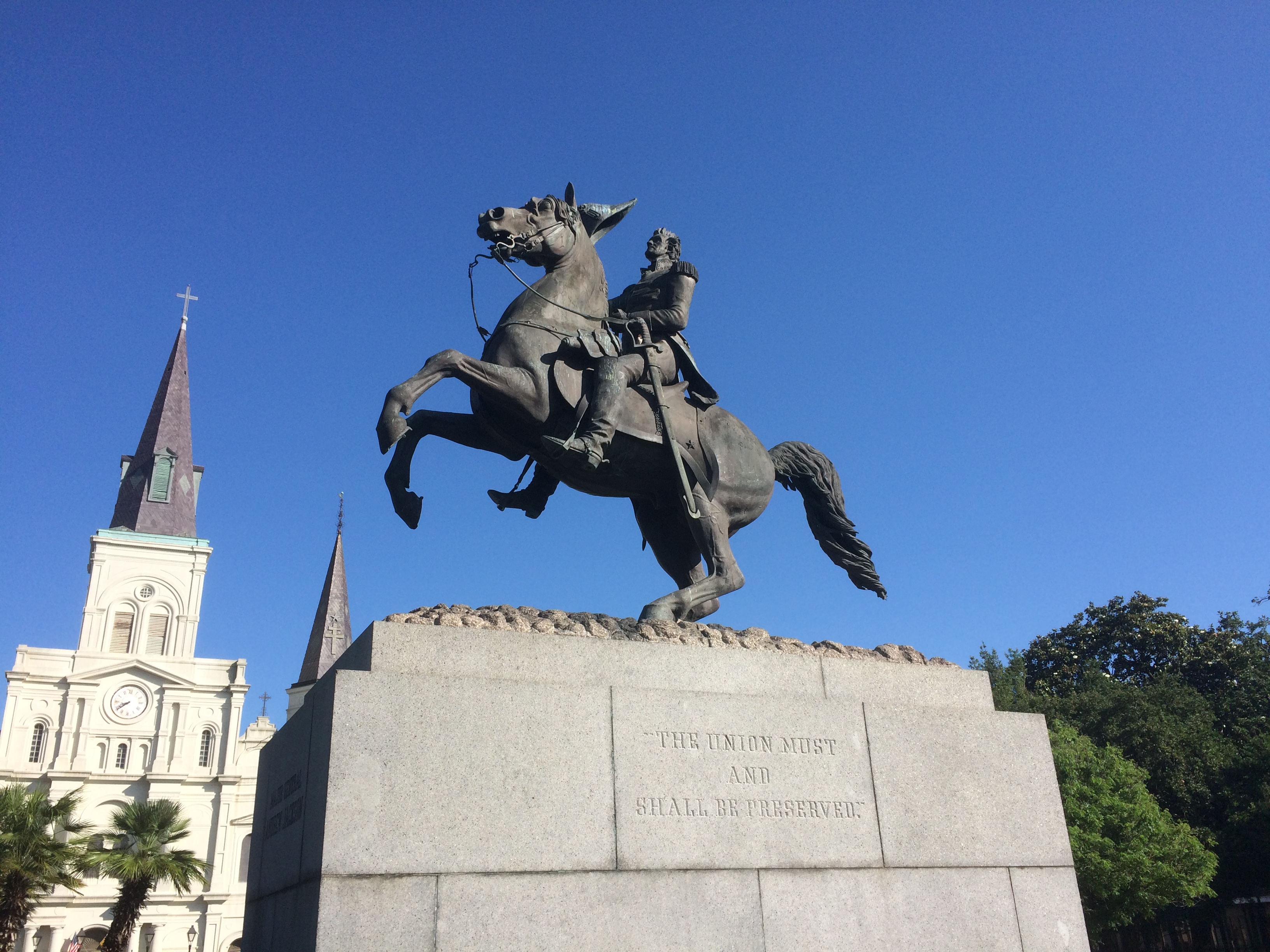
As of May 2019, Gen. Andrew Jackson still rides his steed at Jackson Square in New Orleans, the dramatic centerpiece of a handsome public space.
The equestrian bronze, by notable 19th-century sculptor Clark Mills, has been there since 1856, when the Battle of New Orleans was still in living memory, at least among the old timers. I understand the monument is a target of removalists, so there might come a day when Jackson Square loses its man on horseback and becomes Something Else Square.

That’s New Orleans’ decision. Yet I’m not persuaded Jackson should go, for all his retroactively understood flaws. It’s one thing to remove monuments to those who actively sought disunion because they feared to lose their human property. Jackson and his men defeated an invading army on American soil near New Orleans. As president, he had no use for disunion, either. Just ask John C. Calhoun.

During our last day in New Orleans, Lilly and I visited the National WW II Museum, and to do so we got off the St. Charles streetcar at Lee Circle (as Google Maps calls it). Looking back at the circle, we saw an empty pedestal.

That’s odd, I said to Lilly. But I must have known at some time — I’d ridden on the St. Charles line decades earlier — that a statue of Robert E. Lee used to stand atop the pedestal. I’d forgotten. I don’t ever remember taking a close look at the Lee statue, since I haven’t always watched for monuments as much as I do now.

Just yesterday, it occurred to me to look up Lee Circle, and was reminded that removal activists were able to persuade New Orleans to take down Lee and three other monuments in 2017. Sic transit gloria mundi, Gen. Lee.

Of course, there are many ideas about a new statue to put on Lee’s former spot. Among this selection, the one I like best on prima facie examination is the relatively unknown J. Lawton Collins, a New Orleans native and important commander during WWII. He’s also appropriate because the museum devoted to that war is mere blocks away. Or if a strictly military option is out, Andrew Higgins, of Higgins boat fame, seems reasonable.

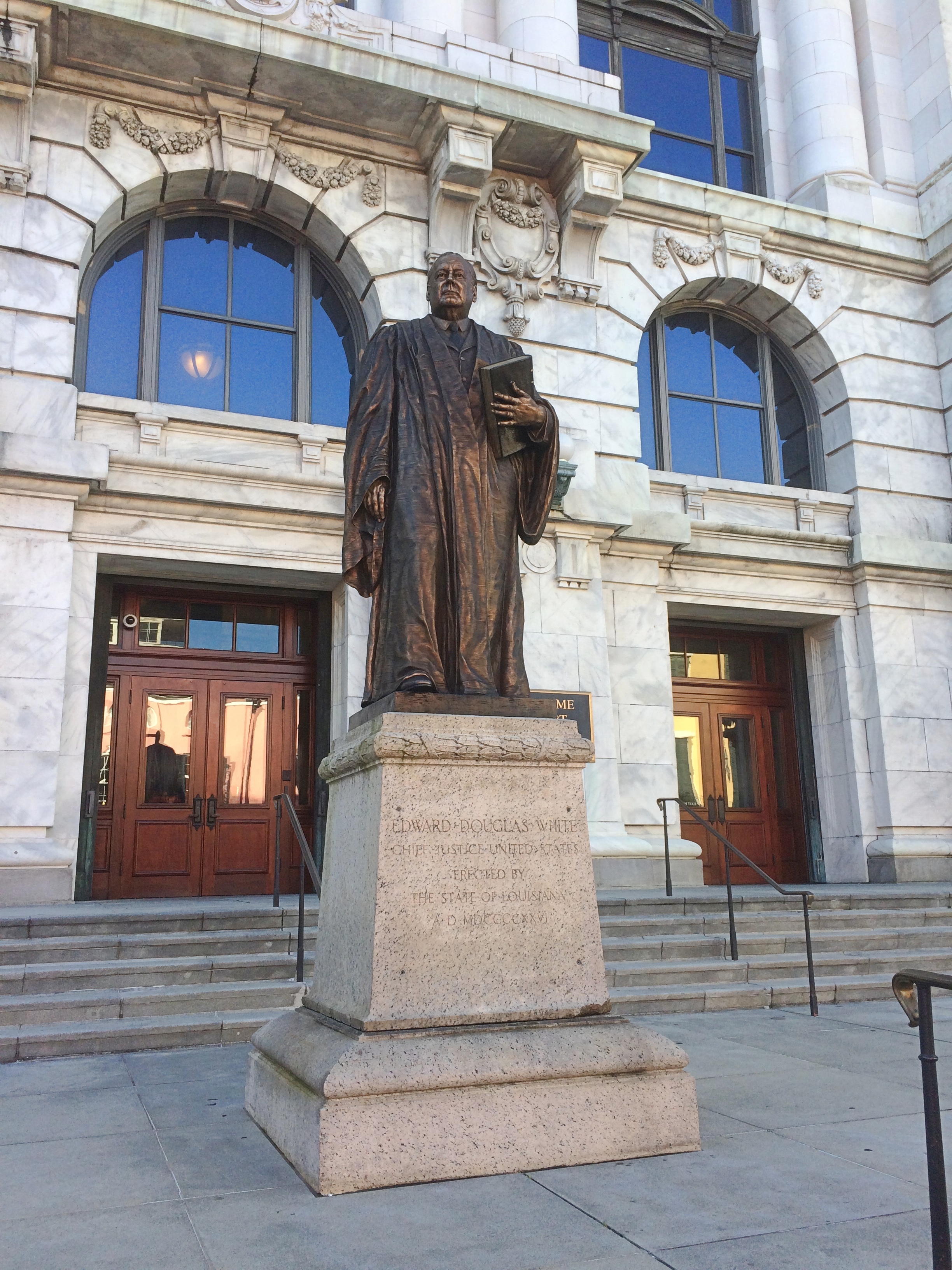
Here’s another statue that has gained the ire of removalists: Chief Justice of the United States Edward Douglass White Jr., who had a long and varied career but sided with the majority on the notorious Plessy v. Ferguson decision. (Most sources double that s in his middle name, but the statue does not.)

The chief justice stands on Royal St. in front of the major edifice housing the Louisiana Supreme Court, a building whose reputation has varied across the decades. We just happened to walk by.

Later I wondered, what’s the state supreme court doing in New Orleans and not Baton Rouge? Guess as far as the court is concerned, Baton Rouge is a johnny-come-lately capital, having that title only since 1846.

Chief Justice White would be a harder nut to crack for the removalists than Lee, simply because among the generally ahistoric American people, whipping up righteous outrage about someone as obscure as White would be a tall order. But it might happen.

In Louis Armstrong Park, where we had a pleasant stroll despite the increasing heat, there are plenty of statues that will probably last a good long time. Satchmo himself certainly deserves to.
Elizabeth Catlett did the bronze, which was dedicated in 1980.

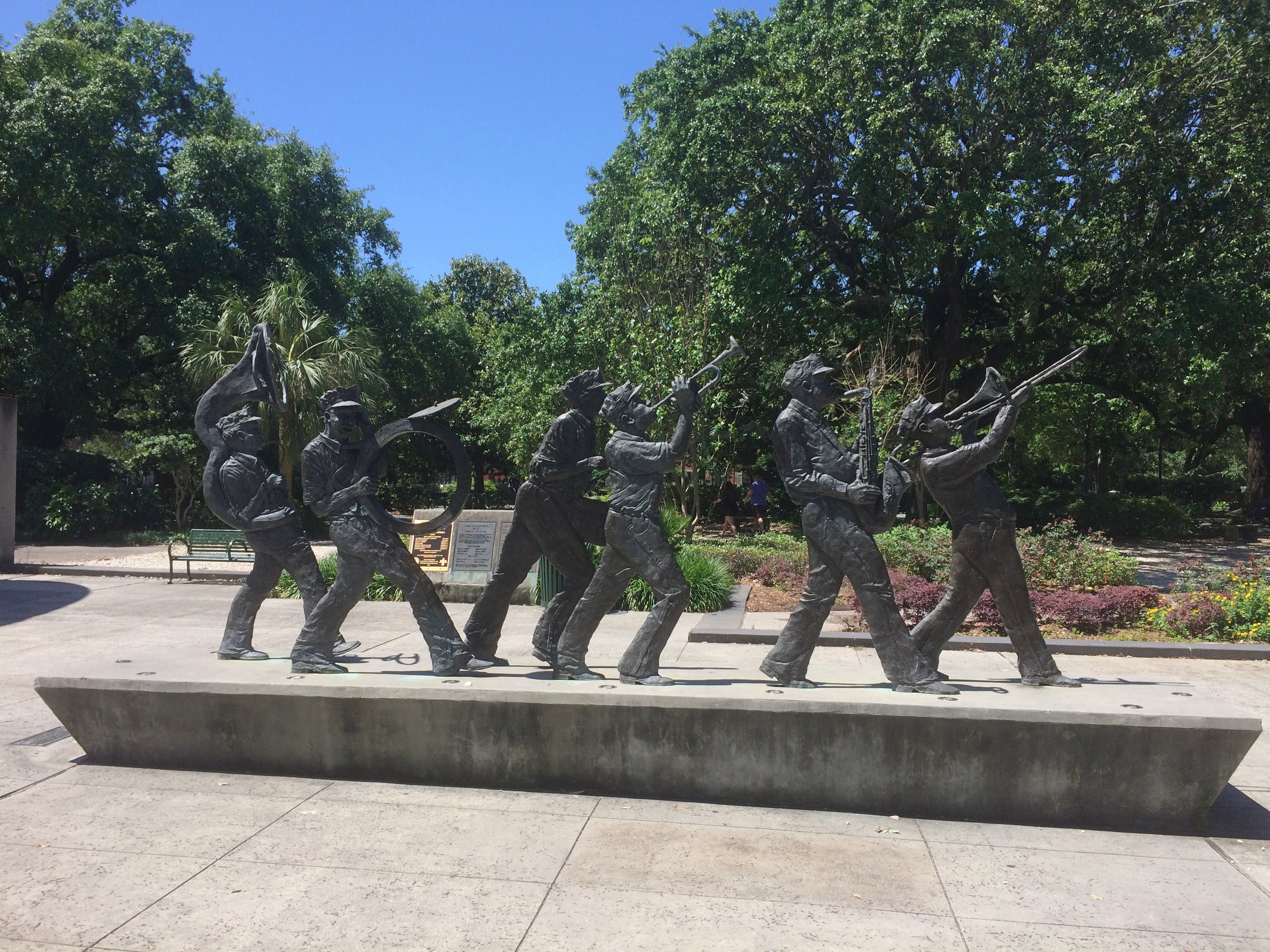
Other metal jazzmen grace the park, such as a marching brass band by sculptor and New Orleans native Sheleen Jones-Adenle, erected in 2010.
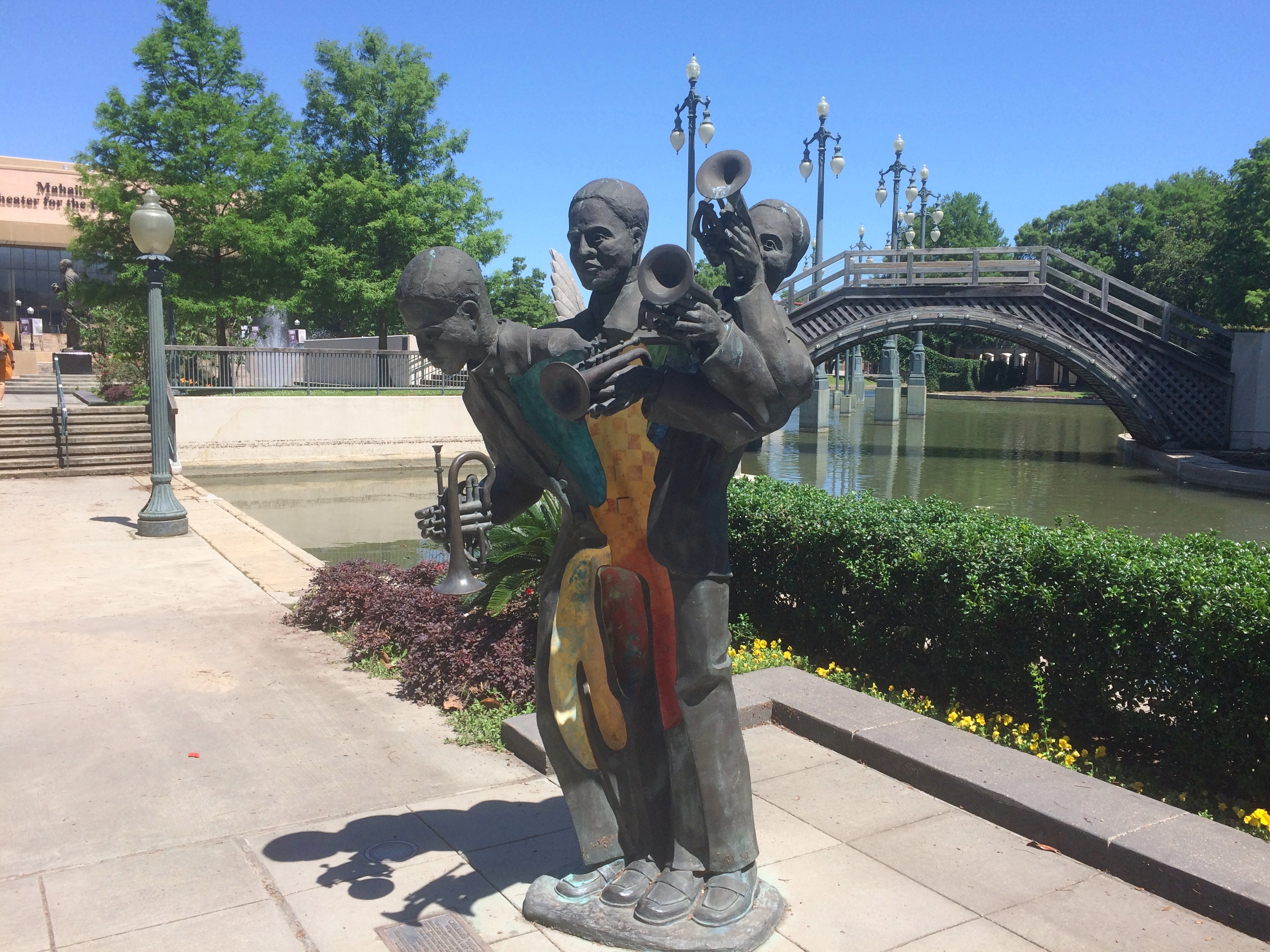
Here’s a tripartite statue of foundational jazzman Charles ‘Buddy’ Bolden created by sculptor Kimberly Dummons, also from 2010. Such triple figures aren’t common, but not unknown.

In Congo Square, there’s a vivid sculptural relief by Nigerian-born artist Adéwálé Adénlé fittingly called “Congo Square,” another of the 2010 class of works in the park.

That hardly covers everything in Louis Armstrong Park. Whoever Mike is, he made good images of these and other sculptures there.

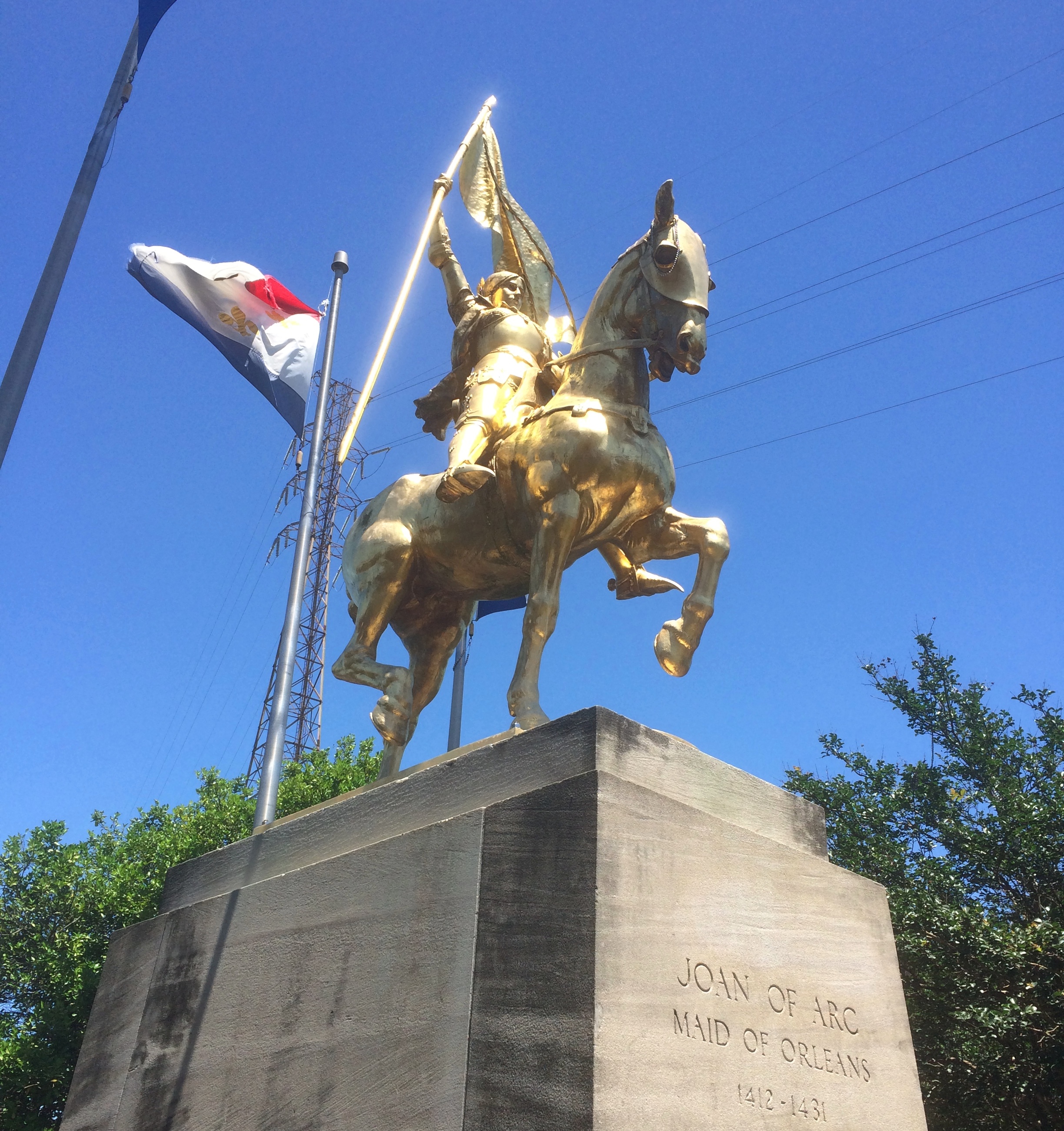
Next to the French Market, at St. Philip and Decatur Sts., is Maid of Orleans, a gift from France to New Orleans and erected in 1972.
A replica of the 1880 Emmanuel Frémiet equestrian statue of Joan of Arc in Place des Pyramids in Paris, the Maid used to be at the foot of Canal St., but when a casino was developed there, she moved to her present location in the Quarter.

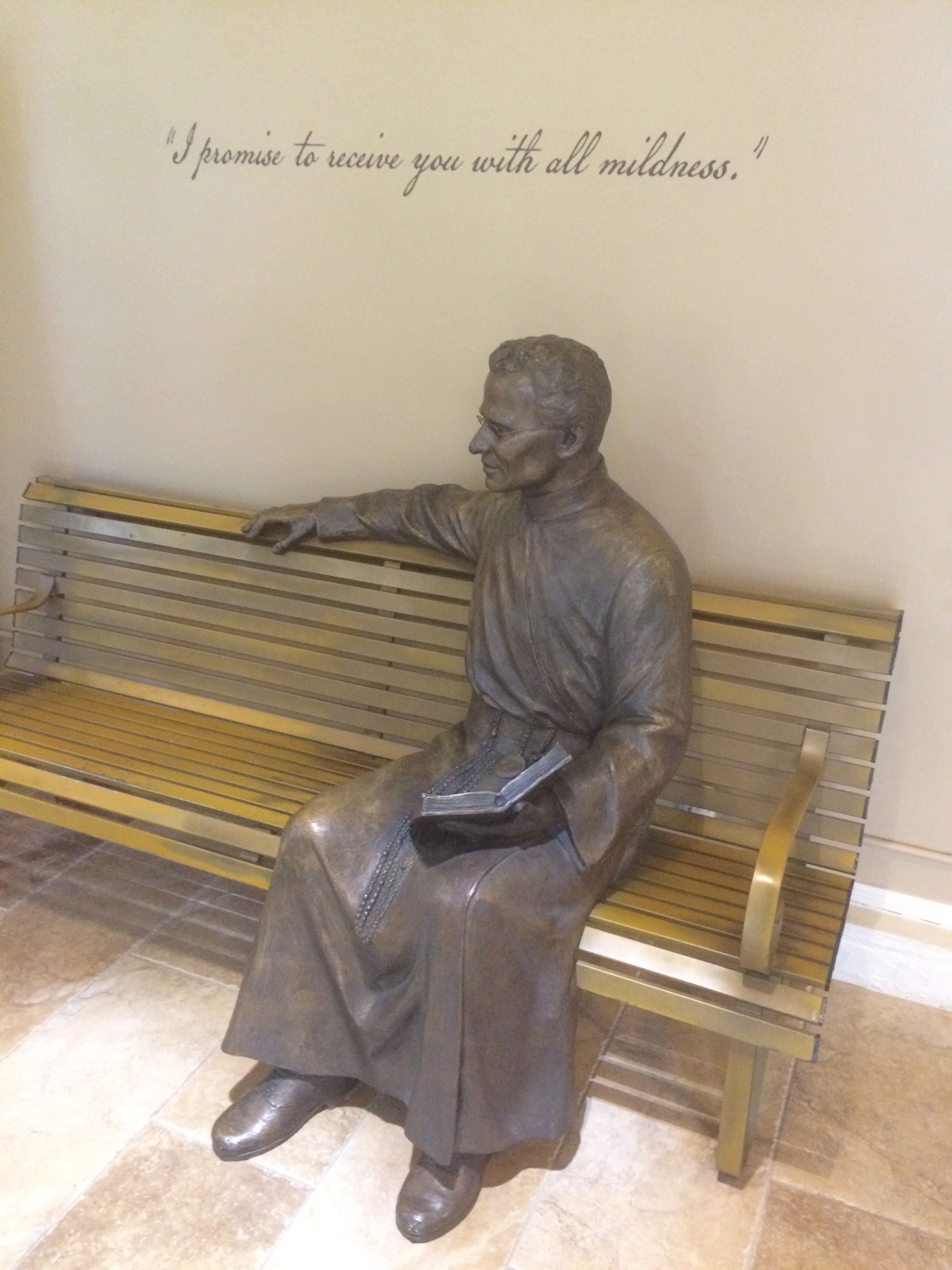
One more: A seated statue of Francis Xavier Seelos.
Francis Xavier Seelos statueHow we came see that statue, during our walkabout in the Garden District, is slightly convoluted. But that’s never stopped me from pursuing a destination.

While relaxing at the Chateau Hotel during the second evening, I queued up “Pearl of the Quarter,” a dulcet song about a New Orleans long gone and which never quite was. One of its lines: “I met my baby by the shrine of the martyr.”

A flight of Steely Dan fancy, I’m sure, but if you Google around using that term and “New Orleans,” pretty soon you come across the National Shrine of Blessed Francis Xavier Seelos at St. Mary’s Assumption Church in New Orleans. Which just happened to be not too far from where we were going to go the next day.

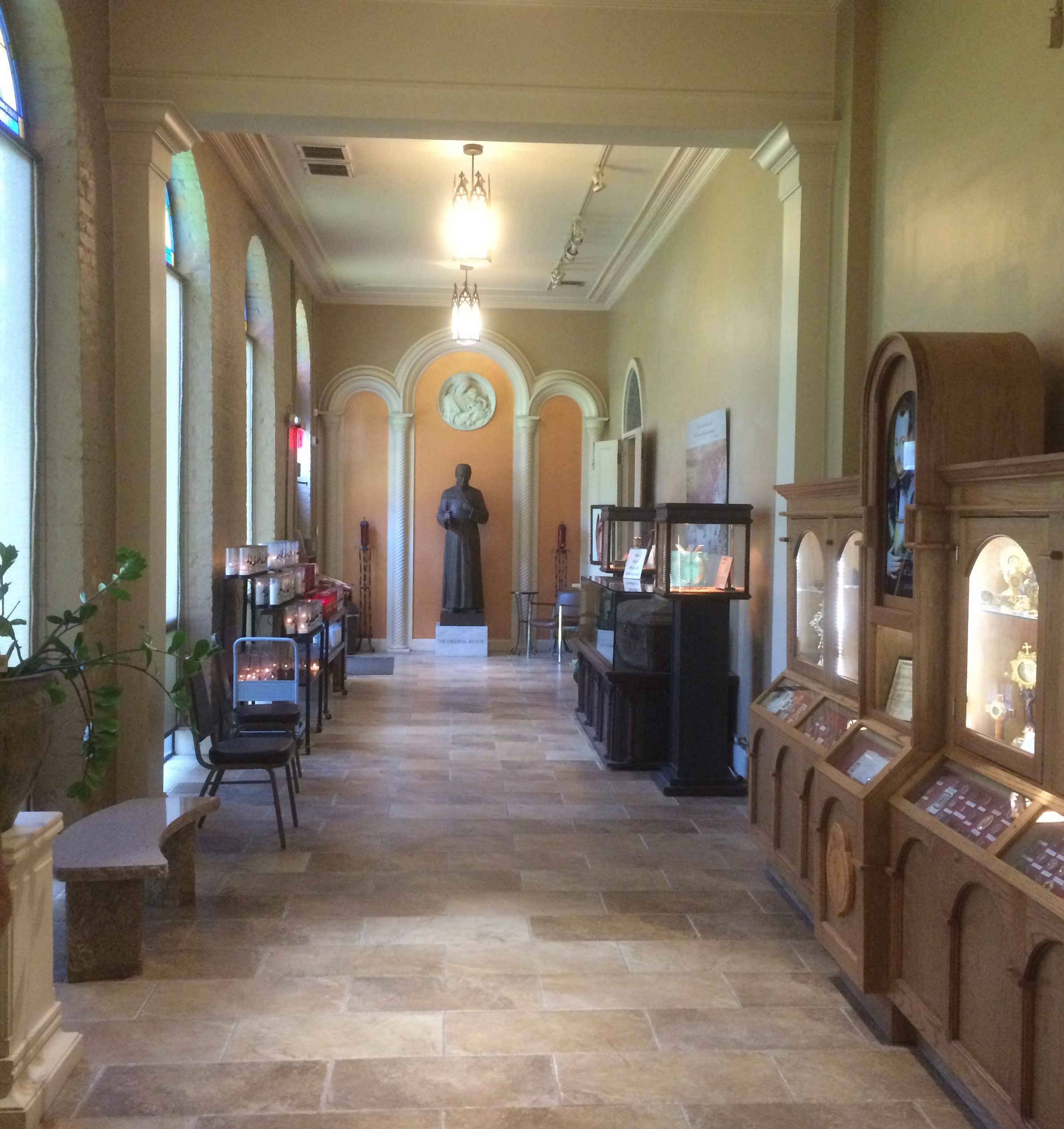
So we visited the shrine and its reliquary, which are separated from the nave of the church by a wall and a door — locked. We didn’t get to see the interior of the church as a result, which I understand is well worth seeing.

The seated statue is in the hallway outside the shrine itself, which includes a number of exhibits about Fr. Seelos, a Redemptorist from Bavaria, along with many relics and a more conventional standing statue of him at the end of the hall.

Fr. Seelos, for his part, was beatified by the church in 2000. He came to New Orleans as a missionary in the 1866.

“As pastor of the Church of St. Mary of the Assumption, he was… joyously available to his faithful and singularly concerned for the poorest and the most abandoned,” Seelos.org says.

“In God’s plan, however, his ministry in New Orleans was destined to be brief. In the month of September, exhausted from visiting and caring for the victims of yellow fever, he contracted the dreaded disease. After several weeks of patiently enduring his illness, he passed on to eternal life on October 4, 1867.”

Nicolas Cage, the Voodoo Queen of New Orleans & the Young Cemetery Enthusiast

Back again on Tuesday, after Memorial Day.

These days, you need to be part of an organized tour to legally visit Saint Louis Cemetery No. 1 in New Orleans, though considering that city’s reputation, I expect people still slip in. But I wanted to do things the official way, so on the morning of May 13, Lilly and I were part of a Free Tours on Foot tour of the historic cemetery. That’s a pay-what-you-will organization whose tours I first enjoyed in Charleston, SC.

Actually, not free in this case, even if you’re a wanker who doesn’t tip the guide at the end of the tour, since the Catholic Archdiocese of New Orleans, owner of the cemetery, demands a $2 fee per person paid upfront. Not that onerous, and I hope that it all goes to maintenance of the place. (Also, I tipped our guide, since I’m not going to be that wanker.)

New Orleans cemeteries famously sport above-ground tombs, a feature I long believed stemmed from the region’s high water table. That seems to be a common notion, repeated in guidebooks in an earlier time, and on many web sites more recently.

Our guide, an earnest young man and New Orleans history buff, told us otherwise.
What he said was pretty much in line with how an interesting web site called Interesting Thing of the Day explains it: “Tour guides seldom mention that above-ground burial was a common practice in both France and Spain, where many of the early settlers were from. Even without the resurfacing coffins — which, by the way, were the exception rather than the rule — this practice may well have been adopted simply to keep with tradition. In any case, this method is still widely used today, even though the water table has dropped considerably over the past two centuries as nearby marshes and swamps were drained.

“In New Orleans… bodies are usually placed inside the walls of the tombs. Because of the hot, subtropical climate, the tomb then effectively becomes an oven, and the high heat causes the body to decompose rapidly in a process that has been compared to a slow cremation. Within about a year, only bones are left.

“Just as an oven would not be constructed to bake a single loaf of bread, the tombs in New Orleans cemeteries are used again and again. The specifics vary depending on the exact design of the tomb, but a typical scenario is that after a year, the bones of the departed are swept into an opening in the floor of the tomb, which is then ready for its next occupant. It is a common practice to bury all the members of a family — or multiple families — in the same tomb, with names and dates added to a plaque or headstone as necessary.”

Overall, Saint Louis Cemetery No. 1 has the look and feel of a dense necropolis, with avenues of the dead running between the tombs.
Saint Louis Cemetery No. 1 Some of the tombs — a good many — are well maintained. Others, not so much.

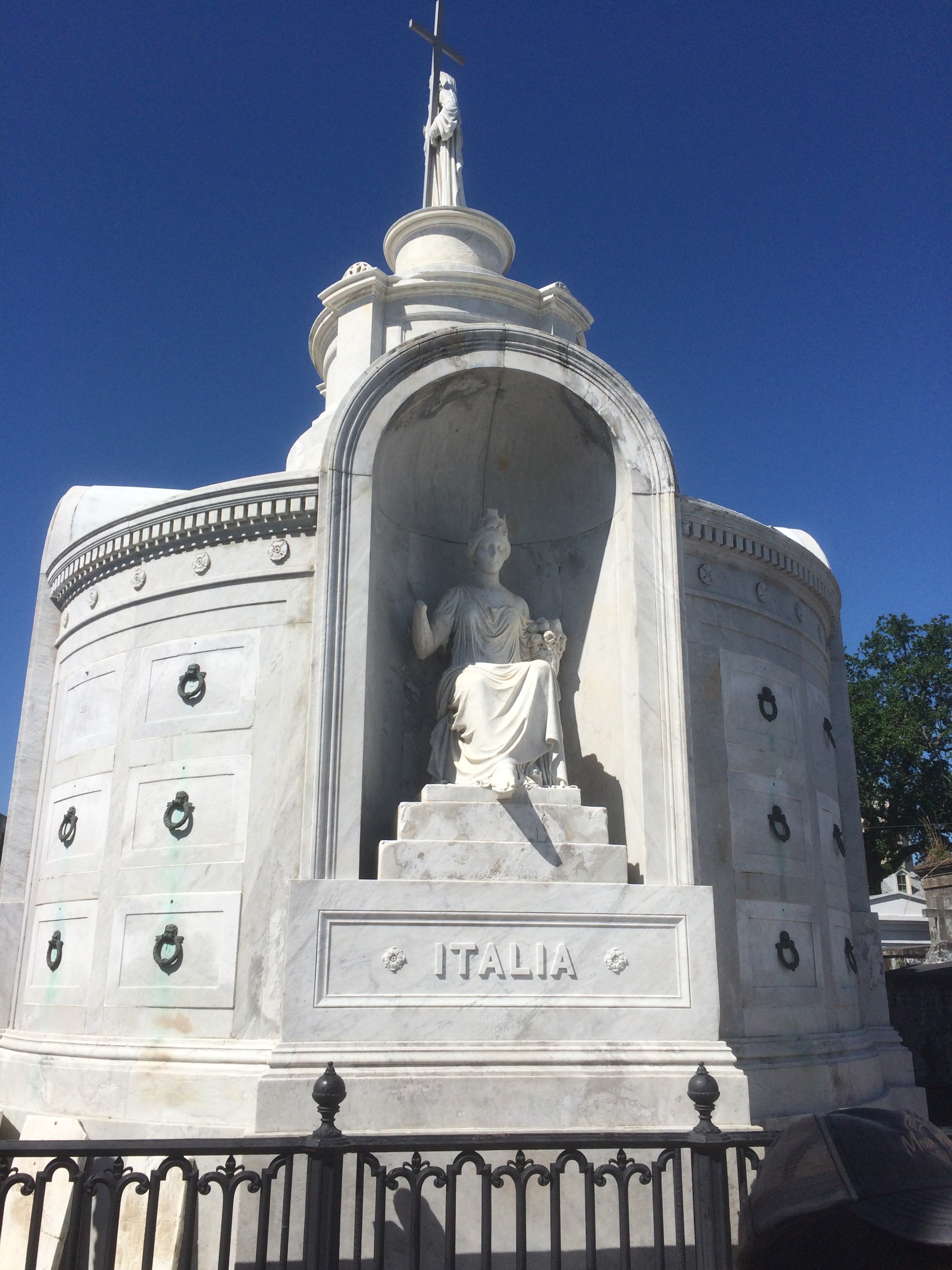
We saw a number of examples of tombs used by many occupants over the years, including those of mutual aid societies established in New Orleans in the 19th century. The most ornate of these is the New Orleans Italian Mutual Benevolent Society’s tomb.

Architect Pietro Gualdi designed the tomb in the mid-1850s and went as far as inscribing his name on it. The tomb’s 24 vaults were for the temporary use of the society’s members, with its basement serving as an ossuary. The guide said that Gualdi died of one of the diseases that killed a lot of people in 19th-century New Orleans, maybe malaria, and was one of the first people interred in his creation (Wiki asserts malaria for sure).

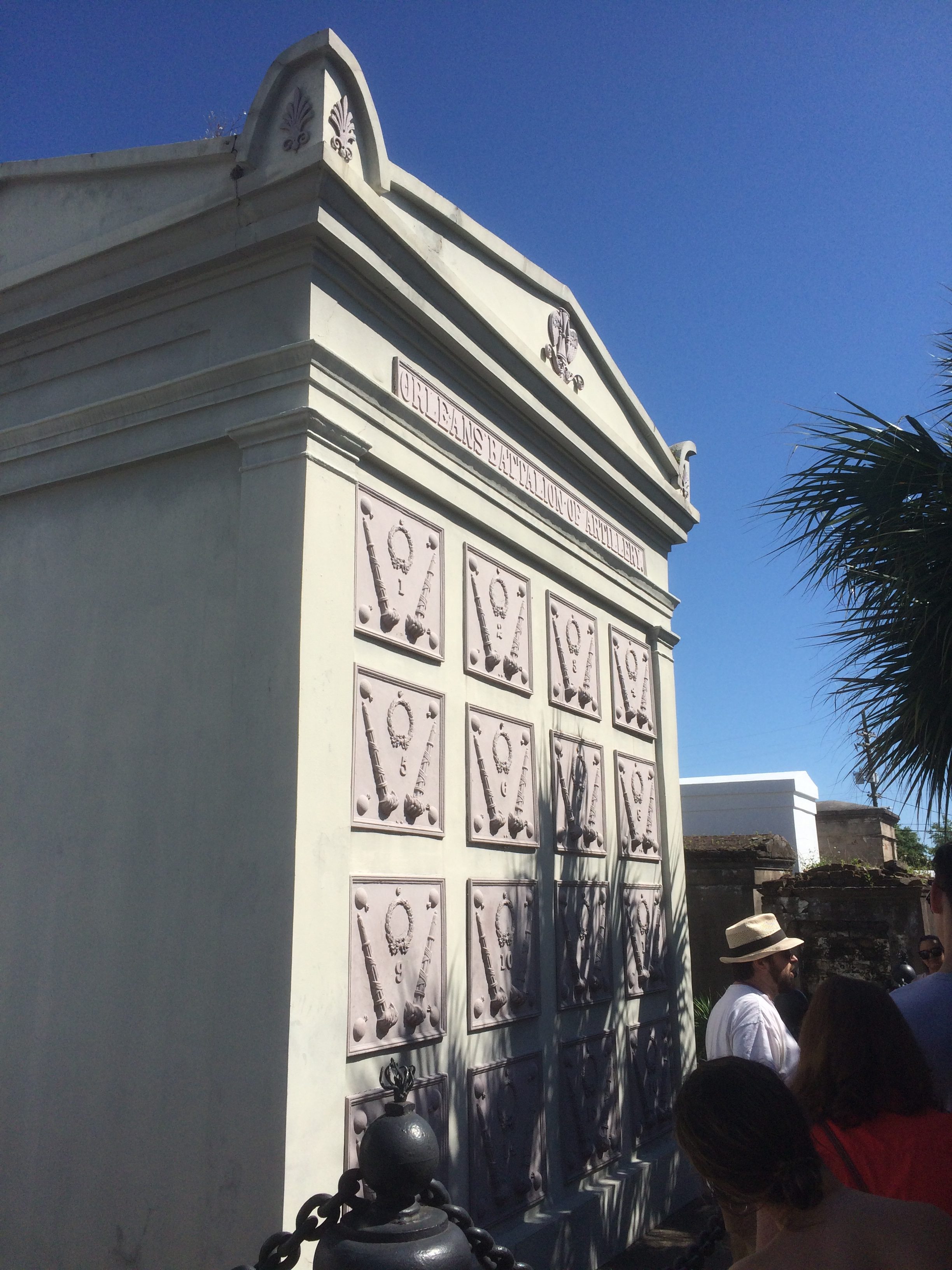
Another collective tomb: the Orleans Battalion of Artillery.

Its plaque says:

Within this burial memorial rest some of the gallant defenders of New Orleans, members of the battalion which fought in honor on the plains of Chalmette on January 8, 1815 against the British invaders.

Date of construction is unknown.

Restored in 1974

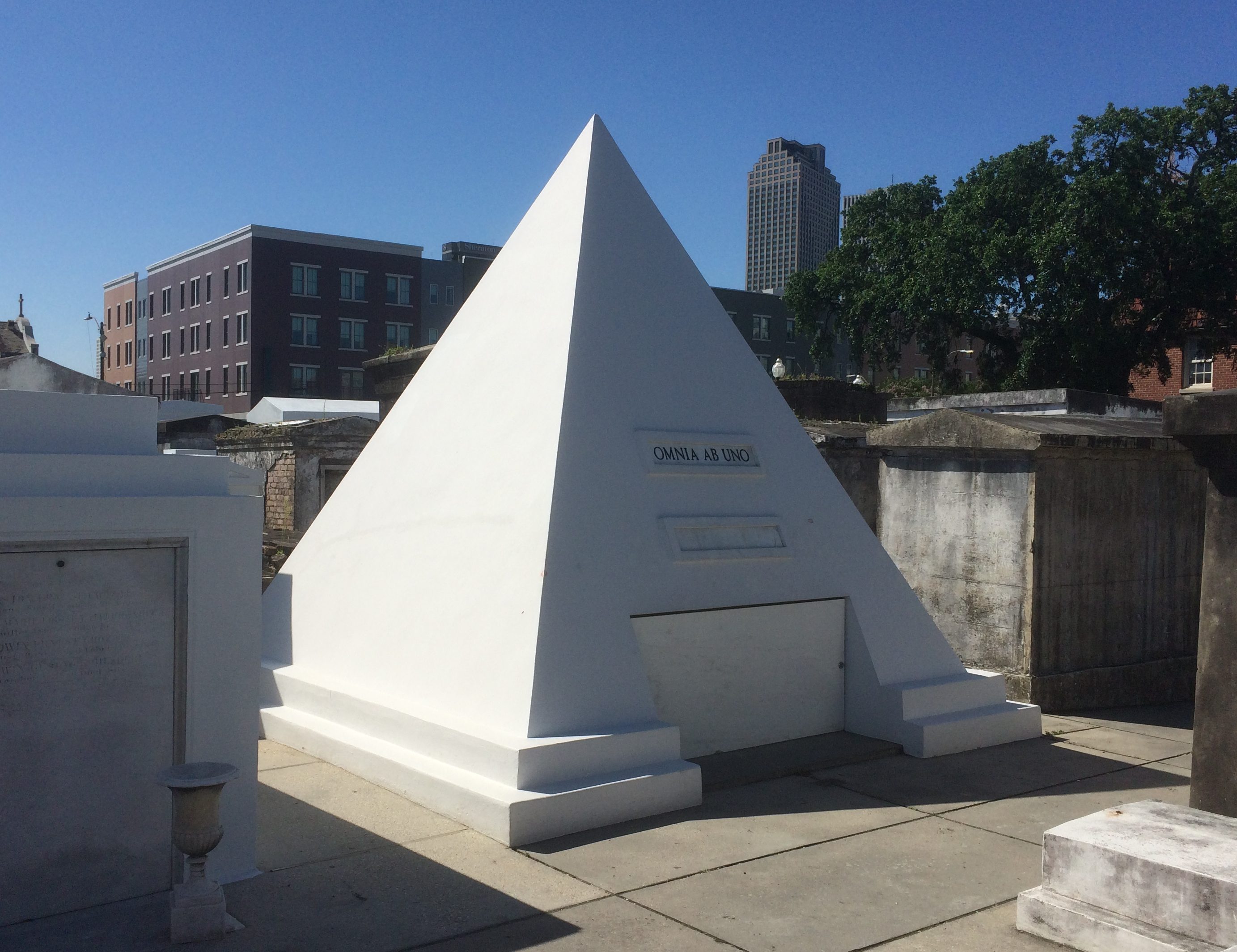
Naturally the tour went by one of the cemetery’s odder tombs — that commissioned by actor Nicolas Cage, presumably to bake his mortal remains when the time comes.
Saint Louis Cemetery No. 1 Nicholas CageI’ve read he’s gotten a lot of flack for it. The tomb does look a little out of place, but then again, pyramids aren’t unknown in cemeteries — and why do all the tombs need to be rectangular? Also, the archdiocese clearly signed off on the thing, presumably persuaded by the actor’s payment of a generous fee.

In a century, tours will probably pass by the pyramid, by that time stained and a little crumbled, and explain that an eccentric movie actor had it built for himself in the early 21st century. Maybe the guide will have to explain what a movie was. And say that the actor supposedly believed in the power of voodoo to revive him, and in fact practiced voodoo himself.

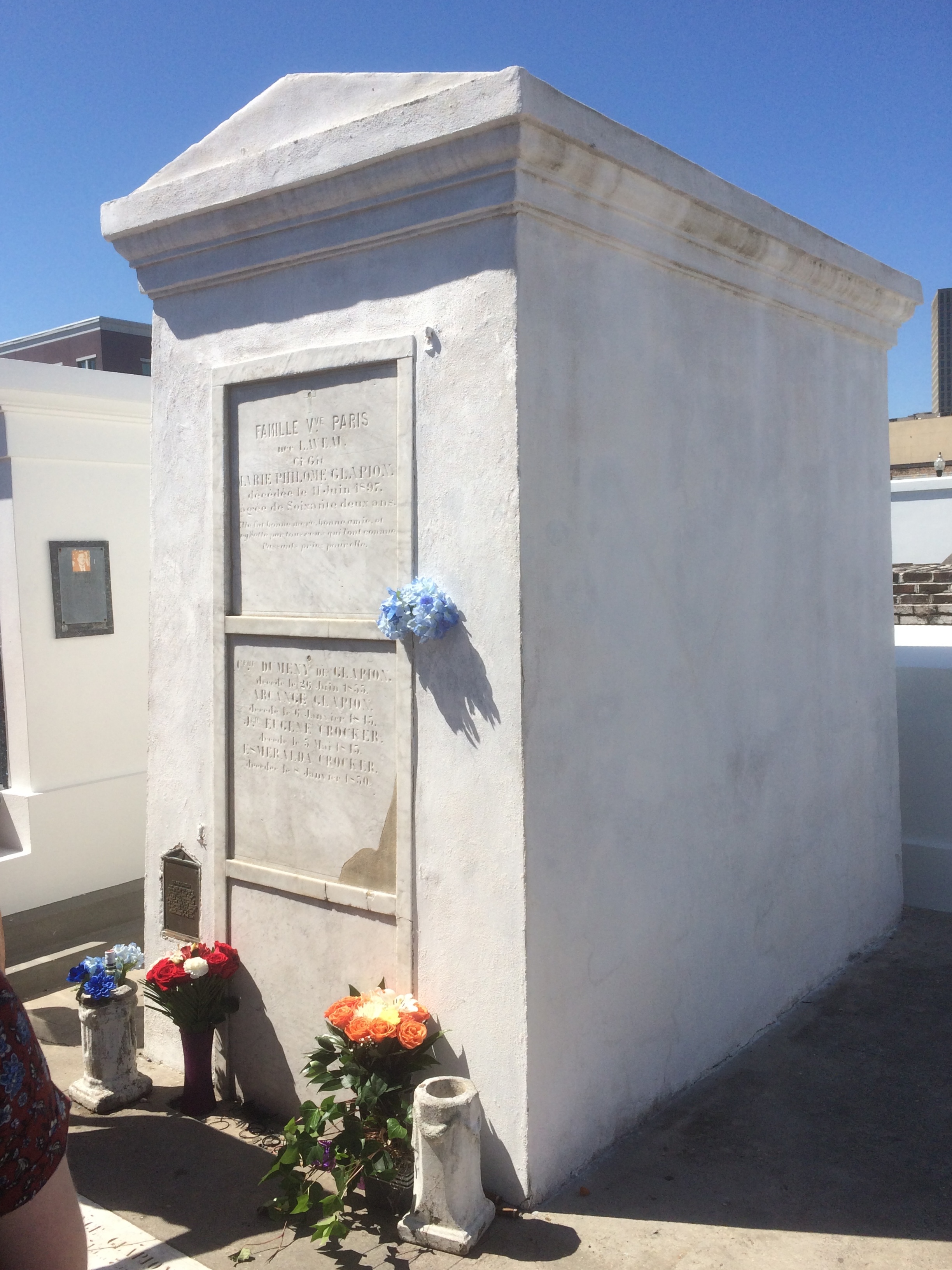
I made that last part up as an example of a story someone might tell in the future. After all, such stories occasionally cling to someone long after their death. Take the example of Marie Laveau, the Voodoo Queen, whose tomb the tour visited last (she’s there with a number of other people, per cemetery custom).
Saint Louis Cemetery No. 1 Marie LaveauMarie LaRoadside America: “Marie Laveau ran a New Orleans hairdressing salon during the day, but on her off-hours she was (supposedly) the Voodoo Queen, sought after for her potions and charms that would bring love or money to those willing to pay the price.

“Laveau died in 1881, but a tradition later developed that she could still grant favors from beyond the grave if believers either left offerings or scrawled three Xs on her tomb. This resulted in what was clearly the messiest grave in the U.S., and caused no end of headaches for local preservationists, who had to constantly clean and repair the tomb only to have it trashed again.

“They finally had enough and, on March 1, 2015, the cemetery was declared off-limits to all tourists except tour groups led by licensed tour guides.”

Marie Laveau’s grave is clean white these days, though if you look closely enough, you can see traces of those Xs drawn on the stone. As for Mme. Laveau’s skills in the voodoo arts, the guide suggested we take those stories with grains of salt. I will. New Orleans seems to have more than her share of such stories, yet we love her for it.

Usually members of a tour like this don’t have that many questions, but one young woman — college age, I think, on the tour with her mother — peppered the guide with an unusual number of questions that betrayed a strong interest in cemeteries and funerary practices.

The tour wound down at the Basin St. Station, a redevelopment between the cemetery and Louis Armstrong Park that has a New Orleans visitors center, exhibits and event space. A few of us stayed there to speak with the guide a little longer, and he and I and the young cemetery enthusiast started comparing notes about cemeteries worth visiting. I suggested Green-Wood in Brooklyn and Woodland in Dayton, though of course I can never remember its name. One suggestion of his — or hers — was Akaroa Cemetery in New Zealand, which I have to say does look pretty cool.

Houston Water Features

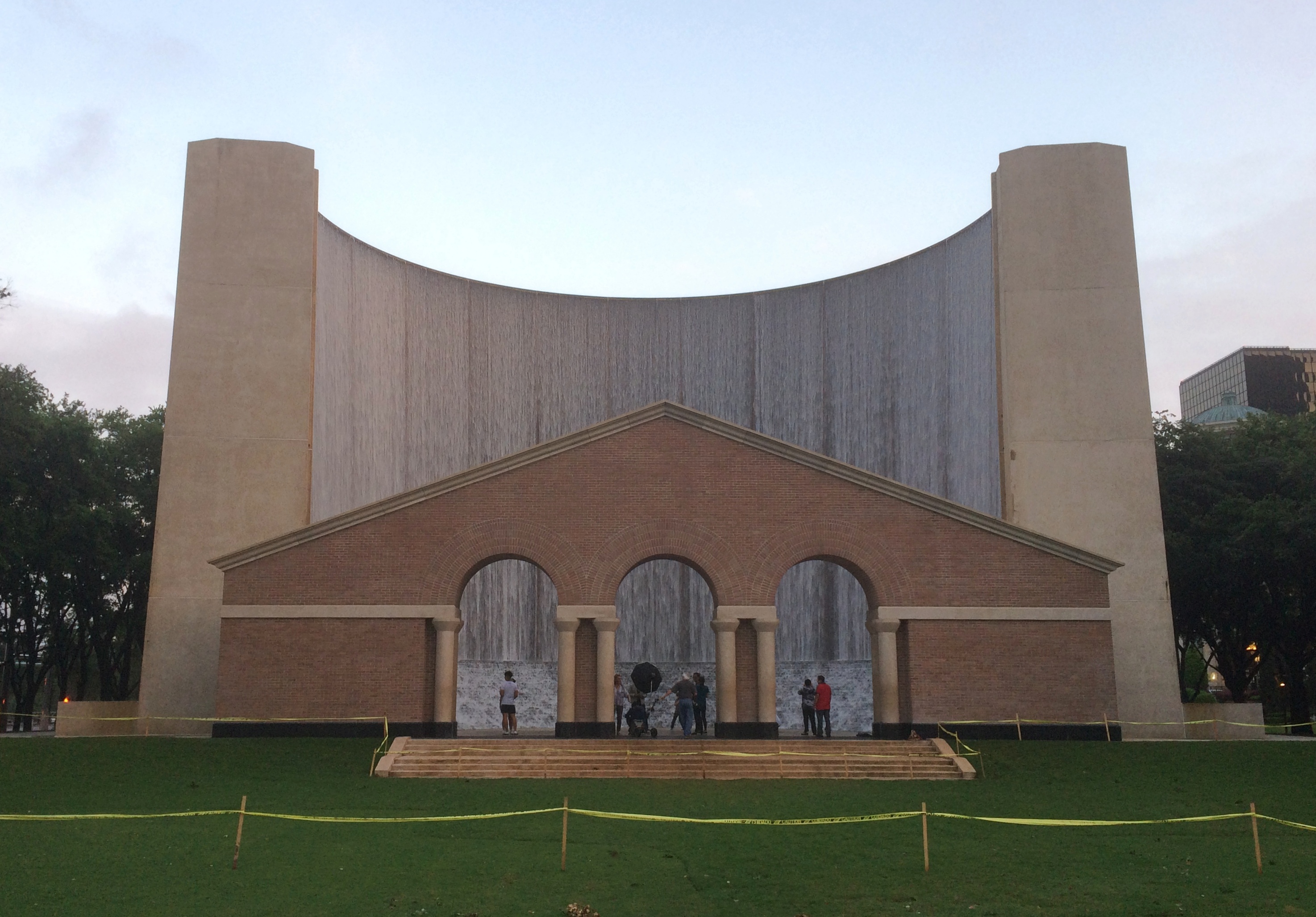
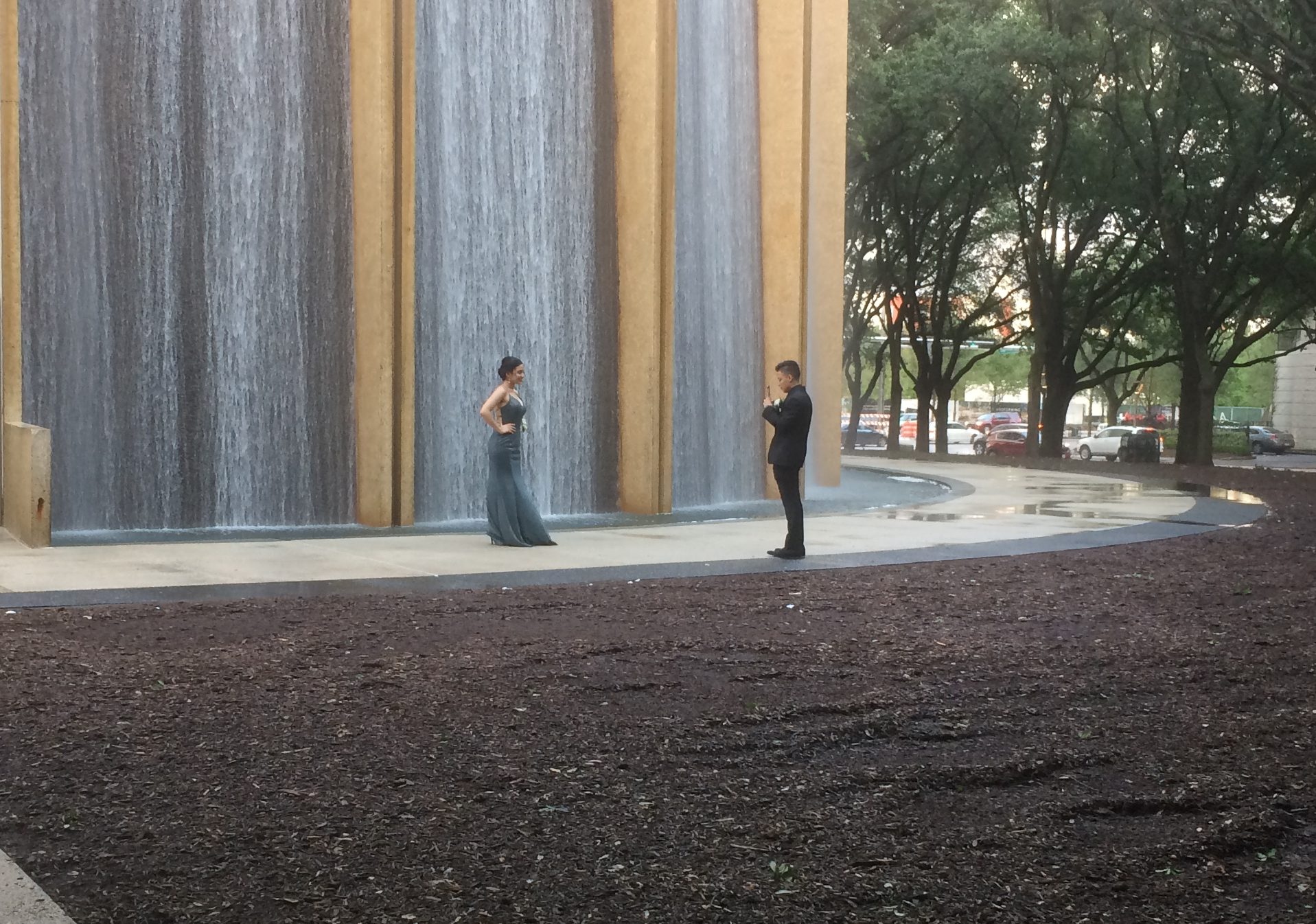
Near the Galleria in Houston, which is a mixed-use property that includes the 1.9 million-square-foot mall of that name as well as office towers and a couple of hotels, is a local feature unlike any other: the Gerald D. Hines Waterwall Park. Or more commonly, the Waterwall.

Waterwall is an apt name, with water cascading down the front.
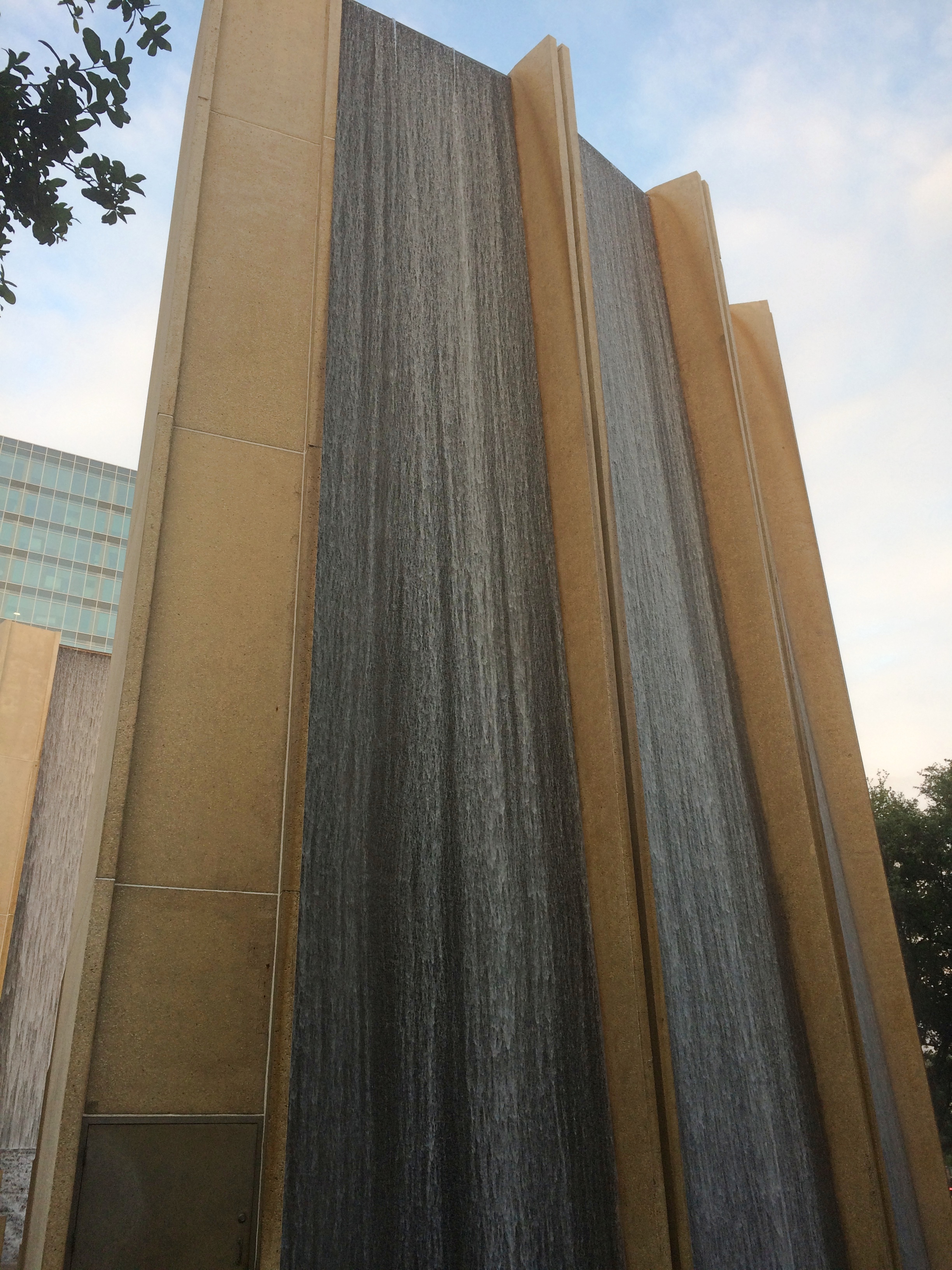
Water cascades down the back as well.
According to a nearby plaque, 11,000 gallons of water spill over the walls per minute, from a height of 64 feet. John Burgee Architects, working with Philip Johnson, designed the massive water feature, apparently inspired by ancient Roman theaters.

This is a drone’s view. All we had were our own eyes to appreciate the place.

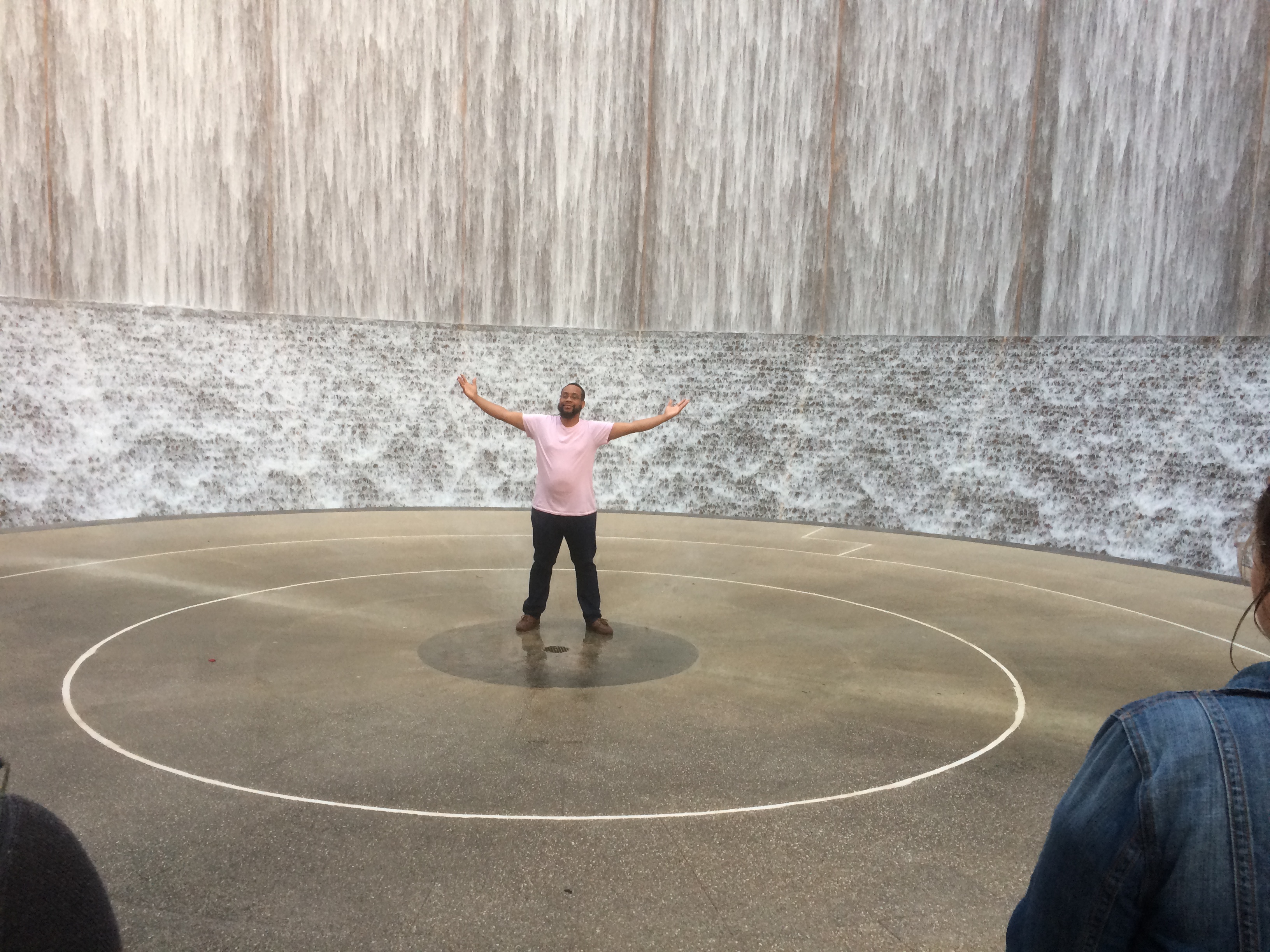
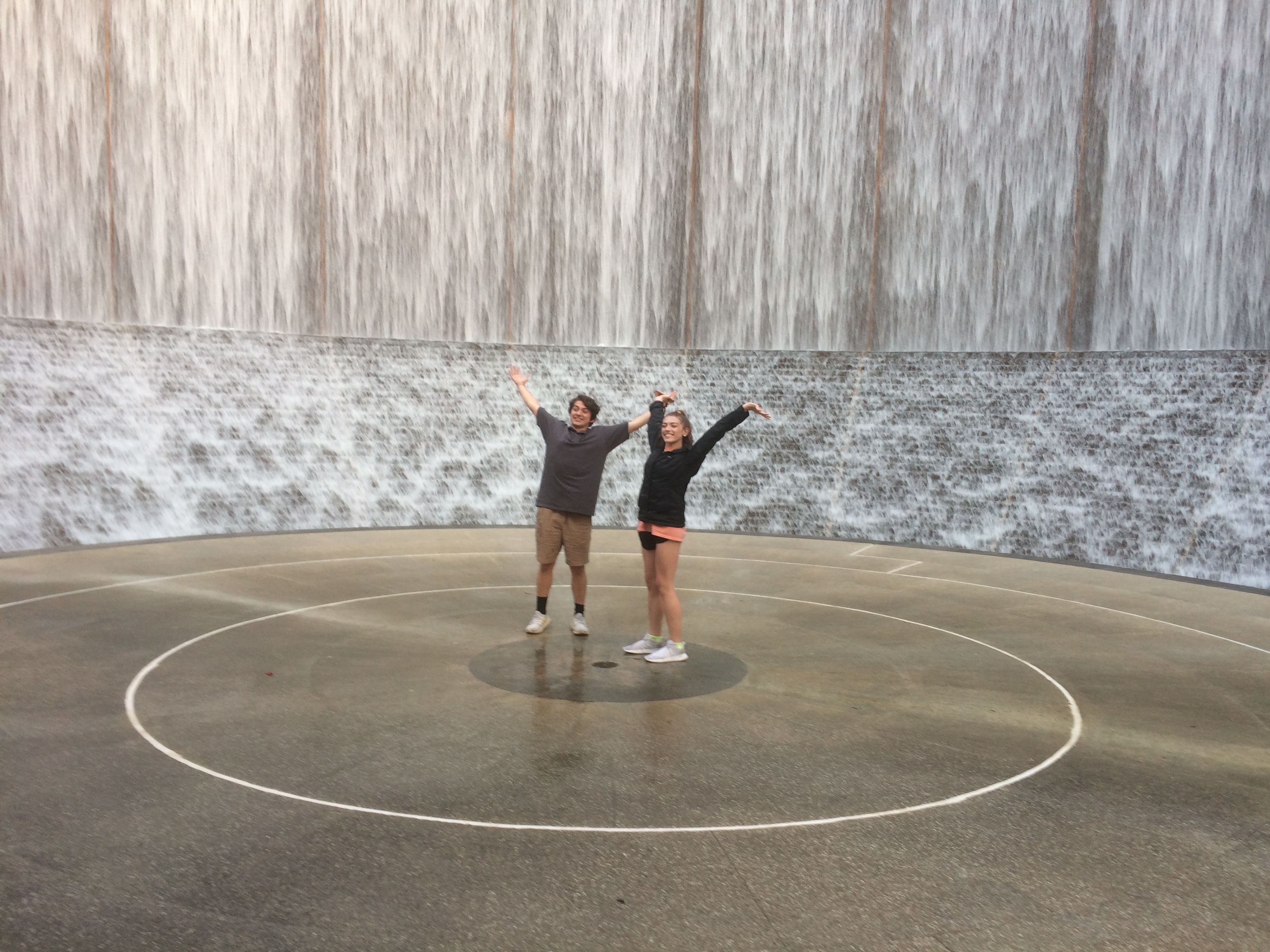
It’s a popular place to have your picture taken, front and back, but especially in the circle near the spray coming off the waterwall.
More than one person asked Lilly to take their picture at the site, including the young couple above, dressed to the nines.

Completed in 1985, Waterwall was privately owned until it looked like ownership might destroy it. In 2008, the Uptown Houston Tax Increment Reinvestment Zone, a local nonprofit, acquired the Waterwall and the surrounding land. That might have been when I first read about the Waterwall, but then I forgot about it.

We stayed near the Galleria — in the nicest La Quinta I’ve ever stayed at — and when I was mapping out a route to visit the mall, I noticed the Waterwall nearby on Google Maps. I remembered it instantly and knew I wanted to go. We saw it late on the afternoon of May 11.

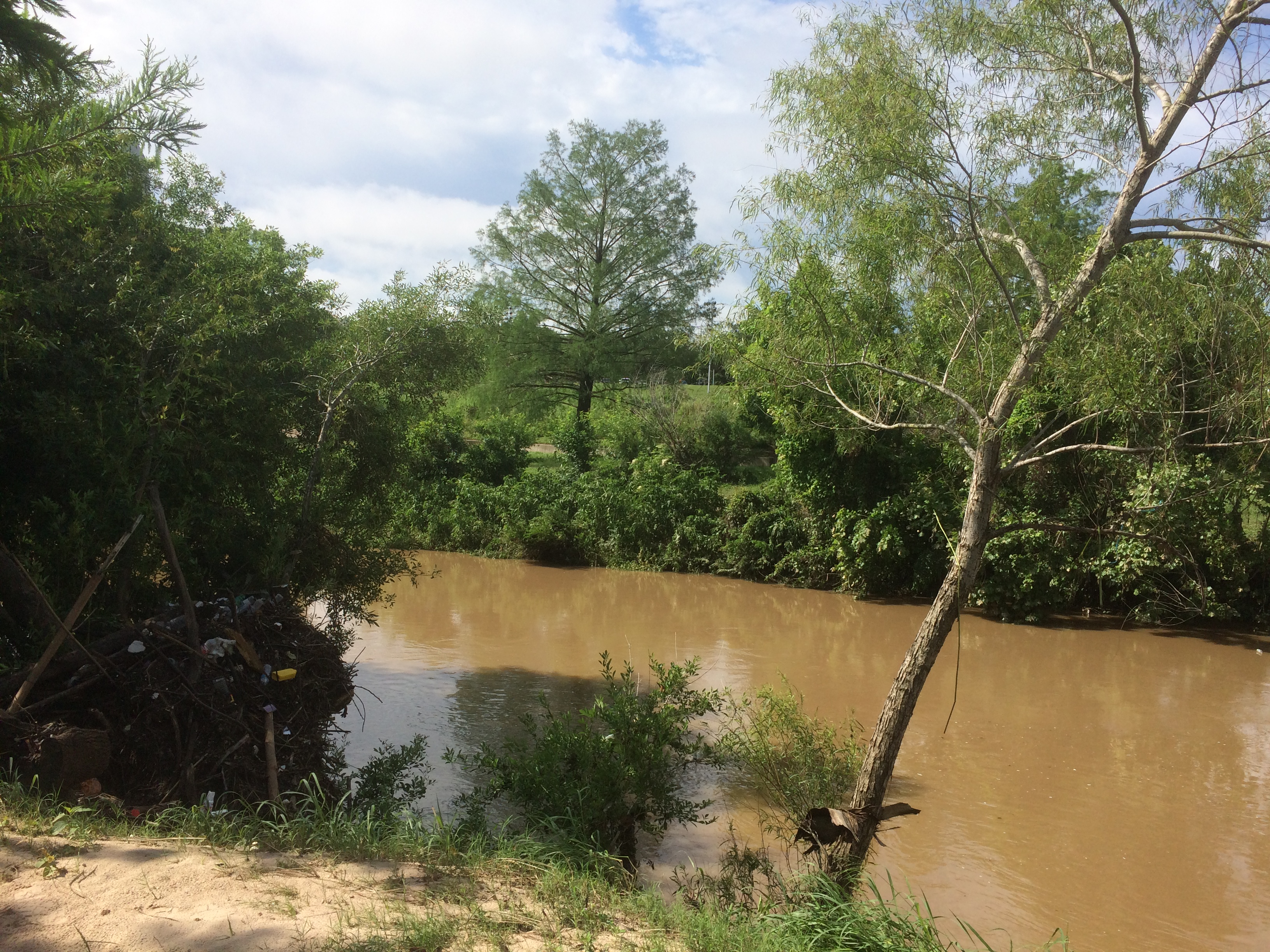
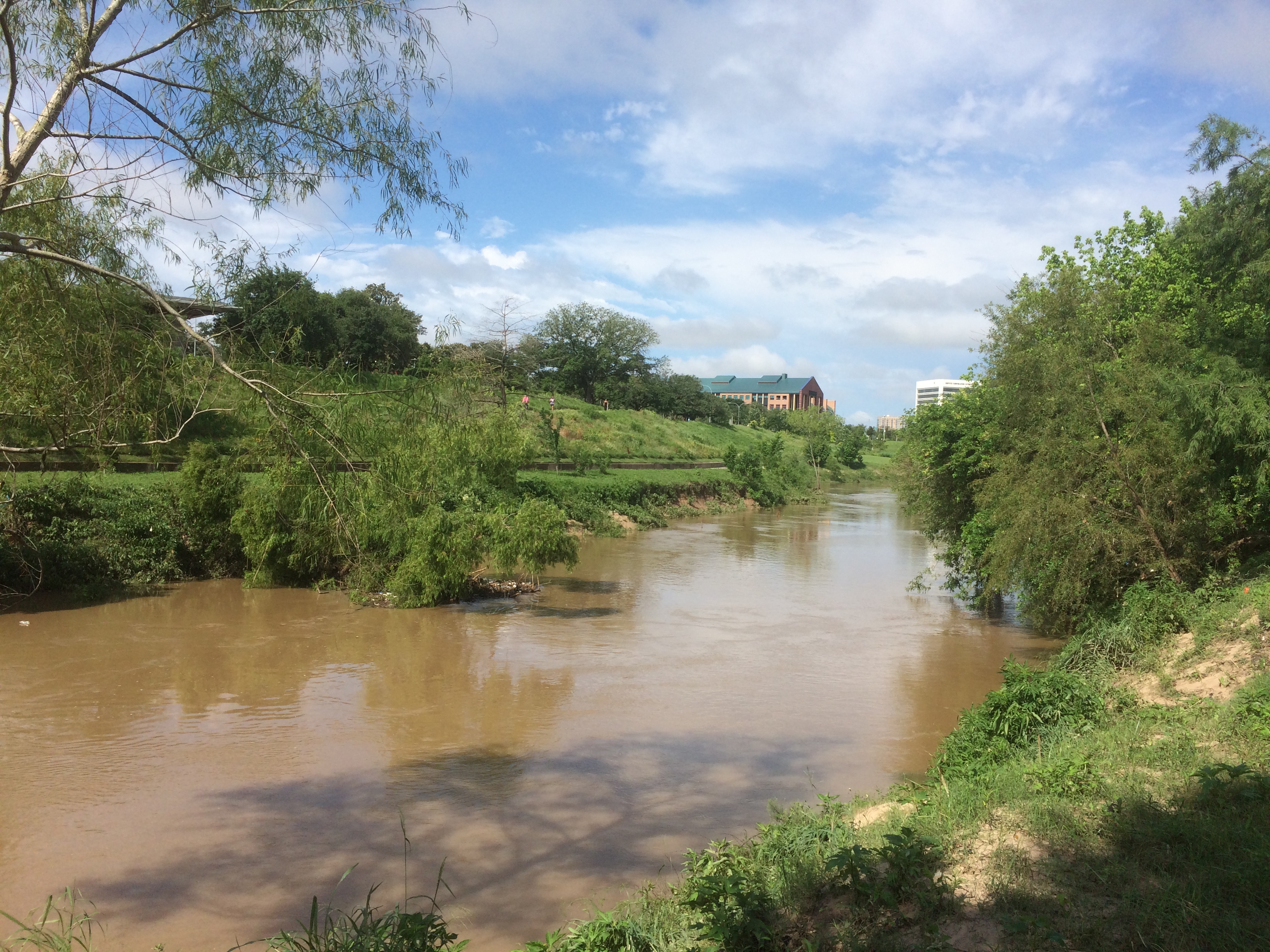
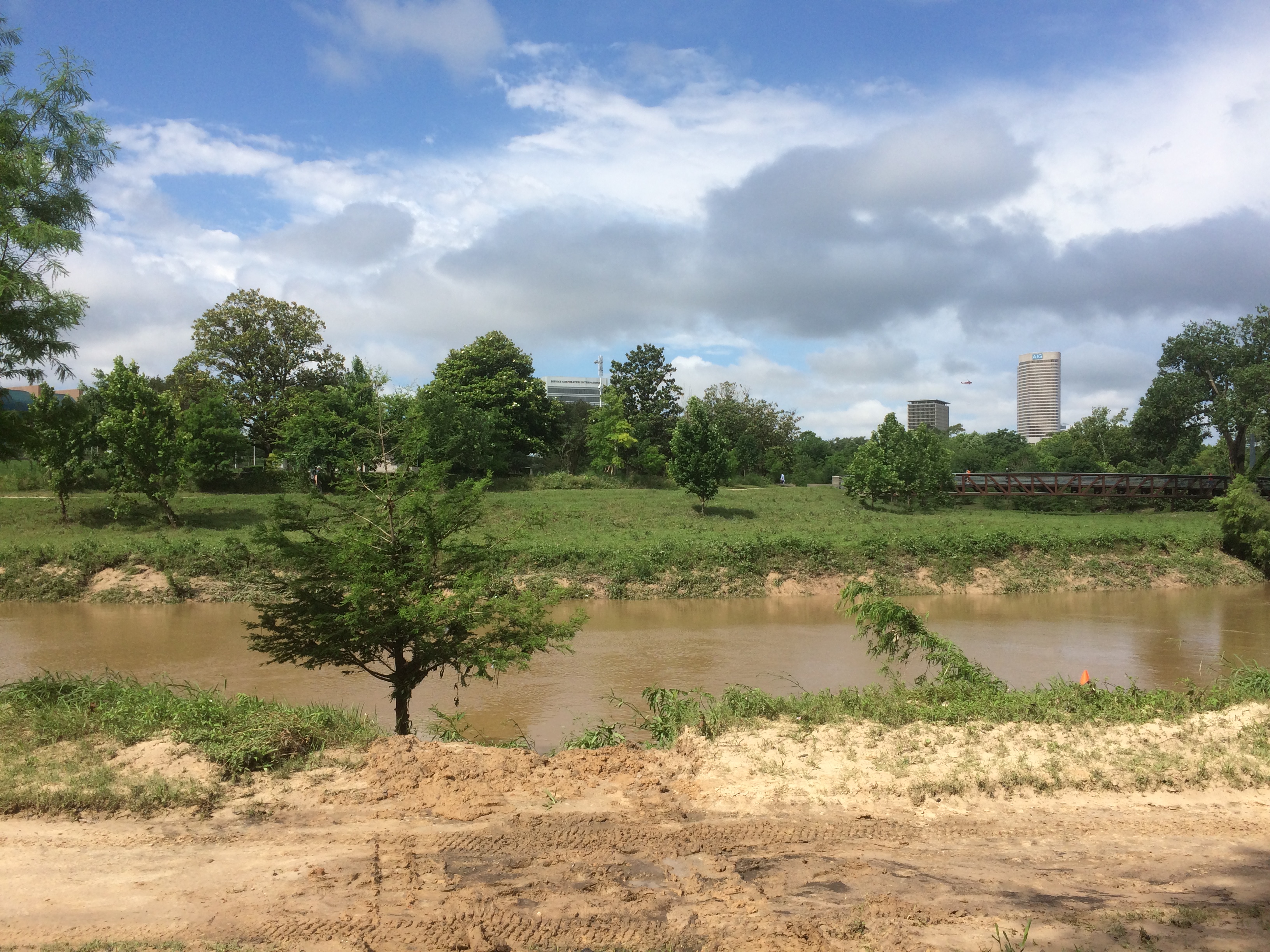
The next morning, we checked out and headed for New Orleans. But not before we spent a while near Buffalo Bayou, the main river through metro Houston. It’s another map feature that I wanted to see with my own eyes.

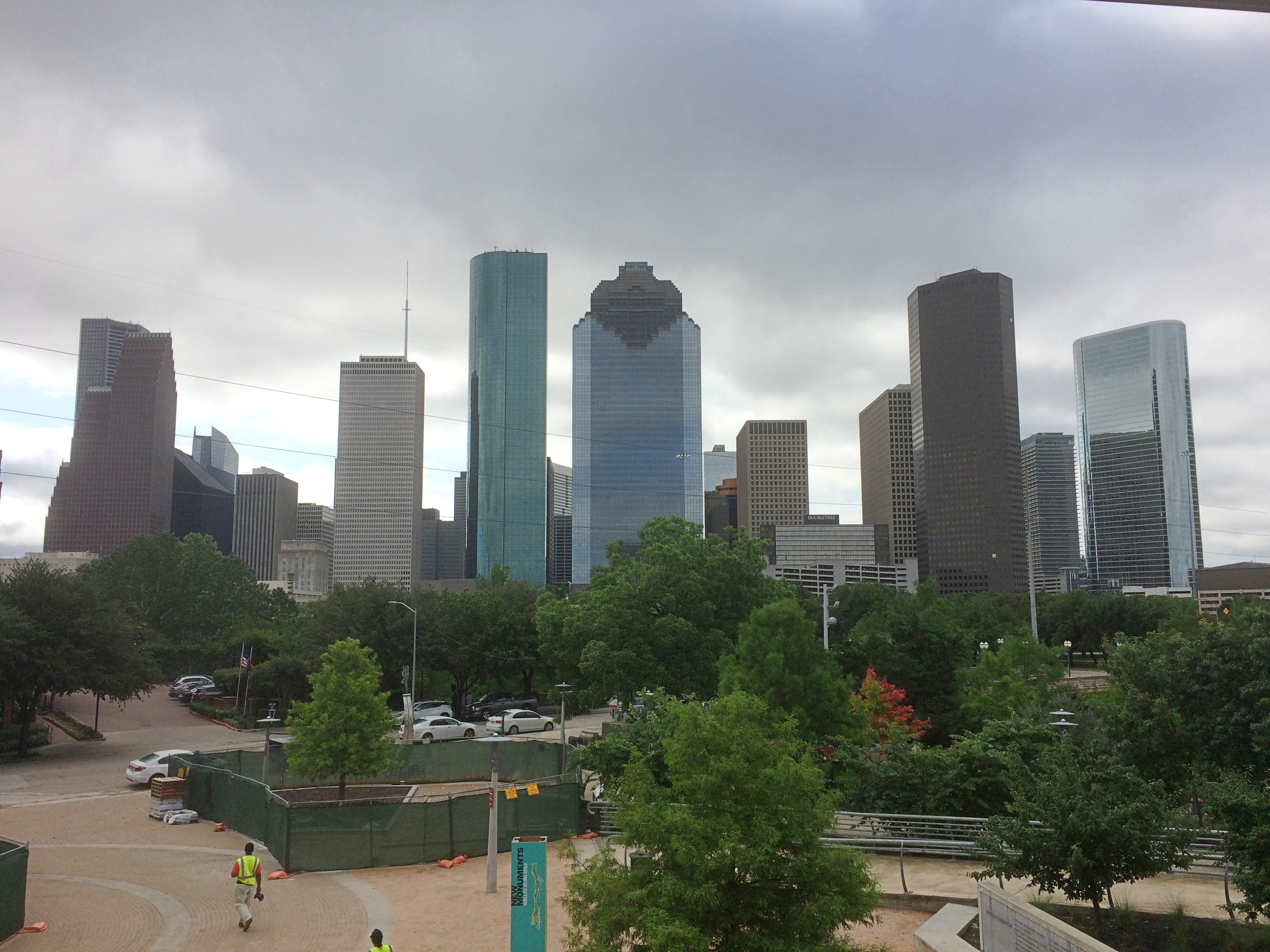
The park associated with Buffalo Bayou near downtown Houston has its charms, one of which is a view of downtown Houston.
That is the city’s original downtown, but at least in terms of office building density, the Galleria area now functions as another downtown for Houston. I knew that because I’ve read about the Galleria office market, but seeing it myself drove the point home.

Lilly and I walked along the Buffalo Bayou Park path for about an hour.

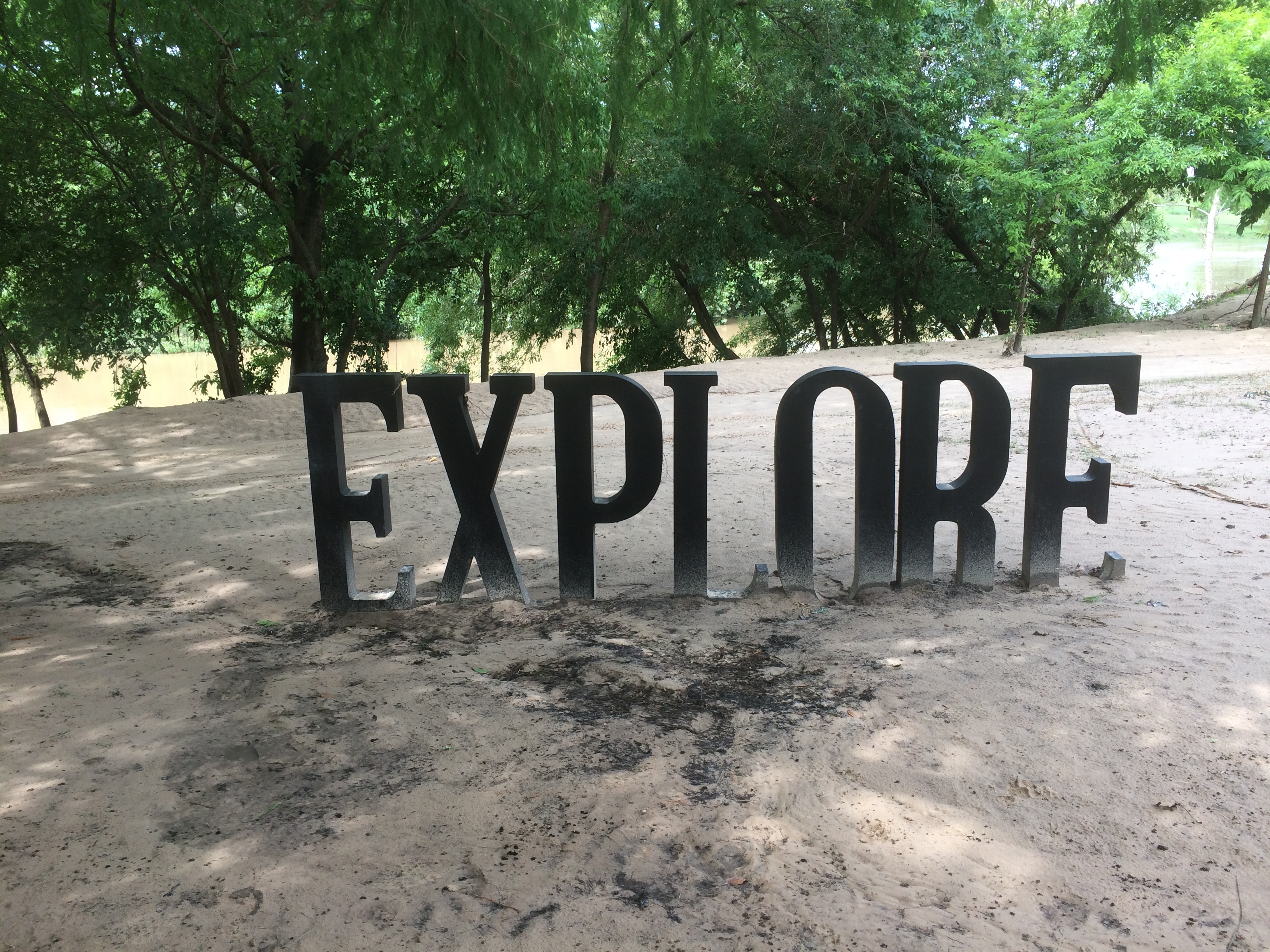
At one point, the landscape urged us onward.

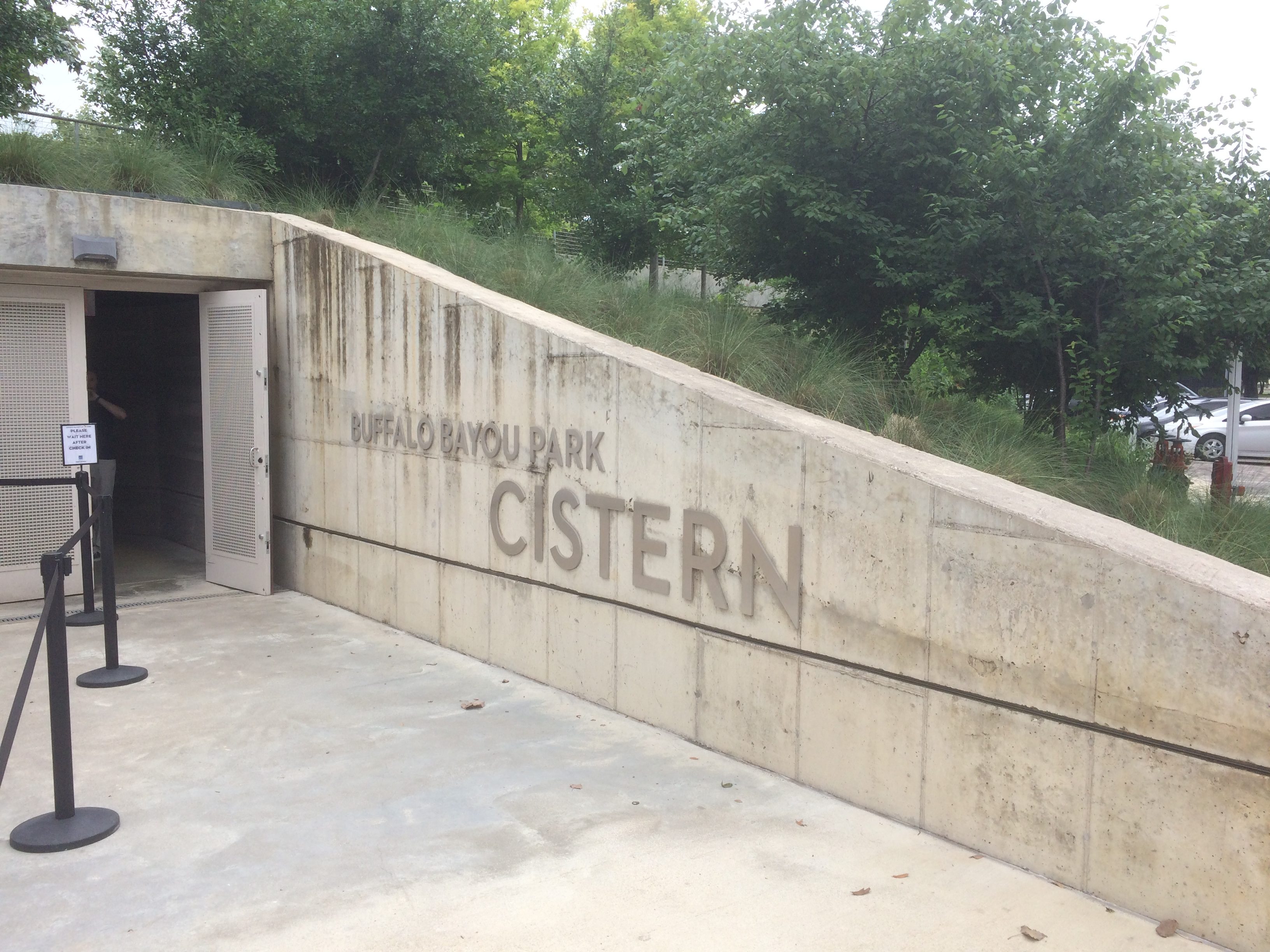
At the tip end of Buffalo Bayou Park facing downtown is the Buffalo Bayou Park Cistern. I can’t remember when I read about that. It wasn’t long ago.
Maybe in the likes of Atlas Obscura. That publication saves me the trouble of writing a description, along with the embarrassment of publishing the crummy pictures that I took inside the cistern.

“Built in 1926, this 87,500-square-foot… space was one of Houston’s first underground reservoirs,” the Atlas says. “The eight-inch-thick concrete roof is supported by 221 concrete pillars reaching 25 feet high that march in rows into the dim distance.

“A public works facility for decades, an irreparable leak was eventually found in the structures walls and thus it was subsequently decommissioned in 2007. The city was preparing to demolish it when it was found by the partnership developing Buffalo Bayou Park. After briefly considering using it for parking or mulch storage, the developers decided to keep it as an unusual and attractive space for park visitors.”

We took the 20-minute tour inside. “That was cool,” Lilly said afterward, meaning it metaphorically, not literally. I was expecting the inside of the cistern to be cool like a cave, but it was closer to room temperature. Anyway, I completely agree with Lilly.

Wolf Point & The Merchandise Mart Hall of Fame

On Friday I went to downtown Chicago for business. Since it was a warm, clear spring day, I wanted to do a more extensive walkabout, especially in the River North area, where I attended to business. But I didn’t have much time.

Instead I was able to take a quick walk near the Chicago River, mostly on the way to my appointment and heading back to Union Station afterward. I was near the place where the river divides into its North and South Branches, which is known as Wolf Point and is the origin of the Chicago Municipal Device.

For quite a while, Wolf Point was oddly underdeveloped, at least compared with the rest of the riverfront. For instance, until recently the point was occupied mostly by a parking lot.

No more. The latest project there, Wolf Point East, is still under construction.

So Wolf Point looks a little different than at the beginning of this decade, and a lot different than it did in 1833.

Hines, Joseph P. Kennedy Enterprises, the AFL-CIO Building Investment Trust and PNC Realty Investors are the developers of Wolf Point East; Pelli Clarke Pelli did the design. The 60-story tower will have 698 residential units — upper-end rentals — that will be available late this year.

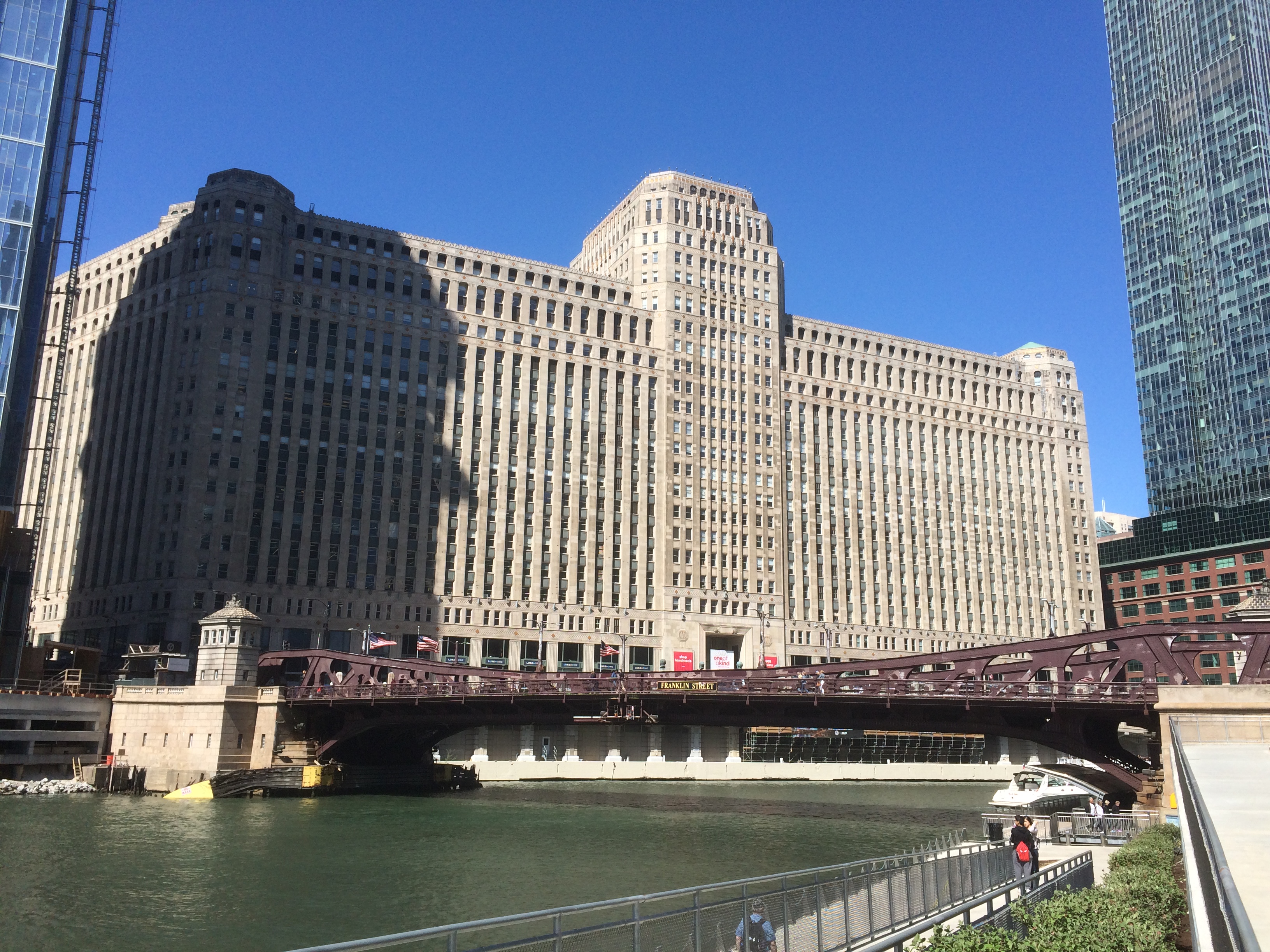
Just to the east, of course, is the 4 million-square-foot Merchandise Mart, seen here catching a shadow in the mid-afternoon.

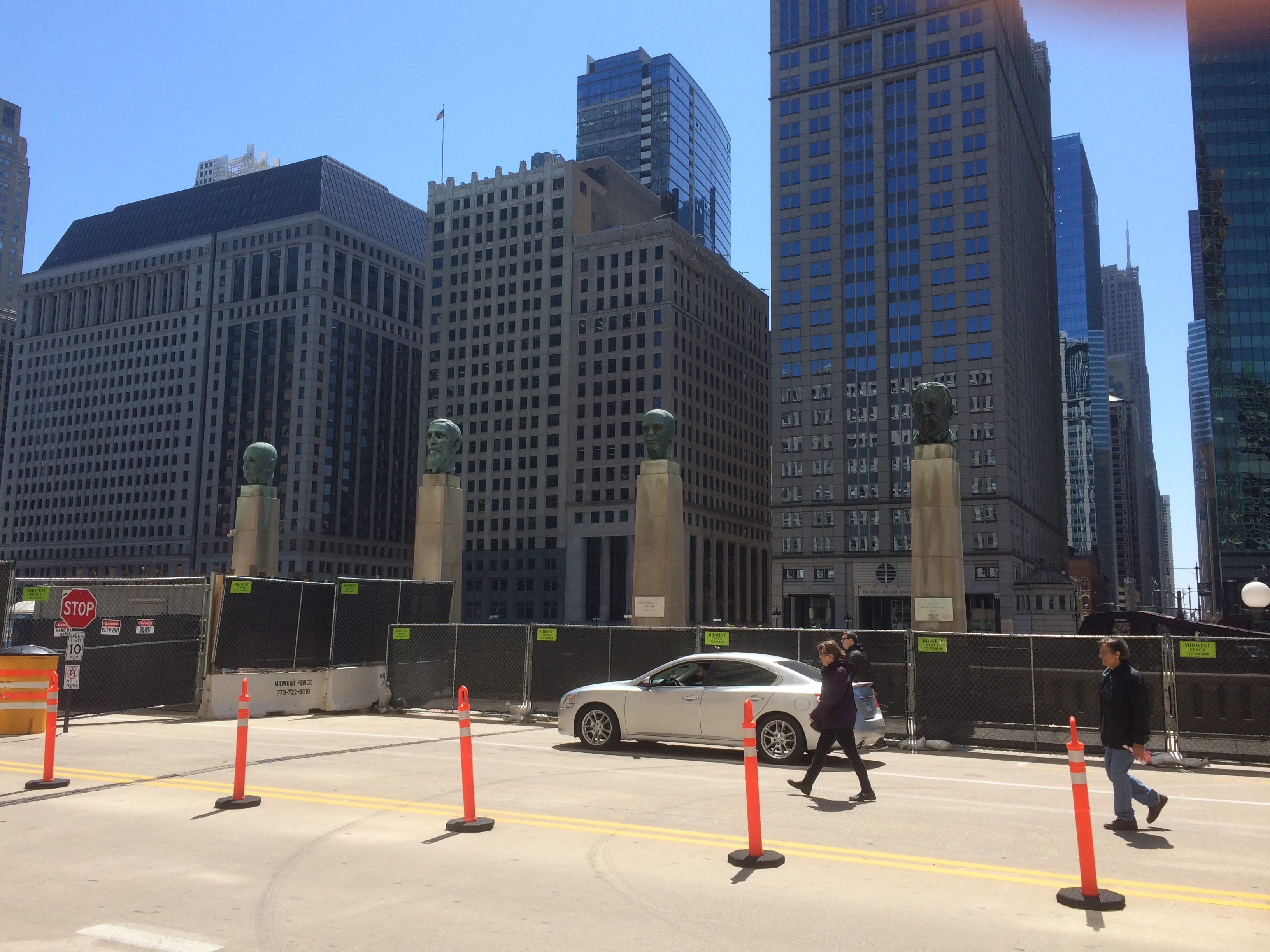
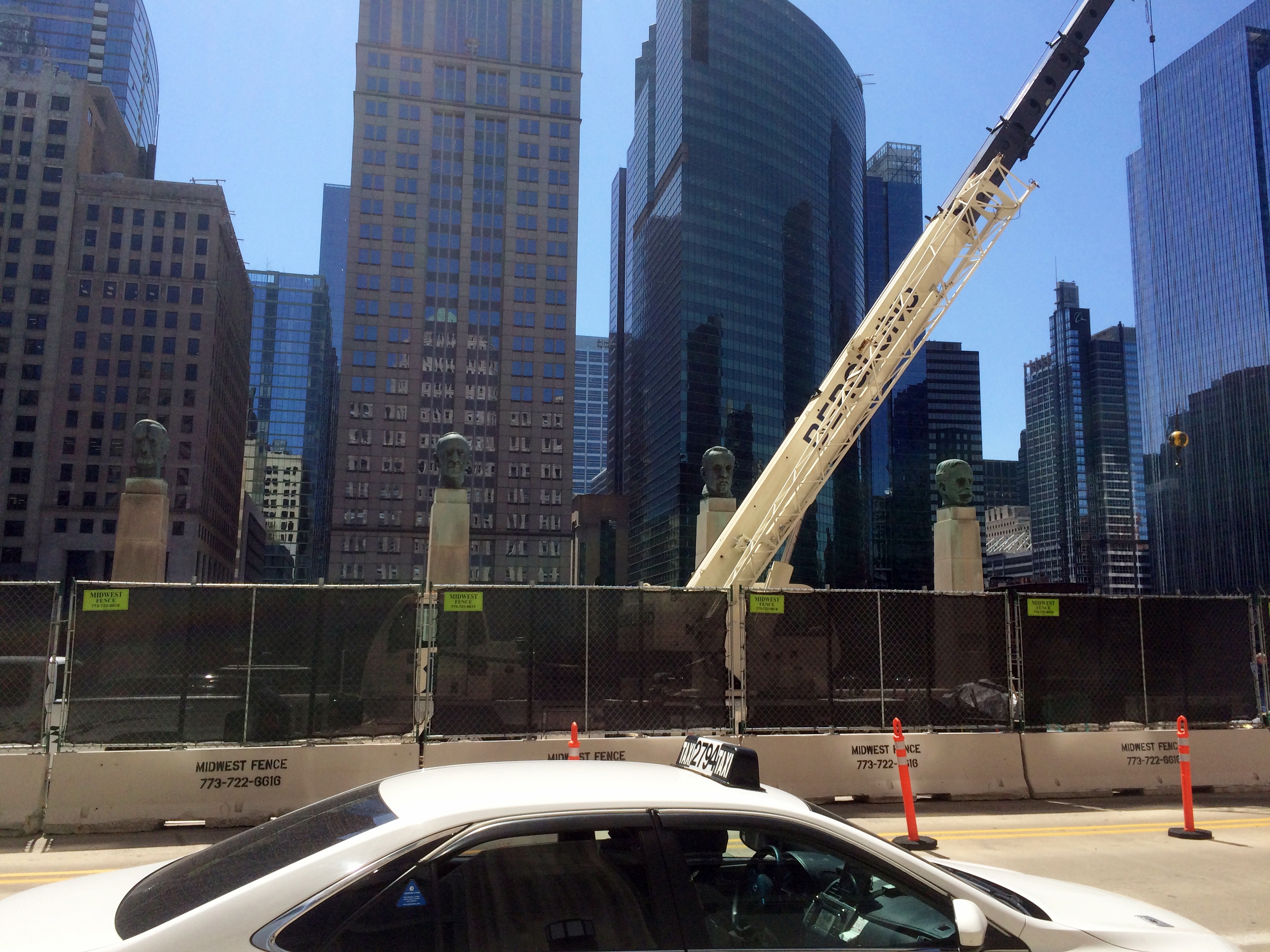
A street runs between the Merchandise Mart and the river — the unimaginatively named W. Merchandise Mart Plaza — and from there, you can see the Merchandise Mart Hall of Fame. That is, eight bronze busts honoring one-time U.S. merchant princes, each facing the building. Joseph P. Kennedy himself commissioned the busts in the early 1950s, which was possible because the Kennedy family owned the Merchandise Mart for many decades.

The busts are in two groups of four. These are the busts to the west. They don’t look so large from across the street, but the heads are four times the size of a regular human head.
From left to right: John Wanamaker, founder of the stores by that name; George Hartford, founder of A&P; Edward Filene, founder of those stores; and Montgomery Ward.

These are the busts to the east.
Construction and taxis whizzing by made it a little harder to make an image, but in any case they are Robert Wood, a chairman of Sears; F.W. Woolworth; Julius Rosenwald, another chairman of Sears and founder of the Museum of Science and Industry; and Marshall Field.

More about each of the busts is here. Twelve years ago, at least, they looked like they needed some restoration. I didn’t get quite close enough to them this time to know whether that has happened.

Champaign Stroll & Digressions From Kung Fu to the Match King

After visiting the University of Illinois Arboretum on Easter, we returned to Lilly’s apartment briefly and took a walk from there a few blocks to the UIUC campus. Blocks heavy with businesses supported by students. Along the way everyone else went into one of them, Kung Fu Tea, for bubble tea to go, while I waited outside with the dog.

Kung Fu Tea is a chain I’d never heard of. Lilly didn’t understand why I was amused by the name. But she’s unable to imagine the following variation on an old TV narrative.

“Grasshopper, when you can take the tapioca pearl from my hand, it will be time for you to leave.”

I just found out that Kung Fu is available on Amazon for no extra charge. I was an intermittent viewer when the show was originally on the air, which was 45 years ago anyway, so I might give it another go.

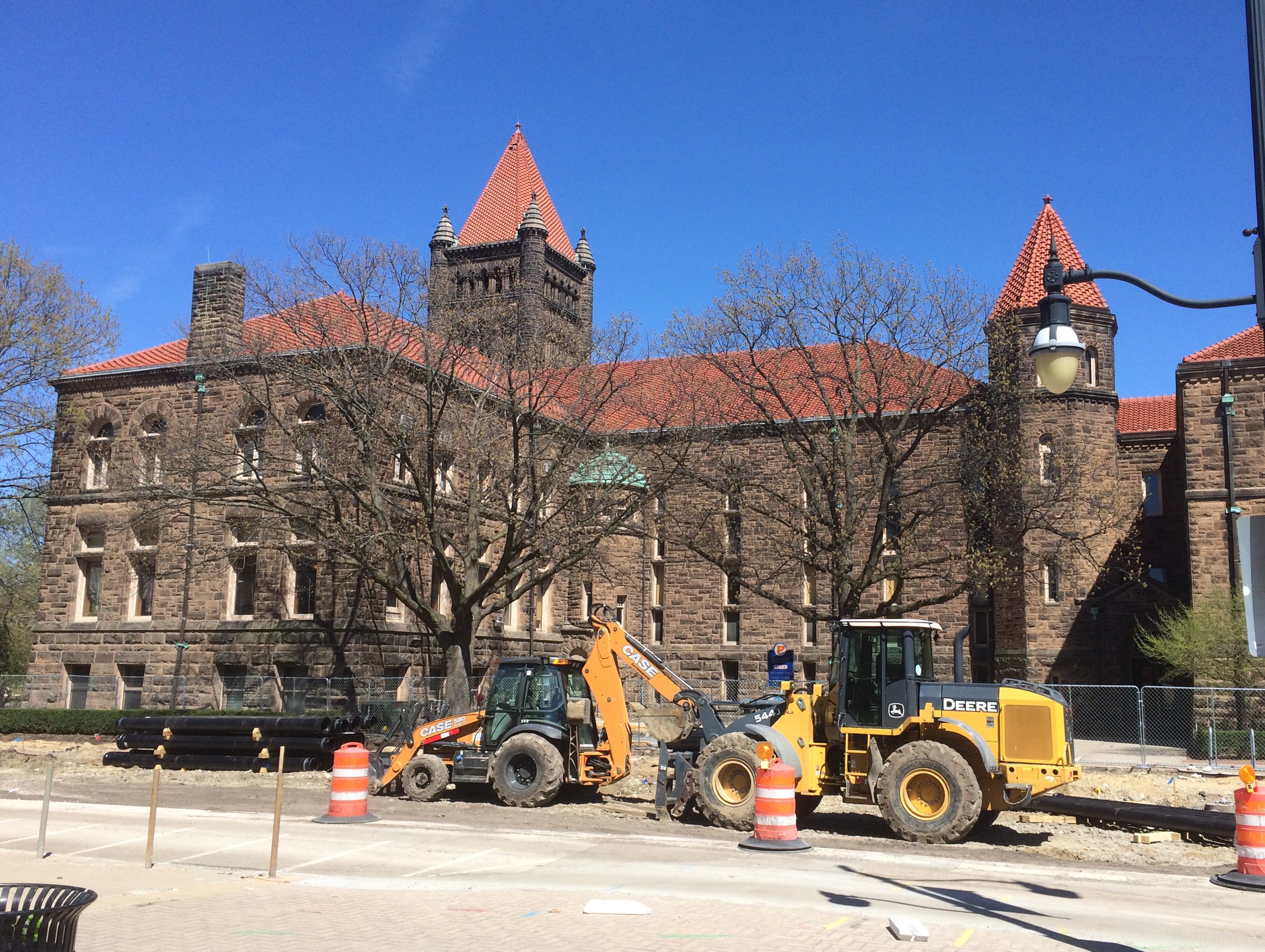
From Kung Fu Tea, it was a short walk to Altgeld Hall, which I’ve seen before, but not from this vantage.

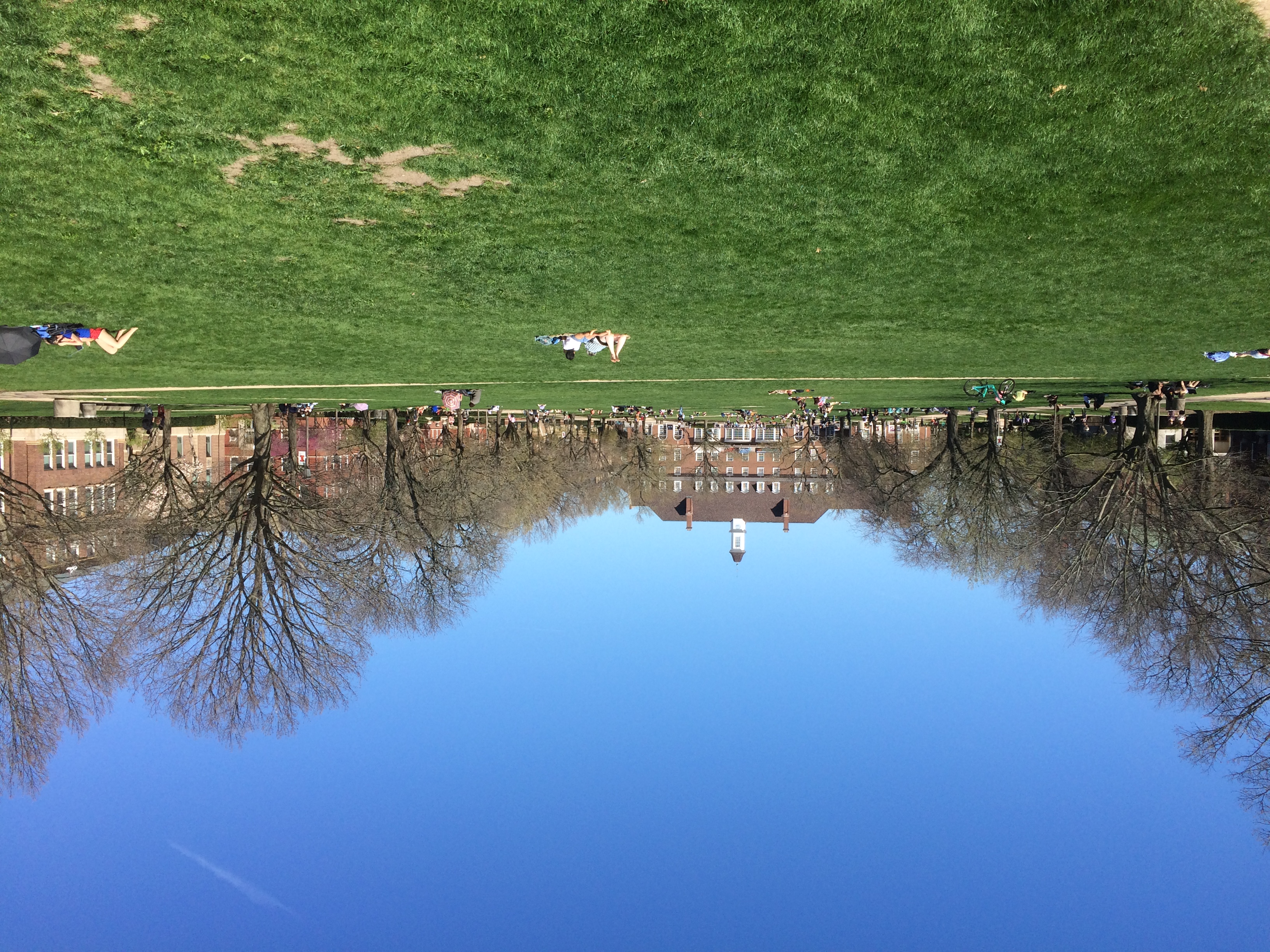
On we went. A fine day for a walk. The sunny warmth had drawn a number of students to the Main Quad, where they parked themselves on the grass. That’s the Illini Union in the distance.
Some students lolled in hammocks. That’s something I don’t ever remember seeing at any of the green fields of Vanderbilt.
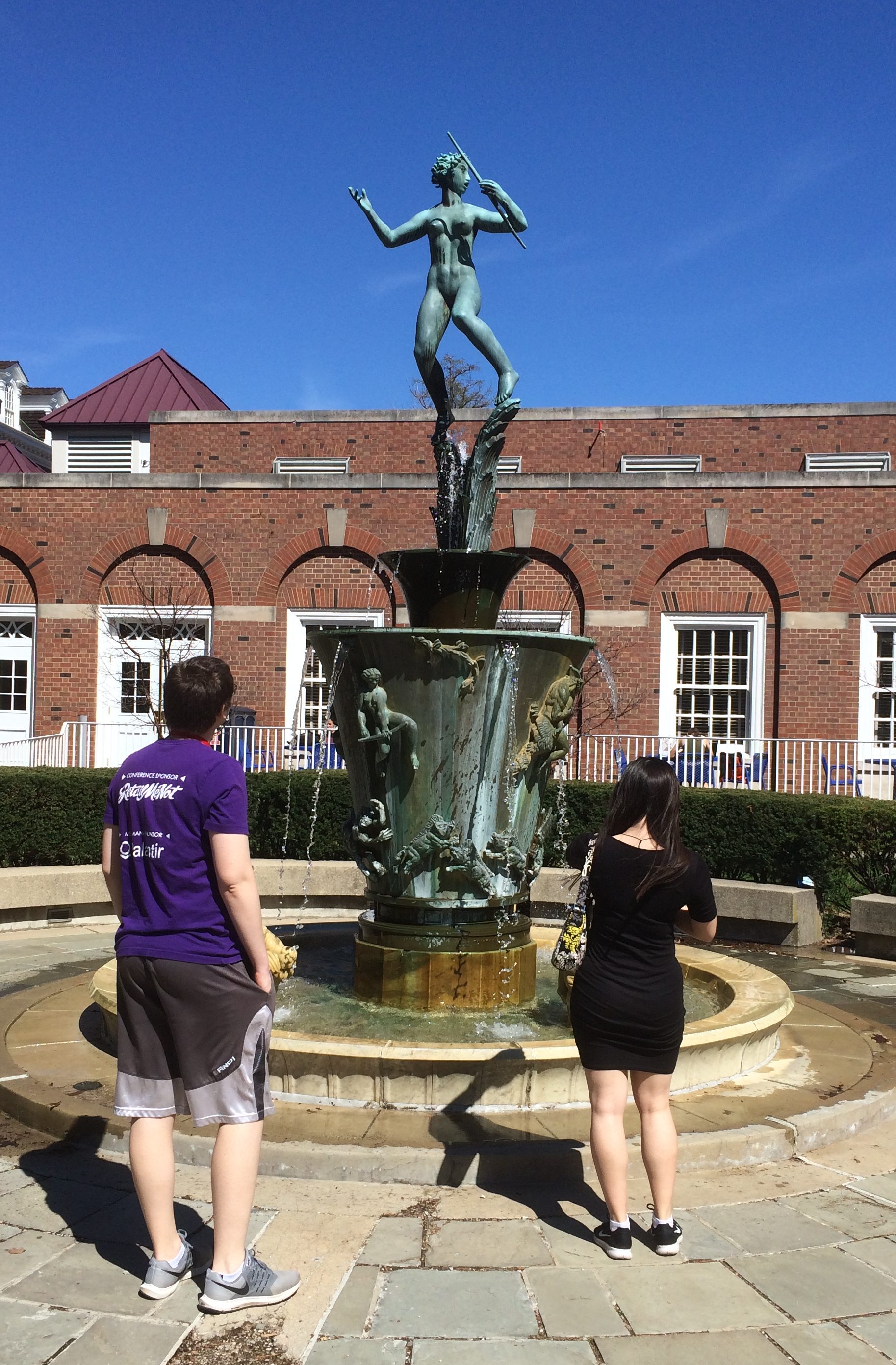
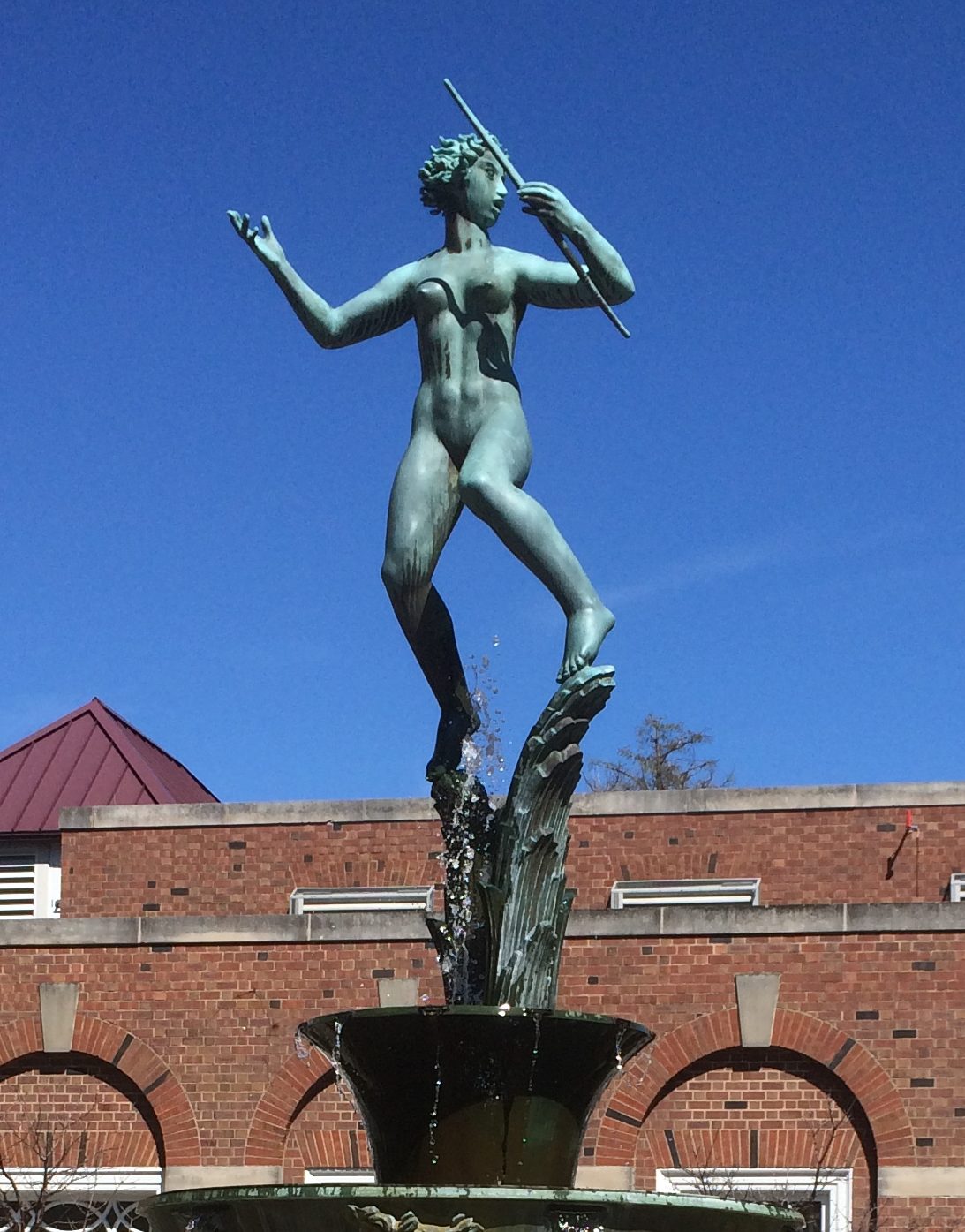
We circled back around the other side of Altgeld Hall and happened across this statue.
That’s the goddess Diana.
A nearby plaque says: The Diana Fountain is a creation of the Swedish sculptor, Carl Milles. It was designed for the court of a building at 540 North Michigan Avenue, Chicago, where it remained from 1930 until it was generously presented by Time Incorporated to the University of Illinois at the request of the Class of 1921.

The Fountain was dedicated here on October 23, 1971, as a class memorial, at the Fiftieth Anniversary Reunion of the Class of 1921.

Then there’s a list of “members and friends” of the Class of ’21, all of whom presumably ponied up some money for moving the statue, as well as the site work and installation. It’s a long alphabetical list from Allman to Zimmer: eight columns of 35 names each. More, actually, since some of the names represent married couples.

Fifty years plus nearly 50 more. Safe to assume all of the Class of ’21 have shuffled off this mortal coil. As has Carl Milles (d. 1955).

Here’s a digression. Another Diana Fountain by Milles is in Stockholm, at a place called the Matchstick Palace. Who built the Matchstick Palace?

The Match King, Ivar Kreuger, that’s who. I ran across him years ago in the wonderful Webster’s New Biographical Dictionary. Wiki gives a fuller description of his activities. His is an astonishing story.

Thursday Nokorimono

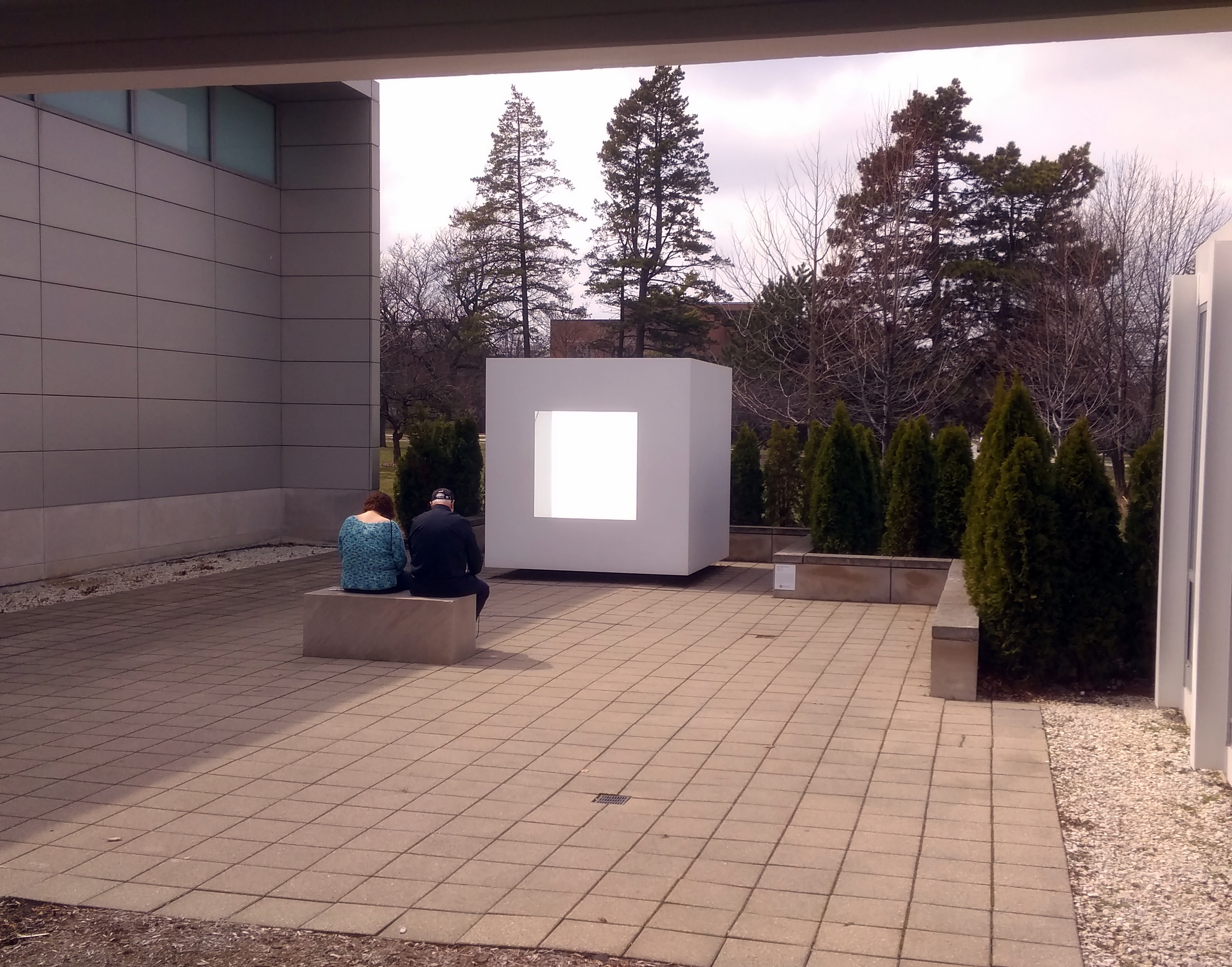
One major installation we saw at the Elmhurst Art Museum on Saturday didn’t have anything to do with the Bauhaus (which got a Google doodle today), or Mies van der Rohe, or anything but the sky.

“Skycube” by David Wallace Haskins, which was installed in 2015. It may look light, but it’s made from 6,000 lbs. of steel.
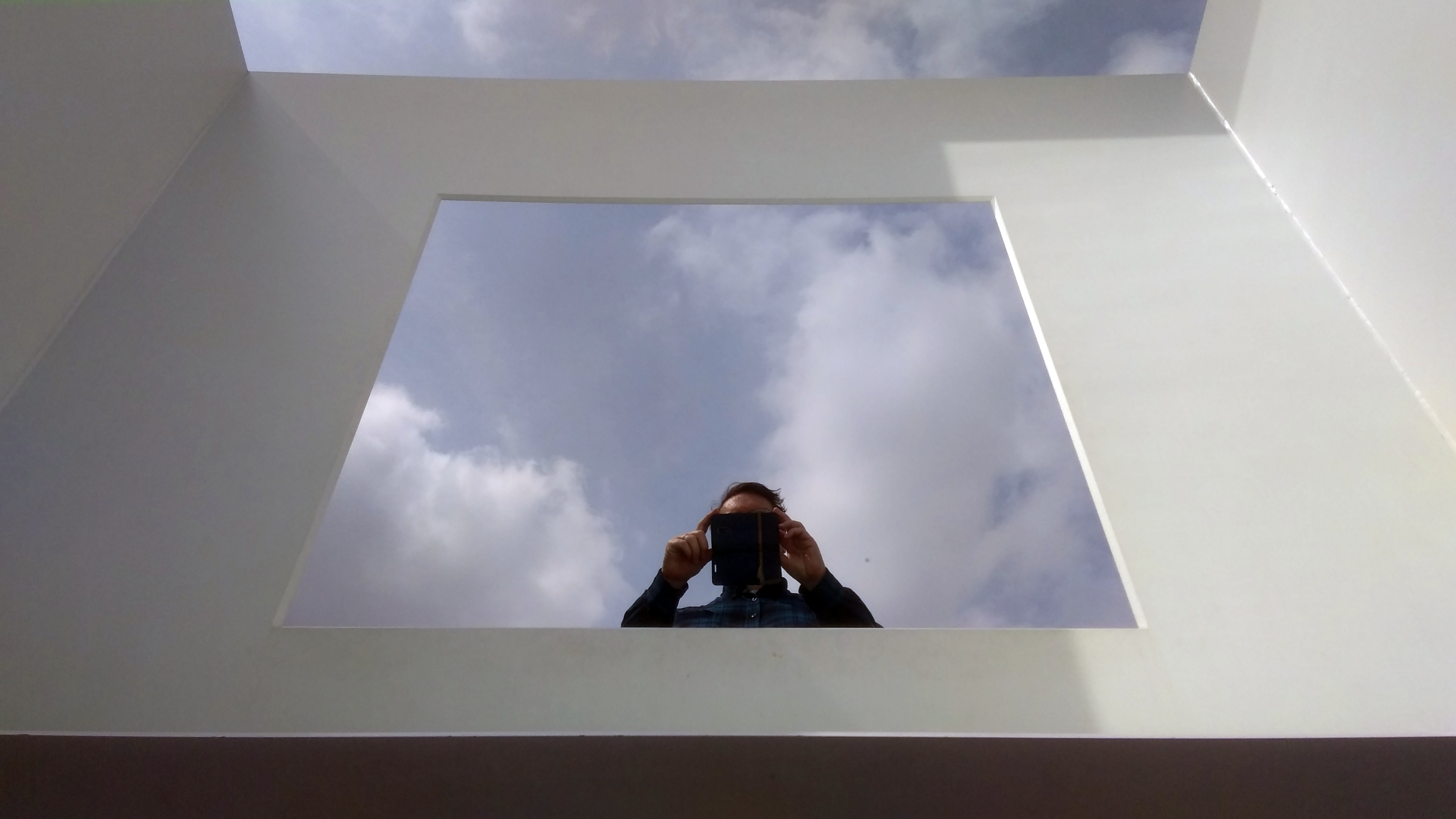
The mirrors inside the cube deliver an image of the sky to — in — at — the square window — hole — aperture — on the side. It’s a little unnerving to sit there and look at it, but also hard to turn away.
Stand next to the “window” and you can get a self-portrait in the sky. Got a surreal tinge to it.
The view might be even more interesting on one of those days when rafts of clouds are speeding along at high altitudes.

The YouTube autoplay algorithm is pretty much of the same dense mindset as Top 40 radio is, or at least used to be. Play one song, well known or even not so well known, and it will line up nothing unusual or surprising.

Odd, then — and I’ve tested this on a few separate days — when I queue up something by the B-52s, a good many lesser-known songs of theirs appear on the autoplay. Mostly published by the group itself, but not always (and who doesn’t like a song that mentions ancient Mesopotamia?).

Might just be a fluke, though. Your results may vary. I doubt that algorithms will ever be good enough to weed out all the flukes. Hope not.

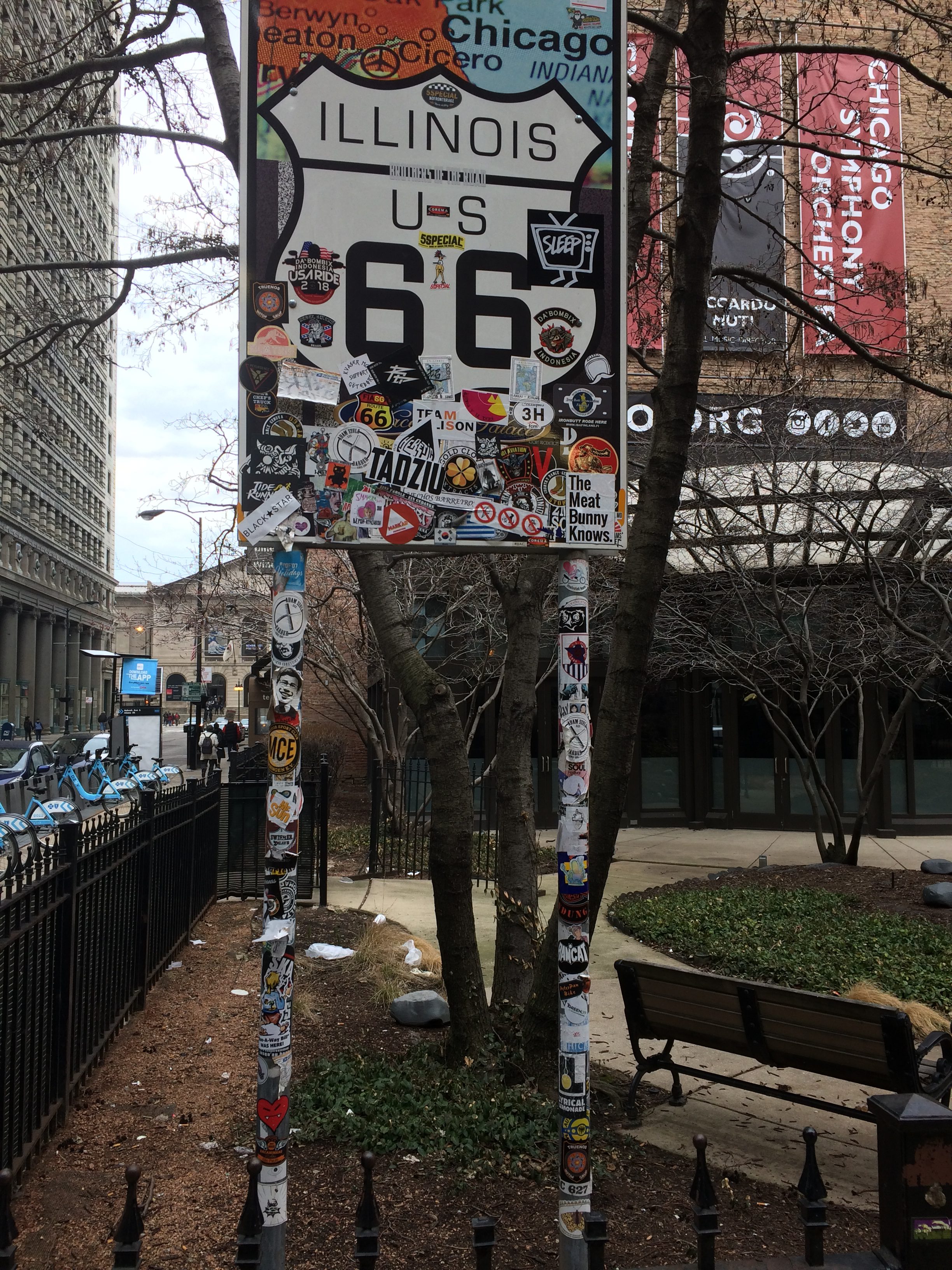
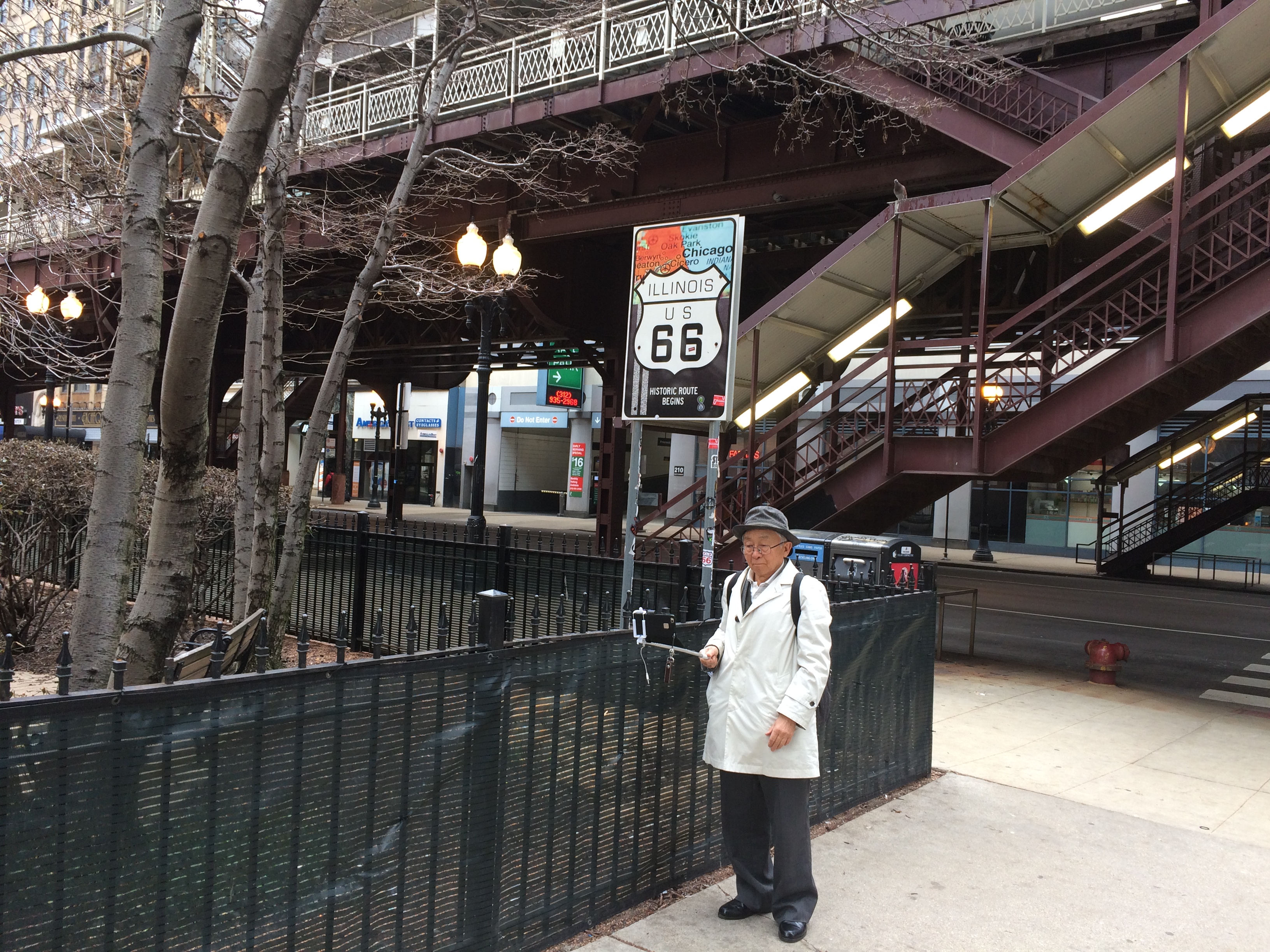
The last time I was in downtown Chicago, earlier this month, I paused for a moment to take a picture of a sign on E. Adams St. marking the eastern terminus of the former U.S. 66.
That’s the western-facing side of the side, covered by stickers from all over, with many European in origin. Shortly before I took my picture, a group of Germans were doing the same. Must be in their Reiseführer von Amerika. And what does the Meat Bunny know?

By the time I took a picture of the eastern-facing side, the Germans were gone.
Leaving only this fellow and his selfie stick.

Theologian Rendered in Bubble Gum

Saturday felt like the actual first day of spring around here. Warm, partly cloudy, birds atwitter, no coat or even jackets necessary for human comfort.

We spent much of the day in the mid-sized western Chicago suburb of Elmhurst, a pleasant place we briefly considered while shopping for a house more than 20 years ago. We’ve spent some time there since, but not recently, and Saturday was a fine day for walking through some of Elmhurst’s soon-to-be-leafy, soon-to-be-green spaces.

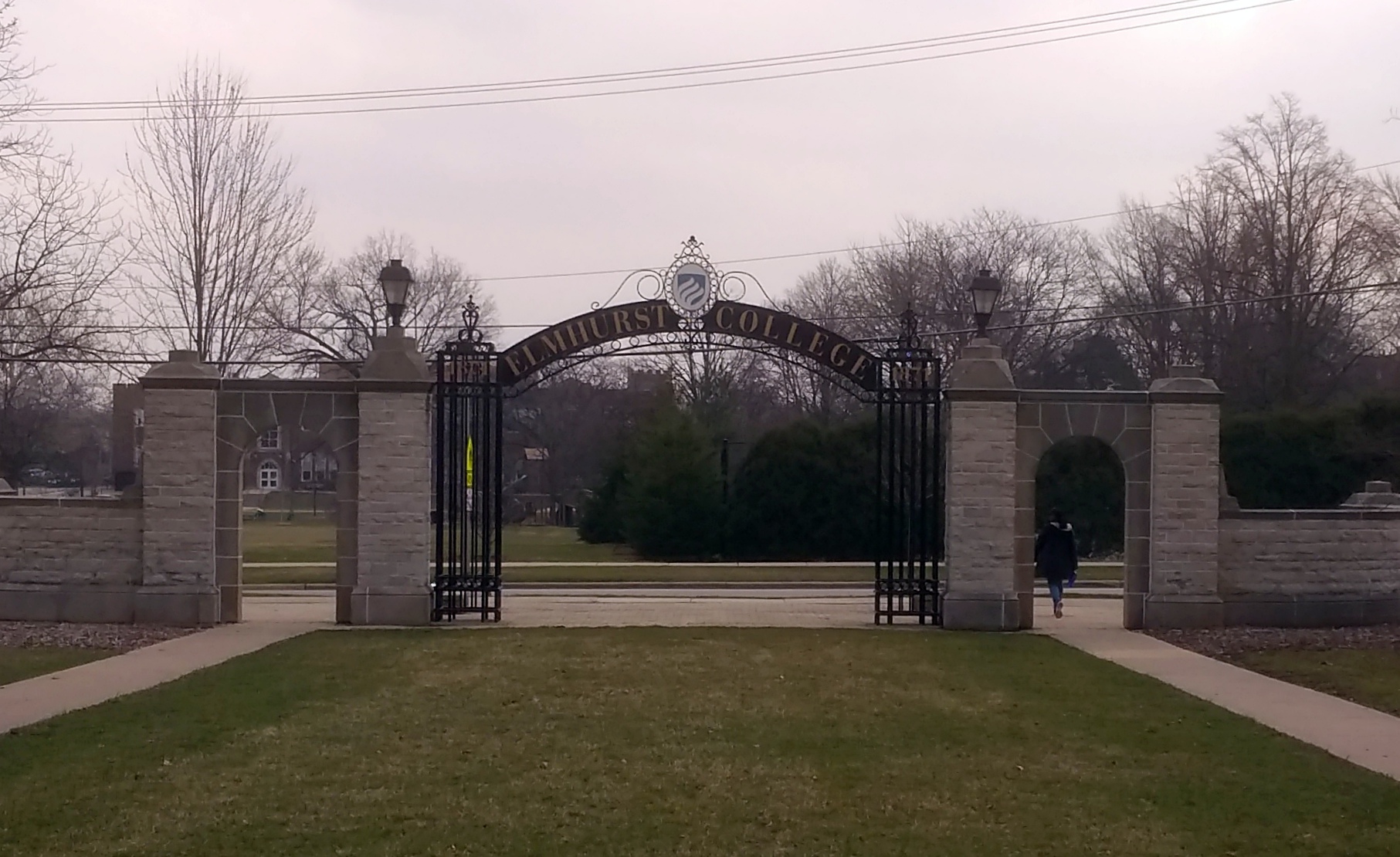
Elmhurst is also home to Elmhurst College, a private liberal arts school that looks every bit like you’d think, with handsome buildings, mature trees, lawns crossed by paved footpaths and students here and there on a warm Saturday.
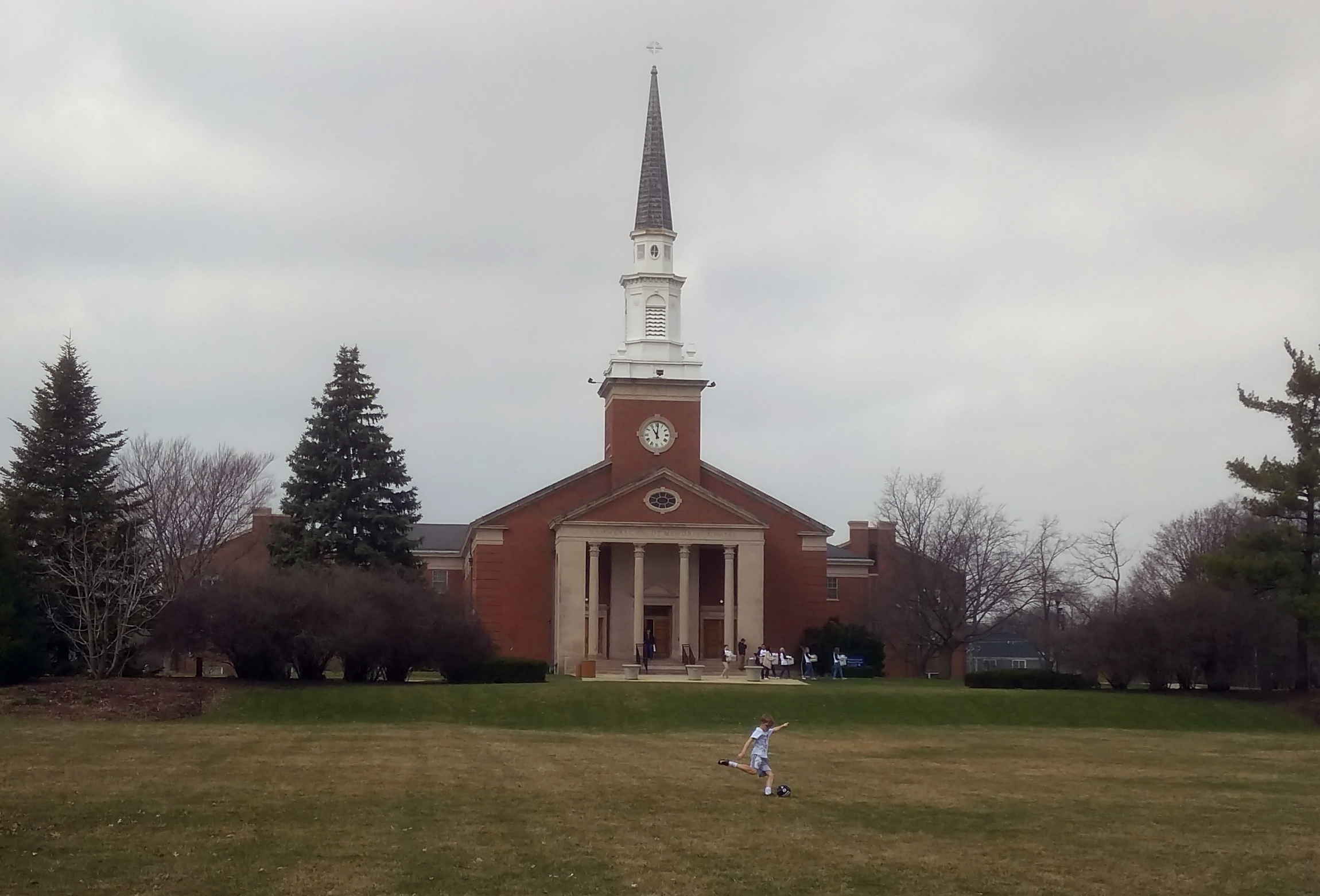
Some years ago, I took Lilly to a few sessions of the Elmhurst College Jazz Festival, whose high school and college performers play at the college’s at Hammerschmidt Chapel.
Elmhurst College dates from the 1870s, founded roughly at the same time as Vanderbilt, though it doesn’t seem to have evolved into the same sort of academic leviathan. I’m glad some institutions still eschew the upgrade to university and call themselves colleges. I suspect that Elmhurst charges about the same stratospheric tuition as Vanderbilt, however, and there’s no excuse for either of them in that regard.

These days, the college is affiliated with the United Church of Christ. It was founded by the German Evangelical Synod of North America, or the Deutsche Evangelische Synode von Nord-Amerika, one of the 19th-century predecessor denominations of the UCC.

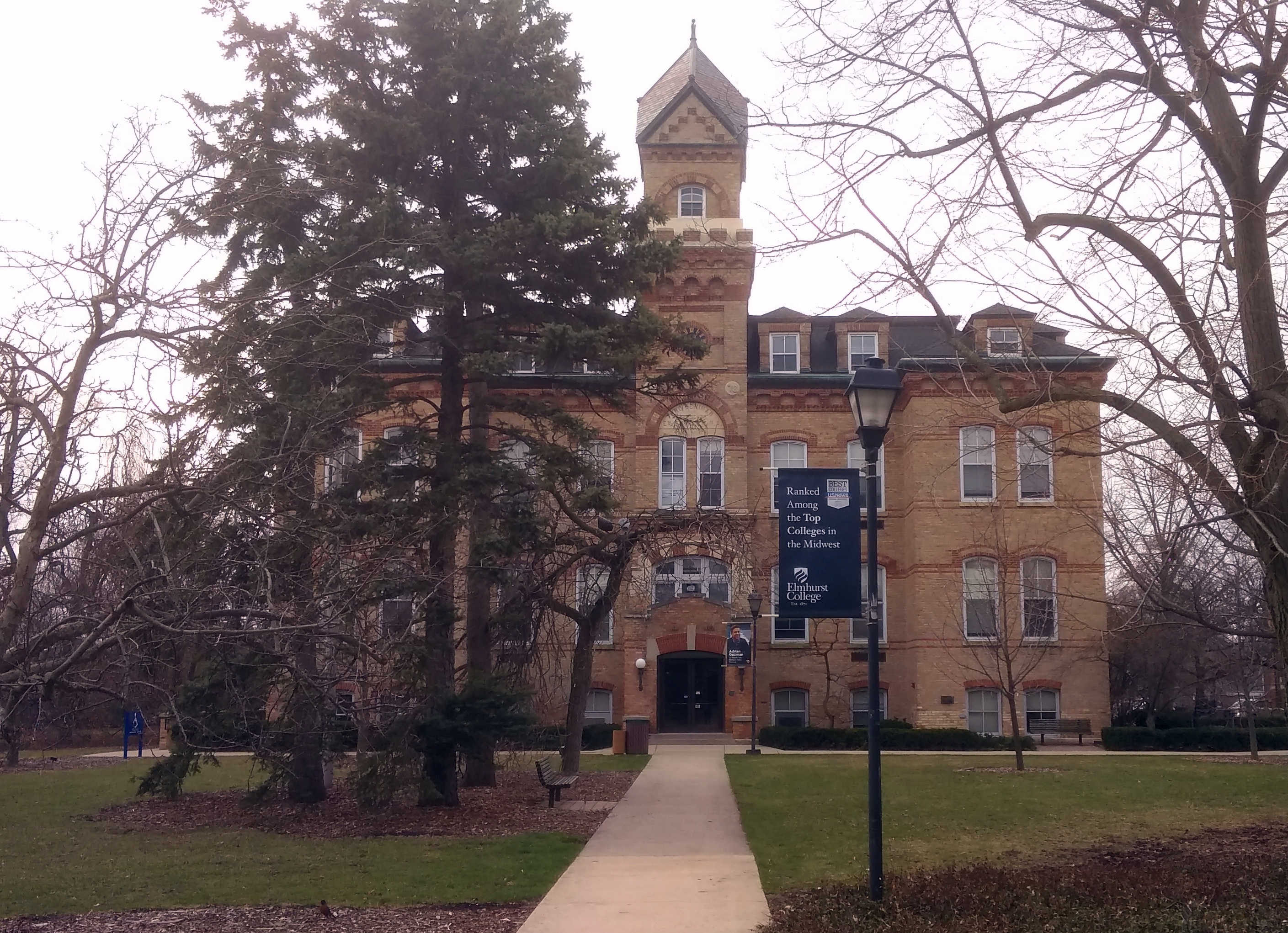
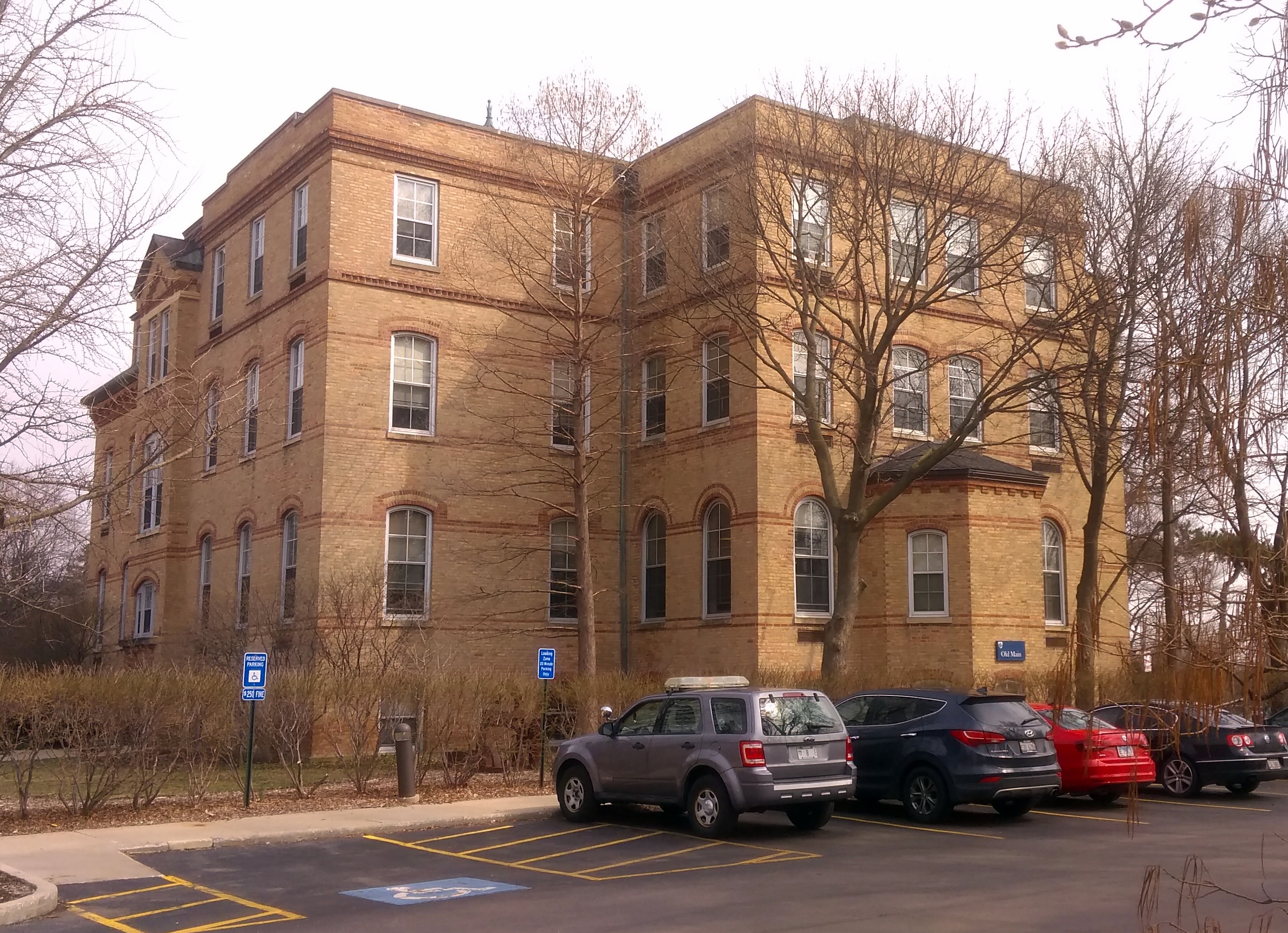
Here’s Old Main. Or the Hauptgebaude, which remarkably has its own Wiki page. One of the more handsome structures on campus, I’d say. The front.
And the back.
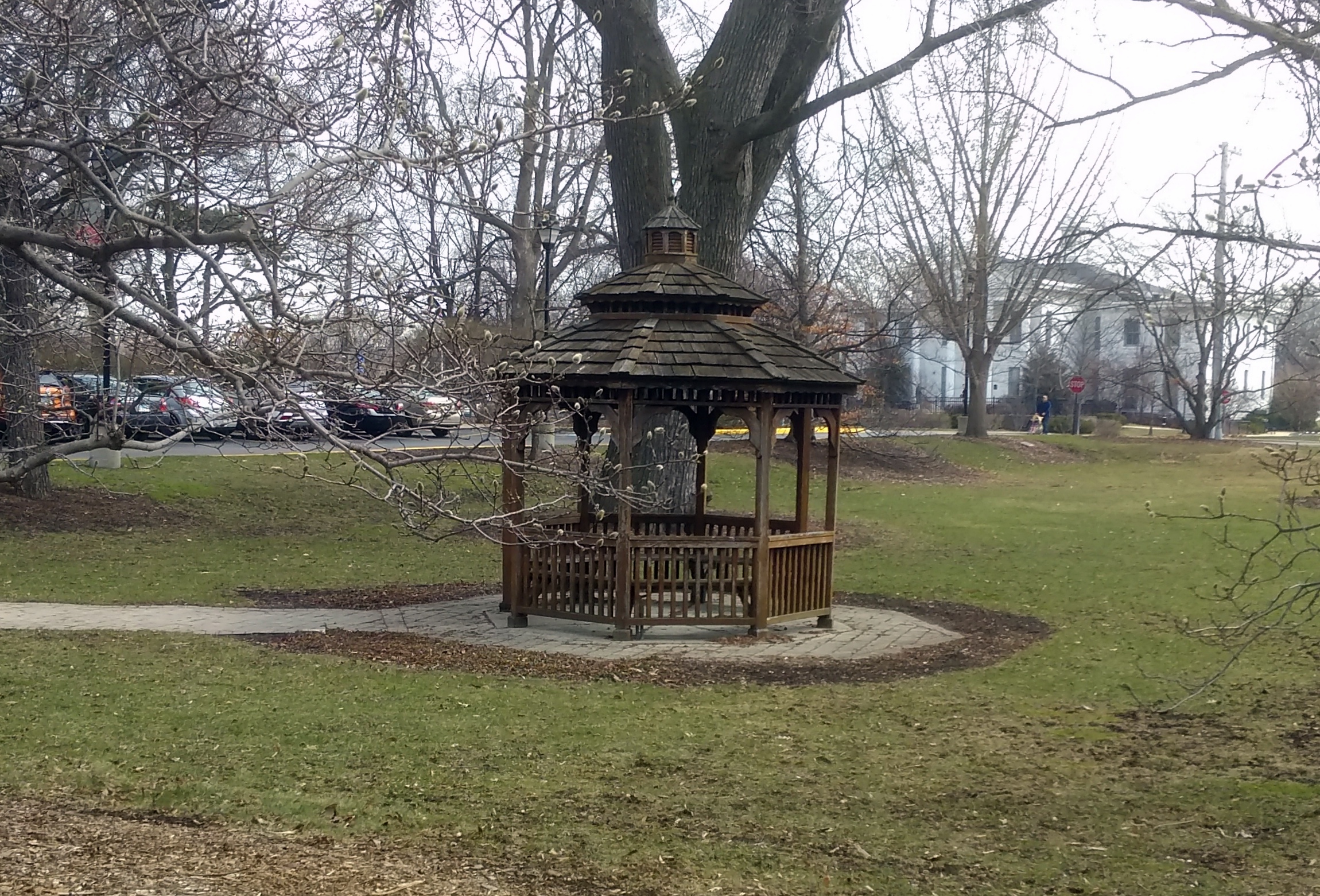
The college has a gazebo. Minor, but still a gazebo. All colleges should.

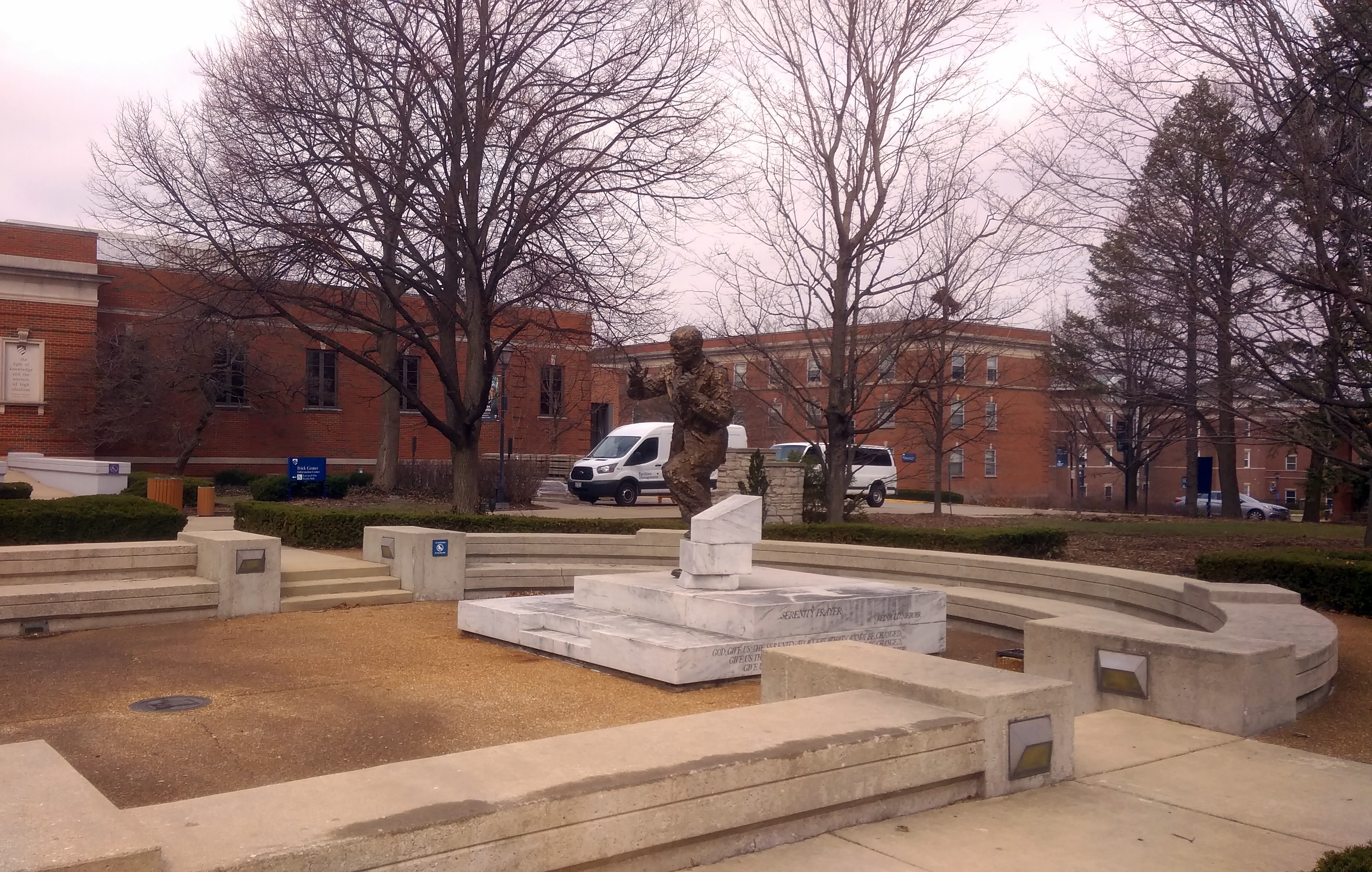
What’s this? I noticed a statue not far from Old Main, standing in its own plaza-like spot.
A founding bishop with “Knowledge is Good” carved on the base in German? I’m not sure the denomination had bishops; probably not, but never mind.

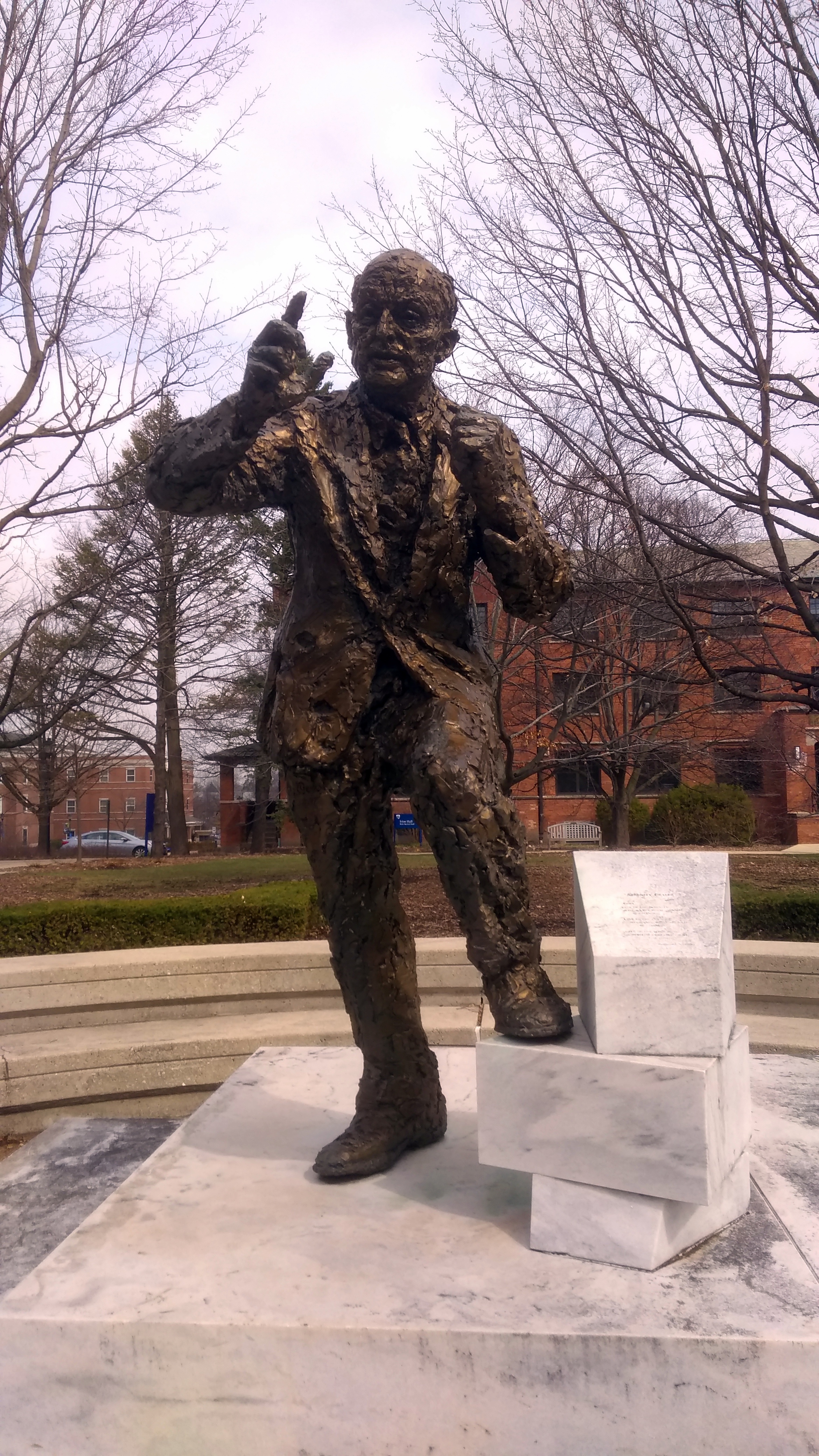
No. It’s a statue of Reinhold Niebuhr in an animated pose.
I didn’t expect that. My own ignorance was at work. Niebuhr did his undergraduate work at Elmhurst College, class of 1910. His brother H. Richard, also a theologian, likewise went to Elmhurst.

In 1997, Niebuhr was honored with this regrettable chewing-gum statue, the work of the late Robert Berks, who is better known for his bubble-gum Einstein in Washington, DC, though I’ve also encountered his Carolus Linnæus statue at the Chicago Botanical Gardens. Carved on one of the white blocks is the Serenity Prayer, which is widely attributed to Niebuhr.

Sad to say, most of what I learned about Niebuhr at Vanderbilt — and I’m pretty sure I learned something — has evaporated after nearly 40 years. He was a U.S. public intellectual in any case, informed by his theology. Is there such a thing any more?

Evergreen Memorial Cemetery, Bloomington

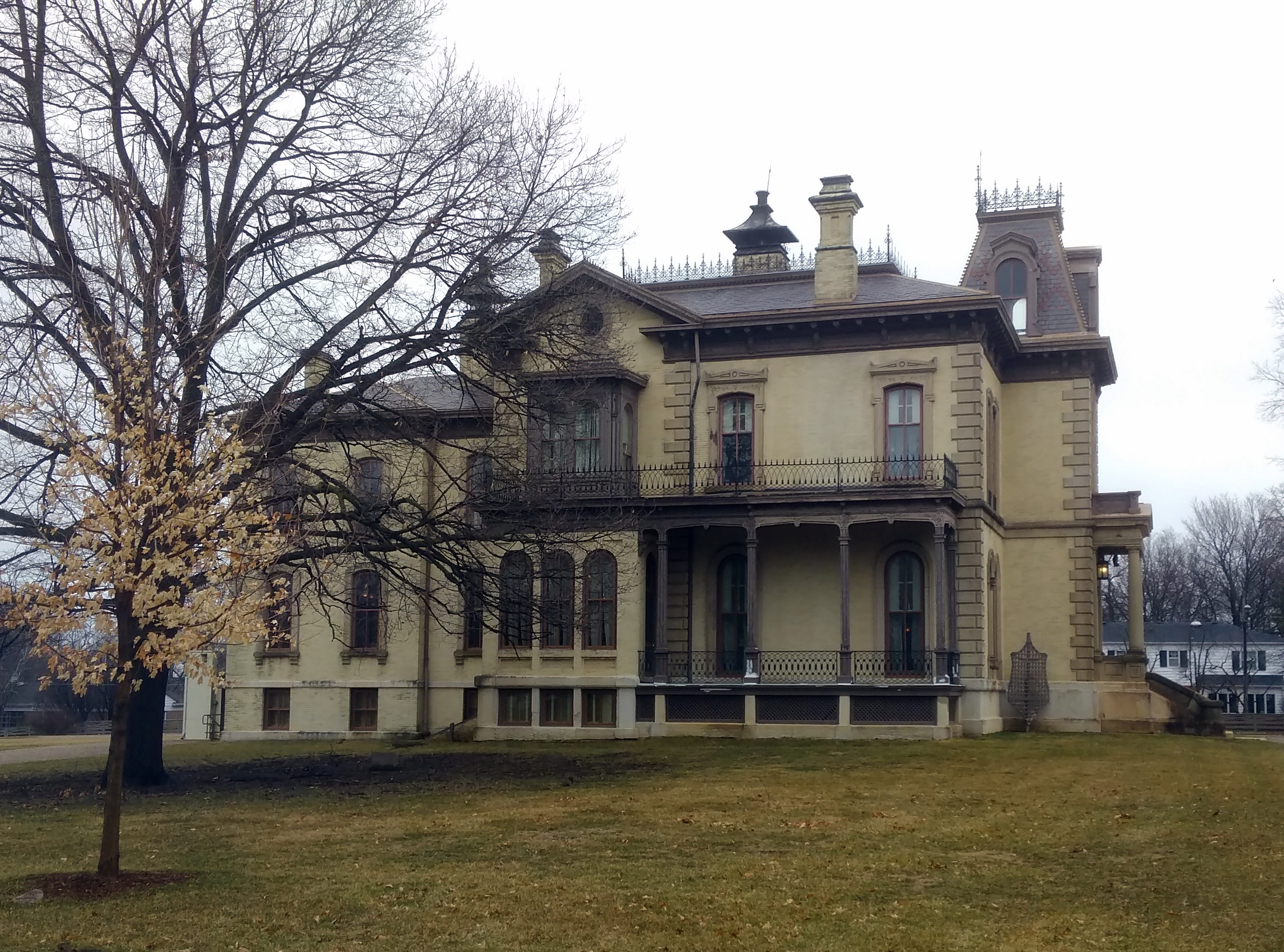
Sometime in the late 1990s, I visited the David Davis House in Bloomington, Illinois. As Lincoln’s campaign manager in 1860 — and important in getting him nominated in the first place — Davis was a behind-the-scenes man at a critical turning point in U.S. history. Lincoln put him on the Supreme Court in ’62.

On Sunday, I took a quick look at the house. As handsome as I remember.
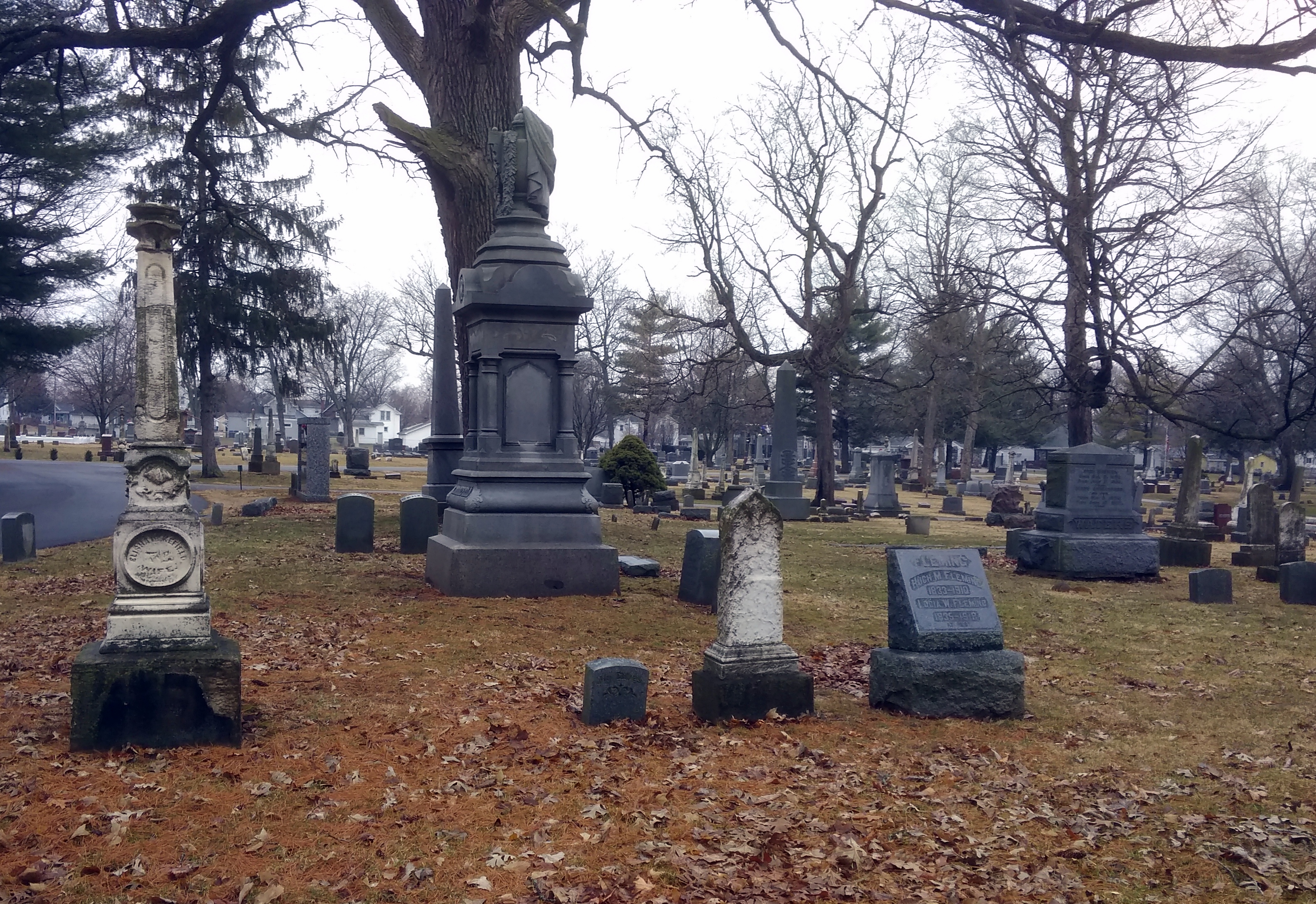
David Davis House BloomingtonBut that isn’t why I swung through Bloomington. I wanted to see the Evergreen Memorial Cemetery. An impressive array of stones among the still-bare trees and brown grass.

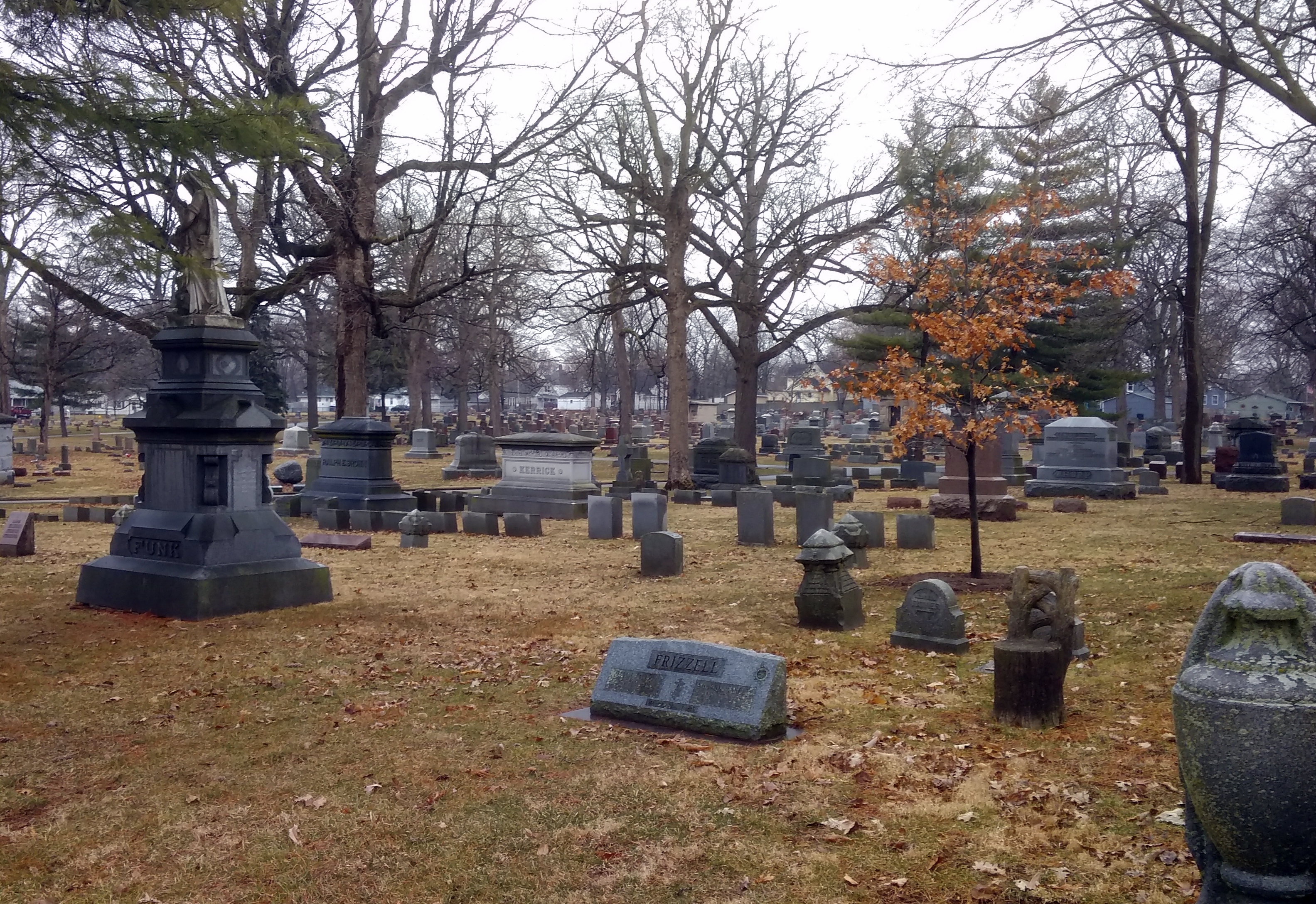
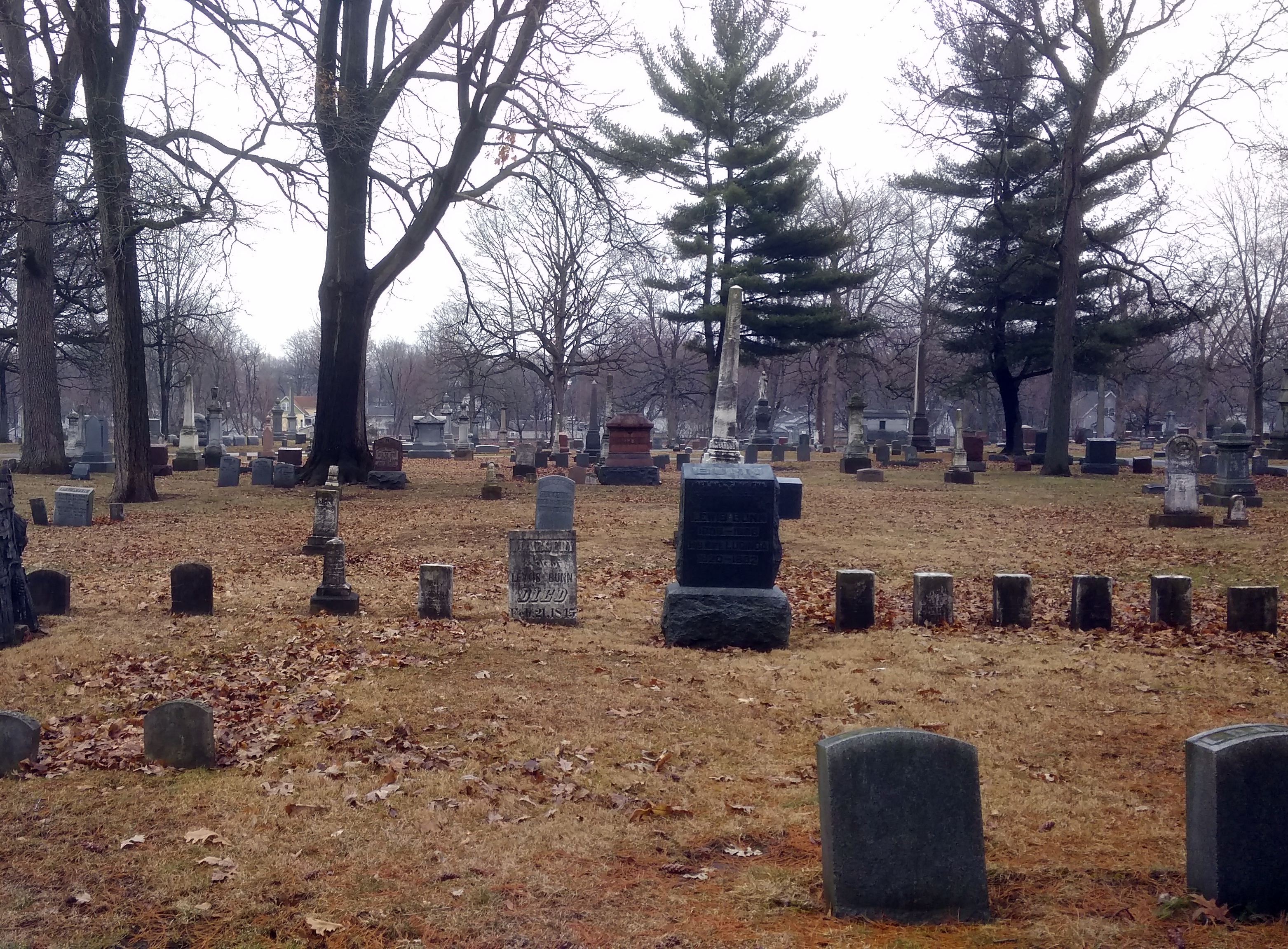
Evergreen Memorial Cemetery, BloomingtonEvergreen Memorial Cemetery, BloomingtonEvergreen Memorial Cemetery, BloomingtonSome sizable memorials, too, befitting the prosperous place Bloomington was in the 19th century.

Evergreen Memorial Cemetery, BloomingtonEvergreen Memorial Cemetery, BloomingtonNot a huge amount of funerary art, but some.
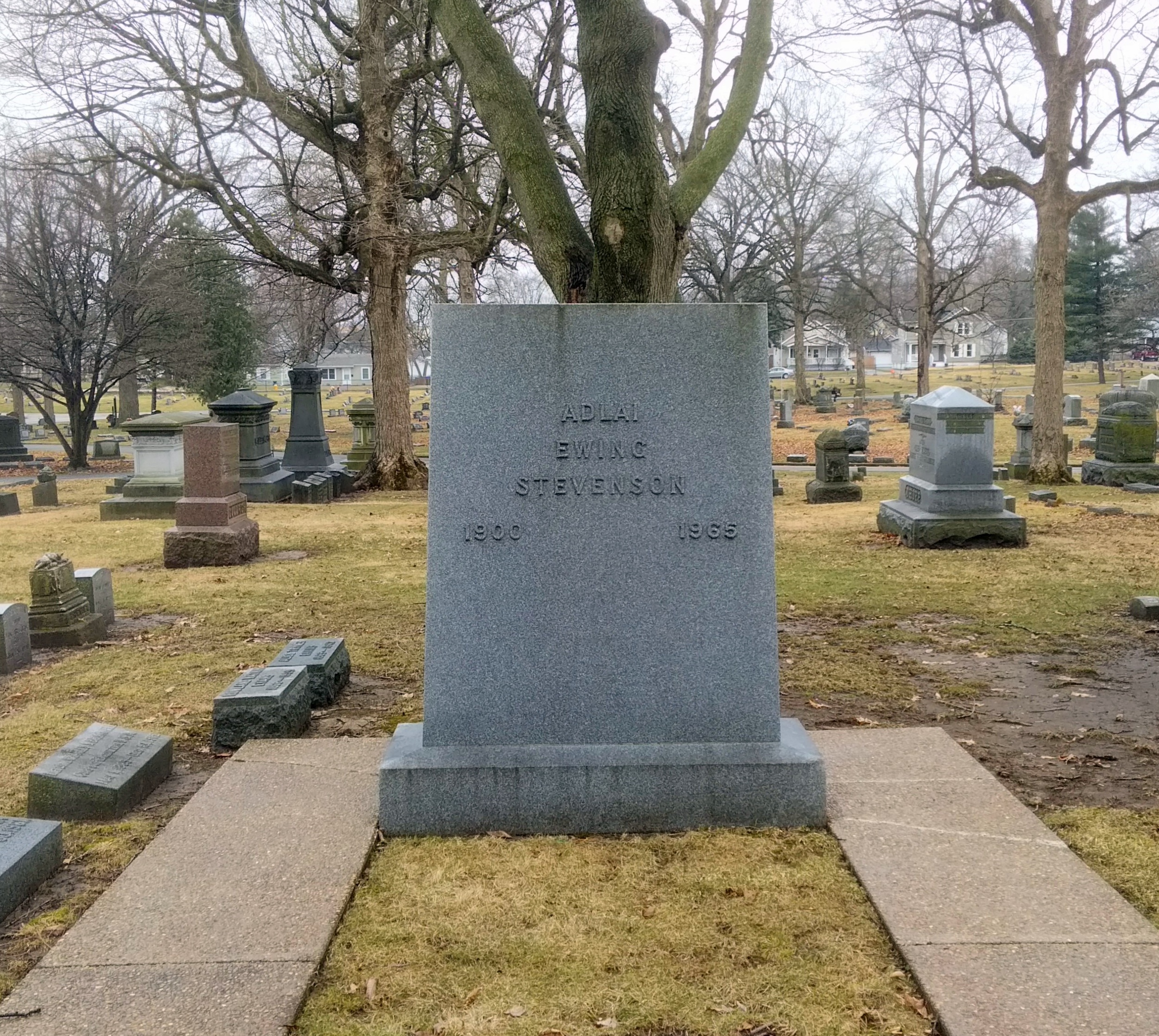
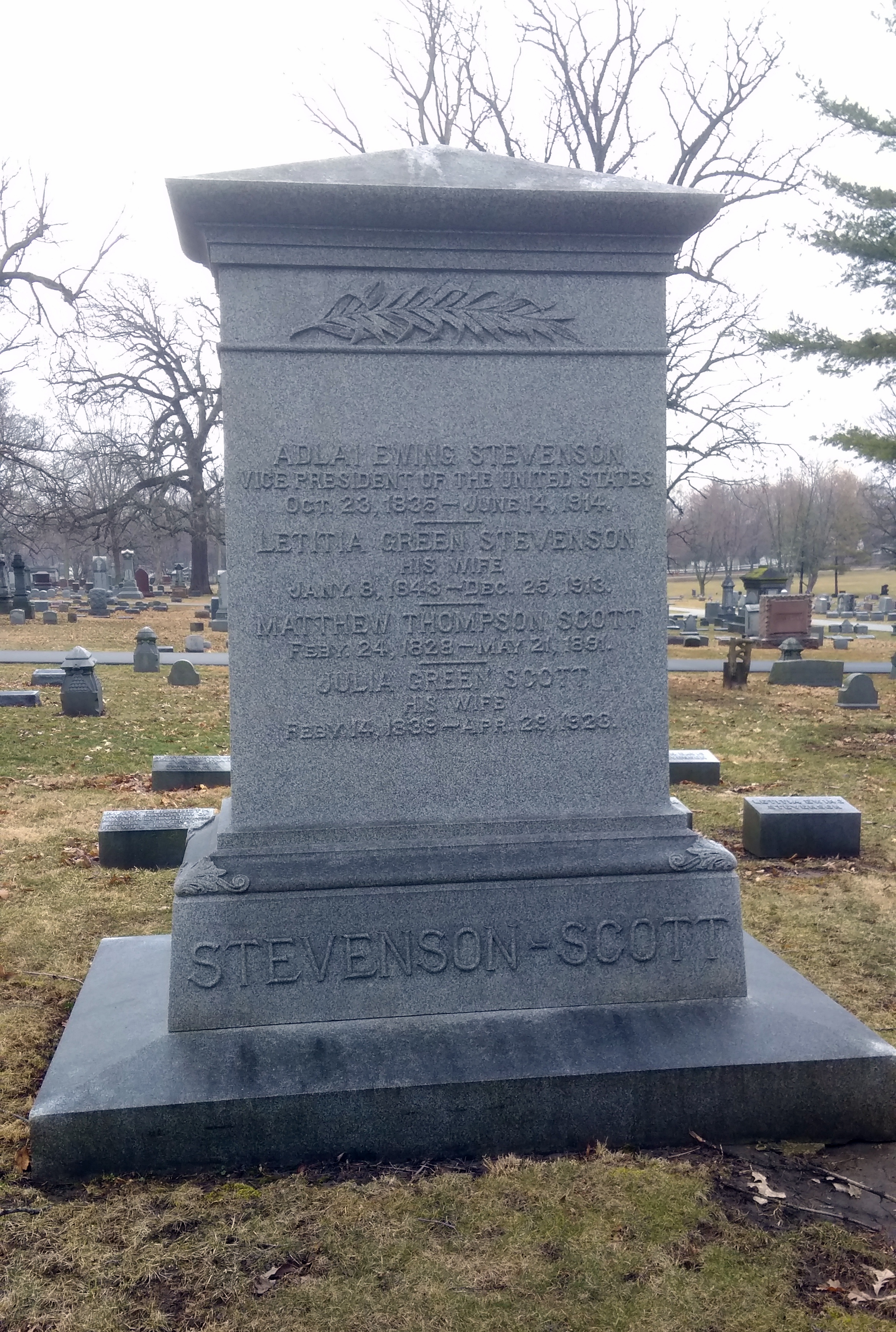
Evergreen Memorial Cemetery, BloomingtonI’d come to visit the Stevensons. Here’s the Adlai Stevenson famed for being shellacked by Eisenhower but also for his denunciation of Soviet behavior on the world stage.

Evergreen Memorial Cemetery, Bloomington

This Adlai Stevenson was 23rd Vice President of the United States, from 1893 to 1897, during Cleveland’s second term.
Evergreen Memorial Cemetery, BloomingtonHad President Cleveland’s cancer in ’93 been more aggressive, or medical science not up to its extraction — a few years earlier, probably not — this is also the Stevenson who would have been president.

I didn’t know the Scotts also memorialized on the stone: Matthew and Julia Scott. Turns out Stevenson was married to Letitia, Julia’s sister. Also, Matthew T. Scott was a business partner of Adlai Stephenson, with a distinctly 19th-century CV: land speculation, newspaper publishing, a coal mine.

Just before I left, I took a look at something a little more unusual.
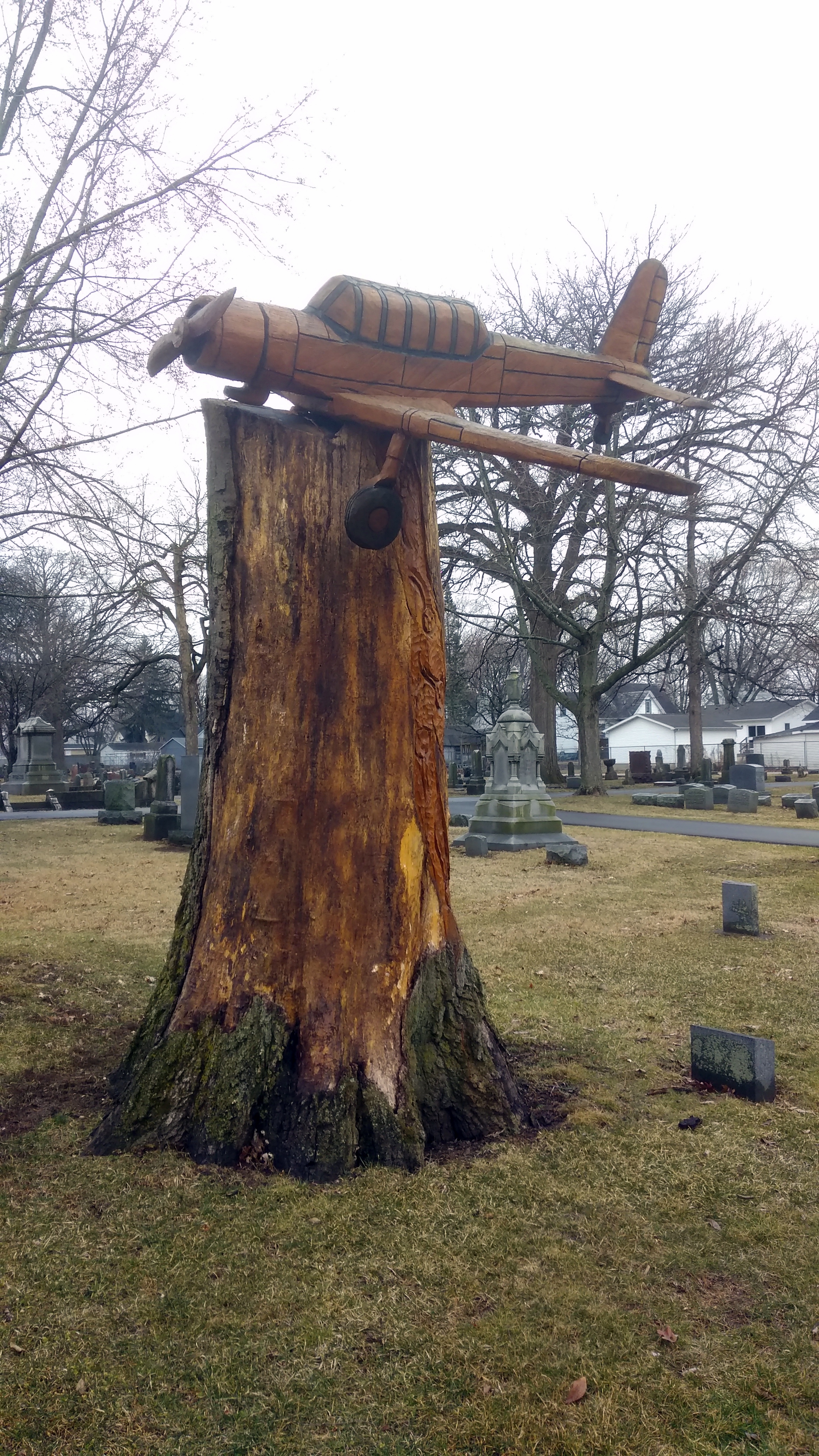
Evergreen Memorial Cemetery, BloomingtonAccording to a nearby plaque, the carving memorializes an airplane that crashed into the tree that used to stand there.

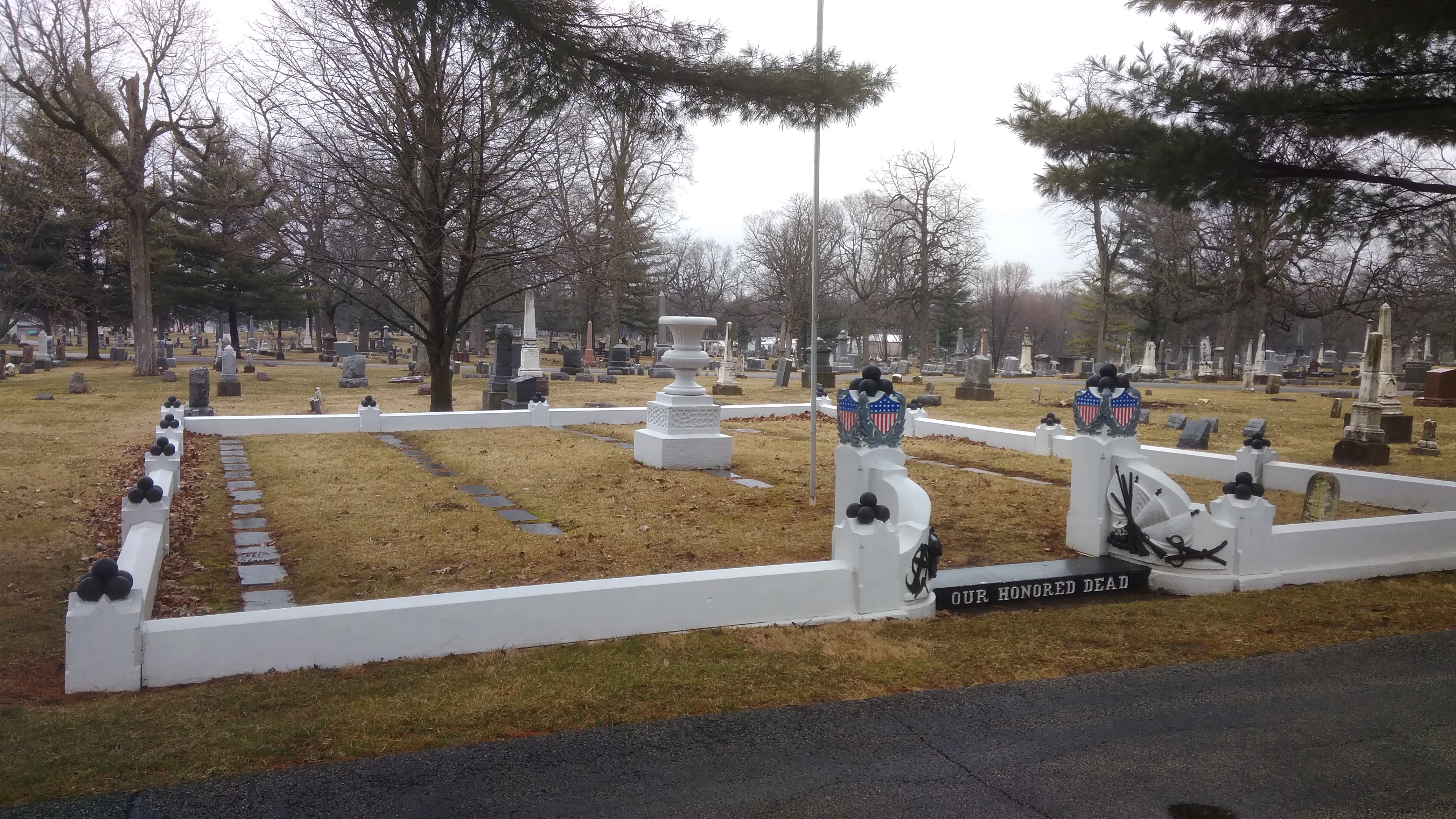
“On May 31, 1948, a group of citizens gathered at Evergreen Memorial Cemetery’s Civil War Veteran’s enclosure…” the plaque begins.

That must be here, very near the tree.

Evergreen Memorial Cemetery, Bloomington“… During the ceremony, a WWII trainer plane flown by James A. Tuley and passenger Chester H. Frahm was flying over Evergreen… to drop poppies over the grounds. The plane crashed into this tree, killing Frahm and severely injuring Tuley,” the plaque continues.

“In 2015 this tree had to come down and cemetery employees felt something more needed to be done with the wood from the tree… chainsaw artist Tim Gill was contacted and he accepted the challenge.”

The Pantagraph published a fuller version of the story.

LeRoy (Le Roy), Wausaneta and Simeon H. West

On Sunday afternoon, as I headed roughly northwest on U.S. 150 in McLean County, Illinois, I impulsively made a turn off the main road onto Center St., which goes directly to the town square of LeRoy. Or rather, the town sort-of-circle.

I came to be in that part of Illinois because earlier in the day, I’d taken Lilly back to UIUC at the end of her spring break. Usually the trip to Champaign involves popping down on I-57 and returning the same way. But the day wasn’t that cold — not like last time — and despite sometime drizzle, I wanted to make a slight detour and return home via Bloomington.

Champaign to Bloomington could mean a short drive on I-74. Or, if you want something different in March, you take U.S. 150, passing close to the still-unplanted fields and by hulking grain silos and through towns like Mahomet, Mansfield, Farmer City, and LeRoy (sometimes styled Le Roy). The road roughly parallels the Interstate. I took it.

When I got to the LeRoy square (circle), I noticed some memorials inside the circle, including a statue on a pillar. While I was still driving, I took it to be a memorial featuring a Union soldier. I parked nearby and got out for a closer look.

The formal name of the round-shaped green space in LeRoy is Kiwanis Park. Visitors are greeted on one side of the circle by a shoe-store mural.

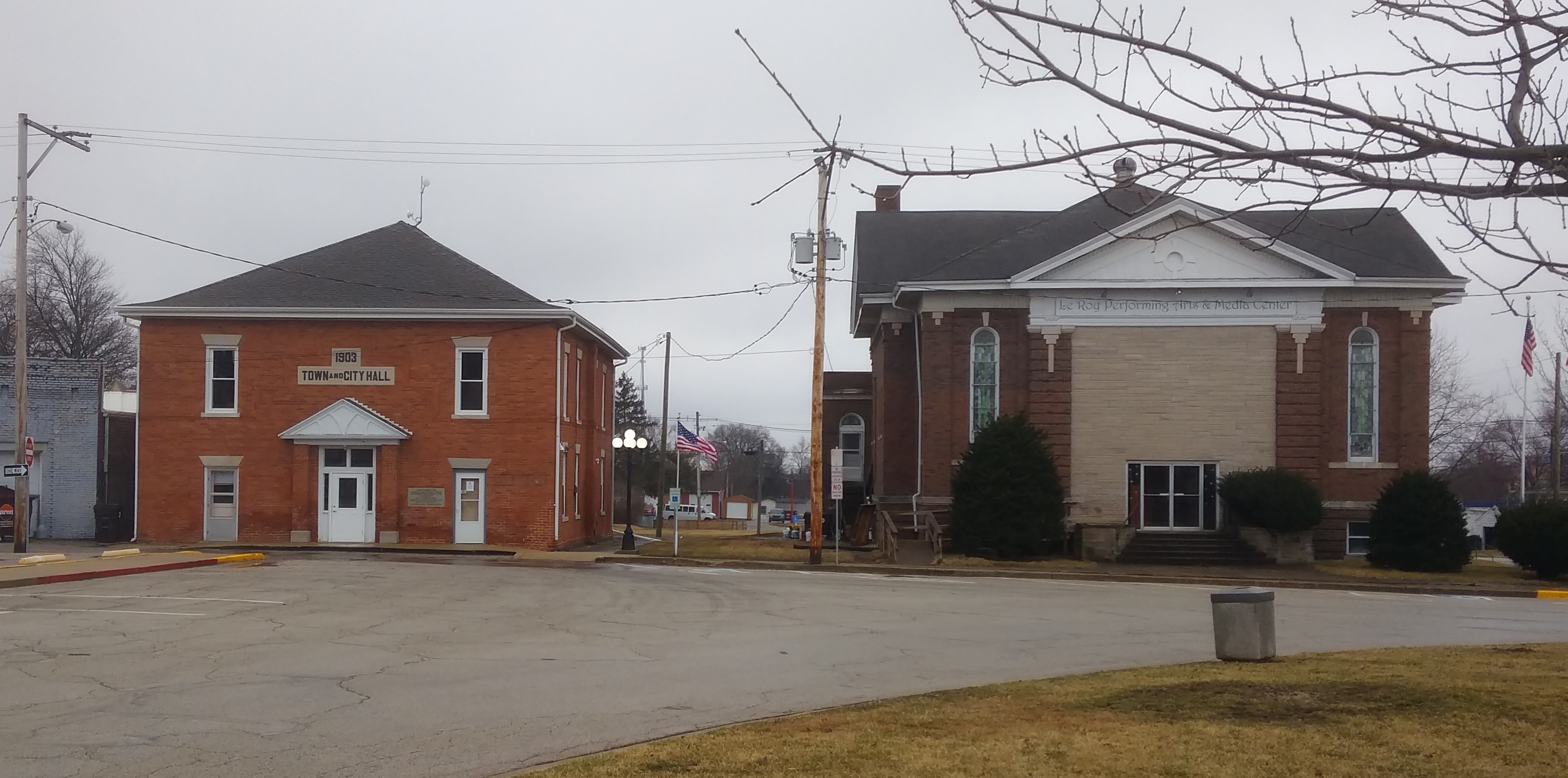
A building labeled “Town and City Hall” is next to the Le Roy Performing Arts & Media Center, which has the look of a former church building, but I didn’t take a closer look.

Also around the circle are an undertaker, the American Legion Post 79, a clinic and some other buildings.

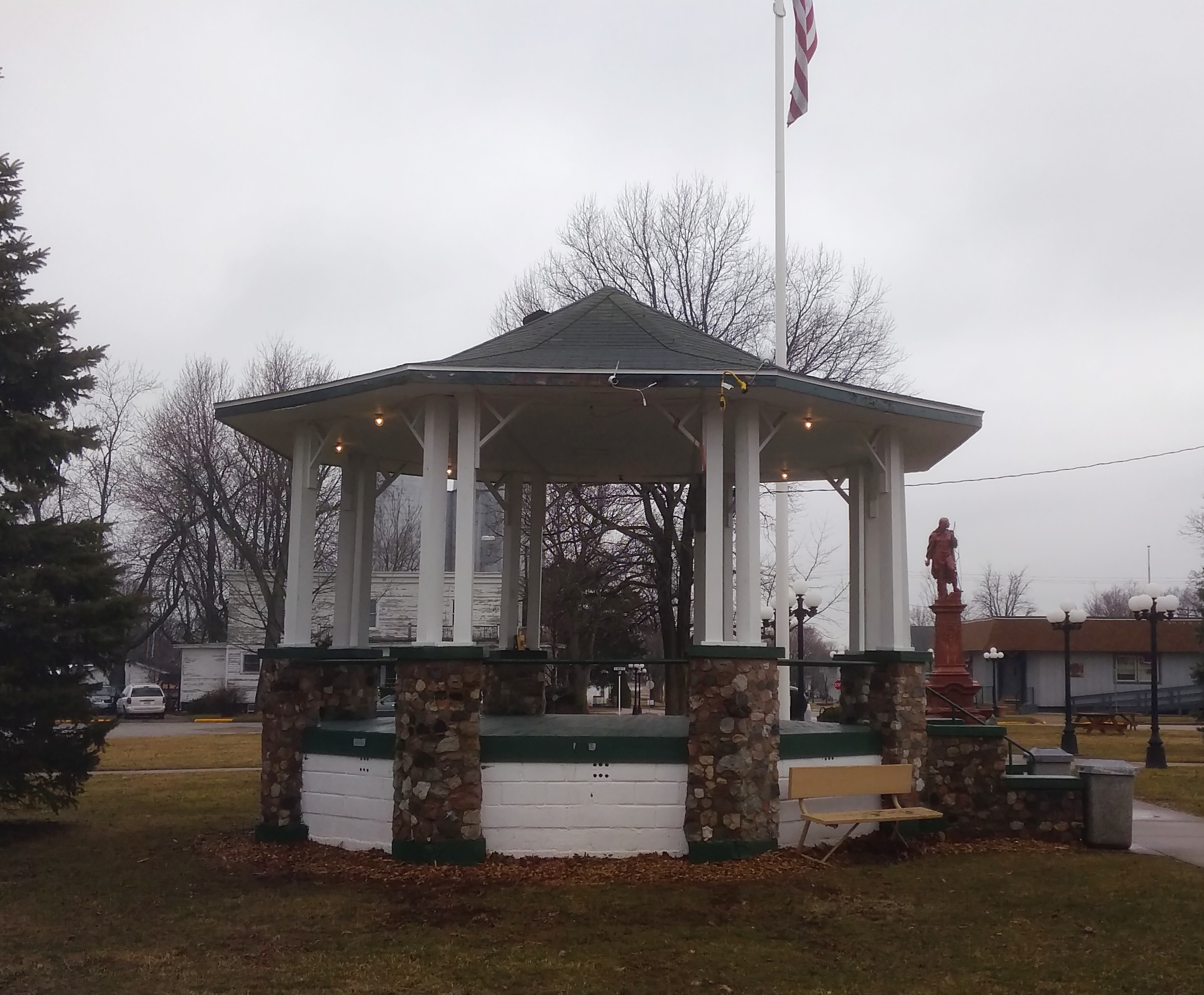
Kiwanis Park itself has a gazebo. I have to like a place that has a gazebo.

There are also smaller memorials, such as one to all U.S. service men and women, and one to honor Victor, LeRoy Police K-9 Officer from 2005 to 2012.
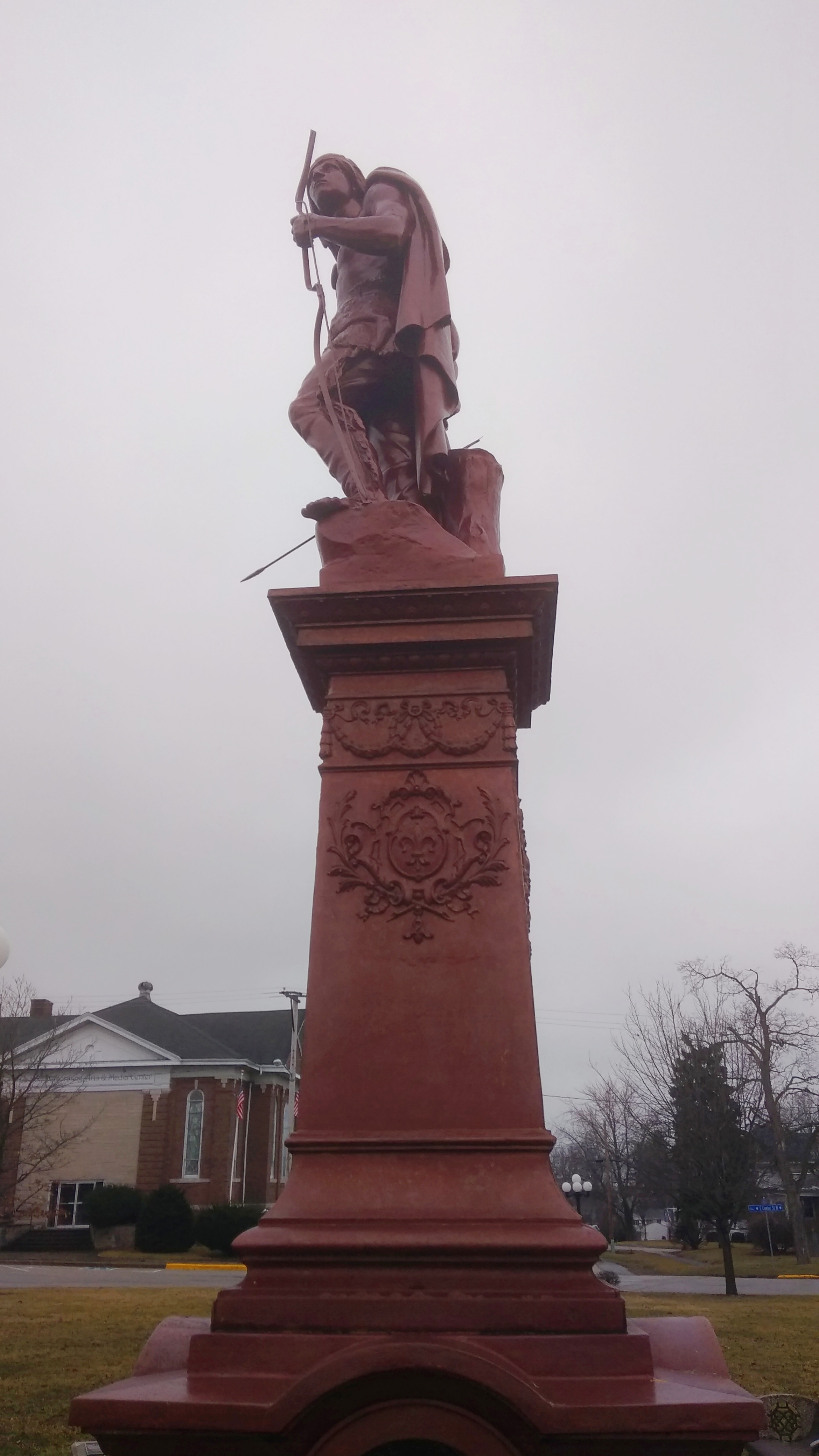
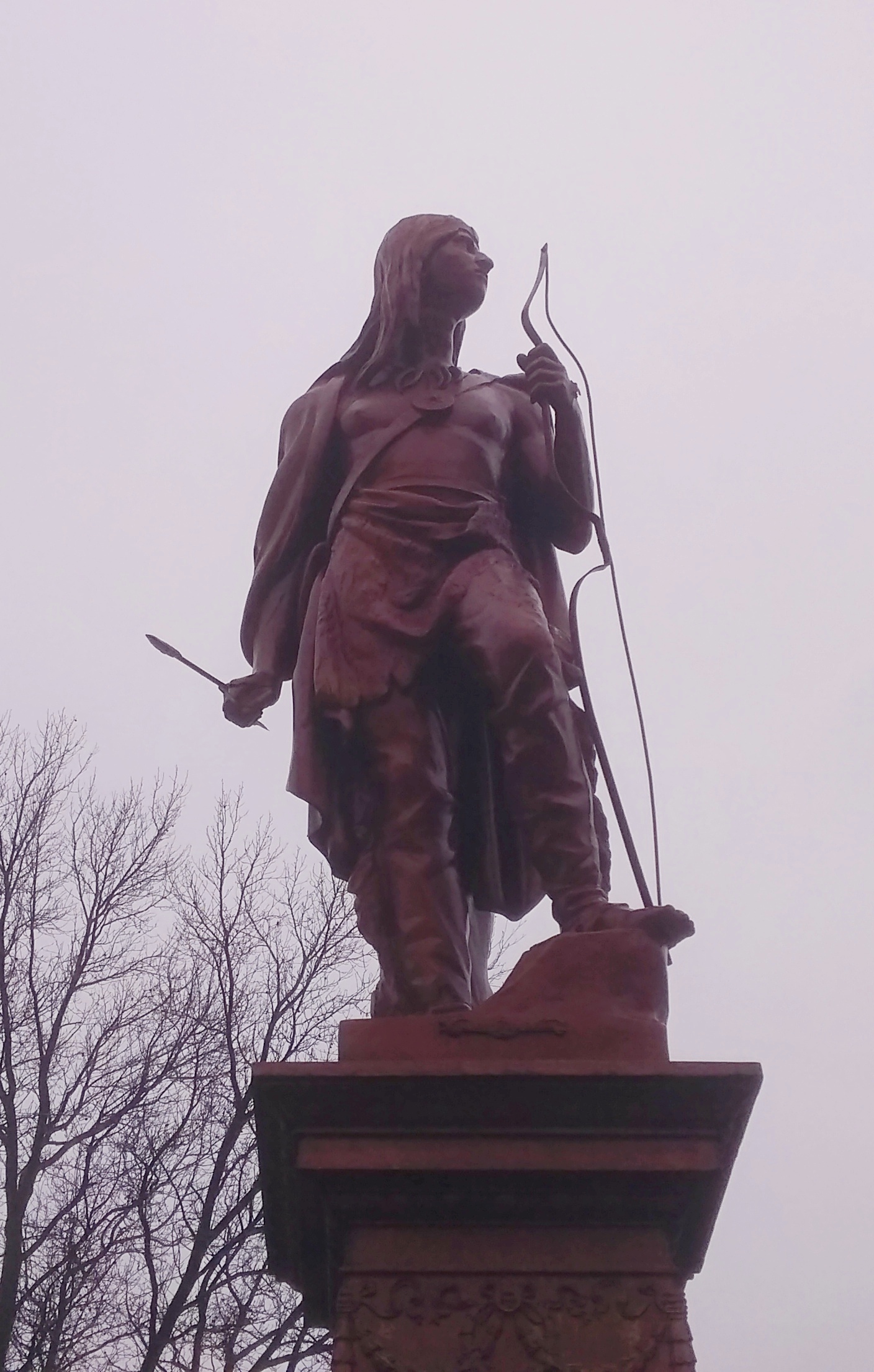
As I got closer to the main memorial, I realized that it was no Union soldier.
It was an Indian.
If anyone else had been with me — and absolutely no one else was anywhere nearby — I would have said, “How about that?” or “That’s odd” or some such.

An inscription on the base says WAUSANETA. The year carved on the base is 1911.

Also on the base: Cultivate love, peace and harmony; life is too short and time too valuable to waste in angry strife. Be slow to believe evil reports about your neighbors. Be diligent in searching for something good to say about others, and when you find it don’t wait until they are dead, but say it at once.

And more: West’s Precepts. Love and thank the supreme power. Control your temper. Try to keep cheerful. Do all the good you can. Be honest, truthful and temperate. Help the poor, needy and sick. Encourage the weak and timid. Make a specialty of trying to add to the happiness of someone to-day…. and all other days.

What on Earth is this? Why is it in LeRoy, Illinois, about as off the beaten path as you can be?

Last night when I got home, I looked it up. It didn’t take long. The wonderfully named Pantagraph newspaper published an article in 2011 about Wausaneta by McLean County Museum of History Archivist/Librarian Bill Kemp.

“Although few know it today, this statue embodies LeRoy’s longtime ties to spiritualism…” Kemp wrote.

“The idea for such a statue came from local resident and ardent spiritualist Simeon H. West, and he foot the bill to purchase, ship and install the pre-cast metal Native American and its elaborate pedestal. West claimed that on more than one occasion he communed with a deceased Kickapoo named Wausaneta, and he erected this statue as a tribute to the chief and his people.

“The Wausaneta statue gazes in a northeasterly direction toward a long-gone Kickapoo fort or stockade located seven or so miles out of town. In late November 1905, West oversaw the placement of a granite marker at this rich archaeological and historic site (now considered part of the Grand Village of the Kickapoo).

“In the midst of that day’s heavy snow and howling winds, West had an intense spiritualist encounter, later reporting that he had established a ‘rapport with the spirits of the people who lived there in the distant past.’

It was then that he supposedly learned from these spirits that a Kickapoo by the name of Wausaneta was ‘head chief’ during the fort’s construction. In a later seance, West heard from Wausaneta himself, and was told that the chief had died at the age of 75 and was buried north of the historic marker.”

“LeRoy’s Wausaneta was unveiled to the public on New Year’s Day 1912. West, in his typical new-agey grandiosity, dedicated his statue ‘to the lovers of the beautiful in every country and in every clime until time shall be no more.’ ”

That made my day. It’s exactly the kind of eccentric sight I enjoy finding on the road, especially when serendipity leads me to it.