Grouseland

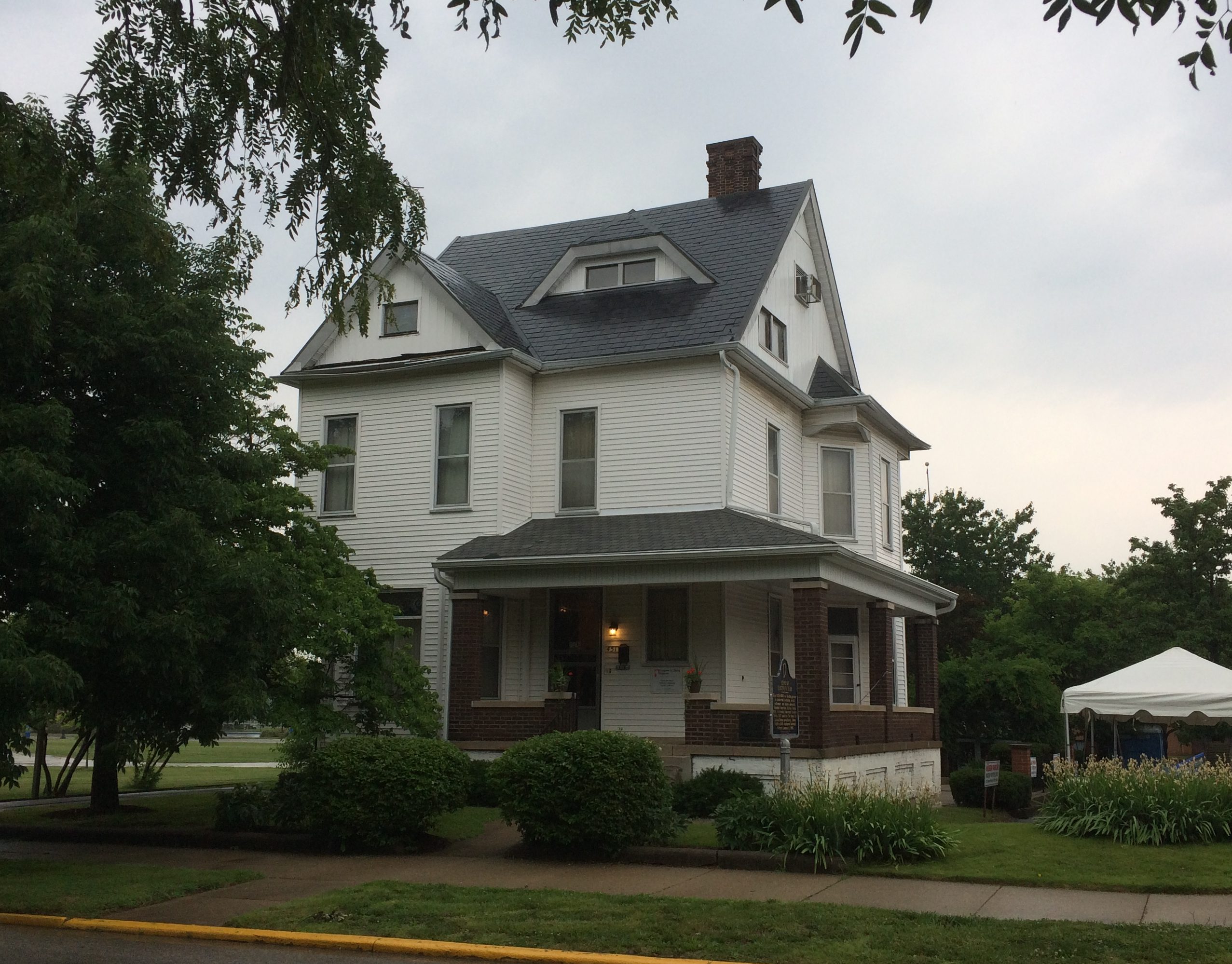
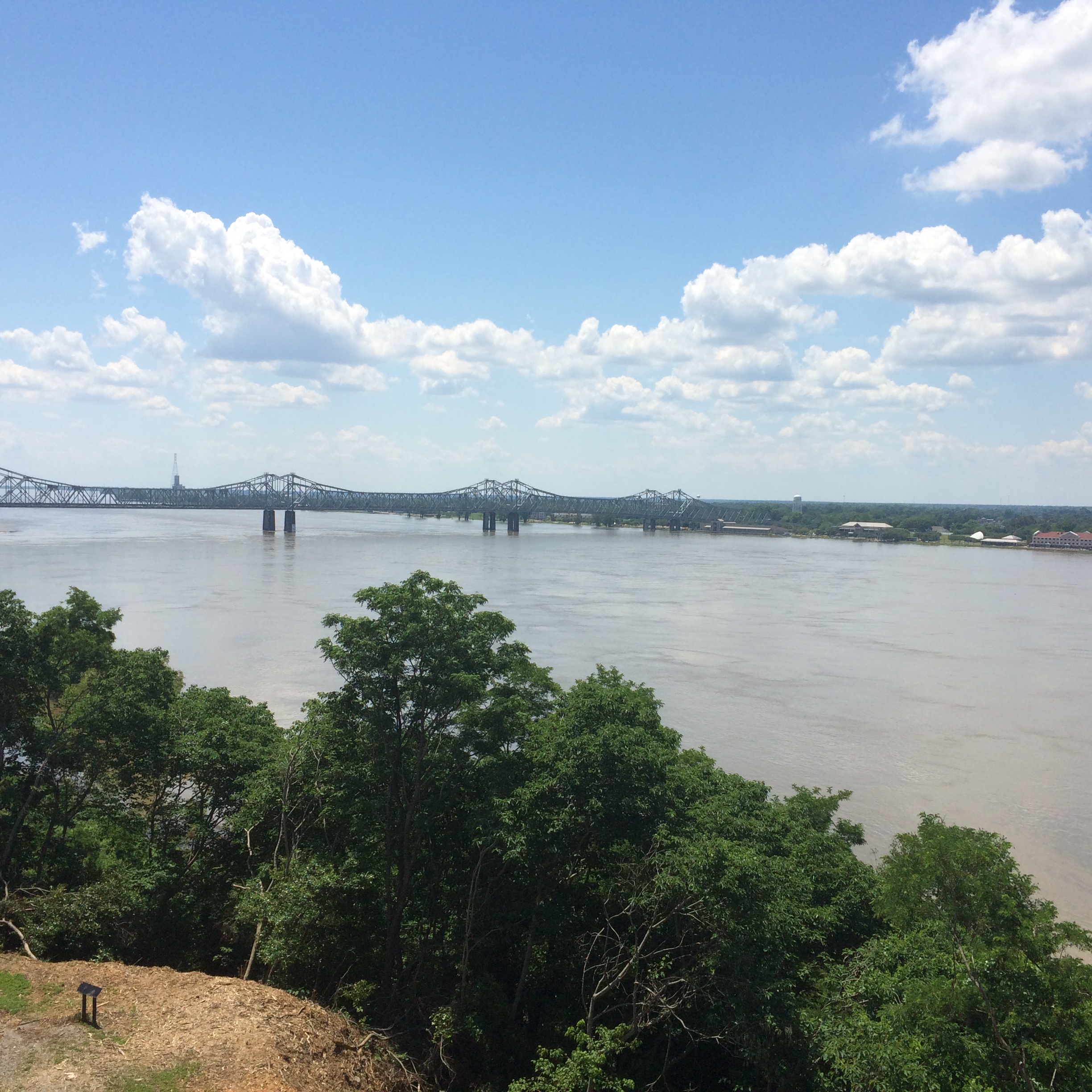
Grouseland is the inelegant name of a more elegant-that-expected house, supposedly named after the plentiful birds in the area, and thought to be the first brick building in Indiana — the Indiana Territory in those days. It was the home of territorial Gov. William Henry Harrison and his family in the early years of the 19th century. Long before Tippecanoe and Tyler too.

Even longer before “We Are the Mediocre Presidents,” though I’d argue that Wm. Henry Harrison was one of the great U.S. presidents. And one of the worst. He didn’t have time to be anything else.

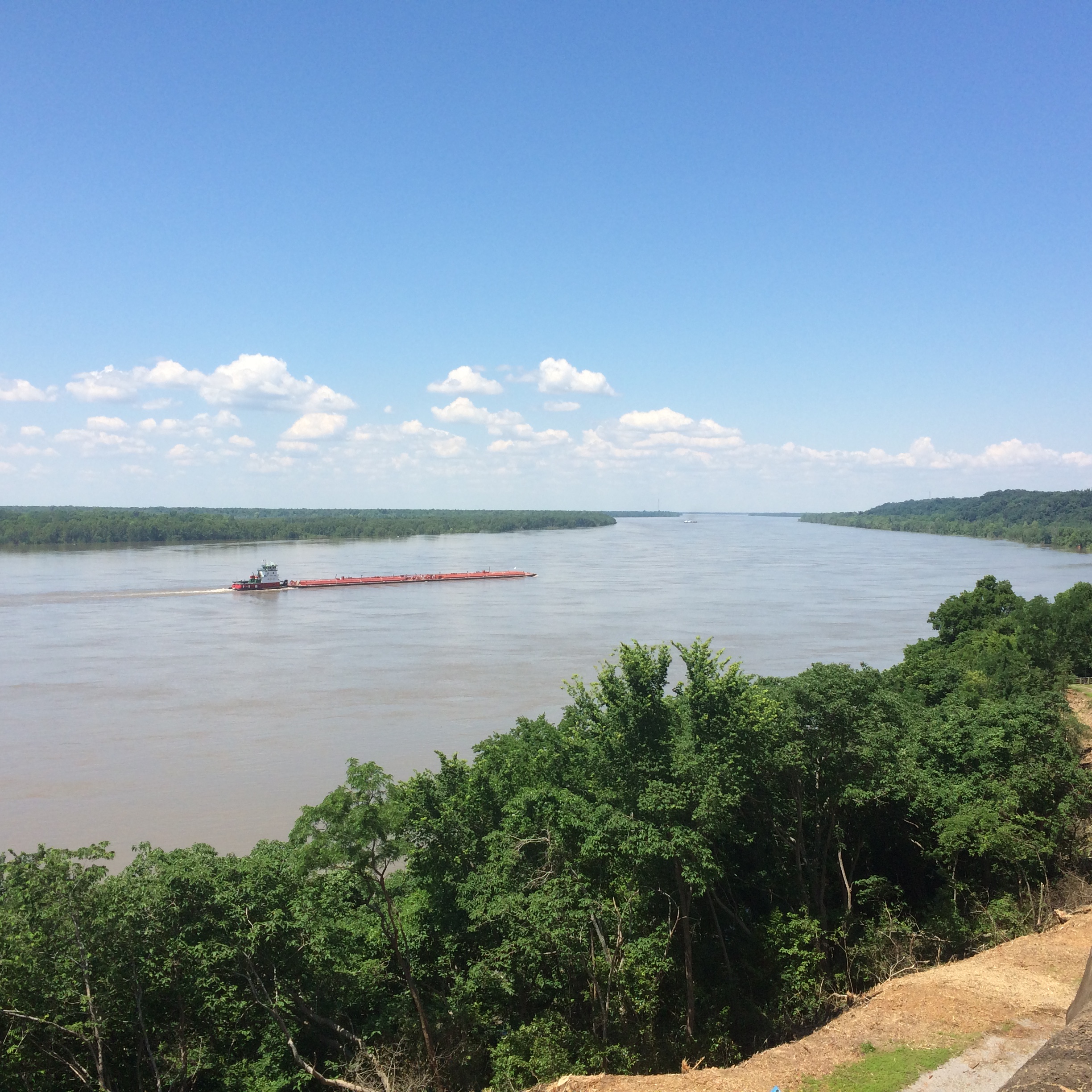
Last Sunday we arrived in Vincennes, Indiana, hard by the Wabash River, and Grouseland was our first stop. Guess I need to add it to my vanity list of presidential sites, which I haven’t updated in more than three years. Maybe next Presidents Day.

Grouseland, Vincennes, Indiana

Patterned after the Harrison manse in Virginia, Grouseland probably would have been no great shakes in the early 19th-century Old Dominion, but out in the wilderness of Indiana, it must have been impressive. It’s still impressive in small-town Vincennes. The exterior walls were built sturdy enough to endure for more than two centuries, but most of the interior is a faithful re-creation, considering that after the Harrisons left, the property was given over the other uses, including a period as a barn.

Grouseland, Vincennes, Indiana“As governor, Harrison saw his principal task as opening lands belonging to the local Indian tribes to white settlement,” the NPS says of Grouseland’s heyday. “He negotiated a series of treaties that provided for the cession of millions of acres of land, but his success generated strong resistance.

“Tecumseh, the famous Shawnee leader, who was trying to recruit other tribes to join him in armed resistance, met with Harrison at Grouseland in 1810 and warned that his people would fight to prevent further white encroachment. Located to the left of the center hall, the ‘Council Chamber,’ is where Harrison held many meetings with Indian leaders and conducted much of his business as governor.”

We got to the house just in time for a guided tour, given by a fetching Vincennes University history major undergrad volunteering for the gig. The campus extends off in the distance from Grouseland. Until I looked it up, I knew nothing about the school except as a spot on the map. (Pretty much the same could be said for Vincennes.)

From its web site: “VU is Indiana’s first college. William Henry Harrison, the ninth U.S. President, founded VU in 1801 while serving as governor of the Indiana Territory. VU was incorporated as Vincennes University on November 29, 1806.”

So that’s another Harrison legacy. Attaboy, William Henry.

The Great American Solar Eclipse Road Trip

How long did I know about this week’s solar eclipse? I don’t know. It wasn’t because of the recent media buzz. The better part of a decade ago, probably. Sometime back then, I filed away the notion: I am going to see the solar eclipse of August 21, 2017. In the path of totality.

So I did yesterday, along with my immediate family. And some unspecified millions of other people. It was an event among events. During totality, we were in Paducah, Kentucky, which occurred there for a bit more than two minutes beginning at 1:22:15 pm CDT. All my remaining days, I will remember where I was at that moment, and what I saw, and I hope so will the other members of my family.

I’d like to report that I overcame various trials and adversity to arrive at that place at that time, like an intrepid 19th-century scientist off to see eclipses over remote parts of the globe, but all it really took was a modest amount of planning, plus a bit of time and money. Back in October, for instance, I booked a room at a limited-service motel in Paducah for the night of August 20. I mentioned this to the clerk.

“That’s why you paid the regular rate,” she said. “People who booked this month had to pay twice as much.” Surge pricing among motels. She also claimed that nearby motels, only a bit better than the one we were staying in, charged $400 a night for some rooms. “And they’re getting it.”

We left on Saturday and drove from the northwest suburbs via Champaign-Urbana to Terre Haute, Indiana, where we spent the night of the 19th. On the way, we stopped at Shades State Park in Montgomery County, Ind.

The next day we went from Terre Haute to Paducah, spending a few hours in between in Vincennes, Indiana, on the Wabash River. We saw three things there: Grouseland, home of William Henry Harrison as governor of the Indiana Territory; the splendid Basilica of St. Francis Xavier, and the monumental yet obscure George Rogers Clark National Historical Park.

The thinking behind these stopovers was that seeing the eclipse at totality was no certain thing. Clouds don’t care about your peak-life-affirming-you-are-a-child-of-the-Universe experience, or even if you’re a scientist (or citizen scientist) looking to add to mankind’s body of total knowledge. It’s just another day to the atmosphere. So in case that happened — and the prospect kept me antsy for days — the trip wouldn’t be a total bust.

All together, the trip from our house to Paducah, using the most direct roads, is nearly 400 miles. St Louis is closer, about 300 miles, but I wanted to stay away from a large city for the event, which would mean adding crowds to crowds. Also, I’d acquainted myself with much smaller Paducah in 2009 at the same time as Metropolis, Ill. (misspelling Paducah in my posting), and found it pleasant enough.
Why see the eclipse at all? Because of the astronomy books I had as a kid that explained and illustrated the phenomenon, especially with maps of where total eclipses would be in far-off future years like 1979. Because of the eclipse of March 7, 1970, which was partial in Texas. My eight-year-old self made a pinhole box but, finding that unsatisfying — and this was before widespread eclipse glasses — I stole an instant’s look at it the thing itself in partly cloudy skies, very clearly seeing the black disk on the bright one. Because the subject came up at the planetarium I visited almost monthly in elementary school. Because men were going to the Moon at the same time. Because of the lyric in “You’re So Vain” that seems to reference the ’70 eclipse. The idea of winging off to Nova Scotia just to see an eclipse seemed (seems) impossibly intoxicating. Because of A Connecticut Yankee in King Arthur’s Court and “Nightfall” and other stories and movies using an eclipse as a plot point. Because I read Isaac Asimov writing about the Eclipse of Thales, and later read Herodotus on that event, which probably was on May 28, 585 BC, and if so history’s first exact date. Because I read about the eclipse of May 29, 1919, which helped confirm general relativity. Because of the annular eclipse I experienced in Nashville (as a partial) on May 30, 1984, which dimmed the sky in a strange way. Because it’s a cool thing to see not before I die, but while I’m still alive, just like the Transit of Venus. Because, to paraphrase George Mallory, it’s up there.
Roadside Wisconsin, Part 1: “The World’s Largest Penny”

Roadside America and I go back a ways, even before it was a web site. I bought an edition of it when it was a book, sometime in the 1990s at some remainder table. Now of course it’s a sprawling web site whose wisdom I occasionally consult.

I’m pretty sure that’s where I first heard about the “World’s Largest Penny.” That object can be found in Woodruff, Wisconsin. Traveling via US 51, we passed through Woodruff, a town in Oneida County, on the way to the UP and on the way home. On the way home, I watched for a sign pointing to the “World’s Largest Penny.” I wasn’t disappointed.

A block off US 51, at 3rd Ave. and Hemlock St., is the “penny.”
World's Largest Penny, Woodruff, WisconsinA sidewalk from the edge of the intersection leads up to the object, and behind it is senior housing. I’ll be nitpicky and insist that it’s a depiction of a penny, of which it might well be the largest anywhere. It’s made of painted concrete, for one thing. And even as a depiction, it’s only half there: expecting a wheat penny reserve, I went to the other side and found it blank. All you get is the Lincoln observe.

Still, the town’s heart is in the right place with its penny-depicting concrete object. The sign next to it (all sic) says:

THE MILLION PENNY PARADE

Dr. Kate NewComb had a dream — a hospital for the Lakeland area. Through contributions and volunteer help, the hospital was started. Because of the lack of funds the building was discontinued. Pennies would now help the compete the hospital.

The pupils of the geometry class of Arbor Vitae – Woodruff School wanted to see a million of something. Their teacher, Otto Burich, suggested that they collect pennies for the new hospital. The Million Penny Parade was launched.

In March of 1954, Dr. Kate went to a Doctors convention in California. She was a surprise guest on the T.V. program, “The is Your Life.” Because of her appearance people all over the country sent money for the hospital. With this money, amounting to $106,000 the hospital was completed and equipped.

As a result of this Penny Parade, the residents of this area had the beginning of the present Lakeland Memorial Hospital. This Penny is dedicated to the work of Dr. Kate and the people of the community who helped make the hospital a realty.

Donated by eighth grade class of 1969.

On a small plaque below the “penny” itself is a mention of the Woodruff-Arbor Vitae High School, as well as a Lions Club emblem. Perhaps the club had something to do with erecting “The World’s Largest Penny.”

A more detailed and somewhat different history of the fundraising efforts to build the hospital is at the web site of the Dr. Kate Museum, which isn’t far from the “penny.” Dr. Kate Newcomb (1886-1956) was apparently beloved in her time as a roving North Woods doctor. Remarkably, a clip of her on This is Your Life is posted on YouTube.

On Hemlock St. leading up to the “World’s Largest Penny,” Dr. Kate is also honored by painted images of snowshoe prints. Her nickname was “Angel on Snowshoes.”

Kate Newcomb Painted Snowshoe Prints, Woodruff, WisconsinThe small museum honoring Dr. Kate is off in that direction, but we didn’t spend any time at it. One more nit to pick: whoever painted the prints made it look like Dr. Kate hopped through the North Woods to see her patients.

Ironwood Public Art, Except For the World’s Tallest Indian

Yesterday, the Space Weather Prediction Center, a branch of NOAA, had this to say: “A watch has been issued for likely G2 (Moderate) geomagnetic storm conditions on 16 Jul and early on 17 Jul.” Thus the Aurora Borealis might thus just be visible at my latitude, according to the map. So at about 11:45 pm on July 16, I went outside and looked north. No dice.

But I’m glad the Space Weather Prediction Center is a real thing. It’s something we (humankind) should have in the 21st century.

Ironwood, pop. somewhat less than 6,000, is Michigan’s westernmost town, on the east bank of the Montreal River, which flows into Lake Superior not far away and is the border with Wisconsin. On the morning of Sunday, July 2, we stopped there to look for coffee for Yuriko.

We were unsuccessful in that, but we had a few moments to look around. Unfortunately, we didn’t see the World’s Tallest Indian. That’s what I get for not looking up what’s to see in a town before I go.

I did see the Ironwood Area Historical Society and the Historic Depot Museum. Being Sunday morning, it was closed, but it looked like a fine old depot, dating from the 1890s.
Ironwood, Michigan DepotThe Ironwood Area Historical Society says, “Its architecture is true to its Richardson Romaneque origins. The exterior is baked-red brick above and a heavy base of Lake Superior sandstone from the brownstone quarries located on the mainland and Apostle Islands near Bayfield in Northern Wisconsin. The Ironwood depot is a stunning structure with three tapering roof lines, including an unusual hipped, cross dormer and a signature finial cupola reflecting flanged rail wheels crowning the pinnacle.”

On the grounds is a statue — a carving, really, made from a tree trunk — of what appear to be three workingmen from the Ironwood past, one a miner, another a lumberman. Not sure about the third, but certainly some kind of hard 19th-century job.

Ironwood Depot Park tree carving

Ironwood Depot Park tree carvingI didn’t see any information about who carved the thing, or whether it has a title. It wasn’t created from an old tree that grew on the site, even though it looks like that. I know because if you check Google StreetView for that short stretch of S. Suffolk St., there’s no tree at all there, nor a carving. Google came by in September 2008. Guess even information behemoths can’t be everywhere on a regular basis.

At the intersection of S. Suffolk and E. McLeod Ave., a few blocks from the depot and the wooden workers, there’s a small building. According to Google’s nine-year-old information, its wall facing McLeod is long and painted white.

Not any more.
Miners Mural, Ironwood, MichiganA remarkable mural. I was thoughtless not to take a longer look at it. A mural of Ironwood miners, back when Ironwood miners dug into the earth looking for iron. A detail:
Miners Mural, Ironwood, MichiganRoadside America says: “Artists Kelly Meredith and Sue Martinsen spent over four years researching and painting the mural, which depicts over 100 real miners. It was unveiled on June 16, 2012, and proved so popular as a photo-op that in 2013 the city created a car-free zone in front of the mural. A booklet available in Ironwood provides biographies of each of the miners.”

Sixth St., Calumet, Michigan

From Houghton-Hancock and the Quincy Mine, the town of Calumet isn’t far north on the Keweenaw Peninsula. I was half-expecting something like Houghton, mainly because I didn’t do much research beforehand. None, really. But I’ve owned a postcard depicting the Calumet Theater for a long time, and I knew I wanted to see that.

So we did. It’s a fine old building. Wish it had been open for a look-see inside.

Calumet Theater, Michigan

Copper fortunes built the Calumet. A local architect named Charles K. Shand designed it. The historical marker next to it says, in part: “One of the first municipal theaters in America, the Calumet opened on March 20, 1900, ‘the greatest social event ever known in copperdom’s metropolis.’ The theater contained a magnificent stage and elegant interior decorations, including an electrified copper chandelier.”

The theater’s web site says: “The Theatre opened… with a touring Broadway production of Reginald DeKoven’s The Highwaymen. In the ensuing years, the Theatre’s marquee read like a Who’s Who of American Theatre: Madame Helena Modjeska, Lillian Russell, John Phillip Sousa, Sarah Bernhardt, Douglas Fairbanks, Sr., Lon Chaney, Sr., Jason Robards, Sr., James O’Neill, William S. Hart, Frank Morgan, Wallace and Noah Beery.

“With the decline of copper mining and the local economy, and the advent of motion pictures, stage productions became less common in the late 1920s. From the depression through the late 1950s, it was almost exclusively a movie theatre…

“The auditorium was renovated for the village’s centennial in 1975, and the exterior was restored in 1988-89. The technical and code improvements and backstage reconstruction have just been completed.” These days, the theater holds 50 to 60 events a year, including plays, movies and concerts.

The theater is on Sixth St. in Calumet. The street hasn’t evolved into a day-trippers shopping district, but it does have some other interesting buildings, dating from copper times, from the looks of them.

Calumet, MichiganCalumet, Michigan Sixth StreetCalumet, Michigan Sixth Street

The buildings of Sixth St. also sport a few ghost signs.Ghost Sign, Calumet MichiganVertin’s Department Store (since 1885, headquarters for Lee overalls, union made). The store turns out to have been located in the building pictured above, between the Sixth St. streetscape and the Michigan House Cafe & Red Jacket Brewing Co. This is an example of the kind of thing I learn from a trip after I’ve gotten home. I didn’t know what I was looking at when I stood across the street from the former Vertin’s on the afternoon of July 1. Now I do.

The Vertins were Slovenian immigrants to copper country in the 1870s, and rather than mine themselves, they enterprisingly sold goods to miners and their families. Remarkably, the store endured until the 1980s. More about them is in this article in Copper Country Explorer.

This ghost sign has advertised, through many UP summers and hard winters, for a widely available product: Pillsbury Best flour.

Calumet, Michigan Ghost Sign Pillsbury

Slute’s Saloon has been a saloon, though not under that name, and as the sign says, since 1890. Curiously enough, a descendant of the Vertins is one of the partners in the business, at least according to this 2010 article. A look inside is here.

After I got home, I learned that George Gipp was from nearby Larium, Mich. — where you can find the George Gipp Recreation Area & Ice Arena — and is buried in Calumet. Dang. That would have been something to know beforehand, but you can never really prepare for going somewhere new. Still, I’d have looked for the Gipper’s grave had I known. It isn’t everyone who can inspire motivational speeches down the decades.

Houghton & The Quincy Mine, Keweenaw

Who could look at a map of the Upper Peninsula, taking a solid gaze at the UP’s UP, namely the Keweenaw Peninsula, and not think I want to go there. Probably a lot of people would not think that. But I do.

So on July 1, unfortunately a bit late in the afternoon, we approached Keweenaw via M-26 (a part of the Lake Superior Circle Tour). Aside from a gas station in South Range, first stop was Houghton, a town with a pleasant main street — Shelden Street — that tries to capture the tourist trade, but isn’t a full-blown, Gatlinburg-class tourist trap. Yet it is an old street formerly given over to ordinary commerce, then repurposed over time to feature restaurants, gift shops, boutiques and so on.

Shelden Street isn’t the most frenetic example of that kind of street that I’ve seen — that might be in Banff Ave. in Banff in July — but it was busy enough. Red brick and red sandstone structures line the street, including the handsome Douglass House Hotel, which is an apartment building these days.

Across the street and down a block or so, tucked away in a pedestrian passage leading to parking off Shelden Street, was a wonderful mural map of the Keweenaw Peninsula. I can’t find an image of it online, but whoever did it was a first-rate map muralist. The artist managed to straddle the line between creating an actuate map with too much detail and a map illustrated by small images (like in a tourist brochure), which often doesn’t have enough detail.

Houghton is separated from the town of Hancock by Portage Lake, which is part of the canal cutting through the peninsula. The Portage Lift Bridge, with its unusual look, connects the towns. It’s the fourth bridge on the site.

“This… bridge would have double decks with the upper deck carrying four lanes of traffic while its lower deck supported rail traffic,” Keweenaw Free Guide says. “Its lift section – the largest and heaviest in the world – could be raised 32 feet to allow the passage of modern ore carriers below it. Construction on the new bridge began in 1959 and was finished by the following summer. The old steel bridge was demolished.”

We crossed the bridge — driving, though walking across would have been an excellent thing to do — and went into Hancock, whose traffic was bollixed by road construction. As we drove slowly along, however, I was able to see the campus of Finlandia University.

Founded in 1896 as Suomi College, “Finlandia is one of 26 U.S. colleges and universities affiliated with the Evangelical Lutheran Church in America, and the only private institution of higher learning in Michigan’s Upper Peninsula,” the school’s web site says. “It is the only remaining university in North America founded by Finnish immigrants.”

Note also that the web site is honest enough to depict students in the snow. The University of Hawaii, it’s not.

Just north of Hancock is the Quincy Mine. Driving by on US 41, you can’t really miss it.
Quincy Mine, MichiganThat’s only the largest of the complex’s surface structures. There are other buildings.
Quincy Mine, MichiganAs well as picturesque ruins.

Quincy Mine, MichiganQuincy Mine, MichiganQuincy Mine, MichiganEngines, probably for ore-hauling trains. Or maybe they brought coal to power the mine. Or both.
These days, the relics are part of the Keweenaw National Historical Park. Once upon a time, Quincy Mine was the most successful copper mine on the peninsula, which is saying something, since Keweenaw was the site of a copper rush beginning in the 1840s and had a lot of active mines for a while (unsurprisingly, Indians dug for copper there for centuries before that).

The National Park Service says: “1840. Douglass Houghton, state geologist of Michigan, publishes a report on the geology of the Upper Peninsula and describes the Keweenaw’s copper deposits. Despite his appeal for caution, a land rush would soon start as investors, miners and entrepreneurs attempt to acquire copper-rich real estate.

“1856. The Quincy Mining Company begins work on the profitable Pewabic lode. Quincy soon becomes an important copper mine, and earns the nickname ‘Old Reliable’ for its nearly constant profits.

“1861: Demand for brass buttons, copper canteens and munitions increases. Despite the need, copper production at many older and profitable mines in the region actually decreases as new, speculative mines open, causing labor shortages.”

Later, telephones and electric wiring spurred more demand for copper, and the Quincy Mine remained in production until the Depression, despite competition from mines in Montana and elsewhere. Quincy’s last gasp as a mining concern was World War II. Remember, copper was in such short supply then that pennies were made of steel in 1943.

Now Quincy is a tourist attraction. You can take a tour down in the mine, at least at the levels that aren’t flooded. We didn’t get there in time to do that, but we were able to look around the ruins and the small museum inside one of the intact buildings. If I come this way again, I’ll time things to see the depths of the Quincy Mine.

UP ’17

For someone who grew up in Texas, I’m unaccountably fond of the Upper Peninsula. A little, probably, since I first saw as a lad its fine ragged outline on a map, and a lot more since my first visit, solo, in 1989. Maybe my appreciation came into full flower on H-13, a two-lane road through Hiawatha National Forest, as I drove north a little faster than strictly necessary, my cassette player playing a little louder than usual, zipping between walls of pines. It was a Be Here Now moment.

Also, I’ve never grown tired of gazing out into the vastness of Lake Superior, as I first did that year and most recently on July 1 at the mouth of Presque Isle River.

Lake Superior, Presque Isle RiverThe shore was rocky at that point, with smooth white driftwood beached on the shore. Not only that, people had built small cairns there, mostly on the wood, something I didn’t notice until I did. Then I started seeing them all around. I built one too, though not this one.
Lake Superior, Presque Isle River
We left the northwest Chicago suburbs late in the afternoon on June 29, spending the first night in Madison. From there, it’s a straight shot north through central Wisconsin, for much of the way on I-39 and then the slower but more interesting US 51. On the last day of June, we made our way north to the western reaches of the UP.

As I wrote 14 years ago: “At the northern end of I-39, which runs like a spine through most of central Wisconsin, US 51 takes over, though for a time it’s a divided highway of four lanes, and thus exactly like the Interstate. Just north of the wee resort town of Tomahawk… the road narrows. By this time, the driving visuals were compelling anyway, and all the narrowing of the road did was bring the scenery that much closer.”

Near Hurley, Wis., US 51 meets US 2. Unlike the 2003 trip, this time we headed east on US 2 into Michigan, into new territory for all of us — me, Yuriko and Ann. Staying at a modest but charming non-chain hotel in Wakefield, Mich., on the nights of the 30th and the 1st, the focus of the 2017 trip was the western UP, especially the Porcupine Mountains Wilderness State Park. We also visited the Keweenaw Peninsula, but time didn’t allow a fuller look at Keweenaw.

Evenings were cool and days in the 70s F. and partly cloudy most of the time. Weather forecasts had spoken of rain, but the closer we got to the trip, such forecasts were revised, downplaying the chance of rain. In the event, only a little fell on us on July 1 as we drove back toward Wakefield in the late afternoon. On the evening before, just before sunset, patches of thick fog clung to the Black River Road near Potawatomi and Gorge waterfalls. Ann commented on its eerieness.

Walking was an important part of the trip. Essential, as far as I’m concerned. On the first day of July, Yuriko thought to check the app on her phone that counts steps. We took over 14,000 steps that day. Many of the steps were on forest paths like this.

Porcupine Mountains Wilderness State Park

Or this.

Porcupine Mountains Wilderness State Park

A lot of the steps looked like this.

Porcupine Mountains Wilderness State Park

I felt my age. I usually brought up the rear, and took more breaks than I might have 10 or 20 years ago, but I got through.

Since time was short and distances, while not great, did involve miles to cover, driving was important, too. Also an essential experience on the trip, in my opinion. Tracing a course around the southern edge of the state park, the utilitarian-named South Boundary Road snaked through the intense summertime UP greenery, made all the more flush by a rainy spring, up and over hills, encountering few other cars. Light traffic on a two-lane road like that is the difference between an enjoyable time and constant white-knuckle dread. It was car-commercial driving. I got a kick out of that road.

Other roads in that part of the UP, routes through Ottawa National Forest and up into Keweenaw, were more developed and traveled, but had their attractions as drives and for their roadside sites. Though I know they represent a backstory of hardship — the UP must be a difficult place to make a living for a fair number of people — the area’s abandoned buildings were strangely fascinating. Such as a derelict store with gas pumps near (in?) Silver City.

Silver City, Michigan 2017

Detroit has no monopoly on abandoned Michigan structures. I suspect no root beer has been served at this former Wakefield drive-in in some time.

Family Root Beer Drive In, Wakefield, Mich 2017

In Wakefield, I made a point of taking a picture of a couple of Lake Superior Circle Tour signs.
Lake Superior Circle Tour signs, Wakefield, MichThe Circle Tours are networks of roads that, as the name implies, go all the way around each Great Lake, and in this case Superior. The idea was obviously hatched to promote tourism, and not that long ago, in the 1980s. To that I say, so what? The signs sit there quietly, but make a grand suggestion to passersby all the same.

I saw Lake Michigan Circle Tour signs in the late ’80s, as far south as Illinois, and on a sunny September day in ’89, on M-28 headed west to Marquette, I first saw a Lake Superior Circle Tour sign, which I hadn’t known existed. To me, the sign said — still says — Drop Everything and Drive Around the Lake. I’ve managed to drive around Lake Michigan, clockwise and counterclockwise. Lake Superior, no.

The Air Zoo of Kalamazoo

Mid-week between Christmas and New Year’s, I popped off by myself to Michigan, more specifically to Kalamazoo, the city with the most fun name in the whole state — just repeat it a few times and see — for a look around. One of its main attractions is the Air Zoo. I’ve heard about that place for years, but an air (and space) museum is a moderately hard sell for the family. Not for me. Spacecraft especially, but also aircraft.

The Air Zoo is relatively small, at least with the Museum of the U.S. Air Force still fairly fresh in mind, but it offers an excellent collection, including early airplanes, a lot of WWII aircraft, examples from the age of jet fighters, and a number of space-related objects. The museum is also in the major leagues of aircraft restoration efforts. A number of items that it had restored were on display, and later I read about a WWII dive bomber, a Douglas SBD-2P Dauntless, that was pulled from Lake Michigan recently and which will be restored by the museum.

Here’s a WACO VPF-7, something I’d never heard of, probably because it was only one of six ever built.

According to the museum, the ’30s-vintage aircraft “was designed as a trainer/combat aircraft for the Guatemalan Air Force. As an attack aircraft, the front cockpit would be covered and .30-caliber machine gun pods would be placed under the wings. However, this particular aircraft has no indication of machine guns ever having been attached.”

A Ford Tri-Motor. Also known as a Tin Goose, produced from 1925 to 1933. Indiana Jones got around in these sometimes, I believe.
Air Zoo“The Air Zoo’s 5-AT Ford Tri-Motor (N4819) came off the assembly line in 1929 with serial number 58 and was delivered to National Air Transport, where it probably delivered freight and mail,” the museum says. “It quickly went to Ford Motor Company for modifications and then was sold to Northwest Airways, flying the Minneapolis-St Paul-to-Chicago run. It was one of five Tri-Motors bought by [the company that] would become Northwest Airlines.”

Maybe so, but as a display item, the plane is painted as if it were in service of the U.S. Army. I’ve read that until last year, this very plane was airworthy, and the museum gave rides.

Here’s a B-25, one of almost 10,000 produced during the war.
Air ZooThis particular one made strafing runs with the 489th Bomb Squadron, 345th Bomb Group, according to the museum. I like that paint job.

Modern wars aren’t won just with fighting machines, but by getting materiel here and there as fast as possible. Enter the DC-3.

Air ZooTime flies, there are more wars. Jets do the fighting, such as this F-8 Crusader.
Air ZooThe sign said: “Photo reconnaissance variants of the Crusader flew several dangerous missions during the Cuban Missile Crisis. Then… the F-8 became the first U.S. Navy aircraft to routinely battle North Vietnamese MiGs.”

A small but distinctive collection of space artifacts is on display at the Air Zoo. I take ’em where I can get ’em. Such as this J-2 engine, famed for its attachment to the second and third stages of the Saturn V.

J-2 Air ZooThere aren’t many machines that have to be just so or they’ll blow up. Kudos to the engineers.

Here’s something I’d never seen before: a Gemini boilerplate.
El Kabong, Air ZooEl Kabong I is its whimsical nickname. I’d forgotten that, “as El Kabong, Quick Draw would attack his foes by swooping down on a rope with the war cry “OLÉ!” and hitting them on the head with an acoustic guitar …” (Wikipedia). Quick Draw McGraw made a fairly faint impression on me, even at an impressionable age.

Anyway, the boilerplate’s main job was to test the feasibility of recovering spacecraft on land using extendable skid-type landing gear, a steerable gliding parachute (para-sail), and solid-fuel retrorockets to help slow the spacecraft for landing, says the Air Zoo. I don’t think Gemini landed that way, but it sounds pretty cool.

The concept of the boilerplate spacecraft might be an obscure one to the public at large, but I like coming across them.

Jumes, Sheboygan Update

Eight years ago this month, I visited the Sheboygan, Wis., area and had a fine breakfast one morning at a diner in Sheboygan, Jumes.

Jumes, SheboyganI wondered recently if it was still in business. Sorry to say, it isn’t.

I wrote in 2008: “The place had that diner atmosphere: a straight pink neon tube all the way around the walls, a few pictures of ’50s pop icons here and there, tables, booths and a counter, the hiss of frying, the clink of dishes, relaxed Sunday conversation, the smell of bacon, and even the faint aroma of cigarette smoke — which isn’t banned in all restaurants at all times yet in Wisconsin.

“A Greek immigrant named George Jumes got into the restaurant business in Sheboygan in 1929, and the place has been under the current name at the current location on 8th Street since 1951, so the ’50s memorabilia, which wasn’t overdone as some chain restaurants do, is apt.”

Sly’s Midtown Salooon, which is behind Jumes in this image, does still seem to be in business. People gotta drink.

The Surviving Kankakee Gazebo

One more thing about Kankakee: there’s only one surviving gazebo of the two that David Letterman gave the city. Of course I had to see that.

Kankakee Dave Letterman Gazebo, Cobb Park

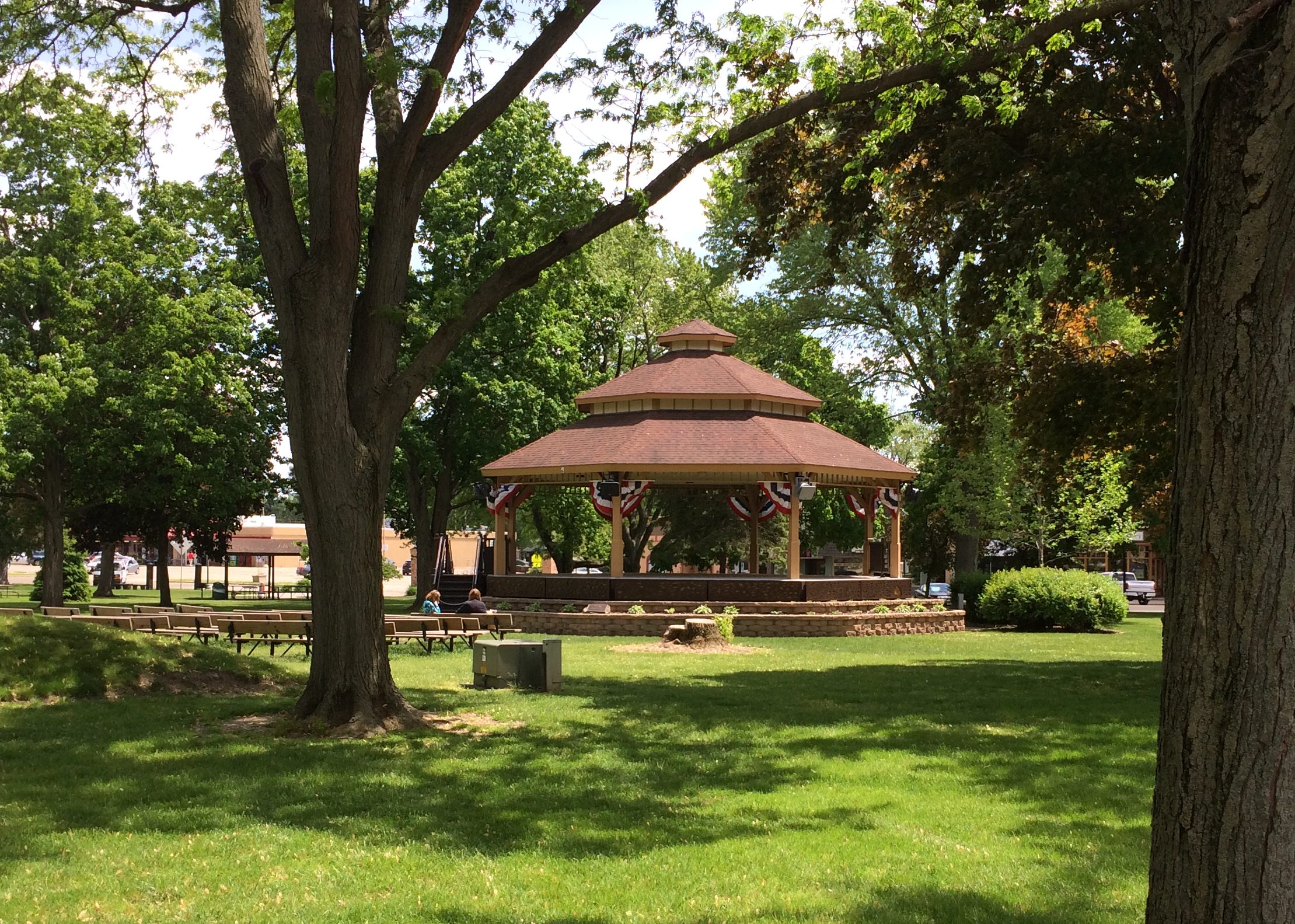
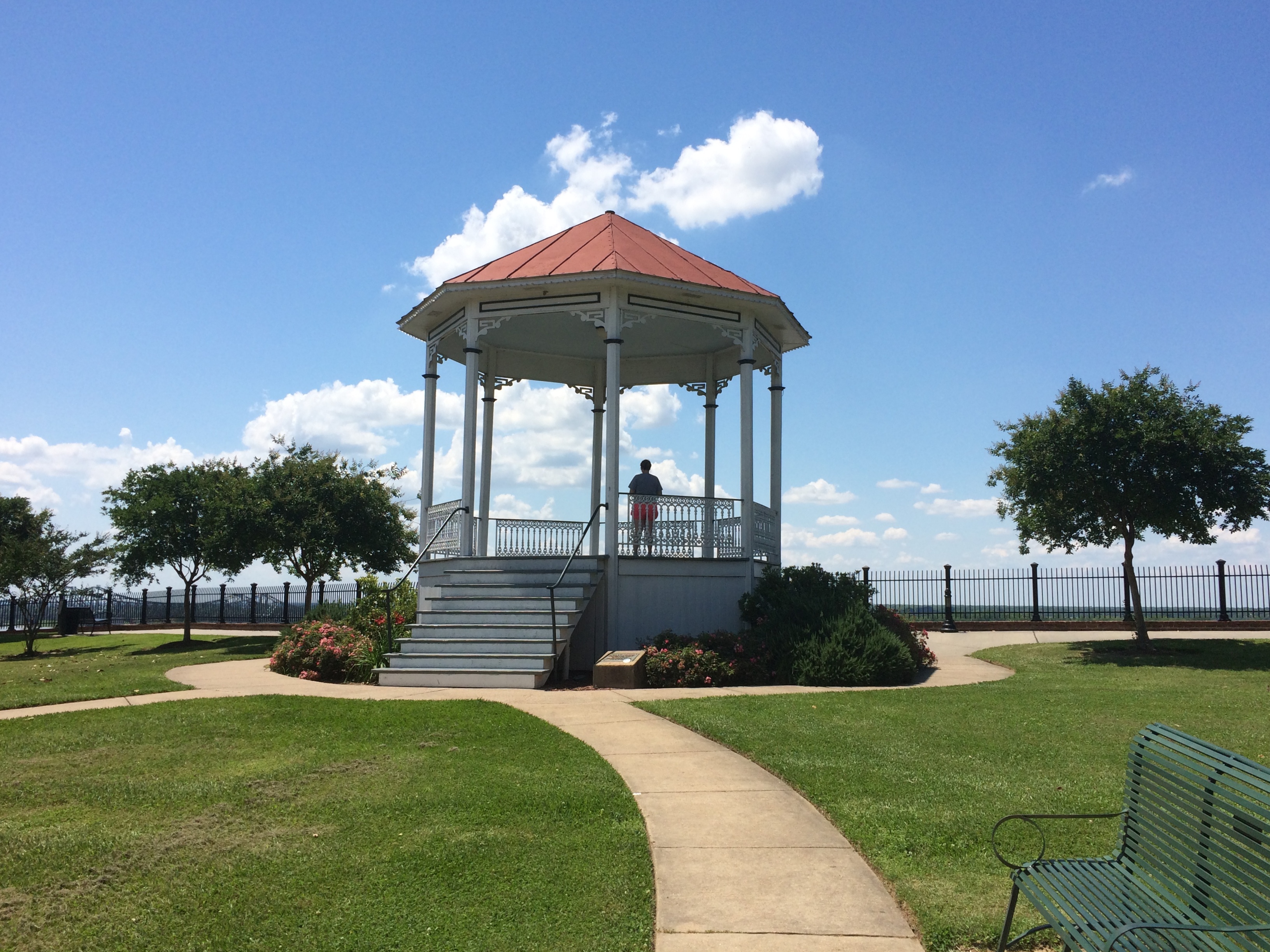
It’s in Cobb Park, near the Kankakee River. Not the most impressive of structures, even among gazebos (this one’s better). It’s like something someone would buy at a DIY store and put in his back yard.

But that’s not so important. A sign inside the gazebo says, “this is one of the world famous [sic] gazebos as seen on the Late Show with Dave Letterman. Presented to Kankakee on air in 1999, in a spoof to nickname the city: “Home of the Twin Gazebos.” In 2015, the City of Kankakee returned their [sic] gazebo on air to Dave Letterman in the form of a rocking chair.”

Needed an editor, that sign. It meant that the city, at the suggestion of Kankakee high school students, tore down one of the two gazebos and used some of the wood to build a rocking chair for Letterman (to remind him of his retirement?). The other one still stands, or at least it did as of October 1, 2016, when I got out of my car — Yuriko wasn’t interested, and waited in the car — and crossed Cobb Park to see it. More detail is in the Chicago Tribune.

I vaguely remember Letterman making fun of Kankakee (“puts the ill in Illinois” and “puts the annoy in Illinois”) after the city ranked last in some places-to-live article. Giving the city a couple of gazebos was a Lettermanesque extension of the gag, I guess. Also, it doesn’t hurt that “gazebo” is simply a fun word to say.