Southern Loop ’21

Just returned today from a series of long drives totaling 2,610 miles that took me down the length of Illinois and through parts of Missouri, Tennessee, Mississippi, Arkansas, Louisiana and Texas. Dallas was the prime destination, where I visited Jay for the first time in well over a year.

I drove on crowded Interstates, nearly empty Interstates, U.S. highways, state and county roads, and urban streets, and logged a lot of miles on roads through farmland, forests and small towns. I crossed the Mississippi more than once, including on a bridge that felt so narrow that moving the slightest bit out of your lane would crash you into the side of the bridge or oncoming traffic. Rain poured sometimes, drizzle was common and there was plenty of evidence of a wet spring in the ubiquitous puddles and the lush greenery of the South.

On I-20 east of Shreveport, I spotted a small truck carrying mattresses that had stopped on the right shoulder ahead of me. Then I spotted the mattress he’d dropped in the middle of the road, a few seconds ahead of me. The truck was 50 feet or so further than the mattress; he’d probably stopped to pick it up, but fortunately hadn’t got out of his truck yet. To my left another car was just behind me, so I threaded the needle to the right of the mattress and left of the truck, missing both.

I left metro Chicago mid-morning on April 9, making my way to Carbondale in southern Illinois, and took a short afternoon hike to the Pomona Natural Bridge in Shawnee National Forest. Overnight an enormous thunderstorm passed over that part of the state, and intermittent rain continued the next day as I drove through the southernmost tip of Illinois, a slice of Missouri, the length of West Tennessee and into Mississippi, arriving in Clarksdale after dark.

En route I’d stopped for a couple of hours at Fort Pillow State Park and about half that long in downtown Memphis. Dinner that night was Chinese food from a Clarksdale takeout joint called Rice Bowl.

On the morning of April 11, I took a walk in downtown Clarksdale, then drove south — stopping to mail postcards in Alligator, Mississippi — and spent most of the afternoon at Vicksburg National Military Park.
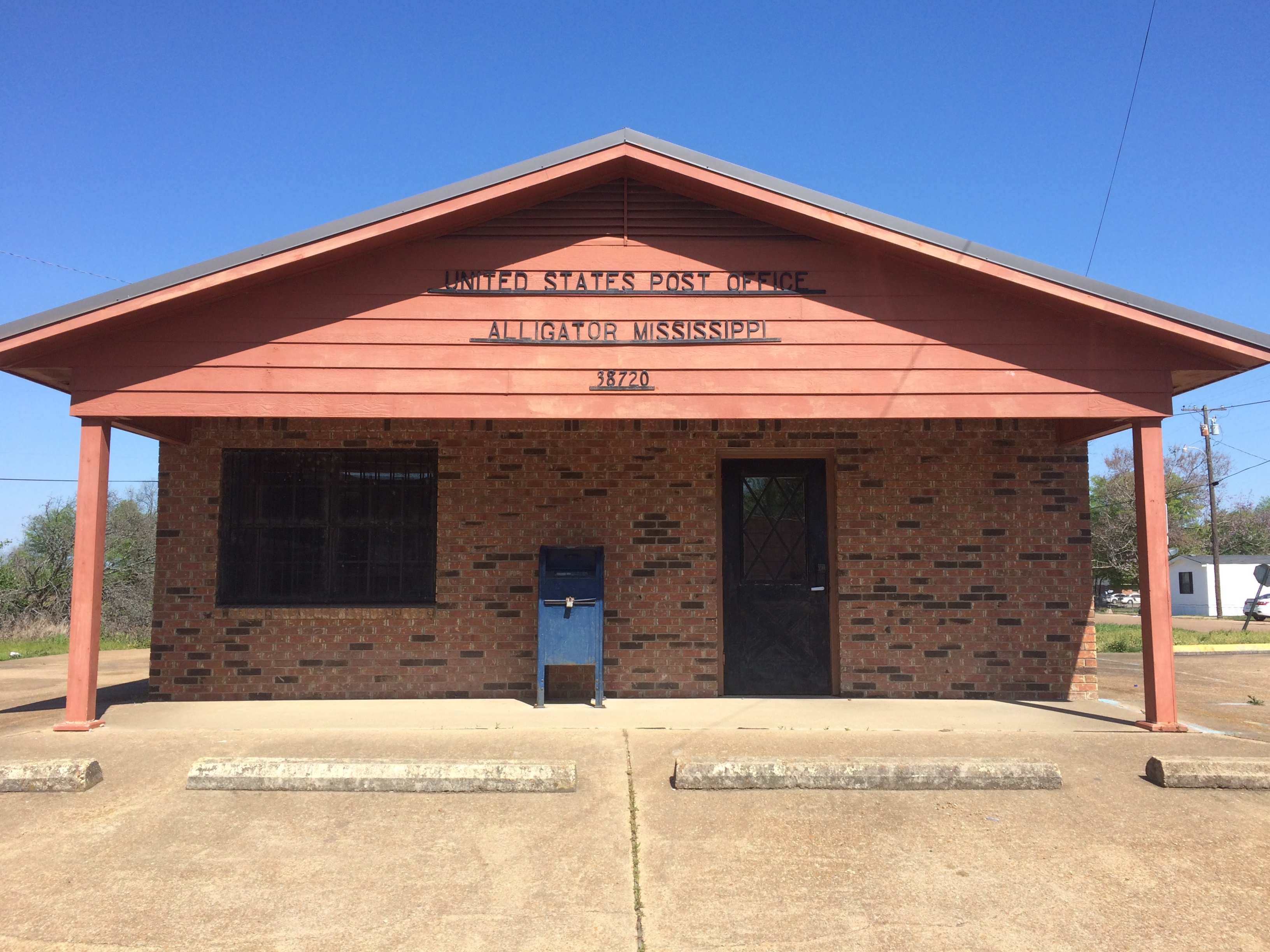
Alligator, Mississippi

As the afternoon grew late, I walked around downtown Vicksburg and one of its historic cemeteries. The next day I headed west across the Mississippi River into Louisiana, where I stopped at Poverty Point World Heritage Site, locale of an ancient Indian settlement much older than Cahokia, or the pyramids outside Mexico City for that matter.

I stayed in Dallas from the evening of April 12 to the morning of the 16th, mostly at Jay’s house, though I did visit my nephew Sam and his family, meeting their delightful two-year-old daughter, my grandniece, for the first time.

On the 16th I drove north from Dallas, spending a little time in Paris, Texas. In Oklahoma I headed on small roads to the Talimena Scenic Drive through Winding Stair Mountain National Recreation Area, where I followed its winding (as the name says), up and down two-lane path through near-mountainous terrain. In a thick fog. That was excitement enough for one day, but that didn’t stop me from visiting Heavener Runestone Park toward the end of the afternoon. I spent the night just outside Fort Smith, Arkansas.

The next morning I headed toward Fort Smith and chanced across the picturesque Main Street of Van Buren, a large suburb of Fort Smith, or maybe its mate in a small twin cities. I also looked around the Crawford County Courthouse before crossing the Arkansas River to Fort Smith proper, spending an hour or so at Fort Smith National Historic Site. From there a long and tiring drive took me to Belleville, Illinois for the last night of the trip, stopping only for gas, food and a quick look at the Mildred B. Cooper Memorial Chapel.

The place I stayed in Belleville last night was an inexpensive motel at the end of the town’s downtown shopping and restaurant street. Up earlier than usual this morning, around 7, I took a walk in area’s handsome, near-empty streets and sidewalks. Before leaving town I stopped at the Cathedral of Saint Peter, and a few miles away, Our Lady of the Snows shrine.

That ought to be enough for any trip, I thought, till I saw that the world’s largest catsup bottle in nearby Collinsville as a point of interest on my paper map (I now use both paper and electronic, which complement each other). So I went to see that. Later heading north on I-55, I thought, that ought to be enough for any trip, till I saw the pink elephant. Pink Elephant
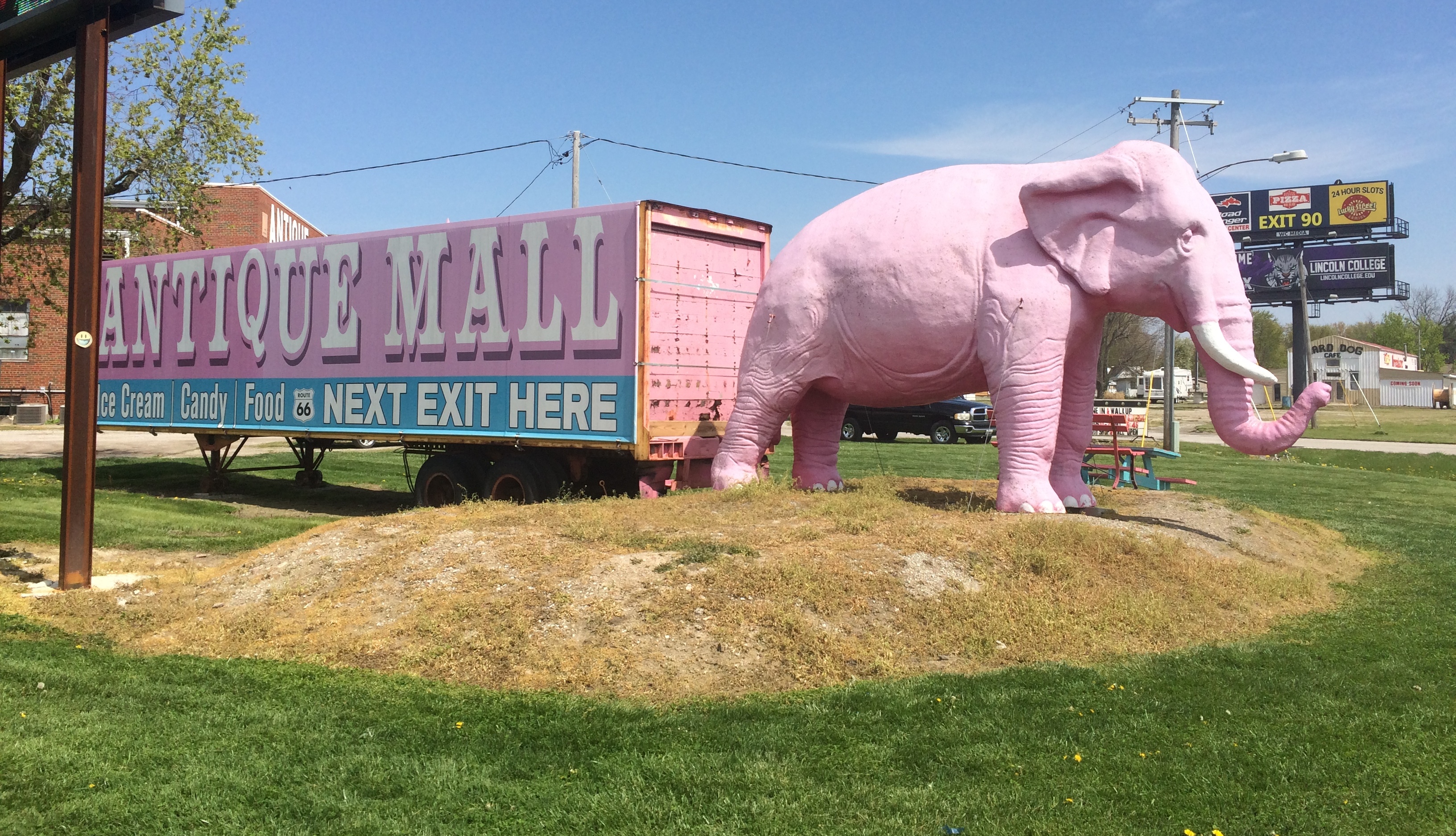
That is, the Pink Elephant Antique Mall northeast of St. Louis, which I’ve driven by many times over the years, but never stopped at. This time I did and it became the cherry on the sundae of the trip.

Yakov

Though not particularly warm today, we took a mile or so walk beginning at about 5:30 this afternoon. Just an afternoon stroll. There’s still traffic on our suburb roads, of course, but in volume it was more like a Sunday afternoon than a weekday rush hour.

One more item from the early 2000s. I didn’t realize it until today, but everything this week has been from that period, except for Sunday. An unconscious choice, probably, signifying — like all that sound and fury — nothing.

The first time we ever passed through Branson, in 2001 as a short detour on the way to Dallas, I picked up a Yakov ad pamphlet. Probably at the restaurant we ate lunch, which was the only thing we did in town.

Why? We weren’t planning to see the show. I think I’d heard of him, maybe even seen him on television by chance, such as his beer commercial, though I didn’t watch much TV during his heyday.

I’m sure I picked up the pamphlet because of the billboards we’d seen between Springfield, Mo., and Branson, which amused me. There were a lot of them advertising his Branson show, which he did from 1993 to 2015. The billboards looked a lot like the pamphlet, if I remember right. A big Yakov face promising a wacky Soviet — that is, Russian — comedian.

For the record, Yakov Naumovich Pokhis — his stage name taken from the vodka, apparently — was actually from the Ukraine. He’s still touring, or presumably was until recently, and probably will be again sometime.

The Branson Scenic Railway

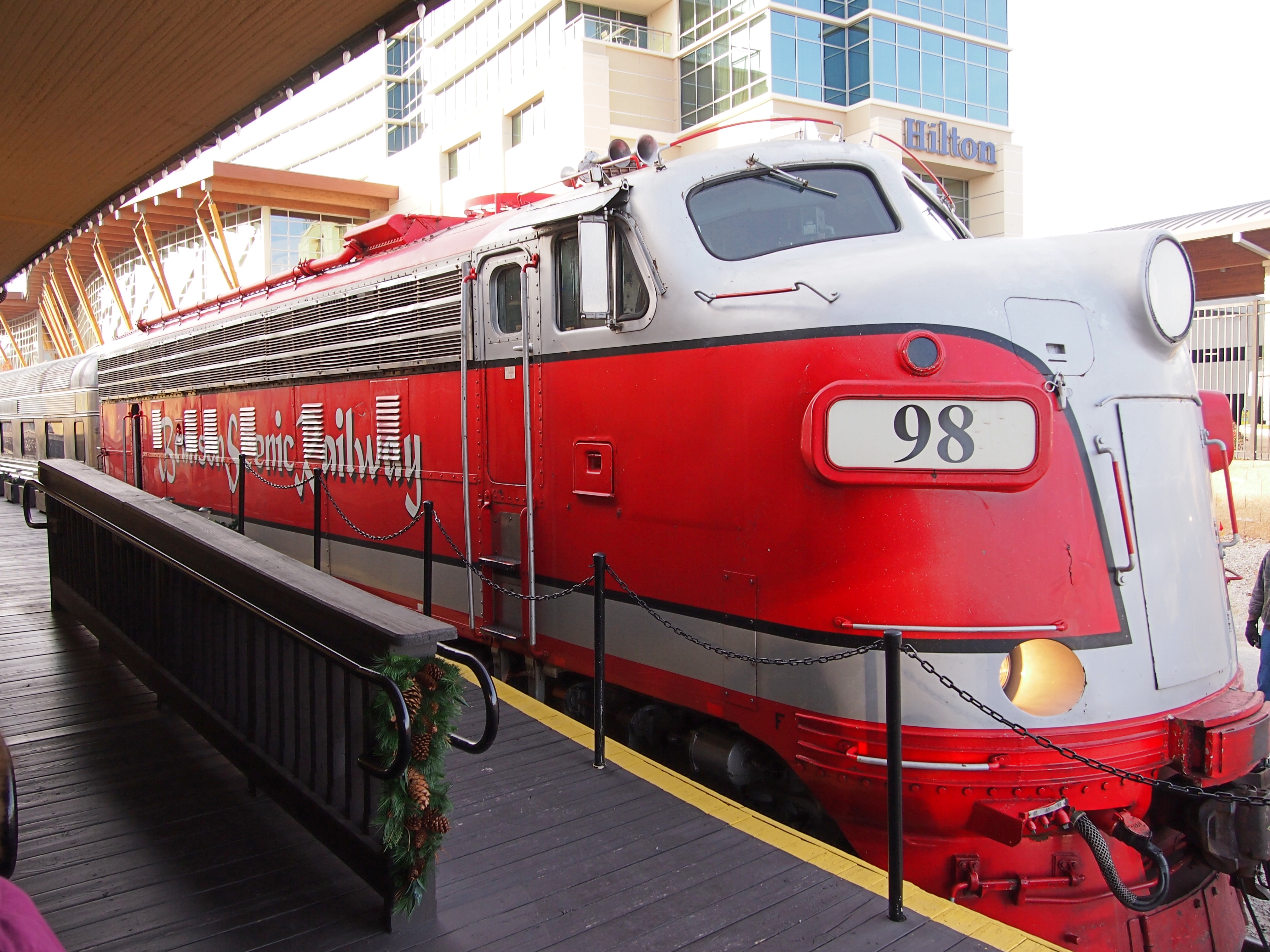
During my visit to Branson in November 2012, I took an excursion on the Branson Scenic Railway. Nothing like hopping aboard a pleasure train pulled by mid-century locomotives.
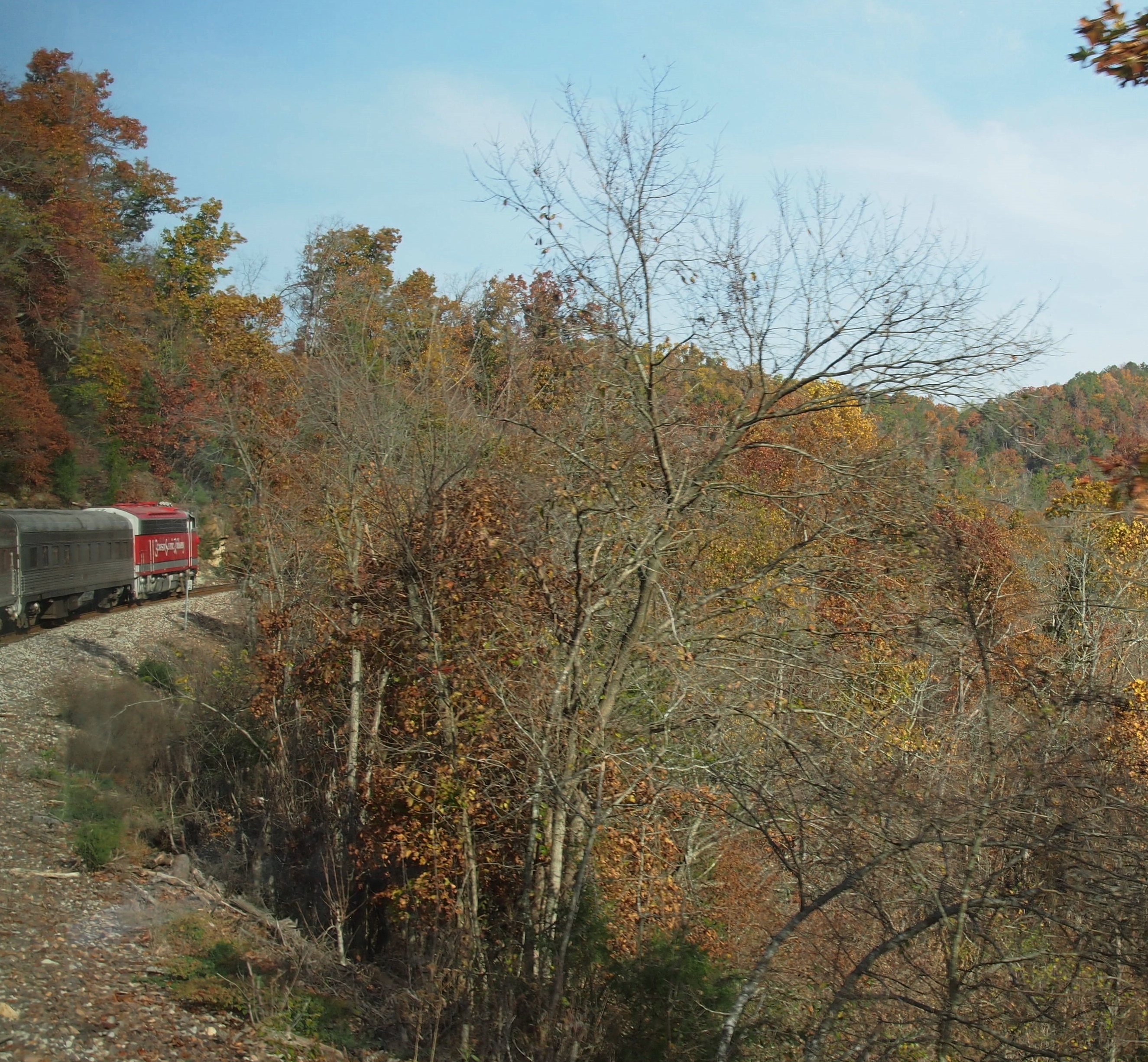
Branson Scenic RailwaySpecifically, according to the railroad’s web site, “BSRX 98, Locomotive, 1951 EMD F9PH, rebuilt 1981, has HEP (Formerly B&O, then MARC #83).” I looked up HEP, at least: head-end power. Nice to know that the locomotive has hep.

The web site further explains: “Traveling on a working commercial railroad line, the train’s direction of travel… is determined by the Missouri and Northern Arkansas Railroad just prior to departure. At that time, the train will go either north or south. The northern route goes as far as Galena, Missouri, to the James River Valley; and the southern route extends into Arkansas to the Barren Fork Trestle.”

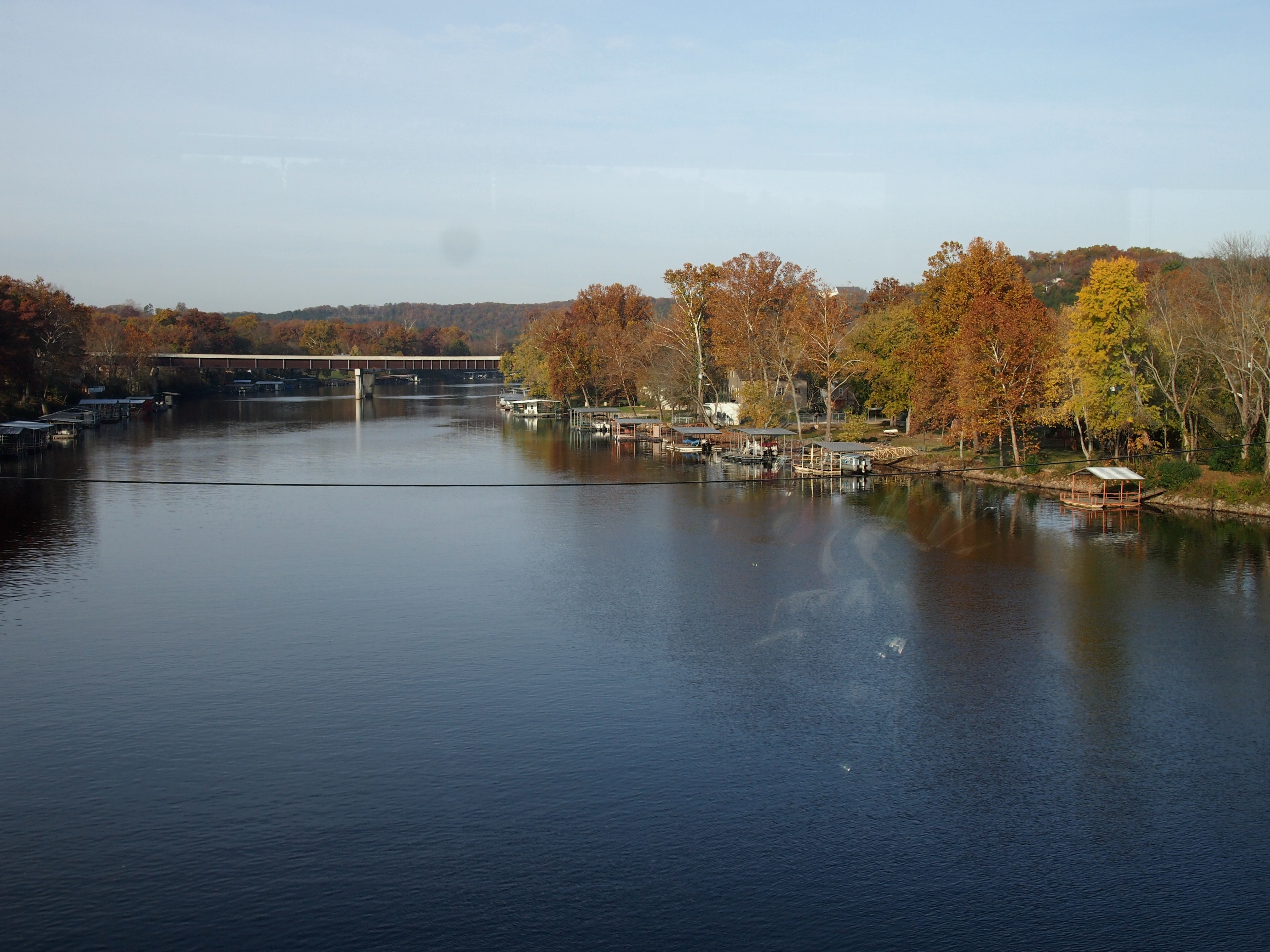
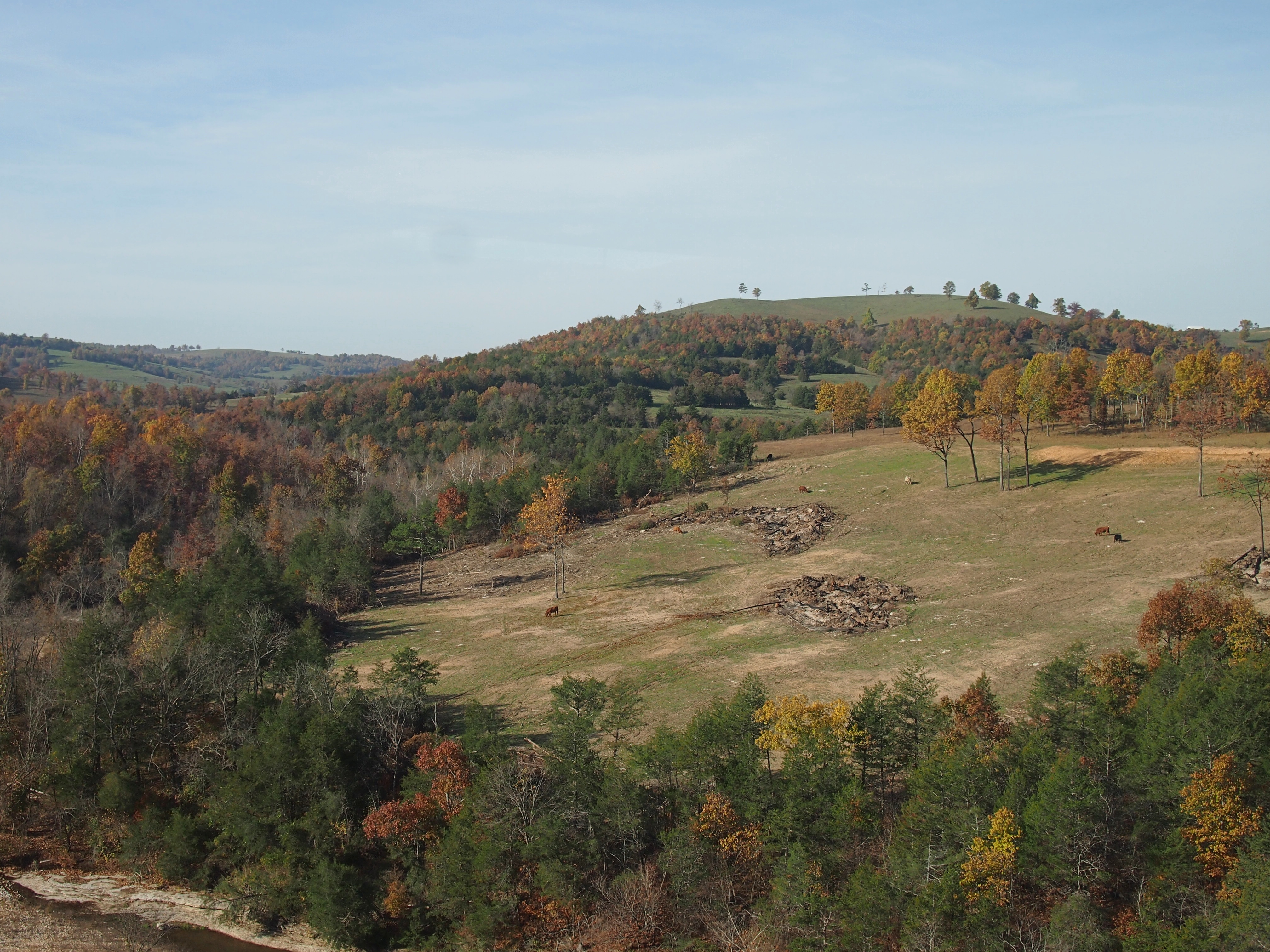
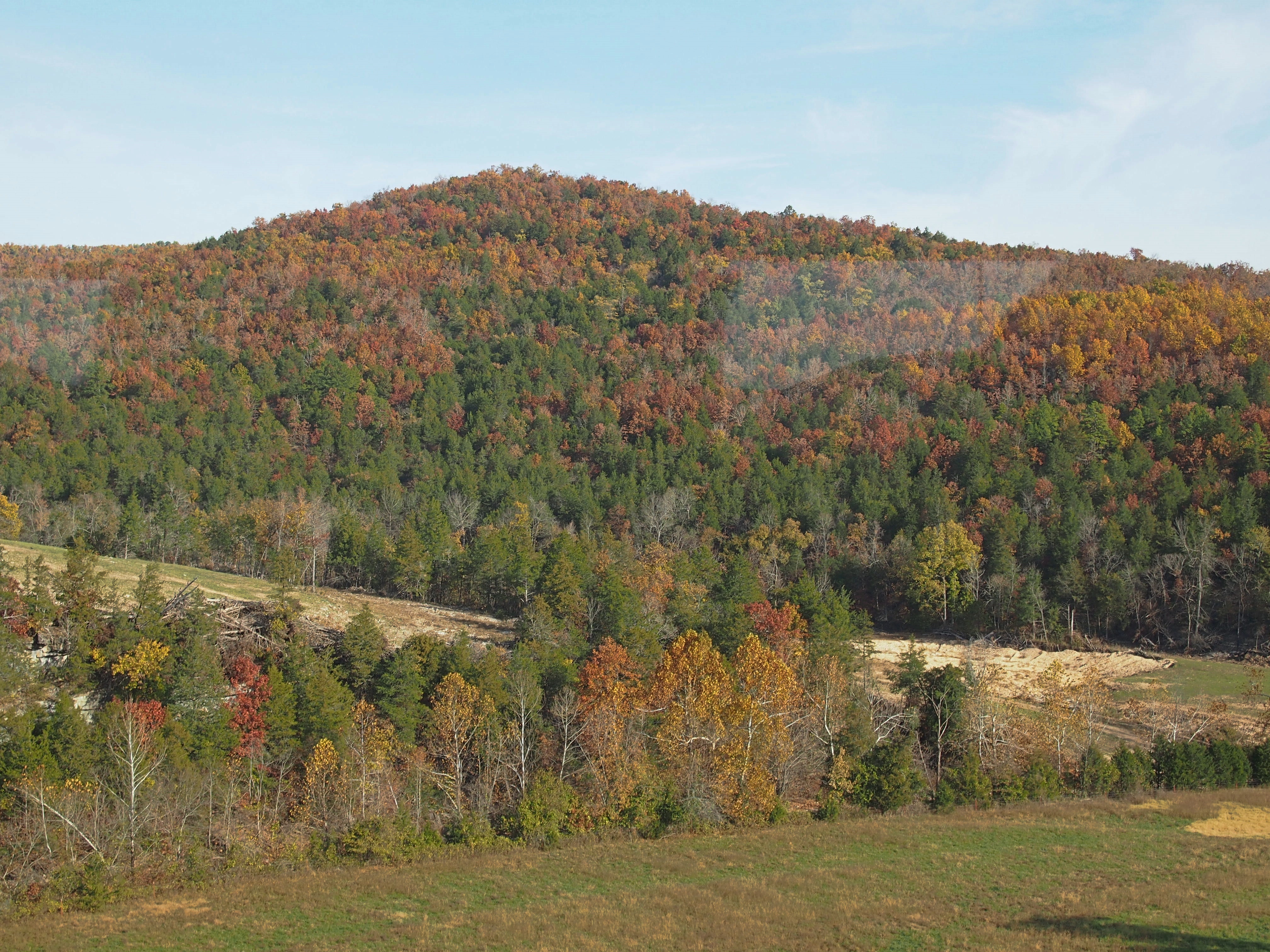
We went south into Arkansas, which isn’t actually that far from Branson, across water and through hills and woods and tunnels, just as the leaves were turning nicely.Near Branson Mo

Near Branson MoNear Branson MoNear Branson Mo“The construction of the White River Railway in the early 1900s made the area accessible for tourists and is largely responsible for the development of Branson and the Ozarks as a tourism destination… The route crosses the White River in Branson, now Lake Taneycomo, and then runs along side of it after taking a fifty-mile short cut over the Ozark Mountains.

“This was part of the Missouri Pacific Railroad between Kansas City, Missouri, and Little Rock, Arkansas. It became a part of the Union Pacific after the UP bought the MOPAC. The Missouri and Northern Arkansas Railroad now operates the line.

“In 1993, the Branson Scenic Railway was formed, and through a lease arrangement with the MNA, runs excursions through this historic route March through December.”

A train through the Alps it isn’t, but it’s scenic all the same.

Century of Progress, Missent to Kansas City

Had my slip and fall over the weekend. That happens about once per winter. Light snow was falling on Sunday, just enough to cover up a patch of ice waiting for me on a sidewalk. You know how it is. By the time you realize you’re falling, you’re on the ground.

Ann was next to me and helped me to my feet again. I knew I had children for a reason. This time, no bone damage or even bruises or any pain. Sometimes you get lucky.

The risk isn’t over. Until 9 a.m. Tuesday, the NWS says: “Total snow accumulations of 1 to 4 inches expected with highest amounts in the north. Ice accumulations of up to one quarter of an inch possible across portions of Lee, DeKalb, Kane, and DuPage Counties…

“Strong westerly winds are expected to develop Tuesday afternoon and continue Tuesday night. These strong winds may result in blowing snow and may also increase the threat of power outages…”

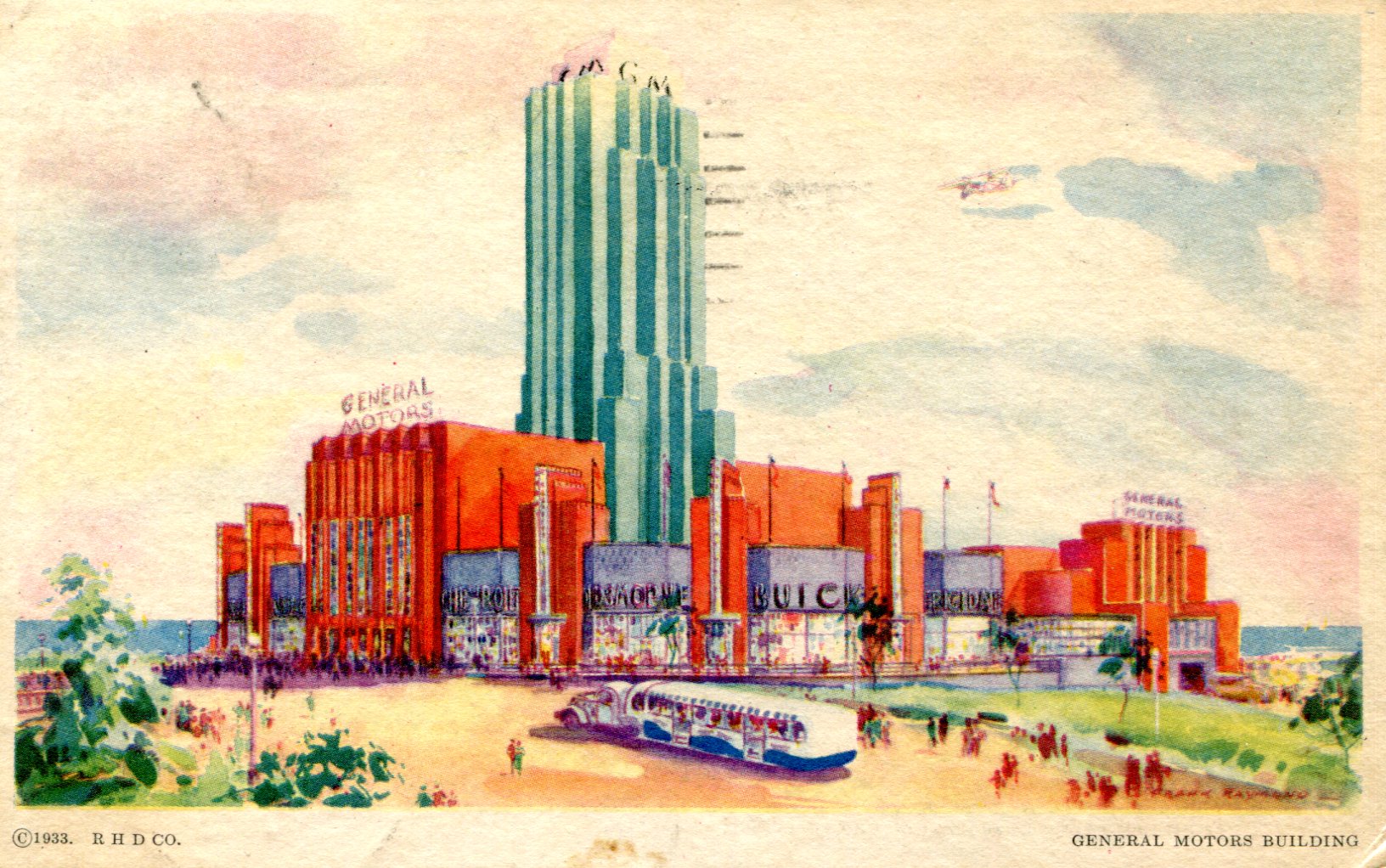
Oh, boy. Days like this, time to dwell on the past. Someone else’s past. At some point during the last few years, I acquired this postcard for a modest sum.
It’s a genuine penny postcard, depicting the General Motors Building at the 1933 world’s fair in Chicago. The Century of Progress Exposition, to use its formal name.

A product of the Reuben H. Donnelley Co., whom I assume was tasked to make cards for the fair. Not, as it turns out, the same entity as R.R. Donnelley Publishing, but a separate company founded by Richard Robert Donnelley’s son, Reuben H. Donnelley. Guess he didn’t want to work for the old man.

The card was mailed from the fair, postmarked 9 p.m. July 17, 1933, a Monday, and sent to a Mrs. A.G. Drew of St. Joseph, Mo. Interestingly, there’s another postmark that says “Missent to Kansas City, July 18, 1933.” Hope the delay wasn’t too long for Mrs. Drew.

When I lived in Osaka, one day I got a beaten up envelope in the mail that had been about three weeks in transit from the United States, or two weeks longer than usual. Stamped on the bottom (in English) was “Missent to Manila.”

Life Jackets on the Titanic

Got an unexpected press release today from a place I visited a while ago, the Titanic Museum Attraction.

Branson, Mo. Feb 5. 2019 – For the first and only time, the largest assemblage of remaining RMS Titanic life jackets will be on exclusive display March through June 15 at the Titanic Museum Attraction in Branson, Missouri. A new dimension in “Living Titanic Exhibits” will showcase seven of only 12 known Titanic life jackets beginning March 1 in Branson.

One detail: Branson ought to stand alone in datelines. Just my opinion. AP, the arbiter of such style points, disagrees. The list of cities that take no state in datelines is fairly short, according to the AP.

Besides Branson, I’d definitely add Orlando to that list, along with Austin, Birmingham, Buffalo, El Paso, Fort Lauderdale, Nashville, and some others.

“This is a stunning, world exclusive exhibit that we’re extremely proud to bring to Branson and to millions of our Titanic followers,” said Mary Kellogg, president, COO and co-owner of Titanic Museum Attractions. “There are only 12 KNOWN Titanic life jackets left in the world. For the first time, seven of these priceless artifacts will be at Branson’s Titanic Museum Attraction.”

All-caps KNOWN in the original. True, it is a fact that I didn’t know until now, but the emphasis is too much.

Wonder where the other five are. Private collections, including at least one held by an eccentric Japanese billionaire? The Greenwich Maritime Museum? The Maritime History Archive in St. John’s, Newfoundland? Someplace even more obscure?

The release also offered some quotable facts about the sad state of emergency preparedness on that doomed steamer, specifically about its life jackets.

There were enough life jackets to protect the 2,208 passenger/crew on board Titanic… but not enough lifeboats to save them all.

Life jackets were made of hard cork and canvas, proving dangerous for many forced to jump into the water.

So not only did a lack of lifeboats fail the passengers and crew, so did relatively primitive materials science. Guess cork was the best available material in 1912. It floats, after all.

I wish the Titanic Museum Attraction well with its life jacket exhibit, though I probably won’t make it to Branson to see them. But I might go if the museum promised an exhibit of surviving deck chairs from the Titanic. You know, those that were famously re-arranged.

One Cadillac Ranch & Two Stonehenges

Driving out of Amarillo toward the west I got the impression that the city comes to an end at Soncy Road, a major north-south street. City to the east, open fields to the west. Looking at the city on Google maps, I see that impression isn’t absolutely accurate, but it’s pretty close.

I was going that way to see the Cadillac Ranch. Because that’s a thing you see while passing through Amarillo, like you might mosey over to the Eiffel Tower while visiting Paris for the first time. Google Maps simply calls it the Cadillac Ranch, as does my Michelin atlas. Curiously, my Rand McNally atlas calls it Stanley Marsh’s Cadillac Ranch.

The Cadillac Ranch isn’t far out of town, just south of one of the I-40 feeder roads, which is the former U.S. 66 at the point, so it counts as a Route 66 site for enthusiasts of that road. You can park off the feeder and see the installation from that vantage.

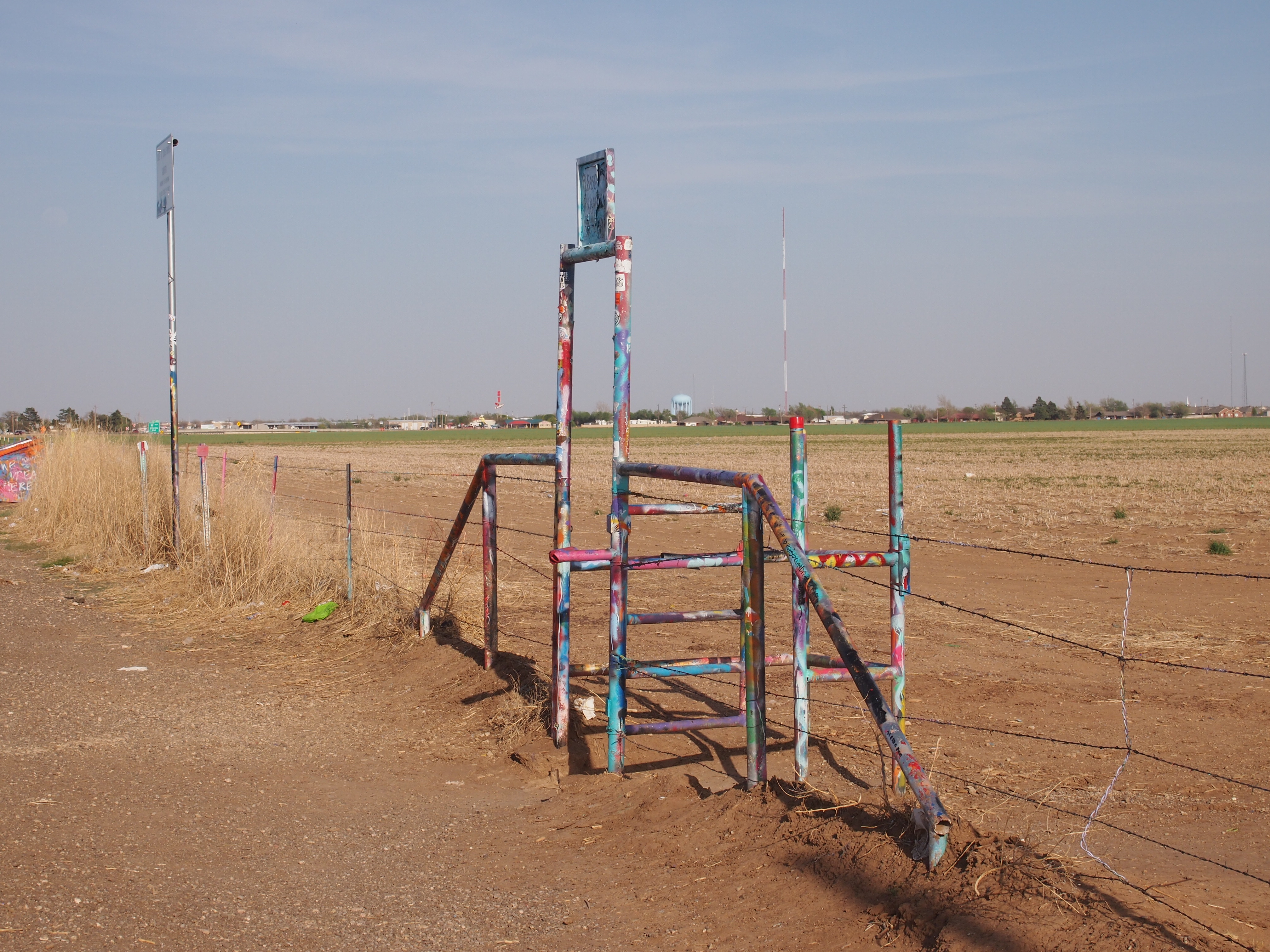
The Cadillac Ranch field is fenced with barbed wire, but not to worry. Visitors can go through a graffiti’d gate.

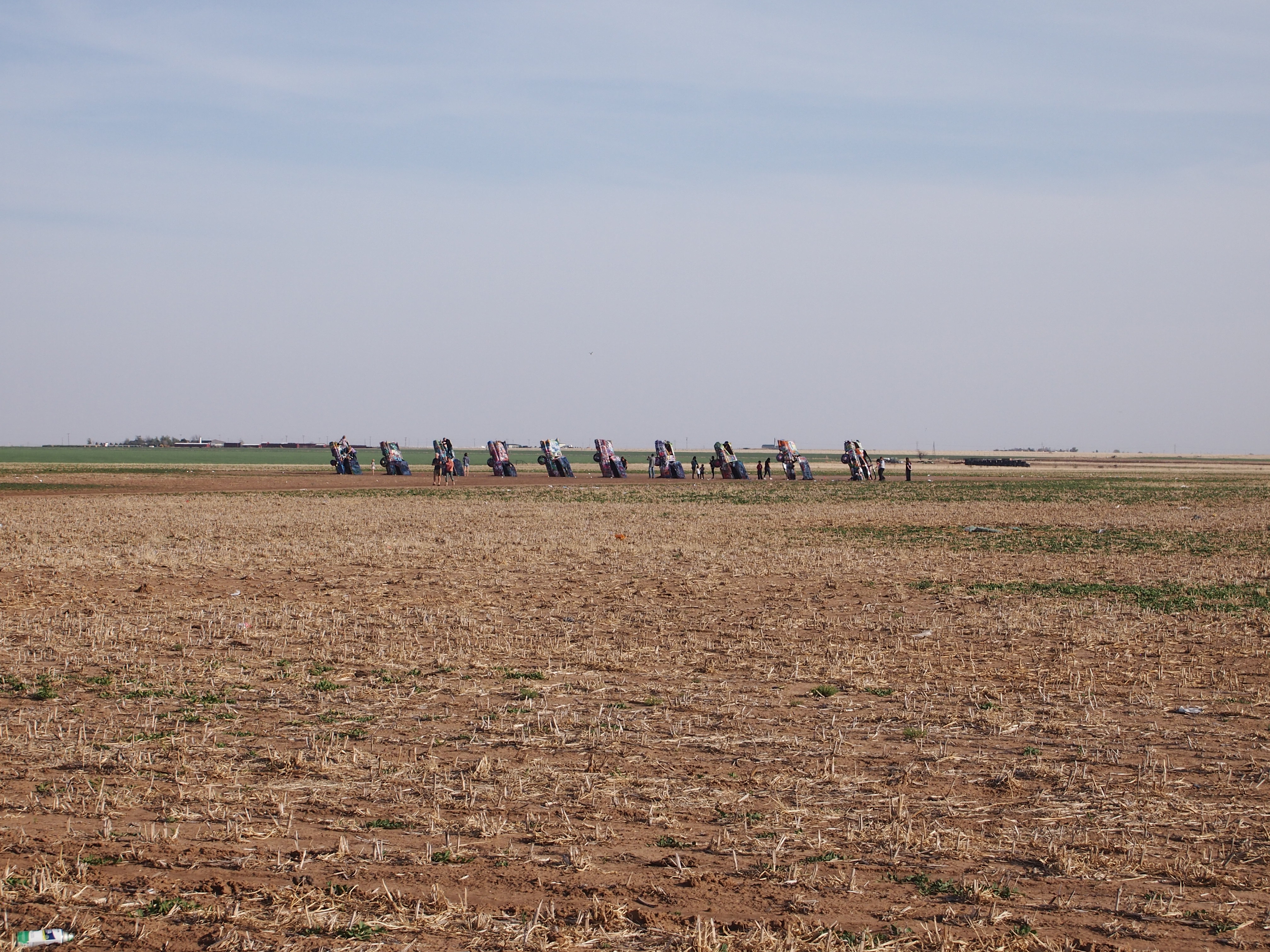
You walk right up to the 10 cars buried at an angle in the Panhandle soil and join everyone else looking at them or spray painting them.
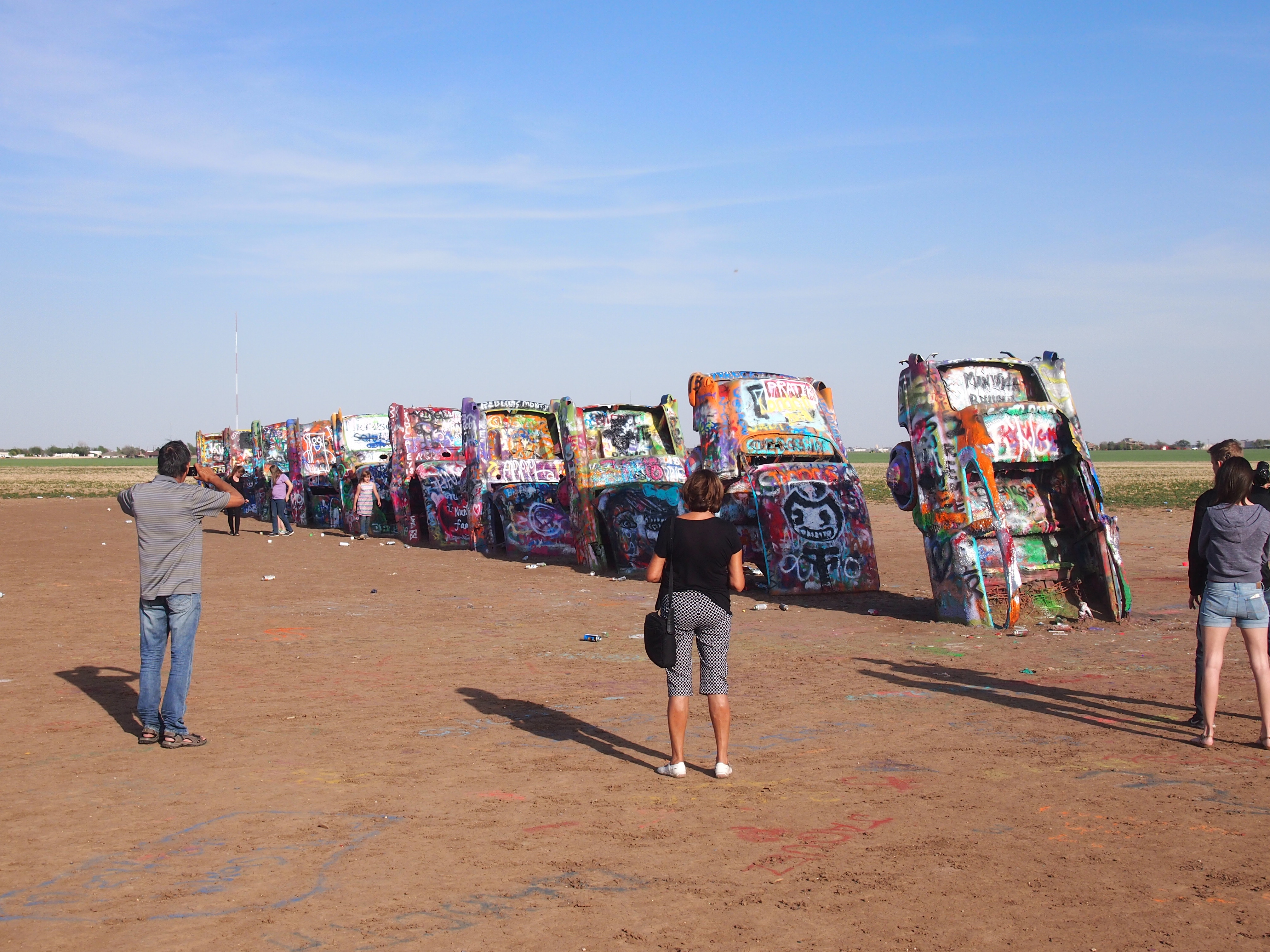
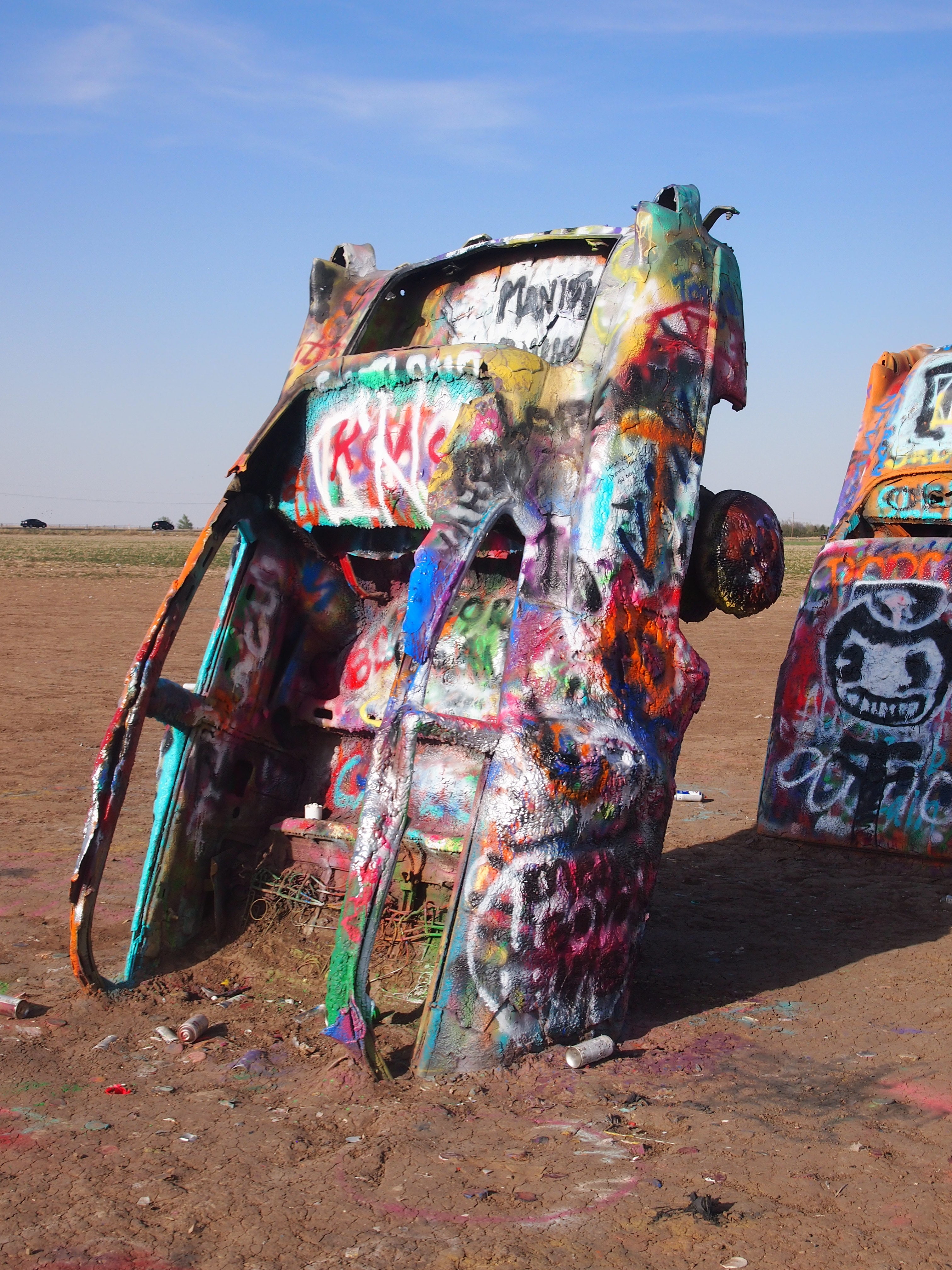
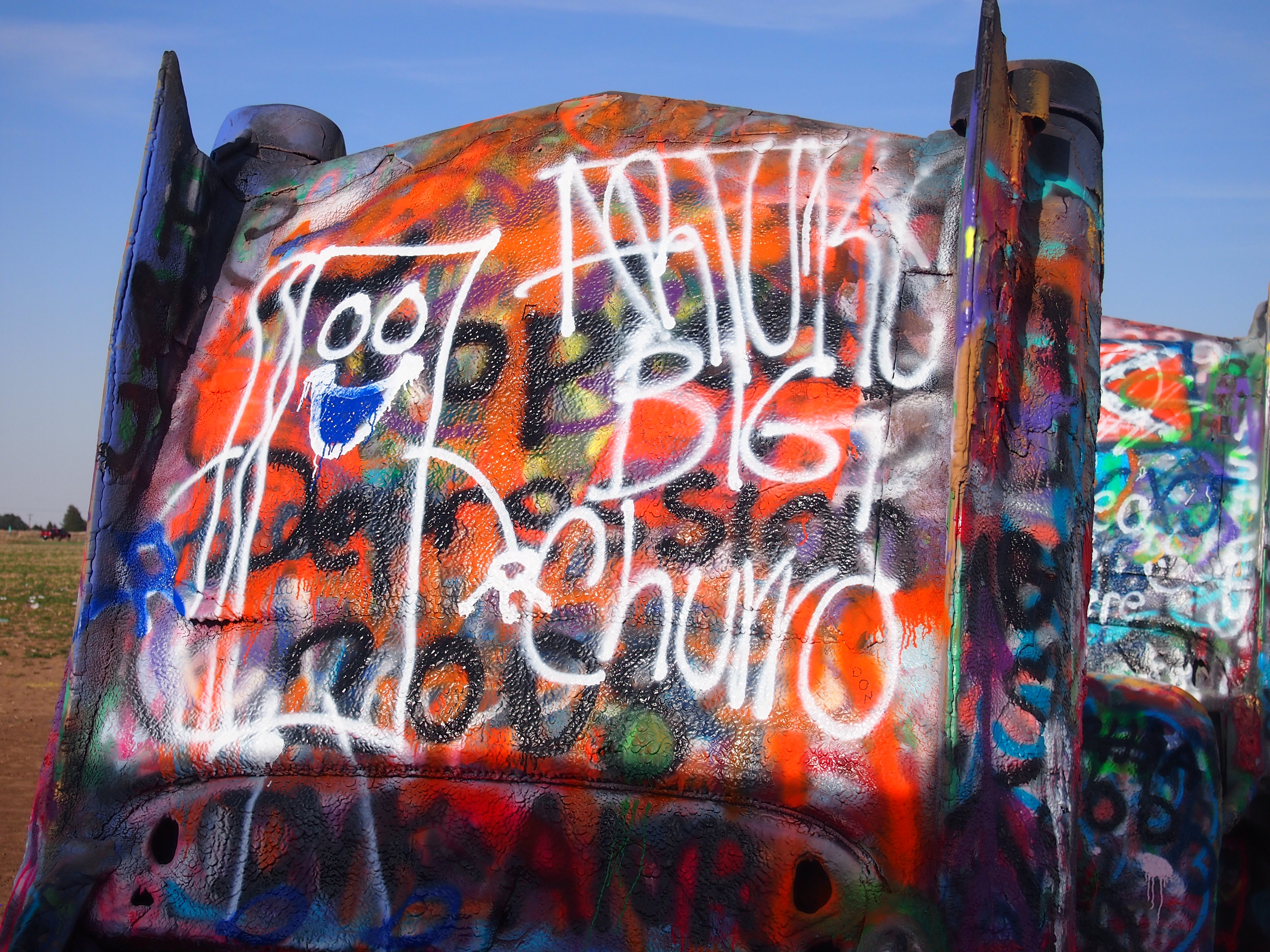
Roadside America, the authority on attractions of this kind, says that “Cadillac Ranch was invented and built by a group of art-hippies imported from San Francisco. They called themselves The Ant Farm, and their silent partner was Amarillo billionaire Stanley Marsh 3. He wanted a piece of public art that would baffle the locals, and the hippies came up with a tribute to the evolution of the Cadillac tail fin.

“Ten Caddies were driven into one of Stanley Marsh 3’s fields, then half-buried, nose-down, in the dirt (supposedly at the same angle as the Great Pyramid of Giza). They faced west in a line, from the 1949 Club Sedan to the 1963 Sedan de Ville, their tail fins held high for all to see on the empty Texas panhandle. That was in 1974….”

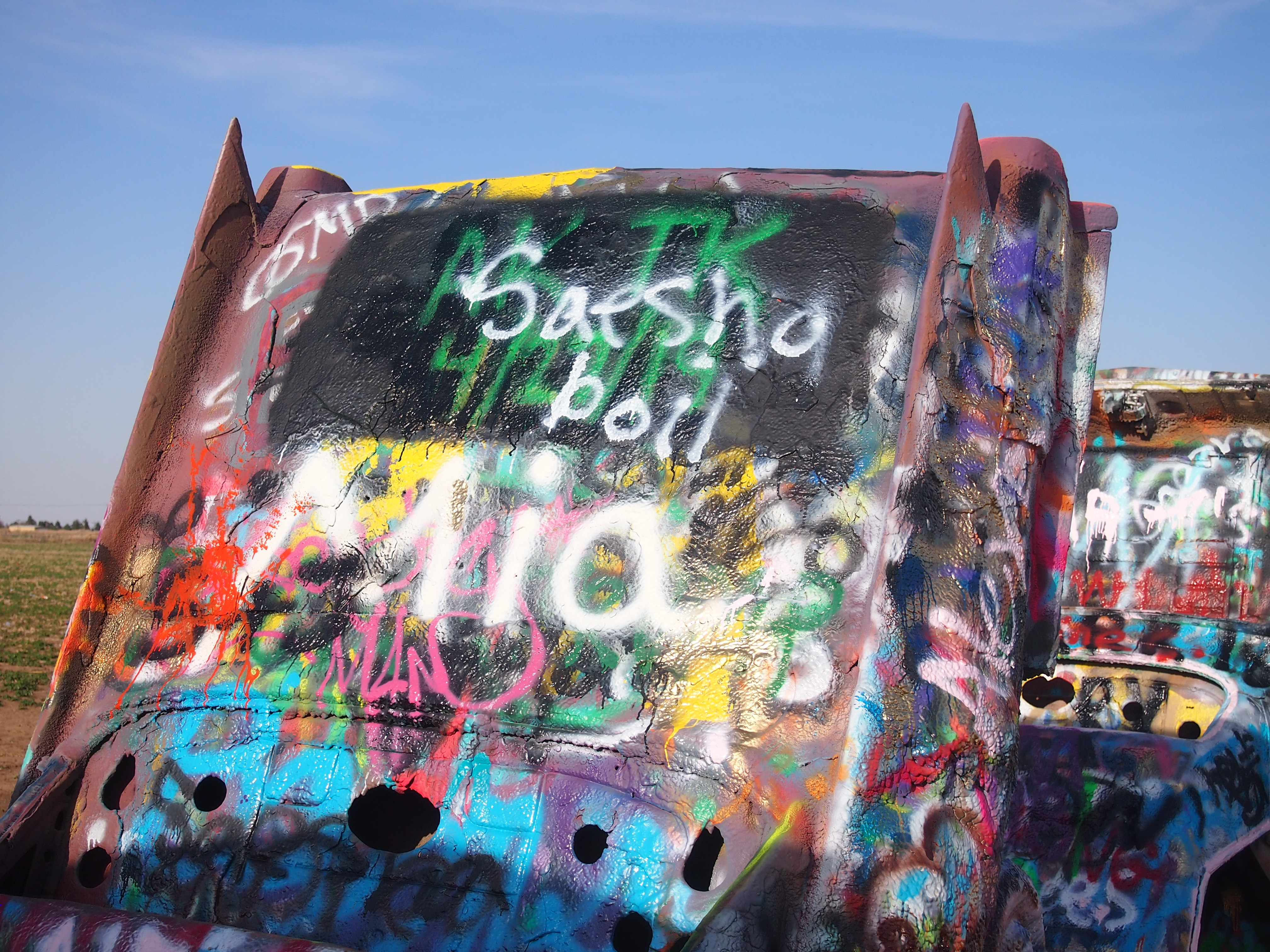
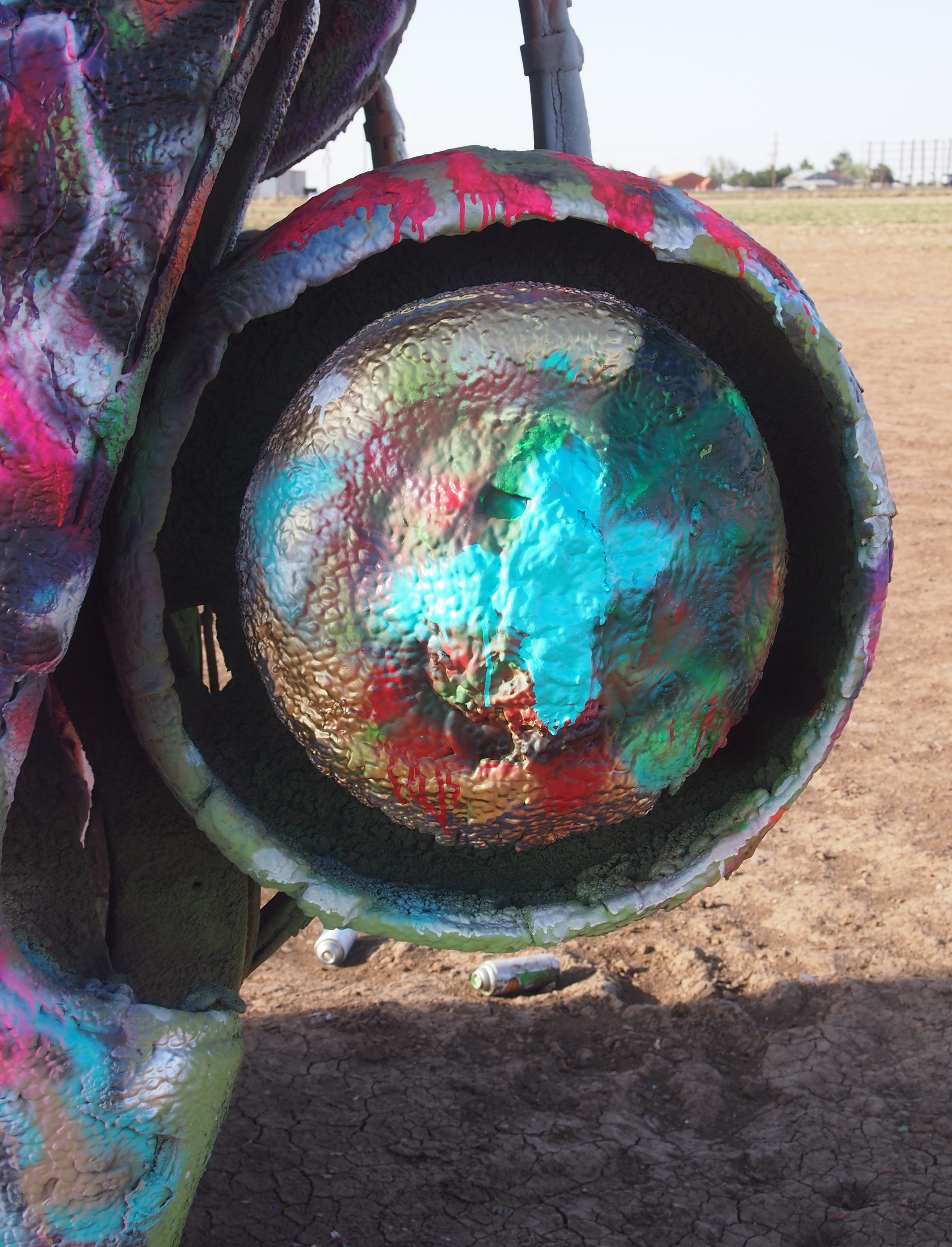
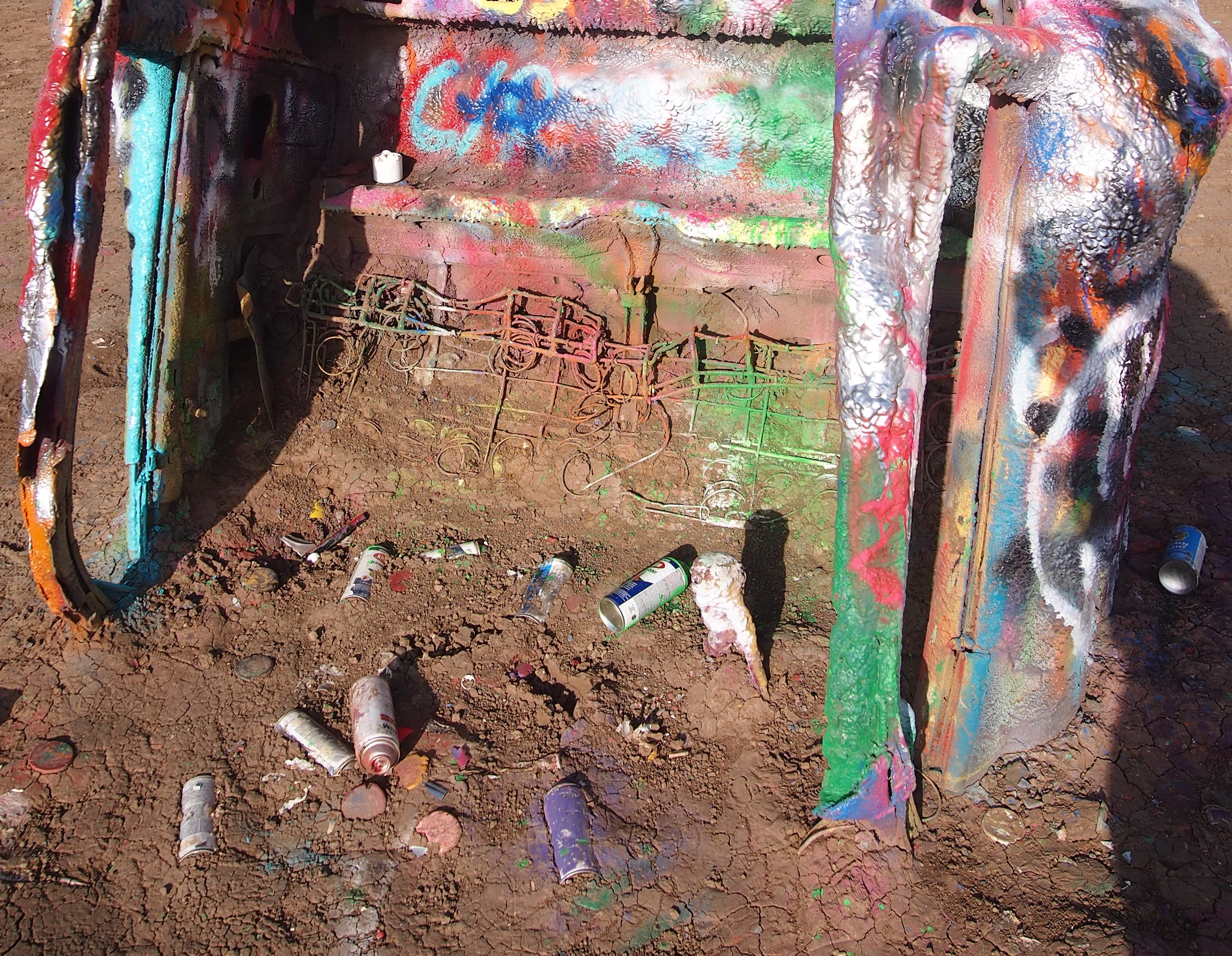
Since then, the cars have been falling apart, but more importantly covered and re-covered ad infinitum with spray paint. The images I took on the afternoon of April 27, 2018 depict how it looked then — a look that I figure is almost as fleeting as cloud formations.

Note also that plenty of people don’t bother taking their spray cans with them when they leave.

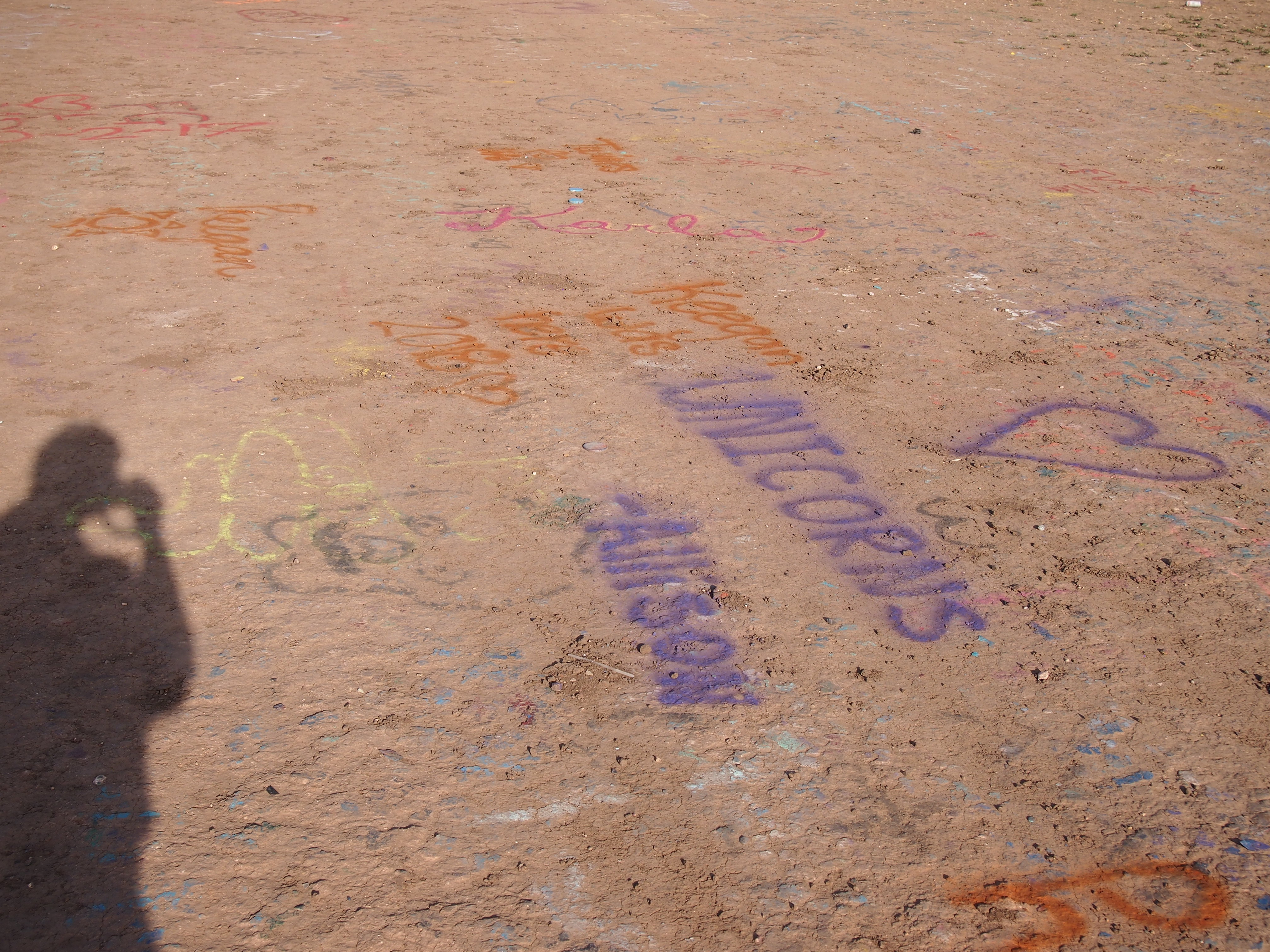
The cars weren’t the only surface on which people paint.
Besides being a roadside oddity, I liked the Cadillac Ranch because there’s nothing else to go with it — no visitors center, no gift shop, no exposition signs, not even anything to tell you what the place is called or who created it.

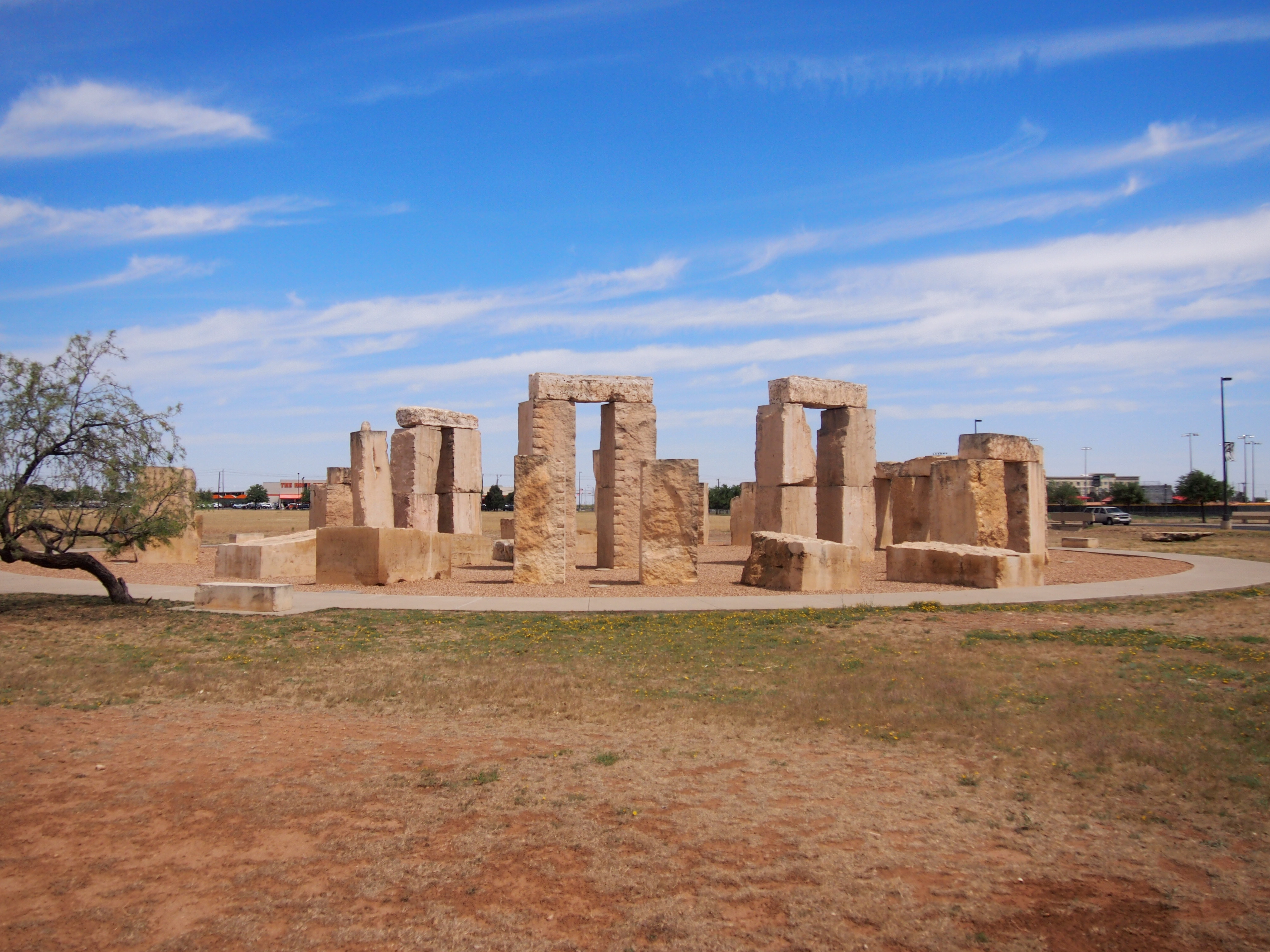
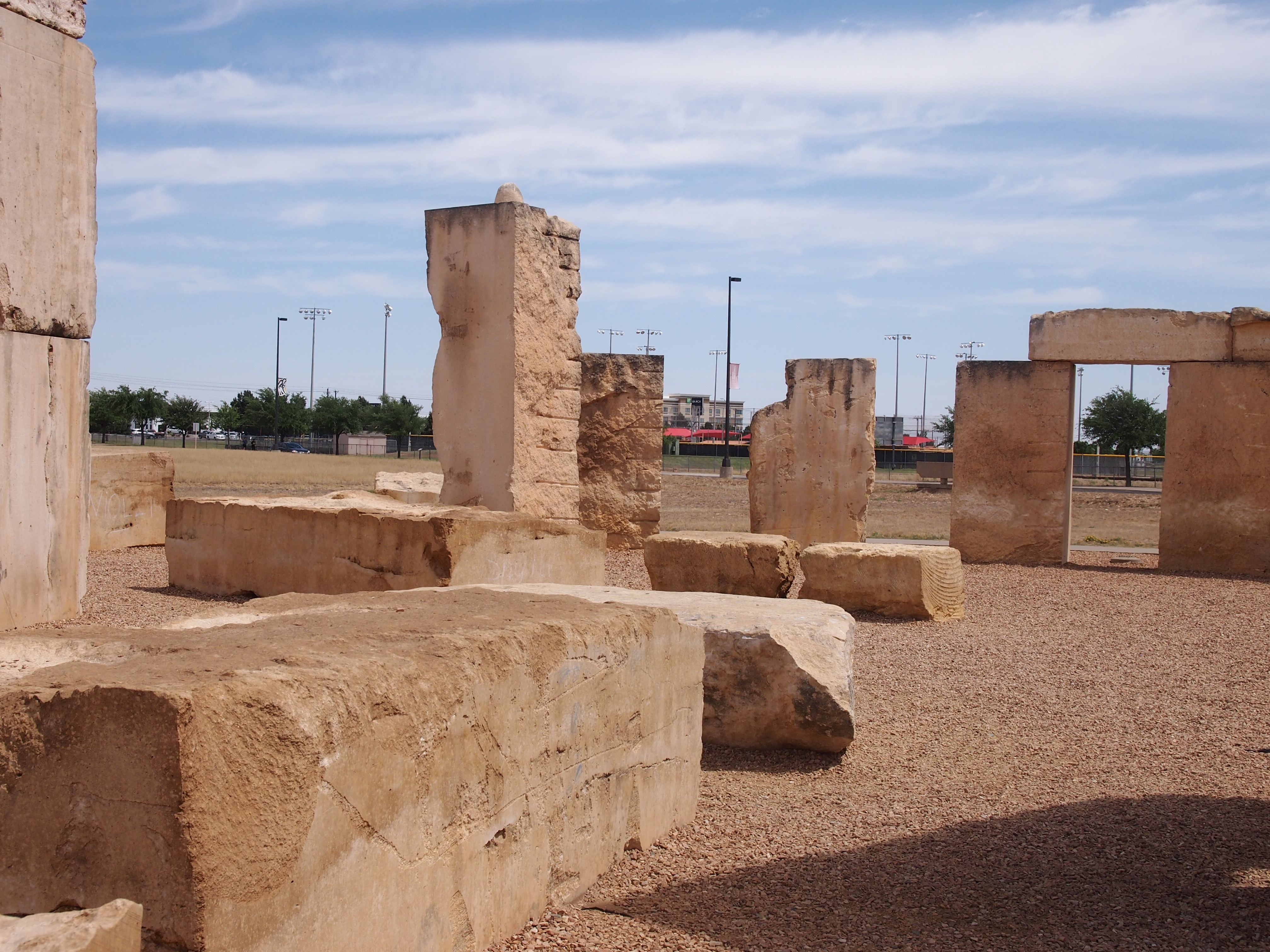
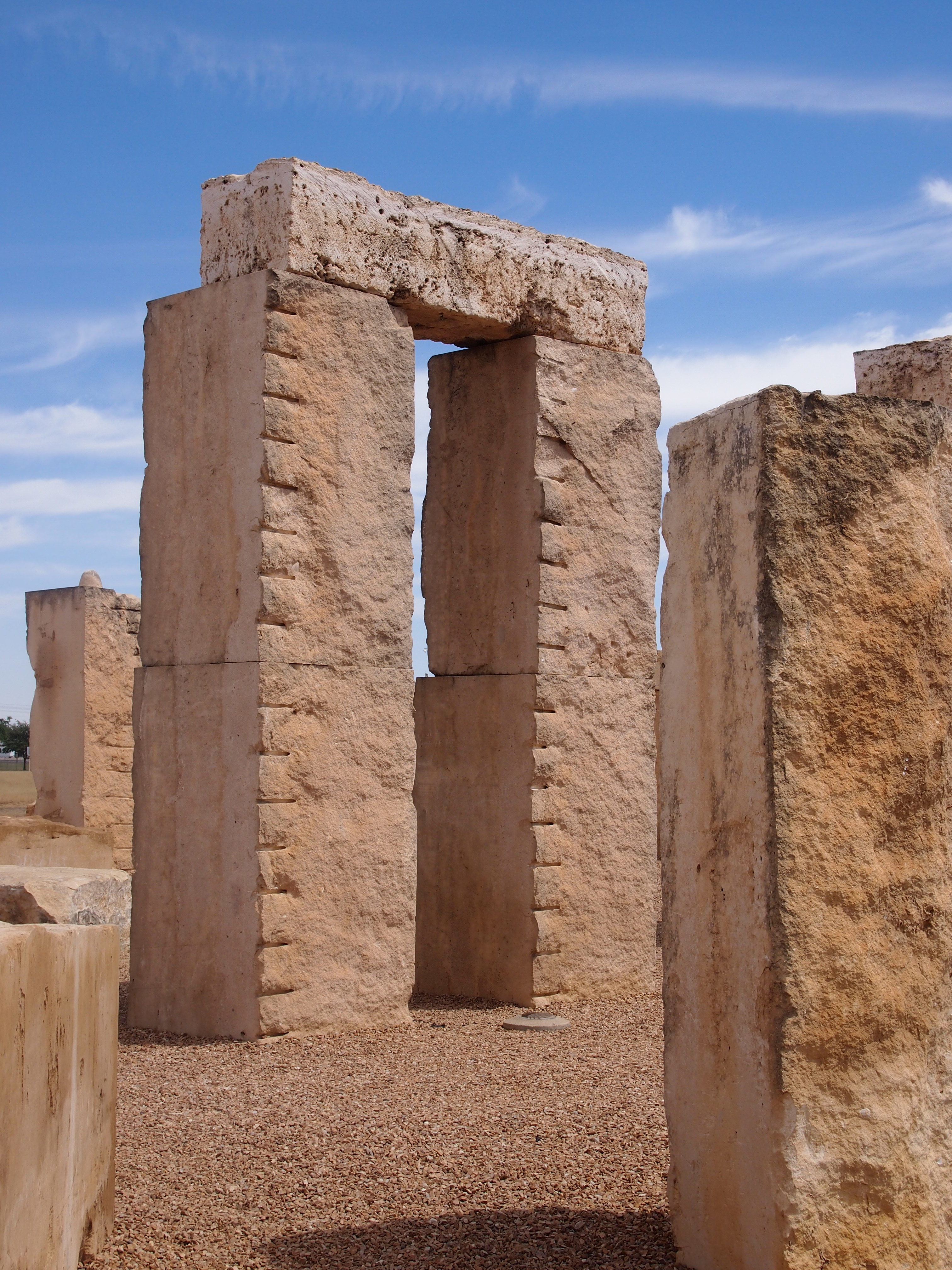
My recent peregrinations also took me to two other places with upright objects installed in the ground, both Stonehenge replicas that I spent a few minutes looking at. One, completed in 2004, was at the University of Texas of the Permian Basin in Odessa.

Unlike the original, visitors are free to get as close as they like to the Permian Basin Stonehenge and even touch the stones. Spray painting would probably be discouraged as rank vandalism, however.

Roadside America again: “Made of limestone slabs up to 19 feet tall and 20 tons apiece, Permian Basin Stonehenge is slightly shorter than the original, but it’s exact in horizontal size and astronomically accurate. Although a plaque in front of the ‘henge claims that the replica is ‘as it appears today in England,’ that’s not exactly true.

“The slabs are blocky leftovers donated by a quarry, so they’re approximations, not duplicates; the Stonehenge stands in a circle of reddish Texas gravel, not the green Salisbury Plain; and the Heel Stone, which marks the summer solstice, had to be stuck in the ground across a street.”

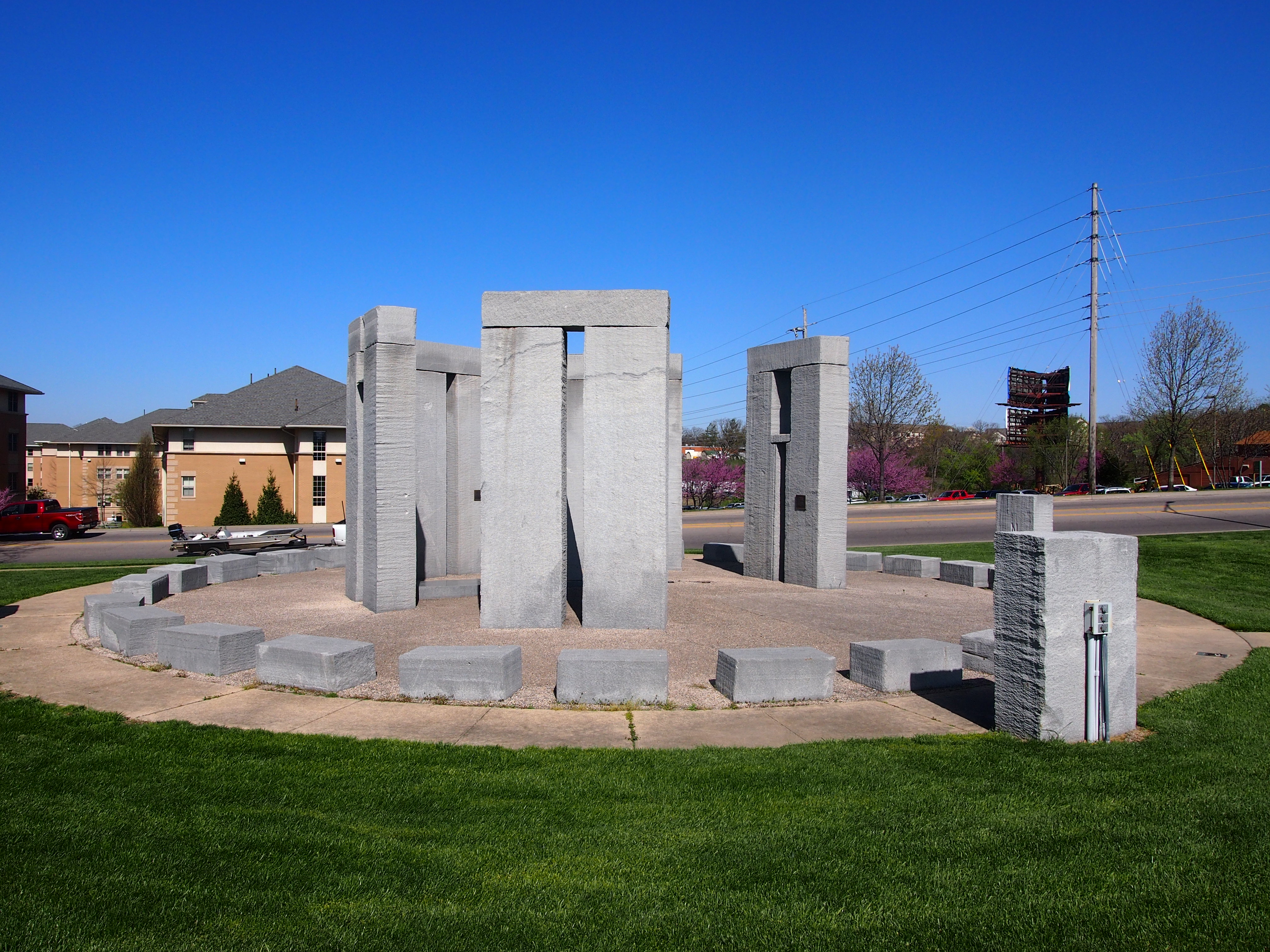
On the last day of my trip, I stopped briefly in Rolla, Missouri, and got a breakfast sandwich at Hardee’s. Not far away was the Missouri University of Science and Technology’s Stonehenge replica. What better place to sit and eat your breakfast sandwich?

It’s a half-sized granite replica. Not a commanding presence, but worth a look. Once more to the Roadside America well, which says the replica was built in the 1980s to “showcase the stone carving capabilities of [the school’s] High Pressure Water Jet Lab.”

Branson 2012

Has it been all of five years since I was last in Branson? Seems that way. Quite a spectacle, that town.

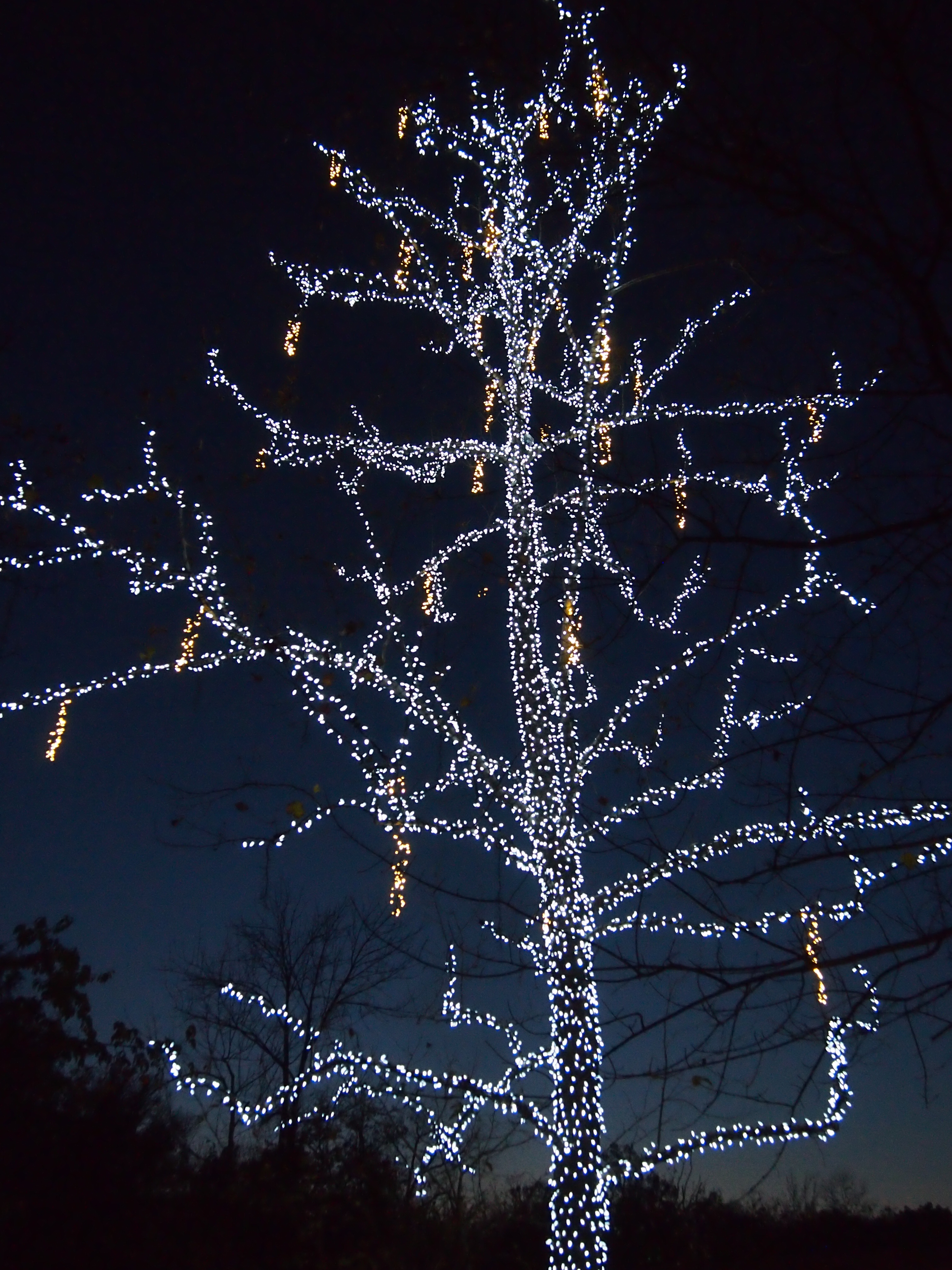
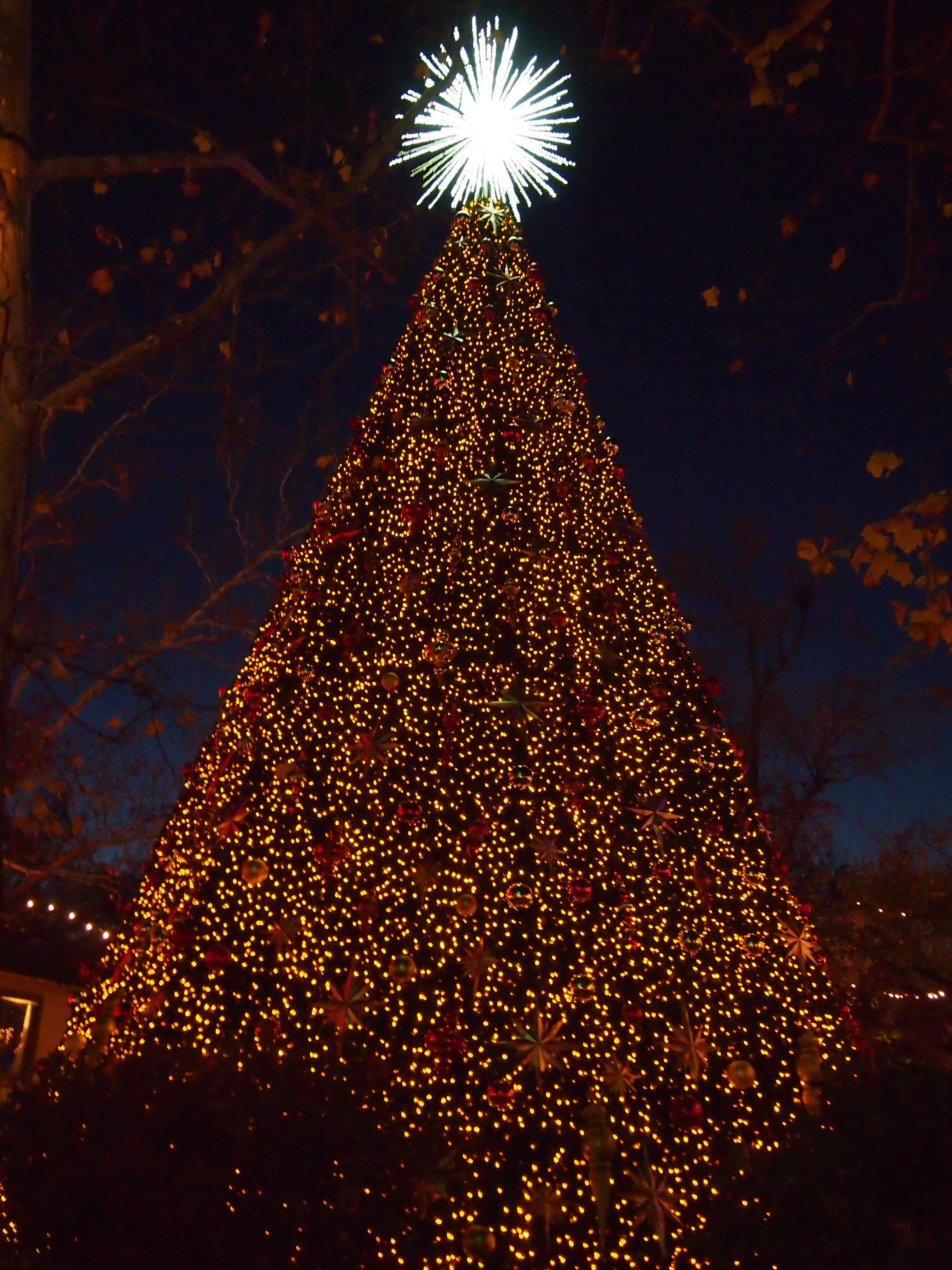
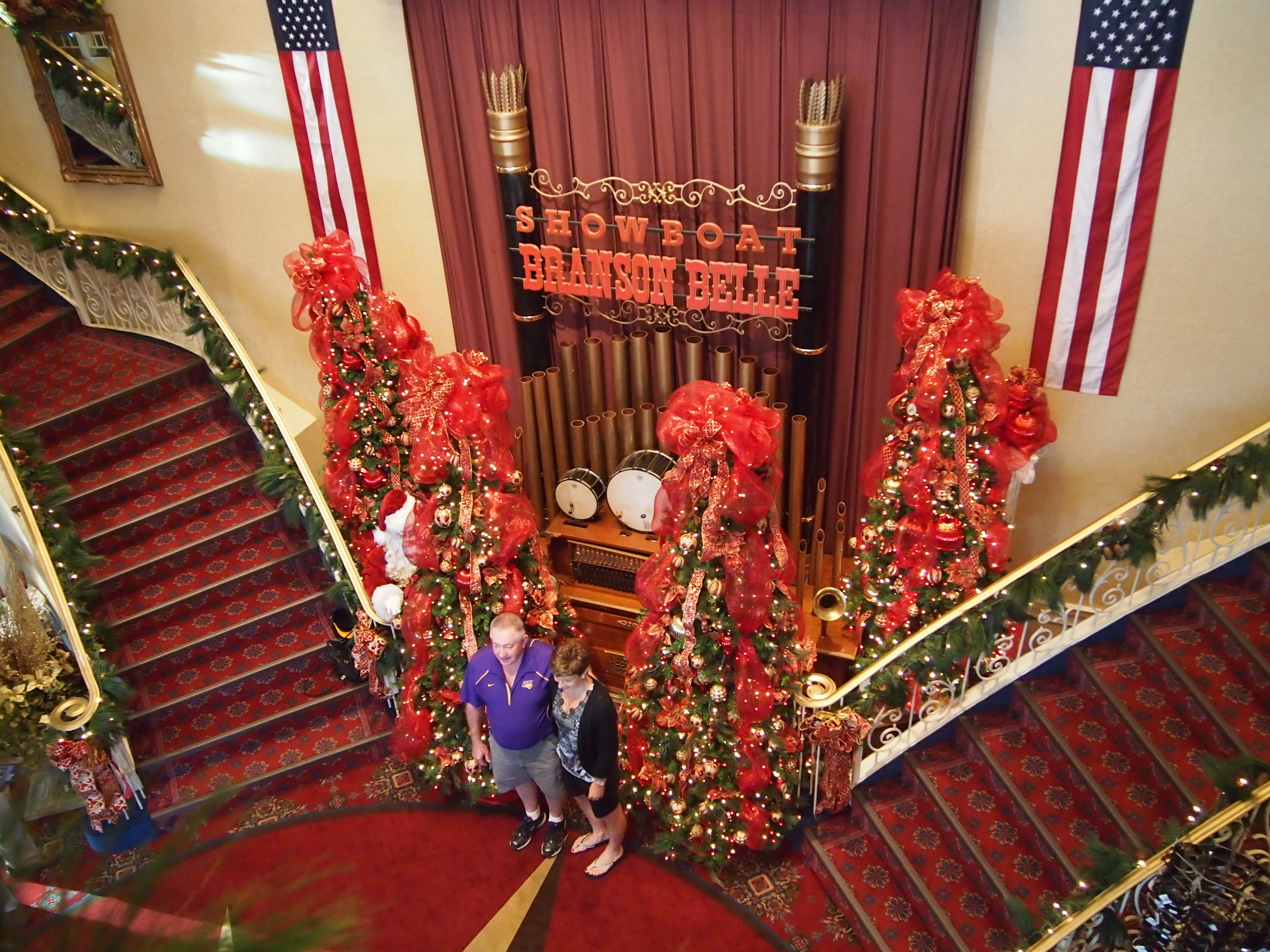
Branson in early November was already lighted for Christmas because the late Andy Williams, Mr. Christmas, had wanted things done up by November 1. So let it be written, so let it be done.

A few trees at Silver Dollar City.

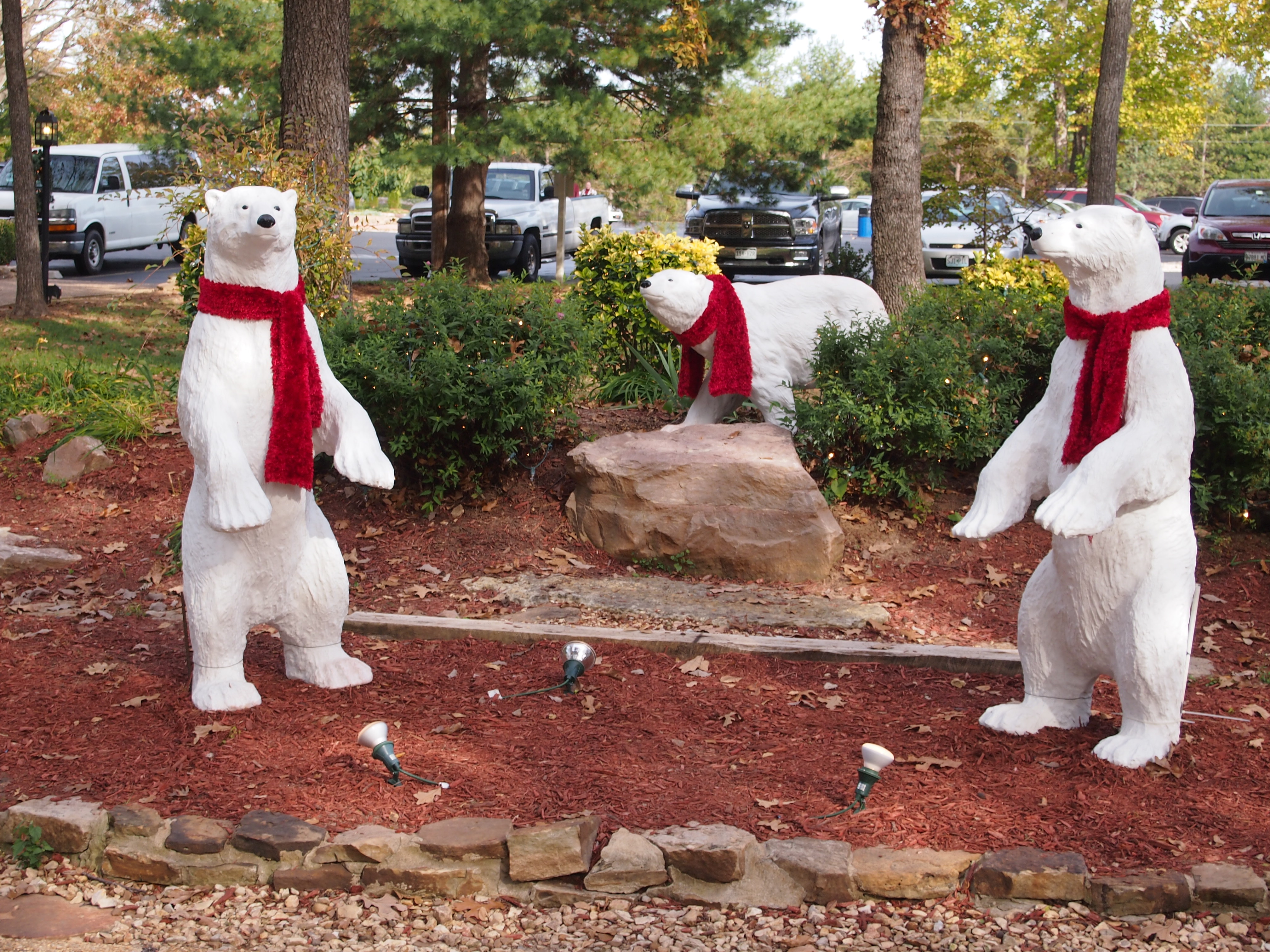
Branson 2012Branson 2012There were other seasonal decorations elsewhere.
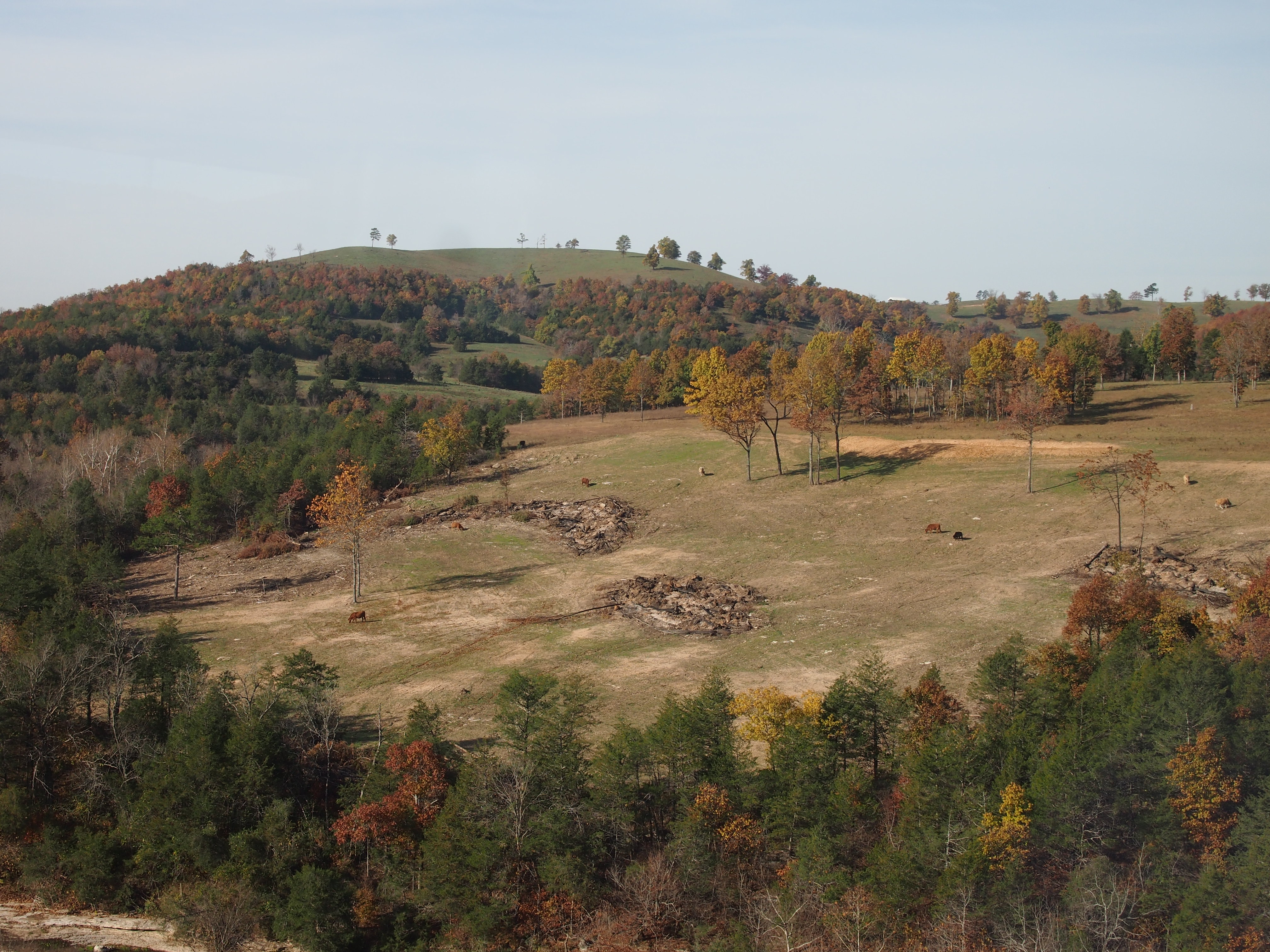
Branson 2012Branson 2012And fall foliage in the rolling hills of southern Missouri.
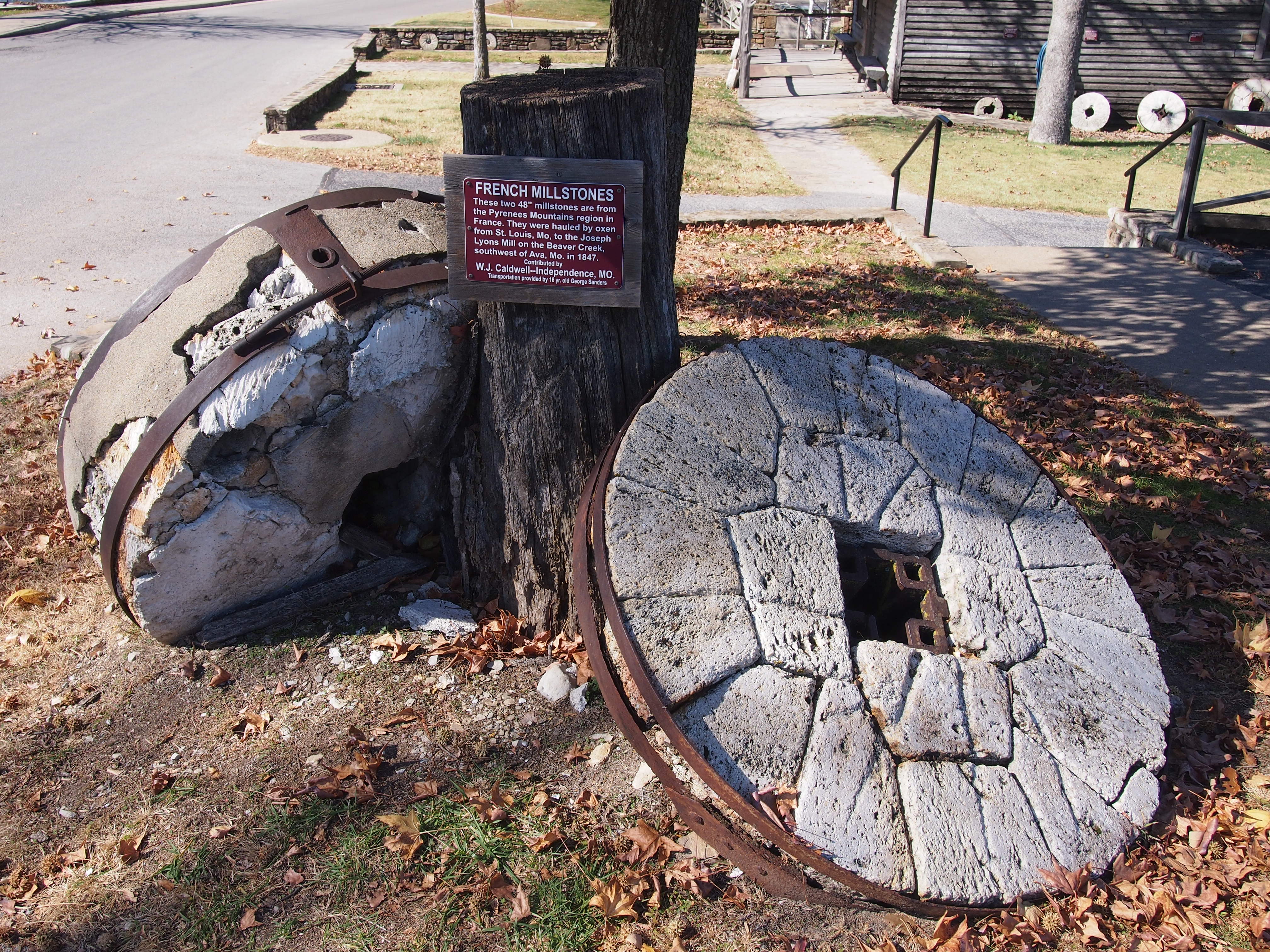
Branson 2012And of course, French millstones.

Branson 2012 - French millstones, College of the Ozarks

What’s a major tourist destination without a few of those lying around?

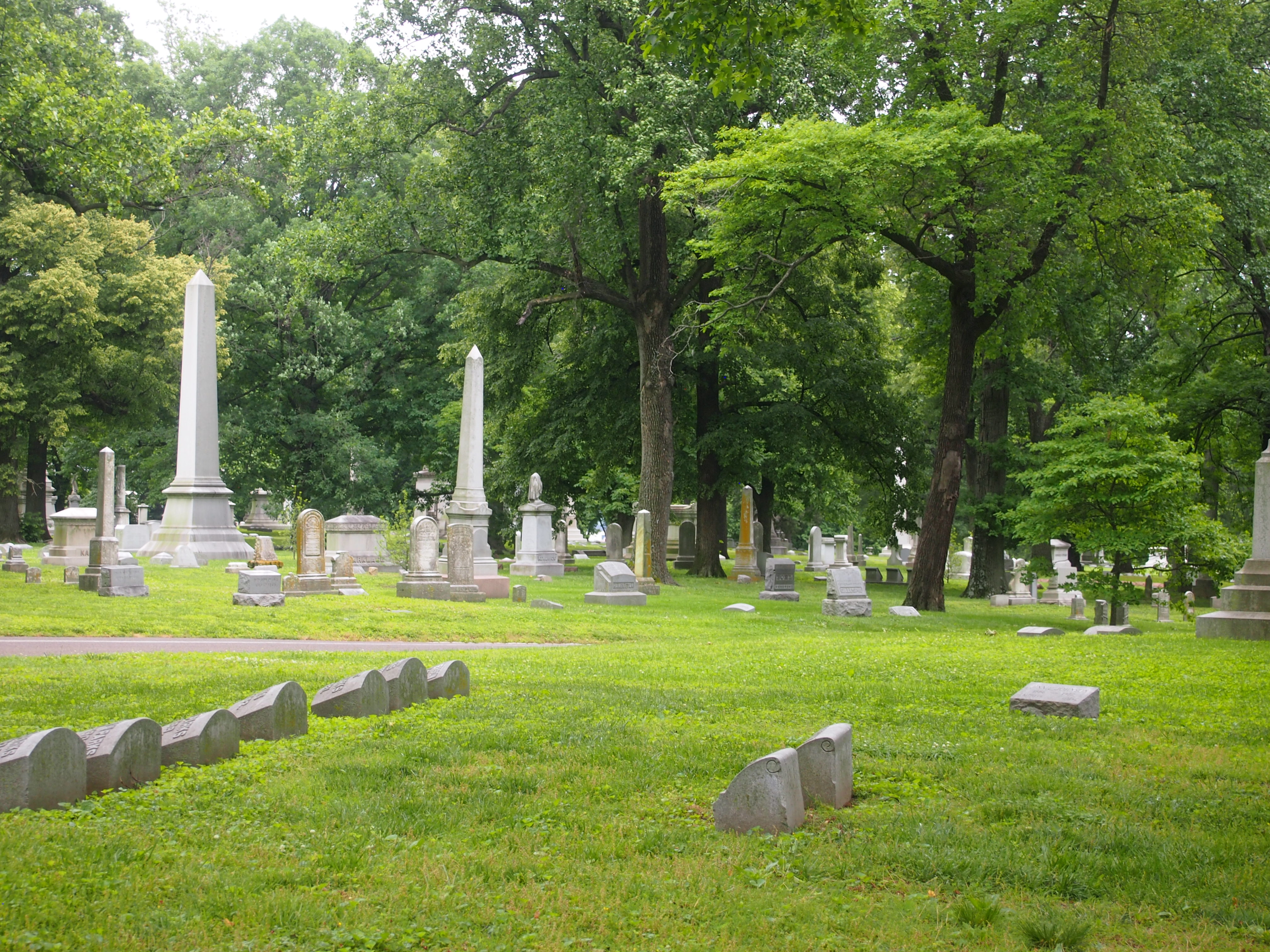
Bellefontaine Cemetery and Arboretum, St. Louis

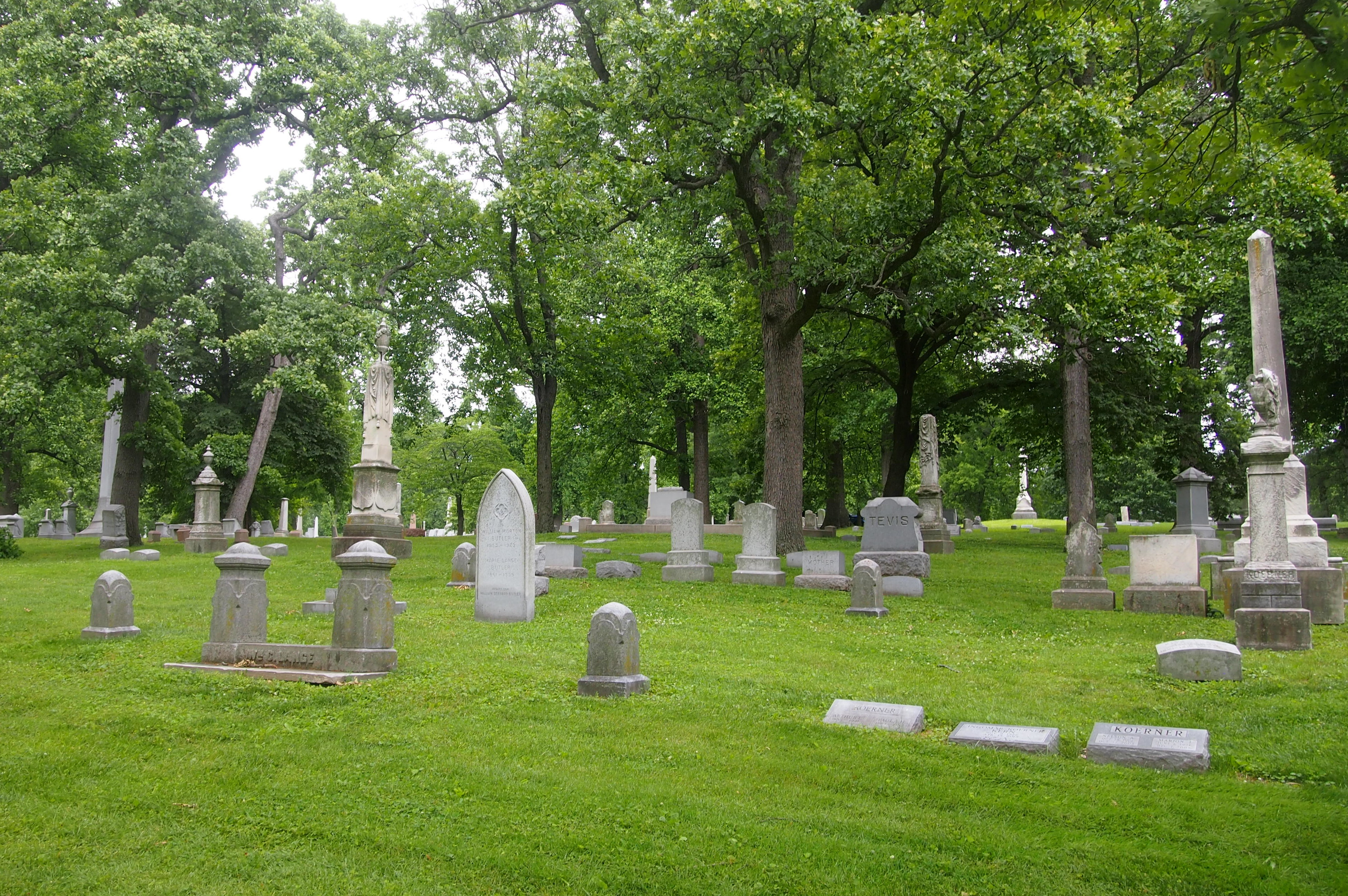
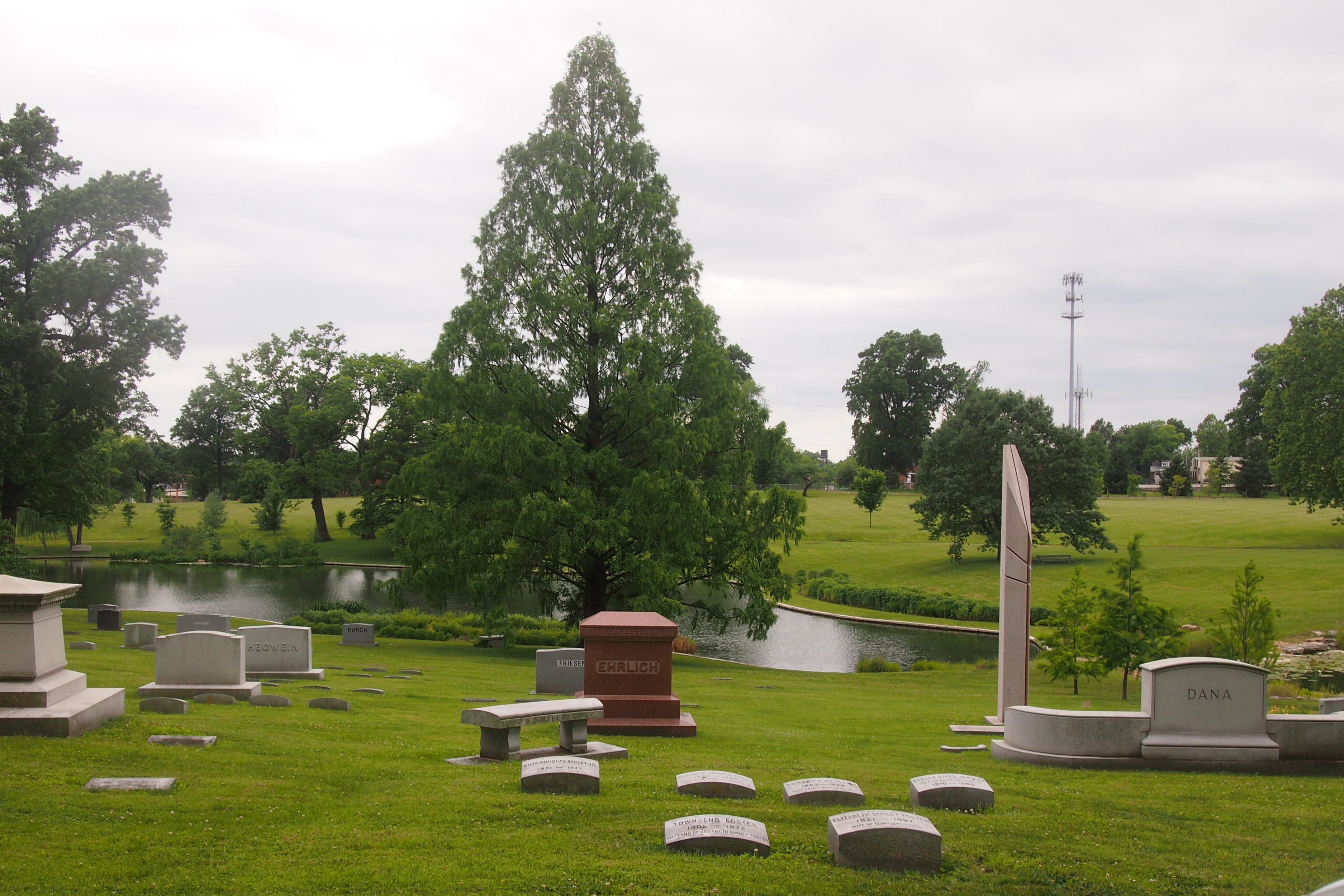
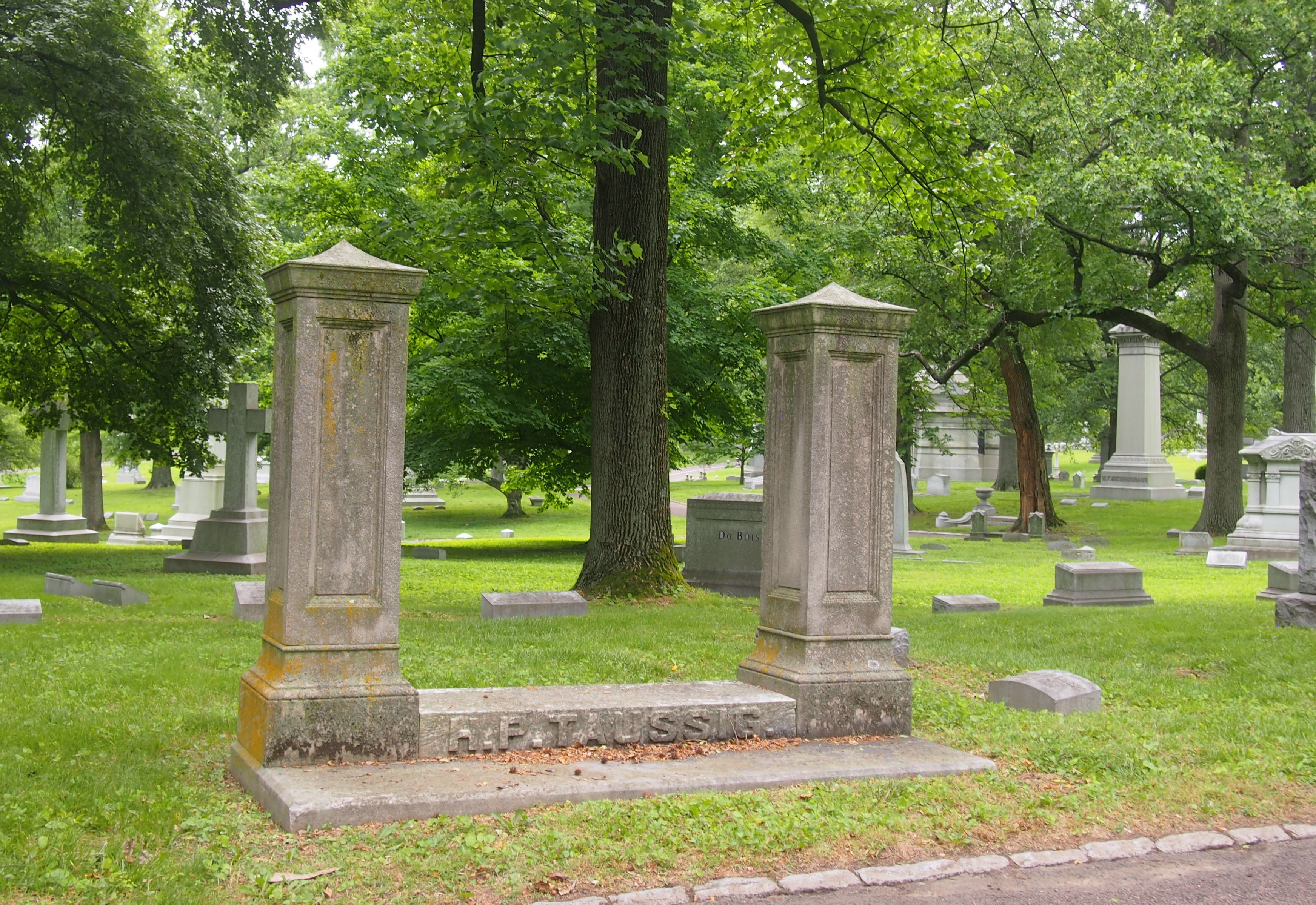
You might call Bellefontaine Cemetery and Arboretum in St. Louis a Mount Auburn-class cemetery, since it dates from the 19th century as a solid example of the rural cemetery movement. Mount Auburn in Boston is the first of the class, dating from 1831. Others are Green-Wood in Brooklyn, Laurel Hill in Philadelphia and Woodland in Dayton, all of which are now surrounded by their respective cities, as Bellefontaine is.

It is a good class. More people ought to visit these places. But as usual, when we were at Bellefontaine on May 26, the only other living souls around were groundskeepers.

The good people of St. Louis got around to founding Bellefontaine in 1849, well outside the existing city, spurred in part by a severe cholera epidemic that year. The further away those bodies were, the better, since the dead helped create the miasma that vexed the living with the likes of cholera. Sure, that wasn’t true, but it must have made intuitive sense in the days before germ theory, and it gave us a roundly beautiful public space.

Bellefontaine Cemetery and Arboretum

Bellefontaine Cemetery and ArboretumBellefontaine Cemetery and ArboretumBellefontaine Cemetery and ArboretumBellefontaine’s web site has a well-written short history of the place, including its founding, the splashy dedication event in 1850, the work of long-time grounds superintendent Almerin Hotchkiss (1816-1903; he still resides at Bellefontaine), and a paragraph about post-Victorian cemetery aesthetics, something I didn’t realize.

“Nearly 50 years after its founding, Bellefontaine was inspired to modernize. Spring Grove Cemetery in Cincinnati and the burgeoning landscape-lawn cemetery design movement ushered in a new aesthetic that replaced ornate and elaborate Victorian fences and hedges with open, cross-lawn views.

“Bellefontaine followed suit by removing hedges, fences, elaborate plantings, and stone copings. Open, cross-lawn views became the more common aesthetic of the cemetery, bringing Bellefontaine in line with modern ideas about cemetery design. The changes also made Bellefontaine appear more open and park-like, creating a more integrated landscape composition than the earlier delineation of individual lots with distinctly defined spaces.”

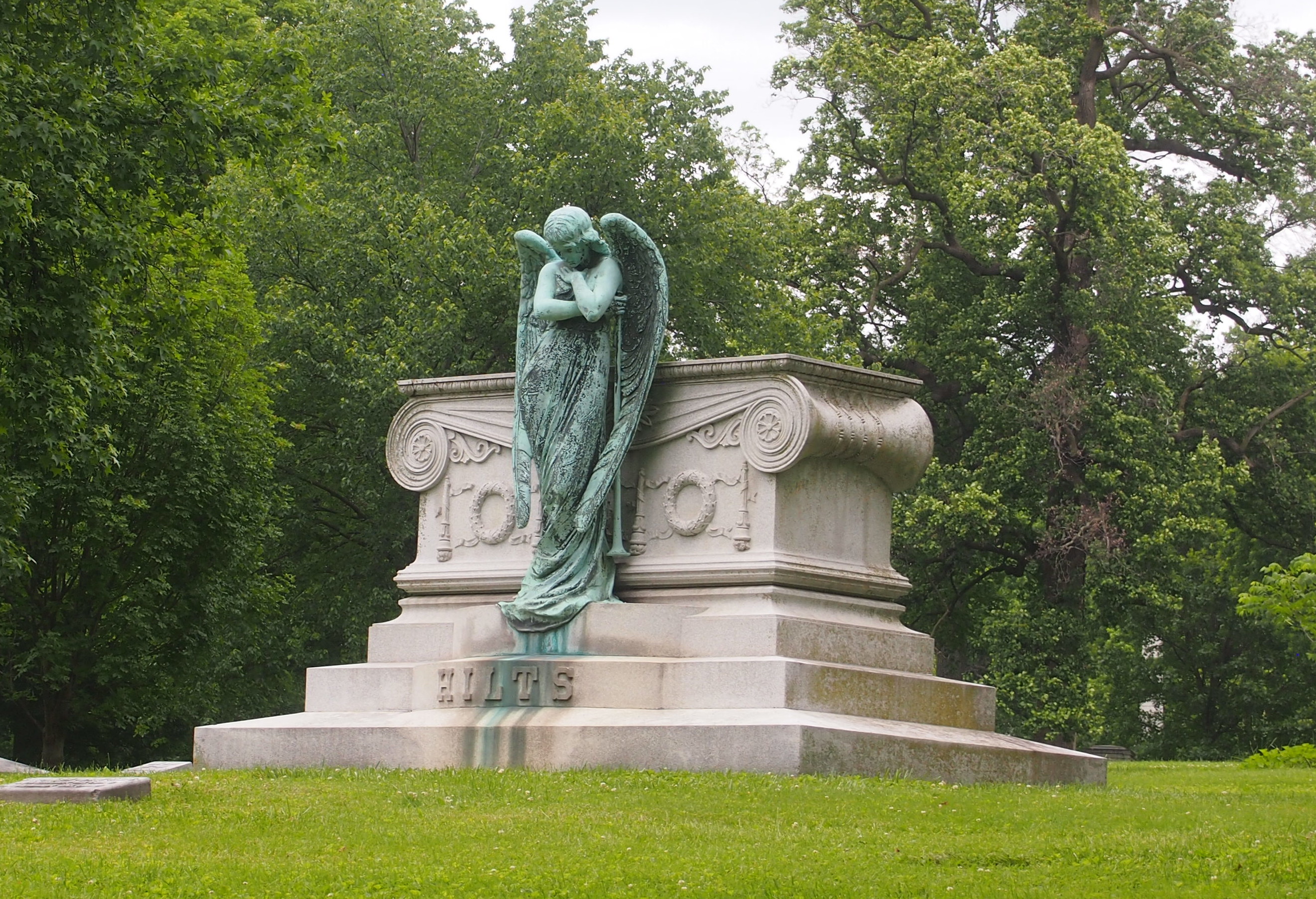
The cemetery sports a fair amount of funerary art, such as the Hilts memorial, whose angel has spent many years out in the elements.
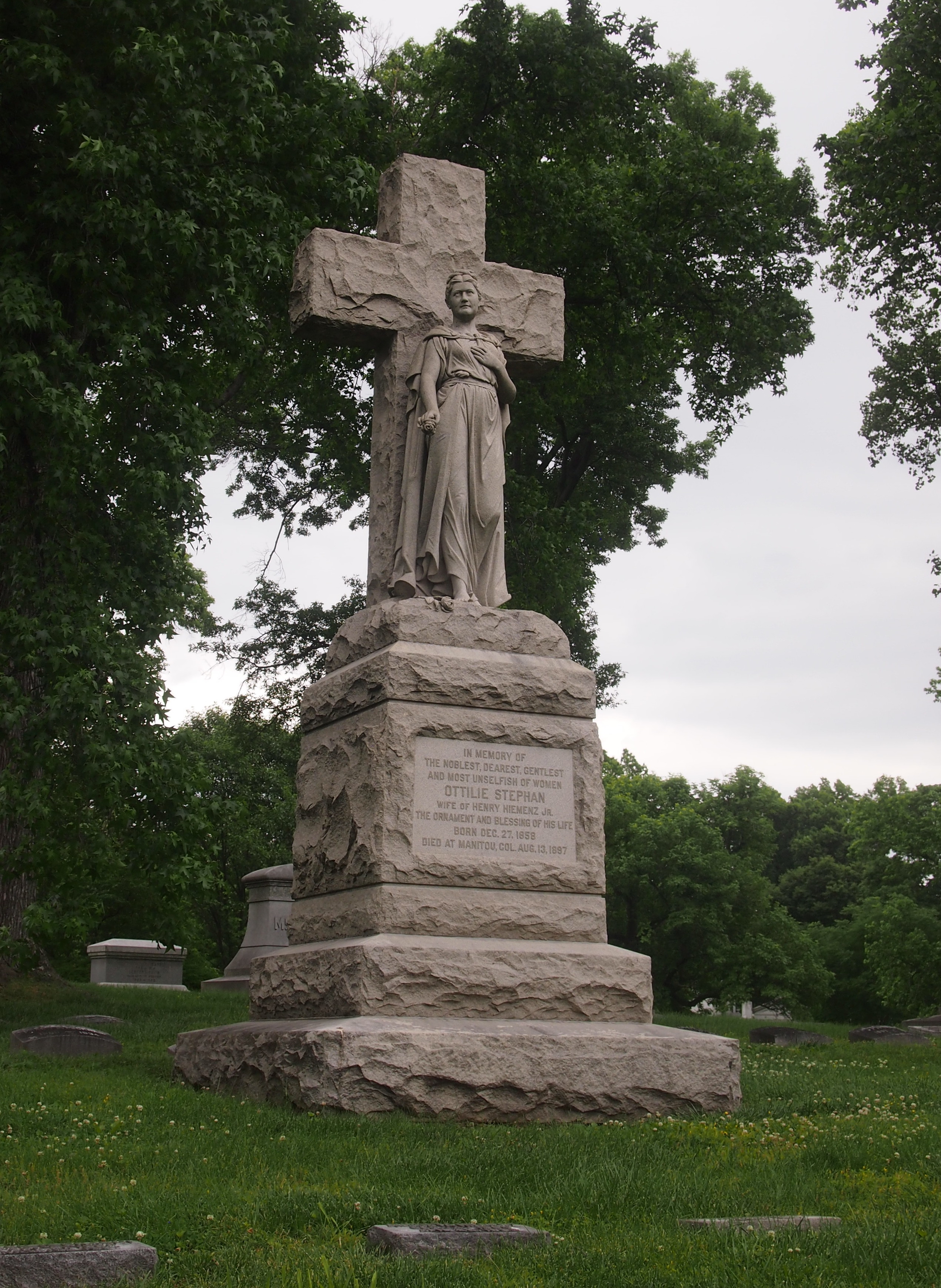
Bellefontaine Cemetery and ArboretumThis memorial says it remembers the “nobelest, dearest, gentlest and most unselfish of women, Ottilie Stephan, wife of Henry Hiemenz Jr.” (1858-1897). Well, let’s hope so.
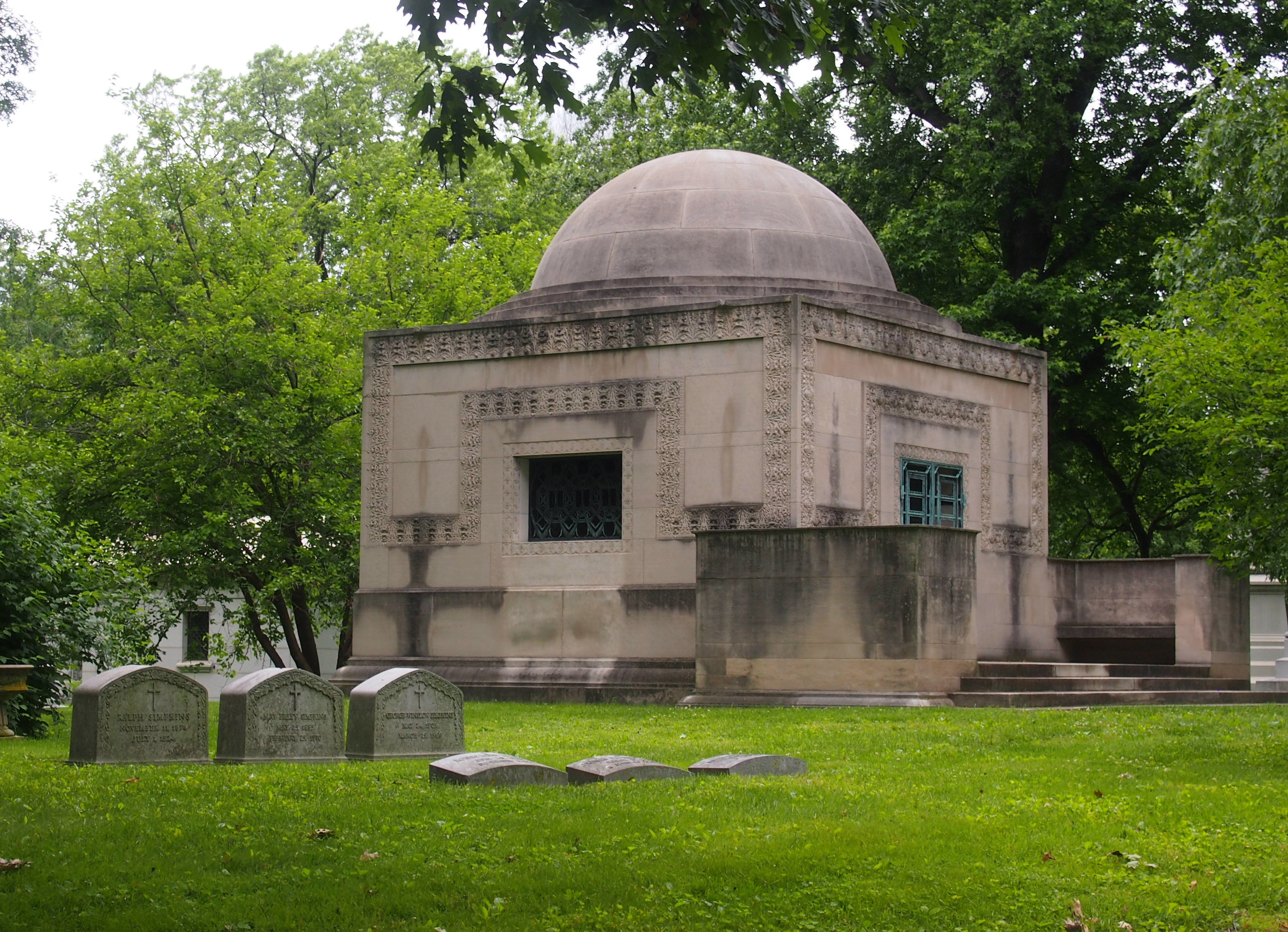
Bellefontaine Cemetery and ArboretumBellefontaine is also known for its mausoleums. Such as one for Ellis Wainwright and family.
Bellefontaine Cemetery and Arboretum, Ellis Wainwright“In 1891, St. Louis millionaire and brewer Ellis Wainwright commissioned architect Louis Sullivan to design a tomb for his wife who had died suddenly of peritonitis,” the cemetery tells us. “Sullivan had recently completed the Wainwright Building in St. Louis, which is considered to be the beginning of modern skyscraper design. The mausoleum is a domed cube with simple carved decorations in Sullivan’s signature stylized plant patterns. The mausoleum’s double doors are bronze grills framed by delicate stone carvings. Sullivan’s draftsman for the project was Frank Lloyd Wright.”

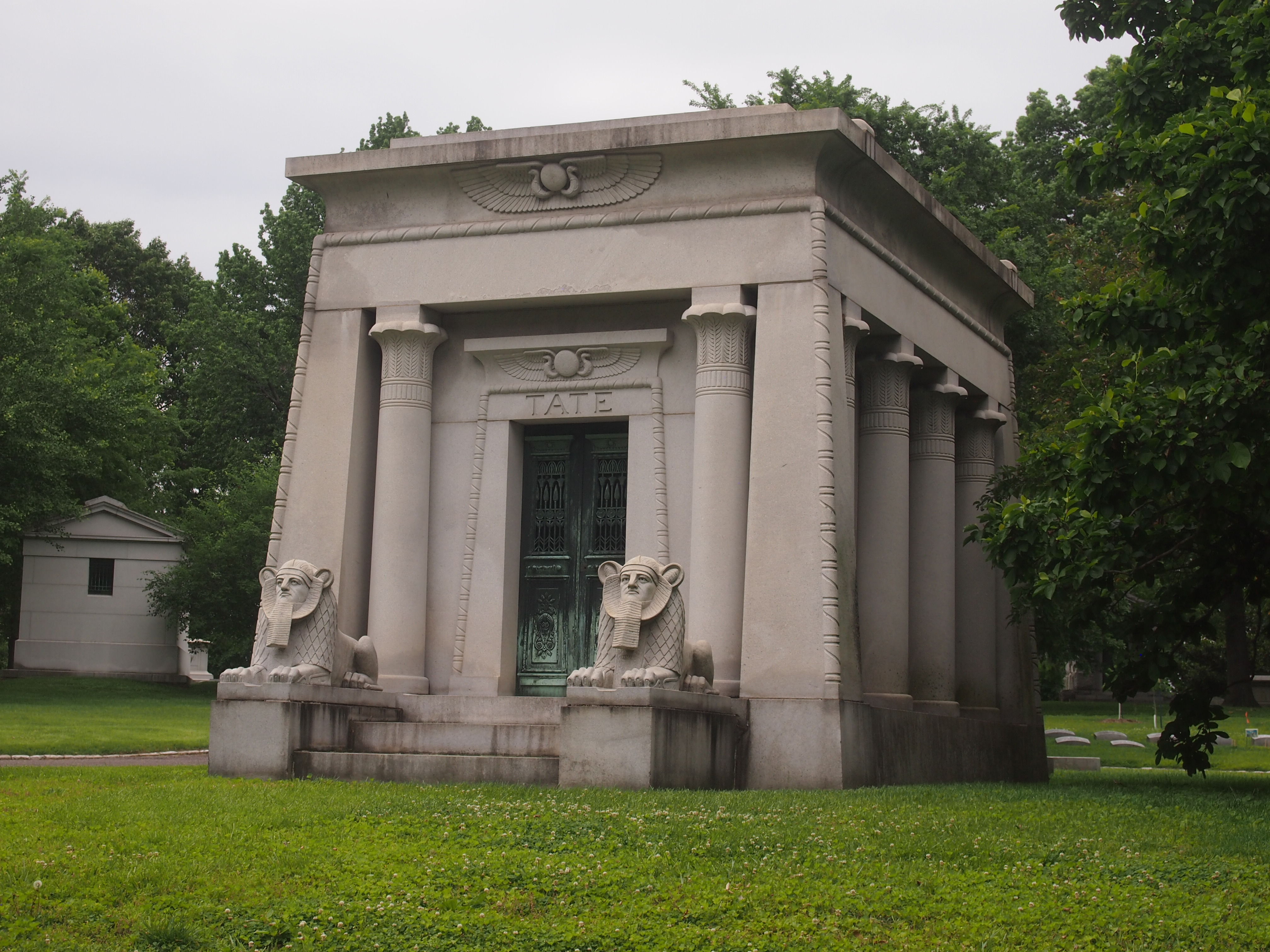
The Tate mausoleum is a little different.
Bellefontaine Cemetery and Arboretum, Tate tomb“This Egyptian Revival mausoleum, designed by Eames and Young, was built in 1907 by Frank N. Tate, who at the time controlled most of the theater property in St. Louis. He also owned theaters in Chicago and Buffalo, New York…. The mausoleum has an entry flanked by columns with palm capitals. An Egyptian winged disc is flanked by serpents above the entry, and a pair of granite sphinxes guard the front.”

The Cathedral Basilica of St. Louis

The Old Cathedral of St. Louis, formally the Basilica of Saint Louis, King of France, is near the Gateway Arch. In February 1990, after visiting the Arch, I took a look at the Old Cathedral, which dates from the 1830s. It’s a fine old church (recently restored, so I suppose I should take another look someday).

A man I met there briefly told me, in so many words, that this one was nice, but you should see the “New” Cathedral of St. Louis, which is a few miles away in the city. He also told me how to get there. So I went, even though I was racing a winter storm to get back to Chicago. (The storm won, and I spent the night in a Normal, Ill., motel room.)

At least, that’s how I think it happened. I’m not completely sure. But I know I went that day. I entered the cathedral, shook off the cold, and let my eyes adjust to the relative dim. I was astonished by what I saw.

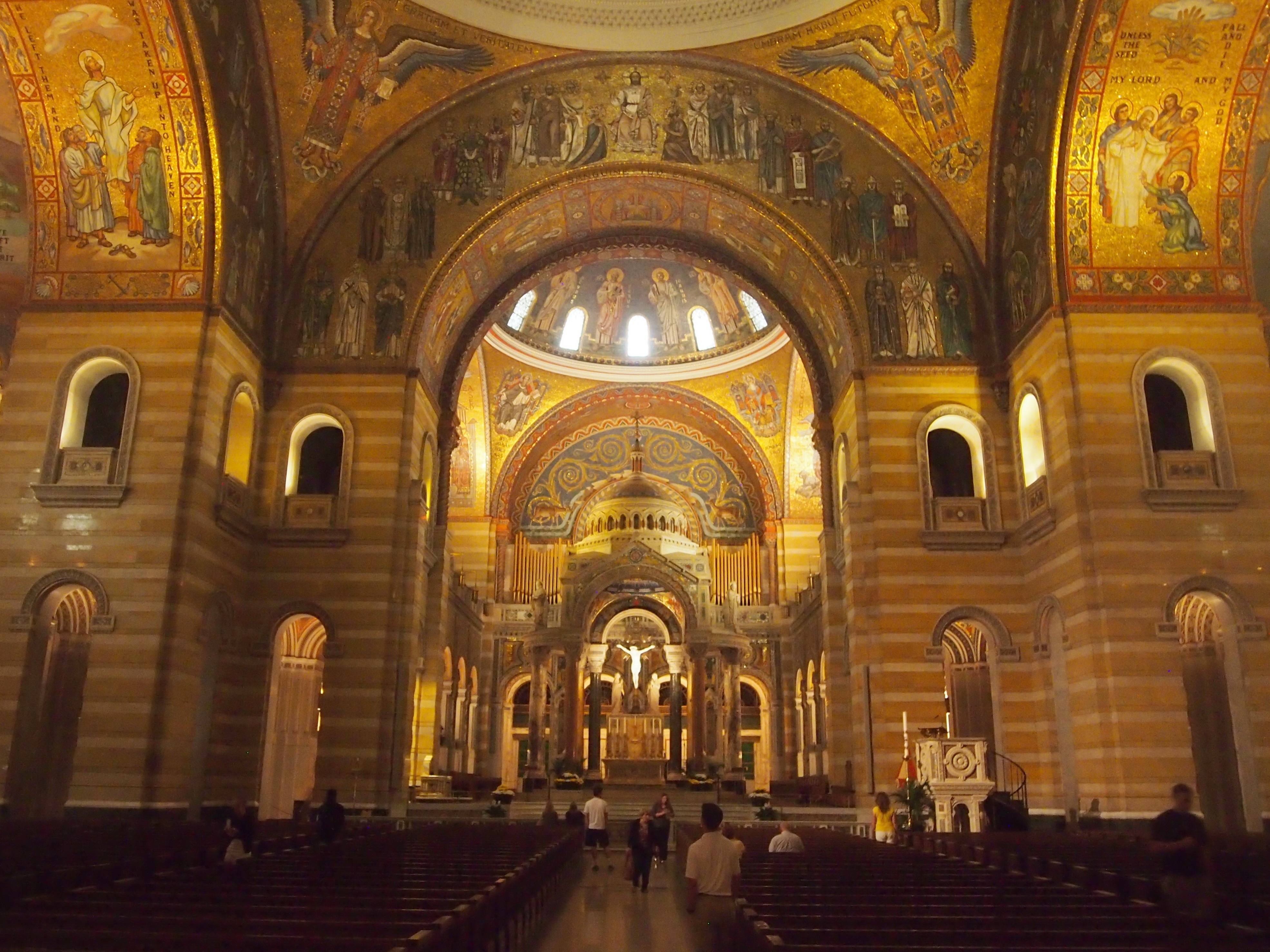
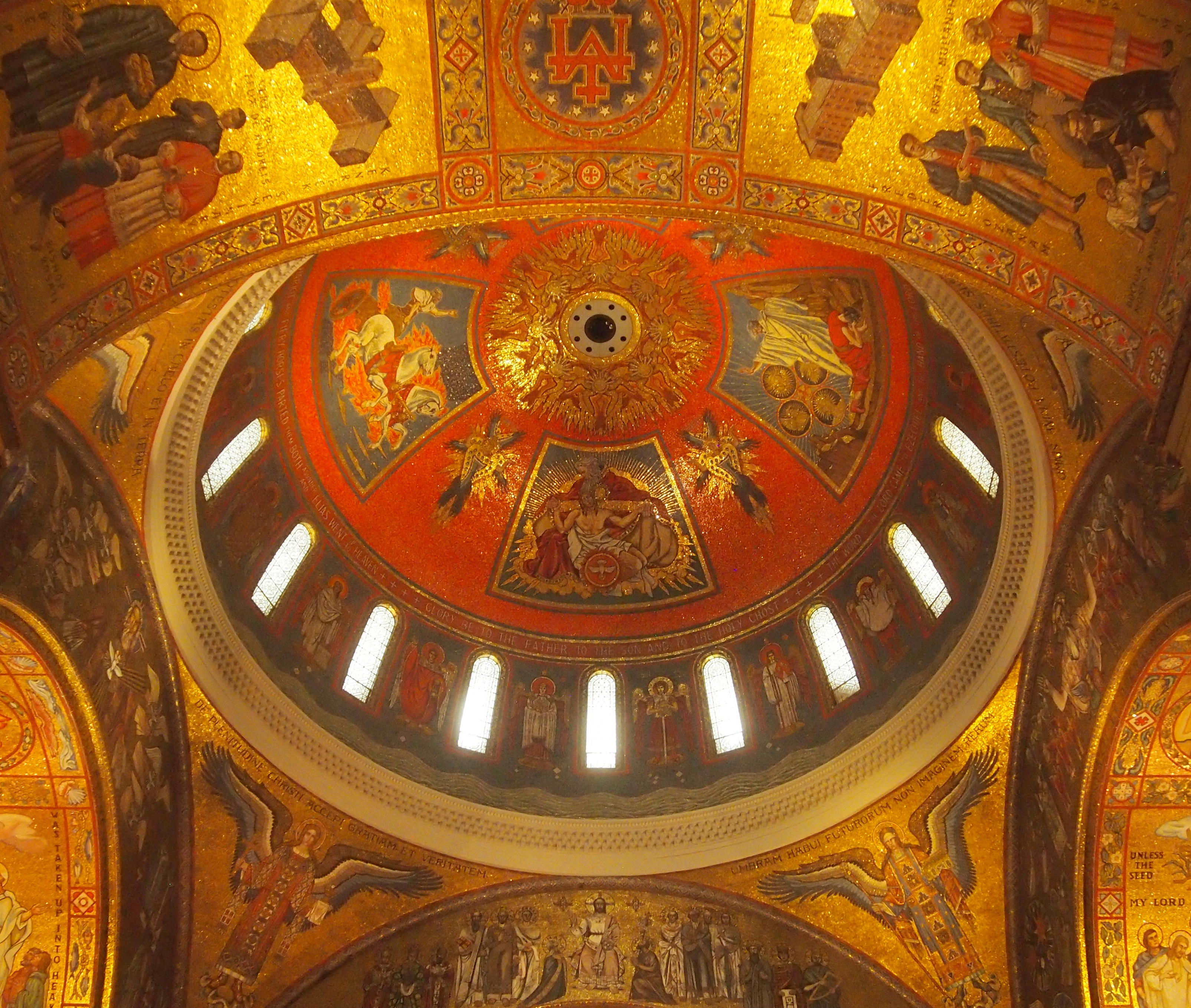
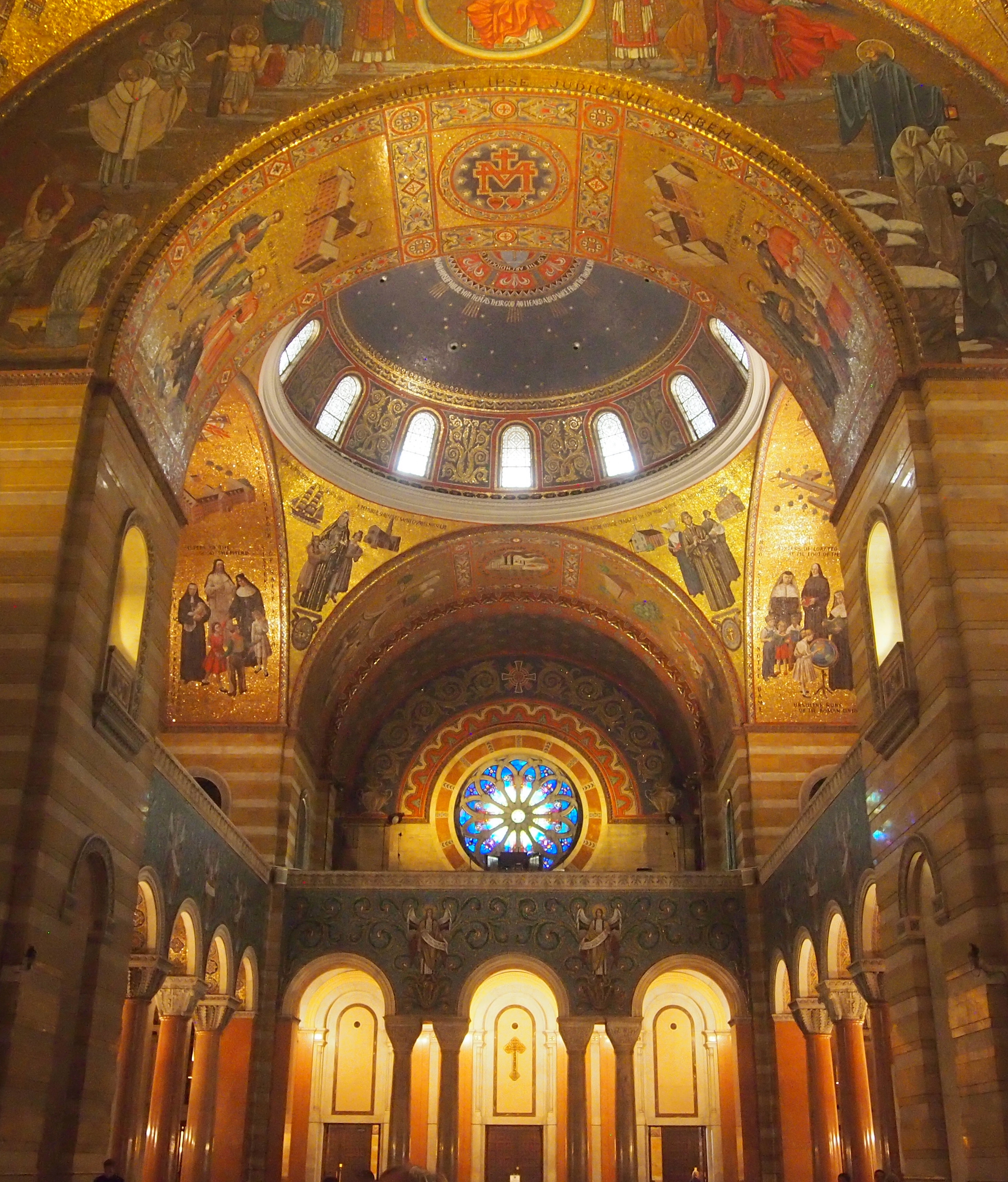
On May 26 this year, Lilly and I paid the place a visit en route home. I’ll never be as astonished — I had no idea what I was going to see beforehand — but I’ll always be impressed. Photography barely does the church justice, my photos even less so.

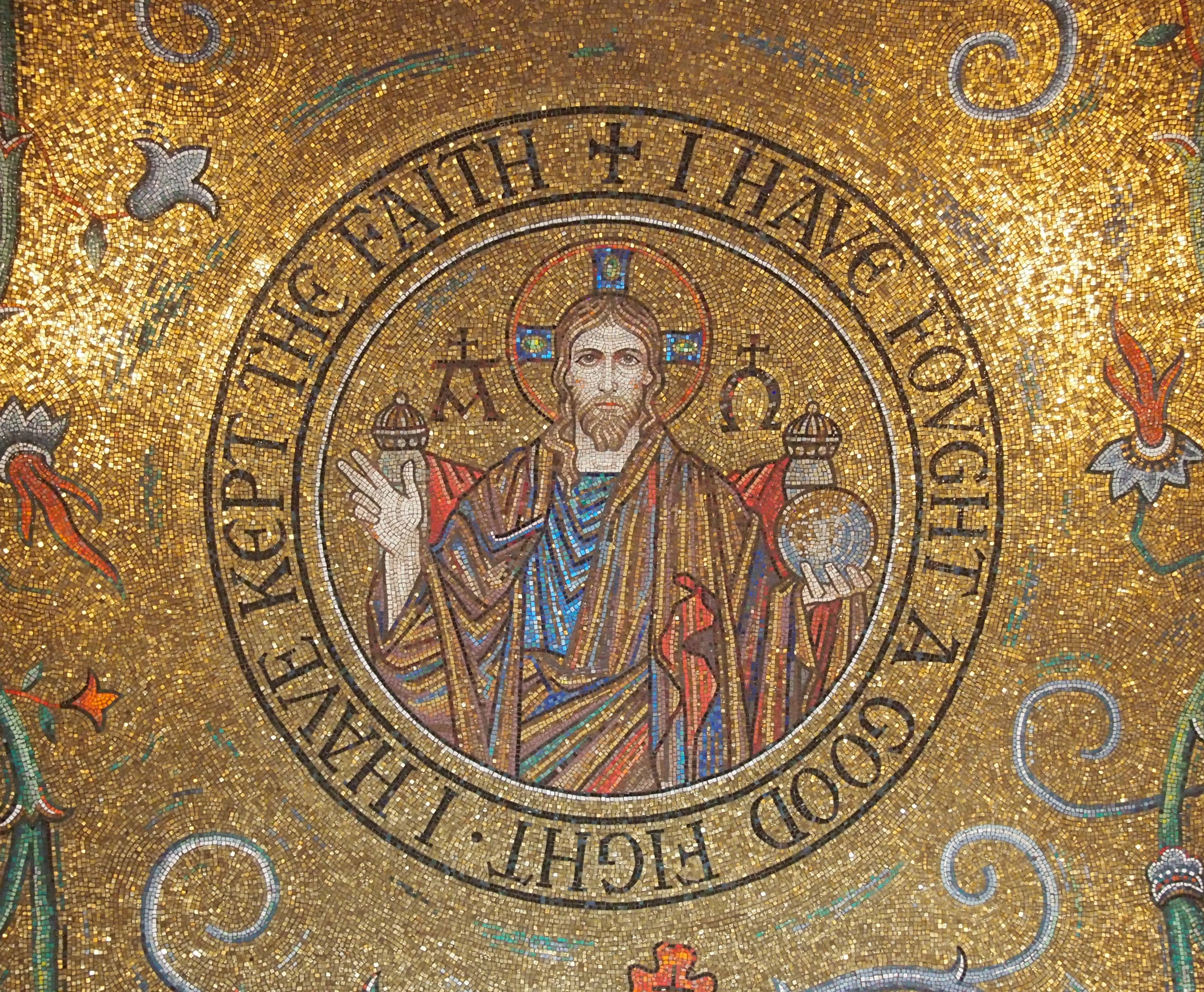
The Cathedral Basilica of St. LouisThe Cathedral Basilica of St. LouisThe Cathedral Basilica of St. LouisAfter seeing the cathedral for the first time, I wrote: “It isn’t necessary to cross oceans to savior the majesty of large-scale mosaic art, vaultingly expressed in a cathedral. You only need to visit the Cathedral of St. Louis, about 10 minutes west of that city’s well-known Arch. Composed of millions of tesserae — tiles of stone or glass — the mosaics of the cathedral dome and walls offer visitors a pageantry of Christian saints, symbols and stories rendered in hundreds of subtle hues. Its architecture is deeply reminiscent of the great Byzantine cathedrals of Italy and points East.”

I based that on what I’d read about (and pictures seen of) places like Ravenna. I thoughtlessly did not go there when I was in Italy, even though I knew about it. Ah, well. The Cathedral Basilica of St. Louis will have to do for now.

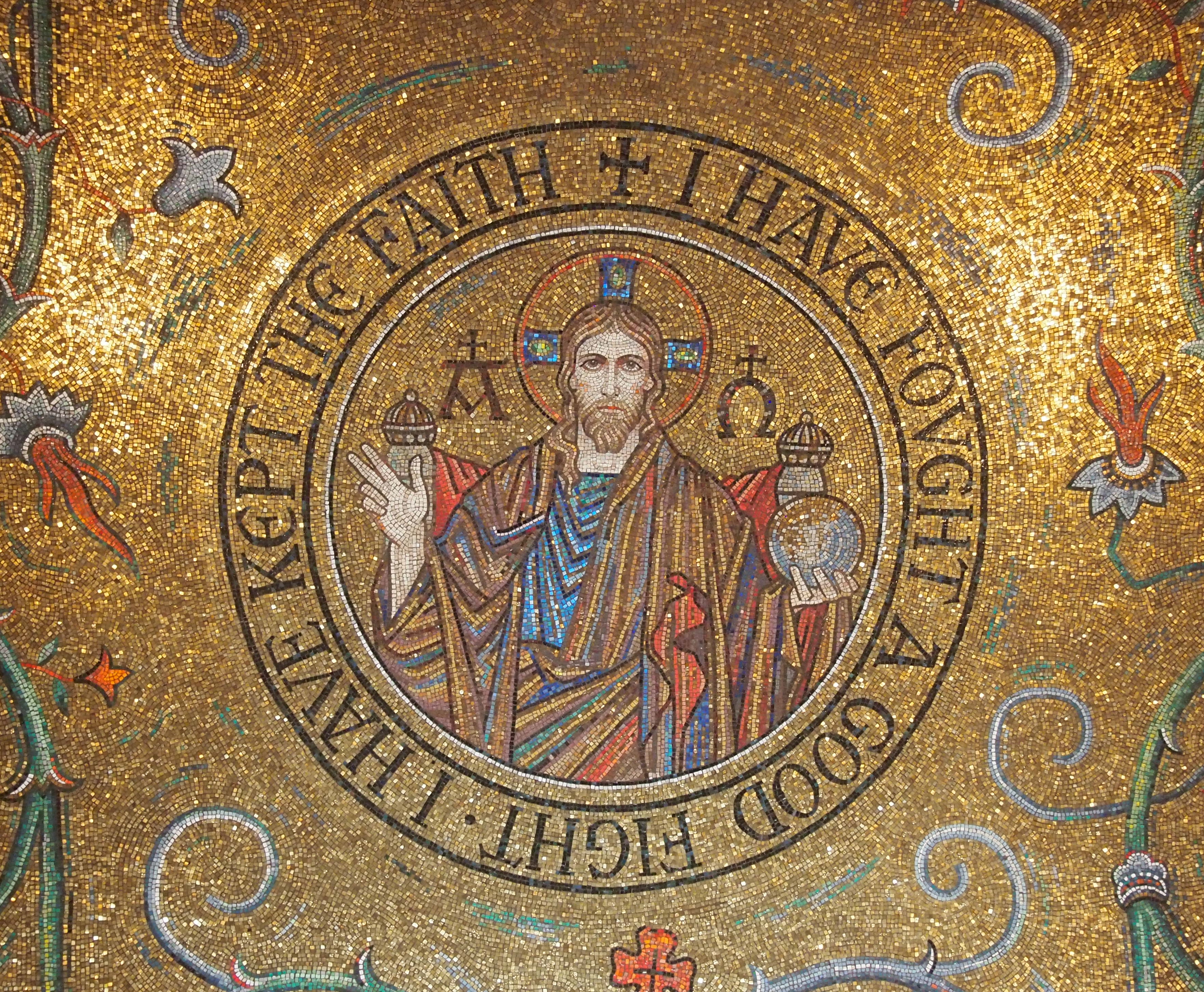
The mosaics are especially easy to see in detail just above the entrance.

Cathedral Basilica of St. LouisThe basilica’s web site says: “George D Barnett of Barnett, Haynes, and Barnett of Saint Louis designed the entire structure of the Cathedral, including a circular Sacristy on the north end which was not built when the main structure was completed in 1914. The semicircular Sacristy which was eventually built was designed by George John Magualo of Magualo and Quick.

“Barnett also designed the main Altar, the baldachino, and the Lower Sanctuary mosaics. The mosaics were installed by the Gorham Company of New York in 1916. Barnett also designed the Blessed Sacrament Chapel and its mosaics which were installed by Gorham in 1916 and 1917.”

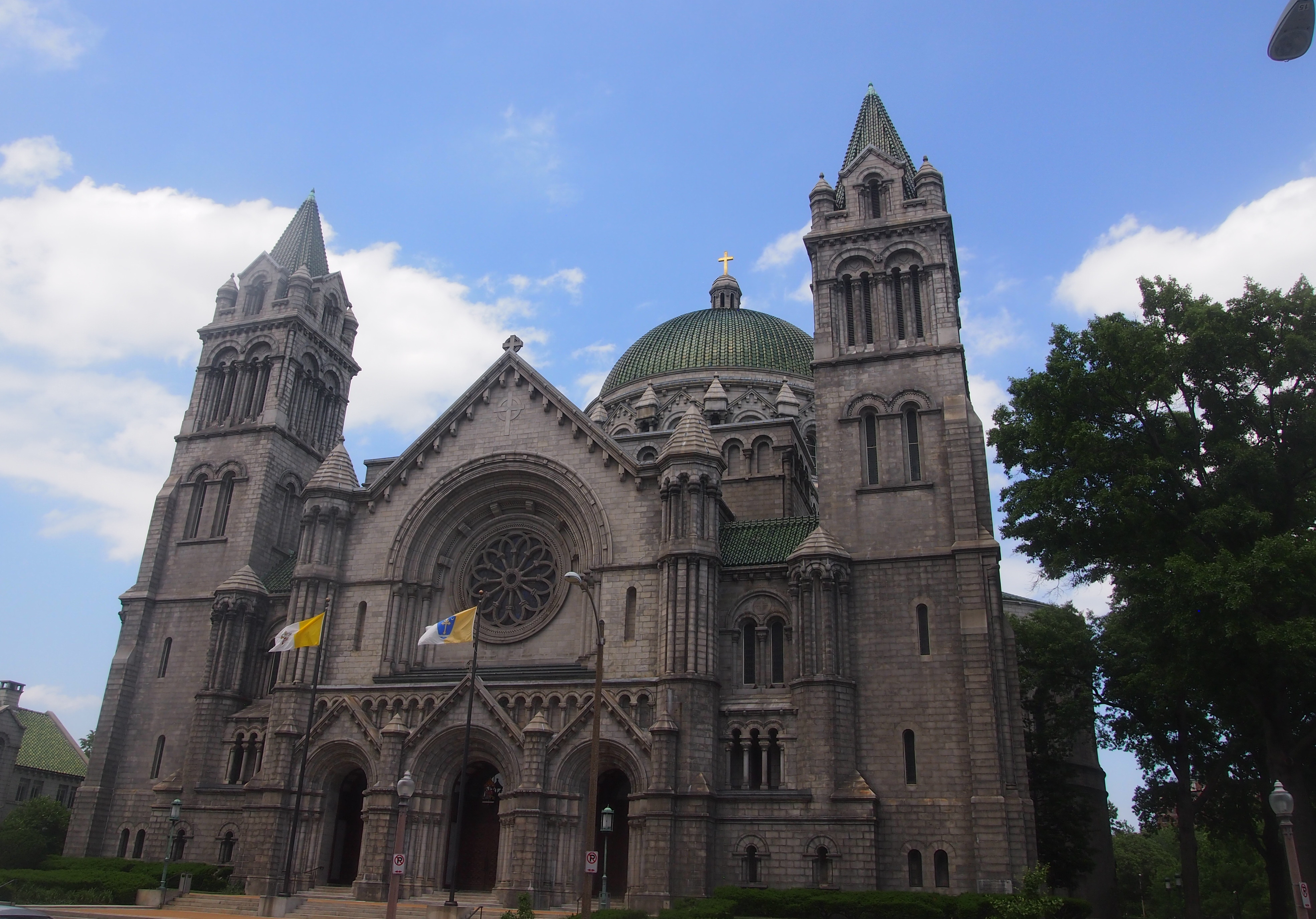
As for the fact that it is now the Cathedral Basilica of St. Louis, which it was not in 1990, the web site notes: “On April 4, 1997, Pope John Paul II honored the Cathedral of Saint Louis by making it a Basilica, a place of worship of special distinction. As a Basilica, the Cathedral displays two special symbols — the tintinnabulum or bell and the ombrellino or umbrella.”

A warm spring day is a better time to take exterior shots. Also impressive.
Cathedral Basilica of St. LouisThe last time I saw the Cathedral Basilica of St. Louis was in 2005 (I think), when I took Ann — and she was small enough to pick up when she didn’t want to walk. I know I took Lilly at a similar age, and showed the place to Yuriko, when we visited St. Louis in 2000. In any case, those visits were too long ago. Good to make it back.

The Old Gasconade River Bridge

On I-44 in south central Missouri, there’s a point at which you cross the Gasconade River, which rises in the Ozarks and ultimately flows to the Missouri River. It hardly seems like a bridge, so effortless is the crossing.

Transportation disaster enthusiasts, or maybe just train wreck buffs, know the Gasconade River as the site of the Gasconade Bridge Train Disaster of 1855. A train from St. Louis bound for Jefferson City broke the railroad bridge it was traveling across, precipitating the engine and some of the cars into the river, killing 31 and seriously injuring many others at a time when the state of medical science meant that you were pretty much on your own when it came to recovery.

The accident was nowhere near where I-44 crosses the river, but rather near the town of Gasconade in Gasconade County, between St. Louis and Jeff City. Hope there’s some kind of memorial to the event around there, but I can’t find any evidence of one.

A few years ago, Ramona Lehman, co-owner of the Munger Moss Motel, told me about the old bridge across the Gasconade, just south of the modern I-44 bridge, which is only about 10 miles from the motel. She even sells postcards depicting the bridge at the motel front desk, proceeds of which go toward preserving the bridge. I’ve bought a few over the years.

The old bridge dates from the 1920s, and carried U.S. 66 traffic across the river for many years. After that highway became nostalgia fodder, the bridge continued to carry local traffic for many more years.

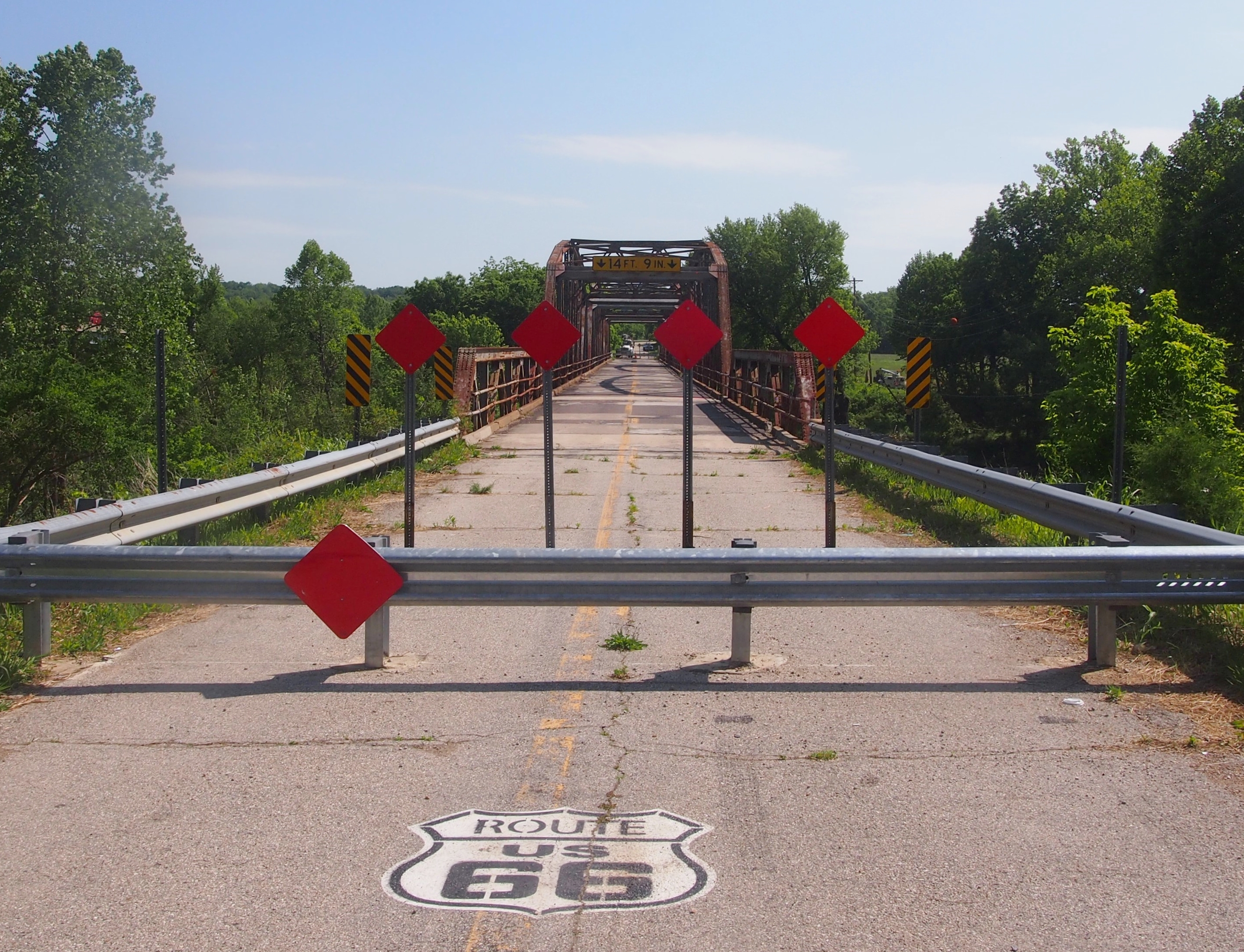
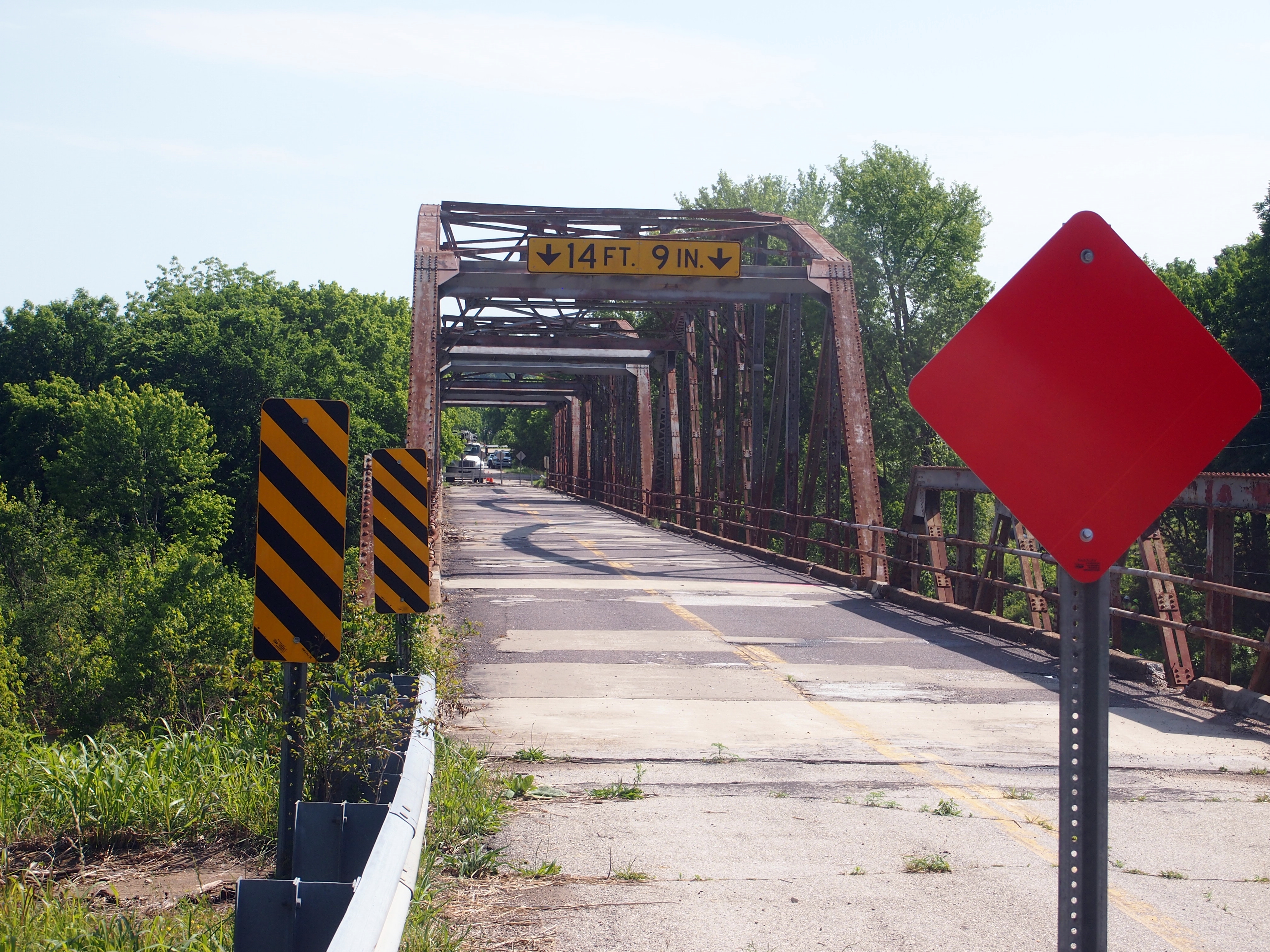
In late 2014, the Missouri Department of Transportation closed the old bridge as unsafe. What with the new bridge and all, the department had probably opted for deferred maintenance on the old one for a long time. Get off the Interstate west of the old bridge, and take the access road — Historic 66, that is — and pretty soon you’ll find yourself at the inaccessible bridge, as we did late on the morning of May 26.

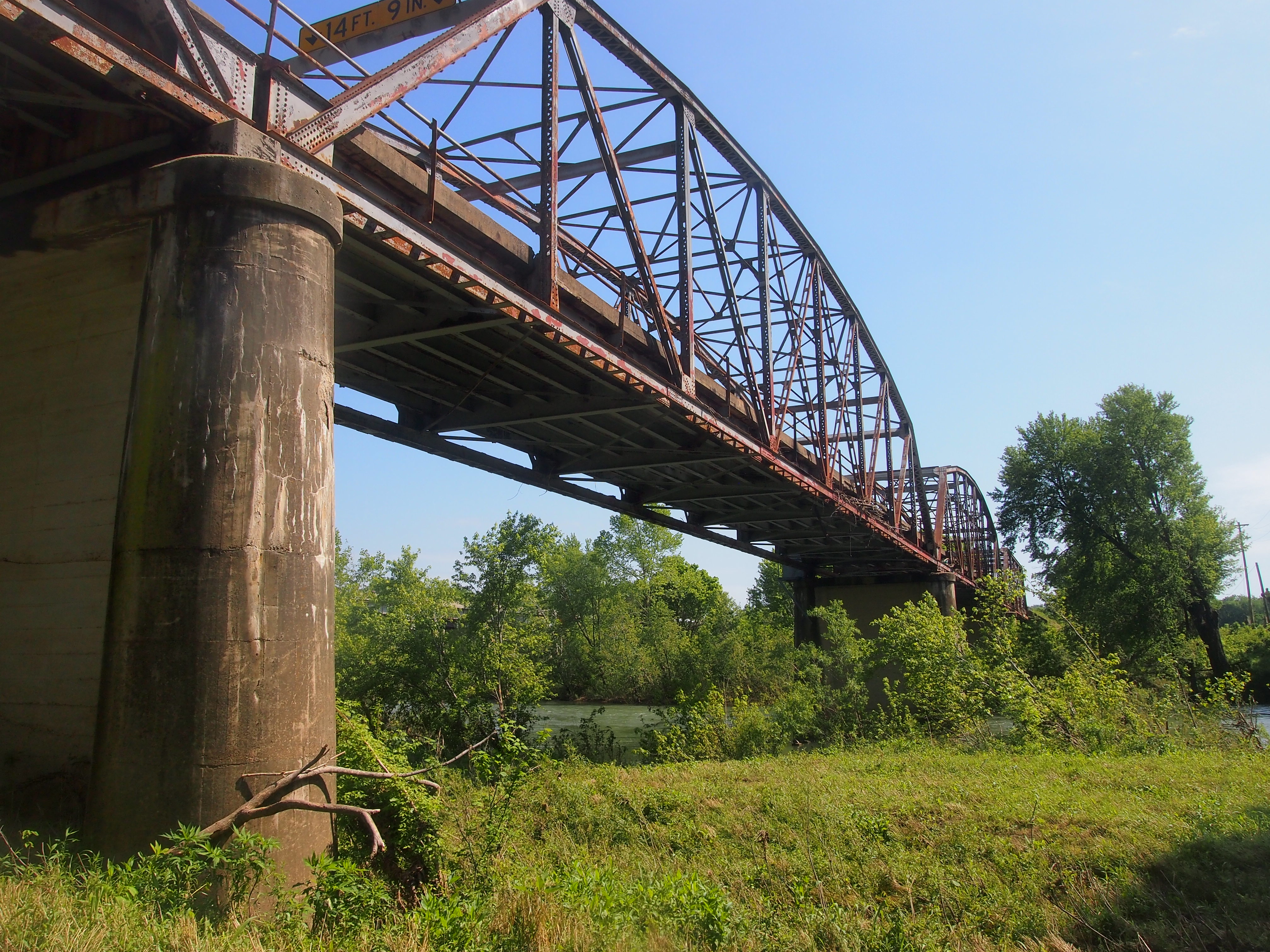
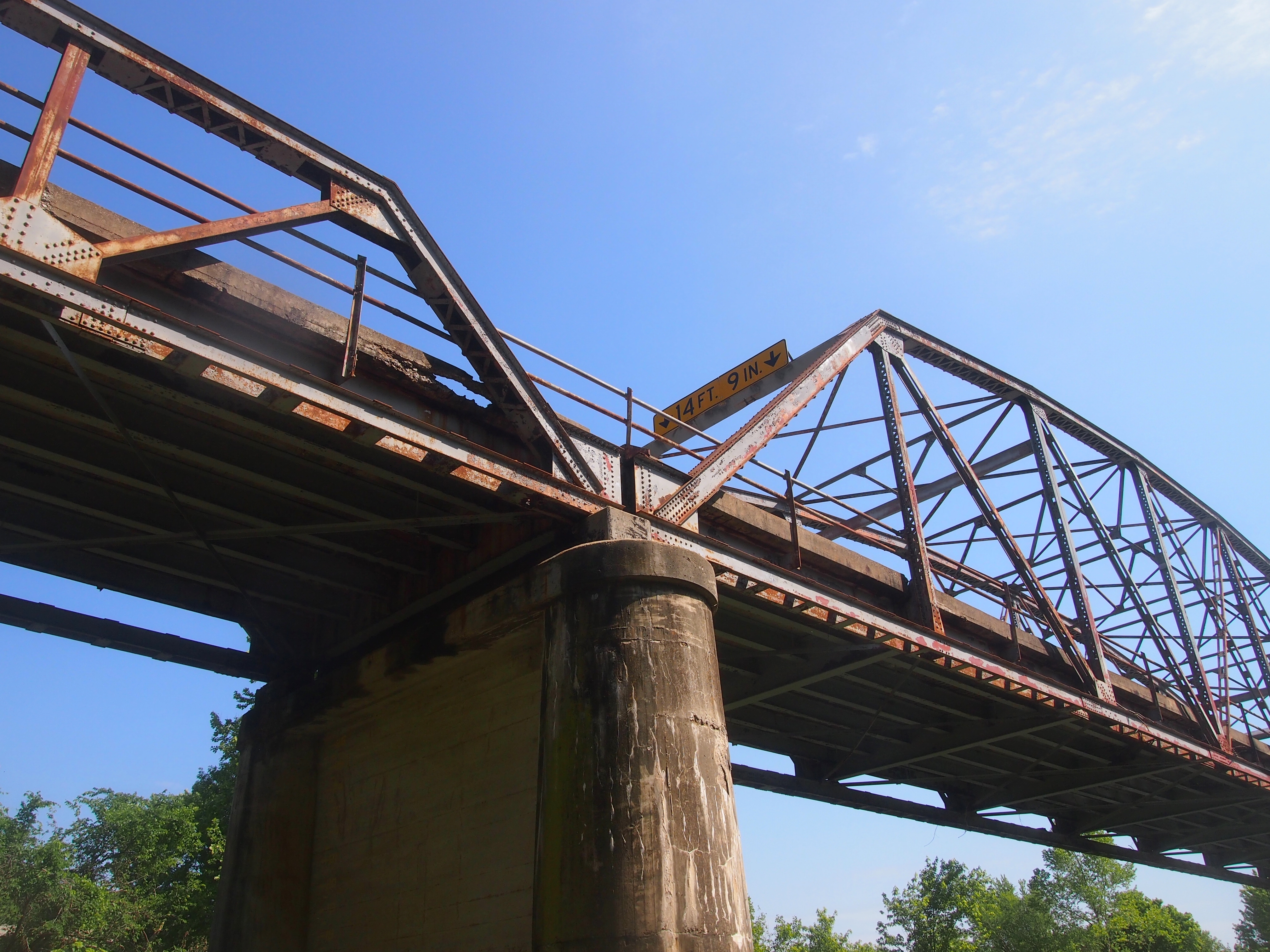
The Gasconade River Bridge, Route 66The Gasconade River Bridge, Route 66Not especially impressive from that vantage. The best way to look at the old bridge was from underneath. A patch of land near the river and under the bridge was surprisingly accessible.

The Gasconade River Bridge, Route 66

The Gasconade River Bridge, Route 66I was motivated to see the structure as more than a passing blur out of the corner of my eye. The next time I come this way, it might be gone. The good people who live near it want the bridge preserved, but it isn’t clear that’s going to happen. As usual, it comes down to money.

MoDOT recently issued a press release that included the following: “The majority of public comments stemming from a Dec. 14, 2016, public meeting held in Lebanon supported constructing a new bridge near I-44 and leaving the current facility, located on historic Route 66, intact. However, MoDOT has indicated all along that liability issues and limited funds would require the department to remove the bridge unless an outside entity stepped forward to take ownership of and maintain the bridge.

“The current bridge will remain in place as the agency works through the requirements of Section 106 of the National Historic Preservation Act. The act requires federal agencies and the recipients of federal funds, such as MoDOT, to consider the effects of projects on properties eligible for listing on the National Register of Historic Places, such as the Gasconade River Bridge.”

Thus the fate of the bridge is uncertain. That meant seeing the bridge was a carpe diem situation, so I did.