Springfield ’18: Another Look at the Rubber Lincolns

The weekend before last, we popped down to Springfield for a short visit. As in the capital of Illinois, not any of the many others, or the cartoon town. Ann had expressed an interest, mostly in passing, that she’d like to see the Abraham Lincoln Presidential Museum again. So, like a parent does sometimes, I took that passing whim and ran with it.

The last time we were there was 2010, so I could see Ann’s point. She was only seven years old then and wanted an updated perspective. I also wanted to visit again, just to see if it was any different.

The short answer: not much. Is that part of the museum’s current problems?

Maintaining attendance as the years go by means offering new things from time to time, and I got the distinct impression that most everything was the same as eight years ago — including the short films shown in the museum’s two main auditoriums. I know it costs money to make new films, but that can’t be done in eight years?

Then again, maybe the museum isn’t interested in repeat visitors. School groups come, tourists come. For most people, once is probably it. Or maybe again many years later as a child who visited returns with a child of his or her own. The museum isn’t quite old enough for that yet, but I suppose it will happen.

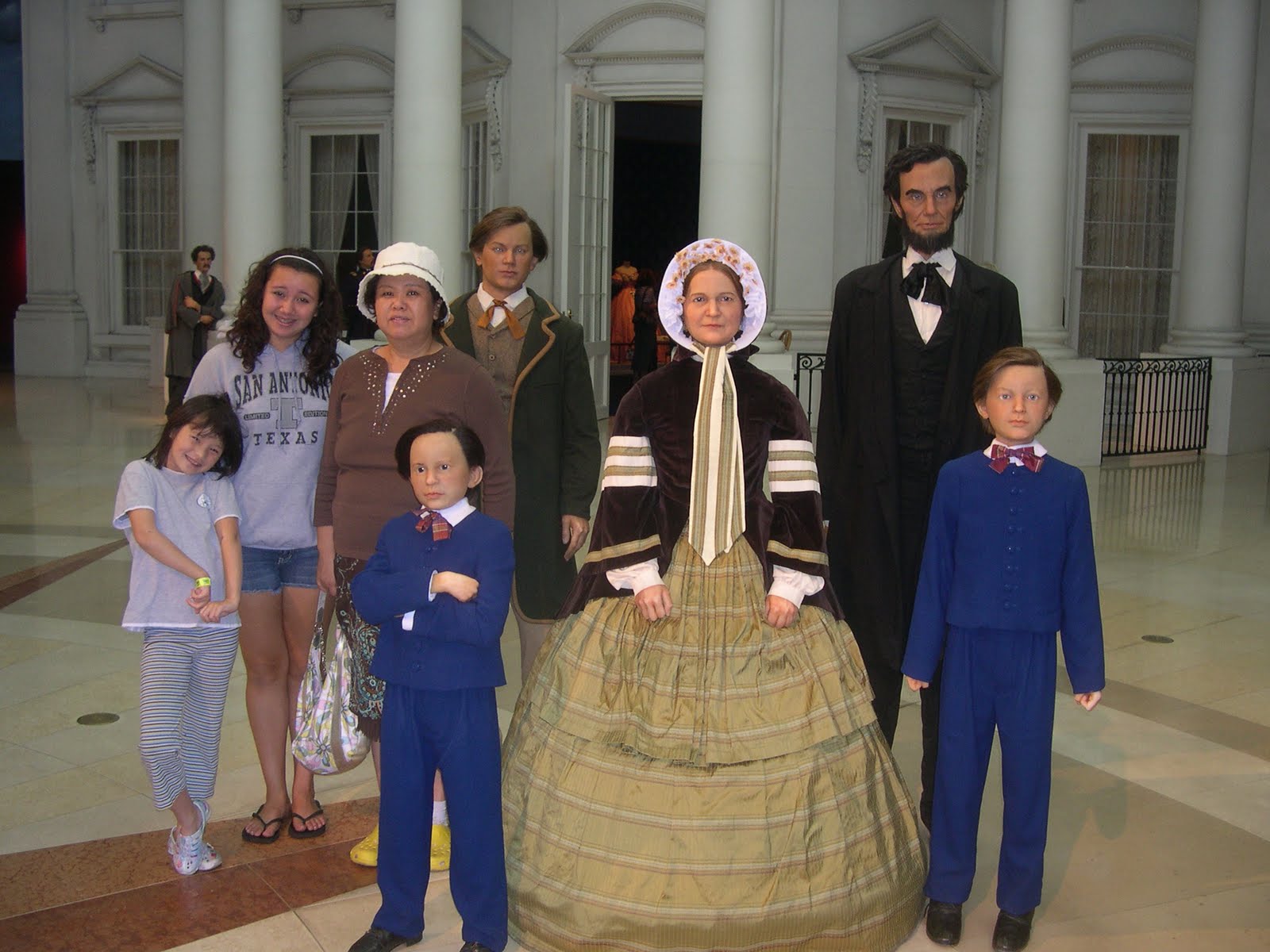
Actually, I noticed a few small changes. Take a look at the picture of the “rubber” Lincoln family near the museum’s entrance that I took in 2010, with my own family posing.
Now look at this one from 2018, with Ann on the right and a friend of hers on the left.
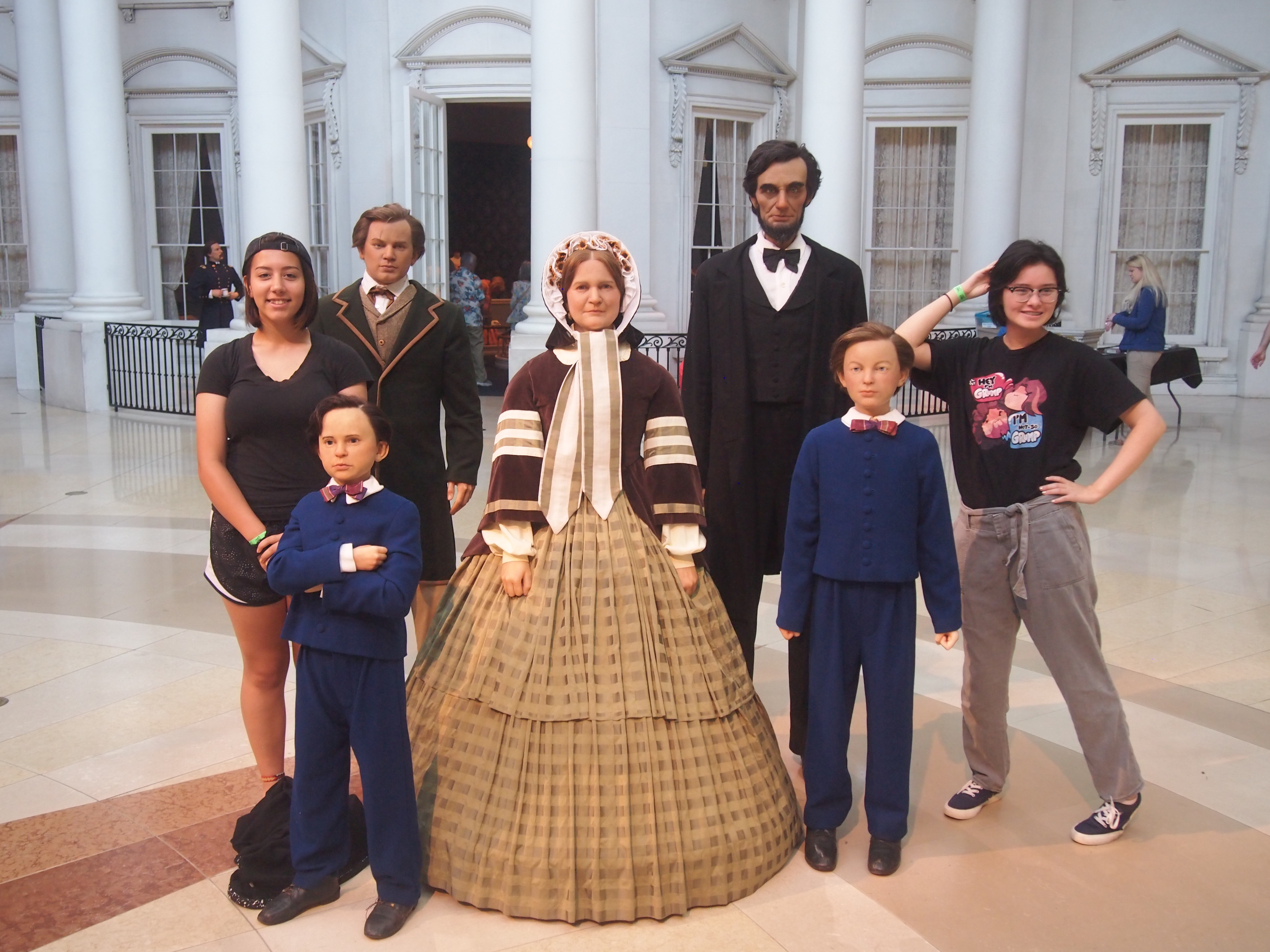
There are some small differences in the Lincoln family — a different but similar dress for Mary, for instance, and for all I know the life-sized figures might be different ones from the ones standing there eight years ago. But the main difference is behind the Lincolns.

Eight years ago, a life-sized John Wilkes Booth lurked in the background. Now he’s gone. The figure you can see in the back to the left is George McClellan, standing inside the fence with U.S. Grant, who isn’t visible in my picture. (Also obscured, and off the right, are Harriett Tubman and Frederick Douglass.)

Is Booth out for a touchup? Or did the museum get tired of people complaining about his presence? He did murder Lincoln, after all. His figure in such a prominent place is a little like putting a print of the famed photo of Lee Harvey Oswald and his rifle on the wall at the Kennedy Museum.

Never mind all that, I enjoyed the museum the second time around enough to make it worth the trip, though I think it will be my last. I’m sure Ann got her revised impression of the place.

I paid close attention to the rubber figures, which aren’t rubber, of course. As I wrote in 2010, “Though derided as ‘rubber’ Lincolns, they’re actually sculpted foam coated with fiberglass, and then painted, clothed and fitted with a mix of real and synthetic hair.”

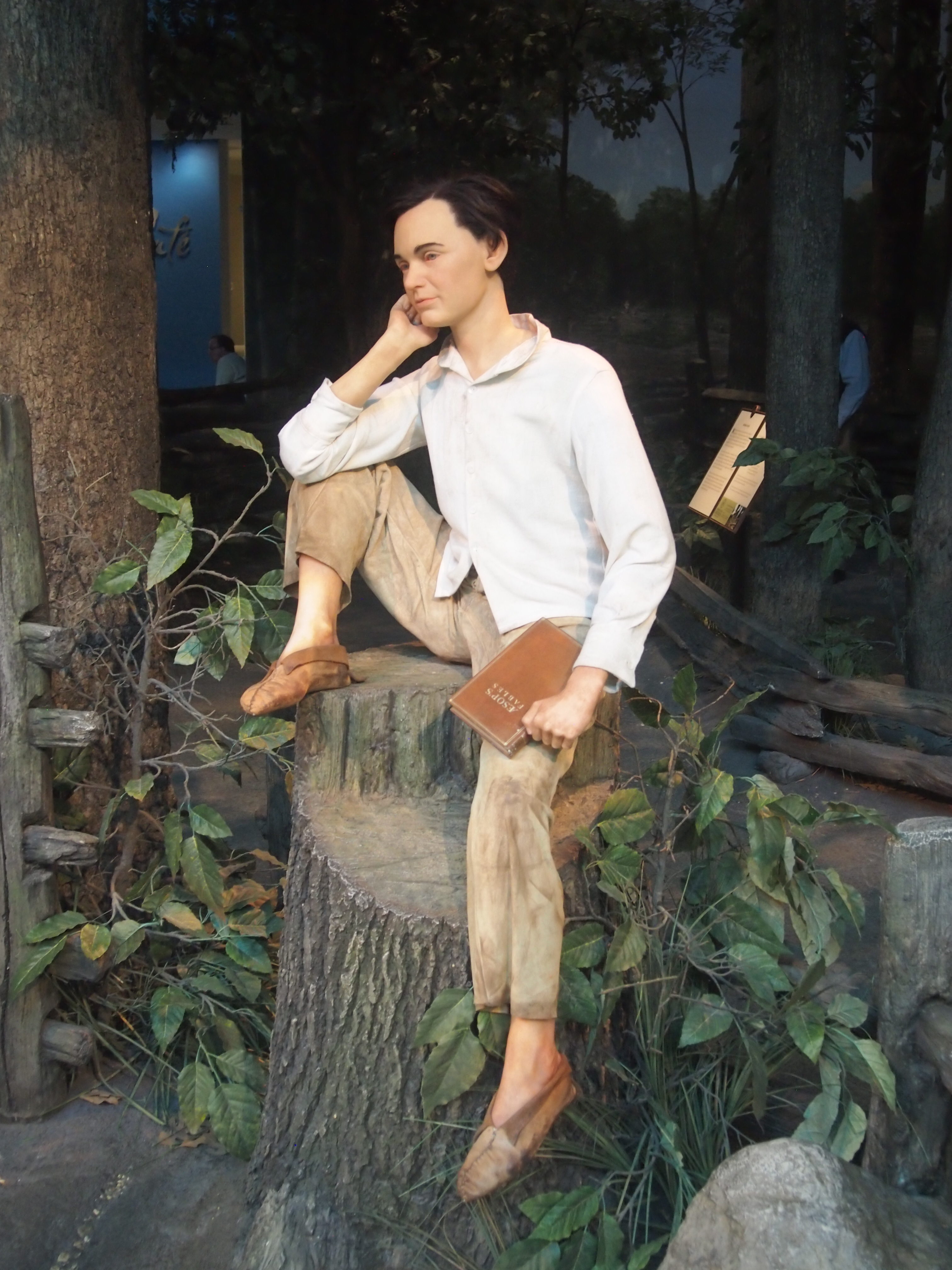
The figures are a distinguishing feature of the museum, and on the whole, add to the experience. Here’s the thinkin’, book readin’ young Abe.
The store-keeping Lincoln as a young man in Salem, Illinois. It didn’t work out for him.

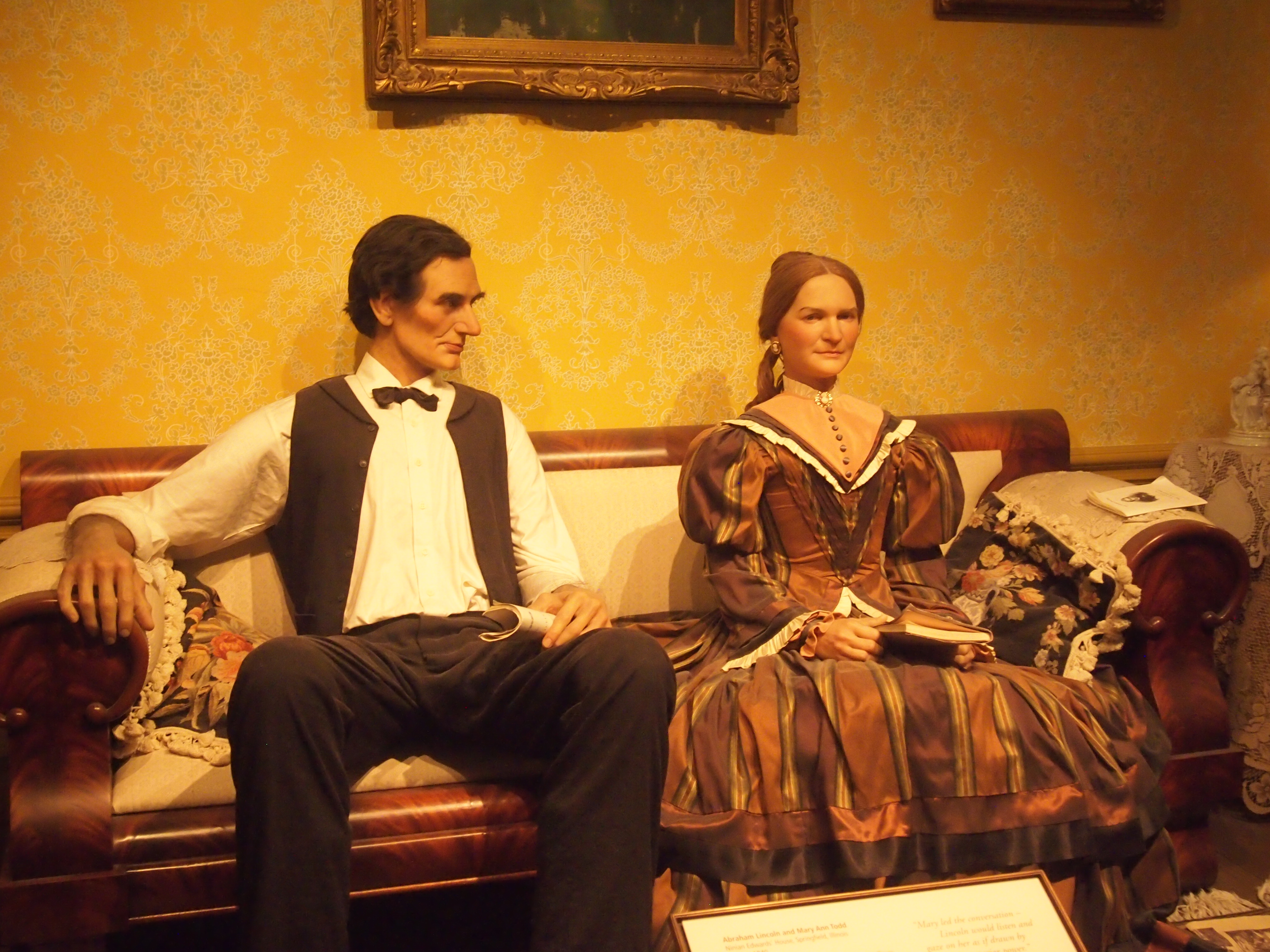
Abraham courting Mary. That worked out for him.
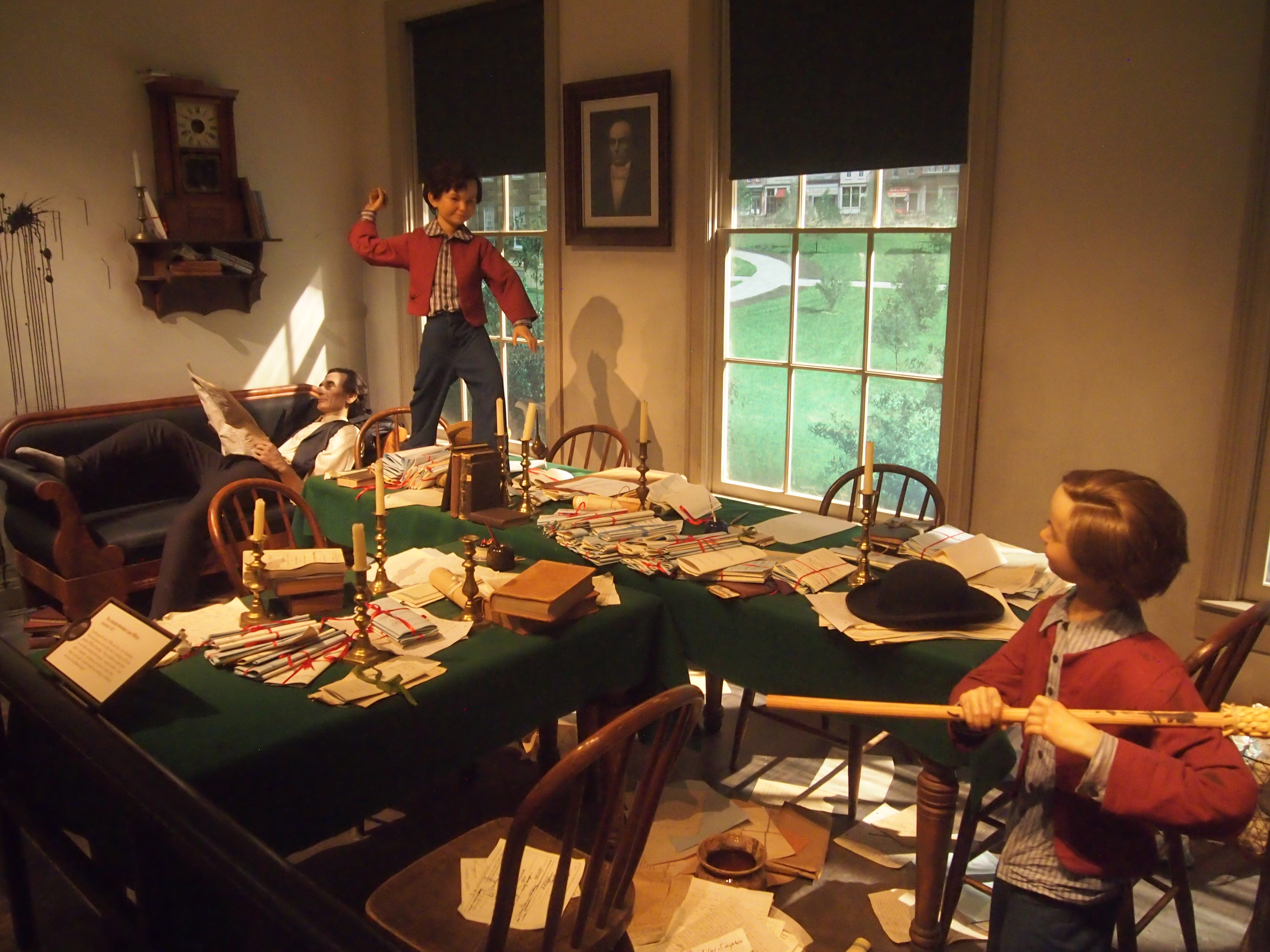
The Lincoln-Herndon law office. Perhaps the best tableau in the museum. Clutter is an essential aspect of people’s lives that historical museums often miss. Lincoln had better things to do than tidy his office or discipline his sons. Namely, read.
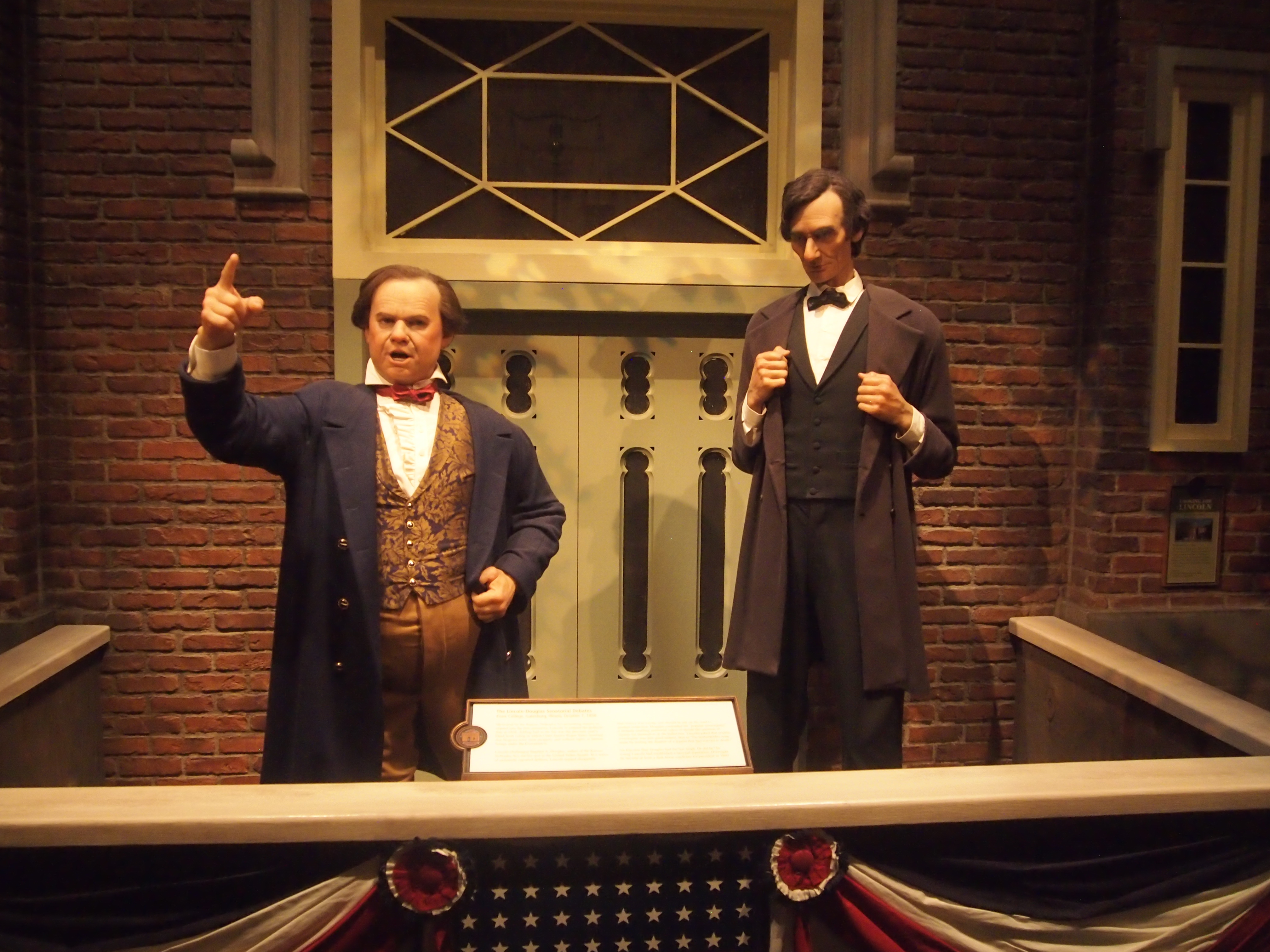
Can’t very well have a Lincoln museum without Mr. Douglas debating Mr. Lincoln.
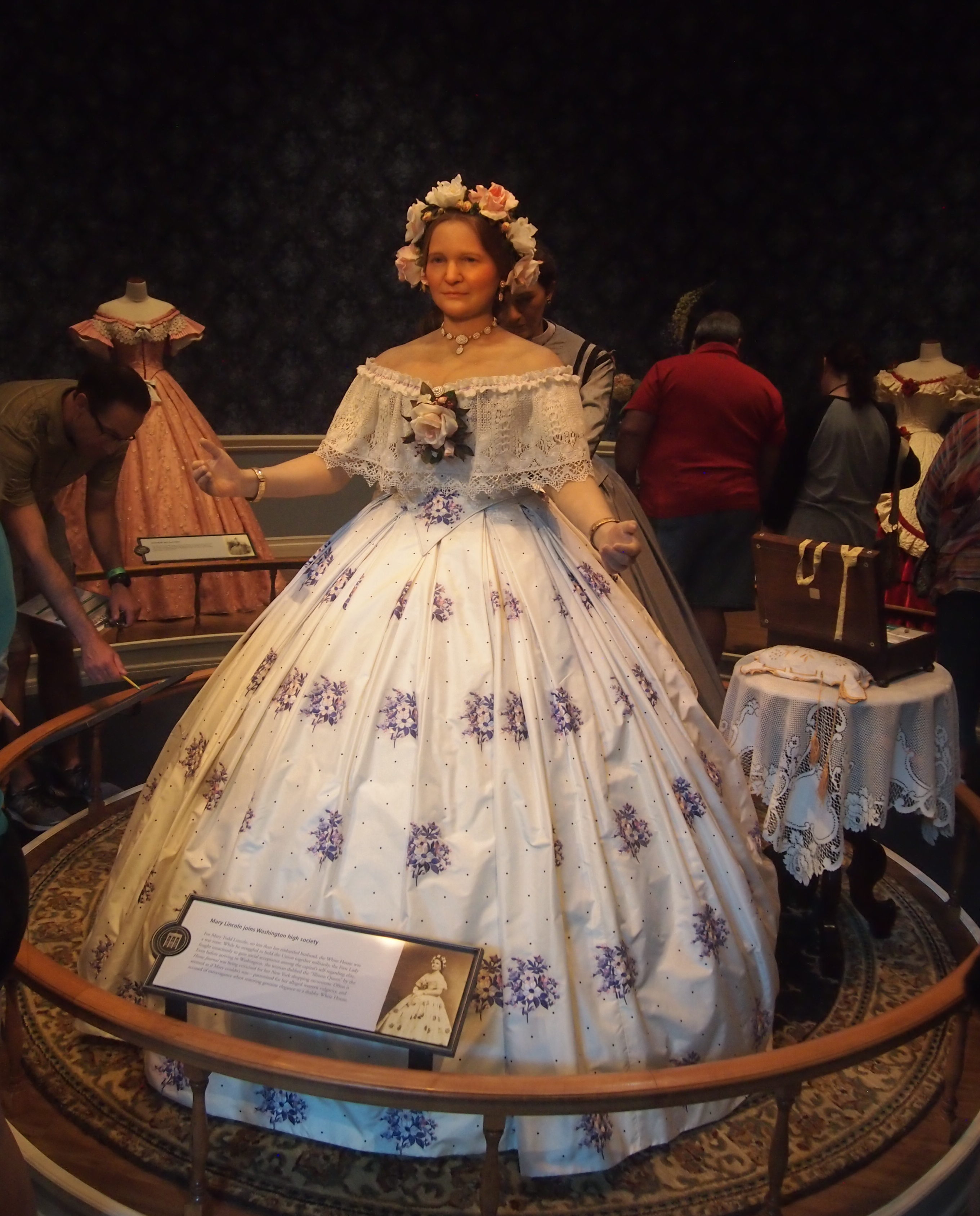
Mary Lincoln dressed for her husband’s inauguration.
There is another Mary Lincoln figure, dressed in black, sitting alone in a dim room with the sound of rain in the background. She is depicted grieving for their son Tad, who died in 1862. It’s the saddest tableau in the museum, even more than the Ford’s Theatre depiction.

The first reading of the Emancipation Proclamation to the cabinet. (“By the way, gentlemen, one more thing…”) Clearly inspired by the famed Carpenter painting, if not so formally posed.
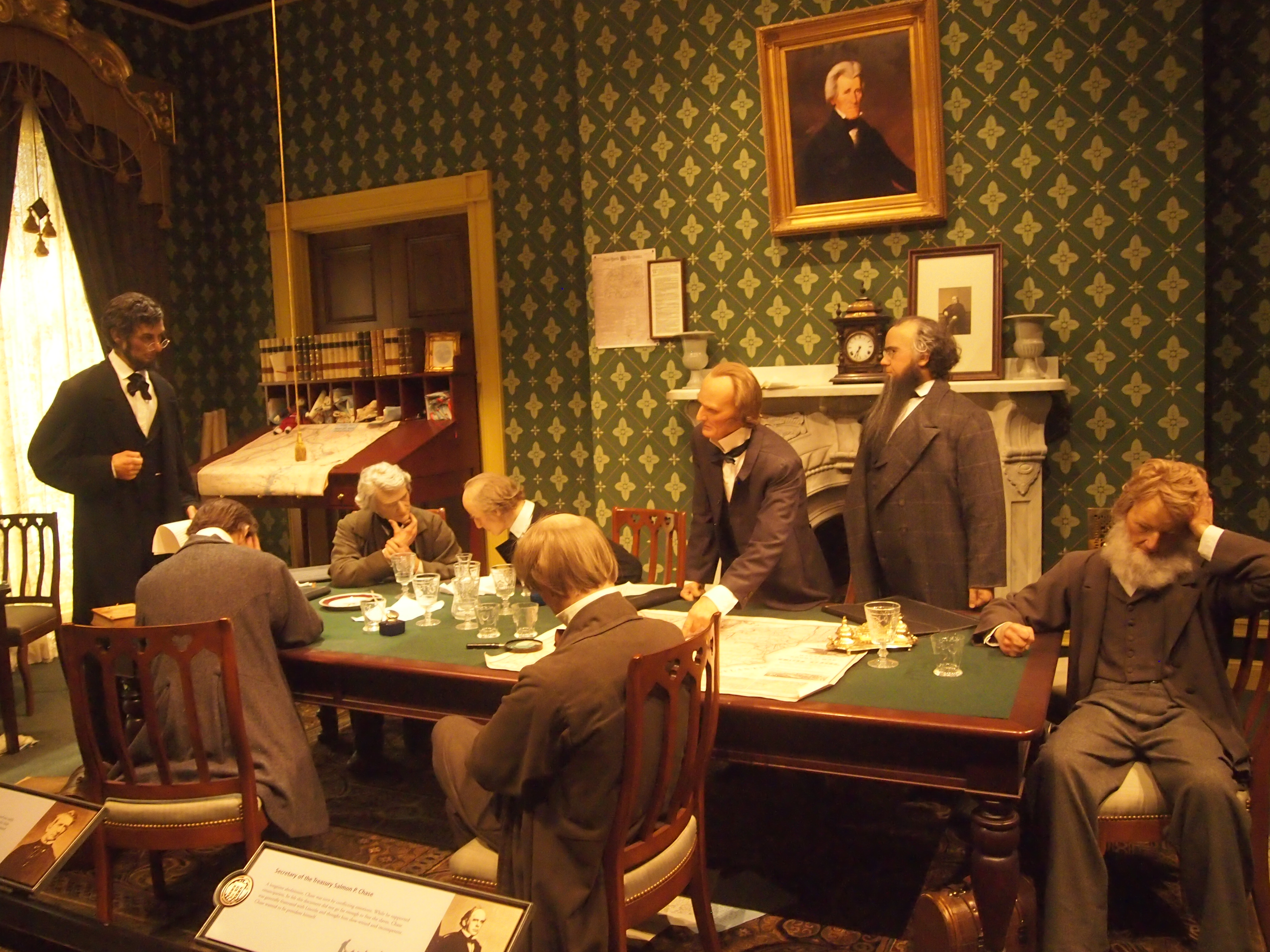
And, of course, the Lincolns at Ford’s Theatre.
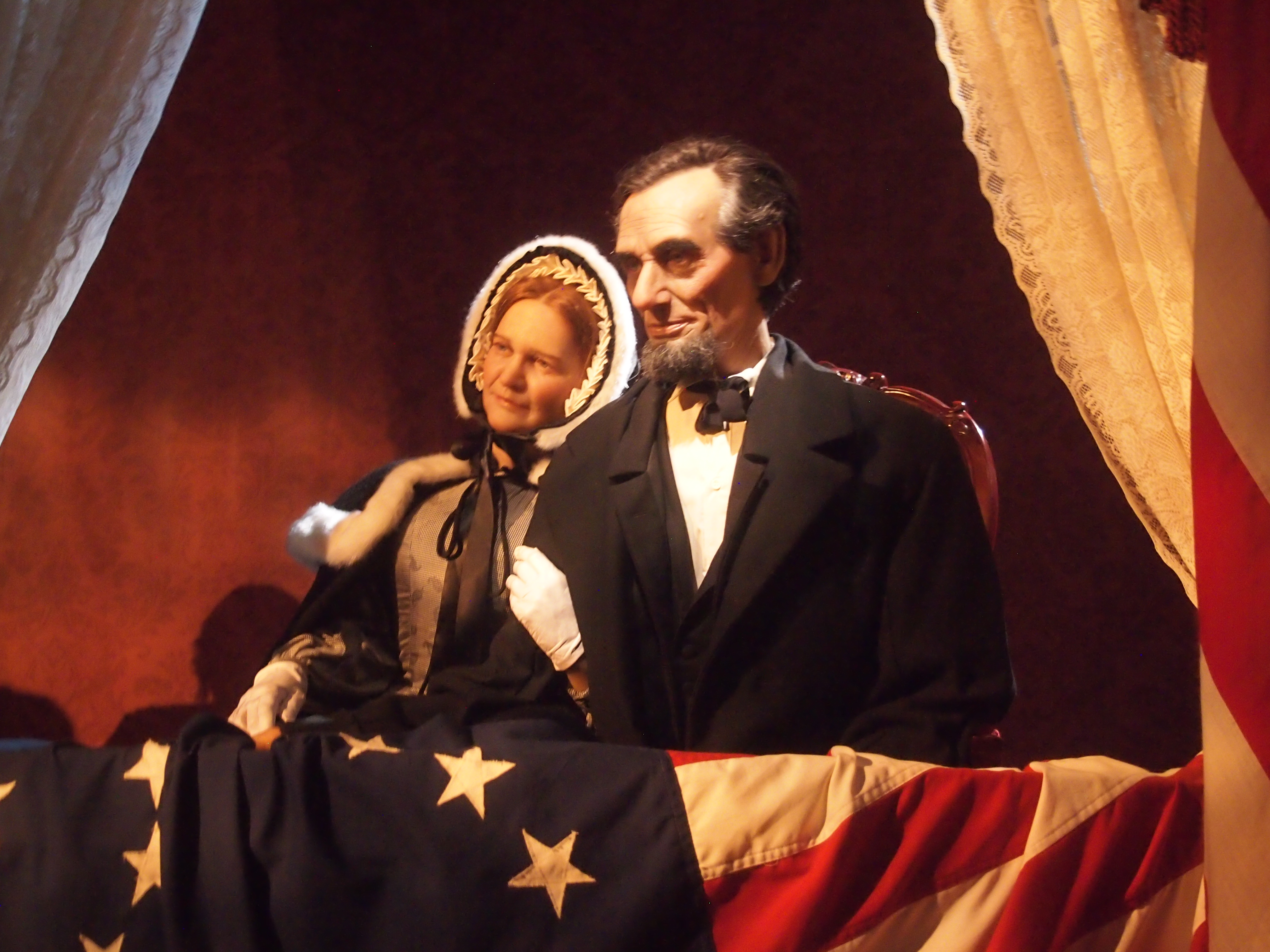
Booth is depicted entering the door behind them, so maybe that’s the only place to find the rubber assassin in the museum these days.
Arthur and Arcola 2018

On Saturday, we were at a small bookstore and antique shop in Arthur, Ill., down in what’s known as the Illinois Amish country of the east-central part of the state, and as we were leaving, Ann mentioned that she’d seen some Amish romance novels in the store.

Just another thing I’d never thought of. The world keeps tossing things like that at me. According to Time, at least, the Amish romance novel is quite a thing:

“In Amish romance novels, there is no sex, but lots of babies; no nakedness, but layer upon layer of clothing is removed; and no physical contact between unmarried couples— unless perhaps God wills it through a tornado, or a house fire, or a buggy accident — and, well, it turns out that happens between attractive Amish singles quite a lot.”

It also turns out that most of the readers and most of the writers of such yarns aren’t Plain People at all, though the magazine does mention one example:

“The authors of Amish fiction freely admit that most of them are not Amish, either. ‘I can think of only one Amish writer I know of,’ says [author Beverly] Lewis, who made a point of living with Amish families to learn more about them. ‘She’s Old Order Amish, Linda Byler, and she has a bishop who’s given her permission to write Amish novels. She had an electric typewriter reconfigured to have batteries in it, which are allowed in Amish culture, so she can write.’ ”

Wonder what actual Old Order Amish think of all the weird attention the rest of the world pays to them. Maybe not much. They’re probably pretty busy doing other things most of the time.

We drove down to that part of Illinois over the weekend just to look around, and it is a little odd as a destination. I’ve never seen any Amish, or Mennonites either, wandering around looking at the Chicago suburbs just because they’re different from home.

This was our second visit; the first time was in 2007. This time we spent time in Arthur, at the book store, and at a small street festival, a few antique stores, and an ice cream shop. Tasty soft serve, served by women in bright-colored Mennonite dresses: purple for one, nearly lime green for another. We also poked around Arcola for a while, including a visit to the Visitors Information Center, located in a renovated Illinois Central depot, ca. 1885, and an antique store.

As far as I could remember, not much had changed in either town, or the farmland between (fairly dense with farmhouses), except that one of the restaurants we went to in Arcola had closed, and so had the distinctly non-Amish Raggedy Ann Museum in Arcola.

Not to worry, the woman at the desk at Visitors Information Center told us. A new one was opening up. Or maybe had just opened, though a lot of the old one’s collection went to the National Toy Museum in Rochester, New York. We decided not to follow up on that tip. Visiting a Raggedy Ann museum is a thing you need to do only once.

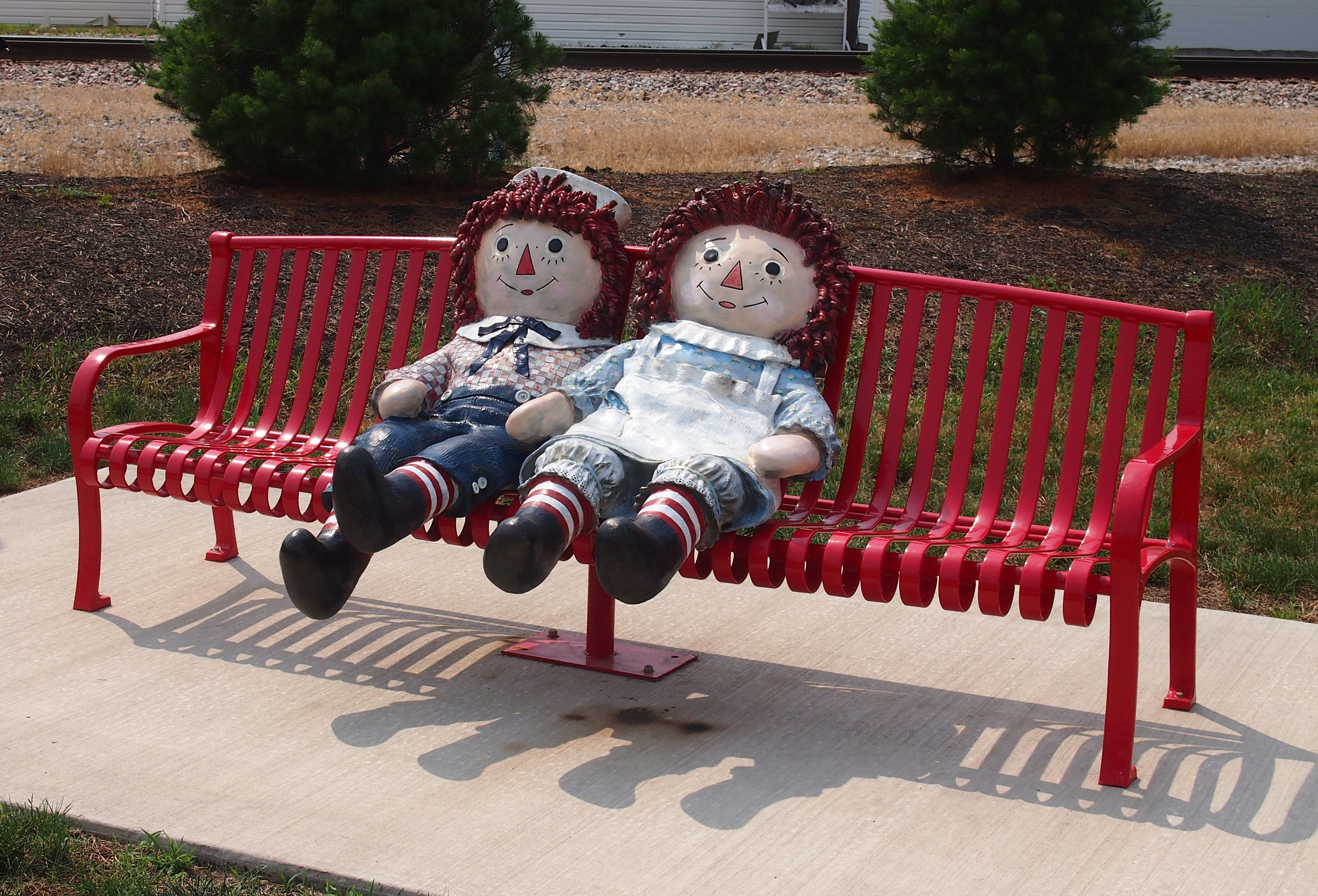
Whatever the status of the museum, Arcola hasn’t forgotten Ragged Ann and Andy. In 2016, the town unveiled these painted bronzes near the Visitors Information Center.
The artist is named Jerry McKenna, a Texas Hill Country sculptor.

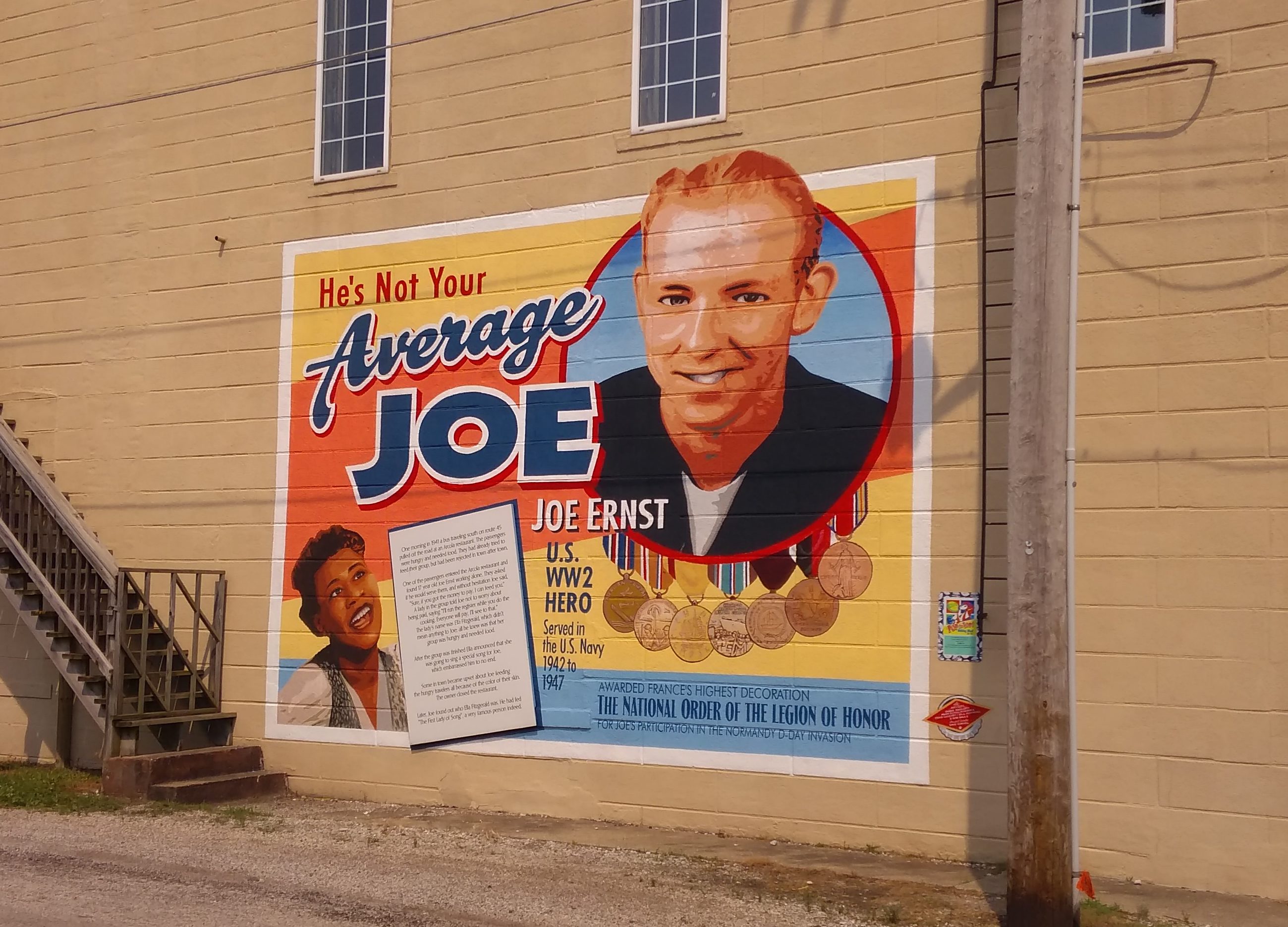
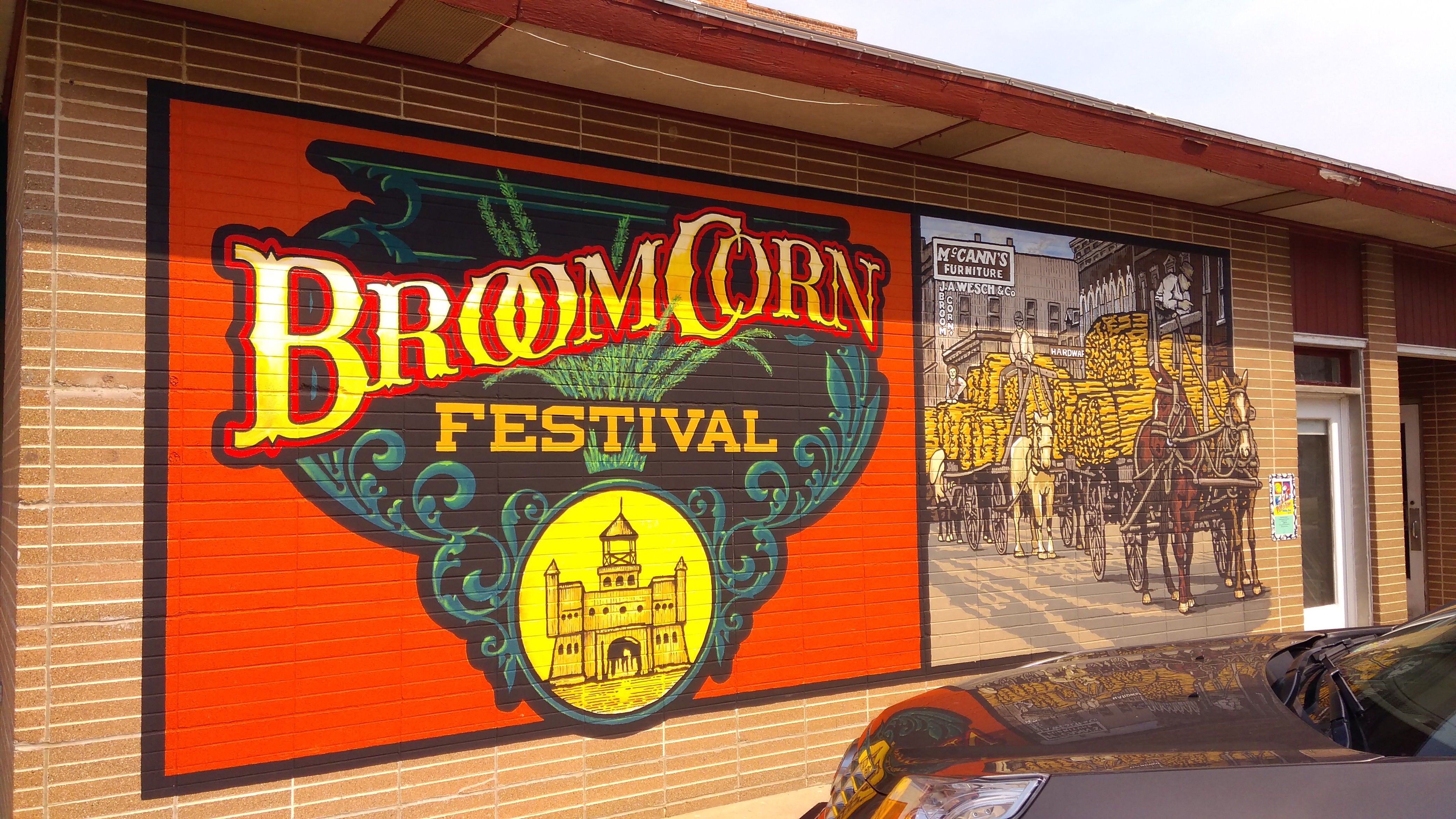
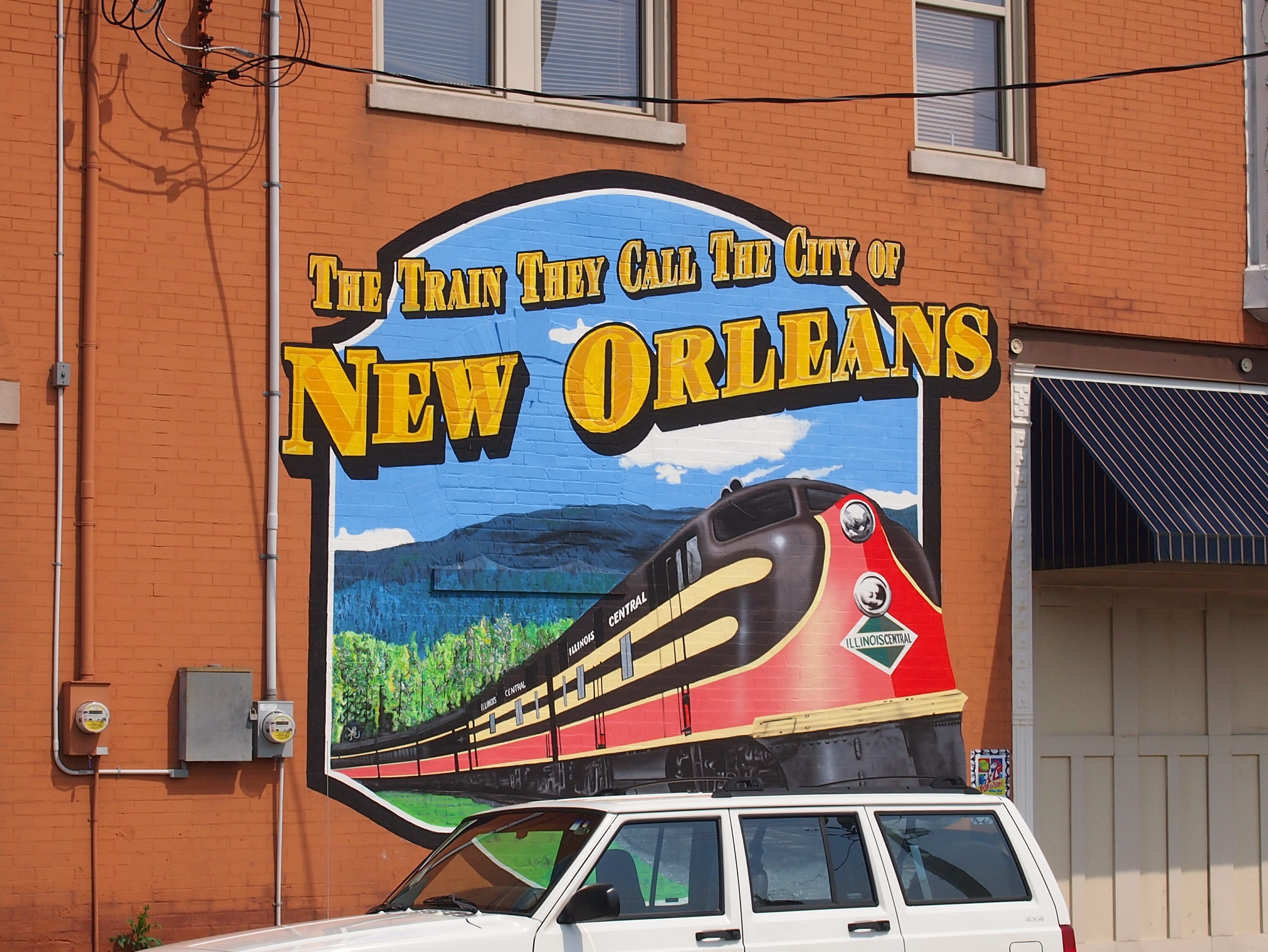
We also looked at a few of Arcola’s wall murals. They weren’t there in 2007.
“During the week of June 20-24, 2012, over 130 artists from across the United States as well as Canada, New Zealand, Scotland and Australia descended upon Arcola leaving behind 15 historic murals,” the town’s web site says. “Known as the Walldogs, the loose affiliation of sign painters, graphic artists and other talented individuals reunite annually to entertain and transform a community with their special brand of artistic interpretation, entertainment, and friendship.”

The Trans-Pecos & Llano Estacado

Back on April 14, I headed for Texas by car. I spent most of following two weeks in that state, arriving home today. Along the way, I drove 3,691 miles and change.

The main event was the wedding of my nephew Dees and his betrothed Eden on April 21 at Hummingbird House, a gorgeous outdoor wedding venue just south of Austin in the full flush of a Texas spring. An actual warm and green spring, unlike the cold and still brown spring I left in Illinois.
Rain had been predicted for the day, as it often is this time of the year, and there was an indoor pavilion just for that circumstance, but the Texas spring accommodated the bride and groom and wedding party and all the guests by not raining. If fact, the sun came out just before the ceremony, which was picturesque as could be.
I was remiss in taking pictures of Dees and Eden or anyone else, except for a few shots of my family.They’d flown to Austin the day before the wedding, in time for the rehearsal dinner, which was a pizza party in Dees and Eden’s back yard. The logistics of my family getting to Austin were a little involved, but everything worked out.

As for me, I’d spent most of the week before the wedding with my brother Jay in Dallas, arriving in Austin the Thursday before the wedding. The morning after the wedding, a week ago now, Yuriko, Lilly and Ann and I drove to San Antonio, where we all visited my mother and brother Jim. They flew back home that evening, leaving me to drive back to Illinois.

I wanted to return a different way than I’d came, especially since I had the week off from work (the week before the wedding was a work week). So I didn’t pick the most direct route home.

Namely, I drove west from San Antonio to Marathon, Texas, a town of a few hundred people in West Texas whose main distinction is its proximity to Big Bend National Park, which I visited last Tuesday. There are many impressive things to see there, but I was most astonished by the cliffs on the Rio Grande that form Santa Elena Canyon.

The next day I went to the Trans-Pecos towns of Alpine, Marfa and especially Fort Davis. Not far from Fort Davis is the McDonald Observatory, which I’ve had a mind to visit for years. It was cloudy and misty and a little cold when I got there, but that doesn’t matter when you’re looking at impressive telescopes. In Fort Davis itself, I visited the Fort Davis National Historic Site.

The next day, I drove north, through Midland-Odessa and Lubbock and finally to Amarillo, a shift in scenery from the desert of the Trans-Pecos to the high plains of the Llano Estacado. Along the way I made a few stops: the Presidential Archives and Leadership Library in Midland and the Buddy Holly Center in Lubbock.

While in Amarillo, a city I had not seen since a brief visit in 1979, I took the opportunity on Friday to see Palo Duro Canyon State Park, which is about 30 minutes outside of town. It’s a great unknown among natural areas in Texas and, for that matter, the United States.

I had enough time that day after visiting Palo Duro — the days are getting longer — to drop by and see the Cadillac Ranch, famed oddball tourist attraction, which is on the western outskirts of town.

This weekend was a long drive home: Amarillo to Lebanon, Missouri, on Saturday (I’d stopped in Lebanon the first day out, on the way to Dallas), and Lebanon to home in metro Chicago today. Tiring, but I did squeeze in two more sites. In Claremore, Okla., on Saturday, I saw the Will Rogers Museum. Not bad for an entertainer who’s been dead more than 80 years.

Today I stopped just outside St. Louis and took a walk around the Cahokia Mounds State Historic Site. Not bad for a culture that’s been gone for about 800 years.

New York ’18: At the Tip of Manhattan

“Charging Bull,” a 7,100-pound bronze at Broadway and Whitehall St. in Downtown Manhattan, seems even more popular than the statue of Rocky Balboa in Philadelphia, which certainly has its fans. My evidence is only anecdotal, judging by the number of people I saw around each, trying to take a picture. Rocky had a short line of people waiting to take their picture with him (in 2016, some 40 years after the movie came out).

But the Bull draws a crowd. In front of it:
Along with those eager to shoot its backside:
I was in New York City all of last week, where I met many of the editors of the company I now work for, plus writers and other staff, at an office in Downtown (Lower) Manhattan. Also during the trip, I spent time with a few old friends and their spouses, and my youngest nephew and his girlfriend. I even had a little time to walk around town, especially Downtown, which I enjoyed despite chilly air and some drizzle.

One of my walks took me to “Charging Bull,” which had its start as one of the heaviest works of guerilla art ever made, by Arturo Di Modica in the late 1980s. Now it’s a fixture on the tourist circuit, located almost as far south as you can go on the island, though not quite.

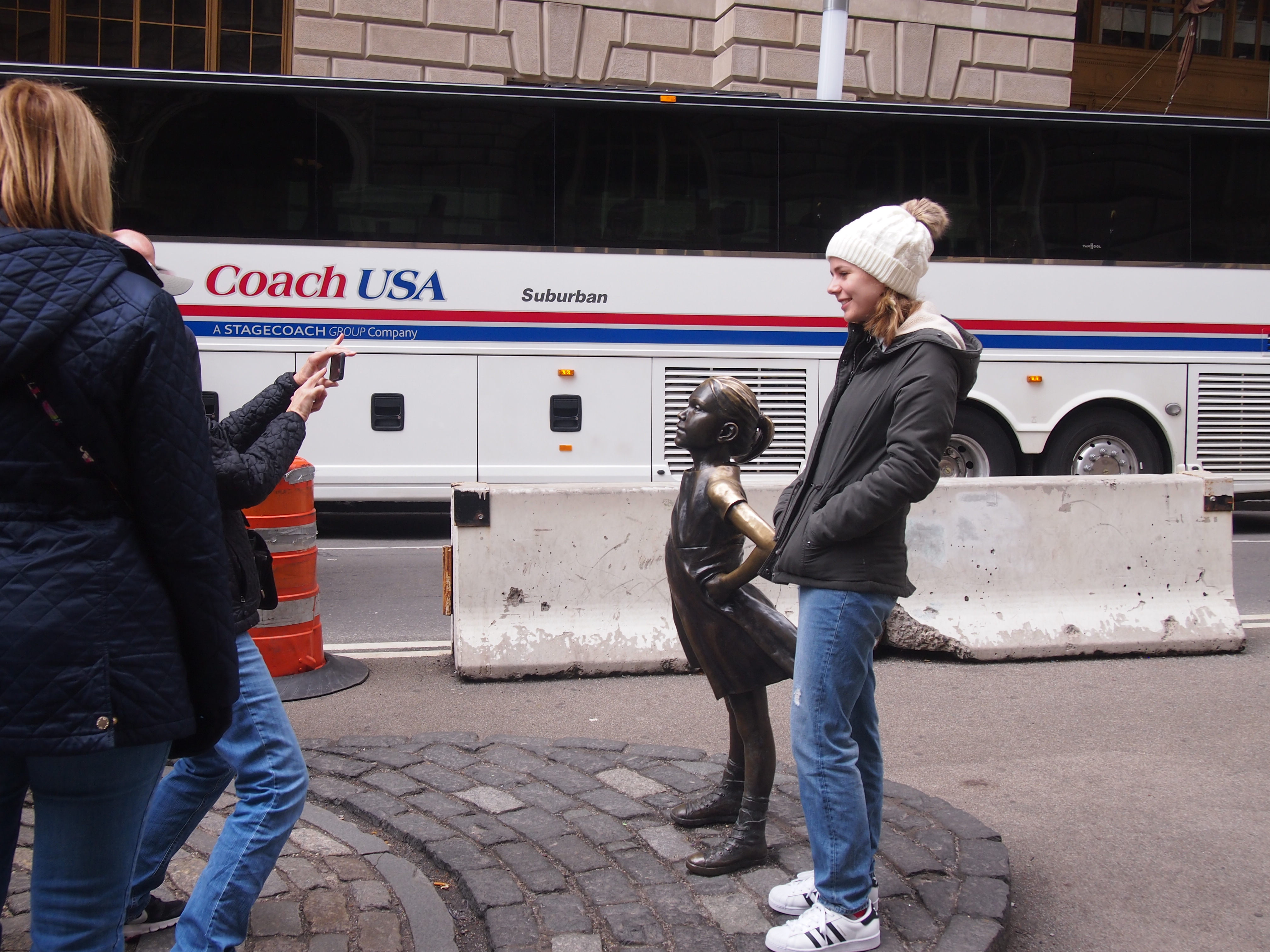
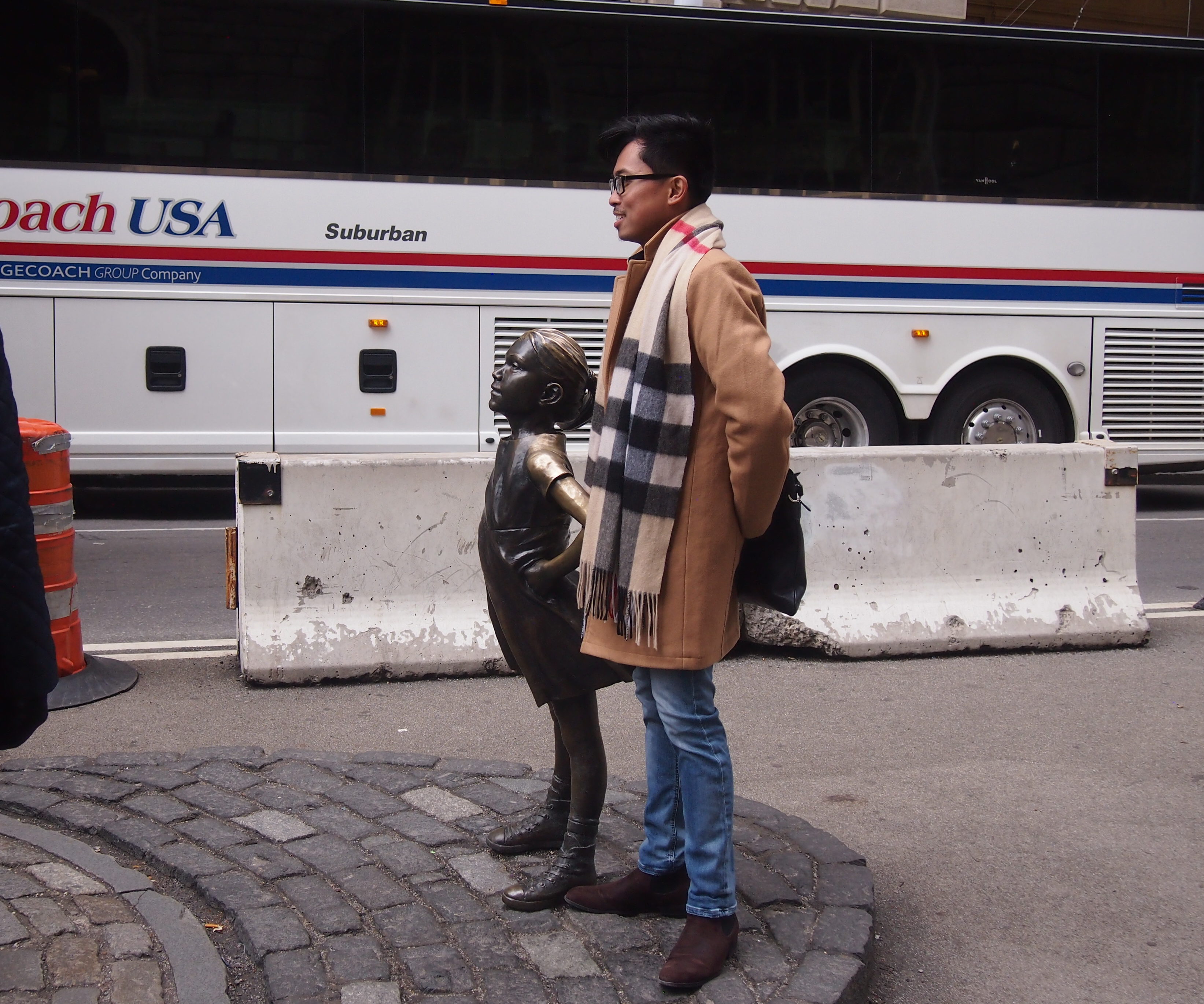
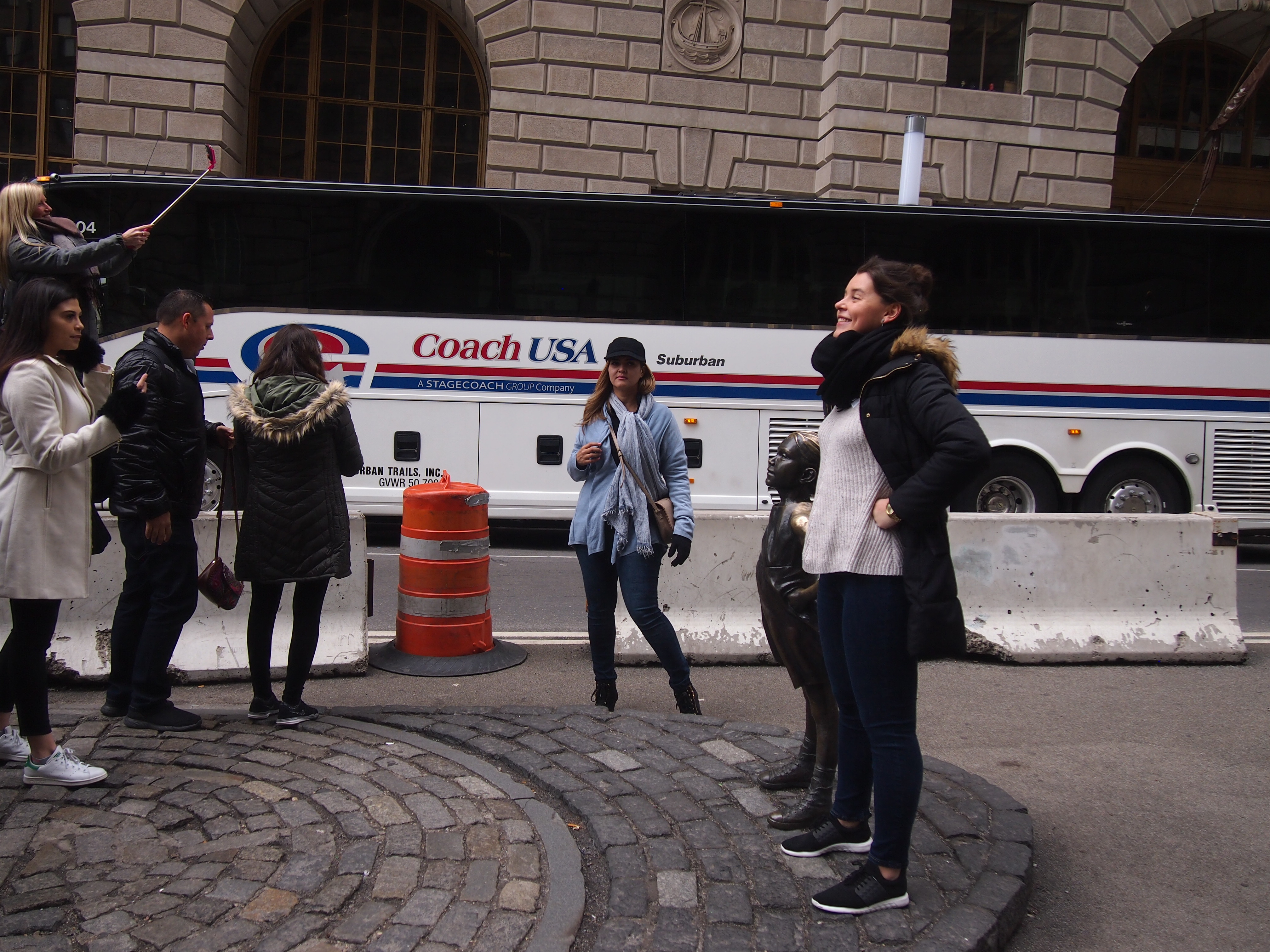
As is “Fearless Girl,” a much newer installation by Kristen Visbal, dating only from last year, and which was positioned to face the bull as an ad for an exchange-traded fund. I watched as one person after another posed with “Girl.”

Apparently Di Modica doesn’t like his work being upstaged by a little girl, but I can’t say that I much care. What’s interesting to me is their power as tourist magnets. Not many statues have that.

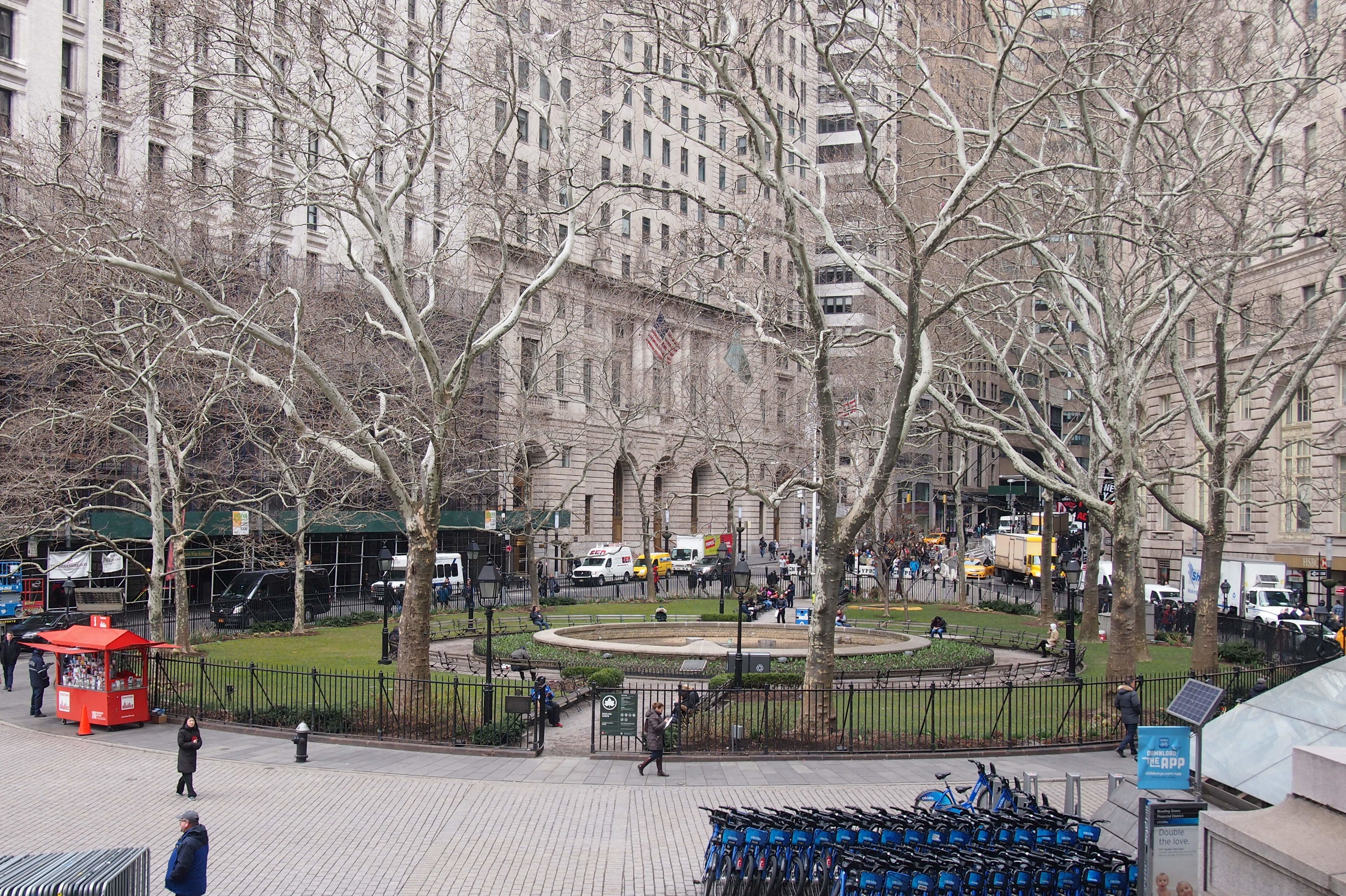
The statues are adjacent to a nice little park that has the distinction of being the first public park in New York, Bowling Green.
Note the fence. It rates a plaque, which says that the park was “leased in 1733 for use as a bowling green at a rental of one peppercorn a year. Patriots, who in 1776 destroyed an equestrian statue of George III which stood here, are said to have removed the crowns which capped the fence post, but the fence itself remains.”

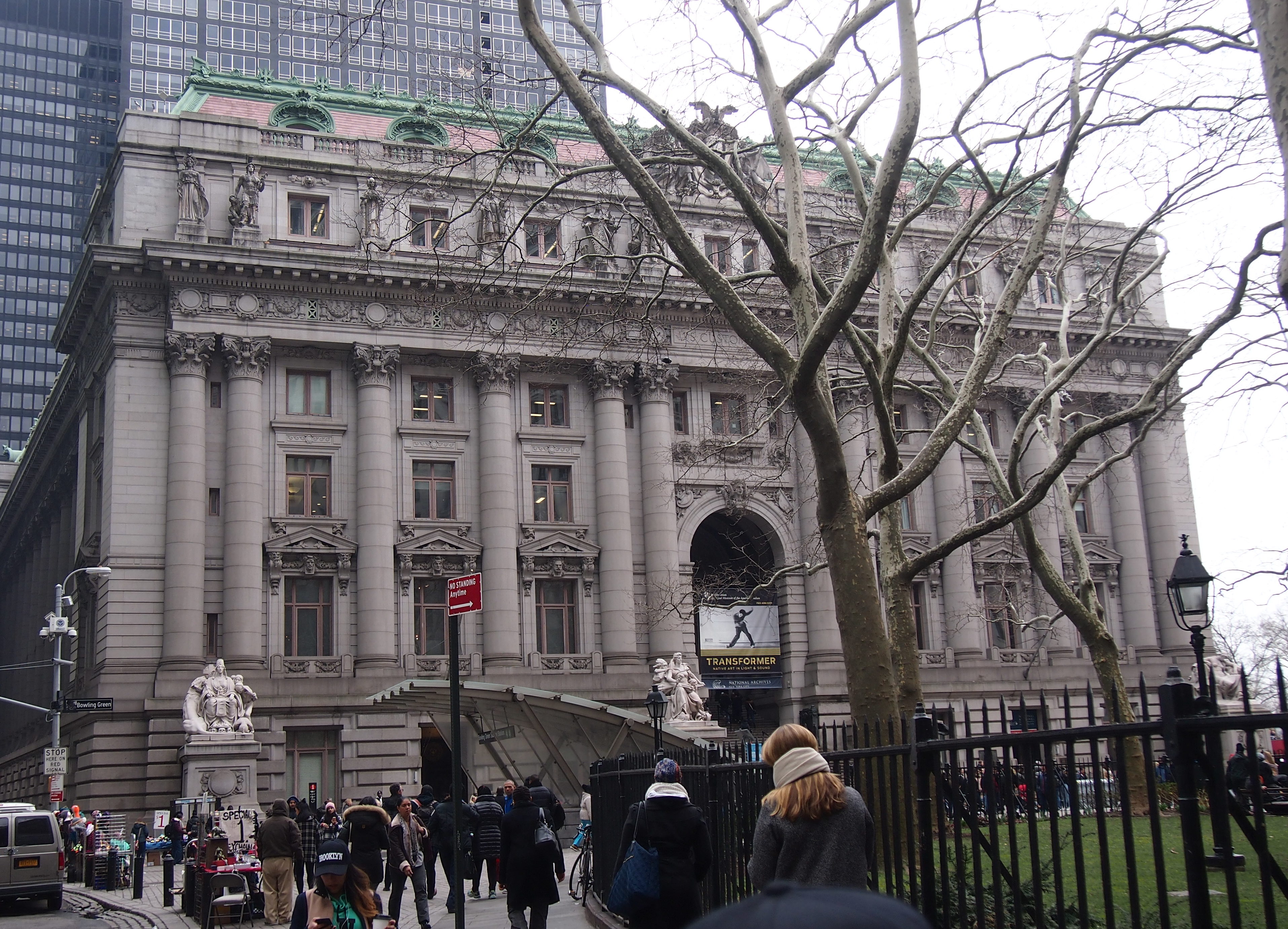
The Alexander Hamilton U.S. Customs House rises over the park, roughly where Fort Amsterdam stood long ago.
The present structure dates from the early 1900s and was designed by Cass Gilbert, who’s best known for the Woolworth Building further uptown. These days, the building is home to a branch of the National Museum of the American Indian, which is part of the Smithsonian, as well as the United States Bankruptcy Court for the Southern District of New York.

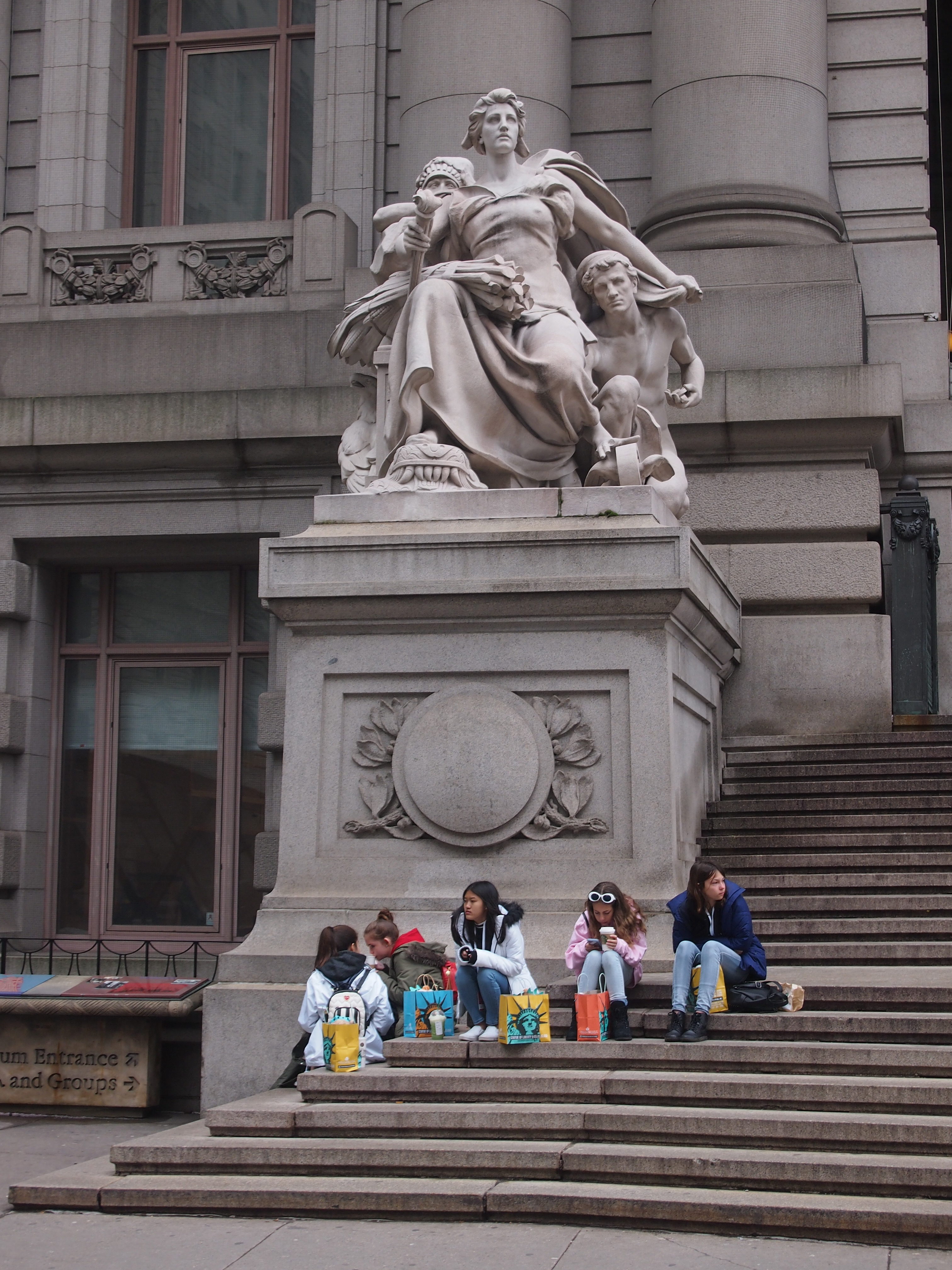
Off to each side of the building, allegorical figures stand above; tourists loll below. The work of Daniel Chester French, creator of the seated Lincoln at the Lincoln Memorial and a lot else besides.
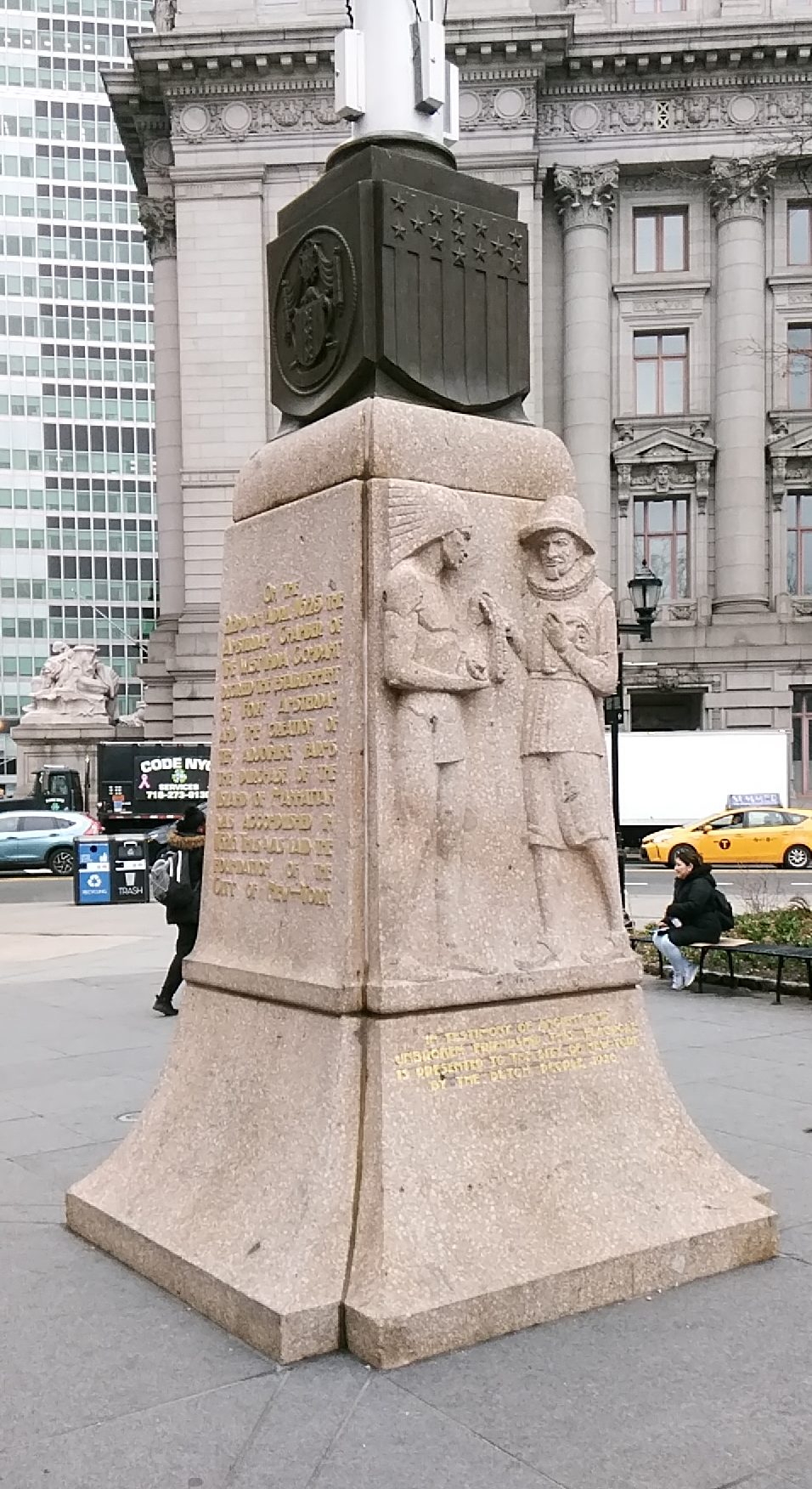
Across State Street from the building, in Battery Park, is a curious flagpole. Officially it’s the Netherland Monument. This is the base.

According to NYC Parks: “This monumental flagstaff commemorates the Dutch establishment of New Amsterdam and the seventeenth century European settlement which launched the modern metropolis of New York City. Designed by H.A.van den Eijnde (1869-1939), a sculptor from Haarlem in the Netherlands, the monument was dedicated in 1926 to mark the tercentenary of Dutch settlement, and the purchase of the island of Manhattan from Native Americans.”

How many people crowd around the bronze bull? Dozens at a time. Around the Dutch flagpole? None. Fitting, I guess. Bulls used to get their own cults. Flagpoles, not so much.

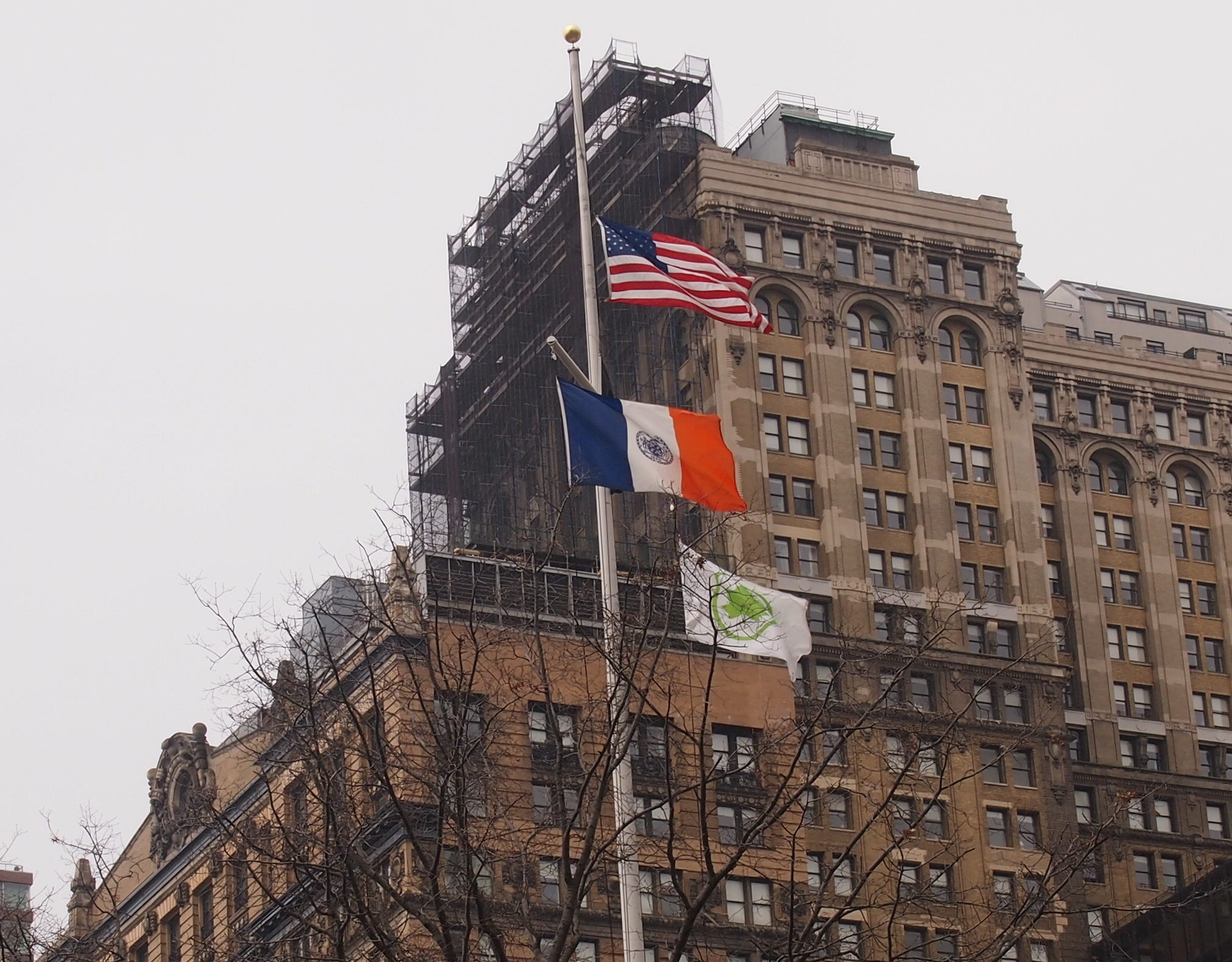
The Dutch flag wasn’t flying on the pole.

But at least I saw New York City flag, which is based on the tricolor of the Prince’s Flag of the Dutch Republic. Not as striking as the Chicago flag, but not bad at all.

GTT 1990

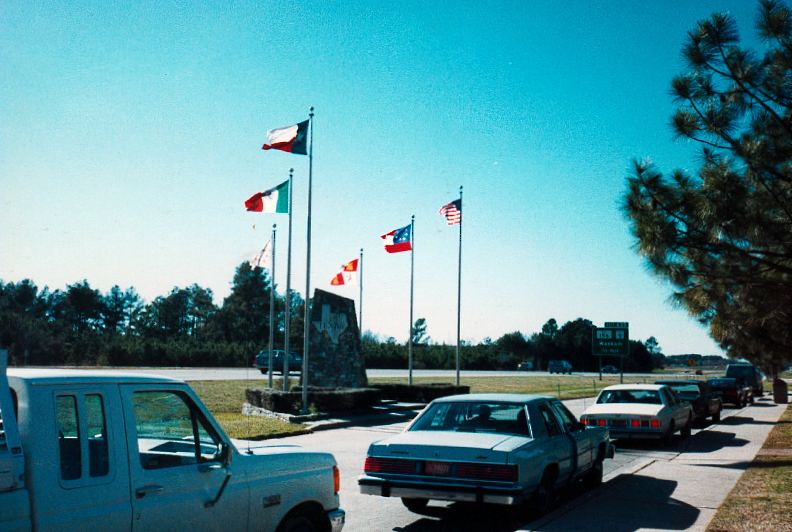
I’m pretty sure this is on the Texas side of the Texas-Louisiana border on I-20, not far west of Shreveport, in February 1990. As part of my long move to Japan, I moved my meager possessions from Chicago to Dallas that month, stopping along the way in Nashville and central Mississippi.

The site had the Six Flags Over Texas, a common enough display at Texas borders and elsewhere in various forms, and probably some kind of welcome center that’s probably been redeveloped since then. I haven’t been back that way since.

I can’t quite read it, but the road sign seems to say that the exit to Waskom, Texas, is nearby, which would definitely put it on the westbound side of I-20. (I’m fairly certain this earlier Texas border picture was taken along I-10). Not sure what inspired me to take a picture at that place and that time, but I did, and I’m glad of it. Not every moment documented by camera needs to be associated with some kind of peak experience, which are elusive anyway.

CDMX

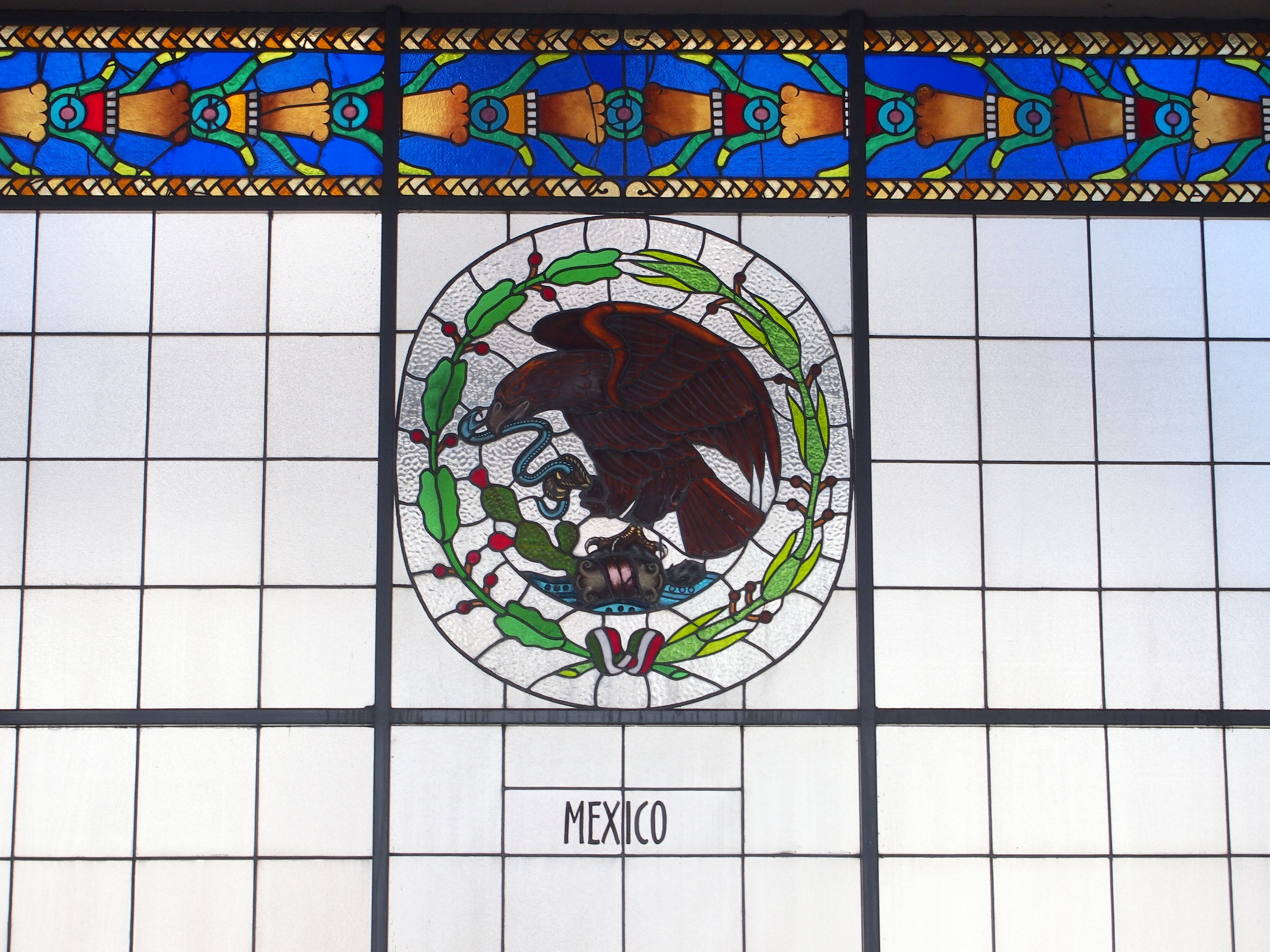
Something I didn’t know until recently: Mexico City, which has more autonomy than it used to, is no longer in the Distrito Federal, which it had been since 1824. Two years ago, the federal government of Mexico signed off on a name change, which the city’s government had wanted, to simply Ciudad de México, abbreviated CDMX.

On Wednesday, December 27, Lilly and I flew to Mexico City, returning on New Year’s Day 2018 — or actually early January 2, since the return flight was late. We stayed at a hotel in the Zona Rosa, just south of Paseo de la Reforma, a major thoroughfare, but also within walking distance of the Roma neighborhood.

We spent our time as dyed-in-the-wool, first-time tourists, seeing impressive places and structures, visiting grand museums, walking along interesting streets, eating a variety of food, taking in as much detail as possible.

Considering that Mexico City is a vast megalopolis — all too apparent from the air as we arrived in the daylight and left at night — we experienced only the slimmest sliver. But an endlessly fascinating sliver.

Adding immeasurably to the trip was the fact that my old friend Tom Jones — known him nearly 45 years — was in Mexico City at the same time. In fact, I’d suggested the trip to him on the phone last summer, when I called him to hear about his experience in seeing the eclipse. He’d been a fair number of other places in Mexico over the years, more than I have, but not Mexico City, so he was open to the suggestion.

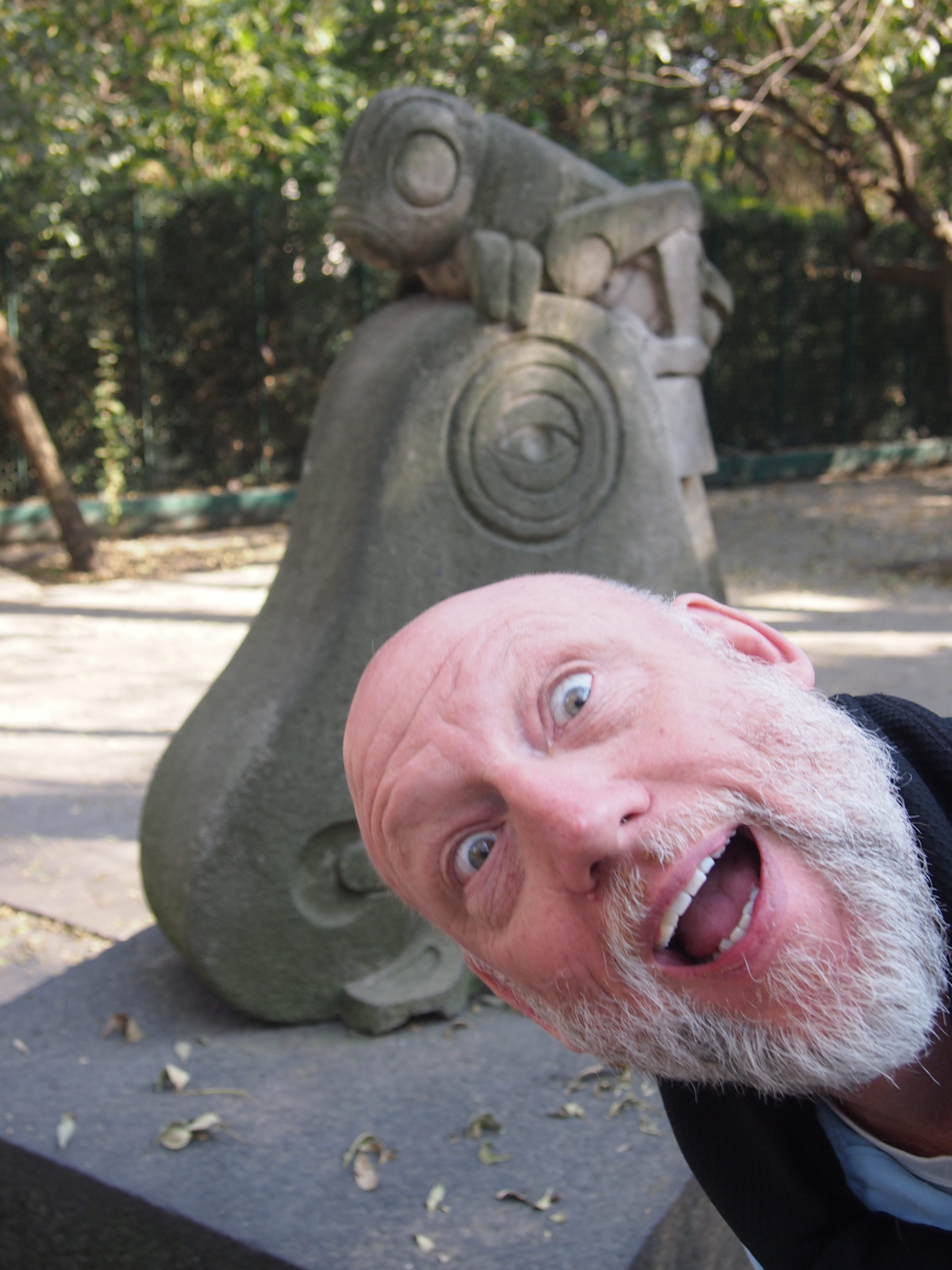
So the three of us went a lot of places together in the city. Tom has an impulse for photobombing.
The first place Lilly and I went, not long after we had arrived, was the enormous Zocalo (formally the Plaza de la Constitution), which was packed with holiday revelers enjoying a temporary ice-skating rink and amusement-park slides. We circumambulated the square, said to be the second largest in the world after Red Square, and spent some time inside the vaulting Catedral Metropolitana, which opens onto one side of the Zocalo.

The second day, with Tom joining us, was for large museums in the even larger Bosque de Chapultepec, the city’s equivalent of Central Park: the Castillo de Chapultepec, a grand palace along European lines and now a history museum; and the Museo Nacional de Antropologia, an epic museum devoted to the many and varied cultures of pre-Columbian Mexico (or more precisely, pre-Cortez).

All that makes for tired feet, so the third day was less intense. Even so, we got a good look at a small part of the charming Coyoacan neighborhood, which includes the Museo Frida Kahlo. The lines were too long to visit Frida, but not to get into the Museo Casa Leon Trotsky a few blocks away.

The next day, December 30, was exhausting, but completely worth all the energy and money we spent, because we got to visit the renowned Teotihuacan, which is to the northeast of the city, in the State of Mexico, and climb its pyramids. From there, we went back into the city to see the Basílica de Nuestra Señora de Guadalupe — the Basilica of Our Lady of Guadalupe — a pilgrimage site I’ve been curious about since I encountered The Shrine of Our Lady of Guadalupe, Des Plaines.

And as if that wasn’t enough for a day, we returned to Castillo de Chapultepec on the evening of the 30th, along with four of Tom’s friends from Austin who were also visiting Mexico City, for an outdoor performance by the astonishingly talented dancers, singers and musicians of the Ballet Folklórico de México.

On the last day of 2017, we slept fairly late, but were out and about after noon, for a visit to the Palacio de Belles Artes, a striking building with art exhibits and some astonishing murals, especially the Diego Riveras. More Rivera murals were in the offing at the Palacio National, the last large site we visited.

We were tired on the evening of the 31st, but not too tired to walk a few blocks from our hotel to the Paseo de la Reforma. One of the city’s two main New Year’s celebrations was being held around the Angel de la Independencia, a famed gold-colored statue atop a tall column in the center of a Paseo de la Reforma traffic circle. The event featured live music by well-known (I was told) Mexican bands, a countdown just like at Times Square, except in Spanish, and then fireworks: a bang-up way, literally and figuratively, to start 2018.

Birm-Tex ’17

Before spending the last week in San Antonio visiting family, I spent about 36 hours in Birmingham, Alabama, during the first weekend in December. I went there to visit my old friend Dan, whom I hadn’t seen in about 18 years.
That’s too long, as the Wolf Brand Chili man said. See your old friends if you can, because we’re all mortal. I was also fortunate enough to become reacquainted with his wife Pam, whom I’d only met once, more than 20 years ago.

Dan and I had a fine visit, talking of old times and places — we’ve known each other 36 years — but not just that. He grew up in Birmingham and has lived there as an adult for a long time, so he was able to show me around and tell me about the city’s past and about recent growth as an up-and-coming metro. In this, he’s quite knowledgeable.

I’d heard something about that growth, but it was good to see some examples on foot and as we tooled around hilly Birmingham in Dan’s Mini Cooper, which was also a new experience for me. Not to sportiest version, he told me — he’d traded that one for this one he now drives — but it had some kick.

On the morning of Saturday, December 2, we first went to Oak Hill Memorial Cemetery, very near downtown Birmingham, and the city’s first parkland-style burial ground. Dan told me he’d never been there before. Not everyone’s a cemetery tourist. But he took to the place, especially for its historic interest, and he even spotted the names of a few families whose descendants he knows.

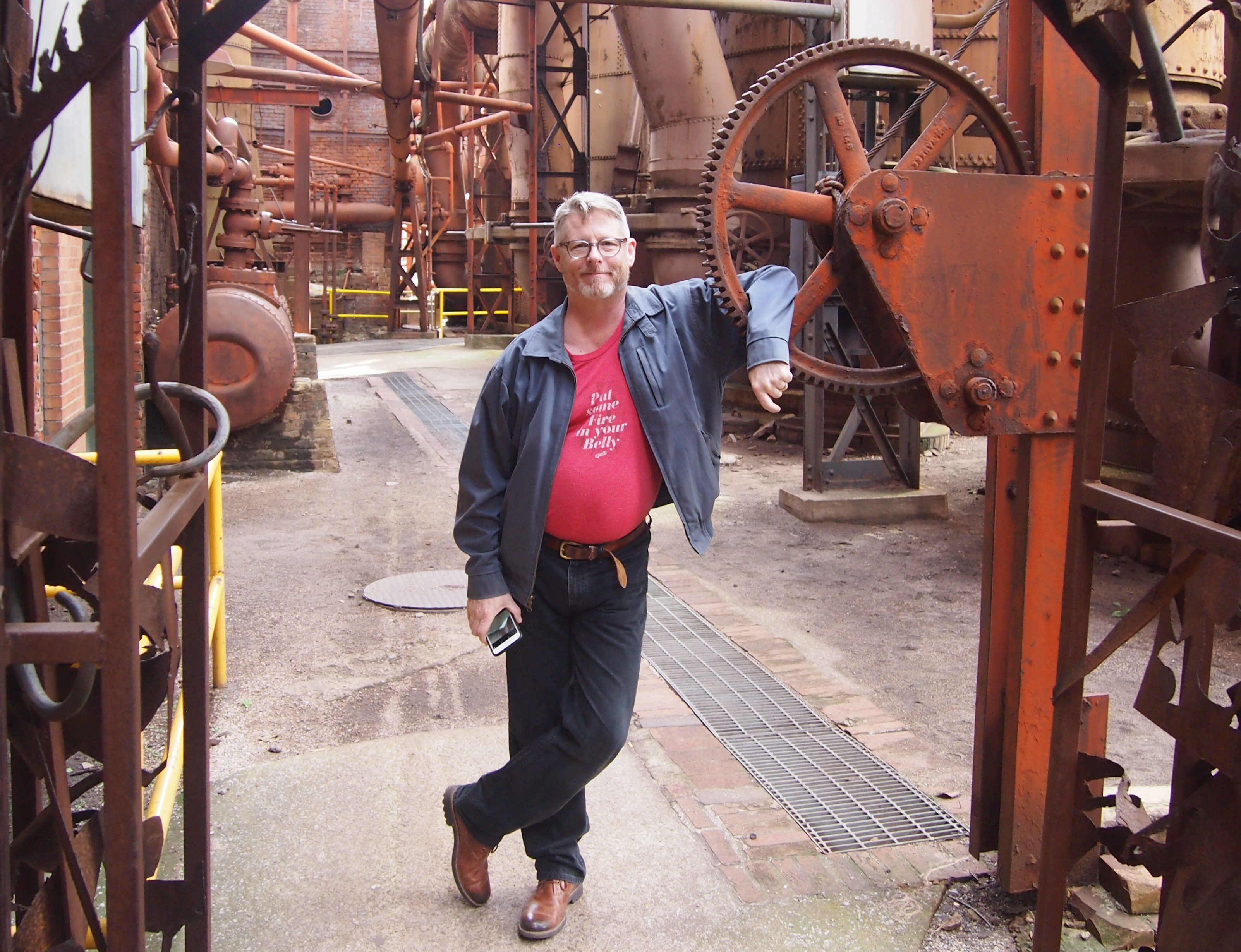
From there we drove to Sloss Furnaces, which, as the postcard I got there says, is “the nation’s only 20th-century blast furnace turned industrial museum.” Iron mining and smelting made Birmingham the city that it is. So it was only fitting that we went to Vulcan Park as well, to see the mighty cast-iron Vulcan on his pedestal on a high hill overlooking the city.

Toward the end of the afternoon, I suggested a walk, and so we went to the Ruffner Mountain Nature Preserve, which has 14 miles of hiking trails. More than that, the earth there is honeycombed with former mines, all of which are now sealed. But we got to see the entrance of one of them, dating from 1910.

After all that, we repaired to Hop City Beer & Wine Birmingham, a store that has an enormous selection of beer and wine in bottles, as well as a bar with a large draft selection, where we relaxed a while. Had a cider and a smaller sample of beer that I liked.

Along the way during the day, we also visited Reed Books, a wonderful used bookstore of the kind that’s increasingly rare: owned and run by an individual, and stacked high with books and other things, with only marginal organization. I bought Dan a copy of True Grit, which he’d never read.

We drove through some of Birmingham’s well-to-do areas, sporting posh houses on high hills and ridges along roads that I could make no sense of, twisty and web-like as they were. Luckily, Dan knew them well.

In downtown Birmingham, we also drove by some of the historic sites associated with the civil rights movement, including the new national monument. According to Dan, it would take a day to do the area right, so we didn’t linger. I got a good look at the 16th Street Baptist Church, the A.G. Gaston Motel, where King and others strategized, and Kelly Ingram Park, where protesters were attacked with police dogs and water cannons.

During my visit, I ate soul food, breakfast at a Greek diner — Greek immigrants being particularly important to the evolution of restaurant food in Birmingham, Dan said — excellent Mexican food (mole chicken for me), and a tasty breakfast of French toast and bacon made by Dan and Pam. On the whole, we carpe diem’d that 36 hours.

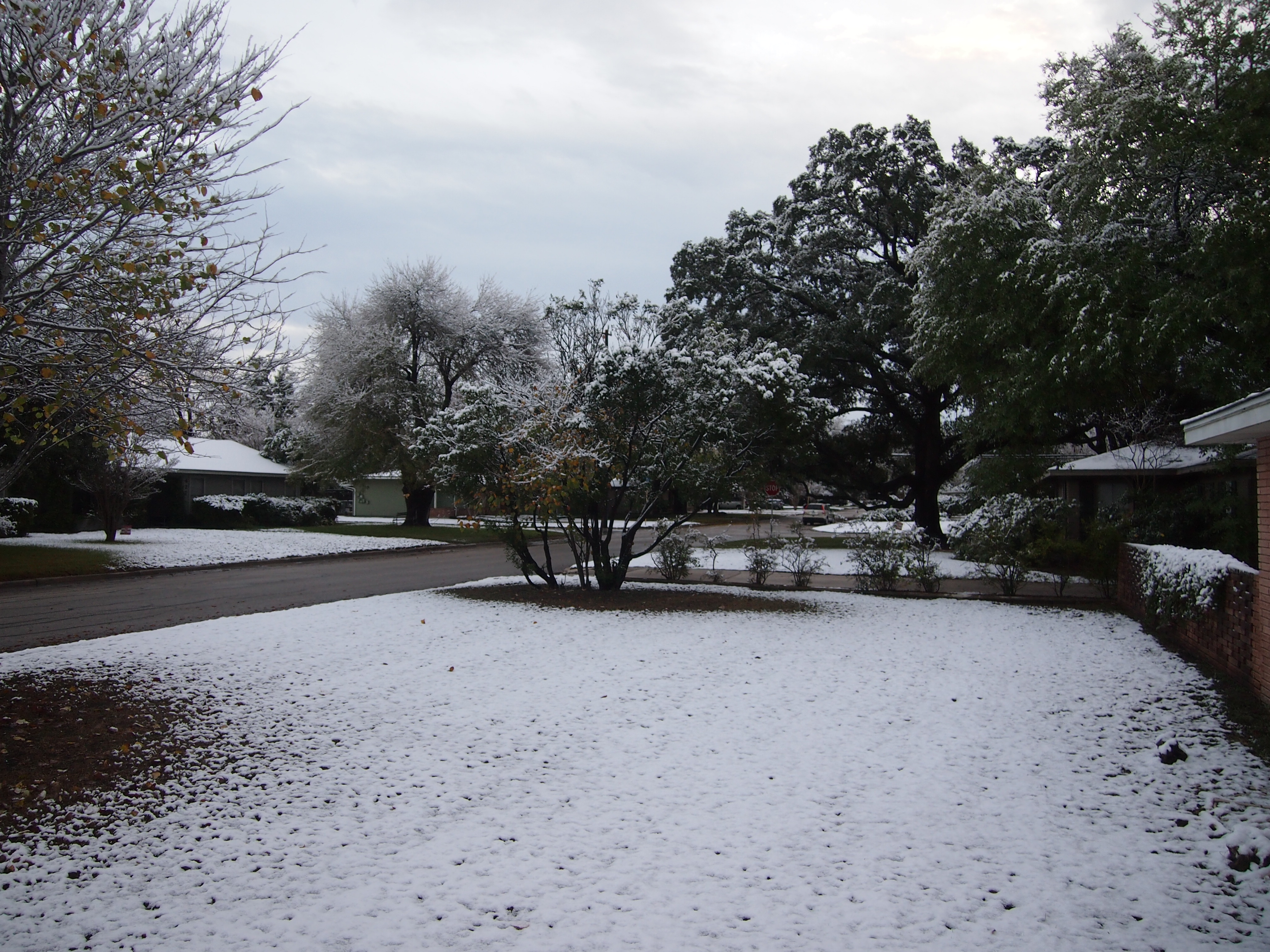
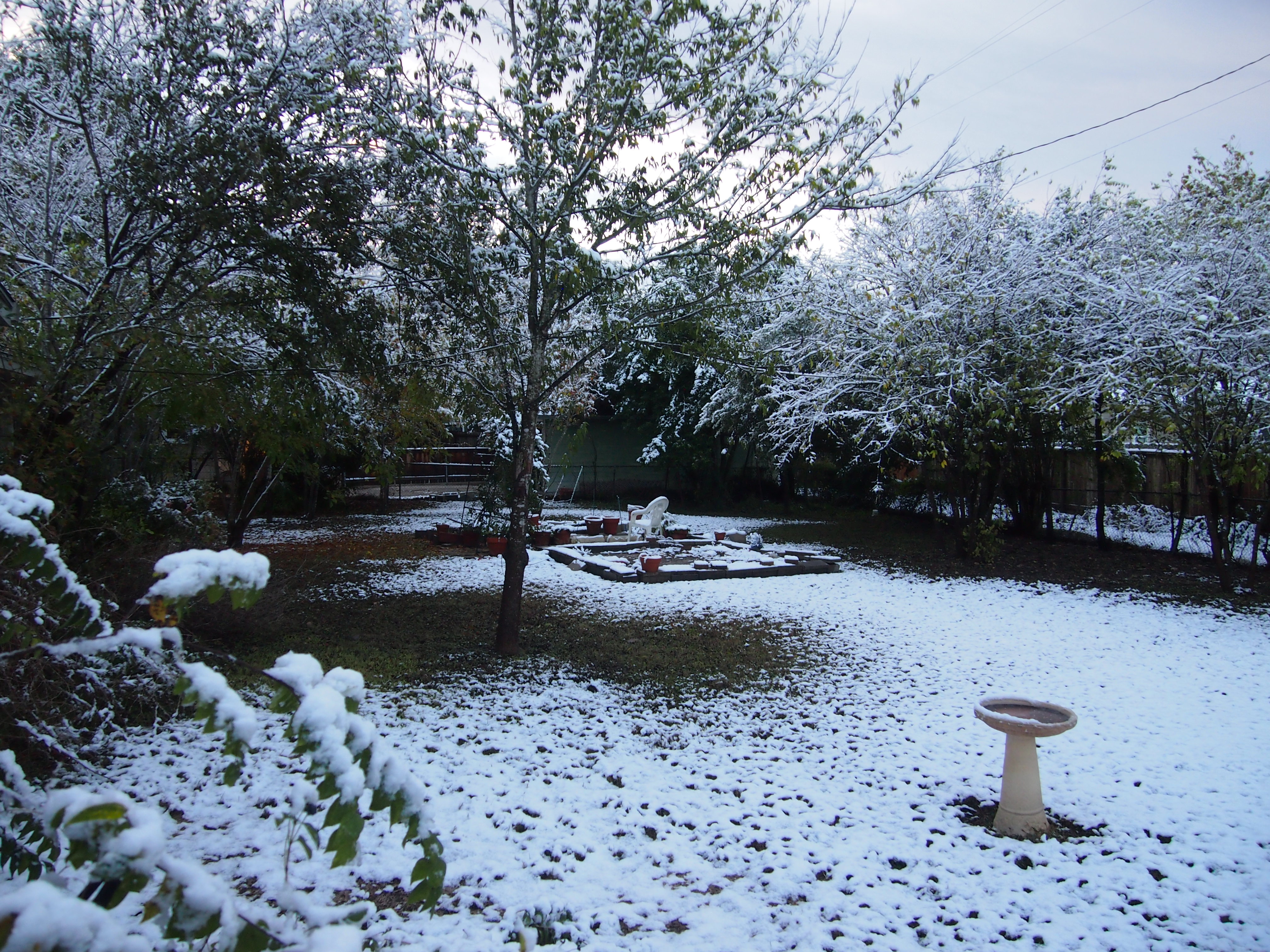
In San Antonio, as usual, I was less active in seeing things, but one sight in particular came to me. On the evening of Thursday, December 7, I looked out of a window at my mother’s house and saw snow coming down. And sticking. “I’ll be damned,” I muttered to myself.

At about 7:30 the next morning, I went outside to take pictures. Nearly two inches had fallen, according to the NWS. The snow was already melting. A view of the front yard.

Of the back yard.

It occurred to me that hadn’t seen snow on the ground in San Antonio since 1973.

Branson 2012

Has it been all of five years since I was last in Branson? Seems that way. Quite a spectacle, that town.

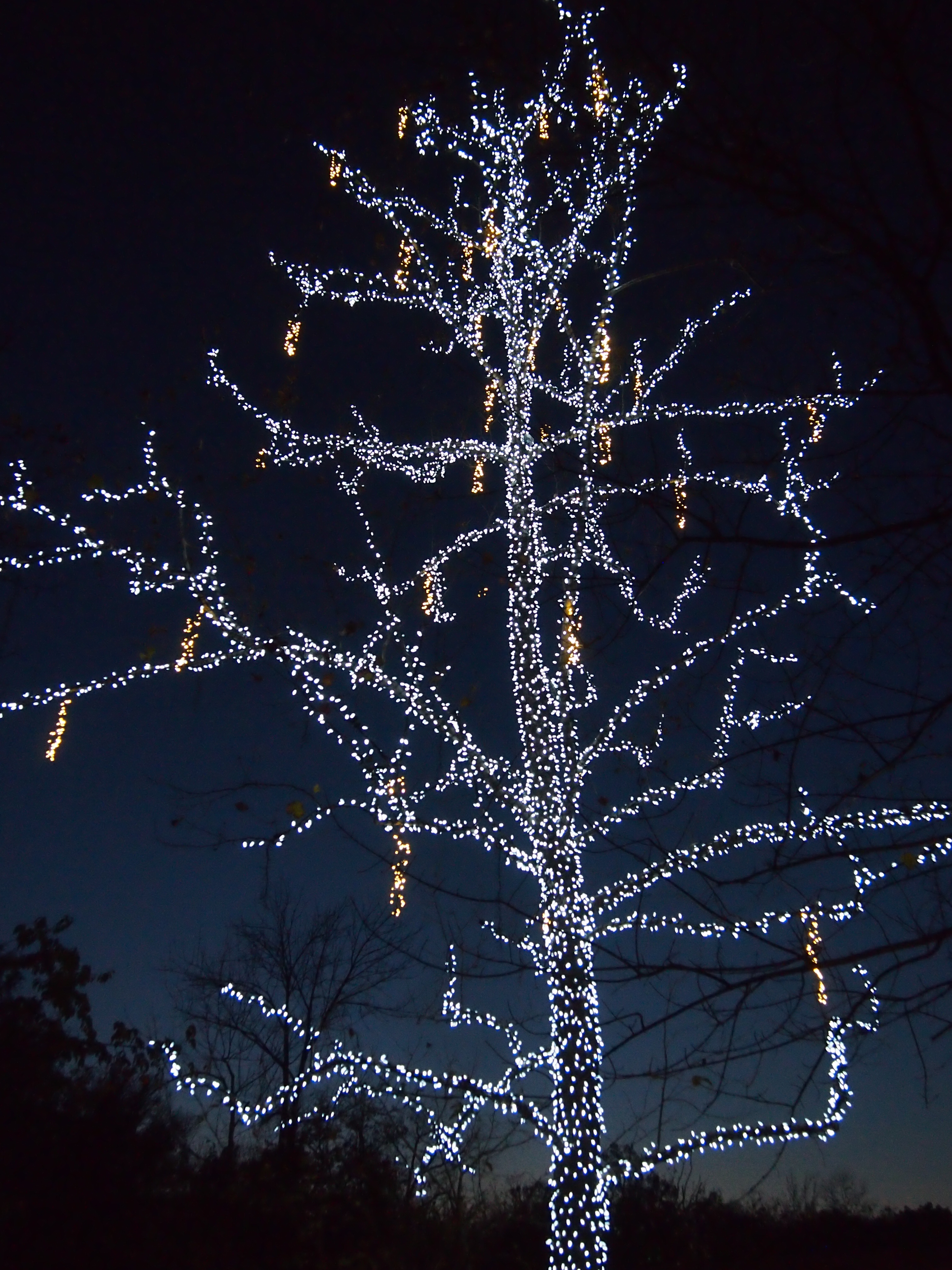
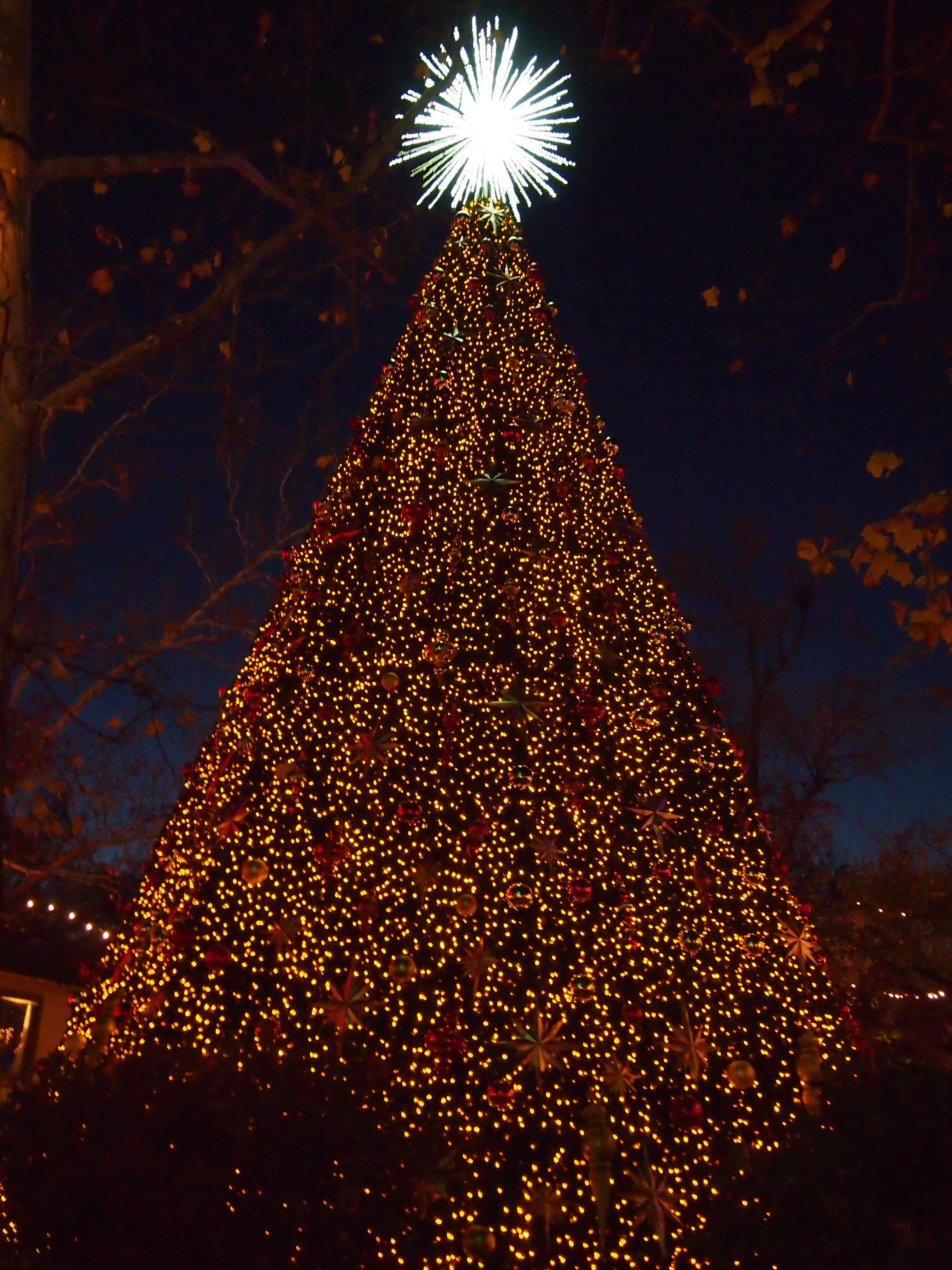
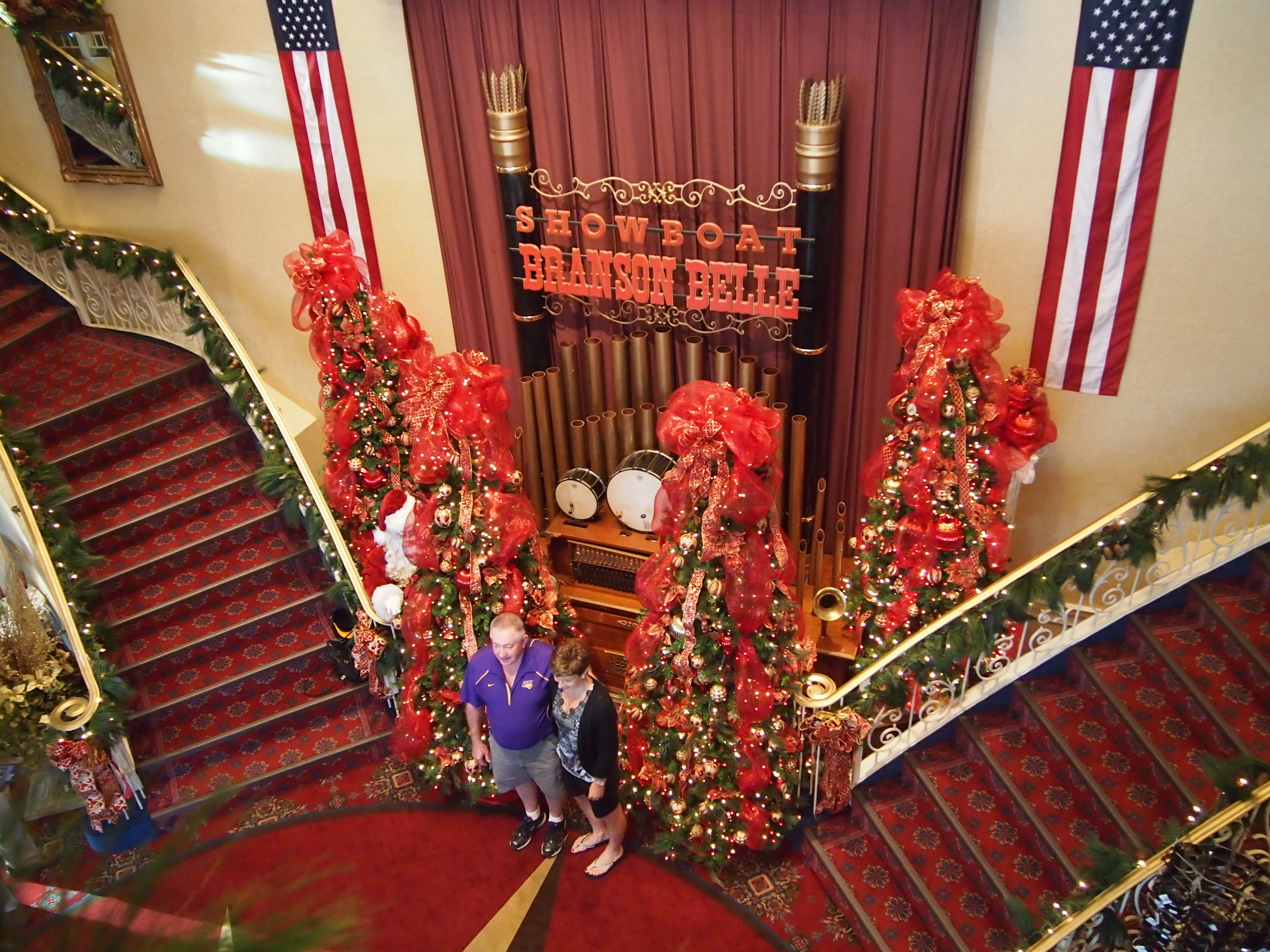
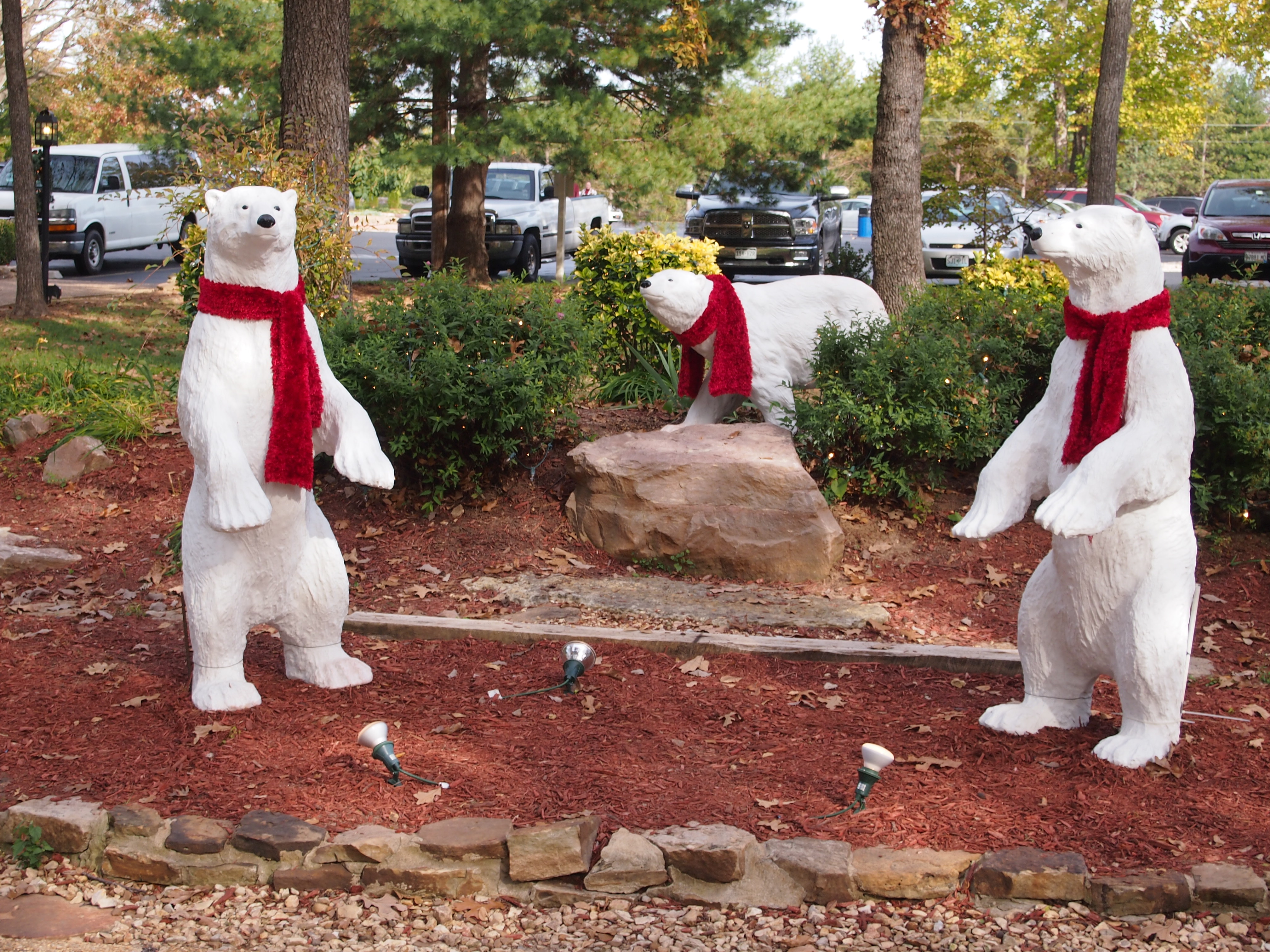
Branson in early November was already lighted for Christmas because the late Andy Williams, Mr. Christmas, had wanted things done up by November 1. So let it be written, so let it be done.

A few trees at Silver Dollar City.

Branson 2012Branson 2012There were other seasonal decorations elsewhere.
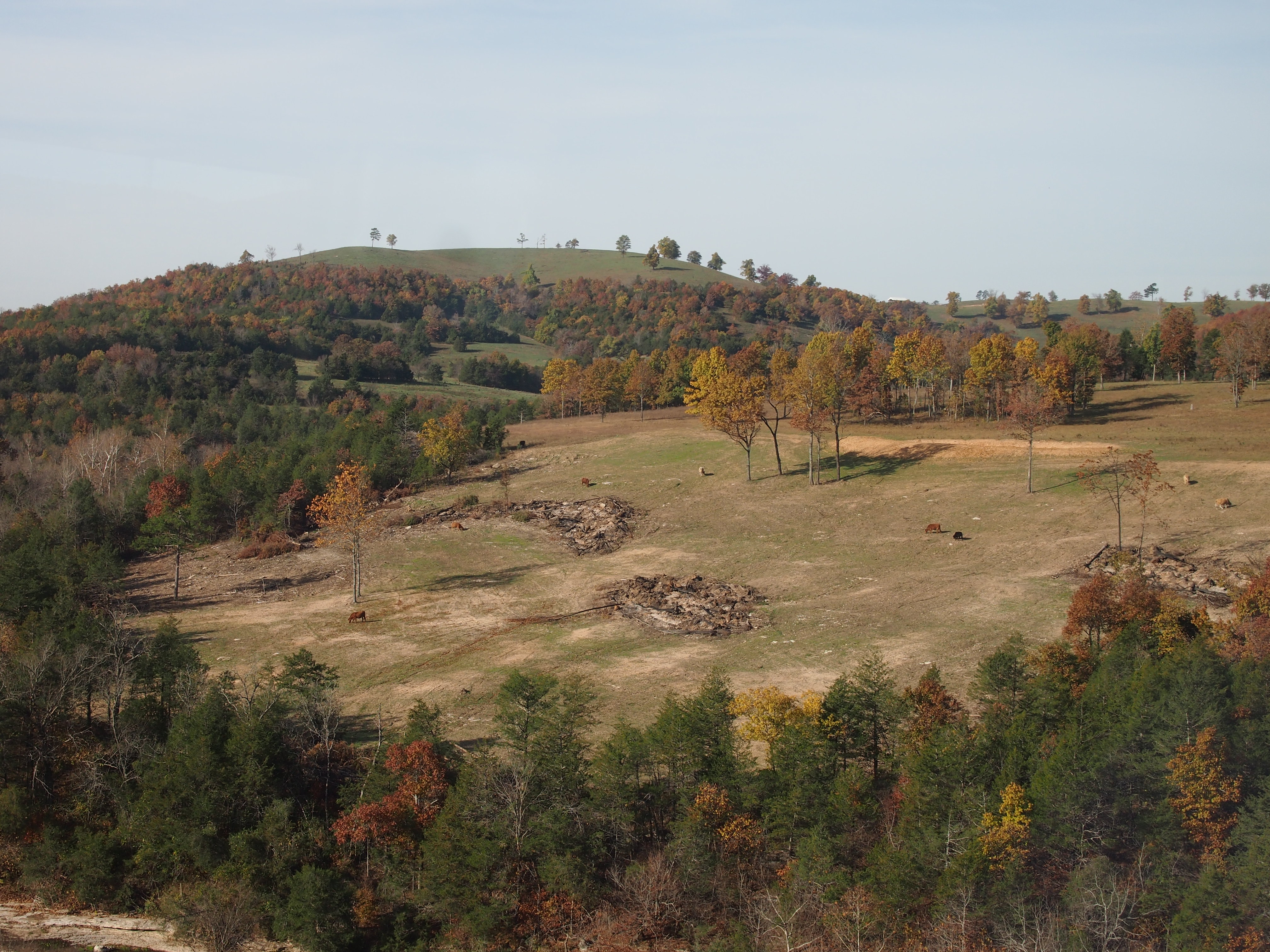
Branson 2012Branson 2012And fall foliage in the rolling hills of southern Missouri.
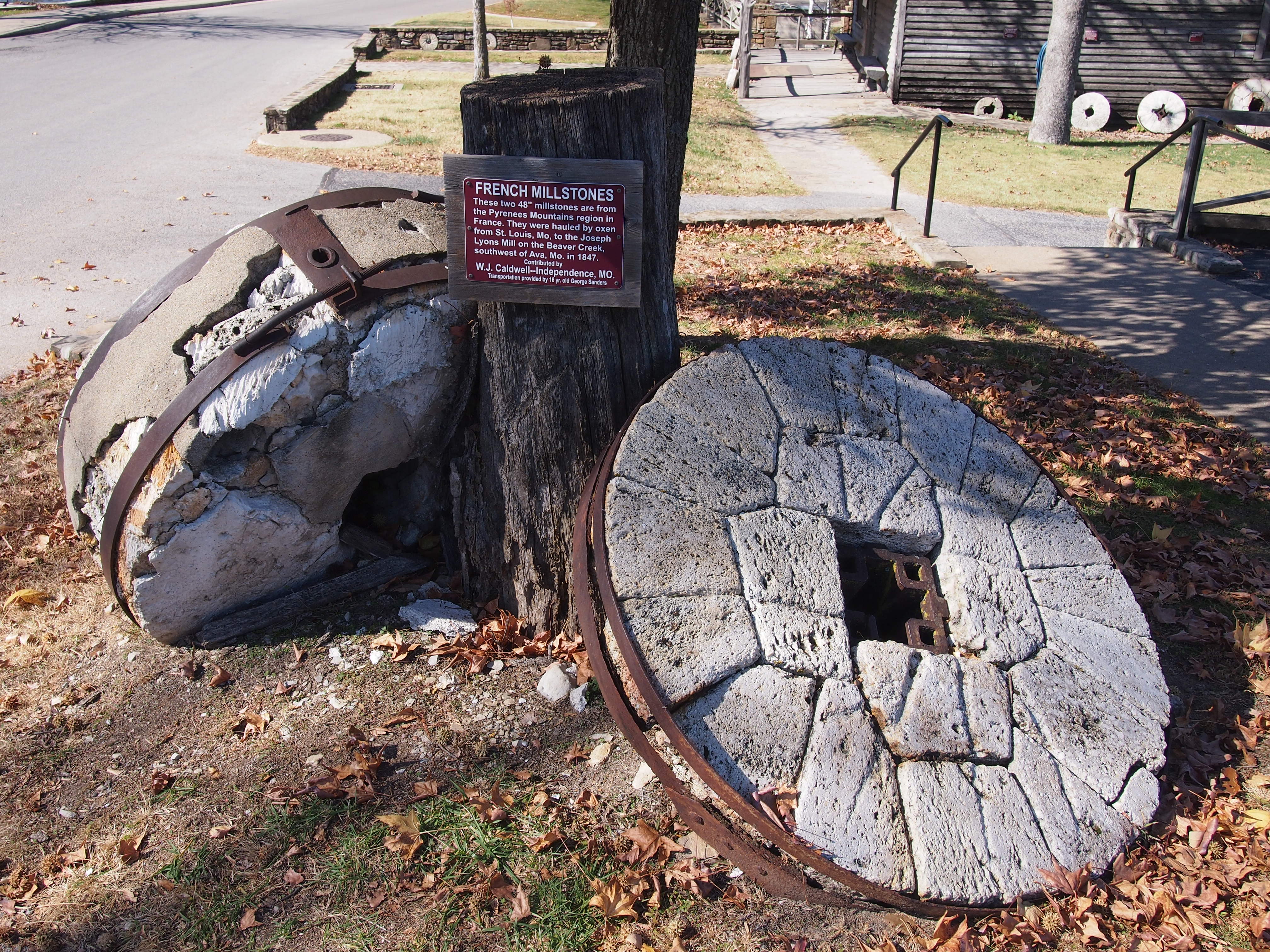
Branson 2012And of course, French millstones.

Branson 2012 - French millstones, College of the Ozarks

What’s a major tourist destination without a few of those lying around?

Hida-Takayama 1991

While my friend Steve stayed with me in Osaka in October 1991, we took a weekend trip to Takayama in Gifu Prefecture, in the Japanese Alps. (All the pictures below are dated October 26, 1991.) The small city is better known as Hida-Takayama (飛騨高山), since takayama simply means “tall mountain,” which describes a fair number of places in Japan. It used to be in Hida Province, in the pre-Meiji era way of dividing the country.

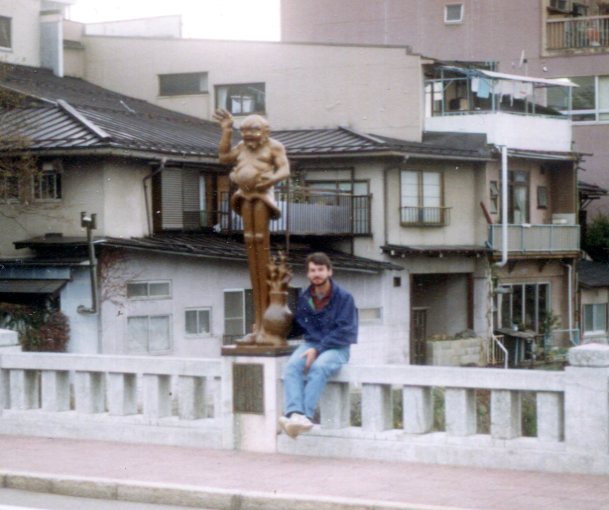
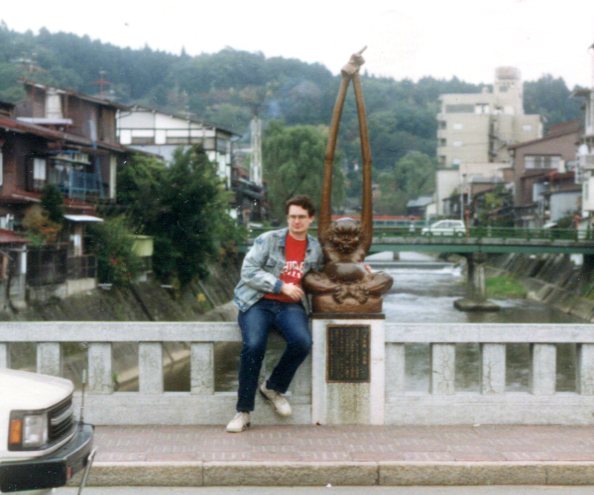
I’ve posted about the trip before. But nothing about the statues on the Kajibashi Bridge over the Miyagawa River in Takayama. Steve and I posed with different ones.

Statues on the Kajibashi Bridge over the Miyagawa River in Takayama. Statues on the Kajibashi Bridge over the Miyagawa River in Takayama. One source, clearly written in English by a Japanese writer — but not too bad a job, all sic — says: “Extremely long-arm goblin, Tenaga and long-leg goblin, Ashi-naga are displayed on the railing of Kaji-bashi bridge. Te-naga and Ashi-naga folklore is handed down in Japan, which represents the god of immortal.

“There is another folk tale about the creature. This creature was regarded as a hobgoblin, a ghostly apparition, Yokai in Japanese. The creatures with their weird long arms and long legs are said to do wrong to people.

“So, two different traditions about Te-naga and Ashi-naga. There is a shrine to dedicate the creatures in Nagano prefecture.”

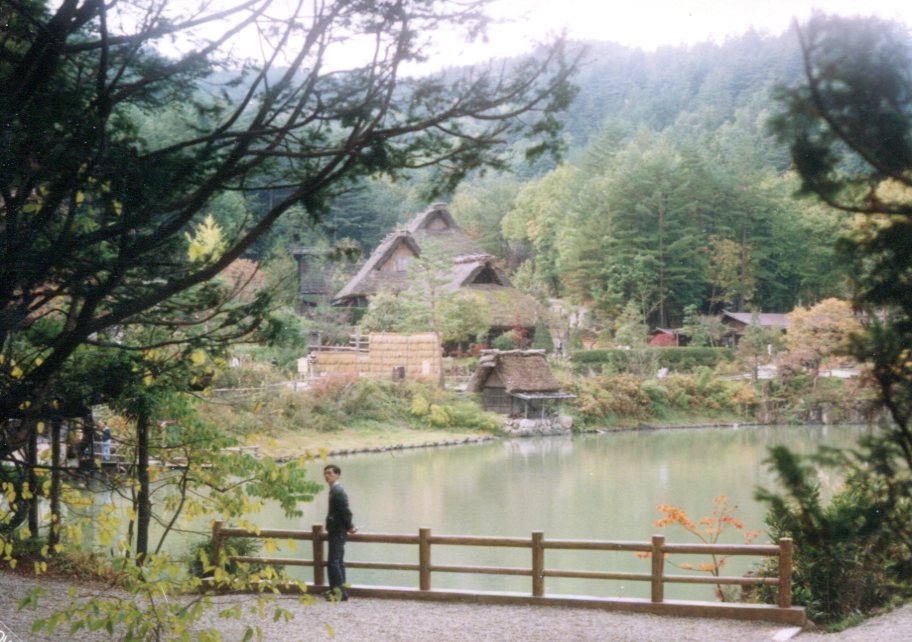
We also spent some time at the Hida Folk Village (飛騨民俗村), which is an open-air museum with about 30 farmhouses from this part of Japan.

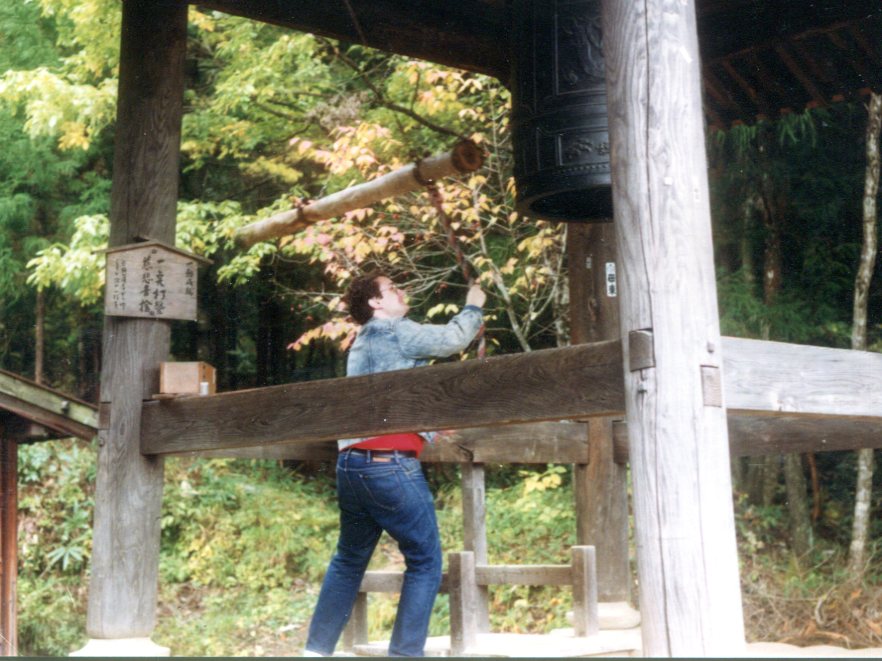
Hida Folk Village (飛騨民俗村)Hida Folk Village (飛騨民俗村)Complete with a bell to ring. Ring bells if you can.

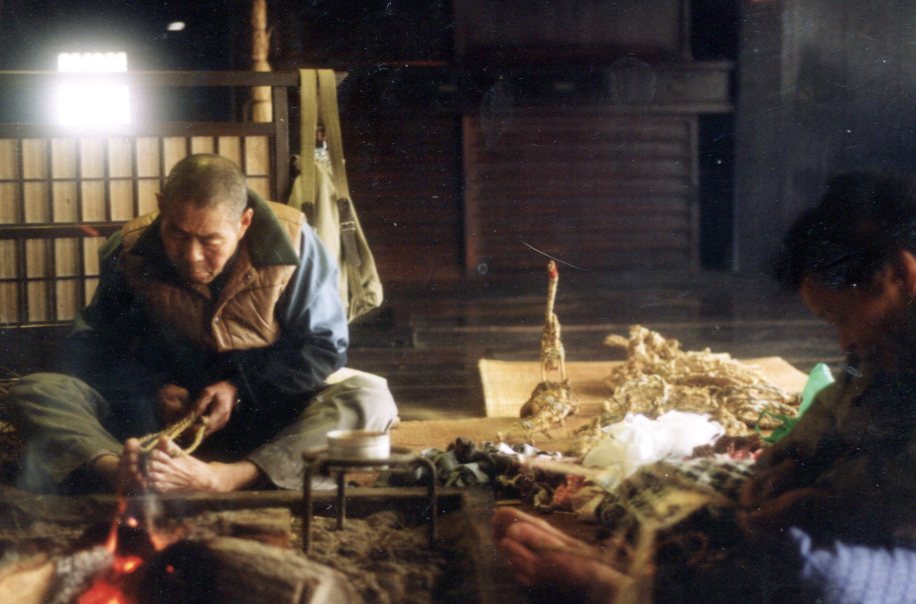
Hida Folk Village (飛騨民俗村) bell“We saw a man and a woman fashioning hemp sandals from stacks of cord,” I wrote. Here’s the man.
Hida Folk Village (飛騨民俗村)I don’t believe this was in the Folk Village.
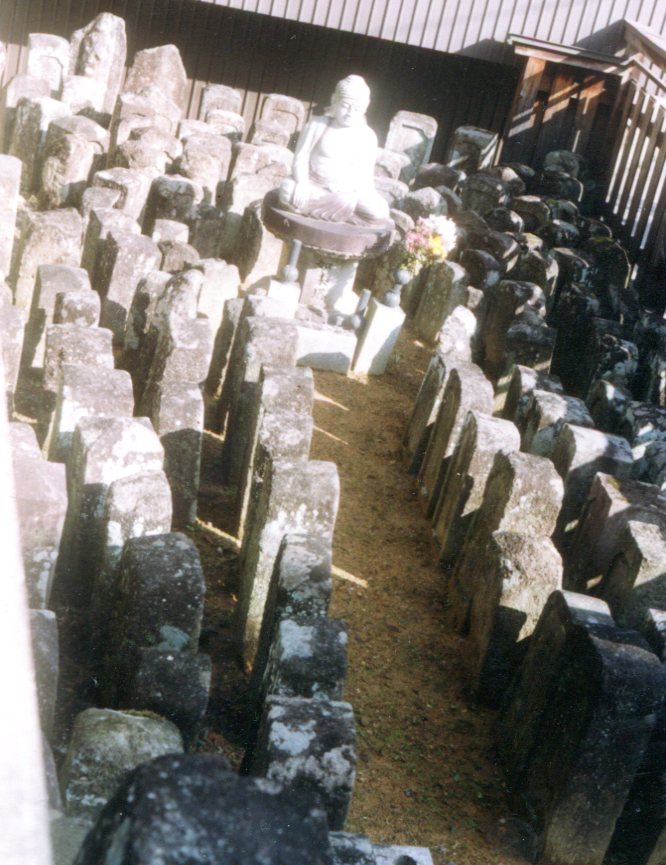
Cemetery, Hida-Takayama 1991Rather, it’s a good example of an urban Japanese cemetery. Since cremation is the norm in Japan, burial space isn’t necessary. Rather, the memorial stones can be fit into a tight space. In a city, even a small one like Takayama, that’s often an irregular or otherwise hard to develop plot of land.

Seaside, Florida 2007

Has it been 10 years since I roamed the New Urbanist streets of Seaside, Florida? It has. Did a whole week’s posting about it, including Seaside, Florida Part 1 and the Last Photo Series of Seaside. Hope the recent winds and rain didn’t cause the place too much harm.

I stayed in WaterColor during that visit, a newer planned community next to Seaside. So close, in fact, that it’s an easy walk between the two.

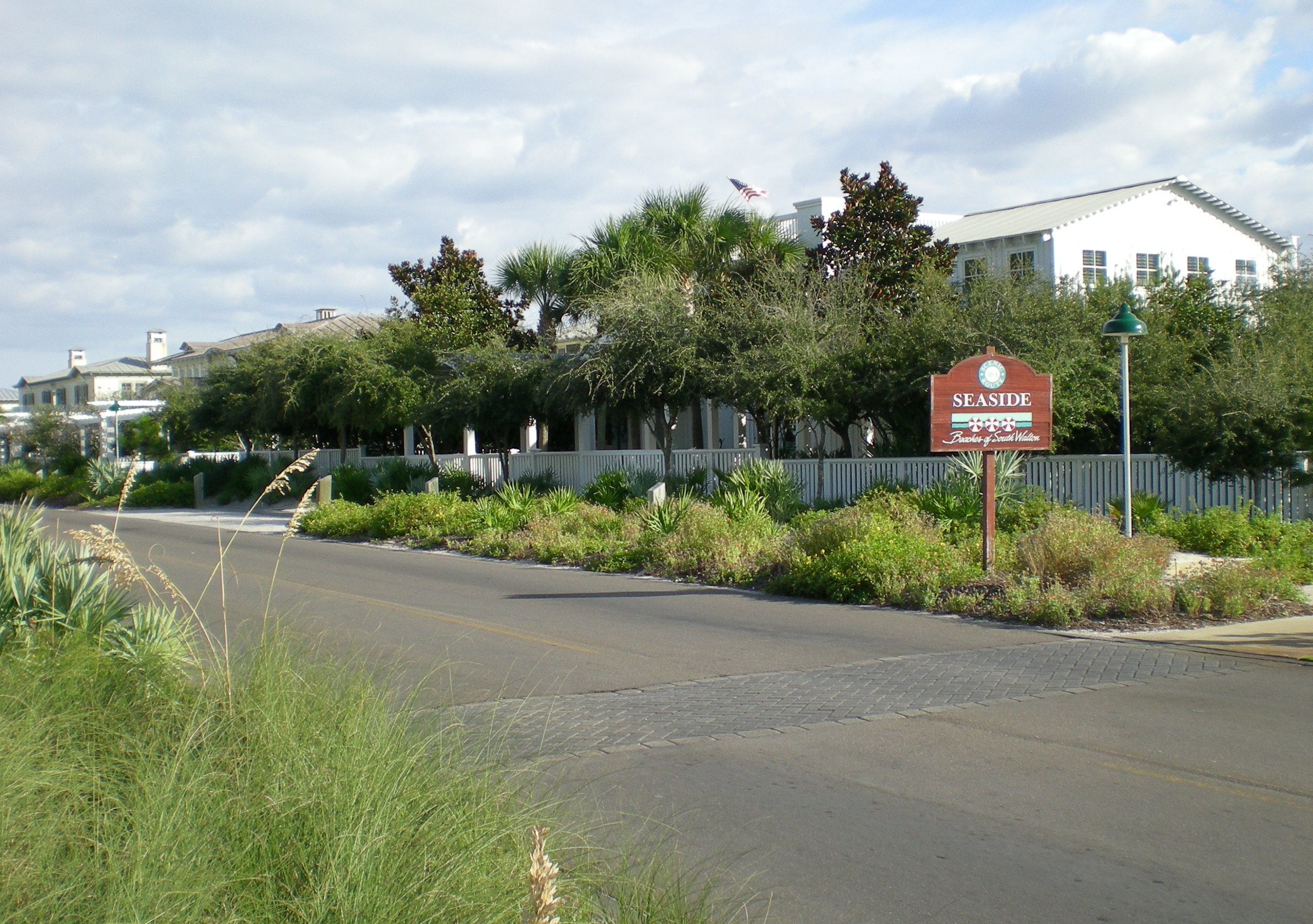
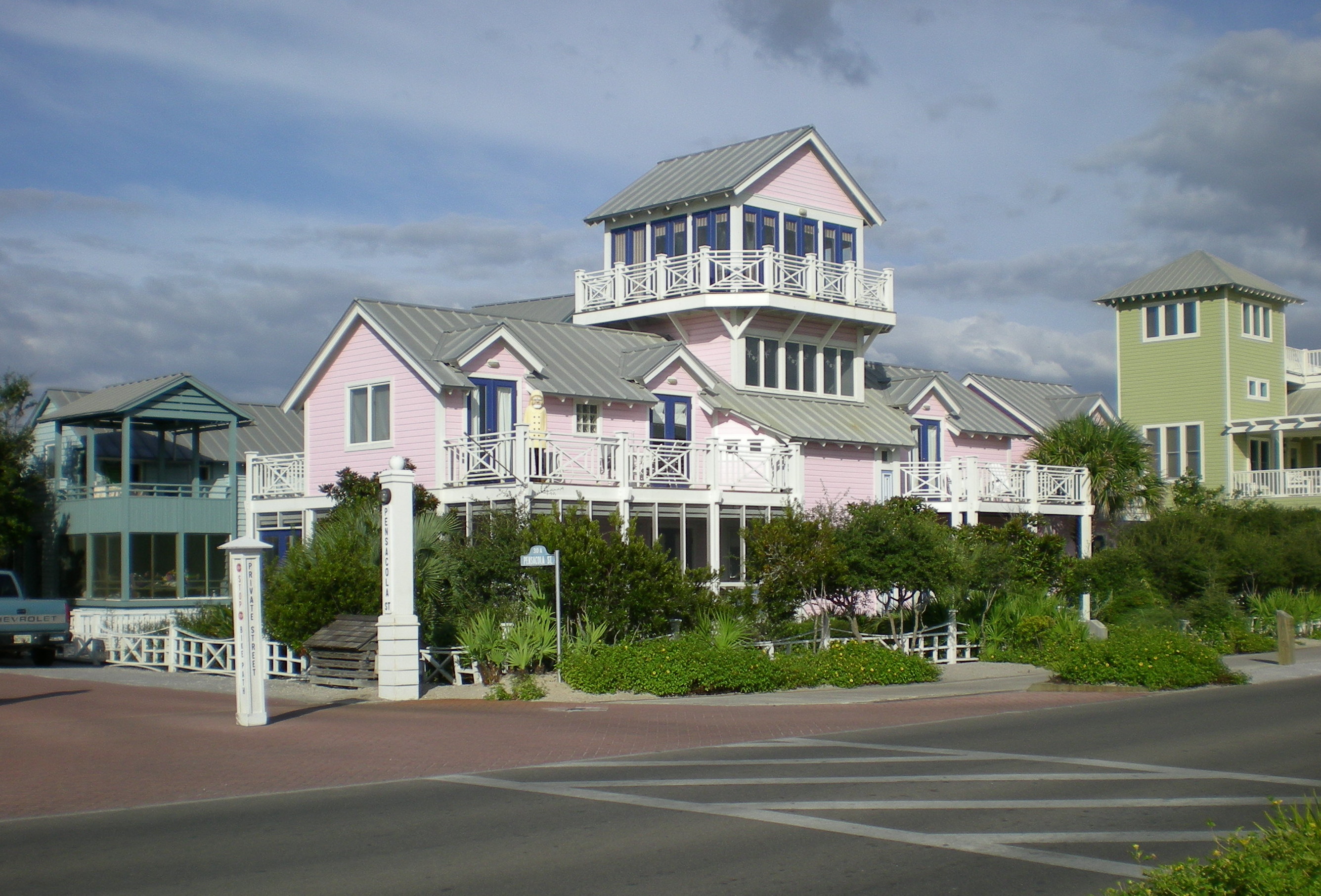
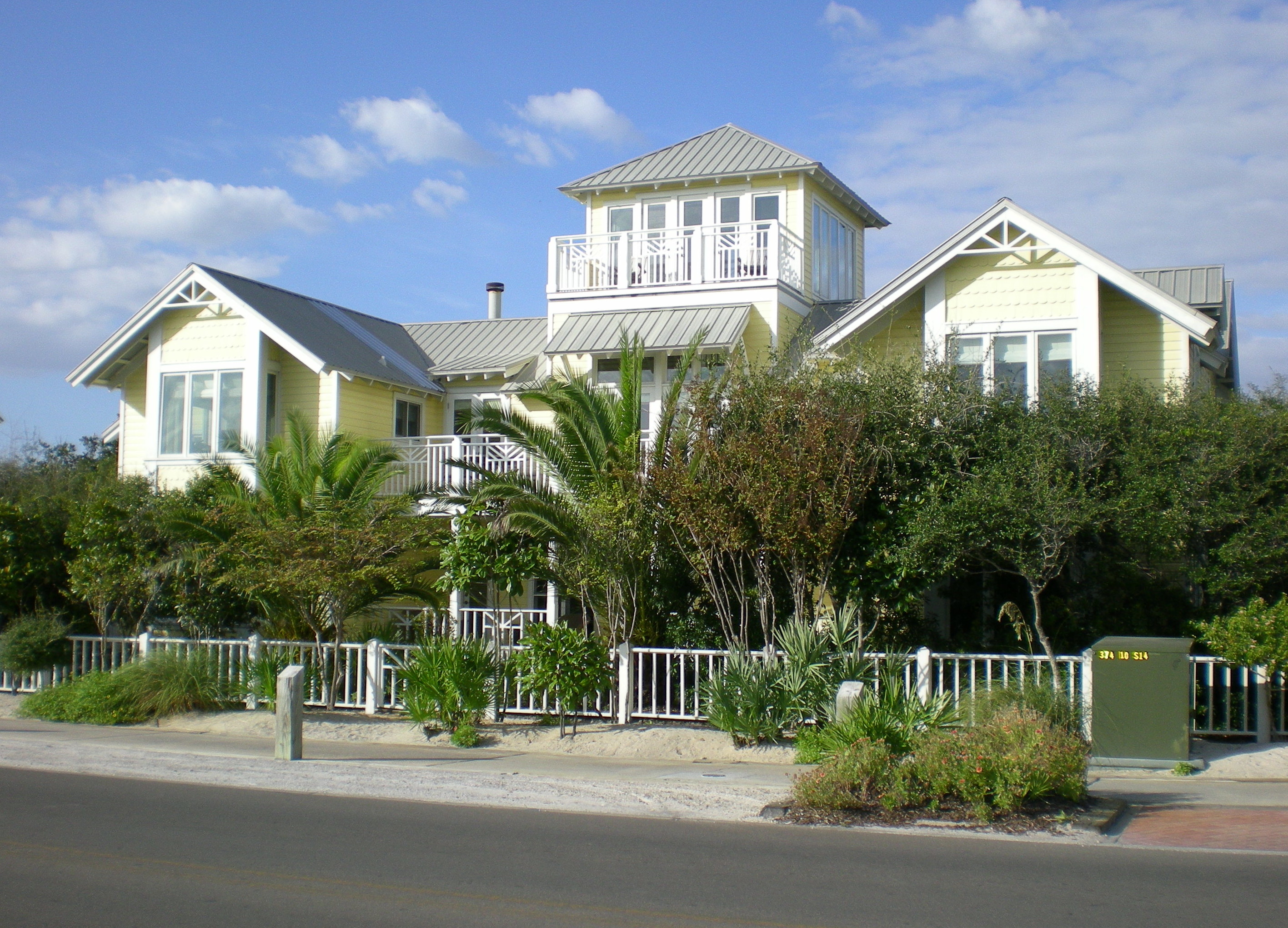
Near Sideside, FloridaSideside, FloridaAlmost immediately Seaside offered up pleasant buildings to look at. These were along County 30A, which ran between the town and the Gulf.

Sideside, Florida

Sideside, Florida

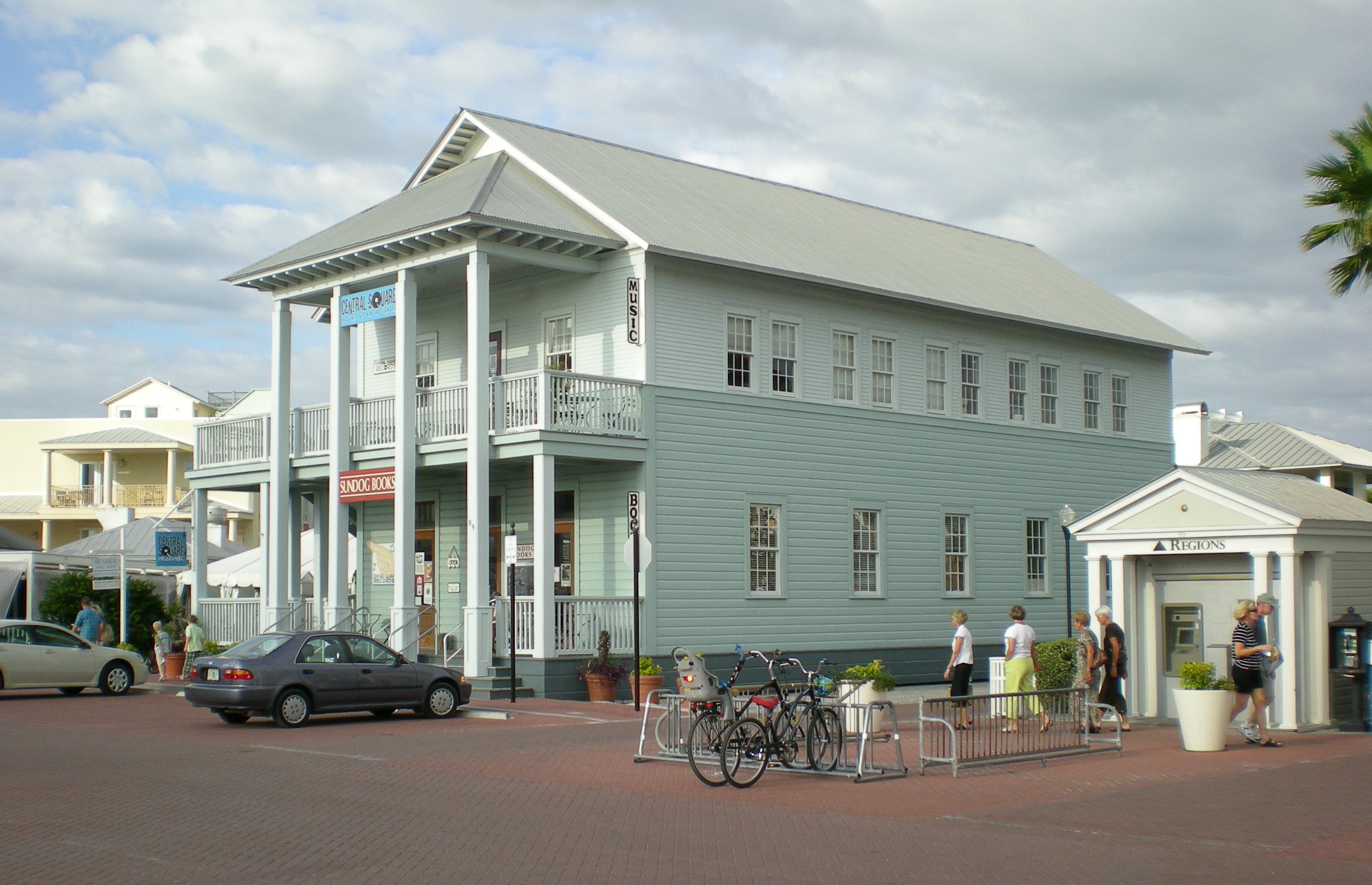
Other structures were further into the town. In this case, commercial.

Sideside, Florida

Near the beach.

Sideside, Florida

Water’s edge near Seaside.

Sideside, Florida

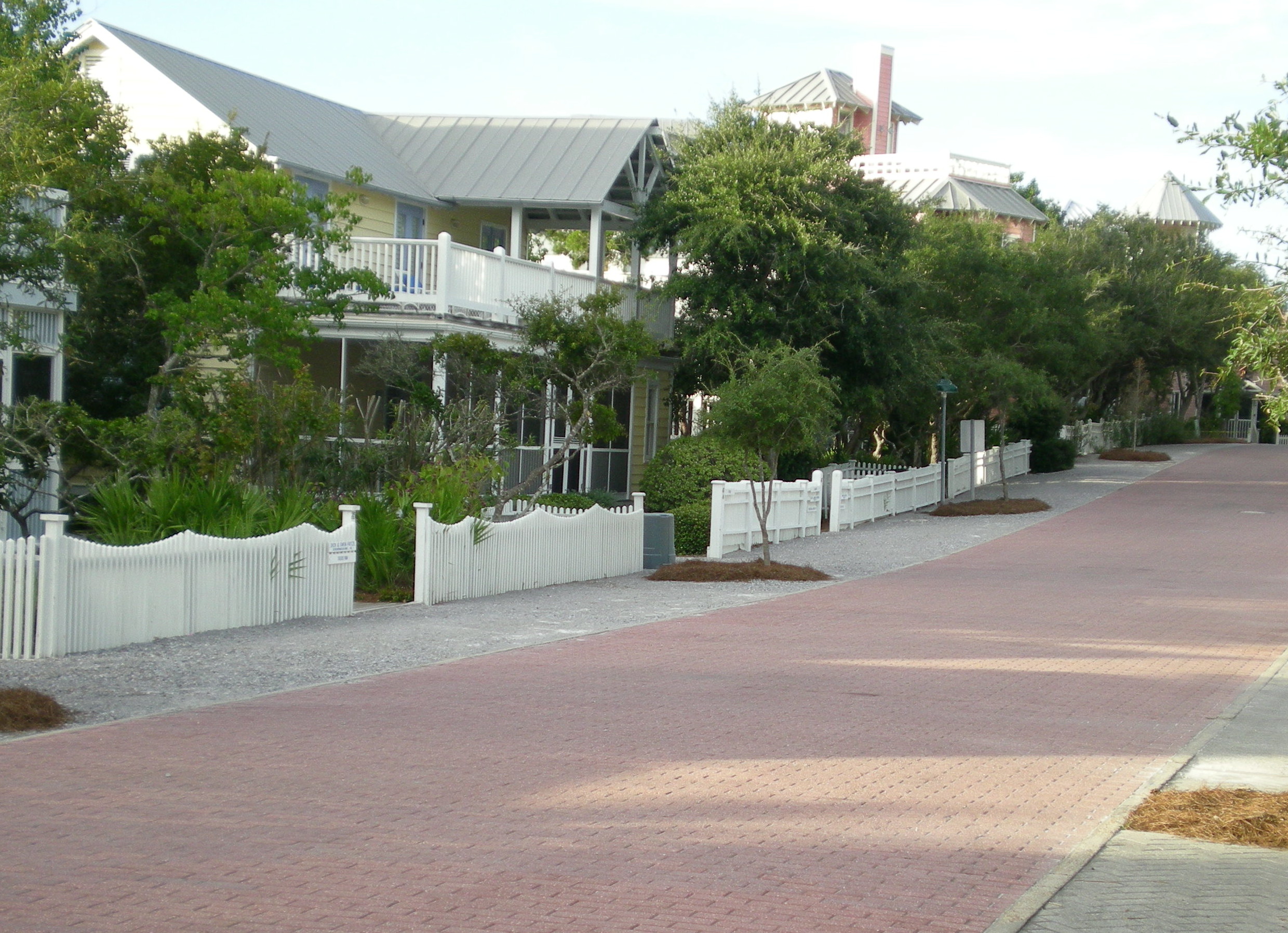
The easily walkable brick streets of Seaside.

Sideside, FloridaEasy mainly because there was no one else around. I wrote at the time that “I saw only one or two other pedestrians, a couple of bicyclists and one car drive by in the hour or so that I spent on the streets, looking at things and taking pictures.”

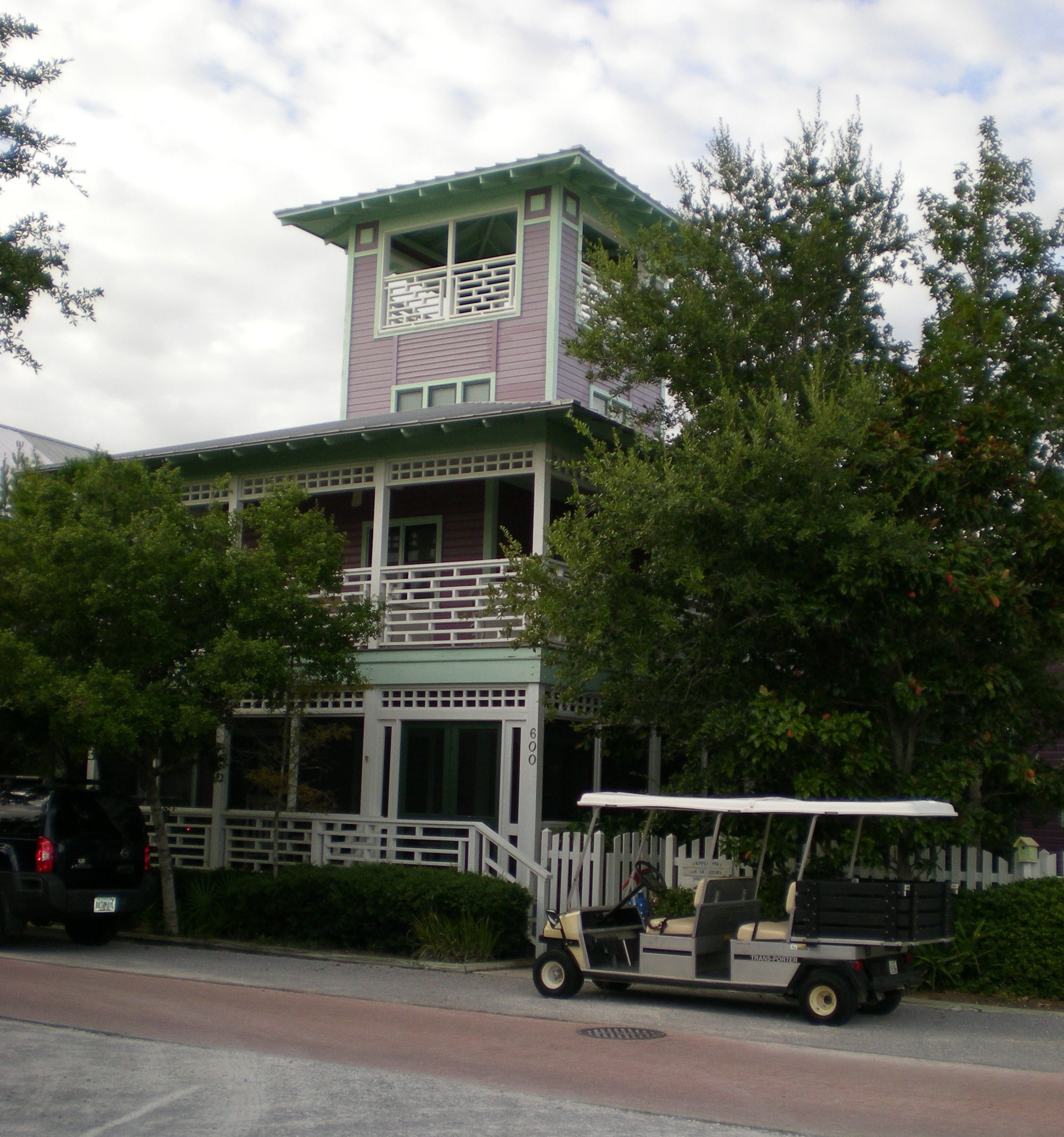
Even the golf carts were idle.
Sideside, FloridaThere’s no golf course around that I know of, but such carts would be a good way to get around a town this size. I expect things are a lot busier starting around November and finishing in around April. Perhaps only the die-hard Seasiders stay for the sticky summers and the thrill of hurricane season.

I took a close look — zoomed it on in — at the last picture and saw that the house’s name (Seaside houses have names) is Apple Pie A La Mode.